1. Introduction
Vibrancy, defined as the dynamic interplay between people and places, is a cornerstone of successful urban public spaces, critically shaping their social function and sustainability [
1,
2]. Esteemed urban theorists like Kevin Lynch and Jan Gehl have long championed vibrancy as a fundamental goal of urban design, emphasizing that it is ultimately driven by human presence and activity [
3,
4]. However, the environmental drivers contributing to urban coastal zone vitality remain uncertain due to unclarified spatial boundaries and the influences of diverse characteristics from surrounding contexts [
5]. In this study, we define Coastal Landscape Vibrancy (CLV) as the measurable intensity and quality of human-environmental interactions within coastal zones. We operationalize this concept through a multi-dimensional assessment framework that quantifies two primary dimensions: the Crowd Dimension, representing the real-time presence and intensity of human activity and visual characteristics of the landscape that attract and support such activity, and the Physical Place Elements, encompassing the urban features and natural attributes. Consequently, accurately assessing and enhancing vibrancy has become a central pursuit in urban studies and planning.
Coastal zones represent unique and critically important social–ecological systems [
6]. They are biodiversity hotspots and provide vital ecosystem services, yet they are also among the most intensively developed and ecologically fragile areas globally [
7]. The rapid processes of urbanization [
8], tourism expansion [
9], and climate change [
10] are exerting immense and often conflicting pressures on these landscapes. On one hand, there is a growing demand for vibrant, accessible, and attractive coastal spaces to support recreation, tourism, and community well-being. On the other hand, uncoordinated development to meet this demand can degrade the very ecological foundations—such as healthy habitats, stable shorelines, and good water quality—that sustain long-term human use and resilience. This creates a fundamental management dilemma: how to foster vibrant human communities and economies without compromising the ecological integrity that underpins coastal sustainability.
Current research on landscape vibrancy has extensively explored urban spaces [
11], rural public spaces [
12,
13], and street-level environments [
14]. These studies have employed methodologies ranging from traditional Analytic Hierarchy Process (AHP) [
15] to regression analysis and have identified a consistent set of influencing factors predominantly focused on the built environment, such as spatial accessibility, facility configuration, and land use [
11,
13,
14]. Notably, coastal landscapes, as vital and increasingly valued urban subspaces [
5,
16], have also garnered attention [
17]. Research here has begun to measure spatiotemporal vibrancy using emerging big data like Baidu heat maps and to evaluate factors in coastal parks and urban waterfronts, yet often through qualitative or limited quantitative lenses [
5,
18]. Baidu Heat Maps represent real-time spatial density of mobile device users, serving as a proxy for human activity intensity, and are not related to thermal temperature.
Despite these advancements, two significant research gaps persist. First, while the definition of vibrancy inherently combines ‘crowd’ (human activity) and ‘place’ (physical setting) [
4] empirical assessments frequently prioritize the material elements of ‘place’ (e.g., facilities, accessibility), thereby neglecting direct, dynamic measurements of ‘crowd’ activities [
15]. Second, and crucially, the prevailing focus on the built environment often overlooks the critical relationship between landscape vibrancy and ecological vulnerability. Coastal zones are quintessential “ecologically fragile zones” [
19], facing intense pressures from urbanization, habitat degradation, and climate change [
20,
21]. The potential trade-offs or synergies between fostering human vibrancy and maintaining ecological integrity in these sensitive areas remain poorly understood and rarely quantified [
22]. Failing to understand this relationship can lead to planning decisions that inadvertently promote short-term vibrancy at the cost of long-term ecological resilience, resulting in unsustainable coastal development, increased risk from coastal hazards, and the eventual decline of the very natural amenities that attract human activity [
23].
Emerging big data offer promising avenues to address the first gap. Baidu Heat Maps, for instance, provide real-time, spatiotemporal dynamics of population aggregation, offering a powerful proxy for human activity [
24,
25]. Similarly, Point of Interest (POI) data richly depict urban facility distribution and cultural vibrancy [
26,
27]. Beyond the built environment, other dimensions of ‘place’—namely natural characteristics (e.g., vegetation cover, bioabundance [
28,
29,
30]) and landscape visual experience (e.g., green view index, visual sensitivity [
31,
32,
33,
34])—have also been shown to influence vibrancy but are seldom integrated into a comprehensive assessment framework.
Therefore, this study moves beyond single-metric and built-environment-centric approaches. We propose a holistic, multi-dimensional framework for assessing Coastal Landscape Vibrancy (CLV), which integrates two primary dimensions: Crowd Activity, directly quantified through Baidu Heat Maps, and Place Characteristics, encompassing urban features (such as POI-based facility vibrancy and accessibility), natural attributes (including vegetation cover and bioabundance), and visual experience (e.g., green view index, slope sensitivity, and viewshed).
Furthermore, we directly address the second gap by employing a regression model to quantitatively analyze the influence mechanisms between a suite of coastal ecological vulnerability factors (e.g., shoreline erosion, habitat quality) and the derived CLV.
We select Beihai City, a renowned coastal tourist destination in China with a unique geography and abundant resources, as our case study. This research aims to answer the following key questions:
What are the spatiotemporal characteristics of coastal landscape vibrancy within the Beihai coastal zone?
What are the inherent influence mechanisms between coastal ecological vulnerability factors and coastal landscape vibrancy?
The findings will provide a nuanced understanding of coastal vibrancy, offering valuable insights for achieving a sustainable balance between vibrant human use and ecological conservation in coastal zone planning and management.
To empirically investigate these questions, we selected Beihai City, a prominent coastal tourist destination in Guangxi, China, as our case study. Beihai epitomizes the typical pressures faced by many coastal zones: rapid tourism expansion and urban development within an ecologically sensitive environment. Its long coastline, diverse landscapes, and status as a historic port on the Maritime Silk Road create a complex social–ecological system where the tensions and synergies between human activity and ecological integrity are acutely visible. This makes Beihai an ideal and representative setting for examining the interplay between coastal vibrancy and ecological vulnerability.
2. Materials and Methods
2.1. Study Area
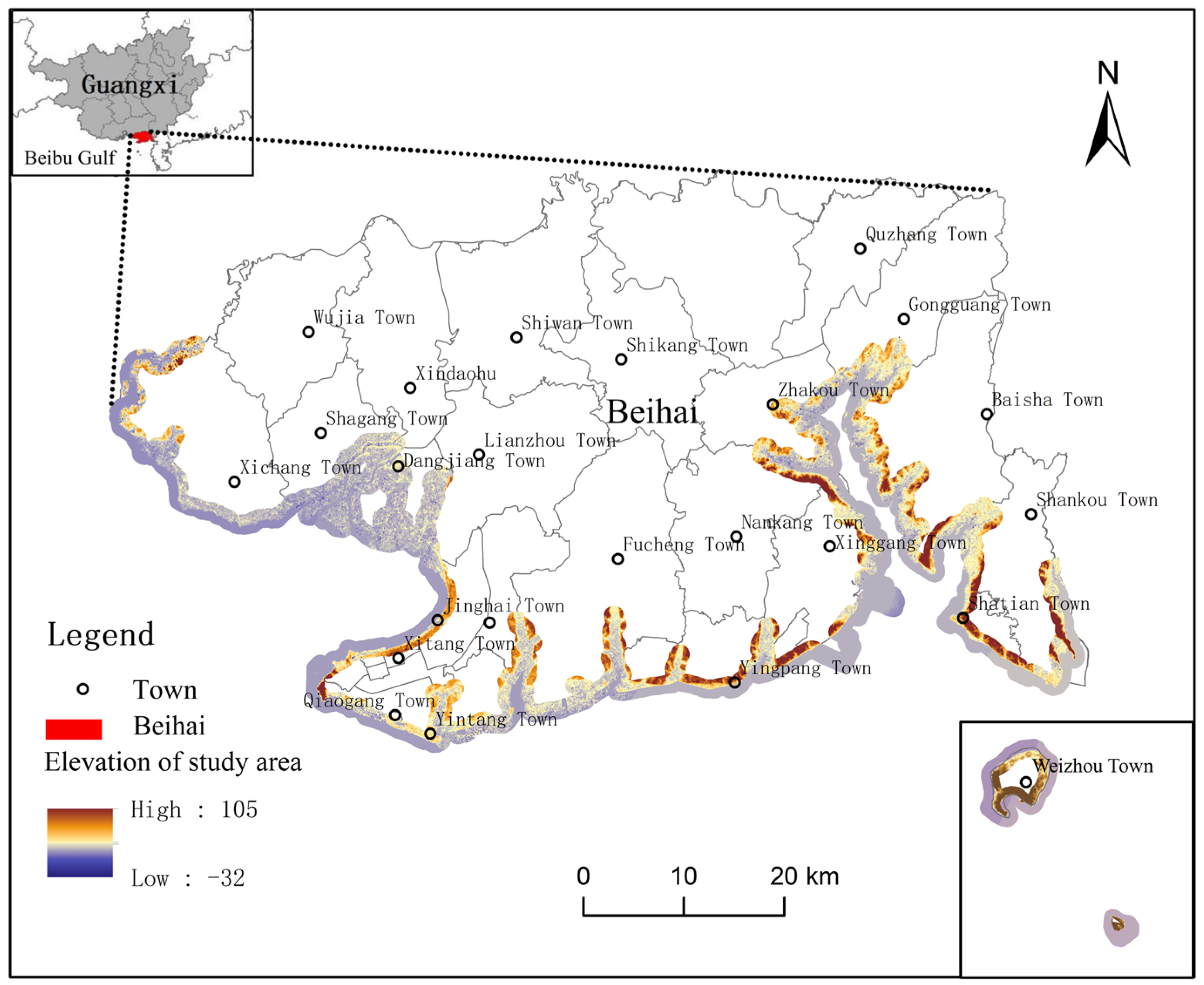
As introduced above, Beihai City (20°26′ N to 21°55′34″ N, 108°50′45″ E to 109°47′28″ E) is located at the southern end of the Guangxi Zhuang Autonomous Region on the northeast coast of the Beibu Gulf. Beihai City has a maritime monsoon climate with an annual average temperature of 22.9 °C and annual precipitation of 1670 mm. According to the 2021 Statistical Yearbook of Beihai City, the permanent population is 1.85 million, including 1.08 million urban residents and 0.78 million rural residents. Districts include Yinhai (0.32 million), Tieshangang (0.15 million), and Hepu County (0.86 million). Beihai was less affected by the COVID-19 pandemic; it received 41.2 million tourists in 2020, generating tourism revenue of 51.431 billion CNY. In 2021, tourist arrivals reached 54.795 million (a 33% year-on-year increase), with tourism consumption of 70.66 billion CNY (a 37.4% increase).
The topography is characterized by a general north-to-south elevation gradient, flat and open terrain, low altitude, and coastal plains. The city has a long coastline, extensive tidal flats, numerous sandy beaches and harbors, and vast shallow waters. Beihai’s rich tourism resources, historical significance as an ancient Maritime Silk Road port, and geography bordered by the sea on three sides make it an ideal case study for evaluating CLV. The highest elevation is at Guantouling in the west (
Figure 1). Weizhou and Xieyang Islands have higher elevations in the south and north, respectively, and are characterized by volcanic rock platforms.
2.2. Coastal Landscape Vibrancy (CLV) Assessment
2.2.1. Definition of the Coastal Zone and Conceptual Framework of CLV
According to the International Geosphere-Biosphere Program, the coastal zone encompasses both land and ocean components, though no universally standard definition exists [
35]. Many countries and regions integrate coastal management areas within 500 to 1000 m from the coastline [
36]. The coastline data used in this study were derived from Landsat 7 satellite imagery (30 m spatial resolution) for the year 2020, obtained through a shoreline extraction method and adjusted to the Mean High Water Line (MHW) based on local tidal data to maintain relative positional stability. On this basis, a 1000 m buffer zone was established in both landward and seaward directions, defining the coastal zone study area.
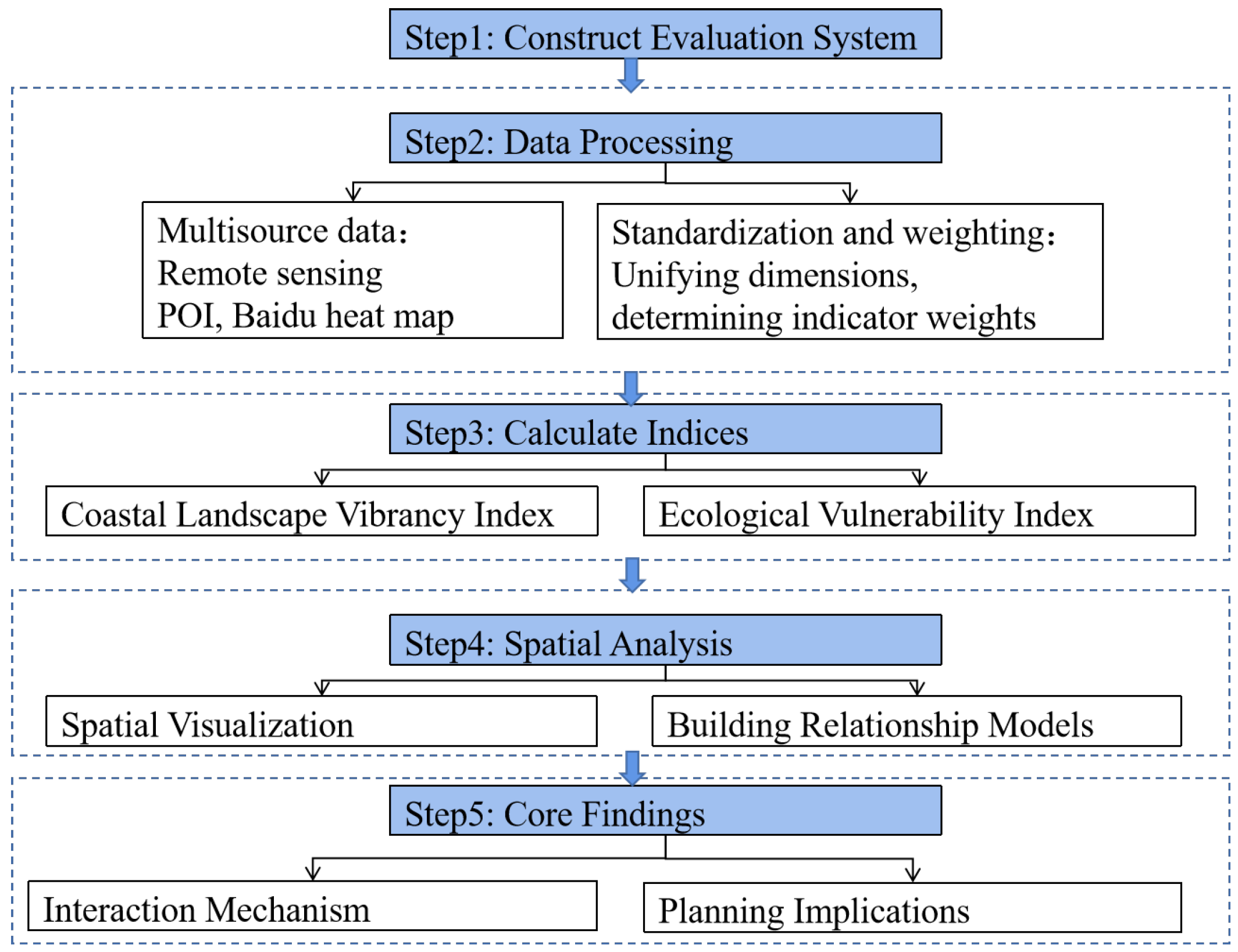
The overall analytical framework is presented in
Figure 2. Coastal Landscape Vibrancy (CLV) is conceptualized as a multi-dimensional phenomenon emerging from the dynamic interaction between human activities and the physical attributes of the coastal environment. Nine indicators were selected from the literature on coastal landscape vibrancy (
Table 1).
Table 2 showed the calculation method for each indicator. To capture this complexity, our evaluation framework is structured around two primary dimensions: the Crowd Dimension, representing the presence and intensity of human activity, and the Physical Place Elements, encapsulating the intrinsic characteristics of the landscape that attract and support such activity. Within this framework, we selected specific proxy indicators based on their theoretical relevance and empirical validity from established literature. The Human Dimension is directly quantified using Baidu Heat Maps, which provide a real-time, spatially explicit measure of crowd aggregation, serving as a robust proxy for actual human presence and intensity of use [
11]. The Physical Place Elements are further dissected into three facets: (1) Urban Character, represented by POI density (diversity and concentration of amenities) and accessibility (ease of reaching the location), which jointly capture the functional attractiveness and convenience of a place [
37]; (2) Natural Character, gauged by vegetation cover (NDVI) and bioabundance index, which reflect the ecological quality and natural appeal of the coastline [
28]; and (3) Visual Character, assessed through the green view index, slope sensitivity, and viewshed area, which together quantify the esthetic experience and visual permeability of the landscape, crucial for recreational satisfaction [
31,
32]. This comprehensive suite of indicators ensures a holistic measurement of CLV that moves beyond a sole focus on the built environment.
The selection of these nine specific indicators was guided by the need to comprehensively operationalize the three dimensions of CLV as defined. For the Crowd Dimension, the Baidu Heat Index was selected as a direct, real-time proxy for the intensity of human presence and aggregation, which is the core manifestation of vibrancy [
11]. For the Physical Place Elements, this was further disaggregated. Within the urban facet, POI density captures the diversity and concentration of amenities that support and attract activity [
37], while accessibility quantifies the ease of reaching a location, a fundamental precondition for use [
37]. To represent the Natural Character, vegetation cover (NDVI) and the bioabundance index were chosen as they reflect the foundational ecological quality and natural capital of the landscape, which underpin its long-term appeal and sustainability [
28]. Finally, for the visual experience facet, which bridges perception and place, the Green View Index (GVI) directly measures the perceived greenery from a human perspective [
32], slope sensitivity affects visual prominence and development suitability [
38], and the viewshed area quantifies visual openness, collectively capturing key esthetic attributes that influence attractiveness [
31,
39]. Each indicator thus serves to quantify a distinct aspect of the theoretical construct of coastal vibrancy.
2.2.2. Data Sources
The multi-dimensional assessment of Coastal Landscape Vibrancy (CLV) and Coastal Ecological Vulnerability (CEV) in this study relies on a synthesis of multi-source geospatial and statistical data. All datasets were selected for their relevance to capturing human activity dynamics, landscape characteristics, and ecological conditions within the Beihai coastal zone. The primary data sources, along with their acquisition years and primary uses in this study, are summarized below and in
Table 3.
2.2.3. Data Processing and Analysis Methods
The primary datasets for this study (Baidu Heatmaps and POIs) were collected in 2020. Although this period coincided with the global COVID-19 pandemic, which undoubtedly suppressed overall mobility, tourism in Beihai demonstrated relatively robust resilience, hosting 41.2 million domestic tourists that year. We acknowledge that the absolute values of vibrancy might be influenced, but the relative spatial patterns and mechanistic relationships between variables are robust and form the focus of this study.
We explicitly acknowledge that the primary data collection period for human activity (25–26 April 2020) occurred during a phase of significant disruption due to the global COVID-19 pandemic. This is a recognized limitation, as pandemic-related restrictions likely suppressed overall mobility and altered typical activity patterns. Consequently, the absolute levels of human activity captured by the Baidu Heat Index and the utilization of POI-related facilities during this specific snapshot are likely not representative of peak, pre-pandemic conditions. They may reflect a subdued baseline or patterns dominated by local, rather than tourist, activity. However, the core analytical objectives of this study are to (1) establish a methodological framework and (2) examine the relative spatial patterns of vibrancy and, crucially, the statistical relationships between the multi-dimensional CLV index and ecological vulnerability factors. We posit that while the pandemic may have scaled down absolute activity levels, the fundamental spatial logic—where activity concentrates (e.g., in accessible, well-serviced urban cores) and how it correlates with underlying ecological and infrastructural variables—is likely to remain valid. The pandemic context thus frames our findings as revealing the structure of coastal vibrancy under constrained conditions, highlighting its intrinsic drivers. The verification of these relationships with post-pandemic data is an important direction for future research, as noted in the limitations section. All spatial analyses, including georegistration, vectorization, kernel density estimation, cost-distance modeling, and viewshed analysis, were performed using ArcGIS Pro 3.1 (Esri, Redlands, CA, USA). All spatial datasets were uniformly projected to the WGS_1984_UTM_Zone_49N coordinate system for consistent analysis. The term ‘projected’ used hereafter refers to this specific transformation.
- (1)
Baidu Heat Intensity Data and POI Data Processing
Data were acquired via web scraping, including heat maps and POIs, offering large volume, real-time updates, and dynamic details representing human activity spatial relationships.
Baidu Heat Index: Data were collected on weekends (25–26 April 2020) from 8:00 to 20:00 at 2 h intervals (14 maps). BHI were georegistered to WGS84 and converted to vector data for GIS analysis. After vectorization, heat values were categorized 1–5; values 4 and 5 represented sub-heat and high-heat areas, indicating urban population aggregation [
46].
POI Data: 2020 POIs from Baidu Maps included 22 classes and 182 subcategories. Based on tourism elements (dining, accommodation, transportation, sightseeing, leisure, public facilities), we selected 6 classes and 63 subcategories. Using the Baidu Maps API, we retrieved all tourism-related POIs in Beihai (224,319 points). After filtering duplicates, 187,798 POIs remained: dining (15,219), accommodation (7916), transportation (2402), sightseeing (524), leisure (1409), public facilities (615) (
Table 4). Data were georegistered to WGS84 and a kernel density analysis was applied using a search radius of 500 m and an output cell size of 30 m to create a continuous surface representing POI density (number of POIs per square kilometer). The resulting raster was then clipped to the study area.
To construct the composite POI heat model, kernel density analysis (with the same parameters as above: 500 m search radius, 30 m output cell size) was first performed separately for each of the five POI categories (restaurants, accommodations, transportation, sightseeing, leisure), resulting in five distinct density rasters. Each raster represented the spatial concentration of a specific facility type (in points per km
2). Subsequently, all five density rasters were standardized (Z-score normalization). Principal Component Analysis (PCA) was then applied to these standardized layers to derive objective weights for each category (
Table 3). Finally, the composite ‘POI heat index’ raster was generated by calculating the weighted sum of the five standardized density rasters according to the PCA-derived weights. A coastal
POI heat model was constructed using five 2020 indicators: restaurants (
R), accommodations (
A), transportation (
T), sightseeing (
S), leisure (
L):
These indicators were normalized. Principal Component Analysis (PCA) was conducted using IBM SPSS 19.0 to obtain weights for each factor (
Table 5). The Kaiser–Meyer–Olkin (KMO) value was 0.755 (>0.5) and the sphericity test showed
p < 0.05, indicating suitability for PCA. Two principal components were extracted, with a cumulative variance explained of 86.612%.
- (2)
Coastal Landscape Accessibility
Accessibility quantifies the ability to overcome barriers (distance, time, cost) to reach service facilities. Cost-distance analysis was applied, with Beihai Railway Station as the center (2000 m buffer). Costs were assigned to road types, waterbodies, slopes, and undulations (
Table 6). GIS “cost distance” tool generated the accessibility raster.
2.2.4. PCA Integration and Weighting for CLV Index and CEV Index
The Coastal Landscape Vibrancy (CLV) index is calculated as a composite score derived from the weighted summation of nine standardized indicators across four dimensions: ‘Crowd Dimension’ (Baidu Heat Index), ‘Urban Character’ (POI density, accessibility), ‘Natural Character’ (vegetation coverage, bioabundance), and ‘Visual Character’ (green view rate, relative distance, slope sensitivity, viewshed). Objective weights for these indicators were determined using Principal Component Analysis (PCA). The calculation formula is as follows:
where
is the composite vibrancy index for the
spatial unit,
the weight of the
indicator obtained through PCA, and
the standardized value (Z-score) of the
indicator for that unit. Thus,
CLV is a dimensionless composite relative index. Its value indicates the level of vibrancy of an area relative to the study area’s average (positive values denote above-average vibrancy; negative values denote below-average vibrancy). It is not a direct measure of population density, but rather a comprehensive metric that integrates multiple dimensions—human activity intensity, facility provision, natural endowment, and visual landscape—to systematically assess and compare the vibrancy of different coastal zone units.
- (1)
Model Data Validation Methods
KMO Test: Evaluates variable correlation for factor suitability.
Values near 1 indicate better factor analysis. Sphericity Test (Bartlett’s test): Tests if the covariance matrix is an identity matrix. p < 0.05 indicates suitability for factor analysis.
- (2)
Data Standardization
All continuous variables—including the five POI category density rasters, Baidu Heat Index values, accessibility scores, and all ecological and visual indicators—were standardized using Z-score normalization prior to further analysis. The formula applied was z = (x − μ)/σ, where μ is the mean, and σ is the standard deviation. This approach ensures comparability across indicators with different units and scales.
- (3)
Principal Component Analysis (PCA) for Objective Weighting
To derive objective, data-driven weights for integrating multiple indicators—first for the five POI categories and subsequently for the nine composite CLV dimensions—we employed Principal Component Analysis (PCA). PCA is a dimensionality reduction technique that transforms a set of possibly correlated variables into a set of linearly uncorrelated principal components, ordered by the amount of variance they explain from the original data. Its primary goal in this context was to assign weights based on the statistical structure of the data, thereby avoiding the subjectivity inherent in expert-based weighting methods like AHP. This data-driven approach was preferred over subjective weighting methods (e.g., Analytic Hierarchy Process) to minimize expert bias and to allow the weights to be derived directly from the inherent statistical structure of the dataset itself [
47]. It is important to clarify that the primary purpose of employing PCA in this study was not to define or validate the theoretical dimensions of CLV (which are established a priori based on literature), but rather to serve two practical objectives within the established framework: (1) to mitigate potential multicollinearity among correlated indicators (e.g., between Baidu Heat Index and POI density), and (2) to derive an objective, statistically grounded weighting scheme for constructing a composite CLV index. The theoretical interpretation of CLV remains rooted in the integrated ‘Crowd’ and ‘Place’ dimensions, while PCA provides a transparent method for data reduction and index synthesis.
Diagnostic Tests for Suitability: Prior to performing PCA, we assessed whether the correlation matrix of the variables was appropriate for structure detection and information compression. To this end, we utilized two diagnostic measures traditionally associated with, but not exclusive to, factor analysis:
The Kaiser-Meyer-Olkin (KMO) measure of sampling adequacy, which quantifies the proportion of variance among variables that might be common variance. A KMO value > 0.5 is generally considered acceptable.
Bartlett’s test of sphericity, which tests the null hypothesis that the variables in the population correlation matrix are uncorrelated. A significant test result (p < 0.05) suggests that correlations exist and thus dimensionality reduction is warranted.
PCA reduces the multidimensionality of the data by transforming the original correlated variables into a set of uncorrelated principal components (PCs), which are weighted by their respective variances (eigenvalues). The weights for each indicator are then calculated based on their loadings on the significant components and the proportion of variance each component explains, ensuring that indicators contributing more to the overall variance in the dataset receive a higher weight in the final index. While the resulting components are statistically orthogonal, they may conflate elements from different theoretical dimensions (e.g., mixing ‘Crowd’ and ‘Place’ indicators). This is an acknowledged characteristic of the data-driven PCA approach and does not invalidate the composite index for subsequent correlational analysis. The composite CLV index is interpreted as an overall measure of observed vibrancy, whose relationship with ecological factors is the focus of investigation.
We determined the weights of each vibrancy indicator through Principal Component Analysis (PCA) using IBM SPSS. The calculation of weights (
) for the i-th indicator from the component loadings (
) and the eigenvalues (
) of the retained principal components was performed as follows:
where
is the eigenvalue of the j-th principal component,
is the loading of the i-th indicator on the j-th principal component,
m is the number of retained principal components (with eigenvalues > 1),
n is the total number of indicators.
This approach ensures that the weights reflect both the loading of each variable on the principal components and the proportion of variance explained by each component, providing a statistically robust weighting scheme for the composite vibrancy index.
2.3. Rationale for SRP Model Selection
Coastal zones, functioning as critical ecotones between terrestrial and marine ecosystems, represent archetypal ecologically fragile systems under intense anthropogenic and natural pressures [
19]. Accurately assessing ecological vulnerability—defined here as the degree to which a coastal system is susceptible to harm due to external stressors—is essential for guiding sustainable landscape development.
Multiple conceptual frameworks exist for vulnerability assessment, each with distinct strengths and limitations (
Table 7). The IPCC Framework offers a standardized, globally recognized structure centered on exposure, sensitivity, and adaptive capacity, making it suitable for large-scale and comparative studies [
48]. However, its broad scope often lacks the resolution to integrate localized socio-economic drivers and complex ecosystem feedbacks, limiting its utility for regional management applications [
45]. The Coastal Vulnerability Index (CVI), pioneered by Gornitz [
49], provides a straightforward, computationally simple approach effective for geophysical hazards like erosion and flooding. Its primary drawback lies in its reliance on relative scores, which constrain cross-regional comparability and often overlook critical ecological and human dimensions [
50]. The Pressure-State-Response (PSR) model excels in framing environmental issues within a causal chain, making it valuable for policy-oriented assessments [
51]. Nevertheless, its indicator sets can suffer from overlap and subjectivity in weighting, potentially introducing redundancy into the evaluation [
52].
Given these considerations, the Sensitivity-Resilience-Pressure (SRP) model was selected as the most appropriate framework for this study. While models such as the PSR offer a more detailed causal chain, the SRP model’s tripartite structure provides a more direct and analytically tractable representation of the key system dynamics in the Beihai coastal zone. Its focus on internal system properties (Sensitivity, Resilience) and external forcing (Pressure) aligns closely with our research goal of diagnosing the interaction between ecological vulnerability and human-induced vibrancy. This structure effectively captures the system’s innate susceptibility, its capacity to buffer disturbances, and the anthropogenic stresses it faces, providing a clear and actionable lens for spatial planning without the added complexity of distinguishing between ‘state’ and ‘impact’ or ‘driving forces’ that may overlap conceptually in our context.
The SRP model moves beyond a hazard-centric view to conceptualize vulnerability as an emergent property of three interconnected components: internal Sensitivity, the system’s innate Resilience, and external Pressure. This structure is particularly well-suited for several reasons:
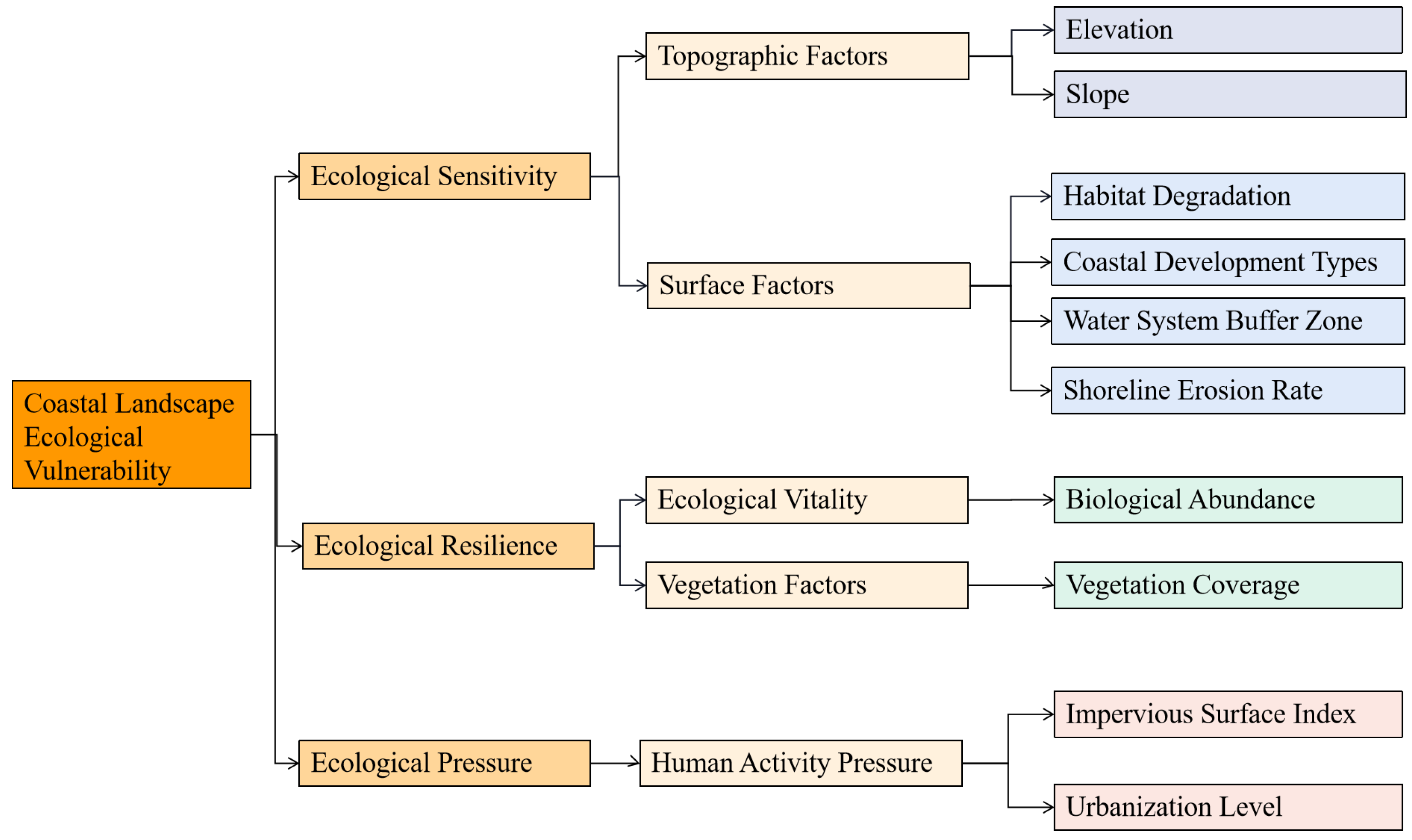
Holistic System Representation: The SRP model explicitly integrates natural ecosystem properties (e.g., bioabundance, vegetation cover) with anthropogenic pressures (e.g., impervious surfaces, nighttime lights). Note that ‘bioabundance’ herein refers to organism quantity or biomass density derived from land cover composites, distinct from ‘biodiversity,’ which pertains to species diversity. This aligns perfectly with our study’s goal of analyzing the interplay between human activity (vibrancy) and ecological vulnerability. Functional Relevance to Coastal Dynamics: The model effectively captures the defining characteristics of the Beihai coastal zone. Sensitivity encapsulates the system’s innate susceptibility to threats like habitat degradation and erosion. Resilience quantifies the capacity of mangroves and other vegetation to buffer disturbances and maintain functionality. Pressure directly measures the anthropogenic stress from urbanization and infrastructure development.
Analytical Compatibility: The SRP framework facilitates the use of objective statistical methods, such as Principal Component Analysis (PCA), to derive component weights, thereby mitigating the subjectivity that can plague other models like the PSR [
53]. This objectivity is crucial for ensuring the robustness of our subsequent analysis of the vulnerability-vibrancy relationship. In conclusion, while each model offers valuable insights, the SRP framework provides the most comprehensive and functionally relevant structure for assessing the ecological vulnerability of a complex social–ecological system like the Beihai coast. Its tripartite structure allows us to deconstruct vulnerability into mechanistically meaningful components, thereby offering a powerful explanatory lens through which to evaluate its interaction with coastal landscape vibrancy. The calculation methods for each indicator are shown in
Table 8 (see also
Figure 3 for a conceptual overview of the indicator framework). Within the Pressure (P) component, anthropogenic influences were captured by the Normalized Difference Impervious Surface Index (NDISI), which quantifies the extent of impervious surfaces such as roads and buildings, and the Nighttime Light Index (NTL), a proxy for economic activity and urbanization intensity.
Calculation of the Composite Coastal Ecological Vulnerability (CEV) Index:
The composite CEV index was constructed by integrating the standardized values of the indicators listed in
Table 8. Crucially, to maintain objectivity and consistency with the CLV assessment, the weighting of these indicators within their respective SRP components (Sensitivity, Resilience, Pressure) was not based on subjective expert scoring. Instead, we employed the same data-driven Principal Component Analysis (PCA) methodology described in detail in
Section 2.2.4 (“PCA Integration and Weighting for CLV Index and CEV Index”). This approach derives objective weights from the statistical structure of the dataset itself, ensuring that indicators contributing more to the overall variance receive proportionally higher weight in the final composite index, thereby enhancing the robustness and replicability of the assessment.
2.4. Statistical Analysis: Regression of CLV vs. CEV Factors
To quantify the influence of ecological vulnerability factors on Coastal Landscape Vibrancy (CLV), a multiple linear regression model was developed. The dependent variable was the composite CLV index, obtained through PCA-weighted integration of all dimensions. Independent variables comprised ten ecological and environmental factors selected within the Sensitivity-Resilience-Pressure (SRP) framework.
All variables were standardized using Z-scores to eliminate scale effects and enable direct comparison of standardized regression coefficients (β). The regression model takes the form:
where
CLV represents the standardized composite vibrancy index,
β0 is the intercept,
β1,
β2, …,
βn denote the standardized coefficients for predictors
X1,
X2, …,
Xn, and
ε is the error term.
The model was fitted using ordinary least squares (OLS) in IBM SPSS Statistics 27. Overall significance was evaluated with an F-test, and explanatory power was assessed using R2 and adjusted R2.
2.5. Assumption Checks and Model Diagnostics
To ensure model validity, the following diagnostics were performed:
Multicollinearity: Assessed using Variance Inflation Factor (VIF) and tolerance. VIF > 10 (tolerance < 0.1) indicated severe multicollinearity, leading to variable removal or combination.
Normality of Residuals: Evaluated via quantile-quantile (Q–Q) and the Kolmogorov–Smirnov test. The model is robust to slight non-normality, but major deviations were examined.
Homoscedasticity: Tested with the Breusch–Pagan test. If heteroscedasticity was detected, robust standard errors were applied.
Spatial Autocorrelation: Given the spatial structure of the data, we conducted a Global Moran’s I test on the regression residuals using the spatial statistics tools in ArcGIS Pro 3.1 to detect spatial autocorrelation. A significant test result (p < 0.05) would indicate the need to consider employing spatial regression models (such as Spatial Lag or Spatial Error models) for adjustment.
Significant spatial autocorrelation (p < 0.05) would suggest the need for spatial regression models (e.g., Spatial Lag or Error models).
Results of these diagnostics are reported alongside final coefficients to confirm model reliability.
2.6. Map Classification and Visualization
To illustrate spatial patterns, continuous indicators (e.g., average thermal grade, POI density, accessibility cost) were converted into classified maps within the GIS environment. A consistent classification scheme was applied, using Jenks’ natural breaks method to divide the values into five classes. This method identifies inherent groupings in the data by minimizing variance within classes and maximizing variance between classes, making it suitable for visualizing geographically distributed data that often exhibits non-uniform patterns.
3. Results
3.1. Analysis of CLV on Weekends
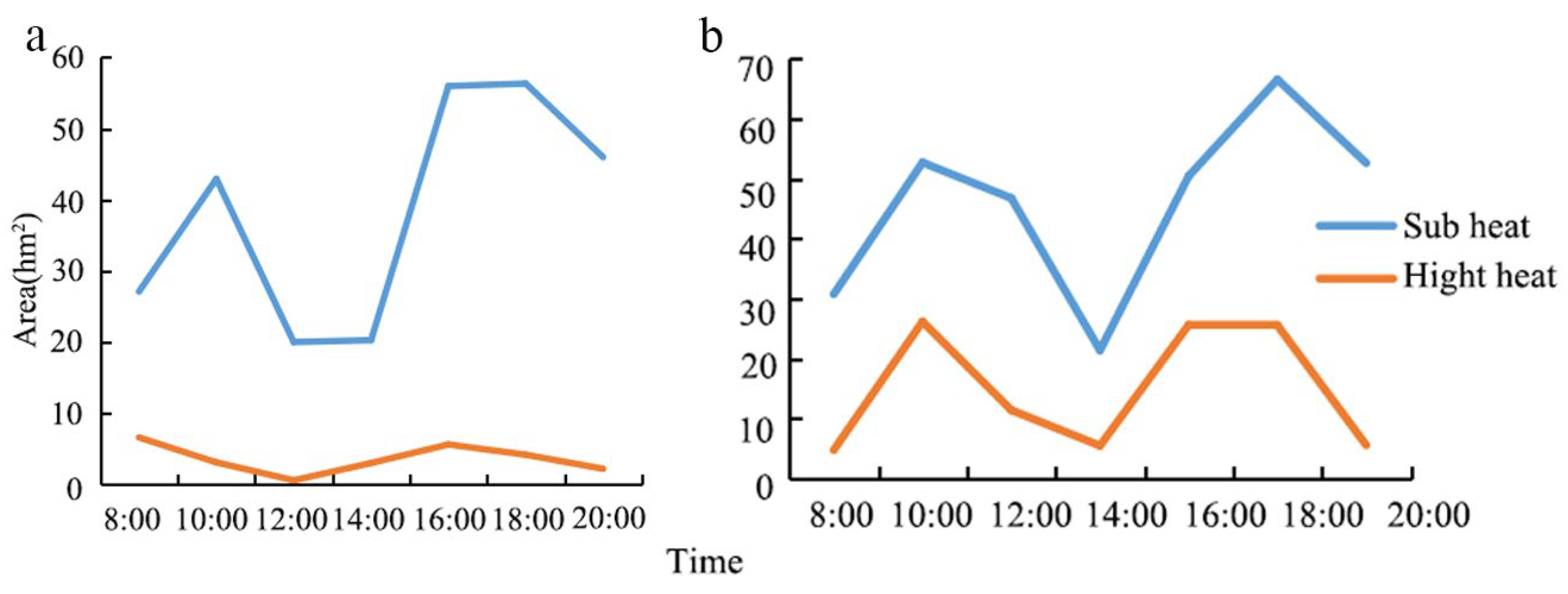
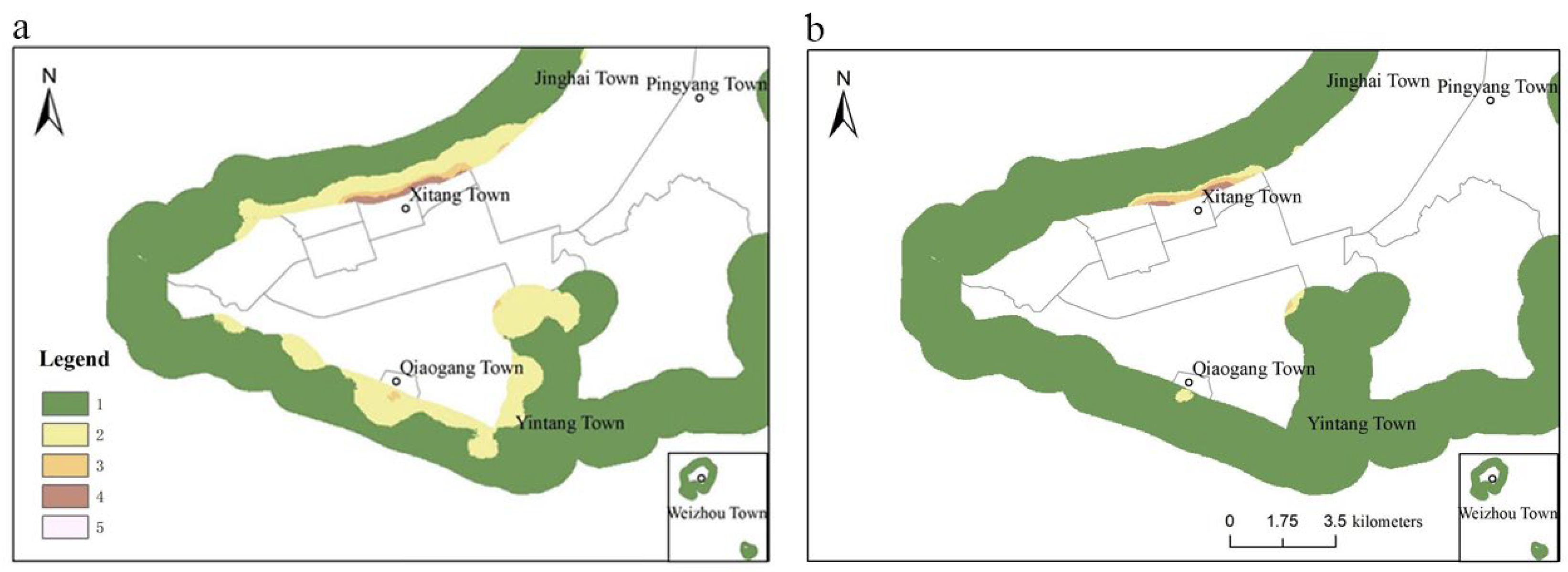
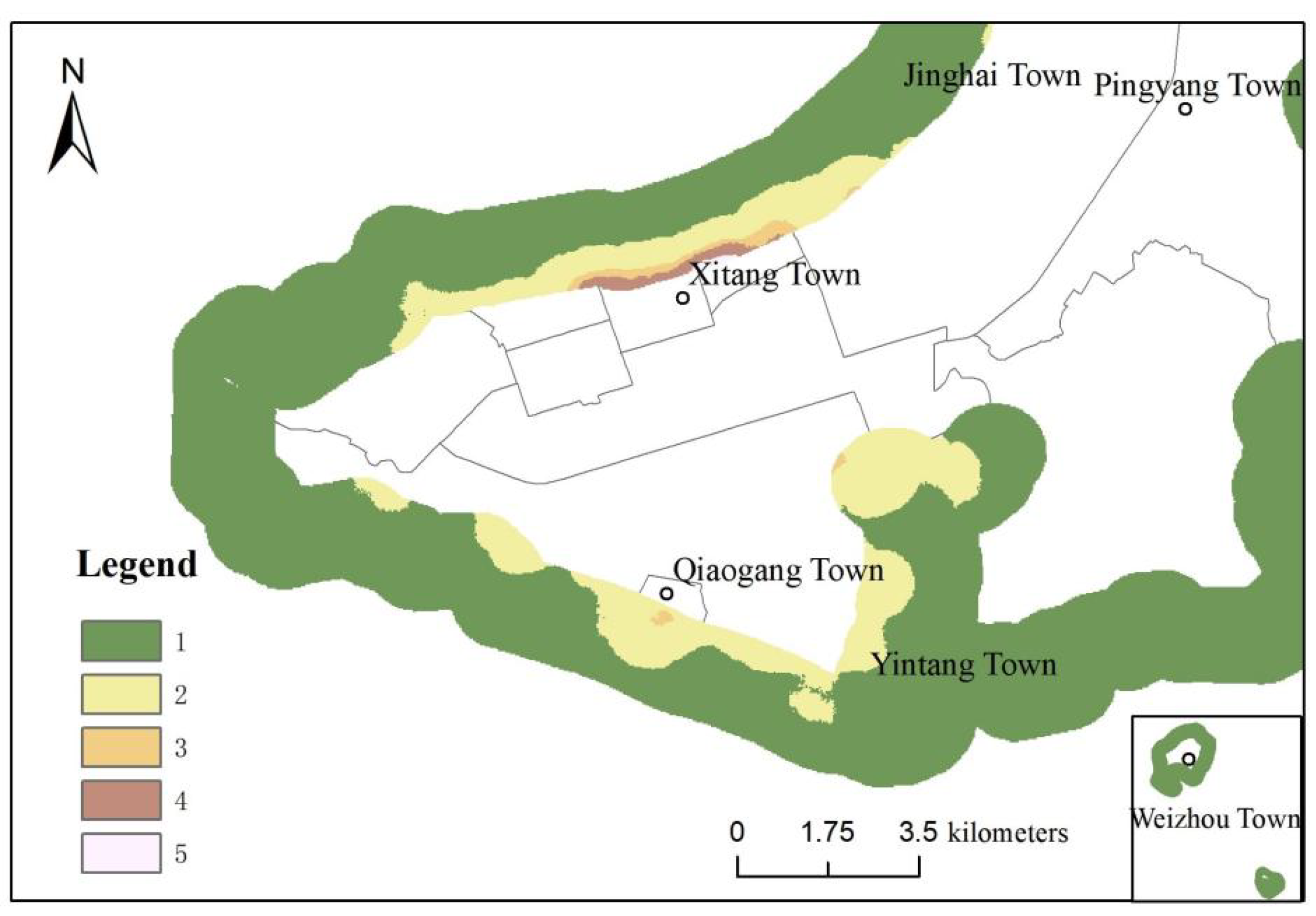
High-heat areas were observed primarily at 8:00 and 16:00, indicating morning and late afternoon gathering periods, likely corresponding to the start of leisure activities and peak tourist visits (
Figure 4a). High-heat areas decreased from 8:00 to 12:00 (potentially due to dispersal for indoor activities during warmer hours), increased from 12:00 to 16:00 (peak afternoon outdoor activities), and decreased again from 16:00 to 20:00. Moderate heat areas showed a similar bimodal pattern, reinforcing that coastal vibrancy is highly time-sensitive and driven by recreational rhythms. The population was primarily concentrated in urban areas, especially Xitang Town, where CLV is highest, followed by Qiaogang Town (
Figure 5a).
3.2. Analysis of CLV on Weekdays
Locations with higher heat levels were consistent with weekends, with Xitang Town remaining the most vibrant area, suggesting the spatial pattern is structurally embedded (
Figure 4b). However, overall vibrancy intensity was significantly lower on weekdays (
Table 9,
Figure 5b), with smaller high-heat areas, underscoring the dominance of tourism and leisure, with weekday usage likely limited to locals.
3.3. CLV Characteristics Based on Baidu Heat Map
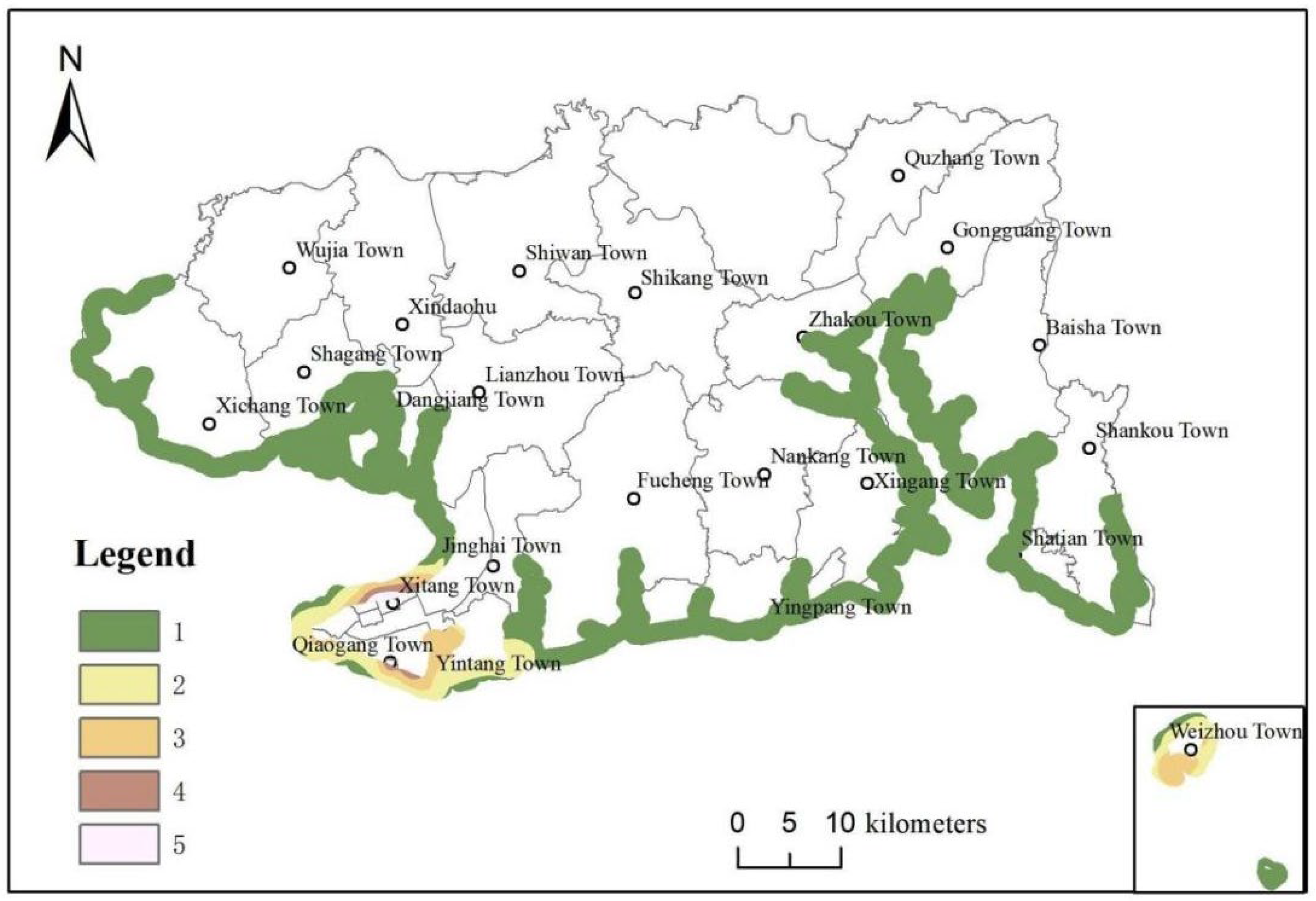
Synthesized data showed overall vibrancy is relatively low and highly unevenly distributed (
Figure 6,
Table 10). Except for the core urban areas of Xitang and Qiaogang Towns (hosting major attractions like Beihai Underwater World), most coastline exhibits low human activity, indicating significant underutilization and a lack of attractive facilities or points of interest.
3.4. Characteristics of CLV Based on POI Density
POI density distribution reveals a critical bottleneck (
Table 11,
Figure 7). High and very high POI heat areas are extremely concentrated (<1% of total coast). 84.85% classified as “very low” indicates a severe scarcity of service facilities (dining, accommodation, leisure), aligning with reports of inadequate infrastructure in Beihai’s tourist areas [
63] and explaining low human activity in these regions. Vibrancy depends critically on supporting amenities, not just natural beauty.
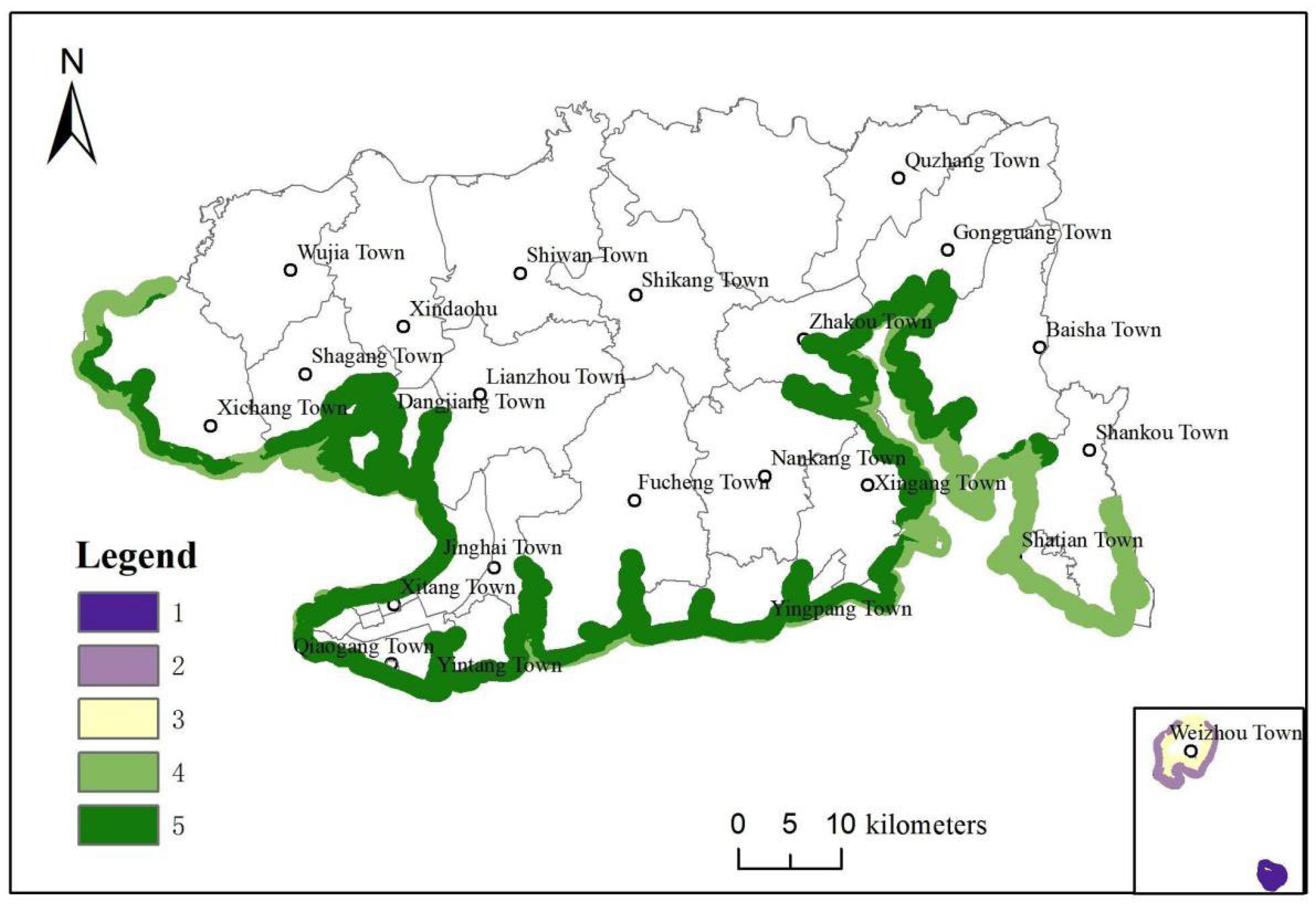
3.5. Characteristics of CLV Based on Accessibility Analysis
Physical accessibility is not a primary limiting factor for most of the coast, with 65.03% exhibiting “extremely high” accessibility (
Table 12,
Figure 8), due to a well-developed northern road network. Key challenges are confined to offshore islands (Weizhou, Xieyang) due to sea transport dependence. This suggests the main problem for the mainland coast is not access but a lack of reasons to visit, reinforcing the POI analysis conclusion.
3.6. Comprehensive Model of Coastal Landscape Vibrancy
The integrated CLV model combines normalized Baidu heat index (H), landscape visual vibrancy index (V), urban feature vibrancy index (C), and natural feature vibrancy index (N):
3.6.1. Driving Factors of Coastal Landscape Vibrancy: A PCA Approach
The results of the PCA, including the eigenvalues, variance explained, and the component loadings matrix, are presented in
Table 13. The Kaiser-Meyer-Olkin (KMO) measure of sampling adequacy was 0.58 (exceeding the threshold of 0.5), and Bartlett’s test of sphericity was significant (
p < 0.05), confirming the suitability of the data for factor analysis. Four principal components with eigenvalues greater than 1 were retained, collectively explaining 70.082% of the total variance in the dataset. The component loadings, which represent the correlation between each original variable and the principal component, were used to calculate the final weights (as shown in the final column of
Table 13).
Component 1 (22.98% variance explained) is predominantly loaded by Slope sensitivity (0.811) and Green coverage (0.800), with a strong negative loading from Visual field (−0.696). This component represents a “Topographic–Natural Matrix” dimension. It indicates that areas with gentler slopes (higher development suitability) and higher green coverage are associated with higher vibrancy, but this is inversely related to the openness of the visual field, suggesting a potential trade-off in highly urbanized natural settings.
Component 2 (18.88% variance explained) is strongly and positively correlated with Landscape Facility POI (0.775) and the Baidu Heat Index (0.738), and negatively with Bioabundance (−0.597). This component clearly captures the “Human Activity Intensity” dimension. It highlights that vibrancy is driven by the density of human infrastructure and real-time human presence, often at the expense of native biodiversity, characterizing highly urbanized and serviced coastal areas.
Component 3 (15.42% variance explained) is defined by high positive loading on Accessibility (0.737) and high negative loading on Green rate (−0.780). This component can be interpreted as the “Transportation-Urbanization Pressure” axis. It underscores that ease of access (e.g., road density, proximity to urban centers) is a critical driver of vibrancy, which is conversely associated with a reduction in the proportion of green spaces within the landscape.
Component 4 (12.80% variance explained) is primarily loaded by a single variable, Landscape visual feature vibrancy (0.794), suggesting this component represents a unique “Scenic Amenity” factor that contributes independently to the overall vibrancy model.
3.6.2. Spatial Patterns and Classification of Coastal Vibrancy
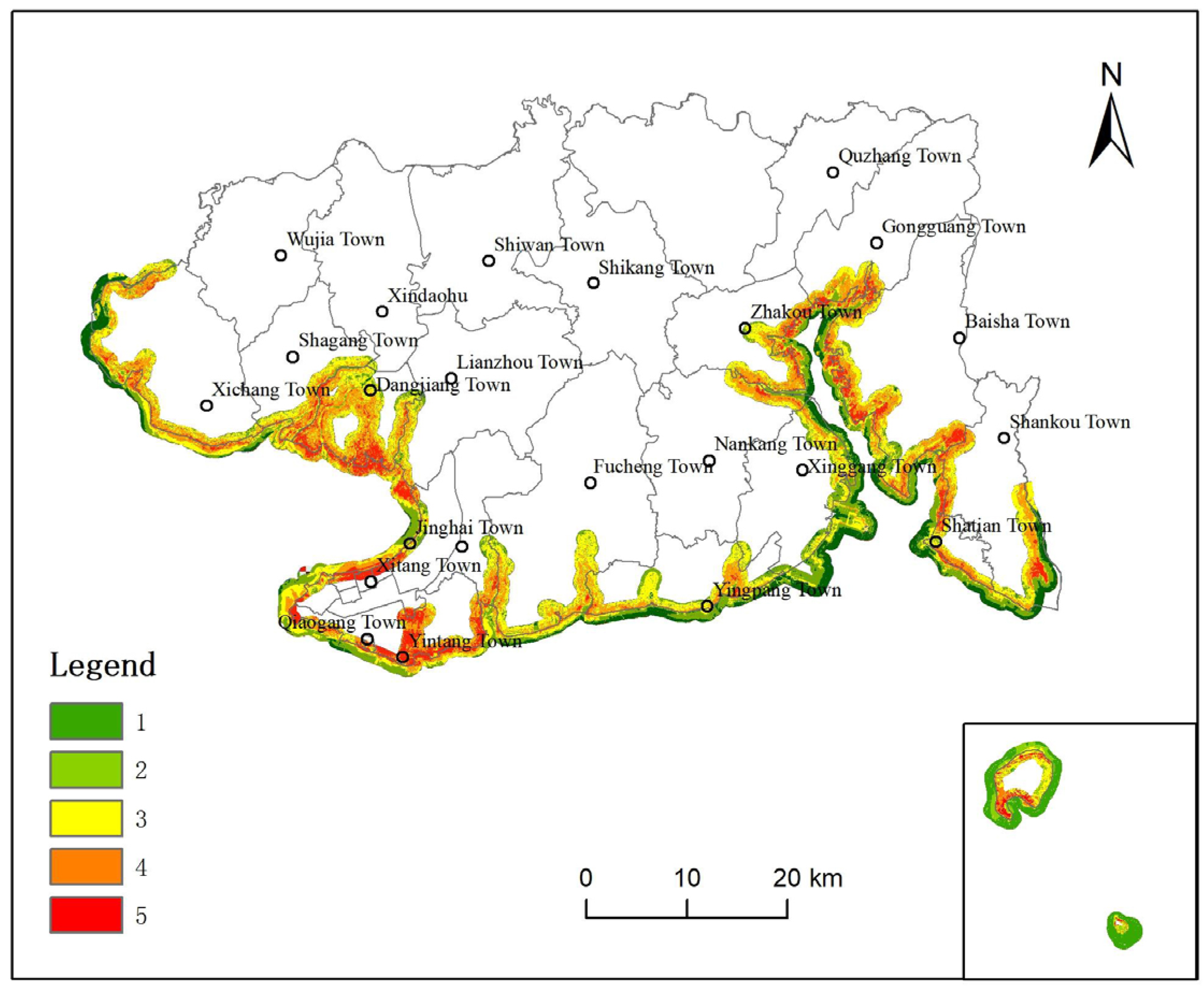
The spatial distribution of this composite CLV index, presented below, reflects the integrated outcome of all weighted indicators. The integrated model revealed that moderate vibrancy levels predominate across Beihai (
Table 14,
Figure 9). Only 10.81% of the coastline, concentrated in main urban districts (Xitang, Yintan, Weizhou), achieves “extremely high” vibrancy. This confirms vibrancy is an urban-centric phenomenon, declining sharply with distance from core service and transportation hubs.
This intense concentration of vibrancy in a few urban cores suggests that historical and current coastal planning in Beihai has largely followed a centralized, high-intensity tourism and commercial development model. While effective for generating economic activity in the short term, this approach creates zones of intense anthropogenic pressure and ecological stress, potentially turning vibrant urban coasts into long-term ecological ‘sacrificial zones.’ Concurrently, it leaves vast stretches of the coastline with high ecological quality and accessibility underutilized from a socio-economic perspective, representing a significant missed opportunity for developing a more distributed, low-impact model of sustainable recreation or ecotourism. To enhance systemic resilience and equity, future spatial planning should aim to strategically foster multiple, smaller nodes of vibrancy. This can be achieved by targeted investments in essential service facilities (addressing the POI deficit identified) and ecological restoration in these currently underutilized but accessible areas, thereby diversifying the coastal economy and dispersing visitation pressures, all while better integrating human activity with the natural landscape.
3.6.3. Synthesis of PCA and Spatial Distribution
The spatial pattern aligns well with the PCA findings. The “extremely high” vibrancy areas (e.g., Xitang, Yintan) are unequivocally explained by the “Human Activity Intensity” (Comp 2) dimension, characterized by high Baidu Heat indices and dense POIs. The prevalence of “moderate” vibrancy across vast stretches suggests a complex interplay and potential balance between the “Topographic–Natural Matrix” (Comp 1) and the “Transportation-Urbanization Pressure” (Comp 3). Areas of low vibrancy likely score poorly on both human activity drivers and the favorable topographic/natural conditions that facilitate development.
This multi-faceted analysis confirms that the vibrancy of the Beihai coast is not a product of a single factor but a synergistic yet sometimes conflicting outcome of anthropogenic pressure, natural endowment, and terrain suitability.
3.7. Analysis of the Relationship Between CLV and Ecological Vulnerability Factors
To quantify the influence of ecological and anthropogenic factors on Coastal Landscape Vibrancy (CLV), a multiple linear regression model was constructed. The model revealed a statistically significant overall fit and identified a complex set of both promoting and inhibiting drivers, elucidating the critical interplay between human activity and ecological conditions (
Table 15).
The most potent inhibitor of coastal vibrancy was Slope (β = −0.457, p < 0.001), indicating that steeper coastal terrains are associated with significantly lower human activity, likely due to reduced accessibility and development suitability. Furthermore, factors representing anthropogenic pressure consistently exhibited significant negative effects. The Normalized Difference Impervious Surface Index (NDISI) (β = −0.092, p < 0.001) and Coastal use intensity (β = −0.081, p < 0.001) both suppressed CLV, highlighting that urbanization and land hardening detrimentally impact vibrancy. Coastal degradation (β = −0.061, p = 0.004) and erosion (β = −0.066, p < 0.001) were also significant negative drivers, underscoring the threat that geomorphological instability poses to coastal social–ecological systems. Notably, Elevation showed a significant negative relationship (β = −0.159, p < 0.001), suggesting that lower-lying areas exhibited higher vibrancy in our study area, potentially due to their proximity to the shoreline and concentration of service facilities.
Conversely, several factors emerged as significant promoters of vibrancy. Chief among them were indicators of ecological endowment and quality. Green coverage (β = 0.236, p < 0.001) and Bioabundance (β = 0.190, p < 0.001) were strong positive drivers, confirming that high-quality natural environments are key attractors that enhance the esthetic and recreational experience. The presence of a Water system buffer was also a positive contributor (β = 0.124, p < 0.001), emphasizing the intrinsic draw of aquatic interfaces. As a proxy for economic activity and infrastructure, Nighttime Light (NTL) intensity was a significant positive predictor of CLV (β = 0.190, p < 0.001).
Multicollinearity was assessed using Variance Inflation Factor (VIF) statistics. All VIF values were below the conservative threshold of 5, and most were close to 1, indicating that multicollinearity is not a severe concern in this model and that the parameter estimates are stable and reliable.
In summary, the regression results delineate a clear tension: vibrancy is promoted by ecological quality and economic activity yet inhibited by anthropogenic pressure and ecological vulnerability. This underscores that sustainable coastal vibrancy is not a product of unchecked development but emerges from a careful balance that preserves and enhances ecological integrity while optimizing human service facilities.
3.8. Robustness Checks: Regression Analyses Based on Theoretical Dimensions
To examine whether the core conclusions—that ecological quality promotes vibrancy and ecological pressure inhibits it—are dependent on the specific construction of the composite index, we performed supplementary regression analyses. We abandoned the single composite CLV index and instead constructed dependent variables using two alternative approaches:
Principal Component Regression: The four principal components extracted by PCA (PC1-PC4, representing the “Topographic–Natural Matrix”, “Human Activity Intensity”, “Transportation-Urbanization Pressure”, and “Scenic Amenity”) were used as independent predictor variables in a joint regression model.
Theoretical Dimension Regression: Based on the theoretical framework, we separately constructed three independent sub-indices: “Human Activity Intensity” (based on the Baidu Heat Index and POI density), “Natural Endowment Quality” (based on green coverage and bioabundance), and “Visual Landscape Attractiveness” (based on the green view rate, viewshed, etc.). These were each used as dependent variables in separate regressions.
4. Discussion
Our study moves beyond conventional built-environment-centric assessments by pioneering a multi-dimensional framework that integrates direct human activity metrics with a comprehensive suite of ecological vulnerability indicators. This approach allows us to quantitatively unravel the complex, often contradictory, interactions between human use and ecological integrity in a dynamic coastal zone. Our findings challenge simplistic planning paradigms and offer a nuanced evidence base for advancing social–ecological systems theory and practice.
4.1. Theorizing Vibrancy Within a Social–Ecological Systems Framework
The PCA revealed that CLV emerges from the synergy of four distinct dimensions: Human Activity Intensity, Topographic–Natural Matrix, Transportation-Urbanization Pressure, and Scenic Amenity. This structure empirically validates the theoretical notion of vibrancy as a product of people-place interactions [
1,
4], but crucially, it embeds this concept within a social–ecological systems (SES) framework. Our findings demonstrate that coastal vibrancy is not merely a social or economic phenomenon but an emergent property of the coupled human-natural system.
The regression results further illuminate key associations suggestive of synergies and trade-offs within the SES. The significant positive relationships of CLV with green coverage (β = 0.243) and bioabundance (β = 0.182) are consistent with a ‘win-win’ scenario where ecological integrity and human vibrancy are mutually reinforcing. This synergy supports the “biophilia hypothesis” and suggests that high-quality natural environments are fundamental attractors, enhancing esthetic and recreational experiences that underpin sustained human activity [
29]. Conversely, the potent negative associations with factors like the impervious surface index (NDISI, β = −0.158) suggest a critical trade-off. This pattern warns of a potential “tipping point” where conventional development strategies, which prioritize land conversion and shoreline hardening, degrade the very ecological assets that support long-term vibrancy. An increase in NDISI causes an increase in surface temperature [
66]. The system risks shifting from a high-vibrancy, high-integrity state to a low-vibrancy, degraded state, a classic SES concern.
The observed negative correlation between the impervious surface index (NDISI) and coastal vibrancy is a critical and nuanced finding. It suggests that while a baseline of infrastructure is essential for accessibility and service provision, excessive landscape hardening—characterized by large expanses of pavement, sealed surfaces, and structural shoreline defenses—ultimately degrades the perceived natural esthetic and recreational quality that forms the primary attraction of coastal environments. This implies a non-linear or threshold relationship between development intensity and vibrancy: initial development supports activity, but beyond a certain point, the loss of natural character, increased thermal discomfort [
63], and diminished biophilic experience reduce the area’s appeal for the leisure and recreation activities that underpin vibrancy. For planners, this underscores that the quality and configuration of development—prioritizing permeability, green infrastructure, and landscape integration—is more consequential for sustaining vibrancy than the sheer quantity of built form.
4.2. Re-Evaluating Planning Dogmas: The Complex Role of Development
The patterns of association we observe provide a critical lens through which to re-evaluate conventional urban planning wisdom. Traditionally, economic vitality and urban vibrancy have been closely linked with intensive development and high land-use intensity. However, our analysis presents a more nuanced picture. The negative coefficient for NDISI suggests that beyond a certain threshold, increased imperviousness suppresses, rather than enhances, coastal vibrancy. This finding challenges the assumption that development intensity invariably leads to more vibrant spaces and aligns with a growing body of literature on the ‘green gentrification’ paradox and the value of ecological amenities. It implies that the quality of development (e.g., green infrastructure, permeable surfaces) is more important for sustaining vibrancy than its sheer quantity.
This is complemented by the positive association with Nighttime Light (NTL) index (β = 0.354), which reflects economic activity and infrastructure. The coexistence of these results suggests a delicate balance: economic activity is necessary, but it must be strategically managed to avoid crossing critical ecological thresholds. The goal, therefore, shifts from maximizing development to optimizing the spatial configuration and environmental performance of human facilities.
4.3. Policy and Planning Implications: From Diagnosis to Action
Our model provides a quantitative basis for translating ecological diagnostics into spatial planning strategies. The standardized coefficients (Beta) offer highlights potential leverage points for intervention in Beihai and similar coastal cities:
Prioritize Ecological Enhancement: The strong positive effects of green coverage and bioabundance suggest that policies should actively protect existing natural assets and invest in ecological restoration (e.g., mangrove rehabilitation, dune vegetation planting) as a primary strategy for boosting vibrancy, rather than an afterthought.
Limit and Mitigate Imperviousness: Planners should implement strict caps on new impervious surfaces in coastal zones and promote green infrastructure (e.g., permeable pavements, green roofs) to mitigate the negative impact of NDISI. Zoning ordinances could mandate maximum lot coverage ratios to preserve permeable ground.
Target Vulnerability Mitigation: Given the strong inhibitory effect of sea-level rise vulnerability, land-use planning must integrate forward-looking climate adaptation strategies. This includes establishing enforced coastal setback lines, restricting high-intensity development in highly vulnerable areas, and investing in nature-based solutions for erosion control (e.g., living shorelines) instead of hard engineering structures.
Strategic Facility Distribution: To address the POI deficit identified, new service amenities (dining, leisure) should be strategically distributed to underutilized but accessible coastal areas with high ecological quality, creating new nodes of vibrancy without increasing pressure on ecologically sensitive or already saturated urban cores.
4.4. Limitations and Future Research Directions
While this study leverages novel multi-source data to provide valuable insights, several limitations must be acknowledged, which also present opportunities for future research.
A primary limitation concerns the temporal context of our primary human activity data (Baidu Heatmaps and POIs), which were collected in 2020 during the global COVID-19 pandemic. This period was characterized by widespread travel restrictions and suppressed mobility. Although Beihai’s tourism sector demonstrated relative resilience compared to other regions (hosting 41.2 million domestic tourists in 2020, a decrease from over 52 million in 2019), the patterns of human activity captured likely deviate from pre- or post-pandemic norms. Consequently, our model reflects coastal vibrancy under atypical conditions. This specific context may lead to an overestimation of the role of local accessibility while underestimating factors tied to long-distance travel and tourism. Therefore, the absolute values of the vibrancy index should be interpreted with caution. Nonetheless, we posit that the relative relationships and influence mechanisms between the key variables identified in our analysis are likely to remain robust and theoretically informative.
Beyond the pandemic context, other limitations exist. First, Baidu Heatmap data serves as a proxy for potential activity based on mobile app user density and cannot differentiate between types of activities (e.g., recreational strolls vs. utilitarian commutes), potentially leading to an oversimplified interpretation of “vibrancy.” Second, although our data captured diurnal and weekday-weekend variations, the two-day temporal scope is insufficient to account for seasonal fluctuations, weather impacts, or long-term trends. Future studies would benefit from incorporating longer time-series data. Third, and critically, the cross-sectional nature of our data and the use of OLS regression limit the analysis to identifying associative relationships. While the model reveals statistically significant linkages, it cannot establish causality or directionality. The dynamics between vibrancy and ecological factors are almost certainly complex and bidirectional (e.g., vibrancy can both respond to attractive environments and exert subsequent environmental pressure). While we have controlled for statistical confounds like multicollinearity, our findings should be interpreted as revealing systemic correlations that are consistent with, but do not prove, hypothesized influence mechanisms. This is a fundamental limitation of the present study design. While we controlled for statistical issues like multicollinearity, establishing causality requires longitudinal studies or quasi-experimental designs.
To address these limitations and build upon this work, we suggest several promising directions for future research. Integrating social media data (e.g., Weibo check-ins, photo metadata) could capture perceptual vibrancy and the semantics of human activities more richly. Employing spatial regression models (e.g., Spatial Lag or Error models) would better account for spatial autocorrelation in the residuals, thereby refining the model estimates. Furthermore, the use of higher-resolution ecological data, such as UAV-based habitat mapping, could significantly enhance the precision of the vulnerability assessment. Crucially, replicating this study with multi-year data spanning pre-, during-, and post-pandemic periods would be invaluable for validating the stability of the observed relationships and enhancing our understanding of the resilience of coastal social–ecological systems to major external shocks.
Methodological Considerations Regarding the CLV Index: The use of PCA to construct a composite CLV index, while objective, introduces specific limitations. As noted, the derived principal components may not be theoretically pristine, potentially combining indicators from different conceptual domains (e.g., human activity and physical features). Consequently, the composite index, while robust for predictive modeling, becomes a blended measure whose internal composition is optimized for variance explanation rather than theoretical clarity. Future research could explore and compare alternative index construction methods, such as using structural equation modeling (SEM) to define latent variables that more strictly correspond to theoretical constructs (e.g., a ‘Human Activity’ latent variable defined by Baidu Heat and POI data), and then examining their distinct relationships with ecological factors. This would help disentangle the specific mechanisms through which different aspects of vibrancy interact with the environment.
5. Conclusions
This study successfully developed and applied a multi-dimensional framework to diagnose Coastal Landscape Vibrancy (CLV) and its critical interaction with ecological vulnerability in Beihai, China. The main conclusions are:
CLV is a multi-dimensional emergent property of a social–ecological system, driven by the synergistic yet tense interplay between human activity intensity, the topographic–natural matrix, urbanization pressure, and scenic amenity.
The associations between CLV and ecological factors are dualistic, suggesting both potential synergies and trade-offs. Ecological quality (green coverage, bioabundance) shows a strong positive correlation with vibrancy, while ecological vulnerability and anthropogenic pressure indices show significant negative correlations. This finding challenges planning approaches that equate development intensity with vitality.
Spatial planning should consider integrated strategies that aim to simultaneously enhance ecological integrity, strategically distribute service facilities, and mitigate vulnerabilities, as our model indicates that these factors are strongly associated with observed vibrancy patterns. The quantitative assessment provided by our framework offers a scientifically grounded basis for identifying priority intervention areas and evaluating planning scenarios.
In conclusion, achieving sustainable and vibrant coastal landscapes requires a paradigm shift from managing human activities and natural systems in isolation to managing their intricate interactions. Our framework provides a diagnostic tool to quantify these interactions through their observed correlations, advocating for planning that seeks to foster a resilient and positive association between human well-being and ecological health.