Adaptive Cyber Defense for Renewable Energy Systems Using Digital Forensics and Fuzzy Multi-Criteria Analysis


Abstract
1. Introduction
2. Relevant Previous Studies
3. Materials and Methods
3.1. Problem Formulation
- What methodologies can be implemented to acquire a profound comprehension of the dynamic and evolving nature of digital dependence on renewable energy systems?
- To provide a comprehensive analysis of effective strategies against the diverse array of threats encountered in the field of renewable energy systems, which digital forensics methods can be presented and investigated?
- Which criterion should be taken into account when selecting and validating the best practices for the security of renewable energy systems?
- How does a proposed integrated framework specifically improve the digital threat security of renewable energy systems, addressing the necessity for a cohesive strategy in the presence of evolving digital threats?
- In order to guarantee the framework’s adaptability and efficacy in the face of emerging digital threats, which key attributes and guidelines should be incorporated?
3.2. Need of Cybersecurity in Renewable Energy System
3.3. Security in Energy System
3.4. Cybersecurity Threats in the Renewable Energy System
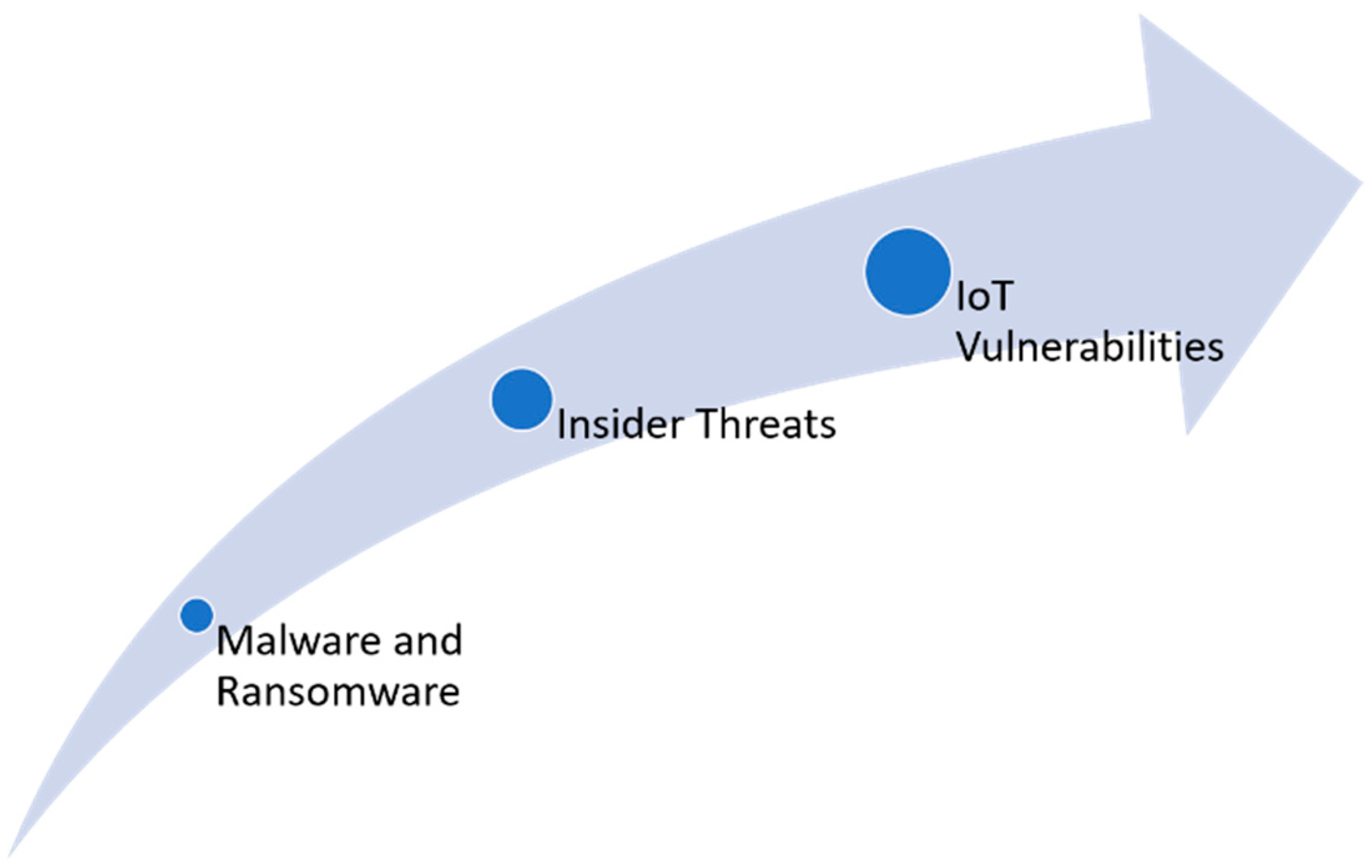
3.4.1. Malware and Ransomware
- Risks Posed: The renewable energy system faces substantial risks from malware and ransomware, given its extensive reliance on interconnected systems. Malicious software can compromise control systems, manipulate data, and disrupt renewable energy production, distribution and management of supply chains distribution, leading to severe operational and financial consequences [5,14]. Ransomware poses an additional threat, encrypting critical data and demanding ransom payments, potentially paralyzing renewable energy infrastructure until the demands are met.
- Case Studies: In the realm of cybersecurity, case studies serve as crucial benchmarks for understanding the evolving landscape of digital threats. One such milestone is the here, the Stuxnet Worm of 2010, a highly sophisticated malware that specifically targeted supervisory control and data acquisition (SCADA) systems, shed [3,4,5,6]. This incident revealed the vulnerability of electricity infrastructure to customized malware, prompting concerns about the possibility of manipulating essential systems. The ramifications were severe, as Stuxnet effectively damaged Iran’s nuclear programme, exposing the geopolitical significance of malicious malware on critical infrastructure. Another noteworthy case study is the WannaCry Ransomware outbreak that occurred in 2017. By taking advantage of weaknesses in Microsoft Windows systems, the WannaCry ransomware had a widespread influence, impacting organizations in different systems, including the renewable energy industry [7,8,9,10]. The consequences encompassed operational disruptions, loss of data, and substantial financial setbacks, underscoring the widespread danger presented by ransomware to vital infrastructure on a global scale. These case studies highlight the importance of constant monitoring and creative cybersecurity solutions to protect against ever-changing digital dangers in a world that is linked and heavily reliant on technology.
- Strategies to reduce or prevent the negative impacts: Implementing efficient mitigation solutions is crucial in protecting systems from the constantly increasing danger of malware. By utilizing sophisticated data analysis techniques to observe the behavior of a system, organizations can quickly detect and address abnormal actions. This enables them to take proactive measures to minimize the impact of malicious software threats before they do significant harm.
3.4.2. Insider Threats
- Scope and Complexity: Insider threats in the renewable energy system encompass a broad spectrum, ranging from inadvertent mistakes by employees to malicious actions with the intent to compromise security. The complexity raises further arise when considering the s from the diverse motivations and access levels of insiders, making it challenging to detect and prevent such threats effectively.
- Motivations: Motivations driving security breaches within organizations can be categorized into accidental errors and malicious intent. Accidental errors arise when employees inadvertently compromise security protocols, often due to misconfigurations or mishandling of sensitive data. Such unintentional actions may result from a lack of awareness or inadequate training, making it essential for organizations to invest in comprehensive education and awareness programs [14,15,16,17].
- Lessons from Incidents: In reflecting upon pivotal incidents such as Edward Snowden’s revelation in 2013 and the Colonial Pipeline Ransomware Attack in 2021, valuable lessons emerge that cast light on the evolving landscape of cybersecurity [11,18,19,20]. The Snowden incident served as a stark reminder of the criticality of safeguarding against insider threats, unveiling vulnerabilities in organizations handling sensitive information. This episode underscored the importance of robust monitoring systems and stringent access controls to mitigate risks arising from within. Similarly, the Colonial Pipeline Ransomware Attack emphasized the multifaceted nature of insider threats, revealing how compromised credentials could serve as a gateway for malicious actors.
- Detection and Prevention: Effective detection and prevention strategies are crucial in safeguarding an organization’s cybersecurity. User behavior monitoring plays a pivotal role in this effort by employing analytics to detect aberrations from regular activities, thereby serving as an early warning system for potential insider threats. Access controls and privilege management further fortify the defense, as restricting access based on job roles and adhering to the principle of least privilege minimizes the risk of malicious insiders exploiting their privileges [21,22,23,24]. In tandem, employee training and awareness programs contribute significantly to the overall security posture. By educating employees on cybersecurity best practices and enlightening them about the potential consequences of their actions, organizations empower their workforce to be vigilant and reduce the likelihood of unintentional insider threats. These multifaceted approaches collectively create a robust defense mechanism, fostering a resilient cybersecurity framework.
3.4.3. IoT Vulnerabilities
- Expanding Attack Surfaces: The widespread adoption of IoT devices in the renewable energy system introduces numerous entry points for potential attackers. These devices, ranging from sensors to smart meters, expand the attack surface and create new opportunities for cyber threats.
- Security Challenges: Security challenges in the realm of IoT are prevalent and demand urgent attention. One major concern lies in the insecure communication of devices, as a significant number of these transmit sensitive data over channels lacking adequate security protocols. This vulnerability exposes them to potential interception and manipulation by malicious entities, posing a serious threat to both individual or organization privacy as well as overall system integrity.
- Best Practices: In the realm of IoT, adopting best practices is imperative to safeguard the integrity and confidentiality of connected devices and networks. One fundamental principle is “Security by Design,” emphasizing the integration of security measures at the very inception of IoT device development. This proactive approach ensures that security becomes an inherent and foundational aspect of the device’s functionality. Moreover, robust protection mechanisms such as encryption and authentication play a pivotal role in securing communication between IoT devices.
- Future Trends: As there are technological advancements in the future, two prominent trends are poised to redefine the landscape of cybersecurity. Firstly, the integration of blockchain technology for securing IoT devices is gaining significant traction. Blockchain’s decentralized nature and tamper-resistant capabilities provide a robust framework for enhancing the security of device communication [25,27,28]. Secondly, the rise of artificial intelligence (AI) is ushering in a new era of threat detection in the IoT ecosystem. AI-driven algorithms excel in monitoring and identifying anomalous patterns in device behavior, enabling the real-time detection and response to emerging threats. Together, the synergy of blockchain for decentralized security and AI-driven threat detection represents a powerful paradigm shift in fortifying the future of IoT cybersecurity.
3.5. Digital Forensics in Renewable Energy Security
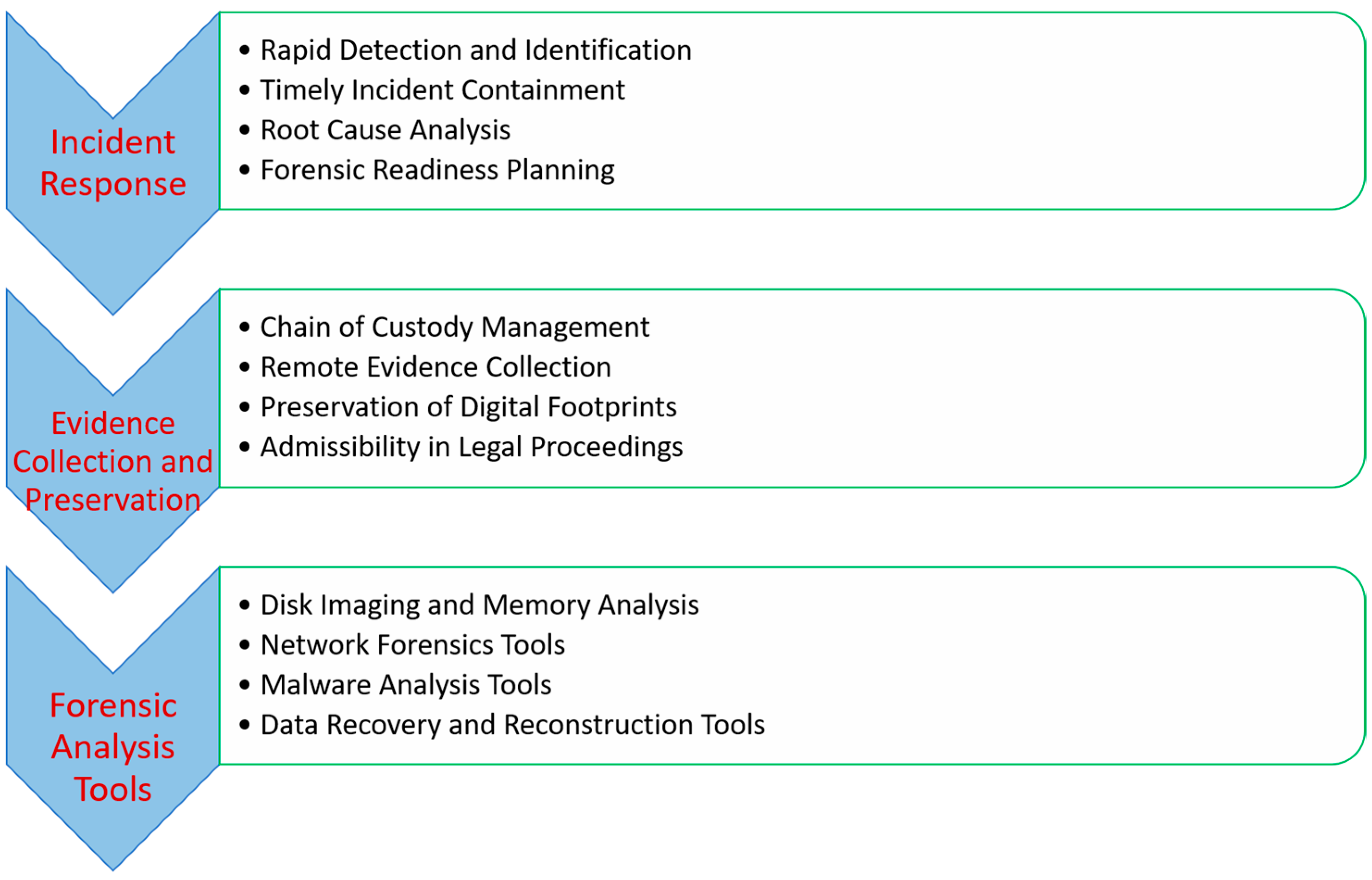
3.5.1. Incident Response
- Rapid Detection and Identification: Digital forensics assists in the rapid detection and identification of security incidents by employing advanced monitoring tools and techniques. Through real-time analysis of network traffic, system logs, and anomalous behaviour patterns, security teams can swiftly pinpoint potential threats and vulnerabilities [8,12,13,14].
- Timely Incident Containment: Once a security incident is detected, digital forensics aids in the rapid containment of the threat. By isolating affected systems and networks, security teams can prevent the lateral movement of attackers and limit the extent of damage, thereby ensuring the continued operation of renewable energy infrastructure.
- Root Cause Analysis: Digital forensics also facilitates a thorough root cause analysis of security incidents. By scrutinizing the attack vectors, identifying vulnerabilities, and understanding the tactics employed by adversaries, organizations can strengthen their defenses and prevent future occurrences of similar cyber threats.
- Forensic Readiness Planning: Effective incident response is predicated on proactive forensic readiness planning. Digital forensics professionals work collaboratively with cybersecurity teams to develop and implement incident response plans, ensuring that organizations are well-prepared to respond to and recover from security incidents [15,16,17].
3.5.2. Evidence Collection and Preservation
- Chain of Custody Management: Digital forensics professionals meticulously manage the chain of custody for digital evidence [18]. This involves documenting the handling, transfer, and storage of evidence to ensure its admissibility in legal proceedings and maintain its integrity throughout the investigation.
- Remote Evidence Collection: In the renewable energy system, where critical infrastructure may be geographically dispersed, digital forensics leverages remote evidence collection techniques. This allows forensic experts to gather relevant data without compromising the operational continuity of renewable energy facilities.
- Preservation of Digital Footprints: Digital forensics focuses on preserving digital footprints left by attackers. This includes capturing volatile data, analyzing system logs, and creating forensic images of affected systems, all of which contribute to building a comprehensive understanding of the cyber incident [19].
- Admissibility in Legal Proceedings: To ensure the admissibility of digital evidence in legal proceedings, digital forensics professionals adhere to industry best practices and legal standards. This involves documenting the methods used for evidence collection, preserving metadata, and maintaining a clear audit trail.
3.5.3. Forensic Analysis Tools
- Disk Imaging and Memory Analysis: Forensic analysis tools enable the creation of forensic images of disks and memory, allowing investigators to examine the state of systems at the time of an incident.
- Malware Analysis Tools: Digital forensics can also leverage specialized malware analysis tools to dissect and understand the behaviour of malicious software. By identifying the characteristics and functionalities of malware, security teams can develop strategies to prevent and mitigate future malware attacks on renewable energy systems.
- Data Recovery and Reconstruction Tools: In the aftermath of a security incident, data recovery and reconstruction tools are instrumental in restoring compromised or deleted data [20,21,22,32]. Digital forensics professionals use these tools to recover critical information, helping organizations resume normal operations promptly.
3.6. Issues and Challenges
3.6.1. Sophisticated Cyber Threats
3.6.2. Complex System Architecture
3.6.3. Real-Time Incident Response
3.6.4. Data Integrity and Trustworthiness
3.6.5. Legal and Jurisdictional Complexities
3.6.6. Resource Constraints
3.6.7. Privacy Concerns
3.6.8. Interoperability and Standardization
3.7. Proposed Integrated Model
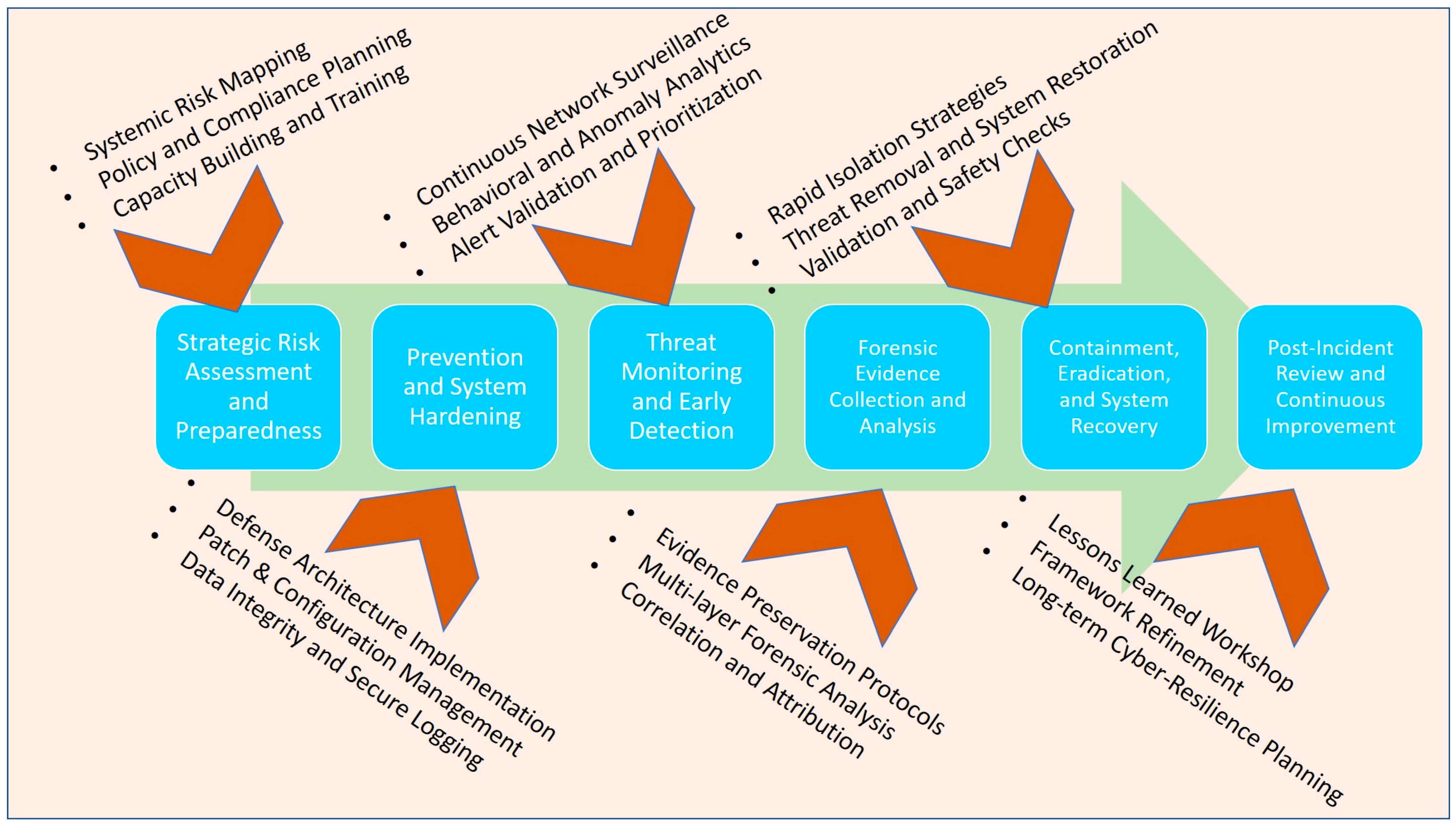
3.7.1. Strategic Risk Assessment and Preparedness
- Systemic Risk Mapping: Identify vulnerabilities across devices, networks, control components, and communication interfaces in renewable energy systems. Assess threat likelihood, potential damage, and critical asset exposure.
- Policy and Compliance Planning: Develop clear cybersecurity policies, operational protocols, and compliance standards. Ensure alignment with national regulations, energy-sector guidelines, and digital forensics best practices.
- Capacity Building and Training: Train technical teams in incident handling, forensic readiness, and secure system operations. Establish awareness programs for operators and engineers.
3.7.2. Prevention and System Hardening
- Defense Architecture Implementation: Deploy layered security controls including firewalls, secure communication protocols, authentication mechanisms, and access control frameworks to minimize attack surfaces.
- Patch and Configuration Management: Regularly update software, firmware, and ICS/SCADA components. Fix misconfigurations and ensure all systems operate under hardened security baselines.
- Data Integrity and Secure Logging: Enable tamper-resistant logging mechanisms and ensure continuous logging of events, sensor outputs, commands, and operator actions to support future forensic investigations.
3.7.3. Threat Monitoring and Early Detection
- Continuous Network Surveillance: Use advanced IDS/IPS, anomaly detection models, and ML-enabled monitoring systems to identify unusual behavior or unauthorized access attempts.
- Behavioral and Anomaly Analytics: Integrate AI-based analytics to differentiate normal operational patterns from suspicious anomalies in power flow data, device communication, and performance metrics.
- Alert Validation and Prioritization: Establish procedures to filter false positives, validate alerts, and prioritize genuine threats that require immediate action.
3.7.4. Forensic Evidence Collection and Analysis
- Evidence Preservation Protocols: Follow standardized forensic procedures for collecting digital artifacts from logs, devices, memory images, network packets, and cloud-based controllers while ensuring chain-of-custody.
- Multi-layer Forensic Analysis: Conduct detailed forensic examinations, including timeline reconstruction, vulnerability analysis, malware analysis, and root-cause investigation.
- Correlation and Attribution: Link evidence from multiple data sources to understand the attack vector, affected systems, and potential threat actor behavior.
3.7.5. Containment, Eradication, and System Recovery
- Rapid Isolation Strategies: Immediately disconnect compromised components or networks to stop lateral movement and restrict the spread of malicious activities.
- Threat Removal and System Restoration: Remove malicious files, repair corrupted configurations, apply necessary patches, and restore clean backups to return systems to normal operations.
- Validation and Safety Checks: Verify system integrity post-restoration by conducting performance tests, security checks, and forensic confirmation that the threat has been fully eliminated.
3.7.6. Post-Incident Review and Continuous Improvement
- Lessons Learned Workshop: Conduct detailed post-incident reviews to analyze what worked, what failed, and what can be improved in detection, containment, and forensics.
- Framework Refinement: Update security policies, forensic procedures, detection rules, and operational protocols based on insights from each incident.
- Long-term Cyber-Resilience Planning: Enhance security investments, integrate new technologies, and refine workforce training to create an adaptive and future-ready renewable energy cybersecurity ecosystem.
3.8. Methodology
4. Results
4.1. Numerical Analysis
4.2. Validation
4.3. Comparison with Other Models
5. Discussion
- More accurate prioritization of cyber threats under uncertain conditions
- Reduced response time through structured forensic readiness
- Improved adaptability to dynamic threat landscapes
5.1. Results and Their Potential Impact
- Conducted an in-depth analysis of prior studies to establish the contextual background for cybersecurity and renewable energy integration.
- Analyzed the existing cybersecurity posture of energy infrastructure, identifying gaps and vulnerabilities in the protection of critical assets.
- Highlighted the major cyber threats and attack vectors specific to renewable energy infrastructures such as smart grids and IoT-based systems.
- Summarized the critical issues—technical, organizational, and regulatory—that hinder effective cybersecurity implementation in renewable energy sectors.
- Proposed a novel integrated model combining cybersecurity measures, forensic capabilities, and decision-support tools to enhance energy system security.
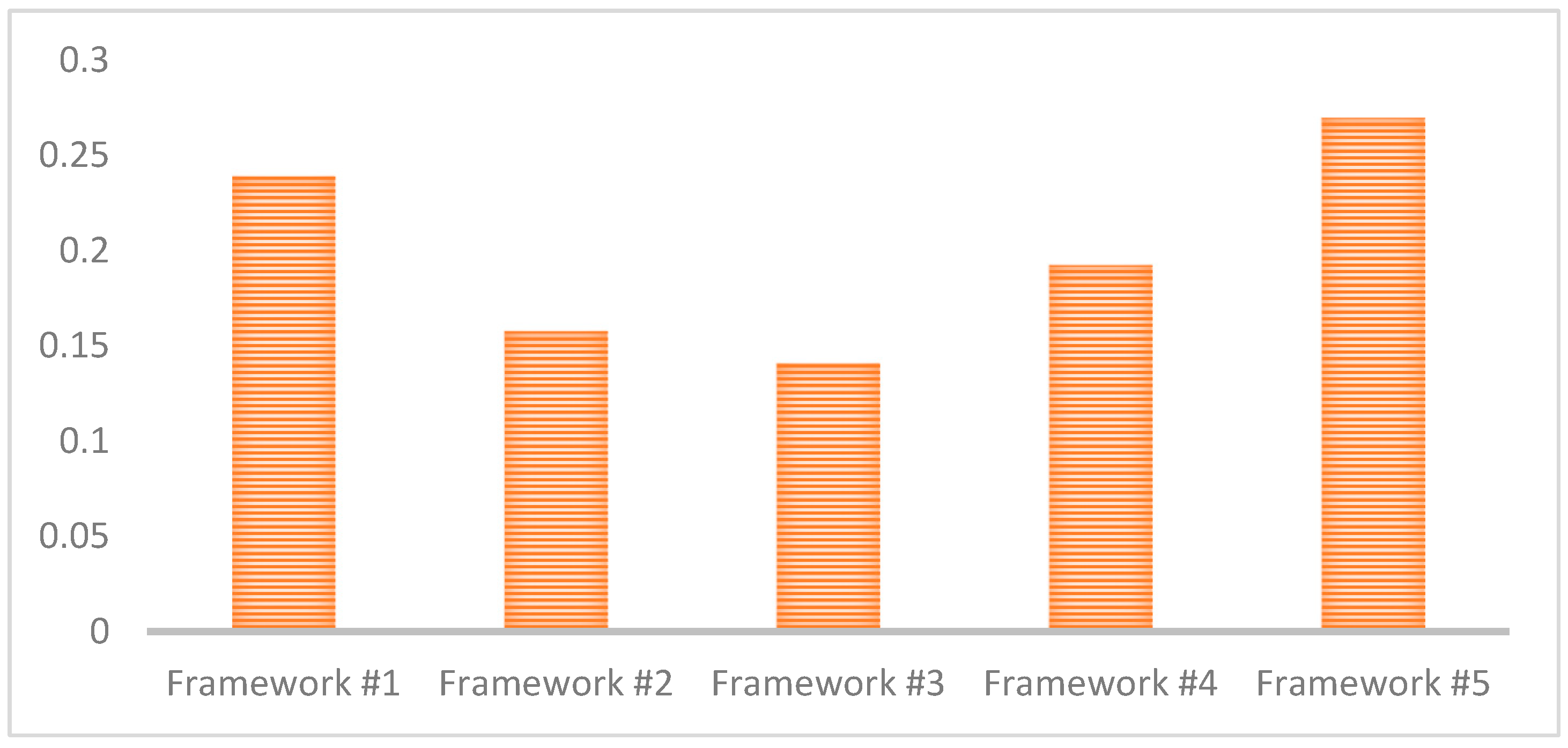
- Conducted numerical analysis using Fuzzy AHP and benchmarking of five frameworks, where Framework #5 achieved the highest ranking with 26.99% weight, demonstrating superior performance.
5.2. Limitations and Future Research
6. Conclusions
Supplementary Materials
Author Contributions
Funding
Institutional Review Board Statement
Informed Consent Statement
Data Availability Statement
Conflicts of Interest
Appendix A. Questionnaire for Pairwise Comparison of Cybersecurity and Digital Forensic Frameworks for Renewable Energy Systems
- Purpose of the Questionnaire: To evaluate the utility, effectiveness, and relative importance of existing and proposed cybersecurity and digital forensic frameworks for securing renewable energy management systems, a Fuzzy Analytic Hierarchy Process (Fuzzy-AHP)–based assessment is conducted. This questionnaire is designed to capture expert judgments for ranking competing frameworks in a structured and systematic manner. The evaluation focuses on five frameworks, including four existing approaches from the literature and one proposed integrated framework. The collected expert opinions will be aggregated and analyzed using Fuzzy-AHP to derive priority weights and final rankings.
- Frameworks under Evaluation
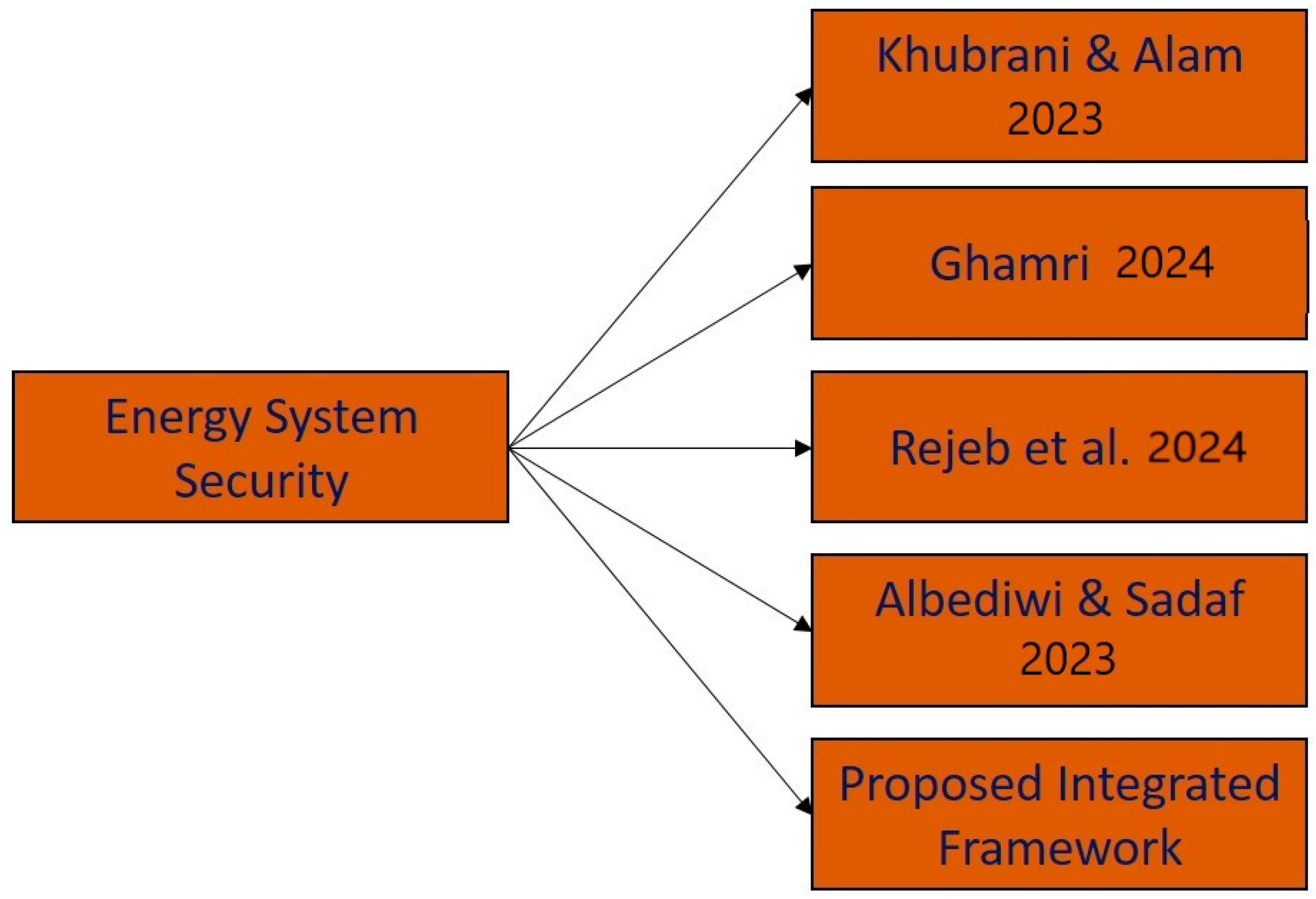
- Framework #1: Khubrani & Alam Framework
- Framework #2: Ghamri Framework
- Framework #3: Rejeb Framework
- Framework #4: Albediwi & Sadaf Framework
- Framework #5: Proposed Integrated Framework
- Suggestions to the Expert: You are requested to provide your expert judgment by performing pairwise comparisons between the frameworks listed above with respect to securing renewable energy management systems through digital forensics.
- Use the linguistic scale provided in Table 2.
- If the framework on the left is more important than the one on the right, select the appropriate importance level on the left side of “Equal (1)”.
- If the framework on the right is more important, select the reciprocal value on the right side of “Equal (1)”.
- Reciprocal values represent the opposite importance of the assigned numeric value.
- Pairwise Comparison Questions
- (With respect to Secure Renewable Energy Management and Digital Forensic Readiness)
- Question 1: How important is Framework #1 compared to Framework #2?
- Question 2: How important is Framework #1 compared to Framework #3?
- Question 3: How important is Framework #1 compared to Framework #4?
- Question 4: How important is Framework #1 compared to Framework #5?
- Question 5: How important is Framework #2 compared to Framework #3?
- Question 6: How important is Framework #2 compared to Framework #4?
- Question 7: How important is Framework #2 compared to Framework #5?
- Question 8: How important is Framework #3 compared to Framework #4?
- Question 9: How important is Framework #3 compared to Framework #5?
- Question 10: How important is Framework #4 compared to Framework #5?

| Q.No. | 9 | 8 | 7 | 6 | 5 | 4 | 3 | 2 | 1 | 1/2 | 1/3 | 1/4 | 1/5 | 1/6 | 1/7 | 1/8 | 1/9 |
|---|---|---|---|---|---|---|---|---|---|---|---|---|---|---|---|---|---|
| Q1: F#1 vs. F#2 | |||||||||||||||||
| Q2: F#1 vs. F#3 | |||||||||||||||||
| Q3: F#1 vs. F#4 | |||||||||||||||||
| Q4: F#1 vs. F#5 | |||||||||||||||||
| Q5: F#2 vs. F#3 | |||||||||||||||||
| Q6: F#2 vs. F#4 | |||||||||||||||||
| Q7: F#2 vs. F#5 | |||||||||||||||||
| Q8: F#3 vs. F#4 | |||||||||||||||||
| Q9: F#3 vs. F#5 | |||||||||||||||||
| Q10: F#4 vs. F#5 |
- Closing Statement for Experts: Your expert input is invaluable for validating the proposed integrated framework and for advancing secure, resilient, and forensically ready renewable energy systems. The results of this evaluation will contribute to establishing a decision-support foundation for future research and practical implementations.
- Your Comments
- (Please mark corrections and provide suggestions wherever required. Additional pages may be attached if necessary.)

- Please elaborate on any observations related to:
- The adequacy of the evaluation criteria
- The clarity and completeness of the framework comparison
- The applicability of the proposed integrated framework
- Any missing factors or suggested improvements
- Your qualitative feedback will be used solely for academic research purposes and to further refine the proposed methodology.
- Expert’s Details
- The information provided by the experts will be kept confidential and used strictly for research and academic analysis. Participation in this study is voluntary, and responses will be anonymized during analysis.
- Expert’s Name (Optional): _____________________________________
- Designation/Affiliation: ____________________________________
- Years of Professional Experience: _____________________________
- Signature: _________________________________________________
- Date: _____________________________________________________
- Submission Information
- Please return the completed questionnaire to:
- Dr. Waeal J. Obidallah
- College of Computer and Information Sciences
- Imam Mohammad Ibn Saud Islamic University (IMSIU)
- Riyadh 11673, Saudi Arabia
- Email: wobaidallah@imamu.edu.sa
References
- El Zein, M.; Gebresenbet, G. Digitalization in the renewable energy sector. Energies 2024, 17, 1985. [Google Scholar] [CrossRef]
- Cao, M.; Song, W.; Xu, Y. Research on the impact of enterprise digital transformation based on digital twin technology on renewable energy investment decisions. Energy Inform. 2024, 7, 142. [Google Scholar]
- BizTech Magazine. Tech Trends: Here’s What’s in Store for Energy and Utilities Companies. 2024. Available online: https://biztechmagazine.com/article/2024/01/2024-tech-trends-heres-whats-store-energy-and-utilities-companies (accessed on 2 November 2025).
- Cloud Security in Energy Sector Size & Share Analysis—Growth Trends & Forecasts (2025–2030). Available online: https://www.mordorintelligence.com/industry-reports/cloud-security-in-energy-sector-industry (accessed on 12 November 2025).
- United Nations. Addressing Energy’s Interlinkages with Other SDGs. Policy Briefs. 2022. Available online: https://sdgs.un.org/sites/default/files/2022-06/Policy%20Briefs%20-2022%20Energy%27s%20Interlinkages%20With%20Other%20SDGs.pdf (accessed on 6 November 2025).
- Astute Analytica. Saudi Arabia Cybersecurity Market Set to Attain Valuation of USD 10.5 Billion by 2032. 2023. Available online: https://www.astuteanalytica.com/industry-report/saudi-arabia-cybersecurity-market (accessed on 16 November 2025).
- Sikha, V.K.; Somepalli, S. Cybersecurity in Utilities: Protecting Critical Infrastructure from Emerging Threats. J. Sci. Eng. Res. 2023, 10, 233–242. [Google Scholar]
- He, H.; Yan, J. Cyber-physical attacks and defences in the smart grid: A survey. IET Cyber-Phys. Syst. Theory Appl. 2016, 1, 13–27. [Google Scholar] [CrossRef]
- Cyber Security in Energy Market Size (2018–2028). 2022. Available online: https://www.researchandmarkets.com/reports/5778676/global-cyber-security-in-energy-market-size?utm_source=GNE&utm_medium=PressRelease&utm_code=7x27dz&utm_campaign=1845851+-+Global+Cyber+Security+In+Energy+Market+Report+to+2028%3a+Increased+Risk+of+Cyberattacks+in+Energy+System+Drives+Growth&utm_exec=jamu273prd#product--description (accessed on 16 November 2025).
- Energy Cybersecurity in 2024: Building Accountability and Responsibility. 2024. Available online: https://www.enlit.world/library/energy-cybersecurity-in-2024-building-accountability-and-responsibility (accessed on 2 November 2025).
- Resecurity. Ransomware Attacks Against the Energy System on the Rise—Nuclear and Oil & Gas Are Major Targets in 2024. 2024. Available online: https://www.resecurity.com/blog/article/ransomware-attacks-against-the-energy-sector-on-the-rise-nuclear-and-oil-gas-are-major-targets-2024 (accessed on 17 November 2025).
- Baz, A.; Logeshwaran, J.; Natarajan, Y.; Patel, S.K. Deep fuzzy nets approach for energy efficiency optimization in smart grids. Appl. Soft Comput. 2024, 161, 111724. [Google Scholar] [CrossRef]
- Hailu, E.A.; Nyakoe, G.N.; Muriithi, C.M. Data-driven approach to fuzzy inference system tuning for static security assessment of multi-area power systems with renewable energy. Ain Shams Eng. J. 2024, 15, 102369. [Google Scholar]
- Ige, A.B.; Kupa, E.; Ilori, O. Analyzing defense strategies against cyber risks in the energy sector: Enhancing the security of renewable energy sources. Int. J. Sci. Res. Arch. 2024, 12, 2978–2995. [Google Scholar] [CrossRef]
- Tsantikidou, K.; Sklavos, N. Threats, Attacks, and cryptography frameworks of cybersecurity in critical infrastructures. Cryptography 2024, 8, 7. [Google Scholar] [CrossRef]
- Ige, A.B.; Kupa, E.; Ilori, O. Best practices in cybersecurity for green building management systems: Protecting sustainable infrastructure from cyber threats. Int. J. Sci. Res. Arch. 2024, 12, 2960–2977. [Google Scholar] [CrossRef]
- Rekeraho, A.; Cotfas, D.T.; Cotfas, P.A.; Bălan, T.C.; Tuyishime, E.; Acheampong, R. Cybersecurity challenges in IoT-based smart renewable energy. Int. J. Inf. Secur. 2024, 23, 101–117. [Google Scholar] [CrossRef]
- Alghassab, M.A. Fuzzy-based smart energy management system for residential buildings in Saudi Arabia: A comparative study. Energy Rep. 2024, 11, 1212–1224. [Google Scholar] [CrossRef]
- Almotiri, S.H. Integrated fuzzy based computational mechanism for the selection of effective malicious traffic detection approach. IEEE Access 2021, 9, 10751–10764. [Google Scholar] [CrossRef]
- TechTarget. Computer Forensics. 2024. Available online: https://www.techtarget.com/searchsecurity/definition/computer-forensics (accessed on 16 November 2025).
- Choudhury, A.; Rajasekaran, A. A survey on cybersecurity threats and solutions in energy internet of things (IoT) systems. J. Wirel. Mob. Netw. Ubiquitous Comput. Dependable Appl. 2021, 13, 353–376. [Google Scholar]
- Ali, A.M.; Abdelhafeez, A.; Soliman, T.H.; ELMenshawy, K. A probabilistic hesitant fuzzy MCDM approach to selecting treatment policy for COVID-19. Decis. Mak. Appl. Manag. Eng. 2024, 7, 131–144. [Google Scholar] [CrossRef]
- Alrashdi, I.; Ali, A.M.; Sallam, K.M.; Abdel-Basset, M. Intelligent decision support framework for assessment of alternative vehicle technologies in transportation system: A sustainable approach toward environmental remedy. Sustain. Futures 2025, 9, 100472. [Google Scholar] [CrossRef]
- Parveen, S.; Khan, M.; Atif, T.; Ali, A. Emerging Technologies and their Impact on Policy Design, Policy Communication, and Policy Evaluation. Dialogue Soc. Sci. Rev. (DSSR) 2025, 3, 16–28. [Google Scholar]
- Albediwi, M.R.; Sadaf, K. A framework for cybersecurity awareness in Saudi Arabia. J. Eng. Appl. Sci. 2023, 10, 35–45. [Google Scholar] [CrossRef]
- Rawindaran, N.; Nawaf, L.; Alarifi, S.; Alghazzawi, D.; Carroll, F.; Katib, I.; Hewage, C. Enhancing cyber security governance and policy for SMEs in industry 5.0: A comparative study between Saudi Arabia and the United Kingdom. Digital 2023, 3, 200–231. [Google Scholar] [CrossRef]
- Khatoon, U.T.; Velidandi, A. An overview on the role of government initiatives in nanotechnology innovation for sustainable economic development and research progress. Sustainability 2025, 17, 1250. [Google Scholar] [CrossRef]
- Næss, H.E.; Tjønndal, A. Innovation, Sustainability and Management in Motorsports: The Case of Formula E; Springer Nature: Berlin/Heidelberg, Germany, 2021; p. 140. [Google Scholar]
- Alsulami, A.; Fairbrass, J.; Botelho, T.; Assadinia, S. Renewable energy and innovation in Saudi Arabia: An exploration of factors affecting consumers' intention to adopt Solar PV. Technol. Forecast. Soc. Change 2024, 204, 123430. [Google Scholar] [CrossRef]
- Khubrani, M.M.; Alam, S. Blockchain-based microgrid for safe and reliable power generation and distribution: A case study of Saudi Arabia. Energies 2023, 16, 5963. [Google Scholar] [CrossRef]
- Ghamri, R.M.S. A Trust Framework for Information Sharing. Ph.D. Dissertation, University of Southampton, Southampton, UK, 2024. Available online: https://eprints.soton.ac.uk/487926/ (accessed on 6 November 2025).
- The State of Ransomware in Critical Infrastructure 2024. Available online: https://assets.sophos.com/X24WTUEQ/at/75tnw38cqsnrrv56wpwc78k/sophos-state-of-ransomware-critical-infrastructure-2024.pdf (accessed on 18 November 2025).
- Cyber Threats Against Energy Sector Surge as Global Tensions Mount. Available online: https://www.resecurity.com/blog/article/cyber-threats-against-energy-sector-surge-global-tensions-mount (accessed on 18 November 2025).
- Mohammed, H.J.; Naiyf, A.T.; Thaer, A.J.; Khbalah, S.K. Assessment of sustainable renewable energy technologies using analytic hierarchy process. IOP Conf. Ser. Earth Environ. Sci. 2021, 779, 012038. [Google Scholar] [CrossRef]
- Alkatheiri, M.S.; Alqarni, M.A.; Chauhdary, S.H. Cyber security framework for smart home energy management systems. Sustain. Energy Technol. Assess. 2021, 46, 101232. [Google Scholar] [CrossRef]
- Thinkbit Training. Cybersecurity Workforce Gap Widens in UK, 50% of Businesses Struggling. 2024. Available online: https://thinkbittraining.co.uk/cybersecurity-workforce-gap-widens-in-uk-50-of-businesses-struggling/ (accessed on 16 November 2025).
- Rejeb, A.; Rejeb, K.; Zrelli, I.; Süle, E.; Iranmanesh, M. Blockchain technology in the renewable energy system: A co-word analysis of academic discourse. Heliyon 2024, 10, e28965. [Google Scholar] [CrossRef]
- Investment Needs of European Energy Infrastructure to Enable a Decarbonised Economy. Available online: https://www.artelys.com/app/uploads/2025/02/Artelys_investment-needs-of-european-energy-infrastructure.pdf (accessed on 18 November 2025).
- Alnajim, A.M.; Habib, S.; Islam, M.; Thwin, S.M.; Alotaibi, F. A Comprehensive Survey of Cybersecurity Threats, Attacks, and Effective Countermeasures in Industrial Internet of Things. Technologies 2023, 11, 161. [Google Scholar] [CrossRef]
- Kumar, R.; Mishra, S.K. Assessing the impact of heat vulnerability on urban public spaces using a fuzzy-based unified computational technique. AI Soc. 2025, 40, 787–804. [Google Scholar] [CrossRef]
- Luo, X.; Xue, K.; Xu, J.; Sun, Q.; Zhang, Y. Blockchain based secure data aggregation and distributed power dispatching for microgrids. IEEE Trans. Smart Grid 2021, 12, 5268–5279. [Google Scholar] [CrossRef]
- Kaewpasuk, S.; Intiyot, B.; Jeenanunta, C. A Fuzzy Unit Commitment Model for Enhancing Stability and Sustainability in Renewable Energy-Integrated Power Systems. Sustainability 2025, 17, 6800. [Google Scholar] [CrossRef]
- Shibi, B. AI-Driven Smart Energy Management Systems for Optimized Renewable Energy Utilization in Urban Smart Grids. 2025. Available online: https://assets-eu.researchsquare.com/files/rs-6326251/v1/47fe6d34-e129-4af1-a9bf-f118c1255506.pdf?c=1759118512 (accessed on 17 November 2025).
- Ramya, K.; Teekaraman, Y.; Kumar, K.R. Fuzzy-based energy management system with decision tree algorithm for power security system. Int. J. Comput. Intell. Syst. 2019, 12, 1173–1178. [Google Scholar] [CrossRef]
- Zhang, R.; VE, S.; Jackson Samuel, R.D. Fuzzy efficient energy smart home management system for renewable energy resources. Sustainability 2020, 12, 3115. [Google Scholar] [CrossRef]
- Liou, T.S.; Wang, M.J.J. Fuzzy weighted average: An improved algorithm. Fuzzy Sets Syst. 1992, 49, 307–315. [Google Scholar] [CrossRef]
- Sheskin, D.J. Spearman’s Rank-Order Correlation Coefficient. In Handbook of Parametric and Nonparametric Statistical Procedures; CRC Press: Boca Raton, FL, USA, 2007; p. 1353. [Google Scholar]
- Maglaras, L.; Janicke, H.; Ferrag, M.A. Cybersecurity of critical infrastructures: Challenges and solutions. Sensors 2022, 22, 5105. [Google Scholar] [CrossRef]
- Abraham, D.; Houmb, S.H.; Erdodi, L. Cyber-Attacks on Energy Infrastructure—A Literature Overview and Perspectives on the Current Situation. Appl. Sci. 2025, 15, 9233. [Google Scholar] [CrossRef]
- Kontogiannis, D.; Bargiotas, D.; Daskalopulu, A. Fuzzy control system for smart energy management in residential buildings based on environmental data. Energies 2021, 14, 752. [Google Scholar] [CrossRef]
- Abdul, D.; Wenqi, J.; Tanveer, A. Prioritization of renewable energy source for electricity generation through AHP-VIKOR integrated methodology. Renew. Energy 2022, 184, 1018–1032. [Google Scholar] [CrossRef]
- Xu, W.; Li, J.; Dehghani, M.; GhasemiGarpachi, M. Blockchain-based secure energy policy and management of renewable-based smart microgrids. Sustain. Cities Soc. 2021, 72, 103010. [Google Scholar]
- Emam, W.; Waqas, H.M.; Mahmood, T.; Rehman, U.U.; Pamucar, D. AI-driven energy management system based on hesitant bipolar complex fuzzy Hamacher power aggregation operators and their applications in MADM. Sci. Rep. 2025, 15, 13083. [Google Scholar] [CrossRef] [PubMed]
- Hacini, I.; Lalouni Belaid, S.; Idjdarene, K.; Abderazek, H.; Berabez, K. Fuzzy Logic-Based Energy Management Strategy for Hybrid Renewable System with Dual Storage Dedicated to Railway Application. Technologies 2025, 13, 334. [Google Scholar] [CrossRef]
- Arsad, S.R.; Hasnul Hadi, M.H.; Mohd Afandi, N.A.; Ker, P.J.; Tang, S.G.H.; Mohd Afzal, M.; Tiong, S.K. The Impact of COVID-19 on the Energy Sector and the Role of AI: An Analytical Review on Pre-to Post-Pandemic Perspectives. Energies 2023, 16, 6510. [Google Scholar] [CrossRef]
- Jana, S.; Giri, B.C.; Sarkar, A.; Jana, C.; Stević, Ž.; Radovanović, M. Application of fuzzy AHP in priority based selection of financial indices: A perspective for investors. Econ. Innov. Econ. Res. J. 2024, 12, 1–27. [Google Scholar]


| S. No. | Issues and Challenges | Description |
|---|---|---|
| 1 | Sophisticated Cyber Threats | The renewable energy system faces a persistent threat from advanced cyber adversaries, including state-sponsored entities. Identification and attribution of threats, especially advanced persistent threats (APTs), require highly sophisticated forensic techniques. Continuous adaptation of cybersecurity measures is essential to mitigate evolving and elusive cyber threats. |
| 2 | Complex System Architecture | Renewable energy systems exhibit intricate architectures with extensive interconnectivity among devices, sensors, and control systems. Investigating incidents within this complex framework demands specialized skills and tools. The sheer volume of data generated by diverse components adds complexity, potentially overwhelming forensic investigators. Effective analysis and resolution require the development and deployment of advanced methodologies. |
| 3 | Real-time Incident Response | Swift and effective real-time incident response is imperative in renewable energy systems to counter emerging risks. The challenge lies in balancing the need for immediacy with the precision required in identifying and mitigating threats. Integrating real-time capabilities into forensic processes is an ongoing endeavor to fortify against evolving threats in the dynamic renewable energy landscape. |
| 4 | Data Integrity and Trustworthiness | Ensuring the accuracy and trustworthiness of digital evidence is challenging due to the constant threat of tampering and manipulation. In dynamic renewable energy environments, maintaining a secure chain of custody for digital artifacts involves meticulous tracing from collection through analysis. Challenges include preventing tampering and navigating complexities to uphold a reliable and trustworthy data chain. |
| 5 | Legal and Jurisdictional Complexities | Legal and jurisdictional complexities in the renewable energy system require practitioners to navigate intricate legal frameworks and jurisdictional issues. Challenges involve determining jurisdiction, ensuring the legal admissibility of digital evidence, and fostering international cooperation for successful investigations. Harmonization of legal standards is crucial to address the multifaceted legal landscape in cross-border digital forensic endeavors. |
| 6 | Resource Constraints | Limited availability of skilled personnel and advanced forensic tools poses a significant challenge to digital forensics efforts. Developing and retaining a highly skilled workforce is crucial, as is ensuring access to cutting-edge forensic technologies. Resource constraints may compromise the ability to conduct comprehensive digital investigations, hindering identification and prosecution of cybercriminals. |
| 7 | Privacy Concerns | Privacy concerns arise in the collection and analysis of digital evidence, potentially encroaching upon individual privacy rights. Striking a delicate balance between the exigencies of forensic investigations and safeguarding individual privacy requires ethical guidelines and frameworks. It is a societal challenge necessitating a thoughtful and collaborative approach to uphold the rights of individuals in the digital age. |
| 8 | Interoperability and Standardization | Achieving interoperability and standardization is paramount in the dynamic renewable energy system. The challenge lies in developing unified frameworks for seamless communication and collaboration among diverse technologies and vendors. Standardized protocols are essential for facilitating effective forensic investigations, preventing obstacles in the exchange of forensic data, and ensuring overall efficiency and security of the renewable energy infrastructure. |
| Scale | Linguistic Term | Numeric Value | Reciprocal |
|---|---|---|---|
| 1 | Equal Importance | 1 | 1 |
| 3 | Weakly Important | 3 | 1/3 |
| 5 | Essential Importance | 5 | 1/5 |
| 7 | Very Strongly Important | 7 | 1/7 |
| 9 | Extremely Important | 9 | 1/9 |
| 2, 4, 6, 8 | Intermediate Values | 2–8 | 1/2–1/8 |
| Framework #1 | Framework #2 | Framework #3 | Framework #4 | Framework #5 | |
|---|---|---|---|---|---|
| Framework #1 | 1.00000, 1.000000, 1.000000 | 2, 3, 4 | 5, 6, 7 | 3, 4, 5 | 1/4, 1/3, 1/2 |
| Framework #2 | 1.00000, 1.000000, 1.000000 | 2, 3, 4 | 1/3, 1/2, 1 | 1/5, 1/4, 1/3 | |
| Framework #3 | 1.00000, 1.000000, 1.000000 | 1/4, 1/3, 1/2 | 1/6, 1/5, 1/4 | ||
| Framework #4 | 1.00000, 1.000000, 1.000000 | 1/3, 1/2, 1 | |||
| Framework #5 | 1.00000, 1.000000, 1.000000 |
| Framework #1 | Framework #2 | Framework #3 | Framework #4 | Framework #5 | |
|---|---|---|---|---|---|
| Framework #1 | 1.00000, 1.000000, 1.000000 | 0.152400, 0.812540, 1.145200 | 0.252400, 0.256300, 0.365300 | 1.112000, 1.525630, 1.936350 | 0.485650, 0.645650, 1.565250 |
| Framework #2 | 1.00000, 1.000000, 1.000000 | 0.656300, 0.963650, 1.363520 | 0.256360, 0.355550, 0.525630 | 0.165630, 0.199650, 0.263650 | |
| Framework #3 | 1.000000, 1.000000, 1.000000 | 1.152110, 1.335620, 1.563520 | 0.315260, 0.445650, 0.815360 | ||
| Framework #4 | 1.000000, 1.000000, 1.000000 | 0.232650, 0.278590, 0.423650 | |||
| Framework #5 | 1.000000, 1.000000, 1.000000 |
| Framework #1 | Framework #2 | Framework #3 | Framework #4 | Framework #5 | |
|---|---|---|---|---|---|
| Framework #1 | 1.00000 | 3.00000 | 6.00000 | 4.00000 | 0.36100 |
| Framework #2 | 0.33300 | 1.00000 | 3.00000 | 0.61100 | 0.26100 |
| Framework #3 | 0.16700 | 0.33300 | 1.00000 | 0.36100 | 0.20500 |
| Framework #4 | 0.25000 | 1.63600 | 2.77000 | 1.00000 | 0.61100 |
| Framework #5 | 2.77000 | 3.83000 | 4.88000 | 1.63600 | 1.00000 |
| CR = 0.02000 | |||||
| Framework #1 | Framework #2 | Framework #3 | Framework #4 | Framework #5 | |
|---|---|---|---|---|---|
| Framework #1 | 1.00000 | 1.24525 | 1.65652 | 1.45286 | 0.95652 |
| Framework #2 | 0.80305 | 1.00000 | 1.28695 | 0.68569 | 0.49562 |
| Framework #3 | 0.60367 | 0.77703 | 1.00000 | 0.64565 | 0.66365 |
| Framework #4 | 0.68829 | 1.45838 | 1.54883 | 1.00000 | 0.61632 |
| Framework #5 | 1.04546 | 2.01767 | 1.50682 | 1.62252 | 1.00000 |
| CR = 0.000563 | |||||
| S. No. | Frameworks | Weights | Percentage | Ranks |
|---|---|---|---|---|
| 1 | Framework #1 | 0.238991 | 23.90% | 2 |
| 2 | Framework #2 | 0.157809 | 15.78% | 4 |
| 3 | Framework #3 | 0.140853 | 14.09% | 5 |
| 4 | Framework #4 | 0.192445 | 19.24% | 3 |
| 5 | Framework #5 | 0.269902 | 26.99% | 1 |
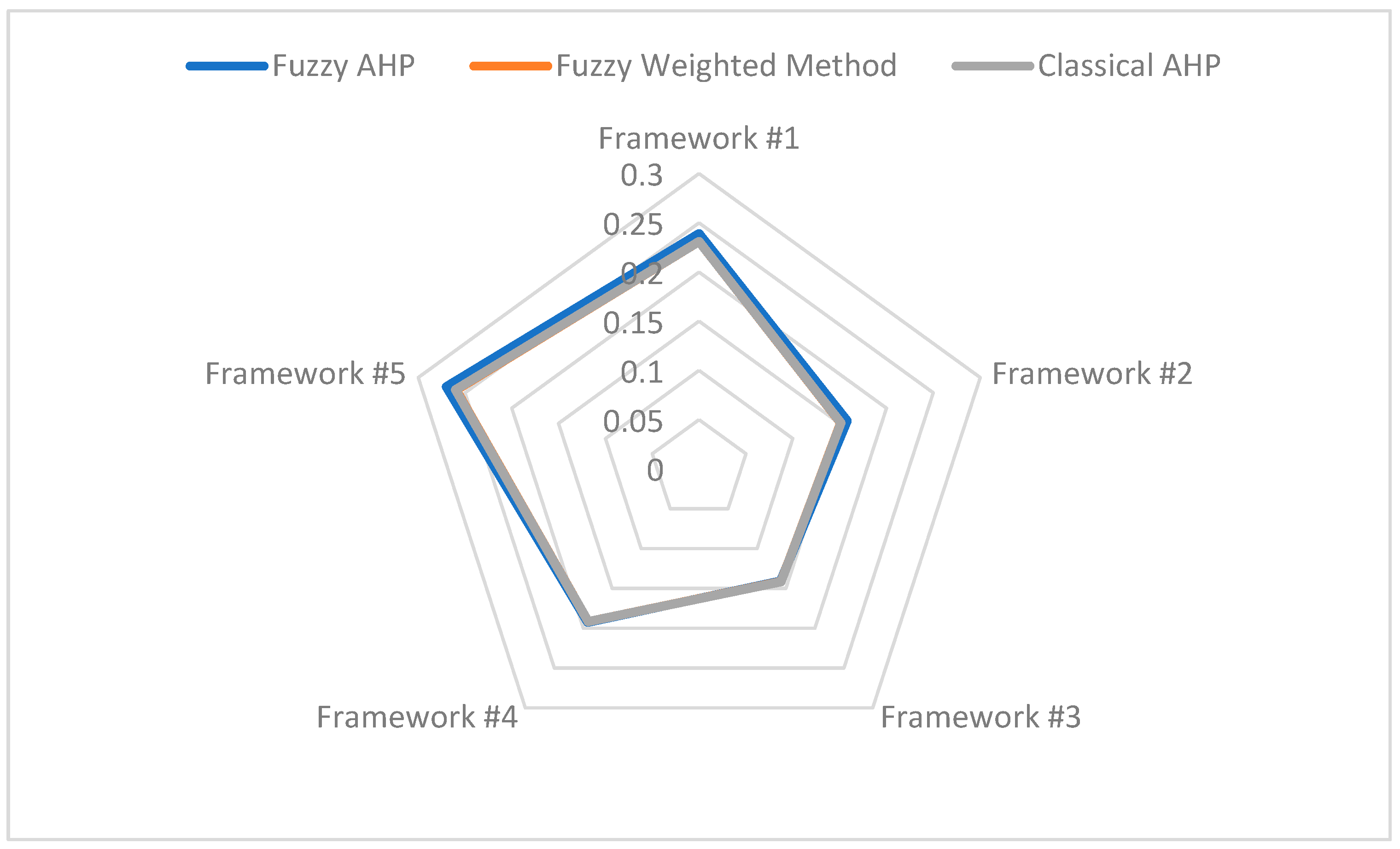
| S. No. | Frameworks | Fuzzy AHP | Fuzzy Weighted Method | Classical AHP |
|---|---|---|---|---|
| 1 | Framework #1 | 0.238991 | 0.231214 | 0.231225 |
| 2 | Framework #2 | 0.157809 | 0.151117 | 0.151221 |
| 3 | Framework #3 | 0.140853 | 0.141352 | 0.141585 |
| 4 | Framework #4 | 0.192445 | 0.191452 | 0.191635 |
| 5 | Framework #5 | 0.269902 | 0.259475 | 0.259994 |
| S. No. | Criteria | Proposed Integrated Model | Khubrani & Alam [30] | Ghamri [31] | Rejeb et al. [37] | Albediwi & Sadaf [25] |
|---|---|---|---|---|---|---|
| 1 | Focus Area | Digital forensics, cybersecurity in renewable energy system | Blockchain-based microgrid for renewable energy management | Trust and accuracy in educational and employment data | Blockchain technology in renewable energy system | Cybersecurity awareness among general population |
| 2 | Primary Goal | Enhance cybersecurity and resilience in renewable energy systems | Ensure secure and reliable power generation and distribution | Optimize resource allocation and foster economic growth through accurate data sharing | Enhance renewable energy efficiency, enable decentralized trading, ensure transaction transparency | Increase cybersecurity awareness across all demographics |
| 3 | Key Components | Prevention, Detection, Containment, Recovery | Peer-to-peer energy trading, Renewable Energy Certificates, decentralized energy trading | Facilitating Conditions, IT Services, Secure Access, Trust and Accuracy (FIST) | Integration with smart grids, electric vehicle integration, sustainable urban energy systems | Training programs, incident response, addressing awareness in informal backgrounds |
| 4 | Advantages | Comprehensive, proactive approach; integrates risk assessment, IDS, forensic analysis, and continuous improvement | Decentralized management, addresses trust and cybersecurity challenges using blockchain | Emphasis on trust and accuracy, formal modeling for rigorous validation | Diverse applications in renewable energy systems, fills knowledge gap, comprehensive bibliometric analysis | National-level awareness, targets diverse demographics, includes incident response |
| 5 | Cybersecurity Approach | Proactive and reactive measures, systematic evidence collection, swift threat containment | Blockchain for enhanced security, smart contracts for transparency | Ensures data reliability and accuracy, formal validation techniques | Blockchain for transparency and security, decentralized management | Awareness programs, training, incident response |
| 6 | Application Context | Renewable energy infrastructures, critical infrastructure protection | Localized microgrids, renewable energy management | Educational and employment data integration | Renewable energy system, smart grids, electric vehicles | General population, educational institutions, organizations |
| 7 | Strengths | Holistic and adaptable, integrates multiple cybersecurity layers, continuous improvement loop | Utilizes blockchain for decentralized energy management, enhances trust and security | Focus on data accuracy and trust, adaptable to evolving threats, supports economic growth | Comprehensive analysis, broad thematic coverage, highlights blockchain’s transformative potential | Addresses widespread cybersecurity awareness, inclusive of all demographics |
Disclaimer/Publisher’s Note: The statements, opinions and data contained in all publications are solely those of the individual author(s) and contributor(s) and not of MDPI and/or the editor(s). MDPI and/or the editor(s) disclaim responsibility for any injury to people or property resulting from any ideas, methods, instructions or products referred to in the content. |
© 2026 by the authors. Licensee MDPI, Basel, Switzerland. This article is an open access article distributed under the terms and conditions of the Creative Commons Attribution (CC BY) license.
Share and Cite
Alzahrani, T.; Obidallah, W.J. Adaptive Cyber Defense for Renewable Energy Systems Using Digital Forensics and Fuzzy Multi-Criteria Analysis. Sustainability 2026, 18, 1334. https://doi.org/10.3390/su18031334
Alzahrani T, Obidallah WJ. Adaptive Cyber Defense for Renewable Energy Systems Using Digital Forensics and Fuzzy Multi-Criteria Analysis. Sustainability. 2026; 18(3):1334. https://doi.org/10.3390/su18031334
Chicago/Turabian StyleAlzahrani, Taher, and Waeal J. Obidallah. 2026. "Adaptive Cyber Defense for Renewable Energy Systems Using Digital Forensics and Fuzzy Multi-Criteria Analysis" Sustainability 18, no. 3: 1334. https://doi.org/10.3390/su18031334
APA StyleAlzahrani, T., & Obidallah, W. J. (2026). Adaptive Cyber Defense for Renewable Energy Systems Using Digital Forensics and Fuzzy Multi-Criteria Analysis. Sustainability, 18(3), 1334. https://doi.org/10.3390/su18031334