Article

Determinants of the Green Trade Transition in OECD Countries: Evidence from Dynamic Panel Models

Department of International Trade and Business, Zonguldak Bülent Ecevit University, Zonguldak 67100, Türkiye
*
Author to whom correspondence should be addressed.
Sustainability 2026, 18(3), 1329; https://doi.org/10.3390/su18031329
Submission received: 14 December 2025 / Revised: 25 January 2026 / Accepted: 26 January 2026 / Published: 28 January 2026
(This article belongs to the Section Economic and Business Aspects of Sustainability)

Abstract

Our study addresses a critical gap in the trade–environment literature by introducing Green Trade Transition (GTT), defined as the share of green goods trade in total trade, and investigating its determinants across OECD countries between 2000 and 2020. Using the Generalized Method of Moments (GMM) methodology to address unobserved heterogeneity and endogeneity, we analyze the roles of green technology, renewable energy, globalization, environmental policy stringency, and CO2 emissions. Our findings indicate that green technological development, renewable energy, and stringent environmental policies positively contribute to the green trade transition, while CO2 emissions and globalization have negative effects. A key conclusion of our analysis is the “globalization paradox”: Globalization is associated with a weaker GTT, largely because its economic dimension continues to favour non-green industries. This study contributes to the trade-environment literature by formalizing the GTT and identifying its structural determinants. The results offer practical guidance for policymakers aiming to align global trade flows with long-term sustainability objectives.

1. Introduction

The expansion of economic activities has deepened the interaction between international trade and environmental quality, giving rise to a complex and reciprocal relationship [1,2]. The impacts of international trade on environmental quality can be categorized into three distinct effects: scale effect, technique effect, and composition effect [1,3,4]. The scale effect refers to the environmental impact of increased production. The technique effect arises from the fact that as income levels increase, the demand for a better environment also increases, which in turn leads to the implementation of stronger environmental regulation policies. A country’s production structure is shaped by how open it is to trade and in which areas it has a comparative advantage. The composition effect is directly related to how this structure impacts the environment. Depending on the country’s natural resources and environmental regulations, it can be positive or negative [5].
The scale, technique, and composition effects framework is still a cornerstone for studying how trade and the environment interact. Yet, it usually treats trade as an exogenous driver of environmental outcomes, without considering how trade responds to sustainability goals. This is a significant gap from a green transition perspective. If building a sustainable future means shifting how resources are used, then what is traded should be a main focus, not just a secondary outcome.
This shift is reflected in recent global policy discussions, such as the Stockholm + 50 Conference, where strong calls have been made to embed climate objectives directly into global trade. In this context, trade’s contribution to sustainability is measured not just by trade volume, but by structural changes that favour green goods. While technological diffusion and cleaner logistics play supporting roles [6,7,8], the share of green goods in total trade is a more meaningful indicator of sustainability alignment than aggregate trade growth.
Therefore, we introduce the concept of the Green Trade Transition (GTT), which captures structural changes in trade related to sustainability. By shifting attention from volume to composition, this framework does not discard classical trade theory but reinterprets specialization and comparative advantage within ecological boundaries. Policy incentives, technological capabilities, and energy structures jointly determine whether comparative advantage emerges in green or non-green sectors.
While a growing body of literature examines the relationship between green trade and environmental quality [9,10,11,12,13,14,15,16,17], most of them rely on trade volumes or openness measures. Such measures capture the scale of trade but do not explain how trade structures evolve toward environmentally beneficial activities. As a result, the determinants of trade composition shifts remain insufficiently understood. This gap is non-trivial. To address this gap, we first estimate the GTT and then examine its key determinants. Specifically, we analyze the roles of CO2 emissions, green technological development (GTECH), renewable energy use (RENEW), globalization (GLBZ) and its components (economic, political, and social dimensions), and environmental policy stringency (ENVSTR) in OECD countries over the period 2000–2020. The OECD sample provides a suitable setting given its relatively high technological capacity, institutional quality, and environmental awareness. To address heteroskedasticity, cross-sectional dependence, endogeneity, and unobserved heterogeneity issues, we employ the Generalized Method of Moments (GMM) framework.
The rest of the paper is structured as follows: The GTT framework is presented in Section 2. The relevant literature on green trade is reviewed in Section 3. The dataset and methodology are explained in Section 4. The empirical findings are presented in Section 5. The discussion is outlined in Section 6. Finally, Section 7 concludes with the policy implications.

2. Literature Review

The relationship between trade and environmental quality is a key economic debate. However, empirical findings on this relationship remain inconsistent. While a substantial body of studies links trade liberalization to increased environmental degradation [18,19,20,21,22], others report improvements in environmental quality as trade grows [5,23,24,25,26]. The ongoing lack of consensus indicates that assessing the environmental impact of trade requires consideration of factors beyond trade volume alone. As suggested by the framework of scale, technique, and composition effects, the outcome is fundamentally determined by the underlying structure of the trade composition.
In this context, green trade may serve as a bridge connecting production and consumption with sustainability goals. Much of the empirical literature focuses on how green trade impacts environmental quality and growth. Therefore, it is predominantly viewed as an explanatory variable. The drivers of structural change are relatively underexplored. This gap is important, as increases in green trade volumes do not necessarily imply a structural shift in trade composition.
Much of the existing literature focuses on the impact of green trade on emissions. For example, refs. [27,28] find that a higher share of green trade can reduce CO2 emissions in developing and developed countries. Using data from 12 developing countries over the period 1996–2021, ref. [27] finds that green trade openness reduces CO2 emissions and promotes green growth. Analyzing G7 countries from 2000 to 2016 with fully modified ordinary least squares (FMOLS), ref. [28] indicates that an increasing share of green trade in total exports reduces consumption-based CO2 emissions, whereas a higher share of green trade in imports increases them. On the other hand, employing system GMM for 114 countries, ref. [29] finds that greater trade in green goods tends to increase total CO2 emissions rather than reduce them. Finally, ref. [22] finds that green trade significantly reduces GHG emissions in 47 countries of the Organisation of Islamic Cooperation for the period 1996–2016. However, the evidence is not uniform. Using a large cross-country sample, ref. [29] shows that trade in green goods may increase total emissions, suggesting that scale effects may dominate compositional gains in some contexts. These contrasting results suggest that, in some contexts, scale effects may dominate compositional gains, thereby offsetting the potential environmental benefits of green trade.
There are also studies investigating the impact of green trade on green growth, environmental sustainability, and well-being. Using data from 2007 to 2017, ref. [6] finds that the inclusion of green goods in trade significantly lowers environmental impacts in OECD countries. Similarly, ref. [16] demonstrates that green trade reduces pollution in 277 Chinese cities over the period 2004–2013, although the effects are limited by local purchasing power and absorptive capacity. In addition, ref. [13] employs the autoregressive distributed lag (ARDL) model simulation approach to examine the contribution of green trade openness to environmental sustainability in Germany between 2000 and 2020. The findings indicate that green trade openness effectively reduces the environmental footprint. However, its impact varies. Using Chinese data from 1980 to 2020 and the ARDL bounds test, ref. [14] reports that the green trade and green growth have a negative impact on the usage of natural resources. In the context of South Asian countries, ref. [17] shows that clean energy production, green technologies, and green trade contribute positively to green economic growth between 2000 and 2018. Likewise, ref. [15] reports that green trade openness enhances human welfare in EU countries between 2003 and 2016, using the method of moments quantile regression (MMQR).
Some studies also examine trade liberalization in green goods. For instance, ref. [11] reports that liberalizing trade in green goods alone does not guarantee improved environmental quality; however, combining such liberalization with carbon taxes can reduce CO2 emissions, albeit with potential GDP losses. Similarly, ref. [12] concludes that trade in green goods contributes to emission reductions in the presence of pollution taxation. Ref. [30] reveals that removing tariff barriers has a modest impact on green trade for OECD countries over the period 1995 to 2012. Ref. [31] demonstrates that tariffs reduce the green goods trade in developing countries. These findings indicate that policy design plays a critical role in determining whether trade liberalization translates into environmentally favourable outcomes.
The relationships between green trade, green technologies, and environmental outcomes have been examined by several studies. Ref. [32] shows that the diffusion of green technologies supports the expansion of green trade in 61 countries for the period 2007–2017. Ref. [9] also finds that stronger innovation capabilities encourage green trade in both developed and developing countries from 2000 to 2014. Ref. [6] offers additional evidence that supports this connection. Collectively, these studies identify technology as a critical factor influencing both the direction and composition of trade in green goods.
The empirical literature provides mixed evidence on the relationship between environmental policies and green trade. For instance, ref. [9] reports that green trade increases with appropriate environmental policies in both developed and developing countries from 2000 to 2014. Similarly, ref. [10] concludes that promotion of environment-related tax boosts green exports among high-income countries for 1990–2019. In contrast, ref. [33] finds that strict environmental policies limit green trade in 112 countries for the period 1989–2013. This heterogeneity suggests that the effectiveness of environmental policies in fostering green trade is context-dependent and may vary with institutional capacity and economic structure.
Despite these contributions, no previous study has explicitly examined green trade as a transition process and systematically analyzed its determinants. We address this gap by identifying and analyzing the main drivers of GTT in OECD countries.

3. Theoretical Framework

The GTT refers to a structural shift in a country’s trade towards environmentally sustainable practices, reflected in a rising share of green goods in total trade. Formally, GTT is measured as the ratio of total green goods trade to overall trade for country i and year t:
G T T i t = M G i t + X G i t M i t + X i t
where M G i t and X G i t represent the total imports and exports of green goods; M i t and X i t denote the total imports and exports of all goods, respectively. This ratio focuses explicitly on trade composition, allowing an assessment of whether trade structures are becoming more aligned with environmental objectives rather than merely expanding in volume.
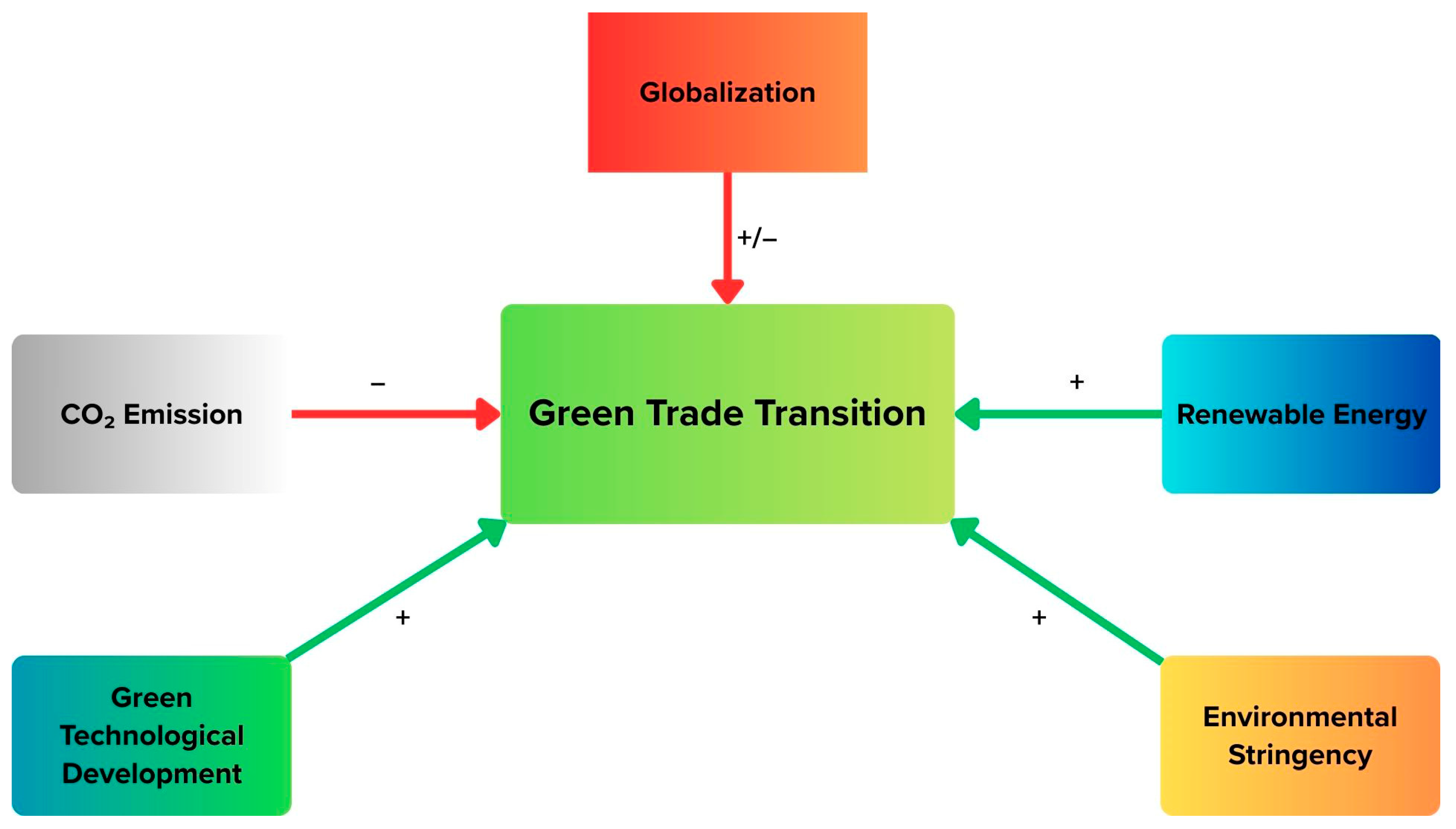
Conceptually, the GTT is rooted in the green growth paradigm, which emphasizes resource efficiency, pollution reduction, environmental management, and risk mitigation to enable cleaner and more resilient resource use without limiting economic growth [34,35,36]. We identify four key forces shaping the GTT: RENEW, GTECH, ENVSTR, and GLBZ, and consider CO2 emissions as a structural constraint. Figure 1 summarizes the expected directional effects of these drivers.
GLBZ affects trade structures through two opposing channels. On the one hand, deeper integration can stimulate production and trade, potentially reinforcing environmental pressures if structural change does not occur [3]. On the other hand, GLBZ facilitates technology transfer, promotes diffusion of higher environmental standards, and increases global demand for green goods [37,38]. Consequently, the impact of GLBZ on the GTT depends on the interaction with national policies, technological capacity, and existing production structures.
Although GTECH and RENEW contribute to economic development, they are not sufficient to ensure a greener trade structure. These factors may increase the production of both green and non-green goods, implying that trade becomes structurally greener only if their effects are disproportionately stronger in green sectors. Otherwise, technological and energy transitions may remain scale-enhancing rather than composition-shifting.
Theoretically, GTECH and RENEW affect the GTT indirectly. GTECH expands production possibilities and facilitates compliance with environmental standards, whereas RENEW reduces dependence on carbon-intensive inputs [36,39,40]. Since energy production accounts for approximately 75% of global GHG emissions [41], shifts toward renewable sources can substantially reduce the carbon intensity of production and trade-related activities. These changes may improve the relative competitiveness of green goods in international markets, but without supportive policy frameworks, their contribution to trade restructuring remains limited.
ENVSTR is another key driver of the GTT. Stringent policies increase the cost of polluting activities and reduce the attractiveness of environmentally harmful production [42], thereby encouraging a shift toward cleaner alternatives [43]. An early study by [44] initiated the debate on how environmental regulations affect economic performance. While well-designed policies may stimulate innovation, as suggested by the Porter Hypothesis, they may also induce the relocation of pollution-intensive activities to countries with weaker standards, consistent with the Pollution Haven Hypothesis [44].
Relatedly, the Race to the Bottom hypothesis argues that countries may relax environmental regulations to attract foreign investment and enhance competitiveness [45]. However, rising income levels and environmental awareness often lead to more stringent regulatory frameworks, in line with the Environmental Kuznets Curve hypothesis [46,47]. Moreover, increasing supply chain transparency and sustainability pressures make it more difficult for such mechanisms to persist in practice.
Finally, CO2 emissions capture the carbon intensity of a country’s production and trade structure and reflect the degree of lock-in to fossil fuel–based activities. Higher emission levels signal structural dependence on carbon-intensive sectors, which constrains the reallocation of trade toward green goods and is therefore expected to hinder the GTT.
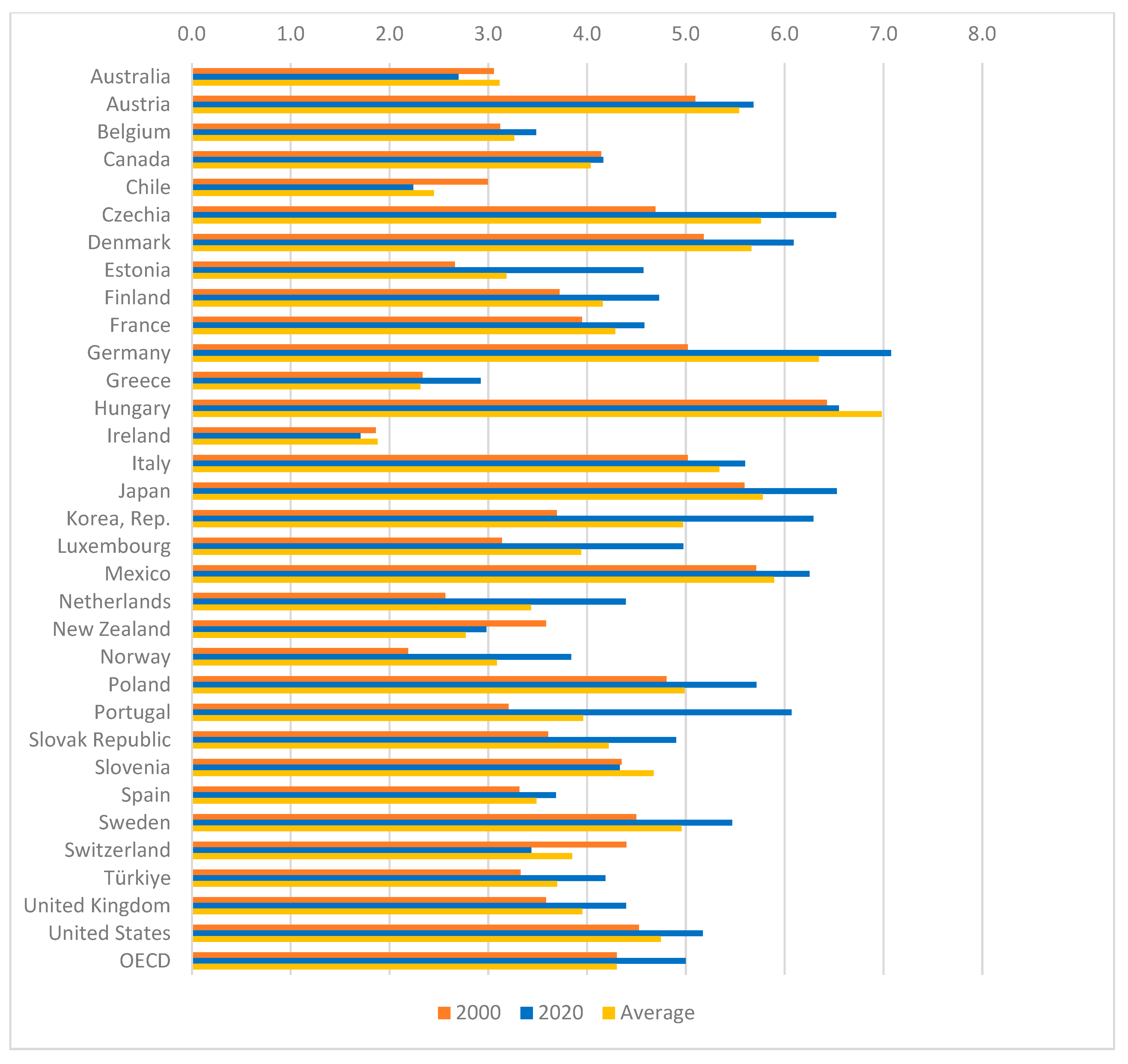
Figure 2 illustrates the evolution of GTT in OECD countries from 2000 to 2020. The estimated GTT levels are still low throughout the period. However, we can observe a substantial cross-country heterogeneity. Countries with the highest average values include Hungary, Germany, Mexico, Japan, Czechia, and Denmark. The lowest averages are observed in Ireland, Greece, Chile, New Zealand, and Australia. On average, GTT in the OECD increased modestly, from 4.3% to around 5%. Countries such as Portugal, Korea, Germany, and Lithuania showed relatively strong progress. However, several countries, including Switzerland, Chile, New Zealand, Australia, Costa Rica, and Ireland, experienced a decline in GTT levels.

4. Econometric Analysis

4.1. Model and Dataset

To investigate the determinants of green trade transition, the following model is estimated:
G T T = f G T E C H ,   R E N E W , E N V S T R , C O 2 , G L B Z
where G T T ,   T E C H ,   R E N E W ,   E N V S T R ,   C O 2 , and G L B Z represent green trade transition, green technological development, renewable energy, environmental stringency, carbon emission, and globalization, respectively. GTT denotes the share of green goods trade in total trade, as mentioned before, and is gathered from the World Bank’s World Integrated Trade Solution [WITS]. We define green goods by adopting the CLEG proposed by the OECD, which allows us to track 255 products based on their 6-digit Harmonized System (HS) codes. ENVSTR is the degree to which environmental policies put an explicit or implicit price on polluting or environmentally harmful behaviour, based on the degree of stringency of 13 environmental policy instruments. CO2 corresponds to the production-based carbon intensity. GTECH, RENEW, ENVSTR, and CO2 data were obtained from OECD. Finally, GLBZ is the globalization index, which measures the economic, social, and political dimensions of globalization, introduced by [48,49].
Table 1 provides a description of the variables. This study has transformed the empirical model to the following linear dynamic form:
G T T i t = β 0 + β 1 G T T i t 1 + β 2 G T E C H i t + β 3 R E N E W i t + β 4 E N V S T R i t + β 5 C O 2 i t + β 6 G L B Z i t + ε i t
where i indicates cross-section units [OECD countries] and t represents the time series. β i are the estimated coefficients.
Descriptive statistics of the variables are presented in Appendix A. Accordingly, GTECH, RENEW, CO2, and GLBZ have relatively high standard deviations. This variability reflects pronounced heterogeneity across OECD countries in terms of technological capabilities, integration into global markets, and energy transition pathways. Moreover, Appendix B indicates the correlation matrix. The pairwise correlations are generally moderate and below conventional thresholds, suggesting that multicollinearity is unlikely to be a concern in the estimations. The signs of the correlations are largely consistent with theoretical expectations, providing preliminary support for the empirical specification.

4.2. Methodology

This study begins with a series of preliminary tests to examine the statistical properties of the panel data, including cross-section dependency, slope homogeneity, unit roots, heteroskedasticity, endogeneity, and autocorrelation. We also conduct panel cointegration tests to ensure the presence of long-run equilibrium relationships and avoid spurious results, and we employ panel causality tests to identify the direction of influence among variables, which is crucial for detecting potential endogeneity and reverse causality issues in the model.
We employ the test developed by [50,51] to evaluate correlations across cross-sectional units:
C D = [ 2     T N N 1 ] 0.5     i = 1 N 1 j = i + 1 N ρ i j
where ρ i j denotes the correlation coefficient between units i and j. The null hypothesis of this test is that the error terms are weakly cross-sectionally dependent. Weak cross-sectional dependence indicates that the correlation between these units tends to approach zero, suggesting minimal dependency. Conversely, strong cross-sectional dependence implies that the correlation remains constant across the units. This reflects a significant and stable relationship among them.
To assess whether slope coefficients are homogeneous across panel units, the slope homogeneity test developed by [52] is used. This test is a modification of Swamy’s test for panels with larger cross-sectional dimensions than time series. The test statistics are calculated as follows:
˜ S H = N 0.5 2 K 0.5 1 N S ˜ k
a d j ˜ S H = N 0.5 2 K [ T k 1 ] 0.5 T + 1 1 N S ˜ k
In Equations (5) and (6), ˜ S H , a d j ˜ S H , S, k, and N denote the delta tide, adjusted delta tide, Swamy test statistics, predictor variables, and cross-section units, respectively. The null hypothesis of this test is that the panel is homogeneous.
To evaluate the stationarity of the variables under study, the unit root test introduced by [53] was used. This test effectively addresses issues of heterogeneity and cross-sectional dependence in the data used. Parallel to the unit root test developed by [54], this methodology makes use of the average of each panel unit’s individual Augmented Dickey–Fuller (ADF) t-statistics. The null hypothesis of this test is that all series are non-stationary. To address the issue of cross-dependence, standard Augmented Dickey–Fuller (ADF) regressions are enhanced by incorporating cross-sectional averages of the lagged levels and first differences in the individual time series. This methodology is referred to as the Cross-Sectional Augmented Dickey–Fuller (CADF) statistic.
y i , t = i + ρ i y i , t 1 + γ i N 1 i = 1 N y i , t 1 + δ i N 1 i = 1 N y i , t + ε i , t
Additionally, a truncated variant of the CADF statistic is implemented, which accounts for finite first- and second-order moments. This is denoted as the Cross-Sectional Augmented IPS (CIPS).
C I P S N , T = N 1 i = 1 N t i [ N , T ]
where t i ( N , T ) denotes the t-statistics of the OLS estimates of ρ i (denoted as CADF). The Pesaran test statistic represents a modification of the IPS statistic, derived from the average of the individual CADF statistics.
To evaluate the heteroskedasticity of the residuals, the Modified Wald test for groupwise heteroskedasticity proposed by [55] is employed. The discussion of the Lagrange multiplier, likelihood ratio, and standard Wald test statistics highlights their sensitivity to the assumption of normality in errors. Notably, the Modified Wald statistic applied in this analysis is robust to violations of the normality assumption, at least in asymptotic terms.
To analyze the cointegration relationships, refs. [56,57] panel cointegration tests are applied, reporting Modified Phillips–Perron t, Phillips–Perron t, and Augmented Dickey–Fuller t statistics to evaluate long-run equilibrium relationships among variables. These statistics are derived under the null hypothesis of no cointegration, which implies that the estimated residuals are non-stationary. Under appropriate normalizations, these statistics follow a standard normal distribution asymptotically [56,57]. Hence, a calculated statistic exceeding the critical value (1.65 at the 5% significance level) leads to rejection of the null hypothesis of no cointegration.
The panel causality test introduced by [58] identifies causal links across panel units. The null hypothesis assumes that there is no homogeneous Granger causality across the panel. The alternative hypothesis posits the existence of at least one causal relationship within the dataset. This approach is designed for panel data where the causal relationship may exist for some individuals but not necessarily for all. The regression model for individual i at time t is specified as follows:
y i , t = i + k = 1 K γ i k y i , t k + k = 1 K β i k x i , t k + ε i , t
where y i , t and x i , t are stationary variables. The coefficients γ i k and β i k are allowed to differ across individuals but are assumed to be constant over time, and the lag order K is identical for all panel members. The panel is assumed to be balanced. The null hypothesis posits no Granger causality for any individual, while the alternative allows causality to exist for a subset of the panel.
Dynamic panel data models with fixed or random effects can produce biased coefficient estimates, especially when the time dimension is limited [59]. To address this, difference GMM [60] and system GMM [61,62,63] are widely used. Difference GMM relies on moment conditions from first differences, while system GMM uses both levels and differences, providing more efficient and consistent estimates, particularly when the dependent variable exhibits high persistence or approximates a random walk [64].
System GMM can be implemented using one-step or two-step estimators. The one-step method applies all moment conditions simultaneously, whereas the two-step estimator first estimates the model and then refines the parameter estimates using a more efficient weighting matrix, reducing finite-sample bias. The GMM estimator is formally expressed as follows:
θ ^ = arg m i n 1 N i = 1 N X i t ε i t [ θ ] W 1 N i = 1 N X i t ε i t [ θ ]
In Equation (10), θ is the parameter to be estimated, Z is the weighting matrix [the variance-covariance matrix of the moment conditions], and N is the number of observations. Two-step GMM is designed to achieve more efficient parameter estimates than one-step GMM by integrating additional instruments or refining the set of moment conditions. Furthermore, as demonstrated by [62], the application of one-step GMM in large-scale panel data models may result in significant finite-sample biases. Accordingly, we select to utilize the two-step system GMM estimator.
To ensure reliability, two additional estimators are employed: Dynamic Bias-Corrected (DBC) and Dynamic Quasi-Maximum Likelihood (DQML). DBC is efficient for linear dynamic panels with strictly exogenous regressors, equivalent to corrected profile likelihood and iterative bias-corrected estimators. DQML is suitable for panels with many cross-sections and fixed time periods, applying quasi-maximum likelihood techniques for both random and fixed effects models. These methods correct finite-sample bias and provide robust inference when standard GMM may be inefficient.

5. Results

The preliminary test results are presented in Table 2. According to the cross-sectional dependence test, the null hypotheses are rejected for all variables as well as for the overall model, indicating the presence of cross-sectional dependence. On the other hand, the unit root test results show that GLBZ and ENVSTR are stationary at the level, while the other variables become stationary after taking their first differences. The results of the homogeneity, heteroskedasticity, and autocorrelation tests indicate that the null hypotheses are rejected, thereby suggesting that the model is heterogeneous and suffers from heteroskedasticity and autocorrelation problems.
The results of the panel cointegration tests are reported in Table 3. The findings clearly indicate the rejection of the null hypothesis no cointegration, thereby providing strong evidence for the existence of a long-run cointegration relationship among the variables.
The results of panel causality tests [Table 4] reveal unidirectional relationships between GLBZ and GTT, ENVSTR and RENEW, and GLBZ and RENEW, whereas bidirectional causality is observed among the remaining variables. Such causality relationships between independent variables suggest the presence of potential endogeneity issues [55,65].
Preliminary tests reveal several econometric issues, including cross-sectional dependence, heterogeneity, heteroskedasticity, autocorrelation, and endogeneity. Because of these issues, the System GMM estimator emerges as an appropriate choice. This method is particularly suitable for panels with large N and small T. It also effectively addresses endogeneity by using internal instruments and provides robust results against heteroskedasticity and autocorrelation.
The results of system GMM, DBC, and DQML estimations are presented in Table 5. Overall, the coefficient signs and magnitudes are largely consistent across methods, confirming the robustness of our findings. The results show that the lagged dependent variable [L1.GTT] is positive and significant across all models, showing that countries with higher past levels of green trade are more likely to maintain and expand it over time. This finding indicates the dynamic nature of the green trade transition.
The result for GTECH shows a positive and statistically significant effect in the GMM estimation, but this impact becomes insignificant in the robust DBC and DQML models. RENEW also shows a positive and significant effect in the GMM estimation, although this significance disappears in the DBC and DQML models. ENVSTR shows a consistently positive and significant effect in all models. Our analysis shows that CO2 emissions have a negative and significant association with the GTT in the DBC model. However, this relationship becomes insignificant in the GMM and DQML estimations. Importantly, GLBZ shows a negative and statistically significant effect across all estimators. To examine this interesting result in more detail, we conducted a robustness check analysis of the economic, political, and social dimensions of globalization. Table 6 presents the results. The results indicate that economic globalization has a negative and significant impact on the GTT, whereas political globalization shows a positive impact, and social globalization has no significant effect.
To ensure the reliability and validity of the GMM estimations, several post-estimation diagnostic tests were conducted. The Arellano–Bond test results indicate that the null hypothesis of no first-order autocorrelation is rejected. This outcome is expected, as the first lag of the dependent variable is included as a regressor. In contrast, the Arellano–Bond test results for second-order serial correlation (AR(2)) do not reject the null of no second-order autocorrelation, which is a desirable outcome. According to [62], the probability value of the AR(2) test should be between 0.1 and 0.25. The test results reveal that the probability values are within the recommended range.
The Sargan–Hansen test reveals no statistically significant evidence against the validity of the instruments, supporting the model’s fit. Additionally, the Difference-in-Hansen test results indicate that the instrument exogeneity hypothesis cannot be rejected. This finding supports the validity of the additional instruments used in the system GMM estimation. These results strengthen confidence in the consistency and reliability of the system GMM specification.

6. Discussion

The most notable result is the negative relationship between GLBZ and the GTT. This does not imply a decline in green trade in absolute terms; rather, overall trade has expanded faster than green trade. A closer look at the dimensions of globalization reveals that this effect is mainly driven by economic integration, while political globalization partially counteracts it by promoting regulatory alignment and environmental norms. Nevertheless, these political dynamics remain insufficient to offset the dominance of market-driven forces, suggesting that economic globalization continues to favour non-green trade.
The effects of GTECH and RENEW require a more nuanced interpretation. Their mixed statistical significance does not indicate weak relevance; instead, their influence operates primarily through indirect channels. Green technologies expand production possibilities and facilitate compliance with environmental standards, while renewable energy reduces dependence on carbon-intensive inputs. Together, these factors create favourable conditions for green trade, but on their own, they are insufficient to generate a structural shift in trade composition, in line with [32].
ENVSTR is identified as the most robust driver of the GTT. Stricter regulations increase the cost of polluting activities and incentivize firms to adopt cleaner production processes that comply with international standards. The stronger effect observed in the DQML model further suggests that environmental policies are more effective when country-specific heterogeneity is considered. These findings are consistent with [9,10] but contrast with [33], highlighting the context-dependent nature of environmental regulations.
Finally, the negative association between CO2 emissions and the GTT indicates that carbon-intensive production structures constrain the transition toward greener trade. Decarbonization thus supports both emission reductions and the structural reallocation of trade toward environmentally sustainable sectors. Furthermore, the model’s dynamic structure suggests that the GTT exhibits path dependence, implying that existing production structures shape future trade trajectories.

7. Conclusions and Policy Implications

This study introduces the concept of the green trade transition (GTT) and provides a systematic assessment of the structural drivers of green trade across OECD countries from 2000 to 2020. The findings indicate that renewable energy deployment, green technological development, and stringent environmental policies are associated with higher levels of GTT, whereas CO2 emissions and globalization serve as structural constraints. These results capture structural relationships rather than strict causal effects.
A central contribution is the identification of a “globalization paradox”. While globalization is often expected to facilitate the diffusion of green goods, its economic dimension tends to favour non-green sectors, thereby impeding the GTT. Political globalization partially offsets this effect by promoting regulatory harmonization and the diffusion of environmental norms, whereas social globalization has no significant impact. Together, these findings suggest that technological progress alone is insufficient to induce a structural shift in trade without a consistent and supportive environmental policy framework.
From a policy perspective, the results imply that uniform strategies are unlikely to be effective, given the heterogeneity in technological capacity and governance structures across countries. Rather than relying solely on broad trade liberalization, more targeted green-specific trade instruments appear necessary. These include reducing tariff and non-tariff barriers for environmental goods within the WTO frameworks and implementing Carbon Border Adjustment Mechanisms (CBAM) to mitigate competitive disadvantages faced by countries with stricter environmental standards. However, the adoption of such tools may be constrained by political economy factors, including budget limitations, political resistance, and international competition.
The complementary roles of green technology and renewable energy also point to the importance of well-designed financial incentives, such as green export credits and targeted subsidies. For countries with persistently low or declining shares of green trade—such as Ireland, Greece, Chile, and Australia—broader structural reforms may be required to realign trade patterns with sustainability objectives. More generally, the GTT should be understood as a multi-actor process in which trade outcomes are jointly shaped by policy frameworks, research capacity, and societal demand.
By focusing on the share of green goods in total trade, this study shifts attention from aggregate trade volumes to the structural dimensions of trade sustainability. In this sense, evidence from OECD countries provides a comparative benchmark for policymakers seeking to promote greener trade structures, particularly in industrializing economies.
Finally, the analysis is limited to OECD countries. Future research could extend the scope by incorporating non-OECD economies, alternative indicators of green production, and more flexible nonlinear or machine-learning approaches to better capture cross-country heterogeneity. Such extensions would further improve understanding of how structural factors shape the green trade transition.

Author Contributions

Conceptualization, E.B.; Methodology, F.Ö. and E.B.; Validation, F.Ö. and E.B.; Data curation, E.B.; Writing—review and editing, F.Ö. and E.B.; Supervision, F.Ö. All authors have read and agreed to the published version of the manuscript.

Funding

This research received no external funding.

Institutional Review Board Statement

Not applicable.

Informed Consent Statement

Not applicable.

Data Availability Statement

The datasets analyzed during the current study are available in the OECD at [https://data-explorer.oecd.org] and WITS at [https://wits.worldbank.org].

Conflicts of Interest

The authors declare no conflicts of interest.

Abbreviations

The following abbreviations are used in this manuscript:
GTTGreen Trade Transition
GTECHGreen Technological Development
RENEWRenewable Energy Use
GLBZGlobalization
ENVSTREnvironmental Policy Stringency
CLEGCombined List of Environmental Goods
GMMGeneralized Method of Moments
GHGsGreenhouse Gas Emissions
FMOLSFully Modified Ordinary Least Squares
MMQRMoments Quantile Regression
ARDLAutoregressive Distributed Lag
WITSWorld Integrated Trade Solution
ADFAugmented Dickey–Fuller
CADFCross-Sectional Augmented Dickey–Fuller
CIPSCross-Sectional Augmented IPS
DBCDynamic Bias-Corrected
DQMLDynamic Quasi-Maximum Likelihood
CBAMCarbon Border Adjustment Mechanisms

Appendix A

Table A1. Descriptive statistics.
VariableObsMeanStd.MinMax
GTT6724.2731.2911.5427.751
GTECH672209.645242.4030.7181732.641
ENVSTR6722.5710.9530.1114.889
RENEW672160.018223.2396.2052701.081
CO2672100.17921.9536.923194.965
GLBZ67280.0816.19958.46789.812

Appendix B

Table A2. Correlation matrix.
GTTGLBZRENEWCO2GTECHENVSTR
GTT1.0000
GLBZ0.01481.0000
RENEW0.1443−0.03711.0000
CO2−0.2149−0.3705−0.08441.0000
GTECH0.15310.1920−0.0426−0.10721.0000
ENVSTR0.27580.58540.0971−0.26310.27991.0000

References

  1. Copeland, B.R.; Taylor, M.S. North-South Trade and the Environment. Q. J. Econ. 1994, 109, 755–787. [Google Scholar] [CrossRef]
  2. Vale, V.A.; Perobelli, F.S.; Chimeli, A.B. International trade, pollution, and economic structure: Evidence on CO2 emissions for the North and the South. Econ. Syst. Res. 2018, 30, 1–17. [Google Scholar] [CrossRef]
  3. Grossman, G.M.; Krueger, A.B. Environmental Impacts of a North American Free Trade Agreement (No. w3914); National Bureau of Economic Research, Inc.: Cambridge, MA, USA, 1991; pp. 2–36. [Google Scholar]
  4. Antweiler, W.; Copeland, B.R.; Taylor, M.S. Is Free Trade Good for the Environment? Am. Econ. Rev. 2001, 91, 877–908. [Google Scholar] [CrossRef]
  5. Managi, S.; Hibiki, A.; Tsurumi, T. Does Trade Liberalization Reduce Pollution Emissions; Research Institute of Economy, Trade and Industry (RIETI): Tokyo, Japan, 2008; Volume 8013. [Google Scholar]
  6. Can, M.; Ben Jebli, M.; Brusselaers, J. Can green trade save the environment? Introducing the Green (Trade) Openness Index. Environ. Sci. Pollut. Res. 2022, 29, 44091–44102. [Google Scholar] [CrossRef]
  7. Wei, S.; Jiandong, W.; Saleem, H. The impact of renewable energy transition, green growth, green trade and green innovation on environmental quality: Evidence from top 10 green future countries. Front. Environ. Sci. 2023, 10, 1076859. [Google Scholar] [CrossRef]
  8. Liu, S.; Padhan, H.; Jose, A. Do green trade and technology-oriented trade affect economic cycles? Evidence from the Chinese provinces. Technol. Forecast. Soc. Change 2024, 202, 123334. [Google Scholar] [CrossRef]
  9. Cantore, N.; Cheng, C.F.C. International trade of green goods in gravity models. J. Environ. Manag. 2018, 223, 1047–1060. [Google Scholar] [CrossRef]
  10. Kang, S.J.; Lee, S. Impacts of environmental policies on global green trade. Sustainability 2021, 13, 1517. [Google Scholar] [CrossRef]
  11. Hu, X.; Pollitt, H.; Pirie, J.; Mercure, J.F.; Liu, J.; Meng, J.; Tao, S. The impacts of the trade liberalization of green goods on power system and CO2 emissions. Energy Policy 2020, 140, 111173. [Google Scholar] [CrossRef]
  12. Wan, R.; Nakada, M.; Takarada, Y. Trade liberalization in green goods. Resour. Energy Econ. 2018, 51, 44–66. [Google Scholar] [CrossRef]
  13. Gyamfi, B.A.; Agozie, D.Q.; Musah, M.; Onifade, S.T.; Prusty, S. The synergistic roles of green openness and economic complexity in environmental sustainability of Europe’s largest economy: Implications for technology-intensive and environmentally friendly products. Environ. Impact Assess. Rev. 2023, 102, 107220. [Google Scholar] [CrossRef]
  14. Huang, L.; Zhao, W. The impact of green trade and green growth on natural resources. Resour. Policy 2022, 77, 102749. [Google Scholar] [CrossRef]
  15. Can, B.; Ahmed, Z.; Ahmad, M.; Can, M. Do renewable energy consumption and green trade openness matter for human well-being? Empirical evidence from European Union countries. Soc. Indic. Res. 2022, 164, 1043–1059. [Google Scholar] [CrossRef]
  16. Liu, H.; Liu, H.; Zhou, Y. How does green trade affect the environment? Evidence from China. J. Econ. Anal. 2022, 1, 2. [Google Scholar] [CrossRef]
  17. Ahmed, F.; Kousar, S.; Pervaiz, A.; Trinidad-Segovia, J.E.; del Pilar Casado-Belmonte, M.; Ahmed, W. Role of green innovation, trade and energy to promote green economic growth: A case of South Asian Nations. Environ. Sci. Pollut. Res. 2022, 29, 6871–6885. [Google Scholar]
  18. Kellenberg, D.K. An Empirical Investigation of the Pollution Haven Effect with Strategic Environment and Trade Policy. J. Int. Econ. 2009, 78, 242–255. [Google Scholar] [CrossRef]
  19. Chebbi, H.E.; Olarreaga, M.; Zitouna, H. Trade openness and CO2 emissions in Tunisia. Middle East Dev. J. 2011, 3, 29–53. [Google Scholar] [CrossRef]
  20. Tiwari, A.K.; Shahbaz, M.; Hye, Q.M.A. The environmental Kuznets curve and the role of coal consumption in India: Cointegration and causality analysis in an open economy. Renew. Sustain. Energy Rev. 2013, 18, 519–527. [Google Scholar] [CrossRef]
  21. Balogh, J.M.; Jámbor, A. Determinants of CO2 emission: A global evidence. Int. J. Energy Econ. Policy 2017, 7, 217–226. [Google Scholar]
  22. Ali, S.; Yusop, Z.; Kaliappan, S.R.; Chin, L. Dynamic common correlated effects of trade openness, FDI, and institutional performance on environmental quality: Evidence from OIC countries. Environ. Sci. Pollut. Res. 2020, 27, 11671–11682. [Google Scholar] [CrossRef] [PubMed]
  23. Frankel, J.A.; Rose, A. Is Trade Good or Bad for the Environment? Sorting out the Causality. Rev. Econ. Stat. 2005, 87, 85–91. [Google Scholar] [CrossRef]
  24. Baek, J.; Cho, Y.; Koo, W.W. The environmental consequences of globalization: A country-specific time-series analysis. Ecol. Econ. 2009, 68, 2255–2264. [Google Scholar] [CrossRef]
  25. Kohler, M. CO2 emissions, energy consumption, income and foreign trade: A South African perspective. Energy Policy 2013, 63, 1042–1050. [Google Scholar] [CrossRef]
  26. Ahmed, Z.; Le, H.P. Linking Information Communication Technology, trade globalization index, and CO2 emissions: Evidence from advanced panel techniques. Environ. Sci. Pollut. Res. 2021, 28, 8770–8781. [Google Scholar]
  27. Tariq, M.; Xu, Y.; Ullah, K.; Dong, B. Toward low-carbon emissions and green growth for sustainable development in emerging economies: Do green trade openness, eco-innovation, and carbon price matter? Sustain. Dev. 2024, 32, 959–978. [Google Scholar]
  28. Bai, J.; Han, Z.; Rizvi, S.K.A.; Naqvi, B. Green trade or green technology? The way forward for G-7 economies to achieve COP 26 targets while making competing policy choices. Technol. Forecast. Soc. Change 2023, 191, 122477. [Google Scholar] [CrossRef]
  29. Zugravu-Soilita, N. Trade in Green goods and Air Pollution: A Mediation Analysis to Estimate Total, Direct and Indirect Effects. Environ. Resour. Econ. 2019, 74, 1125–1162. [Google Scholar] [CrossRef]
  30. Tamini, L.D.; Sorgho, Z. Trade in green goods: Evidences from an analysis using elasticities of trade costs. Environ. Resour. Econ. 2018, 70, 53–75. [Google Scholar]
  31. De Melo, J.; Solleder, J.M. Barriers to trade in green goods: How important they are and what should developing countries expect from their removal. World Dev. 2020, 130, 104910. [Google Scholar]
  32. Chen, Q.; Cho, H. Determinants of Green Technology Diffusion and Green Trade. J. Korea Trade 2023, 27, 1–26. [Google Scholar]
  33. Dai, Z.; Zhang, Y.; Zhang, R. The impact of environmental regulations on trade flows: A focus on green goods listed in APEC and OECD. Front. Psychol. 2021, 12, 773749. [Google Scholar] [CrossRef]
  34. World Bank (WB). Inclusive Green Growth: The Pathway to Sustainable Development; World Bank: Washington, DC, USA, 2012. [Google Scholar]
  35. Hallegatte, S.; Heal, G.; Fay, M.; Treguer, D. From Growth to Green Growth-A Framework (No. w17841); National Bureau of Economic Research, Inc.: Cambridge, MA, USA, 2012. [Google Scholar]
  36. Dangelico, R.M.; Pujari, D. Mainstreaming green product innovation: Why and how companies integrate environmental sustainability. J. Trade Ethics 2010, 95, 471–486. [Google Scholar] [CrossRef]
  37. Panayotou, T. Globalization and Environment. CID Working Paper Series 2000.53; Harvard University: Cambridge, MA, USA, 2000. [Google Scholar]
  38. Copeland, B.R. Globalization and the Environment; National Bureau of Economic Research, Inc.: Cambridge, MA, USA, 2021; Volume 2. [Google Scholar]
  39. Lin, B.; Ma, R. Green technology innovations, urban innovation environment and CO2 emission reduction in China: Fresh evidence from a partially linear functional-coefficient panel model. Technol. Forecast. Soc. Change 2022, 176, 121434. [Google Scholar] [CrossRef]
  40. Xu, Y.; Liu, S.; Wang, J. Impact of environmental regulation intensity on green innovation efficiency in the Yellow River Basin, China. J. Clean. Prod. 2022, 373, 133789. [Google Scholar] [CrossRef]
  41. IEA. World Energy Outlook 2023; IEA: Paris, France, 2023; Available online: https://www.iea.org/reports/world-energy-outlook-2023 (accessed on 13 December 2025).
  42. Neves, S.A.; Marques, A.C.; Patrício, M. Determinants of CO2 emissions in European Union countries: Does environmental regulation reduce environmental pollution? Econ. Anal. Policy 2020, 68, 114–125. [Google Scholar] [CrossRef]
  43. Povitkina, M. The limits of democracy in tackling climate change. Environ. Politics 2018, 27, 411–432. [Google Scholar] [CrossRef]
  44. Porter, M.E.; Linde, C.V.D. Toward a new conception of the environment-competitiveness relationship. J. Econ. Perspect. 1995, 9, 97–118. [Google Scholar] [CrossRef]
  45. Srinivasan, T.N.; Bhagwati, J. Trade and the Environment: Does Environmental Diversity Detract from the Case for Free Trade? MIT Press: Cambridge, MA, USA, 1995; p. 729. [Google Scholar]
  46. Newig, J. Does public participation in environmental decisions lead to improved environmental quality?: Towards an analytical framework. Commun. Coop. Particip. (Int. J. Sustain. Commun.) 2007, 1, 51–71. [Google Scholar]
  47. Gielen, D. Perspectives for the Energy Transition Investment Needs for a Low-Carbon Energy System; International Renewable Energy Agency: Abu Dhabi, United Arab Emirates, 2017; pp. 1–204. [Google Scholar]
  48. Dreher, A. Does Globalization Affect Growth? Evidence from a new Index of Globalization. Appl. Econ. 2006, 38, 1091–1110. [Google Scholar] [CrossRef]
  49. Gygli, S.; Haelg, F.; Potrafke, N.; Sturm, J.E. The KOF Globalisation Index—Revisited. Rev. Int. Organ. 2019, 14, 543–574. [Google Scholar] [CrossRef]
  50. Pesaran, M.H. Testing Weak Cross-Sectional Dependence in Large Panels. Econ. Rev. 2014, 34, 1089–1117. [Google Scholar] [CrossRef]
  51. Pesaran, M.H. General diagnostic tests for cross-sectional dependence in panels. Empir. Econ. 2021, 60, 13–50. [Google Scholar] [CrossRef]
  52. Pesaran, M.H.; Yamagata, T. Testing slope homogeneity in large panels. J. Econ. 2008, 142, 50–93. [Google Scholar] [CrossRef]
  53. Pesaran, M.H. A simple panel unit root test in the presence of cross-section dependence. J. Appl. Econ. 2007, 22, 265–312. [Google Scholar]
  54. Im, K.; Pesaran, H.; Shin, Y. Testing for unit roots in heterogenous panels. J. Econ. 2003, 115, 53–74. [Google Scholar] [CrossRef]
  55. Greene, W. Econometric Analysis; Prentice-Hall: New York, NY, USA, 2000. [Google Scholar]
  56. Pedroni, P. Critical values for cointegration tests in heterogeneous panels with multiple regressors. Oxf. Bull. Econ. Stat. 1999, 61, 653–670. [Google Scholar] [CrossRef]
  57. Pedroni, P. Panel cointegration: Asymptotic and finite sample properties of pooled time series tests with an applicaton to the PPP hypothesis. Econ. Theory 2004, 20, 597–625. [Google Scholar]
  58. Dumitrescu, E.I.; Hurlin, C. Testing for Granger non-causality in heterogeneous panels. Econ. Model. 2012, 29, 1450–1460. [Google Scholar] [CrossRef]
  59. Nickell, S. Biases in Dynamic Models With Fixed Effects. Econometrica 1981, 49, 1417–1426. [Google Scholar] [CrossRef]
  60. Arellano, M.; Bond, S. Some tests of specification for panel data: Monte-Carlo evidence and an application to employment equations. Rev. Econ. Stud. 1991, 58, 277–297. [Google Scholar]
  61. Arellano, M.; Bover, O. Another look at the instrumental variable estimation of error-components models. J. Econ. 1995, 68, 29–51. [Google Scholar] [CrossRef]
  62. Blundell, R.; Bond, S. Initial conditions and moment restrictions in dynamic panel data models. J. Econ. 1998, 87, 115–143. [Google Scholar] [CrossRef]
  63. Chudik, A.; Pesaran, M.H. An augmented Anderson–Hsiao estimator for dynamic short-T panels. Econ. Rev. 2022, 41, 416–447. [Google Scholar] [CrossRef]
  64. Roodman, D. How to do xtabond2: An introduction to difference and system GMM in Stata. Stata J. 2009, 9, 86–136. [Google Scholar] [CrossRef]
  65. Wooldridge, J.M. Econometric Analysis of Cross Section and Panel Data, 2nd ed.; The MIT Press: Cambridge, MA, USA, 2010. [Google Scholar]
Figure 1. Directional effects of RENEW, GTECH, ENVSTR, CO2, and GLBZ on the GTT.
Sustainability 18 01329 g001
Figure 2. Green Trade Transition (%).
Sustainability 18 01329 g002
Table 1. Description of variables.
VariableDescriptionDefinitionData Source
GTTGreen Trade TransitionShare of green goods trade in total trade.Authors’ calculations based on WITS
GTECHGreen Technological DevelopmentDevelopment of environment-related technologies [index].OECD
RENEWRenewable Energy Renewable energy supply [index].OECD
ENVSTREnvironmental Stringency IndexThe degree to which environmental policies put an explicit or implicit price on polluting or environmentally harmful behaviour.
The index is based on the degree of stringency of 13 environmental policy instruments.
OECD
CO2 Production-based Carbon IntensityProduction-based CO2 emissions [index].OECD
GLBZGlobalizationThe index measures the economic, social and political dimensions of globalization.[48,49]
Table 2. Preliminary test results.
VariableCross-Sectional DependenceUnit Root Test
Pesaran CD TestLevel1st Difference
GTT24.63 ***
[0.000]
−1.715
[0.602]
−3.105 ***
[0.000]
GTECH15.68 ***
[0.000]
−1.559
[0.879]
−2.639 ***
[0.000]
ENVSTR81.92 ***
[0.000]
−2.570 ***
[0.000]
-
RENEW4.88 ***
[0.000]
−1.747
[0.531]
−3.090 ***
[0.000]
CO230.05 ***
[0.000]
−1.517
[0.922]
−3.168 ***
[0.000]
GLBZ85.91 ***
[0.000]
−2.100 **
[0.024]
-
Model10.69 ***
[0.000]
H0: The error terms are weakly cross-sectionally dependent
H0: All series are non-stationary
Slope Heterogeneity Test
Delta12.023 ***
[0.000]
Adj. Delta14.726 ***
[0.000]
H0: Panel is homogenous
Modified Wald Test for Groupwise Heteroskedasticity
Chi251.27 **
[0.017]
H0: Homoskedasticity
Wooldridge Test for Autocorrelation
F Test284.400 ***
[0.000]
H0: No serial correlation
*** and ** denote the significance levels at the 1% and 5%, respectively. The values in the parentheses are p-values.
Table 3. Cointegration test.
Statisticp-Value
Modified Phillips–Perron t5.212 ***0.000
Phillips–Perron t−2.664 ***0.004
Augmented Dickey–Fuller t−2.206 **0.014
*** and ** denote the significance levels at the 1% and 5%, respectively.
Table 4. Panel causality test results.
W-Bar StatZ-Bar StatDecision
GTT → GLBZ
GLBZ → GTT
1.145
2.623 ***
0.581
6.493 ***
GLBZ=>GTT
GTT → GTECH
GTECH → GTT
2.198 ***
2.016 ***
4.792 ***
2.733 ***
GTT<=>GTECH
GTT → RENEW
RENEW → GTT
2.452 ***
1.592 **
5.807 ***
2.369 **
GTT<=>RENEW
GTT → ENVSTR
ENVSTR → GTT
1.423 *
2.548 ***
1.719 *
6.190 ***
GTT<=>ENVSTR
GTT → CO2
CO2 → GTT
2.204 ***
3.333 ***
4.816 ***
9.330 ***
GTT<=>CO2
GTECH → RENEW
RENEW → GTECH
1.737 ***
3.284 ***
2.949 ***
9.149 ***
GTECH<=>RENEW
GTECH → CO2
CO2 → GTECH
3.043 ***
2.028 ***
8.172 ***
4.112 ***
CO2<=>GTECH
GTECH → ENVSTR
ENVSTR → GTECH
3.443 ***
2.822 ***
9.771 ***
7.287 ***
GTECH<=>ENVSTR
GTECH → GLBZ
GLBZ → GTECH
1.929 ***
2.544 ***
3.719 ***
6.177 ***
GTECH<=>GLBZ
ENVSTR → GLBZ
GLBZ → ENVSTR
4.183 ***
3.737 ***
12.731 ***
10.949 ***
ENVSTR<=>GLBZ
GLBZ → RENEW
RENEW → GLBZ
2.957 ***
1.2394
7.830 ***
0.957
GLBZ=>RENEW
GLBZ → CO2
CO2 → GLBZ
4.404 ***
1.816 ***
13.617 ***
3.263 ***
GLBZ<=>CO2
ENVSTR → RENEW
RENEW → ENVSTR
3.861 ***
1.196 *
11.442 ***
0.786
ENVSTR=>RENEW
RENEW → CO2
CO2 → RENEW
4.077 ***
3.264 ***
12.307 ***
9.057 ***
RENEW<=>CO2
ENVSTR → CO2
CO2 → ENVSTR
3.789 ***
2.303 ***
11.158 ***
5.210 ***
CO2<=>ENVSTR
***, **, and * denote the significance levels at the 1%, 5%, and 10%, respectively.
Table 5. GMM, DBC, and DQML results.
GMMDBCDQML
L1.GTT0.797 ***
[0.000]
0.907 ***
[0.000]
0.911 ***
[0.000]
GTECH0.001 ***
[0.000]
0.001
[0.838]
0.001
[0.944]
ENVSTR0.076 ***
[0.005]
0.0619 ***
[0.000]
0.109 ***
[0.000]
RENEW0.001 ***
[0.000]
0.001
[0.511]
0.001
[0.970]
CO2 −0.001
[0.386]
−0.002 **
[0.012]
0.001
[0.362]
GLBZ−0.036 ***
[0.000]
−0.007 **
[0.010]
−0.021 ***
[0.000]
Cons3.408 ***
[0.000]
1.001 ***
[0.001]
1.682 ***
[0.000]
AR(1)−4.134 ***
[0.000]
AR(2)−1.530
[0.126]
Sargan–Hansen28.993
[0.311]
Difference-in-Hansen0.999
[0.607]
*** and ** denote the significance levels at the 1% and 5%, respectively.
Table 6. System GMM results for the role of globalization dimensions.
Economic GlobalizationPolitical GlobalizationSocial Globalization
L1.GTT0.772 ***
[0.000]
0.815 ***
[0.000]
0.890 ***
[0.000]
GTECH0.001 ***
[0.000]
0.001 ***
[0.000]
0.001 ***
[0.001]
ENVSTR0.006
[0.805]
−0.034
[0.153]
−0.012
[0.660]
RENEW0.001 ***
[0.000]
0.001 ***
[0.000]
0.001 ***
[0.000]
CO2 −0.001
[0.473]
0.001
[0.214]
0.001
[0.187]
GLBZ−0.018 ***
[0.002]
0.019 *
[0.063]
−0.004
[0.482]
Cons2.146 ***
[0.000]
1.085
[0.174]
1.682 ***
[0.000]
AR(1)−4.0125 ***
[0.000]
−4.0581 ***
[0.000]
−4.334 ***
[0.000]
AR(2)−1.6301
[0.103]
−1.621
[0.105]
−1.653
[0.098]
*** and * denote the significance levels at the 1% and 10%, respectively.
Disclaimer/Publisher’s Note: The statements, opinions and data contained in all publications are solely those of the individual author(s) and contributor(s) and not of MDPI and/or the editor(s). MDPI and/or the editor(s) disclaim responsibility for any injury to people or property resulting from any ideas, methods, instructions or products referred to in the content.