_Li.png)
Institutional Signals in Marine Policy Shape Tourists’ Pro-Environmental Intentions: Asymmetric Psychological Pathways and a Behaviorally Informed Governance Framework


Abstract
1. Introduction
2. Literature Review
2.1. Theory of Planned Behavior and Its External Boundaries
2.2. Marine Environmental Policy Regulation
2.3. Tourist Environmentally Responsible Behavioral Intention
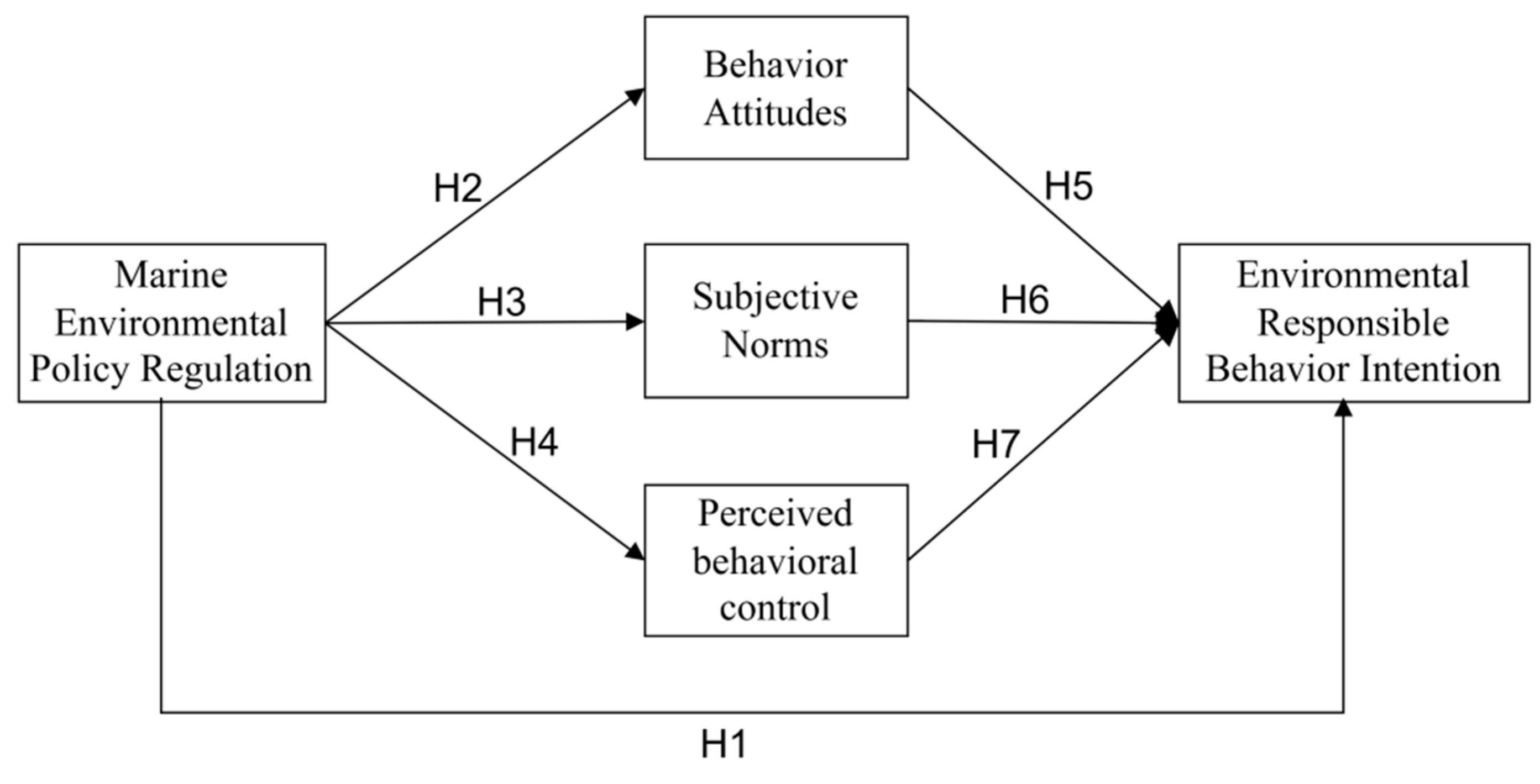
3. Hypotheses and Conceptual Model
3.1. Research Hypotheses
3.1.1. Direct Effect of Policy Regulation on Behavioral Intention
3.1.2. Policy Regulation’s Influence on TPB Antecedents
3.1.3. TPB Antecedents and Behavioral Intention
3.1.4. Mediating Roles of TPB Constructs
3.2. Conceptual Model
4. Research Design
4.1. Measurement of Variables
4.2. Data Collection
5. Results and Discussions
5.1. Reliability and Validity Test
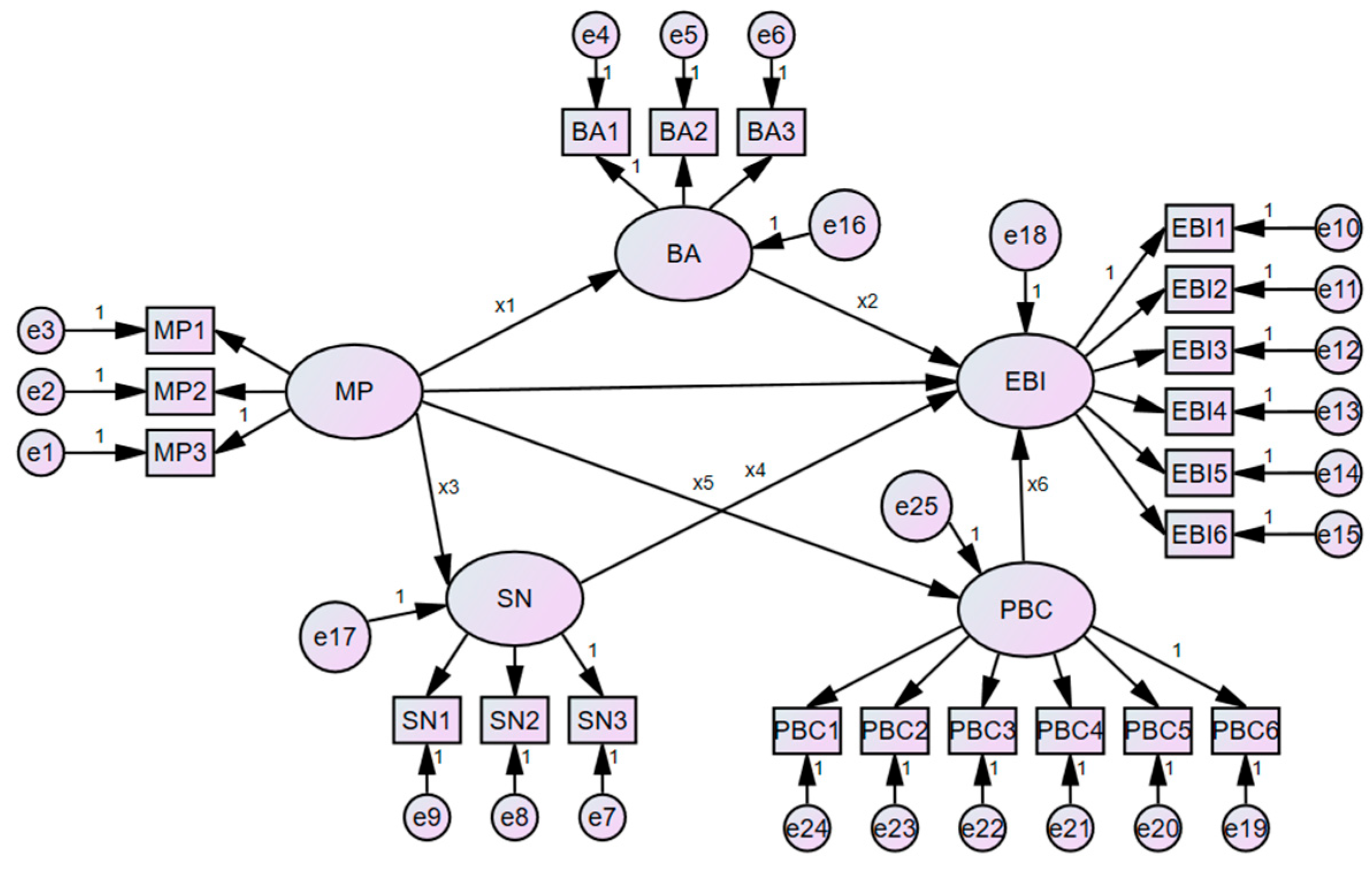
5.2. Path Analysis and Hypothesis Testing
5.3. Mediating Effects Testing
6. Conclusions and Future Research
6.1. Conclusions
6.2. Management Implications
6.3. Limitations and Future Research
Author Contributions
Funding
Institutional Review Board Statement
Informed Consent Statement
Data Availability Statement
Conflicts of Interest
Abbreviations
| TPB | Theory of Planned Behavior |
| SEM | Structural Equation Model |
| MP | Marine Environmental Policy Regulation |
| BA | Behavioral Attitudes |
| SN | Social Norms |
| PBC | Perceived Behavioral Control |
| EBI | Environmentally Responsible Behavioral Intention |
Appendix A. Descriptive Statistics

| Variable | Category | Frequency (n) | Percentage (%) |
|---|---|---|---|
| Gender | Male | 184 | 44.55 |
| Female | 229 | 55.45 | |
| Age | 18–30 | 162 | 39.23 |
| 31–40 | 78 | 18.89 | |
| 41–50 | 79 | 19.13 | |
| 50–60 | 54 | 13.07 | |
| 60+ | 40 | 9.69 | |
| Education | High school or below | 76 | 18.40 |
| College diploma | 120 | 29.06 | |
| Bachelor’s | 145 | 35.11 | |
| Master’s or above | 72 | 17.44 | |
| Occupation | Civil servants and staff of public institutions | 102 | 24.70 |
| Corporate staff | 131 | 31.72 | |
| Student | 123 | 29.78 | |
| Other | 57 | 13.80 | |
| Last visit season | Winter | 60 | 14.53 |
| Spring | 62 | 15.01 | |
| Summer | 150 | 36.32 | |
| Autumn | 141 | 34.14 |
Appendix B. Convergent Validity Test Result
| Factor | Variable | Non-Standardized Load Factor | Standardized Load Factor | AVE Value | CR Value |
|---|---|---|---|---|---|
| MP | MP1 | 1 | 0.842 | 0.729 | 0.889 |
| MP2 | 0.926 | 0.9 | |||
| MP3 | 0.854 | 0.822 | |||
| BA | BA1 | 1 | 0.795 | 0.719 | 0.884 |
| BA2 | 1.115 | 0.91 | |||
| BA3 | 1.001 | 0.836 | |||
| SN | SN1 | 1 | 0.83 | 0.667 | 0.857 |
| SN2 | 0.922 | 0.813 | |||
| SN3 | 0.911 | 0.806 | |||
| PBC | PBC1 | 1 | 0.667 | 0.533 | 0.872 |
| PBC2 | 1.209 | 0.74 | |||
| PBC3 | 1.11 | 0.714 | |||
| PBC4 | 1.215 | 0.759 | |||
| PBC5 | 1.128 | 0.735 | |||
| PBC6 | 1.188 | 0.753 | |||
| EBI | EBI1 | 1 | 0.76 | 0.611 | 0.903 |
| EBI2 | 1.041 | 0.777 | |||
| EBI3 | 0.996 | 0.725 | |||
| EBI4 | 1.252 | 0.867 | |||
| EBI5 | 1.005 | 0.745 | |||
| EBI6 | 1.07 | 0.796 |
Appendix C. Discriminant Validity Test Results
| MP | BA | SN | PBC | EBI | |
|---|---|---|---|---|---|
| MP | 0.854 | ||||
| BA | 0.349 | 0.848 | |||
| SN | 0.311 | 0.238 | 0.817 | ||
| PBC | 0.058 | 0.125 | 0.119 | 0.73 | |
| EBI | 0.48 | 0.557 | 0.418 | 0.236 | 0.782 |
References
- Ministry of Natural Resources. Statistical Bulletin on China’s Marine Economy, 2022. 2023. Available online: https://gi.mnr.gov.cn/202304/P020230414430782331822.pdf (accessed on 22 January 2026).
- China Tourism Research Academy. China Report on the Development of Tourist Attractions and Resorts (2023–2024). 2023. Available online: https://www.ctaweb.org.cn/yanjiuchengguo/9836.html (accessed on 22 January 2026).
- Wang, Y.L.; Bi, L.Q. Economics of Public Regulation; Tsinghua University Press: Beijing, China, 2011. [Google Scholar]
- Rhodes, E.; Scott, W.A.; Jaccard, M. Designing flexible regulations to mitigate climate change: A cross-country comparative policy analysis. Energy Policy 2021, 156, 112419. [Google Scholar] [CrossRef]
- Xu, N.N.; Guo, Y.Z.; Liu, H.B. The effect of cultural identity on tourists’ environmentally responsible behavior: A chain-mediated model. J. Arid. Land Resour. Environ. 2021, 35, 199–208. [Google Scholar] [CrossRef]
- Luo, W.; Tang, P.; Jiang, L.; Su, M. Influencing mechanism of tourist social responsibility awareness on environmentally responsible behavior. J. Clean. Prod. 2020, 271, 122565. [Google Scholar] [CrossRef]
- Scott, W.R. Institutions and Organizations: Ideas, Interests, and Identities, 4th ed.; Sage Publications: Thousand Oaks, CA, USA, 2014. [Google Scholar]
- Ajzen, I. The theory of planned behavior. Organ. Behav. Hum. Decis. Process. 1991, 50, 179–211. [Google Scholar] [CrossRef]
- Wang, X.; Qin, X.; Zhou, Y. A comparative study of relative roles and sequences of cognitive and affective attitudes on tourists’ pro-environmental behavioral intention. J. Sustain. Tour. 2020, 28, 727–746. [Google Scholar] [CrossRef]
- Chatterjee, D.; Barbhuiya, M.R. Bottled water usage and willingness to pay among Indian tourists: Visual nudges and the theory of planned behaviour. Scand. J. Hosp. Tour. 2021, 21, 531–549. [Google Scholar] [CrossRef]
- Tang, L.; Luo, X.F.; Zhang, J.S. Environmental Policies and Farmers’ Environmental Behavior: Administrative Constraints or Economic Incentives: An Examination Based on the Research Data of Farmers in the Provinces of Hubei, Jiangxi, and Zhejiang, China. Popul. Resour. Environ. 2021, 31, 147–157. [Google Scholar]
- Critchley, H.; Garfinkel, S. The influence of physiological signals on cognition. Curr. Opin. Behav. Sci. 2018, 19, 13–18. [Google Scholar] [CrossRef]
- Howlett, M. Policy instruments, policy styles, and policy implementation: National approaches to theories of instrument choice. Policy Stud. J. 1991, 19, 1–21. [Google Scholar] [CrossRef]
- Thaler, R.H.; Sunstein, C.R. Nudge: Improving Decisions About Health, Wealth, and Happiness; Yale University Press: London, UK, 2008. [Google Scholar]
- Gasparini, M.; Mariotti, A. Sustainable tourism indicators as policy making tools: Lessons from ETIS implementation at destination level. J. Sustain. Tour. 2021, 31, 1719–1737. [Google Scholar] [CrossRef]
- Crabolu, G.; Font, X.; Miller, G. The Hidden Power of Sustainable Tourism Indicator Schemes: Have We Been Measuring Their Effectiveness All Wrong? J. Travel. Res. 2023, 63, 1741–1760. [Google Scholar] [CrossRef]
- Meyer, J.W.; Rowan, B. Institutionalized organizations: Formal structure as myth and ceremony. Am. J. Sociol. 1977, 83, 340–363. [Google Scholar] [CrossRef]
- Lombardi, D.; Moschella, M. The symbolic politics of delegation: Macroprudential policy and independent regulatory authorities. New Political Econ. 2017, 22, 92–108. [Google Scholar] [CrossRef]
- Capano, G.; Lepori, B. Designing policies that could work: Understanding the interaction between policy design spaces and organizational responses in public sector. Policy Sci. 2024, 57, 53–82. [Google Scholar] [CrossRef]
- Capano, G.; Lippi, A. How policy instruments are chosen: Patterns of decision makers’ choices. Policy Sci. 2017, 50, 269–293. [Google Scholar] [CrossRef]
- Lee, Y. Impact of government policy and environment quality on visitor loyalty to Taiwan music festivals: Moderating effects of revisit reason and occupation type. Tour. Manag. 2016, 53, 187–196. [Google Scholar] [CrossRef]
- He, X.; Su, L.; Swanson, S. The impacts of macro, meso, and micro antecedents on environmentally responsible behavior on tourism. J. Vacat. Mark. 2024, 30, 1–15. [Google Scholar] [CrossRef]
- Steinebach, Y. Administrative traditions and the effectiveness of regulation. J. Eur. Public Policy 2023, 30, 1163–1182. [Google Scholar] [CrossRef]
- Chen, B.; Cheng, Y. The Impacts of Environmental Regulation on Industrial Activities: Evidence from a Quasi-Natural Experiment in Chinese Prefectures. Sustainability 2017, 9, 571. [Google Scholar] [CrossRef]
- Li, X.; Hu, Z.; Zhang, Q. Environmental regulation, economic policy uncertainty, and green technology innovation. Clean Technol. Environ. Policy 2021, 23, 2975–2988. [Google Scholar] [CrossRef]
- Ma, R.Y.; Zhang, Y.H.; Qiao, G.H. Is the Grassland Ecological Reward Policy Favorable to Improving the Productivity of Herding Households?—An empirical study based on tracking survey data of herding households in Inner Mongolia. Heilongjiang Anim. Sci. Vet. Med. 2021, 6, 21–25. [Google Scholar] [CrossRef]
- Zhang, Y.; Wang, J.; Chen, J.; Liu, W. Does environmental regulation policy help improve business performance of manufacturing enterprises? evidence from China. Environ. Dev. Sustain. 2023, 25, 4335–4364. [Google Scholar] [CrossRef]
- Han, H. Travelers’ pro-environmental behavior in a green lodging context: Converging value-belief-norm theory and the theory of planned behavior. Tour. Manag. 2015, 46, 173–185. [Google Scholar] [CrossRef]
- Robinson, T. The effects of bin location and abundance on disposal behavior at beaches. Mar. Pollut. Bull. 2023, 197, 115697. [Google Scholar] [CrossRef]
- Kuo, C.; Nah, X.; Hsu, H. Enhancing Community Waste Recycling in Taiwan: Key Drivers Affecting Consumers in Waste Recycling. Sustainability 2025, 17, 5322. [Google Scholar] [CrossRef]
- Qiu, H.L.; Fan, J.; Zhao, L. Review and Prospects of Research on Tourists’ Environmentally Responsible Behavior. China Tour. Trib. 2018, 33, 122–138. [Google Scholar]
- Liu, H.B.; Xie, J.Z.; Guo, Y.Z. Study on the Relationship between Recreational Place Attachment and Environmentally Responsible Behavior of Oasis City Residents—Taking Zhangye National Wetland Park as an Example. Resour. Dev. Mark. 2017, 33, 49–53. [Google Scholar]
- Wu, J.; Wu, H.C.; Hsieh, C.M.; Ramkissoon, H. Face consciousness, personal norms, and environmentally responsible behavior of Chinese tourists: Evidence from a lake tourism site. J. Hosp. Tour. Manag. 2022, 50, 148–158. [Google Scholar] [CrossRef]
- Cheng, T.M.; Wu, H.C. How do environmental knowledge, environmental sensitivity, and place attachment affect environmentally responsible behavior? An integrated approach for sustainable island tourism. J. Sustain. Tour. 2014, 23, 557–576. [Google Scholar] [CrossRef]
- He, X.H.; Cheng, J.; Hu, D.B. Mechanisms of Service Quality Influence on Tourists’ Environmentally Responsible Behavior. Econ. Geogr. 2021, 41, 232–240. [Google Scholar] [CrossRef]
- Jin, H.Y.; Sun, G.N.; Zhang, X.T.; Feng, Q. Effect of tourism authenticity on tourist’s environmentally responsible behavior of traditional village: Roles of Nostalgia and Taoist ecological value. J. Zhejiang Univ. 2022, 49, 121–130. [Google Scholar] [CrossRef]
- Huang, T.; Liu, J.L.; Tang, N. Influence of Values, Scenic Area Policies on Tourists’ Environmentally Responsible Behavior—An Expanded Model Based on TPB. J. Arid. Land Resour. Environ. 2018, 32, 88–94. [Google Scholar] [CrossRef]
- Mensah, I. Environmental education and environmentally responsible behavior: The case of international tourists in Accra hotels. Int. J. Tour. Sci. 2012, 12, 69–89. [Google Scholar] [CrossRef]
- Canales, R.; Bradbury, M.; Sheldon, A.; Cannon, C. Evidence in Practice: How Structural and Programmatic Scaffolds Enable Collaboration in International Development. Adm. Sci. Q. 2024, 69, 655–710. [Google Scholar] [CrossRef]
- Stephan, U.; Uhlaner, L.; Stride, C. Institutions and social entrepreneurship: The role of institutional voids, institutional support, and institutional configurations. J. Int. Bus. Stud. 2014, 46, 308–331. [Google Scholar] [CrossRef]
- Diekert, F.; Eymess, T.; Luomba, J.; Waichman, I. The Creation of Social Norms under Weak Institutions. J. Assoc. Environ. Resour. Econ. 2022, 9, 1127–1160. [Google Scholar] [CrossRef]
- Baniya, R.; An, Y.; Thapa, B. Green hotel selection: The effects of social learning and eco-labels. Tour. Rev. 2023, 78, 245–259. [Google Scholar] [CrossRef]
- Ruan, W.Q.; Deng, F. Stop unsafe behaviors: Matching strategies of social norms and anthropomorphized roles in tourism safety communication. J. Hosp. Tour. Manag. 2024, 60, 177–191. [Google Scholar] [CrossRef]
- Wang, X.; Zhang, C. Contingent effects of social norms on tourists’ pro-environmental behaviours: The role of Chinese traditionality. J. Sustain. Tour. 2020, 28, 1646–1664. [Google Scholar] [CrossRef]
- Huo, X.; Zou, X.; Zhang, Y.; Ma, R. Driving factors of pro-environmental behavior among rural tourism destination residents-considering the moderating effect of environmental policies. Sci. Rep. 2025, 15, 7663. [Google Scholar] [CrossRef]
- Liu, J.; Li, J.; Jang, S.; Zhao, Y. Understanding tourists’ environmentally responsible behavior at coastal tourism destinations. Mar. Policy 2022, 143, 105178. [Google Scholar] [CrossRef]
- Ibnou-Laaroussi, S.; Rjoub, H.; Wong, W. Sustainability of Green Tourism among International Tourists and Its Influence on the Achievement of Green Environment: Evidence from North Cyprus. Sustainability 2020, 12, 5698. [Google Scholar] [CrossRef]
- Tonge, J.; Ryan, M.M.; Moore, S.A.; Beckley, L.E. The effect of place attachment on pro-environment behavioral intentions of visitors to coastal natural area tourist destinations. J. Travel. Res. 2015, 54, 730–743. [Google Scholar] [CrossRef]
- Confente, I.; Scarpi, D. Achieving environmentally responsible behavior for tourists and residents: A norm activation theory perspective. J. Travel. Res. 2021, 60, 1196–1212. [Google Scholar] [CrossRef]
- Yu, X.T.; Wu, X.G.; Zhang, Y.L. Study on the Drivers of Tourists’ Environmental Responsible Behavior—A Case Study of Taiwan. China Tour. Trib. 2015, 30, 49–59. [Google Scholar]
- Martín, H.S.; De Los Salmones Sánchez, M.M.G.; Herrero, Á. Residents’ attitudes and behavioural support for tourism in host communities. J. Travel Tour. Mark. 2018, 35, 231–243. [Google Scholar] [CrossRef]
- Cordano, M.; Frieze, I.H. Pollution Reduction Preference of U.S. Environmental Managers: Applying Ajzen’s Theory of Planned Behavior. Acad. Manag. J. 2000, 43, 627–641. [Google Scholar] [CrossRef]
- Juvan, E.; Dolnicar, S. Measuring environmentally sustainable tourist behaviour. Ann. Tour. Res. 2016, 59, 30–44. [Google Scholar] [CrossRef]
- Xiao, C.; Dunlap, R.E.; Hong, D. The nature and bases of environmental concern among Chinese Citizens. Soc. Sci. Q. 2013, 94, 672–690. [Google Scholar] [CrossRef]
- Wei, X.Y. Thoughts on Accelerating the Development of Marine Tourism Economy. China Manag. Obs. 2018, 6, 97–98. [Google Scholar]
- Hair, J.F.; Sarstedt, M.; Ringle, C.M.; Mena, J.A. An assessment of the use of partial least squares structural equation modeling in marketing research. J. Acad. Mark. Sci. 2012, 40, 414–433. [Google Scholar] [CrossRef]
- Hofstede, G. Dimensionalizing Cultures: The Hofstede Model in Context. Online Read. Psychol. Cult. 2011, 2, 8. [Google Scholar] [CrossRef]
- Ajzen, I. Residual effects of past on later behavior: Habituation and reasoned action perspectives. Personal. Soc. Psychol. Rev. 2002, 6, 107–122. [Google Scholar] [CrossRef]
- Cuomo, M.; Tortora, D.; Foroudi, P.; Giordano, A.; Festa, G.; Metallo, G. Digital transformation and tourist experience co-design: Big social data for planning cultural tourism. Technol. Forecast. Soc. Change 2021, 162, 120345. [Google Scholar] [CrossRef]


| Variables | Items | Contents | Sources |
|---|---|---|---|
| Marine Environmental Policy Regulation | MP1 | The Marine Environment Policy provides for visitors to conscientiously comply with environmental protection regulations. | Yu et al., (2015) [50] |
| MP2 | The ocean management department has established environmental protection regulations for the scenic area to promote environmentally friendly behaviors and punish inappropriate behaviors. | ||
| MP3 | Scenic area develops and implements tourism activities that are conducive to the protection of the marine environment. | ||
| Behavioral Attitudes | BA1 | I believe that tourist’s environmentally responsible behavior will have positive benefits for the protection of the environment in ocean scenic area. | Martín et al., (2017) [51] |
| BA2 | I think environmentally responsible behavior by tourists would be important for the protection of the environment at ocean scenic area. | ||
| BA3 | I think I take pleasure in adopting environmentally responsible behavior as a tourist. | ||
| Subjective Norms | SN1 | Those who are important to me think I should take action to protect the environment in ocean scenic area. | Ajzen (1991) [8] |
| SN2 | Those who are important to me want me to take action to protect the environment in ocean scenic area. | ||
| SN3 | They would be happy if I took action to protect the environment in ocean scenic area. | ||
| Perceived Behavioral Control | PBC1 | I think I am free to decide if I want to act in an environmentally responsible manner when traveling. | Cordano & Frieze, (2000) [52] |
| PBC2 | I think I can easily go for environmentally responsible behavior when traveling. | ||
| PBC3 | I am authorized and obligated to take environmentally responsible actions when necessary. | ||
| PBC4 | I have access to the resources I need to conduct environmentally responsible behavior. | ||
| PBC5 | I have access to external support in conducting environmentally responsible behavior. | ||
| PBC6 | I believe that the environmentally responsible actions I take while traveling can contribute to the protection of the environment in ocean scenic area. | ||
| environmentally responsible behavioral Intention | EBI1 | I prefer to participate in vacations for the sake of preserving the environment than other vacations. | Juvan & Dolnicar (2016) [53]; Xiao et al., (2013) [54] |
| EBI2 | In the choice of marine tourist attractions, I prefer marine tourist places that care about marine ecology. | ||
| EBI3 | Other things being equal, I prefer eco-conscious tour providers. | ||
| EBI4 | I am willing to pay a higher price for tourism products that benefit marine ecology. | ||
| EBI5 | I would like to join the ocean conservancy organizations. | ||
| EBI6 | I am willing to participate in marine environmental protection activities. |
| Variables | Cronbach’s α | AVE | CR | Items |
|---|---|---|---|---|
| Marine Environmental Policy Regulation | 0.887 | 0.729 | 0.889 | 3 |
| Behavioral Attitudes | 0.883 | 0.719 | 0.884 | 3 |
| Subjective Norms | 0.856 | 0.667 | 0.857 | 3 |
| Perceived Behavioral Control | 0.871 | 0.533 | 0.872 | 6 |
| environmentally responsible behavioral Intention | 0.902 | 0.611 | 0.903 | 6 |
| Indicators | Suggested Range | Results | Fitness |
|---|---|---|---|
| Chi-square/df | <3 | 1.477 | Y |
| GFI | >0.9 | 0.943 | Y |
| AGFI | >0.9 | 0.927 | Y |
| NFI | >0.9 | 0.946 | Y |
| CFI | >0.9 | 0.982 | Y |
| IFI | >0.9 | 0.982 | Y |
| RMSEA | <0.08 | 0.034 | Y |
| Hypothesis | Path Relation | Non-Standardized Coefficient | Standardized Coefficient | S.E. | C.R. | p |
|---|---|---|---|---|---|---|
| H1 | MP→EBI | 0.21 | 0.233 | 0.045 | 4.654 | *** |
| H2 | MP→BA | 0.413 | 0.407 | 0.056 | 7.431 | *** |
| H3 | MP→SN | 0.364 | 0.366 | 0.056 | 6.499 | *** |
| H4 | MP→PBC | 0.065 | 0.082 | 0.044 | 1.473 | 0.141 |
| H5 | BA→EBI | 0.243 | 0.268 | 0.044 | 5.532 | *** |
| H6 | SN→EBI | 0.401 | 0.451 | 0.046 | 8.675 | *** |
| H7 | PBC→EBI | 0.184 | 0.162 | 0.049 | 3.781 | *** |
| Hypothesis | Path | Efficacy Value | SE | Bias-Corrected Percentile Method 95% CI | Percentile Method 95% CI | ||||
|---|---|---|---|---|---|---|---|---|---|
| Lower | Upper | p | Lower | Upper | p | ||||
| H8 | StdIndA1 | 0.183 | 0.028 | 0.134 | 0.247 | 0 | 0.13 | 0.24 | 0.001 |
| H9 | StdIndA2 | 0.098 | 0.024 | 0.056 | 0.153 | 0.001 | 0.055 | 0.149 | 0.001 |
| H10 | StdIndA3 | 0.013 | 0.012 | −0.005 | 0.042 | 0.145 | −0.007 | 0.039 | 0.186 |
Disclaimer/Publisher’s Note: The statements, opinions and data contained in all publications are solely those of the individual author(s) and contributor(s) and not of MDPI and/or the editor(s). MDPI and/or the editor(s) disclaim responsibility for any injury to people or property resulting from any ideas, methods, instructions or products referred to in the content. |
© 2026 by the authors. Licensee MDPI, Basel, Switzerland. This article is an open access article distributed under the terms and conditions of the Creative Commons Attribution (CC BY) license.
Share and Cite
Zheng, Y.; Li, B.; Cai, C. Institutional Signals in Marine Policy Shape Tourists’ Pro-Environmental Intentions: Asymmetric Psychological Pathways and a Behaviorally Informed Governance Framework. Sustainability 2026, 18, 1325. https://doi.org/10.3390/su18031325
Zheng Y, Li B, Cai C. Institutional Signals in Marine Policy Shape Tourists’ Pro-Environmental Intentions: Asymmetric Psychological Pathways and a Behaviorally Informed Governance Framework. Sustainability. 2026; 18(3):1325. https://doi.org/10.3390/su18031325
Chicago/Turabian StyleZheng, Yuxiang, Beibei Li, and Chenchen Cai. 2026. "Institutional Signals in Marine Policy Shape Tourists’ Pro-Environmental Intentions: Asymmetric Psychological Pathways and a Behaviorally Informed Governance Framework" Sustainability 18, no. 3: 1325. https://doi.org/10.3390/su18031325
APA StyleZheng, Y., Li, B., & Cai, C. (2026). Institutional Signals in Marine Policy Shape Tourists’ Pro-Environmental Intentions: Asymmetric Psychological Pathways and a Behaviorally Informed Governance Framework. Sustainability, 18(3), 1325. https://doi.org/10.3390/su18031325