Article

Effects of Bamboo (Bambusa emeiensis) Expansion on Soil Microbial Communities in a Subtropical Evergreen Broad-Leaved Forest

1
College of Environment and Ecology, Chongqing University, Chongqing 400044, China
2
Key Laboratory of the Three Gorges Reservoir Regions Eco-Environment, Ministry of Education, Chongqing University, Chongqing 400044, China
*
Author to whom correspondence should be addressed.
Sustainability 2026, 18(3), 1304; https://doi.org/10.3390/su18031304
Submission received: 16 December 2025 / Revised: 11 January 2026 / Accepted: 19 January 2026 / Published: 28 January 2026

Abstract

Soil microorganisms are important components of forest ecosystems and play a key role in biogeochemical cycling. Bamboo is invasive due to its strong clonal expansion ability, which often leads to changes in plant communities and soil environments, thus affecting soil microorganisms. However, the existing research focuses on the response of moso bamboo (Phyllostachys edulis) and soil fungi and bacteria, and little attention is paid to other bamboo species and their impact on soil protists. In this study, we examined the effects of Bambusa emeiensis expansion on the soil microbial communities in subtropical evergreen broad-leaved forests. B. emeiensis expansion significantly reduced plant diversity and soil pH (p < 0.05). The expansion of B. emeiensis did not significantly change the relative abundance of dominant bacteria and fungi groups in the soil, but significantly changed the community composition of protists, including a significant increase in the relative abundance of Cercozoa, while the Evosea_X group and Ciliophora decreased significantly (p < 0.05). While α-diversity remained unchanged across all microbial groups, only protist community structure differed significantly (p = 0.026). The main driver of protist variation was identified as plant diversity decline by redundancy analysis (R2 = 0.760, p = 0.032). These results can be interpreted within a bottom-up regulatory framework, in which plant diversity is linked to changes in protist community composition. Overall, protists are an important group of organisms that help us understand the impact of bamboo growth on the environment. Their role in nutrient cycling and soil fertility suggests that changes in protist communities may have broader implications for ecosystem sustainability. This study provides a scientific reference for the ecological management of regional B. emeiensis and highlights the potential impact of protist community shifts on soil health and ecosystem resilience.

1. Introduction

Bamboo belongs to the bamboo subfamily (Bambusoideae) of the Poaceae family. The global bamboo forest covers an area of about 22 million hectares, mainly distributed in tropical and subtropical areas [1,2]. Bamboo is an important resource plant species, which is widely used in food, building materials, fibers, horticulture, works of art and even modern industry [2,3,4]. Beyond their economic and cultural value, bamboo forests play a key role in ecosystems. They are one of the important land carbon reservoirs and have an important position in the regional carbon cycle [1,5]. Owing to their diverse uses, many bamboo species are widely cultivated artificially and even introduced to areas other than their native land [2]. Their clonal growth, vigorous regenerative capacity, and rapid expansion often confer strong spreading or invasive tendencies [2,6,7,8,9]. The expansion of bamboo into adjacent ecosystems has been widely reported worldwide [6,10,11,12,13,14,15].
In recent years, the ecological impacts of bamboo expansion have been a subject of mounting scholarly interest [7,8]. Preliminary research has centered on the alterations in plant communities that have occurred in the wake of bamboo encroachment into broad-leaved forests [6,7,8,12,13,14]. The expansion of bamboo has been demonstrated to markedly reduce plant diversity within invaded communities. This reduction in diversity has been attributed to various mechanisms, including light competition, mechanical damage to adjacent trees, shading-induced suppression of understory regeneration, and allelopathic inhibition of seed germination and seedling growth [7,16,17]. Recent research has begun to extend beyond the study of aboveground vegetation, encompassing the investigation of belowground biodiversity responses as well [8,18,19,20,21,22,23,24]. Soil microorganisms are considered integral components of forest ecosystems, deeply involved in the biogeochemical cycle, particularly in the processes of carbon fixation, stabilization, and decomposition [25]. Existing studies indicate that bamboo expansion can reshape the structure of soil microbial communities by changing soil physicochemical properties [18,19,20,21,22,23,24]. For instance, based on the meta-analysis of literature, Shi et al. reported that the expansion of moso bamboo (Phyllostachys edulis) generally increased the soil pH and significantly changed the diversity and community structure of bacteria and fungi [23]. Despite these advances, several substantial knowledge gaps remain. Initial research has focused on moso bamboo, despite the fact that bamboo comprises a variety of species that exhibit distinct ecological strategies and growth forms. These range from monopodial to sympodial rhizome types and from tree-like to shrub-like life forms. Whether different bamboo species exert ecological effects comparable to those of moso bamboo remains largely unresolved [7]; second, aside from bacteria and fungi, the responses of other soil microbial groups to bamboo expansion have received little attention. Protists, as single-celled eukaryotes widely distributed in soils, are highly sensitive to environmental change and occupy key positions in the soil micro-food web due to their diverse trophic strategies [26,27]. Although they have an important function in the ecosystem, there is no research on the response of soil protists to the expansion of bamboo.
Bambusa emeiensis is a clump-forming bamboo species endemic to China. It reproduces by cloning and is mainly distributed in the southwest region, among which Sichuan province and Chongqing are the center of its distribution and dominance [28]. The Jinyun Mountain National Nature Reserve, situated in the upper-middle reaches of the Yangtze River, is a typical subtropical evergreen broad-leaved forest area and an important plant genetic diversity reservoir. Within the reserve, B. emeiensis is widely distributed in the protected area. According to the investigation, most of these forests were formed and expanded naturally after artificial cultivation in the 1970s. It is the type of bamboo forest with the largest distribution area in Jinyun Mountain [29]. The species is now present even within the core conservation zones, posing a potential threat to the integrity and conservation of native subtropical evergreen broad-leaved forest ecosystems. However, there is still a lack of research on the ecological impact of the expansion of B. emeiensis.
In this study, we examined B. emeiensis forests within the Jinyun Mountain Reserve and compared them with adjacent typical evergreen broad-leaved forests to assess the impacts of bamboo expansion. Bambusa emeiensis is a type of bamboo that is different from Phyllostachys edulis. It grows in a clump-like shape, has unique growth patterns, and produces a different amount of leaves and stems. These biological differences suggest that the ecological effects of B. emeiensis expansion may be different from those reported for moso bamboo-dominated systems. Using high-throughput sequencing, we systematically analyzed the responses of bacterial, fungal, and protist communities to B. emeiensis expansion. This research aims to reveal the characteristics of the impact of B. emeiensis expansion on soil microbial communities, provide data support for the scientific evaluation of the ecological effect of B. emeiensis expansion, and provide a reference basis for the management and protection of regional bamboo forests.

2. Materials and Methods

2.1. Study Area

The research was conducted in the Jinyun Mountain National Nature Reserve in Chongqing (106°17′–106°24′ E, 29°41′–29°52′ N) in Southwestern China. The reserve, which was established in 2000, encompasses an area of 76 km2 and is distinguished by a mountainous and hilly terrain, with elevations ranging from 300 to 952 m. The regional climate is a typical subtropical monsoon humid climate, with an average annual temperature of 13.6 °C and an average annual precipitation of 1610 mm [30]. The dominant soil types in the reserve are acidic yellow soil and yellow-brown soil, with patches of purple soil occurring locally [30]. Forest cover exceeds 96.6%, and the reserve hosts diverse vegetation types. The regional vegetation is subtropical evergreen broad-leaved forests, with Castanopsis fargesii, Machilus nanmu, and Symplocos setchuensis constituting the dominant species. In addition, other forest types such as Pinus massoniana stands, Cunninghamia lanceolata plantations, Bambusa emeiensis bamboo, and Cinnamomum camphora stands are also present.

2.2. Plot Set and Samples Collection

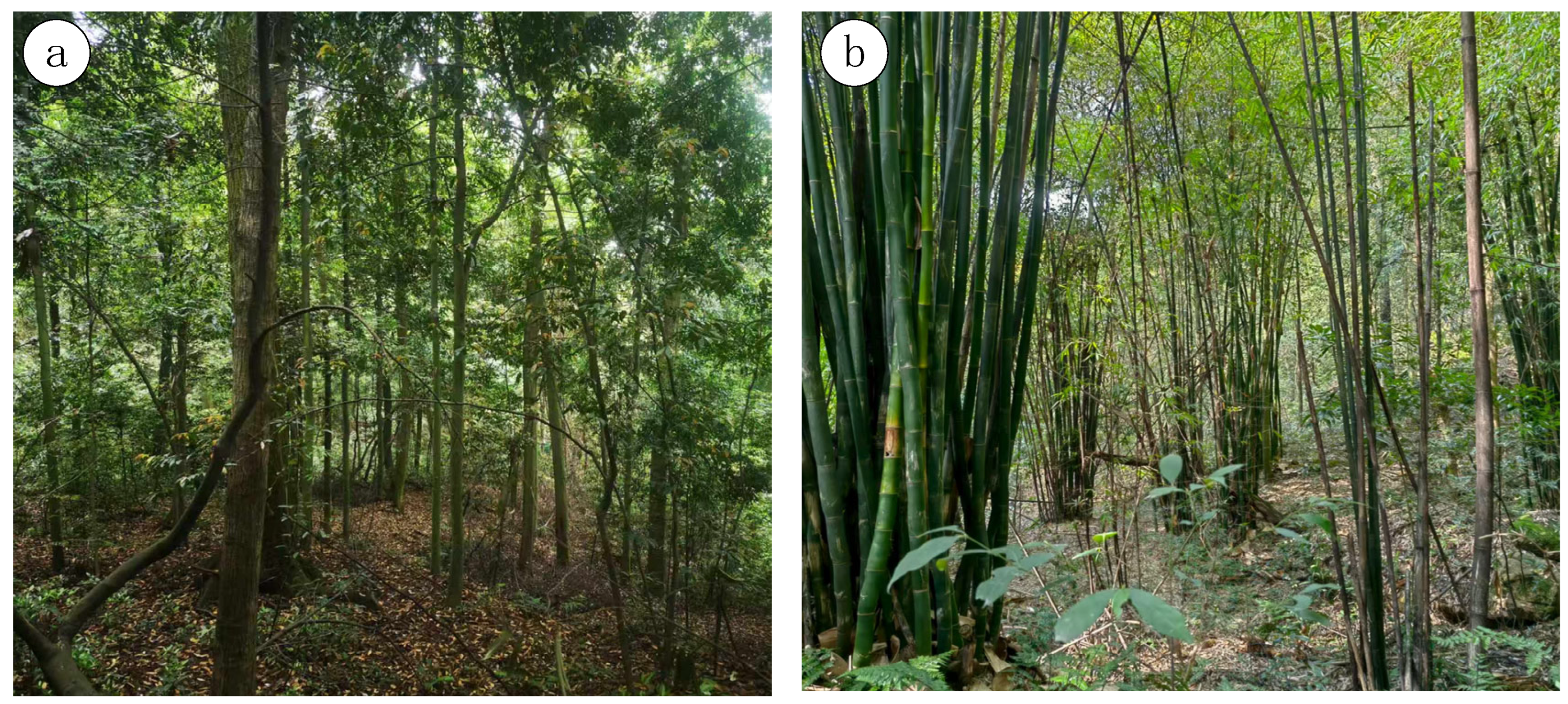
To accomplish the objectives of this study, sampling plots were established within Bambusa emeiensis stands in the Jinyun Mountain Reserve. Adjacent typical evergreen broad-leaved forests were selected as controls for the study (Figure 1). Two forest types occurred in close proximity, and four 20 m × 20 m plots were set up for each. Within each plot, all trees with a diameter at breast height (DBH) > 1 cm were surveyed, and species composition was recorded. The tree layer in the B. emeiensis plots was overwhelmingly dominated by B. emeiensis, whereas the evergreen broad-leaved forest plots were primarily composed of Castanopsis fargesii, Machilus nanmu, and Symplocos setchuensis as dominant species (Figure 1). Plot placement was designed to minimize spatial autocorrelation by ensuring that plots were spatially separated and located in distinct forest stands. Given the limited spatial extent of the reserve, formal spatial modeling was not applied, but sampling was conducted to reduce spatial dependence as much as possible.
In April 2024, five soil sampling points were randomly selected within each plot of the two forest types. Surface soils (0–10 cm) were collected using a soil auger with an inner diameter of 3.2 cm. The five subsamples from each plot were thoroughly homogenized and combined into a single composite sample, which was placed in a sterile zip-lock bag. All samples were transported to the laboratory under cooled conditions and subsequently divided into three portions. A portion was stored at −80 °C in sterile bags for soil microbial DNA extraction. A second portion was kept at 4 °C for the determination of ammonium nitrogen and nitrate nitrogen. The remaining portion was air-dried, and visible plant debris was removed before grinding with a mortar and passing through a 2-mm sieve for the measurement of total carbon, total nitrogen, total phosphorus, available phosphorus, and soil pH.

2.3. Soil Chemical and Physical Properties

Soil samples were naturally dried and then ground into a fine powder using a ball mill (Shunchi, Nanjing, China) before soil physicochemical analyses were conducted. The pH of the soil was measured using the glass electrode method at a soil-to-water ratio of 1:2.5 [31]. Total soil carbon content was determined by means of solid combustion, employing a Shimadzu TOC–TN analyzer (Shimadzu, Kyoto, Japan) [31]. Following high-temperature digestion with an H2SO4–HClO4 mixture, the total nitrogen content was quantified using the same TOC–TN analyzer, while the total phosphorus content was measured using the molybdenum–antimony colorimetric method [31]. The available phosphorus was extracted with an NH4F–HCl solution and determined colorimetrically. Fresh soil samples were extracted with 2 mol·L−1 KCl, and ammonium nitrogen and nitrate nitrogen in the extracts were quantified using colorimetric methods. Soil moisture content was determined using the gravimetric method after oven-drying the samples at 105 °C for 48 h [31].

2.4. DNA Extraction, Gene Amplification, and MiSeq Sequencin

The total soil DNA was extracted using E.Z.N.A.® Soil DNA Kit (Omega Bio-tek, Norcross, GA, USA) following the manufacturer’s instructions, and DNA quality was assessed by 1% agarose gel electrophoresis(NanoDrop 2000, Thermo Scientific, Waltham, MA, USA). The bacterial community was amplified using the primers 515F and 806RmodR targeting the V4 region of the 16S rRNA gene [32], while the fungal community was amplified using the ITS3F and ITS4R primers targeting the ITS2 region [33]; protist communities were amplified with the primers TAReuk454FWD1F and TAReukREV3R targeting the 18S rRNA gene [34]. For each sample, three parallel PCR reactions were performed, and the resulting products were pooled. The pooled amplicons were examined by 2% agarose gel electrophoresis, purified, and subsequently subjected to high-throughput sequencing on the Illumina NextSeq 2000 platform.
The raw sequencing reads were quality-filtered using Fastp (version 0.19.6), and paired-end reads were merged with FLASH (version 1.2.11). The merged sequences were processed in QIIME2 using the DADA2 plugin for denoising and generating amplicon sequence variants (ASVs). Taxonomic assignments were performed using appropriate reference databases: the SILVA 16S rRNA database (v138) for bacteria, the UNITE 9.0/ITS_fungi database for fungi, and the Protist_PR2 database (v5.0.1) for protists. Non-target sequences (i.e., sequences not belonging to bacteria, fungi, or protists) were removed during annotation. To minimize the influence of uneven sequencing depth on diversity analyses, all samples were rarefied to the minimum sequencing depth.

2.5. Statistical Analysis

The differences in plant diversity and soil physicochemical properties between B. emeiensis forests and evergreen broad-leaved forests were compared with the Wilcoxon rank sum-test. Venn diagrams were generated to illustrate the overlap in ASVs between the two forest types. The Wilcoxon rank-sum test was Used to analyze the differences between the dominant groups of the two types of forest divisions at the phyla level. the α-diversity index of bacteria, fungi and protist communities were Calculated, including Chao1 richness, Shannon diversity, Faith’s phylogenetic diversity and Pielou’s evenness, and use Wilcoxon rank sum-test to compare the differences between different forest divisions.
Based on the Bray–Curtis distance matrix, the relative abundance data of the community were analyzed by Principal Coordinate Analysis (PCoA), and the two forest divisions were tested by permutational multivariate analysis of variance (PERMANOVA). The significance of microbial community differences was assessed. For microbial communities with significant differences, further Redundancy Analysis (RDA) was carried out, with the relative abundance of the community as the response variable, and plant diversity and soil physicochemical factors as the explanatory variables. Prior to analysis, variance inflation factors (VIFs) were calculated, and variables with VIF > 10 were removed to minimize multicollinearity. Spearman rank correlations were further used to assess the relationships between dominant phyla and plant diversity as well as soil physicochemical properties. All statistical analyses and visualizations were conducted in R (version 4.4.1) [35], using the vegan package [36]. Protist functional and trophic classifications were assigned based on published ecological frameworks for soil protists [26,37].

3. Results

3.1. Plant Diversity and Soil Differences Between B. emeiensis and Broad-Leaved Forests

With regard to plant diversity, evergreen broad-leaved forests demonstrated significantly higher levels of diversity than B. emeiensis forests (p < 0.05; Table 1). Analysis of soil properties revealed that both forest types were acidic (pH < 4.0), among which the pH of B. emeiensis forests was significantly lower than that of broad-leaved forests (p < 0.05; Table 1). A comparison of the mean values of total carbon, total phosphorus, available phosphorus, and ammonium nitrogen in B. emeiensis with those of evergreen broad-leaved forests revealed that the former had lower values. However, the mean values of total nitrogen and nitrate nitrogen were slightly higher in the B. emeiensis. These differences were not statistically significant (all p > 0.05; Table 1).

3.2. Microbial Community Composition

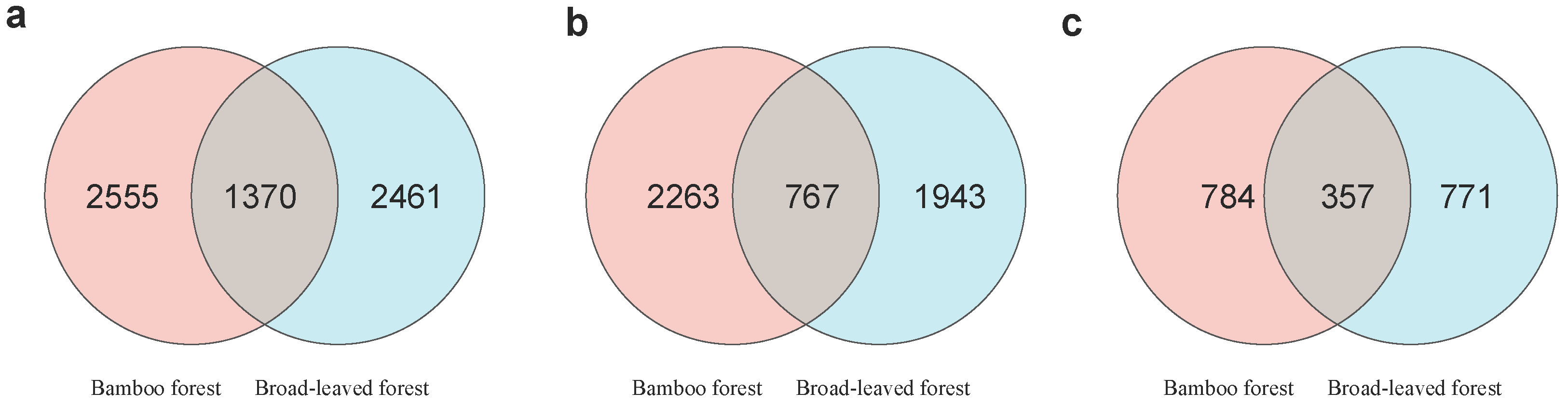
Overall, the number of microbial ASVs shared between the two forest types was lower than the number unique to each forest type (Figure 2). A total of 6341 bacterial ASVs were detected, as determined by 16S rRNA gene sequencing. Of these, 3786 were identified in evergreen broad-leaved forests, while 3925 were found in B. emeiensis forests. The two forest types shared 1370 ASVs, accounting for 21.61% of all ASVs, while 2461 (38.10%) and 2555 (40.29%) ASVs were unique to evergreen broad-leaved forests and B. emeiensis stands, respectively.
ITS2 gene sequencing yielded a total of 4973 fungal ASVs, of which 2710 were observed in evergreen broad-leaved forests and 3030 in B. emeiensis stands. A total of 767 ASVs (15.40%) were shared between forest types, whereas 1943 (39.07%) and 2263 (45.50%) were unique to evergreen broad-leaved forests and B. emeiensis stands, respectively.
Based on 18S rRNA gene sequencing, a total of 1912 protist ASVs were detected, with 1128 found in evergreen broad-leaved forests and 1141 in B. emeiensis stands. The two forest types shared 357 ASVs (19.87%), while 771 (40.32%) and 784 (41.00%) were unique to evergreen broad-leaved forests and B. emeiensis stands, respectively.
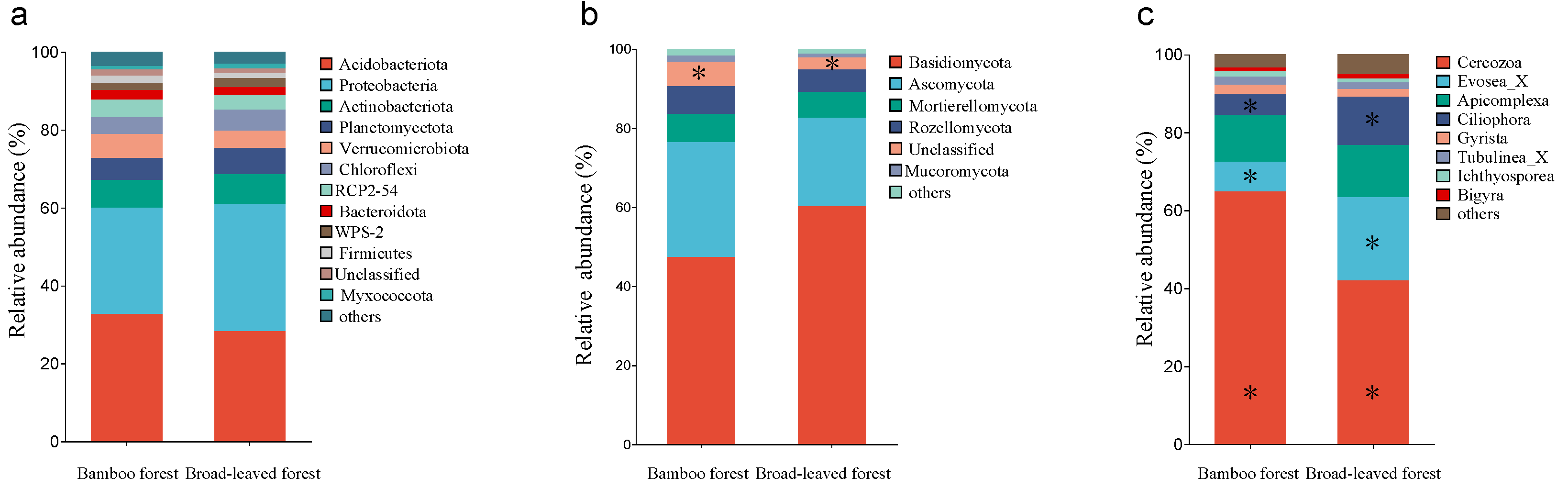
At the phylum level, significant disparities were identified between B. emeiensis and evergreen broad-leaved forests; nevertheless, statistically significant differences were only detected in specific protist groups (Figure 3). For bacteria, five dominant bacterial phyla (relative abundance > 5%) were identified. Acidobacteriota and Proteobacteria dominated in both forest types, but Acidobacteriota showed a 4.48% increase in B. emeiensis stands (32.81%), whereas Proteobacteria decreased by 5.53% (27.24%). In addition, Verrucomicrobiota increased by 1.80% and Myxococcota decreased by 1.19% in B. emeiensis stands (Figure 3a). For fungi, three dominant fungal phyla (relative abundance > 5%) were detected. Basidiomycota and Ascomycota were predominant in both forest types; however, Ascomycota (29.01%) was 6.57% higher in B. emeiensis stands, whereas Basidiomycota (47.52%) was 12.81% lower. Several minor groups, including Mortierellomycota, Rozellomycota, and unclassified fungi, showed higher relative abundances in B. emeiensis stands. Notably, the number of unclassified fungal taxa was significantly higher in B. emeiensis stands (p < 0.05; Figure 3b). For protists, four dominant protist groups (relative abundance > 5%) were identified. B. emeiensis stands were dominated by Cercozoa (64.92%) and Apicomplexa (12.12%), with Cercozoa showing a significantly higher relative abundance than in evergreen broad-leaved forests (p < 0.05), increasing by 22.78%. In evergreen broad-leaved forests, Cercozoa and the Evosea_X group were dominant, the latter being significantly more abundant than in B. emeiensis stands. Ciliophora also showed a significant decline in B. emeiensis stands (5.30%) compared with evergreen broad-leaved forests (12.35%), decreasing by 7.05% (p < 0.05; Figure 3c).

3.3. Soil Microbial Diversity

Microbial α-diversity was evaluated using the Chao1 richness index, Shannon diversity index, Faith’s phylogenetic diversity, and Pielou’s evenness (Table 2). Comparable α-diversity values were observed across bacterial, fungal, and protist communities in B. emeiensis and evergreen broad-leaved forests, with no significant differences between the two forest types evident in any of the indices (all p > 0.05).
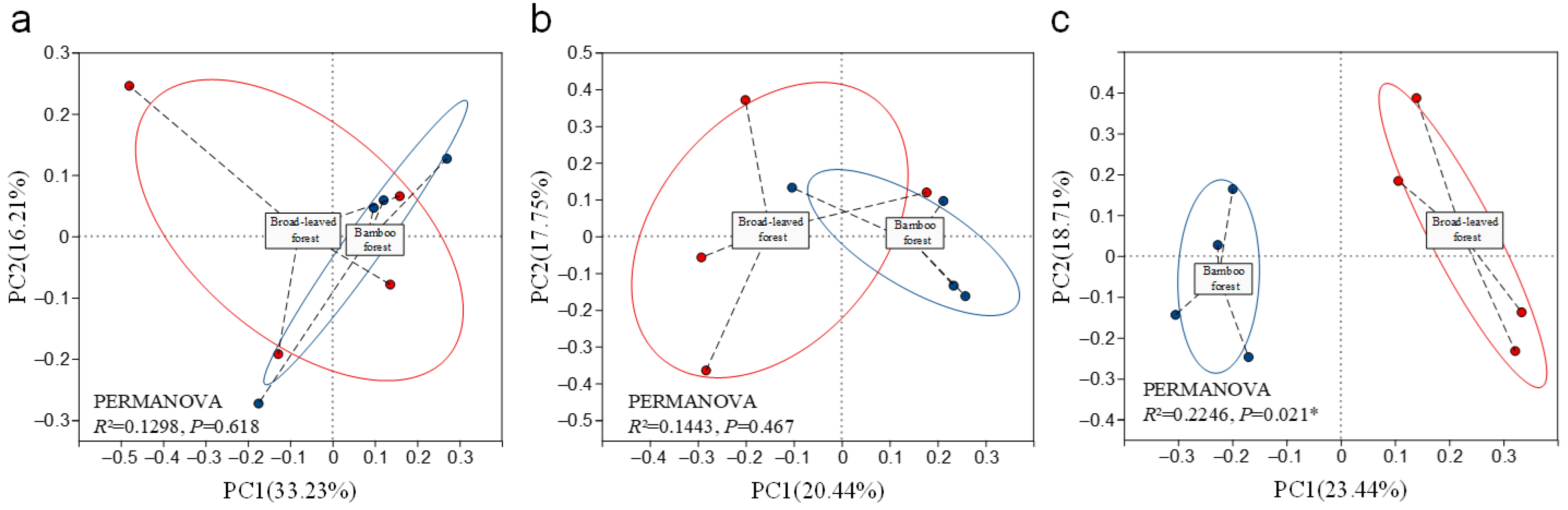
The community structure was examined using PCoA based on ASV-level Bray–Curtis distances (Figure 4). For bacterial communities, the first two PCoA axes explained 33.23% and 16.21% of the variation, respectively, accounting for 49.44% in total. Substantial overlap was observed between B. emeiensis stands and evergreen broad-leaved forests, indicating broadly similar bacterial community structures (Figure 4a). This pattern was supported by PERMANOVA, which detected no significant differences between the two forest types (R2 = 0.130, p = 0.618). In addition, bacterial communities exhibited slightly higher dispersion among plots within evergreen broad-leaved forests (Figure 4a). Fungal communities showed a pattern similar to that of bacteria, with the first two PCoA axes explaining 38.19% of the variation. Considerable overlap between forest types indicated comparable fungal community structures (Figure 4b). PERMANOVA likewise revealed no significant difference in fungal community composition between the two forest types (R2 = 0.144, p = 0.467). Greater within-forest heterogeneity was also observed in evergreen broad-leaved forest plots (Figure 4b). In contrast to bacteria and fungi, protist communities showed clear separation between the two forest types. The first two PCoA axes explained 42.14% of the variation, and protist communities from B. emeiensis stands and evergreen broad-leaved forests showed no overlap (Figure 4c). PERMANOVA confirmed a significant difference in protist community structure between the two forest types (R2 = 0.225, p = 0.021). Although the first two axes of the PCoA explained less than 50% of the total variation, which is common for Bray–Curtis-based ordinations of complex microbial communities [38]. Importantly, PERMANOVA tests were conducted on the full distance matrix rather than on the reduced ordination space, indicating that the observed group differences are not affected by the unexplained variation [38].

3.4. Relationships Between Environmental Factors and Protist Communities

To facilitate functional interpretation of protist community responses, dominant protist taxa were classified into functional and trophic groups following established frameworks [26,37]. Specifically, Cercozoa, Ciliophora, Tubulinea, and Bigyra were classified as predominantly bacterivorous protists; Apicomplexa and Ichthyosporea were classified as parasitic groups; Evosea and Eumycetozoa were considered functionally mixed, including bacterivorous and saprotroph-associated taxa; Gyrista included phototrophic or mixotrophic groups. Unclassified taxa were not assigned to specific trophic categories.
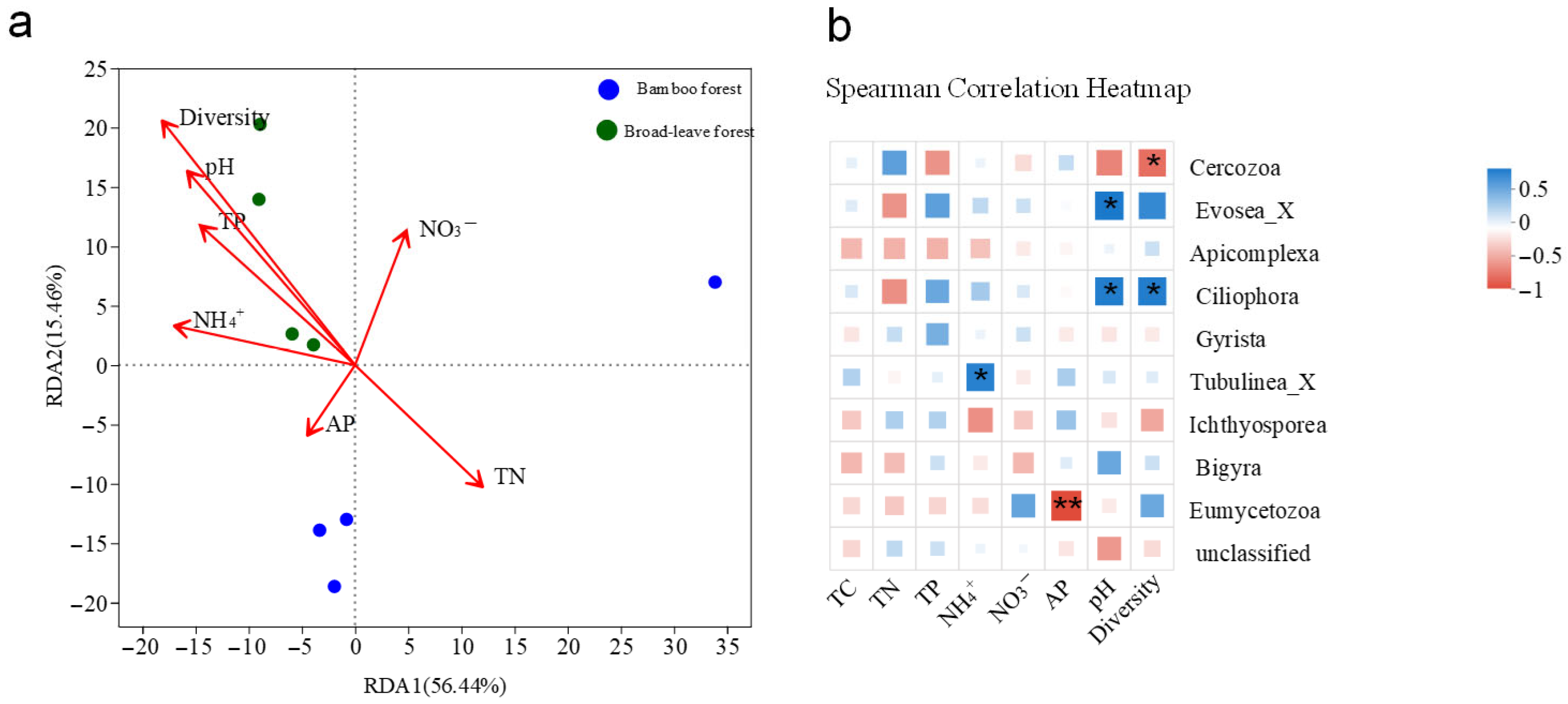
Since protist communities differed markedly between B. emeiensis stands and broad-leaved forests, we performed RDA to identify the key environmental factors associated with these differences (Figure 5). The first two RDA axes explained 56.44% and 15.46% of the variation in protist community composition, respectively. Among all environmental factors, plant diversity had a significant effect on protist community structure (R2 = 0.767, p = 0.032) and was identified as the primary driver, accounting for 76.7% of the explained variation. Other factors that contributed notably to community variation included soil pH, total phosphorus, and total nitrogen, with explanatory contributions of 35.13%, 29.95%, and 24.81%, respectively.
Spearman rank correlation analysis showed that there is a significant correlation between the dominant protist at the phyla level and soil factors (Figure 5). The relative abundance of Cercozoa was significantly negatively correlated with plant diversity (p < 0.05). Eumycetozoa showed a significant negative correlation with soil available phosphorus (p < 0.01). Evosea and Ciliophora were both positively correlated with soil pH (p < 0.05), and Ciliophora also exhibited a significant positive correlation with plant diversity (p < 0.05). In addition, Tubulinea showed a significant positive correlation with ammonium nitrogen (p < 0.05).

4. Discussion

4.1. Environmental Effects of B. emeiensis Expansion

The expansion of bamboo into evergreen broad-leaved forests can substantially alter stand environments. Previous studies have shown that the expansion of moso bamboo typically reshapes plant community structure and markedly reduces plant diversity [13,14]. Consistent with these findings, we observed significantly lower plant diversity in B. emeiensis stands compared with adjacent natural evergreen broad-leaved forests (Table 1). Plant diversity is widely regarded as the core indicator of ecological sustainability because it supports the stability, multifunctionality and long-term resilience of ecosystems [39]. Therefore, the observed decline in plant diversity suggests that B. emeiensis expansion may negatively affect the forest ecosystems sustainability by simplifying vegetation structure and reducing niche availability. The reduction in plant diversity is likely to be related to the biological characteristics of bamboo. Bamboo predominantly reproduces clonally and exhibits rapid growth and strong competitive ability for space, light, and nutrient resources [7,8,16], In addition, bamboo may suppress the growth of co-occurring plant species through allelopathic effects [17], thus further limiting the biodiversity on the community scale and its related ecosystem functions.
The expansion of bamboo will also cause changes in the physical and chemical properties of the soil. For instance, numerous studies have reported that moso bamboo expansion significantly increased the soil pH and reduced the content of soil organic carbon, nitrate nitrogen and other nutrients [21,22,23,24,40]. However, the effects of B. emeiensis expansion differed from the widely documented patterns of moso bamboo. These differences show that the impact of bamboo on soil ecosystem is not generally consistent among different bamboo species, but is strongly regulated by the characteristics of bamboo itself (such as growth mode and expansion form) and soil conditions. Our results show that the expansion of B. emeiensis has reduced the pH of the soil, while other soil parameters have not changed significantly (Table 1). The relatively limited alteration of soil properties suggests that B. emeiensis expansion exerts a weaker environmental pressure on soil systems, potentially indicating a higher degree of soil physicochemical stability. These contrasting patterns highlight that the ecological impacts of bamboo expansion are species-specific and strongly influenced by bamboo growth form (uniaxial scattering versus clump-forming) and soil conditions. Nevertheless, further studies are required to elucidate the mechanisms underlying these interspecific differences and their long-term implications for ecosystem sustainability.

4.2. Microbial (Bacterial and Fungal) Responses to B. emeiensis Expansion

Soil bacteria and fungi are key drivers of essential ecological processes, including carbon cycling and nutrient cycling, so they have become the focus of research on the impact of bamboo expansion in recent years. Research on moso bamboo has frequently reported substantial shifts in soil bacterial and fungal communities following expansion, and these changes are closely related to the change in the physical and chemical properties of the soil caused by the moso bamboo expansion [21,22,24]. In contrast, our findings indicate that B. emeiensis expansion has no statistically significant impact on soil bacteria and fungal communities (Figure 3 and Figure 4). This pattern may be attributed to the limited influence of B. emeiensis on most soil properties.
Although B. emeiensis expansion significantly reduced soil pH, the soil in the study area itself is already in a highly acidic state (pH < 4). This may be related to the comprehensive effect of the long-term acid rain in the study area [41]. In addition, the inherent heterogeneity of soil types and the legacy effects of historical land use can also be independent of the recent expansion of bamboo to a certain extent, resulting in long-term spatial differences in soil physicochemical properties (including soil pH) [42,43]. Such an extreme acidic environment has a strong environmental screening effect on soil microbial communities, making it difficult for bacteria and fungi to respond significantly to other environmental changes [44]. This is because acid-tolerant organisms thrive in such conditions [45]. Therefore, the addition of more pH reduction due to the growth of B. emeiensis may not exceed the levels necessary to cause significant changes in bacterial and fungal groups. The relative stability of bacterial and fungal communities may reflect resistance to disturbances in core soil microbial functions, which is an important component of ecosystem resilience.
It is worth noting that although the statistical results do not show a significant impact of B. emeiensis expansion on bacterial and fungal communities, the trend of community change is similar to the impact of moso bamboo expansion to some extent. For example, previous studies have shown increased fungal diversity in moso bamboo stands, characterized by a higher proportion of r-strategist Ascomycota and a decline in K-strategist Basidiomycota [24], A similar shift was observed in B. emeiensis stands in our study. Taken together, these results suggest that B. emeiensis expansion exerts some influence on soil bacterial and fungal communities, but the magnitude of its impact appears weaker than that typically associated with moso bamboo expansion. This pattern may be attributed to the limited influence of B. emeiensis on the physicochemical properties of most soils. It should be noted that the number of samples used in this study is relatively small (each forest type n = 4), which may limit the statistical effectiveness of detecting subtle changes in bacterial and fungal communities to a certain extent. However, this sampling design was sufficient to identify consistent directional trends and pronounced responses where present, while weaker or more nuanced effects may have remained statistically undetected [46].
Therefore, bacterial and fungal responses primarily offer contextual evidence of soil functional stability, which supports the interpretation of changes related to sustainability detected in more sensitive microbial groups such as protists.

4.3. Effects of Bambusa emeiensis Expansion on Soil Protists

Protists constitute an important component of soil eukaryotic microbiomes and play essential roles in soil ecosystems [26,27]. Their functional diversity, encompassing phototrophic, phagotrophic, parasitic, and mixotrophic groups, facilitates their occupation of pivotal roles within the soil micro-food web. This contributes to the decomposition of organic matter, the cycling of nutrients, and the maintenance of soil fertility [26,27,47]. These processes are critical for sustaining soil fertility and overall ecosystem health, particularly in relation to carbon and nitrogen cycling [48]. Consequently, changes in protist community composition may have implications for ecosystem persistence and sustainability. Despite their ecological importance, the responses of protists to bamboo expansion have received comparatively little attention in the scientific literature when set against bacterial and fungal communities.
In contrast to the limited responses exhibited by bacteria and fungi to the expansion of B. emeiensis, protist communities demonstrated clear and significant compositional differences between B. emeiensis and evergreen broad-leaved forests (Figure 4). This finding suggests that protists exhibit a greater sensitivity to bamboo expansion. Although the total variation explained by the first two axes of PCoA in Figure 4 is less than 50%, this is more common in high-dimensional and heterogeneous soil microbial community data [49,50]. The community difference is not only judged by the visual separation of the ranking diagram, but also supported by PERMANOVA analysis based on the complete difference matrix [51], so the low interpretation rate does not affect the robustness of the conclusion of the protozoa community difference.
It should also be acknowledged that this study was based on a limited number of plots (n = 4 per forest type), which may constrain statistical power for detecting subtle community-level changes [46]. However, the clear and consistent differences observed in protist community composition, supported by PERMANOVA based on the full dissimilarity matrix, indicate that the main results reported here are robust [38]. This contrast between the pronounced responses of protists and the relatively weak or non-significant responses of bacteria and fungi further supports the interpretation that protists represent a more sensitive indicator of bamboo expansion under the environmental conditions examined in this study.
This heightened sensitivity may be attributed to their ecological characteristics. First, many protist taxa have relatively narrow niche breadths and therefore respond more strongly to environmental fluctuations [52]; second, numerous protist groups, particularly bacterivorous taxa, occupy higher trophic positions in the soil food web. According to the “trophic sensitivity hypothesis” [53,54], higher trophic-level organisms tend to exhibit greater responsiveness to environmental change. Indeed, previous studies have demonstrated that protists respond more strongly than bacteria and fungi to fertilization, nitrogen enrichment, and exposure to organic or inorganic pollutants [55,56,57,58,59].
Our results also showed that there is no significant difference in the α-diversity of protists between B. emeiensis and evergreen broad-leaved forests. This means that the differences in community structure are mainly due to changes in the relative abundance of dominant groups, not changes in species richness. Redundancy analysis shows that plant diversity is a key factor driving the change in protists. The growth and reproduction of protists largely depend on the resources and habitat provided by plants [27]. Plant diversity can directly influence protists through variation in litter inputs and root exudates, and indirectly by regulating bacteria and fungal communities, changing the soil physicochemical environment and local microclimate.
Further analysis revealed a significant relationship between the relative abundance of dominant protist groups, such as Cercozoa and Ciliophora, and plant diversity. These taxa are predominantly classified as bacterivorous based on established functional frameworks [26,27]. Cercozoa are predominantly classified as bacterivorous protists and occupy a key trophic position within the soil microbial food web [26,37]. The increased relative abundance of Cercozoa observed in B. emeiensis stands may therefore be associated with changes in bacterial turnover and soil food-web dynamics. Previous studies have shown that bacterivorous protists can stimulate bacterial turnover and influence nutrient mineralization through grazing-mediated microbial loop processes, potentially enhancing the release of nitrogen and phosphorus from microbial biomass [55,60].
The protist responses observed in this study are most directly applicable to clump-forming bamboo species that expand in subtropical evergreen broad-leaved forests under strongly acidic soil conditions, and should not be assumed to be broadly generalizable across all bamboo species or invasive clonal plants. These findings suggest a potential bottom-up relationship between plant diversity and protist communities associated with B. emeiensis expansion. Consequently, protist community alterations induced by bamboo expansion may further influence ecosystem functions and potentially affect sustainability-related indicators such as soil nutrient retention, soil health, and ecosystem resilience to environmental stress. Given the important ecological functions of protists and their high sensitivity to environmental change, future studies on the ecological impacts of bamboo expansion should place greater emphasis on protist communities.

5. Conclusions

This study demonstrates the ecological impacts of B. emeiensis expansion on the soil microbial communities of subtropical evergreen broad-leaved forests. The results show that the expansion of B. emeiensis significantly reduced plant diversity and was accompanied by a decline in soil pH, but has no significant impact on the content of nutrients such as carbon, nitrogen and phosphorus in the soil. Although shifts were observed in the relative abundances of several dominant bacterial and fungal phyla—such as increases in Acidobacteriota and Ascomycota and decreases in Proteobacteria and Basidiomycota—both the α-diversity and overall community structure of bacteria and fungi remained stable, indicating a relatively weak response to bamboo expansion.
In contrast, protist communities showed much higher sensitivity. Protist community structure differed significantly between forest types, with marked increases in Cercozoa and decreases in Evosea_X and Ciliophora in B. emeiensis stands. Further analyses identified plant diversity as the primary and measurable predictor of protist community shifts. This suggests that changes in vegetation can be used to anticipate belowground microbial responses to bamboo expansion. This suggests that changes in protist communities may provide early indications of belowground ecological responses to bamboo expansion, occurring prior to detectable changes in bacterial and fungal communities.
Overall, this study shows that protists are more sensitive to the expansion of B. emeiensis than bacteria and fungi, which has significant implications for ecosystem sustainability. These results highlight the potential long-term ecological consequences of B. emeiensis expansion on soil health and biodiversity, which are key components of ecosystem services such as carbon sequestration and nutrient cycling. By providing scientific references for understanding the belowground ecological effects of bamboo expansion, this study offers valuable guidance for the sustainable management and conservation of regional forests.

Author Contributions

Methodology, W.X.; software, W.X.; validation, W.X.; formal analysis, W.X.; investigation, W.X., S.L. and L.Z.; resources, W.X. and S.L.; data curation, W.X.; writing—original draft preparation, W.X.; writing—review and editing, W.X. and L.Z. All authors have read and agreed to the published version of the manuscript.

Funding

This research was supported by “the Fundamental Research Funds for the Central Universities” [No. 2018CDXYCH0014].

Institutional Review Board Statement

Not applicable.

Informed Consent Statement

Not applicable.

Data Availability Statement

All data generated and analysed during this study are available in the NCBI Sequence Read Archive under BioProject accession number PRJNA1399697.

Conflicts of Interest

The authors declare no conflicts of interest.

References

  1. Zhou, G.; Meng, C.; Jiang, P.; Xu, Q. Review of carbon fixation in bamboo forests in China. Bot. Rev. 2011, 77, 262–270. [Google Scholar] [CrossRef]
  2. Canavan, S.; Richardson, D.M.; Visser, V.; Le Roux, J.J.; Vorontsova, M.S.; Wilson, J.R.U. The global distribution of bamboos: Assessing correlates of introduction and expansion. AoB Plants 2017, 9, plw078. [Google Scholar] [PubMed]
  3. Hossain, M.F.; Islam, M.A.; Numan, S.M. Multipurpose uses of bamboo plants: A review. Int. Res. J. Biol. Sci. 2016, 4, 57–60. [Google Scholar]
  4. Sun, X.F.; He, M.J.; Li, Z. Novel engineered wood and bamboo composites for structural applications: State-of-the-art of manufacturing technology and mechanical performance evaluation. Constr. Build. Mater. 2020, 249, 118751. [Google Scholar] [CrossRef]
  5. Devi, A.S.; Singh, K.S. Carbon storage and sequestration potential in above-ground biomass of bamboos in North East India. Sci. Rep. 2021, 11, 837. [Google Scholar] [CrossRef] [PubMed]
  6. Lima, R.A.F.; Rother, D.C.; Muler, A.E.; Lepsch, I.F.; Rodrigues, R.R. Bamboo over abundance alters forest structure and dynamics in the Atlantic Forest hotspot. Biol. Conserv. 2012, 147, 32–39. [Google Scholar] [CrossRef]
  7. Yang, Q.P.; Yang, G.Y.; Song, Q.N.; Shi, J.M.; Ouyang, M.; Qi, H.Y.; Fang, X.M. Ecology of bamboo expansion: Processes, legacy effects, and mechanisms. Chin. J. Plant Ecol. 2015, 39, 110–124. [Google Scholar]
  8. Xu, Q.F.; Liang, C.F.; Chen, J.H.; Li, Y.C.; Qin, H.; Fuhrmann, J.J. Rapid bamboo expansion (expansion) and its effects on biodiversity and soil processes. Glob. Ecol. Conserv. 2020, 21, e00787. [Google Scholar]
  9. Bai, S.; Wang, Y.; Conant, R.T.; Zhou, G.; Xu, Y.; Wang, N.; Fang, F.; Chen, J. Can native clonal Moso bamboo encroach on adjacent natural forest without human intervention? Sci. Rep. 2016, 6, 31504. [Google Scholar] [CrossRef]
  10. Suzuki, S. Chronological location analyses of giant bamboo (Phyllostachys pubescens) groves and their invasive expansion in a satoyama landscape area, western Japan. Plant Species Biol. 2015, 30, 63–71. [Google Scholar] [CrossRef]
  11. Li, D.; Wei, J.; Wu, J.; Zhong, Y.; Chen, Z.; He, J.; Zhang, S.; Yu, L. The expansion of Moso bamboo (Phyllostachys edulis) forests into diverse types of forests in China from 2010 to 2020. Forests 2024, 15, 1418. [Google Scholar] [CrossRef]
  12. Kudo, G.; Amagai, Y.; Hoshino, B.; Kaneko, M. Expansion of dwarf bamboo into alpine snow-meadows in northern Japan: Pattern of expansion and impact on species diversity. Ecol. Evol. 2011, 1, 85–96. [Google Scholar] [CrossRef] [PubMed]
  13. Bai, S.B.; Zhou, G.M.; Wang, Y.X.; Liang, Q.Q.; Chen, J.; Cheng, Y.Y.; Shen, R. Responses of forest community plant diversity to Moso bamboo expansion in Tianmushan Nature Reserve. Biodivers. Sci. 2013, 21, 288–295. [Google Scholar]
  14. Ouyang, M.; Yang, Q.P.; Chen, X.; Yang, G.Y.; Shi, J.M.; Fang, X.M. Effects of Moso bamboo expansion on species composition and diversity of evergreen broad-leaved forests. Biodivers. Sci. 2016, 24, 649–657. [Google Scholar] [CrossRef]
  15. Ying, W.; Jin, J.; Jiang, H.; Zhang, X.; Lu, X.; Chen, X.; Zhang, J. Satellite-based detection of bamboo expansion over the past 30 years in Mount Tianmushan, China. Int. J. Remote Sens. 2016, 37, 2908–2922. [Google Scholar] [CrossRef]
  16. Ouyang, M.; Eziz, A.; Xiao, S.; Fang, W.; Cai, Q.; Ma, S.; Zhu, J.; Yang, Q.; Hu, J.; Tang, Z.; et al. Effects of bamboo expansion on forest structures and diameter–height allometries. For. Ecosyst. 2025, 12, 100256. [Google Scholar] [CrossRef]
  17. Chen, J.; Bai, S.B.; Zhou, G.M.; Wang, Y.X.; Liang, Q.Q.; Cheng, Y.Y.; Shen, R. Allelopathic effects of Moso bamboo extracts on young seedlings of Styrax tonkinensis. Acta Ecol. Sin. 2014, 34, 4499–4507. [Google Scholar]
  18. Lin, Y.T.; Tang, S.L.; Pai, C.W.; Whitman, W.B.; Coleman, D.C.; Chiu, C.Y. Changes in the soil bacterial communities in a cedar plantation invaded by Moso bamboo. Microb. Ecol. 2013, 67, 421–429. [Google Scholar] [CrossRef]
  19. Li, Y.C.; Liang, X.; Li, Y.F.; Wang, Q.; Chen, J.H.; Xu, Q.F. Effects of Moso bamboo expansion on soil fungal communities in broad-leaved forests. Chin. J. Appl. Ecol. 2016, 27, 585–592. [Google Scholar]
  20. Ma, X.R.; Zheng, X.L.; Zheng, C.Y.; Hu, Y.T.; Qin, H.; Chen, J.H.; Liang, C.F. Effects of Moso bamboo expansion on soil microbial communities in evergreen broad-leaved forests. Chin. J. Appl. Ecol. 2022, 33, 1091–1098. [Google Scholar]
  21. Liu, C.; Zheng, C.; Wang, L.; Zhang, J.; Wang, Q.; Shao, S.; Qin, H.; Xu, Q.; Liang, C.; Chen, J. Moso bamboo expansion changes the assembly process and interactive relationship of soil microbial communities in a subtropical broad-leaved forest. For. Ecol. Manag. 2023, 536, 120901. [Google Scholar] [CrossRef]
  22. Mao, Y.E.; Zhou, X.M.; Wang, N.; Li, X.X.; You, Y.K.; Bai, S.B. Effects of Moso bamboo expansion on soil bacterial communities in Cunninghamia lanceolata forests. Biodivers. Sci. 2023, 31, 22695. [Google Scholar]
  23. Shi, Y.S.; Wang, S.S.; Fang, W.; Zheng, M.Q.; Jiang, B.H.; Shao, S.; Ma, X.M.; Xu, Q.F. Meta-analysis of soil pH and microbial changes induced by Moso bamboo expansion. Acta Pedol. Sin. 2024, 61, 862–877. [Google Scholar]
  24. Chen, H.; Wang, N.; Ding, B.L.; Xie, T.S.; Bai, S.B. Effects of Moso bamboo expansion on fungal communities in evergreen broad-leaved forests. Acta Ecol. Sin. 2025, 45, 4263–4275. [Google Scholar]
  25. Tao, F.; Huang, Y.; Hungate, B.A.; Manzoni, S.; Frey, S.D.; Schmidt, M.W.I.; Reichstein, M.; Carvalhais, N.; Ciais, P.; Jiang, L.; et al. Microbial carbon use efficiency promotes global soil carbon storage. Nature 2013, 618, 981–985. [Google Scholar] [CrossRef]
  26. Geisen, S.; Mitchell, E.A.D.; Adl, S.; Bonkowski, M.; Dunthorn, M.; Ekelund, F.; Fernández, L.D.; Jousset, A.; Krashevska, V.; Singer, D.; et al. Soil protists: A fertile frontier in soil biology research. FEMS Microbiol. Rev. 2018, 42, 293–323. [Google Scholar] [CrossRef]
  27. Yao, B.M.; Zeng, Q.; Zhang, L.M. Soil protist diversity and its ecological functions. Biodivers. Sci. 2022, 30, 22353. [Google Scholar] [CrossRef]
  28. Su, Z.X.; Zhong, Z.C. Biomass structure of Dendrocalamus latiflorus populations in Jinyun Mountain. J. Plant Ecol. Phytogeogr. 1991, 15, 240–252. [Google Scholar]
  29. Su, Z.X. Preliminary study on the age of Dendrocalamus latiflorus populations in Jinyun Mountain, Chongqing. J. Bamboo Res. 1990, 9, 47–55. [Google Scholar]
  30. Yang, S.F.; Dou, P.P.; Wang, H.J.; Wang, F.; Yang, G.R.; Lin, D.M. Dynamics of carbon, nitrogen and phosphorus release during fern leaf and fine root decomposition. Chin. Sci. Bull. 2019, 64, 2430–2440. [Google Scholar]
  31. Yang, G.R.; Dou, P.P.; Ma, Y.; Wang, H.J.; Lin, D.M. Characteristics of soil animal communities in evergreen broad-leaved forests of Jinfo Mountain. Acta Ecol. Sin. 2020, 40, 7602–7610. [Google Scholar]
  32. Sampson, T.R.; Debelius, J.W.; Thron, T.; Janssen, S.; Shastri, G.G.; Ilhan, Z.E.; Challis, C.; Schretter, C.E.; Rocha, S.; Gradinaru, V.; et al. Gut microbiota regulate motor deficits and neuroinflammation in a model of Parkinson’s disease. Cell 2016, 167, 1469–1480. [Google Scholar] [CrossRef] [PubMed]
  33. Walters, W.; Hyde, E.R.; Berg-Lyons, D.; Ackermann, G.; Humphrey, G.; Parada, A.; Gilbert, J.A.; Jansson, J.K.; Caporaso, J.G.; Fuhrman, J.A.; et al. Improved bacterial 16S rRNA gene (V4 and V4-5) and fungal internal transcribed spacer marker gene primers for microbial community surveys. mSystems 2016, 1, e00009-15. [Google Scholar] [CrossRef] [PubMed]
  34. Behnke, A.; Engel, M.; Christen, R.; Nebel, M.; Klein, R.R.; Stoeck, T. Depicting more accurate pictures of protistan community complexity using pyrosequencing of hypervariable SSU rRNA gene regions. Environ. Microbiol. 2011, 13, 340–349. [Google Scholar] [CrossRef] [PubMed]
  35. R Core Team. R: A Language and Environment for Statistical Computing; R Foundation for Statistical Computing: Vienna, Austria, 2024. [Google Scholar]
  36. Oksanen, J.; Simpson, G.; Blanchet, F.; Kindt, R.; Legendre, P.; Minchin, P.; O’Hara, R.; Solymos, P.; Stevens, M.; Szoecs, E.; et al. Vegan: Community Ecology Package, version 2.7-2; CRAN (The Comprehensive R Archive Network): Vienna, Austria, 2024. [Google Scholar]
  37. Adl, S.M.; Bass, D.; Lane, C.E.; Lukeš, J.; Schoch, C.L.; Smirnov, A.; Agatha, S.; Berney, C.; Brown, M.W.; Burki, F.; et al. Revisions to the classification, nomenclature, and diversity of eukaryotes. J. Eukaryot. Microbiol. 2019, 66, 4–119. [Google Scholar] [CrossRef]
  38. Cui, J.; Li, P.; Qi, X.; Rahman, S.U.; Zhang, Z. Changes of Microbial Diversity in Rhizosphere of Different Cadmium-Gradients Soil under Irrigation with Reclaimed Water. Sustainability 2022, 14, 8891. [Google Scholar] [CrossRef]
  39. Li, Y.; Schuldt, A.; Ebeling, A.; Eisenhauer, N.; Huang, Y.Y.; Albert, G.; Albracht, C.; Amyntas, A.; Bonkowski, M.; Bruelheide, H.; et al. Plant diversity enhances ecosystem multifunctionality via multitrophic diversity. Nat. Ecol. Evol. 2024, 8, 2037–2047. [Google Scholar] [CrossRef]
  40. Ouyang, M.; Tian, D.; Pan, J.; Chen, G.; Su, H.; Yan, Z.; Yang, Q.; Ji, C.; Tang, Z.; Fang, J. Moso bamboo expansion increases forest soil pH. Catena 2022, 215, 106339. [Google Scholar] [CrossRef]
  41. Zheng, Y.L.; Wang, Y.Q.; Xu, X.X.; Wang, Y.J.; Li, Y.M. Responses of radial growth of Pinus massoniana and Machilus nanmu to acid rain in Jinyun Mountain. Sci. Silvae Sin. 2024, 60, 58–67. [Google Scholar]
  42. Vos, M.; Wolf, A.B.; Jennings, S.J.; Kowalchuk, G.A. Micro-scale determinants of bacterial diversity in soil. FEMS Microbiol. Ecol. 2013, 37, 936–954. [Google Scholar] [CrossRef]
  43. Fierer, N.; Ladau, J.; Clemente, J.C.; Leff, J.W.; Owens, S.M.; Pollard, K.S.; Knight, R.; Gilbert, J.A.; McCulley, R.L. Reconstructing the microbial diversity and function of pre-agricultural tallgrass prairie soils in the United States. Science 2013, 342, 621–624. [Google Scholar] [CrossRef] [PubMed]
  44. Li, Z.X.; Gao, X.Y.; Li, D.D.; Gao, J.; Li, J.H.; Cai, Z.J.; Sun, N.; Wu, L.H.; Xu, M.G. Differential responses of bacteria, fungi, and C, N, P functions to soil acidification in farmland: A meta-analysis. Environ. Technol. Innov. 2025, 40, 104499. [Google Scholar] [CrossRef]
  45. Wang, T.; Cao, X.; Chen, M.; Lou, Y.; Wang, H.; Yang, Q.; Pan, H.; Zhuge, Y. Effects of soil acidification on bacterial and fungal communities in the Jiaodong Peninsula, Northern China. Agronomy 2022, 12, 927. [Google Scholar] [CrossRef]
  46. Hermans, S.M.; Buckley, H.L.; Lear, G. Perspectives on the impact of sampling design and intensity on soil microbial diversity estimates. Front. Microbiol. 2019, 10, 1820. [Google Scholar] [CrossRef]
  47. Oliverio, A.M.; Geisen, S.; Delgado-Baquerizo, M.; Maestre, F.T.; Turner, B.L.; Fierer, N. The global-scale distributions of soil protists and their contributions to belowground systems. Sci. Adv. 2020, 6, eaax8787. [Google Scholar] [CrossRef]
  48. Ren, P.X.; Sun, A.Q.; Jiao, X.Y.; Chen, Q.L.; Hu, H.W. The relationship between protist consumers and soil functional genes under long-term fertilization. Sci. Total Environ. 2025, 966, 178658. [Google Scholar] [CrossRef]
  49. Legendre, P.; Legendre, L. Numerical Ecology, 3rd ed.; Elsevier: Amsterdam, The Netherlands, 2012. [Google Scholar]
  50. Ramette, A. Multivariate analyses in microbial ecology. FEMS Microbiol. Ecol. 2007, 62, 142–160. [Google Scholar] [CrossRef]
  51. Anderson, M.J. A new method for non-parametric multivariate analysis of variance. Austral Ecol. 2001, 26, 32–46. [Google Scholar]
  52. Wu, W.; Lu, H.P.; Sastri, A.; Yeh, Y.C.; Gong, G.C.; Chou, W.C.; Hsieh, C.H. Contrasting the relative importance of species sorting and dispersal limitation in shaping marine bacterial versus protist communities. ISME J. 2018, 12, 485–494. [Google Scholar] [CrossRef]
  53. Petchey, O.L.; McPhearson, P.T.; Casey, T.M.; Morin, P.J. Environmental warming alters food-web structure and ecosystem function. Nature 1999, 402, 69–72. [Google Scholar] [CrossRef]
  54. Voigt, W.; Perner, J.; Davis, A.J.; Eggers, T.; Schumacher, J.; Bahrmann, R.; Fabian, B.; Heinrich, W.; Köhler, G.; Lichter, D.; et al. Trophic levels are differentially sensitive to climate. Ecology 2003, 84, 2444–2453. [Google Scholar] [CrossRef]
  55. Zhao, Z.B.; He, J.Z.; Geisen, S.; Han, L.L.; Wang, J.T.; Shen, J.P.; Shi, X.Z.; Wei, W.X.; Fang, Y.T.; Zhong, W.H.; et al. Protist communities are more sensitive to nitrogen fertilization than other microorganisms in diverse agricultural soils. Microbiome 2019, 7, 33. [Google Scholar] [CrossRef]
  56. Wu, S.; Dong, Y.; Deng, Y.; Cui, L.; Zhuang, X. Protistan consumers and phototrophs are more sensitive than bacteria and fungi to pyrene exposure in soil. Sci. Total Environ. 2022, 822, 153539. [Google Scholar] [CrossRef]
  57. Sun, S.; Jousset, A.; Geisen, S.; Lara, E.; Zhang, P.; Li, R.; Duan, X.; Chen, Y.; Xiong, W. Protist communities as indicators of fertilization-induced changes in a species-rich grassland ecosystem. Agric. Ecosyst. Environ. 2024, 372, 109101. [Google Scholar] [CrossRef]
  58. Du, S.; Li, X.Q.; Hao, X.; Hu, H.W.; Feng, J.; Huang, Q.; Liu, Y.R. Stronger responses of soil protistan communities to legacy mercury pollution than bacterial and fungal communities in agricultural systems. ISME Commun. 2022, 2, 69. [Google Scholar] [CrossRef]
  59. Degrune, F.; Dumack, K.; Ryo, M.; Garland, G.; Romdhane, S.; Saghaï, A.; Bonkowski, M.; Eisenhauer, N. The impact of fungi on soil protist communities in European cereal croplands. Environ. Microbiol. 2024, 26, e16673. [Google Scholar] [CrossRef]
  60. Clarholm, M. Interactions of bacteria, protozoa and plants leading to mineralization of soil nitrogen. Soil Biol. Biochem. 1985, 17, 181–187. [Google Scholar] [CrossRef]
Figure 1. Stand appearance characteristics of broad-leaved forests (a) and bamboo forests (b) in the study area.
Sustainability 18 01304 g001
Figure 2. Venn diagrams showing the distribution of unique and shared ASVs of soil bacteria (a), fungi (b), and protists (c) across different forests.
Sustainability 18 01304 g002
Figure 3. Taxonomic composition of soil bacteria (a), fungi (b), and protists (c) at the phylum level across different forests. The asterisks on the bar chart indicate that the corresponding taxa show significant differences between the two forest types (p < 0.05).
Sustainability 18 01304 g003
Figure 4. Principal Coordinates Analysis (PCoA) of soil bacterial (a), fungal (b), and protistan (c) communities based on Bray–Curtis distance among different forest types. The asterisk indicates that the corresponding taxa show significant differences between the two forest types (p < 0.05).
Sustainability 18 01304 g004
Figure 5. Redundancy analysis of soil protist communities and environmental factors (a), and relationships between the relative abundances of major protist phyla and environmental factors (b). TC: total soil carbon; TN: total soil nitrogen; TP: total soil phosphorus; NO3: soil nitrate nitrogen; NH4+: soil ammonium nitrogen; AP: available soil phosphorus; pH: soil pH value; Diversity: plant diversity. * p < 0.05, ** p < 0.01.
Sustainability 18 01304 g005
Table 1. Differences in plant diversity and soil chemical properties across different forests (mean ± SE, n = 4).
Forest TypePlant DiversitySoil pH TC
(g/kg)
TN
(g/kg)
NO3-N
(mg/kg)
NH4+-N
(mg/kg)
TP
(g/kg)
AP
(mg/kg)
Broadleaved forests2.50 ± 0.10 a3.95 ± 0.13 a67.15 ± 7.40 a1.63 ± 0.05 a44.14 ± 8.89 a6.75 ± 0.32 a0.36 ± 0.04 a6.17 ± 1.13 a
Bamboo forest0.85 ± 0.06 b3.35 ± 0.16 b59.41 ± 0.92 a2.01 ± 0.19 a45.70 ± 1.64 a6.35 ± 0.23 a0.33 ± 0.05 a5.99 ± 0.75 a
Different lowercase letters in the same column indicate significant differences between forests (p < 0.05).
Table 2. Alpha diversity indices of soil bacterial, fungal, and protozoan communities in different forests (mean ± SE, n = 4).
Chao1 IndexShannon Diversity IndexPielou Evenness IndexPhylogenetic Diversity Index
Bacteria
Broad-leaved forest1299.9 ± 82.16.4 ± 0.10.900 ± 0.00490.3 ± 5.5
Bamboo forest1409.7 ± 101.16.3 ± 0.10.880 ± 0.00794.0 ± 5.9
Fungi
Broad-leaved forest821.1 ± 97.14.2 ± 0.30.630 ± 0.040220.1 ± 19.9
Bamboo forest977.5 ± 71.64.7 ± 0.20.680 ± 0.020250.3 ± 11.2
Protists
Broad-leaved forest347.1 ± 35.65.1 ± 0.10.870 ± 0.01042.3 ± 2.9
Bamboo forest412.2 ± 48.85.1 ± 0.30.860 ± 0.03054.6 ± 4.5
Disclaimer/Publisher’s Note: The statements, opinions and data contained in all publications are solely those of the individual author(s) and contributor(s) and not of MDPI and/or the editor(s). MDPI and/or the editor(s) disclaim responsibility for any injury to people or property resulting from any ideas, methods, instructions or products referred to in the content.