Article

Microalgae-Derived Biopolymers: An Ecological Approach to Reducing Polylactic Acid Dependence

by
Gabriela de O. Machado
1,
Marília L. De Assis
2,
Matheus F. de C. Reis
3,
Marcela A. da S. Alexandre
1,
Tarsila R. Arruda
4,
Alexia S. A. de P. Pereira
2,
Maria L. Calijuri
2,
José M. F. de Carvalho
2,
Angélica de C. O. Carneiro
3,
Meirielly Jesus
5,
Joana Santos
5,*,
Taíla V. De Oliveira
1,* and
Nilda de F. F. Soares
1
1
Departament of Food Technology, Federal University of Viçosa, Viçosa 36570-900, Minas Gerais, Brazil
2
Departament of Civil Engineering, Federal University of Viçosa, Viçosa 36570-900, Minas Gerais, Brazil
3
Departament of Forest Engineering, Federal University of Viçosa, Viçosa 36570-900, Minas Gerais, Brazil
4
Department of Life Science Engineering, TUM School of Life Science, Technical University of Munich, 85354 Freising, Germany
5
CISAS-Center for Research and Development in Agrifood Systems and Sustainability, Instituto Politécnico de Viana do Castelo, Rua da Escola Industrial e Comercial Nun’Alvares 34, 4900-347 Viana do Castelo, Portugal
*
Authors to whom correspondence should be addressed.
Sustainability 2026, 18(3), 1302; https://doi.org/10.3390/su18031302
Submission received: 24 December 2025 / Revised: 20 January 2026 / Accepted: 25 January 2026 / Published: 28 January 2026

Abstract

The growing demand for sustainable materials and the valorization of waste streams have intensified research on wastewater biorefineries and bioplastics. Within this framework, this study aims to develop and characterize poly (lactic acid) (PLA)-based films partially substituted with microalgae biomass derived from wastewater treatment at different concentrations (PLA-MA: 0, 10, 20, 30, 40, and 50%). The films were produced and systematically characterized in terms of their morphological (SEM), structural (FTIR), physical (thickness, weight, swelling, and solubility), thermal (TGA), mechanical (tensile strength, elongation at break, and Young’s modulus), optical (colorimetry and UV–Vis), barrier (water vapor permeability), and biodegradability properties. FTIR analysis confirmed the successful incorporation of microalgae biomass into the polymeric matrix and indicated good compatibility at low biomass loadings, whereas higher concentrations (>20%) introduced hydrophilic functional groups associated with increasing structural incompatibility. Partial substitution of PLA with microalgae biomass significantly modulated the physical, mechanical, and optical properties of the resulting composites. Notably, biodegradability assays revealed that the PLA-MA 50% composite achieved 89% degradation within 120 days, demonstrating that microalgal biomass markedly accelerates material decomposition. Furthermore, antimicrobial tests conducted for PLA-MA 0%, 20%, and 50% confirmed the safety of wastewater-derived microalgae for incorporation into the polymer matrix. Overall, these results highlight the potential of wastewater-derived microalgae biomass as a promising and sustainable component for short-life-cycle bioplastic applications, particularly in the agricultural sector.

1. Introduction

Global production of conventional plastics reached 413.8 million tons in 2023, contributing substantially to waste accumulation in terrestrial and aquatic ecosystems [1]. These materials are highly resistant to degradation, remaining in the environment for centuries and causing adverse impacts on both fauna and flora. The environmental persistence of petrochemical polymers has therefore intensified research on biodegradable alternatives capable of replacing conventional plastics [2,3].
Despite advances in this field, the replacement of synthetic packaging with materials derived from natural polymers continues to be challenging. Natural polymer-based materials often exhibit inferior barrier properties against moisture and gases, reduced mechanical strength compared to conventional plastics, limited thermal stability during processing, and higher production costs [4,5,6,7]. These limitations explain why most natural polymer-based packaging solutions remain at the research stage, limiting industrial-scale implementation.
Among these materials, PLA is a bioplastic produced from renewable resources that offers biodegradability and biocompatibility, making it suitable for a broad range of applications [8]. PLA has gained commercial relevance due to its processing characteristics, which are similar to those of conventional thermoplastics. However, its widespread application is hindered by limitations, including mechanical performance, thermal stability, and production costs [9]. For PLA to effectively replace conventional biodegradable films, it must meet specific performance criteria regarding tensile strength, elongation at break, oxygen and water vapor barrier properties, thermal stability, and production costs competitive with conventional materials [10,11].
One strategy to overcome these limitations involves the incorporation of natural fillers into the PLA matrix [12]. In particular, microalgal biomass offers technical, environmental, and economic advantages. Microalgae possess a chemical composition rich in proteins, polysaccharides, and lipids, components that can positively influence the mechanical, thermal, and functional properties of polymeric matrix [13]. Additionally, the presence of nitrogenous compounds in microalgae can accelerate PLA biodegradation by stimulating the growth of polymer-degrading microorganisms, thereby facilitating the breakdown of polymer chains [14]. However, this biochemical profile is highly dependent on the culture medium, especially when wastewater is used. Although effluents from certain sectors provide essential nutrients, such as nitrogen and phosphorus, which promote biomass growth, they can also introduce heavy metals and toxic compounds. These contaminants can induce metabolic stress in microalgae metabolism and may compromise the purity and safety of the resulting bioplastics.
Recent studies indicate that incorporating microalgal biomass into blends of poly (butylene adipate-co-terephthalate) (PBAT) and PLA can enhance mechanical strength and thermal stability while simultaneously reducing the carbon footprint of the resulting material [15]. Although some research has explored incorporating microalgae into PLA matrices, reports involving microalgae cultivated in wastewater remain limited.
This specific approach of using microalgae cultivated in wastewater for bioplastics production represents a circular economy approach, transforming residues from water treatment into a novel functional polymer-based material while reducing the amount of PLA required [16,17]. This strategy allows the valorization of microalgal biomass that would otherwise be discarded or underutilized, adding economic value while mitigating environmental impacts associated with the improper plastic disposal [18]. Furthermore, wastewater-grown microalgae offer unique advantages, including high protein and polysaccharide content, the potential to enhance biodegradation rates, and the opportunity to simultaneously valorize waste and improve material properties [19]. Consequently, the development of PLA-wastewater microalgae composites presents considerable potential for advancing sustainable materials.
Therefore, this study aims to evaluate the effect of partially replacing PLA with wastewater-grown microalgae and to characterize the resulting films regarding morphological, structural, mechanical, thermal, barrier, optical, and biodegradability properties. The results provide insights for developing cost-effective bioplastics with enhanced performance, offering promising alternatives for the materials industry.

2. Materials and Methods

2.1. Materials

The microalgae biomass used in this study was supplied by the Sanitary and Environmental Engineering Laboratory of the Department of Engineering Civil at the Federal University of Viçosa. Cultivation was carried out in high-rate algal ponds (HRAPs) with a surface area of 3.3 m2 (2.86 m by 1.28 m by 0.3 m) located at 20°45′14″ S, 42°52′54″ W in Viçosa, Minas Gerais, Brazil. The system operated under natural environmental conditions of temperature and illumination. Sanitary sewage from the Wastewater Treatment Plant (WWTP) in the Romão dos Reis neighborhood was used as the culture medium. The effluent, collected after primary treatment in a septic tank, was supplied by the Autonomous Water and Sewage Service. The cultivation was conducted in a batch mode, with a hydraulic retention time of 10–15 days, during which pH, temperature, dissolved oxygen, and optical density were monitored. At the end of the cultivation period, the biomass was harvested by gravitational sedimentation. For preservation and processing, the wet biomass was first frozen in an ultrafreezer at −70 ± 1 °C for 24 h, followed by lyophilization using a bench-top freeze dryer (model LP510, Liotop Comércio de Equipamentos LTDA, São Carlos, SP, Brazil) under vacuum for 72 h, reaching up to 30 °C during the final stage. The dried biomass was ground using a household blender and then macerated with a mortar and pestle to obtain a fine, homogeneous powder. The processed biomass was then stored under vacuum until use.
The PLA was supplied by Earth Renewable Technologies LTDA (São Carlos, SP, Brazil), and dichloromethane was purchased from LabSynth LTDA (Diadema, SP, Brazil). Both reagents were provided by the Packaging Laboratory of the Department of Food Technology at the Federal University of Viçosa.

2.2. Film Preparation

The films were prepared using the casting technique. The total polymer mass was maintained at a 1:10 (m/v) ratio, with PLA partially substituted by microalgae biomass (0, 10, 20, 30, 40, and 50%). PLA (2.0, 1.8, 1.6, 1.4, 1.2, and 1.0 g) was first dispersed in dichloromethane, after which the corresponding amount of microalgae biomass (0, 0.2, 0.4, 0.6, 0.8, 1.0 g) was added. The dispersions were kept under magnetic stirring for 24 h at 25 ± 5 °C to ensure complete dispersion of the polymer and biomass. The mixture was then homogenized using an Ultra-Turrax (model T25, Ika-Werke GmbH & Co. KG, Staufen, Germany) at 4800 rpm. Finally, the suspensions were poured onto glass plates (25 cm by 10 cm) and allowed to dry at room temperature until uniform films were formed.

2.3. Film Characterization

2.3.1. Fourier Transform Infrared Spectroscopy (FTIR)

FTIR analysis was performed using a Jasco FT/IR-4100 type A spectrometer (Tokyo, Japan). The spectra were recorded in the range of 4000–600 cm−1 with a resolution of 4 cm−1, accumulating 256 scans per sample.

2.3.2. Grammage

The grammage of the films was determined based on the methodology of Reis et al. (2025) [20]. Test specimens measuring 5 cm by 5 cm were cut using a precision cutter and weighed on an analytical balance. All measurements were performed in triplicate for each treatment. Grammage (g·m−2) was calculated according to Equation (1) as follows:
Grammage = S a m p l e m a s s ( g ) S a m p l e a r e a ( m 2 )

2.3.3. Scanning Electron Microscope (SEM)

Morphological analysis was performed based on the methodology described by Reis et al. (2025) [20], with modifications. Micrographs were obtained using an SEM (model TM3000, Hitachi High-Technologies, Tokyo, Japan). Samples of approximately 1.0 cm2 were mounted on metal aluminum stubs using double-sided conductive carbon tape. The electron acceleration voltage was automatically adjusted by the equipment. Surface images were captured at magnifications of 100-fold.

2.3.4. Thickness and Mechanical Properties

Film thickness was measured using a digital micrometer (Mitoyo Corporation, Kawasaki, Japan), with an accuracy of 0.001 mm. Ten random measurements were taken per sample. Mechanical properties were evaluated according to ASTM D882-12 [21]. Test specimens (175 mm by 25 mm) were assessed using a Universal Testing Machine (model 3367, Instron Corporation, Norwood, MA, USA), equipped with a 250 N load cell, an initial jaw separation of 125 mm, and a crosshead speed of 50 mm/min. Six replicates were analyzed for each treatment.

2.3.5. Color Analysis

The light transmittance of the films was evaluated using a UV-Visible spectrophotometer (UV-2600, Shimadzu, Japan). Test specimens measuring 5 cm by 5 cm were scanned across the spectral range of 200–800 nm. The chromatic properties of the films were assessed by determining the color coordinates L* (lightness, ranging from black to white), a* (ranging from green to red), and b* (ranging from blue to yellow) using Colorquest® XE color spectrophotometers (HunterLab, Reston, VA, USA). The saturation index (C*) and hue angle (h*) were determined using Equations (2) and (3), respectively.
C ( a ) 2 + ( b ) 2
h = t a n 1 b a

2.3.6. Thermogravimetric Analysis (TGA)

Thermogravimetric analysis was conducted using a DTG thermal analyzer (Shimadzu, model 60 H, Kyoto, Japan). Approximately 3.5 mg of each film sample was placed in alumina crucibles and heated from 30 °C to 600 °C at a rate of 10 °C min−1 under a nitrogen atmosphere with a flow rate of 50 mL min−1. The thermal stability of the films was assessed based on the thermogravimetric (TG) and first derivative (DTG) curves.

2.3.7. Water Vapor Permeability (WVP)

WVP was determined by the gravimetric method, in accordance with ASTM E96/E96M [22], with adaptations. Circular film samples (Ø = 80 mm) were sealed with paraffin onto capsules filled with a supersaturated lithium chloride (LiCl) solution, which maintained an internal relative humidity (RH) of 12%. The capsules were stored at 25 ± 2 °C inside a desiccator containing a supersaturated sodium chloride (NaCl) solution that maintained an external RH of 75%, establishing a humidity gradient of 63% across the film. The capsules were weighed every 12 h for 12 days to monitor water mass gain. The water vapor transmission rate (WVTR) was calculated using Equation (4).
W V T R = m t . A
In which ∆m/∆t corresponds to the water mass gain over time (g s−1), obtained from the slope of the mass versus time curve, and A is the permeation area of the film (m2). The WVP values (g Pa−1 s−1 m−1) were calculated according to Equation (5).
W V P = W V T R . X T P s . R H 1 R H 2
In which XT is the average film thickness (m), Ps is the saturation vapor pressure of water at 25 °C, RH1 is the relative humidity in the desiccator, and RH2 is the relative humidity inside the capsule.

2.3.8. Swelling Index (SI) and Film Solubility (FS)

Film samples were cut into 2 cm by 2 cm specimens, dried in an oven at 70 ± 5 °C for 24 h, and weighed to determine the initial dry weight (W1). Subsequently, the samples were immersed in 20 mL of distilled water at 25 ± 2 °C for 24 h and weighed to determine the swollen weight (W2). Afterward, the samples were then re-dried at 70 ± 5 °C for an additional 24 h to determine the final dry weight (W3). The swelling index (SI) and film solubility (FS) were calculated using Equations (6) and (7) as follows:
S I = W 2 W 1 W 1 × 100
F S = W 1 W 3 W 1 × 100

2.3.9. Microbiological Quality of Microalgae Biomass

To assess the microbiological safety of the microalgae biomass, samples were diluted at 1:10 and 1:100 ratios in 0.1% (w/v) peptone water. Aliquots (1 mL) were inoculated onto PetrifilmTM (3M) plates for enumeration of total aerobic mesophilic bacteria, Staphylococcus aureus, Escherichia coli, and coliforms, Salmonella spp., and Listeria monocytogenes. Petrifilm plates for total aerobic mesophilic bacteria were incubated at 35 °C for 24 h.

2.3.10. Antimicrobial Activity Analysis In Vitro

The in vitro antimicrobial activity of the films containing 0, 20, and 50% (w/w) microalgae was evaluated against E. coli ATCC 29214, Salmonella Typhimurium ATCC 14028, and Listeria monocytogenes ATCC 19111. The bacterial strains were activated in Brain and Heart Infusion broth (BHI, Kasvi LTDA, São José dos Pinhais, PR, Brazil) and incubated at 37 ± 2 °C for 16 h. The final concentration of each microorganism suspension, approximately 108 CFU/mL, was confirmed by the microdrop cell counting technique on BHI agar. Aliquots (100 μL) of each bacterium suspension were spread onto BHI agar using a Drigalski loop. Subsequently, 20 mm diameter film disks were placed on the agar surface, and the plates were incubated at 37 ± 2 °C for 24 h to observe zones of microbial growth inhibition.

2.3.11. Biodegradability

Biodegradability testing was evaluated following the methodology of ASTM D6400 [23]. Initially, film samples were cut into 3 cm by 3 cm specimens and weighed to determine the initial mass (m0). The burial medium was prepared using a mixture of horse manure, sand, and soil (1:1:1 m/m). The moisture content of the mixture was adjusted to 60% of its water retention capacity and monitored periodically. Each sample was buried individually in 250 mL plastic containers, positioned horizontally at a depth of 5 cm. The containers were incubated in a climate chamber (420-CLDTS 300, Ethik Technology LTDA, Vargem Grande Paulista, SP, Brazil) under controlled temperature conditions (25 ± 2 °C) and in the absence of light for periods of 30, 60, 90, 120, and 180 days. After each incubation period, the samples were carefully recovered, cleaned, and weighed (mx). Biodegradation was quantified as mass loss (%) according to Equation (8) as follows:
M a s s l o s s = m 0 m x m 0 × 100

2.4. Statistical Analysis

All analyses were performed in triplicate unless otherwise specified. Results were expressed as mean ± standard deviation and submitted to Analysis of Variance (ANOVA). When significant differences were detected, treatment means were compared using Tukey’s test at a 5% significance level (p < 0.05). The analyses were carried out using RStudio software (version 2025.09.1, Posit, PBC, Boston, MA, USA).

3. Results and Discussion

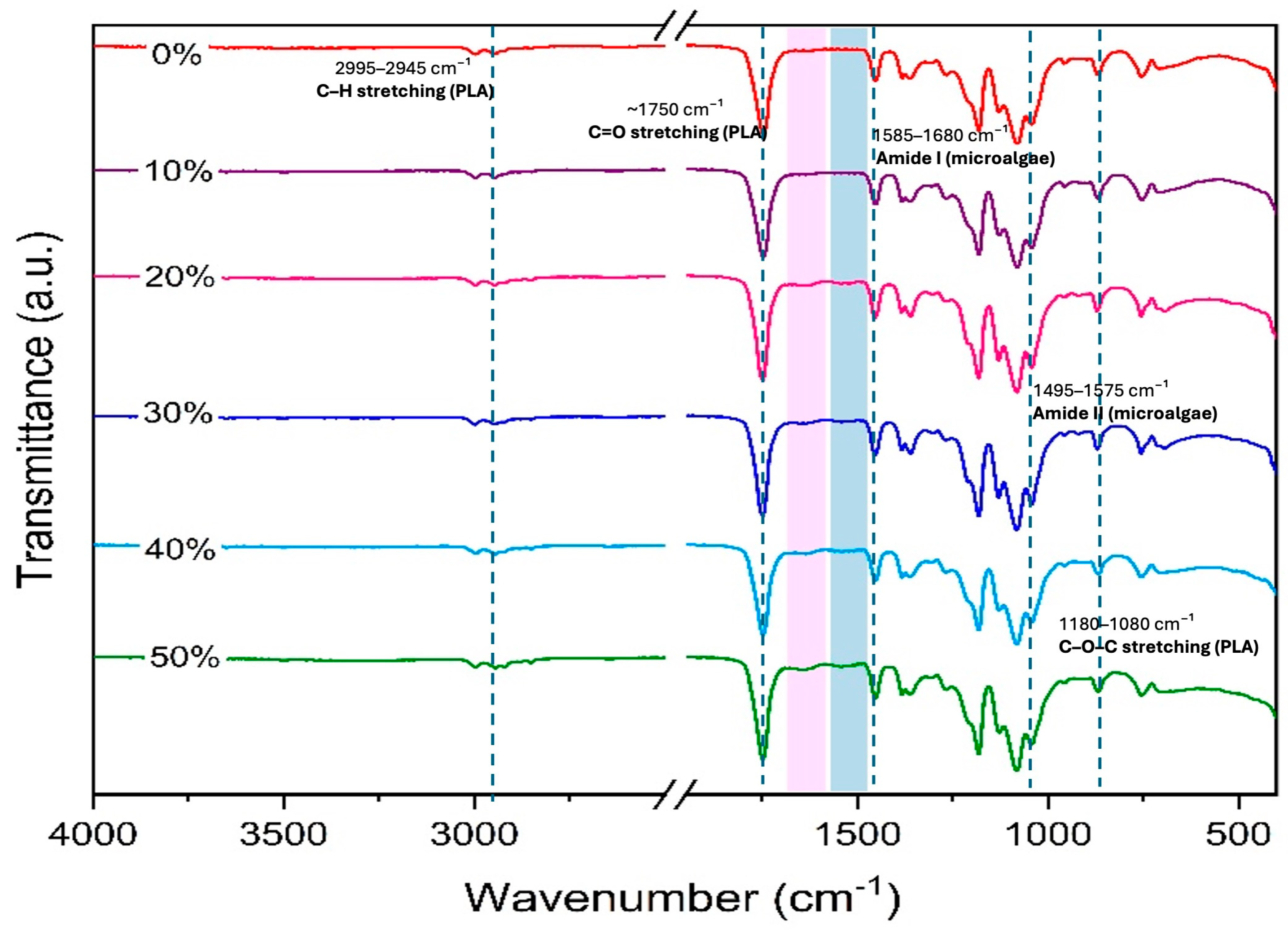
The PLA polymer films partially substituted with different proportions of microalgae biomass exhibited visually homogeneous surfaces with good conformation and structural integrity. The incorporation of microalgae into the polymer matrix, even at the highest substitution levels, did not compromise film formation, confirming the feasibility of partially replacing PLA with algal biomass. Therefore, the films were characterized to evaluate the effects of microalgae incorporation on their microstructure and overall performance. Accordingly, FTIR spectra were recorded for the neat PLA films (PLA-MA 0%) and for those partially substituted with different microalgae concentrations (Figure 1).
The characteristic PLA absorption bands and the amide I and amide II bands associated with microalgae components are highlighted. The FTIR spectra of PLA-MA samples exhibit the same characteristic bands observed for neat PLA (PLA-MA 0%), including the strong carbonyl (C=O) stretching band at approximately 1750 cm−1, the C–O–C stretching vibrations in the 1180–1080 cm−1 region, and the C–H stretching bands at 2995–2945 cm−1 (Figure 1). For films containing microalgae above 20%, additional weak absorption bands appear at approximately 1585–1680 cm−1 and 1495–1575 cm−1, which are attributed to amide I (C=O or N–H stretching) and amide II (N–H bending) vibrations from proteinaceous components of the microalgae biomass [24,25,26,27]. The absence of significant peak shifts suggests that these bands are associated with the presence of microalgae components rather than any chemical interaction with the PLA matrix.
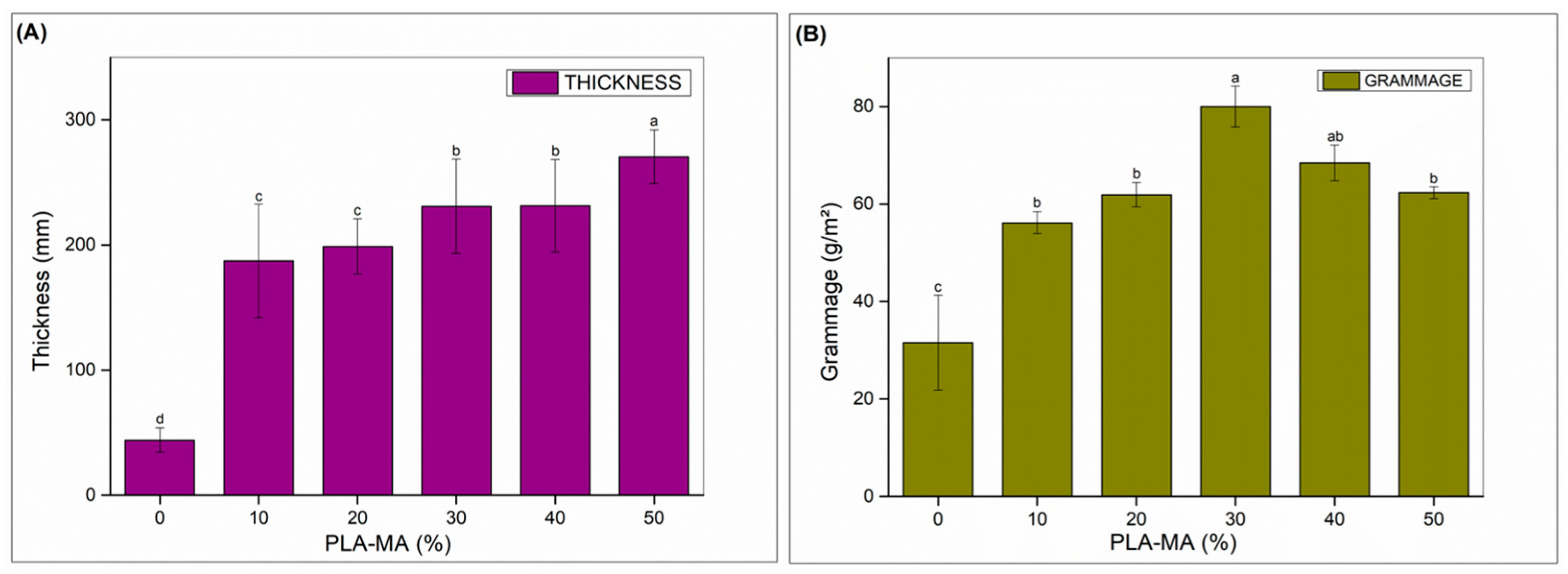
Continuing with the evaluation of the physical dimensions of the films, thickness is a critical variable in textural studies, as it is considered when calculating mechanical parameters and directly affects strength and elasticity outcomes [28,29]. In this study, the partial replacement of PLA with wastewater-grown microalgae significantly increased (p < 0.05) the film thickness (Figure 2A). The PLA control film (PLA-MA 0%) exhibited the lowest average thickness (0.044 ± 0.0097 mm), whereas the film containing 50% microalgae substitution showed the highest value (0.270 ± 0.0215 mm). Because the total film mass was kept constant, this increase can be attributed to the volumetric contribution of the incorporated microalgae, associated with the lower density of the biomass [28]. However, film thickness should not be used as a direct indicator of production cost, despite often being employed in cost-yield control [30].
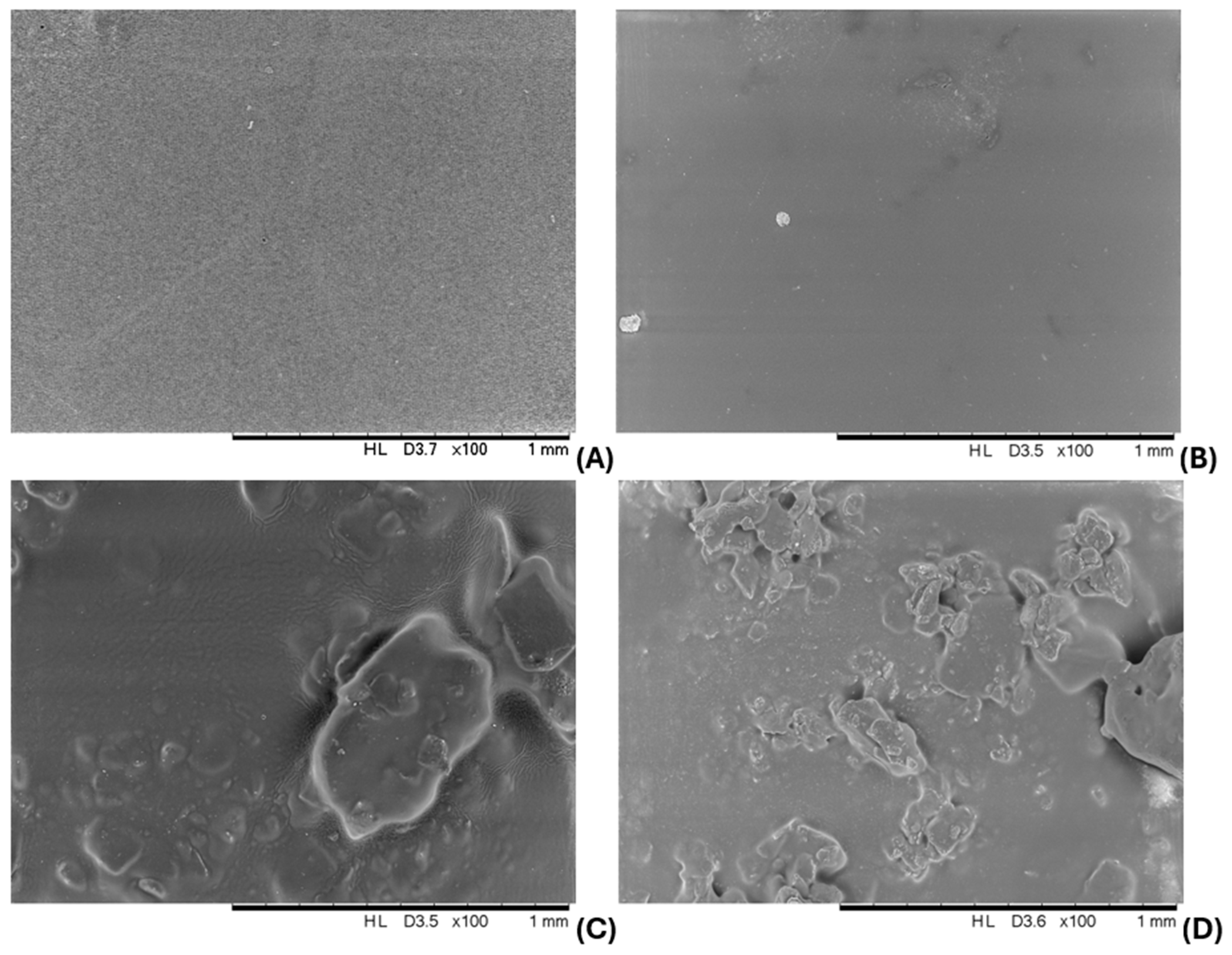
Regarding mass distribution, the increment in thickness is attributed to the formation of agglomerates as biomass content increases. Higher biomass concentrations raise the viscosity of the polymer dispersion, hindering homogeneity and promoting particle sedimentation during casting and drying, which leads to uneven mass distribution. Consequently, the films exhibited phase separation between PLA and the microalgae biomass [31,32]. This behavior is further supported by the grammage results (Figure 2B), which presented a maximum value at 30% microalgae substitution, followed by a subsequent decrease likely influenced by the non-uniform biomass distribution within the polymer matrix. Additionally, this reduction may be related to the incomplete polymer dispersion and partial loss of biomass during film formation. To verify the structural inferences made from physical measurements, the surface morphology was examined, as illustrated in the SEM micrographs in Figure 3.
The control film (PLA-MA 0%) exhibited a visually smooth, transparent, and homogeneous surface, reflecting excellent PLA dispersion [33]. However, upon closer inspection, small bubbles and microvoids were observed, likely formed due to the rapid solvent evaporation during the drying step. In contrast, films containing 50% microalgae biomass showed surface irregularities and particle agglomeration [34]. Interestingly, the biomass addition seemed to slow down the solvent evaporation rate, resulting in a more continuous polymeric matrix. Specifically, PLA-MA 10% and PLA-MA 20% produced a firmer and more cohesive matrix, with uniformly dispersed particles and a smooth, uninterrupted surface. In these films, the microalgae acted as an effective filler, moderating solvent release and preventing the bubble formation observed in the control film. To gain deeper insight into the structural behavior of PLA and biomass, FTIR analysis was conducted.
PLA is a hydrophobic polymer with a backbone composed mainly of apolar groups, such as methyl groups (-CH3), and contains only a limited number of polar functional groups (ester -COO), which are insufficient to establish strong interactions with hydrophilic compounds [35]. In contrast, microalgae biomass is predominantly hydrophilic, due to the abundance of polar molecules on its surface, such as proteins and polysaccharides, containing hydroxyl (-OH), amino (-NH2), and carboxyl (-COOH) groups [36]. These groups promote strong interactions among microalgae particles themselves, causing them to aggregate and form clusters rather than disperse uniformly within the PLA matrix.
The current findings—particularly the positive effect of low microalgae concentrations (10% and 20%) in reducing surface defects and promoting a more cohesive polymer matrix—are highly relevant for large-scale production. When transitioning from solvent-based casting to melt extrusion, the standard industrial processing route, solvent-related deformation issues (such as the bubbles observed in the control film) are no longer expected. Therefore, future studies are recommended to further elucidate how microalgae-containing formulations behave in terms of viscosity, particle distribution, processability, melt stability, and the resulting quality of the extruded composites.
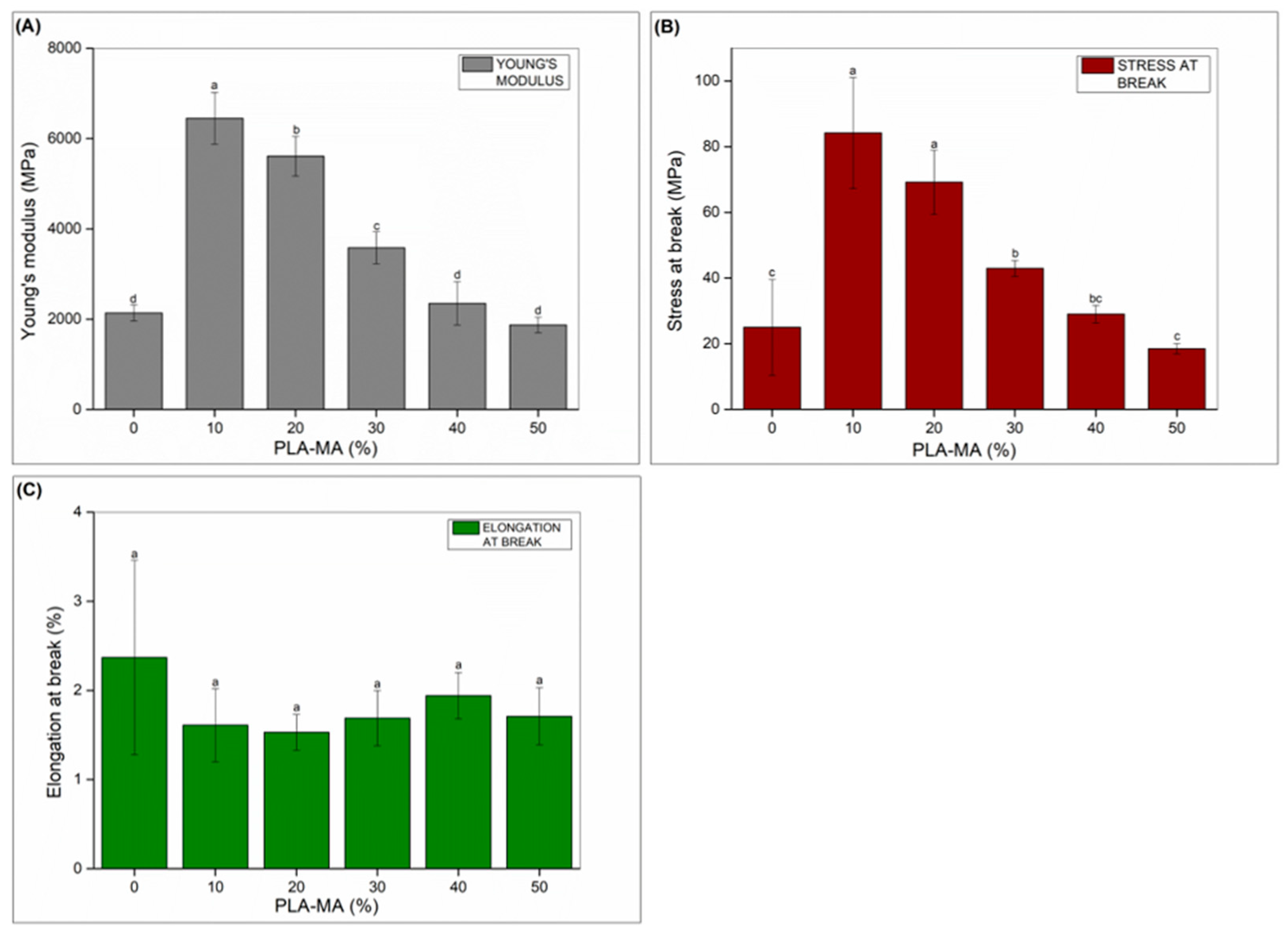
Ultimately, to assess the impact of incorporating microalgae from wastewater on film performance, mechanical properties were evaluated (Figure 4). Although mechanical properties may vary with environmental conditions, this study focused on material development and baseline characterization, and, therefore, mechanical testing was conducted under standardized conditions in accordance with ASTM D882. Moreover, the thickness variations previously discussed were carefully accounted for to ensure the accuracy of the stress and strain calculations.
Distinct effects were observed for Young’s modulus and stress at break as a function of the percentage of PLA replaced by microalgae biomass. At 10% substitution, the microalgae biomass acted as an effective reinforcing agent, enhancing the stiffness and strength of the films. This reinforcement effect gradually decreased as the concentration increased to 40%. Beyond that, at 50% substitution, the polymer matrix integrity was compromised due to particle agglomeration. These results are consistent with the grammage and morphological analyses, which indicated poor biomass dispersion at higher concentrations.
The optimum performance was achieved at 10% microalgae biomass incorporation. At this concentration, the films became stiffer, with Young’s modulus almost tripling from 2140.15 MPa (0%) to 6442.58 MPa, and stronger, with stress at break increasing from 25.01 MPa (0%) to 84.15 MPa, representing a 230% improvement. Remarkably, the simultaneous and pronounced increase in tensile strength surpasses previous reports in which filler addition often decreased the PLA strength [37,38], suggesting that microalgae biomass promoted surprisingly effective interfacial adhesion at the 10% substitution level.
Regarding elongation at break, the ductility of the films was not significantly affected by microalgae substitution. This is a favorable outcome, since materials typically reduce ductility when tensile strength at break and Young’s modulus increase. Average elongation at break values varied from 2.37% for pure PLA films to 1.62% (10%), 1.53% (20%), 1.69% (30%), 1.95% (40%), and 1.72% (50%) for the microalgae-containing films.
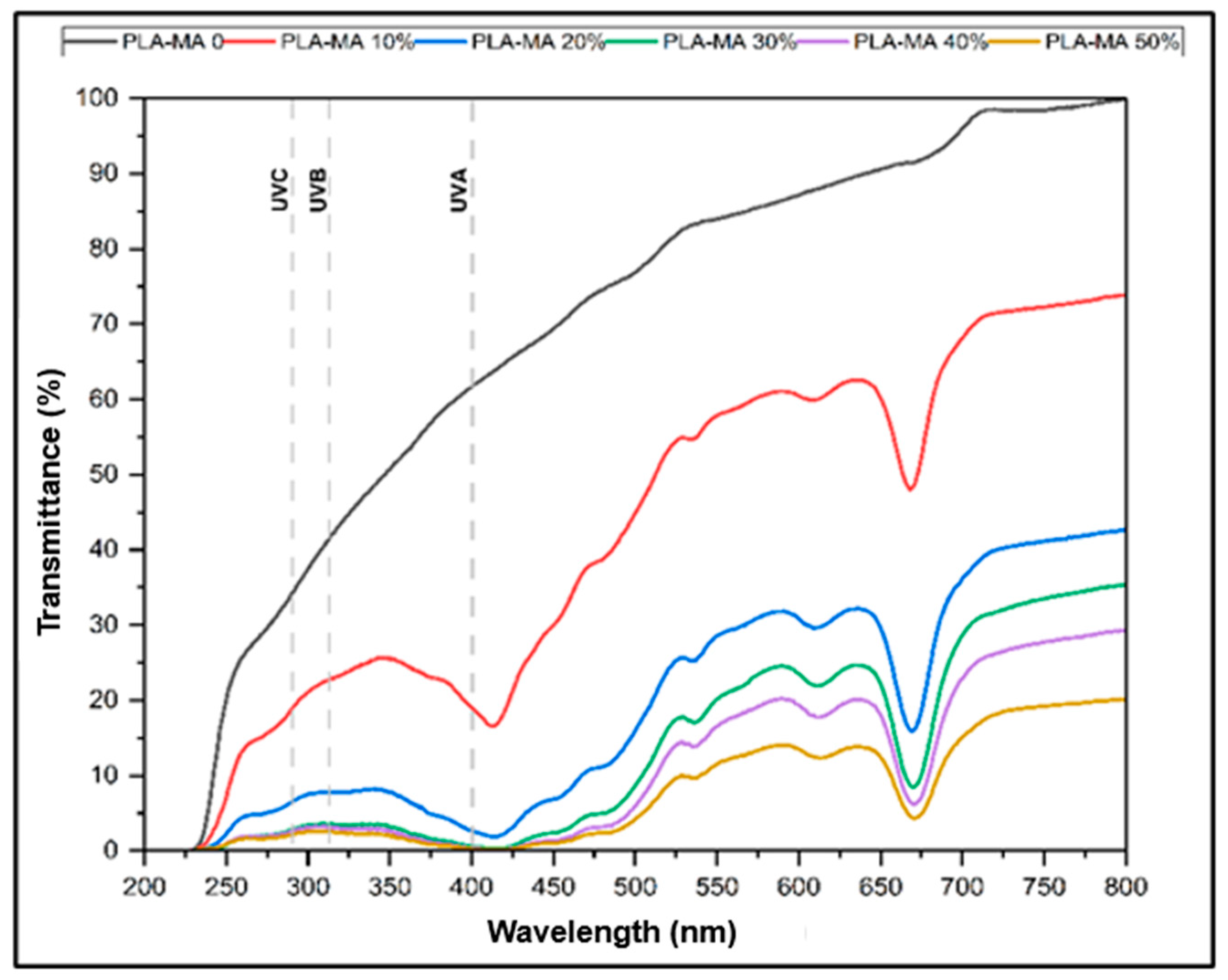
The most notable effect was the enhanced barrier against UV radiation. As displayed in Figure 5, microalgae biomass was able to block all incident UV radiation (280–400 nm) at concentrations above 20%, whereas pure PLA film remained highly transparent. In addition, characteristic pigment-related absorption bands are observed in the blue (~430–450 nm) and red (~660–680 nm) regions, which are attributed to chlorophyll pigments present in the microalgae biomass, as indicated in the spectrum. This pronounced photoprotective effect is attributed to pigments naturally present in the biomass, such as carotenoids and chlorophylls, which efficiently absorb ultraviolet energy, supporting previous reports on the potential of microalgae as natural photoprotective additives in biopolymers [39,40,41].
Additionally, the high absorbance observed across the visible spectrum (400–700 nm) explains the darkening and reduced transparency of the films containing microalgae biomass. This effect was evidenced by the progressive decrease in luminosity (L*) and the corresponding increase in film opacity as microalgae content increased (Table 1). Therefore, incorporating microalgal biomass into the polymer matrix functions as an effective opacifying agent, promoting light absorption and scattering behavior similar to that reported for pigment-rich Chlorella microalgae in chitosan films [42].
The spectral profile also explains the complex color changes observed in the films. At lower microalgae concentrations, the green hue, evidenced by negative a* values, arises from chlorophyll absorption, which predominantly occurs in the blue (~440 nm) and red (~670 nm) regions, while reflecting light in the green range (~500–600 nm) [43,44,45]. However, the green coloration is masked at higher concentrations due to the overlap of yellow and orange pigments (carotenoids), resulting in a brownish tone. In addition, chemical degradation of chlorophyll may have occurred during film preparation. The acidic environment generated during PLA dispersion can convert chlorophyll (green) into pheophytin (grayish brown) [46]. Therefore, the combination of pigment masking and chlorophyll transformation explains the loss of green hue at higher microalgae concentrations. These optical changes result from the combined effects of pigment composition, chemical transformations of chlorophyll, and the physical distribution of microalgal particles within the polymer matrix, which collectively govern light absorption and scattering.
Overall, wastewater microalgae biomass acts as a multifunctional additive, simultaneously modifying PLA coloration and providing effective UV-blocking properties. This approach represents a promising strategy within the circular economy framework, valorizing a low-cost by-product to produce biocomposites with improved optical and functional performance suitable for applications requiring protection against light-induced degradation.
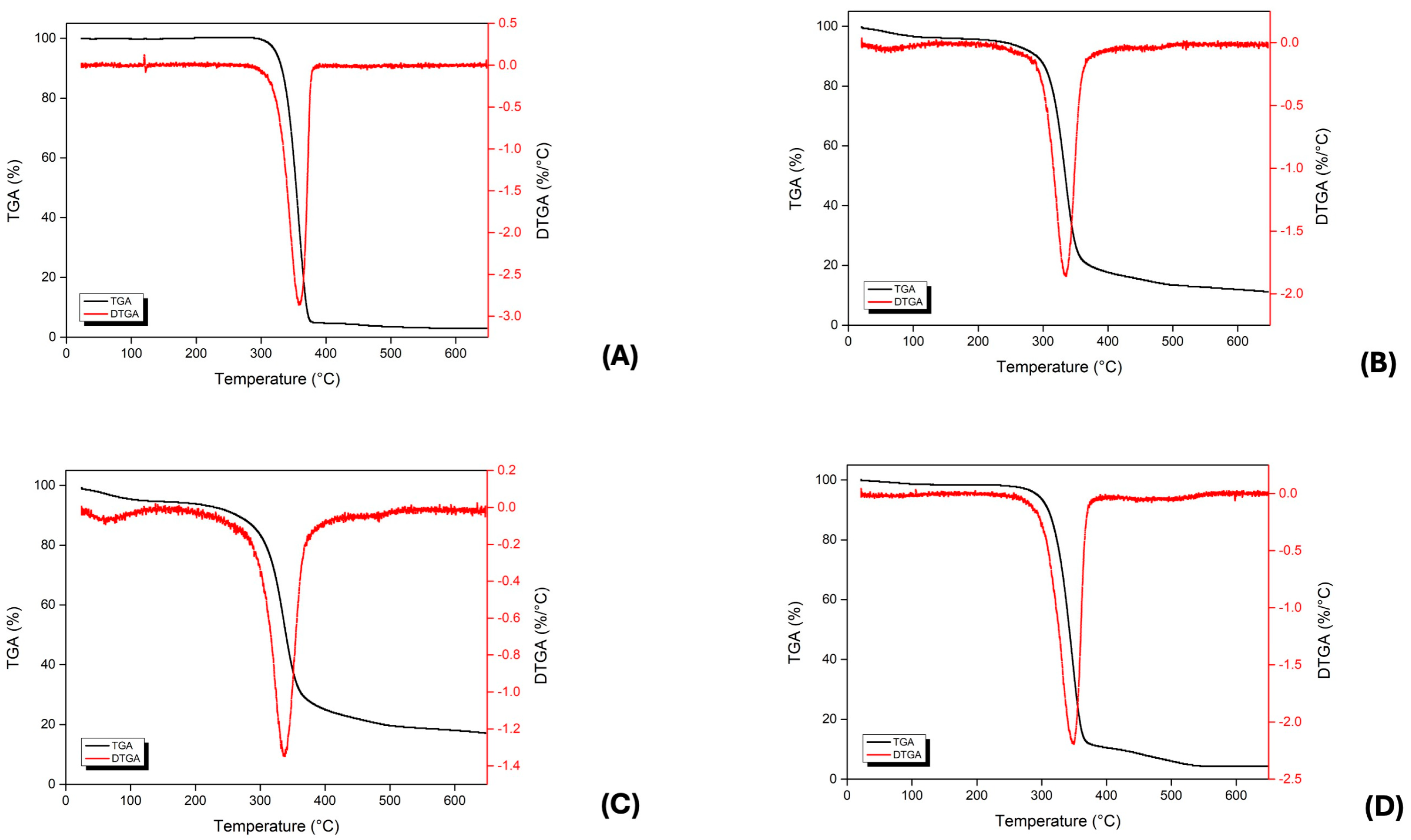
The characterization was followed by thermogravimetric analysis of PLA films substituted with different concentrations of microalgae, as displayed in Figure 6. The DTG curves reveal a gradual decrease in the maximum degradation temperature (Tmax) with increasing microalgae content, shifting from ~350 °C for neat PLA to ~345 °C, ~340 °C, and ~330 °C for films containing 10%, 30%, and 50% biomass, respectively. This shift reflects the lower thermal stability of microalgae components, such as proteins, lipids, and carbohydrates, which decompose at lower temperatures and contribute to an earlier maximum mass-loss rate. Nevertheless, the Tmax values remained relatively high and within a narrow range, indicating that the main degradation mechanism of the PLA matrix is preserved and that the composites maintain adequate thermal stability for conventional processing.
The first stage, observed below 100 °C, was associated with moisture evaporation and volatilization of low-molecular-weight compounds. Subsequent stages corresponded to the main polymer degradation and the decomposition of secondary compounds formed during breakdown. In addition, an earlier onset of thermal degradation was also observed, decreasing with increasing biomass content from ~310 °C for PLA-MA 10% to ~260 °C for PLA-MA 50%. This reduction in thermal stability is attributed to the decomposition of biomass components (such as lipids, proteins, and carbohydrates), which degrade at lower temperatures than the PLA matrix [47]. Nevertheless, the maximum degradation temperature of the microalgae-containing films remained around 340 °C.
Additionally, the linear increase in the residual mass, from approximately 3% for pure PLA to about 17% in the film with 50% microalgae substitution, is consistent with expected results. This behavior is attributed to the carbonization of the biomass, which produces a carbonaceous residue (biochar), in contrast to the nearly complete volatilization of neat PLA during pyrolysis [48]. In summary, the results align with the typical effects of incorporating a hydrophilic organic filler on the thermal degradation profile of PLA.
Although incorporating microalgae into the PLA matrix reduced the overall thermal stability of the films, the degradation onset temperatures remained well above the PLA melting range (typically 150–170 °C). This indicates that the microalgae-containing composites can easily withstand the thermal processing conditions required for PLA, such as extrusion and injection molding. Therefore, wastewater-derived microalgae represent an excellent partial substitute for PLA, reducing material costs while simultaneously enhancing functional properties and contributing to the development of more sustainable and cost-effective materials.
The study then evaluated the water vapor permeability (WVP) of PLA-MA films to assess their barrier performance. This analysis allows insight into how microalgae incorporation affects the films’ resistance to moisture transfer. The results are illustrated in Table 2.
Partial substitution of PLA with microalgae increased WVP values, indicating a reduced ability of the films to act as moisture barriers. At concentrations above 40%, the formation of particle agglomerates likely created “shortcuts” within the polymer network, further facilitating moisture transfer through the film.
This distinction is fundamental for the application of the material. Formulations containing up to 30% microalgae represent an excellent balance of properties, making them suitable for various applications such as mulching films for arid regions, where retaining soil moisture is the primary function. Conversely, films with 40% and 50% microalgae, which exhibited high WVP, are better suited for applications where permeability is advantageous, such as biodegradable pots or seedling trays, as their higher moisture exchange capacity with the soil can accelerate decomposition after planting.
In the present study, the WVP value obtained for pure PLA was approximately 1.53 × 10⁻¹³ g m−1 s−1 Pa−1, while in other studies, values of 2.7 × 10⁻¹¹ g m−1 s−1 Pa−1 [10], 1.0 × 10⁻¹¹ g m−1 s−1 Pa−1 [20], and 2.77 × 10⁻¹⁰ g m−1 s−1 Pa−1 was also reported [25]. The value remained within the typical order of magnitude expected for semi-crystalline polymers with inherently low permeability. Such variations are commonly attributed to differences in film thickness, processing parameters, crystallinity, and experimental conditions [20]. When compared to conventional films, such as low-density polyethylene (LDPE), which typically has WVP values of 1.81 × 10⁻⁵ Kg m−2 dia−1 Pa−1, the microalgae-PLA films developed in this study have significantly higher permeability. This difference reflects a fundamental shift in functionality, while conventional plastic mulching films are designed to maximize moisture retention and create a highly sealed microenvironment, films with higher WVP may allow partial vapor exchange. Such increased permeability can help mitigate excessive moisture accumulation and overheating beneath the film, which may be advantageous under specific agricultural applications where controlled moisture and heat management are desired. Field-scale studies are required to fully validate their performance compared to conventional LDPE mulches.
Regarding solubility, none of the films dissolved in water, even at 50% microalgae content, suggesting that the PLA was able to “encapsulate” the biomass, preventing its release or solution in an aqueous medium. Additionally, swelling tests showed statistically similar water absorption across all formulations, with mean values of 0.34%, indicating that the microalgae incorporation allows water to diffuse through the matrix without being retained or causing film disintegration. This behavior reinforces the hypotheses of microalgae encapsulation within the PLA matrix, which prevents swelling and solubility, while slightly modifying the internal structure to permit water diffusion.
Overall, these results suggest that, under appropriate storage conditions, the films may retain their functional properties over time, although validation under food-specific storage scenarios remains necessary.
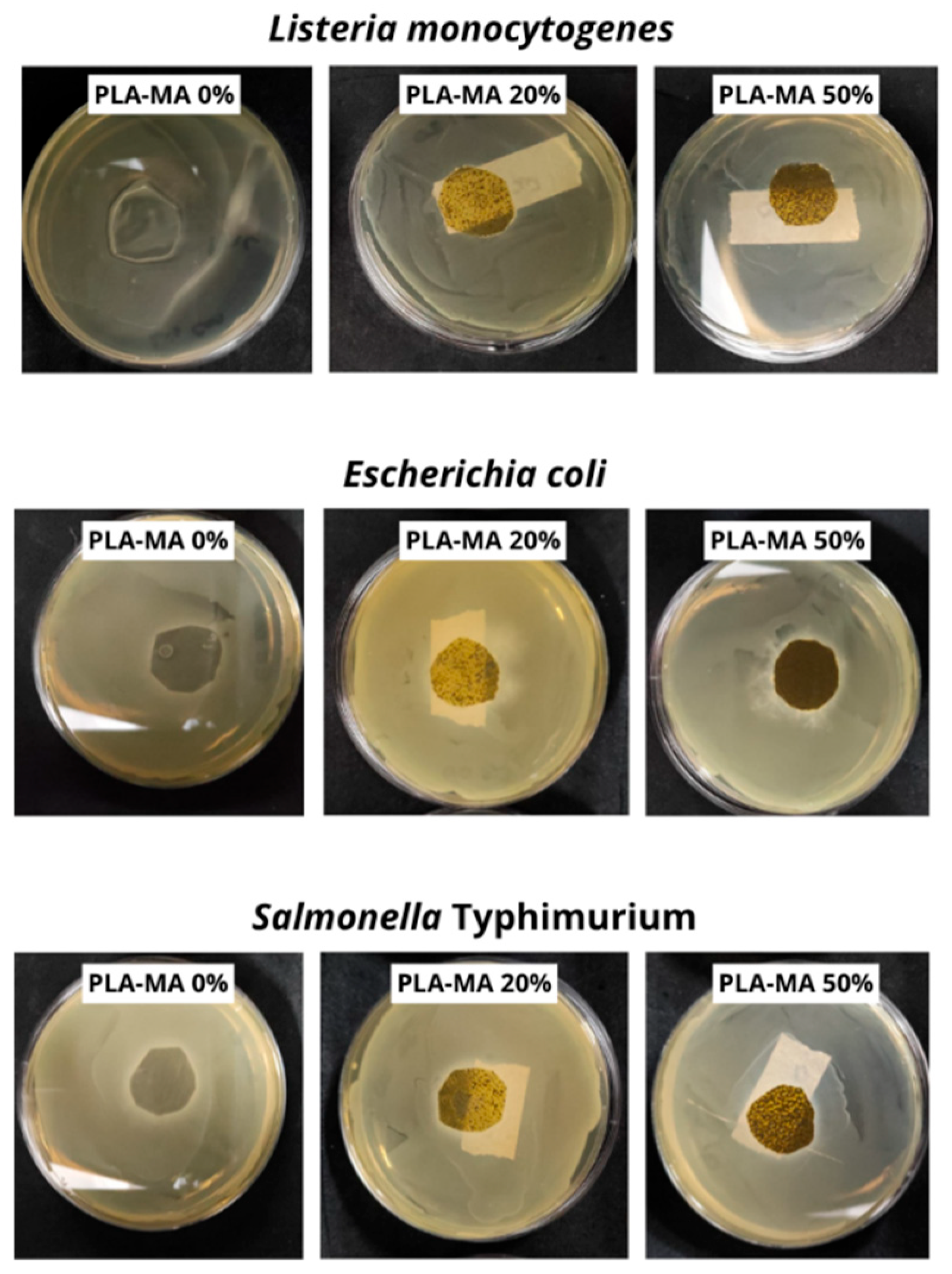
In the microbiological analysis of the microalgae, no microbial growth was observed on PertrifilmsTM plates for S. aureus, E. coli, coliforms, Salmonella, and L. monocytogenes. Only total aerobic microorganisms were detected, at 3.5 × 10³ CFU/mL. Although the microalgae originated from sanitary wastewater, this microbial load is relatively low, and no enteric or fecal pathogens were detected. This safety profile can be attributed to the freezing and freeze-drying process applied during microalgae processing, which considerably reduces water activity of the sample and impacts microbial growth [49]. Moreover, during the wastewater polishing, microalgae are exposed to intense sunlight, pH fluctuations, competition within the microbial community, and other environmental stressors that naturally suppress the survival of enteric pathogens. Therefore, these results confirm that processed microalgae are microbiologically safe for use as a partial polymer substitute in PLA films. Antimicrobial activity of PLA-MA films partially substituted by microalgae can be observed in Figure 7.
For Listeria monocytogenes, a subtle inhibition zone (~1 mm) was observed for neat PLA films (PLA-MA 0%), whereas no inhibition was detected for the PLA-MA 20% and 50% films. For E. coli and Salmonella Typhimurium, none of the films exhibited zones of microbial growth inhibition. When associated with bioactive substances, PLA can exhibit antimicrobial activity, as demonstrated by An et al. (2023) [50], who developed films for PLA food packaging with N-halamine-modified microcrystalline cellulose that inactivated E. coli and S. aureus cells. Similarly, Theinsathid et al. (2012) [51] reported antibacterial activity against L. monocytogenes and S. Typhimurium in PLA films coated with Laurie alginate. In this study, the lack of in vitro antimicrobial activity of microalgae films against the tested strains may be related to the low concentration of bioactive compounds present in the microalgae or to the limited diffusion of these compounds from the polymer matrix in BHI agar [52]. Consequently, the PLA-MA films show limited potential for applications requiring antimicrobial functionality. It is also important to note that the absence of antimicrobial activity under in vitro conditions does not necessarily preclude selective interactions with specific microbial groups, as antimicrobial effects can be strain-dependent and may differ from those involving environmental microorganisms responsible for biodegradation.
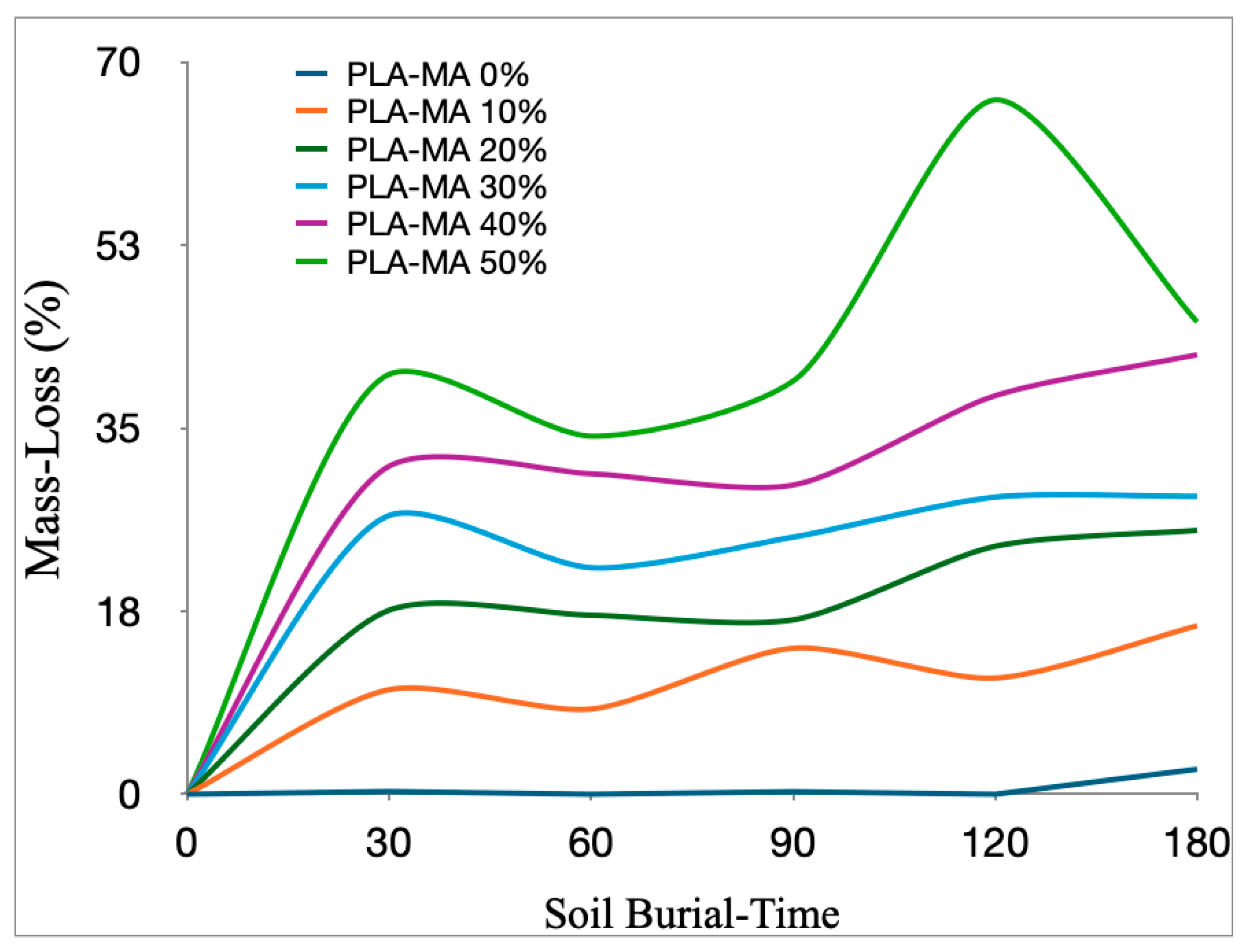
Biodegradability was subsequently assessed through a soil-burial test, and the results of mass loss are summarized in Figure 8.
To facilitate data interpretation, the mass-loss results were presented as a graph, which allows a clearer visualization of the degradation behavior over time and enables a more direct comparison among the different microalgae concentrations. It is important to note that this analysis is subject to considerable variability, since soil particles may adhere to the film samples during the degradation test, potentially influencing the measured mass loss. Despite this limitation, the overall degradation trend remains evident: formulations with higher microalgae concentrations exhibit steeper mass-loss slopes, indicating an increased biodegradation rate.
Biodegradability tests demonstrated that the incorporation of microalgae as a partial substitute for PLA markedly accelerated film decomposition. The analysis was carried out for up to 180 days. The control film (PLA-MA 0%) did not degrade after 120 days, suggesting its high resistance to soil burial under the evaluated conditions. In contrast, microalgae-containing films exhibited mass losses ranging from 11% to 90% for films with 10% and 50% of biomass, respectively. This behavior can be explained by two mechanisms: (i) microalgae stimulate microbial activity in the surrounding environment, enhancing biodegradation [53]; and (ii) the hydrophilic components promote hydrolytic processes within the polymer matrix [54]. Notably, the PLA-MA 50% film displayed a sharp increase in mass loss between 90 and 120 days, from 39.54% to 89.47%. These results indicate that microalgae accelerate the PLA degradation rate to be tailored by adjusting the biomass content, highlighting their potential for developing more sustainable and environmentally friendly bioplastic materials. It should be noted that the biodegradation behavior observed in this study is specific to the soil burial conditions evaluated, which are known to favor higher microbial activity and faster degradation; therefore, additional experiments under different soil types and environmental conditions are required to fully understand and compare biodegradation rates across diverse scenarios.

4. Conclusions

This study successfully develops biodegradable PLA films partially substituted with wastewater-derived microalgae biomass (0–50% w/w) using the casting method. Given the use of wastewater-derived microalgal biomass, ensuring consistent biomass quality through adequate process monitoring and control is essential to guarantee reproducible material performance. Additionally, variations in the grade and source of PLA may influence film performance, as differences in crystallinity and molecular characteristics can affect its interaction with the microalgal biomass. The biomass integrated well into the matrix at proportions up to 30%, resulting in cohesive and homogeneous films, while higher loadings (40–50%) led to heterogeneous dispersion. Microalgae content modulated multiple film properties: thickness and grammage increased with biomass addition, color shifted from transparent to yellowish-green, and SEM micrographs revealed microvoids and particle agglomeration at higher concentrations (40–50%). Regarding mechanical performance, low microalgae levels (10–20%) acted as a reinforcing agent, increasing Young’s modulus and tensile strength at break, thereby enhancing stiffness without significantly affecting elongation at break. In contrast, thermal stability and water vapor barrier properties reduced with increasing microalgae content, although the materials remained processable and thermally stable above the PLA melt point. The films also demonstrated water stability, showing negligible solubility and low swelling. The most remarkable outcome relates to biodegradability: microalgae biomass acted as an effective pro-degrading agent. All microalgae-containing composites showed visible degradation after 30 days, reaching a mass loss of 89.47% for PLA-MA 50% after 120 days, whereas the control PLA film remained unchanged. Although no antimicrobial activity was detected, the absence of pathogenic microorganisms in the films confirms their safe use. However, the films exhibited a characteristic odor that may restrict their application in food packaging, as it poses a potential risk of sensory transfer to the food product. While the casting method employed in this study presents inherent limitations related to industrial representativeness, reliance on solvent evaporation, and sensitivity to environmental conditions, PLA is a melt-processable polymer compatible with scalable manufacturing routes. Therefore, future studies should investigate the processing of microalgal biomass-PLA formulations under industrially relevant conditions to assess their scalability and performance. Overall, wastewater-derived microalgae into PLA represents a sustainable and versatile approach: lower concentrations (10–20%) enhance mechanical performance, while higher concentrations (50%) promote rapid biodegradation. This strategy highlights the potential of wastewater-derived biomass to accelerate PLA decomposition and opens promising opportunities for agricultural sector applications such as mulching films or seedling tubes.

Author Contributions

G.d.O.M., M.L.D.A. and M.F.d.C.R. conducted the main investigation, data curation, and writing. G.d.O.M., T.R.A., M.A.d.S.A. and A.S.A.d.P.P. conducted data curation and writing. G.d.O.M., A.d.C.O.C., M.J., J.S. and T.V.D.O. conducted the review and editing of the material. T.V.D.O., M.L.C., N.d.F.F.S. and J.M.F.d.C. conducted the conceptualization, review, editing, and project administration. All authors contributed to the review paper. All authors have read and agreed to the published version of the manuscript.

Funding

This research was funded by FINEP/FNDCT, grant number (1322/22) and by the Brazilian National Council for Scientific and Technological Development (CNPq) (grant number 152561/2025-0).

Institutional Review Board Statement

Not applicable.

Data Availability Statement

The original contributions presented in this study are included in the article. Further inquiries can be directed to the corresponding author.

Acknowledgments

The authors wish to acknowledge the financial support provided by Fundação de Amparo à Pesquisa do Estado de Minas Gerais—Brazil (FAPEMIG—n° 491) and Coordenação de Aperfeiçoamento de Pessoal de Nível Superior—Brazil (CAPES—n° 001). The authors acknowledge the financial assistance from the Foundation for Science and Technology (FCT, Portugal) for financial support to the Center for Research and Development in Agrifood Systems and Sustainability (CISAS) [UID/05937/2025 (doi.org/10.54499/UID/05937/2025)].

Conflicts of Interest

The authors declare no conflicts of interest.

References

  1. Plastics Europe. Plastics—The Facts 2024: An Analysis of European Plastics Production, Demand and Waste Data; Plastics Europe AISBL: Brussels, Belgium, 2024; Available online: https://plasticseurope.org (accessed on 1 August 2025).
  2. Li, B.; Zhu, X.; Xu, C.; Zhang, X.; Fan, Y.; Yu, J. Sustainable Strategy for Lignin Etherification and Its Promotion of Anti-UV Aging PLA Biocomposite. Chem. Eng. J. 2024, 500, 156746. [Google Scholar] [CrossRef]
  3. Marín, A.; Feijóo, P.; Carbonetto, B.; González-Torres, P.; Tena-Medialdea, J.; García-March, J.R.; Gámez-Pérez, J.; Cabedo, L. Long-Term Monitoring of Biofilm Succession Unveils Differences between Biodegradable and Conventional Plastic Materials. Mar. Pollut. Bull. 2025, 214, 117820. [Google Scholar] [CrossRef]
  4. Trinh, B.M.; Chang, B.P.; Mekonnen, T.H. The Barrier Properties of Sustainable Multiphase and Multicomponent Packaging Materials: A Review. Prog. Mater. Sci. 2023, 133, 101071. [Google Scholar] [CrossRef]
  5. Zhao, X.; Pelfrey, A.; Pellicciotti, A.; Koelling, K.; Vodovotz, Y. Synergistic Effects of Chain Extenders and Natural Rubber on PLA Thermal, Rheological, Mechanical and Barrier Properties. Polymer 2023, 269, 125712. [Google Scholar] [CrossRef]
  6. Ponnusamy, P.G.; Mani, S. Material and Environmental Properties of Natural Polymers and Their Composites for Packaging Applications—A Review. Polymers 2022, 14, 4033. [Google Scholar] [CrossRef]
  7. Shelly, D.; Singhal, V.; Jaidka, S.; Banea, M.D.; Lee, S.-Y.; Park, S.-J. Mechanical Performance of Bio-Based Fiber Reinforced Polymer Composites: A Review. Polym. Compos. 2025, 46, S9–S43. [Google Scholar] [CrossRef]
  8. Shahdan, D.; Rosli, N.A.; Chen, R.S.; Ahmad, S.; Gan, S. Strategies for Strengthening Toughened Poly(Lactic Acid) Blend via Natural Reinforcement with Enhanced Biodegradability: A Review. Int. J. Biol. Macromol. 2023, 251, 126214. [Google Scholar] [CrossRef]
  9. He, L.; Song, F.; Guo, Z.-W.; Zhao, X.; Yang, N.; Wang, X.-L.; Wang, Y.-Z. Toward Strong and Super-Toughened PLA via Incorporating a Novel Fully Bio-Based Copolyester Containing Cyclic Sugar. Compos. Part B Eng. 2021, 207, 108558. [Google Scholar] [CrossRef]
  10. Lazaro-Hdez, C.; Gomez-Carturla, J.; Arrieta, M.P.; Boronat, T.; Ivorra-Martinez, J. Enhancing Polylactic Acid Films with Polyethylene Glycol-Based Plasticizers: A Reactive Extrusion Approach. Macromol. Rapid Commun. 2025, 46, 2401130. [Google Scholar] [CrossRef]
  11. O’Loughlin, J.; Doherty, D.; Herward, B.; McGleenan, C.; Mahmud, M.; Bhagabati, P.; Boland, A.N.; Freeland, B.; Rochfort, K.D.; Kelleher, S.M.; et al. The Potential of Bio-Based Polylactic Acid (PLA) as an Alternative in Reusable Food Containers: A Review. Sustainability 2023, 15, 15312. [Google Scholar] [CrossRef]
  12. Kumar, G.S.P.; Keshavamurthy, R.; Panigrahi, S.P.; Thomas, S.; R, T.; Hebbar, G.S.; Prasad, C.D.; Aden, A.A. Enhanced Mechanical Properties of CNT/Graphene Reinforced PLA-Based Composites Fabricated via Fused Deposition Modelling. Results Eng. 2025, 25, 104472. [Google Scholar] [CrossRef]
  13. Sayin, S.; Kohlhaas, T.; Veziroglu, S.; Okudan, E.Ş.; Naz, M.; Schröder, S.; Saygili, E.I.; Açil, Y.; Faupel, F.; Wiltfang, J.; et al. Marine Algae-PLA Composites as de Novo Alternative to Porcine Derived Collagen Membranes. Mater. Today Chem. 2020, 17, 100276. [Google Scholar] [CrossRef]
  14. Kalita, N.K.; Damare, N.A.; Hazarika, D.; Bhagabati, P.; Kalamdhad, A.; Katiyar, V. Biodegradation and Characterization Study of Compostable PLA Bioplastic Containing Algae Biomass as Potential Degradation Accelerator. Environ. Chall. 2021, 3, 100067. [Google Scholar] [CrossRef]
  15. Letwaba, J.; Muniyasamy, S.; Lekalakala, R.; Mavhungu, L.; Mbaya, R. Design of Compostable Toughened PLA/PBAT Blend with Algae via Reactive Compatibilization: The Effect of Algae Content on Mechanical and Thermal Properties of Bio-composites. J. Appl. Polym. Sci. 2024, 141, e55204. [Google Scholar] [CrossRef]
  16. Vo, T.-D.-H.; Nguyen, V.-T.; Le, V.-A.; Do, Q.-H.; Nguyen, T.-Y.-P.; Nguyen, P.-T.; Lin, C.; You, S.-J.; Visvanathan, C.; Bui, X.-T. Simultaneous Organic and Nutrient Removal in Wastewater Using a Revolving Algae Biofilm Reactor. Environ. Technol. Innov. 2025, 37, 103949. [Google Scholar] [CrossRef]
  17. Yang, Y.; Guo, W.; Zhang, J.; Liang, S.; Liu, Q.; Liu, J.; Ngo, H.H.; Zhang, H. Applicability Analysis of Algae Biochar for Anaerobic Membrane Bioreactors in Wastewater Treatment: A Review from a Sustainability Assessment Perspective. Sci. Total Environ. 2024, 957, 177609. [Google Scholar] [CrossRef]
  18. Jayaraman, J.; Kumaraswamy, J.; Rao, Y.K.S.S.; Karthick, M.; Baskar, S.; Anish, M.; Sharma, A.; Yadav, A.S.; Alam, T.; Ammarullah, M.I. Wastewater Treatment by Algae-Based Membrane Bioreactors: A Review of the Arrangement of a Membrane Reactor, Physico-Chemical Properties, Advantages and Challenges. RSC Adv. 2024, 14, 34769–34790. [Google Scholar] [CrossRef]
  19. Chong, J.W.R.; Khoo, K.S.; Yew, G.Y.; Leong, W.H.; Lim, J.W.; Lam, M.K.; Ho, Y.-C.; Ng, H.S.; Munawaroh, H.S.H.; Show, P.L. Advances in Production of Bioplastics by Microalgae Using Food Waste Hydrolysate and Wastewater: A Review. Bioresour. Technol. 2021, 342, 125947. [Google Scholar] [CrossRef]
  20. de Carvalho Reis, M.F.; de Oliveira Machado, G.; Côcco Teixeira, S.; Batista, L.F.; Frollini, E.; de Abreu Oliveira, A.V.; Ferreira Soares, N.d.F.; Fontes Demuner, I.; Veloso de Oliveira, T.; Oliveira Carneiro, A.d.C. Strengthening Poly (Lactic Acid): The Role of Fractionated Lignin in the Development of Sustainable Films. Int. J. Biol. Macromol. 2025, 320, 145912. [Google Scholar] [CrossRef]
  21. Standard Test Method for Tensile Properties of Thin Plastic Sheeting. Available online: https://store.astm.org/d0882-12.html (accessed on 6 October 2025).
  22. Standard Test Methods for Gravimetric Determination of Water Vapor Transmission Rate of Materials. Available online: https://store.astm.org/e0096_e0096m-22ae01.html (accessed on 6 October 2025).
  23. Standard Specification for Labeling of Plastics Designed to be Aerobically Composted in Municipal or Industrial Facilities. Available online: https://store.astm.org/d6400-23.html (accessed on 22 October 2025).
  24. Marques, C.S.; Arruda, T.R.; Dos Santos Filho, M.T.C.; Graciano, A.C.; De Mendonça, K.S.; Ventura, B.M.L.; De Souza, A.L.; De Oliveira, T.V.; Mendes, T.A.D.O.; Soares, N.D.F.F. Active Biodegradable Film with Garlic Essential Oil: From Elaboration to Cytotoxicity and Preliminary Assessment of Antibiotic Resistance in Staphylococcus Aureus. Food Control 2024, 166, 110760. [Google Scholar] [CrossRef]
  25. Arruda, T.R.; Bernardes, P.C.; Moraes, A.R.F.E.; Marques, C.S.; Pinheiro, P.F.; De Oliveira, T.V.; Ferreira, S.O.; Naves, E.A.A.; Soares, N.D.F.F. Beyond Brewing: β-Acid Rich Hop Extract in the Development of a Multifunctional Polylactic Acid-Based Food Packaging. Int. J. Biol. Macromol. 2023, 228, 23–39. [Google Scholar] [CrossRef] [PubMed]
  26. Torres, S.; Navia, R.; Campbell Murdy, R.; Cooke, P.; Misra, M.; Mohanty, A.K. Green Composites from Residual Microalgae Biomass and Poly(Butylene Adipate-Co-Terephthalate): Processing and Plasticization. ACS Sustain. Chem. Eng. 2015, 3, 614–624. [Google Scholar] [CrossRef]
  27. Bulota, M.; Budtova, T. PLA/Algae Composites: Morphology and Mechanical Properties. Compos. Part A Appl. Sci. Manuf. 2015, 73, 109–115. [Google Scholar] [CrossRef]
  28. Ghasemi, B.; Ševčík, J.; Nádaždy, V.; Végsö, K.; Šiffalovič, P.; Urbánek, P.; Kuřitka, I. Thickness Dependence of Electronic Structure and Optical Properties of F8BT Thin Films. Polymers 2022, 14, 641. [Google Scholar] [CrossRef] [PubMed]
  29. Zhang, T.; Riggleman, R.A. Thickness-Dependent Mechanical Failure in Thin Films of Glassy Polymer Bidisperse Blends. Macromolecules 2022, 55, 201–209. [Google Scholar] [CrossRef]
  30. Oluwasina, O.O.; Awonyemi, I.O. Citrus Peel Extract Starch-Based Bioplastic: Effect of Extract Concentration on Packed Fish and Bioplastic Properties. J. Polym. Environ. 2021, 29, 1706–1716. [Google Scholar] [CrossRef]
  31. Sharifzadeh, E. Evaluating the Dependency of Polymer/Particle Interphase Thickness to the Nanoparticles Content, Aggregation/Agglomeration Factor and Type of the Exerted Driving Force. Iran. Polym. J. 2021, 30, 1063–1072. [Google Scholar] [CrossRef]
  32. Nor Adilah, A.; Noranizan, M.A.; Jamilah, B.; Nur Hanani, Z.A. Development of Polyethylene Films Coated with Gelatin and Mango Peel Extract and the Effect on the Quality of Margarine. Food Packag. Shelf Life 2020, 26, 100577. [Google Scholar] [CrossRef]
  33. Li, J.; Li, Z.; Yan, Y.; Shao, D.; Guo, Y.; Lin, R. Study on the Structure–Property Relationship of Starch/PLA Composite Films Modified by the Synergistic Effect of Aromatic Rings and Aliphatic Chains. Polym. Degrad. Stab. 2025, 241, 111567. [Google Scholar] [CrossRef]
  34. Ravi, V.C.; Zagabathuni, A. Synergistic Effects of Pyrolytic Carbon Reinforcement and Annealing on the Structural, Mechanical, and Tribological Properties of SLA 3D Printed PLA Composites. Mater. Chem. Phys. 2026, 347, 131508. [Google Scholar] [CrossRef]
  35. Basu, A.; Kunduru, K.R.; Doppalapudi, S.; Domb, A.J.; Khan, W. Poly(Lactic Acid) Based Hydrogels. Adv. Drug Deliv. Rev. 2016, 107, 192–205. [Google Scholar] [CrossRef]
  36. Finkel, Z.V.; Follows, M.J.; Liefer, J.D.; Brown, C.M.; Benner, I.; Irwin, A.J. Phylogenetic Diversity in the Macromolecular Composition of Microalgae. PLoS ONE 2016, 11, e0155977. [Google Scholar] [CrossRef]
  37. Lazaridis, D.G.; Karabagias, V.K.; Kalarakis, A.N.; Andritsos, N.D.; Giannakas, A.E.; Karabagias, I.K. Bioactive PLA-based films reinforced with agro-industrial by-products for the shelf-life evaluation of fresh-cut pineapple (Ananas comosus L.) slices. Food Res. Int. 2025, 221, 117602. [Google Scholar] [CrossRef]
  38. Bhagia, S.; Lowden, R.R.; Erdman, D.; Rodriguez, M.; Haga, B.A.; Solano, I.R.M.; Gallego, N.C.; Pu, Y.; Muchero, W.; Kunc, V.; et al. Tensile Properties of 3D-Printed Wood-Filled PLA Materials Using Poplar Trees. Appl. Mater. Today 2020, 21, 100832. [Google Scholar] [CrossRef]
  39. Simkin, A.J.; Kapoor, L.; Doss, C.G.P.; Hofmann, T.A.; Lawson, T.; Ramamoorthy, S. The Role of Photosynthesis Related Pigments in Light Harvesting, Photoprotection and Enhancement of Photosynthetic Yield in Planta. Photosynth. Res. 2022, 152, 23–42. [Google Scholar] [CrossRef]
  40. Martins, V.F.R.; Lopes, A.I.; Machado, M.; Costa, E.M.; Ribeiro, T.B.; Poças, F.; Pintado, M.; Morais, R.M.S.C.; Morais, A.M.M.B. Biodegradable Films with Polysaccharides, Proteins, and Bioactive Compounds from Lobosphaera sp.: Antioxidant and Antimicrobial Activities. Foods 2025, 14, 1327. [Google Scholar] [CrossRef] [PubMed]
  41. Roy Chong, J.W.; Tan, X.; Khoo, K.S.; Ng, H.S.; Jonglertjunya, W.; Yew, G.Y.; Show, P.L. Microalgae-Based Bioplastics: Future Solution towards Mitigation of Plastic Wastes. Environ. Res. 2022, 206, 112620. [Google Scholar] [CrossRef]
  42. Deshmukh, A.R.; Aloui, H.; Khomlaem, C.; Negi, A.; Yun, J.-H.; Kim, H.-S.; Kim, B.S. Biodegradable Films Based on Chitosan and Defatted Chlorella Biomass: Functional and Physical Characterization. Food Chem. 2021, 337, 127777. [Google Scholar] [CrossRef]
  43. Fernandes, A.S.; Petry, F.C.; Mercadante, A.Z.; Jacob-Lopes, E.; Zepka, L.Q. HPLC-PDA-MS/MS as a Strategy to Characterize and Quantify Natural Pigments from Microalgae. Curr. Res. Food Sci. 2020, 3, 100–112. [Google Scholar] [CrossRef] [PubMed]
  44. López-Padilla, A.; Cortés-Rodríguez, M.; Ortega-Toro, R. Development and Comparative Analysis of Hard and Soft Wheat Flour Films Enriched with Yellow and White Chlorella Vulgaris Algae. Polymers 2025, 17, 785. [Google Scholar] [CrossRef]
  45. Maletin, A.; Jeremic-Knezevic, M.; Djurovic-Koprivica, D.; Veljovic, T.; Ramic, B.; Milekic, B. Analysis of Colorimetric Parameters of International Commission on Illumination L*a*b* System in the Color of Maxillary Central Incisors. Med. Pregl. 2020, 73, 309–314. [Google Scholar] [CrossRef]
  46. Kusmita, L.; Limantara, L. The Influence of Strong and Weak Acid Upon Aggregation and Pheophytinization of Chlorophyll A and B. Indones. J. Chem. 2010, 9, 70–76. [Google Scholar] [CrossRef]
  47. Arif, M.; Li, Y.; El-Dalatony, M.M.; Zhang, C.; Li, X.; Salama, E.-S. A Complete Characterization of Microalgal Biomass through FTIR/TGA/CHNS Analysis: An Approach for Biofuel Generation and Nutrients Removal. Renew. Energy 2021, 163, 1973–1982. [Google Scholar] [CrossRef]
  48. Bach, Q.-V.; Chen, W.-H. Pyrolysis Characteristics and Kinetics of Microalgae via Thermogravimetric Analysis (TGA): A State-of-the-Art Review. Bioresour. Technol. 2017, 246, 88–100. [Google Scholar] [CrossRef]
  49. Adams, G.D.J.; Cook, I.; Ward, K.R. The Principles of Freeze-Drying. In Cryopreservation and Freeze-Drying Protocols; Wolkers, W.F., Oldenhof, H., Eds.; Methods in Molecular Biology; Springer: New York, NY, USA, 2015; Volume 1257, pp. 121–143. [Google Scholar]
  50. An, L.; Perkins, P.; Yi, R.; Ren, T. Development of Polylactic Acid Based Antimicrobial Food Packaging Films with N-Halamine Modified Microcrystalline Cellulose. Int. J. Biol. Macromol. 2023, 242, 124685. [Google Scholar] [CrossRef] [PubMed]
  51. Theinsathid, P.; Visessanguan, W.; Kruenate, J.; Kingcha, Y.; Keeratipibul, S. Antimicrobial Activity of Lauric Arginate-Coated Polylactic Acid Films against Listeria monocytogenes and Salmonella Typhimurium on Cooked Sliced Ham. J. Food Sci. 2012, 77, M142–M149. [Google Scholar] [CrossRef] [PubMed]
  52. Perumal Pillai, B.; Balasubramaniam, B.; Gupta, R.K.; Tyagi, A. Bio-Based Materials for Antimicrobial Films in Food Applications: Beyond the COVID-19 Pandemic Era. Oxf. Open Mater. Sci. 2023, 3, itad016. [Google Scholar] [CrossRef]
  53. Huang, F.; Liu, Z.; Luo, D.; Xu, Z.; Wei, K.; He, N.; Sun, X. Microalgae-Bacterial Consortiums for Enhanced Degradation of Nonylphenol: Biodegradability and Kinetic Analysis. J. Environ. Manag. 2024, 370, 122400. [Google Scholar] [CrossRef]
  54. Liberti, D.; Pinheiro, F.; Simões, B.; Varela, J.; Barreira, L. Beyond Bioremediation: The Untapped Potential of Microalgae in Wastewater Treatment. Water 2024, 16, 2710. [Google Scholar] [CrossRef]
Figure 1. FTIR spectra for PLA films substituted with 0% (PLA-MA 0%), 10% (PLA-MA 10%), 20% (PLA-MA 20%), 30% (PLA-MA 30%), 40% (PLA-MA 40%), and 50% (PLA-MA 50%) of microalgae.
Sustainability 18 01302 g001
Figure 2. Average thickness (mm) (A) and grammage (g/m2) (B) of PLA-MA films as a function of microalgae substitute (0, 10, 20, 30, 40, and 50%). Error bars represent standard deviation. Different letters indicate statistically significant differences (p < 0.05).
Sustainability 18 01302 g002
Figure 3. Surface morphology of PLA-MA films with 0% (A), 10% (B), 20% (C) and 50% (D) microalgae biomass. All micrographs were obtained at 100-fold magnification.
Sustainability 18 01302 g003
Figure 4. Results for (A) Young’s modulus (MPa), (B) stress at break (MPa), and (C) elongation at break (%) of PLA-MA films with 0%, 10%, 20%, 30%, 40%, and 50% microalgae biomass. Bars represent mean values of six replicates (n = 6), and error bars represent the standard deviation. For graphs (A) and (B), means followed by different letters differ statistically according to Tukey’s test (p < 0.05). For graph (C), Analysis of Variance (ANOVA) did not indicate a significant difference between the means (p ≥ 0.05).
Sustainability 18 01302 g004
Figure 5. UV–Vis absorbance spectra of PLA-MA films with different microalgae contents, highlighting UV-blocking behavior and pigment-related absorption bands.
Sustainability 18 01302 g005
Figure 6. Thermogravimetric analysis (TGA) and first derivative (DTG) curves of the PLA-MA films with (A) 0%, (B) 10%, (C) 30%, and (D) 50% microalgae biomass.
Sustainability 18 01302 g006
Figure 7. Antimicrobial analysis of PLA-MA films with 0%, 20%, and 50% (m/m) of microalgae biomass against Listeria monocytogenes, E. coli, and Salmonella Typhimurium.
Sustainability 18 01302 g007
Figure 8. Percentage mass loss of PLA-MA films with 0%, 10%, 30%, and 50% microalgae biomass over time and under soil burial conditions.
Sustainability 18 01302 g008
Table 1. Mean values of color coordinates (L*, a*, b*), brightness (Y white and Y black), and opacity of PLA-MA films at different microalgae concentrations. Different letters within the same column indicate statistically significant differences among treatments according to Tukey’s test (p < 0.05).
PLA-MA (%)L*a*b*Y WhiteY BlackOpacity
092.70 ± 0.21 a−0.95 ± 0.03 b1.63 ± 0.07 d82.27 ± 0.49 d11.35 ± 0.27 b13.79 ± 0.41 b
1077.88 ± 0.99 b−4.37 ± 0.15 a39.40 ± 1.07 a53.01 ± 1.68 a9.11 ± 0.18 ab17.19 ± 0.20 ab
2065.68 ± 1.98 c−1.46 ± 0.31 b49.15 ± 1.94 b34.94 ± 2.54 b7.76 ± 0.28 a22.29 ± 2.43 ac
3059.71 ± 0.73 c0.05 ± 0.08 bc47.20 ± 0.74 b27.81 ± 0.80 b7.18 ± 0.37 a25.80 ± 0.59 c
4047.85 ± 1.58 d2.50 ± 0.55 d36.18 ± 1.94 ac16.69 ± 1.24 c6.50 ± 1.01 a38.84 ± 3.19 d
5047.01 ± 6.55 d1.99 ± 1.34 cd32.78 ± 2.28 c16.29 ± 5.01 c6.42 ± 1.47 a39.93 ± 3.25 d
Table 2. Water vapor permeability of the PLA-MA films with 0%, 10%, 20%, 30%, 40%, and 50% microalgae biomass. Results are expressed as mean ± standard deviation (n = 2).
PLA-MA (%)WVP (g m−1 s−1 Pa−1)
00.1526 ± 0.00476 × 10⁻¹²
100.6960 ± 0.1028 × 10⁻¹²
200.9145 ± 0.0966 × 10⁻¹²
301.0701 ± 0.2945 × 10⁻¹²
402.4565 ± 0.5134 × 10⁻¹²
503.5370 ± 0.1302 × 10⁻¹²
Disclaimer/Publisher’s Note: The statements, opinions and data contained in all publications are solely those of the individual author(s) and contributor(s) and not of MDPI and/or the editor(s). MDPI and/or the editor(s) disclaim responsibility for any injury to people or property resulting from any ideas, methods, instructions or products referred to in the content.