


The Impact of Multidimensional Risk Factors on Economic Growth as a Proxy for Sustainable Development Goals in Saudi Arabia: Alignment with Saudi Vision 2030


Abstract
1. Introduction
2. Literature Review
2.1. Economic Growth and Government Effectiveness
2.2. Economic Growth and Financial Development
2.3. Economic Growth and Environmental Pressure
2.4. Economic Growth and Human Capital
2.5. Economic Growth and Oil Price Volatility
2.6. Risk Management and Its Connection to the Sustainable Development Goals (SDGs)
2.7. A Summary of Literature Review
2.8. Theoretical Framework and Hypotheses
3. Data and Methodology
3.1. Data
3.2. Methodology
4. Empirical Analysis
4.1. Diagnostic Tests
4.2. Stationarity Tests
4.3. Bounds Test
4.4. Assessments of Economic Model Stability
4.5. Short Run ARDL Estimations
4.6. Long-Run ARDL Estimations
4.7. Robustness Checks
5. Conclusions
6. Alignment with Saudi Vision 2030
7. Suggestions for Policy Connected to the SDGs
- Start specific projects in digitalization, regulatory audits, and performance metrics to strengthen governance in the public sector. These projects should lead to quantifiable gains in efficiency and risk reduction over the next few years.
- Reform financial development to address inefficiencies (SDG 8: Decent Work and Economic Growth).
- Given the negative long-run association, investigate and reform credit allocation inefficiencies (e.g., high non-performing loans) by redirecting to SMEs and non-oil sectors with enhanced oversight, turning FD into a growth enabler.
- Make smart investments in people (SDG 4: Quality Education). Make sure that what is taught in schools and training programs is what companies need so that they can make the most out of their money. This will assist with variety and productivity in the long run.
- Take meaningful steps to deal with environmental pressure (SDG 13: Climate Action). To minimize the long-term costs of environmental harm from being too high, make sure economic planning includes laws about the environment and means to limit carbon emissions.
- Cut down on dependency on oil and deal with price swings (SDG 7 and SDG 12).
- Speed up diversification through renewable energy projects and fiscal reserve systems that protect against oil shocks. This would promote energy security and long-term consumption habits.
Author Contributions
Funding
Institutional Review Board Statement
Informed Consent Statement
Data Availability Statement
Conflicts of Interest
References
- Shah, S.Q.A.; Lai, F.W.; Shad, M.K.; Hamad, S.; Ellili, N.O.D. Exploring the Effect of Enterprise Risk Management for ESG Risks towards Green Growth. Int. J. Product. Perform. Manag. 2025, 74, 224–249. [Google Scholar] [CrossRef]
- Shah, S.Q.A.; Lai, F.W.; Shad, M.K.; Jan, A.A. Developing a Green Governance Framework for the Performance Enhancement of the Oil and Gas Industry. Sustainability 2022, 14, 3735. [Google Scholar] [CrossRef]
- Okunlola, O.C.; Sani, I.U.; Ayetigbo, O.A.; Oyadeyi, O.O. Effect of Government Expenditure on Real Economic Growth in ECOWAS: Assessing the Moderating Role of Corruption and Conflict. Humanit. Soc. Sci. Commun. 2024, 11, 768. [Google Scholar] [CrossRef]
- Nguyen, M.-L.T.; Bui, N.T. Government Expenditure and Economic Growth: Does the Role of Corruption Control Matter? Heliyon 2022, 8, e10822. [Google Scholar] [CrossRef] [PubMed]
- Nzama, L.; Sithole, T.; Kahyaoglu, S.B. The Impact of Government Effectiveness on Trade and Financial Openness: The Generalized Quantile Panel Regression Approach. J. Risk Financial Manag. 2022, 16, 14. [Google Scholar] [CrossRef]
- Lopes, L.E.M.; Packham, N.; Walther, U. The Effect of Governance Quality on Future Economic Growth: An Analysis and Comparison of Emerging Market and Developed Economies. SN Bus. Econ. 2023, 3, 108. [Google Scholar] [CrossRef]
- Mahran, H.A. The Impact of Governance on Economic Growth: Spatial Econometric Approach. Rev. Econ. Political Sci. 2022, 8, 37–53. [Google Scholar] [CrossRef]
- Akhtar, N.; Rashid, A. Financial Development and Sustainable Development: A Review of Literature. Sustain. Dev. 2024, 32, 7114–7139. [Google Scholar] [CrossRef]
- Darweesh, F.; Khudari, M.; Othman, N.S. The Relationship Between Financial Development and Carbon Emissions: A Systematic Review. Int. J. Prof. Bus. Rev. Int. J. Prof. Bus. Rev. 2023, 8, 92. [Google Scholar] [CrossRef]
- Hewage, R.S.; Pyeman, J.; Othman, N.; Rahman, N.B.A.; Zakaria, S. An Overview on the Relationship Between Financial Development and Economic Growth. Rev. Bus. Financ. Stud. 2022, 13, 63–77. [Google Scholar]
- Azmeh, C.; Al-Raeei, M. Financial Development, Research in Finance, and Economic Growth. Cogent Econ. Financ. 2025, 13, 2448220. [Google Scholar] [CrossRef]
- Kayani, U.N.; Sadiq, M.; Rabbani, M.R.; Aysan, A.F.; Kayani, F.N. Examining the relationship between economic growth, financial development, and carbon emissions: A review of the literature and scientometric analysis. Int. J. Energy Econ. Policy 2023, 13, 489–499. [Google Scholar] [CrossRef]
- Shi, S.; Smith, L. Decoupling Growth from Degradation: A CS-ARDL and MMQR Panel Analysis of Ecological Foot-Prints and Sustainable Economic Growth. Front. Environ. Sci. 2025, 13, 1604011. [Google Scholar] [CrossRef]
- Osuntuyi, B.V.; Lean, H.H. Economic Growth, Energy Consumption and Environmental Degradation Nexus in Het-Erogeneous Countries: Does Education Matter? Environ. Sci. Eur. 2022, 34, 48. [Google Scholar] [CrossRef]
- Liu, X.; Li, X.; Shi, H.; Yan, Y.; Wen, X. Effect of Economic Growth on Environmental Quality: Evidence from Tropical Countries with Different Income Levels. Sci. Total Environ. 2021, 774, 145819. [Google Scholar] [CrossRef] [PubMed]
- Wahab, S.; Imran, M.; Ahmed, B.; Rahim, S.; Hassan, T. Navigating Environmental Concerns: Unveiling the Role of Economic Growth, Trade, Resources and Institutional Quality on Greenhouse Gas Emissions in OECD Countries. J. Clean. Prod. 2024, 431, 139692. [Google Scholar] [CrossRef]
- Wei, J.; Rahim, S.; Wang, S. Role of Environmental Degradation, Institutional Quality, and Government Health Ex-Penditures for Human Health: Evidence from Emerging Seven Countries. Front. Public Health 2022, 10, 870767. [Google Scholar] [CrossRef]
- Ma, Z. A Systematic Literature Review of Human Capital and Education Policy 2014–2024. High. Educ. Res. 2025, 10, 231–246. [Google Scholar] [CrossRef]
- Shastri, S.; Giri, A.K.; Mohapatra, G. Foreign Capital Inflows and Poverty Linkages in South Asia: Do the Forms of Capital Inflows Matter? Econ. Syst. 2022, 46, 101018. [Google Scholar] [CrossRef]
- Égert, B.; Maisonneuve, C. The Importance of Human Capital for Economic Outcomes; OECD Education Policy Committee Document EDU/EDPC(2022)2; OECD Publishing: Paris, France, 2022. [Google Scholar]
- Baily, M.N.; Bosworth, B.; Kennedy, K. The Contribution of Human Capital to Economic Growth; Brookings Institution: Washington, DC, USA, 2021. [Google Scholar]
- Bloom, D.E.; Khoury, A.; Kufenko, V.; Prettner, K. Spurring Economic Growth through Human Development: Re-Search Results and Guidance for Policymakers. Popul. Dev. Rev. 2021, 47, 377–409. [Google Scholar] [CrossRef]
- Ismail, A.T.; Latifat, A.J.; Adewale, S.A. Impact of Oil Price Volatility on Economic Growth in United States: An Ordinary Least Square Analysis. Int. J. Sci. Res. Arch. 2024, 13, 477–485. [Google Scholar] [CrossRef]
- Musa, I.; Magaji, S.; Ismail, Y.; Ahmed, E.B.; Wafure, O.G.; Gombe, B.M.; Sani, S.B. Impact of Tax Structure on Economic Growth in Nigeria: An Empirical Analysis Using Vector Error Correction Model. In New Advances in Business Management and Economics-Volume 8; Book Publisher International: Hooghly, India, 2024; Chapter 8; pp. 153–169. [Google Scholar] [CrossRef]
- Bagadeem, S. Oil Volatility and Economic Growth: Evidence from Top Oil Trading Countries. Int. J. Energy Econ. Policy 2023, 13, 101–115. [Google Scholar] [CrossRef]
- Kumari, R.; Singh, S.K.; Vig, S. Analyzing the Association between Crude Oil Price Volatility and Economic Growth in OECD Economies. Cogent Econ. Financ. 2024, 12, 2399956. [Google Scholar] [CrossRef]
- Oliveira, A.; Schommer, S.; Rosa, L.L.G. Oil price volatility: Impacts in the Brazilian economy. Econ. Bull. 2023, 43, 429–444. [Google Scholar]
- Xiong, S.; Yang, F.; Zhang, J.; Li, J.; Gu, C. Advancing Multiscale Sustainable Development in Lake-Dense Regions: A Dynamic Management Chain for Ecosystem Service Supply–Demand and Ecological Risks Interactions. J. Environ. Manag. 2025, 386, 125737. [Google Scholar] [CrossRef] [PubMed]
- Bai, L.; Zhang, L.; Zhang, L.; Shao, K.; Luo, X. Unlocking the Potential of Project Portfolio: Value-Oriented Interactive Risk Management. Humanit. Soc. Sci. Commun. 2025, 12, 1012. [Google Scholar] [CrossRef]
- Almgrashi, A.; Mujalli, A. The Influence of Sustainable Risk Management on the Implementation of Risk-Based Internal Auditing. Sustainability 2024, 16, 8455. [Google Scholar] [CrossRef]
- North, D.C. Institutions, Institutional Change and Economic Performance; Cambridge University Press: Cambridge, UK, 1990. [Google Scholar] [CrossRef]
- King, R.G.; Levine, R. Finance, Entrepreneurship and Growth. J. Monet. Econ. 1993, 32, 513–542. [Google Scholar] [CrossRef]
- Grossman, G.M.; Krueger, A.B. Economic Growth and the Environment. Q. J. Econ. 1995, 110, 353–377. [Google Scholar] [CrossRef]
- Becker, G.S. Human Capita; National Bureau of Economic Research: New York, NY, USA, 1964. [Google Scholar]
- Sachs, J.D.; Warner, A. Natural Resource Abundance and Economic Growth 1995; NBER Working Paper No. 5398; National Bureau of Economic Research: Cambridge, MA, USA, 1995. [Google Scholar] [CrossRef]
- Pesaran, M.H.; Shin, Y.; Smith, R.J. Bounds Testing Approaches to the Analysis of Level Relation-Ships. J. Appl. Econom. 2001, 16, 289–326. [Google Scholar] [CrossRef]
- Pesaran, M.H.; Pesaran, B. Working with Microfit 4.0: Interactive Econometric Analysis; Oxford University Press: Oxford, UK, 1997; Volume 29, Available online: https://www.scirp.org/reference/referencespapers?referenceid=2873764 (accessed on 21 January 2026).
- Newey, W.K.; West, K.D. A Simple, Positive Semi-Definite, Heteroskedasticity and Autocorrelation consistent Covariance Matrix. Econometrica 1986, 55, 703–708. [Google Scholar] [CrossRef]
- Pesaran, M.H.; Shin, Y. An Autoregressive Distributed Lag Modelling Approach to Cointegration Analysis. In Econometrics and Economic Theory in the 20th Century: The Ragnar Frisch Centennial Symposium; Strom, S., Ed.; Cambridge University Press: Cambridge, UK, 1999; pp. 371–413. [Google Scholar] [CrossRef]
- Johansen, S.; Juselius, K. Maximum likelihood estimation and inference on cointegration with applications to the demand for money. Oxf. Bull. Econ. Stat. 1990, 52, 169–210. [Google Scholar] [CrossRef]
- Derouez, F.; Ifa, A.; Shammre, A.A.; Zayed, M.; Alrawad, M. Socioeconomic and Climatic Factors Influencing Desertification in Saudi Arabia through an ARDL Approach. Sci. Rep. 2025. ahead of print. [Google Scholar] [CrossRef]
- Derouez, F.; Ifa, A. Desalination for Food Security in Tunisia: Harnessing Renewable Energy to Address Water Scarcity and Climate Change by Using ARDL Approach and VECM Technical. Sustainability 2025, 17, 1046. [Google Scholar] [CrossRef]
- Laradi, S.; Elfekair, A.; Alrawad, M.; Hashim, M.; Derouez, F. Leveraging Capabilities of Social Media Marketing for Business Success. Comput. Hum. Behav. Rep. 2024, 16, 100524. [Google Scholar] [CrossRef]
- Arcand, J.L.; Berkes, E.; Panizza, U. Too Much Finance? J. Econ. Growth 2015, 20, 105–148. [Google Scholar] [CrossRef]
- Toda, H.Y.; Yamamoto, T. Statistical Inference in Vector Autoregressions with Possibly Integrated Processes. J. Econom. 1995, 66, 225–250. [Google Scholar] [CrossRef]

| Dependent Variable | Variable | Description/Proxy | Sources |
| Sustainable Development | Economic Growth (GDP) | GDP growth (annual %) | World Bank Indicator; 2025 |
| Independent Variables (Risk Dimension) | Variables | Description/Proxy | Sources |
| Governance Risk | Government Effectiveness (GOVE) | World Bank Governance Indicator for policy formulation/implementation quality | Governance Indicators (WGI); 2025. |
| Financial Risk | Financial Development (FD) | Domestic credit to private sector (% GDP) | World Bank Indicator; 2025 |
| Environmental Risk | Environmental Pressure (EP) | CO2 emissions per capita | World Bank Indicator; 2025 |
| Social Risk | Human Capital (HC) | Government spending on education/training (% GDP) | World Bank Indicator and UNESCO; 2025. |
| External Risk | Oil Price Volatility (OPV) | Brent crude price index | World Bank Indicator and Energy Information Administration; 2025. |
| Variables | Mean | Std. Dev | Min | Max | Skewness | Kurtosis | Jarque–Bera | p-Value | Obs. |
|---|---|---|---|---|---|---|---|---|---|
| GDP | 0.05 | 0.22 | −0.31 | 0.52 | −0.15 | 2.10 | 1.45 | 0.48 | 35 |
| FD | −0.05 | 0.31 | −0.58 | 0.80 | 0.95 | 3.80 | 6.20 | 0.04 | 35 |
| HC | 36.42 | 14.10 | 20.30 | 68.30 | 0.85 | 2.50 | 4.10 | 0.12 | 35 |
| GOVE | 0.04 | 0.15 | 0.00 | 1.00 | 5.80 | 35.00 | 950.0 | 0.00 | 35 |
| EP | 5.92 | 1.10 | 3.89 | 8.28 | 0.45 | 2.80 | 1.80 | 0.40 | 35 |
| OPV | 56.50 | 28.40 | 12.72 | 111.67 | 0.42 | 1.95 | 2.10 | 0.35 | 35 |
| Model | LM Test (t-Statistic) | ARCH Test (t-Statistic) | Reset Test (t-Statistic) | JB Test (t-Statistic) |
|---|---|---|---|---|
| 0.326 | 0.298 | 0.223 | 0.675 | |
| Null hypothesis (H0) | Serial correlation does not exist | Heteroskedasticiy does not exist | Functional form misspicificationdoes not exist | Normal distribution ofResiduals |
| Decisions | Accept (H1) | Accept (H1) | Accept (H1) | Accept (H1) |
| Phillips–Perron (PP) | |||||||
|---|---|---|---|---|---|---|---|
| At Level | |||||||
| GDP | FD | HC | GOVE | EP | OPV | ||
| With Constant | t-Statistic | −4.8856 | −0.2156 | −3.0007 | 0.1562 | −1.2821 | −1.0463 |
| Prob. | 0.0004 *** | 0.9270 | 0.0449 ** | 0.9655 | 0.6265 | 0.7252 | |
| With Constant and Trend | t-Statistic | −4.8223 | −3.0726 | −3.7886 | −1.7292 | −1.1533 | −2.0352 |
| Prob. | 0.0024 *** | 0.1288 | 0.0296 ** | 0.7160 | 0.9042 | 0.5618 | |
| Without Constant and Trend | t-Statistic | −3.1493 | 4.0391 | −0.4146 | −0.2162 | 0.6597 | 0.6559 |
| Prob. | 0.0026 *** | 0.9999 | 0.5264 | 0.6010 | 0.8538 | 0.8530 | |
| At First Difference | |||||||
| d(GDP) | d(FD) | d(HC) | d(GOVE) | d(EP) | d(OPV) | ||
| With Constant | t-Statistic | −11.4255 | −12.4397 | −12.0594 | −7.4256 | −6.9696 | −5.3930 |
| Prob. | 0.0000 *** | 0.0000 *** | 0.0000 *** | 0.0000 *** | 0.0000 *** | 0.0001 *** | |
| With Constant and Trend | t-Statistic | −11.1120 | −11.8437 | −13.9782 | −20.2119 | −7.0221 | −5.3858 |
| Prob. | 0.0000 *** | 0.0000 *** | 0.0000 *** | 0.0000 *** | 0.0000 *** | 0.0006 *** | |
| Without Constant and Trend | t-Statistic | −11.6874 | −4.9535 | −11.5920 | −6.9295 | −6.9371 | −5.2672 |
| Prob. | 0.0000 *** | 0.0000 *** | 0.0000 *** | 0.0000 *** | 0.0000 *** | 0.0000 *** | |
| Augmented Dickey–Fuller (ADF) | |||||||
|---|---|---|---|---|---|---|---|
| At Level | |||||||
| GDP | FD | HC | GOVE | EP | OPV | ||
| With Constant | t-Statistic | −5.3487 | −0.6728 | −1.1429 | −0.2270 | −1.2821 | −1.1377 |
| Prob. | 0.0001 *** | 0.8403 | 0.6835 | 0.9254 | 0.6265 | 0.6893 | |
| With Constant and Trend | t-Statistic | −5.3338 | −4.3747 | −2.5123 | −2.0319 | −1.3160 | −2.0352 |
| Prob. | 0.0007 *** | 0.0076 *** | 0.3202 | 0.5636 | 0.8667 | 0.5618 | |
| Without Constant and Trend | t-Statistic | −1.5800 | 1.7753 | −0.1632 | −0.4086 | 0.5712 | 0.5392 |
| Prob. | 0.1060 | 0.9795 | 0.6180 | 0.5287 | 0.8347 | 0.8275 | |
| At First Difference | |||||||
| d(GDP) | d(FD) | d(HC) | d(GOVE) | d(EP) | d(OPV) | ||
| With Constant | t-Statistic | −7.9109 | −5.6068 | −2.3507 | −7.3051 | −7.1460 | −5.6349 |
| Prob. | 0.0000 *** | 0.0001 *** | 0.0164 ** | 0.0000 *** | 0.0000 *** | 0.0001 *** | |
| With Constant and Trend | t-Statistic | −7.8499 | −5.5149 | −2.7624 | −7.8600 | −7.2204 | −5.5320 |
| Prob. | 0.0000 *** | 0.0004 *** | 0.0221 ** | 0.0000 *** | 0.0000 *** | 0.0004 *** | |
| Without Constant and Trend | t-Statistic | −8.0398 | −4.9965 | −2.4773 | −6.9947 | −7.1029 | −5.4574 |
| Prob. | 0.0000 *** | 0.0000 *** | 0.0152 *** | 0.0000 *** | 0.0000 *** | 0.0000 *** | |
| F-Bounds Test | Null Hypothesis: No Levels Relationship | |||
|---|---|---|---|---|
| Test Statistic | Value | Signif. | I(0) | I(1) |
| Asymptotic: n = 1000 | ||||
| F-statistic | 7.649381 **** | 10% | 1.81 | 2.93 |
| k | 5 | 5% | 2.14 | 3.34 |
| 2.5% | 2.44 | 3.71 | ||
| 1% | 2.82 | 4.21 | ||
| CUSUM Test | CUSUMSQ Test |
|---|---|
 | 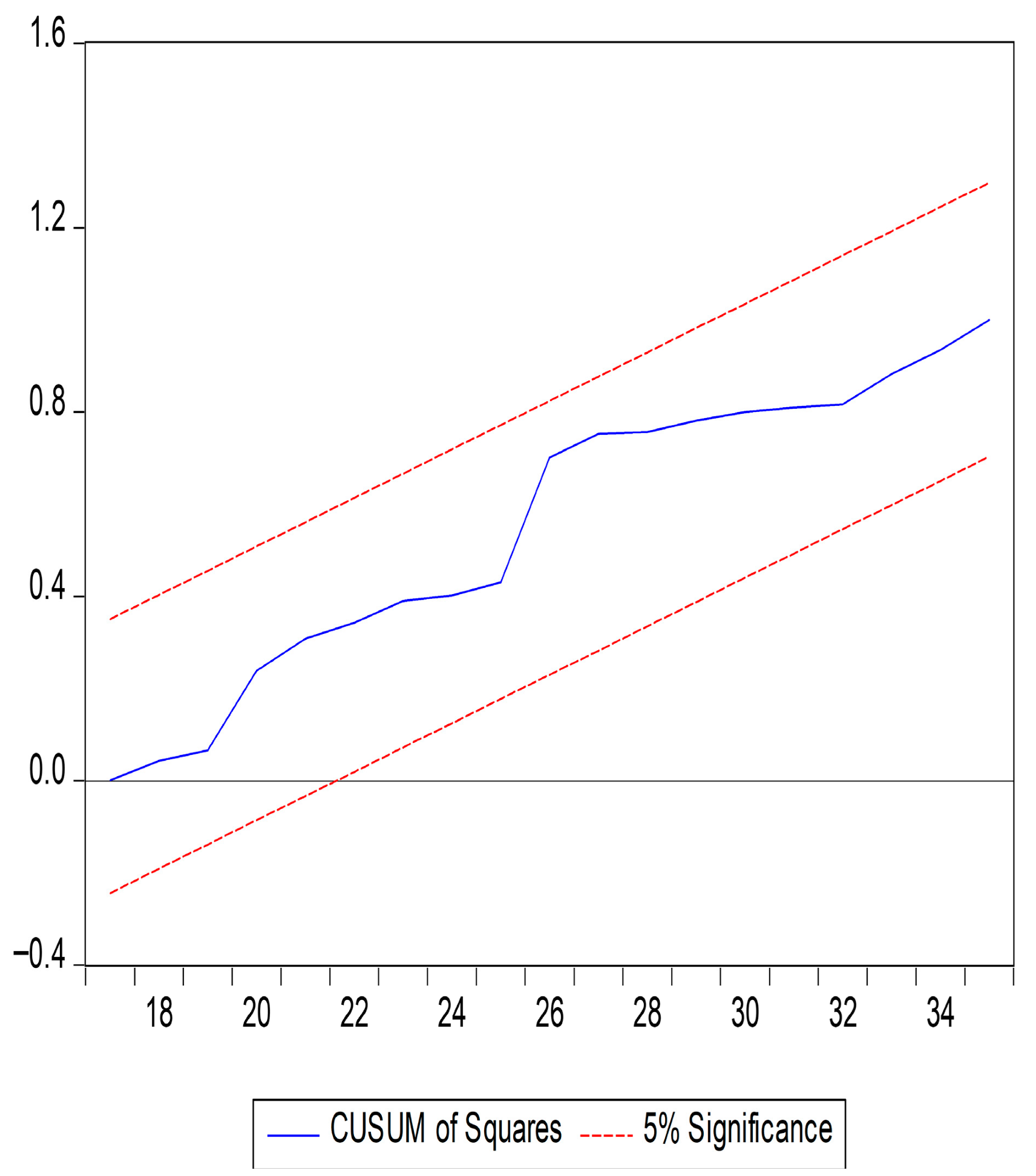 |
| Variables | Coefficient | Std. Error | t-Statistic | Prob.* |
|---|---|---|---|---|
| GDP(t-1) | 0.2258 | 0.0996 | 2.2657 | 0.035 ** |
| GDP(t-2) | −0.3823 | 0.0988 | −3.8676 | 0.001 *** |
| FD | 0.1500 | 0.1452 | 1.0330 | 0.314 |
| FD(t-1) | −0.2965 | 0.1220 | −2.4304 | 0.025 ** |
| HC | 0.3324 | 0.6441 | 0.5161 | 0.611 |
| HC(t-1) | −1.4649 | 0.6655 | −2.2010 | 0.040 ** |
| HC(t-2) | 2.1632 | 0.6546 | 3.3041 | 0.003 *** |
| GOVE | 0.0622 | 0.0308 | 2.0186 | 0.057 * |
| EP | 0.2441 | 0.1319 | 1.8496 | 0.080 * |
| EP(t-1) | 0.1729 | 0.1744 | 0.9912 | 0.334 |
| EP(t-2) | −0.4402 | 0.1507 | −2.9195 | 0.008 *** |
| OPV | 0.0976 | 0.0209 | 4.6737 | 0.000 *** |
| OPV(t-1) | −0.1364 | 0.0273 | −4.9799 | 0.000 *** |
| OPV(t-2) | 0.0645 | 0.0169 | 3.8070 | 0.001 *** |
| Variable Pair | Direction | F-Statistic | p-Value |
|---|---|---|---|
| GOVE → GDP | GOVE Granger-causes GDP | 4.25 | 0.015 |
| GDP → GOVE | GDP Granger-causes GOVE | 3.78 | 0.028 |
| HC → GDP | HC Granger-causes GDP | 5.12 | 0.009 |
| GDP → HC | GDP Granger-causes HC | 1.45 | 0.231 |
| FD → GDP | FD Granger-causes GDP | 1.89 | 0.167 |
| GDP → FD | GDP Granger-causes FD | 2.34 | 0.112 |
| OPV → GDP | OPV Granger-causes GDP | 6.03 | 0.004 |
| GDP → OPV | GDP Granger-causes OPV | 0.98 | 0.378 |
| EP → GDP | EP Granger-causes GDP | 4.67 | 0.012 |
| GDP → EP | GDP Granger-causes EP | 1.56 | 0.209 |
Disclaimer/Publisher’s Note: The statements, opinions and data contained in all publications are solely those of the individual author(s) and contributor(s) and not of MDPI and/or the editor(s). MDPI and/or the editor(s) disclaim responsibility for any injury to people or property resulting from any ideas, methods, instructions or products referred to in the content. |
© 2026 by the authors. Licensee MDPI, Basel, Switzerland. This article is an open access article distributed under the terms and conditions of the Creative Commons Attribution (CC BY) license.
Share and Cite
Derouez, F.; Alshalan, S.F. The Impact of Multidimensional Risk Factors on Economic Growth as a Proxy for Sustainable Development Goals in Saudi Arabia: Alignment with Saudi Vision 2030. Sustainability 2026, 18, 1278. https://doi.org/10.3390/su18031278
Derouez F, Alshalan SF. The Impact of Multidimensional Risk Factors on Economic Growth as a Proxy for Sustainable Development Goals in Saudi Arabia: Alignment with Saudi Vision 2030. Sustainability. 2026; 18(3):1278. https://doi.org/10.3390/su18031278
Chicago/Turabian StyleDerouez, Faten, and Suad Fahad Alshalan. 2026. "The Impact of Multidimensional Risk Factors on Economic Growth as a Proxy for Sustainable Development Goals in Saudi Arabia: Alignment with Saudi Vision 2030" Sustainability 18, no. 3: 1278. https://doi.org/10.3390/su18031278
APA StyleDerouez, F., & Alshalan, S. F. (2026). The Impact of Multidimensional Risk Factors on Economic Growth as a Proxy for Sustainable Development Goals in Saudi Arabia: Alignment with Saudi Vision 2030. Sustainability, 18(3), 1278. https://doi.org/10.3390/su18031278
