Article

Research on the Impact of Fiscal Vertical Imbalance on the Green Total Factor Productivity of Enterprises


School of Economics, Qingdao University, Qingdao 266071, China
*
Author to whom correspondence should be addressed.
Sustainability 2026, 18(3), 1265; https://doi.org/10.3390/su18031265
Submission received: 10 December 2025 / Revised: 16 January 2026 / Accepted: 24 January 2026 / Published: 27 January 2026
(This article belongs to the Special Issue Development Economics and Sustainable Economic Growth)

Abstract

The institutional environment constitutes the external foundation for corporate development. In the process of China’s modernization, addressing the fiscal constraints on corporate green development is a key issue in advancing the green transformation of the economy, as well as a new approach to understanding the implementation gaps in environmental regulations and the challenges facing the development of green finance. This paper draws on new institutional economics theory to construct an analytical framework of “institutional incentives-behavioural choices-performance outcomes.” Using unbalanced panel data from 2008 to 2022 on listed companies in the Shanghai and Shenzhen A-share markets and prefecture-level cities, a two-way fixed effects model is employed to systematically examine the impact of fiscal vertical imbalances on the efficiency of corporate green development. Heterogeneity analysis reveals the ‘institutional sensitivity gradient’ phenomenon, with the inhibitory effects of fiscal vertical imbalances being particularly pronounced among institutionally sensitive groups such as labour and capital-intensive enterprises, heavily polluting enterprises, mature and declining stage enterprises, and eastern coastal enterprises. Fiscal vertical imbalances severely constrain the pace of green transformation in traditional enterprises and the growth of green industries. It is necessary to reconfigure the central-local fiscal relationship oriented toward green development, innovate ecological compensation and green debt coordination mechanisms, and establish an incentive-compatible institutional environment to resolve the “green paradox.”

1. Introduction

As quintessential public goods, high-quality ecological environments constitute a foundational pillar of sustainable human well-being. China’s commitment to the ambitious “Dual Carbon” (Carbon Peak and Carbon Neutrality) goals, however, encounters profound systemic impediments to its realisation. The entrenched paradigm of “high-energy consumption, high-pollution, high-growth” development has not only exacted a substantial welfare toll [1] but has also laid bare a critical compliance-implementation gap—a dissonance between national climate ambitions and sub-national execution capacities, which is institutionally embedded in the prevailing fiscal governance structure. It is urgent to establish a new paradigm of coordinated economic-ecological development. Green development, with its inherent economic-environmental coupling mechanism, has become a strategic choice to break through the “three overlapping phases” dilemma in ecological civilisation construction. Green development operates as an innovation-driven paradigm that fosters sustainable productive forces through technological advancement, orchestrating a structural transition within socio-economic systems and positioning itself as a defining feature of Chinese-style modernization [2]. This developmental pathway simultaneously addresses national growth imperatives and contributes to the evolving architecture of global environmental governance.
Enterprises are the most important policy targets for green development and the micro-level carriers of high-quality economic development. The essence of corporate green transformation is the inevitable reflection of an upgrade in the structure of factor endowments. In the dimension of market competition, it manifests as a Pareto improvement that follows the law of increasing marginal benefits and builds sustainable competitive advantages. In the dimension of institutional embeddedness, it evolves into a Nash equilibrium solution that responds to ecological threshold constraints and practises social responsibility ethics. The dynamic evolution of enterprise green development efficiency constitutes the micro-level driving force of the green modernisation process. Efficiency improvements directly impact the macro-level green modernisation process. As a key indicator for measuring the effectiveness of green development, enterprise green development efficiency has established a two-way knowledge transfer channel between academic policy research and industrial transformation practices. Existing research primarily focuses on local government environmental regulations, green finance, carbon emission constraints, corporate technological innovation, and ESG performance, yet it overlooks the underlying transmission logic of the fiscal decentralisation system.
Local governments are the key implementers of green transformation and the core builders of regional systems. They shape the decision-making space for corporate green development through the dual effects of institutional embedding strategies and market incentive mechanisms. On the one hand, fiscal tools such as tax exemptions and special subsidies are used to directly reduce the marginal costs of green development, driving the iteration and green upgrading of production technologies, enhancing the competitiveness of the terminal market, and cultivating micro-market entities for green development. On the other hand, resource reallocation projects are implemented, with systematic adjustments to business environment parameters to guide the flow of high-quality resources toward green and low-carbon sectors, indirectly stimulating enterprises’ initiative in green development and laying a solid foundation for green development [3].
As a signatory to the Paris Agreement, China has formally committed to its dual carbon targets, thereby clarifying its responsibilities within global climate governance. The implementation of these objectives within the vertical governance structure fundamentally relies upon a multi-tiered principal-agent framework: the central government acts as the principal, setting strategic objectives, while local governments serve as agents bearing the responsibility for execution. Within this framework, the agents’ incentives frequently diverge from the principals’ objectives, particularly when structural tensions exist between fiscal resource allocation and jurisdictional responsibilities. The fiscal system serves as the pivotal institutional variable regulating this principal-agent relationship and influencing policy transmission efficiency. Vertical imbalances within the current fiscal architecture not only constrain local governments’ fiscal capacity to fulfil environmental responsibilities but also distort their incentive structures, thereby amplifying the divergence between principal objectives and agent outcomes [4]. This constitutes the core institutional root cause of the systemic compliance gap between central government emission reduction commitments and local implementation capacity. This gap manifests not only as a structural mismatch between fiscal resources and emission reduction responsibilities, but more profoundly reflects the persistent tension between central environmental governance objectives and local growth incentives [5].
It is worth noting that modern central-local fiscal arrangements indicate that the central government seeks to strike a dynamic balance between mobilising local economic initiative and maintaining central authority in the process of ‘empowerment and control’ [6]. The operational outcomes and typical characteristics of a centralised fiscal system are the asymmetric allocation of ‘fiscal authority being centralised while fiscal responsibilities and expenditure obligations are decentralised’ [7]. Fiscal imbalances along vertical lines trap local governments in a double bind of ‘weakened policy implementation capacity and delayed response to local needs,’ becoming the core institutional obstacle constraining transformation [8]. The weakening of local governments’ fiscal absorption capacity and the rigidification of expenditure responsibilities create institutional tensions, limiting the flexibility of local governments to formulate and implement green transition policies based on local conditions. The dual overlap of limited policy incentives and insufficient fiscal support leaves enterprises facing greater uncertainty in clarifying green transition directions and achieving green development goals.
The article takes the impact of fiscal vertical imbalances on the efficiency of corporate green development as its starting point, integrating core elements such as environmental regulations and corporate financing. It constructs a three-dimensional analytical framework of ‘fiscal pressure-government behaviour-corporate response,’ employs cross-level analysis methods to reveal the operational mechanisms of institutional transaction costs, and precisely identifies their impact on corporate green transformation. The study clarifies the microeconomic consequences of increased fiscal vertical imbalance, expanding the theoretical dimensions of research on corporate green transformation; strengthens the systemic connection between fiscal systems and corporate behaviour, enhancing the theoretical framework linking macro policies and micro behaviour; deconstructs the ‘government-market’ interaction black box, providing theoretical support for local governments to guide corporate sustainable development, while also emphasising the importance of corporate anticipation and interpretation of government policies. The research conclusions provide theoretical support for optimising fiscal policies, environmental policies, and their combinations, as well as offering valuable references for improving the business environment and establishing new government-business relationships. This, in turn, promotes corporate green transformation and efficiency improvements, contributing to the refinement of domestic policies for high-quality economic development and China’s engagement in global environmental governance practices. By focusing on the sustainability consequences of fiscal institutions rather than on technical abatement measures alone, this study contributes to the growing literature on governance-oriented sustainability transitions in emerging economies.

2. Research Progress

The balance between economic development and environmental protection is a hot topic of current academic interest. Green development, as a key dimension of high-quality economic development, focuses on reconciling the contradiction between economic growth and environmental protection, serving as an important pathway to achieving ecological civilisation. However, whether the concept of green development can accelerate the advancement of green modernisation depends on the response strategies of environmental pollution entities [9].
Enterprise high-quality development is the practical implementation of the new development philosophy. This transformation process dynamically aligns with the goals of green modernisation, manifesting as improved enterprise output efficiency and sustained improvement in environmental externalities [10]. Green total factor productivity breaks through the limitations of traditional indicators that focus solely on economic output, enabling a more accurate and objective reflection of the synergistic efficiency between enterprise factor combination paradigm shifts and environmental governance. It has become a key tool for assessing the quality of enterprise green transformation [11]. However, measurements at the micro-enterprise level still face challenges such as data acquisition and heterogeneity, which limit the depth and breadth of related mechanism studies.
Enterprise green transformation not only faces challenges from market uncertainties but is also influenced by local government behaviour, with existing literature forming a three-dimensional analytical framework of ‘policy tools-market response-environmental regulation.’ Policy-dimension research examines the incentive effects of reform policies such as green reform pilot zones [12,13], as well as the impact of policy tools like green finance [14,15] and green credit [16,17] on enhancing corporate green total factor productivity; Market-dimension research primarily explores market environment factors such as value chain coupling and coordination [18], capital market openness [19], and market-driven factors like digital transformation levels [20] and smart manufacturing capabilities [21], highlighting that diverse industrial synergistic clusters facilitate corporate green transformation; The regulatory dimension focuses on the innovation compensation mechanism of the ‘Porter hypothesis,’ exploring how tools such as environmental protection taxes [22] and carbon emissions trading internalise environmental costs [23], with technological innovation supporting corporate green transformation. It also addresses the negative impact of increased production costs on environmental performance and the effects of regulatory heterogeneity [24].
However, the efficacy of these policy instruments in guiding corporate practice is profoundly shaped and constrained by underlying institutional drivers, particularly governmental behaviour under fiscal pressure. Existing research converges on the view that the imbalance between slowing fiscal revenues and rigid expenditure constitutes a grave threat to fiscal sustainability [25], forming the core constraint on local government behaviour.
Under high fiscal pressure, local governments have developed a series of distorted behaviours that distort corporate production decisions through multiple channels. On the revenue side, reliance on strategic policy tools, coupled with tax collection incentives and competition to attract tax sources [26], drives cross-regional capital flows among enterprises. This triggers excessive investment and distorts capital allocation efficiency. Concurrently, the green curse effect of regional fiscal expansion exacerbates corporate pollution emissions and worsens environmental performance [27]. On the expenditure side, a pronounced structural bias emerges: long-term public expenditures such as environmental protection are curtailed [28], while limited resources are prioritised for productive investment or debt servicing. This not only directly crowds out corporate R&D and green investment [29] but also constrains innovation vitality and productive capacity [30] through deteriorating business environments and heightened non-tax burdens [31]. On the regulatory front, there is demonstrated ‘enforcement flexibility’, whereby fiscal pressures and growth targets lead to relaxed environmental oversight, diminishing the practical constraints and incentive effects of green policies [32]. Although some studies have observed that fiscal transparency [33,34], green fiscal incentives [35], and moderate decentralisation of fiscal authority [36] can stimulate corporate green innovation, overall, the aforementioned government behaviour patterns driven by fiscal pressures tend to systematically construct an institutional environment that incentivises enterprises to prioritise short-term economic performance over long-term green development.
Although existing research has touched upon the impact of central-local fiscal relations on corporate environmental behaviour (such as transfer payment mechanisms and tax sharing systems), this field has yet to develop a comprehensive theoretical framework or systematic theoretical system. Furthermore, the breadth and depth of research into transmission pathways and boundary conditions require further expansion. The institutional transaction costs arising from divergent central-local objective functions constitute a deep-seated obstacle to corporate green development. Exploring corporate green behaviour choices from the perspective of mismatched fiscal authority and responsibilities between central and local governments, and revealing the ‘policy implementation paradox’ in China’s green transition, remains a direction worthy of further exploration.
The trend of fiscal authority shifting upward under China’s fiscal system reform has shaped a unique fiscal vertical imbalance pattern, and explaining China’s economic issues from this angle may be more persuasive. The essence of fiscal vertical imbalance is the mismatch between revenue and expenditure responsibilities [37]. The most widely adopted measurement method is the ‘own revenue/own expenditure’ ratio, though there are disagreements regarding the definition of ‘own.’ Eyraud and Lusinyan, as well as Chu Deyin and Chi Shuxian, have refined the quantitative methods from the perspective of fiscal decentralisation systems. High levels of fiscal vertical imbalance not only prompt local governments to rely on central government transfers [6] but also have negative impacts on macro-level economic high-quality development [7], tax efforts [38], public expenditure structure [39], local government governance capacity [40], and environmental regulation.
Micro-level research indicates that fiscal vertical imbalance can trigger an ‘overinvestment trap,’ causing investment efficiency to deviate from optimal levels [41], indirectly hindering the enhancement of green technological innovation benefits for enterprises [42], and ultimately weakening their sustainable development capabilities. Academic discussions have also explored the issue from the perspective of distorted factor inputs, where imbalances can influence the efficiency and quality of enterprise green innovation through tax incentives and government R&D subsidies [43], while human capital outflow serves as a channel for their negative effects [3]. Particularly noteworthy is the ‘green paradox’ caused by fiscal pressures [44]. Asymmetric fiscal and administrative power leads local governments to relax environmental regulations, weaken support for the green transformation of traditional industries [45] and the cultivation of green industries, and diminish the transformative effects of low-carbon policies [46,47], thereby impacting the stability and sustainability of corporate development.
Research based on evolutionary game theory reveals that there is a complex interactive game between enterprises, local governments, and the central government [48]. As principals, local governments balance environmental quality and economic benefits, and their behaviour is influenced by both corporate incentives and central government policy constraints. They may enhance corporate enthusiasm for green production through clean production-oriented tax policies, or they may alleviate imbalances by strengthening tax collection, land finance, and expanding the scale of financing platform debt. However, this ‘short-sighted equilibrium’ ignores the central government’s overall planning and policy direction, leading to issues such as deteriorating business environments and increased tax burdens for businesses within their jurisdictions [49]. This not only directly harms business operational efficiency but also severely hinders green transformation and upgrading [50].
The adjustment and optimisation of fiscal relations between the central and local governments not only concern the effective allocation of national fiscal resources and the enhancement of macroeconomic regulatory capabilities but also directly impact the green transformation motivation and path selection of businesses as market economic entities. While ensuring the central government’s macroeconomic regulatory capacity, how to further stimulate local governments’ initiative and creativity in promoting green development and encouraging enterprises to make green behavioural choices, thereby accelerating the process of green modernisation, is an important issue facing current fiscal system reforms. As a product of the current fiscal system arrangement, existing research on fiscal vertical imbalances has primarily focused on macro-level impacts at the regional level, with limited exploration of micro-level behavioural dynamics within regions, particularly lacking in-depth analysis of the specific role of enterprise green development efficiency. In response, this paper adopts an ‘institutional transaction cost’ analytical perspective, integrating fiscal vertical imbalance with corporate green total factor productivity into a unified analytical framework. The aim is to reveal the underlying mechanisms linking corporate behavioural choices and intergovernmental fiscal relations, by analysing the transmission mechanisms of urban environmental regulations and corporate financing constraints within this framework. This highlights the critical role of reasonably adjusting environmental regulation policies and improving corporate financing environments in facilitating the transition to a green economy. These findings not only provide theoretical support for positive government-enterprise interactions but also clarify the practical pathways for corporate green development.

3. Theoretical Analysis and Research Hypothesis

3.1. Vertical Fiscal Imbalances Inhibit Green Development of Enterprises

Since the implementation of the tax-sharing reform, the phenomenon of fiscal imbalance between different levels of government—where fiscal revenue and expenditure responsibilities are mismatched—has become increasingly prominent. Following the ‘Business Tax to Value-Added Tax (VAT) Reform,’ the absence of local main tax categories and the instability of autonomous tax sources have exacerbated the crisis in fiscal self-sufficiency [51], leaving local governments trapped in an institutional dilemma characterised by ‘declining fiscal capacity and rigid expenditure responsibilities.’ The funding disbursement process for routine delegated tasks from higher-level governments is complex and time-consuming. Lower-level governments often need to allocate additional fiscal funds to implement temporary tasks assigned by higher-level governments, leading to the phenomenon of ‘central government ordering, local governments paying the bill.’ Under fiscal expenditure pressure, local governments struggle to efficiently fulfil their functions. The complex relationships formed between hierarchical governments due to interest-based negotiations have exacerbated insufficient fiscal resource allocation at the local level, weakened fiscal budget constraints, and triggered policy biases and reduced fiscal fund utilisation efficiency. The dynamic adjustment of central-local fiscal relations interacts with structural transformations in the market environment, shaping a ‘pressure-driven’ fiscal revenue-generation incentive mechanism that has shaped China’s unique local government behaviour strategies. This not only weakens the institutional effectiveness of the ecological civilisation strategy at the local governance level but also creates negative incentive effects on corporate green development.

3.1.1. Short-Sightedness in Resource Allocation

Under the GDP-driven ‘promotion competition’ model, the pressure of multi-objective performance evaluation has transformed into a self-reinforcing inertia in fiscal spending [52]. Under budgetary soft constraints, long-term investments such as environmental governance and the research, development, and promotion of green technologies face a dual squeeze effect from explicit fiscal capacity constraints and implicit policy priority suppression.
According to the multiple principal-agent theory, the central government, as the ultimate principal, has an objective function oriented towards maximising national interests and social welfare, incorporating explicit emission reduction commitments and green development weightings. However, constrained by institutional mismatches between fiscal responsibilities and revenues, local governments as agents face multiple agency conflicts: while required to respond to central environmental assessments, they simultaneously bear the practical pressures of sustaining local economic growth, safeguarding employment, and ensuring fiscal self-sufficiency. When fiscal pressures reach a threshold, a systemic deviation in priority occurs, leading local governments to rationally relegate environmental objectives in policy sequencing [53]. This creates a hierarchical attenuation effect in target implementation.
Under the incentive of ‘visibility bias’ evaluations, fiscal resource allocation exhibits a significant bias toward productive expenditures, systematically crowding out the space for basic public service expenditures [54]. The productive incentive attributes of value-added tax further reinforce this preference. In project selection and fund allocation, there is a path dependence, with funds tilting toward projects that do not adequately consider environmental and social responsibilities [55]. Brown subsidies marginalise the concept of green development, and the foundational conditions and industrial environment for corporate green development face institutional barriers [56].
Public service finances are limited, and the ‘small horse pulling a big cart’ fiscal ecosystem has led to a decline in resource allocation capacity and efficiency. Local governments have fallen into a ‘low-level equilibrium trap,’ unable to fully fulfil their expenditure responsibilities. The social responsiveness of fiscal policies is inadequate, severely limiting investment capacity in environmental protection and green technology sectors. Enterprises struggle to obtain sufficient and stable policy support, fiscal subsidies, and guidance on green technologies, hindering improvements in green development efficiency and potentially delaying or diverting the green transition from its intended trajectory.
Policy gaps or institutional distortions caused by misguided implementation have led to a ‘self-reliance’ model among enterprises. Due to the lag in environmental infrastructure construction, enterprises are forced to bear high additional pollution control costs; the lack of tax incentive policies further exacerbates the financial pressure enterprises face in green technology R&D and the recruitment of specialised talent. The cost stickiness of shifting responsibility has weakened their profitability and willingness to invest in green initiatives [47]. The ‘voting with their feet’ mechanism has made enterprises more cautious in green transition decisions, constraining their actual performance in advancing carbon reduction, pollution control, green expansion, and economic growth in tandem, severely impacting the effectiveness of green development.

3.1.2. Uncertainty in Policy Implementation

The policy objectives of central and local governments exhibit multi-level game characteristics, inevitably facing the tension between ‘overall objectives’ and ‘local needs.’ As policy makers, the central government seeks to maximise overall welfare, emphasising strategic and coordinated approaches; local governments, as implementers, interpret policies in a ‘localised’ manner under the dual influences of fiscal constraints and promotion incentives. While this provides opportunities for local governments to explore new pathways tailored to their specific circumstances, it also carries the risk of deviating from the central government’s policy intentions, leading to frequent fluctuations in the policy and market environments.
Local governments’ ‘regulatory capture’ [57] reflects both a selective interpretation of central government policies and a desire to maximise local interests. The implementation of green development policies has some flexibility, with local governments sometimes enforcing green regulations strictly and at other times being overly lenient or flexible [58]. This ‘pendulum-like’ regulation disrupts businesses’ policy expectations, affects the real option value of green investments, and increases transition risks.
This policy environment volatility and market signal distortion induced by VFI ultimately manifests at the macro level as a systemic ‘Compliance Gap’ between the central government’s strategic environmental objectives and local governments’ fragmented implementation practices [59]. Specifically, the green development blueprint established by the central government based on national interests and international commitments undergoes successive layers of filtering and dilution during its transmission to local authorities, due to fiscal constraints, misaligned incentives, and short-term behavioural tendencies caused by VFI. This compliance gap is not merely a matter of poor implementation but stems from deep-seated institutional fissures within central-local fiscal relations. It traps enterprises—the ultimate recipients of policy—in a contradictory decision-making space: on one hand, they receive strong policy signals from the central level regarding green transformation; on the other, they operate within a micro-environment where local fiscal pressures lead to de facto relaxation of environmental regulations and weakened green incentives. This divergence between policy signals and operational realities directly discourages enterprises from undertaking long-term, high-risk green innovation investments [60], thereby fundamentally constraining their green total factor productivity.
The high uncertainty of the policy environment and market conditions creates a crowding-out effect on innovation incentives. Companies tend to continue using traditional production methods rather than promoting green technological upgrades, which reduces costs in the short term but suppresses their green innovation capabilities. The risk premium for technology route selection has risen, with extended resource investment payback periods and significant opportunity costs, forcing enterprises to adopt a more conservative approach in green technology R&D and project implementation. The absence of long-term planning in the green development sector has led to a decline in green patent output. Technology lock-in not only delays the green transition process but also weakens the competitive advantage of enterprises, potentially undermining their position in the global green value chain.
Government intervention has disrupted market competition, giving rise to the ‘lemons market’ effect. Environmentally compliant companies bear costs that put them at a disadvantage in the market, while non-compliant companies gain cost advantages through ‘regulatory arbitrage.’ The unfair market environment not only weakens the market competitiveness of companies that fulfil their environmental responsibilities but also gradually dampens their enthusiasm for promoting green development. The ‘bad money drives out good money’ phenomenon not only hinders corporate innovation in green technology and business models but also obstructs local economies from achieving long-term high-quality growth in the green development track.
Based on this, this paper proposes the hypothesis.
H1: 
Fiscal vertical imbalance has an inhibitory effect on corporate green development, i.e., the higher the level of fiscal vertical imbalance, the lower the efficiency of corporate green development.

3.2. Analysis of the Mechanism of Corporate Financing Constraints

The improvement of corporate green production efficiency is highly dependent on financial support. According to the pecking order theory of financing, companies prioritise internal financing under the principle of cost minimisation. However, the inherent shortcomings of internal financing (such as scale limitations and opportunity costs) highlight the importance of external financing. When the difference in internal and external financing costs results in the total financing amount being insufficient to meet investment needs, companies will face financing constraints.
This financial constraint state significantly impacts corporate investment decisions, imposing notable constraints on reproduction, innovation activities, and environmental protection investments, thereby becoming a key bottleneck hindering corporate transformation and upgrading [61]. The intensification of financing constraints leads to the failure of risk diversification mechanisms, limiting future financing capacity; misallocation of entrepreneurial talent, with management resources overly consumed by debt repayment and capital raising; liquidity pressures prompting management to prioritise short-term goals, avoiding high-risk long-term projects with positive net present value (NPV), thereby suppressing the company’s growth potential and green sustainable development capabilities.
Based on the theory of precautionary savings and investment substitution, enterprises under financing constraints exhibit significant financialisation tendencies [62]. Arbitrage incentives for excess returns crowd out real capital. While moderate constraints can temporarily improve capital allocation efficiency, the capital reallocation mechanism has efficiency boundaries. The interaction between the ‘liquidity illusion’ and the ‘sunk cost effect’ leads to a vicious cycle of ‘financing constraints-capital misallocation,’ causing the combination of production factors to deviate from the optimal state, ultimately forming a chain reaction of main business contraction and the decline of high-quality development capabilities [63].
Green technological innovation is both capital-intensive and technology-intensive. Technological spillovers and environmental externalities result in private benefits being lower than social benefits, and it is necessary to overcome the dual uncertainties of policy and the market. These characteristics make green innovation more susceptible to financing constraints [64]. Increased risk aversion leads to delayed innovation prioritisation, creating a quantitative crowding-out effect; revenue mismatches cause cognitive biases, prompting management to intentionally reduce environmental performance and adopt suboptimal R&D strategies [65]. The non-continuous ‘technology lock-in’ effect of innovation weakens a company’s ability to improve environmental performance, while the investment costs and operational risks of transformation suppress corporate incentives for pollution control [66]. These two factors synergistically hinder the maximisation of social welfare.
The distortion of the corporate financing environment is rooted in the ‘green paradox’ inherent to local governments under fiscal pressure, which manifests as a divergence between environmental governance objectives and the weakening of their implementation [67]. This differs from the theory of ‘regressive competition,’ where actively lowering environmental standards to attract capital entails high political risks and public opinion costs. Instead, selective neglect and passive oversight of environmental regulations represent the rational choice for local governments [68]. This paradox does not negate the direction of green development; however, the current strength of local implementation and the intensity of support are insufficient. The contradiction between policy signals and stakeholder expectations undermines the consistency and predictability of policies. As a result, financial markets demand higher risk assessments, reshaping the financing conditions for corporate green technology innovation [69]. The expected marginal returns on costly green technology investments decline, while the marginal costs of maintaining traditional production models are implicitly reduced, thereby leading to a locked-in state of the ‘green paradox’.
The current significant funding gap in China’s corporate green transformation, combined with systemic distortions, creates a financing ‘cliff effect’. Fiscal vertical imbalances exacerbate asymmetric financing costs, local government interventions trigger structural distortions, institutional frictions between administrative directives and market-oriented reforms reduce the availability of green credit, tax administration intensifies cash flow crowding out and compresses financing space, the fulfilment rate of matching funding for environmental protection projects declines, and risk premiums rise.
Based on theoretical continuity, this paper proposes the research hypothesis.
H2: 
The intensification of fiscal vertical imbalances will enhance the level of financing constraints on enterprises, thereby forming a transmissible inhibitory effect on the efficiency of enterprise green development.

3.3. Analysis of the Regulatory Effects of Green Information Disclosure by Enterprises

Information asymmetry is a key factor contributing to financing constraints in capital markets [70]. Corporate green information disclosure effectively alleviates funding difficulties by reducing the asymmetry barrier between internal information and external markets, thereby providing the necessary financing support to drive corporate green production efficiency [71]. Green information disclosure serves as a strategic tool for companies to communicate their environmental behaviour and performance to stakeholders (market, government, and society). By signalling their commitment to environmental responsibility and green technological capabilities, companies can address the environmental concerns of diverse stakeholders, reduce information asymmetry, environmental risks, and regulatory pressures from external stakeholders. In China’s current environmentally friendly institutional context, such signals can attract green-preference investors, consumers, and policy support, providing legitimacy for firms to access scarce resources such as green credit and tax incentives, thereby optimising resource allocation efficiency, alleviating financing constraints, and promoting improvements in green production efficiency [72].
In the external resource acquisition pathway, credible environmental commitment signals can enhance a company’s policy alignment, meet local governments’ legitimacy demands under central environmental protection assessment pressures, and seek policy synergy effects to leverage resource allocation and market capital aggregation. By proactively adapting to the institutional environment through environmental information disclosure, companies reduce their reliance on traditional resource transfers from local governments and shift toward policy-compliance-driven targeted resource acquisition. That is, companies with outstanding green performance are more likely to receive government environmental transfer payments, R&D funding, and priority approval for green projects, among other policy support and fiscal incentives [73].
From the perspective of external investment, green information disclosure reduces information asymmetry between companies and external investors, helping to overcome adverse selection barriers and reduce share price synchronisation [74], ultimately promoting external capital investment in green production [75]. The ‘dual carbon’ strategy has incorporated corporate environmental information disclosure into mandatory regulations, with both policy pressure and incentives coexisting. Financial institutions tend to provide low-cost green bonds or loans, among other central bank carbon reduction support tools, to companies with transparent environmental performance, thereby reducing financing constraints on green technology investments [76]. The role of green financial market access thresholds is becoming increasingly prominent. Companies with higher disclosure standards are more likely to be included in national carbon market transactions or green financial pilot programmes. On one hand, green transformation can apply for environmental project funds or low-carbon technology subsidies, reinforcing the ‘green effect’ of environmental information disclosure and reducing corporate financing costs. On the other hand, it can directly utilise carbon quota revenues or financing conveniences to enhance green production efficiency.
Given the unsustainability caused by resource displacement, fiscal imbalances have led local governments to reduce public service expenditures, including environmental protection subsidies. If companies rely solely on ‘slogan-style’ disclosure, they cannot obtain sustained external resource support. A genuine green transition that aligns words with actions has become a necessary choice to maintain competitiveness. Positive fiscal incentives from local governments require companies to provide matching emissions reduction data, technical patents, and other green performance proofs as prerequisites for accessing local resources such as land incentives and tax breaks [77]. At this point, improvements in green production efficiency become a ‘resource voucher’ to reduce the catering effect [78]. Disclosure must align with actual performance, linking the green transformation and upgrading disclosed in annual reports to actual energy-saving and emissions-reduction intensity. By fulfilling commitments through concrete actions, this drives technological upgrades and efficiency improvements, creating a positive feedback loop for enhancing green production efficiency.
Highly transparent environmental information is not only a tool for external communication but also a strategic lever for driving internal governance structure reforms. The internal constraint effect of proactive green information disclosure requires companies to embed environmental responsibility into their organisational structure, regularly disclose the achievement of environmental goals and governance performance, and transform green responsibility from a ‘peripheral function’ to a ‘strategic function.’ This internalisation of environmental costs, coupled with internal environmental cost accounting and budget management, generates endogenous green innovation incentives that compel companies to incorporate environmental performance into their strategic decision-making frameworks, thereby offsetting the external policy incentive distortions caused by vertical mismatches between central and local government finances. Based on agency theory, the formalisation and independence of internal governance structures can upgrade decision-making processes, facilitate the supervisory role of internal stakeholders, reduce short-term opportunistic behaviours such as management cutting environmental budgets or engaging in environmental violations, and incentivise companies to prioritise investments in green technologies to ensure alignment with long-term shareholder interests and green strategies [79]. The process of environmental information disclosure possesses management synergy effects. Companies with strong environmental strategy management performance often have more standardised and efficient governance and management teams that make rational and prudent investments [80], effectively driving the integration of environmental management processes, optimising internal resource allocation efficiency, and enhancing the absorption and conversion capabilities of green technologies. Transparent environmental information can reduce compliance risks caused by sudden policy changes or intensified environmental inspections, enhancing companies’ adaptability to policy uncertainties resulting from fiscal vertical imbalances.
Based on the above theoretical reasoning, corporate green information disclosure can help local governments strike a balance between environmental protection assessments and economic growth, forming a new incentive structure of ‘government-enterprise collaboration for green transformation,’ alleviating financing constraints on corporate green investment, and mitigating the negative impact of fiscal vertical imbalance. This paper proposes a research hypothesis.
H3: 
Negative moderating effect of green information disclosure will alleviate the inhibitory effect of fiscal vertical imbalance on the improvement of corporate green development efficiency.
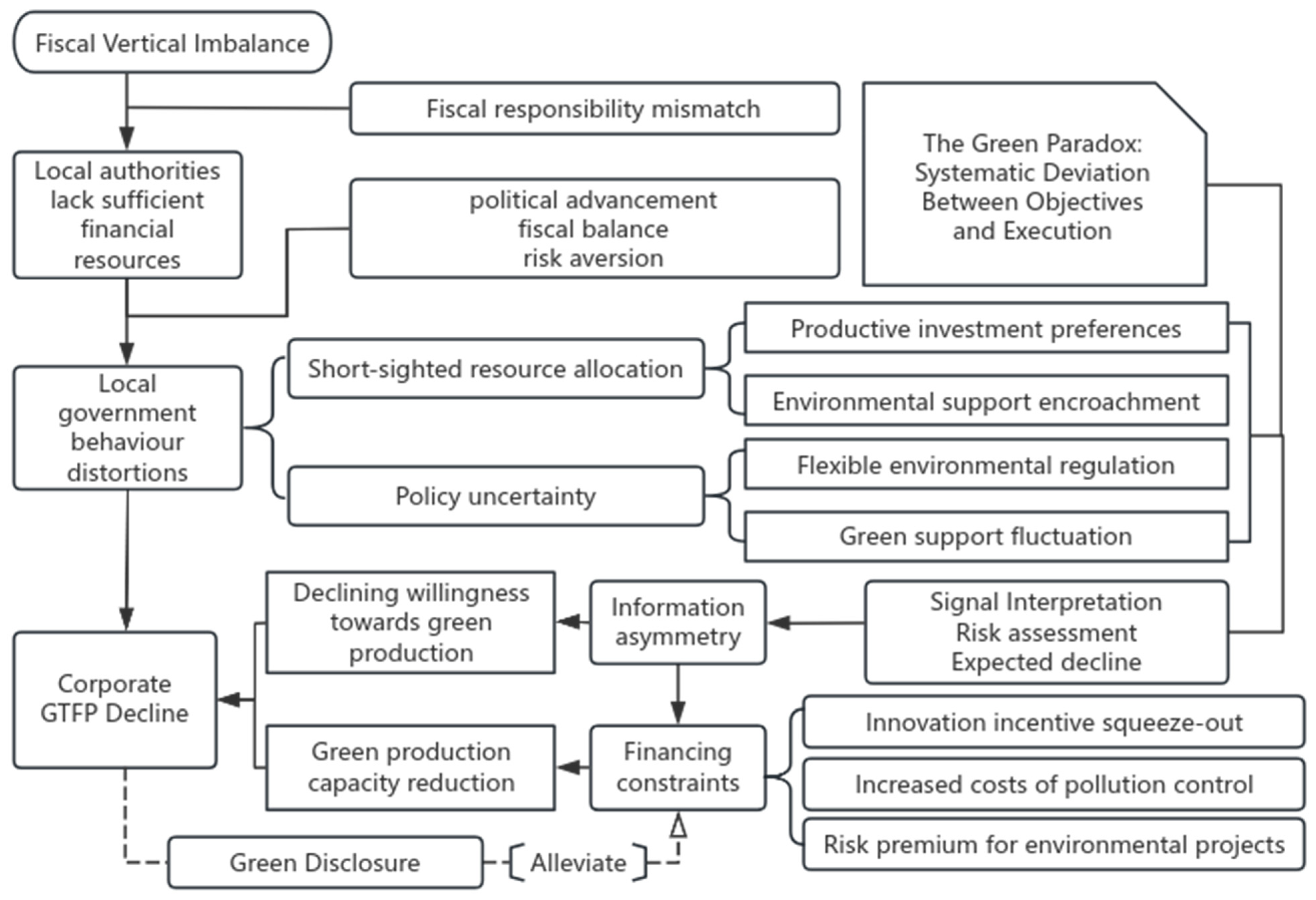
To systematically elucidate the aforementioned logic, the theoretical analytical framework constructed in this paper is illustrated in Figure 1.

4. Model Design and Variable Selection

4.1. Model Construction

To explore the impact of vertical fiscal imbalances in prefecture-level city local governments on the productivity of green development in enterprises, this paper constructs the following multiple regression model:
G T F P i j t = β 0 + β 1 V F I i t + β 2 C o n t r o l s i j t + μ i + τ i + ε i t
Among these, GTFP ijt represents the green development efficiency of enterprise j in City i in year t; V F I i t serves as the core explanatory variable representing the fiscal vertical imbalance degree of City i’s government in year t; Controls i j t constitutes a control variable set encompassing variables at both corporate and municipal levels; μ i and τ i represent fixed effects at the firm and annual levels, respectively; ε i t is the random disturbance term. Among these, β 1 is the main regression coefficient of interest in this paper. As theoretical analysis indicates, if β 1 is significantly negative, it demonstrates that fiscal vertical imbalance among local governments inhibits corporate green development efficiency, supporting the theoretical hypothesis. Conversely, a positive coefficient would refute the theoretical expectation.
To examine whether corporate green information disclosure moderates the effect of fiscal vertical imbalance on the efficiency of corporate green development, a moderation effect model is established, as shown in Equation (2):
G T F P i j t = β 0 + β 1 V F I i t + β 2 G R E E N i j t + β 3 V F I i t G R E E N i j t + β 4 C o n t r o l s i j t + μ i + τ i + ε i t
This paper further examines the impact mechanism of local government fiscal imbalances on the efficiency of green development in enterprises from the perspective of corporate financing constraints, and tests whether corporate green information disclosure has a moderating effect in this mechanism. The following moderated mechanism testing model is constructed:
K Z i j t = β 0 + β 1 V F I i t + β 2 C o n t r o l s i t + μ i + τ i + ε i t
K Z i j t = β 0 + β 1 V F I i t + β 2 G R E E N i j t + β 3 V F I i t G R E E N i j t + β 4 C o n t r o l s i j t + μ i + τ i + ε i t
Among these, GREEN i j t is the moderating variable, i.e., the quality of corporate green information disclosure, and KZ i j t is the institutional variable, i.e., the degree of corporate financing constraints. The fixed effects and control variables in Equations (2)–(4) are consistent with those in Equation (1).

4.2. Variable Definition

4.2.1. Core Explanatory Variable: Fiscal Vertical Imbalance Index

The core independent variable in this paper is the vertical fiscal imbalance index (VFI) of the prefecture-level city where the enterprise is located. The method developed by Chu Deyin et al. [81]. takes into account factors such as fiscal revenue and expenditure decentralisation and fiscal revenue and expenditure gap rates in the calculation process, thereby avoiding the problem of vague definitions of own-source revenue and expenditure and better reflecting the reality of fiscal decentralisation in China. This paper adopts this approach to measure the degree of vertical fiscal imbalance in each city.
V F I = 1 F q r F q s × 1 L b d = 1 L c p r / L c p r + L p p r + C p r L c p e / L c p e + L p p e + C p e × 1 L c e L c r L c e
Fqr and Fqs denote the degree of decentralisation in local fiscal revenue and expenditure, respectively, while Lbd represents the local fiscal self-sufficiency gap ratio. As empirical research utilises municipal-level data, the measurement of decentralisation draws upon the methodology of Lv Wei [82]. Lcp, Lpp and Cp denote per capita public budget scales at municipal, provincial and central levels, respectively, where suffixes r and e denote revenue and expenditure, respectively; Lcr and Lce denote municipal public budget revenue and expenditure, respectively [83].
To ensure the standardisation and accuracy of the data, based on the characteristic of fiscal imbalance, namely that ‘local government revenue is insufficient to meet local government expenditure,’ the article standardises the final value range to (0, 1).

4.2.2. Dependent Variable: Enterprise Green Total Factor Productivity

As the core economic entities, the evolution of corporate productivity efficiency profoundly reflects the structural transformation of economic growth paradigms. With the iterative development of economic theory, the measurement paradigm of productivity efficiency has evolved from single-factor efficiency analysis (such as labour or capital) to a systematic evaluation system that integrates multiple factors. Total Factor Productivity (TFP) has gradually emerged as the ideal indicator for measuring economic efficiency.
In the face of intensifying resource constraints and environmental externalities during the industrialisation process, green total factor productivity (GTFP) has emerged as an innovative evaluation tool. It establishes a dual-constraint framework incorporating energy inputs and undesirable outputs (such as pollutant emissions), aligning with the ecological constraints currently facing economic development while integrating production performance and sustainability objectives through the internalisation of environmental costs. This paper employs a super-efficient EBM model with both non-radial and non-directional characteristics. By constructing a global frontier Malmquist productivity index, it uses MaxDEA 8 ULTRA x64 software 8.21 (R2021/10/22) to dynamically measure the GTFP of A-share listed companies from 2008 to 2022, thereby characterising corporate green development efficiency.
Compared to traditional DEA models, this method has significant methodological advantages in the field of energy efficiency and green development research. The super-efficient EBM model achieves three breakthroughs: it allows input and output variables to be adjusted according to heterogeneous proportions, aligning with the multi-dimensional optimisation characteristics of actual production systems; it breaks through the pre-set constraints of input/output orientation, enabling bidirectional efficiency optimisation assessment; and it effectively addresses the sensitivity issues in efficiency ranking of traditional models through the ε parameter. In the measurement system for corporate GTFP, the input dimension encompasses three elements: labour (total number of employees at year-end), capital (net fixed assets), and energy (standard coal equivalent). Expected output is represented by main business revenue, while undesirable output is indirectly measured using pollution discharge charges, corresponding to the pollution discharge fee (pre-2018) and the environmental protection tax (post-2018), to reflect the extent to which environmental costs are internalised due to corporate production. It should be noted that China’s Environmental Protection Tax Law has been formally implemented since 2018, leading to the termination of the previous pollution discharge fee system. Given the clear policy continuity between the environmental protection tax and the pollution discharge fee in terms of their fundamental purpose and tax calculation basis, this study treats them as different phases of the same environmental cost variable and merges the two datasets accordingly [84,85]. Among these, net fixed assets, main business revenue, and pollution fees are all converted to 2000 constant prices using price indices to eliminate the interference of price fluctuations on the measurement results. The corresponding measurement indicator system for corporate GTFP is detailed in Table 1.

4.2.3. Moderating Variable: Quality of Corporate Green Information Disclosure

Drawing on the research of Xiang XJ et al. (2020) [86], this study employs text analysis to statistically analyse the frequency of keywords related to ‘green development’ disclosed in the annual reports of listed companies, thereby generating a green information keyword frequency count. This frequency count is then increased by one and its natural logarithm is taken to characterise the quality of a company’s green information disclosure. The selection of annual reports of listed companies as the textual observation object in this study is based on the following two considerations: First, green development, as a key piece of information at the core strategic level of a company, is typically systematically presented in the annual report, which serves as the primary disclosure medium for the public. This aligns with the integrated narrative characteristics and strategic orientation functions inherent in annual report texts. Second, given that annual reports are prepared in accordance with mandatory disclosure regulations, their standardised format and expression requirements significantly enhance the accuracy of keyword screening and identification. Therefore, measuring the quality of corporate green information disclosure using the frequency of green development-related terms in annual report texts has significant methodological validity.

4.2.4. Mechanism Variable: Degree of Corporate Financing Constraints

The article compares the applicability of mainstream measurement tools and finds that the KZ index is more suitable for measuring the financing constraints of Chinese enterprises due to its relatively more comprehensive theoretical framework, decomposability, and dynamic comparability advantages. Given the special nature of China’s institutional context, the study refers to Xu K et al. (2020) [87], an improved framework to construct a four-factor KZ index to measure the degree of financing constraints, with higher values indicating more severe financing constraints faced by enterprises.

4.2.5. Control Variables

In order to ensure unbiased estimation results, this paper selects control variables that affect the green total factor productivity of enterprises from macro and micro perspectives.
(1)
Micro-control variables
Enterprise Age (Age): Start-ups are more likely to adopt green technologies due to their technological generational advantage and are also more concerned about GTFP, while mature companies have a transformation advantage due to their accumulated resources, measured by the number of years since the company was founded +1.
Financial Capacity (Tl): Enhanced financial support boosts corporate revenue, strengthens brand image, and encourages green production, quantified by the debt-to-asset ratio, where lower values indicate stronger capabilities.
Free Cash Flow (Cflow): Companies with ample free cash flow tend to increase investments in green production, gauged by the ratio of net operating cash flow to total assets.
Profitability (ROA): Enterprises with higher return on total assets prioritise long-term sustainable development and are more likely to invest in green strategies, measured by net income relative to total assets.
Scale (Size): Corporate size impacts market competitiveness, while economies of scale reduce unit transformation costs, measured by the natural logarithm of total assets.
Equity Concentration (Top1): A concentrated ownership structure may strengthen environmental responsibility fulfillment and provide more resource guarantees for green technological innovation, measured by the shareholding ratio of the largest shareholder.
(2)
Macro-control variables
Economic development level (GDP), the environmental Kuznets curve predicts a non-linear relationship between the stage of development and environmental protection investment. Regions with high levels of development place greater emphasis on high-quality economic development and sustainable development, and typically implement stricter environmental standards. The effects of technology diffusion and demand upgrading are more pronounced. The natural logarithm of regional GDP is used as a measure.
Industrial Structure (Ind): The ongoing deepening of supply-side structural reforms requires a shift away from the extensive development model that relies too heavily on high-energy-consuming and high-emission industries. Industrial ecology theory suggests that optimising the industrial structure will alter differences in energy intensity, while factor reallocation and innovation clustering will better drive green transformation. This is measured by the ratio of tertiary industry value added to secondary industry value added.
Openness (FDI): Enhanced openness fosters positive technology spillovers that improve corporate resource efficiency. However, FDI may also flow into pollution-intensive and resource-consumptive industries, creating negative pollution shelter effects, measured by the proportion of actual foreign investment to GDP in the current year.

4.3. Sample Selection and Data Source

This study takes prefecture-level cities as the research unit, selects A-share listed companies from 2008 to 2022 as the benchmark sample, and constructs panel data by spatially matching macro- and micro-level data through enterprise headquarters geocoding. It empirically tests the impact of fiscal vertical imbalance at the city level on the green total factor productivity of enterprises within the region.
The city-level data originates from official statistics in the China Urban Statistical Yearbook and China Fiscal Yearbook, while enterprise micro-data is integrated from the CSMAR database and annual reports of listed companies. Although industrial enterprise databases have time limitations (as of 2014) and differ in development characteristics between listed companies and ordinary enterprises, their comprehensive environmental and financial disclosures, along with behavioural demonstration effects, make them ideal research subjects. To ensure sample quality, we implemented the following screening criteria: (1) Exclusion of financial listed companies; (2) Removal of STPT special treatment companies; (3) Elimination of samples lacking key financial indicators; (4) Removal of outliers and samples with severe missing primary indicators. Continuous variables underwent double-tailed capping at 1% and 99% to mitigate potential impacts of extreme values on empirical results, ultimately yielding 19,966 valid enterprise-year observations. Descriptive statistics of the main variables are shown in Table 2.

5. Empirical Results and Analysis

5.1. Analysis of Benchmark Regression Results

The study employs a two-way fixed-effects model (firm-year) to estimate the parameters of the benchmark model, using firm-level cluster-robust standard errors to address potential autocorrelation issues in panel data. As shown in Table 3, local government fiscal vertical imbalance has a significant negative impact on corporate green development efficiency: at the 1% significance level, the VFI coefficient is −0.172 (Column 1), indicating that an increase of one unit in fiscal vertical imbalance leads to a decrease of 0.172 units in corporate GTFP. After introducing control variables such as firm size and industrial structure (Column 2), the coefficient of the core explanatory variable changes to −0.173, correcting for omitted variable bias.
Under China’s fiscal decentralisation system, the imbalance between rights and responsibilities interacts with the promotion tournament mechanism to form a systemic interaction, jointly shaping a distorted incentive structure for corporate green transformation. The decline in fiscal self-sufficiency and the rise in reliance on transfer payments create structural tension, forcing local governments to make dynamic trade-offs between economic growth and green transformation [88]. The contraction of local fiscal resources caused by the ‘Business Tax to Value-Added Tax (VAT) Reform’ triggered a ‘budget myopia response’ mechanism, manifested as a combination of policies such as compressed environmental expenditures, weakened regulatory intensity, and a preference for heavy industry. Strategic behaviour under multi-dimensional goal conflicts has formed a framework of ‘selective implementation’ for central green policies, leading to the erosion of the credibility of environmental regulatory commitments.
At the micro level, the ‘incentive compatibility trap’ in environmental governance significantly influences corporate decision-making. ‘Signal distortion’ by the public sector renders the internalisation of environmental costs ineffective, reducing corporate resolve and expectations for green transformation. Fiscal pressure transfer induces ‘green premium escalation,’ diminishing the marginal benefit advantage of clean technologies and undermining corporate motivation for transformation, even eliciting resistance. The blockage in the transmission of central and local policies, coupled with fragmented environmental policies, has created institutional arbitrage opportunities for businesses in environmental remediation [89], hindering the promotion of environmentally friendly production models and causing businesses to lag behind in green development.

5.2. Robustness Test

5.2.1. Exclusion of Special Samples: Exclude Samples from Resource-Based Cities and Central Cities

  • Resource-based cities
Resource-based cities rely on natural resource rents and specialised policy support, with their fiscal revenue structure acting as a buffer against vertical fiscal imbalances, thereby mitigating the crowding-out effect of such imbalances on green transition. In contrast, non-resource-based cities depend more heavily on tax competition and land-based fiscal revenues, making fiscal pressures more readily translated into relaxed environmental regulations. The underlying mechanisms at play differ fundamentally.
Moreover, resource-based cities face stronger central policy intervention, where industrial homogeneity may amplify the moderating effect of the ‘resource curse’ [90] on green total factor productivity. Specialised national policies create quasi-natural experimental settings, and their heterogeneous interventions complicate the identification of fiscal system independence effects. Therefore, excluding resource-based city samples helps focus on the foundational impact of fiscal systems, enhancing the reliability of causal inference.
2.
Central cities (classified according to administrative level into provincial capitals, sub-provincial cities, and municipalities)
Central cities, owing to their higher administrative status, enjoy institutional advantages in fiscal transfers and tax revenue sharing [91], meaning their fiscal imbalances may be partially offset by special policies. Concurrently, such cities are more likely to be prioritised as pilot zones for various policy initiatives, where the resulting ‘policy synergy effect’ may mitigate the inhibitory impact of fiscal imbalances on green development. From a ‘political promotion competition’ perspective [92], officials in central cities face stronger environmental governance assessment constraints and possess more abundant policy tools to alleviate fiscal pressures. In contrast, officials in non-central cities rely more heavily on traditional economic growth models, where fiscal imbalances exert a more direct constraint on green development.
Moreover, central cities often exhibit anomalous distributions in key variables, with their fiscal imbalance and green total factor productivity generally exceeding the national average. To ensure the reliability of findings, this study excludes central city samples. This approach reduces the sensitivity of estimates to outliers while enhancing comparability in fiscal systems and policy authority, thereby more accurately identifying the impact of foundational fiscal systems on corporate green development.

5.2.2. Eliminating the Interference of Policy Changes

The sample period is divided into a policy change period (after the full implementation of the ‘business tax to VAT’ reform in 2016) and a non-change period to examine whether the effects of fiscal imbalance change with policy changes.
Structural tax reduction, as a key policy instrument for fiscal and tax system innovation, plays a vital role in driving economic transformation and upgrading while enhancing green total factor productivity. Among these measures, the ‘Business Tax to Value-Added Tax Reform’ represents not merely a technical adjustment to simplify the tax system, but a significant initiative to restructure fiscal relations between central and local governments. Following implementation, the shared nature of VAT replaced business tax as the primary local revenue source, depriving local governments of stable autonomous tax revenues and heightening their dependence on central transfer payments. This has both diminished local fiscal autonomy and exacerbated vertical fiscal imbalances. Simultaneously, as a structural tax reduction policy, the VAT reform directly impacts local fiscal revenues and micro-level corporate behaviour by alleviating corporate tax burdens [93]. If its policy effects remain unchecked, it may indirectly mitigate the suppression of green transformation caused by fiscal imbalances, thereby obscuring the accurate identification of core mechanisms.
The insignificant interaction coefficient indicates that the ‘Business Tax to VAT Reform’ policy has not significantly moderated the impact of VFI, and the main regression effect remains robust after controlling for policy effects.

5.2.3. Change Fixed Effects

Fixed effects are set according to the spatio-temporal attributes of confounding variables. In the time dimension, the global shock is controlled by year fixed effects, which are then modified to control industry-specific shocks through the interaction of industry and year fixed effects. On the spatial dimension, the individual heterogeneity controlled by firm fixed effects is replaced by regional heterogeneity controlled by city fixed effects. This hierarchical control strategy systematically excludes the interference of omitted variables at different levels, meeting the robustness requirements of hierarchical linear models [94]. By comparing the consistency of results under different fixed effect combinations, the causal identification of core relationships can be enhanced.
After adjusting the fixed effects, the inhibitory effect of fiscal vertical imbalance on corporate GTFP remains robust, indicating that fiscal decentralisation hindering corporate green efficiency progress is not a product of specific industry technical characteristics or urban endowments, but rather a universal institutional flaw rooted in the fiscal decentralisation system, with mechanisms exhibiting cross-industry and cross-regional characteristics.

5.2.4. Replacing the Measurement Method of Core Explanatory Variables

The measurement of fiscal vertical imbalance has been replaced with the fiscal revenue-expenditure gap ratio, defined as the proportion of the difference between local government expenditure and revenue relative to total fiscal revenue. This indicator directly quantifies the relative scale of the fiscal gap, with higher values indicating greater local fiscal pressure and providing a more intuitive reflection of fiscal strain. Although this metric differs in form from the original core variable, both share a high degree of consistency in theoretical core and policy orientation, aiming to reveal local governments’ dependence on central transfer payments and the structural contradiction between responsibilities and fiscal authority.
Employing alternative measurement approaches effectively tests the sensitivity of conclusions to indicator selection [95]. The original indicator is susceptible to fluctuations in regional economic structures, whereas the fiscal revenue-expenditure gap ratio more directly reflects rigid expenditure pressures. Should core conclusions remain consistent across both measurement methods, this would demonstrate that fiscal constraints on corporate green development do not stem from specific indicator construction techniques, thereby significantly enhancing the robustness of research findings.
We verified the core findings through a series of robustness checks, as detailed in Table 4.

5.3. Endogeneity Test

Although the benchmark model mitigates some omitted variable bias through two-way fixed effects and control variables, it still needs to address estimation biases stemming from endogenous sources such as potential reverse causality (e.g., green transition pioneers potentially influencing local fiscal decisions). The study employs instrumental variables two-stage least squares (2SLS) for causal identification, thereby enhancing the robustness of inferences.
  • Average VFI among other prefecture-level cities within the same province
Given the homogenous characteristics of provincial fiscal systems (such as tax-sharing rules and transfer payment allocation mechanisms), fluctuations in vertical fiscal imbalance exhibit interdependence. Therefore, the average vertical fiscal imbalance across other cities within the same province (IV1) is selected as an instrumental variable, demonstrating strong correlation with local VFI. Fiscal vertical imbalances in other cities influence local finances through provincial redistribution channels but cannot directly affect local enterprises’ GTFP. The geographical isolation hypothesis ensures that (IV1) meets the exogeneity criteria for an instrumental variable. The empirical results correspond to Table 5, columns (1–2).
2.
National key counties for poverty alleviation and development
The designation of national key counties for poverty alleviation significantly impacts central government fiscal transfers to localities. Its “filling effect” mitigates the mismatch between administrative responsibilities and fiscal authority by compensating for local fiscal deficits. Consequently, this study employs the interaction term (IV2) between the number of national key poverty-stricken counties within a city and the previous year’s central fiscal expenditure as an instrumental variable for the VFI. IV2 captures the strong correlation between central fiscal support for designated counties and local fiscal vertical imbalances. Given that designation criteria typically rely on non-economic indicators such as poverty incidence and infrastructure, IV2 possesses exogeneity and historical relevance, rendering it incapable of directly influencing contemporary corporate GTFP—thus satisfying instrumental variable exogeneity criteria. Empirical results correspond to Table 5, columns (3–4).
The results of the endogeneity tests (Table 5) indicate that the instrumental variables in the first stage exhibit a significant positive correlation with fiscal vertical imbalance at the 1% significance level. The Cragg-Donald Wald F-statistics are substantially greater than the weak instrumental variable threshold of 10, demonstrating strong correlation between the instrumental variables and the endogenous variable. The LM statistic and Wald F statistic of the Kleibergen-Paap rk test both significantly reject the null hypothesis, indicating the rationality of the instrumental variable selection. The second-stage regression results consistently demonstrate that the VFI exerts a significant negative suppression effect on corporate GTFP. The coefficients in the second-stage regression are larger than those in the benchmark regression, confirming that fiscal system distortions constitute the core institutional factor inhibiting corporate green development, and there exists a risk of underestimating the magnitude of this suppression effect.

5.4. Mechanism Verification

Analysis of the Mechanism of Financing Constraints

Under China’s decentralised governance framework, local governments face structural contradictions between their responsibilities, expenditure obligations, and financial capabilities. In carrying out multi-level public affairs (local services, shared responsibilities, and responsibilities delegated by the central government), they exhibit characteristics of ‘overload and overcapacity,’ giving rise to multiple financing constraints for enterprises. Significant fiscal imbalances along the vertical fiscal chain systematically elevate corporate financing constraints (Column 1 of Table 6). For every one-unit increase in the imbalance, the KZ index—which measures corporate financing constraints—rises by 0.514 units. Unmet financing needs not only reinforce firms’ incentives to emit pollutants but also hinder production efficiency optimisation, forcing firms to maintain traditional production models and passively respond to green development requirements.
Local government intervention in financial resource allocation has triggered a ‘dual financing dilemma,’ with enterprises facing both reduced short-term credit limits and rising long-term funding costs. Local governments participate in capital competition through channels such as financing platforms, causing regional credit resources to continue to tilt toward the public sector and resulting in credit crowding out of the real sector. Government debt expansion has increased enterprise debt financing costs, while debt restructuring has led to mismatches in enterprise investment and financing terms, significantly contracting enterprise financing space.
Fiscal imbalances at the vertical level have reinforced administratively driven financial resource allocation, exacerbating resource misallocation. Based on the dual logic of ‘risk aversion and performance-driven,’ local governments intervene in financial institutions’ credit decisions, and the preferential credit treatment for state-owned enterprises indirectly exacerbates financing constraints for other enterprises [96]. The policy shift of ‘prioritising short-term over long-term’ in special subsidies has created a double blow, reducing both the funding effect and transfer effect of innovation subsidies while weakening the signal transmission effect (subsidy cuts reduce the probability of venture capital acquisition by 30%).
Persistent fiscal pressures drive the intensification of tax collection and administration, with tax burdens squeezing corporate cash flows and retained earnings, directly eroding corporate internal financing capabilities and suppressing long-term investment incentives. The countercyclical nature of tax collection behaviour amplifies these negative effects. Regional economic policy uncertainties trigger risk repricing, prompting commercial banks to tighten lending conditions, resulting in shorter loan terms and persistently rising interest rates for high-risk enterprises [97]. The chain of ‘cash flow erosion–rising risk premiums–suppressed investment willingness’ ultimately forms a mechanism reinforcing financing constraints, inhibiting corporate long-term development, thereby validating Hypothesis 2 of this paper.

5.5. Moderating Effect

5.5.1. Moderating Effect of Main Regression

To test Hypothesis 3, a moderation effect model was established by introducing corporate green information disclosure and its interaction term with fiscal vertical imbalance. Table 7 (1) shows the results of the moderation effect test of GREEN on the main regression. At the 1% significance level, the coefficient of fiscal vertical imbalance (VFI) remains significantly negative (−0.314). while the coefficient of the interaction term between corporate green information disclosure and fiscal vertical imbalance (GREEN_VFI) is significantly positive (0.046). The moderating effect has the opposite sign to the main regression, indicating that the strategic guiding role of corporate green information disclosure can mitigate the negative impact of VFI on GTFP. This suggests that, when embedded within a ‘pressure-response’ framework involving fiscal accountability and market supervision, corporate green development can be transformed into effective action, offsetting the negative effects of fiscal vertical imbalance through technological upgrades and efficiency improvements, thereby validating Hypothesis 3 of this paper.

5.5.2. Moderating Effect of Financing Constraint Mechanism

Table 7 (Column 2) reports the negative moderating effect of green information disclosure on the process by which fiscal vertical imbalance affects corporate financing constraints. The results show that VFI has a positive and significant effect on the level of corporate financing constraints (KZ_index), while GREEN_VFI has a negative and significant effect on the level of corporate financing constraints (KZ_index), opposite to the coefficient of VFI. An increase of 1 unit in the interaction term between fiscal vertical imbalance and the level of corporate green information disclosure reduces the level of corporate financing constraints, as measured by the KZ_index, by 0.156 units. This indicates that green information disclosure plays a negative moderating role in the financing constraint mechanism. As the level of green information disclosure increases, it helps alleviate the financing constraints of firms affected by fiscal vertical imbalance to some extent, thereby providing more credit and investor support for firms’ green transitions, which in turn promotes their green production efficiency, thus validating Hypothesis 3 of this paper.
Against the institutional backdrop of profoundly reshaped local financial ecosystems due to vertical fiscal imbalances, corporate green disclosure has emerged as a pivotal market-based mechanism for alleviating financing constraints. This is achieved through capital cost impact channels such as reshaping investor preferences, optimising credit allocation, and adjusting risk premiums [98].
From the perspective of investor preferences, green disclosure serves as a key observable variable for investors to assess corporate social responsibility commitment and environmental governance effectiveness. It positively reflects corporate value, strategically reducing debt financing costs [99] and increasing expected cash flows through equity valuation premiums [100].
From the perspective of optimising credit allocation, green disclosure serves as a vital tool for mitigating information asymmetry and accessing green credit [101], functioning both as an environmental compliance signal transmitter and a responsibility governance verifier: the former conveys ‘low environmental risk’ signals to banks, reducing the marginal cost of pre-lending environmental risk monitoring; the latter curbs corporate moral hazard through credible commitment mechanisms.
From the perspective of risk premium adjustment, quantitative disclosures provide verifiable environmental risk metrics [102] that convey credible compliance signals to capital markets. This effectively mitigates cash flow volatility and aligns with the practical needs of enterprises in regions with fiscal imbalances to reduce policy uncertainty. Its fundamental role lies in alleviating capital misallocation and financing constraints caused by fiscal distortions by lowering policy risk premiums [103].

5.6. Heterogeneity Analysis

Owing to differences in corporate characteristics and external contexts, the extent to which firms’ behavioural choices and operational performance are influenced by shifts in the external institutional environment exhibits systematic variations. This institutional sensitivity leads to divergent response patterns and performance outcomes among different enterprises when confronted with alterations in fiscal systems and regulatory intensity. Consequently, this paper examines the complexity and diversity of these effects across four dimensions: the intensity of production factors employed, pollution levels, the stage of the firm’s life cycle, and geographical location.

5.6.1. Heterogeneity in the Intensity of Production Factors Within Enterprises

Factor intensity determines a firm’s cost structure, technological path, policy dependency, and sensitivity to factor market distortions [104]. Drawing upon the classification of production factors within industrial economics, production sectors are categorised into three types based on the relative weight or dependency of each factor: technology-intensive industries, capital-intensive industries, and labour-intensive industries.
The enhancement of GTFP in capital-intensive enterprises is highly dependent on sustained large-scale capital renewal and green technological transformation investments. Their investment plans are extremely sensitive to external financing costs and availability, rendering the green transition process susceptible to constraints arising from distorted capital acquisition. When VFI-induced local fiscal pressures disrupt credit resource allocation, green investments by capital-intensive enterprises are prone to crowding out. This effect, compounded by the sunk cost effect of substantial fixed assets and transformation inertia, inhibits GTFP growth. As shown in Table 8 (2), VFI significantly suppresses the improvement of green total factor productivity in capital-intensive enterprises (β = −0.284, p < 0.01).
The competitiveness of labour-intensive enterprises is predicated upon labour costs and is highly sensitive to fluctuations in market-based factor prices such as labour and land, with their GTFP improvement pathways typically linked to energy conservation, consumption reduction, and process optimisation rather than breakthroughs in cutting-edge green technologies. High VFI drives local governments to maintain low-cost labour market conditions to attract investment and sustain competitiveness, thereby reinforcing enterprises’ path dependency on low-cost labour. The availability of cheap labour diminishes firms’ incentive to invest in green technologies and automation equipment to enhance efficiency and conserve energy consumption. This consequently suppresses the pathway of capital deepening to boost GTFP. As shown in Table 8 (3), VFI significantly inhibits the improvement of green total factor productivity in labour-intensive enterprises (β = −0.174, p < 0.1).
The market externalities and strategic foresight of technology-intensive enterprises necessitate that their technical standards, brand image, and ESG performance be anchored within international supply chains. Sustained investment in green technologies and clean production constitutes a core strategic component with considerable rigidity. The distortions in local government behaviour stemming from fiscal vertical imbalances primarily impact localised institutional and resource environments. Technology-intensive industries, by virtue of their capacity for supra-regional resource allocation and strategic autonomy, can effectively buffer or circumvent such local institutional influences. As shown in Column (1) of Table 8, VFI does not significantly inhibit the green total factor productivity of technology-intensive enterprises.

5.6.2. Heterogeneity in Corporate Pollution Levels

The samples were divided into two industry subsamples: heavily polluting enterprises and non-heavily polluting enterprises. The findings (Table 8, Column (4)) reveal that both the coefficient and significance level of the interaction term (VFI*heavily polluting enterprises) (β = −0.843, p < 0.05) exceed those of the main effect terms (VFI) (β = −0.407, p < 0.1). Both significantly inhibit the green total factor productivity of enterprises, revealing a synergistic effect between fiscal vertical imbalance and heavily polluting industries.
Vertical Fiscal Imbalance (VFI), as an institutional distortion, inhibits enterprises’ green total factor productivity (GTFP) not primarily through direct directives but by reshaping local governments’ behavioural incentives. Within their objective functions, tax revenue growth far outweighs environmental protection, leading to strategic relaxation of environmental regulatory constraints on heavily polluting industries and distorting factor allocation. ‘regulatory capture’ and ‘tacit collusion’ lock these enterprises into traditional high-pollution development pathways [105].
Heavily polluting industries, owing to their substantial economic scale, high environmental compliance costs, and close linkage to local fiscal revenues, become the most sensitive ‘receivers’ and most pronounced ‘manifestations’ of VFI’s negative effects. The combination of these factors generates a negative synergistic effect where ‘1 + 1 > 2’. Conversely, non-heavily polluting enterprises, owing to their relatively lower economic importance, inherently smaller environmental compliance costs, and development models more reliant on innovation than resource inputs, exhibit weaker suppression effects. Their higher strategic autonomy provides a degree of insulation from the shocks induced by local government behavioural distortions stemming from VFI.

5.6.3. Heterogeneity in Corporate Growth Stages

The corporate life cycle theory posits that systematic differences exist across distinct developmental stages in terms of strategic objectives, resource capabilities, organisational structures, and risk preferences. These variations moderate the intensity of fiscal vertical imbalances’ inhibitory effect on firms’ green total factor productivity [106]. Grouped regression analyses (Table 8, columns (5)–(7)) reveal that fiscal vertical imbalances significantly suppress GTFP growth in mature and declining firms (β = −0.129, p < 0.05; β = −0.221, p < 0.05), while exerting no significant effect on growth-stage enterprises. This finding demonstrates that the micro-level efficacy of VFI—a macro-level institutional constraint—is not uniformly applied across all firms. Instead, it interacts with firm-specific characteristics that evolve over the life cycle, such as resource endowments and strategic orientations. Mature and declining firms, characterised by organisational rigidity, path dependence, and deep embedding within local institutional environments, are more susceptible to becoming ‘captured’ by VFI’s negative effects. Conversely, growth-stage enterprises, leveraging strategic flexibility, innovation orientation, and resource acquisition advantages, exhibit a degree of immunity to the adverse impacts of the institutional environment.

5.6.4. Heterogeneity in Location Factor

Given regional resource endowments and the reality of uneven development, fiscal vertical imbalances may manifest differently across distinct stages of economic advancement. Column (8) of Table 8 indicates that local government fiscal vertical imbalances significantly suppress the green total factor productivity of enterprises in coastal cities, while exerting negligible effects on non-coastal areas. This spatial divergence reflects variations in institutional constraints across regional development phases.
The heightened ‘institutional sensitivity’ exhibited by enterprises in eastern coastal regions towards the VFI stems not from economic fragility, but from their deeper market integration and more advanced competitive positioning. A highly marketised environment dictates that their resource allocation, investment decisions and technological innovation are profoundly reliant upon clear, stable and predictable policy signals and market competition rules. On the one hand, ‘institutional noise’—such as policy implementation flexibility and fluctuations in green public expenditure stemming from fiscal vertical imbalances—severely disrupts the sensitivity of market signals and the stability of decision-making frameworks [107]. Enterprises are compelled to bear higher information costs and risk premiums to navigate policy uncertainty, thereby eroding the marginal expected returns on long-term investments like green technological innovation [108]. Conversely, to alleviate fiscal pressures, local governments often adopt more economically driven strategies, competing through fiscal expenditure to attract mobile capital. The transmission of market signals and the deepening effects of foreign capital inflows significantly intensify regional competition and accelerate factor mobility, compelling enterprises to prioritise cost control and efficiency optimisation over environmental investments. While standardised financing platforms may mitigate fiscal pressures to some extent, the higher the degree of marketisation, the more pronounced the economic opportunity cost of green investments becomes. By contrast, enterprises in regions with lower marketisation may exhibit greater reliance on administrative directives and informal networks, while demonstrating reduced sensitivity to the stability of formal institutions.
The marginal effects of fiscal vertical imbalances in non-coastal regions face triple structural constraints. Path dependencies in traditional industries create barriers to transformation, with urban economies in these areas typically driven by a single sector—predominantly high-energy-consuming traditional industries such as coal, steel, and chemicals. The inherent mismatch between corporate attributes and green development, coupled with the specialised nature of fixed assets, means that even when fiscal imbalances arise, the marginal costs of corporate transformation and institutional barriers remain significantly higher than in coastal regions. Persistent fiscal imbalances induce policy inertia. Non-coastal cities suffer from inadequate fiscal mobilisation capacity, enduring prolonged high levels of fiscal imbalance that perpetuate a vicious cycle of ‘low tax base growth coupled with high reliance on transfer payments’. However, weak infrastructure and innovation resource systems diminish the efficacy of policy instruments, rendering the limited marginal effects of fiscal imbalances insufficient to trigger substantive adjustments in corporate green behaviour.

6. Discussion

Traditional fiscal decentralisation theories, such as the Tiebout model [109] and ‘market-maintaining federalism’, primarily emphasise the positive role of fiscal incentives and decentralisation of financial authority in driving economic growth by local governments. Alternatively, some literature examines how fiscal-related issues such as government solvency, self-sufficiency in revenue and expenditure, and other fiscal fluctuations stimulate governmental behaviour. Yet, this very incentive structure is increasingly recognised as a potential source of distortion in the domain of environmental governance, prompting a new line of inquiry. Although academic circles have begun to examine the impact of fiscal systems on environmental governance and green development, analyses have predominantly centred on the macro framework of fiscal decentralisation, primarily drawing upon empirical evidence from provincial and municipal administrative units.
This paper places fiscal vertical imbalances at the macro-institutional level and green total factor productivity at the micro-firm level within a unified analytical framework. Starting from the foundational arrangements of the fiscal system, it systematically elucidates how vertical institutional constraints progressively influence local government governance behaviour, policy implementation logic, and corporate green decision-making. This expands the discourse on fiscal decentralisation beyond mere ‘economic efficiency’ to encompass systematically elucidating how vertical institutional constraints progressively influence local government governance behaviour, policy implementation logic, and corporate green decision-making. This expands the scope of fiscal decentralisation discourse beyond mere ‘economic efficiency’ to encompass ‘environmental efficiency’, providing a coherent analytical chain linking ‘macro-level institutions—meso-level government—micro-level enterprises’ to understand the complexities of green transition. It advances the research perspective on fiscal systems and green production efficiency in a vertical dimension. The findings suggest that local governments may systematically suppress incentives for corporate green transformation by lowering environmental entry thresholds and tolerating pollution in exchange for short-term economic growth and fiscal revenue. This reveals the distorting effects of fiscal incentives in environmental governance, enriching our understanding of how fiscal systems influence the microfoundations of high-quality development.
Existing literature confirms that while macro-level institutional pressures, such as environmental regulations [110] and green fiscal policies [111], indeed influence corporate green behaviour, the intermediary mechanisms through which government fiscal constraints are transmitted to enterprises remain a ‘black box’. The mechanism test identified financing constraints as a key mediating mechanism. This finding directly links fiscal systems, local behaviour, and firms’ financial resource acquisition capabilities, offering a new capital-element perspective to understand the ‘green paradox’. Moderation analyses confirm the strategic nature of corporate green disclosure. Unlike the majority of existing literature focusing on greenwashing induced by disclosure [112,113], corporate green disclosure can serve as an effective strategic buffer, thereby enriching the “institutional-organisational” interaction theory. This demonstrates that micro-level actors are not entirely passive within adverse macro-institutional environments; their proactive release of environmentally friendly signals can partially offset institutional distortions, deepening our understanding of how firms leverage non-financial information to navigate external uncertainties. Furthermore, heterogeneity tests corroborate the influence of firms’ intrinsic attributes (factor intensity [114], pollution levels [115]) and exogenous spatio-temporal contexts (growth stage [106], geographical location [116]) on green development, aligning with findings from prior research.
In summary, this study integrates fiscal decentralisation theory, corporate strategic management theory, and resource and environmental economics across disciplines to reveal the intrinsic mechanism through which macro-level fiscal imbalances influence micro-level green efficiency, alongside enterprises’ strategic responses.
However, within the fiscal research dimension, this paper primarily focuses on the ‘degree’ effect of fiscal vertical imbalances. Future research may further explore the ‘structural’ characteristics of fiscal imbalances, such as the differences between revenue imbalances and expenditure imbalances, or the asymmetric impacts and non-linear relationships of their dynamic trajectories on corporate green development.
It must be acknowledged that the acquisition of enterprise-level data on undesired output remains challenging. While pollution discharge charges can serve as a proxy, they may not fully capture a firm’s true environmental performance, as micro-level data on industrial waste emissions suffer from significant issues of insufficient disclosure and data gaps. Future advancements in mandatory and standardised corporate environmental information disclosure are expected to enable the use of more direct and multi-dimensional pollution emission data for measurement, thereby enhancing the robustness of research findings. Consequently, green information disclosure should be accorded greater importance. Future research may further explore the specific channels through which information disclosure exerts its effects—whether primarily by attracting green finance or improving government relations—while broadening perspectives through multi-level, multi-dimensional, and dynamic approaches. This includes, but is not limited to, analysing spatial spillover effects, investigating industrial chain transmission mechanisms, and assessing dynamic long-term impacts.
This paper urges the academic community to place greater emphasis on the profound impact of foundational institutional arrangements—such as fiscal systems—on corporate green transformation, alongside traditional policy tools like environmental regulation. Enhancing Green Total Factor Productivity (GTFP) requires not only optimising top-level institutions but also relying on the agency and strategic dynamism of micro-level enterprises.

7. Conclusions and Policy Recommendations

7.1. Conclusions

From a sustainability practice perspective, this study provides an institutional explanation for why green transition and sustainability policies often fail to translate into effective firm-level action under fiscal pressure, thereby offering actionable insights for improving the operability of local sustainability governance.
The study is based on panel data from 2008 to 2022 on listed companies in the Shanghai and Shenzhen A-share markets and prefecture-level cities. It employs a two-way fixed effects model to systematically examine the impact of fiscal vertical imbalances on corporate green development efficiency, thereby expanding the institutional analysis framework for corporate green development. Empirical results indicate that the exacerbation of fiscal vertical imbalances leads to significant negative impacts on corporate green total factor productivity (β = −0.173, p < 0.01), suggesting that fiscal system distortions not only weaken corporate environmental governance effectiveness but also hinder the green transformation of traditional industries and the cultivation of emerging green industries. This conclusion holds true in robustness analyses such as sample selection, policy interference exclusion, and instrumental variable method testing. These findings highlight that fiscal institutions shape not only economic incentives but also the effectiveness of sustainability-oriented governance at the local level.
The study found that intensified financing constraints constitute the core transmission pathway, while green information disclosure has a negative moderating effect. Fiscal vertical imbalance exacerbates capital allocation distortions (β = 0.514, p < 0.05), and misallocation of credit resources leads to an expanded funding gap for green innovation; Green information disclosure overcomes information asymmetry barriers, improves access to external resources, triggers internal governance structure reforms, thereby alleviating financing constraints on corporate green investments (β = 0.991, p < 0.01), and weakens the negative impact of fiscal vertical imbalances (β = −0.314, p < 0.01). This finding provides a new perspective for understanding the ‘new incentive structure for green transition’ and the ‘dilemma of green financial development,’ while also revealing the deep institutional tensions between the fiscal system and green development goals.
Heterogeneity analysis reveals the ‘institutional sensitivity gradient’ phenomenon, with the inhibitory effects of fiscal vertical imbalance being particularly pronounced in institutionally sensitive enterprise groups such as labour and capital-intensive enterprises, heavily polluting enterprises, mature and declining stage enterprises, and eastern coastal enterprises. This finding not only reflects the heterogeneity of environmental response behaviour among microeconomic entities in a transition economy but also reveals the interactive mechanism between ‘institutional environment-factor endowment-firm capabilities,’ providing empirical evidence for optimising central-local fiscal relations and formulating differentiated green transition policies in the new era. Therefore, improving fiscal coordination should be understood not merely as an economic reform but as a critical institutional prerequisite for achieving long-term sustainability outcomes.

7.2. Policy Recommendations

These policy recommendations are directly aligned with the United Nations Sustainable Development Goals (SDGs), particularly those related to sustainable industrialisation, climate action, and responsible production, by enhancing the institutional foundations of green transformation at the local level.
  • Deepen fiscal system reform
To mitigate fiscal vertical imbalances, it is recommended to further restructure the fiscal relationship between central and local governments by clarifying environmental expenditure responsibilities through a responsibility-list system, with functions characterised by strong externalities appropriately reassigned to higher-level governments. Meanwhile, efforts should be made to cultivate more stable local tax bases, thereby alleviating the mismatch between fiscal authority and expenditure responsibilities. Reforms to the transfer payment system could gradually reduce the reliance on earmarked transfers, while increasing the share of ecological conservation expenditures within general transfer payments. In addition, a dynamic adjustment mechanism linked to green development performance may be introduced, with particular attention to regions facing severe fiscal stress. To enhance fiscal sustainability, innovative fiscal management approaches could be explored, including the adoption of dual constraints on debt scale and green investment returns, the creation of priority channels for green bond issuance, and the incorporation of environmental benefits into debt risk assessments. At the same time, greater fiscal transparency should be promoted through environmental budgeting practices and independent third-party audits, in order to reduce the risk of fund misallocation.
2.
Improve the performance evaluation system for environmental development
It is advisable to establish a multi-dimensional performance evaluation framework that integrates economic growth quality, ecological welfare outcomes, and innovation-driven development. Core indicators such as green total factor productivity could be progressively incorporated into officials’ term-of-office audits. To enhance accountability, a multi-stakeholder evaluation mechanism may be developed, combining government self-assessment, expert evaluation, and public satisfaction surveys. Digital technologies could be selectively leveraged to improve data traceability and credibility, while third-party institutions may be encouraged to publish green development rankings, thereby strengthening reputational constraints. Furthermore, the effectiveness of evaluation outcomes should be reinforced by linking assessment results to resource allocation mechanisms, including official promotion criteria and fiscal transfer payments. For regions persistently underperforming in green development, institutional constraints such as approval restrictions or fiscal penalties could be considered, thus enhancing the credibility of environmental accountability mechanisms.
3.
Optimise the allocation of financial resources
To alleviate financing constraints on corporate green transformation, a multi-tiered green finance support system should be further developed, guiding capital flows towards clean technology sectors through instruments such as targeted reserve requirement adjustments for green loans and carbon-neutral re-lending facilities.
At the same time, government-guided, risk-sharing green industrial investment funds may be established to address maturity mismatches commonly observed in green projects. Differentiated factor allocation policies could also be implemented, including strengthened intellectual property pledge financing for technology-intensive enterprises and targeted ecological compensation or technical upgrading subsidies for resource-dependent firms.
4.
Strengthen the green information disclosure mechanism
It is recommended to accelerate the development of a standardised green information disclosure framework, aligned with international norms, with clear requirements for the calculation and reporting of key indicators such as carbon intensity and energy consumption to enhance comparability. To improve information credibility, mandatory verification of core environmental disclosures by qualified independent third parties could be progressively introduced, with the assurance level gradually enhanced over time. In parallel, voluntary disclosure incentive mechanisms may be refined, encouraging firms to improve disclosure quality through market-based rewards such as credit ratings, market valuation premiums, and preferential access to government procurement. Finally, regulatory enforcement should be strengthened through cross-departmental coordination mechanisms, with strict penalties imposed for false or misleading disclosures in accordance with the law. Where appropriate, the feasibility of an environmental information “blacklist” system could be explored to further enhance accountability.

Author Contributions

Conceptualization, R.L.; Methodology, R.L., Z.L. and J.L.; Software, Z.L. and J.L.; Validation, R.L., Z.L. and J.L.; Formal analysis, R.L., Z.L. and J.L.; Investigation, R.L.; Resources, R.L., Z.L. and J.L.; Data curation, Z.L.; Writing—original draft, Z.L.; Writing—review & editing, R.L.; Visualization, R.L.; Supervision, R.L.; Project administration, R.L.; Funding acquisition, R.L. All authors have read and agreed to the published version of the manuscript.

Funding

National Social Science Foundation (22BJL133).

Institutional Review Board Statement

Not applicable.

Informed Consent Statement

Not applicable.

Data Availability Statement

The original data presented in the study are openly available in China Urban Statistical Yearbook, China Fiscal Yearbook, CSMAR database and annual reports of listed companies. The data presented in this study are available on request from the corresponding author.

Conflicts of Interest

The authors declare no conflicts of interest.

References

  1. Shi, W.; Zhang, L. Does technological innovation promote haze pollution control? New evidence based on panel threshold model and spatial econometric model. Front. Environ. Sci. 2022, 9, 800460. [Google Scholar] [CrossRef]
  2. Huang, S.; Ke, C. Research on Disruptive Green Technological Innovation in Agriculture Driven by Low-Carbon Initiatives. Sustainability 2024, 16, 11230. [Google Scholar] [CrossRef]
  3. Zhang, L.; Lyu, X. Vertical fiscal imbalance and inclusive green total factor productivity. Int. Rev. Econ. Financ. 2025, 98, 103837. [Google Scholar] [CrossRef]
  4. Zhou, C. Game theory-based analysis of local governments’ behavioral dissimilation in the third-party soil pollution control under Chinese-style fiscal decentralization. Land 2021, 10, 389. [Google Scholar] [CrossRef]
  5. Wang, L.; Pan, F. Incentive mechanism analysis of environmental governance using multitask principal–agent model. Sustainability 2023, 15, 4126. [Google Scholar] [CrossRef]
  6. Li, T.; Du, T. Vertical fiscal imbalance, transfer payments, and fiscal sustainability of local governments in China. Int. Rev. Econ. Financ. 2021, 74, 392–404. [Google Scholar] [CrossRef]
  7. Zhao, Y.; Guo, Z.; Lang, M. Political Attributes of Transfer Payments, Vertical Fiscal Imbalance, and High-Quality Regional Economic Development: Evidence from 215 Prefecture-Level Cities in China. Adm. Soc. 2025, 57, 654–694. [Google Scholar] [CrossRef]
  8. Guo, S.; Pei, Y.; Xie, Z. A dynamic model of fiscal decentralization and public debt accumulation. J. Public Econ. 2022, 212, 104692. [Google Scholar] [CrossRef]
  9. Luo, G.; Guo, J.; Yang, F.; Wang, C. Environmental regulation, green innovation and high-quality development of enterprise: Evidence from China. J. Clean. Prod. 2023, 418, 138112. [Google Scholar] [CrossRef]
  10. Fang, Z.; Yang, C.; Song, X. Construction of influencing factor model for high-quality green development of Chinese industrial enterprises. Front. Environ. Sci. 2022, 10, 1006224. [Google Scholar] [CrossRef]
  11. Li, B.; Wu, S. Effects of local and civil environmental regulation on green total factor productivity in China: A spatial Durbin econometric analysis. J. Clean. Prod. 2017, 153, 342–353. [Google Scholar] [CrossRef]
  12. Zhao, L.; Wang, D.; Wang, X.; Zhang, Z. Impact of green finance on total factor productivity of heavily polluting enterprises: Evidence from green finance reform and innovation pilot zone. Econ. Anal. Policy 2023, 79, 765–785. [Google Scholar] [CrossRef]
  13. Lin, Y.; Zhong, Q. Does green finance policy promote green total factor productivity? Evidence from a quasi-natural experiment in the green finance pilot zone. Clean Technol. Environ. Policy 2024, 26, 2661–2685. [Google Scholar] [CrossRef]
  14. Lee, C.C.; Lee, C.C. How does green finance affect green total factor productivity? Evidence from China. Energy Econ. 2022, 107, 105863. [Google Scholar] [CrossRef]
  15. Chen, J.; Abbas, J.; Najam, H.; Liu, J.; Abbas, J. Green technological innovation, green finance, and financial development and their role in green total factor productivity: Empirical insights from China. J. Clean. Prod. 2023, 382, 135131. [Google Scholar]
  16. Zhang, D. Green credit regulation, induced R&D and green productivity: Revisiting the Porter Hypothesis. Int. Rev. Financ. Anal. 2021, 75, 101723. [Google Scholar]
  17. Cui, X.; Wang, P.; Sensoy, A.; Nguyen, D.K.; Pan, Y. Green credit policy and corporate productivity: Evidence from a quasi-natural experiment in China. Technol. Forecast. Soc. Change 2022, 177, 121516. [Google Scholar] [CrossRef]
  18. Meng, F.; Zhao, Y. How does digital economy affect green total factor productivity at the industry level in China: From a perspective of global value chain. Environ. Sci. Pollut. Res. 2022, 29, 79497–79515. [Google Scholar] [CrossRef] [PubMed]
  19. Zhan, Z.; Li, J.; Jia, D.; Wu, K. Two-Pronged Approach: Capital Market Openness Promotes Corporate Green Total Factor Productivity. Sustainability 2025, 17, 5901. [Google Scholar] [CrossRef]
  20. Lyu, Y.; Wang, W.; Wu, Y.; Zhang, J. How does digital economy affect green total factor productivity? Evidence from China. Sci. Total Environ. 2023, 857, 159428. [Google Scholar] [CrossRef]
  21. Wang, H.; Lockett, M.; He, D.; Lv, Y. Enhancing green total factor productivity through manufacturing output servitization: A case study in China. Heliyon 2024, 10, e23769. [Google Scholar] [CrossRef]
  22. Yao, C.; Xi, B. Does environmental protection tax improve green total factor productivity? Experimental evidence from China. Environ. Sci. Pollut. Res. 2023, 30, 105353–105373. [Google Scholar] [CrossRef]
  23. Li, C.; Qi, Y.; Liu, S.; Wang, X. Do carbon ETS pilots improve cities’ green total factor productivity? Evidence from a quasi-natural experiment in China. Energy Econ. 2022, 108, 105931. [Google Scholar] [CrossRef]
  24. Yuan, B.; Xiang, Q. Environmental regulation, industrial innovation and green development of Chinese manufacturing: Based on an extended CDM model. J. Clean. Prod. 2018, 176, 895–908. [Google Scholar] [CrossRef]
  25. Liu, Q.; Zhang, X. A study on the effects of tax reduction policies on fiscal sustainability in China. Sustainability 2023, 15, 7831. [Google Scholar] [CrossRef]
  26. Wang, L.; Ji, Y.; Luo, Y. Local Government’s Fiscal Revenue Targets and Enterprise Carbon Emissions: Evidence from China. Hacienda Pública Española/Rev. Public Econ. 2025, 252, 3–28. [Google Scholar]
  27. Song, K.; Bian, Y. Green gospel effect of regional financial expansion: Evidence from urban commercial banks in China. Environ. Sci. Pollut. Res. 2023, 30, 91007–91027. [Google Scholar] [CrossRef] [PubMed]
  28. Liu, Q.; Ren, J. Local fiscal pressure and enterprise environmental protection investment under COVID-19: Evidence from China. Sustainability 2023, 15, 5456. [Google Scholar] [CrossRef]
  29. Xu, J.; Li, Y.; Feng, D.; Wu, Z.; He, Y. Crowding in or crowding out? How local government debt influences corporate innovation for China. PLoS ONE 2021, 16, e0259452. [Google Scholar] [CrossRef]
  30. Zhang, X.; Gong, D.; Huang, Y.; Li, Y. The Government’s fiscal and taxation policy effect on enterprise productivity: Policy choice and optimal allocation. Int. Rev. Econ. Financ. 2024, 93, 28–41. [Google Scholar] [CrossRef]
  31. Qiu, T.; Tang, L.; Li, Y. The effect of fiscal anti-poverty funds on enterprises’ non-tax burden in China. Cities 2025, 158, 105679. [Google Scholar] [CrossRef]
  32. Liu, B.; Sun, Z.; Fu, K.; Liu, J. Green innovation effect of green fiscal demonstration policy: From the perspective of multiple pressure constraints. J. Nat. Resour. 2024, 39, 2102–2120. [Google Scholar] [CrossRef]
  33. Tian, G.; Liu, X.; Si, Y. Fiscal transparency and corporate tax avoidance. J. Ind. Eng. Eng. Manag. 2024, 38, 58–75. [Google Scholar]
  34. Miao, P.; Ye, K.; Du, Q.; Wang, Y. The impact of fiscal transparency on enterprise digital transformation: Evidence from China. Appl. Econ. 2025, 1–14. [Google Scholar] [CrossRef]
  35. Hu, Y.; Ding, Y.; Liu, J.; Zhang, Q.; Pan, Z. Does carbon mitigation depend on green fiscal policy or green investment? Environ. Res. Lett. 2023, 18, 045005. [Google Scholar] [CrossRef]
  36. Gao, Y.; Li, Z.; Wang, Z. Fiscal decentralization, green innovation and low-carbon transition of heavily polluting firms. J. Environ. Manag. 2025, 380, 124897. [Google Scholar] [CrossRef]
  37. Jia, J.; Guo, Q.; Zhang, J. Fiscal decentralization and local expenditure policy in China. China Econ. Rev. 2014, 28, 107–122. [Google Scholar] [CrossRef]
  38. Wang, K.; Liew, V.K.S. The impact of vertical fiscal imbalances and local government tax efforts on the quality of economic development—A study based on threshold regression and simultaneous equation models. Sustainability 2024, 16, 3173. [Google Scholar] [CrossRef]
  39. Qin, F. Fiscal expenditure structure, vertical fiscal imbalance and environmental pollution. Int. J. Environ. Res. Public Health 2022, 19, 8106. [Google Scholar] [CrossRef]
  40. Guo, G. Vertical imbalance and local fiscal discipline in China. J. East Asian Stud. 2008, 8, 61–88. [Google Scholar] [CrossRef]
  41. Lin, B.; Zhou, Y. How does vertical fiscal imbalance affect the upgrading of industrial structure? Empirical evidence from China. Technol. Forecast. Soc. Change 2021, 170, 120886. [Google Scholar] [CrossRef]
  42. Lin, B.; Zhou, Y. Does fiscal decentralization improve energy and environmental performance? New perspective on vertical fiscal imbalance. Appl. Energy 2021, 302, 117495. [Google Scholar] [CrossRef]
  43. Wei, L.; Lin, B.; Zheng, Z.; Wu, W.; Zhou, Y. Does fiscal expenditure promote green technological innovation in China? Evidence from Chinese cities. Environ. Impact Assess. Rev. 2023, 98, 106945. [Google Scholar] [CrossRef]
  44. Miao, X.; Feng, E.; Siu, Y.L.; Li, S.; Wong, C.W. Can China’s carbon intensity constraint policies improve carbon emission performance? Evidence from regional carbon emissions. J. Environ. Manag. 2023, 348, 119268. [Google Scholar] [CrossRef] [PubMed]
  45. Peng, F.; Zhou, S.; Ding, T.; Wu, H. Impact of fiscal expenditure stress on green transformation risk: Evidence from China education authority reform. Econ. Change Restruct. 2023, 56, 4565–4601. [Google Scholar] [CrossRef]
  46. Lee, C.C.; Wang, E.Z.; Tang, H. Green fiscal policy and carbon emission: Enterprises’ level evidence from China. Renew. Sustain. Energy Rev. 2024, 203, 114795. [Google Scholar] [CrossRef]
  47. Yu, L.; Zhang, W.; Bi, Q. The study on the backward forcing effect of environmental tax on corporate green transformation. Chin. Popul. Resour. Environ. 2019, 29, 112–120. [Google Scholar]
  48. Wang, M.; Li, Y.; Cheng, Z.; Zhong, C.; Ma, W. Evolution and equilibrium of a green technological innovation system: Simulation of a tripartite game model. J. Clean. Prod. 2021, 278, 123944. [Google Scholar] [CrossRef]
  49. Jiao, J.; Chen, J.; Li, L.; Li, F. A study of local governments’ and enterprises’ actions in the carbon emission mechanism of subsidy or punishment based on the evolutionary game. Chin. J. Manag. Sci. 2017, 25, 140–150. [Google Scholar]
  50. Chen, X.; Wang, Y.; Li, X. Research on green technology transformation strategy of inter-regional enterprises under environmental regulation based on evolutionary game theory. Syst. Eng. Theory Pract. 2021, 41, 1732–1749. [Google Scholar]
  51. Xu, C.; Cai, Y.; Zhou, C.; Qi, Y. The impact of VAT tax sharing on industrial pollution in China. J. Clean. Prod. 2023, 415, 137926. [Google Scholar] [CrossRef]
  52. Que, W.; Zhang, Y.; Liu, S. The spatial spillover effect of fiscal decentralization on local public provision: Mathematical application and empirical estimation. Appl. Math. Comput. 2018, 331, 416–429. [Google Scholar] [CrossRef]
  53. Cai, H.; Tong, Z.; Xu, S.; Chen, S.; Zhu, P.; Liu, W. Fiscal decentralization, government behavior, and environmental pollution: Evidence from China. Front. Environ. Sci. 2022, 10, 901079. [Google Scholar] [CrossRef]
  54. Lahiani, A.; Mtibaa, A.; Gabsi, F. Fiscal consolidation, social sector expenditures and twin deficit hypothesis: Evidence from emerging and middle-income countries. Comp. Econ. Stud. 2022, 64, 710. [Google Scholar] [CrossRef]
  55. Yang, Z. The impact of green finance on high-quality economic development in China: Vertical fiscal imbalance as the moderating effect. Sustainability 2023, 15, 9350. [Google Scholar] [CrossRef]
  56. Wang, R.; Zhang, Q. Local Governments’ Fiscal Pressure and the Dependence on Polluting Industries in China. China World Econ. 2017, 25, 109–130. [Google Scholar] [CrossRef]
  57. Muhammad Sabil, F.; Feroze, N.; Tongshun, C.; Feroze, F. Analyzing the influence of regulatory capture on environmental efficiency within institutional frameworks. Front. Environ. Sci. 2025, 13, 1550756. [Google Scholar] [CrossRef]
  58. Nie, G.Q.; Zhu, Y.F.; Wu, W.P.; Xie, W.H.; Wu, K.X. Impact of voluntary environmental regulation on green technological innovation: Evidence from Chinese manufacturing enterprises. Front. Energy Res. 2022, 10, 889037. [Google Scholar] [CrossRef]
  59. He, A.P.; An, M.T. Competition among local governments, environmental regulation and green development efficiency. Chin. Popul. Resour. Environ. 2019, 29, 21–30. [Google Scholar]
  60. Ding, S.; Jiang, W.; Li, S.; Wei, S.J. Fiscal policy volatility and capital misallocation: Evidence from China. Eur. Econ. Rev. 2024, 167, 104797. [Google Scholar] [CrossRef]
  61. Lin, B.; Xu, C. Digital inclusive finance and corporate environmental performance: Insights from Chinese micro, small-and medium-sized manufacturing enterprises. Borsa Istanb. Rev. 2024, 24, 460–473. [Google Scholar] [CrossRef]
  62. Wang, J.; Huang, H.; Khan, A.N.; Liao, Y.; Zang, D. Inhibit or stimulate? Green credit guidelines and corporate financialization. J. Clean. Prod. 2024, 470, 143303. [Google Scholar] [CrossRef]
  63. Piao, Z.; Jia, J.; Shen, F.; Chen, R. Research of microcosmic affection factors on capital misallocation: A case of Chinese listed companies. Math. Probl. Eng. 2016, 2016, 8921418. [Google Scholar] [CrossRef]
  64. Yu, C.-H.; Wu, X.; Zhang, D.; Chen, S.; Zhao, J. Demand for green finance: Resolving financing constraints on green innovation in China. Energy Policy 2021, 153, 112255. [Google Scholar] [CrossRef]
  65. Deng, Q.; Huang, G.; Li, D.; Yang, S. The impact of climate risk on corporate innovation: An international comparison. J. Multinatl. Financ. Manag. 2024, 75, 100870. [Google Scholar] [CrossRef]
  66. Chen, J. Market-incentivized environmental regulation policy and company green transformation: An analytical perspective based on the cost transfer capability of companies. In Natural Resources Forum; Blackwell Publishing Ltd.: Oxford, UK, 2024. [Google Scholar]
  67. Zhang, K.; Zhang, Z.Y.; Liang, Q.M. An empirical analysis of the green paradox in China: From the perspective of fiscal decentralization. Energy Policy 2017, 103, 203–211. [Google Scholar] [CrossRef]
  68. Cai, Z.; Ding, X.; Zhou, Z.; Han, A.; Yu, S.; Yang, X.; Jiang, P. Fiscal decentralization’s impact on carbon emissions and its interactions with environmental regulations, economic development, and industrialization: Evidence from 288 cities in China. Environ. Impact Assess. Rev. 2025, 110, 107681. [Google Scholar] [CrossRef]
  69. Ma, Y.; Shuo, W.; Ning, Z.; Choi, Y. Does China’s emission trading scheme policy exacerbate financing costs for enterprises? Energy Econ. 2025, 149, 108789. [Google Scholar] [CrossRef]
  70. Hope, O.K.; Thomas, W.; Vyas, D. Financial credibility, ownership, and financing constraints in private firms. J. Int. Bus. Stud. 2011, 42, 935–957. [Google Scholar] [CrossRef]
  71. Lin, B.; Pan, T. Whether green credit is effecitve: A study based on stock market. Int. Rev. Econ. Financ. 2024, 92, 261–274. [Google Scholar] [CrossRef]
  72. Tian, Y.; Lai, E.; Fu, Y.; Li, Y. Exploring the Impacts of ESG Disclosure on Corporate Financing Constraints: A Perspective of Classifying Corporate Carbon Emissions. Corp. Soc. Responsib. Environ. Manag. 2025, 32, 7630–7647. [Google Scholar] [CrossRef]
  73. Fang, Z.; Li, Z.; Tao, S. Environmental information disclosure, fiscal decentralization, and exports: Evidence from China. Front. Environ. Sci. 2022, 10, 813786. [Google Scholar] [CrossRef]
  74. Yang, Y.; Zhang, J.; Li, Y. The effects of environmental information disclosure on stock price synchronicity in China. Heliyon 2023, 9, e16271. [Google Scholar] [CrossRef]
  75. Zhang, C.; Zhou, B.; Wang, Q.; Jian, Y. The consequences of environmental big data information disclosure on hard-to-abate Chinese enterprises’ green innovation. J. Innov. Knowl. 2024, 9, 100474. [Google Scholar] [CrossRef]
  76. Su, X.; Pan, C.; Zhou, S.; Zhong, X. Threshold effect of green credit on firms’ green technology innovation: Is environmental information disclosure important? J. Clean. Prod. 2022, 380, 134945. [Google Scholar] [CrossRef]
  77. Dagestani, A.A.; Chen, P.; Du, L.; Hu, J.; Bilan, Y. The impacts of urban development orientation of resource-based cities on environmental information disclosure and greenwashing behavior of listed firms in China. Environ. Dev. Sustain. 2024, 27, 21515–21540. [Google Scholar] [CrossRef]
  78. Liu, G.; Fang, Y.; Qian, H.; Ding, Z.; Zhang, A.; Zhang, S. Incentive or catering effect of environmental subsidies? Evidence from ESG reports on greenwashing. Int. Rev. Financ. Anal. 2025, 103, 104242. [Google Scholar] [CrossRef]
  79. Yuan, X.; Li, Z.; Xu, J.; Shang, L. ESG disclosure and corporate financial irregularities–Evidence from Chinese listed firms. J. Clean. Prod. 2022, 332, 129992. [Google Scholar] [CrossRef]
  80. Un, C.A. The Liability of Localness in Innovation. J. Int. Bus. Stud. 2016, 47, 44–67. [Google Scholar] [CrossRef]
  81. Chu, D.; Fei, M. Vertical fiscal imbalance, transfer payment and local government governance. China Financ. Econ. Rev. 2021, 10, 44–65. [Google Scholar]
  82. Lv, W.; Zhou, J.; Lu, Y. A new perspective for understanding the central-local fiscal game—Evidence from reforms in the issuance and repayment modes of municipal bonds. Soc. Sci. China 2019, 10, 134–159. [Google Scholar]
  83. Liu, R.; Sun, K.; Cao, H. The impact and mechanism of vertical fiscal imbalance on green development efficiency: An empirical analysis based on city-level samples in China. Heliyon 2024, 10, e27097. [Google Scholar] [CrossRef]
  84. Lv, C.; Fan, J.; Lee, C.C. Can green credit policies improve corporate green production efficiency? J. Clean. Prod. 2023, 397, 136573. [Google Scholar] [CrossRef]
  85. Liao, X.; Wang, J.; Wang, T.; Li, M. Green credit guideline influencing enterprises’ green transformation in China. Sustainability 2023, 15, 12094. [Google Scholar] [CrossRef]
  86. Xiang, X.; Liu, C.; Yang, M.; Zhao, X. Confession or justification: The effects of environmental disclosure on corporate green innovation in China. Corp. Soc. Responsib. Environ. Manag. 2020, 27, 2735–2750. [Google Scholar] [CrossRef]
  87. Xu, K.; Geng, C.; Wei, X.; Jiang, H. Financing development, financing constraint and R&D investment of strategic emerging industries in China. J. Bus. Econ. Manag. 2020, 21, 1010–1034. [Google Scholar] [CrossRef]
  88. Bai, J.; Lu, J.; Li, S. Fiscal pressure, tax competition and environmental pollution. Environ. Resour. Econ. 2019, 73, 431–447. [Google Scholar] [CrossRef]
  89. Peng, F.; Wang, L.; Peng, L.; Wu, H. Local government fiscal squeeze, environmental regulation and firms’ polluting behavior: Evidence from China. Econ. Model. 2023, 125, 106343. [Google Scholar] [CrossRef]
  90. Sachs, J.D.; Warner, A.M. The curse of natural resources. Eur. Econ. Rev. 2001, 45, 827–838. [Google Scholar] [CrossRef]
  91. Qian, Y.; Roland, G. Federalism and the soft budget constraint. Am. Econ. Rev. 1998, 88, 1143–1162. [Google Scholar] [CrossRef]
  92. You, D.; Zhang, Y.; Yuan, B. Environmental regulation and firm eco-innovation: Evidence of moderating effects of fiscal decentralization and political competition from listed Chinese industrial companies. J. Clean. Prod. 2019, 207, 1072–1083. [Google Scholar] [CrossRef]
  93. Cao, Y.; Liu, X. Empirical study on the impact of tax reduction on the development of Chinese green energy industry. PLoS ONE 2023, 18, e0294875. [Google Scholar] [CrossRef] [PubMed]
  94. Raudenbush, S.W. Hierarchical linear models: Applications and data analysis methods. In Advanced Quantitative Techniques in the Social Sciences Series; SAGE: Thousand Oaks, CA, USA, 2002. [Google Scholar]
  95. Denzin, N.K. The Research Act: A Theoretical Introduction to Sociological Methods; Routledge: Oxfordshire, UK, 2017. [Google Scholar] [CrossRef]
  96. Yi, H.; Ugo Panizza, M.P. Local Crowding-Out in China. J. Financ. 2020, 75, 2855–2898. [Google Scholar]
  97. Han, X.; Hsu, S.; Li, J.; An, R. Economic policy uncertainty, non-financial enterprises’ shadow banking activities and stock price crash risk. Emerg. Mark. Rev. 2023, 54, 101003. [Google Scholar] [CrossRef]
  98. Richardson, A.J.; Welker, M. Social disclosure, financial disclosure and the cost of equity capital. Account. Organ. Soc. 2001, 26, 597–616. [Google Scholar] [CrossRef]
  99. Goss, A.; Roberts, G.S. The impact of corporate social responsibility on the cost of bank loans. J. Bank. Financ. 2011, 35, 1794–1810. [Google Scholar] [CrossRef]
  100. Clarkson, P.M.; Overell, M.B.; Chapple, L. Environmental reporting and its relation to corporate environmental performance. Abacus 2011, 47, 27–60. [Google Scholar] [CrossRef]
  101. Wu, L.; Xu, L. Bank loans and firm environmental information disclosure: Evidence from China’s heavy polluters. Aust. Econ. Pap. 2022, 61, 42–71. [Google Scholar] [CrossRef]
  102. Clarkson, P.M.; Li, Y.; Gordon, R. The market valuation of environmental capital expenditures by pulp and paper companies. Account. Rev. 2004, 79, 329–353. [Google Scholar] [CrossRef]
  103. Lavin, J.F.; Montecinos-Pearce, A.A. Heterogeneous firms and benefits of ESG disclosure: Cost of debt financing in an emerging market. Sustainability 2022, 14, 15760. [Google Scholar] [CrossRef]
  104. Chang, L.; Taghizadeh-Hesary, F.; Mohsin, M. Role of artificial intelligence on green economic development: Joint determinates of natural resources and green total factor productivity. Resour. Policy 2023, 82, 103508. [Google Scholar] [CrossRef]
  105. Dai, J.; Kiaw, J.P.A.; Hiung, E.Y.T. Is Some Uncertainty Better Than None? Nonlinear Relationships Between Climate Policy Uncertainty and Corporate Green Performance. Int. Rev. Econ. Financ. 2025, 102, 104336. [Google Scholar] [CrossRef]
  106. Hu, H.; Jia, Z.; Yang, S. Exploring FinTech, green finance, and ESG performance across corporate life-cycles. Int. Rev. Financ. Anal. 2025, 97, 103871. [Google Scholar] [CrossRef]
  107. Zhu, Y.; Sun, Y.; Xiang, X. Economic policy uncertainty and enterprise value: Evidence from Chinese listed enterprises. Econ. Syst. 2020, 44, 100831. [Google Scholar] [CrossRef]
  108. Beladi, H.; Deng, J.; Hu, M. Cash flow uncertainty, financial constraints and R&D investment. Int. Rev. Financ. Anal. 2021, 76, 101785. [Google Scholar]
  109. Saltz, I.S.; Capener, D. 60 years later and still going strong: The continued relevance of the Tiebout Hypothesis. J. Reg. Anal. Policy 2016, 46, 72–94. [Google Scholar]
  110. Wang, Y.; Yang, Y.; Fu, C.; Fan, Z.; Zhou, X. Environmental regulation, environmental responsibility, and green technology innovation: Empirical research from China. PLoS ONE 2021, 16, e0257670. [Google Scholar] [CrossRef]
  111. Zhou, Z.; Chen, J.; He, M.; Liu, T. Green fiscal policy and corporate green innovation: Anti-driving effect or resource compensation effect? Environ. Dev. Sustain. 2025, 1–33. [Google Scholar] [CrossRef]
  112. Wang, X.; Gao, X.; Sun, M. Construction and analysis of corporate greenwashing index: A deep learning approach. EPJ Data Sci. 2025, 14, 44. [Google Scholar] [CrossRef]
  113. Mateo-Márquez, A.J.; González-González, J.M.; Zamora-Ramírez, C. An international empirical study of greenwashing and voluntary carbon disclosure. J. Clean. Prod. 2022, 363, 132567. [Google Scholar] [CrossRef]
  114. Lin, B.; Xu, C. The effects of capital-biased tax incentives on firm energy intensity: Environmental dividend or consequence? J. Environ. Manag. 2023, 345, 118507. [Google Scholar] [CrossRef] [PubMed]
  115. Yuan, X.; Shang, L.; Xu, J. Green Financial Policy, Resource Allocation and Corporate Environmental Responsibility. Sustainability 2024, 16, 6273. [Google Scholar] [CrossRef]
  116. Tan, X.; Dong, H.; Liu, Y.; Su, X.; Li, Z. Green bonds and corporate performance: A potential way to achieve green recovery. Renew. Energy 2022, 200, 59–68. [Google Scholar] [CrossRef]
Figure 1. Theoretical Framework: The Impact of Fiscal Vertical Imbalance on Corporate Green Total Factor Productivity.
Sustainability 18 01265 g001
Table 1. Enterprise GTFP measurement system.
Variable AttributesVariable NameMeasures of AchievementUnit
Input variablesLabour forceEmployment at the end of the yearPeople
CapitalNet fixed assets10,000 Yuan
Energy resourcesEnergy consumption conversion10,000 tons of standard coal equivalent
Output variablesExpected outputsMain business income10,000 Yuan
Undesirable outputsPollution discharge charges10,000 Yuan
Table 2. Descriptive statistics.
VarNameObsMeanSDMinMedianMax
GTFP19,9660.88390.44850.25990.82693.6844
VFI19,9660.41710.23700.08450.36750.9346
GREEN19,9663.20930.93981.38063.19805.3020
KZ19,2601.36222.3462−11.45281.565412.0504
Age19,96613.55046.82983.000013.000033.0000
Top119,96625.663817.47550.567723.880068.7589
Tl19,9660.46070.20480.00840.46032.0239
Cflow19,9660.04990.0808−4.26960.04780.9201
ROA19,9660.03310.1001−3.16440.03177.4451
Size19,96622.47911.418017.641322.278228.6365
Ind19,9661.52431.02660.09431.19095.4192
GDP19,96617.94481.168714.067417.958719.9170
FDI19,9660.02450.01710.00000.02260.0794
Table 3. Benchmark regression results.
Variable NameGreen Total Factor Productivity (GTFP) of Enterprises
(1)(2)
VFI−0.172 ***
(−3.00)
−0.173 ***
(−3.19)
Age −0.029 ***
(−7.93)
Top1 −0.000
(−0.69)
Tl −0.074
(−1.29)
Cflow 0.406 ***
(6.37)
ROA 0.321 ***
(3.20)
Size 0.155 ***
(10.35)
Ind 0.004
(0.23)
GDP −0.011
(−0.38)
FDI −0.147
(−0.51)
_cons1.146 ***
(49.78)
−1.821 ***
(−3.32)
controlled variable NoYes
Corporate fixed effectsYesYes
Fixed effects by yearYesYes
sample number19,96619,966
R-squared0.06010.143
Note: The values in parentheses are the t-values of empirical tests. *** indicate that the results are significant at the statistical levels of 1%.
Table 4. Robustness test.
Variable NameGTFP
(1)(2)(3)(4)(5)
VFI−0.179 ***
(−2.95)
−0.167 **
(−2.45)
−0.199 ***
(−3.41)
−0.140 ***
(−2.62)
did −1.412 ***
(−9.02)
did_VFI 0.050
(1.50)
VFI* −0.172 ***
(−3.01)
Corporate fixed effectsyesyesyesyesyes
Fixed effects by yearyesyesyesyesyes
controlled variableyesyesyesyesyes
sample capacity17,123821419,96619,95019,966
R-squared0.1430.1570.1440.1800.143
Note: The values in parentheses are the t-values of empirical tests. ** and *** indicate that the results are significant at the statistical levels of 5%, and 1%, respectively.
Table 5. Endogeneity test.
Variable Name(1)(2)(3)(4)
VFIGTFPVFIGTFP
First-Stage2SLSFirst-Stage2SLS
IV10.635 ***
(30.56)
IV2 −0.000 ***
(−8.11)
VFI −0.353 ***
(−3.15)
−3.363 ***
(−3.03)
K-P LM-stat 660.210 *** 83.217 ***
Cragg-Donald Wald F-sta 6347.13 *** 49.542 ***
K-P F-stat 933.994 *** 65.731 ***
Corporate fixed effectsYesYesYesYes
Fixed effects by yearYesYesYesYes
controlled variableYesYesYesYes
sample capacity19,91619,91616,23716,237
Note: The values in parentheses are the t-values of empirical tests. *** indicate that the results are significant at the statistical levels of 1%.
Table 6. Mechanism test.
Variable NameKZ_Index
VFI0.514 ***
(2.63)
Individual fixed effectsYes
Fixed effects by yearYes
controlled variableYes
sample capacity19,260
R-squared0.625
Note: The values in parentheses are the t-values of empirical tests. *** indicate that the results are significant at the statistical levels of 1%.
Table 7. Results of the moderating effect.
Variable NameGTFPKZ_Index
(1)(2)
VFI−0.314 ***
(−3.86)
0.991 ***
(3.73)
GREEN−0.013
(−1.52)
0.087 ***
(3.17)
GREEN_VFI0.046 ***
(2.57)
−0.156 ***
(−2.83)
Individual fixed effectsYesYes
Fixed effects by yearYesYes
controlled variableYesYes
sample capacity19,96619,260
R-squared0.1440.625
Note: The values in parentheses are the t-values of empirical tests. *** indicate that the results are significant at the statistical levels of 1%.
Table 8. Heterogeneity Analysis.
Intensity of Production FactorsPollution
Level
Corporate Growth StageCompany
Location
(1)(2)(3)(4)(5)(6)(7)(8)
Technology-
Intensive
Capital-
Intensive
Labour-
Intensive
GrowthMaturityDecline
VFI−0.018
(−0.31)
−0.284 ***
(−3.45)
−0.174 *
(−1.67)
−0.407 *
(−1.85)
−0.085
(−0.71)
−0.129 **
(−2.12)
−0.221 **
(−2.39)
−0.314
(−1.31)
VFI*High-Pollution −0.843 **
(−2.17)
VFI*Coastal −0.537 *
(−1.77)
Individual fixed effectsYesYesYesYesYesYesYesYes
Fixed effects by yearYesYesYesYesYesYesYesYes
controlled variableYesYesYesYesYesYesYesYes
sample capacity87874578650822,450401110,062566522,426
R-squared0.1990.1400.1300.3320.2340.1520.1440.331
Note: The values in parentheses are the t-values of empirical tests. *, ** and *** indicate that the results are significant at the statistical levels of 10%, 5% and 1%, respectively.
Disclaimer/Publisher’s Note: The statements, opinions and data contained in all publications are solely those of the individual author(s) and contributor(s) and not of MDPI and/or the editor(s). MDPI and/or the editor(s) disclaim responsibility for any injury to people or property resulting from any ideas, methods, instructions or products referred to in the content.