The U-Shaped Impact of Manufacturing-Services Co-Agglomeration on Urban Green Efficiency: Evidence from the Yangtze River Delta

Abstract
1. Introduction
2. Literature Review
2.1. Industrial Agglomeration Theory
2.2. Green Development Theory
2.3. Industrial Coordinated Agglomeration and Regional Green Development
- (1)
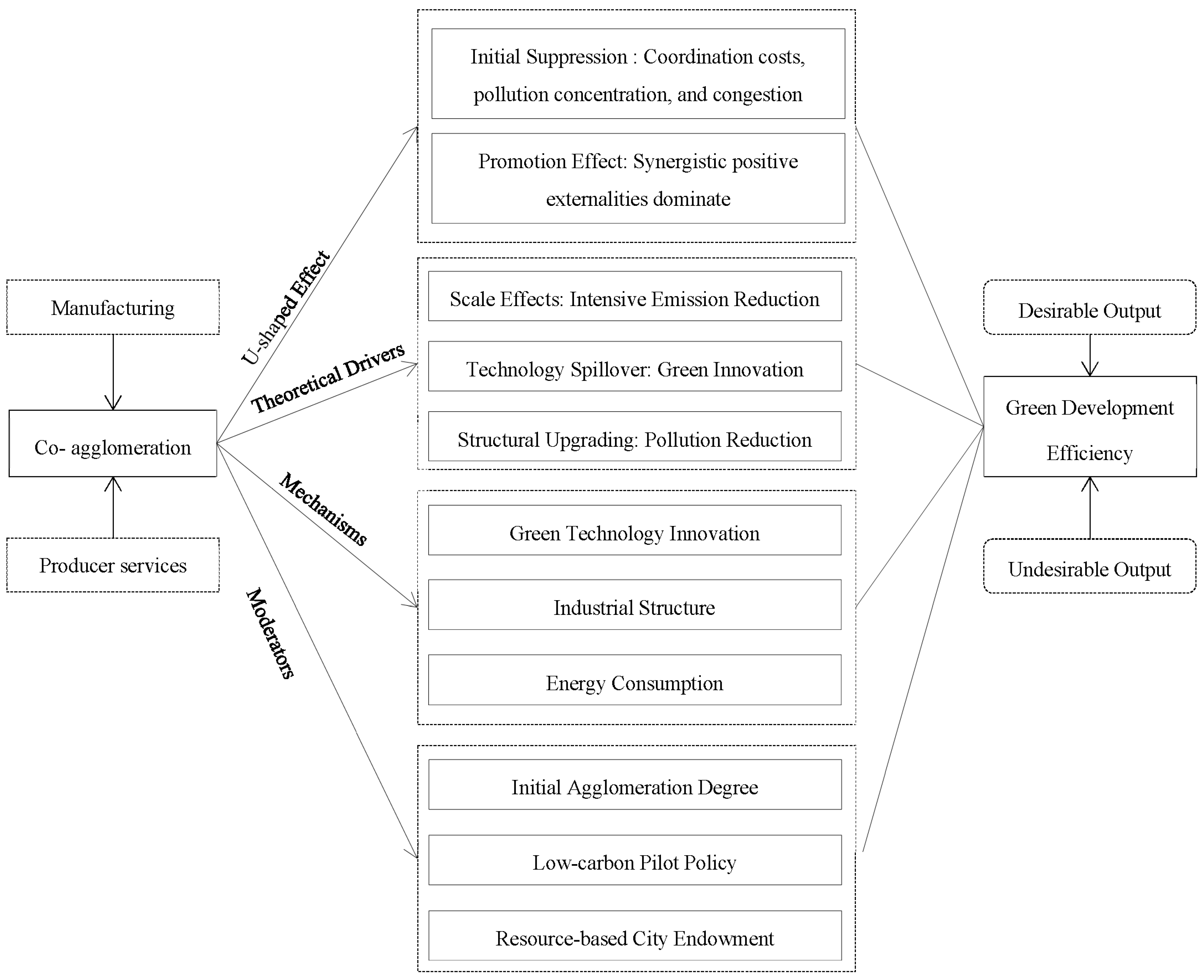
- Scale Externalities: Coordinated agglomeration enables the large-scale, cost-effective provision of shared environmental protection infrastructure and specialized green services. This effectively transforms the high fixed costs of green transformation, often prohibitive for individual firms, into variable operating costs that can be shared across the entire industrial ecosystem, thereby reducing the average cost of pollution abatement [5].
- (2)
- Structural Externalities: The core of this mechanism lies in the green restructuring of the regional economic system’s operational logic. When high-end producer services deeply embed themselves into the manufacturing value chain as knowledge carriers and governance nodes, they propel the industrial structure towards a more advanced, high-value-added, and low-pollution configuration. This shift releases “structural dividends” by reallocating resources from environmentally intensive, low-productivity sectors to cleaner, high-productivity activities [1].
- (3)
- Technological Externalities: Industrial coordination can break down technological silos between manufacturing and services, stimulating green technological innovation. Geographic proximity and established industrial linkages facilitate cross-sectoral spillover and recombination of green knowledge. This “innovation compensation” effect can potentially offset the compliance costs associated with environmental regulations, aligning with the Porter Hypothesis [21].
3. Materials and Methods
3.1. Model Specification
3.2. Variable Selection and Measurement
3.2.1. Dependent Variable
3.2.2. Core Explanatory Variable
3.2.3. Mediator Variables
3.2.4. Control Variables
3.2.5. Summary of Variables
3.3. Data Sources and Processing
4. Results
4.1. Analysis of Baseline Regression Results
4.2. Endogeneity Analysis
4.3. Mediation Effect Test
- (1)
- Green Technological Innovation (inn): The mediating role is partially significant and exhibits a time-lag effect. The impact of coordinated agglomeration on green innovation itself is U-shaped, and its current-period contribution to GDE is not statistically significant. This suggests that coordinated agglomeration needs to reach a threshold to effectively stimulate green innovation, and the economic benefits of such innovation manifest with a lag, consistent with theories of technology diffusion and absorptive capacity [30].
- (2)
- Industrial Advancement (ts): The mediating effect is strong and significant. Coordinated agglomeration directly drives the regional economic structure to evolve from energy-intensive, high-emission manufacturing dominance towards a high-value-added, low-pollution integrated form of services and advanced manufacturing, by promoting the deep integration of high-end producer services and manufacturing. This structural change itself generates substantial structural dividends, as resources flow from sectors with low productivity and high environmental costs to those with high productivity and low environmental costs [26].
- (3)
- Energy Consumption Intensity (eff): The mediation effect was not statistically significant in this model. This may indicate that in the Yangtze River Delta context, the transmission mechanism through energy intensity is overshadowed by more dominant structural transformations or operates with a longer time lag than captured in the model [28].
4.4. Heterogeneity Analysis
- (1)
- Agglomeration Degree: The sample was divided into high and low agglomeration level groups based on the median of the coordinated agglomeration level. The results show that the U-shaped relationship is significant for cities with low initial agglomeration levels but flattens or becomes insignificant for high-agglomeration cities, possibly due to congestion effects or diminishing marginal green returns [26]. Physical proximity between industries is the main feature, but efficient knowledge exchange networks have not yet formed. At this point, marginal efforts to deepen agglomeration first face linear increases in static costs like organizational coordination and facility sharing, while dynamic, non-linear benefits from knowledge recombination are not yet apparent, resulting in an overall suppression of GDE. Once coordinated agglomeration crosses a threshold, sufficient interaction history and trust capital accumulate among firms and industries, stable innovation networks begin to form, and the positive externalities of knowledge spillovers start to increase non-linearly, gradually offsetting and surpassing coordination costs, propelling GDE onto an upward trajectory. For cities already at high agglomeration levels, their industrial networks may be relatively mature. Further deepening of agglomeration yields diminishing marginal green benefits, or may even produce negative effects due to excessive congestion and intensified competition, causing the U-shaped curve to flatten or become insignificant.
- (2)
- Low-carbon Pilot Cities: Based on the National Development and Reform Commission’s three batches of low-carbon city pilot lists, the starting year for pilots was identified and assigned a value of 1 in the dummy variable, with other cities assigned 0. A particularly noteworthy finding is the absence of a statistically significant U-shaped relationship in low-carbon pilot cities, while a clear U-shaped trajectory is observed in non-pilot cities. This may be attributed to the stringent and front-loaded environmental standards implemented in pilot cities, which raise initial coordination costs and delay the realization of green benefits—a phenomenon consistent with the “short-term cost” aspect of the Porter Hypothesis [43]. The pilot policy compels the industrial coordination system to embed green genes from its inception, potentially bypassing certain high-carbon lock-in stages and ultimately driving the green production possibility frontier toward a higher-order leap [44]. However, for low-carbon pilot cities, the stricter environmental standards and more rigorous assessment systems mandated by the state constitute a strong external institutional shock. In the early stages of coordinated agglomeration, enterprises not only need to bear conventional coordination costs but must also undertake additional expenditures for large-scale, high-standard green technological transformation and equipment upgrades to meet environmental requirements. This leads to a testable hypothesis for future research: whether the U-shaped relationship will eventually emerge over a longer time horizon as pilot cities undergo deeper structural adjustments.
- (3)
- Resource Endowment: With reference to the State Council’s National Sustainable Development Plan for Resource-based Cities (2013-2020), corresponding cities were defined as resource-based and assigned a value of 1 in the dummy variable, with others assigned 0. The U-shaped relationship is significant in non-resource-based cities but completely insignificant in resource-based cities. The economic structure, human capital, local finance, and even social perception of resource-based cities have long been highly self-contained systems revolving around resource extraction, primary processing, and related heavy or chemical industries. In this context, the coordination between manufacturing and producer services is more likely to reinforce the existing path: producer services primarily provide supporting services for resource-based manufacturing, and their knowledge spillovers are confined to improving traditional resource extraction efficiency rather than green technological innovation. Therefore, industrial coordinated agglomeration in resource-based cities, despite potentially high physical concentration, functionally falls into the trap of “pseudo-coordination.” Its agglomeration economies are more reflected in traditional scale economies, making it difficult to trigger structural and technological effects oriented towards green development [5].
4.5. Robustness Tests
- (1)
- Replacing the Explained Variable: In measuring green development, the SBM-DEA model was replaced with the SBM-GML model. The U-shaped effect was fully replicated after replacement, indicating that the U-shaped relationship is robust to the measurement method of green development efficiency, and the nonlinear impact pattern of industrial coordinated agglomeration stably exists.
- (2)
- Lagged One-Period Regression: Considering the potential lagged effect of industrial coordinated agglomeration on GDE and to mitigate bidirectional causality bias, the one-period lagged explanatory variables (L.coag, L.coag_sq) were used for regression. The results remain robust. This not only alleviates potential reverse causality issues but also captures the dynamic cumulative effect of coordinated agglomeration, indicating that its shaping of green development is a continuous process whose benefits require time to materialize and accumulate, providing empirical support for the long-term nature of policies.
- (3)
- Winsorization: All variables were winsorized at the 5th percentile to correct for extreme values. The results show that the coefficient signs remain consistent with the baseline, proving that the baseline conclusions are not driven by extreme values and confirming that the core findings are not driven by a few outlier observations, enhancing the reliability of statistical inference.
5. Discussion
5.1. Key Findings and the U-Shaped Main Effect
- (1)
- Nonlinear impact: Co-agglomeration initially suppresses GDE, then promotes it after a threshold, confirming a U-shaped pattern.
- (2)
- Mediating mechanisms: Industrial advancement acts as a strong and direct mediator, while green technological innovation exhibits a significant but lagged mediating effect. Energy consumption intensity shows no statistically significant mediation in the current model.
- (3)
- Contextual heterogeneity: The U-shaped relationship is more pronounced in cities with lower agglomeration levels, non-low carbon pilot cities, and non-resource-based cities.
5.2. Interpretation of the U-Shaped Nexus
5.3. Mechanism Analysis
- (1)
- Industrial advancement (ts) is the most robust mediator. Co-agglomeration drives the regional economic structure toward a more service-oriented, high-value-added composition, which inherently reduces pollution intensity and raises resource productivity. This finding is consistent with studies highlighting structural transformation as a primary engine of green growth [1,26].
- (2)
- Green technological innovation (inn) shows a significant but lagged mediating effect. The U-shaped impact on innovation itself suggests that a certain level of agglomeration maturity is needed to trigger knowledge spillovers. Moreover, the delayed translation of innovation into efficiency gains reflects the time required for technology diffusion and absorptive capacity building [3,37]. This aligns with the Porter Hypothesis, which posits that environmental regulation can spur innovation, yet its full benefits emerge over time.
- (3)
- Energy consumption intensity (eff) did not show a significant mediation effect in our model. This may indicate that in a developed region like the Yangtze River Delta, the dominant green transition mechanism has shifted from incremental energy savings to deeper structural and technological change. Alternatively, energy efficiency gains might be offset by rebound effects or captured through other channels such as industrial upgrading.
5.4. Contextual Heterogeneity and Boundary Conditions
- (1)
- Agglomeration Degree: The attenuated or insignificant U-shape in high-agglomeration cities suggests the possibility of diminishing marginal green returns or the emergence of congestion effects, hinting at an optimal range for coordinated agglomeration [15].
- (2)
- Low-carbon Pilot Policy Status: The absence of a significant U-shaped relationship in pilot cities is a pivotal finding. This likely reflects the stringent, front-loaded environmental standards that raise initial coordination costs and delay the realization of green benefits—consistent with the “short-term cost” aspect of the Porter Hypothesis [43]. It does not imply policy failure but may indicate a different, potentially more profound restructuring trajectory compelled by the pilot policy, which embeds green criteria from the outset. This presents a testable hypothesis for future longitudinal research.
- (3)
- Resource Endowment: The complete insignificance of the U-shaped relationship in resource-based cities starkly illustrates the powerful “carbon lock-in” effect and path dependency. It demonstrates that without concerted efforts to diversify economic structures, spatial coordination alone may reinforce existing high-carbon industrial trajectories rather than catalyzing a green transition [5].
6. Conclusions and Policy Implications
6.1. Theoretical and Empirical Contributions
6.2. Differentiated Policy Recommendations
- (1)
- For cities on the left side of the U-curve (low agglomeration, initial stage): provide green coordination subsidies to offset upfront environmental adaptation costs; invest in shared green infrastructure to lower entry barriers; foster cross-industry collaboration platforms to accelerate learning and trust-building.
- (2)
- For cities on the right side of the U-curve (higher agglomeration, synergy stage): encourage the development of green technology alliances and joint R&D centers; promote green branding and certification schemes to enhance market recognition; optimize agglomeration quality to avoid congestion and over-intensification.
- (3)
- For low-carbon pilot cities (stricter environmental regulations): establish special green transformation funds to mitigate early-stage policy-induced costs; facilitate knowledge spillovers from pilot to non-pilot cities through regional cooperation networks; monitor long-term green performance to capture delayed benefits of structural restructuring.
- (4)
- For resource-based cities: prioritize industrial diversification policies alongside agglomeration strategies; offer fiscal incentives for green service industries and advanced manufacturing; implement tailored environmental standards that encourage gradual decarbonization.
- (5)
- To strengthen mediating mechanisms: create “industrial upgrading guidance funds” to support high-end green services; build regional green technology transfer platforms to shorten innovation diffusion lags; incorporate green innovation indicators into local government performance evaluations.
6.3. Limitations and Future Research
Author Contributions
Funding
Institutional Review Board Statement
Informed Consent Statement
Data Availability Statement
Acknowledgments
Conflicts of Interest
Abbreviations
| GDE | Green Development Efficiency |
| GTFP | Green Total Factor Productivity |
| DEA | Data Envelopment Analysis |
| SBM | Slacks-Based Measure |
| GML | Green Total Factor Productivity |
| EKC | Environmental Kuznets Curve |
| R&D | Research and Development |
References
- Song, Y.; Zhu, J.; Yue, Q.; Zhang, M.; Wang, L. Industrial Agglomeration, Technological Innovation and Air Pollution: Empirical Evidence from 277 Prefecture-Level Cities in China. Struct. Chang. Econ. Dyn. 2023, 66, 240–252. [Google Scholar] [CrossRef]
- Guo, B.; Jin, Y.; Li, Q. How Does Spatial Crowdedness Affect Patenting Performance in Industrial Clusters? An Empirical Study on the Moderated U-Shaped Relationship. Technol. Anal. Strateg. Manag. 2019, 31, 1016–1028. [Google Scholar] [CrossRef]
- Yang, H.; Zhang, F.; He, Y. Exploring the Effect of Producer Services and Manufacturing Industrial Co-Agglomeration on the Ecological Environment Pollution Control in China. Environ. Dev. Sustain. 2021, 23, 16119–16144. [Google Scholar] [CrossRef]
- Zhao, X.; Nakonieczny, J.; Jabeen, F.; Shahzad, U.; Jia, W. Does Green Innovation Induce Green Total Factor Productivity? Novel Findings from Chinese City Level Data. Technol. Forecast. Soc. Chang. 2022, 185, 122021. [Google Scholar] [CrossRef]
- Zhu, D.; Li, H. Environmental effect of industrial agglomeration in China and its mechanism. China Popul. Resour. Environ. 2021, 31, 62–70. [Google Scholar]
- Wang, M.; Wu, Y.; Zhang, X.; Lei, L. How Does Industrial Agglomeration Affect Internal Structures of Green Economy in China? An Analysis Based on a Three-Hierarchy Meta-Frontier DEA and Systematic GMM Approach. Technol. Forecast. Soc. Chang. 2024, 206, 123560. [Google Scholar] [CrossRef]
- Marshall, A. Principles of Economics; Palgrave Macmillan: London, UK, 2013. [Google Scholar]
- Jacobs, J. The Economy of Cities; Vintage Books: New York, NY, USA, 1969. [Google Scholar]
- Krugman, P. Increasing Returns and Economic Geography. J. Political Econ. 1991, 99, 483–499. [Google Scholar] [CrossRef]
- Helsley, R.W. Economics of Agglomeration: Cities, Industrial Location and Regional Growth. Econ. J. 2003, 35, 584–592. [Google Scholar]
- He, W.; Li, Y.; Meng, X.; Song, M.; Ramsey, T.S.; An, M. Will Green Technological Progress Help Industrial Collaborative Agglomeration Increase Regional Carbon Productivity: Evidence from Yangtze River Delta Urban Agglomerations. Environ. Dev. Sustain. 2024, 26, 26019–26046. [Google Scholar] [CrossRef]
- Wu, X.; Huang, Y.; Gao, J. Impact of Industrial Agglomeration on New-Type Urbanization: Evidence from Pearl River Delta Urban Agglomeration of China. Int. Rev. Econ. Financ. 2022, 77, 312–325. [Google Scholar] [CrossRef]
- Ellison, G.; Glaeser, E.L. Geographic Concentration in U.S. Manufacturing Industries: A Dartboard Approach. J. Political Econ. 1997, 105, 889–927. [Google Scholar] [CrossRef]
- Duranton, G.; Overman, H.G. Testing for Localization Using Micro-Geographic Data. Rev. Econ. Stud. 2005, 72, 1077–1106. [Google Scholar] [CrossRef]
- Ding, J.; Liu, B.; Shao, X. Spatial Effects of Industrial Synergistic Agglomeration and Regional Green Development Efficiency: Evidence from China. Energy Econ. 2022, 112, 106156. [Google Scholar] [CrossRef]
- Tone, K. A Slacks-Based Measure of Efficiency in Data Envelopment Analysis. Eur. J. Oper. Res. 2001, 130, 498–509. [Google Scholar] [CrossRef]
- Sun, Y.; Zhang, L.; Yao, S.; Sun, Y.; Zhang, L.; Yao, S. Evaluating resilience of prefecture cities in the Yangtze River delta region from a socio-ecological perspective. China Popul. Resour. Environ. 2017, 27, 151–158. [Google Scholar]
- Chung, Y.H.; Färe, R.; Grosskopf, S. Grosskopf Productivity and Undesirable Outputs: A Directional Distance Function Approach. Microeconomics 1997, 51, 229–240. [Google Scholar]
- Wang, X.; Song, J.; Duan, H.; Wang, X. Coupling between Energy Efficiency and Industrial Structure: An Urban Agglomeration Case. Energy 2021, 234, 121304. [Google Scholar] [CrossRef]
- Xu, X.; Shen, Y.; Liu, H.; Qiu, L. The Coupling Relationship Between Industrial Linkage and Spatial Co-Agglomeration of Advanced Manufacturing and Producer Services in Metropolitan: A Case Study of Beijing, China. Chin. Geogr. Sci. 2025, 35, 631–646. [Google Scholar] [CrossRef]
- Fan, F.; Dai, S.; Zhang, K.; Ke, H. Innovation Agglomeration and Urban Hierarchy: Evidence from Chinese Cities. Appl. Econ. 2021, 53, 6300–6318. [Google Scholar] [CrossRef]
- Mi, K.; Zhuang, R. Producer Services Agglomeration and Carbon Emission Reduction-An Empirical Test Based on Panel Data from China. Sustainability 2022, 14, 3618. [Google Scholar] [CrossRef]
- Li, Y.; Chen, Y. Development of an SBM-ML Model for the Measurement of Green Total Factor Productivity: The Case of Pearl River Delta Urban Agglomeration. Renew. Sust. Energy Rev. 2021, 145, 111131. [Google Scholar] [CrossRef]
- Liu, L.; Zhang, L.; Li, B.; Wang, Y.; Wang, M. Can Financial Agglomeration Curb Carbon Emissions Reduction from Agricultural Sector in China? Analyzing the Role of Industrial Structure and Digital Finance. J. Clean. Prod. 2024, 440, 140862. [Google Scholar] [CrossRef]
- Li, X.; Lai, X.; Zhang, F. Research on Green Innovation Effect of Industrial Agglomeration from Perspective of Environmental Regulation: Evidence in China. J. Clean. Prod. 2021, 288, 125583. [Google Scholar] [CrossRef]
- He, Z.; Chen, Z.; Feng, X. Different Types of Industrial Agglomeration and Green Total Factor Productivity in China: Do Institutional and Policy Characteristics of Cities Make a Difference? Environ. Sci. Eur. 2022, 34, 64. [Google Scholar] [CrossRef]
- Hao, X.; Wen, S.; Xue, Y.; Wu, H.; Hao, Y. How to Improve Environment, Resources and Economic Efficiency in the Digital Era? Resour. Policy 2023, 80, 103198. [Google Scholar] [CrossRef]
- He, Y.; Wang, H.; Liu, Y.; He, Y.; Wang, H.; Liu, Y. Spatial effects of agricultural carbon emissions from the perspective of industrial agglomeration. Resour. Sci. 2022, 44, 2428–2439. [Google Scholar] [CrossRef]
- Ellison, G.; Glaeser, E.L. The Geographic Concentration of Industry: Does Natural Advantage Explain Agglomeration? Am. Econ. Rev. 1999, 89, 311–316. [Google Scholar] [CrossRef]
- Yang, H.; Lin, Y.; Hu, Y.; Liu, X.; Wu, Q. Influence Mechanism of Industrial Agglomeration and Technological Innovation on Land Granting on Green Total Factor Productivity. Sustainability 2022, 14, 3331. [Google Scholar] [CrossRef]
- Xu, M.; Tan, R.; He, X. How Does Economic Agglomeration Affect Energy Efficiency in China?: Evidence from Endogenous Stochastic Frontier Approach. Energy Econ. 2022, 108, 105901. [Google Scholar] [CrossRef]
- Yuan, Y.; Gao, K.; Yuan, Y.; Gao, K. The synergetic agglomeration of industries, spatial knowledge spillovers and regional innovation efficiency. Stud. Sci. Sci. 2020, 38, 1966. [Google Scholar]
- Yu, D.; Li, X.; Yu, J.; Li, H. The Impact of the Spatial Agglomeration of Foreign Direct Investment on Green Total Factor Productivity of Chinese Cities. J. Environ. Manag. 2021, 290, 112666. [Google Scholar] [CrossRef]
- Chatman, D.G.; Noland, R.B. Do Public Transport Improvements Increase Agglomeration Economies? A Review of Literature and an Agenda for Research. Transp. Rev. 2011, 31, 725–742. [Google Scholar] [CrossRef]
- Wang, N.; Zhu, Y.; Yang, T. The Impact of Transportation Infrastructure and Industrial Agglomeration on Energy Efficiency: Evidence from China’s Industrial Sectors. J. Clean. Prod. 2020, 244, 118708. [Google Scholar] [CrossRef]
- Hsu, W.-T.; Lu, Y.; Luo, X.; Zhu, L. Foreign Direct Investment and Industrial Agglomeration: Evidence from China. J. Comp. Econ. 2023, 51, 610–639. [Google Scholar] [CrossRef]
- Neffke, F.; Henning, M.; Boschma, R.; Lundquist, K.-J.; Olander, L.-O. The Dynamics of Agglomeration Externalities along the Life Cycle of Industries. Reg. Stud. 2011, 45, 49–65. [Google Scholar] [CrossRef]
- Peng, B.; Chen, H.; Elahi, E.; Wei, G. Study on the Spatial Differentiation of Environmental Governance Performance of Yangtze River Urban Agglomeration in Jiangsu Province of China. Land Use Policy 2020, 99, 105063. [Google Scholar] [CrossRef]
- Tan, D.; Meyer, K.E. Country-of-Origin and Industry FDI Agglomeration of Foreign Investors in an Emerging Economy. J. Int. Bus. Stud. 2011, 42, 504–520. [Google Scholar] [CrossRef]
- Koo, J. Technology Spillovers, Agglomeration, and Regional Economic Development. J. Plan. Lit. 2005, 20, 99–115. [Google Scholar] [CrossRef]
- Chen, Y. Agglomeration and Location of Foreign Direct Investment: The Case of China. China Econ. Rev. 2009, 20, 549–557. [Google Scholar] [CrossRef]
- Deng, L.; Zhao, Y. Investment Lag, Financially Constraints and Company Value-Evidence from China. Emerg. Mark. Financ. Trade 2022, 58, 3034–3047. [Google Scholar] [CrossRef]
- Zhang, H.; Chen, Z. Financial Reform and Haze Pollution: A Quasi-Natural Experiment of the Financial Reform Pilot Zones in China. J. Environ. Manag. 2023, 330, 117196. [Google Scholar] [CrossRef] [PubMed]
- Ren, S.; Li, L.; Han, Y.; Hao, Y.; Wu, H. The Emerging Driving Force of Inclusive Green Growth: Does Digital Economy Agglomeration Work? Bus. Strateg. Environ. 2022, 31, 1656–1678. [Google Scholar] [CrossRef]


| Variable Type | Variable Name | Abbreviation | Measurement |
|---|---|---|---|
| Dependent Variable | Green Development Efficiency | GDE | Calculated using the non-radial, non-oriented SBM model under the DEA framework. |
| Core Explanatory Variable | Coordinated Agglomeration Index | coag | Constructed based on the location quotient (LQ) of manufacturing (M) and producer services (P) |
| Mediating Variables | Green Technological Innovation | inn | The natural logarithm of the number of green invention patents granted per 10,000 people. |
| Industrial Advancement | ts | The ratio of the added value of the tertiary industry to that of the secondary industry. | |
| Energy Consumption Intensity | eff | Energy consumption per unit of GDP. | |
| Control Variables | Economic Development Level | gdp | The natural logarithm of GDP per capita. |
| Science and Technology Investment | tec | The proportion of science and technology expenditure in the local general fiscal budget. | |
| Infrastructure Level | infra | Road mileage per unit of administrative area. | |
| Urbanization Rate | urb | The proportion of the urban resident population to the total regional population. | |
| Foreign Direct Investment | fdi | The proportion of actually utilized foreign capital in the regional GDP of the current year. |
| Variable | N | Mean | SD. | Min | Max |
|---|---|---|---|---|---|
| logGDE | 533 | 3.535 | 0.265 | 2.863 | 4.188 |
| coag | 533 | 1.637 | 0.254 | 0.982 | 3.068 |
| inn | 533 | −0.863 | 0.677 | −2.851 | 0.726 |
| ts | 533 | 1.037 | 0.365 | 0.313 | 2.956 |
| eff | 533 | 0.616 | 0.279 | 0.040 | 1.720 |
| gdp | 533 | 11.625 | 0.669 | 9.848 | 13.657 |
| tec | 533 | 0.666 | 0.227 | 0.041 | 1.338 |
| infra | 533 | 1.444 | 0.364 | 0.565 | 2.249 |
| urb | 533 | 0.626 | 0.117 | 0.313 | 0.896 |
| fdi | 533 | 11.442 | 1.233 | 8.396 | 14.542 |
| (1) | (2) | (3) | (4) | (5) | (6) | (7) | (8) | |
|---|---|---|---|---|---|---|---|---|
| logGDE | logGDE | logGDE | logGDE | logGDE | logGDE | logGDE | logGDE | |
| coag | 0.047 *** | 0.298 *** | 0.032 ** | −0.219 *** | 0.031 ** | −0.095 | 0.032 ** | −0.189 ** |
| (3.34) | (3.45) | (2.63) | (−2.93) | (2.63) | (−1.30) | (2.63) | (−2.40) | |
| coag_sq | −0.047 ** | 0.045 *** | 0.023 | 0.039 ** | ||||
| (−2.95) | (3.41) | (1.75) | (2.80) | |||||
| gdp | −0.077 *** | −0.085 *** | 0.412 *** | 0.415 *** | −0.033 | −0.026 | 0.412 *** | 0.156 *** |
| (−4.97) | (−5.46) | (11.27) | (11.47) | (−1.00) | (−0.78) | (11.27) | (6.33) | |
| tec | −0.282 *** | −0.275 *** | −0.162 *** | −0.156 *** | −0.235 *** | −0.231 *** | −0.162 *** | −0.192 *** |
| (−5.89) | (−5.78) | (−3.45) | (−3.34) | (−5.07) | (−4.99) | (−3.45) | (−3.96) | |
| urb | 1.131 *** | 1.160 *** | −0.487 * | −0.481* | 0.441 ** | 0.449 ** | −0.487 * | 0.897 *** |
| (11.25) | (11.56) | (−2.15) | (−2.15) | (2.80) | (2.85) | (−2.15) | (5.64) | |
| infra | −0.084 ** | −0.079 ** | −0.228 *** | −0.199 *** | −0.199 *** | −0.187 *** | −0.228 *** | −0.126 ** |
| (−2.82) | (−2.66) | (−5.71) | (−4.91) | (−5.47) | (−5.04) | (−5.71) | (−3.22) | |
| fdi | 0.030 * | 0.028 * | 0.008 | 0.007 | 0.044 *** | 0.044 *** | 0.008 | 0.044 ** |
| (2.58) | (2.45) | (0.60) | (0.50) | (3.45) | (3.40) | (0.60) | (3.20) | |
| _cons | 3.563 *** | 3.350 *** | 0.478 | 0.689 ** | 3.348 *** | 3.412 *** | −0.699 * | 1.156 *** |
| (15.58) | (14.05) | (1.90) | (2.69) | (8.53) | (8.68) | (−2.28) | (4.12) | |
| N | 533 | 533 | 533 | 533 | 533 | 533 | 533 | 533 |
| R2 | 0.375 | 0.385 | 0.412 | 0.426 | 0.363 | 0.412 | 0.435 | 0.440 |
| Control city | NO | NO | YES | YES | NO | NO | YES | YES |
| Control year | NO | NO | NO | NO | YES | YES | YES | YES |
| Variable | (1) | (2) | (3) |
|---|---|---|---|
| coag | −0.419 ** (0.253) | −0.183 ** (−2.21) | −0.035 * (0.040) |
| coag_sq | 0.040 ** (0.014) | 0.0395 ** (2.63) | 0.062 ** (0.027) |
| l_logGDE | 0.265 ** (0.098) | ||
| gdp | 0.297 *** (0.100) | 0.150 *** (5.76) | 0.458 *** (0.114) |
| tec | −0.073 *** (0.097) | −0.206 *** (−3.92) | −0.158 (0.097) |
| infra | −0.233 *** (0.069) | 0.868 *** (5.21) | −0.330 *** (0.118) |
| urb | 0.501 *** (0.322) | −0.119 ** (−2.87) | −0.874 (0.689) |
| fdi | 0.045 ** (0.014) | 0.0481 ** (3.108) | −0.006 (0.023) |
| _cons | 1.156 *** (0.280) | 1.194 *** (3.94) | |
| N | 533 | 492 | 451 |
| R2 | 0.441 | 0.322 | |
| Control city | YES | YES | YES |
| Control year | YES | YES | YES |
| Model | IV-2SLS | IV-2SLS | Difference GMM |
| (1) | (2) | (3) | ||||
|---|---|---|---|---|---|---|
| inn | logGED | ts | logGED | eff | logGED | |
| coag | −0.339 ** | −0.216 ** | −0.0377 * | −0.242 ** | −0.023 * | −0.212 ** |
| (−2.72) | (−2.87) | (−2.25) | (−3.29) | (−1.73) | (−2.83) | |
| coag_sq | 0.073 ** | 0.045 *** | 0.050 *** | 0.044 *** | ||
| (3.28) | (3.33) | (3.85) | (3.33) | |||
| inn | 0.007 | |||||
| (0.29) | ||||||
| ts | 0.147 *** | |||||
| (4.54) | ||||||
| eff | 0.060 | |||||
| (1.53) | ||||||
| gdp | 0.976 *** | 0.407 *** | 0.508 *** | 0.340 *** | −0.041 | 0.441 *** |
| (16.21) | (9.06) | (10.22) | (8.71) | (−1.31) | (11.02) | |
| tec | 0.361 *** | −0.159 *** | 0.374 *** | −0.210 *** | −0.0115 | −0.151 ** |
| (4.64) | (−3.32) | (5.84) | (−4.45) | (−0.23) | (−3.25) | |
| infra | 0.133 * | −0.200 *** | 0.332 *** | −0.244 *** | 0.196 *** | −0.212 *** |
| (1.97) | (−4.91) | (6.12) | (−5.98) | (5.00) | (−5.13) | |
| urb | 0.389 | −0.484 * | −0.936 ** | −0.342 | −0.773 *** | −0.485 * |
| (1.04) | (−2.16) | (−3.04) | (−1.55) | (−4.81) | (−2.17) | |
| fdi | 0.025 | 0.007 | −0.069 *** | 0.017 | −0.058 *** | 0.009 |
| (1.08) | (0.49) | (−3.51) | (1.21) | (−4.12) | (0.66) | |
| _cons | −12.84 *** | −0.347 | −4.109 *** | 0.187 | 2.230 *** | −0.812 * |
| (−24.66) | (−0.74) | (−9.84) | (0.56) | (5.62) | (−2.07) | |
| N | 533 | 533 | 533 | 533 | 533 | 533 |
| R2 | 0.797 | 0.426 | 0.567 | 0.449 | 0.542 | 0.428 |
| Control city | YES | YES | YES | YES | YES | YES |
| Control year | YES | YES | YES | YES | YES | YES |
| (1) | (2) | (3) | ||||
|---|---|---|---|---|---|---|
| High-Level | Low-Level | Pilot | Non-Pilot | Resource | Non-Resource | |
| coag | −0.120 | −0.263 ** | −0.071 | −0.256 ** | 0.058 | −0.292 ** |
| (−1.13) | (−2.73) | (−0.43) | (−3.05) | (0.47) | (−3.23) | |
| coag_sq | 0.030 | 0.053 ** | 0.026 | 0.0551 *** | 0.002 | 0.056 *** |
| (1.60) | (3.08) | (0.96) | (3.55) | (0.12) | (3.50) | |
| gdp | 0.544 *** | 0.202 *** | 0.657 *** | 0.282 *** | 0.267 *** | 0.460 *** |
| (8.75) | (4.16) | (9.31) | (6.56) | (4.68) | (9.77) | |
| tec | −0.346 *** | −0.185 *** | −0.121 | −0.250 *** | −0.152 * | −0.179 ** |
| (−4.36) | (−3.51) | (−1.78) | (−4.14) | (−2.19) | (−3.03) | |
| infra | −0.150 * | −0.015 | −0.259 ** | −0.118 ** | −0.184 ** | −0.186 *** |
| (−2.24) | (−0.33) | (−2.81) | (−2.67) | (−2.85) | (−3.75) | |
| urb | −1.713 *** | 0.121 | −1.081 | 0.040 | −0.183 | −0.687 * |
| (−4.07) | (0.51) | (−1.97) | (0.16) | (−0.64) | (−2.22) | |
| fdi | 0.006 | −0.013 | 0.018 | 0.011 | 0.043 | 0.006 |
| (0.36) | (−0.61) | (0.68) | (0.60) | (1.42) | (0.38) | |
| _cons | −0.881 | 1.454 *** | −2.998 *** | 0.643 | −0.096 | −0.591 |
| (−1.75) | (3.47) | (−4.20) | (1.79) | (−0.20) | (−1.51) | |
| N | 277 | 256 | 155 | 378 | 117 | 416 |
| R2 | 0.407 | 0.269 | 0.607 | 0.375 | 0.481 | 0.433 |
| Control city | YES | YES | YES | YES | YES | YES |
| Control year | YES | YES | YES | YES | YES | YES |
| (1) | (2) | (3) | |
|---|---|---|---|
| logS_GDE | logGDE | logGDE | |
| coag | −0.173 ** | −0.168 ** | |
| (−2.38) | (−2.55) | ||
| coag_sq | 0.039 ** | 0.034 ** | |
| (3.05) | (2.90) | ||
| L.coag | −0.199 ** | ||
| (−2.49) | |||
| L.coag_sq | 0.037 ** | ||
| (2.64) | |||
| gdp | 0.334 *** | 0.416 *** | 0.408 *** |
| (9.54) | (10.30) | (11.92) | |
| tec | −0.204 *** | −0.145 ** | −0.145 ** |
| (−4.50) | (−2.88) | (−3.17) | |
| infra | −0.190 *** | −0.173 *** | −0.238 *** |
| (−4.84) | (−3.93) | (−5.93) | |
| urb | −0.378 | −0.469 | −0.399 * |
| (−1.74) | (−1.87) | (−2.05) | |
| fdi | −0.005 | 0.004 | 0.003 |
| (−0.38) | (0.31) | (0.25) | |
| _cons | −3.578 *** | −0.477 | −0.367 |
| (−11.80) | (−1.35) | (−1.23) | |
| N | 533 | 492 | 533 |
| R2 | 0.332 | 0.398 | 0.440 |
| Control city | YES | YES | YES |
| Control year | YES | YES | YES |
Disclaimer/Publisher’s Note: The statements, opinions and data contained in all publications are solely those of the individual author(s) and contributor(s) and not of MDPI and/or the editor(s). MDPI and/or the editor(s) disclaim responsibility for any injury to people or property resulting from any ideas, methods, instructions or products referred to in the content. |
© 2026 by the authors. Licensee MDPI, Basel, Switzerland. This article is an open access article distributed under the terms and conditions of the Creative Commons Attribution (CC BY) license.
Share and Cite
Ma, J.; Yu, X. The U-Shaped Impact of Manufacturing-Services Co-Agglomeration on Urban Green Efficiency: Evidence from the Yangtze River Delta. Sustainability 2026, 18, 967. https://doi.org/10.3390/su18020967
Ma J, Yu X. The U-Shaped Impact of Manufacturing-Services Co-Agglomeration on Urban Green Efficiency: Evidence from the Yangtze River Delta. Sustainability. 2026; 18(2):967. https://doi.org/10.3390/su18020967
Chicago/Turabian StyleMa, Jun, and Xingxing Yu. 2026. "The U-Shaped Impact of Manufacturing-Services Co-Agglomeration on Urban Green Efficiency: Evidence from the Yangtze River Delta" Sustainability 18, no. 2: 967. https://doi.org/10.3390/su18020967
APA StyleMa, J., & Yu, X. (2026). The U-Shaped Impact of Manufacturing-Services Co-Agglomeration on Urban Green Efficiency: Evidence from the Yangtze River Delta. Sustainability, 18(2), 967. https://doi.org/10.3390/su18020967