1. Introduction
Japan is facing a growing concern in the logistics sector dubbed the ‘2024 problem’. It is a recurring condition in which the lack of available truck drivers in the logistics sector prevents it from delivering goods at a satisfactory level. Since April 2024, with the passing of labor-related laws that reformed the rules regarding work style, including for truck drivers, the amount of legally permissible working hours has been reduced. This, combined with the existing labor shortage condition, fueled by the decreasing demographic trend, only exacerbates the already fragile labor situation in the logistics sector. This has generated a concern within the sector about the inability to efficiently transport goods under certain operational standards. A study conducted by NX Research Institute stated that it is estimated that the driver shortage problem may cause a 19.5% deficit, or 540 million tons, in transport capacity by 2030 under a business-as-usual path [
1]. Adding the 2024 problem to the scenario will result in a 34.1% deficit or 940 million tons [
1]. The potential impact that the problem may cause drives the need to explore any possible alternatives to alleviate the impact. One of the solutions is the concept of crowdshipping.
To tackle the potential decline in transport capacity caused by labor shortage, the obvious way would be to increase the capacity through other means by involving a new source of labor to act as a replacement for the old labor force. The crowdshipping concept serves as a way to provide a path to solve the problem. It is a relatively new logistics approach that was first mentioned by the United States Postal Service (USPS) in one of its reports [
2]. The crowdshipping concept revolves around the same concept of crowdsourcing, in which it utilizes technology as a means to gather a substantial number of people to perform a certain task or accomplish an objective [
2]. Based on that, crowdshipping can be defined as a concept that matches a sender who needs to send packages with a person who is willing to deliver them to the destination. The way it can solve the labor shortage lies within its type of labor sources, in which it mobilizes the commuters and travelers to participate in the system by having them carry the packages with them to their destination. This will ease the burden of the logistics sector by having a new source of labor and an entirely new system to work in parallel with the conventional one. It will also exploit the advantage of utilizing the passenger-based transportation capacity as a logistics-based transportation capacity as well, thereby enabling a more sustainable approach for logistics transport.
Japan, as one of the few countries that possesses a mature and advanced passenger-based transportation system, can utilize the crowdshipping system to solve its problem of labor shortage. One of them is the renowned Shinkansen, colloquially dubbed the bullet train. Its vast networks that connect the nation’s biggest cities provide ample potential to be used as a means to deliver packages under the crowdshipping concept that will open a new way to deliver packages and, in turn, generate a potential source of income to any involved stakeholder within the system itself. Utilizing the Shinkansen as the core transportation mode, this study focuses on a feasibility evaluation of a crowdshipping concept from the economic and environmental perspectives, defined under various assumptions that cover operational and cooperative aspects. This will be carried out through the cooperative arrangements and reward allocation schemes to analyze fair profit sharing, participation of stakeholders, and CO2 reductions of a high-speed rail-based system relative to conventional delivery.
The key contributions of this study are threefold: (i) it assesses the economic feasibility of crowdshipping through Japan’s high-speed rail network (the Tokaido Shinkansen); (ii) it develops and contrasts cooperative profit-sharing mechanisms among Sagawa, JR, and passengers based on game-theoretic solution concepts; and (iii) it quantifies potential environmental gains through CO2 reduction scenarios.
2. Literature Review and Research Gaps
In this study, a literature review is conducted on several studies that are relevant to crowdshipping. This enables us to further understand the current state of crowdshipping as a research concept and also to see its potential utilization on numerous platforms. Based on this review, several research gaps on crowdshipping can be found that will provide the basis of argumentation for this research.
2.1. Research on Crowdshipping
This research on crowdshipping can be categorized into three distinct themes: studies on the social acceptability of crowdshipping as a concept, studies on methods for crowdshipping operations, and studies on the potential impact of crowdshipping implementation.
2.1.1. The Social Acceptability of Crowdshipping as a Concept
The emergence of the crowdshipping concept as a novel alternative for delivery options has led to several studies that focused on the investigation of the acceptance of such a concept from a social aspect. This includes the willingness of potential crowdshippers, consumers, and logistics service providers (LSPs) to participate under the crowdshipping environment.
Crowdshippers form one of the most important elements of the crowdshipping system, as their engagement determines whether the model can function at scale. For this reason, several studies have examined willingness and motivation rather than treating participation as an assumed resource. Marcucci et al. [
3] reported consistently high interest across selected cities in several countries, including Italy with 87%, the United States with 78%, and Australia with 60%, respectively. The willingness to participate in the crowdshipping activity is not only driven by certain demographic characteristics but also by the convenience it offers through the integration of parcel delivery with passengers’ existing trips [
4]. This adds the perceived benefits of earning additional income from crowdshipping activity.
As the topic progressed, research expanded to explore why individuals choose to participate rather than measuring willingness alone. Le and Ukkusuri [
5], for example, found a similarly strong interest in the United States and Vietnam and noted that motivation is commonly tied to convenience and supplemental income rather than replacing formal courier work. Together, these findings indicate that acceptance is generally high when participation naturally aligns with existing travel routines. This, however, is not without the risk that potentially affects participation. Wang and Simoni [
6] found that the willingness to participate is sensitive to several factors, such as additional length of detour, complexity of the task, and, more importantly, proportional compensation to the inconvenience created by the delivery task itself. In addition to those factors, trust in the delivery platform and clarity of parcel handling are also important non-financial-related factors that influence the potential participation in a crowdshipping-based delivery system [
4].
2.1.2. Efficient Operational Methods for Crowdshipping
Several aspects shape the method in which the crowdshipping is operated. These are the four main elements: client and crowdshipper matching, route selection for delivery, scheduling for crowdshipper, and payment. Archetti et al. [
7], who analyzed the crowdshipping through the Vehicle Routing Problem (VRP) method, mentioned in their study that the crowdshipper, who will act as the temporary driver, can be compensated a fair amount while reducing the delivery costs that the logistics company needs to spend per package. This resulted from the multi-heuristic approach that was solved through computational calculations that aimed to minimize the overall total costs per delivery. It shows that the concept of crowdshipping is a viable option for an alternative to the conventional delivery service.
Another study found that through the utilization of bus routes and information on taxis in Singapore, and the minimum cost flow problem as the selected method, it can minimize the travel distance of each crowdshipper when assigning them with the delivery task [
8]. This study was also conducted under a randomly generated delivery task, which also included a large-scale task. This proved that crowdshipping can be carried out and applies to large-scale delivery tasks, which makes it even more useful for delivering packages during peak demand. A study by Le et al. [
9] discusses the crowdshipping concept with the main aim of maximizing the profit from the crowdshipping platform perspective by adding several schemes on pricing and compensation to each matching model. It determines such schemes based on the various levels of demand and supply; the study stated that the integration of both pricing and compensation as a unified scheme during the matching decision process may be beneficial for the companies to further improve their overall financial viability under the crowdshipping concept.
In addition to matching decisions, improvement in service reliability is also one of the main focuses in recent times. Zhou et al. [
10] formulated a service-focused Vehicle Routing Problem with Crowdshipping (VRPC) model by incorporating customer impatience as a novel variable with other variables such as on-time arrival probability and expected lateness duration to determine the best routing. The formulations effectively lower the risk of late delivery and time uncertainty. Another operation-focused study that focused on the service-price problem has also been developed through the study by Peng et al. [
11], which utilized the bilevel optimization model. They found that utilizing mobility service providers (MSPs) as an outsourced asset for LSPs can potentially reduce costs by 17% for LSPs while also potentially improving the profit for MSPs by up to 15.8%.
Kizil and Yildiz [
12] propose a last-mile delivery model that combines public transport and backup options. This study applied a two-stage stochastic program and a branch-and-price algorithm to solve for using public transit as a backbone network. This indicates an evolution from urban public transit-based crowdshipping.
2.1.3. Assessment of the Implementation of the Crowdshipping Concept
The application of crowdshipping as a novel concept will impact the logistics sector itself. This includes the impact that it will bring in terms of the environment and sustainability. The crowdsourcing concept that constitutes the backbone of the crowdshipping should offer some advantages when it comes to those aspects. In this regard, several studies have been conducted to specifically highlight this issue.
One study by Zhang et al. [
13] showed the potential environmental impact of crowdshipping in congested cities. By taking Singapore as the case study, it developed a model for parcel allocation matching that will match the packages with public bus routes. This study also considers the possibility of capacity overload under the crowdshipping scheme, in which regular delivery vans will then be used to handle the task. The results indicated that crowdshipping has successfully reduced the amount of mileage of the logistics company’s delivery vehicle and its associated gas emissions by 17% while also lowering the overall delivery costs by up to 29% per package [
13]. This proves that the application of crowdshipping by utilizing the existing public transportation system and its users can reduce the environmental impact of delivery service, and it can, to some extent, complement the role of conventional vehicles in making deliveries. Gdowska et al. [
14] showed that the implementation of crowdshipping can reduce the expected delivery cost by 9% on average, thus proving its impact on both environmental and economic points of view. Despite its potential benefits, crowdshipping is still in its infancy, and real-world applications remain limited due to a lack of laws and frameworks that regulate crowdshipping itself. The absence of such concrete regulatory signals, added to unclear structures and coordination schemes, contributes to the implementation barrier [
15]. Furthermore, a lack of connection between the simulation results and full-scale application indicates that crowdshipping, in its current form, exists merely as a theoretical concept rather than a proven one [
16]. Wang et al. [
17] introduced a mixed-integer programming model to solve the freight allocation problem for parcel delivery using high-speed railway and crowd couriers. This study is one of the few that discuss a joint high-speed railway and crowd-courier system for parcel delivery. Our study differs from theirs in that it targets Japan, uses a cooperative game, and establishes explicit profit-sharing rules.
2.2. Research Gaps
Crowdshipping as a novel concept in the logistics sector provides an alternative to the conventional method, in which both can coexist to complement each other, which would be crucial for countries whose labor force has been under constant strain. In addition, numerous studies demonstrate a strong willingness to participate in crowdshipping activities and their promising operational and environmental benefits. However, several key areas remain under-researched.
The first gap lies in the lack of analysis of high-speed rail-based crowdshipping. Whilst most research focuses on the integration of public transportation systems such as buses or taxis, an absence of such studies can be seen in the case of high-speed rail as the primary delivery platform. Due to its vast network and advanced technology, the high-speed network in Japan offers punctuality, swiftness, high reliability, and, more importantly, a large number of potential participants due to the high volume of passengers. A study on high-speed rail for potential use in a crowdshipping-based delivery system offers a new approach to leveraging public transportation for the logistics sector.
The second gap is the absence of cooperative, game-based profit-sharing frameworks among LSPs, rail operators, and passengers. Despite investigations regarding behavioral factors such as willingness, the absence of a study that focuses on a collaboration framework between logistics service providers, public transportation operators, and passengers provides an opportunity for new research that explores the feasibility of such collaboration under numerous possible scenarios. Several methods have been utilized for economic-related studies for the crowdshipping, such as route analysis, pricing, and optimization models. Such methods, however, are not suitable for analyzing the cooperation of several stakeholders in the crowdshipping scenario to ensure fairness in profit-sharing. The application of cooperative game theory enables the analysis to determine equitable profit distribution among the involved parties, in this case, all stakeholders that are involved in the crowdshipping scenario.
The third gap concerns the limited integration of behavioral participation, specifically the value of time (VOT), with operational and environmental feasibility. The VOT is a concept that converts the travel time saved in a journey into a monetary value, which allows it to be placed alongside other aspects in the analysis to obtain a clearer picture of the benefits of a certain scenario as a whole [
18]. Highlighting the potential of the Shinkansen and the application of cooperative game theory also enables the crowdshipping research to be specifically tailored for Japan to tackle its growing problem of labor shortage and the need for an alternative model for parcel delivery. By addressing the gaps, this study observes the feasibility of a high-speed railway-based transportation network that is represented by the Shinkansen as a crowdshipping model by applying cooperative game theory to analyze profit-sharing structures that align with the feasibility from operational and sustainability aspects.
3. Methodology and Data
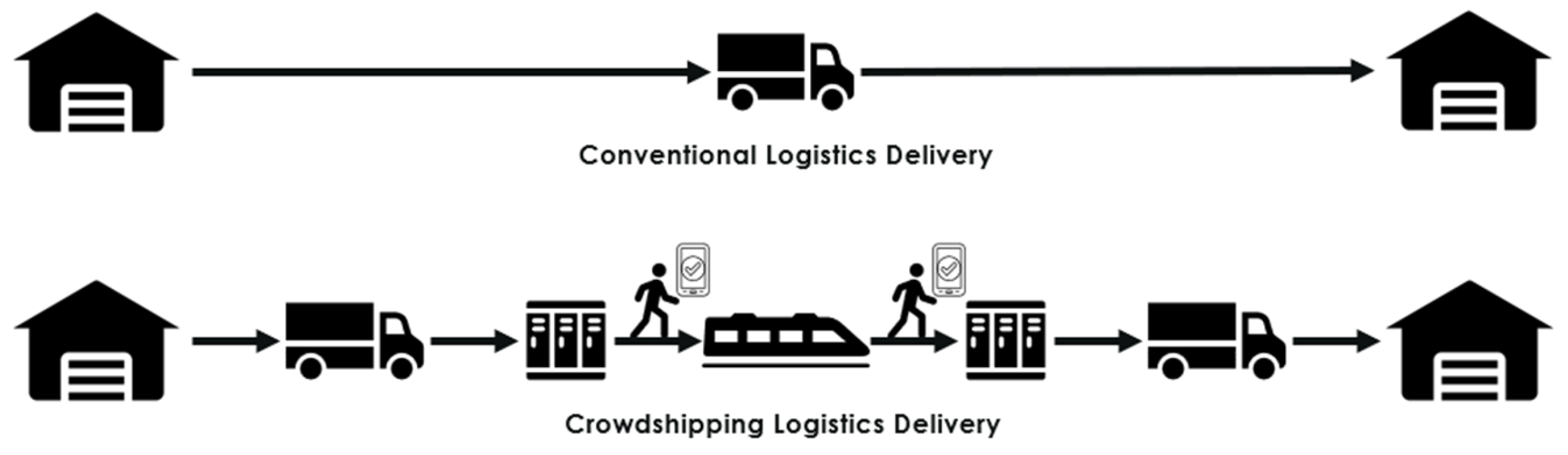
The concept of crowdshipping introduced in this study will be conducted from the perspective of the operators, which includes the LSPs and the operators of public transportation. Under the conventional workflow, the delivery of packages will be handled exclusively by the LSPs and their respective assets from the first-mile stage all the way through the last-mile stage. The crowdshipping concept, however, differs from the conventional one in which the LSPs will send the packages to lockers located at the stops of the selected public transportation mode. Packages will then be delivered using public transportation, with its passengers acting as the sender, replacing the LSPs’ drivers, to the lockers at the destinations.
The selected method of transportation for the crowdshipping concept introduced in this study is the Shinkansen, or the high-speed railway in Japan. Known for its punctuality and its vast network, it offers an alternative to the conventional delivery service under the crowdshipping concept. This Shinkansen-based concept works in several steps. The passengers of the Shinkansen who have already registered in the system as the crowdshippers will pick up the packages from the lockers located at a certain station, which serves as the departure point for them. The crowdshipper will then commence their journey to their respective destinations whilst carrying the package with them as well. Then, the packages will be dropped off at the lockers located at the destination stations, and they will receive the compensation as a service fee for delivering the package, thus completing the entire task of delivery service under crowdshipping.
The Tokaido Shinkansen is one of the most important Shinkansen routes in Japan, connecting two of the biggest cities in Japan, Tokyo and Osaka. The high-speed nature of the trains, their high frequency, and their relatively short travel time enable the long-range delivery service between these two cities that is not only fast but also can be carried out in high volume as well. Moreover, the utilization of the Shinkansen is expected to have reduced greenhouse gas emissions (GHGs) compared to conventional trucks or vans, thus contributing to the sustainability in the logistics sector. This workflow is best represented with
Figure 1, which shows the crowdshipping package delivery procedure and visualizes the procedure for crowdshipping delivery. Due to the relative novelty of crowdshipping as a concept, it is intended as a scenario-based representation at a conceptual level in accordance with the economic and cooperative analysis rather than a detailed operational representation, which includes other parameters such as routing, scheduling, and capacity.
The stakeholders that will act as the collaborators in this crowdshipping scenario are the logistics service provider, represented by Sagawa; Japan Railways Central (JR Central), representing the operator of the Shinkansen; and the passengers of the Shinkansen, representing the crowdshipper. Through the comparison of several scenarios that are run under different reward schemes given to each participant, several things can be observed. These include the expected participation rate of the passengers of the Shinkansen that will act as the crowdshipper, the potential transport volume that the Tokaido Shinkansen can offer under the crowdshipping scenario and its related environmental impact, the amount of generated income, and its distribution for each collaborator.
As seen in
Figure 1, the task to deliver a parcel under a crowdshipping-based delivery consists of five steps: (i) pre-registration through a digital application to get registered into the system and receive the delivery task; (ii) should the passenger accept the task, they have to pick up the parcel from a locker located near the ticket gate of the station before departure; (iii) the parcel is carried by the passenger during the Shinkansen trip according to the plan; (iv) the passenger drops off the parcel at a destination-station locker after arrival; (v) the task is completed by reporting it in the app, and the passenger receives payment for their service. Since the system covers the middle-mile section of the delivery task, no interaction is needed between the sender, the recipient, or the passenger. Furthermore, the task will not alter the itinerary of the passenger, thus making it convenient for them to do so.
In this study, the first-mile and last-mile stages of the delivery stay wholly managed by Sagawa. In the first-mile stage, Sagawa performs the collection of parcels from senders and distributes them to departure-station-based lockers using a conventional method. After the middle-mile stage is carried out under the crowdshipping-based delivery method, parcels that are placed inside the destination-station-based lockers will be retrieved by Sagawa to be sent to the recipients in the last-mile stage.
Sagawa, as the representative of the LSP, will act as the leader in the implementation of the crowdshipping concept. It has to pay the fees for each contribution of other collaborators, in this case, JR Central and the crowdshippers, to ensure the cooperation of both in the crowdshipping concept. To solve this, game theory, which is a mathematical approach to solving the strategic interactions between numerous actors, is utilized to observe the most appropriate way to distribute the income of package deliveries obtained using the crowdshipping method and how the distribution of the income will be carried out. This will show the potential of crowdshipping from an economic standpoint to measure its viability for each participant within the system itself. To achieve such analysis, the data that will be used in this research are based on each collaborator: Sagawa, JR Central, and the Shinkansen’s passengers.
3.1. Data for Logistics Provider: Sagawa
The data for Sagawa is primarily sourced from the financial and ESG report of the Sagawa Express company for the fiscal year ending in March 2024 [
16,
17].
Table 1 shows the data that is utilized in this study.
According to the data, the delivery business of Sagawa generated an operating profit margin of 7.9%, which in turn indicates the operating expenses of JPY 947 billion. Through these figures, the average cost per parcel handled by the company stands at JPY 689.7. The data also shows the emissions generated by the company for its delivery service, which, in turn, averaged at 184.6 g-CO2 per delivery.
3.2. Crowdshipper: Shinkansen Passenger Data
The data for the Shinkansen passengers, specifically the Tokaido Shinkansen, is obtained from the JR Central fact sheet and user profile survey that was also conducted by the company [
21,
22]. These data are available publicly on the company’s website and show several important statistics that can be utilized for this study. This can be further observed in
Table 2.
Based on the table, the average daily ridership of the Tokaido Shinkansen could reach more than 400,000 passengers, indicating the popularity of the route between Tokyo and Osaka and also the potential availability of passengers that can join the crowdshipping system as the crowdshipper.
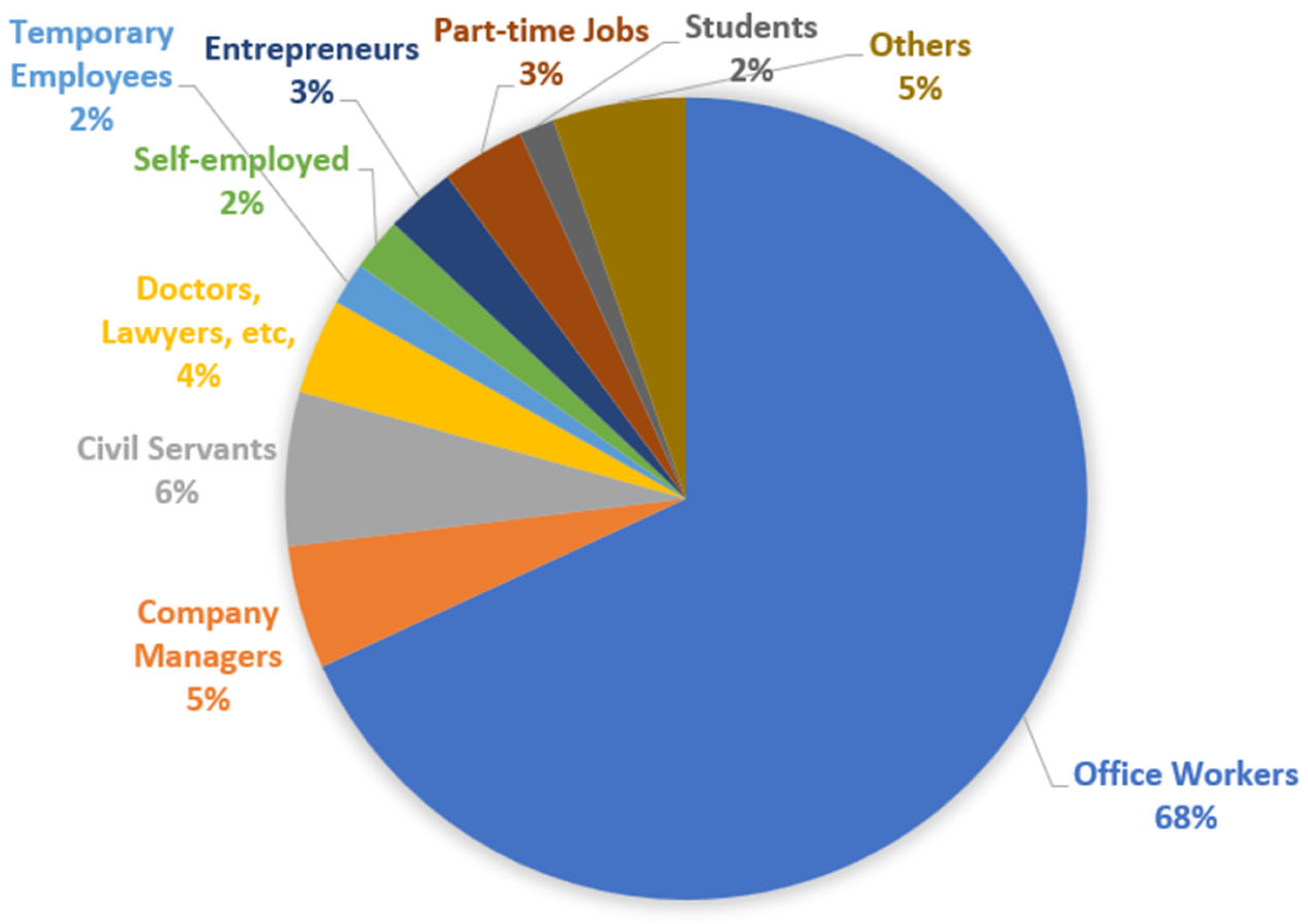
The passengers of the Tokaido Shinkansen can be further divided based on several indicators. Based on their occupations, more than 65% of the passengers are office workers, as shown in
Figure 2.
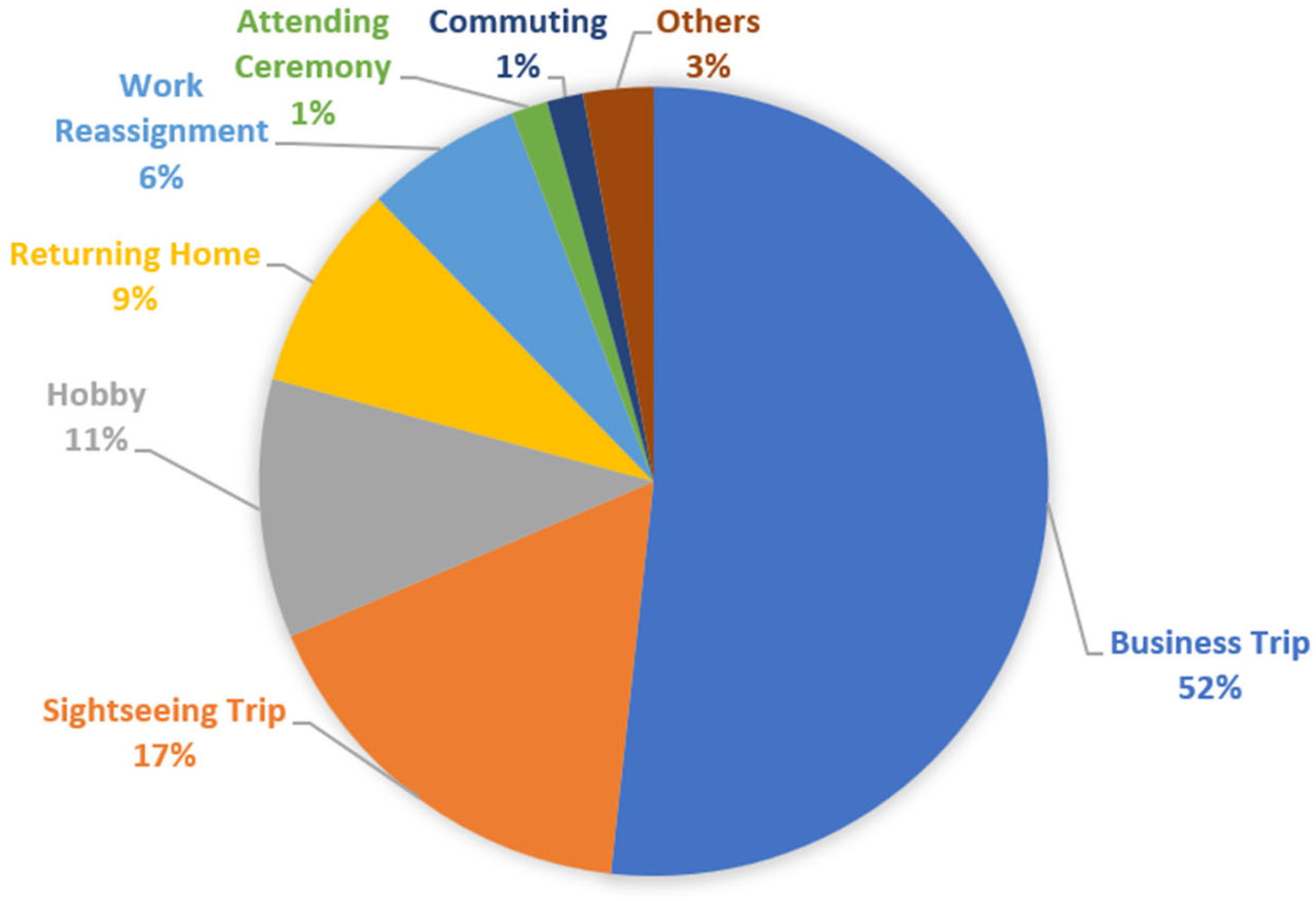
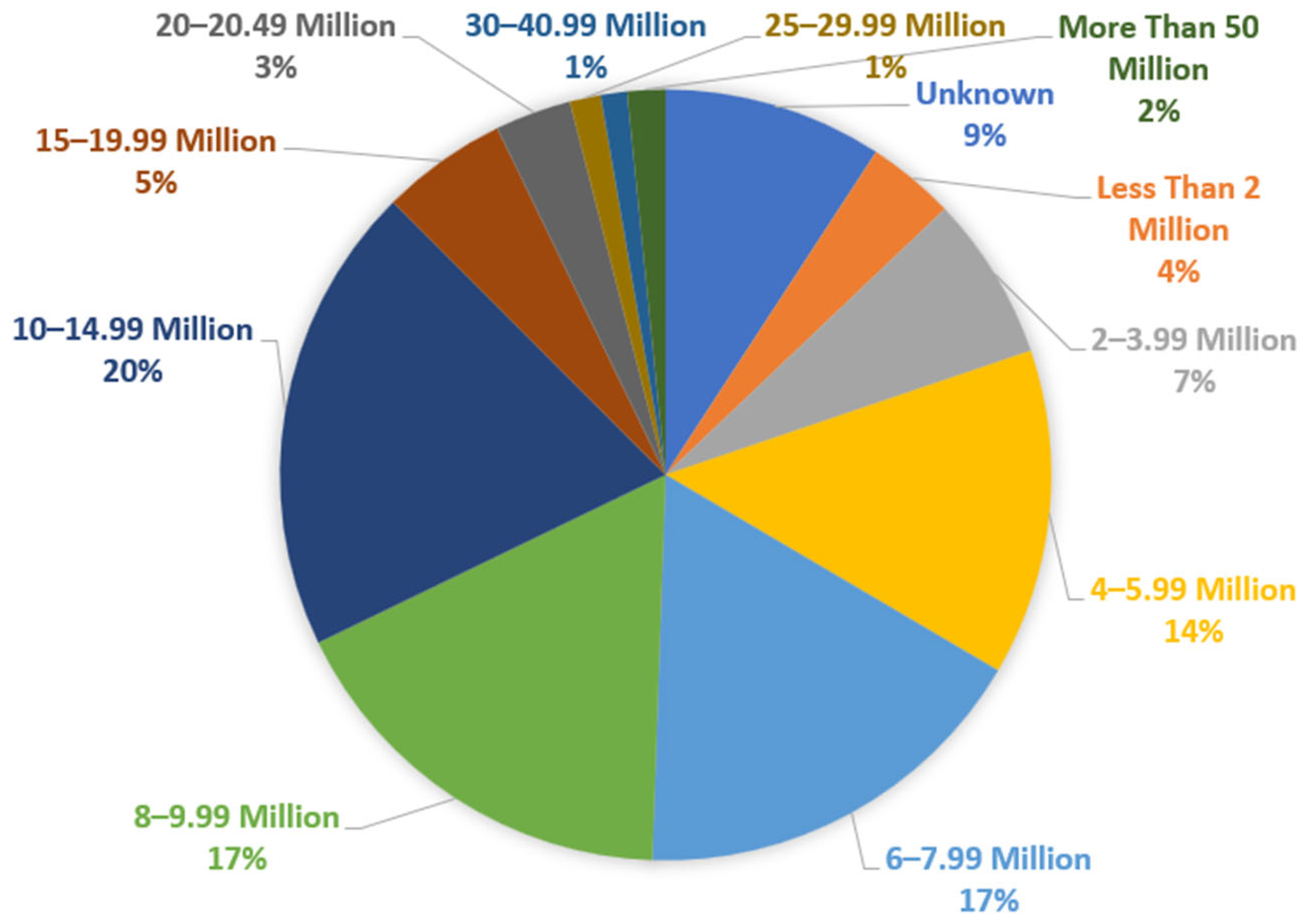
Figure 3 also indicates that the main purpose of using the Shinkansen is to conduct a business trip, which stands at 52%. When it comes to the amount of annual household incomes, the biggest group will be the passengers with annual incomes that range from JPY 10 to 14.9 million per year, as represented in
Figure 4.
The data on annual income can be further broken down based on the VOT per minute for each passenger. It represents each minute’s worthiness when converted to money, which can be obtained by dividing the annual income by working hours. Based on the survey of the Ministry of Health, Labor and Welfare, the average working hours of Japan’s workers are 134.7 h per month. This generates the value per annual income cohort, which can be seen in
Table 3.
3.3. Passenger VOT and Participation Decision
In this study, the Shinkansen passengers are grouped into several VOT cohorts according to their opportunity cost of time, expressed in JPY per minute. The VOT distribution is calibrated using typical income levels and wage-based estimates from the passenger transport economics literature. It is represented by three categories: low VOT (e.g., leisure travelers), medium VOT, and high VOT (e.g., business travelers). Each cohort accounts for a fixed share of total passengers on the Tokaido Shinkansen.
A passenger decides to participate in crowdshipping if the monetary reward per minute of additional time required for parcel handling is at least equal to his or her VOT [
5]. The rates of participation in this study represent a model-implied participation based on the aforementioned estimations and assumptions, instead of observed behavior-based participation [
7,
12]. Previous research conducted by [
7] assumes the availability of drivers to conduct an evaluation of the feasibility and cost savings for parcel delivery. Another study conducted by [
12] was carried out by analyzing a public transport-based crowdshipping system using modeled passengers’ participation. By referring to those studies, the variables used in this study are intended as model-implied proxies rather than direct measurements constructed from empirical observation.
Formally, a passenger in cohort with the (JPY/min) participates if , where is the per-parcel reward offered to the passenger, and is the additional time required to pick up and drop off the parcel at lockers. Under JR Central’s cooperation, reflects a short handling and walking time because lockers are assumed to be placed inside the station area, whereas in the absence of JR cooperation, is larger due to the need to exit and re-enter the station or walk longer distances to external lockers. For each allocation scheme, the participation rate is obtained by summing the shares of all cohorts that satisfy the inequality above.
3.4. Cargo Demand Data
The number of parcels delivered to prefectures along the Tokaido Shinkansen route (Tokyo, Kanagawa, Shizuoka, Aichi, Gifu, Shiga, Kyoto, and Osaka) was calculated based on the results from [
23].
The calculation of parcels originating from Tokyo was performed through the multiplication of the total volume of generated parcel deliveries in Tokyo by the share of parcel concentration in the prefectures along the Tokaido Shinkansen route. This would also apply to parcels originating from other prefectures. However, parcels that are delivered to the same prefecture as the origin (e.g., from and to Tokyo) would be excluded from the calculation, for the crowdshipping concept only covers inter-prefectural deliveries in this study.
Due to the unavailability of the corridor-specific OD parcel flow data, the analysis utilizes the aggregated prefectural-level data as proxies. Therefore, the results should be interpreted as the scenario-based estimation for the feasibility analysis of the crowdshipping concept from the economic and profit-allocation standpoint rather than empirically generated parcel flow predictions.
The result of the calculations can be seen in
Table 4. The annual transport demand is approximately 697 million parcels, which is the sum of all prefectures combined. This figure corresponds to 1.91 million parcels per day.
4. Methods
4.1. Advantages and Disadvantages of Participating in Crowdshipping
To analyze the distribution of rewards for each collaborator in the crowdshipping, the collaborator must be defined properly, along with the potential advantages and disadvantages that they may receive should they participate in the crowdshipping scenario.
Table 5 summarizes these pros and cons thoroughly.
The crowdshipping system can actually be implemented without the cooperation of JR Central as the train operator. However, it may pose several potential problems, as the time and effort required to send the package may increase due to the inability of the lockers to be placed within the premises of the JR station. This, however, cannot work without the cooperation of Sagawa and the passengers of the Tokaido Shinkansen, as they constitute the fundamental part of crowdshipping as the operator and the crowdshippers, respectively.
4.2. Base Value of Delivery Fee
As mentioned before, the crowdshipping method serves as an alternative method to the conventional delivery method that is usually carried out by the LSPs. Assume that a package delivery is carried out from Tokyo to Osaka. Under the conventional method, that means the company, in this case, Sagawa, will have to send the package using its own delivery truck. Whereas under the crowdshipping concept, Sagawa collaborates with passengers as the crowdshipper to deliver the package from the station that serves the Tokaido Shinkansen in Tokyo to another one in Osaka. Therefore, in the case of crowdshipping, the delivery cost from Tokyo to Osaka will be switched from being directly paid to Sagawa by the clients to being paid to the crowdshippers, with Sagawa as the intermediary component that acts as the payee. Based on this concept, this study considers that the long-distance package delivery under the crowdshipping concept will switch from the company to the crowdshippers, with the delivery cost treated as the compensation for the crowdshippers.
While it is true that crowdshipping may have the potential to reduce the labor and fuel costs that are associated with the conventional methods, in this study, it only applies to the middle-mile service, with the last-mile section still having to be performed using Sagawa’s conventional delivery method to ensure that the package is received by the receiver.
Section 3.1 of the previous chapter has already mentioned that the average cost per package for home delivery service numbered around JPY 689.7. By using this figure, this study assumes that this would be the value of the delivery cost that will be incurred by Sagawa directly. In Japan, several types of parcels exist that are measured according to the total amount of length, width, and height. With the size ranging from 60 to 200 [
24]. According to Sagawa, the price for sending a package with a size of 60-standard (total amount of length + width + height less than 60 cm and weight less than 2 kg) is JPY 1040 for a delivery shipment from Tokyo to Osaka [
25]. This, however, is the price of a regular delivery service in which the package will be delivered to the destination the afternoon of the day after shipment. For the same-day delivery and using the same size, Sagawa charges JPY 2173 per package, which brings the total difference between the two services to JPY 1133 [
25]. Since the crowdshipping scenario enables the shipment to be performed on the same day through the utilization of the Shinkansen, the total difference of JPY 1133 will be used as the base of the compensation for the collaborators.
4.3. Determining Reward Amounts Using Game Theory
To make crowdshipping a viable concept, the cooperation of all the collaborators within the system, which includes Sagawa as the LSP, JR Central as the Tokaido Shinkansen operator, and the passengers as the crowdshippers, is paramount. All of the collaborators will henceforth be known as players under the game theory paradigm. Under the crowdshipping system, multiple players that are autonomous from each other need to cooperate. Therefore, the game theory will analyze the best way to see what kind of cooperation or alliances the players will form and how the profits from the already pre-determined base value (JPY 1133) will be best distributed among the players.
This study uses game theory as a way to determine the most reasonable distribution ratio through cooperative feasibility assumptions. In general, the method can be further broken down into two. The first one is the non-cooperative game theory. In which each party will act rationally and independently to achieve various objectives that have been established and see what kind of outcomes can be reached [
23]. The second one is the cooperative game theory. In which the players are allowed to act cooperatively and focus on the fair distribution of profits among players [
23]. Since crowdshipping is strongly associated with collaborative effort among its collaborators, this study will treat crowdshipping as a cooperative game and will also apply the relevant function to determine the best distribution method for the profits. The distribution method is commonly known as a solution, and it is defined based on several concepts. This study will analyze the solution for the game theory based on two allocation methods: Shapley value and Nucleolus.
4.3.1. Cooperative Game with Side Payments
One type of cooperative game is the class of games with side payments. It can be defined as the summation of the alliance’s value, which can be defined by a single real number that enables it to be represented in a scalar value [
26]. This representation is made possible based on two fundamental aspects of this type of cooperative game: transferable utility and side payments.
Transferable utility is the concept that defines the utility of each player under monetary value, which can be represented by profits that the alliance makes and can be exchanged to ensure the comparability of the alliance’s value [
26]. The existence of transferable utility does not enable the free allocation of the payoff among the alliance’s players. This might pose a problem of the redistribution of profits among players, which is solvable with side payments. It allows the players inside the alliance to freely redistribute the payoff among themselves to enable the allocation of profit under the prearranged agreement between all players [
26]. Transferable utility and side payments serve as the basis to allocate profits so that they can be transferred and divided in the alliance.
4.3.2. Characteristic Function Game and Coalition Definition
A cooperative game with side payments is represented by a pair of , where is the set of players that participate in the game and is the characteristic function.
Definition 1. Let denote the set of players participating in the game, and an alliance is defined as any subset .
Definition 2. Let represent a characteristic function for each alliance ; is a benefit of the alliance obtained through cooperation.
The merging of two coalitions brings a new function that is additive. It can also be called superadditivity, in which the gain obtained by the new alliance is greater than the sum of the gains of the original two alliances.
Definition 3. For any , a characteristic function is additive such that , .
4.3.3. Utility and Distribution Structure
In cooperative games with side payments, the utility for each player can be represented by a transferable utility, which is represented as , with representing side payments.
Definition 4. Let and be the vector and the set of -dimensional real vectors, a payoff allocation is valid under two conditions: if (condition 1) or if x for any (condition 2).
Condition (1) is called overall rationality. It indicates that all players distribute together. Condition (2) is called individual rationality. It indicates that the allocation of is not less than the profit that a player could obtain individually. For a pair of , the set of such allocations is denoted .
4.3.4. Core as a Solution Concept
When all the players are involved in an alliance, they would cooperate to gain a profit for themselves. The situation where a set of allocations is set in a way that will make the cooperation remain stable, and no one would gain more benefit by leaving it, is called the core. If an alliance can gain more by breaking away, it would result in a deviation. The allocation under this condition will not belong to the core.
Definition 5. Given the characteristic function game , the subset of the allocations is the core.
In the case of a nonempty core, it represents the outcome that is stable for the alliance so that no player would leave. However, it can also be empty, which makes the core insufficient in determining the allocation distribution. Therefore, this study also employs allocation methods of Shapley value and Nucleolus that will produce a unique allocation method to ensure the distribution of profit gained by the alliance.
4.3.5. Allocation Method 1: Shapley Value
The Shapley value is effective in deciding allocations between carriers [
27]. The Shapley value is an allocation method in which the benefit will be distributed based on each player’s contributions to the alliance. For player
, the difference in profit gained by the player
after they join the alliance represents the contribution the player
has made, ensuring fairness and proportional distribution based on the contribution.
Definition 6. In the characteristic function form game , the subset with denotes the number of elements in ; the payoff for player is defined as
4.3.6. Allocation Method 2: Nucleolus
The nucleolus is an allocation method with the primary objective of giving a payoff vector that minimizes the dissatisfaction in the alliance. For any allocation and any alliance , the value of the dissatisfaction in the alliance, denoted in , will be minimized as low as possible by eliminating the biggest dissatisfaction. measures the under-compensation value of the alliance under the allocation . The larger the value of , the greater the incentive for the alliance to break itself off from the original grand alliance. The dissatisfaction is arranged in descending order, which will form a payoff vector . It excludes the value of dissatisfaction from and an empty coalition of . Another thing is the lexicographic order, which is represented with to ensure the fairest compromise for profit allocation under the threat of dissatisfaction.
Definition 7. For any , the set of distributions that satisfies is called the nucleolus in the characteristic function form game .
4.3.7. Formulation
Based on the game theory mentioned in the previous section, this study uses a cooperative game with side payments as a method. To reflect the feasibility of operation and the dependency relationship among players, the payoff tasks will be constructed based on the approximation values that best represent the realistic relationship among players. Under full cooperation, seamless coordination is expected with locker access, participation of passengers under crowdshipping, and logistics coordination as the aspects that build it. This is expected to produce maximal efficiency. Under the alliance scenario of no cooperation from JR Central as the railway operator, the crowdshipping may still be operational, albeit under reduced efficiency due to the inability to install lockers inside the station. Lastly, the scenario without Sagawa or the passengers’ cooperation due to their central roles as parcel provider and transporter, respectively, is not possible. Thus, crowdshipping will also not be possible.
With Sagawa, the Shinkansen passengers, and JR Central as players 1, 2, and 3, respectively, the set of players is defined as
. With this, the characteristic function
is as follows:
Value represents 100% of the available surplus. This value is later mapped to the actual monetary surplus (e.g., 100 → JPY 1133 per parcel or to the total annual surplus) when calculating the collaborators’ payments. As such, the value is possible under full collaboration of all players.
Value is possible under Sagawa and passengers’ collaboration. It corresponds to Sagawa and passengers operating without JR’s cooperation, where external lockers or ad hoc handover points are used, which halves the available surplus due to lower participation and higher effective costs.
Value and represent the inability of the working crowdshipping scenario. indicates that without passengers, crowdshipping is not feasible even if Sagawa and JR cooperate because there is no agent to carry the parcels. indicates that without Sagawa providing parcels, the passengers and JR cannot generate a surplus in this scheme.
Lastly, any player will not gain any profit if they operate independently, represented by value . In other words, no player alone can operate this crowdshipping model profitably; hence, the characteristic function assigns a value of 0.
Assume the total profit that can be obtained when cooperation is obtained from all players, Sagawa, passengers, and JR, is 100. If cooperation is obtained from Sagawa and passengers, crowdshipping is possible, but since lockers cannot be installed inside stations, we assume that the participation rate will drop by half due to increased effort on the part of passengers, so . If cooperation is not obtained from Sagawa, which provides the luggage, or from passengers, who transport it, crowdshipping will not be possible, so . Similarly, each player alone will not gain any profit, so . Using this formulation enables the alliance to be evaluated using core solutions, Shapley value, and nucleolus to ensure fair distribution of profits.
The values, both under the Shapley and nucleolus allocation methods, are calculated using the function defined in Equation (3), where the normalized total surplus is set to 100. The value variations of the alliance represent feasibility and efficiency under multiple scenarios, such as increased handling costs and reduced participation scenarios in the absence of JR Central as one of the players. The ratios obtained from the scenario are converted into monetary values by scaling the normalized surplus values to the delivery cost under the same-day delivery scheme of JPY 1133 per parcel. This ensures the consistency of the predefined formulation and the results from the calculation.
4.4. A Comparison of the Total Logistics Cycle Costs for Different Scenarios
This study explicitly contrasts the total logistics cycle cost of the baseline truck-only scenario with that of the Shinkansen-based crowdshipping scenario between Tokyo and Osaka, including all additional handling and station trips. Under the baseline, Sagawa handles the entire first–middle–last mile by truck, and the average operating cost per parcel is JPY 689.7, derived from FY2024 delivery business expenses and total handled items. The regular (next-day) tariff for a size 60 parcel on this corridor is JPY 1040, while the same-day service costs JPY 2173, so the additional JPY 1133 is interpreted as the customer’s willingness to pay for faster service.
In the crowdshipping scenario, each passenger carries a maximum of one parcel. The first and last mile remain truck-based and retain the same unit cost of JPY 689.7 per parcel, but the middle-mile truck operation is replaced by Shinkansen-based crowdshipping. The JPY 1133 same-day premium is treated as the gross surplus that can be reallocated among Sagawa, passengers, and JR Central, covering (i) Shinkansen-based middle-mile transport; (ii) parcel handling at departure- and arrival-station lockers; and (iii) the additional access/egress time incurred by passengers when picking up and dropping off parcels. When JR Central cooperates, lockers are located inside stations, and the additional handling time per task is assumed to be 5 min; without cooperation, lockers are located outside stations, and the handling time increases to 15 min, which is reflected in higher per-minute rewards required to sustain participation.
The analysis does not break down each operational sub-cost within the parcel delivery itself but rather limits all costs incurred from additional activities that might result from the crowdshipping scheme within the cost of same-day parcel delivery under the conventional method. This ensures the total cost to stay consistent economically across various scenarios.
Table 6 summarizes the total logistics cycle cost per parcel for the baseline and representative crowdshipping schemes, including extra handling and the implicit cost of courier trips between local depots and station lockers. In the baseline, the full per-parcel cost is given by Sagawa’s average operating cost (JPY 689.7) plus the implicit cost of middle-mile truck operations already embedded in that figure. In the crowdshipping case, the per-parcel cost remains anchored at JPY 689.7 for first- and last-mile activities, while the JPY 1133 surplus is redistributed as side payments among collaborators according to the Shapley value or nucleolus solutions, so that the total logistics cycle cost to the operator does not exceed the customer’s same-day tariff but covers additional handling and station access required by the crowdshipping scheme.
5. Results and Discussion
The results from the calculations were obtained through various settings of allocation methods (Shapley value and nucleolus) and cooperation scenarios (with and without JR Central) to determine the most feasible result from this study.
5.1. Profit Allocation
To determine the optimal allocation of profit among all players involved (Sagawa, passengers, and JR Central), the distribution ratio is calculated as shown in
Table 7. Under this scenario, the crowdshipping is conducted under full cooperation of all the players. The allocation method for payoff distribution utilizes both the Shapley value and the nucleolus method. Under the Shapley value method, Sagawa and the passengers receive 5/12 of the payoff, and JR Central receives the remaining 2/12. Meanwhile, the nucleolus method enables the payoff to be distributed in a ratio of 1/2, 1/4, and 1/4 for Sagawa, the passengers, and JR Central, respectively. In both methods, the ratio of profit assigned to JR Central is smaller. Despite its importance to the crowdshipping scheme, its contribution is primarily focused on the provision of space for the lockers within the stations rather than direct involvement on an operational basis. Moreover, the scenario can be carried out without the involvement of JR Central, which provides further justification for the small value of the profit ratio. This can be seen in
Table 8, which distributes the payoff ratio under the scenario involving only Sagawa and passengers. Under this scenario, the payoff ratio is set to half for both Sagawa and the passengers under the Shapley value and the nucleolus method.
From the expected surplus of JPY 1133 as a result of crowdshipping implementation, the distribution under the Shapley value and nucleolus method can be seen in
Table 9. It shows the result of the distribution both with and without JR Central cooperation in the scenario. Furthermore, it also shows different scenarios where Sagawa receives a portion of the payoff and when it does not. The decision as to whether Sagawa receives the payoff or not is based on the possibility that the company, as the primary beneficiary of the crowdshipping system, may have the possibility of conducting the crowdshipping-based delivery system under a condition in which it will allocate its share to other players to further attract the participation of other players involved in the alliance. This is possible due to the elimination of labor and fuel costs originally spent by Sagawa under the conventional delivery system.
From the table, it can be seen that the highest reward one player can receive is JPY 1133. This occurs under the situation in which JR Central does not cooperate in the crowdshipping scenario, and Sagawa receives no share from the payout. This, however, will have a consequence of a different placement scenario for parcel lockers since no JR Central cooperation means the lockers cannot be placed within the premises of the station.
The JPY 1133 surplus from the additional middle-mile and handling tasks introduced by crowdshipping can be decomposed as follows: With JR’s cooperation, the nucleolus allocates JPY 567 to Sagawa, JPY 283 to passengers, and JPY 283 to JR Central per parcel. This allocation exhausts the JPY 1133 surplus, fully compensating for the extra handling stages and short station trips while maintaining Sagawa’s underlying first–last mile cost of JPY 689.7. In the high-participation schemes without a Sagawa share, the full JPY 1133 is allocated to passengers and JR Central. This increases the per-minute reward and participation rates while shifting a larger share of middle-mile flows from trucks to the Shinkansen. However, the overall cycle cost remains within the same-day customer tariff.
As previously mentioned, under the situation in which JR Central cooperates, it enables the installation of the parcel lockers to be placed within the station’s area. Using this situation as the basis, it can be assumed that the time required for parcel handout and handover from and to passengers will take 5 min. When JR Central does not cooperate, the time required for both handout and handover is 15 min, since the lockers will be placed outside the station. Since the required time takes longer without the cooperation of JR Central and thus also results in longer distances for the passengers to handle the parcels, the rewards for the passengers will be higher to incentivize such possibilities.
Table 10 shows these possibilities and the respective reward per minute for each payoff scenario.
Considering the time required to handle the parcels, the highest reward per minute can be observed in the case of JR Central cooperation within the scenario, and no share for Sagawa under the Shapley value allocation method, with JPY 161.8.
5.2. Reward Allocation
The participation rates reported in
Table 11 are derived directly from the game-theoretic reward allocations and the passengers’ value-of-time distribution. For each allocation method, the cooperative game determines the passengers’ share of the surplus, which is then converted into a per-parcel reward R (JPY) as shown in the second column of
Table 9. Given R and the assumed handling time T under each cooperation scenario (with or without JR Central), the implied reward per minute R/T is compared with the VOT of each passenger cohort. All cohorts for which
are assumed to participate, and the participation rate is the sum of their population shares.
For example, when the nucleolus is applied with JR cooperation, the per-parcel reward of JPY 283 implies a moderate reward per minute, so only the low- and part of the medium-VOT cohorts participate, resulting in a participation rate of 32.6% and 52 million parcels carried per year. Under the ‘no Sagawa share’ scenarios, the passenger reward increases substantially (up to JPY 567–JPY 1133), which raises the reward per minute above the VOT of most cohorts; this leads to higher participation rates (up to 81.8%) and larger volumes and CO
2 reductions, as shown in
Table 11.
The passengers’ participation rate in the crowdshipping scenario is determined based on the reward amounts given to them. This participation rate reflects the yearly number of parcels carried by passengers. The reward can also be utilized to calculate the amount of CO
2 reduction. The basic logic of the passenger participation as a crowdshipper is based on the rewards that need to exceed the time value per minute obtained from their respective income. The reward per minute can be seen in
Table 11 below.
Even though the passenger reward is lower under the nucleolus with JR cooperation, it generates a higher participation rate (32.6%) than the Shapley value with JR cooperation (14.6%), which offers a larger absolute reward. What matters for participation is whether the reward per minute exceeds each passenger’s VOT threshold, rather than the total reward amount. Under the nucleolus with JR cooperation, the per-minute reward is sufficient to meet the thresholds of both low- and medium-VOT passengers, leading to broader participation. In contrast, the higher total reward under the Shapley value is concentrated on a narrower subset of passengers and does not adequately cover the full range of VOT thresholds, resulting in a lower overall participation rate.
Under the assumption that each passenger carries one parcel, the number of annual parcels delivered using the Shinkansen under the crowdshipping scenario is obtained through the multiplication of the passengers of the Tokaido Shinkansen by their participation rate under various allocation methods. For the CO
2 reduction, the number of parcels delivered is multiplied by the emission intensity produced by Sagawa’s parcel delivery, which amounts to 184.6 g-CO
2 per parcel [
12].
From the table, it can be seen that the number of parcels delivered never exceeded the annual parcel demand of 697 million parcels mentioned in
Section 3. This proves that the crowdshipping scenario can supplement the demand for parcel delivery, and it will always have the demand, thus preventing a condition where the crowdshipping scenario exists without the parcels to deliver.
Regarding the participation rate, under the scenario of JR Central’s cooperation, the passenger, who acts as the crowdshipper, will require less time to handle the parcel, hence increasing the participation rate from the passenger side. However, the participation rate is noticeably lower under the Shapley value method, thus reducing the number of parcels carried and their respective emissions reduction. This also achieved the observed effect of increased reward for the crowdshipper since a lower participation rate means a higher monetary reward per capita.
Under the scenario in which Sagawa receives no payoff, the reward for passengers significantly increases, which in turn increases the participation rate and the reduction of CO2. This is due to the allocated payoff for Sagawa being completely redirected for the passenger. Meanwhile, the scenario of JR Central’s absence in the alliance resulted in the placement of parcel lockers outside the stations. This will increase the burden for the passenger since they require more time and cover more distance to handle the parcel, which results in lower participation rates and CO2 reductions. This proves that the cooperation of JR Central is paramount to ensure a high participation rate of passengers and reduce CO2 even more.
The environmental impact in the form of CO
2 reductions proved to be potentially high under the implementation of the crowdshipping scenario. The original amount of CO
2 emissions in FY2023 was recorded at 1,716,291 t-CO
2, a considerably high number of emissions. Sagawa, in line with its objective of improving its sustainability record, aims to reduce greenhouse gas emissions by 46% compared to FY2020 by 2030 [
20]. The number of emissions in FY2023 has achieved 13.5% of the target [
20]. Utilizing the Tokaido Shinkansen for the crowdshipping method can potentially further reduce the number of CO
2 emissions by 7%, which is about half of the company’s annual emissions-reduction goal. This proves that crowdshipping can help decrease greenhouse emissions even further to achieve the target even faster, provided the conditions above regarding modeled participation and cooperation are met. However, it is also worth noting that the estimated CO
2 represents the potential reduction produced by the shift to the crowdshipping-based delivery system in the middle-mile section from a conventional delivery system. The estimations do not account for other potential CO
2 that can be produced by other aspects, such as electricity or rail operations. As such, the reduction can be interpreted as an upper-bound estimation under the stated assumptions for the model rather than a comprehensive emission analysis for the crowdshipping-based system using the Shinkansen.
Considering the potential that crowdshipping can bring, such a method can serve as a novel way in the logistics sector and provide the potential to significantly contribute to creating a sustainable delivery method in the future.
5.3. Managerial Implications
The managerial implications indicated in this section are obtained from the results of scenario-based modeling that provide a novel insight into the crowdshipping concept. Through these implications, the incentives and participation of each stakeholder and their respective response within the alliance are observed under modeled assumptions.
From Sagawa’s perspective, the most realistic payoff scheme is one in which the logistics company retains a stable and positive share of the surplus while offering sufficient incentives to passengers and JR Central. Among the examined schemes, those in which Sagawa receives a moderate share (e.g., 30–50% of the surplus) and passengers receive a substantial but not dominant share are particularly attractive because they ensure that (1) Sagawa can justify investments and operational adjustments internally and (2) passenger rewards are large enough to sustain participation rates above 30–40%. In contrast, although extreme “no Sagawa share” cases are useful as an upper bound for passenger participation, they are unlikely to be implemented because they leave Sagawa without a direct financial benefit, thus undermining the business case for crowdshipping.
JR Central’s direct monetary share of the surplus is modest in most schemes. However, cooperation can still be attractive when considering non-monetary benefits. JR Central’s participation in allocations that yield even a small percentage of the surplus, coupled with substantial reductions in CO2 emissions and congestion on the Tokaido corridor, establishes a compelling case for corporate social responsibility and alignment with national decarbonization policies. Therefore, JR Central is more likely to accept schemes in which it receives a small but visible share (e.g., 10–20% of the surplus) and can publicly claim contributions to sustainable logistics than it is to accept purely operational roles with no explicit share in the profits.
Policy support can significantly alter the preferred allocation by effectively increasing the total surplus to be distributed. For example, if subsidies for modal shift or revenues from carbon credits were added to the crowdshipping scheme, the additional funds could be used to increase passenger rewards without reducing Sagawa’s residual share. Alternatively, they could be used to allocate a higher share to JR Central as compensation for station space and operational adjustments, while maintaining Sagawa’s profitability at an acceptable level. In such cases, allocation schemes that are currently unattractive to one of the parties, for example, those with a relatively high JR share, may become viable once policy-derived revenues are incorporated into the cooperative game as an additional component of the grand coalition value.
6. Conclusions
The growing concern of driver shortage in the logistics sector that Japan is currently facing triggered the need for research to alleviate this problem. Crowdshipping, a novel approach in the logistics delivery system, is examined in this study to determine the feasibility of the approach through the utilization of the Shinkansen as one of the forms of public transportation. The observed aspects in this study focus on the participation of Shinkansen passengers along the Osaka and Tokyo route as crowdshippers to deliver the parcels.
The implementation of a crowdshipping-based delivery system using the Shinkansen involves three main stakeholders who will collaborate to maximize the success of the crowdshipping application. These are Sagawa as the delivery company, JR Central as the railway operator, and the passengers as the crowdshippers. Game theory is utilized to find out the best profit-sharing ratios for each stakeholder, who will be called a player, in the alliance to ensure the fairness of the distribution of profit, thus minimizing the dissatisfaction among players. To find the best solution, several allocation methods, such as the Shapley value and nucleolus method, were employed under the core function of cooperative game theory.
The key findings are threefold. First, the proposed Shinkansen-based crowdshipping scheme between Tokyo and Osaka can generate a positive surplus for all collaborators if passenger participation rates exceed a certain threshold. This scheme would simultaneously reduce delivery costs and CO2 emissions compared to conventional truck-based operations. However, it is important to consider that this condition can be achieved under the current settings and assumptions of participation and cooperation scenarios, which will, in fact, affect the result of the analysis.
Second, cooperative game-theoretic allocation rules, such as the Shapley value and nucleolus, produce profit-sharing ratios that give Sagawa the largest share of the surplus while still providing meaningful incentives for passengers and JR Central. Higher passenger shares lead to higher participation rates and larger environmental benefits.
Third, scenario analysis shows that cooperating with JR Central improves system performance by reducing handling time and increasing participation. However, extreme “no Sagawa share” cases are useful as upper-bound benchmarks for participation and are unlikely to be implemented as realistic business models.
This study offers several policy and practical implications. First, for logistics managers, the results suggest that crowdshipping using high-speed rail can be integrated as a complementary long-distance transport option, particularly on dense corridors such as Tokyo–Osaka, to alleviate driver shortages and support same-day delivery services without sacrificing profitability.
Second, for JR Central and other railway operators, even modest monetary shares can be justified when reputational and sustainability benefits are considered; explicitly framing crowdshipping as a decarbonization and modal-shift measure can facilitate internal acceptance and partnerships with logistics firms.
Third, for policymakers, subsidies for modal shift, support for locker infrastructure at major stations, and mechanisms to monetize CO2 reductions (e.g., carbon credits) can expand the total surplus and make cooperative profit-sharing schemes more attractive for all players, thereby accelerating the deployment of similar crowdshipping models on other high-speed rail corridors in Japan and abroad.
The significance of this study lies in its ability to assess the economic feasibility of crowdshipping-based delivery based on numerical analysis and utilizing actual data. This, in particular, is related to the reallocation of labor and fuel costs that would have been spent under the conventional-based delivery method to serve as a reward to the cooperating parties. Moreover, using game theory, it establishes the precedent that crowdshipping is not only an abstract concept but also a realistically feasible logistics delivery method from the business perspective. However, it is worth noting that the analysis will provide a model-based insight into the distribution of reward under certain allocation methods rather than proving the operational feasibility of the crowdshipping concept.
This study has several limitations. First, the participation of passengers in the crowdshipping scenarios is modeled using VOTs that are based on the average income data rather than direct field observation, which may result in the over- or under-estimation of passengers’ participation in the scheme. Second, this study is based on the assumption of the maximum parcel that can be carried by each passenger, which is capped at one parcel per passenger. It does not take into account the potential constraints that may arise, such as the absence of luggage space or the comfort of the passenger. Third, the allocation of demand and the emission calculations that follow were based on average values and do not take aspects such as the variety of parcel sizes or routes into the equation. Fourth, due to the nature of this study, which puts an emphasis on finding the outcomes under multiple scenario simulations to assess the feasibility of the crowdshipping-based system, the findings of this study should be treated as scenario-derived modeling rather than an actual estimate derived from real-world observations. Finally, this study does not address safety-related aspects, such as (i) preventing the shipment of dangerous or illegal goods that could damage trains or infrastructure and (ii) reducing the risk of theft or tampering by dishonest carriers, as these lie beyond the analytical focus of the current model. While such risks may result in higher passenger compensation or different arrangements in the distribution of rewards within the alliance due to additional handling procedures or more stringent regulatory processes, which lead to higher costs, quantitatively addressing such risks will require additional institutional, technological, and regulatory measures (e.g., screening, identification, monitoring, liability rules) and empirical data, which are not incorporated into the present cooperative game formulation but represent important directions for future research and policy development.
Moreover, all conclusions in this study, which are closely related to the feasibility analysis of the crowdshipping concept from the economic perspective, are confined within the Tokyo–Osaka corridor due to the absence of the intra-corridor-related data and shall not be applied to intermediate segments, such as Tokyo–Nagoya, without additional supporting data that will enable more detailed analysis.
It is also worth noting that neither Sagawa nor JR Central has publicly announced a collaborative project in relation to the Shinkansen-based delivery system, nor have they participated in this research in any form. Due to the novelty of this concept, it is imperative that studies like this be conducted on a greater scale in the future to make the participation of LSPs and other stakeholders possible. Ample opportunities in crowdshipping research are available. In relation to the study of crowdshipping using game theory, it can be expanded based on the utilization of other Shinkansen lines. This includes the Tohoku and Kyushu Shinkansen, which enables the crowdshipping-based delivery concept to be applied to a wider coverage. Moreover, research related to the feasibility of collaboration of stakeholders such as the logistics service provider, railway company, and passengers can be widened to include studies on surveys of participation willingness from the passengers, expansion of multimodal-based crowdshipping business scenarios, development of a system for the parcel and passenger matching process, and also regulatory preparation for the creation of the legal framework of the crowdshipping itself. In other words, to push for faster real-world implementation, numerous research studies can be carried out in this field to ensure a smooth transition for crowdshipping to transform itself from a conceptual thought to a realistically feasible method for the logistics sector.