Article

Regional Vulnerability to Food Insecurity in Indonesia: A Fuzzy Set Qualitative Comparative Analysis

1
Faculty Economic and Business, UPN Veteran Jakarta, Jakarta 12459, Indonesia
2
Regional and Rural Development Planning, IPB University, Bogor 16680, Indonesia
*
Author to whom correspondence should be addressed.
Sustainability 2026, 18(3), 1221; https://doi.org/10.3390/su18031221
Submission received: 22 November 2025 / Revised: 15 January 2026 / Accepted: 16 January 2026 / Published: 26 January 2026

Abstract

Regional vulnerability to food insecurity is shaped by intertwined socioeconomic and climatic factors. In Indonesia, vulnerability is evident in the rise in undernourishment from 8.23% in 2017 to 10.21% in 2022. This study proposes a new regional vulnerability index for food insecurity across Indonesia and shows that social and economic conditions are the main drivers. Using fuzzy set Qualitative Comparative Analysis (fsQCA), the study examines how combinations of poverty, unemployment, GRDP per capita, government expenditure per capita, economic growth, and rainfall jointly produce vulnerability. fsQCA groups regions with similar profiles and identifies multiple causal pathways instead of a single cause. Analysis of 34 provinces reveals nine distinct pathways, typically involving high poverty and unemployment, low income and government spending, slow economic growth, and low rainfall. The results highlight the need to account for each region’s specific combination of conditions and to use methods that capture causal complexity in food insecurity.

1. Introduction

Understanding vulnerability is crucial to identify who and what is at risk from hazards. It explains why disasters occur when hazards strike, revealing populations’ or systems’ susceptibility and guiding effective risk reduction and response strategies. Vulnerability highlights social, economic, and political factors influencing disaster impacts [1]. Regional vulnerability to food insecurity is considered a pressing “emergency” issue, not only within national boundaries but also on a global scale [2,3]. Vulnerability to food insecurity, an important aspect, can occur at the regional level, in Indonesia there are 74 districts or cities, accounting for approximately 17.1% of areas are classified as vulnerable to food insecurity [4]. The factors contributing to this vulnerability vary across regions, each influenced by their distinct characteristics [1].
Vulnerability to food insecurity stems from both social issues and the economic conditions in affected areas. In this studies explain how some characteristics from socioeconomic and environmental factors such as poverty rate, unemployment, economic growth, and the impacts of climate change as the characteristics of vulnerability on food insecurity. This study aims to contribute to the Sustainable Development Goals (SDGs) 2 (Zero Hunger) and 1 (No Poverty) [5,6].
Understanding the characteristics of regions prone to food insecurity is crucial for several reasons. It supports risk assessment by identifying and prioritizing food security threats, enabling targeted interventions. It also improves community preparedness for disasters and food crises and informs planning for the development of vulnerable areas [7].
Social factors such as high poverty rates undermine a region’s ability to meet food needs [8]. Areas with elevated poverty often struggle to secure adequate food [9]. The Food and Agriculture Organization reports that in Indonesia about 15.15 million of the poor (60.25%) live in rural areas, while 9.99 million (39.75%) live in urban areas, which makes it difficult for these populations to satisfy their food needs [10].
Another social contributor to food insecurity is unemployment [10,11]; Indonesia’s unemployment rate was 5.32% in 2021, reflecting challenges communities face in meeting food requirements [12].
Economic indicators economic growth, GDP per capita, and expenditure per capita also shape a region’s vulnerability to food insecurity. Positive economic growth generally increases employment and incomes, boosting purchasing power and reducing food insecurity [13]. Regions with higher GDP per capita typically enjoy better economic welfare, which often translates into improved access to food, infrastructure, and public services [14].
Environmental conditions, alongside economic and social indicators, also shape a region’s vulnerability to food insecurity; climate change is a key factor [6]. Global climate shifts, closely monitored by experts, can profoundly affect societies [15]. Unpredictable rainfall, both deficits and excesses, adversely impacts food security. Rainfall exhibits a dual nature, acting as both a boon and a bane for agricultural systems and food security. In drought-prone regions, adequate precipitation replenishes soil moisture, enhances crop yields, and mitigates water scarcity, fostering resilience against food insecurity. Conversely, excessive rainfall overwhelms areas with poor water absorption capacity due to saturated soils, inadequate drainage, or urbanization—triggering devastating floods that erode farmlands, destroy harvests, and disrupt supply chains [16,17].
Research on Pakistan shows climate variability and extreme weather disrupt agricultural production, reducing yields and increasing risk [18]. Regions with low or erratic rainfall face droughts that limit irrigation water and depress crop yields, heightening food scarcity. This bidirectional impact underscores the vulnerability of food systems to rainfall variability, particularly in tropical regions like Indonesia, where monsoon patterns amplify risks. Food insecurity often stems not just from absolute shortages but from localized disruptions exacerbated by climate extremes. Existing studies highlight rainfall’s role in regional vulnerability but rarely dissect its configurational patterns using advanced methodologies [19]. Others conditions, land affected by moderate drought in 2021 totaled 253,559 hectares and rose to 268,123 hectares in 2022, contributing to reduced agricultural productivity [20].
Several previous studies from Sileshi et al. [3], Botreau & Cohen [21], Holleman and Conti [14], identified a research gap by combining regional characteristics that describe food insecurity, supported by additional works from Begna [19], Botreau & Cohen [21], Guo et al. [6], Feldman & Shwartz-Ziv [8]. According to Wang et al. [22] food insecurity is intrinsically linked to poverty, which restricts families access to food. Jatav & Naik [15] report that women with limited education may lack the knowledge to select nutritious foods and emphasize that protecting regions from food insecurity can promote sustainable agriculture and contribute to global development.
Although food security has been widely studied, this research narrows the focus to food vulnerability and insecurity by examining regional vulnerability characteristics. Prior studies have often overlooked the interconnections among poverty, unemployment, and climate factors as core characteristics in their frameworks. Few researchers have examined how poverty (an economic stressor), unemployment (a source of income instability), and climate variability (an environmental disruptor) interact to amplify vulnerability in specific contexts such as rural or developing economies. Moreover, there is a notable lack of research explicitly linking the broader concept of vulnerability encompassing social, economic, and environmental susceptibilities with food insecurity.
This study fills that gap by examining regional vulnerability using economic, social, and environmental indicators. Characterizing regions susceptible to food insecurity helps identify specific food-related risks, improves community preparedness for food crises and disasters, and supports targeted development planning [21].
The complexity of economic, social, and environmental characteristics in assessing a region’s vulnerability to food insecurity can be effectively explained using Fuzzy set Qualitative Comparative Analysis (fsQCA). This method excels at unpacking multifaceted causal relationships, where multiple factors combine in diverse ways to produce outcomes like heightened food insecurity, rather than relying on simple linear correlations [8].
Fuzzy set Qualitative Comparative Analysis (fsQCA) is well suited to analyze the complex interplay of these characteristics. fsQCA unpacks multifaceted causal combinations rather than relying on linear correlations, treating vulnerability as a calibrated continuum (from fully in to fully out of the set). It identifies necessary and sufficient conditions such as high poverty, elevated unemployment, or climate shocks that lead to food insecurity, and reveals equifinal pathways and asymmetries (different causes for presence versus absence of vulnerability), yielding policy-relevant insights for development [11].
Policy measures to address food insecurity include promoting agricultural diversification, developing irrigation infrastructure, delivering agricultural education, and providing social assistance [22]. Knowing the traits of food-insecure areas improves monitoring and evaluation of regional development, supporting the design of strategies to sustainably reduce food insecurity [23].

2. Literature Review

2.1. Food Insecurity

The Food and Agriculture Organization [24] likens the threat of food insecurity to a disease outbreak, since both can cause severe outcomes, including deaths from acute hunger. Lack of reliable access to sufficient, nutritious food rapidly undermines health, increasing susceptibility to illness and mortality. Hunger also has wider social effects: as needs go unmet, people may resort to desperate behaviors, including increased crime, undermining community stability. Given these consequences, the agricultural sector requires greater attention and support; strengthening agricultural sustainability can stabilize food supplies, reduce insecurity, and protect vulnerable populations from the harms of hunger and its social impacts [25].
Food insecurity can often result from disruptions in the food supply chain caused by the effects of climate change. As global temperatures continue to rise, many regions experience more frequent and intense weather events, such as floods and droughts, which directly harm crop productivity. These extreme weather conditions not only damage the physical growth of crops but also create an environment conducive to the spread of pests and plant diseases, further reducing agricultural yields. Additionally, climate change negatively affects the quality of agricultural products, impacting their nutritional value and marketability. The combined effects of these factors lead to decreased food availability, making it difficult for communities to access sufficient and nutritious food. As a result, food insecurity has become a very real and pressing issue worldwide [26]. Numerous observations and studies have documented clear signs of food crises emerging in vulnerable areas, underscoring the urgent need to address climate change and build more resilient food systems [27]. Without immediate action, the threat of widespread hunger and malnutrition will continue to grow [21]. Addressing food insecurity in today’s interconnected world demands coordinated international trade policies that promote the efficient and reliable movement of agricultural products across borders. Such policies must facilitate access to food in regions facing shortages while supporting the livelihoods of farmers and producers within their own countries. It is essential to strike a balance between allowing the smooth flow of goods in global markets and protecting domestic agricultural sectors from unfair competition. By fostering cooperation among nations, trade policies can help stabilize food supply chains, reduce volatility, and ultimately contribute to global food security, benefiting both importing and exporting countries alike [28,29].
To gain a comprehensive understanding of food insecurity, it is essential to consider not only rice but also non-rice crops. Both types of crops play critical roles in providing nutrition and sustaining livelihoods for diverse populations around the world. The World Food Program has taken proactive steps by systematically predicting acute food insecurity, especially as the world faces numerous challenges. Rapid global population growth increases the demand for food while simultaneously exacerbating issues such as rising poverty rates and uneven food distribution. These factors contribute significantly to food insecurity, making it crucial to address the issue through a broad perspective that includes all staple crops and the socioeconomic conditions affecting food access [24].

2.2. Regional Vulnerability and Vulnerability to Food Insecurity

Vulnerability is a concept relevant across various fields, such as ecology, health, poverty and development, livelihood security and hunger, land use change, climate impacts and adaptation, and broader disciplines like sustainability science, global environmental change, and risk and resilience [30,31]. The idea emerged in the 1970s, shifting focus from hazards to understanding disasters more comprehensively [32,33]. In the 1980s and 1990s, vulnerability became popular by linking disasters with development and highlighting how weaknesses in development, especially socioeconomic factors in communities, can make them more prone to disasters. Awotona [34], a significant contributor to vulnerability theory, identified key elements: social, institutional, system, environmental, and economic vulnerability.
According to Xiao et al. [35], vulnerability is categorized into various types:
  • Social Vulnerability: Involves factors like population density, the percentage of vulnerable groups (e.g., the elderly and children), and the community’s capacity to interact and respond to emergencies.
  • Economic Vulnerability: Pertains to a community’s economic conditions, including per capita income and employment structure. Areas with a high number of impoverished residents are often more affected by disasters.
  • Physical Vulnerability: Refers to the state of infrastructure and buildings, influencing the extent of damage during disasters, including construction quality, road networks, and public facilities.
  • Environmental Vulnerability: Encompasses land use and ecological conditions that may heighten disaster risk, such as areas susceptible to landslides or flooding.
Vulnerability can also be defined differently, for example, Singh et al. [36] classified vulnerability through three components: Exposure, Sensitivity, and Adaptive Capacity. These dimensions are defined as follows:
  • Exposure (E) describes how susceptible a region is to climate change disruptions, and it is closely linked to regional vulnerability within risk and disaster management.
  • Sensitivity (S) represents the level of responsiveness to climate change stimuli, indicating how much a system or component can be affected by changes or disturbances. It is measured by the extent of change or disturbance required to have significant effects on the system or component.
  • Adaptive Capacity (AC) indicates the ability to mitigate or anticipate climate change impacts. It reflects a system’s or community’s capability to adapt and adjust to changes or disturbances.
Regional vulnerability refers to the susceptibility of a specific area or community to harm or adverse effects resulting from various environmental, social, economic, or climatic factors. This concept captures how certain regions face higher risks due to their inherent characteristics, exposure to hazards, and limited capacity to cope or adapt. Vulnerability is often influenced by factors such as poverty, inadequate infrastructure, lack of access to resources, and governance challenges. Regions that experience these conditions may struggle more during crises such as natural disasters, economic downturns, or health emergencies, leading to prolonged negative impacts on the well-being of their populations. One critical dimension of regional vulnerability is vulnerability to food insecurity. Food insecurity occurs when people do not have reliable access to sufficient, safe, and nutritious food that meets their dietary needs. Regions that are vulnerable to food insecurity often face compounding risks such as poor agricultural productivity, economic instability, and adverse climatic conditions like droughts or floods. This vulnerability can be aggravated by socioeconomic challenges such as poverty, unemployment, and inadequate social safety nets, which diminish the ability of communities to secure or afford adequate food supplies consistently [21].
The implications of vulnerability to food insecurity are profound, particularly in how it contributes to hunger and malnutrition. Hunger resulting from food insecurity not only affects physical health but also hampers cognitive development, educational attainment, and economic productivity. In vulnerable regions, prolonged food insecurity can lead to chronic malnutrition, stunting in children, and increased susceptibility to diseases. These health impacts create cycles of poverty and vulnerability, as unhealthy populations are less able to engage in economic activities and contribute to community resilience and growth [35].
Addressing regional vulnerability, especially food insecurity, requires comprehensive and integrated approaches that consider the complexity of underlying causes. This includes strengthening local economies, investing in resilient agricultural practices, improving infrastructure for food storage and distribution, and enhancing social protection systems. Moreover, policy interventions need to be tailored to the specific needs and conditions of each vulnerable region, recognizing that vulnerability arises from a unique combination of factors rather than a single cause [37]. Collaboration among government, local communities, NGOs, and international organizations is key to building long-term resilience.
In summary, regional vulnerability is a multifaceted condition that significantly affects the quality of life in many areas, with food insecurity being a critical aspect that directly impacts hunger and health. By understanding the drivers of vulnerability and implementing targeted strategies, it is possible to reduce the risks faced by at-risk regions and improve their capacity to withstand and recover from adverse events. Ultimately, reducing regional vulnerability is essential to achieving sustainable development and ensuring food security for all populations [38].
Disruptions can exacerbate food insecurity, especially in vulnerable regions that rely heavily on food imports or have limited local production, where poverty often intensifies the impact by limiting households’ ability to access sufficient food. Therefore, the analysis underscores the critical role of political stability and international cooperation in ensuring steady food supplies and mitigating food crises, as these factors help create an environment where poverty-related food access challenges can be more effectively addressed [39,40].
The vulnerability of a region to food insecurity becomes more intricate as poverty rates rise. Poor conditions hinder individuals’ ability to meet their food needs, leading to hunger and reduced productivity [1].The prevalence of food insecurity and regional vulnerability is particularly high in rural areas, where communities often find themselves in a weakened state, making it difficult to recover from external shocks. Limited capacity for resource capture and supply exacerbates their vulnerability [19]. In such areas with high poverty rates, access to food is severely restricted, contributing to food shortages and potential famine [41].
Nurkse [42] known for his theory on the poverty cycle affecting welfare in his book “Some Aspects of Capital Accumulation in Underdeveloped Countries,” describes a vicious circle where impoverished communities are more susceptible to food issues and external disturbances. As poverty rates increase, a country’s competitiveness diminishes [43,44]. High poverty rates reflect social inequality, and Sen [45] argues that densely populated areas with low-income individuals exhibit low productivity due to unemployment [46]. Sen [45] emphasizes that the inability to purchase food can lead to food insecurity, especially among the unemployed [47,48].This has revived Malthusian ideas about population control as a framework for addressing these issues. As the availability of agricultural land diminishes, concerns about food insecurity are likely to escalate [41].
However, conditions can arise that mitigate a region’s vulnerability to food insecurity, particularly through economic growth. Monitoring the rate of growth within a region is crucial, as its effects on vulnerability to food insecurity are complex and influenced by local context, economic policies, and social structures [49]. If economic growth is uneven, it may exacerbate inequality, leaving some groups, especially those in precarious economic situations, food insecure despite overall growth [5].
Economic growth can facilitate investments in agricultural infrastructure, such as irrigation, storage, and transportation, which can enhance agricultural productivity, reduce food insecurity, and minimize postharvest losses while improving food distribution [50]. Sustained economic growth can stabilize food prices and provide market stability, thereby alleviating food insecurity and enabling governments to allocate more resources for poverty alleviation and social security programs designed to protect regions from food shortages [51].
To avoid vulnerability to food insecurity, regions must also maintain high purchasing power. The Life-Cycle Hypothesis, developed by Franco Modigliani, suggests that purchasing power can be measured by per capita Gross Regional Domestic Product (GRDP) [3,52]. Keynes’ consumption theory, introduced in his 1936 work “The General Theory of Employment, Interest, and Money,” explains the relationship between current income and consumption levels. Essentially, an individual’s or household’s income influences their consumption; as income increases, consumption also rises, and vice versa [53]. Higher per capita income generally indicates enhanced purchasing power, enabling individuals and families to buy a wider variety of nutritious foods, thereby reducing food insecurity. Families with adequate income can afford nutritious, high-quality food, which decreases the risk of malnutrition [54]. Regions with elevated per capita income are better equipped to handle food crises, such as price fluctuations or natural disasters, as they possess more resources for food reserves, improved distribution systems, and social support [38].
Government attention is crucial in addressing regional vulnerability to food insecurity, particularly through budget allocations for government expenditure. Increased government spending can significantly impact food insecurity, especially in vulnerable areas. In this context, government expenditure serves not only to enhance public welfare but also to strengthen food security [9].
Food insecurity is a complex issue influenced by economic and social factors, as well as increasingly pressing environmental concerns [16]. As the world continues to change, the impacts are substantial. One notable example is climate change, which affects weather and rainfall patterns globally [55].
Climate change affects agricultural production by altering temperature patterns, precipitation levels, and increasing the frequency of extreme weather events such as droughts and floods. These changes directly reduce crop yields and livestock productivity, therefore negatively impacting the physical availability of food [39].
Climate change has made rainfall increasingly unpredictable. Some regions face heavy rains that result in flooding, damaging farmland and decreasing crop yields [56,57], while others experience prolonged droughts that leave soil dry and unfit for cultivation. This uncertainty poses a significant challenge for farmers, who rely on consistent weather patterns to make planting and harvesting decisions [52].

2.3. Index of Regional Vulnerability on Food Security

Regional Vulnerability on Food Insecurity Index (RVFII) has been calculated by previous research from Juliannisa et al. [58]. The RVFII was measured based on FAO guidelines in which the vulnerability is a function of exposure, sensitivity, and adaptive capacity. The first side, vulnerability, draws from established frameworks in disaster risk reduction and climate adaptation, incorporating three key dimensions. The second side focuses on food insecurity itself, broken into two core components: food availability and food access. Scores indicate “high vulnerability” but rarely unpack underlying profiles, such as characteristic of economic, social, and environmental. This Index serves as a critical tool for assessing how susceptible specific geographic areas are to food insecurity hazards. This index quantifies vulnerability by integrating two primary measurement dimensions: vulnerability on one side and food insecurity on the other. By combining these aspects, it provides a composite score that highlights regions at risk, enabling policymakers, researchers, and stakeholders to prioritize interventions in agriculture, economics, and public policy. Unlike broader global metrics, this index focuses on regional scales such as province to local contexts like those in Indonesia’s diverse archipelago.
Exposure measures the degree to which a region confronts food related hazards, such as droughts, floods, and the impact of food insecurity on health. Sensitivity evaluates the internal characteristics that amplify harm from these exposures, this component regarding things that will make sensitive or easily vulnerable to food insecurity, such as food supply, the amount of land with irrigation, CPI, and proportion household expenditure on food. Adaptive capacity, conversely, gauges a region’s ability to mitigate risks through resilience-building measures, such as; the number of food production, the ability to share the agricultural sector to all PDRB, the proportion of young farmers, the number of farmers per extension workers, farmers term of trade, the percentage of diversity, and the number of traditional market.

2.4. Conceptual Design

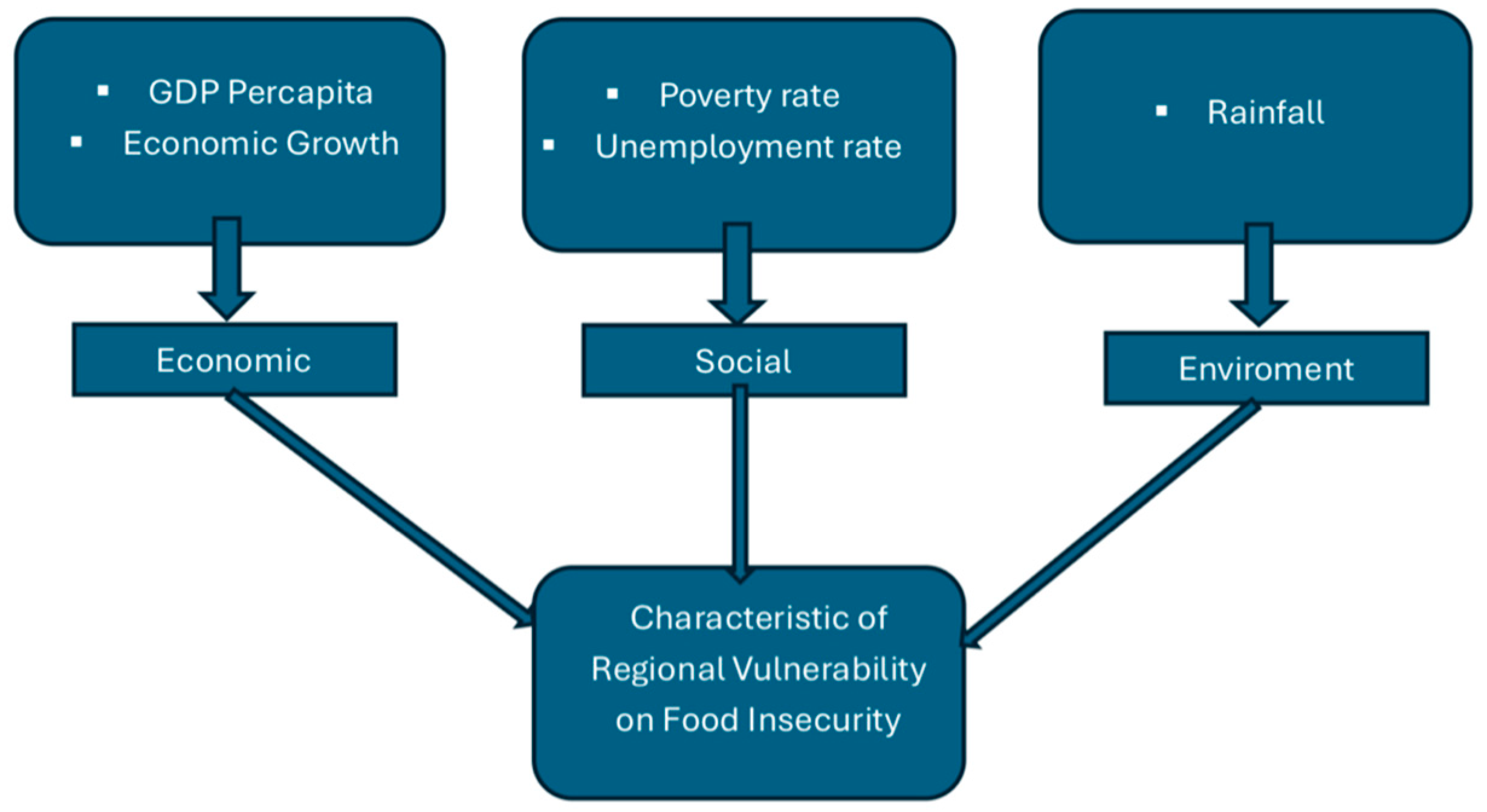
This research employs a conceptual design focused on examining regional characteristics that contribute to vulnerability toward food insecurity. It specifically investigates how economic, social, and environmental factors define regions at risk, distinguishing between moderately vulnerable areas and those highly vulnerable to food insecurity. In economic indicators (GDP per capita and economic growth rate) gauge individual income capacity and regional economic stability. Strong performance in these areas enhances household purchasing power, facilitating easier access to food consumption. For social indicators (unemployment rate and poverty rate) reflect vulnerabilities where joblessness eliminates income, categorizing individuals as poor and unable to meet basic needs, directly obstructing food access. Lastly, in environmental indicators (rainfall levels) determine food production outcomes. Excessive rainfall risks flooding and crop damage, while higher levels prove advantageous in arid regions by supporting agricultural yields. For clarity, it is presented in the following Figure 1:

3. Materials and Methods

This study employed Fuzzy Set Qualitative Comparative Analysis (fsQCA). Fuzzy set Qualitative Comparative Analysis (fsQCA) offers a powerful methodological approach for elucidating the characteristics of regions vulnerable to food insecurity. Developed by Charles Ragin, fsQCA bridges qualitative depth with quantitative rigor, enabling researchers to identify causal configurations combinations of conditions that lead to specific outcomes, such as high regional vulnerability to food insecurity.
It enables the exploration of multiple causal configurations, making it well-suited for complex social issues where outcomes may result from various combinations of conditions [59]. fsQCA focuses on identifying patterns and configurations of conditions that lead to specific outcomes. This comprehensive approach more effectively captures the complexities of real-world scenarios. By emphasizing the combinations of causal factors that result in specific outcomes [32,60], fsQCA assists stakeholders in understanding effective strategies in various contexts, including policy development related to food insecurity and regional vulnerability.
One of the key steps in using fsQCA is to calibrate the original data or raw data into fuzzy data. The calibration or fuzzification is carried using the following formula [61].
μ S b = 0                                                                                           i f   τ e x b   1 2                                                               i f   τ e x < b < τ c r           1 1 2 τ i n b τ i n τ c r q                 i f   τ c r < b < τ i n   1                                                                                                               τ i n < b
Here μ S b is the fuzzy value of base variable (b), τ e x is threshold for full exclusion in set S, and τ i n is threshold for full inclusion in set S. Variable τ c r describes the crossover threshold for ambiguous member of set S, while parameters p and q control the degrees of concentration and dilation.
The next step of fsQCA method is performing analysis of necessity and sufficient condition. Analysis of necessity proceed from the observation of a value under the outcome set Y or Y ( v l ) to the observation of a value under the condition of set X or X ( v l ) [61]. The necessary inclusion of X ( v l ) is presented in the following formula:
I n c l N X { v l } = i = 1 n min { v l } x i , { v l } y i i = 1 n { v l } y i
While necessary coverage is written as:
C o v n { X v l } = i = 1 n min { v l } x i , { v l } y i i = 1 n { v l } x i
fsQCA is effective with small or medium-sized samples, which is common in regional studies where data availability is limited. It provides robust results without requiring very large datasets. fsQCA recognizes that there can be multiple sufficient combinations of conditions leading to food insecurity. This helps policymakers understand different “paths” or sets of regional characteristics that may lead to vulnerability, enabling more targeted interventions. fsQCA blends qualitative insights with quantitative rigor by using Boolean algebra and set theory. This approach suits interdisciplinary studies on food insecurity that merge quantitative data with contextual qualitative information [62].
fsQCA focuses on analyzing complex causal relationships by examining combinations of multiple conditions or characteristics rather than isolated factors. Vulnerability to food insecurity is often driven by multiple interrelated factors such as poverty, agricultural investment, education, and social capital. fsQCA allows capturing these multifaceted configurations that contribute to food insecurity vulnerability.
Traditional QCA uses crisp sets where cases either fully belong (1) or do not belong (0) to a set. fsQCA advances this by allowing partial membership with scores between 0 and 1, representing the degree to which a case belongs to a set. For example, a region may partly (0.7) belong to the set of “vulnerable regions” rather than being fully vulnerable or not at all. This allows for a richer, more flexible representation of reality [59].
In this study identifies six causal conditions believed to explain the occurrence of regional vulnerability to food insecurity in each province, which are incorporated in the fsQCA model. These conditions include poverty rate, unemployment rate, GDP per capita, per capita public expenditure, economic growth, and rainfall. The outcome measured was the Regional Vulnerability to Food Insecurity Index (RVFII).
In this study, regional vulnerability to food insecurity is assessed using the Regional Vulnerability to Food Insecurity Index (RVFII) previously studied in [58]. As in [58], the RVFII is calculated based on components of vulnerability, which include exposure, sensitivity, and adaptive capacity, along with dimensions of food insecurity such as availability and access. Exposure is quantified by factors like the frequency of droughts, the extent of flooded land, levels of food insufficiency, instances of malnutrition, stunting rates, and infant mortality. Sensitivity is determined by the volume of food imports, the proportion of irrigated agricultural land, household food expenditure, and the consumer price index. Adaptive capacity is evaluated through metrics like the per capita area of paddy fields, the number of young farmers and extension workers, food diversity, the rising income of farmers, and the number of markets that facilitate food access. The RVFII has been calculated by Juliannisa et al. [58] across 34 provinces in Indonesia using secondary data from 2021 and it will be used in this study as an outcome variable of fsQCA model.
The research focused on the year 2021 and included 34 provinces in Indonesia. The operational definitions of the causal conditions are presented in Table 1.
The calibrated data is then examined using the fsQCA method to understand the causal relationships between various conditions and the outcome. The subsequent step involves analyzing the Truth table using the 2021 dataset; the truth table is an essential element in fsQCA.
In the fsQCA method, a truth table is a key analytic tool used to systematically represent all logically possible combinations of causal conditions included in a study. Each row of the truth table corresponds to a unique configuration of causal factors (conditions), capturing the presence or absence (or degree of membership in fuzzy sets) of these conditions in relation to an outcome. Unlike traditional crisp set QCA where conditions are either fully present (1) or absent (0), fsQCA allows for varying degrees of membership between 0 and 1, making the truth table capable of handling more nuanced, partial memberships.
In fsQCA, the truth table serves to organize cases according to specific combinations of conditions and to evaluate each configuration’s empirical consistency and coverage as a potential causal pathway to the outcome. Consistency captures the extent to which cases conform to the proposed causal relationship, that is, the proportion of cases in which the presence of a condition is accompanied by the expected outcome. Coverage reflects the share of outcome cases that are accounted for by a given condition or configuration and is typically divided into raw coverage (for an individual configuration) and solution coverage (for the full set of configurations in the solution).
This procedure allows researchers to determine which combinations of conditions are sufficient or necessary for the outcome to occur. By applying consistency thresholds, the truth table distinguishes configurations that systematically produce the outcome from those that do not. This, in turn, supports Boolean minimization, which reduces complex configurations into more parsimonious causal explanations. In effect, the truth table in fsQCA converts complex, multidimensional causal information into a structured format that highlights patterns of causal complexity, showing how different combinations of conditions can lead to the same outcome. It thereby enables the detection of multiple equifinal solutions, aligning with the notion that social phenomena typically emerge from diverse causal processes rather than a single determinant. The truth table specifies the configurations that are sufficient for the outcome and facilitates logical minimization by enumerating all possible configurations [62]. Calibration, as summarized in Table 2, requires setting threshold values for each causal condition and the outcome.
The threshold is taken from the threshold value of the original data matrix used in Table 3. N1 shows the highest score, N2 is the average value, and N3 is the lowest value [63]. Additionally, tests for consistency and necessary conditions are performed to evaluate how often the membership score in the outcome (Yi) is equal to or less than the membership in the causal condition (Xi), represented as Yi ≤ Xi. This indicates that the outcome is a subset of the causal condition. The threshold for the consistency test for necessary conditions is set at 0.90. Conversely, the consistency test for sufficient conditions assesses if the degree of membership in the outcome exceeds or is equal to that in the causal condition (Yi ≥ Xi). For conditions frequently observed that form a superset of the outcome, the consistency threshold for sufficient conditions is 0.75 or higher [59,60].
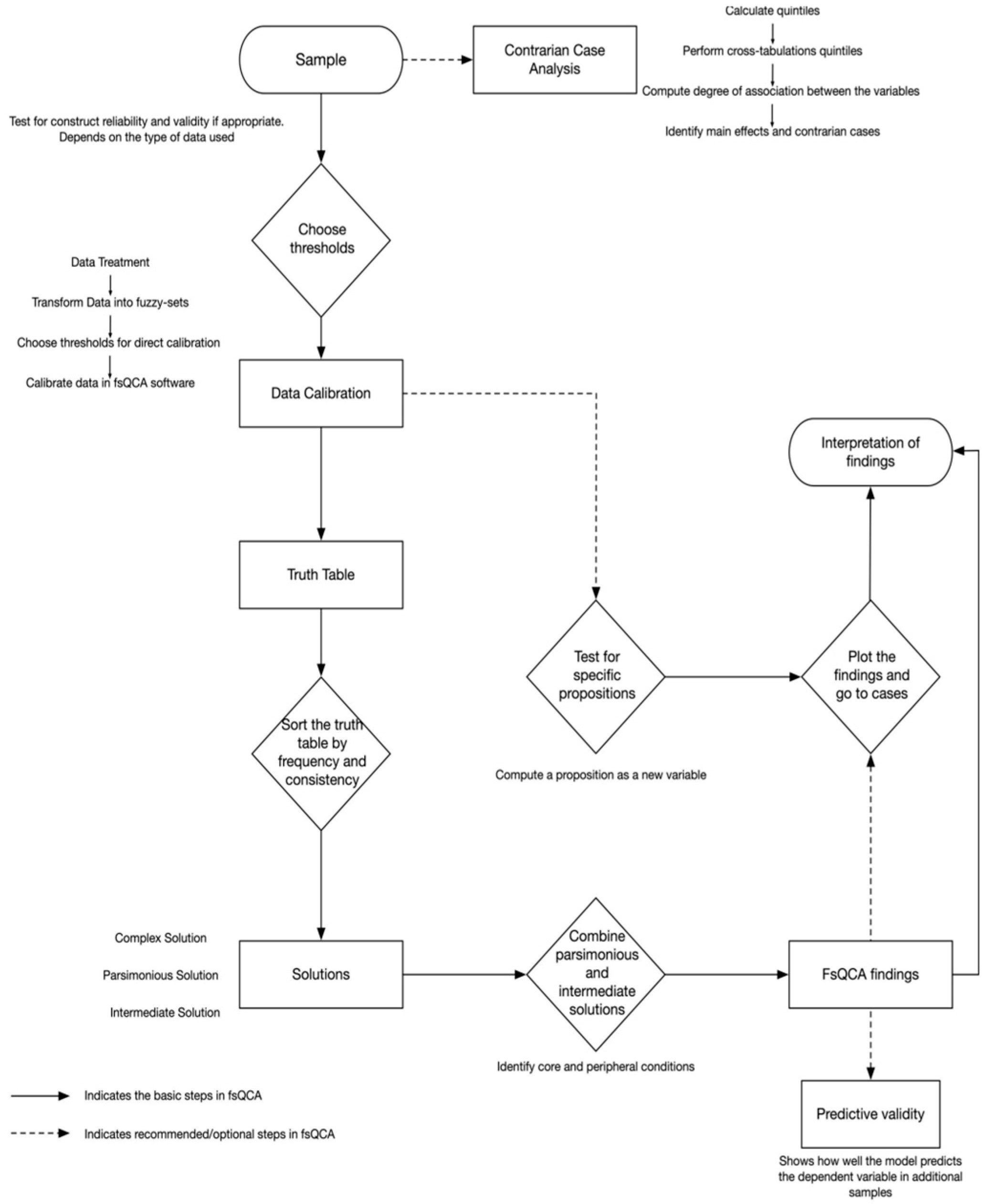
fsQCA offers three solution models: complex, parsimonious, and intermediate. Complex solutions consider all potential combinations of conditions using traditional logic operations, though they can be too intricate for practical use. Parsimonious solutions are simpler, highlighting core conditions essential to the outcome and include counterfactual scenarios. Intermediate solutions result from the counterfactual examination of both complex and parsimonious solutions, incorporating theoretical counterfactual cases. The intermediate solution employs a selection of simplified assumptions to derive the parsimonious solution, ensuring alignment with theoretical and empirical knowledge. At this point, variables are evaluated as “only present,” “only absent,” or both in relation to explaining the outcome; typically, both “present” and “absent” are considered. Decisions about the relationship between causal conditions and outcomes should rely on theoretical and substantive understanding [62]. The data analysis process sequence using the fsQCA software (version 4.1) is illustrated in Figure 2.
To determine the data threshold, first calculate the threshold value, then enter both the data and this threshold into the fsQCA software to perform calibration. Next, test for sufficiency and necessity, using 0.90 as the consistency threshold for necessary conditions. Based on the test results, code and remove any data that do not meet the study’s threshold of 0.8. With the cleaned dataset, analyze the truth table to identify the number of pathways and examine the characteristics of each region in relation to the causal conditions [32].

Data Sources

The data sources for the causal conditions are Poverty Rate, Unemployment Rate, Economic Growth, and GDP per Capita are derived from the Central Statistics Agency. The data on Rainfall comes from the Indonesian Agency for Meteorological, Climatological, and Geophysics. This study focuses on the year 2021, use 34 of 38 provinces in Indonesia as sample. The data is presented in Table 3.

4. Results

As noted in the previous section, the degree of regional vulnerability to food issues differs across provinces in Indonesia. Several factors can account for why one region may exhibit high vulnerability while another does not. Utilizing 6 causal conditions and 1 outcome, as described earlier, the results of the data calibration are presented in Table 4.
This table displays the results of data calibration calculated by the fsQCA software. Calibration is conducted using threshold values, with closer numbers to one indicating higher causal conditions in the region. Moreover, in the fsQCA method, we aim to assess the strength of the relationship between the various factors under investigation. Reference [59] outlines two perspectives on this relationship: the necessity of a factor for a specific outcome to occur (necessary condition) and whether a factor is sufficient to produce that outcome (sufficient condition). If a factor is necessary, it typically occurs alongside the outcome being studied, though it alone may not be enough to cause the outcome. Conversely, if a factor is deemed sufficient, it can produce the desired outcome independently of other factors.
Table 5 displays the consistency and coverage scores for the necessary conditions across 34 provinces in Indonesia. The results of the consistency and coverage tests exceeded 0.8, indicating that all causal conditions met the requirements for causal relationships and served as characteristic conditions in this study. These conditions reliably explained the outcome as both sustainable pathways and solution terms. The consistency score results indicate that none of the causal conditions meet the necessary consistency thresholds, suggesting that there are no conditions that must be present to characterize vulnerability in a province. This implies that vulnerability arises from a combination of several causal conditions.

4.1. Truth Table Analysis

This study utilizes truth tables to uncover distinct relationships between unique combinations of risk factors and the incidence of regional vulnerability to food insecurity in each province in Indonesia. In fsQCA, logical reminders refer to combinations of causal conditions present in truth table rows that lack sufficient unit cases with fuzzy set membership scores exceeding 0.5 [60].The truth table analysis is conducted using a cutoff threshold of 0.9.

4.2. Intermediate Solution

Data processing results using fsQCA with the Quine–McCluskey algorithm yield a truth table for Intermediate solutions, as shown in Table 6 below:
The fsQCA output links the high RVFII outcome with six causal conditions: Poverty Rate, Economic Growth, Expenditure per Capita, GDP Per Capita, Rainfall, Unemployment, and Island, resulting in a solution consistency score of 0.921277. This score, exceeding the 0.90 threshold, indicates a strong correlation between the causal condition pathways and high regional vulnerability to food insecurity issues in the province.
The solution coverage score of 0.6606 implies that 66.06 percent of provinces facing high regional vulnerability to food insecurity problems are represented by the identified combinations of causal conditions. However, Rahma et al. [60] note that, in contrast to consistency, which has a defined lower threshold, solution coverage does not have a minimum value. This distinction arises because consistency ensures the presence of a subset relationship, while coverage indicates the empirical significance of that relationship.
All combinations of causal conditions have satisfied the necessary conditions, effectively explaining the occurrence of regional vulnerability to high food insecurity. Additionally, nine pathways have achieved consistency scores exceeding the cutoff of 0.9, meaning each of these pathways alone can adequately account for regional vulnerability to food insecurity issues. These pathways represent the identified causal configurations associated with higher relative vulnerability. The pathways are as follows:
-
Pathway 1: North Maluku
-
Pathway 2: West Sumatra, West Java, West Sulawesi, East Java, West Kalimantan, Jambi, DKI Jakarta
-
Pathway 3: North Sumatra, Aceh, Central Java, Jambi, DI Yogyakarta, North Sulawesi, South Kalimantan
-
Pathway 4: Banten, Aceh, Central Java, West Java, East Kalimantan, Papua, Riau
-
Pathway 5: Bangka Belitung, Riau Island
-
Pathway 6: Central Sulawesi, Maluku
-
Pathway 7: East Nusa Tenggara, West Sulawesi, Gorontalo, Central Java
-
Pathway 8: West Kalimantan, Central Kalimantan, North Kalimantan, North Maluku, West Nusa Tenggara
-
Pathway 9: South Kalimantan, East Java
Two provinces are represented in different pathways: Aceh appears in pathways 3 and 4, with the latter indicating that its low per capita income makes the region more vulnerable to food insecurity. Central Java is included in three pathways: 3, 4, and 7. South Sulawesi features in pathways 1 and 6, highlighting that Central Java has particularly complex causal conditions explaining its vulnerability to food insecurity. In pathway 2, Central Java is characterized by high poverty rates, unemployment, and low economic growth and rainfall. In pathway 3, it is defined by low GDP per capita, while in pathway 4, it has low expenditure per capita. Essentially, Central Java exhibits all the critical conditions contributing to its vulnerability to food insecurity.
This indicates that the characteristics are very diverse and through fsQCA can explain how the diversity conditions are. When Aceh appears on pathway 3, it means that Aceh’s condition is high in terms of poverty and unemployment, and rainfall and low economic growth. When it was on pathway 4, it showed that Aceh also had a problem with low per capita income. Likewise with central java when it appeared on pathway 3 and 4, while in pathway 7 it shows that central java not only has high poverty and unemployment rates, but also has low economic growth conditions, rainfall, and low per capita income, but high per capita expenditure figures.
In this case, it is explained that each region has various characteristics why the region is vulnerable to food insecurity. The diversity of characteristics can be explained not only in one pathway, but can appear in other different pathways, and explain additional conditions or differences that are not possessed between one pathway and another.
The provinces experiencing low economic growth in some province, such as West Sumatra, West Java, South Sulawesi, East Java, North Sumatra, Aceh, Central Java, North Sulawesi, Jambi, Maluku, East Kalimantan, Papua, East Nusa Tenggara, West Nusa Tenggara, West Sulawesi, South Sumatra, West Papua, and Central Sulawesi.
Pathway 1 illustrates that North Maluku experiences a high level of regional vulnerability to food insecurity due to low economic growth, low GDP per capita, and high unemployment. Various interconnected factors contribute to these issues. Economic growth in the region is mainly dependent on the mining and mineral processing sectors, while traditional industries such as agriculture and fisheries have declined due to reduced production and increasing distances to catchment areas. Furthermore, government spending has been limited by slow budget absorption, particularly for infrastructure development and public services. This is exacerbated by budget allocations that favor personnel expenditures over capital investments. The high unemployment rate worsens the situation, creating poverty pockets around mining areas and emphasizing the need for more diversified economic opportunities and more effective public spending strategies [64].
Pathway 2 indicates that West Sumatra, West Java, West Sulawesi, East Java, West Kalimantan, Jambi, and DKI Jakarta face significant regional vulnerability to food insecurity driven by high poverty rates, low economic growth, limited rainfall, and high unemployment. Elevated poverty levels are linked to income inequality and a lack of economic diversification, leaving communities exposed to economic shifts. Slow economic growth in places like West Sulawesi, East Kalimantan, and Jambi is associated with inadequate infrastructure, restricted access to technology, and a shortage of skilled human resources [65]. Low rainfall, particularly affecting West Kalimantan and West Sulawesi, adversely affects agricultural productivity, especially in areas reliant on rain-fed farming. High unemployment is indicative of both a lack of employment opportunities and a skills mismatch between the workforce and the demands of local industries [66].
Pathway 3 indicates that North Sumatra, Aceh, Central Java, Jambi, DI Yogyakarta, North Sulawesi, and South Kalimantan are highly vulnerable to food insecurity due to high poverty rates, low economic growth, inadequate rainfall, and high unemployment [67]. In Yogyakarta, North Sumatra, North Sulawesi, and South Kalimantan, limited education significantly contributes to poverty. Many areas still face challenges in accessing quality education, leaving individuals without the skills necessary to compete in the labor market [68]. In Central Java, fluctuations in the prices of essential goods can impact people’s purchasing power, making it increasingly difficult for those in poverty to meet their daily needs due to rising prices of food and other necessities [69]. Insufficient economic growth may hinder the region’s ability to attract investments [70].
Pathway 4 highlights that Banten, Aceh, Central Java, West Java, East Kalimantan, Papua, and Riau are also vulnerable to food insecurity. East Kalimantan and Papua, known for their challenging access to resources, face significant poverty issues. Some provinces remain dependent on foreign investments to support their economic activities. Weak economic growth is further exacerbated by rising global oil prices [71].
Pathways 5 and 6 may initially seem similar regarding the factors influencing regional vulnerability to food insecurity in Bangka Belitung and the Riau Islands. However, this classification underscores a key difference: despite having high per capita income and adequate rainfall, these regions still experience vulnerability to food insecurity due to issues such as poverty, unemployment, low economic growth, and minimal government spending.
In Pathway 6, Central Sulawesi and Maluku encounter challenges stemming from low economic growth, poverty, and high unemployment rates. The economic performance of Central Sulawesi is declining, partly due to high exchange rates affecting farmers. Additionally, the distribution of essential goods plays a critical role in determining poverty levels; difficulties in this distribution hinder impoverished communities from meeting their food consumption needs [72].
Pathway 7 highlights that East Nusa Tenggara, West Sulawesi, Gorontalo, and Central Java are vulnerable to food insecurity due to high poverty rates and low government expenditure. Despite boasting high economic growth and GDP per capita, the severe poverty in these regions makes it challenging for individuals to access food. Furthermore, a lack of investor interest impedes economic growth, while climate change exacerbates the situation by causing severe drought conditions that negatively impact agricultural productivity.
Pathway 8 shows that West Kalimantan, Central Kalimantan, North Kalimantan, North Maluku, and West Nusa Tenggara are vulnerable due to low rainfall and GDP per capita. Although these regions experience good economic growth, adequate government spending, and low levels of poverty and unemployment, climatic challenges still pose substantial risks to food security. High income inequality has resulted in low GDP per capita across the Kalimantan provinces, and limited employment opportunities remain a significant barrier to addressing food issues [73].
Pathway 9 explains that South Kalimantan and East Java face regional vulnerability to food insecurity due to unemployment and low rainfall, despite having low poverty rates, high economic growth, and high per capita income. The abundance of workers, combined with a lack of job opportunities, is the main driver of unemployment in these regions. Additionally, the concentration of labor in urban areas contributes to inequality in surrounding regions [74].
Farmers in regions with low economic growth, high poverty rate, and unemployment rate often face limited access to financial resources. Without credit, they struggle to invest in improved seeds, fertilizers, or equipment necessary to boost productivity. This situation perpetuates a cycle of low income and heightened vulnerability, as farmers find it challenging to adapt to changing climatic conditions or market demands [56].
The decline in economic growth in West Nusa Tenggara, West Sulawesi, South Sumatra, and West Papua can worsen existing disparities in income and resource access. Regions heavily dependent on specific commodities are especially sensitive to price fluctuations, which directly impact household incomes and food purchasing power [75].
Similar conditions are observed in the rural areas of Southern Asia and Sub-Saharan Africa, where nearly 11.00% of the global population (approximately 7.42 billion people) lives in severe poverty, primarily in these regions. With 78.00% of impoverished individuals depending on agriculture and related businesses for their income, agricultural development has significant potential to alleviate rural poverty. Growth in the agricultural sector can reduce poverty rates at least twice as effectively as growth in other sectors; for instance, a 1.00% increase in GDP in a non-farm sector results in a 1.00% reduction in poverty, while a 1.00% rise in the agricultural sector leads to a 2.00% decrease in poverty. Therefore, agricultural growth should be central to anti-poverty strategies in India [15].
Regions with low economic growth, high poverty, high unemployment, low rainfall, low GDP per capita and low expenditure per capita are more vulnerable as this decline reduces demand for agricultural products, leading to lower prices for farmers. This issue is particularly pronounced in areas where agricultural goods rely heavily on exports, as fluctuations in global markets can severely affect local economies. For example, in Mexico, agricultural prices have dropped significantly due to external market pressures, resulting in a trade deficit and added economic strain on farmers [6].
All of causal conditions contributing to high levels of vulnerability to food insecurity include high poverty rates and unemployment. These factors limit households’ ability to afford nutritious food, with approximately 34% of Indonesians unable to purchase healthy food. Additionally, 68.8% cannot afford nutritious options. Food-insecure individuals are more likely to consume lower-quality food, reflecting their disadvantaged financial situations [76]. Economic downturns and unemployment can further diminish demand for agricultural products, leading to lower prices for farmers, which directly impacts household incomes and food purchasing power, particularly in rural areas [77].
Low expenditure per capita and GDP per capita can increase regional vulnerability. A low GDP per capita signifies that individuals in the region have a lower average income, and when expenditure per capita is also low, it indicates that people are spending less overall, even on essential items like food [78].
East Nusa Tenggara, West Nusa Tenggara, West Sulawesi, South Sumatra, West Papua, and Central Sulawesi are facing issues related to rainfall, particularly severe drought conditions. Adequate rainfall is crucial for reducing vulnerability to food insecurity, as these regions contend with climate variability and limited resource access, making them especially vulnerable when economic circumstances deteriorate. Rainfall conditions in East Nusa Tenggara, West Nusa Tenggara, West Sulawesi, South Sumatra, West Papua, and Central Sulawesi during 2025–2026 show a pattern of prolonged dry spells in eastern Indonesia, followed by a delayed or uneven transition to the rainy season. This leads to water deficits for agriculture, crop failures, and heightened food insecurity due to reliance on rice planting seasons and other staple crops [74].
East Nusa Tenggara (NTT) and West Nusa Tenggara (NTB) experienced extreme drought lasting up to 94 days without rain in August 2025, while Central Sulawesi (Sulteng) and West Sulawesi (Sulbar) were in prolonged dry zones with potential meteorological drought. South Sumatra entered the rainy season earlier (September–October 2025) with flooding that inundated agricultural lands, whereas West Papua and Sulteng were forecast to have normal to high rainfall starting November–December 2025, though with flood risks in Papua. Overall, the 2025 dry season was delayed and shorter in the south, but eastern regions remained vulnerable to rainfall deficits. Prolonged droughts in NTT, NTB, Sulbar, and Sulteng disrupted planting cycles, reducing production of rice, corn, and horticultural crops, thereby increasing regional food insecurity. In South Sumatra, floods caused crop failures and disrupted supply chains, despite minimal national impacts, while West Papua faced risks of waterlogged lands that worsened food access. These areas are vulnerable due to limited irrigation infrastructure and dependence on natural rainfall [75].
Reduced agricultural productivity has been associated with dry spells during critical growth phases for crops. In India, such dry periods can significantly hinder production. Conversely, good rainfall can help secure irrigation and maintain soil moisture levels [15].

5. Discussion

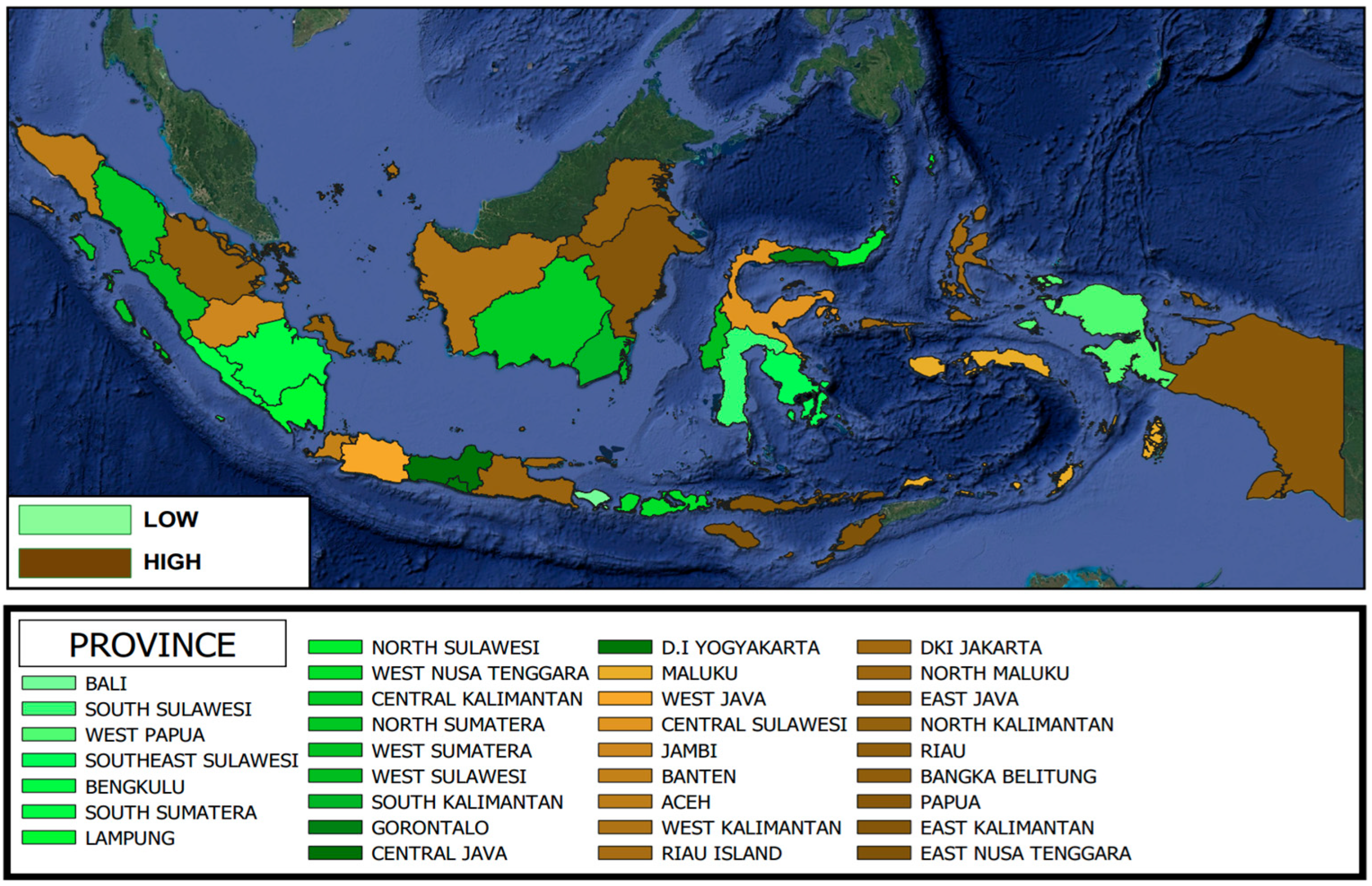
Figure 3 offers a visual representation of regional food security vulnerability across 34 provinces in Indonesia. The map indicates that provinces shaded in brown are at risk of food insecurity, with darker shades of brown signifying greater vulnerability. Conversely, provinces with lower vulnerability are depicted in green, where lighter green shades represent a lesser risk. The three provinces most affected by food insecurity are East Nusa Tenggara, East Kalimantan, and Papua. According to the findings from the fsQCA truth table analysis, provinces with high vulnerability to food security typically face challenges such as high poverty rates, unemployment, low rainfall, sluggish economic growth, low per capita expenditure, and low per capita income. To examine the characteristics prevalent in areas vulnerable to food insecurity, we can refer to Figure 3 [58].
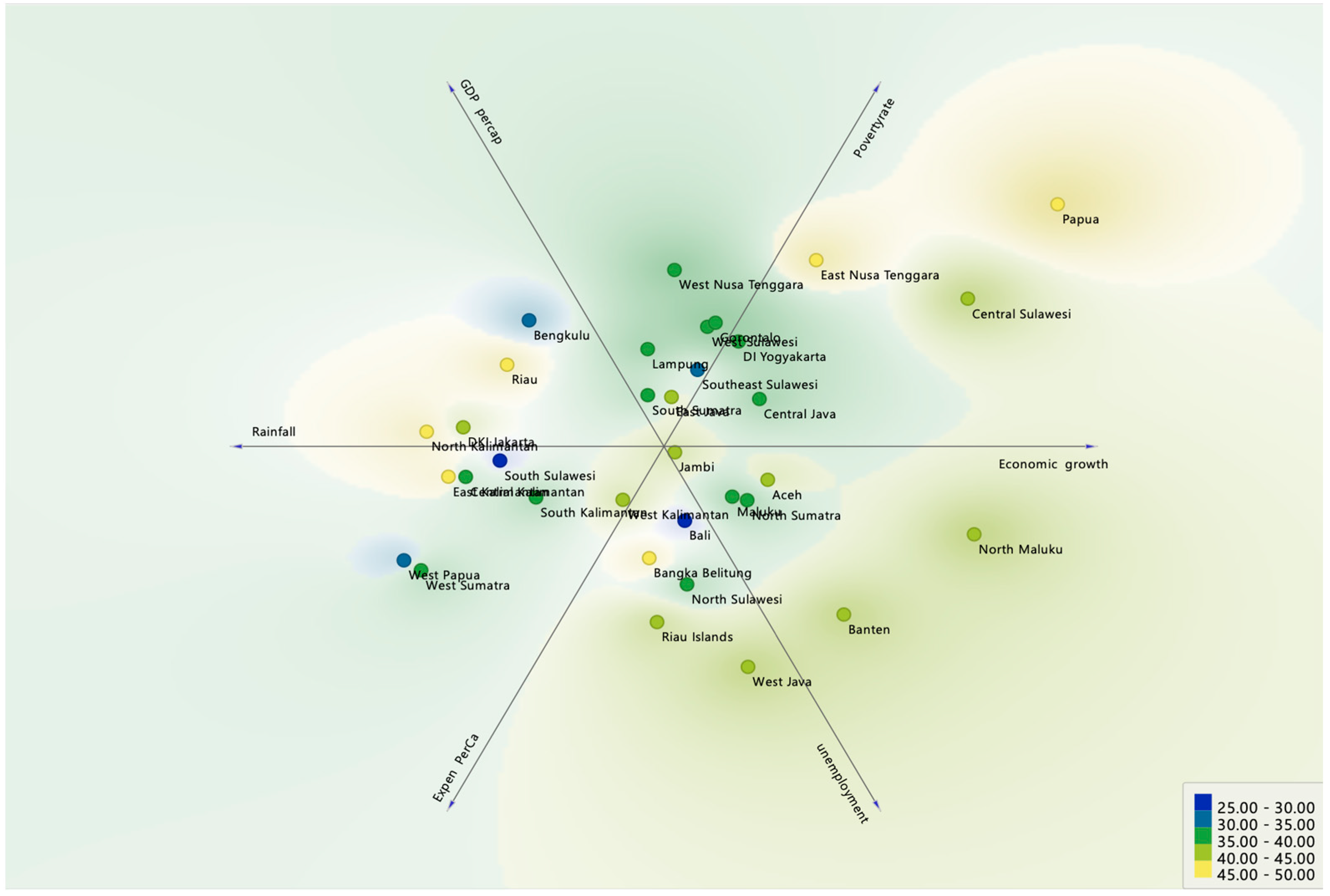
Figure 4 shows the spatial distribution of provinces along axes representing variables or conditions generated by the FreeViz. Provinces located between the economic growth and poverty rate axes, such as East Nusa Tenggara (NTT), illustrate how RVII levels are influenced by these factors. In NTT, the high poverty rate stems from interconnected issues, particularly geographic constraints and heavy dependence on agriculture. Low rainfall results in dry, unproductive land, which depresses agricultural output. Around 95% of NTT’s population relies on agriculture for their livelihoods, and unstable yields leave many households unable to meet basic needs, making poverty a persistent problem [79]. To address this, the government should prioritize areas with high poverty and unemployment by attracting investment that can spur economic growth and generate new employment opportunities.
In addition to geographical influences, the low levels of education and skills further contribute to the high poverty rate in NTT. Many residents have only basic education or have not completed formal schooling, hindering their ability to compete in an increasingly competitive job market. Limited access to quality education and vocational training exacerbates the situation, trapping the younger generation in a cycle of poverty that is hard to escape. In districts like Sumba, low educational attainment is closely linked to high poverty rates [80].
Economic growth in East Nusa Tenggara (NTT) remains low, exacerbating the region’s poverty issues. Efforts to increase investment and improve infrastructure have not yielded sufficient results for sustainable economic development. High unemployment rates and limited economic diversification leave residents in difficult situations. To tackle these challenges, the government needs to implement more effective policies that improve access to education, healthcare, and employment opportunities, thereby fostering economic growth and reducing poverty in the province [79]. Building a vibrant local economy that highlights the unique strengths of each region requires the promotion of diverse economic activities, which can significantly enhance growth. Moreover, it is crucial for communities to reduce their dependence on a single food commodity, thereby encouraging a more resilient and diversified agricultural sector.
Other provinces facing high poverty rates and low economic growth include West Nusa Tenggara, West Sulawesi, Maluku, Gorontalo, Central Java, and Aceh. Among these, West Nusa Tenggara and Aceh experience particularly severe poverty rates, with significant portions of the population living below the poverty line. For example, in West Nusa Tenggara, over 700,000 individuals survive on less than US$2 per day [81]. In Aceh and Central Java, similar challenges persist, with a high percentage of the poor caught in cycles of structural and relative poverty [82].
Economic growth in these provinces has not achieved sufficient development. Data indicates that eastern Indonesia, particularly Maluku and Gorontalo, experiences economic growth significantly below the national average. This situation is worsened by inadequate infrastructure and limited access to quality education and healthcare services. Consequently, many communities in these provinces find themselves vulnerable to food insecurity, increasing their risk of hunger. Given the communities’ reliance on the often unstable agricultural sector, food insecurity has become a pressing issue. In this context, the government must implement concrete measures to address regional disparities in development and expedite poverty alleviation programs. These initiatives should focus on improving access to education, skills training, and infrastructure development to foster inclusive and sustainable economic growth [83].
Unemployment and low economic growth further highlight the challenges faced by areas with high food vulnerability, as seen in provinces like North Sumatra, Central Java, North Sulawesi, Jambi, West Java, East Kalimantan, and Papua. For instance, West Java reported an unemployment rate of 6.91%, while North Sulawesi recorded 5.98% at the beginning of 2022. These elevated unemployment figures reflect the labor market’s inability to absorb the increasing workforce. As many remain unemployed and without income, they struggle to meet their basic needs, including access to sufficient and nutritious food. This leads to a situation where individuals are compelled to reduce food consumption or opt for less nutritious options, ultimately deteriorating their health [84].
In North Sumatra, for example, the Central Bureau of Statistics reported 408,000 unemployed individuals in February 2021, with an open unemployment rate of 6.10%. High unemployment adversely affects purchasing power and access to essential needs, including food. Notably, the unemployment rate is higher in urban areas compared to rural regions in North Sumatra [85]. Similar challenges persist in Central Java and Jambi. The high unemployment rates correlate with low agricultural production and economic instability. As more people remain unemployed, their ability to purchase food diminishes, exacerbating food insecurity. Additionally, government initiatives aimed at creating jobs and enhancing labor skills have not fully succeeded in addressing these challenges [86].
East Nusa Tenggara (NTT), characterized by low GDP per capita, faces numerous challenges hindering its economic growth and further contributing to its low Gross Domestic Product (GDP) per capita. A significant factor is the uneven economic growth among its districts, largely due to economic activities being concentrated in Kupang City, which boasts a substantially higher GDP per capita than other districts. This inequality is worsened by a lack of economic diversification and the predominance of the agricultural sector, which cannot adequately absorb the available labor force [87].
Inadequate infrastructure is a significant factor contributing to the low GDP per capita in East Nusa Tenggara (NTT). This situation reflects relatively low government spending as well. Various regions within the province continue to struggle with access to transportation and essential services, which hampers both investment and local economic development [80]. Additionally, the limited quality of human resources poses a major challenge, as insufficient education and training lead to a less skilled workforce. This perpetuates a cycle of poverty, making it difficult for individuals to obtain better job opportunities [73].
Certain areas also exhibit high regional vulnerability to food insecurity, driven by factors such as low rainfall and inadequate government support for the agricultural sector. This is evident in regions like North Sumatra, Aceh, Central Java, North Sulawesi, East Kalimantan, East Nusa Tenggara, West Nusa Tenggara, West Sulawesi, and Lampung. Unfavorable environmental conditions, particularly insufficient rainfall, directly affect agricultural productivity, which is vital for community sustenance. When agricultural yields suffer due to a lack of water, food availability declines, heightening the risk of food insecurity in these areas.
In East Nusa Tenggara and West Nusa Tenggara, chronic drought due to insufficient rainfall severely impacts agriculture. Many farmers rely on irrigation from natural water sources, which are often inadequate during prolonged dry periods. This results in lower production of staple crops like maize and rice, thereby increasing the communities’ vulnerability to food crises [88].
In North Sumatera, over 600 hectares of paddy fields have faced drought conditions due to minimal rainfall. Districts such as Langkat, Deli Serdang, and Labuhan Batu are experiencing significant threats to rice production, with dry soils unable to meet the water requirements of the plants. The repercussions of drought extend beyond reduced yields; they can also lead to the proliferation of pests and plant diseases. Arid conditions and elevated temperatures create favorable conditions for pest breeding, further increasing the likelihood of crop damage [89].
East Kalimantan is similarly affected by insufficient rainfall, resulting in drought conditions that negatively impact agricultural lands and diminish the yields of rice and other crops. Farmers often confront the risk of crop failure due to inadequate water supply during critical growth stages. Furthermore, these adverse conditions can degrade soil quality and reduce land fertility, exacerbating the challenges of sustainable food production in the region [90].

6. Conclusions

This study thoroughly examines the characteristics of regions in Indonesia that are particularly vulnerable to food insecurity, offering valuable insights that can be applied to other developing countries grappling with analogous challenges. By employing fuzzy set Qualitative Comparative Analysis (fsQCA), the research uncovers nine distinct causal configurations across 19 provinces that contribute to food insecurity vulnerability. These configurations encompass a range of socioeconomic factors, including low economic growth rates, high poverty levels, and significant unemployment, alongside environmental conditions such as limited rainfall. The findings emphasize that all identified causal pathways meet rigorous consistency and coverage thresholds, thereby affirming the empirical relevance of the dataset.
Provinces such as East Nusa Tenggara, East Kalimantan, and Papua exemplify distinct archetypes of vulnerability, where specific combinations of the identified factors heighten the risk of food insecurity. This analysis deepens our understanding of the multidimensional nature of food insecurity in Indonesia and highlights the need for targeted interventions that address both socioeconomic and environmental dimensions.
This study, however, has several limitations. First, its scope is confined to 19 provinces, which may not fully capture Indonesia’s geographic and cultural diversity. Second, dependence on available data may introduce bias, as some relevant determinants of food insecurity might be missing. Finally, although the methodology is robust, it may overlook local variables and contextual nuances shaping the causal pathways, thereby constraining the broader generalizability of the findings.
Further research is needed to build on these findings. Future studies should use more granular data at the district or village level to better capture local dynamics. Longitudinal analyses could clarify how vulnerabilities shift over time as socioeconomic and environmental conditions change. In addition, incorporating qualitative methods—such as interviews with local stakeholders—would deepen understanding of community-specific drivers of food security and support the design of more effective, context-sensitive policies. Ultimately, reducing food insecurity in Indonesia will require a multifaceted approach that responds to the complex interaction between regional characteristics and broader socioeconomic trends.

Author Contributions

The authors of this journal, I.A.J. contributed to conceptualizing the idea, collecting data, selecting variables, and analyzing the results. A.F. contributed by developing the framework, reviewing the language, and analyzing the pathways in the results, while S.M. ensured that the journal’s writing adhered to the guidelines. H.R., contributed to conceptualizing the idea and analyzing the results. All authors have read and agreed to the published version of the manuscript.

Funding

UPN Veteran Jakarta provided financial support during the data collection process, with Grant Number 977/UN61/HK.03.01/2024.

Data Availability Statement

The data supporting and the findings of this study are available from the corresponding author upon reasonable request.

Conflicts of Interest

The authors declare no conflicts of interest. The funders had no role in the design of the study; in the collection, analyses, or interpretation of data; in the writing of the manuscript; or in the decision to publish the results.

References

  1. Biswas, S.; Nautiyal, S. A Review of Socio-Economic Vulnerability: The Emergence of Its Theoretical Concepts, Models and Methodologies. Nat. Hazards Res. 2023, 3, 563–571. [Google Scholar] [CrossRef]
  2. Atwii, F.; Sandvik, K.B.; Kirch, L.; Paragi, B.; Radtke, K.; Schneider, S.; Weller, D. World Risk Report 2022; Bündnis Entwicklung Hilft: Berlin, Germany, 2022; ISBN 978-3-946785-14-9. [Google Scholar]
  3. Sileshi, M.; Kadigi, R.; Mutabazi, K.; Sieber, S. Analysis of Households’ Vulnerability to Food Insecurity and Its Influencing Factors in East Hararghe, Ethiopia. J. Econ. Struct. 2019, 8, 41. [Google Scholar] [CrossRef]
  4. Bappenas Rencana Aksi Nasional Pangan Dan Gizi 2021–2024. Available online: http://repository.uhamka.ac.id/id/eprint/26854/1/aksi%20nasional%20gizi%202021-2024.pdf (accessed on 1 November 2025).
  5. Adom, P.K. The Socioeconomic Impact of Climate Change in Developing Countries over the next Decades: A Literature Survey. Heliyon 2024, 10, 35134. [Google Scholar] [CrossRef] [PubMed]
  6. Guo, H.; Chen, J.; Pan, C. Assessment on Agricultural Drought Vulnerability and Spatial Heterogeneity Study in China. Int. J. Environ. Res. Public. Health 2021, 18, 4449. [Google Scholar] [CrossRef] [PubMed]
  7. Antriyandarti, E.; Barokah, U.; Rahayu, W.; Laia, D.H.; Asami, A. Factors Associated with Food Security of Dryland Farm Households in the Karst Mountains of Gunungkidul Indonesia. Sustainability 2023, 15, 8782. [Google Scholar] [CrossRef]
  8. Feldman, G.; Shwartz-Ziv, T. Negotiating Housing Insecurity: Parenting in Poverty and the Struggle for Home. Child. Youth Serv. Rev. 2024, 163, 107780. [Google Scholar] [CrossRef]
  9. Food and Agriculture Organization FAO. The State of Food Security and Nutrition in the World (Nos. 2663–8061); Food and Agriculture Organization: Rome, Italy, 2020.
  10. Taslim, T.; Tahir, R.; Lira, J. Faktor-Faktor Yang Mempengaruhi Terjadinya Kerawanan Pangan. J. Sos. Ekon. Pertan. 2023, 19, 73–87. [Google Scholar]
  11. Nisa, R.; Triani, M. Faktor-Faktor Yang Mempengaruhi Prevalensi Ketidakcukupan Konsumsi Pangan Di Indonesia. Media Ris. Ekon. Pembang. MedREP 2022, 1, 83–91. [Google Scholar]
  12. Yahya, M.G.; Utami, I.P.; Ariansyah, S. Pemodelan Spasial Prevalensi Ketidakcukupan Konsumsi Pangan Menggunakan Pendekatan Ketahanan Pangan Di Indonesia Tahun 2022. Semin. Nas. Off. Stat. 2023, 2023, 869–878. [Google Scholar] [CrossRef]
  13. Anandhiya, A.; Arifin, A.; Istiqomah, I. Pengaruh Ketahanan Pangan Terhadap Rata-Rata Pengeluaran Masyarakat Di Jawa Tengah. J. Ilm. Univ. Batanghari Jambi 2021, 21, 96. [Google Scholar] [CrossRef]
  14. Holleman, C.; Conti, V. Role of Income Inequality in Shaping Outcomes on Individual Food Insecurity, 1st ed.; Food and Agriculture Organization: Rome, Italy, 2020.
  15. Jatav, S.S.; Naik, K. Measuring the Agricultural Sustainability of India: An Application of Pressure-State-Response (PSR) Model. Reg. Sustain. 2023, 4, 218–234. [Google Scholar] [CrossRef]
  16. World Bank. What You Need to Know About Food Security and Climate Change. 17 October 2022. Available online: https://www.worldbank.org/en/topic/agriculture/brief/food-security-update (accessed on 1 November 2025).
  17. Ammar, K.A.; Kheir, A.M.S.; Ali, B.M.; Sundarakani, B.; Manikas, I. Developing an Analytical Framework for Estimating Food Security Indicators in the United Arab Emirates: A Review. Environ. Dev. Sustain. 2024, 26, 5689–5708. [Google Scholar] [CrossRef] [PubMed]
  18. Abbas, S.; Haider, A.; Kousar, S.; Lu, H.; Lu, S.; Liu, F.; Li, H.; Miao, C.; Feng, W.; Ahamad, M.I.; et al. Climate Variability, Population Growth, and Globalization Impacting Food Security in Pakistan. Sci. Rep. 2025, 15, 4225. [Google Scholar] [CrossRef] [PubMed]
  19. Begna, T. Effects of Drought Stress on Crop Production and Productivity. Int. J. Res. Stud. Agric. Sci. 2020, 6, 34–43. [Google Scholar] [CrossRef]
  20. Ministry of Agriculture of the Republic of Indonesia. 2021. Available online: https://www.pertanian.go.id/ (accessed on 1 November 2025).
  21. Botreau, H.; Cohen, M.J. Gender Inequality and Food Insecurity: A Dozen Years after the Food Price Crisis, Rural Women Still Bear the Brunt of Poverty and Hunger. In Advances in Food Security and Sustainability; Elsevier: Amsterdam, The Netherlands, 2020; Volume 5, pp. 53–117. [Google Scholar]
  22. Wang, K.; Liu, J.; Xia, J.; Wang, Z.; Meng, Y.; Chen, H.; Mao, G.; Ye, B. Understanding the Impacts of Climate Change and Socio-Economic Development through Food-Energy-Water Nexus: A Case Study of Mekong River Delta. Resour. Conserv. Recycl. 2021, 167, 105390. [Google Scholar] [CrossRef]
  23. Zeleke, G.; Teshome, M.; Ayele, L. Farmers’ Livelihood Vulnerability to Climate-Related Risks in the North Wello Zone, Northern Ethiopia. Environ. Sustain. Indic. 2023, 17, 100220. [Google Scholar] [CrossRef]
  24. UNICEF. The State of Food Security and Nutrition in the World (SOFI); UNICEF: New York, NY, USA, 2022. [Google Scholar]
  25. Wahbeh, S.; Anastasiadis, F.; Sundarakani, B.; Manikas, I. Exploration of Food Security Challenges towards More Sustainable Food Production: A Systematic Literature Review of the Major Drivers and Policies. Foods 2022, 11, 3804. [Google Scholar] [CrossRef]
  26. Virtriana, R.; Riqqi, A.; Anggraini, T.S.; Fauzan, K.N.; Ihsan, K.T.N.; Mustika, F.C.; Suwardhi, D.; Harto, A.B.; Sakti, A.D.; Deliar, A.; et al. Development of Spatial Model for Food Security Prediction Using Remote Sensing Data in West Java, Indonesia. ISPRS Int. J. Geo-Inf. 2022, 11, 284. [Google Scholar] [CrossRef]
  27. Apdita, F.; Iskandar, J.; Rochima, E. The Impact of COVID-19 and Climate Change on Food Security in Pamijahan District, Bogor Regency. Economies 2023, 11, 271. [Google Scholar] [CrossRef]
  28. Erokhin, V.; Tianming, G.; Andrei, J.V. Shifting Patterns of Agricultural Trade: The Protectionism Outbreak and Food Security; Springer Nature: Singapore, 2021. [Google Scholar]
  29. Zhong, R.; Pei, F.; Yang, K.; Xia, Y.; Wang, H.; Yan, G. Coordinating Socio-Economic and Environmental Dimensions to Evaluate Regional Sustainability—Towards an Integrative Framework. Ecol. Indic. 2021, 130, 108085. [Google Scholar] [CrossRef]
  30. Füssel, H.-M. Adaptation Planning for Climate Change: Concepts, Assessment Approaches, and Key Lessons. Sustain. Sci. 2007, 2, 265–275. [Google Scholar] [CrossRef]
  31. Lassa, J.A. Politik Ketahanan Pangan Indonesia 1950–2005; ZEF Centre for Development Research: Bonn, Germany, 2005. [Google Scholar]
  32. Fauzi, A. Teknik Analisis Berkelanjutan; Gramedia Pustaka Utama: Jakarta, Indonesia, 2019. [Google Scholar]
  33. Levin, K.; Boehm, S.; Carter, R. 6 Temuan Besar Dari Laporan IPCC 2022 Tentang Dampak Iklim, Adaptasi, Dan Kerentanan; World Resources Institute: Mumbai, Indonesia, 2022. [Google Scholar]
  34. Awotona, A. Rebuilding Afghanistan in Times of Crisis: A Global Response, 1st ed.; Routledge: Abingdon-on-Thames, UK, 2019. [Google Scholar]
  35. Xiao, Y.; Tang, X.; Li, Y.; Huang, H.; An, B.-W. Social Vulnerability Assessment of Landslide Disaster Based on Improved TOPSIS Method: Case Study of Eleven Small Towns in China. Ecol. Indic. 2022, 143, 109316. [Google Scholar] [CrossRef]
  36. Singh, R.K.; Joshi, P.K.; Sinha, V.S.P.; Kumar, M. Indicator Based Assessment of Food Security in SAARC Nations under the Influence of Climate Change Scenarios. Futur. Foods 2022, 5, 100122. [Google Scholar] [CrossRef]
  37. Schneiderbauer, S.; Baunach, D.; Pedoth, L.; Renner, K.; Fritzsche, K.; Bollin, C.; Pregnolato, M.; Zebisch, M.; Liersch, S.; Rivas López, M.D.R.; et al. Spatial-Explicit Climate Change Vulnerability Assessments Based on Impact Chains. Findings from a Case Study in Burundi. Sustainability 2020, 12, 6354. [Google Scholar] [CrossRef]
  38. Korir, L.; Rizov, M.; Ruto, E.; Walsh, P.P. Household Vulnerability to Food Insecurity and the Regional Food Insecurity Gap in Kenya. Sustainability 2021, 13, 9022. [Google Scholar] [CrossRef]
  39. Firdaus, R.B.R.; Senevi Gunaratne, M.; Rahmat, S.R.; Kamsi, N.S. Does Climate Change Only Affect Food Availability? What Else Matters? Cogent Food Agric. 2019, 5, 1707607. [Google Scholar] [CrossRef]
  40. Mkumbukiy, A.; Loghmani-Khouzani, T.; Madani, K.; Guenther, E. Agrifood Systems’ Resilience for Sustainable Food Security amid Geopolitical Tensions: A Systematic Literature Review. Front. Sustain. Food Syst. 2025, 9, 1546851. [Google Scholar] [CrossRef]
  41. Deprá, M.C.; Dias, R.R.; Zepka, L.Q.; Jacob-Lopes, E. Building Cleaner Production: How to Anchor Sustainability in the Food Production Chain? Environ. Adv. 2022, 9, 100295. [Google Scholar] [CrossRef]
  42. Nurkse, R. The Problems of Capital Formation in Underdeveloped Countries; Oxford University Press: Oxford, UK, 1952. [Google Scholar]
  43. Digdowiseiso, K.; Sugiyanto, E.; Setiawan, H.D. Fiscal Decentralisation and Inequality in Indonesia. Econ. Reg. 2020, 16, 989–1002. [Google Scholar] [CrossRef]
  44. Songsermsawas, T.; Mabiso, A.; Arslan, A.; Chiarella, C.; Savastano, S. Agricultural Value Chains and Food Security in the Pacific: Evidence from Papua New Guinea and Solomon Islands. Glob. Food Sec. 2023, 39, 100719. [Google Scholar] [CrossRef]
  45. Sen, A. Development as Freedom. Ethics Int. Aff. 2000, 14, 149–151. [Google Scholar]
  46. Salsabilla, A.; Juliannisa, I.A.; Triwahyuningtyas, N.; Fatmawati, J.R. Analisis Faktor-Faktor Kemiskinan Di Kabupaten/Kota Daerah Istimewa Yogyakarta. Ikraith Ekon. 2022, 5, 96–105. [Google Scholar]
  47. Muzerengi, T.; Khalema, E.N.; Zivenge, E. The Synergistic Relationship between Amartya Sen Entitlement Theory and the Systems Theory in Developing a Food Security Implementation Model in Matabeleland South Province, Zimbabwe. Jàmbá J. Disaster Risk Stud. 2021, 13, a965. [Google Scholar] [CrossRef] [PubMed]
  48. Riani, I.A.P.; Sumreskosu, Y.; Purwadi, M.A. Analisis Pengaruh Pertumbuhan Ekonomi, Tingkat Kemiskinan Dan Rasio Gini Terhadap Indeks Pembangunan Manusia Di Provinsi Papua Periode 2011–2020. J. Kaji. Ekon. Dan Stud. Pembang. 2021, 8, 564736. [Google Scholar] [CrossRef]
  49. Langford, A. Developing Food Markets in Vanuatu: Re-Examining Remote Island Geographies of Food Production and Trade. World Dev. Perspect. 2022, 28, 100463. [Google Scholar] [CrossRef]
  50. Mouratidis, K. Urban Planning and Quality of Life: A Review of Pathways Linking the Built Environment to Subjective Well-Being. Cities 2021, 115, 103229. [Google Scholar] [CrossRef]
  51. Shear, F.; Ashraf, B.N.; Butt, S. Sensing The Heat: Climate Change Vulnerability and Foreign Direct Investment Inflows. J. Pre-Proof 2023, 66, 102005. [Google Scholar] [CrossRef]
  52. Tabari, H. Climate Change Impact on Flood and Extreme Precipitation Increases with Water Availability. Sci. Rep. 2020, 10, 13768. [Google Scholar] [CrossRef] [PubMed]
  53. Tasri, E.S.; Karimi, K.; Muslim, I. The Study of the Impact of Maninjau Lake Pollution on Economic and Public Health. IOP Conf. Ser. Earth Environ. Sci. 2021, 747, 12027. [Google Scholar] [CrossRef]
  54. Sariguna Johnson Kennedy, P. The Problem of Food Security in the Indonesia Border Area of Nusa Tenggara Timur Province with Timor Leste Country. KnE Soc. Sci. 2023, 8, 167–177. [Google Scholar] [CrossRef]
  55. World Economic Forum. How to Mitigate the Effects of Climate Change on Global Food Security. 2023. Available online: https://www.weforum.org/stories/2023/04/mitigate-climate-change-food-security/ (accessed on 1 November 2025).
  56. El Bilali, H.; Henri Nestor Bassole, I.; Dambo, L.; Berjan, S. Climate Change and Food Security. J. Agric. For. 2020, 66, 197–210. [Google Scholar] [CrossRef]
  57. United States Environmental Protection Agency. Climate Change Indicators: Heavy Precipitation; United States Environmental Protection Agency: Washington, DC, USA, 2022.
  58. Juliannisa, I.A.; Rahma, H.; Mulatsih, S.; Fauzi, A. Regional Vulnerability to Food Insecurity: The Case of Indonesia. Sustainability 2025, 17, 4800. [Google Scholar] [CrossRef]
  59. Ragin, C.C. Comment: Lucas and Szatrowski in Critical Perspective. Sociol. Methodol. 2014, 44, 80–94. [Google Scholar] [CrossRef]
  60. Rahma, H.; Fauzi, A.; Juanda, B.; Widjojanto, B. Fenomena Natural Resource Curse Dalam Pembangunan Wilayah Di Indonesia. J. Ekon. Pembang. Indones. 2021, 21, 148–163. [Google Scholar] [CrossRef]
  61. Thiem, A.; Dușa, A. QCA: A Package for Qualitative Comparative Analysis. R J. 2013, 5, 87–97. [Google Scholar] [CrossRef]
  62. Pappas, I.O.; Woodside, A.G. Fuzzy-Set Qualitative Comparative Analysis (fsQCA): Guidelines for Research Practice in Information Systems and Marketing. Int. J. Inf. Manag. 2021, 58, 102310. [Google Scholar] [CrossRef]
  63. Schneider, C.Q.; Wagemann, C. Strategies for Social Inquiry. In Set-Theoretic Methods for the Social Sciences: A Guide to Qualitative Comparative Analysis; Cambridge University Press: Cambridge, UK, 2012; ISBN 9781107013520. [Google Scholar]
  64. Najmuddin, Z.; Rizkiyani, A. Government Spending by Function and Economic Growth in Maluku Utara: I-O Table and Panel Data Regression Analysis. J. Perenc. Pembang. Indones. J. Dev. Plan. 2022, 6, 64–80. [Google Scholar] [CrossRef]
  65. Mahmud, F.; Olilingo, F.Z.; Akib, F.H.Y. Faktor-Faktor Yang Mempengaruhi Kemiskinan Di Pulau Sulawesi. Oikos Nomos J. Kaji. Ekon. Dan. Bisnis 2020, 13, 130–147. [Google Scholar] [CrossRef]
  66. Mustaqim, L.F.; Arif, M. Analisis Faktor-Faktor Pembentuk Kemiskinan Di Kabupaten/Kota Provinsi Kalimantan Barat Selama Periode 2015–2021. Primanomics J. Ekon. Bisnis 2023, 21, 35–46. [Google Scholar] [CrossRef]
  67. Umary, R.; Hamzah, A.; Musnadi, S. Analisis Faktor-Faktor Yang Mempengaruhi Penyerapan Tenaga Kerja Pada Industri Kecil Di Kota Banda Aceh. Al Mashaadir J. Ilmu Syariah 2020, 1. [Google Scholar] [CrossRef]
  68. Pangemanan, S.S. Relationships of Causality from Level of Education, Revenues, And Consumption to The Quantities of Poor People in The Coastal Beach in City of Bitung in AEC Free Competition. J. Asean Stud. Marit. Issues 2017, 3, 60–71. [Google Scholar]
  69. Putri, S.K. Fluktuasi Harga Kebutuhan Pokok Pangan Sebelum Dan Selama Pandemi Covid-19 Daerah Produsen Jawa Timur. Agritech J. Fak. Pertan. Univ. Muhammadiyah Purwok. 2022, 24, 221. [Google Scholar] [CrossRef]
  70. Manullang, R.R.; Nasution, A.A.; Nasution, A.A.; Syofya, H. Analisis Pengaruh Investasi Asing Dan Investasi Dalam Negeri Terhadap Pertumbuhan Ekonomi Di Indonesia. J. Ilm. Edunomika 2024, 8, 1–12. [Google Scholar]
  71. Anwar, M.; Nasrudin, R. The Household Food Insecurity Amidst the Covid-19 Pandemic in Indonesia. JEJAK J. Ekon. Dan Kebijak. 2021, 14, 244–260. [Google Scholar] [CrossRef]
  72. Mustakim, F.; Suasa, S.; Nawawi, M. Evaluasi Kebijakan Pemerintah Provinsi Sulawesi Tengah Dalam Meningkatkan Kapasitas Fiskal Daerah. CENDEKIA J. Penelit. dan Pengkaj. Ilm. 2024, 1, 281–290. [Google Scholar] [CrossRef]
  73. Suparta, I.W.; Moniyana, R. Income Disparities and Regional Economic Potential in East Kalimantan Province as the National Capital (IKN) New Capital City of Indonesia Nusantara. Int. J. Econ. Manag. Account. IJEMA 2024, 2, 43–54. [Google Scholar] [CrossRef]
  74. Syukriansyah, D.; Adidjaya, F.R.G.; Huda, F.F.; Saputra, F.D.; Fadilla, A. Dinamika Pengangguran: Analisis Perubahan Dalam Pasar Tenaga Kerja Nasional. J. Macroecon. Soc. Dev. 2024, 1, 1–7. [Google Scholar] [CrossRef]
  75. Kementerian Koordinator Bidang Pembangunan Manusia Dan Kebudayaan. Menko PMK Sisir Permasalahan Stunting Dan Kemiskinan Ekstrem NTT. 2023. Available online: https://www.kemenkopmk.go.id/menko-pmk-sisir-permasalahan-stunting-dan-kemiskinan-ekstrem-ntt (accessed on 1 November 2025).
  76. Sundram, P. Food Security in ASEAN: Progress, Challenges and Future. Front. Sustain. Food Syst. 2023, 7, 1260619. [Google Scholar] [CrossRef]
  77. UNICEF. The State of Food Security and Nutrition in the World (SOFI); UNICEF: New York, NY, USA, 2023. [Google Scholar]
  78. Guiomar, N.; Godinho, S.; Rivera, M.; Pinto-Correia, T.; Machado, R.; Czekaj, M.; Tyran, E.; Puchała, J. Assessing Food Availability: A Novel Approach for the Quantitative Estimation of the Contribution of Small Farms in Regional Food Systems in Europe. Glob. Food Sec. 2021, 30, 100555. [Google Scholar] [CrossRef]
  79. Nalle, F.W. Analisis Faktor-Faktor Yang Mempengaruhi Tingkat Kemiskinan Di Kecamatan Insana Kabupaten Timor Tengah Utara (TTU). J. Din. Ekon. Pembang. 2019, 1, 35–45. [Google Scholar] [CrossRef]
  80. Syaifullah, D.R.; Sari, D.M. Dekomposisi Ketimpangan Pendapatan Dan Determinan Posisi Ekonomi. J. Litbang Sukowati Media Penelit. Dan Pengemb. 2021, 5, 125–140. [Google Scholar] [CrossRef]
  81. Bappeda. Kemiskinan Dan Kerusakan Lingkungan; Bappeda Provinsi Nusa Tenggara Barat: Mataram, Indonesia, 2020.
  82. Ferezagia, D.V. Analisis Tingkat Kemiskinan Di Indonesia. J. Sos. Hum. Terap. 2018, 1, 1. [Google Scholar]
  83. Diaurrochmah, F.; Mulyanto, M. Analisis Indeks Pertumbuhan Inklusif Di Kawasan Barat Indonesia Dan Kawasan Timur Indonesia. J. Ekon. Dan Kebijak. Publik Indones. 2021, 8, 178–195. [Google Scholar] [CrossRef]
  84. Adipratomo, Y.A.R.; Hutagaol, M.P.; Tanjung, D. Penyebab tingginya angka pengangguran di Jawa Barat. SEIKAT J. Ilmu Sos. Polit. Huk. 2024, 3, 158–165. [Google Scholar] [CrossRef]
  85. Herawaty, R. Determinan Pengangguran Terbuka Menggunakan Pendekatan Geographically Weighted Regression Di Provinsi Sumatera Utara. J. Ketenagakerjaan 2022, 17, 75–87. [Google Scholar] [CrossRef]
  86. Nengsih, T.A.; Saqina, N.; Maula, N.; Oktavia, F.A. Analisis Pengaruh Tingkat Pengangguran Terbuka (TPT) dan Indeks Pembangunan Manusia (IPM) Terhadap Tingkat Kemiskinan di Provinsi Jambi. J. Masharif Al-Syariah J. Ekon. Dan Perbank. Syariah 2024, 9, 2580–5800. [Google Scholar]
  87. International Labour Organization. Analisa Diagnostik Ketenagakerjaan Kupang; International Labour Organization: Geneva, Switzerland, 2011. [Google Scholar]
  88. Mulyani, A.; Nursyamsi, D. Percepatan Pengembangan Pertanian Lahan Kering Iklim Kering Di Nusa Tenggara. Pengemb. Inov. Pertan. 2024, 7, 30894. [Google Scholar]
  89. Chaniago, N.; Rammadhan, H.F.; Gunawan, I. Response of Local Upland Rice From Deli Serdang North Sumatra To Water Stress Conditions. J. Sains Agro 2022, 7, 151–164. [Google Scholar]
  90. Harini, R.; Susilo, B. Kajian Spasial Dampak Perubahan Iklim Terhadap Produksi Pertanian. J. Agribisnis Dan Pembang. Pertan. 2017, 1, 14–20. [Google Scholar]
Figure 1. Conceptual Framework.
Sustainability 18 01221 g001
Figure 2. fsQCA Analysis Chart. Source: [62].
Sustainability 18 01221 g002
Figure 3. Map of Regional Vulnerability to Food Insecurity.
Sustainability 18 01221 g003
Figure 4. Visualization of Region Characteristics of Regions Vulnerable to Food Insecurity.
Sustainability 18 01221 g004
Table 1. Operational Definition of Causal Condition.
ConditionCode
Calibration
Description
Poverty rate (%)fPovPercentage of the population whose income or consumption falls below the poverty line.
Unemployment Rate (%)fUnemployPercentage of unemployment compared to the total labor force.
Economic Growth (%)fEGChange in economic output over time in annual percentage.
GDP per Capita
(Rp/capita)
fGDPcapGross Domestic Product (GDP) per capita is the value of GDP calculated at current prices, divided by the population of an area. GDP per capita reflects the average economic value generated per person in a region over a given period.
Government Expenditure Per Capita (rp/capita)fGovExpendTotal government expenditure divided by total population
Rainfall (mm/year)fRainTotal rainfall that occurs in one year in a province
Source: Author modification.
Table 2. Threshold for Calibration Data.
ThresholdPovUnemployEGGDPcapGovExpendRainRVFII
n110710206,0336500354840
n275353,3525000187135
n343124,645250046030
Table 3. Matrix of Data.
No.ProvincesEGPovGDPcapRainGovExpendUnemployRVFII
1Aceh2.8115.5326,061.515757950.46.342.44
2North Sumatra2.618.4937,780.6975.93722.76.3336.29
3West Sumatra3.296.0432,166.935484669.86.5236.66
4Riau3.36780,773.92048.34859.24.4245.99
5Jambi3.697.6744,514.61694.95083.65.0941.47
6South Sumatra3.5812.7939,718.91947.24774.74.9835.57
7Bengkulu3.2714.4324,238.52668.95892.73.6532.58
8Lampung2.7711.6727,973.81628.131964.6935.64
9Bangka Belitung5.054.6338,743.81534.76140.15.0346.07
10Riau Islands3.436.1389,637.42250.95944.29.9144.18
11DKI Jakarta3.564.67183,5982169.558348.544.32
12West Java3.747.7932,246.82199.32706.29.8240.43
13Central Java3.3311.2528,248.21620.728435.9538.88
14DI Yogyakarta5.5811.9130,410.62045.542474.5639.01
15East Java3.5610.5942,635.82024.73122.15.7444.73
16Banten4.496.539,790.41310.13032.78.9842.28
17Bali2.464.7234,4811133.85032.35.3725.81
18West Nusa Tenggara2.313.8318,647.11147.938513.0135.98
19East Nusa Tenggara2.5220.4413,261.214065017.23.7750.08
20West Kalimantan4.86.8426,734.62757.74823.85.8242.95
21Central Kalimantan3.595.1639,856.52748.47765.64.5336.29
22South Kalimantan3.484.5634,133.22509.66208.94.9537.9
23East Kalimantan2.556.27131,2392069.49083.16.8347.78
24North Kalimantan3.986.8392,3932311.511,366.64.5845.07
25North Sulawesi4.167.3636,368.618076355.37.0635.89
26Central Sulawesi11.712.1856,577.1460.96733.53.7541.13
27South Sulawesi4.648.5338,973.333824646.15.7229
28Southeast Sulawesi4.111.7437,956.11589.67704.93.9232.36
29Gorontalo2.4115.4125,270.2870.667073.0138.67
30West Sulawesi2.5711.8523,071.11167.95431.73.1336.97
31Maluku3.0516.317,716.91987.27429.46.9339.98
32North Maluku16.796.3830,526.5913.49397.84.7144.35
33West Papua0.5121.8253,506.82844.619,402.45.8431.47
34Papua15.1627.3839,112.71265.911,695.43.3346.52
Table 4. Calibrated data of the matrix.
No.Name of ProvincefPovfUnemployfEGfGDPcapfGovExpendfRainfRVFII
1Aceh10.880.420.140.810.350.99
2North Sumatera0.890.880.360.530.090.130.68
3West Sumatra0.390.910.530.360.210.950.73
4Riau0.50.30.540.890.240.581
5Jambi0.730.530.570.610.290.410.98
6South Sumatra10.490.560.550.230.530.58
7Bengkulu10.120.530.10.470.810.19
8Lampung10.390.410.20.060.370.59
9Bangka Belitung0.110.510.710.540.530.331
10Riau Island0.310.550.930.490.661
11DKI Jakarta0.090.990.5610.460.631
12West Java0.8110.580.370.040.640.96
13Central Java0.990.810.540.210.040.370.91
14D.I.Yogyakarta10.340.750.290.150.580.92
15East Java0.990.750.560.590.050.571
16Banten0.4110.650.560.050.230.99
17Bali0.070.640.310.470.280.170
18West Nusa Tenggara10.050.260.040.10.180.64
19East Nusa Tenggara10.140.330.010.270.271
20West Kalimantan 0.560.770.680.160.240.830.99
21Central Kalimantan0.150.330.560.560.790.830.68
22South Kalimantan0.10.480.550.460.540.760.85
23East Kalimantan0.410.940.340.990.910.591
24North Kalimantan0.60.350.60.930.980.691
25North Sulawesi0.690.960.620.520.570.470.63
26Central Sulawesi10.130.980.730.630.050.98
27South Sulawesi0.880.750.670.550.210.940.03
28Southeast
Sulawesi
0.990.170.620.530.780.350.17
29Gorontalo10.050.290.120.630.110.9
30West Sulawesi0.990.060.340.080.360.180.77
31Maluku10.950.510.030.740.550.95
32North Maluku0.490.3910.290.930.121
33West Papua10.780.020.710.850.11
34Papua0.940.080.990.550.990.651
Sources: Calculation by author.
Table 5. Consistency and coverage analysis for causal condition.
ConditionConsistencyCoverage
FPOV0.8291820.902819
Funemployment0.8728220.852537
FEG0.8210000.892112
FGDPperca0.8782910.845193
FGovexpend0.8329100.840234
FRain0.58848240.893457
Table 6. Intermediate Solution.
SolutionCausal Condition IntermediateRaw CoverageUnique CoverageConsistencyRegion
fPovfEGfExpcapfGDPcapfRainfUnemploy
1 ~✓~✓~✓ 0.1422580.01220450.97644North Maluku
2 ~✓~✓ 0.3344780.01754390.913542West Sumatra, West Java, West Sulawesi, East Java, West Kalimantan, Jambi, DKI Jakarta
3~✓ ~✓0.3260870.01449280.962838North Sumatra, Aceh, Central Java, Jambi, DI Yogyakarta, North Sulawesi, South Kalimantan
4~✓ ~✓ 0.3367660.03318080.928496Banten, Aceh, Central Java, West Java, East Kalimantan, Papua, Riau
5 ~✓0.1254770.00190690.98503Bangka Belitung, Riau Island
6 0.1422580.02135770.939547Central Sulawesi, Maluku
7~✓~✓~✓~✓ 0.3222730.08657520.95805East Nusa Tenggara, West Sulawesi, Gorontalo, Central Java
8~✓~✓ 0.1803970.02364610.947896West Kalimantan, Central Kalimantan, North Kalimantan, North Maluku, West Nusa Tenggara
9~✓~✓ 0.2273070.009153370.90303South Kalimantan, East Java
Solution coverage: 0.668 & Solution consistency: 0.9225
Disclaimer/Publisher’s Note: The statements, opinions and data contained in all publications are solely those of the individual author(s) and contributor(s) and not of MDPI and/or the editor(s). MDPI and/or the editor(s) disclaim responsibility for any injury to people or property resulting from any ideas, methods, instructions or products referred to in the content.