Article

Changes in Water Quality and Plankton of Artificial Culture Pond in Sea Cucumber Apostichopus japonicus


1
East China Sea Fisheries Research Institute, Chinese Academy of Fishery Sciences, Shanghai 200090, China
2
School of Ocean, Yantai University, Yantai 264005, China
3
Innovation Center of Lianyungang, East China Sea Fisheries Research Institute, Lianyungang 222000, China
*
Author to whom correspondence should be addressed.
Sustainability 2026, 18(3), 1214; https://doi.org/10.3390/su18031214
Submission received: 11 November 2025 / Revised: 19 January 2026 / Accepted: 23 January 2026 / Published: 25 January 2026
(This article belongs to the Special Issue Ecology and Environmental Science in Sustainable Agriculture)

Abstract

Recently, how to improve the aquaculture efficiency of sea cucumber Apostichopus japonicus and promote the sustainable development of its artificial cultivation has become an increasingly important issue. The pond water environment plays important roles in the survival rate and growth of A. japonicus seedlings. This study investigated the changes in water quality and plankton from June to November in A. japonicus ponds. The seawater temperature, pH, dissolved oxygen, salinity, nitrogen, and active phosphate contents were measured, and the planktonic species were detected and identified. The results showed that the seawater temperature ranged from 11.2 to 29.9 °C, and the highest temperature did not exceed the tolerance survival limits of A. japonicus. The changes in pH, dissolved oxygen, and salinity were also suitable for growth. A total of six phyla and 14 species of planktonic algae were detected, among which diatoms were dominant, and the dominant species changed over time. In the early stage, it was Chroomonas acuta, then, after it was Nitzschia sp., and then it returned to C. acuta again later. The biomass and density of algae peaked in week 5 (p < 0.05), but decreased to their lowest in week 18. The changes in chlorophyll-a content were consistent with the biomass of algae. Both the chlorophyll-a and pheophytin contents peaked in weeks 5 and 10 (p < 0.05). The changes in suspended particulate matter (SPM) and particulate organic matter (POM) were synchronized, and they peaked in weeks 5 and 12. These results suggested that the planktonic algae have the functions of a food supply and an environmental indication, and changes in chlorophyll-a, pheophytin, SPM, and POM support the food source reserve for A. japonicus. This study provides important information for the artificial cultivation of sea cucumber seedlings in a pond, and it is useful to promote the sustainable development of the sea cucumber industry.

1. Introduction

Recently, with the rapid development of the aquaculture industry, the sea cucumber (Apostichopus japonicus) has become one of the advantageous species in China’s marine aquaculture, due to its extremely high nutritional and economic value, and the aquaculture scale and industrial benefits have been increasing year by year [1]. The sea cucumber belongs to the Echinodermata, Holothuroidea, Stichopodidae, and Apostichopus [2]. Its high nutritional and medicinal value, for which it is known as “sea ginseng”, mean that it is one of the important economic sea cucumber varieties in China [3]. With the increase in market demand and improvements in seedling and breeding technology, the scale of the sea cucumber industry has rapidly expanded, and the aquaculture production in China had reached 292,045 tons by the end of 2024 [4]. As the core link of the sea cucumber industry, the quality and survival rate of seedling cultivation directly affect the success of subsequent production [5,6]. The water environment in the pond is the key factor to ensure the effectiveness of seedling cultivation [7], which is related to the stable and high yield of aquaculture. Studies showed that the dynamic balance of water quality factors not only directly affects the physiological metabolism, growth rate, and quality formation of cultivation objects, but also constitutes the core conditions for conducting various cultivation experiments [8,9].
How to improve the aquaculture efficiency of sea cucumber A. japonicus and promote the sustainable development of its artificial cultivation has become an increasingly important issue. Studies showed that the pond water environment is a complex ecosystem composed of abiotic and biotic factors. The fluctuations of abiotic factors such as water temperature, salinity, dissolved oxygen, pH, and nutrients have significant impacts on sea cucumber seedlings [10,11,12,13]. Although the application of commercial water quality conditioner provides means for environmental regulation, there are still many unresolved issues. Previous studies have shown that temperature and dissolved oxygen, as key abiotic factors, have a direct and significant regulatory effect on the survival, metabolism, motility, and quality of seedlings in sea cucumbers [14,15,16]. These results provide important evidence on the relationship between water environmental factors and sea cucumber growth.
There are significant annual changes in the content of nitrogen, phosphorus, and sulfides in the sea cucumber aquaculture pond, which may directly affect the nutrient balance and seedling growth of A. japonicus [17,18,19]. In addition, there are also significant differences in the sediment characteristics in the different types of A. japonicus ponds, and indicators such as organic matter content and redox potential indirectly affect the survival and development of sea cucumbers, suggesting that sediment management may be related to water environment regulation [19,20,21]. In terms of biological factors, plankton, as an important component of pond ecosystems, are not only a natural source of feed for sea cucumbers, but also directly reflect the nutritional status and ecological stability of the water body by the changes in community structure [22]. To date, the different methods for controlling water quality, such as natural tidal absorption, microporous aeration, and water retention machines, have different impacts on the population structure of phytoplankton. Among them, the diversity index of phytoplankton in the water retention machine is higher, which is more conducive to building a stable aquatic ecological environment [23].
Although studies on the aquaculture environment of A. japonicus have confirmed the importance of water environmental factors and biological communities, the critical stage of net cage seedling preservation is still insufficient. Traditional research often focuses on the effects of a single factor or physiological responses under laboratory conditions [24]. However, in actual pond environments, the impacts of abiotic factors and the dynamic evolution of planktonic communities on the survival rate of sea cucumber seedlings are still not fully understood. This study investigated the changes in water quality and the species composition, dominant population, and quantity fluctuation characteristics of plankton in the pond of sea cucumbers, aiming to understand the effects of water environmental factors on the structure of planktonic communities.

2. Materials and Methods

2.1. Pond Conditions

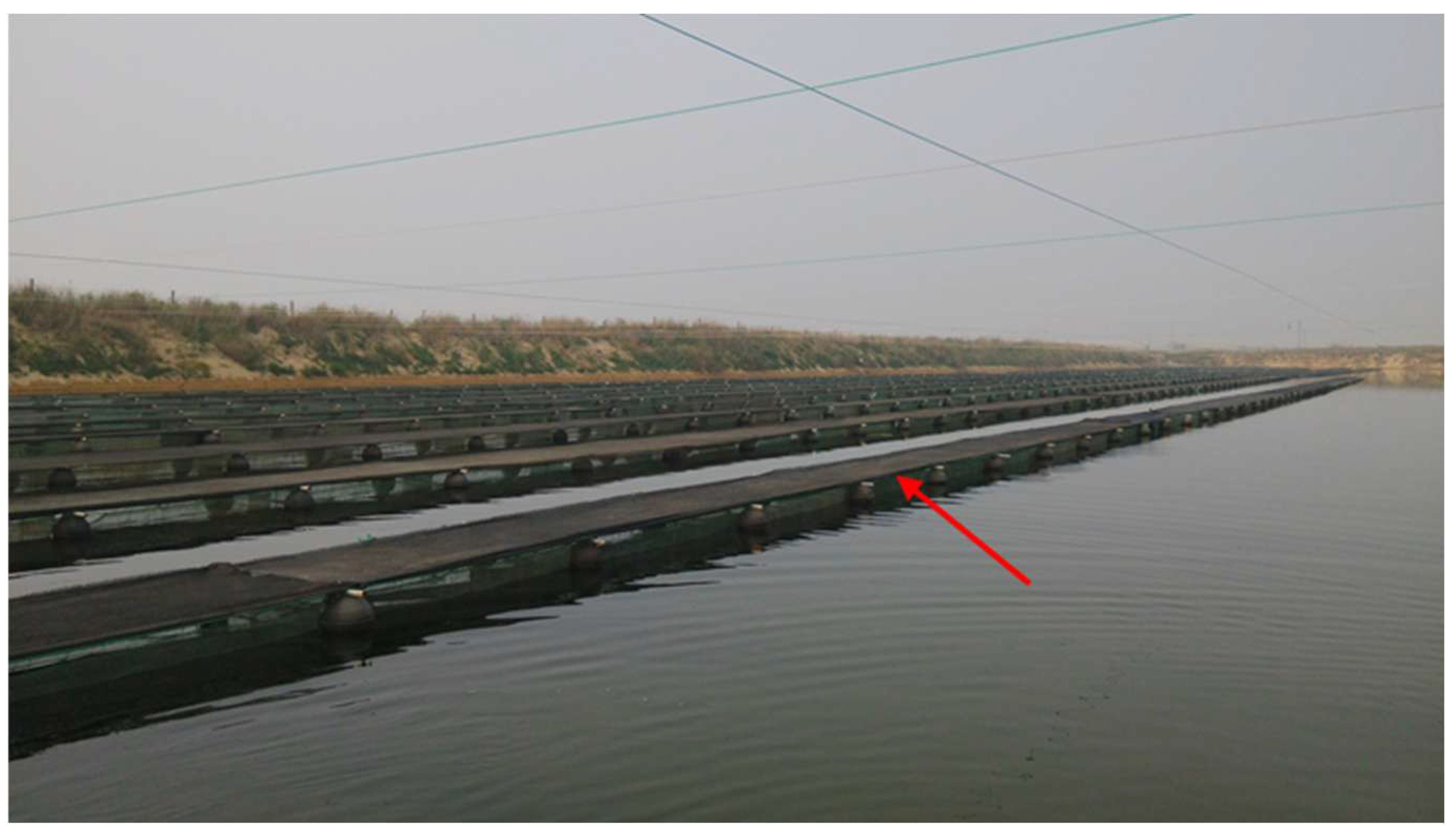
The experimental pond was located at the sea cucumber breeding farm of Shandong Oriental Marine Technology Co., Ltd. in Laizhou City (37°12′25.92″ N, 119°57′37.30″ E), Shandong Province, China. The pond covered an area of about 20,000 square meters, with a depth of 1.2 to 2.0 m, a sandy and muddy bottom, and a complete drainage system. The water quality was pollution-free. The upper part of the pond was covered with a black sunshade net to prevent an excessively high water temperature in summer (Figure 1).

2.2. Determination of Pond Water Quality Factors

The water temperature of the pond was measured at 08:00 every morning, from 28 June to 3 November. The salinity, dissolved oxygen, and pH were measured using the water quality analyzer HACH ® TM156 (HACH, Danaher Corporation, Washington, DC, USA). The indicators were measured three times at each sampling. A 2.5 L organic glass water sampler was used to mix the water from the upper (depth 30 cm), middle (depth 90 cm), and lower (depth 150 cm) ponds separately, and then take 1–2 L of the mixed water. They were filtered with a 0.45 μm glass fiber microporous filter membrane that was preheated at 500 °C for 2 h in a muffle furnace. The suspended particle matter (SPM) and particulate organic matter (POM) in the water were measured [25]. Then, the filtered microporous membrane was cut into fine strips and was added into 90% acetone. They were extracted at 4 °C for 18–24 h to measure the content of chlorophyll-a, using a spectrophotometer [26]. The contents of ammonia nitrogen, nitrate nitrogen, nitrite nitrogen, and reactive phosphorus in a mixed water sample of 400 to 500 mL were measured [27,28].

2.3. Determination of Plankton in Ponds

When sampling each time, 1 L of water was taken from the shore located 2–3 m offshore along the diagonal of the pond. Then, 1 L of water from one or more layers (surface, middle, bottom) in the center of the pond was taken and then they were mixed. After that, it was fixed with 4% formalin and 1.5% Lugol’s solution. The water sample was placed in a separatory funnel for precipitation. After 2 h, the funnel was gently rotated and continued to precipitate for 24–48 h. Then, a pipette was used to carefully suction out the clear liquid without algae from the upper part, until only about 20–40 mL liquid was left. Then, the precipitation was transferred into a 100 mL plastic specimen bottle, and the funnel was rinsed 2–3 times, with the supernatant being poured into the bottle until 40–60 mL, and the accurate volume of the sample was measured.
The 0.1 mL sample was aspirated using a pipette and placed into a 0.1 mL chamber using the microscope counting method referred to by LeGresley et al. [29]. Small organisms, such as diatoms, and larger organisms, such as filamentous algae, were identified and counted using an Olympus FX380 microscope (Olympus Corporation, Tokyo, Japan) [30].

2.4. Data Analysis

SPSS v26.0 software (IBM, Armonk, NY, USA) was used to analyze the data, and all data are expressed as means ± standard deviations (SD). The Kolmogorov–Smirnov method was used for normal distribution detection, and one-way ANOVA (analysis of variance) and Tukey’s HSD (honestly significant difference) were used for a comparative analysis of differences. p < 0.05 was considered to be significant.

3. Results

3.1. Changes in the Water Quality Factors of the Pond

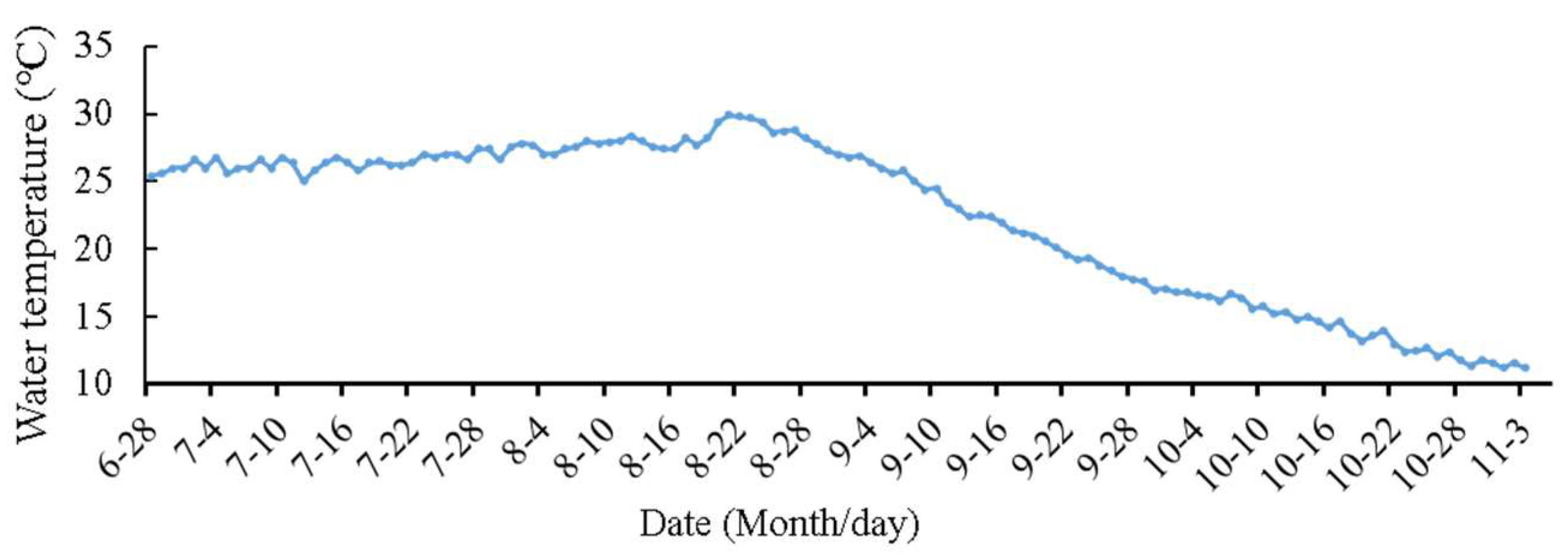
The temperature varied from 11.2 to 29.9 °C, with a trend of first increasing and then decreasing (Figure 2). On 22 August, the highest water temperature was 29.9 °C, with a range of 25.8 to 29.9 °C from 19 July to 30 August. The water temperature began to decrease in September.
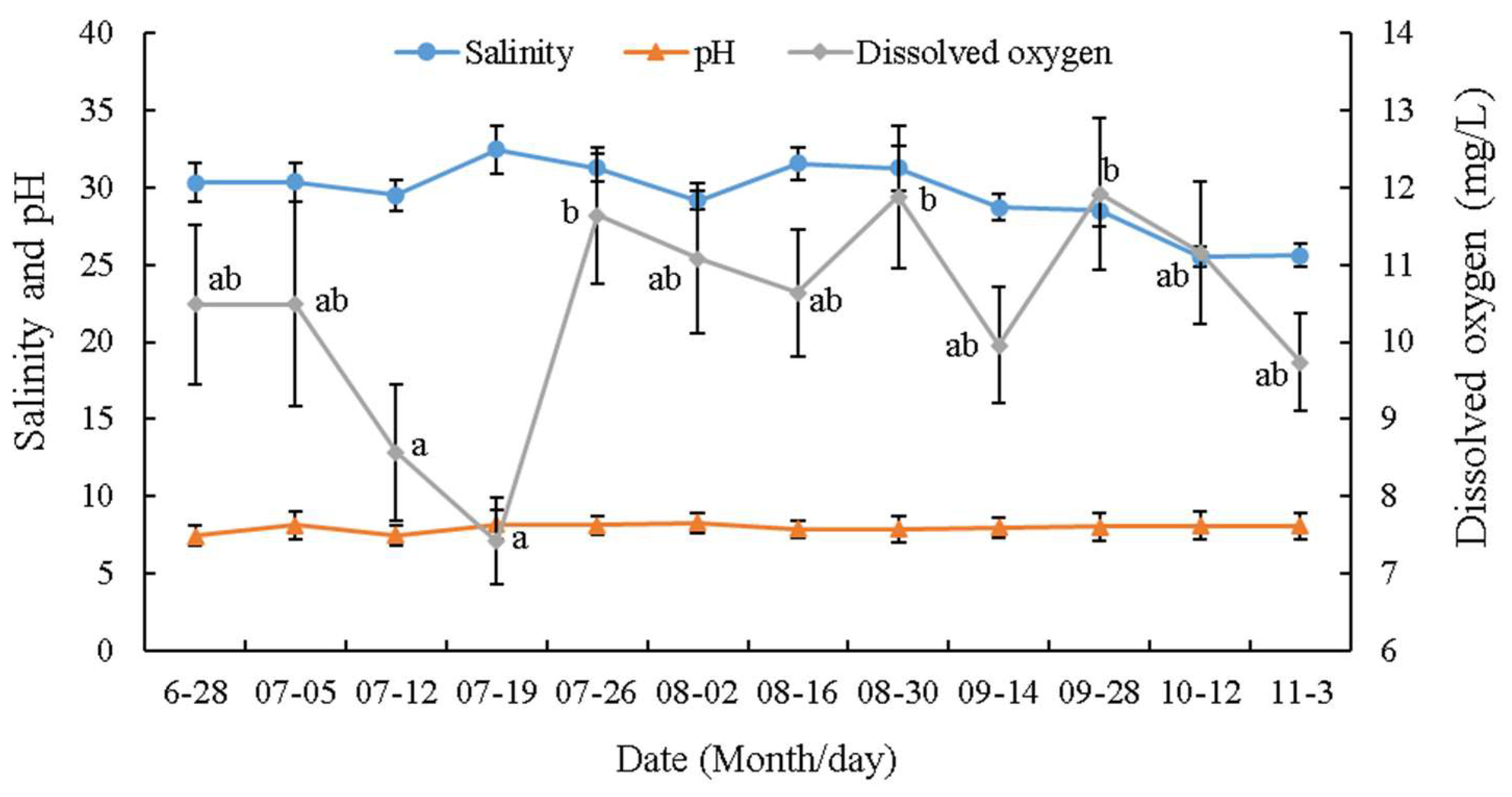
During the experiment, there were no significant differences in the contents of pH and salinity (p > 0.05), with pH ranging from 7.46 to 8.28 and salinity being between 25.51 and 32.48 (Figure 3). However, the dissolved oxygen content ranged from 7.72 to 11.92 mg/L, and it was significantly higher on 26 July, 30 August, and 28 September than those at other dates (p < 0.05).
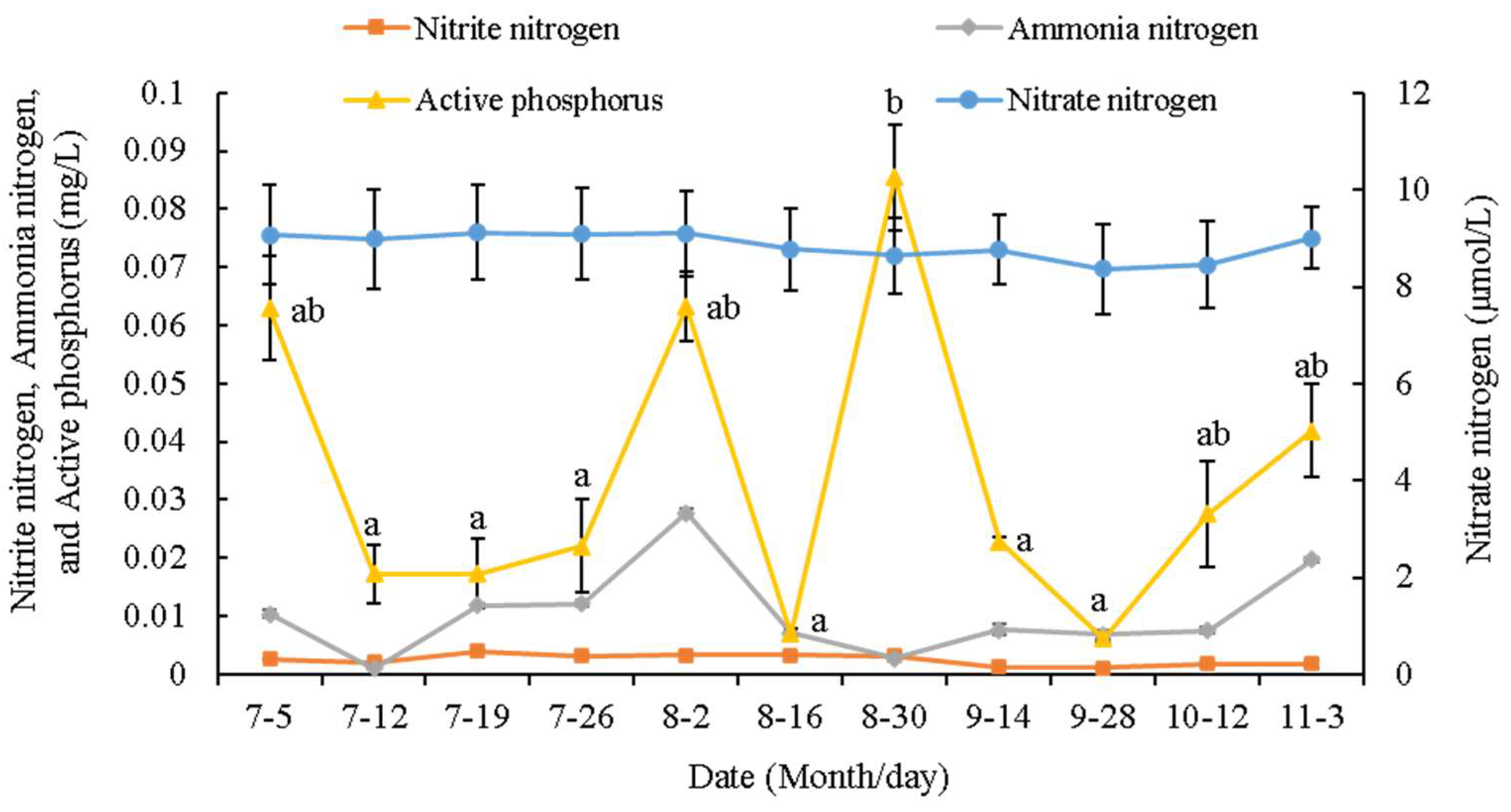
There was no significant difference in the nitrogen content (p > 0.05), with nitrate nitrogen ranging from 8.365 to 9.12 μmol/L, nitrite nitrogen from 0.0011 to 0.0039 mg/L, and ammonia nitrogen from 0.001 to 0.019 mg/L (Figure 4). However, the content of active phosphorus ranged from 0.0062 mg/L to 0.063 mg/L, and it was significantly higher on 30 August than those on the 12, 19, and 26 July, 16 August, and 14 and 28 September (p < 0.05).

3.2. Composition and Content Changes in Algae Species

The composition of algae in the pond was shown in Table 1. A total of six phyla, 11 genera, and 14 species of planktonic algae were detected. The dominants are mainly nine species of diatoms, and there was one species each from the Chlorophyta, Pyrrophyta, Cyanobacteria, Chrysophyta, and Cryptophyta. The highest number and density of algae occurred in August, while the lowest occurred in November.
The dominant species was Chroomonas acuta in the first two weeks. From July to August, it was Nitzschia sp. In mid-September, it was replaced by C. acuta. In October and November, the number of algae decreased significantly, with the dominant species becoming Peridinium sp. in October and C. acuta in November.

3.3. Changes in Biomass Content

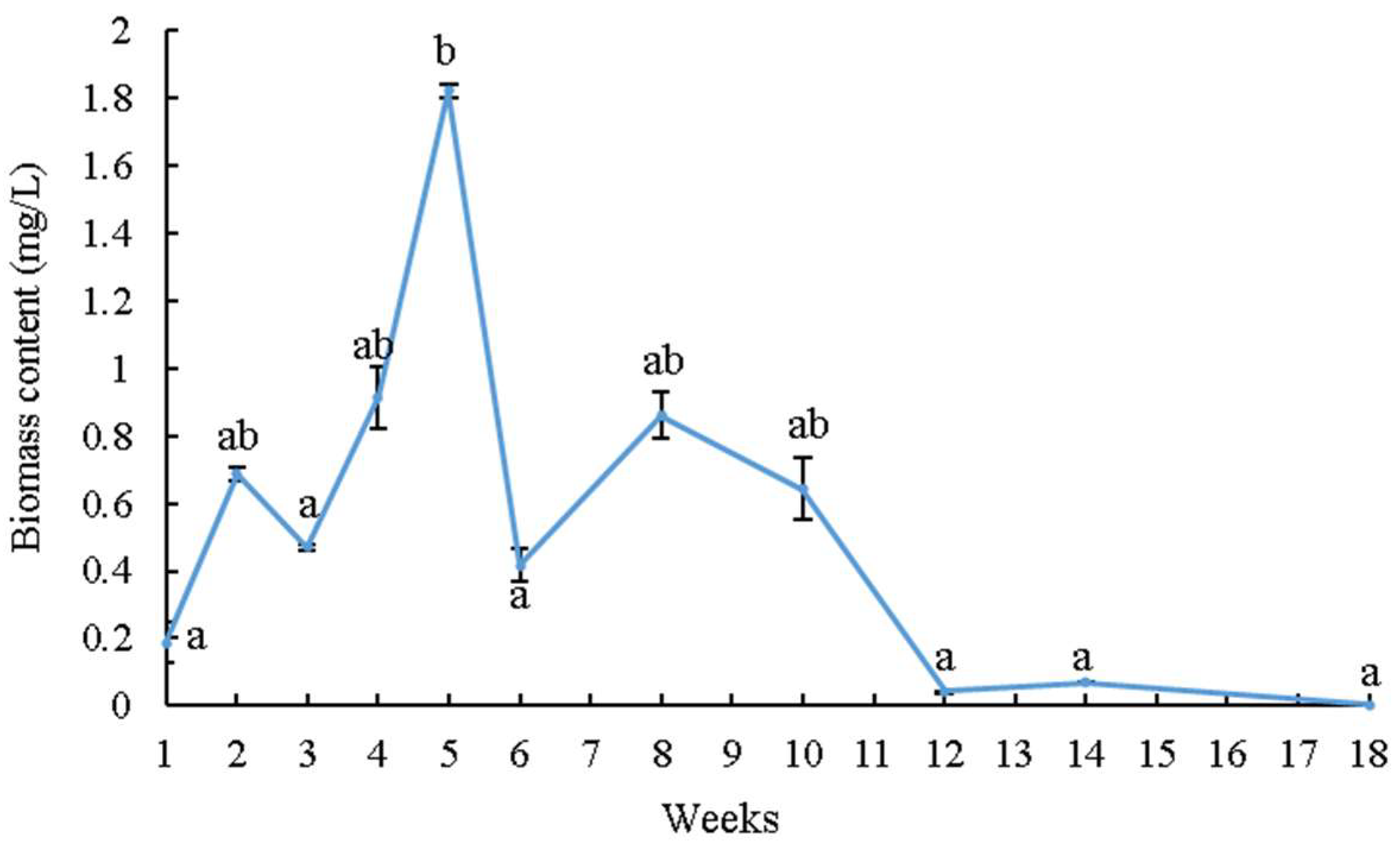
The biomass content ranged from 0.08 to 1.82 mg/L (Figure 5). The biomass content was significantly higher in week 5 than those in week 1, 3, 6, 12, 14, and 18 (p < 0.05). The variation trend of the biomass was consistent with the trend of the density pattern. In week 5, the number, density, and biomass of the planktonic algae species were also the highest.

3.4. Changes in Suspended Solids and Chlorophyll-a Content in Ponds

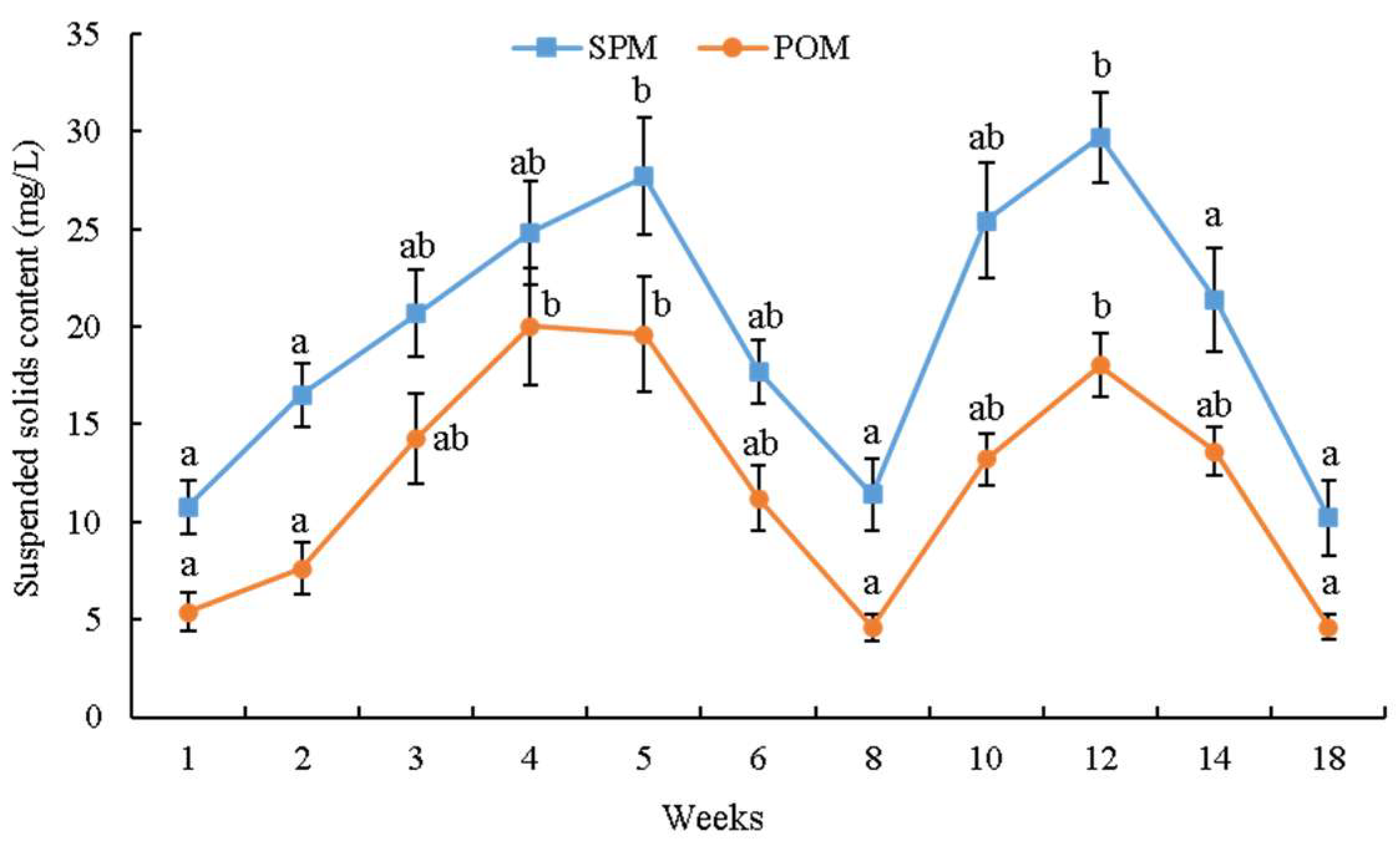
The changes in suspended particulate matter (SPM) ranged from 10.2 to 29.7 mg/L, (Figure 6). The SPM contents in weeks 5 and 12 were significantly higher than those in weeks 1, 2, 8, and 18 (p < 0.05). The changes in particulate organic matter (POM) ranged from 4.6 to 19.6 mg/L, and the trend was similar to that of SPM. The POM contents in weeks 4 and 5 were significantly higher than those in weeks 1, 2, 8, and 18 (p < 0.05).
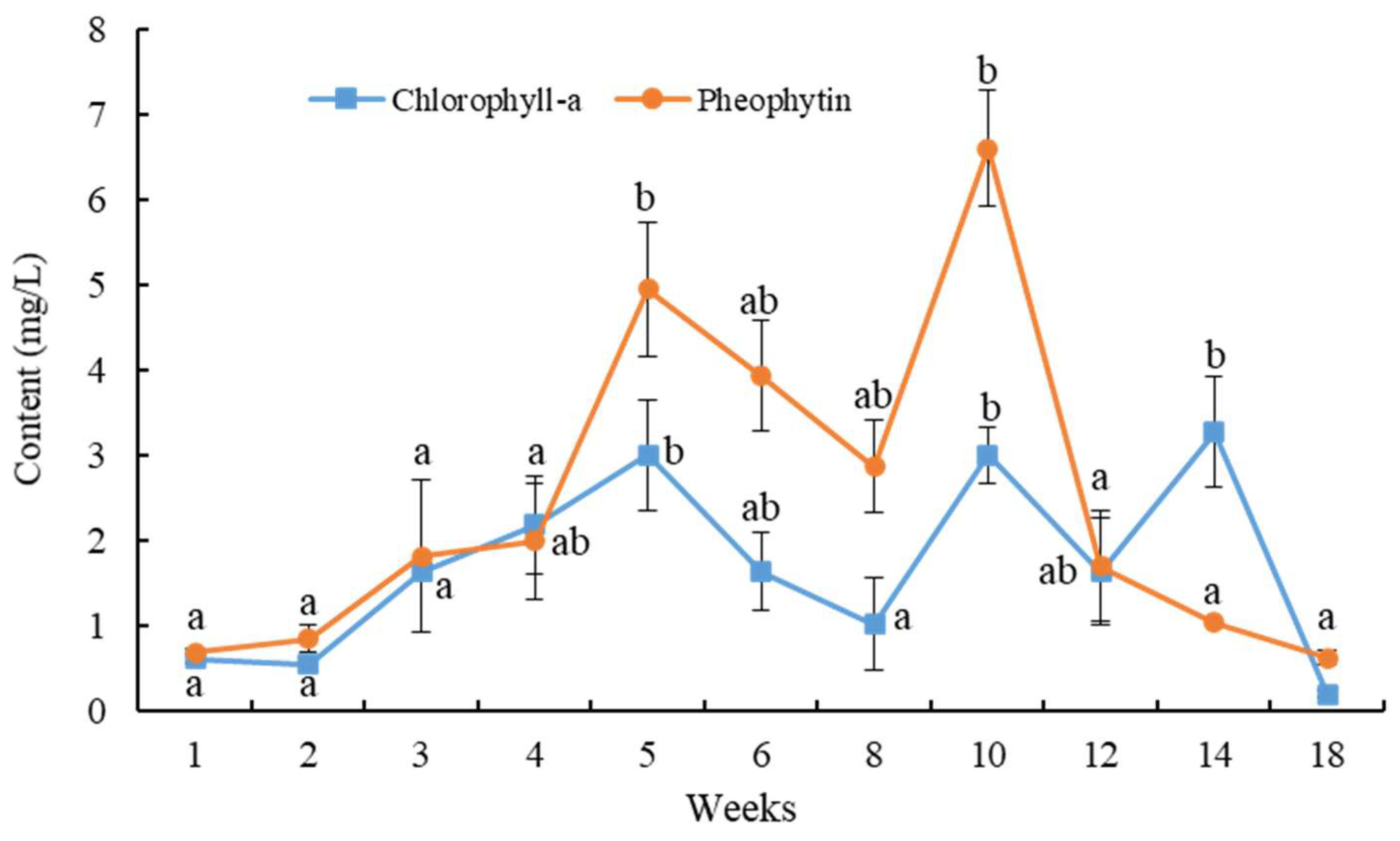
As shown in Figure 7, the chlorophyll-a content was significantly higher in weeks 5, 10, and 14 than those in week 1, 2, 3, 8, and 18 (p < 0.05). The pheophytin content was significantly higher in weeks 5 and 10 than those in weeks 1, 2, 3, 12, 14, and 18 (p < 0.05).

4. Discussion

4.1. The Influence of Water Quality on the Growth of Sea Cucumber

The water environment is the foundation for the survival of aquaculture organisms. The changes in water quality and the accumulation of various nutrients play an important role in the growth of aquaculture species. The sea cucumbers were sensitive to temperature changes, and when the temperature was high, they stopped feeding with a dormant state. Therefore, a layer of shading net was covered above the pond and the net cage to prevent a high water temperature in summer. Studies have shown that covering with shading nets in summer can effectively control the water temperature and the growth of algae [31,32]. In this study, the content of pH, dissolved oxygen, salinity, and nitrogen remained relatively stable. Active phosphate showed significant fluctuations in weeks 5 and 8. However, the elements N and P mainly affected the growth and reproduction of algae, indirectly affecting the growth of aquaculture species. In this study, the pond was a reservoir for seedling production, and there was no fertilizer during the seedling preservation process. The main factors affecting the concentration of active phosphate variation may be related to the seasons [33,34]. Therefore, controlling water quality factors within an appropriate range during production is a necessary condition for ensuring the healthy growth of sea cucumbers.

4.2. The Role of Phytoplankton in Sea Cucumber Ponds

Research has shown that in sea cucumber ponds, diatoms are the most abundant species of phytoplankton, while Chlorophyta, Pyrrophyta, Cyanobacteria, Chrysophyta, and Cryptophyta are relatively rare. Algae sedimentation can provide high-quality food for benthic organisms [35]. Part of the diatoms in the pond settle to the bottom in the form of particulate organic matter, providing high-quality food for detrital sea cucumbers. In week 8, the number of phytoplankton in the pond was the highest, and the dominant species were obvious. However, in week 5, the biomass of phytoplankton was the highest, which may be related to factors such as temperature [36], water exchange [37], and water nutrients [38,39,40], as well as there probably being competition between filamentous macroalgae and phytoplankton.
In this study, the experimental pond was a reservoir in the seedling workshop and no artificial fertilizer or water was added; therefore, the number and biomass of phytoplankton species in the pond were lower than those in the shrimp farming pond. In week 6, the number and biomass of phytoplankton in the pond decreased, which may be related to the growth of large filamentous algae competing with phytoplankton for nutrients and inhibiting the growth of phytoplankton. Purcell [41] suggested that excessive large algae such as hairy algae may not only affect the activity of sea cucumbers at the bottom, but may also lead to a decrease in the primary productivity of phytoplankton in the water. Therefore, it is necessary to clean the large algae in the pond in July, August, and September every year.

4.3. Changes in Chlorophyll-a and Pheophytin Contents in the Pond

The changes in chlorophyll-a content are mainly influenced by phytoplankton, and the chlorophyll-a is more easily degraded into pheophytin. The results show that the content of pheophytin is slightly higher than that of chlorophyll-a. As a detrital marine organism, sea cucumbers mainly feed on dead and decomposed organic matter, and the proportion of live diatoms is not high [34]. It is believed that after the death of phytoplankton, chlorophyll-a immediately dissociates from the cells. Free chlorophyll-a is very unstable and sensitive to light and heat. Under acidic conditions, the magnesium ion in the center of the chlorophyll-a molecule porphyrin ring is replaced by two hydrogen ions and converted into pheophytin, which characterizes the content of lifeless chlorophyll-a in the water, and the higher the content, the more dead algae in the water [42]. In this study, chlorophyll-a showed a trend of rising and falling, which is similar to the trend of biomass changes in planktonic algae. The experiment was conducted from July to November, and the 5th week to the 10th week is the high-temperature period in summer. Sea cucumbers have a habit of summer sleep, and the death and decomposition of planktonic algae under a high temperature lead to higher levels of magnesium free chlorophyll-a. Planktonic algae settle to the bottom and undergo bacterial decomposition with benthic microalgae, providing high-quality food reserves for sea cucumbers.

4.4. Changes in Suspended Solids in the Ponds

The sedimentation and resuspension of SPM and POM in ponds play an important role in the transfer of energy from primary producers to consumers in aquatic systems. Organic debris is an important food source for detrital benthic communities in marine ecosystems [43]. The quantity and quality of SPM play an important role in the distribution and metabolism of benthic communities [44,45]. By analyzing the flux of POM in water, the function of aquatic ecosystems can be better evaluated [46]. The suspended solids in the pond of this experiment decreased significantly in week 6, which is consistent with the decrease in the biomass of phytoplankton and the number of phytoplankton species. As the water temperature decreased, the reproduction of phytoplankton and the diffusion of feed in the net cage affected the concentration of suspended solids, which increased again after week 8. After week 12, a large number of phytoplankton decayed and settled, and the concentration of suspended solids decreased.

5. Conclusions

During the experiment, shading nets covered ponds and net cages to effectively alleviate the impact of high temperatures in summer. Although the water temperature fluctuated between 11.2 and 29.9 °C, the critical high temperature period (19 July to 30 August) did not exceed the tolerance limit of the sea cucumbers. The pH, dissolved oxygen, salinity, and nitrogen remain stable. A total of six phyla and 14 species of planktonic algae were detected in the pond, with diatoms accounting for the absolute majority (nine species). Furthermore, the structure of algal communities, especially the abundance of diatoms, is sensitive to changes in the water environment and can serve as a biological monitoring indicator for water quality. The content of chlorophyll-a is consistent with the trend of changes in the biomass of planktonic algae. The changes in SPM and POM are synchronized, and their sedimentation and resuspension processes not only maintain energy transfer in the ecosystem, but also provide a key food source for sea cucumbers after summer dormancy through the accumulation of algal debris.
With the continuous expansion of the sea cucumber cultivation scale, the demand for high-quality seedlings in the industry is gradually increasing. However, the traditional indoor seedling ponds are no longer able to meet the needs of industrial development, due to high production costs and unstable survival rates. Therefore, it is urgent to develop new intermediate cultivation technologies to promote the sustainable development of the breeding industry. The cultivation method in the pond net cages is becoming increasingly popular. From the perspective of industrial development needs, improving seedling yield and quality, it is particularly important to select suitable attachment bases and determine the optimal seedling size and density in the outdoor net cage cultivation process of sea cucumbers. The results in this study provide important information for seedling cultivation in the sea cucumber pond, and further study should focus on the production and quality of adult sea cucumbers to promote the sustainable development of this industry.

Author Contributions

Conceptualization, Y.W.; methodology, L.L. and R.D.; software, B.Q. and N.Y.; validation, Y.W. and L.L.; formal analysis, B.Q. and B.Z.; investigation, N.Y. and B.Z.; resources, Y.W. and L.L.; data curation, L.L. and R.D.; writing—original draft Y.W. and W.X.; writing—review and editing, W.X.; visualization, W.X.; supervision, W.X.; project administration, R.D. and Y.W.; funding acquisition, W.X. All authors have read and agreed to the published version of the manuscript.

Funding

This work was funded by Lianyungang City Key Research and Development Program (SF2304) and Yantai Science and Technology Innovation Development Plan Project, China (2022XDRH022).

Institutional Review Board Statement

The study was conducted in compliance with the Animal Care and Use Committee of Yantai University, China (Permit Number 20206803).

Informed Consent Statement

Not applicable.

Data Availability Statement

The data that support the findings of this study are available from the corresponding author upon reasonable request.

Conflicts of Interest

The authors declare no conflicts of interest.

References

  1. Conand, C.; Claereboudt, M.; Dissayanake, C.; Ebrahim, A.; Fernando, S.; Godvinden, R.; Friedman, K. Review of fisheries and management of sea cucumbers in the Indian Ocean. West. Indian Ocean J. Mar. Sci. 2022, 21, 125–148. [Google Scholar] [CrossRef]
  2. Yang, H.; Hamel, J.F.; Mercier, A. (Eds.) The Sea Cucumber Apostichopus japonicus: History, Biology and Aquaculture; Academic Press: Cambridge, MA, USA, 2015. [Google Scholar]
  3. Kang, K.H.; Kwon, J.Y.; Kim, Y.M. A beneficial coculture: Charm abalone Haliotis discus Hannai and sea cucumber Stichopus japonicus. Aquaculture 2003, 216, 87–93. [Google Scholar] [CrossRef]
  4. Wang, D.; Wu, F.X. China Fishery Statistical Yearbook; China Agriculture Press: Beijing, China, 2004. [Google Scholar]
  5. Serang, A.M.; Rahantoknam, S.P.T.; Tomatala, P. Effect of different stocking densities on growth and survival rates of sea cucumber Holothuria scabra seedlings. J. Aquac. Indones. 2016, 17, 30–34. [Google Scholar] [CrossRef]
  6. Han, Q.; Keesing, J.K.; Liu, D. A review of sea cucumber aquaculture, ranching, and stock enhancement in China. Rev. Fish. Sci. Aquac. 2016, 24, 326–341. [Google Scholar] [CrossRef]
  7. Bosma, R.H.; Verdegem, M.C. Sustainable aquaculture in ponds: Principles, practices and limits. Livest. Sci. 2011, 139, 58–68. [Google Scholar] [CrossRef]
  8. Zhang, K.; Ye, Z.; Qi, M.; Cai, W.; Saraiva, J.L.; Wen, Y.; Zhao, J. Water quality impact on fish behavior: A review from an aquaculture perspective. Rev. Aquac. 2005, 17, e12985. [Google Scholar] [CrossRef]
  9. Zhang, X.; Zhang, Y.; Zhang, Q.; Liu, P.; Guo, R.; Jin, S.; Liu, Y. Evaluation and analysis of water quality of marine aquaculture area. Int. J. Environ. Res. Public Health 2020, 17, 1446. [Google Scholar] [CrossRef] [PubMed]
  10. Asha, P.S.; Muthiah, P. Effects of temperature, salinity and pH on larval growth, survival and development of the sea cucumber Holothuria spinifera Theel. Aquaculture 2005, 250, 823–829. [Google Scholar] [CrossRef]
  11. Li, L.; Li, Q.; Sun, X.; Kong, L. Effects of temperature and salinity on larval growth, survival, and development of the sea cucumber Apostichopus japonicus. N. Am. J. Aquac. 2011, 73, 296–303. [Google Scholar] [CrossRef]
  12. Al-Rawahy, M.S.; Al-Rawahy, S.A.; Al-Mulla, Y.A.; Nadaf, S.K. Influence of nutrient solution temperature on its oxygen level and growth, yield and quality of hydroponic cucumber. Agric. Sci. 2019, 11, 75–92. [Google Scholar] [CrossRef]
  13. Bai, Y.; Zhang, L.; Liu, S.; Ru, X.; Xing, L.; Cao, X.; Yang, H. The effect of salinity on the growth, energy budget and physiological performance of green, white and purple color morphs of sea cucumber, Apostichopus japonicus. Aquaculture 2015, 437, 297–303. [Google Scholar] [CrossRef]
  14. Huo, D.; Sun, L.; Sun, J.; Zhang, L.; Liu, S.; Su, F.; Yang, H. Sea cucumbers in a high temperature and low dissolved oxygen world: Roles of miRNAs in the regulation of environmental stresses. Environ. Pollut. 2021, 268, 115509. [Google Scholar] [CrossRef] [PubMed]
  15. Kühnhold, H.; Kamyab, E.; Novais, S.; Indriana, L.; Kunzmann, A.; Slater, M.; Lemos, M. Thermal stress effects on energy resource allocation and oxygen consumption rate in the juvenile sea cucumber, Holothuria scabra (Jaeger, 1833). Aquaculture 2017, 467, 109–117. [Google Scholar] [CrossRef]
  16. Huo, D.; Su, F.; Zhang, L.; Yang, H.; Sun, L. Temperature and dissolved oxygen influence the immunity, digestion, and antioxidant level in sea cucumber Apostichopus japonicus. Front. Mar. Sci. 2022, 9, 1094814. [Google Scholar] [CrossRef]
  17. Lv, X.; Yu, P.; Mao, W.; Li, Y. Vertical variations in bacterial community composition and environmental factors in the culture pond sediment of sea cucumber Apostichopus japonicus. J. Coast. Res. 2018, 84, 69–76. [Google Scholar] [CrossRef]
  18. Hu, S.; Xing, R.; Wang, H.; Chen, L. Comparing spatial-temporal characteristics of dissolved nitrogen and phosphorus in water of sea cucumber Apostichopus japonicas culture ponds between sandy and muddy sediments. Aquaculture 2022, 552, 737990. [Google Scholar] [CrossRef]
  19. Chen, L.; Chen, L.Y.; Wang, X.Y.; Wang, G.Y. Physicochemical properties and bacterial diversity of sediment in sea cucumber culture ponds under high summer temperatures. Aquac. Res. 2023, 1, 6090956. [Google Scholar] [CrossRef]
  20. Ren, Y.; Dong, S.; Wang, F.; Gao, Q.; Tian, X.; Liu, F. Sedimentation and sediment characteristics in sea cucumber Apostichopus japonicus (Selenka) culture ponds. Aquac. Res. 2010, 42, 14–21. [Google Scholar] [CrossRef]
  21. Lavitra, T.; Rasolofonirina, R.; Eeckhaut, I. The effect of sediment quality and stocking density on survival and growth of the sea cucumber Holothuria scabra reared in nursery ponds and sea pens. West. Indian Ocean J. Mar. Sci. 2010, 9, 153–164. Available online: https://www.ajol.info/index.php/wiojms/article/view/73975 (accessed on 10 November 2025).
  22. Sun, J.; Hamel, J.F.; Stuckless, B.; Small, T.J.; Mercier, A. Effect of light, phytoplankton, substrate types and colour on locomotion, feeding behaviour and microhabitat selection in the sea cucumber Cucumaria frondosa. Aquaculture 2020, 526, 735369. [Google Scholar] [CrossRef]
  23. Lin, Q.; Zhang, D.S.; Wei, Y.N.; Sun, G.W.; Lei, Z.L.; Chen, J.F.; Guo, C.; Zhou, W. Effects of three water quality regulation methods on phytoplankton population structure in a sea cucumber culture pond. J. Dalian Ocean Univ. 2019, 34, 566–572. [Google Scholar] [CrossRef]
  24. Yin, X.W.; Lin, H.J.; Min, W.W.; Liu, G.; Yang, D.Z.; Zhou, W.; Liu, F.H. Effects of diets on growth and survival of larval and juvenile sea cucumber Apostichopus japonicus in a marine net cage. J. Dalian Ocean Univ. 2014, 29, 126–130. [Google Scholar] [CrossRef]
  25. Hunter, K.A.; Liss, P.S. Organic matter and the surface charge of suspended particles in estuarine waters. Limnol. Oceanogr. 1982, 27, 322–335. [Google Scholar] [CrossRef]
  26. Aminot, A.; Rey, F. Standard procedure for the determination of chlorophyll-a a by spectroscopic methods. ICES 2000, 112, 1–2. [Google Scholar]
  27. Zhang, H.Y.; Zhang, Y.; Lai, D.; Chen, L.Q.; Zhou, L.Q.; Tao, C.L.; Yang, Y. Real-time smartphone-based multi-parameter detection of nitrite, ammonia nitrogen, and total phosphorus in water. Anal. Methods 2025, 17, 5683–5696. [Google Scholar] [CrossRef]
  28. Alahi, M.E.E.; Mukhopadhyay, S.C. Detection methods of nitrate in water: A review. Sens. Actuators A Phys. 2018, 280, 210–221. [Google Scholar] [CrossRef]
  29. LeGresley, M.; McDermott, G. Counting chamber methods for quantitative phytoplankton analysis-haemocytometer, Palmer-Maloney cell and Sedgewick-Rafter cell. In IOC Manuals and Guides; UNESCO: Paris, France, 2010; Volume 55, pp. 25–30. [Google Scholar]
  30. Tseng, C.K. Common Seaweeds of China; Science Press: Beijing, China, 1983. [Google Scholar]
  31. Mosisch, T.D.; Bunn, S.E.; Davies, P.M. The relative importance of shading and nutrients on algal production in subtropical streams. Freshw. Biol. 2001, 46, 1269–1278. [Google Scholar] [CrossRef]
  32. Yeh, T.Y.; Ke, T.Y.; Lin, Y.L. Algal growth control within natural water purification systems: Macrophyte light shading effects. Water Air Soil Poll. 2011, 214, 575–586. [Google Scholar] [CrossRef]
  33. Jiang, S.; Lu, H.; Liu, J.; Lin, Y.; Dai, M.; Yan, C. Influence of seasonal variation and anthropogenic activity on phosphorus cycling and retention in mangrove sediments: A case study in China. Estuar. Coast. Shelf S 2018, 202, 134–144. [Google Scholar] [CrossRef]
  34. Tammeorg, O.; Moels, T.; Kangur, K. Weather conditions influencing phosphorus concentration in the growing period in the large shallow Lake Peipsi (Estonia/Russia). J. Limnol. 2014, 73, 27–35. [Google Scholar] [CrossRef]
  35. Hansen, J.L.S.; Josefson, A.B. Ingestion by deposit-feeding macro-zoobenthos in the aphotic zone does not affect the pool of live pelagic diatoms in the sediment. Exp. Mar. Biol. Ecol. 2004, 308, 59–84. [Google Scholar] [CrossRef]
  36. Agawin, N.S.; Duarte, C.M.; Agustí, S. Nutrient and temperature control of the contribution of picoplankton to phytoplankton biomass and production. Limnol. Oceanogr. 2000, 45, 591–600. [Google Scholar] [CrossRef]
  37. Bouteiller, A.L.; Blanchot, J.; Rodier, M. Size distribution patterns of phytoplankton in the western Pacific: Towards a generalization for the tropical open ocean. Nucleic Acids Res. 2002, 9, 4863–4878. [Google Scholar] [CrossRef]
  38. Zhu, W.; Wan, L.; Zhao, L. Effect of nutrient level on phytoplankton community structure in different water bodies. J. Environ. Sci. 2010, 22, 32–39. [Google Scholar] [CrossRef]
  39. Gobler, C.J.; Cullison, L.A.; Koch, F.; Harder, T.M.; Krause, J.W. Influence of freshwater flow, ocean exchange, and seasonal cycles on phytoplankton–nutrient dynamics in a temporarily open estuary. Estuar. Coast. Shelf Sci. 2005, 65, 275–288. [Google Scholar] [CrossRef]
  40. Zhao, L.; Guo, X. Influence of cross-shelf water transport on nutrients and phytoplankton in the East China Sea: A model study. Ocean Sci. 2011, 7, 27–43. [Google Scholar] [CrossRef]
  41. Purcell, S.W.; Conand, C.; Uthicke, S.; Byrne, M. Ecological roles of exploited sea cucumbers. In Oceanography and Marine Biology; CRC Press: Boca Raton, FL, USA, 2016; pp. 375–394. [Google Scholar]
  42. Wang, L.; Zhao, D.Z.; Xing, X.G.; Yang, J.H.; Fu, Y.N. The effects of pheophytin on absorption characteristics of phytoplankton. J. Oceanol. Limnol. 2009, 40, 596–602. [Google Scholar] [CrossRef]
  43. Danovaro, R.; Della Croce, N.; Dell’Anno, A.; Fabiano, M.; Marrale, D.; Martorano, D. Seasonal changes and biochemical composition of the labile organic matter flux in the Cretan Sea. Prog. Oceanogr. 2000, 46, 259–278. [Google Scholar] [CrossRef]
  44. Graf, G.; Schulz, R.; Peinert, R.; Meyer-Reil, L.A. Benthic response to sedimentation events during autumn to spring at a shallow-water station in the western Kiel Bight. Mar. Biol. 1983, 77, 235–246. [Google Scholar] [CrossRef]
  45. Grant, J.; Hargrave, B.T. Benthic metabolism and the quality of sediment organic carbon. Biol. Oceanogr. 1987, 4, 243–264. [Google Scholar] [CrossRef]
  46. Pusceddu, A.; Sarà, G.; Armeni, M.; Fabiano, M.; Mazzola, A. Seasonal and spatial changes in the sediment organic matter of a semi-enclosed marine system (W-Mediterranean Sea). Hydrobiologia 1999, 397, 59–70. [Google Scholar] [CrossRef]
Figure 1. Appearance of experiment pond. The red arrow indicates black sunshade net.
Sustainability 18 01214 g001
Figure 2. Changes in water temperature in the pond during the experiment period.
Sustainability 18 01214 g002
Figure 3. Changes in pH, salinity, and dissolved oxygen in the pond during the experiment period. Data were expressed as means ± SD; different letters on the same line indicate significant differences (p < 0.05).
Sustainability 18 01214 g003
Figure 4. Changes in nitrite nitrogen, nitrate nitrogen, ammonia nitrogen, and active phosphorus in the pond during the experiment period. Data were expressed as means ± SD; different letters on the same line indicate significant differences (p < 0.05).
Sustainability 18 01214 g004
Figure 5. Changes in phytoplankton biomass in the pond during the experiment period. Data were expressed as means ± SD. Different letters on the same line indicate significant differences (p < 0.05).
Sustainability 18 01214 g005
Figure 6. Changes in SPM and POM contents in the pond during the experiment period. Data were expressed as means ± SD. Different letters on the same line indicate significant differences (p < 0.05).
Sustainability 18 01214 g006
Figure 7. Changes in chlorophyll-a and pheophytin contents in the pond during the experiment period. Data were expressed as means ± SD. Different letters on the same line indicate significant differences (p < 0.05).
Sustainability 18 01214 g007
Table 1. The species and quantity of algae on sampling dates. Data were expressed as cell density (×103 ind/L). Data were shown as means ± SD (n = 3).
SpeciesDate
7-057-127-197-268-038-168-309-1310-211-3
Navicula sp.0.1 ± 0.02 8.7 ± 0.160.8 ± 0.090.2 ± 0.03
Pleurosigma sp.1.8 ± 0.15 2.8 ± 0.463.1 ± 0.985.8 ± 1.064.2 ± 1.238.7 ± 2.090.8 ± 0.05
Nitzschia paradoxa 0.8 ± 0.04 2.4 ± 0.891.2 ± 0.082.0 ± 0.85 0.2 ± 0.06
Pinnularia sp.0.8 ± 0.041.0 ± 0.121.2 ± 0.251.8 ± 0.46 0.8 ± 0.05
Nitzschia sp.3.5 ± 0.58 14 ± 4.0672.8 ± 15.0628.1 ± 5.0824 ± 6.0514.5 ± 3.08
Pleurosigma affine0.1 ± 0.040.5 ± 0.091.2 ± 0.031.4 ± 0.26 1.6 ± 0.38 0.2 ± 0.050.1 ± 0.15
Coscinodiscas sp. 4.8 ± 0.89 1.2 ± 0.351.0 ± 0.310.5 ± 0.040.4 ± 0.052.9 ± 0.89
Thalassionema nitzschioides 2.4 ± 0.863.6 ± 0.79 1.0 ± 0.36 0.5 ± 0.06
Gyrosigma balticum 0.6 ± 0.351.2 ± 0.211.0 ± 0.14 2.0 ± 0.53
Peridinium sp. 1.2 ± 0.042.0 ± 0.36 0.9 ± 0.06 0.6 ± 0.18
Chlorella sp. 1.2 ± 0.321.3 ± 0.34 2.0 ± 0.540.7 ± 0.042.4 ± 0.45 0.4 ± 0.07
Chromulina sp.0.6 ± 0.031.0 ± 0.241.6 ± 0.560.9 ± 0.21 3.2 ± 0.85 0.4 ± 0.65
Chroomonas acuta3.8 ± 0.271.6 ± 0.643.2 ± 0.987.9 ± 1.752.3 ± 0.568.7 ± 3.014.3 ± 1.051.2 ± 0.12 0.7 ± 0.04
Dactylococcopsis acicularis 2.1 ± 0.13 0.5 ± 0.241.0 ± 0.25
Disclaimer/Publisher’s Note: The statements, opinions and data contained in all publications are solely those of the individual author(s) and contributor(s) and not of MDPI and/or the editor(s). MDPI and/or the editor(s) disclaim responsibility for any injury to people or property resulting from any ideas, methods, instructions or products referred to in the content.