

Dry Pass, Wet Fail: Ground Impedance Testing of Field-Aged PV Modules—Implications for Repowering/Revamping Within 5–10 Years and for Environmental Sustainability


Abstract
1. Introduction
- We quantify the relationship between dry (Rdry) and IEC-wet (Rwet) ground impedance (insulation resistance) for N = 37 field-aged modules;
- We document the occurrence of dry-pass/wet-fail modules that meet dry criteria but fail the IEC 40 MΩ·m2 wet criterion;
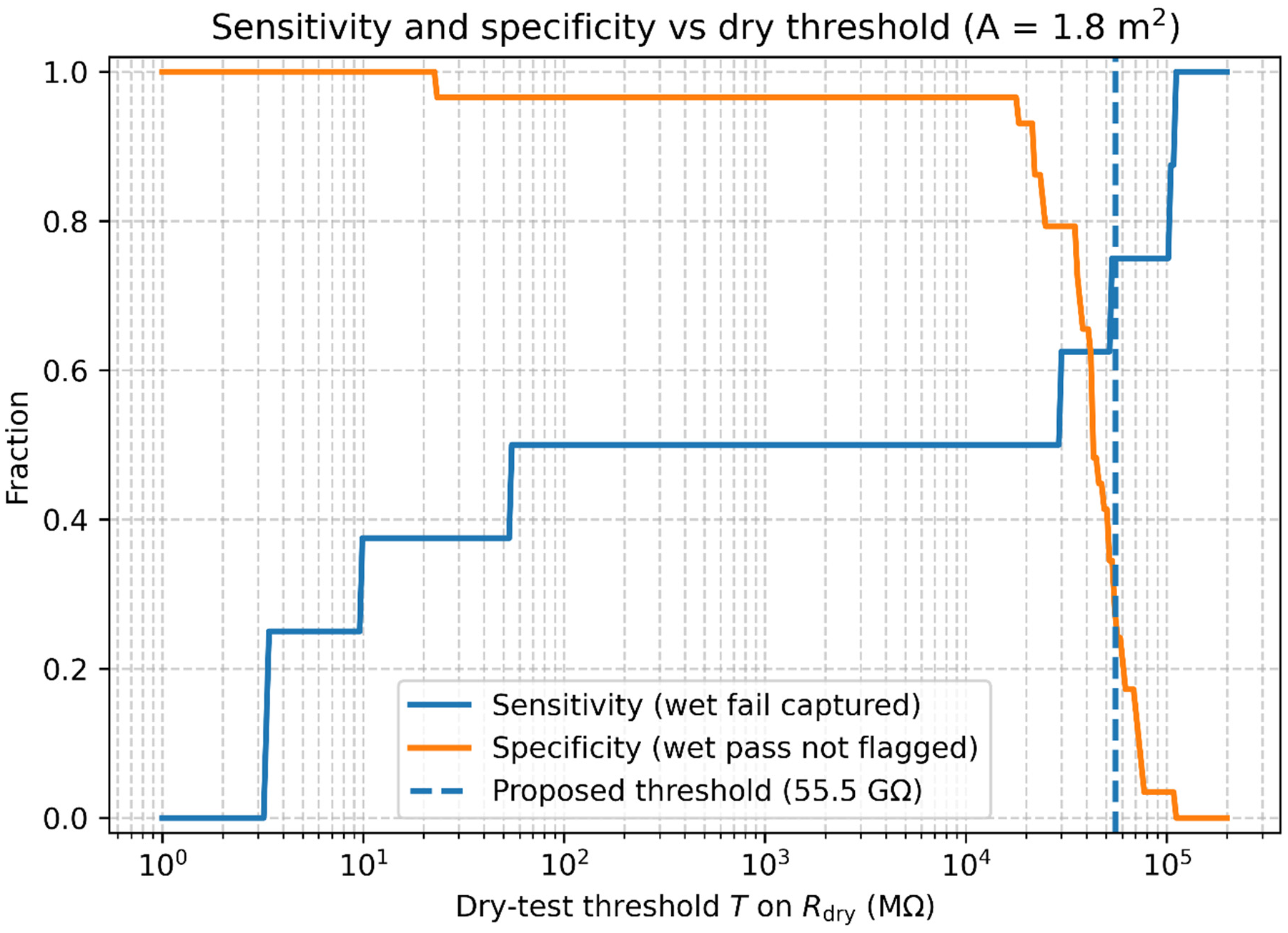
- We derive a dry-test threshold that can serve as a conservative screening indicator for potential IEC-wet failure;
- How dry and wet insulation measurements can support safer operation, repowering/revamping, and contributing to sustainable PV fleet management and sustainability-oriented end-of-life strategies should be discussed.
2. Materials and Methods
2.1. Samples
- Module ID (internal);
- Wet insulation resistance Rwet with units (kΩ, MΩ, GΩ or catastrophic 0 Ω);
- Dry insulation resistance Rdry with units;
- Ratio Rdry/Rwet (dimensionless).
2.2. Dry Insulation Resistance Measurements
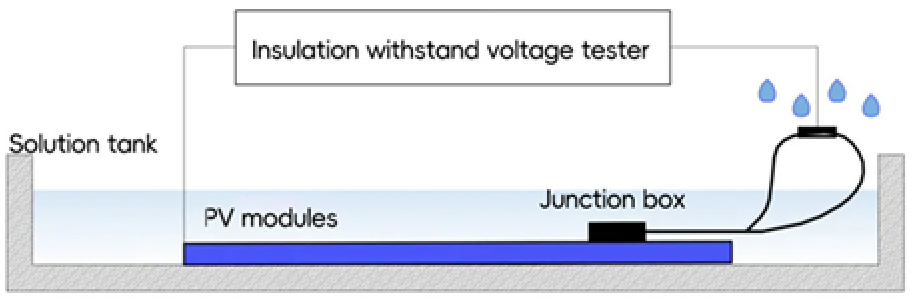
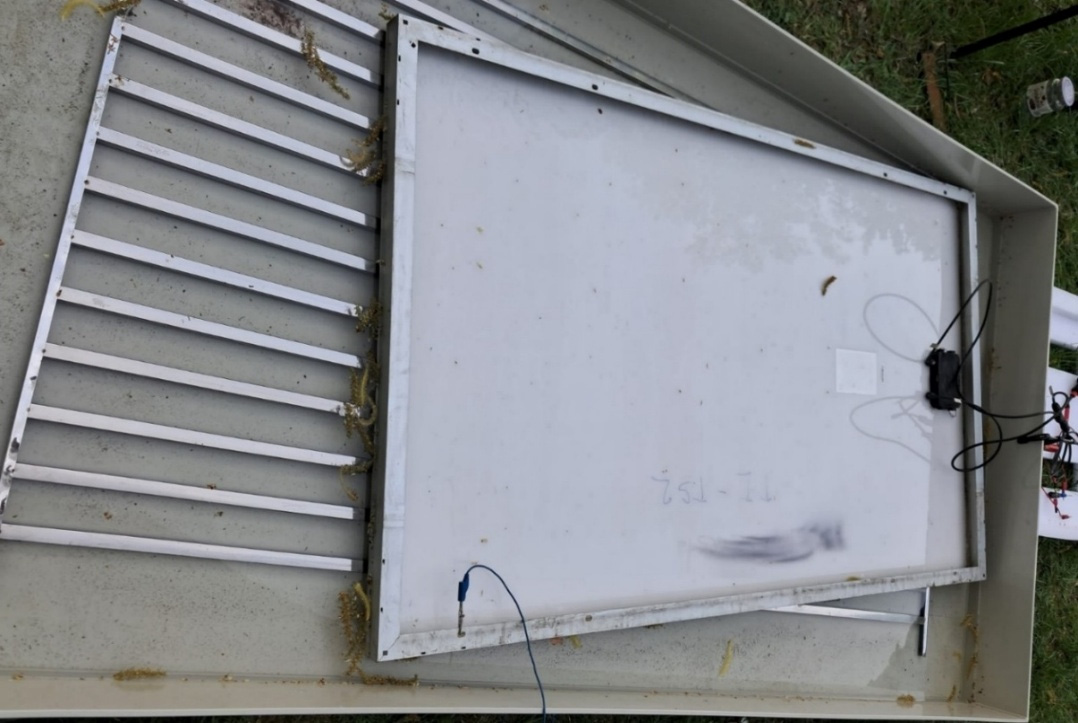
2.3. IEC 61215 MQT 15 Wet Leakage Test
2.4. Data Analysis and Dry-Test Threshold
3. Results
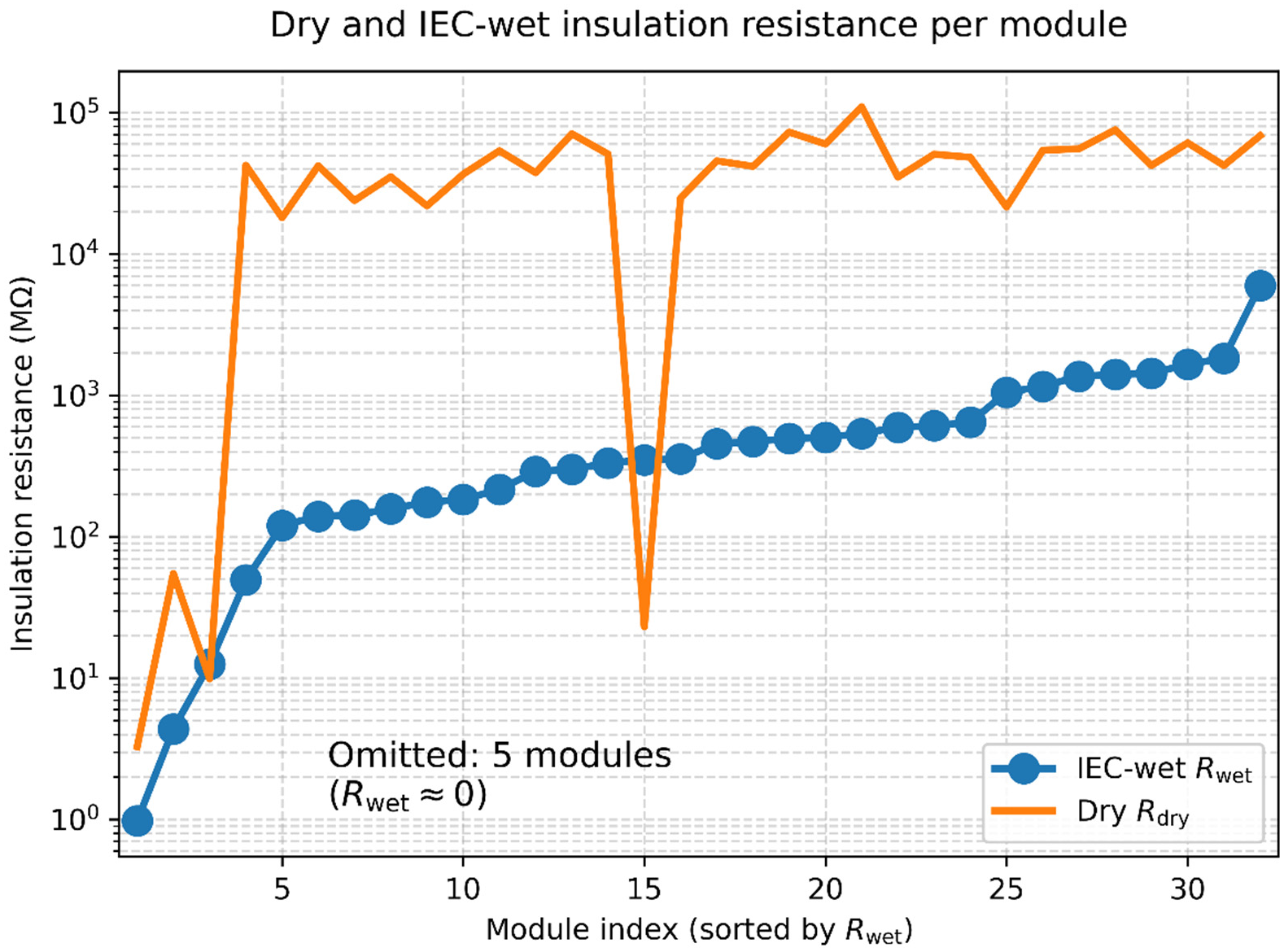
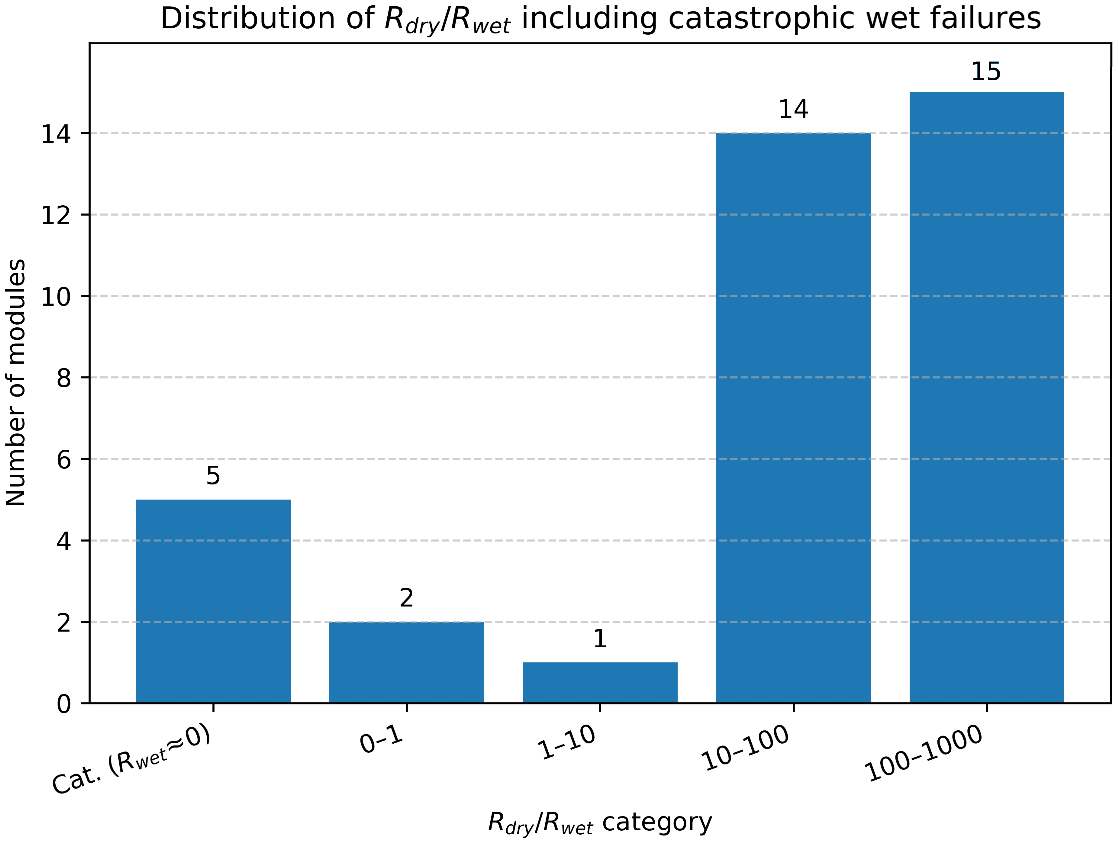
3.1. Dry Versus IEC-Wet Insulation Resistance and Ratio Distributions
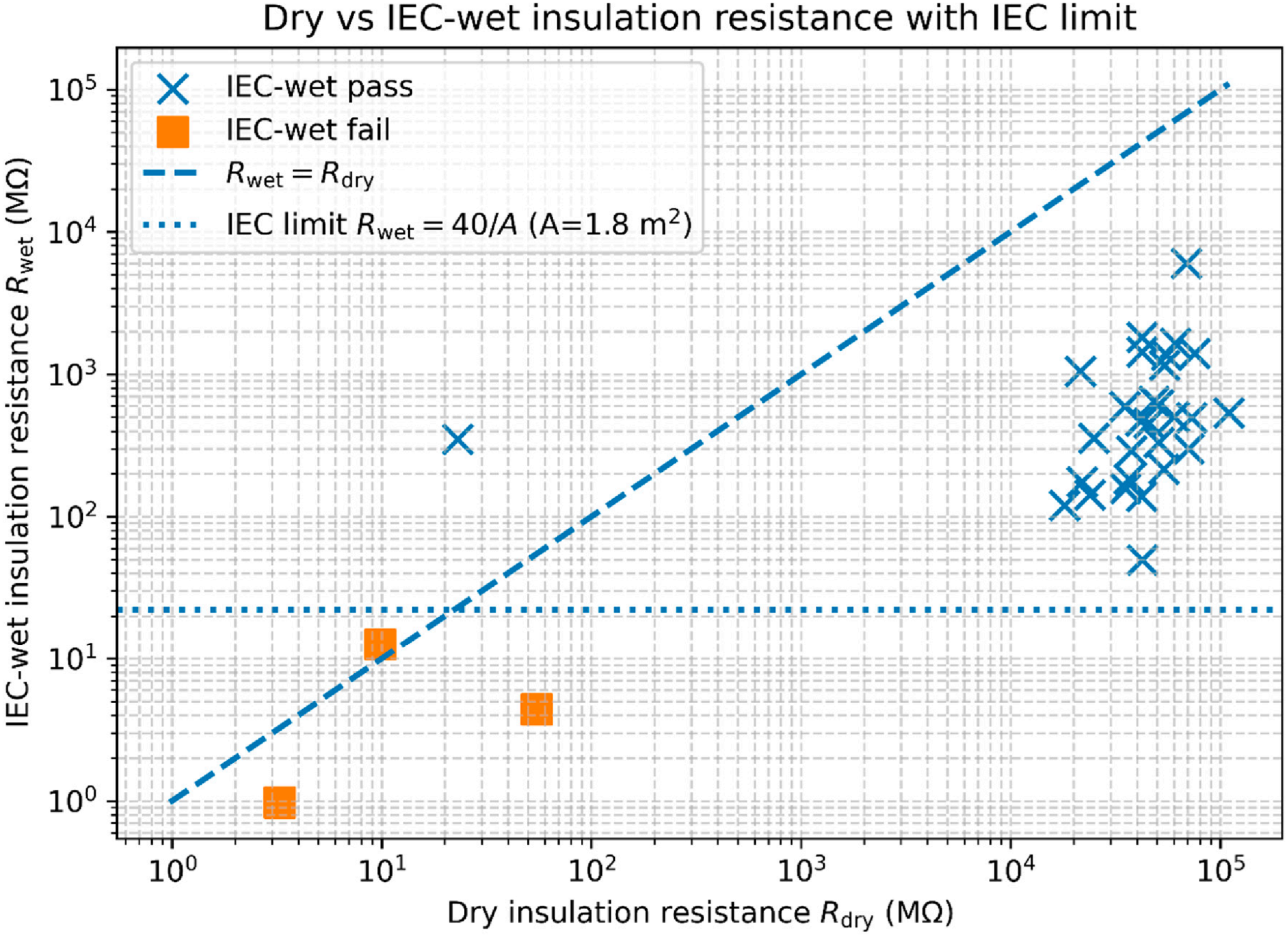
3.2. Compliance with the IEC 40 MΩ·m2 Criterion and Dry-Pass/Wet-Fail Cases
- IEC-wet-pass modules: 29 modules;
- IEC-wet-fail modules: 8 modules (21.6% of the set);
- Dry-fail modules: 3 modules already below 22.2 MΩ in the dry state;
- Dry-pass/wet-fail modules: 5 modules that meet the dry criterion but fail the IEC-wet limit.
3.3. Practical Dry-Test Threshold
4. Discussion
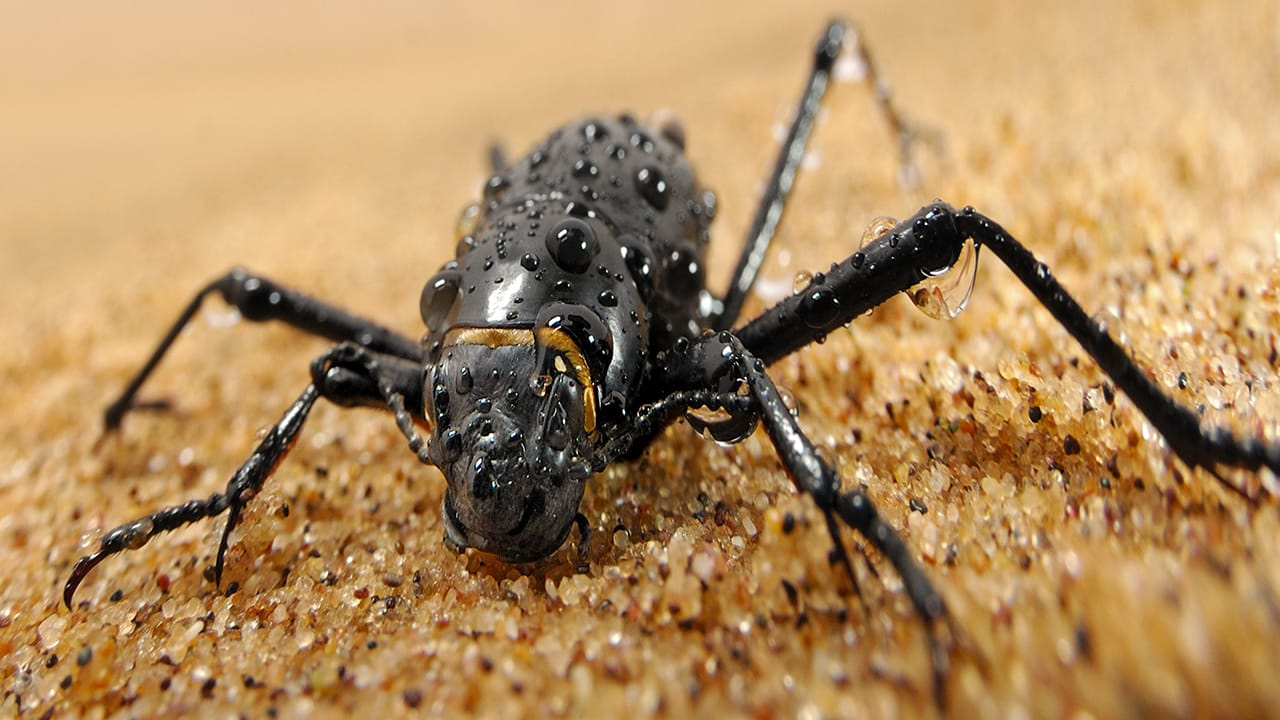
4.1. Dew, Wet Conditions and Leakage Mechanisms
Pragmatic Leakage-Behavior Classes (Framework for Repowering/O&M)
4.2. Implications for Testing Strategies of Field-Aged Modules
4.3. Repowering/Revamping Decisions and End-of-Life Management
- Modules that pass both dry and IEC-wet tests and show acceptable power output can be kept in service until performance degradation or mechanical wear justifies replacement;
- Modules that fail the IEC-wet criterion or exhibit catastrophic wet behavior (Rwet ≈ 0 Ω) represent a safety and reliability risk, even if their dry resistance remains high; these modules should be prioritized for replacement during repowering campaigns;
- By combining dry thresholds (e.g., 55.5 GΩ) with IEC-wet tests, operators can identify sub-arrays or module batches that merit priority replacement versus those that can be retained or redeployed in less demanding applications (e.g., low-voltage systems with enhanced protection).
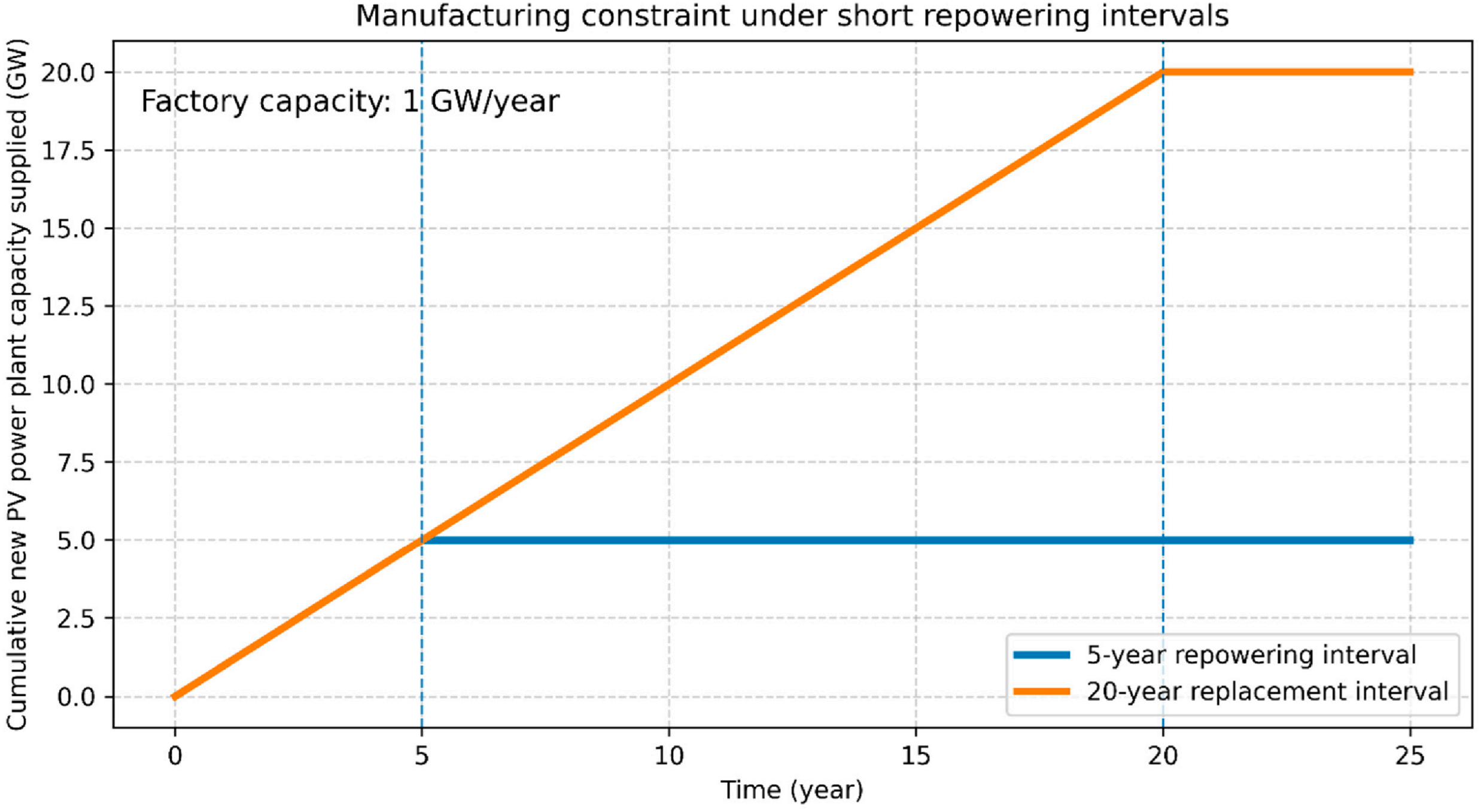
Manufacturing Constraint (Figure 8; Requested Addition)

4.4. Potential Drawbacks and Unintended Consequences of Stricter Wet-Condition Requirements
5. Conclusions
Author Contributions
Funding
Institutional Review Board Statement
Informed Consent Statement
Data Availability Statement
Conflicts of Interest
References
- IEC 61215-2:2021; Terrestrial Photovoltaic (PV) Modules—Design Qualification and Type Approval—Part 2: Test Procedures (MQT 15: Wet Leakage Current Test). International Electrotechnical Commission: Geneva, Switzerland, 2021. Available online: https://webstore.iec.ch/en/publication/61350 (accessed on 7 December 2025).
- Simsek, E.; Williams, M.J.; Pilon, L. Effect of dew and rain on photovoltaic solar cell performances. Sol. Energy Mater. Sol. Cells 2021, 222, 110908. [Google Scholar] [CrossRef]
- Hernández, J.; Vidal, P.; Medina, A. Characterization of the insulation and leakage currents of PV generators: Relevance for human safety. Renew. Energy 2010, 35, 593–601. [Google Scholar] [CrossRef]
- Roy, J.N. Modelling of insulation characteristics of Solar Photovoltaic (SPV) modules. Sol. Energy 2015, 120, 1–8. [Google Scholar] [CrossRef]
- Buerhop, C.; Stroyuk, O.; Zöcklein, J.; Pickel, T.; Hauch, J.; Peters, I.M. Wet Leakage Resistance Development of Modules with Various Backsheet Types. Prog. Photovolt. Res. Appl. 2022, 30, 938–947. [Google Scholar] [CrossRef]
- Ketjoy, N.; Mensin, P.; Chamsa-Ard, W. Impacts on insulation resistance of thin film modules: A case study of a flooding of a photovoltaic power plant in Thailand. PLoS ONE 2022, 17, e0274839. [Google Scholar] [CrossRef]
- Anagha, E.; Kulkarni, S.; Shiradkar, N. Development of a characterization technique to effectively detect latent insulation defects in the field-deployed PV modules. Sol. Energy Mater. Sol. Cells 2025, 292, 113761. [Google Scholar] [CrossRef]
- Buerhop-Lutz, C.; Stroyuk, O.; Pickel, T.; Winkler, T.; Hauch, J.; Peters, I.M. PV modules and their backsheets—A case study of a Multi-MW PV power station. Sol. Energy Mater. Sol. Cells 2021, 231, 111295. [Google Scholar] [CrossRef]
- Lutz, C.B.; Lüer, L.; Stroyuk, O.; Hauch, J.; Peters, I.M. Dynamics of backsheet-driven insulation issues. Sol. Energy Mater. Sol. Cells 2023, 257, 112398. [Google Scholar] [CrossRef]
- Stroyuk, O.; Güttler, C.; Buerhop-Lutz, C.; Hauch, J.; Peters, I.M. Identification of the Backsheet Type of Silicon Photovoltaic Modules from Encapsulant Fluorescence Images. ACS Appl. Energy Mater. 2023, 6, 2340–2346. [Google Scholar] [CrossRef]
- Poulek, V.; Beranek, V.; Kozelka, M.; Finsterle, T. Environmentally Sustainable Recycling of Photovoltaic Panels Laminated with Soft Polysiloxane Gels: Promoting the Circular Economy and Reducing the Carbon Footprint. Sustainability 2025, 17, 8167. [Google Scholar] [CrossRef]
- Poulek, V.; Safrankova, J.; Cerna, L.; Libra, M.; Beranek, V.; Finsterle, T.; Hrzina, P. PV Panel and PV Inverter Damages Caused by Combination of Edge Delamination, Water Penetration, and High String Voltage in Moderate Climate. IEEE J. Photovolt. 2021, 11, 561–565. [Google Scholar] [CrossRef]
- Finsterle, T.; Kasper, J.; Hrzina, P.; Knap, V.; Černá, L. The Effect of Backsheet Repairs on Insulation Resistance in Photovoltaic Modules. Monatshefte Chem. 2025, 156, 559–567. [Google Scholar] [CrossRef]
- Papamichael, I.; Voukkali, I.; Jeguirim, M.; Argirusis, N.; Jellali, S.; Sourkouni, G.; Argirusis, C.; Zorpas, A.A. End of Life Management and Recycling on PV Solar Energy Production. Energies 2022, 15, 6430. [Google Scholar] [CrossRef]
- Gerold, E.; Antrekowitsch, H. Advancements and Challenges in Photovoltaic Cell Recycling: A Comprehensive Review. Sustainability 2024, 16, 2542. [Google Scholar] [CrossRef]
- Akhter, M.; Al Mansur, A.; Islam, M.I.; Lipu, M.H.; Karim, T.F.; Abdolrasol, M.G.; Alghamdi, T.A. Sustainable Strategies for Crystalline Solar Cell Recycling: A Review on Recycling Techniques, Companies, and Environmental Impact Analysis. Sustainability 2024, 16, 5785. [Google Scholar] [CrossRef]
- Królicka, A.; Maj, A.; Łój, G. Promoting Sustainability in the Recycling of End-of-Life Photovoltaic Panels and Li-Ion Batteries Through LIBS-Assisted Waste Sorting. Sustainability 2025, 17, 838. [Google Scholar] [CrossRef]
- IEA PVPS. Trends in Photovoltaic Applications 2025; International Energy Agency Photovoltaic Power Systems Programme: Paris, France, 2025; Available online: https://iea-pvps.org/wp-content/uploads/2025/10/IEA-PVPS_Trends_2025-.pdf (accessed on 7 December 2025).
- IRENA. Renewable Power Generation Costs in 2020; International Renewable Energy Agency: Abu Dhabi, United Arab Emirates, 2021.
- Fraunhofer ISE. Photovoltaics Report; Fraunhofer Institute for Solar Energy Systems ISE: Freiburg, Germany, 2025; Available online: https://www.ise.fraunhofer.de/en/publications/studies/photovoltaics-report.html (accessed on 7 December 2025).
- Villena-Ruiz, R.; Martín-Martínez, S.; Honrubia-Escribano, A.; Ramírez, F.J.; Gómez-Lázaro, E. Solar PV power plant revamping: Technical and economic analysis of different alternatives for a Spanish case. J. Clean. Prod. 2024, 446, 141439. [Google Scholar] [CrossRef]
- Jean, J.; Woodhouse, M.; Bulović, V. Accelerating Photovoltaic Market Entry with Module Replacement. Joule 2019, 3, 2824–2841. [Google Scholar] [CrossRef]
- Firman, A.; Cáceres, M.; González Mayans, A.R.; Vera, L.H. Photovoltaic Qualification and Approval Tests. Standards 2022, 2, 136–156. [Google Scholar] [CrossRef]
- Almarri, A.; AlMutairi, R.; Alnass, F.; Alghamdi, N.; Ghobashy, M.M.; Attia, M.S.; Madani, M. Experimental and modeling study of dust composition impact on photovoltaic performance in arid coastal environments. J. Mater. Res. Technol. 2025, 39, 5455–5467. [Google Scholar] [CrossRef]
- Kempe, M.D.; Lyu, Y.; Kim, J.H.; Felder, T.; Gu, X. Fragmentation of photovoltaic backsheets after accelerated weathering exposure. Sol. Energy Mater. Sol. Cells 2021, 226, 111044. [Google Scholar] [CrossRef]
- Guadarrama-Cetina, J.; Mongruel, A.; Medici, M.G.; Baquero, E.; Parker, A.R.; Milimouk-Melnytchuk, I.; González-Viñas, W.; Beysens, D. Dew Condensation on Desert Beetle Skin. Eur. Phys. J. E 2014, 37, 109. [Google Scholar] [CrossRef] [PubMed]
- Zankl, S. A Fog Basking Beetle (Onymacris unguicularis) on the Crest of a Sand Dune in the Namib Desert is Drinking Droplets of Water Which Gather on Its Body During the Early Morning Fog over the Dunes. PhotoShelter/Solvin Zankl. Available online: https://solvinzankl.photoshelter.com/image?&_bqG=148&_bqH=eJyLSA4JqDQqC_LJMYkvyw4089JNT_N2zCszT7awMjKzsDI0MABhIOkZ7xLsbJuXmJuZpAZmxzv6udiWANmhwa5B8Z4utqEgdS4GGT5lvsVJTm6BavGOziG2xamJRckZAGbLH1s-&GI_ID= (accessed on 7 December 2025).
- Luo, W.; Khoo, Y.S.; Hacke, P.; Naumann, V.; Lausch, D.; Harvey, S.P.; Singh, J.P.; Chai, J.; Wang, Y.; Aberle, A.G.; et al. Potential-induced degradation in photovoltaic modules: A critical review. Energy Environ. Sci. 2017, 10, 43–68. [Google Scholar] [CrossRef]





| Panel No. | Rwet | Unit (Wet) | Rdry | Unit (Dry) | Ratio Rdry/Rwet |
|---|---|---|---|---|---|
| 1 | 1828 | M | 42.3 | G | 23.14 |
| 2 | 356 | M | 24.9 | G | 69.94 |
| 3 | 1051 | M | 21.5 | G | 20.46 |
| 4 | 183.4 | M | 36.7 | G | 200.11 |
| 5 | 216 | M | 53.7 | G | 248.61 |
| 6 | 1158 | M | 54.2 | G | 46.80 |
| 7 | 5.99 | G | 68.7 | G | 11.47 |
| 8 | 1658 | M | 61.1 | G | 36.85 |
| 9 | 1405 | M | 75.6 | G | 53.81 |
| 10 | 12.58 | M | 9.87 | M | 0.78 |
| 11 | 0 | Ω | 3.3 | M | Cat. |
| 12 | 49.5 | M | 42.4 | G | 856.57 |
| 13 | 1365 | M | 55.5 | G | 40.66 |
| 14 | 977 | k | 3.27 | M | 3.35 |
| 15 | 0 | Ω | 110.4 | G | Cat. |
| 16 | 0 | Ω | 29.5 | G | Cat. |
| 17 | 504 | M | 60 | G | 119.05 |
| 18 | 332 | M | 50.9 | G | 153.31 |
| 19 | 537 | M | 110 | G | 204.84 |
| 20 | 647 | M | 48.3 | G | 74.65 |
| 21 | 495 | M | 72.8 | G | 147.07 |
| 22 | 0 | Ω | 52.3 | G | Cat. |
| 23 | 157.4 | M | 35.2 | G | 223.63 |
| 24 | 175.4 | M | 21.9 | G | 124.86 |
| 25 | 139.4 | M | 42.1 | G | 302.01 |
| 26 | 142.3 | M | 23.9 | G | 167.96 |
| 27 | 120.2 | M | 18.08 | G | 150.42 |
| 28 | 0 | Ω | 103.5 | G | Cat. |
| 29 | 300 | M | 70.8 | G | 236.00 |
| 30 | 471 | M | 41.7 | G | 88.54 |
| 31 | 454 | M | 45.6 | G | 100.44 |
| 32 | 610 | M | 50.8 | G | 83.28 |
| 33 | 349 | M | 23.1 | M | 0.07 |
| 34 | 4.38 | M | 54.9 | M | 12.53 |
| 35 | 1435 | M | 42.3 | G | 29.48 |
| 36 | 594 | M | 35 | G | 58.92 |
| 37 | 290 | M | 37.6 | G | 129.66 |
| Metric | Rdry | Rwet | Ratio Rdry/Rwet |
|---|---|---|---|
| Median | 42.4 GΩ | 462.5 MΩ | 109.7× |
| Mean | (not used; skewed) | (not used; skewed) | 543.5× |
| Minimum (non-zero) | 3.27 MΩ (Panel 14) | 4.38 MΩ (Panel 34) | 0.07× (Panel 33) |
| Maximum | 110.4 GΩ (Panel 15) | 5.99 GΩ (Panel 7) | 856.6× (Panel 12) |
| Assumed Area A [m2] | Wet Limit Rlimit = 40/A [MΩ] | IEC Wet Pass [Count] | IEC Wet Fail [Count] | Dry Fail [Count] | Dry-Pass/Wet-Fail [Count] |
|---|---|---|---|---|---|
| 1.6 | 25.0 | 29 | 8 | 4 | 5 |
| 1.8 | 22.2 | 29 | 8 | 3 | 5 |
| 2.0 | 20.0 | 29 | 8 | 3 | 5 |
| Class | Electrical Signature (Measured/Derived) | Indicative Moisture-Related Leakage Pathway (Examples; Non-Exhaustive) | Simple Inspection Indicator (Examples) | Recommended Action (O&M/Repowering) |
|---|---|---|---|---|
| C0 (Catastrophic wet failure) | Rwet ≈ 0 Ω (below instrument range); IEC-wet fail by definition | Severe moisture ingress and/or direct wet conduction (e.g., junction box seal/cable-gland ingress; severe insulation breakdown; water film shorting to frame) | Water inside junction box; damaged seals/grommets; visible corrosion/burn marks; severe backsheet cracking or delamination | Immediate isolation/mitigation; prioritize replacement; route removed modules to appropriate end-of-life handling |
| C1 (Wet fail, finite Rwet) | Rwet·A < 40 MΩ·m2 (i.e., Rwet < 40/A); Rwet finite but below IEC limit | Strong moisture-assisted leakage under wetting (surface/edge conduction; moisture-assisted polymer/interface pathways; ageing-related backsheet/encapsulant degradation) | Cracked/embrittled backsheet; edge-seal degradation; delamination signs; corrosion at frame/ground points | Prioritize replacement during repowering/revamping; targeted inspection; consider batch-level screening |
| C2 (Dry-pass/wet-fail) | Rdry·A ≥ 40 MΩ·m2 AND Rwet·A < 40 MΩ·m2 (dry passes, wet fails) | Wet-only leakage pathway dominates compliance (latent defect activated by wetting; localized surface conduction; moisture pathway not expressed in dry state) | Often visually subtle; may correlate with dew-/rain-sensitive alarms in the field | Do not rely on dry-only acceptance; prioritize IEC-wet verification and monitoring; replace if recurring or clustered |
| C3 (Wet pass, high drop/susceptible) | Rwet·A ≥ 40 MΩ·m2 AND Rratio = Rdry/Rwet is very large (e.g., ≥ 100; fleet-tunable) | Developing moisture-sensitive pathway (early-stage backsheet aging; edge conduction under wetting; contamination-assisted water film conduction) | Early backsheet whitening/crazing; mild edge changes; frequent dew-related insulation fluctuations | Increase wet-test sampling frequency; preventive inspection; consider earlier replacement if trend worsens |
| C4 (Wet pass, moderate drop/typical) | Rwet·A ≥ 40 MΩ·m2 AND Rratio moderate (e.g., 1–100; fleet-tunable) | Typical wetting response without evidence of critical defect | No specific indicator | Standard operation; routine sampling only |
Disclaimer/Publisher’s Note: The statements, opinions and data contained in all publications are solely those of the individual author(s) and contributor(s) and not of MDPI and/or the editor(s). MDPI and/or the editor(s) disclaim responsibility for any injury to people or property resulting from any ideas, methods, instructions or products referred to in the content. |
© 2026 by the authors. Licensee MDPI, Basel, Switzerland. This article is an open access article distributed under the terms and conditions of the Creative Commons Attribution (CC BY) license.
Share and Cite
Poulek, V.; Beranek, V.; Finsterle, T.; Kozelka, M. Dry Pass, Wet Fail: Ground Impedance Testing of Field-Aged PV Modules—Implications for Repowering/Revamping Within 5–10 Years and for Environmental Sustainability. Sustainability 2026, 18, 1212. https://doi.org/10.3390/su18031212
Poulek V, Beranek V, Finsterle T, Kozelka M. Dry Pass, Wet Fail: Ground Impedance Testing of Field-Aged PV Modules—Implications for Repowering/Revamping Within 5–10 Years and for Environmental Sustainability. Sustainability. 2026; 18(3):1212. https://doi.org/10.3390/su18031212
Chicago/Turabian StylePoulek, Vladislav, Vaclav Beranek, Tomas Finsterle, and Martin Kozelka. 2026. "Dry Pass, Wet Fail: Ground Impedance Testing of Field-Aged PV Modules—Implications for Repowering/Revamping Within 5–10 Years and for Environmental Sustainability" Sustainability 18, no. 3: 1212. https://doi.org/10.3390/su18031212
APA StylePoulek, V., Beranek, V., Finsterle, T., & Kozelka, M. (2026). Dry Pass, Wet Fail: Ground Impedance Testing of Field-Aged PV Modules—Implications for Repowering/Revamping Within 5–10 Years and for Environmental Sustainability. Sustainability, 18(3), 1212. https://doi.org/10.3390/su18031212