1. Introduction
1.1. Research Background
Traffic accidents remain a pressing global public health challenge, causing profound and long-term losses of human life and property. Recent survey data indicate that China experiences hundreds of thousands of road traffic accidents annually, resulting in nearly 60,000 deaths and direct economic losses amounting to billions of dollars [
1]. Among all accident types, rear-end collisions stand out as one of the most prevalent. In the United States, approximately 3.98 million rear-end collisions occur each year, accounting for about 34% of all reported accidents [
2]. In China, road traffic accident statistics indicate that rear-end collisions constitute roughly one-third of all road traffic accidents [
3], with unsafe following distance identified as a core triggering factor.
From the perspective of road types, secondary and lower-grade two-lane roads in China bear the highest proportion of traffic accidents, accounting for about 70% of total incidents and nearly 50% of fatalities. Among these, mountainous two-lane roads contribute over 15% of all highway accidents [
4], within which rear-end collisions account for approximately 31% of reported crashes [
5]. As an integral part of China’s highway network, mountainous two-lane roads are extensively distributed and play an irreplaceable role in regional transportation and freight logistics [
6].
Especially with the rapid development of the logistics industry, the proportion of trucks in traffic flows continues to increase. Due to inherent vehicle power characteristics and operational requirements, trucks—characterized by their large bodies, heavy loads, and relatively low operating speeds—often act as “moving barriers” in a traffic stream. They persistently obstruct the vision of passenger vehicle drivers, leaving them unable to promptly grasp real-time traffic and road conditions ahead [
7]. Thus, following vehicles are forced into low-speed states, accompanied by frequent acceleration and deceleration, lane-spanning overtaking attempts, and efforts to peek around the preceding truck. Such car-following-truck (CFT) behaviors may lead to unsafe following distances and increased rear-end and head-on collision probabilities. Notably, although trucks constitute only 5% of China’s total vehicle fleet, they are involved in 30% of all traffic accidents, a trend that is particularly pronounced on mountain roads [
8]. Overall, these facts highlight the severity of CFT safety issues on mountainous two-lane roads.
Therefore, taking mountainous two-lane roads in Yunnan, China, as a typical scenario characterized by “high truck mixing rates and limited visibility”, this study focuses on identifying and characterizing CFT risks under truck-induced conditions, as well as clarifying the factors contributing to these risks. It enables a precise understanding of accident causes and provides a proactive warning basis for road management and driver assistance systems on mountainous roads, supporting safer and more sustainable transportation.
The contributions of this paper are as follows:
Conducting a micro-level empirical study into CFT risk induced by truck occlusion on mountainous two-lane roads. Based on drone trajectory data, this research addresses the existing gap where prior studies primarily focused on overtaking and curve-related risk while neglecting the high-exposure CFT risks.
This study introduces the Anticipated Collision Time (ACT) as an advanced CFT risk quantification metric, and further calibrates scenario- specific ACT risk thresholds using Extremal Value Theory (EVT). This approach achieves superior risk classification performance on straight and curved road sections, compared to competing machine learning methods.
This study constructs a CFT risk prediction model based on the XGBoost algorithm. By utilizing explainable machine learning methods, it precisely identifies the critical trigger intervals and operational mechanisms of CFT risks in mountainous regions, while revealing the dominant roles of various CFT characteristics in risk assessment and their respective sensitivity ranges.
1.2. Literature Review
1.2.1. Car-Following Risk Assessment Methods
In the field of car-following safety assessment, research primarily relies on two types of data. The first is historical collision data, which has been widely used to analyze the frequency and severity of rear-end collisions on mountainous roads [
9,
10]. However, this type of data possesses significant limitations. One is that accident samples are sparse and highly random, making statistical results susceptible to chance factors. For instance, the absence of recorded accidents on a specific road section during a particular time window does not imply the absence of potential risks [
11]. The other is that accident data only reveals the influence of macro-level factors such as road structure and meteorological conditions on accident occurrence and severity. The engineering countermeasures derived from such data are often reactive measures like installing guardrails or warning signs, failing to reflect the micro-level driving behaviors and meet the demand for high-resolution behavioral data required by autonomous and connected vehicle technologies.
To overcome these shortcomings, researchers have recently begun extensively applying vehicle trajectory data combined with surrogate safety measures (SSMs) to assess vehicle operational safety. This approach characterizes potential conflict risks before accidents occur, thereby expanding the applicability of traditional accident data [
11]. Common publicly available trajectory datasets include NGSIM [
12] and HighD [
13], which provide high-temporal-resolution information such as vehicle positions, velocity, and acceleration. Based on these micro-level data, a series of SSMs can be calculated to assess potential driving risks [
14], including Time-to-Collision (TTC), Post-Entry Time (PET), Deceleration Rate to Avoid a Crash (DRAC), and Aggregate Conflict Index (ACI) [
15,
16,
17]. Among these, TTC has become one of the most widely applied metrics due to its simple definition and clear physical interpretation [
14,
18,
19].
However, TTC calculations typically assume uniform linear motion and fail to adequately reflect the dynamic changes in vehicle acceleration [
19,
20]. Considering the common occurrence of acceleration changes during conflict evolution, Modified Time-to-Collision (MTTC) [
21] was proposed. This metric integrates speed difference, acceleration difference, and vehicle spacing into a unified framework, solving collision time via a uniformly accelerated motion model. While this partially overcomes the constant-speed assumption, it still neglects the two-dimensional motion characteristics of vehicles.
To more accurately characterize vehicle motion, existing research has developed various TTC extensions based on the two-dimensional dynamics of vehicle operation. For instance, the Extended Time-to-Collision (ETTC) incorporates the two-dimensional relative distance between vehicles and its rate of change, combining this with the looming principle to identify potential collisions [
22]. Generalized Time-to-Collision (GTTC) treats vehicles as rectangular entities, calculates minimum two-dimensional distances and relative velocities using boundary discrete points, and employs spatio-temporal consistency to eliminate false conflicts [
19]. While these approaches address the two-dimensional characteristics of vehicle collision assessment to varying degrees, they generally still assume constant vehicle velocity.
At a higher level of refinement, Anticipated Collision Time (ACT) was proposed as a unified framework incorporating both two-dimensional motion characteristics and acceleration variation [
20]. ACT calculates the shortest two-dimensional distance between vehicles and their closing rate in that direction (while accounting for acceleration), thereby deriving the minimum reachable collision time. This makes it applicable to multiple collision scenarios, including rear-end, lateral, angular, and even head-on impacts. Due to its comprehensiveness and applicability, ACT has been widely adopted in traffic conflict research [
23,
24] and is considered an “ideal” standard for alternative safety metrics.
It should be noted that the core variables adopted in SSMs, including following distance, speed difference, and acceleration difference, originate from classical car-following theory [
25]. These variables constitute the fundamental state descriptors in widely used car-following models such as the Intelligent Driver Model (IDM), Gipps model [
26], Newell model [
25], and Wiedemann model [
27], where longitudinal stability is governed by the interaction between spacing, relative speed, and acceleration [
25,
26,
27]. Within this theoretical framework, fluctuations or uncertainties in headway and relative motion are closely associated with transitions from stable to unstable traffic states. Recent studies on traffic flow stability and phase transitions further demonstrate that increasing headway uncertainty and relative speed variability can push traffic systems toward congestion boundaries and locally unstable regimes [
28,
29].
From this perspective, rear-end conflict risk can be interpreted as a micro-level manifestation of incipient instability in car-following dynamics. Rather than proposing new car-following equations, this study builds upon classical traffic flow theory and focuses on identifying high-risk CFT states that emerge when stability margins are compressed under truck-induced visual occlusion. This theoretical linkage provides a foundation for integrating surrogate safety indicators with explainable data-driven risk identification.
1.2.2. Vehicle Operation Risk Research on Mountainous Two-Lane Roads
Currently, based on video trajectory data, research on vehicle operation risks on mountainous two-lane roads primarily focuses on two aspects: overtaking behavior risks and curve entry/exit risks.
With regard to overtaking risk analysis, Karimi et al. [
30] identified restricted sight distance (how far ahead a driver can see), oncoming vehicle speed, and available overtaking gaps (sufficient spaces in traffic for completing an overtaking maneuver) as the core factors affecting overtaking safety, basing their findings on field-measured overtaking scenarios on mountainous two-lane roads. Furthermore, they noted that multi-vehicle consecutive overtaking scenarios carry significantly higher risks than single-vehicle overtaking. Similarly, Branzi et al. [
31] demonstrated through simulations that combinations of consecutive curves and gradients (road slopes) on mountain roads impair drivers’ judgment of potential conflicts. This, in turn, alters speed trajectories (the speed patterns vehicles follow through the road layout) and passing strategies, further elevating overtaking risks. Based on previous findings, Mwesige et al. [
32] utilized video data from rural roads in Uganda, employing TTC at the end of overtaking maneuvers as an SSM to construct a logistic regression model quantifying high-risk scenarios (TTC < 3 s) and proposing improvement measures categorized by traffic volume conditions.
Regarding risk analysis for cornering operations, Wang et al. [
33] noted based on natural driving data that corner-related accidents account for a high proportion on mountainous two-lane roads. Visual misjudgment, changes in corner radius, and interference from oncoming vehicles may all induce driving errors, significantly increasing the probability of following distance conflicts during corner entry and exit phases. Subsequent research further demonstrated that reduced curve radii significantly decrease entry speeds, while widening speed differentials can destabilize local following stability, thereby increasing rear-end and lateral collision risks [
34]. Faiz et al. [
35] validated these findings using multi-vehicle traffic counter data from Malaysian mountain roads, employing one-way ANOVA and Tukey’s test to confirm that vehicles significantly reduce entry speeds on small-radius curves and under nighttime conditions.
Building on this foundation, subsequent studies have focused on risk prediction methods for curves. For instance, Ji et al. [
4] developed a dynamic prediction model for traffic accident risks on mountainous two-lane curved roads. This model characterized traffic conflicts by extracting hazardous driving behavior features from drone trajectory data. Similarly, Geng et al. [
15] employed high-precision drone trajectory data and a bivariate extremal theory model to predict CFT collision risks on mountainous two-lane roads. Qin et al. [
36] adopted a car-following behavior perspective, employing factor analysis and K-Means++ clustering to classify car-following risks among passenger vehicles on mountainous curved sections into three categories. They further utilized a higher-order Markov chain model to predict the evolutionary process of car-following risk states.
More recently, several studies have introduced deep learning and hybrid prediction frameworks to capture complex nonlinear driving patterns on mountainous roads. For example, Li [
37] incorporated risk-driven features and employed CNN–LSTM models to identify car-following driving intentions, while Qin et al. [
38] adopted the Informer architecture to predict overtaking vehicle trajectories on mountainous two-lane roads. These studies demonstrate the strong predictive capability of deep learning models in complex traffic environments but also highlight that most existing approaches primarily emphasize prediction accuracy, with relatively limited interpretation of the underlying car-following risk mechanisms.
Additionally, some studies revealed the flow characteristics of mountainous two-lane roads from a broader perspective of traffic operation. Roy et al. [
39] noted that under mixed traffic conditions with limited overtaking opportunities, the proportion of short headway distances significantly increases. This tendency to form longer vehicle queues prolongs exposure to car following, thereby elevating collision risks. Several studies on road facilities and geometric design (e.g., curve design consistency models, roadside environment reliability analysis) also provide statistical support for operational risks on mountain roads from a traffic engineering perspective [
40].
1.2.3. Operational Risk Research on Mountainous Roads
Existing studies on mountainous road traffic safety primarily focus on accident data analysis. However, as discussed in
Section 1.2.1, accident data is sparse and highly random, making it difficult to characterize risk evolution processes. It also fails to meet the demand for high-resolution behavioral data required by autonomous driving and intelligent connected vehicle technologies. Therefore,
Section 1.2.2 exclusively addresses vehicle operational risks based on micro-trajectory data. The application of micro-trajectory data has expanded research on operational risks in mountainous two-lane roads. However, it remains largely concentrated on two high-risk scenarios: overtaking risks and curve operation risks. This is because the complex alignment and limited sight distance of mountain roads make conflicts in these two scenarios particularly prominent.
Nevertheless, accident statistics and traffic flow characteristics indicate that rear-end collisions also constitute a significant proportion of accidents on straight sections of mountain roads. For instance, a study based on a decade of accident records in Thailand revealed that over half of the accidents occurred on straight sections [
41], suggesting risks are not solely concentrated in typical high-risk scenarios like overtaking or curves. Under conditions of mixed traffic and restricted overtaking that frequently form vehicle trains, CFT risks exhibit higher exposure and persistence. However, current research on CFT behavior and its micro-level risk formation processes on mountainous two-lane roads remains insufficient. Existing work largely focuses on speed characteristics, road alignment consistency, or risk warning systems, failing to explain how risks emerge or which factors drive them.
Furthermore, while trajectory-based studies have improved the accuracy of risk identification, many investigations have not explored the underlying causes of risk that emerge in detail. These approaches do not meet the modeling needs for micro-interaction mechanisms in intelligent connected vehicles. There is an urgent need for research on rear-end collision risk factors on mountainous two-lane roads. The results will support road safety assessments in autonomous driving and vehicle-infrastructure coordination environments, advancing sustainable transportation development.
1.3. Objective
Addressing the limitations of previous studies on mountain road risks, this research aims to construct an analytical framework capable of revealing the evolution process of CFT risks based on high-resolution micro-trajectory data. This framework will support road safety assessments in intelligent connected vehicle environments. First, this study collects drone aerial videos from actual mountain roads, extracts vehicle trajectory data containing high-frequency dynamic parameters such as speed and acceleration, and constructs two typical CFT scenarios: straight sections and curves. Second, a quantitative method for CFT risk is established using the two-dimensional alternative safety indicator ACT. EVT is employed to calibrate scenario-specific risk thresholds applicable to straight and curved road segments, ensuring risk classification better aligns with the actual operational characteristics of mountain roads. Furthermore, a machine learning recognition model based on XGBoost was developed. From a vehicle dynamics perspective, this model systematically analyzed the characteristic patterns of risk states under truck obstruction. By integrating feature importance and partial dependency graphs, it provided an in-depth analysis of risk evolution characteristics across dimensions, including the following: distance, speed difference, acceleration difference, and lateral maneuvering.
2. Research Framework
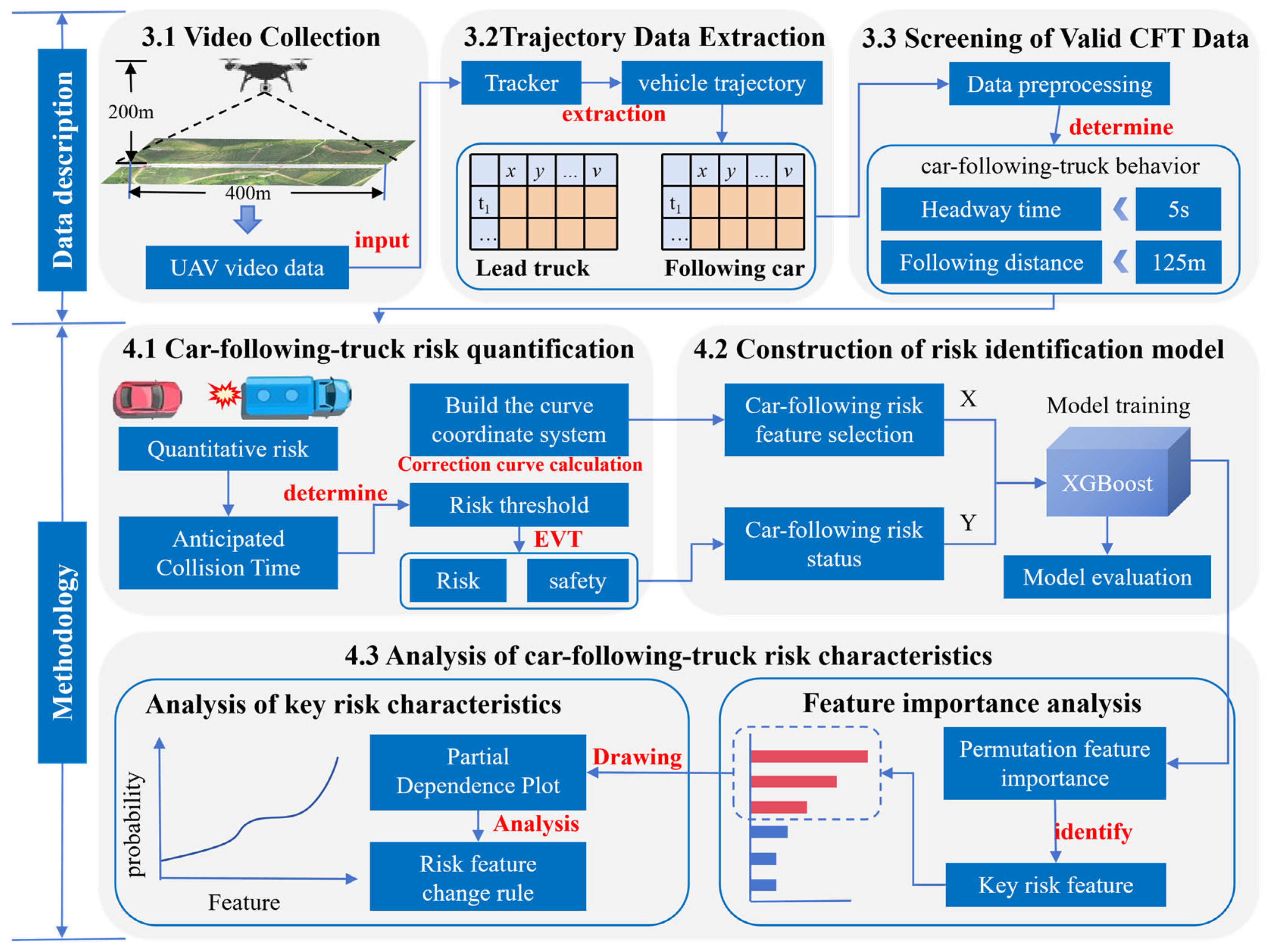
The overall research framework is shown in
Figure 1, consisting of two main modules: data description and research methodology.
In the data description section, unmanned aerial vehicle (UAV) videos were collected over representative straight and curved segments of a mountainous two-lane road. The videos were then processed in Tracker to extract high-resolution vehicle trajectories. Based on spatial–temporal criteria (e.g., headway time and following distance) and a minimum duration requirement, valid CFT episodes were screened to ensure that each sample captures an integral following process.
In the research methodology section, first, ACT, characterized by two-dimensional motion attributes and acceleration properties, is introduced as a quantitative indicator for CFT risk. A Frenet coordinate system is established to calibrate the calculation of risk and feature indicators in curved road scenarios. Subsequently, based on EVT, ACT danger thresholds are calibrated for straight and curved road sections, respectively. Subsequently, based on scenario-specific thresholds, the following states are categorized into safe and risky classes. Vehicle dynamics features are selected to build an XGBoost following a risk recognition model, whose performance is evaluated against multiple benchmark models. Finally, integrating AUC-based feature importance and Partial Dependency Plots (PDP), this study systematically analyzes the following risk characteristics from a vehicle dynamics perspective under truck-obscured conditions. It identifies differentiated risk control priorities for straight and curved road segments, providing support for safety management and driver assistance system design on mountainous two-lane roads.
3. Data Description
3.1. Video Collection
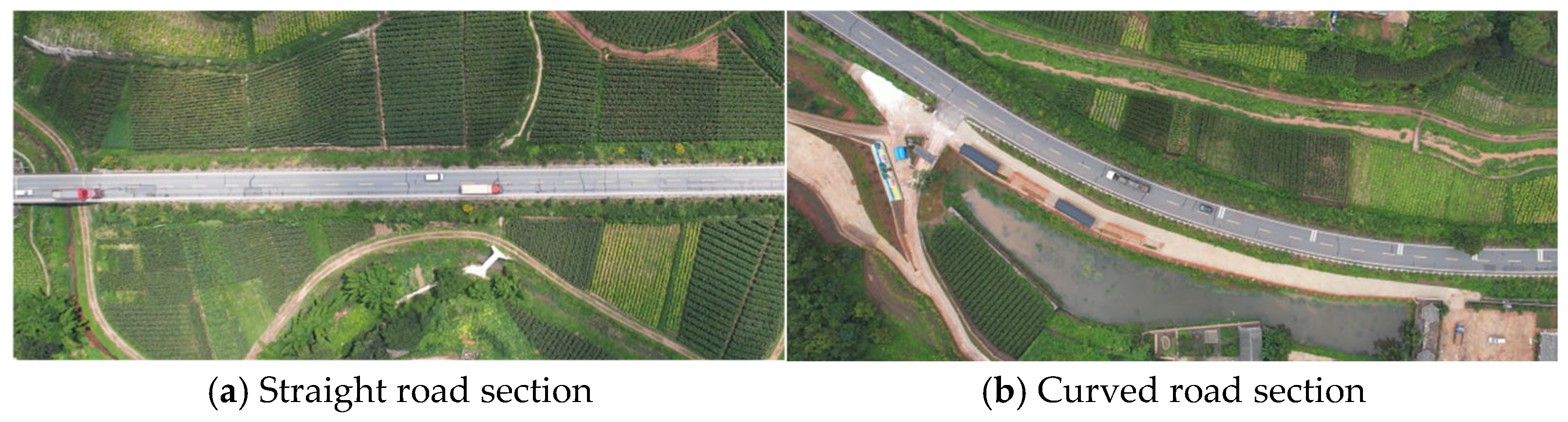
A typical mountainous two-lane road in Yunnan, China, was selected for study. This secondary road has a design speed of 60 km/h, with a single-lane width of 3.75 m. The inner side of curves features widened sections, with a width of 3.9 m on curved segments. The study section selected for this research is shown in
Figure 2, comprising a straight section and a curved section.
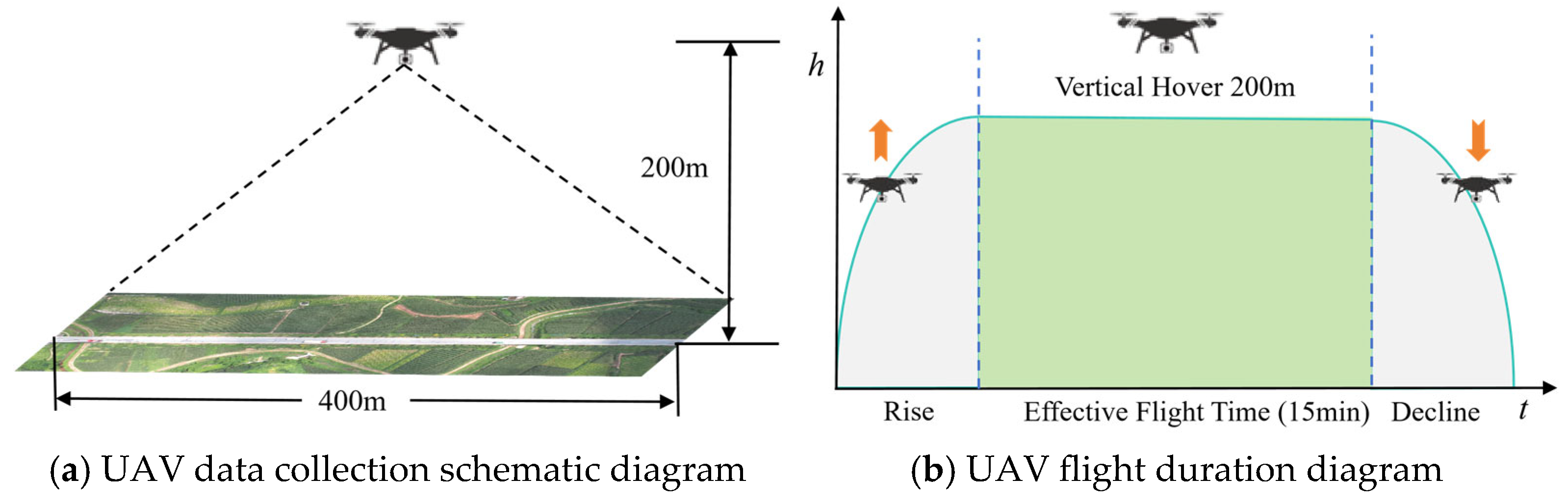
To obtain traffic flow data, the research team conducted aerial surveys of the study section over three days using a DJI Air 2S drone (DJI, Shenzhen, China) under clear weather conditions. The drone captured 4K resolution video footage at an altitude of approximately 200 m, covering a section spanning roughly 400 m (as shown in
Figure 3a). Each drone flight lasted about 15 min (as shown in
Figure 3b).
The 5 min traffic flow statistics for the data collection section indicate that truck traffic accounted for 32.36% and 35.56%, respectively, meeting the requirements for studying the risk of passenger vehicles following too closely in scenarios where trucks obstruct visibility.
3.2. Trajectory Data Extraction
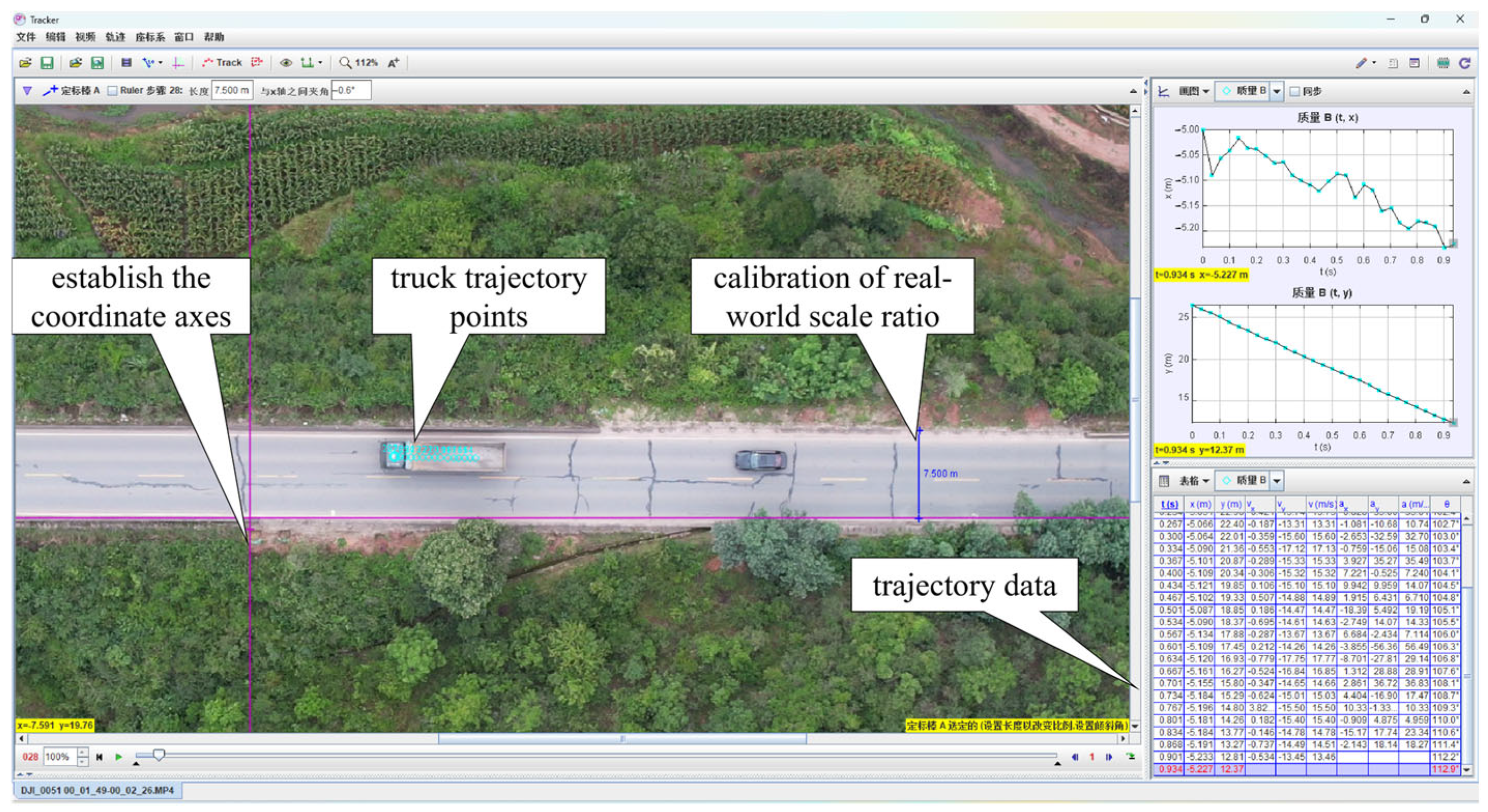
This paper utilizes the video analysis modeling tool Tracker to extract vehicle trajectory data. Tracker is an open-source video analysis and modeling tool built on the Open Source Physics (OSP) Java framework. Primarily designed for physics education, it has increasingly been applied to vehicle trajectory analysis in recent years. Tracker enables users to analyze object motion through video footage, automatically tracking specific targets within videos and capturing data such as their position, velocity, and acceleration, as shown in
Figure 4. The specific steps for extracting vehicle trajectories using Tracker are as follows:
Step 1: Extract CFT behavior video segments. Manually identify and select segments showing CFT behavior within the intersection area, filtering out invalid segments.
Step 2: Calibrate vehicles. Set reference coordinates, scale, and tracking step size. The leading truck and the following car were annotated using salient pixel features.
Step 3: Automatically track vehicle trajectories. Establish dynamic tracking targets and automatically identify/calculate calibrated vehicle trajectory information (coordinates, speed, distance traveled, etc.) using a specified tracking step size;
Step 4: Record the extracted complete trajectory data and save it as an Excel file.
The drone-captured video was recorded at 30 fps. When extracting trajectories using Tracker software, this study sets the frame interval to 3, capturing 10 frames per second, yielding 10 trajectory points per second. Consequently, the temporal granularity of the trajectory data is approximately 0.1 s, enabling a relatively detailed depiction of the vehicle’s dynamic movement. The extracted trajectory data is shown in
Table 1.
The table lists key vehicle motion characteristics, including position coordinates, velocity components, acceleration components, and overall velocity and acceleration at five consecutive time points. It should also be noted that when extracting trajectory data, this paper pairs the lead truck with the following car for extraction, facilitating subsequent ACT calculations (
Section 4.1.1) and feature indicator computations (
Section 4.2.1).
3.3. Screening of Valid CFT Data
First, this study performs preprocessing operations on the extracted trajectory data, including data smoothing, missing value handling, and outlier detection. Subsequently, screening of valid CFT data, the criteria for defining CFT behavior are typically categorized into spatial and temporal aspects. For instance, traffic flow theory defines car following as the distance between the target vehicle and the preceding vehicle being less than 125 m. Additionally, some scholars propose that when the Time Headway (TH) between the target vehicle and the preceding vehicle is less than 5 s, it can be considered a car following state [
7]. The U.S. Manual on Highway Capacity [
42] explicitly states that TH can serve as a criterion for car following in two-lane highway scenarios. Integrating existing standards with road characteristics, this study adopts a CFT threshold of less than 5 s TH and less than 125 m following distance. Following the aforementioned steps, this study extracted a total of 571 CFT trajectory sets, including 366 sets on straight sections and 205 sets on curved sections, encompassing 88,354 trajectory pairs.
4. Methodology
4.1. CFT Risk Quantification Indicators
4.1.1. Anticipated Collision Time (ACT)
To quantify CFT risk comprehensively, this study adopts ACT as the core SSM. Distinguished from traditional indicators such as TTC, MTTC, and GTTC [
20,
21,
22], ACT integrates two-dimensional motion characteristics and acceleration variations, making it applicable to multiple collision scenarios (rear-end, side-swipe, head-on, and single-vehicle impacts) [
23,
24].
ACT is defined based on the minimum distance between vehicles and the closing velocity along that direction, reflecting the time required for contact between two vehicles if they maintain their current speed and direction under the present motion state. Its mathematical definition is as follows:
Here, denotes the shortest Euclidean distance between the outer boundaries of the two vehicles, and represents the closing velocity along this shortest distance. When , it indicates that the two vehicles are moving apart from each other, at which point .
The closing speed can be determined by combining the velocities, accelerations, and yaw rates of both vehicles, expressed as follows:
In the equation,
and
represent the vehicle’s velocity and acceleration vectors, respectively.
denotes the yaw rate, while
indicates the real-part projection component along the shortest distance direction. For further details, please refer to reference [
20].
4.1.2. Risk Threshold Calibration
The selection of collision time risk thresholds is a critical issue in traffic conflict analysis, but also the key to determining the car-following risk label in the study. By reasonably determining these thresholds, traffic conflict events can be effectively identified for collision risk assessment [
18,
43]. Existing research has extensively explored collision time thresholds, with some studies suggesting that 4 s is a relatively reasonable fixed threshold capable of covering more potential risk scenarios [
11,
14]. While others employ quantile methods based on sample distribution characteristics to determine thresholds [
43]. Among various threshold selection approaches, the graphical method based on EVT is widely adopted due to its excellent stability and applicability [
44]. This method determines the risk threshold by integrating the approximate linear characteristics of the mean remaining lifetime curve with the steady-state interval of the threshold stability curve [
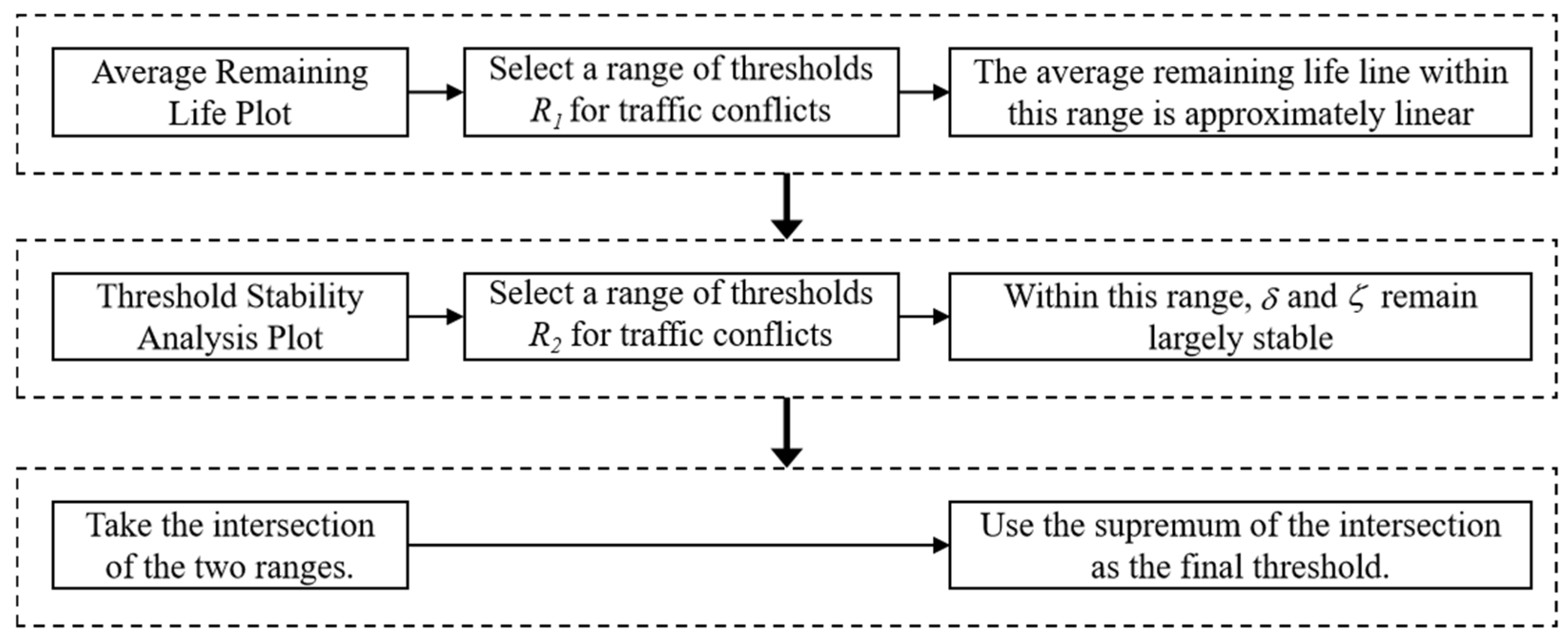
45].
The basic steps of the graphical method in EVT are as follows: (1) Calculate the remaining life of the sample data, i.e., the expected value of
, plot the average remaining life curve of the sample data, and then determine a range
where the average remaining life exhibits linear variation. (2) Plot the modified scale parameter and shape parameter as functions of the threshold. Subsequently, determine a range
where the modified scale parameter and shape parameter remain essentially unchanged with respect to the threshold. (3) Take the intersection
of ranges
and
, and use the upper bound
of set
as the final threshold. The overall process is shown in
Figure 5. It should be noted that the EVT-calibrated ACT thresholds are statistical classification boundaries rather than behavioral or operational safety limits. The resulting “high-risk” and “safe” states are model-internal and context-dependent, intended for relative risk stratification and subsequent analysis rather than normative safety assessment.
4.1.3. Construction of the Curve Coordinate System
When vehicles navigate curved road sections, traditional following distance calculation methods based on Euclidean distance fail to accurately reflect the true distance relationships along the road’s direction. To overcome errors caused by curve curvature, this paper establishes a curve reference coordinate system (Frenet coordinate system) based on the road centerline. The Frenet coordinate system is a commonly used method for vehicle trajectory planning on curved road sections [
46]. The Frenet coordinate system projects the vehicle’s spatial position onto a “longitudinal-lateral” two-dimensional plane, enabling unified calculation of metrics such as following distance and lateral offset distance. It should also be noted that this coordinate system is established to facilitate the calculation of characteristic indicators (
Section 4.2.1) and is not directly used for ACT calculations, as ACT is applicable to curved roads [
20].
Step 1 Centerline Extraction: Using drone aerial footage or scene vector maps, select several road center point coordinates in Tracker software to form a set of centerline points for curved sections.
Step 2: Smoothing and Resampling: To mitigate the impact of manual point selection or pixel noise on computational accuracy, perform three rounds of corner point smoothing using the Chaikin algorithm. Subsequently, resample the centerline using a fixed arc length step size (0.5 m in this study) to obtain a smooth, continuous centerline point sequence:
In the equation, s represents the arc length parameter along the centerline.
Step 3: Definition of the Curve Coordinate System: At any point s along the center line, define the tangent unit vector:
The direction vector of the normal is as follows:
Establish the Frenet coordinate system , where denotes the position along the road direction and represents the lateral offset of the vehicle relative to the centerline (positive on the left, negative on the right).
Step 4: Vehicle coordinate projection: For any vehicle position
in the global coordinate system, project it onto the centerline using the minimum distance principle to obtain the projection point
:
Based on this, calculate the lateral distance relative to the centerline of the lane:
This allows us to determine the vehicle’s position in the curve coordinate system at that moment, enabling the calculation of metrics such as the following distance and relative lateral offset between the two vehicles in the curve scenario.
4.2. CFT Risk Identification Model
4.2.1. Feature Selection
To construct a CFT risk identification model, this study starts from the characteristics of the trajectory data (
Table 1), combines the existing research [
4,
15] and the operation characteristics of the CFT scene of the truck occlusion line of sight in the two-lane highway section of the mountainous area, and selects the key feature variables shown in
Table 2. The selected features mainly characterize CFT risk from three aspects: longitudinal vehicle running state, relative motion relationship, and lateral driving behavior.
Specifically: Speed and acceleration of the leading truck and following passenger car (X1–X4) describe basic vehicle states; Speed and acceleration differentials between vehicles (X5–X6) reflect relative motion changes during following—critical factors influencing rear-end collision risk; following distance (X8) directly represents longitudinal safety margin. Considering that passenger cars are prone to lateral adjustment maneuvers when obstructed by trucks, this study further incorporates lateral offset distance and lateral sway coefficient (X7, X9) to characterize lateral instability. Additionally, the velocity instability coefficient (X10) is employed to describe longitudinal speed fluctuations in passenger cars.
To ensure the reproducibility of this study, we provide the calculation methods for the transverse oscillation coefficient (TOC) and velocity instability coefficient (VIC). These methods are derived from the literature [
47].
The TOC reflects the driver’s directional control stability; a higher value indicates a more pronounced “snaking” phenomenon in the vehicle.
where
is the cumulative lateral displacement over 1 s,
is the cumulative longitudinal travel distance, and
is the sampling frequency.
VIC describes the intensity of longitudinal speed fluctuations, reflecting the longitudinal stability of vehicle following.
where
is the standard deviation of speed over 1 s, and
is the mean speed over 1 s.
All the above metrics are calculated within a 1 s sliding time window, with a sampling frequency of 0.1 s. The 1 s sliding window was adopted to balance temporal resolution and noise suppression [
47]. In addition, it should be noted that risk characterization may be sensitive to the chosen temporal aggregation scale.
4.2.2. Development of an XGBoost-Based Risk Identification Model
In recent years, the primary modeling approaches for identifying car following risk using micro-trajectory data have been machine learning methods [
48,
49], including Support Vector Machines (SVM), Random Forests (RF), and Extreme Gradient Boosting (XGboost). XGboost has demonstrated strong performance in micro-driving behavior recognition studies [
50,
51]. Therefore, a CFT risk identification model was constructed based on the XGBoost model.
The fundamental workflow for model construction is as follows:
Step 1: We removed missing values and obviously anomalous records to ensure the integrity and reliability of feature data.
Step 2: We standardized each feature using the min-max normalization method, mapping features with different scales to a unified range [0, 1] to eliminate the impact of scale differences on the model training process.
Step 3: The processed dataset was split into 80% training data and 20% testing data. The training data is used for model parameter learning and hyperparameter tuning, while the testing data evaluates the model’s generalization performance on unseen samples.
Step 4: Due to the significant imbalance between risk and safe states, where risk samples are vastly outnumbered, this study employs the Synthetic Minority Over-sampling Technique (SMOTE) to augment the minority class in the training set. Combined with XGBoost’s ‘scale_pos_weight’ parameter to assign higher misclassification costs to risk samples, this dual approach mitigates class imbalance at both the data and algorithmic levels.
Importantly, the use of SMOTE and class weighting alters the joint feature distribution of the training data. Accordingly, the predicted probabilities generated by the model should be interpreted as relative risk discrimination scores for pattern detection, rather than calibrated estimates of real-world crash frequency or absolute risk prevalence.
Step 5: After completing sample preprocessing and class imbalance mitigation, the XGBoost CFT risk detection model was trained on the training set. Key hyperparameters—including number of trees, maximum depth, and learning rate—were tuned to balance model complexity and generalization capability, yielding an optimal configuration.
Step 6: We applied the trained model to the test set to predict CFT risk states for samples. We then conducted a comprehensive assessment of the model’s recognition performance using multiple evaluation metrics to validate its risk identification capability on unseen samples.
4.2.3. Model Evaluation Metrics
This study uses the test set to evaluate model performance, and the evaluation index adopts the more commonly used classification evaluation index in the car-following risk assessment [
15,
50], with metrics including Accuracy, Recall, and F1-score. The specific explanations of these are as follows:
Accuracy: the ratio of correctly classified samples to the total number of samples.
In the above equation, TP (True Positive), FP (False Positive), TN (True Negative), and FN (False Negative) represent true positives, true negatives, false positives, and false negatives, respectively.
- 2.
Precision: The proportion of samples correctly classified as positive among those predicted as positive by the model. A higher value indicates greater accuracy in predicting positive samples.
- 3.
Recall: this metric represents the ratio of correctly classified samples to the total number of samples belonging to a specific category.
- 4.
F1 Score: the harmonic mean of precision and recall, providing a comprehensive evaluation of classifier performance.
4.3. Causal Analysis of CFT Risk
4.3.1. Selection of Key Variables
In tree models, directly using split frequency or gain metrics to measure feature importance is susceptible to the influence of tree structure and sample partitioning. Permutation feature importance (PFI) is more commonly used in machine learning, and its performance files are also confirmed [
52,
53]. Therefore, to obtain a more robust metric that facilitates comparison across different models, this paper employs PFI to rank each input variable.
First, we fix the trained XGBoost model on the test set and compute the baseline AUC, denoted as
. Next, we randomly permute a specific feature column to disrupt the correspondence between that feature and the sample labels while preserving its overall distribution. Based on this, we recalculate the model’s performance on the test set, denoted as
. The permutation importance of the
j-th feature is defined as follows:
In the above equation, represents the performance degradation caused by the perturbation of feature j. If replacing a particular feature results in a significant performance decline, it indicates that the feature played a crucial role in the original prediction. Conversely, it suggests that the feature made a marginal contribution to the model output. Finally, this paper selects the three most important features for subsequent partial dependency analysis and risk attribution explanation. It should also be emphasized that PFI is used in this study as a predictive attribution tool rather than a causal inference measure. Due to inherent kinematic relationships in car-following behavior, several features are mechanically correlated; therefore, PFI reflects shared predictive information across correlated variables rather than causal dominance of individual features.
4.3.2. Analysis of Key Variables Using PDP
The combination of PFI and partial dependence plots (PDP) is highly interpretable and very robust [
53,
54], which can provide a strong guarantee for the micro-risk interpretation of CFT risk in this study. Therefore, after obtaining the set of key variables, this paper further utilizes PDP to characterize the relationship between “changes in variable levels” and “changes in risk probabilities.” The fundamental concept of PDP is as follows: while focusing on the variation in the value of a specific variable, other variables are treated as background conditions. The model output is averaged to obtain the average marginal effect of that variable on the prediction result.
Let the key variable be
, with the remaining features forming the vector
. The model output is the probability
that the sample belongs to a risk state. The one-dimensional partial dependence function can be approximated at the sample level as follows:
where
represents a given value of variable
, and
denotes all other features in the
i-th sample except
. Calculating
for different
values yields the overall influence curve of this variable on the probability of following-distance risk as it varies from low to high.
PDP effectively identifies the monotonicity of risk probability as the variable changes (e.g., whether large speed differences generally reduce risk) and whether the variable exhibits distinct threshold intervals (e.g., when following distance below a certain threshold causes risk to surge sharply).
In addition to global interpretability based on permutation feature importance (PFI) and partial dependence plots (PDP), this study incorporates SHAP (SHapley Additive exPlanations) to provide instance-level explanations of model predictions. SHAP is used as a complementary local interpretability tool to characterize individual deviations around the average effects captured by PDP. By jointly visualizing SHAP distributions and PDP curves, the proposed framework links population-level risk mechanisms with case-specific risk variations under complex mountainous road conditions.
5. Results
5.1. Risk Threshold Calibration Results
This study selected samples with ACT values below 20 s for threshold calibration. This approach was chosen because excessively high ACT values hold limited significance for assessing driving risk, while also preventing a small number of extreme outliers from disrupting distribution fitting [
55]. Following the methodology outlined in
Section 4.1.3, extreme value analysis was conducted on ACT values within the [0, 20] second range to derive the danger threshold for car-following-truck (CFT) behavior.
Extreme value theory (EVT) focuses on the extreme values of a variable. For ACT, the extreme event is ACT < 0 (vehicle collision or entry into collision state). This study, however, concentrates on early risk identification within the interval where “collision has not yet occurred, but danger is imminent.” To facilitate tail distribution fitting using the Generalized Pareto Distribution (GPD), ACT undergoes a negative mapping in this study, denoted as −ACT. This transformation maps the originally smaller ACT values (high risk) to larger −ACT values, enabling characterization of its extreme properties from a “right-tail” perspective—a standard practice in extremal analysis [
43].
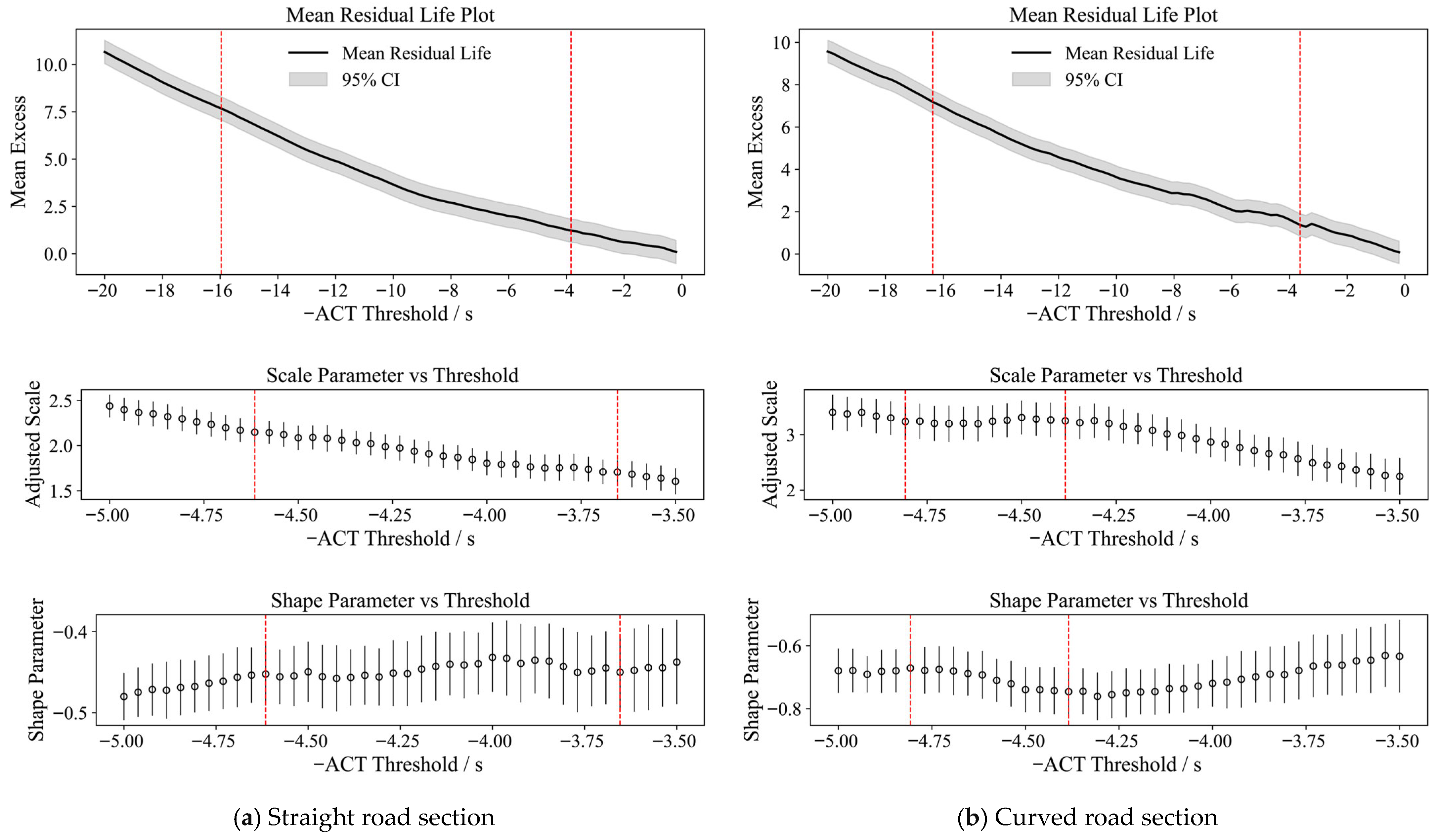
As shown in
Figure 6a, on straight road sections, the average remaining life curve of −ACT exhibits near-linearity within the interval [−15.96, −3.838], indicating that GPD fitting is reasonable within this range. Concurrently, the stable interval for the modified scale parameter and shape parameter as a function of threshold is [−4.615, −3.654]. Considering the results from both the average remaining life curve and the threshold stability curve, the maximum value within the intersection of these two intervals, −3.838, is adopted as the ACT danger threshold for straight road scenarios. Correspondingly, when ACT is less than 3.838 s, the following behavior can be considered to have entered a significantly high-risk state.
As shown in
Figure 6b, on curved road segments, the average remaining lifetime curve of −ACT exhibits near-linearity within the interval [−16.36, −3.636], while the stability intervals for the modified scale parameter and shape parameter thresholds are [−4.808, −4.385]. Similarly, integrating the average remaining lifetime diagram with parameter stability analysis results, this study adopts −4.385 s as the ACT danger threshold for curved road scenarios. That is, when ACT falls below 4.385 s, following behavior on curves is deemed to enter a significantly high-risk state.
After calibrating the ACT thresholds, this study further employs chi-square tests to evaluate the validity and robustness of the threshold classification across different scenarios. First, samples with ACT values below the threshold are defined as hazardous events based on different thresholds. The proportion of hazardous events in straight and curved road scenarios is then calculated. A 2 × 2 contingency table chi-square test is used to determine whether there is a significant difference in the occurrence rates of hazardous events between the two scenarios.
Table 3 presents the test results based on EVT thresholds and the commonly used fixed threshold (4 s). It can be observed that when using EVT-calibrated thresholds (3.838 s for straight sections and 4.385 s for curves), the proportions of hazardous events on straight sections and curves were 10.32% and 10.36%, respectively, showing near consistency. The corresponding chi-square statistic was 0.0039 with a
p-value of 0.9499, indicating no significant difference (
p > 0.05). This demonstrates that the EVT threshold provides a relatively consistent risk classification between straight and curved road sections. In contrast, when uniformly applying the conventional threshold of 4 s, the proportions of hazardous events on straight and curved sections were 11.38% and 9.39%, respectively, showing a significant difference. The corresponding chi-square value was 14.6224, with a
p-value of only 1.31 × 10
−4, reaching statistical significance. This demonstrates that scenario-based thresholds calibrated using EVT exhibit superior robustness and multi-scenario applicability compared to simple fixed thresholds. They are more suitable for classifying CFT risks in mixed straight and curved road scenarios on mountain roads.
5.2. Analysis of CFT Characteristics
This section compares the following behavior characteristics of passenger vehicles behind trucks on straight and curved road sections, analyzing both following distance and following duration.
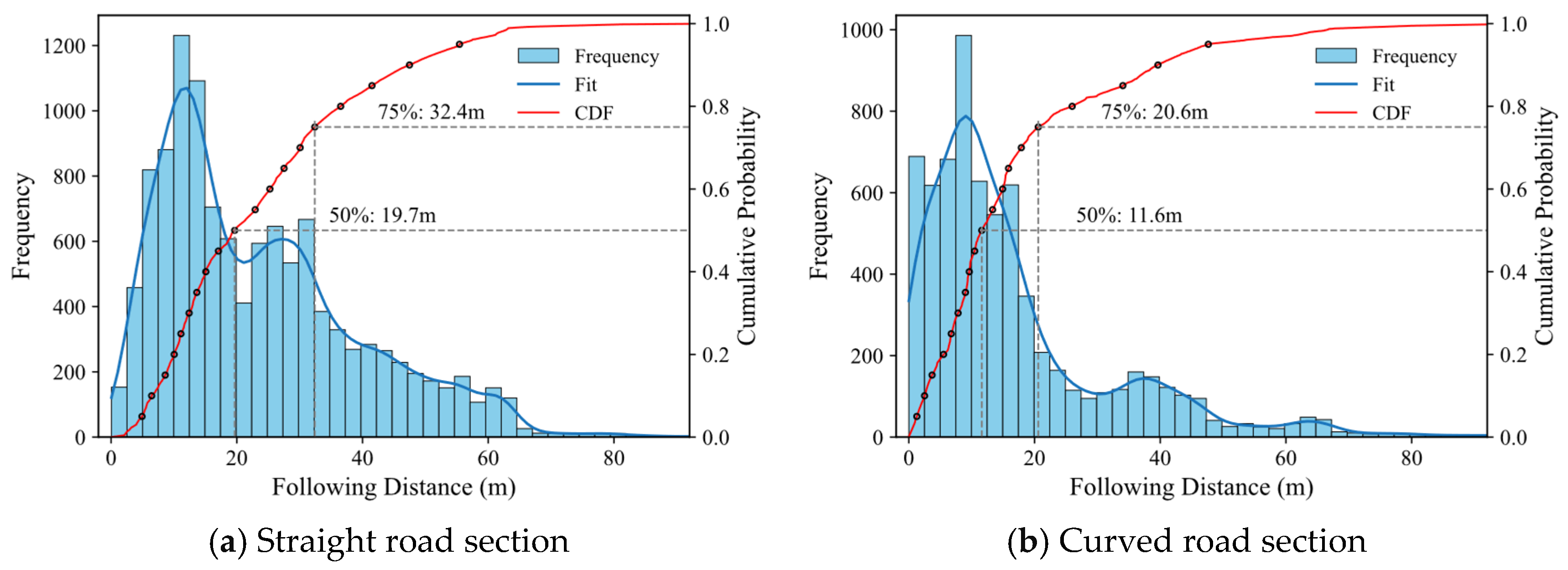
Figure 7 shows the distribution of the following distances under both scenarios. Overall, distances on both straight and curved sections exhibit a pronounced left skew, with most samples concentrated within the 0–40 m range. However, the distribution on curved sections shifts toward shorter distances. The median and 75th percentile distances on straight sections were 19.7 m and 32.4 m, respectively, while those on curved sections were only 11.6 m and 20.6 m, representing a significant difference. This indicates that under truck-induced visibility obstruction, drivers generally maintain tighter following distances on curves. This behavior stems partly from lower design speeds and reduced operating speeds on curves, and partly from restricted forward sight distance due to the combined effects of curvature and roadside obstructions. With limited perception of road geometry and oncoming traffic, drivers increasingly rely on the movement of the preceding vehicle for “close following,” thereby reducing longitudinal safety margins.
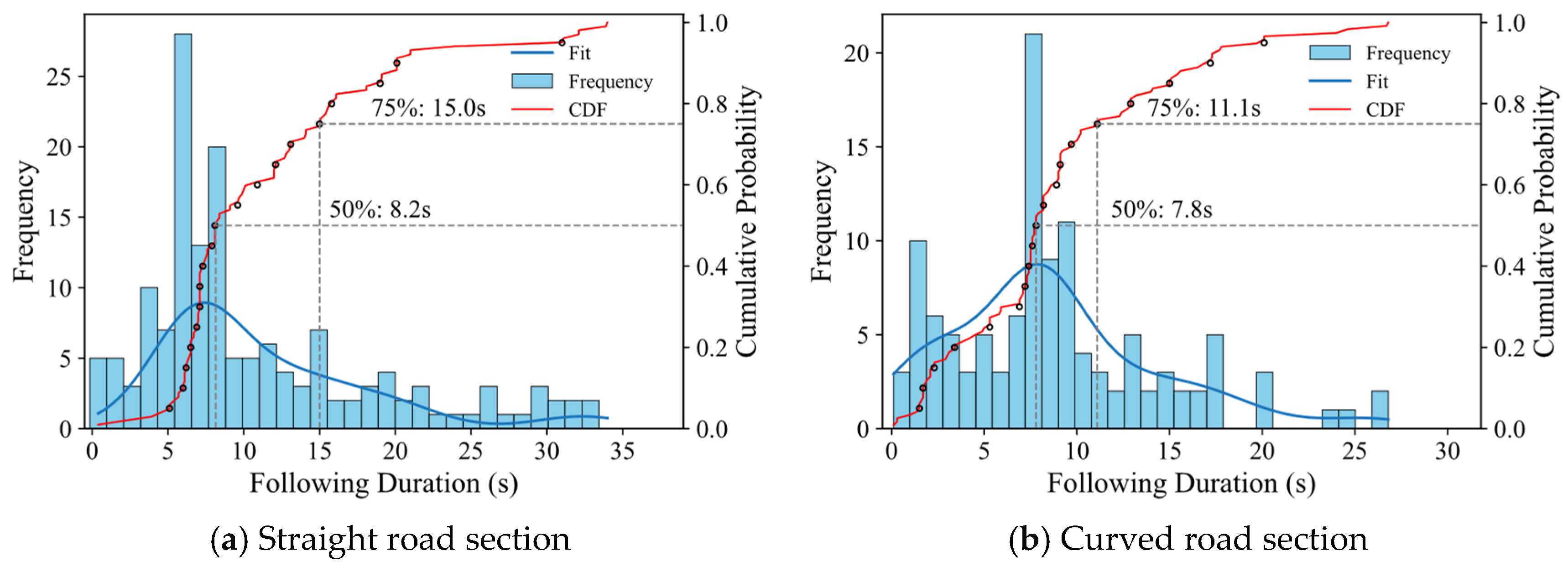
Figure 8 illustrates the distribution characteristics of CFT duration. In both scenarios, CFT times exhibit a long-tail distribution, with most events lasting less than 20 s and only a small number involving prolonged following. The median and 75th percentile times on straight sections were 8.2 s and 15.0 s, respectively, while those on curved sections were 7.8 s and 11.1 s—slightly shorter overall. This indicates drivers tend to exit following states more quickly on curves, such as overtaking or adjusting distance after exiting the curve, or when visibility improves. Combining distance and time metrics reveals that the following behavior in curved road scenarios exhibits a “short duration, small gap” pattern of tense CFT. Should the preceding truck decelerate or experience speed fluctuations, this increases the likelihood of triggering high-risk events within a limited reaction time. This behavioral pattern provides foundational support for subsequent risk metric analysis and identification model development.
5.3. CFT Risk Prediction Results
This section compares the CFT risk detection performance of four models—SVM, RF, XGBoost, and LGBM—using test datasets from straight and curved road segments.
Results from straight road segments (
Table 4) show that all four models perform well overall, with Accuracy exceeding 0.84 and AUC exceeding 0.92 for each. This indicates that the constructed feature system can adequately characterize risk patterns in truck-obscured scenarios on straight roads. Among them, XGBoost and LGBM demonstrated the best overall performance, achieving an accuracy and Recall of 0.9063, with an F1-score of 0.9077. This represents a significant improvement over SVM and RF, particularly compared to RF. Recall increased by approximately 6.3 percentage points, indicating a substantial reduction in the false negative rate for risk samples while maintaining overall accuracy. Among these, XGBoost achieved an AUC of 0.9775, slightly higher than LGBM’s 0.9661. This indicates that under varying classification thresholds, XGBoost demonstrates more stable discrimination between safe and risk samples, with a broader overall margin of safety.
On curved road segments (
Table 5), performance differences among models become more pronounced. SVM achieved an Accuracy of 0.7893, a recall of 0.7814, and an F1-score of 0.8064, with an AUC of only 0.6875. This indicates its significant shortcomings in scenarios with more complex nonlinear features and severe category overlap, such as curves. RF and LGBM achieved Accuracies of 0.8614 and 0.8596, respectively, with F1-scores around 0.8673 and 0.8653. While these represent improvements over SVM, a certain proportion of risk samples were still misclassified as safe. In contrast, XGBoost demonstrates a clear advantage in the curve scenario: its Accuracy reaches 0.9587, Recall and F1-score are 0.9546 and 0.9569, respectively. This indicates not only its ability to accurately identify the vast majority of risk samples but also its effective control of false positives for safe samples. The AUC of 0.8281, while lower overall than on straight roads due to the inherently reduced separability of curved road scenarios, remains the highest among the four models. This reduction in AUC reflects the increased uncertainty and feature overlap induced by limited visibility and stronger coupling between longitudinal and lateral vehicle behaviors on curves, which constrains probability ranking performance despite high classification accuracy. Importantly, this indicates a limitation in state separability under curved-road conditions rather than a deficiency in the model’s ability to detect high-risk events.
In addition, pairwise comparisons of AUC values were conducted using the DeLong test on the same test set. While XGBoost achieved the highest AUC on curved segments, the differences in AUC relative to the other models were not statistically significant at the 0.05 level, reflecting the increased uncertainty and reduced separability inherent in curved-road scenarios.
The combined results from straight and curved road segments reveal two key insights: First, the overall AUC levels on curved roads are generally lower than on straight roads. This reflects reduced distinguishability between safe and risky samples in the feature space when visibility is limited, vehicle speed fluctuates, and lateral drift occurs simultaneously, thereby increasing the difficulty of risk identification. Second, XGBoost maintains high Accuracy and Recall in both scenarios, with its relative advantage being more pronounced in the complex curved road environment. This aligns with XGBoost’s mechanisms of leveraging second-order gradient information, explicit regularization, and cost adjustment for class imbalance (scale_pos_weight), enabling it to better fit high-dimensional, nonlinear CFT risk patterns. Based on these findings, XGBoost is selected as the primary model for subsequent interpretability analysis, where its decision-making process is subjected to an in-depth examination of key variables and risk mechanisms.
5.4. Results of Causal Analysis of CFT Risk
5.4.1. Feature Importance Analysis
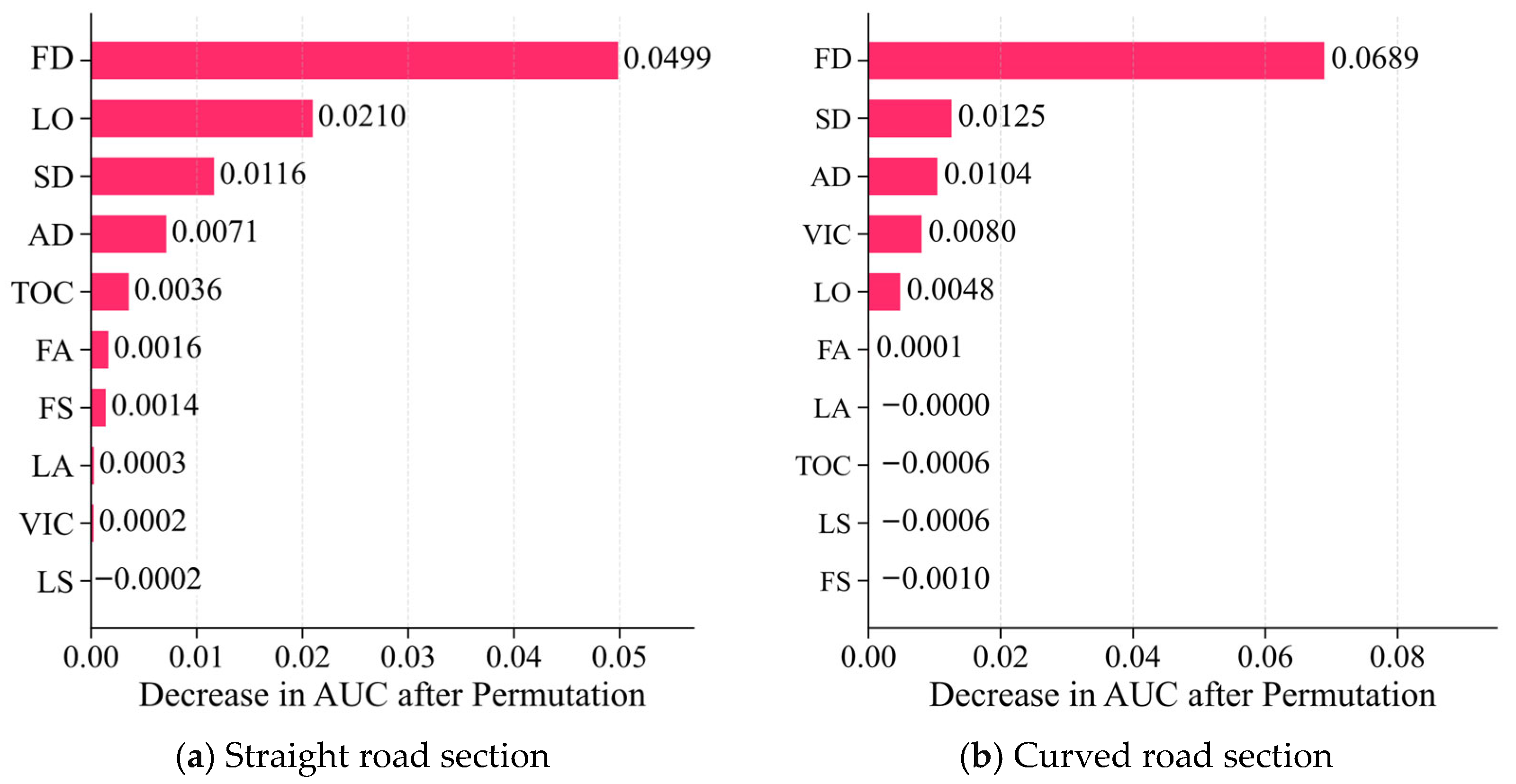
Building upon the evaluation of the CFT risk identification model, this section assesses the contribution of each input variable to the XGBoost CFT risk identification model based on feature importance derived from AUC permutations.
Figure 9 illustrates the decrease in AUC following feature permutation for both straight and curved road sections. Higher values indicate a more pronounced decline in the model’s ability to distinguish between safe and risky states after feature disturbance, signifying greater criticality for risk identification.
Results for straight road segments (
Figure 9a) reveal that following distance (FD) is significantly more important than other variables. Its permutation causes an AUC decrease of nearly 0.05, confirming longitudinal spacing as the dominant factor influencing following risk on straight roads. Followed by lateral offset (LO), speed difference (SD), and acceleration difference (AD), whose permutations caused varying degrees of AUC decline. This indicates that in truck-obscured scenarios, drivers adjust lateral position to “peek” ahead and match speed and acceleration with the preceding vehicle.
Results for curved road sections (
Figure 9b) similarly show that replacing following distance (FD) yields the largest AUC reduction (approximately 0.07), further confirming that longitudinal spacing exerts greater control over risk levels in visibility-restricted curves. Compared to straight sections, the importance of speed difference (SD) and acceleration difference (AD) increases on curves. This indicates that maintaining high relative speeds or frequent acceleration/deceleration at close following distances in passenger vehicles is more likely to trigger hazardous events on curved roads. Meanwhile, the significance of lateral variables (e.g., lateral offset) is slightly lower than on straight sections, potentially due to the limited space available for lateral adjustments within curves.
5.4.2. Analysis of Key Risk Features
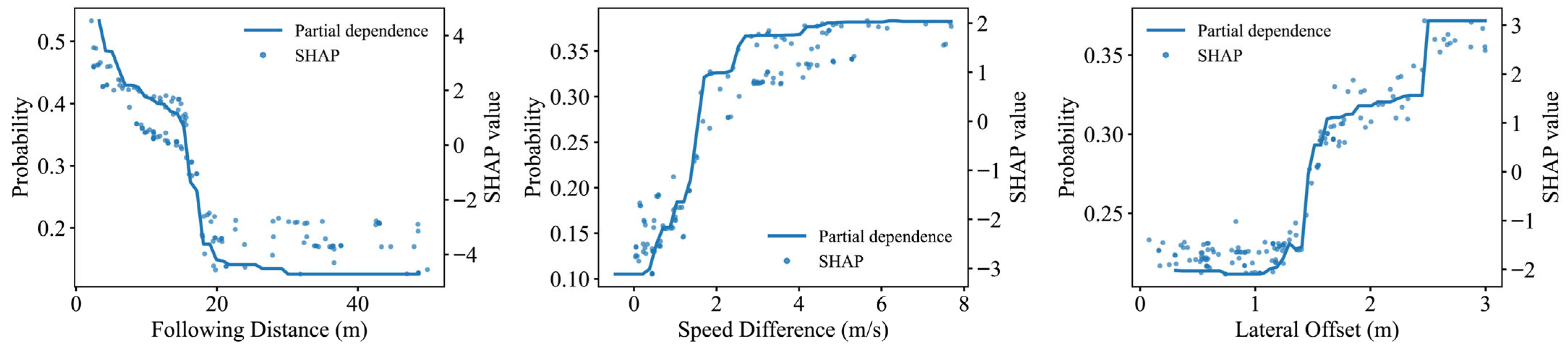
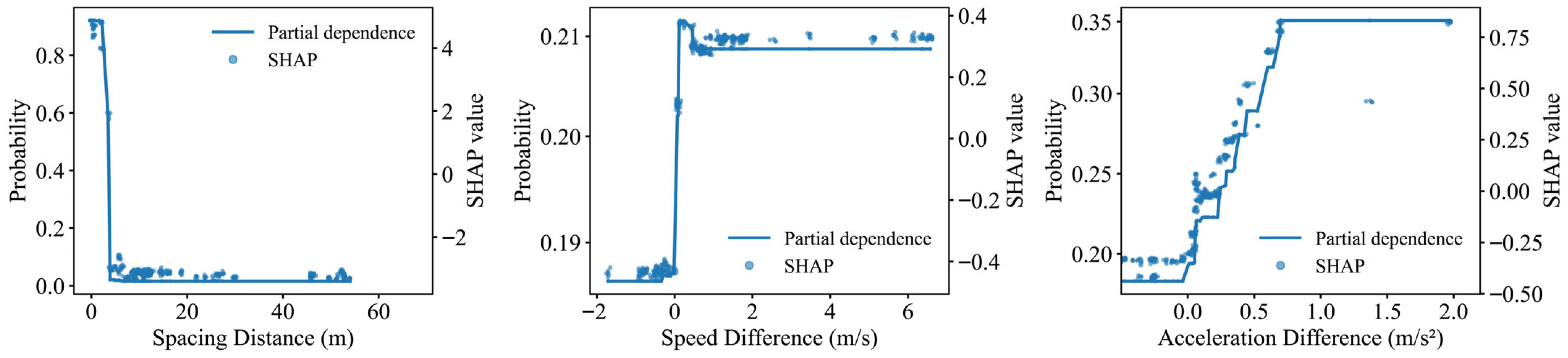
Based on the feature importance ranking, the top three explanatory variables were selected for straight and curved road segments. Partial dependence plots (PDPs) were used to examine the average marginal effects of key variables on CFT risk probability, while SHAP values were incorporated to provide instance-level explanations around these global trends, as shown in
Figure 10 and
Figure 11.
For straight road segments (
Figure 10), the partial dependence curve of following distance (FD) exhibits a clear nonlinear decay pattern. When FD is below approximately 10 m, the risk probability remains high (around 0.4–0.5). Within the 10–20 m range, the risk probability decreases rapidly, indicating a high-sensitivity zone in which small increases in distance yield substantial safety benefits. Beyond approximately 30 m, the curve gradually flattens, suggesting diminishing marginal returns from further spacing increases. The feature distribution shows that a large proportion of observed following events occur within this high-sensitivity interval, implying that routine driving behavior frequently operates close to critical safety margins. The PDP for speed difference (SD) shows an approximately monotonic increasing trend, with the steepest slope occurring in the 0–3 m/s range. This indicates that moderate relative speed variations contribute most strongly to risk elevation, while extremely large speed differences are comparatively rare. This pattern is consistent with classical car-following theories, in which relative speed plays a central role in drivers’ anticipation and braking responses. For lateral offset (LO), the risk probability remains low when vehicles maintain a near-central lane position. However, once LO approaches the lane centerline (approximately 2 m or more), the risk probability rises sharply and stabilizes at a higher level. This reflects compensatory lateral maneuvers adopted by following drivers under occluded conditions to regain forward visibility, which may increase exposure to adjacent conflicts.
The superimposed SHAP scatter distributions reveal notable heterogeneity around the PDP curves. High-risk SHAP values are observed even at moderate levels of FD and SD, indicating that individual risk outcomes depend on the combined configuration of longitudinal spacing, relative speed, and lateral behavior rather than on any single variable alone. In particular, cases with simultaneous longitudinal instability and increased lateral offset tend to exhibit higher local risk contributions, suggesting a coupling effect between lateral maneuvers and longitudinal control under occluded following conditions.
For curved road sections (
Figure 11), the PDP curves exhibit a more pronounced threshold-type behavior compared with straight segments. The partial dependence of following distance (FD) is extremely steep. When FD is below approximately 10 m, the predicted risk probability remains at a saturated high level. As the distance increases to the 10–20 m range, the risk probability drops sharply and then stabilizes near a low level, showing limited sensitivity to further distance increases. This indicates that under occluded sight conditions on curves, short following distances are almost invariably associated with high-risk states, and modest distance adjustments yield substantially greater risk mitigation than on straight roads. The PDP for speed difference (SD) still shows an overall increasing trend, but with a noticeably gentler slope than that observed on straight segments. This suggests that on curved roads, relative speed plays a secondary role compared with spacing constraints: even small speed differences may correspond to elevated risk when following distances remain short. The acceleration difference (AD) curve highlights the role of active longitudinal maneuvers. Risk probability remains relatively low when AD is close to zero, but increases markedly as AD exceeds approximately 0–1 m/s
2 and rises rapidly beyond this range. This indicates that under close-following conditions on curves, strong acceleration behaviors—such as closing in on the lead vehicle or initiating overtaking—are consistently classified as high-risk situations. Together with the SHAP distributions, these results suggest that on curved segments, high risk often emerges from the combined effect of constrained spacing and aggressive longitudinal control, with lateral compensatory behaviors further amplifying local risk in specific cases.
By integrating displacement-related feature importance with PDP and SHAP-based local explanations, the results consistently indicate that longitudinal spacing is the primary determinant of CFT risk on both straight and curved road sections, in line with the core assumptions of classical car-following models (e.g., Gipps and IDM), where headway directly constrains feasible acceleration and safety margins. On straight sections, SHAP distributions show that drivers often operate within a relatively “manageable” risk regime, where moderate adjustments in relative speed and lateral offset can partially compensate for short spacing without immediately triggering high-risk states. In contrast, on curved sections with limited sight distance, small headways alone are sufficient to push the system toward near-critical risk levels; SHAP reveals that additional increases in acceleration or speed difference then exert a strongly amplifying effect. This pattern suggests a tighter coupling between longitudinal instability and lateral compensatory maneuvers on curves, where drivers’ attempts to gain preview information or prepare overtaking simultaneously elevate both acceleration demand and risk exposure. Accordingly, safety management and driver assistance strategies in truck-obscured mountainous scenarios should adopt geometry-specific priorities: emphasizing headway regulation and speed harmonization on straight segments, while enforcing stricter constraints on acceleration and aggressive longitudinal maneuvers under close-following conditions on curves.
6. Discussion
This study provides an engineering-oriented interpretation of CFT risk under truck-induced occlusion on mountainous two-lane roads, with particular relevance to geometry-aware safety management and advanced driver assistance systems (ADAS). By using high-resolution UAV trajectory data, the proposed framework captures short-term interaction dynamics that are not observable in accident-based studies but are critical for real-time risk assessment.
A central contribution is the identification of geometry-specific high-sensitivity spacing zones. On straight sections, risk exhibits its greatest sensitivity within a following distance range of approximately 10–20 m, where moderate increases in spacing yield substantial risk reduction. Beyond this range, the marginal safety benefit of increasing distance diminishes. On curved sections, however, the sensitivity zone shifts to much shorter distances (approximately 0–10 m), and risk escalates rapidly as spacing decreases. This contrast indicates that uniform headway or collision-time thresholds are insufficient for mountainous roads, and that alignment-specific thresholds are necessary for effective risk control.
From an operational perspective, these findings suggest differentiated intervention strategies. On straight sections, ADAS or advisory systems may focus on regulating relative speed and maintaining reasonable headway within the critical distance range. On curves, short following distances alone are sufficient to induce high-risk states, and additional constraints on acceleration during close following or overtaking become essential. These insights support the development of geometry-aware warning logic and control priorities in truck-obscured scenarios.
Furthermore, the combined analysis of spacing, speed difference, and acceleration difference further clarifies the interaction mechanisms underlying CFT risk. While following distance remains the dominant factor, speed and acceleration differences act as strong amplifiers under short-distance conditions, particularly on curves. This pattern is consistent with classical car-following theory [
25], but highlights how limited visibility and longitudinal–lateral coupling on curves effectively compresses drivers’ safety margins. The results also indicate that lateral maneuvers, such as offsetting toward the lane center to improve visibility, may interact with longitudinal instability, modestly increasing risk under occluded conditions. These findings are consistent with behavior-based mitigation frameworks proposed in earlier car–truck interaction studies, such as Peeta et al. [
56], which emphasized adaptive warnings, operational guidance, and lane-management strategies tailored to asymmetric car–truck dynamics. In this regard, the present results provide empirical, trajectory-based support for refining such strategies under mountainous road and limited-visibility conditions, thereby extending risk classification outcomes toward practical engineering and policy-relevant applications.
Beyond the direct car–truck interaction captured by trajectory features, an important contextual factor affecting CFT risk interpretation is the occupational nature of truck driving. Trucks are often operated under time pressure, workload constraints, and upstream traffic or geometric limitations that are not directly observable from the follower’s perspective. Sudden braking, oscillatory acceleration, or conservative speeds on curves may therefore encode upstream constraints such as limited sight distance, oncoming conflicts, or congestion. In this sense, trucks may act as behavioral proxies for unobserved upstream risk, and CFT risk reflects not only direct car–truck interaction but also the downstream propagation of upstream hazards. This interpretation is critical for applying the results in practice: interventions should not solely target passenger car behavior, but also consider how truck operations transmit risk through the traffic stream.
Several limitations should be acknowledged. First, the data were collected from a single mountainous road segment. While the identified mechanisms are broadly consistent with international findings on car–truck interaction under occluded conditions [
56], validation across diverse mountainous contexts is still required to assess the generalizability of the reported thresholds. Second, car-following behavior is inherently heterogeneous across drivers and situations. Accordingly, the reported thresholds and sensitivity ranges should be interpreted as aggregate tendencies averaged across heterogeneous behavior modes, rather than behavior-specific regimes. Future work could incorporate driver-level or vehicle-level heterogeneity to further refine these relationships. Nevertheless, as vehicle-based sensing and connectivity continue to advance, dynamic interaction features are increasingly accessible in real-world systems. Within this context, the proposed framework provides a practical and transferable basis for geometry-aware risk assessment and ADAS design on mountainous two-lane roads.
7. Conclusions
This study investigated car-following-truck (CFT) risk under truck-induced visual occlusion on mountainous two-lane roads using high-resolution UAV trajectory data. By integrating a two-dimensional surrogate safety indicator (ACT), extreme value theory (EVT)–based threshold calibration, and an explainable machine-learning framework, the study provided a micro-behavioral characterization of following risk under different road geometries.
First, scenario-specific ACT thresholds were calibrated for straight and curved sections. The results demonstrate that the high-risk thresholds differ substantially by alignment, with calibrated values of approximately 3.84 s for straight sections and 4.39 s for curved sections. Compared with commonly used uniform thresholds, these contextual thresholds exhibited superior consistency across road geometries, confirming the necessity of alignment-aware risk classification on mountainous roads.
Second, an XGBoost-based risk identification model achieved high recognition performance in both scenarios, particularly on curved sections where nonlinear interactions are more pronounced. The model attained accuracies of 90.63% on straight sections and 95.87% on curved sections, indicating that vehicle-dynamics-based features can effectively capture short-term CFT risk under occluded visibility conditions.
Third, explainable analysis revealed that following distance is the dominant determinant of CFT risk across both road types, while its sensitivity range differs markedly by geometry. On straight sections, risk increases progressively as spacing decreases within the 10–20 m range, whereas on curved sections, risk escalates rapidly once spacing falls below approximately 10 m. Under short-spacing conditions, speed and acceleration differentials further amplify risk, highlighting the vulnerability of close following combined with active longitudinal maneuvers in visually constrained environments.
Overall, this study provides empirical evidence that CFT risk formation on mountainous two-lane roads is highly context-dependent and driven by micro-level interaction dynamics rather than static geometric factors alone. The findings offer practical implications for alignment-specific parameter setting in advanced driver-assistance systems, proactive risk warning strategies, and safety management on mountainous roads with high truck exposure. Future research should extend the framework to multi-site datasets and incorporate driver and vehicle heterogeneity to further enhance generalizability and real-world applicability.
Author Contributions
Conceptualization, T.Y. and K.P.; methodology, T.Y. and K.P.; software, K.P.; validation, T.Y., K.P., W.Q. and J.C.; formal analysis, J.C.; investigation, T.Y. and W.Q.; resources, K.P. and W.Q.; data curation, J.C.; writing—original draft preparation, T.Y. and K.P.; writing—review and editing, T.Y., K.P., W.Q. and J.C.; visualization, K.P.; supervision, W.Q. and J.C.; project administration, K.P. and W.Q.; funding acquisition, K.P., W.Q. and J.C. All authors have read and agreed to the published version of the manuscript.
Funding
This research was supported by the National Natural Science Foundation of China (Grant No. 72461015), Major Science and Technology Special Projects of Yunnan Province (No. 202502AD080006), Yunnan Fundamental Research Project (Grant No. 202401AT070309), and Yunnan Xing Dian Talents Plan Young Program.
Institutional Review Board Statement
Not applicable.
Informed Consent Statement
Not applicable.
Data Availability Statement
The raw data supporting the conclusions of this article will be made available by the corresponding author on request. The trajectory extraction software Tracker 2.0 can be accessed here:
https://opensourcephysics.github.io/tracker-website/ (accessed on 1 June 2024).
Acknowledgments
The authors would like to thank colleagues who provided valuable comments and suggestions during the research process, as well as those who contributed to the data collection work. During the preparation of this manuscript, the authors used ChatGPT (OpenAI), model GPT-5.2 Thinking, for language editing and clarity improvement. The authors have reviewed and edited the output and take full responsibility for the content of this publication.
Conflicts of Interest
Author Jie Chen was employed by the company Yunnan Infrastructure Investment Co., Ltd. The remaining authors declare that the research was conducted in the absence of any commercial or financial relationships that could be construed as a potential conflict of interest.
References
- Gong, X.; Bo, W.; Chen, F.; Wu, X.; Zhang, X.; Li, D.; Gou, F.; Ren, H. Safety Evaluation of Highways with Sharp Curves in Highland Mountainous Areas Using an Enhanced Stacking and Low-Cost Dataset Production Method. Sustainability 2025, 17, 5857. [Google Scholar] [CrossRef]
- Itasca, I. National Safety Council—Injury Fact; National Safety Council: Itasca, IL, USA, 2015. [Google Scholar]
- Traffic Management Bureau of the Ministry of Public Security. Annual Report of Road Traffie Accident Statistics of the People’s Republic of China (2016–2019); Traffic Management Bureau of the Ministry of Public Security: Beijing, China, 2019.
- Xiao, J.; Shi, X.; Wen, Q.; Wen, Y.; Cheng, H. Dynamic Prediction of Traffic Accident Risk in Risky Curve Sections Based on Vehicle Trajectory Data. China J. Highw. Transp. 2022, 35, 277–285. [Google Scholar]
- Yao, X. Prevent and Respond to Rural Road Traffic Safety Issues from the Source; Ministry of Public Security Road Traffic Safety Research Centre: Beijing, China, 2021; Available online: https://mp.weixin.qq.com/s/KkLAKLtQhApEZDb6e6zWrg (accessed on 20 January 2026).
- Xu, J.; Lin, W.; Wang, X.; Shao, Y.-M. Acceleration and Deceleration Calibration of Operating Speed Prediction Models for Two-Lane Mountain Highways. J. Transp. Eng. Part. A Syst. 2017, 143, 04017024. [Google Scholar] [CrossRef]
- Shi, X.; Zhen, Y.; Xiao, J. Modeling Heterogeneity for Car-following Risk Evaluation Under Truck Movement Block. J. Tongji Univ. (Nat. Sci.) 2022, 50, 1788–1797. [Google Scholar]
- Shi, B. Shi Baolin’s Interpretation of the Interim Measures for the Administration of Road Freight Transport Operations on Online Platforms; China Academy of Transportation Sciences (CATS): Beijing, China, 2019; Available online: https://mp.weixin.qq.com/s/SQxoC9baU_tSruhkzQLoZQ (accessed on 20 January 2026).
- Qi, Z.; Yao, J.; Zou, X.; Pu, K.; Qin, W.; Li, W. Investigating Factors Influencing Crash Severity on Mountainous Two-Lane Roads: Machine Learning Versus Statistical Models. Sustainability 2024, 16, 7903. [Google Scholar] [CrossRef]
- Zhang, W.; Liu, T.; Yi, J. Exploring the Spatiotemporal Characteristics and Causes of Rear-End Collisions on Urban Roadways. Sustainability 2022, 14, 11761. [Google Scholar] [CrossRef]
- Li, Y.; Wu, D.; Lee, J.; Yang, M.; Shi, Y. Analysis of the transition condition of rear-end collisions using time-to-collision index and vehicle trajectory data. Accid. Anal. Prev. 2020, 144, 105676. [Google Scholar] [CrossRef] [PubMed]
- Coifman, B.; Li, L. A critical evaluation of the Next Generation Simulation (NGSIM) vehicle trajectory dataset. Transp. Res. Part B Methodol. 2017, 105, 362–377. [Google Scholar] [CrossRef]
- Krajewski, R.; Bock, J.; Kloeker, L.; Eckstein, L. The highd dataset: A drone dataset of naturalistic vehicle trajectories on german highways for validation of highly automated driving systems. In Proceedings of the 2018 21st International Conference on Intelligent Transportation Systems (ITSC), Maui, HI, USA, 4–7 November 2018; pp. 2118–2125. [Google Scholar]
- Li, Y.; Wu, D.; Chen, Q.; Lee, J.; Long, K. Exploring transition durations of rear-end collisions based on vehicle trajectory data: A survival modeling approach. Accid. Anal. Prev. 2021, 159, 106271. [Google Scholar] [CrossRef]
- Geng, Z.; Ji, X.; Cao, R.; Lu, M.; Qin, W. A Conflict Measures-Based Extreme Value Theory Approach to Predicting Truck Collisions and Identifying High-Risk Scenes on Two-Lane Rural Highways. Sustainability 2022, 14, 11212. [Google Scholar] [CrossRef]
- Shen, J.; Yang, G. Crash Risk Assessment for Heterogeneity Traffic and Different Vehicle-Following Patterns Using Microscopic Traffic Flow Data. Sustainability 2020, 12, 9888. [Google Scholar] [CrossRef]
- Kuang, Y.; Qu, X.; Wang, S. A tree-structured crash surrogate measure for freeways. Accid. Anal. Prev. 2015, 77, 137–148. [Google Scholar] [CrossRef]
- Zheng, L.; Sayed, T.; Mannering, F. Modeling traffic conflicts for use in road safety analysis: A review of analytic methods and future directions. Anal. Methods Accid. Res. 2021, 29, 100142. [Google Scholar] [CrossRef]
- Zhang, J.; Lee, J.; Abdel-Aty, M.; Zheng, O.; Xiao, G. Enhanced index of risk assessment of lane change on expressway weaving segments: A case study of an expressway in China. Accid. Anal. Prev. 2023, 180, 106909. [Google Scholar] [CrossRef] [PubMed]
- Venthuruthiyil, S.P.; Chunchu, M. Anticipated Collision Time (ACT): A two-dimensional surrogate safety indicator for trajectory-based proactive safety assessment. Transp. Res. Part C Emerging Technol. 2022, 139, 103655. [Google Scholar] [CrossRef]
- Ozbay, K.; Yang, H.; Bartin, B.; Mudigonda, S. Derivation and validation of new simulation-based surrogate safety measure. Transp. Res. Rec. 2008, 2083, 105–113. [Google Scholar] [CrossRef]
- Ward, J.R.; Agamennoni, G.; Worrall, S.; Bender, A.; Nebot, E. Extending Time to Collision for probabilistic reasoning in general traffic scenarios. Transp. Res. Part. C Emerging Technol. 2015, 51, 66–82. [Google Scholar] [CrossRef]
- Kar, P.; Venthuruthiyil, S.P.; Chunchu, M. Non-stationary crash risk modelling of powered two-wheelers using extreme value analysis of surrogate crash events. Accid. Anal. Prev. 2023, 183, 106973. [Google Scholar] [CrossRef]
- Ma, X.; Xiang, M.; Jiang, X.; Shao, X. Bayesian survival analysis of interactions between truck platoons and surrounding vehicles through a two-dimensional surrogate safety measure. Accid. Anal. Prev. 2025, 213, 107945. [Google Scholar] [CrossRef]
- Newell, G.F. A simplified car-following theory: A lower order model. Transp. Res. Part B Methodol. 2002, 36, 195–205. [Google Scholar] [CrossRef]
- Gipps, P.G. A behavioural car-following model for computer simulation. Transp. Res. Part B Methodol. 1981, 15, 105–111. [Google Scholar] [CrossRef]
- Wiedemann, R. Simulation of Traffic Flow. Ph.D. Thesis, University of Karlsruhe, Karlsruhe, Germany, 1974. [Google Scholar]
- Yadav, D.; Siwach, V.; Redhu, P. Impact of headway uncertainty on traffic flow: Asymptotic and local stability analysis of car-following model. Physica A Stat. Mech. Its Appl. 2025, 680, 130998. [Google Scholar] [CrossRef]
- Lee, E.H.; Lee, E. Congestion boundary approach for phase transitions in traffic flow. Transp. B Transp. Dyn. 2024, 12, 2379377. [Google Scholar] [CrossRef]
- Karimi, A.; Mirza Boroujerdian, A.; Amini, I. Risk evaluation of multiple passing maneuvers on two-lane rural highways in Iran. Accid. Anal. Prev. 2021, 163, 106472. [Google Scholar] [CrossRef]
- Branzi, V.; Meocci, M.; Domenichini, L.; Calcinai, M.; Hussein, M. A Combined Simulation Approach to Evaluate Overtaking Behaviour on Two-Lane Two-Way Rural Roads. J. Adv. Transp. 2021, 2021, 9973138. [Google Scholar] [CrossRef]
- Mwesige, G.; Farah, H.; Koutsopoulos, H.N. Risk appraisal of passing zones on two-lane rural highways and policy applications. Accid. Anal. Prev. 2016, 90, 1–12. [Google Scholar] [CrossRef]
- Wang, B.; Hallmark, S.; Savolainen, P.; Dong, J. Crashes and near-crashes on horizontal curves along rural two-lane highways: Analysis of naturalistic driving data. J. Safety Res. 2017, 63, 163–169. [Google Scholar] [CrossRef] [PubMed]
- Wang, B.; Hallmark, S.; Savolainen, P.; Dong, J. Examining vehicle operating speeds on rural two-lane curves using naturalistic driving data. Accid. Anal. Prev. 2018, 118, 236–243. [Google Scholar] [CrossRef] [PubMed]
- Faiz, R.U.; Mashros, N.; Hassan, S.A. Speed Behavior of Heterogeneous Traffic on Two-Lane Rural Roads in Malaysia. Sustainability 2022, 14, 16144. [Google Scholar] [CrossRef]
- Qin, W.; Bai, B.; Han, C.; Ji, X.; Gu, J.; Tian, B. Car-following State Transition Prediction on Horizontal Curves of Mountainous Two-lane Roads. J. Transp. Syst. Eng. Inf. Technol. 2025, 25, 92–101. [Google Scholar]
- Li, H. Two-Lane Roads in Mountainous Area Based on Risk Perception Research on Vehicle Driving Intention Recognition. Master’s Thesis, Kunming University Science and Technology, Kunming, China, 2024. [Google Scholar]
- Qin, W.; Peng, D.; Ji, X.; Xu, Y.; Li, B.; Li, W.; Zen, H. Lane-occupying Overtaking Trajectory Prediction Model for Two-lane Mountainous Highways. J. Transp. Syst. Eng. Inf. Technol. 2025, 25, 96–106. [Google Scholar]
- Roy, R.; Saha, P. Headway distribution models of two-lane roads under mixed traffic conditions: A case study from India. Eur. Transp. Res. Rev. 2017, 10, 3. [Google Scholar] [CrossRef]
- Jalayer, M.; Zhou, H. Evaluating the safety risk of roadside features for rural two-lane roads using reliability analysis. Accid. Anal. Prev. 2016, 93, 101–112. [Google Scholar] [CrossRef]
- Kronprasert, N.; Boontan, K.; Kanha, P. Crash Prediction Models for Horizontal Curve Segments on Two-Lane Rural Roads in Thailand. Sustainability 2021, 13, 9011. [Google Scholar] [CrossRef]
- Manual, H.C. Highway capacity manual. TR News, March–April 1987; pp. 26–27. [Google Scholar]
- Yue, Q.; Guo, Y.; Sayed, T.; Liu, P.; Zheng, L.; Lyu, H. Bayesian hybrid gamma-GPD model for extreme traffic conflict threshold determination in the peak over threshold approach. Accid. Anal. Prev. 2024, 206, 107717. [Google Scholar] [CrossRef]
- Qin, W.; Li, H.; Li, W.; Han, C.; Ji, X.; Gu, J. A proactive driving risk assessment on mountainous two-lane roads considering opposite-direction vehicle interactions from video-based trajectories. Comput. Ind. Eng. 2025, 200, 110848. [Google Scholar] [CrossRef]
- Embrechts, P.; Klüppelberg, C.; Mikosch, T. Modelling Extremal Events: For Insurance and Finance; Springer Science & Business Media: Berlin/Heidelberg, Germany, 2013; Volume 33. [Google Scholar]
- Li, B.; Ouyang, Y.; Li, L.; Zhang, Y. Autonomous Driving on Curvy Roads Without Reliance on Frenet Frame: A Cartesian-Based Trajectory Planning Method. IEEE Trans. Intell. Transp. Syst. 2022, 23, 15729–15741. [Google Scholar] [CrossRef]
- Wang, M.; Tu, H.; Li, H. Prediction of Car-Following Risk Status Based Car-Following on Behavior Spectrum. J. Tongji Univ. (Nat. Sci.) 2021, 49, 843–852. [Google Scholar]
- Zhu, S.; Li, C.; Fang, K.; Peng, Y.; Jiang, Y.; Zou, Y. An Optimized Algorithm for Dangerous Driving Behavior Identification Based on Unbalanced Data. Electronics 2022, 11, 1557. [Google Scholar] [CrossRef]
- Ma, X.-C.; Zhou, Y.-H.; Lu, J.; Wong, Y.D.; Zhang, J.; Chen, J.; Gu, C. Assessing the impact of car-following driving style on traffic conflict risk using asymmetric behavior model and explainable machine learning. Accid. Anal. Prev. 2025, 211, 107904. [Google Scholar] [CrossRef]
- Huang, S.; Chen, H.; Wen, X.; Zhang, H. Predicting highway risk event with trajectory data: A joint approach of traffic flow and vehicle kinematics. Electronics 2024, 13, 625. [Google Scholar] [CrossRef]
- Zhang, H.; Shen, Y.; Bao, Q.; Han, T.; Zhang, R.; Yang, M. Resilience-Driven Car-Following Risk Evolution Analysis Using an Explainable Machine Learning Approach. Transp. Res. Rec. 2025; Online First. [Google Scholar] [CrossRef]
- Altmann, A.; Toloşi, L.; Sander, O.; Lengauer, T. Permutation importance: A corrected feature importance measure. Bioinformatics 2010, 26, 1340–1347. [Google Scholar] [CrossRef]
- Khan, A.; Ali, A.; Khan, J.; Ullah, F.; Faheem, M. Using Permutation-Based Feature Importance for Improved Machine Learning Model Performance at Reduced Costs. IEEE Access 2025, 13, 36421–36435. [Google Scholar] [CrossRef]
- Huang, P.H. Residual permutation tests for feature importance in machine learning. Br. J. Math. Stat. Psychol. 2025; Early View. [Google Scholar] [CrossRef]
- Borsos, A.; Farah, H.; Laureshyn, A.; Hagenzieker, M. Are collision and crossing course surrogate safety indicators transferable? A probability based approach using extreme value theory. Accid. Anal. Prev. 2020, 143, 105517. [Google Scholar] [CrossRef] [PubMed]
- Peeta, S.; Zhang, P.; Zhou, W. Behavior-based analysis of freeway car–truck interactions and related mitigation strategies. Transp. Res. Part B Methodol. 2005, 39, 417–451. [Google Scholar] [CrossRef]
| Disclaimer/Publisher’s Note: The statements, opinions and data contained in all publications are solely those of the individual author(s) and contributor(s) and not of MDPI and/or the editor(s). MDPI and/or the editor(s) disclaim responsibility for any injury to people or property resulting from any ideas, methods, instructions or products referred to in the content. |