1. Introduction
The health of populations is intimately connected to the condition of the environment. Environmental sustainability has emerged as a key determinant of global health outcomes, and its degradation poses a significant threat to human well-being [
1]. The health of populations is intimately connected to the condition of the environment, particularly through key dimensions of environmental sustainability encompassing ecological integrity, social participation and equity, and economic efficiency [
1]. In this study, environmental sustainability is operationalized through faculty awareness of environmental protection and resource efficiency (environmental and economic pillars), perceptions of equity, participation, institutional responsibility (social pillar), and engagement in sustainability-related practices that are perceived to influence public health outcomes. The World Health Organisation (WHO) estimates that nearly one in four deaths worldwide can be attributed to environmental factors such as air pollution, unsafe water, and chemical exposure [
1]. Exposure to ambient air pollution alone is responsible for approximately seven million premature deaths annually, primarily from cardiovascular and respiratory diseases [
2]. Studies across high-income regions, including Europe and North America, demonstrate that environmental degradation through particulate matter, industrial emissions, and climate-induced events contributes to rising rates of respiratory disorders, cardiovascular disease, mental health challenges, and adverse pregnancy outcomes [
3,
4,
5]. The European Environment Agency (EEA) has similarly emphasised the relationship between declining air quality, ecosystem loss, and the increasing burden of non-communicable diseases [
6].
These global patterns underscore the importance of integrating environmental protection with public health initiatives. WHO’s Global Health and Climate Report underscores that unsustainable consumption, fossil fuel dependence, and ecosystem disruption are key drivers of contemporary health inequities [
7]. The United Nations’ Sustainable Development Goals (SDGs), particularly SDG 3 (
Good Health and Well-being) and SDG 13 (
Climate Action), call for integrated policies addressing the shared determinants of environmental and human health [
8]. In response, emerging frameworks such as Planetary Health and One Health advocate for unified approaches to ecosystem preservation, human well-being, and equitable development [
9,
10,
11]. These paradigms have increasingly influenced academic and policy discourse, encouraging interdisciplinary collaboration and system-level solutions to health and environmental challenges [
12].
Within this global context, higher education institutions play a critical role as catalysts for sustainability transformation. Universities are increasingly positioned as potential catalysts for sustainability transformation; however, the extent to which they can fulfil this role varies significantly across institutional and national contexts [
13]. While universities are frequently described as catalysts for sustainability transformation in European and North American contexts, this role cannot be assumed to operate uniformly across regions [
14]. Unlike decentralized systems where faculty-led initiatives and external funding streams often drive sustainability innovation, Saudi universities operate within more centralized administrative structures [
12]. This can limit the autonomy of faculty members to initiate sustainability-oriented curricula, research agendas, or community partnerships without formal institutional endorsement. As a result, the catalytic potential of universities in the Saudi context is highly contingent upon top-level policy alignment, resource allocation, and incentive frameworks. These potentials indicate that universities in Saudi Arabia may best be understood as conditional catalysts for sustainability transformation:
Across Europe, North America, and Asia, universities have advanced sustainability integration through curriculum innovation, campus greening initiatives, and research collaborations such as the Association for the Advancement of Sustainability in Higher Education (AASHE) and the European University Association’s Green Transition Initiative [
14,
15]. Faculty engagement in sustainability teaching and research has been shown to enhance students’ environmental literacy and civic responsibility [
16]. However, challenges persist even in developed contexts; studies from Taiwan and Sweden reveal that institutional barriers, competing research demands, and insufficient incentives often hinder meaningful sustainability integration [
17,
18]. These findings underscore that achieving sustainability in higher education is not solely a technical or policy matter, but also a function of institutional culture, leadership, and faculty perception.
In recent years, nations worldwide have strengthened their commitment to sustainability as a strategy for health protection and socio-economic stability. In the Gulf region and particularly in the Kingdom of Saudi Arabia, these efforts are institutionalised through Vision 2030, which prioritises environmental protection, renewable energy transition, and sustainable development as cornerstones of national transformation [
19]. Yet, despite notable progress, there remains a limited understanding of how such policy ambitions translate into awareness, behavioural change, and practice within universities. Faculty members, as educators, researchers, and innovators, hold unique responsibilities for embedding sustainability into curricula, institutional strategies, and community engagement [
20]. However, evidence from the Middle East suggests uneven awareness and implementation of sustainability principles due to resource constraints, limited training, and a lack of cross-disciplinary collaboration [
21,
22]. In Saudi Arabia, emerging initiatives such as the Saudi Green Initiative and university-based sustainability programs demonstrate growing momentum, but systematic research on faculty perceptions of environmental sustainability and its health implications is still scarce [
23,
24]. Although a growing body of research has examined environmental sustainability in Saudi Arabia, existing studies have largely focused on student awareness, institutional policies, or national environmental indicators. Empirical evidence examining faculty members’ sustainability awareness, health-related perceptions, and professional practices remains limited. Moreover, prior research has rarely explored how these perceptions vary across academic disciplines, professional hierarchies, and institutional capacity constraints, such as access to formal sustainability training. This study addresses these gaps by providing a systematic assessment of faculty perceptions across multiple disciplines and academic ranks, while also examining how institutional factors, particularly training availability, shape sustainability and engagement. By doing so, it offers novel insights into the structural and professional dynamics that influence sustainability integration within Saudi universities.
Within the global policy landscape, the United Nations Sustainable Development Goals (SDGs) provide an integrative framework linking environmental sustainability, public health, and education. In particular, SDG 3 (Good Health and Well-being) recognises environmental quality as a key determinant of population health, while SDG 4 (Quality Education) emphasises the role of education in promoting sustainable development. Universities occupy a strategic position at the intersection of these goals by shaping knowledge, values, and professional practices that influence societal sustainability trajectories. Additionally, SDG 11 (Sustainable Cities and Communities) and SDG 13 (Climate Action) explicitly shows the importance of environmentally responsible institutions and informed citizens in addressing urban environmental challenges and climate-related health risks. Despite this global emphasis, empirical evidence on how faculty members in Saudi universities perceive and operationalise these interlinked SDG priorities remains limited.
Therefore, understanding faculty members’ perceptions is essential for several reasons. First, faculty attitudes and knowledge directly influence the quality and direction of sustainability education, shaping students’ environmental literacy, values, and civic responsibility [
25]. Second, perceptions of the environment–health nexus inform research priorities and policy engagement across disciplines such as public health, engineering, and environmental science [
26]. The health of populations is intimately connected to the condition of the environment, particularly through key dimensions of environmental sustainability, encompassing ecological integrity, social participation and equity, and economic efficiency [
1]. In this study, environmental sustainability is operationalized through faculty awareness of environmental protection and resource efficiency (environmental and economic pillars), perceptions of equity, participation, institutional responsibility (social pillar), and engagement in sustainability-related practices that are perceived to influence public health outcomes. Third, identifying perception gaps can guide targeted interventions that align institutional policies with national sustainability strategies under Vision 2030. Faculty understanding of the environment–health relationship also determines how effectively sustainability principles are embedded in teaching, research, and campus operations, ultimately influencing how universities contribute to national and global sustainability goals.
Given these considerations, this study aims to investigate how faculty members in Saudi universities perceive environmental sustainability and its relationship to human health. Specifically, it aims to
- (a)
Assess faculty members’ knowledge and awareness of environmental sustainability;
- (b)
Explore perceptions of environmental sustainability on health outcomes and the health implications of environmental degradation and climate change;
- (c)
Examine personal and institutional sustainability practices;
- (d)
Examine how demographic and professional characteristics (gender, academic rank, discipline, teaching experience, and training) influence sustainability awareness, perceptions, and practices.
By addressing these objectives through a structured questionnaire, this research will generate evidence on the awareness, attitudes, and behavioural dimensions of sustainability among Saudi faculty. The findings inform strategies for curriculum review, faculty capacity building, and policy enhancement, advancing the alignment of Saudi higher education with Vision 2030 and the broader planetary health agenda.
Theoretical Framework and Conceptual Orientation:
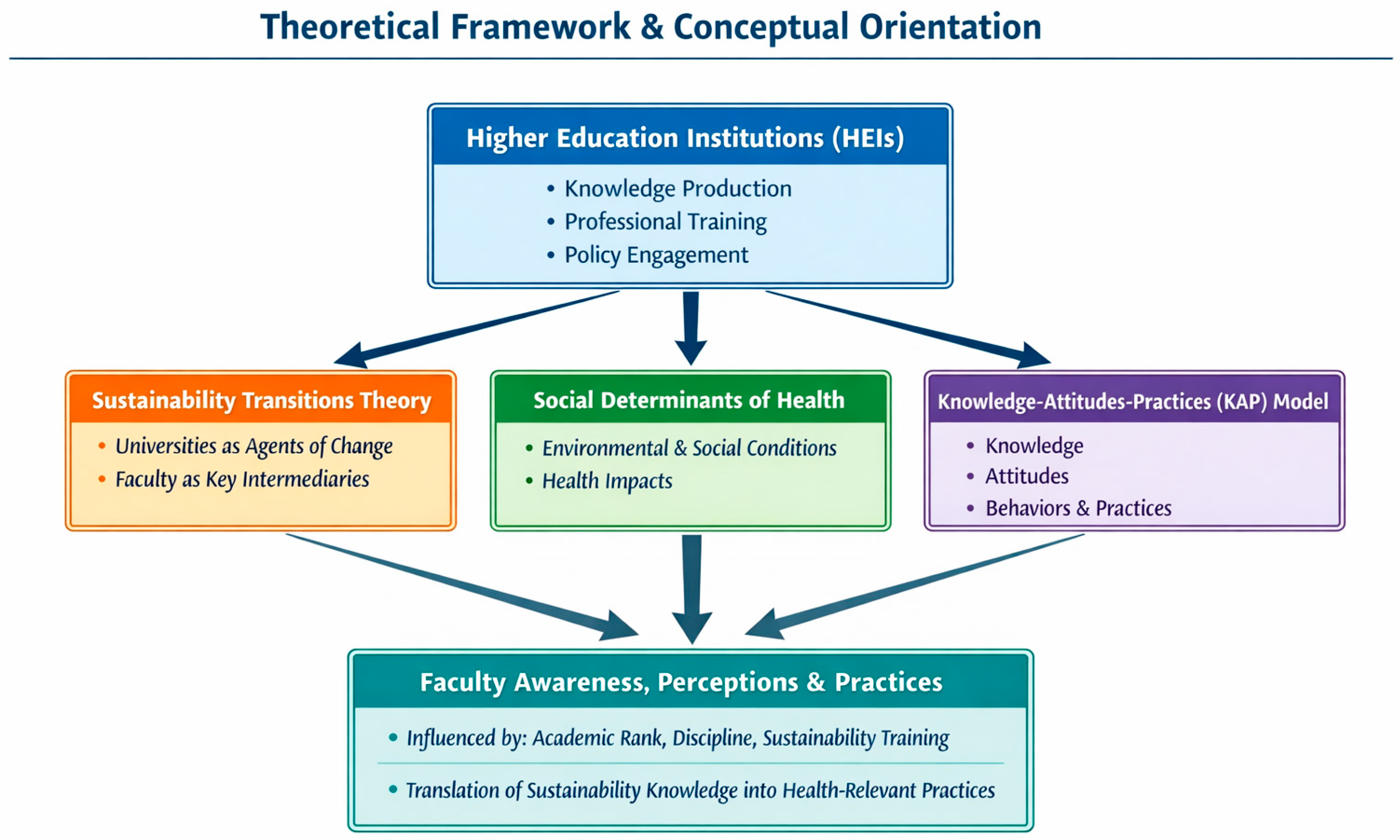
This study is informed by complementary theoretical perspectives (
Figure 1) that explain the role of higher education institutions in sustainability transitions and the links between environmental conditions and human health. First, sustainability transitions theory conceptualizes universities as critical institutional actors capable of shaping societal responses to environmental challenges through knowledge production, professional training, and policy engagement [
27]. Within this framework, faculty members function as key intermediaries whose awareness, values, and practices influence both institutional priorities and broader sustainability outcomes.
Second, the study draws on the social determinants of health framework, which emphasizes that population health is shaped not only by healthcare systems but also by environmental, social, and economic conditions [
26]. Environmental degradation, resource inefficiency, and unequal access to sustainable infrastructure are increasingly recognized as upstream determinants of health outcomes. Examining faculty perceptions of these linkages is therefore essential for understanding how sustainability knowledge is translated into health-relevant educational and institutional practices.
Third, the empirical structure of the study is guided by the knowledge–attitudes–practices (KAP) model, which posits that individuals’ knowledge and awareness influence their perceptions and attitudes, which in turn shape behavioral practices. In the context of higher education [
28]. This model provides a useful lens for assessing whether faculty awareness of environmental sustainability and its health implications is associated with engagement in sustainability-related teaching, research, and institutional initiatives.
Together, these frameworks provide the conceptual basis for the study’s analytical focus on faculty awareness, perceptions, and practices, as well as for examining professional characteristics, such as academic rank, disciplinary background, and sustainability training, which may influence these dimensions. Rather than testing causal hypotheses, the study adopts a theory-informed exploratory approach appropriate for cross-sectional survey research in underexplored institutional contexts.
2. Materials and Methods
2.1. Ethics Statement
Ethical approval for this study was obtained from the Standing Committee of Bioethics Research at Prince Sattam bin Abdulaziz University with approval number SCBR-556/2025, in accordance with the principles of the Declaration of Helsinki and national ethical guidelines for human subjects’ research in Saudi Arabia. Permission to conduct the study was further granted by the research offices of the participating universities. Written informed consent was obtained from all participants through a digital- or paper-based consent form attached to the questionnaire. Participants were informed of the study’s purpose, and their right to withdraw at any time without penalty, and that all data would remain anonymous and confidential. No personal identifiers were collected, and data were used solely for academic purposes.
2.2. Study Design and Setting
This cross-sectional study was conducted among faculty members across selected public and private universities in the Kingdom of Saudi Arabia. The study formed part of a broader institutional assessment of sustainability awareness and health linkages within higher education. Data was collected between September and November 2025. Saudi universities were chosen to represent diverse academic and institutional contexts, aligning with the goals of Vision 2030 to promote environmental stewardship and sustainable development within the education sector.
2.3. Study Population
The study population consisted of academic faculty members holding full-time appointments across various disciplines, including health sciences, engineering, social sciences, and environmental studies. Eligible participants were professors, associate professors, assistant professors, and teaching assistants with at least one year of teaching or research experience. Faculty members on temporary contracts or administrative-only positions were excluded. A total of 118 faculty members participated in the study. This number was considered adequate for exploratory reliability analysis and inferential statistics within a cross-sectional framework. Participation was voluntary, and inclusion was based on willingness to complete the self-administered questionnaire within the study period.
2.4. Sampling
The sample size of 118 faculty members was determined based on feasibility, access to participants, and response rates typical of faculty-based survey research in higher education settings. Given the exploratory nature of the study and the limited availability of empirical data on sustainability–health perceptions among Saudi university faculty, the primary objective was to establish baseline patterns rather than to test causal hypotheses. Similar exploratory studies in higher education sustainability research have employed comparable sample sizes. While a formal a priori power analysis was not conducted, the sample was sufficient to perform descriptive analyses and exploratory group comparisons.
2.5. Questionnaire Development and Validation
The structured questionnaire used in this study was developed through a review of validated instruments assessing sustainability perceptions, environmental awareness, and public health linkages from prior international studies. The tool was adapted to the Saudi higher education context and reviewed by three experts in environmental health and higher education for content validity and cultural appropriateness.
The final instrument consisted of four sections:
- (a)
Demographic profile (gender, academic rank, discipline, years of teaching experience, and prior sustainability-related training);
- (b)
Awareness of environmental sustainability (five initial items assessing conceptual understanding and knowledge of sustainability challenges);
- (c)
Perceptions of health implications (seven items exploring perceived connections between environmental degradation, climate change, and human health);
- (d)
Sustainability practices (seven items assessing personal, teaching, and institutional engagement in sustainability behaviours).
Responses were recorded using a 5-point Likert scale (1 = strongly disagree to 5 = strongly agree). The questionnaire was pilot tested with 15 faculty members to evaluate clarity and reliability, and feedback informed minor revisions before full administration.
2.6. Instrument Validation
Reliability (Psychometric) Analysis
Internal consistency reliability was assessed using Cronbach’s alpha.
Section A: Awareness of Environmental Sustainability:
The initial five-item scale (A1–A5) produced a low Cronbach’s alpha of 0.42, indicating poor internal consistency. Item analysis revealed that A3 and A5 weakened the scale due to low and negative correlations. After removing these items, the refined three-item version (A1, A2, A4) achieved an improved alpha of 0.71 (standardised), reflecting an acceptable reliability for a short exploratory scale that effectively captures faculty understanding of sustainability principles.
Section B: Perceptions of Health Implications:
The original seven-item scale (B1–B7) yielded a Cronbach’s alpha of 0.58, suggesting internal inconsistency. Although all items were positively worded, B6 correlated negatively with others, implying it was interpreted differently by respondents. Removing B6 improved the scale’s reliability to approximately 0.75, demonstrating good internal consistency among the remaining six items (B1, B2, B3, B4, B5, B7), which coherently measure faculty perceptions of the links between environmental conditions and human health.
Section C: Sustainability Practices:
The seven-item practice scale (C1–C7) initially showed moderate reliability (α = 0.64), with items C4 and C5 exhibiting weak item-total correlations. After removing these two items, the refined five-item version (C1, C2, C3, C6, C7) achieved a Cronbach’s alpha of about 0.73, indicating good internal consistency. The final version reliably captures faculty engagement in sustainable behaviours, teaching, and institutional participation in environmental initiatives. Overall, it shows that the final reliability analysis demonstrated that the refined instrument achieved acceptable-to-good internal consistency across all three major constructs. The Awareness of Environmental Sustainability scale, reduced to three core items (A1, A2, A4), recorded a standardised Cronbach’s alpha of 0.71, indicating moderate reliability suitable for exploratory research. The Perceptions of Health Implications scale, refined by excluding one inconsistent item (B6), achieved a Cronbach’s alpha of 0.75, reflecting strong internal coherence among the six remaining items (B1, B2, B3, B4, B5, B7) measuring respondents’ understanding of the environmental–health relationship. Similarly, the Sustainability Practice scale improved substantially after removing two weakly correlated items (C4, C5), yielding a five-item version (C1, C2, C3, C6, C7) with a Cronbach’s alpha of 0.73, signifying good reliability. Collectively, these results confirm that the refined questionnaire is psychometrically sound and reliable for assessing faculty members’ sustainability awareness, health perceptions, and behavioural engagement in the university context.
2.7. Analytical Framework
The analytical framework of the study is guided by the knowledge–attitudes–practices (KAP) model and sustainability transitions theory. Faculty awareness represents the knowledge domain, perceptions of environmental–health linkages reflect attitudinal orientation, and sustainability practices capture behavioural engagement. Demographic and professional characteristics are examined as potential differentiating factors.
2.8. Data Management and Statistical Analysis
Data was analysed using IBM SPSS Statistics version 25.0 (IBM Corp., Armonk, NY, USA). Descriptive statistics were computed for all demographic and scale variables, including frequencies, means, and standard deviations, to describe awareness, perceptions, and sustainability practices among faculty. Inferential analyses included independent-sample t-tests to assess mean differences by gender and training status, one-way ANOVA tests to compare differences across academic rank, discipline, and years of teaching experience, and Chi-square tests of independence to examine associations between categorical demographic factors (e.g., gender, discipline, rank, sustainability training) and sustainability awareness or practices. A significant level of p < 0.05 was applied for all inferential tests.
2.9. Data Quality and Confidentiality
All responses were anonymized before analysis. Data were checked for completeness and consistency, and incomplete questionnaires (<80% completed items) were excluded. Inferential statistical analyses (independent-samples t-tests, one-way ANOVA, and Chi-square tests) were conducted to explore potential group differences and associations across demographic and professional characteristics. Given the exploratory nature of the study and the limited sample size, no formal correction for multiple comparisons was applied. Accordingly, statistical significance was interpreted cautiously, and findings are presented as indicative rather than confirmatory. Electronic data were stored on password-protected institutional servers accessible only to the research team.
4. Discussion
This study explored how faculty members in Saudi universities perceive environmental sustainability and its connection to human health, revealing important insights into awareness, perceptions, and institutional engagement within higher education. The findings demonstrate that while faculty members exhibit strong awareness and positive health-related perceptions of sustainability, their active engagement in sustainable practices remains comparatively moderate. This gap between knowledge and action reflects a broader challenge observed globally in translating sustainability awareness into consistent institutional and personal behaviours [
29].
The demographic composition provides valuable context for interpreting the findings. The cohort was predominantly male, reflecting the gender structure common within Saudi academia [
30]. Most respondents were assistant professors and associate professors, representing mid-to senior-level faculty who typically influence academic policy and curriculum decisions. The predominance of the Humanities and Social Sciences faculty also indicates the growing relevance of sustainability discourse beyond technical and scientific disciplines, a trend consistent with recent global calls for interdisciplinary sustainability education [
31].
The present study uncovered a significant institutional gap, reflecting that majority of faculty members reported no formal sustainability-related training. This is a striking contrast to findings from universities in Europe and North America, where structured sustainability education and professional development programs have become integral to faculty advancement [
32,
33,
34]. The lack of formal training opportunities within Saudi universities likely contributes to the observed disparity between awareness and practice, underscoring the need for systematic institutional capacity building aligned with Vision 2030’s sustainability goals [
35].
Faculty: Members demonstrated relatively high awareness of sustainability concepts and environmental challenges, echoing findings from prior research in Middle Eastern and Asian higher education institutions [
36,
37]. This awareness may be partly attributed to increased national visibility of environmental issues through initiatives such as the Green Initiative and the Middle East Green Initiative. Similar to reports from Qatar and the UAE, where university faculty displayed general familiarity with sustainability themes, the Saudi faculty appear conceptually informed yet lack structured institutional channels for deeper engagement [
38].
Internationally, awareness levels in developed contexts tend to be higher due to long-established sustainability policies, environmental science integration in curricula, and institutional sustainability reporting [
39,
40]. The present findings suggest that while conceptual understanding exists among Saudi faculty, institutional mechanisms to operationalise sustainability knowledge, such as targeted training, curriculum integration, and incentive structures, remain limited. The study supports this interpretation, showing that while knowledge exists, it is unevenly distributed or variably interpreted across disciplines and experience levels. Participants expressed strong recognition of the linkages between environmental conditions and human health, consistent with global trends in the adoption of the Planetary Health and One Health paradigms [
41,
42].
However, the findings also reveal variation in the depth of this understanding across disciplines. Faculty in Natural and Health Sciences scored slightly higher on perception measures than their counterparts in Humanities and Social Sciences, mirroring patterns observed in comparative studies from Egypt [
43]. This disciplinary divide suggests that faculty whose teaching or research directly addresses environmental, or health issues are more likely to conceptualise sustainability as a determinant of health. Such variation reinforces the argument for embedding planetary health perspectives across all disciplines, not only in science-based faculties [
44]. The strong positive effect of formal sustainability training on perception scores highlights the transformative role of capacity building. Trained faculty consistently demonstrated more integrated views of the environment–health nexus, aligning with literature showing that structured exposure to sustainability principles enhances both cognitive understanding and behavioural intention [
45]. In contrast, untrained faculty, despite expressing general concern, may lack the tools to translate awareness into academic or operational action.
Although awareness and perception scores were high, engagement in sustainability practices lagged slightly behind. This discrepancy, a well-documented “knowledge–action gap”, is common in sustainability behaviour research [
46,
47,
48]. Faculty members often express commitment to sustainability principles but face barriers such as insufficient institutional incentives, time constraints, and a lack of administrative support for sustainability-focused initiatives [
49,
50]. In many European contexts, sustainability has been institutionalized for decades through binding regulatory frameworks, accreditation standards, and externally funded research programs that explicitly reward sustainability-oriented teaching and scholarship. Similarly, several East Asian systems have embedded sustainability competencies within national higher education quality assurance mechanisms.
Similar findings have been reported in European universities where faculty participation in green campus activities and sustainable research practices increases when supported by institutional frameworks, policy mandates, or recognition systems [
51]. By contrast, sustainability integration in Saudi universities remains relatively recent and is often framed as an emerging strategic priority rather than a fully operationalized academic norm. Faculty members may therefore possess strong conceptual awareness, reinforced by national discourse and Vision 2030 initiatives, without corresponding opportunities, incentives, or institutional mandates to translate this knowledge into routine teaching, research, or campus practices. Within the Saudi context, universities are still developing formal mechanisms, such as sustainability offices, reporting frameworks, and interdepartmental initiatives, that can convert awareness into sustained action [
23,
24]. Furthermore, cultural and organizational factors may also play a role. Saudi higher education institutions are typically characterized by centralized governance structures, where curriculum reform and professional development initiatives are driven top-down (28). While this model allows for rapid policy alignment, it may limit bottom-up experimentation and interdisciplinary collaboration that are more common in European and some Asian universities (24, 25). Consequently, faculty engagement in sustainability practices may depend more heavily on formal institutional endorsement than on individual initiative. These contextual distinctions help explain why the present findings should not be interpreted as a deficit in faculty commitment, but rather as evidence of a transitional phase in sustainability integration within Saudi higher education. Addressing this gap requires moving beyond awareness-raising toward institutional mechanisms that normalize sustainability as a core academic responsibility.
One of the most important findings of this study is that 95.8% of faculty respondents reported having no formal training in environmental sustainability. While the present survey did not directly assess the causes of this gap, several systemic factors may help explain this pattern within the Saudi higher education context. First, faculty development programs in many universities have traditionally prioritized pedagogical skills, disciplinary research output, and accreditation requirements, with comparatively limited emphasis on cross-cutting themes such as sustainability and health [
27]. As a result, sustainability training may be perceived as supplementary rather than integral to academic advancement. Second, institutional funding and incentive structures may play a critical role [
19]. Professional development opportunities are often linked to short-term teaching effectiveness or research productivity metrics, whereas sustainability-related training, particularly when interdisciplinary, may lack clear reward mechanisms within promotion and evaluation systems [
28]. This misalignment can discourage faculty participation even when awareness and positive attitudes are high. Third, cultural and structural factors may also influence training uptake.
In Saudi universities, sustainability initiatives are frequently implemented at the administrative or infrastructural level rather than embedded systematically into faculty capacity-building programs [
24,
28]. Consequently, faculty may support sustainability conceptually but lack formal pathways to acquire applied competencies [
19,
20]. This interpretation aligns with prior regional studies indicating that sustainability in Gulf higher education is often framed as a policy objective rather than a pedagogical or professional development priority [
21,
37]. Importantly, the large effect sizes observed between trained and untrained faculty across awareness, health perception, and practice domains suggest that even limited exposure to structured training can yield substantial benefits. This shows the urgency of addressing institutional barriers and repositioning sustainability training as a core component of faculty development rather than an optional add-on. However, the influence of academic rank, teaching experience, and discipline provides nuanced insights. Professors and senior faculty exhibited higher awareness and engagement levels, potentially reflecting their exposure to policy discussions, leadership roles, and research collaborations on sustainability themes. Similar trends have been observed in Turkish and Chinese universities, where senior academics often drive institutional sustainability initiatives [
52,
53,
54]. The present findings confirm that academic rank, experience, and training are significant differentiators of sustainability-related knowledge and behaviour. Although differences across disciplines were not statistically significant, trends favoured Natural and Health Sciences faculty, which is consistent with previous regional findings linking disciplinary proximity to environmental and health sciences with greater sustainability engagement [
55,
56]. The present findings further revealed that participation in sustainability training is significantly associated with academic discipline, suggesting that opportunities for exposure and professional development are unevenly distributed across fields. These point to a structural challenge in Saudi academia, where sustainability remains concentrated within certain departments rather than embedded as an institutional ethos. Expanding access to interdisciplinary training could bridge this gap, promoting a university-wide culture of environmental responsibility. By shaping environmental awareness, civic responsibility, and health-conscious behaviours, schools and universities contribute not only to individual capacity-building but also to the collective resilience of urban systems [
57]. The findings of this study align with this perspective, as faculty members demonstrated high awareness of sustainability and strong recognition of its health implications, yet comparatively lower engagement in practical sustainability initiatives. This awareness–practice gap suggests that while higher education institutions in Saudi Arabia possess significant potential to contribute to SDG 11, this potential remains underutilised in the absence of structured institutional mechanisms, professional training, and policy incentives [
58]. Strengthening sustainability education within universities through curriculum integration, faculty development programs, and alignment with national urban sustainability agendas could therefore enhance the role of Saudi higher education institutions as active contributors to smart, healthy, and sustainable cities in line with Vision 2030.
4.1. Implications for Policy and Higher Education Reform
The findings show that an urgent need for Saudi universities to institutionalise sustainability training and align faculty development with national sustainability objectives. The fact that majority of faculty members reported no formal sustainability training reveals a systemic disconnect between national policy ambitions and educational practice. This gap undermines the potential of higher education institutions to act as drivers of the Vision 2030 sustainability agenda [
19]. From a policy perspective, these findings suggest that universities and higher education authorities should move beyond symbolic commitments to sustainability and invest in structured, incentivized faculty training programs. Integrating sustainability competencies into promotion criteria, teaching certification requirements, and funded professional development schemes may help bridge the gap between high awareness and limited practical engagement [
59]. Universities can respond by integrating sustainability competencies into faculty promotion criteria, establishing sustainability leadership fellowships, and embedding sustainability outcomes into accreditation and curriculum standards. Given the strong alignment between environmental sustainability, public health, and Saudi Vision 2030, sustainability training should be formally integrated into existing faculty development infrastructures, such as university Deanships of Faculty Affairs and Teaching Excellence Centers [
60]. Rather than optional workshops, sustainability and health modules could be embedded into mandatory induction programs for new faculty and periodic professional certification requirements. Incentive structures also require recalibration. Universities could explicitly recognize sustainability-related teaching, research, and community engagement within promotion and annual evaluation frameworks [
61]. For example, faculty contributions to sustainability-oriented curriculum design, interdisciplinary research clusters, or campus environmental initiatives could be credited alongside traditional research outputs. Such alignment would address the observed gap between high awareness and lower practice engagement. At the curricular level, sustainability–health linkages can be operationalized through cross-listed courses and interdisciplinary minors that draw on Health Sciences, Environmental Studies, Engineering, and Social Sciences. In the Saudi context, this approach is particularly feasible within existing general education requirements, where sustainability literacy and environmental health concepts can be introduced across disciplines without overburdening specialized curricula.
Global best practices such as the AASHE STARS
framework in the United States and the European Green Transition Initiative offer models for structured implementation and evaluation [
56]. Additionally, fostering interdisciplinary collaboration through joint research projects, sustainability hubs, and experiential learning platforms can enhance faculty engagement and student participation alike. Policy-level integration of environmental health considerations into higher education governance will also strengthen Saudi Arabia’s contribution to the global planetary health movement. This aligns with the broader recognition that sustainable universities serve as living laboratories for testing and demonstrating solutions to global environmental and health challenges [
19].
4.2. Limitations and Future Directions
This study’s cross-sectional design restricts causal interpretations, and the modest sample size limits generalizability beyond the sampled institutions. This study has several limitations that should be considered when interpreting the findings. First, the sample size of 118 faculty members, while adequate for exploratory analysis, limits the statistical power for detailed subgroup comparisons across disciplines and academic ranks. Consequently, findings related to group differences should be interpreted cautiously and viewed as indicative rather than conclusive. Second, the sample was male-dominated, which may introduce gender-related bias and constrain the generalizability of results. A further limitation of this study is the absence of a formal a priori power analysis, which restricts the ability to draw strong inferences from null hypothesis significance testing. As such, statistically significant findings should be interpreted with caution, and non-significant results may reflect limited statistical power rather than true absence of effects. Future research should employ larger, multi-institutional samples and conduct formal power calculations to enable more robust hypothesis testing and subgroup analyses. The use of multiple inferential tests without formal adjustment for multiple comparisons represents a limitation of this study and may increase the risk of Type I error. However, these analyses were conducted for exploratory purposes to identify potential patterns warranting further investigation. Future research employing larger samples should apply appropriate correction procedures (e.g., Bonferroni or false discovery rate adjustments) and report effect sizes to strengthen the robustness and interpretability of statistical findings. Self-reported measures may be influenced by social desirability bias, particularly in a policy environment that strongly promotes sustainability. However, the study’s rigorous psychometric evaluation, multi-domain structure, and comparative analytical approach lend credibility to its findings. Future research should employ mixed-methods or longitudinal designs to explore how faculty perceptions evolve as Saudi universities advance their sustainability policies. Comparative studies across Gulf Cooperation Council (GCC) countries could also elucidate regional dynamics in environmental health education and sustainability integration. Moreover, qualitative inquiry could provide richer insights into institutional barriers and enablers of sustainability practice among academic staff.