Article

Impacts of Polycentric Spatial Structure of Chinese Megacity Clusters on Their Carbon Emission Intensity


1
School of Economics and Finance, Hohai University, Changzhou 213200, China
2
School of Business, Hohai University, Changzhou 213200, China
*
Author to whom correspondence should be addressed.
Sustainability 2026, 18(3), 1146; https://doi.org/10.3390/su18031146
Submission received: 29 November 2025 / Revised: 15 January 2026 / Accepted: 19 January 2026 / Published: 23 January 2026

Abstract

Megacity clusters are the key battlegrounds for carbon emission reduction in China, and the polycentric spatial structure of these clusters has a profound impact on their carbon emission intensity. This paper focuses on five major megacity clusters: the Beijing–Tianjin–Hebei (BTH), Yangtze River Delta (YRD), Pearl River Delta (PRD), the middle reaches of the Yangtze River (MRYR), and the Chengdu–Chongqing (CY) City Clusters. We construct an inter-period panel dataset spanning from 2002 to 2023 and utilize an index of polycentric spatial structure, which equally considers both morphology and functionality. A fixed-effects model is employed, and the Lind–Mehlum U-shape test is applied to identify the nonlinear relationship. Additionally, a two-step approach is used to examine the mediating effect of industrial agglomeration, while interaction terms help identify the moderating effects of technological innovation and transport infrastructure. The results indicate a significant U-shaped relationship between the polycentric structure of megacity clusters and carbon emission intensity. When the polycentric spatial structure index reaches a specific threshold, carbon emission intensity is minimized, suggesting that a moderate degree of polycentricity is most conducive to carbon reduction. Mechanism analysis reveals that industrial agglomeration functions as a significant mediator, whereas technological innovation and transport infrastructure serve as critical moderators in this relationship. Based on these findings, we propose several policy recommendations: to guide the moderate adjustment of the polycentric structure of city clusters with stage-specific targets, optimize the mechanism of industrial synergy and transfer, differentiate the allocation of innovation resources, and achieve a fine-tuned alignment between the transport system and spatial structure. These measures will support the high-quality, low-carbon transformation of city clusters.

1. Introduction

In recent years, global economic expansion has been accompanied by a significant increase in energy consumption and carbon emissions [1]. This development model, characterized by high energy consumption and emissions, presents a major challenge to achieving global sustainable development goals [2]. For a long time, the structural contradiction between economic growth and environmental protection has not been fundamentally resolved. Achieving synergy between these two objectives has become a core issue that needs to be addressed in the modernization process of many countries [3]. As the world’s second-largest economy, China has explicitly set a goal in its 14th Five-Year Plan to promote high-quality development. This emphasizes the shift from a growth model driven by scale and speed to one focused on quality and efficiency, aiming for economic structure optimization and a green, low-carbon transformation [4,5]. To quantify the decoupling of economic growth and carbon emissions, carbon emission intensity (carbon emissions per unit of GDP) has gradually become a key indicator for evaluating the green and low-carbon transition [6].
As China accelerates its high-quality economic development, urbanization, as a crucial engine, directly influences carbon emission intensity [7,8]. Traditional, decentralized, and energy-intensive urbanization paths tend to exacerbate carbon emissions. In contrast, new urbanization driven by city clusters can improve energy efficiency, optimize public service resource allocation, and promote the concentrated application of green and low-carbon technologies through the agglomeration of population, industries, and infrastructure, thus reducing regional carbon emission intensity [9,10]. During the 14th Five-Year Plan period, China formed a pattern of 19 major city clusters, and divided the five major city clusters of BTH, YRD, PRD, MRYR and CY into the first echelon of “optimisation and upgrading” [4]. Fang et al. [11] defined these five clusters as China’s megacity cluster regions. According to the China Urban Statistical Yearbook and the China Carbon Accounting Database (CEADs), in the past five years, these five city clusters, covering approximately 12% of the national land area, have supported about 45% of the population, contributed over 55% of GDP, and accounted for nearly 50% of carbon emissions [12,13]. This underscores that megacity clusters are the strategic core of national economic development and the main regions for China’s new urbanization, making them key areas for reducing carbon emission intensity.
However, existing research predominantly focuses on the overall agglomeration effect or individual city scales, with insufficient attention to the spatial structure within city cluster [14]. In particular, spatial structure is inherently a relational concept that manifests most clearly at the scale of city clusters rather than isolated cities. While single-city studies can capture local emission characteristics, they are limited in explaining how inter-city interactions, functional division of labor, and shared infrastructure networks jointly shape carbon emission outcomes. City clusters provide an integrated spatial framework within which the internal configuration of multiple cities and their interactions can be systematically examined. Therefore, analyzing spatial structure and its carbon emission effects at the city cluster scale offers a more appropriate perspective for understanding the structural mechanisms underlying regional carbon emission intensity. Spatial structure can generally be divided into two categories: monocentric and polycentric, reflecting the distribution and combination of resources, factors, and socioeconomic activities across cities. Different spatial structures can have distinctly different effects on regional carbon emission intensity by reshaping population distribution, industrial layout, infrastructure networks, and the efficiency of resource and factor flows [15,16]. With improvements in transportation infrastructure and the increasing number of megacities, the spatial structure of some city clusters is evolving from monocentric to polycentric [17]. The 14th Five-Year Plan and Vision 2035 also propose optimizing the internal spatial structure of city clusters to build ecological and security barriers, creating multi-centered, multi-layered, and multi-node networked city clusters. In existing studies, polycentric development is seen as an important strategy for improving economic efficiency, alleviating urban problems, and addressing regional development imbalances [18]. For the five megacity clusters, the spatial structure has already shown a significant polycentric pattern [19]. Therefore, exploring the impact of polycentric spatial structures on carbon emission intensity and their underlying mechanisms is of great importance.
This paper focuses on the five major megacity clusters in China. It aims to answer the following questions: What are the temporal evolution characteristics of their degree of polycentricity? How does carbon emission intensity evolve and differ across different time periods? What impact does the polycentric spatial structure have on carbon emission intensity? What are the core transmission paths and underlying mechanisms?
To address these questions, this paper selects 107 cities from the five megacity clusters—BTH, YRD, PRD, MRYR and CY—as the research objects. We construct a measurement system for the polycentric spatial structure of Chinese megacity clusters, focusing on morphology and functionality, and considering aspects such as location, scale, and accessibility. The study uses a fixed-effects model to examine the impact on carbon emission intensity, incorporating industrial agglomeration as a mediating variable, and technological innovation and transport infrastructure as moderating variables to explore the mechanisms at play. The marginal contributions of this paper are as follows:
  • It considers the five megacity clusters—BTH, YRD, PRD, MRYR and CY—as a unified empirical unit. By using a panel dataset from 2002 to 2023, this paper examines the relationship between spatial structure and carbon emission intensity, avoiding biases arising from single city cluster or national samples, and providing policy identification contexts within the same development tier.
  • A dual-dimension measurement system for polycentricity, which balances morphology and functionality, is applied. This system incorporates location, scale, and accessibility indicators, and constructs a polycentric index based on the underlying logic of the Herfindahl index, reducing the sensitivity of the conclusions to single-dimension thresholds and offering a reusable operational framework for polycentric identification.
  • Through the fixed-effects model and the Lind–Mehlum U-shape test, this paper identifies a significant U-shaped relationship between polycentricity and carbon emission intensity. It also locates the carbon emission intensity extremum, revealing that both weak polycentricity (resulting in congestion inefficiency) and strong polycentricity (leading to cross-regional costs) contribute to the elevated emissions at both ends, with the optimal carbon emission intensity occurring in the middle. By examining the transmission mechanisms through industrial agglomeration, technological innovation, and transport infrastructure, this study provides empirical support for policy decisions regarding urban cluster spatial optimization and emission reduction.

2. Literature Review

2.1. Spatial Structure and Carbon Emission Intensity

Existing studies on regional carbon emission intensity have largely concentrated on economic and technological drivers, including industrial structure [20], energy structure [21], technological progress [22] and stages of economic development [23]. These studies have provided important insights into the economic mechanisms underlying carbon emissions. However, this line of research implicitly treats space as a passive container, paying limited attention to how the internal spatial organization of cities and regions actively shapes energy use and emission outcomes.
In contrast, research in urban morphology and transportation economics suggests that spatial structure is a fundamental determinant of carbon emission intensity through multiple channels. Commuting distance and mode choice directly affect transport-related emissions, land-use density influences building energy efficiency, and the spatial allocation of employment and industries reshapes the energy intensity of production activities [24,25,26]. Despite these insights, spatial structure has not yet been systematically incorporated into mainstream analyses of carbon emission intensity, especially at the scale of city clusters. This disconnect motivates the need to explicitly integrate spatial structure into the analytical framework of carbon emission intensity.

2.2. Measuring Polycentric Spatial Structure

The polycentric spatial structure investigated in this study refers to a networked organizational form within a city cluster, consisting of several relatively balanced centers and sub-centers, sustained by dense factor flows and functional complementarities among nodes, in contrast to the hierarchical diffusion pattern typical of monocentric systems [27]. While the concept of polycentricity has been widely adopted, its empirical measurement remains highly contested.
Methodologically, existing approaches to measuring polycentricity can be broadly classified into two categories: morphological and functional. The morphological approach focuses on the balance of population or employment density and the distribution of city sizes, typically using indices such as primacy, rank-size deviation, entropy, Gini, and sub-center identification based on density thresholds to characterize the quantity and shape of polycentricity [28,29,30,31,32]. In contrast, the functional approach emphasizes inter-city interactions and flow structures, including commuting flows, passenger and freight movements, and producer-service linkages, typically measured using network centrality or community detection methods [30,33,34].
A growing body of comparative research highlights that these two dimensions are not interchangeable. Empirical results are highly sensitive to indicator selection, threshold settings, and data sources, often yielding contradictory classifications of whether a city cluster is polycentric [33,35,36]. This issue is particularly pronounced in China, where empirical studies based on transportation networks or long-distance travel data frequently identify polycentric tendencies, while density-based measures may suggest persistent monocentric dominance [37,38,39]. The structural mismatch between morphological and functional polycentricity not only complicates empirical interpretation but also undermines comparability across studies, underscoring the need for an integrated, dual-dimensional measurement framework.

2.3. Polycentricity and Carbon Emissions

Empirical evidence on the environmental effects of polycentric spatial structures remains highly inconclusive. On one hand, several studies argue that polycentricity contributes to carbon emission reduction. For example, Han et al. [40] show, using firm-level data, that polycentric spatial structures significantly reduce industrial carbon emissions, with results robust across alternative specifications and samples. On the other hand, other studies report neutral effects [41,42] or even emission-increasing effects [43]. More recent research suggests that these contradictory findings may stem from nonlinear relationships and regional heterogeneity. Studies have documented U-shaped or inverted U-shaped relationships between polycentricity and carbon emissions, implying the existence of an “optimal” degree of polycentric development [44,45]. However, most existing analyses remain fragmented, differing widely in spatial scale, polycentricity measurement, and emission indicators. As a result, the academic community has yet to reach a consensus on whether, and under what conditions, polycentric spatial structures promote low-carbon development.
From a theoretical perspective, the environmental effects of polycentric spatial structures reflect a trade-off between agglomeration benefits and coordination costs. On one hand, polycentricity can enhance production efficiency through specialization, technological spillovers, and improved factor mobility, thereby reducing energy consumption and pollution emissions [46]. By facilitating functional division of labor across centers, polycentric structures may also reduce firm-level emissions [15,40]. In this sense, polycentricity represents a spatial equilibrium that balances local con-centration with global decentralization [47]. On the other hand, polycentric development is not cost-free. Inter-jurisdictional competition may induce a “race to the bottom,” leading to industrial homogeneity, redundant construction, and the persistence of extensive development models [48]. Moreover, polycentric systems rely on frequent inter-city flows of goods and labor. When transportation infrastructure or technological capabilities are inadequate, these flows may substantially increase transportation-related energy consumption and carbon emissions. Although recent studies acknowledge potential nonlinear effects, systematic mediation and moderation analyses at the megacity cluster scale remain largely absent.

2.4. Research Gaps and Contributions

In summary, existing research has predominantly concentrated on analyzing carbon emission intensity at the city or provincial level, while systematic evidence at the scale of megacity clusters remains limited, despite their central role in regional governance and factor mobility. Although a growing number of studies have examined the relationship between polycentric spatial structures and carbon emissions, their conclusions remain fragmented, partly due to differences in spatial scale and the reliance on single-dimensional measures of polycentricity. Furthermore, most studies have focused on measuring total carbon emissions or carbon emission efficiency, neglecting the nonlinear impact of polycentric structures on carbon emission intensity and the underlying mechanisms.
To address these gaps, this study focuses on China’s major megacity clusters and constructs a dual-dimensional polycentric spatial structure index that integrates morphological and functional characteristics. Using fixed-effects models and the Lind–Mehlum U-shape test, this study identifies a significant nonlinear relationship between polycentric spatial structure and carbon emission intensity, highlighting the existence of an optimal degree of polycentricity from a low-carbon perspective. Furthermore, by incorporating industrial agglomeration as a mediating variable and technological innovation and transportation infrastructure as moderating variables, this study clarifies the mechanisms through which polycentric spatial structures influence carbon emission intensity, thereby extending existing research from correlation-based analysis toward a more mechanism-oriented understanding.

3. Theoretical Analysis and Hypothesis

As a typical spatial carrier of polycentric structures, megacity clusters represent a dynamic equilibrium between the efficiency gains from spatial allocation of production factors and the environmental externalities generated by spatial coordination costs in shaping carbon emission intensity. According to agglomeration economy theory, spatial agglomeration can initially generate positive externalities such as knowledge spillovers and labor pooling [49]. However, when the degree of agglomeration exceeds the optimal threshold, agglomeration diseconomies may emerge, significantly increasing negative externalities [50]. This implies that the marginal environmental benefits of agglomeration are diminishing, while marginal environmental costs increase beyond a critical point.
During the low polycentric stage, megacity clusters exhibit quasi-monocentric characteristics, with population and economic activities disproportionately concentrated in the primary center. This configuration increases spatial separation between residences and workplaces and weakens the capacity of sub-centers to absorb non-core functions, thereby generating substantial cross-city commuting and traffic concentration toward the main center. As commuting flows converge on limited corridors and central areas, congestion intensifies and travel times rise, leading to higher fuel consumption and transport-related carbon emissions [51]. More fundamentally, consistent with spatial externality theory, the quasi-monocentric structure concentrates negative externalities—such as traffic emissions, local pollution accumulation, and congestion costs—within the primary center, where environmental carrying capacity becomes increasingly constrained [52]. As a result, the marginal environmental cost of additional agglomeration rises faster than the marginal efficiency gains, causing diminishing returns to agglomeration and elevating carbon emission intensity at the cluster level.
In contrast, at the high polycentric stage, although the spatial structure displays a multi-nodal distribution, insufficient functional division of labor and weakened coordination among sub-centers result in a surge in cross-center commuting, business activities, and logistics demands. As functional polycentricity fails to keep pace with morphological dispersion, coordination costs increase nonlinearly, amplifying transportation-related energy consumption and carbon emissions across the entire megacity cluster [25]. Simply put, when sub-centers lack functional coordination, the polycentric spatial structure significantly amplifies negative externalities in transportation and construction sectors, thereby elevating carbon emission intensity across the entire megacity cluster.
During the moderate polycentric stage, jobs, housing, and public services within each sub-center are in close proximity, shortening residents’ daily travel distances and reducing regional congestion levels, thereby decreasing vehicle fuel consumption and carbon emissions. Meanwhile, industries form complementary divisions of labor among centers, avoiding redundant transportation caused by homogeneous competition and further reducing transportation-related carbon emissions. Wang et al. [51], based on data from six Chinese city clusters, found that polycentric structure requires moderation to achieve emission reduction effects, as excessive dispersion or concentration both increase carbon intensity. Dai et al. [53] through research on 14 Chinese city clusters, discovered a U-shaped relationship between the degree of polycentricity and per capita carbon emissions, with moderate polycentricity being more conducive to carbon emission reduction.
Taken together, the nonlinear (U-shaped) relationship arises from the asymmetric evolution of agglomeration benefits and coordination costs as polycentricity increases. When polycentricity is too low or too high, one of these forces dominates and elevates carbon emission intensity, whereas a moderate degree of polycentricity balances both effects and achieves a low-carbon spatial equilibrium. Accordingly, we propose the following hypothesis:
H1. 
The polycentric spatial structure of megacity clusters exhibits a positive U-shaped relationship with carbon emission intensity.
Drawing from new economic geography and environmental economics theory, industrial agglomeration level is an important factor influencing how polycentric spatial structures in megacity clusters affect carbon emission intensity [54]. Fu et al. [55], based on Chinese urban panel data from 2009–2021, found that the regression coefficient of industrial agglomeration degree on urban carbon emissions is significantly positive at the 1% level, displaying “high–high” spatial clustering characteristics, indicating that cities with higher agglomeration levels and their neighboring areas also exhibit higher carbon emission levels. From the perspective of the linkage between spatial structure and industrial agglomeration, in low polycentric states, insufficient development of core nodes causes production factors to concentrate locally under the gravitational force of a single center, leading to elevated industrial agglomeration levels [56]. In high polycentric structures, excessive competition among core nodes triggers factor agglomeration toward advantaged regions, similarly elevating industrial agglomeration levels. At this point, agglomeration scale effects dominate, with energy consumption and emissions amplifying synchronously with output, thereby increasing carbon emission intensity [44,56]. In contrast, moderate polycentricity disperses manufacturing functions to several sub-centers of comparable scale and commutable accessibility, reducing factor density at single points. While maintaining agglomeration economies, this introduces competition and land use constraints, inducing enterprises to adopt cleaner production technologies. Consequently, industrial agglomeration levels decrease relatively, and carbon emissions per unit output decline [15,57]. Accordingly, we propose Hypothesis Two:
H2. 
Industrial agglomeration level plays a mediating role in the impact of polycentric spatial structures in megacity clusters on carbon emission intensity.
As a core driving force for promoting low-carbon transformation, technological innovation level reshapes the mechanisms through which spatial structure affects carbon emission intensity [58]. From an evolutionary economic geography perspective, technological innovation is a crucial driver of urban spatial structure evolution, particularly prominent in megacity clusters [59]. Tang et al. [60] indicated that the spatial diffusion of knowledge and technological externalities reshapes the hierarchical relationships within urban systems, promoting the formation of functional polycentricity. When technological innovation levels are high, sub-centers no longer serve merely as peripheries to the primary center but possess independent capabilities for knowledge creation and industrial incubation. This “knowledge polycentric” structure not only alleviates agglomeration pressure on the primary center but also significantly reduces carbon emission intensity per unit economic output through localized green technology diffusion [16,61]. When technological innovation levels are high, the carbon reduction effects of high polycentricity are significantly enhanced. High polycentric structures can leverage advanced technology to achieve distributed deployment of renewable energy and cross-regional coordination of intelligent transportation, fully realizing low-carbon advantages, while the agglomeration diseconomies of low polycentric structures are further amplified [53,62]. Under high-technology conditions, low polycentric structures concentrate larger populations and industrial scales, with energy consumption from long-distance commuting and carbon emissions from concentrated industries difficult to completely offset through technological innovation. High-tech industries themselves may even increase energy demand, thereby exacerbating carbon emissions. Therefore, the lower the degree of polycentricity, the higher the carbon emission intensity [63]. At this point, the relationship between polycentricity degree and carbon emission intensity approaches linearity, with the low-carbon equilibrium point in the U-shaped relationship shifting toward high polycentricity. Thus, technological innovation significantly moderates the impact of megacity cluster polycentric structures on carbon emissions. Accordingly, we propose Hypothesis Three:
H3. 
Technological innovation level plays a moderating role in the impact of polycentric spatial structures in megacity clusters on carbon emissions.
Furthermore, well-developed regional transportation infrastructure optimizes factor allocation efficiency by enhancing spatial accessibility [64,65]. Its specific effects manifest as follows: on one hand, it strengthens the agglomeration of population and economic activities toward core areas, reducing redundant commuting caused by dispersed layouts, thereby amplifying the low-carbon advantages of high-density structures. This aligns with Glaeser and Kahn’s [66] conclusions regarding urban density reducing per capita carbon emissions. On the other hand, it promotes coordinated industrial chain deployment within megacity clusters by integrating regional functional divisions, reducing cross-regional freight intensity, consistent with mechanisms revealed by land use and transport interaction theory [67]. However, in many cases, transportation infrastructure does not function as a linear emission reduction tool but rather reshapes the marginal impact intensity of different spatial structural configurations on carbon emissions by altering spatial transaction costs [68,69]. For instance, moderate polycentric megacity clusters may paradoxically exhibit higher carbon emission intensity, while low and high polycentric structures may achieve carbon emission reductions, forming an inverted U-shaped relationship. The reason is that when road network density and transportation capacity have not yet exceeded critical thresholds, moderate polycentricity may intensify cross-regional motorized travel due to dual dispersion of functions and commuting, inducing transportation demand as described in induced demand theory [70,71]. Cervero et al. [72] also confirmed that imbalanced transportation supply can lead to rigid increases in carbon emissions under polycentric structures. Only when road network density, interconnection levels, and public transportation modal shares simultaneously exceed critical thresholds can moderate polycentric structures achieve carbon emission reduction leaps through high-density nodes and efficient interconnections. This further validates Lyu et al.’s [73] assertion that transportation system efficiency is a core intermediate variable determining urban carbon footprints. Accordingly, we propose Hypothesis Four:
H4. 
Regional transportation infrastructure plays a moderating role in the impact of polycentric spatial structures in megacity clusters on carbon emissions.
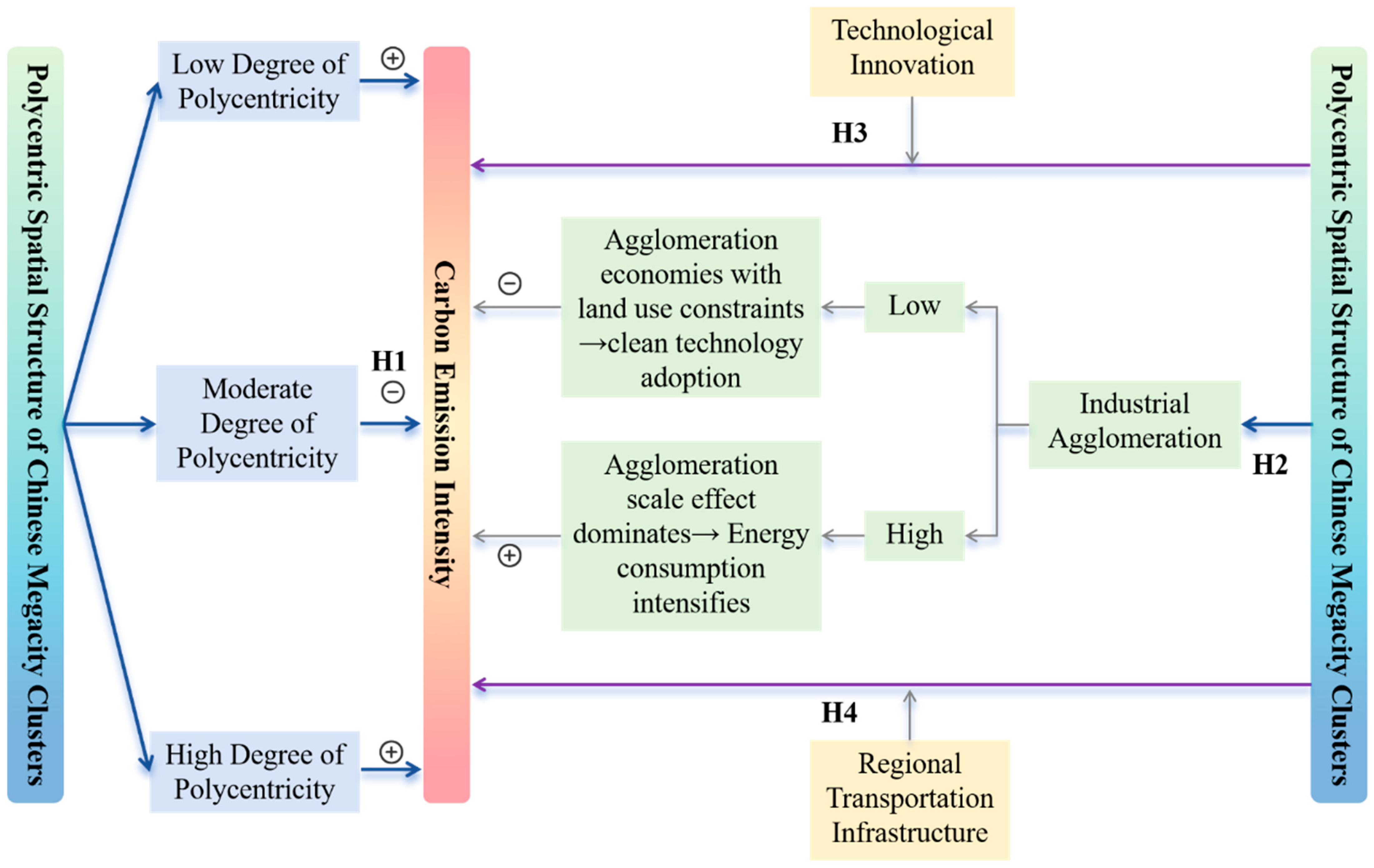
Based on existing theory and previous research, the mechanisms and logical framework through which the polycentric spatial structure of megacity clusters affects carbon emission intensity can be described as shown in Figure 1.

4. Research Design

4.1. Study Area

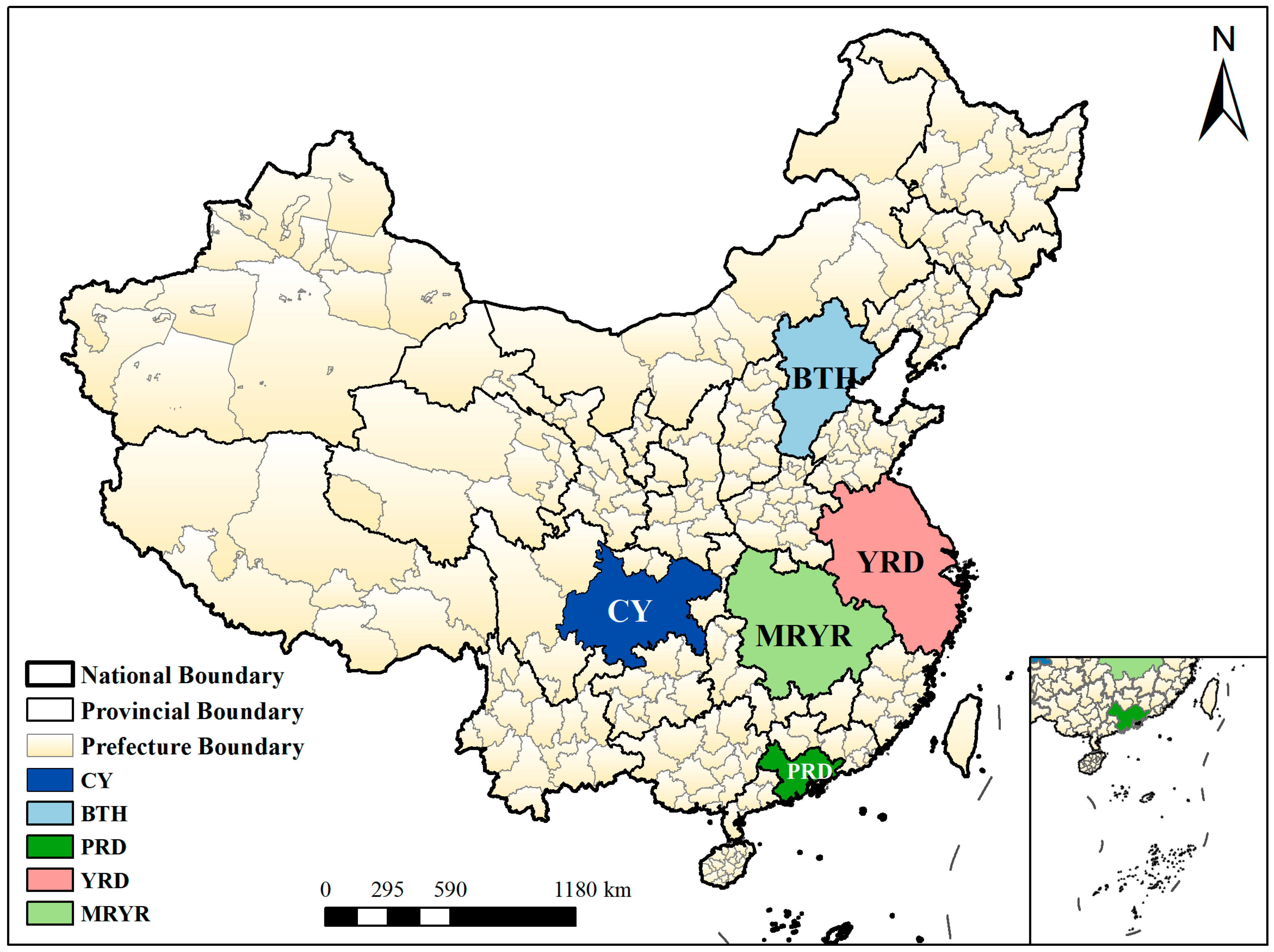
During the 14th Five-Year Plan period, China formed a structure comprising 19 major city clusters, which were categorized into three tiers: “Optimize and Enhance”, “Develop and Strengthen” and “Nurture and Grow”. Among these, five city clusters—BTH, YRD, PRD, MRYR and CY—were explicitly designated by the national government as the first tier of the “Optimize and Enhance” category. In August 2025, the “Opinions on Promoting High-Quality Urban Development” further refined the structure into a “3 + 2 + N” format, supporting the transformation of the BTH, YRD, and PRD into world-class city clusters. The CY economic circle and the MRYR city clusters were identified as key growth engines for high-quality development. These megacity regions serve as strategic core areas for national economic development and the primary zones for China’s new urbanization efforts. They bear the historical responsibility of supporting the global economic shift and are the main platforms driving high-quality economic growth in China, making them crucial focal points for both current and future development. Based on the development plans of these city clusters, this study focuses on 107 cities from the five aforementioned city clusters. The scope of the study area is shown in Figure 2.

4.2. Regression Model

To examine the causal relationship between the polycentric spatial structure of megacity clusters and carbon emission intensity, this study utilizes panel data from 2002 to 2023 for five major city clusters: BTH, YRD, PRD, MRYR and CY. Following the Hausman and F-tests, the fixed effects model was selected, and the baseline econometric model is constructed as follows:
E I i t = α + β 1 S p a t i a l i t + β 2 S p a t i a l i t 2 + X γ + G r o u p i + Y e a r t + ε i t
In Equation (1), E I i t represents the carbon emission intensity of city cluster i in year t. S p a t i a l i t denotes the polycentric spatial structure index, and S p a t i a l i t 2 is its squared term. X’ is the vector of control variables. G r o u p i represents the individual fixed effects for each city cluster; Y e a r t indicates the time fixed effects; β 1 , β 2 , γ are the regression coefficients; ε i t is the random error term.
To ensure the validity and robustness of the estimation results, several diagnostic and testing procedures are incorporated into the research design. First, model specification tests, including the F-test, LM test, and Hausman test, are employed to determine the appropriate panel estimation strategy. Second, to rigorously identify the nonlinear relationship between polycentric spatial structure and carbon emission intensity, the Lind–Mehlum U-shape test [74] is applied to verify whether the estimated quadratic relationship satisfies the conditions of a true U-shaped pattern rather than a monotonic curve. Furthermore, a series of robustness checks are conducted to examine the stability of the baseline results, including lagging the core explanatory variable, adjusting the sample period, and introducing higher-order polynomial terms. These tests are designed to ensure that the empirical findings are not driven by specific model specifications, sample selection, or short-term shocks.
Building on Equation (1), the model is further refined. Based on the mechanism analysis and drawing on previous studies, a two-step approach is used to test the mediating effect of industrial agglomeration. The model for this test is as follows:
ln I A i t = θ 0 + θ 1 S p a t i a l i t + θ 2 S p a t i a l i t 2 + θ X + G r o u p i + Y e a r t + ε i t
In Equation (2), I A i t is the mediating variable reflecting the level of industrial agglomeration. To reduce data volatility and address heteroscedasticity, the natural logarithm of I A i t is taken. θ represents the regression coefficients of the independent and control variables. First, a total effect test is performed to verify the significance of the regression coefficient β of the squared polycentric spatial structure index in the baseline model (1). If significant, this indicates a total effect of the spatial structure on carbon emission intensity, allowing further testing. If not significant, the analysis is halted. Subsequently, the mediating path test is conducted by examining the significance of the coefficients θ 1 and θ 2 for the polycentric structure index and its squared term in Equation (2). If both coefficients are significant and there is existing theoretical support for the impact of IA on EI, the mediating effect is confirmed.
To test the moderating effects, the variables representing transportation infrastructure level (TI) and technological innovation level (TECH) are sequentially added to the baseline model (1), along with interaction terms between these variables and the linear and quadratic terms of the polycentric spatial structure. The models are specified as follows:
E I i t = δ 0 + δ 1 1 s p a t i a l i t + δ 2 1 s p a t i a l i t 2 + δ 3 1 r i + δ 4 1 s p a t i a l i t × R I + δ 5 1 s p a t i a l i t 2 × R I + θ X + G r o u p i + Y e a r t + ε i t
E I i t = δ 0 + δ 1 2 s p a t i a l i t + δ 2 2 s p a t i a l i t 2 + δ 3 2 t e c h + δ 4 2 s p a t i a l i t × T E C H + δ 5 2 s p a t i a l i t 2 × T E C H + θ X + G r o u p i + Y e a r t + ε i t
In Equations (3) and (4), δ represent the regression coefficients. If the coefficients of the interaction terms between the polycentricity index squared term and the moderating variables are significant, this indicates the presence of a moderating effect. Specifically, if the coefficient of δ 5 1 is significant, it demonstrates that transportation infrastructure plays a moderating role in the impact of the polycentric spatial structure on carbon emission intensity. Similarly, if the coefficient of δ 5 2 is significant, it indicates the moderating effect of technological innovation level.

4.3. Variables Measurement

4.3.1. Explanatory Variables

Previous studies have often been limited to measuring the polycentricity of city clusters from a single dimension, such as morphological or functional polycentricity. This paper overcomes this limitation by measuring both morphological and functional polycentricity. Following the work of Wang et al. [75], the polycentric index of city clusters is chosen as a proxy variable to characterize the polycentric spatial structure. The measurement is based on three indicators: scale, location, and accessibility. This approach integrates both the morphological elements of city clusters and their functional characteristics.
(1)
Scale Indicator
Traditional measures of morphological polycentricity often rely on single-dimensional indicators, such as population or economic scale. However, the dynamic asymmetry between urban population scale and economic scale suggests that a single indicator is insufficient to comprehensively reflect spatial structure characteristics. Therefore, this study measures both the economic scale and population scale of city clusters and then calculates the geometric mean of both to form a composite index, which is referred to as the “scale indicator” of the city clusters.
The Herfindahl-Hirschman Index (HHI), initially used as a tool for evaluating industry concentration, has gradually expanded its application to the field of urban economics. It has become a classical method for measuring the monocentricity or polycentricity of city clusters’ spatial structures. Due to its ability to accurately depict the spatial distribution and dynamic evolution patterns of urban systems, the HHI is widely used in the spatial structure studies of city clusters. Based on this, the Herfindahl-Hirschman Index is adopted as the core measurement tool for quantifying the spatial structure of city clusters. Population size ( P ) and economic scale ( E ) are treated as collaborative variables, and their respective Herfindahl indices ( H P and H E ) are calculated as follows:
H P = i = 1 n P i P total 2
H E = i = 1 n E i E total 2
where P i denote the permanent resident population of city i , and P total = i = 1 n P i the total population of the agglomeration. The population-based Herfindahl index satisfies H P 0 , 1 , a larger H P indicates a more concentrated population distribution and stronger monocentricity. E i denote the GDP of city i , and E total = i = 1 n E i the agglomeration’s total GDP. The GDP-based Herfindahl index satisfies H E 0 , 1 , a larger H E indicates a more concentrated economic distribution and stronger monocentricity.
To integrate the population and economic dimensions and avoid single-dimension bias, we take their mean to construct the scale-based polycentricity index ( H H I S ) of the city clusters:
H H I S = H P + H E 2
Values H H I S 1 characterize a highly concentrated spatial structure (monocentric configuration), whereas H H I S 0 indicates a highly dispersed spatial structure (polycentric configuration).
(2)
Location Indicator
The form of city layout within a city cluster has a large impact on the spatial structure of a city cluster, and this paper takes the distance from each city within a city cluster to the population center of the city cluster ( D ) as a proxy indicator of location, and uses the Herfindahl index to measure it to represent the location attributes of the city cluster’s polycentrism:
H H I D = i = 1 n D i D total 2
The population center city is defined as the city with the largest population within the cluster and may change depending on the year. The larger the Herfindahl index of the location ( H H I D ) in question, the weaker the polycentricity, and the smaller the Herfindahl index, the stronger the polycentricity.
(3)
Accessibility Indicator
In this paper, the Herfindahl index is calculated separately for each city within a city cluster using data on road freight traffic ( H F T ) and road passenger traffic ( H P T ) for that city, and take the geometric mean of the two to form the accessibility index of the city clusters ( H H I A ):
H F T = i = 1 n F T i F T total 2
H P T = i = 1 n P T i P T total 2
H H I A = H F T + H P T 2
The larger the accessibility index ( H H I A ), the weaker the polycentricity, the smaller the index, the stronger the polycentricity.
Finally, the polycentric spatial structure index ( S p a t i a l i t ) of megacity cluster is obtained by proportionally weighting the scale, location and accessibility indicators.

4.3.2. Explained Variable

Given that official city-level carbon emission statistics are not publicly released in China, this study constructs carbon emission indicators for five megacity clusters based on internationally recognized emission inventories. Carbon dioxide emission data at the prefecture-level city scale are obtained from the Emissions Database for Global Atmospheric Research (EDGAR), which provides globally consistent, spatially explicit gridded CO2 emission data and has been widely adopted in studies on urban and regional carbon emissions.
Using geographic information system (GIS) techniques, gridded CO2 emissions from EDGAR are spatially overlaid with prefecture-level administrative boundaries. Grid-level emissions are first aggregated to the prefecture-level city scale based on geographic location. Subsequently, carbon emissions of each urban agglomeration are calculated by summing the emissions of all prefecture-level cities included within the corresponding urban agglomeration, ensuring consistency between spatial units and administrative definitions.
Considering the substantial heterogeneity in economic scale among different urban agglomerations, this study adopts carbon emission intensity (EI) as the explained variable to reflect carbon emissions per unit of economic output. Specifically, carbon emission intensity is defined as the ratio of total carbon dioxide emissions of an urban agglomeration to its gross domestic product (GDP). To improve numerical stability and comparability across regions and over time, EI is measured as tons of CO2 emissions per CNY 1000 of GDP.

4.3.3. Mechanism Variables

Given that urban polycentricity may have an impact on carbon emissions through the mediating variable of industrial agglomeration, this study adopts a two-step method [76,77,78] to test the mediating effect. The industrial agglomeration level of each city is measured using the location entropy method to construct the Industrial Agglomeration Index (IA) with the following formula:
I A i t = i a i / i a i G D P i / G D P i
where I A i t characterizes the level of industrial agglomeration in the city. The numerator i a i / i a i is the proportion of industrial added value of city cluster i to the national total industrial added value, and the denominator G D P i / G D P i represents the proportion of GDP of city cluster i to the total GDP. The value of I A i t serves as an indicator of the level of industrial agglomeration, which can be described as follows: when I A i t > 1, it indicates that the level of industrial agglomeration of city cluster i is higher than the national average, which can be regarded as a high degree of agglomeration; when I A i t = 1, the level of industrial agglomeration is on a par with the national average, and the distribution of industries is relatively balanced; and when I A i t < 1, the level of industrial agglomeration is low.
In addition, this study selects regional transportation infrastructure (TI) and technological innovation (TECH) as key transmission mechanism variables and employs a moderation-effect analytical framework to examine the heterogeneity in the impact of the spatial structure of city clusters on carbon emission intensity (EI). Among these variables, TI represents the level of regional transportation infrastructure and is measured by the total length of railways and highways per unit of land area. TECH denotes the level of technological innovation within city clusters and is proxied by the number of patents per capita.

4.3.4. Control Variable

To mitigate potential omitted-variable bias, a set of control variables capturing economic development, industrial structure, government intervention, service sector development, and transportation conditions is included in all model specifications. These variables are selected based on prior literature [53,57,66] and are consistently controlled across baseline, mediation, and moderation models.
  • Economic Development Level (ECO): The scale of economic activity and technological capacity jointly influence carbon emissions. We measure this using the per capita GDP of the megalopolis. A higher level of economic development may increase energy consumption due to heightened industrial activity, but it can also promote a low-carbon transition through advanced technologies, thus exerting a complex and multifaceted influence on carbon emission intensity.
  • Industrial Structure (IS): The secondary sector is characterized by high energy consumption and substantial carbon emissions. This variable is represented by the proportion of the industrial value-added to the total GDP of the megalopolis. Megalopolises with a prominent industrial sector tend to exhibit higher carbon emission intensity, driven by the energy consumption inherent in their production processes.
  • Government Intervention (GOV): The scale and allocation of local government fiscal expenditure shape regional economic and environmental development. We measure this by the ratio of general public budget expenditure to the GDP of the megalopolis.
  • Tertiary Sector as a Percentage of GDP (TGDP): This is a core indicator reflecting the degree of service-oriented industrial development within a megalopolis. An increased share of low-carbon service sectors can reduce carbon emissions. Conversely, sectors such as commerce, logistics, accommodation, and catering may increase carbon emission intensity due to their energy consumption. Consequently, this variable is expected to have a bidirectional effect.
  • Per Capita Urban Road Area (PR): This variable measures the adequacy of transportation infrastructure supply in a megalopolis. While a sufficient road network can alleviate traffic congestion and reduce carbon emissions from idling vehicles, an excessive road area may induce urban sprawl and lengthen commuting distances, paradoxically increasing transportation-related carbon emissions. Therefore, this variable is hypothesized to have a dual effect on carbon emission intensity.
Table 1 presents the detailed information for each variable.

4.4. Data Sources

The data for this study were compiled from multiple authoritative sources to ensure accuracy and reliability. Data for GDP, population, and fiscal expenditure at the prefecture-level city level were primarily sourced from the China Statistical Yearbook, published by the National Bureau of Statistics of China, as well as from provincial/municipal statistical yearbooks and annual statistical bulletins released by the respective city-level statistical bureaus. Patent data were obtained from the China National Intellectual Property Administration. Data on urban road area were collated from the China Urban Construction Statistical Yearbook, published by the Ministry of Housing and Urban-Rural Development. Data for highway and railway mileage were sourced from the National Bureau of Statistics. Data regarding urban passenger and freight transport volumes were provided by the Urban Passenger Transport Statistics report, released by the Ministry of Transport of the People’s Republic of China. Government fiscal expenditure data were acquired from the annual fiscal bulletins published by the finance bureaus of each prefecture-level city. Data for industrial value-added and tertiary sector value-added were derived from the China Statistical Yearbook and various provincial/municipal statistical yearbooks. In this study, prefecture-level city carbon emission data are derived from the Emissions Database for Global Atmospheric Research (EDGAR). Specifically, we extract gridded carbon dioxide emission data for China from EDGAR and aggregate the grid-level emissions to prefecture-level administrative boundaries based on geographic overlays. Annual city-level carbon emissions are obtained by summing the gridded emissions within each city’s boundary. All megacity clusters’ data were aggregated by summing the corresponding data of the constituent prefecture-level cities within each megalopolis.
During the construction of the panel dataset, standard data screening and cleaning procedures were applied. Missing values for key variables were treated using linear interpolation when data gaps were confined to adjacent years; observations with more extensive missing information were excluded to ensure data reliability. To maintain the integrity of the original information under a relatively limited number of megacity cluster observations, the dataset was carefully examined through cross-validation across multiple official sources. Diagnostic checks indicate that extreme observations do not exert a disproportionate influence on the estimation results.

5. Results

5.1. Polycentric Spatial Structure and Carbon Emission Intensity of Megacity Clusters

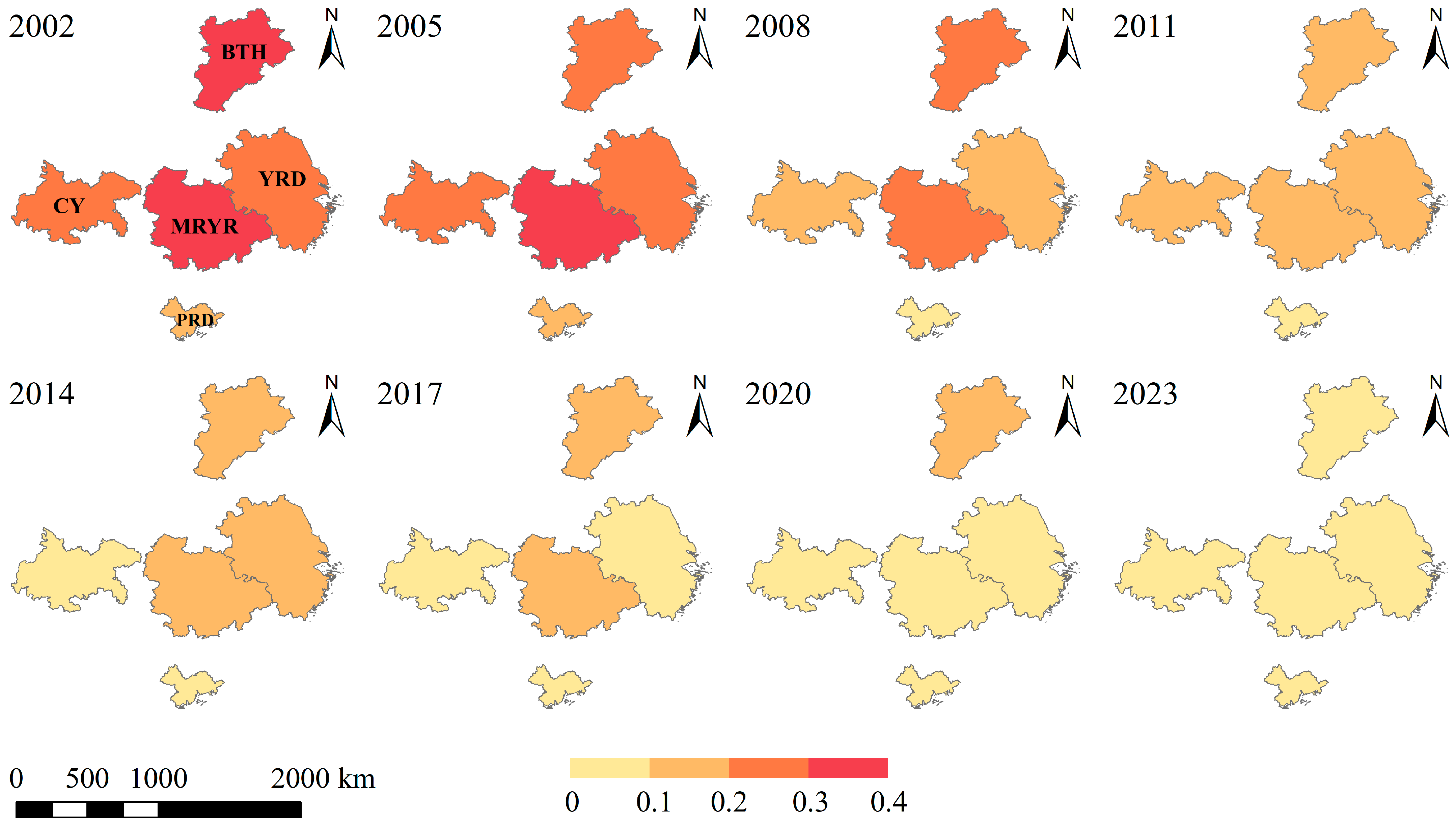
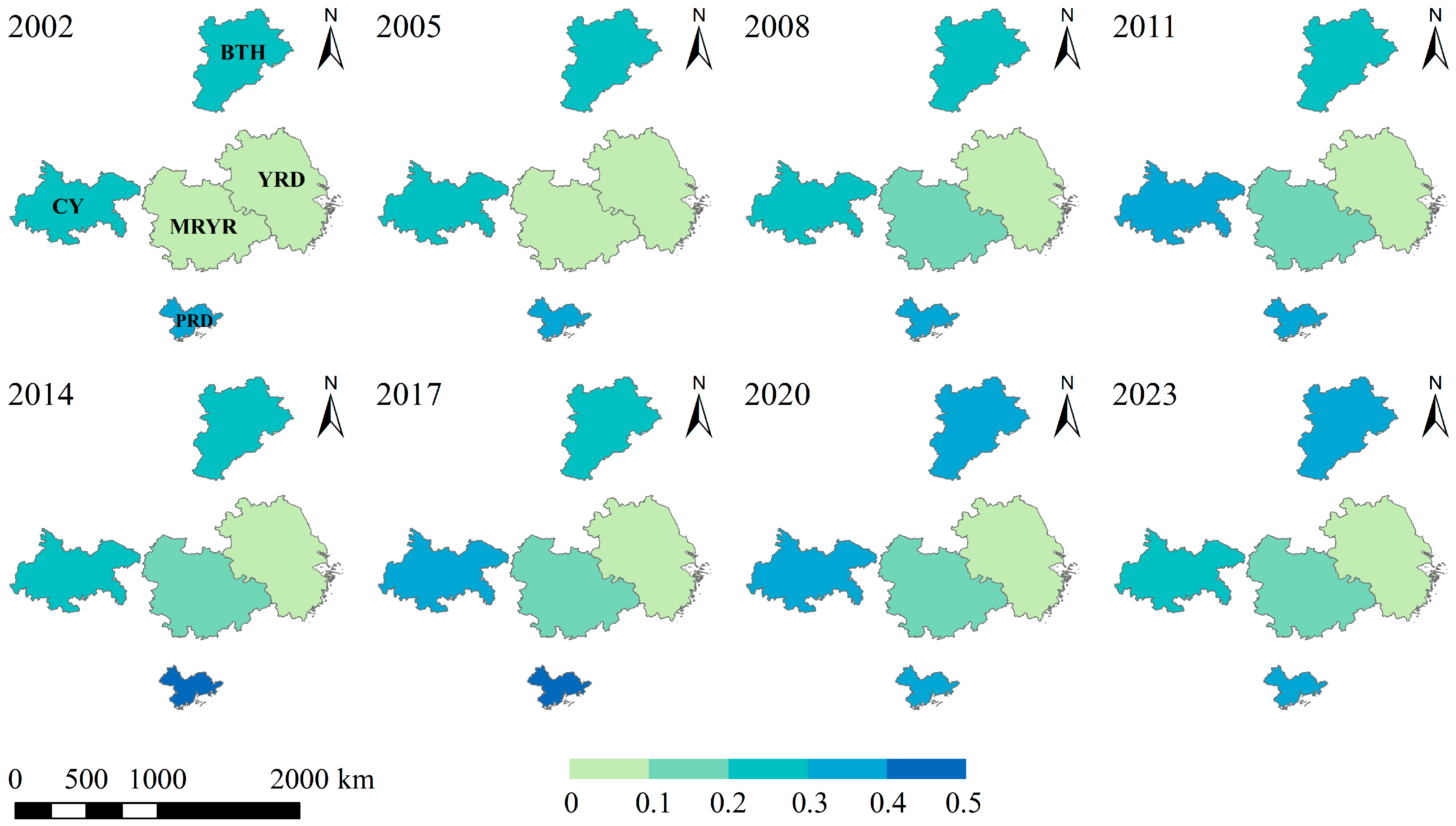
Figure 3 presents the spatial evolution of carbon emission intensity in five major megacity clusters for selected years between 2002 and 2023. Overall, all clusters exhibit a sustained decline in carbon emission intensity; however, they differ markedly in the pace of reduction, spatial distribution characteristics, and specific decarbonization pathways. PRD shows the most pronounced transition toward low-carbon development, with a rapid and continuous decline in emission intensity. This trend reflects the region’s relatively advanced industrial restructuring and technological upgrading, enabling it to enter the low-carbon phase earlier than other clusters. CY also experiences a clear downward trend, although the reduction slows in the later period, indicating potential constraints in further mitigation. MRYR maintains relatively high levels of carbon emission intensity throughout the study period. Despite a gradual decline, its levels remain consistently above those of the other clusters, highlighting its industrial base characterized by a large share of energy-intensive heavy industries. YRD follows a more stable and gradual decarbonization trajectory, with emission intensity falling from medium to low levels. The slowdown observed in later years suggests diminishing marginal opportunities for further reductions. BTH cluster records an accelerated decline in the mid-period, corresponding to the implementation of intensive air pollution control actions and industrial adjustment policies. In summary, all five megacity clusters achieve notable reductions in carbon emission intensity, with rates exceeding the national average. This indicates that megacity clusters—with their high economic agglomeration, concentrated infrastructure, and strong governance capacity—play a leading and convergent role in advancing low-carbon transitions.
Figure 4 depicts the temporal evolution of spatial structure indices for the five megacity clusters. According to the index definition, higher values indicate stronger concentration of population and economic activities in core cities, while lower values indicate a more balanced and polycentric pattern. As polycentric systems, the five clusters exhibit a nonlinear evolutionary process characterized by dispersion, re-agglomeration, and eventual stabilization. YRD maintains consistently low index values with limited fluctuations, demonstrating a long-term stable polycentric and networked spatial pattern. PRD shows the most complex dynamics: the index rises in the early years, increases sharply in the mid-period—indicating strengthened agglomeration—and then declines, reflecting a transition from dispersion to concentration and subsequent rebalancing. BTH displays a sustained increase in the spatial structure index, particularly accelerating in recent years, suggesting an intensifying primacy of the core city and limited diffusion effects toward secondary centers. MRYR maintains relatively low and stable index values, indicating persistent balanced development among its multiple central cities. The CY cluster experiences minor increases in the index, but the overall change is modest, implying that disparities among core cities remain limited and that its polycentric configuration is relatively stable. Overall, the five megacity clusters demonstrate a complex trajectory of spatial restructuring, transitioning from dispersion to moderate agglomeration and subsequently toward structural optimization. This dynamic evolution generates substantial spatial and temporal heterogeneity, providing valuable empirical conditions for examining how spatial structural changes influence carbon emission intensity and regional sustainability.

5.2. Baseline Regression

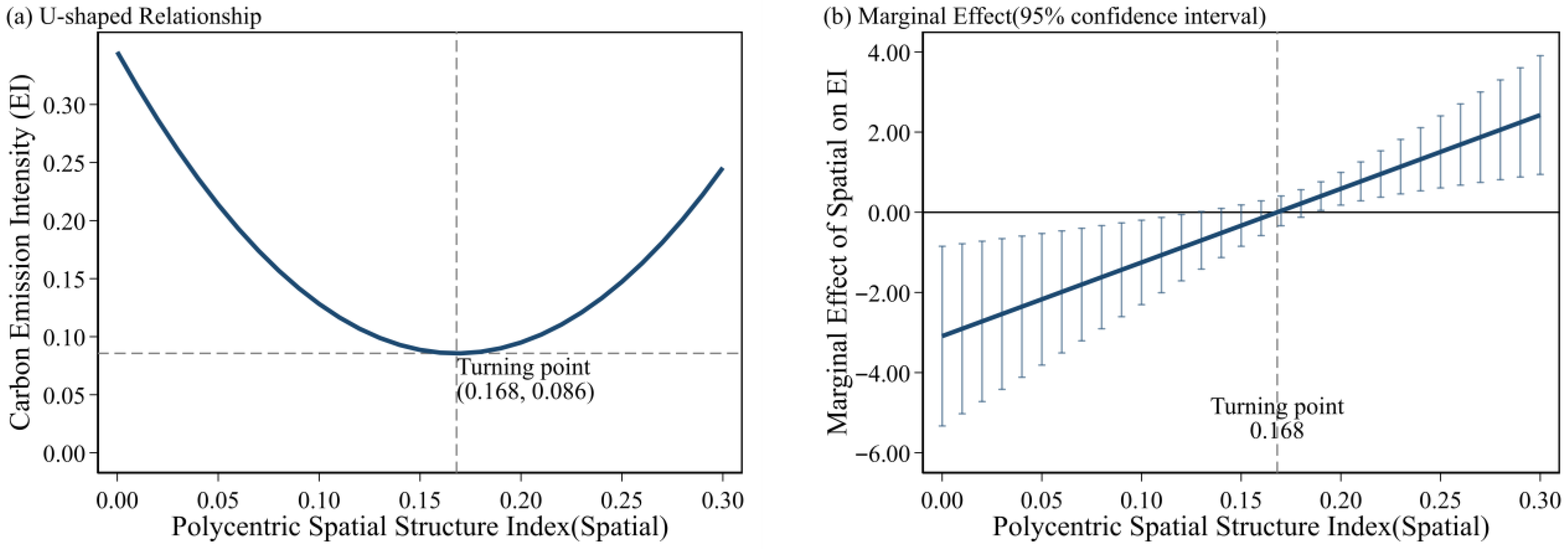
Prior to conducting the benchmark regression, panel unit root tests confirmed the absence of spurious regression. Based on the results of the LM test, F test, and Hausman test, a two-way fixed effects model was selected as the optimal specification. The VIF statistics are all below the critical threshold, indicating that multicollinearity is not a concern. Table 2 reports the estimation results of the impact of megacity cluster spatial structure on carbon emission intensity. Column (1) presents the model with time-fixed effects only, Column (2) includes individual-fixed effects only, and Column (3) reports the two-way fixed effects model. Cluster-robust standard errors are applied in all three specifications. Following the procedure proposed by Haans et al. [79] for testing the presence of a U-shaped relationship, this study evaluates whether the regression results satisfy the following three conditions: ① The coefficient of the linear term of the independent variable is negative, while the coefficient of the quadratic term is significantly positive; ② The slope at the lower bound of the independent variable is negative, whereas the slope at the upper bound is positive; ③ The turning point lies within the observed range of the independent variable. Furthermore, in line with Lind and Mehlum [74], the U-shape test (utest) is performed to rule out the possibility that a convex but strictly monotonic relationship may also produce a significantly positive quadratic term, thereby avoiding misleading conclusions. As shown in Column (3), the coefficient of the core explanatory variable s p a t i a l is significantly negative at the 1% level, while its quadratic term s p a t i a l 2 is significantly positive, also at the 1% level. The p-value of the U-test is 0.0052, confirming statistical significance at the 1% level. A visual representation of the U-shaped relationship is provided in Figure 5a, where the x-axis denotes Spatial and the y-axis denotes EI. The minimum and maximum values of Spatial are 0.038 and 0.229, respectively, and the turning point is located at 0.168, at which carbon emission intensity reaches its minimum. Moreover, following Lind and Mehlum [74], the statistical identifiability of the turning point is assessed through the joint significance of the slope estimates at the lower and upper bounds of the data range, as well as the confidence intervals of the marginal effects, rather than through a separate standard error of the turning point itself. The marginal effects plot in Figure 5b, based on the 95% confidence interval, further corroborates the U-shaped pattern: when Spatial is below the turning point (0.168), its marginal effect on carbon emission intensity is negative and gradually approaches zero in absolute value; when Spatial exceeds the turning point, the marginal effect becomes positive and increases steadily. This provides robust marginal-effect evidence for the existence of a U-shaped relationship, thereby supporting Hypothesis 1.

5.3. Robustness Checks

Given that model estimation may be influenced by various factors, several robustness checks were conducted to ensure the accuracy and reliability of the empirical results. Specifically, we re-estimated the baseline model by lagging the explanatory variable by one period, adjusting the sample time window, and incorporating a cubic term of the spatial structure variable.
First, considering that the impact of the spatial structure of megacity clusters on carbon emission intensity may exhibit a lagged effect, the core explanatory variable (Spatial) was lagged by one period (denoted as L.Spatial). As reported in Column (1) of Table 3, the coefficient of L.Spatial remains significantly negative, while the coefficient of its quadratic term L.Spatial2 is significantly positive. Moreover, the U-shape test confirms the presence of a statistically significant U-shaped relationship. This indicates that even after accounting for potential lagged effects, the U-shaped association between spatial structure and carbon emission intensity persists, demonstrating the robustness of the baseline findings.
Second, the COVID-19 pandemic and subsequent policy interventions (2019–2023)—including mobility restrictions, lockdown measures, and cross-regional movement controls—introduced exogenous shocks to economic activities and carbon emissions within megacity clusters [5]. To eliminate potential bias caused by these exceptional years, the sample was restricted to 2002–2018, excluding data from 2019–2023. As shown in Column (2) of Table 3, the coefficient of the linear term of spatial remains significantly negative, and the quadratic term remains significantly positive, continuing to support a U-shaped relationship. This suggests that the baseline conclusions are not driven by pandemic-related external shocks and possess strong resistance to perturbation.
Third, although the baseline regression incorporates the quadratic term of the spatial structure variable and identifies a U-shaped relationship, it remains necessary to rule out the possibility of an N-shaped or inverted N-shaped pattern. Therefore, a cubic term Spatial3 of the spatial structure variable was added to the model. As reported in Column (3) of Table 3, the coefficient of the linear term remains significantly negative, the quadratic term remains significantly positive, while the cubic term is statistically insignificant. This indicates that neither an N-shaped nor an inverted N-shaped relationship exists, validating the appropriateness of the U-shaped model specification and further reinforcing the baseline conclusion.
In summary, across the three robustness checks—lagging the explanatory variable, adjusting the sample period, and introducing a cubic term—the U-shaped relationship between the spatial structure of megacity clusters and carbon emission intensity remains consistently supported. These results confirm the high reliability and stability of the baseline regression.

5.4. Mechanism Analysis

5.4.1. The Mediating Effect of Polycentric Spatial Structure on Carbon Emission Intensity

To examine the mediating role of industrial agglomeration (IA) in the relationship between polycentric spatial structure (Spatial) and carbon emission intensity (EI), we adopt the two-step method proposed by Anderson, Baron, and Jiang et al. [76,77,78]. First, we assess the direct effect of spatial structure on EI. Column (1) in Table 4 reports that both the spatial structure index and its squared term significantly influence EI, supporting a U-shaped relationship between spatial structure and carbon emission intensity, which is consistent with the results from the baseline regression. Second, we investigate the effect of spatial structure on industrial agglomeration (IA). As shown in Column (2), spatial structure also has a significant positive U-shaped effect on IA.The relationship between industrial agglomeration and carbon emissions has been well-documented in previous studies. Industrial agglomeration can influence carbon emissions through various mechanisms, including scale economies, technological spillovers, and congestion effects. However, in our study, the impact of industrial agglomeration on carbon emission intensity is explored within the context of spatial structure. The results suggest that industrial agglomeration plays a significant role in shaping the relationship between polycentric spatial structure and carbon emission intensity. These findings provide evidence that industrial agglomeration acts as a key factor in the transmission process, linking polycentric spatial structure to carbon emission intensity. Thus, Hypothesis 2 is supported.

5.4.2. The Moderating Effect of the Level of Technological Innovation

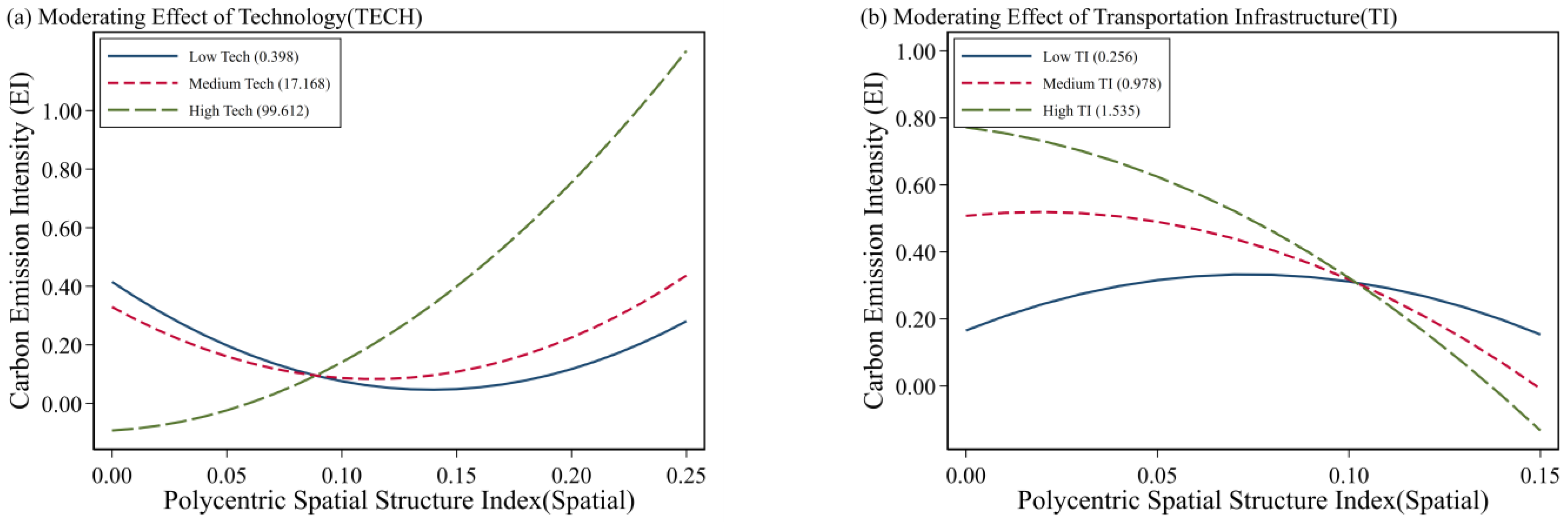
To test Hypothesis 3, we introduce the interaction terms between the spatial structure index and its squared term and the level of technological innovation into the model. As reported in Column (2) of Table 5, the coefficients of both interaction terms are significant and exhibit opposite signs, confirming the moderating effect of TECH on the relationship between Spatial and EI. Thus, Hypothesis 3 is supported.
Panel (a) of Figure 6 illustrates that under low TECH levels, EI decreases rapidly and then rises slowly as Spatial increases, remaining overall at a medium level. Under moderate TECH levels, both the initial decline and subsequent rise in EI occur at higher rates, and the curvature of the relationship becomes more pronounced. Under high TECH levels, EI exhibits a substantial and rapid decline in the early stage of spatial expansion, followed by a steep upward trend at higher levels of Spatial, eventually reaching a relatively high value.

5.4.3. The Moderating Effect of the Level of Transportation Infrastructure

To test hypothesis four, an interaction term between the spatial structure index and its quadratic term with regional transport infrastructure development was added to the model. As reported in Column (3) of Table 5, both interaction terms are significant and have opposite signs, confirming the moderating effect of TI on the relationship between Spatial and EI. Thus, Hypothesis 4 is supported.
Moreover, the inclusion of TI as a moderating variable changes the form of the Spatial–EI relationship from a U-shape to an inverted U-shape. Panel (b) of Figure 6 shows that transportation infrastructure significantly shifts the turning point and peak value of carbon emission intensity. When TI is low, the turning point occurs at a higher Spatial level, and the peak EI remains relatively low. When TI is high, the turning point shifts leftward and the maximum EI increases. These results indicate that transportation infrastructure substantially reshapes the nonlinear relationship between spatial structure and carbon emission intensity.

6. Discussion

6.1. Interpretation of the U-Shaped Relationship

The baseline results reveal a statistically significant U-shaped relationship between the polycentric spatial structure of megacity clusters and carbon emission intensity, implying that neither extreme monocentricity nor excessive polycentric dispersion is environmentally optimal. This nonlinearity can be interpreted as the outcome of a trade-off between agglomeration economies and dispersion-related coordination costs. When the spatial structure index is below the estimated turning point, increasing polycentricity tends to reduce carbon emission intensity. A plausible explanation is that a shift away from excessive primacy can alleviate congestion pressures in core cities, relax land and transport bottlenecks, and promote a more balanced allocation of production and population across subcenters, thereby improving energy-use efficiency and lowering emissions. However, once polycentricity exceeds the threshold, further dispersion is associated with rising carbon intensity. At this stage, functional fragmentation and cross-city competition may induce duplicated infrastructure and industrial layouts, weaken scale economies in energy and public service provision, and increase inter-city commuting and freight movements, all of which can raise energy demand and emissions. Importantly, the estimated turning point indicates that the “carbon-minimizing” spatial configuration corresponds to a moderate level of polycentricity, highlighting the existence of an interior optimum rather than a monotonic relationship. This finding is broadly consistent with the growing literature documenting nonlinear or threshold effects of spatial organization on environmental outcomes [53], while our contribution lies in identifying an empirically supported turning point within a long-run balanced panel of China’s major megacity clusters and in showing that the benefits of polycentric restructuring can diminish and even reverse when dispersion becomes excessive. Taken together, the results suggest that spatial planning aimed at decarbonization should focus on achieving a coordinated and functionally complementary polycentric system, rather than pursuing polycentricity per se.

6.2. Mechanism Implications

The mechanism analysis provides important insights into how polycentric spatial structure is empirically associated with carbon emission intensity through both transmission and conditioning channels. Industrial agglomeration emerges as a key mechanism-related factor linking spatial structure and emissions. As spatial structure evolves from weak to moderate polycentricity, industrial activities tend to become more spatially coordinated rather than excessively concentrated or fragmented, which is associated with stronger scale economies and technological spillovers and, in turn, lower energy intensity. In the Chinese institutional context, this stage of moderate polycentricity is often accompanied by more orderly inter-city competition among local governments, where jurisdictions specialize in differentiated industrial functions under regionally coordinated development strategies, thereby mitigating redundant investment and excessive capacity expansion. However, when polycentricity reaches higher levels, intensified inter-city competition—particularly under decentralized fiscal and administrative incentives—may lead local governments to pursue parallel industrial projects and infrastructure expansion, resulting in functional duplication, weakened agglomeration efficiencies, and rising coordination costs. These dynamics are associated with higher carbon emission intensity through increased energy consumption and cross-city factor flows. This interpretation is consistent with existing studies emphasizing the role of agglomeration processes in shaping environmental outcomes [80,81,82]; meanwhile, it extends the literature by showing that, within China’s megacity clusters, the environmental implications of industrial agglomeration are closely intertwined with the spatial configuration of cities and the nature of local government competition, giving rise to a nonlinear, structure-dependent mechanism.
The findings regarding the moderating role of technological innovation provide important insights into how spatial structure shapes carbon emission intensity under different technological conditions. The results indicate that technological innovation does not exert a uniform environmental effect; instead, it reshapes the nonlinear relationship between spatial structure and emissions by altering the balance between agglomeration efficiency and congestion costs. At low levels of technological innovation, monocentric structures are more capable of suppressing emissions due to scale economies and resource-sharing advantages, whereas polycentric configurations tend to suffer from coordination failures and redundant infrastructure investment. These findings are consistent with the conclusions of Li et al. [15]. As technological innovation intensifies, however, the environmental performance of spatial structures diverges markedly, with polycentric structures increasingly exhibiting emission-reduction advantages while monocentric structures experience escalating congestion-related costs that can no longer be fully offset by technological progress. Importantly, these results also highlight the heterogeneous nature of technological innovation as a moderating factor. Technological innovation is a broad concept encompassing both general technological innovation, which primarily enhances productivity and factor efficiency, and green technological innovation, which directly targets energy efficiency, clean production, and emission reduction. While the empirical analysis captures the overall moderating effect of technological innovation, the observed patterns suggest that green technological innovation is more likely to reinforce the emission-reduction advantages of polycentric structures by facilitating distributed low-carbon systems and decentralized energy solutions. In contrast, general technological innovation may disproportionately strengthen economic agglomeration in core cities, thereby amplifying congestion effects and emissions under highly monocentric configurations. This conceptual differentiation enriches the interpretation of the moderating mechanism and suggests that the environmental consequences of technological progress depend not only on its intensity but also on its orientation. Future research could further disentangle these heterogeneous effects by explicitly distinguishing between green and general technological innovation, thereby providing a more nuanced understanding of how technology–spatial interactions influence environmental outcomes.
The moderating role of transportation infrastructure in shaping the relationship between spatial structure and carbon emissions highlights the critical interplay between mobility efficiency and environmental outcomes. Once transportation infrastructure is introduced as a moderating variable, the relationship between Spatial and EI shifts to an inverted U-shape, with moderately polycentric structures becoming the segment associated with higher emissions. This transformation results from the reshaping effect of transportation infrastructure. From the perspective of factor mobility efficiency, improved transportation infrastructure reduces inter-city mobility costs, but this effect becomes negatively amplified under moderately polycentric structures. This pattern can be explained as follows: although moderate polycentricity should theoretically achieve low-carbon outcomes through balanced functional division, enhanced transport accessibility induces a “semi-agglomeration” of factors toward core cities. This configuration lacks the strong scale economies of a monocentric structure and simultaneously loses the dispersion advantages of a highly polycentric system. As cross-regional mobility intensifies, carbon emissions increase instead. From the perspective of the energy consumption structure, transportation infrastructure development is often accompanied by increased dependence on private vehicles. Particularly in the transitional zones between urban and rural areas within moderately polycentric regions, worsening jobs–housing imbalance amplifies vehicle-related emissions, causing carbon emissions in moderately polycentric configurations to surpass those in extreme spatial structures. When transportation infrastructure is underdeveloped (i.e., TI is low), the spatial structure index at the emission peak is relatively high, and the maximum emission level is relatively low. This is because low transport efficiency restricts the scale of factor mobility, requiring a higher degree of monocentricity for congestion effects to significantly elevate emissions. Meanwhile, limited mobility reduces the overall magnitude of factor flows, resulting in lower emissions even at the turning point. When transportation infrastructure is well developed (i.e., TI is high), the spatial structure index at the emission peak becomes lower, while the maximum emission level increases. This occurs because greater transport efficiency accelerates the concentration of production factors in core cities. Even within polycentric structures, low-density expansion and surging cross-regional commuting may still drive emissions upward. This conclusion is consistent with the findings of Zhang et al. [26]. At the same time, well-developed transportation systems can support larger scales of mobility and agglomeration, thereby raising the peak level of carbon emissions. The moderating role of transportation infrastructure does not simply improve or worsen carbon emissions; rather, it alters the thresholds and scale of factor mobility, thereby reversing the relationship between spatial structure and emissions. Without transportation moderation, moderate polycentricity yields lower emissions by balancing dispersion and agglomeration. With transportation moderation, moderate polycentricity increases emission intensity due to its characteristics of semi-agglomeration and high mobility, and this effect becomes more pronounced as transportation systems improve. This finding aligns with the interactive logic of transportation, spatial structure, and environmental outcomes: the effect of transportation infrastructure on carbon emissions depends on the compatibility between spatial structure and transport efficiency. Only when the two are well matched can emissions be suppressed; otherwise, environmental costs will intensify. This result also corroborates the conclusions of Li et al. [83].

6.3. Policy Implications

Based on the findings and the objectives of high-quality development, this study suggests that carbon reduction strategies in city clusters should be differentiated, adaptive, and dynamically coordinated, rather than guided by uniform spatial or structural benchmarks. Given the pronounced heterogeneity in development stage, industrial base, and spatial configuration across city clusters, policy interventions should be tailored to local conditions and development trajectories.
  • Adjustments to polycentric spatial structures should be stage-specific and moderate. Mature city clusters should avoid excessive functional dispersion by clarifying core functional areas and controlling disorderly expansion, while city clusters at earlier stages may gradually cultivate sub-centers to relieve pressure on core cities and move toward a more balanced spatial structure.
  • Industrial agglomeration policies should emphasize coordination over scale expansion, preventing homogeneous competition and carbon-intensive clustering through differentiated industrial planning, low-carbon technological upgrading, and cross-regional environmental standards, particularly in regions experiencing industrial relocation.
  • The allocation of technological innovation resources should follow a regionally differentiated support strategy. Advanced city clusters can focus on the development and application of low-carbon technologies, whereas less-developed regions should be supported through interregional cooperation, technology transfer, and national-level sharing mechanisms, thereby enhancing the emission-mitigating role of innovation.
  • Transportation infrastructure planning should be closely aligned with spatial structure and regional characteristics, prioritizing efficient public transport systems, intercity connectivity, and low-carbon mobility solutions to ensure that transportation investments contribute effectively to emission reduction.
Overall, these policy implications underscore the importance of flexible, context-sensitive governance frameworks that accommodate diverse development paths and evolving regional conditions, rather than relying on a single optimal spatial configuration or policy threshold.

7. Conclusions

This study focuses on 107 cities within China’s five major megacity clusters, constructing a polycentric spatial structure measurement system with both morphological and functional dimensions. Using a time and individual fixed-effects model, we systematically examine the impact of the polycentric spatial structure of city clusters on carbon emission intensity and its mechanisms, deriving the following key conclusions:
  • There exists a significant “U-shaped” relationship between polycentric spatial structure and carbon emission intensity. The lowest level of carbon emission intensity occurs when the spatial structure index of a megacity agglomeration reaches a turning point of 0.168. In highly polycentric structures, carbon emissions are elevated due to functional dispersion and redundant infrastructure construction, while in weakly polycentric structures, emissions increase due to agglomeration congestion effects. Only a moderately polycentric structure can achieve optimal carbon reduction in megacity agglomerations. It should be noted that the estimated turning point reflects a panel-average structural equilibrium among first-tier megacity clusters, rather than a cluster-specific optimal value.
  • At the level of the mechanism of action, industrial agglomeration plays a significant mediating role. Spatial structure influences emissions by altering the scale and form of industrial agglomeration. During the moderately polycentric stage, the “moderately concentrated and highly coordinated” pattern reduces emissions, whereas excessive agglomeration or homogenous competition in weakly and highly polycentric stages leads to higher emissions.
  • Both technological innovation and transportation infrastructure have regulatory effects. High technological levels enhance the emission reduction advantages of polycentric structures and amplify the emission disadvantages of monocentric structures. The moderating effect of transportation infrastructure, through altering the threshold and scale of factor flows, reverses the relationship between spatial structure and carbon emissions. Only when spatial structure and transport efficiency are efficiently matched can emissions be suppressed; otherwise, environmental costs are exacerbated.
While this study provides strong empirical support for understanding the impact of polycentric spatial structures in China’s megacity clusters on carbon emission intensity, there are still some limitations. First, this study does not comprehensively consider the impact of external factors, such as global climate change [84]. Future research could explore how to optimize the spatial structure of city clusters in the context of global climate change to enhance emission reduction effectiveness. Second, the interactive mechanisms between transportation infrastructure and technological innovation need further refinement, particularly how to achieve the optimal matching of spatial structure and infrastructure in city clusters at different stages of development. Additionally, although this study considers industrial agglomeration, technological innovation, and transportation infrastructure, other factors potentially influencing carbon emission intensity, such as social policies and green building technologies, have not been incorporated into the analytical framework. Moreover, the mediation analysis is conducted within a panel regression framework and may be subject to potential endogeneity of the mediating variable, implying that the identified mediation effects should be interpreted as mechanism-consistent rather than strictly causal. Future research could include more variables to provide a more comprehensive analysis.

Author Contributions

Conceptualization, Y.F. and R.M.; methodology, Y.F. and R.M.; software, Y.F. and R.M.; data curation, L.J. and X.N.; writing—original draft preparation, R.M. and Y.W.; writing—review and editing, Y.F., L.J. and X.N.; visualization, Y.W. and R.M.; supervision, Y.W.; project administration, Y.W.; funding acquisition, X.N. All authors have read and agreed to the published version of the manuscript.

Funding

This research was funded by [the National Natural Science Foundation of China] grant number [42471334].

Institutional Review Board Statement

Not applicable.

Informed Consent Statement

Not applicable.

Data Availability Statement

The data presented in this study are available on request from the corresponding author due to confidentiality agreements and the need to protect sensitive information.

Conflicts of Interest

The authors declare no conflicts of interest.

Abbreviations

The following abbreviations are used in this manuscript:
EICarbon Emission Intensity
SpatialPolycentric Spatial Structure
ECOEconomic Development
ISIndustrial Structure
GOVGovernment Intervention
TGDPTertiary Sector as a Percentage of GDP
PRPer Capita Urban Road Area
IAIndustrial Agglomeration
TITransportation Infrastructure
TECHTechnological Innovation

References

  1. Jiang, J.T.; Shi, S.; Raftery, A.E. Mitigation efforts to reduce carbon dioxide emissions and meet the Paris Agreement have been offset by economic growth. Commun. Earth Environ. 2025, 6, 823. [Google Scholar] [CrossRef]
  2. Peng, K.; Feng, K.; Chen, B.; Shan, Y.; Zhang, N.; Wang, P.; Fang, K.; Bai, Y.; Zou, X.; Wei, W.; et al. The global power sector’s low-carbon transition may enhance sustainable development goal achievement. Nat. Commun. 2023, 14, 3144. [Google Scholar] [CrossRef] [PubMed]
  3. Cao, Y.; Tu, C.; Du, K.; Cui, C. The coupling dynamic effect of government environmental attention, green efficiency, and air quality. Humanit. Soc. Sci. Commun. 2025, 12, 590. [Google Scholar] [CrossRef]
  4. Hepburn, C.; Qi, Y.; Stern, N.; Ward, B.; Xie, C.; Zenghelis, D. Towards carbon neutrality and China’s 14th Five-Year Plan: Clean energy transition, sustainable urban development, and investment priorities. Environ. Sci. EcoTechnol. 2021, 8, 100130. [Google Scholar] [CrossRef]
  5. Zhu, W.J.; Shi, C.F.; Chen, Z.X.; Zhi, J.Q.; Zhang, C.J.; Yao, X. Research on the process of energy poverty alleviation in China’s provinces by new energy revolution from the perspective of time and space. Energy 2025, 322, 135635. [Google Scholar] [CrossRef]
  6. Freire-González, J.; Rosa, E.P.; Raymond, J.L. World economies’ progress in decoupling from CO2 emissions. Sci. Rep. 2024, 14, 20480. [Google Scholar] [CrossRef]
  7. Zhang, H.; Liu, X.; Wang, S. New urbanization and carbon emissions intensity reduction: Mechanisms and spatial spillover effects. Sci. Total Environ. 2023, 880, 163245. [Google Scholar] [CrossRef]
  8. Qiao, J.; Li, Y.; Yu, J. Administrative-led urbanization and urban carbon emission intensity: Evidence from city–county merger in China. Energy Econ. 2024, 136, 107615. [Google Scholar] [CrossRef]
  9. He, J.; Wang, F. Does urban agglomeration reduce carbon emissions in Chinese cities? New perspective on factor mobility. Energy Econ. 2025, 143, 108297. [Google Scholar] [CrossRef]
  10. Liu, Y.; Dong, X.; Wang, C. Effectiveness of the city cluster development strategy on urban carbon reduction: Evidence from 286 cities in China. J. Clean. Prod. 2025, 517, 145864. [Google Scholar] [CrossRef]
  11. Fang, C.L.; Zhou, C.H.; Gu, C.L.; Chen, L.; Li, S. Theoretical analysis of interactive coupled effects between urbanization and eco-environment in mega-urban agglomerations. Acta Geogr. Sin. 2016, 71, 531–550. [Google Scholar] [CrossRef]
  12. Yao, L.; Luo, R. Decoding China’s urban agglomerations policies: A scientific evaluation and exploration of economic benefits. Habitat Int. 2024, 152, 103159. [Google Scholar] [CrossRef]
  13. Si, J.; Li, Y.; Zhao, C.; Zhan, H.; Zhang, S.; Zhang, L. Carbon emissions and drivers across five urban agglomerations of China: Comparison between the 12th and 13th Five-Year Plan periods. Stoch. Environ. Res. Risk Assess. 2024, 38, 4577–4593. [Google Scholar] [CrossRef]
  14. Wei, Y.D.; Xiao, W.; Wu, Y. Polycentric Urban Development in China: Dimensions, Effects, and Policies. Chin. Geogr. Sci. 2025, 35, 1030–1044. [Google Scholar] [CrossRef]
  15. Li, Q.; Yang, X.; Lin, T. Polycentric urban development and carbon emission Intensity—An examination of 268 Chinese cities. J. Clean. Prod. 2025, 510, 145599. [Google Scholar] [CrossRef]
  16. Yang, X.; Zou, X.; Li, M.; Wang, Z.Y. The Decarbonization Effect of the Urban Polycentric Structure: Empirical Evidence from China. Land 2024, 13, 173. [Google Scholar] [CrossRef]
  17. Zeng, P.; Liang, L. Polycentricity or monocentricity? A multi-scale assessment of how urban agglomeration structures influence carbon emission performance in China. Energy 2025, 335, 137925. [Google Scholar] [CrossRef]
  18. Pan, H.; Yao, Y.; Ming, Y.; Hong, Z.; Hewings, G. Whither less is more? Understanding the contextual and configurational conditions of polycentricity to improve urban agglomeration efficiency. Cities 2024, 149, 104884. [Google Scholar] [CrossRef]
  19. Lv, Y.; Zhou, L.; Yao, G.; Zheng, X. Detecting the true urban polycentric pattern of Chinese cities in morphological dimensions: A multiscale analysis based on geospatial big data. Cities 2021, 116, 103298. [Google Scholar] [CrossRef]
  20. Chang, H.; Ding, Q.; Zhao, W.; Hou, N.; Liu, W. The digital economy, industrial structure upgrading, and carbon emission intensity—Empirical evidence from China’s provinces. Energy Strategy Rev. 2023, 50, 101218. [Google Scholar] [CrossRef]
  21. Li, Y.; Lin, Y.; Su, B. Analysis of China’s energy consumption and intensity during the 13th five-year plan period. Energy Policy 2025, 198, 114433. [Google Scholar] [CrossRef]
  22. Li, R.; Han, X.; Wang, Q. Do technical differences lead to a widening gap in China’s regional carbon emissions efficiency? Evidence from a combination of LMDI and PDA approach. Renew. Sustain. Energy Rev. 2023, 182, 113361. [Google Scholar] [CrossRef]
  23. Zhang, L.; Ma, L. The relationship between industrial structure and carbon intensity at different stages of economic development: An analysis based on a dynamic threshold panel model. Environ. Sci. Pollut. Res. 2020, 27, 33321–33338. [Google Scholar] [CrossRef]
  24. Li, W.; Cao, X.; Hou, Q.; Wei, Y. Which matters to commuting-related CO2 emissions? Parking, population suburbanization, or employment decentralization? Transp. Res. Part D Transp. Environ. 2025, 139, 104461. [Google Scholar] [CrossRef]
  25. Zhang, S.; Miao, X.; Zheng, H.; Chen, W.; Wang, H. Spatial functional division in urban agglomerations and carbon emission intensity: New evidence from 19 urban agglomerations in China. Energy 2024, 300, 131541. [Google Scholar] [CrossRef]
  26. Zhang, B.; Xin, Q.; Chen, S.; Yang, Z.; Wang, Z. Urban spatial structure and commuting-related carbon emissions in China: Do monocentric cities emit more? Energy Policy 2024, 186, 113990. [Google Scholar] [CrossRef]
  27. Parr, J.B. The polycentric urban region: A closer inspection. Reg. Stud. 2004, 38, 231–240. [Google Scholar] [CrossRef]
  28. Giuliano, G.; Small, K.A. Subcenters in the Los Angeles region. Reg. Sci. Urban Econ. 1991, 21, 163–182. [Google Scholar] [CrossRef]
  29. McMillen, D.P. Nonparametric employment subcenter identification. J. Urban Econ. 2001, 50, 448–473. [Google Scholar] [CrossRef]
  30. Green, N. Functional polycentricity: A formal definition in terms of social network analysis. Urban Stud. 2007, 44, 2077–2103. [Google Scholar] [CrossRef]
  31. Sha, W.; Chen, Y.; Wu, J.; Wang, Z. Will polycentric cities cause more CO2 emissions? A case study of 232 Chinese cities. J. Environ. Sci. 2020, 96, 33–43. [Google Scholar] [CrossRef]
  32. Mazzamurro, M.; Guo, W.S. Network-entropy-based morphological polycentricity in 1851–1881 England and Wales. Environ. Plan. B Urban Anal. City Sci. 2024, 51, 2108–2125. [Google Scholar] [CrossRef]
  33. Burger, M.; Meijers, E. Form Follows Function? Linking Morphological and Functional Polycentricity. Urban Stud. 2012, 49, 1127–1149. [Google Scholar] [CrossRef]
  34. Wang, T.; Yue, W.; Ye, X.; Liu, Y.; Lu, D. Re-evaluating polycentric urban structure: A functional linkage perspective. Cities 2020, 99, 102672. [Google Scholar] [CrossRef]
  35. Bartosiewicz, B.; Marcińczak, S. Investigating polycentric urban regions: Different measures—Different results. Cities 2020, 105, 102855. [Google Scholar] [CrossRef]
  36. Derudder, B.; Liu, X.; Wang, M.; Zhang, W.; Wu, K.; Caset, F. Measuring polycentric urban development: The importance of accurately determining the ‘balance’ between ‘centers’. Cities 2021, 111, 103009. [Google Scholar] [CrossRef]
  37. Liu, X.; Derudder, B.; Wu, K. Measuring polycentric urban development in China: An intercity transportation network perspective. Reg. Stud. 2016, 50, 1302–1315. [Google Scholar] [CrossRef]
  38. Yue, W.; Wang, T.; Liu, Y.; Zhang, Q.; Ye, X. Mismatch of morphological and functional polycentricity in Chinese cities: Evidence from land development and functional linkage. Land Use Policy 2019, 88, 104176. [Google Scholar] [CrossRef]
  39. Zhu, X.; Niu, X.; Zhang, K. Polycentric urban spatial structure identification based on morphological and functional dimensions: Evidence from three Chinese cities. Sustainability 2024, 16, 2584. [Google Scholar] [CrossRef]
  40. Han, S.S.; Miao, C.H. Does a Polycentric Spatial Structure Help to Reduce Industry Emissions? Int. J. Environ. Res. Public Health 2022, 19, 8167. [Google Scholar] [CrossRef]
  41. Burgalassi, D.; Luzzati, T. Urban spatial structure and environmental emissions: A survey of the literature and some empirical evidence for Italian NUTS 3 regions. Cities 2015, 49, 134–148. [Google Scholar] [CrossRef]
  42. Lo, A.Y. Small is green? Urban form and sustainable consumption in selected OECD metropolitan areas. Land Use Policy 2016, 54, 212–220. [Google Scholar] [CrossRef]
  43. Wang, Y.; Shi, G.; Zhang, Y. How did polycentric spatial structure affect carbon emissions of the construction industry? A case study of 10 Chinese urban clusters. Eng. Constr. Archit. Manag. 2023, 32, 1186–1210. [Google Scholar] [CrossRef]
  44. Chen, X.; Zhang, S.; Ruan, S. Polycentric structure and carbon dioxide emissions: Empirical analysis from provincial data in China. J. Clean. Prod. 2021, 278, 123411. [Google Scholar] [CrossRef]
  45. Zhang, B.; Yin, J. Exploring the impact of spatial structure on carbon emissions in Chinese urban agglomerations: Insights into polycentric and compact development patterns. Urban Clim. 2025, 62, 102557. [Google Scholar] [CrossRef]
  46. Wen, Y.; Yu, Z.; Xue, J.; Liu, Y. How heterogeneous industrial agglomeration impacts energy efficiency subject to technological innovation:Evidence from the spatial threshold model. Energy Econ. 2024, 136, 107686. [Google Scholar] [CrossRef]
  47. Duan, L.P.; Gu, Z.H.; Zhang, Y.; Chen, Y.X. From Clustered to Networked: Multi-Dimensional and Multi-Scale Performance Evaluation of Polycentric Urban Structure Evolution in Shenzhen, China. Land 2025, 14, 1899. [Google Scholar] [CrossRef]
  48. Hong, Y.; Lyu, X.; Chen, Y.; Li, W. Industrial agglomeration externalities, local governments’ competition and environmental pollution: Evidence from Chinese prefecture-level cities. J. Clean. Prod. 2020, 277, 123455. [Google Scholar] [CrossRef]
  49. Tabuchi, T. Urban Agglomeration and Dispersion: A Synthesis of Alonso and Krugman. J. Urban Econ. 1998, 44, 333–351. [Google Scholar] [CrossRef]
  50. Corradini, C.; Morris, D.; Vanino, E. Marshallian agglomeration, labour pooling and skills matching. Camb. J. Econ. 2025, 49, 527–557. [Google Scholar] [CrossRef]
  51. Wang, Y.; Niu, Y.; Li, M.; Yu, Q.; Chen, W. Spatial structure and carbon emission of urban agglomerations: Spatiotemporal characteristics and driving forces. Sustain. Cities Soc. 2022, 78, 103600. [Google Scholar] [CrossRef]
  52. Liu, K.; Xue, M.; Peng, M.; Wang, C. Impact of spatial structure of urban agglomeration on carbon emissions: An analysis of the Shandong Peninsula, China. Technol. Forecast. Soc. Change 2020, 161, 120313. [Google Scholar] [CrossRef]
  53. Dai, L.; Luo, J. Effects of spatial structure on carbon emissions of urban agglomerations in China. Cities 2025, 163, 106021. [Google Scholar] [CrossRef]
  54. Tang, D.; Peng, Z.; Yang, Y. Industrial agglomeration and carbon neutrality in China: Lessons and evidence. Environ. Sci. Pollut. Res. 2022, 29, 46091–46107. [Google Scholar] [CrossRef]
  55. Fu, Y.P.; Wang, Z.X. The Impact of Industrial Agglomeration on Urban Carbon Emissions: An Empirical Study Based on the Panel Data of China’s Prefecture-Level Cities. Sustainability 2024, 16, 10270. [Google Scholar] [CrossRef]
  56. Chen, D.; Chen, S.; Jin, H. Industrial agglomeration and CO2 emissions: Evidence from 187 Chinese prefecture-level cities over 2005–2013. J. Clean. Prod. 2018, 172, 993–1003. [Google Scholar] [CrossRef]
  57. Wang, C.; Zhang, Y.; Chen, J.; Li, D.; Zhu, M.; Gan, Z. The impact of urban polycentricity on carbon emissions: A case study of the Yangtze River Delta Region in China. J. Clean. Prod. 2024, 442, 141127. [Google Scholar] [CrossRef]
  58. Creutzig, F.; Hilaire, J.; Nemet, G.; Müller-Hansen, F.; Minx, J.C. Technological innovation enables low cost climate change mitigation. Energy Res. Soc. Sci. 2023, 105, 103276. [Google Scholar] [CrossRef]
  59. Kogler, D.F.; Evenhuis, E.; Giuliani, E.; Martin, R.; Uyarra, E.; Boschma, R. Re-imagining evolutionary economic geography. Camb. J. Reg. Econ. Soc. 2023, 16, 373–390. [Google Scholar] [CrossRef]
  60. Tang, C.; Dou, J. Exploring the Polycentric Structure and Driving Mechanism of Urban Regions from the Perspective of Innovation Network. Front. Phys. 2022, 10, 855380. [Google Scholar] [CrossRef]
  61. Shang, H.; Jiang, L.; Pan, X.; Pan, X. Green technology innovation spillover effect and urban eco-efficiency convergence: Evidence from Chinese cities. Energy Econ. 2022, 114, 106307. [Google Scholar] [CrossRef]
  62. Ding, Y.; Luo, Q. Polycentric spatial Structure, digital economy and urban green sustainable development. J. Clean. Prod. 2024, 468, 143080. [Google Scholar] [CrossRef]
  63. Yin, Y.; Yang, Y. Sustainable Transition of the Global Semiconductor Industry: Challenges, Strategies, and Future Directions. Sustainability 2025, 17, 3160. [Google Scholar] [CrossRef]
  64. Donaldson, D.; Hornbeck, R. Railroads and American Economic Growth: A”Market Access” Approach. Q. J. Econ. 2016, 131, 799–858. [Google Scholar] [CrossRef]
  65. Holl, A. Highways and productivity in manufacturing firms. J. Urban Econ. 2016, 93, 131–151. [Google Scholar] [CrossRef]
  66. Glaeser, E.L.; Kahn, M.E. The greenness of cities: Carbon dioxide emissions and urban development. J. Urban Econ. 2010, 67, 404–418. [Google Scholar] [CrossRef]
  67. Wegener, M. The future of mobility in cities: Challenges for urban modelling. Transp. Policy 2013, 29, 275–282. [Google Scholar] [CrossRef]
  68. Baum-Snow, N.; Brandt, L.; Henderson, J.V.; Turner, M.A.; Zhang, Q. Roads, Railroads, and Decentralization of Chinese Cities. Rev. Econ. Stat. 2017, 99, 435–448. [Google Scholar] [CrossRef]
  69. Ahlfeldt, G.M.; Redding, S.J.; Sturm, D.M.; Wolf, N. The Economics of Density: Evidence From the Berlin Wall. Econometrica 2015, 83, 2127–2189. [Google Scholar] [CrossRef]
  70. Duranton, G.; Turner, M.A. The Fundamental Law of Road Congestion: Evidence from US Cities. Am. Econ. Rev. 2011, 101, 2616–2652. [Google Scholar] [CrossRef]
  71. Noland, R.B.; Lem, L.L. A review of the evidence for induced travel and changes in transportation and environmental policy in the US and the UK. Transp. Res. Part D Transp. Environ. 2002, 7, 1–26. [Google Scholar] [CrossRef]
  72. Cervero, R.; Murakami, J. Effects of built environments on vehicle miles traveled: Evidence from 370 US urbanized areas. Environ. Plan. A-Econ. Space 2010, 42, 400–418. [Google Scholar] [CrossRef]
  73. Lyu, S.; Huang, Y.; Sun, T. Urban sprawl, public transportation efficiency and carbon emissions. J. Clean. Prod. 2025, 489, 144652. [Google Scholar] [CrossRef]
  74. Lind, J.T.; Mehlum, H. With or Without U? The Appropriate Test for a U-Shaped Relationship. Oxf. Bull. Econ. Stat. 2010, 72, 109–118. [Google Scholar] [CrossRef]
  75. Wang, C.; Liu, X. The Influence of Polycentric Spatial Structure of Urban Agglomeration on Rural Revitalization: Based on 19 Urban Agglomerations in China. Econ. Geogr. 2023, 43, 55–63. [Google Scholar] [CrossRef]
  76. Baron, R.M.; Kenny, D.A. The moderator–mediator variable distinction in social psychological research: Conceptual, strategic, and statistical considerations. J. Personal. Soc. Psychol. 1986, 51, 1173–1182. [Google Scholar] [CrossRef]
  77. Anderson, J.C.; Gerbing, D.W. Structural equation modeling in practice: A review and recommended two-step approach. Psychol. Bull. 1988, 103, 411–423. [Google Scholar] [CrossRef]
  78. Jiang, T. Mediating Effects and Moderating Effects in Causal Inference. China Ind. Econ. 2022, 2022, 100–120. [Google Scholar] [CrossRef]
  79. Haans, R.F.J.; Pieters, C.; He, Z.L. Thinking About U: Theorizing and Testing U- and Inverted U-Shaped Relationships in Strategy Research. Strateg. Manag. J. 2016, 37, 1177–1195. [Google Scholar] [CrossRef]
  80. Wu, Z.; Woo, S.-H.; Piboonrungroj, P.; Lai, P.-L. Manufacturing agglomeration and carbon emissions: An ensemble learning approach with evidence from South Korea. Humanit. Soc. Sci. Commun. 2025, 12, 902. [Google Scholar] [CrossRef]
  81. Li, H.; Liu, B. The effect of industrial agglomeration on China’s carbon intensity: Evidence from a dynamic panel model and a mediation effect model. Energy Rep. 2022, 8, 96–103. [Google Scholar] [CrossRef]
  82. Wang, Y.; Yin, S.; Fang, X.; Chen, W. Interaction of economic agglomeration, energy conservation and emission reduction: Evidence from three major urban agglomerations in China. Energy 2022, 241, 122519. [Google Scholar] [CrossRef]
  83. Li, J.; Wang, P.; Ma, S. The impact of different transportation infrastructures on urban carbon emissions: Evidence from China. Energy 2024, 295, 131041. [Google Scholar] [CrossRef]
  84. Xu, C.X.; Chen, Z.X.; Zhu, W.J.; Zhi, J.Q.; Yu, Y.; Shi, C.F. Time-frequency spillover and early warning of climate risk in international energy markets and carbon markets: From the perspective of complex network and machine learning. Energy 2025, 318, 134857. [Google Scholar] [CrossRef]
Figure 1. The mechanism of polycentric structure affecting carbon emissions intensity.
Sustainability 18 01146 g001
Figure 2. Five City Clusters in China.
Sustainability 18 01146 g002
Figure 3. Temporal–spatial distribution of EI of 5 city clusters over 8 years.
Sustainability 18 01146 g003
Figure 4. Temporal–spatial distribution of Spatial of 5 city clusters over 8 years.
Sustainability 18 01146 g004
Figure 5. (a) The U-shaped relationship between Spatial and EI; (b) Marginal effect between Spatial and EI.
Sustainability 18 01146 g005
Figure 6. (a) The moderating effects of Tech at different levels; (b) the moderating effects of TI at different levels.
Sustainability 18 01146 g006
Table 1. Descriptive statistics.
IndicatorVariablesUnitMeanSDMinMax
Explained variableEITons per thousand CNY of GDP0.1450.0870.0310.365
Explanatory variableSpatial/0.1130.0590.0380.229
Control variablesECOCNY ten thousand per Capita5.7843.5320.67014.005
ISRatio0.3650.0610.2330.473
GOVRatio0.1670.0410.0980.243
TGDPRatio0.4760.0810.3490.676
PRm2 per capita15.2124.1534.18725.963
Mechanism variableslnIARatio−0.0880.174−0.5210.186
TIkm−10.9780.3230.2561.535
TECHPatents per 10,000 people17.16820.2600.39899.612
Table 2. The impact of polycentricity on EI under different fixed effects.
Variables(1)(2)(3)
EIEIEI
Spatial−2.090 **−1.065−3.090 ***
(−3.010)(−1.890)(−5.342)
Spatial26.111 *2.9059.191 ***
(2.298)(2.029)(8.305)
ECO−0.001−0.009 **−0.003
(−0.307)(−3.796)(−1.356)
IS−0.839 **−0.534 *−0.862 *
(−3.412)(−2.572)(−2.680)
GOV−0.052−0.848 ***−0.135
(−0.118)(−5.432)(−0.692)
TGDP0.113−0.273−0.327 **
(0.524)(−1.836)(−2.933)
PR−0.005−0.007 ***−0.005 **
(−1.883)(−7.390)(−2.822)
cons0.624 *0.840 ***0.940 ***
(2.617)(6.023)(7.502)
N110110110
p-Utest 0.0052
Individual fixed effectNOYesYes
Time fixed effectYesNOYes
Note: t statistics in parentheses. ***, **, and * indicate significance at the 1%, 5%, and 10% levels, respectively.
Table 3. Robustness check.
Variable(1)(2)(3)
EIEIEI
Spatial −3.241 ***−8.691 **
(−7.66)(−3.02)
Spatial2 10.226 ***44.921 *
(19.82)(2.43)
Spatial3 −71.910
(−1.90)
L.Spatial−3.003 ***
(−3.33)
L.Spatial28.619 ***
(3.51)
_cons0.902 ***0.893 ***1.155 ***
(10.96)(5.83)(9.49)
N10590110
p-Utest<0.0010.012
Individual fixed effectYesYesYes
Time fixed effectYesYesYes
Note: t statistics in parentheses. ***, **, and * indicate significance at the 1%, 5%, and 10% levels, respectively.
Table 4. Results of the mediation effect test for the level of IA.
Variable(1)(2)
EIlnIA
Spatial−3.090 ***−2.491 ***
(−5.34)(−4.53)
Spatial29.191 ***7.768 ***
(8.31)(5.31)
N110110
Control variableYesYes
Individual fixed effectYesYes
Time fixed effectYesYes
Note: t statistics in parentheses. *** indicate significance at the 1% levels, respectively.
Table 5. Results of the moderating effect test for the level of TECH and TI.
Variable(1)(2)(3)
EIEIEI
Spatial−3.090 ***−5.322 ***5.743 *
(−5.34)(−3.56)(1.80)
Spatial29.191 ***19.045 ***−30.863 **
(8.31)(3.78)(−2.25)
TECH −0.001
(−1.38)
Spatial × TECH 0.058 ***
(2.93)
Spatial2 × TECH −0.245 ***
(−2.84)
TI 0.051
(0.58)
Spatial × TI −4.656 ***
(−2.94)
Spatial2 × TI 25.916 ***
(3.03)
N110110110
Control variableYesYesYes
Individual fixed effectYesYesYes
Time fixed effectYesYesYes
Note: t statistics in parentheses. ***, **, and * indicate significance at the 1%, 5%, and 10% levels, respectively.
Disclaimer/Publisher’s Note: The statements, opinions and data contained in all publications are solely those of the individual author(s) and contributor(s) and not of MDPI and/or the editor(s). MDPI and/or the editor(s) disclaim responsibility for any injury to people or property resulting from any ideas, methods, instructions or products referred to in the content.