Article

Poisson’s Ratio as the Master Variable: A Single-Parameter Energy-Conscious Model (PNE-BI) for Diagnosing Brittle–Ductile Transition in Deep Shales

1
State Key Laboratory of Continental Shale Oil, Daqing 163712, China
2
PetroChina Daqing Oilfield Exploration and Development Research Institute, Daqing 163712, China
3
Heilongjiang Provincial Key Laboratory of Continental Shale Oil, Daqing 163712, China
4
Institute of Unconventional Oil & Gas, Northeast Petroleum University, Daqing 163318, China
5
College of Petroleum and Natural Gas Engineering, Chongqing University of Science and Technology, Chongqing 401331, China
*
Author to whom correspondence should be addressed.
Sustainability 2026, 18(2), 985; https://doi.org/10.3390/su18020985 (registering DOI)
Submission received: 28 October 2025 / Revised: 9 December 2025 / Accepted: 19 December 2025 / Published: 18 January 2026
(This article belongs to the Section Energy Sustainability)

Abstract

As shale gas development extends into deeper formations, the unclear brittle-ductile transition (BDT) mechanism and low fracturing efficiency have emerged as critical bottlenecks, posing challenges to the sustainable and economical utilization of this clean energy resource. This study, focusing on the Liangshang Formation shale of Sichuan Basin’s Pingye-1 Well, pioneers a paradigm shift by identifying Poisson’s ratio ( ν ) as the master variable governing this transition. Triaxial tests reveal that ν systematically increases with depth, directly regulating the failure mode shift from brittle fracture to ductile flow. Building on this, we innovatively propose the Poisson’s Ratio-regulated Energy-based Brittleness Index (PNE-BI) model. This model achieves a decoupled diagnosis of BDT by quantifying how ν intrinsically orchestrates the energy redistribution between elastic storage and plastic dissipation, utilizing ν as the sole governing variable to regulate energy weighting for rapid and accurate distinction between brittle, transitional, and ductile states. Experiments confirm the ν -dominated energy evolution: Low ν rocks favor elastic energy accumulation, while high ν rocks (>0.22) exhibit a dramatic 1520% surge in plastic dissipation, dominating energy consumption (35.9%) and confirming that ν enhances ductility by reducing intergranular sliding barriers. Compared to traditional multi-variable models, the PNE-BI model utilizes ν values readily obtained from conventional well logs, providing a transformative field-ready tool that significantly reduces the experimental footprint and promotes resource efficiency. It guides toughened fracturing fluid design in ductile zones to suppress premature closure and optimizes injection rates in brittle zones to prevent fracture runaway, thereby enhancing operational longevity and minimizing environmental impact. This work offers a groundbreaking and sustainable solution for boosting the efficiency of mid-deep shale gas development, contributing directly to more responsible and cleaner energy extraction.

1. Introduction

China’s surging energy demands have positioned shale gas as a crucial strategic energy resource. According to the China Mineral Resources Report (2016) [1], Chinese shale gas exhibits not only abundant reserves but also significant potential in technically recoverable resources. Following years of dedicated technological advancements, shale gas resources in formations such as the Longmaxi and Wufeng in the Sichuan Basin have entered the commercial-scale development phase. Particularly within the Sichuan-Chongqing region, significant progress has been achieved in developing marine shale, with continuous technological improvements and progressively deeper exploration efforts. Shale gas reservoirs throughout the Sichuan Basin exhibit promising development prospects across multiple levels [2], with exploration depths advancing progressively from shallow to medium-deep targets; as technologies mature, the challenges associated with deep shale gas extraction are being systematically addressed. The exploration successes in the Sichuan-Chongqing region hold substantial importance for nationwide shale gas development. Nonetheless, complex geological conditions, including variations in formation in situ stress and temperature, continue to present significant challenges, emphasizing the critical importance of optimizing fracturing techniques and enhancing resource recovery rates for future development [3].
As extraction depths increase, formation confining pressure rises significantly, causing rocks to exhibit brittle, ductile, or transitional behaviors under stress—termed the brittle-ductile transition phenomenon. This process describes the shift in material failure mode from brittle fracture to ductile flow under specific stress conditions [4], directly contributing to engineering challenges such as difficult fracture initiation and restricted propagation during hydraulic fracturing. Extensive research confirms confining pressure as the key factor governing this transition. Handin’s triaxial tests on salt rock [5] revealed that at confining pressures exceeding 20 MPa, rock failure transitions from tensile splitting to shear failure or even barreling, demonstrating ductile-dominated behavior. Mogi [6] established the fundamental pressure-dependence of rock failure, demonstrating that the transition from brittle fracture to ductile flow occurs when confining pressure exceeds a critical threshold, thereby suppressing macroscopic shear rupture. Building on this, Sone and Zoback [7] elucidated that in clay-rich shales, elevated confining pressure significantly enhances ductility by activating viscoplastic deformation mechanisms and grain-scale sliding, which effectively dissipates strain energy and inhibits instable crack propagation.
Beyond confining pressure, the influence of strain rate on the failure mode is critical. Li et al. [8] conducted dynamic triaxial experiments and demonstrated that shale exhibits significant strain-rate hardening: under high strain rates, the rock manifests enhanced brittleness and compressive strength, limiting the plastic flow that typically occurs under quasi-static or creeping conditions. Experimental results from Suo et al. [9] and Li et al. [10] demonstrated that granite transitions from brittle fracture to ductile flow modes at elevated strain rates, primarily attributable to enhanced grain sliding and dislocation motion. Zhang Lianying et al. [11] investigated the impact of loading rates on brittle-ductile transition in coal-measure mudstone, revealing that increasing loading rates induce a complex brittle-to-ductile-to-brittle evolution in failure patterns, further highlighting the multifaceted nature of this transition. Additionally, a mature multiscale theoretical framework has emerged to explain transition mechanisms. Duan et al. [12], through true triaxial cyclic disturbance experiments, revealed that the total dissipated energy increases exponentially with loading amplitude. They established an energy-based damage constitutive model which demonstrates an S-type evolution trend, quantifying how complex stress disturbances accelerate energy dissipation and drive the material toward failure. Li et al. [13] corroborated this phenomenon, noting that such dissolution can reduce apparent brittleness indices by over 30%. While these studies establish a multiscale framework, their reliance on multi-parameter coupling limits their utility for real-time engineering prediction in deep fracturing, underscoring the urgent need for engineering-friendly decoupled models based on single key indicators. Against this backdrop, constitutive equations quantifying the brittle-ductile transition have emerged as pivotal tools for modeling rock mechanical behavior. This article synthesizes recent literature on transition models; the table below summarizes brittle-ductile constitutive models proposed across different studies, their methodologies and applicability, aiming to inform further theoretical exploration and field application.
Whereas substantial research has explored brittle-ductile transition mechanisms from perspectives of microstructure, confining pressure effects, and mineral composition [14], such studies frequently rely on multi-variable coupling, limiting their utility for rapid engineering prediction [15]. In parallel with theoretical advancements, advanced data-driven approaches have emerged as powerful tools for parameter validation. For example, Naeim et al. [16] demonstrated that Machine Learning (ML) algorithms can effectively conduct feature importance analyses to predict material behavior under complex loading conditions. While acknowledging the potential of such data-driven verification, this study focuses on establishing a clear physical constitutive law to provide an explicit, engineering-friendly solution.
Distinct from the multi-parameter coupled models summarized in Table 1, this study postulates that Poisson’s ratio (ν) serves as a pivotal physical indicator of brittle-ductile states [17], characterized by single-input simplicity, ease of acquisition, and high engineering applicability [18]. Leveraging extensive triaxial test data, we delineate a Poisson’s ratio-dominant brittle-ductile partitioning framework, demonstrating that ν functions not merely as a structural parameter reflecting macroscopic rock response, but as a core physical quantity linking burial depth (confining pressure) to brittle-ductile transformation. At ν > 0.20—a distinct threshold—enhanced intergranular sliding and elevated plastic deformation capacity suppress crack propagation, manifesting typical ductile failure behavior. Consequently, the specific objectives of this study are threefold: (1) to experimentally elucidate the regulatory mechanism of ν on energy evolution; (2) to establish the Poisson’s Ratio-exclusive Brittleness Index (PNE-BI) model, which eliminates complex integral calculations while ensuring explicit physical significance; and (3) to validate the model’s reliability through multi-scale verification. This work offers a field-ready tool for optimizing mid-deep shale gas fracturing design.

2. Triaxial Compression Tests on Shale Under Different Confining Pressures

2.1. Geological Characteristics and Sample Preparation

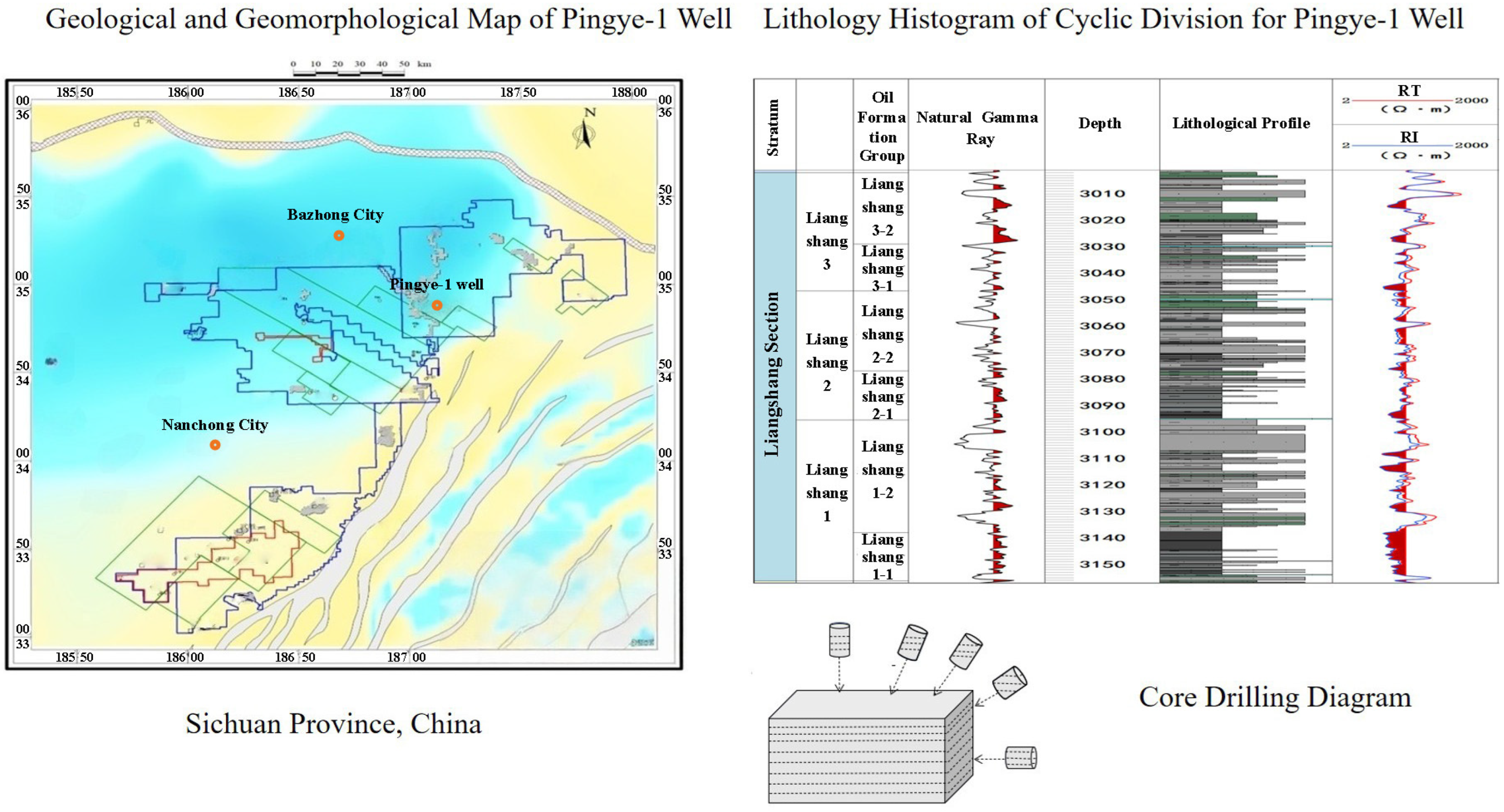
With increasing formation temperature and pressure, mid-deep shales exhibit a transitional behavior from brittle to ductile, leading to difficulties in hydraulic fracture initiation and propagation, thereby impacting the exploration and development of mid-deep shale gas. Consequently, the core samples used in this study were retrieved from the shale intervals of the Pingye-1 Well in the Sichuan Basin (Figure 1). Considering the well-developed bedding characteristics, the core axis was strictly oriented perpendicular to the bedding planes to avoid biasing the brittle-ductile mechanical response due to bedding plane weaknesses.
Standard cylindrical core specimens, 25 mm in diameter and 50 mm in height, were drilled perpendicular to the bedding direction using a core drilling rig, adhering to the standards of the International Society for Rock Mechanics (ISRM). The permissible tolerances were ±0.1 mm for diameter, ±0.2 mm for height, and ≤0.02 mm for end face parallelism.
Analysis of the illustrated geological characteristics reveals that the sedimentary strata in this area exhibit significant bedding and cyclicity. The proportions of pure shale and siltstone vary considerably across the region: pure shale content ranges from 25% to 47%, while siltstone accounts for 37% to 40%. Pure shale is most prevalent in the Liangshang 1-1 sub-member, reaching 47%. Vertically, the lithology displays an orderly sedimentary sequence from bottom to top, characterized by alternating layers of shale, transitional lithofacies, and siltstone. The paleo-water depth evolution follows a shallowing-upward trend, divisible into three sedimentary cycles dominated by retrogradational stacking patterns, where the initial flooding surface coincides with the maximum flooding surface.
The lithological assemblage in this area primarily comprises shale and siltstone, with the most pronounced shale development occurring in the lower sections of the Liangshang 1-1 and 2-1 sub-members. The sedimentary cycles are well-defined, with three fourth-order cycles corresponding to six fifth-order cycles within different reservoir units. Vertically, the lithology exhibits a regular repetitive sequence: Shale → Transitional Lithofacies → Siltstone. Overall, shale and transitional lithofacies constitute the dominant rock types, while siltstone is relatively less abundant. These depositional characteristics provide a critical foundation for further exploration and development.

2.2. Experimental Apparatus and Protocol

Triaxial compression tests were conducted using a GCTS RTX-1500 testing system. Confining pressure was applied and controlled by a hydraulic servo system, covering a range of 0–75 MPa with an accuracy of ±0.1 MPa. Samples were loaded under displacement control at a constant axial strain rate of 0.001 mm/s until failure. The system has an axial load capacity of 300 kN and a displacement resolution of 0.1 μm. Peak stress, strain, and confining pressure data were recorded synchronously at a sampling frequency ≥ 100 Hz, ensuring data accuracy and reliability.
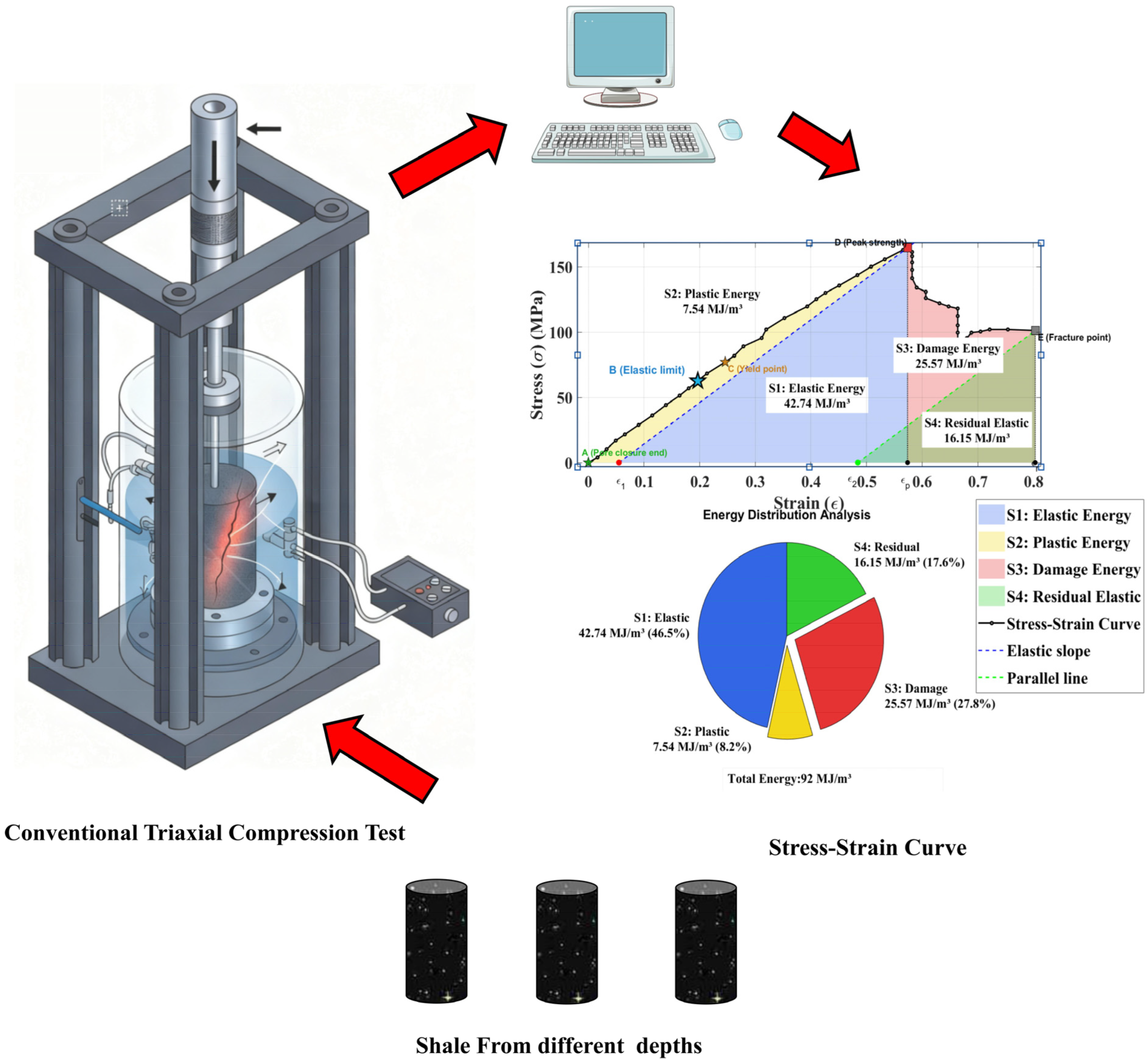
Tests were performed on samples retrieved from three distinct depths: 3029.9 m, 3007.7 m, and 3078.77 m. For each depth, four confining pressure conditions were applied: 0 MPa, 15 MPa, 45 MPa, and 75 MPa, resulting in a total of 12 experimental groups. These tests yielded key mechanical parameters, including compressive strength, residual strength, and elastic modulus, guaranteeing data reliability and experimental repeatability. The acquired dataset provides critical mechanical constraints for establishing shale constitutive models and optimizing reservoir fracturing fluid design (Figure 2).

3. Analysis of Experimental Results

3.1. Stress–Strain Curves

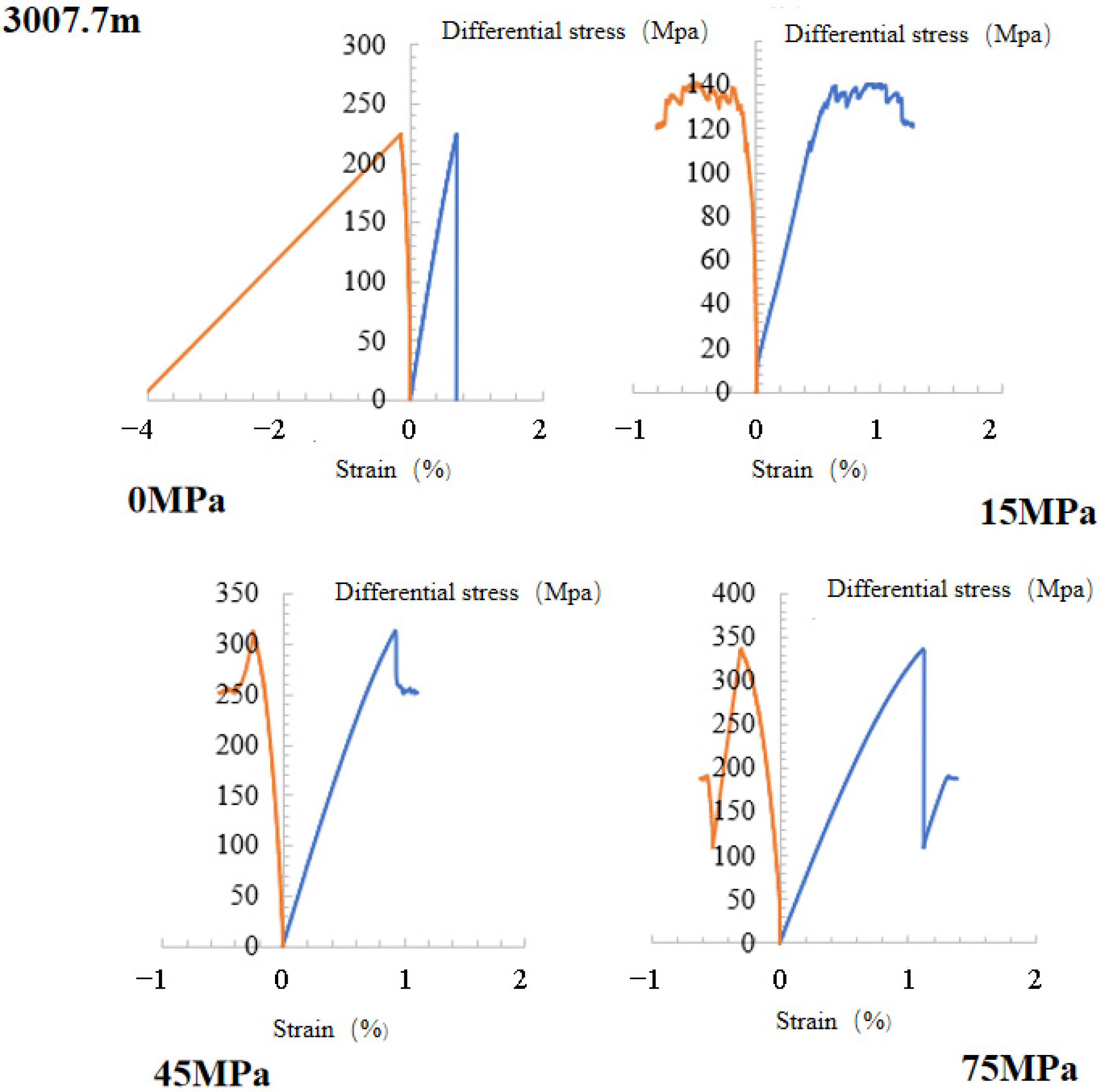
Figure 3 presents the stress–strain curves of shale from the Pingye-1 Well (depth: 3007.7 m) under different confining pressures. The stress–strain responses exhibit significant variations across confining pressure levels. At 0 MPa confining pressure, the rock demonstrates predominantly brittle failure characteristics, featuring rapid crack propagation and the formation of large fracture planes (as shown in the top-left inset of Figure 3). As the confining pressure increases to 15 MPa, 45 MPa, and 75 MPa, the stress–strain curves display progressively gentler loading phases. The failure mode transitions towards ductile behavior, characterized by slower crack propagation and a systematic reduction in fracture plane dimensions (illustrated in the bottom-right inset of Figure 3). Particularly under 75 MPa confining pressure, the rock exhibits pronounced ductile response with constrained crack growth and stable stress evolution.
Collectively, increasing confining pressure systematically diminishes rock brittleness while enhancing ductility. This behavior aligns with well-established rock mechanical principles, confirming the significant influence of confining pressure on the mechanical properties of shale.
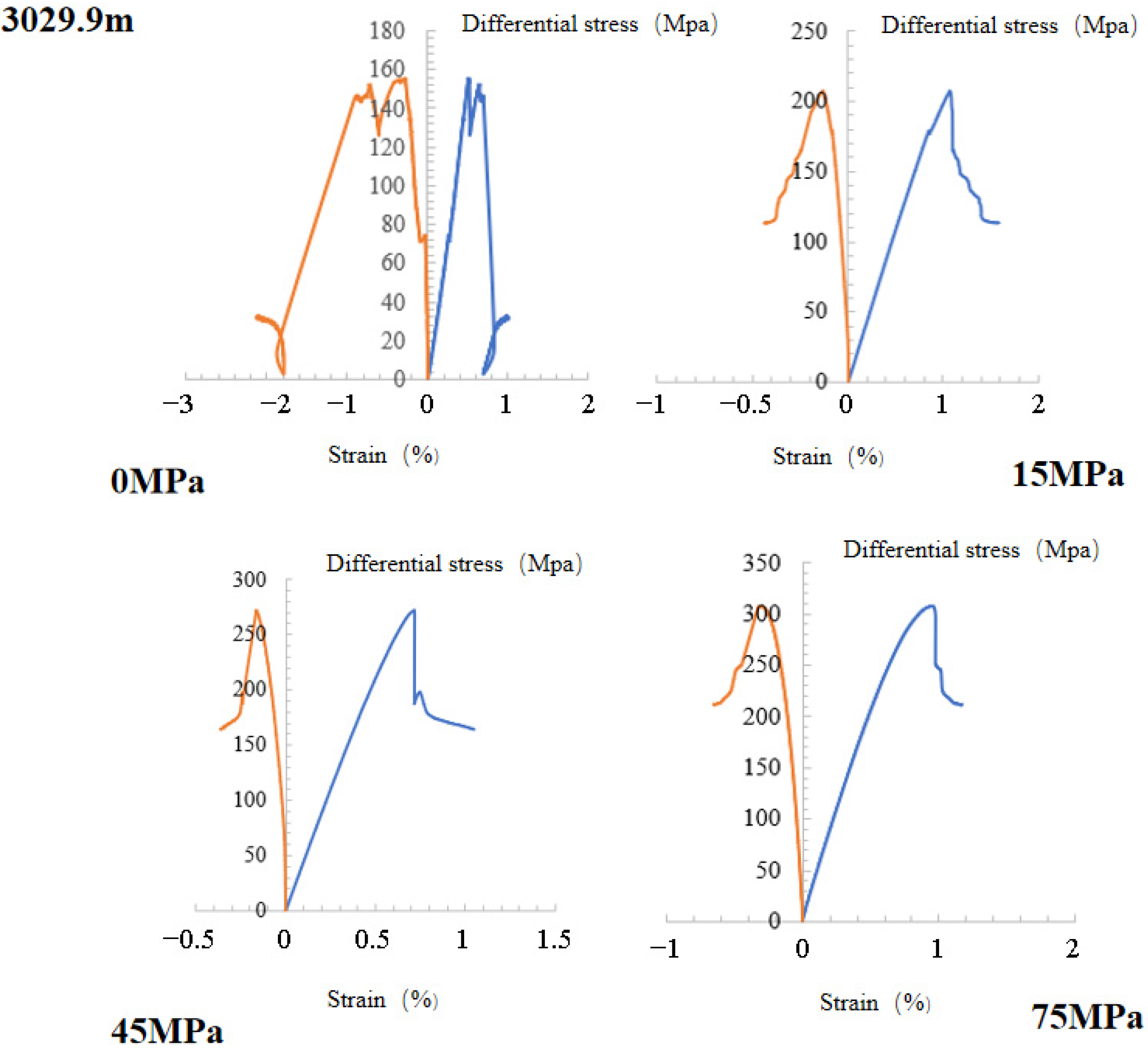
Figure 4 presents the stress–strain curves of shale from the Pingye-1 Well (depth: 3029.9 m) under confining pressures of 0 MPa, 15 MPa, 45 MPa, and 75 MPa. Compared to the curves at 3007.7 m depth shown in Figure 3, the stress-strain curves at 3029.9 m exhibit a similar trend: rock brittleness systematically diminishes while ductility enhances with increasing confining pressure. At 0 MPa confining pressure, the shale at 3029.9 m depth also displays distinct brittle failure characteristics, featuring rapid crack propagation and the formation of large fracture planes (as shown in the top-left inset of Figure 4). As confining pressure increases to 15 MPa, 45 MPa, and 75 MPa, the failure process becomes progressively more gradual. Crack propagation decelerates, and the rock exhibits enhanced ductile behavior, accompanied by a systematic reduction in fracture plane dimensions.
This trend aligns with the observations from Figure 3. However, at the greater depth of 3029.9 m, the rock exhibits marginally higher compressive strength. This suggests that depth-dependent variations in rock mechanical properties may induce distinct mechanical responses.
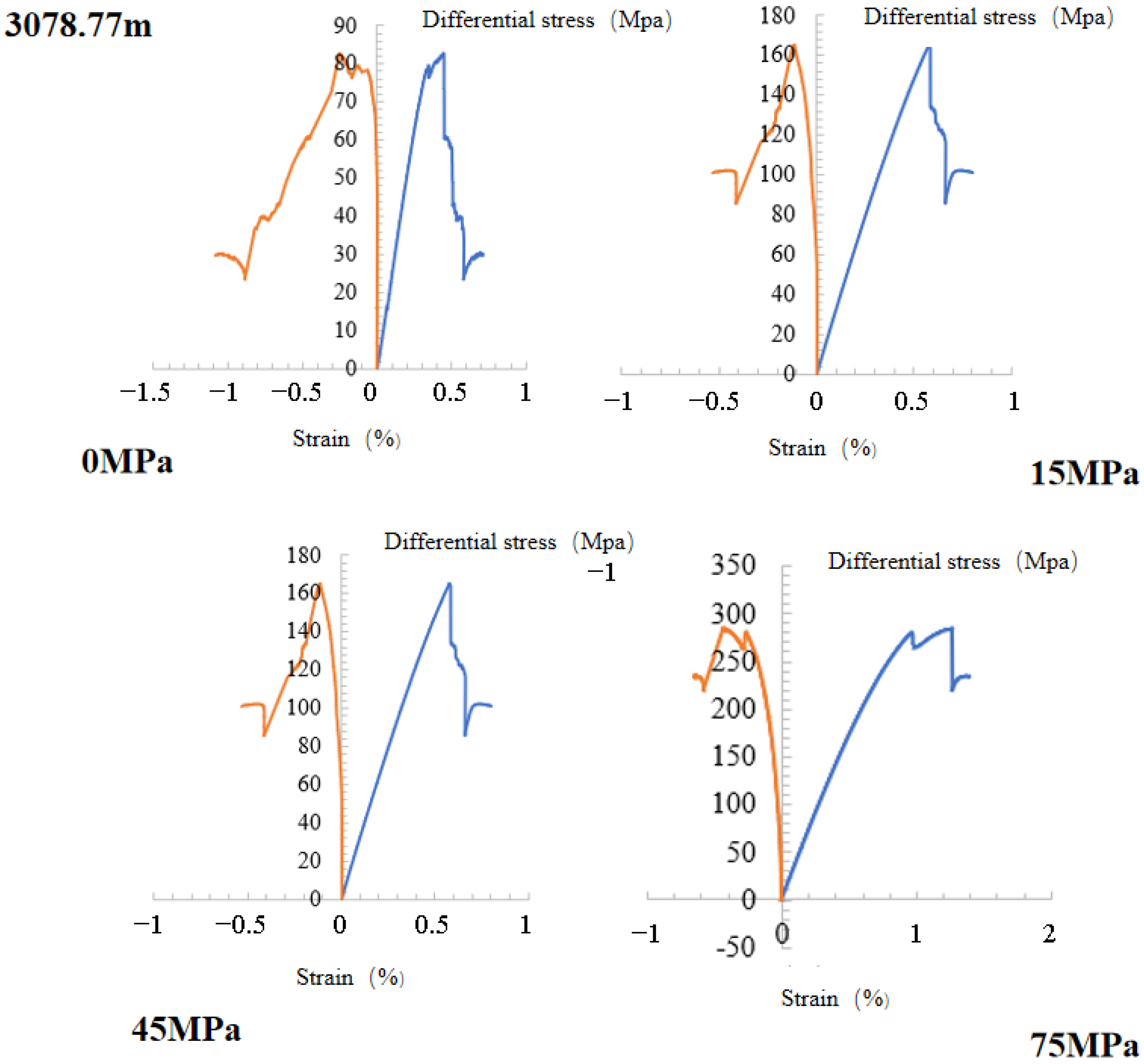
Figure 5 presents the stress–strain curves of shale from the Pingye-1 Well (depth: 3078.77 m) under confining pressures of 0 MPa, 15 MPa, 45 MPa, and 75 MPa. Compared to the results from Figure 3 (3007.7 m depth) and Figure 4 (3029.9 m depth), the stress–strain curves at 3078.77 m exhibit a similar overall trend but with notable differences in mechanical response. At 0 MPa confining pressure, the shale at 3078.77 m depth demonstrates brittle failure characteristics, featuring rapid crack propagation and extensive fracture planes (as shown in the top-left inset of Figure 5). As confining pressure increases to 15 MPa, 45 MPa, and 75 MPa, the stress–strain curves become progressively more gradual. Crack propagation decelerates, reflecting enhanced ductile behavior.
Relative to the shallower depths of 3007.7 m and 3029.9 m, the shale at 3078.77 m exhibits marginally lower compressive strength. However, increasing confining pressure systematically reduces brittleness while enhancing ductility, thereby highlighting the pronounced influence of confining pressure on the mechanical properties of deeper shales.
Collectively, the stress–strain curves across all three depths demonstrate that increasing confining pressure enhances rock ductility while restraining excessive crack propagation. This drives a progressive transition in failure modes toward ductile-dominated behavior. The depth-dependent variations in stress–strain responses highlight the influence of burial depth on mechanical properties, with deeper shales exhibiting superior compressive performance under elevated confining pressures.

3.2. Triaxial Test Results

Table 2 lists the lithological characteristics and corresponding mechanical parameters (including elastic modulus, Poisson’s ratio, cohesion, and internal friction angle) for samples from different depths in the Pingye-1 Well. The data indicate significant differences in the mechanical properties of rocks at varying depths. Specifically, the sample from Pingye-1 Well at 3007.7 m depth (interbedded mudstone-siltstone/siltstone) exhibits a high elastic modulus (38.98 GPa), low Poisson’s ratio (0.15), high cohesion (71.5 MPa), and high internal friction angle (25.98°). At the 3029.9 m depth of Pingye-1 Well (interbedded mudstone-siltstone), the elastic modulus increases to 43.71 GPa, Poisson’s ratio slightly rises to 0.16, cohesion decreases to 47.50 MPa, and the internal friction angle increases to 30.44°. The interbedded mudstone-siltstone sample from Pingye-1 Well at 3078.77 m depth shows a lower elastic modulus (34.21 GPa), higher Poisson’s ratio (0.22), further reduced cohesion (26.7 MPa), and the highest internal friction angle (34.46°).
Overall, with increasing depth, the elastic modulus and cohesion of the rock gradually decrease, while Poisson’s ratio and internal friction angle exhibit increasing trends. This indicates a progressive reduction in brittleness and enhancement of ductility with greater depth, and the variations in mechanical parameters are closely linked to depth, lithology, and evolving stress conditions.
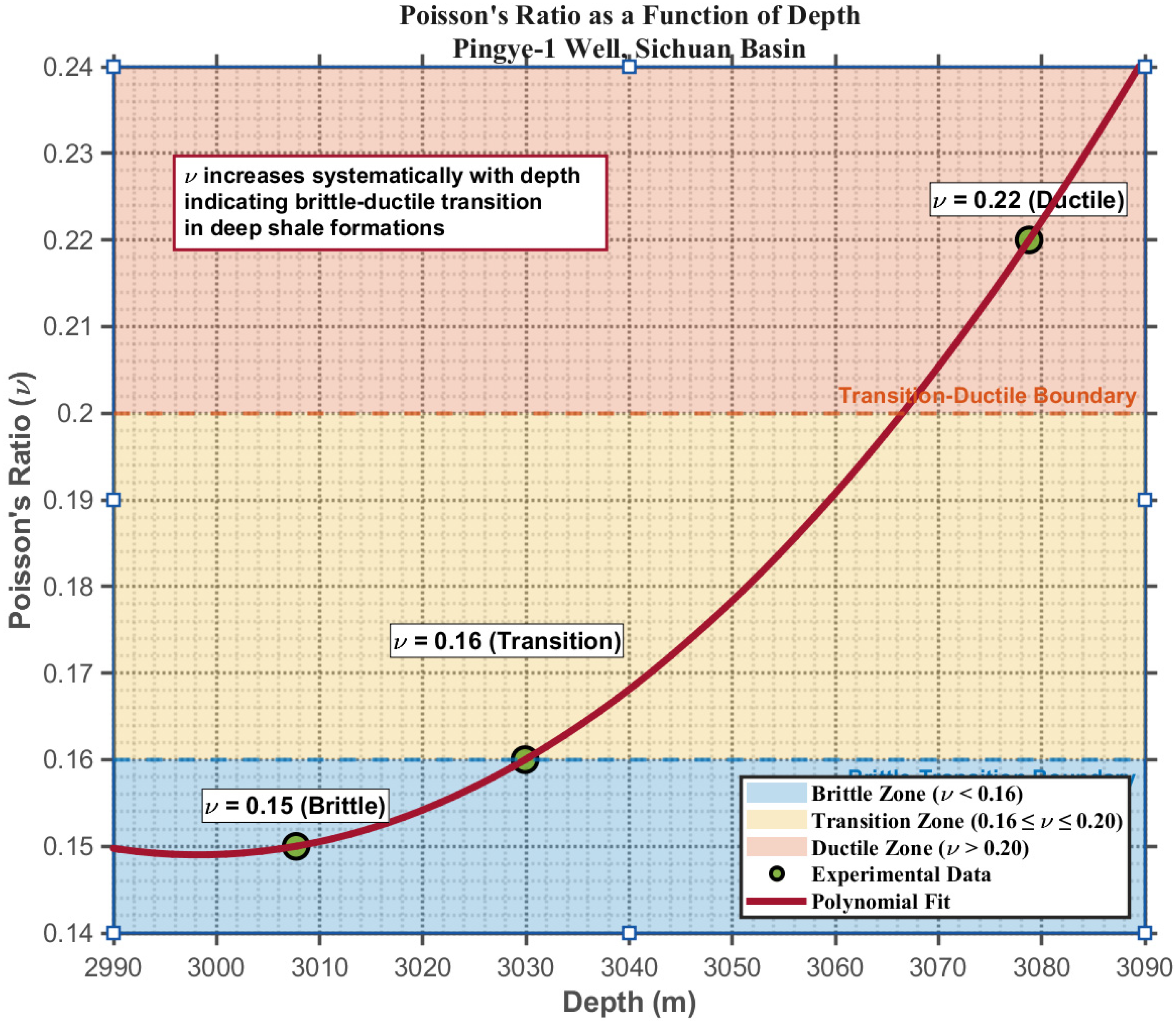
Figure 6 unequivocally demonstrates a strong correlation between Poisson’s ratio ( ν ) and depth for the Liangshang Formation shale in the Pingye-1 Well, Sichuan Basin. The ν value increases consistently from ~0.14 to ~0.24 as depth increases from approximately 3000 m to 3080 m. This trend macroscopically reflects the plastic strengthening and pore compression of the internal rock structure subjected to increasing confining pressure and temperature over geological time. Crucially, based on the correlation between rock failure modes and ν values (see Table 3), we identified two critical thresholds ( ν = 0.16 and ν = 0.20) to mechanically zonate the formation into brittle, transitional, and ductile domains. This figure visually demonstrates that for the current study area, the boundaries for the brittle-ductile transition (BDT) are located at approximately 3020 m ( ν ≈ 0.16) and 3055 m ( ν ≈ 0.20) depth. This depth-domain model, based on the single parameter ν (the PNE-BI model), provides a practical tool—requiring no complex experiments but only routine well logs—for predicting the behavior of deep shales during hydraulic fracturing (e.g., fracture complexity, conductivity). It is of significant importance for optimizing stimulation design in ultra-deep shale gas reservoirs.

4. Poisson’s Ratio-Based Brittle-Ductile Evaluation Model and Verification

4.1. Poisson’s Ratio-Dominated Brittle-Ductile Transition Mechanism

Triaxial test data reveal a significant increasing trend in Poisson’s ratio ( ν ) with depth (Table 2), indicating systematic changes in the brittle-ductile state of deep shale. Specifically: at 3007.7 m depth ( ν = 0.15), the rock exhibits brittle failure characteristics (e.g., longitudinal splitting), corresponding to the brittle zone ( ν < 0.16); at 3029.9 m depth (ν = 0.16), the rock enters the brittle-ductile transition zone (0.16 ≤ ν ≤ 0.20) with conjugate shear failure modes; at 3078.77 m depth ( ν = 0.22), the rock demonstrates distinct ductile failure behavior (e.g., barreling deformation), corresponding to the ductile zone ( ν > 0.20). This demonstrates a strong correlation between increasing Poisson’s ratio and the transition from brittle to ductile dominance.
Based on these observations, we propose the following Poisson’s ratio-dominated brittle-ductile transition mechanism: ν ≤ 0.15 (Brittle Zone): Rocks undergo brittle failure (longitudinal splitting), with mechanical evidence including uniaxial residual strength ratio > 60% (Table 3). 0.16 ≤ ν ≤ 0.20 (Transition Zone): Rocks develop conjugate shear failure, supported by strain hardening under confining pressures > 45 MPa (Table 3). ν > 0.20 (Ductile Zone): Reduced intergranular sliding resistance (enhanced clay mineral hydration) significantly improves plastic deformation capacity, effectively suppresses crack propagation, and channels energy dissipation primarily through plastic flow, manifesting as ductile failures (e.g., barreling). Mechanical evidence includes peak strain > 2.0% (Table 3).
When ν > 0.20, reduced intergranular sliding resistance (enhanced clay mineral hydration) promotes energy dissipation through plastic flow, effectively suppressing macroscopic fracture formation. This analysis demonstrates that Poisson’s ratio ( ν ) governs brittle-ductile transition by modulating internal energy dissipation pathways—such as inhibiting brittle dilation while promoting plastic flow—establishing it as the key physical parameter linking burial depth to brittle-ductile transformation. The subsequently proposed PNE-BI model quantifies ν ’s regulatory effect on energy rebalancing (Section 4.4), further revealing the physical essence of brittle-ductile transition.
The governing role of Poisson’s ratio (ν) on the brittle-ductile transition is deeply rooted in micromechanical evolution. First, ν acts as a macroscopic indicator of mineralogical composition and intergranular cohesion. As indicated in Table 2, the transition to high-νvalues (ν > 0.22) at greater depths corresponds to mudstone-dominated lithologies rich in clay minerals. Unlike the rigid silicate framework of brittle rocks, these mineral aggregates exhibit weak intergranular bonding, which significantly reduces cohesion and facilitates grain boundary sliding under stress. Asadoullahtabar et al. [32] demonstrated that microstructural characteristics and mineral composition (e.g., loose cementation or clay content) are critical determinants of soil stability and collapse potential. Similarly, in deep shales, this mechanism is quantitatively supported by XRD data from the Pingye-1 Well: the shallow brittle section (<3030 m) maintains a rigid framework with clay content generally below 25%, whereas the deep ductile section (>3070 m) exhibits a surge in clay mineral content exceeding 40% (dominantly Illite). This material softening directly results in elevated ν values and macroscopic ductile flow.
Furthermore, from the perspective of fracture mechanics, ν critically regulates the crack-tip shielding effect. Under plane strain conditions, the radius of the plastic zone (rp) at a crack tip is positively correlated with ν. A higher ν promotes a larger plastic zone, which dissipates elastic energy through plastic deformation rather than crack propagation. This “shielding” effect reduces the effective stress intensity factor at the crack tip, inhibiting the unstable fracture growth typical of brittle rocks. Thus, the systematic increase in ν observed in our experiments physically represents the enhancement of this energy dissipation mechanism.
Although Poisson’s ratio ν provides preliminary discrimination of brittle-ductile states (Table 3), the actual mechanical behavior of deep shales is significantly modulated by confining pressure and energy evolution. For instance, rocks with ν > 0.20 may remain in the brittle-ductile transition zone under low pressure (e.g., 3078.77 m/0 MPa, PNE-BI = 0.565), while high confining pressure can drive rocks with ν = 0.15 toward ductile behavior (e.g., 3007.7 m/75 MPa, PNE-BI = 0.581). Consequently, this study proposes the PNE-BI model to achieve dynamic and precise diagnostics of brittle-ductile states by quantifying both: (1) ν ’s enhancement effect on plastic energy dissipation, and (2) confining pressure’s modulation of energy partitioning.

4.2. Modified Mohr-Coulomb Criterion

In the conventional Mohr-Coulomb criterion, the relationship between shear strength (τ) and normal stress (σ) is expressed as (Jaeger et al., 2007 [16]):
τ = c + σ n tan ϕ
where τ : Shear strength (MPa); c: Cohesion (MPa); σ n : Normal stress (MPa); ϕ : Internal friction angle (°).
Confining pressure critically influences rock failure modes. As confining pressure increases, shear strength rises accordingly. Under high confining pressures typical of deep formations, rocks exhibit enhanced shear resistance, shifting failure toward ductile rather than brittle behavior. Beyond elevating shear strength, confining pressure alters internal rock structure—promoting intergranular sliding (grain-boundary motion) and pore closure—thereby modifying both internal friction angle and cohesion.
Ideally, increasing burial depth tends to enhance cohesion due to compaction. However, in the heterogeneous Liangshang Formation, lithological variation exerts the dominant control. As depth increases, the transition from rigid siltstone to clay-rich shale leads to weaker intergranular bonding. Consequently, contrary to the general compaction trend, the intrinsic cohesion exhibits a decreasing trend with depth (as shown in Table 2), reflecting the material softening caused by elevated clay mineral content.
Experimental studies indicate that strength parameters are strictly stress-dependent. Singh et al. (2011) [17] demonstrated that cohesion and friction angle vary significantly under non-linear stress states, while Rybacki et al. (2015) [18] highlighted the depth-dependent evolution of brittle-ductile properties in shales. Incorporating these theoretical concepts with our multivariate regression data (Figure 7), we modify the conventional criterion to address confinement-depth coupling effects:
τ = c P , D + σ t a n φ P , D
where c ( P , D ) is the modified cohesion accounting for confining pressure (P) and depth (D) effects; φ ( P , D ) is the modified internal friction angle incorporating P and D influences; σ denotes normal stress.
Specifically, cohesion and internal friction angle are modified as follows:
Cohesion: Accounting for the depth-dependent lithological softening (Rybacki et al., 2015 [18]) and confinement effects, the modified cohesion is expressed empirically as:
c P , D = c 0 + α P + β D
where c 0 denotes the conventional cohesion, and α and β are correction coefficients accounting for confining pressure and depth variations.
Internal friction angle: Increases with rising confining pressure and depth, expressed as:
φ P , D = φ 0 + γ P + δ D
where φ 0 denotes the conventional internal friction angle, and γ and δ are correction coefficients accounting for variations in confining pressure and depth.
The modified Mohr-Coulomb criterion enables more accurate characterization of shear strength in deep rocks under depth- and pressure-dependent conditions. In practical applications, predictions of rock shear strength can be made using site-specific confining pressure and depth data, thereby guiding fracturing design. This refined criterion proves particularly critical for deep shale gas development: as extraction depths increase, confining pressure exerts pronounced effects on rock mechanical properties—effects that directly impact fracturing efficacy and operational safety.
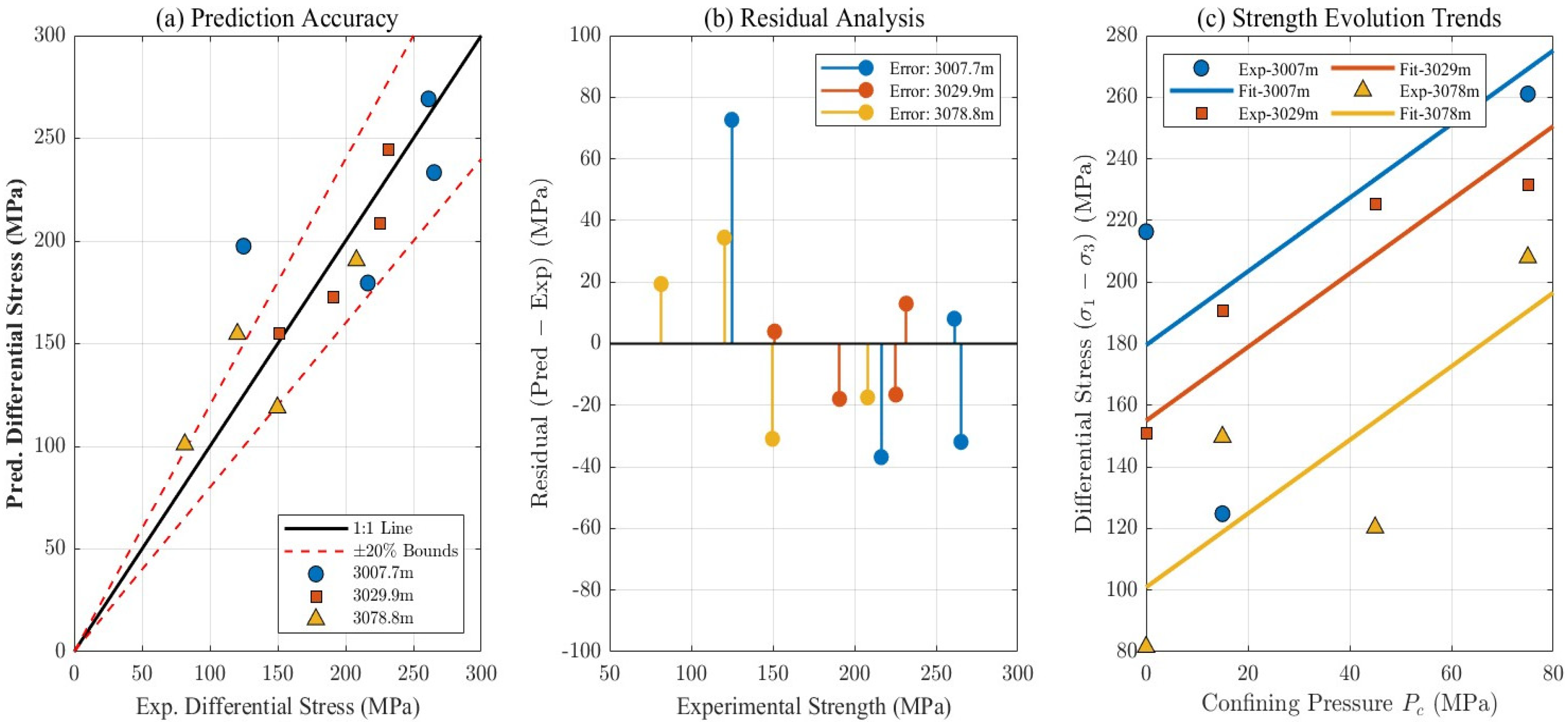
To validate the applicability of the modified criterion, we calibrated the correction coefficients (α, β, γ, δ) using multivariate linear regression based on the experimental dataset. Figure 7 presents the calibration results and error distribution analysis. As shown in Figure 7a, the model exhibits a satisfactory prediction accuracy with a coefficient of determination (R2) of 0.71 and a Root Mean Square Error (RMSE) of 30.7 MPa. The majority of data points fall within the ±20% error bounds, indicating that the modified equations effectively capture the differential stress variations.
The residual analysis in Figure 7b demonstrates that the prediction errors (Predicted—Experimental) are randomly distributed around the zero line without distinct systematic bias, confirming the statistical robustness of the regression. Furthermore, Figure 7c illustrates the strength evolution trends across different depths. The fitted curves (solid lines) align well with the experimental measurements (scatter points), successfully reproducing the strengthening effect of confining pressure on differential stress (σ1–σ3). This validation confirms that the introduced depth-confining pressure coupling coefficients accurately characterize the shear strength enhancement in deep shale formations.

4.3. Brittle-Ductility Evaluation Model

During loading, rocks accumulate strain energy internally. When stress reaches its peak, the stored energy releases through distinct pathways, leading to macroscopic failure. In highly brittle rocks, pre-peak elastic strain energy concentrates intensely and releases abruptly post-peak, causing drastic stress drops. Conversely, ductile rocks dissipate energy progressively via mineral plastic flow, grain sliding, and pore collapse, resulting in stress–strain curves that exhibit gradual decay or even strain hardening. Establishing a rigorous energy quantification framework is prerequisite for accurate brittleness evaluation. As demonstrated by Kafshgarkolaei et al. [33] in their analytical modeling of structural response under intensive loading, decoupling elastic storage from dissipative mechanisms is essential for characterizing material failure modes. Drawing upon this energy-based analytical perspective, we formulate the brittleness index by distinguishing between the pre-peak elastic accumulation and the post-peak plastic dissipation distinctively.
Based on energy evolution analysis derived from stress–strain curves, brittleness indices can be formulated. Conventionally, the brittle-ductile behavior of rocks is evaluated through the ratio of pre-peak elastic strain energy to post-peak energy dissipation. For instance, Muñoz et al. [32] emphasized that energy dissipation in both pre-peak and post-peak stages should be considered holistically to define rock brittleness-ductility. Building on this approach and incorporating the residual elastic energy Ur, the improved brittle-ductility index is typically expressed as:
B I 1 = U e U e + U i
For clarity, this paper uniformly designates:
B I 2 = E p e a k E p e a k + E p l a s t i c
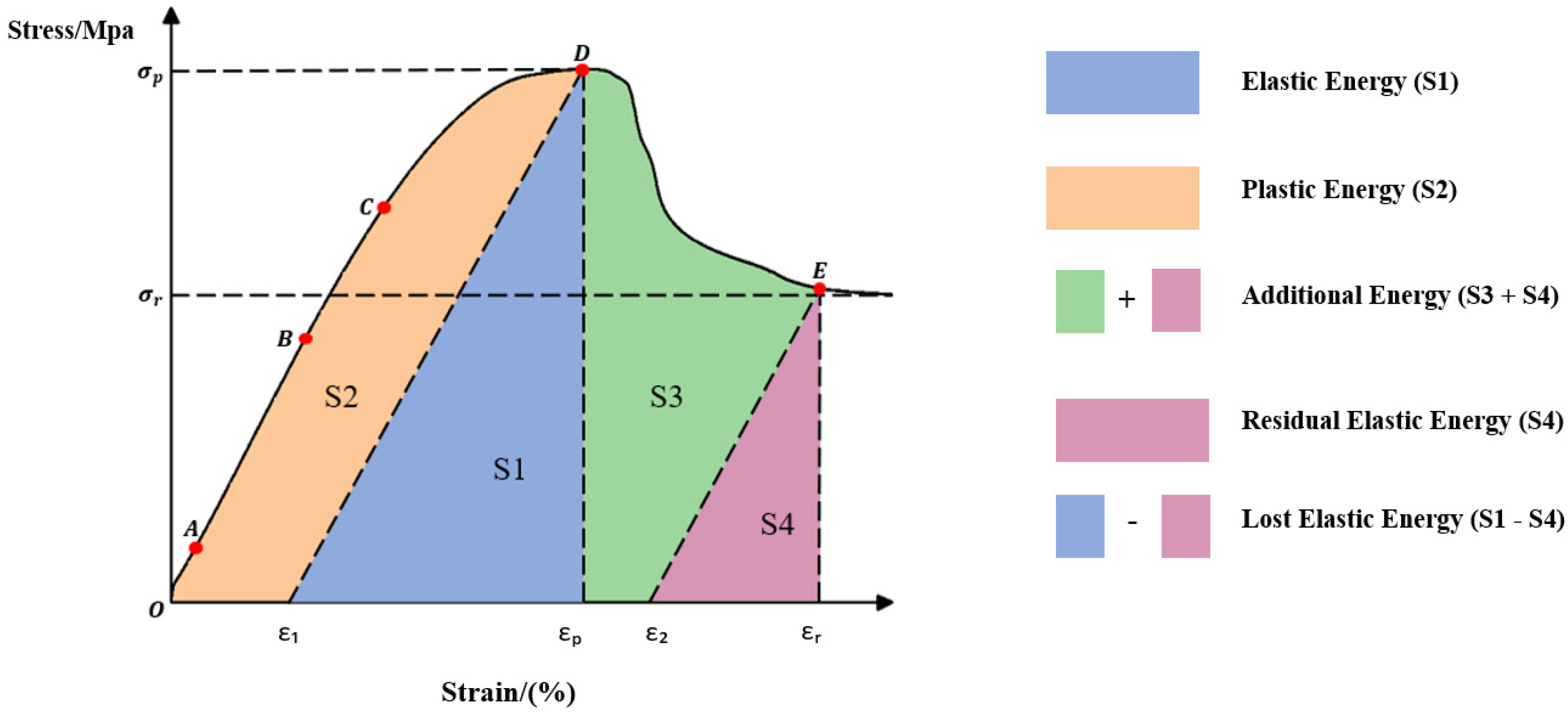
In the equation: E p e a k represents the energy accumulated during the pre-peak (elastic) phase, reflecting the rock’s capacity to store elastic deformation and corresponding to region S1. in the schematic E p l a s t i c denotes the energy dissipated during the post-peak (plastic deformation) phase, encompassing region S2 and residual post-peak energy (region S4). The index ranges over (0, 1]. As B I 2 approaches 1, the rock exhibits fully brittle failure with instantaneous elastic energy release. As B I 2 asymptotically approaches 0, the rock approaches ideal ductile behavior, requiring additional energy input for post-peak deformation and exhibiting incomplete failure.
The energy partitioning illustrated in Figure 8 is quantified using a rigorous numerical integration algorithm based on the stress–strain data σ ϵ . All calculation procedures, including data smoothing and integral operations, were implemented using the MATLAB computing environment (version R2024a) to ensure high precision. The procedure involves two key steps:
Identification of Characteristic Points via MATLAB: First, the Elastic Modulus (E) is determined by performing a linear regression on the initial linear segment. The Yield Point σ y , ϵ y is identified using the 0.2% offset method (implemented algorithmically), defined where the plastic strain ϵ p l a s t i c = ϵ σ / E reaches 0.002. The Peak Point σ p , ϵ y corresponds to the global maximum of the differential stress.
Integral Calculation of Energy Densities Based on the identified points, the four energy components are calculated using the trapezoidal integration rule in MATLAB:
Elastic Energy (S1): Represents the reversible strain energy stored at peak stress:
S 1 = σ p 2 2 E
Pre-peak Plastic Energy (S2): Represents the irreversible energy dissipated due to micro-crack closure and plastic slip. It is calculated by subtracting the elastic energy from the total pre-peak work:
S 2 = 0 ϵ p σ ϵ d ϵ   -   S 1
Post-peak Damage Energy (S3): Represents the energy consumed by fracture propagation during the strain-softening phase (from peak strain ϵ p to fracture strain ϵ r ). It excludes the residual recoverable energy:
S 3 = ϵ p ϵ r σ ϵ d ϵ   -   S 4
Residual Elastic Energy (S4): Represents the potential elastic energy remaining in the rock at the residual strength stage ( σ r ):
S 4 = σ r 2 2 E

4.4. Innovative Poisson’s-Ratio-Regulated Energy Brittle-Ductile Model

While conventional energy models capture macroscopic energy dissipation characteristics of rocks, they fail to explicitly reflect the profound influence of intrinsic physical properties—particularly Poisson’s ratio ( ν )—on energy dissipation modalities. This study establishes that ν , as a pivotal indicator of lateral deformability, directly governs intergranular sliding, microcrack initiation/propagation pathways, and the activation barrier for plastic flow, thereby critically regulating energy dissipation mechanisms.
Empirical triaxial data confirm a robust ν-ductility correlation: increasing ν enhances plastic deformation capacity, elevating the proportion of energy dissipated through plastic flow—effectively suppressing macroscopic fracture formation and propagation. Critically, even when absolute plastic energy extracted from stress–strain curves is identical, higher- ν rocks exhibit superior efficiency in brittle failure suppression through plastic dissipation. This ν -modulated dissipation efficiency represents a fundamental breakthrough beyond traditional energy metrics.
Building upon this framework, we innovatively refine conventional energy brittleness indices by proposing the Poisson’s Ratio-Regulated Energy Brittle-Ductility Index (PNE-BI). The model introduces the Poisson’s Ratio Enhancement Factor λ( ν ) to quantify ν -modulated plastic dissipation efficiency, where λ( ν ) ≥ 1 is a monotonically increasing function of ν . As ν rises, λ( ν ) amplifies the weight of plastic energy ( E p l a s t i c ) in the brittleness denominator, thereby suppressing the index value to accurately reflect enhanced ductility:
P N E B I = E p e a k E p e a k + E p l a s t i c λ ν
In the equation: E p e a k denotes the elastic energy accumulated in the rock prior to the peak stress. E p l a s t i c represents the energy dissipated during plastic deformation of the rock. The brittle zone corresponds to PNE-BI ≥ 0.8, the brittle-ductile transition zone to 0.4 ≤ PNE-BI < 0.8, and the ductile zone to PNE-BI < 0.4. λ ( ν ) is the Poisson’s ratio enhancement factor, the specific form of which can be formulated based on experimental data and theoretical analysis (Table 4). This study innovatively adopts the following expression:
λ ν = 1 2 ν r e f 1 2 ν   ν < 0.5
ν : in situ measured Poisson’s ratio of the rock; ν r e f : reference Poisson’s ratio (taken as the critical brittle-ductile threshold or regional mean value, 0.16).
An increase in ν reduces the bulk modulus K = E 3 ( 1 2 ν ) , thereby promoting intergranular sliding of mineral particles. This mechanistic relationship forms the basis for constructing the enhancement factor λ ν .
The functional form of λ ν is rooted in the mechanics of rock compressibility. The term 1 2 ν represents the coefficient of volumetric strain capability, inversely proportional to the Bulk Modulus (K), where K = E 3 ( 1 2 ν ) . As ν increases towards 0.5, the rock material approaches an incompressible state (limit of perfect plasticity), where volumetric compression is inhibited, and energy dissipation is forced to occur via shear-induced plastic flow. Therefore, the ratio defined in Equation (8) physically quantifies the amplification of plastic dissipation efficiency relative to a brittle reference state ( ν r e f ).
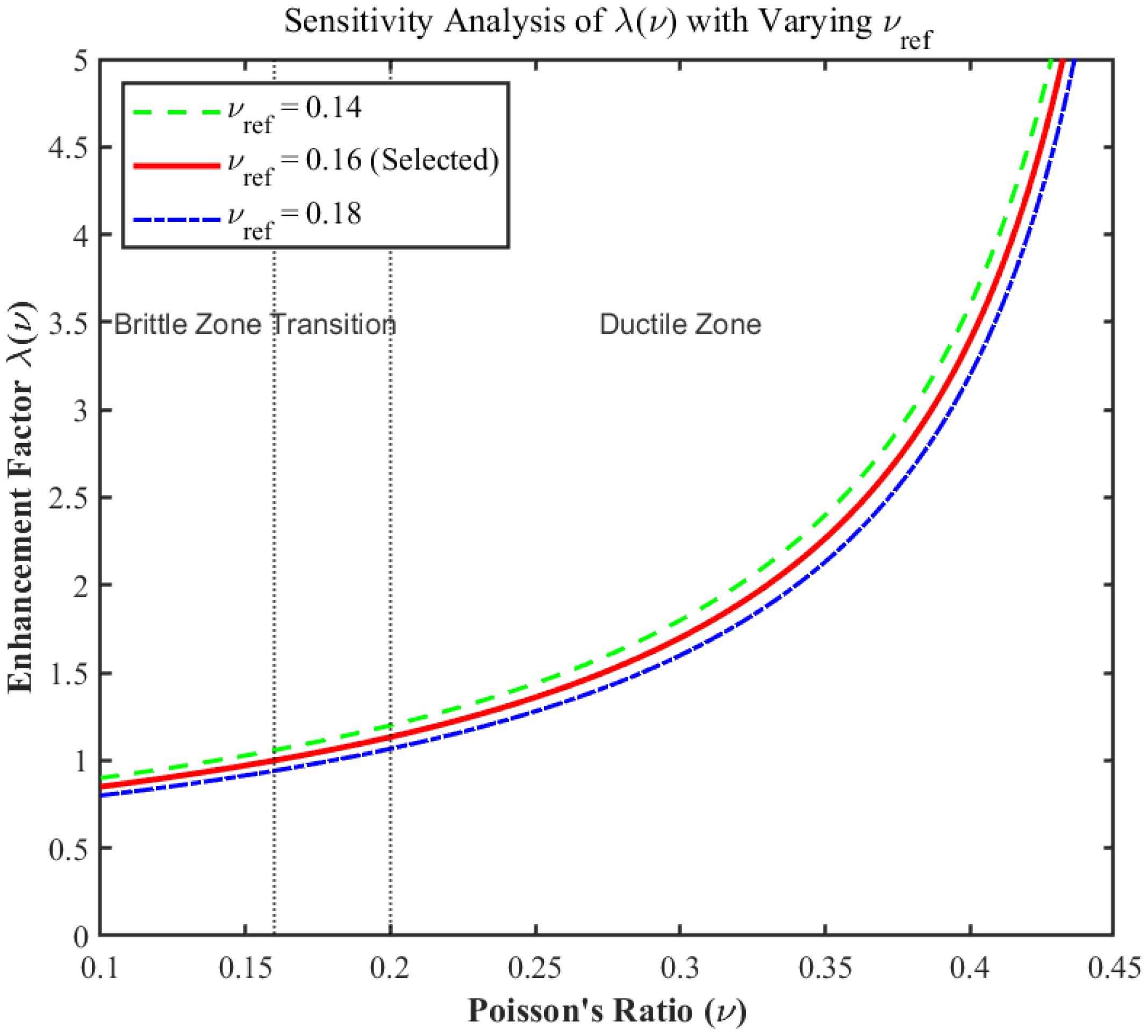
To verify the robustness of selecting ν r e f = 0.16, a sensitivity analysis was conducted (Figure 9). We evaluated the PNE-BI response curves using ν r e f values of 0.14, 0.16, and 0.18. The results indicate that while the monotonic trend remains consistent, setting ν r e f = 0.16 yields the maximum gradient sensitivity for distinguishing the transition zone (3020–3060 m) in the studied shale formation. Consequently, this parameter choice balances mathematical robustness with geological applicability.

4.5. Model Validation and Analysis

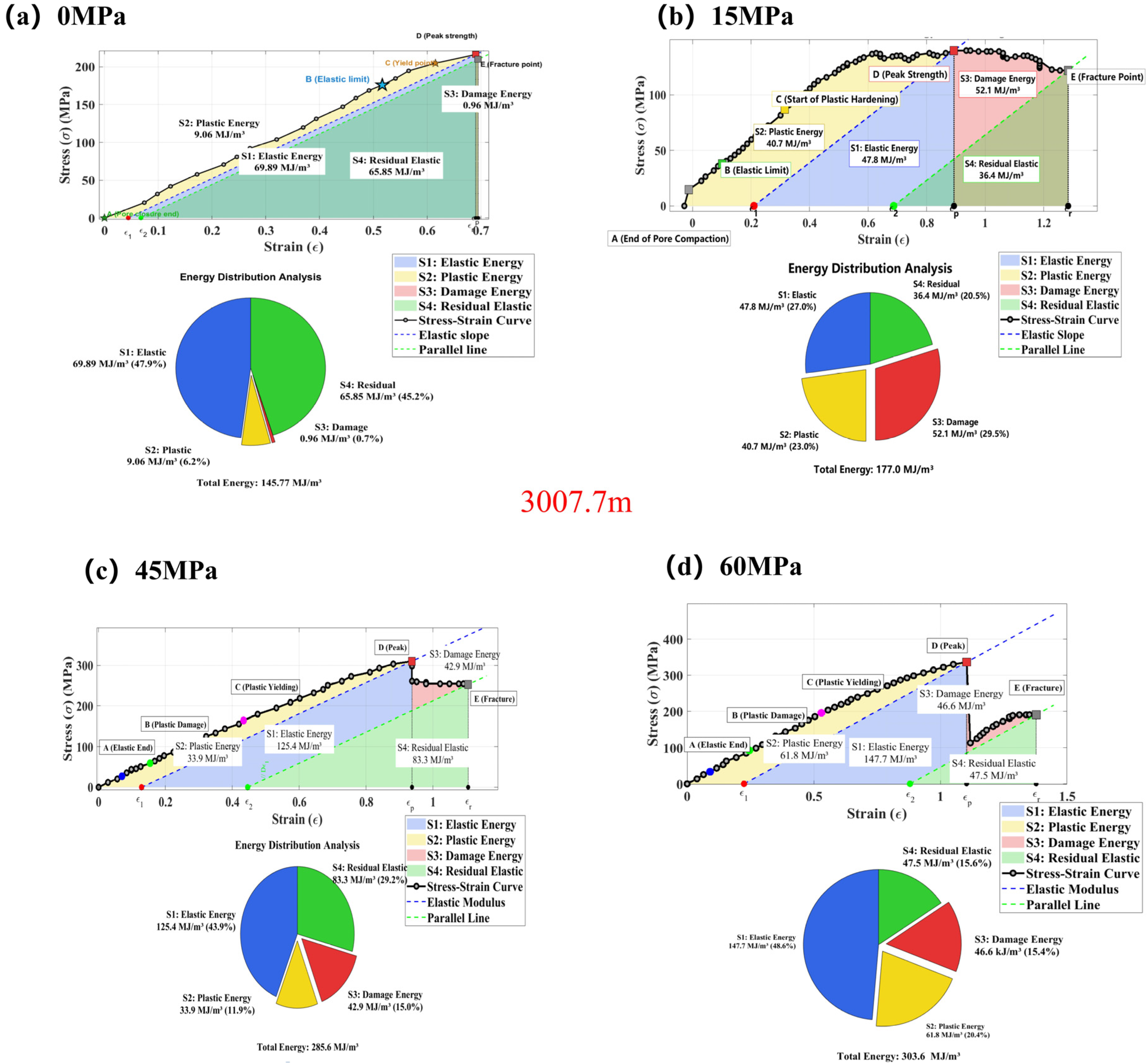
Figure 10 illustrates the energy partitioning at 3007.7 m depth under varying confining pressures. As confining pressure increases, the rock energy allocation mechanism exhibits distinct phase-transition characteristics. At 0 MPa, elastic energy (S1) dominates storage behavior at 47.2% (68.89 MJ/m3), while plastic energy (S2) and damage energy (S3) account for 6.2% (9.06 MJ/m3) and 0.7% (0.96 MJ/m3, respectively, consistent with brittle rock characteristics. When confining pressure rises to 15 MPa, S1 decreases to 27.0% (47.80 MJ/m3), whereas S2 (23.0%/40.70 MJ/m3) and S3 (29.4%/52.10 MJ/m3) surge significantly, indicating co-activation of plastic flow and damage mechanisms. At 45 MPa, S1 rebounds to 43.9% (125.40 MJ/m3), yet S3 (15.0%/42.90 MJ/m3) and S2 (11.9%/33.90 MJ/m3) maintain high dissipation levels, reflecting enhanced nonlinear energy consumption during strain hardening. Under 75 MPa high confining pressure, energy redistribution occurs: S1 constitutes 48.7% (147.70 MJ/m3), with S2 and S3 contributing 20.4% (61.80 MJ/m3) and 15.4% (46.60 MJ/m3) respectively. Although the combined plastic and damage dissipation (S2 + S3 = 108.40 MJ/m3) increases significantly compared to low-confinement states, the elastic energy (S1) remains dominant. This confirms that while high confinement promotes plasticity, this low-ν lithology (ν = 0.15) retains high elastic storage capacity, maintaining its status within the Brittle-Ductile Transition regime (PNE-BI = 0.581) rather than fully yielding to ductile flow.
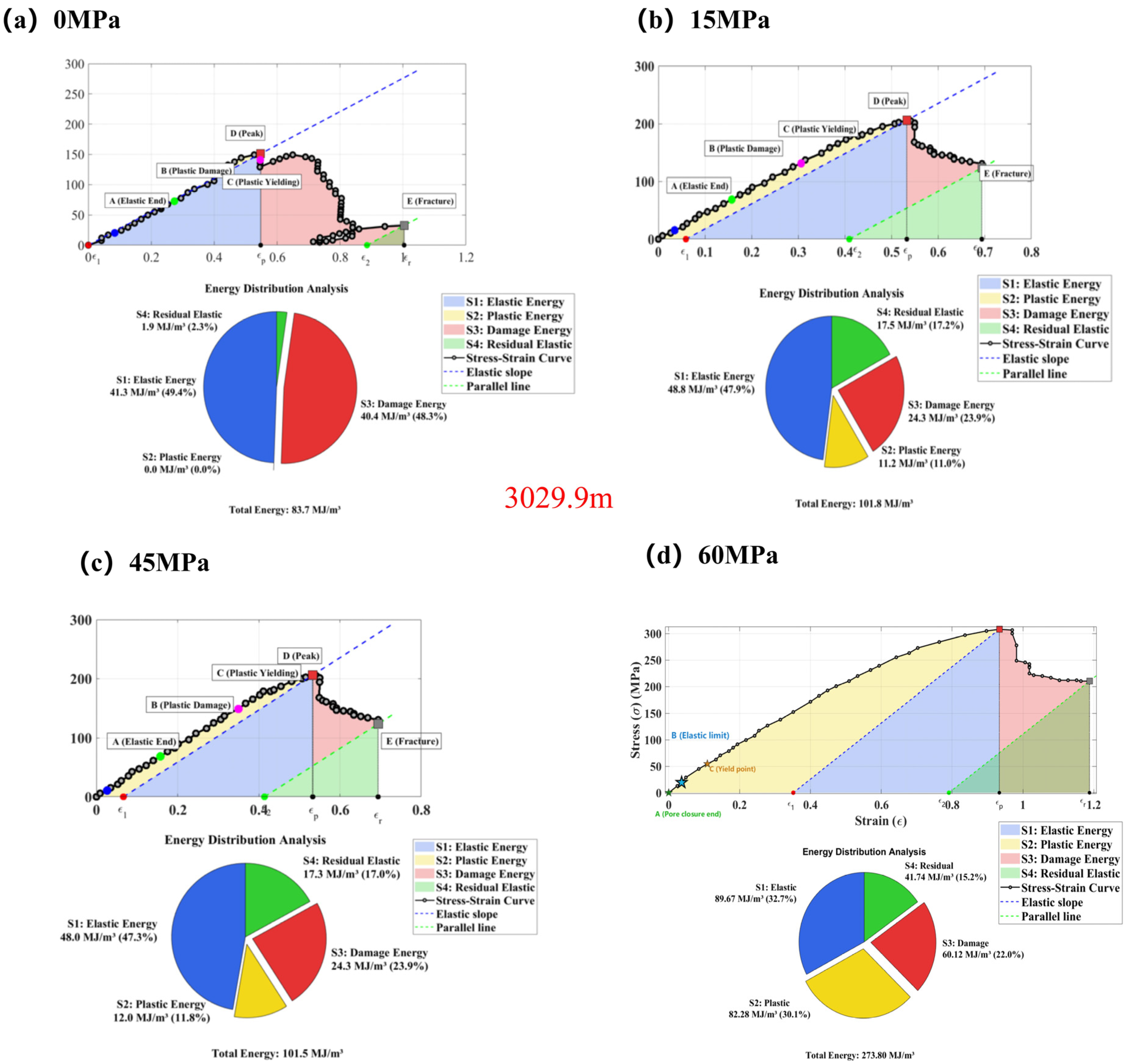
Figure 11 illustrates the energy partitioning at 3029.9 m depth under varying confining pressures. At 0 MPa, damage energy (S3) accounts for 48.3% (40.40 MJ/m3)—a 47.6 percentage-point increase compared to shallow samples at 3007.7 m (S3 = 0.7%), revealing the inherent microcrack advantage induced by greater depth. When confining pressure rises to 15 MPa, the absolute S3 value decreases to 24.30 MJ/m3 (53.4% lower than shallow samples at equivalent pressure), yet its proportion remains elevated at 23.9% (vs. 29.4% in shallow samples), indicating confining pressure’s suppressive effect on deep damage propagation. At 45 MPa, S3 continues to dominate at 23.9% (24.30 MJ/m3), exceeding shallow samples (15.0%) by a factor of 1.6, confirming the persistent depth-enhanced damage accumulation effect. Under 75 MPa high confining pressure, energy dissipation pathways reconfigure: plastic energy (S2) becomes dominant at 30.1% (82.28 MJ/m3), while S3 maintains 22.0% (60.12 MJ/m3). Their combined dissipation (142.40 MJ/m3) reaches 1.6 times the elastic energy (S1 = 89.67 MJ/m3), highlighting the systematic transformation of energy dissipation mechanisms in deep rock masses.
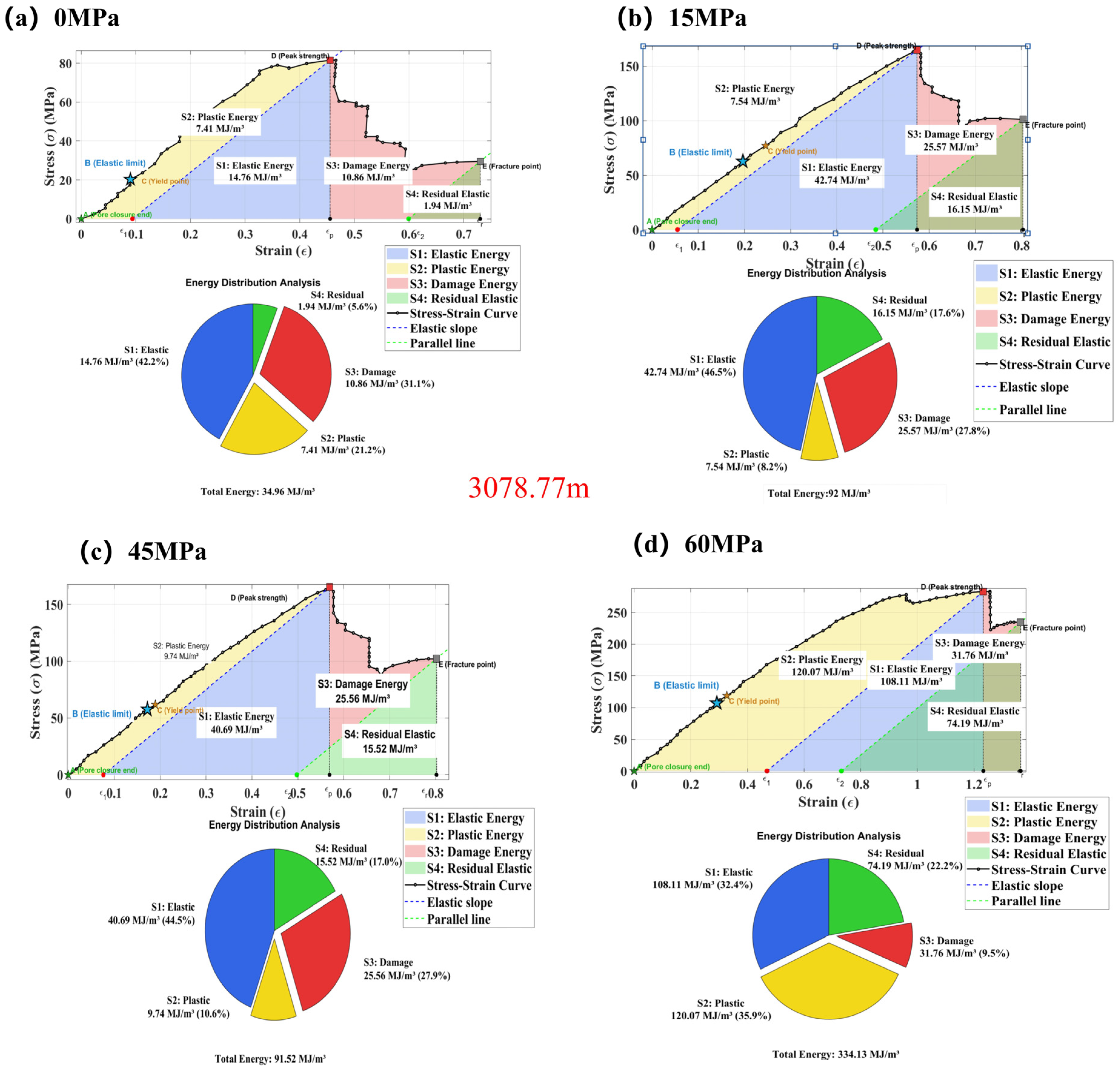
Figure 12 reveals the energy evolution of shale at 3078.77 m depth under confining pressures of 0–75 MPa. At 0 MPa, elastic energy (S1 = 14.76 MJ/m3, 42.2%) and damage energy (S3 = 10.86 MJ/m3, 31.1%) dominate energy allocation, while plastic energy (S2 = 7.41 MJ/m3, 21.2%) is distinctly present. This challenges the conventional notion of “complete absence of plastic energy,” revealing the heterogeneous brittle-plastic coupled failure mechanism in deep shales under low pressure. At 15 MPa confining pressure, damage energy remains elevated (S3 = 25.57 MJ/m3, 27.8%), but plastic dissipation shows only a marginal increase to 7.54 MJ/m3 (8.2%), with cumulative energy reaching 92.00 MJ/m3. By 45 MPa, plastic energy (S2 = 9.74 MJ/m3) still lags behind damage energy (S3 = 25.56 MJ/m3), accounting for 10.6% and 27.9%, respectively. Energy allocation continues to be dominated by damage-elastic synergy (S1 + S3 = 72.4%). Finally, under 75 MPa high confining pressure, plastic dissipation energy surges to 120.07 MJ/m3 (35.9%), while damage energy plummets to 31.76 MJ/m3 (9.5%). This confirms that high confining pressure drives brittle-ductile transition by suppressing crack propagation (65.4% reduction in S3 vs. 0 MPa) and activating mineral sliding (1520% increase in S2). Compared to the 3029.9 m sample, plastic dissipation at this depth increases by 45.9% (120.07 vs. 82.28 MJ/m3) under 75 MPa, validating that ν = 0.22 enhances plastic flow by reducing sliding energy barriers. However, depth-dependent heterogeneity in rock energy capacity (334.13 vs. 273.80 MJ/m3) suggests potential interference from mineral composition and structure on ν -regulated effects.
Based on the energy evolution patterns of three depth-specific samples (3007.7 m, 3029.9 m, and 3078.77 m) across confining pressure gradients of 0–75 MPa, this study systematically integrates stress–strain responses with energy allocation signatures to establish Table 5: Shale Energy Component Characteristics Under Coupled Confining Pressure-Depth Conditions. This dataset lays the quantitative foundations for subsequent Table 6: Rock Brittle-Ductility Evaluation Based on the PNE-BI Model.
Leveraging authentic stress–strain responses and energy evolution data, this study rigorously validates the Poisson’s Ratio-regulated Energy Brittleness Index (PNE-BI) model. Comprehensive analysis in Table 6 demonstrates that PNE-BI values precisely map brittle-ductile transitions, e.g., at 3029.9 m depth ( ν = 0.16) under 0 MPa confinement, PNE-BI = 0.956 (high-brittle zone) aligns with tensile splitting failure, while at 3078.77 m ( ν = 0.22) under 75 MPa, PNE-BI = 0.314 (ductile zone) corresponds to grain-sliding-dominated plasticity. The Poisson’s ratio enhancement factor λ( ν ) critically governs plastic dissipation—as ν increases from 0.15 to 0.22, λ( ν ) rises by 25.0% (0.971→1.214). At 3078.77 m/75 MPa, E p l a s t i c (194.26 MJ/m3) reaches 1.8 times E p e a k (108.11 MJ/m3), suppressing PNE-BI to 0.314. Confining pressure independently drives transitions: for the ν = 0.15 sample at 3007.7 m, PNE-BI increases from 0.479 (0 MPa) to 0.581 (75 MPa), indicating that the rock remains within the Brittle-Ductile Transition regime rather than shifting to ductile-dominated behavior.
Notably, the 3029.9 m sample exhibits PNE-BI = 0.956 (brittle) at 0 MPa but stabilizes at 0.420–0.630 (transitional) under 15–75 MPa; similarly, at 3078.77 m/45 MPa, PNE-BI = 0.572 reflects transitional behavior, confirming the model’s sensitivity to continuous energy evolution. Across all 12 datasets in Table 5, PNE-BI-predicted states fully match observed failure modes, with critical transitions accurately captured—e.g., 3007.7 m/15 MPa (PNE-BI = 0.390→ductile) and 3078.77 m/75 MPa (PNE-BI = 0.314→ductile). This empirically substantiates PNE-BI’s capacity to decouple energy rebalancing via a single parameter ( ν ), establishing a quantitative tool for deep shale fracturing design.

5. Field Application and Discussion

5.1. Representativeness of Thresholds

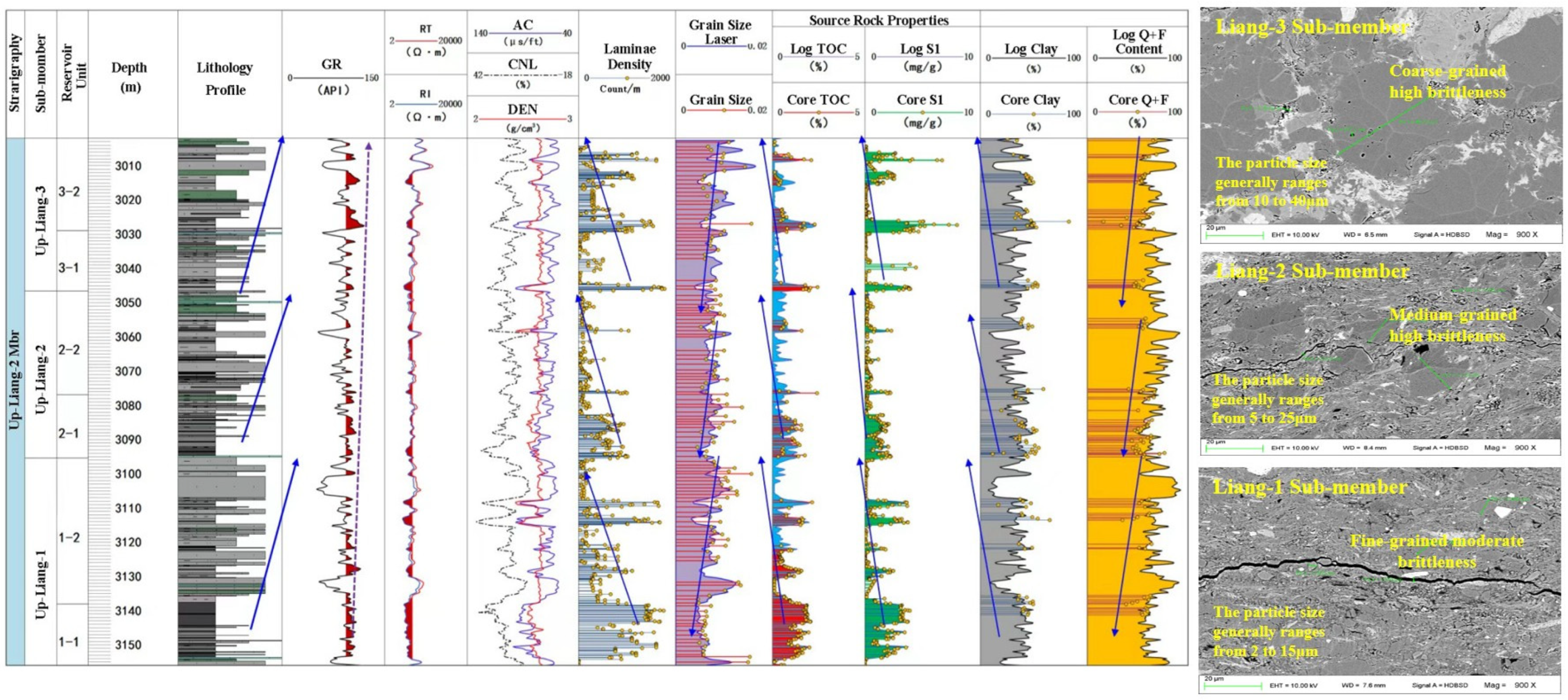
A critical prerequisite for extending the PNE-BI model from laboratory scale to field engineering is ensuring the statistical representativeness of the proposed Poisson’s ratio thresholds (i.e., Brittle: ν < 0.16; Transition: 0.16 < ν < 0.20; Ductile: ν > 0.20). While the constitutive relationships were derived from discrete triaxial tests, their validity across the heterogeneous formation was rigorously calibrated against the continuous lithological and mineralogical logging profile of the Pingye-1 Well, which spans the entire reservoir section of the Liangshang Formation (Figure 13). As visually demonstrated in the “Whole Rock Mineralogy” track, the three core samples selected for mechanical testing function as “lithological anchors” that capture the distinct mineralogical evolution of the formation.
Specifically, the interval above 3030 m corresponds to the depth of Sample 1 (3007.7 m), where continuous logging curves reveal a dominance of rigid framework minerals, with Quartz and Feldspar (Q + F) content consistently exceeding 65% (indicated by the extensive yellow fill) and clay content remaining below 25%. This mineralogical rigidity restricts lateral deformation under axial stress, confirming that the threshold of ν approx 0.15 effectively characterizes the high-brittleness siltstone facies. In sharp contrast, the deep interval below 3070 m, corresponding to Sample 3 (3078.77 m), exhibits a distinct transition where clay mineral content (gray fill) surges to over 40%, accompanied by a reduction in rigid minerals. This significant enrichment in phyllosilicates (mainly Illite) structurally weakens the rock matrix and reduces frictional resistance between grains, thereby facilitating plastic flow. This material evidence justifies the higher Poisson’s ratio threshold ( ν > 0.22) for identifying the ductility-dominated regime. Consequently, the alignment between our discrete PNE-BI thresholds and the continuous formation-scale mineralogical trends validates that the proposed model is not based on random outliers but is statistically representative of the intrinsic material evolution governed by burial depth and mineralogy.

5.2. Quantitative Fracture Characterization and Field Verification

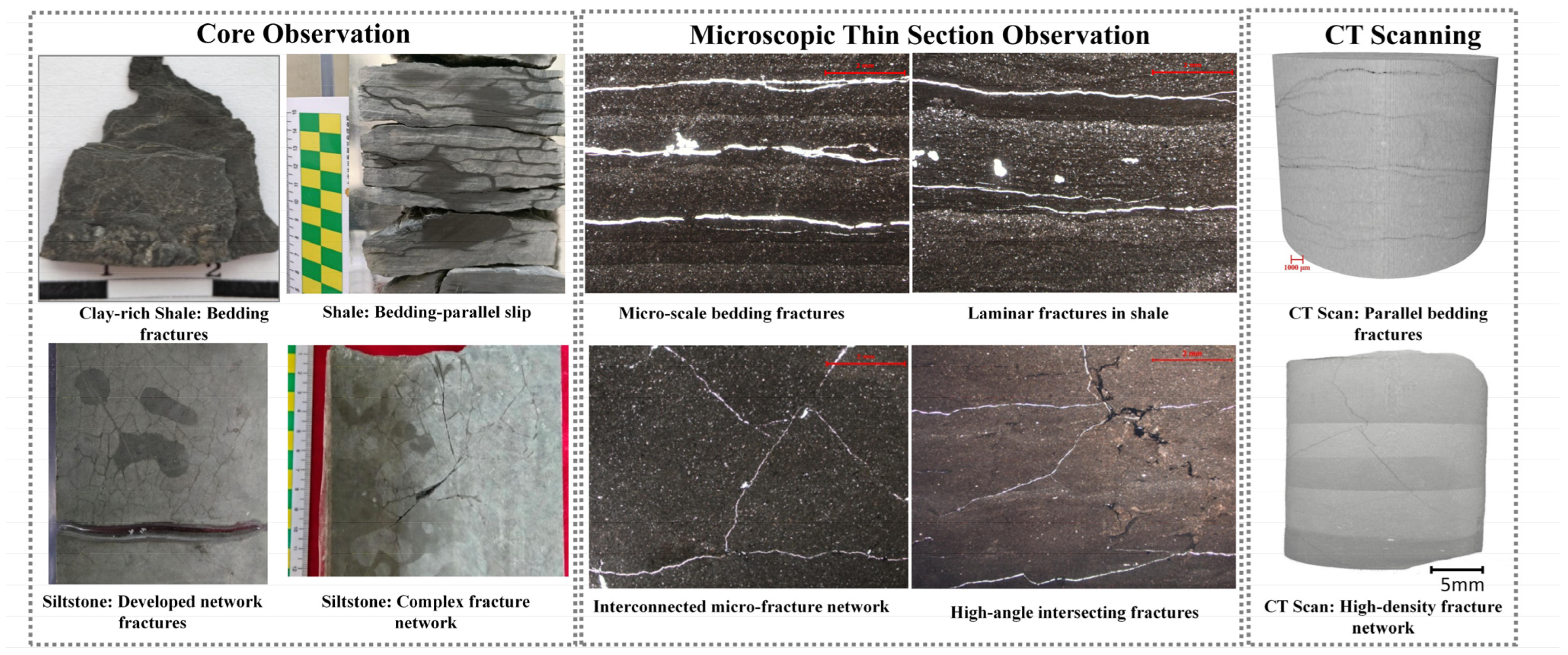
To physically verify the failure modes predicted by the PNE-BI model, we performed a multi-scale characterization using X-ray Computed Tomography (CT), thin-section microscopy, and core observation. Representative core samples were selected from distinct lithological units—specifically the quartz-rich siltstone facies (analogous to the brittle regime) and the clay-rich shale facies (analogous to the ductile regime)—to capture the characteristic fracture morphologies governed by mineralogical brittleness (Figure 14).
The imaging results reveal two distinct fracture mechanisms that strictly corroborate the model predictions:
Validation of Brittle Network Formation (High PNE-BI):The samples selected from the Siltstone Facies (mechanically equivalent to the low- ν high-PNE-BI zone) exhibit a complex “Network Fracture” geometry. As shown in the lower panels of Figure 14, quantitative CT analysis reveals a high fracture surface density of 8000–21,000/m2 and fracture widths ranging from 30 to 300 μ m . This physical evidence confirms that in the rigid siltstone intervals, strain energy is dissipated through the creation of extensive, interconnected volumetric surfaces, validating the model’s capability to identify hydraulic fracturing “sweet spots.”
Validation of Ductile Bedding Slip (Low PNE-BI): In contrast, samples from the Clay-rich Shale Facies (representative of the high- ν , low-PNE-BI zone) display a dominance of “Bedding-Parallel Fractures.” The deformation is strictly localized along laminar planes, characterized by a significantly lower linear fracture density (500–1000 lines/m) and simple planar geometry. This morphology validates the “plastic shielding effect” predicted by our model for clay-rich zones, where energy dissipation via laminar slip inhibits vertical fracture propagation and network complexity.
Consequently, the morphological contrast between the “Network” and “Bedding” modes serves as robust field evidence, confirming that the ν -driven PNE-BI model effectively distinguishes the fundamental failure mechanisms governing deep shale fracturing across different lithological facies.

5.3. Quantitative Sensitivity Analysis and Justification for the Single-Parameter Model

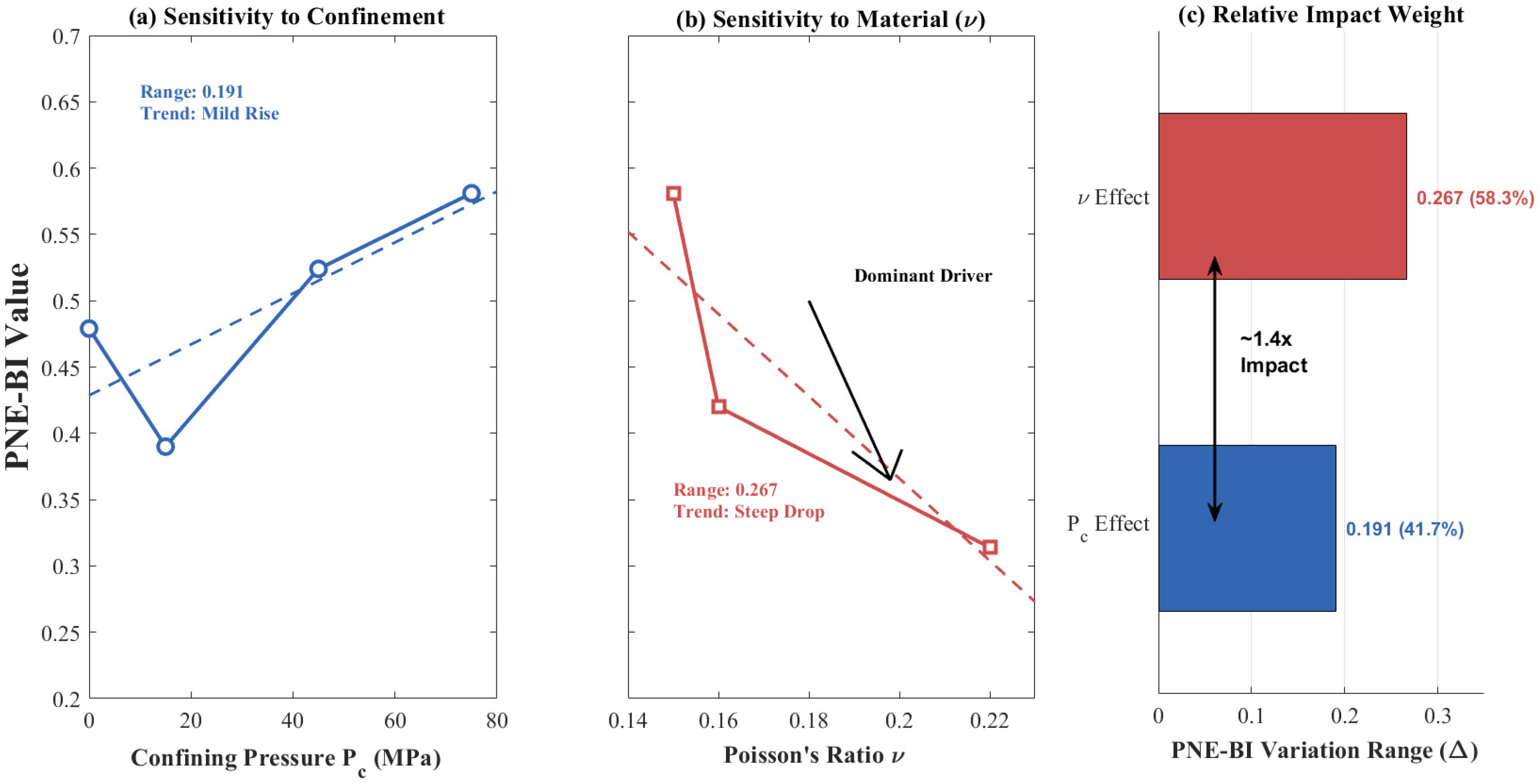
To quantitatively justify the use of Poisson’s ratio ( ν ) as the sole master variable for the PNE-BI model, we performed a decoupled sensitivity analysis comparing the relative impacts of confining pressure ( P c ) and material property ( ν ) on the brittleness index (Figure 15). As shown in Figure 15a, increasing the confining pressure from 0 to 75 MPa (for a constant brittle lithology) results in a relatively mild increase in the PNE-BI value, with a total variation range ( Δ P c ) of only 0.191 (from 0.390 to 0.581). This indicates that while P c enhances the energy magnitude, it does not fundamentally alter the energy partitioning mode. In sharp contrast, Figure 15b demonstrates that a small variation in Poisson’s ratio (from 0.15 to 0.22, representing the lithological shift from siltstone to shale) triggers a steep drop in PNE-BI, with a variation range ( Δ ν ) of 0.267. The slope of the curve highlights that ν acts as a “switch” for the brittle-ductile transition. Figure 15c summarizes the relative impact weights. The variation driven by ν (58.3%) is approximately 1.4 times greater than that driven by P c (41.7%) even under extreme pressure changes. This dominant sensitivity confirms that ν is the primary governing parameter for brittleness evolution, justifying its selection as the single field-applicable indicator for the PNE-BI model.

5.4. Limitations and Future Scope

Despite the successful validation, two limitations warrant consideration for field application. First, the critical thresholds (ν < 0.16 for brittle, >0.20 for ductile) are empirically calibrated based on the specific quartz-clay mineralogical evolution of the Liangshang Formation (Figure 13). Since mineral compositions vary across different geological basins, we recommend a local calibration of the reference parameter (ν_ref) when transferring the PNE-BI model to other shale plays (e.g., marine Longmaxi or lacustrine Yanchang formations) to ensure prediction accuracy.
Second, the decoupled sensitivity analysis (Figure 15) indicates that while Poisson’s ratio is the master variable (58.3% impact weight), confining pressure retains a significant influence (41.7%) on the brittleness index. For ultra-deep reservoirs (>6000 m) exhibiting extreme in -situ stress gradients, the pressure-induced strengthening effect may become non-negligible. Future iterations of the model could benefit from incorporating a depth-dependent correction term into the enhancement factor λ(ν) to further refine diagnostics in extreme environments.

6. Conclusions

(1)
Poisson’s ratio ( ν ) emerges as the pivotal parameter governing brittle-ductile transition in deep shale, with triaxial experimental data confirming its systematic increase with depth—directly controlling fundamental shifts in rock failure modes. At ν < 0.16 (brittle zone), failure manifests as tensile-dominated longitudinal splitting. When ν reaches the critical threshold of 0.16–0.20 (transitional zone), failure shifts to conjugate shear. At ν > 0.22, clay mineral hydration intensifies, reducing intergranular sliding resistance; plastic flow dissipates > 70% of energy, triggering barreling deformation and suppressing macroscopic fracture. Energy evolution analyses (Figure 8, Figure 9 and Figure 10) reveal that rising ν weakens rock resistance to volumetric compression, inhibits brittle dilatant crack propagation, and redirects energy dissipation paths from elastic storage to plastic-damage synergy, ultimately driving the brittle-ductile transition.
(2)
The proposed Poisson’s Ratio-regulated Energy-based Brittleness Index (PNE-BI) uses ν as its sole input parameter. Through the innovative formula PNE - BI = E peak E peak + E plastic · λ ν (where λ ( ν ) = 1   -   2 ν ref 1   -   2 ν ( ν < 0.5 ) , the model quantifies energy rebalancing for engineering-grade diagnostics. The model validity was rigorously verified through multi-scale independent data. On the formation scale, the model accurately segmented the continuous lithological profile, aligning strictly with mineralogical boundaries (Quartz-rich vs. Clay-rich). On the micro-scale, physical CT scanning confirmed that the predicted brittle/ductile states correspond precisely to the transition from complex network fracturing to simple bedding-parallel slip. Increased ν elevates plastic dissipation efficiency (λ(ν) ↑ 25.0% as ν ↑ 0.15 → 0.22), significantly suppressing crack growth (S3 damage energy ↓ 65.4% at 3078.77 m/75 MPa versus 0 MPa), and reveals ν-confinement synergy: confining pressure enhances elastic storage when ν < 0.16 (PNE-BI ↑ 21.3% at 3007.7 m), maintaining the transitional state, whereas depth effects accelerate ductility when ν ≥ 0.22 (PNE-BI = 0.314 at 3078.77 m). Unlike traditional multi-variable models (e.g., Table 1’s Drucker-Prager), PNE-BI requires only conventional-log-derived ν, bypassing complex integrals to provide real-time quantitative criteria for deep fracturing.
(3)
The synergy between rising confinement and increasing depth systematically reshapes energy evolution pathways (Figure 8, Figure 9 and Figure 10). High confinement (>45 MPa) markedly suppresses brittle fracture, reducing elastic energy (S1) from 47.2% (68.89 MJ/m3) at 3007.7 m/0 MPa to 48.7% (147.70 MJ/m3) at the same depth under 75 MPa, while plastic (S2) and damage energies (S3) jointly account for substantial dissipation (S2 + S3 = 35.7% at 75 MPa). Depth effects amplified via rising ν dramatically intensify damage: under 0 MPa confinement, S3 energy surges 44-fold (from 0.7%/0.96 MJ/m3 at ν = 0.15 to 31.1%/10.86 MJ/m3 at ν = 0.22), exposing reduced microcrack initiation barriers due to deep clay hydration (Figure 10 red zones). Ultimately, dissipation paths exhibit depth-dependent transitions: shallow zones (3007.7 m) prioritize elastic storage; deep zones (3078.77 m) emphasize damage-plasticity under low confinement; and high confinement (75 MPa) shifts dominance to plastic dissipation.

Author Contributions

Conceptualization, B.L., J.L., X.C. and T.W.; Methodology, J.F.; Investigation, B.L.; Resources, J.Z.; Data curation, H.S.; Writing—original draft, J.W.; Writing—review & editing, B.G.; Visualization, H.S. and L.L.; Supervision, J.F. All authors have read and agreed to the published version of the manuscript.

Funding

This work was supported by the Joint Guidance Project of Natural Science Foundation of Heilongjiang Province (LH2024D008), Open Fund Project of National Key Laboratory of Multi-Resource Collaborative Green Exploitation of Continental Shale Oil (DQYT-1201002-2024-JS-1270).

Institutional Review Board Statement

Not applicable.

Informed Consent Statement

Not applicable.

Data Availability Statement

The original contributions presented in this study are included in the article. Further inquiries can be directed to the corresponding author.

Conflicts of Interest

Authors Bo Gao, Jiping Wang, Binhui Li, Junhui Li, Hongmei Shao, Xi Cao, Tangyu Wang and Junli Zhao were employed by the company PetroChina Daqing Oilfield Exploration and Development Research Institute. The remaining authors declare that the research was conducted in the absence of any commercial or financial relationships that could be construed as a potential conflict of interest.

References

  1. Ministry of Natural Resources of the People’s Republic of China. China Mineral Resources Report 2016; Geological Publishing House: Beijing, China, 2016. [Google Scholar]
  2. Suo, Y.; Wei, X.; Cao, W.; Pan, Z.; Hou, B.; Huang, B.; Li, Y. Review on specimen structure and bedding plane effects in mode-I fracture toughness testing of shale. Eng. Fract. Mech. 2025, 328, 111532. [Google Scholar] [CrossRef]
  3. He, X.; Chen, G.; Wu, J.; Liu, Y.; Wu, S.; Zhang, J.; Zhang, X. Deep shale gas exploration and development in the southern Sichuan Basin: New progress and challenges. Nat. Gas Ind. B 2023, 10, 32–43. [Google Scholar] [CrossRef]
  4. Lin, R.; Peng, S.; Zhao, J.; Jiang, H.; Ren, L.; Yu, Z.; Zhou, N.; Wu, J.; Song, Y.; Shen, C. Shale brittleness evaluation under high temperature and high confining stress based on energy evolution. Pet. Sci. Technol. 2025, 43, 989–1009. [Google Scholar]
  5. Handin, J. An application of high pressure in geophysics: Experimental rock deformation. Trans. ASME 1953, 75, 315–324. [Google Scholar] [CrossRef]
  6. Suo, Y.; Guan, W.; Dong, M.; Zhang, R.; Wang, K.; He, W.; Fu, X.; Pan, Z.; Guo, B. Study on the heat extraction patterns of fractured hot dry rock reservoirs. Appl. Therm. Eng. 2025, 262, 125286. [Google Scholar] [CrossRef]
  7. Sone, H.; Zoback, M.D. Mechanical properties of shale-gas reservoir rocks—Part 1: Static and dynamic elastic properties and anisotropy. Geophysics 2013, 78, D381–D392. [Google Scholar] [CrossRef]
  8. Li, D.; Han, Z.; Sun, X.; Zhou, T.; Li, X. Dynamic Mechanical Properties and Fracturing Behavior of Marble Specimens Containing Single and Double Flaws in SHPB Tests. Rock Mech. Rock Eng. 2019, 52, 1623–1643. [Google Scholar] [CrossRef]
  9. Wang, Y.; Zheng, X.; Song, M.; Li, Z.; Wang, L.; Jiao, H. Experimental Study on Influence of Loading Rate on Brittleness Indexes of Marble. J. Min. Sci. 2025, 61, 201–215. [Google Scholar] [CrossRef]
  10. He, M.; Zuo, J.; Yuan, Z.; Ma, X.; Zhang, Z.; Ma, C. Criterion for residual strength and brittle-ductile transition of brittle rock under triaxial stress conditions. Geoenergy Sci. Eng. 2024, 243, 213340. [Google Scholar] [CrossRef]
  11. Li, H.; Pel, L.; You, Z.; Smeulders, D. Brittleness indices for chemically corroded rocks under unloading confining pressure. Int. J. Mech. Sci. 2025, 288, 110032. [Google Scholar] [CrossRef]
  12. Duan, M.; Jiang, C.; Yin, W.; Yang, K.; Li, J.; Liu, Q. Experimental study on mechanical and damage characteristics of coal under true triaxial cyclic disturbance. Eng. Geol. 2021, 295, 106445. [Google Scholar] [CrossRef]
  13. Krajcinovic, D.; Silva, M.A.G. Statistical aspect of the continuous damage theory. Int. J. Solids Struct. 1982, 18, 551–562. [Google Scholar] [CrossRef]
  14. Rybacki, E.; Meier, T.; Dresen, G. What controls the mechanical properties of shale rocks?—Part II: Brittleness. J. Pet. Sci. Eng. 2017, 158, 14–28. [Google Scholar] [CrossRef]
  15. Suo, Y.; Su, X.H.; He, W.Y.; Fu, X.F.; Pan, Z.J. Fracability evaluation of sandstone-shale interbedded reservoir in Daqingzijing area, Songliao Basin. Chin. J. Rock Mech. Eng. 2024, 43, 2140–2151. [Google Scholar]
  16. Jaeger, J.C.; Cook, N.G.W.; Zimmerman, R.W. Fundamentals of Rock Mechanics, 4th ed.; Blackwell Publishing: Oxford, UK, 2007. [Google Scholar] [CrossRef]
  17. Singh, M.; Raj, A.; Singh, B. Modified Mohr–Coulomb criterion for non-linear triaxial and polyaxial strength of jointed rocks. Int. J. Rock Mech. Min. Sci. 2011, 48, 546–555. [Google Scholar] [CrossRef]
  18. Rybacki, E.; Meier, T.; Dresen, G. What controls the mechanical properties of shale rocks?—Part I: Strength and Young’s modulus. J. Pet. Sci. Eng. 2015, 144, 39–58. [Google Scholar] [CrossRef]
  19. Drucker, D.C.; Prager, W. Soil mechanics and plastic analysis or limit design. Q. Appl. Math. 1952, 10, 157–165. [Google Scholar] [CrossRef]
  20. Tang, C.A. Numerical simulation of progressive rock failure and associated seismicity. Int. J. Rock Mech. Min. Sci. 1997, 34, 249–261. [Google Scholar]
  21. Lemaitre, J. A continuous damage mechanics model for ductile fracture. J. Eng. Mater. Technol. 1985, 107, 83–89. [Google Scholar] [CrossRef]
  22. Cao, W.G.; Zhao, H.; Li, X.; Zhang, Y.J. Statistical damage model with strain softening and hardening for rocks under the influence of voids and volume changes. Can. Geotech. J. 2010, 47, 857–871. [Google Scholar] [CrossRef]
  23. Li, X.; Cao, W.G.; Su, Y.H. A statistical damage constitutive model for softening behavior of rocks. Eng. Geol. 2012, 143–144, 1–17. [Google Scholar] [CrossRef]
  24. Liu, Y.; Yang, G.; Wang, J.X.; Jiang, Y. Mohr-Coulomb elastoplastic damage constitutive model for rocks and its principal stress implicit return mapping algorithm. Rock Soil Mech. 2017, 38, 418–428. [Google Scholar] [CrossRef]
  25. Deng, J.; Gu, D.S. On a statistical damage constitutive model for rock materials. Comput. Geosci. 2011, 37, 122–128. [Google Scholar] [CrossRef]
  26. Tang, H.; Sun, Y.; Zhu, Y.; Zhang, C.; Li, J. A unified hardening/softening elastoplastic model for rocks undergoing brittle-ductile transition with strength-mapping and fractional plastic flow rule. Comput. Geotech. 2024, 173, 106501. [Google Scholar] [CrossRef]
  27. Feng, C.C.; Wang, Z.L.; Wang, J.G.; Lu, Z.T.; Li, S.Y. A thermo-mechanical damage constitutive model for deep rock considering brittleness-ductility transition characteristics. J. Cent. South Univ. 2024, 31, 2379–2392. [Google Scholar] [CrossRef]
  28. Liu, S.; Li, P.; Hu, K.; Zhao, L. Constitutive modeling of brittle–ductile transition in porous rocks: Formulation, identification and simulation. Acta Mech. 2023, 234, 2103–2212. [Google Scholar] [CrossRef]
  29. Li, M.; Peng, L.; Liu, D.; Zuo, J. Microstructure effect of mechanical and cracking behaviors on brittle rocks using image-based fast Fourier transform method. J. Rock Mech. Geotech. Eng. 2025, 17, 399–413. [Google Scholar] [CrossRef]
  30. Naeim, B.; Javadzade Khiavi, A.; Khajavi, E.; Taghavi Khanghah, A.R.; Asgari, A.; Taghipour, R.; Bagheri, M. Machine Learning Approaches for Fatigue Life Prediction of Steel and Feature Importance Analyses. Infrastructures 2025, 10, 295. [Google Scholar] [CrossRef]
  31. Wong, T.F.; Baud, P. The brittle-ductile transition in porous rock: A review. J. Struct. Geol. 2012, 44, 25–53. [Google Scholar] [CrossRef]
  32. Asadoullahtabar, S.R.; Asgari, A.; Tabari, M.M.R. Assessment, identifying, and presenting a plan for the stabilization of loessic soils exposed to scouring in the path of gas pipelines, case study: Maraveh-Tappeh city. Eng. Geol. 2024, 342, 107747. [Google Scholar] [CrossRef]
  33. Kafshgarkolaei, H.J.; Lotfollahi-Yaghin, M.A.; Mojtahedi, A. A modified orthonormal polynomial series expansion tailored to thin beams undergoing slamming loads. Ocean Eng. 2019, 182, 38–47. [Google Scholar] [CrossRef]
Figure 1. Schematic diagram of geological setting and coring location in Well Pingye-1.
Sustainability 18 00985 g001
Figure 2. Experimental Flowchart.
Sustainability 18 00985 g002
Figure 3. Stress–strain curves under varying confining pressures (0 MPa, 15 MPa, 45 MPa, and 75 MPa) at 3007.7 m depth in Well Pingye-1.
Sustainability 18 00985 g003
Figure 4. Stress–strain curves under varying confining pressures (0 MPa, 15 MPa, 45 MPa, and 75 MPa) at 3029.9 m depth in Well Pingye-1.
Sustainability 18 00985 g004
Figure 5. Stress–strain curves under varying confining pressures (0 MPa, 15 MPa, 45 MPa, and 75 MPa) at 3078.77 m depth in Well Pingye-1.
Sustainability 18 00985 g005
Figure 6. Poisson’s Ratio as a Function of Depth, Pingye-1 Well, Sichuan Basin.
Sustainability 18 00985 g006
Figure 7. Calibration and validation of the modified Mohr-Coulomb criterion: (a) Comparison between predicted and experimental differential stress showing ±20% confidence bounds; (b) Residual distribution analysis; (c) Evolution of differential stress (σ1–σ3) with confining pressure for samples from varying depths.
Sustainability 18 00985 g007
Figure 8. Schematic diagram of energy evolution (adapted from Ref. [15]).
Sustainability 18 00985 g008
Figure 9. Sensitivity analysis of the Poisson’s ratio enhancement factor λ ν under varying reference parameters ( ν r e f ).
Sustainability 18 00985 g009
Figure 10. Energy Partition Map for the 3007.7 m Sample Under Variable Confining Pressures.
Sustainability 18 00985 g010
Figure 11. Energy Partition Map for the 3029.9 m Sample Under Variable Confining Pressures.
Sustainability 18 00985 g011
Figure 12. Energy Partition Map for the 3078.77 m Sample Under Variable Confining Pressures.
Sustainability 18 00985 g012
Figure 13. Comprehensive lithological and mineralogical characterization of the Liangshang Formation in Well Pingye-1.
Sustainability 18 00985 g013
Figure 14. Continuous lithological and mineralogical logging profile with multi-scale microscopic validation of the Liangshang Formation in Well Pingye-1.
Sustainability 18 00985 g014
Figure 15. Quantitative sensitivity comparison of PNE-BI to confining pressure ( P c ) and Poisson’s ratio ( ν ).
Sustainability 18 00985 g015
Table 1. Summary of Research on Brittle-Ductile Constitutive Equations.
AuthorsMethod/ModelEquation/Key FeaturesSource
Drucker-PragerDrucker-Prager Elasto-Plastic ModelCaptures plastic flow/yield under high confinement; lacks accuracy for brittle failure (e.g., microcrack growth, post-peak softening) at low pressure[19]
Tang et al.Statistical Meso-Damage Mechanics ModelIntegrates statistical heterogeneity (Weibull) with damage mechanics to simulate progressive brittle fracture and crack propagation[20]
LemaitreContinuum Damage Mechanics (CDM)Tracks macroscale damage evolution based on effective stress; establishes the[21]
Cao et al.Statistical Damage-Void ModelIntegrates void evolution and volume changes into statistical damage mechanics to simulate both strain softening and hardening behaviors.[22]
Li et al.Statistical Softening Damage ModelIncorporates damage thresholds and statistical distribution to accurately simulate the strain-softening behavior and failure evolution of rocks.[23]
Cao Wengui et al.Statistical Damage ModelIncorporates loading conditions and rock properties; extended to simulate void-compaction strain softening[24]
Deng & GuMaxEnt Statistical Damage ModelProposes the Maximum Entropy Distribution (instead of Weibull) to describe micro-element strength for more flexible damage prediction.[25]
Tang et al.Fractional Plasticity BDT ModelUtilizes strength-mapping and fractional plastic flow rules to capture strain hardening/softening and brittle-ductile transition.[26]
Chen Liang et al.Granite Damage-Plasticity ModelModels brittle-ductile behavior in deep granite[27]
Liu H et al.Damage-Plastic Work CouplingSimulates concurrent damage accumulation and plastic flow under high pressure via energy dissipation[28]
Zhang L et al.Stiffness-Plasticity Coupling ModelUnifies brittle fracture and ductile flow using internal variables[29]
Li et al.Image-based FFT Micromechanical ModelReconstructs heterogeneous microstructure via Digital Image Processing (DIP) and Fast Fourier Transform (FFT) to predict nonlinear cracking behaviors.[30]
Wong & BaudMicromechanical Failure MechanismSystematically differentiates brittle faulting (dilatancy) from cataclastic flow (pore collapse) to describe the brittle-ductile transition in porous rocks.[31]
Table 2. Summary of Elastic Modulus, Poisson’s Ratio, Cohesion, and Internal Friction Angle for Specimens.
Sample ID (Depth)LithologyElastic Modulus (GPa)Poisson’s Ratio ν Cohesion (MPa)Internal Friction Angle (°)
Pingye-1 Well-3007.7 mInterbedded mud-silt Siltstone38.980.1571.525.98
Pingye-1 Well-3029.9 mInterbedded mud-silt43.710.1647.5030.44
Pingye-1 Well-3078.77 mInterbedded mud-silt34.210.2226.7034.46
Table 3. Correspondence Between Poisson’s Ratio Thresholds and Brittle-Ductile States.
ν RangeFailure ModeBrittle-Ductile StateMechanical Evidence
ν < 0.16Longitudinal splitting (Brittle-dominated)Brittle ZoneUniaxial residual strength ratio > 60%
0.16 ≤ ν ≤ 0.20Conjugate shear (Transition)Transition ZoneStrain hardening under confining pressure > 45 MPa
ν > 0.20Barreling deformation (Ductile-dominated)Ductile ZonePeak strain > 2.0%
Table 4. Scientific Basis for Poisson’s Ratio ( ν ) in Regulating Brittle-Ductile Behavior.
Mechanical QuantityExpression Relationship with ν Impact on Brittle-Ductile Transition
Bulk Modulus ( K ) K = E 3 ( 1 2 ν ) ν K Reduced volumetric stiffness → Enhanced compressibility over brittle dilatancy
Dilatancy Tendency Δ V V ( 1 2 ν ) ν Δ V V Suppresses brittle crack propagation → Promotes energy dissipation via plastic flow
Table 5. Shale Energy Component Characteristics Under Coupled Confining Pressure-Depth Conditions.
Core Sample Depth (m)Confining Pressure (MPa)S1
(MJ/m3)
S2
(MJ/m3)
S3
(MJ/m3)
S4
(MJ/m3)
Total Energy
(MJ/m3)
3007.7068.899.060.9665.85145.77
3007.71547.8040.7052.1036.40177.00
3007.745125.4033.9042.9083.30285.60
3007.775147.7061.8046.6047.50303.60
3029.9041.30040.401.9083.70
3029.91548.8011.2024.3017.50101.80
3029.94548.0012.0024.3017.30101.50
3029.97589.6782.2860.1241.74273.80
3078.77014.767.4110.861.9434.96
3078.771542.747.5425.5716.1592.00
3078.774540.699.7425.5615.5291.52
3078.7775108.11120.0731.7674.19334.13
Table 6. Rock Brittle-Ductility Evaluation Using PNE-BI Model.
Core Sample Depth (m)Confining Pressure (MPa)Poisson’s Ratio ν E p e a k (MJ/m3) E p l a s t i c (MJ/m3)λ( ν )PNE-BIPNE-BI TrendBrittleness State
3007.700.1568.8974.910.9710.479Brittle-Ductile TransitionBrittle-Ductile Transition Region
3007.7150.1547.8077.100.9710.390Distinct DuctilityDuctile Region
3007.7450.15125.40117.200.9710.524Brittle-Ductile TransitionBrittle-Ductile Transition Region
3007.7750.15147.70109.300.9710.581Brittle-Ductile TransitionBrittle-Ductile Transition Region
3029.900.1641.301.901.0000.956High BrittlenessBrittle Region
3029.9150.1648.8028.701.0000.630Moderate BrittlenessBrittle-Ductile Transition Region
3029.9450.1648.0029.301.0000.621Moderate BrittlenessBrittle-Ductile Transition Region
3029.9750.1689.67124.021.0000.420Brittle-Ductile TransitionBrittle-Ductile Transition Region
3078.7700.2214.769.351.2140.565Brittle-Ductile TransitionBrittle-Ductile Transition Region
3078.77150.2242.7423.691.2140.599Moderate BrittlenessBrittle-Ductile Transition Region
3078.77450.2240.6925.261.2140.572Brittle-Ductile TransitionBrittle-Ductile Transition Region
3078.77750.22108.11194.261.2140.314Distinct DuctilityDuctile Region
Disclaimer/Publisher’s Note: The statements, opinions and data contained in all publications are solely those of the individual author(s) and contributor(s) and not of MDPI and/or the editor(s). MDPI and/or the editor(s) disclaim responsibility for any injury to people or property resulting from any ideas, methods, instructions or products referred to in the content.