1. Introduction
In today’s turbulent and highly competitive markets, the long-term viability of new ventures depends on entrepreneurs’ ability to adapt, learn, and act effectively under uncertainty [
1]. The process of new venture development requires founders to continuously reconfigure their strategies, resources, and processes to respond to environmental changes [
2]. Within this context, improvisation—defined as the spontaneous and creative integration of planning and execution in response to unforeseen events [
3]—has emerged as a vital behavioral capability that enables entrepreneurs to act decisively and innovatively under pressure [
4,
5]. The entrepreneurial environment, however, is often characterized by constraints such as limited resources, time pressure, and volatile market conditions, all of which make survival and long-term performance particularly challenging for new ventures [
6,
7]. In such contexts, improvisation serves not merely as a short-term adaptive response but as a strategic capability that enhances the enduring competitiveness and resilience of start-ups. Moreover, improvisation becomes especially essential during the early stages of venture development, when firms lack formalized routines and face heightened uncertainty in shaping their business models, market positioning, and growth trajectories [
8].
Beyond internal operational challenges, new ventures also navigate increasingly complex entrepreneurial ecosystems characterized by “dynamic coopetition,” wherein firms simultaneously collaborate with and compete against established players [
9]. Such environments compel entrepreneurs to improvise not only in operational decision-making but also in leveraging alliances, adapting partnership strategies, and mobilizing relational and market-based resources in real time [
10,
11]. These shifting competitive–collaborative dynamics intensify the need for rapid judgment, creative adaptation, and strategic flexibility—further reinforcing the centrality of improvisation in ensuring competitive endurance and economic resilience over time.
Despite the growing recognition of improvisation as a core entrepreneurial capability, its influence on new venture performance remains conceptually and empirically ambiguous. Prior studies have yielded mixed findings—some highlight the positive performance implications of improvisation [
2,
7], while others suggest that improvisation can be detrimental or context-dependent [
12,
13]. This inconsistency points to the need for a deeper understanding of the psychological and learning mechanisms through which improvisation contributes to enduring entrepreneurial success [
14]. Specifically, inconsistent findings suggest that improvisation may benefit certain entrepreneurs more than others depending on their cognitive beliefs, learning orientations, and situational contexts. Scholars have increasingly emphasized that the outcomes of improvisation hinge on how entrepreneurs interpret and learn from their actions, and on the cognitive belief systems that facilitate or constrain the translation of improvisation into performance benefits [
6,
14,
15]. This line of inquiry is especially relevant for new ventures in emerging economies such as Turkey, where entrepreneurs operate under severe resource scarcity, institutional uncertainty, and intense competition [
16,
17]. In such settings, improvisation may be a necessity rather than an optional strategy, yet its effectiveness depends on underlying psychological capabilities and adaptive learning behaviors that remain insufficiently theorized.
To address these conceptual gaps, the present study draws upon the Knowledge-Based View (KBV) and Social Learning Theory (SLT) to explain how and under what conditions improvisation enhances new venture performance, conceptualized here as long-term economic viability, growth, and competitiveness [
18]. From a KBV perspective, knowledge is viewed as a strategic resource that enables entrepreneurs to creatively recombine existing insights to respond to environmental uncertainty [
19]. Improvisation, therefore, represents the dynamic and creative application of knowledge-in-action, enabling entrepreneurs to leverage tacit and experiential knowledge in real time to address emerging challenges [
15]. This aligns with the KBV proposition that organizations gain advantage not through static resources but through the skillful deployment, recombination, and renewal of knowledge under dynamic conditions [
20].
Complementarily, SLT [
21] emphasizes that individuals cultivate confidence in their abilities through mastery experiences, feedback, and social modeling. Improvisation naturally generates such mastery episodes, exposing entrepreneurs to high-pressure situations where success reinforces their self-belief and enhances perceived capability across future tasks [
22]. When entrepreneurs witness the positive outcomes of spontaneous problem-solving—such as resolving crises, addressing customer needs, or capitalizing quickly on emerging opportunities—their entrepreneurial self-efficacy is strengthened, thereby improving performance-oriented motivation and persistence [
23]. Thus, entrepreneurial self-efficacy constitutes a key psychological pathway through which improvisation translates into sustained economic outcomes.
However, improvisation does not uniformly lead to performance improvements. Its effectiveness depends critically on an entrepreneur’s learning orientation—particularly their level of relative explorative learning, characterized by the pursuit of novel knowledge, experimentation beyond established routines, and exploration of unfamiliar domains [
24,
25]. Entrepreneurs who engage in high levels of explorative learning are more likely to interpret improvisational actions as learning opportunities, extract valuable insights, and transform these insights into improved judgment and creative problem-solving. Explorative learning strengthens an entrepreneur’s capacity to evaluate improvisational outcomes, update cognitive schemas, and apply acquired knowledge in subsequent strategic decisions—thereby amplifying the benefits of improvisation [
26]. Conversely, entrepreneurs with low explorative learning orientation may perceive improvisational actions as isolated events rather than developmental experiences, limiting their ability to convert improvisation into meaningful performance gains [
27,
28].
Given these considerations, this study investigates the psychological and learning-based mechanisms that shape the improvisation–performance link and addresses the following research questions:
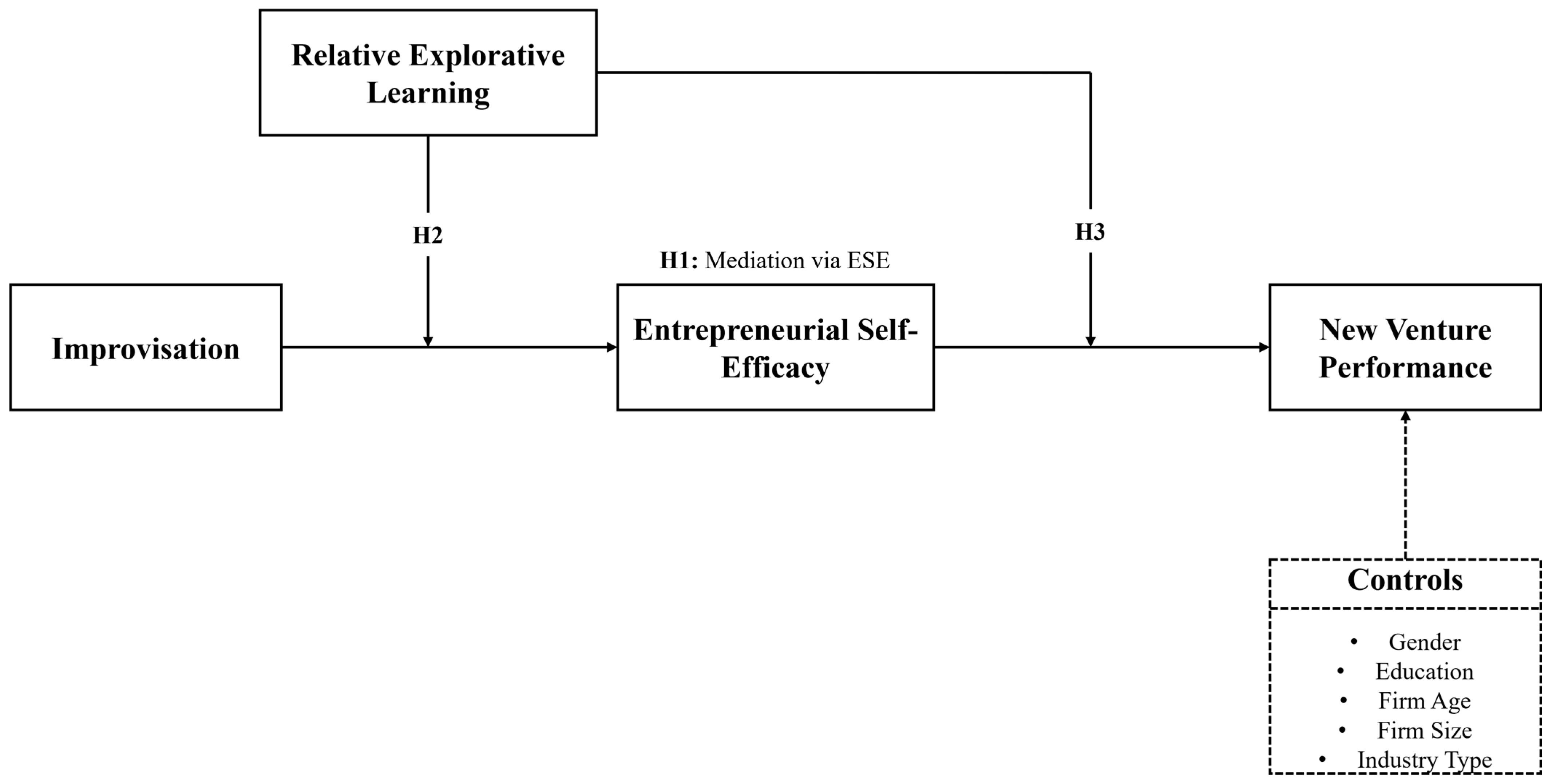
RQ1: Does entrepreneurial self-efficacy mediate the relationship between improvisation and new venture performance?
RQ2: Does relative explorative learning strengthen the effect of improvisation on entrepreneurial self-efficacy?
RQ3: Does relative explorative learning condition the indirect effect of improvisation on new venture performance through entrepreneurial self-efficacy?
Overall, this study contributes to entrepreneurship and organizational behavior research in several ways. First, it clarifies the psychological mechanism—entrepreneurial self-efficacy—through which improvisation produces performance benefits, offering a theoretically grounded explanation for previously inconsistent empirical findings. Second, it integrates KBV and SLT to present a unified framework linking knowledge application, learning orientation, and cognitive beliefs as drivers of adaptive entrepreneurial behavior. Third, by incorporating relative explorative learning and positioning improvisation within the broader context of dynamic coopetition, the study identifies critical boundary conditions under which improvisation enhances new venture performance. Fourth, by focusing on Turkish start-ups, the study highlights how entrepreneurs in resource-constrained environments leverage improvisational behavior and learning orientation to sustain competitive performance and long-term venture success amid institutional volatility. Finally, this research advances existing improvisation–performance models by specifying a moderated mediation structure: it theorizes and empirically tests how entrepreneurial self-efficacy serves as the psychological pathway linking improvisation to new venture performance, and how relative explorative learning conditions both the strength of this pathway and the magnitude of the resulting indirect effects. By validating this conditional indirect mechanism using a two-wave design in an emerging-market setting, the study offers a novel and analytically rigorous contribution to understanding when and how improvisation generates enduring entrepreneurial advantages.
5. Discussion and Implications
5.1. Discussion of Findings
This study advances the entrepreneurship literature by developing and empirically validating a model that links improvisation, entrepreneurial self-efficacy, and new venture performance through the theoretical lenses of the KBV and SLT. By examining entrepreneurial self-efficacy as a mediating mechanism and relative explorative learning as a boundary condition, the study elucidates how cognitive and learning processes jointly explain variability in early-stage venture outcomes. This integrated framework suggests that entrepreneurs’ ability to act spontaneously, believe in their capacity to manage uncertainty, and engage in exploration-oriented learning collectively form a capability set that enhances adaptation in dynamic environments. These insights enrich existing perspectives by showing how immediate behavioral responses, internal psychological evaluations, and learning-oriented behaviors work together to support entrepreneurs seeking long-term performance and competitive endurance, extending prior models that treat these components as isolated rather than interdependent processes.
The findings indicate that improvisation positively influences new venture performance, supporting recent evidence that reframes improvisation as a forward-looking entrepreneurial capability [
6] rather than a risky or destabilizing behavior [
36,
51]. This pattern may reflect contemporary venture conditions—particularly in emerging-market contexts—where entrepreneurs often operate with limited resources and under substantial environmental volatility, making improvisation a pragmatic and strategically valuable response to rapidly changing circumstances [
8,
49]. Improvisation also enhanced entrepreneurial self-efficacy, revealing the cognitive underpinnings of spontaneous behavior. Consistent with SLT, engaging in trial-and-error problem solving provides mastery experiences that reinforce entrepreneurs’ perceived competence and control over uncertain business contexts [
133]. This interpretation positions improvisation as a developmental process through which repeated engagement in spontaneous action builds psychological readiness and strengthens future opportunity enactment, ultimately supporting stronger long-term venture performance.
The results further demonstrate that entrepreneurial self-efficacy strengthens new venture performance, affirming prior studies that highlight the pivotal role of self-belief in entrepreneurial decision quality, innovation, and opportunity exploitation [
31,
58]. From a KBV perspective, self-efficacy influences how entrepreneurs mobilize and apply knowledge resources to create value under uncertain conditions. The mediating mechanism identified in this study underscores that the benefits of improvisation do not translate directly into improved performance but rather emerge through entrepreneurs’ enhanced confidence, which shapes their persistence, decision speed, and willingness to allocate cognitive and material resources to improvised strategies. Entrepreneurs with higher self-efficacy appear better equipped to convert improvised ideas into viable solutions, reinforcing their ability to sustain competitive outcomes in uncertain environments [
23,
51,
59]. The consistency of this pathway across both the primary analysis and the latent-variable robustness checks provides compelling evidence that the psychological channel linking improvisation and performance is stable, meaningful, and theoretically coherent.
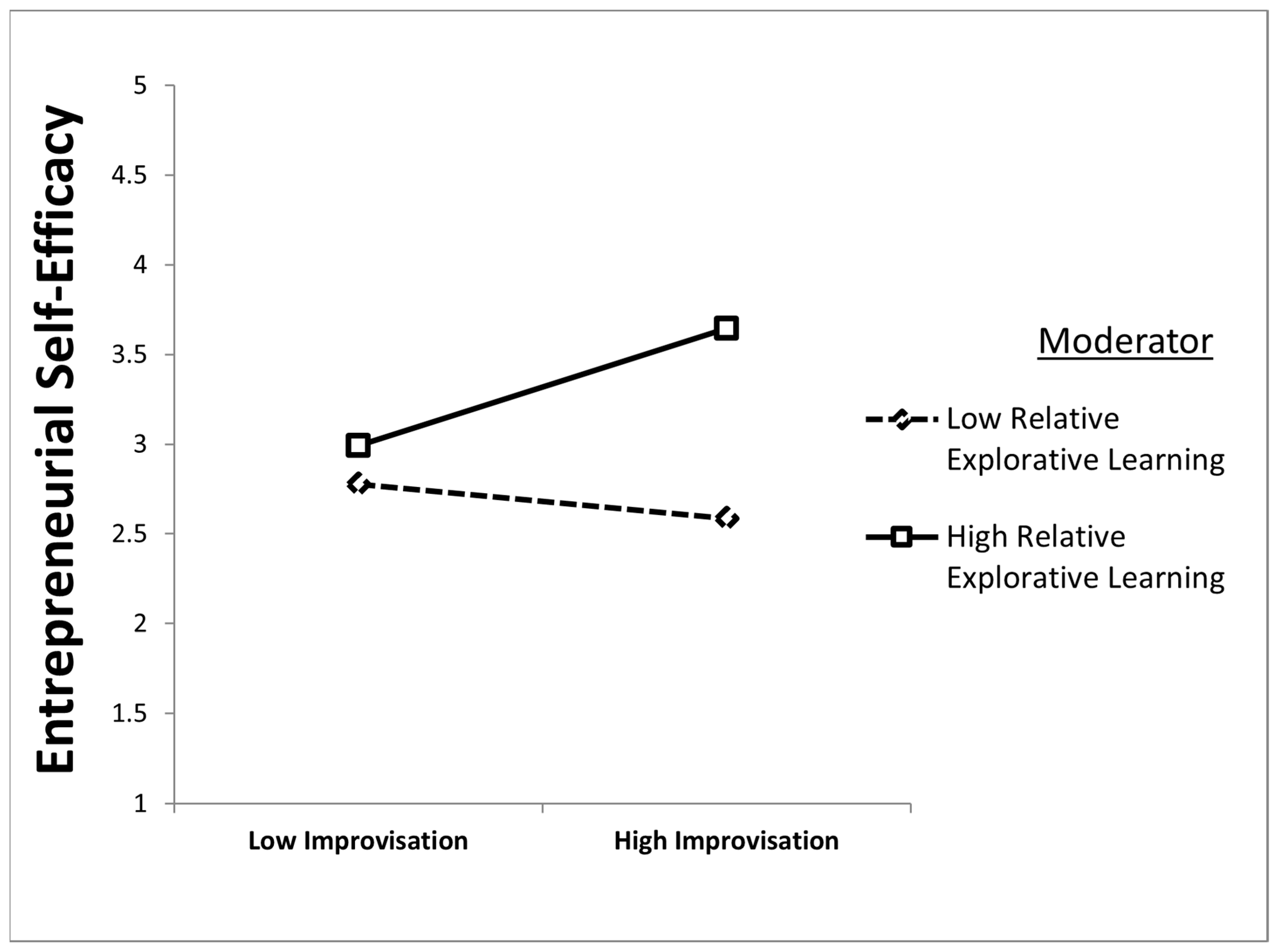
Furthermore, the moderating role of relative explorative learning reveals that learning orientation shapes the cognitive impact of improvisation. Entrepreneurs with high levels of explorative learning actively pursue new information, engage in experimentation, and challenge existing routines, making them more likely to interpret improvised actions as developmental experiences that build confidence. This finding aligns with KBV’s emphasis on the strategic importance of ongoing knowledge acquisition and integration for improving entrepreneurial judgment and opportunity enactment, suggesting that learning-oriented entrepreneurs derive more skill-enhancing value from resource-constrained improvisation [
78,
79]. When explorative learning is low, however, the cognitive benefits of improvisation weaken, implying that ventures relying heavily on routine-based behavior may struggle to translate spontaneous action into enhanced confidence or long-term performance gains [
69,
134]. This highlights that improvisation is not universally beneficial; rather, its psychological payoff depends critically on whether entrepreneurs maintain a mindset oriented toward continual learning, experimentation, and cognitive renewal.
At the same time, the findings suggest that improvisation may be less effective under certain boundary conditions that restrict entrepreneurs’ cognitive, temporal, or structural flexibility. Improvisation is likely to falter when founders operate under extreme cognitive overload, face stringent regulatory requirements, or work within highly formalized organizational structures that limit discretion and rapid adaptation. In such contexts, the costs of spontaneous action—including increased error likelihood, regulatory noncompliance, or disruption of established coordination patterns—may outweigh its potential benefits. This nuance aligns with research showing that improvisation is contingent on managerial discretion, supportive structures, and the availability of attentional resources, underscoring that its positive effects depend on the broader situational demands entrepreneurs face.
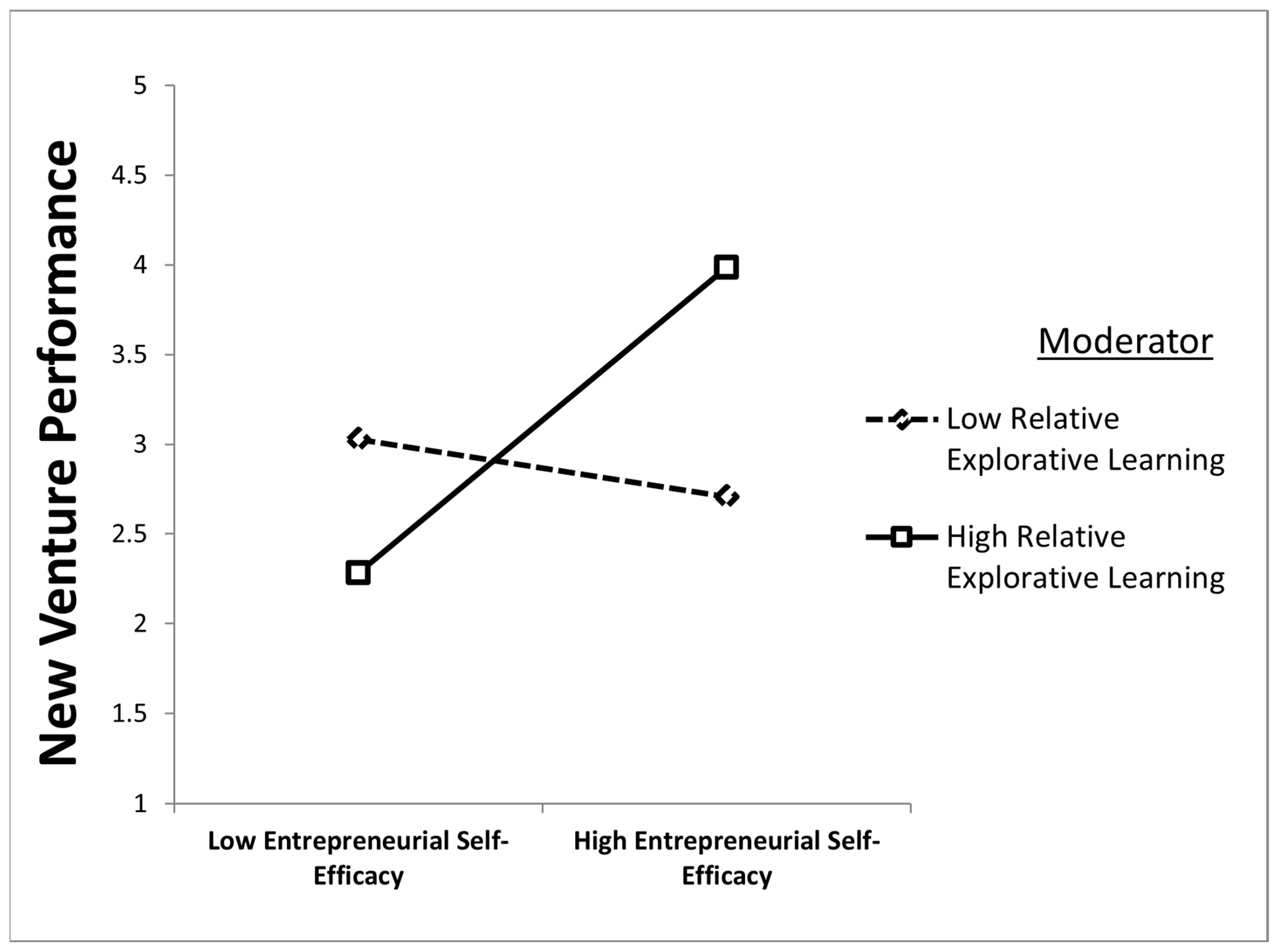
In addition, a supplementary exploratory result showed that relative explorative learning strengthened the relationship between entrepreneurial self-efficacy and new venture performance. Although not part of the hypothesized model, this observation suggests that learning orientation may further amplify the extent to which strong self-beliefs translate into tangible performance gains. This finding resonates with research indicating that cognitive and learning mechanisms often jointly influence entrepreneurial outcomes, and it raises promising avenues for future exploration into how learning-oriented founders convert psychological assets into sustained competitive advantage. Collectively, these results reveal a coherent interplay among improvisation, learning orientation, and entrepreneurial self-efficacy, illuminating how psychological readiness and continuous learning jointly enable entrepreneurs to transform spontaneous actions into enduring performance advantages.
5.2. Theoretical Implications
This research offers several theoretical contributions across the entrepreneurship and organizational behavior literatures. First, it broadens improvisation theory by demonstrating that improvisational behavior enhances new venture performance through a cognitively grounded mechanism rather than solely through rapid or unstructured action. Earlier research often portrayed improvisation as context-dependent and potentially risky [
36,
51], but the present findings show that its effectiveness is shaped by entrepreneurs’ confidence and their engagement with new knowledge. By integrating the KBV [
19] with SLT [
21], the study demonstrates that improvisation functions as a knowledge-activation process through which entrepreneurs generate experiential learning, refine judgment, and cultivate beliefs about their capacity to navigate uncertainty. This reconceptualization advances theoretical perspectives by positioning improvisation as a micro-level capability that blends creative action with cognitive interpretation, thereby explaining why improvisational behavior yields adaptive advantages even in resource-constrained settings.
Second, the study deepens entrepreneurial cognition research by establishing entrepreneurial self-efficacy as a central mediating mechanism linking improvisation to new venture performance. Prior research has highlighted self-efficacy as a powerful driver of entrepreneurial persistence and opportunity exploitation [
23,
31,
58], yet the literature has offered limited insight into how improvisation contributes to the development of such beliefs. The present findings clarify this pathway by showing that improvisational experiences operate as mastery episodes that strengthen entrepreneurs’ perceived ability to creatively solve problems. This insight enriches theoretical understanding of the behavior–outcome paradigm by demonstrating that improvisation generates performance benefits primarily through cognitive internalization rather than direct behavioral effects [
7,
15]. By framing entrepreneurial self-efficacy as the cognitive bridge between spontaneous action and firm-level outcomes, the study advances both KBV and SLT and provides a more precise account of how confidence emerges and is transformed into performance-enhancing behavior.
Third, this research contributes to learning-orientation theory by identifying relative explorative learning as a key boundary condition that shapes the psychological impact of improvisation. Although prior scholarship has recognized learning orientation as a broad strategic posture, its role in moderating cognitive mechanisms has remained less clearly articulated [
79,
82,
84]. The current findings demonstrate that high levels of explorative learning amplify the confidence-building effects of improvisation, whereas low levels weaken this psychological pathway. This theoretical nuance extends the KBV by specifying how knowledge acquisition and exploratory behavior interact with improvisation to influence performance outcomes [
69,
134]. Moreover, the exploratory observation that explorative learning strengthens the relationship between entrepreneurial self-efficacy and new venture performance indicates that learning orientation operates across multiple channels of capability development. This insight offers a clearer explanation of why improvisation benefits some entrepreneurs more than others—it is most effective when embedded in a mindset that prioritizes experimentation, curiosity, and the pursuit of novel knowledge.
Taken together, this study advances theoretical integration by demonstrating that improvisational action, cognitive appraisal, and learning orientation function as an interconnected system that drives new venture performance. By empirically validating a moderated-mediation structure in which improvisation enhances performance through entrepreneurial self-efficacy—and in which this psychological pathway is conditioned by relative explorative learning—the study provides a comprehensive and analytically distinctive contribution to improvisation research. This framework refines broader theories of entrepreneurial action by showing that the value of improvisation depends not only on behavioral flexibility but also on the cognitive and learning structures that shape how improvisational experiences are interpreted, absorbed, and translated into enduring venture gains.
5.3. Managerial Implications
This research offers several meaningful implications for entrepreneurs, managers, and policymakers seeking to enhance new venture performance. First, the results reaffirm that improvisation should be cultivated not merely as a reactive response but as a deliberate strategic orientation [
6] that equips entrepreneurs to cope with volatility, resource scarcity, and unexpected disruptions. Managers in early-stage firms can strengthen this capability by encouraging flexible thinking, rapid decision-making, and experimentation. Practical mechanisms—such as rapid-response huddles, real-time “option-generation” discussions, and short daily adaptation briefings—help transform spontaneous insights into coordinated action [
49,
51]. Establishing simplified approval pathways and empowering frontline members to make timely, informed decisions further embeds improvisation as a repeatable organizational capability rather than an ad hoc behavior. These practices create a work climate where improvisational action becomes intentional, structured, and aligned with strategic objectives.
Second, the mediating role of entrepreneurial self-efficacy highlights the importance of psychological capability development in converting improvisation into improved venture performance. Because self-belief shapes entrepreneurs’ persistence, problem-solving behavior, and willingness to act creatively under uncertainty [
135], managers should invest in interventions designed to strengthen confidence. Simulation-based training, mentorship from experienced founders, and reflective mastery logs can reinforce entrepreneurs’ perceived competence and facilitate continuous learning from improvisational experiences. By enhancing entrepreneurial self-efficacy, firms increase the likelihood that spontaneous actions translate into effective opportunity enactment and improved performance outcomes [
23,
59].
Third, the moderating role of relative explorative learning shows that improvisation yields its strongest benefits when the organizational environment actively supports exploration, experimentation, and knowledge renewal. Managers should design learning systems that extend beyond routine exploitation, incorporating diverse and uncertain knowledge sources. Monthly learning sprints, cross-functional innovation teams, and repositories that document improvisation episodes can enhance a venture’s ability to interpret and leverage spontaneous behavior [
5,
39,
83]. Because explorative learning amplifies the pathway from improvisation to entrepreneurial self-efficacy—and subsequently to new venture performance—managers should view exploration not only as a knowledge-acquisition mechanism but also as a catalyst that magnifies the psychological gains derived from improvisational action. This directly reflects the study’s moderated-mediation finding that learning orientation strengthens the cognitive impact of improvisation.
Finally, this study carries important implications for policymakers in emerging markets. Policies that encourage entrepreneurial creativity, capability development, and cross-industry knowledge exchange can cultivate environments where improvisation-based performance gains are more likely to emerge. Targeted investments in incubators and accelerators, training programs on adaptive problem-solving, and digital platforms for peer learning and mentorship can strengthen the improvisational, cognitive, and learning capabilities needed for enduring venture success. By fostering ecosystem-level supports that reinforce improvisation, self-efficacy, and learning orientation, policymakers can help entrepreneurs build stronger adaptive capacities and improve long-term competitiveness.
5.4. Limitations and Directions for Future Research
This study presents several limitations that provide meaningful pathways for advancing future research. The empirical setting—new ventures operating in Turkey—may limit the generalizability of the findings to entrepreneurial ecosystems shaped by different institutional logics, cultural norms, or economic structures. Future research should therefore test the robustness of this model across more diverse contexts, including developed economies and other emerging markets, to assess whether the effects of improvisation, entrepreneurial self-efficacy, and relative explorative learning vary systematically across environments. Furthermore, the demographic characteristics of the sample, which consisted predominantly of male entrepreneurs located in two major urban regions, indicate the need for broader representativeness to capture variations in gendered entrepreneurial experiences, regional disparities, and sectoral differences. Studies involving women-led ventures, family firms, or entrepreneurs from rural or technologically disadvantaged areas would provide a more nuanced understanding of how cognitive beliefs and learning orientation shape entrepreneurial behavior in heterogeneous settings. In addition, although this study centered on entrepreneurial self-efficacy as a mediating mechanism and relative explorative learning as a boundary condition, future studies could incorporate other psychological and behavioral processes—such as resilience, bricolage, adaptive expertise, or opportunity confidence—to expand the theoretical framework and better understand how entrepreneurs interpret and respond to uncertainty.
From a methodological perspective, although new venture performance was measured at Time 2 to mitigate common-method inflation, improvisation, entrepreneurial self-efficacy, and relative explorative learning were assessed concurrently at Time 1; therefore, reciprocal relationships—such as higher entrepreneurial self-efficacy leading to greater improvisational behavior—cannot be fully ruled out. Future research employing multi-wave longitudinal designs or cross-lagged panel models would allow for stronger causal inference and a more precise examination of the dynamic interplay between improvisation and entrepreneurial cognition over time. Moreover, new venture performance was measured using founder-reported subjective indicators, which may inflate observed associations due to perceptual bias; future studies could strengthen validity by incorporating objective performance metrics (e.g., sales growth, profitability, survival rates) or multi-informant designs drawing on external records or investor assessments.
Future research would also benefit from methodological extensions that capture the temporal and contextual dynamics underlying improvisation and learning. Mixed-method approaches—including diary studies, real-time logging of improvisational decisions, or qualitative post-mortem analyses—could offer deeper insights into how entrepreneurs cognitively process unexpected challenges and translate unplanned actions into capability-building routines. Future investigations may also examine additional contextual moderators, such as technological turbulence, digital capability, entrepreneurial culture, or governance mechanisms, which may shape the strength of the mediation (improvisation → self-efficacy → performance) and the moderation (improvisation × explorative learning) uncovered in this study. Collectively, these directions would help build a richer, multi-layered understanding of the mechanisms and contexts through which improvisational action supports long-term entrepreneurial success.
6. Conclusions
This study provides a comprehensive understanding of how improvisation enhances new venture performance and the conditions under which its impact is most effective. The findings show that improvisation improves performance primarily by strengthening entrepreneurial self-efficacy, indicating that confidence, judgment, and perceived capability play a critical role in translating spontaneous action into meaningful outcomes. Engaging in improvisational behavior places entrepreneurs in unpredictable situations where they must respond rapidly, experiment with emerging opportunities, and rely on adaptive decision-making. Through these repeated real-time encounters, entrepreneurs develop mastery experiences that reinforce their confidence and shape their ability to navigate uncertainty effectively. This demonstrates that the value of improvisation is not limited to immediate crisis response; instead, it serves as a developmental process that cultivates psychological readiness, perseverance, and strategic judgment. By highlighting entrepreneurial self-efficacy as the central mechanism, the study clarifies the internal pathway through which improvisation contributes to improved new venture performance.
The study also clarifies the conditions that enhance or weaken the influence of improvisation, pointing to relative explorative learning as a key boundary factor. Entrepreneurs who actively pursue new knowledge, test unfamiliar approaches, and challenge established routines are better equipped to transform improvisational actions into capability-building experiences. Higher levels of explorative learning intensify the confidence-building effect of improvisation, enabling entrepreneurs to convert spontaneous actions into sustained performance advantages, whereas lower levels restrict this developmental process and limit the effectiveness of improvisation. Further evidence indicates that explorative learning not only shapes the impact of improvisation but also strengthens the link between entrepreneurial self-efficacy and performance, suggesting that learning orientation reinforces multiple stages of entrepreneurial development. Taken together, these insights show that improvisation, confidence formation, and learning orientation function as an interconnected system, providing a complete explanation of when and how spontaneous entrepreneurial action contributes to enhanced new venture performance and long-term success.