Article

Improvisation and New Venture Performance: Unpacking the Roles of Entrepreneurial Self-Efficacy and Learning Orientation

Department of Business Administration, Institute of Graduate Research and Studies, University of Mediterranean Karpasia, Via Mersin 10, 33010 Lefkosa, Turkey
*
Author to whom correspondence should be addressed.
Sustainability 2026, 18(2), 975; https://doi.org/10.3390/su18020975
Submission received: 24 October 2025 / Revised: 13 December 2025 / Accepted: 30 December 2025 / Published: 18 January 2026

Abstract

New ventures operating in volatile and unpredictable environments must rely on rapid adaptation and decisive action, making improvisation a critical entrepreneurial capability. This study examines how improvisation enhances new venture performance by uncovering the psychological and learning-based mechanisms through which its effects unfold. Drawing on the Knowledge-Based View (KBV) and Social Learning Theory (SLT), the model proposes that improvisation strengthens entrepreneurial self-efficacy, enabling entrepreneurs to approach uncertainty with greater confidence and adaptive judgment. Using a two-wave survey of 322 startup founders in Turkey and analyses conducted through PROCESS and complementary SEM estimation, the findings show that improvisation significantly boosts both entrepreneurial self-efficacy and new venture performance. Entrepreneurial self-efficacy emerges as a key mediating mechanism, indicating that improvisational experiences help entrepreneurs develop mastery, reinforce capability beliefs, and translate spontaneous action into improved outcomes. The results further suggest that improvisational episodes provide immediate learning cues that enhance situational awareness and decision-making agility, deepening the psychological pathway that links spontaneous behavior to venture performance. Additionally, relative explorative learning significantly moderates the relationship between improvisation and entrepreneurial self-efficacy, demonstrating that entrepreneurs benefit more from improvisation when they actively pursue new knowledge, experiment with unfamiliar approaches, and challenge routine assumptions. This moderating role clarifies when improvisation produces its strongest effects, while the mediating mechanism explains how performance improvements materialize through confidence-building processes. By integrating these mechanisms into a unified explanation, the study advances understanding of the improvisation–performance relationship and highlights the importance of learning-oriented behavior in converting spontaneous action into sustained entrepreneurial advantage. The findings offer theoretical contributions and actionable insights for entrepreneurs seeking to strengthen adaptability, resilience, and competitiveness in fast-changing environments.

1. Introduction

In today’s turbulent and highly competitive markets, the long-term viability of new ventures depends on entrepreneurs’ ability to adapt, learn, and act effectively under uncertainty [1]. The process of new venture development requires founders to continuously reconfigure their strategies, resources, and processes to respond to environmental changes [2]. Within this context, improvisation—defined as the spontaneous and creative integration of planning and execution in response to unforeseen events [3]—has emerged as a vital behavioral capability that enables entrepreneurs to act decisively and innovatively under pressure [4,5]. The entrepreneurial environment, however, is often characterized by constraints such as limited resources, time pressure, and volatile market conditions, all of which make survival and long-term performance particularly challenging for new ventures [6,7]. In such contexts, improvisation serves not merely as a short-term adaptive response but as a strategic capability that enhances the enduring competitiveness and resilience of start-ups. Moreover, improvisation becomes especially essential during the early stages of venture development, when firms lack formalized routines and face heightened uncertainty in shaping their business models, market positioning, and growth trajectories [8].
Beyond internal operational challenges, new ventures also navigate increasingly complex entrepreneurial ecosystems characterized by “dynamic coopetition,” wherein firms simultaneously collaborate with and compete against established players [9]. Such environments compel entrepreneurs to improvise not only in operational decision-making but also in leveraging alliances, adapting partnership strategies, and mobilizing relational and market-based resources in real time [10,11]. These shifting competitive–collaborative dynamics intensify the need for rapid judgment, creative adaptation, and strategic flexibility—further reinforcing the centrality of improvisation in ensuring competitive endurance and economic resilience over time.
Despite the growing recognition of improvisation as a core entrepreneurial capability, its influence on new venture performance remains conceptually and empirically ambiguous. Prior studies have yielded mixed findings—some highlight the positive performance implications of improvisation [2,7], while others suggest that improvisation can be detrimental or context-dependent [12,13]. This inconsistency points to the need for a deeper understanding of the psychological and learning mechanisms through which improvisation contributes to enduring entrepreneurial success [14]. Specifically, inconsistent findings suggest that improvisation may benefit certain entrepreneurs more than others depending on their cognitive beliefs, learning orientations, and situational contexts. Scholars have increasingly emphasized that the outcomes of improvisation hinge on how entrepreneurs interpret and learn from their actions, and on the cognitive belief systems that facilitate or constrain the translation of improvisation into performance benefits [6,14,15]. This line of inquiry is especially relevant for new ventures in emerging economies such as Turkey, where entrepreneurs operate under severe resource scarcity, institutional uncertainty, and intense competition [16,17]. In such settings, improvisation may be a necessity rather than an optional strategy, yet its effectiveness depends on underlying psychological capabilities and adaptive learning behaviors that remain insufficiently theorized.
To address these conceptual gaps, the present study draws upon the Knowledge-Based View (KBV) and Social Learning Theory (SLT) to explain how and under what conditions improvisation enhances new venture performance, conceptualized here as long-term economic viability, growth, and competitiveness [18]. From a KBV perspective, knowledge is viewed as a strategic resource that enables entrepreneurs to creatively recombine existing insights to respond to environmental uncertainty [19]. Improvisation, therefore, represents the dynamic and creative application of knowledge-in-action, enabling entrepreneurs to leverage tacit and experiential knowledge in real time to address emerging challenges [15]. This aligns with the KBV proposition that organizations gain advantage not through static resources but through the skillful deployment, recombination, and renewal of knowledge under dynamic conditions [20].
Complementarily, SLT [21] emphasizes that individuals cultivate confidence in their abilities through mastery experiences, feedback, and social modeling. Improvisation naturally generates such mastery episodes, exposing entrepreneurs to high-pressure situations where success reinforces their self-belief and enhances perceived capability across future tasks [22]. When entrepreneurs witness the positive outcomes of spontaneous problem-solving—such as resolving crises, addressing customer needs, or capitalizing quickly on emerging opportunities—their entrepreneurial self-efficacy is strengthened, thereby improving performance-oriented motivation and persistence [23]. Thus, entrepreneurial self-efficacy constitutes a key psychological pathway through which improvisation translates into sustained economic outcomes.
However, improvisation does not uniformly lead to performance improvements. Its effectiveness depends critically on an entrepreneur’s learning orientation—particularly their level of relative explorative learning, characterized by the pursuit of novel knowledge, experimentation beyond established routines, and exploration of unfamiliar domains [24,25]. Entrepreneurs who engage in high levels of explorative learning are more likely to interpret improvisational actions as learning opportunities, extract valuable insights, and transform these insights into improved judgment and creative problem-solving. Explorative learning strengthens an entrepreneur’s capacity to evaluate improvisational outcomes, update cognitive schemas, and apply acquired knowledge in subsequent strategic decisions—thereby amplifying the benefits of improvisation [26]. Conversely, entrepreneurs with low explorative learning orientation may perceive improvisational actions as isolated events rather than developmental experiences, limiting their ability to convert improvisation into meaningful performance gains [27,28].
Given these considerations, this study investigates the psychological and learning-based mechanisms that shape the improvisation–performance link and addresses the following research questions:
RQ1: 
Does entrepreneurial self-efficacy mediate the relationship between improvisation and new venture performance?
RQ2: 
Does relative explorative learning strengthen the effect of improvisation on entrepreneurial self-efficacy?
RQ3: 
Does relative explorative learning condition the indirect effect of improvisation on new venture performance through entrepreneurial self-efficacy?
Overall, this study contributes to entrepreneurship and organizational behavior research in several ways. First, it clarifies the psychological mechanism—entrepreneurial self-efficacy—through which improvisation produces performance benefits, offering a theoretically grounded explanation for previously inconsistent empirical findings. Second, it integrates KBV and SLT to present a unified framework linking knowledge application, learning orientation, and cognitive beliefs as drivers of adaptive entrepreneurial behavior. Third, by incorporating relative explorative learning and positioning improvisation within the broader context of dynamic coopetition, the study identifies critical boundary conditions under which improvisation enhances new venture performance. Fourth, by focusing on Turkish start-ups, the study highlights how entrepreneurs in resource-constrained environments leverage improvisational behavior and learning orientation to sustain competitive performance and long-term venture success amid institutional volatility. Finally, this research advances existing improvisation–performance models by specifying a moderated mediation structure: it theorizes and empirically tests how entrepreneurial self-efficacy serves as the psychological pathway linking improvisation to new venture performance, and how relative explorative learning conditions both the strength of this pathway and the magnitude of the resulting indirect effects. By validating this conditional indirect mechanism using a two-wave design in an emerging-market setting, the study offers a novel and analytically rigorous contribution to understanding when and how improvisation generates enduring entrepreneurial advantages.

2. Literature Review and Hypotheses Development

2.1. Underpinning Theories

Drawing upon the KBV and SLT, this study develops a moderated mediation framework to explain how improvisation shapes new venture performance (NVP) through entrepreneurial self-efficacy (ESE), and how relative explorative learning (REL) conditions this process. These two theories jointly illuminate both the knowledge-based foundations of improvisation (KBV) and the psychological mechanisms through which improvisational experiences translate into sustained entrepreneurial behavior (SLT).
According to the KBV, knowledge represents the most valuable and difficult-to-imitate resource that entrepreneurs can leverage to build competitive advantage [19]. Improvisation aligns with this perspective because it involves real-time recombination and application of tacit and emergent knowledge, enabling entrepreneurs to respond effectively when existing routines are insufficient [13,29]. Improvisation therefore functions as a mechanism of rapid knowledge enactment under time pressure, allowing entrepreneurs to momentarily bypass structural constraints and resource limitations, which is especially critical in young ventures where routines are underdeveloped [30]. In this sense, improvisation provides the cognitive and behavioral flexibility required to navigate uncertainty, generate novel solutions, and accelerate experiential learning processes.
The psychological consequences of improvisational behavior are clarified by SLT. SLT [21] posits that individuals develop efficacy beliefs through mastery experiences, social learning, and iterative feedback. Improvisation inherently exposes entrepreneurs to continuous cycles of experimentation, evaluation, and adjustment, which constitute powerful mastery experiences that reinforce beliefs in their capability to execute entrepreneurial tasks [22,31]. Through this lens, improvisation not only produces new knowledge (KBV) but also strengthens the self-regulatory and motivational processes (SLT) that empower entrepreneurs to persist, adapt, and mobilize effort in challenging environments. This integration positions ESE as the psychological channel through which the knowledge generated during improvisation translates into enhanced venture outcomes [23,32].
Bringing KBV and SLT together clarifies the full causal pathway: improvisation generates and recombines knowledge (KBV), this knowledge is internalized as confidence and strengthened self-beliefs (SLT), and these beliefs motivate entrepreneurs to act more persistently and resourcefully, ultimately enhancing NVP [15,33]. This synthesis also helps explain why improvisation does not uniformly improve performance—its effectiveness depends on whether the knowledge produced is meaningfully absorbed and whether entrepreneurs develop the confidence to act on it [27,34].
KBV also emphasizes that the value of knowledge depends on the learning processes that allow individuals to interpret, integrate, and store new insights [35]. For new ventures operating in resource-constrained and uncertain markets, learning orientation is therefore a critical boundary condition. Relative explorative learning—defined as the degree to which entrepreneurs prioritize experimentation and the pursuit of novel knowledge over the refinement of existing routines [26]—shapes how improvisational experiences are processed and retained. Entrepreneurs high in REL actively seek fresh information, challenge prior assumptions, and extract broader lessons from improvisational events, making them more capable of transforming unplanned actions into sustainable behavioral patterns [24,25]. Under high REL, the benefits of improvisation are amplified because entrepreneurs are better positioned to internalize improvisational learning, strengthen ESE, and ultimately improve performance.
Recent research reinforces this synergistic view, showing that improvisation generates new knowledge, accelerates learning, and supports the development of routines—especially when ventures adopt learning strategies that promote experimentation and variety [15,36]. Thus, the combined logic of KBV, SLT, and REL highlights that improvisation alone is insufficient; instead, its performance effects depend on the dynamic interplay between knowledge recombination, psychological reinforcement, and learning orientation [15]. Together, these theoretical perspectives provide a robust basis for understanding why improvisation enhances NVP, through which psychological mechanism (ESE) this occurs, and under which learning conditions (REL) these effects are strengthened.

2.2. Improvisation in New Ventures

Improvisation differs from conventional organizational decision-making, which assumes that actions follow deliberate cognitive planning [29]. Instead, improvisation emphasizes the simultaneous convergence of design and execution, allowing entrepreneurs to craft solutions in real time as events unfold [37,38]. While earlier research often relied on jazz metaphors to conceptualize improvisation [12], contemporary entrepreneurship studies increasingly view improvisation as a strategic behavioral capability rather than a metaphorical analogy. This capability enables founders to respond creatively and effectively to unexpected challenges, particularly in contexts where new ventures lack the established routines and decision templates that guide action in mature firms [15,39]. Such real-time responsiveness is especially valuable in the early stages of venture formation, where uncertainty, resource limitations, and time pressure frequently undermine the usefulness of pre-planned strategies [15].
Following Baker et al. [40], entrepreneurship scholars have examined improvisation as both a purposeful and context-sensitive behavior shaped by environmental and organizational contingencies. For instance, environmental turbulence and market volatility have been shown to heighten reliance on improvisation [41], while structural characteristics and resource constraints influence its performance outcomes [42]. Recent work conceptualizes improvisation as an intentional, goal-directed action in which founders deliberately generate and enact novel responses to emergent situations, highlighting its relevance for opportunity recognition, rapid experimentation, and strategic agility [6,7]. This view aligns with the entrepreneurial reality that many decisions cannot be postponed for extended analysis, requiring immediate and creative solutions aligned with the venture’s goals.
Despite its relevance, the conceptual boundaries of improvisation remain debated, particularly in relation to related constructs such as bricolage, effectuation, and trial-and-error learning [22,43]. Improvisation involves the temporal convergence of thinking and acting, meaning that entrepreneurs formulate and implement novel actions nearly instantaneously [13]. Although improvisation may rely on available resources similar to bricolage, bricolage does not require simultaneity or time pressure and can occur in more deliberate settings [44,45]. Likewise, whereas effectuation emphasizes flexible, contingency-based logic, improvisation concerns the immediate generation of novel behavioral responses rather than iterative, resource-driven decision logics. Further, unlike trial-and-error learning—where individuals can revisit prior states—improvised decisions are path-dependent and often irreversible, reflecting high-stakes entrepreneurial contexts [46]. Clarifying these distinctions strengthens the theoretical foundation for positioning improvisation as a unique capability with distinct psychological and performance implications for new ventures.
Improvisation also manifests differently in early-stage ventures than in large organizations. Established firms often distribute improvisational responsibility across teams, whereas new ventures rely heavily on the founder or founding team to improvise directly, given their limited hierarchy and resource slack [29]. This concentration of improvisational decision-making magnifies its influence on venture trajectories, as founders’ spontaneous and creative actions shape strategic direction, opportunity selection, and early performance outcomes. The absence of formalized routines further increases the likelihood that improvisation becomes a default mode of action rather than an occasional response to exceptional events [5].
Recent scholarship increasingly frames improvisation as a knowledge-generating and cognitive-updating mechanism in entrepreneurial contexts. Improvised action can produce rapid insights, refine mental models, and facilitate experiential learning that influences subsequent decisions [13,36]. For example, Li and Yu [6] demonstrate that improvisational strategic orientation enhances performance through resourceful behavior and learning, while Kyriakopoulos [47] finds that improvisation improves market efficiency only when supported by knowledge availability and effective information flows. These studies reinforce a critical point: improvisation produces value not merely through spontaneous action but through the learning processes that allow entrepreneurs to interpret, absorb, and reapply the insights gained from improvised responses.
Drawing on these perspectives, this study conceptualizes improvisation as a spontaneous and creative process through which entrepreneurs attempt to achieve objectives in new ways when facing unexpected, time-sensitive, and resource-constrained situations [15,29]. By framing improvisation as both a behavioral capability and a knowledge-enactment mechanism, this study emphasizes its centrality for early-stage firms, where rapid adaptation, experiential learning, and cognitive updating are essential for responding to uncertainty and shaping entrepreneurial self-efficacy. This conceptualization positions improvisation as a foundational capability that supports new ventures’ ability to navigate volatility, generate novel solutions, and build resilience—ultimately laying the groundwork for enhanced new venture performance.

2.3. Improvisation and New Venture Performance

New ventures often operate in volatile and resource-constrained environments where formal planning is limited and organizational routines are underdeveloped. In such conditions, entrepreneurs must frequently rely on flexible, real-time responses to unexpected events [5]. Improvisation therefore becomes a practical alternative to formal strategic planning, enabling founders to address emerging challenges through spontaneous, event-driven action [48]. Prior research indicates that improvisational behavior is particularly valuable in turbulent environments, as it allows new ventures to adapt quickly, mitigate uncertainty, and improve performance despite limited resources [49,50]. Ventures inclined to improvise tend to perform better under uncertainty because rapid experimentation and creative recombination of resources promote opportunity discovery and exploitation [51]. These performance gains are amplified in early-stage firms, where the absence of established routines increases reliance on improvisation as a mechanism for operational continuity, strategic responsiveness, and rapid problem-solving [15].
Improvisation also equips entrepreneurs with the capability to act decisively under time pressure. Liu et al. [42] argue that a strategic improvisation orientation enables founders to respond swiftly to emerging opportunities and overcome constraints associated with environmental turbulence. By reducing delays associated with plan-driven decision-making, improvisation enhances a venture’s ability to make timely decisions, mobilize available resources efficiently, and resolve emergent problems creatively [49]. This fast-cycle action–adjustment process is aligned with the KBV, which asserts that competitive advantage arises from the ability to integrate, recombine, and redeploy knowledge in novel ways [15]. Improvisation enables entrepreneurs to convert tacit and explicit knowledge into immediate action, thereby turning uncertainty into a context for knowledge application and performance-oriented experimentation [14].
Beyond these strategic benefits, improvisation influences new-venture performance through psychological mechanisms. Scholars note that improvisational action creates repeated mastery experiences, reinforcing entrepreneurs’ beliefs in their ability to handle unpredictable situations [23]. This micro-learning process, characterized by feedback loops and rapid experiential insight, is consistent with SLT. As entrepreneurs succeed through improvised action, their entrepreneurial self-efficacy strengthens, which subsequently enhances persistence, opportunity pursuit, and adaptive decision-making—behaviors shown to directly influence NVP [51]. Thus, improvisation functions not only as a strategic capability but as a foundational psychological mechanism that supports sustained performance under uncertainty.
Improvisation further contributes to NVP through its role in the emergence and refinement of organizational routines. Whereas established firms rely on structured routines embedded with tacit knowledge [13,52], new ventures must build routines from scratch. Improvisation often constitutes the starting point of this developmental process: entrepreneurs experiment with alternative responses, observe outcomes, and gradually consolidate successful approaches into recognizable, repeatable patterns [15]. This transition—from spontaneous improvisation to routinized practice—reduces future uncertainty, facilitates knowledge retention, and lays the foundation for scalable operational capability, which is crucial for long-term performance.
In addition, improvisation can spark serendipitous opportunities and innovative resource combinations. Studies show that improvised action increases interactions among team members, stimulates creative collisions, and generates unplanned linkages that may lead to valuable discoveries [7]. Because improvisation draws heavily on existing resources and accumulated knowledge [44], the process often yields novel resource configurations that uncover overlooked opportunities or produce unexpectedly effective solutions. These emergent outcomes expand the venture’s opportunity space, reduce reliance on formal planning, and enhance performance adaptability—key performance advantages in volatile markets.
Taken together, these perspectives establish improvisation as a dynamic behavioral capability that enables entrepreneurs to act creatively, accelerate experiential learning, develop emergent routines, and recognize serendipitous opportunities—each of which contributes meaningfully to NVP. In contexts such as Turkish start-ups, where institutional volatility and resource scarcity are pronounced [53], improvisation becomes an indispensable mechanism that supports venture growth, competitiveness, and long-term viability by transforming unpredictability into strategic and psychological advantage.

2.4. The Intervening Role of Entrepreneurial Self-Efficacy

Entrepreneurial self-efficacy (ESE) refers to individuals’ beliefs in their capability to perform entrepreneurial tasks effectively and to achieve desired entrepreneurial outcomes [21,32]. Prior studies show that ESE shapes how entrepreneurs evaluate uncertainty, persist in the face of obstacles, and mobilize effort toward opportunity-driven action [54,55]. Within new ventures—where formal routines are underdeveloped, uncertainty is pervasive, and decision-making is highly fluid—ESE becomes a foundational psychological resource that determines whether improvisational efforts translate into sustained, performance-enhancing behavior [51].
Improvisation exposes entrepreneurs to real-time challenges that require rapid judgment, resource recombination, and immediate integration of prior knowledge with new situational cues. These activities generate mastery experiences—identified by SLT [56] as the most powerful antecedent of self-efficacy. Such mastery experiences function as “micro-learning episodes” through which entrepreneurs build confidence by acting, receiving rapid feedback, and refining their approach in uncertain situations [23]. This process strengthens beliefs in personal capability and reinforces the psychological readiness to continue experimenting under pressure [57]. In this way, improvisation creates repeated experiential cycles that reinforce cognitive resilience and enhance the entrepreneur’s belief in their ability to navigate complexity.
The KBV [19] conceptualizes improvisation as a dynamic knowledge enactment process that obliges entrepreneurs to recombine tacit and explicit knowledge under severe time constraints. By forcing entrepreneurs to draw on existing knowledge stocks while simultaneously adapting to unfolding conditions, improvisation expands the entrepreneur’s cognitive repertoire and enhances learning intensity [13]. This continuous cycle of knowledge application strengthens ESE by increasing perceived competence in managing complex, unpredictable environments—a key requirement for survival and growth in resource-scarce early-stage ventures [15].
SLT further explains that self-efficacy grows not only from personal mastery but also from vicarious learning and affective reinforcement. Successful improvisational episodes, as well as observing peers manage similar challenges, produce psychological signals of competence that strengthen persistence and reduce fear of failure [23]. As entrepreneurs improvise and witness the positive outcomes of their adaptive actions, they internalize these successes as evidence of capability, increasing their willingness to take calculated risks, embrace experimentation, and maintain effort under adversity. This reinforces findings that high-ESE entrepreneurs set more ambitious goals, recover more quickly from setbacks, and demonstrate greater resilience—behaviors central to venture performance [58].
ESE thus operates as a mediating mechanism that channels improvisational learning into effective entrepreneurial behavior. Improvisation generates experiential knowledge, but ESE determines whether entrepreneurs interpret this knowledge constructively, maintain motivation, and persist through iterative trial-and-error cycles [51]. This addresses the theoretical question of how improvisation influences performance by clarifying that the psychological confidence generated through improvisational mastery enables entrepreneurs to convert emergent insights into purposeful strategic action [23]. Without sufficient ESE, the benefits of improvisation may remain underutilized, as entrepreneurs may fail to transform emergent learning into consistent performance behaviors.
Past research demonstrates that ESE mediates relationships between entrepreneurship education and start-up readiness [59], proactive personality and entrepreneurial intention [60], and creativity and entrepreneurial behavior [61]. Extending this evidence, the current study argues that improvisation similarly fosters ESE, which subsequently drives performance by enhancing opportunity recognition, strategic persistence, and resource prioritization in turbulent early-stage environments.
The relevance of ESE is amplified in emerging markets such as Turkey, where institutional volatility and resource scarcity magnify uncertainty [1,62,63]. In such contexts, ESE serves as a stabilizing psychological mechanism that enables entrepreneurs to leverage improvisational learning, maintain strategic direction, and continue acting purposefully despite fluctuating environmental conditions. Accordingly, ESE becomes indispensable in linking improvisational behavior to actionable and sustained performance outcomes.
Taken together, these arguments demonstrate that entrepreneurial self-efficacy plays a critical intermediary role in transforming improvisational behavior—rooted in real-time knowledge application—into consistent, performance-enhancing entrepreneurial actions. By strengthening psychological confidence, improvisation increases the likelihood that entrepreneurs will persist, experiment strategically, and convert experiential learning into superior new venture performance.
H1: 
Entrepreneurial self-efficacy mediates the relationship between improvisation and new venture performance.

2.5. Relative Explorative Learning as a Moderator

Relative explorative learning reflects the extent to which a venture prioritizes experimentation, external search, and the acquisition of new knowledge relative to refining existing routines [24,64]. Congruent with the KBV, a firm’s long-term development depends on its ability to generate, integrate, and apply diverse knowledge inputs [19]. In new ventures—where resource scarcity and environmental uncertainty are pervasive—explorative learning becomes a crucial capability that enables entrepreneurs to broaden their cognitive frames and respond creatively to unexpected challenges [65]. By expanding access to emerging technologies, evolving customer preferences, and external informational cues, relative explorative learning provides a richer knowledge base that enhances the entrepreneur’s ability to interpret improvisational outcomes and convert spontaneous actions into meaningful learning [64,66].
Firms typically rely on two forms of learning: exploitation, which focuses on refining existing knowledge, and exploration, which emphasizes experimentation and discovery [24,67,68]. Because early-stage ventures lack slack resources, they cannot rely exclusively on either learning mode [17,69]. Accordingly, this study adopts the concept of relative explorative learning—the degree to which exploration exceeds exploitation—as a more accurate representation of the learning orientation that supports new venture adaptability [26,64,70]. This orientation enables entrepreneurs to avoid the rigidity associated with over-exploitation and reduces the risk of becoming locked into narrow routines that hinder innovation. In this way, relative explorative learning becomes a strategic mechanism that strengthens the value of improvisation for capability development [71,72].
Importantly, explorative learning enhances the psychological transmission mechanism through which improvisation affects entrepreneurial action. SLT suggests that ESE develops through mastery experiences, vicarious learning, and affective reinforcement [56]. In high-exploration environments, entrepreneurs encounter diverse role models, alternative problem-solving approaches, and novel market insights that provide vicarious cues reinforcing their belief in their ability to navigate uncertainty [22]. These varied exposures magnify the efficacy-building potential of improvisation by helping entrepreneurs understand, contextualize, and internalize the lessons derived from spontaneous actions [73]. Thus, relative explorative learning strengthens the link between improvisation and ESE by enabling entrepreneurs to view improvisational episodes as credible evidence of competence.
A further boundary condition emerges from the fact that new ventures frequently operate within coopetitive environments, simultaneously collaborating with and competing against established firms [74]. These interactions—often involving shared knowledge, negotiation over access to channels, and rapid adaptation to partner expectations—create situations where improvisation becomes essential [75]. Relative explorative learning enhances the benefits of such coopetitive improvisation by increasing entrepreneurs’ absorptive capacity and cognitive flexibility, enabling them to assimilate external insights and apply them strategically [76]. This capability allows ventures to use improvisational adjustments not only to resolve immediate challenges but also to develop enduring strategic advantages.
From a KBV perspective, relative explorative learning expands the knowledge variety that entrepreneurs can draw upon when interpreting the outcomes of improvisational actions, increasing the likelihood that these actions translate into valuable insights [77,78,79]. From an SLT perspective, it enriches the vicarious and mastery cues that strengthen ESE, thereby reinforcing the mechanism through which improvisation influences performance [80,81,82]. When explorative learning is low, improvisational experiences may be interpreted narrowly or inconsistently, limiting their developmental value. When explorative learning is high, these experiences are more likely to be viewed as evidence of capability, increasing their psychological and strategic impact.
Taken together, these arguments indicate that relative explorative learning serves as a critical moderator that shapes both the cognitive and psychological pathways through which improvisation enhances entrepreneurial outcomes [83,84]. By deepening knowledge diversity, strengthening sensemaking, and reinforcing self-efficacy development, relative explorative learning heightens the likelihood that improvisation will translate into stronger new venture performance.
H2: 
Relative explorative learning positively moderates the relationship between improvisation and entrepreneurial self-efficacy, such that this relationship is stronger when relative explorative learning is high.
H3: 
Relative explorative learning strengthens the indirect effect of improvisation on new venture performance through entrepreneurial self-efficacy, such that the mediated effect is stronger at higher levels of relative explorative learning.

2.6. Conceptual Model

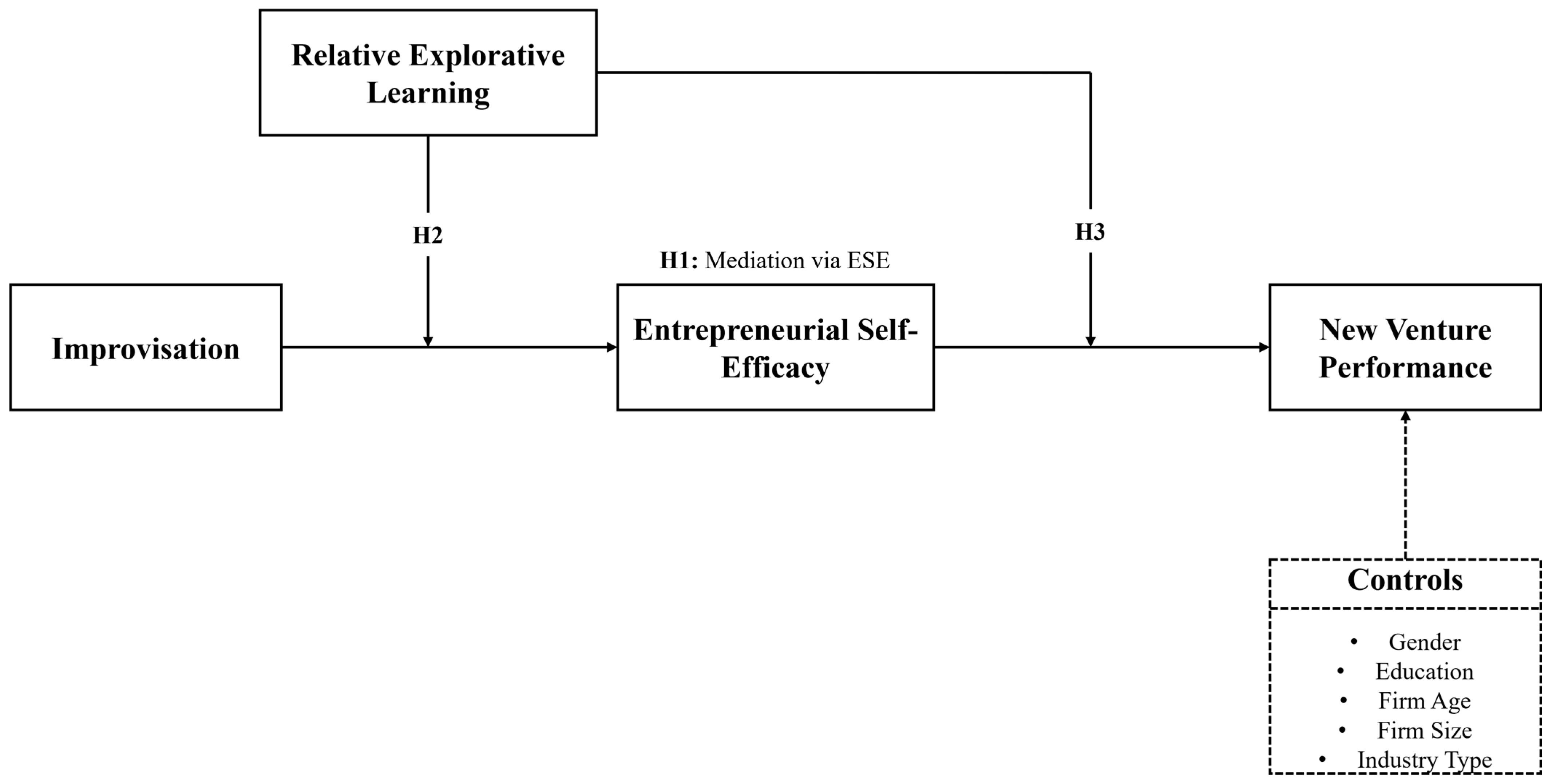
The proposed conceptual model integrates the core elements of improvisation, entrepreneurial self-efficacy, new venture performance, and relative explorative learning into a cohesive framework that explains how early-stage ventures convert spontaneous action into enduring performance outcomes. As illustrated in Figure 1, improvisation serves as the foundational behavioral capability that enables entrepreneurs to respond rapidly to emerging challenges and unfolding opportunities. Grounded in the KBV and SLT, the model positions improvisation as both a knowledge enactment mechanism and a source of mastery experiences that generate the experiential learning necessary for capability development. This real-time problem-solving strengthens entrepreneurial self-efficacy, which functions as the central psychological mechanism through which improvised actions translate into heightened confidence, more adaptive judgments, and ultimately improved venture performance. The model further recognizes that not all entrepreneurs derive equal benefit from improvisation; therefore, relative explorative learning is introduced as a moderating condition that shapes the strength of these relationships. When ventures maintain a strong explorative learning orientation, they possess greater cognitive openness and external search capacity, making improvisational experiences easier to interpret, internalize, and translate into strategic action, thereby intensifying both the direct influence of improvisation on entrepreneurial self-efficacy and its indirect effect on new venture performance. Collectively, the model clarifies how improvisation interacts with psychological and learning-oriented processes to produce superior performance outcomes, offering a structured explanation of how and under what conditions early entrepreneurial capabilities emerge and generate value.

3. Methodology

3.1. Research Context

Türkiye represents one of the most dynamic emerging economies, with a gross domestic product of approximately USD 1.44 trillion in current prices [85] and a rapidly evolving entrepreneurial ecosystem that fosters innovation-driven new ventures. Entrepreneurs in Türkiye are distinguished by their resilience, proactiveness, and opportunity-seeking behaviors, attributes that are critical for navigating a competitive and institutionally fluid market landscape [1]. Türkiye’s strong export capacity—surpassing USD 262 billion in 2024—further illustrates its expanding economic integration and the strategic role played by entrepreneurial ventures in sustaining growth [86]. Despite these advances, new ventures commonly face challenges associated with economic volatility, limited foreign investor participation, bureaucratic barriers, and resource constraints typical of emerging markets [87,88]. Such structural pressures heighten the relevance of entrepreneurial capabilities such as improvisation, confidence development, and learning orientation for securing venture viability and long-term competitiveness.
At the same time, Türkiye’s entrepreneurial ecosystem has undergone substantial transformation, marked by increasing diversity of actors—including accelerators, science parks, angel investors, corporate venture capital units, and high-growth technology firms such as Getir, Peak Games, Trendyol, and Insider [89]. This ecosystem evolution has been accompanied by rising collaboration between start-ups and multinational enterprises, offering new avenues for knowledge exchange and capability building despite persistent institutional uncertainty [53]. These conditions provide a highly suitable empirical context to examine how entrepreneurs mobilize improvisational behavior, strengthen entrepreneurial self-efficacy, and leverage relative explorative learning to enhance new venture performance in emerging markets [90]. Within this environment—where opportunities coexist with constraints—the mechanisms explored in this study offer meaningful insights into how early-stage firms convert spontaneous action and learning into sustained competitive outcomes.

3.2. Data Collection and Sampling

A quantitative research design using a structured questionnaire survey was adopted to collect data from founders of new ventures located in Istanbul and Ankara, two major cities in Turkey known for their vibrant start-up ecosystems and innovation-driven industries. Following prior studies [15,17], the sample comprised start-ups that were not more than eight years old. This criterion allows the inclusion of firms in both early and growth phases, which are often characterized by improvisational decision-making, learning orientation, and psychological adaptability—all crucial elements for sustainable entrepreneurial development. To ensure the identification of active and innovation-oriented start-ups, the sampling frame was built using incubator and technopark registries, chambers of commerce databases, entrepreneurship platforms, and business network listings, consistent with purposive sampling approaches commonly applied in emerging-market entrepreneurship research [91,92]. This approach ensured that only founders with sufficient strategic and operational knowledge were included, strengthening the appropriateness of the sample for examining behavioral and cognitive entrepreneurial mechanisms.
To ensure measurement clarity and contextual relevance, a pilot test was conducted with ten entrepreneurs and senior managers to evaluate the wording, clarity, and comprehensibility of the survey items. Feedback from the pilot stage led to minor refinements in terminology to reflect common entrepreneurial language. Pilot responses were excluded from the final dataset. To ensure linguistic and conceptual equivalence, the survey underwent translation into Turkish and back-translation into English following Brislin’s [93] guidelines, a standard procedure in cross-cultural entrepreneurship research.
To reduce the potential for common method bias (CMB), data were collected in two phases using a temporal separation approach [94]. In the first phase (Time 1), 480 questionnaires were distributed via email and in-person visits to founders who possessed adequate knowledge of their firms’ strategic and operational processes. They were asked to evaluate improvisation, entrepreneurial self-efficacy, and relative explorative learning. A total of 347 valid responses were received. After a one-year interval (Time 2), the same firms were contacted again to assess the outcome variable—new venture performance. This multi-wave design enhances temporal ordering, which is essential when testing mediation effects, as cross-sectional designs undermine causal sequencing and inflate mediation bias [95]. By measuring the predictors and mediator at Time 1 and the performance outcome at Time 2, the design offers stronger methodological justification for the proposed causal chain.
After aligning the matched responses from both data collection phases, incomplete or inconsistent responses were removed, resulting in 322 valid cases, yielding a response rate of 67.08%. The longitudinal design enhances causal inference and mitigates biases commonly associated with single-source cross-sectional data. To evaluate potential non-response bias, early–late respondent comparisons [96] were conducted, revealing no statistically significant differences. Additional attrition analysis confirmed that Time 2 respondents did not differ from non-matched cases in gender, education, or firm characteristics, suggesting minimal systematic dropout [97]. To further reduce omitted-variable bias, firm-level controls—including firm age, size, and industry category—were incorporated into the statistical models, consistent with recommendations for entrepreneurship research in institutional environments characterized by heterogeneity and volatility [98,99,100].
Table 1 presents the demographic characteristics of the respondents. The sample comprised 289 males (89.75%) and 33 females (10.25%), reflecting the gender distribution typical of Turkey’s entrepreneurial ecosystem. In terms of education, 286 participants (88.87%) held at least a bachelor’s degree, indicating a well-educated founder base. Industry representation included computer and software (12.73%), textile (25.78%), equipment manufacturing (20.81%), electrical/electronics (15.22%), mechanical and engineering (16.15%), and others (9.31%). Regarding firm age, 21.43% were 1–2 years old, 41.30% were 3–5 years old, and 37.27% were 6–8 years old. These characteristics collectively reflect a diverse and representative sample of Turkish start-ups actively engaged in innovation-driven activities, making the dataset highly relevant for analyzing how psychological factors (e.g., self-efficacy) and learning orientation enhance new venture performance. Although the sampling was concentrated in Istanbul and Ankara due to their ecosystem maturity and high density of start-up activity, this geographical scope is acknowledged as a limitation; however, it aligns with prior research that draws extensively on Turkey’s leading entrepreneurial cities as representative settings for studying dynamic new ventures [101,102,103].
Overall, the demographic profile summarized in Table 1, together with the two-wave sampling design, provides a robust empirical basis for examining the psychological and learning mechanisms underlying new venture performance. The concentration of founders in Istanbul and Ankara reflects Turkey’s most active entrepreneurial ecosystems, ensuring strong contextual relevance for observing improvisational behavior and learning orientation. Collectively, these sample characteristics confirm that the dataset is methodologically appropriate and well aligned with the objectives of this research.

3.3. Measures

All constructs were measured using previously validated instruments to ensure conceptual precision and comparability with prior research. The questionnaire was developed in English and translated into Turkish following Brislin’s [93] back-translation procedure, which is widely used to guarantee semantic and conceptual equivalence across languages. Two bilingual experts independently performed the translation and back-translation, and discrepancies were resolved through a consensus review. This translation process is essential in cross-cultural entrepreneurship research to avoid construct drift and maintain conceptual fidelity [104]. To further enhance content validity, a pilot test was conducted with ten entrepreneurs and senior managers who assessed item clarity and contextual relevance. Minor linguistic refinements were incorporated based on their feedback, and pilot responses were excluded from the final dataset. Appendix A (Table A1) contains the complete list of measurement items used in this study. A final expert validation step ensured that the items reflected behavioral patterns commonly observed within Türkiye’s dynamic start-up environment.
Improvisation (IMP) was measured using seven items drawn from Vera and Crossan [29,105], capturing entrepreneurs’ ability to generate spontaneous, creative, and real-time solutions to unexpected challenges [15]. Sample items include statements such as “The firm tries new approaches to problems.” The scale exhibited strong internal consistency, reflected in a Cronbach’s alpha of 0.893. Entrepreneurial self-efficacy (ESE) was assessed using four items adapted from Zhao et al. [106], representing founders’ confidence in identifying business opportunities, generating innovative ideas, developing new products, and commercializing solutions. The Cronbach’s alpha for this scale was 0.846, demonstrating satisfactory internal reliability. Additionally, domain specialists confirmed that these items capture the core competencies expected of early-stage entrepreneurs in opportunity-driven markets.
Relative explorative learning (REL) was measured using eight items from Atuahene-Gima [107], comprising both explorative and exploitative learning dimensions. Consistent with established methodological practice [69,108], REL was operationalized as the standardized difference between explorative and exploitative learning, producing a composite index where higher scores indicate a stronger orientation toward exploration. This operationalization avoids conceptual conflation between the two learning modes and preserves theoretical clarity. The combined reliabilities for the explorative–exploitative learning subdimensions were high, with a Cronbach’s alpha of 0.932. New venture performance (NVP) was measured using five items from Sheng et al. [109], in which founders compared their firms’ relative performance on profitability, sales growth, market share, return on investment, and return on assets. This scale demonstrated strong reliability, with a Cronbach’s alpha of 0.917. To reduce perceptual inflation of predictor–outcome relationships, all NVP items were measured at Time 2, one year after the predictor variables were collected.
To improve model robustness and address heterogeneity across firms, the analysis included individual-level and firm-level control variables commonly used in entrepreneurship studies. These included founder gender, education level, firm age, firm size, and industry [6,14,18,110]. Incorporating these controls helps isolate the focal relationships by accounting for demographic and structural variations that may influence improvisation, learning behaviors, or new venture performance.

3.4. Common Method Bias

Because this study relied on self-reported data, several procedural and statistical approaches were adopted to reduce and diagnose potential common method bias (CMB). Validated measurement scales were used, and the questionnaire separated independent, mediating, moderating, and dependent variables with different response formats to minimize consistency effects [94,111]. Respondents were assured of anonymity and confidentiality and reminded that there were no right or wrong answers, reducing evaluation apprehension and socially desirable responding [112]. Furthermore, temporal separation was embedded into the design by collecting all predictor variables (IMP, ESE, REL) at Time 1 and the dependent variable (NVP) one year later at Time 2, thereby limiting the activation of shared response tendencies and cognitive heuristics across constructs [15,62]. These procedural remedies collectively enhanced the integrity of the measurement process and reduced the likelihood that method artifacts would influence observable relationships among variables.
In addition to procedural controls, diagnostic statistical tests were conducted to further assess CMB. Harman’s single-factor test showed that the first factor explained only 33.17% of the variance, well below the conventional 50% threshold [94]. The marker-variable technique [113], using survey completion duration as an unrelated marker, revealed no significant changes in path coefficients across models. To strengthen the assessment, an unmeasured latent methods factor (ULMF) was incorporated into an additional confirmatory factor analysis following Podsakoff et al. [94]. All items were loaded on both their theoretical constructs and the latent methods factor; comparison of the baseline CFA model and the ULMF model showed minimal changes in fit indices (ΔCFI = 0.011; ΔGFI = 0.008; ΔRMSEA = −0.003; ΔSRMR = 0.014), consistent with recent entrepreneurship applications [15,114]. These negligible differences indicate that method variance did not meaningfully distort item loadings or construct relationships. Finally, variance inflation factor (VIF) values remained below 5 [17,115], confirming the absence of multicollinearity. Taken together, these procedural safeguards and robust statistical checks demonstrate that common method bias is unlikely to compromise the validity of the study’s findings.

4. Results

4.1. Data Analysis Technique

The data analysis was conducted using SPSS 25.0 and AMOS 26.0 to ensure analytical rigor and validity. SPSS was used for preliminary data screening, descriptive statistics, and correlation analysis, while AMOS was applied to test the measurement and structural models using maximum likelihood estimation. Reliability and validity of the constructs were assessed through confirmatory factor analysis (CFA), using composite reliability (CR), average variance extracted (AVE), and discriminant validity based on the Fornell–Larcker criterion [116]. AMOS was purposefully selected because CFA enables a rigorous examination of latent structures through factor loadings, shared variance, measurement error, and the distinctiveness of constructs—an essential requirement when evaluating complex mediated and moderated relationships in entrepreneurship research [117,118]. Furthermore, full model-fit indices (χ2/df, CFI, TLI, RMSEA, SRMR) were examined to ensure that the measurement model met recommended thresholds, supporting the robustness and adequacy of the latent structure [119]. This dual-stage validation process ensured that improvisation (IMP), entrepreneurial self-efficacy (ESE), relative explorative learning (REL), and new venture performance (NVP) met accepted psychometric standards prior to hypothesis testing.
To examine the direct, indirect, and conditional effects among variables, Hayes’s PROCESS macro [120] was utilized in SPSS. Model 4 was employed to test the mediating role of entrepreneurial self-efficacy in the relationship between improvisation and new venture performance, while Model 59 was used to test the moderated mediation model involving relative explorative learning. All hypotheses were evaluated using bias-corrected bootstrapping with 5000 resamples and 95% confidence intervals (CI), where effects were considered significant if the CI did not include zero. PROCESS was selected because it offers advanced tools for estimating conditional process models, including the index of moderated mediation and the Johnson–Neyman technique for probing continuous interactions [121], providing advantages over traditional SEM for examining conditional indirect effects. To ensure analytical coherence and robustness, the mediation and moderation model was additionally estimated using a latent-variable SEM approach in AMOS 26. The results were directionally consistent across both AMOS and PROCESS, strengthening confidence in the stability of the observed relationships and demonstrating that findings were not dependent on a single estimation technique. Together, these procedures ensured that the analytical strategy was methodologically sound and aligned with best practices for testing complex theoretical models in entrepreneurship and organizational behavior research.

4.2. Measurement Model Assessment

Through maximum likelihood estimation in AMOS 26, a confirmatory factor analysis (CFA) was conducted to evaluate the convergent validity, reliability, and discriminant validity of the measurement model. All constructs measured by multiple indicators were assessed for internal consistency using Cronbach’s alpha, with results (Table 2) ranging from 0.846 to 0.932, exceeding the recommended threshold of 0.70 [122]. This confirms that the construct measures were reliable and internally consistent. Regarding validity, all standardized item loadings were greater than 0.60 (0.620–0.890), the average variance extracted (AVE) values exceeded 0.50 (0.523–0.699), and composite reliability (CR) values were above 0.70 (0.883–0.931), as shown in Table 2. These findings demonstrate strong convergent validity [123,124].
To ensure conceptual clarity in measuring relative explorative learning, the learning items were modeled as two correlated latent factors—explorative learning (EXPLORE) and exploitative learning (EXPLOIT). This specification aligns with established theoretical arguments regarding the duality of organizational learning [107,108] and eliminates ambiguity in construct interpretation. After validating EXPLORE and EXPLOIT as distinct first-order constructs in the CFA, relative explorative learning (REL) was computed as a standardized index—z(EXPLORE) − z(EXPLOIT)—and used as an observed variable in subsequent PROCESS analyses; the overall REL reported in Table 2 reflects second-order validation only and was not directly modeled as a latent construct in the structural analysis. Although four improvisation items exhibited slightly lower factor loadings (0.62–0.65), they were retained because they capture theoretically essential facets of improvisational behavior and did not compromise the construct’s AVE, CR, or overall reliability.
Discriminant validity was also established following the Fornell–Larcker criterion. As illustrated in Table 3, all correlation coefficients among the latent constructs were significant and below 0.75, while the square root of each construct’s AVE exceeded its inter-construct correlations, confirming that each construct is distinct from the others [123]. To strengthen the evidence for discriminant validity, the heterotrait–monotrait ratio (HTMT) was calculated and all values were below the conservative 0.85 threshold [125], supporting the empirical distinctiveness of the constructs (Table 4). Furthermore, the full measurement model demonstrated an excellent overall fit across multiple indices: χ2/df = 1.298 (below 3), CFI = 0.981, TLI = 0.978 (both above 0.90), and RMSEA = 0.034 (below 0.08). These values indicate a well-fitting model that adequately represents the observed data [119]. Following CFA validation, relative explorative learning (REL) was operationalized as a standardized difference score between EXPLORE and EXPLOIT, consistent with prior methodological approaches for capturing comparative learning orientation [69,108]. This post-validation operationalization eliminates interpretive ambiguity, ensures theoretical alignment, and provides a robust basis for testing moderation and moderated-mediation effects in subsequent analyses.
Overall, the results presented in Table 2, Table 3 and Table 4 confirm that the measurement model demonstrates strong reliability, convergent validity, and discriminant validity, providing a robust foundation for subsequent hypothesis testing. The excellent model-fit indices further verify that the latent constructs are empirically distinct and appropriately specified within the CFA framework. By validating explorative and exploitative learning as separate but related dimensions and operationalizing relative explorative learning as a standardized difference score, the study ensures conceptual precision and methodological coherence for examining the moderating and mediated pathways proposed in the theoretical model. Together, these results indicate that the measurement structure is sound, statistically rigorous, and well suited for the structural analyses that follow.

4.3. Testing of Direct and Indirect Hypotheses

The direct associations among improvisation, entrepreneurial self-efficacy, and new venture performance were examined using Hayes’s PROCESS macro (Model 4) in SPSS, applying bias-corrected bootstrapping with 5000 samples as recommended for mediation analysis [120,126]. As shown in Table 5, improvisation exerted a significant positive effect on new venture performance (β = 0.228, t = 2.899, p < 0.05) and entrepreneurial self-efficacy (β = 0.123, t = 2.468, p < 0.05), while entrepreneurial self-efficacy also significantly predicted new venture performance (β = 0.275, t = 2.829, p < 0.05). These direct associations were examined to establish the empirical foundation of the model and were not formulated as formal hypotheses, ensuring that the hypothesis testing sequence centers solely on the theorized mediating mechanism. Before estimating these relationships in PROCESS, diagnostic checks confirmed acceptable VIF values (<3) and normally distributed residuals, supporting the stability and reliability of the OLS-based path estimates [127]. These diagnostics ensured that the estimation of direct paths was not affected by multicollinearity or violations of regression assumptions.
H1 examined the mediating role of entrepreneurial self-efficacy in the relationship between improvisation and new venture performance. After incorporating entrepreneurial self-efficacy as a mediator, the direct effect of improvisation on new venture performance remained significant (path c′), indicating partial mediation. The bootstrapped indirect effect was statistically significant, as the 95% confidence interval excluded zero (LLCI = 0.002, ULCI = 0.091), confirming the presence of mediation. The magnitude of the indirect effect (β = 0.034) accounted for 12.98% of the total effect, whereas the direct pathway represented 87.02%, suggesting that improvisation enhances performance both directly and through its contribution to strengthened entrepreneurial self-efficacy. The mediation model explained R2 = 0.109 of the variances in entrepreneurial self-efficacy and R2 = 0.318 of the variances in new venture performance, indicating meaningful explanatory power for early-stage venture outcomes. Overall, the findings provide strong support for H1 and highlight entrepreneurial self-efficacy as a key psychological mechanism through which improvisation contributes to improved new venture performance.
Together, these results reported in Table 5 provide clear empirical support for the proposed mediating pathway, demonstrating that improvisation enhances new venture performance both directly and indirectly through elevated entrepreneurial self-efficacy. The significance of the indirect effect, even after accounting for the direct pathway, highlights the psychological mechanism through which improvisational behavior translates into improved venture outcomes. Overall, the findings confirm that entrepreneurial self-efficacy serves as a meaningful conduit linking spontaneous action with performance gains, thereby establishing a solid foundation for examining boundary conditions in the subsequent moderated mediation analysis.

4.4. Testing of Moderated Mediation Effects

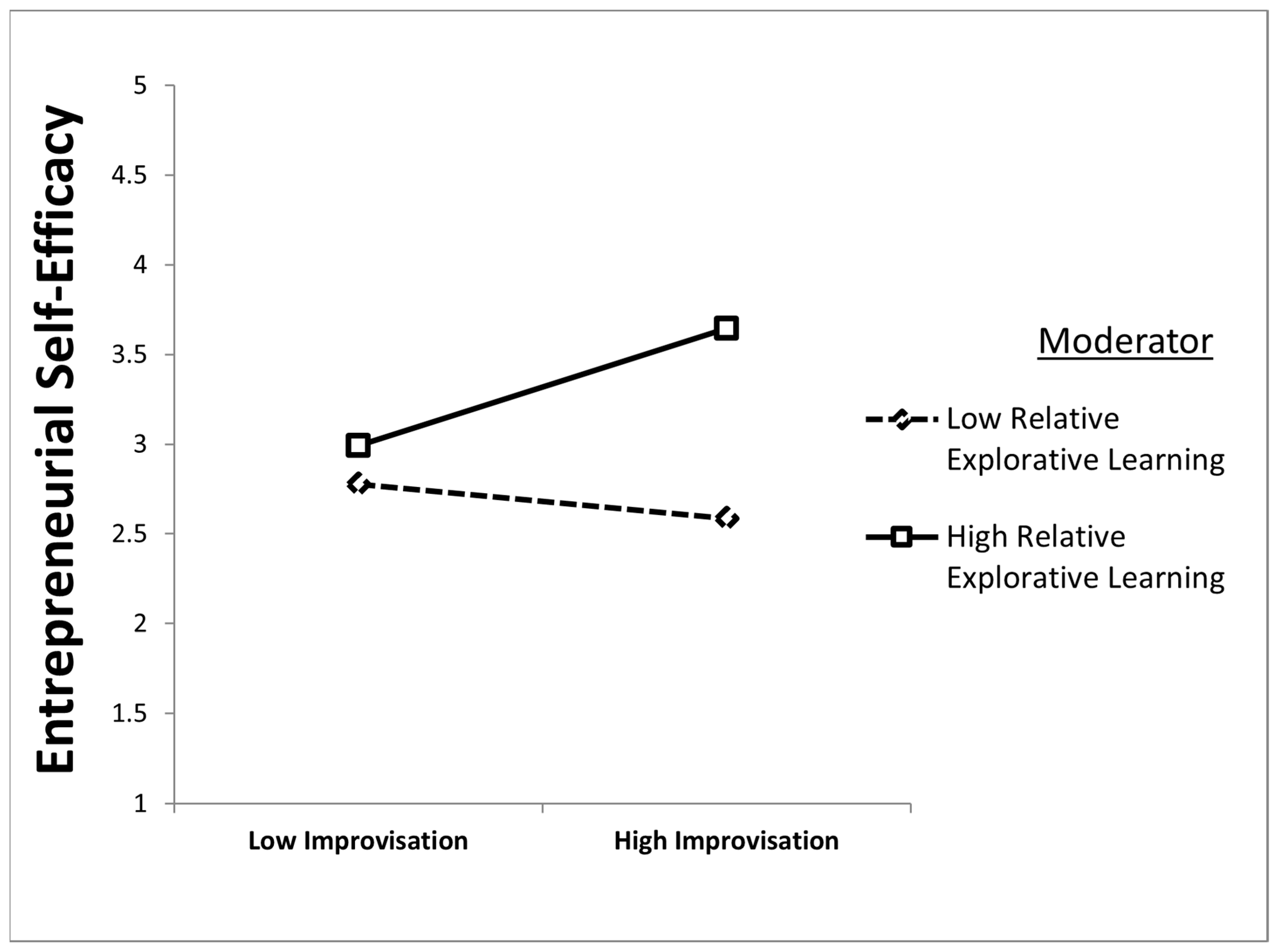
The moderated mediation model was assessed using Hayes’s PROCESS macro (Model 59), which enables simultaneous estimation of interaction effects and conditional indirect effects within a unified analytical framework [120]. Bias-corrected bootstrapping with 5000 resamples was employed to evaluate the significance of all conditional paths, and all predictor variables were mean-centered to reduce multicollinearity following established recommendations [128,129,130]. Consistent with prior entrepreneurship research, gender and education were included as demographic controls, and additional firm-level covariates—firm age, firm size, and industry dummies—were incorporated to capture heterogeneity in venture characteristics and reduce omitted-variable bias [6,14,18]. As shown in Table 6, improvisation significantly predicted entrepreneurial self-efficacy (β = 0.116, t = 2.301, p < 0.05), and the interaction between improvisation and relative explorative learning was also significant (β = 0.211, t = 2.304, p < 0.05), providing support for H2. Simple-slope analysis (Figure 2) further revealed that improvisation exerted a substantially stronger positive effect on entrepreneurial self-efficacy at high levels of relative explorative learning (β = 0.291, t = 4.587, p < 0.001) compared to low levels (β = 0.169, t = 2.342, p < 0.05), indicating that learning orientation amplifies the psychological benefits of improvisational behavior. All VIF values remained below the recommended threshold of 3, confirming the absence of multicollinearity and reinforcing the stability of the moderation estimates [131].
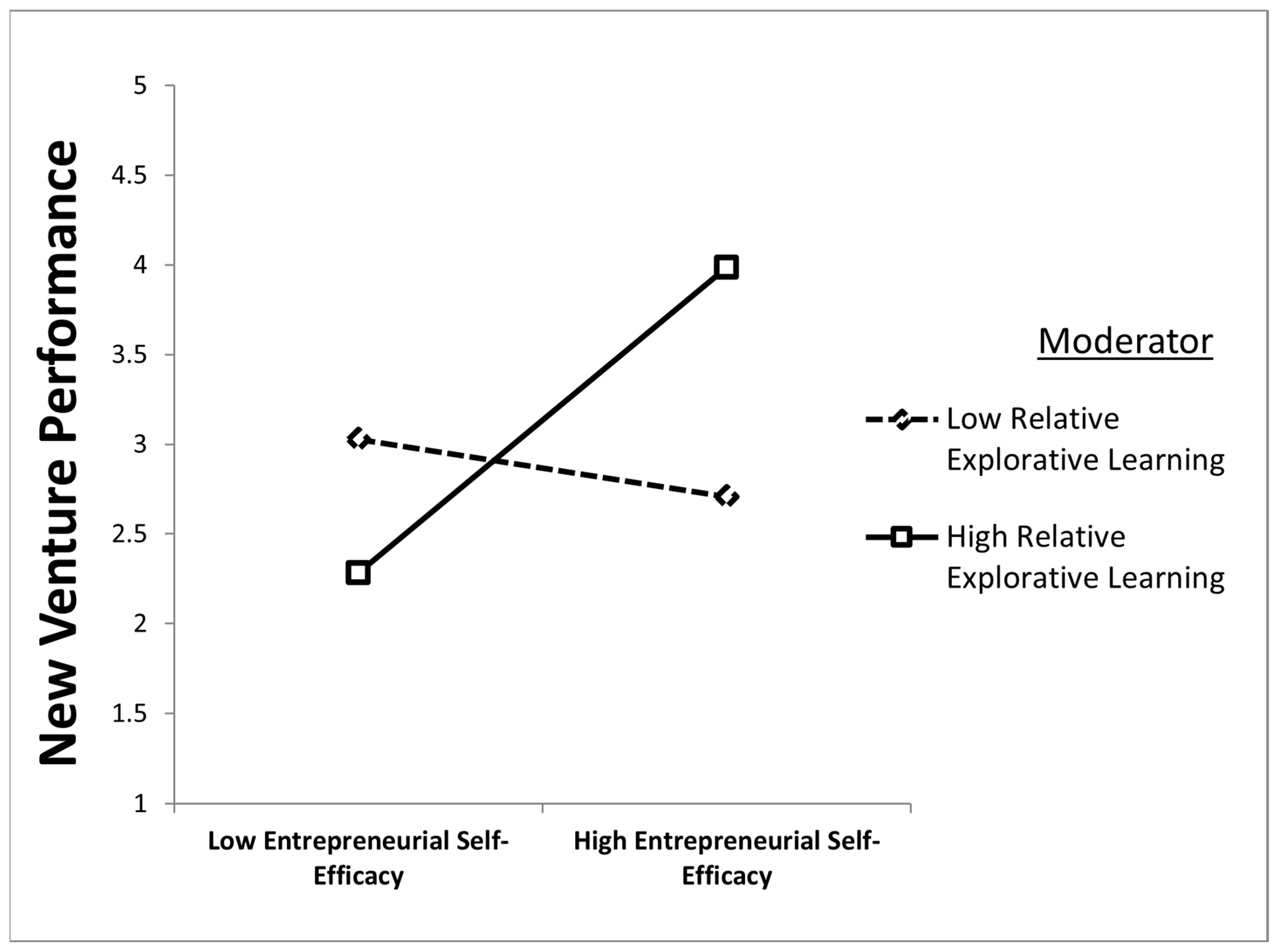
H3 examined whether relative explorative learning strengthened the indirect effect of improvisation on new venture performance through entrepreneurial self-efficacy. The conditional indirect effect was statistically significant at high levels of relative explorative learning (β = 0.103, SE = 0.058, 95% CI [0.013, 0.224]) but nonsignificant at low levels (β = 0.032, SE = 0.060, 95% CI [–0.081, 0.157]). This pattern indicates that the psychological mechanism linking improvisation to performance—via elevated entrepreneurial self-efficacy—is activated more strongly among individuals who display a higher orientation toward exploratory learning. PROCESS also produced an exploratory direct moderation effect between entrepreneurial self-efficacy and relative explorative learning on new venture performance (ESE × REL → NVP: β = 0.506, SE = 0.174, t = 2.902, p < 0.01). Because this interaction was not part of the hypothesized model, it is interpreted strictly as an exploratory robustness check rather than as a formal hypothesis test. Corresponding conditional simple slopes (Figure 3) showed that entrepreneurial self-efficacy significantly enhanced new venture performance when relative explorative learning was high (β = 0.316, t = 2.686, 95% CI [0.084, 0.548]) but did not exert a significant effect at low levels (β = −0.011, t = 0.947, p > 0.05). The index of moderated mediation was statistically significant (Index = 0.071, 95% CI [0.009, 0.152]), confirming that the mediating mechanism varies systematically across levels of learning orientation. Collectively, these findings offer strong support for H3 and highlight relative explorative learning as a critical boundary condition shaping how improvisational behavior translates into enhanced entrepreneurial capability and improved new venture outcomes.
Regarding explanatory power, Model 1 (predicting entrepreneurial self-efficacy) explained a substantial proportion of variance, and the inclusion of the IMP × REL interaction term increased explained variance from R2 = 0.287 to R2 = 0.312 (ΔR2 = 0.025), indicating meaningful incremental explanatory contribution of the moderation effect. Similarly, in Model 2 (predicting new venture performance), the addition of interaction terms increased explained variance from R2 = 0.301 to R2 = 0.336 (ΔR2 = 0.035), demonstrating that learning orientation enhances the model’s predictive strength beyond main effects alone.
Overall, the moderated mediation analysis reported in Table 6 and visually illustrated in Figure 2 and Figure 3 demonstrates that the strength of the psychological mechanism connecting improvisation to new venture performance varies systematically depending on entrepreneurs’ learning orientation. High relative explorative learning substantially amplifies both the direct influence of improvisation on entrepreneurial self-efficacy and the indirect effect on performance, whereas low learning orientation weakens these pathways. These results underscore the importance of learning-driven behavior as a key boundary condition shaping when improvisational actions generate their strongest benefits. Collectively, the evidence confirms the central role of learning orientation in reinforcing the translation of improvisation into enhanced entrepreneurial capability and improved venture outcomes.

4.5. Robustness and Additional Analyses

To further validate the moderated mediation model and ensure that the findings were not dependent on a single estimation technique, a robustness analysis was performed using latent-variable structural equation modeling (SEM) in AMOS 26, a method widely recommended for assessing indirect effects while accounting for measurement error [116,117]. SEM enables simultaneous estimation of measurement and structural relationships, offering a more rigorous test of the theoretical model compared to regression-based approaches. The full structural model demonstrated excellent fit across all major indices—CMIN/DF = 1.428; CFI = 0.988; TLI = 0.968; SRMR = 0.012; RMSEA = 0.033; and PClose = 0.620—indicating strong correspondence between the hypothesized model and the observed covariance matrix [119,132]. As shown in Table 7, improvisation remained a significant predictor of entrepreneurial self-efficacy (β = 0.594, p < 0.001) and new venture performance (β = 0.381, p < 0.001) when estimated at the latent level. Entrepreneurial self-efficacy also continued to positively influence new venture performance (β = 0.196, p < 0.001), and the indirect effect of improvisation on new venture performance through entrepreneurial self-efficacy remained significant (β = 0.117, p < 0.01), demonstrating that the mediation pathway is robust to alternative estimation methods. In addition, the latent interaction term (IMP × REL → ESE: β = 0.206, p < 0.001) replicated the moderating effect observed in PROCESS, confirming that relative explorative learning consistently strengthens the effect of improvisation on entrepreneurial self-efficacy.
To enhance model rigor and reduce omitted-variable bias, the SEM robustness model also incorporated demographic and firm-level controls commonly used in entrepreneurship research, including gender, education, firm age, firm size, and industry type. As reported in Table 7, these controls exerted minimal influence on new venture performance (gender: β = 0.033; education: β = 0.037; firm age: β = 0.014; firm size: β = 0.030), and industry type demonstrated only a marginal effect (β = 0.079†). Importantly, the inclusion of these controls did not change the sign, magnitude, or significance of the focal path estimates, indicating that the primary relationships are not confounded by demographic or structural factors. The strong convergence between the PROCESS and SEM results—across coefficient patterns, significance levels, and effect magnitudes—provides compelling evidence that improvisation, entrepreneurial self-efficacy, and relative explorative learning operate as a coherent and empirically stable mechanism explaining differences in new venture performance. Collectively, these findings reinforce the robustness of the model and demonstrate that the empirical relationships remain consistent across distinct analytical techniques.
The SEM robustness checks reported in Table 7 further validate the stability and consistency of the proposed relationships, demonstrating that the model holds under an alternative latent-variable estimation approach. The replication of all key paths—including the mediation and moderation effects—confirms that the empirical relationships are not artifacts of a single analytical technique. The negligible influence of demographic and firm-level controls strengthens confidence that the focal constructs, rather than contextual characteristics, drive the observed performance differences. Taken together, these results offer strong evidence that improvisation, entrepreneurial self-efficacy, and relative explorative learning form a coherent and resilient explanatory framework for understanding variation in new venture performance.

5. Discussion and Implications

5.1. Discussion of Findings

This study advances the entrepreneurship literature by developing and empirically validating a model that links improvisation, entrepreneurial self-efficacy, and new venture performance through the theoretical lenses of the KBV and SLT. By examining entrepreneurial self-efficacy as a mediating mechanism and relative explorative learning as a boundary condition, the study elucidates how cognitive and learning processes jointly explain variability in early-stage venture outcomes. This integrated framework suggests that entrepreneurs’ ability to act spontaneously, believe in their capacity to manage uncertainty, and engage in exploration-oriented learning collectively form a capability set that enhances adaptation in dynamic environments. These insights enrich existing perspectives by showing how immediate behavioral responses, internal psychological evaluations, and learning-oriented behaviors work together to support entrepreneurs seeking long-term performance and competitive endurance, extending prior models that treat these components as isolated rather than interdependent processes.
The findings indicate that improvisation positively influences new venture performance, supporting recent evidence that reframes improvisation as a forward-looking entrepreneurial capability [6] rather than a risky or destabilizing behavior [36,51]. This pattern may reflect contemporary venture conditions—particularly in emerging-market contexts—where entrepreneurs often operate with limited resources and under substantial environmental volatility, making improvisation a pragmatic and strategically valuable response to rapidly changing circumstances [8,49]. Improvisation also enhanced entrepreneurial self-efficacy, revealing the cognitive underpinnings of spontaneous behavior. Consistent with SLT, engaging in trial-and-error problem solving provides mastery experiences that reinforce entrepreneurs’ perceived competence and control over uncertain business contexts [133]. This interpretation positions improvisation as a developmental process through which repeated engagement in spontaneous action builds psychological readiness and strengthens future opportunity enactment, ultimately supporting stronger long-term venture performance.
The results further demonstrate that entrepreneurial self-efficacy strengthens new venture performance, affirming prior studies that highlight the pivotal role of self-belief in entrepreneurial decision quality, innovation, and opportunity exploitation [31,58]. From a KBV perspective, self-efficacy influences how entrepreneurs mobilize and apply knowledge resources to create value under uncertain conditions. The mediating mechanism identified in this study underscores that the benefits of improvisation do not translate directly into improved performance but rather emerge through entrepreneurs’ enhanced confidence, which shapes their persistence, decision speed, and willingness to allocate cognitive and material resources to improvised strategies. Entrepreneurs with higher self-efficacy appear better equipped to convert improvised ideas into viable solutions, reinforcing their ability to sustain competitive outcomes in uncertain environments [23,51,59]. The consistency of this pathway across both the primary analysis and the latent-variable robustness checks provides compelling evidence that the psychological channel linking improvisation and performance is stable, meaningful, and theoretically coherent.
Furthermore, the moderating role of relative explorative learning reveals that learning orientation shapes the cognitive impact of improvisation. Entrepreneurs with high levels of explorative learning actively pursue new information, engage in experimentation, and challenge existing routines, making them more likely to interpret improvised actions as developmental experiences that build confidence. This finding aligns with KBV’s emphasis on the strategic importance of ongoing knowledge acquisition and integration for improving entrepreneurial judgment and opportunity enactment, suggesting that learning-oriented entrepreneurs derive more skill-enhancing value from resource-constrained improvisation [78,79]. When explorative learning is low, however, the cognitive benefits of improvisation weaken, implying that ventures relying heavily on routine-based behavior may struggle to translate spontaneous action into enhanced confidence or long-term performance gains [69,134]. This highlights that improvisation is not universally beneficial; rather, its psychological payoff depends critically on whether entrepreneurs maintain a mindset oriented toward continual learning, experimentation, and cognitive renewal.
At the same time, the findings suggest that improvisation may be less effective under certain boundary conditions that restrict entrepreneurs’ cognitive, temporal, or structural flexibility. Improvisation is likely to falter when founders operate under extreme cognitive overload, face stringent regulatory requirements, or work within highly formalized organizational structures that limit discretion and rapid adaptation. In such contexts, the costs of spontaneous action—including increased error likelihood, regulatory noncompliance, or disruption of established coordination patterns—may outweigh its potential benefits. This nuance aligns with research showing that improvisation is contingent on managerial discretion, supportive structures, and the availability of attentional resources, underscoring that its positive effects depend on the broader situational demands entrepreneurs face.
In addition, a supplementary exploratory result showed that relative explorative learning strengthened the relationship between entrepreneurial self-efficacy and new venture performance. Although not part of the hypothesized model, this observation suggests that learning orientation may further amplify the extent to which strong self-beliefs translate into tangible performance gains. This finding resonates with research indicating that cognitive and learning mechanisms often jointly influence entrepreneurial outcomes, and it raises promising avenues for future exploration into how learning-oriented founders convert psychological assets into sustained competitive advantage. Collectively, these results reveal a coherent interplay among improvisation, learning orientation, and entrepreneurial self-efficacy, illuminating how psychological readiness and continuous learning jointly enable entrepreneurs to transform spontaneous actions into enduring performance advantages.

5.2. Theoretical Implications

This research offers several theoretical contributions across the entrepreneurship and organizational behavior literatures. First, it broadens improvisation theory by demonstrating that improvisational behavior enhances new venture performance through a cognitively grounded mechanism rather than solely through rapid or unstructured action. Earlier research often portrayed improvisation as context-dependent and potentially risky [36,51], but the present findings show that its effectiveness is shaped by entrepreneurs’ confidence and their engagement with new knowledge. By integrating the KBV [19] with SLT [21], the study demonstrates that improvisation functions as a knowledge-activation process through which entrepreneurs generate experiential learning, refine judgment, and cultivate beliefs about their capacity to navigate uncertainty. This reconceptualization advances theoretical perspectives by positioning improvisation as a micro-level capability that blends creative action with cognitive interpretation, thereby explaining why improvisational behavior yields adaptive advantages even in resource-constrained settings.
Second, the study deepens entrepreneurial cognition research by establishing entrepreneurial self-efficacy as a central mediating mechanism linking improvisation to new venture performance. Prior research has highlighted self-efficacy as a powerful driver of entrepreneurial persistence and opportunity exploitation [23,31,58], yet the literature has offered limited insight into how improvisation contributes to the development of such beliefs. The present findings clarify this pathway by showing that improvisational experiences operate as mastery episodes that strengthen entrepreneurs’ perceived ability to creatively solve problems. This insight enriches theoretical understanding of the behavior–outcome paradigm by demonstrating that improvisation generates performance benefits primarily through cognitive internalization rather than direct behavioral effects [7,15]. By framing entrepreneurial self-efficacy as the cognitive bridge between spontaneous action and firm-level outcomes, the study advances both KBV and SLT and provides a more precise account of how confidence emerges and is transformed into performance-enhancing behavior.
Third, this research contributes to learning-orientation theory by identifying relative explorative learning as a key boundary condition that shapes the psychological impact of improvisation. Although prior scholarship has recognized learning orientation as a broad strategic posture, its role in moderating cognitive mechanisms has remained less clearly articulated [79,82,84]. The current findings demonstrate that high levels of explorative learning amplify the confidence-building effects of improvisation, whereas low levels weaken this psychological pathway. This theoretical nuance extends the KBV by specifying how knowledge acquisition and exploratory behavior interact with improvisation to influence performance outcomes [69,134]. Moreover, the exploratory observation that explorative learning strengthens the relationship between entrepreneurial self-efficacy and new venture performance indicates that learning orientation operates across multiple channels of capability development. This insight offers a clearer explanation of why improvisation benefits some entrepreneurs more than others—it is most effective when embedded in a mindset that prioritizes experimentation, curiosity, and the pursuit of novel knowledge.
Taken together, this study advances theoretical integration by demonstrating that improvisational action, cognitive appraisal, and learning orientation function as an interconnected system that drives new venture performance. By empirically validating a moderated-mediation structure in which improvisation enhances performance through entrepreneurial self-efficacy—and in which this psychological pathway is conditioned by relative explorative learning—the study provides a comprehensive and analytically distinctive contribution to improvisation research. This framework refines broader theories of entrepreneurial action by showing that the value of improvisation depends not only on behavioral flexibility but also on the cognitive and learning structures that shape how improvisational experiences are interpreted, absorbed, and translated into enduring venture gains.

5.3. Managerial Implications

This research offers several meaningful implications for entrepreneurs, managers, and policymakers seeking to enhance new venture performance. First, the results reaffirm that improvisation should be cultivated not merely as a reactive response but as a deliberate strategic orientation [6] that equips entrepreneurs to cope with volatility, resource scarcity, and unexpected disruptions. Managers in early-stage firms can strengthen this capability by encouraging flexible thinking, rapid decision-making, and experimentation. Practical mechanisms—such as rapid-response huddles, real-time “option-generation” discussions, and short daily adaptation briefings—help transform spontaneous insights into coordinated action [49,51]. Establishing simplified approval pathways and empowering frontline members to make timely, informed decisions further embeds improvisation as a repeatable organizational capability rather than an ad hoc behavior. These practices create a work climate where improvisational action becomes intentional, structured, and aligned with strategic objectives.
Second, the mediating role of entrepreneurial self-efficacy highlights the importance of psychological capability development in converting improvisation into improved venture performance. Because self-belief shapes entrepreneurs’ persistence, problem-solving behavior, and willingness to act creatively under uncertainty [135], managers should invest in interventions designed to strengthen confidence. Simulation-based training, mentorship from experienced founders, and reflective mastery logs can reinforce entrepreneurs’ perceived competence and facilitate continuous learning from improvisational experiences. By enhancing entrepreneurial self-efficacy, firms increase the likelihood that spontaneous actions translate into effective opportunity enactment and improved performance outcomes [23,59].
Third, the moderating role of relative explorative learning shows that improvisation yields its strongest benefits when the organizational environment actively supports exploration, experimentation, and knowledge renewal. Managers should design learning systems that extend beyond routine exploitation, incorporating diverse and uncertain knowledge sources. Monthly learning sprints, cross-functional innovation teams, and repositories that document improvisation episodes can enhance a venture’s ability to interpret and leverage spontaneous behavior [5,39,83]. Because explorative learning amplifies the pathway from improvisation to entrepreneurial self-efficacy—and subsequently to new venture performance—managers should view exploration not only as a knowledge-acquisition mechanism but also as a catalyst that magnifies the psychological gains derived from improvisational action. This directly reflects the study’s moderated-mediation finding that learning orientation strengthens the cognitive impact of improvisation.
Finally, this study carries important implications for policymakers in emerging markets. Policies that encourage entrepreneurial creativity, capability development, and cross-industry knowledge exchange can cultivate environments where improvisation-based performance gains are more likely to emerge. Targeted investments in incubators and accelerators, training programs on adaptive problem-solving, and digital platforms for peer learning and mentorship can strengthen the improvisational, cognitive, and learning capabilities needed for enduring venture success. By fostering ecosystem-level supports that reinforce improvisation, self-efficacy, and learning orientation, policymakers can help entrepreneurs build stronger adaptive capacities and improve long-term competitiveness.

5.4. Limitations and Directions for Future Research

This study presents several limitations that provide meaningful pathways for advancing future research. The empirical setting—new ventures operating in Turkey—may limit the generalizability of the findings to entrepreneurial ecosystems shaped by different institutional logics, cultural norms, or economic structures. Future research should therefore test the robustness of this model across more diverse contexts, including developed economies and other emerging markets, to assess whether the effects of improvisation, entrepreneurial self-efficacy, and relative explorative learning vary systematically across environments. Furthermore, the demographic characteristics of the sample, which consisted predominantly of male entrepreneurs located in two major urban regions, indicate the need for broader representativeness to capture variations in gendered entrepreneurial experiences, regional disparities, and sectoral differences. Studies involving women-led ventures, family firms, or entrepreneurs from rural or technologically disadvantaged areas would provide a more nuanced understanding of how cognitive beliefs and learning orientation shape entrepreneurial behavior in heterogeneous settings. In addition, although this study centered on entrepreneurial self-efficacy as a mediating mechanism and relative explorative learning as a boundary condition, future studies could incorporate other psychological and behavioral processes—such as resilience, bricolage, adaptive expertise, or opportunity confidence—to expand the theoretical framework and better understand how entrepreneurs interpret and respond to uncertainty.
From a methodological perspective, although new venture performance was measured at Time 2 to mitigate common-method inflation, improvisation, entrepreneurial self-efficacy, and relative explorative learning were assessed concurrently at Time 1; therefore, reciprocal relationships—such as higher entrepreneurial self-efficacy leading to greater improvisational behavior—cannot be fully ruled out. Future research employing multi-wave longitudinal designs or cross-lagged panel models would allow for stronger causal inference and a more precise examination of the dynamic interplay between improvisation and entrepreneurial cognition over time. Moreover, new venture performance was measured using founder-reported subjective indicators, which may inflate observed associations due to perceptual bias; future studies could strengthen validity by incorporating objective performance metrics (e.g., sales growth, profitability, survival rates) or multi-informant designs drawing on external records or investor assessments.
Future research would also benefit from methodological extensions that capture the temporal and contextual dynamics underlying improvisation and learning. Mixed-method approaches—including diary studies, real-time logging of improvisational decisions, or qualitative post-mortem analyses—could offer deeper insights into how entrepreneurs cognitively process unexpected challenges and translate unplanned actions into capability-building routines. Future investigations may also examine additional contextual moderators, such as technological turbulence, digital capability, entrepreneurial culture, or governance mechanisms, which may shape the strength of the mediation (improvisation → self-efficacy → performance) and the moderation (improvisation × explorative learning) uncovered in this study. Collectively, these directions would help build a richer, multi-layered understanding of the mechanisms and contexts through which improvisational action supports long-term entrepreneurial success.

6. Conclusions

This study provides a comprehensive understanding of how improvisation enhances new venture performance and the conditions under which its impact is most effective. The findings show that improvisation improves performance primarily by strengthening entrepreneurial self-efficacy, indicating that confidence, judgment, and perceived capability play a critical role in translating spontaneous action into meaningful outcomes. Engaging in improvisational behavior places entrepreneurs in unpredictable situations where they must respond rapidly, experiment with emerging opportunities, and rely on adaptive decision-making. Through these repeated real-time encounters, entrepreneurs develop mastery experiences that reinforce their confidence and shape their ability to navigate uncertainty effectively. This demonstrates that the value of improvisation is not limited to immediate crisis response; instead, it serves as a developmental process that cultivates psychological readiness, perseverance, and strategic judgment. By highlighting entrepreneurial self-efficacy as the central mechanism, the study clarifies the internal pathway through which improvisation contributes to improved new venture performance.
The study also clarifies the conditions that enhance or weaken the influence of improvisation, pointing to relative explorative learning as a key boundary factor. Entrepreneurs who actively pursue new knowledge, test unfamiliar approaches, and challenge established routines are better equipped to transform improvisational actions into capability-building experiences. Higher levels of explorative learning intensify the confidence-building effect of improvisation, enabling entrepreneurs to convert spontaneous actions into sustained performance advantages, whereas lower levels restrict this developmental process and limit the effectiveness of improvisation. Further evidence indicates that explorative learning not only shapes the impact of improvisation but also strengthens the link between entrepreneurial self-efficacy and performance, suggesting that learning orientation reinforces multiple stages of entrepreneurial development. Taken together, these insights show that improvisation, confidence formation, and learning orientation function as an interconnected system, providing a complete explanation of when and how spontaneous entrepreneurial action contributes to enhanced new venture performance and long-term success.


Author Contributions

Writing—original draft, O.E.; Supervision, K.I.; Project administration, A.B.A. and H.Y.A.; Validation, K.I. and O.E.; Writing—review and editing, O.E. and H.Y.A. All authors reviewed and approved the manuscript. All authors have read and agreed to the published version of the manuscript.

Funding

This study received no external funding.

Institutional Review Board Statement

This study was conducted in accordance with the Declaration of Helsinki and approved by the Institutional Review Board of the University of Mediterranean Karpasia (Approval Code: 2023–2024 Fall 004, Approval Date: 7 March 2023).

Informed Consent Statement

All participants in this study provided their informed consent.

Data Availability Statement

Data from this study can be requested from the corresponding author, Osama Elfghi.

Conflicts of Interest

The authors declare no conflicts of interest.

Appendix A

Table A1. Measurement items.
ConstructItemSource
ImprovisationMembers of the firm think on their feet when carrying out actions.Vera and Crossan [29,105]
The firm responds in the moment to unexpected problems.
The firm uses the resources available to solve new problems on the spot.
The firm identifies opportunities for new work processes.
The firm tries new approaches to problems.
The firm demonstrates originality in its work.
The firm takes risks in producing new ideas when doing its job.
Relative Explorative Learning—ExplorativeWe are more inclined to explore new market/product information.Atuahene-Gima [107]
We attach more importance to seeking information in new fields and pursuing new product/market approaches in uncertain areas.
We are more inclined to learn and master new knowledge.
We collect new information and ideas beyond current market and technical experience.
Relative Explorative Learning—ExploitativeWe focus on market/product information in fields we currently engage in.Atuahene-Gima [107]
We emphasize searching for information that improves or solves existing market/product problems.
We investigate current customers and competitors to understand ongoing projects and market conditions.
We emphasize the use of knowledge related to existing products and experiences.
Entrepreneurial Self-EfficacyHow much confidence do you have in your ability to…?Zhao et al. [106]
Identifying new business opportunities.
Creating new products.
Thinking creatively.
Commercializing an idea or new development.
New Venture PerformanceReturn on investment.Sheng et al. [109]
Profitability growth.
Sales growth.
Market share.
Return on assets.

References

  1. Ageli, R.; Alzubi, A.B.; Aljuhmani, H.Y.; Iyiola, K. How and When Entrepreneurial Leadership Drives Sustainable Bank Performance: Unpacking the Roles of Employee Creativity and Innovation-Oriented Climate. Sustainability 2025, 17, 9259. [Google Scholar] [CrossRef] [Scilit]
  2. Hmieleski, K.M.; Corbett, A.C.; Baron, R.A. Entrepreneurs’ Improvisational Behavior and Firm Performance: A Study of Dispositional and Environmental Moderators. Strateg. Entrep. J. 2013, 7, 138–150. [Google Scholar] [CrossRef] [Scilit]
  3. Magni, M.; Proserpio, L.; Hoegl, M.; Provera, B. The Role of Team Behavioral Integration and Cohesion in Shaping Individual Improvisation. Res. Policy 2009, 38, 1044–1053. [Google Scholar] [CrossRef] [Scilit]
  4. Hughes, P.; Morgan, R.E.; Hodgkinson, I.R.; Kouropalatis, Y.; Lindgreen, A. A Diagnostic Tool to Determine a Strategic Improvisation Readiness Index Score (IRIS) to Survive, Adapt, and Thrive in a Crisis. Ind. Mark. Manag. 2020, 88, 485–499. [Google Scholar] [CrossRef] [Scilit]
  5. Wu, D.; Guo, K.; He, Q.; Zhang, J. The Impact of Live Streamers’ Improvisational Responses to Unexpected Events on Their Entrepreneurial Performance. J. Retail. Consum. Serv. 2023, 70, 103163. [Google Scholar] [CrossRef] [Scilit]
  6. Li, X.; Yu, T. Effect of Improvisational Strategic Orientation and Entrepreneurial Bricolage on New Venture Performance. Manag. Decis. 2023, 62, 2409–2427. [Google Scholar] [CrossRef] [Scilit]
  7. Fultz, A.E.F.; Hmieleski, K.M. The Art of Discovering and Exploiting Unexpected Opportunities: The Roles of Organizational Improvisation and Serendipity in New Venture Performance. J. Bus. Ventur. 2021, 36, 106121. [Google Scholar] [CrossRef] [Scilit]
  8. Csik, M.B.L.; Feldmann, P.R.; Salerno, M.S. What Are the Strategies for Having Success in an Uncertain Market in the New Business Creation? J. Int. Entrep. 2025. [Google Scholar] [CrossRef] [Scilit]
  9. Dowling, M. Coopetition. In Oxford Research Encyclopedia of Business and Management; Oxford University Press: Oxford, UK, 2020; ISBN 978-0-19-022485-1. [Google Scholar]
  10. Sindakis, S.; Theodorou, P. (Eds.) Global Opportunities for Entrepreneurial Growth: Coopetition and Knowledge Dynamics within and across Firms; Emerald Publishing Limited: Leeds, UK, 2017; ISBN 978-1-78714-502-3. [Google Scholar]
  11. Tunçalp, D. Entrepreneurial Resilience in Polycrisis: Adaptation via Improvizational Action, Institutional Workarounds, and Strategic Reconfiguration. J. Manag. Organ. 2025, 1–23. [Google Scholar] [CrossRef] [Scilit]
  12. Ciuchta, M.P.; O’Toole, J.; Miner, A.S. The Organizational Improvisation Landscape: Taking Stock and Looking Forward. J. Manag. 2021, 47, 288–316. [Google Scholar] [CrossRef] [Scilit]
  13. Miner, A.S.; Bassof, P.; Moorman, C. Organizational Improvisation and Learning: A Field Study. Adm. Sci. Q. 2001, 46, 304–337. [Google Scholar] [CrossRef] [Scilit]
  14. Sun, W.; Hou, X.; Liang, L.; Bi, X. Many Roads Lead to Rome: How Improvisation and Absorptive Capacity Affect Entrepreneurial Orientation and New Venture Performance Relationship. PLoS ONE 2023, 18, e0281456. [Google Scholar] [CrossRef] [Scilit]
  15. Wu, J.; Arndt, F.; Ma, H.; Hughes, P.; Tang, S. Learning from Improvisation in New Ventures. J. Innov. Knowl. 2023, 8, 100346. [Google Scholar] [CrossRef] [Scilit]
  16. Al Issa, H.-E. The Impact of Improvisation and Financial Bootstrapping Strategies on Business Performance. EuroMed J. Bus. 2020, 16, 171–194. [Google Scholar] [CrossRef] [Scilit]
  17. Iyiola, K.; Alzubi, A.; Dappa, K. The Influence of Learning Orientation on Entrepreneurial Performance: The Role of Business Model Innovation and Risk-Taking Propensity. J. Open Innov. Technol. Mark. Complex. 2023, 9, 100133. [Google Scholar] [CrossRef] [Scilit]
  18. Stam, W.; Elfring, T. Entrepreneurial Orientation and New Venture Performance: The Moderating Role of Intra- and Extraindustry Social Capital. Acad. Manag. J. 2008, 51, 97–111. [Google Scholar] [CrossRef] [Scilit]
  19. Grant, R.M. Toward a Knowledge-based Theory of the Firm. Strateg. Manag. J. 1996, 17, 109–122. [Google Scholar] [CrossRef] [Scilit]
  20. Krara, W.; Alzubi, A.; Khadem, A.; Iyiola, K. The Nexus of Sustainability Innovation, Knowledge Application, and Entrepreneurial Success: Exploring the Role of Environmental Awareness. Sustainability 2025, 17, 716. [Google Scholar] [CrossRef] [Scilit]
  21. Bandura, A. Social Learning Theory; Prentice-Hall: Englewood Cliffs, NJ, USA, 1977; ISBN 978-0138167448. [Google Scholar]
  22. Xiang, Q.; Zhang, J.; Liu, H. Organisational Improvisation as a Path to New Opportunity Identification for Incumbent Firms: An Organisational Learning View. Innovation 2020, 22, 422–446. [Google Scholar] [CrossRef] [Scilit]
  23. To, C.K.M.; Guaita Martínez, J.M.; Orero-Blat, M.; Chau, K.P. Predicting Motivational Outcomes in Social Entrepreneurship: Roles of Entrepreneurial Self-Efficacy and Situational Fit. J. Bus. Res. 2020, 121, 209–222. [Google Scholar] [CrossRef] [Scilit]
  24. March, J.G. Exploration and Exploitation in Organizational Learning. Organ. Sci. 1991, 2, 71–87. [Google Scholar] [CrossRef] [Scilit]
  25. Politis, D. The Process of Entrepreneurial Learning: A Conceptual Framework. Entrep. Theory Pract. 2005, 29, 399–424. [Google Scholar] [CrossRef] [Scilit]
  26. Wang, X.; Dass, M. Building Innovation Capability: The Role of Top Management Innovativeness and Relative-Exploration Orientation. J. Bus. Res. 2017, 76, 127–135. [Google Scholar] [CrossRef] [Scilit]
  27. Xiong, L. Improvise to Win: The Relationship between Entrepreneurial Improvisation and Start-up Competitive Advantage. Asian Bus. Manag. 2022, 21, 184–204. [Google Scholar] [CrossRef] [Scilit]
  28. Ratanavanich, M.; Charoensukmongkol, P. Effects of Improvisational Behavior on Entrepreneurial Activities and Firm Performance: The Moderating Roles of Firm Size and Business Experience. J. Entrep. Emerg. Econ. 2023, 16, 1380–1408. [Google Scholar] [CrossRef] [Scilit]
  29. Vera, D.; Crossan, M. Improvisation and Innovative Performance in Teams. Organ. Sci. 2005, 16, 203–224. [Google Scholar] [CrossRef] [Scilit]
  30. McKnight, B.; Bontis, N. E-improvisation: Collaborative Groupware Technology Expands the Reach and Effectiveness of Organizational Improvisation. Knowl. Process Manag. 2002, 9, 219–227. [Google Scholar] [CrossRef] [Scilit]
  31. Chen, C.C.; Greene, P.G.; Crick, A. Does Entrepreneurial Self-Efficacy Distinguish Entrepreneurs from Managers? J. Bus. Ventur. 1998, 13, 295–316. [Google Scholar] [CrossRef] [Scilit]
  32. Gielnik, M.M.; Bledow, R.; Stark, M.S. A Dynamic Account of Self-Efficacy in Entrepreneurship. J. Appl. Psychol. 2020, 105, 487–505. [Google Scholar] [CrossRef] [Scilit]
  33. Trivedi, K.; Srivastava, K.B.L. Is Improvisation a Mediating Link Driving Knowledge Management Processes towards Innovativeness in Indian IT Firms? Manag. Res. Rev. 2025, 48, 883–907. [Google Scholar] [CrossRef] [Scilit]
  34. Macpherson, A.; Breslin, D.; Akinci, C. Organizational Learning From Hidden Improvisation. Organ. Stud. 2022, 43, 861–883. [Google Scholar] [CrossRef] [Scilit]
  35. Nonaka, I. A Dynamic Theory of Organizational Knowledge Creation. Organ. Sci. 1994, 5, 14–37. [Google Scholar] [CrossRef] [Scilit]
  36. Crossan, M.; Cunha, M.P.E.; Vera, D.; Cunha, J. Time and Organizational Improvisation. Acad. Manag. Rev. 2005, 30, 129–145. [Google Scholar] [CrossRef] [Scilit]
  37. Moorman, C.; Miner, A.S. The Convergence of Planning and Execution: Improvisation in New Product Development. J. Mark. 1998, 62, 1–20. [Google Scholar] [CrossRef] [Scilit]
  38. Moorman, C.; Miner, A.S. Organizational Improvisation and Organizational Memory. Acad. Manag. Rev. 1998, 23, 698–723. [Google Scholar] [CrossRef] [Scilit]
  39. Abrantes, A.C.M.; Passos, A.M.; Cunha, M.P.E.; Santos, C.M. Bringing Team Improvisation to Team Adaptation: The Combined Role of Shared Temporal Cognitions and Team Learning Behaviors Fostering Team Performance. J. Bus. Res. 2018, 84, 59–71. [Google Scholar] [CrossRef] [Scilit]
  40. Baker, T.; Miner, A.S.; Eesley, D.T. Improvising Firms: Bricolage, Account Giving and Improvisational Competencies in the Founding Process. Res. Policy 2003, 32, 255–276. [Google Scholar] [CrossRef] [Scilit]
  41. Hu, L.; Gu, J.; Wu, J.; Lado, A.A. Regulatory Focus, Environmental Turbulence, and Entrepreneur Improvisation. Int. Entrep. Manag. J. 2018, 14, 129–148. [Google Scholar] [CrossRef] [Scilit]
  42. Liu, Y.; Lv, D.; Ying, Y.; Arndt, F.; Wei, J. Improvisation for Innovation: The Contingent Role of Resource and Structural Factors in Explaining Innovation Capability. Technovation 2018, 74–75, 32–41. [Google Scholar] [CrossRef] [Scilit]
  43. Zenk, L.; Hynek, N.; Schreder, G.; Bottaro, G. Toward a System Model of Improvisation. Think. Ski. Creat. 2022, 43, 100993. [Google Scholar] [CrossRef] [Scilit]
  44. Baker, T.; Nelson, R.E. Creating Something from Nothing: Resource Construction through Entrepreneurial Bricolage. Adm. Sci. Q. 2005, 50, 329–366. [Google Scholar] [CrossRef] [Scilit]
  45. Senyard, J.; Baker, T.; Steffens, P.; Davidsson, P. Bricolage as a Path to Innovativeness for Resource-Constrained New Firms. J. Prod. Innov. Manag. 2014, 31, 211–230. [Google Scholar] [CrossRef] [Scilit]
  46. Hmieleski, K.M.; Corbett, A.C. Proclivity for Improvisation as a Predictor of Entrepreneurial Intentions. J. Small Bus. Manag. 2006, 44, 45–63. [Google Scholar] [CrossRef] [Scilit]
  47. Kyriakopoulos, K. Improvisation in Product Innovation: The Contingent Role of Market Information Sources and Memory Types. Organ. Stud. 2011, 32, 1051–1078. [Google Scholar] [CrossRef] [Scilit]
  48. Rui, Z.; Ma, X. The Contingent Effects of New Venture’s Improvisational Capability and Ambidextrous Search. IEEE Trans. Eng. Manag. 2022, 69, 2349–2360. [Google Scholar] [CrossRef] [Scilit]
  49. Adomako, S.; Opoku, R.A.; Frimpong, K. Entrepreneurs’ Improvisational Behavior and New Venture Performance: Firm-Level and Institutional Contingencies. J. Bus. Res. 2018, 83, 10–18. [Google Scholar] [CrossRef] [Scilit]
  50. Fisher, C.M.; Barrett, F.J. The Experience of Improvising in Organizations: A Creative Process Perspective. Acad. Manag. Perspect. 2019, 33, 148–162. [Google Scholar] [CrossRef] [Scilit]
  51. Hmieleski, K.M.; Corbett, A.C. The Contrasting Interaction Effects of Improvisational Behavior with Entrepreneurial Self-Efficacy on New Venture Performance and Entrepreneur Work Satisfaction. J. Bus. Ventur. 2008, 23, 482–496. [Google Scholar] [CrossRef] [Scilit]
  52. Vera, D.; Nemanich, L.; Vélez-Castrillón, S.; Werner, S. Knowledge-Based and Contextual Factors Associated with R&D Teams’ Improvisation Capability. J. Manag. 2016, 42, 1874–1903. [Google Scholar] [CrossRef] [Scilit]
  53. Buyukbalci, P.; Sanguineti, F.; Sacco, F. Rejuvenating Business Models via Startup Collaborations: Evidence from the Turkish Context. J. Bus. Res. 2024, 174, 114521. [Google Scholar] [CrossRef] [Scilit]
  54. Elnadi, M.; Gheith, M.H. Entrepreneurial Ecosystem, Entrepreneurial Self-Efficacy, and Entrepreneurial Intention in Higher Education: Evidence from Saudi Arabia. Int. J. Manag. Educ. 2021, 19, 100458. [Google Scholar] [CrossRef] [Scilit]
  55. Hsu, D.K.; Burmeister-Lamp, K.; Simmons, S.A.; Foo, M.-D.; Hong, M.C.; Pipes, J.D. “I Know I Can, but I Don’t Fit”: Perceived Fit, Self-Efficacy, and Entrepreneurial Intention. J. Bus. Ventur. 2019, 34, 311–326. [Google Scholar] [CrossRef] [Scilit]
  56. Ghezzi, A.; Cavallo, A. Agile Business Model Innovation in Digital Entrepreneurship: Lean Startup Approaches. J. Bus. Res. 2020, 110, 519–537. [Google Scholar] [CrossRef] [Scilit]
  57. Drnovšek, M.; Wincent, J.; Cardon, M.S. Entrepreneurial Self-efficacy and Business Start-up: Developing a Multi-dimensional Definition. Int. J. Entrep. Behav. Res. 2010, 16, 329–348. [Google Scholar] [CrossRef] [Scilit]
  58. Miao, C.; Qian, S.; Ma, D. The Relationship between Entrepreneurial Self-Efficacy and Firm Performance: A Meta-Analysis of Main and Moderator Effects. J. Small Bus. Manag. 2017, 55, 87–107. [Google Scholar] [CrossRef] [Scilit]
  59. Adeniyi, A.O. The Mediating Effects of Entrepreneurial Self-Efficacy in the Relationship between Entrepreneurship Education and Start-up Readiness. Humanit. Soc. Sci. Commun. 2023, 10, 801. [Google Scholar] [CrossRef] [Scilit]
  60. Prabhu, V.P.; McGuire, S.J.; Drost, E.A.; Kwong, K.K. Proactive Personality and Entrepreneurial Intent: Is Entrepreneurial Self-efficacy a Mediator or Moderator? Int. J. Entrep. Behav. Res. 2012, 18, 559–586. [Google Scholar] [CrossRef] [Scilit]
  61. Kumar, R.; Shukla, S. Creativity, Proactive Personality and Entrepreneurial Intentions: Examining the Mediating Role of Entrepreneurial Self-Efficacy. Glob. Bus. Rev. 2022, 23, 101–118. [Google Scholar] [CrossRef] [Scilit]
  62. Elkhweildi, M.; Vetbuje, B.; Alzubi, A.B.; Aljuhmani, H.Y. Leading with Green Ethics: How Environmentally Specific Ethical Leadership Enhances Employee Job Performance Through Communication and Engagement. Sustainability 2025, 17, 7923. [Google Scholar] [CrossRef] [Scilit]
  63. Bouguerra, A.; Gölgeci, I.; Gligor, D.M.; Khan, Z.; Arslan, A.; Tatoglu, E. Strategic Agility and Product Development in Emerging Markets: The Role of Employee Resilience and Self-Efficacy as Microfoundations. IEEE Trans. Eng. Manag. 2024, 71, 1598–1612. [Google Scholar] [CrossRef] [Scilit]
  64. Wei, Z.; Yi, Y.; Guo, H. Organizational Learning Ambidexterity, Strategic Flexibility, and New Product Development. J. Prod. Innov. Manag. 2014, 31, 832–847. [Google Scholar] [CrossRef] [Scilit]
  65. Levinthal, D.A.; March, J.G. The Myopia of Learning. Strateg. Manag. J. 1993, 14, 95–112. [Google Scholar] [CrossRef] [Scilit]
  66. Chetty, S.; Gabrielsson, P.; Gabrielsson, M. Dynamic Improvisation Capabilities as a Learning Mechanism in Early Internationalizing Firms. J. World Bus. 2024, 59, 101531. [Google Scholar] [CrossRef] [Scilit]
  67. Auh, S.; Menguc, B. Balancing Exploration and Exploitation: The Moderating Role of Competitive Intensity. J. Bus. Res. 2005, 58, 1652–1661. [Google Scholar] [CrossRef] [Scilit]
  68. Li, C.-R.; Chu, C.-P.; Lin, C.-J. The Contingent Value of Exploratory and Exploitative Learning for New Product Development Performance. Ind. Mark. Manag. 2010, 39, 1186–1197. [Google Scholar] [CrossRef] [Scilit]
  69. Wu, W.; Wang, H.; Wang, X. Entrepreneur Narcissism and New Venture Performance: A Learning Perspective. J. Bus. Res. 2022, 149, 901–915. [Google Scholar] [CrossRef] [Scilit]
  70. Hou, B.; Hong, J.; Zhu, R. Exploration/Exploitation Innovation and Firm Performance: The Mediation of Entrepreneurial Orientation and Moderation of Competitive Intensity. J. Asia Bus. Stud. 2019, 13, 489–506. [Google Scholar] [CrossRef] [Scilit]
  71. Real, J.C.; Roldán, J.L.; Leal, A. From Entrepreneurial Orientation and Learning Orientation to Business Performance: Analysing the Mediating Role of Organizational Learning and the Moderating Effects of Organizational Size. Br. J. Manag. 2014, 25, 186–208. [Google Scholar] [CrossRef] [Scilit]
  72. Kim, K.; Seo, E.-H.; Kim, C.Y. The Relationships Between Environmental Dynamism, Absorptive Capacity, Organizational Ambidexterity, and Innovation Performance from the Dynamic Capabilities Perspective. Sustainability 2025, 17, 449. [Google Scholar] [CrossRef] [Scilit]
  73. McGee, J.E.; Peterson, M. The Long-Term Impact of Entrepreneurial Self-Efficacy and Entrepreneurial Orientation on Venture Performance. J. Small Bus. Manag. 2019, 57, 720–737. [Google Scholar] [CrossRef] [Scilit]
  74. McGrath, H.; O’Toole, T.; Canning, L. Coopetition: A Fundamental Feature of Entrepreneurial Firms’ Collaborative Dynamics. J. Bus. Ind. Mark. 2019, 34, 1555–1569. [Google Scholar] [CrossRef] [Scilit]
  75. Sindakis, S.; Aggarwal, S.; Chen, C. Coopetitive Dynamics and Inter-Organizational Knowledge Flow among Venture Capital Firms: A Systematic Literature Review. Kybernetes 2019, 49, 47–72. [Google Scholar] [CrossRef] [Scilit]
  76. Yang, J.; Zhang, M. Coopetition within the Entrepreneurial Ecosystem: Startups’ Entrepreneurial Learning Processes and Their Implications for New Venture Performance. J. Bus. Ind. Mark. 2021, 37, 1867–1886. [Google Scholar] [CrossRef] [Scilit]
  77. Morris, M.H.; Kuratko, D.F.; Schindehutte, M.; Spivack, A.J. Framing the Entrepreneurial Experience. Entrep. Theory Pract. 2012, 36, 11–40. [Google Scholar] [CrossRef] [Scilit]
  78. Calantone, R.; Rubera, G. When Should RD&E and Marketing Collaborate? The Moderating Role of Exploration–Exploitation and Environmental Uncertainty. J. Prod. Innov. Manag. 2012, 29, 144–157. [Google Scholar] [CrossRef] [Scilit]
  79. Zahoor, N.; Tarba, S.; Arslan, A.; Ahammad, M.F.; Mostafiz, M.I.; Battisti, E. The Impact of Entrepreneurial Leadership and International Explorative-Exploitative Learning on the Performance of International New Ventures. Asia Pac. J. Manag. 2025, 42, 1095–1129. [Google Scholar] [CrossRef] [Scilit]
  80. Bai, L.; Liu, X.; Leng, X.; Yao, Y.; Yang, Y.; Li, D.; Zhao, Y.; Yin, H. Relational Embeddedness, Organizational Learning Ambidexterity, and Competitive Advantage in Digital Healthcare. Sci. Rep. 2025, 15, 33024. [Google Scholar] [CrossRef] [Scilit]
  81. Tsai, M.-T.; Huang, Y.-C. Exploratory Learning and New Product Performance: The Moderating Role of Cognitive Skills and Environmental Uncertainty. J. High Technol. Manag. Res. 2008, 19, 83–93. [Google Scholar] [CrossRef] [Scilit]
  82. Li, C.-R.; Yeh, C.-H. Leveraging the Benefits of Exploratory Learning and Exploitative Learning in NPD: The Role of Innovation Field Orientation. RD Manag. 2017, 47, 484–497. [Google Scholar] [CrossRef] [Scilit]
  83. De Noni, I.; Apa, R. The Moderating Effect of Exploitative and Exploratory Learning on Internationalisation–Performance Relationship in SMEs. J. Int. Entrep. 2015, 13, 96–117. [Google Scholar] [CrossRef] [Scilit]
  84. Donbesuur, F.; Owusu-Yirenkyi, D.; Ampong, G.O.A.; Hultman, M. Enhancing Export Intensity of Entrepreneurial Firms through Bricolage and International Opportunity Recognition: The Differential Roles of Explorative and Exploitative Learning. J. Bus. Res. 2023, 156, 113467. [Google Scholar] [CrossRef] [Scilit]
  85. International Monetary Fund European Department. Republic of Türkiye: 2024 Article IV Consultation-Press Release; Staff Report; and Statement by the Executive Director for the Republic of Türkiye; IMF Staff Country Reports; International Monetary Fund: Washington, DC, USA, 2024; Volume 2024, p. 1. [Google Scholar] [CrossRef] [Scilit]
  86. Nwoba, A.C.; Bıçakcıoğlu-Peynirci, N. Export Venture Sustainability Strategies: An Exploration of Knowledge-Based Enablers, Conditions and Performance Implications. Int. Mark. Rev. 2025, 1–47. [Google Scholar] [CrossRef] [Scilit]
  87. Prashantham, S.; Kumar, K. Engaging with Startups: MNC Perspectives. IIMB Manag. Rev. 2019, 31, 407–417. [Google Scholar] [CrossRef] [Scilit]
  88. Kyriakopoulos, P.; Narooz, R.; Ji, J. Ownership Choices of Emerging Market Micromultinationals (mMNEs) under Uncertainty: A Real Option Approach. Int. Bus. Rev. 2025, 34, 102403. [Google Scholar] [CrossRef] [Scilit]
  89. Ünsal, S. Year in Review 2022—Turkish Startup Ecosystem. Available online: https://blog.startups.watch/year-in-review-2022-turkish-startup-ecosystem-1623a33d7215 (accessed on 30 November 2025).
  90. Hultman, M.; Boso, N.; Yeboah-Banin, A.A.; Hodgkinson, I.; Souchon, A.L.; Nemkova, E.; Oliveira, J.; Hughes, P. How Agency and Self-Efficacy Moderate the Effects of Strategic Improvisational Behaviors on Sales Performance: Evidence from an Emerging Market. Eur. Manag. Rev. 2022, 19, 417–435. [Google Scholar] [CrossRef] [Scilit]
  91. Belitski, M.; Büyükbalci, P. Uncharted Waters of the Entrepreneurial Ecosystems Research: Comparing Greater Istanbul and Reading Ecosystems. Growth Change 2021, 52, 727–750. [Google Scholar] [CrossRef] [Scilit]
  92. Alkish, I.; Iyiola, K.; Alzubi, A.B.; Aljuhmani, H.Y. Does Digitization Lead to Sustainable Economic Behavior? Investigating the Roles of Employee Well-Being and Learning Orientation. Sustainability 2025, 17, 4365. [Google Scholar] [CrossRef] [Scilit]
  93. Brislin, R.W. The Wording and Translation of Research Instruments. In Field Methods in Cross-Cultural Research; Cross-cultural research and methodology series; Sage Publications, Inc.: Thousand Oaks, CA, USA, 1986; Volume 8, pp. 137–164. ISBN 978-0-8039-2549-6. [Google Scholar]
  94. Podsakoff, P.M.; MacKenzie, S.B.; Lee, J.-Y.; Podsakoff, N.P. Common Method Biases in Behavioral Research: A Critical Review of the Literature and Recommended Remedies. J. Appl. Psychol. 2003, 88, 879–903. [Google Scholar] [CrossRef] [Scilit]
  95. Fairchild, A.J.; McDaniel, H.L. Best (but Oft-Forgotten) Practices: Mediation Analysis. Am. J. Clin. Nutr. 2017, 105, 1259–1271. [Google Scholar] [CrossRef] [Scilit]
  96. Armstrong, J.S.; Overton, T.S. Estimating Nonresponse Bias in Mail Surveys. J. Mark. Res. 1977, 14, 396–402. [Google Scholar] [CrossRef] [Scilit]
  97. Enbaia, E.; Alzubi, A.; Iyiola, K.; Aljuhmani, H.Y. The Interplay Between Environmental Ethics and Sustainable Performance: Does Organizational Green Culture and Green Innovation Really Matter? Sustainability 2024, 16, 10230. [Google Scholar] [CrossRef] [Scilit]
  98. Aljuhmani, H.Y.; Emeagwali, O.L.; Ababneh, B. The Relationships between CEOs’ Psychological Attributes, Top Management Team Behavioral Integration and Firm Performance. Int. J. Organ. Theory Behav. 2021, 24, 126–145. [Google Scholar] [CrossRef] [Scilit]
  99. Mamash, A.; Iyiola, K.; Aljuhmani, H.Y. The Role of Circular Economy Entrepreneurship, Cleaner Production, and Green Government Subsidy for Achieving Sustainability Goals in Business Performance. Sustainability 2025, 17, 3990. [Google Scholar] [CrossRef] [Scilit]
  100. Rihal, J.; Alzubi, A.; Aljuhmani, H.Y.; Berberoğlu, A. From Ethics to Ecology: How Ethical Leadership Drives Environmental Performance through Green Organizational Identity and Culture. PLoS ONE 2025, 20, e0336608. [Google Scholar] [CrossRef] [Scilit]
  101. Keskin, H.; Tatoglu, E.; Akgün, A.E.; Balak, D. Unveiling the Nexus of Organizational Intelligence, Resilience Capacity and Financial Performance. Manag. Decis. 2025. ahead-of-print. [Google Scholar] [CrossRef] [Scilit]
  102. Kleiner-Schaefer, T.; Tatoglu, E.; Liefner, I. Internationalization and Domestic Political Support: A Differentiation of R&D-Related Foreign and Domestic Firms in Turkey. Int. J. Emerg. Mark. 2022, 19, 624–648. [Google Scholar] [CrossRef] [Scilit]
  103. Durman, S.; Iyiola, K.; Alzubi, A.B.; Aljuhmani, H.Y. Dynamic Capabilities in Action: Digital Capability, Business Model Innovation and Absorptive Capacity. Manag. Decis. 2025, 1–36. [Google Scholar] [CrossRef] [Scilit]
  104. Engelen, A.; Heinemann, F.; Brettel, M. Cross-Cultural Entrepreneurship Research: Current Status and Framework for Future Studies. J. Int. Entrep. 2009, 7, 163–189. [Google Scholar] [CrossRef] [Scilit]
  105. Vera, D.; Crossan, M. Theatrical Improvisation: Lessons for Organizations. Organ. Stud. 2004, 25, 727–749. [Google Scholar] [CrossRef] [Scilit]
  106. Zhao, H.; Seibert, S.E.; Hills, G.E. The Mediating Role of Self-Efficacy in the Development of Entrepreneurial Intentions. J. Appl. Psychol. 2005, 90, 1265–1272. [Google Scholar] [CrossRef] [Scilit]
  107. Atuahene-Gima, K. Resolving the Capability–Rigidity Paradox in New Product Innovation. J. Mark. 2005, 69, 61–83. [Google Scholar] [CrossRef] [Scilit]
  108. He, Z.-L.; Wong, P.-K. Exploration vs. Exploitation: An Empirical Test of the Ambidexterity Hypothesis. Organ. Sci. 2004, 15, 481–494. [Google Scholar] [CrossRef] [Scilit]
  109. Sheng, S.; Zhou, K.Z.; Li, J.J. The Effects of Business and Political Ties on Firm Performance: Evidence from China. J. Mark. 2011, 75, 1–15. [Google Scholar] [CrossRef] [Scilit]
  110. Neiroukh, S.; Emeagwali, O.L.; Aljuhmani, H.Y. Artificial Intelligence Capability and Organizational Performance: Unraveling the Mediating Mechanisms of Decision-Making Processes. Manag. Decis. 2024, 63, 3501–3532. [Google Scholar] [CrossRef] [Scilit]
  111. Fuller, C.M.; Simmering, M.J.; Atinc, G.; Atinc, Y.; Babin, B.J. Common Methods Variance Detection in Business Research. J. Bus. Res. 2016, 69, 3192–3198. [Google Scholar] [CrossRef] [Scilit]
  112. Al’Ararah, K.; Çağlar, D.; Aljuhmani, H.Y. Mitigating Job Burnout in Jordanian Public Healthcare: The Interplay between Ethical Leadership, Organizational Climate, and Role Overload. Behav. Sci. 2024, 14, 490. [Google Scholar] [CrossRef] [Scilit] [PubMed]
  113. Lindell, M.K.; Whitney, D.J. Accounting for Common Method Variance in Cross-Sectional Research Designs. J. Appl. Psychol. 2001, 86, 114–121. [Google Scholar] [CrossRef] [Scilit]
  114. Alsafadi, Y.; Aljuhmani, H.Y. The Influence of Entrepreneurial Innovations in Building Competitive Advantage: The Mediating Role of Entrepreneurial Thinking. Kybernetes 2023, 53, 4051–4073. [Google Scholar] [CrossRef] [Scilit]
  115. Iyiola, K.; Rjoub, H. Using Conflict Management in Improving Owners and Contractors Relationship Quality in the Construction Industry: The Mediation Role of Trust. Sage Open 2020, 10, 2158244019898834. [Google Scholar] [CrossRef] [Scilit]
  116. Byrne, B.M. Structural Equation Modeling With AMOS: Basic Concepts, Applications, and Programming, 2nd ed.; Routledge: New York, NY, USA, 2009; ISBN 978-0-8058-6373-4. [Google Scholar]
  117. Kline, R.B. Principles and Practice of Structural Equation Modeling, 4th ed.; The Guilford Press: New York, NY, USA, 2015; ISBN 978-1-4625-2334-4. [Google Scholar]
  118. Aljuhmani, H.Y.; Emeagwali, O.L.; Ababneh, B. Revisiting the Miles and Snow Typology of Organizational Strategy: Uncovering Interrelationships between Strategic Decision-Making and Public Organizational Performance. Int. Rev. Public Adm. 2021, 26, 209–229. [Google Scholar] [CrossRef] [Scilit]
  119. Hu, L.; Bentler, P.M. Cutoff Criteria for Fit Indexes in Covariance Structure Analysis: Conventional Criteria versus New Alternatives. Struct. Equ. Model. A Multidiscip. J. 1999, 6, 1–55. [Google Scholar] [CrossRef] [Scilit]
  120. Hayes, A.F. Introduction to Mediation, Moderation, and Conditional Process Analysis: A Regression-Based Approach, 3rd ed.; Methodology in the social sciences; The Guilford Press: New York, NY, USA; London, UK, 2022; ISBN 978-1-4625-4903-0. [Google Scholar]
  121. Hayes, A.F.; Rockwood, N.J. Regression-Based Statistical Mediation and Moderation Analysis in Clinical Research: Observations, Recommendations, and Implementation. Behav. Res. Ther. 2017, 98, 39–57. [Google Scholar] [CrossRef] [Scilit]
  122. Nunnally, J.C. Psychometric Theory, 2nd ed.; McGraw-Hill Companies: Columbus, OH, USA, 1978. [Google Scholar]
  123. Fornell, C.; Larcker, D.F. Evaluating Structural Equation Models with Unobservable Variables and Measurement Error. J. Mark. Res. 1981, 18, 39–50. [Google Scholar] [CrossRef] [Scilit]
  124. Collier, J. Applied Structural Equation Modeling Using AMOS: Basic to Advanced Techniques, 1st ed.; Routledge: New York, NY, USA, 2020; ISBN 978-0-367-43526-4. [Google Scholar]
  125. Henseler, J.; Ringle, C.M.; Sarstedt, M. A New Criterion for Assessing Discriminant Validity in Variance-Based Structural Equation Modeling. J. Acad. Mark. Sci. 2015, 43, 115–135. [Google Scholar] [CrossRef] [Scilit]
  126. Baron, R.M.; Kenny, D.A. The Moderator–Mediator Variable Distinction in Social Psychological Research: Conceptual, Strategic, and Statistical Considerations. J. Personal. Soc. Psychol. 1986, 51, 1173–1182. [Google Scholar] [CrossRef]
  127. Curran, P.J.; West, S.G.; Finch, J.F. The Robustness of Test Statistics to Nonnormality and Specification Error in Confirmatory Factor Analysis. Psychol. Methods 1996, 1, 16–29. [Google Scholar] [CrossRef]
  128. Aiken, L.S.; West, S.G. Multiple Regression: Testing and Interpreting Interactions; SAGE Publications, Inc: Newbury Park, CA, USA, 1991; ISBN 978-0-7619-0712-1. [Google Scholar]
  129. Frazier, P.A.; Tix, A.P.; Barron, K.E. Testing Moderator and Mediator Effects in Counseling Psychology Research. J. Couns. Psychol. 2004, 51, 115–134. [Google Scholar] [CrossRef] [Scilit]
  130. Abuseta, H.; Iyiola, K.; Aljuhmani, H.Y. Digital Technologies and Business Model Innovation in Turbulent Markets: Unlocking the Power of Agility and Absorptive Capacity. Sustainability 2025, 17, 5296. [Google Scholar] [CrossRef] [Scilit]
  131. Disatnik, D.; Sivan, L. The Multicollinearity Illusion in Moderated Regression Analysis. Mark. Lett. 2016, 27, 403–408. [Google Scholar] [CrossRef] [Scilit]
  132. Aljuhmani, H.Y.; Ababneh, B.; Emeagwali, L.; Elrehail, H. Strategic Stances and Organizational Performance: Are Strategic Performance Measurement Systems the Missing Link? Asia-Pac. J. Bus. Adm. 2022, 16, 282–306. [Google Scholar] [CrossRef] [Scilit]
  133. Kanter, R.M. Strategy as Improvisational Theater. MIT Sloan Manag. Rev. 2002, 43, 76–81. [Google Scholar]
  134. Zhao, Y.L.; Erekson, O.H.; Wang, T.; Song, M. Pioneering Advantages and Entrepreneurs’ First-Mover Decisions: An Empirical Investigation for the United States and China. J. Prod. Innov. Manag. 2012, 29, 190–210. [Google Scholar] [CrossRef] [Scilit]
  135. Dionne, S.D.; Gooty, J.; Yammarino, F.J.; Sayama, H. Decision Making in Crisis: A Multilevel Model of the Interplay between Cognitions and Emotions. Organ. Psychol. Rev. 2018, 8, 95–124. [Google Scholar] [CrossRef] [Scilit]
Figure 1. Research model.
Sustainability 18 00975 g001
Figure 2. Plot showing different levels of relative explorative learning on the direct impact of improvisation on entrepreneurial efficacy.
Sustainability 18 00975 g002
Figure 3. Plot showing different levels of relative explorative learning on the direct effect of entrepreneurial efficacy on new venture performance.
Sustainability 18 00975 g003
Table 1. Characteristics of the sample.
AttributesFrequencyPercentage (%)
Gender
Male28989.75
Female3310.25
Education
College3611.18
Bachelor degree22469.57
Masters’ degree5918.32
PhD30.93
Industry Type
Computer and software4112.73
Textiles8325.78
Equipment 6720.81
Electrical/Electronics4915.22
Mechanical and Engineering 5216.15
Others309.31
New Venture Age (years)
1–26921.43
3–513341.30
6–812037.27
Total322100%
Table 2. Assessing reliability and validity of the measures.
Variables/ItemsFactor LoadingCRAVECronbach’s Alpha
Improvisation (IMP) 0.8830.5230.893
IMP10.652
IMP20.620
IMP30.642
IMP40.813
IMP50.839
IMP60.815
IMP70.639
Entrepreneurial Efficacy (ESE) 0.8470.5820.846
ESE10.785
ESE20.785
ESE30.704
ESE40.774
Relative Explorative Learning (REL) 0.9310.6270.932
Explorative Learning 0.8680.6260.858
EXPLORE10.722
EXPLORE20.754
EXPLORE30.770
EXPLORE40.766
Exploitative Learning 0.8830.6540.868
EXPLOIT10.860
EXPLOIT20.806
EXPLOIT30.819
EXPLOIT40.829
New Venture Performance (NVP) 0.9100.6990.917
NVP10.741
NVP20.797
NVP30.833
NVP40.890
NVP50.822
Note: CR = Composite reliability, AVE = Average variance extracted, IMP = Improvisation, ESE = Entrepreneurial self-efficacy, REL = Relative explorative learning, EXPLORE = explorative learning, EXPLOIT = exploitative learning, NVP = New venture performance.
Table 3. Descriptive statistics, bivariate correlations and discriminant validity.
VariableMSDIMPESERELNVPGenderEducationFirm AgeFirm SizeIndustry
IMP3.7650.654(0.723)
ESE3.8780.5240.252 **(0.763)
REL3.9770.6040.347 **0.320 **(0.792)
NVP3.5210.8340.204 **0.206 **0.286 **(0.818)
Gender1.8220.4130.0480.0710.0050.038
Education2.0240.5570.0640.0610.0040.0110.070
Firm Age2.1590.7410.0820.0570.0910.0630.0210.049
Firm Size2.4030.8120.0660.0620.0740.0580.0170.0330.122 *
Industry3.1171.2460.0410.0520.0330.0270.0090.0200.0860.097
Note: M = mean, SD = standard deviation, IMP = Improvisation, ESE = Entrepreneurial self-efficacy, REL = Relative explorative learning, NVP = New venture performance, * bivariate correlations are significant at 0.05 level, ** bivariate correlations are significant at 0.01 level, values in brackets are square root of AVEs.
Table 4. HTMT Analysis.
ConstructEXPLOREEXPLOITESENVPIMP
EXPLORE0
EXPLOIT0.7060
ESE0.4280.2120
NVP0.5450.1560.4580
IMP0.3950.1220.1140.2980
Note: IMP = Improvisation, ESE = Entrepreneurial self-efficacy, EXPLORE = explorative learning, EXPLOIT = exploitative learning, NVP = New venture performance.
Table 5. Direct and indirect effects results.
HypothesisRelationshipsβS.E.t-ValueLower BoundUpper Bound
-IMP → NVP0.2280.0782.899 *0.0730.383
-IMP → ESE0.1230.0502.468 *0.0250.222
-ESE → NVP0.2750.0972.829 *0.0840.466
H1IMP → ESE → NVP0.0340.023-0.0020.091
Note: IMP = Improvisation, ESE = Entrepreneurial self-efficacy, NVP = New venture performance, bootstrap sample size = 5000; * = p < 0.05.
Table 6. Moderated mediation hypothesis testing results.
RelationshipsβS.E.t-Values95% CI
Lower BoundUpper Bound
Model 1: Predicting Entrepreneurial Self-Efficacy (ESE)
Gender → ESE0.0060.0120.022 (ns)−0.0380.016
Education → ESE0.0390.0180.046 (ns)−0.0770.046
Firm age → ESE0.0140.0111.273 (ns)−0.0070.035
Firm size → ESE0.0210.0151.400 (ns)−0.0090.051
Industry type → ESE−0.0080.061−0.105 (ns)−0.1270.114
IMP → ESE0.1160.0532.011 *0.0160.184
REL → ESE0.3190.0654.919 ***0.1920.417
H2: IMP × REL → ESE0.2110.0932.304 *0.0310.391
Conditional Effects of IMP on ESE at Levels of REL
+1 SD (High REL)0.2910.0704.587 ***0.1760.384
−1 SD (Low REL)0.1690.0722.342 *0.0270.312
Model 2: Predicting New Venture Performance (NVP)
Gender → NVP0.0570.0240.068 (ns)−0.0420.063
Education → NVP0.0390.0190.048 (ns)−0.0790.048
Firm age → NVP0.0280.0171.647 (ns)−0.0060.062
Firm size → NVP0.0350.0211.667 (ns)−0.0090.077
Industry type → NVP0.1810.0931.935 †−0.0030.264
IMP → NVP0.1630.0802.024 *0.0040.323
ESE → NVP0.3470.0933.716 ***0.1630.531
REL → NVP0.1340.1001.347 (ns)−0.0620.332
Exploratory: ESE × REL → NVP0.5060.1742.902 **0.1620.849
Conditional Effects of ESE on NVP at Levels of REL (Exploratory Robustness)
+1 SD (High REL)0.3160.1182.686 **0.0840.548
−1 SD (Low REL)−0.0110.1120.947 (ns)−0.2100.231
H3: Conditional Indirect Effects of IMP → ESE → NVP at Levels of REL
+1 SD (High REL)0.1030.058-0.0130.224
−1 SD (Low REL)0.0320.060-−0.0810.157
Note: IMP = Improvisation; ESE = Entrepreneurial self-efficacy; REL = Relative explorative learning; NVP = New venture performance; bootstrap samples = 5000; ns = non-significant; † p < 0.100, * p < 0.05; ** p < 0.01; *** p < 0.001.
Table 7. Robustness Analysis Using SEM.
RelationshipsβSEt-Valuesp-Values
IMP → ESE0.594 ***0.06012.2270.001
IMP → NVP0.381 ***0.0667.3410.001
ESE → NVP0.196 ***0.0474.3230.001
IMP → ESE → NVP0.117 **0.002
IMP × REL → ESE0.206 ***0.0264.7360.001
Gender → NVP0.033 (ns)0.0240.8020.423
Education → NVP0.037 (ns)0.0590.9290.353
Firm age → NVP0.014 (ns)0.0220.3060.760
Firm size → NVP0.030 (ns)0.0090.7340.463
Industry type → NVP0.079 †0.0311.7910.073
Notes: IMP = Improvisation; ESE = Entrepreneurial self-efficacy; REL = Relative explorative learning; NVP = New venture performance. Significance: ns = non-significant; ** p < 0.01; *** p < 0.001; † p < 0.100.
Disclaimer/Publisher’s Note: The statements, opinions and data contained in all publications are solely those of the individual author(s) and contributor(s) and not of MDPI and/or the editor(s). MDPI and/or the editor(s) disclaim responsibility for any injury to people or property resulting from any ideas, methods, instructions or products referred to in the content.