Article

ERA5-Land Data for Understanding Spring Dynamics in Complex Hydro-Meteorological Settings and for Sustainable Water Management


1
Department of Physics and Geology, University of Perugia, Via Pascoli snc, 06123 Perugia, Italy
2
National Research Council, Research Institute for Geo-Hydrological Protection, Via Madonna Alta 126, 06126 Perugia, Italy
3
Department of Civil and Environmental Engineering, University of Perugia, Via Duranti 93, 06125 Perugia, Italy
4
Department of Science and Matter Engineering, Environment, and Urban Planning, Marche Polytechnic University, Via Brecce Bianche 12, 60131 Ancona, Italy
*
Author to whom correspondence should be addressed.
Sustainability 2026, 18(2), 970; https://doi.org/10.3390/su18020970
Submission received: 29 November 2025 / Revised: 7 January 2026 / Accepted: 15 January 2026 / Published: 17 January 2026
(This article belongs to the Section Environmental Sustainability and Applications)

Abstract

Springs fed by carbonate-fractured/karst aquifers support spring-dependent ecosystems and provide drinking water in the Italian Apennines, where complex hydro-meteorological environments are increasingly affected by prolonged droughts. The aim of this study was to investigate the hydrogeological behavior of two springs (Alzabove and Lupa) on the mountain ridge of Central Italy, using monthly reanalysis datasets to support sustainable water management. The Master Recession Curves based on the 1998–2023 recession periods highlighted a slightly higher average recession coefficient for Lupa (α = −0.0053 days−1) than for Alzabove (α = −0.0020 days−1). The hydrogeological settings of the Lupa recharge area led to a less resilient response to prolonged, extreme droughts as detected via the Standardized Precipitation-Evapotranspiration Index (SPEI) computed at different time scales using ERA-5 Land datasets. The SPEI computed at a 6-month scale (SPEI6) showed the best correlation with monthly spring discharge, with a 1-month delay time. A parsimonious linear regression model was built using the antecedent monthly spring discharge values and SPEI6 as independent variables. The best modeling performance was achieved for the Alzabove spring, with some overestimation of spring discharge during extremely dry conditions (e.g., 2002–2003 and 2012), especially for the Lupa spring. The findings are encouraging as they reflect the use of a simple tool developed to support decisions on the sustainable management of springs in mountain environments, although issues related to evapotranspiration underestimation during extreme droughts remain.

1. Introduction

Mountain springs are vital components of the hydrological cycle, serving as the primary sources of freshwater for gaining rivers (e.g., linear springs) or spring-dependent ecosystems, maintaining habitat conditions, and supporting cold-water species that are resilient to extreme low flows and temperature changes [1,2,3,4]. As recently reported by Xie et al. [5], groundwater sustains 59% ± 7% of global river flows, and approximately one-quarter of the global population is entirely or partially dependent on drinking water from karst aquifers [6]. This value has also been confirmed for the Mediterranean Region by Bakalowicz [7], with springs serving as the primary source of drinking water during dry months [8]. As recently reported by Pascual et al. [9], a dramatic reduction in discharge in small-flow Mediterranean springs has been documented (e.g., [4]), underscoring the priority of conserving these springs and developing specific management plans for these ecosystems. In Central Italy, according to a recent report by the Italian Institute of Statistics (https://esploradati.istat.it/databrowser/#/en/dw/categories/IT1,Z0920ENV,1.0/ENV_WATER accessed on 9 November 2025), drinking water for about 12 million people is supplied by groundwater resources (92%), the main source of which is springs fed by fractured-karst limestone aquifers located at medium-to-high altitudes along the Apennine ridge. In this framework, long-term, reliable discharge-monitoring data are essential for effective and sustainable management of springs used for drinking water. Although mountain springs are essential sources of freshwater for humans, their discharge is increasingly affected by the intensity of long-term anthropogenic exploitation and ongoing climate change, which must be addressed using sustainable management practices that cannot be applied without an understanding of the processes and modeling of flow dynamics, information that can help decision-makers make rational and informed decisions when choosing between alternative actions (e.g., [10]).
Since 1998, discharge data from many springs in the Umbria Region (Central Italy) have been monitored by ARPA Umbria (Agenzia Regionale per l’Ambiente of the Umbria Region). These data help us analyze the hydrogeological behavior of springs during prolonged droughts, as their recharge areas are scarcely affected by human pressure. This problem is increasingly being studied in the literature, using springs as sentinels to examine the dynamics related to climate change [11,12,13,14,15]. As reported by Tan et al. [16], with increasing concerns about the potential impacts of global climate change and human activities on available water resources, investigating changes in spring discharge and baseflow in a changing climate is becoming an increasingly important topic of study. In mountain regions where piezometers are not readily available for studying the groundwater flow system, spring flow rates can also provide valuable insights into aquifers’ hydrogeological processes and properties, as gleaned by analyzing baseflow spring recession curves (e.g., [13,17,18]). As reported by Cinkus et al. [19] and Kale et al. [20], investigating the recession patterns of spring baseflow is a key step in characterizing the functioning of hydrogeological systems and supporting the development and design of hydrological models. Within this framework, this study focuses on the following open research problems:
  • What are the characteristics of the hydrogeological behavior of mountain limestone springs in complex tectonic areas of Central Italy in terms of resilience to the severe drought periods?
  • How do the ERA5-Land reanalysis products perform in simulating the spring discharge in data-scarce areas?
We aim to address these open questions by examining two springs fed by limestone aquifers in Central Italy. We analyze the Master Recession Curve (MRC) using data from no-recharge periods and investigate changes in spring discharge and baseflow, aiming to investigate the effect of prolonged drought periods over the last decades using the Standardized Precipitation-Evapotranspiration Index (SPEI) [21]. Since the springs are in data-scarce areas (i.e., there are no ground-based rainfall and temperature observations at medium-to-high elevations), as recently noted by Venturi et al. [22], it is essential to explore the use of satellite or reanalysis products to analyze droughts in these regions. In this way, we also aimed to test the monthly ERA5-Land dataset for the 1998–2023 period to calculate potential evapotranspiration (PET), which was used to compute SPEI values. For the first time, we included the monthly SPEI index values in a parsimonious linear-regression-based spring discharge model, discussing some open problems in simulating spring discharge in highly vegetated mountain environments with thin soils. Finally, some insights into the current management of springs in relation to climate change and the needs of water-dependent ecosystems are reported.

2. Materials and Methods

2.1. Hydrogeological Characteristics of Selected Springs

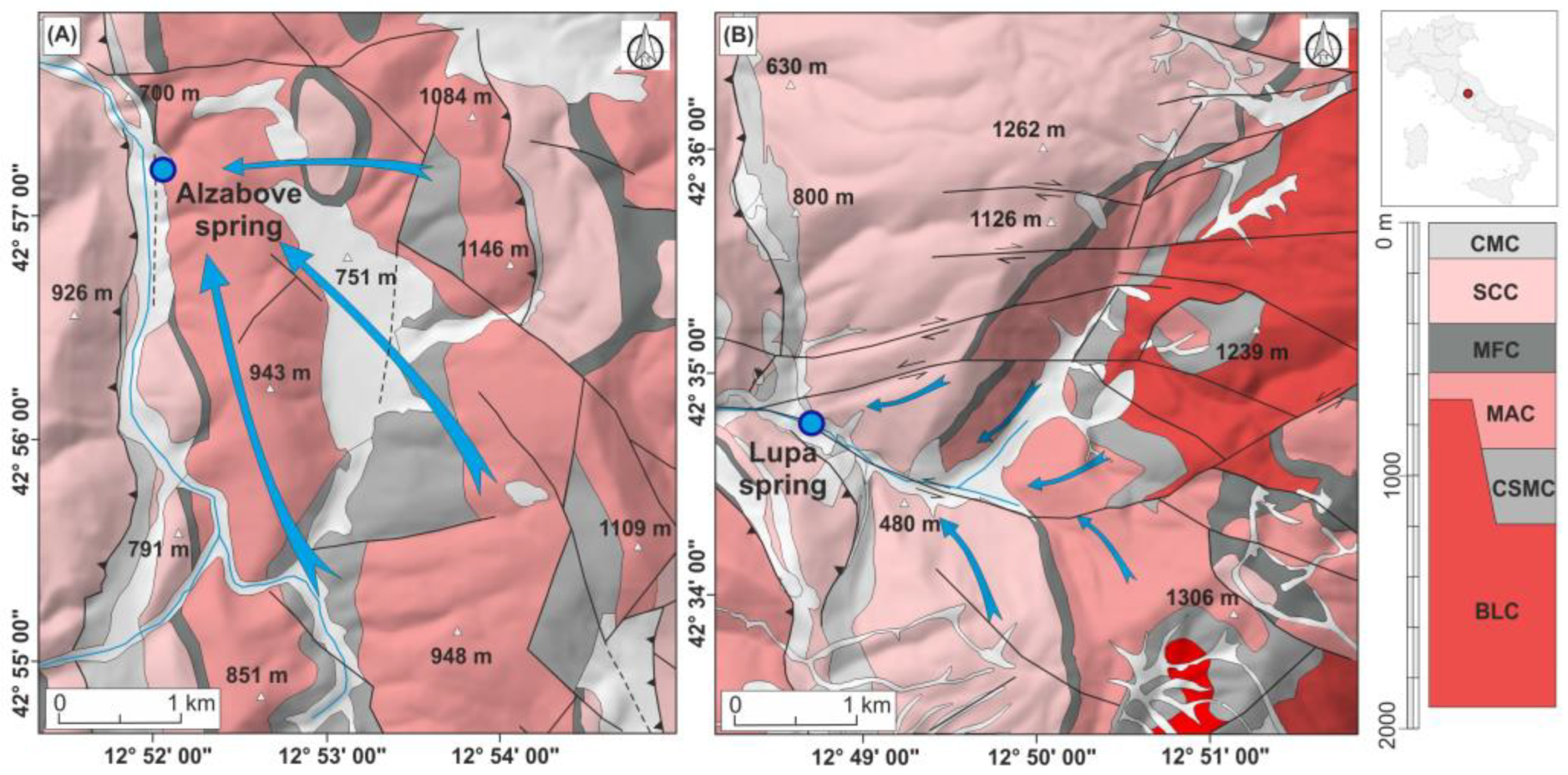
Two strategic springs were chosen, Alzabove and Lupa, which supply the aqueducts of the main cities in the central-southern part of Umbria (Central Italy). Both springs are located in the Umbria–Marche Apennines, an east-verging fold-and-thrust belt formed in the middle Miocene, later dissected by SW-NE directed extensional tectonics active since the early Pleistocene. The reliefs of the chain are formed by the Umbria–Marche stratigraphic Succession (Early Jurassic–Oligocene), an over 2000 m thick calcareous multilayer alternated with siliceous–marly and marly formations (Figure 1). The alternation between calcareous (aquifers) and siliceous–marly/marly (aquicludes) formations plays a crucial role in groundwater circulation, favoring the occurrence of springs at the points of contact between formations with a high permeability contrast, often in conjunction with extensional or strike-slip faults related to the tectonic evolution of the Apennine ridge.
Three limestone complexes hosting important aquifers have been identified in the Umbria–Marche sequence (e.g., [11,13,23,24]): the Base Limestone Complex (Calcare Massiccio and Corniola, Early Jurassic), the Maiolica Complex (Early Cretaceous), and the Scaglia Calcarea Complex (Cretaceous–Paleogene). The Base Limestone Complex and the Maiolica Complex are separated by the Siliceous–Marly and Calcareous Complex (Jurassic). In contrast, the Maiolica Complex and the Scaglia Calcarea Complex are separated by the main aquiclude of the sequence, represented by the marly Marne a Fucoidi Complex. The Calcareous Marly Complex (Eocene-Oligocene) overlies the Scaglia Calcarea Complex and acts as an aquiclude. The Alzabove spring emerges at an altitude of about 640 m a.s.l. at the stratigraphic contact between the Maiolica Complex and Marne a Fucoidi Complex (Figure 1A); thus, it is an overflow spring collected by a draining tunnel managed by the company Valle Umbra Servizi. In contrast, the Lupa spring emerges where the Scaglia Calcarea Complex meets the Calcareous Marly Complex. Its recharge area may also include the aquifer hosted in the Maiolica Complex through tectonic lineaments (Figure 1B). This spring is located at 375 m a.s.l. and managed by the company Servizio Idrico Integrato, and the groundwater here is collected by a long drainage tunnel (about 120 m) built along a strike-slip fault oriented NW-SE.
The recharge area of the Alzabove spring is about 15 km2 (www.arpa.umbria.it/au/pubblicazioni/Sorgenti_bas.zip accessed on 9 November 2025), while that of the Lupa is of about 7 km2 [13], although, due to the complex tectonic features (strike-slip faults) that dissect the hydraulic barrier of the Marne a Fucoidi Complex, the two aquifers hosted in Scaglia Calcarea Complex and Maiolica Complex can be connected (Figure 1B); in this way, the extension of the recharge area can reach 12 km2 (e.g., http://vanoproy.be/python/Lupa_Arrone_infilt_coeff.html#Water-spring-Lupa accessed on 9 November 2025).
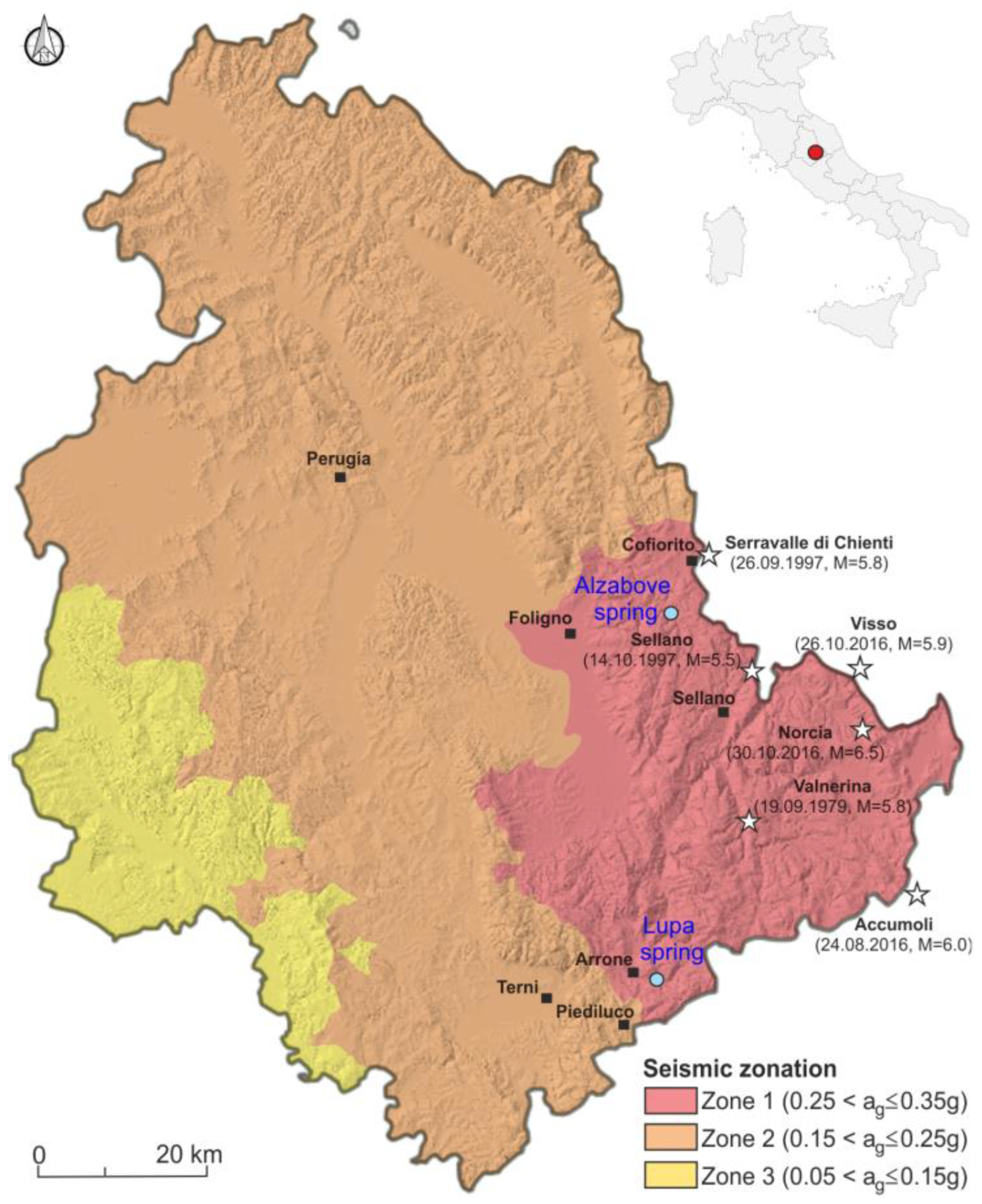
The selected springs are located in highly seismic areas (Figure 2), characterized by extensional earthquakes ranging in magnitude up to 6.5, which develop in the tectonically active Apennine region.
Several recent papers have documented co-seismic effects on groundwater systems that feed both local and streambed springs in the Umbria–Marche Apennines [25,26,27,28,29,30,31]. The influence of seismic shocks on the springs’ regimen depends on earthquake magnitude and the proximity of the epicenter, with significant changes in the near field (less than 10 km from the epicenter) and a decrease between 20 and 30 km from the epicenter. The Alzabove spring experienced a short-term increase in discharge (approximately +0.008 m3/s) following the main shock (6.5 Mw) of the 2016–2017 seismic crisis in Norcia, which occurred approximately 30 km from the spring [25]. The step-like increase in discharge dissipated within a few days relative to the intensity what experienced by springs located less than 10 km from the epicenter. The response to the 1997–1998 seismic sequence (Mw = 5.9), which occurred in the Colfiorito area, at a distance of less than 10 km from the spring, was much more significant, leading to spring discharge changes and increases in sulfate concentrations and water electrical conductivity due to deep-circulating water input induced by the faulting activity, which lasted a few months after the mainshock [32]. The 2016 seismic sequence had negligible effects on the discharge of the Lupa spring [25], as the main seismic crises occurred a significant distance (>30 km) away from it.

2.2. Hydro-Meteorological Data and SPEI Drought Index

A long-term discharge-monitoring dataset has been compiled to characterize the two springs since January 1998. Reliable daily discharge data are available from ARPA Umbria, with missing values amounting to less than 1%. Table S1 reports the discharge data for both springs: these are key data, given that the recharge areas of Alzabove and Lupa springs are located in areas unaffected by human activity (e.g., there are no pumping wells impacting groundwater resources); thus, monitoring spring discharges allows us to understand the responses of mountain aquifers in the Mediterranean basin to prolonged droughts. While the discharge datasets cover a long timespan and are reliable, meteorological data corresponding to altitudes comparable to those of the springs’ recharge areas are either unavailable or available only for short-term periods (e.g., Table 1). This is the case in many mountain areas of Central and Southern Italy, where rain gauge stations are often lacking at medium-to-high elevations, which can be representative of the hydrogeological processes pertaining to the springs’ recharge areas (e.g., [11]).
Meteorological satellites or reanalysis products can overcome the limitations of ground-based data by providing a global view and filling data gaps in areas with sparse or nonexistent ground stations (e.g., [33,34,35,36,37,38]). Among the available products, ERA5-Land is a reanalysis dataset providing a globally consistent view of the evolution of land variables over several decades (e.g., precipitation and air temperature at 2 m from 1950 to the present) at hourly, daily, or monthly scales, with a native resolution of approximately 9 km (0.1° × 0.1°). Hourly daily data were downloaded from the Climate Data Store (https://cds.climate.copernicus.eu/datasets/reanalysis-era5-single-levels?tab=download accessed on 9 November 2025) for the time interval 1997–2023 and subsequently aggregated to obtain the monthly accumulated precipitation. The recharge areas of Alzabove and Lupa springs are included in cells with the following centroid latitude–longitude coordinates: 42.90–12.90 and 42.60–12.80, respectively. As for other mountain regions, the complex topography can affect the reliability of ERA5-Land reanalysis; therefore, verifying its performance with ground-based data enables analyses that are as realistic as possible [36,37]. To quantify the performance of ERA-5 estimates, Pearson’s Correlation Coefficient (CC, Equation (1)), Nash–Sutcliffe efficiency (NSE, Equation (2)), Root Mean Square Error (RMSE, Equation (3)), Mean Absolute Percentage Error (MAPE, Equation (4)), Normalized Mean Absolute Error (NMAE, Equation (5)), and the relative bias (rBias, Equation (6)) are used; the last metric reflects the systematic bias between the satellite-based estimates and the ground observations. All equations are applied to monthly precipitation and temperature data, comparing ground-based meteorological data with reanalysis estimates within each grid cell.
C C = i = 1 n G i G ¯ · S i S ¯ i = 1 n G i G ¯ 2 · i = 1 n S i S ¯ 2
N S E = 1 i = 1 n S i G i 2 i = 1 n G i G ¯ 2
R M S E = i = 1 n S i G i 2 n
M A P E = 1 n · i = 1 n G i S i G i · 100
N M A E = 1 n · i = 1 n G i S i G i m a x G i m i n · 100
r B i a s = i = 1 n ( S i G i ) i = 1 n G i · 100
where
  • S i  = satellite-based estimate;
  • G i  = gauge observation;
  • S ¯  = mean value from satellite-based estimate;
  • G ¯  = mean value from gauge observation;
  • G i m a x  = maximum value of gauge observation;
  • G i m i n  = minimum value of gauge observation.
Ground-based and reanalysis meteorological data were used to compute the Standardized Precipitation-Evapotranspiration Index (SPEI), developed by [21], which helps one determine the frequency, duration, and severity of drought by considering the monthly difference (Di) between the precipitation (Pi) and potential evapotranspiration (PETi). As reported by Vicente-Serrano et al. [21], the Di values aggregated at different time steps, s (e.g., s = 3, 6, 9, 12, 24), are interpolated by the three-parameter log-logistic distribution (Equation (7)). In other words, the probability distribution function of the Di values aggregated at different time steps adapts very well to the empirical F(x) values.
F ( x ) = 1 + a x γ β 1
where a, b, and g are scale, shape, and origin parameters, respectively.
The SPEI (Equation (8)) is therefore obtained as the standardized values of F(x), following the approximation reported in [39].
S P E I = W C 0 + C 1 W + C 2 W 2 1 + d 1 W + d 2 W 2 + d 3 W 3
where
  • W = 2 l n ( P )  for P ≤ 0.5.
  • P = probability of exceeding a determined Di value, P = 1 − F(x). If P > 0.5, then P is replaced by 1 − P, and the sign of the resultant SPEI is reversed.
  • C0 = 2.515517. C1 = 0.802853. C2 = 0.010328. d1 = 1.432788. d2 = 0.189269. and d3 = 0.001308.
According to the WMO [40], at least 20–30 years of monthly data are needed for calculation. Table 2 presents the classifications for different SPEI drought categories.
For computation, the SPEI R library (https://github.com/sbegueria/SPEI/blob/master/R/hargreaves.R accessed on 9 November 2025) was used, which includes PET estimation using various methods. In this study, the daily PET was calculated using the Hargreaves method (Equation (9) [41]) and then aggregated into a monthly scale (PETi). This method performs relatively well compared to the reference FAO-56 Penman–Monteith method, given the lack of data commonly available in mountain regions [42].
P E T = C · 0.408 · R a · T m a x T m i n 0.5 · T m + 17.8
where
  • PET = Potential Evapotranspiration (mm/day).
  • C = Hargreaves coefficient (0.0023).
  • Ra = water equivalent of the monthly averaged daily extraterrestrial radiation (mm/day).
  • Tmax and Tmin = Maximum and minimum daily air temperatures (°C).
  • Tm = Average daily air temperature (°C).

2.3. Master Recession Curve (MRC) and Baseflow Separation

The Master Recession Curve (MRC) for a spring is a graphical representation of the average decrease in spring discharge over time, constructed by combining multiple individual recession periods. The shape and slope of the MRC can provide information about the reservoir’s hydrogeological properties in mountain environments, at least in terms of average or equivalent values. This is important as piezometers are often unavailable due to logistical and topographic constraints (e.g., the piezometric surface is located at great depth) and the complexity of fractured/karst hydrogeological systems. Recession periods were selected from spring hydrographs during no-recharge periods using the XLKarst tool for Excel, developed by [43]. After the recession periods were sorted by discharge from highest to lowest, they were assembled using the strip method [27,44,45,46]. The individual recession curves were overlapped time step by time step, selecting the time-shift values that yielded the best results according to the MAPE criterion (Equation (4)). By fitting the MRCs using the Maillet exponential function (Equation (10)), which is well-suited to the hydrogeological systems of the Apennines in Central Italy (e.g., [13,47,48]), the average recession coefficient (α) for each spring was obtained.
Q t = Q 0 · e α · t
where
  • Qt = daily discharge at time t (m3/s);
  • Q0 = daily discharge at the beginning of the recession period (m3/s);
  • α = recession constant (days−1).
In this study, the one-parameter recursive digital filter developed by Lyne and Hollick [49] was employed (Equation (11)), a simple technique that separates the daily baseflow (BF) at time t from the total spring discharge at time t (Qt) using a filter parameter k that separates low-frequency signals (associated with baseflow). As reported by Kang et al. [50], among the available digital filter methods, the Lyne and Hollick method can achieve reliable baseflow separation when appropriate filter parameters are selected. Although there is little direct link between the digital filter (the k-parameter) and the physical properties of the hydrogeological system feeding the spring, the recession coefficient can be used to separate the hydrograph (e.g., [51]). As reported in some studies, it is often assumed that k = e−αt (e.g., [20,36,51,52]). Regardless of the chosen k-parameter, the critical point is to verify whether the baseflows derived are appropriate during recession periods [50].
B F t = k B F ( t 1 ) + 1 + k 2 ( Q t Q t 1 )
After daily BF data were obtained using Equation (11), the data were aggregated monthly (average monthly discharge) and analyzed alongside the mean monthly discharge to identify potential changes over time in relation to the SPEI index, which was calculated at various time scales.

2.4. Spring Discharge Modeling

Modeling spring discharge is challenging in hydrogeology due to complex subsurface hydrogeology, data scarcity, and difficulties in accurately representing external forcing factors in mountain regions, such as precipitation inputs [53]. Among the available approaches for spring modeling, regression analysis can be helpful for fitting linear or nonlinear equations to predict discharge [54,55]. In this study, a parsimonious model combining an autoregressive model and a cross-regressive model is used to relate the dependent variable to its own past values and to one or more external variables (e.g., [56,57,58]). The basic structure reported in Equation (12) is used for modeling the spring discharge, considering the average monthly spring discharge as its own past values (Qi−1; …; Qi−n) and SPEI as an external variable, computed over different periods (s = 3, 6, 12 months), and considering the delay time (tm) as described in [59]. As reported recently by Ma et al. [55], regression analysis is simple and easy to implement, has low computational cost, and is suitable for large datasets, such as those available for the Lupa and Alzabove springs. Conversely, its ability to simulate nonlinear relationships is limited, making it difficult to accurately represent complex geological and hydrological processes.
Q i = a 0 + a 1 · Q i 1 + + a n · Q i n + b · S P E I s ( i τ m )
where
  • Q i  = simulated mean spring discharge in month i (L/s);
  • Q i 1 ; Q i n = mean spring discharge ranging from month i − 1 and i − n (L/s);
  • S P E I s  = Standardized Precipitation-Evapotranspiration Index computed over different time scales (s = 3, 6, 12 months) and observed in month (i − τm);
  • a 0  = the intercept (L/s);
  • a 1 ; a n  = the regression coefficients for spring discharge values (-);
  • b  = the regression coefficients for SPEIs values (L/s).
The model was calibrated for the two springs using monthly data from a training period (1998–2010), and performance was assessed using MAPE, NSE, and NMAE. Then, it was applied across different hydrological conditions to validate it (2011–2023 period).

3. Results

3.1. Analysis of Springs’ Discharge and BF

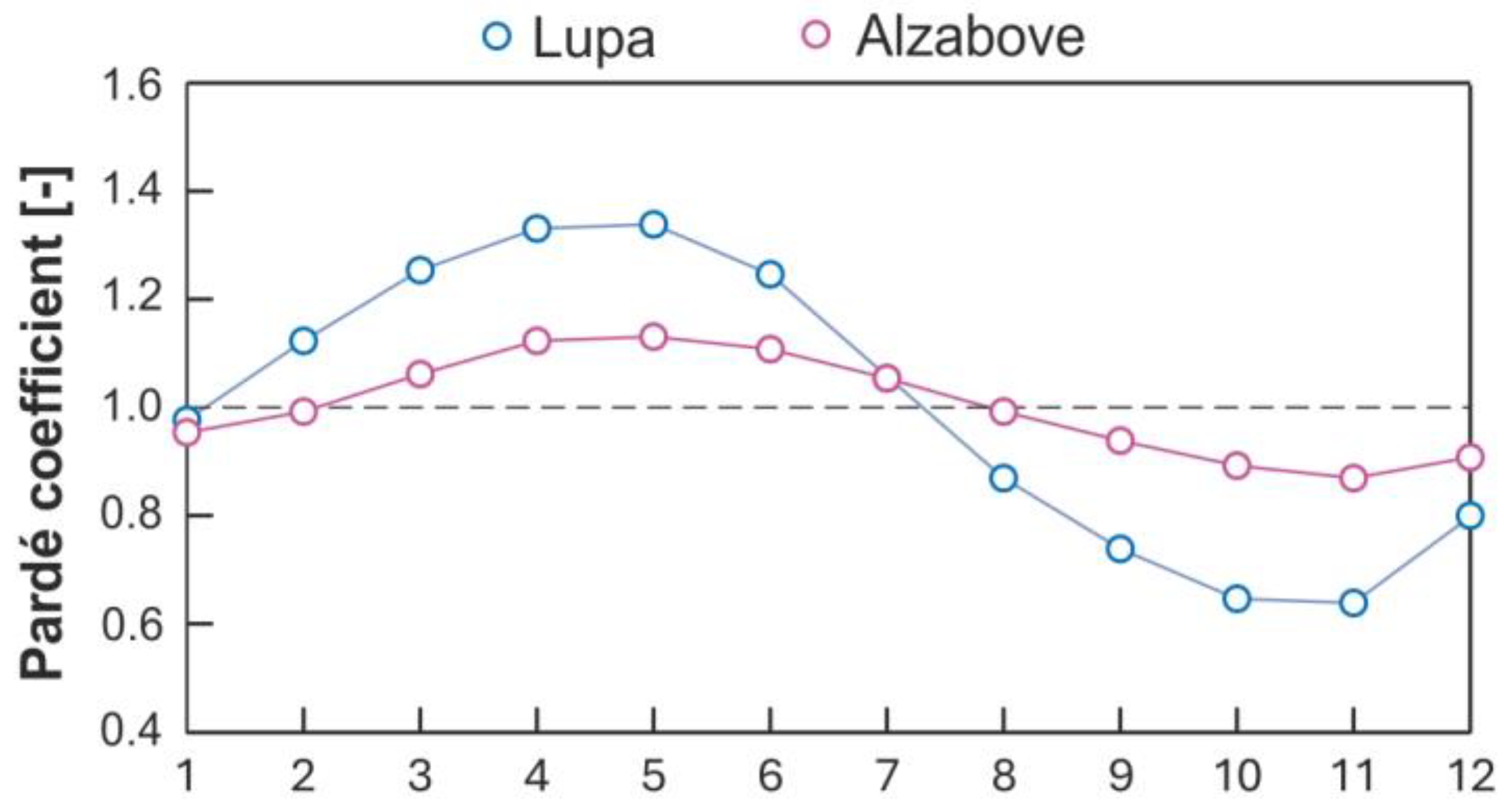
To perform an initial assessment of the hydrogeological systems that feed the springs, we present statistical indicators in Table 3. Figure 3 shows the Pardé coefficient, computed as the ratio of the monthly to annual discharge averages.
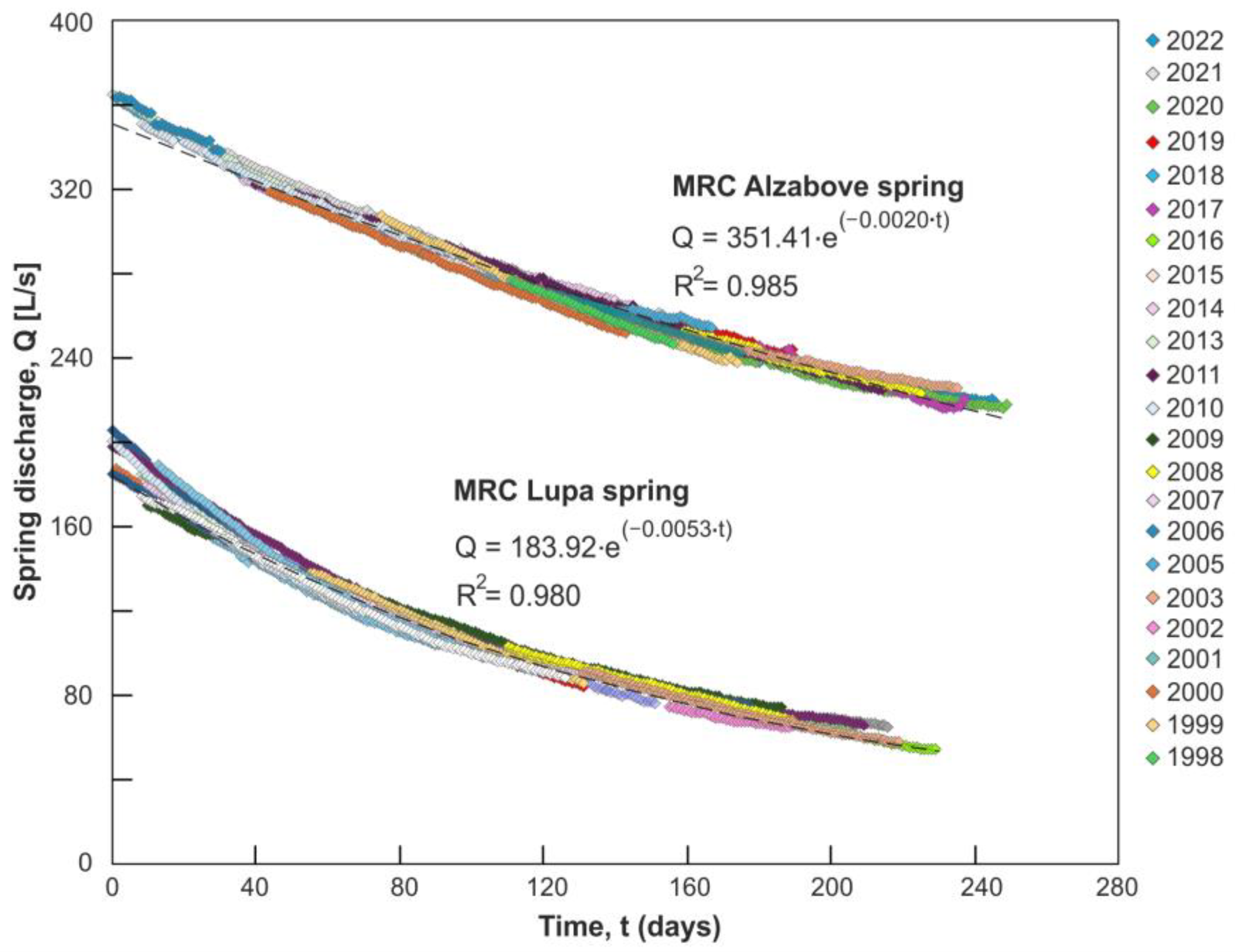
The discharge time series for the Alzabove and Lupa springs was first processed using the XLKarst tool to identify recession periods. Overall, 23 recession curves were selected for the observation period (1998–2023). All recession curves were combined to construct the MRCs (Figure 4), and MAPE values between observed and simulated discharges were used to assess the performance of the recession models. A MAPE of less than 5% was achieved for both springs, indicating the Maillet equation’s overall good performance in describing the recession processes.
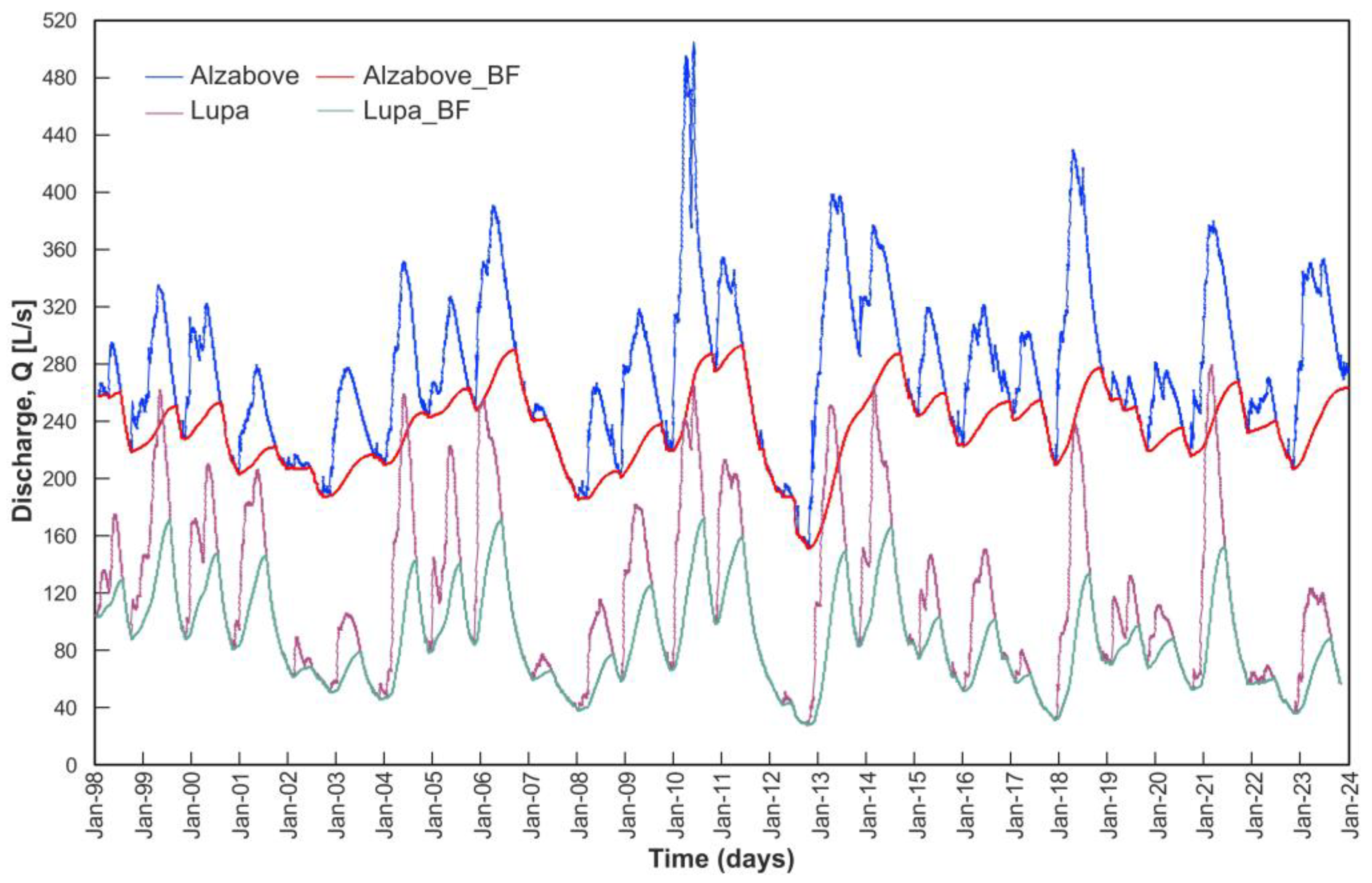
The Alzabove spring exhibits a lower average recession coefficient (α = −0.0020 days−1), indicating a slightly lower decline in spring discharge over time than Lupa (α = −0.0053 days−1). The α values were used to determine the k-parameter for the Lyne and Hollick baseflow separation method, yielding 0.998 for Alzabove and 0.995 for Lupa. In this way, these digital filters were applied to the daily spring discharge data, distinguishing the baseflow recession from the steeper portion of the recession (falling limb), which describes the rapid flow arising from direct recharge into the fracturing network along the main faults (Figure 5).
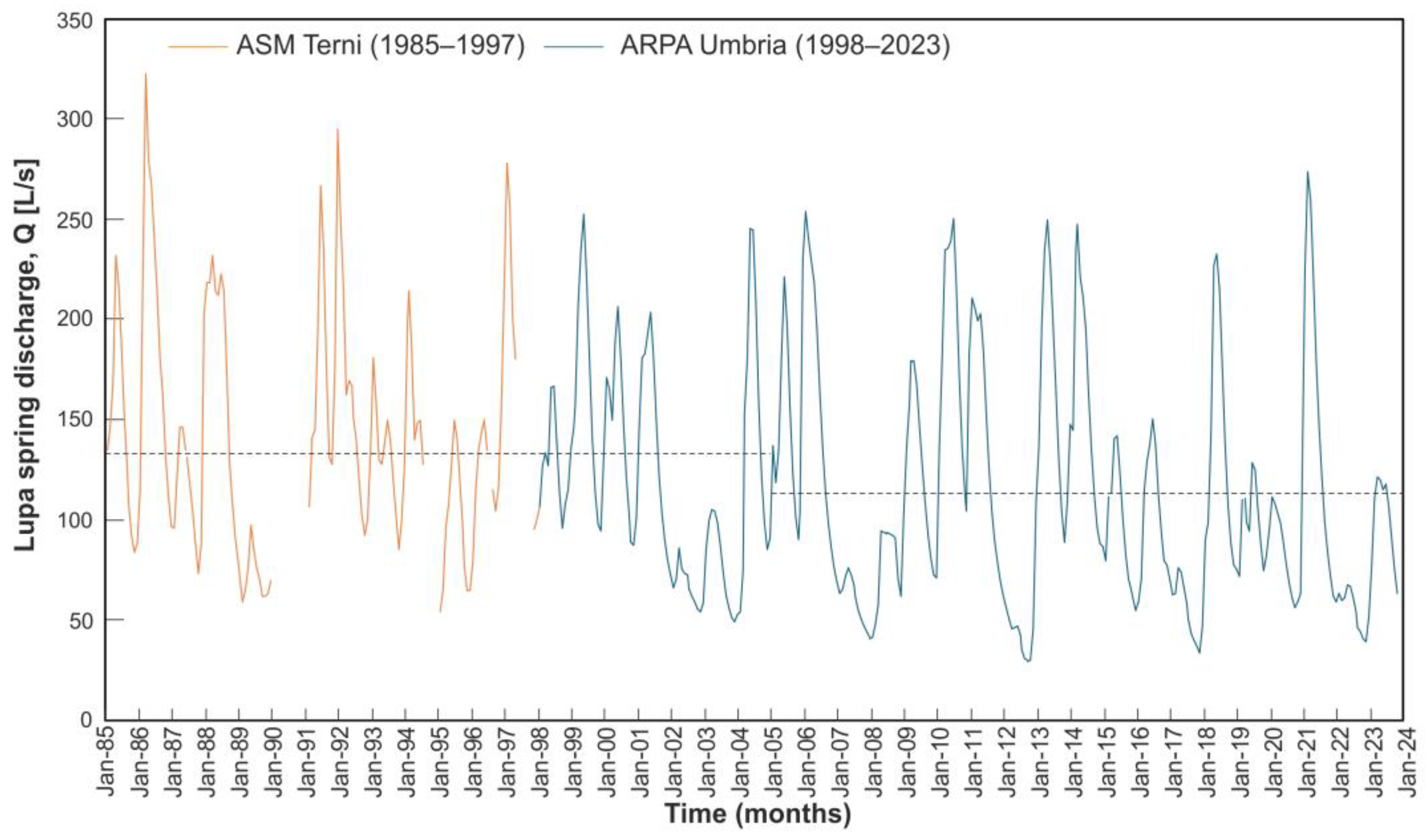
The BF data were aggregated at the monthly scale (mean monthly BF discharge) to examine potential changes driven by the slow release of water associated with matrix porosity and porosity-related permeability (e.g., [60]). The ratio of the total BF volume to the total volume supplied by the springs over the entire observation period (1998–2023) ranges from 0.70 (Lupa) to 0.85 (Alzabove). The trends of mean monthly discharge and mean monthly BF were analyzed using the Mann–Kendall test, a nonparametric test used for detecting trends in sequential data. The significance of trends is determined by a p-value: a small p-value (<0.05) indicates a significant trend, meaning the null hypothesis, no trend, can be rejected. The results indicate that the Lupa spring shows significant negative trends in both mean monthly discharge and mean monthly BF (p < 0.05), with rates of −0.13 L/s × month (p = 6.4 × 10⁻⁵) and −0.10 L/s × month (p < 2.0 × 10⁻⁹), respectively. On the contrary, the data for the Alzabove spring do not show a significant trend for the same period. To understand the long-term behavior of Lupa spring discharges, data monitored by ARPA Umbria were aggregated monthly, along with previously available data analyzed by [13,61], covering the 1985–1997 period and made available by Azienda Servizi Municipalizzati of Terni. The results are presented in Figure 6, which divides the dataset into two sub-periods (1985–2004 and 2005–2023). The mean monthly spring discharge decreased by about 15%, falling from 133 L/s (first period) to 113 L/s (second period). Despite some missing data for the first analysis period, maximum discharges exceeded 250 L/s four times in 1985–2004 and only once in the more recent period. The spring experienced several periods with discharge values below 50 L/s from 2005 to 2023.

3.2. SPEI Values and Spring Discharge Modeling

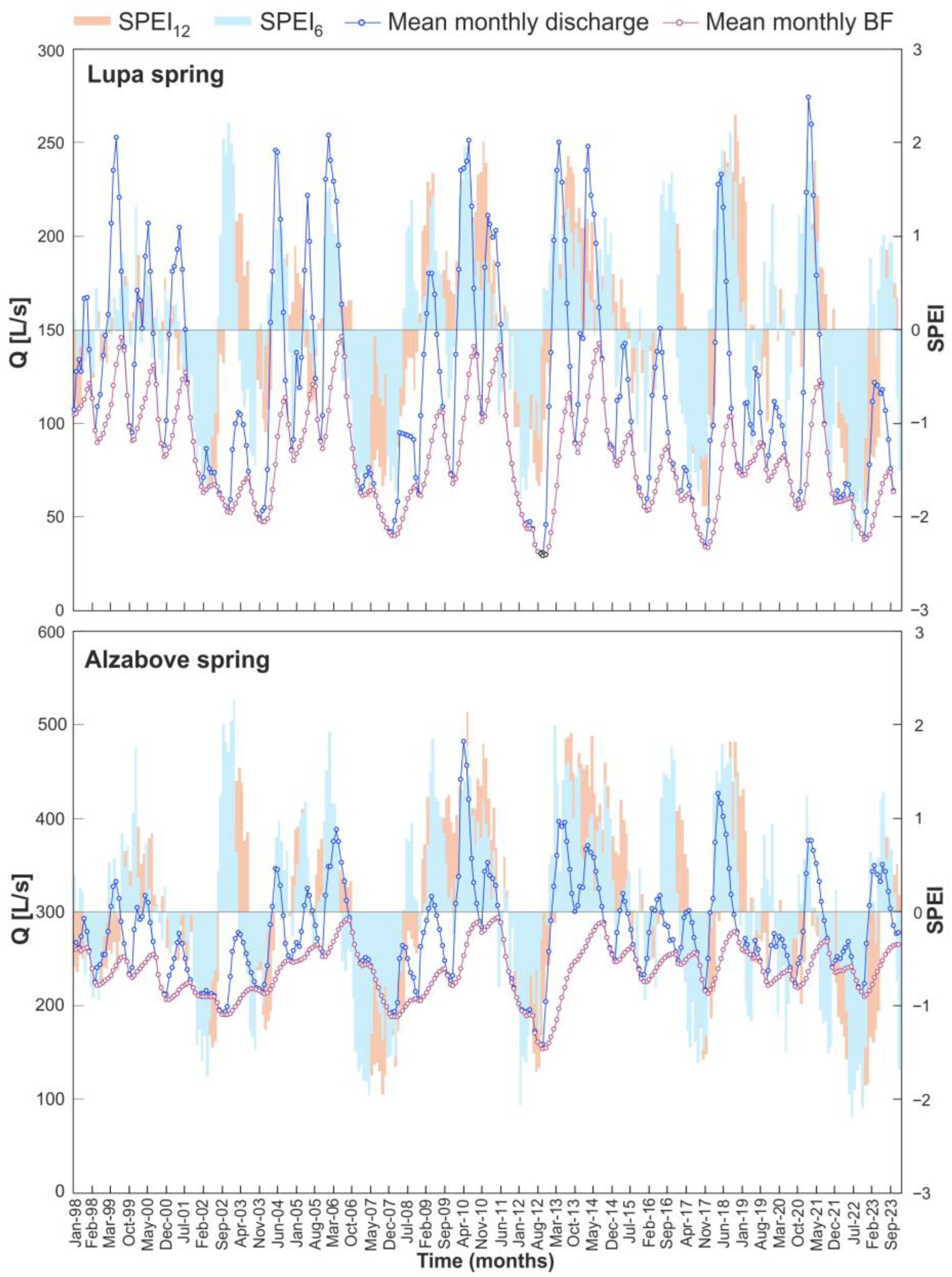
Before SPEI values were computed over different time scales, the reliability of the monthly rainfall dataset from ERA5-Land was assessed by comparing it with ground-based rain gauge data within the ERA5-Land cell. The results of the application of some accuracy indices show that the correlation between monthly ERA5-Land rainfall data with data obtained from the Piediluco gauge (which is the closest one to the Lupa spring (Table 1)) reaches a CC value equal to 0.84, an NSE of 0.70, an RMSE of 33 mm, and an rBias of about −6%. Unfortunately, the ERA5-Land cell used to estimate monthly rainfall over the Alzabove spring recharge area does not include any rain gauges with long datasets with which to compute the statistical indices. However, because this is a data-scarce area, it is essential to use a long, gap-free dataset of rainfall products, such as ERA5-Land, to compute the SPEI and identify the most significant drought events. Figure 7 illustrates the relationship between SPEI, computed over 6 and 12 months (SPEI6 and SPEI12) using ERA5-Land data as an input, and the average monthly spring discharge and the average monthly BF. Each SPEI series was correlated with the monthly mean discharge series to reveal their dependence on the drought index. A cross-correlation analysis showed that the strongest correlation was between SPEI6 and monthly mean discharge with a 1-month delay time (a cross-correlation coefficient of about 0.6 for both springs). Table 4 shows the periods with an SPEI6 for which there were at least three consecutive months with values less than or equal to −1 (corresponding to moderately to extremely dry conditions). Both springs were affected by the same drought periods, with the Lupa spring experiencing a higher magnitude and duration in 2017 than the Alzabove spring. The lowest spring discharges occurred in September 2012: about 30 L/s for Lupa and about 157 L/s for Alzabove. This month was preceded by a long period characterized by negative SPEI6 values—17 months for Lupa and 13 for Alzabove.
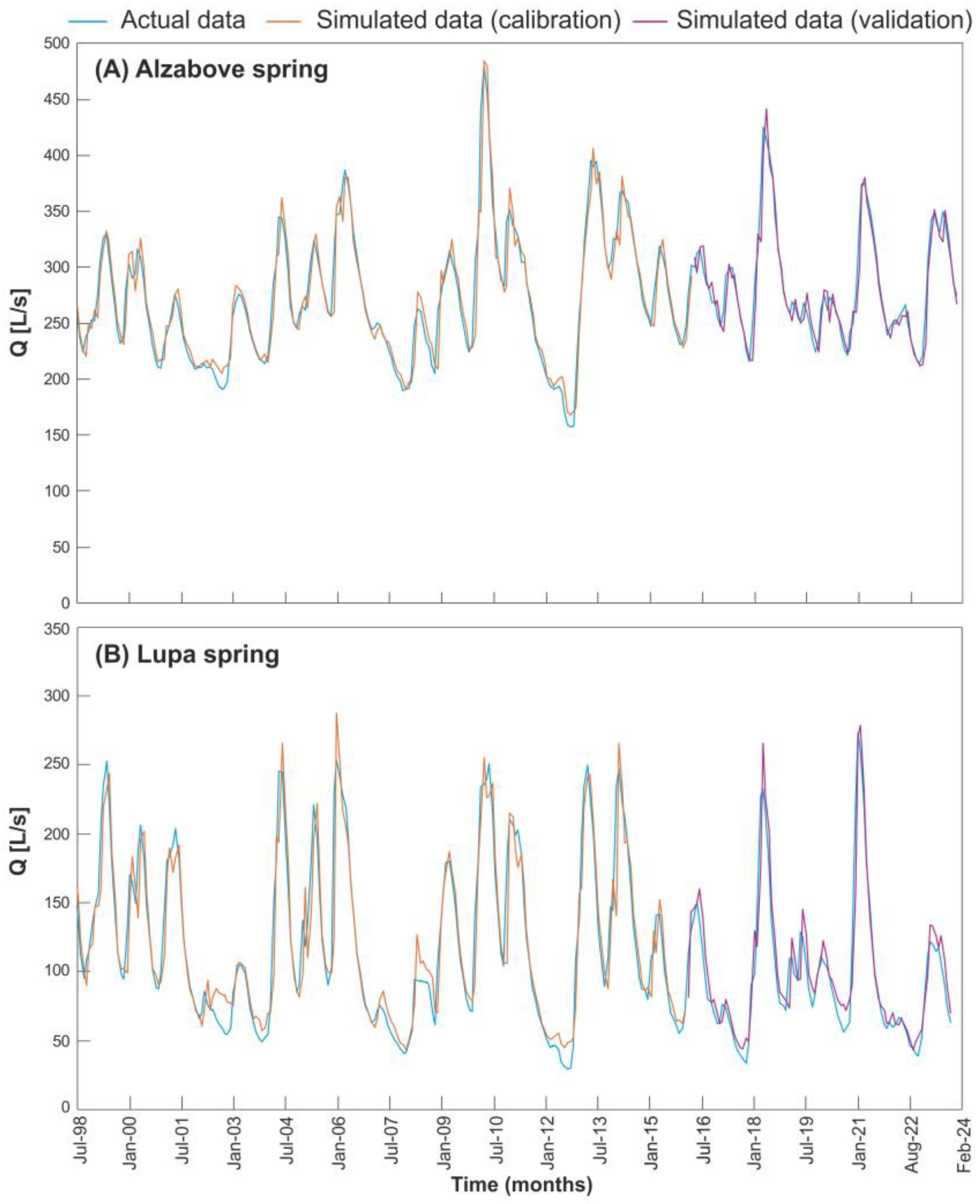
The model in Equation (12) was then developed for both springs, highlighting the importance of the previous mean monthly spring discharge values up to Qi−2. Overall, adding the mean monthly spring discharge for months i − 3 and i − 4 does not improve model performance. Figure 8 shows the calibrated and validated mean monthly spring discharge values, along with the model performance metrics in Table 5 (i.e., MAPE, NSE, and NMAE errors).

4. Discussions

Declining spring discharge is common in the Mediterranean Region due to prolonged droughts, as confirmed by one of the analyzed springs (Lupa), which has shown a significant negative trend over the past decades. This resulted in a reduction of about 20 L/s from 2005 to 2023 compared to 1985–2004, equivalent to the annual water needs of roughly 8000 people. For this calculation, a water consumption of 220 L/day per person was used (e.g., https://eurispes.eu/en/news/a-system-that-treads-water-the-condition-of-water-in-italy/ accessed on 9 November 2025). This observation aligns with a recent study by Casati et al. [62], which examined long-term discharge trends in two springs in the Apennine Mountains. The Alzabove spring does not exhibit a significant trend; overall, in recent decades, the impact of prolonged droughts on spring discharge, as measured using the SPEI index, has been less than that in Lupa. As reported by De Filippi et al. [63], the hydrogeological system of the Alzabove spring has a greater storage capacity than that of Lupa, making it more resilient to ongoing climate change. Additionally, as illustrated in Figure 1, several strike-slip faults in the area have produced a highly fractured hydrogeological system; under these conditions, the depletion of the reservoir in Lupa is occurring more rapidly than in Alzabove, as confirmed by MRC analysis. Moreover, as shown in Table 3, the coefficient of variation for Lupa spring is much higher than that for Alzabove, indicating greater variability in the mean monthly discharge. The Pardé hydrograph for the Alzabove spring shows a relatively smooth appearance compared to that for Lupa, indicating less seasonal variation in monthly discharge (e.g., [64]).
The analysis of the spring discharge response to meteo-climatic conditions revealed that the ERA5-Land data tended to slightly underestimate rainfall in both spring recharge areas, confirming findings from previous studies conducted in mountain fractured/karst regions (e.g., [36,65,66]). Overall, the ERA5-Land dataset has enabled the identification of drought periods in areas for which there are no ground-based thermo-pluviometric data at medium-to-high altitudes. This is a key point for improving water management and understanding the hydrogeological responses of the systems feeding the springs, which would otherwise be very complicated. Moreover, integrating ground-based data and reanalysis products would be advisable to ensure the supply of drinking water, especially given the potential effects of prolonged droughts in the mountain region of Central Italy [11,13,31,67,68]. The expected rise in air temperatures and the occurrence of more persistent droughts in the Mediterranean region (e.g., [69]) will lead to further increases in evapotranspiration and a consequent reduction in aquifer recharge. In this way, the SPEI index can help in capturing the hydrological impact of droughts on spring discharge, offering valuable insights into evolving hydrological processes and supporting more informed decision-making [70,71]. The parsimonious linear regression model developed in this study used the SPEI index as a proxy for estimating monthly spring discharge. Our analysis confirms that the best modeling performance was achieved for the Alzabove spring, which was already analyzed using different modeling approaches—mainly based on rainfall data and previous spring discharges—such as machine learning models [57], nonlinear autoregressive exogenous neural network models [72], linear regression with the Standardized Precipitation Index (SPI) [59], and Fully Connected Neural Networks [63]. In our case, the worst performance occurred under extremely dry conditions (e.g., 2002–2003 and 2012), especially at the Lupa spring, where the simulated discharge overestimated the observed discharge. The problem of the overestimation of simulated discharge during severe droughts has been discussed by Avanzi et al. [73] and, more recently, by [74], who analyzed the Po River basin (Northern Italy), characterized by diverse topographic and climatic characteristics and a variety of land cover types. Apart from inconsistencies in the data used to build the model, the overestimation of discharge during severe droughts is a product of by several factors, including an underestimation of simulated evapotranspiration [73]. For the analyzed springs, using the Hargreaves method in its original parameterization (without calibrating the Hargreaves coefficient (C) in Equation (9)) could lead to an underestimation of PET (e.g., [75]), a well-known problem in forested mountain regions. According to Gavilán et al. [76], in remote mountain areas, the lack of modern automatic weather stations limits calibration of the Hargreaves coefficient (C). In these areas, one possible approach is to perform a sensitivity analysis of the C coefficient, considering the ranges of values reported in the literature for similar environments close to the investigated areas, in terms of weather, topography, and vegetation conditions. Gentilucci et al. [77] calibrated the Hargreaves coefficient (C) using the mountain weather stations along the eastern border of the Umbria and Marche Regions (very close to the spring recharge areas investigated), obtaining values ranging from 0.0021 to 0.0025. These values were used to compute PET values using Equation (9) and, therefore, re-calculate the SPEI6 values, which were introduced in the parsimonious model for simulating the spring discharge (Equation (12)). Overall, model performance does not improve when considering the range of Hargreaves coefficient (C) values in the literature: the MAPE error remains around 11.9% for Lupa and 3.8% for Alzabove during the calibration period (1998–2016), with no improvements in discharge simulation during extreme prolonged droughts. It should be pointed out that an excellent correlation between the uncalibrated Hargreaves method and the calibrated Penman–Monteith method was reported by [77] for mountain weather stations. Regardless of the calibration of the Hargreaves coefficient (C), PET cannot be considered exhaustive for simulating evapotranspiration processes during extreme droughts, which are strictly related to soil water availability and vegetation conditions. As reported by Perez et al. [78], the SPEI index has difficulty capturing the true state of drought in a given plant community due to the complex dynamics of water availability, particularly during critical periods for vegetation [79,80,81]. Orth and Destouni [82], analyzing the European Region, pointed out that vegetation is a potential driver [83,84,85] caused by increased evaporative demand during a drought. As reported by Massari et al. [86], a possible explanation of the enhanced evaporative demand during a drought may lie in the capacity of deep-rooted trees to access water from the weathered, highly porous saprock or from rock moisture [87,88,89,90], which can reach up to 20–30 m beneath the surface [91]. Avanzi et al. [73] reported that a hydrologic model’s predictive skill for evapotranspiration decreases during periods of drought compared to non-drought years because during extended dry periods, the “shallow” moisture storage simulated by the model can be depleted entirely, leading to the paradox of null evapotranspiration [92]. Therefore, modeling does not describe what is actually happening in areas with deep-rooted trees. This problem is significant for the recharge areas of the two selected springs, which, according to the CORINE Land Cover 2018 dataset, are highly forested with deep-rooted trees (about 80% in Lupa and 60% in Alzabove). In this framework, the SPEI underestimates aridity intensity during extremely dry periods (e.g., [93]), especially in high-vegetation mountain environments, leading the model to overestimate spring discharge during these periods. This may be one possible explanation for the model’s weaker performance on Lupa compared to Alzabove, given that the most significant errors in the simulation occur during periods of extreme drought, when the effects of vegetation on evapotranspiration are exacerbated. In this framework, estimating evapotranspiration in mountainous forested regions characterized by thin soils over limestone-fractured rocks during extreme droughts remains challenging.
The analyses highlight the effects of prolonged droughts on spring discharge and the role of tectonic activity in mountain regions in producing medium- to high-magnitude earthquakes. The response of groundwater to earthquakes is increasingly being investigated, a factor that exacerbates the meteo-climatic vulnerability of mountain regions in some hydrogeological systems, even though effects can vary widely and may last anywhere from a few days to a few years (e.g., [94,95]). For the study area we investigated, as documented by [25], groundwater changes were negligible (e.g., an increase of a few L/s in discharge lasted for only a very short period for the Alzabove spring) compared to those of other springs located near the epicenter of the 2016–2017 seismic sequence.
The findings may find practical application in the sustainable management of spring discharge, as they provide insights into how prolonged droughts affect water availability in Central Italy’s mountain regions. Specifically, since the drinking water concession during summer months for the Lupa spring (60 L/s) cannot always be maintained during the frequent dry years (e.g., 2002–2003; 2007–2008; 2012; 2017; 2020; and 2022), a thorough review of the withdrawal system is essential to enhance resilience against climate change. This includes integrating water from new sources, such as pumping wells in aquifers fed by large limestone systems [24], to help release some spring water and support groundwater-dependent ecosystems in mountain environments. When the flow of water from springs to non-perennial streams decreases or stops—as with Lupa—groundwater-dependent ecosystems can become hydrologically disconnected [96]. As Leone et al. [97] recently pointed out, while these surface-water ecosystems are scientifically important, they are often neglected in eco-hydrological research due to a lack of data and specific guidelines or legislation for non-perennial streams. Sustainable management of springs and the preservation of ecosystem integrity represent a new frontier in global conservation efforts [98,99]. The approach and findings presented in our study, based on long-term discharge data coupled with the SPEI index, can provide useful information for the development of sustainable, effective protocols to be integrated into policy strategies that meet local water demands and conservation goals [96,100,101,102,103]. Specifically, as highlighted by our analysis of the Lupa spring (e.g., Figure 7), when the SPEI6 index is lower than −1.5 for at least three consecutive months, the spring discharge falls below 60 L/s, reaching about 30 L/s if the drought persists for at least five consecutive months (e.g., as with the drought in 2022). In this way, an SPEI6 index below −1.5 can be used as a threshold to support sustainable spring management and the protection of groundwater-dependent ecosystems. During prolonged droughts, water from the Lupa spring should be released and replaced to meet water demand, using water from pumping wells drilled outside the spring recharge area in drought-resilient limestone systems.

5. Conclusions

An in-depth analysis was conducted on two springs in Central Italy to understand their hydrogeological behavior—integrating ground-based data and ERA5-Land products toward this end—and investigate their responses to prolonged periods of drought. The following conclusions can be drawn:
-
The long-term discharge data from the Alzabove and Lupa springs fosters an understanding of the feeding reservoir’s behavior by allowing the reconstruction of MRC curves for no-recharge periods. These curves indicate that the hydrogeological system of the Alzabove spring is more resilient to prolonged droughts than that of the Lupa spring.
-
The monthly ERA5-Land reanalysis dataset was compared with ground-based data and used to calculate the SPEI index at different time scales. The highest correlation with SPEI6 (with a 1-month delay) was observed in spring monthly discharge data, capturing wet and dry periods in the recharge areas.
-
A parsimonious linear regression model based on previous monthly mean discharge values and SPEI6 was better able to simulate spring discharge for Alzabove than for Lupa, even though issues in PET underestimation caused overestimation of spring discharge during the 2002–2003 and 2012 extremely dry periods. This effect was more pronounced for the Lupa spring, which experienced a larger decline in discharge during droughts, reflecting the hydrogeological characteristics of its recharge area.
In conclusion, modeling spring discharge in mountain regions is challenging, and further research along these lines is currently underway, integrating additional satellite and reanalysis gridded products. Thermo-pluviometric stations should be installed to complement these products to verify their reliability, a particularly important step given the current lack of data on spring recharge areas, especially for the Alzabove spring. Recently, the Umbria Region Hydrographic Service has installed new weather gauges, whose data will be helpful in for refining the analysis in the future, including evapotranspiration assessment using methods that account for parameters more representative of the phenomenon (e.g., the Penman–Monteith method). Anyway, the findings are encouraging, as they reflect the use of a simple tool to support decisions on groundwater exploitation in complex hydrogeological systems in data-scarce areas. Moreover, the findings can help provide information for efforts to restore essential ecosystems in the Mediterranean mountain regions via using alternative groundwater supplies that are resilient to a changing global climate.

Supplementary Materials

The following supporting information can be downloaded at: https://www.mdpi.com/article/10.3390/su18020970/s1, Table S1: Foglio1.

Author Contributions

Conceptualization, L.D.M. and D.V.; methodology, L.D.M., C.C., S.O., A.M., S.V., D.F., and D.V.; software, S.O. and S.V.; validation, L.D.M., C.C., S.O., A.M., S.V., D.F., and D.V.; formal analysis, L.D.M., C.C., S.O., A.M., S.V., D.F., and D.V.; resources, L.D.M.; data curation, L.D.M., C.C., S.O., A.M., S.V., D.F., and D.V.; writing—original draft preparation, L.D.M., C.C., S.O., A.M., S.V., D.F., and D.V.; writing—review and editing, L.D.M., C.C., S.O., A.M., S.V., D.F., and D.V.; visualization, L.D.M. and S.O.; supervision, L.D.M. and D.V.; project administration, L.D.M. and D.V.; funding acquisition, L.D.M. All authors have read and agreed to the published version of the manuscript.

Funding

This research was funded by the University of Perugia. Project: Analisi dei processi idrogeologici ed idromorfologici nel contesto dei cambiamenti climatici ed antropici, grant number: RICATENEO2024DIMATTEO.

Institutional Review Board Statement

Not applicable.

Informed Consent Statement

Not applicable.

Data Availability Statement

The raw data supporting the conclusions of this article will be included in the article/Supplementary Material. The spring discharge data are available at https://apps.arpa.umbria.it/acqua/contenuto/portata-delle-Sorgenti (accessed on 9 November 2025) while the ground-based thermo-pluviometric data are available at https://annali.regione.umbria.it/ (accessed on 9 November 2025). To open the spring discharge data from the ARPA Umbria website, select S02 (Alzabove) and S05 (Lupa) in the interactive Umbria Region map. The same procedure must be followed to download the thermo-pluviometric data from the Annali Regione Umbria website. The monthly ERA5-Land thermo-pluviometric dataset can be downloaded at https://cds.climate.copernicus.eu/datasets/reanalysis-era5-land-monthly-means?tab=overview (accessed on 9 November 2025).

Conflicts of Interest

The authors declare no conflicts of interest.

References

  1. Lorenzoni, M.; Carosi, A.; Giovinazzo, G.; Petesse, M.L.; Mearelli, M. The fish fauna in the Montedoglio reservoir (Tuscany, Italy) five years after its creation. Int. J. Ecohydrol. Hydrobiol. 2005, 5, 135–146. [Google Scholar]
  2. Di Matteo, L.; Dragoni, W.; Maccari, D.; Piacentini, S.M. Climate change, water supply and environmental problems of headwaters: The paradigmatic case of the Tiber, Savio and Marecchia rivers (Central Italy). Sci. Total Environ. 2017, 598, 733–748. [Google Scholar] [CrossRef]
  3. Cartwright, J.M.; Dwire, K.A.; Freed, Z.; Hammer, S.J.; McLaughlin, B.; Misztal, L.W.; Schenk, E.R.; Springer, A.E.; Stevens, L.E. Oases of the future? Springs as potential hydrologic refugia in drying climates. Front. Ecol. Environ. 2020, 18, 245–253. [Google Scholar] [CrossRef]
  4. Fernández-Martínez, M.; Barquin, J.; Bonada, N.; Cantonati, M.; Churro, C.; Corbera, J.; Delgado, C.; Dulsat-Masvidal, M.; Garcia, G.; Margalef, O.; et al. Mediterranean springs: Keystone ecosystems and biodiversity refugia threatened by global change. Glob. Change Biol. 2024, 30, e16997. [Google Scholar] [CrossRef]
  5. Xie, J.; Liu, X.; Jasechko, S.; Berghuijs, W.R.; Wang, K.; Liu, C.; Reichstein, M.; Jung, M.; Koirala, S. Majority of global river flow sustained by groundwater. Nat. Geosci. 2024, 17, 770–777. [Google Scholar] [CrossRef]
  6. Hartmann, A.; Goldscheider, N.; Wagener, T.; Lange, J.; Weiler, M. Karst water resources in a changing world: Review of hydrological modeling approaches. Rev. Geophys. 2014, 52, 218–242. [Google Scholar] [CrossRef]
  7. Bakalowicz, M. Karst and karst groundwater resources in the Mediterranean. Environ. Earth Sci. 2015, 74, 5–14. [Google Scholar] [CrossRef]
  8. Nerantzaki, S.D.; Nikolaidis, N.P. The response of three Mediterranean karst springs to drought and the impact of climate change. J. Hydrol. 2020, 591, 125296. [Google Scholar] [CrossRef]
  9. Pascual, R.; Piana, L.; Bhat, S.U.; Castro, P.F.; Corbera, J.; Cummings, D.; Delgado, C.; Eades, E.; Fensham, R.J.; Fernández-Martínez, M.; et al. The cultural ecohydrogeology of mediterranean-climate springs: A global review with case studies. Environments 2024, 11, 110. [Google Scholar] [CrossRef]
  10. Le Page, M.; Fakir, Y.; Aouissi, J. Modeling for integrated water resources management in the Mediterranean region. In Water Resources in the Mediterranean Region; Elsevier: Amsterdam, The Netherlands, 2020; pp. 157–190. [Google Scholar] [CrossRef]
  11. Cambi, C.; Valigi, D.; Di Matteo, L. Hydrogeological study of data-scarce limestone massifs: The case of Gualdo Tadino and Monte Cucco structures (central Apennines, Italy). Boll. Geofis. Teor. Ed Appl. 2010, 51, 345–360. Available online: https://bgo.ogs.it/sites/default/files/pdf/bgta51.4_Cambi.pdf (accessed on 10 October 2025).
  12. Fiorillo, F.; Guadagno, F.M. Karst Spring discharges analysis in relation to drought periods, using the SPI. Water Resour. Manag. 2010, 24, 1867–1884. [Google Scholar] [CrossRef]
  13. Di Matteo, L.; Valigi, D.; Cambi, C. Climatic characterization and response of water resources to climate change in limestone areas: Considerations on the importance of geological setting. J. Hydrol. Eng. 2013, 18, 773–779. [Google Scholar] [CrossRef]
  14. Taylor, R.G.; Scanlon, B.; Döll, P.; Rodell, M.; Van Beek, R.; Wada, Y.; Longuevergne, L.; Leblanc, L.; Famiglietti, J.S.; Edmunds, M.; et al. Ground water and climate change. Nat. Clim. Change 2013, 3, 322–329. [Google Scholar] [CrossRef]
  15. Sivelle, V.; Jourde, H.; Bittner, D.; Mazzilli, N.; Tramblay, Y. Assessment of the relative impacts of climate changes and anthropogenic forcing on spring discharge of a Mediterranean karst system. J. Hydrol. 2021, 598, 126396. [Google Scholar] [CrossRef]
  16. Tan, X.; Liu, B.; Tan, X. Global changes in baseflow under the impacts of changing climate and vegetation. Water Resour. Res. 2020, 56, e2020WR027349. [Google Scholar] [CrossRef]
  17. Angelini, P.; Dragoni, W. The problem of modeling limestone springs: The case of Bagnara (North Apennines, Italy). Groundwater 1997, 35, 612–618. [Google Scholar] [CrossRef]
  18. Solgi, A.; Zarei, H.; Marofi, S. A new approach to use of wavelet transform for baseflow separation of Karst springs (case study: Gamasiyab spring). Appl. Water Sci. 2022, 12, 264. [Google Scholar] [CrossRef]
  19. Cinkus, G.; Mazzilli, N.; Jourde, H. KarstID: An R Shiny application for the analysis of karst spring discharge time series and the classification of karst system hydrological functioning. Environ. Earth Sci. 2023, 82, 136. [Google Scholar] [CrossRef]
  20. Kale, R.V.; Dwivedi, A.K.; Ojha, C.S.P.; Shukla, R. Evaluation of spring flows using recession flow analysis techniques. Water Supply 2024, 24, 2232–2246. [Google Scholar] [CrossRef]
  21. Vicente-Serrano, S.M.; Beguería, S.; López-Moreno, J.I. A multiscalar drought index sensitive to global warming: The standardized precipitation evapotranspiration index. J. Clim. 2010, 23, 1696–1718. [Google Scholar] [CrossRef]
  22. Venturi, S.; Dunea, D.; Mateescu, E.; Virsta, A.; Petrescu, N.; Casadei, S. SPEI and SPI correlation in the study of drought phenomena in Umbria region (central Italy). Environ. Sci. Pollut. Res. 2025, 32, 168–188. [Google Scholar] [CrossRef]
  23. Nanni, T.; Vivalda, P.M.; Palpacelli, S.; Marcellini, M.; Tazioli, A. Groundwater circulation and earthquake-related changes in hydrogeological karst environments: A case study of the Sibillini Mountains (central Italy) involving artificial tracers. Hydrogeol. J. 2020, 28, 2409–2428. [Google Scholar] [CrossRef]
  24. Valigi, D.; Cambi, C.; Checcucci, R.; Di Matteo, L. Transmissivity estimates by specific capacity data of some fractured Italian carbonate aquifers. Water 2021, 13, 1374. [Google Scholar] [CrossRef]
  25. Petitta, M.; Mastrorillo, L.; Preziosi, E.; Banzato, F.; Barberio, M.D.; Billi, A.; Cambi, C.; De Luca, G.; Di Carlo, G.; Di Curzio, D.; et al. Water table and discharge changes associated with the 2016–2017 seismic sequence in central Italy: Hydrogeological data and a conceptual model for fractured carbonate aquifers. Hydrogeol. J. 2018, 26, 1009–1026. [Google Scholar] [CrossRef]
  26. Valigi, D.; Mastrorillo, L.; Cardellini, C.; Checcucci, R.; Di Matteo, L.; Frondini, F.; Mirabella, F.; Viaroli, S.; Vispi, I. Springs discharge variations induced by strong earthquakes: The Mw 6.5 Norcia event (Italy, October 30th 2016). Rend. Online Soc. Geol. Ital. 2019, 47, 141–146. [Google Scholar] [CrossRef]
  27. Di Matteo, L.; Dragoni, W.; Azzaro, S.; Pauselli, C.; Porreca, M.; Bellina, G.; Cardaci, W. Effects of earthquakes on the discharge of groundwater systems: The case of the 2016 seismic sequence in the Central Apennines, Italy. J. Hydrol. 2020, 583, 124509. [Google Scholar] [CrossRef]
  28. Di Matteo, L.; Capoccioni, A.; Porreca, M.; Pauselli, C. Groundwater-surface water interaction in the Nera River Basin (Central Italy): New insights after the 2016 seismic sequence. Hydrology 2021, 8, 97. [Google Scholar] [CrossRef]
  29. Cambi, C.; Mirabella, F.; Petitta, M.; Banzato, F.; Beddini, G.; Cardellini, C.; Fronzi, D.; Mastrorillo, L.; Tazioli, A.; Valigi, D. Reaction of the carbonate Sibillini Mountains Basal aquifer (Central Italy) to the extensional 2016–2017 seismic sequence. Sci. Rep. 2022, 12, 22428. [Google Scholar] [CrossRef]
  30. Cencetti, C.; Di Matteo, L. Mitigation measures preventing floods from landslide dams: Analysis of pre-and post-hydrologic conditions upstream a seismic-induced landslide dam in Central Italy. Environ. Earth Sci. 2022, 81, 403. [Google Scholar] [CrossRef]
  31. Mastrorillo, L.; Viaroli, S.; Petitta, M. Co-Occurrence of Earthquake and Climatic Events on Groundwater Budget Alteration in a Fractured Carbonate Aquifer (Sibillini Mts.—Central Italy). Water 2023, 15, 2355. [Google Scholar] [CrossRef]
  32. Italiano, F.; Caracausi, A.; Favara, R.; Innocenzi, P.; Martinelli, G. Geochemical monitoring of cold waters during seismicity: Implications for earthquake-induced modification in shallow aquifers. TAO Terr. Atmos. Ocean. Sci. 2005, 16, 709. Available online: https://pdfs.semanticscholar.org/5c85/9288b274ab9a8c521384fbaa9fb81f26c8ad.pdf (accessed on 15 October 2025). [CrossRef]
  33. Caloiero, T.; Caroletti, G.N.; Coscarelli, R. IMERG-Based Meteorological Drought Analysis over Italy. Climate 2021, 9, 65. [Google Scholar] [CrossRef]
  34. Chiaravalloti, F.; Caloiero, T.; Coscarelli, R. The long-term ERA5 data series for trend analysis of rainfall in Italy. Hydrology 2022, 9, 18. [Google Scholar] [CrossRef]
  35. Ortenzi, S.; Cencetti, C.; Marchesini, I.; Stelluti, M.; Di Matteo, L. Performance of rainfall and soil moisture satellite products on a small catchment in Central Italy. Ital. J. Eng. Geol. Environ. 2023, 99, 99–111. [Google Scholar] [CrossRef]
  36. Ortenzi, S.; Di Matteo, L.; Valigi, D.; Donnini, M.; Dionigi, M.; Fronzi, D.; Geris, J.; Guadagnano, F.; Marchesini, I.; Filippucci, P.; et al. Exploring groundwater-surface water interactions and recharge in fractured mountain systems: An integrated approach. EGUsphere 2025, 2025, 1–37. [Google Scholar] [CrossRef]
  37. Gomis-Cebolla, J.; Rattayova, V.; Salazar-Galán, S.; Francés, F. Evaluation of ERA5 and ERA5-Land reanalysis precipitation datasets over Spain (1951–2020). Atmos. Res. 2023, 284, 106606. [Google Scholar] [CrossRef]
  38. Qian, L.; Zhao, P. Assessment of ERA5-Land Reanalysis Precipitation Data in the Qilian Mountains of China. Atmosphere 2025, 16, 826. [Google Scholar] [CrossRef]
  39. Abramowitz, M.; Stegun, I.A. Handbook of Mathematical Functions, with Formulas, Graphs, and Mathematical Tables; Dover Publications: Mineola, NY, USA, 1965; 1046p. [Google Scholar]
  40. WMO—World Meteorological Organization. Standardized Precipitation Index User Guide; Svoboda, M., Hayes, M., Wood, D., Eds.; WMO-No. 1090; World Meteorological Organization: Geneva, Switzerland, 2012. [Google Scholar]
  41. Hargreaves, G.H.; Samani, Z.A. Reference crop evapotranspiration from temperature. Appl. Eng. Agric. 1985, 1, 96–99. [Google Scholar] [CrossRef]
  42. Vangelis, H.; Tigkas, D.; Tsakiris, G. The effect of PET method on Reconnaissance Drought Index (RDI) calculation. J. Arid Environ. 2013, 88, 130–140. [Google Scholar] [CrossRef]
  43. Bailly-Comte, V.; Ladouche, B.; Charlier, J.B.; Hakoun, V.; Maréchal, J.C. XLKarst, an Excel tool for time series analysis, spring recession curve analysis and classification of karst aquifers. Hydrogeol. J. 2023, 31, 2401–2415. [Google Scholar] [CrossRef]
  44. Singh, V.P. Hydrologic Systems: Watershed Modeling; Prentice-Hall: Denver, CO, USA, 1989; p. 448. [Google Scholar]
  45. Tallaksen, L.M. A review of baseflow recession analysis. J. Hydrol. 1995, 165, 349–370. [Google Scholar] [CrossRef]
  46. Posavec, K.; Parlov, J.; Nakic’, Z. Fully automated objective-based method for master recession curve separation. Groundwater 2010, 48, 598–603. [Google Scholar] [CrossRef] [PubMed]
  47. Dragoni, W.; Mottola, A.; Cambi, C. Modeling the effects of pumping wells in spring management: The case of Scirca spring (central Apennines, Italy). J. Hydrol. 2013, 493, 115–123. [Google Scholar] [CrossRef]
  48. Tamburini, A.; Menichetti, M. Groundwater circulation in fractured and karstic aquifers of the Umbria-Marche Apennine. Water 2020, 12, 1039. [Google Scholar] [CrossRef]
  49. Lyne, V.; Hollick, M. Stochastic time-variable rainfall-runoff modelling. In Institute of Engineers Australia National Conference; Institute of Engineers Australia: Barton, Australia, 1979; Volume 79, pp. 89–93. [Google Scholar]
  50. Kang, T.; Lee, S.; Lee, N.; Jin, Y. Baseflow separation using the digital filter method: Review and sensitivity analysis. Water 2022, 14, 485. [Google Scholar] [CrossRef]
  51. Chapman, T. A comparison of algorithms for stream flow recession and baseflow separation. Hydrol. Process. 1999, 13, 701–714. [Google Scholar] [CrossRef]
  52. Thomas, B.F.; Vogel, R.M.; Kroll, C.N.; Famiglietti, J.S. Estimation of the base flow recession constant under human interference. Water Resour. Res. 2013, 49, 7366–7379. [Google Scholar] [CrossRef]
  53. Chowdhury, N.; Morrissey, P.; Gill, L. A comparison between numerical, neural network, and hybrid modelling approaches to simulate spring flow from a karst catchment in northwest Ireland using long-term hydrological data. J. Hydrol. Reg. Stud. 2025, 61, 102723. [Google Scholar] [CrossRef]
  54. Helsel, D.R.; Hirsch, R.M.; Ryberg, K.R.; Archfield, S.A.; Gilroy, E.J. Statistical methods in water resources. In Techniques and Methods; book 4, chap. A3; U.S. Geological Survey: Reston, VA, USA, 2020; p. 458. [Google Scholar] [CrossRef]
  55. Ma, C.; Jiao, H.; Hao, Y.; Yeh, T.C.J.; Zhu, J.; Hao, H.; Lu, J.; Dong, J. Simulation of spring discharge using deep learning, considering the spatiotemporal variability of precipitation. Water Resour. Res. 2025, 61, e2024WR037449. [Google Scholar] [CrossRef]
  56. Kresic, N.; Stevanovic, Z. Groundwater Hydrology of Springs: Engineering, Theory, Management and Sustainability; Elsevier, Butterworth-Heinemann: Oxford, UK, 2009; 567p. [Google Scholar]
  57. Granata, F.; Saroli, M.; de Marinis, G.; Gargano, R. Machine learning models for spring discharge forecasting. Geofluids 2018, 1, 8328167. [Google Scholar] [CrossRef]
  58. Doglioni, A.; Simeone, V. Data-driven modelling of water table oscillations for a porous aquifer occasionally flowing under pressure. Geosciences 2021, 11, 282. [Google Scholar] [CrossRef]
  59. Guyennon, N.; Passaretti, S.; Mineo, C.; Boscariol, E.; Petrangeli, A.B.; Varriale, A.; Romano, E. A parsimonious model for springs discharge reconstruction and forecast for drought management: Lessons from a case study in Central Italy. J. Hydrol. Reg. Stud. 2024, 56, 102021. [Google Scholar] [CrossRef]
  60. Amit, H.; Lyakhovsky, V.; Katz, A.; Starinsky, A.; Burg, A. Interpretation of spring recession curves. Groundwater 2002, 40, 543–551. [Google Scholar] [CrossRef]
  61. Preziosi, E.; Guyennon, N.; Petrangeli, A.B.; Romano, E.; Di Salvo, C. A stepwise modelling approach to identifying structural features that control groundwater flow in a folded carbonate aquifer system. Water 2022, 14, 2475. [Google Scholar] [CrossRef]
  62. Casati, T.; Navarra, A.; Filippini, M.; Gargini, A. Assessing the long-term trend of spring discharge in a climate change hotspot area. Sci. Total Environ. 2024, 957, 177498. [Google Scholar] [CrossRef]
  63. De Filippi, F.M.; Ginesi, M.; Sappa, G. A fully connected neural network (FCNN) model to simulate karst spring flowrates in the Umbria region (Central Italy). Water 2024, 16, 2580. [Google Scholar] [CrossRef]
  64. Seelig, M.; Seelig, S.; Vremec, M.; Wagner, T.; Brielmann, H.; Eybl, J.; Winkler, G. Quantitative Classification of Spring Discharge Patterns: A Cluster Analysis Approach. Hydrol. Process. 2024, 38, e15326. [Google Scholar] [CrossRef]
  65. Silvestri, L.; Saraceni, M.; Bongioannini Cerlini, P. Links between precipitation, circulation weather types and orography in central Italy. Int. J. Clim. 2022, 42, 5807–5825. [Google Scholar] [CrossRef]
  66. Al Khoury, I.; Boithias, L.; Sivelle, V.; Bailey, R.T.; Abbas, S.A.; Filippucci, P.; Massari, C.; Labat, D. Evaluation of precipitation products for small karst catchment hydrological modeling in data-scarce mountainous regions. J. Hydrol. 2024, 645, 132131. [Google Scholar] [CrossRef]
  67. Romano, E.; Preziosi, E. Precipitation pattern analysis in the Tiber River basin (central Italy) using standardized indices. Int. J. Climatol. 2013, 33, 1781. [Google Scholar] [CrossRef]
  68. García-García, A.; Stradiotti, P.; Di Paolo, F.; Filippucci, P.; Fischer, M.; Orság, M.; Brocca, L.; Peng, J.; Dorigo, W.; Gruber, A.; et al. Intercomparison of Earth Observation products for hyper-resolution hydrological modelling over Europe. Remote Sens. Environ. 2026, 333, 115131. [Google Scholar] [CrossRef]
  69. Cardell, M.F.; Amengual, A.; Romero, R.; Ramis, C. Future extremes of temperature and precipitation in Europe derived from a combination of dynamical and statistical approaches. Int. J. Climatol. 2020, 40, 4800–4827. [Google Scholar] [CrossRef]
  70. Muhumure, J.; Pohl, E.; Schulz, S. Assessing the impact of climate change on spring discharge using hydrological modelling in Musanze District, Rwanda. Hydrogeol. J. 2024, 32, 1909–1923. [Google Scholar] [CrossRef]
  71. Li, J.; Wang, Z.; Wu, X.; Xu, C.Y.; Guo, S.; Chen, X. Toward monitoring short-term droughts using a novel daily scale, standardized antecedent precipitation evapotranspiration index. J. Hydrometeorol. 2020, 21, 891–908. [Google Scholar] [CrossRef]
  72. Di Nunno, F.; Granata, F.; Gargano, R.; de Marinis, G. Prediction of spring flows using nonlinear autoregressive exogenous (NARX) neural network models. Environ. Monit. Assess. 2021, 193, 350. [Google Scholar] [CrossRef] [PubMed]
  73. Avanzi, F.; Rungee, J.; Maurer, T.; Bales, R.; Ma, Q.; Glaser, S.; Conklin, M. Climate elasticity of evapotranspiration shifts the water balance of Mediterranean climates during multi-year droughts. Hydrol. Earth Syst. Sci. 2020, 24, 4317–4337. [Google Scholar] [CrossRef]
  74. Bruno, G.; Avanzi, F.; Alfieri, L.; Libertino, A.; Gabellani, S.; Duethmann, D. Hydrological model skills change with drought severity; insights from multi-variable evaluation. J. Hydrol. 2024, 634, 131023. [Google Scholar] [CrossRef]
  75. Mestre-Valero, J.F.; Álvarez, V.M.; Real, M.M.G. Regionalization of the Hargreaves coefficient to estimate long-term reference evapotranspiration series in SE Spain. Span. J. Agric. Res. 2013, 11, 1137–1152. [Google Scholar] [CrossRef]
  76. Gavilán, P.; Lorite, I.J.; Tornero, S.; Berengena, J. Regional calibration of Hargreaves equation for estimating reference ET in a semiarid environment. Agric. Water Manag. 2026, 81, 257–281. [Google Scholar] [CrossRef]
  77. Gentilucci, M.; Bufalini, M.; Materazzi, M.; Barbieri, M.; Aringoli, D.; Farabollini, P.; Pambianchi, G. Calculation of potential evapotranspiration and calibration of the Hargreaves equation using geostatistical methods over the last 10 years in central Italy. Geosciences 2021, 11, 348. [Google Scholar] [CrossRef]
  78. Perez, M.; Lombardi, D.; Bardino, G.; Vitale, M. Drought assessment through actual evapotranspiration in Mediterranean vegetation dynamics. Ecol. Indic. 2024, 166, 112359. [Google Scholar] [CrossRef]
  79. Scarascia-Mugnozza, G.; Oswald, H.; Piussi, P.; Radoglou, K. Forests of the Mediterranean region: Gaps in knowledge and research needs. For. Ecol. Manag. 2000, 132, 97–109. [Google Scholar] [CrossRef]
  80. Maselli, F.; Cherubini, P.; Chiesi, M.; Gilabert, M.A.; Lombardi, F.; Moreno, A.; Teobaldelli, M.; Tognetti, R. Start of the dry season as a main determinant of inter-annual Mediterranean forest production variations. Agric. For. Meteorol. 2014, 194, 197–206. [Google Scholar] [CrossRef]
  81. Peng, L.; Sheffield, J.; Wei, Z.; Ek, M.; Wood, E.F. An enhanced Standardized Precipitation–Evapotranspiration Index (SPEI) drought-monitoring method integrating land surface characteristics. Earth Syst. Dyn. 2024, 15, 1277–1300. [Google Scholar] [CrossRef]
  82. Orth, R.; Destouni, G. Drought reduces blue-water fluxes more strongly than green-water fluxes in Europe. Nat. Commun. 2018, 9, 3602. [Google Scholar] [CrossRef] [PubMed]
  83. Vicente-Serrano, S.M.; Lopez-Moreno, J.-I.; Beguería, S.; Lorenzo-Lacruz, J.; Sanchez-Lorenzo, A.; García-Ruiz, J.M.; Azorin-Molina, C.; Morán-Tejeda, E.; Revuelto, J.; Trigo, R.; et al. Evidence of increasing drought severity caused by temperature rise in southern Europe. Environ. Res. Lett. 2014, 9, 044001. [Google Scholar] [CrossRef]
  84. Peña-Gallardo, M.; Vicente-Serrano, S.M.; Hannaford, J.; Lorenzo-Lacruz, J.; Svoboda, M.; Domínguez-Castro, F.; Maneta, M.; Tomas-Burguera, M.; Kenawy, A.E. Complex influences of meteorological drought time-scales on hydrological droughts in natural basins of the contiguous Unites States. J. Hydrol. 2019, 568, 611–625. [Google Scholar] [CrossRef]
  85. Peña-Angulo, D.; Vicente-Serrano, S.M.; Domínguez-Castro, F.; Noguera, I.; Tomas-Burguera, M.; López-Moreno, J.I.; Lorenzo-Lacruz, J.; El Kenawy, A. Unravelling the role of vegetation on the different trends between climatic and hydrologic drought in headwater catchments of Spain. Anthropocene 2021, 36, 100309. [Google Scholar] [CrossRef]
  86. Massari, C.; Avanzi, F.; Bruno, G.; Gabellani, S.; Penna, D.; Camici, S. Evaporation enhancement drives the European water-budget deficit during multi-year droughts. Hydrol. Earth Syst. Sci. 2022, 26, 1527–1543. [Google Scholar] [CrossRef]
  87. Rempe, D.M.; Dietrich, W.E. Direct observations of rock moisture, a hidden component of the hydrologic cycle. Proc. Natl. Acad. Sci. USA 2018, 115, 2664–2669. [Google Scholar] [CrossRef]
  88. Hahm, W.J.; Dralle, D.N.; Rempe, D.M.; Bryk, A.B.; Thompson, S.E.; Dawson, T.E.; Dietrich, W.E. Low Subsurface Water Storage Capacity Relative to Annual Rainfall Decouples Mediterranean Plant Productivity and Water Use From Rainfall Variability. Geophys. Res. Lett. 2019, 46, 6544–6553. [Google Scholar] [CrossRef]
  89. Carrière, S.D.; Martin-StPaul, N.K.; Cakpo, C.B.; Patris, N.; Gillon, M.; Chalikakis, K.; Doussan, C.; Olioso, A.; Babic, M.; Jouineau, A.; et al. The role of deep vadose zone water in tree transpiration during drought periods in karst settings—Insights from isotopic tracing and leaf water potential. Sci. Total Environ. 2020, 699, 134332. [Google Scholar] [CrossRef]
  90. Amin, A.; Zuecco, G.; Geris, J.; Schwendenmann, L.; Mc-Donnell, J.J.; Borga, M.; Penna, D. Depth distribution of soil water sourced by plants at the global scale: A new direct inference approach. Ecohydrology 2020, 13, e2177. [Google Scholar] [CrossRef]
  91. Klos, P.Z.; Goulden, M.L.; Riebe, C.S.; Tague, C.L.; O’Geen, A.T.; Flinchum, B.A.; Safeeq, M.; Conklin, M.H.; Hart, S.C.; Berhe, A.A.; et al. Subsurface plant-accessible water in mountain ecosystems with a Mediterranean climate. WIRES Water 2018, 5, e1277. [Google Scholar] [CrossRef]
  92. Fowler, K.; Knoben, W.; Peel, M.; Peterson, T.; Ryu, D.; Saft, M.; Seo, K.; Western, A. Many commonly used rainfall-runoff models lack long, slow dynamics: Implications for runoff projections. Water Resour. Res. 2020, 56, e2019WR025286. [Google Scholar] [CrossRef]
  93. Tegos, A.; Stefanidis, S.; Cody, J.; Koutsoyiannis, D. On the sensitivity of standardized-precipitation-evapotranspiration and aridity indexes using alternative potential evapotranspiration models. Hydrology 2023, 10, 64. [Google Scholar] [CrossRef]
  94. Manga, M.; Rowland, J.C. Response of Alum Rock springs to the October 30, 2007 Alum Rock earthquake and implications for the origin of increased discharge after earthquakes. Geofluids 2009, 9, 237–250. [Google Scholar] [CrossRef]
  95. Wang, C.Y.; Manga, M. New streams and springs after the 2014 Mw 6.0 South Napa earthquake. Nat. Commun. 2015, 6, 7597. [Google Scholar] [CrossRef]
  96. Saito, L.; Byer, S.; Munn, L.; Badik, K.; Provencher, L.; McEvoy, D.J.; Rohde, M.M. Strategies to Address Risks to Groundwater Dependent Ecosystems. Hydrol. Process. 2025, 39, e70229. [Google Scholar] [CrossRef]
  97. Leone, M.; Gentile, F.; Porto, A.L.; Ricci, G.F.; Schürz, C.; Strauch, M.; Volk, M.; De Girolamo, A.M. Setting an environmental flow regime under climate change in a data-limited Mediterranean basin with temporary river. J. Hydrol. Reg. Stud. 2025, 52, 101698. [Google Scholar] [CrossRef]
  98. Stevens, L.E.; Aly, A.A.; Arpin, S.M.; Apostolova, I.; Ashley, G.M.; Barba, P.Q.; Barquín, J.; Beauger, A.; Benaabidate, L.; Bhat, S.U.; et al. The Ecological Integrity of Spring Ecosystems: A Global Review; Elsevier: Amsterdam, The Netherlands, 2021; pp. 436–451. [Google Scholar] [CrossRef]
  99. Cerasoli, F.; Fiasca, B.; Di Lorenzo, T.; Lombardi, A.; Tomassetti, B.; Lorenzi, V.; Vaccarelli, I.; Di Cicco, M.; Petitta, M.; Galassi, D.M.P. Assessing spatial and temporal changes in diversity of copepod crustaceans: A key step for biodiversity conservation in groundwater-fed springs. Front. Environ. Sci. 2023, 11, 1051295. [Google Scholar] [CrossRef]
  100. Kløve, B.; Allan, A.; Bertrand, G.; Druzynska, E.; Ertürk, A.; Goldscheider, N.; Henry, S.; Karakaya, N.; Karjalainen, T.P.; Koundouri, P.; et al. Groundwater dependent ecosystems. Part II. Ecosystem services and management in Europe under risk of climate change and land use intensification. Environ. Sci. Policy 2011, 14, 782–793. [Google Scholar] [CrossRef]
  101. Griebler, C.; Avramov, M. Groundwater ecosystem services: A review. Freshw. Sci. 2015, 34, 355–367. [Google Scholar] [CrossRef]
  102. Charchousi, D.; Goula, A.; Papadopoulou, M.P. Mapping and assessment of groundwater dependent ecosystems (GDEs) Services–An Expert-based land use/land cover scoring approach. Environ. Process. 2025, 12, 2. [Google Scholar] [CrossRef]
  103. Karandish, F.; Liu, S.; de Graaf, I. Global groundwater sustainability: A critical review of strategies and future pathways. J. Hydrol. 2025, 657, 133060. [Google Scholar] [CrossRef]
Figure 1. Hydrogeological maps of Alzabove (A) and Lupa (B) springs. BLC = Base Limestone Complex (Calcare Massiccio and Corniola); CSMC = Siliceous-Marly and Calcareous Complex; MAC = Maiolica Complex; MFC = Marne a Fucoidi Complex; SCC = Scaglia Calcarea Complex; CMC = Calcareous Marly Complex. Blue arrows indicate the main groundwater flowpath.
Sustainability 18 00970 g001
Figure 2. Seismic zoning map of the Umbria Region, with the main earthquakes that occurred close to the study areas (with magnitudes greater than 5.5) and the peak ground acceleration (ag) distribution with a 10% probability of exceedance in 50 years, computed on hard ground (https://rischi.protezionecivile.gov.it/it/sismico/attivita/classificazione-sismica/ accessed on 9 November 2025).
Sustainability 18 00970 g002
Figure 3. Pardé coefficients for Lupa and Alzabove springs.
Sustainability 18 00970 g003
Figure 4. Master Recession Curves (MRCs) of the Alzabove and Lupa springs based on 23 recession curves.
Sustainability 18 00970 g004
Figure 5. Spring discharge and Base Flow (BF) separation of Alzabove and Lupa springs for the 1998–2023 period based on discharge data taken from ARPA Umbria (https://apps.arpa.umbria.it/acqua/contenuto/portata-delle-Sorgenti accessed on 9 November 2025). To open the spring discharge data, select S02 (Alzabove) and S05 (Lupa) in the interactive Umbria Region map.
Sustainability 18 00970 g005
Figure 6. Mean monthly discharge of Lupa spring for the 1985–2023 period. The dashed line represents the mean discharge value for the two sub-periods (1985–1997 and 1998–2023).
Sustainability 18 00970 g006
Figure 7. Mean monthly spring discharge and Base Flow (BF) of Lupa and Alzabove springs vs. SPEI values computed over 6-month and 12-month scales.
Sustainability 18 00970 g007
Figure 8. Comparison of actual spring discharge data and modelled data for Alzabove (A) and Lupa spring (B). Calibration period: July 1998 ÷ April 2016; validation period: May 2016 ÷ December-2023.
Sustainability 18 00970 g008
Table 1. Details of available thermo-pluviometric gauges managed by the Umbria Region Hydrographic Service (https://www.regione.umbria.it/ambiente/servizio-idrografico accessed on 9 November 2025).
SpringGaugesAltitude
(m a.s.l.)
Observation PeriodDistance from
the Spring (km)
AlzaboveFoligno2241996–202515.1
Colfiorito7592021–20258.6
Sellano6082007–20239.1
LupaTerni1301919–202513.2
Arrone2851919–20233.6
Piediluco3701996–20256.1
Table 2. Classification scale for the SPEI values.
SPEI ValueClass
More than +2.0Severely wet
+1.5 to +1.99Very wet
+1.0 to +1.49Moderately wet
−0.99 to +0.99Near normal
−1.0 to −1.49Moderately dry
−1.5 to −1.99Severely dry
Less than −2.0Extremely dry
Table 3. Basic spring discharge indicators for the selected springs computed over the 1998–2023 period. Qm = mean discharge; Qmax = maximum discharge; Qmin = minimum discharge; CV = coefficient of variation.
SpringQm
(L/s)
Qmax
(L/s)
Qmin
(L/s)
CV
(%)
Alzabove27548115720
Lupa1162733050
Table 4. Periods with an SPEI6 for which there were at least three consecutive months with values less than or equal to −1 (corresponding to moderately to extremely dry conditions).
Alzabove SpringLupa Spring
November 2001–April 2002 (6 months)November 2001–May 2002 (7 months)
July 2003–September 2003 (3 months)July 2003–September 2003 (3 months)
November 2006–May 2007 (7 months)October 2006–April 2007 (7 months)
November 2007–February 2008 (4 months)November 2007–March 2008 (5 months)
December 2011–April 2012 (5 months)January 2012–June 2012 (6 months)
July 2017–November 2017 (5 months)March 2017–November 2017 (9 months)
June 2021–October 2021 (5 months)August 2021–November 2021 (4 months)
April 2022–November 2022 (8 months)April 2022–November 2022 (8 months)
Table 5. Model’s performance with respect to the calibration and validation of the mean monthly discharge datasets.
Calibration
(July 1998 ÷ April 2016)
Validation
(May 2016 ÷ December 2023)
SpringMAPE (%)NSE
(-)
NMAE
(%)
MAPE (%)NSE
(-)
NMAE
(%)
Alzabove3.80.933.23.30.924.5
Lupa11.90.896.512.70.895.0
Disclaimer/Publisher’s Note: The statements, opinions and data contained in all publications are solely those of the individual author(s) and contributor(s) and not of MDPI and/or the editor(s). MDPI and/or the editor(s) disclaim responsibility for any injury to people or property resulting from any ideas, methods, instructions or products referred to in the content.