Article

Exploring Key Factors Influencing Generation Z Users’ Continuous Use Intention on Human-AI Collaboration in Secondhand Fashion E-Commerce Platforms


by
Keyun Deng
1,
Chuyi Zhang
1,
Mingliang Song
1,* and
Xin Hu
2,*
1
School of Clothing and Art Design, Donghua University, Shanghai 200050, China
2
Faculty of Innovation Design, City University of Macau, Macau 999078, China
*
Authors to whom correspondence should be addressed.
Sustainability 2026, 18(2), 964; https://doi.org/10.3390/su18020964
Submission received: 20 November 2025 / Revised: 10 January 2026 / Accepted: 15 January 2026 / Published: 17 January 2026
(This article belongs to the Special Issue Research on Sustainable E-commerce and Supply Chain Management)

Abstract

With the increasing prominence of sustainable consumption and the rising influence of Generation Z in the fashion market, secondhand fashion e-commerce platforms have become essential carriers of green fashion. Although AI-assisted recommendation mechanisms are widely embedded in these platforms, their psychological and behavioral effects on users’ continuous use and social engagement remain insufficiently examined. To address this gap, this study incorporates the Stimulus–Organism–Response (SOR) framework to investigate the psychological reaction pathways and behavioral intentions of Generation Z users within Human-AI Collaboration-enabled green e-commerce environments. Three AI-driven service stimuli—Human-AI Collaborative Recommendation Perception, AI Interaction Transparency, and Perceived Personalization—were conceptualized as stimulus variables; Psychological Immersion, Emotional Triggering, Cognitive Engagement, and Platform Trust were modeled as organism variables; and Continuous Use Intention and Social Sharing Intention served as behavioral response variables. Based on 498 valid samples analyzed using Partial Least Squares Structural Equation Modeling (PLS-SEM), the results demonstrate strong empirical support for all proposed hypotheses. Specifically, AI-driven stimuli significantly and positively influence psychological responses, which subsequently strengthen users’ continuous usage and social sharing intentions. This research provides theoretical insights for developing Human-AI Collaboration-enabled service systems that balance efficiency and emotional resonance on green e-commerce platforms, and offers practical implications for promoting sustainable fashion values among younger consumers.

1. Introduction

In the context of escalating global resource consumption and worsening environmental pollution, promoting sustainable consumption has become a critical pathway for achieving green transition and low-carbon development. The United Nations’ Sustainable Development Goal (SDG) 12 explicitly highlights the importance of resource reuse and the circular economy [1]. As one of the most resource-intensive and environmentally impactful industries, the fashion sector generates approximately 92 million tons of textile waste annually, much of which is landfilled or incinerated, resulting in severe water and soil contamination and substantial greenhouse gas emissions [2,3]. Accordingly, extending the life cycle of garments and promoting recirculation of apparel have become crucial levers for advancing sustainable fashion and environmental governance.
According to the ThredUp 2025 Resale Report, the global secondhand fashion market is projected to reach USD 367 billion by 2029, growing significantly faster than traditional retail [4], indicating that apparel recirculation is shifting from a marginal eco-conscious behavior toward a mainstream sustainable lifestyle. A similar trend is observed in China, where C2C resale platforms have rapidly expanded alongside mobile consumption and sustainability awareness. Industry analytics from QuestMobile show that Xianyu, Alibaba Group’s C2C secondhand marketplace, has over 170 million monthly active users, with individuals under the age of 30 accounting for nearly half of its active user base, highlighting the central role of Generation Z in China’s secondhand fashion ecosystem [5]. With their resource-circulation attributes and strong network effects, secondhand fashion e-commerce platforms are emerging as key nodes that enable consumer transitions toward sustainable practices.
At the same time, the widespread integration of artificial intelligence (AI) is reshaping service models in the secondhand e-commerce sector. AI-enabled features—such as personalized recommendations, image recognition, intelligent customer service, and automated operational processes—significantly improve service efficiency and user journey optimization, transforming platforms from transactional tools into “intelligent service ecosystems” [6,7,8]. However, the dominance of algorithmic logic can also introduce issues such as recommendation bias, limited emotional responsiveness, and cold or impersonal interaction experiences, ultimately undermining user trust and continuous use intention [9,10,11]. In sustainable consumption contexts that emphasize emotional resonance and relational interaction, efficiency-driven service pathways alone cannot satisfy users’ deeper needs for understanding, empathy, and social connection—hindering the formation of continuous usage behaviors [12].
Generation Z—the primary driving force behind the rise in sustainable fashion consumption—is characterized by strong digital literacy, heightened environmental awareness, and a strong preference for personalized and meaningful interaction [13]. Typically referring to individuals born between 1995 and 2010, this digital-native cohort demonstrates high adaptability to AI-enabled services while simultaneously exhibiting elevated expectations regarding transparency, emotional resonance, and relational quality in digital interactions [13,14]. Prior studies have shown that Generation Z users tend to favor platforms capable of offering human-centered experiences and value co-creation rather than purely efficiency-oriented automation [15,16,17]. However, despite notable efficiency gains, AI-driven service systems often struggle to fully address users’ emotional and relational needs, particularly in sustainable consumption contexts [18,19]. This structural limitation underscores the necessity of incorporating human–AI collaborative mechanisms that combine algorithmic efficiency with human judgment and socio-emotional support.
Against this backdrop, Human-AI Collaboration has emerged as a promising mechanism to bridge the gap between algorithmic coldness and users’ emotional needs. Human-AI Collaboration refers to the process by which users and AI systems collaboratively complete service tasks, supported by human staff or platform-level mechanisms [20]. It highlights complementarities between AI’s computational strengths and humans’ judgment and emotional support, thereby enhancing service explainability, relational trust, and interaction adaptability [21,22]—attributes highly aligned with Generation Z’s preference for personalization and emotional resonance [23].
Despite increasing research attention to AI, user preferences, and platform performance, several gaps remain regarding Human–AI Collaboration in sustainable e-commerce: (1) most existing studies focus primarily on initial adoption rather than continuous use mechanisms [24,25]. (2) although prior research has examined Human–AI Collaboration-related service features and post-adoption trust-related evaluations, such investigations are often fragmented and lack a systematic, process-oriented modeling approach that explains how these effects emerge through users’ internal psychological mechanisms [26,27]. (3) prior research frequently adopts a functional or technology-centered perspective and overlooks the integrated cognition–emotion–behavior chain, resulting in limited understanding of users’ psychological processing in AI-enabled service environments [28,29,30]. These gaps call for theoretically grounded frameworks that examine sustained behavioral intentions within specific service contexts and user cohorts.
To address these issues, this study proposes the concept of Human-AI Collaboration in Secondhand Fashion E-commerce Platforms (HAIc-SFEP)—defined as an AI-dominated service architecture augmented with human collaborative mechanisms to achieve a balance between computational efficiency and emotional warmth, ultimately enhancing user experience and platform sustainability [23]. Its core components include: (1) AI systems performing high-efficiency tasks such as recommendation, recognition, and matching. (2) human agents providing judgment, explanation, and emotional support [31]. (3) dynamic human–AI coordination enabling adaptive interactions and real-time feedback, together creating a more empathetic and trustworthy user journey [20].
Theoretically, this study adopts the Stimulus–Organism–Response (SOR) model as the analytical framework. It focuses on three AI-related service stimuli—Human-AI Collaborative Recommendation Perception (HAC), which captures users’ perceived quality and collaborative logic of recommendation outcomes under human–AI collaboration, AI Interaction Transparency (AIT), and Perceived Personalization (PP)—and examines how these factors influence continuous use intention (CUI) and social sharing intention (SSI) through a set of organism variables comprising Psychological Immersion (PI), Emotional Triggering (ET), and Cognitive Engagement (CE), along with Platform Trust (PT). This pathway model expands the SOR framework within the intersection of sustainable e-commerce and AI-enabled service environments, offering both theoretical and practical insights for optimizing intelligent platforms targeting Generation Z.
In summary, this study seeks to address three core questions: (1) Which Human–AI Collaboration-related intelligent service factors enhance Generation Z users’ continuous use intention in green e-commerce? (2) Which psychological mechanisms serve as key mediators in this process? (3) How can SOR-based models achieve a balance between AI service efficiency and emotional warmth? The findings of this research aim to inform the development of service systems that combine efficiency and human-centric design while offering empirical support for promoting circular fashion values among younger consumers.
The remainder of this paper is structured as follows: Section 2 reviews the relevant literature on Generation Z user behavior, secondhand fashion e-commerce development, and applications of Human-AI Collaboration, and introduces the SOR model as the analytical foundation. Section 3 presents the research model and hypotheses. Section 4 outlines the research design. Section 5 reports the empirical results. Section 6 discusses theoretical and practical implications. Section 7 identifies research limitations and future directions. Section 8 concludes this paper by summarizing key contributions.

2. Literature Review and Theoretical Background

2.1. Evolution of Intelligent Services in Secondhand Fashion E-Commerce Platforms and Behavioral Characteristics of Generation Z Users

Against the backdrop of deepening global sustainable development agendas, the fashion industry has been widely criticized for its structural problems of “high pollution and high energy consumption.” The Circular Economy has therefore emerged as a key pathway for green transformation, emphasizing resource reuse and life-cycle extension to reduce environmental burdens [32]. Secondhand fashion e-commerce platforms serve as critical digital infrastructures facilitating CE implementation. In recent years, international platforms such as Depop, ThredUp, and Vestiaire Collective, as well as Chinese platforms such as Xianyu and Plum, have integrated C2C, B2C, and social commerce mechanisms to extend garment lifecycles and stimulate sustainable consumption [33,34].
From a transactional perspective, C2C remains the most representative model in secondhand e-commerce, characterized by diverse user identities and fragmented transaction chains. Such platforms rely heavily on AI-driven recommendation, intelligent customer service, behavioral analytics, and interactive feedback mechanisms to enhance matching efficiency and strengthen user stickiness. Prior studies suggest that amid increasing economic pressure and shifting consumption patterns, consumers show growing acceptance of cost-effective secondhand apparel, accelerating the development of C2C models [35]. However, unlike B2C transactions—which benefit from standardized supply chains and quality control—C2C platforms face challenges related to product authenticity, description accuracy, and transaction safety, all of which may undermine user trust and reduce platform engagement [36]. Intelligent service technologies therefore play an essential role in enhancing transparency and safeguarding transaction reliability.
Moreover, secondhand e-commerce platforms have undergone significant evolution in intelligent service systems. Early-stage systems relied on keyword search and static recommendations, which later advanced into personalized algorithmic recommendations based on historical behavior data. Current systems increasingly integrate multimodal technologies—including image recognition and voice-based interaction—to provide immersive and context-aware services. Some platforms have progressed to Human-AI Collaboration (HAC) mechanisms, where AI agents and human agents jointly deliver services (e.g., Xianyu’s hybrid “AI + human” customer service). This shift enhances service explainability, human-likeness, and responsiveness, positioning intelligent service evolution as a core driver of trust-building, user retention, and transaction success.
Existing research shows that intelligent recommendation, interface design, and personalization significantly improve user experience and continuous use intention, while highly immersive technologies such as virtual reality may actually deter adoption due to low user familiarity [37]. These findings suggest that aligning intelligent service modules with users’ familiarity, interaction preferences, and perceived value—particularly among Generation Z—plays a critical role in shaping the “technology → experience → behavior” pathway. From a theoretical perspective, this insight highlights the importance of incorporating human–AI collaborative processes into behavioral models of C2C secondhand e-commerce platforms.
Generation Z users display strong technological adaptability, autonomous information management capabilities, and seamless cross-platform migration behaviors [38,39]. They attach high importance to diverse values, personal expression, and community identity, often treating secondhand consumption as a way to combine “environmental values” with “aesthetic uniqueness” [40]. At the same time, Generation Z users are generally familiar with AI-enabled services—such as algorithmic recommendation, image recognition, and intelligent customer service—yet remain highly sensitive to issues such as privacy leakage and recommendation bias. They expect platforms to strike a balance between efficiency and trustworthiness [41].
Furthermore, the motivations driving Generation Z’s sustainable fashion consumption extend beyond economic considerations. While price advantage remains a key driver, factors such as environmental consciousness, product uniqueness, and perceived quality assurance also exert significant influence [42]. Prior research shows that Generation Z demonstrates heightened sensitivity to environmental issues, regarding green consumption as an important form of moral identity and self-expression [43,44].
Despite the alignment between platform ecosystems and user values, long-term engagement and continuous use intention among Generation Z remain uncertain. Existing studies highlight service process design, trust mechanisms, and social interaction experience as important determinants of continuous use [33,37]. However, under the lens of Human-AI Collaboration, the underlying mechanisms governing continuous use remain theoretically underdeveloped. To date, research lacks an integrated framework capturing the full mechanism chain of “intelligent services → psychological responses → behavioral intentions.” This gap calls for a systematic model that reveals dynamic pathways among intelligent service factors and provides empirical support for enhancing continuous use intentions in secondhand e-commerce platforms.

2.2. Research Progress on User Psychological Responses and Continuous Usage Intention in Human-AI Collaboration

Continuous Usage Intention (CUI) is a critical indicator of a platform’s long-term influence and user stickiness. Unlike initial usage intention, CUI reflects users’ psychological commitment to sustained engagement, repeated visits, and loyalty behaviors. Existing studies—mostly grounded in classical frameworks such as the Technology Acceptance Model (TAM) and the Unified Theory of Acceptance and Use of Technology (UTAUT)—highlight the importance of rational evaluation variables such as perceived usefulness, perceived ease of use, social influence, and performance expectancy in predicting usage intentions [45,46,47]. However, these models were developed in the early stages of information system adoption and predominantly emphasize rational decision-making, offering limited discussion on the roles of affective experience, psychological immersion, and interactive processes [48,49,50].
With the rapid proliferation of AI-driven services and the rising popularity of sustainable consumption, user behavior is increasingly shaped by more complex psychological mechanisms [51,52]. Intelligent recommendation, explainable feedback, and interaction transparency not only influence users’ cognitive evaluations of platforms but also trigger affective reactions, immersive experiences, and psychological engagement—factors that transcend purely rational processing [53,54,55]. Prior studies increasingly suggest that rational evaluation alone is insufficient to explain continuous usage behaviors in AI-enabled services, highlighting the importance of integrating cognitive, emotional, and trust-related mechanisms [56].
Recent studies in green e-commerce, AI platforms, and intelligent recommendation systems have begun to emphasize the mediating roles of affective–cognitive–trust mechanisms in shaping continued usage. Variables such as platform satisfaction, psychological immersion, emotional arousal, cognitive engagement, and trust in explainability have been found to significantly predict CUI [54,57]. Platform Trust (PT), in particular, has emerged as one of the most crucial psychological mechanisms driving user stickiness in the AI era [58]. While these studies shed light on psychological processing in intelligent service environments, many adopt a single-perspective approach—such as focusing solely on satisfaction, trust, or acceptance—thus falling short of constructing an integrated framework that explains the full pathway from technological interaction → psychological processing → behavioral outcomes.
Moreover, existing research pays insufficient attention to Generation Z, despite this group being the most proficient in AI usage and the most environmentally conscious among digital-native cohorts [59,60,61]. Generation Z exhibits distinct characteristics in interactive experience, emotional resonance, personalization needs, and trust sensitivity [62,63]. Their platform usage behaviors are strongly influenced by AI interaction transparency, the interpretability of recommendation logic, and the availability of emotional feedback mechanisms [55,64]. Nevertheless, systematic empirical research focusing specifically on Generation Z remains limited, particularly in integrating intelligent service stimuli, psychological immersion, emotional triggering, and trust formation to explain their continuous usage behavior.
Therefore, it is necessary to adopt a theoretical model capable of integrating external stimuli, psychological mechanisms, and behavioral responses to systematically reveal the continuous usage mechanisms of Generation Z in Human-AI Collaboration environments. The Stimulus–Organism–Response (SOR) framework offers natural advantages in this context, providing a robust foundation for understanding how technological stimuli shape psychological processes that ultimately drive continuous usage in HAIc-SFEP settings.

2.3. Application and Implications of the SOR Theory in Intelligent Service and User Behavior Research

When explaining user behavior mechanisms in intelligent service platforms, traditional models such as the Technology Acceptance Model (TAM), developed by Fred Davis [47], and the Unified Theory of Acceptance and Use of Technology (UTAUT), proposed by Venkatesh et al. [65], primarily emphasize rational evaluation factors, including perceived usefulness, ease of use, and social influence. Although these models offer strong explanatory power in early-stage technology adoption, their analytical scope is relatively limited when artificial intelligence is deeply embedded in ongoing consumption scenarios and Human-AI Collaboration increasingly shapes user experiences. In particular, these models provide insufficient explanatory capacity for capturing the complex psychological processes—such as experiential involvement, affective responses, cognitive engagement, and trust formation—that emerge during sustained human–AI interactions [66].
Against this backdrop, the Stimulus–Organism–Response (SOR) framework offers a more comprehensive and psychologically grounded analytical lens for studying user behavior in intelligent service environments. Proposed by Mehrabian and Russell (1974) [67], the SOR model posits that external stimuli (S) influence individuals’ internal psychological states (O), which in turn generate behavioral responses (R). As a decomposable psychological process model, SOR is well suited for uncovering how technological stimuli activate multiple internal mechanisms—including psychological immersion, emotional responses, cognitive engagement, and trust—that jointly shape user behavior over time [68].
In research on e-commerce platforms and intelligent recommendation systems, the SOR framework has been widely adopted to explain user preferences, experiential evaluations, and continuous usage behaviors [69,70]. Within this framework, stimuli (S) often encompass interface design, interaction quality, AI functional attributes, and transparency. Organism (O) reflects internal psychological reactions such as immersion, emotional arousal, cognitive processing, and trust, while response (R) includes behavioral intentions, continuous usage, repurchase behavior, or social sharing behavior [67,71,72]. Compared with rational-centric models such as TAM and UTAUT, SOR provides a more integrative representation of the dynamic pathway from external service stimuli to internal psychological processing and subsequent behavioral decision-making [47,65,73].
In the context of this study, Human-AI Collaboration services in secondhand fashion e-commerce platforms provide a set of AI-driven stimuli—algorithmic recommendations, interaction transparency, and personalized feedback—that shape not only users’ functional evaluations but also their internal psychological responses [74]. Accordingly, this research adopts the SOR model as the theoretical foundation to construct an integrated framework describing the pathway from AI-driven HAC stimuli to psychological mechanisms and, ultimately, to continuous usage behavior among Generation Z users in Human-AI Collaboration in Secondhand Fashion E-commerce Platforms (HAIc-SFEP).
Specifically, the model incorporates Psychological Immersion (PI), Emotional Triggering (ET), and Cognitive Engagement (CE), together with Platform Trust (PT), as organism variables, while Continuous Use Intention (CUI) and Social Sharing Intention (SSI) serve as behavioral responses. This SOR-based framework enables a structured and theoretically coherent understanding of how multiple psychological mechanisms jointly mediate the relationship between intelligent service stimuli and sustained user engagement while also providing a suitable foundation for examining sustainable consumption behaviors in HAIc-SFEP contexts.

3. Hypothesis Development

Drawing upon the Stimulus–Organism–Response (SOR) framework, this study develops an integrated mechanism model to explain how Generation Z users form behavioral intentions within Human-AI Collaboration in Secondhand Fashion E-commerce Platforms (HAIc-SFEP). According to SOR theory, external service stimuli primarily influence user behavior by shaping internal psychological states, which subsequently drive behavioral responses [75,76,77].
In line with this logic, this study explicitly theorizes a set of direct-effect pathways linking intelligent service perceptions (stimulus), user psychological mechanisms (organism), and behavioral intentions (response), which are subsequently evaluated through empirical analysis. Each hypothesized path is grounded in prior research on intelligent services, digital consumption, and relationship-based platform use, and is derived to reflect the specific characteristics of C2C secondhand fashion platforms, including product heterogeneity, information asymmetry, and trust uncertainty.
At the stimulus (S) level, this study focuses on three AI-driven service perception constructs—Human–AI Collaborative Recommendation Perception (HAC), AI Interaction Transparency (AIT), and Perceived Personalization (PP)—as key intelligent service stimuli in Human–AI collaborative secondhand fashion e-commerce.
At the organism (O) level, the model incorporates four user psychological states—Psychological Immersion (PI), Emotional Triggering (ET), Cognitive Engagement (CE), and Platform Trust (PT)—capturing experiential, affective, cognitive, and relational mechanisms activated during platform interaction.
At the response (R) level, two behavioral outcomes are examined: Continuous Use Intention (CUI) and Social Sharing Intention (SSI).
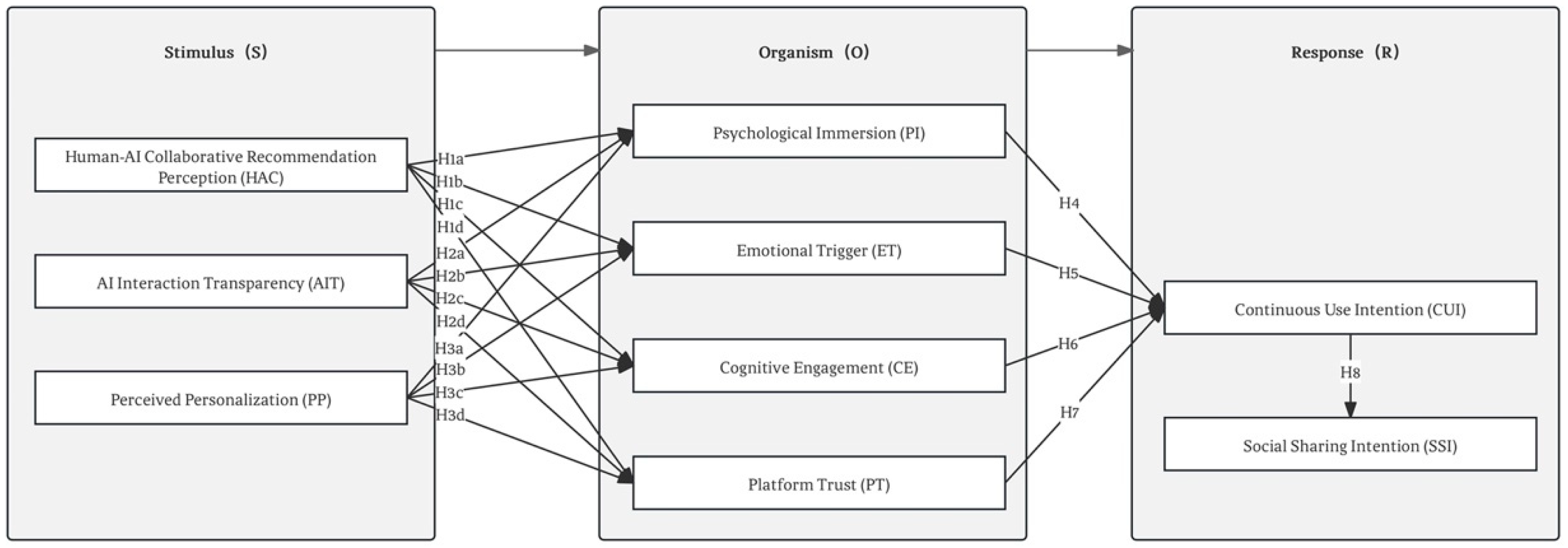
Guided by the SOR conceptual framework, this study develops seventeen direct-effect hypotheses across the “Stimulus → Organism,” “Organism → Response,” and “Response → Response” pathways. No mediation hypotheses are specified at this stage. Instead, indirect effects are examined and reported in later sections. While direct paths from stimulus to outcome are common in some models, this study adopts a mechanism-oriented approach that emphasizes the indirect effects of intelligent service perceptions through psychological mechanisms. The focus is on how external stimuli (service perceptions) influence user behavior via psychological processes (organismic responses), aligning with the S-O-R framework’s emphasis on cognitive, emotional, and relational responses. This approach ensures that the psychological mechanisms are the core drivers in shaping user behavior, rather than focusing on direct stimulus-to-outcome paths.
To remain consistent with the mechanism-oriented logic of the S–O–R framework, the core model emphasizes the transmission of intelligent service stimuli to behavioral outcomes primarily through organismic psychological processes. Accordingly, the hypothesized paths focus on Stimulus → Organism and Organism → Response relationships, rather than specifying direct Stimulus → Response hypotheses at this stage.
Nevertheless, we acknowledge that mediation analyses are often conducted under model specifications that allow for direct paths from predictors to outcomes, particularly when bootstrapping-based indirect effect estimation is adopted. To address this methodological consideration, an additional robustness analysis was performed by estimating an alternative structural model that includes direct paths from HAC, AIT, and PP to CUI. The results of this robustness analysis are presented in the Results section, specifically in Section 5.2.5.
This hypothesis development provides a theoretically grounded structure for examining how intelligent service perceptions shape psychological mechanisms and behavioral responses among Generation Z users in AI-supported secondhand fashion e-commerce environments.

3.1. Influence of Stimuli on Organism: Mechanisms Linking Intelligent Service Perceptions to User Psychological Responses

Human–AI Collaboration in Secondhand Fashion E-commerce Platforms (HAIc-SFEP) operates in a service environment characterized by high product heterogeneity, pronounced information asymmetry, and repeated human–AI interactions. In such contexts, users’ perceptions of intelligent service quality—particularly collaborative recommendations, interaction transparency, and personalized recognition—are unlikely to translate directly into behavioral intentions. Instead, these service stimuli are first internalized through multiple psychological mechanisms, which shape users’ subsequent responses to the platform [72,78].
Specifically, intelligent service perceptions may influence users’ experiential involvement (Psychological Immersion, PI), affective reactions (Emotional Triggering, ET), depth of information processing (Cognitive Engagement, CE), and relational evaluation of the platform (Platform Trust, PT). Accordingly, this study theorizes a set of stimulus–organism relationships, in which each AI-related service perception activates distinct yet complementary psychological responses [79].
Within C2C secondhand fashion e-commerce, users face a consumption environment that differs fundamentally from standardized new-product platforms [80]. The non-uniformity of products, variability in seller credibility, and lack of objective quality guarantees require users to continuously evaluate product authenticity, platform reliability, and decision risk under conditions of incomplete and uneven information. For Generation Z users—who demonstrate heightened sensitivity to experiential quality, emotional resonance, and system transparency—these structural characteristics make intelligent service design particularly consequential for post-adoption psychological responses and sustained engagement [81,82].
Against this backdrop, this study identifies Human–AI Collaborative Recommendation Perception (HAC), AI Interaction Transparency (AIT), and Perceived Personalization (PP) as theoretically salient intelligent service stimuli for examining Generation Z users’ post-adoption psychological responses and subsequent continuous use intention in this context. Specifically, HAC addresses quality uncertainty by integrating algorithmic efficiency with human judgment, thereby enhancing perceived recommendation credibility and providing emotional reassurance during decision-making [54]. AIT directly targets trust-related concerns by reducing algorithmic opacity and improving users’ understanding of how recommendations are generated, which is particularly critical in environments where trust transfer is fragile [83]. PP, in turn, strengthens perceived relevance and emotional alignment by tailoring platform responses to users’ individual preferences and aesthetic identities, fostering a sense of recognition and engagement that resonates strongly with Generation Z users [84].
Collectively, these three stimuli capture complementary mechanisms through which intelligent services mitigate uncertainty, reinforce trust, and enhance experiential and emotional value in secondhand fashion platforms [79,85]. Their combined influence provides a contextually grounded explanation for why HAC, AIT, and PP constitute the most critical antecedents of users’ psychological responses and sustained engagement in Human–AI collaborative C2C secondhand fashion e-commerce [86].

3.1.1. Human-AI Collaborative Recommendation Perception (HAC)

HAC reflects users’ subjective evaluation of recommendations generated through ‘AI + human’ collaboration, including perceived match quality, interpretability, and the coherence of the collaborative logic [87]. In secondhand fashion platforms, where product quality and seller credibility vary substantially, collaborative recommendations help users reduce uncertainty and enhance decision confidence. Prior studies indicate that interpretable and human-in-the-loop recommendation processes enhance perceived service quality, cognitive involvement, and trust formation [54,88].
From an experiential perspective, coherent and well-matched recommendations can increase users’ focused involvement in browsing and evaluation activities, thereby strengthening psychological immersion [54,89]. At the same time, feeling supported by a collaborative system may elicit positive emotional responses and motivate deeper cognitive engagement with platform content. Moreover, transparent collaboration between AI and human agents signals platform responsibility and competence, reinforcing overall platform trust [90]. Accordingly, the following hypotheses are proposed:
H1a. 
HAC positively influences PI.
H1b. 
HAC positively influences ET.
H1c. 
HAC positively influences CE.
H1d. 
HAC positively influences PT.

3.1.2. AI Interaction Transparency (AIT)

AIT concerns users’ perceived clarity and explainability of how the AI system generates recommendations and provides feedback during the service process [74]. In C2C secondhand fashion e-commerce—where product quality signals are heterogeneous and information asymmetry is salient—greater transparency helps reduce algorithmic uncertainty and improves users’ perceived controllability and predictability of the interaction, thereby facilitating deeper experiential involvement and cognitive engagement [91,92]. Moreover, when users can understand the logic behind recommendations, they are more likely to experience positive affective responses (e.g., reassurance rather than suspicion) and to transfer trust to the platform, because the system is perceived as more accountable and reliable [93,94].
From a psychological process perspective, transparent AI interactions allow users to remain cognitively oriented during recommendation encounters, which supports sustained attention and mental effort (i.e., cognitive engagement). At the experiential level, perceived transparency reduces anxiety and confusion, enabling users to immerse themselves more fully in browsing and interaction. At the relational level, explainable and traceable recommendations signal system benevolence and integrity, thereby fostering platform trust. Finally, reduced uncertainty and enhanced understanding may also elicit mild positive emotional responses, such as comfort or reassurance, during the interaction process. Based on this, the following hypotheses are formulated:
H2a. 
AIT positively influences PI.
H2b. 
AIT positively influences ET.
H2c. 
AIT positively influences CE.
H2d. 
AIT positively influences PT.

3.1.3. Perceived Personalization (PP)

PP represents the extent to which the platform tailors its services to users’ preferences, historical behaviors, and stylistic characteristics [95]. In recommendation-based consumption, personalization enhances perceived relevance and self-congruence, which strengthens users’ sense of being understood and supported during the interaction [96]. Such perceived relevance can increase users’ immersion in browsing and exploration while motivating more effortful information processing, because users are encouraged to compare, evaluate, and reflect on AI-provided suggestions that appear “fit for me.” At the same time, when recommendations consistently align with users’ needs and style expectations, personalization may also reduce perceived risk and enhance relational confidence toward the platform, thereby facilitating trust formation [97].
More specifically, personalization enhances psychological immersion by sustaining users’ attention and involvement in recommendation-driven exploration. It stimulates emotional responses by evoking feelings of recognition, resonance, and satisfaction when recommendations match personal identity or aesthetic preferences. Personalization also promotes cognitive engagement, as users are more willing to invest mental effort in evaluating content perceived as highly relevant. Finally, consistent and accurate personalization signals system competence and user-oriented intent, which strengthens platform trust over repeated interactions.
Therefore, the following hypotheses are proposed:
H3a. 
PP positively influences PI.
H3b. 
PP positively influences ET.
H3c. 
PP positively influences CE.
H3d. 
PP positively influences PT.

3.2. Influence of Organism on Response: How Psychological Mechanisms Drive Behavioral Outcomes

While intelligent service perceptions initiate users’ psychological reactions, behavioral intentions in AI-supported secondhand fashion e-commerce are ultimately shaped by how these internal states translate into sustained platform commitment. In the post-adoption stage, continuous use intention is not driven by a single psychological factor but emerges from multiple complementary mechanisms, including experiential involvement, affective responses, cognitive investment, and relational evaluation.
In this study, Psychological Immersion (PI) captures users’ experiential absorption during interaction, Emotional Triggering (ET) reflects affective reinforcement, Cognitive Engagement (CE) represents deliberate information processing and evaluative effort, and Platform Trust (PT) embodies users’ relational confidence toward the platform. Each mechanism contributes to continuous use intention through a distinct pathway, jointly explaining why Generation Z users remain engaged with Human–AI collaborative secondhand fashion platforms over time. Although these psychological mechanisms may unfold dynamically during actual platform use, this study models them in parallel to capture their distinct and complementary roles in shaping continuous use intention at the post-adoption stage [56].

3.2.1. Psychological Immersion (PI)

Drawing on Flow Theory proposed by Csikszentmihalyi (1990) [98], immersive states are typically associated with higher levels of engagement, loyalty, and continuous usage intention [98,99,100,101]. In digital and AI-mediated consumption contexts, such immersive experiences enhance perceived enjoyment and temporal continuity, making users more inclined to prolong their interaction with the platform.
For Generation Z users, who value engaging and seamless digital experiences, immersion primarily functions as an experiential driver of continued usage rather than a rational or relational mechanism. When users become immersed in browsing, exploring, and interacting with AI-supported recommendations, they are more likely to develop habitual usage patterns and sustained engagement. Therefore, the following hypothesis is proposed:
H4. 
PI positively influences CUI.

3.2.2. Emotional Triggering (ET)

ET refers to the positive affective responses elicited during platform interaction, such as enjoyment, satisfaction, and emotional resonance [67]. Prior studies in social commerce and mobile application usage consistently demonstrate that positive emotions reinforce user–platform bonds and enhance post-adoption behaviors, including continued usage [102,103,104,105].
In AI-supported secondhand fashion contexts, emotional responses are often activated when users feel understood, reassured, or emotionally aligned with platform recommendations. Such affective reinforcement strengthens users’ emotional attachment and reduces resistance to repeated engagement. As a result, emotional triggering serves as an affective pathway that complements experiential immersion and cognitive evaluation in driving continuous use intention. Accordingly, we propose:
H5. 
ET positively influences CUI.

3.2.3. Cognitive Engagement (CE)

CE represents the extent to which users invest attention, mental effort, and systematic information processing during platform interaction [106]. According to the Elaboration Likelihood Model (ELM) proposed by Petty and Cacioppo (1986), high cognitive engagement facilitates the formation of stable attitudes and reduces users’ likelihood of switching platforms [107,108].
In the context of AI-driven recommendations, cognitively engaged users are more likely to evaluate recommendation logic, compare alternatives, and reflect on decision outcomes [109]. This deliberate processing enhances perceived decision quality and reinforces users’ confidence in their choices, thereby strengthening their intention to continue using the platform [110]. In this sense, cognitive engagement functions as a rational and evaluative mechanism that supports sustained usage beyond initial experiential appeal [111]. Therefore, the following hypothesis is formulated:
H6. 
CE positively influences CUI.

3.2.4. Platform Trust (PT)

PT reflects users’ overall confidence in the platform’s competence, reliability, and benevolence [112]. In secondhand fashion platforms characterized by uncertainty and information asymmetry, trust serves as a foundational determinant of user behavior. According to the Commitment–Trust Theory proposed by Morgan and Hunt, trust plays a central role in sustaining long-term relational exchanges and user commitment [112,113,114].
Unlike experiential or affective responses, platform trust functions as a relational commitment mechanism that stabilizes long-term platform use [115]. When users trust the platform, they are more willing to rely on AI-supported recommendations, tolerate occasional mismatches, and maintain usage over time [116]. Therefore, trust serves as a key psychological anchor that consolidates experiential, emotional, and cognitive mechanisms into continuous use intention [117]. Therefore, we posit:
H7. 
PT positively influences CUI.
Furthermore, according to the commitment–trust theory in relationship marketing, sustained commitment manifests not only as continued usage but also as outward-facing behaviors such as recommending or sharing platform experiences [113]. Importantly, continuous use intention also represents a proximal motivational state that translates internal psychological responses into subsequent behavioral expressions within digital platforms [56]. Electronic word-of-mouth (eWOM) studies further indicate that users with higher continuous use intention are more likely to engage in positive sharing behaviors [56,118,119]. Thus, the final hypothesis is proposed:
H8. 
CUI positively influences SSI.

3.3. Model Development and Analytical Framework

To ensure conceptual focus and enhance the testability of the proposed hypotheses, this section presents the research model and overall analytical framework without introducing additional mediation hypotheses. Following the logic of the Stimulus–Organism–Response (SOR) theory, the proposed model conceptualizes intelligent service perceptions as stimuli (HAC, AIT, and PP), user psychological states as organism-level mechanisms (PI, ET, CE, and PT), and behavioral outcomes as responses (CUI and SSI). These components are structurally linked in accordance with the seventeen hypotheses developed in Section 3.1 and Section 3.2 (see Figure 1).
This section provides a concise overview of the conceptual and structural alignment between the hypothesized relationships and the proposed research model. Detailed procedures related to data collection, measurement development, estimation techniques, and statistical testing are presented in the Methodology section.

4. Research Methodology

4.1. Research Design and Experimental Platform

This study aims to examine the psychological mechanisms and continuous usage intention of Generation Z users in the context of Human-AI Collaboration in Secondhand Fashion E-commerce Platforms (HAIc-SFEP). Guided by the Stimulus–Organism–Response (SOR) framework, the research model incorporates stimulus variables, organism variables, and response variables. Empirical data were collected through a structured questionnaire survey, and the proposed theoretical model was tested using Partial Least Squares Structural Equation Modeling (PLS-SEM). PLS-SEM was selected over covariance-based SEM because this study examines a relatively complex model with multiple parallel psychological mechanisms and adopts a prediction-oriented focus rather than strict theory confirmation. In addition, PLS-SEM is well suited for exploratory research contexts and does not impose strict assumptions regarding data normality, making it appropriate for the present research design.
For the experimental platform, “Xianyu”—one of China’s largest C2C secondhand trading platforms—was selected as the research setting for the following reasons:
First, its user demographics align strongly with the target population. Xianyu hosts one of the most concentrated Generation Z user bases among Chinese digital marketplaces. According to industry reports, users born after 1995 represent around 43% of active users, while those born after 2000 account for 22%, bringing the combined proportion of Generation Z users to over 50% [120]. This demographic structure aligns closely with the focus of this study.
Second, Xianyu exhibits prominent characteristics of Human-AI Collaborative service delivery. The platform integrates a wide range of AI-assisted functions—including deep-learning–based image search, personalized recommendation algorithms, and the intelligent customer service agent “Xianyu Xiaomi”—while simultaneously incorporating human elements such as manual review and human customer support. This “AI + human” hybrid service architecture provides a representative and ecologically valid environment for examining HAIc-SFEP dynamics.
Third, the platform supports native social sharing mechanisms. Xianyu enables users to engage in dynamic posting, community interactions, private messaging, and cross-platform content sharing. These built-in social features offer an authentic behavioral context for evaluating Social Sharing Intention (SSI) as a key outcome variable in the SOR framework.
In addition to Xianyu, we considered other widely used secondhand fashion platforms such as Plum, Dewu, Zhuanzhuan, Duozhuayu, Xiaohongshu (Secondhand Trading Section), WeChat/QQ Group Secondhand Markets, and others. These platforms represent diverse characteristics and user behavior patterns that are also relevant to the focus of this study. For instance, Plum and Dewu focus on a younger, more fashion-forward demographic, and their recommendation systems emphasize style discovery and brand-oriented purchases. On the other hand, platforms like Zhuanzhuan and Duozhuayu cater to a more general secondhand market, with a broad range of product categories, and focus less on fashion-specific items. Xiaohongshu and WeChat/QQ Group markets offer social sharing and community-driven consumption experiences, which complement the social engagement aspect of this study.
The inclusion of these platforms ensures that our research results are applicable across different user segments and platform features. However, despite users potentially having experience with multiple secondhand fashion platforms, all experimental tasks and questionnaire items in this study were explicitly anchored to users’ actual usage experience on the Xianyu platform.

4.2. Variables and Measurements

All constructs and measurement items in this study were adapted from well-established scales in prior research to ensure content validity and measurement reliability.
For the stimulus variables (S), measurement items for Human-AI Collaborative Recommendation Perception (HAC) were adapted from Yin et al. and Wang et al. [54,88]; Items for AI Interaction Transparency (AIT) were derived from Wang et al., Yu and Li, and Zhao et al. [88,91,92]; Items for Perceived Personalization (PP) were adapted from Yin et al. and Teepapal et al. [54,96].
For the organism variables (O), measurement items for Psychological Immersion (PI) were adapted from Yin et al., Xia et al., and Tcha-Tokey et al. [54,121,122]; Items for Emotional Triggering (ET) were based on Lee et al. and Zheng et al. [123,124]; Items for Cognitive Engagement (CE) were adapted from Yin et al., Teepapal et al., and Ho & Lim [54,96,125]; Items for Platform Trust (PT) were adapted from Wang et al., Yu & Li, and Höddinghaus et al. [88,92,126].
For the response variables (R), measurement items for Continuous Use Intention (CUI) were adapted from Zhou & Ma, Song et al., and Lee et al. [114,127,128]; Items for Social Sharing Intention (SSI) were adopted from Hameed et al., Jo, and Do et al. [129,130,131]. All constructs were measured using a five-point Likert scale ranging from 1 = “strongly disagree” to 5 = “strongly agree.”
To ensure semantic clarity, structural coherence, and contextual relevance to secondhand fashion e-commerce, all measurement items were refined through contextual adaptation following the initial literature-based modifications. Subsequently, six experts—including scholars in e-commerce, psychology, and human–computer interaction—were invited to review the questionnaire. Their evaluation focused on linguistic accuracy, content representativeness, and contextual suitability. All experts affirmed the appropriateness of the scale structure and provided several suggestions to improve item clarity, which were incorporated into the revised version.

4.3. Data Collection and Analytical Procedures

Data were collected through an online survey platform. Although respondents were required to have prior experience using the Xianyu platform, a brief real-use task was designed to activate recent and concrete Human–AI interaction experiences and to ensure a consistent contextual reference across participants. Specifically, the task guided respondents to briefly engage with key AI-supported functions on Xianyu, including browsing secondhand fashion items, using image search or algorithmic recommendation features, interacting with the AI assistant “Xianyu Xiaomi” or with sellers, and trying the plat-form’s social sharing function. Immediately after completing these interactions, respondents proceeded to complete the questionnaire, which helped reduce recall bias and enhance the validity of perceptual and psychological measurements related to Human–AI collaboration. It should be noted that requiring respondents to complete a brief real-use task prior to the survey may have temporarily heightened certain experiential and affective states, particularly psychological immersion and emotional engagement. While this task-based design was intentionally adopted to activate concrete and recent Human–AI interaction experiences and reduce retrospective recall bias, it may also introduce a short-term priming effect.
Importantly, this does not undermine the internal validity of the hypothesized relationships, as all respondents followed the same procedure, and the analysis focuses on relative structural relationships rather than absolute state levels. Nevertheless, future research may further explore the temporal dynamics of experiential and emotional mechanisms—such as by employing longitudinal or delayed-measurement designs—to distinguish more clearly between stable post-adoption perceptions and transient interaction-induced states.
A snowball sampling strategy was employed to recruit participants. Initial respondents and members of the research team shared the questionnaire link within their social networks to gradually expand the sample pool. This method ensured that participants were experienced users of secondhand fashion e-commerce platforms and belonged to the target Generation Z population. Although snowball sampling lacks full randomness, it enables precise targeting of specific user segments and enhances ecological validity within the study context. Therefore, its application in this research is appropriate for the present study context. To further ensure response quality, the questionnaire included an experience-verification item requiring respondents to confirm their completion of the assigned tasks, which was used as one of the criteria for determining questionnaire validity.
A total of 512 responses were received. After applying quality control criteria, 14 invalid responses were removed, resulting in 498 valid samples, with a validity rate of 97.3%. Criteria for exclusion included patterned or straight-lining responses (e.g., selecting the same option across all items), logically inconsistent answers to experience-verification items, and completion times significantly shorter than reasonable expectations. These procedures ensured the robustness and reliability of the subsequent analyses.
Data analysis was conducted using SmartPLS 4.0, following a three-step approach consistent with the partial least squares structural equation modeling (PLS-SEM) framework. First, reliability and validity were assessed through Cronbach’s α, Composite Reliability (CR), Average Variance Extracted (AVE), and the Fornell–Larcker criterion. Indicator loadings and the Heterotrait–Monotrait Ratio (HTMT) were further examined to ensure discriminant validity. Second, the structural model’s fit was evaluated by examining path significance, explanatory power (R2), predictive relevance (Q2), and the Standardized Root Mean Square Residual (SRMR). Third, Bootstrapping with 5000 resamples was used to assess the significance of all path coefficients and test the proposed hypotheses. PLS-SEM is well-suited for exploratory research, complex model structures, and medium-sized samples, providing a robust statistical foundation for this study.
To mitigate potential Common Method Bias (CMB), this study adopted a combination of procedural and statistical remedies during the data collection and analysis stages. Procedural remedies included ensuring respondent anonymity, randomizing item order, incorporating attention-check questions to reduce evaluation apprehension and response pattern biases. At the analytical stage, Harman’s single-factor test was conducted to examine whether a single factor accounted for the majority of the variance. The results of the test showed that no single factor accounted for the majority of the variance (i.e., the highest factor loading was below 50%), indicating that common method bias was unlikely to pose a serious threat to the validity of the findings. In addition, a full collinearity assessment (VIF) was performed to further examine potential method bias.

4.4. Sample Characteristics

A total of 498 valid responses were obtained for this study. In terms of gender composition, 45.58% of the respondents identified as male and 54.42% as female, forming a relatively balanced distribution and avoiding biases associated with single-gender dominance. Regarding age structure, the largest group consisted of participants aged 23–26 (47.79%), followed by those aged 18–22 (32.33%). Together, these groups account for more than 80% of the sample, indicating that the dataset is highly concentrated within the typical Generation Z population. This concentration supports the relevance of the findings for understanding generational characteristics in green consumption and human–AI interaction contexts. In terms of educational background, 48.8% had a junior college degree or below, 35.54% held an undergraduate degree, and 15.66% possessed a master’s degree or higher, creating a broad and stratified distribution that enhances the interpretive flexibility and generalizability of this study.
The sample also demonstrates a strong interdisciplinary profile, covering business and management (32.33%), social sciences (20.08%), art and design (17.47%), computer science/information technology (15.46%), and environmental and sustainability fields (14.66%). This disciplinary diversity not only enriches Generation Z perspectives on secondhand fashion e-commerce but also allows this study to more comprehensively reveal cross-disciplinary differences in the acceptance of AI-enabled services and sustainable consumption—an angle that has received limited systematic attention in prior research.
Geographically, respondents from prefecture-level cities (43.17%) and county-level towns/rural areas (30.12%) jointly account for more than 70% of the sample, while those from first-tier cities represent only 8.43%. This distribution reflects a clear market penetration into lower-tier regions, suggesting that secondhand fashion consumption has expanded well beyond traditional metropolitan users. Such evidence highlights the diffusion of green fashion into broader social strata and provides meaningful insights into structural shifts in sustainable consumption. Regarding usage behavior, 67.07% of respondents reported using secondhand platforms at least once per week, indicating strong platform engagement and relatively mature consumption habits. Multi-platform usage is also prevalent: while Xianyu recorded the highest usage rate (88.96%), a large proportion simultaneously used Zhuanzhuan (62.05%), Dewu (53.41%), and Plum (43.37%), confirming multi-scenario and cross-platform patterns typical of Generation Z consumption. Importantly, these platform usage statistics reflect respondents’ general secondhand fashion consumption background rather than the reference context for questionnaire responses, which were all based on their experience with Xianyu.
In terms of consumption motivations, price advantage (89.76%) and environmental awareness (65.06%) emerged as the primary drivers, followed by nostalgia/vintage preferences (48.8%), low-threshold access to branded fashion (43.37%), and the pleasure of discovering unique items (23.29%). In this study, “Low Price” refers to the general economic advantage of secondhand fashion compared with new products, whereas “Low-Cost Access” emphasizes the opportunity to obtain branded or higher-value fashion items at a substantially lower entry cost. This distinction reflects different dimensions of economic motivation among Generation Z consumers. These results suggest that Generation Z secondhand fashion consumption is shaped by both rational motives (e.g., economic value) and emotional motives (e.g., identity expression, aesthetic preference). Additionally, 33.33% of respondents reported spending more than RMB 500 on secondhand fashion in the past six months, indicating that secondhand consumption has evolved from occasional experimentation to a routine practice for many young users.
Taken together, the sample demonstrates three notable strengths. First, its generational focus is clear and well-aligned with Generation Z users, who constitute the core consumer base of green fashion. Second, the diverse disciplinary backgrounds offer a rich foundation for analyzing differentiated perceptions of Human–AI Collaboration across knowledge domains. Third, the pronounced diffusion into lower-tier urban and rural regions captures the ongoing structural expansion of sustainable consumption beyond major metropolitan areas. With these advantages, this study not only sheds light on how Human–AI Collaborative services influence Continuous Use Intention (CUI) and Social Sharing Intention (SSI), but also reflects broader behavioral transitions within Generation Z sustainable fashion consumption. Compared with prior studies that tend to focus on single technical features or simplistic motivational factors, this research integrates multidimensional user profiles, consumption motives, and real-world usage contexts, offering a more comprehensive and practically relevant framework for understanding how sustainable fashion spreads among younger consumers. The variables reported in Table 1 are presented to describe the sample characteristics and usage context; the structural model estimation focuses on the hypothesized SOR paths.

5. Results

5.1. Measurement Model Assessment

5.1.1. Convergent Reliability and Validity

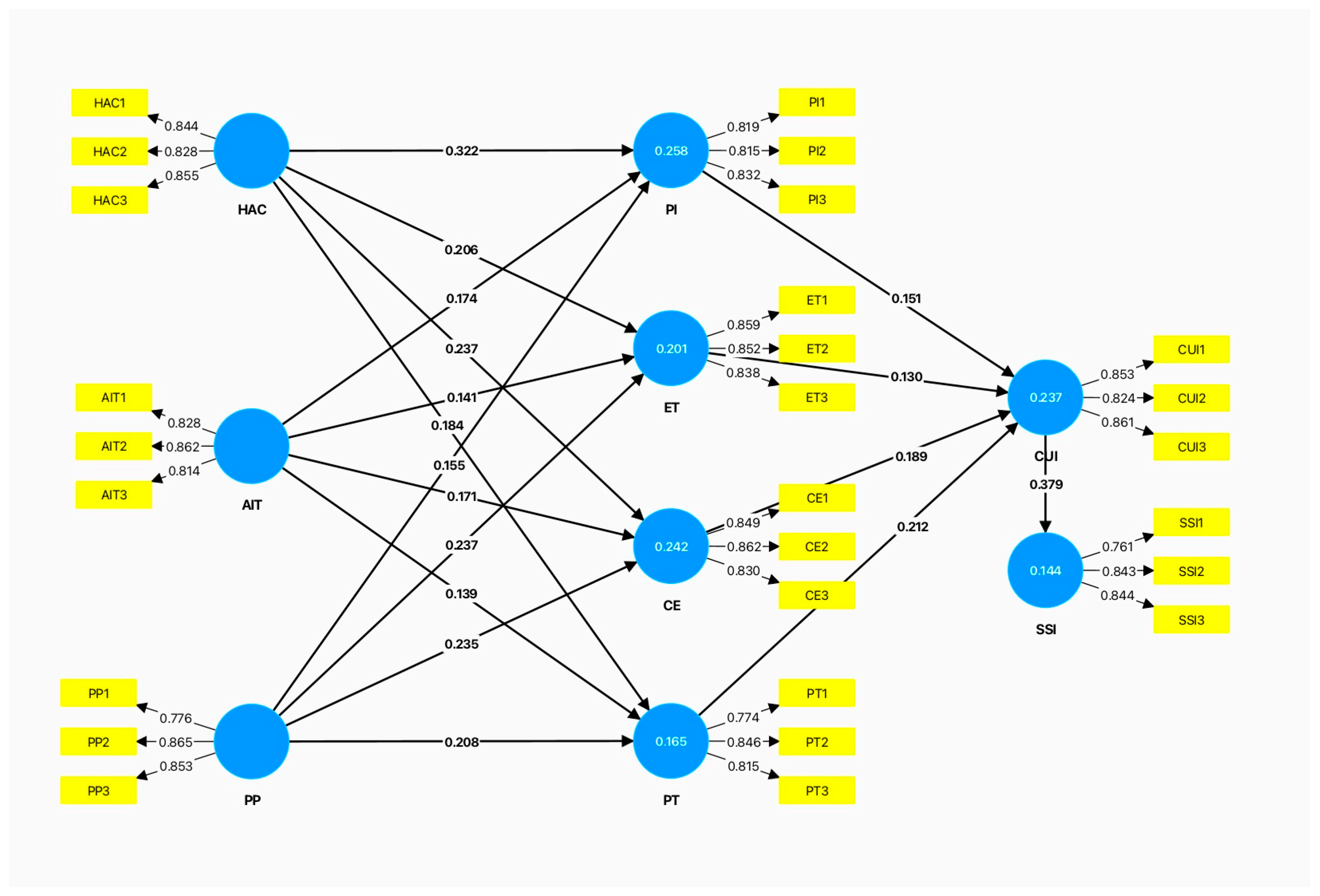
As shown in Table 2, all standardized loadings exceeded 0.70 (0.761–0.865), and the constructs demonstrated adequate internal consistency (Cronbach’s α, ρA, and CR) and convergent validity (AVE).
The evaluation criteria and threshold values adopted in this study follow widely accepted guidelines in PLS-SEM research. Specifically, standardized factor loadings greater than 0.70 indicate adequate indicator reliability [132]. Cronbach’s α, ρA, and composite reliability (CR) values above 0.70 indicate satisfactory internal consistency [133]. AVE values exceeding 0.50 indicate adequate convergent validity [134,135].
Within the stimulus (S) constructs, factor loadings for Human-AI Collaborative Recommendation Perception (HAC), AI Interaction Transparency (AIT), and Perceived Personalization (PP) ranged from 0.814–0.855, 0.828–0.862, and 0.776–0.865.
For the organism (O) constructs, all items for Psychological Immersion (PI), Emotional Triggering (ET), Cognitive Engagement (CE), and Platform Trust (PT) exhibited loadings above 0.77, confirming stable and reliable operationalization of each psychological state.
In the response (R) constructs, factor loadings for Continuous Use Intention (CUI) ranged from 0.824 to 0.861, while those for Social Sharing Intention (SSI) ranged from 0.761 to 0.844. Both constructs thus demonstrated satisfactory item-to-construct alignment.
Collectively, these results support satisfactory convergent reliability and validity, indicating that the indicators adequately capture the underlying latent constructs.
Discriminant validity was further examined using the Fornell–Larcker criterion and the Heterotrait–Monotrait Ratio (HTMT), as reported in Table 3 and Table 4 [136]. The results indicate that the square root of AVE for each construct exceeds its inter-construct correlations, and all HTMT values are below 0.85, supporting discriminant validity among the constructs.
Taken together, the results of the factor loadings and reliability and validity assessments collectively indicate that the measurement model exhibits adequate convergent and discriminant validity. These findings establish a solid and reliable measurement foundation for the subsequent structural model analysis. Furthermore, the valid measurement model enables robust testing of indirect effects in the structural model, supporting the mediation mechanisms explored in the subsequent analysis.

5.1.2. Discriminant Validity Assessment

To further evaluate the discriminant validity among the latent constructs, the Fornell–Larcker criterion was first applied (Table 3). According to this criterion, the square root of the Average Variance Extracted (i.e., √AVE) for each construct should exceed its correlations with any other construct.
The results indicate that the √AVE values on the diagonal (ranging from 0.812 to 0.850) are consistently higher than the inter-construct correlation coefficients. For instance, the √AVE of AIT is 0.835, which is higher than its correlations with CE (0.344), CUI (0.328), ET (0.303), and other constructs. Similarly, the √AVE of CUI is 0.846, exceeding its highest correlation with other constructs (0.379). In addition, the √AVE values of PT and SSI—0.812 and 0.817—are both larger than their correlations with all other constructs (all below 0.50).
Overall, these results demonstrate strong discriminant validity among the latent variables, indicating that the constructs are empirically distinct. These results support adequate construct distinctiveness.
To further verify discriminant validity, the Heterotrait–Monotrait Ratio (HTMT) was also employed (Table 4). HTMT reflects the relative correlations between constructs, and values below 0.85—or below 0.90 under a more lenient standard—are generally considered acceptable.
The results indicate that all HTMT values among the latent constructs fall below 0.85, ranging from 0.355 to 0.654. The highest value is observed between PI and SSI (HTMT = 0.654), which remains well below the recommended threshold of 0.85. Most other construct pairs exhibit HTMT values between 0.35 and 0.60, further suggesting that no discriminant validity issues or severe multicollinearity are present.
Taken together with the Fornell–Larcker criterion and cross-loading results, the HTMT analysis confirms that the measurement model demonstrates satisfactory convergent and discriminant validity, thereby providing a reliable foundation for the subsequent structural model assessment.

5.2. Structural Model Assessment

5.2.1. Model Fit Assessment

Model fit was assessed using commonly reported PLS-SEM fit indices [137,138]. The SRMR value was 0.050, which is below the recommended cutoff of 0.08, and the NFI was 0.761, suggesting a reasonable overall fit for subsequent path estimation.
Taken together, these indicators demonstrate that the proposed structural model exhibits satisfactory overall model fit, thereby supporting subsequent structural path estimation.

5.2.2. Explanatory Power and Predictive Relevance of Endogenous Variables

To assess the explanatory power of the structural model, the coefficients of determination (R2) for each endogenous construct were examined (Table 5). Importantly, the explanatory power for CUI and SSI is significantly enhanced by the indirect effects through organismic psychological processes, highlighting the critical role of continuous use intention as a mediator in shaping social sharing intention. Following commonly used guidelines in PLS-SEM research, R2 values around 0.26, 0.13, and 0.02 may be interpreted as substantial, moderate, and weak explanatory power [139].
Based on these criteria, PI (R2 = 0.258) demonstrates explanatory power approaching the substantial level, while CE (R2 = 0.242) and CUI (R2 = 0.237) exhibit moderate explanatory power. ET (R2 = 0.201) and PT (R2 = 0.165) also fall within the moderate range, whereas SSI (R2 = 0.144) shows relatively lower but still moderate explanatory power under these commonly used guidelines.
The adjusted R2 values are highly consistent with the original R2 values (maximum difference ≤ 0.005), indicating that the model estimation is stable and not affected by overfitting.
With respect to predictive relevance, the Stone–Geisser Q2 values for all endogenous constructs are positive, ranging from 0.092 to 0.168, indicating predictive relevance of the model. In particular, CE (Q2 = 0.168), PI (Q2 = 0.166), and CUI (Q2 = 0.162) demonstrate comparatively stronger predictive capability, while SSI (Q2 = 0.092), although lower, still meets the minimum criterion for predictive relevance (Q2 > 0).

5.2.3. Assessment of Multicollinearity

Multicollinearity was assessed using the variance inflation factor (VIF). All VIF values ranged from approximately 1.00 to 1.35, which are well below the conservative threshold of 3.3, indicating that multicollinearity is not a concern in the structural model.

5.2.4. Path Coefficient Analysis

To validate the 17 structural path hypotheses proposed earlier, the structural model was estimated using PLS-SEM, and the results of hypothesis testing are summarized in Table 6 and illustrated in Figure 2. All hypothesized direct paths reached statistical significance (p < 0.05), providing support for the proposed model.
Within the “Stimulus (S) → Organism (O)” pathways, the three intelligent service perception variables exert significant positive effects on users’ psychological processes. AIT significantly predicts PI (β = 0.174, t = 3.654, p < 0.001), ET (β = 0.141, t = 3.010, p = 0.003), CE (β = 0.171, t = 3.512, p < 0.001), and PT (β = 0.139, t = 2.942, p = 0.003). HAC demonstrates even stronger effects across all four psychological constructs, with the HAC → PI pathway being the most salient (β = 0.322, t = 6.642, p < 0.001). PP also significantly influences CE, ET, PI, and PT, further indicating that personalized experiences reinforce users’ psychological responses.
In the “Organism (O) → Response (R)” pathways, all four psychological mechanisms significantly enhance CUI. PT (PT → CUI, β = 0.212) and CE (CE → CUI, β = 0.189) show the strongest effects, whereas PI (β = 0.151) and ET (β = 0.130) exert weaker yet still significant influences. These findings suggest that trust and cognitive processing represent the dominant pathways driving continued use, while immersion and emotional experience serve complementary roles.
Within the “Response (R) → Response (R)” pathway, CUI significantly strengthens SSI (β = 0.379, t = 7.863, p < 0.001). This result confirms that CUI effectively promotes outward sharing behaviors.
Overall, the path coefficient results highlight a clear transmission chain from intelligent service perceptions to psychological mechanisms and ultimately to behavioral responses. These results support the applicability of the Stimulus–Organism–Response (SOR) framework in Human–AI collaboration scenarios and provide a basis for the subsequent mediation analysis.

5.2.5. Mediation Analysis

As shown in the robustness analysis (Appendix A), the direct path from HAC → CUI was not statistically significant, whereas the direct paths from AIT → CUI and PP → CUI were found to be significant (p < 0.05 and p < 0.01, respectively). Despite the non-significance of the direct path from HAC → CUI, the indirect effects through psychological mechanisms, such as Cognitive Engagement (CE) and Platform Trust (PT), remain robust and significant.
This finding suggests that while direct effects from intelligent service perceptions to behavioral outcomes may not always be present, psychological mechanisms (such as CE and PT) mediate the relationship between HAC, AIT, PP and CUI/SSI, leading to meaningful behavioral outcomes. The lack of direct significance for HAC → CUI underscores the importance of understanding the indirect pathways, particularly how psychological processes can drive sustained engagement and sharing behaviors, even when direct effects are not observed. This highlights that psychological mechanisms such as Platform Trust and Cognitive Engagement are crucial in shaping user behavior, which aligns with the S-O-R framework’s emphasis on internal psychological states rather than direct stimuli.
To uncover how stimulus variables are transformed into behavioral intentions and outward diffusion behaviors through psychological mechanisms, the present study conducted a series of multiple-mediation tests using the bootstrapping method. In addition to the mediation analysis, a robustness analysis was performed to verify that the indirect effects observed are not influenced by model specification. This analysis estimated an alternative structural model that included direct paths from HAC, AIT, and PP to CUI. The inclusion of direct paths does not replace the theorized S–O–R mechanism but serves to confirm that the indirect effects are not artifacts of model specification. The results of this robustness analysis further support the findings of the mediation analysis and ensure the validity of the model. Additional details of this robustness analysis are available in Appendix A.
Overall, the majority of indirect pathways were significant (p < 0.05), suggesting that intelligent service perceptions influence behavioral outcomes primarily through organism-level mechanisms. In particular, the mediating effects of CE were consistently significant. For example, the indirect effects HAC → CE → CUI (β = 0.045, p = 0.002) and PP → CE → CUI (β = 0.044, p = 0.006) were both significant, with VAF values of 19.2% and 18.9%, respectively, indicating a non-trivial indirect contribution.
Pathways associated with PT exhibited especially strong mediating effects. A prominent indirect effect was PT → CUI → SSI (β = 0.080, p < 0.001; VAF = 27.4%), indicating that trust not only enhances users’ continuous use intention but also promotes social diffusion through sustained commitment. Moreover, HAC, PP, and AIT all indirectly influenced CUI or SSI through PT, demonstrating that trust constitutes a core psychological mechanism driving deeper user engagement.
Immersive and emotional processes also played significant mediating roles in several pathways. Notably, PI → CUI → SSI (β = 0.057, p = 0.011) and ET → CUI → SSI (β = 0.049, p = 0.029) were both significant, indicating that although immersion and emotional responses are not the strongest mediating channels, they still enhance users’ sharing behaviors indirectly via continuous use intention.
It is important to note that several emotion-driven pathways did not reach significance (e.g., AIT → ET → CUI, PP → ET → CUI → SSI), suggesting that the mediating function of emotional responses may be conditional in AI-driven recommendation contexts. This indicates that emotional responses, such as enjoyment or surprise, may play a secondary role compared to cognitive and trust-based mechanisms in driving user behavior, especially when the user is already familiar with the AI platform and its recommendations.
Taken together, the findings verify that intelligent service perceptions influence continuous use intention and social sharing intention through multiple intertwined psychological mechanisms. The inclusion of direct paths in the robustness analysis (Appendix A) further confirms that the indirect effects observed in the primary model are not artifacts of model specification, reinforcing the validity and stability of the theoretical framework (Table 7).

6. Discussion

This study examines how Generation Z users develop Continuous Use Intention (CUI) and Social Sharing Intention (SSI) in Human–AI Collaboration within secondhand fashion e-commerce platforms (HAIc-SFEP). Grounded in the Stimulus–Organism–Response (SOR) framework, this section discusses the findings by following the hypothesized pathways and clarifies how the identified psychological mechanisms jointly shape post-adoption behavioral outcomes.

6.1. Effects of Intelligent Service Stimuli on Psychological Mechanisms

As outlined in the Hypothesis Development section, this study adopts a mechanism-oriented approach by focusing on indirect effects through psychological processes rather than specifying direct paths from the independent variables (stimuli) to the dependent variables (responses). While direct paths are often included in traditional S-O-R models, this study emphasizes how external stimuli, such as intelligent service perceptions, shape user behavior through internal psychological mechanisms, aligning with the S-O-R framework’s focus on cognitive, emotional, and relational responses. This approach highlights the importance of understanding the psychological processes that mediate user behavior, rather than directly linking service perceptions to behavioral outcomes.
This mechanism-oriented approach not only distinguishes our study from conventional models that include direct paths but also offers a more comprehensive understanding of how intelligent service perceptions affect user behavior through internal psychological states. In AI-supported environments, where users’ engagement is deeply influenced by psychological factors such as trust, immersion, and cognitive engagement, this indirect path model better captures the complexity of user behavior compared to direct effect models. The approach aligns with the increasing recognition in the literature that psychological mechanisms, rather than direct stimuli, play a central role in driving sustained engagement and behavior change in digital platforms.
Consistent with Hypotheses H1–H3, Human–AI Collaborative Recommendation Perception (HAC), AI Interaction Transparency (AIT), and Perceived Personalization (PP) all exert significant positive effects on users’ psychological states, including Cognitive Engagement (CE), Psychological Immersion (PI), Emotional Triggering (ET), and Platform Trust (PT). Among these organism-level responses, CE and PT exhibit relatively consistent associations across multiple stimulus paths, suggesting that cognitive evaluation and trust are salient psychological routes in this context.
These findings indicate that intelligent service perceptions do not merely generate affective or experiential reactions but also tend to activate users’ cognitive processing and relational evaluation of the platform. This pattern aligns with the core logic of the SOR framework, which emphasizes internal psychological states as the primary channels through which external stimuli influence subsequent behavior.
From a theoretical perspective, the observed effects on CE align with the Elaboration Likelihood Model (ELM), implying that transparent, collaborative, and personalized AI services can encourage central-route processing (i.e., deeper reflection and evaluation) rather than reliance on peripheral cues [108]. Similarly, the consistent effects on PT reflect the importance of relational confidence in AI-supported consumption environments characterized by uncertainty and information asymmetry.
More specifically, the estimated coefficients indicate that PP shows the largest association with PT, followed by HAC, whereas AIT displays a comparatively smaller—though still significant—effect on PT. This pattern suggests that, for Generation Z users, trust in AI-supported secondhand fashion platforms may be shaped less by system explainability alone and more by whether the platform delivers personally relevant and user-oriented support in practice. Personalized services may signal attentiveness and perceived benevolence, while collaborative recommendation mechanisms may convey perceived competence and human oversight. By contrast, transparency appears to function more as an enabling condition for trust—reducing uncertainty—than as its primary driver in this context.

6.2. Psychological Mechanisms Driving Continuous Use Intention

Hypotheses H4–H7 examine how different organism-level psychological mechanisms contribute to Continuous Use Intention (CUI). The empirical results indicate that all four mechanisms—Cognitive Engagement (CE), Platform Trust (PT), Psychological Immersion (PI), and Emotional Triggering (ET)—significantly predict users’ intention to continue using the platform; however, their relative importance is not uniform.
Among these mechanisms, PT and CE emerge as comparatively stronger drivers of sustained usage. In the context of secondhand fashion consumption, platform trust may also reflect users’ confidence that the platform provides reliable and responsible recommendations under uncertainty and information asymmetry. For Generation Z users, trusting a secondhand fashion platform can further resonate with perceived fairness of recommendation logic and confidence in platform governance, which may reinforce their willingness to remain engaged with the platform over time. Consistent with Commitment–Trust Theory, trust can serve as a foundational condition for maintaining long-term relational exchanges in uncertain environments [113]. In parallel, the prominence of cognitive engagement aligns with ELM, suggesting that effortful processing and evaluation contribute to more stable post-adoption attitudes and continued usage [108].
In contrast, Psychological Immersion and Emotional Triggering, while statistically significant, exhibit comparatively weaker effects on Continuous Use Intention. These mechanisms appear to function primarily as experience-enhancing processes that intensify situational involvement and affective resonance during interaction, rather than as dominant determinants of long-term commitment. In the context of AI-driven secondhand fashion platforms, this pattern is consistent with Flow Theory, which explains immersive experiential states that often enhance immediate engagement and enjoyment rather than constituting the primary basis of long-term commitment [140]. Without the support of cognitive understanding and relational trust, immersive and emotional experiences alone are insufficient to anchor continuous use intention.
From a practical standpoint, these findings imply that retention-focused design strategies should prioritize mechanisms that strengthen users’ cognitive understanding and trust formation—such as explainable recommendations, controllable personalization, and interaction transparency—while immersive and emotional design elements should be deployed as complementary features that enrich user experience rather than as standalone retention levers.

6.3. Continuous Use Intention as a Bridge to Social Sharing

Hypothesis H8 is supported, confirming that Continuous Use Intention plays a bridging role between individual-level engagement and Social Sharing Intention. Users who develop stable usage intentions are more likely to externalize their commitment through sharing, recommendation, and advocacy behaviors.
This finding reinforces the response-to-response logic within the SOR framework and suggests that social diffusion of sustainable consumption practices is unlikely to be triggered by intelligent service exposure alone. Instead, it appears to be facilitated by sustained personal commitment, reflecting a gradual shift from individual engagement to social influence. Accordingly, diffusion-focused interventions may be less effective unless users have already developed stable usage intentions, underscoring the importance of retention-oriented design as a prerequisite for social sharing.

6.4. Differentiated Roles of Psychological Mechanisms

Taken together, the findings reveal a differentiated configuration of psychological mechanisms rather than a uniform organism-level response [67]. Cognitive Engagement and Platform Trust function as more central mechanisms that support stable and long-term engagement, whereas Psychological Immersion and Emotional Triggering play supportive roles by enhancing experiential involvement and affective resonance [141].
Importantly, this configuration is not introduced as a new construct. Rather, it emerges as an empirical pattern in the present context. It suggests that in AI-supported secondhand fashion platforms, long-term behavioral commitment is primarily grounded in users’ cognitive understanding and relational confidence, while experiential and emotional responses amplify but do not substitute these foundations.
This interpretation also provides insight into how sustainability-oriented behavior is internalized among Generation Z users. In this process, Emotional Triggering may partly reflect users’ moral satisfaction and identity expression associated with participating in circular fashion practices [142]. For Generation Z users, engaging in secondhand consumption is not merely experiential but can also be value-laden, signaling environmental responsibility and a sustainable identity. Such emotionally rewarding experiences may strengthen affective connection to the platform and support value internalization, even if they function as supportive rather than primary drivers of long-term commitment.
Psychological Immersion may also contribute to the reinforcement of sustainability-oriented engagement [98]. By making circular browsing, discovery, and exploration experiences more absorbing, immersive interaction increases users’ repeated exposure to reuse-oriented consumption scripts, thereby subtly strengthening the internalization of circular-economy practices over time.
Meanwhile, cognitive engagement facilitates users’ understanding of circular-economy logic, while platform trust reinforces confidence in the platform’s ethical governance and sustainability commitments [143]. Without cognitive and trust-based support, however, such experiential responses remain transient.
Building on this interpretation, it is important to situate these differentiated roles within the empirical context of Chinese C2C secondhand fashion platforms, where AI-mediated services and socially embedded interactions are relatively mature (e.g., representative platforms such as Xianyu) [144]. These contextual features may amplify the observed effects of cognitive engagement and platform trust, for example by reducing initial resistance to algorithmic involvement and by normalizing AI-supported decision-making processes among Generation Z users.
In such environments, users are more likely to evaluate AI recommendations through reflective and trust-based mechanisms rather than perceiving them as intrusive or opaque. At the same time, the strong social embeddedness of Chinese C2C platforms—where browsing, sharing, and recommendation behaviors are closely intertwined—may enhance the translation of sustained individual commitment into social sharing behaviors. Consequently, while the underlying psychological mechanisms identified in this study are theoretically grounded, their relative strengths should be understood as partially contingent upon the maturity of AI services and the socialized consumption culture in which they operate. This contextual embeddedness does not undermine the explanatory value of the proposed model, but rather clarifies the conditions under which its effects are most pronounced.

7. Implications and Limitations

7.1. Theoretical and Practical Implications

This study offers both theoretical and practical implications by clarifying how AI-driven recommendation services shape users’ psychological processes and behavioral intentions in green e-commerce contexts.
From a theoretical perspective, this research advances the application of the Stimulus–Organism–Response (SOR) framework by providing a differentiated understanding of the organism stage in AI-enabled consumption environments. Rather than treating psychological responses as a homogeneous construct, the findings reveal that cognitive engagement and platform trust function as relatively more central psychological mechanisms driving sustained usage, while psychological immersion and emotional triggering play complementary roles by enhancing experiential involvement. This layered configuration enriches existing SOR-based research by demonstrating how multiple psychological pathways jointly contribute to continuous use intention and social sharing intention in sustainability-oriented digital platforms. By integrating insights from Flow Theory, the Elaboration Likelihood Model, and Commitment–Trust Theory, this study offers a more nuanced and psychologically grounded explanation of human–AI collaborative consumption behavior among Generation Z users.
From a practical perspective, the findings suggest that green e-commerce platforms should prioritize strengthening users’ cognitive understanding and trust foundations when designing AI-driven services. Enhancing algorithmic transparency, visualizing recommendation rationales, and allowing users to adjust personalization settings may contribute to higher levels of cognitive engagement and perceived control. At the same time, immersive and emotionally responsive design elements—such as narrative interfaces, gamified exploration, and socially enriched interaction features—should be deployed as supportive mechanisms that amplify user experience and value resonance. Together, these strategies can reinforce continuous use intention and facilitate social sharing behaviors, thereby supporting the diffusion of sustainable fashion practices within digital-native consumer communities.

7.2. Limitations and Future Research Directions

Despite the theoretical and empirical contributions of this study, several limitations warrant further attention.
First, although the sample covers diverse genders, educational backgrounds, and domains, it focuses primarily on Generation Z users in the secondhand fashion context within a relatively specific cultural and regional setting. This concentration may constrain the generalizability of the model to broader consumption environments. Future research should incorporate cross-regional and cross-cultural samples to examine how cultural value orientations shape AI service perceptions and psychological responses.
In addition, the empirical context of this study may shape the observed effect patterns. The data were collected from Xianyu, a highly mature Chinese C2C secondhand fashion platform characterized by strong social interaction, advanced algorithmic personalization, and widespread user familiarity with AI-driven services. These contextual features are likely to accentuate the observed roles of cognitive engagement and platform trust in the present sample, as well as the translation of continuous use intention into social sharing behaviors. Accordingly, caution should be exercised when generalizing the relative strength of psychological mechanisms identified in this study to platforms operating in less socialized, less algorithmically mature, or culturally different e-commerce environments. Future research may benefit from cross-platform or cross-cultural comparisons to examine the boundary conditions under which these mechanisms operate across different platform architectures and cultural settings.
Second, this study relies on self-reported survey data. Although reliability and validity assessments indicate strong measurement quality, subjective perceptions of AI recommendation experiences may be influenced by recall bias or limitations of scenario simulation. Future studies may integrate behavioral log data, controlled experiments, or multi-source data fusion to enhance ecological validity and strengthen causal inference.
Finally, this research focuses on AI-assisted recommendation services. With the rapid evolution of multimodal AI, emerging human–AI collaboration formats—such as voice-based AI assistants, virtual avatars, and immersive intelligent shopping guides—are expected to play increasingly significant roles in digital consumption platforms. Future research could explore user responses within multi-role, multimodal AI service environments and develop more comprehensive psychological mechanism models. Investigating trust evolution, behavioral migration, and sustained usage patterns under “multi-AI collaborative services” will be particularly meaningful for understanding next-generation consumer–AI interaction ecosystems.

8. Conclusions

Driven by the convergence of AI-enabled services and sustainable consumption, this study examines how Generation Z users form Continuous Use Intention (CUI) and Social Sharing Intention (SSI) within human–AI collaborative secondhand fashion e-commerce platforms. Guided by the Stimulus–Organism–Response (SOR) framework, this study empirically validates an integrated pathway in which Human–AI Collaborative Recommendation Perception (HAC), AI Interaction Transparency (AIT), and Perceived Personalization (PP) act as key intelligent service stimuli that shape user behavior through multiple psychological mechanisms. Using 498 valid responses and PLS-SEM analysis, the results confirm a clear behavioral transmission chain from AI service perceptions to psychological responses and subsequent behavioral outcomes.
Addressing the three core research questions, the findings indicate that users’ continuous engagement with green e-commerce platforms is primarily enhanced by HAC-related collaborative recommendation perceptions, AI interaction transparency, and perceived personalization. Among the organism-level mechanisms, Platform Trust and Cognitive Engagement show comparatively stronger effects on Continuous Use Intention, while Psychological Immersion and Emotional Triggering play complementary, experience-enhancing roles. Furthermore, the results demonstrate that Continuous Use Intention serves as a critical bridge between individual engagement and Social Sharing Intention, indicating that social diffusion of sustainable consumption practices is facilitated by sustained personal commitment. Overall, the findings indicate that the alignment of AI service efficiency and emotional resonance in green e-commerce contexts is primarily grounded in transparent AI interactions and trust-oriented mechanisms, with immersive and affective experiences functioning as complementary enablers rather than primary drivers of sustained engagement. In this regard, this study provides empirical insight into how human-centered AI service design can support sustainability-oriented consumption behaviors.

Author Contributions

Conceptualization, K.D. and C.Z.; methodology, K.D. and M.S.; software, X.H.; validation, K.D. and C.Z.; formal analysis, X.H.; investigation, K.D. and C.Z.; writing—original draft preparation, K.D.; writing—review and editing, K.D., C.Z., M.S. and X.H.; visualization, C.Z.; supervision, M.S. and X.H. All authors have read and agreed to the published version of the manuscript.

Funding

This research received no external funding.

Institutional Review Board Statement

Ethical review and approval were waived for this study due to this study complying with the local regulations of the institution’s location. Furthermore, this study adhered to the local government requirements of the data collection site. According to Chapter III, Article 32 of the Implementation of Ethical Review Measures for Human-Related Life Science and Medical Research, issued by the Chinese government, this study utilized anonymized information for research purposes, posed no harm to participants, and did not involve sensitive personal information or commercial interests. Therefore, it was exempt from ethical review and approval (https://www.gov.cn/zhengce/zhengceku/2023-02/28/content_5743658.htm, accessed on 19 November 2025).

Informed Consent Statement

Informed consent was obtained from all participants involved in this study.

Data Availability Statement

All data generated or analyzed during this study are included in this article. The raw data are available from the corresponding author upon reasonable request.

Acknowledgments

The authors would like to thank all the participants in this study for their time and willingness to share their experiences and feelings.

Conflicts of Interest

The authors declare no conflicts of interest concerning the research, authorship, and publication of this article.

Appendix A

Table A1. Robustness Check Including Direct Paths.
PathEffect Typeβ (Original Sample)Significance
HAC → CUIDirect effect0.055n.s.
AIT → CUIDirect effect0.110p < 0.050
PP → CUIDirect effect0.131p < 0.010
HAC → O → CUITotal indirect effect0.110p < 0.010
AIT → O → CUITotal indirect effect0.075p < 0.010
PP → O → CUITotal indirect effect0.101p < 0.010
Note: O denotes organismic psychological processes, including psychological immersion (PI), emotional trigger (ET), cognitive engagement (CE), and platform trust (PT). Direct effects are obtained from the robustness model including direct paths from stimulus variables to CUI. Total indirect effects are calculated as the difference between total effects and direct effects and represent the aggregated mediation effects through the organismic layer. All effects were estimated using bias-corrected bootstrapping. It should be noted that the total effects reported in Appendix A reflect the combined influence of direct and indirect pathways and therefore may differ from the path coefficients and specific indirect effects reported in the main text. “n.s.” denotes a non-significant effect, indicating that the path does not show statistical significance at the usual thresholds (e.g., p < 0.05). All other effects are statistically significant.

References

  1. Goal 12. Department of Economic and Social Affairs. Available online: https://sdgs.un.org/goals/goal12 (accessed on 12 June 2025).
  2. Niinimäki, K.; Peters, G.; Dahlbo, H.; Perry, P.; Rissanen, T.; Gwilt, A. The Environmental Price of Fast Fashion. Nat. Rev. Earth Environ. 2020, 1, 189–200. [Google Scholar] [CrossRef]
  3. The Global Environmental Injustice of Fast Fashion. Environmental Health. Available online: https://link.springer.com/article/10.1186/s12940-018-0433-7 (accessed on 17 July 2025).
  4. 2025 Resale Market and Consumer Trend Report. Available online: https://www.thredup.com/resale (accessed on 4 August 2025).
  5. Xianyu Moves Beyond Bargains to Power Young Users’ Side Hustles-Alibaba Group. Available online: https://www.alibabagroup.com/en-US/document-1750285392344514560 (accessed on 24 December 2025).
  6. Agrawal, K. The Intelligent E-Commerce Ecosystem: AI-Powered Transformation Across the Customer Journey. Eur. J. Comput. Sci. Inf. Technol. 2025, 13, 62–74. [Google Scholar] [CrossRef]
  7. Song, X.; Yang, S.; Huang, Z.; Huang, T. The Application of Artificial Intelligence in Electronic Commerce. J. Phys. Conf. Ser. 2019, 1302, 032030. [Google Scholar] [CrossRef]
  8. Necula, S.-C.; Păvăloaia, V.-D. AI-Driven Recommendations: A Systematic Review of the State of the Art in E-Commerce. Appl. Sci. 2023, 13, 5531. [Google Scholar] [CrossRef]
  9. Narula, S.; Afaq, A.; Nagar, S.; Chaudhary, M. Transformative Potential and Ethical Challenges of Generative AI in E-Commerce: Data Bias, Algorithm Bias. In Responsible Implementations of Generative AI for Multidisciplinary Use; IGI Global Scientific Publishing: Hershey, PA, USA, 2025; pp. 317–336. ISBN 979-8-3693-9173-0. [Google Scholar]
  10. Chen, A.; Wan, J. How Do We Trust AI Service? Exploring the Trust Mechanism in AI Service. In Proceedings of the E-Business. Digital Empowerment for an Intelligent Future; Tu, Y., Chi, M., Eds.; Springer Nature Switzerland: Cham, Switzerland, 2023; pp. 207–219. [Google Scholar]
  11. Yang, Y.; Ma, Y.; Wu, G.; Guo, Q.; Xu, H. The Insights, “Comfort” Effect and Bottleneck Breakthrough of “E-Commerce Temperature” during the COVID-19 Pandemic. J. Theor. Appl. Electron. Commer. Res. 2022, 17, 1493–1511. [Google Scholar] [CrossRef]
  12. White, K.; Habib, R.; Hardisty, D.J. How to SHIFT Consumer Behaviors to Be More Sustainable: A Literature Review and Guiding Framework. J. Mark. 2019, 83, 22–49. [Google Scholar] [CrossRef]
  13. McKinsey. Generation Z Characteristics and Its Implications for Companies. Available online: https://www.mckinsey.com/industries/consumer-packaged-goods/our-insights/true-gen-generation-z-and-its-implications-for-companies (accessed on 28 July 2025).
  14. Benítez-Márquez, M.D.; Sánchez-Teba, E.M.; Bermúdez-González, G.; Núñez-Rydman, E.S. Generation Z Within the Workforce and in the Workplace: A Bibliometric Analysis. Front. Psychol. 2022, 12, 736820. [Google Scholar] [CrossRef]
  15. Zhao, W.; Zhu, Y.; Wang, R. Exploring the Emotional Impact of In-Store Apparel Experiences on Generation Z Consumers. Adv. Soc. Behav. Res. 2025, 16, 67–73. [Google Scholar] [CrossRef]
  16. Benissan, E. Gen Z Will Drive Explosive Growth in Secondhand Sales, Says Thredup. Available online: https://www.voguebusiness.com/sustainability/gen-z-will-drive-explosive-growth-in-secondhand-sales-says-thredup (accessed on 28 July 2025).
  17. Chin, C.-H.; Wong, W.P.-M.; Kiu, A.L.H.; Thong, J.-Z. Intention to Use Virtual Reality in Sarawak Tourism Destinations: A Test of Stimulus-Organism-Response (SOR) Model. Geoj. Tour. Geosites 2023, 47, 551–562. [Google Scholar] [CrossRef]
  18. Luo, X.; Tong, S.; Fang, Z.; Qu, Z. Machines Versus Humans: The Impact of AI Chatbot Disclosure on Customer Purchases. Available online: https://papers.ssrn.com/sol3/papers.cfm?abstract_id=3435635 (accessed on 24 December 2025).
  19. Longoni, C.; Bonezzi, A.; Morewedge, C.K. Resistance to Medical Artificial Intelligence. J. Consum. Res. 2019, 46, 629–650. [Google Scholar] [CrossRef]
  20. Seeber, I.; Bittner, E.; Briggs, R.O.; de Vreede, T.; de Vreede, G.-J.; Elkins, A.; Maier, R.; Merz, A.B.; Oeste-Reiß, S.; Randrup, N.; et al. Machines as Teammates: A Research Agenda on AI in Team Collaboration. Inf. Manag. 2020, 57, 103174. [Google Scholar] [CrossRef]
  21. Cañas, J.J. AI and Ethics When Human Beings Collaborate with AI Agents. Front. Psychol. 2022, 13, 836650. [Google Scholar] [CrossRef] [PubMed]
  22. Rai, A. Explainable AI: From Black Box to Glass Box. J. Acad. Mark. Sci. 2020, 48, 137–141. [Google Scholar] [CrossRef]
  23. Priporas, C.-V.; Stylos, N.; Fotiadis, A.K. Generation Z Consumers’ Expectations of Interactions in Smart Retailing: A Future Agenda. Comput. Hum. Behav. 2017, 77, 374–381. [Google Scholar] [CrossRef]
  24. Yue, B.; Li, H. The Impact of Human-AI Collaboration Types on Consumer Evaluation and Usage Intention: A Perspective of Responsibility Attribution. Front. Psychol. 2023, 14, 1277861. [Google Scholar] [CrossRef]
  25. Zhang, K.; Luo, J.; Huang, Q.; Zhang, K.; Du, J.; Zhang, K.; Luo, J.; Huang, Q.; Zhang, K.; Du, J. The Effect of Perceived Interactivity on Continuance Intention to Use AI Conversational Agents: A Two-Stage Hybrid PLS-ANN Approach. J. Theor. Appl. Electron. Commer. Res. 2025, 20, 255. [Google Scholar] [CrossRef]
  26. Xu, C.; Cho, S.-E.; Xu, C.; Cho, S.-E. Factors Affecting Human–AI Collaboration Performances in Financial Sector: Sustainable Service Development Perspective. Sustainability 2025, 17, 4335. [Google Scholar] [CrossRef]
  27. Tugarin, N.; van Husen, C. Development and Integration of Human-AI Interactions in Service Applications: Conceptual Framework and Review. Int. J. Inf. Manag. Data Insights 2025, 5, 100357. [Google Scholar] [CrossRef]
  28. Vann Yaroson, E. Human-Artificial Intelligence Collaboration in Supply Chain Outcomes: The Mediating Role of Responsible Artificial Intelligence. Ann. Oper. Res. 2025, 354, 35–69. [Google Scholar] [CrossRef]
  29. Nguyen, M.T.; Thach, K.T.D.; Nguyen, C.N.L.; Nguyen, A.C.; Doan, H.K. The Influence of AI Chatbots on Green Satisfaction and Loyalty: Evidence from Sustainability-Driven Consumer Behavior. J. Glob. Mark. 2025, 1–30. [Google Scholar] [CrossRef]
  30. Rezwana, J.; Maher, M.L. Identifying Ethical Issues in AI Partners in Human-AI Co-Creation. arXiv 2022, arXiv:2204.07644. [Google Scholar] [CrossRef]
  31. Shin, D.; Park, Y.J. Role of Fairness, Accountability, and Transparency in Algorithmic Affordance. Comput. Hum. Behav. 2019, 98, 277–284. [Google Scholar] [CrossRef]
  32. Shirvanimoghaddam, K.; Motamed, B.; Ramakrishna, S.; Naebe, M. Death by Waste: Fashion and Textile Circular Economy Case. Sci. Total Environ. 2020, 718, 137317. [Google Scholar] [CrossRef]
  33. Feng, M. Development and Challenges of the Second-Hand Electronic Product E-Commerce Market from the Perspective of Circular Economy. SHS Web Conf. 2024, 200, 01003. [Google Scholar] [CrossRef]
  34. Persson, O.; Hinton, J.B. Second-Hand Clothing Markets and a Just Circular Economy? Exploring the Role of Business Forms and Profit. J. Clean. Prod. 2023, 390, 136139. [Google Scholar] [CrossRef]
  35. Wang, L.; Sun, H. Influencing Factors of Second-Hand Platform Trading in C2C E-Commerce. J. Intell. Manag. Decis. 2022, 2, 21–29. [Google Scholar] [CrossRef]
  36. Jain, G.; Kamble, S.S.; Ndubisi, N.O.; Shrivastava, A.; Belhadi, A.; Venkatesh, M. Antecedents of Blockchain-Enabled E-Commerce Platforms (BEEP) Adoption by Customers—A Study of Second-Hand Small and Medium Apparel Retailers. J. Bus. Res. 2022, 149, 576–588. [Google Scholar] [CrossRef]
  37. Bae, Y.; Choi, J.; Gantumur, M.; Kim, N. Technology-Based Strategies for Online Secondhand Platforms Promoting Sustainable Retailing. Sustainability 2022, 14, 3259. [Google Scholar] [CrossRef]
  38. Pichler, S.; Kohli, C.; Granitz, N. DITTO for Gen Z: A Framework for Leveraging the Uniqueness of the New Generation. Bus. Horiz. 2021, 64, 599–610. [Google Scholar] [CrossRef]
  39. Kring, B. iGen: Why Today’s Super-Connected Kids Are Growing Up Less Rebellious, More Tolerant, Less Happy-and Completely Unprepared for Adulthood-and What That Means for the Rest of Us by Jean Twenge (Review). Group 2018, 42, 363–365. [Google Scholar] [CrossRef]
  40. Singh, D.A.P.; Dangmei, J. Understanding the Generation Z: The Future Workforce. South-Asian J. Multidiscip. Stud. 2016, 3, 1–5. [Google Scholar]
  41. Kim, S.; Jang, S.; Choi, W.; Youn, C.; Lee, Y. Contactless Service Encounters among Millennials and Generation Z: The Effects of Millennials and Gen Z Characteristics on Technology Self-Efficacy and Preference for Contactless Service. J. Res. Interact. Mark. 2021, 16, 82–100. [Google Scholar] [CrossRef]
  42. Mazanec, J.; Harantová, V. Gen Z and Their Sustainable Shopping Behavior in the Second-Hand Clothing Segment: Case Study of the Slovak Republic. Sustainability 2024, 16, 3129. [Google Scholar] [CrossRef]
  43. Dragolea, L.-L.; Butnaru, G.I.; Kot, S.; Zamfir, C.G.; Nuţă, A.-C.; Nuţă, F.-M.; Cristea, D.S.; Ştefănică, M. Determining Factors in Shaping the Sustainable Behavior of the Generation Z Consumer. Front. Environ. Sci. 2023, 11, 1096183. [Google Scholar] [CrossRef]
  44. Hidayat, Z.; Hidayat, D. Environmental Sense of Gen Z in Online Communities: Exploring the Roles of Sharing Knowledge and Social Movement on Instagram. In Proceedings of the 2nd Borobudur International Symposium on Humanities and Social Sciences, BIS-HSS 2020, Magelang, Indonesia, 18 November 2020; EAI: Magelang, Indonesia, 2021. [Google Scholar]
  45. Lee, A.T.; Ramasamy, R.K.; Subbarao, A.; Lee, A.T.; Ramasamy, R.K.; Subbarao, A. Understanding Psychosocial Barriers to Healthcare Technology Adoption: A Review of TAM Technology Acceptance Model and Unified Theory of Acceptance and Use of Technology and UTAUT Frameworks. Healthcare 2025, 13, 250. [Google Scholar] [CrossRef]
  46. Marangunić, N.; Granić, A. Technology Acceptance Model: A Literature Review from 1986 to 2013. Univers. Access Inf. Soc. 2015, 14, 81–95. [Google Scholar] [CrossRef]
  47. Davis, F.D. Perceived Usefulness, Perceived Ease of Use, and User Acceptance of Information Technology. MIS Q. 1989, 13, 319–340. [Google Scholar] [CrossRef]
  48. Sharma, L.; Kaushik, N.; Maggon, M.; Sivathanu, B. Cognitive and Cultural Factors in Metaverse Acceptance: A TAM-Based Meta-Analysis. Acta Psychol. 2025, 254, 104855. [Google Scholar] [CrossRef] [PubMed]
  49. Shachak, A.; Kuziemsky, C.; Petersen, C. Beyond TAM and UTAUT: Future Directions for HIT Implementation Research. J. Biomed. Inform. 2019, 100, 103315. [Google Scholar] [CrossRef]
  50. Dimitrijević, S.; Devedžić, V. Utilitarian and Experiential Aspects in Acceptance Models for Learning Technology. Educ. Technol. Res. Dev. 2021, 69, 627–654. [Google Scholar] [CrossRef]
  51. Sharma, N.; Paço, A. AI and Emotions: Enhancing Green Intentions through Personalized Recommendations—A Mediated Moderation Analysis. AI Soc. 2025, 40, 2821–2838. [Google Scholar] [CrossRef]
  52. Yang, J.; Liu, N.; Zhai, L.; Wang, W. Can AI Applications Boost Green Consumption? Experience from China. Asia Pac. J. Mark. Logist. 2025, 1–17. [Google Scholar] [CrossRef]
  53. He, Z.; Zhang, S.; Ma, W.; Li, J.; Sun, P.; Ai, Q.; Liu, Y.; Zhang, M. User Immersion-Aware Short Video Recommendation. ACM Trans. Inf. Syst. 2025, 44, 1–33. [Google Scholar] [CrossRef]
  54. Yin, J.; Qiu, X.; Wang, Y. The Impact of AI-Personalized Recommendations on Clicking Intentions: Evidence from Chinese E-Commerce. J. Theor. Appl. Electron. Commer. Res. 2025, 20, 21. [Google Scholar] [CrossRef]
  55. Haque, A.B.; Islam, N.; Mikalef, P. To Explain or Not to Explain: An Empirical Investigation of AI-Based Recommendations on Social Media Platforms. Electron. Mark. 2024, 35, 2. [Google Scholar] [CrossRef]
  56. Bhattacherjee, A. Understanding Information Systems Continuance: An Expectation-Confirmation Model. MIS Q. 2001, 25, 351–370. [Google Scholar] [CrossRef]
  57. Sarkar, S.K. How Immersive Experiences in Digital Technology Influence Post-Adoption Behavior. Int. J. Inf. Learn. Technol. 2025, 42, 392–407. [Google Scholar] [CrossRef]
  58. Zhang, X. Ongoing Trust and Tourism O2O Platform Continuance: A Two-Trustee Involved Model with Moderating Variable. Sage Open 2020, 10, 2158244020920659. [Google Scholar] [CrossRef]
  59. Theocharis, D.; Tsekouropoulos, G. Sustainable Consumption and Branding for Gen Z: How Brand Dimensions Influence Consumer Behavior and Adoption of Newly Launched Technological Products. Sustainability 2025, 17, 4124. [Google Scholar] [CrossRef]
  60. Babu, M.A.; Yusuf, K.M.; Eni, L.N.; Jaman, S.M.d.S.; Sharmin, R. ChatGPT and Generation ‘Z’: A Study on the Usage Rates of ChatGPT. Soc. Sci. Humanit. Open 2024, 10, 101163. [Google Scholar] [CrossRef]
  61. Dewalska-Opitek, A.; Witczak, O.; Szostak, A.; Dziura, M.; Wroniszewska-Drabek, B. Generation Z’s Trust Toward Artificial Intelligence:Attitudes and Opinions. Eur. Res. Stud. J. 2024, 27, 33–52. [Google Scholar] [CrossRef]
  62. Wang, Y.; Huam, H.T.; Hamid, A.B.A. Virtual Influencer Effects in China’s Gen Z Market: How Core Characteristics and Dual Moderation Shape Purchase Intentions. Acta Psychol. 2025, 259, 105477. [Google Scholar] [CrossRef]
  63. Hammouri, Q.; Nusairat, N.M.; AlSokkar, A.A.M.; Jdaitawi, A.M.; Mistarihi, A.M.; Akhuirshaideh, D.A.A.; AlFraihat, S.F. Engaging Gen Z through Personalized Social Media Content: The Mediating Role of Perceived Relevance on Platform Engagement. Data Metadata 2025, 4, 918. [Google Scholar] [CrossRef]
  64. Hu, S.; Liu, J.; Li, H.; Yin, J.; Liu, X.; Hu, S.; Liu, J.; Li, H.; Yin, J.; Liu, X. Exploring the Mechanism of AI-Powered Personalized Product Recommendation on Generation Z Users’ Spontaneous Buying Intention on Short-Form Video Platforms: A Perceived Evaluation Perspective. J. Theor. Appl. Electron. Commer. Res. 2025, 20, 290. [Google Scholar] [CrossRef]
  65. Venkatesh, V.; Morris, M.G.; Davis, G.B.; Davis, F.D. User Acceptance of Information Technology: Toward a Unified View. MIS Q. 2003, 27, 425–478. [Google Scholar] [CrossRef]
  66. Hildebrandt, K.; Ortmann, T.; Putzar, L. Acceptance, Usability, and Emotions—An Extension of the UTAUT Designed for AI Virtual Assistants in the Context of Housing Modernization. In Proceedings of the 18th ACM International Conference on Pervasive Technologies Related to Assistive Environments, Corfu, Greece, 25–27 June 2025; Association for Computing Machinery: New York, NY, USA, 2025; pp. 575–582. [Google Scholar]
  67. Mehrabian, A.; Russell, J.A. An Approach to Environmental Psychology; The MIT Press: Cambridge, MA, USA, 1974; pp. 12–266. ISBN 978-0-262-13090-5. [Google Scholar]
  68. Huang, T. Using SOR Framework to Explore the Driving Factors of Older Adults Smartphone Use Behavior. Humanit. Soc. Sci. Commun. 2023, 10, 690. [Google Scholar] [CrossRef]
  69. Herzallah, F.; Abosamaha, A.J.; Salameh, S.M.; Alhayek, M. Social Commerce Attributes, Customer Engagement and Repurchase Intention in Social Commerce Platforms: A Stimulus–Organism—Response Approach. J. Open Innov. Technol. Mark. Complex. 2025, 11, 100635. [Google Scholar] [CrossRef]
  70. Wang, G.; Men, D. Understanding Continued Use Intention of Digital Intangible Cultural Heritage Games through the SOR Model. npj Herit. Sci. 2025, 13, 322. [Google Scholar] [CrossRef]
  71. Kim, J.; Lennon, S.J. Effects of Reputation and Website Quality on Online Consumers’ Emotion, Perceived Risk and Purchase Intention. J. Res. Interact. Mark. 2013, 7, 33–56. [Google Scholar] [CrossRef]
  72. Eroglu, S.A.; Machleit, K.A.; Davis, L.M. Atmospheric Qualities of Online Retailing: A Conceptual Model and Implications. J. Bus. Res. 2001, 54, 177–184. [Google Scholar] [CrossRef]
  73. Huang, Z.; Benyoucef, M. From E-Commerce to Social Commerce: A Close Look at Design Features. Electron. Commer. Res. Appl. 2013, 12, 246–259. [Google Scholar] [CrossRef]
  74. Shin, D. The Effects of Explainability and Causability on Perception, Trust, and Acceptance: Implications for Explainable AI. Int. J. Hum. Comput. Stud. 2021, 146, 102551. [Google Scholar] [CrossRef]
  75. Shi, W.; Li, L.; Zhang, Z.; Li, M.; Li, J. Research on Driving Factors of Consumer Purchase Intention of Artificial Intelligence Creative Products Based on User Behavior. Sci. Rep. 2025, 15, 17400. [Google Scholar] [CrossRef] [PubMed]
  76. Kim, M.J.; Lee, C.-K.; Jung, T. Exploring Consumer Behavior in Virtual Reality Tourism Using an Extended Stimulus-Organism-Response Model. J. Travel Res. 2020, 59, 69–89. [Google Scholar] [CrossRef]
  77. Sultan, P.; Wong, H.Y.; Azam, M.S. How Perceived Communication Source and Food Value Stimulate Purchase Intention of Organic Food: An Examination of the Stimulus-Organism-Response (SOR) Model. J. Clean. Prod. 2021, 312, 127807. [Google Scholar] [CrossRef]
  78. Shao, J.; Feng, Y.; Liu, Z. The Impact of Big Data-Driven Strategies on Sustainable Consumer Behaviour in E-Commerce: A Green Economy Perspective. Sustainability 2024, 16, 10960. [Google Scholar] [CrossRef]
  79. Li, Y.; Deng, X.; Hu, X.; Liu, J. The Effects of E-Commerce Recommendation System Transparency on Consumer Trust: Exploring Parallel Multiple Mediators and a Moderator. J. Theor. Appl. Electron. Commer. Res. 2024, 19, 2630–2649. [Google Scholar] [CrossRef]
  80. Youn, S.; Hwang, J.; Ju, N. Blockchain Transparency in Reducing Second-Hand Luxury Shopping Uncertainty and the Role of Price Consciousness. Fash. Text. 2025, 12, 10. [Google Scholar] [CrossRef]
  81. Rosnerova, Z.; Ponisciakova, O.; Kicova, E.; Strenitzerova, M. The Impact of the Digital World on the Buying Behaviour of Generation Z. Adm. Sci. 2025, 15, 459. [Google Scholar] [CrossRef]
  82. Guerra-Tamez, C.R.; Kraul Flores, K.; Serna-Mendiburu, G.M.; Chavelas Robles, D.; Ibarra Cortés, J. Decoding Gen Z: AI’s Influence on Brand Trust and Purchasing Behavior. Front. Artif. Intell. 2024, 7, 1323512. [Google Scholar] [CrossRef]
  83. Turki, H. AI-Powered Personalization in e-Commerce: Governance, Consumer Behavior, and Exploratory Insights from Big Data Analytics. Technol. Soc. 2025, 83, 103033. [Google Scholar] [CrossRef]
  84. Hassan, N.; Abdelraouf, M.; El-Shihy, D. The Moderating Role of Personalized Recommendations in the Trust–Satisfaction–Loyalty Relationship: An Empirical Study of AI-Driven e-Commerce. Futur. Bus. J. 2025, 11, 66. [Google Scholar] [CrossRef]
  85. Xu, Y.; Chen, L. Personalized Recommendations and Consumer Trust: The Role of Perceived Control and Locus of Control. Acta Psychol. 2025, 261, 105936. [Google Scholar] [CrossRef]
  86. Mani, D.S.; Tiwari, P.; Ramchandani, D.S.; Acharya, P.S.; Irudayaraj, V.D. From Clicks to Conversions: How AI Shapes Consumer Trust, Experience, and Online Buying Behaviour. Adv. Consum. Res. 2025, 2, 5028–5035. [Google Scholar]
  87. Rader, E.; Gray, R. Understanding User Beliefs About Algorithmic Curation in the Facebook News Feed. In Proceedings of the 33rd Annual ACM Conference on Human Factors in Computing Systems, Seoul, Republic of Korea, 18–25 April 2015; Association for Computing Machinery: New York, NY, USA, 2015; pp. 173–182. [Google Scholar]
  88. Wang, W.; Chen, Z.; Kuang, J. Artificial Intelligence-Driven Recommendations and Functional Food Purchases: Understanding Consumer Decision-Making. Foods 2025, 14, 976. [Google Scholar] [CrossRef] [PubMed]
  89. Chen, L. Immersive Artificial Intelligence Technology Based on Entertainment Game Experience in Simulation of Psychological Health Testing for University Students. Entertain. Comput. 2025, 52, 100839. [Google Scholar] [CrossRef]
  90. Schomakers, E.-M.; Biermann, H.; Ziefle, M. Users’ Preferences for Smart Home Automation—Investigating Aspects of Privacy and Trust. Telemat. Inform. 2021, 64, 101689. [Google Scholar] [CrossRef]
  91. Zhao, R.; Benbasat, I.; Cavusoglu, H. Do Users Always Want to Know More? Investigating the Relationship between System Transparency and Users’ Trust in Advice-Giving Systems. In Proceedings of the 27th European Conference on Information Systems (ECIS), Stockholm and Uppsala, Sweden, 8–14 June 2019. [Google Scholar]
  92. Yu, L.; Li, Y. Artificial Intelligence Decision-Making Transparency and Employees’ Trust: The Parallel Multiple Mediating Effect of Effectiveness and Discomfort. Behav. Sci. 2022, 12, 127. [Google Scholar] [CrossRef] [PubMed]
  93. McKnight, D.H.; Choudhury, V.; Kacmar, C. The Impact of Initial Consumer Trust on Intentions to Transact with a Web Site: A Trust Building Model. J. Strateg. Inf. Syst. 2002, 11, 297–323. [Google Scholar] [CrossRef]
  94. Park, K.; Yoon, H.Y. Beyond the Code: The Impact of AI Algorithm Transparency Signaling on User Trust and Relational Satisfaction. Public Relat. Rev. 2024, 50, 102507. [Google Scholar] [CrossRef]
  95. Tam, K.Y.; Ho, S.Y. Understanding the Impact of Web Personalization on User Information Processing and Decision Outcomes. MIS Q. 2006, 30, 865–890. [Google Scholar] [CrossRef]
  96. Teepapal, T. AI-Driven Personalization: Unraveling Consumer Perceptions in Social Media Engagement. Comput. Hum. Behav. 2025, 165, 108549. [Google Scholar] [CrossRef]
  97. Liang, T.-P.; Lai, H.-J.; Ku, Y.-C. Personalized Content Recommendation and User Satisfaction: Theoretical Synthesis and Empirical Findings. J. Manag. Inf. Syst. 2006, 23, 45–70. [Google Scholar] [CrossRef]
  98. Csikszentmihalyi, M. FLOW: The Psychology of Optimal Experience; Harper & Row: New York, NY, USA, 1990. [Google Scholar]
  99. Choi, K.; Nam, Y. Do Presence and Authenticity in VR Experience Enhance Visitor Satisfaction and Museum Re-Visitation Intentions? Int. J. Tour. Res. 2024, 26, e2737. [Google Scholar] [CrossRef]
  100. Novak, T.P.; Hoffman, D.L.; Yung, Y.-F. Measuring the Customer Experience in Online Environments: A Structural Modeling Approach. Mark. Sci. 2000, 19, 22–42. [Google Scholar] [CrossRef]
  101. Jennett, C.; Cox, A.L.; Cairns, P.; Dhoparee, S.; Epps, A.; Tijs, T.; Walton, A. Measuring and Defining the Experience of Immersion in Games. Int. J. Hum. -Comput. Stud. 2008, 66, 641–661. [Google Scholar] [CrossRef]
  102. He, C.; Hashim, N.; Kamarudin, S.; Yu, M.; Shi, L. Mediating Effect of Emotional Response between Streamers’ Characteristics and Consumer Purchase Intention in E-Commerce Live Streaming. Environ. Soc. Psychol. 2024, 9, 8. [Google Scholar] [CrossRef]
  103. Blau, P. Exchange and Power in Social Life, 2nd ed.; Routledge: New York, NY, USA, 2017; ISBN 978-0-203-79264-3. [Google Scholar]
  104. Cheung, C.M.; Lee, M.K. What Drives Consumers to Spread Electronic Word of Mouth in Online Consumer-Opinion Platforms. Decis. Support. Syst. 2012, 53, 218–225. [Google Scholar] [CrossRef]
  105. Hajli, M.N. A Study of the Impact of Social Media on Consumers. Int. J. Mark. Res. 2014, 56, 387–404. [Google Scholar] [CrossRef]
  106. O’Brien, H.L.; Toms, E.G. What Is User Engagement? A Conceptual Framework for Defining User Engagement with Technology. J. Am. Soc. Inf. Sci. Technol. 2008, 59, 938–955. [Google Scholar] [CrossRef]
  107. Huang, M.-H.; Rust, R.T. Engaged to a Robot? The Role of AI in Service. J. Serv. Res. 2021, 24, 30–41. [Google Scholar] [CrossRef]
  108. Petty, R.E.; Cacioppo, J.T. The Elaboration Likelihood Model of Persuasion. In Advances in Experimental Social Psychology; Berkowitz, L., Ed.; Academic Press: Cambridge, MA, USA, 1986; Volume 19, pp. 123–205. [Google Scholar]
  109. Acharya, N.; Sassenberg, A.-M.; Soar, J. Effects of Cognitive Absorption on Continuous Use Intention of AI-Driven Recommender Systems in e-Commerce. Foresight 2022, 25, 194–208. [Google Scholar] [CrossRef]
  110. He, X.; Liu, Q.; Jung, S. The Impact of Recommendation System on User Satisfaction: A Moderated Mediation Approach. J. Theor. Appl. Electron. Commer. Res. 2024, 19, 448–466. [Google Scholar] [CrossRef]
  111. Acharya, N.; Sassenberg, A.-M.; Soar, J. The Role of Cognitive Absorption in Recommender System Reuse. Sustainability 2023, 15, 3896. [Google Scholar] [CrossRef]
  112. McKnight, D.H.; Choudhury, V.; Kacmar, C. Developing and Validating Trust Measures for E-Commerce: An Integrative Typology. Inf. Syst. Res. 2002, 13, 334–359. [Google Scholar] [CrossRef]
  113. Morgan, R.M.; Hunt, S.D. The Commitment-Trust Theory of Relationship Marketing. J. Mark. 1994, 58, 20–38. [Google Scholar] [CrossRef]
  114. Zhou, T.; Ma, X. Examining Generative AI User Continuance Intention Based on the SOR Model. Aslib J. Inf. Manag. 2025; ahead of print. [Google Scholar] [CrossRef]
  115. Bach, T.A.; Khan, A.; Hallock, H.; Beltrão, G.; Sousa, S. A Systematic Literature Review of User Trust in AI-Enabled Systems: An HCI Perspective. Int. J. Hum. Comput. Interact. 2024, 40, 1251–1266. [Google Scholar] [CrossRef]
  116. Hollmann, E.; Ageman, F. The Effect of AI Recommender Systems on Consumer Trust and Purchase Intention under Varying Levels of Risk. Master’s Thesis, Lund University, Lund, Sweden, 2025. [Google Scholar]
  117. Ge, Y.; Liu, S.; Fu, Z.; Tan, J.; Li, Z.; Xu, S.; Li, Y.; Xian, Y.; Zhang, Y. A Survey on Trustworthy Recommender Systems. ACM Trans. Recomm. Syst. 2024, 3, 1–68. [Google Scholar] [CrossRef]
  118. Berger, J.; Milkman, K.L. What Makes Online Content Viral? J. Mark. Res. 2012, 49, 192–205. [Google Scholar] [CrossRef]
  119. Hennig-Thurau, T.; Gwinner, K.P.; Walsh, G.; Gremler, D.D. Electronic Word-of-Mouth via Consumer-Opinion Platforms: What Motivates Consumers to Articulate Themselves on the Internet? J. Interact. Mark. 2004, 18, 38–52. [Google Scholar] [CrossRef]
  120. Sander, E. Alibaba’s Xianyu: More than Just a Second-Hand Marketplace. ChinaTalk, 25 May 2025. [Google Scholar]
  121. Tcha-Tokey, K.; Christmann, O.; Loup-Escande, E.; Richir, S. Proposition and Validation of a Questionnaire to Measure the User Experience in Immersive Virtual Environments. Int. J. Virtual Real. 2016, 16, 33–48. [Google Scholar] [CrossRef]
  122. Xia, Y.; Deng, Y.; Tao, X.; Zhang, S.; Wang, C. Digital Art Exhibitions and Psychological Well-Being in Chinese Generation Z: An Analysis Based on the S-O-R Framework. Humanit. Soc. Sci. Commun. 2024, 11, 266. [Google Scholar] [CrossRef]
  123. Zheng, Q.; Zeng, H.; Xiu, X.; Chen, Q. Pull the Emotional Trigger or the Rational String? A Multi-Group Analysis of Organic Food Consumption. Foods 2022, 11, 1375. [Google Scholar] [CrossRef] [PubMed]
  124. Lee, S.; Jeong, E.; Qu, K. Exploring Theme Park Visitors’ Experience on Satisfaction and Revisit Intention: A Utilization of Experience Economy Model. J. Qual. Assur. Hosp. Tour. 2020, 21, 474–497. [Google Scholar] [CrossRef]
  125. Ho, H.; Lim, H. Unraveling the Influence of Museum Atmospherics on Visitor Satisfaction: The Stimulus-Organism-Response (SOR) Model. Collect. Pap. Korean Soc. Cult. Space Archit. 2024, 86, 96–108. [Google Scholar]
  126. Höddinghaus, M.; Sondern, D.; Hertel, G. The Automation of Leadership Functions: Would People Trust Decision Algorithms? Comput. Hum. Behav. 2021, 116, 106635. [Google Scholar] [CrossRef]
  127. Lee, C.-K.; Yoon, Y.-S.; Lee, S.-K. Investigating the Relationships among Perceived Value, Satisfaction, and Recommendations: The Case of the Korean DMZ. Tour. Manag. 2007, 28, 204–214. [Google Scholar] [CrossRef]
  128. Song, H.J.; Lee, C.-K.; Park, J.A.; Hwang, Y.H.; Reisinger, Y. The Influence of Tourist Experience on Perceived Value and Satisfaction with Temple Stays: The Experience Economy Theory. J. Travel. Tour. Mark. 2015, 32, 401–415. [Google Scholar] [CrossRef]
  129. Do, B.-R.; Wu, J.; Isharina, I. To See Is to Believe through Social Augmented Reality: A Mechanism from Shopper’s Point-of-View Sharing. Pac. Asia J. Assoc. Inf. Syst. 2025, 17, 8. [Google Scholar]
  130. Hameed, I.; Zainab, B.; Akram, U.; Ying, W.J.; Chan Xing, C.; Khan, K. Decoding Willingness to Buy in Live-Streaming Retail: The Application of Stimulus Organism Response Model Using PLS-SEM and SEM-ANN. J. Retail. Consum. Serv. 2025, 84, 104236. [Google Scholar] [CrossRef]
  131. Jo, H. Tourism in the Digital Frontier: A Study on User Continuance Intention in the Metaverse. Inf. Technol. Tour. 2023, 25, 307–330. [Google Scholar] [CrossRef]
  132. Hair, J.F. A Primer on Partial Least Squares Structural Equation Modeling (PLS-SEM); Sage: Thousand Oaks, CA, USA, 2014. [Google Scholar]
  133. Bagozzi, R.P.; Yi, Y. On the Evaluation of Structural Equation Models. J. Acad. Mark. Sci. 1988, 16, 74–94. [Google Scholar] [CrossRef]
  134. Saepudin, D.; Shojaei, A.S.; Barbosa, B.; Pedrosa, I. Intention to Purchase Eco-Friendly Handcrafted Fashion Products for Gifting and Personal Use: A Comparison of National and Foreign Consumers. Behav. Sci. 2023, 13, 171. [Google Scholar] [CrossRef]
  135. Hair, J.F.; Risher, J.J.; Sarstedt, M.; Ringle, C.M. When to Use and How to Report the Results of PLS-SEM. Eur. Bus. Rev. 2019, 31, 2–24. [Google Scholar] [CrossRef]
  136. Fornell, C.; Larcker, D.F. Evaluating Structural Equation Models with Unobservable Variables and Measurement Error. J. Mark. Res. 1981, 18, 39–50. [Google Scholar] [CrossRef]
  137. Singh, R. Does My Structural Model Represent the Real Phenomenon? A Review of the Appropriate Use of Structural Equation Modelling (SEM) Model Fit Indices. Mark. Rev. 2009, 9, 199–212. [Google Scholar] [CrossRef]
  138. Henseler, J.; Ringle, C.M.; Sarstedt, M. A New Criterion for Assessing Discriminant Validity in Variance-Based Structural Equation Modeling. J. Acad. Mark. Sci. 2015, 43, 115–135. [Google Scholar] [CrossRef]
  139. Cohen, J. Statistical Power Analysis for the Behavioral Sciences, 2nd ed.; Routledge: New York, NY, USA, 2013; ISBN 978-0-203-77158-7. [Google Scholar]
  140. Mirvis, P.H. Flow: The Psychology of Optimal Experience. Acad. Manag. Rev. 1991, 16, 636–640. [Google Scholar] [CrossRef]
  141. Ryan, R.M.; Deci, E.L. Self-Determination Theory and the Facilitation of Intrinsic Motivation, Social Development, and Well-Being. Am. Psychol. 2000, 55, 68–78. [Google Scholar] [CrossRef] [PubMed]
  142. Bocken, N.M.P.; Short, S.W.; Rana, P.; Evans, S. A Literature and Practice Review to Develop Sustainable Business Model Archetypes. J. Clean. Prod. 2014, 65, 42–56. [Google Scholar] [CrossRef]
  143. Gefen, D.; Karahanna, E.; Straub, D.W. Trust and TAM in Online Shopping: An Integrated Model. MIS Q. 2003, 27, 51–90. [Google Scholar] [CrossRef]
  144. Qi, S. Research on the Impact of Functions and Management of Second-Hand E-Commerce Platforms on User Behavior from the Perspective of User Experience. Acad. J. Manag. Soc. Sci. 2025, 13, 774–788. [Google Scholar] [CrossRef]
Figure 1. Proposed conceptual model.
Sustainability 18 00964 g001
Figure 2. Results of PLS structural model.
Sustainability 18 00964 g002
Table 1. Demographic and Behavioral Characteristics of the Respondents (n = 498).
MeasureItemsFrequencyPercentage
GenderMale22745.58%
Female27154.42%
Age18~2216132.33%
23~2623847.79%
27~309919.88%
EducationJunior college or below (completed or currently enrolled)24348.8%
Bachelor’s degree (completed or currently enrolled)17735.54%
Master’s degree or above (completed or currently enrolled)7815.66%
Academic Background
(Equivalent or similar majors grouped under broader categories)
Art and Design (e.g., Design, Visual Communication, Animation)8717.47%
Business and Management (e.g., Marketing, E-commerce, Management)16132.33%
Computer Science/Information Technology (e.g., Software Engineering, AI, Data Science)7715.46%
Social Sciences (e.g., Psychology, Communication, Education)10020.08%
Environment & Sustainability (e.g., Environmental Science, Green Engineering)7314.66%
Type of ResidenceTier-1 Cities (e.g., Beijing, Shanghai, Guangzhou, Shenzhen)428.43%
New Tier-1/Provincial Capitals (e.g., Hangzhou, Chengdu, Zhengzhou, Changsha)9118.27%
Prefecture-level Cities21543.17%
County-level Cities/Towns/Rural Areas15030.12%
Secondhand Fashion Platform Usage FrequencySeveral times per week8617.27%
Once per week24849.8%
1–2 times per month13627.31%
Rarely used285.62%
Commonly Used Platforms (Multiple-choice)Xianyu (Version 7.17.90 and above)44388.96%
Plum (Version 5.4.0 and above)21643.37%
Dewu (Version 5.63.0 and above)26653.41%
Zhuanzhuan (Version 11.10.0 and above)30962.05%
Duozhuayu (Version 2.28.0 and above)12124.3%
Xiaohongshu (Secondhand Trading Section) (Version 8.81.0 and above)18937.95%
WeChat/QQ Group Secondhand Markets (WeChat Version 8.0.46 and above) (QQ Version 9.9.15 and above)15030.12%
Others326.43%
Main Reasons for Purchasing Secondhand Fashion (Multiple-choice)Low price/cost-effectiveness44789.76%
Environmental protection/waste reduction32465.06%
Unique or personalized fashion style13226.51%
Low-cost access to branded items21643.37%
Enjoyment in searching and discovering products11623.29%
Nostalgia/vintage preference24348.8%
Social influence/recommendations from friends19138.35%
Trying new styles with limited budget20541.16%
Others224.42%
Secondhand Fashion Spending in the Past Six MonthsNone224.42%
1–100 RMB6513.05%
101–300 RMB11222.49%
301–500 RMB13326.71%
Above 500 RMB16633.33%
Online Purchase Frequency of New Fashion Items (Past Six Months)Several times per week8917.87%
Once per week17535.14%
1–2 times per month20641.37%
Rarely285.62%
Note: The consumption motivation items were measured using predefined categories derived from prior studies; therefore, no open-ended responses were collected or analyzed for this item.
Table 2. Measurement Model Assessment: Factor Loadings, Reliability, and Convergent Validity.
VariablesItemsRef.Factor LoadsCArho_ACRAVE
HAC1. I believe the AI system improves my efficiency and accuracy in finding target products.
2. I feel that the AI recommendations continuously adjust according to my interests and preferences.
3. I believe the AI recommendation system can recognize and adapt to my spending capacity.
[54,88]0.844
0.828
0.855
0.7950.7970.8800.709
AIT1. I can clearly understand how the AI system makes its recommendations.
2. The AI system explains the logic or rationale behind the recommended content.
3. I feel that the AI recommendation process is transparent and understandable.
[88,91,92]0.828
0.862
0.814
0.7830.7880.8730.697
PP1. I feel that the recommended content is tailored specifically to me.
2. The system provides recommendations based on my previous browsing or purchasing behavior.
3. I perceived a clear sense of personalization during this recommendation experience.
[54,96]0.776
0.865
0.853
0.7800.8000.8710.693
PI1. AI-based personalized recommendations immerse me in continuously browsing the recommended content.
2. I find myself staying focused on the page due to AI personalization, becoming fully immersed.
3. The recommendation process immerses me so deeply that I momentarily forget my initial shopping purpose.
[54,121,122]0.819
0.815
0.832
0.7600.7620.8620.676
ET1. Interacting with the AI triggers positive emotions, such as surprise or enjoyment.
2. Each time the AI responds, I experience noticeable emotional reactions.
3. The AI system enhances my emotional engagement during the interaction.
[123,124]0.859
0.852
0.838
0.8080.8110.8860.722
CE1. I actively evaluate and reflect on the suggestions provided by the AI.
2. The system encourages me to think more deeply about my consumption preferences.
3. I need to invest cognitive effort to understand the AI-generated recommendations.
[54,96,125]0.849
0.862
0.830
0.8030.8050.8840.718
PT1. I am willing to rely on the AI system during my shopping process.
2. I have strong trust in the platform’s AI recommendation system.
3. The AI system makes me feel secure and confident when using it.
[88,92,126]0.774
0.846
0.815
0.7430.7510.8530.660
CUI1. I plan to continue using the AI recommendation service regularly in the future.
2. I am willing to rely on the platform’s AI recommendation in my future shopping.
3. I intend to keep using the platform’s recommendation system.
[114,127,128]0.853
0.824
0.861
0.8020.8040.8830.716
SSI1. I am willing to share AI-generated recommendations with my friends.
2. I tend to post AI recommendation results on social media.
3. I am willing to recommend the AI-generated content to others.
[129,130,131]0.761
0.843
0.844
0.7510.7600.8570.667
Table 3. Discriminant validity (Fornell–Larcker).
AITCECUIETHACPIPPPTSSI
AIT0.835
CE0.3440.847
CUI0.3280.3580.846
ET0.3030.4110.3360.850
HAC0.3960.3930.3250.3510.842
PI0.3540.3860.3360.3600.4490.822
PP0.3390.3820.3570.3620.3770.3350.832
PT0.2820.2740.3560.3520.3170.3080.3240.812
SSI0.3610.3810.3790.3790.4600.4970.4530.3520.817
Table 4. Discriminant validity (HTMT).
AITCECUIETHACPIPPPTSSI
AIT
CE0.434
CUI0.4100.445
ET0.3810.5080.414
HAC0.5000.4910.4100.435
PI0.4580.4920.4270.4540.579
PP0.4280.4760.4460.4500.4690.432
PT0.3630.3550.4570.4510.4070.4080.410
SSI0.4720.4920.4860.4840.5950.6540.5920.471
Table 5. Values of R2 and Q2.
R2R2 AdjustedQ2
CE0.2420.2370.168
CUI0.2370.2310.162
ET0.2010.1960.139
PI0.2580.2540.166
PT0.1650.1600.104
SSI0.1440.1420.092
Table 6. Structural Model Path Coefficients.
PathsβSDt-Valuep-ValueResults
n = 498
HAC → PI0.3220.0496.642<0.001Supported
HAC → ET0.2060.0474.344<0.001Supported
HAC → CE0.2370.0475.078<0.001Supported
HAC → PT0.1840.0503.694<0.001Supported
AIT → PI0.1740.0483.654<0.001Supported
AIT → ET0.1410.0473.0100.003Supported
AIT → CE0.1710.0493.512<0.001Supported
AIT → PT0.1390.0472.9420.003Supported
PP → PI0.1550.0463.335<0.001Supported
PP → ET0.2370.0504.764<0.001Supported
PP → CE0.2350.0484.911<0.001Supported
PP → PT0.2080.0454.624<0.001Supported
PI → CUI0.1510.0503.0200.003Supported
ET → CUI0.1300.0562.3090.021Supported
CE → CUI0.1890.0473.985<0.001Supported
PT → CUI0.2120.0484.447<0.001Supported
CUI → SSI0.3790.0487.863<0.001Supported
Table 7. Mediation Analysis Results.
RelationshipβT-Valuep-Value2.50%97.5%ResultsVAF
AIT → CE → CUI0.0322.4480.0140.0110.063Significant Mediation17.0%
AIT → PT → CUI → SSI0.0112.0760.0380.0030.024Significant Mediation12.1%
HAC → PI → CUI0.0492.6890.0070.0170.089Significant Mediation21.9%
PP → PT → CUI0.0442.8990.0040.0200.079Significant Mediation18.7%
AIT → PI → CUI → SSI0.0101.9780.0480.0030.023Significant Mediation11.2%
HAC → ET → CUI0.0271.9600.0500.0060.061Significant Mediation14.3%
PP → PI → CUI0.0232.0470.0410.0070.053Significant Mediation12.6%
AIT → ET → CUI → SSI0.0071.6510.0990.0010.018Non-Significant Mediation
HAC → CE → CUI0.0453.0880.0020.0210.079Significant Mediation19.2%
PP → ET → CUI0.0311.9440.0520.0060.069Non-Significant Mediation
AIT → CE → CUI → SSI0.0122.2150.0270.0040.026Significant Mediation13.8%
PP → CE → CUI0.0442.7410.0060.0190.082Significant Mediation18.9%
HAC → PI → CUI → SSI0.0182.3150.0210.0060.038Significant Mediation15.4%
HAC → ET → CUI → SSI0.0101.8390.0660.0020.024Non-Significant Mediation
HAC → CE → CUI → SSI0.0172.6790.0070.0070.032Significant Mediation14.2%
PP → CE → CUI → SSI0.0172.4440.0150.0070.034Significant Mediation13.9%
PP → ET → CUI → SSI0.0121.8580.0630.0020.028Non-Significant Mediation
PP → PI → CUI → SSI0.0091.8080.0710.0020.022Non-Significant Mediation
PP → PT → CUI → SSI0.0172.6160.0090.0070.032Significant Mediation14.9%
HAC → PT → CUI → SSI0.0152.4120.0160.0060.030Significant Mediation13.2%
CE → CUI → SSI0.0723.3090.0010.0340.118Significant Mediation21.3%
ET → CUI → SSI0.0492.1790.0290.0090.100Significant Mediation20.1%
PI → CUI → SSI0.0572.5520.0110.0180.107Significant Mediation21.6%
PT → CUI → SSI0.0803.674<0.0010.0420.126Significant Mediation27.4%
AIT → PT → CUI0.0292.2340.0260.0090.060Significant Mediation15.8%
AIT → PI → CUI0.0262.2230.0260.0080.055Significant Mediation14.1%
AIT → ET → CUI0.0181.7230.0850.0030.046Non-Significant Mediation
HAC → PT → CUI0.0392.7390.0060.0160.073Significant Mediation17.3%
Disclaimer/Publisher’s Note: The statements, opinions and data contained in all publications are solely those of the individual author(s) and contributor(s) and not of MDPI and/or the editor(s). MDPI and/or the editor(s) disclaim responsibility for any injury to people or property resulting from any ideas, methods, instructions or products referred to in the content.