Article

Dual-Control Environmental–Economic Dispatch of Power Systems Considering Regional Carbon Allowances and Pollutant Concentration Constraints


1
School of Electrical Engineering, Dalian University of Technology, Dalian 116024, China
2
Baiyin Power Supply Company, State Grid Gansu Electric Power Company, Baiyin 730900, China
3
Electric Power Research Institute, State Grid Anhui Electric Power Company, Hefei 230600, China
*
Author to whom correspondence should be addressed.
Sustainability 2026, 18(2), 934; https://doi.org/10.3390/su18020934
Submission received: 12 December 2025 / Revised: 5 January 2026 / Accepted: 8 January 2026 / Published: 16 January 2026

Abstract

To achieve more precise and regionally adaptive emission control, this study develops a dual-control framework that simultaneously constrains both total carbon emissions and pollutant concentration levels. Regional environmental heterogeneity is incorporated into the dispatch of generating units to balance emission reduction and operational efficiency. Based on this concept, a regional carbon emission allowance allocation model is constructed by integrating ecological pollutant concentration thresholds. A multi-source Gaussian plume dispersion model is further developed to characterize the spatial and temporal distribution of pollutants from coal-fired power units. These pollutant concentration constraints are embedded into an environmental–economic dispatch model of a coupled electricity–hydrogen–carbon system supported by hybrid storage. By optimizing resource use and minimizing environmental damage at the energy-supply stage, the proposed model provides a low-carbon foundation for the entire industrial production cycle. This approach aligns with the sustainable development paradigm by integrating precision environmental management with circular economy principles. Simulation results reveal that incorporating pollutant concentration control can effectively reduce localized environmental pressure while maintaining overall system economy, highlighting the importance of region-specific environmental capacity in enhancing the overall environmental friendliness of the industrial chain.

1. Introduction

Carbon emissions rights trading has been adopted by an increasing number of countries and regions as a means to limit greenhouse gas emissions through market mechanisms. On 16 July 2021, China’s national carbon emissions rights trading market went online for trading, with local pilot carbon markets operating in parallel to the national carbon market, facilitating a smooth and gradual transition [1]. Currently, China’s carbon emissions account for 29% of the world’s total, and emissions from electricity generation already make up 40% of China’s overall carbon output. Therefore, the power industry is the first to be included in China’s carbon emissions trading market [2]. The National Climate Change Adaptation Strategy 2035 (NCCAS 2035) explicitly proposes promoting the incorporation of greenhouse gas emission control and climate change response requirements into environmental impact assessments [3]. The low-carbon transformation of the power system is crucial for addressing climate change and achieving significant emission reductions in the power sector [4]. This process not only depends on various low-carbon technologies [5], but it is also necessary to build appropriate market mechanisms that provide incentives for market players to reduce carbon emissions [6].
Carbon market mechanisms and carbon trading technology are the primary focus of research in low-carbon planning and the optimization of power system operations. For low-carbon requirements, typically with emissions or price as the primary consideration, carbon elements are incorporated into the corresponding variables or constraints. This is primarily achieved through carbon trading costs as the optimization objective [7,8,9] or by using carbon emission allowances as constraints [10,11,12]. The allocation of carbon emission allowances is a prerequisite for carbon trading and carbon emission constraints. Currently, there are two main methods for the gratuitous allocation of carbon emission allowances: the baseline method and the historical method [13]. Among these, the baseline method is the most widely used; it determines carbon allowances on a uniform scale and based on unit output. In addition, the literature [14,15] applies the simple average sum and weighted average sum allocation models, considers the historical emission deficit, and determines the initial carbon allowances based on the Boltzmann distribution theory, respectively, to provide a fair solution for the majority of power plants to meet the overall demand. Literature [16] developed a two-layer planning model to allocate initial carbon emission allowances among coal-fired generating units. Literature [17] identifies multiple factors that influence the allocation of carbon emission rights within the structural system. It establishes a carbon emission rights allocation model for the electric power industry, utilizing a combination of subjective and objective assignment methods. Literature [18] calculates carbon quota using the baseline method and develops a carbon quota costs decision-making model based on blockchain technology, incorporating emission reduction effort value indicators. These programs are based on the principles of fairness and efficiency, aiming to reduce overall carbon emissions, and do not consider the differences in environmental carrying capacity among various regions for the rational allocation of carbon resources [19].
In recent years, controlling greenhouse gas emissions and addressing climate change have become the main goals in the optimal scheduling of power systems. The impact of environmental differences across various regions on the effectiveness of implementing emission reduction strategies is gradually becoming more evident. Literature [20], based on the traditional carbon emission quota allocation method, adjusts the inter-provincial carbon emission quota according to the differences in energy resources between provinces and regions, as well as inter-regional power exchanges. Literature [21] proposed a novel framework for continuous “allocation + compensation” of carbon emissions to ensure fair and sustainable carbon management. Considering the environmental claims of residents affected by carbon emissions areas, the literature [22] creates a carbon allowance allocation model based on a Stackelberg game to decouple the carbon trading and the electricity markets during operation. The model uses the rolling optimization method to approach the goal of carbon neutrality in stages and achieve coordinated emission reduction in multiple regions. However, it only seeks to equalize carbon emissions between regions and lacks consideration of environmental indicators and controls within the region, thereby maintaining the current distribution scheme. Due to the close relationship between SO2 and CO2 in China, areas with large CO2 emissions often also have high SO2 emissions [23]. Nevertheless, pollutants represented by SO2 and CO2 have different control characteristics. Literature [24] proposes grid-side low-carbon optimization indexes and thermal power plant air pollution optimization indexes suitable for power scheduling. It establishes a multi-objective optimization scheduling model that considers the spatial and temporal distribution of air pollutants. This highlights that, apart from the constraints on total carbon emissions, it is a good strategy to link the control of carbon intensity in the region with air pollutant indicators in optimal scheduling.
A high-percentage renewable power system is the future trend for the low-carbon transition of the power system. Its operation mode is complex and diverse, making it difficult to rely solely on a small number of typical and extreme operation modes for characterization [25]. In this context, the study of carbon emission allowance allocation and environmental scheduling for the power system shall refine the power system operation simulation and analysis. Therefore, this paper firstly proposes a method of the initial allocation of carbon emission rights considering differences in the atmospheric environment, and establishes a step-type carbon trading costs model; secondly, establishes a pollutant emission concentration distribution model and determines the pollutant concentration thresholds in each region; finally, a simulation analysis is carried out for an electric-hydrogen-carbon coupled energy system supported by hybrid electricity-hydrogen storage to take into account the carbon trading costs and the constraints on environmental pollutant concentration. It conducts a year-round refined operation simulation, comparing and analyzing it with the traditional distribution method and scheduling model.

2. Carbon Emission Allowance Model Considering Regional Environmental Differences

2.1. Regional Atmospheric Environmental Assessment Model

For pollutants, the definition of the self-purification capacity of the atmosphere in a certain region mainly relies on the regional atmospheric environmental capacity, which refers to the maximum mass of pollutants that can be carried by the atmosphere when the production and removal of pollutants reach a state of equilibrium over a long period in a specific region [26]. The atmospheric environmental capacity of different areas is a local natural attribute, depending on the local natural conditions and meteorological conditions, which can be characterized by the atmospheric environmental capacity coefficient A, as shown in Equation (1); according to the A-value method for solving the atmospheric ecological capacity, the pollutant concentration at the regional boundary is expressed by Equation (2) [27].
A = π 2 U H + ( v d + v w ) S
c = q A S [ 1 exp ( A H S t ) ] + c 0 exp ( A H S t )
where A is the atmospheric capacity coefficient, km2/a; H is the height of the mixed layer, m; vd and vw are the average dry and wet settling velocities, m/s; U is the gas advection velocity, m/s; S is the area of the region, km2; c is the concentration of pollutants, mg/m3, and when A = 0, c = c0; q is the emission of atmospheric pollutants, t/a; and t denotes time.

2.2. Regional Carbon Emission Rights Allocation Model

When the production and removal of pollutants reach equilibrium, i.e., t→∞, the effect of ventilation dilution is much greater than that of rainfall-induced wet and dry deposition. Therefore, the impact of dry and wet deposition is negligible, allowing the pollutant concentration threshold of area k to be determined, as shown in Equation (3).
t v k = q k / ( A k S k ) = q k / ( v k H k π S k )
where tvk is the pollutant concentration threshold for area k, mg/m3; qk is the total pollutant emission rate or removal rate, t; Hk is the height of the mixed layer in area k, m, and Sk is the area of area k, km2.
In implementing low-carbon power, we not only need to reduce system-wide carbon emissions, but also need to consider regional differences in carbon emissions. CO2 has different control characteristics than pollutants represented by SO2; emissions of CO2 are regulated, while SO2 and other pollutants are managed through ground-level concentrations. But also because sulfur dioxide and carbon dioxide have “simultaneous, same root, same source” characteristics, so you can use SO2 ground concentration indicators to achieve regional differentiation of carbon emissions control.
The initial carbon emission allowances determined using the baseline method are:
c e a k .0 = q u o t a 0 t T P t . k
where ceak.0 denotes the region k unremunerated carbon allowance, quota0 is the initial carbon emission allowance coefficient per unit of electricity generation, Pt.k denotes the electricity generation of region k at moment t, and T is the dispatch cycle.
Based on the initial carbon emission allowance quota, the quota is adjusted according to the regional threshold for environmental pollutants. The planning region is divided into K sub-regions based on environmental differences, and the pollutant concentration threshold of sub-region k0 is tvk0, assuming that the carbon quota coefficient per unit of electricity generation in the region is quota0. If the regional environmental concentration threshold satisfies tvktvk+1, the carbon quota coefficient of region k is:
q u o t a k = q u o t a 0 t v k t v k 0 ω q u o t a 0 , k k 0 q u o t a 0 + t v k t v k 0 ω q u o t a 0 , k > k 0     k 1 , K
where K is the total number of regions divided, and quotak is the carbon quota coefficient for region k, considering the atmospheric background. ω denotes a weighting coefficient that quantifies regional environmental thresholds. It is introduced to incorporate environmental considerations into carbon allowance allocation, aiming to assign higher carbon quotas to regions with stricter environmental limits.

2.3. Carbon Trading Costs Model

The regionally differentiated carbon emission allowances ultimately affect carbon costs through the carbon trading model, thereby influencing the optimal dispatch results. There are three kinds of carbon trading prices in existing studies: single price, stepped price, and price model based on market clearing. Considering that some regions have not yet established a mature carbon trading market, this paper adopts the stepped carbon price model, as in Equations (6) and (7).
Δ c e m k = c e m k c e a k = c c t T P C . t . k q u o t a k t T P t . k
f CO 2 ( Δ c e m k ) = C 1 ( 1 + 2 ς ) ( Δ c e m k θ )         ,         Δ c e m k < θ C 1 ( 1 + 2 ς ) θ C 1 ( 1 + ς ) Δ c e m k       ,       θ Δ c e m k < 0 C 1 Δ c e m k       ,       0 Δ c e m k < θ C 1 θ + C 1 ( 1 + λ ) ( Δ c e m k θ )       ,       θ Δ c e m k < 2 θ C 1 ( 2 + λ ) θ + C 1 ( 1 + 2 λ ) ( Δ c e m k 2 θ )       ,       2 θ Δ c e m k < 3 θ C 1 ( 3 + 3 λ ) θ + C 1 ( 1 + 3 λ ) ( Δ c e m k 3 θ )       ,       3 θ Δ c e m k
In the formula, cemk for the region k carbon emissions, Δcemk for the region k carbon emissions trading volume, c represents the coal-fired unit carbon emission coefficients, ceak represents the region k carbon emission allowances, PC.t.k for the region k in t moment thermal power unit power, Pt.k represents the region k in t moment power supply total power, θ for the carbon emissions interval length, ζ, λ for the carbon trading price interval growth rate, C1 for the carbon trading price base.

3. Pollutant Emission Concentration Distribution Model for Coal-Fired Units

Unlike CO2, which is characterized by its controlled emissions, the control index for pollutants such as SO2 is the ground-level concentration. Taking the coal-fired power plant as an example, the flue gas emission has a fixed outfall, which is a typical elevated point source pollution. The multi-source Gaussian plume diffusion model can be used to establish a pollutant concentration distribution model for coal-fired units, encompassing the three dimensions of time, space, and concentration, to characterize the impact of pollutant emissions from coal-fired units on the atmospheric environment. Under the elevated continuous point source model, the concentration at any point can be expressed as:
c ( x , y , z ) = Q 2 π u σ y σ z exp ( y 2 2 σ y 2 )     { exp ( ( z H c ) 2 2 σ z 2 ) + exp ( ( z + H c ) 2 2 σ z 2 ) }
where x, y, and z denote the coordinate values from any point to the origin, respectively; σy and σz are the horizontal diffusion coefficient and vertical diffusion coefficient, respectively; and u is the average wind speed; the effective height of the chimney, Hc, is the sum of the actual height of the chimney, Hcs, and the height of plume lifting, ΔHc. Q is the mass of pollutants emitted from the coal-fired power plant in unit time.
Environmental monitoring is more concerned about the distribution of pollutant ground concentration, so z = 0 can be taken to obtain the ground concentration of the elevated continuous point source:
c ( x , y , z ) = Q π u σ y σ z exp ( y 2 2 σ y 2 ) exp [ ( H c s + Δ H c ) 2 2 σ z 2 ]
Generally, for a region, the pollution point source is not unique, and the concentration of pollutants at a specific location is the result of the superposition of multiple pollution sources. The Gaussian plume diffusion model assumes a single point source at the coordinate origin, and the wind direction at time t is defined as the x-axis to establish the wind direction coordinate system. If more than one point source exists at the same time, there will be an inconsistency in the coordinate system, and it cannot be calculated. Therefore, it is necessary to convert the wind direction coordinate system to the geographic coordinate system uniformly:
x = ( y pol y mon ) cos ϑ + ( x pol x mon ) sin ϑ y = ( y pol y mon ) sin ϑ ( x pol x mon ) cos ϑ
where x and y are the coordinate variables used in the Gaussian plume dispersion model, m; xpol and ypol are the coordinate variables of the geographic coordinate system of the point source, m; xmon and ymon are the coordinate variables of the geographic coordinate system of the computation point or the monitoring point, m; and ϑ is the angle of the wind direction (in the positive direction due to the south), degree.
Accordingly, the concentration value of the emission m from coal-fired unit i at coordinates (x, y, 0) can be obtained:
c i m ( x , y , z ) = Q i m π u σ y σ z exp ( y 2 2 σ y 2 ) exp [ ( H c s + Δ H c ) 2 2 σ z 2 ]
Therefore, the contribution value of pollutant m concentration of coal-fired units in region k at time t can be expressed by Equation (12).
c k . t m = 1 Y j = 1 Y i = 1 N c i . j . t m ( x , y , z )
where c k . t m denotes the pollutant m concentration contribution of the coal-fired unit in region k at time t, c i . j . t m is the pollutant concentration of unit i at detection point j at time t, and Y is the number of pollutant concentration detection points.

4. Environmental-Economic Optimization Scheduling Model Considering Carbon Trading Costs and Environmental Constraints

4.1. System Coupling Model

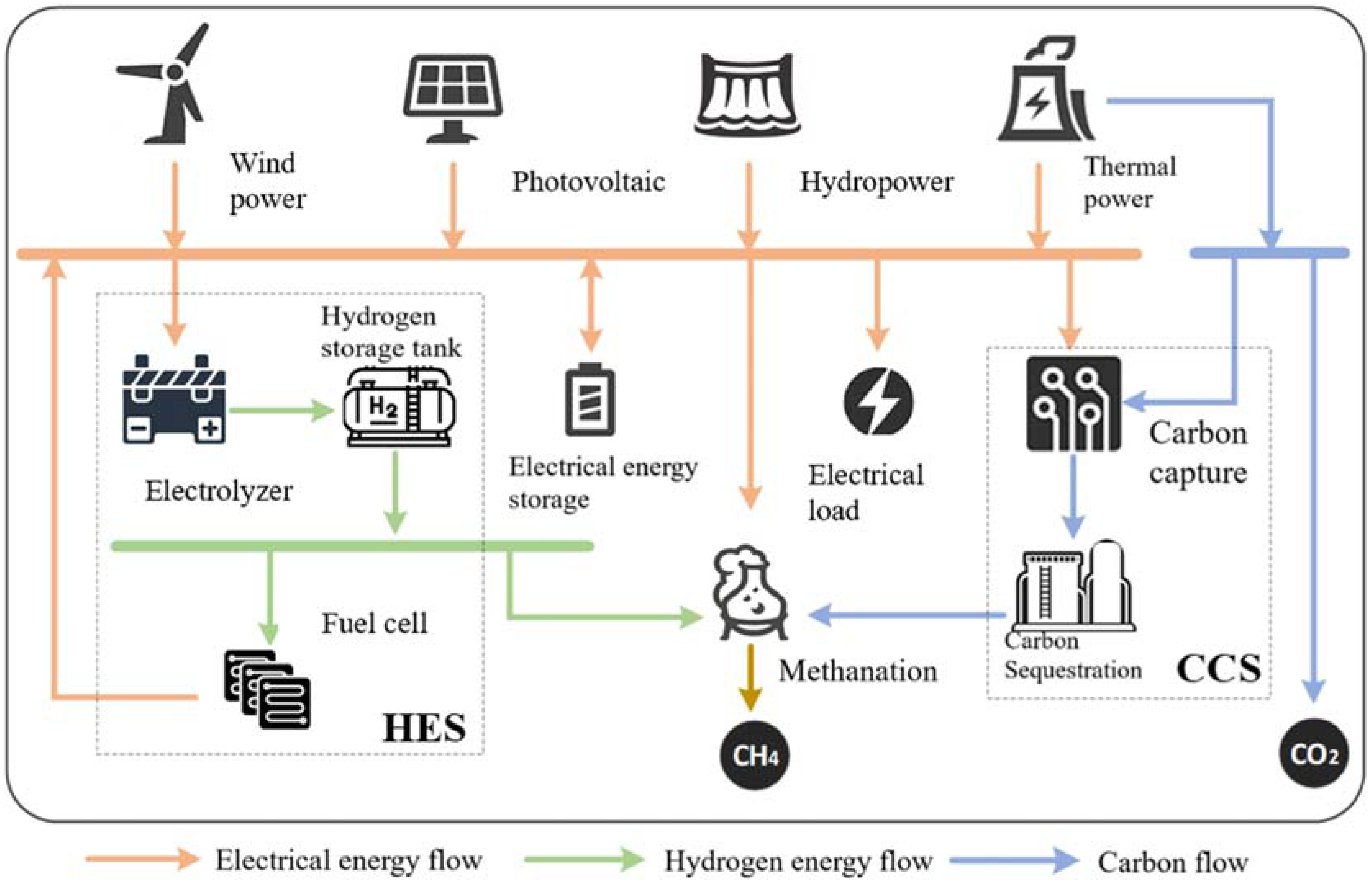
In this paper, a high-proportion renewable energy power system supported by hybrid electricity-hydrogen storage is constructed and analyzed. The system structure is shown in Figure 1, and the energy flow coupling model of each unit is as follows:
(1)
Carbon capture and storage, CCS
P CCS . t = η CCS V CO 2 . CCS . t V CO 2 . CCS . t = α CCS V CO 2 . t V CO 2 . t = η PC P C . t
where η CCS denotes the power consumption coefficient of CCS, V CO 2 . CCS . t denotes the amount of CO2 captured at time t, indicates the amount of power consumed by CCS at time t, α CCS is the capture efficiency of CCS, V CO 2 . t is the carbon emission of the thermal power unit, η PC is the carbon emission coefficient of the thermal power unit, and P C . t is the power of the thermal power unit.
(2)
Methanation equipment, ME
P CH 4 . t = η CH 4 V CH 4 . t V H 2 . CH 4 t = α H 2 . CH 4 V CH 4 . t V CO 2 . CH 4 . t = α CO 2 . CH 4 V CH 4 . t
where V CH 4 . t , P CH 4 . t , η CH 4 are the methane production, power consumption, and power consumption coefficient at time t; V H 2 . CH 4 t , α H 2 . CH 4 hydrogen consumption and hydrogen consumption coefficient; V CO 2 . CH 4 . t , α CO 2 . CH 4 are carbon consumption and carbon consumption factor.
(3)
Hybrid energy storage, HES: It includes two parts, battery(BA) and hydrogen energy storage (HS), as in Equations (15) and (16), respectively.
P EL . t = η EC V HS . EC . t P FC . t = η FC V HS . FC . t S O C HS . t + 1 = S O C HS . t + η s V HS . EC . t V HS . FC . t / η s 0 S O C HS . t H HS . max C A P HS S O C HS . 0 = S O C HS . T = δ HS . 0 H HS . max C A P HS
S O C BA . t + 1 = S O C C . t + η s P BA . c . t P BA . d . t / η s 0 S O C BA . t H max C A P s S O C BA . 0 = S O C BA . T = δ BA . 0 H BA . max C A P BA
In the formula, η EC for the electric hydrogen production efficiency, P EL . t , V HS . EC . t for the t moment of electric hydrogen production equipment power and hydrogen production; η FC for the fuel cell efficiency, P FC . t , V HS . FC . t the t moment of fuel cell power generation and hydrogen consumption. η s energy storage unit charging and discharging efficiency. S O C s . t is the energy storage state at time t, C A P s is the installed capacity, H max is the maximum storage time, and δ s .0 indicates the percentage of initial storage, s BA , HS . P BA . c / d . t is the charging and discharging power of the battery.

4.2. Energy Flow Balance and Environmental Constraints

The system must maintain a balance between electricity, hydrogen, and carbon energy flows during operation, as shown in Equations (17)–(19).
P C . t + P W . t + P PV . t + P H . t + P FC . t + P BA . d . t = P CCS . t + P EL . t + P CH 4 . t + P BA . c . t + L E . t
V HS . EC . t = V HS . FC . t + V H 2 . CH 4 . t
V CO 2 . t V CO 2 . CCS . t = c e m t
where P C . t , P W . t , P PV . t , P H . t are the thermal power, wind power, photovoltaic power, and hydroelectricity output at time t, respectively, and L E . t is the value of electrical load at time t. cemt denotes the carbon emission at time t.
The output of each thermal power unit must meet the total thermal power dispatch requirements, i.e.,:
P C . t = i N S S i . t P G i . t
where N is the number of thermal power units, P G i . t is the power of thermal power unit i at time t, and S S i . t represents the start-stop state of the unit.
The focus of low-carbon economy dispatching is on pollutant concentration constraints in addition to considering carbon trading costs. According to the model described in Section 1 and Section 2, the pollutant concentration in region k at time t should not exceed the ambient concentration threshold for that region as follows:
c k . t m + c k . t .0 m t v k m
where c k . t .0 m denotes the background concentration of pollutant m at time t in region k.

4.3. Optimization Scheduling Model

The objective function consists of carbon trading costs, O&M costs, wind and power abandonment costs, fuel costs, and unit startup and shutdown costs:
min     F = F cem + F om + F ab + F fuel + F sts
F cem = i N t T f CO 2 ( Δ c e m k . t ) F om = t T ε g C inv . g P g . t g W , P V , H F ab = t T ε a b P r . t P r . t r W , P V F fuel = i N t T ε f a i ( P G i . t ) 2 + b i P G i . t + c i F sts = i N - 1 t T u d S S i . t + 1 S S i . t
where F cem , F om , F ab , F fuel , are the carbon trading costs, O&M costs, wind and power abandonment, fuel costs, and unit startup and shutdown costs, respectively. T represents the total number of scheduling periods. C inv . g and ε g are the unit investment costs and O&M costs coefficient of the power source g. P r . t , P r . t are the actual and forecasted output values of wind power and photovoltaic, respectively. a i , b i , c i are the coal combustion coefficients of coal-fired unit i. ε f , ε a b are the fuel costs coefficients and the costs coefficients of wind and photovoltaic abandonment, and ud denotes the costs coefficient of startup and shutdown.
The constraints include equipment characteristic constraints, energy balance constraints, and environmental constraints, i.e., To account for the inherent stochasticity of renewable energy, the system maintains a certain level of up/down spinning reserves, ensuring that any real-time deviations between forecasted and actual output can be effectively balanced.
s . t .    Equations   ( 13 ) ( 16 ) , Equations   ( 17 ) ( 20 ) ,   Equation   ( 21 )

5. Case Study

5.1. Background Parameters

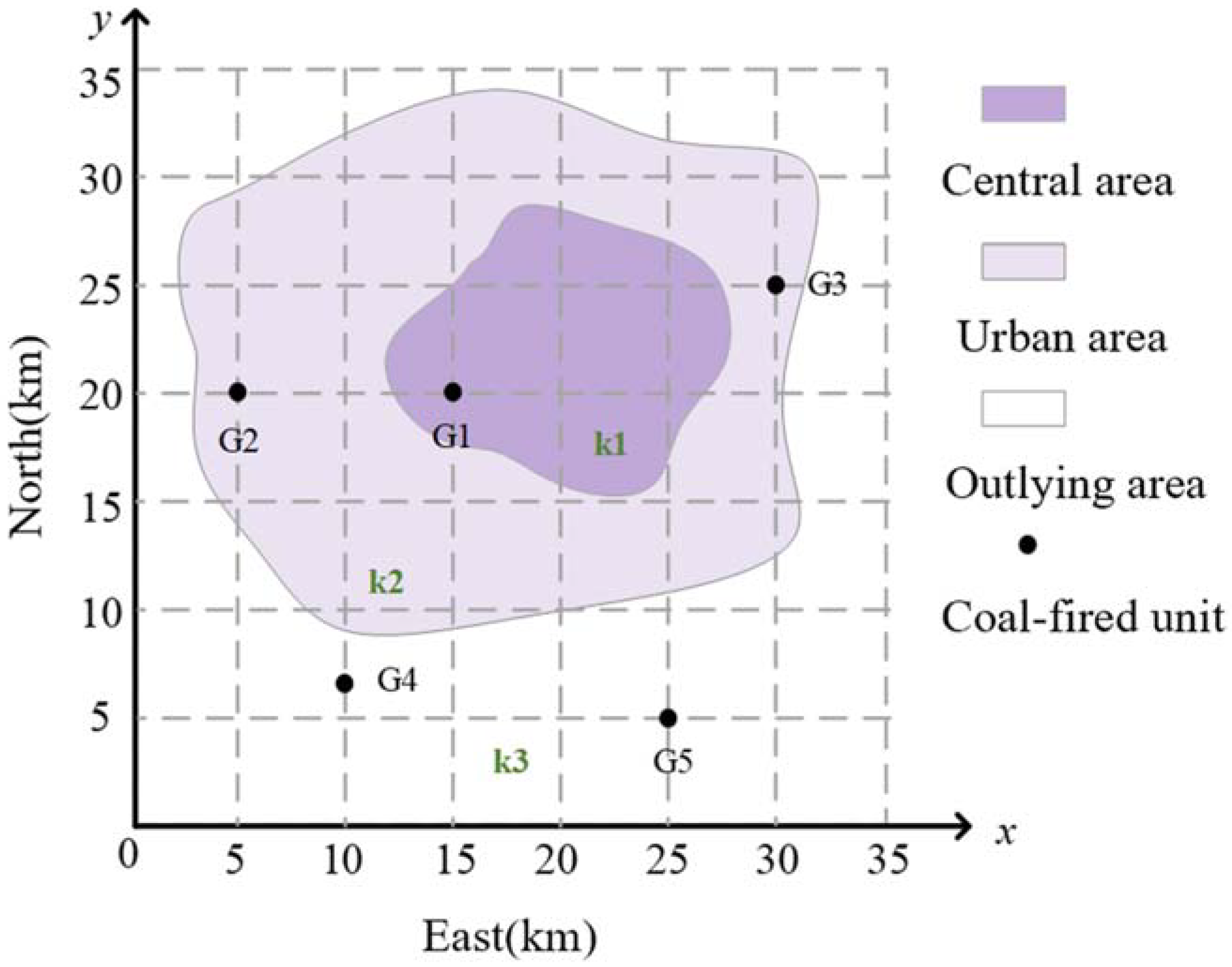
Taking the data of a city in Gansu Province as an example, the capacity of the atmospheric environment is 21,332.68 t/a, the thickness of the mixed layer is 276.85 m, and the height of the chimney is assumed to be 100 m. The planning area is divided into three parts based on the environmental situation, containing five thermal power units, as shown in Figure 2.
According to the model calculation in Section 1 and Section 2, the SO2 concentration thresholds for regions k1, k2, and k3 are 37.2 µg/m3, 40.2 µg/m3, and 97.55 µg/m3, respectively. Taking the carbon quota of subregion k2 as the baseline value, and according to the “Guidelines on Accounting Methods and Reporting of Greenhouse Gas Emissions by Enterprises and Power Generation Facilities,” released by the Department of Response to Climate Change of the Ministry of Ecology and Environmental Protection on 15 March 2022, the baseline value for the power industry is 0.5810 t/MW·h, and the carbon quota coefficients for the regions k1~k3 can be obtained according to the model in Section 2.2 as 0.5272 t/MW·h, 0.5810 t/MW·h, and 0.7220 t/MW·h, respectively. The optimal scheduling of the units and the system is carried out based on the above carbon quota, and the system configurations are shown in Table 1. The data in the table are derived from actual operational records and practical engineering scenarios, ensuring the representativeness and applicability of the case study. The atmospheric environment monitoring points use a fan-shaped distribution pattern, with all locations situated 2 km downwind of each coal-fired unit. The average concentration at these monitoring points is used to assess the contribution of emissions from the coal-fired units. The rationale for employing the average value over multiple detection points as the control indicator is that it aligns with regional carbon allocation objectives. The spatial average accurately reflects the overall ecological pressure of a sub-region. Additionally, it avoids the optimization being highly sensitive to localized fluctuations or the specific coordinates of monitoring points.
The monitoring system was selected and deployed in strict accordance with the “Technical Specifications for Ambient Air Quality Automatic Monitoring” (HJ/T 193-2005) and the technical specifications for the operation and quality control of ambient air gaseous pollutant continuous automatic monitoring systems issued by the Ministry of Ecology and Environment of the People’s Republic of China in 2018.
Real-time pollutant emission rates from thermal units can be monitored using Continuous Emission Monitoring Systems, which are standard installations in modern large-scale power plants. Ambient background concentrations are obtained from regional air quality monitoring networks operated by environmental protection agencies. Meteorological parameters required for the Gaussian plume dispersion model, such as wind speed, wind direction, and mixing layer height, can be sourced from local meteorological stations or high-resolution Numerical Weather Prediction services. Finally, these environmental and meteorological data streams are integrated into the power dispatch center’s Energy Management System through standardized industrial communication protocols, such as IEC 60870-5-104 or DL/T 634. Furthermore, while the current simulation operates on an hourly scale for long-term evaluation, the optimization module within the EMS is designed to execute on a 15 min rolling horizon. This allows the dispatch commands for hydrogen-storage units and thermal units to be dynamically updated in response to real-time fluctuations in environmental carrying capacity and renewable energy output.
In this paper, the following four scenarios are set up for simulation and comparative analysis, and GUROBI is invoked to solve the problem using the YALMIP toolbox:
  • Scenario 1: Optimization scheduling with uniform carbon emission quotas;
  • Scenario 2: Optimization scheduling with a uniform carbon emission quota and considering environmental constraints;
  • Scenario 3: Optimization scheduling with regionally differentiated carbon allowances;
  • Scenario 4: Optimization scheduling with regionally differentiated carbon emission allowances and ecological constraints.

5.2. Optimization Scheduling Results

5.2.1. System Operation Simulation

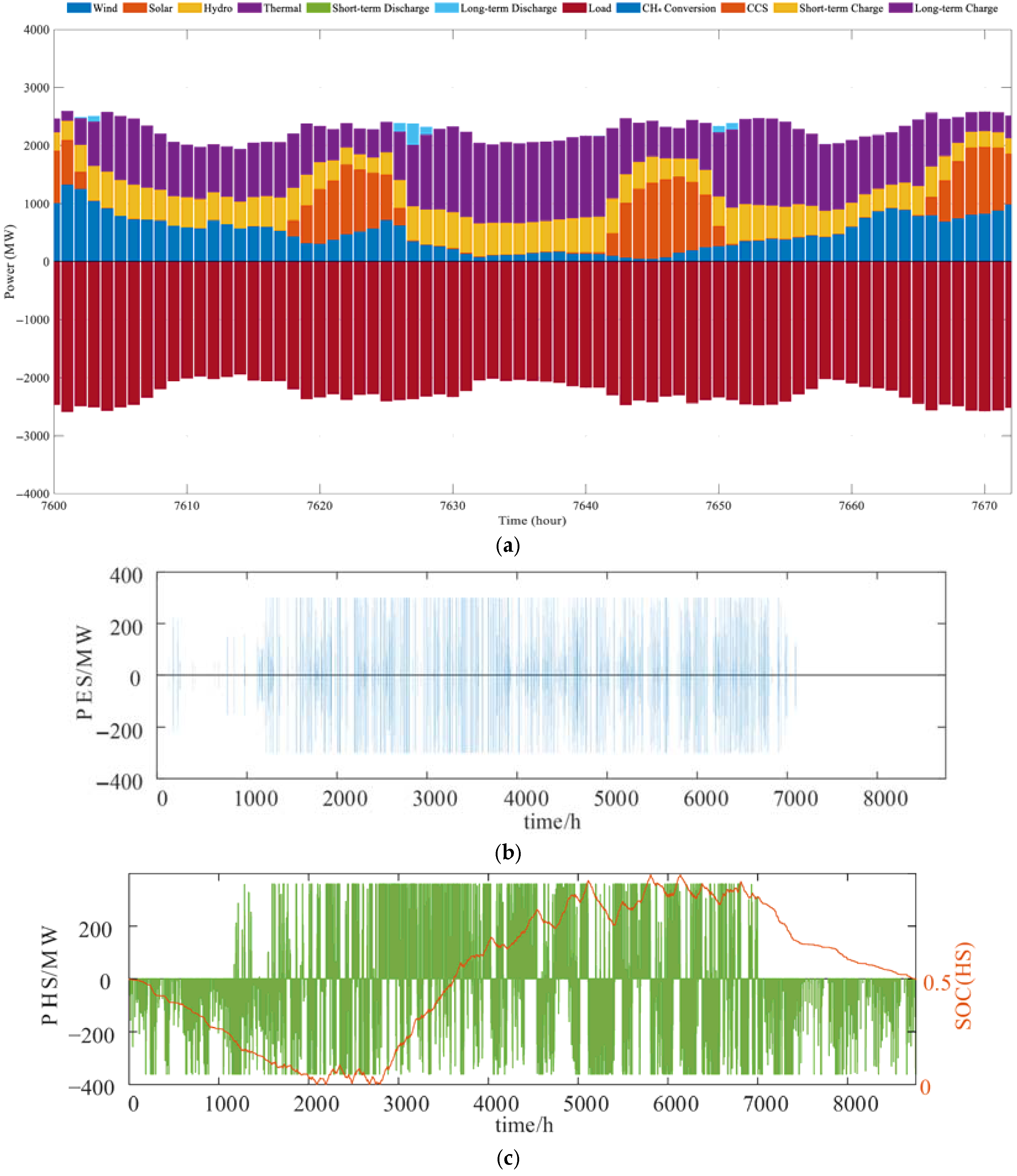
The hourly power balance of the integrated system under Scenario 1 is shown in Figure 3a, which confirms that generation and consumption are dynamically balanced under the optimal dispatch results. Positive values above the zero line represent electricity generation from renewable and conventional sources, including wind, PV, hydro, and thermal units, as well as discharging power from short-term and long-term energy storage systems. Negative values below the zero line correspond to power consumption units, such as the system electrical load, CH4 production, CCS processes, and the charging phases of the storage systems. It can be observed that at each time step, the total generation and consumption remain balanced, demonstrating the feasibility of the system dispatch results. Renewable energy sources (wind + PV + hydro) dominate the positive side of the balance, while thermal generation provides system flexibility and ensures supply security. Energy storage units operate in both directions—charging during renewable surpluses and discharging during shortages—thereby maintaining short-term stability. The CCS and CH4 units introduce additional electricity consumption associated with low-carbon transformation pathways. The overall power balance around the zero line confirms that the integrated energy system can achieve real-time supply–demand equilibrium throughout the operation horizon.
The electrical load in this region is slightly lower in spring and summer than in fall and winter. Since this paper considers future scenarios with a high percentage of new energy supply, including sufficient wind power and photovoltaic generation, as well as abundant water resources in summer, thermal power primarily plays a role in fall and winter. In the spring and summer, thermal power is hardly involved in the power supply, and renewable energy’s annual power generation accounts for approximately 80%, which aligns with the basic requirements of a low-carbon energy system. The low-carbon energy system is equipped with carbon capture and methanization equipment, which utilizes surplus wind power, photovoltaic and other renewable energy sources for carbon capture, hydrogen production, and methane synthesis. The annual operation results show a reduction in power abandonment of 278,295.4 MW·h.
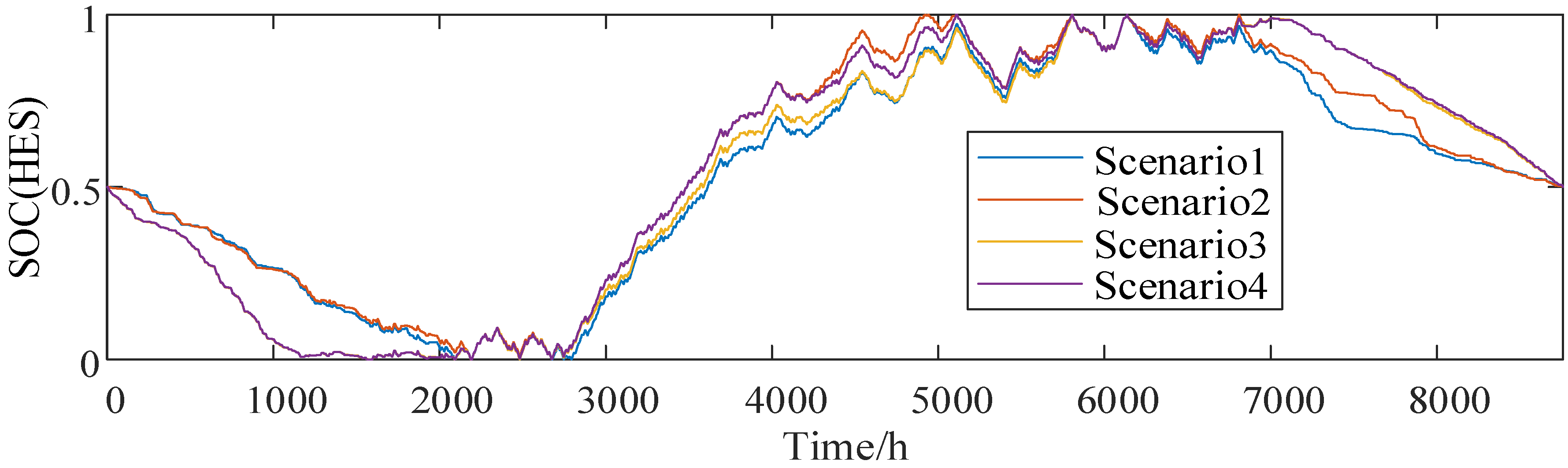
In this process, the hybrid electricity-hydrogen storage system plays an important supporting role. As shown in Figure 3b,c, in the periods of 0~1000 h and 7000 h~8760 h, the hydrogen storage energy is discharged for a continuous and long time, and the residual capacity (SOCHS) is decreasing; there are tens or hundreds of consecutive hours of charging and discharging between 2000 h~7000 h, and the SOCHS shows an overall increasing trend. The electric energy storage mainly operates within 1000 h to 7000 h, with frequent, shorter charging and discharging cycles, and maintains the energy balance of the system, together with the hydrogen energy storage.
Renewable energy generation tracking prediction curve, so the wind power, photovoltaic, and hydroelectricity output in scenarios 2~4 are almost the same as scenario 1. Still, there are some differences between thermal power and energy storage output, and the difference can be reflected in the state of the energy storage system. Figure 4 illustrates the state curves of hydrogen energy storage in various scenarios, where scenarios 1 and 2 are more similar to each other, and scenarios 3 and 4 are also identical. Scenarios 3 and 4 with regionally differentiated initial carbon quotas are discharged faster in the first 1000 h, and the residual capacity is continuously higher than that of scenarios 1 and 2 between 3000 h~5000 h and 7000 h~8760 h; due to the higher residual capacity at 7000 h, the discharged amount is larger after 7000 h. The operational status of energy storage is primarily affected by the operation of thermal power units.

5.2.2. Spatial and Temporal Distribution of Carbon Emissions and Pollutants

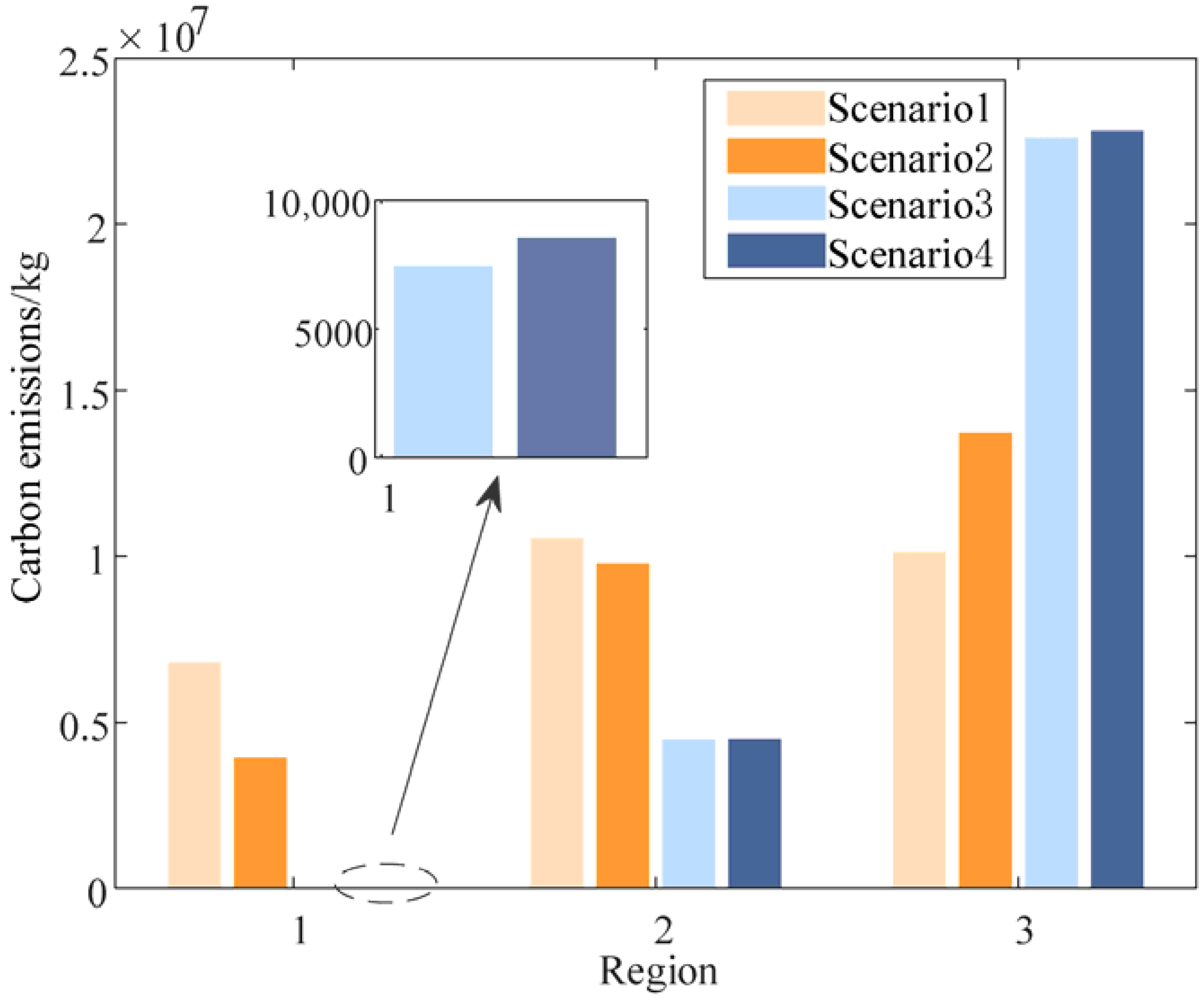
To explore the power allocation of units under different initial quotas of carbon emission rights and environmental constraints, the thermal power units considered here are primarily coal-fired units with significant carbon emissions; the unit parameters are presented in Table 2. Carbon emissions from each region under different scenarios are shown in Figure 5. As can be seen in Figure 5 and Table 3, the total carbon emissions from the k1 and k2 regions under Scenarios 3 and 4 are much smaller than those in Scenarios 2 and 3. This part of the carbon emissions is transferred to k3 in Scenarios 3 and 4. This is because Scenarios 3 and 4 have adopted the regionally differentiated initial carbon emission quotas. The environmental coefficients and initial carbon emission allowance quotas obtained from the models in Section 2.1 and Section 2.2 for the k1 and k2 regions are low, so that the same amount of carbon emission brings about a higher carbon transaction cost, so it is more inclined to prioritize the utilization of the units in the k3 region for power supply in power allocation. In terms of total annual emissions, scenarios 3 and 4 reduce carbon emissions by more than 1.5 × 10⁴ t compared with scenarios 1 and 2. This result indicates that regionally differentiated initial carbon emission allowances have a significant impact on total carbon emissions.
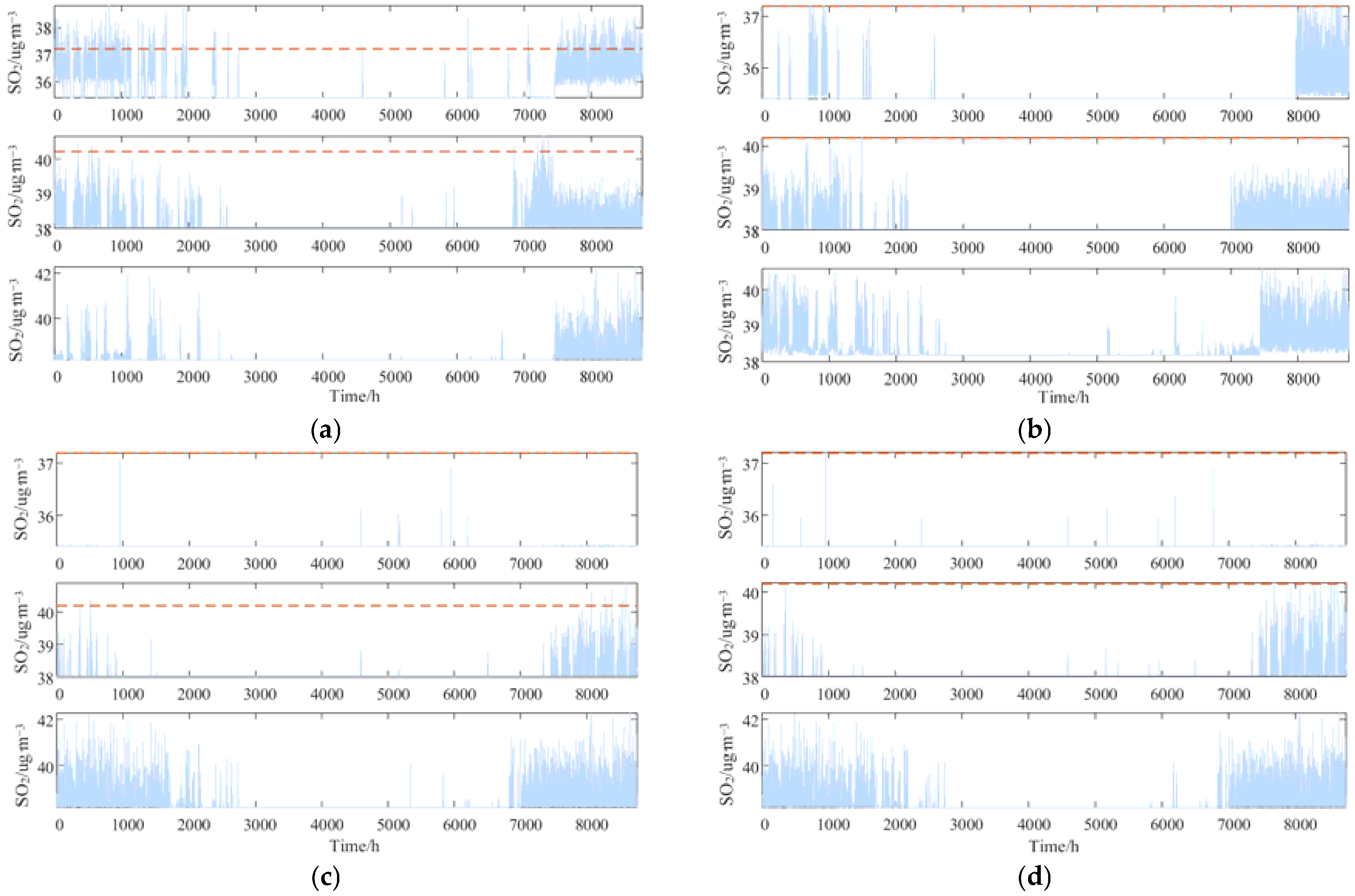
In addition to controlling the total amount of carbon emissions, the ground concentration of pollutants is also an important control index. In this paper, SO2 is used as a proxy to estimate ground-level pollutant concentrations. The time-dependent changes in SO2 concentration under each scenario are shown in Figure 6. Under Scenario 1, the SO2 concentration in the k1 region frequently exceeds the ambient concentration threshold in the periods of 0~2500 h and 7800 h~8200 h, with the maximum exceeding the concentration threshold by 8.6%; the SO2 concentration in the k2 region exceeds the ambient concentration threshold in the periods of 400 h~800 h and 7000 h~7600 h. In Scenario 2, after considering the regional SO2 concentration distribution for constraints, the SO2 concentration distribution in each region returns to within the threshold for that region. In Scenario 3, although the total amount of carbon emissions is controlled, there are still instances when the SO2 concentration exceeds the ambient concentration threshold in the k2 region during the 8000–8700 h period, with the highest point exceeding the threshold by 2.1%. Scenario 4 considers the control of total carbon emissions in the region and the constraints on ground-level SO2 concentrations in each period, which not only meet the concentration threshold requirements but also limit regional carbon emissions according to environmental differences.
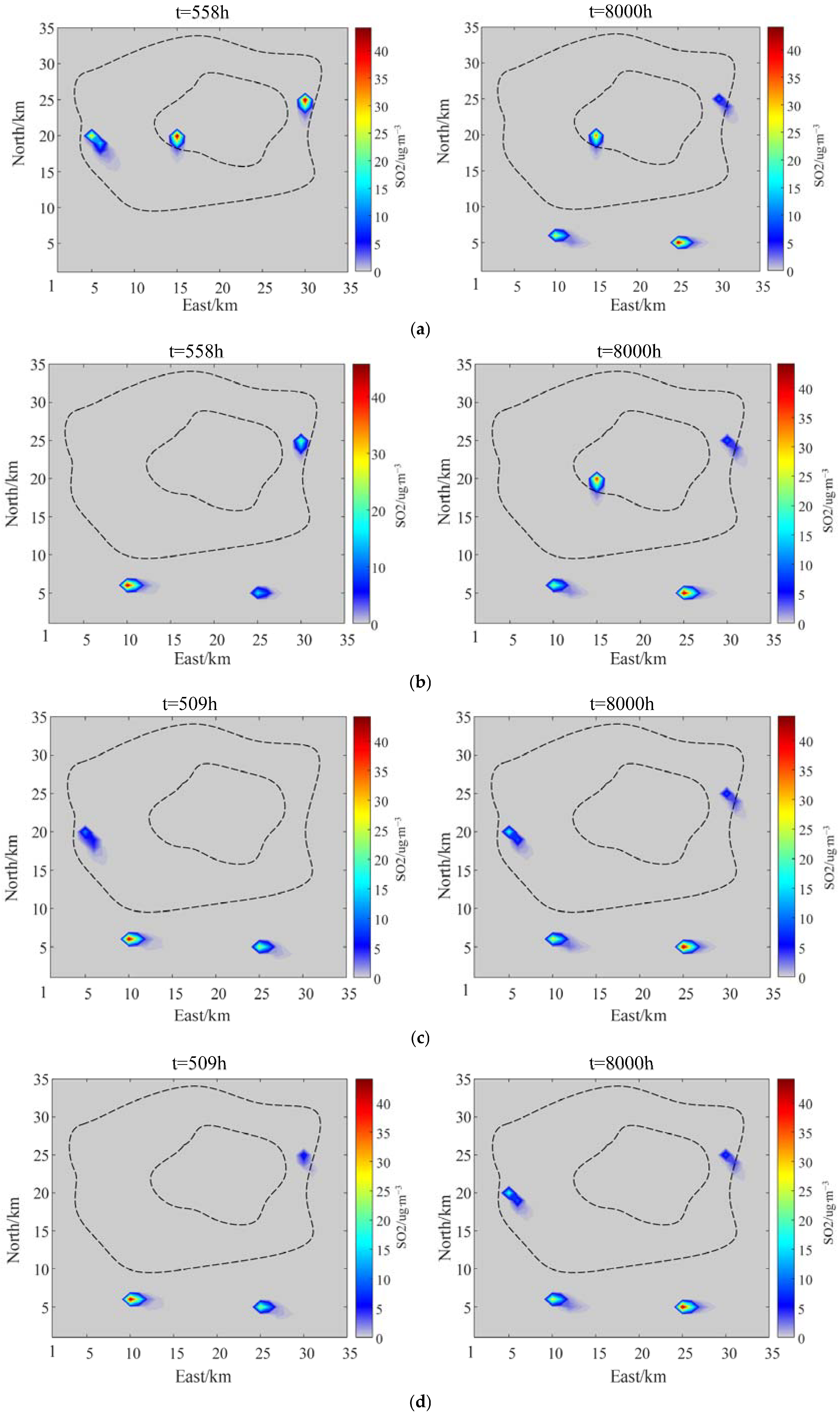
Scenarios 1 and 2 take t = 558 h and t = 8000 h, and scenarios 3 and 4 take t = 509 h and t = 8000 h, and the spatial distribution of SO2 concentration is obtained as shown in Figure 7. t = 558 h, G1~G3 are powered in scenario 1, and G3, G4, and G5 are used to power supply in scenario 2, which is a result of the constraints on the concentration of the pollutants in the region because the concentration in scenario 1 at G1 at that moment exceeds the ambient concentration threshold. Concentration exceeds the ambient concentration threshold. t = 8000 h, the results are the same under scenarios 1 and 2, which all use G1, G3, G4, and G5 for power supply; scenarios 3 and 4 use G2, G3, G4, and G5 for power supply, and the concentration of G4 and G5 is higher than that of G2 and G3. Thus, it can be seen that, under the constraint of the total amount of carbon emissions in the region, the dispatch strategy prioritizes the utilization of units in the area with a higher initial carbon emission quota (k3 region). At t = 509 h, the concentrations of G4 and G5 in scenarios 3 and 4 are essentially the same. The difference is that G2 is selected in scenario 3, and G3 is used in scenario 4. Still, the comparison shows that the concentration of SO2 at G2 in scenario 3 is higher than that at G3 in scenario 4; thus, the effect of scenario 4 is more favorable.

5.2.3. Cost Comparison Analysis

To further evaluate the economic performance of the proposed optimization scheduling model, the total and component costs under the four scenarios are compared in Table 2, and their visual representations are shown in Figure 8 and Figure 9. The total dispatch cost F consists of five parts: the fuel cost Ffuel, carbon trading cost Fcem, operation and maintenance cost Fom, unit startup and shutdown cost Fsts, and the cost of wind and photovoltaic power curtailment Fab. Since the latter is zero in all cases, it is omitted from the comparison.
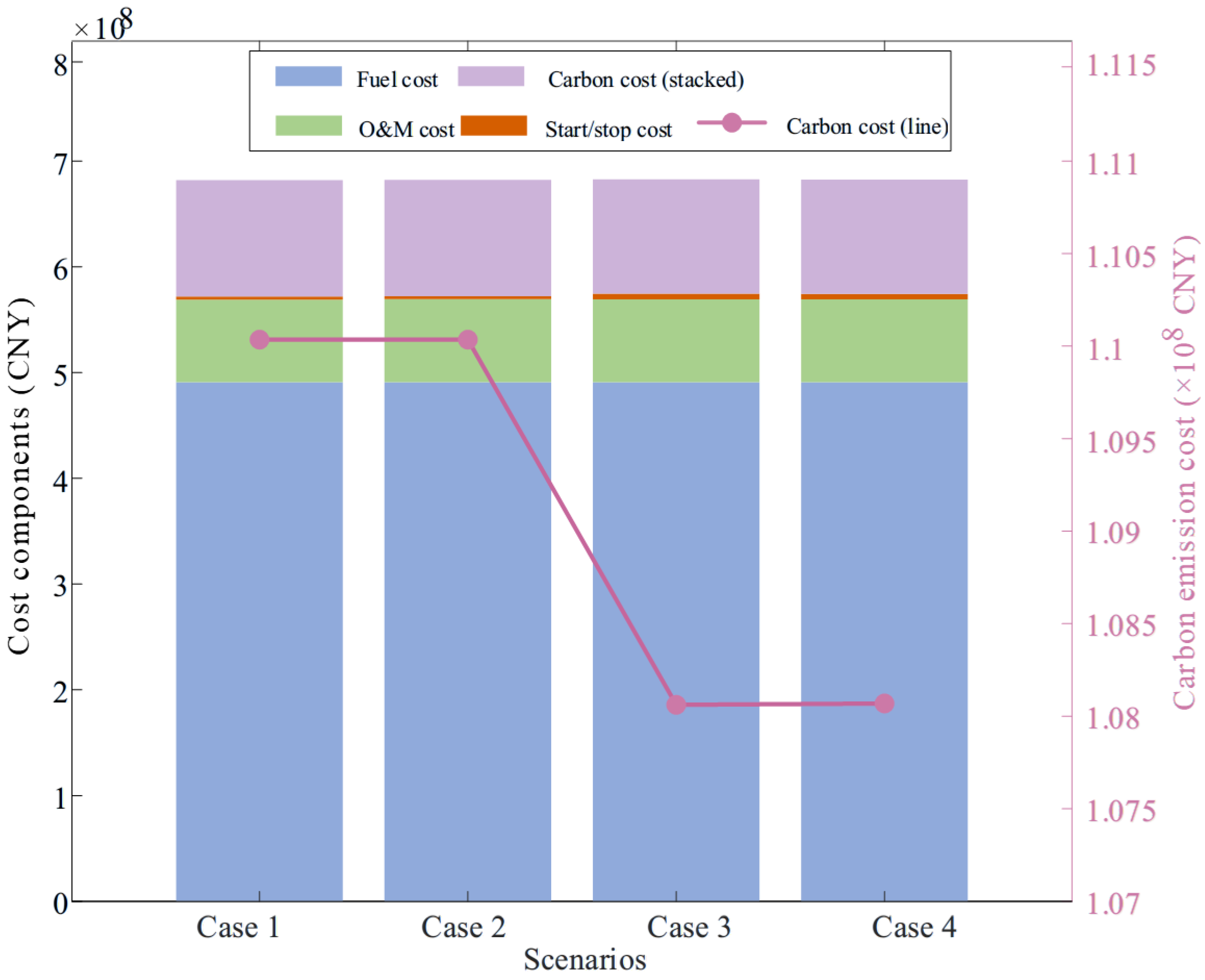
As shown in Table 2 and Figure 8, the total dispatch cost remains nearly constant among the four scenarios, indicating strong economic stability of the proposed optimization framework. However, clear differences appear in the carbon trading cost, which reflects the effect of introducing regional differentiation and environmental constraints. Under the uniform carbon quota (Scenarios 1 and 2), the total system cost is 5.02783 × 10¹⁰ CNY and 5.02787 × 10¹⁰ CNY, respectively—practically identical. When regionally differentiated quotas are implemented (Scenario 3), the total cost decreases to 5.02553 × 10¹⁰ CNY, representing a reduction of about 0.045% (≈2.3 × 10⁷ CNY) relative to Scenario 1. Meanwhile, the carbon trading cost declines from 1.10035 × 10⁹ CNY in Scenario 1 to 1.08062 × 10⁹ CNY in Scenario 3, a 1.8% decrease. This reduction arises because generation shifts toward regions with higher initial carbon allowances (region k3), reducing carbon purchase requirements.
When environmental concentration constraints are further applied (Scenario 4), the total dispatch cost increases only marginally—from 5.02553 × 10¹⁰ CNY to 5.02554 × 10¹⁰ CNY—a variation smaller than 0.002‰. Thus, integrating pollutant concentration limits yields meaningful environmental improvements at virtually no additional cost. Similarly, comparing Scenario 1 and Scenario 2, the cost increase of only 0.008‰ confirms that considering regional SO2 thresholds barely affects economic performance while ensuring all pollutant levels remain within ambient limits. Figure 8 clearly depicts these trends: the blue bars (total cost) remain almost unchanged across scenarios, while the red line (carbon trading cost) declines gradually from Scenario 1 to Scenario 4. This visual evidence demonstrates that the regionalized carbon quota model effectively reduces carbon transaction expenses while maintaining total system cost stability.
The internal composition of total costs is shown in Figure 9. Fuel cost is the dominant component, contributing approximately 97.7% of the total cost in all cases. The carbon trading cost accounts for about 2.1%, while O&M and startup/shutdown costs together represent less than 0.2%. Despite the relatively small share of carbon cost, its variation across scenarios plays a critical role in optimizing regional dispatch. When differentiated quotas are introduced, the share of carbon cost decreases slightly, consistent with the numerical decline observed in Figure 8. It highlights this composition clearly: the gray sections (fuel cost) occupy almost the entire bars, while the red sections (carbon trading cost) shrink slightly from Scenario 1 to Scenario 4. This subtle shift underscores that even marginal changes in carbon price or allocation mechanism can significantly influence dispatch patterns and system-wide emission outcomes.
Overall, the combined results of Table 2 and Figure 8 and Figure 9 demonstrate that (1) Regionally differentiated carbon quotas reduce the annual total cost by more than 2 × 10⁷ CNY and cut carbon emissions by over 1.5 × 10⁴ t, compared with the uniform-quota case. (2) Environmental concentration constraints ensure pollutant compliance at a negligible additional cost (<0.002‰). (3) The system achieves a negative marginal abatement cost, indicating that emission reduction and cost minimization can occur simultaneously. Therefore, the proposed model exhibits a strong economic–environmental synergy. From a policy perspective, combining region-specific carbon quotas with pollutant concentration thresholds provides a realistic and effective approach for low-carbon dispatch in integrated electricity–hydrogen–carbon systems.

5.2.4. Sensitivity Analysis of Key Parameters

To assess the robustness of the proposed optimization model and to explore how major parameters influence both economic and environmental performance, a sensitivity analysis was carried out on two critical factors: (1) the carbon trading price, which directly affects the marginal cost of emissions; and (2) the regional pollutant concentration threshold, which constrains unit dispatch in environmentally sensitive areas. All other parameters and system configurations were kept consistent with those described in Section 5.2.1.
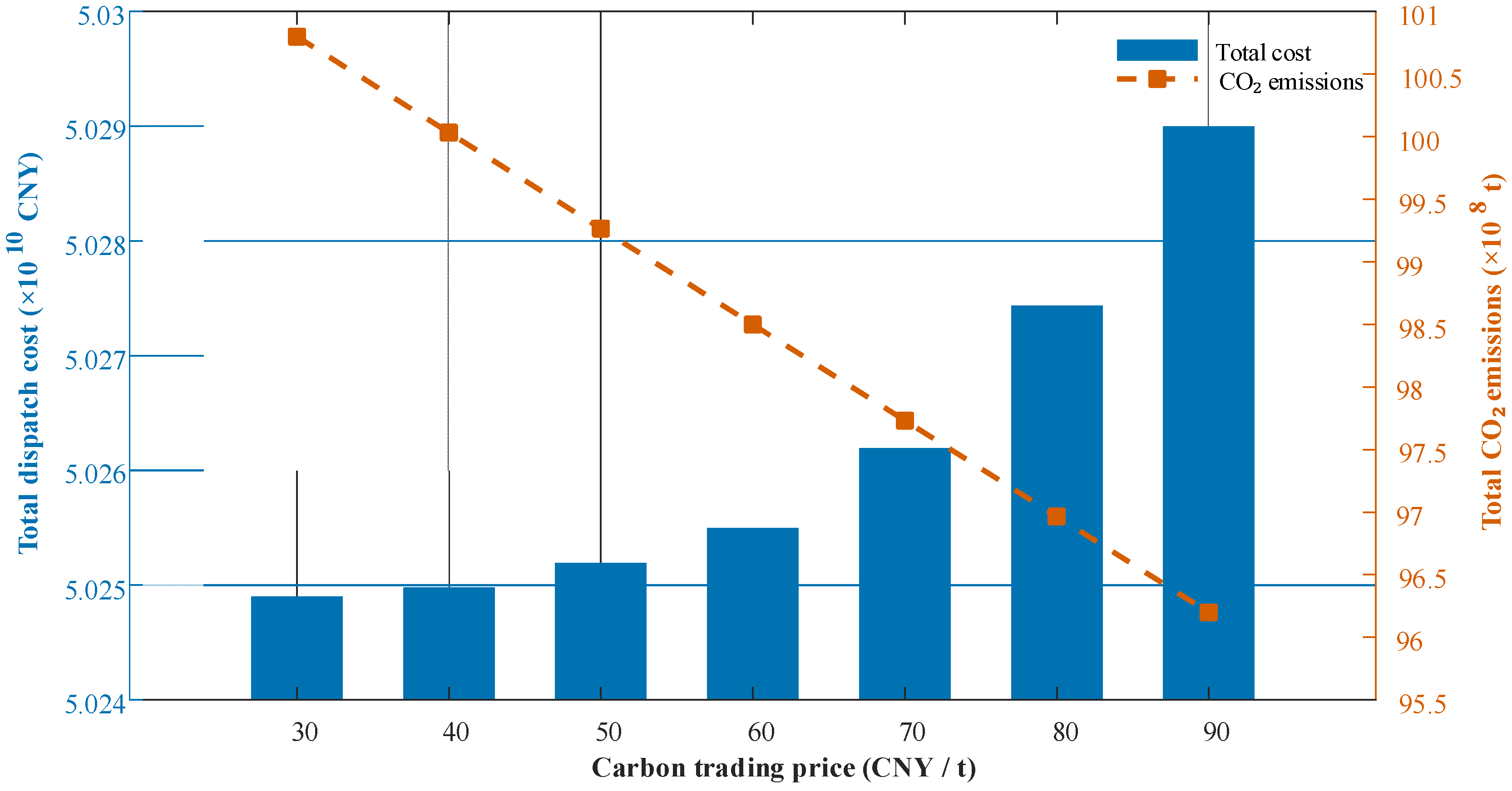
The baseline carbon price was set at 60 CNY t−1 (as in Section 5.2.3). To evaluate its effect, additional simulations were conducted for 30 CNY t−1 and 90 CNY t−1. Figure 9 illustrates the variations in total dispatch cost and total CO2 emissions under these different price levels. As shown in the figure, the total dispatch cost increases almost linearly with carbon price, while the rate of emission reduction gradually decreases. When the carbon price rises from 30 CNY t−1 to 90 CNY t−1, the total system cost in Scenario 3 increases by about 0.07%, whereas total carbon emissions decrease by 2.3%. This indicates that moderate increases in carbon price significantly enhance emission reduction without imposing a substantial cost burden. Beyond approximately 80 CNY t−1, however, the cost-effectiveness of further price escalation diminishes, suggesting the existence of an optimal carbon price range for system-level economic–environmental balance.
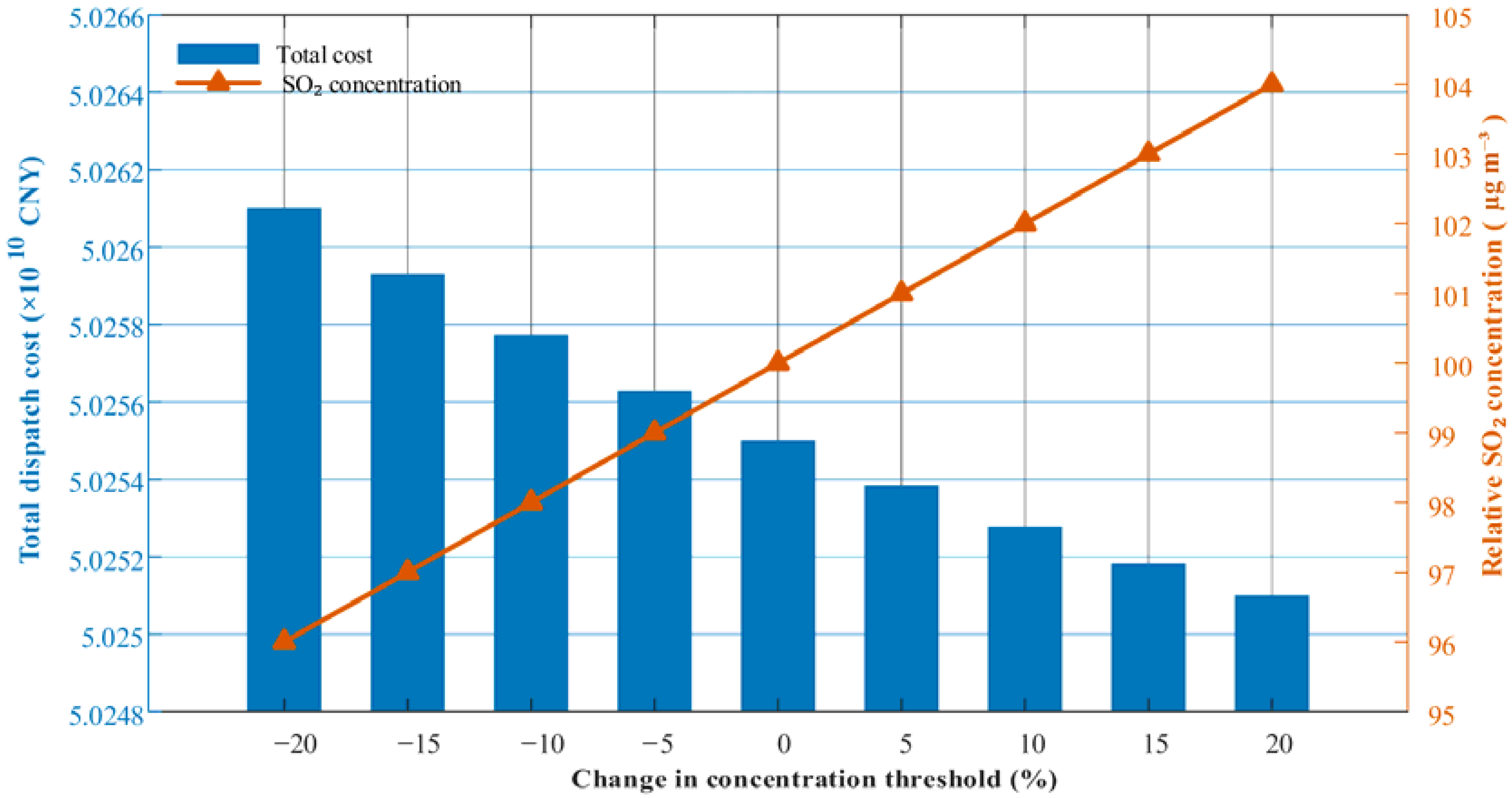
To analyze the influence of environmental constraints, the SO2 concentration thresholds for regions k1–k3 were varied by ±20% relative to the baseline (37.2, 40.2, 97.55 µg m−3). The results, shown in Figure 10, indicate that tightening the pollutant thresholds (−20%) leads to reduced utilization of coal-fired units in k1 and k2, with a corresponding 1.6% decrease in regional SO2 concentration and a slight 0.012% increase in total cost. Conversely, relaxing the thresholds (+20%) marginally lowers total cost but results in higher pollutant exposure in low-capacity regions.
These results confirm that the pollutant concentration threshold acts as an effective regulatory parameter that can reallocate thermal generation spatially without significantly affecting the total system cost. Maintaining moderate regional differentiation (±10%) provides a favorable balance between local air quality improvement and dispatch economy.
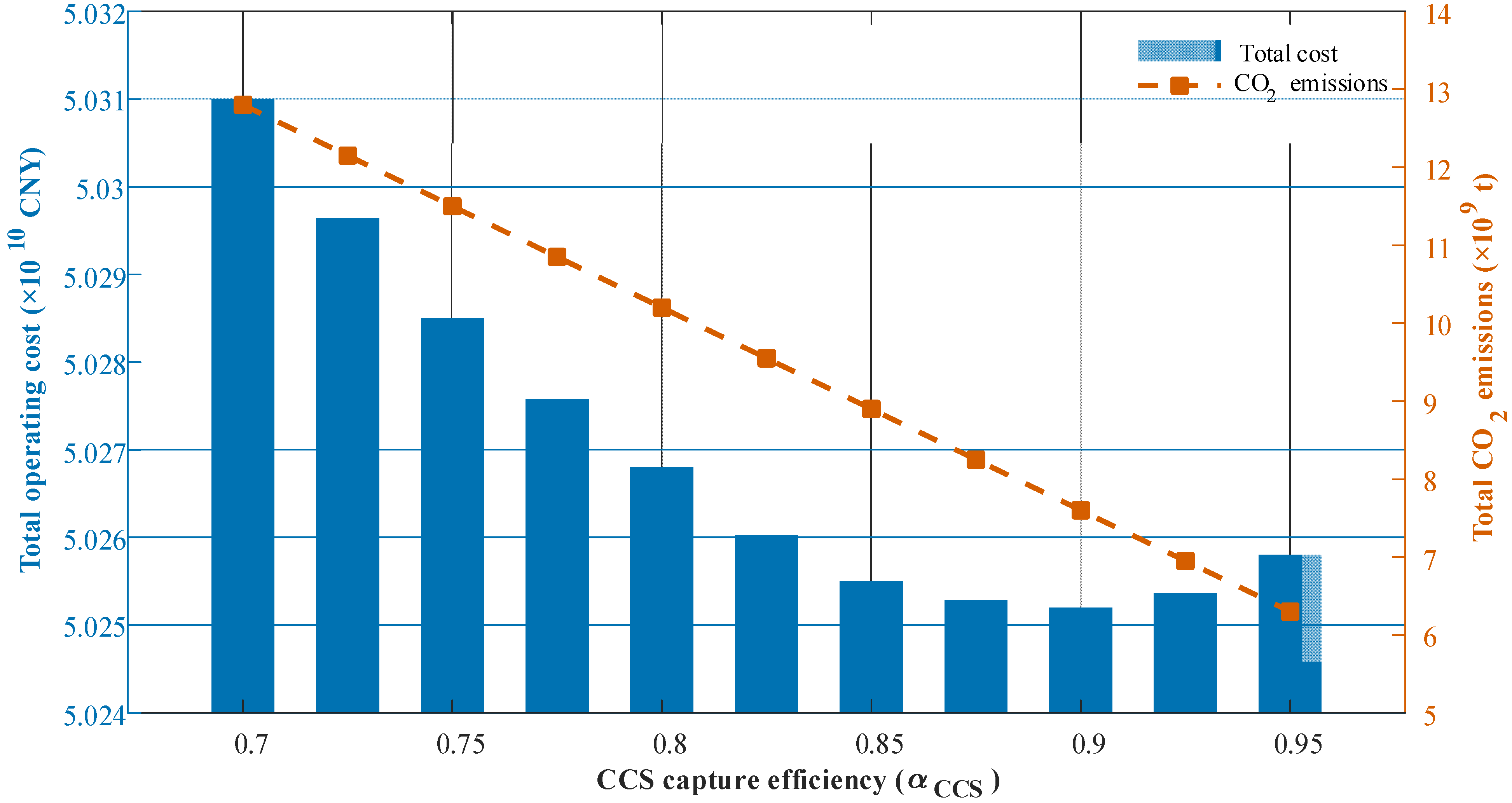
Figure 11 illustrates the trends of total operating cost and total CO2 emissions as a function of the CCS capture efficiency. As observed, the total carbon emissions exhibit a significant linear downward trend as CCS capture efficiency increases from 0.70 to 0.95, indicating that improving capture efficiency is a direct means of achieving deep decarbonization for the system. Regarding economic performance, the total operating cost continues to decrease within the range of CCS capture efficiency in [0.70, 0.90], as the increase in carbon capture effectively offsets high carbon trading expenditures. However, when the capture efficiency exceeds 0.90, the total cost curve shows a slight rebound. This is because excessive capture rates lead to a surge in energy consumption (parasitic load) of the CCS unit, where the marginal operating cost exceeds the savings from reduced carbon trading costs, causing the total system cost to reach an economic equilibrium point near 0.90.
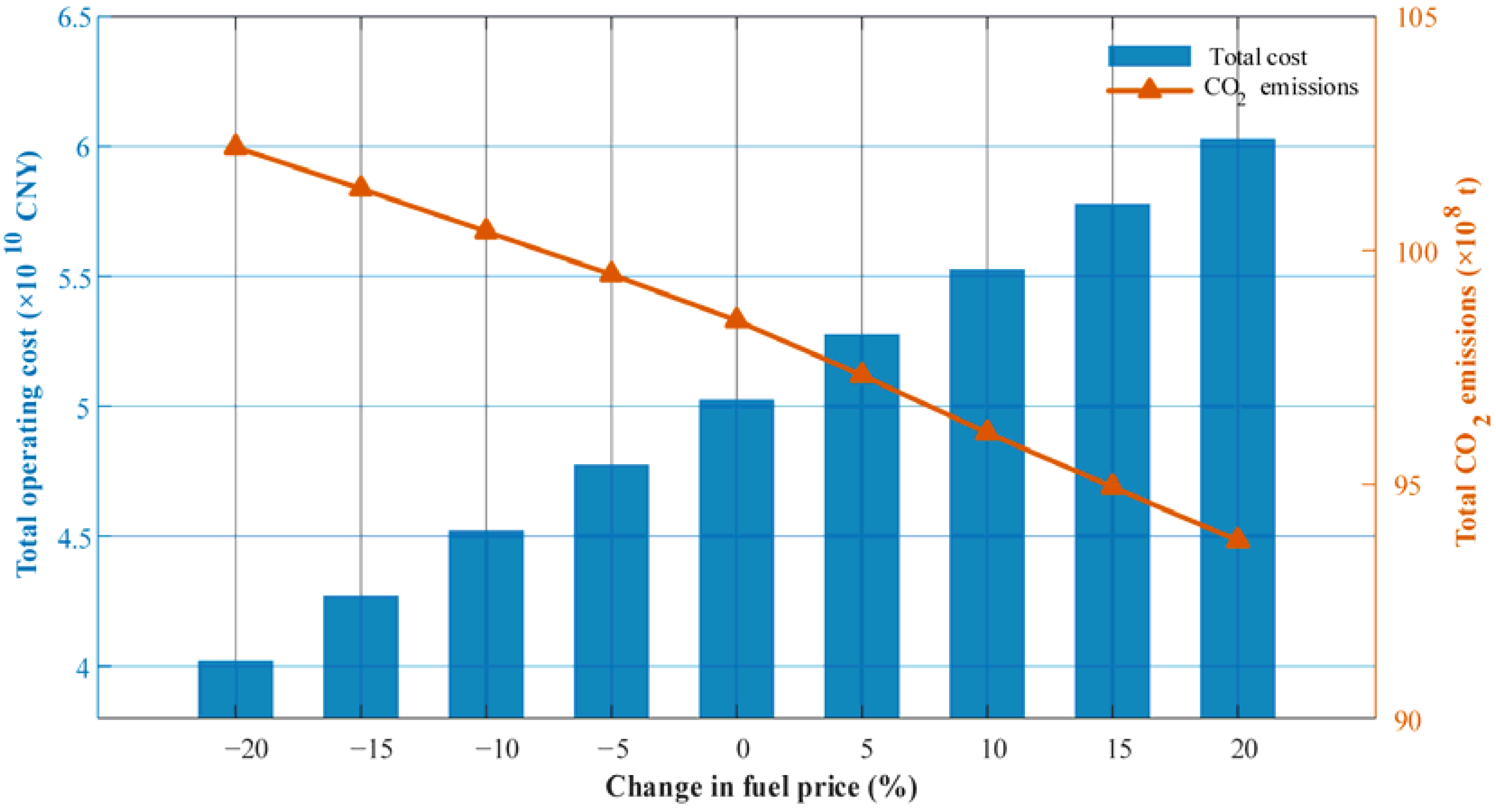
Figure 12 depicts the impact of fuel price fluctuations ±20% on system performance. The analysis results reveal that the total operating cost is highly sensitive to fuel prices, exhibiting a positively correlated quasi-linear growth trend, which is consistent with the fact that fuel costs account for a vast majority (approximately 97.7%) of the total expenditure. Notably, as fuel prices rise, the total CO2 emissions show a decreasing trend. The underlying mechanism of this phenomenon is that when fossil energy prices increase, the dispatch model actively reduces the output of coal-fired units to pursue economic optimization, inducing the system to dispatch more renewable energy and hydrogen energy storage systems for power compensation. This “market-driven” emission reduction effect suggests that rising fuel prices objectively strengthen the momentum for the system’s low-carbon transition and validate the adaptability and environmental advantages of the proposed dispatch strategy across diverse market environments.
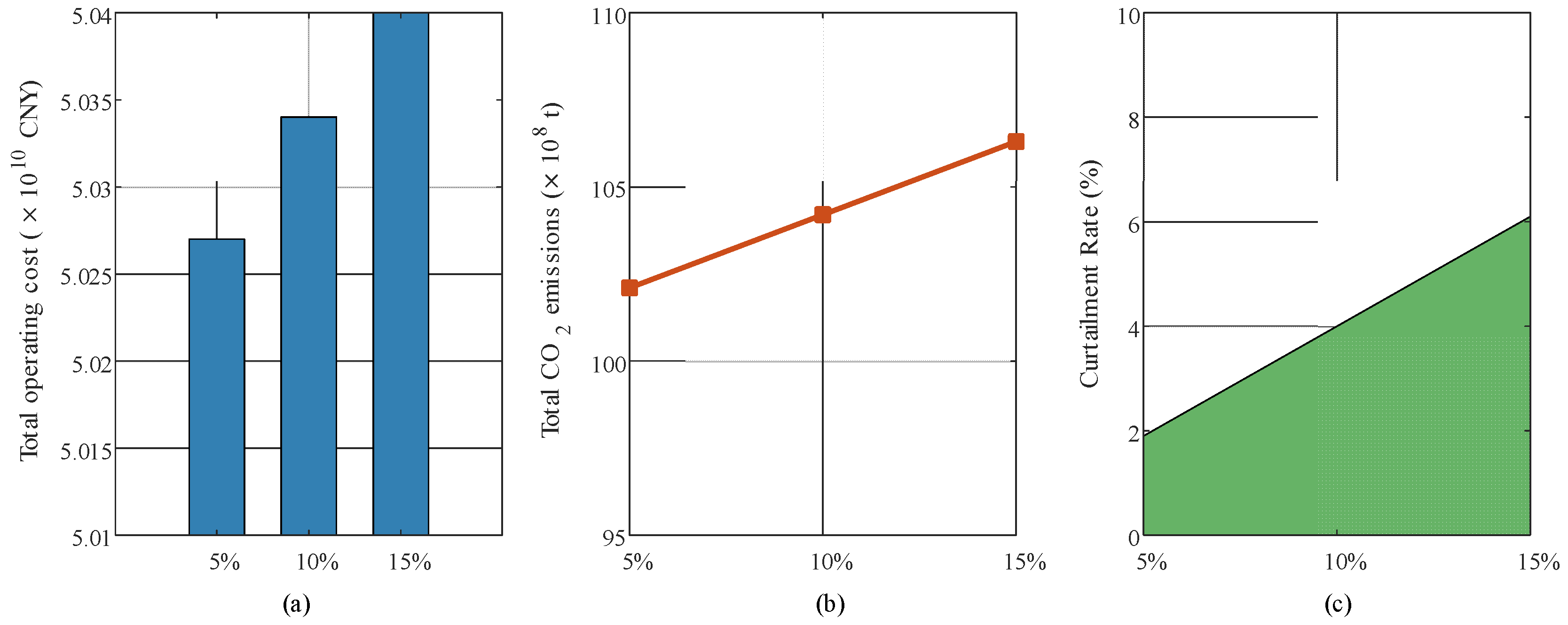
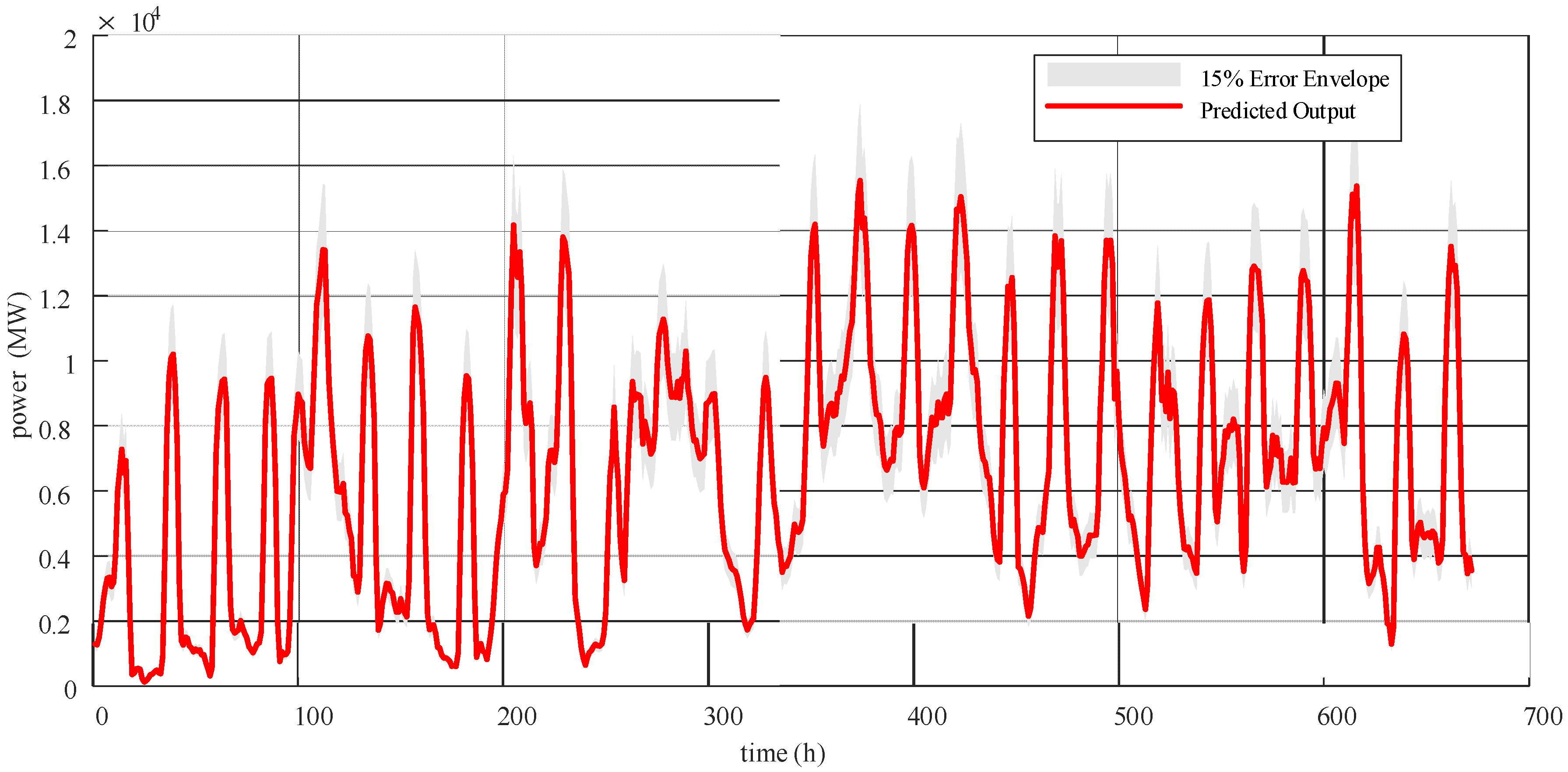
Finally, the inherent stochasticity of renewable energy was rigorously accounted for through a multi-scenario sensitivity analysis on forecasting deviations (Standard deviation of the normal distribution σ = 5%, 10%, 15%) based on measured data from Gansu, as shown in Figure 13. While the system demonstrates inherent robustness, the increasing uncertainty imposes a non-negligible uncertainty premium on system performance. When the forecasting standard deviation rises from 5% to 15%, the total operating cost escalates from approximately 5.027 ×10¹⁰ CNY to 5.04 ×10¹⁰ CNY (shown in Figure 13a), and total CO2 emissions increase from 102 × 108 t to 106 ×108 t (shown in Figure 13b). This upward trend in cost and emissions is primarily attributed to the additional spinning reserves required to buffer against power deficits and the defensive curtailment strategies—reaching a 6% curtailment rate at σ = 15%—to ensure downward regulation safety (shown in Figure 13c).
Despite these fluctuations, the variations in economic and environmental indices remain within a manageable range (approx. 2–4%), significantly lower than the volatility of the renewable input itself (shown in Figure 14). This validates that the proposed dual-control framework, underpinned by the flexible coordination of source-storage resources, effectively dampens the impact of green energy uncertainties, maintaining the system’s trajectory toward a low-carbon energy transition.
The sensitivity results demonstrate that the proposed model remains robust across realistic parameter ranges, including variations in renewable energy forecasts. The economic–environmental performance responds smoothly to technical, market, stochastic, and regulatory shifts, with no abrupt changes in total cost or dispatch stability. These findings emphasize that integrating carbon trading mechanisms with regionally adaptive environmental constraints can provide policymakers with a flexible framework to fine-tune low-carbon power system operation while maintaining localized environmental quality.

6. Conclusions

This study establishes a regionally differentiated initial carbon emission allowance allocation model that integrates pollutant concentration thresholds, providing a novel “dual-control” framework for environmental-economic dispatch. This methodology aligns with a broader paradigm of sustainable development by optimizing upstream energy supply to minimize environmental damage throughout the production cycle. The key findings and practical implications are summarized as follows:
(1) The proposed model achieves a superior balance between economic efficiency and environmental protection. Compared to uniform quota allocation, the regionally differentiated approach reduces annual operating costs by over 2 × 10⁷ CNY and total CO2 emissions by more than 1.5 × 10⁴ t. Furthermore, by incorporating pollutant concentration constraints, the model dynamically alleviates environmental pressure in low-capacity regions, reducing maximum SO2 concentrations by approximately 1.9% with negligible impact on the system-wide economy (<0.002‰ cost increase).
(2) For practical application, this framework can be integrated into existing Energy Management Systems (EMS) at power dispatch centers. Implementation requires a synchronized data stream consisting of real-time emission data from Continuous Emission Monitoring Systems (CEMS) and localized meteorological data (e.g., wind speed and mixing layer height) from weather forecasting services. This integrated sensing-dispatching architecture allows grid operators to adaptively adjust generation schedules on a 15 min rolling basis, moving beyond static emission limits to dynamic, real-time, spatially aware regulation.
(3) In large-scale power systems, the model is expected to maintain high numerical stability and robust performance across varying fuel prices and carbon market conditions. While the primary implementation costs involve the deployment of high-precision pollutant sensors and data integration platforms, these expenditures are often marginal compared to the significant fuel savings and carbon tax liabilities avoided. In fact, many modern power plants already possess the necessary CEMS infrastructure, meaning the transition to this dual-control dispatch primarily requires software-level updates to the optimization algorithms, offering a cost-effective pathway for green power system evolution.
In summary, the synergy between regionalized carbon allocation and pollutant concentration constraints provides a scalable and sustainable strategy for the low-carbon operation of complex integrated energy systems.

Author Contributions

Conceptualization, T.Y.; methodology, L.R. and Y.M.; validation, Y.T.; resources, Y.T.; writing—original draft preparation, L.R.; writing—review and editing, Y.M.; supervision, T.Y.; funding acquisition, T.Y. All authors have read and agreed to the published version of the manuscript.

Funding

This research was funded by the Science and Technology Project on State Grid of China grant number on 52120525001X and the National Science and Technology Major Project on Smart Grid of China grant number 2025ZD0806100.

Institutional Review Board Statement

Not applicable.

Informed Consent Statement

Not applicable.

Data Availability Statement

The original contributions presented in this study are included in the article. Further inquiries can be directed to the corresponding author.

Acknowledgments

This work was supported by the Science and Technology Project on State Grid of China, “Dynamic Optimization and Quality Control Technology for Green Fuel Loading under Wide-Range Operation” (52120525001X) and the National Science and Technology Major Project on Smart Grid of China, “Demonstration Project of 100-Megawatt-Class Wind–Solar–Hydrogen Integrated System for Flexible Load Regulation and Grid Interaction” (2025ZD0806100).

Conflicts of Interest

Author Liang Ran and Yue Teng was employed by State Grid Gansu Electric Power Company and State Grid Anhui Electric Power Research Institute. The authors declare that this study received funding from the State Grid Corporation of China. The funder had the following involvement with the study: State Grid Corporation of China Technology Funding Project (52120525001X), National Science and Technology Major Project on Smart Grid of China (2025ZD0806100).

References

  1. Xian, Y.; Li, N.; Zhao, M. Market potential and the industrial sectors inclusion sequence in China’s national carbon emission trading: From the perspective of maximizing gains. J. Clean. Prod. 2024, 435, 140511. [Google Scholar] [CrossRef]
  2. Chen, Y.; Liu, Y. How biased technological progress sustainably improve the energy efficiency: An empirical research of manufacturing industry in China. Energy 2020, 11, 21–23. [Google Scholar] [CrossRef]
  3. Khalid, M.H.; Nafe, S.A. Business strategies and climate change adaptation: Insights from a comparative study between a developed and a developing country. Manag. Environ. Qual. Int. J. 2022, 35, 1354–1371. [Google Scholar] [CrossRef]
  4. Pahle, M.; Quemin, S.; Osorio, S.; Günther, C.; Pietzcker, R. The emerging endgame: The EU ETS on the road towards climate neutrality. Resour. Energy Econ. 2025, 81, 1014176. [Google Scholar] [CrossRef]
  5. Ayla, D.; Cihan, K.A. Spatial dynamics in low carbon technologies exports: Institutional, political and economic determinants. J. Clean. Prod. 2025, 532, 146972. [Google Scholar] [CrossRef]
  6. Zare, A.; Shafie-khah, M.; Siano, P.; Lazaroiu, G.C. A systematic review of Virtual Power Plant configurations and their interaction with electricity, carbon, and flexibility markets. Renew. Sustain. Energy Rev. 2026, 226, 116448. [Google Scholar] [CrossRef]
  7. Mbangeni, L.; Krishnamurthy, S. A lagrange-based multi-objective framework for wind–thermal economic emission dispatch. Processes 2025, 13, 2814. [Google Scholar] [CrossRef]
  8. Diaz, R.J.L.; García, J.B.; Badaoui, M.; Zaremba, K. Decarbonizing power generation: Integrating green hydrogen in the economic dispatch of combined-cycle power plants. Energy 2025, 336, 138473. [Google Scholar] [CrossRef]
  9. Nemati, H.; Ortega, Á.; Martín, S.P. Two-stage robust optimization strategy for VPP participation in the energy and reserve markets considering intertemporal carbon trading. Int. J. Electr. Power Energy Syst. 2025, 172, 111093. [Google Scholar] [CrossRef]
  10. Chen, Y.R.; Chen, Y.L. Gas turbine capacity planning method incorporating tiered carbon trading and two-stage power-to-gas integration. Energy Inform. 2025, 8, 92. [Google Scholar] [CrossRef]
  11. Qiu, Y.; Li, Q.; Ai, Y.; Chen, W.; Benbouzid, M.; Liu, S.; Gao, F. Two-stage distributionally robust optimization-based coordinated scheduling of integrated energy systems with electricity-hydrogen hybrid energy storage. Prot. Control Mod. Power Syst. 2023, 8, 33. [Google Scholar] [CrossRef]
  12. Ding, C.C.; Zhu, Y. Low-carbon optimal scheduling of integrated energy systems based on multi-strategy ameliorated goose algorithm and green certificate-carbon trading coordination. PLoS ONE 2025, 20, e0331927. [Google Scholar] [CrossRef]
  13. Sun, J.J.; Dong, F. Optimal reduction and equilibrium carbon allowance price for the thermal power industry under China’s peak carbon emissions target. Financ. Innov. 2023, 9, 12. [Google Scholar] [CrossRef]
  14. Cucchiella, F.; Adamo, D.; Gastaldi, M.; Miliacca, M. Efficiency and allocation of emission allowances and energy consumption over more sustainable European economies. J. Clean. Prod. 2018, 182, 805–817. [Google Scholar] [CrossRef]
  15. Wang, T.; Wang, X.; Gong, Y.; Jiang, C.; Xiong, F.; Li, L.; Zhao, Y. Initial allocation of carbon emission permits in power systems. J. Mod. Power Syst. Clean Energy 2017, 5, 239–247. [Google Scholar] [CrossRef]
  16. David, Y.S.; Reinert, C.; Mannhardt, J.; Leenders, L.; Lüthje, J.; Mitsos, A.; Bardow, A. Overcoming the central planner approach—Bilevel optimization of the European energy transition. iScience 2024, 27, 110168. [Google Scholar] [CrossRef]
  17. Mahdiloo, M.; Ngwenyama, O.; Scheepers, R.; Tamaddoni, A. Managing emissions allowances of electricity producers to maximize CO2 abatement: DEA models for analyzing emissions and allocating emissions allowances. Int. J. Prod. Econ. 2018, 205, 244–255. [Google Scholar] [CrossRef]
  18. Carvalho, R.G.; Brandão, D.; Santos, J.; Carvalho, S.T.; Guerra, R.; Brandão, D. Blockchain for the carbon market: A literature review. Discov. Environ. 2025, 3, 68. [Google Scholar] [CrossRef]
  19. Okullo, S.J.; Bai, Y.J. Drivers and pass-through of the EU ETS price: Evidence from the power sector. Energy Econ. 2023, 123, 106698. [Google Scholar] [CrossRef]
  20. David, P.; Sauma, E.; Contreras, J. A three-level static MILP model for generation and transmission expansion planning. IEEE Trans. Power Syst. 2013, 28, 202–210. [Google Scholar] [CrossRef]
  21. Huang, X.; Chi, C.; Shen, J.Q.; Sun, F.; Ge, Q.; Hu, P. Continuous allocation and compensation of carbon emission rights considering expert credibility and uncertainty—A case study of China. Energy 2025, 339, 138984. [Google Scholar] [CrossRef]
  22. Feng, H.; Hu, Y.J.; Li, C.; Wang, H. Rolling horizon optimisation strategy and initial carbon allowance allocation model to reduce carbon emissions in the power industry: Case of China. Energy 2023, 277, 127659. [Google Scholar] [CrossRef]
  23. Shi, Q.W.; Liang, Q.Q.; Huo, T.F.; You, K.; Cai, W. Evaluation of CO2 and SO2 synergistic emission reduction: The case of China. J. Clean. Prod. 2023, 433, 139784. [Google Scholar] [CrossRef]
  24. Lalhmachhuana, R.; Deb, S.; Datta, S.; Singh, K.R.; Cali, U.; Ustun, T.S. Multi-objective-based economic and emission dispatch with integration of wind energy sources using different optimization algorithms. Front. Energy Res. 2024, 12, 1421212. [Google Scholar] [CrossRef]
  25. Zhong, S.P.; He, Y.; Wu, H.B.; Xu, B. Collaborative decision-making for integrated energy systems based on A-ADMM: A multi-subject low-carbon optimization and dynamic hydrogen pricing mechanism. Int. J. Hydrogen Energy 2025, 170, 151252. [Google Scholar] [CrossRef]
  26. Coussa, A. What will a circular city look like? A systematic literature review of urban circular economy applications and their implications for research and practice. City Environ. Interact. 2025, 28, 100261. [Google Scholar] [CrossRef]
  27. Liqiang, M.; Yousef, G.; Cheynesh, B.K.S. Dynamics of backfill compressive strength obtained from enrichment tails for the circular waste management. Resour. Conserv. Recycl. Adv. 2024, 23, 200224. [Google Scholar] [CrossRef]
Figure 1. Energy flow diagram for coupled electricity-hydrogen-carbon low-carbon energy systems.
Sustainability 18 00934 g001
Figure 2. Location of coal-fired units.
Sustainability 18 00934 g002
Figure 3. The operation of each unit in scenario 1. (a) balance of power supply and demand; (b) short-term energy storage; (c) long-term energy storage.
Sustainability 18 00934 g003
Figure 4. The operation of HES in each scenario.
Sustainability 18 00934 g004
Figure 5. Carbon emissions by region in different scenarios.
Sustainability 18 00934 g005
Figure 6. Variation in SO2 concentration by region over time for different scenarios. (a) Scenario 1; (b) Scenario 2; (c) Scenario 3; (d) Scenario 4.
Sustainability 18 00934 g006
Figure 7. Spatial distribution of SO2 concentrations under different scenarios. (a) Scenario 1; (b) Scenario 2; (c) Scenario 3; (d) Scenario 4.
Sustainability 18 00934 g007
Figure 8. Total dispatch cost and carbon trading cost under different scenarios.
Sustainability 18 00934 g008
Figure 9. Impact of carbon trading price on cost and CO2 emissions.
Sustainability 18 00934 g009
Figure 10. Sensitivity to regional SO2 concentration thresholds.
Sustainability 18 00934 g010
Figure 11. Sensitivity to CCS efficiency.
Sustainability 18 00934 g011
Figure 12. Sensitivity to fuel price.
Sustainability 18 00934 g012
Figure 13. Sensitivity to forecasting error.
Sustainability 18 00934 g013
Figure 14. Renewable Energy Output Forecasting and Random Scenario Simulation.
Sustainability 18 00934 g014
Table 1. System Configuration.
Equipment UnitInstalled Capacity
Wind power3400 MW
Photovoltaic1100 MW
Hydroelectricity930 MW
Thermal power2000 MW
Battery300 MW
/1200 MW·h
Electrolyzer360 MW
Hydrogen fuel cell360 MW
Hydrogen storage5 × 107 Nm3
Carbon capture and storage10 MW
Methanization equipment10 MW
Table 2. Coal-fired unit parameters.
UnitCoal Consumption Characterization FactorUnit SO2 Emission Factor
α (t/MW2h)β (t/MWh)γ (t/h)α (10−6t/MW2h)β (10−6t/MWh)γ (10−6t/h)
G10.004013.5176.95.24012.46290.1032
G20.004114.6162.84.46402.34920.1153
G30.004114.5163.94.78662.55130.0728
G40.006014.5167.45.60343.16500.0832
G50.004014.5176.94.99802.92660.0561
Output limit [0, 400] (MW), climb limit 50 MW.
Table 3. Carbon emissions in different scenarios.
ScenarioRegion 1Region 2Region 3Region 4
16,812,7403,927,09074488562
210,549,7399,773,1924,484,7404,500,174
310,138,04013,710,60222,604,76522,811,855
Disclaimer/Publisher’s Note: The statements, opinions and data contained in all publications are solely those of the individual author(s) and contributor(s) and not of MDPI and/or the editor(s). MDPI and/or the editor(s) disclaim responsibility for any injury to people or property resulting from any ideas, methods, instructions or products referred to in the content.