
Between Nature and City: Translating Nature’s Inspiration into Ecosystem Services Solutions for Hot Climate Resilience


Abstract
1. Introduction
2. Materials and Methods
2.1. Ecosystem Services (ES)


2.1.1. Economic Benefits
2.1.2. Social and Health Benefits
2.1.3. Environmental Benefits
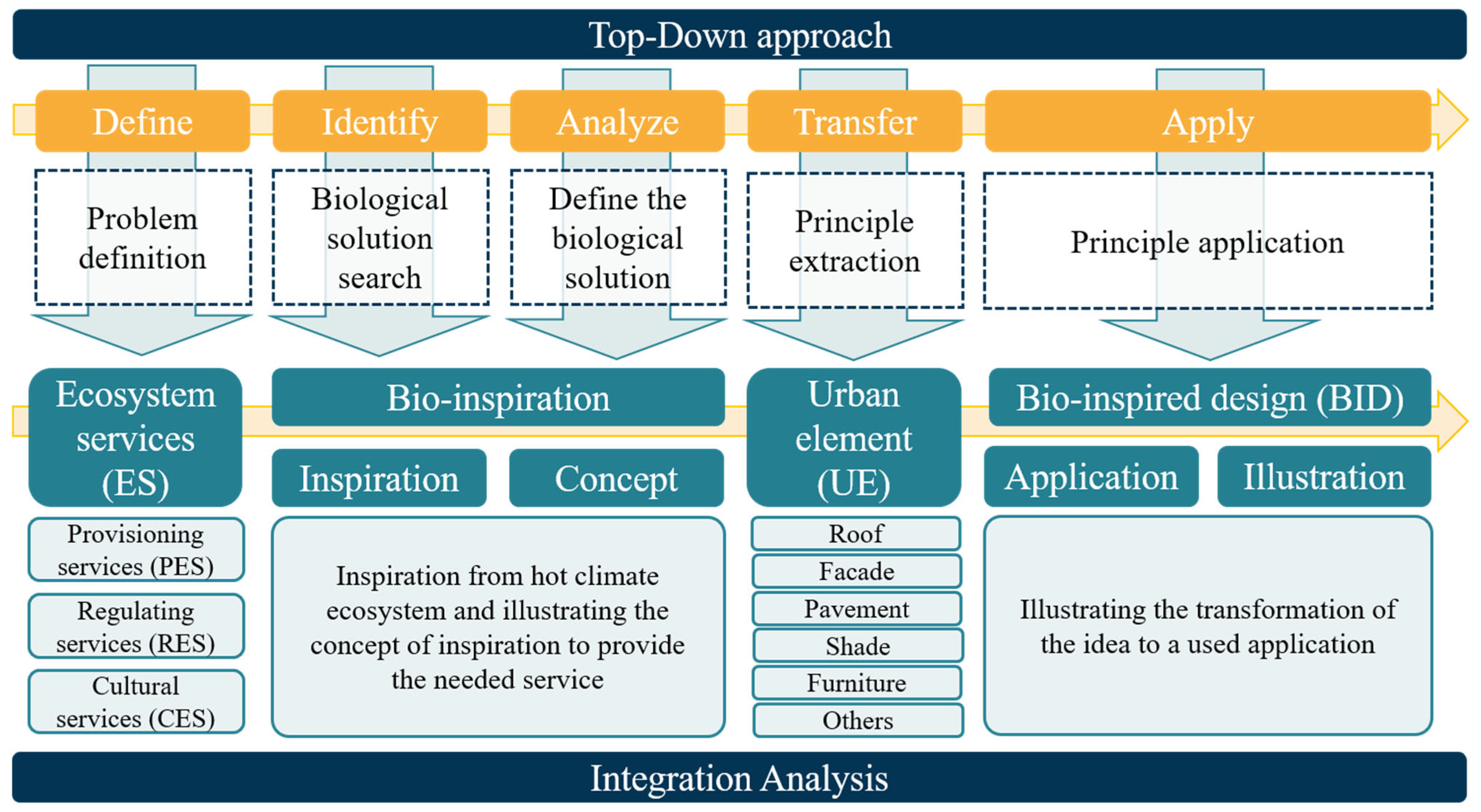
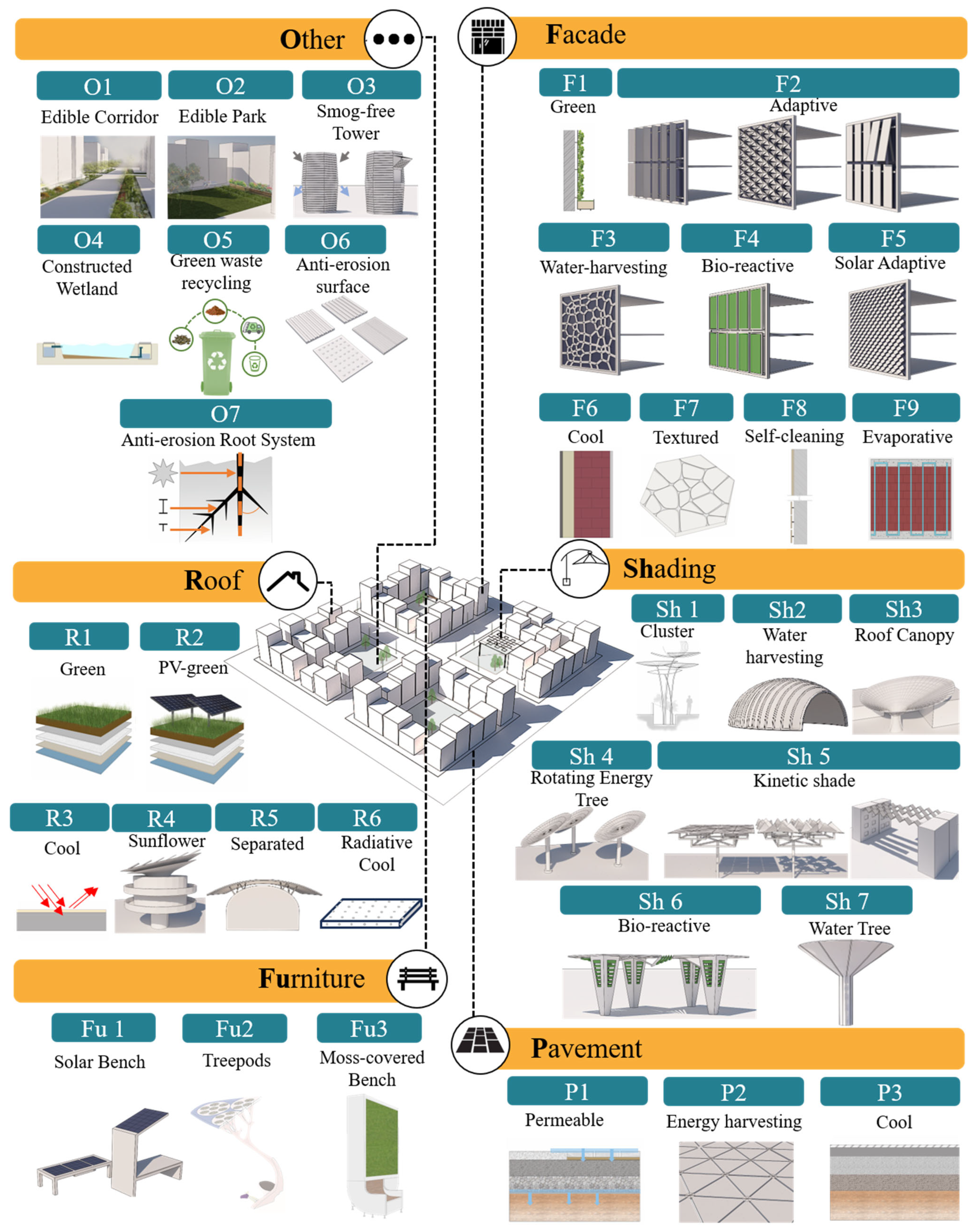
2.2. Bio-Inspired Design (BID)
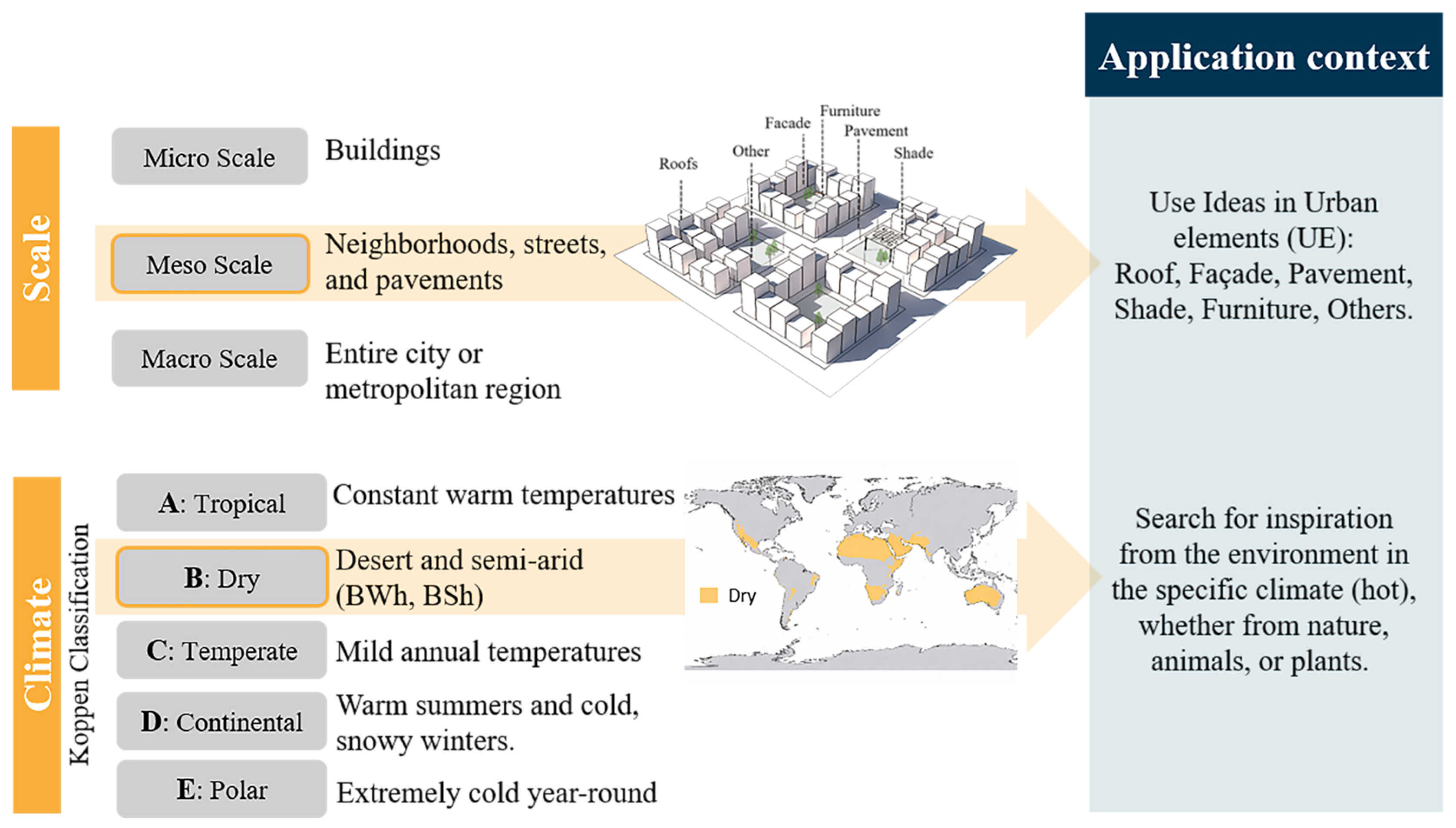
2.3. Application Context
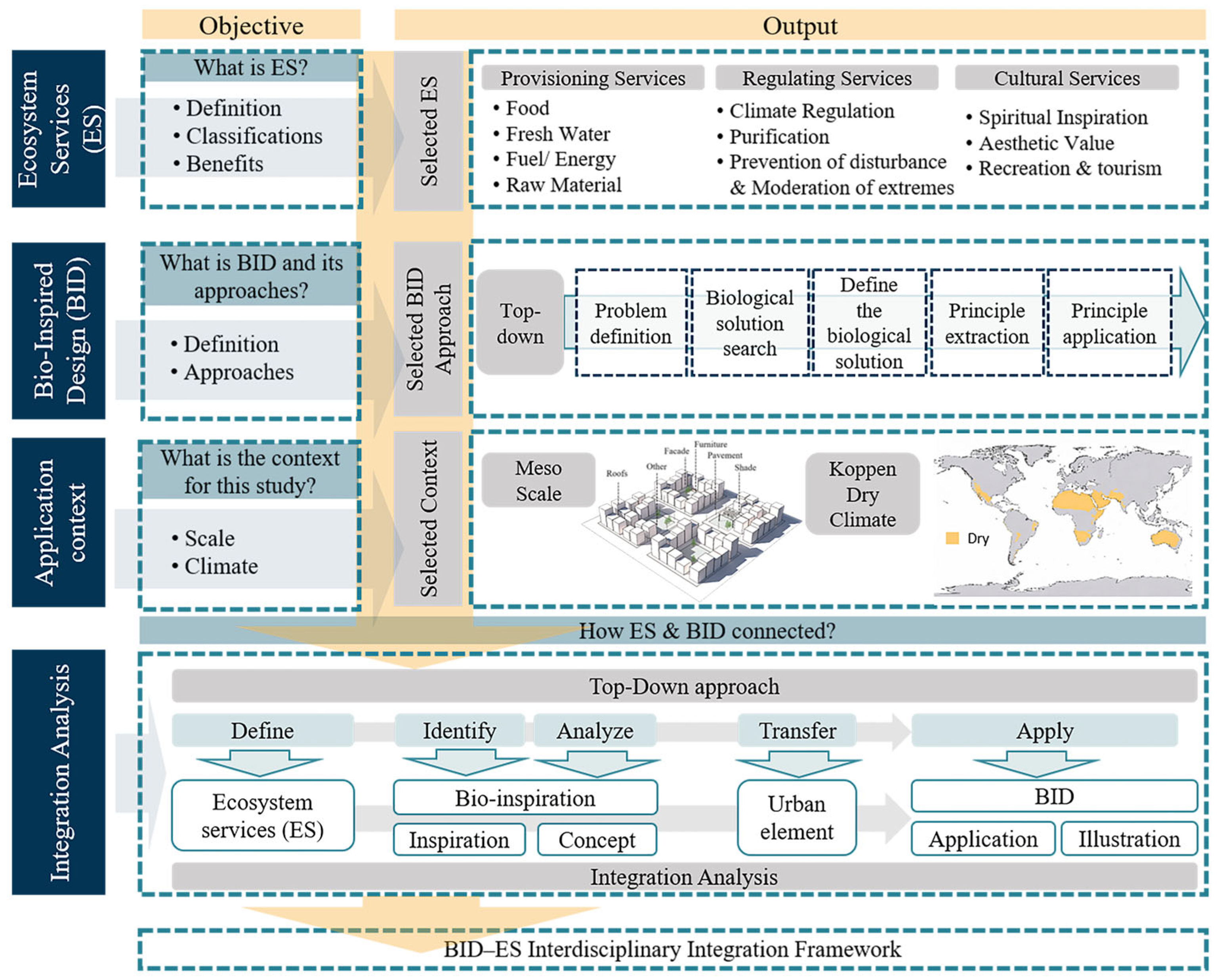
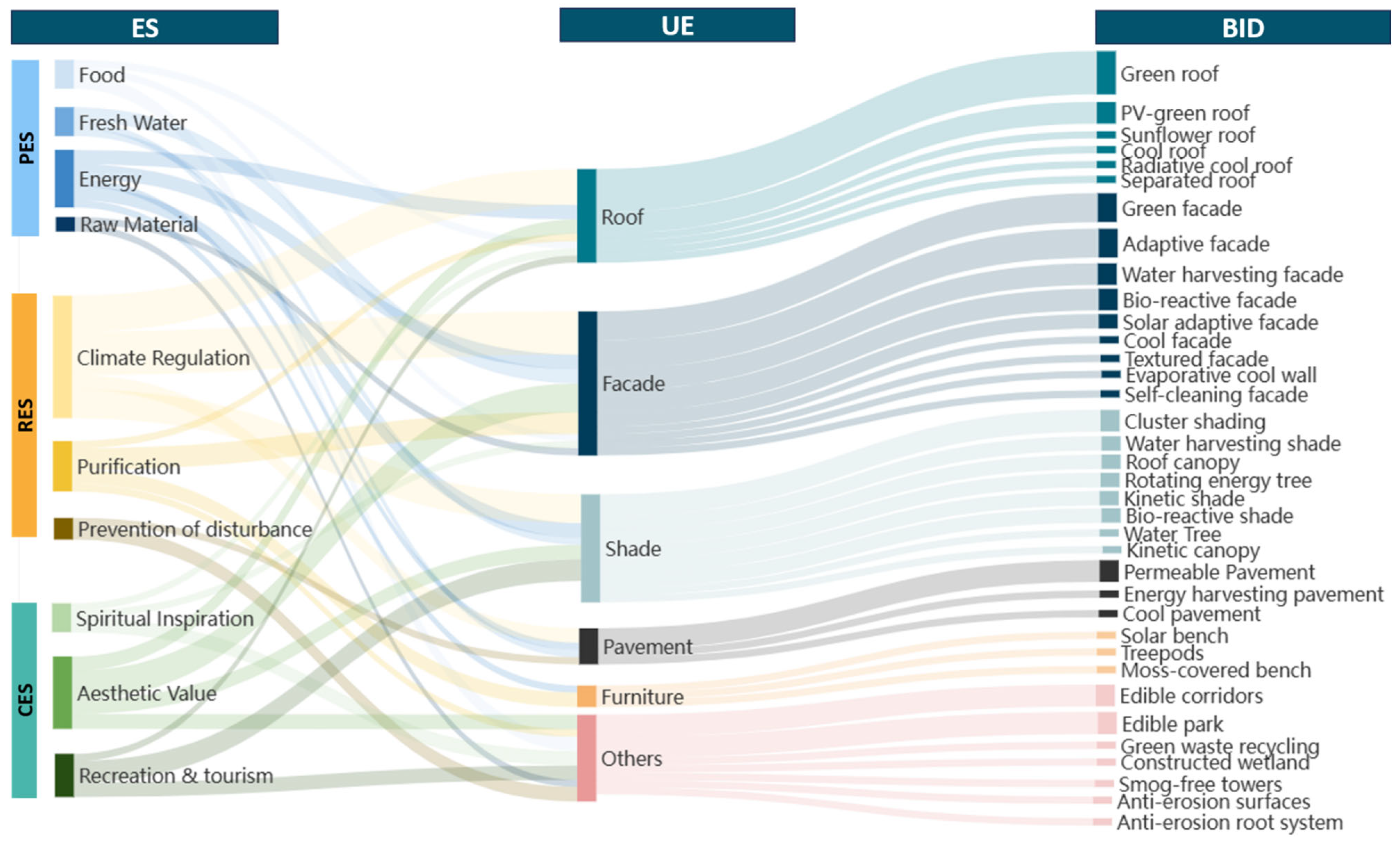
2.4. Integration Analysis of BID to Provide ES
- Climatic Relevance: To ensure environmental applicability, it must come from desert or semi-arid regions (BWh/BSh Köppen classifications).
- Contribution to Ecosystem Services: One or more essential ecosystem services, such as providing, regulating, or cultural, must be properly provided.
- Bio-inspiration Specificity: Every case must express a particular principle from the same chosen climate in a clear and concise manner.
- Implementation Scale: It must be implemented at the meso scale or show that scaling to this level is clearly possible.
2.4.1. Provisioning Ecosystem Services (PES)
2.4.2. Regulating Ecosystem Services (RES)
2.4.3. Cultural Ecosystem Services (CES)
3. Results and Discussion
3.1. Interpretation of Key Findings
3.2. Scientific Rationale and Supporting Literature
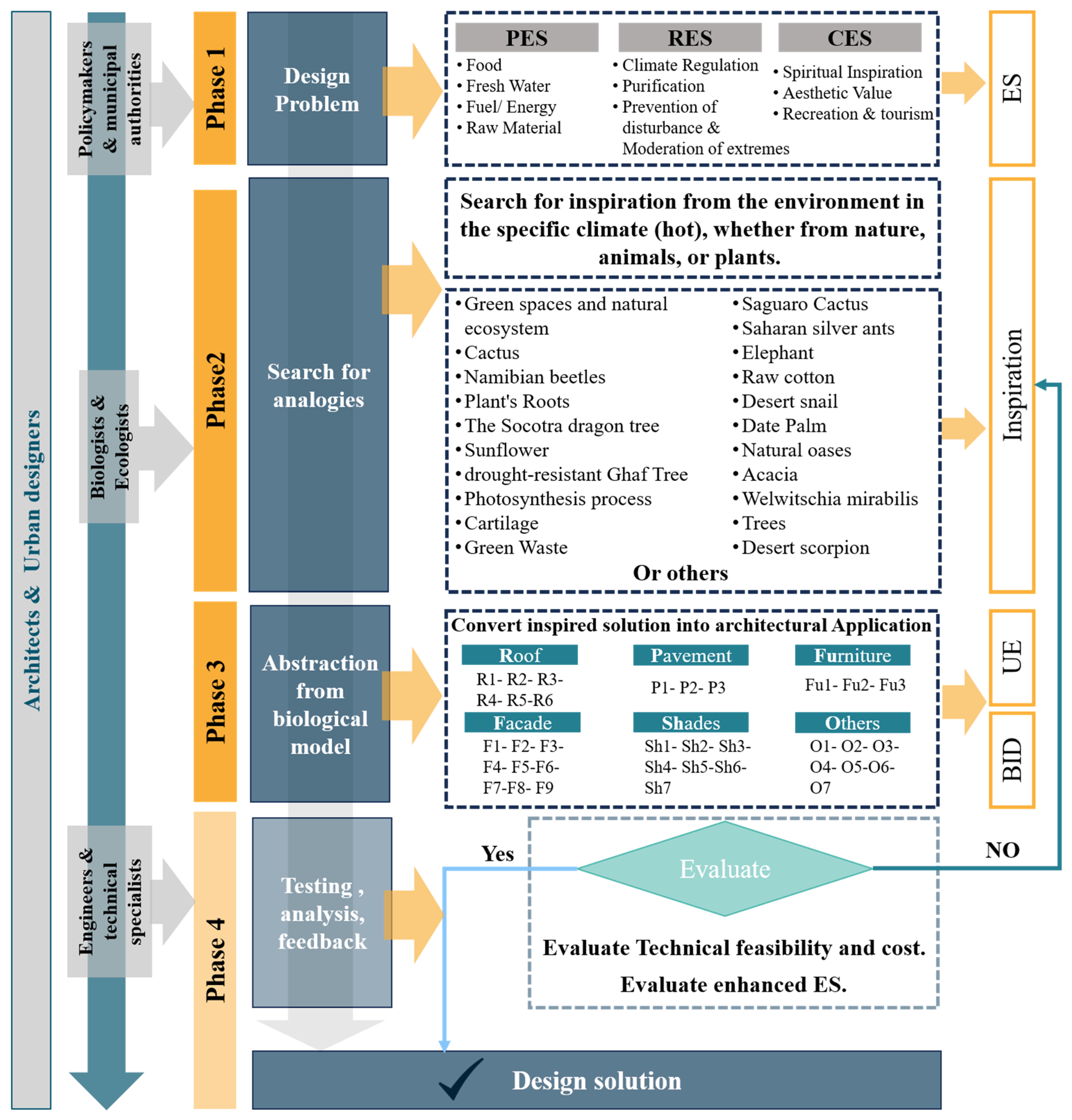
3.3. Framework Application Across Decision-Making Phases
3.4. Study Limitations and Future Research Directions
4. Conclusions
- Climate regulation is the most prevalent ecosystem service, complemented by energy and air purification.
- Some services, like food and raw materials, are less common due to the need for extensive areas to achieve high productivity.
- Cultural services are heavily reliant on the previously mentioned strategies and other associated services.
Author Contributions
Funding
Institutional Review Board Statement
Informed Consent Statement
Data Availability Statement
Conflicts of Interest
Abbreviations
| ES | Ecosystem services |
| BID | Bio-inspired design |
| UHI | Urban heat island |
| NbS | Nature-based solutions |
| MEA | Millennium ecosystem assessment |
| BE | Built environment |
| UE | Urban element |
| PES | Provisioning ecosystem services |
| RES | Regulating ecosystem services |
| CES | Cultural ecosystem services |
References
- Das, B.; Khan, F.; Mohammad, P. Impact of Urban Sprawl on Change of Environment and Consequences. Environ. Sci. Pollut. Res. 2023, 30, 106894–106897. [Google Scholar] [CrossRef]
- Hassan, A.M.; Kotb, M.A. SGI Applications towards Sustainable and Resilient Smart Cities. J. Umm Al-Qura Univ. Eng. Archit. 2025. [Google Scholar] [CrossRef]
- Elzeni, M.M.; ELMokadem, A.A.; Badawy, N.M. Impact of Urban Morphology on Pedestrians: A Review of Urban Approaches. Cities 2022, 129, 103840. [Google Scholar] [CrossRef]
- Megahed, N.A.; Ali, R.A.; Shahda, M.M.; Hassan, A.M. Integrating Skycourts into Multi-Story Buildings for Enhancing Environmental Performance: A Case Study of a Residential Building in a Hot-Humid Climate. Sustainability 2025, 17, 11061. [Google Scholar] [CrossRef]
- Li, X.; Suoerdahan, G.; Shi, Z.; Xing, Z.; Ren, Y.; Yang, R. Spatial–Temporal Impacts of Urban Sprawl on Ecosystem Services: Implications for Urban Planning in the Process of Rapid Urbanization. Land 2021, 10, 1210. [Google Scholar] [CrossRef]
- Tan, P.Y.; Zhang, J.; Masoudi, M.; Alemu, J.B.; Edwards, P.J.; Grêt-Regamey, A.; Richards, D.R.; Saunders, J.; Song, X.P.; Wong, L.W. A Conceptual Framework to Untangle the Concept of Urban Ecosystem Services. Landsc. Urban Plan. 2020, 200, 103837. [Google Scholar] [CrossRef] [PubMed]
- Li, J.; Wang, J.; Zhou, W. Different Impacts of Urbanization on Ecosystem Services Supply and Demand across Old, New and Non-Urban Areas in the ChangZhuTan Urban Agglomeration, China. Landsc. Ecol. 2024, 39, 107. [Google Scholar] [CrossRef]
- Ersoy Tonyaloğlu, E. Future Land Use/Land Cover and Its Impacts on Ecosystem Services: Case of Aydın, Turkey. Int. J. Environ. Sci. Technol. 2025, 22, 4601–4617. [Google Scholar] [CrossRef]
- World Health Organization Heat and Health. Available online: https://www.who.int/news-room/fact-sheets/detail/climate-change-heat-and-health (accessed on 31 December 2025).
- Balvanera, P.; Quijas, S.; Karp, D.S.; Ash, N.; Bennett, E.M.; Boumans, R.; Brown, C.; Chan, K.M.A.; Chaplin-Kramer, R.; Halpern, B.S.; et al. Ecosystem Services BT. In The GEO Handbook on Biodiversity Observation Networks; Walters, M., Scholes, R.J., Eds.; Springer International Publishing: Cham, Switzerland, 2017; pp. 39–78. ISBN 978-3-319-27288-7. [Google Scholar]
- Pedersen Zari, M. Ecosystem Services Analysis: Mimicking Ecosystem Services for Regenerative Urban Design. Int. J. Sustain. Built Environ. 2015, 4, 145–157. [Google Scholar] [CrossRef]
- Westman, W.E. How Much Are Nature’s Services Worth? Science 1977, 197, 960–964. [Google Scholar] [CrossRef]
- Costanza, R.; d’Arge, R.; de Groot, R.; Farber, S.; Grasso, M.; Hannon, B.; Limburg, K.; Naeem, S.; O’Neill, R.V.; Paruelo, J.; et al. The Value of the World’s Ecosystem Services and Natural Capital. Nature 1997, 387, 253–260. [Google Scholar] [CrossRef]
- Grêt-Regamey, A.; Sirén, E.; Brunner, S.H.; Weibel, B. Review of Decision Support Tools to Operationalize the Ecosystem Services Concept. Ecosyst. Serv. 2017, 26, 306–315. [Google Scholar] [CrossRef]
- Ismail, R.M.; Naglaa, A.M.; Merhan, M.S.; Eltarabily, S. Bio-Inspired Design: Leveraging Nature for Enhanced Ecosystem Services. Archit. Eng. Des. Manag. 2025, 1–32. [Google Scholar] [CrossRef]
- Shackleton, C.M. Ecosystem Provisioning Services in Global South Cities. In Cities and Nature; Springer: Cham, Switzerland, 2021. [Google Scholar]
- Mengist, W.; Soromessa, T.; Feyisa, G.L. A Global View of Regulatory Ecosystem Services: Existed Knowledge, Trends, and Research Gaps. Ecol. Process. 2020, 9, 40. [Google Scholar] [CrossRef]
- Baskent, E.Z. A Framework for Characterizing and Regulating Ecosystem Services in a Management Planning Context. Forests 2020, 11, 102. [Google Scholar] [CrossRef]
- Bürgi, M.; Silbernagel, J.; Wu, J.; Kienast, F. Linking Ecosystem Services with Landscape History. Landsc. Ecol. 2015, 30, 11–20. [Google Scholar] [CrossRef]
- Landers, D.H.; Nahlik, A.M. Final Ecosystem Goods and Services Classification System (FEGS-CS); Report No. EPA/600/R-13/ORD-004914; U.S. Environmental Protection Agency: Washington, DC, USA, 2013.
- Costanza, R.; de Groot, R.; Braat, L.; Kubiszewski, I.; Fioramonti, L.; Sutton, P.; Farber, S.; Grasso, M. Twenty Years of Ecosystem Services: How Far Have We Come and How Far Do We Still Need to Go? Ecosyst. Serv. 2017, 28, 1–16. [Google Scholar] [CrossRef]
- Stenseke, M.; Larigauderie, A. The Role, Importance and Challenges of Social Sciences and Humanities in the Work of the Intergovernmental Science-Policy Platform on Biodiversity and Ecosystem Services (IPBES). Innov. Eur. J. Soc. Sci. Res. 2018, 31, S10–S14. [Google Scholar] [CrossRef]
- Haines-Young, R.; Potschin, M.; Fish, R. Classifying Ecosystem Services: An Ecosystems Knowledge Network Briefing Paper. 2012. Available online: https://ecosystemsknowledge.net/sites/default/files/wp-content/uploads/2012/10/EKN_Classification_briefing1_R1.pdf (accessed on 15 November 2025).
- Gómez-Baggethun, E.; Barton, D.N. Classifying and Valuing Ecosystem Services for Urban Planning. Ecol. Econ. 2013, 86, 235–245. [Google Scholar] [CrossRef]
- Escobedo, F.J.; Nowak, D.J. Spatial Heterogeneity and Air Pollution Removal by an Urban Forest. Landsc. Urban Plan. 2009, 90, 102–110. [Google Scholar] [CrossRef]
- Berte, E.; Panagopoulos, T. Enhancing City Resilience to Climate Change by Means of Ecosystem Services Improvement: A SWOT Analysis for the City of Faro, Portugal. Int. J. Urban Sustain. Dev. 2014, 6, 241–253. [Google Scholar] [CrossRef]
- Martinez-Juarez, P.; Chiabai, A.; Taylor, T.; Quiroga Gómez, S. The Impact of Ecosystems on Human Health and Well-Being: A Critical Review. J. Outdoor Recreat. Tour. 2015, 10, 63–69. [Google Scholar] [CrossRef]
- Elmqvist, T.; Goodness, J.; Marcotullio, P.J.; Parnell, S.; Sendstad, M.; Wilkinson, C.; Fragkias, M.; Güneralp, B.; McDonald, R.I.; Schewenius, M.; et al. Urbanization, Biodiversity and Ecosystem Services: Challenges and Opportunities: A Global Assessment; Springer: Cham, Switzerland, 2013. [Google Scholar]
- Roth-Nebelsick, A. How Much Biology Is in the Product? Role and Relevance of Biological Evolution and Function for Bio-Inspired Design. Theory Biosci. 2022, 141, 233–247. [Google Scholar] [CrossRef] [PubMed]
- La Notte, A.; Zulian, G. An Ecosystem Services-Based Approach to Frame NBS in Urban Context. In Nature-Based Solutions for More Sustainable Cities—A Framework Approach for Planning and Evaluation; Emerald Publishing Limited: Leeds, UK, 2021. [Google Scholar]
- Imani, N.; Vale, B. Developing a Method to Connect Thermal Physiology in Animals and Plants to the Design of Energy Efficient Buildings. Biomimetics 2022, 7, 67. [Google Scholar] [CrossRef]
- Aboulnaga, M.; Helmy, S.E. Biomimetic Architecture and Its Role in Developing Sustainable, Regenerative, and Livable Cities, 1st ed.; Global Perspectives and Approaches in the Age of COVID-19; Springer: Cham, Switzerland, 2022. [Google Scholar]
- Aboulnaga, M.; Helmy, S.E. Biomimicry Influences Architecture and Design: Thinking, Approaches, Levels, Application Types, and Inspiration. In Biomimetic Architecture and Its Role in Developing Sustainable, Regenerative, and Livable Cities; Springer: Cham, Switzerland, 2022. [Google Scholar]
- Al-Obaidi, K.M.; Azzam Ismail, M.; Hussein, H.; Abdul Rahman, A.M. Biomimetic Building Skins: An Adaptive Approach. Renew. Sustain. Energy Rev. 2017, 79, 1472–1491. [Google Scholar] [CrossRef]
- Yang, H.; Gou, X.; Xue, B.; Xu, J.; Ma, W. How to Effectively Improve the Ecosystem Provisioning Services in Traditional Agricultural and Pastoral Areas in China? Ecol. Indic. 2023, 150, 110244. [Google Scholar] [CrossRef]
- Cascone, S. Green Roof Design: State of the Art on Technology and Materials. Sustainability 2019, 11, 3020. [Google Scholar] [CrossRef]
- Gamal, A.; Eleinen, O.A.; Eltarabily, S.; Elgheznawy, D. Enhancing Urban Resilience in Hot Humid Climates: A Conceptual Framework for Exploring the Environmental Performance of Vertical Greening Systems (VGS). Front. Archit. Res. 2023, 12, 1260–1284. [Google Scholar] [CrossRef]
- Shahda, M. Vertical Farming: A Catalyst for Integrating Biophilic Design into the Built Environment. J. Sustain. Archit. Civ. Eng. 2025, 37, 140–157. [Google Scholar] [CrossRef]
- Zahra, N.; Rahimi, A.; Breuste, J. Edible Parks Are an Innovative Strategy for Enhancing Environmental Comfort and Promoting Sustainable Urban Development. J. Geogr. Plan. 2025, 28, 440–465. [Google Scholar] [CrossRef]
- Farrier, A.; Dooris, M.; Morley, A. Catalysing Change? A Critical Exploration of the Impacts of a Community Food Initiative on People, Place and Prosperity. Landsc. Urban Plan. 2019, 192, 103663. [Google Scholar] [CrossRef]
- Cenk, Z.K.; Mutlu Avinç, G.; Arslan Selçuk, S. Application of Biomimetic Strategies In Building Envelope Design for Water Harvesting. Gazi Univ. J. Sci. 2024, 37, 1575–1594. [Google Scholar] [CrossRef]
- Jiang, L.; Guo, C.; Fu, M.; Gong, X.; Ramakrishna, S. Water Harvesting on Biomimetic Material Inspired by Bettles. Heliyon 2023, 9, e12355. [Google Scholar] [CrossRef]
- Aslan, D.; Selçuk, S.A.; Mutlu Avinç, G. A Biomimetic Approach to Water Harvesting Strategies: An Architectural Point of View. Int. J. Built Environ. Sustain. 2022, 9, 47–60. [Google Scholar] [CrossRef]
- Wang, C.; Wang, Z.H.; Kaloush, K.E.; Shacat, J. Cool Pavements for Urban Heat Island Mitigation: A Synthetic Review. Renew. Sustain. Energy Rev. 2021, 146, 111171. [Google Scholar] [CrossRef]
- Grimshaw Terra―The Sustainability Pavilion Expo 2020 Dubai: Case Study. Available online: https://grimshaw.global/sustainability/expo-2020-sustainability-pavilion-case-study/ (accessed on 21 April 2025).
- Designboom Sunflower House Is a Carbon Positive Concept Designed by Koichi Takada. Available online: https://www.designboom.com/architecture/sunflower-house-carbon-positive-concept-koichi-takada-architects-01-07-2021/ (accessed on 10 April 2025).
- UrbiAtlas Seeking Shadow A Cool Fix for Hot Cities. Available online: https://atlas.urbi.ae/seeking-shadow/ (accessed on 21 April 2025).
- Talaei, M.; Mahdavinejad, M.; Azari, R. Thermal and Energy Performance of Algae Bioreactive Façades: A Review. J. Build. Eng. 2020, 28, 101011. [Google Scholar] [CrossRef]
- Nagy, Z.; Svetozarevic, B.; Jayathissa, P.; Begle, M.; Hofer, J.; Lydon, G.; Willmann, A.; Schlueter, A. The Adaptive Solar Facade: From Concept to Prototypes. Front. Archit. Res. 2016, 5, 143–156. [Google Scholar] [CrossRef]
- Cavadini, G.B.; Cook, L.M. Green and Cool Roof Choices Integrated into Rooftop Solar Energy Modelling. Appl. Energy 2021, 296, 117082. [Google Scholar] [CrossRef]
- Andonegi, M.; Diez, A.G.; Costa, C.M.; Romanyuk, K.N.; Kholkin, A.L.; de la Caba, K.; Guerrero, P.; Lanceros-Mendez, S. Piezoelectric Properties of Collagen Films: Insights into Their Potential for Electroactive Biomedical Applications. Int. J. Biol. Macromol. 2025, 309, 142799. [Google Scholar] [CrossRef]
- PAVEGEN Steps into Energy, Energy into Engagement. Available online: https://www.pavegen.com/ (accessed on 2 May 2025).
- Kango, R.; Hadiyanto; Pongtularan, E.H. Design and Implementation of a Solar Integration in Electric Smart Bench. IOP Conf. Ser. Mater. Sci. Eng. 2021, 1088, 012058. [Google Scholar] [CrossRef]
- Liu, X.; Xie, Y.; Sheng, H. Green Waste Characteristics and Sustainable Recycling Options. Resour. Environ. Sustain. 2023, 11, 100098. [Google Scholar] [CrossRef]
- Khorasani, M.L.; Burry, J.; Salehi, M. Thermal Performance of Patterned Facades- Studies on Effects of Patterns on the Thermal Performance of Facades. In Proceedings of the 32nd eCAADe Conference, England, UK, 10–12 September 2014; Volume 1. [Google Scholar] [CrossRef]
- The Construction Specifier Arizona’s Native Cactus Inspires Sustainable Office Design. Available online: https://www.constructionspecifier.com/arizonas-native-cactus-inspires-sustainable-office-design/ (accessed on 1 April 2025).
- Ashraf, N.; Abdin, A.R. Biomimetic Design Synthesis and Digital Optimization of Building Shading Skin: A Novel Conceptual Framework for Enhanced Energy Efficiency. Energy Build. 2024, 323, 114824. [Google Scholar] [CrossRef]
- Fu, S.C.; Zhong, X.L.; Zhang, Y.; Lai, T.W.; Chan, K.C.; Lee, K.Y.; Chao, C.Y.H. Bio-Inspired Cooling Technologies and the Applications in Buildings. Energy Build. 2020, 225, 110313. [Google Scholar] [CrossRef]
- Shi, N.N.; Tsai, C.C.; Camino, F.; Bernard, G.D.; Yu, N.; Wehner, R. Keeping Cool: Enhanced Optical Reflection and Radiative Heat Dissipation in Saharan Silver Ants. Science 2015, 349, 298–301. [Google Scholar] [CrossRef]
- Zhang, L.; Fukuda, H.; Liu, Z. The Value of Cool Roof as a Strategy to Mitigate Urban Heat Island Effect: A Contingent Valuation Approach. J. Clean. Prod. 2019, 228, 770–777. [Google Scholar] [CrossRef]
- Verma, R.; Rakshit, D. Comparison of Reflective Coating with Other Passive Strategies: A Climate Based Design and Optimization Study of Building Envelope. Energy Build. 2023, 287, 112973. [Google Scholar] [CrossRef]
- Anupam, B.R.; Sahoo, U.C.; Chandrappa, A.K.; Rath, P. Emerging Technologies in Cool Pavements: A Review. Constr. Build. Mater. 2021, 299, 123892. [Google Scholar] [CrossRef]
- Soh, E.; Loh, N.; Teoh, J.H.; Jain, A.; Le Ferrand, H. Biodegradable Mycelium Tiles with Elephant Skin Inspired Texture for Thermal Regulation of Buildings. Energy Build. 2025, 328, 115187. [Google Scholar] [CrossRef]
- Mattila, P.; Eisenbart, B.; Kocsis, A.; Ranscombe, C.; Tuulos, T. Research into Design for a Connected World. In Smart Innovation, Systems and Technologies; Springer: Singapore, 2019; Volume 135. [Google Scholar]
- Yang, Z.; Sun, H.; Xi, Y.; Qi, Y.; Mao, Z.; Wang, P.; Zhang, J. Bio-Inspired Structure Using Random, Three-Dimensional Pores in the Polymeric Matrix for Daytime Radiative Cooling. Sol. Energy Mater. Sol. Cells 2021, 227, 111101. [Google Scholar] [CrossRef]
- Hamdy, E.A. Achieving Thermal Comfort by Simulating the Ecosystems of the Desert Environment BT. In Advances in Architecture, Engineering and Technology; Rosso, F., Fabiani, C., Altan, H., Amer, M., Eds.; Springer International Publishing: Cham, Switzerland, 2022; pp. 227–242. [Google Scholar]
- Archello Leafy: Kinetic Leaves That Help Shape Actual Parks. Available online: https://archello.com/de/project/leafy (accessed on 23 March 2025).
- Gorgoglione, A.; Torretta, V. Sustainable Management and Successful Application of Constructed Wetlands: A Critical Review. Sustainability 2018, 10, 3910. [Google Scholar] [CrossRef]
- Mander, Ü.; Tournebize, J.; Kasak, K.; Mitsch, W.J. Climate Regulation by Free Water Surface Constructed Wetlands for Wastewater Treatment and Created Riverine Wetlands. Ecol. Eng. 2014, 72, 103–115. [Google Scholar] [CrossRef]
- Reader, T.W.; Flin, R.; Mearns, K.; Cuthbertson, B.H. Proposal for a Responsive Canopy Integrating Curved Line Folding Technique and Cable-Driven Systems. In Proceedings of the IASS 2024 Symposium, Redefining the Art of Structural Design, Zurich, Switzerland, 26–30 August 2024. [Google Scholar]
- Inhabitat Futuristic Urban Algae Folly Grows Food, Fuel and Shade. Available online: https://inhabitat.com/futuristic-urban-algae-folly-grows-food-fuel-and-shade/ (accessed on 2 May 2025).
- Barthlott, W.; Mail, M.; Neinhuis, C. Superhydrophobic Hierarchically Structured Surfaces in Biology: Evolution, Structural Principles and Biomimetic Applications. Philos. Trans. R. Soc. A Math. Phys. Eng. Sci. 2016, 374, 20160191. [Google Scholar] [CrossRef]
- Januszkiewicz, K.; Kowalski, K.G. Air Purification in Highly-Urbanized Areas with the Use of TiO2. New Approach in Designing Urban Public Space with Beneficial Human Condition. IOP Conf. Ser. Mater. Sci. Eng. 2019, 603, 032100. [Google Scholar] [CrossRef]
- Jordana, S. Boston’s Treepods/Influx_Studio. Available online: https://www.archdaily.com/118154/bostons-treepods-influx_studio (accessed on 13 May 2024).
- Hitti, N. Moss-Covered CityTree Bench Designed to Combat Urban Pollution. Available online: https://www.dezeen.com/2018/03/21/moss-covered-citytree-bench-combats-urban-pollution-london-uk (accessed on 20 May 2024).
- Han, Z.W.; Yang, M.K.; Yin, W.; Zhang, J.Q. Biomimetic Design and Manufacturing of Anti-Erosion Functional Surfaces Inspired from Desert Scorpion. Adv. Sci. Technol. 2017, 100, 187–196. [Google Scholar] [CrossRef]
- Stachew, E.; Houette, T.; Gruber, P. Root Systems Research for Bioinspired Resilient Design: A Concept Framework for Foundation and Coastal Engineering. Front. Robot. AI 2021, 8, 548444. [Google Scholar] [CrossRef]
- Morakinyo, T.E.; Kalani, K.W.D.; Dahanayake, C.; Ng, E.; Chow, C.L. Temperature and Cooling Demand Reduction by Green-Roof Types in Different Climates and Urban Densities: A Co-Simulation Parametric Study. Energy Build. 2017, 145, 226–237. [Google Scholar] [CrossRef]
- Luo, H.; Liu, X.; Anderson, B.C.; Zhang, K.; Li, X.; Huang, B.; Li, M.; Mo, Y.; Fan, L.; Shen, Q.; et al. Carbon Sequestration Potential of Green Roofs Using Mixed-Sewage-Sludge Substrate in Chengdu World Modern Garden City. Ecol. Indic. 2015, 49, 247–259. [Google Scholar] [CrossRef]
- Andric, I.; Kamal, A.; Al-Ghamdi, S.G. Efficiency of Green Roofs and Green Walls as Climate Change Mitigation Measures in Extremely Hot and Dry Climate: Case Study of Qatar. Energy Rep. 2020, 6, 2476–2489. [Google Scholar] [CrossRef]
- Helmi, N.; Faggal, A.; Nessim, A. Enhancing energy consumption in egypt within adaptive facade techniques. J. Al-Azhar Univ. Eng. Sect. 2024, 19, 130–142. [Google Scholar] [CrossRef]
- Austin, M.C.; Araque, K.; Palacios, P.; Maure, K.R.; Mora, D. Numerical Assessment of Zebra-Stripes-Based Strategies in Buildings Energy Performance: A Case Study under Tropical Climate. Biomimetics 2022, 7, 14. [Google Scholar] [CrossRef]
- Almadhhachi, M.; Seres, I.; Farkas, I. Sunflower Solar Tree vs. Flat PV Module: A Comprehensive Analysis of Performance, Efficiency, and Land Savings in Urban Solar Integration. Results Eng. 2024, 21, 101742. [Google Scholar] [CrossRef]



| ES | Bio-Inspiration | Urban Element | Bio-Inspired Design (BID) | Ref. | |||||||
|---|---|---|---|---|---|---|---|---|---|---|---|
| Inspiration | Concept | Roof | Facade | Pavement | Shade | Furniture | Other | Application | Illustration | ||
| Food | Green spaces and natural ecosystem | Provide spaces for vegetation | ● | Green roof Provide various advantages, including food production. |  | [36] | |||||
| Provide spaces for vegetation | ● | Green Façades/vertical farming Provide foods, mitigating high temperatures and air pollution. |  | [37,38] | |||||||
| Provide spaces for vegetation | ● | Edible Green Corridors Provide food production |  | [39,40] | |||||||
| ● | Mixed-Use Green Zones (Edible Parks) Provide community gathering and food production by creating green spaces. |  | |||||||||
| Fresh Water | Cactus | Cactus spines’ conical shape facilitates water absorption from the atmosphere, with water droplets initially gathered at the spine tips eventually migrating towards the spine. | ● | Water Harvesting Facade Gains water by façade panels inspired by the hydrophilic spines of cactus and transports it by Voronoi-patterned gutters. |  | [41] | |||||
| Namibian beetles | Namibian desert beetles’ striated bumps and hydrophilic and hydrophobic areas on their backs allow them to quickly collect water in humid air. | ● | Water Harvesting Shade Increases the adhesion of small droplets in the air by the hydrophilic hydrogel surface, and the water film generated on the surface accelerates the droplet transit rate, thus improving water collection. |  | [42] | ||||||
| ● | Water Harvesting Facade Condense water particles in humid air by specifically designed façade feature panels, facilitating their collection |  | [43] | ||||||||
| Plant’s Roots | Water infiltration is effectively managed by the roots of desert plants. | ● | Permeable pavements Enable water to infiltrate the underlying layers, reducing temperatures mainly through evaporative cooling and significantly enhancing urban stormwater management. |  | [44] | ||||||
| The Socotra dragon tree | The Socotra dragon tree, native to the Arabian Sea, inspires Energy Trees and Water Trees due to its dense shade and adaptation to arid conditions. | ● | Water Trees Utilize a passive dew-collecting technique, generating water droplets from the cooler inner cone surface, irrigating the performative landscape below and providing thermal comfort for visitors. |  | [45] | ||||||
| Fuel/Energy | Sunflower | Sunflower and the way it turns to face the sun | ● | The sunflower Roof Spins around a central stem and generates up to 40% more energy than static panels. Battery seeds store unused energy, rainfall collects for watering, and a secondary spinning mechanism protects the structure from sun radiation. |  | [46] | |||||
| drought-resistant Ghaf Tree | A drought-tolerant tree, which can remain green even in harsh desert environments, essential for the survival of animal and plant species alike | ● | Roof Canopy Features a wide canopy equipped with solar panels that provide heat protection and facilitate rainwater collection. |  | [45] | ||||||
| The Socotra dragon tree | Its dense shade and adaptation to arid conditions. | ● | Rotating Energy Trees Generate electricity while offering much-needed shade for visitors. |  | [47] | ||||||
| Photosynthesis process | Photosynthesis process: absorbing CO2 and sunlight to produce energy | ● | Bio-reactive façade Provide benefits such as CO2 sequestration, oxygen production, solar radiation conversion, dynamic shading, acoustic isolation, and a dynamic exterior look via color and air bubble variations |  | [48] | ||||||
| Plants | Plants’ Solar Responsive Aspects | ● | Solar Adaptive Facades Adapt by a modular, highly integrated dynamic building facade. Its energetic behavior and architectural expression may be regulated with high spatio-temporal resolution using individually addressable modules. |  | [49] | ||||||
| Green spaces and photosynthesis process | Mimicking the structure and function of natural ecosystems and the process of photosynthesis where plants use sunlight to produce chemical energy | ● | PV-Green roof Reduces surface temperature through evapotranspiration which can increase the yield of rooftop photovoltaic panels, which have a temperature-dependent conversion efficiency. |  | [50] | ||||||
| Cartilage | The electrical charges that the cartilage naturally produces as a joint move. | ● | Energy Harvesting pavements Depend on the tiles’ soft downward movement of 10 mm with each step. This vertical motion is translated to rotary motion inside the generators, and electromagnetic induction is then used to turn it into electrical potential energy. |  | [51,52] | ||||||
| Photosynthesis process | Converting sunlight to energy | ● | Solar Bench Works as a source of electricity for LED lighting systems and mobile phone charging stations that uses photovoltaics to save electricity |  | [53] | ||||||
| Raw Material | Photosynthesis process | Photosynthesis process: absorbing CO2 and sunlight to produce energy | ● | Bio-reactive façade Provide benefits such as CO2 sequestration, oxygen production, solar radiation conversion, dynamic shading, acoustic isolation. The algae biomass it cultivates is a tangible, harvestable resource. |  | [48] | |||||
| decomposition and nutrient cycling | Creating circular material systems that follow nature’s “waste-to-resource” model. | ● | Green Waste Recycling Uses advanced techniques like composting, wood-plastic composites, and mushroom cultivation to divert GW from landfills. Energy recovery applications include incineration, pyrolysis, gasification, anaerobic digestion, and ethanol fermentation. |  | [54] | ||||||
| ES | Bio-Inspiration | Urban Element | Bio-Inspired Design (BID) | Ref. | |||||||
|---|---|---|---|---|---|---|---|---|---|---|---|
| Inspiration | Concept | Roof | Facade | Pavement | Shade | Furniture | Other | Application | Illustration | ||
| Climate Regulation | Cactus | The ribs and spines of cacti improve thermal performance by shielding the outer surface from sun irrigation. | ● | Adaptive façade Allows sufficient air circulation and heat dispersion through ribbed metal panels mounted off the building and resembles the fins of the cactus. |  | [55,56] | |||||
| Saguaro Cactus | Its ribbed shell allows for dynamic expansion and contraction, adding structural stability and flexibility that are essential for water storage. The spines of the cactus have the practical function of shading, which reduces exposure to direct sunlight. | ● | Adaptive façade Increase the level of environmental responsiveness in building design by introducing elements such as movable fins or louvers that emulate the shading processes identified in the cactus. |  | [57] | ||||||
| Saharan silver ants | Ants’ silvery appearance is due to triangular hairs, which increase reflectivity in the visible and near-infrared wavelengths and emissivity in the mid-infrared. | ● | Cool Roof Replaces traditional roofs with high-albedo materials to lessen the absorption of solar radiation has become an essential way to mitigate the UHI effect. |  | [58,59,60] | ||||||
| ● | Cool façade (Reflective façade) Enhance surface cooling by using cool-colored facades with high solar reflectance and thermal emissivity, reducing absorbed solar radiation and reducing heat released to built and urban environments. |  | [61] | ||||||||
| ● | Cool pavements (Reflective Pavement) Absorb less heat energy while remaining cooler due to their light color. They are recommended for long-exposure locations in hot, dry conditions to reduce heat absorption. |  | [62] | ||||||||
| Plant’s Roots | Water infiltration is effectively managed by the roots of desert plants. | ● | Permeable pavements Allow water to percolate into the layers under their surfaces, which lower temperatures primarily by evaporative cooling. |  | [44] | ||||||
| Elephant | Elephants cool themselves with wrinkles on their skin that limit heat intake, store water, and disperse heat through evaporative cooling. | ● | Textured Façade: Features an evaporative cooling surface by using elephant skin-inspired tiles. |  | [63] | ||||||
| They can control their body temperature by spraying it with water or taking mud baths, fanning their ears to create wind, utilizing trans-epidermal evaporation through skin design, and actively regulating blood flow to create thermal windows. | ● | Evaporative cooling wall Transfers heat trapped by the wall to an active heat exchanger or other building parts through a wall assembly containing pipes woven into drywall or hollow brick-and-mortar configurations. |  | [64] | |||||||
| Raw cotton | Based on the micro structured pores found in raw cotton, a porous polymer was developed to enable passive cooling through controlled light scattering and heat regulation. | ● | Radiative Cool Roof Uses a porous polypropylene structure with regulated air holes. The material is appropriate for energy-efficient roofing because it efficiently reflects sunlight, lowers heat absorption, and enhances thermal insulation. |  | [65] | ||||||
| Desert snail | To survive in deserts, the Desert Snail Envelope consists of a reflective outer shell surface, shading through the shell form, placing the body on top of the shell, and forming an air barrier to insulate the snail from the high ground surface temperature. | ● | Separated Roof Enhance passive cooling techniques by separating the roof structure from the main interior space. Installing a vented, perforated clay or brick ceiling will effectively circulate air. As cool air is drawn in through lower-level vents and warm air exits through the holes above, natural ventilation is promoted. |  | [66] | ||||||
| Date Palm | Shading by date palm leaves | ● | Cluster Shading Creates a sustainable microclimate through artificial trees with convex leaves that reflect sunlight and retain condensation, offering a cool haven for native plants while shielding the ground level from rising temperatures. |  | [67] | ||||||
| Natural oases | Like natural oases or wadis (desert valleys), it stores water underground safely. | ● | Constructed wetland Provide cost-effective, low-maintenance, and environmentally friendly wastewater treatment solutions, particularly beneficial for developing regions and rural communities, while aiding in climate regulation and improving water quality. |  | [68,69] | ||||||
| Green spaces | Natural layering and evapotranspiration, thermal regulation | ● | Green roof Provide various advantages, including urban heat island reduction, enhanced air quality, and environmental preservation |  | [36] | ||||||
| Green spaces and photosynthesis process | Mimicking thermal regulation of green spaces and the process of photosynthesis where plants use sunlight to produce chemical energy | ● | PV-Green roof Lower surface temperatures by evapotranspiration, allowing green roofs to provide evaporative cooling that improves the temperature-dependent efficiency of rooftop photovoltaic panels. |  | [50] | ||||||
| Green spaces | Natural layering and evapotranspiration, thermal regulation | ● | Green Façades/vertical farming Provide foods, mitigating high temperatures and air pollution. |  | [37] | ||||||
| Acacia | Some species fold their leaves at night | ● | Kinetic Canopy Serves as a responsive shade system that retracts when shading is not required and dynamically unfolds to block solar radiation when necessary. |  | [70] | ||||||
| ● | Kinetic shade structures. Block sunlight, lowering urban heat island effects by movable panels or wings. Solar canopies provide shade and renewable energy, and are commonly utilized over parking lots and pathways to lower temperatures while creating clean power. |  | [47] | ||||||||
| The Socotra dragon tree | The Socotra dragon tree, native to the Arabian Sea, inspires Energy Trees and Water Trees due to its dense shade and adaptation to arid conditions. | ● | Rotating Energy Trees Generate electricity while offering much-needed shade for visitors. |  | [47] | ||||||
| Purification | Photosynthesis process | Photosynthesis process: absorbing CO2 and sunlight to produce | ● | Bio-reactive façade (Microalgae façade) Uses microalgae in photobioreactors built onto a building’s façade are to cleanse the air by releasing oxygen and absorbing carbon dioxide. |  | [48] | |||||
| ● | Bio-reactive shades Uses photosynthetic organisms like spirulina and other microalgae that are more efficient at absorbing CO2, oxygenating the atmosphere, and containing vital nutrients than big trees. Additionally, the biodigital canopy produces fuel and food. |  | [71] | ||||||||
| Welwitschia mirabilis | The giant leaves of the conifer Welwitschi a mirabilis exhibit square meters of superhydrophobic surfaces covered by nonacosan-10-ol crystals. | ● | Hydrophobic Façade (self-cleaning façade) Maintains the super-hydrophobic properties by using paints based on particles embedded into a hydrophobic silicone resin (such as Lotusan) or TiO2. |  | [72] | ||||||
| Trees | Emulate the carbon filtration qualities of trees. | ● | Artificial trees (Treepods) Use a “humidity swing” mechanism to remove CO2 from the air. It creates electricity using solar panels and an interactive seesaw and is entirely made of recycled plastic from drink bottles, which includes titanium dioxide. |  | [73,74] | ||||||
| The natural air-purifying abilities of trees | ● | Moss-covered City Tree bench Uses the “living wall” system to fight pollution. Moss, which absorbs pollutants, is used in the system to filter out nitrogen dioxide and particles. In order to provide an urban setting where mosses can flourish, the design makes use of plants that provide shade. The system gathers rainwater for irrigation and is run by solar panels. |  | [75] | |||||||
| ● | Smog free tower Release positive ions into the atmosphere through an electrode, allowing fine dust particles to attach to them. The ion particle clusters are then drawn toward a negatively charged counter electrode for collection |  | [73] | ||||||||
| Green spaces | Air-purifying abilities for green spaces | ● | Green Façades/vertical farming Provide foods, mitigating high temperatures and air pollution. |  | [37] | ||||||
| ● | Green roof Improves air quality, and environmental preservation |  | [36] | ||||||||
| Prevention of disturbance & moderation of extremes | Desert scorpion | The desert scorpion, adapted to harsh conditions, is an excellent species for resisting wind-sand erosion. Its carapaces consist of numerous convex bumps and seven grooves, with groove width ranging from 0.4 to 0.7 mm. | ● | Anti-erosion surfaces Provide superior anti-erosion resistance against sand impingement, with the V-type groove bionic surface showing the highest erosion resistance among four bionic models. |  | [76] | |||||
| Plant’s roots | Root strategies that prevent soil erosion, anchor structures, penetrate soils, and provide natural habitat. | ● | Anti-erosion Root system Form a robust, interconnected structure by using large cylindrical components whose branching ends project into the flow to provide anchoring and stability. |  | [77] | ||||||
| Water infiltration is effectively managed by the roots of desert plants. | ● | Permeable pavements Aid in urban stormwater management by porous materials (flood protection). |  | [44] | |||||||
| ES | Bio-Inspiration | Urban Element | Bio-Inspired Design (BID) | Ref. | |||||||
|---|---|---|---|---|---|---|---|---|---|---|---|
| Inspiration | Concept | Roof | Facade | Pavement | Shade | Furniture | Other | Application | Illustration | ||
| Spiritual Inspiration | Green spaces | Green spaces in ecosystems provide spiritual inspiration. | ● | ● | ● | Green roof/Green Façades/Edible Green Corridors/Edible Parks these applications reconnect people with nature by creating spaces for renewal, harmony, and contemplation in urban spaces. |  | [36,37,39,40] | |||
| Aesthetic Value | Green spaces | Green spaces in ecosystems provide Aesthetic value. | ● | ● | Green Roof/Edible Green Corridors/Edible Parks Improve urban aesthetics by incorporating vegetation, seasonal variation, and natural beauty into the built environment. |  | [36,39,40] | ||||
| Plants | Plants aesthetic value and response to environment | ● | Green/Adaptive/Self-cleaning Facades Provide aesthetic value by function and appearance inspired by plants. |  | [37,49,55,56,57,72] | ||||||
| Acasia, Date palm | Fold their leaves at night, shading by date palm leaves. | ● | Kinetic/Cluster shades Provide aesthetic value by function and appearance inspired by plants. |  | [67,70] | ||||||
| Recreation & tourism | Green spaces and natural ecosystem | Green spaces in ecosystems provide Aesthetic value. | ● | ● | Green Roof/Edible Green Corridors/Edible Parks Create recreational opportunities by providing easily accessible green places for relaxing, walking, and community interaction. |  | [36,39,40] | ||||
| Plants | Fold their leaves at night, shading by date palm leaves, photosynthesis | ● | Kinetic/Cluster/Bio-reactive shades Provide recreational areas with function and appearance inspired by plants |  | [47,67,70,71] | ||||||
Disclaimer/Publisher’s Note: The statements, opinions and data contained in all publications are solely those of the individual author(s) and contributor(s) and not of MDPI and/or the editor(s). MDPI and/or the editor(s) disclaim responsibility for any injury to people or property resulting from any ideas, methods, instructions or products referred to in the content. |
© 2026 by the authors. Licensee MDPI, Basel, Switzerland. This article is an open access article distributed under the terms and conditions of the Creative Commons Attribution (CC BY) license.
Share and Cite
Ismail, R.M.; Shahda, M.M.; Eltarabily, S.; Megahed, N.A. Between Nature and City: Translating Nature’s Inspiration into Ecosystem Services Solutions for Hot Climate Resilience. Sustainability 2026, 18, 935. https://doi.org/10.3390/su18020935
Ismail RM, Shahda MM, Eltarabily S, Megahed NA. Between Nature and City: Translating Nature’s Inspiration into Ecosystem Services Solutions for Hot Climate Resilience. Sustainability. 2026; 18(2):935. https://doi.org/10.3390/su18020935
Chicago/Turabian StyleIsmail, Ruaa M., Merhan M. Shahda, Sara Eltarabily, and Naglaa A. Megahed. 2026. "Between Nature and City: Translating Nature’s Inspiration into Ecosystem Services Solutions for Hot Climate Resilience" Sustainability 18, no. 2: 935. https://doi.org/10.3390/su18020935
APA StyleIsmail, R. M., Shahda, M. M., Eltarabily, S., & Megahed, N. A. (2026). Between Nature and City: Translating Nature’s Inspiration into Ecosystem Services Solutions for Hot Climate Resilience. Sustainability, 18(2), 935. https://doi.org/10.3390/su18020935