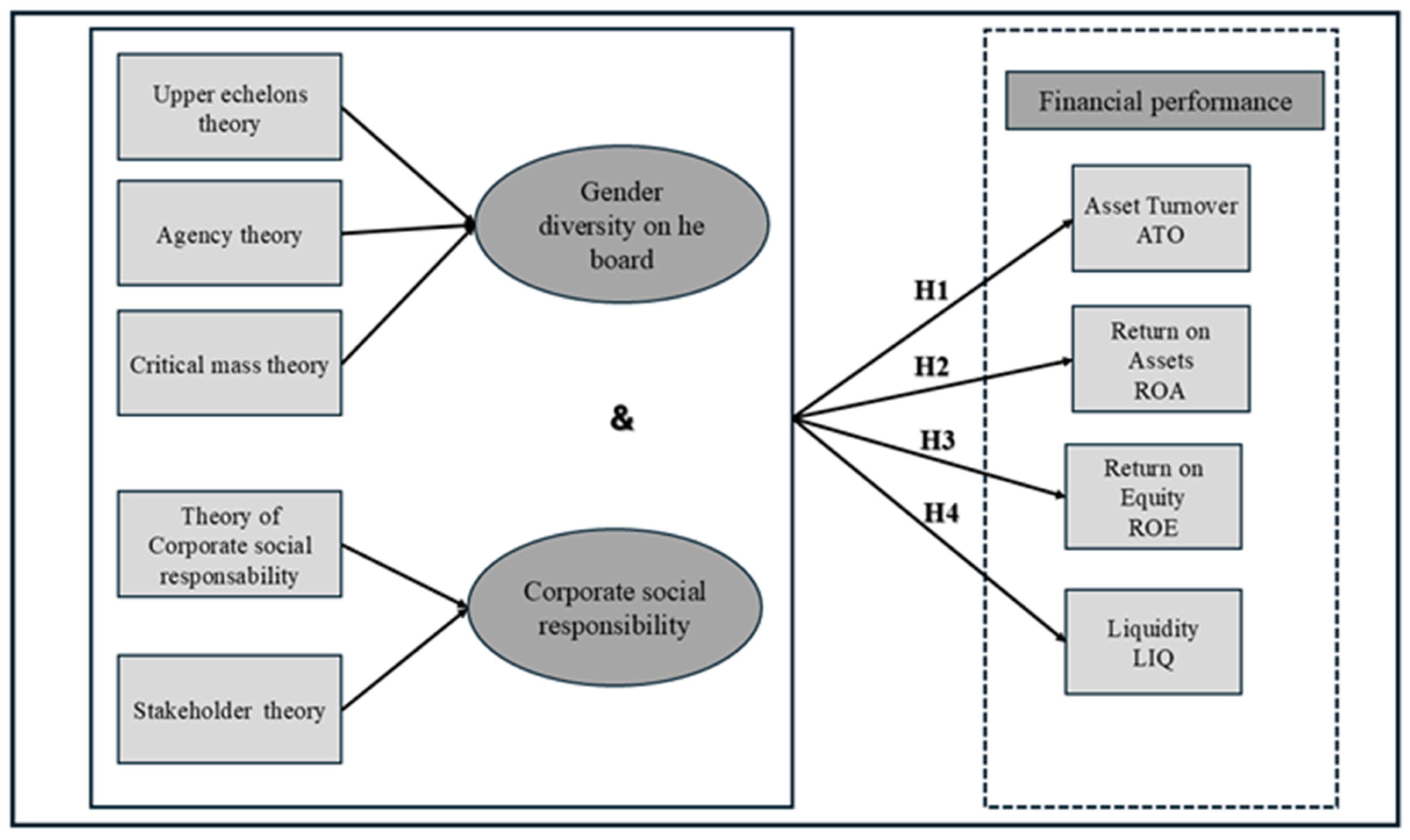
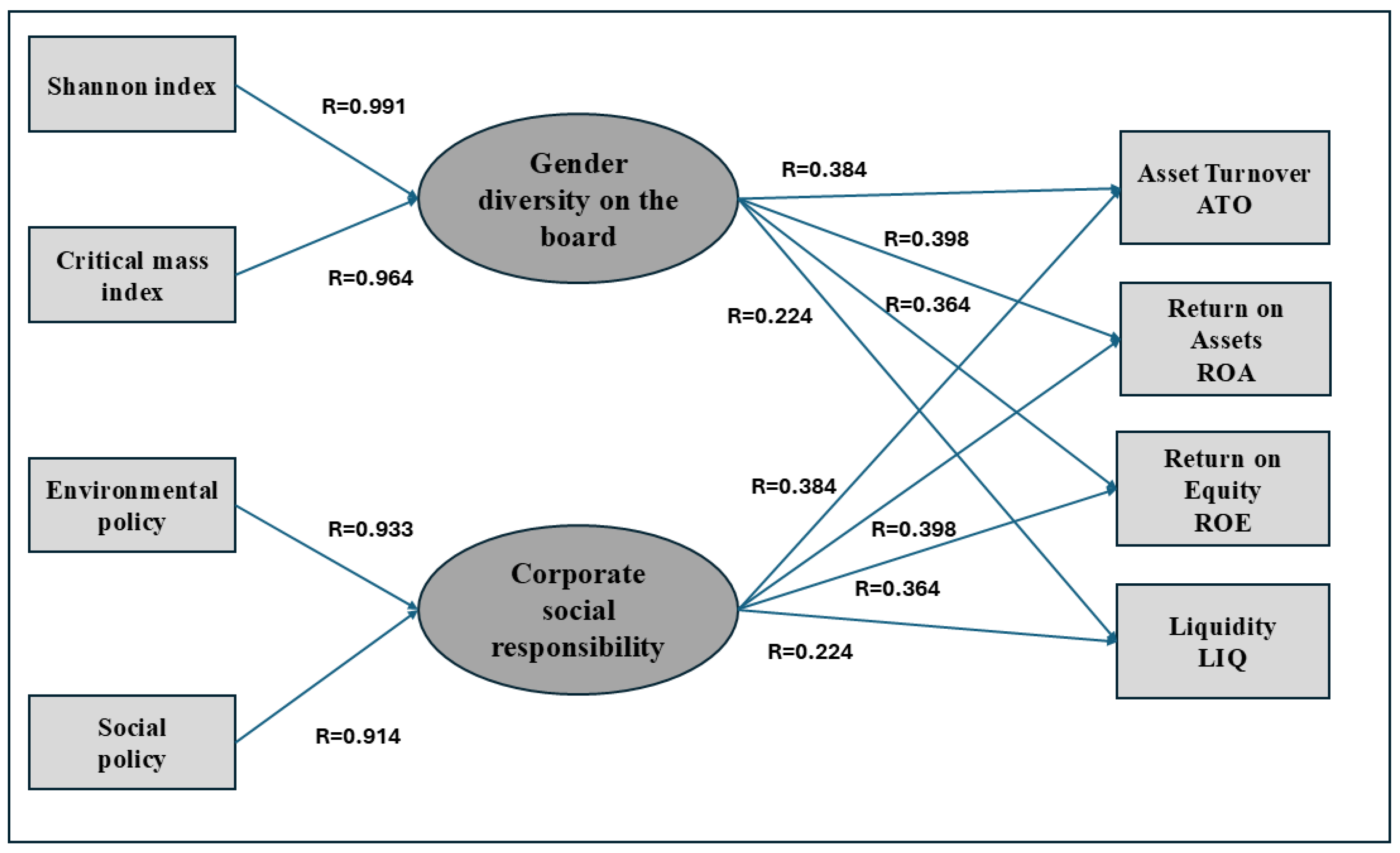
Board Gender Diversity, Corporate Social Responsibility and Financial Performance in an Emerging Market: Evidence from Peru


Abstract
1. Introduction
Literature Review and Hypothesis Development
2. Materials and Methods
2.1. Data and Measures
2.2. Data Analysis
2.3. Regression Models
3. Results
3.1. Descriptive Statistics
3.2. Multiple Regression Model and Hypotheses
4. Discussion
5. Conclusions
Funding
Institutional Review Board Statement
Informed Consent Statement
Data Availability Statement
Acknowledgments
Conflicts of Interest
Abbreviations
| BGD | Board Gender Diversity |
| CSR | Corporate Social Responsibility |
References
- World Economic Forum. Global Gender Gap Report 2024; World Economic Forum: Geneva, Switzerland, 2024; Available online: https://www.weforum.org/publications/global-gender-gap-report-2024/ (accessed on 25 September 2025).
- Lee, J.S.; Lan, L.L.; Rowley, C. Why might females say no to corporate board positions? The Asia Pacific in comparison. Asia Pac. Bus. Rev. 2014, 20, 513–522. [Google Scholar] [CrossRef]
- Seo, G.; Huang, W.; Han, S.H.C. Conceptual review of underrepresentation of women in senior leadership positions from a perspective of gendered social status in the workplace: Implication for HRD research and practice. Hum. Resour. Dev. Rev. 2017, 16, 35–59. [Google Scholar] [CrossRef]
- Laique, U.; Abdullah, F.; Rehman, I.U.; Sergi, B.S. Two decades of research on board gender diversity and financial outcomes: Mapping heterogeneity and future research agenda. Corp. Soc. Responsib. Environ. Manag. 2023, 30, 2121–2144. [Google Scholar] [CrossRef]
- Adams, R.B.; Ferreira, D. Women in the boardroom and their impact on governance and performance. J. Financ. Econ. 2009, 94, 291–309. [Google Scholar] [CrossRef]
- Shakil, M.H.; Tasnia, M.; Mostafiz, M.I. Board gender diversity and environmental, social and governance performance of US banks: Moderating role of environmental, social and corporate governance controversies. Int. J. Bank Mark. 2021, 39, 661–677. [Google Scholar] [CrossRef]
- Kachouri, M.; Salhi, B.; Jarboui, A. The impact of gender diversity on the relationship between managerial entrenchment and corporate social responsibility: Evidence from UK companies. J. Glob. Responsib. 2020, 11, 197–217. [Google Scholar] [CrossRef]
- Marques, A.; Pascaru, O. Voluntary gender diversity targets and their impact on firm performance and firm value. J. Int. Account. Res. 2023, 22, 157–173. [Google Scholar] [CrossRef]
- Chiao, Y.C.; Chang, Y.C.; Hsu, Y.J.; Lu, C.H.; Chang, M.L. Gender diversity in top management team and corporate social responsibility performance: Examining the moderating nature of TMT international experience. Gend. Manag. Int. J. 2024, 39, 272–291. [Google Scholar] [CrossRef]
- Nguyen, T.K.Q.; Phan, T.H.N.; Hang, N.M. The effect of liquidity on firm’s performance: Case of Vietnam. J. East. Eur. Cent. Asian Res. 2024, 11, 175–185. [Google Scholar] [CrossRef]
- Post, C.; Byron, K. Women on boards and firm financial performance: A meta-analysis. Acad. Manag. J. 2015, 58, 1546–1571. [Google Scholar] [CrossRef]
- Setó-Pamies, D. The relationship between women directors and corporate social responsibility. Corp. Soc. Responsib. Environ. Manag. 2015, 22, 334–345. [Google Scholar] [CrossRef]
- Hartmann, C.C.; Carmenate, J. Does board diversity influence firms’ corporate social responsibility reputation? Soc. Responsib. J. 2021, 17, 1299–1319. [Google Scholar] [CrossRef]
- Tjahjadi, B.; Hapsari, A.P.; Soewarno, N.; Sutarsa, A.A.P.; Fairuzi, A. Women on boards, corporate environmental responsibility engagement and corporate financial performance: Evidence from Indonesian manufacturing companies. Gend. Manag. Int. J. 2024, 39, 1017–1036. [Google Scholar] [CrossRef]
- Stanwick, P.A.; Stanwick, S.D. The determinants of corporate social performance: An empirical examination. Am. Bus. Rev. 1998, 16, 86. [Google Scholar]
- Fauzi, F.; Locke, S. Board structure, ownership structure and firm performance: A study of New Zealand listed firms. Asian Acad. Manag. J. Account. Financ. 2012, 8, 43–67. [Google Scholar]
- Jhunjhunwala, S.; Mishra, R. Board Diversity and Corporate Performance: The Indian Evidence. IUP J. Corp. Gov. 2012, 11, 71. Available online: www.proquest.com/scholarly-journals/board-diversity-corporate-performance-indian/docview/1034107201/se-2 (accessed on 20 June 2025).
- Arioglu, E. Female board members: The effect of director affiliation. Gend. Manag. Int. J. 2020, 35, 225–254. [Google Scholar] [CrossRef]
- Orazalin, N.; Baydauletov, M. Corporate social responsibility strategy and corporate environmental and social performance: The moderating role of board gender diversity. Corp. Soc. Responsib. Environ. Manag. 2020, 27, 1664–1676. [Google Scholar] [CrossRef]
- Reguera-Alvarado, N.; Bravo-Urquiza, F. The impact of board diversity and voluntary risk disclosure on financial outcomes: A case for the manufacturing industry. Gend. Manag. Int. J. 2020, 35, 445–462. [Google Scholar] [CrossRef]
- Chapple, L.; Humphrey, J.E. Does board gender diversity have a financial impact? Evidence using stock portfolio performance. J. Bus. Ethics 2013, 122, 709–723. [Google Scholar] [CrossRef]
- Joecks, J.; Pull, K.; Vetter, K. Gender diversity in the boardroom and firm performance: What exactly constitutes a “critical mass”? J. Bus. Ethics 2013, 118, 61–72. [Google Scholar] [CrossRef]
- Sial, M.S.; Zheng, C.; Cherian, J.; Gulzar, M.A.; Thu, P.A.; Khan, T.; Khuong, N.V. Does corporate social responsibility mediate the relation between boardroom gender diversity and firm performance of Chinese listed companies? Sustainability 2018, 10, 3591. [Google Scholar] [CrossRef]
- Galbreath, J.; Shum, P. Do customer satisfaction and reputation mediate the CSR–FP link? Evidence from Australia. Aust. J. Manag. 2012, 37, 211–229. [Google Scholar] [CrossRef]
- Shahbaz, M.; Karaman, A.S.; Kilic, M.; Uyar, A. Board attributes, CSR engagement, and corporate performance: What is the nexus in the energy sector? Energy Policy 2020, 143, 111582. [Google Scholar] [CrossRef]
- Zhang, L. An institutional approach to gender diversity and firm performance. Organ. Sci. 2020, 31, 439–457. [Google Scholar] [CrossRef]
- Lawrence, B.S. Perspective—The black box of organizational demography. Organ. Sci. 1997, 8, 1–22. [Google Scholar] [CrossRef]
- Hoobler, J.M.; Masterson, C.R.; Nkomo, S.M.; Michel, E.J. The business case for women leaders: Meta-analysis, research critique, and path forward. J. Manag. 2018, 44, 2473–2499. [Google Scholar] [CrossRef]
- Van den Oever, K.; Beerens, B. Does task-related conflict mediate the board gender diversity–organizational performance relationship? Eur. Manag. J. 2021, 39, 445–455. [Google Scholar] [CrossRef]
- Avolio, B.; Pretell, C.; Valcazar, E. Women on corporate boards in a predominantly male-dominated society: The case of Peru. Gend. Manag. Int. J. 2023, 38, 93–110. [Google Scholar] [CrossRef]
- De Anca, C.; Gabaldon, P. Female directors and the media: Stereotypes of board members. Gend. Manag. Int. J. 2014, 29, 334–351. [Google Scholar] [CrossRef]
- Heller, L.; Gabaldon, P. Women on boards of directors in Latin America: Building a model. Acad. Rev. Latinoam. Adm. 2018, 31, 43–72. [Google Scholar] [CrossRef]
- International Labour Organization. International Labour Organization Annual Report 2023; ILO Publications: Geneva, Switzerland, 2023; Available online: https://www.ilo.org/publications/annual-report-2023 (accessed on 25 September 2025).
- World Bank. Data on Peru, Ecuador, Chile, Argentina and Mexico; World Bank: Washington, DC, USA, 2024; Available online: https://datos.bancomundial.org/?locations=CL-AR-BR-PE-CO (accessed on 25 September 2025).
- United Nations. Sustainable Development Goals; United Nations: New York, NY, USA, 2025. [Google Scholar]
- Herrera-Cano, C.; Gonzalez-Perez, M.A. Representation of women on corporate boards of directors and firm financial performance. In Diversity Within Diversity Management: Types of Diversity in Organizations; Emerald Publishing Limited: Leeds, UK, 2019; pp. 37–60. [Google Scholar] [CrossRef]
- Carrasco, A.; Francoeur, C.; Labelle, R.; Laffarga, J.; Ruiz-Barbadillo, E. Appointing women to boards: Is there a cultural bias? J. Bus. Ethics 2015, 129, 429–444. [Google Scholar] [CrossRef]
- Pride, M. The Way Home: Beyond Feminism, Back to Reality; Home Life Books: London, UK, 1985. [Google Scholar]
- Schlafly, P. Feminist Fantasies; Spence Publishing Company: Dallas, TX, USA, 2003. [Google Scholar]
- Hakim, C. Women, careers, and work-life preferences. Br. J. Guid. Couns. 2006, 34, 279–294. [Google Scholar] [CrossRef]
- Cuddy, A.J.; Fiske, S.T.; Glick, P. The BIAS map: Behaviors from intergroup affect and stereotypes. J. Personal. Soc. Psychol. 2007, 92, 631–648. [Google Scholar] [CrossRef]
- Hambrick, D.C.; Mason, P.A. Upper echelons: The organization as a reflection of its top managers. Acad. Manag. Rev. 1984, 9, 193–206. [Google Scholar] [CrossRef]
- Dezsö, C.L.; Ross, D.G. Does female representation in top management improve firm performance? A panel data investigation. Strateg. Manag. J. 2012, 33, 1072–1089. [Google Scholar] [CrossRef]
- Bernile, G.; Bhagwat, V.; Yonker, S. Board diversity, firm risk, and corporate policies. J. Financ. Econ. 2018, 127, 588–612. [Google Scholar] [CrossRef]
- Ciappei, C.; Liberatore, G.; Manetti, G. A systematic literature review of studies on women at the top of firm hierarchies: Critique, gap analysis and future research directions. Sustain. Account. Manag. Policy J. 2023, 14, 202–231. [Google Scholar] [CrossRef]
- Croson, R.; Gneezy, U. Gender differences in preferences. J. Econ. Lit. 2009, 47, 448–474. [Google Scholar] [CrossRef]
- Rahman, H.U.; Zahid, M. Women directors and corporate performance: Firm size and board monitoring as the least focused factors. Gend. Manag. Int. J. 2021, 36, 605–621. [Google Scholar] [CrossRef]
- Chang, Y.; Wu, K.T.; Lin, S.H.; Lin, C.J. Board gender diversity and corporate social responsibility. Int. J. Corp. Soc. Responsib. 2024, 9, 7. [Google Scholar] [CrossRef]
- Jensen, M.C.; Meckling, W.H. Theory of the firm: Managerial behavior, agency costs and ownership structure. J. Financ. Econ. 1976, 3, 305–360. [Google Scholar] [CrossRef]
- Fama, E.F.; Jensen, M.C. Separation of ownership and control. J. Law Econ. 1983, 26, 301–325. [Google Scholar] [CrossRef]
- Francoeur, C.; Labelle, R.; Sinclair-Desgagné, B. Gender diversity in corporate governance and top management. J. Bus. Ethics 2008, 81, 83–95. [Google Scholar] [CrossRef]
- Farag, H.; Mallin, C. Board diversity and financial fragility: Evidence from European banks. Int. Rev. Financ. Anal. 2017, 49, 98–112. [Google Scholar] [CrossRef]
- Lefley, F.; Janeček, V. Board gender diversity, quotas and critical mass theory. Corp. Commun. Int. J. 2024, 29, 139–151. [Google Scholar] [CrossRef]
- Schelling, T.C. Dynamic models of segregation. J. Math. Sociol. 1971, 1, 143–186. [Google Scholar] [CrossRef]
- Kanter, R.M. Men and Women of the Corporation; Basic Books: New York, NY, USA, 1977. [Google Scholar]
- Granovetter, M. Threshold models of collective behavior. Am. J. Sociol. 1978, 83, 1420–1443. [Google Scholar] [CrossRef]
- Kanter, R.M. Some effects of proportions on group life: Skewed sex ratios and responses to token women. Am. J. Sociol. 1977, 82, 965–990. [Google Scholar] [CrossRef]
- Carmo, C.; Alves, S.; Quaresma, B. Women on boards in Portuguese listed companies: Does gender diversity influence financial performance? Sustainability 2022, 14, 6186. [Google Scholar] [CrossRef]
- Konrad, A.M.; Kramer, V.; Erkut, S. Critical mass: The impact of three or more women on corporate boards. Organ. Dyn. 2008, 37, 145–164. [Google Scholar] [CrossRef]
- Carroll, A.B. A three-dimensional conceptual model of corporate performance. Acad. Manag. Rev. 1979, 4, 497–505. [Google Scholar] [CrossRef]
- Birch, D. Corporate Citizenship in Australia: Some Ups, Some Downs. J. Corp. Citizsh. 2002, 2002, 73–84. Available online: https://www.jstor.org/stable/jcorpciti.5.73 (accessed on 20 June 2025).
- Wood, D.J. Corporate social performance revisited. Acad. Manag. Rev. 1991, 16, 691–718. [Google Scholar] [CrossRef]
- Sen, S.; Bhattacharya, C.B. Does doing good always lead to doing better? Consumer reactions to corporate social responsibility. J. Mark. Res. 2001, 38, 225–243. [Google Scholar] [CrossRef]
- Galbreath, J. How does corporate social responsibility benefit firms? Evidence from Australia. Eur. Bus. Rev. 2010, 22, 411–431. [Google Scholar] [CrossRef]
- Baron, D.P. Private politics, corporate social responsibility, and integrated strategy. J. Econ. Manag. Strategy 2001, 10, 7–45. [Google Scholar] [CrossRef]
- McWilliams, A.; Siegel, D. Corporate social responsibility: A theory of the firm perspective. Acad. Manag. Rev. 2001, 26, 117–127. [Google Scholar] [CrossRef]
- Waldman, D.A.; Siegel, D.S.; Javidan, M. Components of CEO transformational leadership and corporate social responsibility. J. Manag. Stud. 2006, 43, 1703–1725. [Google Scholar] [CrossRef]
- Vishwanathan, P.; van Oosterhout, H.; Heugens, P.P.M.A.R.; Duran, P.; Van Essen, M. Strategic CSR: A concept building meta-analysis. J. Manag. Stud. 2020, 57, 314–350. [Google Scholar] [CrossRef]
- Freeman, R.E. Strategic Management: A Stakeholder Approach; Cambridge University Press: Cambridge, UK, 1984. [Google Scholar]
- Marom, I.Y. Toward a unified theory of the CSP–CFP link. J. Bus. Ethics 2006, 67, 191–200. [Google Scholar] [CrossRef]
- Valentinov, V.; Chia, R. Stakeholder theory: A process-ontological perspective. Bus. Ethics Environ. Responsib. 2022, 31, 762–776. [Google Scholar] [CrossRef]
- Freeman, R.E.; Dmytriyev, S.D.; Phillips, R.A. Stakeholder theory and the resource-based view of the firm. J. Manag. 2021, 47, 1757–1770. [Google Scholar] [CrossRef]
- Roberts, R.W. Determinants of corporate social responsibility disclosure: An application of stakeholder theory. Account. Organ. Soc. 1992, 17, 595–612. [Google Scholar] [CrossRef]
- Ritter-Hayashi, D.; Vermeulen, P.; Knoben, J. Is this a man’s world? The effect of gender diversity and gender equality on firm innovativeness. PLoS ONE 2019, 14, e0222443. [Google Scholar] [CrossRef]
- García-Sánchez, I.M.; Minutiello, V.; Tettamanzi, P. Gender disclosure: The impact of peer behaviour and the firm’s equality policies. Corp. Soc. Responsib. Environ. Manag. 2022, 29, 385–405. [Google Scholar] [CrossRef]
- Orlitzky, M.; Schmidt, F.L.; Rynes, S.L. Corporate social and financial performance: A meta-analysis. Organ. Stud. 2003, 24, 403–441. [Google Scholar] [CrossRef]
- Abdullah, S.N.; Ismail, K.N.I.K.; Nachum, L. Does having women on boards create value? The impact of societal perceptions and corporate governance in emerging markets. Strateg. Manag. J. 2016, 37, 466–476. [Google Scholar] [CrossRef]
- Cochran, P.L.; Wood, R.A. Corporate social responsibility and financial performance. Acad. Manag. J. 1984, 27, 42–56. [Google Scholar] [CrossRef]
- Haslam, S.A.; Ryan, M.K.; Kulich, C.; Trojanowski, G.; Atkins, C. Investing with prejudice: The relationship between women’s presence on company boards and objective and subjective measures of company performance. Br. J. Manag. 2010, 21, 484–497. [Google Scholar] [CrossRef]
- Jang, S.W.; Ahn, W.C. Financial analysis effect on management performance in the Korean logistics industry. Asian J. Shipp. Logist. 2021, 37, 245–252. [Google Scholar] [CrossRef]
- Hassan, R.; Marimuthu, M. Contextualizing comprehensive board diversity and firm financial performance: Integrating market, management and shareholder’s perspective. J. Manag. Organ. 2018, 24, 634–678. [Google Scholar] [CrossRef]
- Reimann, B.C. Organizational effectiveness and management’s public values: A canonical analysis. Acad. Manag. J. 1975, 18, 224–241. [Google Scholar] [CrossRef]
- Conine, T.E.; Madden, G.P. Corporate social responsibility and investment value: The expectational relationship. In Handbook of Business Strategy; Warren Gorham and Lamont: Boston, MA, USA, 1986; pp. 1–18. [Google Scholar]
- Wartick, S.L. How issues management contributes to corporate performance. Bus. Forum 1988, 13, 16. Available online: https://www.proquest.com/scholarly-journals/how-issues-management-contributes-corporate/docview/210204027/se-2 (accessed on 25 September 2025).
- Carter, D.A.; Simkins, B.J.; Simpson, W.G. Corporate governance, board diversity, and firm value. Financ. Rev. 2003, 38, 33–53. [Google Scholar] [CrossRef]
- Hussain, S.M.; Ahmad, N.; Fazal, F.; Menegaki, A.N. The impact of female directorship on firm performance: A systematic literature review. Rev. Manag. Sci. 2024, 18, 913–939. [Google Scholar] [CrossRef]
- Marquez-Cardenas, V.; Gonzalez-Ruiz, J.D.; Duque-Grisales, E. Board gender diversity and firm performance: Evidence from Latin America. J. Sustain. Financ. Invest. 2022, 12, 785–808. [Google Scholar] [CrossRef]
- Husted, B.W.; de Sousa-Filho, J.M. Board structure and environmental, social, and governance disclosure in Latin America. J. Bus. Res. 2019, 102, 220–227. [Google Scholar] [CrossRef]
- Veltri, S.; Mazzotta, R.; Cambrea, D.R.; Ferrigno, G. Women Directors and R&D Investments Relationship: Does Their Intellectual Capital Matter? R&D Manag. 2025. [Google Scholar] [CrossRef]
- Chen, G.; Hsu, P.H.; Lee, Y.T.; Mack, D.Z. How Deep-Level and Surface-Level Board Diversity, Formal and Informal Social Structures Affect Innovation. J. Manag. Stud. 2025, 62, 65–101. [Google Scholar] [CrossRef]
- Tsoutsoura, M. Corporate Social Responsibility and Financial Performance. In Applied Financial Project; University of California at Berkeley: Berkeley, CA, USA, 2004; Available online: https://escholarship.org/uc/item/111799p2 (accessed on 25 September 2025).
- Margolis, J.D.; Elfenbein, H.A.; Walsh, J.P. Does It Pay to be Good…and Does it Matter? A Meta-Analysis of the Relationship Between Corporate Social and Financial Performance. Working Paper; Harvard University: Cambridge, MA, USA, 2009. [Google Scholar] [CrossRef]
- Zu, L.; Song, L. Determinants of managerial values on corporate social responsibility: Evidence from China. J. Bus. Ethics 2009, 88, 105–117. [Google Scholar] [CrossRef]
- Lenssen, G.; Blagov, Y.; Bevan, D.; Chen, H.; Wang, X. Corporate social responsibility and corporate financial performance in China: An empirical research from Chinese firms. Corp. Gov. Int. J. Bus. Soc. 2011, 11, 361–370. [Google Scholar] [CrossRef]
- Sohn, J.; Lee, J.; Kim, N. Going green inside and out: Corporate environmental responsibility and financial performance under regulatory stringency. Sustainability 2020, 12, 3850. [Google Scholar] [CrossRef]
- Van Beurden, P.; Gössling, T. The worth of values—A literature review on the relation between corporate social and financial performance. J. Bus. Ethics 2008, 82, 407–424. [Google Scholar] [CrossRef]
- Hair, J.F.; Black, W.C.; Babin, B.J.; Anderson, R.E. Multivariate Data Analysis, 8th ed.; Cengage: Boston, MA, USA, 2019. [Google Scholar]
- Green, C.P.; Homroy, S.; Liang, W. Female directors, board committees and firm performance. Eur. Econ. Rev. 2018, 102, 19–38. [Google Scholar] [CrossRef]
- Birindelli, G.; Iannuzzi, A.P.; Savioli, M. The impact of women leaders on environmental performance: Evidence on gender diversity in banks. Corp. Soc. Responsib. Environ. Manag. 2019, 26, 1485–1499. [Google Scholar] [CrossRef]
- Morán-Muñoz, A.; Heras-Saizarbitoria, I.; Boiral, O. Board gender and nationality diversity and corporate human rights performance. Corp. Gov. Int. Rev. 2024, 33, 760–781. [Google Scholar] [CrossRef]
- Krüger, P. Corporate goodness and shareholder wealth. J. Financ. Econ. 2015, 115, 304–329. [Google Scholar] [CrossRef]
- Zhu, S.; Cai, J.; Xiong, R.; Zheng, L.; Ma, D. Singular pooling: A spectral pooling paradigm for second-trimester prenatal level II ultrasound standard fetal plane identification. IEEE Trans. Circuits Syst. Video Technol. 2025, 35, 12508–12523. [Google Scholar] [CrossRef]



| Construct | Observable Variable | Variable Type | Calculation Method/Instrument | Possible Values | Interpretation |
|---|---|---|---|---|---|
| Dependent Variable | |||||
| Financial Performance | Asset Turnover | Continuous | Asset Turnover = Revenue or Sales/Total Assets | Infinite values within the real numbers | Greater than 1 or less than 1: Indicates that the company is generating more than one dollar or less than one dollar in sales for every dollar invested in assets, which is generally positive or negative depending on the factor. |
| ROA | Continuous | ROA = Net Profit/Total Assets | Infinite values within the real numbers | Measures a company´s profitability in relation to its assets a typical range can be from −0.10 to 0.20 | |
| ROE | Continuous | ROE = Net Profit/Equity | Infinite values within the real numbers | Measures a company’s profitability in relation to the capital invested by shareholders. Atypical range can be between 0.10 and 0.20 | |
| Liquidity | Continuous | Liquidity = Current Assets/Current Liabilities | Infinite values within positive real numbers | Less than 1 to greater than 2, which defines positions with respect to the ability to cover short-term obligations | |
| Independent Variables | |||||
| Gender diversity on the board of directors | Shannon index | Continuous | H = −Σ (p × log2(p)) | 0 a Log2 (n) | 0 = no gender diversity (complete homogeneity) higher values (up to 0.693) indicate greater gender diversity |
| Critical mass index | Continuous | D = (1/2) × Σ ((|Pi − Qi|)/(Pi + Qi)) | 0 a 1 | 0 = No gender segregation, 1 = maximum gender Segregation | |
| Corporate social responsibility | Environmental policy | Dichotomous | 12 question questionnaire. Corporate sustainability report | 0 No & 1 Yes | The results provide information on the direction and magnitude of the effect of the variables. |
| Social policy | Dichotomous | 10 question questionnaire. Corporate sustainability report | 0 No & 1 Yes | ||
| Variables | N | Range | Min | Max | Average | SE | SD | Variance |
|---|---|---|---|---|---|---|---|---|
| SHI | 121 | 0.66 | 0.00 | 0.66 | 0.3260 | 0.01714 | 0.18849 | 0.036 |
| CMI | 121 | 0.50 | 0.00 | 0.50 | 0.1556 | 0.01003 | 0.11037 | 0.012 |
| BGD | 121 | 0.57 | 0.00 | 0.57 | 0.2396 | 0.01327 | 0.14593 | 0.021 |
| EP | 121 | 0.73 | 0.00 | 0.73 | 0.2870 | 0.01239 | 0.13634 | 0.019 |
| SP | 121 | 0.81 | 0.02 | 0.83 | 0.4589 | 0.01045 | 0.11496 | 0.013 |
| CSR | 121 | 0.77 | 0.01 | 0.78 | 0.3725 | 0.01061 | 0.11667 | 0.014 |
| ATO | 121 | 3.18 | −1.12 | 2.06 | 0.0025 | 0.06270 | 0.68974 | 0.476 |
| ROA | 121 | 3.22 | −1.12 | 2.10 | 0.0209 | 0.06111 | 0.67225 | 0.452 |
| ROE | 121 | 3.18 | −1.12 | 2.06 | 0.0036 | 0.06245 | 0.68698 | 0.472 |
| LIQ | 121 | 4.63 | 0.28 | 4.91 | 1.4549 | 0.08188 | 0.90064 | 0.811 |
| Model | R | R2 | R2 Adjusted | Standard Error of Estimation |
|---|---|---|---|---|
| H1 | 0.384 a | 0.148 | 0.133 | 0.64213 |
| H2 | 0.398 a | 0.159 | 0.144 | 0.62179 |
| H3 | 0.364 a | 0.138 | 0.123 | 0.63961 |
| H4 | 0.224 a | 0.050 | 0.034 | 0.88514 |
| Model | Sum of Squares | gl | Root Mean Square | F | Sig. | |
|---|---|---|---|---|---|---|
| H1 | Regression | 8.434 | 2 | 4.217 | 10.227 | 0.000 b |
| Residual | 48.655 | 118 | 0.412 | |||
| Total | 57.088 | 120 | ||||
| H2 | Regression | 8.609 | 2 | 4.304 | 11.133 | 0.000 b |
| Residual | 45.622 | 118 | 0.387 | |||
| Total | 54.230 | 120 | ||||
| H3 | Regression | 8.359 | 2 | 4.180 | 10.216 | 0.000 b |
| Residual | 48.274 | 118 | 0.409 | |||
| Total | 56.633 | 120 | ||||
| H4 | Regression | 4.887 | 2 | 2.444 | 3.119 | 0.048 b |
| Residual | 92.450 | 118 | 0.783 | |||
| Total | 97.337 | 120 | ||||
| Model | Non-Standardised Coefficients | Standardised Coefficients | t-Student | Sig. | ||
|---|---|---|---|---|---|---|
| B | SE | Beta | ||||
| H1 | (Constants) | −0.559 | 0.209 | −2.676 | 0.009 | |
| BGD | −0.932 | 0.405 | −0.197 | −2.301 | 0.023 | |
| CSR | 2.108 | 0.507 | 0.357 | 4.160 | 0.000 | |
| H2 | (Constants) | −0.564 | 0.202 | −2.788 | 0.006 | |
| BGD | −0.902 | 0.392 | −0.196 | −2.300 | 0.023 | |
| CSR | 2.151 | 0.491 | 0.373 | 4.385 | 0.000 | |
| H3 | (Constants) | −0.557 | 0.208 | −2.675 | 0.009 | |
| BGD | −0.925 | 0.404 | −0.195 | −2.293 | 0.024 | |
| CSR | 2.100 | 0.505 | 0.355 | 4.161 | 0.000 | |
| H4 | (Constants) | 2.018 | 0.288 | 7.003 | 0.000 | |
| BGD | −1.165 | 0.558 | −0.189 | −2.087 | 0.039 | |
| CSR | −0.761 | 0.698 | −0.099 | −1.989 | 0.028 | |
Disclaimer/Publisher’s Note: The statements, opinions and data contained in all publications are solely those of the individual author(s) and contributor(s) and not of MDPI and/or the editor(s). MDPI and/or the editor(s) disclaim responsibility for any injury to people or property resulting from any ideas, methods, instructions or products referred to in the content. |
© 2026 by the author. Licensee MDPI, Basel, Switzerland. This article is an open access article distributed under the terms and conditions of the Creative Commons Attribution (CC BY) license.
Share and Cite
Villamizar Morales, P.M. Board Gender Diversity, Corporate Social Responsibility and Financial Performance in an Emerging Market: Evidence from Peru. Sustainability 2026, 18, 869. https://doi.org/10.3390/su18020869
Villamizar Morales PM. Board Gender Diversity, Corporate Social Responsibility and Financial Performance in an Emerging Market: Evidence from Peru. Sustainability. 2026; 18(2):869. https://doi.org/10.3390/su18020869
Chicago/Turabian StyleVillamizar Morales, Patrick Michael. 2026. "Board Gender Diversity, Corporate Social Responsibility and Financial Performance in an Emerging Market: Evidence from Peru" Sustainability 18, no. 2: 869. https://doi.org/10.3390/su18020869
APA StyleVillamizar Morales, P. M. (2026). Board Gender Diversity, Corporate Social Responsibility and Financial Performance in an Emerging Market: Evidence from Peru. Sustainability, 18(2), 869. https://doi.org/10.3390/su18020869