Article

Elevating Morals, Elevating Actions: The Interplay of CSR, Transparency, and Guest Pro-Social and Pro-Environmental Behaviors in Hotels


Faculty of Tourism, Eastern Mediterranean University, TRNC, Via Mersin 10, Gazimagusa 99628, Turkey
*
Author to whom correspondence should be addressed.
Sustainability 2026, 18(2), 866; https://doi.org/10.3390/su18020866 (registering DOI)
Submission received: 7 November 2025 / Revised: 23 December 2025 / Accepted: 9 January 2026 / Published: 14 January 2026

Abstract

In the hospitality industry, corporate social responsibility practices are getting more recognition as a strategic driver of stakeholders’ sustainable behaviors. This study creates and tests a moderated serial mediation model that connects hotel CSR activities to guests’ pro-environmental behavior (PROE). In addition, moral elevation (ME) and pro-social behaviors of guests (PSO) are posited as affective and behavioral mediating mechanisms, whereas the perceived transparency (TRA) of hotel actions is investigated as a moderator. The survey data were collected from 426 hotel guests who had stayed in hotels in the Turkish Republic of Northern Cyprus (TRNC) and used partial least squares structural equation modeling (PLS-SEM) to analyze it. The findings reveal that CSR does have a positive effect on ME, which sequentially makes ME affect PSO and PROE behavior positively. The research shows that the moderator TRA also amplifies the relationship strength between CSR and ME, which suggests that transparent actions of hotels do have a positive emotional impact on guests. The research contributes to hospitality literature and also sustainability literature by identifying ME as an emotional mechanism and TRA as a moderating condition that alter guests’ behaviors. As managerial implications, the research underlines the value of creating CSR practices that are both transparent and authentic to guests and stakeholders to ultimately maximize the engagement of guests in the context of sustainability.

1. Introduction

“Leave no one behind,” the guiding principle of the 2030 Agenda for Sustainable Development, has become increasingly difficult to achieve [1]. Hotels contribute about 1% of global greenhouse gas emissions [2] and negatively affect ecosystems [3]. Tourism more broadly generates environmental pressures such as carbon emissions, resource use, and habitat degradation [4,5]. This highlights the need for hotels not only to strengthen sustainability practices [6] but also to communicate them effectively, since uncommunicated efforts remain invisible to stakeholders [7].
CSR information sharing fosters transparency, dialogue, and legitimacy [8,9], enhancing reputation and guest engagement [10,11]. Beyond philanthropy or crisis response [12], CSR can strengthen stakeholder identification with socially responsible organizations [13]. It may also encourage pro-social behavior [14], though most research focuses on employees rather than guests [15,16]. Pro-social behavior, defined as voluntary, selfless action that benefits others [17], is increasingly recognized as essential for tourism’s contribution to social inclusion and community well-being [18,19,20].
Moral elevation also fosters pro-social behavior by inspiring individuals who witness altruism to emulate it [21,22]. This emotional response triggers moral values and motivates selfless action [23].
According to past research [24], CSR actions have a positive effect on ME, which motivates guests to act socially responsible. From the perception of the guests, if these actions are authentic and altruistic, the actions do give them encouragement to behave more pro-socially [25].
The guests’ perception of hotel CSR actions’ transparency, as in clarity of actions and availability of information, can be stated as an indirect factor that shapes guest behaviors [26]. Transparency is related to accuracy, clarity, and disclosure of actions and information [27]; if these attributes are high in an organization, the organization’s credibility and trust increase in the perception of the stakeholders [28]. According to several previous studies [29,30,31], credible, transparent communication of hotel organizations regarding green practices increases the strength of guest engagement in the context of sustainability. These can vary from recycling, energy conservation, and towel reuse, which are the most common PROE behaviors that increase the level of sustainability in the tourism sector [32,33,34].
Even though CSR research has been increasing annually, there are still certain gaps in the literature. First, most studies emphasize cognitive predictors and in-role outcomes, leaving affective pathways such as moral elevation underexplored [35,36,37]. Second, CSR skepticism and greenwashing highlight the importance of message credibility, particularly transparency, yet few hospitality models test this boundary condition [38]. Third, although hotels promote helping and safety behaviors through social marketing, mechanisms driving pro-social and sustainable guest conduct remain undertheorized [39,40]. Finally, micro-CSR evidence is largely employee-focused, leaving guest-side emotional and behavioral pathways insufficiently examined [41].
Grounded in the theory of planned behavior (TPB), this study examines how hotel CSR shapes sustainable guest conduct. We test a model in which perceived CSR elicits moral elevation (ME), motivating pro-social (PSO) and, in turn, pro-environmental (PROE) behaviors, addressing calls for emotion-based mediators in hospitality research [37,38,39,40,41,42]. We also consider perceived transparency (TRA) as a moderating condition that strengthens the CSR → ME link and amplifies downstream effects [38]. By integrating moral emotions and message credibility, the study extends TPB-based hospitality research and offers guidance for designing transparent, guest-engaging CSR strategies.

2. Theoretical Framework, Hypotheses, and Research Model

CSR in the hospitality industry is mostly seen as environmental and social; some examples are water and energy preservation, waste reduction (towel reuse, recycling), and community programs [39,40,41,42,43]. When the organizations communicate their CSR practices effectively, these sustainability practices alter the responses of the guests, ranging from loyalty and trust to giving aid and support for sustainability [44,45].
The theory of planned behavior (TPB) suggests that behavior results from cognitive evaluations, including subjective norms, attitudes toward the behavior, and perceived behavioral control [46]. In a hotel setting, visible CSR initiatives (such as environmental programs and community support) serve as situational cues that influence guests’ attitudes towards sustainable behaviors, reflect social norms regarding “appropriate” behavior on the premises, and affect the perceived ability to engage in eco-friendly practices (for instance, the presence of recycling bins or options for towel reuse) [38].
In this context, pro-social behavior (PSO) and pro-environmental behavior (PROE) are regarded as intentional outcomes that can be shaped by these TPB components. PSO is a general tendency to help and benefit others (like donating, sharing, and supporting social causes), while PROE is a specific behavior that helps the environment in a hotel (like saving energy and reusing towels and linens). In the study, PROE is defined as a specific type of pro-social behavior that is aimed at environmental goals, while PSO is a more general type of behavior that is focused on other people.
However, TPB primarily emphasizes cognitive evaluations and fails to explain the mechanisms that trigger moral emotions or other influences on subsequent decision-making [37]. To mitigate this limitation, this study presents moral elevation (ME) as an affective mechanism that enhances the cognitive pathway. ME is characterized as a positive, warm, moral feeling that people experience when they see someone do something good or kind [21]. In hospitality, ME mediates the link between green practices and green citizenship, highlighting an emotion–behavior channel beyond attitudes [37]. In the context of CSR, guests who view a hotel’s CSR efforts as truly altruistic can feel elevated, which encourages them to follow these moral standards by taking part in PSO and PROE.
Attribution theory, on the other hand, describes the specific conditions under which this affective pathway is activated. Attribution theory explains how individuals infer the motives underlying observed behavior and how these attributions influence emotions and conduct [47]. When CSR initiatives are communicated transparently via clear, accessible, and accurate information, guests are more inclined to attribute them to altruistic motives, thereby reinforcing ME. A systematic review further underscores transparency as a key moderator shaping whether CSR generates supportive attitudes and behaviors [38]. Accordingly, low transparency can lead to self-serving attributions or greenwashing, which can make people less emotional and less likely to act in certain ways. In this study, perceived transparency (TRA) serves as a boundary condition that influences the CSR-ME relationship and, consequently, the indirect effects of CSR on PSO and PROE.
Based on the aforementioned argument, we propose (Figure 1) that perceived CSR elicits ME, which promotes pro-social (PSO) and pro-environmental (PROE) behaviors, through a sequential pathway in which ME fosters PSO, which, in turn, drives PROE [14,46]. We further posit that transparency strengthens the CSR → ME link and amplifies indirect effects on PSO and PROE by enhancing credibility and benevolent attributions [38,39].

2.1. Corporate Social Responsibility and Pro-Environmental Behavior

CSR has been widely studied [48,49,50,51,52], but most work emphasizes financial outcomes, often with mixed results [53,54,55]. Evidence on guest reactions remains scarce and tends to focus on attitudes or intentions rather than actual behaviors [56,57].
From the guest perspective, pro-environmental behavior (PROE) includes actions such as linen and towel reuse, energy conservation, waste separation, and participation in green programs [36]. When guests perceive these actions as altruistic rather than self-serving, the chances of their cooperating with the CSR practices increase [58].
The research uses TPB [46] to establish this process, as CSR practices do have an effect on attitudes and signal social norms. This framework applies when guests perceive eco-friendly selections like recycling bins and towel reuse programs, which in turn increase perceived behavioral control. These mechanisms can increase hotel guests’ pro-social behavior. Based on the literature data, the paper proposes the following hypothesis:
H1. 
CSR relates positively to guest PROE.

2.2. The Mediating Role of Moral Elevation

ME is often described as a positive emotional response or an uplifting emotional sensation, like a warmth in the chest, which occurs when an individual witnesses a selfless, benevolent act [21]. According to [59,60], ME often creates a desire to act more compassionately toward others. Although elevation and gratitude are similar, they differ in two key ways. First, elevation arises from “disinterested elicitors,” or actions not directly affecting oneself, such as observing a stranger helping another [61]. Second, gratitude motivates behavior directed toward a benefactor, whereas elevation inspires broader pro-social behavior [21]. Experiencing moral elevation has been shown to increase volunteering, organizational citizenship, mentoring, and charitable giving [62,63,64].
Based on this evidence, it is appropriate to propose a mediating role for moral elevation between CSR and PROE. CSR actions may not immediately prompt guests to act pro-environmentally, but first move them emotionally, creating favorable attitudes that guide subsequent behavior. Accordingly, we hypothesize that
H2. 
ME mediates the effect of CSR on guest PROE.

2.3. The Mediating Role of Pro-Social Behavior

Pro-social behavior refers to voluntary actions performed without the expectation of personal gain, intended to benefit others (e.g., helping, donating, sharing). In tourism and hospitality, PSO is often linked to contributing resources to social causes or assisting others [39]. Within the Theory of Planned Behavior (TPB), attitudes shaped by credible, value-congruent initiatives predict such discretionary actions, reflecting the classic attitude–behavior link [39,40,41,42,43,44,45,46].
CSR initiatives can also evoke altruistic emotions, particularly ME. When guests experience virtuous CSR initiatives, ME motivates them to emulate those actions and act pro-socially [21,22,23,24,25,26,27,28,29,30,31,32,33,34,35,36,37,38,39,40,41,42,43,44,45,46,47,48,49,50,51,52,53,54,55,56,57,58,59,60,61,62,63,64,65].
Evidence shows that ME mediates the link between CSR and pro-social outcomes [24,25,26,27,28,29,30,31,32,33,34,35,36,37,38,39,40,41,42,43,44,45,46,47,48,49,50,51,52,53,54,55,56,57,58,59,60,61,62,63,64,65,66]. Positioning PSO as a mediator is further supported by studies that integrate moral emotions into guests’ responses to pro-environmental behavior, often framed as green citizenship [37]. Because PROE benefits society and the environment rather than the individual, it conceptually overlaps PSO [65].
Taken together, these variables suggest a pathway—CSR → ME → PSO (e.g., helping, donating, sharing) → PROE (e.g., conserving resources, recycling)—consistent with TPB’s view that attitudes amplify deliberate, discretionary actions in tourism contexts. Therefore,
H3. 
PSO mediates the effect of CSR on guest PROE.

2.4. Moral Elevation and Pro-Social Behavior as the Serial Mediators

CSR research shows that corporate actions influence not only reputation but also stakeholders’ moral responses [14]. Individuals value CSR for moral reasons, which evoke a sense of elevation and motivate supportive behavior [21,65].
CSR directed toward stakeholders also heightens moral elevation and citizenship behavior [41,42,43,44,45,46,47,48,49,50,51,52,53,54,55,56,57,58,59,60,61,62,63,64,65,66,67]. Ref. [14] demonstrated through experimental and longitudinal designs that CSR → moral elevation → CSR-supportive OCB (Organizational Citizenship Behavior), showing that employees act “because it’s the right thing,” even in the absence of self-interest.
The past literature [68] found that as guests perceive CSR actions, their responses become more positive, while the authors of [69] found in their study that hotel food waste decreased by 14.4% due to the sustainable practices of hotels.
ME affects PSO, which in turn increases the socially responsible values of hotels. Actions taken by stakeholders, guests, and staff do create a movement toward future sustainability behaviors. Within the framework of TPB, these behaviors also have an effect on shaping the subjective norms of guests, as these actions are expected from the hotel sector [70].
When enriched with moral and normative inputs, the effectiveness of TPB increases. The authors of [71] found that the attitude-to-intention gap in green hotel selection decreases when personal norms and moral obligation are added.
Similarly, ref. [72] showed that perceptions of green practices enhanced loyalty and word-of-mouth via stronger attitudes, norms, and perceived control. Together, these findings indicate that moral norms explain variance beyond rational TPB components.
Thus, engaging in PSO fosters responsibility and thereby increases PROE. Therefore, CSR operates through both emotional and behavioral channels, creating a pathway from awareness to action. Accordingly, it is hypothesized that
H4. 
ME and PSO mediate the effects of CSR on guest PROE in a serial manner.

2.5. The Moderating Role of Perception of Transparency

Perceptions of transparency regarding guests can be considered a core boundary condition for the effectiveness of CSR actions. Transparency, how openly organizations communicate intentions and outcomes, reduces skepticism and enhances credibility, whereas limited disclosure increases doubt, especially in tourism, where CSR outcomes are less visible [38].
The moderation can be explained by attribution theory [73,74]. When CSR practices are followed in a transparent manner, altruistic attributions increase, which in turn increases ME, PSO, and PROE. Low transparency, by contrast, prompts egoistic attributions, which weaken the CSR → ME → PSO → PROE pathway.
Empirical studies confirm this logic. Transparent communication strengthens trust, gratitude, and pro-environmental intentions [37,38,39,40,41,42,43,44,45,46,47,48,49,50,51,52,53,54,55,56,57,58,59,60,61,62,63,64,65,66,67,68,69,70,71,72,73,74,75], while untransparent CSR increases perceptions of hypocrisy and suppresses pro-social responses [76].
Thus, transparency acts as a credibility filter, amplifying the CSR → ME link (H5) and strengthening the indirect CSR → ME → PSO → PROE chain (H6).
H5. 
TRA moderates the positive effect of CSR on ME.
H6. 
TRA moderates the indirect positive effect of SCR on guest PROE via ME and PSO.

3. Method

3.1. Analysis Strategy

This research examined a moderated mediation model to examine the behavior of the proposed model among hotel guests of the Turkish Republic of Northern Cyprus (TRNC). Partial least squares structural equation modeling (PLS-SEM) was selected as the methodology for analyzing the proposed model. As recommended by previous studies (e.g., [77,78]), the analysis was conducted in two phases. The initial step involved observing various parameters of the measurement model to ensure its quality, while the subsequent phase focused on evaluating the structural model and the offered hypotheses. Ref. [79] classified the study variables under examination as reflecting composites, as they represented unobservant structures formed from theoretical conceptions, reflected through combinations of quantifiable elements. For this study, we utilized SmartPLS 4 software to analyze the data.

3.2. Sample and Procedure

Hotel guests from different nationalities were selected as the primary target population, as they are the direct beneficiaries of hotel CSR activities, and convenience sampling was chosen to align with the aims of the study. Their experience of CSR activities differs from that of employees or managers; guests encounter CSR directly through service cues, communication, and visible CSR practices. The sampling frame consisted of 4–5 star hotels, as these establishments in Northern Cyprus are more likely to adopt structured CSR activities and formalized environmental programs and show CSR transparently. The data were collected in hotel lobbies, mostly at checkout time, to make sure that the evaluation of CSR, moral elevation, and future behavior is based on new and complete experiences. The data collection took place in 2025. The questionnaires were administered in English and Turkish. For the English questionnaires, we used the original version, while the Turkish version was developed via back-translation. This study conducted a pilot study with 50 hotel guests to check how clear, worded, and understandable the survey items were. The pilot study showed that all the items were appropriate for collecting the main data. Thus, no changes were required in light of the pilot study results. A total of 426 respondents consented to participate in this poll. The survey was administrated in hotel lobbies after obtaining permission from managers and describing the study’s context to the participants. In the questionnaires, marital status was categorized into two main groups: “married” and “single or divorced”. In line with previous quantitative studies, marital status is often recategorized into “married” and “unmarried” (combining single, divorced, separated, and widowed) to guarantee sufficient cell sizes and reliable statistical estimates. Consequently, single and divorced respondents were categorized as “not currently married” [80,81]. Table 1 illustrates the characteristics of the respondents. The data indicate that the majority of participants were female (56.1%), aged 18–27 (39.2%), single or divorced (61.7%), and had a 4-year college degree (40.6%). Most originated from urban regions (n = 340, 79.8%). Table 1 summarizes the sample characteristics.

3.3. Measures

To measure CSR, scales were adapted from previous literature, from Bo et al., whose scale originated from Brown & Darcin [39,82]. A sample item is, “This hotel company gives back to the communities in which it does business.” Moral elevation was measured using past studies by Thomson & Siegel and Aquino et al. [83,84]. A sample item is, “The social responsibility actions of this hotel make me believe that there is still some good in the world” (ME4). A scale from Boo et al. and Capcara et al. was utilized to measure PSO [39,40,41,42,43,44,45,46,47,48,49,50,51,52,53,54,55,56,57,58,59,60,61,62,63,64,65,66,67,68,69,70,71,72,73,74,75,76,77,78,79,82,83,84,85]. A sample item is, “I would be willing to share things that I have with people” (PSO1) The PROE scale was adapted from Liu & Peng and Miao & Wei [86,87]. An example item is, “Whenever I leave the hotel room, I turn off the lights and air conditioning” (PROE1) To measure TRA, the scales were adapted from Alyahia et al. and Hustvedt and Kang [88,89]. An example item is, “It is easy to obtain sufficient information about this hotel’s activities” (TRA2). The control variables we used were guest age, educational attainment, gender, marital status, and place of residence (urban or rural).

4. Results

4.1. Preliminary Data Analysis and Common Method Bias Check

Before commencing our analysis, we investigated potential factors that could potentially impact the dataset. PLS-SEM is recognized for its ability to produce accurate estimates regardless of data distribution; however, additional research may be necessary to address extreme skewness [78]. Skewness and kurtosis values were examined for all the items to assess the appropriateness of the data distribution. No significant deviation from normality was indicated from the values falling in the acceptable range of ±2 [78]. It is confirmed that the data exhibited acceptable levels of univariate normality, as the skewness values of all the items range from −1.318 (PROE1) to −0.308 (ME6) and kurtosis data values range from −0.926 (ME4) to 0.667 (PROE1). Multicollinearity was evaluated through the variance inflation factor (VIF). All values were found in between the acceptable range, which confirms univariate normality. This shows that multicollinearity is not a concern for the dataset, as the data were well below the conservative threshold of 3.3 [77]. Both statistical and procedural remedies were implemented to mitigate potential biases associated with common method variance (CMV) [90]. Harman’s single-factor test was conducted using SPSS v.28, which revealed that the single factor accounted for 49.193% of the variance, which can be regarded as below the critical 50% threshold [90]. Due to Harman’s test not being sufficient to exclude CMV, the unmeasured latent method construct approach was implemented, as it was a recommendation for variance-based techniques (like PLS) [91,92]. An alternative model, which included a randomly generated variable, was entailed in the process. The findings of the model were not consistent with any indication of common bias that could influence the results. CMV was not a significant issue in the dataset, as the diagnostic assessments collectively verified.

4.2. Measurement Model Quality

With the methodological framework proposed by the authors of [93], a confirmatory composite analysis was involved in the initial stage of the analysis. All the results are outlined in Table 2. The outer loadings of Cronbach’s alpha, composite reliability (CR), and average variance extracted were used to measure the convergent and reliability validity of all constructs. Strong item reliability was shown, as all outer loadings for the individual items exceeded the recommended threshold of 0.70 [77]. For instance, all CSR indicators loaded between 0.83 and 0.914, whereas the ME construct, comprising 11 items, had loadings ranging from 0.816 to 0.906. Internal consistency reliability was confirmed, as Cronbach’s alpha values for all constructs were well above the 0.70 threshold: CSR = 0.916, ME = 0.968, PROE = 0.848, PSO = 0.835, and TRA = 0.904. Composite reliability (CR) values, which are considered more accurate than Cronbach’s alpha for PLS-SEM, also exceeded the 0.70 benchmark, with values ranging from 0.888 (for PROE and PSO) to 0.972 (for ME), confirming strong construct reliability. Convergent validity was supported as all Average Variance Extracted (AVE) values were above the 0.50 minimum requirement [77], indicating that each construct explains more than half of the variance in its indicators. The AVE values were CSR = 0.749, ME = 0.758, PROE = 0.571, PSO = 0.664, and TRA = 0.721.

4.3. Discriminant Validity

The Fornell–Larcker criterion [94] was employed to evaluate discriminant validity. Table 3 illustrates that the square root of the average variance extracted (AVE) for each construct surpassed the inter-construct correlations, signifying adequate discriminant validity. For example, the square root of AVE for CSR (0.865) exceeds its correlations with ME (0.757), PROE (0.411), PSO (0.528), and TRA (0.699). This verifies that all latent constructs are experimentally distinct from one another.
To assess potential collinearity issues among predictor constructs in the inner model, variance inflation factor (VIF) values were examined. As shown in Table 4, all VIF values ranged from 1.205 to 2.525, well below the conservative threshold of 3.3 [78], indicating the absence of multicollinearity problems. Thus, collinearity is not a concern for further interpretation of the path coefficients in the structural model.

4.4. Structural Model Assessment

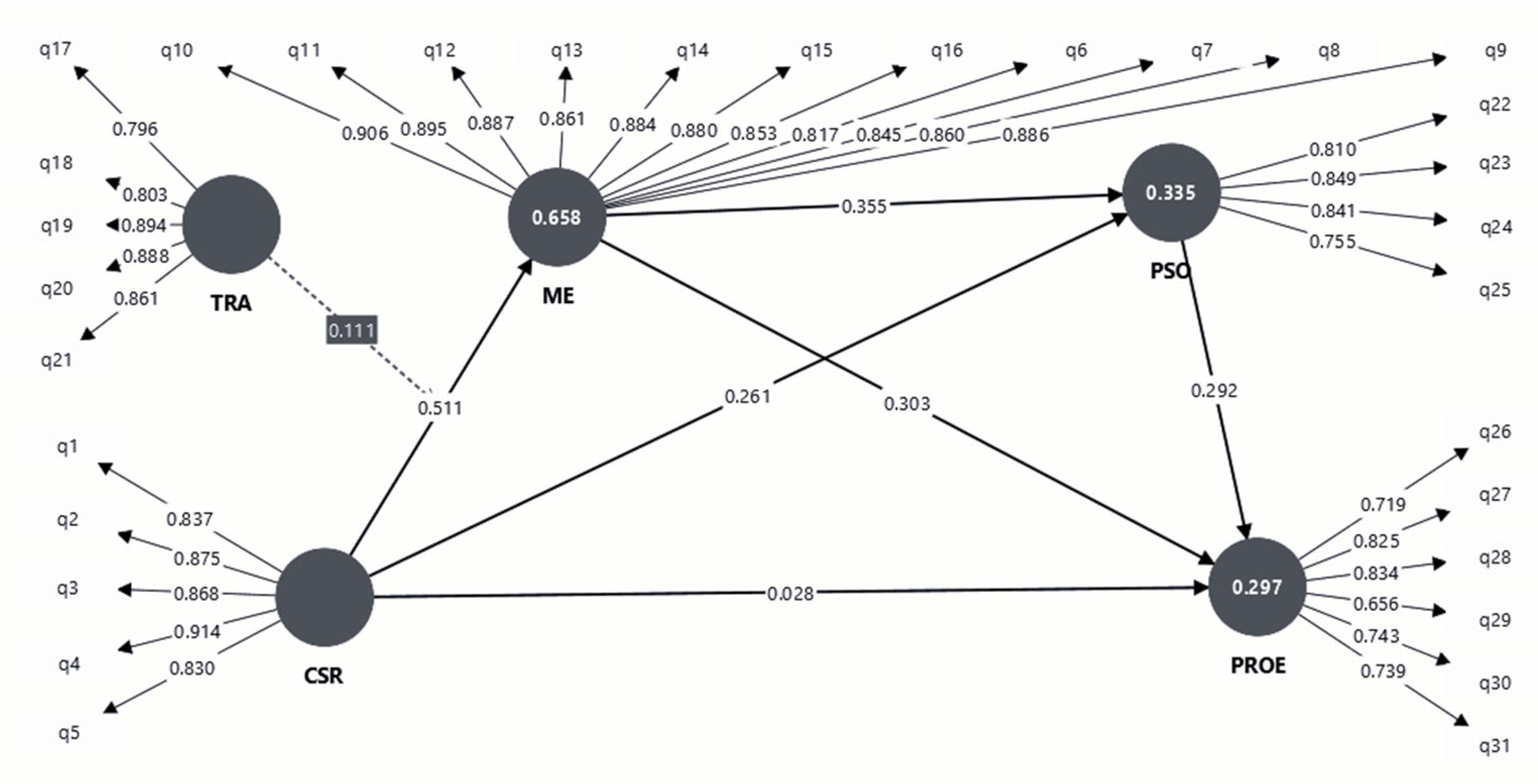
The analysis was conducted in three phases: initially assessing direct impacts, subsequently investigating mediation effects, and ultimately exploring moderation or interaction effects [77,78,79,82,83,84,85,86,87,88,89,90,91,92,93,94,95]. The results are depicted in Figure 2 (pertaining to direct impacts) and Table 5.
The structural model demonstrated acceptable explanatory power. CSR, TRA, and their interaction accounted for 65.8% of the variance in ME (R2 = 0.658), indicating significant explanatory power. CSR and ME accounted for 33.5% of PSO (R2 = 0.335), and the full model accounted for 29.7% of PROE (R2 = 0.297), indicating that the model was moderately accurate.
Effect sizes (F2). CSR had a big impact on ME (F2 = 0.388), and TRA had a medium impact (F2 = 0.239). The interaction between CSR and TRA had a small impact (F2 = 0.044). For PSO, CSR had a small effect (F2 = 0.044), and ME had a small to moderate effect (F2 = 0.081). For PROE, CSR did not have a significant impact (F2 = 0.000); however, ME (F2 = 0.052) and PSO (F2 = 0.081) exhibited small to moderate effects. These results substantiate the predominantly indirect impact of CSR on guests’ pro-environmental behaviors.
Effects of control variables.
To examine whether demographic characteristics (age, gender, education, marital status, and residence) influenced our outcome variable, we ran an auxiliary linear regression in SPSS. Among the control variables, only age showed a small positive association with PROE (β = 0.13, p = 0.004); education, marital status, and gender were non-significant predictors (|β| ≤ 0.08, p > 0.05).

4.5. Direct and Interaction Effects

Among the direct effects, corporate social responsibility (CSR) significantly influenced ME (β = 0.511, p < 0.001) and PSO (β = 0.261, p < 0.001), but had no direct impact on pro-environmental behavior (PROE) (β = 0.028, p = 0.493). ME significantly predicted PSO (β = 0.355, p < 0.001), and PSO had a strong positive effect on PROE (β = 0.292, p < 0.001). In terms of TRA, it exerted significant direct effects on ME (β = 0.411, p < 0.001), PSO (β = 0.143, p < 0.001), and PROE (β = 0.292, p < 0.001). The interaction term (TRA × CSR) was significant in predicting ME (β = 0.111, p = 0.001), PSO (β = 0.039, p = 0.008), and PROE (β = 0.012, p = 0.023), confirming its moderating influence. Table 6 presents the results for the direct, interaction, and indirect effects, including t-values and p-values obtained through bootstrapping.
Bootstrapped Effects
Table 6 summarizes the bootstrapped confidence intervals (CIs) for the mediation and moderated mediation paths. All lower-level and upper-level confidence intervals (LLCI and ULCI) exclude zero, confirming that these paths are significant (Table 7).
Results are based on a percentile bootstrap with 5000 subsamples, using a two-tailed significance test and 95% confidence intervals. SmartPLS gives the standard deviation of bootstrap estimates (STDEV) instead of classical errors, and that is why this study used t-values and confidence intervals.
The bootstrapping results show that CSR has a strong and statistically significant direct effect on ME (β = 0.511, t = 10.992, p < 0.001; 95% CI [0.419, 0.602]) and a significant direct effect on PSO (β = 0.261, t = 3.846, p < 0.001; 95% CI [0.132, 0.395]), while its direct effect on PROE is not significant (β = 0.028, t = 0.352, p = 0.725; 95% CI [−0.129, 0.177]), indicating that CSR influences PROE mainly through mediators rather than directly. ME significantly predicts both PROE (β = 0.303, t = 3.770, p < 0.001; 95% CI [0.146, 0.466]) and PSO (β = 0.355, t = 5.303, p < 0.001; 95% CI [0.218, 0.484]), and PSO also significantly predicts PROE (β = 0.292, t = 5.086, p < 0.001; 95% CI [0.178, 0.402]). Moreover, TRA positively affects ME (β = 0.415, t = 7.844, p < 0.001; 95% CI [0.308, 0.516]) and shows significant indirect effects on PROE and PSO, suggesting downstream benefits through the mediating chain. Importantly, the interaction term TRA × CSR significantly increases ME (β = 0.111, t = 3.306, p = 0.001; 95% CI [0.043, 0.175]) and also yields significant indirect effects on PROE and PSO, supporting a moderation pattern where higher TRA strengthens CSR’s impact on ME and ultimately enhances outcomes; consistent with this, the total effects confirm that CSR is significantly related to PROE (β = 0.312, p < 0.001) and PSO (β = 0.443, p < 0.001) once indirect pathways are included.
Summary of Hypothesis results
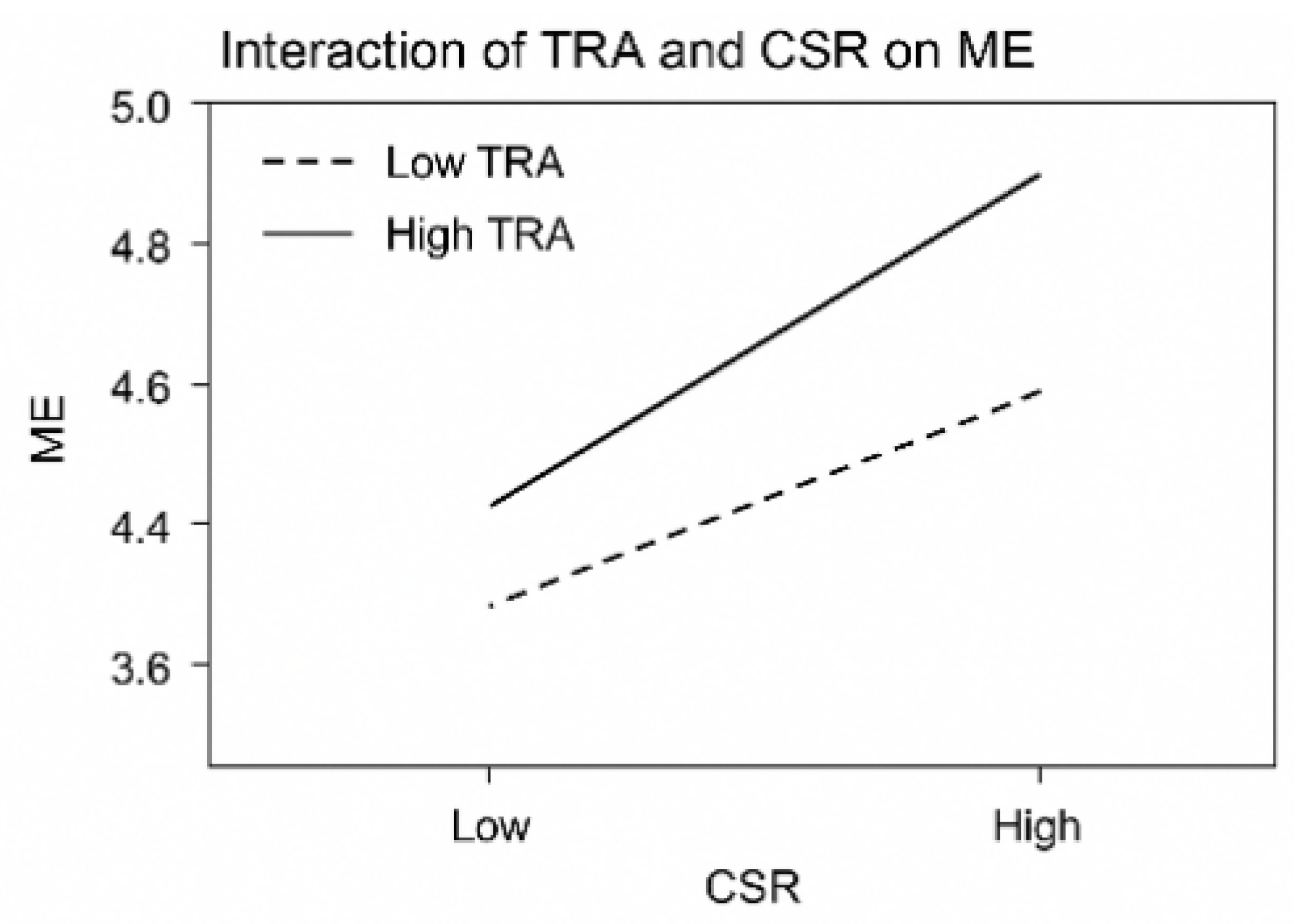
The results of the structural model are summarized below: H1: CSR → PROE (direct effect) The direct effect of CSR on PROE was not statistically significant (β = 0.045, t = 0.686, p = 0.493), indicating that CSR alone does not directly predict employees’ pro-environmental behaviors. According to this result, H1 was not supported. H2: ME mediates the relationship CSR → PROE. A significant indirect effect was found through ME (Indirect β = 0.157, 95% CI [0.075, 0.246]), with a strong direct effect of CSR on ME (β = 0.514, p < 0.001). This supports the mediating role of ME in explaining how CSR influences PROE. H3: PSO mediates the relationship CSR → PROE. A significant indirect effect through PSO was observed (Indirect β = 0.081, t = 3.336, p = 0.001), indicating that CSR also affects PROE by enhancing psychological safety. Therefore, H3 is supported. H4: ME and PSO serially mediate CSR → PROE. The serial mediation path CSR → ME → PSO → PROE was significant (Indirect β = 0.055, t = 3.166, p = 0.002), indicating that CSR influences ME, which enhances PSO, ultimately increasing PROE. Thus, H4 is supported. H5: TRA moderates CSR → ME. The interaction effect between CSR and TRA on ME was significant (β = 0.111, t = 3.298, p = 0.001), indicating that TRA strengthens the positive relationship between CSR and ME. Therefore, H5 is supported. H6: TRA moderates the serial mediation CSR → ME → PSO → PROE. The moderated serial mediation path was also significant (Indirect β = 0.012, t = 2.277, p = 0.023), and the confidence interval did not include zero. This indicates that the positive indirect effect of CSR on PROE through ME and PSO is stronger when TRA is high (Figure 3 and Table 8).

5. Discussion

5.1. General Conclusions

The results of this study offer significant insights into how hotel CSR influences guest behavior through psychological mechanisms rather than direct impacts. The findings illustrate not only the significance of CSR practices but also the critical mechanisms and circumstances that drive guests to engage in pro-environmental behavior.
The direct path from CSR to guests’ pro-environmental behavior (PROE) was not supported, as it emphasized that CSR practices alone are not important in fostering guests’ environmental behavior. This finding aligns with evidence that the attitude–behavior link is fragile in hotels: guests often act less sustainably than at home, and “green” cues rarely shift behavior without psychological support or contextual design [86]. This pattern aligns with TPB-based arguments that attitudes are not sufficient predictors of behavior in low-effort contexts and with environmental psychology studies demonstrating that pro-environmental behavior requires emotional, social, or situational reinforcement. Field work by [69] confirms that contextual cues at the point of choice, rather than CSR communication alone, reduce food waste, supporting our finding that mediation is necessary.
H2, the mediating role of ME between CSR and PROE, was supported. This parallels employee-side studies showing that CSR directed at external stakeholders evokes ME, which promotes positive behaviors [14]. Similarly, ref. [37] found that green hotel practices elicited “green citizenship” via pride and elevation. These findings show that elevation has a downstream effect on PROE, not just WOM or citizenship. This strengthens the idea that moral emotions can connect organizational CSR and individual sustainability behavior.
H3 and H4, testing PSO as a mediator and the serial CSR → ME → PSO → PROE pathway, were also supported. This complements the findings from [75] that CSR shapes guests’ moral states, leading to green and pro-social intentions. Pro-social behavior is often seen as a starting point that extends to associated sustainability actions, and this study incorporates the moral–emotional initial stage, explaining the transition from “being moved” to “doing more” for others and the environment. This strengthens the theoretical connection between moral psychology (elevation → helping) and environmental behavior research (helping → ecological action), pointing out that environmental behavior may arise from deeper other-regarding motivations.
H5, the moderating role of TRA on CSR → ME, was supported. Clear CSR communication reduces skepticism and perceptions of hypocrisy, whereas vague communication creates doubt [38,39,40,41,42,43,44,45,46,47,48,49,50,51,52,53,54,55,56,57,58,59,60,61,62,63,64,65,66,67,68,69,70,71,72,73,74,75,76,77,78,79,82,83,84,85,86,87,88,89,90,91,92,93,94,95,96]. This is consistent with the signaling perspective that believable, verified CSR signals elicit stronger emotional responses, as well as attribution theory, which anticipates altruistic attributions under transparent communication. The results support the idea that transparency serves as a credibility amplifier in CSR-emotion processes, as evidence suggests that CSR messages that are tailored to guests’ expectations are more compelling [97].
H6, the moderated serial mediation CSR → ME → PSO → PROE, was also supported. Similar boundary effects are seen in how green practices vary by hotel type or star rating [37]. Our study demonstrates that transparency itself acts as a credibility filter shaping the full affective–behavioral pathway.
The larger sample size in the 18–27 group (39.2%) indicates that younger generations are likely to show greater interest in CSR initiatives than older generations [98,99]. Regarding gender, the female group was larger in the sample (56.1%), supporting the idea that female respondents are more likely to demonstrate sensitivity to social, ethical, and CSR-related issues than their male counterparts [100]. In education, the largest sample category is “4-year college degree” (40.6%), which supports the methodological research showing that higher educational attainment is associated with a greater likelihood of participation in voluntary samples [101]. A very high number of the sample group were residing in urban areas (79.8%), and it is possible to state that individuals living in urban communities are more likely to witness and react to greater social norms and civic engagements, which can be associated with a stronger responsiveness to the socially oriented practices of organizations [80]. Together, the demographic characteristics can explain the observed strength of the moral–emotional and pro-environmental pathways identified in the study. It is important to note that these interpretations are offered as contextual explanations without country-related bias, but future studies with more diverse demographic samples may contradict or strengthen these patterns.
Overall, CSR seldom shifts guests’ behavior directly. Instead, its influence runs through moral emotions and pro-social tendencies, moderated by transparency. Our contribution is threefold: (i) documenting a serial pathway from ME to PSO to PROE, (ii) testing transparency as a moderator of CSR → ME, and (iii) demonstrating a fully moderated serial mediation that integrates these elements in one model.

5.2. Theoretical Implications

The study offers various contributions to CSR and sustainability research in the context of hospitality. The Theory of Planned Behavior (TPB) is extended by demonstrating that moral–emotional mechanisms play a central role in translating corporate social responsibility (CSR) initiatives into guest behavior.
We extend CSR research, which has largely emphasized attitudes, norms, and control, by enriching TPB with moral–normative content and showing that moral elevation (ME) can shape decision processes [21,22,23,24,25,26,27,28,29,30,31,32,33,34,35,36,37,38,39,40,41,42,43,44,45,46]. Prior work suggests that “green” cues elicit extra-role responses; our findings sharpen this by showing that elevation fuels CSR’s effects on both pro-social and pro-environmental outcomes [14,15,16,17,18,19,20,21,22,23,24,25,26,27,28,29,30,31,32,33,34,35,36,37].
Our evidence for the CSR → ME → PSO → PROE chain illustrates how feeling moved first leads to acting for others, then for the environment. This bridges two literatures: micro-CSR work on elevation and helping/OCB, and sustainability research on PEB and green WOM. Showcasing this serial mediation for guests increases the employee-focused results and puts PSO at the center as a variable that influences environmental action [14,15,16,17,18,19,20,21,22,23,24,25,26,27,28,29,30,31,32,33,34,35,36,37].
The study also found that TRA amplifies the CSR-ME connection. Transparent communication steers attributions toward altruistic rather than self-serving motives, which is a suitable condition for when ME is most likely to occur [38,39,40,41,42,43,44,45,46,47,48,49,50,51,52,53,54,55,56,57,58,59,60,61,62,63,64,65,66,67,68,69,70,71,72,73,74]. It is possible to view transparency as a filter of credibility that determines whether the emotion-to-behavior links work. This study’s moderated serial mediation advances the research on CSR in the hospitality context by defining authenticity and clarity as key boundary conditions [75].
This study not only adds moral and normative elements to the Theory of Planned Behavior (TPB), but also points out where TPB falls short in explaining CSR-driven actions in hospitality. TPB focuses on deliberate, reasoned choices, but CSR efforts often work through emotional and moral triggers that happen before people form conscious intentions [81]. The results show that moral elevation can start a chain of pro-social and pro-environmental actions, suggesting that CSR effects may come from emotion-driven processes that run alongside, rather than inside, the usual TPB framework [102]. These findings highlight the need to include emotional and moral factors in future models to understand sustainability decisions. This research adds to sustainability theory by showing evidence of behavioral spillover in the context of CSR. The results indicate that when CSR activities inspire moral elevation, people are first motivated to act pro-socially, and this behavior leads to more environmentally friendly actions [103]. The results show that the behaviors are connected to each other and influenced by social and moral actions together. By focusing on PSO as the pathway before PROE, our study increases the understanding of how CSR efforts can be a catalyst to indirectly affect wider sustainability benefits beyond their direct social impact.
Lastly, the research adds to CSR theory by focusing on hotel guests instead of employees, a group that has not been studied as much in moral–emotional CSR research. Earlier research mostly looked at how CSR affects employees’ attitudes and actions, but our results show that similar emotional and behavioral patterns also appear among consumers in service settings [104]. By looking at this new group, our findings support the broader relevance of moral elevation and pro-social behavior theories outside of organizations.
In conclusion, due to the fragile nature of attitude–behavior pathways in the hotel sector, the findings of the study reinforce the affective–attribution view of TPB, as transparent CSR creates elevation, which then increases pro-social responses that lead to friendly actions in an environmental manner. TPB is not a sufficient model to fully explain, as it is only one framework [46,47,48,49,50,51,52,53,54,55,56,57,58,59,60,61,62,63,64,65,66,67,68,69,70,71,72,73,74,75,76,77,78,79,80,81,82,83,84,85,86,87,88,89,90,91,92,93,94,95,96,97,98,99,100,101,102,103,104,105].

5.3. Practical Implications

This study offers several practical takeaways for hotel managers seeking to encourage guests to adopt environmentally friendly practices. The results show that CSR initiatives by themselves do not directly lead guests to make greener choices. Instead, these efforts work best when they inspire positive moral emotions, especially moral elevation [102]. Managers should act beyond passive and symbolic CSR efforts and instead work on activities that guests can observe, experience, and connect with emotionally. Such activities include volunteering, environmental restoration, and local support projects, which guests can also participate in. These types of activities are more likely to spark moral elevation, which is the first step toward encouraging sustainable behavior.
The study also shows that transparency is key to making CSR efforts more effective. When hotels clearly and reliably share information about their CSR activities, guests are more likely to trust and support these efforts and to change their own behavior [13]. Hotels should make their CSR messages clear and easy to find, whether on their websites, in guest rooms, on digital platforms, or on property signs. By sharing real results, explaining their CSR efforts, and giving specific examples, hotels can build trust and encourage guests to be more eco-friendly during their stay.
Third, the central role of pro-social behavior suggests that hotels can facilitate opportunities for guests to nurture their pro-social behaviors. Pro-social activities act as a bridge between feeling inspired and making greener choices. Managers can set up donation programs, social projects, or small environmental activities for guests to participate in. These opportunities not only encourage guests to help others but also make it easier for them to take positive steps for the environment. While hotels do take initiatives, the important part is how CSR initiatives are designed, communicated, and integrated into the guest experience. Hotels can elicit deeper connections in an emotional manner with guests and promote sustainable behavior at an increased level by using strategic transparency in communication, creating opportunities for pro-social engagement, and leveraging moral emotions.

5.4. Limitations and Future Research

This study, while offering valuable information, still has several limitations that can direct future studies. First, the data was collected from hotels’ guests in the Turkish Republic of Northern Cyprus (TRNC). Because the study was done on a small island with a unique culture and tourist dynamics, the results may not fully apply to all hospitality markets; therefore, future studies can collect the data from more touristic destinations or other countries.
This study did not consider the effect of different cultures among tourists. Future studies may consider cross-cultural or multi-group comparisons to check the pathway that can work for all types of guests.
As the study is cross-sectional, this limits the casual inference of the moderated serial mediation models. Longitudinal or field studies are recommended as future research to capture the long-term indirect effects [106,107,108].
The research relies solely on self-reported data. As this data can be affected by social desirability bias [90], future studies can pair surveys with indicators of behavior (e.g., NGO confirmations, measures of guests’ sustainability actions, and data regarding guest participation).
Transparency is a broad construct that still requires research, with sub-dimensions such as CSR scoreboards, third-party audits, and narrative reporting to determine which is the better choice for increasing trust and ME [38,39,40,41,42,43,44,45,46,47,48,49,50,51,52,53,54,55,56,57,58,59,60,61,62,63,64,65,66,67,68,69,70,71,72,73,74,75].
Generalization is another issue, as hospitality contexts vary across segments and cultures. In all-inclusive hotels, for example, the attitude–behavior link often weakens, though targeted sustainability cues can still promote green actions [69]. Replication across hotel types and cultural settings, along with measurement-invariance checks, would clarify whether the findings hold across contexts [109].
Finally, future research could use pre-registered designs across different time frames and CSR communication levels. Because hotels may fail to meet targets or provide timely updates, longitudinal designs could track how quickly guests translate transparent CSR communication into sustained engagement and pro-environmental behavior [37,38,39,40,41,42,43,44,45,46,47,48,49,50,51,52,53,54,55,56,57,58,59,60,61,62,63,64,65,66,67,68,69,70,71,72,73,74,75,76].

Author Contributions

Conceptualization, K.A.Y. and H.R.; Methodology, K.A.Y.; Resources, K.A.Y.; Writing—original draft, K.A.Y.; Writing—review & editing, K.A.Y. and H.R.; Supervision, H.K. and H.R.; Project administration, H.R. All authors have read and agreed to the published version of the manuscript.

Funding

This research received no external funding.

Institutional Review Board Statement

The study was conducted in accordance with the Declaration of Helsinki, and approved by the Institutional Review Board of Tourism Faculty Ethics Subcommittee of Eastern Mediterranean University (protocol code: ETK00-2024-0172 and date of approval: 21 August 2024).

Informed Consent Statement

Informed consent was obtained from all subjects involved in the study.

Data Availability Statement

The original contributions presented in this study are included in the article. Further inquiries can be directed to the corresponding author.

Conflicts of Interest

The authors declare no conflict of interest.

Abbreviations

The following abbreviations are used in this manuscript:
CSRCorporate Social Responsibility
PSOPro-social Behavior
PROEPro-environmental Behavior
MEMoral Elevation
TRAPerception of Transparency
TPBTheory of Planned Behavior
OCBOrganizational Citizenship Behavior

References

  1. United Nations. The Sustainable Development Goals Report 2023: Special Edition; United Nations: New York, NY, USA, 2023; Available online: https://unstats.un.org/sdgs/report/2023/ (accessed on 1 October 2025).
  2. Alnawas, I.; El Hedhli, K.; Abu Farah, A.; Zourrig, H. The effects of hotels’ environmental sustainability communication strategies on social media engagement and brand advocacy: The roles of communication characteristics and customers’ personality traits. J. Vacat. Mark. 2024, 31, 596–613. [Google Scholar] [CrossRef]
  3. Farrukh, M.; Raza, A.; Mansoor, A.; Khan, M.S.; Lee, J.W.C. Trends and patterns in pro-environmental behaviour research: A bibliometric review and research agenda. Benchmarking 2023, 30, 681–696. [Google Scholar] [CrossRef]
  4. Rezapouraghdam, H.; Alipour, H.; Arasli, H. Workplace spirituality and organization sustainability: A theoretical perspective on hospitality employees’ sustainable behavior. Environ. Dev. Sustain. 2019, 21, 1583–1601. [Google Scholar] [CrossRef]
  5. Uyar, A.; Kilic, M.; Koseoglu, M.A.; Kuzey, C.; Karaman, A.S. The link among board characteristics, CSR performance, and financial performance: Evidence from the hospitality and tourism industry. Tour. Manag. Perspect. 2020, 35, 100714. [Google Scholar] [CrossRef]
  6. Zutshi, A.; Creed, A.; Bhattacharya, A.; Croy, G.; Dahms, S. Sustainability during the COVID pandemic: Analysis of hotel association communication. Curr. Issues Tour. 2022, 25, 3840–3853. [Google Scholar] [CrossRef]
  7. Gulati, S. Social and sustainable: Exploring social media use for promoting sustainable behaviour among Indian tourists. Int. Hosp. Rev. 2021, 36, 373–393. [Google Scholar] [CrossRef]
  8. Dedeoğlu, B.B.; Taheri, B.; Okumus, F.; Gannon, M. Understanding the importance that consumers attach to social media sharing (ISMS): Scale development and validation. Tour. Manag. 2020, 76, 103954. [Google Scholar] [CrossRef]
  9. García-de los Salmones, M.d.M.; Herrero, A.; Martinez, P. CSR communication on Facebook: Attitude towards the company and intention to share. Int. J. Contemp. Hosp. Manag. 2021, 33, 1391–1411. [Google Scholar] [CrossRef]
  10. Akbari, M.; Nazarian, A.; Foroudi, P.; Seyyed Amiri, N.; Ezatabadipoor, E. How CSR contributes to strengthening brand loyalty, hotel positioning and intention to revisit. Curr. Issues Tour. 2020, 24, 1897–1917. [Google Scholar] [CrossRef]
  11. Pérez, A.; García de los Salmones, M.d.M.; Liu, M.T. Maximising business returns to corporate social responsibility communication: An empirical test. Bus. Ethics Eur. Rev. 2019, 28, 275–289. [Google Scholar] [CrossRef]
  12. Hung, K.K.C.; Mark, C.K.M.; Yeung, M.P.S.; Chan, E.Y.Y.; Graham, C.A. The role of the hotel industry in the response to emerging epidemics: A case study of SARS in 2003 and H1N1 swine flu in 2009 in Hong Kong. Glob. Health 2018, 14, 117. [Google Scholar] [CrossRef] [PubMed]
  13. Latif, K.F.; Pérez, A.; Sahibzada, U.F. Corporate social responsibility (CSR) and customer loyalty in the hotel industry: A cross-country study. Int. J. Hosp. Manag. 2020, 89, 102565. [Google Scholar] [CrossRef]
  14. Hericher, C.; Bridoux, F.; Raineri, N. I feel morally elevated by my organization’s CSR, so I contribute to it. J. Bus. Res. 2023, 169, 114282. [Google Scholar] [CrossRef]
  15. De Roeck, K.; El Akremi, A.; Swaen, V. Consistency matters! How and when does corporate social responsibility affect employees’ organizational identification? J. Manag. Stud. 2016, 53, 1141–1168. [Google Scholar] [CrossRef]
  16. Dunford, B.B.; Jackson, C.L.; Boss, A.D.; Tay, L.; Boss, R.W. Be fair, your employees are watching: A relational response model of external third-party justice. Pers. Psychol. 2015, 68, 319–352. [Google Scholar] [CrossRef]
  17. Small, D.A.; Cryder, C. Prosocial consumer behavior. Curr. Opin. Psychol. 2016, 10, 107–111. [Google Scholar] [CrossRef]
  18. Bazrafshan, S.; McIntosh, A.; Cockburn-Wootten, C. Advancing a social justice-orientated agenda through research: A review of refugee-related research in tourism. J. Sustain. Tour. 2023, 32, 1142–1160. [Google Scholar] [CrossRef]
  19. Chi, X.; Cai, G.; Han, H. Festival travellers’ pro-social and protective behaviours against COVID-19 in the time of pandemic. Curr. Issues Tour. 2021, 24, 3256–3270. [Google Scholar] [CrossRef]
  20. Ramkissoon, H. COVID-19 place confinement, pro-social, pro-environmental behaviors, and residents’ wellbeing: A new conceptual framework. Front. Psychol. 2020, 11, 2248. [Google Scholar] [CrossRef]
  21. Haidt, J. Elevation and the positive psychology of morality. In Flourishing: Positive Psychology and the Life Well-Lived; Keyes, C.L.M., Haidt, J., Eds.; American Psychological Association: Washington, DC, USA, 2003; pp. 275–289. [Google Scholar] [CrossRef]
  22. Huang, M.; Fang, S. Mechanisms of self-control in the influence of moral elevation on pro-social behavior: A study based on an experimental paradigm. Psychol. Res. Behav. Manag. 2024, 17, 537–552. [Google Scholar] [CrossRef]
  23. Ding, W.; Shao, Y.; Sun, B.; Xie, R.; Li, W.; Wang, X. How can prosocial behavior be motivated? The different roles of moral judgment, moral elevation, and moral identity among young Chinese. Front. Psychol. 2018, 9, 814. [Google Scholar] [CrossRef] [PubMed]
  24. Romani, S.; Grappi, S. How companies’ good deeds encourage consumers to adopt pro-social behavior. Eur. J. Mark. 2014, 48, 943–963. [Google Scholar] [CrossRef]
  25. Shang, J.; Basil, D.Z.; Wymer, W. Using social marketing to enhance hotel reuse programs. J. Bus. Res. 2010, 63, 166–172. [Google Scholar] [CrossRef]
  26. Bushman, R.M.; Smith, A.J. Financial accounting information and corporate governance. SSRN Electron. J. 2002, 32, 237–333. [Google Scholar] [CrossRef]
  27. Schnackenberg, A.K.; Tomlinson, E.C. Organizational transparency: A new perspective on managing trust in organization–stakeholder relationships. J. Manag. 2016, 42, 1784–1810. [Google Scholar] [CrossRef]
  28. Rawlins, B. Give the emperor a mirror: Toward developing a stakeholder measurement of organizational transparency. J. Public Relat. Res. 2008, 21, 71–99. [Google Scholar] [CrossRef]
  29. Balaji, M.S.; Jiang, Y.; Jha, S. Green hotel adoption: A personal choice or social pressure? Int. J. Contemp. Hosp. Manag. 2019, 31, 3287–3305. [Google Scholar] [CrossRef]
  30. Choi, H.; Jang, J.; Kandampully, J. Application of the extended VBN theory to understand consumers’ decisions about green hotels. Int. J. Hosp. Manag. 2015, 51, 87–95. [Google Scholar] [CrossRef]
  31. Goldstein, N.J.; Cialdini, R.B.; Griskevicius, V. A room with a viewpoint: Using social norms to motivate environmental conservation in hotels. J. Consum. Res. 2008, 35, 472–482. [Google Scholar] [CrossRef]
  32. Akhshik, A.; Rezapouraghdam, H.; Ozturen, A.; Ramkissoon, H. Memorable tourism experiences and critical outcomes among nature-based visitors: A fuzzy-set qualitative comparative analysis approach. Curr. Issues Tour. 2022, 26, 2981–3003. [Google Scholar] [CrossRef]
  33. Karatepe, O.M.; Rezapouraghdam, H.; Hassannia, R.; Kim, T.T.; Enea, C. Tourism destination social responsibility and the moderating role of self-congruity. Tour. Rev. 2024, 79, 568–584. [Google Scholar] [CrossRef]
  34. Rezapouraghdam, H.; Akhshik, A.; Ramkissoon, H. Application of machine learning to predict visitors’ green behavior in marine protected areas: Evidence from Cyprus. J. Sustain. Tour. 2023, 31, 2479–2505. [Google Scholar] [CrossRef]
  35. White, K.; Habib, R.; Hardisty, D.J. How to SHIFT consumer behaviors to be more sustainable: A literature review and guiding framework. J. Mark. 2019, 83, 22–49. [Google Scholar] [CrossRef]
  36. Han, H.; Yoon, H.J. Hotel customers’ environmentally responsible behavioral intention: Impact of key constructs on decision in green consumerism. Int. J. Hosp. Manag. 2015, 45, 22–33. [Google Scholar] [CrossRef]
  37. Tran, D.V.; Nguyen, D.M.; Nguyen, T. Fostering green customer citizenship behavioral intentions through green hotel practices: The roles of pride, moral elevation, and hotel star ratings. J. Sustain. Tour. 2024, 33, 122–142. [Google Scholar] [CrossRef]
  38. Nguyen, N.; Priporas, C.-V.; McPherson, M.; Manyiwa, S. CSR-related consumer scepticism: A review of the literature and future research directions. J. Bus. Res. 2023, 169, 114294. [Google Scholar] [CrossRef]
  39. Boo, S.; Kim, M.; Kim, T.J. Effectiveness of corporate social marketing on prosocial behavior and hotel loyalty in a time of pandemic. Int. J. Hosp. Manag. 2024, 117, 103635. [Google Scholar] [CrossRef]
  40. Truong, V.D.; Hall, C.M. Corporate social marketing in tourism: To sleep or not to sleep with the enemy? J. Sustain. Tour. 2016, 25, 884–902. [Google Scholar] [CrossRef]
  41. Thomas, G.; Albishri, N.A. Driving employee organizational citizenship behaviour through CSR: An empirical study in the context of luxury hotels. Acta Psychol. 2024, 245, 104231. [Google Scholar] [CrossRef]
  42. Gond, J.-P.; El Akremi, A.; Swaen, V.; Babu, N. The psychological microfoundations of corporate social responsibility: A person-centric systematic review. J. Organ. Behav. 2017, 38, 225–246. [Google Scholar] [CrossRef]
  43. Goldstein, N.J.; Griskevicius, V.; Cialdini, R.B. Invoking social norms: A social psychology perspective on improving hotels’ linen-reuse programs. Cornell Hotel Restaur. Adm. Q. 2007, 48, 145–150. [Google Scholar] [CrossRef]
  44. Hsieh, Y.J.; Chen, Y.-L.; Wang, Y.-C. Government and social trust vs. hotel response efficacy: A protection motivation perspective on hotel stay intention during the COVID-19 pandemic. Int. J. Hosp. Manag. 2021, 97, 102991. [Google Scholar] [CrossRef] [PubMed]
  45. Tong, Z.; Xie, Y.; Xiao, H. Effect of CSR contribution timing during the COVID-19 pandemic on consumers’ prepayment purchase intentions: Evidence from the hospitality industry in China. Int. J. Hosp. Manag. 2021, 97, 102997. [Google Scholar] [CrossRef] [PubMed]
  46. Ajzen, I. The theory of planned behavior. Organ. Behav. Hum. Decis. Process. 1991, 50, 179–211. [Google Scholar] [CrossRef]
  47. Kelley, H.H. The processes of causal attribution. Am. Psychol. 1973, 28, 107–128. [Google Scholar] [CrossRef]
  48. Claver-Cortés, E.; Molina-Azorín, J.F.; Pereira-Moliner, J.; López-Gamero, M.D. Environmental strategies and their impact on hotel performance. J. Sustain. Tour. 2007, 15, 663–679. [Google Scholar] [CrossRef]
  49. Dahlgaard-Park, S.M.; Reyes, L.; Chen, C.-K. The evolution and convergence of total quality management and management theories. Total Qual. Manag. Bus. Excell. 2018, 29, 1108–1128. [Google Scholar] [CrossRef]
  50. de Grosbois, D. Corporate social responsibility reporting in the cruise tourism industry: A performance evaluation using a new institutional theory–based model. J. Sustain. Tour. 2016, 24, 245–269. [Google Scholar] [CrossRef]
  51. González-Rodríguez, M.R.; Díaz-Fernández, M.C.; Biagio, S. The perception of socially and environmentally responsible practices based on values and cultural environment from a customer perspective. J. Clean. Prod. 2019, 216, 88–98. [Google Scholar] [CrossRef]
  52. Kang, K.H.; Lee, S.; Huh, C. Impacts of positive and negative corporate social responsibility activities on company performance in the hospitality industry. Int. J. Hosp. Manag. 2010, 29, 72–82. [Google Scholar] [CrossRef]
  53. van Doorn, J.; Onrust, M.; Verhoef, P.C.; Bügel, M.S. The impact of corporate social responsibility on customer attitudes and retention—The moderating role of brand success indicators. Mark. Lett. 2017, 28, 607–619. [Google Scholar] [CrossRef]
  54. Margolis, J.D.; Elfenbein, H.A.; Walsh, J.P. Does it pay to be good…and does it matter? A meta-analysis of the relationship between corporate social and financial performance. SSRN Electron. J. 2007, 68. [Google Scholar] [CrossRef]
  55. Orlitzky, M.; Schmidt, F.L.; Rynes, S.L. Corporate social and financial performance: A meta-analysis. Organ. Stud. 2003, 24, 403–441. [Google Scholar] [CrossRef]
  56. Barnett, M.L.; Henriques, I.; Husted, B.W. Beyond good intentions: Designing CSR initiatives for greater social impact. J. Manag. 2020, 46, 349–377. [Google Scholar] [CrossRef]
  57. Singh, A.B.; Khandelwal, C.; Sarkar, P.; Dangayach, G.S.; Meena, M.L. Recent research progress on corporate social responsibility of hotels. Eng. Proc. 2023, 37, 41. [Google Scholar] [CrossRef]
  58. Gao, Y.; Mattila, A.S.; Lee, S. A meta-analysis of behavioral intentions for environment-friendly initiatives in hospitality research. Int. J. Hosp. Manag. 2016, 54, 107–115. [Google Scholar] [CrossRef]
  59. Algoe, S.B.; Haidt, J. Witnessing excellence in action: The “other-praising” emotions of elevation, gratitude, and admiration. J. Posit. Psychol. 2009, 4, 105–127. [Google Scholar] [CrossRef]
  60. Haidt, J. The positive emotion of elevation. Prev. Treat. 2000, 3, 33c. [Google Scholar] [CrossRef]
  61. Haidt, J. Wired to be inspired. In The Compassionate Instinct; Keltner, D., Marsh, J., Smith, J.A., Eds.; W.W. Norton: New York, NY, USA, 2010; pp. 86–93. [Google Scholar]
  62. Cox, K.S. Elevation predicts domain-specific volunteerism 3 months later. J. Posit. Psychol. 2010, 5, 333–341. [Google Scholar] [CrossRef]
  63. Thomson, A.L.; Nakamura, J.; Siegel, J.T.; Csikszentmihalyi, M. Elevation and mentoring: An experimental assessment of causal relations. J. Posit. Psychol. 2014, 9, 402–413. [Google Scholar] [CrossRef]
  64. Van de Vyver, J.; Abrams, D. Testing the prosocial effectiveness of the prototypical moral emotions: Elevation increases benevolent behaviors and outrage increases justice behaviors. J. Exp. Soc. Psychol. 2015, 58, 23–33. [Google Scholar] [CrossRef]
  65. Bai, J.; Qing, T.; Fan, X.; Hui, S.C. Perceived corporate social responsibility and employee voluntary pro-environmental behavior: Does moral motive matter? Corp. Soc. Responsib. Environ. Manag. 2023, 31, 816–830. [Google Scholar] [CrossRef]
  66. Fatma, M.; Khan, I. Impact of CSR on customer citizenship behavior: Mediating the role of customer engagement. Sustainability 2023, 15, 5802. [Google Scholar] [CrossRef]
  67. Kang, H.J.; Kim, W.G.; Choi, H.-M.; Li, Y. How to fuel employees’ prosocial behavior in the hotel service encounter. Int. J. Hosp. Manag. 2020, 84, 102333. [Google Scholar] [CrossRef]
  68. D’Acunto, D.; Tuan, A.; Dalli, D.; Viglia, G.; Okumus, F. Do consumers care about CSR in their online reviews? An empirical analysis. Int. J. Hosp. Manag. 2019, 85, 102342. [Google Scholar] [CrossRef]
  69. Antonschmidt, H.; Lund-Durlacher, D. Stimulating food waste reduction behaviour among hotel guests through context manipulation. J. Clean. Prod. 2021, 329, 129709. [Google Scholar] [CrossRef]
  70. Han, H.; Yu, J.; Kim, W. Youth travelers and waste reduction behaviors while traveling to tourist destinations. J. Travel Tour. Mark. 2018, 35, 1119–1131. [Google Scholar] [CrossRef]
  71. Naskar, S.T.; Maria, J. Forty years of the theory of planned behavior: A bibliometric analysis (1985–2024). Manag. Rev. Q. 2025, 1–60. [Google Scholar] [CrossRef]
  72. Zhang, Q.; Pong, P.; Wang, L. The efficacy of the theory of planned behaviour and value-belief-norm theory for predicting young Chinese intention to choose green hotels. Sci. Rep. 2025, 15, 14332. [Google Scholar] [CrossRef]
  73. Heider, F. The Psychology of Interpersonal Relations; Wiley: New York, NY, USA, 1958. [Google Scholar] [CrossRef]
  74. Weiner, B. An attributional theory of achievement motivation and emotion. Psychol. Rev. 1985, 92, 548–573. [Google Scholar] [CrossRef]
  75. Manthé, E.; Morrongiello, C.; Bonnefoy-Claudet, L.; Bezançon, M.; Bilgihan, A. Do hotels’ green efforts lead guests to adopt sustainable behaviors? Mediating roles of perceived motives, gratitude, and green trust. Int. J. Hosp. Manag. 2025, 131, 104302. [Google Scholar] [CrossRef]
  76. Boğan, E.; Dedeoğlu, B.B.; Çalışkan, C.; Cheema, S. Employee negative reactions to CSR: Corporate hypocrisy and symbolic CSR attributions as serial mediators. Int. J. Hosp. Manag. 2024, 120, 103786. [Google Scholar] [CrossRef]
  77. Hair, J.F.; Howard, M.C.; Nitzl, C. Assessing measurement model quality in PLS-SEM using confirmatory composite analysis. J. Bus. Res. 2020, 109, 101–110. [Google Scholar] [CrossRef]
  78. Hair, J.F.; Sarstedt, M.; Ringle, C.M.; Gudergan, S.P. Advanced Issues in Partial Least Squares Structural Equation Modeling, 2nd ed.; SAGE Publications: Thousand Oaks, CA, USA, 2024. [Google Scholar]
  79. Henseler, J.; Ringle, C.M.; Sarstedt, M. A new criterion for assessing discriminant validity in variance-based structural equation modeling. J. Acad. Mark. Sci. 2015, 43, 115–135. [Google Scholar] [CrossRef]
  80. Attig, N.; Brockman, P. The local roots of corporate social responsibility. J. Bus. Ethics 2017, 142, 479–496. [Google Scholar] [CrossRef]
  81. Meng, B.; Lee, M.J.; Chua, B.-L.; Han, H. An integrated framework of behavioral reasoning theory, theory of planned behavior, moral norm and emotions for fostering hospitality and tourism employees’ sustainable behaviors. Int. J. Contemp. Hosp. Manag. 2022, 34, 4317–4341. [Google Scholar] [CrossRef]
  82. Brown, T.J.; Dacin, P.A. The company and the product: Corporate associations and consumer product responses. J. Mark. 1997, 61, 68–84. [Google Scholar] [CrossRef]
  83. Aquino, K.; McFerran, B.; Laven, M. Moral identity and the experience of moral elevation in response to acts of uncommon goodness. J. Pers. Soc. Psychol. 2011, 100, 703–718. [Google Scholar] [CrossRef]
  84. Thomson, A.L.; Siegel, J.T. A moral act, elevation, and prosocial behavior: Moderators of morality. J. Posit. Psychol. 2013, 8, 50–64. [Google Scholar] [CrossRef]
  85. Caprara, G.V.; Steca, P.; Zelli, A.; Capanna, C. A new scale for measuring adults’ prosocialness. Eur. J. Psychol. Assess. 2005, 21, 77–89. [Google Scholar] [CrossRef]
  86. Miao, L.; Wei, W. Consumers’ pro-environmental behavior and the underlying motivations: A comparison between household and hotel settings. Int. J. Hosp. Manag. 2013, 32, 102–112. [Google Scholar] [CrossRef]
  87. Liu, M.; Peng, X. Can the home experience in luxury hotels promote pro-environmental behavior among guests? PLoS ONE 2023, 18, e0284981. [Google Scholar] [CrossRef] [PubMed]
  88. Alyahia, M.; Azazz, A.M.S.; Fayyad, S.; Elshaer, I.A.; Mohammad, A.A.A. Greenwashing behavior in hotels industry: The role of green transparency and green authenticity. Sustainability 2024, 16, 1050. [Google Scholar] [CrossRef]
  89. Hustvedt, G.; Kang, J. Consumer perceptions of transparency: A scale development and validation. Fam. Consum. Sci. Res. J. 2013, 41, 299–313. [Google Scholar] [CrossRef]
  90. Podsakoff, P.M.; MacKenzie, S.B.; Lee, J.-Y.; Podsakoff, N.P. Common method biases in behavioral research: A critical review of the literature and recommended remedies. J. Appl. Psychol. 2003, 88, 879–903. [Google Scholar] [CrossRef]
  91. Kock, N. Common method bias: A full collinearity assessment method for PLS-SEM. In Partial Least Squares Path Modeling; Latan, H., Noonan, R., Eds.; Springer: Cham, Switzerland, 2017; pp. 245–257. [Google Scholar] [CrossRef]
  92. Kock, N.; Lynn, G.S. Lateral collinearity and misleading results in variance-based SEM: An illustration and recommendations. J. Assoc. Inf. Syst. 2012, 13, 2. [Google Scholar] [CrossRef]
  93. Henseler, J.; Schuberth, F. Using confirmatory composite analysis to assess emergent variables in business research. J. Bus. Res. 2020, 120, 147–156. [Google Scholar] [CrossRef]
  94. Fornell, C.; Larcker, D.F. Evaluating structural equation models with unobservable variables and measurement error. J. Mark. Res. 1981, 18, 39–50. [Google Scholar] [CrossRef]
  95. Carrión, G.C.; Nitzl, C.; Roldán, J.L. Mediation analyses in partial least squares structural equation modeling: Guidelines and empirical examples. In Partial Least Squares Path Modeling; Latan, H., Noonan, R., Eds.; Springer: Cham, Switzerland, 2017; pp. 173–195. [Google Scholar] [CrossRef]
  96. Roszkowska-Menkes, M.; Aluchna, M.; Kamiński, B. True transparency or mere decoupling? The study of selective disclosure in sustainability reporting. Crit. Perspect. Account. 2024, 98, 102700. [Google Scholar] [CrossRef]
  97. Tao, Y.; Wang, C.; Zhang, T.; Zhai, L.; Gao, Y.; Liu, J. CSR communication in hospitality: Fostering hotel guests’ climate (change) engagement. J. Hosp. Tour. Manag. 2024, 60, 264–276. [Google Scholar] [CrossRef]
  98. Mas-Manchón, L.; Fernández-Cavia, J.; Estanyol, E.; Van-Bergen, P. Differences across generations in the perception of the ethical, social, environmental, and labor responsibilities of the most reputed Spanish organizations. Prof. Inf. 2024, 33, 0302. [Google Scholar] [CrossRef]
  99. Sawicka, J.; Marcinkowska, E. Environmental CSR and the purchase declarations of Generation Z consumers. Sustainability 2023, 15, 12759. [Google Scholar] [CrossRef]
  100. Berényi, L.; Deutsch, N. Gender differences in attitudes to corporate social responsibility among Hungarian business students. WSEAS Trans. Bus. Econ. 2017, 14, 298–310. [Google Scholar]
  101. Cheung, K.L.; ten Klooster, P.M.; Smit, C.; de Vries, H.; Pieterse, M.E. The impact of non-response bias due to sampling in public health studies: A comparison of voluntary versus mandatory recruitment in a Dutch national survey on adolescent health. BMC Public Health 2017, 17, 276. [Google Scholar] [CrossRef]
  102. Thein, K.S.; Takahashi, Y.; Soe, A.T.; Lwin, C.M. Hotel employees’ pro-environmental behavior: A functionalist approach to positive moral psychology. Curr. Psychol. 2025, 44, 14729–14737. [Google Scholar] [CrossRef]
  103. Shao, J.; Mahmood, A.; Han, H. Unleashing the potential role of CSR and altruistic values to foster pro-environmental behavior by hotel employees. Int. J. Environ. Res. Public Health 2021, 18, 13327. [Google Scholar] [CrossRef]
  104. Wekesa, J. Impact of corporate social responsibility on consumer behavior. Int. J. Mark. Strateg. 2024, 6, 35–45. [Google Scholar] [CrossRef]
  105. Tao, W.; Song, B.; Ferguson, M.A.; Kochhar, S. Employees’ prosocial behavioral intentions through empowerment in CSR decision-making. Public Relat. Rev. 2018, 44, 667–680. [Google Scholar] [CrossRef]
  106. Kim, W.; Che, C.; Jeong, C. Hotel guests’ psychological distance of climate change and environment-friendly behavior intention. Int. J. Environ. Res. Public Health 2022, 19, 16. [Google Scholar] [CrossRef]
  107. Acampora, A.; Lucchetti, M.C.; Merli, R.; Ali, F. The theoretical development and research methodology in green hotels research: A systematic literature review. J. Hosp. Tour. Manag. 2022, 51, 512–528. [Google Scholar] [CrossRef]
  108. Cole, D.A.; Maxwell, S.E. Testing mediational models with longitudinal data: Questions and tips in the use of structural equation modeling. J. Abnorm. Psychol. 2003, 112, 558–568. [Google Scholar] [CrossRef]
  109. Maxwell, S.E.; Cole, D.A. Bias in cross-sectional analyses of longitudinal mediation. Psychol. Methods 2007, 12, 23–44. [Google Scholar] [CrossRef]
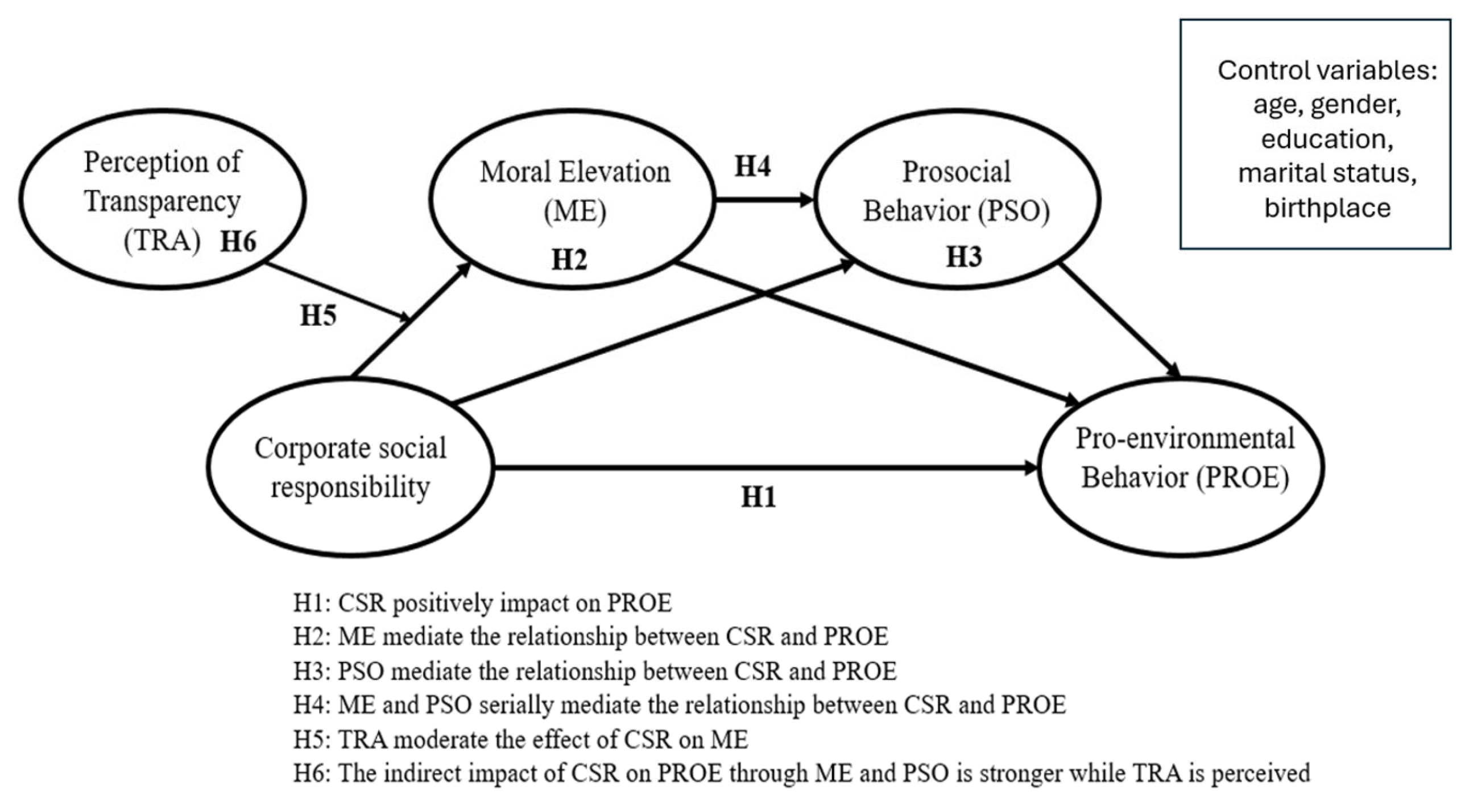
Figure 1. Conceptual model of the study.
Sustainability 18 00866 g001
Figure 2. Direct effects for structural model test results.
Sustainability 18 00866 g002
Figure 3. The moderator acts of TRA.
Sustainability 18 00866 g003
Table 1. Participant demographics (n = 426).
VariableCategoryFrequency (n)Percentage (%)
GenderMale18743.9
Female23956.1
Marital StatusSingle/Divorced26361.7
Married16338.3
BirthplaceUrban34079.8
Rural8620.2
Education LevelPrimary School102.3
Secondary/High School8820.7
2-Year College8319.5
4-Year College Degree17340.6
Master’s Degree or Above7216.9
Age Group18–2716739.2
28–3711727.5
38–476916.2
48–57419.6
58 and Over327.5
Table 2. Confirmatory composite analysis (CCA).
VariableSkewnessKurtosisOuter LoadingsCronbach’s AlphaCRAVE
Corporate social Responsibility (CSR) 0.9150.9370.749
CSR1−0.505−0.5900.837
CSR2−0.369−0.7070.875
CSR3−0.636−0.3180.868
CSR4−0.487−0.5490.914
CSR5−0.690−0.5140.830
Moral Elevation (ME) 0.9680.9720.758
ME1−0.419−0.7380.817
ME2−0.492−0.5380.845
ME3−0.440−0.7000.860
ME4−0.339−0.9260.886
ME5−0.330−0.8660.906
ME6−0.308−0.8720.895
ME7−0.449−0.7620.887
ME8−0.326−0.5010.861
ME9−0.343−0.8070.884
ME10−0.503−0.6780.880
ME11−0.489−0.6760.853
Pro-Environmental Behavior (PROE) 0.8480.8880.571
PROE1−1.3180.6670.719
PROE2−0.774−0.2030.825
PROE3−0.788−0.1030.834
PROE4−0.527−0.8690.656
PROE5−0.623−0.6470.743
PROE6−0.786−0.2260.739
Pro-social Behavior (PSO) 0.8350.8870.664
PSO1−0.693−0.1760.810
PSO2−0.592−0.4060.849
PSO3−0.771−0.0800.841
PSO4−0.750−0.1940.755
Perception of Transparency (TRA) 0.9040.9280.721
TRA1−0.8420.0190.796
TRA2−0.707−0.2990.803
TRA3−0.606−0.3620.894
TRA4−0.623−0.5570.888
TRA5−0.658−0.4750.861
Table 3. Fornell–Larcker discriminant validity matrix.
ConstructCSRMEPROEPSOTRA
CSR0.865
ME0.7570.871
PROE0.4110.4850.755
PSO0.5280.5480.4740.815
TRA0.6990.7180.4770.5000.850
Table 4. Collinearity statistics for the inner model.
VariablesVIF
CSR →ME1.966
CSR → PROE2.448
CSR → PSO2.344
ME → PROE2.533
ME → PSO2.344
PSO → PROE1.504
TRA → ME2.107
TRA × CSR → ME1.205
Threshold: VIF values below 3.3 [78] or more conservatively 5.0 [92] indicate no critical collinearity concerns.
Table 5. Significance testing results of the direct and indirect links.
PathOriginal Sample (O)Sample Mean (M)Standard Deviation (STDEV)t-Statisticp-Value
CSR → ME0.5140.5160.04711.0220.000
CSR → PROE0.0450.0450.0660.6860.493
CSR → PSO0.2640.2660.0703.8010.000
ME → PSO0.3480.3470.0714.9060.000
PSO → PROE0.3070.3100.0585.2590.000
TRA → ME0.4110.4090.0537.6920.000
TRA → PROE0.2920.2920.0743.9160.000
TRA → PSO0.1430.1420.0354.1040.000
TRA × CSR → ME0.1110.1080.0343.2980.001
TRA × CSR → PSO0.0390.0380.0152.6550.008
TRA × CSR → PROE0.0120.0120.0052.2770.023
Total Indirect effects
CSR → ME → PSO0.1790.1790.0404.4530.000
CSR → PSO → PROE0.0810.0820.0243.3360.001
CSR → ME → PSO → PROE0.0550.0560.0173.1660.002
ME → PSO → PROE0.1070.1080.0323.3770.001
TRA → ME → PSO0.1430.1420.0354.1040.000
TRA → ME → PSO → PROE0.0440.0440.0143.1440.002
TRA × CSR → ME → PSO0.0390.0380.0152.6550.008
TRA × CSR → ME → PSO → PROE0.0120.0120.0052.2770.023
Table 6. Bootstrapped effects and confidence intervals.
Total Direct EffectOriginal Sample (O)Sample Mean (M)Standard Deviation (STDEV)T Statistics (|O/STDEV|)p-Value
CSR → ME0.5110.5120.04610.9920.000
CSR → PROE0.0280.0250.0790.3520.725
CSR → PSO0.2610.2630.0683.8460.000
ME → PROE0.3030.3070.0803.7700.000
ME → PSO0.3550.3560.0675.3030.000
PSO → PROE0.2920.2940.0575.0860.000
TRA → ME0.4150.4140.0537.8440.000
TRA × CSR → ME0.1110.1080.0343.3060.001
Total indirect effect
CSR → PROE0.2840.2870.0436.6580.000
CSR → PSO0.1810.1820.0384.7310.000
ME → PROE0.1040.1040.0283.6710.000
TRA → PROE0.1690.1710.0423.9750.000
TRA → PSO0.1480.1470.0344.3710.000
TRA × CSR → PROE0.0450.0440.0162.8870.004
TRA × CSR → PSO0.0390.0390.0152.7200.007
Total effect
CSR → ME0.5110.5120.04610.9920.000
CSR → PROE0.3120.3120.0555.6170.000
CSR → PSO0.4430.4450.04410.1320.000
ME → PROE0.4070.4110.0795.1760.000
ME → PSO0.3550.3560.0675.3030.000
PSO → PROE0.2920.2940.0575.0860.000
TRA → ME0.4150.4140.0537.8440.000
TRA → PROE0.1690.1710.0423.9750.000
TRA → PSO0.1480.1470.0344.3710.000
TRA × CSR → ME0.1110.1080.0343.3060.001
TRA × CSR → PROE0.0450.0440.0162.8870.004
TRA × CSR → PSO0.0390.0390.0152.7200.007
All values are based on bootstrapping with a 95% confidence level.
Table 7. Upper-level/lower-level confidence intervals (ULCI/LLCI).
Path CoefficientOriginal Sample (O)Sample Mean (M)LLCI 2.5%ULCI 97.5%
CSR → ME0.5110.5120.4190.602
CSR → PROE0.0280.025−0.1290.177
CSR → PSO0.2610.2630.1320.395
ME → PROE0.3030.3070.1460.466
ME → PSO0.3550.3560.2180.484
PSO → PROE0.2920.2940.1780.402
TRA → ME0.4150.4140.3080.516
TRA × CSR → ME0.1110.1080.0430.175
Total indirect effect
CSR → PROE0.2840.2870.2070.375
CSR → PSO0.1810.1820.1090.259
ME → PROE0.1040.1040.0540.164
TRA → PROE0.1690.1710.0920.260
TRA → PSO0.1480.1470.0820.217
TRA × CSR → PROE0.0450.0440.0170.078
TRA × CSR → PSO0.0390.0390.0140.069
Total effect
CSR → ME0.5110.5120.4190.602
CSR → PROE0.3120.3120.2020.418
CSR → PSO0.4430.4450.3570.528
ME → PROE0.4070.4110.2520.563
ME → PSO0.3550.3560.2180.484
PSO → PROE0.2920.2940.1780.402
TRA → ME0.4150.4140.3080.516
TRA → PROE0.1690.1710.0920.260
TRA → PSO0.1480.1470.0820.217
TRA × CSR → ME0.1110.1080.0430.175
TRA × CSR → PROE0.0450.0440.0170.078
TRA × CSR → PSO0.0390.0390.0140.069
Note: LLCI = lower-level confidence interval; ULCI = upper-level confidence interval.
Table 8. Hypothesis results.
HypothesisPredicted RelationshipRelevant Path(s) in the TableDecision
H1: CSR → PROECSR → PROENot supportedβ = 0.045, t = 0.686, p = 0.493
H2: ME mediates CSR → PROECSR → ME → PROESupportedIndirect β = 0.157, 95% CI [0.075, 0.246]; CSR → ME is significant (β = 0.514, p < 0.001)
H3: PSO mediates CSR → PROECSR → PSO → PROESupportedIndirect β = 0.081, t = 3.336, p = 0.001
H4: ME & PSO serially mediate CSR → PROECSR → ME → PSO → PROESupportedIndirect β = 0.055, t = 3.166, p = 0.002
H5: TRA moderates CSR → METRA × CSR → MESupportedβ = 0.111, t = 3.298, p = 0.001
H6: The serial indirect CSR → ME → PSO → PROE is stronger when TRA is high (moderated serial mediation)TRA × CSR → ME → PSO → PROESupportedIndirect β = 0.012, t = 2.277, p = 0.023 (CI does not include zero)
Disclaimer/Publisher’s Note: The statements, opinions and data contained in all publications are solely those of the individual author(s) and contributor(s) and not of MDPI and/or the editor(s). MDPI and/or the editor(s) disclaim responsibility for any injury to people or property resulting from any ideas, methods, instructions or products referred to in the content.