Article

Effects of Deep Ploughing Combined with Subsurface Drainage on Soil Water–Salt Dynamics and Physical Properties in Arid Regions


College of Hydraulic and Civil Engineering, Xinjiang Agricultural University, Urumqi 830052, China
*
Author to whom correspondence should be addressed.
Sustainability 2026, 18(2), 862; https://doi.org/10.3390/su18020862
Submission received: 25 November 2025 / Revised: 6 January 2026 / Accepted: 8 January 2026 / Published: 14 January 2026

Abstract

A two-year (2024–2025) field experiment was conducted in southern Xinjiang to alleviate soil compaction and severe salinization in saline–alkali soils and to evaluate the combined effects of tillage depth and subsurface drain spacing on soil improvement. Six treatments were established with three deep tillage depths, 70 cm (W1), 50 cm (W2), and 30 cm (W3), and two subsurface drain spacings, 20 m (S1) and 40 m (S2). Treatment effects on soil water–salt dynamics, soil physical properties and structure, ionic composition, and subsurface drainage and salt removal were analyzed. This study provides mechanistic and practical evidence that coupling deep tillage with subsurface drainage creates a more effective leaching–drainage pathway than either measure alone and enables robust optimization of design parameters (drain spacing × tillage depth) for saline–alkali land improvement in arid regions. Deep tillage in combination with subsurface drainage significantly increased soil profile water content, total porosity, and cumulative subsurface drainage and salt export, all of which reached their maxima under S1W1; it also significantly reduced bulk density, total salinity, and the concentrations of Na+, K+, Mg2+, Ca2+, Cl, and SO42−, which reached their minima under S1W1. After two spring irrigation–leaching events (in 2024 and 2025), surface salt accumulation in the soil profile was markedly alleviated, and the mean salinity in the 0–20 cm layer decreased by 45.68% across treatments. The S1W1 treatment achieved the best desalinization performance in both leaching events, with reductions of 41.36% and 44.68%, respectively. Pearson correlation analysis indicated that the desalinization effect was significantly negatively correlated with porosity and significantly positively correlated with bulk density and ionic concentrations. Overall, coupling deep tillage with subsurface drainage effectively reduced soil salinity and harmful ions, improved soil structure, and enhanced drainage-mediated salt removal, with the 70 cm tillage depth combined with a 20 cm drain spacing delivering the best performance.

1. Introduction

Xinjiang alone accounts for about one-third of China’s saline–alkali soils and shows a wide distribution and large extent [1,2]. In southern Xinjiang, high evaporation combined with scarce precipitation creates a persistent climatic water deficit, which enhances the capillary rise in saline groundwater and evaporative concentration of salts in the topsoil. Meanwhile, chronic freshwater scarcity limits effective leaching and flushing, promoting widespread salinization across cultivated oases and thereby constraining agricultural development [3]. Efficient water-saving and salt-control technologies are widely used to manage saline–alkali soils in arid regions and can improve water conservation and crop yield. However, these practices mainly regulate salt transport within the shallow root zone [4]. Film-mulched drip irrigation, owing to its strong water-saving capacity, has been widely adopted in Xinjiang to address agricultural water shortages. Nevertheless, long-term use can drive salts toward the periphery of the wetted bulb, causing persistent accumulation in the cultivated layer and preventing effective salt removal from the soil profile, thereby heightening the risk of secondary salinization [5,6,7]. In addition, prolonged shallow tillage fails to effectively reduce capillary rise and promotes the formation of a plough pan, which further restricts salt leaching from the tilled layer [1,8].
In recent years, numerous strategies have been investigated to remediate saline–alkali soils, including large-volume freshwater flood (leaching) irrigation to push salts downward [9], application of chemical amendments to neutralize salts [10], and planting of salt-tolerant species to uptake and reduce soil salinity [11]. However, these approaches often suffer from low salt-removal efficiency and long remediation cycles in practice. By contrast, subsurface drainage (tile drainage) is one of the most widely used measures in arid regions for rehabilitating saline croplands, as it requires limited land area, produces less pollution, and is amenable to management and mechanized installation [12,13]. This technique can effectively regulate coupled water–salt transport in the soil, transforming the salinity distribution from a surface-accumulated pattern to a more homogeneous profile [14]. Under spring irrigation and leaching, subsurface drainage promotes salt leaching from the surface and root-zone soil (0–60 cm) to deeper layers (>60 cm) while lowering the groundwater table and thereby reducing capillary rise. Consequently, soil water content decreases mainly within the root zone (0–60 cm), accompanied by the development of non-capillary (macro) pores within the ploughed layer [15]. Deep tillage can establish a well-structured till layer, disrupt the plough pan, and improve soil physicochemical properties. By decreasing bulk density and increasing porosity and permeability, deep tillage promotes the downward movement of salts, breaks capillary pathways, and reduces upward salt migration from deeper layers [16]. Nonetheless, while deep tillage can alleviate salinization, it cannot by itself remove salts from the soil system, leaving risks of secondary salinization and land degradation. Moreover, given the complexity of saline–alkali soils in southern Xinjiang, relying solely on subsurface drainage or deep tillage rarely achieves rapid, large-scale salt removal in the short term [17,18,19]. Overall, each technique has distinct advantages, but the combined effectiveness and long-term sustainability of jointly applying subsurface drainage and deep tillage to severely salinized cropland remain to be fully elucidated.
Therefore, this study evaluates the effects of subsurface drainage combined with deep tillage on soil water–salt dynamics and ion redistribution, soil bulk density and porosity, and subsurface drainage discharge and salt export in saline–alkali fields of southern Xinjiang, with the aim of identifying an optimal combination of drain spacing and ploughing depth to improve desalination efficiency and field water management under arid conditions.

2. Materials and Methods

2.1. Description of the Experimental Site

The experimental site is located in the northwestern Yanqi Basin on the sun-facing slope of the alluvial plain along the southern flank of the Tianshan Mountains (42°27′ N, 86°55′ E; Figure 1). The area lies at a mean elevation of 996 m and is characterized by abundant sunshine, arid conditions, and scant rainfall. According to long-term (multi-year) climatic records from the local meteorological station, the annual evaporation is 2279 mm, the mean annual temperature is 8.8 °C, the frost-free period is 196 d, the annual precipitation is 55.9 mm, and the mean sunshine duration is 8.3 h d−1. During the April–May growing period in 2024 and 2025, the monthly mean evaporation was 242.7 and 225.2 mm, while precipitation was 18.6 and 17.5 mm, respectively, indicative of a typical arid climate. The soils are dominated by silt loam, with particle-size fractions of approximately 54.21% silt, 32.57% sand, and 13.22% clay. The groundwater table typically occurs at a depth of 1.4–2.5 m, and silt loam is mainly distributed at depths of 80–140 cm in the profile. The basic physical properties of the test area are summarized in Table 1.

2.2. Experimental Design and Sampling Scheme

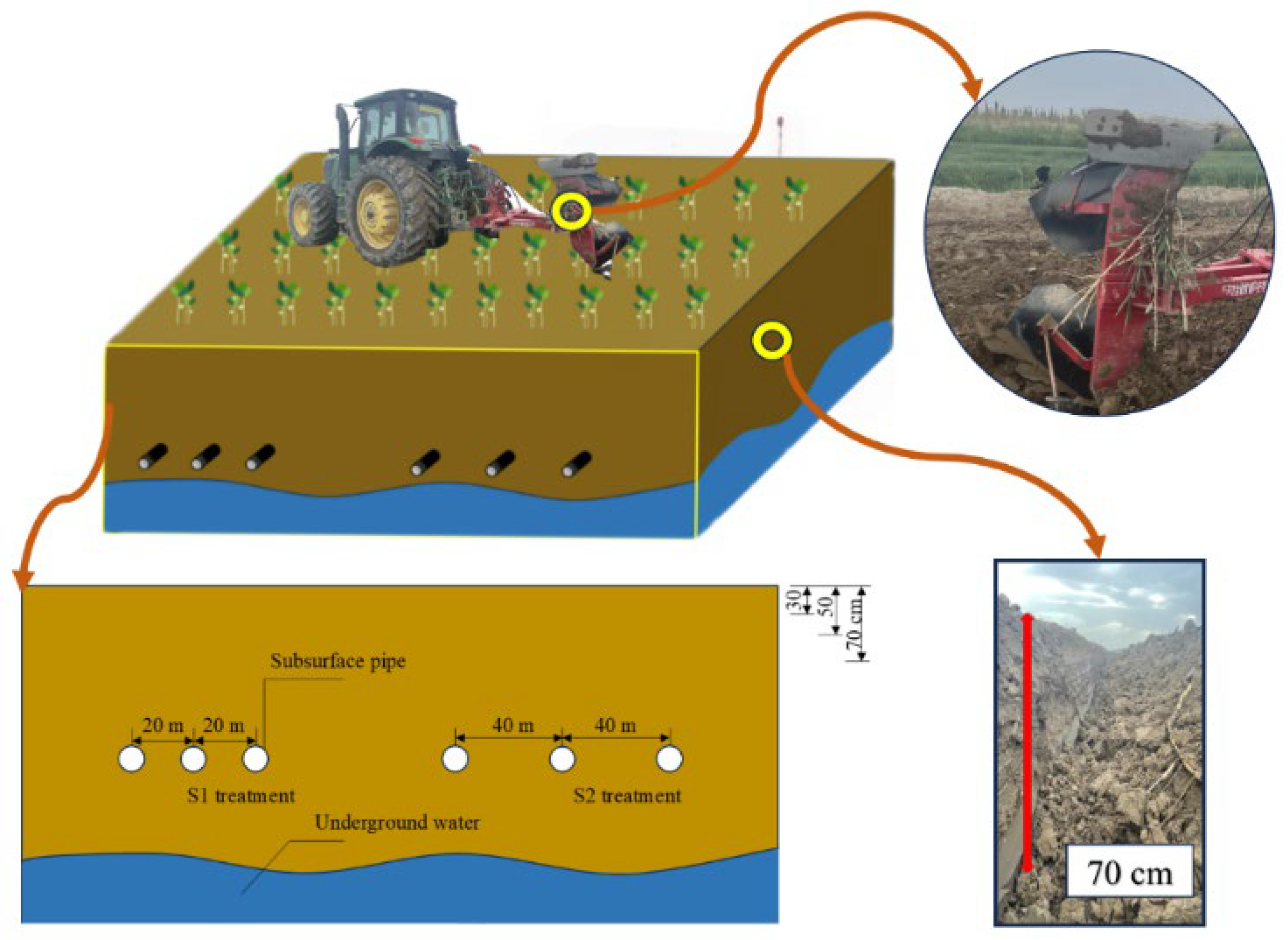
In this experiment, ploughing depth and subsurface drain spacing were selected as the experimental variables. The subsurface drain spacing was set at two levels: 20 m (S1) and 40 m (S2). The ploughing depth was set at three levels: 70 cm (W1), 50 cm (W2), and 30 cm (W3). The three ploughing depths were selected to represent a practical gradient of soil disturbance under local field conditions: 30 cm corresponds to the conventional tillage depth in the region, 50 cm represents an intermediate deep-tillage level intended to disrupt the compacted layer below the root zone and enhance infiltration, and 70 cm was chosen as the deepest practical level to maximize improvements in the 0–70 cm soil physical environment while remaining well above the buried subsurface drains (1.2 m) to avoid disturbing the drainage system. Thus, there were six treatments in total, and the treatment codes are shown in Table 2. In the subsurface drainage experimental area, the length of the subsurface pipes in each treatment was 57 m, with a burial depth of 1.2 m. The drains consisted of PVC double-wall corrugated pipes (Xinjiang Tianye Group Co., Ltd., Shihezi, China) with an inner diameter of 90 mm, wrapped in non-woven geotextile, and installed with a slope of 0.1%. Three subsurface laterals were laid in each plot: the central pipe was used for monitoring and sampling, while the two side pipes were used to reduce edge effects. The subsurface drainage ditch was arranged in a north–south direction, and the drain outflow discharged into this ditch and was then collected by the open collector drain on the eastern side. The experimental layout is shown in Figure 2. Soil samples were taken with an auger before the spring irrigation leaching and after the end of the subsurface drainage process. In 2024, sampling before and after leaching was carried out on 12 April and 29 April, respectively; in 2025, the corresponding sampling dates were 25 April and 16 May. Sampling depths were 0–10, 10–20, 20–40, 40–60, 60–80, 80–100, 100–120, 120–140, 140–160, and 160–180 cm, giving a total of 10 layers, with three replicate samples collected for each layer. Within each replicate plot, soil cores collected at the same depth were thoroughly homogenized and composited into one representative sample per depth for laboratory analysis. Therefore, each treatment had n = 3 independent samples per depth (one from each replicate plot). The spring leaching irrigation experiments were conducted in 2024 and 2025 using surface flooding. According to monitoring data, the leaching water quotas were 3300 m3·hm−2 in 2024 and 3500 m3·hm−2 in 2025. River water was used for spring irrigation. Prior to each spring irrigation event, water samples were collected and analyzed for major ions (Na+, K+, Ca2+, Mg2+, Cl, and SO42−) using inductively coupled plasma-optical emission spectrometry (Agilent 5110, Agilent Technologies Inc., Santa Clara, CA, USA) and titration methods. The results indicated that the total dissolved solids ranged from 0.31–0.36 g·L−1, and the ionic composition remained stable between 2024 and 2025. The electrical conductivity values were 0.34 and 0.38 mS·cm−1, respectively, confirming that the water quality variations had negligible influence on the experimental results.
The spring leaching irrigation was conducted by surface flooding (i.e., water was applied from above the soil surface rather than through the subsurface pipes). River water was used as the leaching source, with electrical conductivity of 0.34 and 0.38 mS−1 in 2024 and 2025, respectively. According to the monitoring data, the leaching water quotas were 3300 and 3500 m3·hm−2 in 2024 and 2025, respectively, which correspond to 330 and 350 L·m−2 (i.e., 330 and 350 mm of water) applied per unit area. Three subsurface laterals were installed in each plot: the central pipe was used for monitoring and sampling, while the two side pipes were used to reduce edge effects. Drain outflow from each plot discharged into a north–south subsurface drainage ditch and was then conveyed to an open collector drain on the eastern side, where drainage discharge was monitored, and drainage water samples were collected. During the drainage period, discharge and water sampling were conducted 2–4 times per day, with a higher frequency at the beginning of drainage and a lower frequency during the later stage. Drain discharge was measured volumetrically using a graduated cylinder and a stopwatch.

2.3. Measurement Items and Methods

2.3.1. Soil Water Content and Salinity

The soil water content was determined by the oven-drying method. A 10 g soil sample was oven-dried, then ground and sieved, and mixed with water at a soil-to-water ratio of 1:5 to obtain a suspension, which was filtered to obtain the extract. The electrical conductivity of the extract was measured using a conductivity meter (DDS-307, Shanghai Lei Magnetic Instrument Co., Ltd., Shanghai, China; year of manufacture: 2022). The total soil salt content was determined by the residue oven-drying method and converted using a regression equation established from preliminary baseline samples in the experimental area. The calculation formula is given in Equation (1). To establish the site-specific conversion between electrical conductivity and total soil salinity, preliminary baseline soil samples were collected from the experimental area prior to treatment implementation. For each sample, electrical conductivity (EC, 1:5 soil-to-water extract) and total salt content (g·kg−1, residue oven-drying method) were measured in parallel. A linear regression model was then fitted to relate total salt content to EC, and the dataset was randomly split into a calibration set and an independent validation set. Model performance was evaluated by comparing predicted and measured salinity in the validation set using the coefficient of determination (R2) and the root mean square error. The resulting regression equation (Equation (1)) was subsequently used to convert EC to total salt content for all soil samples in this study within the observed EC range.
Y = 2.994 E C + 6.002 ( R 2 = 0.95 )
where Y is the total salt content (g·kg−1); EC is the electrical conductivity (mS·cm−1).
The soil desalinization rate was calculated as follows:
N = S 1 S 2 S 1 × 100 %
where N is the soil desalinization rate (%); S 1 is the initial mean soil salt content in the 0–70 cm layer before spring leaching irrigation (g·kg−1); S 2 is the mean soil salt content in the 0–70 cm layer after spring leaching irrigation (g·kg−1).

2.3.2. Determination of Soil Ions

An extract was prepared from the collected soil at a soil-to-water ratio of 1:5, and the contents of Na+, K+, Ca2+ and Mg2+ were determined using inductively coupled plasma–optical emission spectrometry (Inductively Coupled Plasma-Optical Emission Spectrometry; Agilent 5110, Agilent Technologies, Melbourne, Australia; year of manufacture: 2020). The soil Cl content was measured by silver nitrate titration, and the SO42− content was determined by ethylenediaminetetraacetic acid titration. Carbonate-related anions (CO32− and HCO3) were not quantified in this study. According to the state standard, these ions can be considered when classifying salinity/alkalinity types. However, the primary objective of the present work was to quantify leaching efficiency and drainage-driven salt export under the combined ploughing depth × drain spacing designs. Therefore, we focused on the major dissolved inorganic ions that dominate salt transport in the soil solution (Cl and SO42− together with Na+, K+, Ca2+ and Mg2+). The omission of CO32−/HCO3 is acknowledged as a limitation and will be addressed in future investigations.

2.3.3. Soil Bulk Density and Total Porosity

Soil samples were collected using a cutting ring at four depth intervals: 0–10, 10–30, 30–50 and 50–70 cm, with three replicates for each treatment. The samples were taken back to the laboratory for the determination of soil bulk density and porosity. The corresponding calculation formulas are given in Equations (3) and (4).
C = ( M 1 M 0 ) / V
X = ( M 2 M 1 ) / V × 100 %
where C —Soil bulk density, g/cm3
X —Total soil porosity, %
V —Volume of the cutting ring, 100 cm3
M 0 —Mass of the cutting ring, g
M 1 —Mass of the cutting ring plus oven-dried soil, g
M 2 —Mass of the cutting ring plus saturated soil, g

2.3.4. Subsurface Drainage and Salt Removal

To investigate subsurface drain discharge and salt concentration in greater detail, the discharge from the corresponding subsurface laterals in each treatment was continuously monitored during the drainage period, and water samples were collected from the drain outlets to determine salt concentration. The monitoring period for subsurface drainage extended from the onset of flow to its cessation. The monitoring frequency for drain discharge was consistent with the sampling frequency, at 2–4 times per day, with a higher frequency at the beginning of drainage and a lower frequency at the later stage.
Drain discharge was determined volumetrically using a graduated cylinder in combination with a stopwatch, and water samples were collected in sampling bottles. The electrical conductivity of the subsurface drainage water ( E C W ) was measured using a conductivity meter, and the drainage water salinity ( C W ) was calibrated by the residue oven-drying method. The relationship between drainage water salinity ( C W ) and the electrical conductivity of subsurface drainage water ( E C W ) in the experimental area was obtained as follows:
C W = 0.6282 E C W 0.0311 ( R 2 = 0.9975 )
where C W — Salinity of subsurface drainage water, g/L
E C W — Electrical conductivity of subsurface drainage water, μS/cm
The cumulative subsurface drainage volume W (m3) was obtained by integrating the subsurface drain discharge over the entire drainage period. The cumulative salt removal D (kg) was calculated by multiplying the subsurface drain discharge by the drainage water salinity and summing the product over the drainage period.
W = t 0 t 1 w ( t ) d t  
D = t 0 t 1 w ( t ) × C W ( t ) d t

2.4. Data Processing

Microsoft Excel 2021 was used for data processing, SPSS 26.0 was employed for statistical analysis, and Origin 2017 was used for graphing. Prior to analysis, data were checked for normality (Shapiro–Wilk test) and homogeneity of variances (Levene’s test). For the factorial treatments (drain spacing × ploughing depth), a two-way analysis of variance was used to test the main effects and their interaction. When significant differences were detected, means were separated using Tukey’s honestly significant difference post hoc test. For comparisons involving the check or single-factor comparisons where appropriate, a one-way analysis of variance was applied. Statistical significance was accepted at p < 0.05 (highly significant at p < 0.01). Results are reported as mean ± standard deviation (n = 3).

3. Results and Discussion

3.1. Effects of Deep Ploughing Combined with Subsurface Drainage on Soil Water and Salinity

3.1.1. Soil Water Content

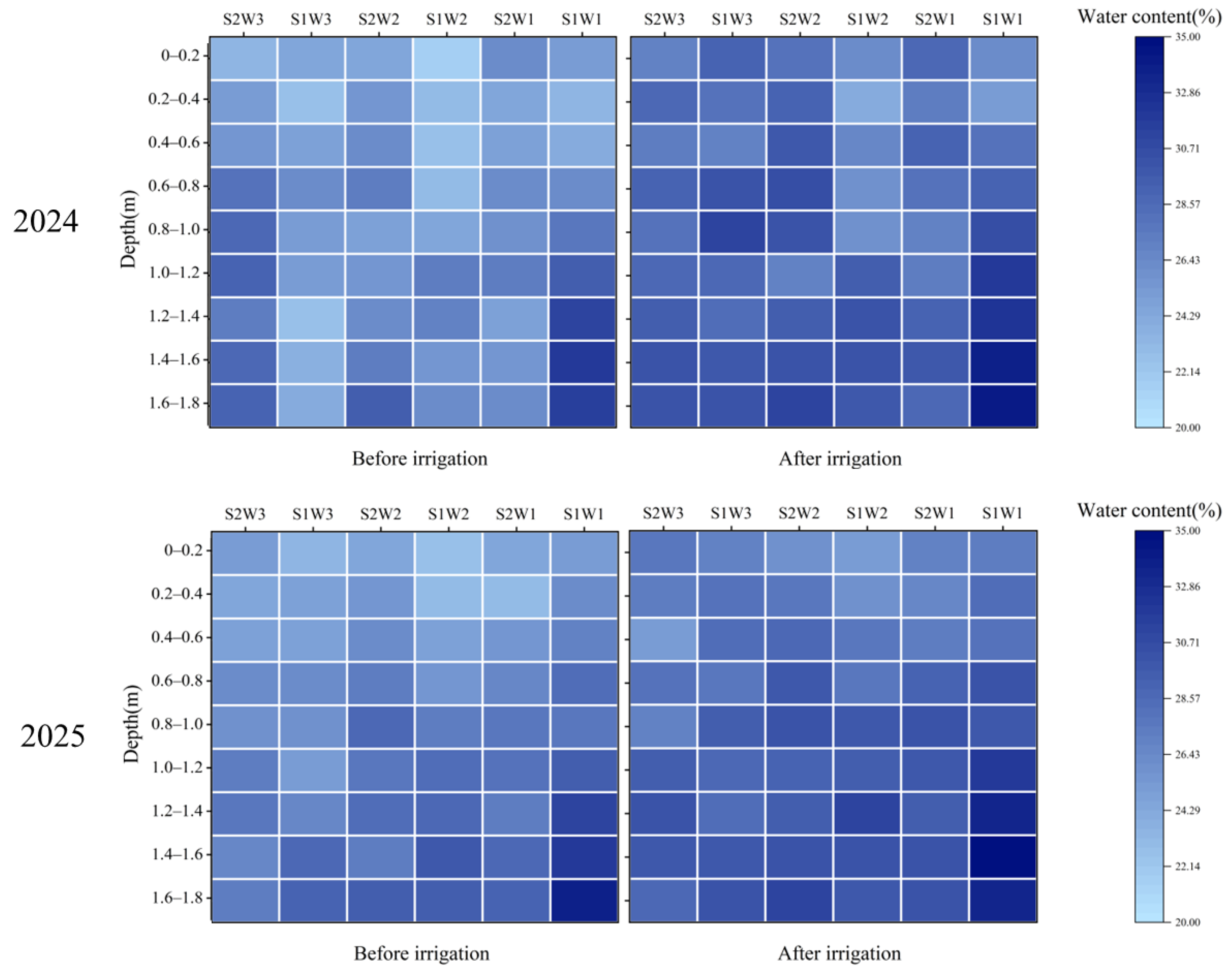
The soil water content profiles of each treatment before and after leaching in 2024 and 2025 are shown in Figure 3, where the value at each depth represents the mean water content of all sampling points at that depth.
In 2024, after spring irrigation and leaching, soil water content generally increased with soil depth. For a given subsurface drain spacing, water content in the 0–80 cm layer differed significantly among ploughing depths (p < 0.05); for example, the soil profile water contents under S1W1, S1W2 and S1W3 were 28.50%, 26.16% and 25.75%, respectively. At the same ploughing depth, soil water content was significantly higher under the wider drain spacing (S1) than under S2 in the 0–80 cm layer (p < 0.05); for instance, the soil profile water content under S1W1 was 10.57% higher than that under S2W1. In the 80–100 cm layer, the effect of ploughing depth was not significant (p > 0.05), whereas water content varied significantly with drain spacing (p < 0.05); for example, the water contents under S1W3 and S2W3 were 32.11% and 28.01%, respectively.
In the 2025 experiment, the pattern of soil water content distribution in the 0–80 cm layer after spring irrigation and leaching was similar to that in 2024, but the overall soil water content, especially in the 0–30 cm layer, was significantly lower than in 2024 (p < 0.05). This was likely because the sampling date in 2025 was later, and the loosened surface layer after deep ploughing was more susceptible to the effects of air temperature and evaporation, resulting in a pronounced reduction in soil water content.
In both 2024 and 2025, soil water content in the 0–80 cm layer was strongly influenced by ploughing depth and subsurface drain spacing: as ploughing depth and subsurface drain spacing increased, soil water content also increased, with treatment S2W1 exhibiting notably higher soil water content than the other treatments. In contrast, treatments S1W3 and S2W3, with the shallower ploughing depth (30 cm), showed lower soil water content in the 0–80 cm layer because the influence of ploughing on soil water storage was relatively weak. Overall, under the combined effect of deep ploughing and subsurface drainage, treatment S1W1 maintained a relatively high soil water content after spring irrigation and leaching.

3.1.2. Soil Salinity

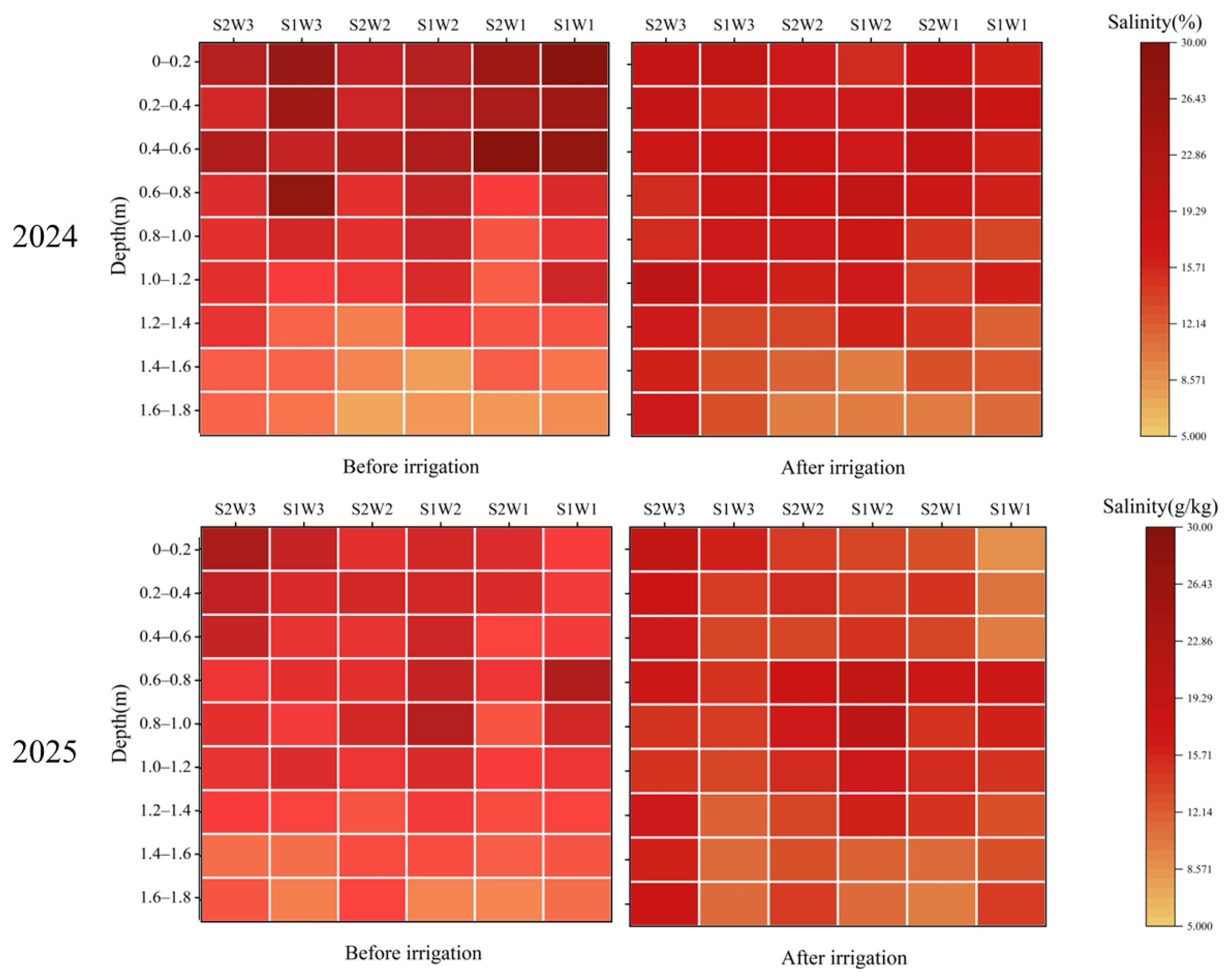
Due to the gradual rise in air temperature in spring in arid regions, surface evaporation becomes intense, and the soil profile salt distribution of each treatment before spring irrigation and leaching shows a surface-accumulation pattern. During the April–May period in 2024 and 2025, monthly mean evaporation reached 242.7 and 225.2 mm, whereas precipitation was only 18.6 and 17.5 mm, respectively, indicating a strong evaporative demand that favors upward salt migration and surface accumulation before leaching. The soil salt content profiles of each treatment before and after leaching in 2024 and 2025 are shown in Figure 4, where the value at each depth represents the mean salt content of all sampling points at that depth.
In the 2024 experiment, the soil was in a salt-accumulating state before spring irrigation and leaching, with relatively high salt contents in the 0–40 cm surface layer (all above 22.02 g·kg−1), while salt contents in the 40–180 cm layer ranged from 10.25 to 28.80 g·kg−1. After spring irrigation and leaching, the mean salt content in the 0–40 cm layer decreased markedly in all treatments, indicating good desalinization, with reductions of 4.60–7.57 g·kg−1. In contrast, the desalinization effect in the 40–180 cm layer was weaker, with mean salt content decreasing by only 2.11–5.13 g·kg−1.
Under different combinations of ploughing depth and subsurface drain spacing, soil salts migrated downward under the driving force of irrigation water and were discharged through the subsurface drains. For a given drain spacing, the reduction in salt content in the 0–80 cm layer increased with increasing ploughing depth; for example, in 2024, the decreases in soil profile salt content under treatments S1W3, S1W2 and S1W1 were 7.81, 9.27 and 10.25 g·kg−1, respectively. At the same ploughing depth, the reduction in soil salt content increased as drain spacing decreased; for instance, compared with S2W1, treatment S1W1 showed an 11.52 g·kg−1 greater decrease in soil profile salt content. After spring irrigation and leaching, larger ploughing depths combined with smaller drain spacing led to better soil salt leaching, with treatment S1W1 showing the most pronounced reduction in soil salt content. This is because S1W1 effectively broke the plough pan, improved soil aeration, loosened the soil profile, and thus enhanced salt leaching.
In the 2025 experiment, the variation pattern of soil salt content before spring irrigation and leaching was generally similar to that in 2024, with the 0–40 cm surface layer having salt contents above 17.77 g·kg−1 and the 40–180 cm layer ranging from 12.40 to 25.79 g·kg−1. After spring irrigation and leaching, the mean salt content in the 0–40 cm layer again decreased markedly in all treatments, with average reductions of 5.92–8.25 g·kg−1, whereas the desalinization effect in the 40–180 cm layer was weaker, with mean salt content reductions of 2.45–7.88 g·kg−1. For the same drain spacing, the reduction in salt content in the 0–80 cm layer increased with increasing ploughing depth; for example, the decreases in soil profile salt content under S1W3, S1W2 and S1W1 were 8.49, 9.56 and 11.98 g·kg−1, respectively. At the same ploughing depth, the reduction in soil salt content increased as drain spacing decreased; for instance, compared with S2W1, treatment S1W1 showed a 12.45 g·kg−1 greater decrease in soil profile salt content.
The soil desalinization rate is an important indicator for evaluating leaching effectiveness and can effectively reflect the desalinization effect of spring irrigation and leaching under the combined action of deep ploughing and subsurface drainage. Table 3 presents the analysis results of soil salt content and desalinization rate for each treatment over the two years of spring irrigation and leaching. Because the main active root zone of crops is 0–70 cm, only the desalinization rate in this layer was analyzed. There were clear differences in soil desalinization among treatments under the combined effect of deep ploughing and subsurface drainage: after two years of spring irrigation and leaching, the mean desalinization rates of all treatments except S2W3 were significantly higher than that of S2W3 by 13.62–39.99%, with treatment S1W1 having the highest mean desalinization rate at 64.70%. As shown in Table 3, at the same drain spacing, there were large differences in desalinization rate among ploughing depths: the mean soil desalinization rate of S1W1 was 21.12% and 19.99% higher than that of S1W2 and S1W3, respectively. After two years of spring irrigation and leaching, the mean soil desalinization rate followed the order S1 > S2 and W1 > W2 > W3. In summary, deep ploughing combined with subsurface drainage can effectively increase the mean soil desalinization rate, and the desalinization effect improves as drain spacing decreases and ploughing depth increases.

3.2. Effects of Deep Ploughing Combined with Subsurface Drainage on Soil Ion Contents

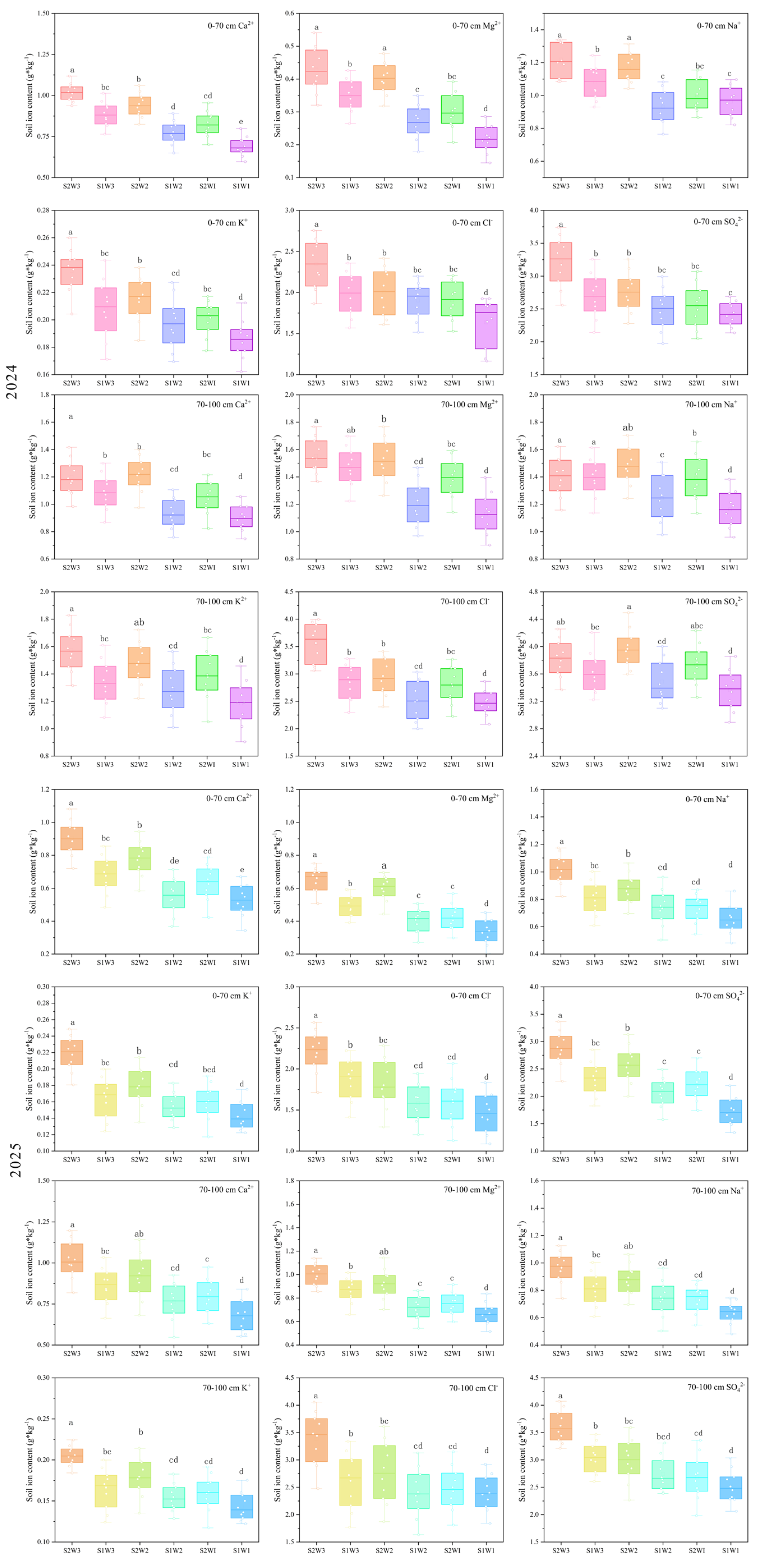
Changes in soil ion contents under the combined effect of deep ploughing and subsurface drainage are shown in Figure 5. All ion contents are reported on a mass basis and expressed as g·kg−1 of oven-dried soil. The results indicate that increasing ploughing depth and reducing subsurface drain spacing can effectively reduce ion contents in the 0–100 cm soil layer. Specifically, in 2024, at the same drain spacing, compared with treatment S1W3, treatment S1W1 significantly reduced Na+, K+ and Cl contents in the 0–70 cm layer by 0.42, 0.32 and 0.21 g·kg−1, respectively (p < 0.05). At the same ploughing depth, Na+, K+ and Cl contents under S1W1 were significantly lower than those under S2W1 by 0.37, 0.25 and 0.36 g·kg−1, respectively.
In the 0–70 cm layer, Na+, K+ and SO42− contents under S1W2 did not differ significantly from those under S1W1 (p > 0.05), while all other treatments showed significant differences. In the 70–100 cm layer in 2024, differences in soil ion contents among treatments were relatively small, but S1W1 still showed a significant decrease compared with S2W3 (p < 0.05).
With the continued application of the combined deep ploughing and subsurface drainage measures, ion contents in the 70–100 cm layer decreased in 2025, and for all ions, the contents across treatments decreased in the order S2W3 > S2W2 > S2W1 > S1W3 > S1W2 > S1W1. Overall, treatment S1W1 effectively reduced salt ion contents in the 0–100 cm soil layer.

3.3. Effects of Deep Ploughing Combined with Subsurface Drainage on Soil Bulk Density and Total Porosity

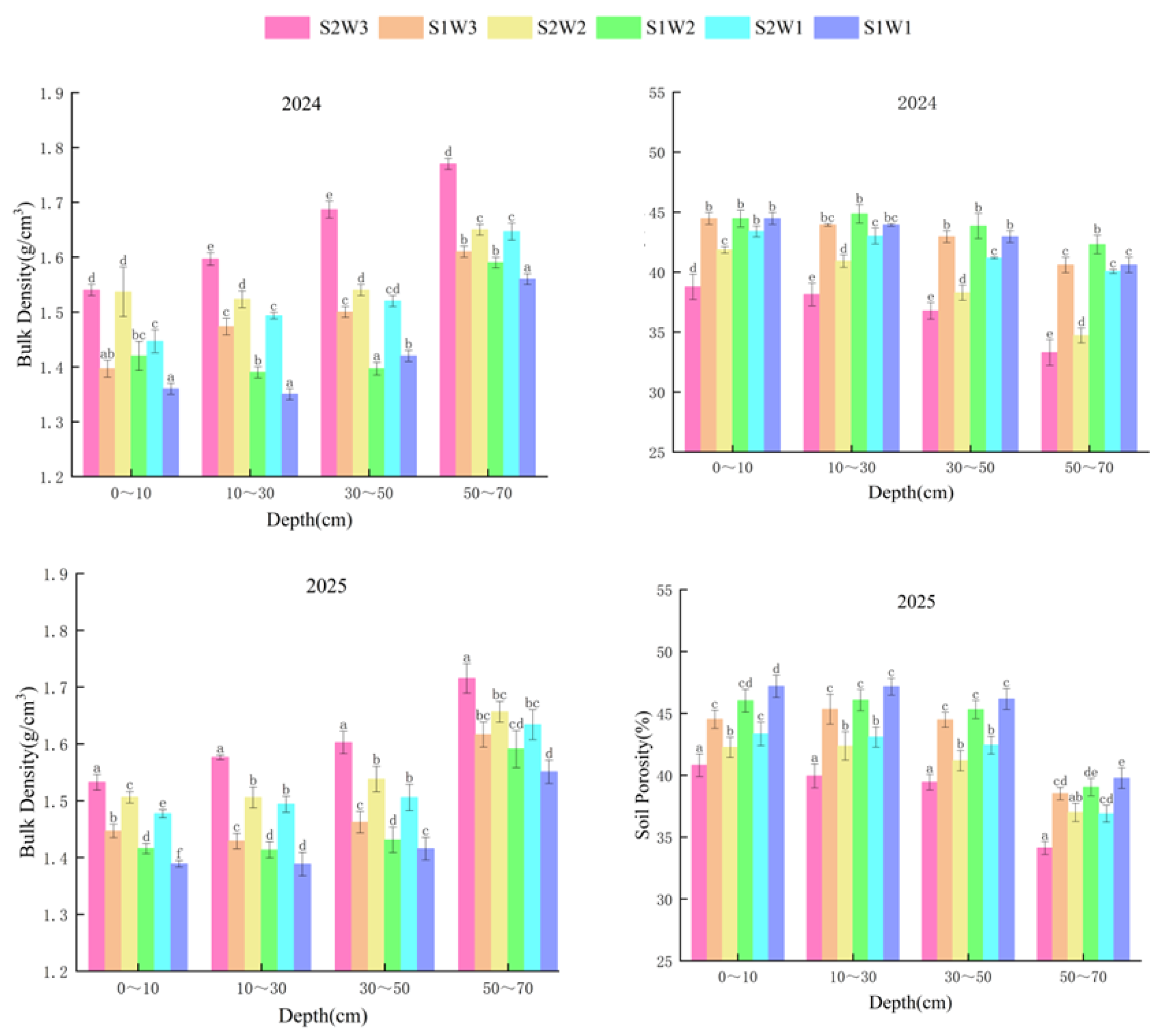
The effects of ploughing depth combined with subsurface drain spacing on soil bulk density and total porosity are shown in Figure 6, and the corresponding absolute values (mean ± SD) are provided therein. In 2024 and 2025, within the 0–10 cm soil layer, soil bulk density under S1W1 was significantly reduced by 3.07% and 3.32% compared with S1W2 and S1W3, respectively (p < 0.05), while total porosity increased by 5.58% and 5.92% (see Figure 6 for the absolute bulk density and porosity values). Under S2W1, soil bulk density was significantly reduced by 2.95% and 4.86% relative to S2W2 and S2W3, and total porosity increased by 3.78% and 6.04%. At the same ploughing depth, soil bulk density under S1W3 was 7.46% lower than under S2W3, and total porosity was 4.71% higher (absolute values are shown in Figure 6).
In the 10–30 cm soil layer, soil bulk density under S1W1 was significantly reduced by 5.61% and 3.24% compared with S1W3 and S1W2, respectively (p < 0.05), while total porosity increased by 6.84% and 5.68%. In the 30–50 cm layer, soil bulk density under S1W1 was significantly reduced by 4.26% and 3.14% compared with S1W3 and S1W2, respectively (p < 0.05), and total porosity increased by 3.57% and 4.56%. Across all treatments, soil bulk density in 2025 was lower than in 2024, and total porosity was higher. These results indicate that deep ploughing combined with subsurface drainage has a certain persistent effect, and that greater ploughing depth and smaller drain spacing lead to more pronounced improvements in soil physical properties, with S1W1 performing best.

3.4. Effects of Deep Ploughing Combined with Subsurface Drainage on Subsurface Drainage and Salt Removal

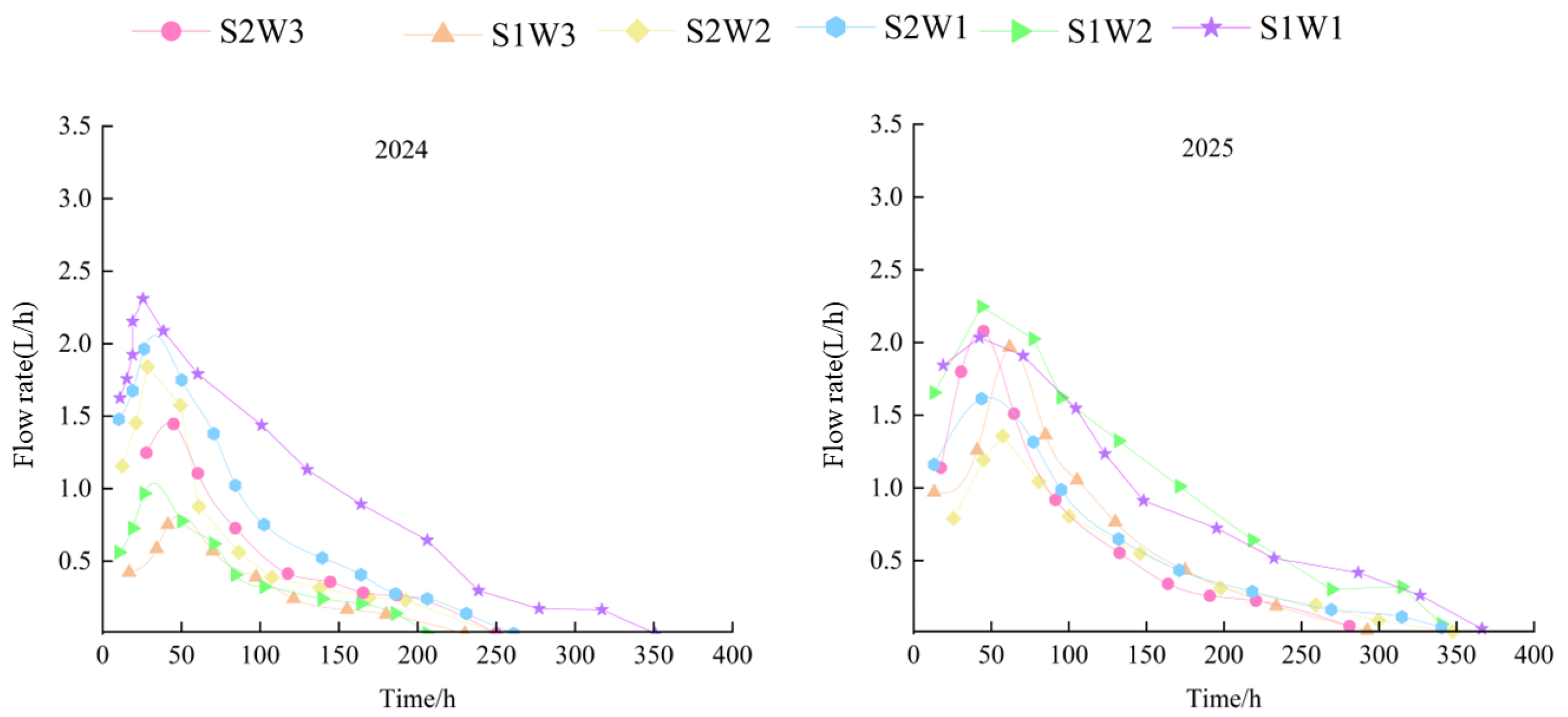
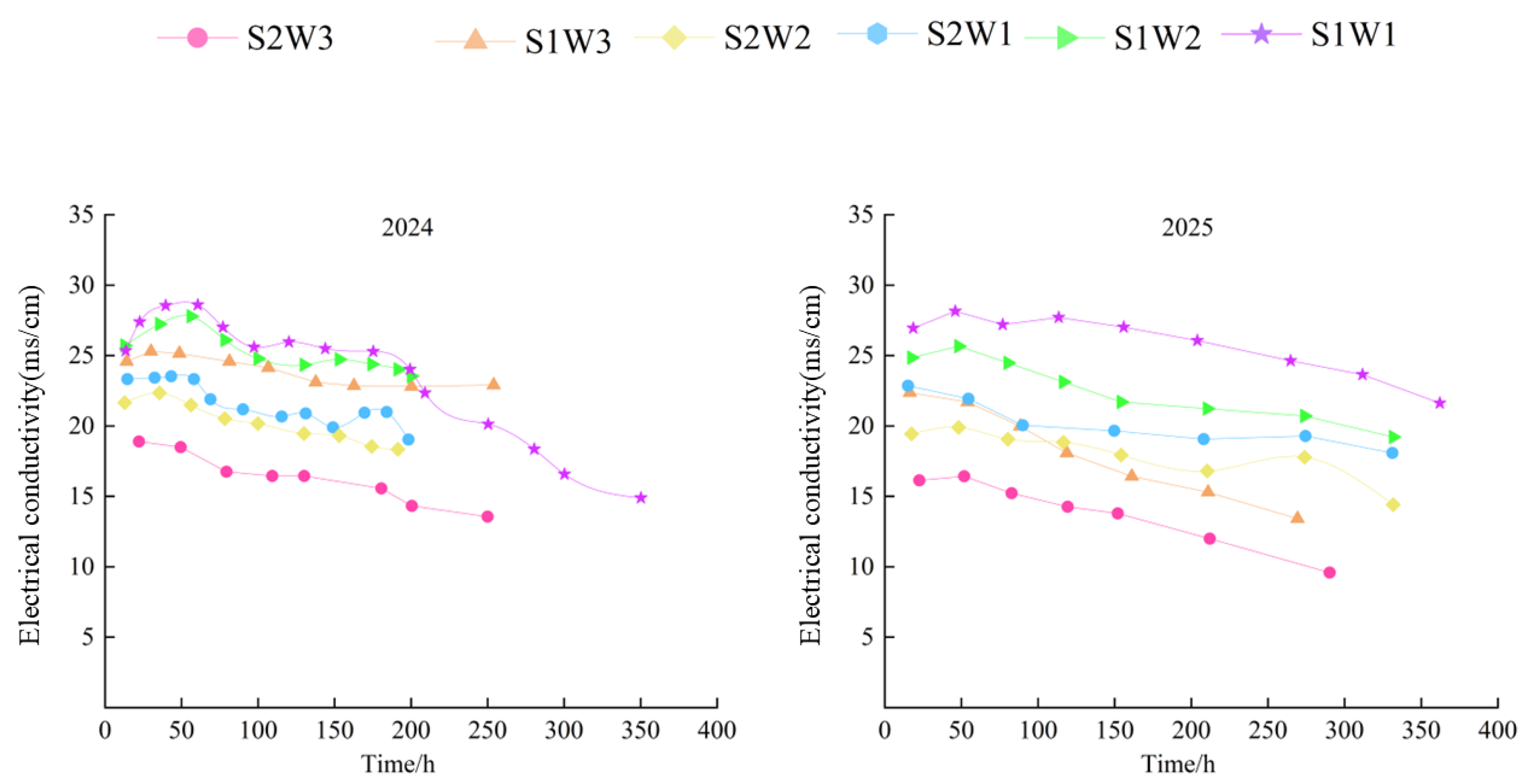
During the spring irrigation and leaching experiments in 2024 and 2025, the temporal variations in subsurface drain discharge and electrical conductivity for each treatment were as shown in Figure 7 and Figure 8, respectively. For all treatments, the drainage discharge first increased and then decreased over time. As shown in Figure 7, in 2024, under the same drain spacing, treatment S1W1 had the highest drainage discharge, reaching 0.75 m3·h−1, which was 154.2% and 168.54% higher than those of S1W2 and S1W3, respectively. Under S2, the drainage discharge of S2W1 was 89.24% and 115.45% higher than those of S2W2 and S2W3, respectively. At the same ploughing depth, the drainage discharge of S1W1, S1W2 and S1W3 was 145.87%, 127.21% and 80.90% higher than that of S2W1, S2W2 and S2W3, respectively.
In 2025, during spring irrigation and leaching, S1W1 again had the highest drainage discharge, reaching 0.98 m3·h−1, which was 54.21% and 64.58% higher than those of S1W2 and S1W3, respectively. Under the same drain spacing, the drainage discharge of S2W1 was 68.54% and 70.62% higher than those of S2W2 and S2W3, respectively. At the same ploughing depth, the drainage discharge of S1W1, S1W2 and S1W3 was 80.54%, 57.84% and 67.59% higher than that of S2W1, S2W2 and S2W3, respectively. A comparison of drainage durations for the same treatment between years showed that the subsurface drainage process in 2025 lasted longer than in 2024, mainly because the spring irrigation and leaching quota in 2025 was larger.
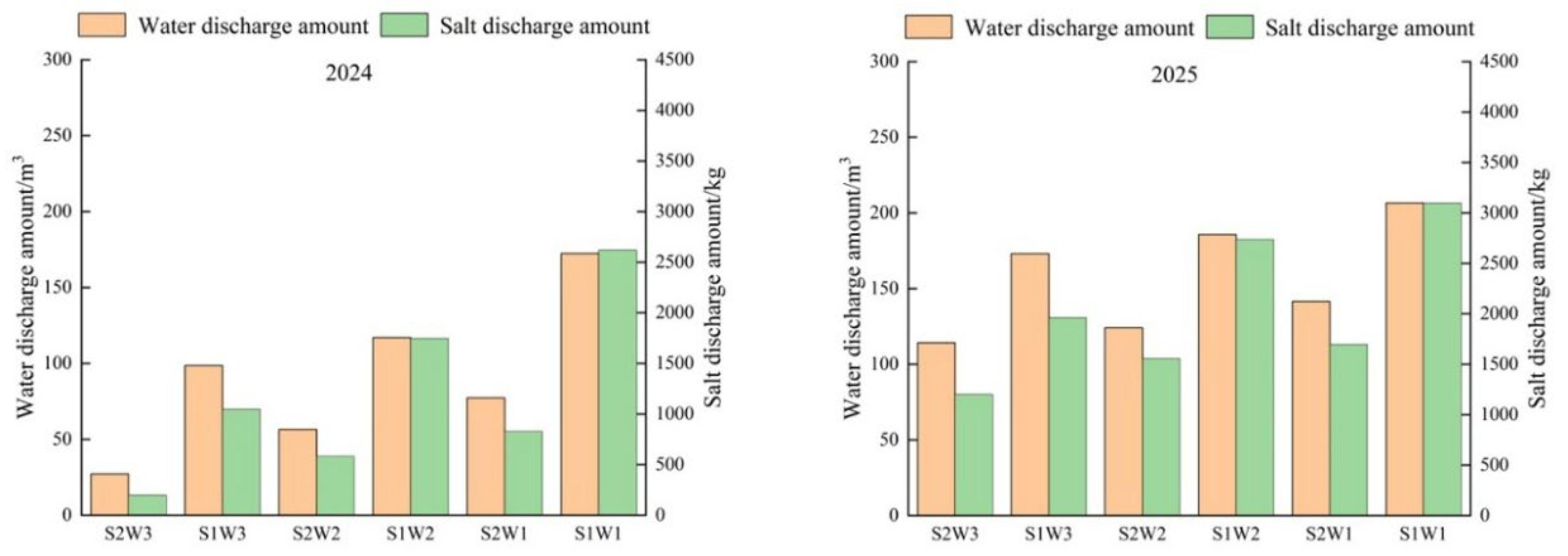
Figure 8 illustrates that drainage EC varied only modestly during the drainage period in both years, showing a gentle downward drift over time without pronounced fluctuations. After spring irrigation and leaching in 2024, the treatment-mean drainage EC spanned 13.45–25.67 mS·cm−1. Interannual differences were minor: for most treatments, mean drainage EC in 2025 was marginally lower than in 2024, whereas S1W2 did not follow this pattern. As shown in Figure 9, the mean cumulative drainage volume of all treatments in 2024 after spring irrigation and leaching was 80.98 m3. Among the treatments, S1W1 had the largest cumulative drainage volume and salt removal, at 172.39 m3 and 3099.17 kg, respectively, whereas S2W3 had the smallest cumulative drainage volume and salt removal, at 114.80 m3 and 1200.94 kg, respectively. In 2025, the patterns of cumulative drainage volume and cumulative salt removal were generally similar to those in 2024. Across the six treatments, S1W1 consistently produced the greatest drainage volume and salt export, whereas S2W3 showed the lowest values, and the remaining treatments fell between these two extremes.

3.5. Correlation Analysis of Soil Desalinization Rate Under Deep Ploughing Combined with Subsurface Drainage

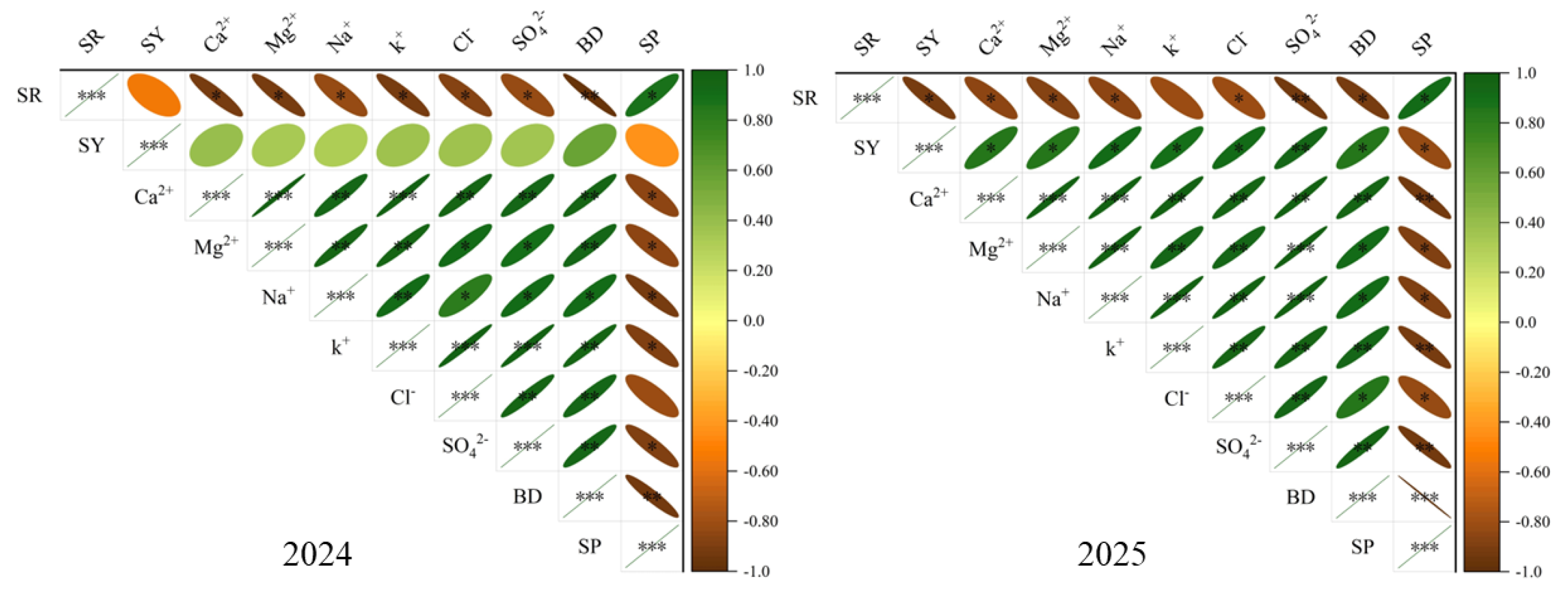
To identify the main factors affecting the soil desalinization rate, Pearson correlation analysis was performed between desalinization rate and soil salt content, bulk density, total porosity, and soil ions (Na+, K+, Ca2+, Mg2+, Cl, SO42−) (Figure 10). The correlation analyses for 2024 and 2025 showed that soil desalinization rate was significantly and negatively correlated with soil salt content and the concentrations of Ca2+, Mg2+, Na+, K+, Cl and SO42−, whereas it was significantly and positively correlated with total porosity.
In summary, with the prolonged application of deep ploughing combined with subsurface drainage in saline–alkali farmland, soil salt content, ion concentrations, bulk density and total porosity increasingly emerged as key environmental factors influencing the soil desalinization rate. Moreover, the positive effects of deep ploughing coupled with closer subsurface drain spacing on reclaiming saline–alkali farmland and improving soil physicochemical properties became more pronounced.

4. Discussion

4.1. Effects of Deep Ploughing Combined with Subsurface Drainage on Soil Water–Salt Transport and Ions

Previous studies have shown that subsurface drainage and deep ploughing can effectively reclaim saline–alkali soils, improve soil structure, and reduce soil salinity [20]. The results of this study indicate that, under the combined application of deep ploughing and subsurface drainage, soil water content in the cultivated layer exhibits a gradually increasing trend from the surface downward. The two-year spring irrigation and leaching experiments further demonstrated that the reduction in soil water content was mainly attributable to the synergistic effect of these two techniques, which improved soil physicochemical properties, increased soil water permeability, and promoted the discharge of water from the soil profile through the subsurface drains.
The present experiment showed that, under the synergistic action of deep ploughing and subsurface drainage, the treatment with a ploughing depth of 70 cm and a drain spacing of 20 m achieved a 57.25% reduction in soil salt content within the 0–70 cm layer. The main reason is that deep ploughing breaks the plough pan, increases soil porosity, and thereby enhances the leaching effect of irrigation water on soil salts [21]. At the same time, subsurface drainage strengthens soil water dynamics, enhances flow through macropores, and further promotes the downward movement of dissolved salts to deeper layers, where they are eventually removed from the soil via the subsurface drains [22].
Overall, compared with S2W3, treatment S1W1 produced a more pronounced reduction in soil salt content. This may be because reducing drain spacing accelerates water flow within the area controlled by the drains and intensifies the transport of dissolved salts, whereas increasing drain spacing has the opposite effect [23]. In contrast, shallow tillage tends to compact the deeper soil, reducing its permeability and aeration, which restricts the formation of saturated and stable pressure zones around the drains and thereby weakens the salt-leaching effect [24,25]. Li et al. [26] reported that when the soil above the subsurface drains has good permeability and aeration, and the soil around the drains has good water-holding capacity, improving soil structure can effectively disrupt the upward capillary water channels, eliminate lag effects, and facilitate the subsurface drainage process.
The experimental results of this study further indicate that reducing drain spacing and increasing ploughing depth enhance the hydraulic gradient and soil permeability, thereby promoting more effective leaching of salts from the soil profile. Consequently, treatment S1W1 significantly reduced soil salt content compared with the other treatments. Yu et al. [27] found that excessively high contents of Na+, Cl and SO42− ions in soil exert strong toxic effects on crops. Our results show that the combined application of deep ploughing and subsurface drainage significantly reduced soil ion contents. Compared with S2W3, treatment S1W1 significantly decreased the mean contents of Cl and SO42− in the 0–70 cm layer by 0.45 and 0.38 g·kg−1, respectively. The main reason is that Cl migrates relatively freely in soil under electrostatic repulsion, while SO42− has low adsorption and high solubility, giving it strong mobility [28]. Meanwhile, the improvement in soil permeability further accelerates the transport of salt ions.
A limitation of this study is that carbonate alkalinity (CO32− and HCO3) and related indices (e.g., soil pH and sodium adsorption ratio) were not measured. These variables are useful for diagnosing alkalization risk and for salinity-type classification (e.g., state standard-based assessment). Future work will incorporate alkalinity titration and sodicity indicators to better distinguish salinity versus alkalinity processes while continuing to evaluate drainage-driven salt export.
Trade-offs and practical considerations. Although S1W1 (70 cm deep ploughing with a 20 m drain spacing) consistently delivered the best improvements in soil desalinization and physical properties, its wider adoption should be evaluated in light of potential trade-offs. Deep ploughing to 70 cm generally requires greater traction power and fuel consumption, which may increase operational costs and limit feasibility when machinery capacity or suitable tillage windows are constrained. Likewise, reducing drain spacing increases the amount of pipe materials and installation workload per unit area, potentially raising initial investment and long-term maintenance needs. From a sustainability perspective, repeated deep tillage may lead to stronger soil disturbance and higher energy-related emissions; therefore, a site-specific decision framework is recommended, in which S1W1 is prioritized for severely salinized fields requiring rapid reclamation, whereas intermediate designs (e.g., S1W2 or S2W1) may provide more cost-effective compromises under moderate salinity or budget-limited conditions. Future work should incorporate multi-year cost–benefit assessment and operational energy accounting to support large-scale implementation.

4.2. Effects of Deep Ploughing Combined with Subsurface Drainage on Soil Bulk Density and Porosity

In highly saline soil environments, alternating wetting–drying and freeze–thaw cycles cause silt and clay particles to disperse, leading to the rearrangement of soil particles and the formation of layers with poor permeability [29]. High Na+ concentrations in the soil promote swelling and dispersion of soil particles upon wetting, resulting in surface crusting and hardening [30]. Deep ploughing combined with subsurface drainage effectively reduces the contents of silt and clay particles in the soil, and an appropriate tillage regime can optimize soil structure and enhance soil aeration.
The experimental results show that the combined application of deep ploughing and subsurface drainage significantly reduces soil bulk density and increases porosity, with these effects becoming more pronounced as drain spacing decreases and ploughing depth increases. This is likely because deep ploughing disrupts the close bonding between soil particles and helps to break the plough pan, thereby improving soil structure. The loosened soil facilitates the movement of water and air, which in turn increases soil porosity and reduces bulk density [31]. At the same time, large-volume spring irrigation and leaching accelerate the dissolution of salts, effectively reducing the cohesive forces between soil particles; the particles are then transported with the percolating water to deeper layers, making the soil structure even looser.
The results of this study are generally consistent with those reported by Back M. P. in Ohio and Zhang J. in Guangxi, both of which demonstrated that deep ploughing in combination with subsurface drainage can effectively decrease soil bulk density, increase soil porosity, and improve soil structure [32,33].
Beyond confirming the general benefits of deep ploughing or subsurface drainage reported in previous studies, this study provides new evidence on the synergistic mechanism and practical optimization when the two measures are implemented together under arid saline–alkali conditions. Deep ploughing mainly improves the soil physical framework by breaking the compacted layer and increasing macroporosity, which enhances downward infiltration and weakens upward capillary connectivity, whereas a smaller drain spacing strengthens the hydraulic drainage capacity by shortening the flow path to drains and accelerating groundwater drawdown. The coupling of these processes creates a more continuous leaching–drainage pathway during irrigation, thereby promoting salt/ion export rather than internal redistribution. Importantly, the two-year results demonstrate the persistence of these coupled effects and identify an operationally robust parameter combination (S1W1) that consistently outperformed the other treatments, providing practical guidance for designing subsurface drainage and deep-tillage schemes in similar saline fields.

4.3. Effects of Deep Ploughing Combined with Subsurface Drainage on Subsurface Drainage and Salt Removal

Subsurface drain discharge is primarily determined by the depth of the groundwater table [34]. The experimental results showed that at the beginning of subsurface drainage, the discharge from the drains increased sharply to a peak. This was mainly because, at the onset of spring irrigation and leaching, a large volume of leaching water recharged the groundwater, causing the water table to rise rapidly.
In addition, at the early stage of subsurface drainage, the drainage electrical conductivity of some treatments fluctuated initially and then became relatively stable. This may be attributed to the loosening of the soil after deep ploughing: large amounts of leaching water rapidly converged through soil pores into the subsurface drains and were discharged from the soil, resulting in relatively low electrical conductivity of the drainage water at the beginning. Once the soil reached saturation, the movement of water through the soil slowed down, allowing more salts to dissolve, and the electrical conductivity of the subsurface drainage increased accordingly. In the later stage of spring irrigation and leaching, continuous subsurface drainage gradually reduced the salt content in the soil, and the electrical conductivity of the drainage water also decreased.
The results further showed that cumulative drainage and cumulative salt removal under treatment S1W1 were significantly higher than those of the other treatments. When drain spacing decreased, the hydraulic gradient increased, and deep ploughing improved soil structure, enabling more rapid water movement and drainage through the soil.
Moreover, the environmental impacts of this technology warrant careful consideration. Although the discharge of highly saline drainage could potentially lead to secondary salinization downstream, in the arid regions of southern Xinjiang, this effluent is typically conveyed via a dedicated network of collector drains into closed evaporation basins or salt-collection lakes, thereby isolating the salts from the cultivated soil system. Regarding the concerns over microplastic pollution from PVC pipes, while subsurface drainage is highly effective for salt removal, future investigations should evaluate the long-term degradation of these materials or explore eco-friendly biodegradable alternatives.

5. Results

Based on a two-year spring irrigation and leaching experiment with different combinations of ploughing depth and subsurface drain spacing, the following conclusions were drawn. After two years of spring irrigation and leaching, treatment S1W1 (ploughing depth 70 cm, drain spacing 20 m) achieved the best salt-leaching effect in the 0–70 cm soil layer, where soil profile salt content decreased by 64.70% compared with the initial level.
Across both years, cumulative drainage and salt removal responded systematically to the treatment design, with S1W1 consistently achieving the highest values. Under two consecutive years of spring irrigation and leaching, treatment S1W1 had the highest cumulative drainage and salt removal, reaching 172.39 m3 and 2619.67 kg in one year, and 206.57 m3 and 3099.16 kg in the other year. The results indicate that a management regime combining 70 cm deep ploughing with a 20 m subsurface drain spacing can optimize soil structure, enhance soil desalinization, and improve subsurface drainage and salt removal efficiency, thereby providing favorable soil conditions for crop growth. This regime is suitable for promotion in saline–alkali areas dominated by silty loam soils in southern Xinjiang.

Author Contributions

Methodology, Y.M.; Writing—original draft, M.W.; Writing—review & editing, P.A.; Supervision, Z.M. and C.L. All authors have read and agreed to the published version of the manuscript.

Funding

This work was supported by the National Key Research and Development Program of China (Grant No. 2021YFD1900804-03); Major Science and Technology Special Projects of Xinjiang Uygur Autonomous Region (2023A02002-5); Key Science and Technology Project of Xinjiang Uygur Autonomous Region (2024A03007-4).

Institutional Review Board Statement

Not applicable.

Informed Consent Statement

Not applicable.

Data Availability Statement

The original contributions presented in this study are included in the article. Further inquiries can be directed to the corresponding author.

Conflicts of Interest

The authors declare no conflict of interest.

References

  1. Wang, W.; Vinocur, B.; Altman, A. Plant responses to drought, salinity and extreme temperatures: Towards genetic engineering for stress tolerance. Planta 2003, 218, 1–14. [Google Scholar] [CrossRef] [PubMed]
  2. Su, Y.; Mai, W.; Zhao, Z.; Liu, Y.; Yan, Y.; Yao, L.; Zhou, H. The Effects of Different Planting Patterns in Bare Strips on Soil Water and Salt Accumulation under Film-Mulched Drip Irrigation. Agronomy 2024, 14, 6. [Google Scholar] [CrossRef]
  3. Chen, S.; Mao, X.; Shang, S. Response and contribution of shallow groundwater to soil water/salt budget and crop growth in layered soils. Agric. Water Manag. 2022, 266, 107574. [Google Scholar] [CrossRef]
  4. Nie, Z.; Zhang, L.; Zhang, T.; Guo, L.; Zhou, J.; An, F.; Ma, H.; Wang, Z.; Yang, F. Effects of Lignite Humic Acid and Lignite Humic Acid-based Combined Amendment on Soil Quality in Saline-sodic Farmlands in the West Liaohe Plain, China. Chin. Geogr. Sci. 2025, 35, 401–414. [Google Scholar] [CrossRef]
  5. Patel, N.; Rajput, T.B.S. Dynamics and modeling of soil water under subsurface drip irrigated onion. Agric. Water Manag. 2008, 95, 1335–1349. [Google Scholar] [CrossRef]
  6. Zeng, W.; Xu, C.; Wu, J.; Huang, J. Soil salt leaching under different irrigation regimes: HYDRUS-1D modelling and analysis. J. Arid Land 2014, 6, 44–58. [Google Scholar] [CrossRef]
  7. Farhadi Machekposhti, M.; Shahnazari, A.; Ahmadi, M.Z.; Aghajani, G.; Ritzema, H. Effect of irrigation with sea water on soil salinity and yield of oleic sunflower. Agric. Water Manag. 2017, 188, 69–78. [Google Scholar] [CrossRef]
  8. He, X.L.; Yang, G.; Li, J.F.; Pu, S.H. Study on Water and Salt Transport Features and Regulation for Salt-Effected Soil through Drip Irrigation under Film. Energy Procedia 2011, 11, 2782–2789. [Google Scholar] [CrossRef]
  9. Sreenivas, C.; Reddy, C.K. Salinity–sodicity relationships of the Kalipatnam drainage pilot area, Godavari Western Delta, India. Irrig. Drain. 2010, 57, 533–544. [Google Scholar] [CrossRef]
  10. Jafaari-Talukolaee, M.; Shahnazari, A.; Ahmadi, M.Z.; Darzi-Naftchali, A. Drain discharge and salt load in response to subsurface drain depth and spacing in paddy fields. J. Irrig. Drain. Eng. 2015, 114, 04015017. [Google Scholar] [CrossRef]
  11. Yang, Y.; Zhou, X.; Gao, Y.; Li, D.; Wang, X.; Li, Z. Factors influencing usage of subsurface drainage to improve soil desalination and cotton yield in the Tarim Basin oasis in China. Irrig. Sci. 2022, 40, 857–871. [Google Scholar] [CrossRef]
  12. Siyal, A.A.; Skaggs, T.H. Reclamation of saline soils by partial ponding: Simulations for different soils. Vadose Zone J. 2010, 9, 486–495. [Google Scholar] [CrossRef]
  13. Qian, Y.; Zhu, Y.; Ye, M.; Huang, J.; Wu, J. Experiment and numerical simulation for designing layout parameters of subsurface drainage pipes in arid agricultural areas. Agric. Water Manag. 2021, 243, 106455. [Google Scholar] [CrossRef]
  14. Amjad, M.; Akhtar, J.; Anwar-Ul-Haq, M.; Imran, S.; Jacobsen, S. Soil and foliar application of potassium enhances fruit yield and quality of tomato under salinity. Turk. J. Biol. 2014, 38, 208–218. [Google Scholar] [CrossRef]
  15. Malash, N.M.; Flowers, T.J.; Ragab, R. Effect of irrigation methods, management and salinity of irrigation water on tomato yield, soil moisture and salinity distribution. Irrig. Sci. 2008, 26, 313–323. [Google Scholar] [CrossRef]
  16. Bai, Z.; Liu, H.; Wang, T.; Gong, P.; Li, H.; Li, L.; Xue, B.; Cao, M.; Feng, J.; Xu, Y. Effect of Smashing Ridge Tillage Depth on Soil Water, Salinity, and Yield in Saline Cotton Fields in South Xinjiang, China. Water 2021, 13, 3592. [Google Scholar] [CrossRef]
  17. Schneider, F.; Don, A.; Hennings, I.; Schmittmann, O.; Seidel, S.J. The effect of deep tillage on crop yield–What do we really know? Soil Tillage Res. 2017, 174, 193–204. [Google Scholar] [CrossRef]
  18. Zhang, F.; Wang, X.; Liu, S.; Ren, H.; Wang, Y.; Han, J. Effects of different pipe burial depths on crop yield, water productivity, and irrigation water productivity: A global meta-analysis. Eur. J. Agron. 2025, 166, 127562. [Google Scholar] [CrossRef]
  19. Min, W.; Hou, Z.A.; Lijuan, M.A.; Zhang, W.; Ru, S.; Ye, J. Effects of water salinity and N application rate on water- and N-use efficiency of cotton under drip irrigation. J. Arid Land 2014, 6, 454–467. [Google Scholar] [CrossRef]
  20. Mehdi, J.T.; Henk, R.; Abdullah, D.N.; Shahnazari, A. Subsurface Drainage to Enable the Cultivation of Winter Crops in Consolidated Paddy Fields in Northern Iran. Sustainability 2016, 8, 249. [Google Scholar] [CrossRef]
  21. Bai, Z.T.; Li, Z.J.; Li, L.; Li, P.F.; Gong, P.; Wang, T.; Fan, J.L.; Liu, H.G. Deep vertical rotary tillage reduced soil salinity and improved seed cotton yield and water productivity under limited irrigation in saline-alkaline fields. Ind. Crops Prod. 2024, 218, 118943. [Google Scholar] [CrossRef]
  22. Qin, S.J.; Li, S.E.; Yang, K.; Hu, K.L. Can plastic mulch save water at night in irrigated croplands? J. Hydrol. 2018, 564, 667–681. [Google Scholar] [CrossRef]
  23. Chen, L.; Zhou, G.X.; Feng, B.; Wang, C.; Luo, Y.; Li, F.; Shen, C.C.; Ma, D.H.; Zhang, C.Z.; Zhang, J.B. Saline-alkali land reclamation boosts topsoil carbon storage by preferentially accumulating plant-derived carbon. Sci. Bull. 2024, 69, 2948–2958. [Google Scholar] [CrossRef] [PubMed]
  24. Shedekar, V.S.; King, K.W.; Fausey, N.R.; Islam, K.R.; Soboyejo, A.B.O.; Kalcic, M.M.; Brown, L.C. Exploring the effectiveness of drainage water management on water budgets and nitrate loss using three evaluation approaches. Agric. Water Manag. 2021, 243, 106501. [Google Scholar] [CrossRef]
  25. Dou, X.; Shi, H.; Li, R.; Miao, Q.; Tian, F.; Yu, D.; Zhou, L.; Wang, B. Effects of controlled drainage on the content change and migration of moisture, nutrients, and salts in soil and the yield of oilseed sunflower in the Hetao Irrigation District. Sustainability 2021, 13, 9835. [Google Scholar] [CrossRef]
  26. Li, Z.J.; Liu, H.G.; Yang, H.C.; Wang, T.A. Effects of deep vertical rotary tillage management methods on soil quality in saline cotton fields in southern Xinjiang. Agriculture 2023, 13, 1864. [Google Scholar] [CrossRef]
  27. Yu, Y.; Xu, T.; Li, X.; Tang, J.; Ma, D.; Li, Z.; Sun, J. NaCl-induced changes of ion homeostasis and nitrogen metabolism in two sweet potato (Ipomoea batatas L.) cultivars exhibit different salt tolerance at adventitious root stage. Environ. Exp. Bot. 2016, 129, 23–36. [Google Scholar] [CrossRef]
  28. Zhang, L.; Mao, L.L.; Yan, X.Y.; Liu, C.M.; Song, X.L.; Sun, X.Z. Long-term cotton stubble return and subsoiling increases cotton yield through improving root growth and properties of coastal saline soil. Ind. Crops Prod. 2022, 177, 114472. [Google Scholar] [CrossRef]
  29. Quirk, J.P. The significance of the threshold and turbidity concentrations in relation to sodicity and microstructure. Soil Res. 2001, 39, 1185. [Google Scholar] [CrossRef]
  30. Fu, X.K.; Wu, X.; Wang, H.Y.; Chen, Y.; Wang, R.; Wang, Y. Effects of fertigation with carboxymethyl cellulose potassium on water conservation, salt suppression, and maize growth in salt-affected soil. Agric. Water Manag. 2023, 287, 108436. [Google Scholar] [CrossRef]
  31. He, Y.; Zhang, J.; Yang, S.; Hong, D.; Xu, J. Effect of controlled drainage on nitrogen losses from controlled irrigation paddy fields through subsurface drainage and ammonia volatilization after fertilization. Agric. Water Manag. 2019, 221, 231–237. [Google Scholar] [CrossRef]
  32. Back, M.P.; Jefferson, A.J.; Ruhm, C.T.; Blackwood, C.B. Effects of reclamation and deep ripping on soil bulk density and hydraulic conductivity at legacy surface mines in northeast Ohio, USA. Geoderma 2024, 442, 116788. [Google Scholar] [CrossRef]
  33. Zhang, J.; Li, F.Q.; Liao, P.Z.; Khan, A.; Hussain, I.; Iqbal, A.; Ali, I.; Wei, B.; Jiang, L. Smash ridge tillage strongly influence soil functionality, physiology and rice yield. Saudi J. Biol. Sci. 2021, 28, 1297–1307. [Google Scholar] [CrossRef]
  34. Tian, F.; Shi, H.; Miao, Q.; Li, R.; Duan, J.; Dou, X.; Feng, W. Soil water and salt transport in severe saline–alkali soil after ditching under subsurface pipe drainage conditions. Agriculture 2023, 13, 2196. [Google Scholar] [CrossRef]
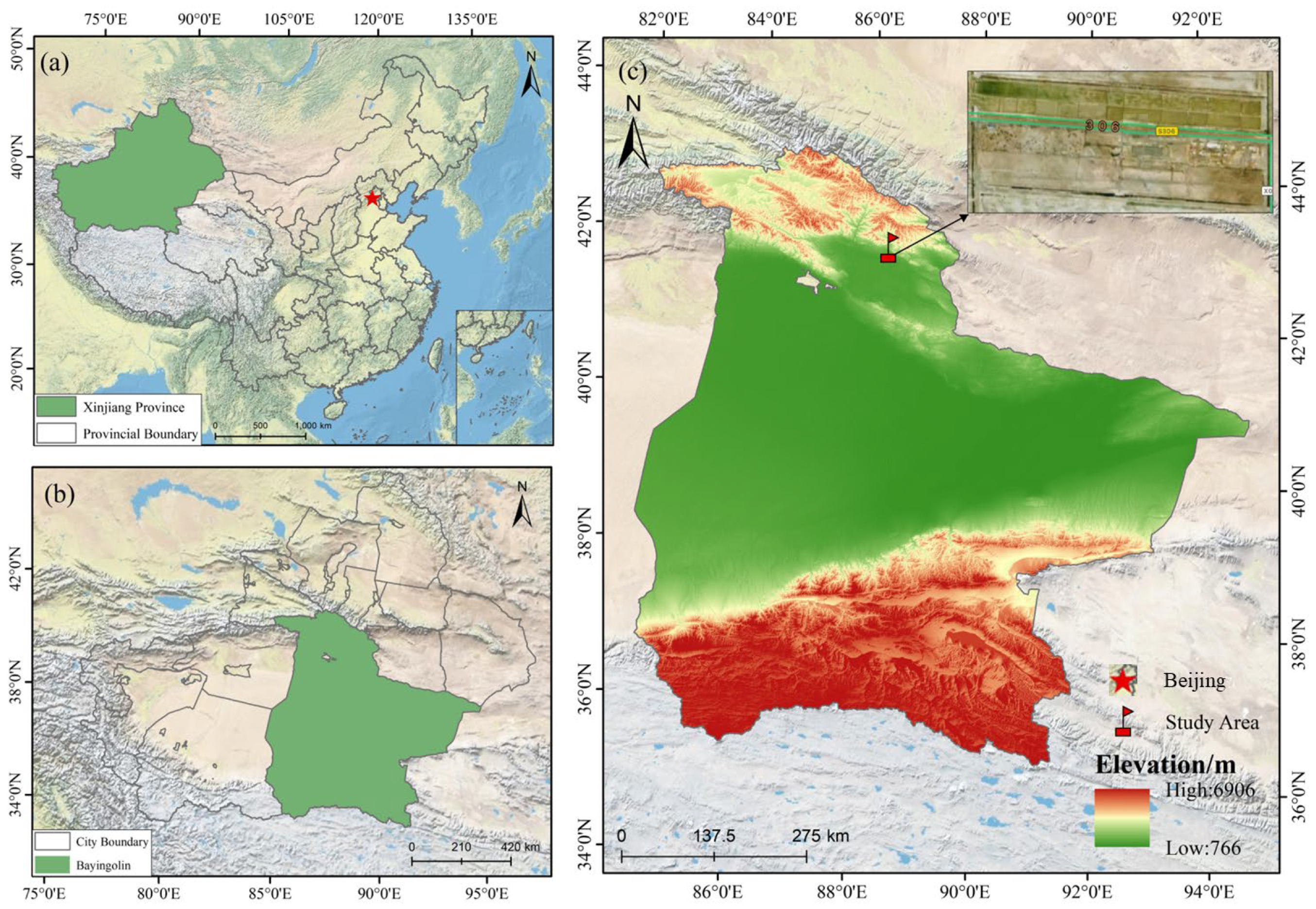
Figure 1. Map of the study area.
Sustainability 18 00862 g001
Figure 2. Layout of the experiment.
Sustainability 18 00862 g002
Figure 3. Soil water content of each treatment before and after the experiment.
Sustainability 18 00862 g003
Figure 4. Soil salinity of each treatment before and after the experiment.
Sustainability 18 00862 g004
Figure 5. Effects of deep ploughing combined with subsurface drainage on soil ion contents. Note: Different letters indicate significant differences at p < 0.05.
Sustainability 18 00862 g005
Figure 6. Effects of deep ploughing combined with subsurface drainage on soil bulk density and total porosity. Note: Values are presented as mean ± SD (n = 3). Different letters indicate significant differences at p < 0.05.
Sustainability 18 00862 g006
Figure 7. Temporal variation in drainage discharge for each treatment during spring irrigation and leaching.
Sustainability 18 00862 g007
Figure 8. Temporal variation in drainage electrical conductivity for each treatment during spring irrigation and leaching.
Sustainability 18 00862 g008
Figure 9. Cumulative drainage volume and cumulative salt removal for each treatment during spring irrigation and leaching.
Sustainability 18 00862 g009
Figure 10. Correlation analysis between soil desalinization rate and environmental factors. Note: SR, desalinization rate; SY, soil salinity; BD, bulk density; SP, total porosity. * indicates p < 0.05; ** indicates p < 0.01; *** indicates p < 0.001.
Sustainability 18 00862 g010
Table 1. Physical properties of the soil in the experimental area.
Depth/mSilt Content/%Sand Content/%Clay Content/%Average Salt Content/g·kg−1
0~0.155.7527.3616.8936.78
0.1~0.255.7126.3117.9835.67
0.2~0.456.9329.3213.7214.52
0.4~0.655.6829.1915.1313.54
0.6~0.850.2136.4113.3812.51
0.8~1.046.3238.8614.8212.35
1.2~1.453.4637.968.5811.25
1.4~1.639.6751.329.0110.21
1.6~1.850.2139.3110.488.62
Note: Values are presented as mean values (n = 3). Here, n denotes the number of replicate plots (independent field replicates) used to calculate the average salt content at each soil depth.
Table 2. Codes of experimental treatments.
No.Subsurface Pipe Spacing, S (m)Ploughing Depth, W (cm)
S1W12070
S1W22050
S1W32030
S2W14070
S2W24050
S2W34030
Table 3. Desalinization rates of the 0–70 cm soil layer under different treatments before and after leaching.
TreatmentSoil Salinity After Spring Irrigation and Leaching in 2024 (g·kg−1)Soil Salinity After Spring Irrigation and Leaching in 2025 (g·kg−1)Average Desalinization Rate (%)
Before LeachingAfter LeachingDesalinization Rate (%)Before LeachingAfter LeachingDesalinization Rate (%)
S2W324.08 ± 1.24 a18.22 ± 0.68 a24.3424.41 ± 2.24 a18.13 ± 0.85 a25.7324.71
S1W326.35 ± 1.56 bc17.09 ± 1.78 abc35.1421.34 ± 1.45 ab14.57 ± 1.54 bc31.7244.71
S2W223.48 ± 0.58 ab17.08 ± 1.25 abc27.2620.58 ± 1.65 b14.48 ± 1.34 bc29.6438.33
S1W225.24 ± 1.34 c16.15 ± 0.94 abc36.0122.29 ± 0.54 c14.24 ± 1.26 bc36.1243.58
S2W127.72 ± 2.14 cd19.24 ± 1.35 ac30.5919.81 ± 0.24 b13.75 ± 0.98 bc30.5950.40
S1W128.58 ± 1.89 cd16.76 ± 2.45 d41.3618.24 ± 1.45 d10.09 ± 1.28 d44.6864.70
Note: Different lowercase letters in the same column indicate significant differences in mean soil salinity among treatments (p < 0.05); average desalinization rate = (soil salinity before spring irrigation and leaching in 2024 a − soil salinity after spring irrigation and leaching in 2025 a)/soil salinity before spring irrigation and leaching in 2024 a × 100%.
Disclaimer/Publisher’s Note: The statements, opinions and data contained in all publications are solely those of the individual author(s) and contributor(s) and not of MDPI and/or the editor(s). MDPI and/or the editor(s) disclaim responsibility for any injury to people or property resulting from any ideas, methods, instructions or products referred to in the content.