1. Introduction
Agricultural mechanization is a major contributor to energy consumption worldwide, with fuel use in crop production representing a significant portion of the sector’s total energy demand. Improving energy efficiency in agricultural operations is therefore critical to support sustainable farming practices and reduce environmental impacts.
Tractors serve as the primary source of power for agricultural machinery, and their fuel consumption represents a key performance parameter during field operations. With rising fuel costs, energy input has become a major concern for farmers, making fuel and energy efficiency critical not only for sustainable farming but also for reducing greenhouse gas emissions and supporting resource-efficient practices. Understanding tractor fuel requirements across different field operations is essential for effectively managing both production costs and energy resources.
During tillage operations, high levels of fuel energy are required to overcome the soil resistance forces that arise during cutting and, when necessary, turning the soil. Operations such as ploughing and soil rotation are particularly fuel–intensive, contributing to higher energy use and environmental impact if not optimized [
1]. In agricultural production, approximately 60% of total fuel consumption is expended on seedbed preparation [
2]. Many parameters affect a tractor’s fuel consumption during tillage, including soil structure, climate, soil moisture, tractor type, tractor size, and the relationship between tractor and implements. Therefore, tractor fuel consumption is not constant but varies depending on operating conditions. Optimizing machine operating efficiency is essential for improving agricultural production and for promoting sustainable mechanization practices [
3,
4]. It has been estimated that in the United States, for every 1% improvement in traction efficiency, 284–303 million liters of fuel can be saved annually [
5]. These findings highlight the importance of optimizing machine–soil interactions, adopting appropriate tillage strategies, and improving equipment design to reduce energy inputs and enhance overall production efficiency, with subsequent environmental and economic benefits.
Machine learning-based models can assist in predicting tractor fuel consumption under varying operating conditions, helping to minimize energy waste and promote sustainable field management. Previous studies have applied machine learning approaches, such as regression-based models and ensemble methods, to predict fuel consumption and energy efficiency in agricultural machinery [
2,
3,
4,
5]. However, these studies often relied on limited datasets, focused on specific soil types or tractor–implement combinations, and did not comprehensively evaluate the joint effects of operational parameters. The present study aims to address these gaps by investigating the combined impact of forward speed and tillage depth under controlled field conditions, while employing multiple machine learning algorithms to model and predict optimal energy use.
Karparvarfard and Rahmanian-Koushkaki [
6] investigated the effects of blade width, tillage depth, and forward speed influence fuel consumption during chisel plow operations. The experimentally obtained fuel consumption values were then evaluated against predictions derived from the ASAE Standard D497.4 [
7]. Their findings indicated that the standard systematically overpredicted fuel consumption, with discrepancies ranging from 26% to 53%.
Rahimi-Ajdadi and Gilandeh [
8] employed data from the Nebraska Tractor Testing Laboratory to estimate tractor fuel consumption as a function of engine speed, loading conditions, tested weight, drawbar performance, and power take-off (PTO) operation. Fuel consumption was modeled using backpropagation-based artificial neural networks (ANNs). The optimal model consisted of two hidden layers with 10 neurons each and was trained using the Levenberg–Marquardt algorithm, achieving a high predictive performance (R
2 = 0.986).
Abbaspour-Gilandeh et al. [
9] used multilayer recurrent backpropagation artificial neural networks in their study to predict the pulling force of a chisel cultivator. The input parameters of the ANN were soil moisture content, tractor forward speed, soil cone index, and tillage depth. The output parameter of the designed network was the pulling force of the chisel cultivator. Momentum gradient descent, scaled conjugate gradient, and Levenberg–Marquardt algorithms were used to train the network. The ANN model with the scaled conjugate gradient algorithm showed high success with 89.48% prediction accuracy and an R
2 of 0.9445. In contrast, the linear regression model performed significantly worse with 61% accuracy and an R
2 of 0.592. This difference clearly demonstrates that ANNs are more effective than regression methods in predicting the pulling force.
Kheiralla et al. [
10] developed four linear regression-based fuel consumption models for moldboard plowing, disc plowing, disc harrowing, and rotary harrowing operations conducted in sandy clay loam soil. The models were derived using traction power, PTO power, and equivalent PTO power as explanatory variables. Their analysis showed that fuel consumption values estimated using the ASAE Standard D497.3 [
11] exceeded those predicted by the proposed models by approximately 17–33%. In contrast, the fuel consumption rates generated by the developed models were within the acceptable limits reported in the OECD Tractor Test.
Çarman et al. [
12] developed an artificial neural network model employing a backpropagation learning algorithm to predict the specific draft force and fuel consumption of a mouldboard plough under different operating conditions. Validation against measured draft force and fuel consumption values demonstrated that the model could estimate these parameters with an error of less than 1%. Over the last two decades, researchers have focused on examining the effect of forward speed and tillage depth on fuel consumption of a tractor equipped with specific tillage equipment. Studies have shown that tractor forward speed and tillage depth significantly affect fuel consumption. It has been shown that a better understanding of tractor fuel consumption behavior during tillage operations can be achieved by accurately modeling the effects of forward speed and tillage depth on tractor fuel efficiency. This has led to the development of various mathematical models to predict tractor fuel efficiency parameters during tillage. A review of the studies has shown that simple linear regression, the ASABE equation, and the univariate nonlinear regression model have been used to predict some tractor fuel efficiency parameters based on a single variable [
13,
14,
15]. Such models can also inform sustainability-oriented decisions by highlighting energy-saving opportunities.
A study on the classification of agricultural machinery using machine learning algorithms demonstrated that machine vibration and pitch serve as reliable indicators for machine identification. The analysis applied five machine learning methods, namely K-Nearest Neighbor, Support Vector Machine, Decision Tree, Random Forest, and Gradient Boosting, on the vibration and pitch data of the machinery. Both vibration and pitch were found to be effective indicators for identifying agricultural machinery. However, classification based on vibration alone achieved higher accuracy (82–85%) compared to pitch-based classification, which showed an accuracy of 68–71%. When vibration and pitch were combined, the classification accuracy increased to 91% [
16].
Due to the similar phenological and spectral properties of different plants, the predictive accuracy of their classification with various image classification techniques is low. Therefore, in the process of classification of plant species using satellite images, Random Forest, Support Vector Machine, and K-Nearest Neighbor machine learning algorithms were used to classify plant species from satellite images. According to the results obtained from the study, the most successful classification (95.3%) was calculated with Random Forest, while the lowest success was obtained with Support Vector Machine (75.9%) [
17].
Machine learning, a subfield of computer science and artificial intelligence, focuses on the development of systems that can learn from data rather than relying on explicitly programmed instructions. It enables computers to perform complex tasks autonomously by extracting patterns and knowledge from experience. This is based on the ability to detect patterns and make predictions through data analysis. By applying it to the real world, it evaluates its performance and begins to produce more accurate and efficient results over time.
Machine learning plays a unique role in building data-driven decision-making processes without human intervention, especially in multivariate, complex, and constantly changing systems. Its disadvantages include costly implementation, potential loss of work, and a lack of emotion and creativity. Recent developments in machine learning, supported by progress in big data analytics and high-performance computing, have opened novel possibilities for the evaluation, quantification, and optimization of data-driven processes in agricultural operations. Machine learning is increasingly being applied to scientific fields such as bioinformatics, meteorology, robotics, agricultural machinery, and food safety [
18,
19,
20]. Incorporating machine learning for fuel efficiency prediction contributes to sustainable agricultural practices by reducing energy waste and optimizing resource use.
In general, there are limited published studies on the application of machine learning simulation environments to estimate tractor fuel efficiency parameters based on simultaneous changes in working depth and forward speed during tillage. This study aims to develop a machine learning model capable of accurately predicting fuel efficiency parameters during tillage operations, considering variations in both working depth and forward speed. The predictive capability of the model was assessed using relevant statistical metrics, while the influences of operating speed and tillage depth on tractor fuel efficiency were additionally examined through statistical analyses. The results aim to support the development of energy-efficient and sustainable mechanization practices in agricultural systems.
2. Materials and Methods
The trials were conducted at the Konya Soil, Water, and Desertification Control Research Station headquarters in Konya, Turkey. The site is located at an altitude of 1050 m above sea level, with coordinates 37°48′22.60″ north latitude and 32°30′43.83″ east longitude. The soil texture in the trial area was clay, containing stubble residue from previous wheat cultivation. The plot size was 10 m wide and 100 m long (1000 m2). The trials were carried out in 3 replicates.
Some soil properties of the trial area are given in
Table 1. These properties are important not only for accurate fuel consumption assessment but also for understanding the potential environmental impact of tillage practices.
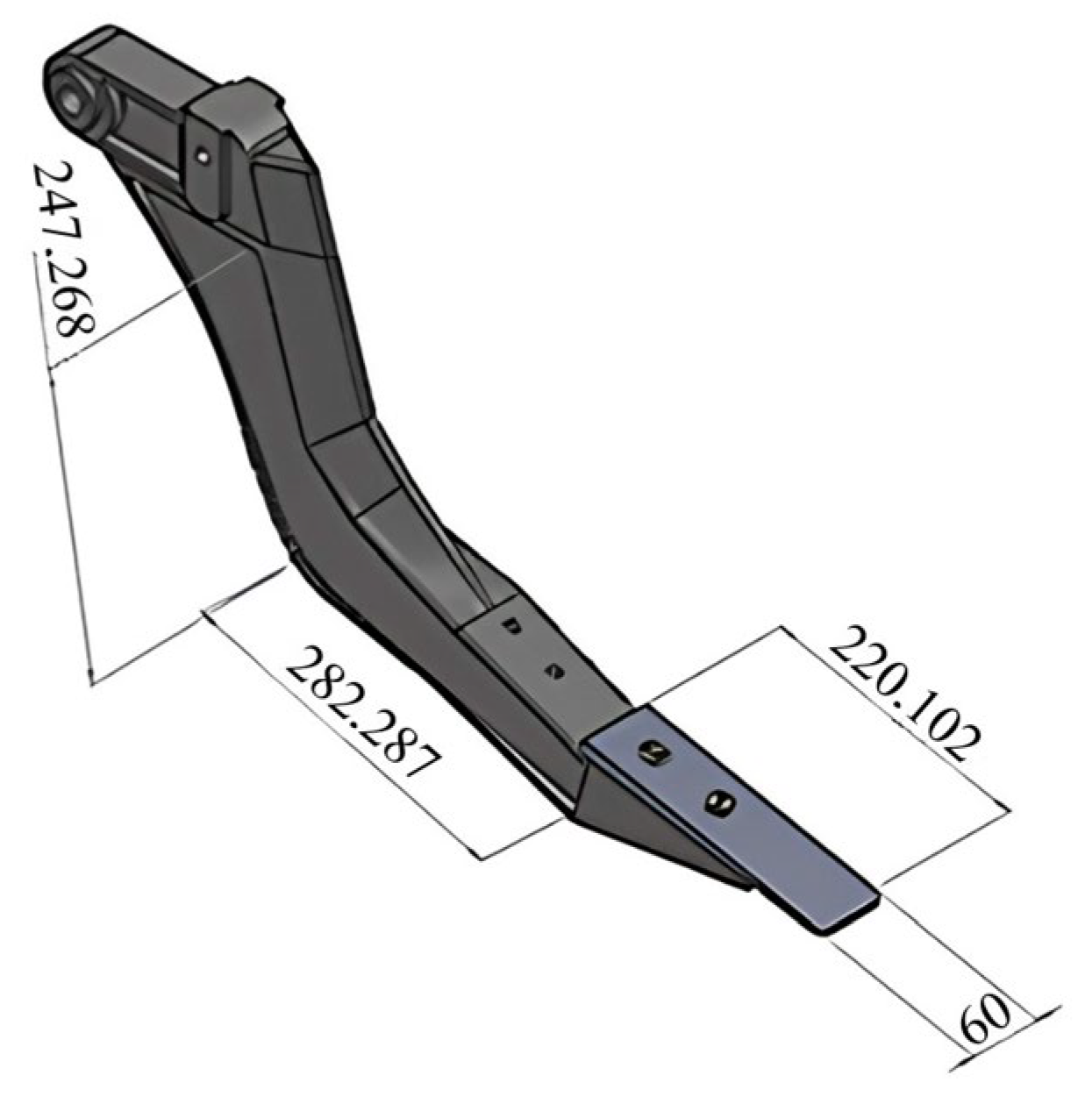
A seven-legged chisel plow was used in the study, and the technical specifications of each tine are given in
Figure 1. The selection of this implement allows evaluation of fuel efficiency and soil disturbance, which is relevant for sustainable soil management.
Trials were conducted at four different depths (15, 19.5, 23 and 26.5 cm) and four different forward speeds (0.6, 0.95, 1.2 and 1.4 m·s−1), and specific fuel consumption [L·kW−1·h−1], fuel consumption per unit area [L·ha−1], and overall energy efficiency [%] were determined.
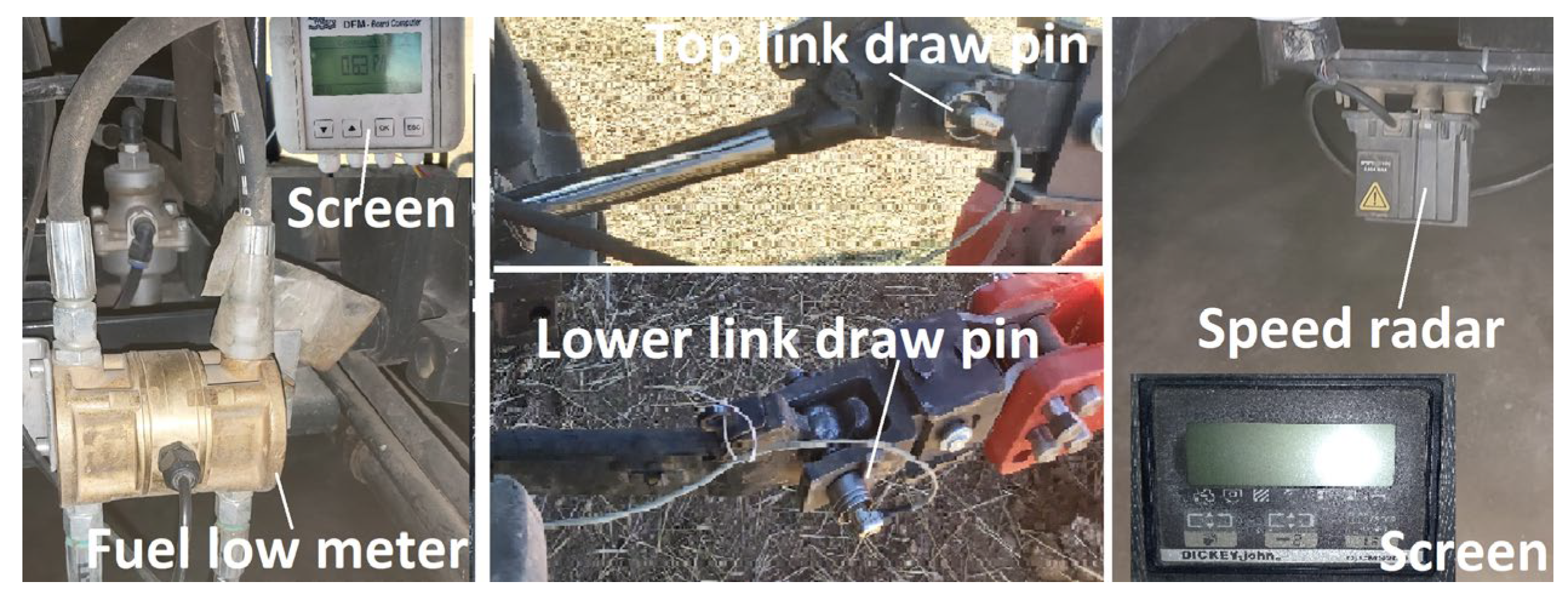
Fuel consumption rate was quantified using two Aquametro turbine-type flow transducers (Aquametro Oil & Marine AG, Therwil, Switzerland) with an operational range of 1–400 L·h
−1. During the experiments, one sensor was installed between the fuel filter and the injection pump, while the second sensor was positioned along the return line to measure surplus fuel flowing back to the fuel tank from the injectors and injection pump. The draft force requirement of the implement was measured by mounting 30 kN capacity load cells on the tractor’s three-point hitch linkage. Data acquisition was performed using a data logger with a sampling frequency of 20 Hz. The tractor’s true forward speed was determined using a Dickey-John (version DJCMS200) system (
Figure 2).
To determine field performance parameters, a stopwatch was used to record the time while the tractor was operating in the plot. Total time was calculated by adding production time to the rotation time and other downtimes [
21]. These measurements allow quantification of energy input per unit area, which can inform sustainability assessments of tillage operations.
The theoretical field capacity (TFC) was calculated as:
where: WS is the working speed [km·h
−1]; W is the equipment working width [m].
The effectiveness of field capacity (EFC) was calculated as:
where: A is the tillage area [ha]; T is the time [h].
Field efficiency (FE) was calculated as:
To investigate tractor fuel consumption during tillage operations under different treatments, the fuel efficiency parameters of the tractor were calculated using the following equations [
22,
23,
24]. Understanding these parameters helps in designing energy-efficient and more sustainable field operations.
Fuel consumption per tilled area [L·ha
−1] can be computed as:
where FC is fuel consumption [L·h
−1].
The specific fuel consumption (SFC) [L·kW
−1·h
−1] is:
where DBF is the drawbar force of equipment
The drawbar power (DBP) [kW] can be determined as:
The overall energy efficiency (OEE) [%] is:
The fuel power (PF) [kW] can be determined with the following equation:
where HV denotes the heating value of the fuel, which is assumed to be 44,000 kJ kg
−1 for diesel;
represents the fuel density (0.835 kg·L
−1; 3600 is the unit conversion coefficient; and 10.21 is a constant value.
The properties of diesel fuel were determined in a fuel laboratory. The calorific value of the diesel fuel was determined using an IKA C 200 model calorimeter (IKA-Werke GmbH & Co. KG, Staufen, Germany). Heating value of the fuel were conducted using a Kem Kyoto DA-130N device (Kyoto Electronics Manufacturing Co., Ltd., Kyoto, Japan) with a measurement range of 0.0000–2.0000 g·cm−3, an error class of ±0.001 g·cm−3, and an operating temperature range of 0–40 °C.
In this study, five machine learning algorithms were employed to model tractor fuel efficiency parameters during soil tillage operations. The dataset was collected from experiments conducted under controlled field conditions, incorporating various combinations of forward speed and working depth. Machine learning enables the simulation of energy-efficient tillage scenarios, providing insights to support sustainable agricultural practices.
The Python 3x programming language was used in the study, and the following libraries were utilized:
NumPy: Numerical calculations and matrix operations;
Pandas: Data manipulation and analysis;
Scikit-learn: Machine learning algorithms and model evaluation;
Joblib: Model serialization operations;
Openpyxl: Excel file operations and reporting.
Raw data was stored in CSV format and processed using Python. The following steps were implemented during the data preprocessing phase:
Character Encoding: UTF-8-sig encoding ensured accurate reading of Turkish characters.
Format Normalization: A special normalization algorithm was developed to ensure compatibility between files created in different regional settings. This algorithm converts semicolons (;) to commas (,) and decimal commas to periods.
Data Validation: The validity of numerical values for all observations was checked, and NaN values were identified and excluded from the analysis. The validity of numerical values for all observations was checked, and NaN values were identified and excluded from the analysis. As a result, a final dataset consisting of 16 observations was obtained. In line with the defined testing strategy, it was divided into a test set comprising 12 samples and a training set comprising 4 samples.
Five different Machine Learning algorithms were used in the study:
Polynomial Regression (PL):
Second-degree polynomial regression was used to model the nonlinear relationships between independent and dependent variables. Polynomial Linear (PL) modeling was chosen for its ability to capture nonlinear trends commonly observed in agricultural mechanization data, making it particularly suitable for achieving high accuracy in predicting fuel consumption per unit area and overall energy efficiency in this study.
Mathematical Formulation:
Original features: X = [speed, depth]
Polynomial transformation (degree = 2):
X_poly = [speed, depth, speed2, speed × depth, depth2]
- 4.
Random Forest Regressor (RFR):
Random Forest, an ensemble learning method, produces robust predictions by combining the predictions of multiple decision trees. Random Forest Regressor (RFR) was selected for its robustness against overfitting and its effectiveness in modeling highly nonlinear and variable relationships, making it particularly well suited for predicting tractor-specific fuel consumption in the context of this study.
Hyperparameters:
Number of trees (n_estimators): 100
Maximum depth (max_depth): 5
Minimum number of split samples (min_samples_split): 2
Minimum number of leaf samples (min_samples_leaf): 1
Random state (random_state): 42
- 5.
Gradient Boosting Regressor (GBR):
Gradient Boosting creates a robust prediction model by sequentially combining weak learners. Gradient Boosting Regression (GBR) was employed due to its high predictive accuracy achieved by sequentially combining weak learners to minimize residual errors, making it particularly suitable for capturing complex patterns in tractor fuel consumption and energy efficiency data under varying field conditions.
Hyperparameters:
Number of trees (n_estimators): 100
Learning rate (learning_rate): 0.1
Maximum depth (max_depth): 3
Random state (random_state): 42
- 6.
Support Vector Regression (SVR):
Support Vector Regression performs regression by finding the optimal hyperplane in a high-dimensional space. Support Vector Regression (SVR) was included due to its strong generalization capability in limited and complex datasets, enabling precise estimation of tractor performance parameters under varying operating conditions.
Hyperparameters:
Kernel: Radial Basis Function
Regularization parameter (C): 100
Kernel coefficient (gamma): ‘auto’
Epsilon: 0.1
Feature scaling: Standard Scaler
- 7.
Decision Tree Regressor (DTR):
A decision tree performs predictions by partitioning the dataset according to feature values. Decision Tree Regression (DTR) was selected for its ability to model nonlinear relationships through simple decision rules and to provide an interpretable structure for analyzing the effects of operational parameters on tractor fuel consumption and energy efficiency.
Hyperparameters:
Maximum depth (max_depth): 5
Minimum number of split samples (min_samples_split): 2
Random state (random_state): 42.
The model was trained using the Ordinary Least Squares (OLS) approach. Of the available data, 12 observations were allocated for model calibration, while the remaining 4 were used for validation. Model accuracy was assessed through statistical indicators such as the coefficient of determination (R
2), root mean square error (RMSE), and mean absolute percentage error (MAPE). These evaluation criteria reflect the robustness of the model predictions, which is essential for achieving sustainable improvements in fuel efficiency within agricultural operations.
where: Xi are the measured values; X
1 are the predicted values.
3. Results and Discussion
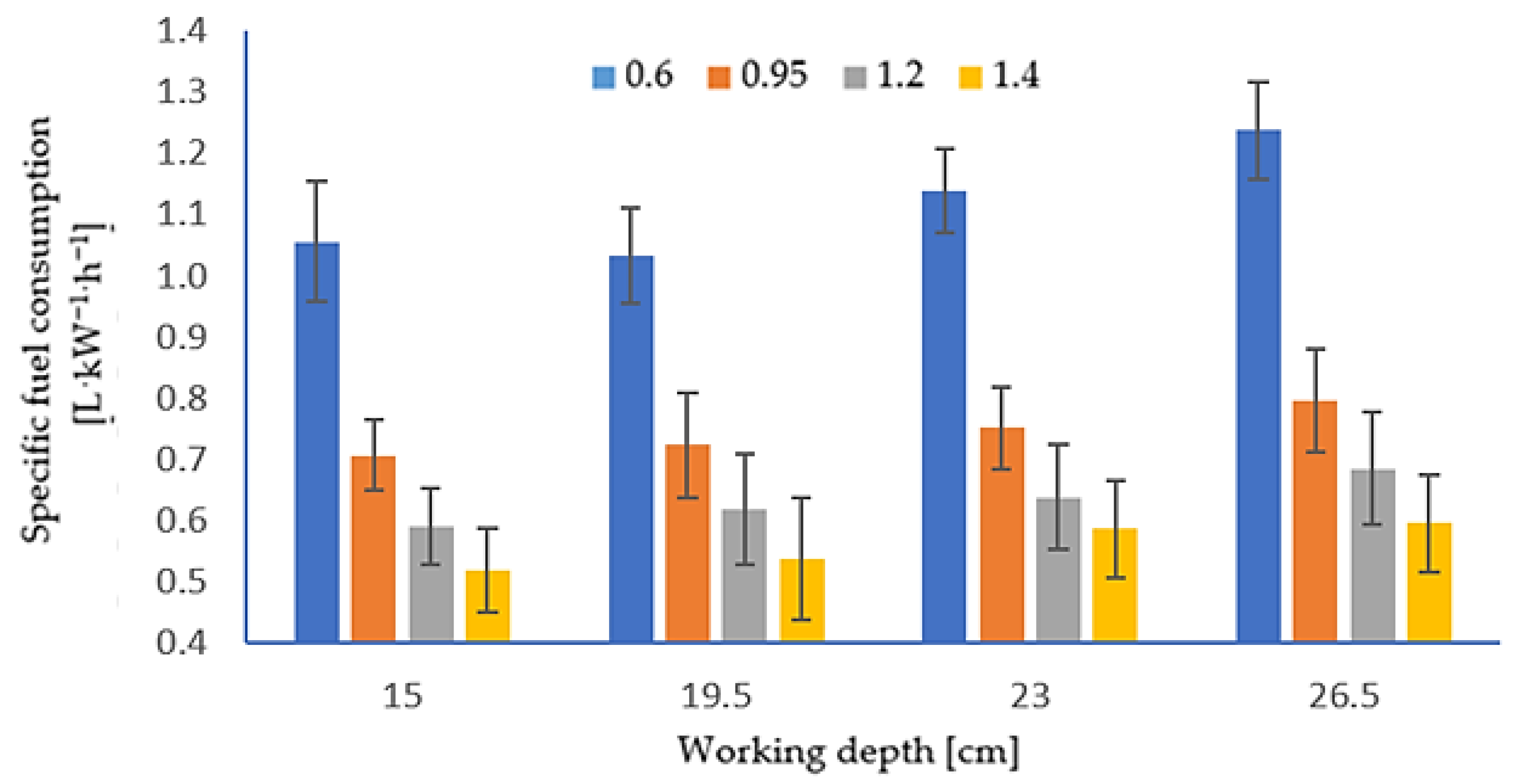
Specific fuel consumption, measured and calculated during the trials, varied between 0.519 and 1.237 L·kW
−1·h
−1. An examination of
Figure 3 reveals that specific fuel consumption varies significantly with both forward speed and tillage depth. Lower specific fuel consumption indicates more energy-efficient tillage, which is a key factor for sustainable agricultural practices.
A 133% increase in forward speed resulted in a 49.8% decrease in fuel consumption per unit area, while a 76.6% increase in working depth resulted in a 15.4% increase in fuel consumption per unit area. This can be attributed to the increased draft requirement of the implement and the increased engine load with increasing tillage depth. At all working depths, the highest specific fuel consumption was achieved at an advance speed of 0.6 m·s−1. This could be attributed to the tractor’s lower work performance at lower forward speeds. A significant decrease in specific fuel consumption was observed as forward speed increased. The lowest values were observed at all depths, particularly at 1.4 m·s−1. This is due to the engine being under more suitable load and operating in a more efficient operating regime. Selecting optimal forward speed and tillage depth contributes not only to fuel savings but also to reducing greenhouse gas emissions. Increasing the forward speed excessively during tillage causes the tractor engine to operate under higher load and increases fuel consumption per unit area, while selecting the optimum tillage depth along with an appropriate forward speed reduces fuel consumption and consequently a significant decrease in CO2 emissions. For optimum fuel efficiency, both feed rate and working depth should be evaluated together. According to the results of the variance analysis, the effects of working depth and working depth on specific fuel consumption were found to be statistically significant (p < 0.05 and p < 0.01).
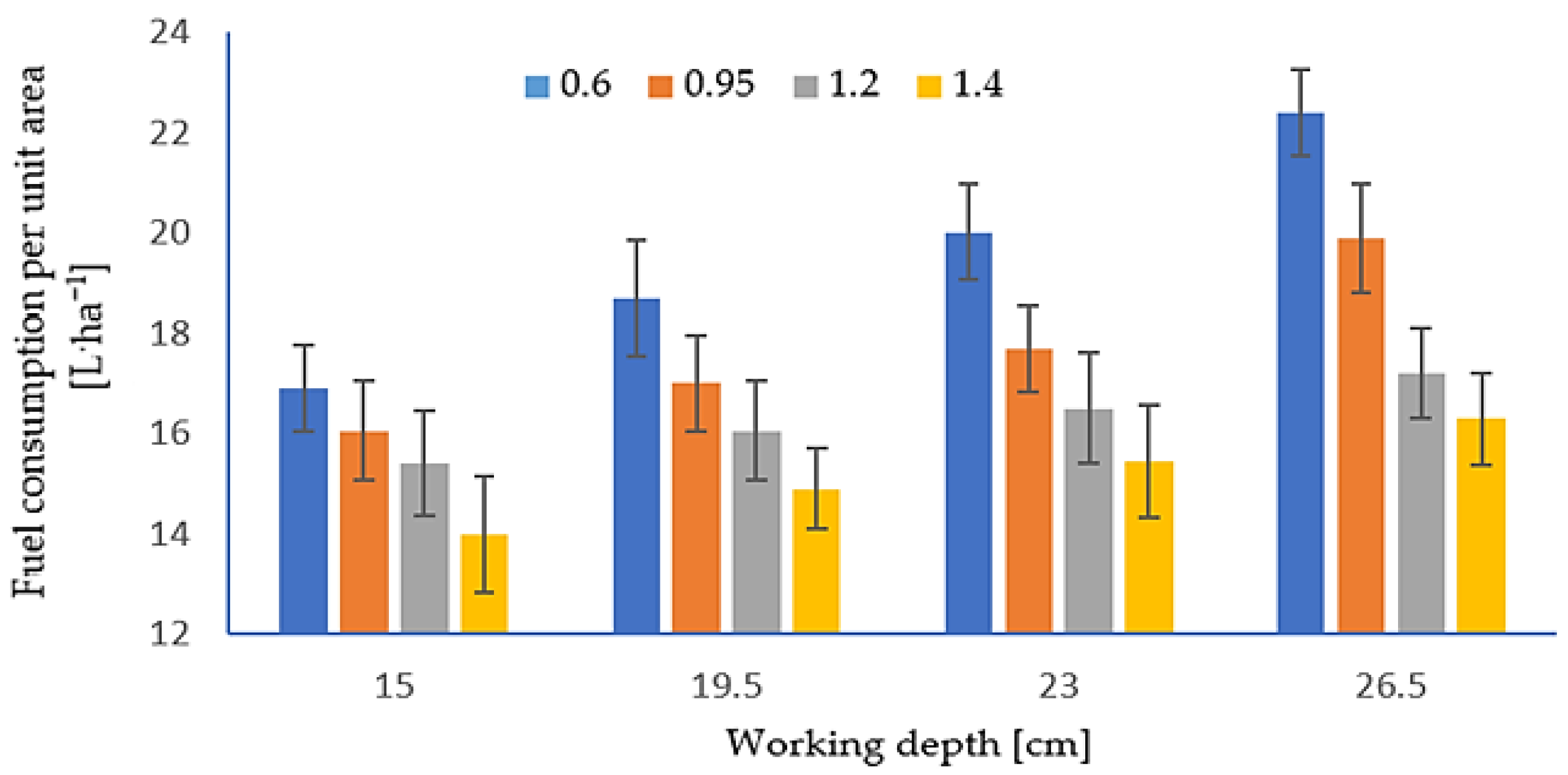
The changes in fuel consumption per unit area at different forward speeds and tillage depths are shown in
Figure 4. In general, both tillage depth and forward speed have an impact on fuel consumption per unit area. Minimizing fuel consumption per unit area is directly linked to improved sustainability in field operations.
Fuel consumption per unit area varied between 14.0 and 22.4 L·ha−1 depending on different operating conditions. When the forward speed increased from 0.6 m/s to 1.4 m/s (a 133% increase), it resulted in a 22.2% decrease in fuel consumption per unit area, while a 76.6% increase in working depth resulted in a 19.3% increase in fuel consumption per unit area. Across all working depths, the highest fuel consumption was measured at a forward speed of 0.6 m·s−1. This decreased the tractor’s working efficiency at low forward speeds, leading to an increase in fuel consumption per unit area. In contrast, the lowest fuel consumption was obtained at a forward speed of 1.4 m·s−1 at all depths. This result demonstrates that fuel consumption per unit area decreased due to the increased working efficiency of the tractor at high forward speeds. As tillage depth increased, fuel consumption per unit area increased at all forward speeds. As expected, fuel consumption per unit area was highest at the highest working depth (26.5 cm). This trend indicates that fuel consumption increases with increasing depth due to the increased soil volume worked and, consequently, the equipment’s draft requirement. For optimum fuel efficiency in tillage, both forward speed and working depth should be carefully selected. Careful selection of operating conditions enhances both fuel efficiency and environmental sustainability. Variance analysis revealed that both working depth and forward speed had a statistically significant effect on fuel consumption per unit area (p < 0.01).
Karparvarfard and Rahmanian-Koshkaki [
6] reported fuel consumption per unit area as 36.7, 30.2, and 27.5 L·ha
−1 at a working depth of 20 cm at operating speeds of 3, 4, and 5 km·h
−1, respectively, in a study conducted with a chisel plow (9 tines). Shafaei et al. [
25] reported fuel consumption per unit area as 28,143, 23,197, and 18,697 L·ha
−1 at a working depth of 30 cm at operating speeds of 3, 4, and 5 km·h
−1, respectively, in a study conducted with a disc plow (3 discs). These studies support the results of our study.
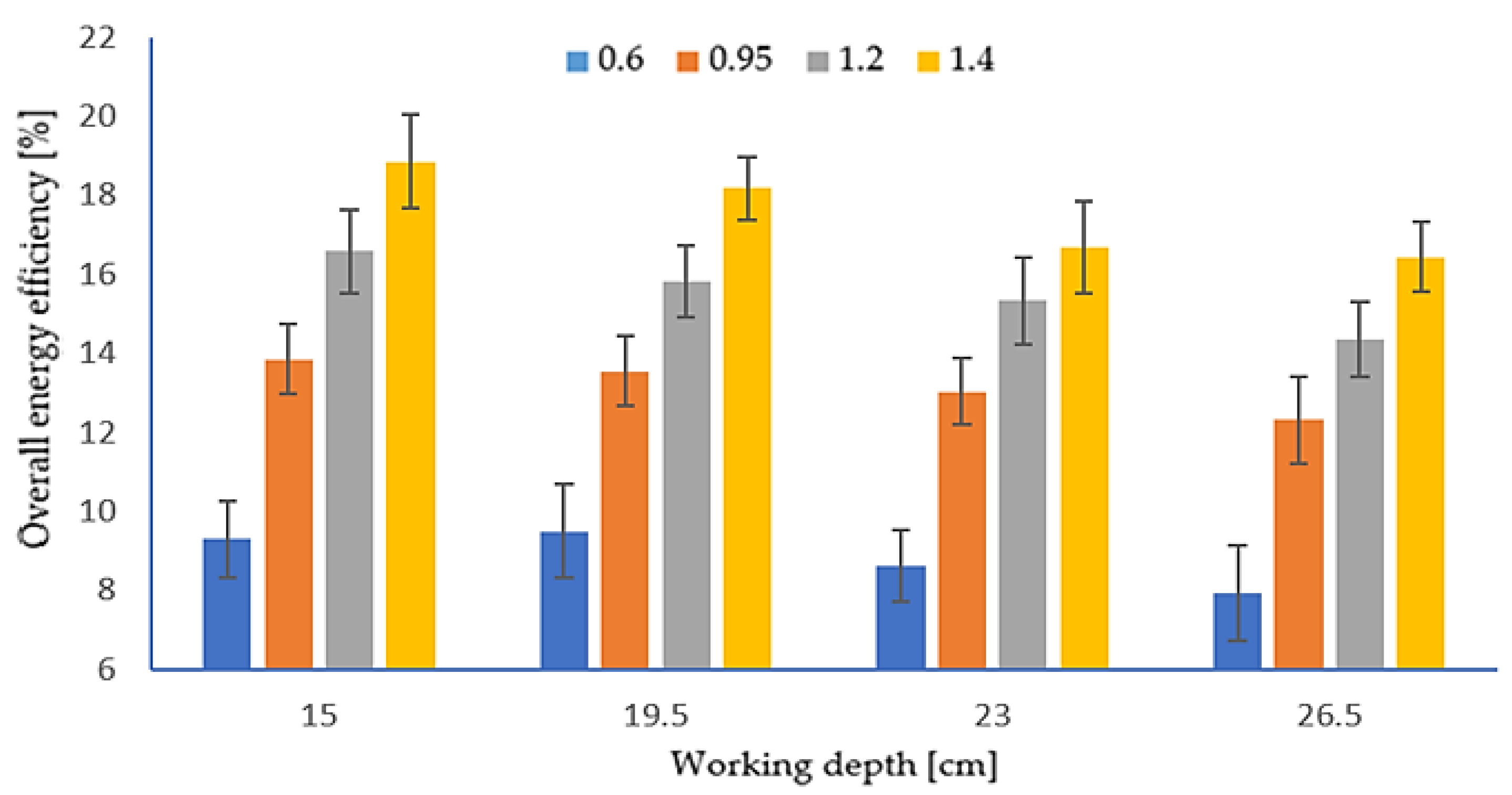
The changes in overall energy efficiency (%) values at different forward speeds and tillage depths are shown in
Figure 5. In general, a significant increase in energy efficiency was observed with increasing the forward speed at all working depths. Higher energy efficiency corresponds to reduced fuel usage and improved sustainability of tillage operations. Site-specific tillage, when compared with conventional uniform-depth tillage, achieved substantial reductions in energy consumption and fuel use, reaching 50% and 30%, respectively, in loamy sandy soils. In sandy loam soil, energy and fuel savings were recorded at 21% and 8%, respectively. Similarly, sandy soil exhibited energy savings of 26.1% alongside a fuel reduction of 8.5% [
26].
The highest energy efficiency was obtained as 18.85% at a forward speed of 1.4 m·s
−1 and a working depth of 15 cm. In contrast, the lowest energy efficiency was determined as 7.92% at a forward speed of 0.6 m·s
−1 and a working depth of 15 cm. This shows that at low forward speeds, energy efficiency decreases due to the engine operating for longer periods under low load; on the other hand, at high speeds, the engine operates within the optimum power range, making energy use more efficient. A slight decreasing trend in energy efficiency was observed as the tillage depth increased. This can be explained by the increase in soil resistance with increasing working depth and the resulting increase in draft power requirements. Depending on soil texture, fuel consumption increases by approximately 0.5 to 1.5 L·ha
−1 for each additional centimeter of plowing depth [
27,
28]. Pulling force increased markedly for all three tillage implements as both operating speed and tillage depth increased. Analysis of variance indicated that the block effect had no statistically significant influence on pulling force, whereas plow type, working depth, and forward speed had highly significant effects (
p < 0.01). In addition, the interaction between speed and depth was also statistically significant at the 1% level [
29]. An increase in tractor operating speed during plowing resulted in higher fuel consumption. Moreover, increasing tillage depth had a greater impact on fuel use than changes in forward speed. Additionally, the combined influence of operating speed and tillage depth led to a further rise in fuel consumption [
30]. However, this decrease was more limited, especially at high forward speeds (1.2 and 1.4 m·s
−1), indicating that appropriate speed selection can minimize energy losses under deep tillage conditions. According to the results of the variance analysis, the effects of working depth and forward speed on energy efficiency were found to be statistically significant at
p < 0.05 and
p < 0.01 levels, respectively. Optimizing speed and depth selection is essential for sustainable energy management in agriculture.
The analysis of variance results is given in
Table 2, and the LSD test results are given in
Table 3.
Both forward speed and tillage depth have a significant effect on overall energy efficiency. It has been determined that selecting the optimum forward speed is of critical importance to save fuel and energy in soil tillage. Karparvarfard and Rahmanian-Koshkaki [
6] reported overall energy efficiencies as 10%, 12%, and 15%, respectively, at a working depth of 20 cm with a chisel plow (9-tine) and operating speeds of 3, 4, and 5 km·h
−1. Al-Sager et al. [
22] reported overall energy efficiencies as 12.44%, 15.57%, and 18.66%, respectively, at a working depth of 16 cm with a chisel plow (7-tine). These studies yielded similar results to our study. In their study using a subsoiler, Askari et al. [
31] found that forward speed and working depth had an impact on overall energy efficiency. They achieved a maximum overall energy efficiency of 73.08% at a forward speed of 3.5 km·h
−1 and a working depth of 50 cm. They also found a minimum overall energy efficiency of 30.02% at a forward speed of 1.8 km·h
−1 and a working depth of 30 cm. They stated that the reason for not achieving higher overall energy efficiency was fuel wasted due to increased tractor slippage. In conditions where the overall energy efficiency value of the tractor-implement combination is below 10%, the tractors are underloaded or show low draft efficiency. On the other hand, if this value is above 20%, it indicates that the loading on the tractor is sufficient or the traction efficiency is high [
23].
In this study, five different machine learning algorithms, namely Polynomial Regression (PL), Random Forest Regressor (RFR), Gradient Boosting Regressor (GBR), Support Vector Regression (SVR) and Decision Tree Regressor (DTR) were compared. Machine learning models can be used to simulate sustainable field operations and identify energy-saving strategies.
Table 4 and
Table 5 present a summary of the models’ training and validation results, reporting key performance indicators such as the coefficient of determination (R
2), which reflects the proportion of explained variance; overall equipment effectiveness (OEE), given in percentage terms; the root mean square error (RMSE), describing the average deviation between predicted and observed values; and the mean absolute percentage error (MAPE), which quantifies the mean relative prediction error.
When the training performances of the models were evaluated, it was determined that the coefficient of determination ranged from 0.8577 to 1.0000, and the mean absolute percentage error ranged from 0.0000 to 11.6800. While the coefficients of determination of the models were generally quite high, the mean absolute percentage error (except for one model) was quite low (<3%) (
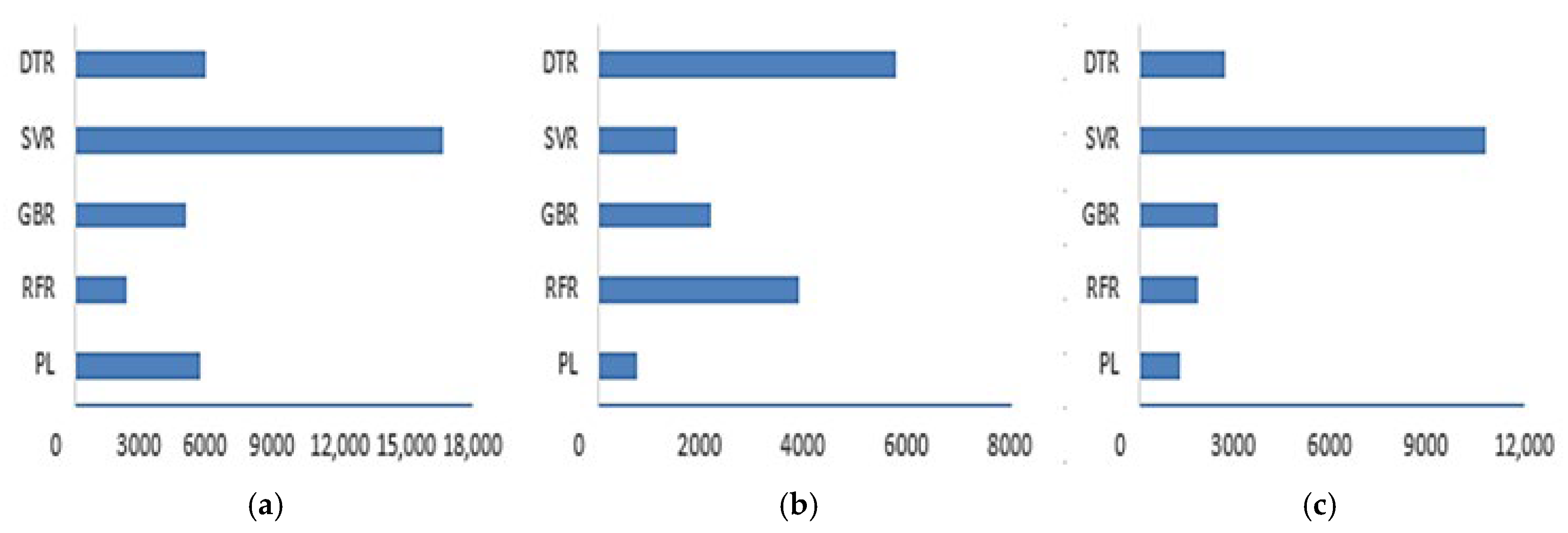
Table 4). Evaluating the test performance of the models revealed that the coefficient of determination ranged from 0.4202 to 0.9990, while the mean absolute percentage error ranged from 0.7650 to 16.6320. The models with the highest mean absolute percentage error, and therefore the lowest success, were Support Vector Regression model for specific fuel consumption and overall energy efficiency, and Decision Tree Regressor model for fuel consumption per unit area (
Table 5). The MAPE (%) values obtained for different models are comparatively presented in
Figure 6. In general, the mean absolute percentage error (MAPE) values for most models remained below 5%, indicating a high level of predictive accuracy.
The mean absolute percentage error (MAPE) (%) values obtained for different models are comparatively presented in
Figure 6. Overall, the MAPE values for most models remained below 5%, indicating a generally high level of prediction accuracy. Among the evaluated models, the Random Forest Regressor (RFR) achieved the lowest MAPE values in the prediction of the tractor’s specific fuel consumption, demonstrating superior performance for this parameter (
Figure 6a). In contrast, the Polynomial Linear (PL) model yielded the lowest MAPE values in the modeling of fuel consumption per unit area, indicating the highest predictive accuracy among all models for this variable (
Figure 6b). Similarly, for the overall energy efficiency parameters, the PL model outperformed the other models by producing the minimum MAPE values (
Figure 6c). Overall, the PL model exhibited the best performance in predicting fuel consumption per unit area and overall energy efficiency, whereas the RFR model was more effective in estimating specific fuel consumption, for which relatively higher error rates were observed across the remaining models.
The energy requirement for the moldboard plow study was predicted using artificial neural networks (ANN) and multiple linear regression (MLR) models. The mean absolute error of the prediction was found to be 2.49 for ANN and 5.40 for MLR [
32]. In their study, Shafaei et al. [
25] used an adaptive neuro-fuzzy inference system to model specific fuel consumption in their study of a three-body disc plow. They found the average relative deviation modulus to be 0.98%. Baz et al. [
33] employed an advanced cross-methodological framework that integrates machine learning–based causal inference approaches with the traditional Granger causality technique to identify the direction of causality between agricultural productivity and exogenous variables. The causal inference neural network (CINN) and deep neural network (DNN) models applied in the study produced robust and highly accurate results, offering valuable insights for policy formulation and decision-making processes. The findings demonstrate that machine learning–based methods are more effective than conventional approaches in estimating causal effects between exogenous and endogenous variables. According to the best-performing results, the proposed comprehensive model accounted for overall effects, thereby enabling more complete and reliable causal inferences.
The model with the lowest MAPE value for specific fuel consumption is Random Forest Regressor, which produced very high accuracy values such as 2.3240% mean absolute percentage error and 0.9298 coefficient of determination on the test data set. The model with the lowest MAPE value for fuel consumption per unit area is Polynomial Regression, which produced very high accuracy values such as 0.7650% mean absolute percentage error and 0.8309 coefficient of determination on the test data set. The model with the lowest MAPE value for overall energy efficiency is Polynomial Regression, which produced very high accuracy values such as 1.2450% mean absolute percentage error and 0.9884 coefficient of determination on the test data set (
Table 6).
The performance of the models used in this study largely aligns with general trends reported in the literature. Models such as PL and RFR excel in data structures dominated by nonlinear relationships. It has been seen that algorithms such as GBR, SVR and DTR need to be optimized with more careful hyperparameter tuning.




 ,
,