Next Article in Journal
Exploring the Pathways to High-Quality Development of Agricultural Enterprises from an Institutional Logic Perspective: A Systemic Configurational Analysis
Previous Article in Journal
Leadership Styles and Organizational Culture as Instruments for Managing the Eighth Loss of the LEAN Model in the Era of Artificial Intelligence
Previous Article in Special Issue
Research on Characteristics and Control Methods of Roof Water Inflow in Syncline Structure Mining Area Under High-Confined Aquifer
 
 
Due to scheduled maintenance work on our servers, there may be short service disruptions on this website between 11:00 and 12:00 CEST on March 28th.
Article

Influence of Filling Rate and Support Beam Optimization on Surface Subsidence in Sustainable Ultra-High-Water Backfill Mining: A Case Study


1
Jiangsu Engineering Laboratory of Mine Earthquake Monitoring and Prevention, School of Mines, China University of Mining & Technology, Xuzhou 221116, China
2
State Key Laboratory of Coal Resources and Safety Mining, China University of Mining & Technology, Xuzhou 221116, China
3
School of Mines, Shanxi Institute of Technology, Yangquan 045000, China
4
College of Coal Engineering, Shanxi Datong University, Datong 037003, China
*
Author to whom correspondence should be addressed.
Sustainability 2026, 18(2), 854; https://doi.org/10.3390/su18020854
Submission received: 2 December 2025 / Revised: 5 January 2026 / Accepted: 12 January 2026 / Published: 14 January 2026

Abstract

As a key sustainable green-mining technology, ultra-high-water backfill mining is widely used to control surface subsidence and sustain extraction of constrained coal seams. Focusing on the Hengjian coal mine in the Handan mining area, this study uses physical modeling and industrial tests to clarify surface subsidence under different filling rates and identify the rock layers that hydraulic supports must control at various equivalent mining heights. A method is proposed to improve the filling rate by optimizing the thickness of the hydraulic support canopy through topological analysis. Results show that, compared with a filling rate of 85%, a 90% filling rate reduces subsidence of the basic roof, key layer, and surface by 51%, 57%, and 63%, respectively, while the industrial practice results have verified that the filling rate can significantly control surface subsidence. The equivalent mining height thresholds for instability of the immediate roof and high basic roof at the 2515 working face are 0.44 m and 1.26 m. Reducing the trailing beam thickness by 10 cm can theoretically raise the filling rate of the 2515 working face by about 2%, offering guidance for similar mines.

1. Introduction

Green coal mining technologies, which coordinate efficient resource utilization, ecological conservation, and safety assurance, represent the essential pathway for coal mines to achieve long-term sustainable development [1]. The coal reserves that are trapped under buildings, railways, and water bodies (hereinafter referred to as “the three under”) have reached 1.379 billion tons [2]. However, the mining of these coal resources is constrained by the stability of surface infrastructure, preventing large-scale extraction using conventional methods [3]. In response, researchers have proposed various green backfill mining technologies to control overlying rock movement and surface subsidence [4,5,6,7,8,9,10,11,12], among which backfill mining has been the most widely adopted. Since its first successful application at Jizhong Energy in 2008, ultra-high-water backfilling mining technology has been rapidly promoted and applied in many regions in China [13]. This technology provides a new technical approach to addressing large-scale “three-under” coal extraction beneath buildings, railways, and water bodies, as well as to promoting sustainable mine development.
Ultra-high water materials are primarily composed of a mixture of two components: Material A, which is sulfate-aluminate cement clinker, and Material B, consisting of lime and gypsum [14]. The main hydration product is ettringite, which forms a network structure capable of adsorbing a large amount of free water. This material offers advantages such as good early performance, low cost, and straightforward preparation and transportation processes [15]. In the humid, low-temperature, and confined environments of underground mined-out areas, ultra-high water materials are ideal filling materials for “three under” mining [16]. Researchers both domestically and internationally have conducted a series of studies on ultra-high water filling technology and surface subsidence characteristics [17,18]. Bai [19] established a mining design scheme for coal extraction under buildings based on key layer theory, incorporating factors such as coal pillar width, roadway layout, support parameters, and filling rates. After implementation, surface subsidence was recorded at 27 mm, with a horizontal deformation rate of 0.3 mm/m, effectively preventing damage to surface structures. Li [20] proposed a technique that combines ultra-high water filling with strip mining under buildings or other structures, designing a scientifically reasonable technical plan. Predictions indicated that this approach could ensure the safety of surface buildings. Additionally, Li [21] introduced a method for detecting the effectiveness of ultra-high water filling in treating mined-out areas using transient electromagnetic methods, correlating changes in electrical resistivity before and after filling with visual detection results from boreholes to validate the method’s accuracy.
The filling rate of ultra-high water materials has a decisive impact on the effectiveness of surface subsidence control [22,23,24,25]. Chang’s [26] numerical simulations demonstrated that the effect of filling rate on surface subsidence is greater than that of filling body strength. Specifically, surface subsidence amounts were recorded as 180 mm, 287 mm, and 377 mm at filling rates of 98%, 97%, and 95%, respectively. Hao [27], based on practical mine pressure control theory, concluded that as the effective filling rate increases, the control effect of the filling body on the overlying rock mass is enhanced. When the filling rate reaches a certain value, no plastic zones may even occur within the protected coal pillar. Zhang [28] proposed the concept of equivalent mining height based on filling rate, establishing a probabilistic integral model for predicting surface subsidence to evaluate the effectiveness of fill mining, while also guiding the design of key parameters for filling operations.
Researchers have sought to increase the filling rate at working faces through improvements in filling processes and equipment research [29,30,31]. Hydraulic supports are one of the key pieces of equipment for ultra-high water fill mining. To ensure safe extraction, the trend in the development of hydraulic supports is toward greater weight and higher working resistance [32], leading to an increase in the thickness of the support beams. However, under the premise that the hydraulic supports meet the safety requirements for mining, an increase in beam thickness implies a reduction in the maximum filling rate [33]. In response, Yang [34] constructed a dynamic simulation platform based on rigid-flexible coupling to study the mechanical responses of the beam under different loads. He identified that the joint between the beam and the protective beam experiences the greatest force variation coefficient, suggesting that optimizations could be made at other locations to reduce the weight of the hydraulic supports and enhance the maximum filling rate at the working face. Xue [35] utilized ANSYS Workbench software to conduct a structural static analysis of the ZZ10800/22/45 (China Shandong Zhongmei Mining and Industrial Supplies Group Co., Ltd., Jining, China) hydraulic support beam under end-load conditions. By establishing an optimization model for the support beam with structural strength as a constraint, the study validated that the structural strength was maintained while reducing the weight of the support.
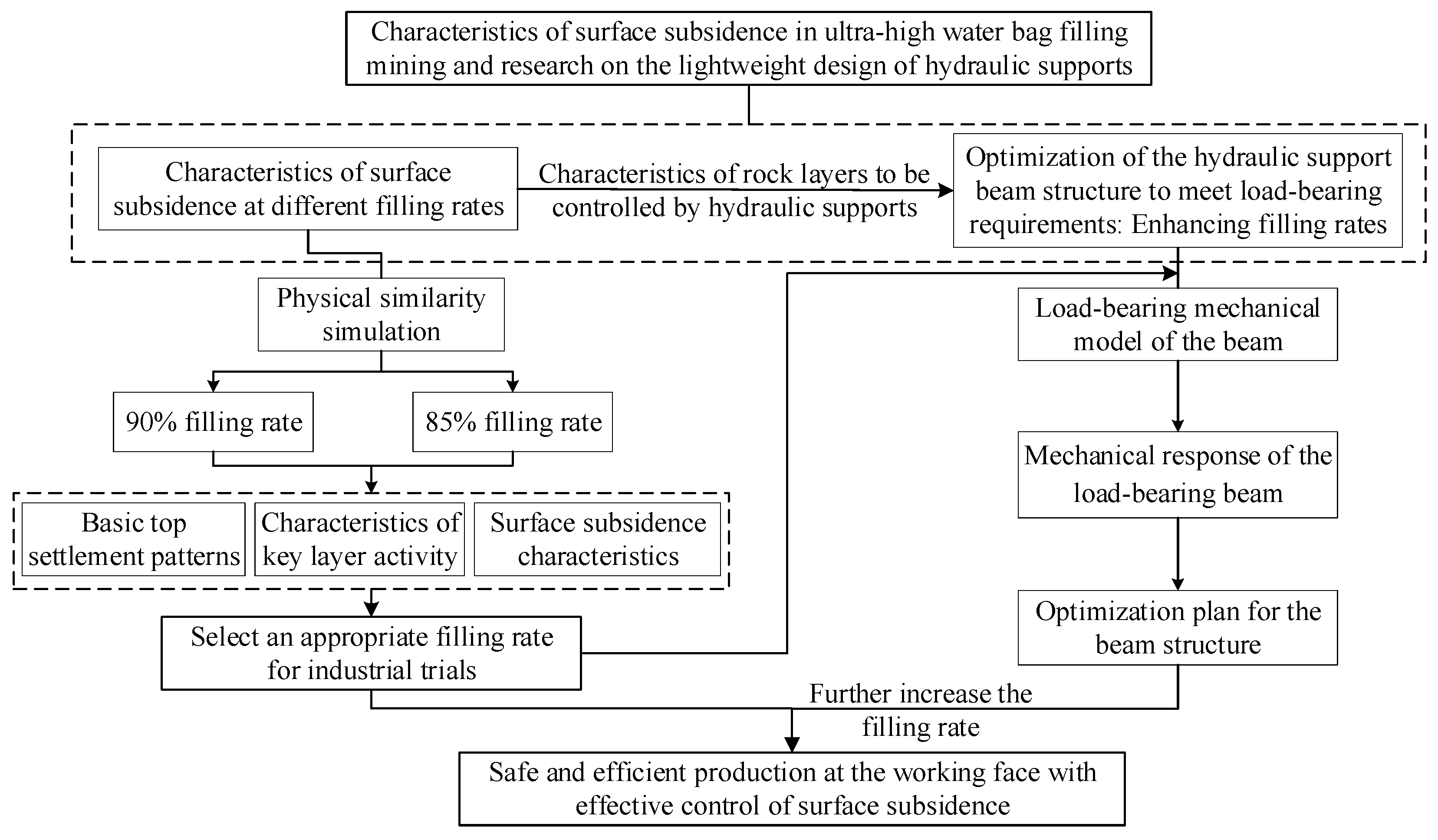
In summary, researchers both domestically and internationally have conducted extensive studies on ultra-high water fill mining. However, the characteristics of the surrounding rock that the supports need to control at different filling rates remain unclear. Furthermore, current studies on improving the filling rate mainly focus on optimizing mining processes and developing backfill materials. In parallel, research on hydraulic support design has largely emphasized mine-pressure control from the perspective of the “support–surrounding rock” interaction. To ensure safe production, hydraulic supports are often designed with load-bearing capacities far exceeding practical engineering requirements, which can adversely affect other operations, such as backfill mining. Consequently, comparatively few studies have explored improving the filling rate through structural optimization of hydraulic supports while maintaining both operational safety and economic feasibility. This paper establishes a physical similarity model based on the engineering geological conditions of the 2515 working face at Hengjian coal mine to investigate the characteristics of surface subsidence under different ultra-high water filling rates, determine the optimal filling rate, and conduct an industrial trial. Building on this foundation, the study analyzes the characteristics of the surrounding rock that hydraulic supports need to control and the load distribution characteristics of the support beams. Finally, using ANSYS Workbench simulation software version 2023R1, the mechanical responses of the beams under different loads are analyzed, and methods for increasing the filling rate are proposed from the perspective of optimizing the structure of the hydraulic support beams. The research framework is illustrated in Figure 1.

2. The Impact of Filling Rate on Surface Subsidence

2.1. Geologic Conditions

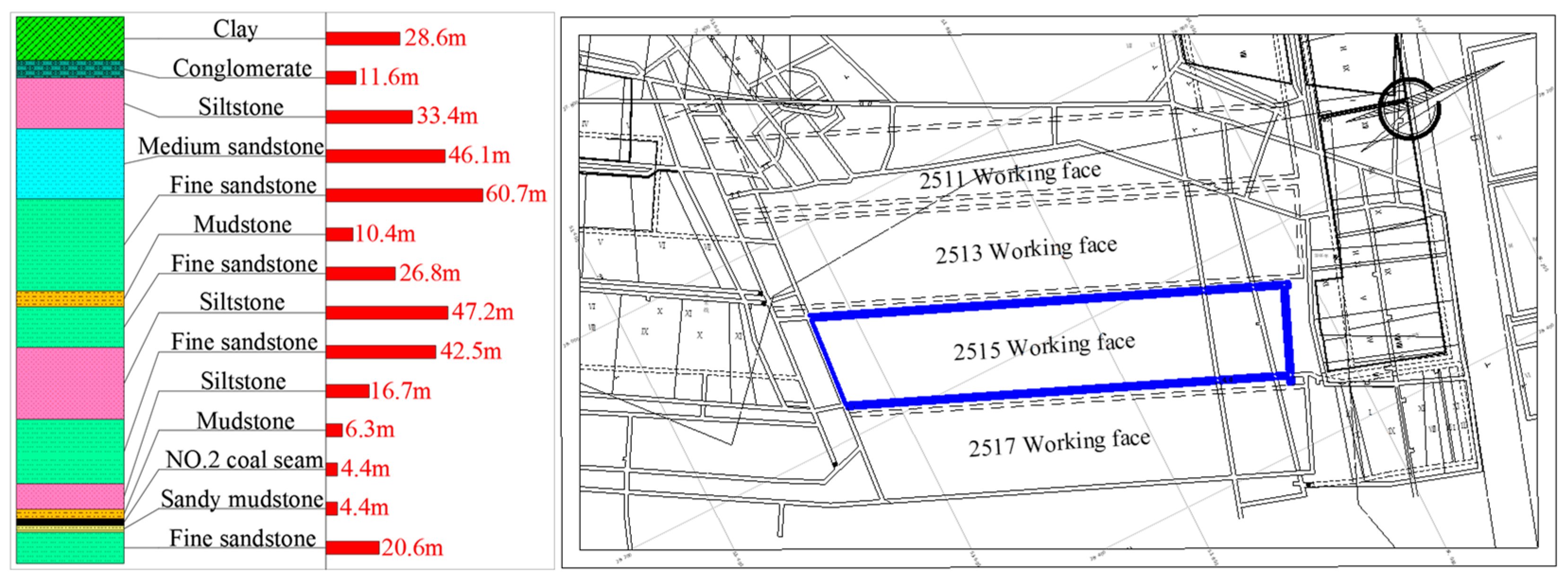
The Hengjian coal mine is located in the southwestern part of Handan City, Hebei Province. The currently mined No. 2 coal seam is nearly horizontal, with an average depth of 360 m and an average thickness of 4.4 m. The 2515 working face has a dip length of 81 m and a strike length of 460 m. To the south of the working face are the centralized belt roadway and centralized track roadway, while the north side is separated by a 20 m coal pillar from the original working face’s mined-out area. The east side adjoins the unmined 2517 working face, as shown in Figure 2. According to drilling records, the immediate roof of the 2515 working face consists of approximately 6.3 m of mudstone, the old roof has a thickness of 16.7 m and is composed of siltstone, the immediate floor is made up of 4.4 m of sandy mudstone, and the old floor consists of 20.6 m of fine sandstone.
The 2515 working face is the first ultra-high water material fill mining face at Hengjian coal mine, corresponding to the location of Zhangzhuang Village on the surface. The surface is primarily composed of farmland and village buildings, with no water bodies present, though shallow gullies are developed. In other working faces of Hengjian mine, the use of full caving methods for managing the roof has led to varying degrees of surface subsidence and ground fissures. Therefore, studying the characteristics of surface subsidence under the conditions of ultra-high water fill mining at the 2515 working face is of great significance for protecting surface buildings.

2.2. Method and Experimental Procedure

2.2.1. Proportions of Similarity Simulation Materials

Physical modeling has been widely used to simulate the mining process of underground longwall working faces [36,37,38]. It has developed into a mature technology that can visually demonstrate the movement of overburden and surface subsidence caused by mining [39,40,41,42,43]. Based on the field filling mining process, physical similarity models were established for filling rates of 85% and 90% to study the patterns of surface subsidence under different filling rate conditions.
To accurately replicate the characteristics of surface subsidence in physical modeling, it is essential to carefully prepare the corresponding construction materials. The material density, strength, and dimensions of the model for simulating each rock layer should satisfy the following principles of similarity theory [44]:
C σ C L C ρ = 1 ,     C σ = σ p σ m ,     C L = L p L m ,     C ρ = ρ p ρ m
In the equation, Cσ, CL, Cρ represent the strength similarity constant, geometric similarity constant, and density similarity constant, respectively. The subscript p denotes actual values, while m denotes model values. σ is the material strength in MPa; L is the dimension in meters; and ρ is the material density in kg/m3.
Considering the thickness and depth of the coal seam at the 2515 working face of Hengjian coal mine, the constants were set as CL = 200, Cσ = 360, Cρ = 1.8. The specifications for the model were set at length × width × height = 2.5 m × 0.3 m × 1.8 m. According to Equation (1), the target physical properties of the model materials corresponding to different lithologies were determined. Standard specimens were then prepared using different mass ratios of sand: gypsum: calcium carbonate: water, and laboratory tests were performed iteratively until the target ranges of strength and density were achieved. The density was measured using the mass–volume method, and the calcium carbonate content was fine-tuned to ensure compliance with the density similarity criterion. The mix proportions that best matched the strength of each target rock layer were ultimately identified, as summarized in Table 1. It should be noted that, due to the limitations of the similarity-material system, achieving an exact similarity scaling of material strength is challenging. In future work, when more accurate constitutive matching is required, additional mechanical property tests and parameter-optimization experiments will be conducted. Meanwhile, mica powder was evenly added every 4–8 cm in layers of 0.5–1.0 cm to simulate the bedding planes within the rock layers or at the interfaces between them.
This physical model was designed to reproduce the short-term overburden movement and ground-surface subsidence characteristics during ultra-high-water backfill mining. After setting, the hardened ultra-high-water material mainly provides support; considering its low compressibility, wooden blocks were used to simulate both the coal seam and the ultra-high-water backfill body.
In ultra-high-water backfill mining, the backfilling process is also influenced by factors such as the filling rate, the roof-contact deficit (unfilled void at the roof), and the compression of the coal wall in front of the support as well as the backfill bags behind the support. Therefore, the concept of equivalent mining heigh was adopted to incorporate all these factors into a single mining-height parameter. The thickness of the removed wooden blocks represents the equivalent extraction height of the coal seam. In addition, a spring welded to a steel plate was used to simulate the hydraulic support.

2.2.2. Experimental Procedures and Measurement Point Arrangement

In this experiment, two sets of physical models were laid out, with the coal seam cutouts located on the right side, mining from right to left. The 2515 working face advances at a rate of 2.1 m per day, corresponding to a time similarity ratio α t = α l = 14.14 ; in the physical model, the working face should advance 10.5 mm every 1.7 h. The model’s total advance length is 2.3 m, requiring 219 mining operations, totaling 372.3 h.
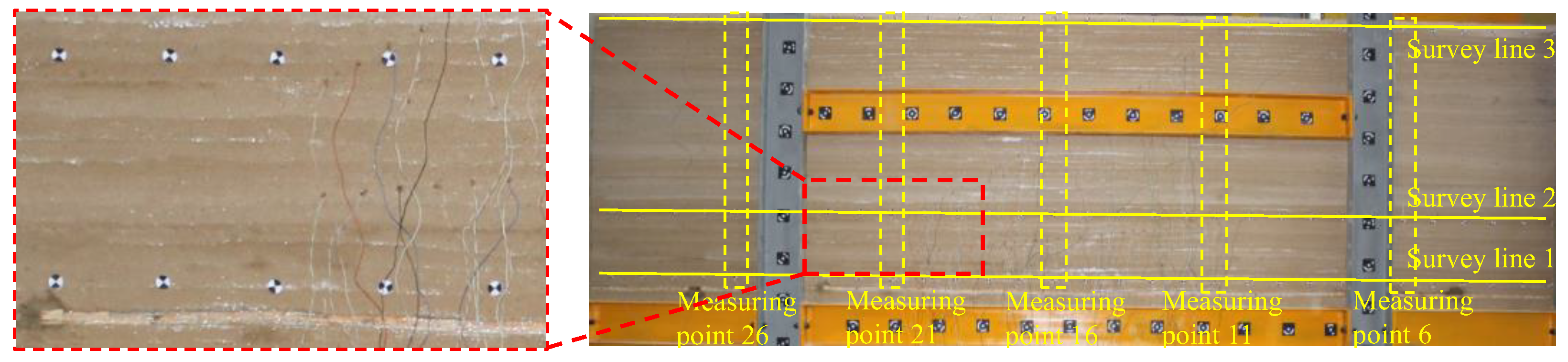
To monitor surface displacement and the movement of the overburden above the coal seam, three displacement monitoring lines were arranged at the basic roof of the coal seam, the main key layer, and the surface. The measurement points were evenly distributed between the mining line and the stop line, with 28 measurement points arranged along each line, totaling 84 measurement points. This arrangement is illustrated in Figure 3, which also indicates some of the measurement points in the middle of the model.
During the physical similarity simulation of backfill mining, a high-speed displacement image acquisition system was used to monitor the displacements of the measuring points and survey lines in the model. This system enables dynamic tracking of displacement evolution with an accuracy of up to 0.001 mm, which fully satisfies the requirements of the present experiment.

2.3. Results and Analysis

The purpose of the similarity simulation is to reveal the patterns of surface subsidence at the 2515 working face. Therefore, the data obtained from the similarity simulation will be proportionally converted to the 2515 working face, explaining the results of the similarity simulation experiments from the perspective of the working face dimensions.

2.3.1. Physical Model with a Filling Rate of 90%

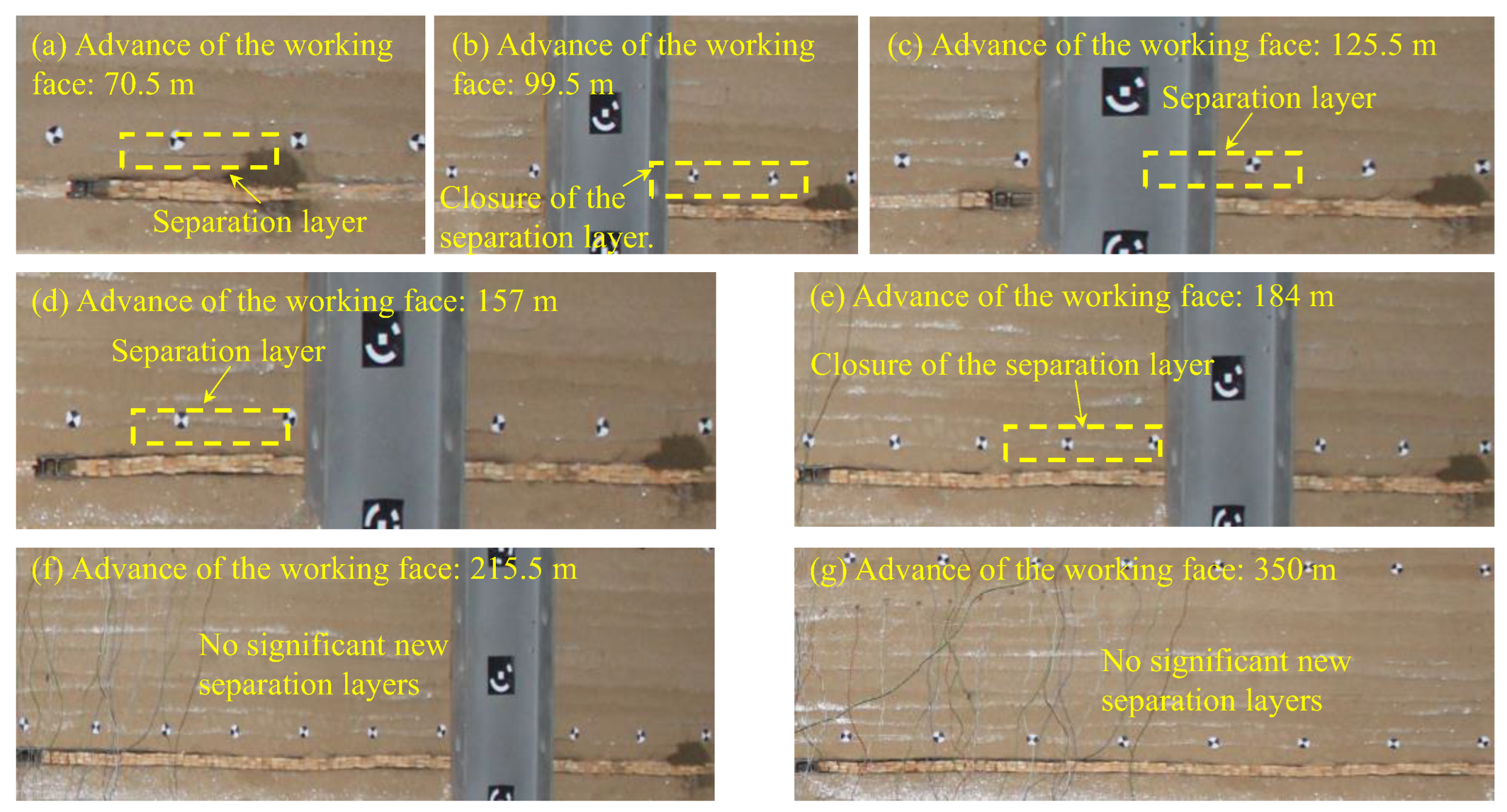
The characteristics of overburden movement when the filling rate of ultra-high water materials is 90% are shown in Figure 4. Before the working face advances to 70.5 m, no significant delamination or fissures are observed in the overlying rock layers. When the working face reaches 70.5 m, a noticeable delamination occurs between the immediate roof and the basic roof, but no caving phenomena are present, as illustrated in Figure 4a. As the working face advances to 99.5 m, this delamination gradually closes, as shown in Figure 4b. When the working face advances to 157 m, the range of delamination near the basic roof continues to expand, while the overburden delamination behind the mined-out area has been largely compressed. This process continues back and forth until the working face advances to 215.5 m, at which point no further delamination phenomena are observed in the overburden. Throughout the entire extraction process, there are no significant caving phenomena in the overlying rock layers; the primary activities observed in the overburden are the generation, expansion, and closure of delamination, with no noticeable development of vertical fissures.
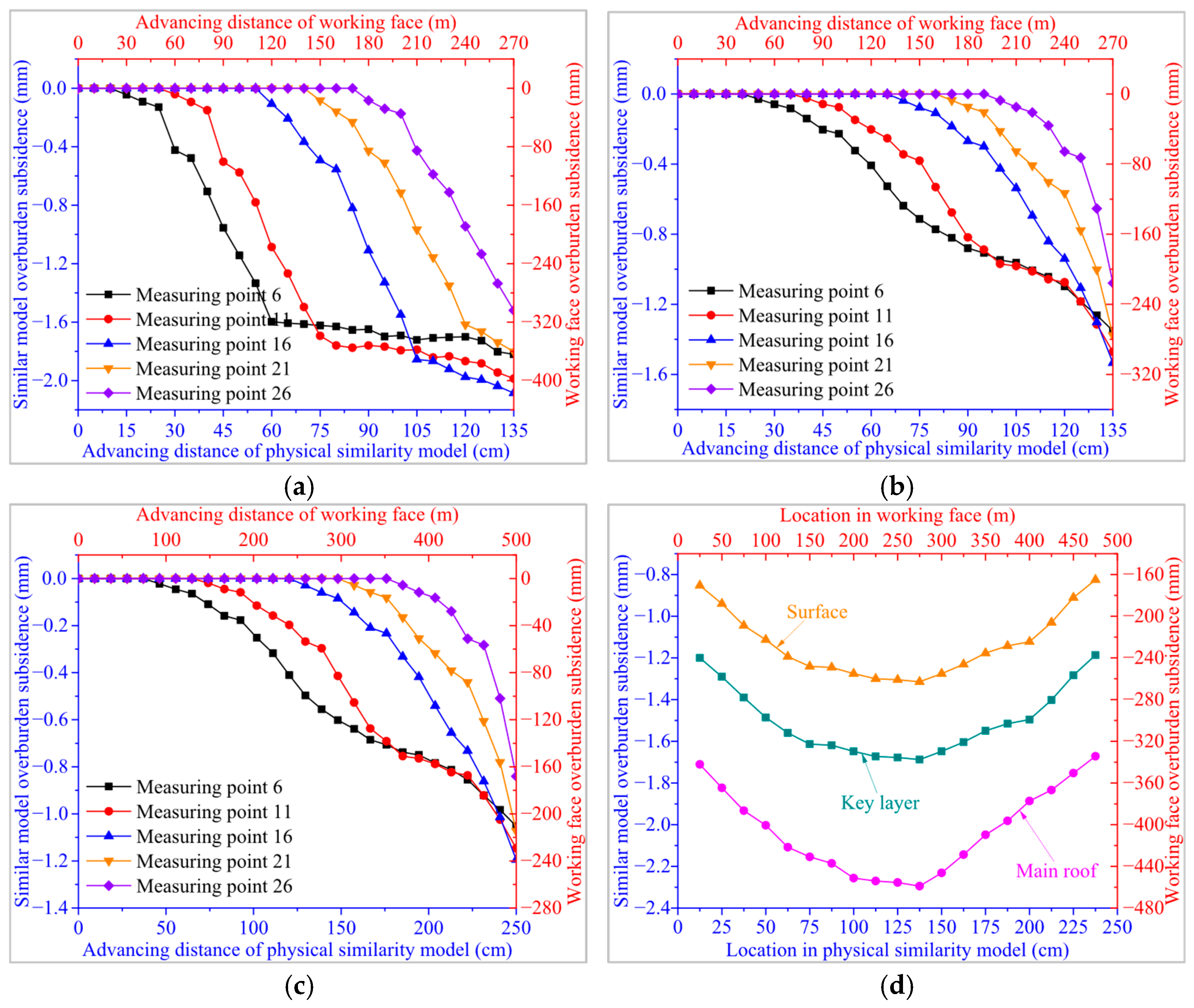
At the same time, Figure 5 records the displacement variation characteristics at each measurement point during the physical simulation experiment. Figure 5a shows the subsidence variation curve of the basic roof, Figure 5b depicts the subsidence variation curve of the main key layer, Figure 5c illustrates the variation curve of surface subsidence, and Figure 5d presents the final subsidence of the overburden when the model is fundamentally stable.
As shown in Figure 5a, during the mining process of the coal seam with a 90% filling rate, the basic roof undergoes two main stages of subsidence. The first stage begins when the working face approaches each measurement point, resulting in a gradual subsidence. The second stage occurs after the working face has advanced past the measurement point, causing a sharp increase in subsidence due to delamination. At a distance of 30 cm from the cutout, measurement point 6 experienced its first significant subsidence of approximately 84.7 mm when the working face advanced to 60 m. As the working face progressed to 80–110 m, the second stage of rapid subsidence occurred, with a maximum subsidence of about 266 mm. Subsequently, the basic roof continued to experience slow subsidence but stabilized overall. The monitoring results at measurement point 11 indicated that when the working face advanced to 90 m, the first significant subsidence of approximately 100.4 mm was observed. As the working face advanced to 100–160 m, the second stage of rapid subsidence was recorded, with a maximum subsidence of about 338.76 mm, followed by continued slow subsidence. The monitoring results at the other measurement points were similar, primarily due to the generation, expansion, and closure of roof delamination during the working face’s advancement.
As shown in Figure 5b, during the recovery process of the working face, the maximum subsidence of the key layer reached 307 mm, but it did not exhibit the two-stage subsidence characteristics observed in the basic roof. Even when the working face advanced to the stop line, the key layer continued to show rapid subsidence, indicating that the activity of the key layer was still ongoing at that time. Analyzing the previous overburden movement process, it is evident that until the working face recovery was completed, the overburden activity only progressed to the point of delamination, and once the delamination was compacted, no further delamination occurred above. The measured subsidence of the overburden also corroborates this, as the onset of slow subsidence at the corresponding measurement points lagged significantly behind the advancement of the working face. In other words, at the completion of the working face recovery, the subsidence activity of the key layer was still ongoing. The surface subsidence characteristics shown in Figure 5c are very similar to those of the key layer, while Figure 5d indicates that after the overburden activity stabilized, the overall subsidence trend of the basic roof, key layer, and surface showed that the subsidence in the middle was greater than at the ends. The surface subsidence and key layer subsidence exhibited a coordinated deformation trend, with the displacement change characteristics of each measurement point being largely consistent, except that the surface subsidence was relatively small.
The results of the physical simulation indicate that when the filling rate is 90%, the subsidence of the basic roof, key layer, and surface are 458.9 mm, 337.5 mm, and 262.9 mm, respectively. These values have little to no impact on the surface village and farmland.

2.3.2. Physical Model with a Filling Rate of 85%

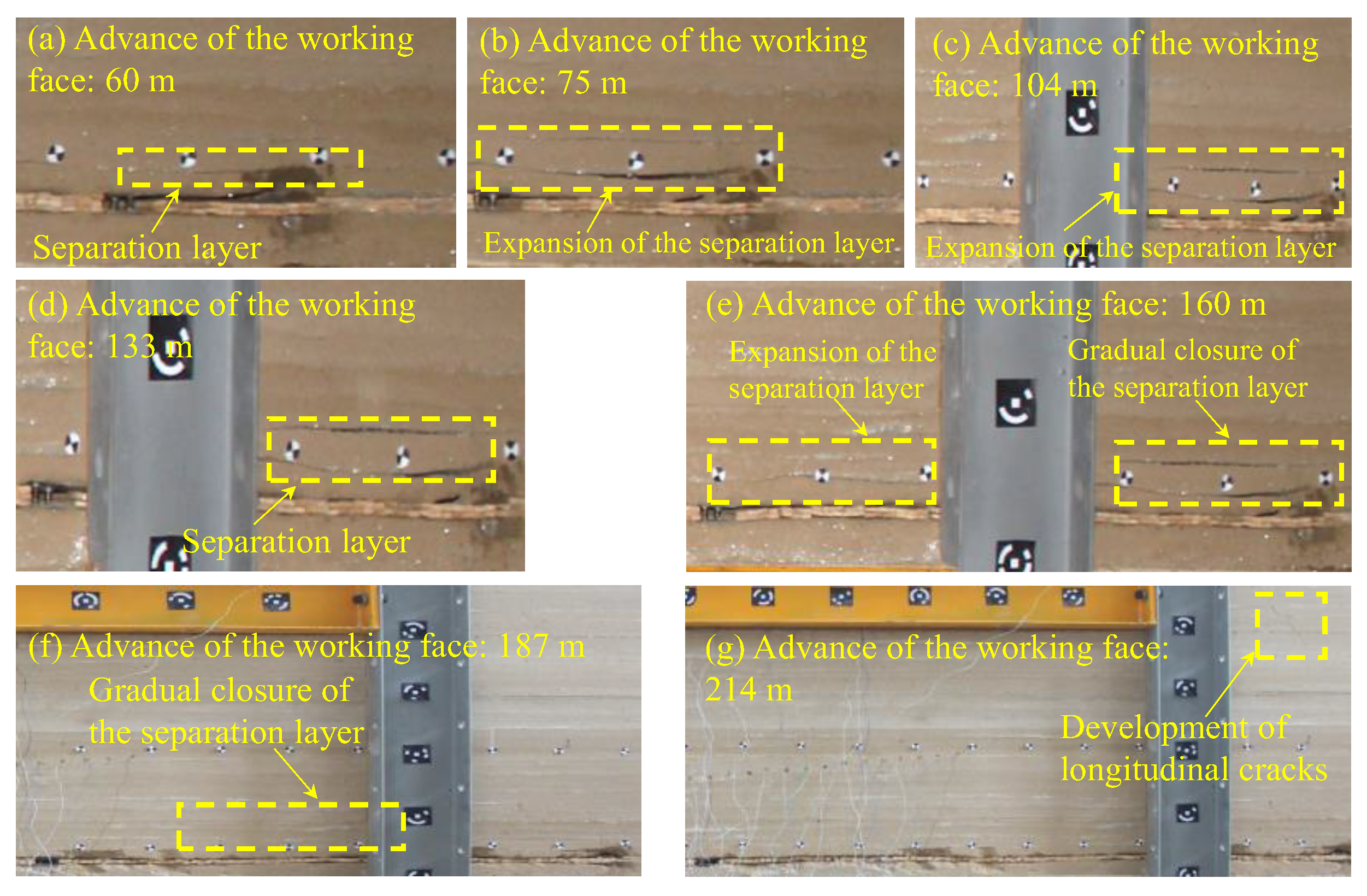
Figure 6 illustrates the characteristics of overburden movement when the filling rate of ultra-high water materials is 85%. Similarly to the 90% filling rate, there are no significant caving phenomena observed at the 85% filling rate. The main activity characteristics of the overburden throughout the recovery process are manifested as the generation, expansion, and closure of delamination. The difference is that the delamination is more pronounced, with some portions remaining not fully closed even after the working face recovery is completed, along with the appearance of subtle vertical fissures.
As shown in Figure 6, when the working face advanced to 60 m, a significant delamination appeared between the immediate roof and the basic roof. By the time the working face reached 75 m, the delamination between the immediate roof and the basic roof further developed, and delamination began to occur between the basic roof and the overlying rock layers. When the working face advanced to 104 m, the delamination between the basic roof and the overlying rock layers gradually expanded. At 160 m, the delamination in the rock layers above the working face continued to develop, and the delamination above the cutout gradually closed. This process repeated until the working face advanced to 214 m, at which point a subtle vertical fissure appeared above the cutout, and thereafter, no further delamination was observed between the rock layers.
The overburden displacement characteristics under an 85% filling rate are similar to those at a 90% filling rate, with the activity characteristics of the basic roof also exhibiting two stages of subsidence. At the end of recovery, the key layer continued to show a trend of relatively rapid subsidence. However, the difference is that under the 85% filling rate, the overburden activity is more intense, and the subsidence of the rock layers is greater. When the model reaches a basic stability, the surface subsidence and key layer subsidence still display a coordinated deformation trend, with the maximum subsidence of the basic roof being 1239 mm, the maximum subsidence of the key layer being 785 mm, and the maximum surface subsidence being 537 mm. At this point, the surface subsidence is significant and has a considerable impact on village houses and other structures.
In summary, compared to an 85% filling rate, the subsidence of the basic roof, key layer, and surface at a 90% filling rate decreased by 51%, 57%, and 63%, respectively. This indicates that for every 1% increase in filling rate, the average surface subsidence decreases by 12.6%. Additionally, through analysis and verification, it is determined that a filling rate of 90% can effectively control the surface subsidence of the 2515 working face. In conjunction with the gradually improving mining practices at Hengjian Coal Mine, a filling rate of 92% for the 2515 working face was established, followed by industrial testing.

2.4. Field Practice

2.4.1. Field Practice in Hengjian Coalmine

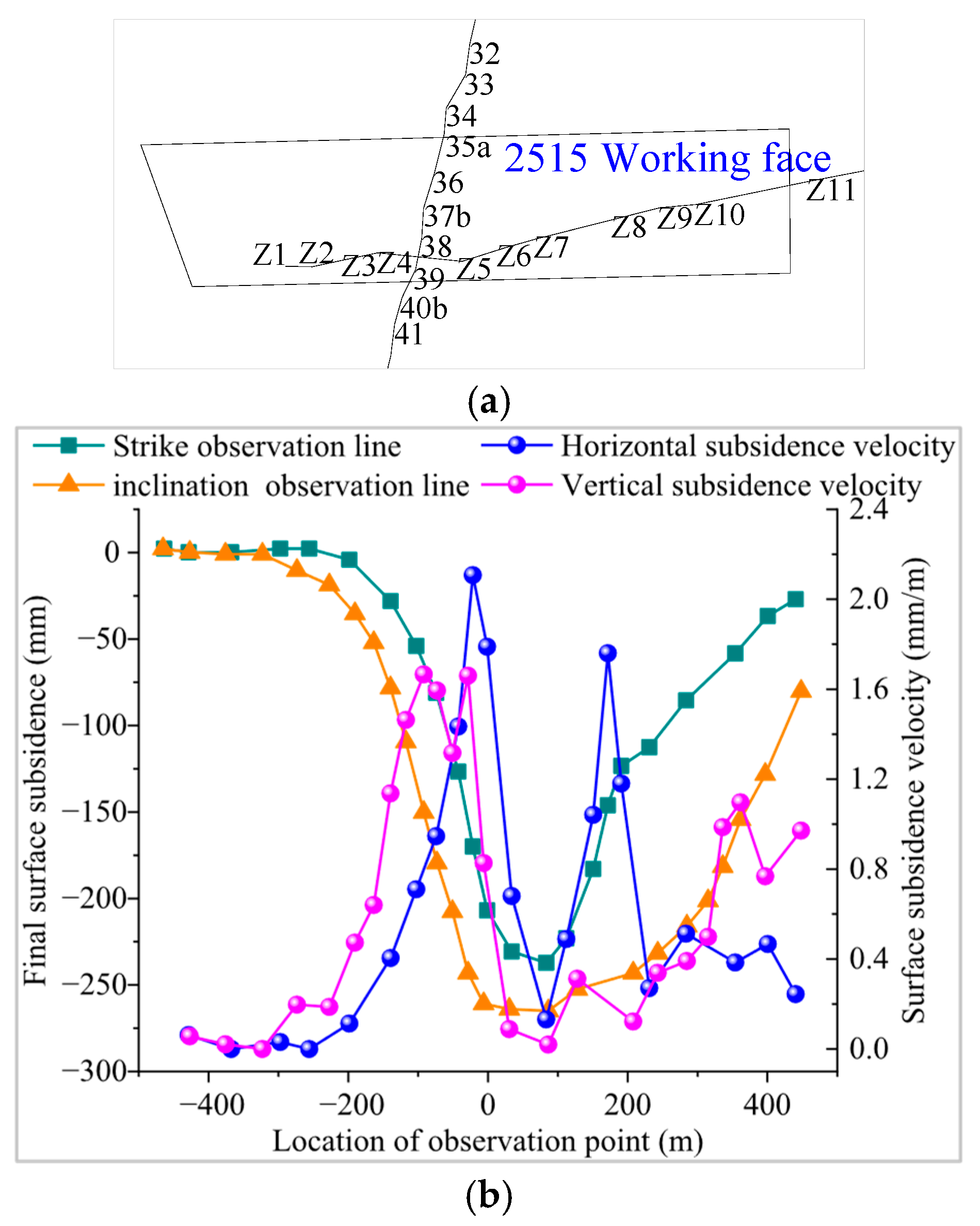
An industrial test of ultra-high water filling mining with a filling rate of 92% was conducted at the 2515 working face of Hengjian Coal Mine. However, due to the unstable thickness of the coal seam, the filling rate fluctuated slightly around 92%. To observe the characteristics of surface subsidence, one measurement line was arranged along the strike and another along the dip of the 2515 working face, as shown in Figure 7a. A GPS network composed of four GPS receivers was employed to monitor the displacement of the monitoring points. The monitoring error of the GPS network is less than 20 mm for every 200 m, and the results are shown in Figure 7b.
From Figure 7, it can be observed that the maximum surface subsidence at the 2515 working face is 265 mm, indicating that the physical simulation results effectively reflect the characteristics of overburden movement during filling mining. Additionally, the calculated surface subsidence coefficient is 0.06, with a maximum horizontal deformation of 1.6 mm/m and a maximum tilt deformation of 2.1 mm/m. According to the «Standards for the Retention of Coal Pillars under Buildings, Water Bodies, Railways, and Main Shafts during Coal Mining» [45], the first-level damage indicators stipulate that horizontal deformation should not exceed 2 mm/m and tilt deformation should not exceed 3 mm/m. Thus, at a filling rate of 92% for ultra-high water materials, the damage to surface buildings is below the first-level damage indicators, meeting the safety requirements for mining beneath buildings. Moreover, compared to the subsidence coefficient of 0.78 when using the full caving method for roof management at Hengjian Mine [46], the subsidence coefficient under ultra-high water filling conditions has been reduced by 92.3%, demonstrating significant effectiveness in controlling surface subsidence.

2.4.2. Field Practice in Taoyi Coal Mine

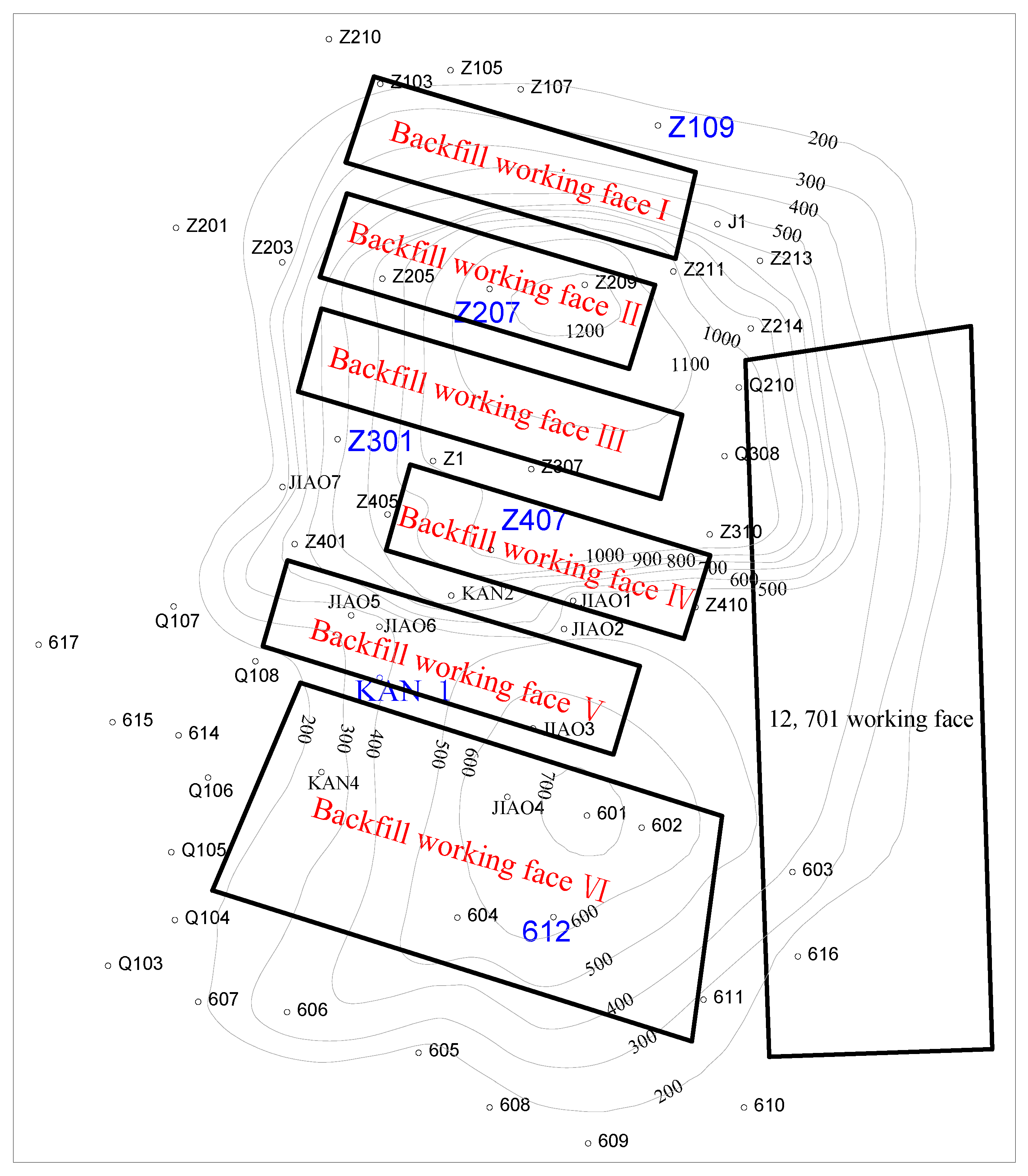
In the No. 7 mining district of Taoyi Coal Mine, six adjacent ultra-high-water backfill mining working faces were arranged, namely Backfill Face I to Backfill Face VI. Coal pillars with a width of approximately 10 m were left between adjacent faces. The mining parameters and the actual filling rates are summarized in Table 2. Among them, Backfill Face VI achieved a relatively low filling rate because the hydraulic supports were not compatible with the backfill mining process. In addition, the surface subsidence characteristics were monitored using a grid-like observation network consisting of multiple monitoring points. The monitoring system was still a GPS network composed of four GPS receivers to track the positions of the monitoring points. The monitoring error of the GPS network was less than 20 mm per 200 m. The monitoring-point layout and the surface subsidence contour map are shown in Figure 8.
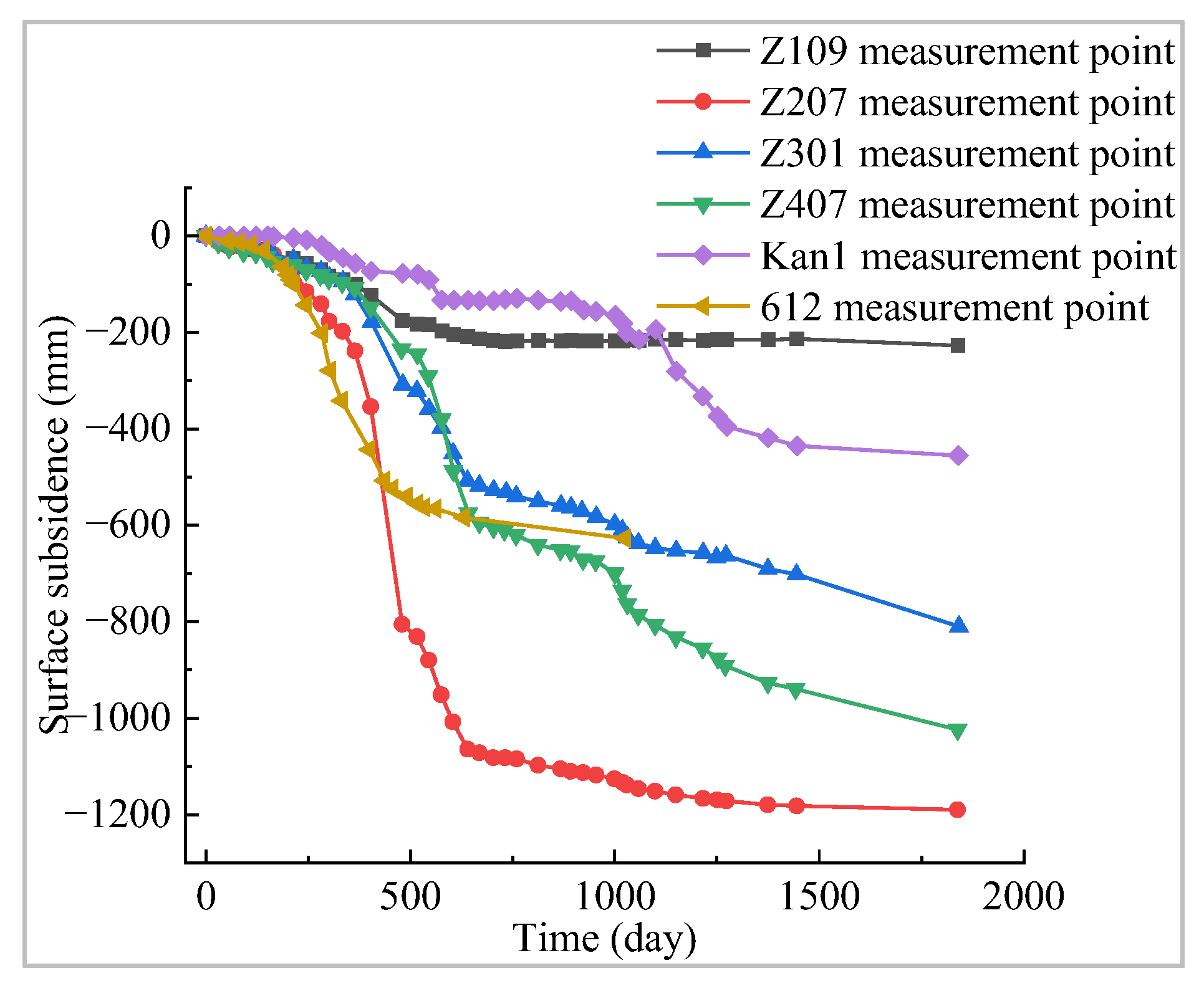
To further illustrate the surface subsidence process, measurement points Z109, Z207, Z301, Z407, Kan-1, and 612 were selected to represent the surface subsidence characteristics associated with Backfill Working Faces I–VI, respectively, as shown in Figure 9.
As shown in Figure 8 and Figure 9, two subsidence troughs developed within the mining-affected area. One trough is located above Backfill Face II, where the maximum ground-surface subsidence reaches approximately 1200 mm. This is mainly because the filling rate of Face II is 71%, which is significantly lower than those of Faces I and III, resulting in markedly larger subsidence above Face II and thus forming a distinct subsidence trough. The other trough is located above Backfill Face VI, with a subsidence magnitude of about 700 mm. This is attributed to the substantially lower filling rate of Face VI compared with the other backfill working faces, leading to relatively large subsidence and the formation of another trough. However, the subsidence above Face VI is smaller than that above Face II, which may be because Face VI has larger strike and dip lengths and therefore experiences a higher degree of full extraction-induced disturbance.
The field practices at the pilot panels of Hengjian Coal Mine and Taoyi Coal Mine indicate that the filling rate has a direct and significant influence on ground-surface subsidence characteristics. For coal extraction beneath buildings, water bodies, and railways, surface subsidence can be effectively controlled by increasing the filling rate.

3. Bearing Characteristics of Hydraulic Supports at Different Filling Rates

3.1. Characteristics of the Overburden That Hydraulic Supports Need to Control

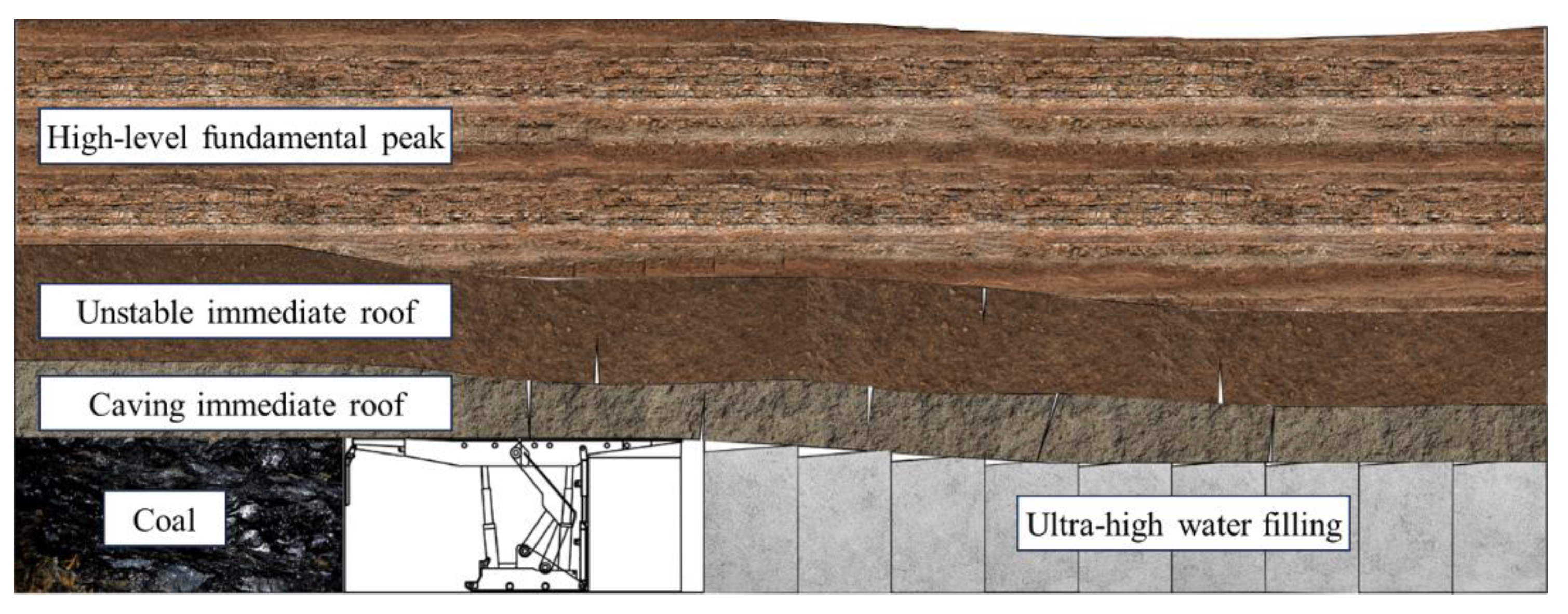
Ultra-high water materials have the advantages of high filling rates and rapid setting, resulting in a smaller gap between the filling body and the roof. Compared to the full caving method, this significantly reduces the impact range on the overburden. By analyzing the structural characteristics of the surrounding rock in the ultra-high water filling mining process, the overburden that hydraulic supports need to control can be divided into three parts: the caving immediate roof, the unstable immediate roof, and the high-level basic roof, as shown in Figure 10. The caving immediate roof is the roof that fails or collapses before filling occurs, requiring the supports to bear the entire load of this rock layer. The unstable immediate roof is the roof that experiences damage and caving during the “mining-filling” process; although this layer has some self-supporting capacity, it is assumed that the supports must bear its entire load considering that the filling body below does not have load-bearing capacity. The high-level basic roof is located above the immediate roof and may exhibit partial caving characteristics as the disturbance range increases during mining; at this point, the supports must bear the load from the caved portion.
Based on the above analysis, an equivalent extraction height can be used to describe the impact of coal mining on overburden movement. This includes the amount of unconnected roof, the compression of the coal wall in front of the support and the ultra-high water filling bag behind it, as well as the bending and sinking of the support’s top beam. The load of the falling part of the high-level basic roof can be calculated using Equation (2).
P = M E γ C Δ h A K T L K Δ h i
In the equation, ME represents the thickness of the high-level basic roof, m; γ is the unit weight of the rock, kN/m3; C is the periodic pressure step distance, m; ΔhA is the maximum subsidence of the roof, mm; Δhi is the subsidence of the roof that needs to be controlled, mm; KT is the rock weight distribution coefficient, which is influenced by the ratio of the thickness of the direct roof to the mining height N. The method for determining N is provided in Table 3.
Based on the geological conditions of the 2515 working face at Hengjian Coal Mine, when N > 5 and the equivalent mining height is less than 1.26 m, the coefficient KT approaches infinity, indicating that the load from the high-level basic roof approaches zero, suggesting that this roof does not collapse.
Results from physical simulation experiments indicate that at a filling rate of 90%, only minor delamination occurs near the working face, which rapidly closes without extending to the overlying rock layers. Conversely, at a filling rate of 85%, the area of delamination significantly increases as the working face advances; after approximately 100 m of advancement, the delamination above the cutting eye gradually closes.
It should be noted that the equivalent mining height thresholds of 0.44 m and 1.26 m were determined based on the physical similarity modeling tests and the engineering practice of backfill mining at the 2515 working face of Hengjian Coal Mine. Given the limited experimental dataset, these thresholds may not be universally applicable. For other mines with different mining heights, burial depths, filling rates, and support conditions, the corresponding thresholds should be re-evaluated and recalibrated.

3.2. Load Distribution Characteristics of the Hydraulic Support Beam

Using the ZC5160/30/50 (Zhengzhou Coal Mining Machinery Group Co., Ltd., Zhengzhou, China) four-column ultra-high water filling hydraulic support employed in the 2515 working face as an example, this study assesses the feasibility of optimizing the structure of the support beam when the filling rate is 92%. Based on this feasibility, a mechanical model of the support beam is established to reveal the load distribution characteristics. Additionally, the mechanical responses of the support beam under different working conditions are analyzed using ANSYS Workbench simulation software. From the perspective of optimizing the support beam structure, feasible methods to increase the filling rate are proposed.
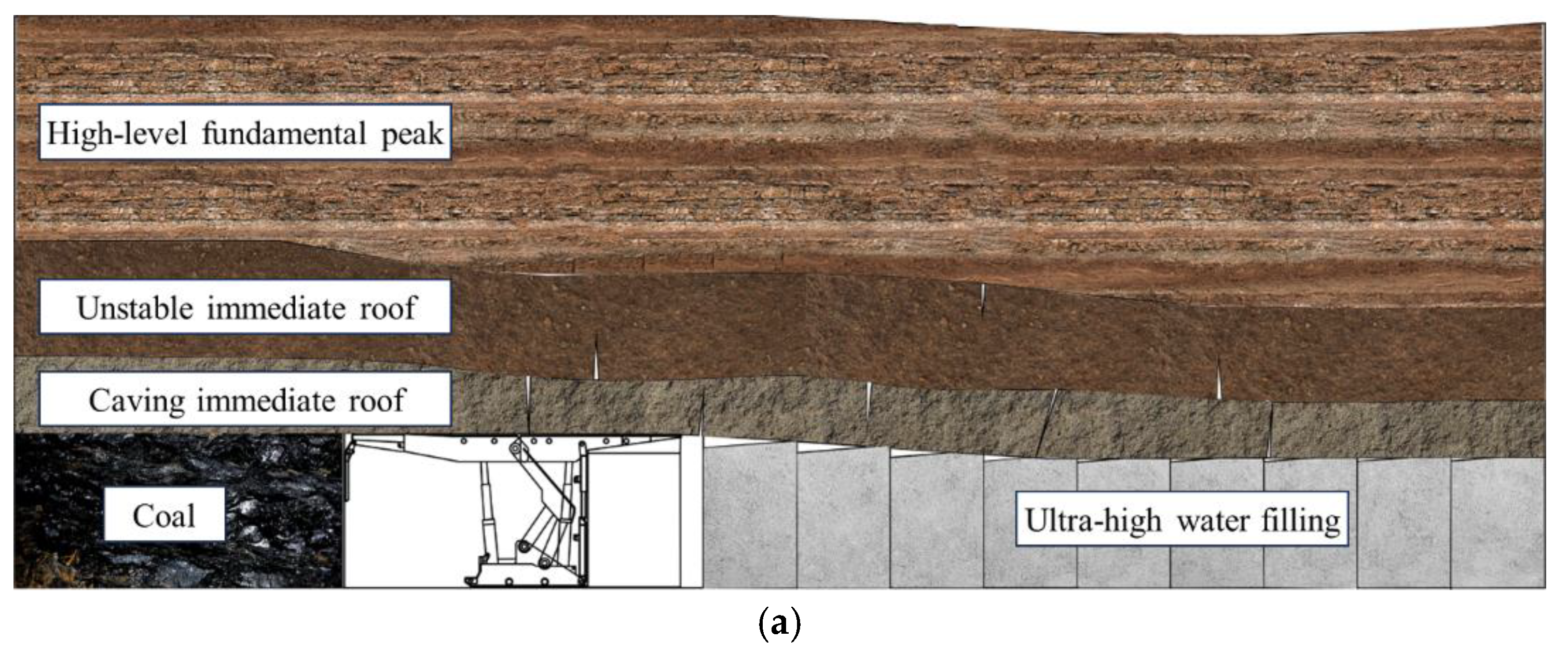
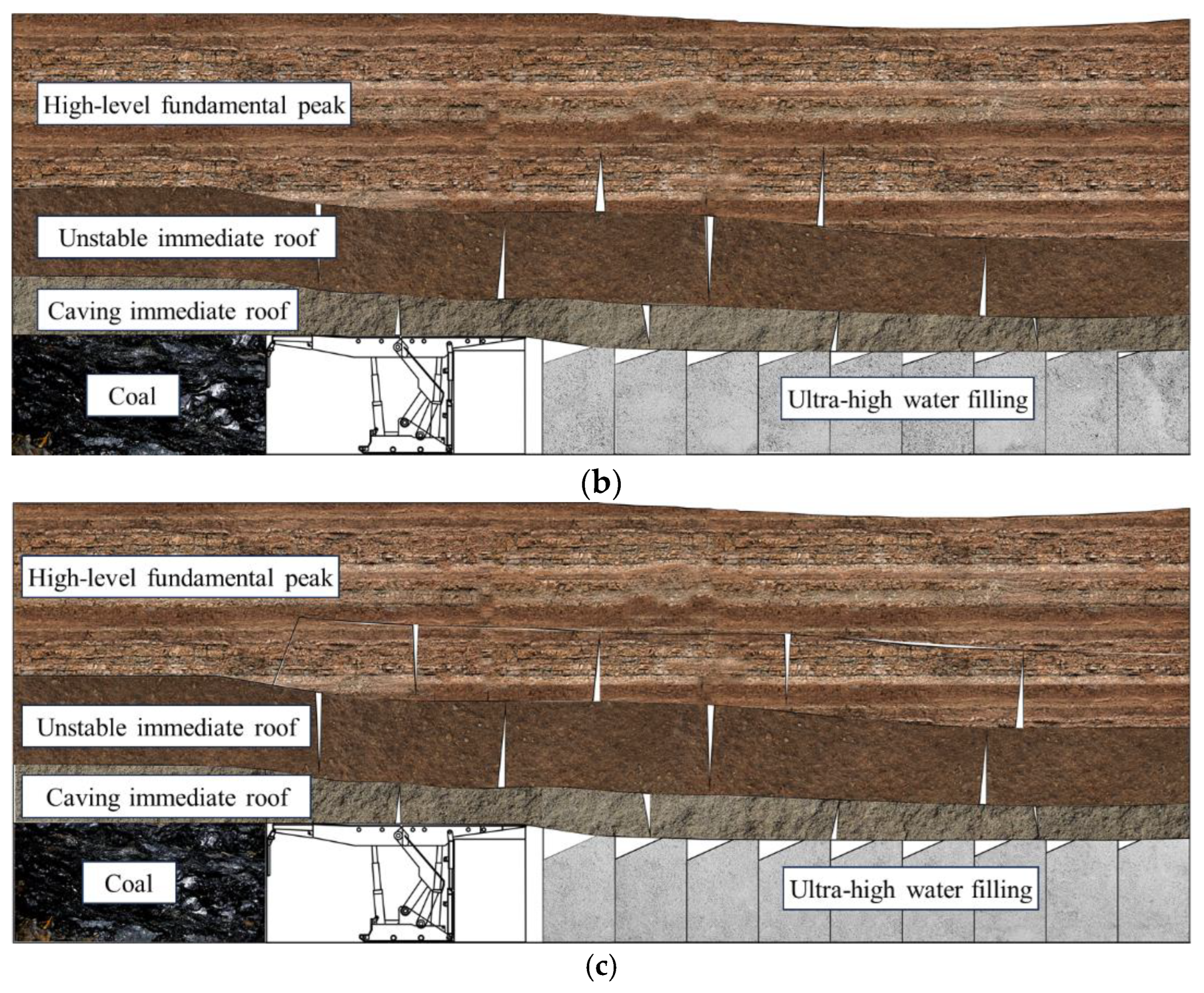
Considering the effects of factors such as the water seepage rate of the ultra-high water bag filling body, the micro-deformation of the coal wall, and the hydraulic support, a filling rate of 92% can be equivalent to mining a very thin coal seam with a thickness of 0.35 m. As illustrated in Figure 11, at this point, only the immediate roof is subject to collapse. The working resistance of the support is determined using the rock weight method, estimating that the load the support must withstand is 6–8 times the weight of the rock corresponding to the mining height, with a maximum value of 8 selected to ensure safe mining practices. Furthermore, the filling bags that have just been filled behind the support have no load-bearing capacity or very low capacity, meaning they cannot support the weight of the immediate roof above them. Consequently, this portion of the roof load is also borne by the hydraulic support. Considering the construction process on-site, the length of this filling bag is approximately 2.5 m. Thus, the working resistance of the hydraulic support is:
q = 8 n M γ W L K
In the equation, n represents the safety factor, typically set to n = 2; M denotes the mining height, taken as M = 0.35 m; γ is the rock unit weight, set at γ = 25 kN/m3; W indicates the width of the hydraulic support, taken as W = 1.5 m; and LK is the maximum control distance of the hydraulic support, set at LK = 11.3 m. Substituting these parameters into Equation (3) yields a working resistance of the hydraulic support, q = 2376 kN. For the ZC5160/30/50 hydraulic support, the total beam length is 10,684 mm, including a front beam length of 5996 mm and a rear beam length of 4688 mm. The beam width is 1500 mm, which represents the overburden pressure within the control distance of the hydraulic support, approximately 0.288 N/mm2. This value is significantly lower than the rated working resistance of the hydraulic support at the working face, approximately 5160 kN. Therefore, optimizing the structure of the hydraulic support beam to improve filling rates and reduce production costs is feasible.

3.2.1. Mechanical Model and Basic Assumptions

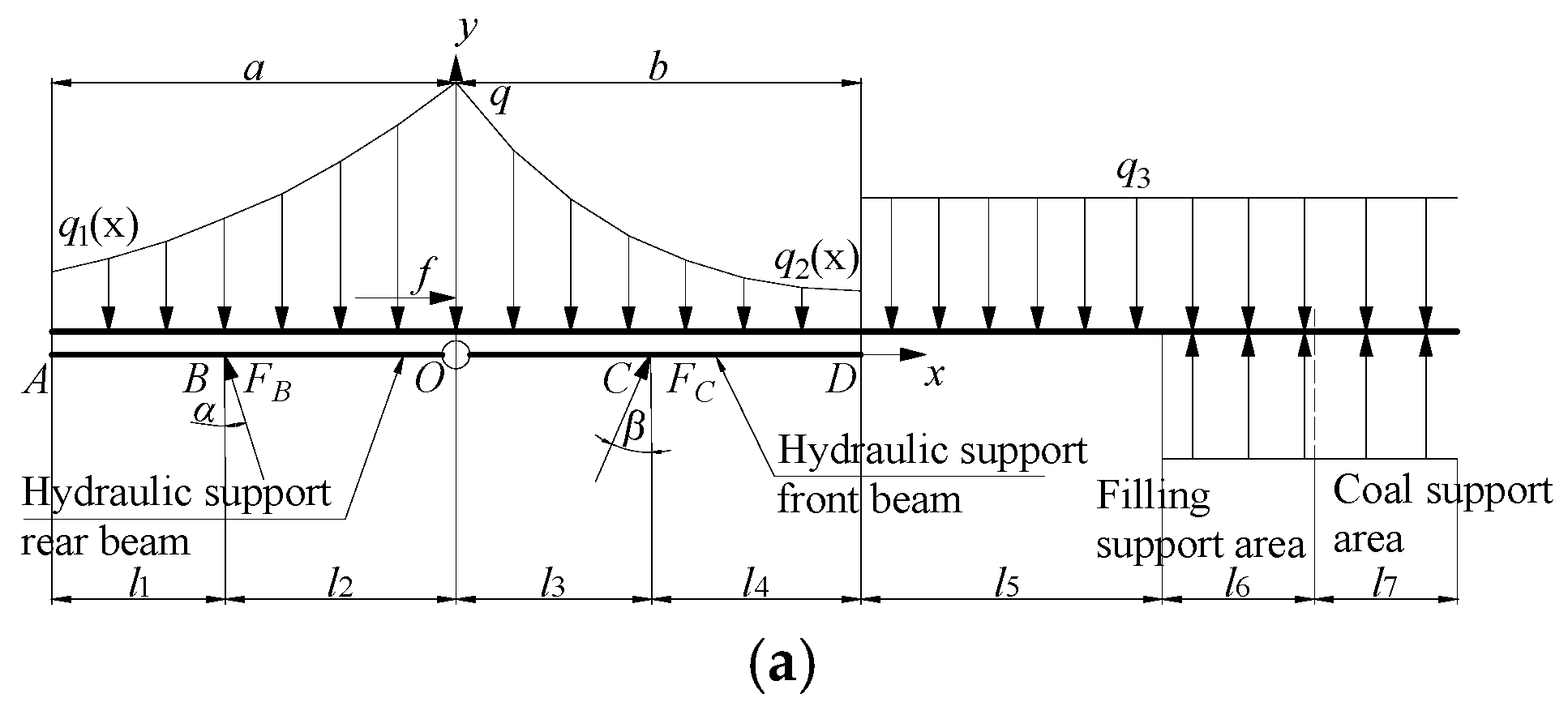
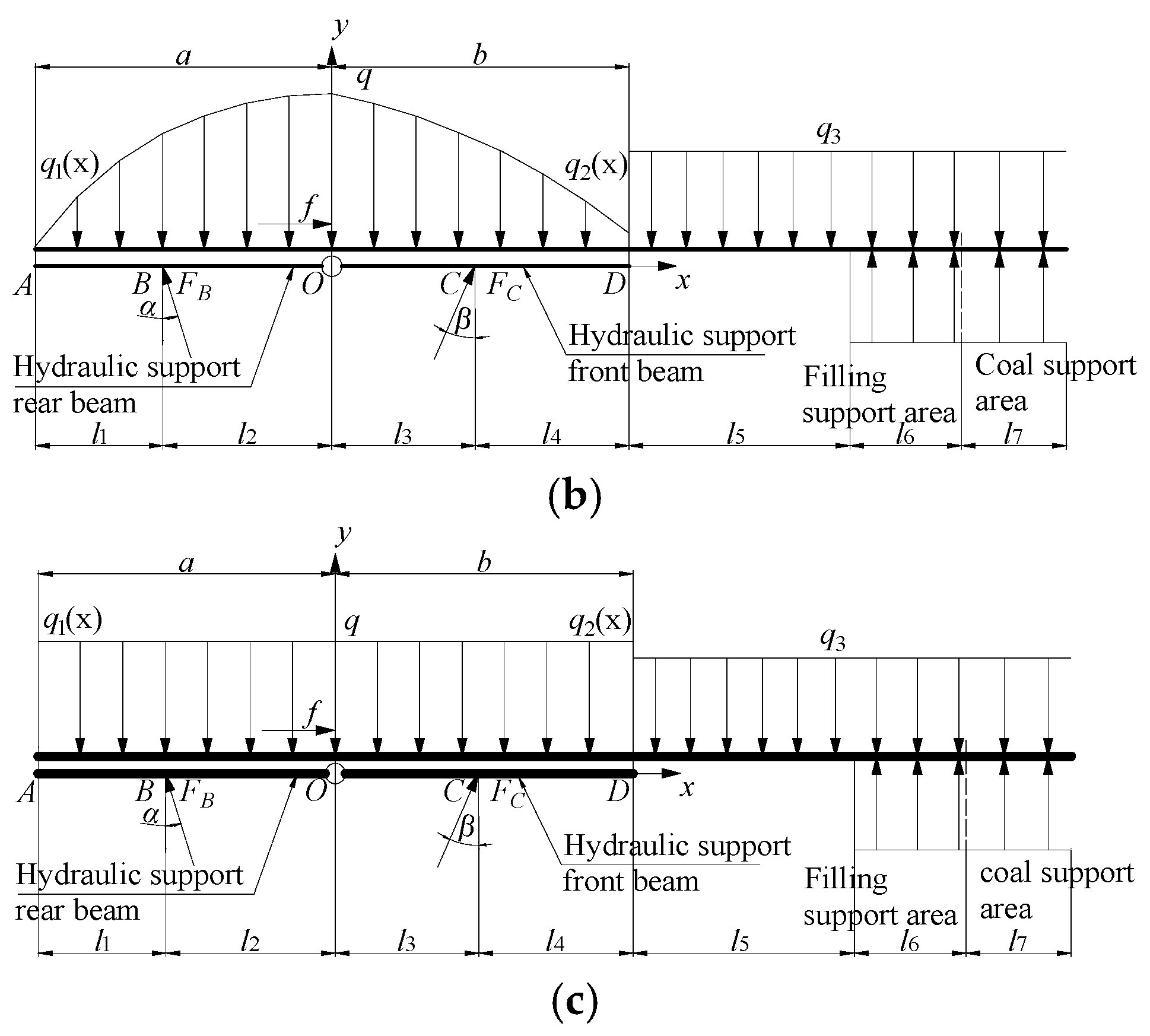
The load-distribution pattern on a hydraulic support canopy is affected by uncertain in situ factors, such as localized roof separation, periodic weighting, and longwall face advance; moreover, the load-distribution patterns on the front and rear canopies may be inconsistent. Therefore, a rational simplification of the canopy load is required for subsequent analysis. Considering that the front and rear canopies are connected by hinges and are supported by hydraulic legs, the method proposed by Zhang [47] can be adopted to classify the overburden stress distribution on the canopy into three typical forms: concave-curve load, quadratic-function load, and uniformly distributed load. In this section, the load-distribution characteristics of the canopy are investigated based on these three load types, and the corresponding mechanical model of the hydraulic support canopy is shown in Figure 12.
In Figure 12, AD represents the hydraulic support beam, with AO as the front beam and OD as the rear beam, having lengths of a and b, respectively. AO and OD are connected through a hinge joint, where the hinge force can be considered as the internal force of the beam. Points B and C indicate the hinge connection positions of the hydraulic columns with the front and rear beams, with supporting forces FB and FC, respectively. Angles α and β are the angles between the two columns and the vertical direction of the beam. The friction resistance of the beam is denoted as f. The distances from the front section of the front beam to B, from B to O, from O to C, and from C to the rear end of the rear beam are l1, l2, l3, and l4, respectively. Behind the rear beam is the ultra-high water bag filling body, where l5 represents the length of the filling body that has not yet acquired load-bearing capacity, l6 denotes the area supporting the roof, and l7 refers to the coal wall support area. The load q represents the overburden load on the hydraulic support. Based on the deformation characteristics of hydraulic supports in other working faces, where both ends are concave and the middle is elevated (all with minimal deformation), it is assumed that the maximum load on the hydraulic support beam occurs at the hinge points of the front and rear beams, with the load distributions represented as q1(x) and q2(x), respectively.
To ensure safe mining practices, it is assumed that the overburden load within the range of the filling body that has not yet acquired load-bearing capacity (l5) is supported by the hydraulic support. Additionally, for ease of calculation, the overburden stress q3 in the region from l5 to l7 is assumed to be a uniformly distributed load.

3.2.2. Load Distribution Characteristics of the Beam

The dimensions of the ZC5160/30/50 four-column ultra-high water filling hydraulic support are as follows: l1 = 1.4 m, l2 = 1.1 m, l3 = 1.2 m, l4 = 1.8 m. According to on-site processes, l5 is taken as 2.5 m. Based on measured data, when the mining height is 4.4 m, the angles of the columns are: α = 3.2° and β = 1.8°.
When the hydraulic support beam is subjected to concave curve-type load:
q 1 ( x ) = a 1 x 2 + b 1 x + c 1 ( a 1 > 0 ) q 2 ( x ) = a 2 x 2 + b 2 x + c 2 ( a 2 > 0 )
In the equation, a1, b1, c1, a2, b2, c2 are constants of the concave curves, and they satisfy the following conditions:
b 1 2 a 1 = l 1 l 2 c 1 = c 2 b 2 2 a 2 = l 3 + l 4
When the hydraulic support is in a balanced state, the resultant forces in the x and y directions on the beam are both zero:
F x = 0         F B sin α + F C sin β + f = 0 F y = 0         F B cos α + F C cos β 0 l 1 + l 2 q 1 x d x 0 l 3 + l 4 q 2 x d x q 3 l 5 = 0
In the equation, ∑Fx represents the stress sum in the x direction, and ∑Fy represents the stress sum in the y direction. Additionally, the frictional force on the beam, f, is given by:
f = μ 0 l 1 + l 2 q 1 x d x + 0 l 3 + l 4 q 2 x d x
In the equation, μ denotes the coefficient of friction, typically taken as μ = 0.3.
Simultaneously, the resultant moments at point O and point A on the beam are both zero:
M f r o n t   b e a m = 0         F B l 2 cos α 0 l 1 + l 2 x q 1 x d x = 0 M r e a r   b e a m = 0         F C l 3 cos β 0 l 3 + l 4 x q 2 x d x q 3 l 5 l 3 + l 4 + l 5 2 = 0 M A = 0             F B l 1 cos α + F C l 1 + l 2 + l 3 cos β M q 1 x M q 2 x q 3 l 5 l 1 + l 2 + l 3 + l 4 + l 5 2 = 0
In the equation, ∑Mfront beam represents the moment sum to the left of the hinge point, specifically the front beam moment; ∑Mrear beam denotes the moment sum to the right of the hinge point, corresponding to the rear beam moment; ∑MA is the moment sum at point A. Mq1(x) and Mq2(x) represent the moments exerted by q1(x) and q2(x) about point A, respectively.
Let m and n denote the distances from the origin O to the centroids of q1(x) and q2(x), respectively. Then:
m 0 l 1 + l 2 q 1 x d x = 0 l 1 + l 2 x q 1 x d x n 0 l 3 + l 4 q 2 x d x = 0 l 3 + l 4 x q 2 x d x
The moments exerted by q1(x) and q2(x) about point A can be expressed as follows:
M q 1 x = l 1 + l 2 m 0 l 1 + l 2 q 1 x d x M q 2 x = l 1 + l 2 + n 0 l 3 + l 4 q 2 x d x
By simultaneously solving Equation (3) to (10), the loads on the front and rear beams can be calculated as follows:
q 1 ( x ) = 0 . 1906 x 2 + 0.9530 x q 2 ( x ) = 0 . 2387 x 2 1.4322 x
When the front and rear beams of the hydraulic support are subjected to a quadratic load, that is:
q 1 ( x ) = q 4 x 2 l 1 + l 2 2 + q 4 q 2 ( x ) = q 4 x 2 l 3 + l 4 2 + q 4
When the support is in a balanced state, the stress equilibrium and moment equilibrium equations remain as shown in Equations (6) and (8).
As previously mentioned, let q3 = q. By simultaneously solving Equations (3) and (8) to (10) and (12), the loads on the front and rear beams can be expressed as:
q 1 ( x ) = 4 . 9298 + 0 . 7888 x 2 q 2 ( x ) = 4 . 9298 + 0 . 5478 x 2
When the front and rear beams of the hydraulic support are subjected to uniformly distributed loads, specifically q1(x) = q2(x) = q5, the moment about point A can be expressed as:
M q 1 ( x ) = q 5 l 1 + l 2 2 2 M q 2 ( x ) = q 5 l 3 + l 4 l 1 + l 2 + l 3 + l 4 2
By taking q3 = q again and simultaneously solving Equations (3), (8) and (14), the uniformly distributed loads can be calculated as follows:
q5 = 1.6775 N/mm2
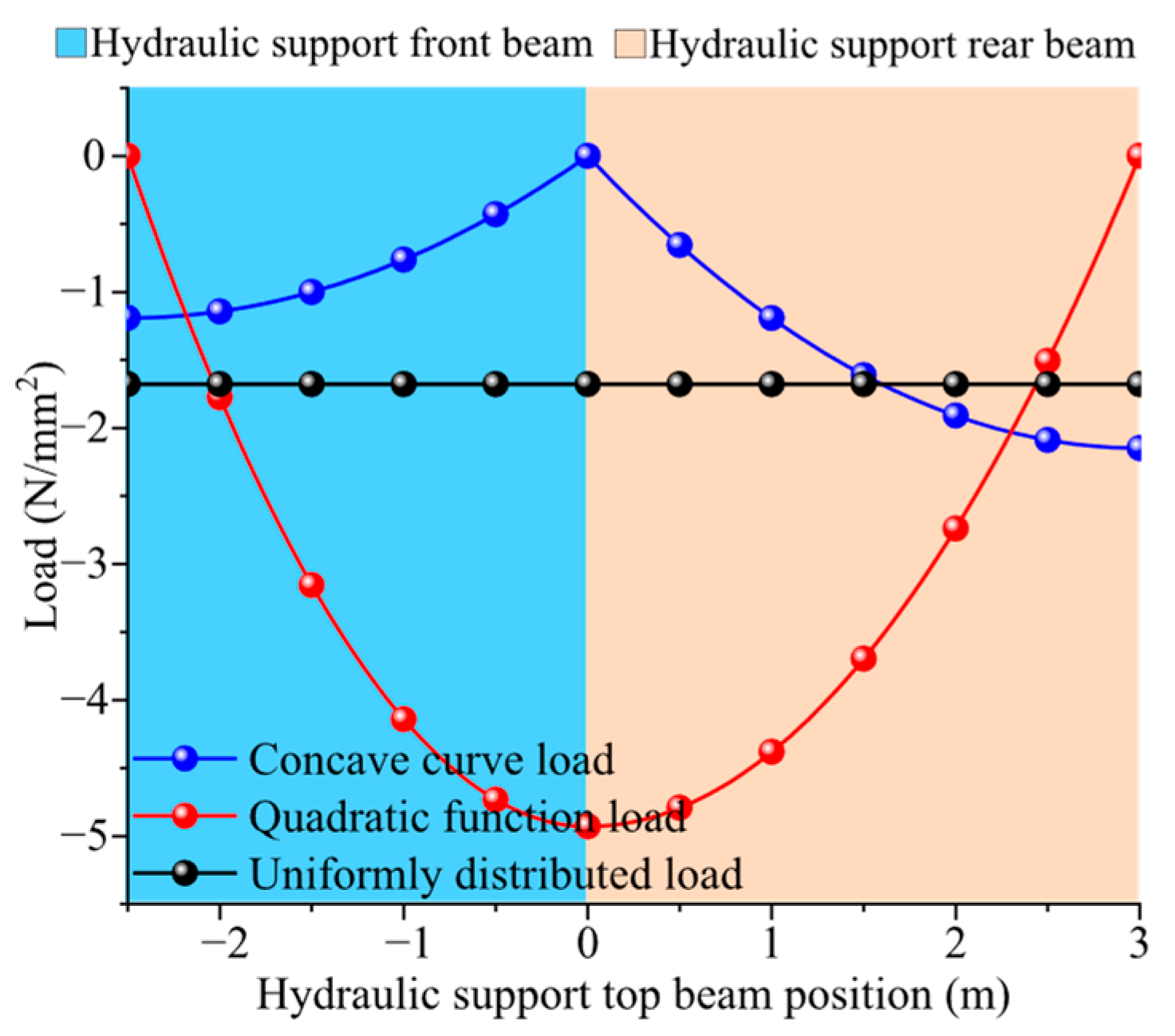
According to Equations (11), (13) and (15), the load distribution characteristics of the hydraulic support beams in different configurations are illustrated in Figure 13, where a negative sign indicates that the load direction is downward.
From Figure 13, it can be observed that when the load on the beam is distributed in a concave curve form, the maximum load on the front beam is approximately 1.19 N/mm2, while the maximum load on the rear beam is 2.15 N/mm2. This phenomenon can explain the common occurrence of sinking at both ends of the hydraulic support beam and the upward bending at the middle hinge point in the working face. When the load distribution follows a quadratic function, the maximum load on the hydraulic support occurs at the middle hinge point, reaching approximately 4.93 N/mm2, with the loads at both ends of the beam being nearly equal and close to 0 N/mm2. The uniformly distributed load is around 1.68 N/mm2.

4. Methods for Increasing Filling Rate Through Structural Optimization of the Hydraulic Support Beam

Building upon the analysis conducted above, this section employs ANSYS Workbench simulation software to analyze the mechanical response of the hydraulic support under three different working conditions, proposing methods to increase the filling rate from the perspective of optimizing the structure of the hydraulic support beam.

4.1. Establishment of the Numerical Model

Based on the engineering drawings of the ZC5160/30/50 hydraulic support, various components of the beam are sequentially created and assembled into a three-dimensional model using Pro/Engineering software version 5.0. During this process, components that have a minimal impact on the overall structure are simplified to enhance computational efficiency [34]. Additionally, the geometric edges of the model are rounded to prevent stress singularities from affecting the analysis results during computation.
The three-dimensional model of the hydraulic support beam is imported into ANSYS Workbench simulation software. The hydraulic support canopy is made of Q690 high-strength steel, rather than special-purpose steel. Therefore, the simulation analysis was conducted using the hydraulic support parameters provided in the product manual, as summarized in Table 4. For the various components of the beam, all contact modes are set to bonded, except for the hinge connections.
In the simulation analysis, the mesh size of the model directly impacts the accuracy of the results and the analysis efficiency. A second-level tetrahedral mesh is used to discretize the model, with a mesh size set to 30 mm and a mesh distortion factor of 0.9. All mesh elements are defined as SOLID 45 solid elements [48], as shown in Figure 14.

4.2. Mechanical Response of the Beam Under Three Working Conditions

Section 3.2.2 presents the stress distribution characteristics of the hydraulic support canopy under three load patterns. However, since these loads are derived from empirical equations, they may deviate from actual field conditions. Therefore, based on the original calculated loads, we adjusted the applied load magnitudes by ±10% and evaluated the mechanical response of the hydraulic support canopy under the three load-distribution patterns using numerical simulations. The results are summarized in Table 5. The results show that, under the ±10% load variations, the maximum stress in the hydraulic support canopy does not exceed the yield strength. Therefore, the loading values calculated in Section 3.2.2 are still adopted for the subsequent analysis of the canopy’s mechanical response under applied loading, as shown in Figure 15.
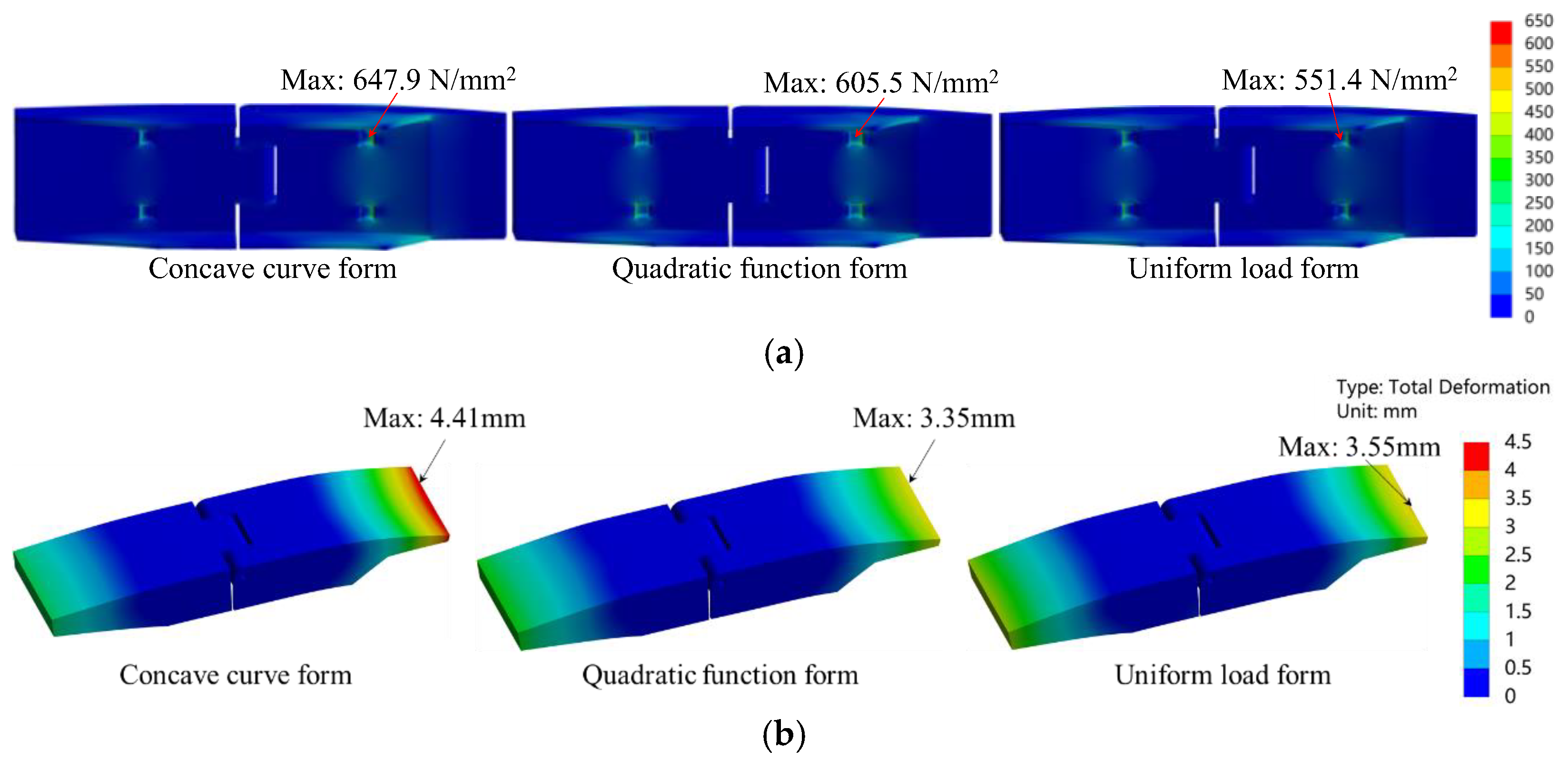
As shown in Figure 15a, stress concentration occurs at the column wells and side plates of the front and rear beams of the hydraulic support, with the side plates exhibiting lower levels of stress concentration. The maximum load in all three working conditions does not exceed 300 N/mm2. The highest stress concentration is found at the rear beam’s column well, where the maximum stress under concave curve-type loading reaches 647.9 N/mm2, although it remains below the yield strength of the beam. No stress concentration is observed at other locations on the beam. Figure 15b indicates that the displacements of the beam under all three conditions are characterized by greater displacement at the ends compared to the middle hinge point. The maximum displacement occurs at the end of the rear beam under concave curve-type loading, measuring only 4.41 mm. The maximum deformations under the other two conditions are 3.35 mm and 3.55 mm, respectively. This indicates that the hydraulic support fully meets the safety requirements for mining operations in the 2515 filling working face, and the beam structure can be further optimized to enhance the filling rate in the working face.

4.3. Structural Optimization of the Beam

The optimization scheme for the hydraulic support beam is investigated using topology analysis in ANSYS Workbench. The same beam model and material parameters are used; however, unlike the previous section, the purpose of the topology analysis is to identify areas within the beam that do not contribute significantly to load-bearing or have minimal load. To enhance the accuracy of the analysis, the mesh is refined, with a mesh size set to 15 mm.
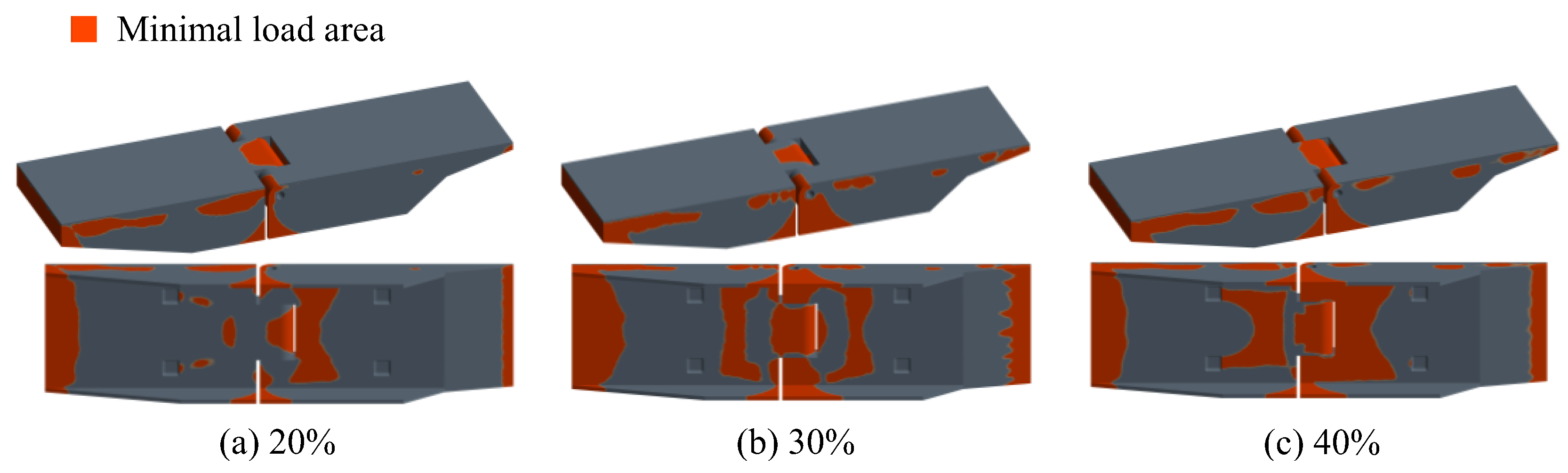
Figure 15 indicates that the maximum deformation occurs under the concave curve-type loading, thus the loading method for the topology analysis is set to the concave curve load. The total mass of the hydraulic support beam upon assembly is 19,352 kg. The distribution characteristics of regions with minimal load-bearing capacity are studied for material removal rates of 20%, 30%, and 40%, as shown in Figure 16. Areas with no load or minimal load are represented in red.
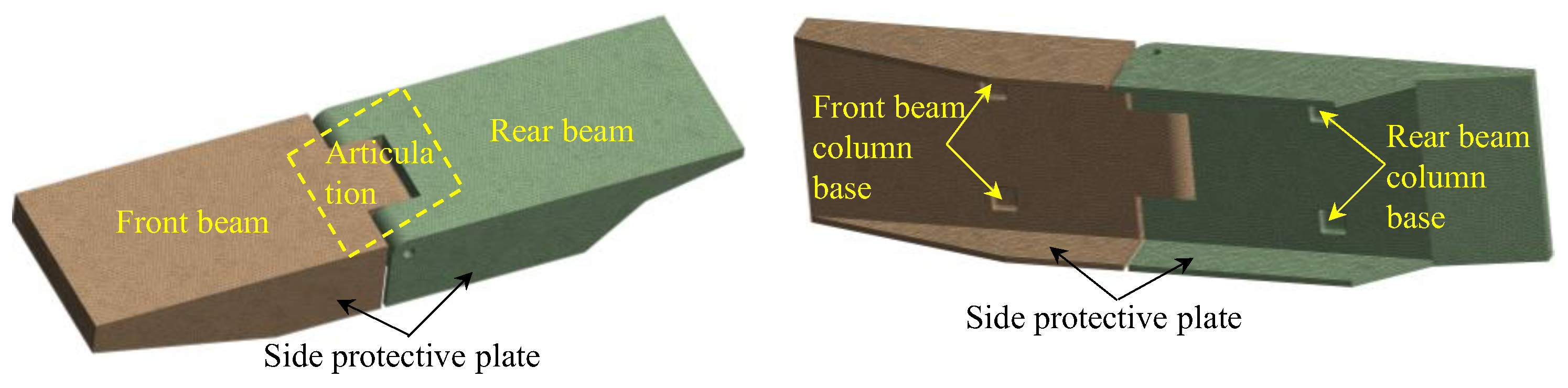
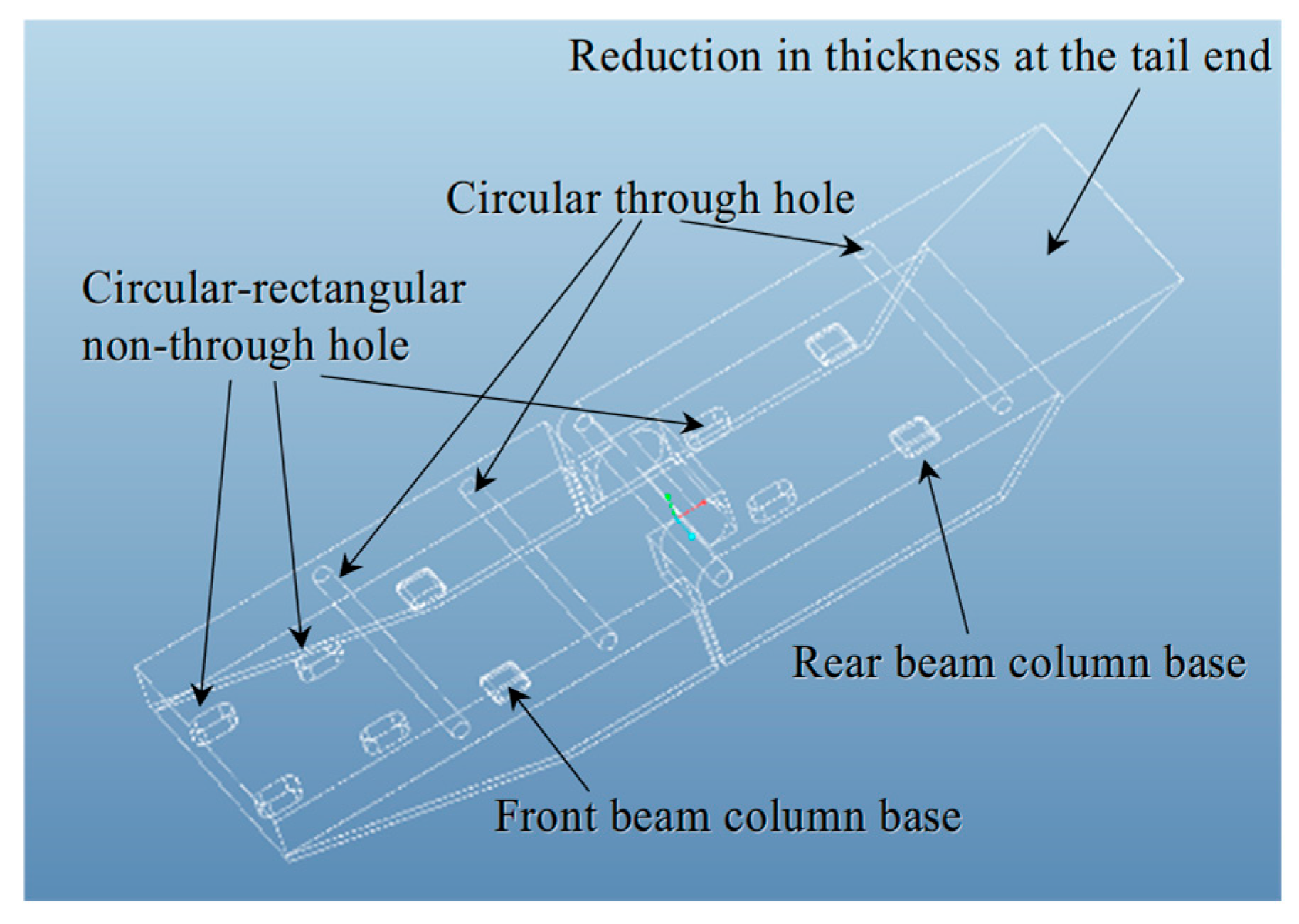
As shown in Figure 16, the topology analysis results for the hydraulic support beam indicate that regions with no load or minimal load are concentrated at the hinge ears connecting the front and rear beams, the areas from the hinge ears to the column wells of the front and rear beams, the top beam and side plates, and at both ends of the hydraulic support. The hinge ears serve as critical connections between the front and rear beams and play an essential bridging role, making them unsuitable for optimization. Similarly, the side plates provide important protective functions and should not be optimized. Therefore, six rounded rectangular non-through holes and three circular through holes can be introduced in the front and rear beams, and the radius at the end of the rear beam can be optimized, as shown in Figure 17. After structural optimization, the thickness at the end of the rear canopy (tail beam) was reduced by 10 cm. Theoretically, this can increase the filling rate by 2%, and decrease the total canopy weight by 1056 kg.
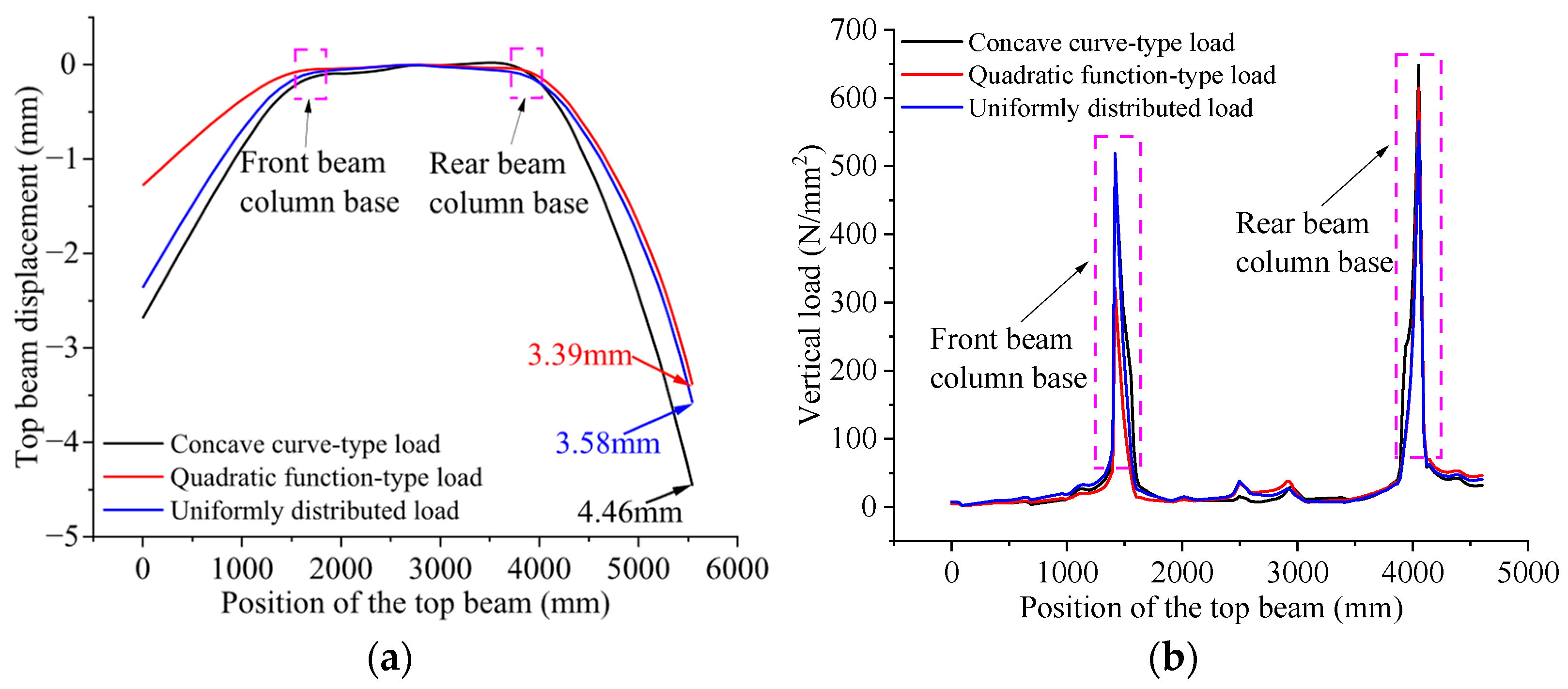
To analyze the load-bearing characteristics of the optimized beam, ANSYS Workbench is again employed to assess the mechanical response of the beam under the three working conditions. The maximum stress location remains at the column well of the rear beam, while the maximum displacement continues to occur at the end of the rear beam. Figure 18 illustrates the mechanical response characteristics at the cross-sections where the maximum stress and displacement are located.
From Figure 18, it can be observed that the optimized beam maintains a similar level of stress concentration and end displacement characteristics compared to the unoptimized version, with slight increases in some areas. The maximum stress concentration still occurs at the column wells of the front and rear beams, with the rear beam’s column well experiencing a maximum stress of 647.9 N/mm2 under concave curve loading, which does not exceed the material’s yield strength. It is worth noting that, if a steel grade with a yield strength lower than 648 N/mm2 is adopted (with all other conditions unchanged), local yielding may occur in the column–well region where peak stress concentrates. Therefore, Q690 (or an equivalent high-yield steel) is recommended to maintain adequate strength under roof-loading conditions. When alternative steel grades are considered, the same verification procedure should be repeated.
The displacement characteristics remain largely unchanged from before optimization, with increased bending at the outer beam sections near the column wells, and the maximum deformation under concave curve loading is 4.46 mm, indicating that the optimized beam still possesses good load-bearing performance.
In summary, the canopy structure was optimized using topology optimization in ANSYS Workbench. By reducing the thickness at the end of the rear canopy (tail beam), the maximum equivalent mining height can be reduced by up to 10 cm. Accordingly, the maximum filling rate at the 2515 working face can theoretically be increased by 2%. Finite element analysis results indicate that the optimized beam meets the required load-bearing standards, and this method can be applied to the design of hydraulic supports for similar mining conditions.

4.4. Long-Term Reliability and Field Adaptability of the Optimized Beam

Although the optimized beam satisfies the static strength requirement under the evaluated load cases, its long-term engineering performance should also be assessed from the perspectives of fatigue resistance, durability in a water-rich environment, manufacturability, and field maintainability. This is particularly relevant for ultra-high-water backfill mining, where hydraulic supports may experience repeated loading-unloading cycles associated with periodic weighting, advancing operations, and transient roof impacts.
(1)
Fatigue and stress-concentration considerations
Topology-optimized openings and thickness reduction can introduce geometric discontinuities that may elevate local stress ranges even when the peak von Mises stress remains below the yield strength under static loading. Therefore, fatigue-critical regions are expected to occur around (i) the contours of optimized openings, (ii) transitions between thickness zones, and (iii) the column well and its adjacent welded connections. In engineering practice, the following measures are recommended to mitigate fatigue risk:
Adopting rounded contours and adequate filet radii at opening edges and thickness transitions to reduce notch effects;
Avoiding sharp corners and ensuring smooth surface finishing at cut boundaries;
Refining weld design and quality control around high-stress regions (e.g., controlled weld toe geometry and post-weld treatment if necessary);
Performing an additional fatigue-oriented numerical check using stress amplitude/mean stress criteria (e.g., Goodman- or Soderberg-type approaches) under representative cyclic load spectra.
(2)
Environmental durability and corrosion protection
Ultra-high-water backfill conditions may increase humidity and expose the canopy/beam to water, slurry mist, and corrosive agents. For long-term durability, corrosion protection (e.g., coatings) and drainage/cleaning provisions should be considered in the structural design and maintenance plan. In addition, periodic inspection is recommended to detect early-stage corrosion and crack initiation around openings and welded joints.
(3)
Prototype validation and field monitoring roadmap
To translate the optimized design into practice, a staged validation strategy is recommended:
Full-scale static bench testing, including loading up to the rated working resistance to verify elastic deformation, stiffness, and safety margin;
Full-scale cyclic loading (fatigue) testing under representative stress ranges to examine crack initiation and stiffness degradation;
Pilot field deployment with monitoring, where strain gauges (or equivalent sensing technologies) are placed near fatigue-critical regions (opening edges and column well), while support leg pressure and canopy displacement are recorded to establish the operational load spectrum;
Non-destructive testing (NDT) such as ultrasonic or magnetic particle inspection at scheduled intervals to detect crack initiation around openings and welds.
These steps will enable iterative refinement of the optimized geometry and provide empirical evidence for long-term reliability in ultra-high-water backfill mining.

5. Conclusions

This study utilizes a comprehensive research approach that integrates physical similarity simulation, industrial experiments, theoretical analysis, and simulation modeling. It clarifies the surface subsidence characteristics under different filling rates and proposes methods for increasing the filling rate from the perspective of optimizing the hydraulic support beam structure, the characteristics of surface subsidence under different filling rates were clarified, and methods to increase the filling rate were proposed from the perspective of optimizing the crown beam structure of hydraulic supports. These findings provide theoretical support for sustainable mine development and further enrich the theory of green mining. The main conclusions are as follows:
(1)
At filling rates of 85% and 90%, the basic roof exhibits a two-stage subsidence, while the key strata and surface demonstrate a trend of coordinated deformation. Compared to the 85% filling rate, the subsidence amounts for the basic roof, key strata, and surface at a 90% filling rate decrease by 51%, 57%, and 63%, respectively. At a filling rate of 92% at the 2515 working face of Hengjian Coal Mine, the maximum ground-surface subsidence was 265 mm. In the No. 7 mining district of Taoyi Coal Mine, two subsidence troughs developed above the six backfill working faces, both of which were located above faces with relatively low filling rates. These two field practices consistently demonstrate that the filling rate plays a significant controlling role in ground-surface subsidence.
(2)
The study clarifies the characteristics of surrounding rock that hydraulic supports must manage under different equivalent mining heights. The equivalent mining height thresholds for unstable direct roof collapse and high basic roof failure are determined to be 0.44 m and 1.26 m, respectively. Based on this, a mechanical model and simulation model for the load distribution on the hydraulic support beam in the 2515 working face were established, revealing that the displacement of the beam under three load conditions is characterized by greater displacement at the ends compared to the middle hinge points.
(3)
The optimization of the beam structure was conducted using ANSYS Workbench simulation analysis, resulting in a 10 cm reduction in the thickness of the rear beam. This optimization can theoretically increase the filling rate in the 2515 working face by approximately 2%. Finite element analysis results indicate that the optimized hydraulic support beam continues to meet the required load-bearing standards.
(4)
In future work, the optimized beam design will be validated through staged prototype testing (static and cyclic loading) and pilot-scale field monitoring (strain/pressure/displacement measurements and periodic NDT inspection) to confirm long-term durability and operational safety under realistic load spectra.
(5)
The proposed method for optimizing the hydraulic support roof beam to improve the backfill ratio is applicable to mines with similar conditions. However, it should be clearly noted that when the geological conditions, mining height, or hydraulic support type changes, the method presented in this study should be re-applied to re-check and re-verify the design.

Author Contributions

Conceptualization, X.C. and X.W.; methodology, X.C. and C.Q.; software, X.C. and Z.N.; validation, X.C., X.W., C.Q. and D.Q.; formal analysis, X.C. and C.Q.; investigation, Z.C. and Z.F.; resources, C.Q.; data curation, X.C. and C.Q.; writing—original draft preparation, X.C.; writing—review and editing, X.W. and C.Q.; visualization, X.C.; supervision, X.W. and C.Q.; project administration, X.C. and X.W.; funding acquisition, X.C. All authors have read and agreed to the published version of the manuscript.

Funding

This research was funded by the Fundamental Research Funds for the Central Universities, grant number 2025QN1002.

Institutional Review Board Statement

Not applicable.

Informed Consent Statement

Not applicable.

Data Availability Statement

The data that support the findings of this study are available from the corresponding author upon reasonable request.

Acknowledgments

The authors are also grateful to the helpful comments provided by the anonymous reviewers.

Conflicts of Interest

The authors declare no conflicts of interest.

Abbreviations

The following abbreviations are used in this manuscript:
Cσstrength similarity constantCLgeometric similarity constant
Cρdensity similarity constantpactual values
mmodel valuesσmaterial strength
Ldimensionρmaterial density
MEthe thickness of the high-level basic roofγthe unit weight of the rock
Cperiodic pressure step distanceΔhAthe maximum subsidence of the roof
Δhithe subsidence of the roof that needs to be controlledKTthe rock weight distribution coefficient
Nmining heightnthe safety factor
Mthe mining heightWthe width of the hydraulic support
LKthe maximum control distance of the hydraulic supporta1, b1, c1, a2, b2, c2constants of the concave curves
Fxthe stress sum in the x directionFythe stress sum in the y direction
μthe coefficient of frictionMfront beamthe moment sum to the left of the hinge point
Mrear beamthe moment sum to the right of the hinge pointMAthe moment sum at point A
Mq1(x)the moments exerted by q1(x)Mq2(x)the moments exerted by q2(x)

References

  1. Xiong, Y.; Kong, D.Z.; Song, G.F. Research hotspots and development trends of green coal mining: Exploring the path to sustainable development of coal mines. Resour. Policy 2024, 92, 105039. [Google Scholar] [CrossRef]
  2. Wang, F.T.; Ma, Q.; Li, G.; Wu, C.; Guo, G. Overlying strata movement laws induced by longwall mining of deep buried coal seam with superhigh-water material backfilling technology. Adv. Civ. Eng. 2018, 2018, 4306239. [Google Scholar] [CrossRef]
  3. Cao, W.H.; Wang, X.F.; Li, P.; Zhang, D.; Sun, C.; Qin, D. Wide strip backfill mining for surface subsidence control and its application in critical mining conditions of a coal mine. Sustainability 2018, 10, 700. [Google Scholar] [CrossRef]
  4. Emad, M.Z.; Mitri, H.; Kelly, C. State-of-the-art review of backfill practices for sublevel stoping system. Int. J. Min. Reclam. Environ. 2013, 29, 544–556. [Google Scholar] [CrossRef]
  5. Huang, Z.M.; Zhang, L.; Ma, Z.G. Study on the mechanical relationship among the backfilling mining support, roof rock beam, and gangue filling body in comprehensive mechanized filling mining process. Adv. Civ. Eng. 2020, 2020, 8824735. [Google Scholar] [CrossRef]
  6. Huang, Y.L.; Zhang, J.X.; An, B.F.; Zhang, Q. Overlying strata movement law in fully mechanized coal mining and backfilling longwall face by similar physical simulation. J. Min. Sci. 2012, 47, 618–627. [Google Scholar] [CrossRef]
  7. Zhang, J.X.; Sun, Q.; Zhou, N.; Jiang, H.; Germain, D.; Abro, S. Research and application of roadway backfill coal mining technology in western coal mining area. Arab. J. Geosci. 2016, 9, 558. [Google Scholar] [CrossRef]
  8. Creber, K.J.; Kermani, M.F.; McGuinness, M.; Hassani, F. In situ investigation of mine backfill distribution system wear rates in Canadian mines. Int. J. Min. Reclam. Environ. 2017, 31, 426–438. [Google Scholar] [CrossRef]
  9. Zhou, N.; Zhang, J.X.; Ouyang, S.Y.; Deng, X.; Dong, C.; Du, E. Feasibility study and performance optimization of sand-based cemented paste backfill materials. J. Clean. Prod. 2020, 259, 120798. [Google Scholar] [CrossRef]
  10. Shaposhnik, Y.N.; Konurin, A.; Neverov, A.A.; Neverov, S.A.; Usol’tseva, O.M.; Shaposhnik, S.N. Validation of friction-anchored rock bolt supports for underground excavations in backfill. J. Min. Sci. 2021, 57, 775–786. [Google Scholar] [CrossRef]
  11. Sakhno, I.; Zuievska, N.; Xiao, L.; Zuievskyi, Y.; Sakhno, S.; Semchuk, R. Prediction of water inrush hazard in Fully Mechanized Coal Seams’ mining under aquifers by numerical simulation in ANSYS software. Appl. Sci. 2025, 15, 4302. [Google Scholar] [CrossRef]
  12. Liu, J.S.; Wang, Y.; Zuo, J.P.; Wu, Z.; Sun, Y.; Zheng, Z. Asymmetric analogous hyperbola model of overburden movement and its verification. Sci. Rep. 2024, 14, 15614. [Google Scholar] [CrossRef]
  13. Feng, G.M. Research on the Superhigh-Water Packing Material and Filling Mining Technology and Their Application. Ph.D. Thesis, China University of Mining and Technology, Xuzhou, China, 2009. [Google Scholar]
  14. Shimada, Y.; Young, J.F. Structural changes during thermal dehydration of ettringite. Adv. Cem. Res. 2001, 13, 77–81. [Google Scholar] [CrossRef]
  15. Wang, X.F.; Qin, D.D.; Zhang, D.S.; Sun, C.; Zhang, C.; Xu, M.; Li, B. Mechanical characteristics of superhigh-water content material concretion and its application in longwall backfilling. Energies 2017, 10, 1592. [Google Scholar] [CrossRef]
  16. Feng, G.M.; Sun, C.D.; Wang, C.Z.; Zhou, Z. Research on goaf filling methods with super high-water material. J. China Coal Soc. 2010, 35, 1963–1968. [Google Scholar] [CrossRef]
  17. Wang, F.T.; Ma, Q.; Zhang, C.; Feng, G. Overlying strata movement and stress evolution laws triggered by fault structures in backfilling longwall face with deep depth. Geomat. Nat. Hazards Risk 2020, 11, 949–966. [Google Scholar] [CrossRef]
  18. Zhang, M.; Zhang, J.F.; Jiao, Z.H. Design of rib pillars in deep longwall mines based on rockburst and water-seepage prevention. Energy Sci. Eng. 2021, 9, 256–266. [Google Scholar] [CrossRef]
  19. Bai, E.H.; Guo, W.B.; Tan, Y.; Huang, G.; Guo, M.; Ma, Z. Roadway backfill mining with super-high-water material to protect surface buildings: A case study. Appl. Sci. 2020, 10, 107. [Google Scholar] [CrossRef]
  20. Li, H.Z.; Guo, G.L.; Zhai, S.C. Mining scheme design for super-high water backfill strip mining under buildings: A Chinese case study. Environ. Earth Sci. 2016, 75, 1017. [Google Scholar] [CrossRef]
  21. Li, H.J.; Zhang, Y.C.; Xu, L.; Jia, X.; Gu, X. Examination of the treatment quality of filling mined-out voids using super-high-water material by the TEM technique. Environ. Earth Sci. 2017, 76, 115. [Google Scholar] [CrossRef]
  22. Guo, G.L.; Zhu, X.J.; Zha, J.F.; Wang, Q. Subsidence prediction method based on equivalent mining height theory for solid backfilling mining. Trans. Nonferrous Met. Soc. China 2014, 24, 3302–3308. [Google Scholar] [CrossRef]
  23. El, M.; Nawfal, A.; Michel, L.L. Effect of drainage and sequential filling on the behavior of backfill in mine stopes. Can. Geotech. J. 2014, 51, 1–15. [Google Scholar] [CrossRef]
  24. Bazaluk, O.; Petlovanyi, M.; Lozynskyi, V.; Zubko, S.; Sai, K.; Saik, P. Sustainable underground iron ore mining in ukraine with backfilling worked-out area. Sustainability 2021, 13, 834. [Google Scholar] [CrossRef]
  25. Abdulkadir, S.B.; Chen, Q.S.; Yilmaz, E.; Wang, D. Comparative and meta-analysis evaluation of non-destructive testing methods for strength assessment of cemented paste backfill: Implications for sustainable pavement and concrete materials. Materials 2025, 18, 2888. [Google Scholar] [CrossRef] [PubMed]
  26. Chang, Q.L.; Yao, X.G.; Leng, Q.; Cheng, H.; Wu, F.; Zhou, H.; Sun, Y. Strata movement of the thick loose layer under strip-filling mining method: A case study. Appl. Sci. 2021, 11, 11717. [Google Scholar] [CrossRef]
  27. Hao, J.; Shi, Y.K.; Qi, M.H.; Zhang, L. Effective filling rate in filling mining’s influence on overlying strata’s movement. Adv. Mater. Res. 2013, 734–737, 741–745. [Google Scholar] [CrossRef]
  28. Zhang, J.X.; Zhang, Q.; Sun, Q.; Gao, R.; Germain, D.; Abro, S. Surface subsidence control theory and application to backfill coal mining technology. Environ. Earth Sci. 2015, 74, 1439–1448. [Google Scholar] [CrossRef]
  29. Jia, K.J. Research on the Overlying Strata Movement Law of Super-High-Water Material Bag-Type Filling Mining and Its Control. Ph.D. Thesis, China University of Mining and Technology, Xuzhou, China, 2015. [Google Scholar]
  30. Adach-Pawelus, K.; Pawelus, D. Application of hydraulic backfill for rockburst prevention in the mining field with remnant in the polish underground copper mines. Energies 2021, 14, 3869. [Google Scholar] [CrossRef]
  31. Bilen, M.; Toroglu, I.; Yilmaz, E. Power plant ash as a backfill material for subsidence mitigation and mining district recovery: A review and case study in Zonguldak, Turkiye. Int. J. Min. Reclam. Environ. 2025, 1–19. [Google Scholar] [CrossRef]
  32. Zhang, X.; Zhang, J.W.; Zeng, Q.L.; Wang, C.L. Lightweight design for hydraulic support. Key Eng. Mater. 2011, 450, 79–82. [Google Scholar] [CrossRef]
  33. Wang, J.; Ning, J.G.; Tan, Y.L.; Hu, S.C.; Guo, W.Y. Deformation and failure laws of roadway surrounding rock and support optimization during shallow-buried multi-seam mining. Geomat. Nat. Hazards Risk 2020, 11, 191–211. [Google Scholar] [CrossRef]
  34. Yang, Z.K.; Sun, Z.Y.; Jiang, S.B.; Mao, Q.H.; Liu, P.; Xu, C.Z. Structural analysis on impact-mechanical properties of ultra-high hydraulic support. Int. J. Simul. Model. 2020, 19, 17–28. [Google Scholar] [CrossRef]
  35. Xue, K.M.; Huang, P.; Li, P.; Chen, L.; Liu, W. The structure statics analysis and optimal design of hydraulic support. Appl. Mech. Mater. 2012, 226–228, 1265–1268. [Google Scholar] [CrossRef]
  36. He, M.C. Physical modeling of an underground roadway excavation in geologically 45° inclined rock using infrared thermography. Eng. Geol. 2011, 121, 165–176. [Google Scholar] [CrossRef]
  37. Kang, H.P.; Li, J.Z.; Yang, J.H.; Gao, F. Investigation on the influence of abutment pressure on the stability of rock bolt reinforced roof strata through physical and numerical modeling. Rock Mech. Rock Eng. 2017, 50, 387–401. [Google Scholar] [CrossRef]
  38. Chen, H.M.; Yu, H.S.; Smith, M.J. Physical model tests and numerical simulation for assessing the stability of brick-lined tunnels. Tunn. Undergr. Space Technol. 2016, 53, 109–119. [Google Scholar] [CrossRef]
  39. Ghabraie, B.; Ren, G.; Smith, J.V. Characterising the multi-seam subsidence due to varying mining configuration, insights from physical modelling. Int. J. Rock Mech. Min. Sci. 2017, 93, 269–279. [Google Scholar] [CrossRef]
  40. Ghabraie, B.; Ren, G.; Smith, J.V.; Holden, L. Application of 3D laser scanner, optical transducers and digital image processing techniques in physical modelling of mining-related strata movement. Int. J. Rock Mech. Min. Sci. 2015, 80, 219–230. [Google Scholar] [CrossRef]
  41. Qin, D.D.; Wang, X.F.; Zhang, D.S.; Guan, W.; Zhang, L.; Xu, M. Occurrence characteristic and mining technology of ultra-thick coal seam in Xinjiang, China. Sustainability 2019, 11, 6470. [Google Scholar] [CrossRef]
  42. Wang, F.T.; Tu, S.H.; Zhang, C.; Zhang, Y.; Bai, Q. Evolution mechanism of water-flowing zones and control technology for longwall mining in shallow coal seams beneath gully topography. Environ. Earth Sci. 2016, 75, 1309. [Google Scholar] [CrossRef]
  43. Bai, Q.S.; Tu, S.H.; Wang, F.T. Characterizing the top coal cavability with hard stone band(s): Insights from laboratory physical modeling. Rock Mech. Rock Eng. 2019, 52, 1505–1521. [Google Scholar] [CrossRef]
  44. Ghabraie, B.; Ren, G.; Zhang, X.Y.; Smith, J. Physical modelling of subsidence from sequential extraction of partially overlapping longwall panels and study of substrata movement characteristics. Int. J. Coal Geol. 2015, 140, 71–83. [Google Scholar] [CrossRef]
  45. State Coal Industry Administration. Buildings, Water Bodies, Railways, and Main Roadway Unexploited Coal Pillars and Compressed Coal Mining Regulations; China Coal Industry Publishing House: Beijing, China, 2017.
  46. Sun, C.D.; Zhang, D.S.; Wang, X.F.; Zhou, Y.Z.; Li, Y.Y. Study and application of overlying strata control technology in bag-type backfill longwall mining with super high-water content material. J. China Coal Soc. 2015, 40, 1313–1319. [Google Scholar] [CrossRef]
  47. Zhang, Q.; Zhang, J.X.; Chen, Y.; Ntigurirwa, J.D.; Xia, K. Moving set-up room theory of weakening the mining pressure caused by the backfilling body in solid backfilling mining. Energy Sci. Eng. 2020, 8, 898–909. [Google Scholar] [CrossRef]
  48. Wang, Y. Analysis on strength of top beam of ZP4000 hydraulic support under different working conditions. Mech. Manag. Dev. 2021, 36, 104–106. [Google Scholar] [CrossRef]
Figure 1. Research framework.
Sustainability 18 00854 g001
Figure 2. Overview of the 2515 working face at Hengjian mine.
Sustainability 18 00854 g002
Figure 3. Similarity material model.
Sustainability 18 00854 g003
Figure 4. Overburden movement characteristics at a 90% filling rate.
Sustainability 18 00854 g004
Figure 5. Vertical displacement characteristics of each measurement point at a 90% filling rate; (a) Variation curve of basic roof subsidence; (b) Variation curve of main key layer subsidence; (c) Variation curve of surface subsidence; (d) Final subsidence of overburden when the model is fundamentally stable.
Sustainability 18 00854 g005
Figure 6. Overburden movement characteristics at an 85% filling rate.
Sustainability 18 00854 g006
Figure 7. Measurement line arrangement and monitoring results at the 2515 working face; (a) Schematic diagram of selected measurement station locations at the 2515 working face; (b) Surface subsidence curve at the 2515 working face.
Sustainability 18 00854 g007
Figure 8. Layout of monitoring points and schematic of ground-surface subsidence.
Sustainability 18 00854 g008
Figure 9. Ground-surface subsidence characteristics.
Sustainability 18 00854 g009
Figure 10. Overburden structure in ultra-high water filling working face.
Sustainability 18 00854 g010
Figure 11. Schematic of the support rock layer characteristics under different equivalent mining heights; (a) The equivalent mining height is less than 0.44 m; (b) The equivalent mining height is between 0.44 m and 1.26 m; (c) The equivalent mining height is greater than 1.26 m.
Sustainability 18 00854 g011aSustainability 18 00854 g011b
Figure 12. Mechanical model of load distribution on the hydraulic support beam; (a) Concave curve-type load; (b) Quadratic function-type load; (c) Uniformly distributed load.
Sustainability 18 00854 g012aSustainability 18 00854 g012b
Figure 13. Load distribution characteristics of the hydraulic support beam.
Sustainability 18 00854 g013
Figure 14. Three-dimensional model and mesh discretization of the hydraulic support beam.
Sustainability 18 00854 g014
Figure 15. Mechanical response characteristics of the beam under three working conditions; (a) Stress distribution characteristics of the beam; (b) Displacement characteristics of the beam.
Sustainability 18 00854 g015
Figure 16. Topology analysis results of the hydraulic support beam.
Sustainability 18 00854 g016
Figure 17. Three-dimensional model of the optimized beam structure.
Sustainability 18 00854 g017
Figure 18. Mechanical response characteristics of the beam under three working conditions; (a) Stress distribution characteristics of the beam; (b) Displacement distribution characteristics of the beam.
Sustainability 18 00854 g018
Table 1. Material proportions for each rock layer.
Rock LayerMass Proportion (%)
Sand:Calcium Carbonate:Gypsum:Water
σp (MPa)σm (MPa)
Quartzose Siltstone74:8:8:10950.264
Mudstone78:8:4:10280.078
Siltstone77:6:6:11800.222
Fine Sandstone72:9:9:10900.250
Muddy Siltstone78:6:6:10600.167
Medium Sandstone72:5:13:10690.192
Conglomerate80:5:5:1060.017
Clay81:3:6:1020.006
Table 2. Backfill mining conditions of Backfill working face I–VI.
Working Face (ID)Strike Length/mDip Length/mMining Height/mFilling Rate
Backfill working face I502204.089%
Backfill working face II502004.071%
Backfill working face III502484.091%
Backfill working face IV502704.069%
Backfill working face V502923.286%
Backfill working face VI1203302.356%
Table 3. Method for determining KT.
NN ≤ 11 < N ≤ 2.52.5 < N ≤ 5N > 5
KT22N38(N − 2.5) + 5
Table 4. Parameters of the hydraulic support beam.
Material TypeModulus of Elasticity
E/GPa
Poisson’s RatioDensity
ρ/kg·m−3
Yield Strength/N/mm2
Q6902060.37850690
Table 5. Load uncertainty and sensitivity analysis.
Concave Curve LoadQuadratic Function LoadUniform Load
−10%0%10%−10%0%10%−10%0%10%
Maximum stress/(N/mm2)544.4647.9665.4545.0605.5666.1506.8551.4599.2
Stress error−15.9%02.7%−10.0%010.0%−8.1%08.7%
Maximum deformation/mm3.974.414.853.023.353.692.913.553.66
Deformation error−10.0%010.0%−9.9%010.1%18.0%03.1%
Disclaimer/Publisher’s Note: The statements, opinions and data contained in all publications are solely those of the individual author(s) and contributor(s) and not of MDPI and/or the editor(s). MDPI and/or the editor(s) disclaim responsibility for any injury to people or property resulting from any ideas, methods, instructions or products referred to in the content.