1. Introduction
The increasing complexity of contemporary organizational environments has elevated the importance of systematic efficiency models such as Lean management. Originally developed within the Toyota Production System (TPS), the Lean philosophy aims to eliminate waste, optimize processes, and maximize customer value through continuous improvement and operational discipline.
Over time, Lean principles have expanded beyond manufacturing into services, logistics, public administration, and knowledge-intensive environments, where human creativity and problem-solving abilities constitute the primary sources of value. Within this framework, the “eighth waste”—the underutilization of human potential—has gained prominence as organizations recognize that intangible resources such as creativity, innovation, and employee engagement are central to sustainable [
1,
2].
Human potential is especially critical in the context of accelerating digital transformation. Artificial Intelligence (AI) technologies—including machine learning, robotic process automation, predictive analytics, and cognitive decision-support systems—are reshaping organizational processes, roles, and competencies. While AI enhances efficiency and can eliminate several classical Lean wastes, it simultaneously creates new forms of employee disenfranchisement when technological progress outpaces cultural adaptation and leadership responsiveness [
3,
4]. In such cases, employees may experience decreased autonomy, reduced learning opportunities, and higher ambiguity regarding their evolving roles, which reinforces the eighth waste. Accordingly, leadership and organizational culture become essential mechanisms for maintaining engagement and safeguarding human-centered value creation in AI-augmented workplaces.
Leadership style determines how employees perceive autonomy, psychological safety, communication openness, and opportunities for creativity—all of which are central to minimizing the eighth waste. Democratic, supportive, and people-oriented leadership styles have been associated with higher motivation, innovation, and collective problem-solving [
5,
6]. Conversely, autocratic or rigid task-oriented styles may suppress creativity and diminish employee willingness to engage in continuous improvement [
7]. Organizational culture similarly shapes how employees interpret organizational expectations, adapt to change, and commit to improvement processes. The Denison framework emphasizes four cultural dimensions—Involvement, Consistency, Adaptability, and Mission—that collectively influence employees’ motivation, communication quality, and clarity of work roles [
8,
9].
Despite growing scholarly interest in Lean transformations, leadership, and organizational culture, three gaps remain evident in the literature.
First, previous studies have primarily focused on Lean’s operational dimensions, whereas the eighth waste has been explored less systematically, particularly in human-centric sectors.
Second, limited attention has been paid to how leadership and culture jointly function as instruments for reducing human-potential losses, despite conceptual arguments that both constructs shape employee motivation, creativity, and adaptability.
Third, while AI adoption is rapidly altering organizational structures and employee expectations, the intersection of AI with Lean philosophy, leadership behavior, organizational culture, and human-potential outcomes remains underdeveloped in empirical literature. Existing AI–Lean studies are predominantly conceptual or technical, lacking a behavioral management perspective.
In response to these gaps, this study examines whether leadership styles and organizational culture act as predictors of the factors contributing to the eighth Lean waste, operationalized here as untapped creativity, untapped innovation, inadequate motivation, inadequate communication, and inadequate role clarity. Although AI is not modeled empirically, the study is situated within the broader organizational transition toward AI-driven systems. This contextual framing enables a more contemporary interpretation of the findings and aligns the research with recent calls to integrate human-centered management principles into digital transformation initiatives [
4,
10].
The study contributes to the literature in three ways.
First, it offers a quantitative assessment of how leadership styles and cultural dimensions jointly relate to the underutilization of human potential, expanding the limited empirical evidence on the eighth waste.
Second, it connects Lean management with organizational behavior theories (leadership and culture), addressing a persistent gap in interdisciplinary management research.
Third, by positioning the findings within the era of AI-driven transformation, the study provides a timely perspective on how organizations can preserve human-centric capabilities while integrating advanced technologies.
2. Literature Review
The literature review integrates four key theoretical domains—leadership, organizational culture, Lean management, and AI-enabled transformation—to establish an interdisciplinary foundation for examining the eighth waste of the Lean model. This synthesis addresses the issue of grounding the research model in updated theories, clarifying construct relationships, and positioning AI as a contextual factor shaping the need for human-centered Lean practices.
2.1. Leadership Styles in Contemporary Organizations
Leadership is a central determinant of organizational behavior, employee motivation, and the execution of improvement initiatives. Traditional leadership theories categorize styles into democratic, autocratic, task-oriented, and people-oriented modes, each shaping communication patterns, role clarity, and employee empowerment [
5,
7]. Democratic and people-oriented leadership emphasize participation, trust, collaboration, and socio-emotional support, which foster creativity, idea sharing, and continuous improvement—elements essential for reducing the eighth Lean waste. In contrast, autocratic leadership centralizes authority, suppresses employee voice, and may inhibit engagement, thereby reinforcing underutilization of human resources.
Recent literature highlights transformational leadership as particularly effective in dynamic and technologically evolving contexts. Transformational leaders articulate a clear vision, encourage intellectual stimulation, and empower employees to innovate, making the style highly relevant in environments influenced by digital technologies and AI [
11]. Studies indicate that transformational leadership strengthens adaptive organizational cultures, enhances creativity, and supports digital transformation by developing employee readiness and reducing resistance to change [
12].
In AI-driven workplaces, leadership roles are shifting from directive oversight to facilitation of human–machine collaboration. Digital leadership theory suggests that leaders should develop competencies in technology adoption, data-driven decision-making, and human-centric change management [
13]. These insights reinforce the argument that leadership is instrumental in shaping employees’ cognitive schemas, internal motivation, and capacity for innovation—all of which directly relate to the eighth Lean waste.
2.2. Organizational Culture as the Foundation for Lean and AI Readiness
Organizational culture represents the collective system of values, beliefs, assumptions, and behavioral norms shared by employees. Culture influences how employees interpret organizational expectations, respond to change, collaborate, and engage in problem-solving [
14].
The Denison model frames culture across four dimensions—Involvement, Consistency, Adaptability, and Mission—with each contributing to performance and employee behavior [
8].
Adaptability is particularly relevant in the era of artificial intelligence. Organizations with adaptive cultures demonstrate openness to innovation, learning, experimentation, and continuous improvement—conditions necessary for leveraging AI without diminishing human potential [
9]. Conversely, rigid, bureaucratic, or risk-averse cultures may resist technological change and suppress idea sharing, directly contributing to the eighth waste.
Involving employees in decision-making strengthens ownership, creativity, and knowledge sharing—protective factors against human-potential losses [
15]. Consistency, when balanced with adaptability, enhances trust and psychological safety, enabling employees to propose improvements and experiment with new solutions. Mission clarity helps employees understand their role within a technologically evolving workplace, reducing ambiguity and supporting role alignment.
Important question is if the culture is viewed as the ecosystem within which AI is either embraced or resisted. This aligns with contemporary organizational culture theory: culture is the “soil” in which technological innovations take root. Lean systems succeed only when the culture promotes transparency, continuous learning, and empowerment—otherwise automation merely replaces visible inefficiencies without improving deeper organizational dynamics.
2.3. Lean Philosophy and the Eighth Waste (Unused Human Potential)
Lean management seeks to reduce all forms of waste (muda), variability (mura), and overburden (muri). The Lean concept originally classified seven wastes, but contemporary interpretations emphasize the “eighth waste,” which refers to the underutilization of employee knowledge, creativity, and capabilities [
11]. This waste arises from inadequate communication, lack of empowerment, insufficient training, poor role clarity, and rigid leadership practices.
As organizations shift from mechanistic production systems to knowledge-based operations, the eighth waste becomes increasingly critical. Human creativity, innovation, and problem-solving drive continuous improvement and long-term resilience [
16]. Employee disengagement, underutilization of ideas, and ineffective communication weaken Lean performance by reducing the flow of insights necessary for process optimization.
Modern studies highlight that the eighth waste is most strongly affected by behavioral and cultural factors, rather than technical ones. Thus, leadership and culture—rather than tools and automation—are the primary drivers of employee willingness to innovate, identify problems, and engage in improvement initiatives [
17].
2.4. Artificial Intelligence in Lean Systems: A Conceptual Theoretical Context
Although AI is not operationalized as a statistical variable in this study, it is included as a theoretical and contextual force influencing modern organizations. The purpose of it is to anchor the research in a contemporary AI ecosystem; therefore, this section summarizes how AI reshapes Lean systems and why human-centric factors remain vital.
From an individual perspective, the Technology Acceptance Model (TAM) explains why employees differ in their willingness to use AI-based tools. According to TAM, perceived usefulness and perceived ease of use are the primary determinants of whether individuals accept or resist new technologies [
18]. In Lean environments, where continuous improvement depends on active employee engagement, these perceptions are strongly shaped by leadership behavior and organizational culture. Leaders who communicate the purpose of AI clearly and provide psychological safety can enhance employees’ perception that AI supports, rather than threatens, their work, thereby reducing resistance and disengagement.
At the organizational level, the Technology–Organization–Environment (TOE) framework further highlights the role of internal structures and managerial support in technological adoption [
19]. TOE suggests that technological innovations are not adopted solely because of their technical advantages, but because organizations possess the cultural readiness, leadership commitment, and internal capabilities needed to absorb them. In Lean systems, cultural dimensions such as involvement, adaptability, and mission clarity create conditions in which employees are more willing to experiment with new digital tools, share knowledge, and integrate AI into continuous improvement practices.
These perspectives are complemented by socio-technical systems theory, which emphasizes that organizational performance emerges from the joint optimization of technical and social subsystems [
20]. While AI can dramatically enhance efficiency, prediction, and process control, it may also unintentionally erode employee autonomy, learning, and engagement if the social system is neglected. In Lean organizations, where frontline employees play a central role in identifying waste and proposing improvements, such imbalances directly contribute to the eighth waste—unused human potential.
Taken together, TAM, TOE, and socio-technical systems theory provide a coherent foundation for viewing leadership and organizational culture as critical mechanisms linking AI technologies to human-centered Lean outcomes. AI may eliminate traditional forms of waste, but leadership and culture determine whether digital transformation strengthens or weakens employee motivation, creativity, and continuous improvement.
AI supports Lean principles by automating routine tasks, enhancing real-time data analysis, improving quality control, and enabling predictive maintenance [
3]. However, AI adoption also risks diminishing learning opportunities, reducing decision-making autonomy, and potentially increasing employee anxiety about job security—conditions that reinforce the eighth waste [
4].
To theoretically frame this dynamic, three well-established models are integrated:
Employees’ acceptance of AI depends on perceived usefulness and ease of use. Leadership and culture shape these perceptions, influencing willingness to collaborate with AI systems.
- 2.
Technology–Organization–Environment (TOE) Framework
The TOE model argues that organizational readiness, internal culture, and leadership support determine successful technological implementation.
- 3.
Socio-Technical Systems Theory
Effective AI integration requires balancing technical efficiency with social well-being. Without supportive leadership and culture, AI may optimize processes but reduce employee engagement—creating new forms of underutilization.
These theories confirm justification of the placement of AI as a contextual variable shaping the relevance of leadership and culture in modern Lean systems, without requiring empirical testing.
2.5. Integrated Theoretical Framework
Synthesizing the literature, leadership styles and organizational culture influence the eighth waste through:
The AI context amplifies the importance of these human-centered mechanisms. As routine work is automated, organizations are to cultivate leadership and culture that sustain engagement, adaptability, and continuous learning.
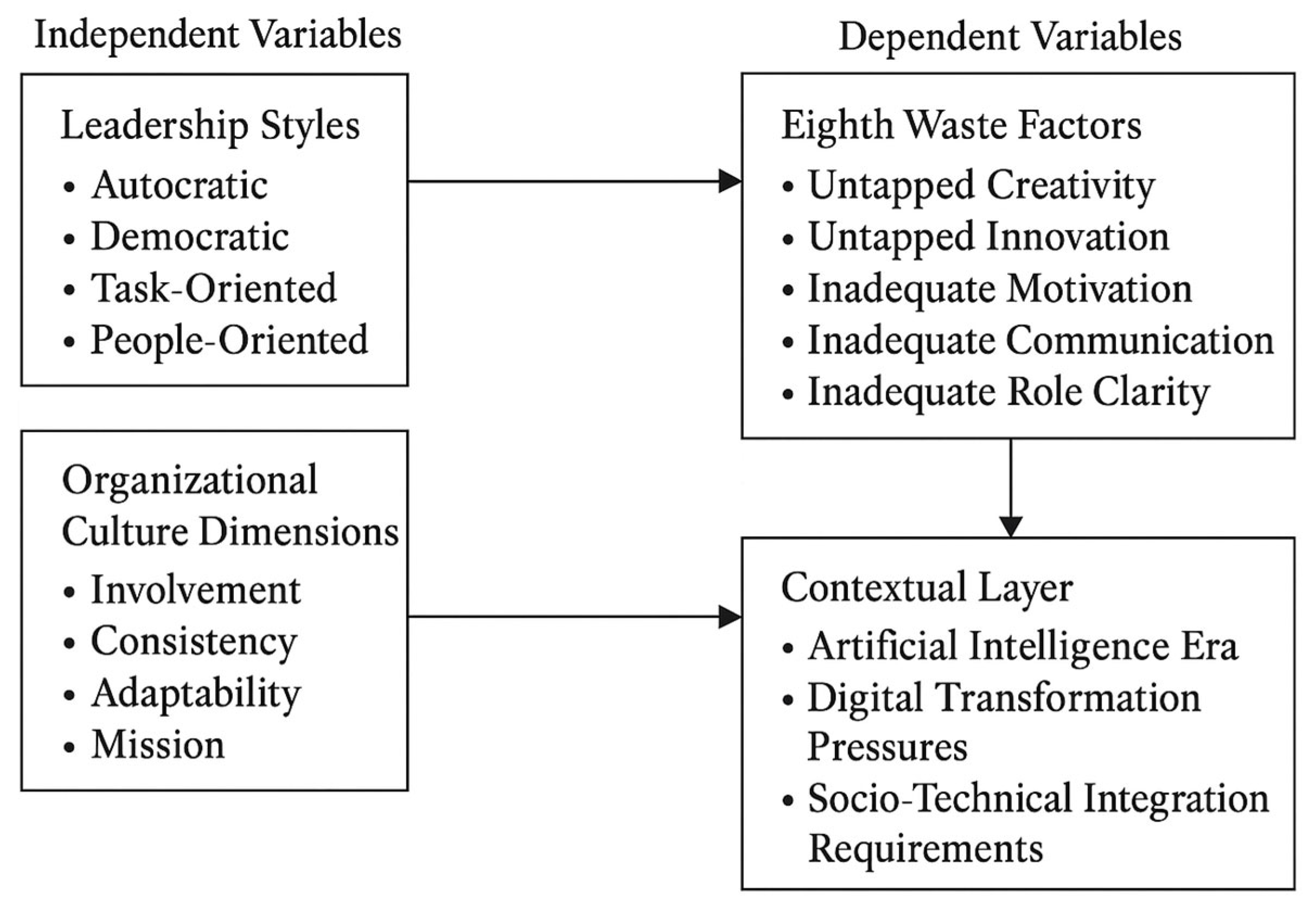
2.6. Research Model
AI is depicted as an external contextual force surrounding the model, influencing leadership and culture but not measured as a variable (
Figure 1).
2.7. Hypotheses Development
Based on the literature and the conceptual model:
H1. Leadership styles are significantly associated with the factors of the eighth Lean waste.
H1a: Autocratic leadership is positively associated with unused human potential.
H1b: Democratic leadership is negatively associated with unused human potential.
H1c: Task-oriented leadership is positively associated with unused human potential.
H1d: People-oriented leadership is negatively associated with unused human potential.
H2. Organizational culture dimensions are significantly associated with the factors of the eighth Lean waste.
H2a: Involvement culture is negatively associated with unused human potential.
H2b: Consistency culture is negatively associated with unused human potential.
H2c: Adaptability culture is negatively associated with unused human potential.
H2d: Mission (Purpose) culture is negatively associated with unused human potential.
H3. Leadership styles and organizational culture jointly predict the eighth waste.
This hypothesis corresponds to the regression models that examine the combined influence of cultural dimensions and leadership styles on each factor of human underutilization.
3. Materials and Methods
3.1. Research Design and Philosophical Orientation
This study employs a quantitative, cross-sectional, positivist research design to examine the predictive influence of leadership styles and organizational culture on the factors associated with the eighth Lean waste—unused human potential. A positivist approach is appropriate because the aim is to identify measurable relationships between constructs and to test theory-driven hypotheses using statistical procedures.
The study design aligns with prior research in organizational behavior and Lean management that relies on structured surveys, validated measurement instruments, and statistical modeling [
9,
17].
3.2. Population, Sampling Procedure, and Sample Size Justification
The target population consisted of employees from public and private organizations in Serbia across various industries. A purposive sampling strategy with quota controls was used to ensure balanced representation of gender and educational backgrounds. The final sample included 200 employees (100 male, 100 female), aged 24–58 (M = 38.29, SD = 9.62), representing organizations ranging from micro-sized firms (1 employee) to large companies (500 employees).
As there may be concerns about sample adequacy, 200 respondents satisfy widely accepted methodological guidelines:
For regression models, a minimum of 10–15 observations per predictor is recommended; this study exceeds that threshold.
According to G*Power (3.1), for a medium effect size (f2 = 0.15), α = 0.05, and 8 predictors, the required sample size is 109.
Comparable Lean and organizational behavior studies frequently use samples between 120 and 200, especially when exploratory factor analysis and regression are applied.
Thus, the sample is adequate and statistically defensible for the analytical strategy employed.
3.3. Ethical Considerations
The study was conducted in accordance with national and institutional ethical standards. Participants were informed of the study’s purpose, assured anonymity, and notified that participation was voluntary. No personal identifiers or sensitive data were collected.
Under Serbian Law (Zakon o zaštiti podataka o ličnosti, Official Gazette 87/2018), fully anonymized social-science survey research does not require Institutional Review Board approval, as anonymous data do not constitute personal data.
Institutional practice at the University of Novi Sad similarly classifies anonymous, non-interventional questionnaire studies as ethically exempt. Therefore, the study conforms to ethical requirements for non-invasive human-subjects research.
3.4. Instruments and Operationalization of Constructs
Three validated instruments were used to measure leadership styles, organizational culture, and factors associated with the eighth waste.
Table 1 summarizes the operational definitions.
The LEAN 8 instrument was developed based on established definitions of the eighth waste [
1,
16] and pilot-tested for clarity and reliability before full distribution.
3.5. Data Collection Procedure
Data were collected in August 2023. Respondents completed the paper-based questionnaires on-site during scheduled breaks or returned them to the researcher the following day. The average completion time was approximately 20 min. Participants were informed that responses would remain anonymous and used exclusively for scientific purposes.
3.6. Data Analysis Strategy
Data were analyzed using SPSS v.25. The analytical strategy consisted of several steps:
Step 1: Data Screening and Descriptive Statistics
Normality, missing data, and outliers were checked.
Descriptive indicators (mean, SD, min, max) were calculated for all variables.
Step 2: Reliability Analysis
Cronbach’s alpha was computed for all subscales.
The overall reliability of the LEAN 8 scale was α = 0.943, exceeding the recommended threshold of 0.70.
Denison culture dimensions demonstrated reliability between α = 0.78 and α = 0.89.
Leadership styles demonstrated acceptable reliability based on the nature of the STILRUK scoring method [
21].
Step 3: Exploratory Factor Analysis (EFA)
Because the LEAN 8 instrument was newly constructed, an EFA with principal components extraction and Varimax rotation was conducted.
KMO = 0.924, indicating sampling adequacy.
Bartlett’s test p < 0.001, confirming sufficient correlation.
Five factors emerged as hypothesized:
- ∘
Untapped Creativity;
- ∘
Untapped Innovation;
- ∘
Inadequate Motivation;
- ∘
Inadequate Communication;
- ∘
Inadequate Role Clarity.
All items loaded ≥ 0.55 on their respective factors.
Step 4: Correlation Analysis
Pearson correlations examined the relationships between leadership styles, cultural dimensions, and eighth-waste factors.
Step 5: Multiple Linear Regression
To test predictive hypotheses (H3), five regression models were conducted, one for each eighth-waste factor as the dependent variable, with leadership styles and cultural dimensions as predictors.
Regression was chosen over SEM due to:
the exploratory nature of the LEAN 8 scale;
the acceptable sample size for regression but insufficient for robust SEM model fit estimation;
the methodological precedent in similar Lean-behavioral studies.
SEM is suggested as a future research direction.
3.7. Validity Considerations
Construct Validity
Leadership and culture instruments are widely validated in organizational research.
The LEAN 8 scale demonstrated content validity, internal consistency, and factor structure alignment.
Convergent and Discriminant Validity
Common Method Bias
Procedural remedies were implemented:
Harman’s single-factor test indicated no dominant factor (largest explained variance <40%).
3.8. Limitations of Methodology
Cross-sectional design limits causal inference.
Non-probability sampling reduces generalizability.
The absence of SEM reduces model precision.
AI was not measured empirically; its role is conceptual.
These limitations are addressed in the Discussion and Conclusion.
4. Results
4.1. Reliability and Exploratory Factor Analysis (EFA)
Before testing the hypotheses, scale validity and reliability were assessed.
4.1.1. Reliability
All instruments demonstrated strong internal consistency:
LEAN 8—Human Potential Losses scale: α = 0.943;
Organizational culture dimensions (Denison): α ranged from 0.78 to 0.89;
Leadership styles (STILRUK): reliability acceptable for ipsative-point format.
These results indicate that all measurement instruments were reliable for further analysis.
4.1.2. Exploratory Factor Analysis (EFA)
Given that the LEAN 8 scale was newly constructed, EFA was conducted using Principal Components Analysis with Varimax rotation.
Five factors emerged exactly as hypothesized:
- 1.
Untapped Creativity;
- 2.
Untapped Innovation;
- 3.
Inadequate Motivation;
- 4.
Inadequate Communication;
- 5.
Inadequate Role Clarity.
All items loaded strongly on their respective factors (≥0.55), confirming the factor structure.
4.2. Descriptive Statistics
Table 2 summarizes the means and standard deviations for all study variables. Results show that unused human-potential factors have moderate expression levels (AM ≈ 2.3–3.0). Organizational culture dimensions are above the midpoint, suggesting a relatively stable cultural environment. Democratic and people-oriented leadership styles are dominant, whereas autocratic leadership shows minimal presence.
4.3. Correlation Analysis (Hypotheses H1 & H2)
Pearson correlations were calculated to examine the relationships between leadership styles, cultural dimensions, and eighth-waste factors.
4.3.1. Leadership Styles (H1)
The correlation matrix demonstrates:
Autocratic leadership → positively associated with several eighth-waste factors (r = 0.33 for Motivation; r = 0.30 for Role Clarity).
Democratic leadership → negatively associated with Untapped Creativity and Innovation (r ≈ –0.41).
Task-oriented leadership → strong positive associations across all human-potential losses (e.g., r = 0.66 Motivation; r = 0.55 Role Clarity).
People-oriented leadership → negative associations with Inadequate Motivation, Inadequate Communication, and Inadequate Role Clarity.
Interpretation:
Democratic and people-oriented leadership reduce human-potential losses, while task-oriented and autocratic styles increase them. This provides strong support for H1a–H1d.
4.3.2. Organizational Culture Dimensions (H2)
All cultural dimensions (Involvement, Consistency, Adaptability, Mission) show significant negative relationships with most eighth-waste factors.
Lower involvement → associated with creativity, communication, and motivation losses.
Lower consistency → associated with creativity, communication, and role clarity losses.
Lower adaptability → associated with creativity, innovation, motivation, and communication losses.
Lower mission clarity → strongly associated with creativity, motivation, role clarity (largest negative correlations).
Interpretation:
Stronger, more adaptive, and purpose-driven cultures are associated with a reduction in the eighth waste, supporting H2a–H2d.
4.4. Multiple Regression Analysis (Hypothesis H3)
Five regression models were conducted, one for each factor of unused human potential. Leadership styles and cultural dimensions were entered simultaneously as predictors.
Regression analysis was selected as appropriate given the exploratory nature of the LEAN 8 scale and sample-size considerations. This reasoning will be repeated in the Discussion.
4.4.1. Model 1: Untapped Creativity
Interpretation:
Low adaptability and low mission clarity increase creative underutilization. Task-orientation increases creative loss; people-orientation unexpectedly does as well, potentially due to role ambiguity in people-centric environments.
4.4.2. Model 2: Untapped Innovation
Interpretation:
Innovation loss increases when cultures are less adaptive and when leadership—regardless of style—fails to cultivate an environment where ideas can be implemented.
4.4.3. Model 3: Inadequate Motivation
Interpretation:
Low involvement is the strongest driver of motivational loss. Autocratic, democratic, and people-oriented leadership styles contribute to motivation negatively.
4.4.4. Model 4: Inadequate Communication
R2 = 0.800.
Significant predictors:
- ∘
Consistency (+);
- ∘
Adaptability (–);
- ∘
Mission (–);
- ∘
Democratic Leadership (–);
- ∘
Task-Oriented Leadership (+);
- ∘
People-Oriented Leadership (–).
Interpretation:
Communication breaks down in low-adaptability, low-mission cultures and under task-oriented leadership.
4.4.5. Model 5: Inadequate Role Clarity
R2 = 0.783.
Predictors:
- ∘
Involvement (–);
- ∘
Consistency (+);
- ∘
Mission (+);
- ∘
Autocratic (–);
- ∘
Democratic (–);
- ∘
People-Oriented (–);
- ∘
Task-Oriented Leadership (+).
Interpretation:
Role ambiguity increases significantly under task-oriented leadership and when cultural involvement is low (
Table 3).
The results confirm:
Leadership and culture are powerful instruments for managing the eighth waste.
Task-oriented leadership and low adaptability are the most damaging.
Mission clarity and involvement are the strongest cultural protectors.
Motivation is the most predictable outcome (R2 = 0.931).
In the context of AI, these results underscore the importance of human-centered digital transformation.
5. Discussion
This study examined how leadership styles and organizational culture influence the factors associated with the eighth Lean waste—unused human potential—within the context of AI-driven organizational transformation. The results strongly support the hypothesis that both leadership and culture act as key instruments in managing human-centered Lean outcomes. This section discusses the findings in relation to existing theories, empirical studies, and the broader implications for organizations implementing Lean systems in the era of artificial intelligence.
5.1. Theoretical Implications
5.1.1. Leadership as a Human-Centric Mechanism in Lean Systems
Results show that task-oriented and autocratic leadership styles significantly increase human-potential losses, including reduced creativity, weakened motivation, and diminished communication. Conversely, democratic and people-oriented leadership styles generally reduce these losses. These findings align with transformational and participatory leadership theories, which emphasize empowerment, open communication, and psychological safety as drivers of creativity and engagement [
5,
6].
Surprisingly, people-oriented leadership demonstrated occasional positive associations with creativity loss. This counterintuitive result suggests that human-focused leaders may under-structure tasks or roles, causing ambiguity and reducing the efficiency needed in Lean-driven operations. This nuance aligns with socio-technical systems theory, which emphasizes the need to balance care-oriented leadership with adequate task clarity.
The results deepen existing leadership theory by showing that in Lean environments—especially those undergoing AI integration—leadership styles should strike a careful balance between empowerment and structure. Too much rigidity suppresses creativity; too much flexibility creates ambiguity.
5.1.2. Organizational Culture as the Ecosystem for Lean and AI Integration
All four cultural dimensions—Involvement, Consistency, Adaptability, and Mission—were negatively associated with the eighth waste. In particular, low adaptability and weak mission clarity had the strongest effects on human-potential losses. These findings confirm the centrality of culture in Lean implementation, supporting previous research demonstrating culture’s role in shaping employee participation, communication quality, and openness to change [
8,
9].
This study confirms positioning of the culture as the ecosystem within which AI is embraced. Mission-driven cultures are better suited to integrating AI without diminishing human contribution. Employees in adaptive cultures experience less fear of technological replacement and more opportunities to collaborate with AI systems.
Thus, this research contributes to organizational culture theory by contextualizing how cultural attributes maintain employee engagement and reduce human waste in increasingly digitized environments.
5.1.3. Lean Philosophy and Human Potential in the AI Era
Findings reinforce the importance of the eighth waste as a strategic dimension of Lean thinking. Creativity, innovation, communication, motivation, and role clarity emerge as measurable, interdependent outcomes influenced by leadership and culture.
The study further advances Lean theory by situating human-potential losses in relation to the technological pressures introduced by AI adoption. AI enhances operational efficiency but simultaneously risks marginalizing human contribution if leadership and culture do not adapt accordingly.
This hybrid perspective—Lean + Leadership + Culture + AI—is largely absent from current literature, and the present findings provide a foundation for a new human-technology integrated Lean paradigm.
5.2. AI as a Contextual Force
Although AI was not measured statistically, its role as a contextual variable strengthens the theoretical contribution of the study. Insights from the Technology Acceptance Model (TAM), TOE framework, and Socio-Technical Systems theory suggest that human responses to AI depend heavily on leadership signals and cultural readiness.
Implications:
TAM: Employees embrace AI when leadership communicates value, supports learning, and clarifies benefits.
TOE: Organizational readiness—driven by culture—is essential for successful AI adoption.
Socio-Technical Systems: AI is to complement, not erode, human autonomy.
The results demonstrate that organizations with weak culture and misaligned leadership are more likely to experience increased eighth-waste levels as AI adoption accelerates.
5.3. Practical Implications
5.3.1. For Leaders: Shifting Toward Human-Centric, AI-Ready Leadership
The findings indicate that:
Task-oriented and autocratic leadership styles amplify human-potential losses.
Democratic and people-oriented styles reduce them, but require structured clarity.
Transformational leadership is particularly important as AI reshapes work tasks.
Practically, organizations should train leaders to:
Communicate transparently during AI-driven changes;
Encourage employee participation in Lean innovations;
Provide clear expectations and role clarity;
Balance people-orientation with process structure;
Support continuous learning and innovation.
This balanced leadership approach helps prevent employee disengagement and reduces the eighth waste.
5.3.2. For Cultural Development: Building an Adaptive, Inclusive Culture
Organizations should strengthen:
Involvement: empower employees and decentralize problem-solving;
Adaptability: encourage experimentation and technology learning;
Mission: articulate purpose clearly, especially during AI transitions;
Consistency: establish norms that support clarity and communication.
Adaptive cultures are best suited to ensuring that AI complements human work rather than replaces it.
5.3.3. For Lean Practitioners: Updating Lean for the Digital Era
Lean implementation should now include:
A human-centric assessment of eighth-waste drivers;
Identification of cultural and leadership bottlenecks;
AI-augmented but human-driven Kaizen processes;
Training programs for human–machine collaboration;
New role definitions integrating digital tools.
Lean consultants and practitioners should reinterpret the eighth waste as an AI-sensitive KPI, since human potential becomes even more critical when automation handles routine tasks.
5.4. Integration with Prior Research
The findings align with:
Research on leadership’s influence on creativity and communication;
Studies linking culture with innovation and change readiness;
Lean literature emphasizing human engagement;
Digital transformation research identifying culture and leadership as success factors.
However, this study extends prior research by:
operationalizing the eighth waste into five measurable dimensions;
empirically linking them to leadership and culture;
framing these relationships within the AI transformation context;
proposing a unified theoretical model connecting behavioral and technological factors.
5.5. Emergent Insights for the AI Era
This study demonstrates that:
The eighth waste is not merely a human-resources issue—it is a strategic barrier to AI integration.
Leadership and culture determine whether AI reduces routine waste or inadvertently increases human waste.
Managing human potential is a competitive differentiator in digital transformation.
In other words, AI efficiency requires human creativity, and organizations that fail to develop supportive leadership and culture risk losing the very capabilities needed for sustainable digital advancement.
6. Conclusions
This study examined how leadership styles and organizational culture function as key instruments for managing the eighth Lean waste—unused human potential—in organizations operating within the broader context of AI-driven transformation. Drawing on a sample of 200 employees across various organizations, the findings confirm that both leadership and culture significantly influence the factors associated with human-potential losses, including creativity, innovation, motivation, communication, and role clarity.
Leadership styles demonstrate distinct patterns: autocratic and task-oriented styles are associated with higher levels of human waste, whereas democratic and people-oriented styles tend to reduce such losses. Organizational culture emerges as an equally powerful determinant. The Involvement, Adaptability, and Mission dimensions in particular show strong protective effects, reinforcing the critical role of culture in shaping employee motivation, engagement, and readiness for change.
Although AI was not included as a quantitative construct, its role as a contextual force provides an important interpretative layer for the findings. As organizations integrate AI technologies and redesign workflow structures, human-centered leadership and adaptive cultural environments become essential to ensure that technological progress does not exacerbate human-potential losses. This study contributes to bridging Lean, leadership, culture, and AI-related organizational research by offering a contemporary, integrated perspective on how human-centric management practices can support sustainable technological transformation.
6.1. Theoretical Contributions
This study advances the literature in several ways:
The research develops and validates five measurable dimensions of unused human potential, addressing a significant gap in Lean scholarship.
- 2.
Integrating Behavioral and Organizational Theories:
By linking leadership styles and cultural dimensions to Lean’s eighth waste, the study contributes to a more comprehensive behavioral foundation for Lean management.
- 3.
Positioning AI as a Transformational Context:
The study enriches existing models such as TAM, TOE, and socio-technical systems theory by showing how AI-era conditions heighten the importance of human-centered leadership and culture.
- 4.
Introducing a Unified Conceptual Model:
The research offers an integrated framework connecting culture, leadership, Lean, and AI, paving the way for future theoretical development.
6.2. Actionable Insights
The results highlight several actionable insights for organizations:
Leaders need to adopt more democratic, transformational, and people-centered approaches, especially when navigating AI-related changes. Excessively task-oriented or autocratic behaviors undermine creativity and motivation.
Organizations should strengthen adaptability, involvement, and mission clarity to support innovation and reduce human resistance to change.
Lean initiatives should expand beyond process efficiency to include human-potential development. AI can eliminate technical waste but may increase the eighth waste unless leadership and culture are aligned to protect and leverage human value.
Managing human potential is not separate from digital transformation; it is foundational to it.
6.3. Future Research Directions
Future studies should consider:
Using longitudinal designs to examine how leadership and culture influence human-potential losses over time, especially during AI implementation phases.
Employing Structural Equation Modeling (SEM) to validate the conceptual model with stronger precision.
Incorporating AI-specific variables, such as employee AI readiness, perceived AI usefulness, or digital maturity.
Conducting comparative studies across industries or between AI-intensive and non-AI-intensive sectors.
Exploring mediating or moderating effects, such as psychological safety, digital leadership, or job redesign.
By extending research in these directions, scholars can deepen understanding of how organizations can simultaneously advance technological efficiency and human-centered excellence.
6.4. Conclusion Statement
In conclusion, this study demonstrates that leadership and culture are not peripheral but central mechanisms for managing human potential within Lean and AI-enhanced environments. As AI reshapes the nature of work, the strategic challenge for modern organizations is not merely to automate processes but to preserve and amplify the uniquely human capabilities that drive creativity, innovation, and continuous improvement.
Leadership and culture, when aligned with Lean principles, provide the foundation for ensuring that technological progress enhances rather than diminishes human contribution.
7. Limitations
Although the present study makes important theoretical and practical contributions, several limitations should be acknowledged.
First, the research employed a cross-sectional design, which restricts causal inference. While significant relationships were identified between leadership styles, organizational culture, and factors of the eighth Lean waste, longitudinal studies would provide stronger evidence of temporal and causal effects.
Second, the use of non-probability purposive sampling limits generalizability. Although quota controls ensured demographic balance, the sample may not represent all industries or organizational structures. Future research should include probabilistic or stratified sampling to enhance external validity.
Third, all measurements relied on self-reported questionnaire data, introducing the possibility of common method variance. Although procedural remedies were implemented (anonymity, varied item formats, reversed items), self-report bias cannot be fully eliminated.
Fourth, although several constructs (leadership styles and culture) relied on validated instruments, the LEAN 8 human-potential losses scale was newly developed. While EFA and reliability analysis confirmed its robustness, additional validation through confirmatory factor analysis (CFA) or SEM is recommended.
Fifth, the role of artificial intelligence was framed as a contextual theoretical variable and not measured empirically. As AI reshapes workflow complexity, employee expectations, and leadership demands, future studies should model AI readiness, digital maturity, and perceived technological change as quantitative constructs.
Finally, regression analysis was chosen due to sample-size constraints and the exploratory nature of the scale. Although appropriate, SEM techniques could provide deeper insights into mediation, moderation, and model fit in future research.
These limitations do not diminish the contributions of the study but rather highlight avenues for refining and expanding this line of research.
Author Contributions
Conceptualization, A.A., I.N., S.K. and M.B.; Methodology, S.K.; Software, S.K.; Validation, M.B.; Formal analysis, S.K.; Investigation, A.A.; Resources, A.A.; Data curation, I.N. and M.B.; Writing–original draft, A.A.; Writing–review & editing, I.N. and M.B.; Supervision, M.B.; Project administration, I.N. and S.K. All authors have read and agreed to the published version of the manuscript.
Funding
This research received no external funding.
Institutional Review Board Statement
This study involved voluntary, anonymous, non-interventional questionnaire responses. No personal data, sensitive information, or identifiable participant details were collected. Participation posed no physical, psychological, or social risk. Under Serbian law and institutional guidelines: 1. Law on Personal Data Protection (Zakon o zaštiti podataka o ličnosti, 2018) 2. Institutional Guidelines (University of Novi Sad) Institutional Guidelines (University of Novi Sad) 3. International Ethical Standards. Therefore, under Serbian legal regulations and institutional practice, this study does not require Ethics Committee or IRB approval.
Informed Consent Statement
Informed consent was obtained from all subjects involved in the study. Participation in the survey was voluntary, and completion of the survey was considered implied informed consent.
Data Availability Statement
The original contributions presented in this study are included in the article. Further inquiries can be directed to the corresponding author.
Conflicts of Interest
The authors declare no conflict of interest.
References
- Radin Umar, R.Z.; Tiong, J.Y.; Ahmad, N.; Dahalan, J. Development of framework integrating ergonomics in Lean’s Muda, Muri, and Mura concepts. Prod. Plan. Control 2024, 35, 1466–1474. [Google Scholar] [CrossRef]
- Dahlgaard, J.J.; Dahlgaard-Park, S.M. Lean Production, Six Sigma Quality, TQM and Company Culture. TQM Mag. 2006, 18, 263–281. [Google Scholar] [CrossRef]
- Wang, J.; Xu, C.; Zhang, J.; Zhong, R. Big data analytics for intelligent manufacturing systems: A review. J. Manuf. Syst. 2022, 62, 738–752. [Google Scholar] [CrossRef]
- Verma, S. Human–AI Collaboration. Technol. Forecast. Soc. Change 2024, 197, 122174. [Google Scholar] [CrossRef]
- Choi, S.L.; Goh, C.F.; Adam, M.B.H.; Tan, O.K. Transformational leadership, empowerment, and job satisfaction: The mediating role of employee empowerment. Hum. Resour. Health 2016, 14, 73. [Google Scholar] [CrossRef] [PubMed]
- Gao, P.; Gao, Y. How Does Digital Leadership Foster Employee Innovative Behavior: A Cognitive–Affective Processing System Perspective. Behav. Sci. 2024, 14, 362. [Google Scholar] [CrossRef] [PubMed]
- Bhatti, N.; Maitlo, G.M.; Shaikh, N.; Hashmi, M.A.; Shaikh, F.M. Leadership Styles. Int. Bus. Res. 2012, 5, 192–201. [Google Scholar] [CrossRef]
- Denison, D.R.; Neale, W. Denison Organizational Culture Survey; Denison Consulting: Ann Arbor, MI, USA, 1996. [Google Scholar]
- Al-Azkiya, M.; Sudarmo, S.; Ansoriyah, F. Organizational Culture and Adaptability in Public Sector Organizations: Bibliometric Analysis and Literature Review. E3S Web Conf. 2024, 593, 08001. [Google Scholar] [CrossRef]
- Accenture. Future Workforce Strategies for AI-Powered Enterprises; Accenture Research: Dublin, Ireland, 2021. [Google Scholar]
- Larsson, J.; Vinberg, S. Leadership behavior in successful organisations: Universal or situation-dependent. Total Qual. Manag. 2010, 21, 317–334. [Google Scholar] [CrossRef]
- Mambo, S.D.S.; Smuts, H. The impact of organizational culture on knowledge management. Epic. Ser. Comput. 2022, 85, 184–195. [Google Scholar]
- Tigre, F.B.; Henriques, P.L.; Curado, C. The digital leadership emerging construct: A multi-method approach. Manag. Rev. Q. 2025, 75, 789–836. [Google Scholar] [CrossRef]
- Schein, E.H. Organizational Culture and Leadership; Jossey-Bass: Hoboken, NJ, USA, 2004. [Google Scholar]
- Han, T.S.; Chiang, H.H.; Chang, A. Employee participation in decision making, psychological ownership and knowledge sharing: Mediating role of organizational commitment in Taiwanese high-tech organizations. Int. J. Hum. Resour. Manag. 2010, 21, 2218–2233. [Google Scholar] [CrossRef]
- Paulo, A.; Silva, F.J.G.; Gouveia, R. Lean Tools Case Study. Procedia Manuf. 2021, 55, 308–315. Available online: https://www.sciencedirect.com/journal/procedia-manufacturing/vol/55/suppl/C (accessed on 5 January 2026).
- Bortolotti, T.; Boscari, S.; Danese, P. Successful lean implementation: Organizational culture and soft lean practices. Int. J. Prod. Econ. 2015, 160, 182–201. [Google Scholar] [CrossRef]
- Davis, F.D. Perceived usefulness, perceived ease of use, and user acceptance of information technology. MIS Q. 1989, 13, 319–340. [Google Scholar] [CrossRef]
- Tornatzky, L.; Fleischer, M. Technological Innovation; Lexington Books: Lanham, MD, USA, 1990. [Google Scholar]
- Trist, E. Socio-Technical Systems; Tavistock Institute: London, UK, 1981. [Google Scholar]
- Franceško, M. Socijalno-Psihološki Činioci Stila Rukovođenja u Preduzeću. Ph.D. Thesis, University of Novi Sad, Novi Sad, Serbia, 2000. [Google Scholar]
| Disclaimer/Publisher’s Note: The statements, opinions and data contained in all publications are solely those of the individual author(s) and contributor(s) and not of MDPI and/or the editor(s). MDPI and/or the editor(s) disclaim responsibility for any injury to people or property resulting from any ideas, methods, instructions or products referred to in the content. |