1.1. Context and Background
Groundwater is a key component of global water, food, and livelihood security, supplying roughly half of freshwater abstracted for domestic use and about one quarter of that used for irrigation. These resources are particularly critical in arid and semi-arid regions, where limited surface-water availability and climate variability increase reliance on aquifers [
1,
2]. In such settings, groundwater management must address both quantity and quality, given their close links to human and environmental uses.
Human activities and climate change are altering groundwater systems worldwide. Recent global assessments report widespread and, in many aquifers, accelerating declines in groundwater levels, including rapid water-table drops and long-term storage losses. Reported consequences include seawater intrusion, land subsidence, reduced baseflow, and well failures, directly affecting domestic and agricultural water supplies [
3,
4]. These trends highlight the need for stricter abstraction control, managed aquifer recharge, demand management, and systematic groundwater quality assessments for drinking-water treatment and irrigation use.
Groundwater-dependent ecosystems (GDEs), such as wetlands, springs, baseflow-dominated rivers, and phreatophytic vegetation, are also sensitive to these pressures. Global mapping indicates that more than half of mapped GDEs may be exposed to groundwater depletion, while only a limited fraction is currently protected or actively managed [
5]. This situation increases ecological and social vulnerability in dryland regions, reinforcing the need to assess groundwater quality in ways relevant to both human health and ecosystem conditions [
6].
Within this broader context, naturally occurring contaminants such as arsenic and boron are of particular concern in volcanic and sedimentary settings typical of many arid basins. In southern Peru, for example, recent studies in high-Andean urban areas have shown that arsenic concentrations in groundwater used for human consumption can exceed guideline values, implying potential health risks for exposed populations [
7]. More generally, arid and semi-arid regions are especially vulnerable because limited high-quality freshwater availability restricts options for dilution, blending, or source substitution [
8,
9]. Recent work has further combined groundwater chemistry data with statistical and machine-learning approaches to predict arsenic occurrence from major ion and salinity indicators in irrigated agricultural settings, showing that arsenic behavior is often better interpreted together with salinity patterns rather than in isolation [
10]. These studies show that arsenic is often better understood when considered not in isolation, but together with salinity and major ion patterns.
Naturally occurring arsenic contamination of groundwater is a recognized global problem and has been reported in diverse hydrogeological settings worldwide. For example, elevated arsenic concentrations in well waters and associated human health risks have been documented in European aquifers, such as in the Timis–Bega area of Romania, where geogenic arsenic poses significant exposure concerns for local populations. These findings highlight that arsenic-related groundwater contamination is not limited to specific regions but represents a widespread environmental and public health challenge across different climatic and geological contexts [
11].
From a sustainability perspective, groundwater quality constraints such as arsenic, boron and salinity are directly linked to the United Nations Sustainable Development Goals (SDGs), particularly SDG 6 (Clean Water and Sanitation), which emphasizes the availability and sustainable management of water resources. In groundwater-dependent, hyper-arid agroecosystems, water quality degradation not only compromises drinking-water safety (SDG 3: Good Health and Well-Being), but also threatens agricultural productivity and food security (SDG 2), while increasing pressure on already stressed aquifer systems. In this context, sector-resolved groundwater quality assessments provide essential evidence for sustainable water governance, risk reduction and long-term resource management.
1.2. Local Problem
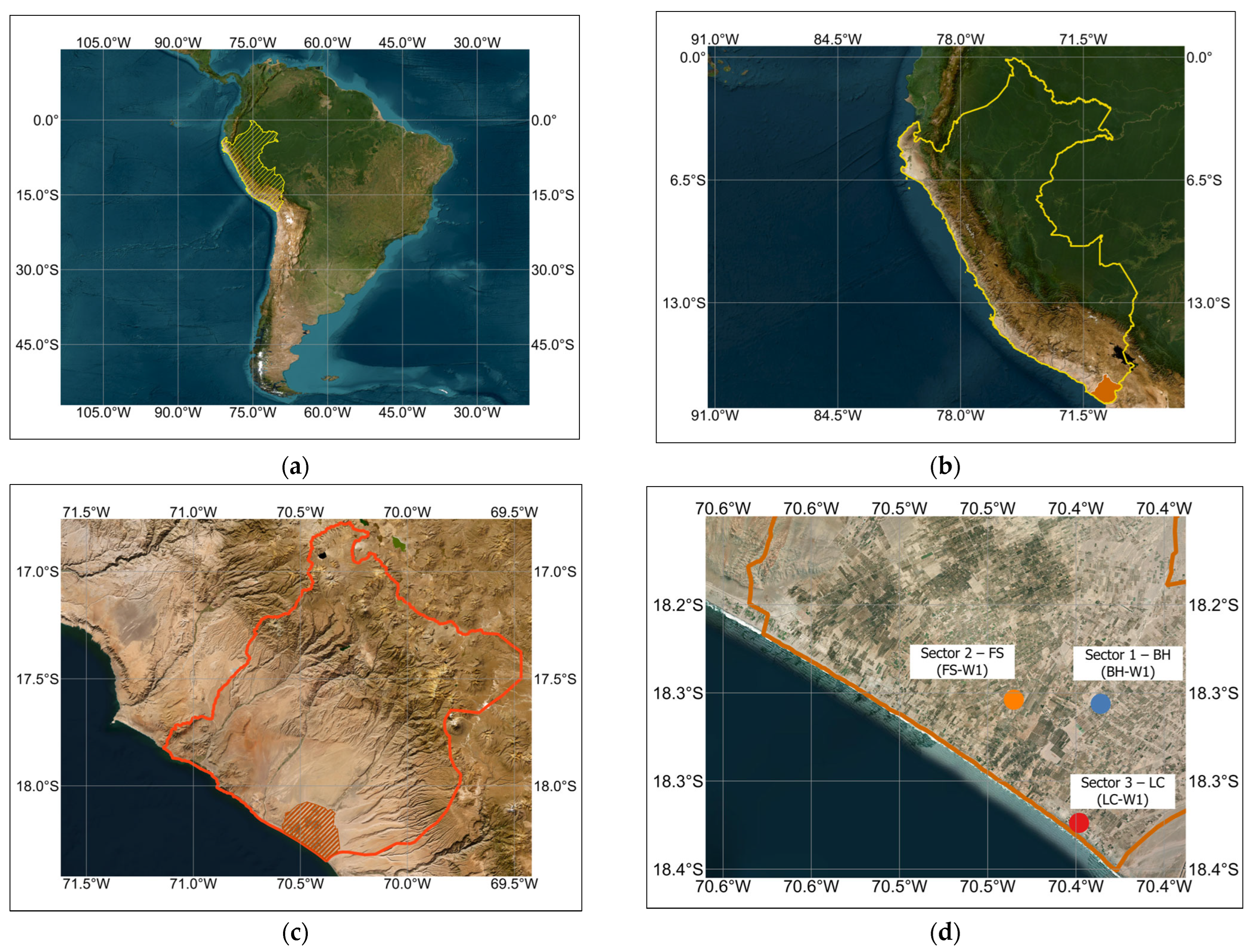
The Caplina River basin, located in the Tacna region of southern Peru, faces significant socio-economic challenges associated with increasing water scarcity and a growing dependence on groundwater resources. Limited and irregular surface-water availability has forced local communities to rely on aquifers to satisfy domestic, agricultural and industrial demands. Agriculture represents a central component of the regional economy, and dominant crops such as olives and grapes require sustained water inputs, making agricultural systems particularly sensitive to changes in groundwater availability and quality [
12]. Intensive groundwater abstraction has contributed to marked groundwater-level declines; together with salinization and seawater intrusion, this has progressively compromised both the quantity and quality of available water resources in coastal and inland arid basins [
13,
14]. These pressures occur alongside broader climate-related stresses and unsustainable agricultural practices that have been documented at a global scale [
3], increasing the vulnerability of rural communities already affected by poverty and social exclusion [
15]. In this context, public policies that promote sustainable groundwater management are essential to secure regional water supplies and protect the livelihoods of smallholders and other water users [
16].
Groundwater quality in arid and semi-arid regions is further shaped by geological and climatic controls. In volcanic and tectonically active settings, lithological units may host minerals capable of releasing trace elements such as arsenic and boron under favorable hydrogeochemical conditions [
17]. Warm and arid climates, characterized by low and irregular precipitation typically concentrated over short seasonal periods, further limit natural dilution processes and favor the accumulation of dissolved constituents in groundwater systems [
18]. These combined geological and climatic factors contribute to the occurrence of naturally elevated concentrations of groundwater contaminants, affecting water suitability for drinking and irrigation purposes [
19]. Recent studies have provided detailed physicochemical assessments of surface waters in arid basins and evaluated their status against national environmental quality standards, offering updated baselines for regional water-quality conditions [
20].
Similar groundwater-quality challenges related to naturally occurring arsenic have been reported in other arid regions worldwide, including parts of China and Pakistan [
10]. In southern Peru, recent investigations have documented elevated concentrations of arsenic, boron and salinity in groundwater, with frequent exceedances of international guideline values for drinking water and irrigation, reflecting the combined influence of geogenic processes and human activities [
21]. These conditions pose potential risks to vulnerable population groups, including infants, children, older adults and individuals with pre-existing health conditions, and may also affect agricultural productivity in water-limited environments [
22]. Taken together, the available evidence highlights the need for integrated groundwater monitoring and management strategies to preserve water quality, reduce long-term health risks and support sustainable livelihoods in arid regions of southern Peru [
23].
1.3. Existing Assessment and Mitigation Efforts
Assessing arsenic in drinking water and irrigation supplies commonly combines concentration measurements with information on the chemical conditions controlling its mobility and persistence. International guidance documents provide benchmark values and methodological frameworks that are widely used to interpret monitoring data and support risk management. The World Health Organization (WHO) drinking-water guidelines define health-based values for arsenic and other naturally occurring contaminants and outline approaches for assessing exposure pathways [
24]. These concepts have been applied in quantitative health risk assessments estimating metrics such as daily intake and hazard quotients for arsenic and other trace elements in drinking water [
25].
In regulatory practice, these approaches are linked to enforceable standards. In the United States, the U.S. Environmental Protection Agency (EPA) has established a maximum contaminant level for arsenic in public water supplies and toxicological reference values used in health risk assessments [
26]. Within the European Union, Directive (EU) 2020/2184 sets parametric values for arsenic in water intended for human consumption, consistent with WHO guidelines and supported by monitoring and risk-based management plans [
27]. For irrigation water, Food and Agriculture Organization (FAO) guidance provides threshold values and interpretive criteria for salinity, specific ions and trace elements, including boron, to protect crop productivity and soil conditions [
28]. A global review of agricultural water pollution further emphasizes the need to integrate water-quality considerations into agricultural water management [
29].
In Peru, environmental quality standards (ECAs) for water established under Supreme Decree No. 004-2017-MINAM define maximum permissible concentrations for contaminants such as arsenic and boron across different water-use categories [
30]. These standards are complemented by the official classification of surface water bodies issued by the National Water Authority (ANA), which links designated uses to quality objectives and monitoring requirements [
31]. Drinking-water quality regulations approved by the Ministry of Health (MINSA) establish criteria for water intended for human consumption and define service provider obligations for control and surveillance [
32]. Together, these instruments provide a regulatory framework for groundwater-quality interpretation related to human and environmental protection.
Previous studies indicate that groundwater arsenic concentrations are strongly influenced by aquifer characteristics, particularly in arid coastal settings where salinity and evaporation play a key role [
14]. Investigations in karstic and volcanic environments highlight the influence of major ions, mineral dissolution and redox conditions on arsenic distribution [
33]. Other work shows that anthropogenic activities and thermal water inputs can further modify groundwater chemistry [
34,
35]. In volcanic terrains, arsenic-bearing minerals and their weathering contribute to natural background arsenic levels [
36]. In southern Peru, studies in the Tambo Valley and Tacna river basins have reported elevated arsenic and boron concentrations in surface and groundwater, frequently exceeding guideline values and interpreted as predominantly geogenic [
21,
37]. Broader syntheses indicate that arsenic release commonly involves mineral dissolution, redox interactions and hydrothermal inputs [
38], and that groundwater-level changes linked to droughts and climate variability can enhance arsenic concentrations in domestic wells [
39].
Due to its adverse health effects, arsenic is recognized as a contaminant of particular concern in water intended for human consumption in the Tacna region [
40]. Recent assessments report localities where arsenic concentrations in drinking-water sources exceed recommended guideline values, raising concerns about chronic exposure [
23]. Current monitoring relies on chemical analyses using techniques such as inductively coupled plasma–mass spectrometry (ICP–MS), complemented by in situ measurements of pH, electrical conductivity and redox potential to support interpretation of arsenic behavior [
23,
38]. Treatment facilities based on coagulation–flocculation with ferric salts have been tested for arsenic removal, but their performance is often constrained by design and operational limitations [
41].
In rural and peri-urban contexts, simpler removal technologies, including ferric chloride coagulation, zero-valent iron systems and adsorption-based approaches using locally available materials, have been explored, while reverse osmosis has been applied for boron removal in irrigation water, albeit with cost and operational trade-offs [
42,
43,
44,
45,
46].
Despite these advances, large-scale implementation in Tacna and similar regions remains limited by financial, technical and institutional constraints [
41].
From a hydrogeological perspective, La Yarada Los Palos forms part of the lower Caplina–Concordia coastal aquifer system, composed mainly of Quaternary alluvial deposits hydraulically connected to volcanic and sedimentary units in the Andean piedmont [
14,
17]. Recharge occurs primarily in the upper basin through rainfall, streamflow and irrigation return flows, with groundwater flowing seaward toward the Pacific coast. In the distal plain, groundwater discharge is dominated by intensive abstraction and diffuse submarine groundwater discharge, with seawater intrusion where piezometric levels approach or fall below sea level [
17,
37,
47]. Within this framework, the three monitored sectors represent key portions of the irrigated coastal plain along the main groundwater flow path, from inland areas to zones most affected by coastal salinization [
14,
37,
47].
Sectoral differences in salinity and trace-element composition therefore reflect progressive water–rock interaction, evapoconcentration and mixing with older, more saline groundwater toward the coast, providing the physical basis for the chemical patterns analysed in this study.
1.4. Knowledge Gaps and Study Objectives
In arid and semi-arid settings, concerns about boron and arsenic in water intended for human consumption have led to a growing body of international literature on contamination and its health implications [
48]. However, most of these works have focused either on national-scale compilations or on specific case studies, while relatively few studies have examined boron and arsenic together in groundwater systems simultaneously important for drinking-water supply and irrigated agriculture. This limits the ability to transfer existing findings to hyper-arid coastal aquifers such as those in southern Peru, where groundwater is the main water source and quality constraints directly affect both households and farming.
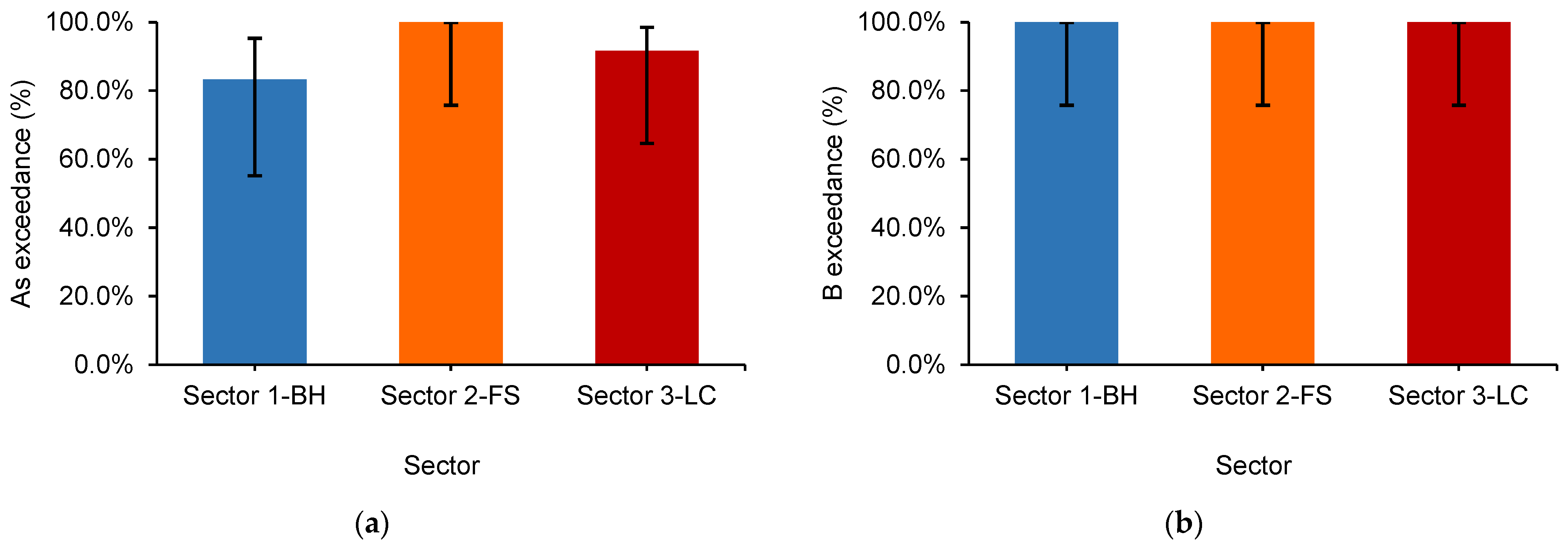
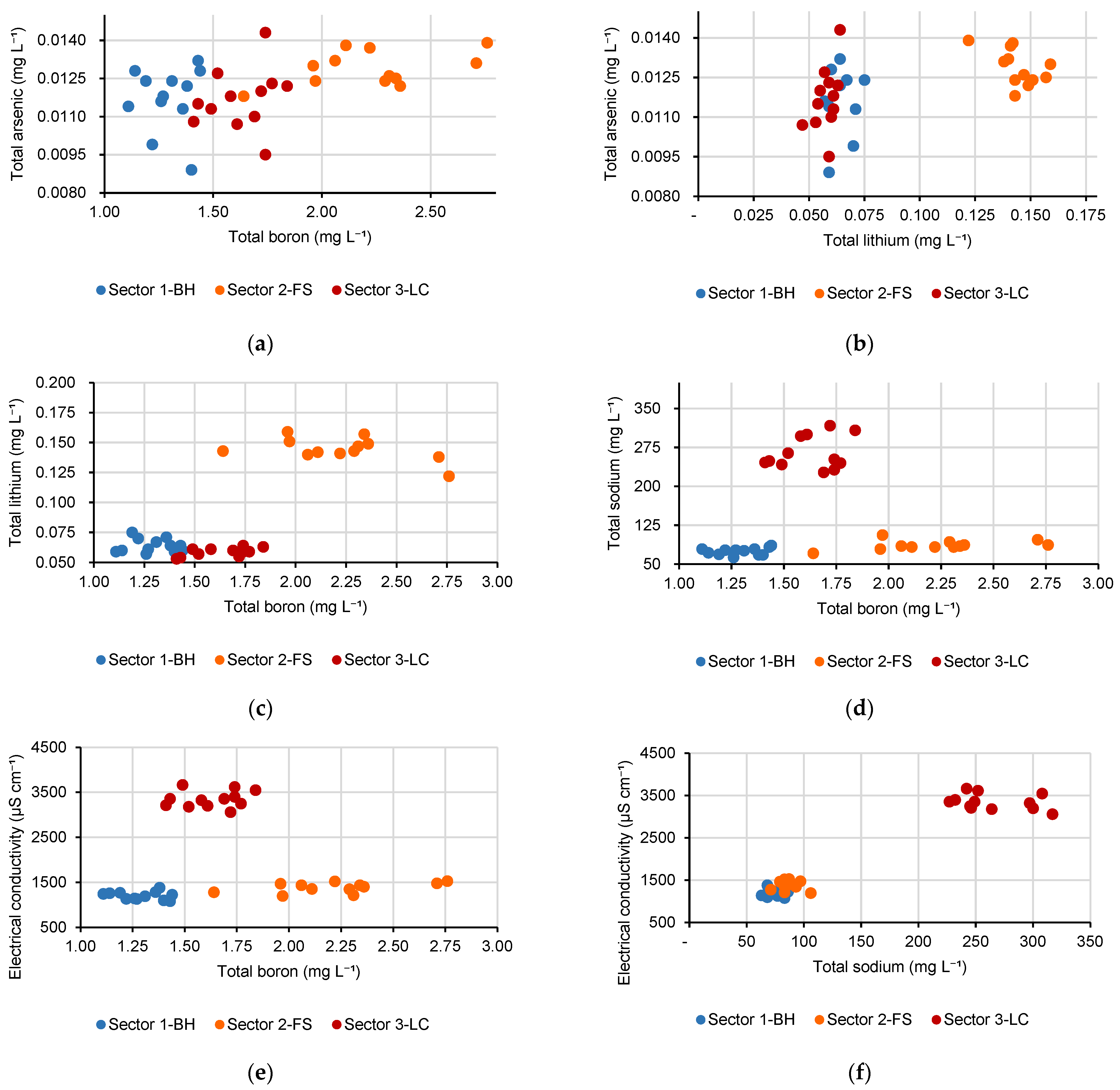
At the same time, there is limited information available on arsenic contamination in Tacna evaluated jointly with multiple supporting parameters, such as electrical conductivity, major cations and boron, in a way that can inform local prediction and mitigation strategies. Available evidence from regional basins indicates that arsenic and boron can exceed relevant guideline values in both surface water and groundwater, and that these patterns are strongly influenced by geology and long residence times [
21]. More broadly, recent work on predictive modeling for water contamination highlights the need to link monitoring data with risk-oriented tools [
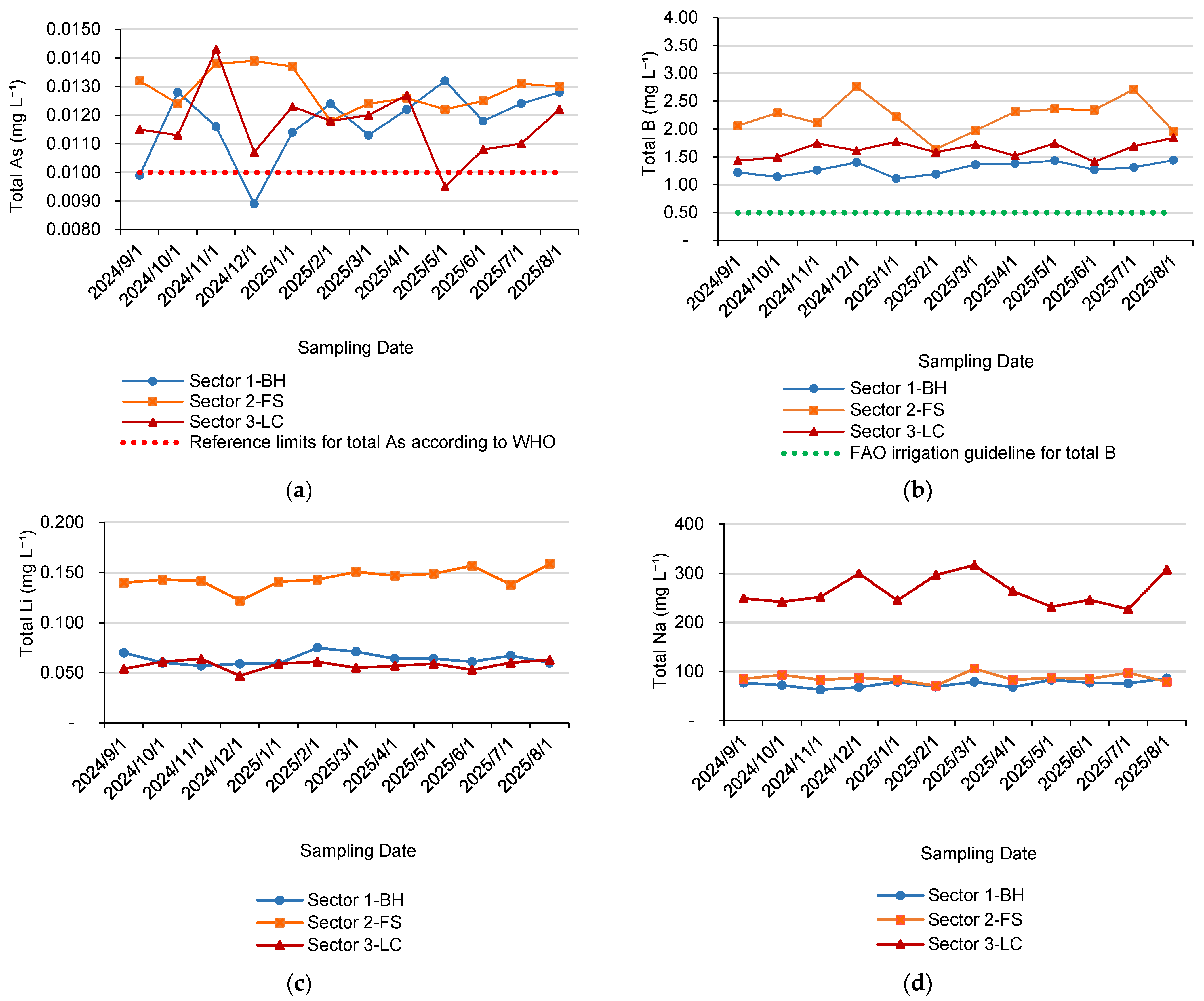
49]. However, most of these assessments are based on spatial surveys or aggregated datasets and do not provide sector-based time series, which would allow a clearer separation of temporal variability from cross-sector contrasts or support robust correlation analyses among trace elements and salinity indicators.
For the Caplina basin specifically, previous studies have characterized arsenite and arsenate in surface water and groundwater, documenting arsenic contamination at the basin scale [
50].
There is nevertheless still no published study focusing on groundwater from the main irrigated sector of La Yarada Los Palos using a sustained, multi-sector monitoring design combining (i) repeated measurements of arsenic and boron in irrigation wells; (ii) concurrent measurements of lithium, sodium and field salinity indicators; and (iii) an explicit comparison against international and national benchmark values for drinking water and irrigation. This combination of sector-resolved monitoring, trace elements and salinity indicators, and benchmark-based interpretation represents a critical knowledge gap for understanding groundwater-quality risks and supporting local decision-making in La Yarada Los Palos, as well as similar hyper-arid coastal agroecosystems.
In this context, the present study focuses on groundwater from the main irrigated area of La Yarada Los Palos, pursuing three main objectives: (i) to quantify concentrations of arsenic and boron, together with lithium, sodium and key salinity indicators, in irrigation wells monitored over a 12-month period; (ii) to evaluate how often, and by how much, these parameters exceed relevant international and national benchmark values for drinking water and irrigation; and (iii) to analyze sectoral patterns and rank-based associations between arsenic, boron, lithium, sodium and salinity indicators in order to clarify how trace-element behavior relates to salinity gradients at the sector scale.



 ,
,