Article

Sectoral Patterns of Arsenic, Boron, and Salinity Indicators in Groundwater from the La Yarada Los Palos Coastal Aquifer, Peru

by
Luis Johnson Paúl Mori Sosa
*,
Dante Ulises Morales Cabrera
,
Walter Dimas Florez Ponce De León
,
Hernán Rolando Salinas Palza
and
Edith Eva Cruz Pérez
Faculty of Engineering, National University Jorge Basadre Grohmann, Tacna 23000, Peru
*
Author to whom correspondence should be addressed.
Sustainability 2026, 18(2), 830; https://doi.org/10.3390/su18020830
Submission received: 12 December 2025 / Revised: 7 January 2026 / Accepted: 11 January 2026 / Published: 14 January 2026

Abstract

Groundwater is the main water source for irrigated agriculture, accounting for an increasing share of the domestic supply in the hyper-arid district of La Yarada Los Palos (Tacna, Peru); however, at the sector scale, concerns about arsenic, boron and salinity remain poorly quantified. Arsenic and boron were selected as target contaminants because of their naturally elevated concentrations associated with coastal and volcanic hydrogeological settings, and their well-documented implications for human health and irrigation suitability. This study reports a 12-month monitoring program (September 2024–August 2025) in three irrigated sectors, in which wells were sampled monthly and analyzed by inductively coupled plasma–mass spectrometry (ICP-MS) for total arsenic, boron, lithium and sodium, along with electrical conductivity, pH, temperature and total dissolved solids. The sector–month total arsenic means ranged from 0.0089 to 0.0143 mg L−1, with 33 of 36 exceeding the 0.010 mg L−1 drinking water benchmark recommended by the World Health Organization (WHO). Total boron ranged from 1.11 to 2.76 mg L−1, meaning that all observations were above the 0.5 mg L−1 irrigation guideline for agricultural use proposed by the United Nations Food and Agriculture Organization (FAO). A marked salinity gradient was observed from the inland Sector 1-BH (median Na ≈ 77 mg L−1; EC ≈ 1.2 mS cm−1) to the coastal Sector 3-LC (median Na ≈ 251 mg L−1; EC ≈ 3.3 mS cm−1), with Sector 2-FS showing intermediate salinity but the highest median boron and lithium levels. Spearman rank correlations indicate that sodium, electrical conductivity and total dissolved solids define the main salinity axis, whereas arsenic is only moderately associated with boron and lithium and is not a simple function of bulk salinity. Taken together, these results show that groundwater from the monitored wells is not safe for drinking without treatment and is subject to at least moderate boron-related irrigation restrictions. The sector-resolved dataset provides a quantitative baseline for La Yarada Los Palos and a foundation for future work integrating expanded monitoring, health-risk metrics and management scenarios for arsenic, boron and salinity in hyper-arid coastal aquifers.

1. Introduction

1.1. Context and Background

Groundwater is a key component of global water, food, and livelihood security, supplying roughly half of freshwater abstracted for domestic use and about one quarter of that used for irrigation. These resources are particularly critical in arid and semi-arid regions, where limited surface-water availability and climate variability increase reliance on aquifers [1,2]. In such settings, groundwater management must address both quantity and quality, given their close links to human and environmental uses.
Human activities and climate change are altering groundwater systems worldwide. Recent global assessments report widespread and, in many aquifers, accelerating declines in groundwater levels, including rapid water-table drops and long-term storage losses. Reported consequences include seawater intrusion, land subsidence, reduced baseflow, and well failures, directly affecting domestic and agricultural water supplies [3,4]. These trends highlight the need for stricter abstraction control, managed aquifer recharge, demand management, and systematic groundwater quality assessments for drinking-water treatment and irrigation use.
Groundwater-dependent ecosystems (GDEs), such as wetlands, springs, baseflow-dominated rivers, and phreatophytic vegetation, are also sensitive to these pressures. Global mapping indicates that more than half of mapped GDEs may be exposed to groundwater depletion, while only a limited fraction is currently protected or actively managed [5]. This situation increases ecological and social vulnerability in dryland regions, reinforcing the need to assess groundwater quality in ways relevant to both human health and ecosystem conditions [6].
Within this broader context, naturally occurring contaminants such as arsenic and boron are of particular concern in volcanic and sedimentary settings typical of many arid basins. In southern Peru, for example, recent studies in high-Andean urban areas have shown that arsenic concentrations in groundwater used for human consumption can exceed guideline values, implying potential health risks for exposed populations [7]. More generally, arid and semi-arid regions are especially vulnerable because limited high-quality freshwater availability restricts options for dilution, blending, or source substitution [8,9]. Recent work has further combined groundwater chemistry data with statistical and machine-learning approaches to predict arsenic occurrence from major ion and salinity indicators in irrigated agricultural settings, showing that arsenic behavior is often better interpreted together with salinity patterns rather than in isolation [10]. These studies show that arsenic is often better understood when considered not in isolation, but together with salinity and major ion patterns.
Naturally occurring arsenic contamination of groundwater is a recognized global problem and has been reported in diverse hydrogeological settings worldwide. For example, elevated arsenic concentrations in well waters and associated human health risks have been documented in European aquifers, such as in the Timis–Bega area of Romania, where geogenic arsenic poses significant exposure concerns for local populations. These findings highlight that arsenic-related groundwater contamination is not limited to specific regions but represents a widespread environmental and public health challenge across different climatic and geological contexts [11].
From a sustainability perspective, groundwater quality constraints such as arsenic, boron and salinity are directly linked to the United Nations Sustainable Development Goals (SDGs), particularly SDG 6 (Clean Water and Sanitation), which emphasizes the availability and sustainable management of water resources. In groundwater-dependent, hyper-arid agroecosystems, water quality degradation not only compromises drinking-water safety (SDG 3: Good Health and Well-Being), but also threatens agricultural productivity and food security (SDG 2), while increasing pressure on already stressed aquifer systems. In this context, sector-resolved groundwater quality assessments provide essential evidence for sustainable water governance, risk reduction and long-term resource management.

1.2. Local Problem

The Caplina River basin, located in the Tacna region of southern Peru, faces significant socio-economic challenges associated with increasing water scarcity and a growing dependence on groundwater resources. Limited and irregular surface-water availability has forced local communities to rely on aquifers to satisfy domestic, agricultural and industrial demands. Agriculture represents a central component of the regional economy, and dominant crops such as olives and grapes require sustained water inputs, making agricultural systems particularly sensitive to changes in groundwater availability and quality [12]. Intensive groundwater abstraction has contributed to marked groundwater-level declines; together with salinization and seawater intrusion, this has progressively compromised both the quantity and quality of available water resources in coastal and inland arid basins [13,14]. These pressures occur alongside broader climate-related stresses and unsustainable agricultural practices that have been documented at a global scale [3], increasing the vulnerability of rural communities already affected by poverty and social exclusion [15]. In this context, public policies that promote sustainable groundwater management are essential to secure regional water supplies and protect the livelihoods of smallholders and other water users [16].
Groundwater quality in arid and semi-arid regions is further shaped by geological and climatic controls. In volcanic and tectonically active settings, lithological units may host minerals capable of releasing trace elements such as arsenic and boron under favorable hydrogeochemical conditions [17]. Warm and arid climates, characterized by low and irregular precipitation typically concentrated over short seasonal periods, further limit natural dilution processes and favor the accumulation of dissolved constituents in groundwater systems [18]. These combined geological and climatic factors contribute to the occurrence of naturally elevated concentrations of groundwater contaminants, affecting water suitability for drinking and irrigation purposes [19]. Recent studies have provided detailed physicochemical assessments of surface waters in arid basins and evaluated their status against national environmental quality standards, offering updated baselines for regional water-quality conditions [20].
Similar groundwater-quality challenges related to naturally occurring arsenic have been reported in other arid regions worldwide, including parts of China and Pakistan [10]. In southern Peru, recent investigations have documented elevated concentrations of arsenic, boron and salinity in groundwater, with frequent exceedances of international guideline values for drinking water and irrigation, reflecting the combined influence of geogenic processes and human activities [21]. These conditions pose potential risks to vulnerable population groups, including infants, children, older adults and individuals with pre-existing health conditions, and may also affect agricultural productivity in water-limited environments [22]. Taken together, the available evidence highlights the need for integrated groundwater monitoring and management strategies to preserve water quality, reduce long-term health risks and support sustainable livelihoods in arid regions of southern Peru [23].

1.3. Existing Assessment and Mitigation Efforts

Assessing arsenic in drinking water and irrigation supplies commonly combines concentration measurements with information on the chemical conditions controlling its mobility and persistence. International guidance documents provide benchmark values and methodological frameworks that are widely used to interpret monitoring data and support risk management. The World Health Organization (WHO) drinking-water guidelines define health-based values for arsenic and other naturally occurring contaminants and outline approaches for assessing exposure pathways [24]. These concepts have been applied in quantitative health risk assessments estimating metrics such as daily intake and hazard quotients for arsenic and other trace elements in drinking water [25].
In regulatory practice, these approaches are linked to enforceable standards. In the United States, the U.S. Environmental Protection Agency (EPA) has established a maximum contaminant level for arsenic in public water supplies and toxicological reference values used in health risk assessments [26]. Within the European Union, Directive (EU) 2020/2184 sets parametric values for arsenic in water intended for human consumption, consistent with WHO guidelines and supported by monitoring and risk-based management plans [27]. For irrigation water, Food and Agriculture Organization (FAO) guidance provides threshold values and interpretive criteria for salinity, specific ions and trace elements, including boron, to protect crop productivity and soil conditions [28]. A global review of agricultural water pollution further emphasizes the need to integrate water-quality considerations into agricultural water management [29].
In Peru, environmental quality standards (ECAs) for water established under Supreme Decree No. 004-2017-MINAM define maximum permissible concentrations for contaminants such as arsenic and boron across different water-use categories [30]. These standards are complemented by the official classification of surface water bodies issued by the National Water Authority (ANA), which links designated uses to quality objectives and monitoring requirements [31]. Drinking-water quality regulations approved by the Ministry of Health (MINSA) establish criteria for water intended for human consumption and define service provider obligations for control and surveillance [32]. Together, these instruments provide a regulatory framework for groundwater-quality interpretation related to human and environmental protection.
Previous studies indicate that groundwater arsenic concentrations are strongly influenced by aquifer characteristics, particularly in arid coastal settings where salinity and evaporation play a key role [14]. Investigations in karstic and volcanic environments highlight the influence of major ions, mineral dissolution and redox conditions on arsenic distribution [33]. Other work shows that anthropogenic activities and thermal water inputs can further modify groundwater chemistry [34,35]. In volcanic terrains, arsenic-bearing minerals and their weathering contribute to natural background arsenic levels [36]. In southern Peru, studies in the Tambo Valley and Tacna river basins have reported elevated arsenic and boron concentrations in surface and groundwater, frequently exceeding guideline values and interpreted as predominantly geogenic [21,37]. Broader syntheses indicate that arsenic release commonly involves mineral dissolution, redox interactions and hydrothermal inputs [38], and that groundwater-level changes linked to droughts and climate variability can enhance arsenic concentrations in domestic wells [39].
Due to its adverse health effects, arsenic is recognized as a contaminant of particular concern in water intended for human consumption in the Tacna region [40]. Recent assessments report localities where arsenic concentrations in drinking-water sources exceed recommended guideline values, raising concerns about chronic exposure [23]. Current monitoring relies on chemical analyses using techniques such as inductively coupled plasma–mass spectrometry (ICP–MS), complemented by in situ measurements of pH, electrical conductivity and redox potential to support interpretation of arsenic behavior [23,38]. Treatment facilities based on coagulation–flocculation with ferric salts have been tested for arsenic removal, but their performance is often constrained by design and operational limitations [41].
In rural and peri-urban contexts, simpler removal technologies, including ferric chloride coagulation, zero-valent iron systems and adsorption-based approaches using locally available materials, have been explored, while reverse osmosis has been applied for boron removal in irrigation water, albeit with cost and operational trade-offs [42,43,44,45,46].
Despite these advances, large-scale implementation in Tacna and similar regions remains limited by financial, technical and institutional constraints [41].
From a hydrogeological perspective, La Yarada Los Palos forms part of the lower Caplina–Concordia coastal aquifer system, composed mainly of Quaternary alluvial deposits hydraulically connected to volcanic and sedimentary units in the Andean piedmont [14,17]. Recharge occurs primarily in the upper basin through rainfall, streamflow and irrigation return flows, with groundwater flowing seaward toward the Pacific coast. In the distal plain, groundwater discharge is dominated by intensive abstraction and diffuse submarine groundwater discharge, with seawater intrusion where piezometric levels approach or fall below sea level [17,37,47]. Within this framework, the three monitored sectors represent key portions of the irrigated coastal plain along the main groundwater flow path, from inland areas to zones most affected by coastal salinization [14,37,47].
Sectoral differences in salinity and trace-element composition therefore reflect progressive water–rock interaction, evapoconcentration and mixing with older, more saline groundwater toward the coast, providing the physical basis for the chemical patterns analysed in this study.

1.4. Knowledge Gaps and Study Objectives

In arid and semi-arid settings, concerns about boron and arsenic in water intended for human consumption have led to a growing body of international literature on contamination and its health implications [48]. However, most of these works have focused either on national-scale compilations or on specific case studies, while relatively few studies have examined boron and arsenic together in groundwater systems simultaneously important for drinking-water supply and irrigated agriculture. This limits the ability to transfer existing findings to hyper-arid coastal aquifers such as those in southern Peru, where groundwater is the main water source and quality constraints directly affect both households and farming.
At the same time, there is limited information available on arsenic contamination in Tacna evaluated jointly with multiple supporting parameters, such as electrical conductivity, major cations and boron, in a way that can inform local prediction and mitigation strategies. Available evidence from regional basins indicates that arsenic and boron can exceed relevant guideline values in both surface water and groundwater, and that these patterns are strongly influenced by geology and long residence times [21]. More broadly, recent work on predictive modeling for water contamination highlights the need to link monitoring data with risk-oriented tools [49]. However, most of these assessments are based on spatial surveys or aggregated datasets and do not provide sector-based time series, which would allow a clearer separation of temporal variability from cross-sector contrasts or support robust correlation analyses among trace elements and salinity indicators.
For the Caplina basin specifically, previous studies have characterized arsenite and arsenate in surface water and groundwater, documenting arsenic contamination at the basin scale [50].
There is nevertheless still no published study focusing on groundwater from the main irrigated sector of La Yarada Los Palos using a sustained, multi-sector monitoring design combining (i) repeated measurements of arsenic and boron in irrigation wells; (ii) concurrent measurements of lithium, sodium and field salinity indicators; and (iii) an explicit comparison against international and national benchmark values for drinking water and irrigation. This combination of sector-resolved monitoring, trace elements and salinity indicators, and benchmark-based interpretation represents a critical knowledge gap for understanding groundwater-quality risks and supporting local decision-making in La Yarada Los Palos, as well as similar hyper-arid coastal agroecosystems.
In this context, the present study focuses on groundwater from the main irrigated area of La Yarada Los Palos, pursuing three main objectives: (i) to quantify concentrations of arsenic and boron, together with lithium, sodium and key salinity indicators, in irrigation wells monitored over a 12-month period; (ii) to evaluate how often, and by how much, these parameters exceed relevant international and national benchmark values for drinking water and irrigation; and (iii) to analyze sectoral patterns and rank-based associations between arsenic, boron, lithium, sodium and salinity indicators in order to clarify how trace-element behavior relates to salinity gradients at the sector scale.


2. Materials and Methods

2.1. Study Area

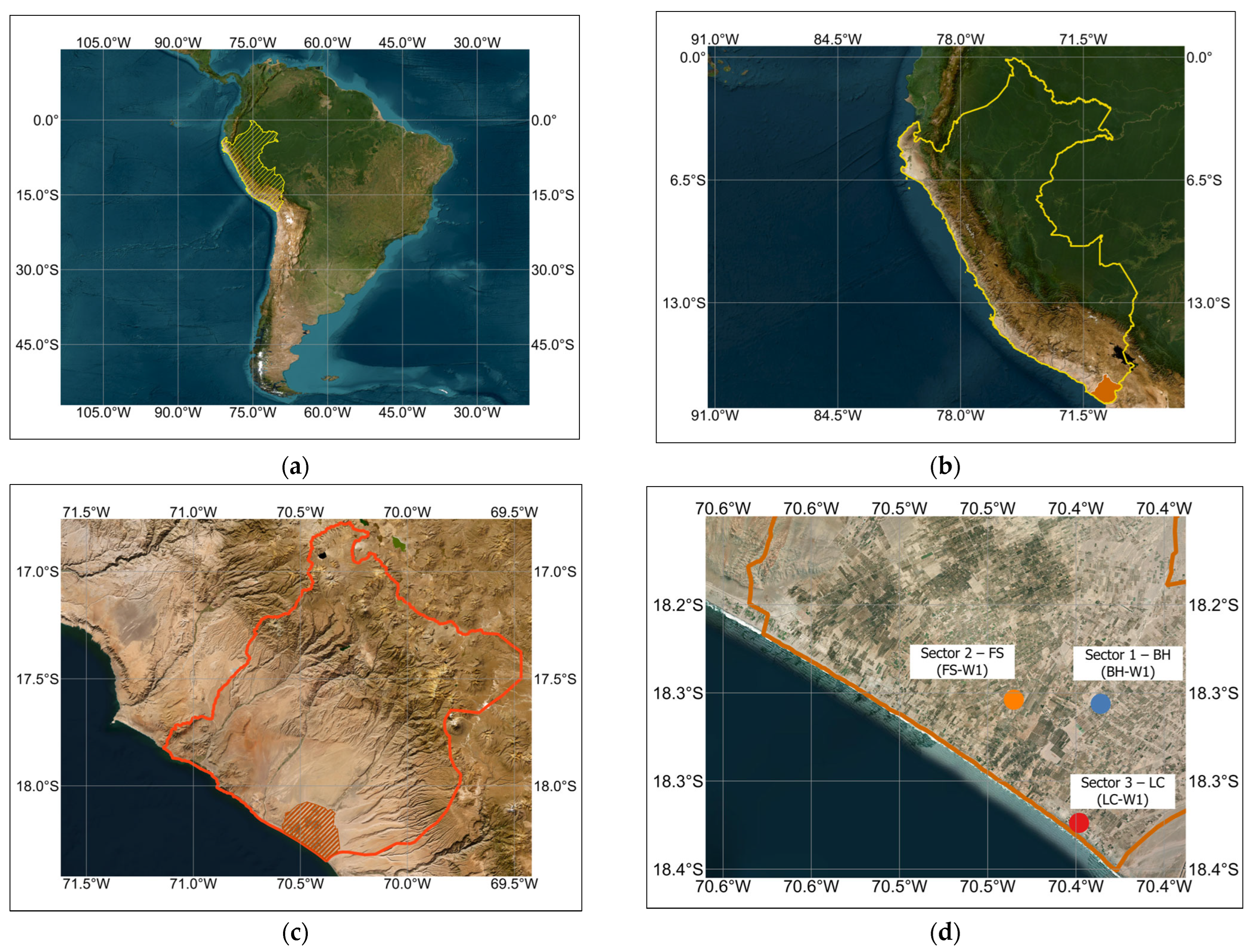
This study was conducted in the La Yarada Los Palos district, located in the southernmost part of Peru, in the Tacna region near the border with Chile (Figure 1). The district occupies a coastal plain at the northern fringe of the Atacama Desert and is characterized by an arid to hyper-arid climate, with very limited rainfall and a persistent water deficit, consistent with the basin-wide pattern of approximately 200–400 mm year−1 concentrated between December and March [18]. Under these conditions, perennial surface water is practically absent in the lower basin, and groundwater from the Caplina/Concordia coastal aquifer system constitutes the main source of water for irrigation and, to a lesser extent, for domestic supply in the Tacna province [17,49,51].
La Yarada Los Palos is a predominantly agricultural district where irrigated agriculture has expanded rapidly over the last two decades, driven by intensive groundwater use and the availability of flat, irrigable land. Remote-sensing analyses indicate that the agricultural area increased by more than 250% between 2000 and 2020, reflecting a strong expansion trend during this period [51]. The dominant land use is currently permanent irrigated orchards, particularly olives for table and oil production, along with other fruit and forage crops adapted to saline and water-limited conditions. While these activities sustain local livelihoods, they also exert considerable pressure on groundwater resources [49,52].
Soils in the La Yarada–Los Palos coastal plain are affected by salinity and related soil degradation processes, as documented in recent field studies of saline soil conditions in La Yarada Baja. In these soils, excessive accumulation of soluble salts (reflected in high electrical conductivity) and altered pH influence key physico-chemical properties such as porosity, moisture retention and organic matter content, which in turn affect subsurface water–soil interactions and the mobility of dissolved elements. The presence of saline soils in this arid coastal context is associated with irrigation practices and limited natural leaching, leading to conditions that can enhance the transport of salinity and trace elements into the shallow aquifer system [53].
In the district, groundwater from the coastal aquifer represents the principal water source and is abstracted through production wells commonly drilled to depths approaching 100 m [17,37,49,51,54]. Prolonged intensive pumping has resulted in marked groundwater-level declines, promoting seawater intrusion and salinization in the lower part of the system, which has progressively compromised water quality for both irrigation and human consumption [47]. Hydrogeochemical studies in La Yarada Los Palos document mixed anthropogenic and geogenic signatures, including elevated salinity and trace-element concentrations, partly controlled by recharge from volcanic highlands and partly by intensive pumping, fertilizer use and seawater intrusion [37]. In this context, understanding the spatial and temporal behavior of elements such as arsenic, boron, lithium and sodium is critical for designing realistic groundwater-quality management strategies in a hyper-arid agricultural district.
Within La Yarada Los Palos, three irrigated sectors were selected as representative monitoring areas: Sector 1-BH (Biohuerto Los Palos Workers’ Association), Sector 2-FS (Frontera Sur Agroindustrial Association) and Sector 3-LC (Los Cenizales Farmers’ Association). These sectors are distributed along the inland-to-coastal portion of the coastal plain and host some of the most representative orchards in the district, particularly olive plantations and other perennial crops. As such, they provide suitable sentinel areas for assessing groundwater-quality conditions in the main agricultural zone (Figure 1d, Table 1).

2.2. Sampling Design and Field Procedures

In each of the three monitored sectors, one representative deep irrigation well was selected based on continuous operational use, stable pumping conditions and accessibility for repeated sampling. The same three wells (one per sector) were sampled monthly throughout the 12-month monitoring period, yielding a consistent sector-based time series.
Each sector within the La Yarada Los Palos district comprises multiple operational production wells routinely used for crop irrigation and, in some cases, for complementary domestic supply [49,54]. For this study, one deep irrigation well was selected in each sector based on three practical criteria: (i) continuous use for irrigating representative olive and other perennial orchards within the corresponding farmers’ association; (ii) stable pumping regime and easy access to the wellhead for repeated sampling; and (iii) concurrent use of the pumped groundwater as a complementary source of drinking water for nearby households. The same three wells—one in each sector—were monitored in every monthly sampling campaign, so that temporal changes in water quality could be interpreted consistently at the sector scale.
Groundwater sampling was carried out at monthly intervals from September 2024 to August 2025. During each campaign, groundwater was collected from the selected irrigation wells in each sector. For sector-level statistical analyses, for every month and sector, we calculated the arithmetic mean of the concentrations measured in the wells belonging to that sector, yielding a dataset of 36 sector–month observations (3 sectors × 12 months).
At each well, groundwater was sampled at the wellhead under normal pumping conditions. Before sampling, the well was purged until field electrical conductivity and water temperature stabilized, indicating that the pumped water was representative of aquifer conditions. Immediately after purging, pH, electrical conductivity (EC), temperature, and total dissolved solids (TDSs) were measured in situ using a calibrated multiparameter portable meter (HI 98194, Hanna Instruments, Sălaj County, Romania), following the manufacturer’s instructions and the national protocol for water-quality monitoring [55]. These field parameters provide essential information on salinity, acidity/alkalinity and thermal conditions, supporting trace-element behavior interpretation in the aquifer. Immediately after field measurements, groundwater was collected into pre-cleaned high-density polyethylene bottles, avoiding bubbles and excessive turbulence.
Samples destined for trace-element analysis (arsenic, boron, lithium and sodium) were handled in accordance with national and international guidance on sample preservation, cooling, storage and holding times for dissolved constituents in groundwater [55,56,57]. In brief, sampling bottles were rinsed with sample water before filling, appropriate chemical preservation was applied according to the target analytes, and samples were stored in insulated coolers and transported to the laboratory on the same day. Upon arrival, samples were kept at a low temperature until analysis, which was undertaken within the recommended holding times for trace elements in water [56,57].

2.3. Laboratory Analyses

All laboratory determinations were performed in a specialized analytical laboratory equipped with an inductively coupled plasma–mass spectrometer (ICP–MS, Agilent 7900, Agilent Technologies, Tokyo, Japan). Groundwater samples for trace-element analysis were collected in 1 L high-density polyethylene (HDPE) bottles that had been preconditioned in the laboratory by washing and rinsing with 10% HNO3 and ultrapure water; in the field, bottles were rinsed with sample water prior to the final fill. Each sample was labeled with a unique code (sector–well–date) and documented under a chain-of-custody system. Immediately after collection, samples were acidified to pH < 2 with trace-metal-grade HNO3, stored at 4 ± 2 °C in insulated coolers, and transported to the laboratory on the same day, in line with national and international guidance on preservation, storage and holding times for dissolved constituents in water [55,56,58].
The total dissolved concentrations of arsenic, boron, lithium and sodium were quantified by ICP–MS, following the multi-element framework of ISO 17294-2 for water analysis and applying the performance and quality-control requirements of US EPA Method 200.8 for trace-element determination [58,59]. A multi-element calibration curve with at least five concentration levels was prepared from certified standard solutions in an acid matrix matching that of the samples. Calibration was verified at the beginning of each analytical sequence, as well as periodically during the run using independent check standards; recalibration was performed whenever verification fell outside the predefined acceptance window. Internal standards were added online to all samples, calibration standards and quality-control solutions to correct for instrumental drift and matrix effects. Arsenic was quantified at m/z 75, corresponding to the only stable isotope of As (75As), and boron, lithium and sodium were quantified at their recommended isotopes according to ISO 17294-2. ICP–MS operating conditions followed the manufacturer’s recommendations for aqueous samples.
Quality assurance and quality control (QA/QC) followed the requirements and recommendations for ICP–MS trace-element analysis in water [58,59]. Each analytical batch included reagent and calibration blanks, continuing calibration verification standards, matrix spikes and sample duplicates. Control charts and predefined acceptance criteria were used to evaluate precision and accuracy, with samples reanalyzed if these criteria were not met. Method detection limits for the elements of interest were in the low µg L−1 range or lower, consistent with the performance reported for ISO 17294-2 and EPA 200.8. The limits were therefore adequate for quantifying concentrations around the guideline values relevant to irrigation and drinking water [58,59]. Only total dissolved concentrations were measured; no speciation analyses were performed for arsenic or other elements, so all risk and compliance assessments in this study are based on total arsenic, total boron, total lithium and total sodium as operational groundwater quality indicators.

2.4. Regulatory Benchmarks and Water-Quality Classification

In this study, groundwater quality interpretation was framed using international guideline values and current Peruvian environmental standards. For arsenic, a benchmark of 10 µg L−1 (0.010 mg L−1) was adopted, consistent with the provisional health-based guideline value for drinking water established by the World Health Organization and with the Peruvian environmental quality standard (ECA) for Category 1A surface waters used for drinking-water production; the latter sets 0.010 mg L−1 as the arsenic limit in subcategories A1 and A2. In the study area, piped drinking-water infrastructure does not cover the entire jurisdiction of the La Yarada Los Palos district; households in some sectors still rely on groundwater from irrigation wells to meet part of their domestic water needs [24,30]. Although the monitored wells are primarily used for irrigation, this arsenic benchmark was consequently retained as a conservative reference for potential human exposure, as well as for comparability with previous studies in the Tacna region.
For boron, the assessment focused on irrigation suitability [28,30]. A threshold of 0.5 mg L−1 was adopted as the primary operational benchmark, in line with irrigation-water studies indicating that (i) experimental studies on horticultural crops report no significant adverse effects when boron concentrations in irrigation water are up to about 0.5 mg L−1; (ii) several technical guidelines and risk assessments use 0.5 mg L−1 as a protective limit for irrigation or long-term reuse; and (iii) perennial tree crops, such as citrus, are among the most boron-sensitive species, with toxicity often reported when irrigation-water levels exceed approximately 0.3–0.5 mg L−1 and with recommended tolerance ranges in the order of 0.50–0.75 mg L−1 for oranges. In comparison, the Peruvian ECA for Category 1A surface waters used for drinking-water production sets 2.4 mg L−1 as the boron limit; as such, the 0.5 mg L−1 threshold used here is deliberately more conservative, tailored to the sensitivity of perennial orchards and other permanent crops in hyper-arid coastal settings [30,60]. Lithium and sodium were treated as supporting tracers of salinity and hydrogeochemical processes, rather than primary regulatory drivers. This was because current international drinking-water guidance does not specify a health-based guideline value for lithium; in the case of sodium, it emphasizes taste and operational considerations—such as an average taste threshold around 200 mg L−1 and the relatively small contribution of drinking water to total sodium intake—rather than toxicity-based limits [61,62].
Water-quality classes were operationally defined based on arsenic and boron. For each groundwater sample, we evaluated whether the measured As and B concentrations were below or above their respective benchmarks (10 µg L−1 and 0.5 mg L−1, respectively). Samples were classified as “suitable” when both parameters were at or below their benchmark values; “conditionally suitable” when at least one parameter exceeded its benchmark but remained within twice that value; and “not suitable” when either As or B exceeded twice its benchmark [63]. At the sector scale, monthly sector–mean concentrations were assigned to the most restrictive class observed among the wells in that sector and sampling campaign. These categories are intended as pragmatic tools for comparing sectors and tracking temporal changes in risk for irrigation and potential human exposure; they do not replace the formal legal definitions used for regulatory compliance.

2.5. Statistical Analysis

The statistical analysis focused primarily on total arsenic and total boron, with lithium, sodium, electrical conductivity (EC), pH, temperature and total dissolved solids (TDSs) used as supporting variables for interpreting hydrogeochemical controls. For each sampling date, sector, and well, the dataset included total arsenic, total boron, total lithium, total sodium (all in mg L−1), EC (µS cm−1), temperature (°C), pH and TDSs (mg L−1).
Exploratory analysis involved a visual inspection of time series, as well as calculating descriptive statistics by sector and for the combined dataset. To limit the influence of extreme values, medians and interquartile ranges (IQRs) were reported alongside minimum and maximum values for arsenic, boron and the supporting parameters. Where appropriate, arsenic and boron concentrations were log10-transformed in graphics to improve the representation of right-skewed distributions.
Regulatory and operational benchmarks were defined in Section 2.4 (10 µg L−1 for As and 0.5 mg L−1 for B). For each parameter and benchmark, we calculated the number of exceedances and the corresponding proportion of samples above the threshold, both by sector and for the three sectors combined. If X denotes the number of exceedances in a sample of size n, the empirical exceedance proportion p ^ is
p ^ = X n   ,
where p ^ is the empirical exceedance proportion, X is the number of samples above the selected threshold, and n is the total number of samples. Two-sided 95% confidence intervals for p ^ were obtained using binomial Wilson score intervals:
p ^ w = p ^ + z 2 2 n 1 + z 2 n   ,
C I 95 % = p ^ w ± z 1 + z 2 n   p ^   1 p ^ n + z 2 4 n 2   ,
where p ^ w is the Wilson-adjusted center of the interval, z is the standard normal quantile for the desired confidence level (here, z = 1.96) and n is the sample size. Water-quality classes (“suitable”, “conditionally suitable”, “not suitable”), as defined from the arsenic and boron thresholds in Section 2.4, were summarized as counts and percentages by sector and sampling campaign.
Because trace-element concentrations and field parameters were typically right-skewed and sector-specific sample sizes were modest, correlation analyses were based on non-parametric methods. Spearman rank correlation coefficients (ρs) were used to quantify monotonic associations between arsenic, boron, lithium, sodium, EC, TDSs and pH, for the full dataset and by sector. For variables X and Y with n paired observations and rank differences di (in the absence of ties), ρs can be written as
ρ s = 1 6 i = 1 n d i 2 n n 2 1   ,
where ρs is the Spearman rank correlation coefficient, di is the difference between the ranks of X and Y for observation i, and n is the number of paired observations. In practice, Spearman correlations were computed by statistical software as the Pearson correlation of ranked variables, with appropriate handling of ties.
Scatterplots (on original or log10-transformed scales) were used to visualize the relationships between arsenic and boron and salinity indicators (EC, TDSs, sodium), with lithium as a groundwater–rock interaction tracer. A significance level of α = 0.05 was adopted for all hypothesis tests. Statistical calculations and graphics were performed using standard statistical software, with spreadsheet tools used for data management and basic descriptive statistics.

3. Results

3.1. Groundwater Chemistry Overview by Sector

Across the three monitored sectors, groundwater chemistry showed consistent but sector-specific patterns in trace elements and salinity indicators (Table 2, Table 3 and Table 4). Median total arsenic concentrations were of the same order of magnitude in all sectors and exhibited relatively narrow interquartile ranges, indicating limited short-term variability at the sector scale.
In contrast, total boron and lithium displayed clearer differences among sectors. Sector 2-FS showed higher concentrations of both elements compared to Sectors 1-BH and 3-LC, suggesting spatially differentiated contributions from water–rock interaction and/or mixing processes along the coastal plain.
Salinity indicators exhibited the strongest sectoral gradients. Groundwater in Sector 3-LC was markedly more saline than in the other sectors, consistent with its position in the lower part of the coastal system and the influence of intensive groundwater abstraction and marine intrusion. Sectors 1-BH and 2-FS showed comparatively lower salinity levels. Groundwater pH was generally neutral to moderately alkaline across all sectors, while groundwater temperature increased toward the more distal, low-lying areas of the district.
Overall, these sector-specific summaries highlight a gradient from relatively less saline groundwater in Sector 1-BH to markedly higher salinity in Sector 3-LC, with Sector 2-FS showing intermediate salinity but comparatively higher boron and lithium levels. The implications of these patterns for arsenic and boron benchmark exceedances are examined in the following subsections.

3.2. Temporal Variability and Benchmark Arsenic, Boron and Field Parameter Exceedances

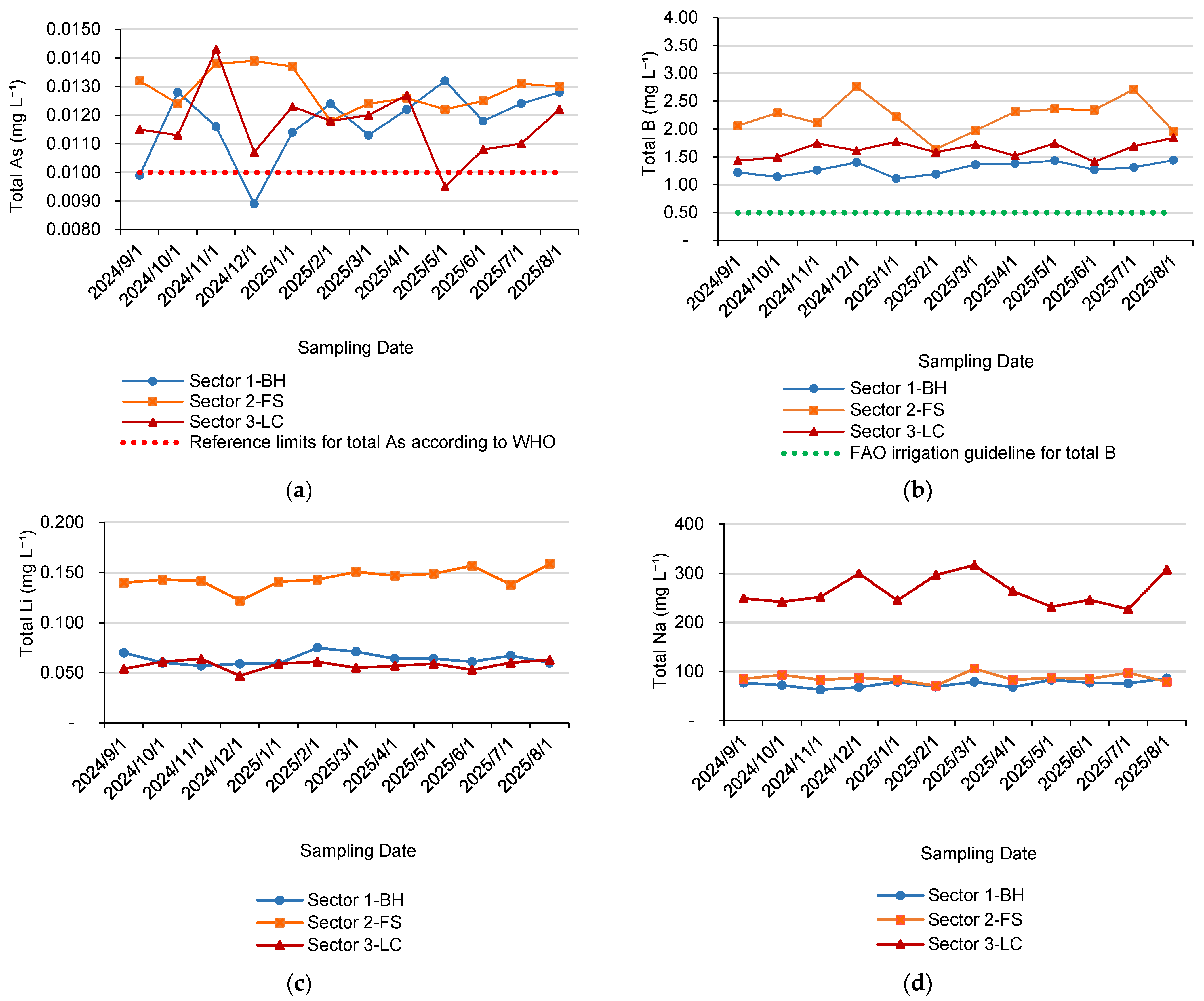
During the 12-month monitoring period (September 2024–August 2025), arsenic, boron and the in situ field parameters exhibited modest intra-annual variability within each sector, with no abrupt shifts or clear monotonic trends. Overall, temporal fluctuations remained within sector-specific envelopes consistent with the median patterns summarized in Section 3.1, indicating relatively stable hydrochemical conditions at the sector scale over the year studied. Time series of total As, B, Li and Na by sector are shown in Figure 2.
Temporal variability in arsenic was limited within each sector, with monthly sector means clustering close to the WHO drinking-water guideline. Occasional sector–month means fell slightly below the 0.010 mg L−1 benchmark, but most values remained above this threshold throughout the monitoring period. These patterns indicate that arsenic concentrations fluctuate within a narrow range and that small temporal variations are sufficient to shift individual observations across the regulatory limit, without implying major changes in groundwater composition.
Boron displayed somewhat larger intra-annual amplitudes than arsenic, particularly in Sector 2-FS, while remaining persistently elevated relative to the FAO irrigation guideline. Across all sectors, boron concentrations consistently exceeded the benchmark, with Sector 2-FS combining the highest levels with the greatest temporal variability. Despite these fluctuations, the overall pattern reflects structurally high boron concentrations rather than transient exceedance events. Lithium followed similar sector-specific contrasts, with consistently higher concentrations in Sector 2-FS and relatively minor temporal variation around the sector medians reported in Section 3.1.
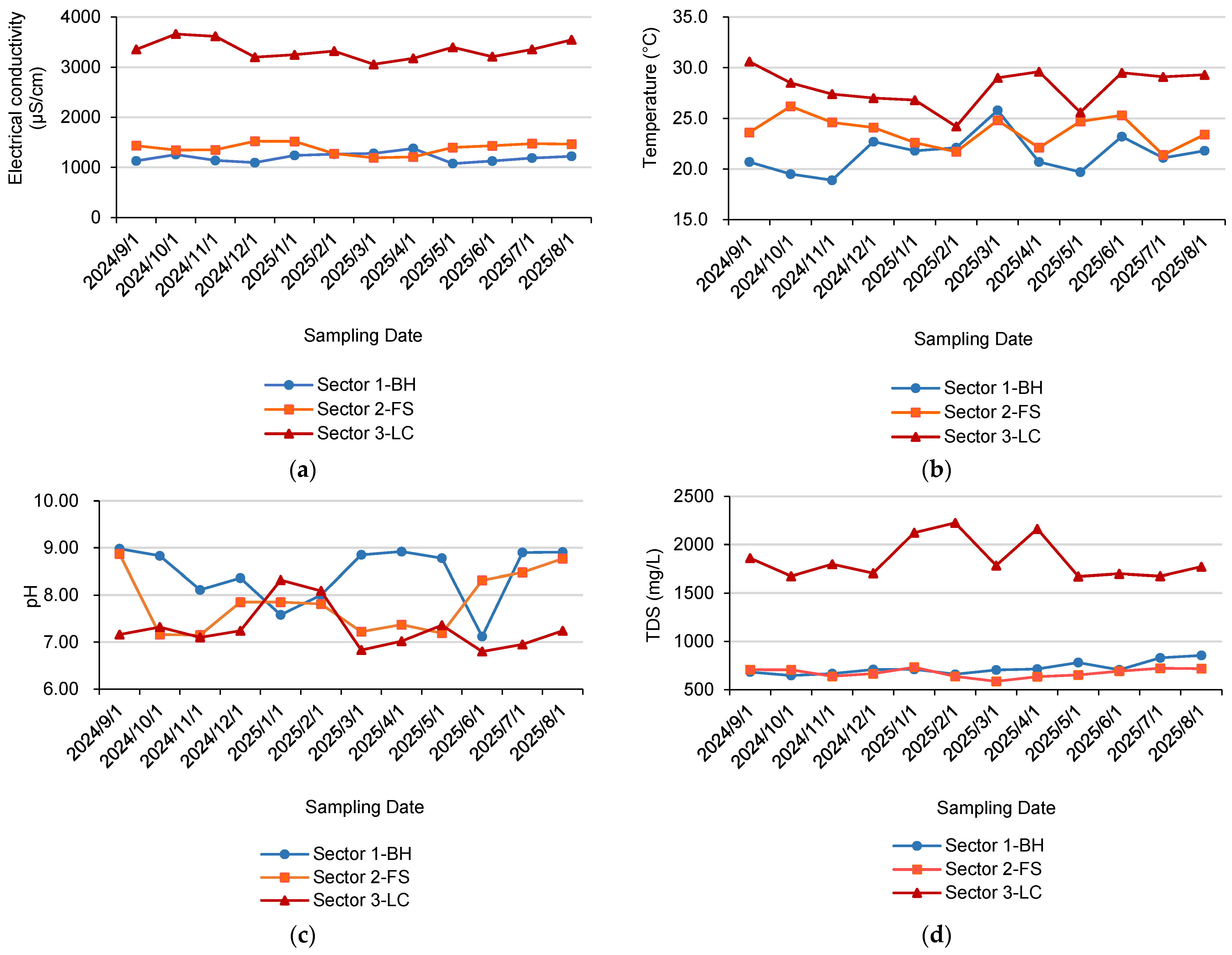
The in situ field parameters exhibited temporal patterns consistent with the spatial contrasts described in Section 3.1 and illustrated in Figure 3, without anomalous excursions. Electrical conductivity, total dissolved solids and sodium showed moderate intra-annual variability within each sector, while preserving strong differences between sectors. Groundwater temperature evolved smoothly over the monitoring year, reflecting seasonal climatic conditions rather than abrupt hydrochemical changes. pH remained predominantly neutral to moderately alkaline in all sectors, with only short-lived departures that did not alter the overall hydrochemical regime.
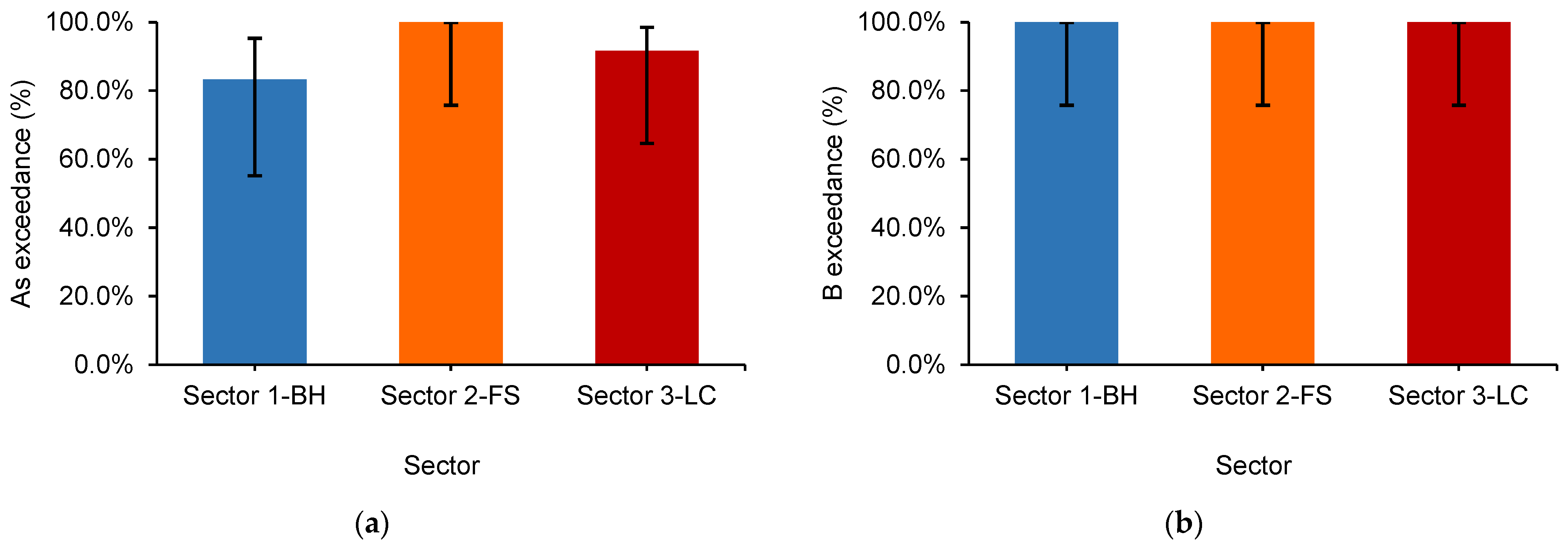
To quantify how often the arsenic and boron benchmarks defined in Section 2.4 were exceeded, sector–month exceedance proportions and Wilson 95% confidence intervals were calculated (Table 5; Figure 4). Arsenic exceedances occurred in the majority of sector–month combinations, indicating that concentrations frequently lie close to the drinking-water guideline. In contrast, boron exceedances were systematic across all sectors, with all sector–month means exceeding the irrigation benchmark.
Taken together, these exceedance frequencies and associated confidence intervals demonstrate that the observed patterns are robust and not artifacts of limited sample size. For arsenic, proximity to the guideline implies sensitivity to short-term temporal variability, whereas for boron, concentrations are structurally high across sectors. Consequently, groundwater suitability is effectively controlled by boron rather than arsenic, and no realistic short-term variation in arsenic alone would be sufficient to shift any sector–month combination out of the “not suitable” class.

3.3. Trace Elements and Salinity Associations

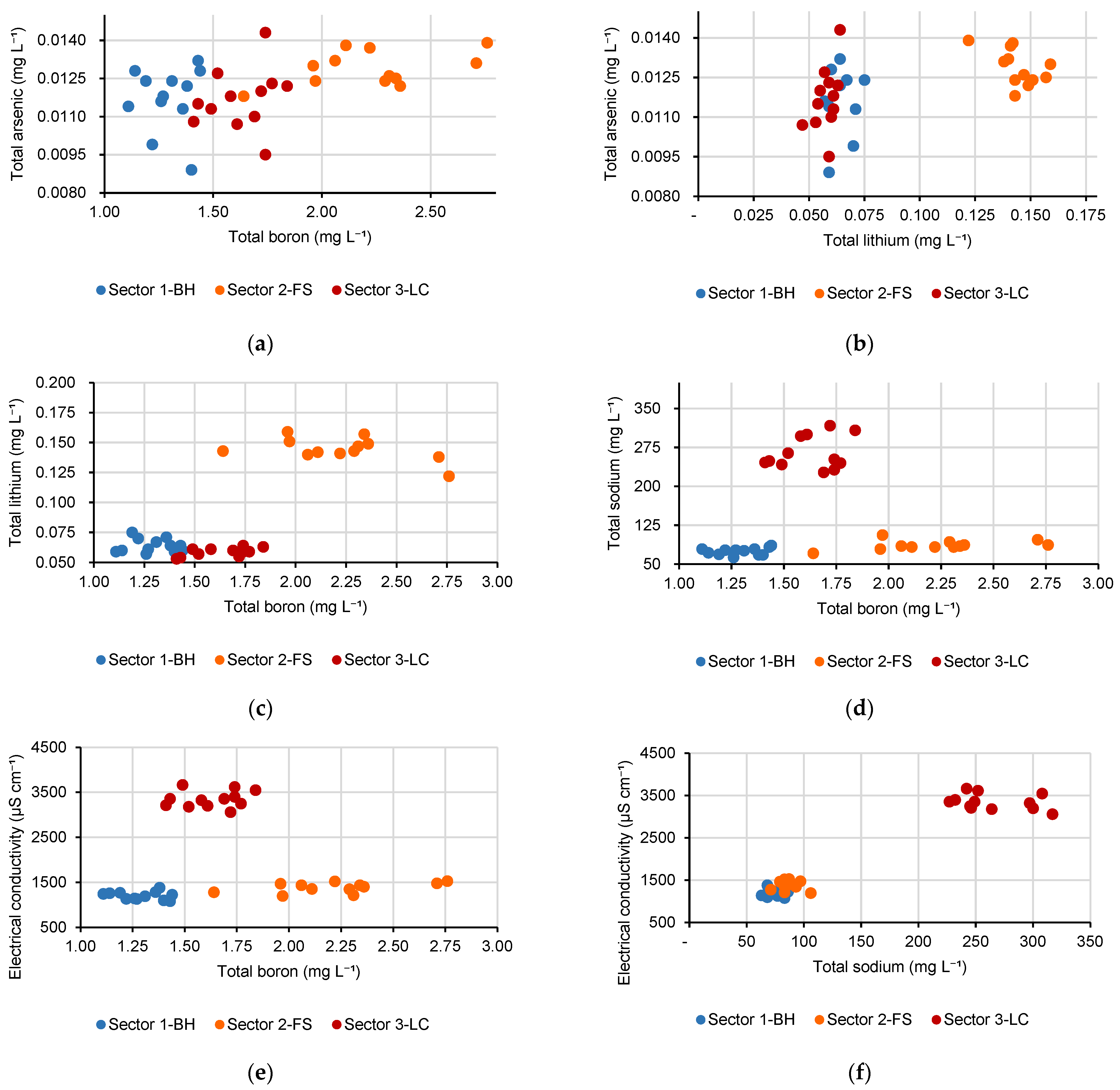
Spearman rank correlations calculated for the 36 sector–month observations (Figure 5 and Table 6) reveal two partly distinct groups of variables. Arsenic, boron and lithium form a moderately coherent trace-element group, whereas sodium, electrical conductivity (EC) and total dissolved solids (TDSs) define a strong salinity axis. pH shows inverse associations with this salinity axis, particularly with sodium and EC.
Total arsenic exhibits moderate, statistically significant positive associations with both boron and lithium, while showing no meaningful monotonic relationship with sodium, EC or TDSs. This pattern indicates that arsenic partially shares geochemical controls with boron and lithium, but is not directly governed by bulk salinity in the combined dataset.
Boron is moderately associated with lithium and shows positive relationships with sodium and EC, suggesting that boron enrichment reflects a combination of water–rock interaction processes and salinity build-up along the groundwater flow path. In contrast, its weak association with TDSs highlights the importance of sector-specific hydrogeochemical conditions, particularly the elevated boron concentrations observed in Sector 2-FS despite comparatively lower TDSs than in Sector 3-LC.
Lithium follows a similar pattern, being positively related to arsenic and boron, but exhibiting an inverse association with TDSs at the system scale. This apparent decoupling reflects cross-sector contrasts, with relatively high lithium concentrations occurring where overall salinity remains moderate.
Sodium, EC and TDSs are strongly inter-correlated, defining the dominant salinity gradient across the study area and reflecting progressive salinization along the coastal plain. pH displays moderate negative associations with sodium and EC, indicating that more saline waters tend to be slightly less alkaline, although pH values remain within the neutral to moderately alkaline range documented in Section 3.1 and Section 3.2.
Taken together, these correlation patterns support a conceptual framework in which sodium, electrical conductivity and total dissolved solids capture the principal salinity gradient of the system, while boron and lithium act as additional tracers of water–rock interaction and sector-specific enrichment processes. Arsenic is partially coupled to these controls through its association with boron and lithium, but is not directly governed by salinity alone.

3.4. Sectoral Synthesis of Groundwater Quality and Risk Patterns

Taken together, the sector-specific statistics and exceedance patterns for arsenic and boron described in Section 3.1 and Section 3.2, together with the correlation structure summarized in Section 3.3, depict a groundwater system in which all three monitored sectors are affected by chronic water-quality risk, albeit driven by different combinations of trace elements and salinity. Across the full set of sector–month observations, boron concentrations consistently exceed irrigation suitability benchmarks, while arsenic exceedances occur in most months but with greater temporal and sectoral variability. These patterns indicate that boron constitutes the primary and most systematic constraint on groundwater use, with arsenic acting as an additional but less uniformly controlling factor.
Sector 1-BH (Biohuerto Los Palos Workers’ Association) represents the relatively least saline end-member of the system. Groundwater in this sector is characterized by moderate salinity and persistently elevated boron concentrations, while arsenic occasionally approaches or marginally falls below the drinking-water benchmark. As a result, irrigation unsuitability in Sector 1-BH is primarily controlled by boron enrichment, rather than by salinity or arsenic alone, despite the presence of slightly alkaline conditions.
Sector 2-FS (Frontera Sur Agroindustrial Association) emerges as the most affected sector in terms of trace-element enrichment. It combines systematically elevated arsenic with the highest boron and lithium concentrations observed in the study area, while overall salinity remains intermediate compared to the other sectors. This combination points to a groundwater body strongly influenced by water–rock interaction and/or evaporative concentration processes, consistent with the correlation patterns identified in Section 3.3.
Sector 3-LC (Los Cenizales Farmers’ Association) constitutes the saline end-member of the monitored system. Groundwater in this sector exhibits markedly elevated salinity indicators together with high boron concentrations, whereas lithium levels remain comparatively moderate. Arsenic concentrations fluctuate around the regulatory threshold, contributing an additional layer of risk, but are superimposed on a more dominant salinity and boron problem.
From a risk-management perspective, these sectoral contrasts indicate that boron-driven irrigation unsuitability is effectively ubiquitous across the monitored portion of the La Yarada Los Palos aquifer, while salinity and arsenic risks show stronger spatial differentiation. Strategies focused solely on arsenic removal would therefore leave boron-related phytotoxicity and salinity constraints largely unmitigated. Effective management will thus require sector-specific interventions that account for the distinct combinations of trace-element enrichment and salinity documented in each part of the system.

4. Discussion

The 12-month monitoring of three irrigated sectors in La Yarada Los Palos shows a consistent picture of chronic groundwater-quality constraints, driven primarily by boron, with arsenic providing an additional layer of concern, and superimposed on a strong salinity gradient along the coastal plain. Although temporal variability at the sector scale is modest for all monitored parameters, benchmark exceedances are systematic enough to have clear implications for both drinking-water safety and irrigation suitability in this hyper-arid agricultural district.

4.1. Benchmark Exceedances and Implications for Drinking Water and Irrigation

At the sector–month scale, total arsenic remained within a narrow band (≈0.009–0.014 mg L−1); however, 33 of 36 sector–month means (91.7%; 95% Wilson CI: 78.2–97.1%) exceeded the 10 µg L−1 benchmark adopted from WHO drinking-water guidance and Peruvian environmental standards for drinking-water production [24,30]. In other words, arsenic concentrations are close to but usually above the health-based guideline, such that relatively small temporal fluctuations are sufficient to move individual observations across the regulatory threshold.
From a regulatory standpoint, boron behaves very differently. All sector–month means were above the 0.5 mg L−1 irrigation benchmark used in this study, with a minimum of 1.11 mg L−1 and sectoral medians of 1.29, 2.26 and 1.65 mg L−1 in Sectors 1-BH, 2-FS and 3-LC, respectively. Expressed relative to 0.5 mg L−1, these values correspond roughly to 2.2–5.5 times the threshold, showing that even the lowest boron levels in the monitored wells lie well within the range associated with long-term phytotoxicity risks for sensitive perennial crops in irrigation-water studies [28,60,64,65]. Although the Peruvian ECA for Category 1A surface waters used for drinking-water production sets a more permissive limit of 2.4 mg L−1 for boron [30], the irrigation-focused 0.5 mg L−1 benchmark adopted here is more relevant for the permanent orchards that dominate land use in La Yarada Los Palos.
Taken together, these exceedance patterns imply that, under current conditions, groundwater from the monitored irrigation wells cannot be considered safe for direct human consumption without treatment, due to arsenic concentrations that are generally above 10 µg L−1 [24,32,66,67]. At the same time, boron concentrations alone are sufficient to classify all sector–month combinations as “not suitable” or, at best, “conditionally suitable” for irrigation under the operational scheme defined in Section 2.4, regardless of arsenic. From a practical standpoint, this means that any mitigation strategy focused solely on arsenic removal—whether at the household or community scale—would leave the boron-driven irrigation constraints essentially unchanged.
The arsenic concentrations observed in La Yarada Los Palos fall within the lower range of values reported globally for naturally contaminated aquifers, but are comparable in regulatory significance to those documented in other volcanic, sedimentary, and reductive groundwater systems worldwide [11,35,68,69] (Table 7). This comparison highlights that, although absolute concentrations are lower than in some heavily affected regions, the persistent exceedance of drinking-water benchmarks places La Yarada Los Palos within the global context of geogenic arsenic contamination.

4.2. Sectoral Contrasts in Trace Elements and Salinity

The three monitored sectors represent distinct combinations of trace-element enrichment and salinity, consistent with their hydrogeological position along the coastal plain and with previous studies in the Caplina/La Yarada system [14,19,37,47]. Sector 1-BH (Biohuerto Los Palos Workers’ Association) forms the relatively less saline end-member, with median sodium, EC and TDSs of about 77 mg L−1, 1205 µS cm−1 and 707 mg L−1, respectively. Here, arsenic fluctuates around ≈0.012 mg L−1, with only two sector–month means slightly below the 10 µg L−1 benchmark, while boron remains between 1.11 and 1.44 mg L−1. This combination of moderate salinity, high pH (median ≈ 8.8) and elevated boron suggests that long residence times and water–rock interaction already impose a structural boron constraint, even in the sector that appears least affected by salinization.
Sector 2-FS (Frontera Sur Agroindustrial Association) is the most affected in terms of trace-element enrichment. It shows the highest median total arsenic (≈0.0128 mg L−1, with all twelve sector–month means above 10 µg L−1) and clearly the highest boron and lithium concentrations (median B = 2.26 mg L−1, Li = 0.143 mg L−1). However, its salinity is only intermediate: median sodium (≈85 mg L−1), EC (≈1416 µS cm−1) and TDSs (≈678 mg L−1) are higher than in Sector 1-BH but far below those in Sector 3-LC. This decoupling between very high boron and lithium and only moderate salinity is consistent with a scenario where sector-specific recharge pathways, evaporative concentrations in the upper basin, and/or focused inputs from volcanic terrains contribute disproportionately to the trace-element load [14,19,21,35,37].
Sector 3-LC (Los Cenizales Farmers’ Association) represents the saline end-member. Median sodium, EC and TDSs (≈251 mg L−1, 3338 µS cm−1 and 1777 mg L−1, respectively) point to advanced salinization, in agreement with independent evidence of seawater intrusion and long-term groundwater-level declines in the aquifer’s distal part [14,19,37]. Boron remains substantially above the irrigation benchmark (median 1.65 mg L−1), but lower than in Sector 2-FS, with lithium concentrations (median 0.059 mg L−1) closer to those in Sector 1-BH. Arsenic spans 0.0095–0.0143 mg L−1, with eleven of twelve sector–month means above 10 µg L−1. In this sector, the dominant signal is therefore a strong salinity gradient with superimposed boron and arsenic enrichment, consistent with mixing between inland groundwater and more saline, geochemically evolved waters along the coastal fringe [14,19,21,35,37].
From a risk perspective, these sectoral contrasts indicate that (i) boron-driven irrigation unsuitability is ubiquitous across the monitored system; (ii) arsenic risk is present in all sectors, but slightly more pronounced in Sector 2-FS; and (iii) salinity issues, while moderate in Sectors 1-BH and 2-FS, become critical in Sector 3-LC. Any prioritization of mitigation measures will therefore need to account for these different combinations of trace elements and salinity, rather than treating the district as hydrochemically homogeneous.

4.3. Relationships Between Trace Elements and Salinity Indicators

Spearman rank correlations at the sector–month scale (n = 36) help clarify how arsenic, boron, lithium and the main salinity indicators co-vary across sectors. Arsenic shows moderate, statistically significant positive correlations with boron and lithium (ρ ≈ 0.48 and 0.52, p < 0.01), indicating that it partially shares the same controlling factors as these trace elements. However, its correlations with sodium, EC and TDSs are weak and not statistically significant (|ρ| < 0.18), suggesting that, in this dataset, arsenic is not simply a monotonic function of overall salinity. This is consistent with regional studies in karstic, volcanic and coastal aquifers, where arsenic distributions reflect a combination of water–rock interaction, redox conditions and mixing processes rather than salinity alone [14,33,35,37,38].
Boron occupies an intermediate position between trace elements and salinity indicators. It is moderately correlated with lithium (ρ ≈ 0.55, p < 0.001) and shows positive associations with sodium and EC (ρ ≈ 0.42 and 0.37; p ≈ 0.01 and 0.03, respectively); however, its correlation with TDSs is weak and non-significant (ρ ≈ −0.08). This pattern reflects the fact that the highest boron values occur in Sector 2-FS, where TDSs remain substantially lower than in Sector 3-LC. Lithium mirrors this behavior: it is positively associated with arsenic and boron, but exhibits a moderate negative correlation with TDSs (ρ ≈ −0.63, p < 0.001), again driven by the combination of high lithium and intermediate TDSs in Sector 2-FS and high TDSs but only moderate lithium in Sector 3-LC.
Sodium, EC and TDSs are strongly inter-correlated (ρ ≈ 0.78, 0.68 and 0.66; p < 0.001), forming a coherent salinity axis that captures the progression from relatively fresh groundwater in Sector 1-BH to more saline conditions in Sector 3-LC. pH shows moderate negative correlations with sodium and EC (ρ ≈ −0.58 and −0.45; p < 0.01), indicating that the more saline waters in this dataset tend to be slightly less alkaline, although pH overall remains in the neutral to moderately alkaline range described in Section 3.1.
These correlations highlight two methodological points. Firstly, trace-element behavior in La Yarada Los Palos is partly—but not entirely—aligned with salinity indicators, so reliance on EC or TDSs alone as proxies for arsenic or boron risk would be misleading, particularly in sectors, such as Sector 2-FS, where trace-element enrichment is decoupled from bulk salinity. Secondly, the moderate correlations involving arsenic, boron and lithium arise from the combined dataset; when data from different sectors or time windows are pooled, aggregate statistics can mask or distort relationships present within subgroups, a well-known problem in the environmental and health datasets often discussed under the umbrella of Simpson’s paradox [70]. Although a full group-wise correlation analysis was beyond the scope of this study, the sector-specific patterns described above underscore the importance of stratified analysis when designing predictive tools or risk-mapping approaches for groundwater contamination [10,71].
Comparison with findings from other regions highlights the broader relevance of our results within both arid and agricultural settings. Boron contamination and its environmental implications have been documented in irrigated systems in North Africa, where boron levels in soil, drainage water, and shallow groundwater can exceed relevant guidelines and influence element mobility under saline and alkaline conditions, similarly to the patterns observed in this study area [72]. In South Asia, arsenic contamination of groundwater and irrigated soils is a major concern, particularly in India, where elevated arsenic has been widely reported in aquifers used for irrigation and drinking water, and integrated hydrogeochemical and risk assessments have been conducted to understand its sources, speciation, and impacts on human and ecosystem health [73]. These international studies underscore that geogenic and anthropogenic controls on boron and arsenic exist in diverse contexts, including arid coastal plains and monsoonal floodplain systems, and support the interpretation of our findings within a global framework of hydrochemical risk in groundwater-dependent agricultural landscapes.

4.4. Implications for Monitoring, Mitigation and Groundwater Management

The documented arsenic and boron benchmark exceedances, together with the strong salinity gradient, have direct implications for both short-term mitigation and longer-term groundwater management in La Yarada Los Palos. From a human-health perspective, arsenic concentrations that are persistently near or above 10 µg L−1 in irrigation wells used informally for domestic needs warrant continued surveillance and, where feasible, the provision of safer alternative drinking-water sources or point-of-use treatment, in line with WHO guidance and recent regional risk-assessment work [23,25,38,40,66,67,74].
Groundwater use for irrigation in La Yarada Los Palos is governed by the national water-resources regulatory framework of Peru. The Caplina–La Yarada coastal aquifer has been officially declared a restricted zone (veda) due to long-term overexploitation, sustained groundwater-level decline, and progressive salinization, as documented by national water authorities [75,76]. Under the Peruvian Water Resources Law (Ley No. 29338), groundwater abstraction is subject to prior authorization, and the Autoridad Nacional del Agua (ANA) is the competent authority responsible for granting water-use licenses, supervising abstraction volumes, and enforcing compliance [77]. In aquifers declared under veda, the construction of new wells is legally prohibited, and only pre-existing, formally registered abstractions are permitted to operate under regulated conditions [75,78]. This institutional context clarifies that groundwater cannot be pumped arbitrarily and that irrigation activities in La Yarada Los Palos occur within an increasingly restrictive regulatory environment aimed at preventing further depletion of groundwater reserves and mitigating associated risks of salinization and trace-element contamination.
The three monitored sectors represent mixed agricultural settlements where land is subdivided among individual farmers who cultivate permanent crops primarily for commercial purposes, while simultaneously residing on-site together with their families and agricultural workers. In the absence of a centralized potable water supply system, groundwater constitutes the only available water resource and is therefore used both for irrigation and for domestic consumption. Authorized groundwater users are subject to an annual economic retribution for groundwater exploitation under the national regulatory scheme. Because the aquifer is under a legal restriction regime, groundwater use can be administratively limited or further constrained in response to declining water levels or quality deterioration. From a food-safety perspective, the elevated arsenic and boron concentrations documented in irrigation groundwater are also relevant because these elements can be taken up by crops, including fruit trees and olives, potentially affecting crop quality and constituting an additional exposure pathway through the food chain, as widely reported in studies on trace-element accumulation and phytotoxicity under saline and boron-rich irrigation conditions [28,46,79,80,81].
For irrigation, the combination of high boron and, in some sectors, high salinity severely constrains the range of crops that can be grown without yield or quality losses. International and national irrigation-water guidelines emphasize the need to consider both salinity and specific ion effects—particularly sodium and boron—when evaluating suitability and designing on-farm management options [28,29,60,64,65]. In the monitored sectors, boron concentrations alone place the groundwater firmly in a category where only tolerant crops and carefully managed irrigation regimes can be sustained, and even then with increased agronomic risk.
Technical options for mitigation must therefore address both arsenic and boron, doing so in a way that is compatible with local financial and institutional capacities. Experience in the Tacna region and in comparable arid settings shows that coagulation–flocculation with ferric salts and zero-valent iron systems can achieve substantial arsenic removal in surface and groundwater; however, performance often depends on careful design, operational control and reliable monitoring [39,40,41,68]. Boron removal is more challenging; while reverse osmosis can substantially reduce concentrations in desalinated or brackish water used for irrigation, this entails significant capital and energy costs and may introduce agronomic trade-offs if the water produced is too low in salinity or nutrients [44,60]. Under these constraints, it is unlikely that large-scale centralized treatment will be a near-term solution for all irrigation uses in La Yarada Los Palos.
Against this background, the most immediately actionable measures involve (i) strengthening monitoring networks for arsenic, boron and salinity indicators in both irrigation and drinking-water sources; (ii) improving the integration of water-quality information into groundwater-allocation and land-use decisions; and (iii) prioritizing low-cost, locally maintainable treatment systems for communities with the highest exposure, while also promoting agronomic adaptations (crop selection, irrigation management) in sectors where boron and salinity constraints are most severe [8,14,21,37,38,41,42,43,44,64,65,82,83].
A key limitation of this study is that the monitoring period covers only a single hydrological year, so the dataset cannot resolve potential interannual variability associated with multi-year climate fluctuations or long-term changes in groundwater abstraction. Nevertheless, the persistently high arsenic and boron concentrations and the marked salinity gradient documented here are consistent with longer-term regional evidence of structural groundwater-quality constraints in the Caplina–La Yarada Los Palos system [37,49,76,84]. We therefore interpret the 12-month record as a conservative baseline that captures the main spatial patterns and regulatory exceedances, while emphasizing that multi-year monitoring and scenario-based analyses will be required to fully characterize interannual variability and long-term trajectories.
Finally, the sector-resolved dataset generated in this study provides a foundation for more advanced analytical approaches. Future work could combine expanded monitoring with multivariate techniques, such as principal component analysis or related methods, to better distinguish natural versus anthropogenic contributions to groundwater quality and identify dominant factor combinations, as demonstrated in other groundwater-quality case studies [33,35,85,86]. Coupling such analyses with explicit risk metrics (e.g., hazard quotients) and scenario-based simulations of groundwater abstraction and salinity evolution [10,38,47,82,83] would help translate the patterns documented here into more operational tools for decision-making in La Yarada Los Palos and similar hyper-arid coastal agroecosystems.

5. Conclusions

This 12-month monitoring of three irrigated sectors in La Yarada Los Palos reveals a coherent pattern of chronic groundwater-quality constraints controlled primarily by boron. Arsenic adds an additional layer of concern, and this is superimposed on a strong salinity gradient along the coastal plain. Temporal variability at the sector scale is modest, but benchmark exceedances are systematic enough to have clear implications for both drinking-water safety and irrigation suitability in this hyper-arid agricultural district. At the sector–month scale, 33 of 36 means for total arsenic exceeded the 10 µg L−1 benchmark adopted from WHO drinking-water guidance and Peruvian standards. Total boron never fell below 1.11 mg L−1 across the dataset, and sectoral medians ranged from 1.29 to 2.26 mg L−1, corresponding to about 2.6–4.5 times the 0.5 mg L−1 irrigation guideline. Under current conditions, groundwater from the monitored irrigation wells therefore cannot be considered safe for direct human consumption without treatment, and boron concentrations alone are sufficient to place all sector–month combinations firmly in the “not suitable” class for irrigation.
Sectoral contrasts highlight that these risks arise from different combinations of trace-element enrichment and salinity. Sector 1-BH combines moderate salinity with chronically excessive boron; Sector 2-FS shows the strongest enrichment in boron and lithium at intermediate salinity and slightly higher arsenic; and Sector 3-LC represents the saline end-member, with very high sodium, EC and TDSs and elevated boron but more moderate lithium. Any mitigation strategy that focuses solely on arsenic removal would therefore leave the boron-related phytotoxicity and salinity constraints essentially unchanged, and sector-specific interventions will be required to address the differing groundwater-quality profiles here documented.
Spearman rank correlations confirm that sodium, EC and TDSs define the system’s main salinity axis, whereas boron and lithium act as additional tracers of water–rock interaction and sector-specific enrichment processes; arsenic is only moderately coupled to these controls through its association with boron and lithium and is not directly governed by salinity alone. Together with the exceedance patterns, this supports a conceptual picture of a groundwater system in which salinization, trace-element enrichment and regulatory risk do not fully coincide, underscoring the need for integrated assessment frameworks that explicitly consider both salinity and specific ion effects. The sector-resolved dataset generated in this study provides a baseline for La Yarada Los Palos and a foundation for more advanced analytical and management approaches. Future work combining expanded monitoring with multivariate analysis, explicit health-risk metrics and scenario-based simulations of abstraction and salinity evolution could help distinguish natural versus anthropogenic contributions to groundwater quality. Such work could help in translating the patterns documented here into operational tools for prioritizing monitoring, mitigation and adaptation in La Yarada Los Palos and comparable hyper-arid coastal agroecosystems.

Author Contributions

Conceptualization, L.J.P.M.S.; data curation, D.U.M.C. and W.D.F.P.D.L.; formal analysis, L.J.P.M.S., D.U.M.C., W.D.F.P.D.L., H.R.S.P. and E.E.C.P.; investigation, L.J.P.M.S., D.U.M.C., W.D.F.P.D.L., H.R.S.P. and E.E.C.P.; methodology, L.J.P.M.S., D.U.M.C., W.D.F.P.D.L., H.R.S.P. and E.E.C.P.; resources, D.U.M.C.; software, H.R.S.P. and E.E.C.P.; supervision, L.J.P.M.S.; validation, L.J.P.M.S. and H.R.S.P.; visualization, H.R.S.P. and E.E.C.P.; writing—original draft preparation, L.J.P.M.S.; writing—review and editing, L.J.P.M.S., D.U.M.C., W.D.F.P.D.L., H.R.S.P. and E.E.C.P. All authors have read and agreed to the published version of the manuscript.

Funding

This article was made possible thanks to funding from Jorge Basadre Grohmann National University, through its Vice-Rectorate for Research and Research Institute, as part of the research project “Determination of Boron Levels in Waters from the River Basins of the Tacna Region for Modulation of the Removal Process Using a Wind-Powered System,” funded by the Competitive Grant Fund for Research, Experimental Development and Innovation (R&D&I) Projects with resources from the Mining Canon, Over-Canon and Mining Royalties, 2023-I.

Institutional Review Board Statement

Not applicable.

Informed Consent Statement

Not applicable.

Data Availability Statement

The data that support the results of this study can be requested by contacting the author via email.

Acknowledgments

This article was made possible thanks to the National University Jorge Basadre Grohmann through its Vice-Rectorate for Research and Research Institute, as part of the Research Project “Determination of Boron Levels in Waters from the River Basins of the Tacna Region for Modulation of the Removal Process Using a Wind-Powered System” of the Competitive Grant Fund for the Financing of Research, Experimental Development and Innovation (R&D&I) Projects with Resources from the Mining Canon, Over-Canon and Royalties, 2023-I.

Conflicts of Interest

The authors declare no conflicts of interest.

References

  1. UNESCO World Water Assessment Programme. Statistics—UN World Water Development Report 2024: Water for Prosperity and Peace. Available online: https://www.unesco.org/reports/wwdr/en/2024/s (accessed on 28 November 2025).
  2. UN-Water. UN World Water Development Report 2022 ‘Groundwater: Making the Invisible Visible’. Available online: https://www.unwater.org/news/un-world-water-development-report-2022-%E2%80%98groundwater-making-invisible-visible%E2%80%99 (accessed on 28 November 2025).
  3. Jasechko, S.; Seybold, H.; Perrone, D.; Fan, Y.; Shamsudduha, M.; Taylor, R.G.; Fallatah, O.; Kirchner, J.W. Rapid Groundwater Decline and Some Cases of Recovery in Aquifers Globally. Nature 2024, 625, 715–721. [Google Scholar] [CrossRef] [PubMed]
  4. Kuang, X.; Liu, J.; Scanlon, B.R.; Jiao, J.J.; Jasechko, S.; Lancia, M.; Biskaborn, B.K.; Wada, Y.; Li, H.; Zeng, Z.; et al. The Changing Nature of Groundwater in the Global Water Cycle. Science 2024, 383, eadf0630. [Google Scholar] [CrossRef]
  5. Rohde, M.M.; Albano, C.M.; Huggins, X.; Klausmeyer, K.R.; Morton, C.; Sharman, A.; Zaveri, E.; Saito, L.; Freed, Z.; Howard, J.K.; et al. Groundwater-Dependent Ecosystem Map Exposes Global Dryland Protection Needs. Nature 2024, 632, 101–107. [Google Scholar] [CrossRef]
  6. Lizama-Allende, K.; Rámila, C.D.P.; Leiva, E.; Guerra, P.; Ayala, J. Evaluation of Surface Water Quality in Basins of the Chilean Altiplano-Puna and Implications for Water Treatment and Monitoring. Environ. Monit. Assess. 2022, 194, 926. [Google Scholar] [CrossRef]
  7. Mestas Mora, T.N. Determinación del Nivel de Concentración de Arsénico en Aguas Subterráneas en la Urbanización Taparachi, Juliaca, Puno 2023; Universidad Privada San Carlos: Puno, Peru, 2025. [Google Scholar]
  8. Mori Sosa, L.J.P. Efficiency Evaluation of a Photovoltaic-Powered Water Treatment System with Natural Sedimentation Pretreatment for Arsenic Removal in High Water Vulnerability Areas: Application in La Yarada Los Palos District, Tacna, Peru. Sustainability 2025, 17, 2987. [Google Scholar] [CrossRef]
  9. Das, A.; Mandal, A. Hydrogeochemical Characteristics and Its Role in Controlling Arsenic Mobilization in a Shallow Aquifer. Acta Geochim. 2021, 40, 912–925. [Google Scholar] [CrossRef]
  10. Younas, F.; Sardar, M.F.; Ullah, Z.; Ali, J.; Yu, X.; Zhu, P.; Guo, W.; Al-Anazi, K.M.; Farah, M.A.; Cui, Z. Assessment of Groundwater Chemistry to Predict Arsenic Contamination from a Canal Commanded Area: Applications of Different Machine Learning Models. Environ. Geochem. Health 2025, 47, 46. [Google Scholar] [CrossRef]
  11. Senila, M.; Levei, E.; Cadar, O.; Senila, L.R.; Roman, M.; Puskas, F.; Sima, M. Assessment of Availability and Human Health Risk Posed by Arsenic Contaminated Well Waters from Timis-Bega Area, Romania. J. Anal. Methods Chem. 2017, 2017, 3037651. [Google Scholar] [CrossRef]
  12. Centro Nacional de Planeamiento Estratégico (CEPLAN). Estudio Prospectivo Sobre El Estrés Hídrico y La Inseguridad Alimentaria En El Perú. Available online: https://www.gob.pe/institucion/ceplan/informes-publicaciones/4909702-estudio-prospectivo-sobre-el-estres-hidrico-y-la-inseguridad-alimentaria-en-el-peru (accessed on 28 November 2025).
  13. Pomareda Muñoz, J.C. La Emergente Problemática en Torno al Uso de Los Recursos Hídricos Transfronterizos en la Región Tacna y sus Implicancias Políticas Con Chile. Available online: http://repositorio.adp.edu.pe/handle/ADP/93 (accessed on 28 November 2025).
  14. Chucuya, S.; Vera, A.; Pino-Vargas, E.; Steenken, A.; Mahlknecht, J.; Montalván, I. Hydrogeochemical Characterization and Identification of Factors Influencing Groundwater Quality in Coastal Aquifers, Case: La Yarada, Tacna, Peru. Int. J. Environ. Res. Public Health 2022, 19, 2815. [Google Scholar] [CrossRef]
  15. Pino, V.E. Conflictos Por El Uso Del Agua En Una Región Árida: Caso Tacna, Perú. Diálogo Andin. 2021, 65, 405–415. [Google Scholar] [CrossRef]
  16. Ministerio de Desarrollo Agrario y Riego (MIDAGRI). Resolución Ministerial N.° 0065-2024-MIDAGRI. Available online: https://www.gob.pe/institucion/midagri/normas-legales/5420793-0065-2024-midagri (accessed on 21 August 2025).
  17. Universidad Nacional Jorge Basadre Grohmann; Pino, V.E. Caracterización Hidrogeológica Para Determinar el Deterioro de la Calidad del Agua en el Acuifero la Yarada Media. Rev. Investig. Altoandin. 2018, 20, 477–490. [Google Scholar] [CrossRef]
  18. Aguirre-Núñez, M.; Mejía-Marcacuzco, J.A. Índice de Sostenibilidad Del Agua (ISA) En Cuencas Del Perú. Kawsaypacha 2025, D-004. [Google Scholar] [CrossRef]
  19. Avendaño Cáceres, E.; Briceño Toledo, M.; Cornejo Ponce, L.; Morales Cabrera, D.; Ward, N.I. Metales de valor añadido en los ríos salado ubicados en las cuencas Sama y Locumba (Región de Tacna—Perú) y su correlación con arsénico y boro. Rev. Soc. Química Perú 2021, 87, 278–297. [Google Scholar] [CrossRef]
  20. Salinas Gómez, H.A.; Mori Sosa, L.J.P. Article—Physicochemical Evaluation of Surface Water in the Caplina River Basin, Tacna, Peru, During October 2024: Assessment Against Environmental Quality Standards. 2025. Available online: https://zenodo.org/records/16791521 (accessed on 28 November 2025).
  21. Morales Cabrera, D.; Avendaño Cáceres, E.; Zevallos Ramos, D.; Fernández Prado, J.; Mendoza Rodas, Z. Riesgo ambiental por arsénico y boro en las cuencas hidrográficas Sama y Locumba de Perú. MediSan 2018, 22, 406–414. [Google Scholar]
  22. Mesa de Concertación para la Lucha Contra la Pobreza (MCLCP). Mesa Regional de Tacna. Available online: https://www.mesadeconcertacion.org.pe/mesas/tacna (accessed on 28 November 2025).
  23. Saenz, M. ¿Por Qué La Población de Cairani Consume Agua Con 40 Veces Más Arsénico de Lo Permitido? Available online: https://rpp.pe/peru/tacna/por-que-la-poblacion-de-cairani-consume-agua-con-40-veces-mas-arsenico-de-lo-permitido-noticia-1438134 (accessed on 28 November 2025).
  24. World Health Organization (Ed.) Guidelines for Drinking-Water Quality, Fourth Edition Incorporating the First and Second Addenda; World Health Organization: Geneva, Switzerland, 2022; ISBN 978-92-4-004506-4. [Google Scholar]
  25. Alidadi, H.; Tavakoly Sany, S.B.; Zarif Garaati Oftadeh, B.; Mohamad, T.; Shamszade, H.; Fakhari, M. Health Risk Assessments of Arsenic and Toxic Heavy Metal Exposure in Drinking Water in Northeast Iran. Environ. Health Prev. Med. 2019, 24, 59. [Google Scholar] [CrossRef]
  26. United States Environmental Protection Agency (US EPA). National Primary Drinking Water Regulations. Available online: https://www.epa.gov/ground-water-and-drinking-water/national-primary-drinking-water-regulations (accessed on 28 November 2025).
  27. European Union. Directive (EU) 2020/2184 of the European Parliament and of the Council of 16 December 2020 on the Quality of Water Intended for Human Consumption (Recast). Available online: https://www.boe.es/buscar/doc.php?id=DOUE-L-2020-81947 (accessed on 28 November 2025).
  28. Ayers, R.S.; Westcot, D.W. Water Quality for Agriculture; FAO Irrigation and Drainage Paper; Food and Agriculture Organization of the UN: Rome, Italy, 1985; ISBN 978-92-5-102263-4. [Google Scholar]
  29. Mateo-Sagasta, J.; Marjani Zadeh, S.; Turral, H. More People, More Food, Worse Water? A Global Review of Water Pollution from Agriculture. Available online: https://www.fao.org/3/CA0146EN/ca0146en.pdf (accessed on 22 August 2025).
  30. Ministerio del Ambiente (MINAM). Decreto Supremo N.° 004-2017-MINAM. Aprueban Estándares de Calidad Ambiental (ECA) Para Agua y Establecen Disposiciones Complementarias. Available online: https://www.gob.pe/institucion/minam/normas-legales/3671-004-2017-minam (accessed on 28 November 2025).
  31. Autoridad Nacional del Agua (ANA). Clasificación de Los Cuerpos de Agua Continentales Superficiales. Available online: https://www.ana.gob.pe/publicaciones/clasificacion-de-los-cuerpos-de-agua-continentales-superficiales (accessed on 28 November 2025).
  32. Ministerio de Salud (MINSA). Decreto Supremo N.° 031-2010-SA. Aprueban El Reglamento de La Calidad Del Agua Para Consumo Humano. Available online: https://www.gob.pe/institucion/minsa/normas-legales/244805-031-2010-sa (accessed on 28 November 2025).
  33. Burgos, H.; Gárfias, J.; Martel, R.; Salas-García, J. Caracterización Espacio-Temporal de La Distribución Del Arsénico En Un Acuífero Kárstico En El Sur Del Estado de México. Boletín Soc. Geológica Mex. 2021, 73, A160820. [Google Scholar] [CrossRef]
  34. Quea, M.V. Evaluación de concentración de arsénico para proponer la alternativa de remediación en el río Ananea. Rev. Investig. 2023, 12, 268–280. [Google Scholar] [CrossRef]
  35. Pincetti-Zúniga, G.P.; Richards, L.A.; Daniele, L.; Boyce, A.J.; Polya, D.A. Hydrochemical Characterization, Spatial Distribution, and Geochemical Controls on Arsenic and Boron in Waters from Arid Arica and Parinacota, Northern Chile. Sci. Total Environ. 2022, 806, 150206. [Google Scholar] [CrossRef]
  36. García, N.J.M.; Azofeifa, I.V. Arsénico en suelos y rocas de origen volcánico en un área de Aguas Zarcas y La Palmera, zona norte de Costa Rica. Rev. Cienc. Tecnol. 2020, 36, 1. [Google Scholar]
  37. Pino, V.E. El Acuífero Costero La Yarada, Después de 100 Años de Explotación Como Sustento de Una Agricultura En Zonas Áridas: Una Revisión Histórica. Idesia 2019, 37, 39–45. [Google Scholar] [CrossRef]
  38. Salinas Gómez, H.A.; Florez Ponce De León, W.D.; Nación Llanos, R. Human Exposure Assessment to Boron and Arsenic in Drinking Water: Risk Analysis and Mitigation Strategies. 2025. Available online: https://zenodo.org/records/16879447 (accessed on 28 November 2025).
  39. Bailey, M. As Water Levels Drop, the Risk of Arsenic Rises. Available online: https://kffhealthnews.org/news/article/arsenic-water-levels-climate-change-colorado-san-luis-valley/ (accessed on 28 November 2025).
  40. Mori Sosa, L.; Cabrera, D.; León, W.; Ramos, E. Arsenic levels present in water intended for human consumption. Eur. Chem. Bull. 2023, 12, 2222–2236. [Google Scholar]
  41. Machaca Rodríguez, A.; Pizarro Rabanal, J.C.; Cornejo Ponce, L.; Morales Cabrera, D.; Avendaño Cáceres, E. Remoción de Arsénico Del Agua Del Río Locumba (Distrito de Ite, Región de Tacna-Perú), Utilizando Cloruro Férrico. Rev. Soc. Química Perú 2022, 88, 333–350. [Google Scholar] [CrossRef]
  42. Cáceres, E.A.; López, E.M.; Fabián, D.F. Remoción de arsénico del Río Sama utilizando la metodología de hierro cero valente (Cuenca del Río Sama, Provincia de Tacna). Cienc. Desarro. 2013, 15, 34–39. [Google Scholar] [CrossRef]
  43. Laura, A.T.; Mena, R.C.; Coaquera, G.M.; Quispe, P.T.; Franco, M.S.; Flores, I.G. Bioadsorción de arsénico del agua del río Locumba utilizando cáscara de naranja (Citrus sinensis), Tacna. Cienc. Desarro. 2020, 26, 41–47. [Google Scholar] [CrossRef]
  44. Imbernón-Mulero, A.; Gallego-Elvira, B.; Martínez-Alvarez, V.; Martin-Gorriz, B.; Molina-del-Toro, R.; Jodar-Conesa, F.J.; Maestre-Valero, J.F. Boron Removal from Desalinated Seawater for Irrigation with an On-Farm Reverse Osmosis System in Southeastern Spain. Agronomy 2022, 12, 611. [Google Scholar] [CrossRef]
  45. Thakur, S.; Chaudhary, J.; Thakur, A.; Gunduz, O.; Alsanie, W.F.; Makatsoris, C.; Thakur, V.K. Highly Efficient Poly(Acrylic Acid-Co-Aniline) Grafted Itaconic Acid Hydrogel: Application in Water Retention and Adsorption of Rhodamine B Dye for a Sustainable Environment. Chemosphere 2022, 303, 134917. [Google Scholar] [CrossRef]
  46. Brdar-Jokanović, M. Boron Toxicity and Deficiency in Agricultural Plants. Int. J. Mol. Sci. 2020, 21, 1424. [Google Scholar] [CrossRef]
  47. Narvaez-Montoya, C.; Torres-Martínez, J.A.; Pino-Vargas, E.; Cabrera-Olivera, F.; Loge, F.J.; Mahlknecht, J. Predicting Adverse Scenarios for a Transboundary Coastal Aquifer System in the Atacama Desert (Peru/Chile). Sci. Total Environ. 2022, 806, 150386. [Google Scholar] [CrossRef]
  48. Sosa, L.J.P.M.; Cabrera, D.U.M.; Ramos, E.A.H.; Velazco, C.G.A.; Nina, B.S.A.; Gomez, L.L.T. Presence of boron in water intended for human consumption. Rigeo 2021, 11, 10. [Google Scholar]
  49. Pino, E. Sobreexplotación Del Agua Subterránea y La Agroexportación En El Acuífero Costero de La Yarada, Tacna, Perú. Agric. Soc. Y Desarro. 2021, 18, 247–258. [Google Scholar] [CrossRef]
  50. Mori Sosa, L.J.P.; Morales Cabrera, D.U.; Florez Ponce De León, W.D.; Hinojosa Ramos, E.A.; Torres Ventura, A.Y. Study of Arsenic Contamination in the Caplina Basin, Tacna, Peru: Arsenite and Arsenate Analysis Using Inductively Coupled Plasma Mass Spectrometry and High-Performance Liquid Chromatography. Sustainability 2025, 17, 611. [Google Scholar] [CrossRef]
  51. Alvarado Huapaya, A.I.; Capristán Sotelo, P.; Corahua Benites, C.; Ruiz Philipps, C.; Velásquez Bejarano, G. Variación Del Área Agrícola En El Distrito La Yarada Los Palos, Tacna, Perú. Espac. Desarro. 2020, 35, 99–120. [Google Scholar] [CrossRef]
  52. Pino Vargas, E.M.; Ascencios, D.R. Sostenibilidad Del Cultivo de Olivo Bajo Un Enfoque Climatológico En Una Región Árida, Cabecera Del Desierto de Atacama. Cienc. Tecnol. Agropecu. 2022, 23, 3. [Google Scholar] [CrossRef]
  53. Velásquez Silva, Y.A.; Paniagua Salamanca, A.F.; Pérez Paz, P.J.; Gonzáles Maquera, A.R.A.; Acahata Galdos, F.S. Tratamiento de la salinidad del suelo de la Yarada baja-Tacna mediante humus y carbón activado. Cienc. Educ. 2024, 5, 67–82. [Google Scholar] [CrossRef]
  54. Limache Sandoval, E.; Choque Apaza, V.; Piaggo Canivillo, M.A.; Limache Sandoval, E.; Choque Apaza, V.; Piaggo Canivillo, M.A. Propuesta de Programa Para La Optimización de Los Recursos Hídricos En Zonas Áridas de Tacna, Perú. Rev. Univ. Soc. 2021, 13, 521–535. [Google Scholar]
  55. Autoridad Nacional del Agua (ANA). Protocolo Nacional Para El Monitoreo de La Calidad de Los Recursos Hídricos Superficiales: Resolución Jefatural N.° 010-2016-ANA. Available online: https://www.ana.gob.pe/sites/default/files/normatividad/files/r.j._010-2016-ana_0.pdf (accessed on 28 November 2025).
  56. ISO 5667-3:2024; International Organization for Standardization ISO 5667-3:2024. Water Quality—Sampling—Part 3: Preservation and Handling of Water Samples. ISO: Geneva, Switzerland. Available online: https://www.iso.org/standard/82273.html (accessed on 28 November 2025).
  57. U.S. Geological Survey Chapter A4. Collection of Water Samples. Available online: https://pubs.usgs.gov/publication/twri09A4 (accessed on 28 November 2025).
  58. U.S. Environmental Protection Agency. Method 200.8: Determination of Trace Elements in Waters and Wastes by Inductively Coupled Plasma–Mass Spectrometry; Environmental Monitoring Systems Laboratory, Office of Research and Development; U.S. Environmental Protection Agency: Cincinnati, OH, USA, 2025.
  59. ISO 17294-2:2016; International Organization for Standardization ISO 17294-2:2016. Water Quality—Application of Inductively Coupled Plasma Mass Spectrometry (ICP-MS)—Part 2: Determination of Selected Elements Including Uranium Isotopes. ISO: Geneva, Switzerland, 2025.
  60. Codex Alimentarius Commission (FAO/WHO). Guidelines for the Safe Use and Reuse of Water in Food Production and Processing (CXG 100-2023); FAO/WHO Codex Alimentarius Commission: Rome, Italy, 2023. [Google Scholar]
  61. Wodschow, K.; Hansen, B.; Schullehner, J.; Ersbøll, A.K. Stability of Major Geogenic Cations in Drinking Water—An Issue of Public Health Importance: A Danish Study, 1980–2017. Int. J. Environ. Res. Public Health 2018, 15, 1212. [Google Scholar] [CrossRef]
  62. Adeel, M.; Zain, M.; Shakoor, N.; Ahmad, M.A.; Azeem, I.; Aziz, M.A.; Tulcan, R.X.S.; Rathore, A.; Tahir, M.; Horton, R.; et al. Global Navigation of Lithium in Water Bodies and Emerging Human Health Crisis. NPJ Clean Water 2023, 6, 33. [Google Scholar] [CrossRef]
  63. Wang, Y.; Li, R.; Wu, X.; Yan, Y.; Wei, C.; Luo, M.; Xiao, Y.; Zhang, Y. Evaluation of Groundwater Quality for Drinking and Irrigation Purposes Using GIS-Based IWQI, EWQI and HHR Model. Water 2023, 15, 2233. [Google Scholar] [CrossRef]
  64. Zaman, M.; Shahid, S.A.; Heng, L. Irrigation Water Quality. In Guideline for Salinity Assessment, Mitigation and Adaptation Using Nuclear and Related Techniques; Springer International Publishing: Cham, Switzerland, 2018; pp. 113–131. ISBN 978-3-319-96189-7. [Google Scholar]
  65. Malakar, A.; Snow, D.D.; Ray, C. Irrigation Water Quality—A Contemporary Perspective. Water 2019, 11, 1482. [Google Scholar] [CrossRef]
  66. World Health Organization (WHO). Arsénico. Available online: https://www.who.int/es/news-room/fact-sheets/detail/arsenic (accessed on 28 November 2025).
  67. Medina-Pizzali, M.; Robles, P.; Mendoza, M.; Torres, C. Ingesta de Arsénico: El Impacto En La Alimentación y La Salud Humana. Rev. Peru. Med. Exp. Salud Publica 2018, 35, 93. [Google Scholar] [CrossRef]
  68. Ahmad, S.A.; Khan, M.H.; Haque, M. Arsenic Contamination in Groundwater in Bangladesh: Implications and Challenges for Healthcare Policy. Risk Manag. Healthc. Policy 2018, 11, 251–261. [Google Scholar] [CrossRef]
  69. Cai, Z.; Liu, L.; Xu, W.; Wu, P.; Lu, C. Hydrochemical Characteristics of Arsenic in Shallow Groundwater in Various Unconsolided Sediment Aquifers: A Case Study in Hetao Basin in Inner Mongolia, China. Water 2022, 14, 669. [Google Scholar] [CrossRef]
  70. Hayashi, C.; Yamaoka, K. Beyond Simpson’s Paradox: One Problem in Data Science. In Advances in Data Science and Classification; Rizzi, A., Vichi, M., Bock, H.-H., Eds.; Studies in Classification, Data Analysis, and Knowledge Organization; Springer: Berlin/Heidelberg, Germany, 1998; pp. 65–72. ISBN 978-3-540-64641-9. [Google Scholar]
  71. Santillan Velasquez, E.M.; Ricaza Farfan, H.H.; Montanchez Galindo, M.A. Propuesta de un Modelo Predictivo Utilizando El Algoritmo de Redes Neuronales Para Medir El Impacto de la Contaminación Hídrica Que Generan Los Procesos de Minado y Transformación Metalúrgica Que Produce la Minería Aurífera Subterránea. Available online: https://repositorioacademico.upc.edu.pe/handle/10757/684361 (accessed on 28 November 2025).
  72. Fatnassi, S.; Hörmann, G.; Fohrer, N.; Navarro-Pedreño, J.; Hachicha, M. Boron in Soil, Drainage Water and Groundwater in Long-Term Irrigated Area by Treated Wastewater in Northeast Tunisia. Soil Syst. 2025, 9, 8. [Google Scholar] [CrossRef]
  73. Marghade, D.; Mehta, G.; Shelare, S.; Jadhav, G.; Nikam, K.C. Arsenic Contamination in Indian Groundwater: From Origin to Mitigation Approaches for a Sustainable Future. Water 2023, 15, 4125. [Google Scholar] [CrossRef]
  74. Mamani Navarro, W. Determinación de La Concentración de Arsénico (As) Total En Las Aguas Subterráneas de Pozos Tubulares En El Distrito de Juliaca y Medidas de Mitigación. Available online: https://repositorio.unsa.edu.pe/bitstreams/e4277544-232f-461d-9c1f-75dbdf1f322d/download (accessed on 29 November 2025).
  75. Ministerio de Agricultura Decreto Supremo N.° 065-2006-AG. Available online: https://www.midagri.gob.pe/portal//download/pdf/marcolegal/normaslegales/decretossupremos/DECRETO%20SUPREMO%20N%20065-2006-AG.pdf (accessed on 29 November 2025).
  76. Autoridad Nacional del Agua; Consejo de Recursos Hídricos de la Cuenca Caplina–Locumba. Plan de Gestión de Recursos Hídricos de la Cuenca Caplina–Locumba, Actualizado Al 2023; Autoridad Nacional del Agua (ANA): Lima, Peru, 2023.
  77. Congreso de la República del Perú. Ley de Recursos Hídricos (Ley N.° 29338); Congreso de la República del Perú: Lima, Peru, 2009.
  78. Ministerio de Agricultura. Reglamento de La Ley de Recursos Hídricos (Ley N.° 29338); Ministerio de Desarrollo Agrario y Riego: Lima, Peru, 2010.
  79. Upadhyay, M.K.; Shukla, A.; Yadav, P.; Srivastava, S. A Review of Arsenic in Crops, Vegetables, Animals and Food Products. Food Chem. 2019, 276, 608–618. [Google Scholar] [CrossRef]
  80. Luo, Z.; Zhang, L.; Hu, W.; Wang, Y.; Tao, J.; Jia, Y.; Miao, R.; Chen, L.-S.; Guo, J. Excessive Boron Fertilization-Induced Toxicity Is Related to Boron Transport in Field-Grown Pomelo Trees. Front. Plant Sci. 2024, 15, 1438664. [Google Scholar] [CrossRef]
  81. Landi, M.; Margaritopoulou, T.; Papadakis, I.E.; Araniti, F. Boron Toxicity in Higher Plants: An Update. Planta 2019, 250, 1011–1032. [Google Scholar] [CrossRef]
  82. Cross, K.; Laban, P.; Paden, M.; Smith, M. (Eds.) Acuíferos: Gestión Sostenible de Las Aguas Subterráneas; IUCN, International Union for Conservation of Nature: Gland, Switzerland, 2020; ISBN 978-2-8317-2083-8. [Google Scholar]
  83. OECD. Gobernanza del Agua en Perú; OECD Studies on Water; OECD Publishing: Paris, France, 2021; ISBN 978-92-64-48608-9. [Google Scholar]
  84. Autoridad Nacional del Agua; Proyecto de Gestión Integrada de Recursos Hídricos en Diez Cuencas (PGIRH). Diagnóstico de la Calidad de los Recursos Hídricos Superficiales en la Cuenca Caplina e Intercuenca 13155: Diciembre, 2020; Autoridad Nacional del Agua: Lima, Peru, 2023.
  85. Kaur, L.; Godara, P. Application of Principal Component Analysis (PCA) in Groundwater Quality Evaluation: A Case Study of Arid Region. Energy Environ. Manag. 2025, 1, 1–12. [Google Scholar] [CrossRef]
  86. Nathan, N.S.; Saravanane, R.; Sundararajan, T. Spatial Variability of Ground Water Quality Using HCA, PCA and MANOVA at Lawspet, Puducherry in India. Comput. Water Energy Environ. Eng. 2017, 6, 243–268. [Google Scholar] [CrossRef]
Figure 1. (a) Regional setting of the southern Peruvian coastal zone in western South America, with Peru highlighted by yellow shading. (b) Location of the Tacna region and the Caplina basin in southern Peru; the country of Peru is outlined in yellow and the Tacna region is highlighted in orange. (c) Caplina River basin with the La Yarada coastal plain highlighted near the Pacific coast; the boundaries of the Tacna region are outlined in red, and the La Yarada Los Palos study area is highlighted in orange. (d) Study area of La Yarada Los Palos showing the three monitored sectors and the location of the groundwater monitoring wells, with the study area boundary outlined in orange: Sector 1-BH (BH-W1; Biohuerto Los Palos Workers’ Association), Sector 2-FS (FS-W1; Frontera Sur Agroindustrial Association), and Sector 3-LC (LC-W1; Los Cenizales Farmers’ Association).
Sustainability 18 00830 g001
Figure 2. Temporal evolution of (a) total arsenic, (b) boron, (c) lithium, and (d) sodium by sector (Sector 1-BH, Sector 2-FS, Sector 3-LC). The dotted horizontal line in (a) indicates the WHO drinking-water guideline for As (0.010 mg L−1), and in (b) the FAO irrigation guideline for B (0.5 mg L−1).
Sustainability 18 00830 g002
Figure 3. Temporal evolution of in situ field parameters by sector: (a) electrical conductivity (EC), (b) groundwater temperature, (c) pH and (d) total dissolved solids (TDSs).
Sustainability 18 00830 g003
Figure 4. Exceedance frequency by sector for (a) arsenic and (b) boron, expressed as the percentage of sector–month observations exceeding guideline limits. Error bars indicate 95% confidence intervals calculated using the Wilson method.
Sustainability 18 00830 g004
Figure 5. Scatterplots showing bivariate relationships between trace elements and salinity indicators at the sector–month scale. Each point represents one sector–month mean (n = 36) from the three monitored groundwater-irrigated agricultural sectors in the La Yarada Los Palos coastal plain: Sector 1-BH (Biohuerto Los Palos Workers’ Association), Sector 2-FS (Frontera Sur Agroindustrial Association), and Sector 3-LC (Los Cenizales Farmers’ Association). Panels show (a) total arsenic vs. total boron, (b) total arsenic vs. total lithium, (c) total lithium vs. total boron, (d) total sodium vs. total boron, (e) electrical conductivity vs. total boron, and (f) electrical conductivity vs. total sodium. Colors distinguish the three sectors. The associated Spearman rank correlation coefficients (ρs) and p-values for each variable pair are reported in Table 5, highlighting a moderately coherent trace-element group (As–B–Li) and a strong salinity axis defined by sodium and electrical conductivity.
Sustainability 18 00830 g005
Table 1. UTM zone 19S (WGS 84) coordinates and elevations of the three monitored sectors.
Sector
Sector 1-BHSector 2-FSSector 3-LC
Sector nameBiohuerto Los Palos Workers’ AssociationFrontera Sur Agroindustrial AssociationLos Cenizales Farmers’ Association
Easting (m)353,190347,732352,355
Northing (m)7,980,9247,981,2627,973,448
Altitude (m.a.s.l.)744419
Table 2. Summary of groundwater chemistry in Sector 1-BH (Biohuerto Los Palos Workers’ Association).
ParameterUnitsMedianP25P75MinMax
Total Asmg L−10.01200.01140.01250.00890.0132
Total Bmg L−11.291.211.391.111.44
Total Limg L−10.0630.0600.0680.0570.075
Total Namg L−17769796386
Electrical conductivity (EC)µS cm−112051130125910791379
Total dissolved solids (TDSs)mg L−1707678730646855
pH8.818.088.907.128.98
Temperature°C21.520.522.318.925.8
Table 3. Summary of groundwater chemistry in Sector 2-FS (Frontera Sur Agroindustrial Association).
ParameterUnitsMedianP25P75MinMax
Total Asmg L−10.01280.01240.01330.01180.0139
Total Bmg L−12.262.042.351.642.76
Total Limg L−10.1430.1410.1500.1220.159
Total Namg L−185838971106
Electrical conductivity (EC)µS cm−114161328146811941525
Total dissolved solids (TDSs)mg L−1678638709586732
pH7.837.218.357.158.87
Temperature°C23.922.524.721.426.2
Table 4. Summary of groundwater chemistry in Sector 3-LC (Los Cenizales Farmers’ Association).
ParameterUnitsMedianP25P75MinMax
Total Asmg L−10.01170.01100.01220.00950.0143
Total Bmg L−11.651.511.741.411.84
Total Limg L−10.0590.0550.0610.0470.064
Total Namg L−1251244298227317
Electrical conductivity (EC)µS cm−133383206343330573661
Total dissolved solids (TDSs)mg L−117771693192516712225
pH7.207.007.336.808.32
Temperature°C28.827.029.424.230.6
Table 5. Exceedances of total arsenic and total boron benchmarks and Wilson 95% confidence intervals by sector and for the combined dataset.
Sectorn (Sector–Months)As Exceedances > 0.010 mg L−1 (n)As Exceedance (%)As 95% CI (Wilson, %)B Exceedances > 0.5 mg L−1 (n)B Exceedance (%)B 95% CI (Wilson, %)
Sector 1-BH121083.3%55.2–95.3%12100.0%75.7–100.0%
Sector 2-FS1212100.0%75.7–100.0%12100.0%75.7–100.0%
Sector 3-LC121191.7%64.6–98.5%12100.0%75.7–100.0%
All sectors363391.7%78.2–97.1%36100.0%90.4–100.0%
Table 6. Spearman rank correlation coefficients (ρs) and two-sided p-values for selected pairs of total arsenic, total boron, total lithium, total sodium, electrical conductivity (EC), total dissolved solids (TDSs) and pH at the sector–month scale (n = 36).
Pairρsp-Value
As—B0.480.003
As—Li0.520.001
B—Na0.420.010
B—EC0.370.025
Li—TDSs−0.63<0.001
Na—EC0.78<0.001
Na—TDSs0.68<0.001
Na—pH−0.58<0.001
EC—TDSs0.66<0.001
EC—pH−0.450.006
Table 7. Groundwater arsenic (As) concentrations reported for La Yarada Los Palos and other naturally contaminated aquifer systems worldwide.
Region/CountryHydrogeochemical SettingGroundwater As Concentration (µg/L)
La Yarada Los Palos, Peru (this study)Coastal aquifer; arid environment; sector-based monitoring wells8.9–14.3
Timis–Bega area, RomaniaGeogenic arsenic in well waters used for drinking purposes0.10–168
Bangladesh (national scale)Tubewell groundwater affected by widespread geogenic arsenic100–300 (typical range); 4700 (maximum)
Hetao Basin, Inner Mongolia, ChinaShallow sedimentary aquifer under strongly reducing conditions916.7
Arica and Parinacota Region, northern ChileVolcanic–geothermal influence in arid basins; surface and groundwater system5000–21,000
Disclaimer/Publisher’s Note: The statements, opinions and data contained in all publications are solely those of the individual author(s) and contributor(s) and not of MDPI and/or the editor(s). MDPI and/or the editor(s) disclaim responsibility for any injury to people or property resulting from any ideas, methods, instructions or products referred to in the content.