1. Introduction
The increasing generation of organic waste and the need for sustainable practices have intensified the search for strategies to add value to these residues. In this context, fruit and vegetable by-products are abundant and accessible sources of high-value bioactive compounds, as well as carotenoids, polyphenols, and flavonoids [
1]. Beyond their nutritional contribution, these phytochemicals play a key role in preventing chronic diseases and promoting a better quality of life [
1]. Among them, lycopene, one of the major carotenoids responsible for the red to orange pigmentation observed in fruits and vegetables, is recognized as a potent antioxidant with important health-promoting properties [
2].
Carrots (
Daucus carota) are widely consumed vegetables worldwide, with a global production of approximately 42 Mt. China is the leading producer (18 Mt), followed by Uzbekistan and the United States. Argentina ranked 27th, with a production of approximately 0.30 Mt [
3]. Carrots are valued for their taste, vibrant color, and high concentration of antioxidant compounds, including lycopene [
4]. However, after harvesting, a significant portion of carrot production, approximately 30%, is discarded for not meeting commercial standards (size and shape) [
4,
5]. This discarded fraction represents a significant source of underutilized biomass that could be valorized through the recovery of bioactive compounds such as lycopene. The valorization of carrot processing by-products through the extraction of high-value compounds represents a strategic approach to transform waste into valuable resources, aligning with circular economy principles and sustainable development goals. This waste-to-value conversion not only reduces environmental burden but also creates economic opportunities by generating functional ingredients for the food, pharmaceutical, and cosmetic industries [
6,
7].
The first step to stabilize plant matrices and preserve heat-sensitive molecules such as lycopene is drying. Far-infrared drying offers an energy-efficient alternative to conventional hot-air drying, with improved retention of the physicochemical properties of plant materials [
8]. So, modeling the kinetics of infrared dehydration allows optimization of drying conditions that maximize bioactive compound preservation. Then, the extraction techniques conducted to extract carotenoids and lycopene from plant matrices are very different, including conventional solvent extraction [
9], ultrasound-assisted extraction (UAE) [
10], microwave-assisted extraction [
11], and supercritical fluid extraction methods [
12]. Nevertheless, very few of these advancements have been explicitly developed and optimized for food-grade, green processes focusing on the valorization of carrot waste. Extracting carotenoids using oil-based extraction is very appealing due to the use of edible vegetable oils without potentially toxic organic solvents, therefore increasing safety, selectivity, and sustainability [
13]. In addition, the pigmented oils that are produced can be utilized in food products (e.g., salad dressings, aquaculture feeds) as a carrier of lycopene and lipid simultaneously [
14]. Recent research has also demonstrated that ultrasound technology can enhance oil-based extractions, improving mass transfer, reducing extraction times and energy consumption, and better preserving thermosensitive compounds [
14,
15]. Thus, edible oil-based UAE represents a green extraction approach aligned with circular economy and clean-label trends.
Nevertheless, while infrared drying, ultrasound-assisted extraction, and edible oil solvents have individually been studied for carotenoid recovery. Therefore, this study aims to optimize infrared drying and edible oil-based ultrasound-assisted extraction of lycopene from carrot waste through kinetic modeling and response surface methodology. This specific integration has not been previously reported for carrot waste valorization and represents a critical gap in the development of scalable and sustainable recovery strategies. By combining advanced drying technologies with green extraction methods, this work demonstrates a comprehensive valorization strategy that transforms carrot processing by-products into functional oil-enriching agents, thereby closing the loop in the carrot production chain and contributing to a more sustainable food system. This work contributes to organic waste valorization, advancing circular economy principles and supporting the development of high-value functional ingredients.
Furthermore, the development of food-grade lycopene extracts meets the current consumer demand for clean labels, sustainable production methods, and health-promoting ingredients, thereby contributing to Sustainable Development Goal 12 (ODS 12, Responsible Consumption and Production). Using carrot-based pigments in functional foods adds value to the food production chain while reducing its environmental impact.
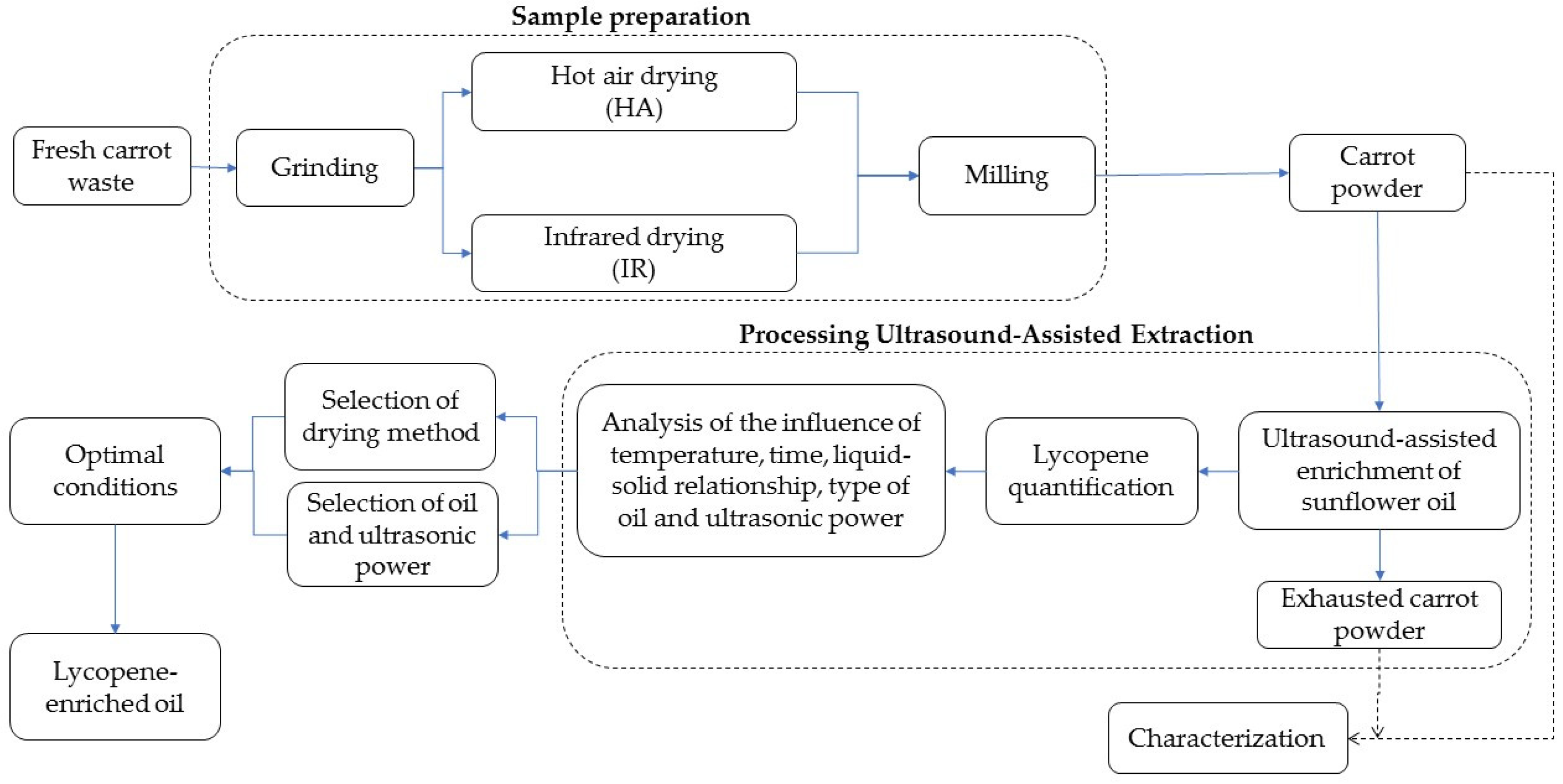
Figure 1 presents the logic diagram of the proposed process, integrating carrot waste drying, lycopene extraction, and characterization of the obtained products.
2. Materials and Methods
2.1. Sample Preparation
In December 2023 and May 2024, discarded carrots considered unmarketable due to deviations in size and shape (but not due to spoilage) were obtained from a local fruit market in the Pocito Department (San Juan Province, Argentina). The carrots were commercial orange types with characteristic orange flesh, and were processed as a representative mixture of the available waste stream. In the laboratory, carrots were washed to remove soil and other impurities, and then they were processed with an electric grater (Peabody Smartchef, Buenos Aires, Argentina) to obtain a uniform particle size before drying.
2.2. Drying Procedure
The drying process was performed using two different technologies: (a) far-infrared (IR) drying, using a three-tray infrared dryer (Irconfort IRCDi3, Sevilla, España), and (b) hot-air (HA) drying, using a forced convection electric oven (Fischer Turbo 2.4, Santa Catarina, Brazil). Both dryers were equipped with automated temperature control. Drying was carried out at three temperature levels: 40, 50, and 60 °C. Once the samples reached constant mass (final moisture content < 10%), they were ground using a food mill (DAMAI HC-300, Yongkang, China) and then sieved through a No. 30 mesh screen to obtain a uniform particle size.
2.3. Color Characteristics
The color evaluation of fresh and dehydrated samples was performed using a computer vision technique. Carrot samples were photographed using a high-resolution smartphone, placed in a lidded box to maintain a constant distance, and under uniform lighting. Sample photographs were converted from RGB to CIE L*a*b* color space and using a color space conversion plug-in in image analysis software (Image J, V.1.42e, USA). The parameters L* (lightness, where 0 = black and 100 = white), a* (green (−) to red (+)), and b* (blue (−) to yellow (+)) were recorded. For each treatment, 25 measurements were taken and averaged. Based on these values, the total color difference (ΔE) and chroma (Chr, color saturation) were calculated using Equations (1) and (2) [
16,
17]:
where L
0, a
0, and b
0 denote the color parameters of the fresh carrot sample, whereas L*, a*, and b* represent the values obtained after drying the carrot samples.
2.4. Kinetic Study
For the kinetic analysis of dehydration, the moisture content values corresponding to the tree drying temperatures and times evaluated were transformed into the dimensionless moisture ratio (MR) using the following Equation (3):
where M
t is the moisture content on a dry basis at any time t, M
e is the equilibrium moisture content, and M
0 is the initial moisture content, all are expressed on a dry basis (g of water/g of dry solids). In each experiment, moisture content loss data were recorded at 30 min intervals until a constant weight was reached. Drying assays at each temperature were performed in triplicate, and the average weight loss was reported. The experimental data obtained were fitted to 11 empirical models from the literature (
Table 1) [
18].
Table 1.
Theoretical and empirical models applied to drying curves.
Table 1.
Theoretical and empirical models applied to drying curves.
| Models | Equations | No. |
|---|
| Newton | | (4) |
| Page | | (5) |
| Modified Page | | (6) |
| Henderson and Pabis | | (7) |
| Modified Henderson and Pabis | | (8) |
| Logarithmic | | (9) |
| Midilli | | (10) |
| Two-terms | | (11) |
| Two-terms exponential | | (12) |
| Noomhorm and Verma | | (13) |
| Approximation of diffusion | | (14) |
2.5. Lycopene Extraction and Quantification
Lycopene extraction was performed using an ultrasound-assisted extraction method with edible oil as a solvent. Ground carrot powder obtained from both drying methods was first mixed with sunflower oil, following conditions adapted from da Silva et al. [
19]. The extraction was conducted in a thermostatically controlled ultrasonic bath (Arcano PS-10 A, 2 L, 40 kHz, 50 W), set at 55 ± 2 °C. A liquid-to-solid ratio of 30 mL/g was used, and sonication time was fixed at 60 min. After extraction, the mixture was centrifuged at 3000 rpm for 10 min to remove residual solids (exhausted carrot powder), and the supernatant (lycopene-enriched oil) was collected in 15 mL polypropylene centrifuge tubes. The exhausted carrot powder was retained for further characterization.
For lycopene quantification, 3.00 ± 0.01 g of enriched oil were accurately weighed and dissolved with petroleum ether to a final volume of 10 mL. A blank solution was prepared under the same conditions using the same extracting solvent used in the sample, and dissolved in petroleum ether to a total volume of 10 mL. The absorbance of the petroleum ether solution was measured at 470 nm. The total carotenoid content was calculated as lycopene equivalents using the specific absorption coefficient for lycopene (E
0% 1 cm = 3450) [
20] and is expressed as mg of total carotenoids (lycopene equivalent, LE) per kg of oil. This spectrophotometric method provides a reliable estimate of total carotenoids with lycopene-like chromophores, acknowledging potential contributions from other carotenoids absorbing at this wavelength [
14,
20].
All extraction procedures were carried out in reduced lighting conditions to prevent carotenoid photo-oxidation. Each treatment was performed in triplicate (n = 3).
where d is the thickness of the spectrophotometer cell (1 cm).
2.6. Experimental Design
After selecting the drying method that provided the highest LE content, an experimental design was developed to improve the lycopene enrichment process. The process was modeled using a Box–Behnken Response Surface Methodology (RSM) design, selected for its efficiency and lower requirement for experimental runs compared to other RSM approaches [
21]. This design used three independent variables: the solvent/material ratio (10, 20, and 30 mL/g), temperature (40, 60, and 80 °C), and ultrasound time (20, 40, and 60 min). The coded and actual levels of these factors, together with their corresponding independent variables, are presented in
Table 2. Finally, optimization was performed using a genetic algorithm implemented in MATLAB Online software (R2024a, The MathWorks, Inc., Natick, MA, USA) to determine the optimal operational parameters.
Finally, under the optimal extraction conditions, a new ultrasonic device with a higher fixed power of 240 W was employed. This device consists of a preheated ultrasonic bath (Testlab, model: TB02, 2 L capacity, 40 kHz) with temperature monitoring. Subsequently, two different oil varieties, sunflower and a blended oil, were used for lycopene extraction from carrot samples. This allowed for comparison between both extraction media and selection of the most suitable oil for the process.
2.7. Characterization of the Dried and Exhausted Carrot Powder
The moisture content, lipids, proteins, and ash were determined according to Official Methods of Analysis (AOAC) protocols [
22]. Crude fiber content was also determined [
23]. Carbohydrates were subsequently calculated by difference, as described by Campuzano et al. [
24]. The total energy was calculated using the Atwater conversion factors, considering the carbohydrate, protein, and lipid contributions, as described by Baldán et al. [
25].
2.8. Statistical Analysis
The coefficient of determination (R
2) and the least Chi-square (χ
2), Sum Squared Error (SSE), and Root Mean Square Error (RMSE) were used to evaluate the fit of the experimental data to the models [
26]. The best fits are for those models with the lowest values of χ
2, SSE, and RMSE and the highest values of R
2. Analysis of variance (ANOVA) was performed using Tukey’s test to verify the validity of the data fit in lycopene quantification. To identify the significance of the effects and their interactions, an ANOVA was performed, using Fisher’s test (
p < 0.05), with InfoStat software, version 2020, free trial version [
27].
The results of the objective function C (mg LE/kg oil) were analyzed using the software (MATLAB Online
https://matlab.mathworks.com, accessed on 15 October 2024). Full quadratic models were fitted to the experimental responses using DOE (design of experiments)/response surface analysis.
3. Results
3.1. Drying Procedure and Color Changes
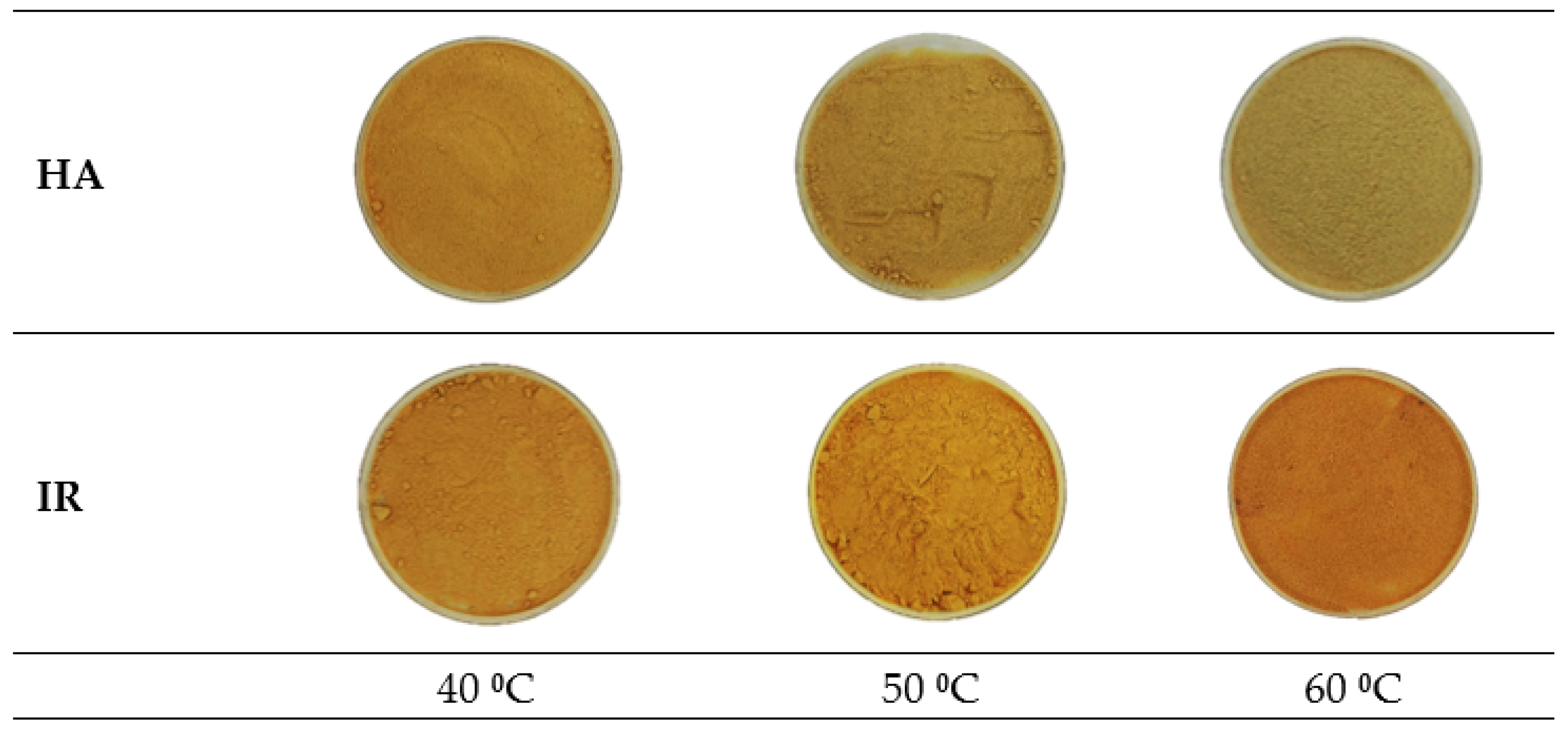
After preparing the samples (selection, washing, and grinding), the moisture content of the fresh carrot was analyzed, with a value of 89.8 ± 0.6%. Then, the samples were dried using two technologies: HA and IR, at 40, 50, and 60 °C, followed by milling and sieving. The samples obtained are shown in
Figure 2. The figure illustrates visible color differences as a function of drying technology and temperature. In HA-dried samples, a progressive loss of the characteristic orange color was observed with increasing temperature. In contrast, IR-dried samples did not exhibit noticeable color changes across the evaluated temperature range.
The color parameters of fresh and dehydrated carrot samples are presented in
Table 3. Fresh carrots exhibited L*, a*, and b* values of 71.20 ± 0.42, 39.10 ± 0.74, and 50.60 ± 0.70, respectively. Drying resulted in a decrease in L* values compared with fresh samples, indicating darkening. Among all treatments, IR drying at 50 °C produced the highest L* value.
Drying temperature significantly affected ΔE. During IR drying, ΔE values decreased as temperature increased from 40 to 60 °C. In contrast, HA drying showed a significant increase in ΔE with increasing temperature (p < 0.05). The a* and b* values closest to those of fresh carrots were obtained for samples dried at 60 °C using IR.
Chr values showed statistically significant differences with temperature (p < 0.05), with the highest value obtained for IR drying at 50 °C. No significant differences in a* values were observed between IR drying at 40 and 50 °C.
3.2. Lycopene Quantification
LE was determined under the optimal extraction conditions described by da Silva et al. [
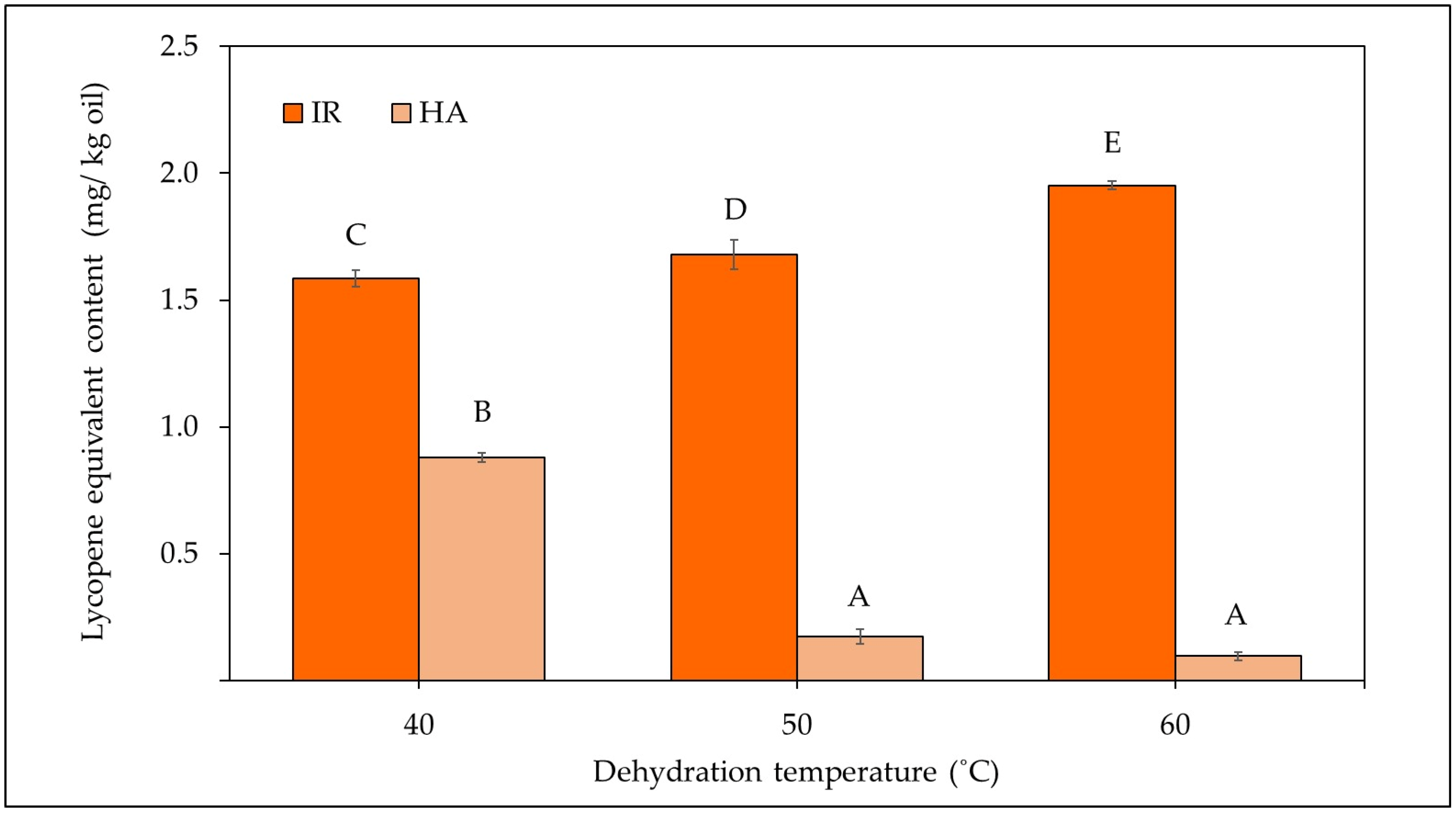
19] to evaluate the effect of drying technology. As shown in
Figure 3, lycopene equivalent content in oil decreased significantly with increasing temperature during HA drying, from 0.88 to 0.10 mg LE/kg oil. Conversely, IR drying showed a significant increase in lycopene equivalent content with temperature, from 1.58 to 1.95 mg LE/kg oil.
Based on these results, IR drying was selected for subsequent experiments.
3.3. Kinetic Study of Infrared Drying
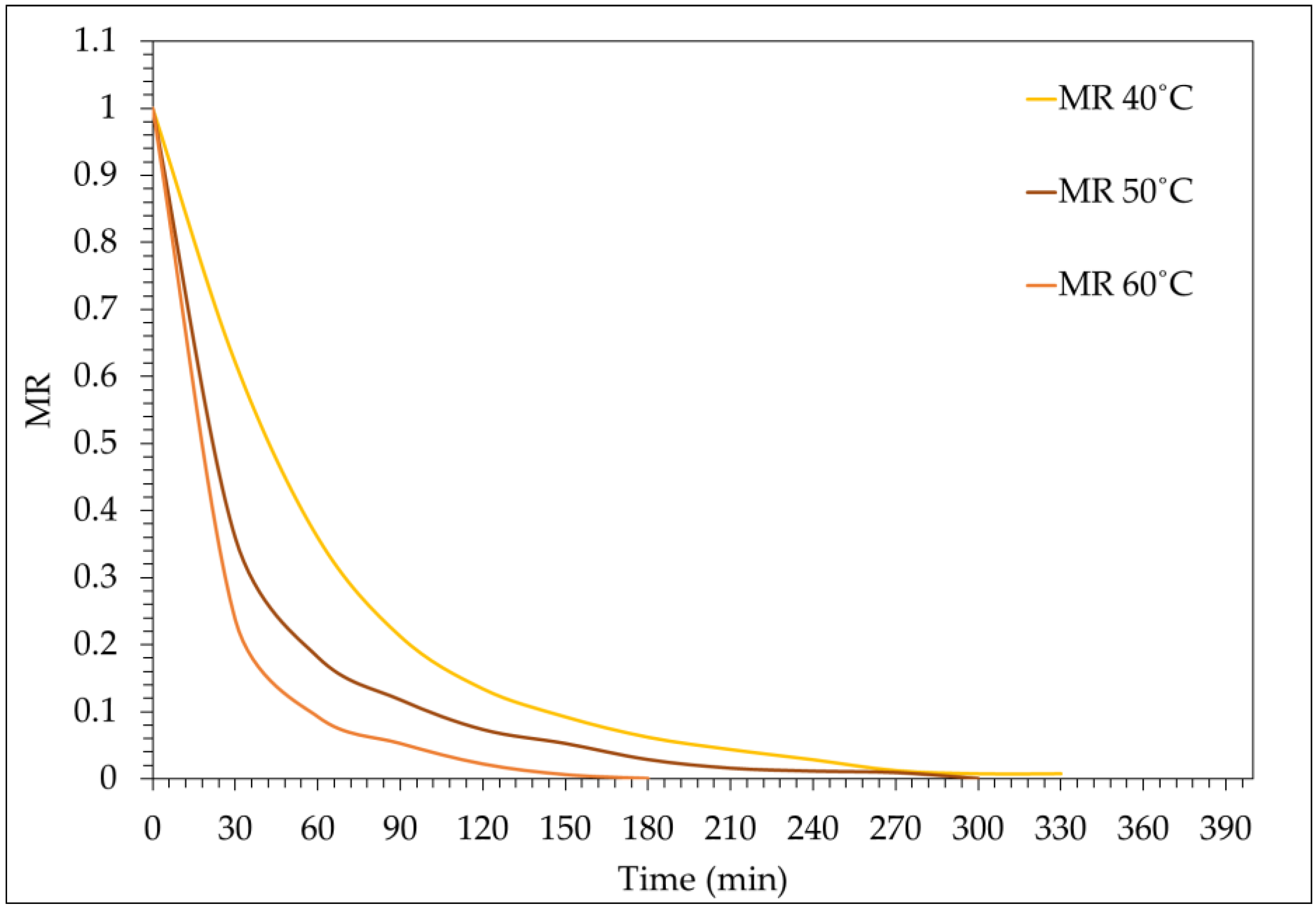
Moisture content data obtained during IR drying were expressed as MR.
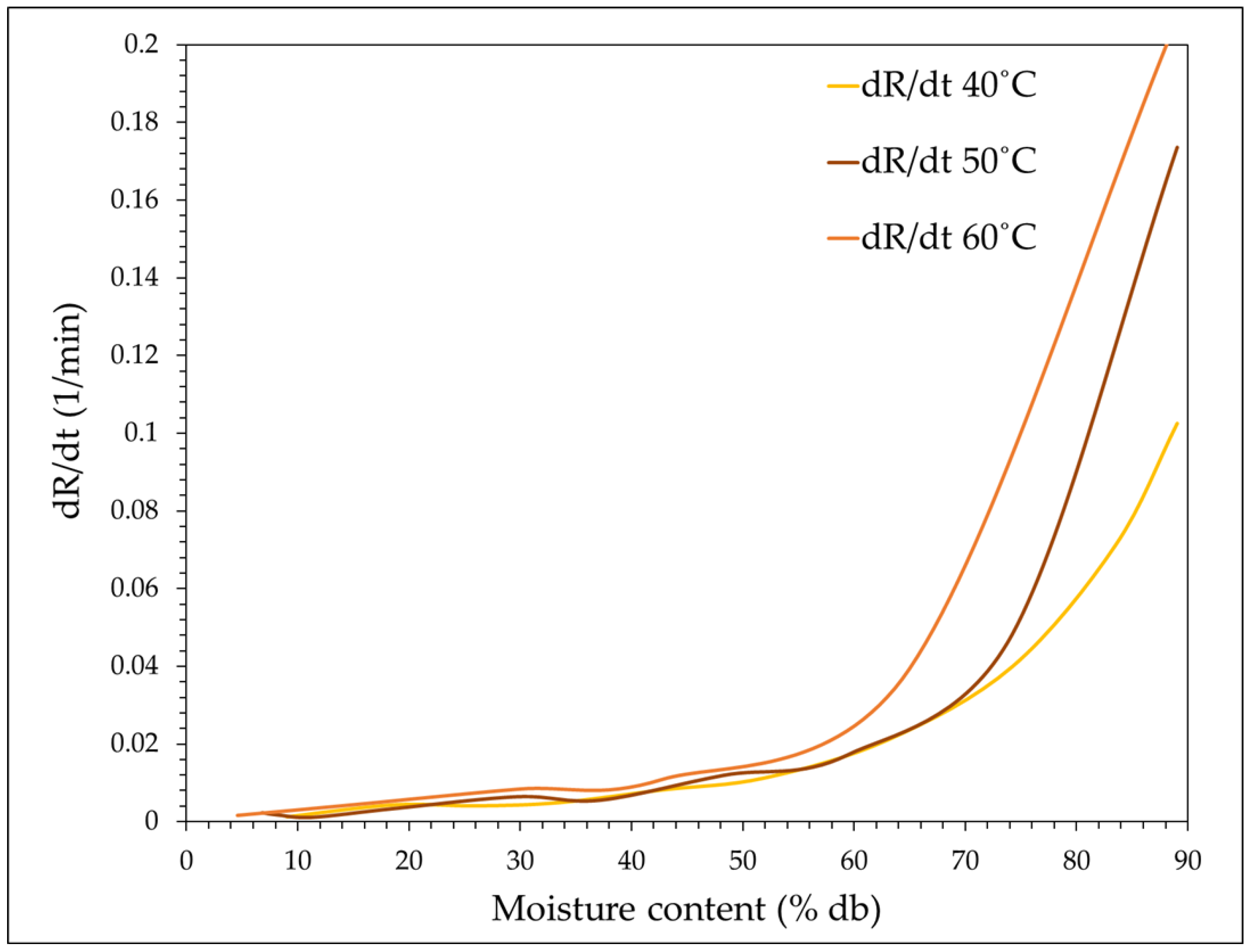
Figure 4 and
Figure 5 show the experimental MR vs. t and dMR/dt at different temperatures, respectively.
The equilibrium moisture content (Me) determined from the drying curves was 0.091, 0.068, and 0.046 g water/g dry solids for drying temperatures of 40 °C, 50 °C, and 60 °C, respectively. These values correspond to final absolute moisture contents (dry basis) of 9.1, 6.8, and 4.6% after IR drying, confirming that higher drying temperatures resulted in lower final moisture levels while maintaining product stability below 10% (wet basis), as targeted for shelf-stable powders.
An increase in drying temperature reduced the time required to reach equilibrium moisture content. The MR curves exhibited an exponential decrease, with two distinct stages: an initial constant-rate period followed by a diffusion-controlled stage. The equilibrium drying times at 40, 50, and 60 °C were 270, 210, and 150 min, respectively.
Eleven thin-layer drying models were fitted to the experimental data. Model performance was evaluated using SSE, RMSE, χ
2, and R
2. Among the evaluated models, the Midilli model showed the lowest error values and the highest R
2 values at all temperatures. The model constants and statistical parameters are summarized in
Table 4.
3.4. Experimental Design and Optimization of Oil Enrichment
3.4.1. Determination of Optimal Extraction Conditions
A Box–Behnken design was applied to determine optimal conditions for lycopene enrichment in oil. The predicted LE content ranged from 0.90 to 3.03 mg/kg oil (
Table 5). The maximum predicted enrichment (3.03 mg LE/kg oil) was obtained at a solvent/material ratio of 10 mL/g, ultrasonic time of 60 min, and temperature of 60 °C.
3.4.2. Model Fitting and Statistical Analysis
The ANOVA results of the fitted quadratic model are presented in
Table 6. Solvent/material ratio, ultrasound temperature, and extraction time showed significant effects on LE enrichment (
p < 0.05). Quadratic effects of all parameters were also significant.
The fitted model describing LE content is given by Equation (16):
where X
1 is the ultrasound temperature, (°C), X
2: is the solvent/material ratio, (mL/g), and X
3 is the time (min).
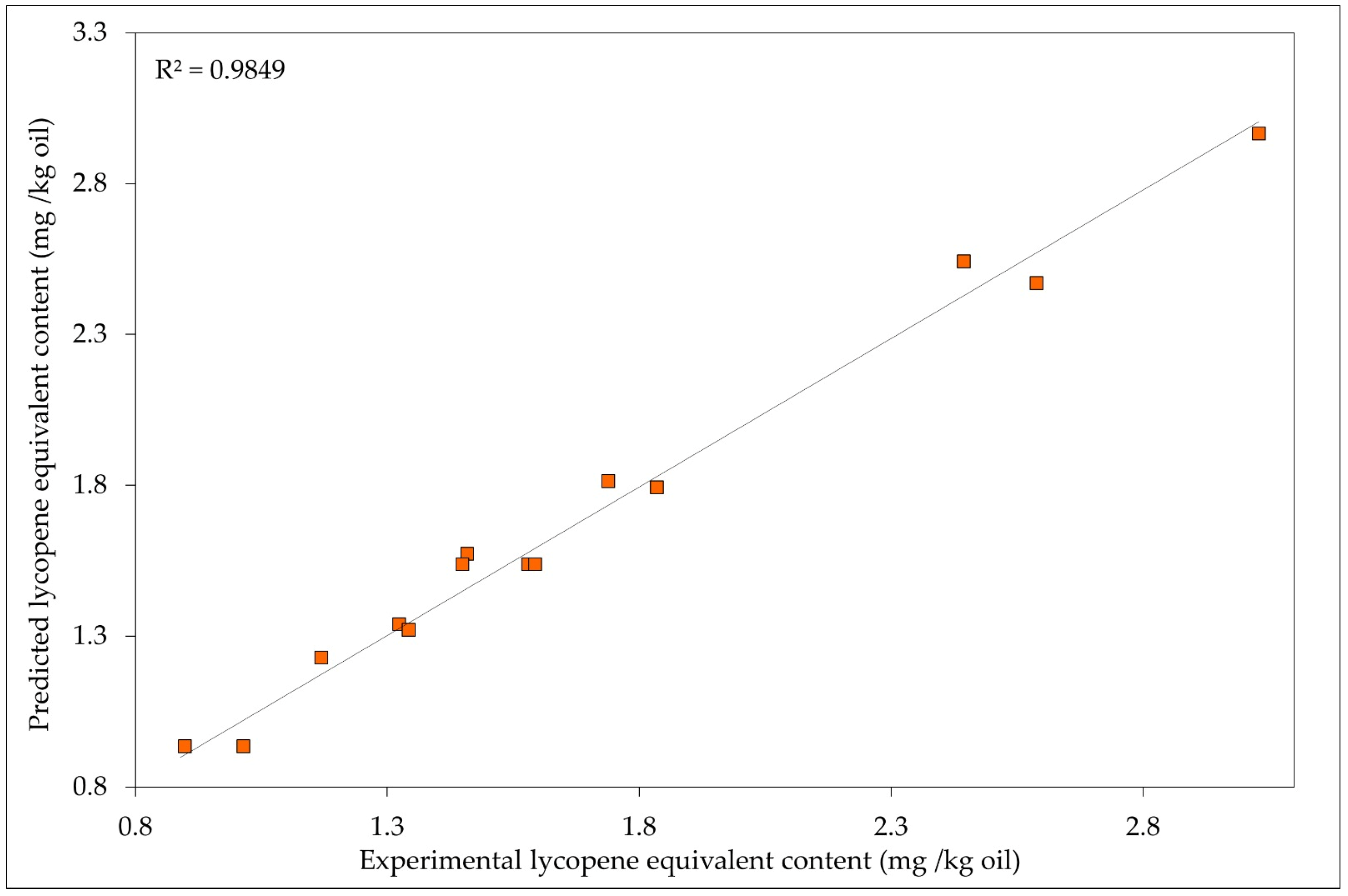
The model showed a high coefficient of determination (R
2 = 0.9849), indicating good agreement between predicted and experimental values (
Figure 6).
3.4.3. Response Surface Analysis
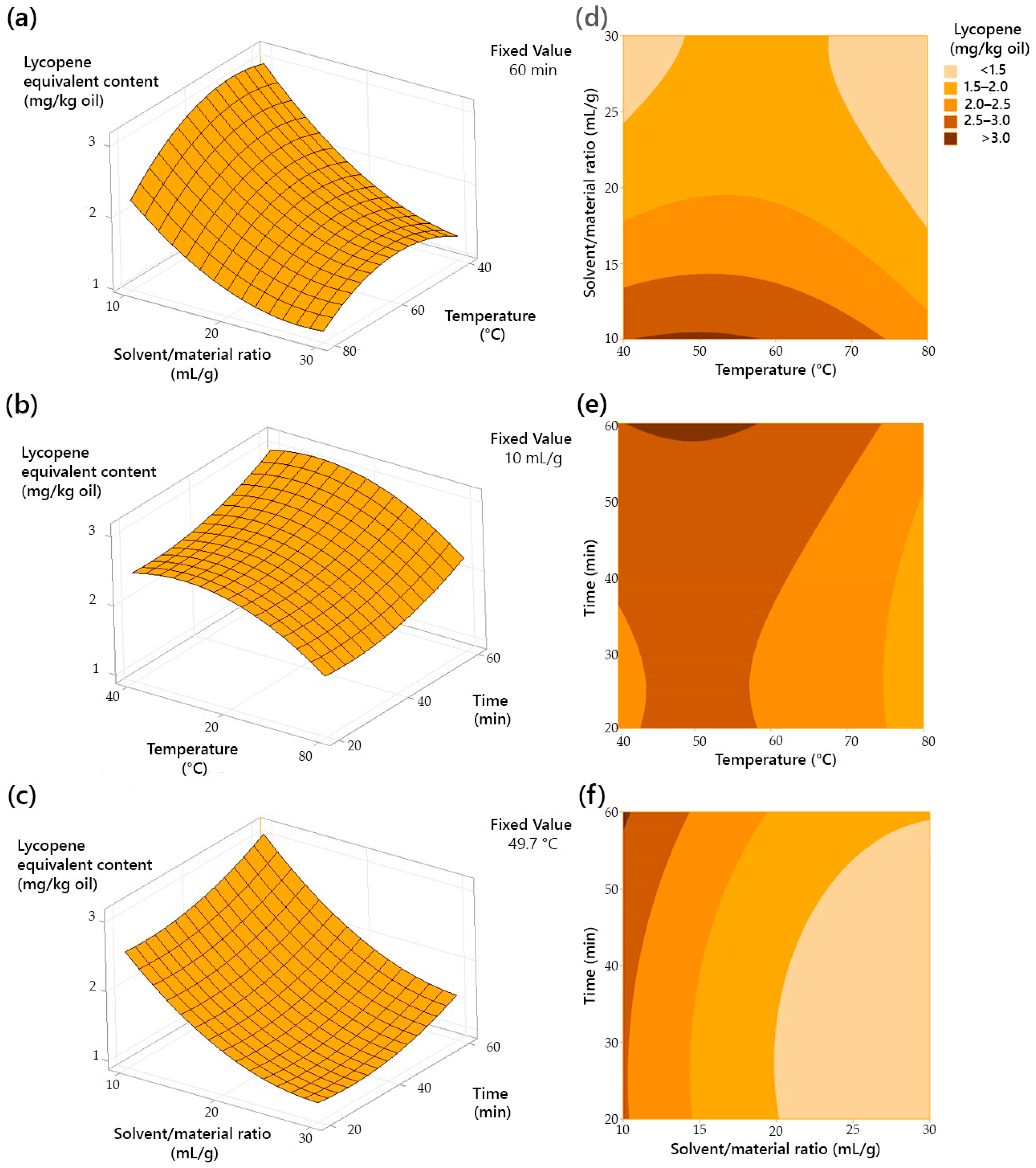
Response surface and contour plots illustrating the effects of the independent variables on lycopene enrichment are shown in
Figure 7. Lycopene enrichment values higher than 3.00 mg LE/kg oil were obtained at a solvent/material ratio of 10 mL/g, an extraction time of 60 min, and temperatures between 49.7 and 60 °C.
According to the response surface model, the optimal extraction conditions were a solvent/material ratio of 10 mL/g, a temperature of 49.7 °C, and an extraction time of 60 min, with a predicted lycopene enrichment of 3.07 mg LE/kg oil. Experimental validation of these conditions showed no statistically significant differences compared to the maximum LE content obtained at 60 °C using the same solvent/material ratio and extraction time.
Under the previously mentioned conditions, increasing the ultrasonic bath power from 50 to 240 W led to an increase in lycopene enrichment, reaching a value of 5.00 mg LE/kg oil. Using the highest ultrasonic power, two oil varieties (sunflower oil and blended oil) were evaluated, and no statistically significant differences were observed between them. The LE content was 5.00 ± 0.23 mg/kg for sunflower oil and 4.88 ± 0.22 mg/kg for blended oil.
The achieved LE concentration of 5.00 mg/kg oil (5 ppm) is a practically significant yield within the framework of a green, solvent-free process. This value is competitive for an oil-based extraction from carrot waste, aligning with yields reported in similar studies [
10]. When compared to lycopene-rich matrices like tomato peels, where concentrations of 35–150 mg LE/kg oil have been reported using oil-based methods [
28,
29], the yield from carrot is understandably lower, reflecting the crop’s intrinsic carotenoid profile. While conventional solvent-based extracts can achieve higher purity, the present method eliminates toxic solvents and produces a directly applicable, food-grade functional ingredient. The concentration obtained is sufficient to impart both a characteristic hue and enhanced antioxidant value to food products such as dressings, spreads, or fortified oils, thereby validating the process’s practical utility for clean-label applications.
As shown in
Figure 7a–c, lycopene enrichment increased with higher extraction temperatures (up to 60 °C), longer extraction times (60 min), and lower solvent/material ratios (10 mL/g).
Figure 7d–f indicates that the highest lycopene enrichment values (>3.00 mg LE/kg oil) were consistently obtained at an extraction time of 60 min and a solvent/material ratio of 10 mL/g, within a temperature range of 40–60 °C.
3.5. Characterization of Dried and Exhausted Carrot Powder
The physicochemical properties of carrot powder dried at 60 °C before and after lycopene extraction are presented in
Table 7.
Moisture content decreased from 6.46 ± 0.10% to 1.30 ± 0.13% after extraction. Crude fiber content remained unchanged, while significant differences were observed in lipids, carbohydrates, proteins, ash, and total energy.
The high retained oil content (about 62 g/100 g db) of the exhausted powder enhances its caloric density but necessitates stabilization to prevent oxidative rancidity during storage. Practical measures include a secondary drying step to reduce moisture content and storage in opaque, sealed containers under cool conditions. The powder’s composition supports its direct use as an energy-dense ingredient in animal feed formulations, as a functional component in composite flours for baked goods (contributing lipids and fiber), or as a substrate for biogas production via anaerobic digestion. This ensures the complete valorization of the carrot matrix within a circular economy framework.
3.6. Lycopene Mass Balance and Recovery Efficiency
To provide a comprehensive assessment of the proposed valorization pathway, a lycopene mass balance was established from fresh carrot waste to the final enriched oil. The initial LE content in the fresh, unprocessed carrot waste was determined via direct solvent extraction (acetone) and spectrophotometric quantification, yielding a value of 18.5 ± 1.2 mg LE/100 g db.
The lycopene retention after drying was estimated indirectly from the extraction yields presented in
Section 3.2. Hot-air (HA) drying at 60 °C resulted in severe thermal degradation, with only an estimated 5–7% of the original lycopene retained in the dried powder. In contrast, far-infrared (IR) drying at 60 °C demonstrated superior preservation, retaining an estimated 35–40% of the initial LE content. A simplified mass balance for lycopene across the main stages of processing (per 100 g of fresh carrot waste, db) is presented in
Table 8.
The overall recovery efficiency of lycopene from fresh waste to oil-enriched product was approximately 27%. This accounts for unavoidable losses during drying and the incomplete extraction inherent to mild, food-grade processes. This recovery is competitive within the context of green, solvent-free extraction methods. For instance, comparable ultrasound-assisted, oil-based extraction studies report carotenoid recoveries of 20–35% from vegetable matrices [
10,
20]. Conventional solvent-based methods (e.g., using hexane or acetone) can achieve higher recoveries (60–80%) but necessitate toxic solvents, additional purification steps, and are not directly applicable for producing food-grade ingredients [
9,
29]. Thus, the moderate recovery achieved here is offset by the significant advantages of the proposed integrated process: it is solvent-free, produces directly usable functional ingredients (oil and powder), aligns with circular economy principles, and minimizes environmental impact.
4. Discussion
4.1. Effect of Drying Technology on Color and Lycopene Retention
The results demonstrate that drying technology plays a decisive role in preserving color and lycopene in carrot by-products. The pronounced color degradation observed during HA drying at higher temperatures can be attributed to prolonged exposure times that favor non-enzymatic browning reactions and pigment oxidation, as previously reported for convectively dried vegetables [
28,
30,
31].
The initial LE content in the raw material is a fundamental variable influencing potential recovery. This content is highly dependent on carrot cultivar and phenotype, with LE concentrations varying significantly among varieties. For instance, deep orange and red-purple carrots can possess substantially higher lycopene levels than traditional orange types [
1]. While the specific cultivar of the commercial discards used in this study was not identified, the optimized process parameters for drying and extraction are expected to be robust across different carrot types. The absolute yield (mg LE/kg oil) would therefore scale with the initial concentration in the feedstock, but the extraction efficiency of the proposed green method remains applicable. This characteristic enhances the versatility of the valorization strategy for handling mixed or variable agro-industrial waste streams.
In contrast, IR drying showed greater color stability, particularly at higher temperatures, which can be explained by faster moisture content removal and reduced thermal exposure. Similar effects have been reported for IR and microwave-assisted drying systems, where rapid energy transfer limits pigment degradation [
32].
Although the current study focused on product quality parameters (color, lycopene retention) and drying kinetics, it did not measure the specific energy consumption of the IR and HA drying processes. The assertion that IR drying may be more energy-efficient is based on its mechanism of direct radiative heat transfer and the significantly shorter drying times observed in this study (e.g., equilibrium reached in 150 min at 60 °C for IR vs. longer times for HA, as inferred from kinetic curves). A conclusive comparison of energy efficiency would require direct measurement of electrical energy input per unit of water removed under standardized conditions—an important parameter for industrial scale-up and life-cycle assessment that should be addressed in future techno-economic analyses.
4.2. Interpretation of Drying Kinetics and Model Performance
The two-stage drying behavior identified during infrared dehydration is consistent with classical drying theory and reflects the transition from surface moisture content removal to internal moisture diffusion, as previously reported for carrot tissues and other plant materials [
18,
33]. This behavior confirms that infrared heating promotes rapid initial water evaporation while progressively shifting control to internal mass transfer mechanisms.
The good performance of the Midilli model across the evaluated temperature range highlights its ability to capture both external and internal mass transfer phenomena under infrared drying conditions. Similar suitability of the Midilli model has been reported for a variety of biological materials, including mango slices, onion slices, and Centella asiatica leaves [
18,
34,
35], supporting its robustness and general applicability.
From a practical perspective, the reliable prediction of moisture ratio evolution is particularly relevant for process optimization and scale-up. Accurate kinetic modeling enables better control of drying time and energy consumption, which is essential for the sustainable industrial processing of agro-industrial by-products.
4.3. Optimization of Ultrasound-Assisted Oil Enrichment
The optimization results confirm that the solvent-to-material ratio, extraction temperature, and extraction time play a decisive role in lycopene enrichment when using an oil-based UAE system. In particular, the negative effect of higher oil-to-solid ratios can be attributed to a dilution phenomenon rather than to improved mass transfer, a behavior previously reported for lipid-based carotenoid extraction systems [
10]. This finding underscores the importance of minimizing solvent use to maximize extract concentration while improving overall process efficiency.
The optimal temperature range identified reflects a balance between enhanced diffusional transport and the thermal stability of lycopene within the oil matrix. Similar trade-offs have been described in UAE-based carotenoid extraction studies, where moderate heating improves mass transfer without causing significant degradation of thermolabile compounds [
10]. Compared with conventional solvent-based extraction methods [
33,
34], the oil-based UAE approach eliminates the use of organic solvents and avoids subsequent purification steps, resulting in a directly usable, food-grade functional ingredient.
The observed increase in lycopene enrichment with higher ultrasonic bath power highlights the role of ultrasonic energy in promoting cell disruption and facilitating the release of lycopene from the plant matrix. This behavior is consistent with previous reports on ultrasound-assisted extraction of carotenoids, where higher power levels enhanced extraction efficiency without adversely affecting compound stability.
While increasing ultrasonic power from 50 W to 240 W significantly improved lycopene yield, the optimal power threshold and potential degradation effects at higher intensities were not investigated. Excessive ultrasonic power can generate localized heat and intense shear forces, potentially degrading thermolabile compounds like lycopene. Determining this maximum beneficial power, or the critical cavitation intensity, represents an important parameter for further process intensification and should be explored in future studies.
From a technological and sustainability perspective, the proposed process offers several advantages, including reduced chemical inputs, simplified processing, and the simultaneous generation of two value-added products: lycopene-enriched oil and exhausted carrot powder. The use of food-grade materials and relatively simple equipment supports the scalability of the process, making it particularly suitable for small- and medium-scale agro-industrial applications within a circular economy framework.
Finally, the absence of significant differences between sunflower and blended oils indicates that lycopene enrichment is not strongly dependent on oil type under the evaluated conditions. This versatility further supports the applicability of the proposed method for the production of functional edible oils and sustainable food formulations
4.4. Valorization of Dried and Exhausted Carrot Powder
The compositional profile of the exhausted carrot powder highlights its potential as a secondary value-added co-product within an integrated valorization strategy. The enrichment process results in a material with elevated lipid and residual carbohydrate contents while maintaining dietary fiber, supporting its suitability for applications such as energy-dense animal feed ingredients, incorporation into composite flours, and use as a substrate for biogas production through anaerobic digestion [
36].
Comparisons with previously reported carrot powders indicate that the compositional variability observed among studies is primarily influenced by drying technology, processing conditions, and agronomic factors, as widely documented in the literature [
29,
37,
38,
39]. In this context, the altered nutritional profile of the exhausted powder reflects not a degradation of quality but a functional transformation driven by oil enrichment.
From a sustainability perspective, the generation of exhausted carrot powder alongside lycopene-enriched oil reinforces the circular economy potential of the proposed process. By converting carrot by-products into multiple functional materials, the approach enhances resource efficiency, reduces waste generation, and creates opportunities for diversified applications in food, feed, and bioenergy sectors, in line with circular economy principles [
38,
40].
While the oil matrix is expected to provide a stabilizing environment for lycopene, the long-term shelf life of the enriched oil was not evaluated in this study and constitutes an essential parameter for commercial application. Future research should systematically assess lycopene retention and oxidative stability (e.g., via peroxide value, conjugated dienes, and lycopene quantification) over time under various storage conditions (e.g., 4 °C, 25 °C, with/without light, under nitrogen). Such studies would determine appropriate packaging and storage guidelines to maximize the functional shelf life of this value-added ingredient.
4.5. Circular Economy Implications and Potential Applications
The integrated process proposed in this study represents a holistic valorization pathway that converts carrot processing residues into multiple functional products, reinforcing circular economy principles. By simultaneously generating lycopene-enriched oil and exhausted carrot powder, the approach maximizes resource utilization while minimizing waste generation.
The lycopene-enriched oil obtained through this process presents a wide range of potential applications within the food and nutraceutical sectors, including use as a natural colorant, a functional ingredient to enhance antioxidant content, and a carotenoid source for specialized feed formulations [
39,
40]. The oil matrix not only facilitates lycopene incorporation into lipid-based products but also contributes to its protection against oxidative degradation.
In parallel, the exhausted carrot powder constitutes a secondary co-product with versatile application potential. Its nutritional and energetic characteristics support its use in animal feed formulations, composite food ingredients, bioenergy production via anaerobic digestion, and emerging applications such as biodegradable packaging materials [
37,
41]. From an economic and sustainability perspective, this multiproduct strategy enhances the feasibility of carrot waste recovery while contributing to more responsible production systems, in line with ODS 12.
4.6. Comparative Analysis with Conventional Extraction Methods
While the present study focused on developing an integrated, solvent-free valorization process, a comparative analysis with conventional extraction techniques provides important context regarding its efficiency and practical positioning. Traditional methods for lycopene recovery, primarily organic solvent extraction (e.g., using hexane or acetone) and supercritical fluid extraction (SFE) with CO
2, typically report higher absolute yields. For instance, hexane extraction from tomato or carrot matrices can yield approximately 20–50 mg of lycopene per kg of raw material [
9,
29], while SFE can achieve yields in the range of 30–80 mg/kg [
42]. In contrast, the optimized oil-based UAE process developed herein yielded 5.00 mg of LE per kg of oil.
However, a direct yield comparison alone is misleading without considering the nature of the final product and the overall process economics and sustainability. Solvent-based extracts require rigorous post-processing to remove toxic solvent residues, concentration, and often stabilization through encapsulation before they can be incorporated into food systems, adding high cost and complexity [
40]. SFE, although green and efficient, entails high capital investment and operational costs, making it less accessible for small- and medium-scale agro-processors [
42]. The methodology proposed in this work offers distinct practical advantages that define its niche:
Food-Grade Readiness: The lycopene-enriched oil is produced directly using edible oil as the solvent, requiring no purification steps, and is immediately suitable for use in various food applications (e.g., dressings, spreads).
Economic and Environmental Efficiency: It eliminates costs and hazards associated with organic solvent purchase, recovery, and waste disposal. The equipment (ultrasonic bath, dryer) is relatively low-cost and widely available.
Holistic Valorization: Unlike conventional single-output extraction, this process generates two value-added streams: the functional oil and the exhausted carrot powder, enhancing overall resource efficiency within a circular economy model.
Therefore, while the yield of the oil-based UAE is lower in concentration, its value proposition lies in its simplicity, safety, alignment with clean-label trends, and integrated approach to waste valorization. It represents a scalable and sustainable alternative, particularly suitable for decentralized processing where minimizing chemical input and maximizing co-product utility are prioritized over maximizing isolated compound purity.
5. Conclusions
This study successfully demonstrates an integrated valorization approach for carrot processing by-products through the combination of infrared drying and ultrasound-assisted oil extraction, yielding functional lycopene-enriched oils while generating value-added co-products. The research addresses critical challenges in agro-industrial waste management while advancing circular economy principles in food production systems.
Infrared drying emerged as the superior technology for preserving bioactive compounds and color attributes in carrot powder. Drying temperature significantly influenced color parameters, with IR drying at 50 °C achieving maximum lightness (L*) and Chr, while IR drying at 60 °C maintained color parameters closest to fresh carrots. The contrasting behavior of ΔE between technologies, decreasing with temperature in IR drying but increasing in hot-air drying (p < 0.05), highlights the importance of technology selection for quality retention. Kinetic modeling of the IR drying process using eleven empirical equations identified the Midilli model as the most accurate predictor of moisture content evolution (R2 > 0.99), providing a reliable tool for process optimization and scale-up.
Process optimization through Box–Behnken response surface methodology established optimal extraction conditions: IR drying at 60 °C, solvent/material ratio of 10 mL/g, extraction temperature of 49.7–60 °C, 60 min extraction time, and ultrasonic power of 240 W. Under these conditions, LE concentrations reached 5.00 mg/kg oil, with both sunflower and blended oils showing comparable extraction efficiencies. The relatively low solvent-to-material ratio (10 mL/g) identified as optimal represents an important finding for industrial implementation, as it minimizes processing costs while maximizing lycopene concentration. The enrichment process significantly modified the proximate composition of carrot powder, though crude fiber content remained stable, confirming the selective nature of the extraction process.
While the oil matrix is expected to provide a stabilizing environment for the extracted lycopene, the long-term shelf life of the enriched oil remains to be determined through dedicated stability studies. Furthermore, while infrared drying offers potential energy efficiency advantages over convective drying due to shorter processing times and direct heat transfer mechanisms, a direct comparative analysis of specific energy consumption was beyond the scope of this study and should be quantified in future techno-economic assessments.
From a circular economy perspective, this work demonstrates dual-value generation from agricultural waste streams. The exhausted carrot powder, characterized by high lipid (62.34 g/100 g db) and carbohydrate (27.03 g/100 g db) contents, represents a secondary value-added material suitable for animal feed formulations, composite flour applications, or bioenergy production. This dual-product approach maximizes resource utilization efficiency, transforming waste disposal costs into potential revenue streams while reducing environmental burden.
The solvent-free extraction methodology developed in this study offers distinct advantages over conventional approaches: (1) elimination of organic solvent use and associated waste generation, (2) production of ready-to-use functional food ingredients without post-processing purification, and (3) simplified equipment requirements facilitating adoption by small and medium-sized processors. These characteristics enhance the scalability and sustainability of the technology, making it particularly suitable for decentralized processing facilities in agricultural regions.
The lycopene-enriched oils produced can be directly incorporated into various food applications, including salad dressings, bakery products, functional spreads, and aquaculture feeds, providing natural colorants and antioxidant properties while meeting consumer demand for clean-label ingredients. This work contributes to ODS 12 (Responsible Consumption and Production) by demonstrating practical strategies for reducing food waste, valorizing agricultural by-products, and developing functional ingredients through environmentally benign technologies.
Future research should focus on: (1) comprehensive shelf-life studies evaluating lycopene stability in enriched oils under different storage conditions, (2) sensory evaluation and consumer acceptance testing of food products containing these enriched oils, (3) life cycle assessment to quantify environmental benefits compared to conventional extraction methods, (4) techno-economic analysis for industrial-scale implementation, and (5) extension of this methodology to other carotenoid-rich agricultural by-products. Such studies would further validate the commercial viability and environmental benefits of this valorization approach, supporting its adoption in sustainable food production systems.
Author Contributions
M.C.R.: Conceptualization, Methodology, Investigation, Writing—original draft. M.R.-G.: Conceptualization, Formal analysis, Investigation, Writing—original draft. D.Z.-G.: Software, Methodology. I.M.R.-V.: Conceptualization, Writing—original draft. C.P.: Formal analysis, Methodology. M.P.F.: Resources, Writing—original draft, Funding acquisition. R.R.: Conceptualization, Visualization, Resources, Writing—review & editing, Supervision, Project administration, Funding acquisition. G.M.: Resources, Writing—review & editing, Supervision, Project administration, Funding acquisition. All authors have read and agreed to the published version of the manuscript.
Funding
The authors wish to express thanks for support from the following Argentine institutions: Research Council (PIP 2021–2023-11220200100950CO); FONCYT-PICT RESOL-2023-31-APN-DANPIDTYI#ANPIDTYI (PICT-2021-I-INVI-00839, PICT-2021-INVI-00803, PICT-2021-A-0169, PIC Project (Call 2022 (Res. No. 2902/22-R and 175/22-CS)), Agencia Nacional de Promoción de la Investigación, el Desarrollo Tecnológico y la Innovación, Gobierno de la Nación Argentina). Williams Foundation. Complementary Funds Competition for Research Projects with Impact on the Argentine Territory 2024.
Institutional Review Board Statement
Not applicable.
Informed Consent Statement
Not applicable.
Data Availability Statement
The raw data supporting the conclusions of this article will be made available by the authors on request.
Acknowledgments
We thank the National Scientific and Technical Research Council of Argentina (CONICET) and the National University of San Juan for providing us with their support and physical space to carry out the research.
Conflicts of Interest
The authors declare no conflicts of interest.
Abbreviations
The following abbreviations are used in this manuscript:
| ANOVA | Analysis of variance |
| AOAC | Official Methods of Analysis |
| ASTM | Standard test methods |
| C | Lycopene quantification |
| Chr | Chroma (color saturation) |
| CONICET | National Scientific and Technical Research Council of Argentina |
| HA | Hot air |
| IR | Far-infrared |
| LE | Lycopene equivalent |
| MR | Dimensionless moisture ratio |
| ODS | Sustainable Development Goals |
| R2 | Coefficient of determination |
| RMSE | Root mean square error |
| RSM | Response surface methodology |
| SSE | Sum of squared errors |
| UAE | Ultrasound-assisted extraction |
| ΔE | Total color difference |
| χ2 | Chi-square |
| db | Dry base |
References
- Kaeppler, M.S.; Smith, J.B.; Davis, C.R.; Simon, P.W.; Tanumihardjo, S.A. Anthocyanin and Lycopene Contents Do Not Affect β-Carotene Bioefficacy from Multicolored Carrots (Daucus carota L.) in Male Mongolian Gerbils. J. Nutr. 2023, 153, 76–87. [Google Scholar] [CrossRef]
- Moran, N.E.; Mohn, E.S.; Hason, N.; Erdman, J.W.; Johnson, E.J. Intrinsic and Extrinsic Factors Impacting Absorption, Metabolism, and Health Effects of Dietary Carotenoids. Adv. Nutr. 2018, 9, 465–492. [Google Scholar] [CrossRef]
- FAO. FAOSTAT: Food and Agriculture Organization Corporate Statistical Database; FAO Food and Agriculture Organization of the United Nations (FAO): Rome, Italy, 2021. [Google Scholar]
- Motegaonkar, S.; Shankar, A.; Tazeen, H.; Gunjal, M.; Payyanad, S. A Comprehensive Review on Carrot (Daucus carota L.): The Effect of Different Drying Methods on Nutritional Properties and Its Processing as Value-Added Foods. Sustain. Food Technol. 2024, 2, 667–688. [Google Scholar] [CrossRef]
- Salvañal, L.; Clementz, A.; Guerra, L.; Yori, J.C.; Romanini, D. L-Lactic Acid Production Using the Syrup Obtained in Biorefinery of Carrot Discards. Food Bioprod. Process. 2021, 127, 465–471. [Google Scholar] [CrossRef]
- Chiboub, W.; Ben Sassi, A.; Amina, C.M.; Souilem, F.; El Ayeb, A.; Djlassi, B.; Ascrizzi, R.; Flamini, G.; Harzallah-Skhiri, F. Valorization of the Green Waste from Two Varieties of Fennel and Carrot Cultivated in Tunisia by Identification of the Phytochemical Profile and Evaluation of the Antimicrobial Activities of Their Essentials Oils. Chem. Biodivers. 2019, 16, e1800546. [Google Scholar] [CrossRef] [PubMed]
- Balakrishnan, S.; Chandrasekaran, I.R.; Jegadeesan, R.; Ramachandran, K.; Govindasamy, A.K.; Kandasamy, G. Eco-Innovation in Action: Valorizing Vegetable Waste into High-Value Ingredients for Sustainable Applications. Front. Sustain. Food Syst. 2025, 9, 1507120. [Google Scholar] [CrossRef]
- Selvi, K.Ç.; Kabutey, A.; Gürdil, G.A.K.; Herak, D.; Kurhan, Ş.; Klouček, P. The Effect of Infrared Drying on Color, Projected Area, Drying Time, and Total Phenolic Content of Rose (Rose Electron) Petals. Plants 2020, 9, 236. [Google Scholar] [CrossRef]
- Lianfu, Z.; Zelong, L. Optimization and Comparison of Ultrasound/Microwave Assisted Extraction (UMAE) and Ultrasonic Assisted Extraction (UAE) of Lycopene from Tomatoes. Ultrason. Sonochem. 2008, 15, 731–737. [Google Scholar] [CrossRef]
- Umair, M.; Jabbar, S.; Nasiru, M.M.; Lu, Z.; Zhang, J.; Abid, M.; Murtaza, M.A.; Kieliszek, M.; Zhao, L. Ultrasound-Assisted Extraction of Carotenoids from Carrot Pomace and Their Optimization through Response Surface Methodology. Molecules 2021, 26, 6763. [Google Scholar] [CrossRef]
- Lasunon, P.; Sengkhamparn, N. Effect of Ultrasound-Assisted, Microwave-Assisted and Ultrasound-Microwave-Assisted Extraction on Pectin Extraction from Industrial Tomato Waste. Molecules 2022, 27, 1157. [Google Scholar] [CrossRef]
- Vaughn Katherine, L.S.; Clausen Edgar, C.; King Jerry, W.; Howard Luke, R.; Julie, C.D. Extraction Conditions Affecting Supercritical Fluid Extraction (SFE) of Lycopene from Watermelon. Bioresour. Technol. 2008, 99, 7835–7841. [Google Scholar] [CrossRef] [PubMed]
- Li, Y.; Fabiano-Tixier, A.S.; Ginies, C.; Chemat, F. Direct Green Extraction of Volatile Aroma Compounds Using Vegetable Oils as Solvents: Theoretical and Experimental Solubility Study. LWT—Food Sci. Technol. 2014, 59, 724–731. [Google Scholar] [CrossRef]
- Rahimi, S.; Mikani, M. Lycopene Green Ultrasound-Assisted Extraction Using Edible Oil Accompany with Response Surface Methodology (RSM) Optimization Performance: Application in Tomato Processing Wastes. Microchem. J. 2019, 146, 1033–1042. [Google Scholar] [CrossRef]
- Vernès, L.; Vian, M.; Chemat, F. Ultrasound and Microwave as Green Tools for Solid-Liquid Extraction. In Liquid-Phase Extraction; Elsevier: Amsterdam, The Netherlands, 2020; pp. 355–374. [Google Scholar]
- Salehi, F.; Goharpour, K.; Razavi Kamran, H. Effects of Different Pretreatment Techniques on the Color Indexes, Drying Characteristics and Rehydration Ratio of Eggplant Slices. Results Eng. 2024, 21, 101690. [Google Scholar] [CrossRef]
- Manzoor, A.; Khan, M.A.; Mujeebu, M.A.; Shiekh, R.A. Comparative Study of Microwave Assisted and Conventional Osmotic Dehydration of Apple Cubes at a Constant Temperature. J. Agric. Food Res. 2021, 5, 100176. [Google Scholar] [CrossRef]
- Roman, M.C.; Fabani, M.P.; Luna, L.C.; Feresin, G.E.; Mazza, G.; Rodriguez, R. Convective Drying of Yellow Discarded Onion (Angaco INTA): Modelling of Moisture Loss Kinetics and Effect on Phenolic Compounds. Inf. Process. Agric. 2020, 7, 333–341. [Google Scholar] [CrossRef]
- da Silva, H.R.P.; Iwassa, I.J.; Marques, J.; Postaue, N.; Stevanato, N.; Silva, C. Enrichment of Sunflower Oil with Β-carotene from Carrots: Maximization and Thermodynamic Parameters of the Β-carotene Extraction and Oil Characterization. J. Food Process. Preserv. 2020, 44, 14399. [Google Scholar] [CrossRef]
- Goula, A.M.; Ververi, M.; Adamopoulou, A.; Kaderides, K. Green Ultrasound-Assisted Extraction of Carotenoids from Pomegranate Wastes Using Vegetable Oils. Ultrason. Sonochem. 2017, 34, 821–830. [Google Scholar] [CrossRef]
- Wyantuti, S.; Fadhilatunnisa, B.; Fauzia, R.P.; Jia, Q.; Rahmani, A.A.; Irkham; Bahti, H.H. Response Surface Methodology Box-Behnken Design to Optimise the Hydrothermal Synthesis of Gadolinium Nanoparticles. Chin. J. Anal. Chem. 2023, 51, 100316. [Google Scholar] [CrossRef]
- Latimer, G.W. Official Methods of Analysis of AOAC International, 18th ed.; AOAC International: Gaithersburg, MD, USA, 2010. [Google Scholar]
- Latimer, G.W. Official Methods of Analysis of AOAC International, 22nd ed.; AOAC International: New York, NY, USA, 2023. [Google Scholar]
- Campuzano, A.; Rosell, C.M.; Cornejo, F. Physicochemical and Nutritional Characteristics of Banana Flour during Ripening. Food Chem. 2018, 256, 11–17. [Google Scholar] [CrossRef]
- Baldán, Y.; Riveros, M.; Fabani, M.P.; Rodriguez, R. Grape Pomace Powder Valorization: A Novel Ingredient to Improve the Nutritional Quality of Gluten-Free Muffins. Biomass Convers. Biorefinery 2021, 13, 9997–10009. [Google Scholar] [CrossRef]
- Riveros-Gomez, M.; Baldán, Y.; Román, M.C.; Fabani, M.P.; Mazza, G.; Rodríguez, R. Drying and Rehydration Kinetics of Peeled and Unpeeled Green Apple Slices (Granny Smith Cv). J. Environ. Sci. Health Part B 2022, 57, 835–847. [Google Scholar] [CrossRef]
- Di Rienzo, J.A.; Casanoves, F.; Balzarini, M.G.; Gonzalez, L.; Tablada, M.; Robledo, C.W. InfoStat Versión 2014. Grup. InfoStat, FCA, Univ. Nac. Córdoba, Argentina. 2011. Available online: http://www.infostat.com (accessed on 15 May 2025).
- Krokida, M.K.; Maroulis, Z.B.; Saravacos, G.D. The Effect of the Method of Drying on the Colour of Dehydrated Products. Int. J. Food Sci. Technol. 2001, 36, 53–59. [Google Scholar] [CrossRef]
- Kehili, M.; Sayadi, S.; Frikha, F.; Zammel, A.; Allouche, N. Optimization of Lycopene Extraction from Tomato Peels Industrial By-Product Using Maceration in Refined Olive Oil. Food Bioprod. Process. 2019, 117, 321–328. [Google Scholar] [CrossRef]
- Polat, A.; Izli, N. Drying Characteristics and Quality Evaluation of ‘Ankara’ Pear Dried by Electrohydrodynamic-Hot Air (EHD) Method. Food Control 2022, 134, 108774. [Google Scholar] [CrossRef]
- Akter, J.; Hassan, J.; Rahman, M.M.; Biswas, M.S.; Khan, H.I.; Rahman Rajib, M.M.; Ahmed, M.R.; Noor-E-Azam Khan, M.; Ahamed Hasan, M.F. Colour, Nutritional Composition and Antioxidant Properties of Dehydrated Carrot (Daucus carota Var. sativus) Using Solar Drying Techniques and Pretreatments. Heliyon 2024, 10, e24165. [Google Scholar] [CrossRef]
- Zartha Sossa, J.W.; Orozco, G.L.; García Murillo, L.M.; Peña Osorio, M.; Sánchez Suarez, N. Infrared Drying Trends Applied to Fruit. Front. Sustain. Food Syst. 2021, 5, 650690. [Google Scholar] [CrossRef]
- Fabani, M.P.; Román, M.C.; Rodriguez, R.; Mazza, G. Minimization of the Adverse Environmental Effects of Discarded Onions by Avoiding Disposal through Dehydration and Food-Use. J. Environ. Manag. 2020, 271, 110947. [Google Scholar] [CrossRef]
- Mugodo, K.; Workneh, T.S. The Kinetics of Thin-Layer Drying and Modelling for Mango Slices and the Influence of Differing Hot-Air Drying Methods on Quality. Heliyon 2021, 7, e07182. [Google Scholar] [CrossRef]
- Syah, H. Mustaqimah Mathematical Modelling on The Thin-Layer Drying of Centella Asiatica Leaves. IOP Conf. Ser. Earth Environ. Sci. 2024, 1290, 012022. [Google Scholar] [CrossRef]
- Morales-Polo, C.; Cledera-Castro, M.d.M.; Moratilla Soria, B.Y. Biogas Production from Vegetable and Fruit Markets Waste—Compositional and Batch Characterizations. Sustainability 2019, 11, 6790. [Google Scholar] [CrossRef]
- Purewal, S.S.; Verma, P.; Kaur, P.; Sandhu, K.S.; Singh, R.S.; Kaur, A.; Salar, R.K. A Comparative Study on Proximate Composition, Mineral Profile, Bioactive Compounds and Antioxidant Properties in Diverse Carrot (Daucus carota L.) Flour. Biocatal. Agric. Biotechnol. 2023, 48, 102640. [Google Scholar] [CrossRef]
- Wang, C.; You, Y.; Huang, W.; Zhan, J. The High-Value and Sustainable Utilization of Grape Pomace: A Review. Food Chem. X 2024, 24, 101845. [Google Scholar] [CrossRef] [PubMed]
- Olawuyi, I.F.; Lee, W.Y. Quality and Antioxidant Properties of Functional Rice Muffins Enriched with Shiitake Mushroom and Carrot Pomace. Int. J. Food Sci. Technol. 2019, 54, 2321–2328. [Google Scholar] [CrossRef]
- Morón-Ortiz, Á.; Mapelli-Brahm, P.; Meléndez-Martínez, A.J. Sustainable Green Extraction of Carotenoid Pigments: Innovative Technologies and Bio-Based Solvents. Antioxidants 2024, 13, 239. [Google Scholar] [CrossRef]
- Kamel, D.G.; Hammam, A.R.A.; Nagm El-diin, M.A.H.; Awasti, N.; Abdel-Rahman, A.M. Nutritional, Antioxidant, and Antimicrobial Assessment of Carrot Powder and Its Application as a Functional Ingredient in Probiotic Soft Cheese. J. Dairy Sci. 2023, 106, 1672–1686. [Google Scholar] [CrossRef]
- Aniceto, J.P.S.; Rodrigues, V.H.; Portugal, I.; Silva, C.M. Valorization of Tomato Residues by Supercritical Fluid Extraction. Processes 2022, 10, 28. [Google Scholar] [CrossRef]
Figure 1.
Logic diagram of the study.
Figure 1.
Logic diagram of the study.
Figure 2.
Final product after dehydration by HA and IR at 40, 50, and 60 °C, milling, and sieving (#30 mesh).
Figure 2.
Final product after dehydration by HA and IR at 40, 50, and 60 °C, milling, and sieving (#30 mesh).
Figure 3.
LE content using two drying technologies. Means with a common letter are not significantly different (Tukey, p > 0.05).
Figure 3.
LE content using two drying technologies. Means with a common letter are not significantly different (Tukey, p > 0.05).
Figure 4.
Experimental normalized Moisture Ratio (MR) during IR drying of carrot at 40, 50, and 60 °C (for absolute moisture content (dry bas), see the above text).
Figure 4.
Experimental normalized Moisture Ratio (MR) during IR drying of carrot at 40, 50, and 60 °C (for absolute moisture content (dry bas), see the above text).
Figure 5.
Drying rate (dMR/dt, 1/min) as a function of moisture content (% db) for the three infrared drying temperatures (40, 50, and 60 °C).
Figure 5.
Drying rate (dMR/dt, 1/min) as a function of moisture content (% db) for the three infrared drying temperatures (40, 50, and 60 °C).
Figure 6.
Prediction versus experimental plot of the LE content from carrot by-product in oil according to the quadratic model.
Figure 6.
Prediction versus experimental plot of the LE content from carrot by-product in oil according to the quadratic model.
Figure 7.
Response surface and contour plots illustrating the relationship between the response (enrichment of oil with lycopene) and the factors X1 and X2 (a,d), X1 and X3 (b,e), and X2 and X3 (c,f).
Figure 7.
Response surface and contour plots illustrating the relationship between the response (enrichment of oil with lycopene) and the factors X1 and X2 (a,d), X1 and X3 (b,e), and X2 and X3 (c,f).
Table 2.
Real and coded independent variables of enriched oil with the lycopene process.
Table 2.
Real and coded independent variables of enriched oil with the lycopene process.
| Response Variable | Factors | Symbols | Coded Factor Levels |
|---|
| | | | −1 | 0 | 1 |
| LE | Ultrasound temperature (°C) | X1 | 40 | 60 | 80 |
| content | Solvent/material ratio (mL/g) | X2 | 10 | 20 | 30 |
| | Time (min) | X3 | 20 | 40 | 60 |
Table 3.
Color characteristics of the carrot sample before and after drying.
Table 3.
Color characteristics of the carrot sample before and after drying.
| Sample | | Color Parameters | | Chr |
|---|
| T | L | a | b |
|---|
| Fresh | - | 71.20 ± 0.42 F | 39.10 ± 0.74 F | 50.60 ± 0.70 D | - | 63.95 ± 0.34 G |
| HA | 40 | 52.10 ± 0.88 B,C | 16.50 ± 0.85 C | 49.10 ± 0.99 C | 29.68 ± 0.97 C | 51.80 ± 0.99 C |
| 50 | 51.00 ± 0.94 A,B | 11.90 ± 0.88 B | 44.90 ± 0.99 B | 34.39 ± 1.06 D | 46.46 ± 1.04 B |
| 60 | 53.90 ± 0.99 D | 4.20 ± 0.79 A | 40.90 ± 0.99 A | 40.18 ± 0.9 E | 41.12 ± 0.97 A |
| IR | 40 | 52.50 ± 0.85 C | 20.30 ± 0.82 D | 50.00 ± 0.82 C,D | 26.56 ± 0.84 A | 53.97 ± 0.99 D |
| 50 | 55.50 ± 0.85 E | 21.30 ± 0.83 D | 56.30 ± 0.82 E | 24.45 ± 0.64 A | 60.20 ± 0.62 F |
| 60 | 50.70 ± 0.95 A | 27.60 ± 0.84 E | 49.90 ± 0.74 C,D | 23.57 ± 0.92 B | 57.03 ± 0.96 E |
Table 4.
Coefficients of the Midilli model and values of the statistical parameters in the evaluated conditions of temperature.
Table 4.
Coefficients of the Midilli model and values of the statistical parameters in the evaluated conditions of temperature.
| Temp. °C | Model Constants | R2 | χ2 | SSE | RMSE |
|---|
| 40 | k = 0.0158; n = 1.0128
a = 1.0022 b = 2.95 × 10⁻⁵ | 0.9993 | 0.000087 | 0.000058 | 0.00761 |
| 50 | k = 0.1063; n = 0.6686
a = 1.0002 b = −1.95 × 10⁻⁵ | 0.9997 | 0.000002 | 0.000002 | 0.00131 |
| 60 | k = 0.1432; n = 0.6787
a = 1.0000 b = 2.85 × 10⁻⁵ | 0.9998 | 0.000024 | 0.00001 | 0.00344 |
Table 5.
Predicted LE content based on the Box–Behnken design.
Table 5.
Predicted LE content based on the Box–Behnken design.
| Run Orden | X1 | X2 | X3 | C (mg LE/kg Oil) |
|---|
| 1 | 40 | 10 | 40 | 2.44 ± 0.10 |
| 2 | 80 | 10 | 40 | 1.74 ± 0.06 |
| 3 | 40 | 30 | 40 | 1.01 ± 0.03 |
| 4 | 80 | 30 | 40 | 0.89 ± 0.06 |
| 5 | 40 | 20 | 20 | 1.32 ± 0.06 |
| 6 | 80 | 20 | 20 | 0.90 ± 0.03 |
| 7 | 40 | 20 | 60 | 1.84 ± 0.02 |
| 8 | 80 | 20 | 60 | 1.34 ± 0.06 |
| 9 | 60 | 10 | 20 | 2.59 ± 0.02 |
| 10 | 60 | 30 | 20 | 1.17 ± 0.04 |
| 11 | 60 | 10 | 60 | 3.03 ± 0.09 |
| 12 | 60 | 30 | 60 | 1.46 ± 0.02 |
| 13 | 60 | 20 | 40 | 1.45 ± 0.01 |
| 14 | 60 | 20 | 40 | 1.58 ± 0.02 |
| 15 | 60 | 20 | 40 | 1.59 ± 0.01 |
Table 6.
ANOVA of the model fitted to the Box–Behnken design results of LE content from carrot by-products as a function of extraction process factors.
Table 6.
ANOVA of the model fitted to the Box–Behnken design results of LE content from carrot by-products as a function of extraction process factors.
| Source | Sum of Squares | D.F | Mean Square | F-Value | p-Value | Significance |
|---|
| Model | 5.431 | 9 | 0.603 | 36.22 | 0.001 | * |
| X1 | 0.382 | 1 | 0.382 | 22.94 | 0.005 | * |
| X2 | 3.473 | 1 | 3.473 | 208.48 | 0.000 | * |
| X3 | 0.355 | 1 | 0.355 | 21.35 | 0.006 | * |
| X1* X1 | 0.493 | 1 | 0.493 | 29.61 | 0.003 | * |
| X2* X2 | 0.442 | 1 | 0.442 | 26.54 | 0.004 | * |
| X3* X3 | 0.112 | 1 | 0.112 | 6.75 | 0.048 | * |
| X1* X2 | 0.084 | 1 | 0.084 | 5.04 | 0.075 | |
| X1* X3 | 0.001 | 1 | 0.001 | 0.07 | 0.804 | |
| X2* X3 | 0.005 | 1 | 0.005 | 0.34 | 0.585 | |
| Residual | 0.083 | 5 | 0.016 | | | |
| Lack of fit | 0.070 | 3 | 0.023 | 3.68 | 0.221 | |
| Pure error | 0.012 | 2 | 0.006 | | | |
| Corrected total | 5.514 | 14 | | | | |
Table 7.
Physico-chemical properties of carrot powder dried at 60 °C obtained before and after lycopene extraction.
Table 7.
Physico-chemical properties of carrot powder dried at 60 °C obtained before and after lycopene extraction.
| Chemical Property | Carrot Powder Dried at 60 °C | Carrot Powder Exhausted After Oil Enrichment |
|---|
| Moisture content [%] | 6.46 ± 0.10 b | 1.30 ± 0.13 a |
| Ash content [g/100 g db] | 6.35 ± 0.16 b | 2.62 ± 0.07 a |
| Lipids [g/100 g db] | 2.91 ± 0.31 a | 62.34 ± 0.12 b |
| Protein [g/100 g db] | 7.33 ± 0.19 b | 6.72 ± 0.12 a |
| Crude Fibers [g/100 g db] | 5.66 ± 0.31 a | 5.83 ± 0.77 a |
| Total Carbohydrates [g/100 g db] | 76.94 ± 0.40 b | 27.03 ± 0.69 a |
| Total Energy [kcal/100 g db] | 363.5 ± 1.54 a | 696.2 ± 5.63 b |
Table 8.
Lycopene mass balance during the valorization process (per 100 g fresh carrot waste, db).
Table 8.
Lycopene mass balance during the valorization process (per 100 g fresh carrot waste, db).
| Stage | LE (mg) | Notes |
|---|
| Fresh carrot waste | 18.5 ± 1.2 | Initial content (per 100 g db) |
| After IR drying (60 °C) | ~7.4 ± 0.5 | Estimated retention: around 40% |
| After UAE (optimal conditions) | 5.00 mg/kg oil | Extracted into oil (per kg of oil); corresponds to around 67% extraction efficiency from dried powder |
| Remaining in exhausted powder | ~2.4 ± 0.3 | Estimated based on mass balance |
| Disclaimer/Publisher’s Note: The statements, opinions and data contained in all publications are solely those of the individual author(s) and contributor(s) and not of MDPI and/or the editor(s). MDPI and/or the editor(s) disclaim responsibility for any injury to people or property resulting from any ideas, methods, instructions or products referred to in the content. |




 ,
,