Article

Assessing Ecosystem Health in Qinling Region: A Spatiotemporal Analysis Using an Improved Pressure–State–Response Framework and Monte Carlo Simulations

1
State Key Laboratory of Loess Science, Institute of Earth Environment, Chinese Academy of Sciences, Xi’an 700061, China
2
University of Chinese Academy of Sciences, Beijing 100049, China
3
Xi’an Institute for Innovative Earth Environment Research, Xi’an 710061, China
*
Author to whom correspondence should be addressed.
Sustainability 2026, 18(2), 760; https://doi.org/10.3390/su18020760
Submission received: 1 December 2025 / Revised: 6 January 2026 / Accepted: 8 January 2026 / Published: 12 January 2026

Abstract

Ecosystem health assessment is essential for informing ecological protection and sustainable management, yet current evaluation frameworks often overlook the foundational role of natural background conditions and struggle with methodological uncertainties in indicator weighting, particularly in ecologically fragile regions. To address these dual challenges, this study proposes a novel Base–Pressure–State–Response (BPSR) framework that systematically integrates key natural background factors as a fundamental “Base” layer. Focusing on the Qinling Mountains—a critical ecological barrier in China—we implemented this framework at the county scale using multi-source data (2000–2023) and introduced a Monte Carlo simulation with triangular probability distributions to quantify and synthesize weight uncertainties from multiple methods, thereby enhancing assessment robustness. Furthermore, the Geodetector method was employed to quantitatively identify the driving forces behind the spatiotemporal heterogeneity of ecosystem health. Supported by 3S technology, our analysis demonstrates a sustained improvement in ecosystem health: the composite index rose from 0.723 to 0.916, healthy areas expanded from 60.17% to 68.48%, and nearly half of the region achieved a higher health grade. Spatially, a persistent “low–south, high–north” pattern was observed, shaped by human disturbance gradients, while temporally, the region evolved from localized improvement (2000–2010) to broad-scale recovery (2010–2023), despite lingering degradation in human-dominated zones. Driving force analysis revealed a shift from early dominance by natural and land use factors to a later complex interplay where urbanization pressure and climatic conditions jointly shaped the health pattern. The BPSR framework, combined with probabilistic weight optimization and driving force quantification, offers a methodologically robust and spatially explicit tool that advances ecosystem health evaluation and supports targeted ecological governance, policy formulation, and sustainable management in fragile mountain ecosystems, with transferable insights for similar regions globally.

1. Introduction

In the context of escalating global environmental degradation, climate change, and growing demands for sustainable regional planning, the coordination of human–environment interactions and the maintenance of ecosystem health have emerged as critical global priorities [1,2,3]. The Qinling Mountains, serving as a vital ecological security barrier and a representative ecotone in China, play an irreplaceable role in safeguarding regional and national ecological security owing to their exceptional biodiversity, significant water conservation capacity, and key function in climate regulation [4,5,6,7,8]. However, rapid socioeconomic development and technological advancement have intensified anthropogenic disturbances to the Qinling ecosystem, thereby posing serious threats to its structural integrity and functional stability [8,9,10,11]. In this context, conducting scientific, systematic, and long-term assessments of ecosystem health in the region is not only essential for elucidating the evolutionary dynamics of ecosystems under human influence but also critically important for informing targeted ecological conservation strategies and advancing regional sustainable development.
Current ecosystem health assessment still faces many challenges, especially in the construction of evaluation frameworks, the selection of indicators, and the determination of weights.
At present, various evaluation frameworks have been developed in this field, such as the Vitality–Organization–Resilience (VOR) model [12,13], the Pressure–State–Response (PSR) model [14,15,16,17], and its derivative Driving Force–Pressure–State–Impact–Response–Management (DPSIRM) framework [3,18]. Among them, the PSR model, with its clear “cause–effect–response” structure, has become a commonly used tool for resource utilization and sustainable development assessment, helping to clarify the interaction mechanism between human activities and the natural environment [17,19]. Research based on this model is currently mainly focused on specific ecosystems such as rivers [20,21], cities [18,22], land [23], and forests [24], and has achieved rich results. However, this framework still has obvious limitations: traditional PSR models and their derivative frameworks often focus on the impact of human activities, overemphasizing the pressure of socio-economic activities on ecosystems, and relatively neglecting the fundamental role of natural background factors such as climate conditions and soil characteristics in maintaining ecosystem stability [25,26]. This theoretical deficiency is particularly prominent in the assessment of ecologically fragile areas, where background environmental factors often have a decisive influence on ecosystem health. To make up for the theoretical deficiencies of the traditional assessment framework, this study innovatively adds a “basic layer (B)” to the PSR model, constructing a “basic–pressure–state–response (BPSR)” assessment framework. This framework systematically incorporates natural background elements such as average annual temperature, precipitation, soil organic carbon content, and soil bulk density, emphasizing the fundamental role of natural background conditions in maintaining ecosystem health. Thus, it provides a more comprehensive and practical theoretical analysis tool for the health assessment of ecologically fragile areas.
At the same time, in terms of indicator selection, the evaluation criteria of different studies vary greatly, and there is a lack of a unified and standardized indicator screening process, which often leads to doubts about the scientificity and repeatability of indicator selection. As a key link affecting the scientificity and reliability of the assessment results, the determination of weights is also easily influenced by the subjective factors of researchers [27]. Currently, the commonly used methods for determining weights mainly include subjective weighting methods, objective weighting methods, and a combination of subjective and objective methods. The Analytic Hierarchy Process (AHP) as a typical subjective weighting method, although it can incorporate expert experience, has problems such as strong subjectivity and complex consistency checks [28,29]; objective weighting methods such as the coefficient of variation method and the entropy weight method completely rely on the degree of data dispersion or information distribution to assign weights, which, although avoiding human interference, may ignore the actual ecological significance of the indicators [3,30,31]. How to effectively integrate various methods and reduce the uncertainty in the assessment process has become a key direction in methodological research. In recent years, probability statistical methods such as Monte Carlo simulation have been introduced into this field, providing new ideas for the uncertainty problem in weight determination. This method, by constructing a triangular probability distribution function, can integrate the results of multiple weight determination methods and provide a confidence interval for the assessment results, thereby significantly enhancing the scientificity and credibility of the assessment process [32].
With the deep integration and innovative application of technologies such as remote sensing (RS), geographic information systems (GIS), and global navigation satellite systems (GPS), significant progress has been made in ecosystem health assessment methods. These developments have made it possible to conduct multi-scale, long-term, and dynamic monitoring and assessment on a global scale [33]. To enhance the accuracy and applicability of regional ecosystem health assessment, this study selected the Qinling region as the case study area and established a “matrix–pressure–state–response (BPSR)” assessment framework. By integrating 3S technologies, a weight determination method based on Monte Carlo simulation was adopted, and the geographic detector [18] method was applied to quantitatively identify the driving factors of the spatiotemporal pattern of ecosystem health. The spatiotemporal evolution characteristics and driving mechanisms of ecosystem health in the Qinling region from 2000 to 2023 were explored. The aim is to provide a scientific basis for systematic ecological protection and sustainable socio-economic development in the Qinling region, as well as theoretical insights and methodological references for ecological management policies in other ecologically fragile regions.
The structure of this article is arranged as follows: Section 2 introduces the overview of the study area, data sources, and methodological framework, including the construction of the improved BPSR assessment system, the determination of indicator weights, and spatial analysis methods. Section 3 elaborates in detail on the spatio-temporal evolution characteristics of the ecosystem health in the Qinling region at the basic layer, pressure layer, state layer, response layer, and comprehensive health index. Section 4 discusses the research innovations, driving factors, comparisons with similar studies, and puts forward policy suggestions for regional ecological protection and sustainable management. Section 5 summarizes the research findings and points out the future research directions.

2. Materials and Methods

2.1. Overview of the Study Area

This study focuses on the Qinling Mountains in the narrow geographical sense, defined as the research area (105°29′ E–110°05′ E, 32°39′ N–34°35′ N). The region extends in an east–west orientation and encompasses a total area of 5.82 × 10⁴ km2, accounting for 28.4% of Shaanxi Province’s total land area (Figure 1).

2.2. Data Sources

The data analysis of this study utilized multi-source data, covering socio-economic statistics, meteorological observations, land use, soil properties, and remote sensing inversion products. The acquisition and processing methods of various data types are as follows.
Socio-economic data were obtained from the “Statistical Yearbook of Shaanxi Province” (2000–2023) and the official data sets released by the Shaanxi Provincial Bureau of Statistics. Core indicators included population indicators (total population, natural population growth rate) and economic indicators (urbanization rate, industrial added value, per capita GDP). Meteorological data were obtained from the China Meteorological Data Service Center (http://data.cma.cn), including daily observation records from 13 meteorological stations from 2000 to 2023. We used the ANUSPLIN 4.3 software based on thin plate spline theory for spatial interpolation to improve the spatial accuracy of meteorological variables. Land use and digital elevation model data were derived from Landsat time series satellite images processed on the Google Earth Engine (GEE) cloud platform (https://earthengine.google.com), generating data snapshots for six time points: 2000, 2005, 2010, 2015, 2020, and 2023. In ArcGIS 10.6, the land use in the study area was classified into six categories: cultivated land, forest land, grassland, wetland, construction land, and unused land. Soil data were sourced from the SoilGrids 250 m resolution product (https://soilgrids.org), including variables such as soil organic carbon, bulk density, and pH value. This data set was generated through random forest machine learning and multiple logistic regression inversion, with a spatial accuracy higher than that of similar data sets with a resolution of 1 km. Remote sensing data included population spatial distribution data and MODIS satellite data. Population data were from WorldPop (https://www.worldpop.org), and MODIS data were from the NASA website (https://ladsweb.modaps.eosdis.nasa.gov/search/, accessed on 1 December 2025). We used the MOD13Q1 enhanced vegetation index product (250 m resolution, orbit h26v05) from 2001 to 2023 and calculated the annual maximum EVI value through the maximum value composite method to represent the interannual vegetation dynamic changes. All spatial data were uniformly processed: using the WGS_1984_UTM_Zone_48N coordinate system; unifying the spatial resolution to 30 m; and integrating the time scale into annual average data for 2000, 2005, 2010, 2015, 2020, and 2023. Data processing was completed on the ArcGIS 10.6 platform to ensure consistency in space and time. dimensions.

2.3. Methods

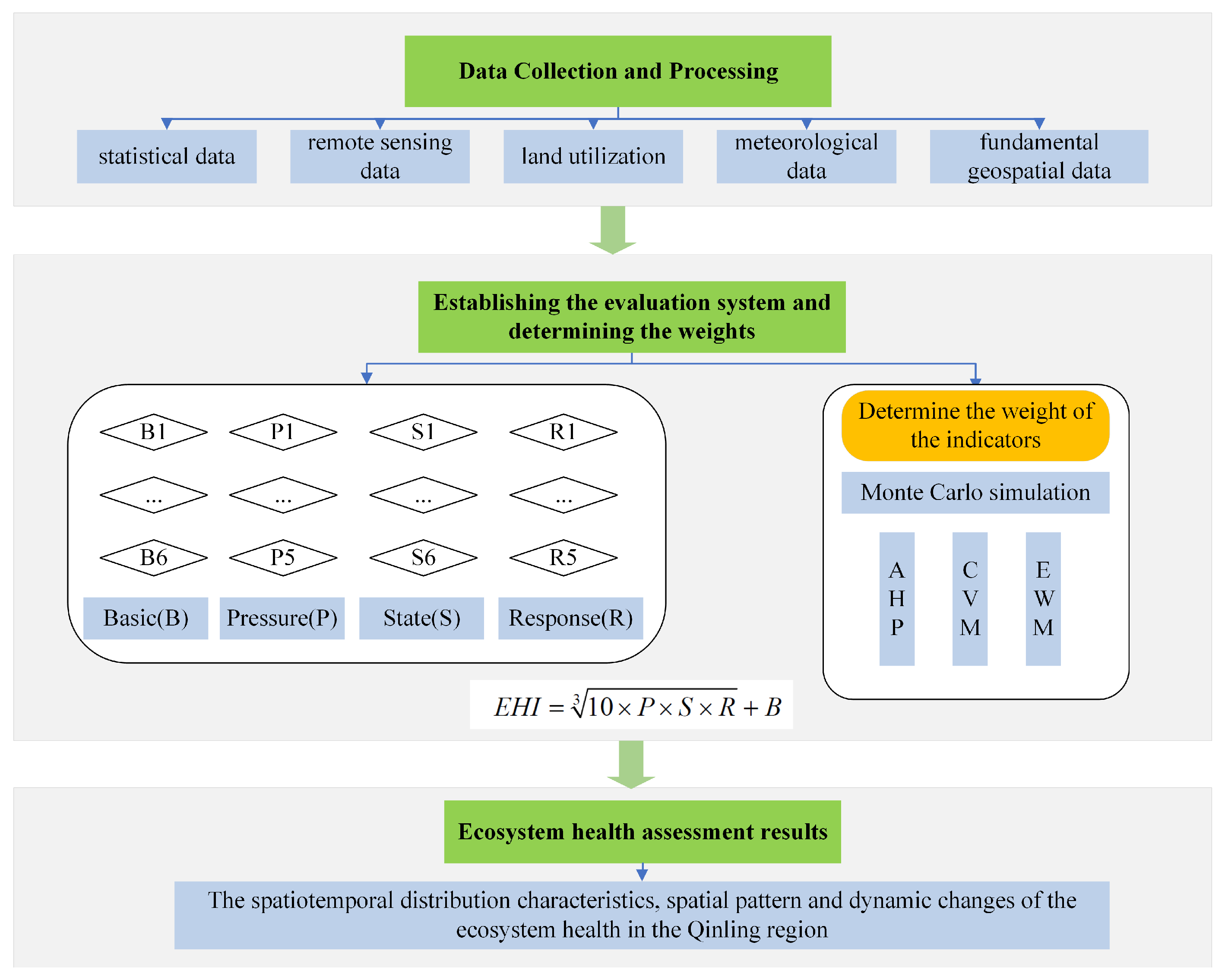
The overall technical framework of this study is shown in Figure 2. Building upon the PSR conceptual framework, this study integrates the ecosystem’s fundamental natural material conditions to refine the original PSR model and proposes an improved BPSR model. This enhanced framework is subsequently employed to develop a comprehensive ecological health evaluation index system for the Qinling region. To determine indicator weights, three methods—the Analytic Hierarchy Process (AHP), the coefficient of variation method, and the entropy weight method—are initially applied to derive individual weighting schemes. Subsequently, a triangular probability distribution within a Monte Carlo simulation is utilized to integrate these results and optimize the combined weights, thereby enhancing the robustness and objectivity of the weighting process. Finally, an integrated evaluation model is constructed using the ArcGIS 10.6 platform to quantify ecosystem health levels in the Qinling region from 2000 to 2023, followed by a systematic analysis of their spatiotemporal distribution, spatial patterns, and dynamic evolution characteristics. Furthermore, the Geodetector method is employed to quantitatively assess the driving forces behind the observed spatial heterogeneity of ecosystem health.

2.3.1. Construction of the Index

Establishing a comprehensive and effective ecosystem health evaluation index system is crucial for accurately quantifying and assessing ecological conditions. However, a unified standardized index system has not yet been formed in this field. To scientifically and reasonably select indicators, it is necessary to be able to reflect the characteristics of the specific regional ecosystem and comprehensively represent its health status.
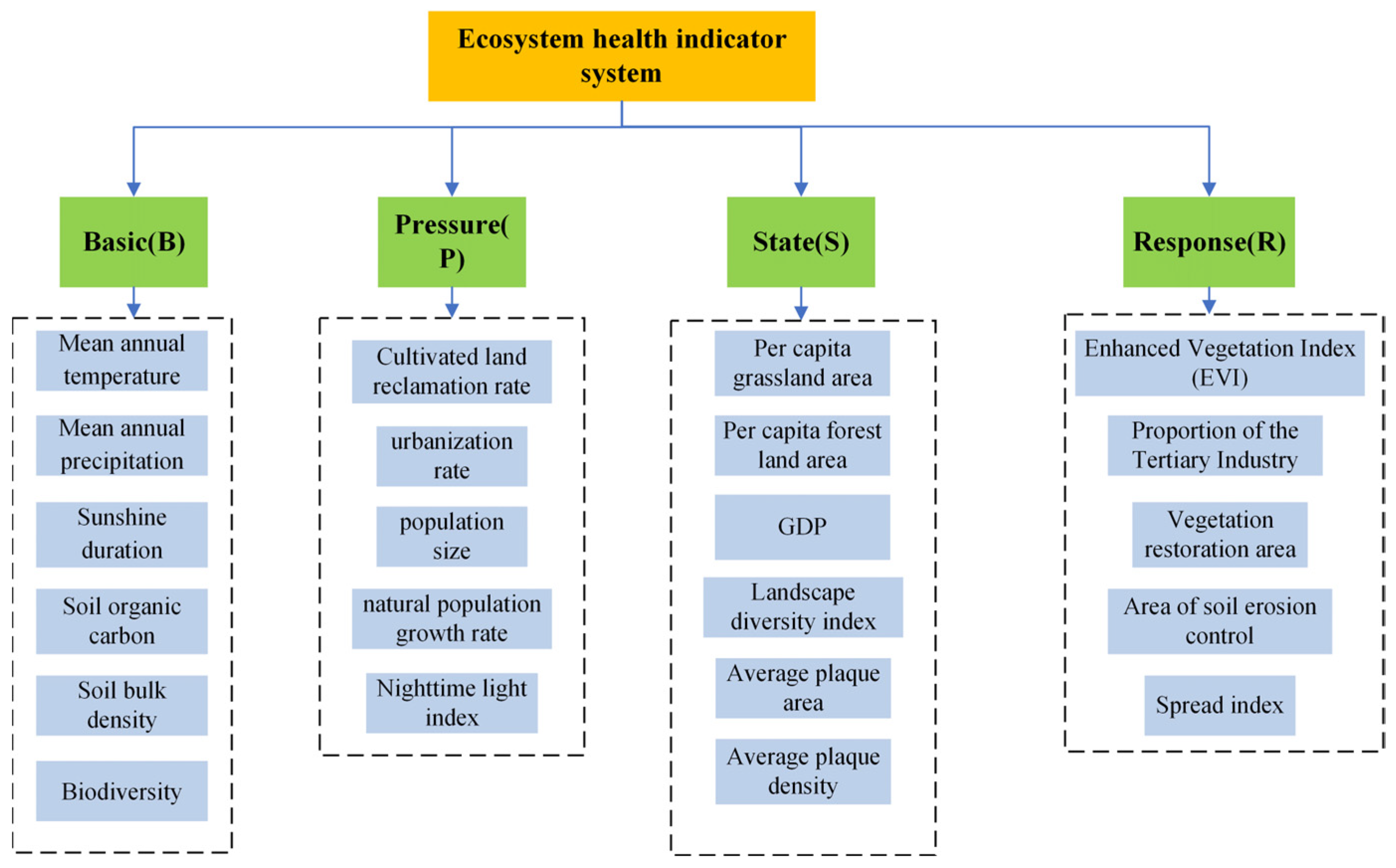
For this purpose, based on a wide literature review and considering the actual situation of the Qinling region, data availability, and research results in related areas, this study constructed an ecosystem health evaluation index system for the Qinling region using the BPSR (Base–Pressure–State–Response) model as the framework [4,14,19,20,25,34,35,36,37]. This system selected a total of 22 specific indicators from four dimensions: base, pressure, state, and response (Figure 3), aiming to systematically assess the background conditions, external pressures, current status, and social responses of the Qinling ecosystem, providing a scientific basis for its comprehensive diagnosis of health status. Specifically, the base indicators (B) represent the natural background conditions that maintain the stability of the ecosystem, including annual average temperature, annual precipitation, soil organic carbon, soil bulk density, and biodiversity. The pressure indicators (P) reflect the direct stress on the ecosystem caused by human socio-economic activities, including the rate of cultivated land reclamation, urbanization rate, total population, natural population growth rate, and night light index (data allocated at the county/city level). The state indicators (S) depict the current status and sustainability of the ecosystem under the combined effects of natural and human pressures, including per capita grassland area, per capita forest area, per capita GDP, landscape diversity index, average patch area, and average patch density. The response indicators (R) refer to management actions and positive factors taken to mitigate ecological degradation and promote recovery, including enhanced vegetation index (EVI), the proportion of the tertiary industry, the area of vegetation restoration, the area of soil and water conservation, and sprawl index.

2.3.2. Determination of Evaluation Indicator Weights

The determination of indicator weights is critical in ecosystem health assessment, as it directly influences the evaluation outcomes. To enhance the scientific rigor and rationality of weight assignment and minimize arbitrariness, this study employed a combination of the Analytic Hierarchy Process (AHP), the Coefficient of Variation method, and the Entropy Weight method. This integrated approach incorporates both subjective and objective weighting techniques. Furthermore, a combined weighting method based on Monte Carlo simulation was applied to improve the accuracy and reliability of the calculated indicator weights.
The Analytic Hierarchy Process (AHP) is a hierarchical decision-analysis method that combines qualitative and quantitative approaches to address complex multi-objective problems. Based on expert experience and existing research data, AHP compares factors within the same level to determine interactions and relative importance among hierarchical indicators [27]. Numerical assignments are used to construct a judgment matrix, through which the weight of each indicator is calculated. In this study, following the evaluation objectives and the BPSR conceptual model, judgment matrices were developed for each element layer—namely the goal layer, criterion layer, and indicator layer—using the AHP methodology. For the construction of the judgment matrices, a commonly adopted scoring scale was applied to perform pairwise comparisons quantifying the relative importance of different indicator factors within the same hierarchy [19,38].
To verify whether the results derived from the AHP method meet logical consistency requirements, a consistency check was conducted. The calculation formula is as follows:
λ m a x = i = 1 n A α i n α i ,
C R = C I R I ,
C I = λ m a x n n 1 ,
where
λ m a x is the maximum eigenvalue;
A represents the pairwise comparison matrix;
α i denotes the weight vector;
R I is the random consistency index of the judgment matrix;
n indicates the order of the matrix.
Generally, when the consistency ratio (CR) is less than 0.10, the judgment matrix is considered to pass the consistency test, and the determined weights are deemed valid. Using the Analytic Hierarchy Process (AHP), the weight values for each indicator in the ecosystem health evaluation of the Qinling region were assigned layer by layer. Based on the BPSR framework model, the calculated consistency ratios (CR) for the BPSR, B, P, S, and R layers were all less than 0.10, indicating that all judgment matrices passed the consistency test and that the resulting weights are consistent. The weights of the evaluation indicators determined by the Analytic Hierarchy Process (AHP) method are presented in Table 1 (denoted as w 1 ).
The Coefficient of Variation (CV) method is an objective weighting approach that determines weight values directly based on the degree of variation in the information contained within each indicator [3,30]. It effectively and objectively describes the deviation trends of indicators. In an evaluation indicator system, the greater the dispersion and differentiation in the data distribution of an indicator, the more information it carries, and thus the higher its weight; conversely, the weight of the indicator is smaller. The calculation formula is as follows:
C V i = σ i x i ¯ i = 1 , 2 , 3 , 4 , n ,
w i = C V i i = 1 n C V i ,
where
V i is the coefficient of variation of the i-th indicator;
σ i and x are the standard deviation and mean of the standardized values of the i-th indicator, respectively;
w i denotes the weight of the i-th indicator (denoted as w 2 in Table 1).
The Entropy Weight Method is an objective weighting technique that determines indicator weights based on the information entropy contained within the evaluation indicators. It is used to analyze and interpret the underlying information conveyed by the indicators [27]. For a given set of evaluation indicators, the information entropy value can reflect their degree of dispersion. A smaller information entropy indicates higher variability and greater information content, resulting in a higher weight; conversely, a larger entropy value corresponds to a lower weight [31]. The use of the Entropy Weight Method can, to some extent, mitigate limitations arising from interrelationships among indicators. The calculation procedure is as follows:
(1)
Assume the ecosystem health evaluation model consists of m evaluation objects and n evaluation indicators. The initial matrix of the evaluation system is constructed as follows:
X = X i j i = 1 , 2 , 3 , 4 , m ; j = 1 , 2 , 3 , 4 , n ,
(2)
Calculate the proportion and entropy value of each indicator:
P i j = X i j i = 1 m X i j ,
e i = k j = 1 n P i j l n P i j ,
(3)
Calculate the weight of each indicator:
w i = 1 e i m i = 1 m e i ,
where
e i is the information entropy of the i -th indicator;
k is a constant defined as k = 1 / l n   n ;
X i j represents the standardized value of the i -th indicator for the j -th evaluation object;
w i denotes the weight of the i -th indicator (denoted as w 3 in Table 1).
To mitigate the uncertainties in evaluation results arising from subjective and objective weight assignments, this study integrates the three weighting methods mentioned above. Drawing on previous research [14,15,16,17,18,19,20,21,22,23,24], a Monte Carlo simulation was introduced to establish an optimized decision-making model, ensuring consistency in the degree of variation between subjective and objective coefficients and thereby obtaining relatively ideal combined weight values.
Monte Carlo simulation is a numerical computation method guided by probability statistics and mathematical statistics. Its fundamental principle involves establishing a probabilistic random distribution model based on the mathematical characteristics of the problem, followed by repeated random sampling simulations of the target parameters. When the number of random simulations reaches a sufficient scale, stable and reliable results can be obtained [39,40].
Various probability distribution functions can be used in Monte Carlo simulation. This study employs a triangular probability distribution function to construct the indicator probability distribution model. The triangular probability function, recommended by the Intergovernmental Panel on Climate Change, offers the advantage of parameter minimization and can be used to quantify uncertainties in different indicator weights. According to the definition of the triangular distribution probability function, only the lower limit, upper limit, and the most likely value (midpoint) of the parameters are required to perform the Monte Carlo simulation. The formula for calculating the combined weights is as follows:
w = r a n d o m t r i a n g u l a r m i n w 1 w 2 w 3 m a x w 1 w 2 w 3 a v e w 1 w 2 w 3 ,
where
w 1 , w 2 , and w 3 represent the weights derived from the Analytic Hierarchy.
The Process (AHP), the Coefficient of Variation (CV) method, and the Entropy Weight method are given, respectively, for each indicator. Based on the relevant theoretical framework, this study utilized the PyCharm 2024.1 software platform to perform Monte Carlo simulations using a triangular probability distribution. The number of random iterations was set to 800, leading to the final determination of the weights for each evaluation indicator (Table 1).

2.3.3. Calculation of the Ecosystem Health Index (EHI)

The Ecosystem Health Index (EHI) for the Qinling region was calculated using the following formula:
E H I = 10 × P × S × R 3 + B ,
B = i = B 1 n W i × X i n = B 1 , B 2 , , B 6 ,
P = i = R n W i × X i n = P 1 , P 2 , , P 9 ,
S = i = S 1 n W i × X i n = S 1 , S 2 , , S 8 ,
R = i = R 1 n W i × X i n = R 1 , R 2 , , R 5 ,
where
n represents the total number of evaluation indicators;
W i denotes the weight coefficient of the *i*-th evaluation indicator;
X i indicates the standardized value of the * i *-th evaluation indicator.

2.3.4. Other Methods

To ensure the clarity of the research process and the repeatability of the methods, the specific methods involved in data standardization, ecosystem health grading, and trend analysis (including range standardization, natural breaks classification method, Mann–Kendall test, and Theil–Sen median trend analysis, etc.) are uniformly placed in the Supplementary Materials (see Sections S1–S3 of the Supplementary Materials). Additionally, to quantitatively identify the key driving factors behind the spatial differentiation of ecosystem health, this study applied the single-factor detection module of the geographical detector method. This method excels in quantifying the individual explanatory power of various potential drivers on the spatial heterogeneity of the target variable, offering the advantage of making no strict assumptions about data linearity. The detailed principles and application procedures of this method are provided in Section S4 of the Supplementary Materials. The above standardization, analysis, and factor detection methods constitute the core basis for data processing, trend judgment, and driving force analysis in this study.

3. Results

3.1. Spatiotemporal Variation Characteristics of Basic Indicators (B)

Basic indicators are core parameters characterizing the background conditions and fundamental features of an ecosystem. Research results show that the basic index of ecosystem health in the Qinling region has changed relatively little from 2000 to 2023, but has shown a weak upward trend. Specifically, the average values for each year are as follows: 2000 (0.506), 2005 (0.526), 2010 (0.594), 2015 (0.597), 2020 (0.507), and 2023 (0.607), with 2015 being the peak. Overall, this reflects a trend of gradual improvement in the ecological background of the region amid fluctuations. In terms of spatial distribution (Figure 4), the basic index shows a significant north–south differentiation, with an overall pattern of “high in the south and low in the north”. High-value areas are mainly concentrated in the southern part of the Qinling Mountains, including Ankang City, Ziyang County, and Hanyin County, indicating that the ecosystem structure in these areas is relatively complete and the natural endowment is relatively good. Low-value areas are mainly distributed in the transitional zone between the northern foot of the Qinling Mountains and the Guanzhong Plain, including Chencang District and Qishan County of Baoji City, Baqiao District and Lintong District of Xi’an City, and parts of Huayin City. These areas are usually more affected by human activities and have relatively weak ecological background conditions.

3.2. Spatiotemporal Variation Characteristics of Pressure Indicators (P)

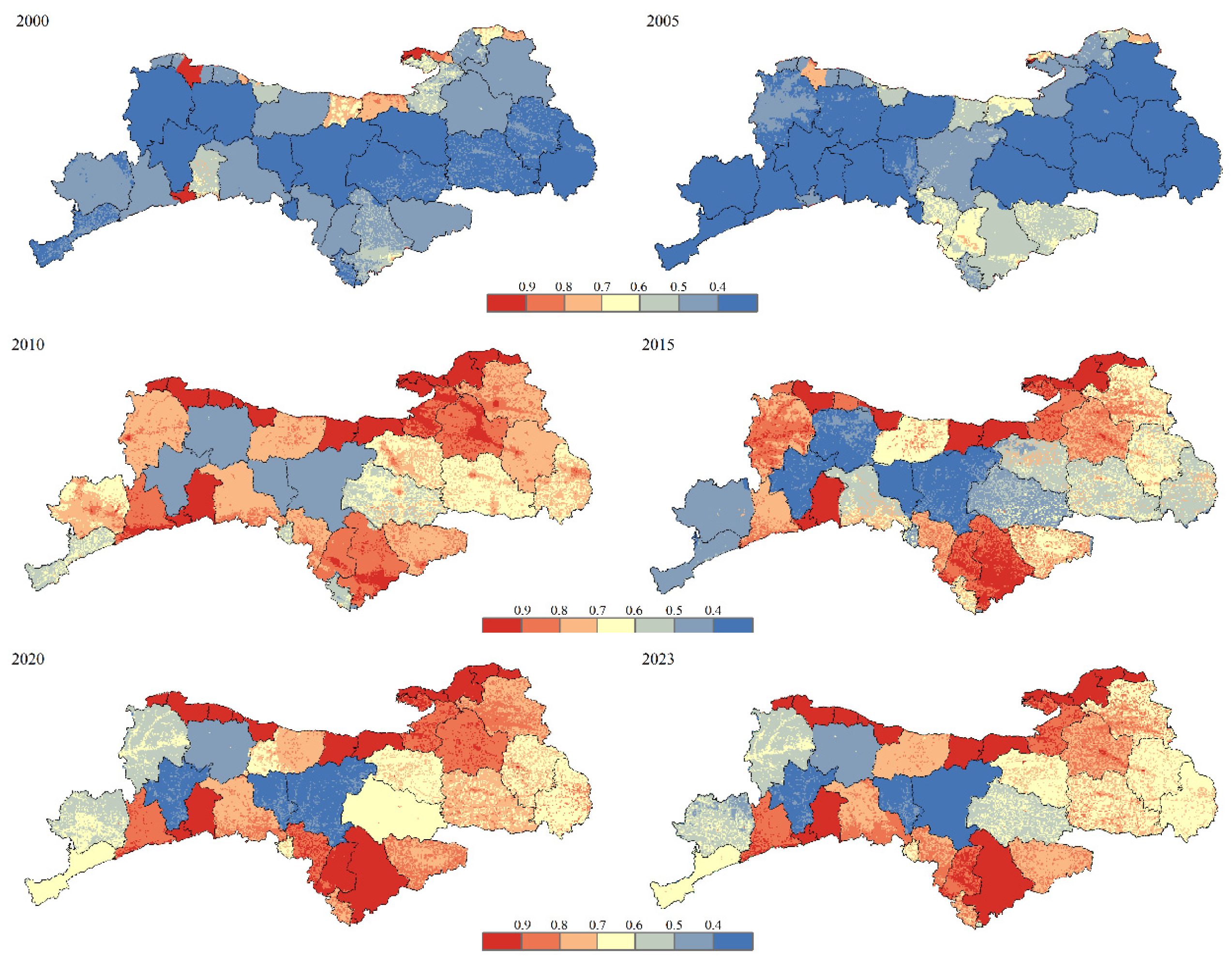
Pressure indicators are negative metrics reflecting the direct driving factors of ecosystem health degradation, with higher values indicating greater external disturbance pressure and lower values indicating reduced pressure. From 2000 to 2023, the average annual pressure index in the Qinling region ranged from 0.1332 to 0.4776. The average values for each year were 0.4005 (2000), 0.3127 (2005), 0.3131 (2010), 0.4179 (2015), 0.3086 (2020), and 0.1332 (2023). Overall, it showed a fluctuating downward trend, with 2023 being the lowest point during the study period, indicating that the human disturbance to the ecosystem has generally weakened. Spatially (Figure 5), the pressure index presented a pattern of “high in the north and south, low in the middle”. High-value areas were mainly distributed in Hanzhong City’s Hanzhong District and Hanyin County, as well as Xi’an City’s Huxian County, Chang’an District, Lantian County, and Lintong District, where the ecosystems were subject to higher levels of human disturbance.
Spatial autocorrelation analysis based on the ArcGIS 10.6 platform indicated that this spatial pattern was closely related to the degree of human disturbance. Specifically, counties and cities with higher pressure generally showed an increasing trend in human disturbance over the years, such as Hantai District, Lintong District, Chencang District, Weibin District, Huayin City, Nanzhong County, Linwei District, Chang’an District, Chenggu County, Hanzhong District, and Huxian County. Among them, Hantai District had the most significant increase in human disturbance, rising from 4.80% to 16.95%, with a cumulative increase of 12.14 percentage points over 20 years, more than tripling. Lintong District followed with an increase of 8.88 percentage points. These areas are mostly located in the low-altitude areas of the northwest, northeast, and southwest of the Qinling Mountains, where economic development is rapid and urban construction land expansion is obvious, exerting a significant negative impact on ecosystem health. The remaining counties and cities, with relatively slow economic development and limited growth in construction land, are mainly distributed in the central Qinling region, with lower and stable human disturbance, and relatively smaller disturbance to the ecosystem.

3.3. Spatiotemporal Variation of State Indicators (S)

State indicators are key parameters that characterize the integrity of the ecosystem structure and function and reflect its sustainable development capacity. From 2000 to 2023, the state index values in the Qinling region ranged from 0.210 to 0.2685. The average values for each year were 0.2506 (2000), 0.2224 (2005), 0.2106 (2010), 0.2307 (2015), 0.2540 (2020), and 0.2482 (2023), showing a fluctuating pattern of “initial decline, subsequent rise, and then a slight drop”. The lowest point was in 2010, and the peak was in 2020. Spatially (Figure 6), the state indicators generally presented a distribution pattern of “high in the middle and low around the periphery”. Further analysis revealed that from 2005 to 2015, the state indicators in the southern foot of the Qinling Mountains and most counties in the east showed a downward trend, with the most significant decline rates in Shanyang County, Xixiang County, Shangnan County, Shangzhou District, and Ningqiang County. The spatial autocorrelation analysis of landscape pattern indices conducted on the ArcGIS 10.6 platform indicated that the decline in state indicators in these areas was mainly due to the degradation of landscape ecological environment quality and the intensification of patch fragmentation. Specifically, the patch density values in Shanyang County, Xixiang County, Shangnan County, Shangzhou District, and Ningqiang County were generally high, reflecting a relatively fragmented landscape structure. Overall, high patch density areas were mainly distributed in the southern and eastern foot of the Qinling Mountains, while the patch density in the northwest region was relatively low. Meanwhile, Hanbin District, Hantai District, Nanzhong County, Lintong District, Xunyang County, and Huayin City had relatively high diversity and evenness indices, indicating a lack of dominant types in their landscape systems, a more mixed structure, and a higher degree of fragmentation. These areas were mostly located in the lower altitude zones of the southern and northern foot of the Qinling Mountains, strongly influenced by human activities, and the landscape continuity was significantly disturbed. In contrast, Ningxian County, Liuba County, Foping County, Taibai County, Zhouzhi County, and Feng County had relatively high sprawl indices, suggesting good connectivity between landscape patches, a relatively complete spatial structure, and a lower degree of fragmentation. In contrast, Hanyin County, Ningqiang County, Xunyang County, Nanzhong County, and Hanbin District had generally low sprawl indices, further confirming the prominent landscape fragmentation issues in these areas.

3.4. Spatiotemporal Variation Characteristics of Response Indicators (R)

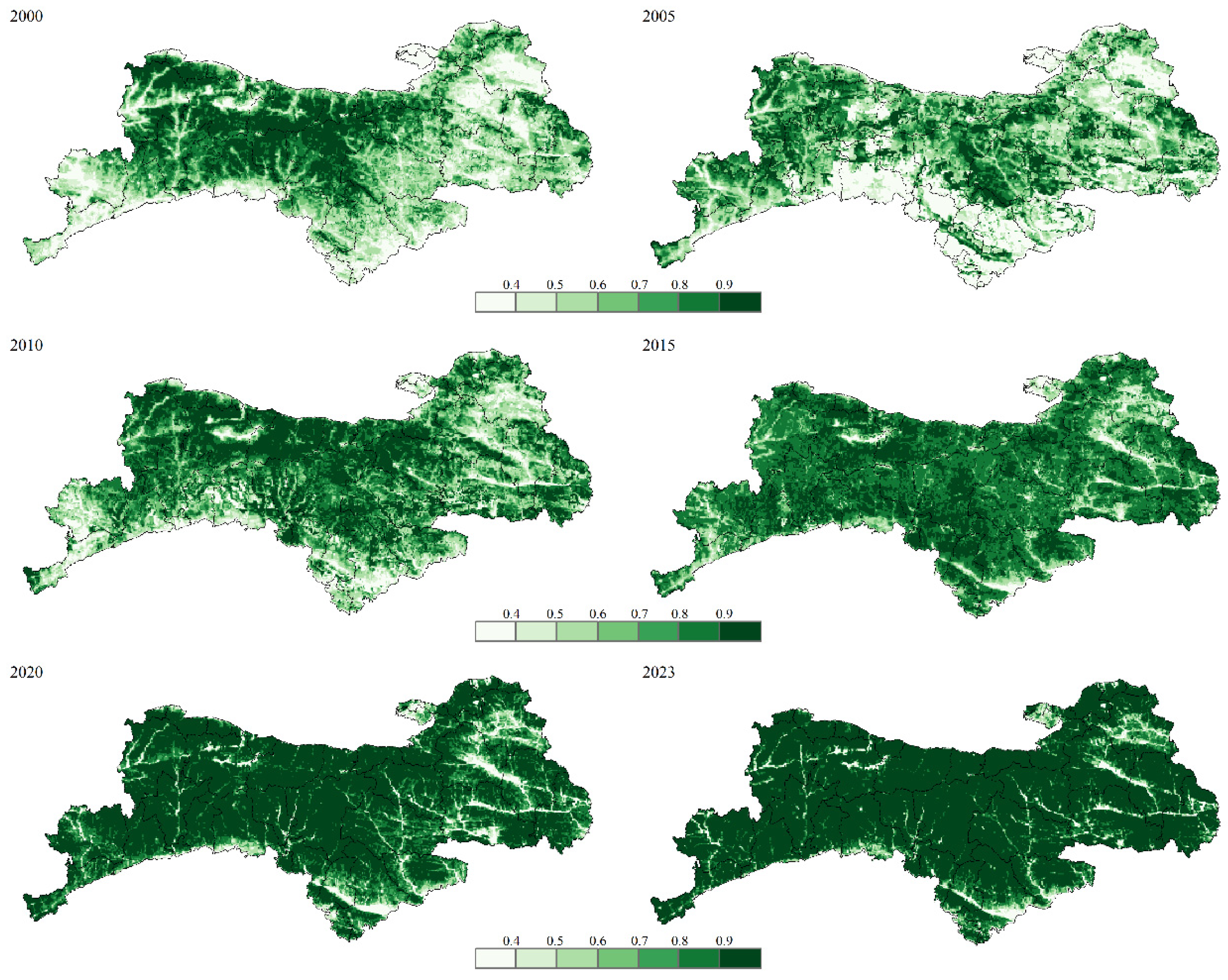
Response indicators are key parameters that represent the regulatory capacity and recovery effect of the ecosystem under human intervention. The response index of the Qinling region ranged from 0.4114 to 0.5509 between 2000 and 2023, showing an overall evolution pattern of “initial slight increase, followed by a slight decrease, and then a continuous rise”. Particularly after 2020, there was a significant increase. The response index in 2020 and 2023 reached 0.5507 and 0.5509, respectively, which were the highest levels during the study period (Figure 7). Spatial autocorrelation analysis conducted on the ArcGIS 10.6 platform revealed that the spatial distribution and temporal changes of the response index were highly positively correlated with vegetation coverage and forest coverage. Specifically, the high-value areas of the response index mainly corresponded to regions with good vegetation coverage and continuous forest distribution, reflecting the significant promoting effect of vegetation restoration and forest protection on the ecosystem’s response capacity. In terms of vegetation coverage, the overall vegetation coverage level in the Qinling region was relatively low in 2000, with only four counties and cities having a vegetation coverage of over 0.8, namely Zhouzhi County, Liuba County, Foping County, and Ningshan County. By 2010, the number of counties and cities with high vegetation coverage had increased to 28, including Liuba County, Foping County, Ningshan County, Zhouzhi County, Taibai County, etc. By 2020, the vegetation coverage in the entire region had further improved, with most areas experiencing an increase in NDVI of 0.03 to 0.06. This vegetation recovery process was highly synchronized with the upward trend of the response index, indicating that the improvement in vegetation coverage was an important driving force for the growth of the response index. Even in Lintong District, which had a relatively poor vegetation background, the NDVI value gradually increased from 0.60 in 2000 to 0.71 in 2020, and the response index also showed a steady increase, further confirming the co-evolutionary relationship between the two. The impact of forest coverage on the response index was also significant. Ningshan County, Liuba County, Foping County, Luoyang County, and Taibai County, which had a forest coverage of over 90%, were all located in the high-value areas of the response index. These counties and cities are situated in the high-altitude mountainous areas in the northwest of the Qinling Mountains, with complex terrain and dominated by forest land cover, forming a forest landscape with strong connectivity and complete structure, providing an important foundation for maintaining a high response capacity of the ecosystem. In contrast, counties and cities with lower forest coverage, such as Luonan County, Huayin City, and Lintong District, which are located in areas with gentle terrain and dense human activities, generally had lower response indices.

3.5. Spatial Change Rate and Dynamic Characteristics of the Ecosystem Health Index

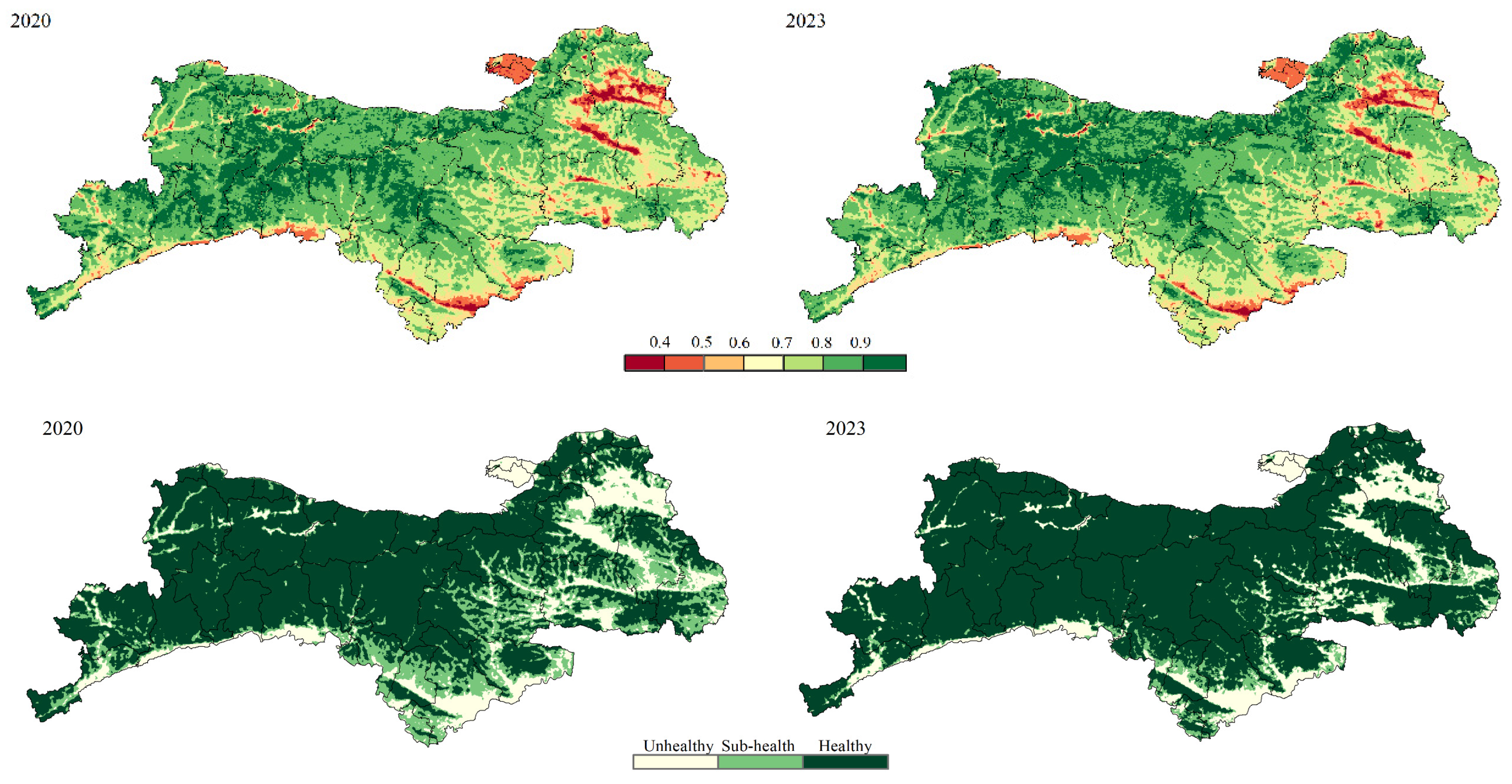
The health status of the ecosystem in the Qinling region shows significant heterogeneity both in time and space. The overall spatial pattern presents a “low in the south and high in the north” distribution feature, with the high-value areas mainly located in the Wei River Basin under the jurisdiction of Baoji City and Xi’an City. This area is dominated by mountainous and hilly terrain, with high vegetation coverage and relatively low human disturbance. The ecosystem structure is complete and the function is stable, resulting in a relatively good overall health level. In contrast, the ecosystem health level in the Hanjiang River Basin in the southern part of the Qinling Mountains, including Hanzhong City and Ankang City, is generally lower. This area has a dense river network and convenient transportation, with frequent human activities, leading to a higher degree of habitat fragmentation and a decline in landscape connectivity, which has a more significant impact on the health of the ecosystem.
From the perspective of temporal evolution, the health level of the ecosystem in the study area has shown a continuous improvement trend from 2000 to 2023. Specifically, it can be divided into three stages:
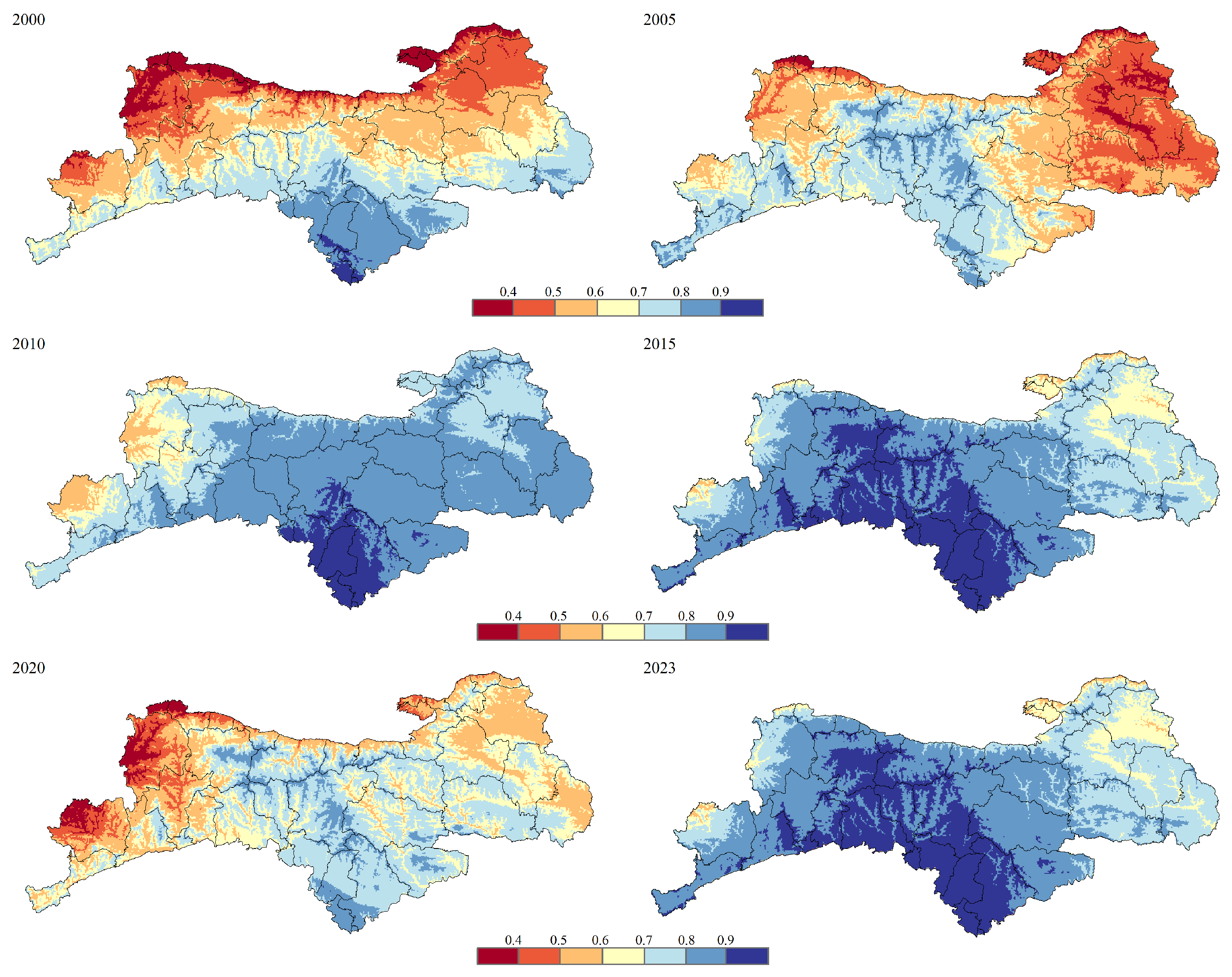
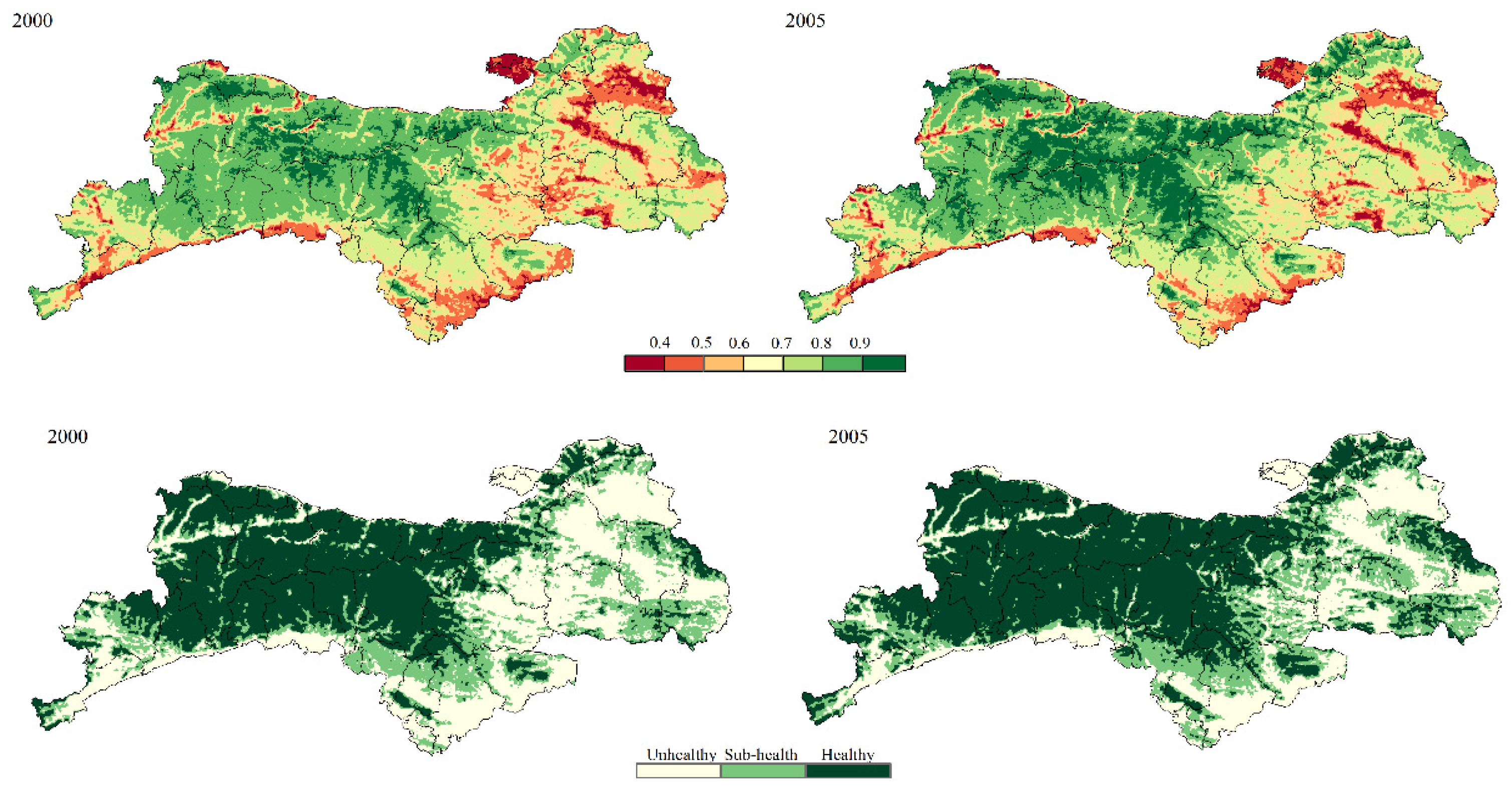
Figure 8 shows the comparison of the ecosystem health index and its health grade assessment results in 2000 and 2005. During this period, the overall ecosystem health condition remained stable, with areas classified as healthy accounting for 60.17% and 62.47% of the total study area in 2000 and 2005, respectively. The average ecosystem health index increased from 0.723 in 2000 to 0.785 in 2005, with extreme values observed in Foping County (0.976 in 2005) and Lintong District (0.204 in 2000). Among the counties and districts included in the study, 20 maintained a health index consistently above the regional average, while 17 remained persistently below it. With regard to the spatial distribution of health grades, healthy areas—defined as those with an index between 0.6 and 1.0—were primarily located in Zhouzhi County, Chenggu County, Yang County, Xixiang County, Foping County, Feng County, Lüeyang County, Chencang District, Taibai County, Ningshan County, and other regions, totaling 18 counties and districts. Among these counties, Xixiang County, Lüeyang County, Liuba County, Foping County, Ningshan County, and Taibai County consistently maintained a health index above 0.9, indicating excellent ecosystem integrity, a well-structured landscape pattern, high vegetation coverage, and the absence of evident ecological degradation. Sub-healthy areas—defined as those with a health index between 0.25 and 0.6—included 12 counties and districts, such as Lantian County, Mian County, Ningqiang County, Mei County, Qishan County, Xunyang County, Hanbin District, Hanyin County, and Shangzhou District. These regions exhibit a largely intact ecosystem structure, a relatively rational landscape configuration, moderate vegetation coverage, and minimal exposure to external disturbances, contributing to good system stability, recovery capacity, and functional maintenance of basic ecological processes. Unhealthy areas were predominantly located in Hantai District, Nanzhong District, and Linwei District, where significant human-induced disturbances have led to alterations in landscape structure, reduced average vegetation coverage, and partial degradation of ecological functions, reflecting observable ecological anomalies.
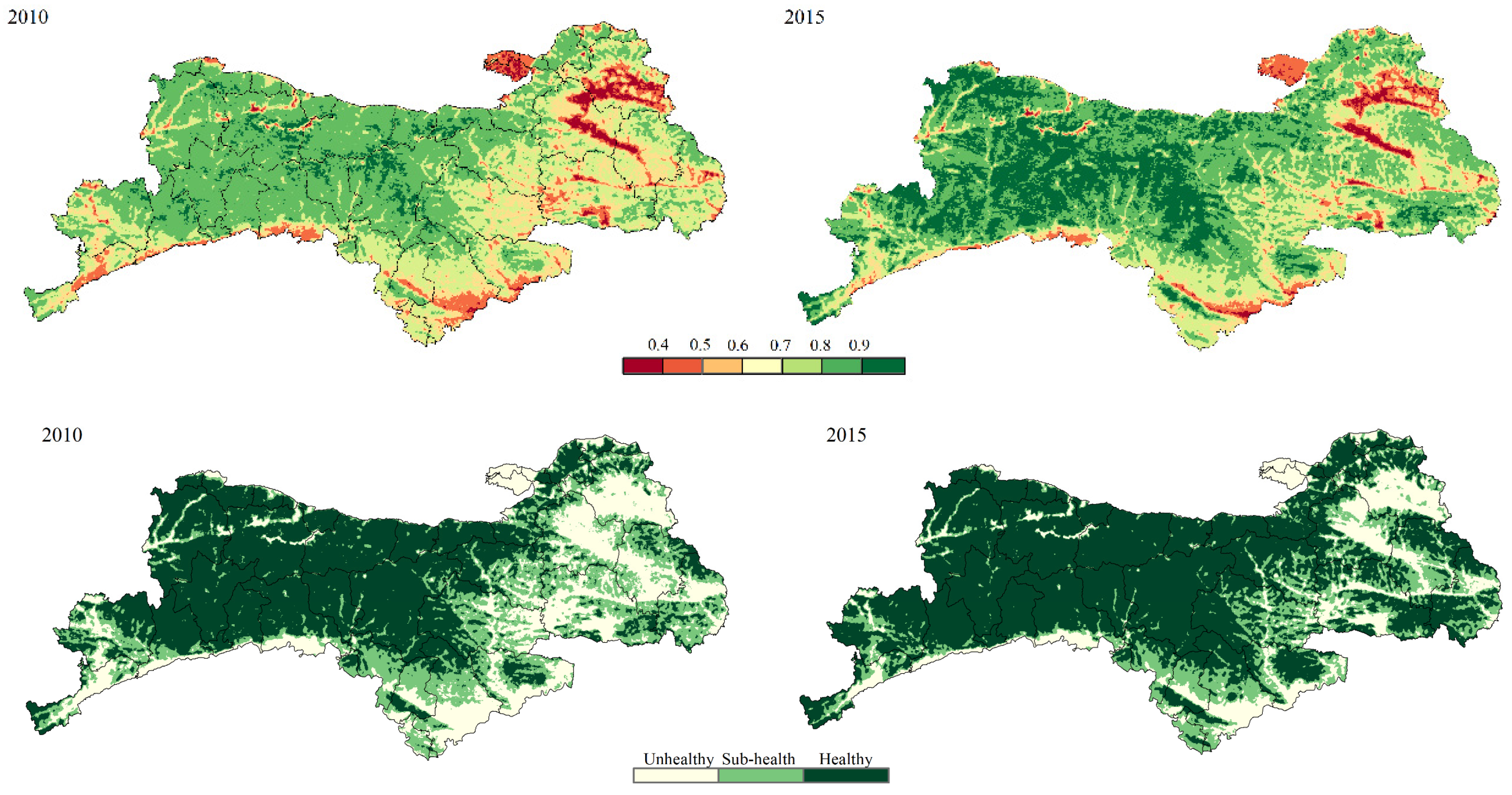
Figure 9 shows the comparison of the ecosystem health index and its health grade assessment results in 2010 and 2015. During this period, the ecosystem health level in the Qinling region continued to improve. The proportion of healthy areas increased from 62.73% to 65.14%, while the average ecosystem health index rose from 0.800 in 2010 to 0.816 in 2015, representing an increase of 0.093 compared to the year 2000. The maximum value was recorded in Xixiang County (0.923 in 2015), whereas the minimum persisted in Lintong District (0.229 in 2015). Thirteen counties and districts—including Chang’an District, Zhouzhi County, Xixiang County, Feng County, Lüeyang County, Taibai County, Liuba County, Ningshan County, Foping County, Shiquan County, and others—maintained a consistently healthy status, characterized by stable natural conditions, high vegetation coverage, strong landscape connectivity, and the absence of significant ecological degradation. The proportion of sub-healthy regions declined from 22.1% in 2010 to 20.8% in 2015 and primarily included Ningqiang County, Mian County, Chenggu County, Yang County, Weibin District, Qishan County, Mei County, Huayin City, Tongguan County, and Luonan County. Compared to 2000, the extent of unhealthy areas decreased from 16.4% to 14.6%, mainly concentrated in parts of Hantai District, Linwei District, and Nanzheng County. These regions exhibited low ecosystem vitality, insufficient vegetation cover, fragmented landscape structures, and limited recovery capacity, reflecting clear signs of ecological degradation.
Figure 10 shows the comparison of the ecosystem health index and its health grade assessment results in 2020 and 2023. During this period, the health level of the ecosystem showed a steady upward trend. The average ecosystem health index rose from 0.837 in 2020 to 0.856 in 2023, a significant increase of 0.133 compared to 2000 (α < 0.05), reflecting an overall trend of continuous improvement in regional ecological quality. Spatially, Foping County had the highest health index of 0.957 in 2023, demonstrating an outstanding ecological state; although Shangzhou District had the lowest index of 0.241, the overall upward movement of the index still indicated the wide-ranging nature of ecological improvement. In terms of area changes, the range of areas rated as healthy grades significantly expanded (α < 0.05), increasing from 66.12% to 68.48% of the total study area, becoming the main body of the regional ecosystem. These healthy areas were widely distributed in 17 counties and districts including Chang’an District, Zhouzhi County, Yang County, Xixiang County, Lüeyang County, Liuba County, Foping County, Feng County, Taibai County, Ningshan County, and others, with stable ecosystem structures and complete functions. The sub-healthy areas covered 12 counties and cities including Ningqiang County, Mian County, Chenggu County, and others. These regions had reasonable landscape structures, generally high vegetation coverage, low levels of human activity disturbance, and basically normal ecosystem service functions, with potential for further optimization and improvement. Notably, the area of unhealthy regions significantly shrank, accounting for only 10.7% to 11.5% of the total study area, a cumulative reduction of 3265.268 km2 compared to 2000. This significant change confirmed the continuous improvement of the overall health status of the ecosystem in the Qinling region, reflecting the positive effects of ecological protection and restoration efforts.
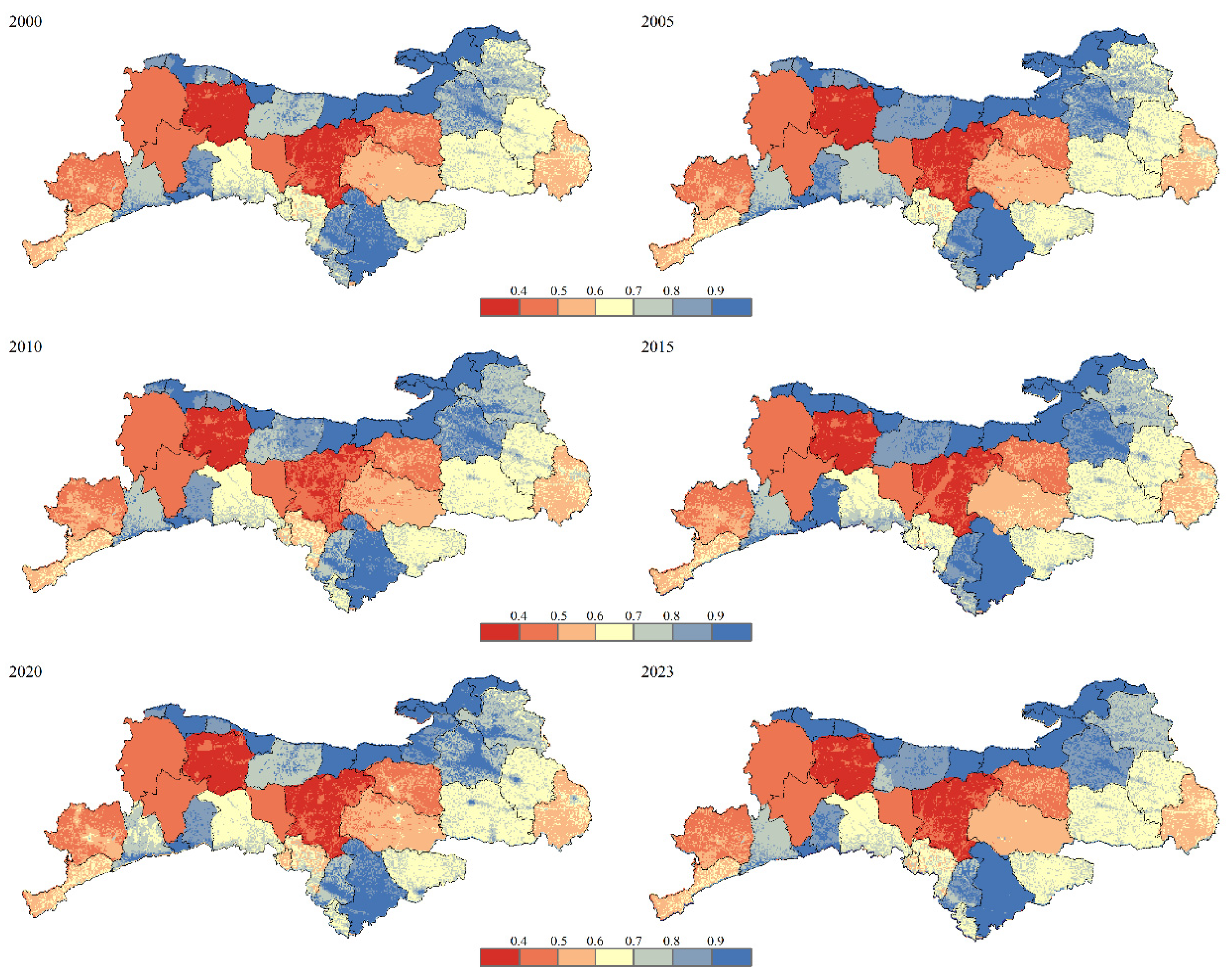
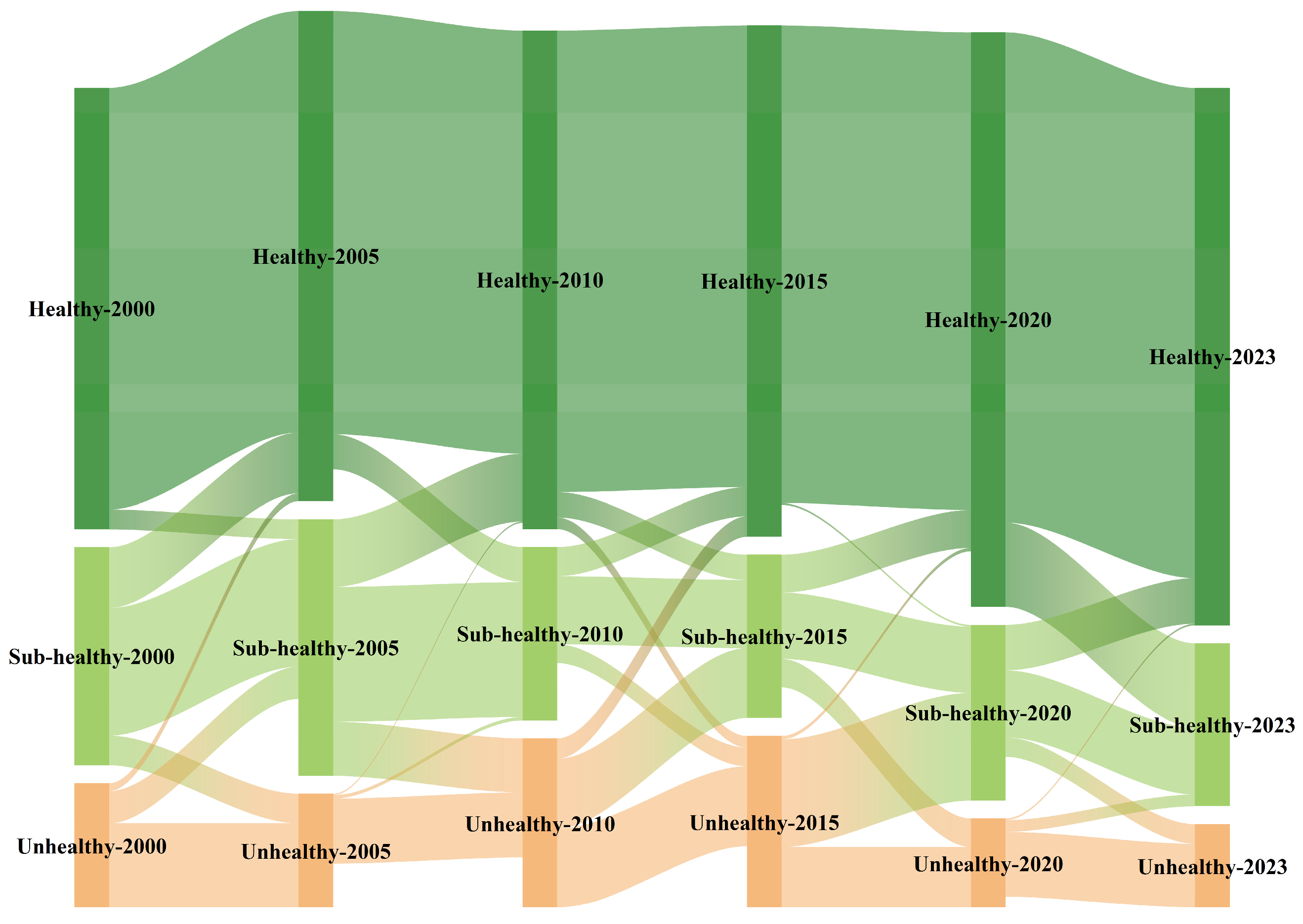
Matrix transfer analysis of changes in the ecosystem health index for the Qinling region was conducted using the ArcGIS 10.6 platform. The results indicate that the transition patterns of ecosystem health conditions across different time periods are significantly distinct (Figure 11 and Figure 12).
Over a ten-year timescale, from 2000 to 2010, ecosystem health conditions deteriorated to some extent in certain areas. Five administrative units—Chencang District, Chenggu County, Huxian District, Qishan County, and Weibin District—transitioned from a healthy to a sub-healthy status. Hantai District, Linwei District, and Nanzhong County shifted from sub-healthy to unhealthy categories. Quantitatively, areas transitioning from healthy to sub-healthy states accounted for 11.2% of the total study area, while those shifting from sub-healthy to unhealthy states constituted 18.4%. Concurrently, improvements were observed in several regions, including Lintong District, Shanyang County, and Shangnan County, whereas most other areas remained relatively stable. Specifically, 8.37% of the total area improved from unhealthy to sub-healthy conditions, and 12.4% transitioned from sub-healthy to healthy conditions. Overall, the ecosystem health dynamics during this period exhibited a general pattern of “significant improvement in localized areas with stability prevailing elsewhere,” with the most pronounced enhancements occurring in the Danjiang River Basin and its surrounding regions—changes that passed the significance test (α < 0.05).
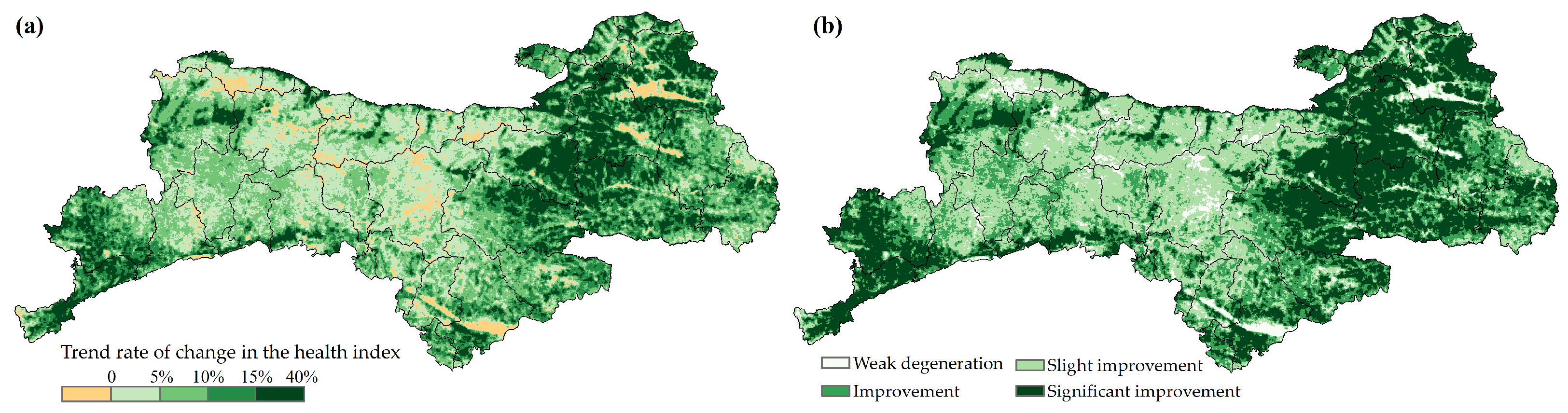
From 2010 to 2023, the spatial extent of ecosystem health deterioration was limited and statistically non-significant. Deteriorated areas were primarily located in relatively flat, densely populated regions of northeastern Qinling, such as Lantian County, Hanyin County, Linwei District, and Tongguan County. These areas are characterized by high population density, intense industrial development, and intensive land use. In contrast, the area exhibiting improved health conditions was substantially larger, accounting for 41.6% of the total study area, of which 22.4% showed statistically significant improvement (α < 0.05); an additional 26.4% of the area remained unchanged in terms of health grade. In terms of categorical transitions, Shanyang County, Yang County, Weibin District, Xunyang County, and Hanyin County improved from sub-healthy to healthy status, while Hantai District, Nanzhong County, Danfeng County, and Shanyang County advanced from unhealthy to sub-healthy status. The remaining areas showed moderate increases in index values without crossing health-grade thresholds. The overall trend of ecosystem health evolution during this period can be summarized as “gradual improvement across most regions with localized stability.”
Collectively, over the past 23 years, the ecosystem health of the Qinling region has exhibited a statistically significant spatial change trend (α < 0.05), with a clear overall upward trajectory. The improvement in health levels is primarily attributed to the reduction in ecological pressure—particularly, the pressure index reaching its lowest level in 2023—and the continuous enhancement of ecosystem response capacity, closely associated with vegetation restoration efforts. However, improvements in fundamental indicators representing ecological background conditions have been limited, and structural integrity (status indicators) has declined in some areas due to landscape fragmentation. Overall, 68.2% of the region experienced improved ecosystem health conditions, with more than 60% showing positive evolutionary trends, and 48.6% underwent actual upgrades in health grades. At the county level, particularly notable improvements occurred in Shangnan County, Luonan County, Zhen’an County, and Shangzhou District of Shangluo City; Lueyang County and Ningqiang County of Hanzhong City; Feng County of Baoji City; and Lantian County of Xi’an City, where the improved areas exceeded 40% of each county’s total area, reflecting the positive impacts of regional ecological restoration and conservation initiatives.

4. Discussion

The following discussion is organized into four aspects: innovation in the research framework and weighting method, driving mechanisms of health evolution, comparison with related studies, and policy recommendations.

4.1. Innovation in the Research Framework and Improvement in Weighting Method

Current ecosystem health assessment faces challenges in both framework construction and weight determination. In terms of framework construction, although mainstream frameworks such as Pressure–State–Response (PSR) and its derivative models are logically clear and widely applied [17,19], they tend to focus on human activity pressure and response, relatively neglecting the fundamental support of natural background conditions in ecologically fragile areas [12,16]. Therefore, this study innovatively added a “Base (B)” layer to the PSR model, systematically incorporating key background factors such as climate (annual average temperature, precipitation) and soil (organic carbon, bulk density), and constructed the BPSR assessment framework. This improvement makes the assessment logic more comprehensively reflect the chain of “natural base constraints–human activity disturbances–system state feedback–management and restoration responses”, especially suitable for mountain systems like the Qinling with strong natural heterogeneity and high ecological sensitivity, and in line with the recent emphasis on the decisive role of natural driving factors in ecological assessment [25,36,41].
In terms of weight determination, single subjective (such as Analytic Hierarchy Process) or objective (such as Entropy Weight Method) weighting methods each have limitations, and combined weighting often faces the challenge of how to scientifically combine the results of different methods [27,38]. This study introduced Monte Carlo simulation, constructing triangular probability distributions for the results of AHP, coefficient of variation method, and entropy weight method to generate comprehensive weights and confidence intervals. This method mathematically integrates the weight information of different principles, significantly reducing the subjectivity and randomness caused by method selection, enhancing the robustness and objectivity of the assessment results, and aligning with the current methodological trend in ecological evaluation that pursues the combination of subjective and objective factors and reduces uncertainty [27,38,41].

4.2. Driving Mechanisms of Ecosystem Health Evolution

This study shows that the comprehensive index of ecosystem health in the Qinling region significantly improved from 2000 to 2023 (0.723 → 0.916), and the proportion of healthy areas continuously expanded (60.17% → 68.48%). This overall improvement trend is consistent with findings in other important ecological barrier areas in China, such as the Qinba Mountain Area [12] and the Shennongjia National Park [13], which also reported an overall increase in ecosystem health. This study further identified phased evolution characteristics: from the early stage (2000–2010) of “local significant improvement, overall stability” to the later stage (2010–2023) of “overall gradual improvement, local stability”. This phased evolution is closely related to the cumulative effects and dynamic responses of China’s continuous implementation and upgrading of ecological protection policies since the late 20th century (such as returning farmland to forest and natural forest protection projects) [3,12].
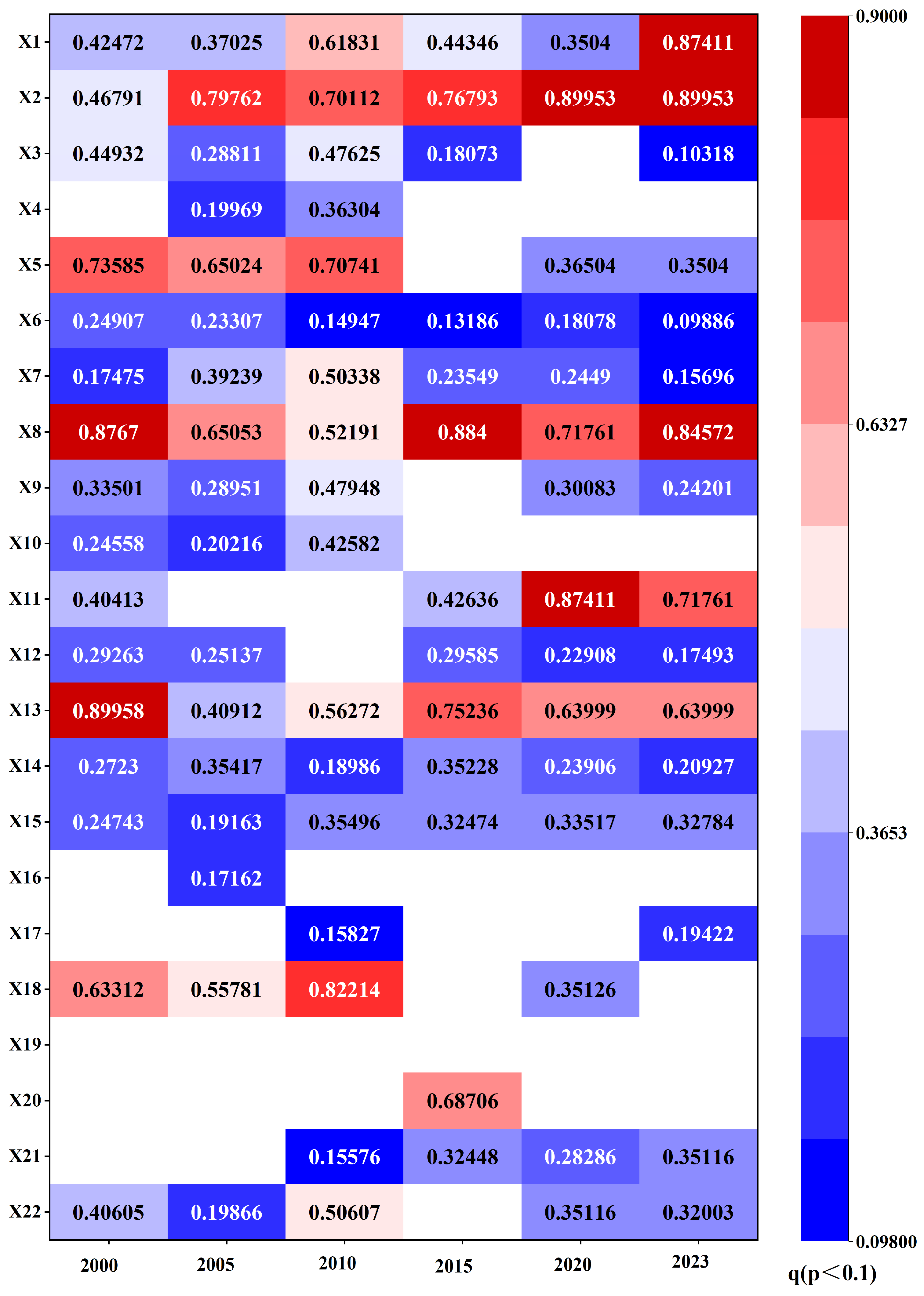
To deeply understand the driving mechanisms behind this dynamic process, this study used the Geodetector to conduct single-factor detection and quantitative assessment of explanatory power for each driving factor in the Qinling region (Figure 13). This method is particularly suitable for mountain systems like the Qinling with high natural environmental heterogeneity. Its core advantage lies in its ability to measure and quantify the influence intensity (q statistic) of individual factors (such as climate, soil, human pressure, etc.) on the formation and evolution of the spatial pattern of ecosystem health, thereby directly and objectively revealing the spatiotemporal dynamics of key driving mechanisms. The results show that the ranking of the driving factor influence (q-statistic) has changed significantly over time. ① From 2000 to 2005, “per capita forest area” (X13, q-value 0.900 → 0.798) and “farmland reclamation rate” (X7, q-value 0.877 → 0.651) consistently dominated, confirming that forest resource conservation and agricultural activity intensity were the cornerstones of healthy spatial differentiation during this period. ② In 2010, the explanatory power of “biodiversity” (X5) and “annual average precipitation” (X2) significantly increased (q-values reaching 0.701 and 0.707, respectively), indicating that the importance of climate change impacts and biodiversity maintenance began to emerge [19]. ③ 2015 was a critical turning point, with the q-value of “urbanization rate” (X8) reaching 0.884, replacing natural factors as the strongest driving force. This is consistent with the relatively high pressure index during this period (0.4179), suggesting that the socio-economic pressure brought by rapid urbanization reached its peak in the medium term and became the dominant force in reshaping the healthy pattern [3,16,26]. At the same time, “vegetation restoration area” (X20) entered the high-influence category for the first time (q = 0.687), marking the beginning of the effectiveness of ecological engineering restoration. ④ From 2020 to 2023, the driving structure presented a complex feature of both natural and human factors. The explanatory power of “annual average precipitation” (X2, q = 0.900) and “urbanization rate” (X8, q = 0.845) remained high, and “nighttime light index” (X11, q = 0.874 in 2020) as a direct indicator of human activity intensity had a prominent influence. This indicates that although the overall human pressure at the regional scale has decreased (the pressure index was the lowest in 2023 at 0.1332), the spatial differentiation pattern caused by human activities (especially urbanization) is persistent and has formed a strong coupling driving effect with the climatic background conditions [36,37,42,43].
From the perspective of the interaction of criterion-level indicators, the improvement of ecosystem health is the result of dynamic games and synergistic effects at all levels. The overall fluctuation of the pressure index (P) has decreased, especially reaching the lowest point in the study period in 2023 (0.1332), indicating that the overall human disturbance pressure at the regional scale has been curbed. However, the results of the geographical detector show that the influence of “urbanization rate” (X8) remained high in multiple periods, indicating that its negative impact on local areas (such as urban-rural transition zones) is still significant. This highlights that human activity pressure is the core regulatory variable for current and future ecosystem health management. The continuous rise of the response index (R) and its strong positive correlation with vegetation coverage and forest coverage strongly confirm the effectiveness of ecological protection and restoration measures. In the geographical detector, “vegetation restoration area” (X20) and “per capita forest area” (X13) had high explanatory power in multiple years, statistically confirming that vegetation restoration and forest resource conservation are key pathways to enhancing the self-recovery and self-adaptation capabilities of ecosystems [13,19,44].
The spatial pattern of ecosystem health in the Qinling Mountains shows a clear differentiation of “low in the south and high in the north”. In the northern Wei River Basin, despite a relatively dense population, its higher terrain, better-preserved forest coverage, and relatively lower high-intensity land use pressure have resulted in a higher health score. In contrast, in the southern Han River Basin, with a dense river network and convenient transportation, frequent agricultural and urban activities have led to a higher degree of habitat fragmentation and lower landscape connectivity, thereby inhibiting the improvement of ecosystem health levels. This pattern of human activities dominating spatial heterogeneity is in line with the research conclusions from a series of different regions such as the Western Qinling Mountains [42], the northern slope of the Tianshan Mountains [29], the Huai River Basin [19,26], and the Sichuan Basin [45], all of which have identified economic activities and urbanization as key negative drivers affecting ecosystem health.

4.3. Comparison with Related Studies

Compared with studies based on the VOR or VORS models [12,13,45], the BPSR framework in this study has an advantage in management orientation (Table 2). The VOR model is adept at depicting the intrinsic attributes of the system (vitality, organization, and resilience), while the BPSR framework, by externalizing the pressure sources (P) and management responses (R), enables the assessment results to be more directly linked to specific management actions such as “pressure control” and “promotion of recovery”, thereby serving precise ecological governance and policy-making more effectively.
Compared with a large number of studies on ecological security assessment of river basins or regions based on the traditional PSR model [17,19,25], the core progress of this study lies in strengthening the “base (B)” layer, empirically demonstrating that in ecologically fragile mountain systems, natural background conditions are not only static backgrounds but also active and decisive driving factors. The study reveals that the annual average precipitation (X2) maintains strong explanatory power over a long time series, which is consistent with the conclusion in arid and semi-arid regions that emphasize the role of water limitation [29,48,49]; and this finding is strongly verified in the relatively humid but topographically complex Qinling region, further highlighting the high dependence of mountain ecosystems on the water and heat regime [36,42]. This suggests that when applying or improving the PSR framework in the future, it is necessary to carefully consider whether and how to incorporate key natural background elements based on regional ecological and geographical characteristics (Table 2).
In terms of understanding the driving mechanisms, this study based on the long-term geographical detector results, reveals the dynamic evolution process of the influence of driving factors, from the early dominance of natural and land use factors to the mid-term prominence of urbanization pressure, and then to the late-stage formation of a complex driving pattern of natural climate and human activities. This differs from the conclusions of some studies that single out natural factors [36] or human factors [26] as the sole dominant factors, revealing a more complex reality: in human–land coupled systems like the Qinling Mountains, the intensity of the influence of natural background and human activities is not constant but changes and interacts with the development stage, policy intervention, and climate change [46,50]. Future research can further utilize the interaction detection module of the geographical detector [36,51], structural equation models [52], or geographically weighted regression [41,47] to quantitatively analyze the nonlinear interaction effects and spatial heterogeneity between natural and human factors in different periods, thereby deepening the understanding of the dynamic mechanisms of human-nature coupled systems.

4.4. Policy Recommendations for Ecological Protection and Regional Sustainable Development

In summary, we propose the following sustainable development suggestions: (1) The southern Han River Basin is recommended as a priority area for ecological restoration and risk prevention. Uncontrolled urban expansion and excessive development of the riverbank should be strictly controlled, and ecological corridors should be actively planned and constructed to enhance landscape connectivity [53]. In the northern Wei River Basin, it is necessary to focus on consolidating existing ecological achievements and implement strict ecological supervision over mineral exploitation and tourism activities. (2) It is suggested to attach importance to the fundamental role of natural background conditions in maintaining system resilience. This study and multiple comparative studies [25,36,42] have confirmed that water and heat conditions (especially precipitation) have a fundamental impact on ecosystem health. It is recommended to incorporate background protection and adaptive management measures such as water conservation and soil and water conservation into long-term regional ecological planning. (3) Research has confirmed that vegetation and forest restoration play a core role in enhancing the response capacity of ecosystems [13,19,44]. It is suggested that future ecological restoration projects should be prioritized in areas with low ecosystem health, severe landscape fragmentation, and overlap with key limiting natural factors (such as low precipitation areas) to improve the targeting and ecological benefits of the measures [54]. (4) Finally, the BPSR framework and probabilistic weight integration method adopted in this study are helpful in enhancing the robustness and comparability of the assessment. It is recommended to refer to and trial these methods in decision-making processes such as the supervision of ecological protection red lines, the evaluation of ecological project effectiveness, and territorial spatial planning to strengthen the scientific basis of ecological management [3,18,27].

5. Conclusions and Prospects

This study constructed the “Base–Pressure–State–Response” (BPSR) framework and employed the probability weighting method of Monte Carlo simulation to assess the spatio-temporal evolution of the ecosystem health in the Qinling region from 2000 to 2023 and identify the driving factors. The main conclusions are as follows:
  • The innovation of the assessment system enhanced the scientific nature of the research: The addition of the “base layer” highlighted the decisive role of the natural background in the fragile mountainous ecosystem; the probability weighting method reduced the subjectivity and uncertainty of traditional weighting, providing a methodological reference for similar regions.
  • The overall ecosystem health improved: The regional health index rose from 0.723 to 0.916, and the area proportion of healthy grades increased from 60.17% to 68.48%, demonstrating significant achievements in ecological protection and restoration. Spatially, a stable “south–low, north–high” pattern emerged: The southern Hanjiang River Basin, affected by dense human activities and low landscape connectivity, lagged behind in health levels; the northern Wei River Basin, with better vegetation conditions and relatively less human pressure, had a better health status. Temporally, it experienced a phased evolution from “local significant improvement” in the early period (2000–2010) to “widespread recovery” in the later period (2010–2023).
  • The dominant factors of the health pattern changed significantly over time: In the early stage, natural and land use factors were dominant; in the middle stage, urbanization pressure became prominent; in the later stage, a complex driving pattern emerged, intertwining natural climatic conditions and human activity intensity, revealing the complexity and phased nature of the driving forces in the human–land coupled system.
  • It is recommended to implement differentiated ecological management strategies: The ecologically fragile southern Hanjiang River Basin should be prioritized for restoration, with control over urban expansion and construction of ecological corridors to enhance landscape connectivity; the northern Wei River Basin, with a better ecological background, needs to strengthen ecological supervision over mineral resource development and tourism activities to consolidate existing achievements. At the same time, the protective role of natural backgrounds such as water and heat conditions should be emphasized, and adaptive measures such as soil and water conservation should be incorporated into long-term ecological planning. In areas with low health levels, fragmented landscapes, and restricted natural conditions, priority should be given to the layout of ecological restoration projects to enhance the effectiveness of measures.
This study still has certain limitations. For instance, the causal paths among the indicators at different levels within the BPSR framework need to be quantitatively verified through more complex models, such as structural equation models [52] and Bayesian networks [55]; the nonlinear interaction mechanisms among driving factors require further in-depth analysis [36,51]. Future research could couple land use change models (such as PLUS [3]) with ecosystem service models (such as InVEST [44,48]) to conduct multi-scenario simulations, predict the evolution of ecosystem health under different development paths and climate scenarios, and provide support for forward-looking planning [55]. Extending and validating this assessment framework and methodological system to other ecological and geographical regions for comparison is also a valuable research direction in the future.

Supplementary Materials

The following supporting information can be downloaded at: https://www.mdpi.com/article/10.3390/su18020760/s1, S1. Min-Max Normalization. S2. Grading Methodology. S3. Mann-Kendall (MK) Dynamic Trend Analysis. S4. Geodetector Method. References [36,41,44,46,56,57,58,59,60] are cited in the Supplementary Materials.

Author Contributions

Conceptualization, H.T. and Y.C.; methodology, H.T. and Y.Z.; software, H.T.; validation, H.T.; formal analysis, Y.Z.; data curation, Y.J.; writing—original draft preparation, H.T.; writing—review and editing, J.G. and H.T.; visualization, H.T.; supervision, Y.C.; project administration, Y.Z.; funding acquisition, Y.C. All authors have read and agreed to the published version of the manuscript.

Funding

This research was funded by the Shaanxi Provincial key research and development program (2025SF-YBXM-130) and the Science and Technology Program of Shaanxi Academy of Science(2023k-02).

Institutional Review Board Statement

Not applicable.

Informed Consent Statement

Not applicable.

Data Availability Statement

The data presented in this study are available on request from the corresponding author. Data is contained within the article and Supplementary Materials.

Conflicts of Interest

The authors declare no conflicts of interest.

References

  1. Baloch, M.A.; Zhang, J.; Iqbal, K.; Iqbal, Z. The effect of financial development on ecological footprint in BRI countries: Evidence from panel data estimation. Environ. Sci. Pollut. Res. 2019, 26, 6199–6208. [Google Scholar] [CrossRef] [PubMed]
  2. Liu, T.; Wang, H.Z.; Wang, H.Z.; Xu, H. The spatiotemporal evolution of ecological security in China based on the ecological footprint model with localization of parameters. Ecol. Indic. 2021, 126, 107636. [Google Scholar] [CrossRef]
  3. Zhao, H.H.; Liu, J.C.; Guo, Y.J.; Wang, H.M.; Gong, Z. Assessing the ecological sensitivity of the Northern Foothills of Qinling Mountains using DPSIRM and PLUS models. Trans. Chin. Soc. Agric. Eng. 2024, 40, 244–252. [Google Scholar]
  4. Luo, L.; Yin, C.; Liu, X.L. Habitat Quality and Degradation in the West Qinling Mountains, China: From Spatiotemporal Assessment to Sustainable Management (1990–2020). Sustainability 2025, 17, 9700. [Google Scholar] [CrossRef]
  5. Zhang, X.; Zhou, J.; Li, G.; Chen, C.; Li, M.; Luo, J. Spatial pattern reconstruction of regional habitat quality based on the simulation of land use changes from 1975 to 2010. J. Geogr. Sci. 2020, 30, 601–620. [Google Scholar] [CrossRef]
  6. Liu, X.; Zhu, X.; Pan, Y.; Li, S.; Ma, Y.; Nie, J. Vegetation dynamics in Qinling-Daba Mountains in relation to climate factors between 2000 and 2014. J. Geogr. Sci. 2016, 26, 45–58. [Google Scholar] [CrossRef]
  7. Zhang, Y.; Yin, H.; Zhu, L.; Miao, C. Landscape Fragmentation in Qinling-Daba Mountains Nature Reserves and Its Influencing Factors. Land 2021, 10, 1124. [Google Scholar] [CrossRef]
  8. Tomassi, A.; Falegnami, A.; Meleo, L.; Romano, E. The GreenSCENT Competence Frameworks. In The European Green Deal in Education; Routledge: Oxfordshire, UK, 2024; pp. 25–44. [Google Scholar]
  9. Kang, P.; Chen, W.; Hou, Y.; Li, Y. Linking ecosystem services and ecosystem health to ecological risk assessment: A case study of the Beijing-Tianjin-Hebei urban agglomeration. Sci. Total Environ. 2018, 636, 1442–1454. [Google Scholar] [CrossRef] [PubMed]
  10. Dadashpoor, H.; Azizi, P.; Moghadasi, M. Land use change, urbanization, and change in landscape pattern in a metropolitan area. Sci. Total Environ. 2019, 655, 707–719. [Google Scholar] [CrossRef]
  11. Zhang, D.; Huang, Q.; He, C.; Wu, J. Impacts of urban expansion on ecosystem services in the Beijing-Tianjin-Hebei urban agglomeration, China: A scenario analysis based on the shared socioeconomic pathways. Resour. Conserv. Recycl. 2017, 125, 115–130. [Google Scholar] [CrossRef]
  12. Xiang, T.; Meng, X.L.; Wang, X.S.; Xiong, J.; Xu, Z.L. Spatiotemporal Changes and Driving Factors of Ecosystem Health in the Qinling-Daba Mountains. ISPRS Int. J. Geo-Inf. 2022, 11, 600. [Google Scholar] [CrossRef]
  13. Wang, H.; Hou, P.; Jiang, J.B.; Xiao, R.L.; Zhai, J.; Fu, Z.; Hou, J. Ecosystem Health Assessment of Shennongjia National Park, China. Sustainability 2020, 12, 7672. [Google Scholar] [CrossRef]
  14. Ke, X.Y.; Wang, N.; Yu, L.; Guo, Z.H.; He, T.M. Spatial Distribution of Water Risk Based on Atlas Compilation in the Shaanxi Section of the Qinling Mountains, China. Sustainability 2023, 15, 9792. [Google Scholar] [CrossRef]
  15. Yu, G.; Lin, D.H.; Xie, J.Y.; Wang, Y.K. A novel approach for modeling and evaluating road operational resilience based on pressure-state-response theory and dynamic Bayesian networks. Appl. Sci. 2023, 13, 7481. [Google Scholar] [CrossRef]
  16. Lu, T.; Li, C.J.; Zhou, W.X.; Liu, Y.X. Fuzzy assessment of ecological security on the Qinghai–Tibet Plateau based on Pressure–State–Response framework. Remote Sens. 2023, 15, 1293. [Google Scholar] [CrossRef]
  17. Sang, S.; Wu, T.X.; Wang, S.D.; Yang, Y.Y.; Liu, Y.Y.; Li, M.Y.; Zhao, Y.T. Ecological safety assessment and analysis of regional spatiotemporal differences based on Earth observation satellite data in support of SDGs: The case of the Huaike River Basin. Remote Sens. 2021, 13, 3942. [Google Scholar] [CrossRef]
  18. Peng, C.C.; Li, B.; Nan, B. An analysis framework for the ecological security of urban agglomeration: A case study of the Beijing-Tianjin-Hebei urban agglomeration. J. Clean. Prod. 2021, 315, 128111. [Google Scholar] [CrossRef]
  19. Hui, L.; Wang, H.; Liu, J.N.; Tang, B.T.; Li, Z.S.; Zhang, L.W.; Jiao, L. Assessing the spatiotemporal changes and drivers of ecological security by integrating ecosystem health and ecosystem services in Loess Plateau, China. J. Geogr. Sci. 2025, 35, 459–482. [Google Scholar] [CrossRef]
  20. Hua, M.M.; Li, Z.T.; Yuan, M.J.; Fan, C.; Xia, B.C. Spatial differentiation of ecological security and differentiated management of ecological conservation in the Pearl River Delta, China. Ecol. Indic. 2019, 104, 439–448. [Google Scholar] [CrossRef]
  21. Zhang, M.X.; Bao, Y.B.; Xu, J.; Hua, A.; Liu, X.P.; Zhang, J.Q.; Tong, Z.J. Ecological security evaluation and ecological regulation approach of East-Liao River basin based on ecological function area. Ecol. Indic. 2021, 132, 108255. [Google Scholar] [CrossRef]
  22. Chen, T.Q.; Feng, Z.; Zhao, H.F.; Wu, K.N. Identification of ecosystem service bundles and driving factors in Beijing and its surrounding areas. Sci. Total Environ. 2020, 711, 134687. [Google Scholar] [CrossRef]
  23. Cheng, H.R.; Zhu, L.K.; Meng, J.J. Fuzzy evaluation of the ecological security of land resources in mainland China based on the Pressure-State-Response framework. Sci. Total Environ. 2022, 804, 150053. [Google Scholar] [CrossRef]
  24. Meng, Y.; Cao, B.; Dong, C.; Dong, X. Mount Taishan Forest Ecosystem Health Assessment Based on Forest Inventory Data. Forests 2019, 10, 657. [Google Scholar] [CrossRef]
  25. Shen, W.; Zheng, Z.C.; Qin, Y.C.; Li, Y. Spatiotemporal characteristics and driving force of ecosystem health in an important ecological function region in China. Int. J. Environ. Res. Public Health 2020, 17, 5075. [Google Scholar] [CrossRef] [PubMed]
  26. Zhu, Q.; Cai, Y.L. Integrating ecological risk, ecosystem health, and ecosystem services for assessing regional ecological security and its driving factors: Insights from a large river basin in China. Ecol. Indic. 2023, 155, 110954. [Google Scholar] [CrossRef]
  27. Wen, J.F.; Hou, K. Research on the progress of regional ecological security evaluation and optimization of its common limitations. Ecol. Indic. 2021, 127, 107797. [Google Scholar] [CrossRef]
  28. Su, M.R.; Xie, H.; Yue, W.N.; Zhang, L.X.; Yang, Z.F.; Chen, S.H. Urban ecosystem health evaluation for typical Chinese cities along the Belt and Road. Ecol. Indic. 2019, 101, 572–582. [Google Scholar] [CrossRef]
  29. Li, K.Q.; Yan, Q.W.; Wu, Z.H.; Li, G.E.; Yi, M.H.; Ma, X.S. A Study on the Spatiotemporal Heterogeneity and Driving Forces of Ecological Resilience in the Economic Belt on the Northern Slope of the Tianshan Mountains. Land 2025, 14, 196. [Google Scholar] [CrossRef]
  30. Yu, H.; Wu, Y.F.; Niu, L.T.; Chai, Y.F.; Feng, Q.S.; Wang, W.; Liang, T.G. A method to avoid spatial overfitting in estimation of grassland above-ground biomass on the Tibetan Plateau. Ecol. Indic. 2021, 125, 107450. [Google Scholar] [CrossRef]
  31. Gao, H.; Fu, T.G.; Liu, J.T.; Liang, H.Z.; Han, L.P. Ecosystem Services Management Based on Differentiation and Regionali-zation along Vertical Gradient in Taihang Mountain, China. Sustainability 2018, 10, 986. [Google Scholar] [CrossRef]
  32. Zhang, W.; Xin, C.; Du, W.; Yu, S. Health risk assessment of heavy metals based on source analysis and Monte Carlo in the Lijiang River Basin, China. Ecol. Indic. 2025, 176, 113620. [Google Scholar] [CrossRef]
  33. Su, J.L.; Yan, C.R.; Lei, Y.; Wang, Y.; Zhao, P.X. Long time series dynamic monitoring of eco-environmental quality in Shaanxi Province. Acta Ecol. Sin. 2023, 43, 554–568. (In Chinese) [Google Scholar] [CrossRef]
  34. Bai, J.; Wang, X.F.; Zhou, C.W.; Zhou, J.T.; Tu, Y.; Sun, Z.C. Integrative analysis of ecosystem health, ecosystem services and species habitat suitability can enhance the spatial configuration of protected areas. Ecol. Indic. 2025, 181, 114457. [Google Scholar] [CrossRef]
  35. Hu, Z.Z.; Li, N.; Zhang, M.; Miao, M. Bayesian Network Analysis: Assessing and Restoring Ecological Vulnerability in the Shaanxi Section of the Qinling-Daba Mountains Under Global Warming Influences. Sustainability 2024, 16, 10021. [Google Scholar] [CrossRef]
  36. Zhang, S.; Zhou, Y.; Yu, Y.; Li, F.; Zhang, R.; Li, W. Using the Geodetector Method to Characterize the Spatiotemporal Dynamics of Vegetation and Its Interaction with Environmental Factors in the Qinba Mountains, China. Remote Sens. 2022, 14, 5794. [Google Scholar] [CrossRef]
  37. Wu, N.; Wang, S.; Wu, X.; Dong, W.; Huang, F.; Wang, H. Eco-environmental quality assessment of transition region between Qinling Mountains and Huanghuai Plain using Remote Sensing Ecological Index. Geocarto Int. 2025, 40, 2462480. [Google Scholar] [CrossRef]
  38. Chen, L.; Ma, L.; Jiji, J.; Kong, Q.; Ni, Z.; Yan, L.; Pan, C. River Ecosystem Health Assessment Using a Combination Weighting Method: A Case Study of Beijing Section of Yongding River in China. Int. J. Environ. Res. Public Health 2022, 19, 14433. [Google Scholar] [CrossRef]
  39. Mantashloo, A.; Shokoohi, R.; Torkshavand, Z. Monte Carlo simulation for human health risk assessment of groundwater contaminated with arsenic at an Iranian semi-arid region. Environ. Nanotechnol. Monit. Manag. 2025, 23, 101069. [Google Scholar] [CrossRef]
  40. Wang, X.; Xu, F.; Gui, Y. Enhancing health risk assessment for soil heavy metal (loid)s using a copula-based Monte Carlo simulation method. Ecotoxicol. Environ. Saf. 2025, 300, 118419. [Google Scholar] [CrossRef] [PubMed]
  41. Li, W.J.; Kang, J.W.; Wang, Y. Spatiotemporal Changes and Driving Forces of Ecological Security in the Chengdu–Chongqing Urban Agglomeration, China: Quantification Using Health-Services-Risk Framework. J. Clean. Prod. 2023, 389, 136135. [Google Scholar] [CrossRef]
  42. Luo, X.; Wang, L.X.; Zhang, J.; Yang, Y.; Liu, Z. Spatio-temporal Dynamic and Driving Factor Analysis of Ecological Environment Quality in Qinling Mountains. Environ. Sci. 2025, 46, 3720–3730. (In Chinese) [Google Scholar]
  43. Lyu, R.F.; Clarke, K.C.; Zhang, J.M.; Feng, J.L.; Jia, X.H.; Li, J.J. Spatial correlations among ecosystem services and their socio-ecological driving factors: A case study in the city belt along the Yellow River in Ningxia, China. Appl. Geogr. 2019, 108, 64–73. [Google Scholar] [CrossRef]
  44. Wang, X.; Wu, J.; Liu, Y.; Hai, X.; Shanguan, Z.; Deng, L. Driving Factors of Ecosystem Services and Their Spatiotemporal Change Assessment Based on Land Use Types in the Loess Plateau. J. Environ. Manag. 2022, 311, 114835. [Google Scholar] [CrossRef]
  45. He, R.; Huang, X.T.; Ye, X.Y.; Pan, Z.; Wang, H.; Luo, B.; Liu, D.M.; Hu, X.X. County ecosystem health assessment based on the VORS model: A case study of 183 counties in Sichuan Province, China. Sustainability 2022, 14, 11565. [Google Scholar] [CrossRef]
  46. He, J.H.; Pan, Z.Z.; Liu, D.F.; Guo, X.N. Exploring the regional differences of ecosystem health and its driving factors in China. Sci. Total Environ. 2019, 673, 553–564. [Google Scholar] [CrossRef]
  47. Feng, Y.J.; Yang, Q.Q.; Tong, X.H.; Chen, L.J. Evaluating land ecological security and examining its relationships with driving factors using GIS and generalized additive model. Sci. Total Environ. 2018, 633, 1469–1479. [Google Scholar] [CrossRef]
  48. Pan, N.H.; Du, Q.Q.; Guan, Q.Y.; Tan, Z.; Sun, Y.F.; Wang, Q.Z. Ecological security assessment and pattern construction in arid and semi-arid areas: A case study of the Hexi Region, NW China. Ecol. Indic. 2022, 138, 108797. [Google Scholar] [CrossRef]
  49. Zhang, Y.S.; Lu, X.; Liu, B.Y.; Wu, D.T.; Fu, G.; Zhao, Y.T.; Sun, P.L. Spatial relationships between ecosystem services and socioecological drivers across a large-scale region: A case study in the Yellow River Basin. Sci. Total Environ. 2021, 767, 144476. [Google Scholar] [CrossRef]
  50. Pan, Z.Z.; Gao, G.Y.; Fu, B.J. Spatiotemporal changes and driving forces of ecosystem vulnerability in the Yangtze River Basin, China: Quantification using habitat-structure-function framework. Sci. Total Environ. 2022, 835, 155494. [Google Scholar] [CrossRef]
  51. Zuo, L.Y.; Gao, J.B. Investigating the compounding effects of environmental factors on ecosystem services relationships for Ecological Conservation Red Line areas. Land Degrad. Dev. 2021, 32, 4609–4623. [Google Scholar] [CrossRef]
  52. Wei, H.J.; Han, Q.; Yang, Y.; Li, L.; Liu, M.X. Spatial heterogeneity of watershed ecosystem health and identification of its influencing factors in a mountain-hill-plain region, Henan Province, China. Remote Sens. 2023, 15, 3751. [Google Scholar] [CrossRef]
  53. Chen, W.; Liu, H.; Wang, J. Construction and optimization of regional ecological security patterns based on MSPA–MCR–GA Model: A case study of Dongting Lake Basin in China. Ecol. Indic. 2024, 165, 112169. [Google Scholar] [CrossRef]
  54. Wang, C.; Tang, C.J.; Fu, B.J.; Li, Y.H.; Xiao, S.S.; Zhang, J. Determining critical thresholds of ecological restoration based on ecosystem service index: A case study in the Pingjiang catchment in southern China. J. Environ. Manag. 2022, 303, 114220. [Google Scholar] [CrossRef]
  55. Ghosh, S.; Das Chatterjee, N.; Dinda, S. Urban ecological security assessment and forecasting using integrated DEMATEL-ANP and CA-Markov models: A case study on Kolkata Metropolitan Area, India. Sustain. Cities Soc. 2021, 68, 102773. [Google Scholar] [CrossRef]
  56. Sun, Y.X.; Liu, S.L.; Dong, Y.H.; An, Y.; Shi, F.N.; Dong, S.K.; Liu, G.H. Spatio-temporal evolution scenarios and the coupling analysis of ecosystem services with land use change in China. Sci. Total Environ. 2019, 681, 211–225. [Google Scholar] [CrossRef]
  57. Wang, Y.H.; Dai, E.F. Spatial-temporal changes in ecosystem services and the trade-off relationship in mountain regions: A case study of Hengduan Mountain region in Southwest China. J. Clean. Prod. 2020, 264, 121573. [Google Scholar] [CrossRef]
  58. Li, S.; Yang, H.; Lacayo, M.; Liu, J.; Lei, G. Impacts of Land-Use and Land-Cover Changes on Water Yield: A Case Study in Jing-Jin-Ji, China. Sustainability 2018, 10, 960. [Google Scholar] [CrossRef]
  59. Zhao, Y.H.; Zhou, Y.J.; Jia, X.; Han, L.; Liu, L.; Ren, K.; Ye, X.; Qu, Z.; Pei, Y.J. Soil characteristics and microbial community structure on along elevation gradient in a Pinus armandii forest of the Qinling Mountains, China. Forest Ecol. Manag. 2022, 503, 119793. [Google Scholar] [CrossRef]
  60. Guo, Q.K.; Ding, Z.W.; Qin, W.; Cao, W.H.; Lu, W.; Xu, X.M.; Yin, Z. Changes in sediment load in a typical watershed in the tableland and gully region of the Loess Plateau, China. Catena 2019, 182, 104132. [Google Scholar] [CrossRef]
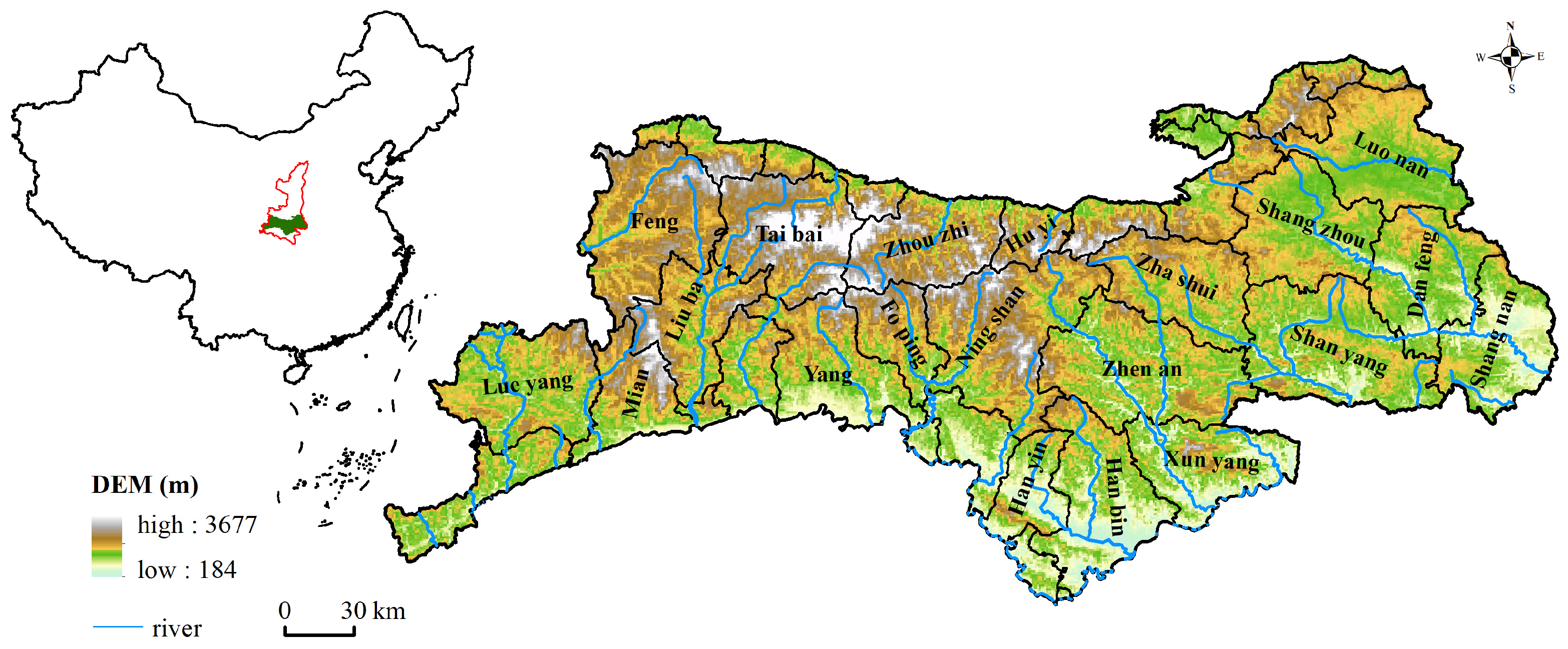
Figure 1. The relative geographical location of the Qinling Mountains in Shaanxi Province, China, and the names of the involved counties and administrative boundaries.
Sustainability 18 00760 g001
Figure 2. Technical framework of the study.
Sustainability 18 00760 g002
Figure 3. Construction of the Ecosystem Health Indicator System.
Sustainability 18 00760 g003
Figure 4. Spatial distribution maps of annual average basic indicator values in the Qinling region for each time period from 2000 to 2023.
Sustainability 18 00760 g004
Figure 5. Spatial distribution of annual average pressure indicator values in the Qinling region for various periods, 2000–2023.
Sustainability 18 00760 g005
Figure 6. Spatial distribution of annual average state indicator values in the Qinling region across periods, 2000–2023.
Sustainability 18 00760 g006
Figure 7. Spatial distribution of annual average response indicator values in the Qinling region for each period, 2000–2023.
Sustainability 18 00760 g007
Figure 8. Evaluation results of ecosystem health index (top) and health grade (bottom) in 2000 and 2005.
Sustainability 18 00760 g008
Figure 9. Evaluation results of ecosystem health index (top) and health grade (bottom) in 2010 and 2015.
Sustainability 18 00760 g009
Figure 10. Evaluation results of ecosystem health index (top) and health grade (bottom) in 2020 and 2023.
Sustainability 18 00760 g010
Figure 11. Matrix transition results of ecosystem health grades in the Qinling Mountains from 2000 to 2023.
Sustainability 18 00760 g011
Figure 12. The trend rate and dynamic evolution pattern of ecosystem health in the Qinling region from 2000 to 2023. (a) Trend rate of change in the ecological health index; (b) The dynamic evolution pattern of ecosystem health grades.
Sustainability 18 00760 g012
Figure 13. Results of single-factor detection for ecosystem health in the Qinling region based on the Geodetector (2000–2023). Note: The figure shows the explanatory power qq values of various driving factors that passed the significance test at p < 0.1; factors that did not pass are left blank. The driving factors include: X1: Annual mean temperature, X2: Annual mean precipitation, X3: Soil organic carbon, X4: Soil bulk density, X5: Biodiversity, X6: Sunshine duration, X7: Cultivated land reclamation rate, X8: Urbanization rate, X9: Population size, X10: Population growth rate, X11: Nighttime light index, X12: Per capita grassland area, X13: Per capita forest area, X14: Per capita GDP, X15: Landscape diversity index, X16: Mean patch area, X17: Mean patch density, X18: Enhanced Vegetation Index, X19: Proportion of tertiary industry, X20: Vegetation restoration area, X21: Soil erosion control area, X22: Contagion index.
Sustainability 18 00760 g013
Table 1. Indicator Weights for Ecosystem Health Assessment in the Qinling Region.
Criterion LayerIndicator LayerA H P w 1 C V w 2 E W w 3 Combined Weights
Basic 0.1175Annual Mean Temperature0.05360.03700.03000.0413
Annual Precipitation0.02260.02860.01730.0235
Sunshine Duration0.03540.02170.01000.0238
Soil Organic Carbon0.01420.01950.00810.0146
Soil Bulk Density0.00910.01230.00320.0087
Biodiversity0.0060.01020.00220.0056
Pressure
0.414
Cultivated Land Reclamation Rate0.08620.01620.00560.0399
Urbanization Rate0.01960.04360.04000.0315
Total Population0.06060.05970.07550.0676
Natural Population Growth Rate0.01360.05870.07450.0365
Nighttime Light Index0.11890.06320.08500.0941
State 0.281Per Capita Grassland Area0.02870.05410.06250.0446
Per Capita Forest Area0.04180.00420.00040.0215
GDP Per Capita0.00690.04970.05220.0307
Landscape Diversity Index0.00950.06760.09880.0483
Mean Patch Area0.09100.02470.01320.0466
Mean Patch Density0.06430.02210.01050.0343
Response 0.185Enhanced Vegetation Index0.01320.08220.14220.0105
Proportion of Tertiary Industry0.04400.01640.00580.0377
Vegetation Restoration Area0.01980.05100.05700.0306
Soil Erosion Area0.02950.02700.01570.0137
Contagion Index0.08100.01580.00530.0246
Table 2. Integration of Ecosystem Health Assessment Frameworks and Their Applications.
Framework CategorySpecific Framework NameStudy Area
1. Pressure–State–Response Logic FrameworksPSR (Pressure–State–Response)Shaanxi Section of Qinling Mountains [14], Shanghai Expressways [15], Qinghai–Tibet Plateau [16], Huaihe River Basin [17,19]
Extended PSRYellow River Influenced Zone [25]
2. Ecosystem Attribute Assessment FrameworksVOR (Vigor–Organization–Resilience)Qinling-Daba Mountains [26], Shennongjia National Park [13]
VORS (Vigor–Organization–Resilience-Services)Counties in Sichuan Province [45], China (Nationwide) [46]
3. Comprehensive Driving Force Analysis FrameworksDPSIRM (Drivers–Pressures–State–Impacts–Responses–Management)Beijing-Tianjin-Hebei Urban Agglomeration [18]
DPSIRMNorthern Foothills of Qinling Mountains [3]
4. Vulnerability–Sustainability FrameworkVSD (Vulnerability–Sustainability Diagnostic)Shaanxi Section of Qinling-Daba Mountains [35]
5. Structure–Function Correlation FrameworkHabitat–Structure–Function FrameworkYangtze River Basin [47]
6. Service-Oriented and Risk Assessment FrameworksHealth–Service–Risk FrameworkChengdu-Chongqing Urban Agglomeration [41]
Health–Service–Risk Comprehensive IndexHexi Region [48]
7. Social-Ecological System Service FrameworksER-EH-ESs (Exposure–Response–Ecosystem Health–Ecosystem Services) FrameworkHuaihe River Basin [26]
Ecosystem Service Bundle Correlation AnalysisNingxia Yellow River Urban Belt [43]
8. Direct Assessment Via Remote Sensing IndicesRemote Sensing Ecological Index (RSEI)Qinling Region (Shaanxi Section) [42], Qinling-Huanghuai Plain Transition Zone [37], Shaanxi Province [33]
9. Quantitative Assessment Via Process-Based ModelsInVEST Habitat Quality ModelWestern Qinling Region [4]
Disclaimer/Publisher’s Note: The statements, opinions and data contained in all publications are solely those of the individual author(s) and contributor(s) and not of MDPI and/or the editor(s). MDPI and/or the editor(s) disclaim responsibility for any injury to people or property resulting from any ideas, methods, instructions or products referred to in the content.