1. Introduction
Growing concern about climate change and environmental degradation has renewed scrutiny of the sustainability of traditional economic expansion. The concept of green growth—the idea that economies can grow while reducing environmental impacts—has become central in policy debates. A crucial element of green growth is decoupling, meaning that the link between Gross Domestic Product (GDP) and environmental pressure is weakened or broken. In particular, absolute decoupling requires that emissions fall in absolute terms even as GDP rises, which is considered necessary to meet Paris Agreement targets and the Sustainable Development Goals [
1,
2,
3]. If absolute decoupling can be achieved, it validates strategies relying on technological innovation, efficiency improvements, and deliberate energy transitions. By contrast, if growth and deep decarbonization remain incompatible, then current economic paradigms may conflict with climate limits.
Empirical evidence on decoupling is limited and sometimes contradictory. Previous studies often focus on particular countries, regions, or sectors, and few offer a systematic, cross-country analysis of absolute decoupling using multiple indicators. This paper narrows that gap by conducting a quantitative comparative study of 79 countries over 2000–2025. The main goal is to model and predict the occurrence of absolute decoupling—defined as positive real GDP growth with declining territorial CO2 emissions—as a function of macroeconomic and energy-related factors (energy intensity, energy use per capita, and the primary energy mix). By identifying the statistical conditions under which decoupling has occurred historically, we contribute empirical evidence to the green-growth versus degrowth debate. Specifically, we ask whether green growth is attainable under current global energy and economic dynamics, or whether decoupling will remain rare without more radical changes.
1.1. Competing Views on Green Decoupling
Early work frequently relied on the Environmental Kuznets Curve (EKC), which hypothesizes an inverted-U relationship between income and pollution [
4,
5]. However, after decades of testing, there is no universal EKC for CO
2: estimated curves depend strongly on the pollutant and model specification, and many studies find no clear turning point for CO
2 even at high income levels [
6,
7,
8,
9]. Structural analyses additionally question whether aggregate environmental impacts can be decoupled from GDP growth under business-as-usual conditions [
10,
11]. In short, the expectation that economic growth eventually reduces environmental pressures is not supported as a general empirical rule.
A clearer conceptual framework is provided by the IPAT/Kaya identity, which decomposes emissions into population, affluence, energy intensity, and carbon intensity. Within this identity, relative decoupling occurs when energy or emissions intensity falls but total emissions may still rise, whereas absolute decoupling requires emissions to fall in absolute terms even as GDP grows. Decoupling elasticity metrics formalize this distinction, and empirical applications confirm that absolute decoupling is rare and context-dependent [
12,
13].
Two broad narratives emerge from this literature. Green-growth proponents argue that directed innovation, carbon pricing, and structural shifts can achieve sustained absolute decoupling [
14,
15]. In contrast, degrowth and ecological-economics scholars highlight rebound effects and biophysical limits to substitution, concluding that observed rates of decoupling are too slow to meet planetary boundaries and advocating sufficiency-oriented approaches [
16,
17,
18,
19,
20]. Thus, the feasibility and drivers of absolute decoupling remain open empirical questions.
1.2. Global and Regional Evidence
At the global scale, there has been no sustained absolute decoupling of CO
2 from GDP. From 2010 to 2019, world GDP grew by about 3% annually while global CO
2 emissions rose by ~1.3% per year, implying only relative decoupling [
1]. Long-run data for 164 countries show that although the GDP–CO
2 link has weakened somewhat, it remains strongly positive and inconsistent with rapid decarbonization [
9]. Worldwide panel studies likewise find that global economic growth remains tightly coupled to rising emissions despite gradual improvements in energy and carbon intensity [
21].
At the country level, patterns are more mixed. Several advanced economies have experienced episodes of absolute decoupling in the last two decades, driven by energy-efficiency gains and cleaner energy mixes [
22]. The European Union has reduced territorial GHG emissions substantially since 1990 while GDP continued to rise [
23]. Decomposition analyses of major emitters and studies on Belt and Road Initiative (BRI) and Organisation for Economic Co-operation and Development (OECD) economies show that improvements in efficiency and fuel switching are common features of countries where absolute decoupling occurs [
9,
24]. Cross-national studies identify between 30 and 50 countries (mostly in Europe and Oceania) that have achieved some form of decoupling, compared to more than 100 countries where emissions still rise with GDP [
9,
25]. Even in these “success” cases, the pace of decoupling is insufficient to meet Paris-aligned mitigation targets. Analyses of high-income countries that achieved absolute decoupling of consumption-based CO
2 show emission reductions far below what is needed under Paris-compliant pathways [
26]. Scenario studies reach similar conclusions, indicating that efficiency gains alone are unlikely to offset growth-driven increases in emissions without additional sufficiency measures [
11].
In most emerging and low-income economies, GDP and emissions remain tightly coupled. Rapid GDP and population growth in Asia, Africa, and Latin America frequently outweigh efficiency improvements, resulting in rising emissions despite falling carbon intensity [
27,
28,
29,
30,
31]. China exemplifies this pattern: its carbon intensity has declined, but its rapid economic expansion has driven CO
2 emissions to new highs [
32]. Many emerging economies show only relative decoupling—emissions rise more slowly than GDP but do not fall absolutely. International trade further complicates assessments of decoupling. High-income countries often outsource carbon-intensive production, displaying territorial decoupling while consumption-based emissions continue to rise. Multi-regional input–output studies find that consumption-based decoupling is weaker or absent compared to production statistics [
33,
34]. Only a subset of countries that decouple territorially also decouple on a consumption basis [
25]. Recent decomposition work highlights that the carbon intensity of imports matters as much as domestic changes [
35].
Across hundreds of studies, systematic reviews conclude that while relative decoupling of CO
2 and materials is common, rapid and sustained absolute decoupling aligned with climate targets is rare and highly context-specific [
19,
36]. This motivates our focus: rather than debating feasibility broadly, we examine the specific episodes and conditions under which absolute decoupling has occurred, with attention to energy-system dynamics.
1.3. Methodological Approaches and Research Gaps
The decoupling literature spans several methodological traditions. One approach computes decoupling indicators and elasticities to classify periods or locations as strongly/weakly decoupled or coupled [
37,
38,
39,
40]. These descriptive metrics are intuitive but sensitive to the length of the time window and do not explain underlying causes.
A second strand uses econometric models linking emissions to income and structural variables in time-series or panel settings [
41,
42,
43,
44,
45,
46]. More recent work incorporates heterogeneity, structural factors such as energy mix and trade, and non-stationary dynamics [
24,
29,
47,
48]. These analyses often identify energy intensity and fuel mix as key channels—variables central to our own modeling. A third strand applies decomposition techniques to attribute emission changes to population, affluence, energy intensity, and carbon intensity, with some studies including structural and trade effects [
22,
25,
27,
28,
29,
30,
31,
35,
49]. While informative, decomposition approaches describe past contributions rather than predicting future decoupling events.
Other studies cluster countries into “decoupling clubs” or test for convergence in emission intensities, emphasizing the roles of institutional and structural factors beyond aggregate energy metrics [
9,
50,
51,
52,
53]. Finally, machine-learning methods have recently been used to forecast emissions and identify key drivers, with tree-based ensembles and neural networks enabling the capture of non-linearities and interactions. Interpretability tools such as SHAP provide insight into variable importance and decision pathways within these models [
54].
Together, these strands reveal significant methodological and empirical gaps. Few studies integrate multiple macro–energy covariates into predictive models of absolute decoupling across many countries, incorporating both linear econometric and modern machine-learning tools. Our analysis addresses this gap by modeling the probability of absolute decoupling using a harmonized multi-country dataset and complementary predictive approaches.
2. Materials and Methods
We assemble an unbalanced panel of 79 countries for the period 2000–2025. The data combine harmonized sources from Our World in Data (OWID), which collects consistent information on economic and energy indicators across countries and time. Specifically, we use (i) total territorial CO2 emissions (metric tons), (ii) real GDP (constant prices, PPP), and (iii) energy-system indicators (total primary energy use, energy intensity, energy use per capita, and energy mix shares for fossil fuels and renewables). The OWID dataset synthesizes inputs from the Global Carbon Project, World Bank, International Energy Agency (IEA), and others, ensuring comparability.
After restricting to valid ISO3 countries, the 2000–2025 window, and dropping the first year for each country (to allow computation of lags), the final sample has 5232 country–year observations. We define an absolute decoupling episode (binary outcome, decouple_abs) at the country–year level: it equals 1 if real GDP grows and CO
2 emissions decline from t–1 to t, and 0 otherwise. By construction, in decoupling years, CO
2 falls while GDP rises, capturing the strongest notion of green growth. Approximately 27% of our observations satisfy this definition; the rest are “coupled” (GDP and emissions both rising) or cases of economic contraction.
Table 1 lists all variables and units.
Descriptive statistics (
Table 2) show that in decoupling years average GDP growth is slightly higher (4.3%) than in non-decoupling years (3.9%), while CO
2 declines on average (–4.5 Mt) in decoupling years but rises (+6.0 Mt) otherwise. Decoupling years also tend to have higher energy use per capita (∼30,000 vs. 24,700 units) and slightly higher energy intensity (1.35 vs. 1.32 units of energy/GDP). Their energy mix is somewhat cleaner: the fossil-fuel share averages 81.3% in decoupling years (versus 85.0% in coupled years), and the renewables share 1.99% (vs. 1.46%). These raw differences suggest that decoupling is more common in relatively energy-intensive, mid-to-high-income economies, but also that yearly shifts in intensity and fuel mix may be critical. We now formalize our modeling strategy using these variables.
2.1. Model Specification and Estimation Strategy
Dependent Variable: Defining Absolute Decoupling—Let
and
denote real GDP (PPP) and territorial CO
2 emissions for country
at time
. We focus on the discrete growth of output,
, and the absolute change in emissions,
. Following the “strong” sustainability framework [
20], we construct a binary indicator
for absolute decoupling:
This indicator identifies “green growth” episodes where the correlation between economic scale and environmental pressure is structurally broken.
Explanatory Variables and Dynamics—To model the likelihood of decoupling, we assemble a vector of covariates
capturing the scale, efficiency, and carbon intensity of the energy system (summarized in
Table 1). We characterize the system state using four core metrics: Energy Intensity
, Energy Use per Capita
, and the shares of fossil fuels
and renewables
in the primary energy mix. Crucially, decoupling is dynamic. For each structural variable
, we compute two transformations to capture short-run shocks and medium-run baselines:
Annual Change:
Structural Baseline (3-year MA):
This specification allows the model to distinguish between the level of efficiency (e.g., a historically clean grid) and the rate of improvement (e.g., a rapid shift to renewables). To preserve sample heterogeneity, we employ a hierarchical imputation. Missing values for a covariate are replaced by the country-specific median ; if undefined, the global sample median is used. We estimate the probability of decoupling, , using two complementary approaches.
2.2. Penalized Logistic Regression
As a parametric benchmark, we assume a linear index function on the standardized predictors
:
Given the class imbalance (−27% positive cases), we maximize a weighted log-likelihood function to ensure sensitivity to minority-class instances.
2.3. Gradient Boosted Decision Trees (GBM)
To capture non-linearities and threshold effects (e.g., tipping points in renewable adoption), we employ a gradient boosting ensemble [
55]. The model approximates the log-odds through an additive expansion of
shallow trees:
where
is the learning rate and each tree
fits the negative gradient of the loss function. We tune hyperparameters (depth,
, subsampling) on the training set (70%) and interpret the “black box” predictions using SHAP (Shapley Additive Explanations) values to isolate the marginal contribution of each energy driver.
3. Results
Across the 5232 observations, about 27% are decoupling episodes (GDP↑ and CO
2↓).
Table 2 (descriptive statistics) highlights a few patterns. On average, decoupling years have slightly higher GDP growth (4.3% vs. 3.9%), indicating that green growth can occur even in robust growth periods, not only low-growth times. By construction, CO
2 emissions fall in decoupling years (mean –4.5 MtCO
2) and rise in non-decoupling years (+6.0 Mt). The standard deviation of emissions change is much smaller during decoupling (14.0) than otherwise (47.0), suggesting that decoupling is associated with steady, moderate declines rather than extreme shocks.
Energy-system variables also differ on average. Countries experiencing decoupling tend to have higher energy use per capita (mean ∼30,000 energy units vs. 24,700 in non-decoupling) and slightly higher energy intensity (1.35 vs. 1.32 energy units/GDP). This reflects that decoupling events are more common in middle-to-high-income, energy-intensive economies (which have the scale and resources to invest in transitions). Importantly, decoupling years feature a somewhat cleaner fuel mix: the average fossil fuel share falls from about 85.0% (non-decoupling) to 81.3% in decoupling years, while the renewables share rises from 1.46% to 1.99%. These raw means hint that both demand-side factors (energy intensity) and supply-side shifts (fuel mix) are relevant, but level differences alone do not fully explain decoupling. This motivates our formal modeling of both levels and dynamic changes.
Predictive Performance of the Models
Table 3 (reproduced below) compares the out-of-sample performance of the logistic regression and gradient boosting models on the test set. The gradient boosting classifier substantially outperforms the logistic model in all key metrics. Its receiver operating characteristic—area under curve (ROC–AUC) is ~0.80 (vs. 0.67 for logistic), and its precision–recall area under curve (PR–AUC) is notably higher (around 0.45 vs. 0.40). Overall accuracy is 78.0% (balanced accuracy ~0.69) for boosting, compared to 68.6% (balanced 0.67) for logistic. At the 0.5 probability threshold, the logistic model achieves precision 0.44 and recall 0.63 for the decoupling class, meaning it correctly identifies most decoupling years but also has many false positives. The boosting model, by contrast, yields higher precision (0.62) albeit lower recall (0.48), indicating it is more conservative in flagging decoupling episodes but with fewer false alarms. Overall, these results suggest that decoupling episodes are not random; a fairly parsimonious set of macro–energy predictors can anticipate them with reasonably high accuracy when using a flexible non-linear model.
The logistic regression coefficients shed light on the direction of effects. The largest (in magnitude) coefficients are associated with energy intensity and the energy mix. Specifically, a higher current energy intensity is linked to lower odds of decoupling (β ≈ –1.52), while a higher fossil-fuel share also reduces decoupling odds (β ≈ –0.38). On the other hand, improvements in intensity (negative Δ intensity) and rising renewables share (Δ renewables) are associated with higher decoupling probability (positive coefficients). These signs align with intuition: cleaner, more efficient systems favor green growth.
Table 4 lists the top predictors by coefficient magnitude.
The gradient boosting model yields complementary insights via feature importance and SHAP analysis. Four variables emerge as most influential in the boosting model. First, GDP growth rate is a key predictor: moderate positive growth increases decoupling likelihood, whereas very low (recession) or very high growth both push against decoupling. In other words, decoupling tends to occur in “Goldilocks” years of steady expansion rather than booms or busts.
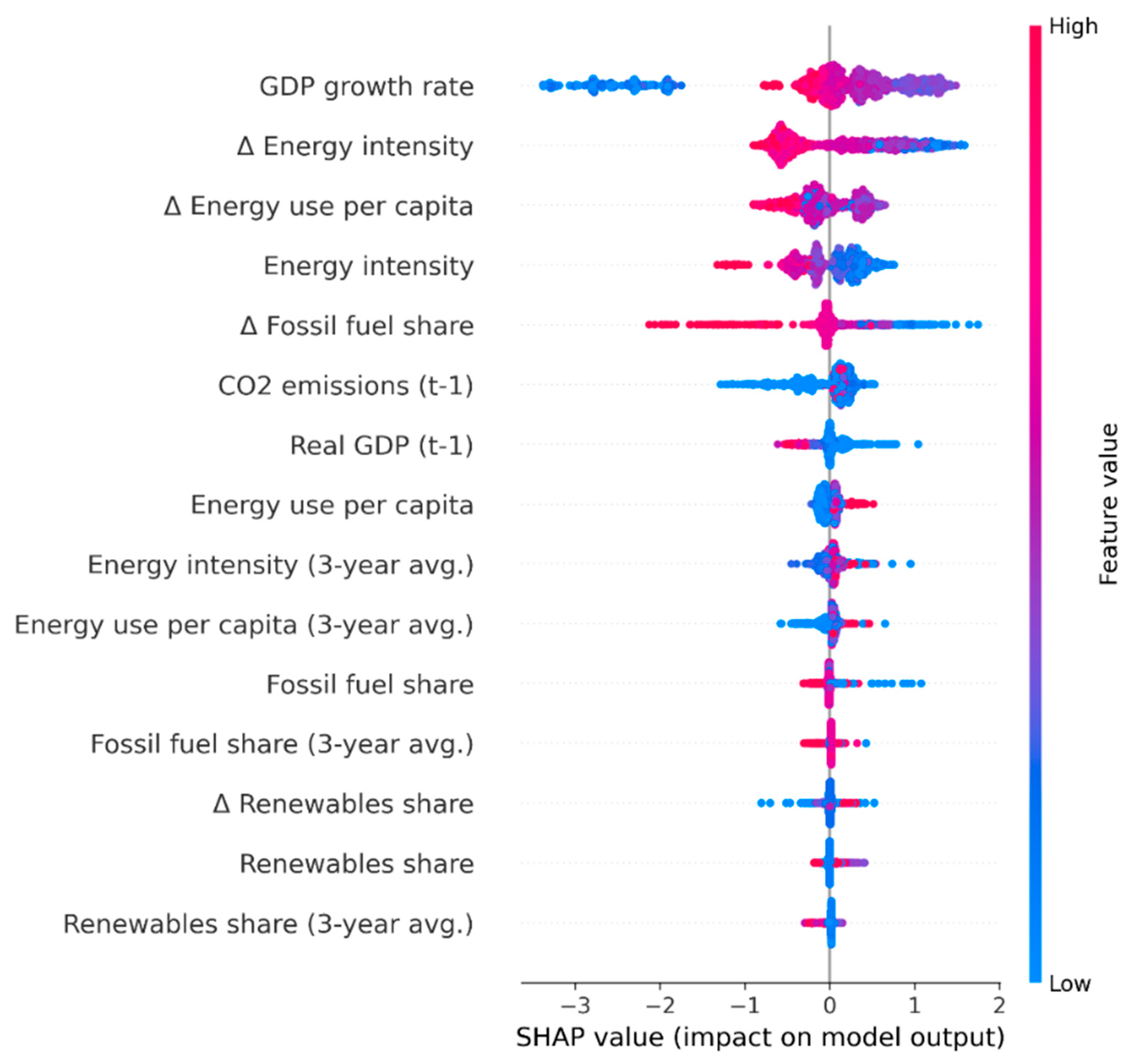
Second, the annual change in energy intensity (ΔEI) is critical. The SHAP summary (beeswarm) plot (
Figure 1) shows a clear gradient: large negative ΔEI (strong efficiency gains) strongly increase decoupling probability, while increases in intensity reduce it. This confirms that short-run improvements in energy efficiency are central to green growth. Third, the change in per-capita energy use (ΔEC) has a similar effect: decreases in per-capita energy use raise decoupling probability, suggesting that demand-side restraint (via efficiency or behavioral shifts) helps reconcile growth with emissions cuts.
Fourth, the annual change in fossil-fuel share (ΔFossil) is highly influential. Large negative ΔFossil (rapid reductions in coal, oil, gas share) consistently push the model toward predicting decoupling. This implies that actively phasing down fossil fuels is strongly associated with green growth outcomes, more so than merely adding renewables on top of an unchanged fossil base. Beyond these dynamic factors, the level of energy intensity, lagged emissions, and lagged GDP also matter: very high levels of intensity or emissions tend to depress decoupling probabilities (as revealed by SHAP values), whereas intermediate levels are less inhibitory.
The 3-year averages of intensity and energy per capita have smaller but non-negligible effects, indicating that the broader efficiency and demand context matters. The renewables share (level and change) also contributes positively when it increases, but it is less dominant than the fossil-share dynamics. In summary, the SHAP and feature-importance analyses reinforce the logistic results: short-term energy transitions are the main statistical markers of absolute decoupling. Rapid efficiency improvements (reducing energy intensity and per-capita use) and swift fossil-fuel phase-out are associated with green growth, conditional on moderate GDP expansion.
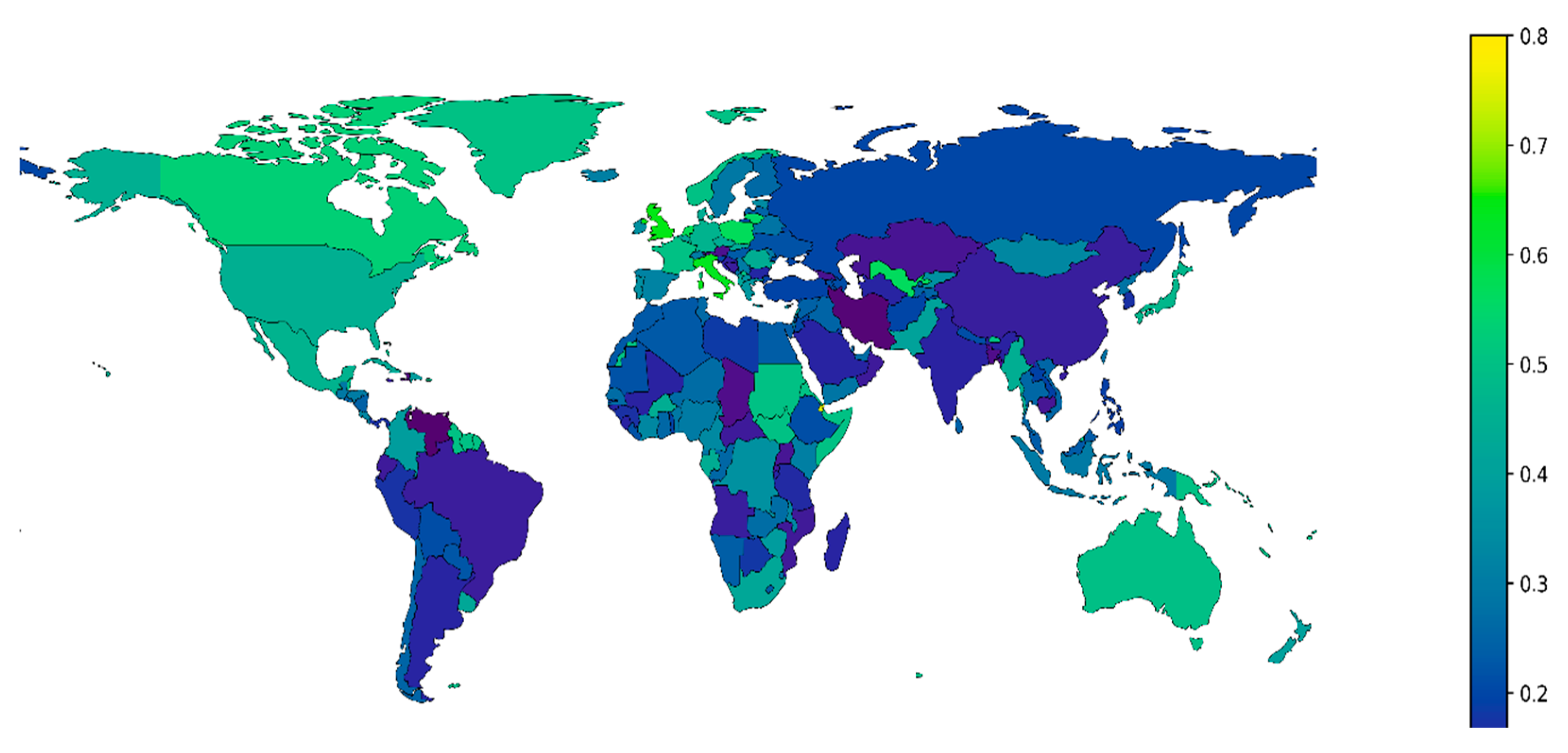
Finally, we use the gradient boosting model to compute, for each country, the average predicted probability of decoupling over the test-set years and visualize these averages on a world choropleth map (
Figure 2). The resulting spatial pattern aligns with the descriptive evidence. High predicted probabilities cluster in several advanced economies with well-documented decarbonization efforts, including Western European countries such as the United Kingdom, Italy, the Netherlands, Poland, and Lithuania, as well as high-income resource exporters like Canada and Australia.
Some smaller economies (for example Luxembourg, Uzbekistan, and Djibouti) also exhibit relatively high modelled propensity to decouple, reflecting idiosyncratic combinations of efficiency improvements and rapid fuel-mix shifts. By contrast, many coal- and oil-dependent economies, particularly in parts of Asia, the Middle East, and Latin America, display low average predicted probabilities. Large emerging emitters with high fossil shares and rising energy demand tend to be assigned a low likelihood of achieving decoupling in any given year, even when their GDP growth is strong. The map therefore offers a compact visual summary of the model-implied geography of green growth, highlighting both pockets of repeated decoupling and regions where decoupling remains rare.
4. Discussion
Our findings indicate that absolute decoupling is neither automatic nor universal, but it does occur repeatedly in some contexts. About one in four country–year observations in the sample is a decoupling episode, suggesting that green growth is attainable under certain conditions. This occurrence rate aligns with empirical work showing decoupling is generally rare, though we do not find it to be entirely exceptional. A key contribution of this study is highlighting the importance of dynamic energy-system variables over static country characteristics. While rich, energy-intensive economies do have more decoupling events on average, it is the year-to-year changes that drive most predictive power. In other words, the pace of transition matters more than the starting point. Large annual improvements in energy intensity or large shifts in the fuel mix are much more predictive of decoupling than whether a country is simply wealthy or large.
Consistent with the literature, we find that fossil fuel phase-down is more decisive for decoupling than renewables growth alone. Years marked by rapid declines in coal/oil/gas shares are strongly associated with decoupling, implying that adding renewables on top of an unchanged fossil base is not sufficient. This contrasts with some studies that focus mainly on renewables; our results highlight that actively reducing fossil dependence is central to green growth.
We also identify a “Goldilocks zone” of economic growth: moderate, sustained expansion is most conducive to decoupling. The model suggests that deep recessions or overheating booms both reduce decoupling likelihood, unless they coincide with extreme efficiency gains and fuel switching. This challenges any simplistic assumption that any positive growth inherently supports emissions declines.
Cross-country heterogeneity likely reflects broader institutional and structural factors beyond our model. The high-propensity countries in our map (Western Europe, Canada, Australia, etc.) all have long histories of climate and energy policies, strong technological capacity, and (in some cases) wealth to invest in cleaner infrastructure. In contrast, many developing or resource-dependent economies face persistent constraints: weaker institutions, limited clean-technology access, and economic structures tied to fossil industries. These factors likely explain why similar macro–energy changes may or may not occur in practice. In short, our results do not deny the role of GDP or policy environments; they complement them by showing what macro variables co-occur with decoupling given those contexts.
Several caveats are in order. We use production-based CO2 at annual frequency and pool all country–year observations, which may obscure some multi-year transition dynamics or fixed country traits (like geography or climate policy). For example, some countries might achieve decoupling through structural shifts over a decade, which a year-on-year model may understate. Moreover, relying on territory-based emissions does not capture the carbon footprint of trade. Nevertheless, our approach provides a broad, quantitative perspective on the conditions associated with absolute decoupling. It highlights actionable levers: namely, continued efficiency improvements and active fossil fuel reduction.
5. Conclusions
Absolute decoupling of CO2 from GDP growth is possible but remains an exceptional outcome, observed in roughly 25–30% of country–year cases in our sample. The main determinants of decoupling episodes are dynamic energy-system factors rather than GDP growth per se. In particular, sharp improvements in energy intensity, reductions in per-capita energy use, and most importantly rapid declines in the fossil-fuel share are associated with a significantly higher probability of green growth. Decoupling is most likely under moderate, sustained economic growth, rather than during recessions or uncontrolled booms, emphasizing a “Goldilocks” growth regime. Cross-country differences underscore that institutional and structural contexts matter: countries with long-standing climate policies tend to achieve repeated decoupling, whereas fossil-dependent economies face structural limits.
Overall, our results reinforce that green growth is not automatic. It requires the simultaneous alignment of moderate growth, improved energy efficiency, and active fossil fuel phase-out. These insights provide guidance for policymakers: focusing on efficiency gains and fuel switching can increase the chances of expanding the rare episodes of absolute decoupling.
Author Contributions
Conceptualization, R.T.-G. and R.T.-S.; methodology, R.T.-G.; software, R.T.-G.; validation, R.T.-G., P.F.d.A. and R.T.-S.; formal analysis, R.T.-G.; investigation, R.T.-G.; resources, R.T.-S.; data curation, R.T.-G.; writing—original draft preparation, R.T.-G.; writing—review and editing, R.T.-G., P.F.d.A. and R.T.-S.; visualization, R.T.-G.; supervision, R.T.-S.; project administration, R.T.-S.; funding acquisition, P.F.d.A. and R.T.-S. All authors have read and agreed to the published version of the manuscript.
Funding
This research was funded by the Instituto Politécnico de Setúbal, Escola Superior de Ciências Empresariais, Campus do IPS, Estefanilha, Setúbal, Portugal, and by the University Center of Defense, Polytechnic University of Cartagena. The funders had no role in the design of the study; in the collection, analyses, or interpretation of data; in the writing of the manuscript; or in the decision to publish the results.
Institutional Review Board Statement
Not applicable.
Informed Consent Statement
Not applicable.
Data Availability Statement
The dataset used in this study is publicly available from Our World in Data (OWID) and combines harmonized sources including the Global Carbon Project, the World Bank, and the IEA. All data supporting the findings of this study can be accessed at:
https://ourworldindata.org/co2-and-greenhouse-gas-emissions (accessed on 7 January 2026). The new variables and model are available if the journal needs it.
Conflicts of Interest
The authors declare no conflicts of interest.
Abbreviations
The following abbreviations are used in this manuscript:
| CO2 | Carbon Dioxide |
| GDP | Gross Domestic Product |
| GHG | Greenhouse Gas |
| EKC | Environmental Kuznets Curve |
| IPAT | Impact = Population × Affluence × Technology |
| BRI | Belt and Road Initiative |
| OECD | Organization for Economic Co-operation and Development |
| EU | European Union |
| PPP | Purchasing Power Parity |
| OWID | Our World in Data |
| IEA | International Energy Agency |
| GBM | Gradient Boosted Machine/Gradient Boosting Model |
| SHAP | SHapley Additive exPlanations |
| ROC–AUC | Receiver Operating Characteristic—Area Under Curve |
| PR–AUC | Precision–Recall Area Under Curve |
| Δ | Change (Δx = xt − xt−1) |
References
- IPCC. Climate Change 2022: Mitigation of Climate Change; Cambridge University Press: Cambridge, UK, 2022. [Google Scholar]
- Antal, M.; van den Bergh, J.C.J.M. Green growth and climate change: Conceptual and empirical considerations. Clim. Policy 2016, 16, 165–177. [Google Scholar] [CrossRef]
- O’Neill, D.W.; Fanning, A.L.; Lamb, W.F.; Steinberger, J.K. A good life for all within planetary boundaries. Nat. Sustain. 2018, 1, 88–95. [Google Scholar] [CrossRef]
- Grossman Gene, M.; Krueger Alan, B. Environmental Impacts of a North American Free Trade Agreement (November 1991). NBER Working Paper No. w3914. Available online: https://ssrn.com/abstract=232073 (accessed on 7 January 2026).
- Panayotou, T. Empirical Tests and Policy Analysis of Environmental Degradation at Different Stages of Economic Development; International Labour Organization: Geneva, Switzerland, 1993. [Google Scholar]
- Stern, D.I. The rise and fall of the Environmental Kuznets Curve. World Dev. 2004, 32, 1419–1439. [Google Scholar] [CrossRef]
- Stern, D.I. The Environmental Kuznets Curve after 25 years. J. Bioeconomics 2017, 19, 7–28. [Google Scholar] [CrossRef]
- Shahbaz, M.; Sinha, A. Environmental Kuznets Curve for CO2 emissions: A literature survey. J. Econ. Stud. 2019, 46, 106–168. [Google Scholar] [CrossRef]
- Freire-González, J.; Padilla, E.; Raymond, J.L. World economies’ progress in decoupling from CO2 emissions. Sci. Rep. 2024, 14, 20480. [Google Scholar] [CrossRef]
- Ward, J.D.; Sutton, P.C.; Werner, A.D.; Robert Costanza; Mohr, S.H.; Simmons, C.T. Is decoupling GDP growth from environmental impact possible? PLoS ONE 2016, 11, e0164733. [Google Scholar] [CrossRef]
- Schandl, H.; Hatfield-Dodds, S.; Wiedmann, T.; Geschke, A.; Cai, Y.; West, J.; Newth, D.; Baynes, T.; Lenzen, M.; Owen, A. Decoupling global environmental pressure and economic growth: Scenarios for the 21st century. J. Clean. Prod. 2016, 132, 45–56. [Google Scholar] [CrossRef]
- Sarkodie, S.A.; Strezov, V. A review on environmental Kuznets Curve hypothesis using bibliometric and meta-analysis. Sci. Total Environ. 2019, 649, 128–145. [Google Scholar] [CrossRef]
- Golaś, Z. Energy-related CO2 emissions, economic growth and decoupling: Evidence from Poland. Energies 2023, 16, 3784. [Google Scholar] [CrossRef]
- Acemoglu, D.; Akcigit, U.; Hanley, D.; Kerr, W. Transition to clean technology. J. Political Econ. 2016, 124, 52–104. [Google Scholar] [CrossRef]
- Bowen, A.; Hepburn, C. Green growth: An assessment. Oxf. Rev. Econ. Policy 2014, 30, 407–422. [Google Scholar] [CrossRef]
- Brockway, P.E.; Sorrell, S.; Semieniuk, G.; Heun, M.K.; Court, V. Energy efficiency and economy-wide rebound effects. Renew. Sustain. Energy Rev. 2021, 141, 110771. [Google Scholar] [CrossRef]
- Keyßer, L.T.; Lenzen, M. 1.5 °C degrowth scenarios. Nat. Commun. 2021, 12, 2676. [Google Scholar] [CrossRef]
- Hickel, J.; Kallis, G. Is green growth possible? New Political Econ. 2020, 25, 469–486. [Google Scholar] [CrossRef]
- Haberl, H.; Wiedenhofer, D.; Virág, D.; Kalt, G.; Plank, B.; Brockway, P.; Fishman, T.; Hausknost, D.; Krausmann, F.; Leon-Gruchalski, B.; et al. A systematic review of the evidence on decoupling. Environ. Res. Lett. 2020, 15, 065003. [Google Scholar] [CrossRef]
- Jackson, T. Prosperity Without Growth; Earthscan: London, UK, 2019. [Google Scholar]
- Wu, Y.; Zhu, Q.; Zhu, B. Decoupling analysis of world economic growth and CO2 emissions. J. Clean. Prod. 2018, 190, 94–103. [Google Scholar] [CrossRef]
- Le Quéré, C.; Korsbakken, J.I.; Wilson, C.; Tosun, J.; Andrew, R.; Andres, R.J.; Canadell, J.G.; Jordan, A.; Peters, G.P.; van Vuuren, D.P. Drivers of declining CO2 emissions in 18 developed economies. Nat. Clim. Change 2019, 9, 213–217. [Google Scholar] [CrossRef]
- European Environment Agency. Trends and Projections in Europe 2021; European Environment Agency: Copenhagen, Denmark, 2021. [Google Scholar]
- Chen, C.; Lv, Y.; He, G. Driving mechanisms for decoupling CO2 emissions. Ecosyst. Health Sustain. 2022, 8, 2059016. [Google Scholar] [CrossRef]
- Hubacek, K.; Chen, X.; Feng, K.; Wiedmann, T.; Shan, Y. Evidence of decoupling consumption-based CO2 emissions. Adv. Appl. Energy 2021, 4, 100074. [Google Scholar] [CrossRef]
- Vogel, J.; Hickel, J. Is green growth happening? Lancet Planet. Health 2023, 7, e759–e769. [Google Scholar] [CrossRef]
- Narayan, P.K.; Narayan, S. Carbon dioxide emissions and economic growth. Energy Policy 2010, 38, 661–666. [Google Scholar] [CrossRef]
- Xu, G.; Zhao, T.; Wang, R. Decomposition and Decoupling Analysis of Factors Affecting Carbon Emissions in China’s Regional Logistics Industry. Sustainability 2022, 14, 6061. [Google Scholar] [CrossRef]
- Wang, H.; Yang, Y. Regional decomposition and decoupling analysis. Environ. Sci. Pollut. Res. 2020, 27, 20889–20903. [Google Scholar] [CrossRef]
- Ike, G.N.; Usman, O.; Sarkodie, S.A. Environmental quality effects of income, energy prices and trade: The role of renewable energy consumption in G-7 countries. Sci. Total Environ. 2020, 721, 137813. [Google Scholar] [CrossRef]
- Wang, Z.; Li, F.; Xie, Z.; Li, Q.; Zhang, Y.; Dai, M. Decoupling CO2 Emissions from Economic Growth in China’s Cities from 2000 to 2020: A Case Study of the Pearl River Delta Agglomeration. Land 2023, 12, 1804. [Google Scholar] [CrossRef]
- BP. Statistical Review of World Energy 2020; BP: London, UK, 2020. [Google Scholar]
- Wiedmann, T.; Schandl, H.; Lenzen, M.; Moran, D.; Suh, S.; West, J.; Kanemoto, K. The material footprint of nations. Proc. Natl. Acad. Sci. USA 2015, 112, 6271–6276. [Google Scholar] [CrossRef] [PubMed]
- Defra. UK’s Carbon Footprint 1997–2019; Department for Environment, Food & Rural Affairs: London, UK, 2019. [Google Scholar]
- Bruckner, T.A.; Rodrigues, J.F.D.; Bradford, B.; Boitier, B.; Lenzen, M. Trade-driven carbon intensity changes. Energy Econ. 2022, 103, 105600. [Google Scholar] [CrossRef]
- Parrique, T.; Barth, J.; Briens, F.; Kraus-Polk, A.; Kerschner, C.; Jackson, T. Decoupling Debunked: Evidence and Arguments Against Green Growth as a Sole Strategy for Sustainability; European Environmental Bureau: Brussels, Belgium, 2019. [Google Scholar]
- World Bank. Indicators of Decoupling 2015; World Bank: Washington, DC, USA, 2015. [Google Scholar]
- Pilatowska, M.; Wlodarczyk, A. Decoupling of economic growth from GHG emissions. Environ. Sci. Policy 2018, 14, 7–26. [Google Scholar] [CrossRef]
- Rabobank. Global Decoupling Outlook 2023; Rabobank: Utrecht, The Netherlands, 2023. [Google Scholar]
- Roca, J.; Padilla, E.; Farré, M.; Galletto, V. Economic growth and atmospheric pollution in Spain: Discussing the environmental Kuznets curve hypothesis. Ecol. Econ. 2001, 39, 85–89. [Google Scholar] [CrossRef]
- Galeotti, M.; Lanza, A.; Pauli, F. Reassessing the Environmental Kuznets Curve for CO2 emissions. Ecol. Econ. 2006, 57, 152–163. [Google Scholar] [CrossRef]
- Romero-Ávila, D. Questioning the empirical basis of the environmental Kuznets curve for CO2. Ecol. Econ. 2008, 64, 559–574. [Google Scholar] [CrossRef]
- Churchill, S.A.; Inekwe, J.; Ivanovski, K.; Smyth, R. The environmental Kuznets curve in the OECD: 1870–2014. Ene. Econ. 2018, 75, 389–399. [Google Scholar] [CrossRef]
- Allard, A.; Takman, J.; Uddin, G.S.; Ahmed, A. The N-shaped environmental Kuznets curve: An empirical evaluation using a panel quantile regression approach. Ene. Econ. 2018, 75, 501–516. [Google Scholar] [CrossRef]
- Wang, Q.; Yang, T.; Li, R. Does income inequality reshape the environmental Kuznets curve (EKC) hypothesis? A nonlinear panel data analysis. Environ. Res. 2023, 216, 114575. [Google Scholar] [CrossRef]
- Singh, S.; Dasgupta, M.S. CO2 emissions dynamics and the role of structural factors in selected countries. Renew. Sustain. Energy Rev. 2016, 59, 1410–1421. [Google Scholar] [CrossRef]
- Li, J.; Li, Z.; Wang, J. Structural drivers of emissions. Energy 2022, 238, 121756. [Google Scholar] [CrossRef]
- Cheng, S.; Wang, P.; Chen, B.; Fan, W. Decoupling and decomposition analysis of CO2 emissions from government spending in China. Energy 2022, 243, 122741. [Google Scholar] [CrossRef]
- Apergis, N.; Payne, J.E. Per capita carbon dioxide emissions across U.S. states by sector and fossil fuel source: Evidence from club convergence tests. Energy Econ. 2017, 63, 365–372. [Google Scholar] [CrossRef]
- Jorgenson, A.K.; Clark, B. Are the economy and the environment decoupling? A comparative international study, 1960–2005. Am. J. Sociol. 2012, 118, 1–44. [Google Scholar] [CrossRef]
- Burnett, J.W. Club convergence and clustering of U.S. energy-related CO2 emissions. Resour. Energy Econ. 2018, 46, 62–84. [Google Scholar] [CrossRef]
- Wang, Y.; Gong, Y.; Bai, C.; Yan, H.; Yi, X. Exploring the convergence patterns of PM2.5 in Chinese cities. Environ. Dev. Sustain. 2023, 25, 708–733. [Google Scholar] [CrossRef]
- van Zyl, C.; Ye, X.; Naidoo, R. Explainable AI for forecasting. Appl. Energy 2024, 353, 122079. [Google Scholar] [CrossRef]
- Best, R.; Burke, P.J.; Jotzo, F. Carbon pricing efficacy: Cross-country evidence. Environ. Resour. Econ. 2020, 77, 69–94. [Google Scholar] [CrossRef]
- Friedman, J.H. Greedy function approximation: A gradient boosting machine. Ann. Statist. 2001, 29, 1189–1232. [Google Scholar] [CrossRef]
| Disclaimer/Publisher’s Note: The statements, opinions and data contained in all publications are solely those of the individual author(s) and contributor(s) and not of MDPI and/or the editor(s). MDPI and/or the editor(s) disclaim responsibility for any injury to people or property resulting from any ideas, methods, instructions or products referred to in the content. |