


Abstract
The escalating climate crisis and pervasive digital transformation position university students at a critical juncture where digital competencies increasingly shape environmental engagement. Despite extensive research on digital literacy and environmental responsibility as discrete constructs, the psychological mechanisms linking these domains remain inadequately theorized. This study investigated whether historical empathy mediates the relationship between digital literacy and environmental responsibility among 927 Egyptian university students (50.9% female; M age = 20.50 years). Participants completed validated measures assessing digital literacy, historical empathy (cognitive, affective, and behavioral dimensions), and environmental responsibility. Mediation analysis using Hayes’ PROCESS macro revealed that historical empathy partially mediated the relationship between digital literacy and environmental responsibility, accounting for approximately 12% of the total effect (indirect effect = 0.0381, 95% CI [0.0132, 0.0636]). Digital literacy demonstrated stronger associations with cognitive empathy (r = 0.337) than affective (r = 0.324) or behavioral empathy (r = 0.209), suggesting digital tools are primarily associated with the contextualization of historical environmental decisions. The model explained 26.6% of variance in environmental responsibility, indicating that while digital literacy exerts substantial direct influence, cultivating historical empathy represents a meaningful complementary pathway. Sustainability educators should integrate historical environmental case studies with digital learning tools to foster empathetic engagement that bridges the attitude–behavior gap. These findings underscore the importance of integrating digital competencies with historical consciousness in sustainability education to bridge the persistent attitude–behavior gap in environmental engagement.
1. Introduction
The confluence of accelerating environmental degradation and pervasive digital transformation has positioned university students at a critical juncture where their capacity to engage meaningfully with environmental challenges increasingly depends on digital competencies. As future decision-makers and change agents, students must navigate an information landscape characterized by both unprecedented access to environmental data and persistent challenges in evaluating its credibility and relevance. Contemporary scholarship reveals a paradox in student engagement with environmental information: while digital platforms provide extensive access to environmental content and facilitate advocacy efforts [1,2], more than 40% of students demonstrate significant deficiencies in critically assessing online information’s reliability, particularly regarding commercial bias and source credibility [3,4]. Although students can readily locate environmental information, their evaluative processes often remain superficial, lacking the reasoned justification necessary for informed environmental decision-making [5]. Evidence suggests that targeted interventions, including digital games and specialized eco-learning platforms, can enhance both digital literacy and environmental knowledge [6,7], yet the translation of digital competencies into environmental action remains mediated by metacognitive strategies and self-regulation capacities that vary substantially across student populations [8].
This translation challenge is further complicated by a persistent attitude–behavior gap in student environmental engagement. Despite 85–91% of university students worldwide reporting positive attitudes toward environmental protection and expressing willingness to make personal sacrifices for environmental causes [9,10], actual pro-environmental behaviors reveal marked inconsistency. Only 60% of students regularly practice waste separation, and merely 20% consistently engage in other sustainable actions such as reducing energy consumption or avoiding single-use items [10,11,12]. This discrepancy stems from a complex interplay of external barriers, including cost and convenience constraints, and internal factors such as limited self-efficacy and entrenched habitual patterns [10,11]. Research identifies moral obligation and participation in environmental education as critical predictors of sustainable behavior [13,14], suggesting that cognitive awareness alone proves insufficient to motivate behavioral change without accompanying emotional and ethical engagement.
Emerging evidence indicates that digital literacy positively correlates with environmental responsibility among university students, though the mechanisms underlying this relationship remain inadequately theorized. Students with advanced digital competencies demonstrate heightened awareness of technology’s environmental impact and exhibit stronger inclinations toward environmentally responsible behaviors, including energy conservation and responsible electronic waste management [7,15,16]. While quantitative studies confirm statistically significant positive correlations between digital literacy and environmental responsibility [1,17], the strength and directness of these relationships vary considerably across contexts and are moderated by factors including curriculum design, integration of sustainability content into digital education, and students’ intrinsic motivation [7,8,15]. Furthermore, digital literacy supports the development of ethical and responsible attitudes foundational to environmental stewardship [17,18], suggesting that the relationship between digital competencies and environmental action operates through attitudinal and value-based pathways that warrant systematic investigation.
Historical empathy—defined as a multidimensional psychological construct encompassing cognitive and affective capacities to comprehend past decisions and their consequences [19,20]—may represent a crucial but overlooked mediating mechanism in this relationship. This construct integrates contextualization of historical actions within temporal and environmental frameworks, recognition of historical actors’ values and beliefs, affective engagement with past individuals, and informed imagination to interpret incomplete historical evidence [20,21,22]. When students employ digital tools to explore historical environmental failures and successes, they may develop empathy not only for those affected by past decisions but also for future generations who will inherit contemporary choices [6,23]. This empathetic engagement is associated with moral responsibility and deeper connection to environmental outcomes, rendering historical lessons personally relevant and emotionally resonant [23,24]. Consequently, historical empathy may function as a transformative bridge that converts digital knowledge into internalized values and attitudes, thereby motivating students to adopt environmentally responsible behaviors [16,23,24]. Digital literacy is associated with access to, interpretation of, and engagement with diverse environmental histories through digital archives, simulations, and interactive media [16,25,26,27], yet whether and how this access relates to historical empathy that subsequently shapes environmental responsibility remains empirically untested.
Historical empathy is conceptualized in this study as a hybrid cognitive-affective ethical competence that uniquely integrates contextualized historical reasoning with morally charged emotional engagement [20,28]. This construct is selected as the mediator because it is discipline-specific to historical learning and theorized to bridge historical understanding with present-oriented citizenship, inclusion, and moral concern [19,28]. Unlike more general predictors such as moral obligation [29], environmental identity [30], or self-efficacy [31], historical empathy synthesizes evidence-based contextualization with ethical judgment and caring responses [20], making it a theoretically proximal mechanism through which historically framed environmental narratives can shape contemporary ethical commitments [19,28]. This positioning aligns with conceptualizations of empathy as inherently relational and morally situated [32], while maintaining its distinctive cognitive-contextual foundation in historical inquiry.
Despite growing scholarly interest in both digital literacy and environmental sustainability, a critical research gap persists regarding the intersection of these domains with historical consciousness. Existing literature predominantly examines digital competencies and environmental awareness as discrete constructs, with few studies integrating digital literacy, environmental responsibility, and historical empathy within a unified theoretical framework [17,23,33,34]. While digital tools have demonstrated potential for fostering environmental awareness through immersive technologies [35,36], the integration of historical consciousness within these interventions remains largely underexplored [37]. Research on digitalization and sustainability in higher education focuses primarily on competency development while seldom incorporating historical or cultural perspectives [34,38]. Most critically, no prior studies have empirically tested historical empathy as a mediating mechanism in the relationship between digital literacy and environmental responsibility. Although theoretical arguments suggest that digital tools enable access to historical environmental narratives that may foster empathy [16,25,26,27], and separate research indicates that historical empathy influences ethical decision-making [23,24], these relationships have never been integrated into a testable mediation model.
The fundamental problem is that the psychological mechanisms through which digital literacy influences environmental responsibility among university students remain poorly understood. While research confirms positive correlations between digital competencies and environmental behaviors [7,15,16,17], the mediating pathways explaining this relationship remain theoretically underdeveloped and empirically untested. Theoretically, digital literacy enables access to historical environmental narratives, historical empathy transforms this information into emotionally resonant moral commitments through cognitive contextualization and affective engagement, and these commitments subsequently motivate pro-environmental behaviors—bridging the attitude–behavior gap by rendering abstract environmental concerns personally meaningful across temporal perspectives [19,20,23,24,28]. Without understanding these processes, educators lack evidence-based guidance for designing interventions that effectively translate environmental knowledge into sustainable action, perpetuating the attitude–behavior gap in sustainability education.
The present study addresses this gap by investigating whether historical empathy mediates the relationship between digital literacy and environmental responsibility among university students. Specifically, this research examines: (1) the relationships between digital literacy and environmental responsibility, (2) the relationships between digital literacy and historical empathy dimensions (cognitive, affective, and behavioral), (3) the relationship between historical empathy and environmental responsibility, (4) whether historical empathy mediates the digital literacy–environmental responsibility relationship, and (5) the proportion of total effect accounted for by indirect versus direct pathways. Through mediation analysis, this study aims to elucidate the mechanisms through which digital competencies translate into environmentally responsible attitudes and behaviors, providing evidence-based guidance for curriculum development and pedagogical interventions designed to cultivate digitally literate, historically informed, and environmentally responsible graduates.
2. Materials and Methods
2.1. Study Design
This study employed a cross-sectional correlational design to investigate the relationships among digital literacy, historical empathy, and environmental responsibility among university students. The research utilized a mediation model framework to examine whether historical empathy mediates the relationship between digital literacy and environmental responsibility. Data were collected at a single time point using self-report questionnaires administered online.
2.2. Participants
The study comprised two independent samples recruited through convenience sampling from undergraduate students at the Faculty of Education and the Faculty of Humanities Studies in Dakahlia, Al-Azhar University, Egypt, during the first semester of the 2025–2026 academic year. The psychometric validation sample consisted of 741 students (401 females, 54.1%; 340 males, 45.9%) aged 18 to 23 years (M = 20.57, SD = 1.73). The main analytical sample included 927 students (472 females, 50.9%; 455 males, 49.1%) aged 18 to 23 years (M = 20.50, SD = 1.67). Both samples included students distributed across all four undergraduate grade levels and represented both rural and urban residential backgrounds. Detailed demographic characteristics of the study participants are presented in Table 1.
Table 1.
Demographic Characteristics of Study Participants.
The use of separate psychometric validation and analytical samples served distinct methodological purposes. The psychometric validation sample (N = 741) was employed to establish the reliability and construct validity of the Arabic-translated instruments through confirmatory factor analysis, ensuring measurement quality before hypothesis testing. The main analytical sample (N = 927) was then used exclusively for testing the mediation model, preventing statistical bias that could arise from using the same data for both scale validation and substantive hypothesis testing. This two-sample approach enhances the robustness and generalizability of the findings by avoiding capitalization on chance characteristics of a single dataset. Convenience sampling from a single institution was appropriate for this exploratory investigation of previously untested mediation pathways, where establishing theoretical relationships and ensuring adequate statistical power (N = 741 and N = 927) took precedence over population representativeness.
2.3. Instruments
Three validated scales were employed to assess the study variables. All instruments were translated into Arabic, the participants’ native language, through a rigorous translation-back-translation process conducted by three bilingual experts specializing in psychology and education. The translation followed a systematic procedure wherein the original English versions were independently translated into Arabic, synthesized into a single Arabic version, and subsequently back-translated into English by different translators to ensure semantic and conceptual equivalence. Following translation, all instruments underwent cultural adaptation procedures to ensure appropriateness for the Egyptian university context. A panel of five Egyptian educational psychology experts reviewed the translated items for cultural relevance, semantic clarity, and conceptual equivalence. Minor modifications were made to examples and phrasing to reflect local educational practices and environmental contexts (e.g., referencing regional environmental challenges familiar to Egyptian students).
Digital Literacy Scale (DLS) is a unidimensional instrument comprising 20 items [39]. Participants responded using a 4-point Likert scale ranging from 1 (Strongly Disagree) to 4 (Strongly Agree), with higher scores indicating greater digital literacy. Sample items include statements assessing competencies in information evaluation, digital communication, and responsible technology use. For the psychometric validation sample, confirmatory factor analysis (CFA) demonstrated excellent model fit: χ2(170) = 177.279, p = 0.335, χ2/df = 1.043, root mean square error of approximation (RMSEA) = 0.038 with 90% confidence interval (CI) [0.000, 0.019], comparative fit index (CFI) = 0.997, Tucker–Lewis index (TLI) = 0.990, goodness-of-fit index (GFI) = 0.977, adjusted goodness-of-fit index (AGFI) = 0.971, and root mean square residual (RMR) = 0.008. Internal consistency reliability was exceptional, with Cronbach’s alpha (α) = 0.988.
Historical Empathy Scale-Adult Form (HES-AF) is a multidimensional instrument consisting of 16 items distributed across three subscales: Cognitive Empathy (8 items), Affective Empathy (5 items), and Behavioral Empathy (3 items) [40]. The scale provides both subscale scores and a total historical empathy score. Participants responded using a 5-point Likert scale ranging from 1 (Never) to 5 (Always), with higher scores reflecting greater historical empathy. Sample items include prompts assessing the ability to understand historical figures’ perspectives, emotional responses to historical events, and intentions to learn from historical experiences. Confirmatory factor analysis for the psychometric validation sample indicated excellent model fit: χ2(101) = 119.308, p = 0.103, χ2/df = 1.181, RMSEA = 0.016, CFI = 0.998, TLI = 0.998, GFI = 0.981, AGFI = 0.974, and RMR = 0.022. Internal consistency reliability was strong for all subscales and the total scale: Cognitive Empathy α = 0.976, Affective Empathy α = 0.922, Behavioral Empathy α = 0.835, and Total Historical Empathy α = 0.936.
Environmental Responsibility Scale (ERS) is a unidimensional measure consisting of 12 items [41]. Participants responded using a 5-point Likert scale ranging from 1 (Strongly Disagree) to 5 (Strongly Agree), with higher scores indicating greater environmental responsibility. Sample items address attitudes and behaviors related to environmental conservation, waste reduction, and sustainable practices. For the psychometric validation sample, confirmatory factor analysis yielded acceptable model fit indices: χ2(54) = 252.950, p < 0.001, χ2/df = 4.680, RMSEA = 0.070 with 90% CI [0.061, 0.079], CFI = 0.942, TLI = 0.929, GFI = 0.946, AGFI = 0.778, and RMR = 0.044. While the chi-square statistic was significant and the χ2/df ratio exceeded the conventional threshold of 3.0, other fit indices remained within acceptable ranges, and the RMSEA fell within the acceptable range of 0.05 to 0.08 for reasonable model fit. Internal consistency reliability was excellent, with α = 0.964. Additionally, item-total correlations for all 12 items ranged from 0.664 to 0.917 (p < 0.001), demonstrating strong internal consistency across all scale items.
2.4. Procedures
Data collection occurred between 4–18 October 2025 through Google Forms administered during the first semester of the 2025–2026 academic year. All participants provided informed consent before completing the survey instruments. The study protocols received approval from the university’s institutional review board, and participation was voluntary with no incentives provided. Students completed the survey independently in a self-paced format, typically requiring 15–20 min for completion. The study protocols were approved by the Research Ethics Committee of the Faculty of Education at Al-Azhar University, Dakahlia, Egypt (protocol code Ref. No. EDU-REC-2025-162; approval date 7 September 2025), and all procedures were conducted in accordance with the Declaration of Helsinki.
2.5. Data Analysis
Data analysis was conducted using SPSS version 27 and AMOS version 26. Descriptive statistics and Pearson correlations were computed to examine relationships among study variables. Statistical mediation analysis was performed using Hayes’ PROCESS macro Model 4 with 5000 bootstrap samples to examine the indirect association of digital literacy with environmental responsibility through historical empathy, with statistical significance evaluated at α = 0.05.
3. Results
Preliminary analyses examined demographic differences across the main sample (N = 927) to assess the representativeness and homogeneity of the participant groups. Chi-square tests of independence were conducted to explore potential associations between gender and other demographic variables, specifically grade level and residence. As presented in Table 2, the analysis revealed no statistically significant relationship between gender and grade level, χ2(3, N = 927) = 3.191, p = 0.363, indicating that male and female students were evenly distributed across all four undergraduate years. Similarly, the relationship between gender and residence was not statistically significant, χ2(1, N = 927) = 2.270, p = 0.132, demonstrating comparable proportions of male and female students from both rural and urban backgrounds. These findings suggest that gender differences did not systematically vary with educational level or residential context, supporting the appropriateness of subsequent analyses without controlling for these demographic factors.
Table 2.
Chi-Square Analysis of Gender Differences Across Demographic Variables.
Descriptive statistics and correlation analyses were conducted to examine the relationships among the study variables. Pearson product–moment correlations revealed significant positive associations among all primary variables and their subscales. As shown in Table 3, digital literacy demonstrated differential patterns of association with the three subscales of historical empathy, showing the strongest correlation with cognitive empathy (r = 0.337, p < 0.001), followed by affective empathy (r = 0.324, p < 0.001), with the weakest but still significant correlation observed with behavioral empathy (r = 0.209, p < 0.001). Digital literacy also exhibited moderate to strong positive correlations with both historical empathy total score (r = 0.454, p < 0.001) and environmental responsibility (r = 0.398, p < 0.001). The intercorrelations among the historical empathy subscales ranged from r = 0.125 to r = 0.165 (p < 0.001), indicating moderate independence among the three dimensions.
Table 3.
Correlations Between Digital Literacy, Historical Empathy Subscales, and Environmental Responsibility.
These findings suggest that digital competencies may be particularly relevant for cognitive dimensions of historical understanding—such as contextualizing past events and recognizing historical actors’ perspectives—while showing somewhat weaker associations with affective and behavioral components. Notably, cognitive empathy showed the strongest relationship with environmental responsibility (r = 0.178, p < 0.001) compared to affective empathy (r = 0.167, p < 0.001) and behavioral empathy (r = 0.156, p < 0.001), while historical empathy total score demonstrated a moderate correlation with environmental responsibility (r = 0.254, p < 0.001). These bivariate relationships provided initial support for investigating mediation effects, as recommended theoretical prerequisites were met: the predictor variable (digital literacy) correlated significantly with both the mediator (historical empathy) and the outcome variable (environmental responsibility), and the mediator correlated significantly with the outcome.
To test the central hypothesis that historical empathy mediates the relationship between digital literacy and environmental responsibility, a mediation analysis was conducted using Hayes’ PROCESS macro Model 4 with 5000 bootstrap samples. The theoretical model proposed that digital literacy would enhance students’ capacity to engage with historical environmental narratives through digital tools, thereby cultivating historical empathy that subsequently motivates environmental responsibility. This indirect pathway would operate alongside a direct effect of digital literacy on environmental responsibility, reflecting the multifaceted ways digital competencies shape sustainable attitudes and behaviors. The mediation framework thus conceptualized historical empathy as a transformative psychological mechanism that converts digital access to environmental histories into personally meaningful moral commitments toward environmental stewardship.
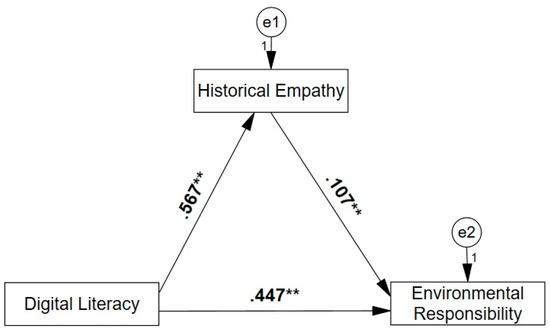
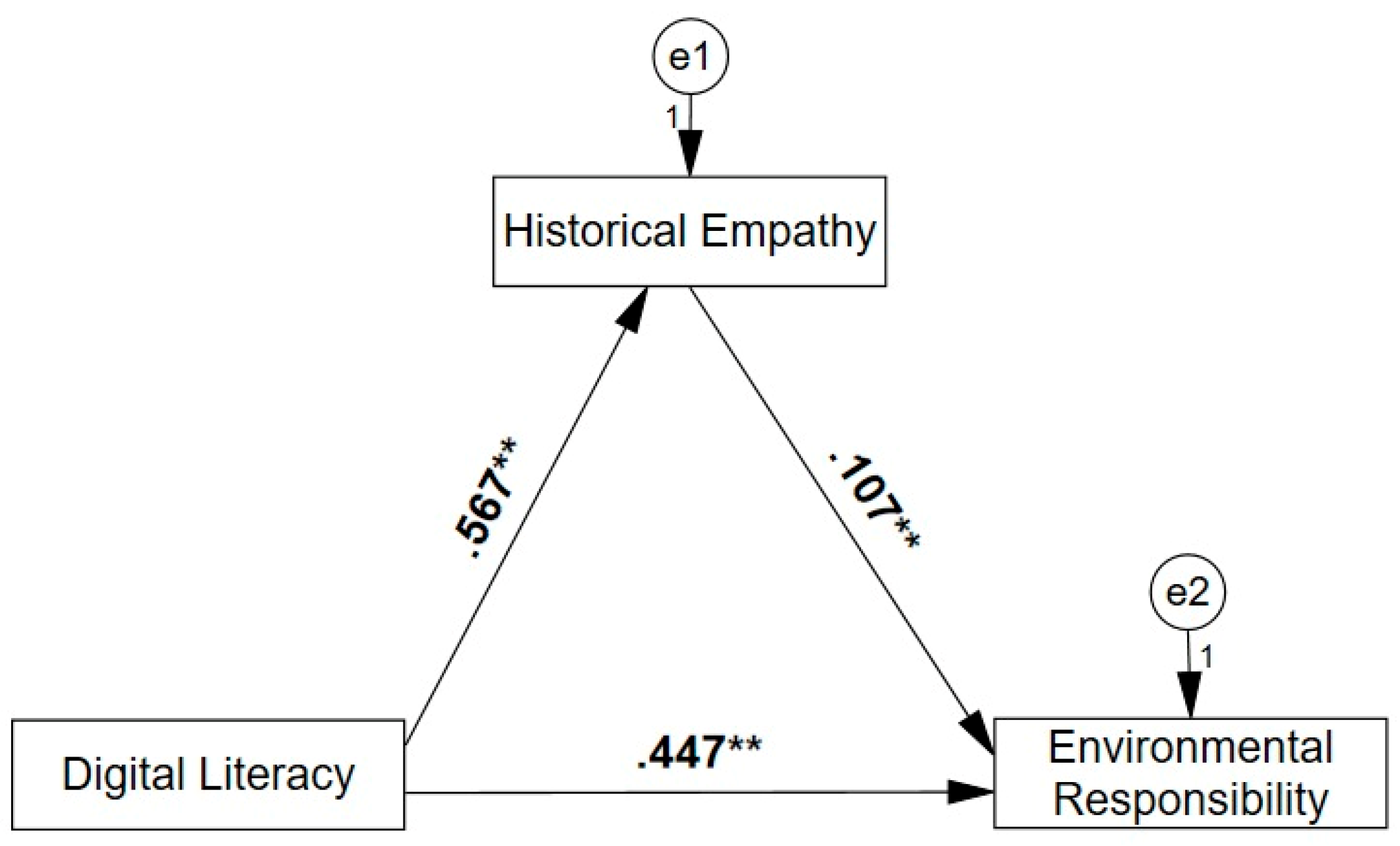
The statistical mediation model, illustrated in Figure 1, examined both the direct association of digital literacy with environmental responsibility and the indirect association through historical empathy. As presented in Table 4, the total association of digital literacy with environmental responsibility was statistically significant (c = 0.3174, SE = 0.0177, t = 17.94, p < 0.001, 95% CI [0.2827, 0.3521]), indicating that higher levels of digital literacy were associated with greater environmental responsibility.
Figure 1.
Mediation Model of the Relationship Between Digital Literacy and Environmental Responsibility Through Historical Empathy.
Table 4.
Summary of Total, Direct, and Indirect Effects in the Mediation Model.
The decomposition of this total association into direct and indirect components revealed a significant statistical mediation pattern. The direct association of digital literacy with environmental responsibility, controlling for historical empathy, remained statistically significant (c’ = 0.2793, SE = 0.0214, t = 13.06, p < 0.001, 95% CI [0.2373, 0.3213]), with a standardized coefficient of c’ = 0.4472. Simultaneously, digital literacy demonstrated a strong positive association with historical empathy (a = 0.4775, SE = 0.0228, t = 20.97, p < 0.001, 95% CI [0.4328, 0.5222]), with a standardized coefficient of 0.5676, accounting for approximately 32.22% of the variance in historical empathy (R2 = 0.3222). Historical empathy, in turn, was significantly associated with environmental responsibility (b = 0.0797, SE = 0.0254, t = 3.14, p = 0.002, 95% CI [0.0298, 0.1296]), with a standardized coefficient of 0.1073. These path coefficients are summarized in Table 5, which provides comprehensive statistical information for all regression pathways in the mediation model.
Table 5.
Regression Coefficients for Mediation Model Pathways.
The indirect effect of digital literacy on environmental responsibility through historical empathy was statistically significant, as evidenced by the bootstrap confidence interval that did not include zero (indirect effect = 0.0381, SE = 0.0130, 95% CI [0.0132, 0.0636]). The completely standardized indirect effect was 0.0609 (95% CI [0.0200, 0.1054]), indicating that approximately 12.0% of the total effect of digital literacy on environmental responsibility was mediated through historical empathy. Correspondingly, the direct effect accounted for 88.0% of the total effect, suggesting partial mediation. These results indicate that while digital literacy exerts a substantial direct influence on environmental responsibility, a meaningful portion of this relationship operates indirectly through the enhancement of historical empathy. The model explained 26.60% of the variance in environmental responsibility (R2 = 0.2660, F(2, 924) = 167.40, p < 0.001), indicating that while the model explains moderate variance, additional mediating variables likely contribute to the digital literacy–environmental responsibility relationship.
The statistical mediation findings provide empirical support for an explanatory model in which historical empathy is associated with the relationship between digital competencies and environmental attitudes and behaviors. Students with stronger digital literacy skills appear better able to access, interpret, and emotionally engage with historical environmental narratives, which is associated with a sense of responsibility toward contemporary and future environmental challenges. Nevertheless, the predominance of the direct association suggests that digital literacy relates to environmental responsibility through multiple pathways beyond historical empathy, warranting further investigation of additional variables in future research.
4. Discussion
The statistical mediation analysis revealed that historical empathy partially accounts for the relationship between digital literacy and environmental responsibility among university students, explaining approximately 12% of the total association. This finding suggests that digital competencies are associated with environmental responsibility through dual pathways: a substantial direct relationship and a meaningful indirect pathway through historical consciousness. The strong correlation between digital literacy and cognitive empathy, compared to affective and behavioral dimensions, indicates that digital tools are primarily associated with students’ capacity to contextualize historical environmental decisions rather than emotional engagement. Although historical empathy accounts for a modest 12% of the total association, its unique contribution lies in temporally contextualizing environmental decisions—connecting past failures, present choices, and future consequences—a dimension not captured by traditional mediators such as moral norms or environmental concern, which typically explain 15–35% of variance individually.
The modest proportion of variance explained by historical empathy (12% of total effect) and the model overall (26.6% of variance in environmental responsibility) warrants careful interpretation. From a practical perspective, a 12% mediation effect represents a meaningful educational target: interventions integrating historical environmental narratives with digital tools could complement existing approaches that address direct pathways. The substantial unexplained variance (73.4%) suggests multiple mechanisms operate simultaneously. Likely contributors include self-efficacy beliefs regarding environmental action [31], environmental identity and personal connection to nature [30], moral norms and perceived behavioral control [29], social norms and peer influence [14], access to sustainable infrastructure, and socioeconomic factors affecting sustainable consumption choices [10,11].
These findings align with previous research establishing positive correlations between digital literacy and environmental responsibility. However, the current study extends understanding by identifying historical empathy as a statistical mediator previously overlooked in sustainability education literature. The results corroborate evidence that digital competencies are associated with environmentally responsible behaviors through access to environmental information and enhanced critical evaluation capacities [7,15]. However, our findings advance beyond prior work by demonstrating patterns consistent with a model in which digital tools relate to engagement with historical environmental narratives, which is associated with empathy that may motivate sustainable action [23,24]. The partial mediation observed supports the theoretical proposition that digital literacy operates through multiple pathways, consistent with research highlighting the importance of metacognitive strategies and ethical engagement in translating environmental knowledge into action [8,13].
These findings carry significant implications for curriculum development and pedagogical practice in higher education. Educators should integrate digital literacy instruction with historical environmental case studies, enabling students to explore past ecological failures and successes through digital archives, simulations, and interactive media. This approach may address the persistent attitude–behavior gap in student environmental engagement by fostering emotional and ethical connections that complement cognitive awareness. Universities should design interdisciplinary courses that deliberately cultivate historical empathy alongside digital competencies, positioning sustainability education within temporal contexts that illuminate contemporary choices’ consequences for future generations. Furthermore, institutions should develop digital learning environments that facilitate critical engagement with diverse environmental histories, thereby transforming abstract environmental concerns into personally relevant moral imperatives. Such pedagogical innovations may enhance students’ self-efficacy and moral obligation, identified as critical predictors of sustainable behavior.
These findings should be interpreted within the Egyptian cultural and educational context. Egyptian university students engage with environmental responsibility through frameworks influenced by Islamic environmental stewardship principles (khilafah, mizan) that emphasize intergenerational justice and resource trusteeship, which may amplify the relevance of historical consciousness in environmental decision-making. Additionally, Egypt’s unique environmental history—including millennia of Nile-dependent agriculture, ancient sustainability practices, and contemporary challenges such as desertification and water scarcity—provides regionally specific historical narratives that may differentially activate historical empathy compared to contexts with different environmental legacies. The mediation patterns observed here may reflect culturally specific ways of connecting past, present, and future environmental concerns that warrant empirical examination across diverse cultural settings before broader generalization.
Several limitations warrant consideration when interpreting these findings. The cross-sectional design precludes causal inferences, as the directionality of relationships among digital literacy, historical empathy, and environmental responsibility remains uncertain. While statistical mediation analysis can identify patterns consistent with theoretical models, it cannot establish that digital literacy causally influences historical empathy, which in turn causally affects environmental responsibility. The observed associations may reflect alternative causal structures, reverse causation, or reciprocal relationships that cannot be distinguished with cross-sectional data. Convenience sampling from a single Egyptian university limits generalizability across diverse cultural, educational, and socioeconomic contexts. Reliance on self-report measures introduces potential social desirability bias, particularly for environmental responsibility assessments where students may overreport sustainable attitudes and behaviors. The study did not account for potential confounding variables such as prior environmental education, socioeconomic status, or access to digital resources, which may influence observed relationships. Additionally, the mediation model explained moderate variance, suggesting unmeasured variables contribute substantially to environmental responsibility. The lack of behavioral observations limits conclusions about actual pro-environmental actions versus reported intentions.
Future research should employ longitudinal designs to establish temporal precedence and examine how digital literacy and historical empathy develop concurrently to influence environmental responsibility over time. Experimental interventions testing pedagogical approaches that integrate digital tools with historical environmental education would provide causal evidence for the proposed mechanisms. Studies should investigate additional mediators and moderators, including self-efficacy, moral obligation, and critical thinking dispositions, to comprehensively map pathways linking digital competencies with sustainable behaviors.
Cross-cultural research across diverse geographical and institutional contexts would enhance generalizability and reveal cultural variations in these relationships. Future studies should specifically examine how Arabic dialect variations and regional cultural contexts influence the conceptualization and expression of environmental responsibility and historical empathy, as linguistic nuances and cultural values may moderate the observed mediation pathways. Comparative investigations across Arab-speaking countries with different dialects (e.g., Egyptian, Gulf, Levantine, Maghrebi) and varying educational systems—including public versus private institutions, traditional versus technology-enhanced learning environments, and nations with different emphases on environmental education in their national curricula—would illuminate whether these relationships operate similarly across diverse Arabic-speaking populations and reveal how systemic educational factors shape the development of digital competencies and environmental consciousness. Mixed-methods approaches incorporating behavioral observations, digital trace data, and qualitative interviews would address self-report limitations while capturing nuanced processes underlying environmental decision-making. Finally, research should examine domain-specific applications, exploring how particular digital tools and historical narratives differentially influence environmental attitudes and actions.
5. Conclusions
This study identifies historical empathy as a significant, though partial, statistical mediator in the relationship between digital literacy and environmental responsibility among university students. The findings demonstrate associations consistent with a model in which digital competencies relate to environmental stewardship both directly and indirectly through historical consciousness, which may render environmental challenges personally meaningful and morally compelling. The mediation analysis revealed several theoretically significant patterns: digital literacy demonstrated differential associations with historical empathy dimensions, correlating most strongly with cognitive empathy compared to affective and behavioral dimensions. This pattern suggests that digital tools primarily enhance students’ capacity to contextualize and understand historical environmental decisions rather than fostering emotional engagement or behavioral intentions. These findings provide the first empirical validation of theoretical arguments that digital access to historical environmental narratives cultivates empathy that subsequently motivates sustainable action, addressing a critical gap in sustainability education literature.
These findings advance the theoretical understanding of the attitude–behavior gap in environmental engagement by identifying historical empathy as a variable that is associated with the relationship between cognitive awareness and moral commitment. Previous research has documented persistent discrepancies between students’ positive environmental attitudes and actual sustainable behaviors, yet the psychological processes underlying this gap remained inadequately explained. The current study demonstrates patterns consistent with a model in which historical empathy is associated with rendering abstract environmental concerns personally relevant by connecting contemporary choices to their consequences for past and future generations. This temporal perspective addresses limitations of models focusing solely on knowledge transmission or attitude formation, revealing that emotional and ethical engagement with environmental histories represents a distinct pathway to behavioral change. As future decision-makers navigate unprecedented ecological challenges, educational interventions that synthesize digital competencies, historical understanding, and ethical engagement may prove essential for cultivating informed, empathetic, and responsible environmental stewardship.
Author Contributions
Conceptualization, Y.H.R., M.F.E. and M.A.N.-a.; methodology, Y.H.R. and M.A.N.-a.; software, M.A.N.-a.; validation, Y.H.R., M.F.E. and M.A.N.-a.; formal analysis, M.A.N.-a.; investigation, Y.H.R. and M.F.E.; resources, Y.H.R. and M.F.E.; data curation, M.A.N.-a.; writing—original draft preparation, M.A.N.-a.; writing—review and editing, Y.H.R. and M.A.N.-a.; visualization, Y.H.R. and M.A.N.-a.; supervision, Y.H.R. and M.F.E.; project administration, Y.H.R. All authors have read and agreed to the published version of the manuscript.
Funding
This research received no external funding.
Institutional Review Board Statement
The study was conducted in accordance with the Declaration of Helsinki and approved by the Re-search Ethics Committee of the Faculty of Education at Al-Azhar University, Dakahlia, Egypt (protocol code Ref. No. EDU-REC-2025-162, approval date 7 September 2025).
Informed Consent Statement
Informed consent was obtained from all subjects involved in the study.
Data Availability Statement
The datasets generated and analyzed during the current study are available from the corresponding author upon reasonable request.
Acknowledgments
The authors thank all participants for their valuable contribution to this study.
Conflicts of Interest
The authors declare no conflicts of interest.
Abbreviations
The following abbreviations are used in this manuscript:
| AGFI | Adjusted Goodness-of-Fit Index |
| AMOS | Analysis of Moment Structures |
| CFA | Confirmatory Factor Analysis |
| CFI | Comparative Fit Index |
| CI | Confidence Interval |
| RMSEA | Root Mean Square Error of Approximation |
| HE_Aff | Historical Empathy–Affective |
| HE_Beh | Historical Empathy–Behavioral |
| HE_Cog | Historical Empathy–Cognitive |
| HES-AF | Historical Empathy Scale–Adult Form |
References
- Amador-Alarcón, M.P.; Torres-Gastelú, C.A.; Lagunes-Domínguez, A.; Medina-Cruz, H.; Argüello-Rosales, C.A. Perceptions of Environmental Protection of University Students: A Look Through Digital Competences in Mexico. Sustainability 2022, 14, 11141. [Google Scholar] [CrossRef] [Scilit]
- Nikou, S.; Aavakare, M. An assessment of the interplay between literacy and digital Technology in Higher Education. Educ. Inf. Technol. 2021, 26, 3893–3915. [Google Scholar] [CrossRef] [Scilit]
- Dadaczynski, K.; Okan, O.; Messer, M.; Rosário, R.; Darlington, E.; Rathmann, K. Digital health literacy and online information seeking in times of COVID-19. A cross-sectional survey among university students in Germany. J. Med. Internet Res. 2021, 23, 24097. [Google Scholar] [CrossRef] [Scilit]
- Kiili, C.; Coiro, J.; Räikkönen, E. Students’ evaluation of information during online inquiry: Working individually or in pairs. Aust. J. Lang. Lit. 2019, 42, 167–183. [Google Scholar] [CrossRef] [Scilit]
- Nygren, T.; Guath, M. Students evaluating and corroborating digital news. Scand. J. Educ. Res. 2022, 66, 549–565. [Google Scholar] [CrossRef] [Scilit]
- Chang, R.C.; Chung, L.Y.; Huang, Y.M. Developing an interactive augmented reality system as a complement to plant education and comparing its effectiveness with video learning. Interact. Learn. Environ. 2016, 24, 1245–1264. [Google Scholar] [CrossRef] [Scilit]
- Sumarmi, S.; Aliman, M.; Mutia, T. The effect of digital eco-learning in student worksheet flipbook to environmental project literacy and pedagogic competency. J. Technol. Sci. Educ. 2021, 11, 357. [Google Scholar] [CrossRef] [Scilit]
- Zheng, J.; Kim, K.T. The driving force for sustaining future competencies for university students in the digital era: Learning strategies. J. Curric. Teach. 2025, 14, 19–29. [Google Scholar] [CrossRef] [Scilit]
- Li, Y.; Yang, D.; Liu, S. The impact of environmental education at Chinese Universities on college students’ environmental attitudes. PLoS ONE 2024, 19, e0299231. [Google Scholar] [CrossRef] [Scilit]
- Shafiei, A.; Maleksaeidi, H. Pro-environmental behavior of university students: Application of protection motivation theory. Glob. Ecol. Conserv. 2020, 22, e00908. [Google Scholar] [CrossRef] [Scilit]
- Carducci, A.; Fiore, M.; Azara, A.; Bonaccorsi, G.; Bortoletto, M.; Caggiano, G.; Calamusa, A.; De Donno, A.; De Giglio, O.; Dettori, M.; et al. Pro-Environmental Behaviors: Determinants and Obstacles among Italian University Students. Int. J. Environ. Res. Public Health 2021, 18, 3306. [Google Scholar] [CrossRef] [Scilit]
- Fernández, M.; Cebrián, G.; Regadera, E.; Fernández, M.Y. Analysing the Relationship between University Students’ Ecological Footprint and Their Connection with Nature and Pro-Environmental Attitude. Int. J. Environ. Res. Public Health 2020, 17, 8826. [Google Scholar] [CrossRef] [Scilit]
- Shahrier, M.A.; Kayesh, K.I.; Zubaier, A.M.; Khan, R.A.; Sarkar, N.; Rahman, M.L. Co-curricular engagement, moral quotient, and pro-environmental behaviors of university students in Bangladesh. BMC Psychol. 2025, 13, 683. [Google Scholar] [CrossRef] [Scilit]
- Kaiser, F.G.; Scheuthle, H. Two challenges to a moral extension of the theory of planned behavior: Moral norms and just world beliefs in conservationism. Personal. Individ. Differ. 2003, 35, 1033–1048. [Google Scholar] [CrossRef] [Scilit]
- Juanda, J.; Afandi, I.; Yunus, A.F. Digital short story literacy and the character of environmentally concerned students. J. Lang. Teach. Res. 2024, 15, 415–427. [Google Scholar] [CrossRef] [Scilit]
- Lu, S.; Sun, Z.; Huang, M. The impact of digital literacy on farmers’ pro-environmental behavior: An analysis with the Theory of Planned Behavior. Front. Sustain. Food Syst. 2024, 8, 1432184. [Google Scholar] [CrossRef] [Scilit]
- Colás-Bravo, P.; Conde-Jiménez, J.; Reyes-De-Cózar, S. Sustainability and digital teaching competence in higher education. Sustainability 2021, 13, 12354. [Google Scholar] [CrossRef] [Scilit]
- Aydınlar, A.; Mavi, A.; Kütükçü, E.; Kırımlı, E.E.; Alış, D.; Akın, A.; Altıntaş, L. Awareness and level of digital literacy among students receiving health-based education. BMC Med. Educ. 2024, 24, 38. [Google Scholar] [CrossRef] [Scilit] [PubMed]
- Bartelds, H.; Savenije, G.M.; Van Boxtel, C. Students’ and teachers’ beliefs about historical empathy in secondary history education. Theory Res. Soc. Educ. 2020, 48, 529–551. [Google Scholar] [CrossRef] [Scilit]
- Savenije, G.M.; De Bruijn, P. Historical empathy in a museum: Uniting contextualisation and emotional engagement. Int. J. Herit. Stud. 2017, 23, 832–845. [Google Scholar] [CrossRef] [Scilit]
- Bleeze, R. Fostering historical consciousness and empathy in lower secondary students: A comparative study of history curricula in Australia and Singapore. Heliyon 2024, 10, e25769. [Google Scholar] [CrossRef] [Scilit]
- Karn, S. Walking in their footsteps: Historical empathy and experiential learning on battlefield study tours. Hist. Encount. 2024, 11, 30–42. [Google Scholar] [CrossRef] [Scilit]
- Luo, J.; Zhao, R.; Li, Y. The role of empathy training in promoting pro-environmental behavior: A comprehensive review. Front. Educ. Res. 2025, 8, 82–89. [Google Scholar] [CrossRef] [Scilit]
- Frentzel-Beyme, L.; Krämer, N.C. Back to the past—An experimental investigation of the effects of immersive historical environments on empathy and morality. PRESENCE Virtual Augment. Real. 2020, 29, 91–111. [Google Scholar] [CrossRef] [Scilit]
- Buchan, M.C.; Bhawra, J.; Katapally, T.R. Navigating the digital world: Development of an evidence-based digital literacy program and assessment tool for youth. Smart Learn. Environ. 2024, 11, 8. [Google Scholar] [CrossRef] [Scilit]
- Chiu, T.K.F.; Sun, J.C.; Ismailov, M. Investigating the relationship of technology learning support to digital literacy from the perspective of self-determination theory. Educ. Psychol. 2022, 42, 1263–1282. [Google Scholar] [CrossRef] [Scilit]
- Wang, C.; Chen, X.; Yu, T.; Liu, Y.; Jing, Y. Education reform and change driven by digital technology: A bibliometric study from a global perspective. Humanit. Soc. Sci. Commun. 2024, 11, 256. [Google Scholar] [CrossRef] [Scilit]
- Karn, S. Historical Empathy: A Cognitive-Affective Theory for History Education in Canada. Can. J. Educ. 2023, 46, 80–110. [Google Scholar] [CrossRef] [Scilit]
- Ayanian, A.H.; Tausch, N.; Acar, Y.G.; Chayinska, M.; Cheung, W.; Lukyanova, Y. Resistance in repressive contexts: A comprehensive test of psychological predictors. J. Personal. Soc. Psychol. 2021, 120, 912–939. [Google Scholar] [CrossRef] [Scilit]
- Tamaki, S. Impacts of empathy, identity, and ethical branding on sustainable local food consumption. Corp. Soc. Responsib. Environ. Manag. 2024, 31, 6184–6196. [Google Scholar] [CrossRef] [Scilit]
- Igwe, A.; Ogbo, A.; Agbaeze, E.; Abugu, J.; Ezenwakwelu, C.; Okwo, H. Self-Efficacy and subjective norms as moderators in the Networking Competence–Social Entrepreneurial Intentions link. SAGE Open 2020, 10, 2158244020934878. [Google Scholar] [CrossRef] [Scilit]
- Van Dijke, J.; Van Nistelrooij, I.; Bos, P.; Duyndam, J. Towards a relational conceptualization of empathy. Nurs. Philos. 2020, 21, e12297. [Google Scholar] [CrossRef] [Scilit] [PubMed]
- Tinmaz, H.; Lee, Y.; Fanea-Ivanovici, M.; Baber, H. A systematic review on digital literacy. Smart Learn. Environ. 2022, 9, 21. [Google Scholar] [CrossRef] [Scilit]
- Trevisan, L.V.; Eustachio, J.H.P.P.; Dias, B.G.; Filho, W.L.; Pedrozo, E.Á. Digital transformation towards sustainability in higher education: State-of-the-art and future research insights. Environ. Dev. Sustain. 2024, 26, 2789–2810. [Google Scholar] [CrossRef] [Scilit]
- Ganguly, R. Interactive and immersive media for environmental education. Int. J. Appl. Res. 2025, 11, 117–122. [Google Scholar] [CrossRef] [Scilit]
- Yi, K.; Wu, Y.; Liu, Y.; Xu, Z. Immersive Empathy in Digital Music Listening: Ideas and Sustainable Paths for developing auditory experiences in museums. SAGE Open 2024, 14, 21582440241256339. [Google Scholar] [CrossRef] [Scilit]
- Madshaven, J.M.; Omlin, C.W.P.; Spanos, A. Making Historical Consciousness Come Alive: Abstract Concepts, Artificial Intelligence, and Implicit Game-Based Learning. Educ. Sci. 2025, 15, 1128. [Google Scholar] [CrossRef] [Scilit]
- Holst, J.; Fritz, H.; Nölting, B.; Lang, D.J.; Löde, V.L.; Ober, S.; Parodi, O.; Potthast, T.; Scheiding, C.; Weynand, M.; et al. Exploring culture (s) of sustainability at higher education institutions: A systematic review of concepts and pathways. Int. J. Sustain. High. Educ. 2025, 26, 489–506. [Google Scholar] [CrossRef] [Scilit]
- Avinc, E.; Dogan, F. Digital literacy scale: Validity and reliability study with the Rasch model. Educ. Inf. Technol. 2024, 29, 22895–22941. [Google Scholar] [CrossRef] [Scilit]
- Çalişkan, H.; Yildirim, Y.; Çalişkan, A. Historical empathy scale-adult form: A study on validity and reliability. Turk. Hist. Educ. J. 2023, 12, 28–46. [Google Scholar] [CrossRef] [Scilit]
- Aldawsari, N.D.; Nemt-allah, M.A.; Abdellatif, M.S. Environmental Education Awareness in Light of Sustainable Development Goals and Its Relationship with Environmental Responsibility Among University Students. Sustainability 2025, 17, 9393. [Google Scholar] [CrossRef] [Scilit]

Disclaimer/Publisher’s Note: The statements, opinions and data contained in all publications are solely those of the individual author(s) and contributor(s) and not of MDPI and/or the editor(s). MDPI and/or the editor(s) disclaim responsibility for any injury to people or property resulting from any ideas, methods, instructions or products referred to in the content. |
© 2026 by the authors. Licensee MDPI, Basel, Switzerland. This article is an open access article distributed under the terms and conditions of the Creative Commons Attribution (CC BY) license.