


Abstract
To address the issues of cities being overwhelmed by the waste and energy crisis, the pyrolysis of municipal solid waste (MSW), oil shale (OS) and their blends was investigated using a thermogravimetric simultaneous thermal analyzer in this study. The experimental research was conducted to investigate the thermal behavior and kinetic parameters of the different blending ratios of MSW and OS, to better utilize these intractable resources, observing whether there is a synergistic effect and trying to find the optimal process conditions. The Ozawa–Flynn–Wall method and the Kissinger–Akahira–Sunose method were used to calculate the activation energy at four different heating rates. The existence of interactions between MSW and OS was confirmed by comparing the experimental thermogravimetric and derivative thermogravimetric curves with the calculated ones. The findings of the thermogravimetric analysis, the calculation of theoretical and experimental curves, and kinetic analysis confirmed the interaction between the components and that the optimal blending ratio is 30% MSW and 70% OS. The optimality results in a relatively smaller activation energy (Eave = 115 kJ/mol), better comprehensive pyrolysis characteristics, and a more beneficial mutual effect.
1. Introduction
The rapid development of industry and economy requires enormous energy consumption. In addition to optimizing the use of fossil fuels, exploiting the use of renewable energy becomes necessary. Particular attention should be given to municipal solid waste (MSW) because of its abundance, high calorific value, and impact on the environment. The typical components of MSW are food waste, wood, paper, glass and plastics. It is commonplace in many countries that MSW is not separated properly because of its inadequate recycling treatments [1], which caused its complex and changeable components, and intricate reaction mechanism. Many MSW process treatments have been adopted, such as recycling, landfill, incineration and composting. Landfill is the main treatment in China, as well as many other lower-income countries, due to its high economic efficiency. However, landfill entails several issues like soil deterioration, land embezzlement and energy waste. Waste recycling demands a sound recycling system and is applied for only part of MSW like paper, glass or metal. In recent years, thermal pathways such as incineration, gasification, and pyrolysis have been proposed and developed to treat the waste in the mixture form [2]. Among these pathways, pyrolysis, which is a chemical degradation reaction that occurs in the absence of oxygen, was applied to treat MSW in this study.
On the other hand, fossil fuels still play a pivotal role in the energy industry. A total of 47.6% of the national energy of China comes from thermal power [3]. Oil shale (OS), one of these fossil fuels known for its abundant energy storage, can be converted into shale oil, semi-coke, petroleum alternative feedstock and retorting gas. OS contains 20–50% organic matter and 50–80% inorganic mineral. It is a low-grade energy resource; thus, it has a limited application. Plenty of studies have been conducted on the pyrolysis of OS to improve the quantity and quality of OS usage in China and other countries. Wei Wang et al. [4] studied the pyrolysis characteristics of Longkou oil shale to optimize the pyrolysis condition, finding that temperature was the most influential factor. Fengtian Bai et al. [5] evaluated the porous structure of the Huadian oil shale during its pyrolysis, finding that its pore structure, particularly of the permeability, could provide pathways for heat transfer and mass transport during pyrolysis. Relevant pyrolysis studies on oil shale from countries like the United States and Iran also concluded that OS is a promising fuel and has a complex thermal conversion process [6,7,8].
Previous studies mainly focused on the pyrolysis of sole MSW, OS, or its blends with other fuels, mostly with coal. Li [9] studied the co-utilization of oil shale and lignite. The results showed that employing the oil shale char as a catalyst could improve the efficiency of the utilization of lignite as well as lower the calorific value of oil shale char refining. In addition, the co-pyrolysis of OS with tar-rich coal [10], OS with waste tires [11], MSW with biochar [12], and kitchen waste inside MSW with microalgae [13] have been studied.
In contrast to the numerous studies that have previously examined the separate pyrolysis of these components (MSW, OS) or their mixtures with coal or other materials, this study makes an original contribution by focusing on the MSW-OS mixture. This study aimed to comprehensively observe the co-pyrolysis of MSW and OS. This combination may work well for the following reasons. First, rich mineral components potentially enable OS to catalyze the pyrolysis of MSW. On the other hand, alkaline metals and alkaline earth metals in MSW, usually potassium, calcium, and sodium from kitchen waste, fruit peel, and wood, may interact with OS during pyrolysis. For example, co-feeding alkaline-containing biomass to fossil fuels enhanced fuel production quality, as reported by Sandile Fakudze et al. [14]. Second, the vesicular structure of OS could probably change the reaction path during co-pyrolysis. Third, the high content of ash in OS could hinder its pyrolysis process, as volatiles decline and heat diffusion is blocked. Blending MSW into OS could lower the overall ash content and may increase decomposition. Fourth, the distributed architecture of OS and MSW is quite different even in the powder form; OS presents stony powders, and MSW presents uneven masses. Blending them before pyrolysis may influence the element decomposition process. Therefore, the co-pyrolysis of MSW and OS at different blending ratios and different heating rates was studied, as described in the following section.
2. Materials and Methods
2.1. Materials
This study used a mix of MSW excluding easily recyclable materials such as glass and metals. Its constituents are described in detail in Table 1, determined by the typical constitutions of MSW in South China. Constituents in this study are similar to the previous study, whose constituents were 37.16% kitchen waste, 23.36% polyvinyl chloride (PVC), 13.90% wood, 10.58% fruit peel, 8.50% paper and 6.50% textiles [15]. Kitchen waste, fruit peel, wood, paper, textile and polyvinyl chloride (PVC) were all collected from South China University of Technology (Guangdong province in China), from places such as cafeterias, logistics department, office buildings, dormitories, and other nearby areas. After thermal drying for 36 h at 105 °C in an electro-thermostatic blast oven, these constituents were crushed and sieved (<178 μm) separately, followed by mixing, according to the ratio mentioned in Table 1 for 2 h using a magnetic blender. Ready-made MSW was stored in desiccators.
Table 1.
The constituents of as-received MSW (wt. %).
OS was obtained from Maoming mineral reservoirs, the second largest oil shale mine in China. It was thermally dried for 36 h at 105 °C in an electro-thermostatic blast oven, then cracked and ground into the desired powder (<178 μm), and OS was stored in desiccators.
The proportion of MSW in OS is 0%, 10%, 30%, 50%,70%, 90%, and 100% (mass ratio), and these samples are denoted as 100OS, 10MSW90OS, 30MSW70OS, 50MSW50OS, 70MSW30OS, 90MSW10OS, and 100MSW, respectively. The ultimate analyses of MSW and OS were conducted by Vario El Cube Elemental Analyzer (Elementar Co., Ltd., Hanau, Germany) according to the American Society for Testing and Materials (ASTM D5373 [16]). The proximate analyses were performed by using a muffle furnace (MF-2000, Hebi Hengke Instrumentation Co., Ltd., Hebi, China) according to the Chinese National Standard (GB/T 212-2008 [17]), and HHV (higher heating value) mentioned in Table 2 was calculated using Equation (1) [18]:
where C, H, S, O, N, and A represent carbon, hydrogen, sulfur, oxygen, nitrogen and ash, respectively, employed as a weight percentage on a dry basis. This correlation offers an average absolute error of 1.45% and a bias error of 0.00% from 225 data points.
HHV = 0.3491C + 1.1783H + 0.1005S − 0.1034O − 0.0151N − 0.0211A
Table 2.
The ultimate analyses, proximate analyses and HHV of MSW and OS.
The ultimate analyses, proximate analyses and higher heating value (HHV) of MSW and OS are shown in Table 2.
2.2. Experimental Apparatus and Process
The pyrolysis behaviors were observed by the thermogravimetric simultaneous thermal analyzer, TGA/DSC1 (METTLER TOLEDO Co., Ltd., Zurich, Switzerland), whose temperature precision is ±0.5 °C and microbalance sensitivity is less than ±0.1 μg. A sample, about 8 ± 0.5 mg, was placed in a quartz crucible under a nitrogen atmosphere with a gas flow rate of 80 mL/min. MSW, OS, and their different blends were pyrolyzed using the non-isothermal method by heating from room temperature (22 ± 1 °C) to 1000 °C with heating rates of 10, 20, 30, and 35 °C/min. During the heating process, the sample was kept at 105 °C for 10 min to remove its moisture.
In these experimental analyses, the heating rate of 10–35 °C/min is suitable for general biomass pyrolysis because a relatively higher heating rate could ensure that the pyrolysis process is continuous and saves energy as well as time [19]. However, significantly high heating rate could shift the characteristic temperatures to higher values, which could be attributed to the limited rate of heat conduction in the sample caused by thermal resistance [20]. In addition, the kinetic data under non-isothermal conditions can provide more reliable information for designing a pyrolytic processing system [21]. All the experiments were carried out twice to reduce the experimental error, and the experimental repeatability was acceptable.
2.3. Kinetics Methods
The conversion rate used in heterogeneous solid-state reactions is described as follows:
where α denotes the conversion degree, t denotes the time, dα/dt denotes the conversion rate, T denotes the reaction temperature in Kelvin, k denotes the temperature-dependent rate constant, and f(α) denotes the temperature-independent function of the reaction model. k(T) is expressed as follows:
where A represents the pre-exponential factor, E represents the activation energy and R represents the universal gas constant. The reaction degree is expressed as follows:
where m0 denotes the initial mass of the sample, m∞ denotes the final mass of the sample, and mt denotes the mass of the sample at time t. Take the heating rate β (defined as dT/dt) into Equation (2):
dα/dt = k(T)f(α)
k(T) = A exp(−E/(RT))
α = (m0 − mt)/(m0 − m∞)
β (dα/dT) = A exp(−E/(RT)) f(α)
The integral form of Equation (5) can be written as follows:
where x = E/(RT). Equation (6) can be solved in many different ways as the function P(x) has no exact solution. The Ozawa—Flynn—Wall (OFW) method is a widely used model independent of the integral method derived from Equation (6). It uses the approximation of log(P(x)) = −2.315 − 0.457x and is finally expressed as Equation (7).
log(β) = log[AE/(RG(α))] − 2.315 − 0.457 E/(RT)
By integrating on both sides of Equation (5), we obtain the Kissinger–Akahira–Sunose (KAS) method:
Non-isothermal methods with different heating rates could be appropriate for the kinetics analysis of complex materials [22]. Both the OFW method and KAS methods are non-isothermal and model-free methods, which avoid choosing the function of reaction mechanism and calculate the activation energy directly. Thus, they eliminate the potential error brought by the false assumption of reaction mechanism. The activation energy was obtained from the plot of log(β) vs. 1/T for a conversion rate ranging from 0 to 0.7 using OFW Equation (7), and the parallelism of the lines indicates the reliability of the evaluation. More applications of this method are found in thermogravimetric analysis of other studies [13,23]. Likewise, another KAS method used linear plots of ln(β/T2) vs. 1/T via Equation (8), where the activation energy could be obtained from the slope. Both methods in this study used four different heating rates (β = 10, 20, 30, and 35 °C/min) to obtain the activation energy.
ln(β/T^2) = ln[AR/(EG(α))] − E/(RT)
3. Results and Discussion
As shown in Table 2, OS contained lower volatiles (58.56% on a dry basis) and higher high ash content (37.99% on a dry basis) than MSW (76.94% and 7.32% on a dry basis, respectively). A high ash content deteriorates the decomposition process because it affects the decomposition rate, causing fouling and agglomeration, adding disposal cost, reducing energy and causing slagging. Moreover, compared with OS, MSW contained slightly more carbon and hydrogen; thus, it had a higher HHV (19.19 MJ/kg) than OS (15.26 MJ/kg). These characteristic features made MSW pyrolysis better and easier than OS pyrolysis.
3.1. Thermogravimetric Analysis of Individual OS and MSW
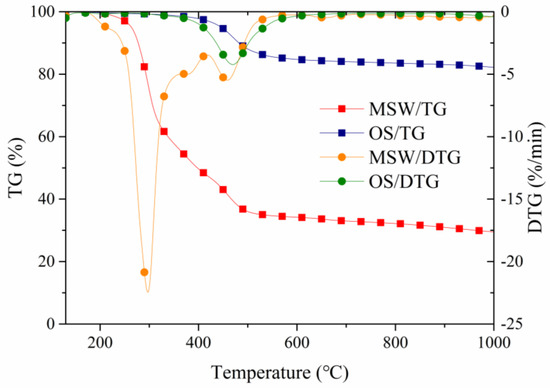
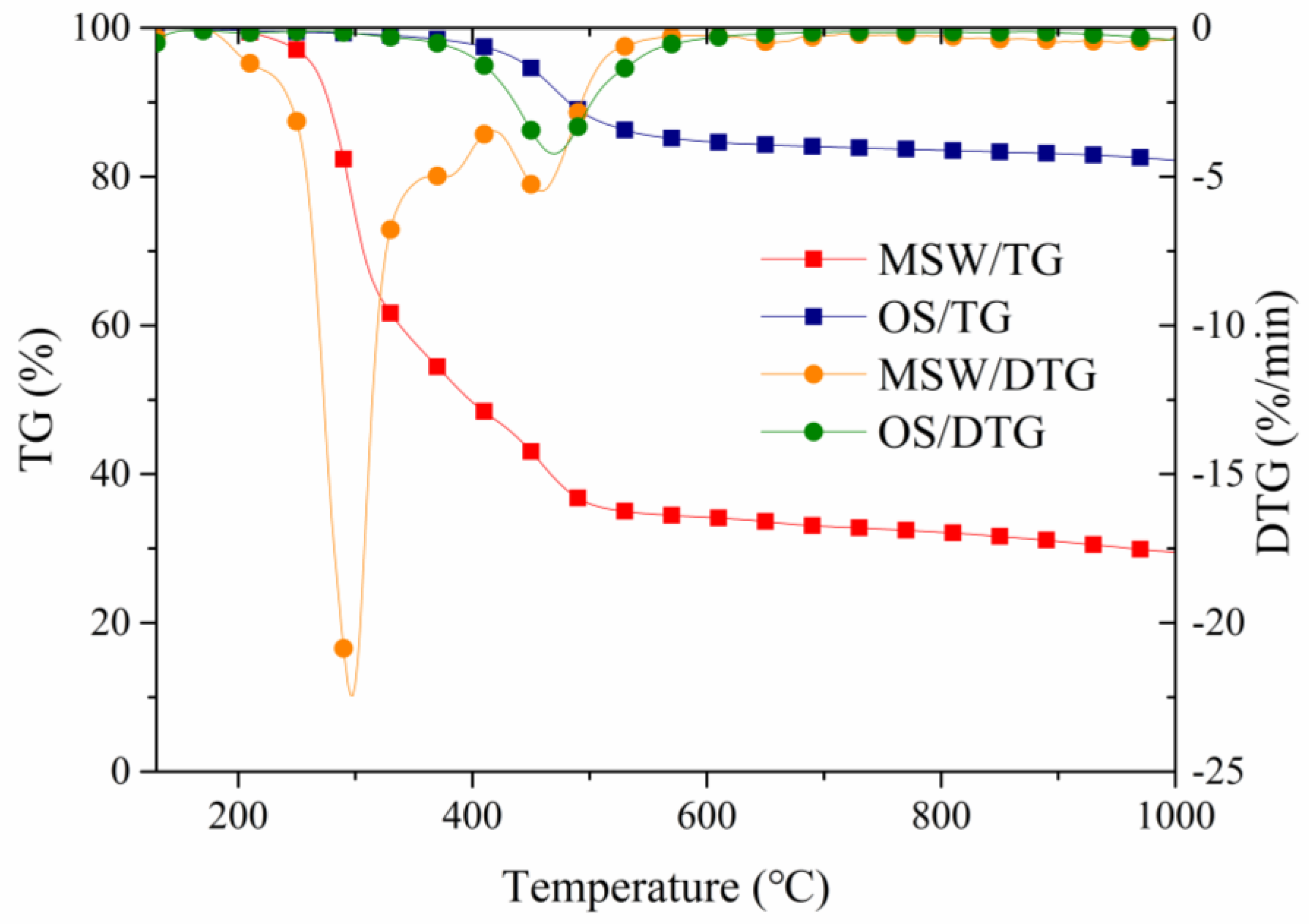
The thermogravimetric (TG) and derivative thermogravimetric (DTG) analyses of MSW and OS were performed at a heating rate of 30 °C/min, as shown in Figure 1. The initial temperature, terminal temperature, maximum weight loss rate, residual quantity, and other parameters were acquired from the TG and DTG curves, as shown in Table 3, where Ti represents the initial temperature, Tf represents the final temperature, Mf represents the residual weight percentage, DTG1, DTG2 and DTG3 represent the maximum mass loss rate of the first, second, and third stages, T1, T2 and T3 represent the temperature corresponding to the first, second and third peaks, DTGmean1, DTGmean2, DTGmean3 represent the mean mass loss rate of each stage.
Figure 1.
The TG and DTG curves of MSW and OS at the heating rate of 30 °C/min.
Table 3.
The pyrolysis characteristic parameters of different blending ratios.
The initial temperature of pyrolysis (Ti) is defined as the point where the bisecting line passes through the intersection of the horizontal line and the tangent to the leading edge of the first reaction [24]. As shown in Figure 1, the Ti was 255 °C for MSW and 414 °C for OS, which indicates that MSW started to decompose at a much lower temperature, compared with OS. The final temperature of pyrolysis (Tf) is achieved when the mass loss is 98% of the total weight loss [25]. The Tf values of MSW and OS were 914 °C and 801 °C, respectively. The peak temperature of pyrolysis (Tp) is the temperature that corresponds to the maximum weight loss rate (dm/dt)max [26]. The maximum weight loss rate of MSW (−22.48%/min at 297 °C) was markedly higher than that of OS (−4.66%/min at 470 °C), and the corresponding Tp of MSW was attained earlier than that of OS. These findings accorded with the results of the proximate analysis of MSW and OS, which showed that MSW contained a moderate ash content (7.32%), while OS contained a high ash content of up to 37.99%. A high ash content could hinder the pyrolysis process due to the following reasons: a higher processing cost, disposal difficulty, pyrolysis delay, and aggregation [27]. Moreover, MSW contained relatively high volatiles (76.94 wt. %, dry basis) than that of OS (58.56 wt. %, dry basis). Better pyrolysis behavior occurs with high volatiles as releasing volatile matter plays an important part in the pyrolysis procedure [28]. Hence, MSW presented exceedingly good pyrolysis behavior, while OS showed poor pyrolysis performance.
The thermal decomposition process of MSW can be divided into three main stages: the first stage was extended from 255 to 340 °C, which contributed to the maximum mass loss (36.87% of total). This significant mass loss probably came from the light volatiles of organic matter. Hemicellulose and cellulose in the biomass were significantly decomposed at the decomposition temperature from 290 to 364 °C, and a mild decomposition process also develops at 442 °C, which is attributed to the reaction of lignin [29]. Thus, the first stage contributed to the escape of a series of produced gases resulting from cellulose, hemicellulose, and other organic compounds in MSW. As the first and second reactions in this pyrolysis overlapped significantly, a shoulder formed in the DTG curve. The second decomposition process was from 340 to 421 °C, with a minor mass loss (12.44%). This stage was mainly caused by the pyrolysis of lignin, tar, coke, and the second cracking of some large molecules. The third decomposition process was conducted from 421 to 914 °C, and its mass loss peak appeared at 459 °C (−5.48%/min), and it was slightly more obvious than the Tp at the second stage (−5.0% at 377 °C). The third stage is probably due to the decomposition of char and secondary reactions. The whole pyrolysis of MSW shared a wide decomposition temperature domain from 255 to 914 °C due to its complex compounds and interactions inside MSW.
Regarding OS, the TG curve presented a notable decomposition peak (−4.66% at 470 °C) in the first primary pyrolysis stage that occurred at 414 to 515 °C, with a mass loss of 10.24%. This was attributed to the decomposition of organic matter such as bitumen and complex kerogen into gas, oil and char [30]. It was followed by the second stage, in which a small mass loss (3.48% of total) occurred at 515–801 °C. This was assigned to minerals, especially the clay minerals derived from quartz and traces of chlorite and illite clays [31]. As expected, the mass residual of OS at the end accounted for 82.19% of the initial sample, which is strongly associated with its high ash content.
3.2. Co-Pyrolysis Analysis Under Different Blending Ratios
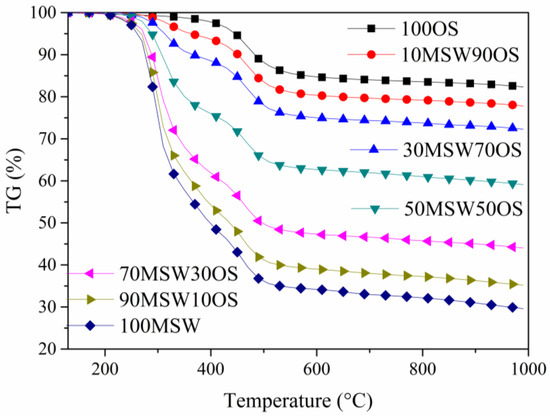
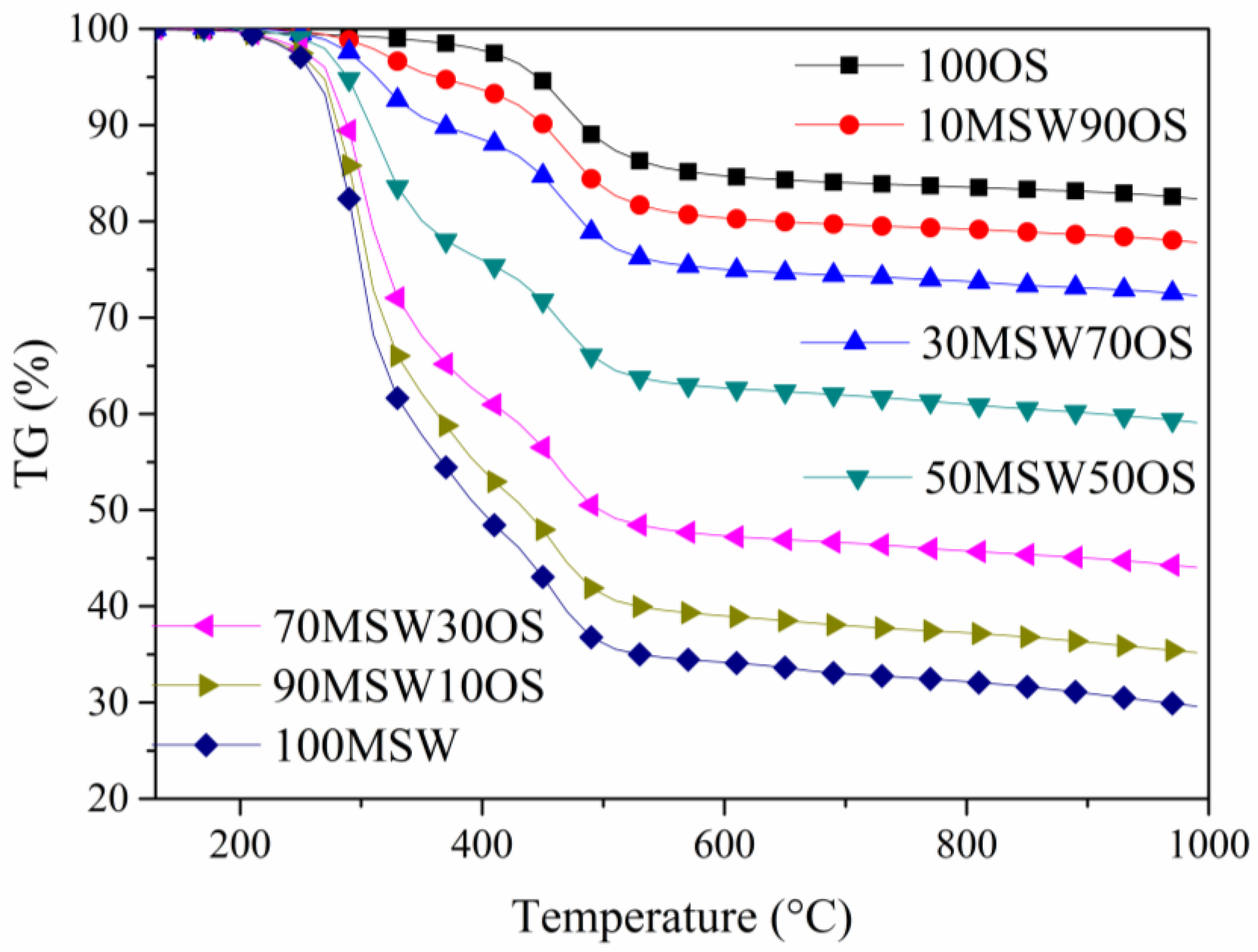
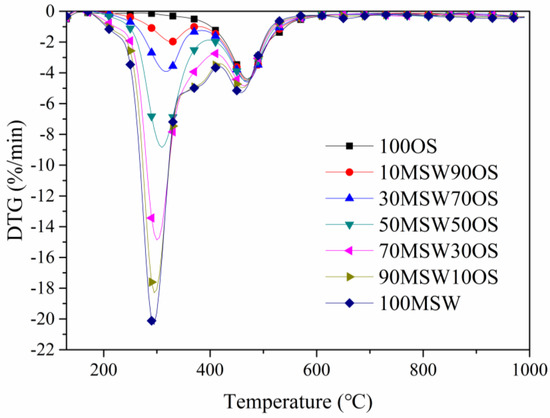
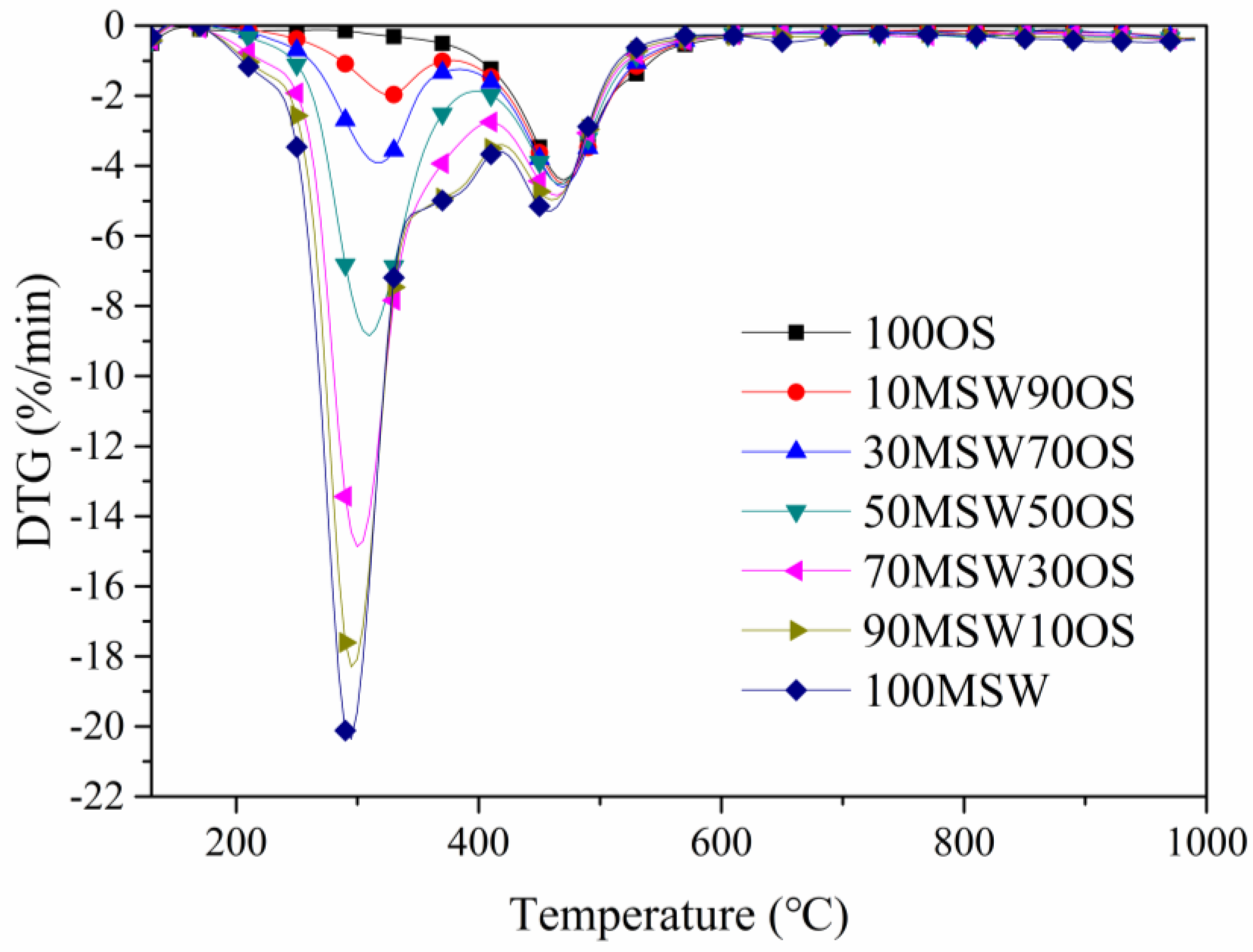
As shown in Figure 2 and Figure 3, the TG and DTG curves shifted from individual OS toward individual MSW as the MSW proportion increased without significant changes in their shapes overall. Similar phenomena could be observed in the co-pyrolysis of the sewage sludge and OS blending case and the paper sludge and MSW blending case [15]. The pyrolysis characteristics of MSW, OS, and their blends at a heating rate of 30 °C/min are presented in Table 3. Obviously, the Ti was delayed gradually from 259 to 414 °C, and the Tf advanced from 914 to 800 °C as the proportion of OS was increased. Namely, the pyrolysis of MSW shared a wider temperature domain than that of OS. The DTG curve became sharper, and the mass residual diminished gradually when the constituent of MSW increased, indicating that MSW contained more usable ingredients and could react more thoroughly. It is safe to conclude that adding an appropriate amount of MSW to OS could improve the thermal behavior of OS pyrolysis.
Figure 2.
The TG curves of co-pyrolysis at the heating rate of 30 °C/min.
Figure 3.
The DTG curves of co-pyrolysis at the heating rate of 30 °C/min.
To compare the pyrolysis performances among the blends and find the optimal blending ratio, usually, the comprehensive index D is utilized to evaluate the difficulty of component pyrolysis. The index D is calculated via Equation (9) [32]:
where (dw/dt)max denotes the maximum weight loss rate (%/min), (dw/dt)mean denotes the average value of weight loss rate out of the total (%/min); M∞ denotes the total mass loss percentage throughout the pyrolysis procedure, without dimension; Ti denotes the initial temperature (°C); Tmax corresponds to the location of the peak value of DTG curve (°C); and ΔT1/2 denotes the temperature width at the half-peak of (dw/dt)max (°C).
D = ((dw/dt)max (dw/dt)meanM∞)/(Ti Tmax ΔT1/2)
As general pyrolysis procedures consist of several stages, the index D is rewritten as follows:
where ηi represents the mass loss percentage in each stage (%), Di represents the index D in each stage, and D represents the total index to evaluate the whole process.
Table 4 showed the pyrolysis characteristic index D of different blending ratios, where ΔT1/2-1, ΔT1/2-2 and ΔT1/2-3 denote the half-temperature width at the first, second, and third weight loss peak, η1, η2 and η3 denote the mass loss percentage of each stage accounted for the total mass loss, D1, D2, D3 and D denote the first, second, and third stage and mean pyrolysis characteristic indices. As seen in Table 4, the index D decreased from 4.01 × 10⁻³ to 2.09 × 10⁻⁵ as the proportion of OS increased, and this again proved that MSW had a better pyrolysis performance. The samples 30MSW70OS, 50MSW50OOS, 70MSW30OS, 90MSW10OS, and 100MSW had an acceptable D index, implying that the optimal blending ratios could be one of them.
Table 4.
The pyrolysis characteristic index D of different blending ratios.
3.3. Interaction Between OS and MSW
Assuming that there were no interactions between the co-pyrolysis of MSW and OS, the theoretical TG curves of co-pyrolysis with different blend ratios are calculated from the pyrolysis process of every single sample using the following Equations (11) and (12) [33]:
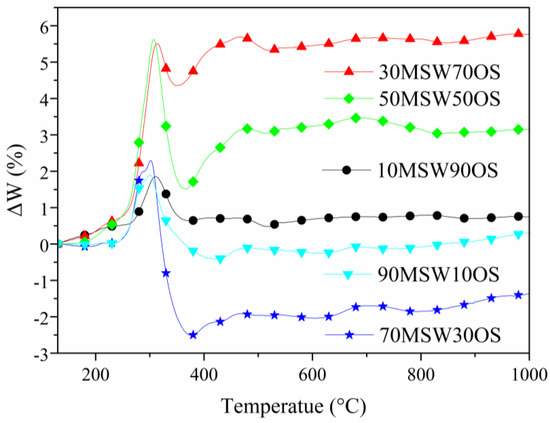
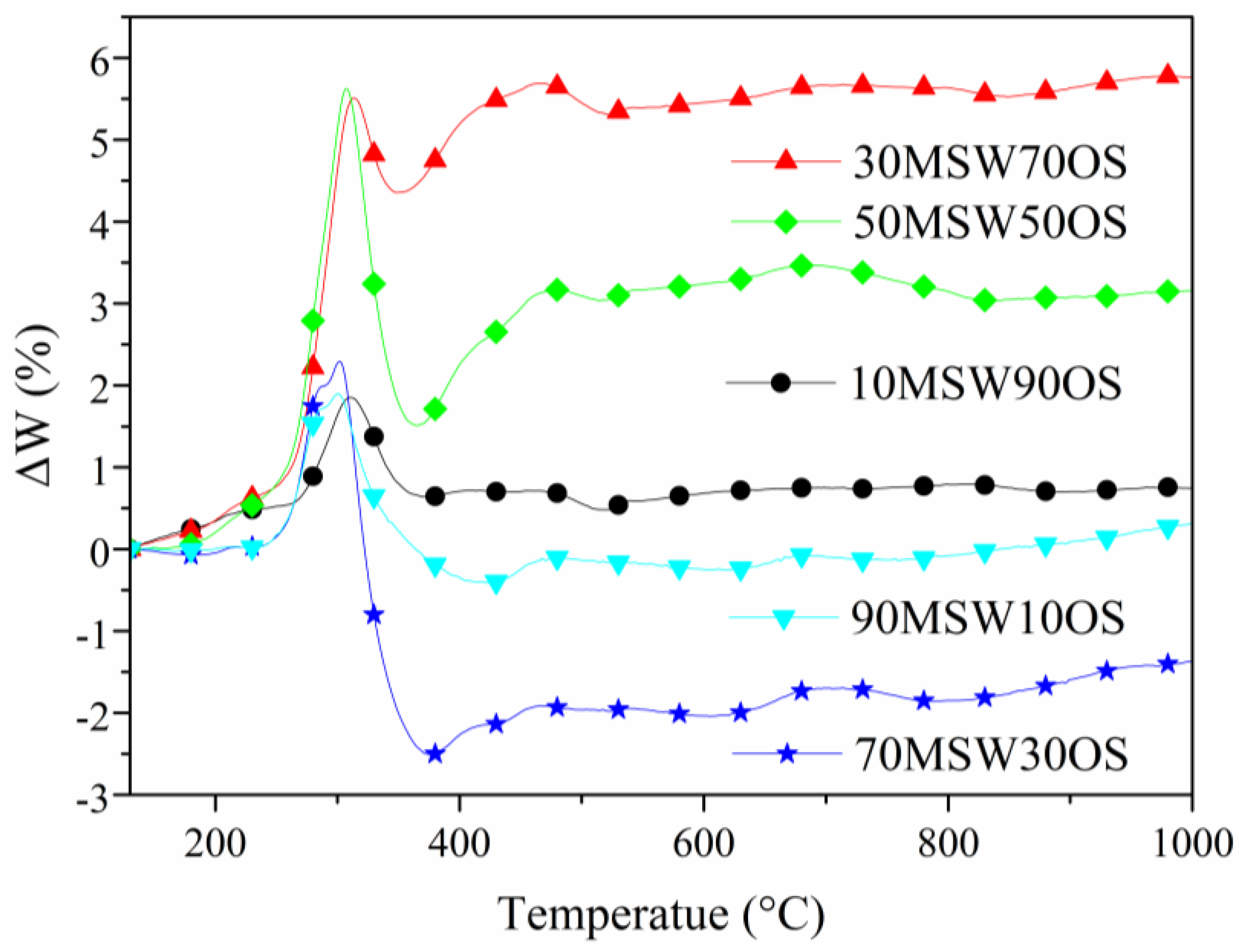
where ηMSW and ηOS denote the blend ratio of MSW and OS (%); WMSW and WOS denote the mass loss of MSW and OS, respectively (%/min); WCAL denotes the calculation result (%/min); and ΔW denotes the disparity between theory and practice (ΔW = (TGexperiment − TGcalculated) (%/min). According to Equations (11) and (12), Figure 4 was drawn, and the difference between TGexperiment and TGcalculated (abbreviated as TGexp and TGcal hereafter) under different blending ratios presents different dynamic regulations. A big absolute value of ΔW signifies a strong interaction between MSW and OS. The ΔW of 10MSW90OS waved nearby zero, which meant that minor interactions occurred. As depicted in Figure 4, the ΔW of 30MSW70OS and 50MSW50OS showed a positive value at the level of +5.5% and +3%, respectively. While the ΔW of 90MSW10OS and 70MSW30OS showed a negative value, which represented the synergistic effect and antagonistic effect between MSW and OS, respectively. The ΔW of 30MSW70OS showed a particularly high value, indicating that it possessed an evident synergistic effect. The phenomenon occurred possibly owing to the porous structure of OS, which provides a more disperse platform for MSW powders during the pyrolysis.
WCAL = ηMSW WMSW + ηOS WOS
ΔW = WEXP − WCAL
Figure 4.
The ΔW curves under different blending ratios.
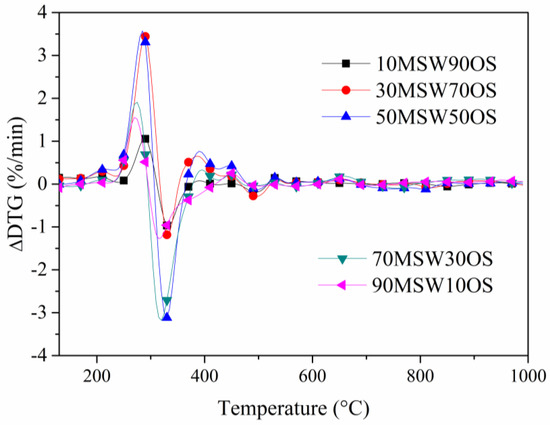
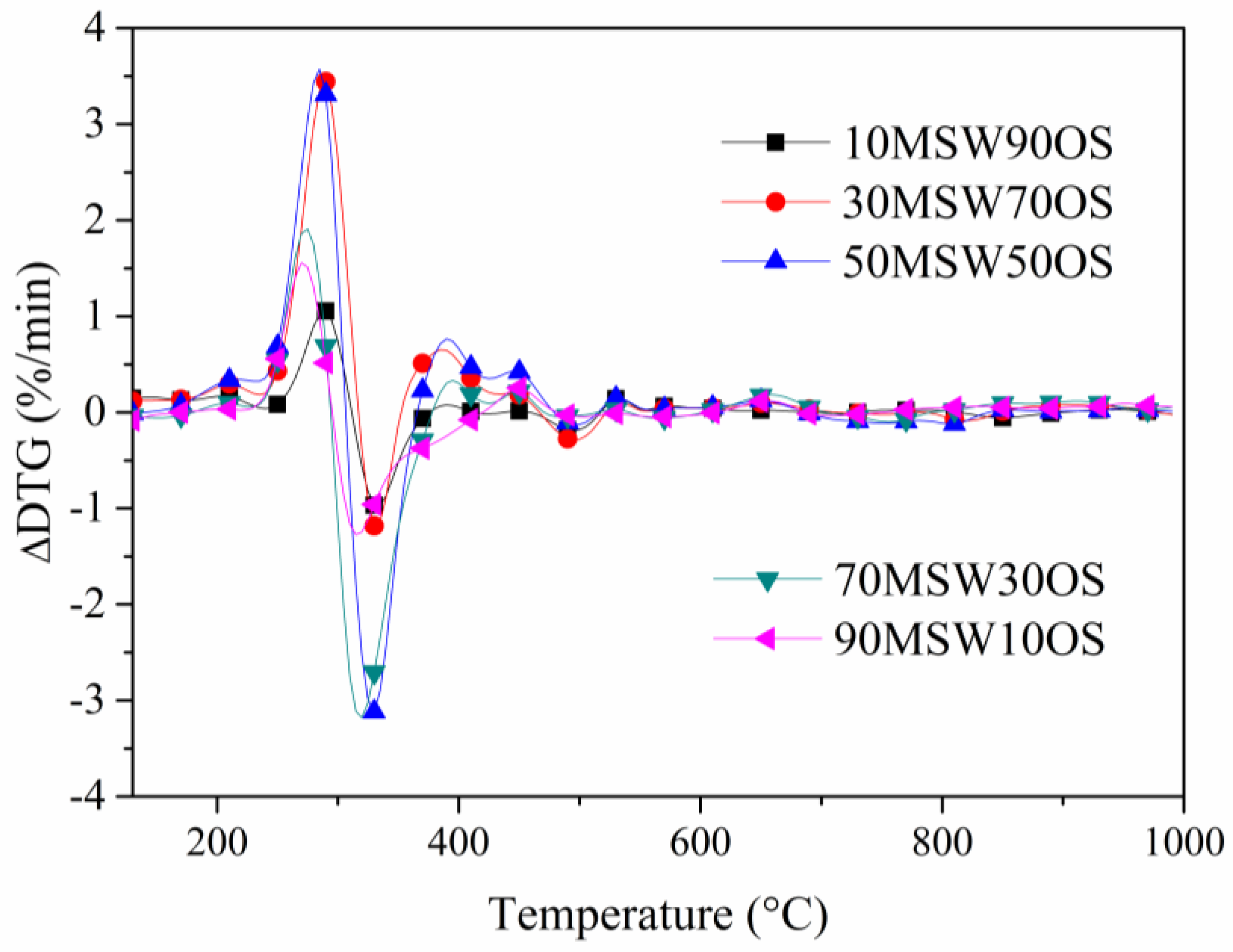
Similarly, assuming that the co-pyrolysis DTG curves have a linear relationship with the single-compound DTG curves, the DTG curves of the mixed samples were predicted using the DTG curves of individual compounds. The ΔDTG was found by subtracting DTGcal from DTGexp and was introduced to investigate the synergistic interactions for further discussion. Based on the inferences drawn from Figure 5, all ΔDTG undulated dramatically around the mass loss peaks where the most severe decomposition occurred, which meant that MSW and OS interacted with each other during the decomposition. Compared with other blending ratios, ΔDTG of 30MSW70OS showed a more positive value. This may be because using the oil shale char as a catalyst improved the pyrolysis efficiency. Similar reports can be found elsewhere [9]. Mineral components inside OS played as the catalyst, which accelerated the pyrolysis of MSW. However, ΔDTG of 10MSW90OS showed a less positive value, due to the high ash content from OS (37.99 wt. % on a dry basis), which impeded the pyrolysis procedure.
Figure 5.
The ΔDTG curves under different blending ratios.
3.4. Kinetics Analysis
The activation energy E is defined as the minimum energy required during a reaction, and it is used to evaluate the difficulty of a reaction and the feasibility of using a fuel. The lower the activation energy is, the easier the reaction becomes.
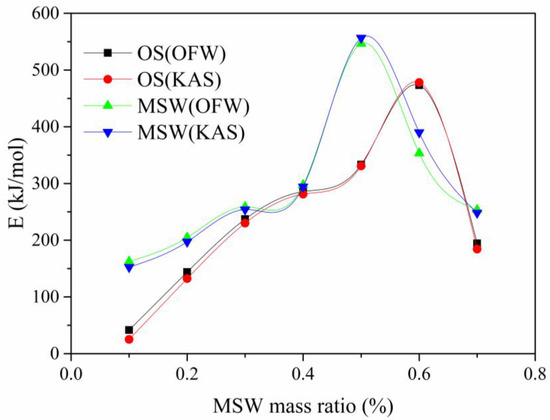
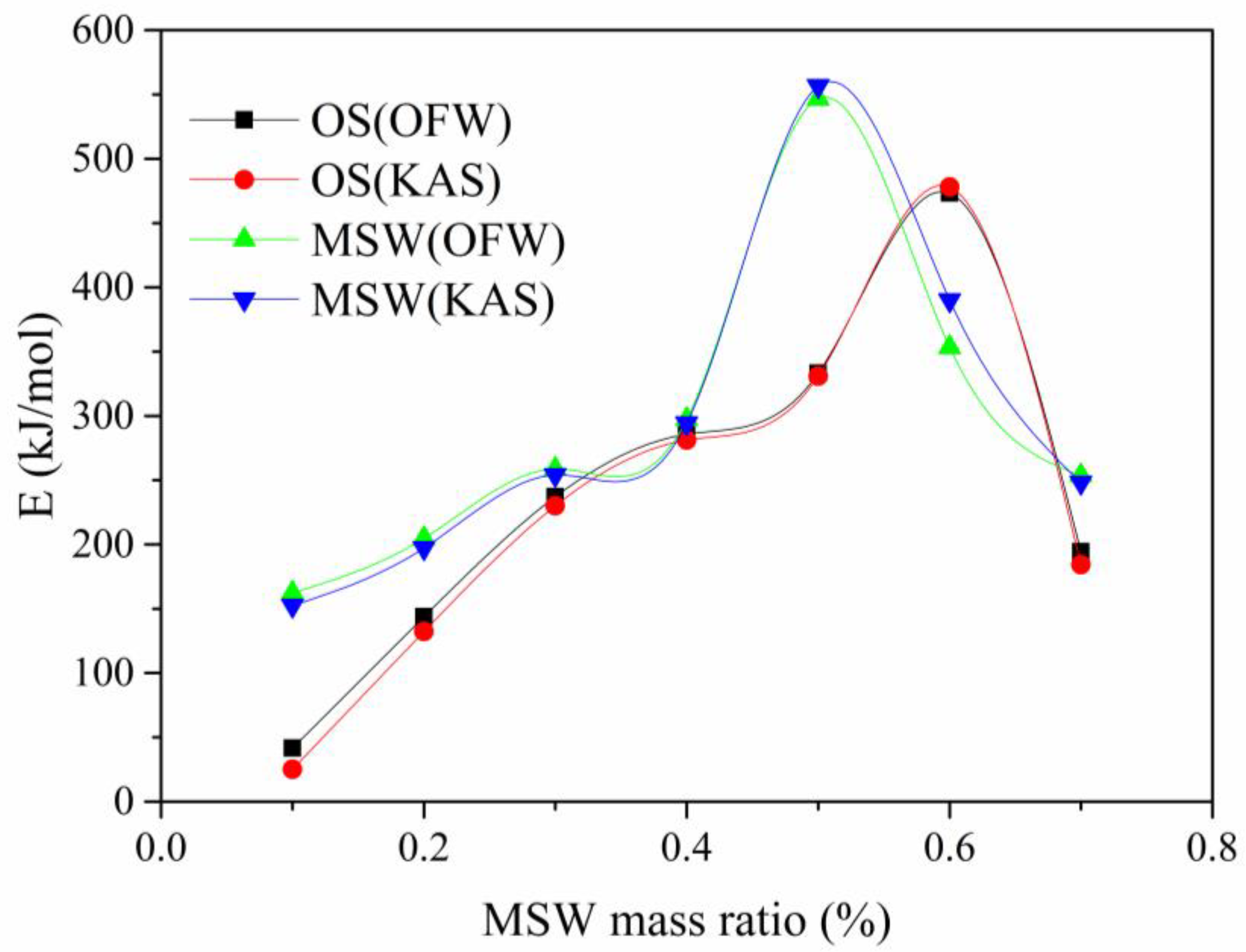
The results depicted in Figure 6 showed an obvious fluctuation in the value E following the change in the mass loss ratio α, which meant that the pyrolysis processes of both MSW and OS were complex and probably comprised multi-step reactions. The value E for MSW increased from around 160 to 550 kJ/mol and then declined to about 250 kJ/mol followed by. The maximum value E appeared at α = 0.5 (547 kJ/mol by OFW and 556 kJ/mol by KAS), and the corresponding temperature was around 320 °C where the peak of the DTG curve existed. The value E for OS rose from about 40 to 475 kJ/mol and then dropped back to about 185 kJ/mol. The maximum value E appeared at α = 0.6 (473 kJ/mol by OFW and 478 kJ/mol by KAS), and the corresponding temperature was 480 °C where the DTG curve peak existed as well. The above discussion illustrated that mass variation, temperature variation and reaction step variation all could lead to the fluctuation in value E.
Figure 6.
The relationship between alpha and E for OS and MSW.
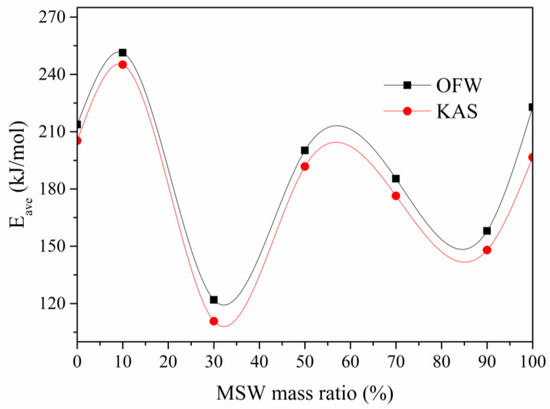
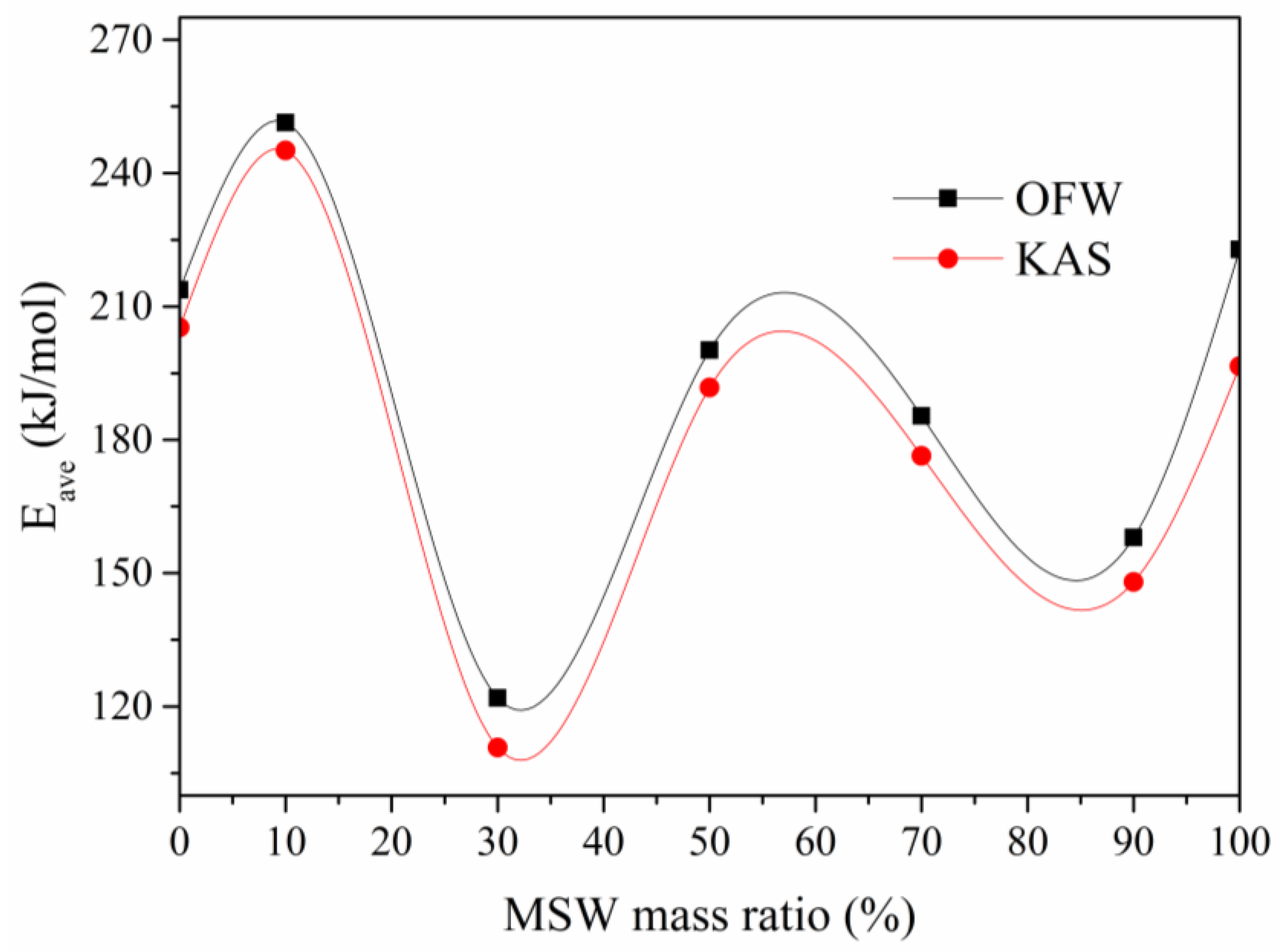
The relationship between Eave (the average E) and blending ratios is depicted in Figure 7. The results calculated using the OFW method and the KAS method showed a good agreement. The activation energy changed remarkably as the blending ratio changed. Eave rose from about 210 kJ/mol to about 248 kJ/mol when 10% MSW was added into OS. And it dropped to about 115 kJ/mol when adding 30% MSW into OS. Next, Eave increased quickly to almost 195 kJ/mol when 50% MSW was added. As the percentage of MSW increased, Eave decreased slightly while being above 195 kJ/mol perpetually. The sample with 30% MSW (mass ratio) showed the lowest activation energy. The result confirmed that the unevenly distributed architectures of OS and MSW influenced the activation energy of different blending ratios. The interaction between OS and MSW varied along with the change in blending ratios. Similar influence was found in the reported literature [15].
Figure 7.
The relationship between Eave and the blending ratios.
4. Conclusions
To address the challenge of joint utilization of low-grade energy resources (oil shale, OS) and hard-to-recycle waste (municipal solid waste, MSW), the characteristics and kinetics of the co-pyrolysis between OS and MSW were studied using thermogravimetric analysis. The pyrolysis procedure of MSW and OS could be divided into three main stages and two main stages, respectively. MSW had a better reaction performance than OS, with a higher comprehensive characteristics index D (4.01 × 10⁻³ and 2.09 × 10⁻⁵, respectively), and the reaction range of MSW was broader than that of OS. The activation energy for different blending ratios was calculated using both the OFW method and the KAS method. The results show that 30% MSW and 70% OS was the optimal co-pyrolysis blending ratio, which presented a relatively low average activation energy (115 kJ/mol), an acceptable index D value (3.37 × 10⁻⁵) and a distinct positive synergistic effect. This study provides basic data support for large-scale applications in the future.
Author Contributions
Conceptualization, L.C. and Z.Y.; methodology, L.C.; software, L.C.; validation, L.C. and X.G.; formal analysis, L.C.; investigation, L.C. and Y.X.; resources, L.C. and Z.Y.; data curation, L.C.; writing—original draft preparation, L.C.; writing—review and editing, L.C.; visualization, L.C.; supervision, Y.L. and L.Z.; project administration, L.L.; funding acquisition, L.C. All authors have read and agreed to the published version of the manuscript.
Funding
This research was funded by the Fujian Province Young and Middle-aged Teacher Education Research Project, grant number JAT231127, the Natural Science Foundation of Fujian Province, grant number 2024J08228, and the Fujian Provincial University-Industry Collaboration Project, grant number 2024H6017.
Institutional Review Board Statement
Not applicable.
Informed Consent Statement
Not applicable.
Data Availability Statement
Data is contained within the article.
Conflicts of Interest
Authors Liping Zheng and Yuxiang Lin were employed by the company Fujian Yanan Technology Co., Ltd. The remaining authors declare that the research was conducted in the absence of any commercial or financial relationships that could be construed as a potential conflict of interest.
Abbreviations
The following abbreviations are used in this manuscript:
| MSW | municipal solid waste |
| OS | oil shale |
| PVC | polyvinyl chloride |
| HHV | higher heating value |
| OFW | Ozawa–Flynn–Wall |
| KAS | Kissinger–Akahira–Sunose |
| TG | thermogravimetric |
| DTG | derivative thermogravimetric |
References
- Gritsch, L.; Breslmayer, G.; Rainer, R.; Stipanovic, H.; Tischberger-Aldrian, A.; Lederer, J. Critical properties of plastic packaging waste for recycling: A case study on non-beverage plastic bottles in an urban MSW system in Austria. Waste Manag. 2024, 185, 10–24. [Google Scholar] [CrossRef] [Scilit]
- Zhang, Z.; Zhou, A.; Yue, S.; Luo, Y.; Embaye, T.M.; Li, Z.; Ma, D.; Ruan, R.; Wang, X.; Hu, Z. Heavy metal enrichment characteristics and environmental risk assessment of MSW pyrolysis char and coal co-incineration fly ash. Fuel 2026, 404, 136236. [Google Scholar] [CrossRef] [Scilit]
- Statistics, N.B.O. China Statistical Yearbook 2024; China Statistics Press: Beijing, China, 2024. [Google Scholar]
- Wang, W.; Ma, Y.; Li, S.; Yue, C.; Wu, J.; Teng, J. Pyrolysis characteristics of Longkou oil shale under optimized condition. J. Therm. Anal. Calorim. 2016, 125, 983–990. [Google Scholar] [CrossRef] [Scilit]
- Bai, F.; Sun, Y.; Liu, Y.; Guo, M. Evaluation of the porous structure of Huadian oil shale during pyrolysis using multiple approaches. Fuel 2017, 187, 1–8. [Google Scholar] [CrossRef] [Scilit]
- Hackley, P.C.; Birdwell, J.E.; McAleer, R. Properties of solid bitumen formed during hydrous, anhydrous, and brine pyrolysis of oil shale: Implications for solid bitumen reflectance in source-rock reservoirs. Appl. Geochem. 2025, 185, 106365. [Google Scholar] [CrossRef] [Scilit]
- Abdi-Khanghah, M.; Heris, S.Z.; Wongwises, S.; Mahian, O. Smart modeling of oil shale pyrolysis: Impact of feed composition and thermal parameters. J. Anal. Appl. Pyrolysis 2026, 193, 107363. [Google Scholar] [CrossRef] [Scilit]
- Abdi-Khanghah, M.; Wu, K.C.; Soleimani, A.; Hazra, B.; Ostadhassan, M. Experimental investigation, non-isothermal kinetic study and optimization of oil shale pyrolysis using two-step reaction network: Maximization of shale oil and shale gas production. Fuel 2024, 371, 131828. [Google Scholar] [CrossRef] [Scilit]
- Li, S.; Ma, X. Catalytic characteristics of the pyrolysis of lignite over oil shale chars. Appl. Therm. Eng. 2016, 106, 865–874. [Google Scholar] [CrossRef] [Scilit]
- Zhu, Y.; Li, C.; Cao, H.; Wu, L.; Yang, F.; Fu, S.; Zhou, J. Effects of spatial distribution of tar-rich coal and oil shale and primary factors on product characteristics during microwave co-pyrolysis. Fuel 2025, 385, 134085. [Google Scholar] [CrossRef] [Scilit]
- Xu, G.; Mei, J.; Chen, J.; Zhu, T.; Fang, B. Study on the properties, by-products, and nitrogen migration mechanism of the co-pyrolysis of oil shale and waste tyres. Fuel 2024, 376, 132659. [Google Scholar] [CrossRef] [Scilit]
- Srinadh, R.V.; Mahawar, R.; Neelancherry, R. Co-pyrolysis behaviour and synergistic effect of municipal solid waste components on biochar production through microwave-assisted co-pyrolysis. Process Saf. Environ. Prot. 2025, 199, 107241. [Google Scholar] [CrossRef] [Scilit]
- Chen, L.; Yu, Z.; Fang, S.; Dai, M.; Ma, X. Co-pyrolysis kinetics and behaviors of kitchen waste and chlorella vulgaris using thermogravimetric analyzer and fixed bed reactor. Energy Convers. Manag. 2018, 165, 45–52. [Google Scholar] [CrossRef] [Scilit]
- Fakudze, S.; Chen, J. A critical review on co-hydrothermal carbonization of biomass and fossil-based feedstocks for cleaner solid fuel production: Synergistic effects and environmental benefits. Chem. Eng. J. 2023, 457, 141004. [Google Scholar] [CrossRef] [Scilit]
- Fang, S.; Yu, Z.; Lin, Y.; Hu, S.; Liao, Y.; Ma, X. Thermogravimetric analysis of the co-pyrolysis of paper sludge and municipal solid waste. Energy Convers. Manag. 2015, 101, 626–631. [Google Scholar] [CrossRef] [Scilit]
- ASTM D5373; Standard Test Methods for Determination of Carbon, Hydrogen and Nitrogen in Analysis Samples of Coal and Carbon in Analysis Samples of Coal and Coke. ASTM International: West Conshohocken, PA, USA, 2021.
- GB/T 212-2008; Proximate Analysis of Coal. Standardization Administration of the People’s Republic of China: Beijing, China, 2008.
- Ahmad, S.; Zhu, X.; Wei, X.; Zhang, S. Influence of process parameters on hydrothermal modification of soybean residue: Insight into the nutrient, solid biofuel, and thermal properties of hydrochars. J. Environ. Manag. 2021, 283, 111981. [Google Scholar] [CrossRef] [Scilit] [PubMed]
- Yan, G.; Liu, S.; Zhang, J.; Gao, Q.; Song, X.; Zhang, Y. An efficient method for the recovery of waste crystalline silicon photovoltaic modules: Solvent steam and pyrolysis techniques. Sep. Purif. Technol. 2026, 382, 135795. [Google Scholar] [CrossRef] [Scilit]
- Li, Y.; Wang, W.; Yin, F. Co-pyrolysis of mixed plastics and its impact on kinetic parameters and pyrolysis product distribution. Therm. Sci. Eng. Prog. 2025, 68, 104242. [Google Scholar] [CrossRef] [Scilit]
- Coruh, M.K. Pyrolysis of oleaster seed under non-isothermal conditions to assess as bioenergy potential: Kinetic, thermodynamic and master plot analyses. Biomass Bioenergy 2025, 198, 107861. [Google Scholar] [CrossRef] [Scilit]
- Liu, Y.; Yao, C.; Ma, Y.; Liu, B.; Yang, H.; Du, X.; Zhou, Y. Co-pyrolysis of medium-low maturity shale and nano-NiO catalyst under supercritical CO2 atmosphere: Mechanisms and reaction kinetics. Fuel 2025, 401, 135882. [Google Scholar] [CrossRef] [Scilit]
- Guo, L.; Zuo, H.; Wang, Y.; Zhao, J. Thermal behavior and kinetic study on the pyrolysis of lean coal blends with thermally dissolved coal. J. Therm. Anal. Calorim. 2019, 136, 903–912. [Google Scholar] [CrossRef] [Scilit]
- Liu, J.; Ma, J.; Luo, L.; Zhang, H.; Jiang, X. Pyrolysis of superfine pulverized coal. Part 5. Thermogravimetric analysis. Energy Convers. Manag. 2017, 154, 491–502. [Google Scholar] [CrossRef] [Scilit]
- Chen, L.; Yu, Z.; Liang, J.; Liao, Y.; Ma, X. Co-pyrolysis of chlorella vulgaris and kitchen waste with different additives using TG-FTIR and Py-GC/MS. Energy Convers. Manag. 2018, 177, 582–591. [Google Scholar] [CrossRef] [Scilit]
- Tang, Y.; Song, M.; Dong, J.; Li, G.; Ye, C.; Hu, Y.; Fang, Y.; Wang, L.; Zheng, Y. Synergetic effect of in-situ CaO on PVC plastic pyrolysis characteristics: TG and Py GC/MS analysis. Polym. Degrad. Stab. 2025, 234, 111205. [Google Scholar] [CrossRef] [Scilit]
- Zhong, M.; Huang, H.; Fan, J.; Zhang, H. Mechanism of radical-mediated synergy in co-pyrolysis of oil shale and yak dung: Experiments, kinetics and ReaxFF-MD simulations for cleaner energy production. Biomass Bioenergy 2026, 205, 108501. [Google Scholar] [CrossRef] [Scilit]
- Liu, G.; Liao, Y.; Guo, S.; Ma, X.; Zeng, C.; Wu, J. Thermal behavior and kinetics of municipal solid waste during pyrolysis and combustion process. Appl. Therm. Eng. 2016, 98, 400–408. [Google Scholar] [CrossRef] [Scilit]
- Lu, K.-M.; Lee, W.-J.; Chen, W.-H.; Lin, T.-C. Thermogravimetric analysis and kinetics of co-pyrolysis of raw/torrefied wood and coal blends. Appl. Energy 2013, 105, 57–65. [Google Scholar] [CrossRef] [Scilit]
- Vantelon, J.; Breillat, C.; Gaboriaud, F.; Alaoui-Sosse, A. Thermal degradation of Timahdit oil shales: Behaviour in inert and oxidizing environments. Fuel 1990, 69, 211–215. [Google Scholar] [CrossRef] [Scilit]
- Groune, K.; Halim, M.; Benmakhlouf, M.; Arsalane, S.; Lemee, L.; Ambles, A. Organic geochemical and mineralogical characterization of the Moroccan Rif bituminous rocks. J. Mater. Environ. Sci. 2013, 4, 472–481. [Google Scholar]
- Jiang, H.; Zheng, Y.; Dong, Z.; Ming, H.; Guo, X.; Cheng, L.; Zhang, L. TG-FTIR analysis of co-pyrolysis behavior between petroleum coke and model lignocellulosic biomass. J. Energy Inst. 2025, 122, 102223. [Google Scholar] [CrossRef] [Scilit]
- Ling, W.; Hong, C.; Xing, Y.; Feng, W. Study on the co-pyrolysis characteristics and mechanism of sewage sludge and coconut shell. Thermochim. Acta 2025, 751, 180058. [Google Scholar] [CrossRef] [Scilit]

Disclaimer/Publisher’s Note: The statements, opinions and data contained in all publications are solely those of the individual author(s) and contributor(s) and not of MDPI and/or the editor(s). MDPI and/or the editor(s) disclaim responsibility for any injury to people or property resulting from any ideas, methods, instructions or products referred to in the content. |
© 2026 by the authors. Licensee MDPI, Basel, Switzerland. This article is an open access article distributed under the terms and conditions of the Creative Commons Attribution (CC BY) license.