Article

Artificial Intelligence and Spatial Optimization: Evaluation of the Economic and Social Value of UGS in Vračar (Belgrade)

by
Slađana Milovanović
1,*,
Ivan Cvitković
2,*,
Katarina Stojanović
3,4 and
Miljenko Mustapić
2
1
Department for Construction, Communal Housing Affairs and Environmental Protection, Vračar City Municipality, Njegoševa 77, 11000 Belgrade, Serbia
2
Department for Logistics and Sustainable Mobility, University of North, Trg dr Žarka Doilnara 1, 48000 Koprivnica, Croatia
3
Department of Architecture, Faculty of Contemporary Arts, 11000 Belgrade, Serbia
4
Department of Traffic Engineering, Faculty of Economics and Engineering Management, University Business Academy in Novi Sad, Cvećarska 2, 21000 Novi Sad, Serbia
*
Authors to whom correspondence should be addressed.
Sustainability 2026, 18(2), 745; https://doi.org/10.3390/su18020745 (registering DOI)
Submission received: 30 November 2025 / Revised: 24 December 2025 / Accepted: 31 December 2025 / Published: 12 January 2026
(This article belongs to the Special Issue Impact of AI on Business Sustainability and Efficiency)

Abstract

This paper examines the growing field of AI-assisted urban planning within the context of sustainable urban development, with a particular focus on spatial optimization of urban green spaces under conditions of scarcity, density, and economic pressure. While the economic, ecological, and social values of UGS are widely acknowledged, urban planners lack a cohesive, data-driven framework to quantify and spatially optimize these often-conflicting values for effective land-use optimization. To address this gap, we propose a methodology that combines Geographic Information Systems (GISs), the Analytic Hierarchy Process (AHP), and an Artificial Intelligence-Based Genetic Algorithm (AI-GA). Vračar was chosen as the case study area. Our approach evaluates (1) the economic value of UGS through housing prices; (2) the ecological value through UGS density; and (3) the social value by measuring access to urban green pockets. The integrated method simulates environmental scenarios and optimizes UGS placement for resilient urban areas. Results demonstrate that properties in mixed-use green areas proximate to urban parks have the highest economic and social value. Additionally, higher densities of UGS correlate with higher housing prices, highlighting the economic impact of green space distribution. The methodology enables planners to make decisions based on evidence that integrates statistical modeling, expert judgment, and artificial intelligence into one cohesive platform.

1. Introduction

Urbanization in the 21st century poses significant public health challenges, with air pollution representing a persistent and critical threat. A robust body of literature establishes a causal association between both long- and short-term exposure to particulate matter (PM) and increased cardiovascular and respiratory morbidity and mortality [1,2,3]. Recent data indicate that 95% of Europe’s urban population live with PM2.5 concentrations [2] above the health-based WHO guideline [3]. In 2023, exposure to PM2.5 was estimated to be responsible for approximately 382,000 attributable deaths across Europe, with nitrogen dioxide (NO2) contributing an additional 148,000 attributable deaths [2]. The distribution of exposure is unequal, particularly in Eastern and Southeastern Europe, where higher pollution levels are associated with more severe health effects. In Serbia, PM2.5 exposure in 2023 was linked to around 34,962 attributable deaths, with ischemic heart disease accounting for a considerable portion of this mortality [2]. Gaps between scientific evidence, protective guidelines, and on-the-ground reality, particularly in regions like the Western Balkans, highlight a critical implementation deficit. It underscores the necessity of moving from general awareness to actionable, location-specific planning tools that can guide effective interventions at the municipal level.
Rapid urban expansion and contemporary urban development paradigms are also reshaping urban planning processes. Land use plays a crucial role in urban transformation. However, contemporary crises often lead to disordered urban development. The post-socialist period in Belgrade resulted in privatization and extensive construction activities that diminished the essential elements of nature in urban environments, diminishing the essential qualities of UGS. Research on post-socialist urban transformation has shown that these processes vary significantly across regions and are deeply entangled with institutional reforms and market liberalization [4,5]. To transform cities into market-oriented models, the challenges of dismantling previous urban structures need to be addressed and necessary regulatory changes need to take place for a profitable urban system [6,7,8,9,10]. Prevailing investment incentives often prioritize revenue-generating development, systematically disfavoring the preservation and creation of public green space. This creates a structural economic bias that directly contributes to the reduction in UGS.
Contemporary sustainability discourse highlights the vital role of Urban Green Spaces (UGS) in fostering cities that are healthy, resilient, and sustainable. UGS provides a connection between the built and natural environments within a city. The term UGS refers to public and private open areas characterized by the deliberate integration of natural landscape elements (such as water, topography, and vegetation) with constructed features (including walls, platforms, and pathways) [11]. Fundamentally, UGSs provide critical ecosystem services: they actively enhance air quality by filtering atmospheric pollutants, with trees and vegetation serving as effective sinks for particulate matter (PM10, PM2.5) and gases like nitrogen dioxide (NO2) [12,13,14]. The significance of UGS in urban environments is evolving [15].
Innovative solutions for future urban development are essential. While the scholarly literature conceptualizes the city through only one function of UGS in its spatial optimization processes, few studies have incorporated the full social, economic, and ecological issues of UGS simultaneously into optimization models [16,17]. This study evaluates these multifaceted values of UGS and employs a widely used integrated GIS, AHP and AI-GA methodology for UGS planning. The model aims to optimize the spatial distribution of UGS, maximizing all three value dimensions simultaneously.
Vračar, the central Belgrade municipality, has been selected as the subject of this research as a case study due to its dense urban fabric and the significance of UGS in its urban system. The UGS considered in this study comprises urban parks, urban pockets, and urban gardens. According to ownership, only public UGS is considered in this paper. The first section provides an overview of literature reviews on sustainability theory, emphasizing the importance of examining the evolution of urban planning practices within the interconnected elements of the planning process using innovative technology. The second section introduces the study area and data sources. Following a description of the methods in Section 3, Section 4 and Section 5 present the results, discussion, and conclusions of the study.

2. Literature Review

2.1. UGS and Urban Sustainability

To understand contemporary urban issues and new urban concepts, it is essential to review the evolution of urban theory, including the various orientations and models that define it. The relationship between people, nature, and physical structure highlights how architecture complements the natural world and illustrates the connection between built-up and natural environments [18,19,20] and physical and psychological well-being [21]. In the book A Pattern Language, people need contact with trees, plants, and water, highlighting this connection as a fundamental aspect of human life. As noted by Alexander and his colleagues, “buildings must always be built-up on those parts of land which are in the worst condition, not the best” [22] (p. 3). In an era marked by diverse urban challenges, the progressive model, as defined by Shoe [23], is characterized by a strong belief in progress and the potential of technology. However, the cultural model emphasizes the importance of planning social facilities and green spaces by projected population sizes, thereby ensuring a distributed allocation of playgrounds and parks throughout the city [24].
In 2017, the United Nations introduced the New Urban Agenda [25], which aims to enhance ecological resilience, promote equity and opportunities, improve connectivity and social inclusion, support cultural expression and dialogue, and advance overall human development. According to UN-Habitat [26], the growth of market-rate developments has led to an increase in auto-centric, privatized, and gated communities, alongside a rise in informal settlements. Both trends reflect, as noted in the report from the 9th World Urban Forum, a diminishing “relationship between public spaces and buildable areas” [27] (p. 165). Consistent with the New Urban Agenda, Sustainable Development Goal 11.7 [28] underscores the importance of ensuring adequate public spaces for people.
The new discourses of sustainability underscore UGS as essential components of a sustainable urban future. Reviews by Lee and Maheswaran [29] and more recent meta-analyses by Gascon et al. [30] provide robust evidence supporting the claim that UGS improve both physical and mental health. They embody natural features that deliver aesthetic, perceptual, and functional benefits to residents [31], while also fostering social cohesion [32], strengthening emotional connections to place and community [33], and providing venues for leisure and physical activity [34,35,36,37,38]. These features align with socio-ecological theories that seek to harmonize human–nature relationships [29,39] and reflect a broader application of sustainability transition frameworks to urban governance and planning [40].
Beyond their physical and ecological attributes, UGS must be understood as socially embedded resources. Their value is constituted through complex social relations. Classic contributions, such as Granovetter’s [41] influential concept of embeddedness, argue that economic actions and valuations never occur in isolation. These actions are deeply enmeshed within networks of social relations, trust, and norms. In urban planning, the value of a park or garden does not stem solely from its size or amenities. Rather, it comes from how space is integrated into the daily life, memory, and identity of a community. Polanyi’s [42] analysis of land as a ‘fictitious commodity’ reminds us that its market value is a product of social and institutional processes of re-embedding. Therefore, planning for UGS should not be merely a technical process. It must actively engage with the social meanings, historical conventions, and governance arrangements that ultimately define a space’s utility and worth.
This social embeddedness of value extends concretely to the formation of housing prices. To understand why proximity to green amenities translates into an economic premium, one must look beyond immediate market signals to the long-term institutional and cultural frameworks that govern valuation. As Barbot [43] argues through a longue durée analysis, property prices are not merely the aggregation of individual preferences but emerge from historically sedimented regimes of property rights and institutionalized conventions of worth. In the European context, these regimes have progressively encoded specific environmental and aesthetic qualities—such as access to light, air, and green space—into legal norms and shared understandings of desirable housing.
To ground our economic analysis, we outline Serbia’s formal framework for property valuation. The Regulation on the Valuation of Real Estate [44] established hierarchy of determinants, typically prioritized as follows: (1) location (urban zone, neighborhood prestige, centrality); (2) parcel characteristics (size, shape, permitted use); (3) structural attributes (usable area, construction quality, age); and (4) access to amenities and infrastructure (e.g., public transport, schools, commercial centers). This study focuses specifically on the influence of one element within this final category: proximity to parks and urban green areas. Beyond their economic and environmental metrics, UGS must be valued for their relational and social infrastructural functions [45,46]. Recent scholarship reframes public spaces not merely as physical amenities but as critical social infrastructures that actively support conviviality, foster recognition among diverse groups, and underpin community well-being. This relational dimension is particularly significant for the micro-spaces and community-managed green interventions central to our analysis.
The value of small-scale urban green spaces (UGS), including pocket parks and urban gardens, is well-documented across social, ecological, and economic domains. Socially, they provide essential proximate access to nature, improving mental well-being and encouraging physical activity [47,48]. More importantly, they act as “social condensers,” facilitating spontaneous interaction and strengthening community identity and cohesion [49,50]. Ecologically, they serve as vital nodes in biodiversity corridors and provide significant localized cooling, thereby mitigating the urban heat island [51]. Economically, these amenities are linked to increased property values and enhanced retail activity in their vicinity [52,53]. Consequently, integrating small-scale green interventions is a recognized strategy within comprehensive urban development plans aimed at addressing historical deficits in green space and fostering sustainable urban regeneration [54].
Sustainable urban planning requires recognizing nature as a public good. Within neoliberal frameworks, the emphasis on spontaneous market actions and private interests, driven by specific incentives, adversely affects public goods in the public sphere [55]. According to Harvey [56], the practice of creating common goods involves a dual principle: first, it considers the relationship between social groups and environmental aspects as a matter of common goods; second, it maintains that these goods should not be subject to trade beyond the logic of market exchange and valuations. When cities successfully integrate green spaces into their policy frameworks as public goods, this transformation can lead to a sustainable transition. Sustainable transition refers to a governance equilibrium between the antagonistic goals of economic efficiency, social equity, and environmental (natural and urban) [57]. In classic terms, the concept of urban sustainability leads urban planners to the center of the triangle (economic, social, and environmental goals) to promote the vision of sustainable development by resolving conflicts between different interests by identifying and implementing interdependent needs [58].
Sustainable transition is interdisciplinary, emphasizing a city as a place shaped by interactions among various systems and actors. It embraces multiple disciplines and evolves into actionable policies [59,60]. At the policy level, many authors identify governance failures leading to urban green space loss from a lack of policies or their poor implementation [61]. Moreover, these issues include a lack of vision in urban green space policy, political intervention, and inconsistency in land policy [62]. Consequently, the land-use policy domains are inconsistent with green space policy, resulting in inadequate legal protection for urban green areas and a fragmented property structure [63]. However, the activities of urban nature management professionals often lack proper integration and can be inconsistent. Moreover, a significant gap in active communication among experts in urban management underscores the lack of coordination between various policies. A final critical shortfall is the lack of participatory mechanisms in green policy [64], which fails to empower stakeholders or foster multi-actor collaboration through direct communication and forums [65,66,67].

2.2. The Application of GIS, AHP and AI-GA in Urban Planning

The application of Artificial Intelligence (AI) and spatial optimization in Urban Green Space (UGS) planning represents an innovative approach to sustainable urbanism. By leveraging these technologies, urban planners can make informed decisions, optimize resource allocation, and enhance residents’ quality of life. These tools facilitate a comprehensive analysis of urban landscapes and the interactions between natural and built environments. Data-driven design supports the creation of healthier environments by enabling large-scale data collection and directly addressing public health concerns—such as promoting physical activity and relaxation through targeted UGS features.
Early efforts in this field primarily utilized Geographic Information Systems (GISs) for spatial analysis, often employing multi-criteria decision analysis (MCDA) methods such as the Analytic Hierarchy Process (AHP) to integrate environmental and social factors. Several studies have demonstrated the use of the Analytic Hierarchy Process (AHP) to incorporate expert knowledge, assigning weights to key UGS criteria like air quality improvement, recreational access, and urban heat island mitigation [68]. This shift enables evidence-based rather than intuition-based planning.
The current paradigm now integrates multi-criteria decision analysis (MCDA) with advanced computational optimization. Recent urban planning research emphasizes the importance of considering ecological, social, and economic values of urban green spaces in spatial optimization. While some studies address specific functions such as social accessibility or ecological cooling, few have integrated these multifaceted values simultaneously within the optimization process. Genetic Algorithms (GAs), for example, are used to solve complex, non-linear spatial allocation problems. Li et al. [69] propose an enhanced Genetic Algorithm (GA) for multi-site land-use allocation, focusing on maximizing economic benefits, ecological benefits, and suitability. Similarly, Yu et al. [16] developed a multi-objective GA model to maximize economic, social, and ecological objectives.
The application of AI-GA in urban planning significantly enhances the planning, management, and maintenance of UGS, which are essential for maximizing ecological, social, and economic benefits. Integrated AI-GA with AHP Liu et al. [17] highlights a growing trend to optimize street space, maximizing ecological connectivity and accessibility. The GA addresses multi-objective optimization (MOO) and automates the allocation of decision weights [69]. Review by Zhou et al. [70] on AI in green infrastructure highlights a growing trend toward hybrid models. These models combine machine learning for predictive analytics with optimization algorithms for spatial configuration.
The integration of AI and GIS has become crucial for analyzing complex urban landscapes. This combined approach processes large-scale datasets, including land-use imagery, to facilitate a detailed analysis of features such as greenery distribution (measured urban green density) and other urban forms [71]. A key challenge in urban planning is automated land-use configuration. This process involves generating suitable land uses and building designs for a specific area by analyzing surrounding geospatial data, human mobility patterns, social media activity, environmental factors, and economic dynamics.
Open-source innovation, as discussed by Li et al. [72], can facilitate collaboration and knowledge sharing among researchers and developers. This collaboration may accelerate the development of AI technologies with environmentally friendly features. By utilizing open-source models, developers can improve existing solutions, potentially enhancing efficiency and reducing environmental impact. Additionally, Qian et al. [73] present an innovative approach that demonstrates how participatory planning can optimize land readjustment strategies through equitable collective decision-making. Their findings indicate improvements in algorithm performance and show how urban readjustment strategies can align with government directives in real-world scenarios.
A persistent critique, articulated by scholars like Yigitcanlar et al. [74], is the “socio-technical disconnect.” A systematic review by Yigitcanlar and colleagues argues that AI-driven planning tools derive their legitimacy and effectiveness not solely from computational accuracy but from interpretability, transparency, and integration into governance practices. Many sophisticated models remain technocratically naive, generating spatially optimal solutions that overlook the political-economic realities, institutional fragmentation, and social conflicts inherent in urban land-use decisions [75,76]. Likewise, recent empirical research on AI-assisted biodiversity and green infrastructure assessments highlights that AI methods must be embedded within expert knowledge and institutional priorities to avoid generating misleading or context-insensitive outputs [77].
In the context of Belgrade, several studies offer a comprehensive diagnosis at the citywide or regional level. Utilizing GIS and remote sensing, these studies map green infrastructure, assess ecosystem services, and evaluate general accessibility metrics. Concerning the spatial modeling of accessibility, the municipalities of Vračar, Zvezdara, and Stari Grad align with this idea, as nearly the entire population can reach all analyzed facilities within a 15 min walk [78]. The authors noted that further research is needed to identify additional essential facilities that contribute to the overall well-being and quality of life of residents, such as grocery stores, kindergartens, green spaces, parks, and public transport stops, among others. Additionally, there are no applied, local-level studies in Serbia that combine spatial optimization algorithms (e.g., genetic algorithms) with multi-criteria methods.

3. Study Area and Data Sources

3.1. Study Area

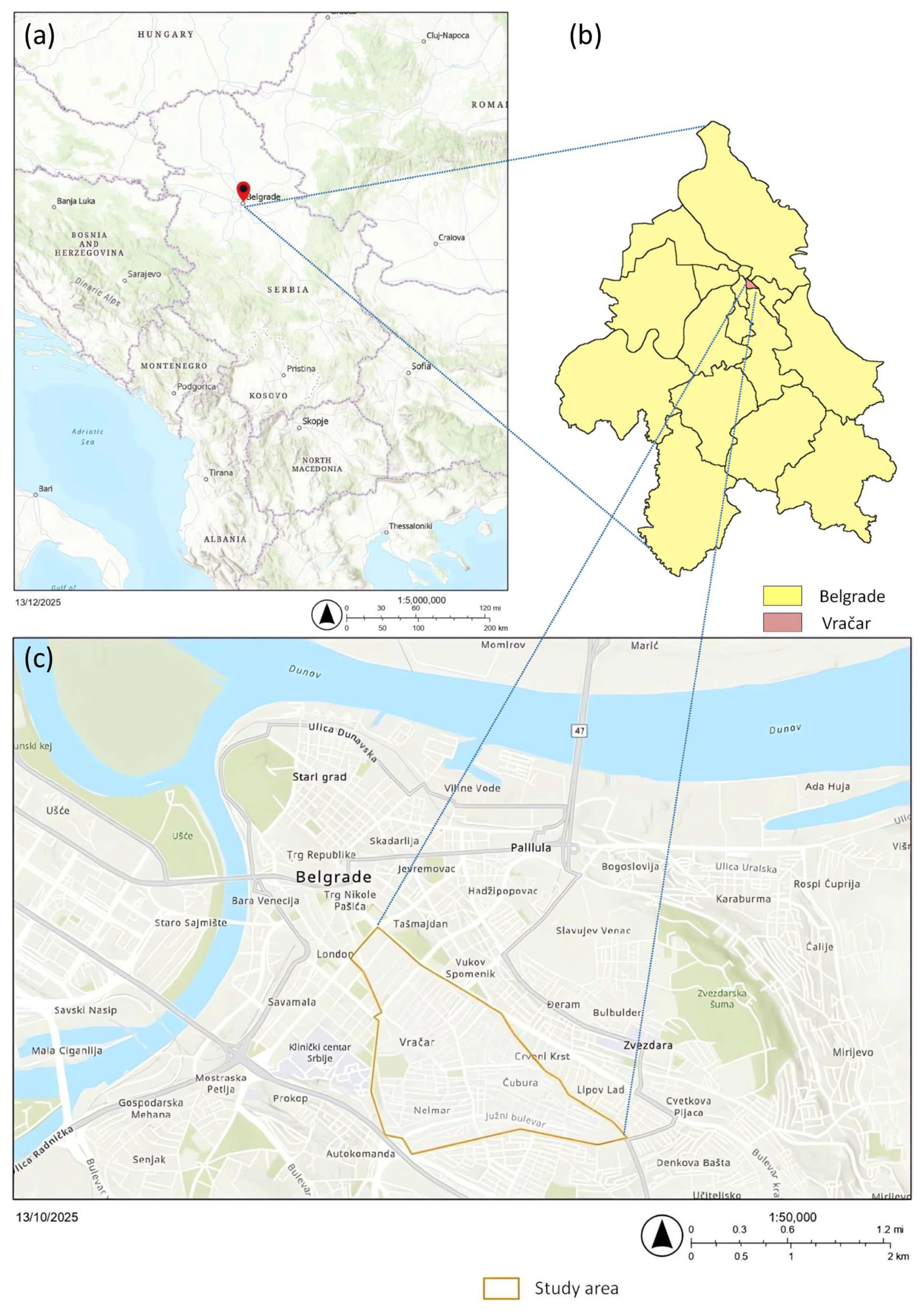
Vračar is a municipality situated in the central part of Belgrade (see Figure 1). It is known for its dense urban fabric and historical significance. With about 80,000 residents in less than 3 km2, this area has the highest population density in Belgrade. This area consistently ranks as the wealthiest and most economically developed in Serbia. Factors contributing to its success include a high concentration of services and corporate headquarters, elevated property values and rents, tourism, and commerce.
Vračar faces challenges due to a low percentage of green spaces. Compared to other municipalities in Belgrade, Vračar has the smallest amount of green area per capita, with only 8 m2 available per resident. This high urban density and the lack of green spaces greatly affect residents’ overall health. According to the Health Center of Vračar, a study by Vujčić et al. [79] revealed that a significant number of residents suffer from health issues: 16.2% experience acute respiratory infections, 2.3% have chronic respiratory disease, and 11.2% face mental and behavioral disorders.
In 2010, in response to the lack of urban green space, Vračar Municipality launched the Urban Pocket initiative. This program aims to create small, accessible green areas throughout the city to enhance the social determinants of health and improve equitable access to nature. Through a collaborative governance model involving local communities and policymakers, the project generates evidence-based recommendations for sustainable urban design. Nevertheless, this grassroots, sustainability-oriented initiative confronts significant opposition from prevailing market-driven development paradigms. A new development plan that prioritizes profitable, market-oriented development can directly threaten UGS. For illustration, the new urban plan for Vračar in 2025 proposes planning over 3000 residential units, representing more than a 150% expansion of the current housing stock. This residential boom would swell the population from around 5356 to nearly 9000—an increase of over 3644 people. In contrast, the plan forecasts modest employment growth, projecting a rise of only 39 employees to reach a total of 169, and minimizing UGS development [80].

3.2. Data Sources and Processing

3.2.1. Land-Use Datasets and UGS in Vračar

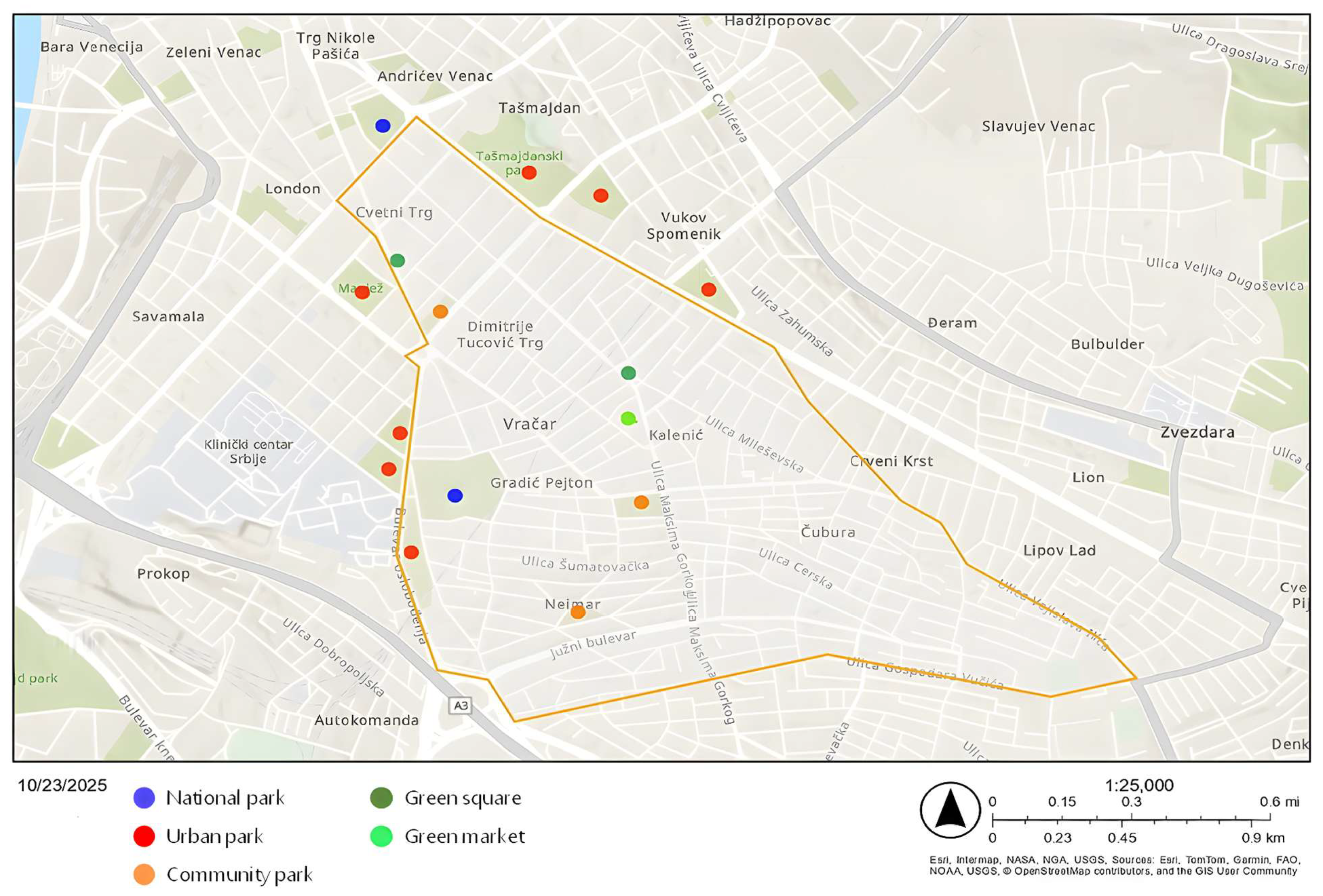
Land-use data for Vračar in 2019 were provided by the Plan of General Regulation of the System of Green Area in the City of Belgrade [81]. Five types of public UGS in Vračar were identified: parks, squares, green space in open blocks, and green corridors. In this study, UGS is defined as parks, squares, urban pockets, urban gardens, and green corridors. The spatial boundaries or locations of parks were drawn from OpenStreetMap (OSM) (https://www.openstreetmap.org/#map, accessed on 10 November 2025). The boundaries for each park were converted to points to reflect their location using ArcGIS SaaS. In Figure 2, we illustrate the spatial distribution of parks, squares, and markets in Vračar.

3.2.2. Point of Interest

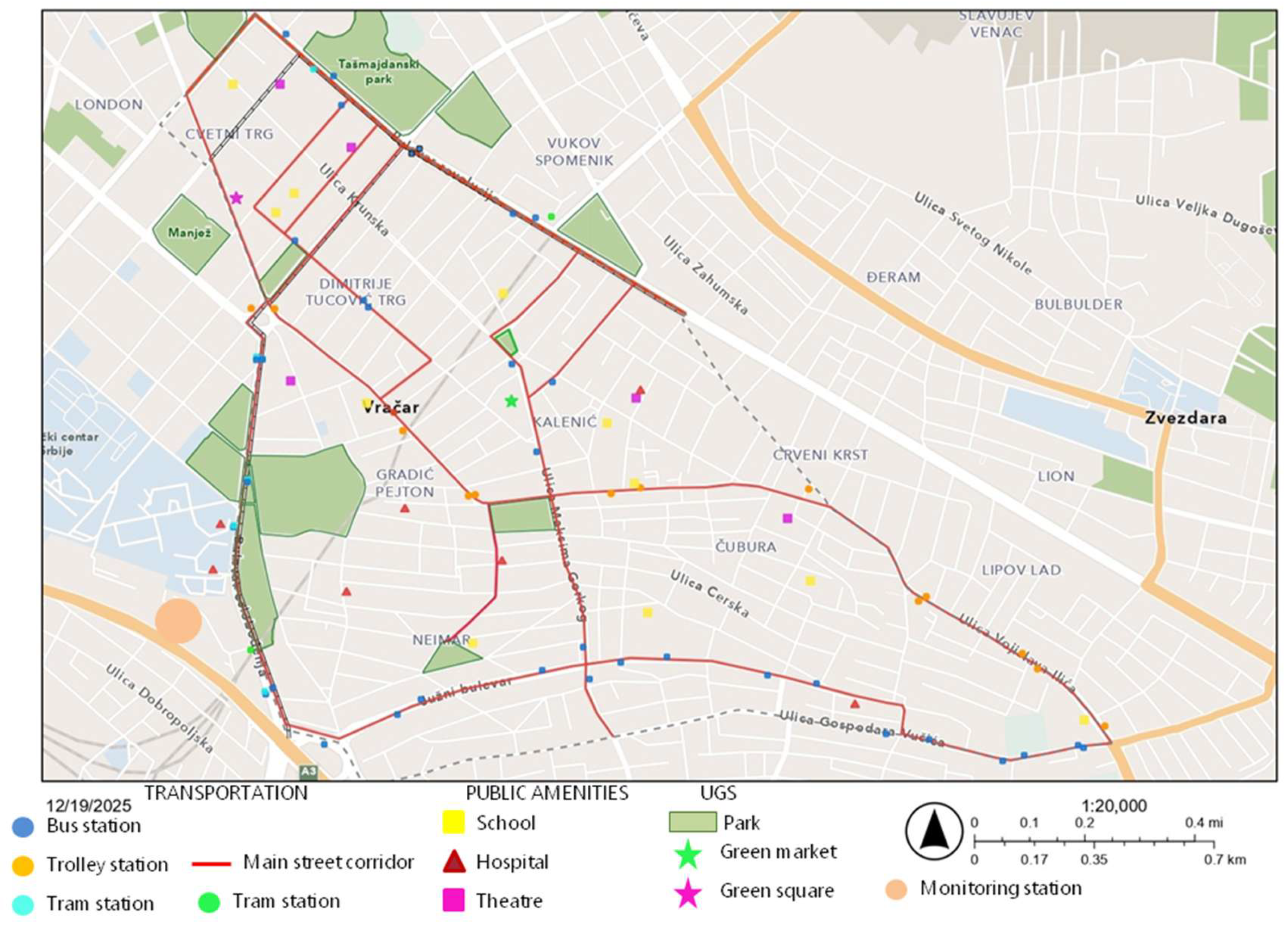
Points of Interest (POIs) were sourced from OpenStreetMap (OSM) via its API on 13 October 2025. The dataset comprises 124 records across ten categories relevant to economic valuation: bus stations, trolley stations, train stations, tram stations, parks, markets, schools, hospitals, theaters, and urban green squares. Our selection of POI categories was guided by the objective of quantifying accessibility to essential urban services and amenities, rather than focusing on commercial activity or nightlife (e.g., individual shops, pubs, cinemas). Table 1 summarizes the POI categories and their respective counts, while Figure 3 illustrates the spatial distribution of POI density.

3.2.3. Urban Pockets and Urban Gardens in Vračar

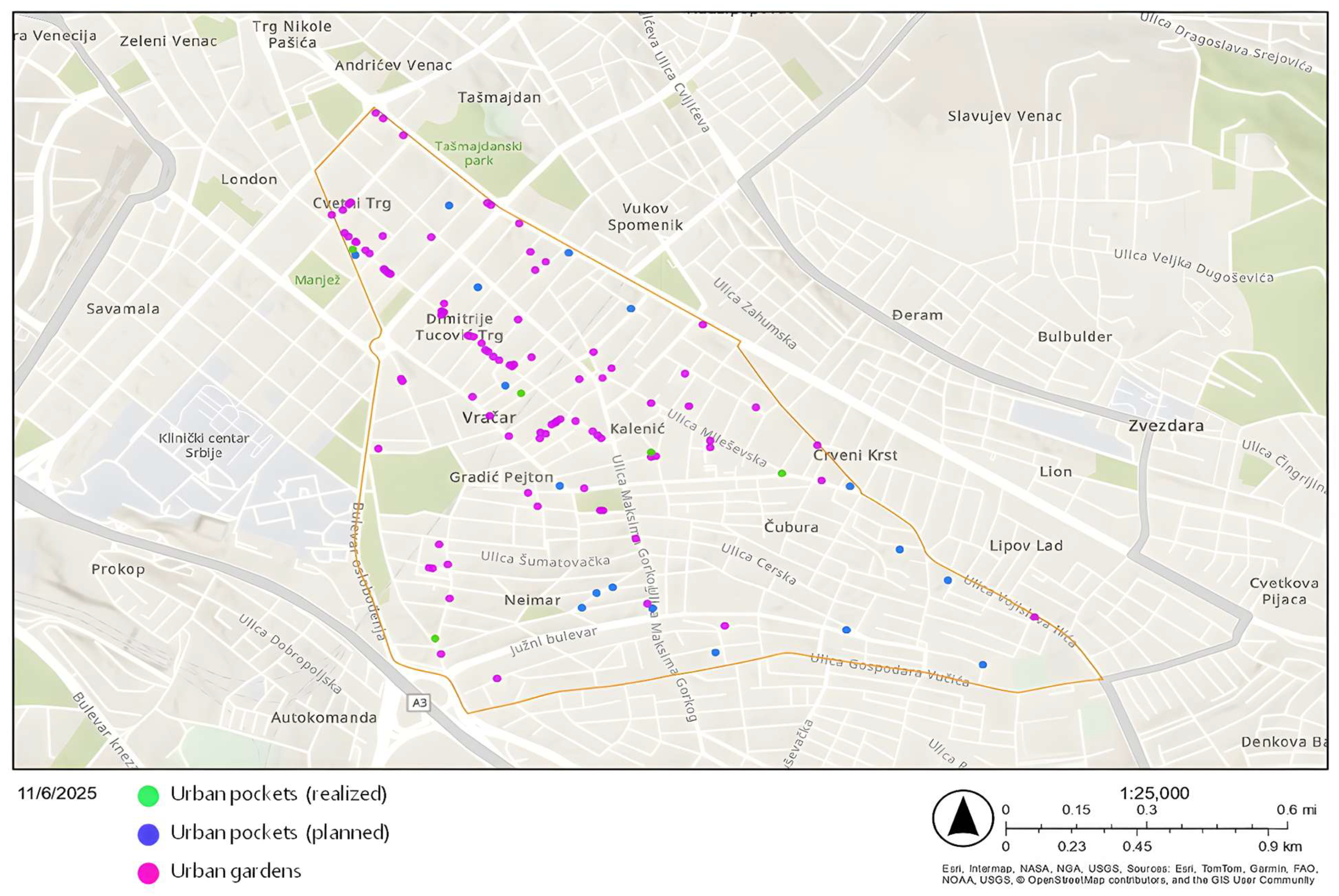
The “urban pocket” project is a grassroots urban revitalization movement initiated in 2010 by students from the Department of Landscape Architecture and Horticulture at the Faculty of Forestry in Belgrade. Its core mission is to transform small, neglected, and often derelict plots of land in dense urban areas into functional, green micro-environments. This approach creates new micro-environments while significantly enhancing the area’s aesthetics, fostering resident socialization, and improving the urban environment. Unlike large-scale urban projects, pocket spaces require minimal investment. The initiative was first piloted in the Vračar municipality, which provided official approval, a minimal budget, and technical support for site preparation. An urban garden is a small, landscaped green space located in front of restaurants and cafes. Table 2 presents the categories and numbers of urban pockets and urban gardens in Vračar utilized in this study, while Figure 4 illustrates the spatial distribution of these urban pockets and gardens.

3.2.4. Housing Price

This study utilized housing listings from Serbian real estate portals: nekretnine.rs, cityexpert.rs, 4zida.rs, and divisnekretnine.rs accessed on 8 November 2025. Data collection occurred on 10 November 2025, resulting in an initial sample of over 2000 new construction listings, each containing an ID, location, price, area, and number of bedrooms. The input features for the predictive model were selected to correspond to the principal determinants of real estate value in Serbia.
The data preparation involved a multi-step filtering process. First, we removed duplicate listings across all portals. Next, the dataset was limited to properties within the Vračar municipality and those with fewer than six bedrooms. Finally, we eliminated samples with housing prices that were unusually high or low, specifically those falling outside the range of the mean ±3 standard deviations of the overall housing price.
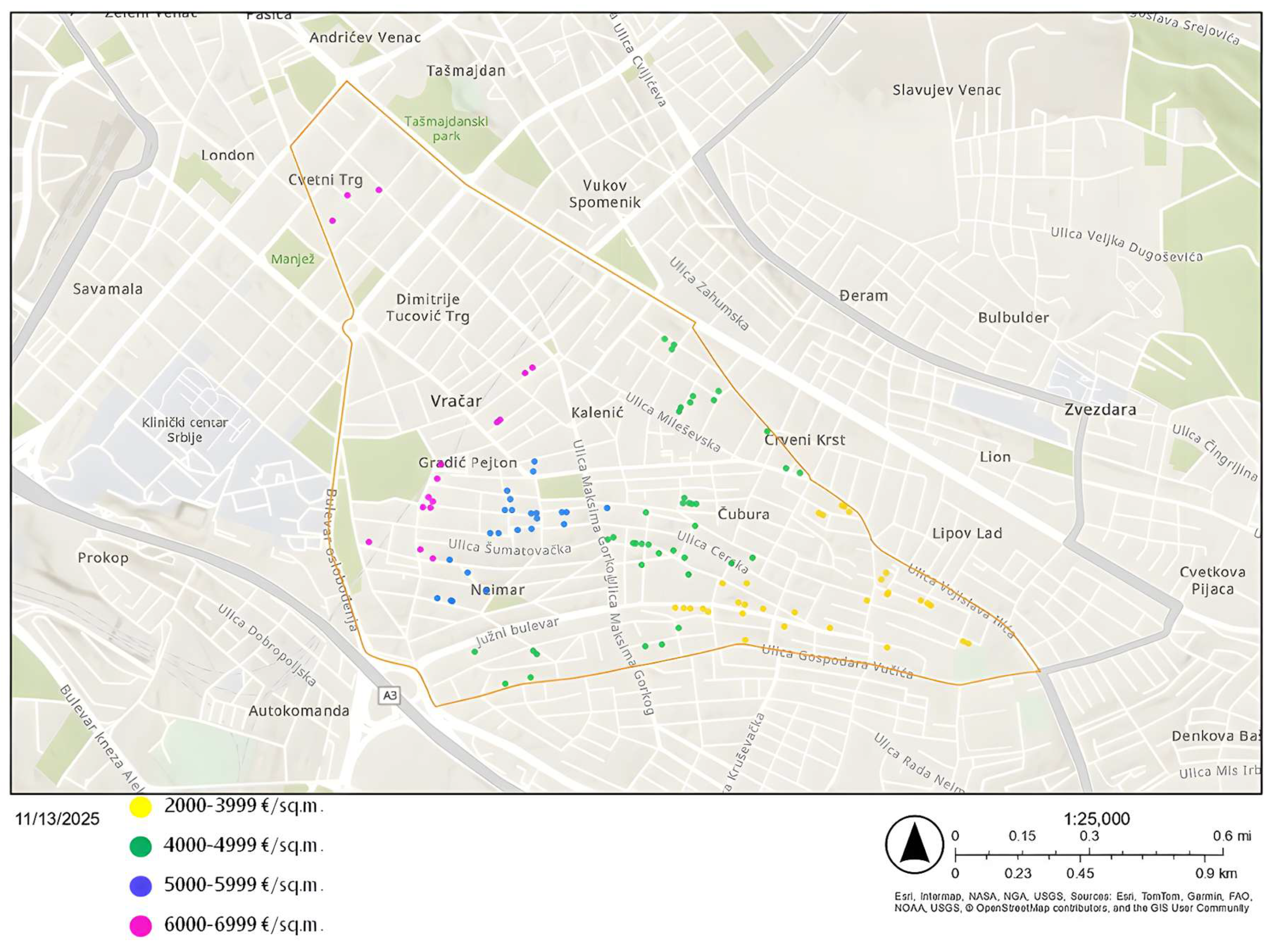
Finally, we combined samples with the same district name and type by calculating the average housing price per unit area (€/sq·m) and the average area. After completing this process, 134 samples remained. The final samples were then converted into points based on their location (see Figure 5).

3.2.5. Air Quality Data in Vračar

Air pollution data were sourced from the portal beoeko.com accessed on 15 December 2025 and recorded on 10 December 2025, at the “Franša Deperea” monitoring station in the Vračar area. This monitoring station is situated near a high-traffic zone (see Figure 3). Table 3 presents the categories and values of pollutants in the Vračar area during morning rush hour (peak times). The temporal resolution was determined based on the availability of city-level data.
Morning rush hour measurements in Vračar at 08:00 indicate elevated levels of particulate matter, attributable to winter heating emissions and traffic. The PM2.5 concentrations measured at 27.6 μg/m3 exceed the World Health Organization’s 24 h guideline of 15 μg/m3, suggesting potential health risks for sensitive populations. Additionally, the NO2 levels recorded at 68.9 μg/m3 demonstrate a significant influence from traffic; O3 concentrations remain low at 30.1 μg/m3, a typical scenario for winter mornings due to limited photochemical production.

4. Method

4.1. The Evaluaton Model of Economic Value of UGS

The model can be written as an equation below:
P = f(x1, x2, x3, …, xn),
where is P is house prices, and x1, x2, …, xn are the factors that impact P. The linear model was used in this study to evaluate the economic value of UGS in Vračar. The average house prices of the 134 dwelling unit samples were set as the dependent variables. Then, the characteristics of the dwelling unit, including its type and area, were set as two independent variables (x1 and x2). Specifically, the independent variable—type of dwelling unit—was assigned positive integer values based on the number of bedrooms in each sample, serving as a proxy for quality (see Table 3).
The analysis incorporated proximity-based variables, measured for each sample as the distance to various amenities. For each sample, we measured the distance to public transit (bus, trolleybus, and train stations), access to amenities (schools, hospitals, theaters, and green markets), and availability of UGS (parks, urban green squares, urban pockets, and urban gardens). Variables that were not statistically significant in preliminary models were excluded from the final analysis. The complete set of independent variables is detailed in Table 4.
The buffering tool in ArcGIS was used to extract distance-independent variables, specifically x3, x4, and x6. In contrast, the density-independent variables, such as x5, x7, x8, and x9, were calculated based on the number within a radius of 100 m, 250 m, and 500 m.

4.2. The Social Value Evaluation

The social value of UGS is quantified based on the presence of parks, urban pockets, and urban gardens, calculated using the following multiplicative equation:
SO = Dp × Dup × Dug × Pop,
where Dp is the density of parks, Dup is the density of urban pockets, Dug is the density of urban gardens, and Pop is the population. All densities were calculated on a 250 m × 250 m grid. Population data for Vračar were obtained from the Global Human Settlement Layer [82] at 250 m resolution. To align these data with our 100 m analysis grid, we performed areal weighting interpolation. This technique proportionally redistributes the population from each source cell to target grid cells based on overlapping area, ensuring the conservation of the total population and an accurate representation at the finer scale.
The multiplicative formulation in Equation (2) was selected over an additive approach to reflect the compound and contingent benefit of having multiple, co-located UGS types. This formulation implies that the social value is negligible if any single UGS type is entirely absent (i.e., if Dp, Dup, or Dug = 0) and that the combined presence of parks, pockets, and gardens creates a synergistic social value greater than the sum of their individual contributions. To ensure comparability, all density measures (Dp, Dup, Dug) were normalized to a 0–1 scale based on their maximum observed values in the study area. The resulting SO value thus ranges from 0 to Popmax, where higher values indicate a greater social value of UGS relative to local population presence. We note that this formulation makes the index inherently sensitive to the scale of the population; a cell with a very high population can dominate the SO value even with moderate UGS densities. The areal weighting interpolation was validated through mass conservation checks, confirming that the total population was preserved within a 0.1% error margin when disaggregating from 250 m to 100 m resolution.

4.3. Spatial Decay Function

For modeling the spatial impact, the Gaussian kernel was used. The impact value (I) at a given location from a single linear emission source was calculated as follows:
I d = e d 2 2 σ 2
The Gaussian model was chosen because its exponential decay approximates the atmospheric dispersion process in dense urban environments such as Vračar, where mixing is limited by ‘urban canyons’. The width parameter (σ = 50 m) was selected based on typical street corridor widths and literature on dispersion in urban conditions.

4.4. Integrated AHP and AI-GA Methodology for UGS Planning

Our platform for the Vračar Municipality convened domain experts, including urban planning specialists, to perform pair-wise comparisons across various sustainability dimensions and sub-indicators. Through this structured AHP, experts provided consistent weight preferences, thereby establishing the relative importance of each indicator. These weights are used in two distinct computational stages: first, to calculate a weighted sustainability score, and second, to inform a multi-objective optimization process. This process employs a hybrid analytical pipeline:
A predictive model (a learning-based AI) is trained to estimate housing price impact based on key features. A Genetic Algorithm (GA)—an optimization technique—is then used to explore UGS planning scenarios. It seeks to maximize both the AHP-derived sustainability score and the model-predicted property value increase.
Our model’s feature engineering directly mirrors the logic of the Serbian appraisal system. Variables capturing centrality, housing quality, and access to green space serve as proxies for its core factors. Therefore, the model’s predicted “price increase” simulates how the market, following this comparative framework, would capitalize on the amenity value of new UGS.
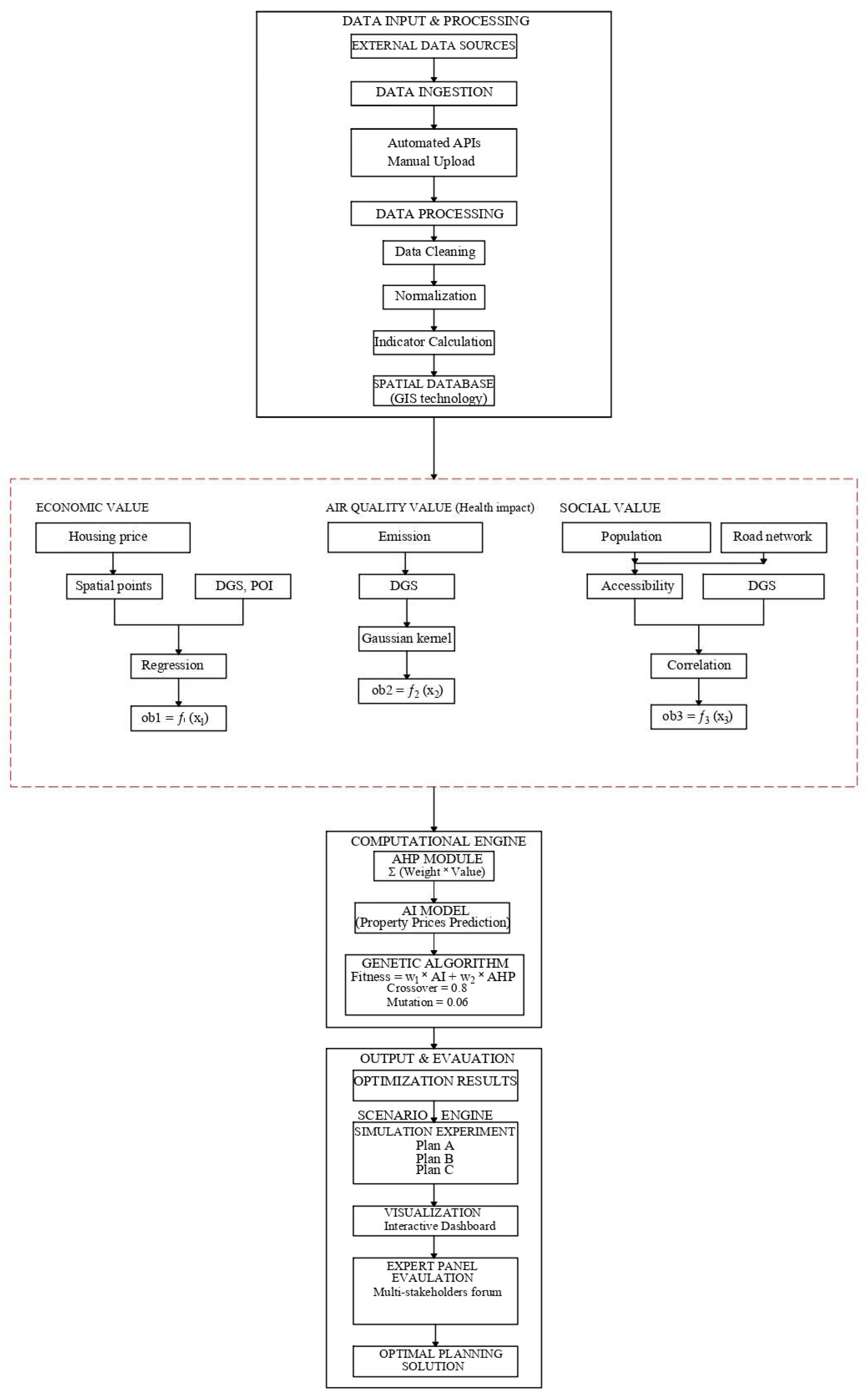
The UrbanSAT platform operates on a modular backend architecture. The workflow supporting the integrated AHP and hybrid analytics follows these sequential steps (see Figure 6):
1.
Backend & Data Ingestion: The platform’s core is built on a cloud-based server infrastructure utilizing GIS geo-data. Data ingestion occurs through two channels:
1.1
Automated Pipeline: Scheduled Python 3.10.12 scripts retrieve structured geospatial data from municipal APIs and public repositories.
1.2
Manual Upload: Expert-defined criteria weights and project-specific boundary files are uploaded via a secure web interface.
2.
Processing Modules: Ingested data is routed through specialized modules:
2.1
Spatial ETL Module: Cleanses and standardizes all geo-data.
2.2
Indicator Calculation Module: Computes normalized values for each sustainability variable (x1 … x9).
2.3
Data Preparation Module: Aggregates indicator scores and historical housing price data into the feature table used for model training and prediction.
3.
Computational Engine: This is the core analytical layer.
3.1
AHP Score Engine: Applies formula: Calculating the AHP Sustainability Score for each spatial unit using the expert-derived weights (see Table 5) by performing a sum:
AHP Score = Σ (Global Weight × Normalized Variable Value),
The weights are defined such that
w1 + w2 = 1,
3.2
Hybrid Prediction & Optimization Engine: This module executes the two-stage analytic process:
3.2.1
Predictive modeling: A trained machine learning model estimates the potential property value (ΔPrice) for any proposed UGS Configuration.
3.2.2
Multi-Objective Optimization: A Genetic algorithm (GA) is used to search for optimal UGS plans. The GA’s fitness function, which defines the quality of a solution, combines the two primary objectives:
Fitness = w1 × (Predicted Δ Price) + w2 × (AHP Sustainable Score Increase)
This algorithm (crossover rate = 0.8, mutation rate = 0.06) evaluates this function for thousands of candidate plans evolving generations to maximize the combined score. The weights w1 and w2 reflect the relative priority of economic gain versus sustainability improvement.
4.
Update Frequency & Output: The computational engine runs on demand for specific planning scenarios. Upon GA convergence, the highest-fitness plans are selected as outputs. These results, along with their detailed projections, are pushed to the frontend visualization dashboard. They are also compiled into a structured report for review by the expert panel.
5.
Expert Review: The panel evaluates the proposed plans using a four-point descriptive scale: “very high”, “high”, “medium”, and “low”. This qualitative assessment complements the quantitative optimization results.
6.
Multi-stakeholder forum: The optimized plans were presented for qualitative validation in a structured Multi-Stakeholder Forum. Participants reviewed the top UGS plans generated by the optimization engine. Feedback from the forum was systematically collected and analyzed.
7.
Optimal planning solution: The final expert panel conducted a holistic evaluation, synthesizing the quantitative outputs from the optimization engine with qualitative feedback from the Multi-Stakeholder Forum. This integrative process ensured the selected planning scenario optimally balanced algorithmic efficiency with on-the-ground practical knowledge and shared societal goals.

5. Results

5.1. The Economic Value of UGS

According to the spatial map (see Figure 5), the Vračar municipality is divided into three main tiers of real estate valuation:
  • Premium Economic Core: This area includes the central-western and northeastern districts, which feature high property values due to excellent access to UGS. These districts have a significantly high density of UGS and are close to parks, making them the most valuable areas in the market;
  • Mid-Value Corridor: This segment comprises central zones that maintain a cohesive urban fabric. However, its relative distance from major green spaces affects accessibility. This corridor offers a balance between connectivity and affordability;
  • Lower-Value Periphery: Primarily located in the southern and southeastern districts, this area has the lowest property values compared to the other tiers.
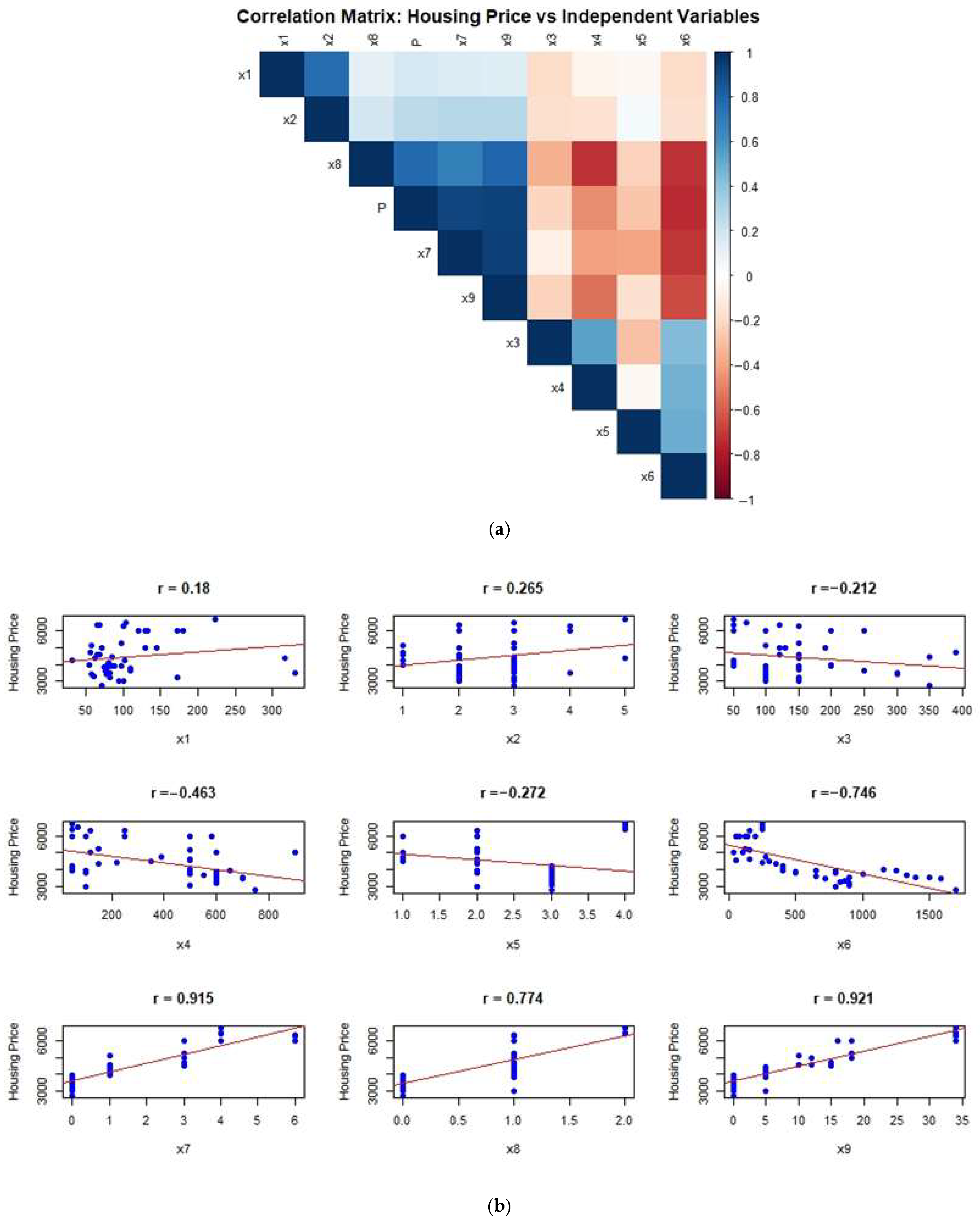
The expert decision weights presented in Table 6. According to the linear model analysis, the results indicate a strong inverse correlation between housing prices and the distance and density of urban green spaces (UGS). The correlation results are presented in Table 7. The correlation results are visually displayed using R Studio 4.3.2. (see Figure 7).
Based on the correlation coefficient, focus on UGS (see Figure 7):
  • Distance of park (x6): This is a strong negative correlation. As the distance to the closest park increases, housing price decreases. Conversely, proximity to a park (shorter distance) increases property value;
  • Density of urban pocket (x8): This is a strong positive correlation. As the density of urban pockets increases, housing prices rise, suggesting that urban pockets are seen as desirable amenities;
  • Density of urban garden (x9): This is a strong positive correlation. As urban gardens increase, housing prices rise significantly. Urban gardens are highly valued in balancing ecological and economic value.
The linear regression analysis of the Vračar real estate market reveals that economic value is not determined by property size. Instead, it primarily depends on location and the quality of amenities that contribute to the overall quality of life. The highest economic value is assigned to properties situated in mixed-use urban gardens, walkable urban areas (indicated by a high score in variable x8) that are close to an urban park (reflected in a low score in variable x6). This trend reflects a demand for a specific, high-quality urban lifestyle. As access to amenities, especially urban parks, decreases, housing prices decline significantly.
By overlaying the economic value and social objective maps, we can prioritize UGS interventions. Areas with both high economic and high social value (the central-western and northeastern districts) are preservation priorities, where investment should focus on maintaining their premium status. In contrast, areas with low scores in both dimensions (the southern and southeastern districts) represent high-potential zones for transformative regeneration, where UGS investment can simultaneously catalyze social well-being and economic objectives.

5.2. The Social Value of UGS

According to the spatial map (see Figure 2, Figure 3 and Figure 4), the analysis reveals a distinct spatial distribution of social value indicators across the Vračar municipality. The northeastern part of the study area has the highest potential due to an excellent balance of green spaces, vibrant urban fabric, and urban gardens. Similarly, the central-western zone demonstrates a high degree of social value. Nonetheless, in the southern and southeastern study areas, available metrics indicate a comparatively lower valuation for the measured socio-environmental amenities, suggesting a potential deficit in the foundational elements of social value as defined by this model. The analysis shows that reducing the distance to a park is highly valuable. The most direct way to achieve this is to build new green spaces (urban pockets and gardens) in areas that have poor access (i.e., a long distance to any park).
The economic significance captured by our model (e.g., the price premium for gardens or pocket parks) is not a universal constant but is activated and amplified by specific local regulatory histories and cultural narratives that define what constitutes a valuable urban asset. Consequently, the variables in our hedonic price model (e.g., distance to UGS, housing quality indices) serve as quantifiable proxies for amenities whose economic value is institutionally constructed. The regression coefficients for green space access thus reflect not only a current willingness-to-pay but also the cumulative outcome of historical planning decisions, zoning laws, and culturally ingrained notions of urban well-being.

5.3. UGS Optimization for Vračar

Objective: To identify the optimal location for 10 new UGS projects that maximize a hybrid objective function, balancing predicted economic impact (property value increase) and multi-criteria sustainability gains (AHP Score).
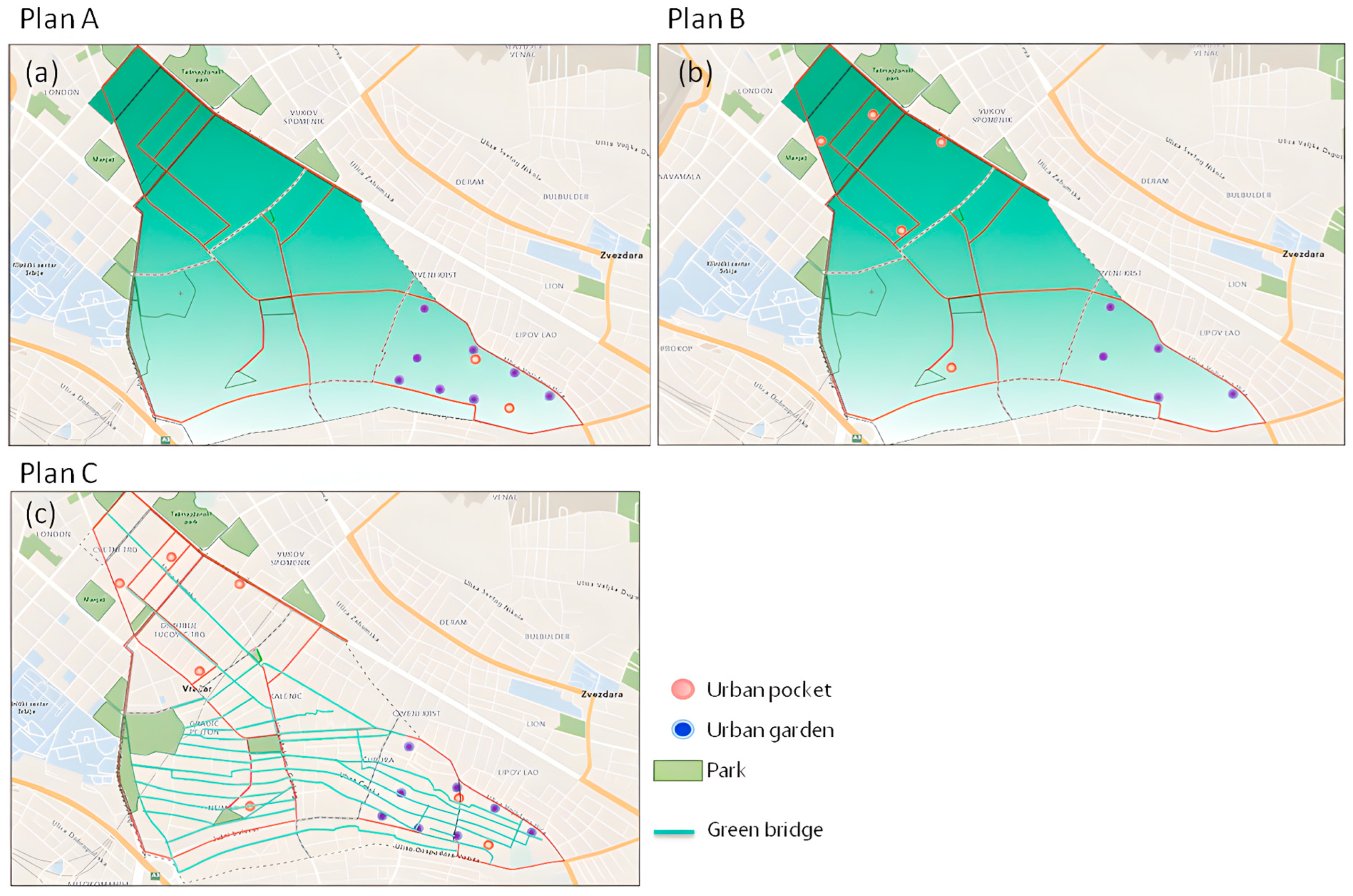
Using the integrated methodology, three distinct candidate plans—each embodying a different strategic priority—were generated and presented to the expert panel for evaluation.
Presented Scenario:
  • Plan A: The Equity-Focused Plan:
    Spatial Strategy: Places 8 new gardens and 2 pockets in the southern district (prioritizing sample 39–49).
    Model Projections:
    Predicted Market Impact: Modest aggregate property value increase (+6.5%).
    Sustainable Impact: Highest improvement in the AHP Sustainability Score for the target area, directly addressing equity and access deficits.
  • Plan B: The Economic Growth Plan:
    Spatial Strategy: Stimulate market activity by placing 5 new gardens in the south and 5 pockets in the central district (targeting zones of medium to high baseline value).
    Model Projections:
    Predicted Market Impact: Highest overall property value uplift (+9.0%)
    Sustainable Impact: Significant but not maximal sustainability gain, offering a balanced improvement across districts.
  • Plan C: The Connectivity Plan
    Spatial Strategy: Create a continuous green corridor, using a sequence of pockets and gardens to physically and visually connect the high-value northeast with the lower-value south.
    Model Projections:
    Predicted Market Impact: Moderate property value increase (+7.5%).
    Sustainable Impact: Maximizes gains in spatial connectivity metrics and social integration, enhancing the overall urban fabric beyond localized benefits.

5.3.1. Model-Based Validation of Expert AHP Weights

The results of the trained predictive model provide an independent, data-driven validation of the expert-derived AHP weights. The model’s feature importance analysis confirms that variables x6 (park accessibility) and x7 (park density) are significant predictors of housing prices, reinforcing the experts’ judgment in assigning these factors high relative weight within the AHP sustainability framework. This convergence between expert preference and empirical data pattern strengthens the credibility of the weighted criteria.

5.3.2. Baseline AHP Score Analysis

The baseline AHP sustainability assessment (calculated using Equation (4) with the expert weights) reveals a clear spatial disparity. This result quantifies the expert-driven evaluation prior to any optimization:
  • Sample 3 (Northeastern District): Achieved a high score of 0.82. This excellent rating is driven by strong performance in sustainability indicators: short distance (x3, x4, x6) combined with high density (x7 and x9).
  • Sample 49 (Southeastern District): Received a low score of 0.21. These poor rating results from a challenging indicator profile: long distance (x3, x4, and x6) coupled with low density (x8 and x9).
This baseline establishes the pre-intervention sustainability landscape, highlighting the southeastern district as a priority area for UGS investment to improve equity, which is a finding that directly informs the spatial strategies (Plan A) evaluated during the optimization phase.
The results from the expert panel evaluation are presented in Table 8.

5.3.3. Recommended Strategy & Synthesis of Results

The integrated analysis recommends a synthesized strategy, prioritizing the Connectivity Plan (C) as the primary spatial framework. To enhance its impact, the strategy proposes targeted refinement within the corridor’s southern segment: increasing the proportion of urban gardens relative to urban pockets. This adjustment directly addresses the social equity deficit highlighted in Plan A by focusing investment in areas with both low baseline sustainability scores and high modeled potential for property value appreciation.
To maximize collective benefit, the recommendation further suggests concentrating urban pockets along the central street corridors. This placement aims to create a continuous, accessible green network benefiting a larger population. The spatial synergy between gardens (in equity-priority zones) and connecting pockets is projected to simultaneously improve key sustainability metrics, specifically x7 (park density) and x8 (urban pocket density). A predicted 7.5% increase in total district property value, while 45% increase in population-weighted green space accessibility (see Figure 8).

6. Discussion

Campbell [58] defined the concept of sustainability that could be transformed and revised for use by urban planners. As Stanilov [4] pointed out, urban planners need to redefine their role from reactive guardians who serve the interests of the political and economic elite to active defenders of public interests. Numerous authors argue that urban planners need a new mechanism to understand city development, one that encompasses not only market-oriented systems but also natural systems.
This approach focuses on the district level in Belgrade, moving beyond simple descriptive mapping or isolated case studies. Instead, it offers a prescriptive decision-support tool to the high-density urban core. By quantifying the trade-offs between sustainability (measured by the AHP score) and market response (predicted by AI), it introduces an economic-ecological dialogue previously absent from the local planning literature. It directly engages with the socio-technical critique by designing a human-in-the-loop, socio-technical system. The model’s legitimacy is derived not from algorithmic authority but from the structured incorporation of expert knowledge through AHP weighting. Its output is designed as negotiable scenarios (Plans A, B, C) for stakeholder discussion. Translating these technical optima into effective urban policy necessitates a governance framework that structures the behavior of key stakeholders, including developers, investors, public agencies, and communities. The concept of “regulation by incentives” [83] offers a critical conceptual framework for this purpose. Consequently, this work responds to the growing call within planning for AI tools that are transparent, interpretable, and explicitly considerate of governance realities [74].
Granovetter [41] emphasizes that micro UGS derive their value less from size and more from functioning as hubs within established social networks, thereby reinforcing local ties and a sense of belonging. In Polanyi’s terms [42], their significance stems from successful social and institutional re-embedding, where a minor physical intervention can redefine collective perceptions of an entire area. Our model operationalizes access to UGS and housing quality through spatial variables such as distance and density. Although these metrics serve as quantitative proxies, we acknowledge they cannot fully capture the qualitative, social dimensions of value discussed by Granovetter and Polanyi. For example, while the model can quantify proximity to a park, it cannot assess the extent to which the park operates as a community hub or forms part of local identity. The observed disproportionate impact of small, pocket green spaces underscores the importance of these socially embedded factors that transcend spatial measurements. Cousin’s [84] research on community building in marginalized urban areas demonstrates that social value is generated through everyday encounters, rather than solely through spatial distribution. Our optimization results—especially the prioritization of urban pockets at population density peaks—resonate with this perspective, pinpointing where UGS can foster both ecological benefits and the socialization processes essential for community formation. Ultimately, integrating Cousin’s processual understanding elevates our contribution from a spatial optimization tool to a comprehensive framework for designing both the social and ecological infrastructure of Vračar’s urban future.
According to Granovetter’s embeddedness thesis, the economic value of UGS cannot be assessed by their spatial proximity. Instead, these amenities acquire significance and value through their integration within the community. In a similar vein, Polanyi’s examination of land as a ‘fictitious commodity’ highlights that the market value of properties located near green spaces is not inherent; rather, it arises from the way these spaces are socially and institutionally re-embedded within specific urban contexts. Consequently, effective UGS planning cannot be a merely technical exercise of optimizing distance and density; it must engage with the social meanings, historical conventions, and governance arrangements that give these spaces their significance. This theoretical perspective provides a crucial lens for interpreting our findings, particularly the strong influence of micro-spaces, which may derive their disproportionate value from their role as focal points within these social networks.
The social value of UGS captured in our assessment, which informs expert weighting in the AHP, encompasses not only accessibility but also this latent capacity to shape community-building dynamics. This perspective further justifies the significant influence small interventions can exert on perceived value, as they frequently serve as highly proximate and accessible nodes within this relational network of everyday public life. While our AI-GA methodology identifies technically optimal locations for UGS based on sustainability and economic criteria, its practical application is fundamentally conditioned by the socio-institutional environment of urban governance. As scholarship on metropolitan governance suggests, spatial planning outcomes are shaped more by processes of negotiation, institutional fragmentation, and incomplete coordination among multiple actors [78]. The municipality of Vračar, like many urban contexts, operates within such a fragmented governance landscape, where land-use decisions involve municipal authorities, utility companies, private landowners, resident associations, and various regulatory bodies.
Our AI-GA methodology identifies spatially and economically rational configurations for UGS allocation. However, as our own background indicates—where UGS in Vračar are threatened by market-driven development—these technical proposals are not immune to conflict. Urban planning literature often depends on the ability to navigate such conflicts through institutionalized forums or participatory mechanisms [75,85]. Therefore, Plans A, B, and C should not be seen as technocratic substitutes for political process, but as evidence-based inputs designed to structure and inform the necessary negotiations.

7. Conclusions

Regulating UGS as a public good is crucial for the long-term sustainability and effectiveness of UGS in promoting public health. By leveraging GIS and the integrated AHP and AI-GA methodology, urban planners can make informed decisions, optimize resource allocation, and enhance the quality of life for residents. Our study, informed by concepts of social “embeddedness”, suggests that effective UGS planning requires a dual approach: a quantitative one that optimizes spatial layout and accessibility, and a qualitative one that seeks to understand and strengthen the social ties and meanings associated with these spaces.
Therefore, our optimization scenarios should not be interpreted as final policy prescriptions but as evidence-based proposals that must enter a political and administrative negotiation process in the following ways:
  • As a Scenario-Building Engine for Workshops: The model can generate multiple evidence-based planning scenarios (such as Plans A, B, and C) for public consultations.
  • As a Common Reference Point for Transparency: The model’s inputs—the expert-derived AHP weights (Table 5) and the objective functions—can be made publicly accessible.
  • As a Framework for Coordination: By agreeing on a common set of indicators and weights, disparate agencies can align their efforts towards a shared, quantitatively defined vision for UGS, thereby mitigating the risks of uncoordinated planning.
  • As a Tool for Iterative Policy Learning: The model is not a one-time solution but a framework for adaptive management. As new data on land availability, property markets, or community priorities emerge, the model can be re-run to update scenarios. This supports a continuous, evidence-based feedback loop in urban planning, moving towards a more dynamic and responsive governance model for green infrastructure.
Ultimately, the value of integrated AHP and AI-GA modeling lies in its capacity to generate clear, evidence-based options that can structure and elevate essential public debates over the future of UGS, rather than seeking to bypass them. It underscores that the proposed UGS plans (A, B, and C) represent technically efficient scenarios, the practical feasibility of which will be determined through subsequent processes of inter-institutional negotiation and stakeholder coordination.
This architecture ensures that the AHP-AI-GA methodology is not a theoretical exercise, but a reproducible and scalable workflow within the UrbanSAT platform, providing clear traceability from raw data to expert-evaluated planning scenarios. The ultimate value of the integrated AHP-AI-GA methodology lies in its potential to be meaningfully mobilized within real-world planning workflows and participatory decision-making arenas.
In this way, our proposed tool is not a technocratic substitute for political judgment, but a robust decision-support system designed to enhance democratic planning. It does not eliminate conflict but provides a transparent, evidence-based platform to structure negotiations, clarify trade-offs, and build consensus around the complex, value-laden task of allocating precious UGS.
In conclusion, while the international literature offers advanced technical models and local research provides essential contextual boundaries, this study on Vračar occupies a necessary and innovative niche. It translates cutting-edge global methodology to solve a hyper-local planning challenge, thereby contributing a scalable case to international journals while delivering actionable intelligence for urban governance in Belgrade.

Limitation and Future Direction

This study acknowledges several limitations that pave the way for future research, including a focus on single-city case study design, static emission assumptions, and a lack of meteorological dispersion modeling. A key limitation of this study is the absence of formal uncertainty or sensitivity analysis. Our modeling provides estimates based on available data. Exposure modeling involves multiple parameters subject to variability (e.g., emission factors, inhalation rates, time-activity patterns). Future work should implement probabilistic modeling approaches to quantify uncertainty ranges.
Future research could focus on developing mixed methods that integrate spatial data with ethnographic or survey research on perception and use to better capture the dynamic nature of UGS value as an ‘embedded’ resource. Additionally, future refinements of this methodology could incorporate governance variables more formally, such as weighting potential sites by land ownership type (public vs. private) or aligning with officially adopted municipal strategic zones, to generate plans with higher initial political feasibility. The incorporation of uncertainty analysis in future studies will strengthen confidence in quantitative estimates, particularly for policy applications where exposure thresholds are established.

Author Contributions

Conceptualization, S.M.; methodology, S.M.; validation, S.M. and K.S.; formal analysis, S.M.; investigation, S.M.; writing—original draft preparation, S.M.; writing—review and editing, I.C., K.S. and M.M.; visualization S.M.; supervision K.S., I.C. and M.M.; project administration, I.C. and M.M.; funding acquisition, I.C. and M.M. All authors have read and agreed to the published version of the manuscript.

Funding

This research received no external funding.

Institutional Review Board Statement

Not applicable.

Informed Consent Statement

Not applicable.

Data Availability Statement

Data are available at request.

Conflicts of Interest

The authors declare no conflicts of interest.

References

  1. Brook, R.D.; Rajagopalan, S.; Pope III, C.A.; Brook, J.R.; Bhatnagar, A.; Diez-Roux, A.V.; Kaufman, J.D. Particulate matter air pollution and cardiovascular disease: An update to the scientific statement from the American Heart Association. Circulation 2010, 121, 2331–2378. [Google Scholar] [CrossRef] [PubMed]
  2. EEA. Harm to Human Health from Air Pollution in Europe: Burden of Disease Status. 2025. Available online: https://www.eea.europa.eu/en/analysis/publications/harm-to-human-health-from-air-pollution-burden-of-disease-status-2025 (accessed on 12 December 2025).
  3. WHO. WHO Global Air Quality Guidelines. 2021. Available online: https://iris.who.int/server/api/core/bitstreams/551b515e-2a32-4e1a-a58c-cdaecd395b19/content (accessed on 12 December 2025).
  4. Stanilov, K. The Post-Socialist City: Urban form and Space Transformations in Central and Eastern Europe After Socialism; Springer: Berlin, Germany, 2007. [Google Scholar]
  5. Tsenkova, S. Planning trajectories in post-socialist cities: Patterns of divergence and change. Urban Res. Pract. 2014, 7, 278–301. [Google Scholar] [CrossRef]
  6. Petrović, M. Transformacija Gradova: Ka Depolitizaciji Urbanog Pitanja; Institut za Sociološka Istraživanja: Beograd, Srbija, 2009; pp. 55–69. [Google Scholar]
  7. Vujošević, M.; Petovar, K. Javni interes i strategije aktera u urbanističkom i prostornom planiranju. Sociologija 2006, 48, 357–382. Available online: https://www.ceeol.com/search/article-detail?id=243144 (accessed on 15 November 2025).
  8. Nedović-Budić, Z. Adjustment of planning practice to the new Eastern and Central context. J. Am. Plan. Assoc. 2001, 67, 5–16. [Google Scholar] [CrossRef]
  9. City of Belgrade Development Strategy (CBDS) 2011–2016 (Strategija Razvoja Grada Beograda 2011–2016). 2010. Available online: http://demo.paragraf.rs/demo/combined/Old/t/t2011_07/t07_0341.htm (accessed on 20 May 2024).
  10. Maruna, M.; Teofilović, V.; Rodić, M.D. Transformacija institucionalne structure urbanističkog planiranja u postsocijalističkoj tranziciji: Primer Savskog keja na Novom Beogradu. Arhit. Urbaizam 2023, 57, 5–16. [Google Scholar] [CrossRef]
  11. Maričić, T. Sistem Zelenih Površina u Velikim Gradovima: Na Primerima Berlina i Beograda; IAUS: Beograd, Srbija, 2007. [Google Scholar]
  12. Nowak, D.J.; Hirabayashi, S.; Doyle, M.; McGovern, M.; Pasher, J. Air pollution removal by urban forests in Canada and its effect on air quality and human health. Urban For. Urban Green. 2018, 29, 40–48. [Google Scholar] [CrossRef]
  13. Tallis, M.; Taylor, G.; Sinnett, D.; Freer-Smith, P. Estimating the removal of atmospheric particulate pollution by the urban tree canopy of London, under current and future environments. Landsc. Urban Plan. 2011, 103, 129–138. [Google Scholar] [CrossRef]
  14. Selmi, W.; Weber, C.; Rivière, E.; Blond, N.; Mehdi, L.; Nowak, D. Air pollution removal by trees in public green spaces in Strasbourg city, France. Urban For. Urban Green. 2016, 17, 192–201. [Google Scholar] [CrossRef]
  15. Orr, S.; Paskins, J.; Chaytor, S. Valuing Urban Green Space: Challenges and Opportunities. Available online: https://www.ucl.ac.uk/public-policy/sites/public_policy_redesign/files/migrated-files/urban_green_spaces_briefing_FINAL.pdf (accessed on 22 October 2025).
  16. Yu, Y.; Zhang, W.; Fu, P.; Huang, W.; Li, K.; Cao, K. The spatial optimization and evaluation of the economic, ecological, and social value of urban green space in Shenzhen. Sustainability 2020, 12, 1844. [Google Scholar] [CrossRef]
  17. Liu, Y.; Qin, S.; Li, J.; Jin, T. Artificial intelligence and street space optimization in green cities: New evidence from China. Sustainability 2023, 15, 16367. [Google Scholar] [CrossRef]
  18. Kostić, K. Intervju sa arhitektom Konstantinom Kostićem. Arhit. Urbaizam 2012, 35, 43–51. [Google Scholar]
  19. Radović, R. Fizička Struktura Grada; IAUS: Beograd, Srbija, 1972. [Google Scholar]
  20. Marej, P. Arhitektura Italijanske Renesanse; Građevinska Knjiga: Beograd, Srbija, 2005. [Google Scholar]
  21. Gehl, J. Life Between Buildings: Using Public Space; Island Press: Washington, DC, USA, 2011. [Google Scholar]
  22. Alexander, C.; Ishikawa, S.; Silverstienm, M. A Pattern Language: Towns, Buildings, Construction; Oxford University Press: New York, NY, USA, 1977; pp. 1–7. [Google Scholar]
  23. Šoe, F. Urbanizam Utopija Stvarnost; Građevinska Knjiga: Beograd, Srbija, 1978. [Google Scholar]
  24. Kamilo, Z. Umetničko Oblikovanje Gradova; Građevinska Knjiga: Beograd, Srbija, 2008. [Google Scholar]
  25. UN. New Urban Agenda. 2016. Available online: https://habitat3.org/wp-content/uploads/NUA-English.pdf (accessed on 22 July 2025).
  26. Senett, R.; Burdett, R.; Sassen, S.; Clos, J. The Quito Papers and the New Urban Agenda; UN-HABITAT: New York, NY, USA, 2018. [Google Scholar]
  27. Elmlund, P.; Haas, T.; Mehaffy, W.M. Public Space in the New Urban Agenda. The challenge of Implementation. J. Public Space 2018, 3, 165–170. [Google Scholar] [CrossRef]
  28. UN-HABITAT. Goal 11: Make Cities Inclusive, Safe, Resilient and Sustainable. 2016. Available online: https://www.un.org/sustainabledevelopment/cities/ (accessed on 22 July 2025).
  29. Lee, A.C.; Maheswaran, R. The health benefits of urban green spaces: A review of the evidence. J. Public Health 2011, 33, 212–222. [Google Scholar] [CrossRef] [PubMed]
  30. Gascon, M.; Triguero-Mas, M.; Martínez, D.; Dadvand, P.; Rojas-Rueda, D.; Plasència, A.; Nieuwenhuijsen, M.J. Residential green spaces and mortality: A systematic review. Environ. Int. 2016, 86, 60–67. [Google Scholar] [CrossRef]
  31. Čardalović, O.; Šarinić, J. Socijalna važnost prirode u urbanom kontekstu. Društvena Istraživanja 2010, 19, 733–747. [Google Scholar]
  32. Bush, J. The role of local government greening policies in the transition towards nature-based cities. Environ. Innov. Soc. Transit. 2020, 35, 35–44. [Google Scholar] [CrossRef]
  33. Naghibi, M.; Farrokhi, A.; Faizi, M. Small Urban Green Spaces: Insights into Perception, Preference, and Psychological Well-being in a Density Poplated Areas of Teheran, Iran. Environ. Health Insights 2024, 18., 11786302241248314. [Google Scholar] [CrossRef]
  34. Zhang, L.; Tan, P.Y.; Diehl, J.A. A conceptual framework for studying urban green spaces effects on health. J. Urban Ecol. 2017, 3, jux015. [Google Scholar] [CrossRef]
  35. Nutsford, D.; Pearson, A.; Kingham, S. An ecological study investigating the association between access to urban green space and mental health. Public Health 2013, 127, 1005–1011. [Google Scholar] [CrossRef]
  36. Tzoulas, K.; Korpela, K.; Venn, S.; Yli-Pelkonen, V.; Kaźmierczak, A.; Niemela, J.; James, P. Promoting ecosystem and human health in urban areas using Green Infrastructure: A literature review. Landsc. Urban Plan. 2007, 81, 167–178. [Google Scholar] [CrossRef]
  37. Bergeron, E. A Right to Nature: Addressing Disparities in Green Space Access. 2024. Available online: https://www.americanbar.org/groups/crsj/resources/human-rights/2024-october/right-to-nature/ (accessed on 22 July 2025).
  38. Baycan-Levent, T.; Nijkamp, P. Urban green space policies: Performance and success conditions in European cities. In Proceedings of the 44th Congress of the European Regional Science Association: “Regions and Fiscal Federalism”, Porto, Portugal, 25–29 August 2004. [Google Scholar]
  39. Benedict, M.A.; McMahon, E.T. Green Infrastructure: Smart Conservation for the 21st Century. Available online: https://www.cabidigitallibrary.org/doi/full/10.5555/20023166678 (accessed on 20 November 2025).
  40. Li, W.; Xu, J.; Zheng, M. Green governance: New perspective from open innovation. Sustainability 2018, 10, 3845. [Google Scholar] [CrossRef]
  41. Granovetter, M. Economic action and social structure: The problem of embeddedness. Am. J. Sociol. 1985, 91, 481–510. [Google Scholar] [CrossRef]
  42. Polanyi, K. The Great Transformation: The Political and Economic Origins of Our Time; Rinehart: New York, NY, USA, 1944. [Google Scholar]
  43. Barbot, M. When the history of property rights encounters the economics of convention. Some open questions starting from European history. Hist. Soc. Res. /Hist. Sozialforschung 2015, 40, 78–93. [Google Scholar]
  44. The Regulation on the Valuation of Real Estate (Pravilnik o Proceni Vrednosti Nepokretnosti). Available online: http://demo.paragraf.rs/demo/combined/Old/t/t2014_10/t10_0250.htm (accessed on 20 November 2025).
  45. Low, S. Social justice as a framework for evaulating public space. In Companion to Public Space, 1st ed.; Mehta, V., Palazzo, D., Eds.; Routledge: London, UK, 2020; pp. 59–69. [Google Scholar]
  46. Klinenberg, E. Palaces for the People: How Social InfrastructureCan Help Fight Inequality, Polarization, and the Decline of Civic Life; Crown: New York, NY, USA, 2018. [Google Scholar]
  47. Kabish, N.; Van den Bosch, M.A. Urban green spaces and the potential for health improvement and environmental justice in a changing climate. In Nature-Based Solutions to Climate Change Adaptation in Urban Areas: Linkages Between Science, Policy and Practice; Kabish, N., Korn, H., Eds.; Springer International Publishing: Cham, Switzerland, 2017; pp. 207–220. [Google Scholar]
  48. Kondo, M.C.; Fluehr, J.M.; McKeon, T.; Branas, C.C. Urban green space and its impact on human health. Int. J. Environ. Res. Public Health 2018, 15, 445. [Google Scholar] [CrossRef]
  49. Francis, J.; Giles-Corti, B.; Wood, L.; Knuiman, M. Creating sense of community: The role of public space. J. Environ. Psychol. 2012, 32, 401–409. [Google Scholar] [CrossRef]
  50. Mehta, V. Evaluating public space. J. Urban Des. 2014, 19, 53–88. [Google Scholar] [CrossRef]
  51. Norton, B.A.; Coutts, A.M.; Livesley, S.J.; Harris, R.J.; Hunter, A.M.; Williams, N.S. Planning for cooler cities: A framework to prioritise green infrastructure to mitigate high temperatures in urban landscapes. Landsc. Urban Plan. 2015, 134, 127–138. [Google Scholar] [CrossRef]
  52. Wolch, J.R.; Byrne, J.; Newell, J.P. Urban green space, public health, and environmental justice: The challenge of making cities ‘just green enough’. Landsc. Urban Plan. 2014, 125, 234–244. [Google Scholar] [CrossRef]
  53. Madden, D. Beyond the limits of rentability: Revalorizing urban space in late neoliberalism. Environ. Plan. F 2025, 4, 374–391. [Google Scholar] [CrossRef]
  54. Busquets, J. Barcelona: The Urban Evaluation of a Compact City; Nicolodi; Harvard University Graduate School of Design: Cambridge, UK, 2005. [Google Scholar]
  55. Josifidis, K.; Lošonc, A. Neoliberalizam Sudbina ili Izbor; Graphic: Novi Sad, Serbia, 2007; pp. 204–212. [Google Scholar]
  56. Harvey, D. Rebel Cities: From the Right to the City to the Urban Revolution; Verso Books: London, UK, 2012. [Google Scholar]
  57. Contin, A.; Ortiz, P.B. New metropolitan discipline: Foundational significance of Madrid 2016 Plan. Urban 2016, 08–09, 125–153. [Google Scholar]
  58. Cambell, S. Green cities, growing cities, just cities? Urban planning and the contradictions of sustainable development. In Classic Readings in Urban Planning, 2nd ed.; Sten, J., Ed.; Routledge: New York, NY, USA, 2001; pp. 308–326. [Google Scholar] [CrossRef]
  59. Wolfram, M.; Frantzeskaki, N. Cities and systematic change for sustainability: Prevailing epistemologies and an emerging research agenda. Sustainability 2016, 8, 144. [Google Scholar] [CrossRef]
  60. Bryant, R.L.; Wilson, G.A. Rethinking environmental management. Prog. Hum. Geogr. 1998, 22, 321–343. [Google Scholar] [CrossRef]
  61. Buizer, I.M.; Elands, B.H.; Mattijssen, T.J.M.; Jagt, A.P.N.; Ambrose, B.; Gerohazi, E.; Santos, E. The Governance of Urban Green Spaces in Selected EU-Cities: Policies, Practices, Actors, Topics; EU: Luxembourg, 2015; pp. 12–60. [Google Scholar]
  62. Diko, S.K.; Palazzo, D. Institutional barriers to urban greenspace planning in the Kumasi Metropolis of Ghana. Urban Forum 2019, 30, 357–376. [Google Scholar] [CrossRef]
  63. Kwartnik-Pruc, A.; Trembecka, A. Public green space policy implementation: A case study of Krakow, Poland. Sustainability 2021, 13, 538. [Google Scholar] [CrossRef]
  64. Kronenberg, J. Why not to green a city? Institutional barriers to preserving urban ecosystem services. Ecosyst. Serv. 2015, 12, 218–227. [Google Scholar] [CrossRef]
  65. Simić, I.; Stupar, A.; Djokić, V. Building the green infrastructure of Belgrade: The importance of community greening. Sustainability 2017, 9, 1183. [Google Scholar] [CrossRef]
  66. Mitić-Radulović, A.; Lalović, K. Multi-level perspective on sustainability transition towards nature-based solutions and co-creation in urban planning of Belgrade. Sustainability 2021, 13, 7576. [Google Scholar] [CrossRef]
  67. Pieterse, D.E. City Futures: Confronting the Crises of Urban Development; Zed Books: London, UK, 2013; pp. 84–107. [Google Scholar]
  68. Chen, Y.C.; Lee, C.S.; Hsu, Y.C.; Chen, Y.J. Why is green hotel certification unpopular in Taiwan? An analytic hierarchy process (AHP) approach. ISPRS Int. J. Geo-Inf. 2021, 10, 255. [Google Scholar] [CrossRef]
  69. Li, X.; Parrott, L. An improved Genetic Algorithm for spatial optimization of multi-objective and multi-site land use allocation. Comput. Environ. Urban Syst. 2016, 59, 184–194. [Google Scholar] [CrossRef]
  70. Zhou, X.; Zou, X.; Xiong, W. Optimization of urban green space in Wuhan based on machine learning algorithm from the perspective of healthy city. Front. Public Health 2025, 13, 1490857. [Google Scholar] [CrossRef]
  71. Seccaroni, M. Integrating AI and GIS in urban landscape analysis and representation for enhanced community well-being. DISEGNARECON 2025, 17, 20.1–20.12. [Google Scholar]
  72. Li, T.; Luo, J.; Liang, K.; Yi, C.; Ma, L. Synergy of patent and open-source-driven sustainable climate governance under Green AI: A case study of TinyML. Sustainability 2023, 15, 13779. [Google Scholar] [CrossRef]
  73. Qian, K.; Mao, L.; Liang, X.; Ding, Y.; Gao, J.; Wei, X.; Guo, Z.; Li, J. AI agent as urban planner: Steering Stakeholder dynamics in urban planning via consensus-based multi-agent reinforcement learning. arXiv 2023. [Google Scholar] [CrossRef]
  74. Yigitcanlar, T.; Mehmood, R.; Corchado, J.M. Green artificial intelligence: Towards an efficient, sustainable and equitable technology for smart cities and futures. Sustainability 2021, 13, 8952. [Google Scholar] [CrossRef]
  75. Le Galès, P.; Vitale, T. Governing the Large Metropolis. A Research Agenda. 2013. Available online: https://sciencespo.hal.science/hal-01070523/ (accessed on 20 November 2025).
  76. Susskind, L.; Cruikshank, J. Breaking the Impasse: Consensual Approaches to Resolving Public Disputes; Basic Book: New York, NY, USA, 1987. [Google Scholar]
  77. Bolón-Canedo, V.; Morán-Fernández, L.; Cancela, B.; Alonso-Betanzos, A. A review of green artificial intelligence: Towards a more sustainable future. Neurocomputing 2024, 599, 128096. [Google Scholar] [CrossRef]
  78. Arnaut, F.; Jevremović, S.; Kolarski, A.; Mijić, Z.R.; Srećković, V.A. Spatial Modelling of Urban Accessibility: Insights from Belgrade, Republic of Serbia. Urban Sci. 2025, 9, 424. [Google Scholar] [CrossRef]
  79. Vujcic, M.; Tomicevic-Dubljevic, J.; Tomicevic-Gavrilovic, D. The socioeconomic and health effects of green infrastructure on the Vracar municipality, city of Belgrade. Agric. For./Poljopr. Šumarstv 2016, 62, 165–174. [Google Scholar]
  80. Draft of the Detailed Regulation Plan for the Area Between Teodora od Stalaća, Jovana Rajića, Sazonova, Đerdapska, Južni Bulevar and UMP Route, City Municipality of Vračar (Nacrt Plana Detaljne Regulacije za Područje Između Ulica Teodora od Stalaća, Jovana Rajića, Sazonove, Đerdapske, Južnog Bulevara i Planirane Trase UMP-a, Gradska Opština Vračar). Available online: https://www.beograd.rs/lat/gradski-oglasi-i-konkursi/a109972/Javni-uvid-u-Nacrt-PDR-za-podrucje-izmedju-ulica-Todora-od-Stalaca-Jovana-Rajica-Sazonove-Djerdapske-Juznog-bulevara-i-planirane-trase-UMP-a-Gradska-opstina-Vracar.html (accessed on 30 October 2025).
  81. Plan of General Regulation of the System of Green area in City of Belgrade (Plan Generalne Regulacije Sistema Zelenih Površina—Grad Beograd) “Official Gazette of the City of Belgrade” No. 20/16, 97/16, 69/17 and 97/17. Available online: https://www.urbel.com/srl/biblioteka-planova/2943/detaljnije/w/0/plan-generalne-regulacije-sistema-zelenih-povrsina-beograda (accessed on 1 October 2024).
  82. GHSL—Gobal Human Settlement Layer. Available online: https://en.wikipedia.org/wiki/Global_Human_Settlement_Layer (accessed on 12 October 2025).
  83. Vitale, T. Regulation by incentives, regulation of the incentives in urban policies. Transnatl. Corp. Rev. 2010, 2, 35–45. [Google Scholar] [CrossRef]
  84. Cousin, G.; Bianchi, F.; Vitale, T. From Roma autochthonous homophily to socialisation and community building in the Parisian metropolitan region shantytowns. J. Ethn. Migr. Stud. 2021, 47, 2938–2960. [Google Scholar] [CrossRef]
  85. Innes, J.E.; Booher, D.E. Planning with Complexity: An Introduction to Collaborative Rationality for Public Policy; Routledge: New York, NY, USA, 2010. [Google Scholar]
Figure 1. A three-panel map illustrating the location of the Municipality of Vračar: (a) the position of Belgrade in Serbia; (b) City of Belgrade with marked study area being Municipality of Vračar; and (c) Municipality of Vračar. Source: Esri, TomTom, Garmin, FAO, NOAA, USGS, OpenStreetMap contributors, and the GIS User Community.
Sustainability 18 00745 g001
Figure 2. The spatial distribution of parks, squares and markets in Vračar. The boundary of the study area is marked in orange. Source: Esri, TomTom, Garmin, FAO, NOAA, USGS, OpenStreetMap contributors, and the GIS User Community.
Sustainability 18 00745 g002
Figure 3. The spatial distribution of POI for Vračar. Source: Esri, TomTom, Garmin, FAO, NOAA, USGS, OpenStreetMap contributors, and the GIS User Community.
Sustainability 18 00745 g003
Figure 4. The spatial distribution of urban pockets and urban gardens in Vračar. The boundary of the study area is marked in orange. Source: Esri, TomTom, Garmin, FAO, NOAA, USGS, OpenStreetMap contributors, and the GIS User Community.
Sustainability 18 00745 g004
Figure 5. The spatial distribution of sample points and house prices (€/sq·m). The boundary of the study area is marked in orange. Source: Esri, TomTom, Garmin, FAO, NOAA, USGS, OpenStreetMap contributors, and the GIS User Community.
Sustainability 18 00745 g005
Figure 6. UrbanSAT platform. The integrated methodology through a structured AHP, predictive model (a learning-based AI) and Genetic Algorithm (GA)—an optimization technique.
Sustainability 18 00745 g006
Figure 7. Visual representation illustrates the correlation results with Housing Price vs. Independent Variables: (a) correlation matrix displaying the relationship between housing prices and independent variables (x1–x9), ranging from −1 to 1; and (b) scatter plot that shows independent variables (x1–x9) on the x-axis and housing prices on the y-axis, highlighting their correlations.
Sustainability 18 00745 g007
Figure 8. The proposed plans (A, B, and C) represent scenarios derived from the multi-objective optimization, each maximizing a different balance of economic and sustainability objectives. The recommended synthesis constitutes a technically optimal solution based on the model’s parameters: (a) Equity-Focused Plan; (b) Economic Growth Plan; and (c) Connectivity Plan. Darker shades of green color indicate a higher density of UGS. Source: Esri, TomTom, Garmin, FAO, NOAA, USGS, OpenStreetMap contributors, and the GIS User Community.
Sustainability 18 00745 g008
Table 1. Categories and numbers of retrieved points (POIs).
CategoryNumberRetrieval Data
Transportation
Bus station68
Trolley station1013 October 2025
Tram station8
Train station2
Public amenities
School11
Hospital7
Theater 5
UGS
Park 10 *
Green square1
Green market1
Sum124
* The analysis also incorporated parks located immediately adjacent to the study area’s boundary.
Table 2. Categories and numbers of urban pocket and urban garden in Vračar.
CategoryNumberRetrieval Data
Urban pocket (existing)5
Urban pocket (planned)174 November 2025
Urban garden (existing)91
Sum113
Table 3. Categories and value of pollutant in Vračar.
PollutantValue (μg/m3)EU Limit (EEA)Retrieval Date
NO320.00-
PM10113.0050 μg/m3 (daily)10 December 2025
08.00 a.m.
PM2.577.6025 μg/m3 (daily)
NO268.90200 μg/m3 (hourly)
NOX 559.00-
SO25.81350 μg/m3 (hourly)
CO 2.1710 μg/m3 (8 h)
O33.01180 μg/m3 (hourly)
Table 4. Types for the samples of house prices and the corresponding assigned value.
TypeValue
1 bedroom1
2 bedrooms2
3 bedrooms3
4 bedrooms4
5 bedrooms5
Table 5. The selected independent variables.
NameVariablesDescription
x1AreaArea (sq·m) of dwelling unit for samples
x2TypeThe number of bedrooms of samples
x3Distance from bus stationEuclidean distance from the sample point to the closest bus station
x4Distance from trolley stationEuclidean distance from the sample point to the closest trolley station
x5Density of schoolDensity of school at the location of the sample
x6Distance of parkEuclidean distance from the sample point to the closest park
x7Density of parkDensity of park at the location of the sample
x8Density of urban pocketDensity of urban pocket at the location of the sample
x9Density of urban gardenDensity of urban garden at the location of the sample
Table 6. Evaluation system weight table.
CriteriaWeightVariableGlobal Weight
x70.200
x60.150
UGS0.350x90.070
x80.030
Accessibility 0.250x30.150
x40.100
Housing quality 0.200x10.140
x20.060
Amenities0.200x50.100
Table 7. Correlation results.
VariableDescriptionCorrelation/
p_Value
Significance/
Relationship
x1Area+0.180/0.2209Not Significant/Positive
x2Type+0.265/0.0686Not Significant/Positive
x3Distance from bus station−0.212/0.1485Not Significant/Negative
x4Distance from trolley station−0.463/0.0009Significant/Negative
x5Density of school−0.272/0.0615Not Significant/Negative
x6Distance of park−0.746/0.0000Significant/Negative
x7Density of park0.915/0.0000Significant/Positive
x8Density of urban pocket0.774/0.0000Significant/Positive
x9Density of urban garden0.921/0.0000Significant/Positive
Table 8. The results from the expert panel evaluation.
Plan (Rank)Economic Impact (AI)Sustainability Score (AHP)Connectivity
A (2)Medium Very high Low
B (3)Very highHighMedium
C (1)HighHighVery high
Disclaimer/Publisher’s Note: The statements, opinions and data contained in all publications are solely those of the individual author(s) and contributor(s) and not of MDPI and/or the editor(s). MDPI and/or the editor(s) disclaim responsibility for any injury to people or property resulting from any ideas, methods, instructions or products referred to in the content.