Article

Low-Carbon Agriculture (ABC) Credit and Pasture Restoration in Minas Gerais, Brazil

by
Bruno Benzaquen Perosa
1,*,
Ramon Bicudo Silva
2,*,
Guilherme de Oliveira Leão
3 and
Marcelo Odorizzi Campos
4
1
Institute of Economics and International Relations, Federal University of Uberlandia, Uberlandia 38405-314, Brazil
2
Center for Environmental Studies and Research (NEPAM), State University of Campinas, Campinas 13083-970, Brazil
3
State Secretariat for Agriculture, Livestock and Supply of Minas Gerais (SEAPA-MG), Belo Horizonte 31630-900, Brazil
4
Faculty of Agricultural and Veterinary Sciences, State University of São Paulo, Jaboticabal 14884-900, Brazil
*
Authors to whom correspondence should be addressed.
Sustainability 2026, 18(2), 744; https://doi.org/10.3390/su18020744 (registering DOI)
Submission received: 5 November 2025 / Revised: 16 December 2025 / Accepted: 18 December 2025 / Published: 12 January 2026
(This article belongs to the Section Sustainable Agriculture)

Abstract

Low-carbon agriculture (ABC—from the acronym in Portuguese) encompasses techniques that reduce carbon emissions while maintaining productivity and profitability. Among these, the restoration of degraded pastures is a major focus of the Brazilian ABC policy, achieved through improved pasture management or crop–livestock integration. This study analyzed the relationship between ABC credit and improvements in pasture vigor in the municipalities of Minas Gerais from 2015 to 2022, considering the carbon-mitigation potential of each region. We evaluated whether credit resources were directed toward areas with greater mitigation potential and whether this investment contributed to pasture recovery. Composite indexes were developed to represent credit investment, pasture dynamics, and theoretical carbon removal potential, followed by spatial mapping and correlation analysis. The results show that ABC credit was strongly concentrated in regions with high carbon-sequestration potential, especially Triângulo Mineiro and Alto Paranaíba, indicating a generally effective targeting of resources toward areas with greater mitigation potential. Correlation analysis also indicates a positive, although moderate, association between credit volume and pasture improvement at the municipal level. Although initial results indicated more substantial improvements in pasture vigor in lower-credit regions such as North of Minas, Jequitinhonha, and Mucuri Valley (with relative increases reaching up to 300%), an additional analysis considering the initial vigor level (baseline) revealed that these gains are strongly affected by initial pasture conditions. From a policy perspective, these findings highlight the importance of rural credit as a driver of sustainable technology adoption, while also showing that baseline conditions, technical assistance, and other public or private incentives can significantly influence restoration outcomes. Strengthening credit allocation criteria, improving technical support, and integrating carbon-mitigation indicators into regional planning could enhance environmental effectiveness.

1. Introduction

Low-carbon agriculture has rapidly expanded in Brazil since 2011, when the ABC Plan was launched [1]. Among the many policy tools proposed in this plan, a special credit line named the ABC Credit Program was made available to farmers adopting one of the six established ABC techniques (no-tillage farming, crop–livestock–forestry integration, biological nitrogen fixation, planted forests, animal waste treatment, and degraded pasture recovery) [2]. Overall, the ABC Plan has been successful in reaching most targets for technology adoption from 2011 to 2020 [3].
Despite the expansion of ABC techniques in Brazil, access to ABC credit still faces limitations, both due to banking system restrictions and the challenges faced by farmers in adopting, monitoring, and reporting the actions funded with credit resources [2,4]. Previous research has revealed that monitoring and applying resources from the ABC Credit Program are major barriers to a more efficient allocation of this credit line [5,6]. This challenge is evident, as the amount made available by the government has always exceeded the value borrowed by farmers [7]. Additionally, targeting credit to the most suitable farmers is critical for making this policy more effective. Therefore, credit would be better targeted and have a higher impact if it reached producers who have the technical capacity to adopt it while also presenting high mitigation potential (e.g., degraded pastures that can be restored offer significant opportunities for both environmental and economic benefits).
This study focuses on Minas Gerais, a state that plays a central role in Brazilian agriculture due to its large pasture area, diverse biomes, and significant contribution to national livestock production [8,9]. Minas Gerais is the fourth-largest agricultural producer in Brazil and is strongly dependent on livestock, with pastures covering 20.8 Mha—about 57% of the state’s agricultural land use [10,11,12,13]. According to MapBiomas [14], approximately 5.9 Mha of this total pasture area are ranked as low vigor (28%), 10 Mha as medium vigor (49%), and 4.8 Mha as high vigor (23%). Under this scenario, we argue that Minas Gerais has great carbon mitigation potential through pasture restoration [15,16,17,18]. Hence, this study aims to (i) analyze how pasture vigor has evolved in Minas Gerais between 2015 and 2022 and compare the observed trends with the adoption of the ABC credit for pasture restoration at the municipality level; and (ii) estimate the potential for carbon removal to evaluate its spatiotemporal correlation with credit flows in the same period. By addressing these two objectives, the study examines both the relationship between credit and pasture recovery and whether ABC credit has been directed toward areas with the greatest environmental mitigation potential.
The findings reveal that regions with higher soil-carbon stocks, particularly Triangulo Mineiro and Alto Paranaíba, received larger volumes of ABC credit, indicating a generally well-targeted allocation of resources toward areas with greater environmental mitigation potential. At the municipal level, the correlation analysis suggests that higher credit volumes are associated with greater improvements in pasture vigor. Notably, a regional examination reveals a counterintuitive pattern: municipalities in lower-credit regions (especially in North of Minas, Jequitinhonha and Mucury Valley) experienced larger improvements in pasture vigor. However, subsequent multivariate analysis demonstrates that these outcomes were strongly influenced by baseline conditions, since municipalities starting with very low pasture-vigor levels tend to exhibit disproportionately large improvements.
This evidence reinforces the central question guiding our study: to what extent does ABC credit contribute to pasture recovery once local biophysical conditions are taken into account, and how well is credit geographically targeted toward areas with higher mitigation potential? By addressing this question, the study provides insights into how credit policy can more effectively support sustainable livestock systems. These findings also highlight the relevance of incorporating environmental indicators and baseline conditions into credit-allocation strategies, which may help enhance the climate-mitigation impact of future rural-credit programs.

2. ABC Policy in Brazil

2.1. The Brazilian Low-Carbon Agriculture Policy (ABC PLAN)

Agricultural activities account for a significant share of Brazil’s greenhouse gas (GHG) emissions. According to SEEG, in 2018, agriculture directly contributed 25% of total national emissions. When indirect emissions (e.g., deforestation, fuel used in production logistics, etc.) are included, this share exceeded 69%. In years with high deforestation rates, such as 2003, agricultural-related emissions reached nearly 90% of Brazil’s total GHG emissions [19]. This occurs because Brazil has a comparatively clean energy matrix (characterized by extensive hydropower generation and widespread use of biofuels) so emissions from agriculture and land-use change account for a large share of national totals, especially during years of severe burning events. Given the agricultural sector’s significant role in national emissions, it has become a central focus of Brazil’s mitigation efforts. As part of its Nationally Determined Contributions (NDCs) under the Paris Agreement, Brazil committed to eliminating illegal deforestation in the Amazon by 2028 and restoring 12 million hectares of forests by 2030.
To promote mitigation within the agricultural sector, the Brazilian government launched the ABC Plan (Low-Carbon Agriculture Plan) in 2011 [3]. The ABC Plan serves as a comprehensive policy framework to incentivize sustainable agricultural practices that reduce CO2-equivalent emissions while maintaining productivity. It promotes the adoption of six key mitigation technologies: (i) no-till farming, (ii) biological nitrogen fixation, (iii) planted forests, (iv) restoration of degraded pastures, (v) integrated crop–livestock–forestry systems (ICLF), and (vi) animal waste management.
One of the main policy instruments under the ABC Plan is the ABC Credit Program, which offers rural credit with preferential interest rates and repayment terms to finance the adoption of these practices. According to data from the ABC Platform (a collaborative initiative coordinated by EMBRAPA Meio Ambiente), Brazil exceeded its mitigation target under the ABC Plan by 46% between 2011 and 2020, highlighting the potential of low-carbon agriculture to support climate goals without compromising economic returns [1]. For example, integrated crop–livestock–forestry systems have shown promise in increasing productivity and resilience to droughts [20].
Between 2010 and 2015, surveys conducted by the ABC Platform estimated that approximately 162.85 million tons of CO2-eq were mitigated. Of this, ICLF systems alone accounted for 21 million tons and expanded over 11 million hectares of pastureland [3]. Despite these achievements and the favorable financial conditions offered by the ABC Credit Program, a significant portion of the federal budget allocated to the ABC Plan has remained unexecuted. This underperformance is primarily explained by the limited access of smallholders to the formal banking system, which restricts their ability to obtain rural credit even under favorable conditions. Difficulties in monitoring and verifying the application of ABC resources further discourage both farmers and financial institutions, increasing operational risks and transaction costs. These factors jointly reduce the effective use of the federal budget allocated to the ABC Plan [2].

2.2. ABC Techniques on the Livestock Sector

As the country with the second-largest cattle herd in the world, with approximately 194 million heads in 2023 [21], Brazil holds substantial potential for mitigating greenhouse gas emissions through the livestock sector, provided that sustainable practices are adopted. Among these, the recovery of degraded pastures accounted for 57% of the total CO2 emissions reduction planned under the ABC Plan between 2011 and 2020. Despite this potential, the high upfront investment required from farmers represents a major economic barrier to pasture recovery [22]. The Brazilian livestock sector is highly heterogeneous, and a large share of it remains technologically underdeveloped, which limits the widespread adoption of recovery practices, even though such practices are available and viable.
Integrated production systems, particularly crop–livestock integration (ICL), offer a promising strategy for pasture recovery, often yielding profitability gains within an average five-year period [23,24]. Despite the barriers to adoption of ABC-related livestock practices, the sector has already shown significant progress. By 2018, emissions from livestock were 19% lower than in 2015, according to EMBRAPA estimates [1]. Incentives for reducing emissions have come from both the ABC Credit Program [1] and consumer markets, which increasingly value low-carbon products [25]. In the livestock supply chain, large meatpacking companies have encouraged their suppliers to adopt mitigation practices [26]. In addition to offering price premiums, these companies have also developed monitoring systems to ensure product sustainability. Some products labeled as “carbon-neutral” have entered the market, aiming to align pricing with environmentally responsible production [24].
The carbon sequestration potential of pasture recovery is directly related to the degree of degradation [17,27,28]. Severely degraded pastures offer greater potential for soil organic carbon storage, but their recovery is more costly and often requires temporarily halting livestock activities for up to 12–24 months [29,30].
In the state of Minas Gerais, nearly half of the total pastureland is classified as having “medium vigor” [10,31]. Converting these areas to a “high vigor” status is essential to halt or reverse the degradation process. This transition not only preserves existing soil carbon stocks but also enhances sequestration over time [29,32]. Medium-vigor pastures, in particular, represent cost-effective opportunities for recovery, as they require lower investments than severely degraded areas while still offering substantial environmental benefits [8].
In summary, public policies such as the ABC Credit Program play an essential role in promoting the adoption of sustainable agricultural practices across Brazil. The program has achieved important results in reducing emissions and expanding low-carbon technologies, even in contexts where credit does not reach all producers. Minas Gerais illustrates how the adoption of ABC techniques can drive significant improvements in the sustainability of livestock production.

3. Materials and Methods

3.1. Study Region

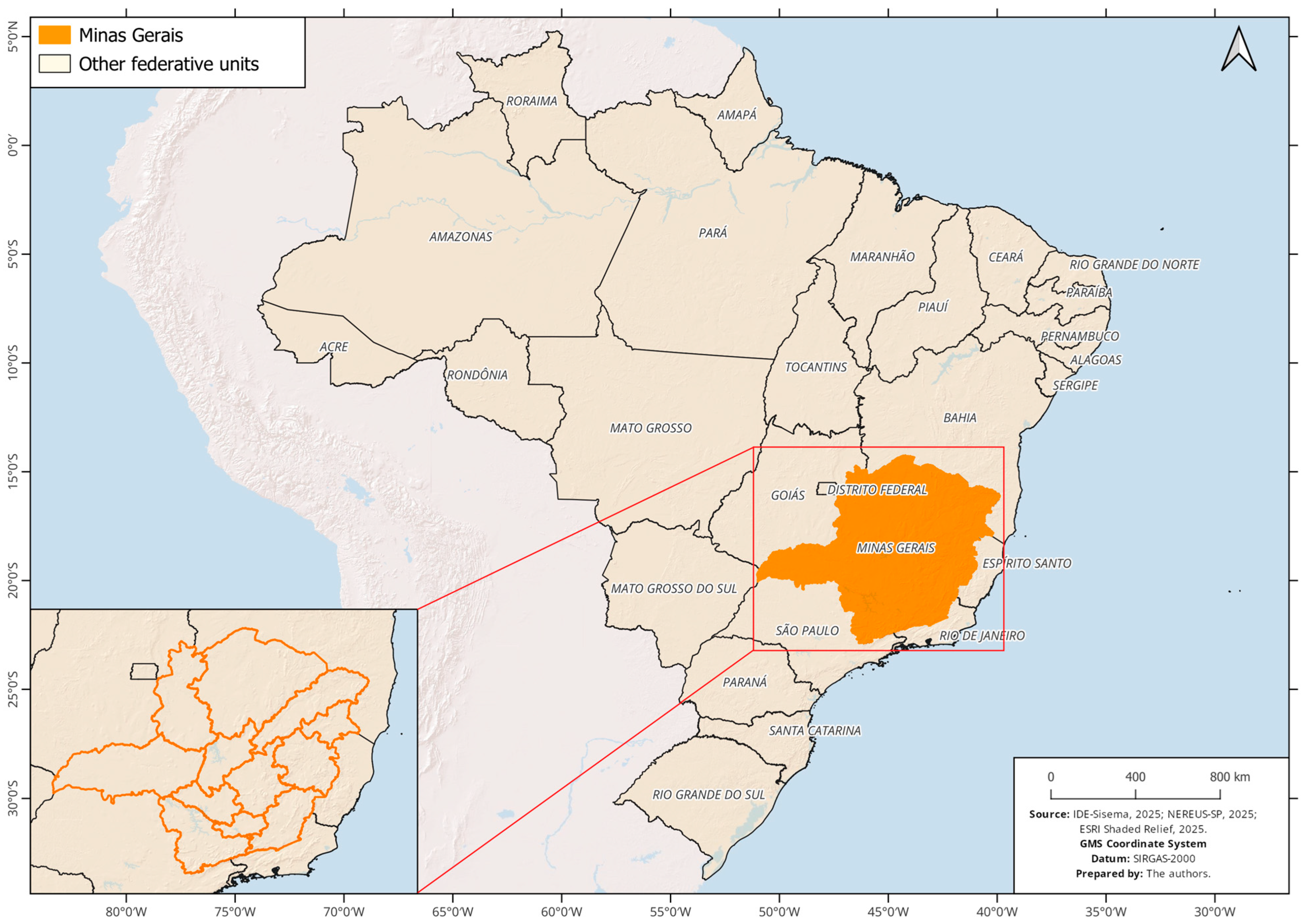
Minas Gerais, located in southeastern Brazil (Figure 1), is the country’s fourth-largest state in territorial area and the second in population, with 21.3 million inhabitants according to the 2024 census. It spans approximately 586,522 km2 and comprises 853 municipalities. The state’s vast and diverse territory presents significant geomorphological, climatic, and socioeconomic variation, which poses challenges for effective territorial management [9]. It is also considered Brazil’s “water tank” due to the presence of several major river basins, including the São Francisco, Doce, Paranaíba, Jequitinhonha, Grande, and Paraíba do Sul rivers.
The state’s complex geological and climatic conditions are reflected in its soil distribution. Latosols (Ferralsol WRB) predominate, covering 53.97% of the area, followed by Cambisols (Cambissol—WRB) (17.32%), Neosols (Fluvisol, Leptsol, Arenosol or Regosol—WRB) (12.52%), and Argisols (Acrisol, Lixisol or Alisol—WRB) (11.26%) [33,34]. This diversity plays a key role in determining land use, particularly for agriculture and forestry, which are strongly concentrated in the Triângulo Mineiro region—renowned for its fertile soils and high productivity [35].
Figure 1. A location Map of the study area: Minas Gerais State, Brazil, and its administrative mesoregions [36,37,38].
Sustainability 18 00744 g001
Minas Gerais encompasses three major biomes: the Cerrado, predominant in the central-west and central regions and essential for Brazil’s agribusiness sector; the Atlantic Forest, concentrated in the east and south, recognized globally as one of the most threatened ecosystems; and the Caatinga, located in the north, which is part of Brazil’s semi-arid region. These biomes require carefully balanced conservation strategies and sustainable land-use policies [39].
Livestock production plays a central role in the state’s agricultural profile. Minas Gerais has approximately 20.5 million hectares of pastureland and 508,702 productive farms—accounting for 12.7% of the total number of farms in Brazil. Of these, 385,488 specialize in cattle production, representing 11.3% of the national total [30]. The dairy sector is particularly strong, with 216,460 productive units and about 3 million dairy cows, making up 25.8% of the national dairy herd [40]. Family farming is also highly significant in the state, representing 72.7% of the 607,500 agricultural establishments, including livestock and crop production.
Given its extensive agricultural activity and diversified rural landscape, Minas Gerais stands out as a national leader in accessing credit under the ABC Program. According to EMATER-MG, the state accounted for 17.8% of all ABC credit contracts signed in Brazil between 2012 and 2023 [40].

3.2. Dataset

The datasets used to analyze temporal changes in pasture vigor and their relationship with ABC credit adoption at the municipal level in Minas Gerais were obtained from publicly available official sources. Data on rural credit originated from the Central Bank of Brazil (BCB), which records credit operations contracted by farmers under the ABC Credit Program. It is important to note that this dataset represents only a proxy for total ABC-related investments, as it excludes private investments made without official financing. Nevertheless, BCB data remains the only consistent and standardized source available for monitoring ABC credit disbursement in Brazil [41].
For pasture vigor conditions, we used the Pasture Vigor Condition (PVC) dataset (v.2) developed by MapBiomas, which provides annual maps of pasture quality across Brazil at 30 m spatial resolution, covering the period from 1985 to 2023 [33]. Additionally, data on soil organic carbon (SOC) was sourced from the SoilGrids 250 m database, which offers globally consistent and spatially explicit soil information at a 250 m resolution [42]. These three datasets were used to construct the analytical indexes presented in the following sections.

3.3. Index and Analysis

3.3.1. ABC Investment Density Index (IDI)

Information on ABC rural credit was obtained from open data provided by the Central Bank of Brazil (BCB), detailing investments in low-carbon agricultural practices between 2015 and 2022. Our focus was the ABC+ Restoration and Conservation subprogram, which targets pastureland recovery. Investments were identified in 321 municipalities of Minas Gerais.
To assess the spatial intensity of financial allocation while correcting distortions caused by municipal size, we developed the ABC Investment Density Index (IDI). Unlike simple absolute metrics, which bias the analysis toward large territories, the IDI measures cumulative financial effort per unit of pastureland. The index was calculated by summing the total value of ABC+ Restoration and Conservation contracts for each municipality over the entire period (2015–2022) and dividing this total by the municipality’s pasture area (in hectares), as explained in the Equation (1):
I D I m = ln t = 2015 2022 V m , t A m + 1
where the following definitions are used:
  • I D I m is the ABC Investment Density Index for municipality m ;
  • V m , t is the value (in BRL) of ABC+ Recovery contracts in municipality m in year t ;
  • A m is the total pasture area (in hectares) of municipality m in 2022;
  • The constant 1 is added to handle municipalities with zero investment before the logarithmic transformation.
Given the highly skewed distribution of financial data, characterized by many municipalities with zero investment and a few extremely high outliers, a natural logarithmic transformation ( ln x + 1 ) was applied to the density values. This transformation normalizes the data distribution, reduces the influence of extreme outliers, and allows for a more robust visualization of investment patterns using Jenks Natural Breaks optimization in spatial analysis.

3.3.2. Pasture Dynamics Index (PDI)

The pasture vigor condition in Minas Gerais was assessed using the Pasture Vigor Condition (PVC) product, version 2, developed by the MapBiomas network [14]. For the analysis in this study, the PVC dataset covering the years 2015 to 2022 was selected to align with the available period of ABC credit data. The PVC is derived from the pasture land-use class mapped in the Annual Land Use and Land Cover (LULC) Collection 9 dataset [43].
The PVC product evaluates pasture vigor through long-term trends in vegetation indices, particularly the Normalized Difference Vegetation Index (NDVI), to classify pastures into three vigor categories: low, medium, and high. Vigor is influenced by management practices, forage species, and degradation stages, especially those associated with biological degradation and exposed soils [32]. As an NDVI-based indicator of photosynthetic activity, the PVC discriminates healthy vegetation (high NDVI values) from degraded areas (medium or low NDVI values) [44,45]. Severely degraded pastures, typically linked to compaction and reduced biomass, show a consistent decline in NDVI over time.
PVC data for each year were obtained as GeoTIFF raster files from the MapBiomas Pasture Quality platform. Vector boundary files for all 853 municipalities and 12 mesoregions of Minas Gerais were also used. Geospatial analysis was conducted in a Python 3.10 environment, employing open-source libraries, with geopandas for vector data and rioxarray (built on rasterio and GDAL) for raster processing.
To construct the Pasture Dynamics Index (PDI), we first conducted a pixel-level transition analysis, detecting changes in pasture vigor categories between 2015 and 2022. A transition raster was generated to classify each pixel according to the direction and intensity of change: (i) drastic improvement (Low to High) = 2; (ii) moderate improvement (Low to Medium or Medium to High) = 1; (iii) neutral (no change) = 0; (iv) moderate degradation (High to Medium or Medium to Low) = −1; and (v) drastic degradation (High to Low) = −2. The results are given by Equation (2):
P D I m = 2 A L H + 1 A L M + 1 A M H 2 A H L + 1 A H M + 1 A M L A t o t a l
where the following definitions are used:
  • P D I m is the Pasture Dynamics Index for municipality m ;
  • A t r a n s represents the area (ha) undergoing a specific vigor transition (e.g., L   H is Low to High);
  • w t r a n s represents the weight assigned to that transition intensity (e.g., +2 for drastic improvement, −2 for drastic degradation);
  • A t o t a l is the total pasture area of the municipality.
All raster layers were projected to the SIRGAS 2000 Albers coordinate system (EPSG:5880) for accurate area calculations. Municipal-level PDI scores were then obtained via zonal statistics by summing pixel values within each municipality and normalizing the result by the total pasture area (in hectares) in 2022. The final PDI is a dimensionless index, where positive values indicate net pasture improvement and negative values indicate net degradation. Results were visualized using bar charts and summarized in tables by municipality and mesoregion.

3.3.3. Theoretical Carbon Removal Potential Index (TCRP)

The Theoretical Carbon Removal Potential (TCRP) estimates the potential for carbon sequestration in degraded pastures. This index offers a strategic perspective to guide public funding and credit policies in allocating resources toward regions where pasture recovery could deliver greater GHG mitigation returns. It aims to highlight areas with the most favorable effort-impact ratio, thereby supporting more efficient allocation of resources under low-carbon agricultural policies.
The TCRP analysis was based on the Pasture Vigor Condition (PVC) product from MapBiomas, which correlates strongly with pasture degradation. In several MapBiomas publications, the terms “vigor” and “degradation” are used interchangeably to reflect this relationship. Accordingly, this study focused exclusively on areas classified as low vigor, which correspond to severely degraded pastures [46].
To ensure the analysis captured truly persistent degradation, we selected only pasture areas classified as low vigor for a minimum of 10 consecutive years [44]. This methodological choice was grounded in the concept of dynamic equilibrium, whereby severely degraded pastures, after a prolonged period of degradation, reach a state in which soil carbon emissions from microbial respiration are roughly balanced by the minimal carbon uptake via photosynthesis and root growth [46,47]. In such conditions, pastures exhibit depleted levels of soil organic carbon (SOC), making them ideal candidates for assessing the true sequestration potential of restoration interventions [48,49].
Focusing on these long-degraded areas allows for a more realistic estimation of potential carbon gains from pasture recovery. It reflects a baseline scenario in which SOC stocks are significantly diminished, and thus, restoration activities—such as improved grazing management or the introduction of adapted forage species—could lead to meaningful increases in carbon sequestration [30,47].
  • Quantification of Carbon Stock in Degraded Pastures
From the dataset of low-vigor pastures built in Section 3.3.2, the centroid (point vector file) of each pixel was used to extract soil organic carbon (SOC) information from the SoilGrids database. This global database provides detailed estimates of soil carbon content, enabling spatial analysis of areas of interest [42]. The SoilGrids mapping results allow the evaluation of variables such as SOC, particle density, and pH in soil layers up to two meters deep.
Using the geographic coordinates of each centroid, the data were disaggregated according to the different biomes present in Minas Gerais (Atlantic Forest, Caatinga, and Cerrado) and also by municipality. This separation is relevant because soil carbon stocks vary across biomes due to differences in climate, vegetation, and soil conditions, which directly influence carbon-sequestration potential [33,44,49]. Organizing the data in this way allows us to compare carbon stock patterns across biomes and to identify municipalities with the greatest potential for carbon removal.
  • Carbon Stock Assignment for High Vigor Pastures
The spatial identification of high-vigor pastures was performed entirely using the MapBiomas PVC v.2 validated dataset, as described in Section 3.3.2. For the specific purpose of estimating the carbon stock in these identified areas, a targeted literature review was conducted to determine the average Soil Organic Carbon (SOC) coefficients for high-productivity pastures in each biome [29,42,49].
Following this review [45], the data were classified by biome to isolate pastures located in the Cerrado [17,44] and Atlantic Forest biomes [49,50]. Differentiating these biomes was essential, as each presents distinct environmental and ecological conditions that directly influence pasture vigor and soil carbon dynamics.
Once the classification was completed, the average soil carbon stock for high-vigor pastures in each biome was calculated. This calculation was based on data obtained from the literature review and other available studies, providing a comparative view of the carbon sequestration capacity of high-vigor pastures according to their specific characteristics and location.
  • Measuring the theoretical carbon removal potential
The measurement of potential carbon stocks for degraded pastures in Minas Gerais aimed to estimate the amount of carbon that could be removed from the atmosphere if these areas were restored to a state of high vegetative vigor [32,49]. This approach is based on the premise that well-managed pastures, with high plant productivity, have a greater potential for soil carbon sequestration than degraded pastures [29,46,49]. Therefore, the analysis estimates the difference between the current carbon soil stock in degraded pastures and the potential carbon sequestration that could be achieved through restoration or improvement of pasture quality.
The result represents the Theoretical Carbon Removal Potential (TCRP) of these areas, providing a basis for assessing the environmental and economic impacts of degraded pasture recovery in Minas Gerais. We then estimate the difference between the soil organic carbon (SOC, tC ha−1) in degraded pastures and its theoretical value under high-vigor conditions (Equation (3)):
T C R P m = S O C r e f S O C ¯ c u r r × A d e g r a d e d × 44 12
where the following definitions are used:
  • T C R P m is the Total Theoretical Carbon Removal Potential for municipality m (in tons of C O 2 equivalent, t C O 2 e q );
  • S O C r e f is the reference Soil Organic Carbon stock for high-vigor pasture in the corresponding biome ( t C h a 1 ), based on literature values (see Table 1);
  • S O C ¯ c u r r is the average current Soil Organic Carbon stock observed in low-vigor pastures within the municipality ( t C h a 1 );
  • A d e g r a d e d is the total area of pasture classified as low vigor in the municipality (in hectares);
  • 44 12 is the stoichiometric factor used to convert elemental Carbon (C) into Carbon Dioxide equivalent ( C O 2 e q ).
It is important to highlight that, to ensure consistency and comparability of the data with the studies reviewed in the literature, it was necessary to convert the carbon stock values from pixels to hectares. This conversion was performed to express the results in the same measurement unit used in the consulted studies (Table 1), enabling greater analytical accuracy and alignment with the methodologies adopted by the referenced articles.
After determining the TCRP, the SOC values were converted into tons of carbon dioxide equivalent (tCO2eq) using the molecular weight ratio of CO2 (44/12). This conversion is essential because it allows the carbon sequestration potential to be expressed in terms of CO2 equivalents—a widely used metric for measuring and comparing greenhouse gas (GHG) emissions [51]. This approach enables the estimation of the potential impact of degraded pasture restoration from a climate change mitigation perspective [29].
Table 1. References used for carbon stock conversion.
ReferenceBiomePasture TypeDepth (cm)SOC (tC ha−1)Standard Deviation (±)
Campos et al. (2022) [29]CerradoHigh vigor0–3045.14.3
Figueiredo et al. (2017) [49]Mata AtlânticaHigh vigor0–3039.73.8
Conceição et al. (2017) [32]Paragominas (PA) 1High vigor (ILPF 2)0–3043.05.1
Valle Jr. et al. (2019) [45]CerradoHigh vigor0–20 341.3-
1—Transition zone from the northern Cerrado to the Amazon (deforestation arc). 2—Crop–livestock–forestry integration system. 3—Adjusted according to the average representativeness of the 20–30 cm soil layer, i.e., +18% over the value reported in the article for the 0–20 cm layer. The adjustment was based on the representativeness of this layer as reported in the following studies: Refs. [49,52].
Thus, the total tCO2 equation per municipality was calculated to identify priority municipalities for low-carbon actions. This calculation provided an insight into how much carbon could be sequestered if low vigor pastures were converted into high vigor pastures. Hence, an important planning tool for guiding strategic decisions towards livestock sustainable management and pasture restoration.

3.3.4. Statistical Analysis and Baseline Control

Finally, to investigate the drivers of pasture dynamics, statistical analyses were performed using the Python libraries scipy and statsmodels. First, a Spearman rank correlation (ρ) [53] was calculated to assess the general association between credit investment and pasture improvement. This non-parametric test was chosen due to the non-normal distribution of the financial data and the presence of outliers [54]. Subsequently, seeking to assess the influence of local variables on pasture recovery, we estimated a multiple ordinary least squares (OLS) regression model (Equation (4)), where: P D I m is the improvement index; β 0 is the intercept; I D I m is the credit density; B a s e l i n e m is the initial degradation ratio; and ϵ m is the error term.
P D I m = β 0 + β 1 · ln I D I m + β 2 B a s e l i n e m + ϵ m
The Pasture Dynamics Index (PDI) was defined as the dependent variable (Y), and two independent variables were tested, namely (i) the IDI and (ii) the Initial Degradation Status (Baseline), a control variable calculated as the proportion of pasture area classified as “Low Vigor” in the initial year (2015) relative to the municipality’s total pasture area.
Including the Baseline variable allows the model to test the “baseline effect” hypothesis, that is, whether municipalities that begin with highly degraded land show higher improvement rates solely due to greater marginal response to management, regardless of financial inputs.

4. Results

4.1. Temporal Analysis

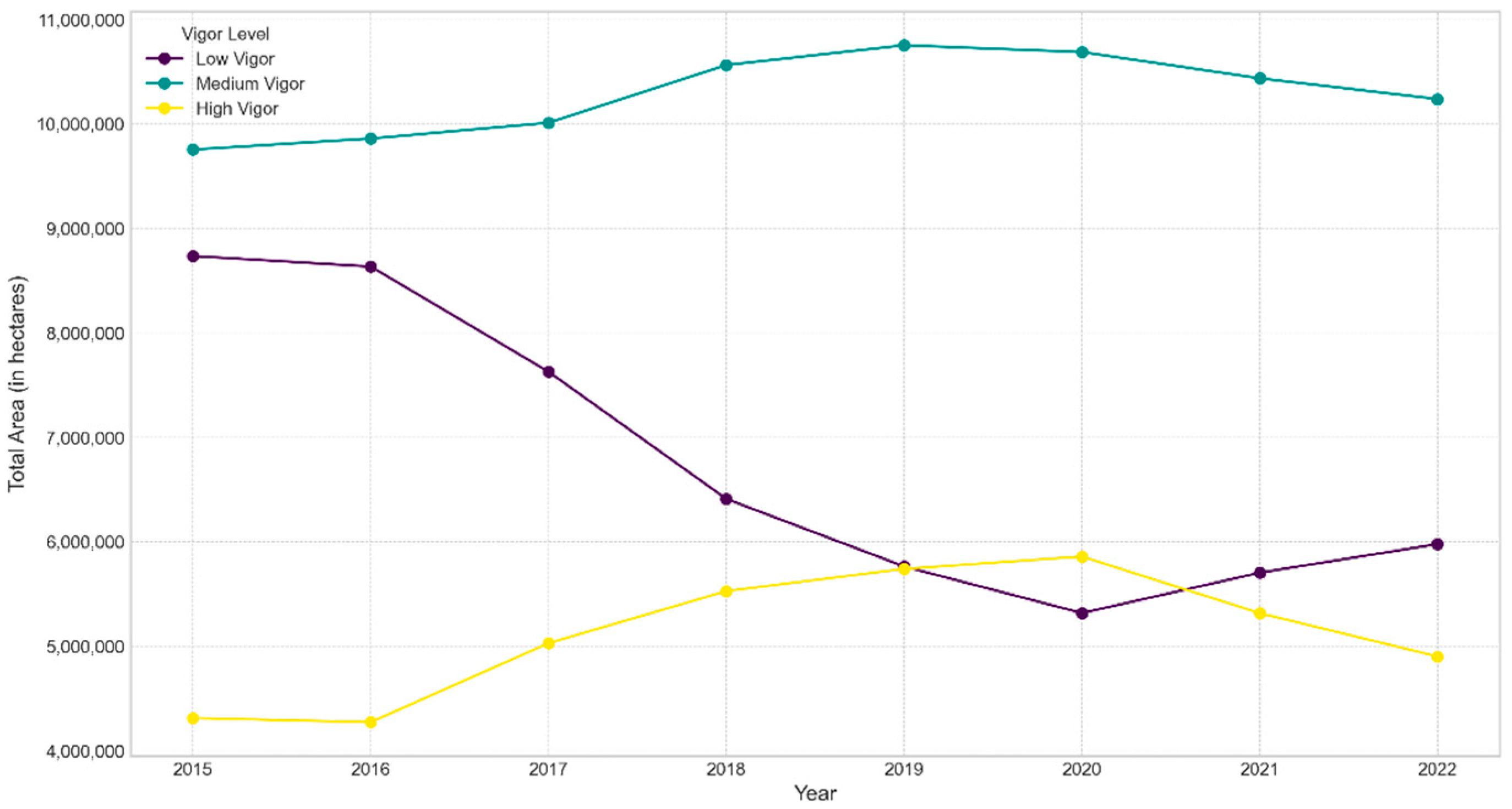
The statewide evolution of pasture vigor in Minas Gerais between 2015 and 2022 is presented in Figure 2. The analysis reveals two distinct phases. From 2015 to a peak around 2019–2020, there was a clear positive trend in pasture quality. This improvement is evidenced by a substantial reduction (−39.7%) in low-vigor pasture, which decreased from approximately 8.8 million hectares in 2015 to a minimum of 5.3 million hectares in 2020. Concurrently, the area of high-vigor pasture expanded by +37.2% from 4.3 million hectares to a peak of 5.9 million hectares in 2020.
However, the analysis also indicates a possible reversal of this positive trend in the final years of the period. Between 2020 and 2022, the area of high-vigor pasture declined to just under 5.0 million hectares, while the area of low-vigor pasture increased again, reaching approximately 6.0 million hectares. This reversal coincides with significant climatic anomalies recorded in Southeast Brazil, specifically the severe drought of 2020/2021, considered the worst water crisis in the region in nearly a century [55]. Since the PVC product relies on vegetation indices (NDVI), the acute water stress likely resulted in lower biomass detection, reflected as a temporary degradation in the dataset. Throughout the entire period, medium-vigor pasture remained the dominant category, peaking at nearly 11 million hectares in 2019 before showing a slight decline thereafter.
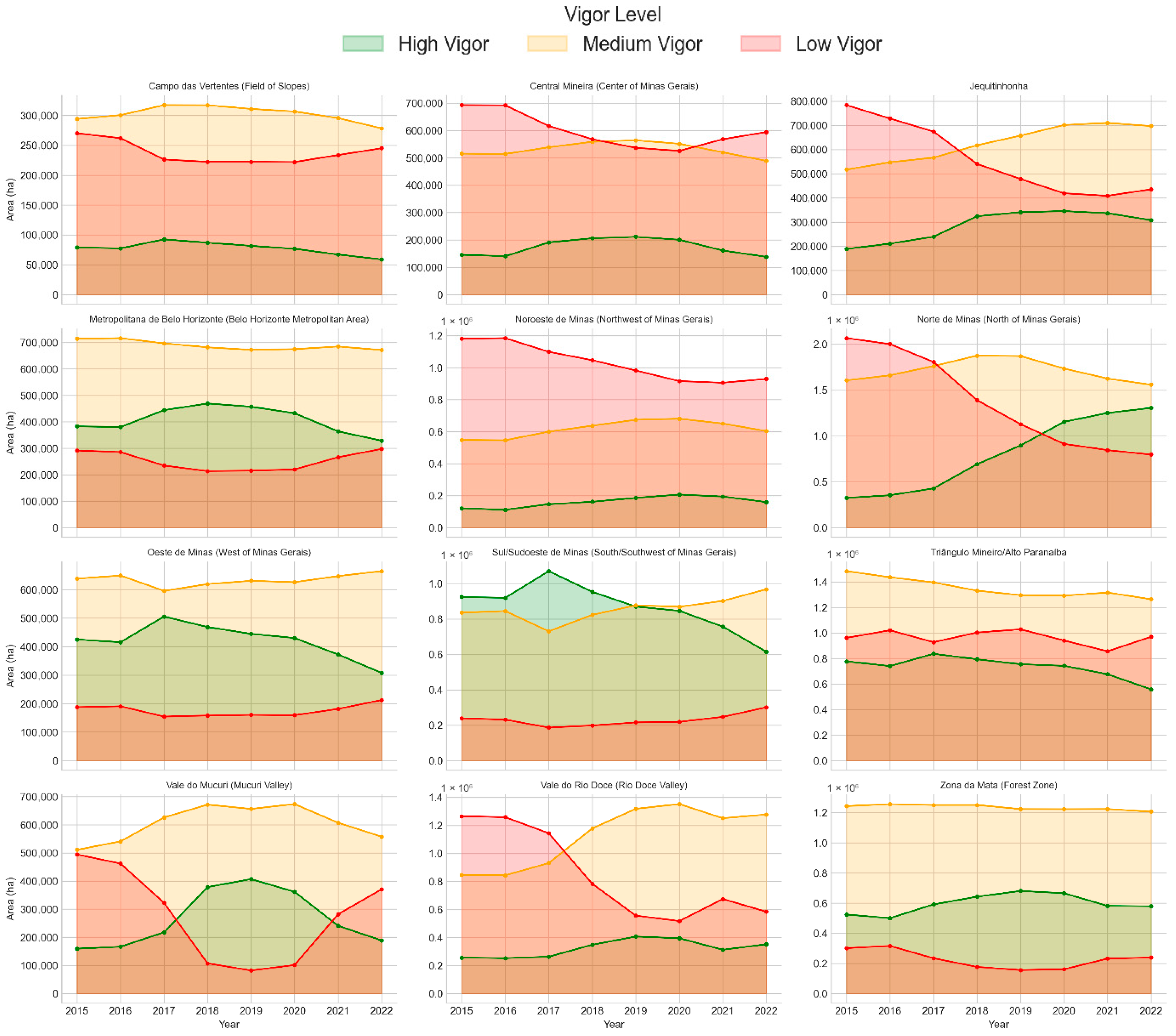
Disaggregating the statewide data into the 12 mesoregions reveals highly divergent local dynamics, as illustrated by the time-series evolution (Figure 3) and the summary of net changes between 2015 and 2022 (Table 2). It is worth noting that this region lies in a transition zone to the semi-arid biome and started the period with the lowest absolute area of high-vigor pasture in the state. Consequently, moderate absolute gains in recovered areas translate into high proportional variations: a ‘baseline effect’ that will be statistically tested in the Section 5 (Discussion).
The most pronounced transformation occurred in the North of Minas, where the evolution chart (Figure 3) shows a steep and continuous decline in low-vigor pastures accompanied by a substantial expansion of high-vigor areas throughout the period. This dynamic culminated in a remarkable 301.6% net increase in high-vigor pasture area (Table 2). A similar, though less intense, pattern of consistent improvement is also evident in the Jequitinhonha and Mucuri Valley regions, both characterized by historically lower baseline conditions.
In contrast, traditionally strong agricultural regions displayed an opposite trajectory. In the South/Southwest of Minas Gerais and Triângulo Mineiro/Alto Paranaíba (Western Minas Gerais), the evolution charts (Figure 3) indicate that their initially extensive areas of high-vigor pasture either stagnated or declined sharply over the period. This process resulted in significant net losses of −33.5% and −28.2%, respectively, as shown in Table 2.

4.2. Spatial Analysis

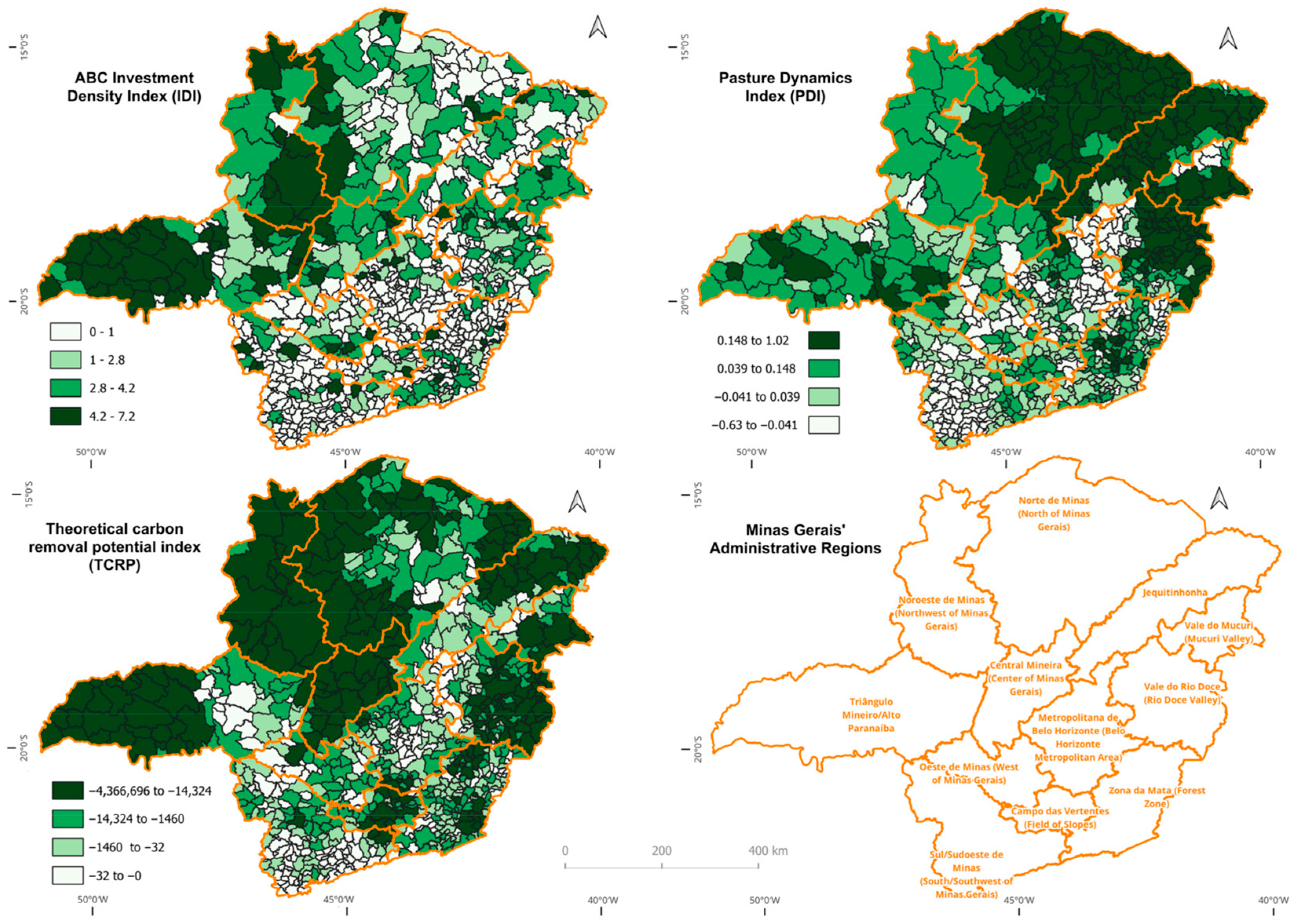
To understand the spatial relationship between credit allocation, pasture improvement, and carbon potential, the accumulated patterns of the ABC Investment Density Index (IDI), Pasture Dynamics Index (PDI), and Theoretical Carbon Removal Potential (TCRP) were mapped at both municipal and mesoregional levels (Figure 4). While Figure 2 previously illustrated the temporal evolution of pasture vigor, these maps provide a consolidated spatial view of the period (2015–2022), allowing for a direct geographic comparison between financial inputs (IDI), physical outcomes (PDI), and environmental potential (TCRP).
The IDI map shows that credit investment was heavily concentrated in the Triângulo Mineiro/Alto Paranaíba (Western Minas Gerais) and Northwest of Minas Gerais mesoregions. Correspondingly, the TCRP map indicates that these same regions possess the highest potential for carbon sequestration. This spatial alignment suggests that credit policy was at least partially successful in targeting areas with a high potential for environmental returns.
However, the PDI map reveals a contrasting spatial pattern. The highest PDI score, indicating the most significant pasture improvement dynamics, are not located in the high-credit regions but are instead concentrated in the North of Minas, Jequitinhonha, and Mucuri Valley mesoregions, which received lower levels of credit investment. This spatial disconnection between where investment was directed (IDI) and the regions where most substantial relative improvements on pasture vigor occurred (PDI) represents a central finding of this study. It highlights the role of additional factors, such as the baseline effect, in driving pasture recovery beyond the influence of credit allocation alone.
As illustrated in Figure 4, the trendline confirms this tendency: municipalities with higher cumulative ABC credit between 2015 and 2022 generally exhibit slightly higher PDI values. Nonetheless, a substantial number of municipalities that received little or no credit also demonstrated improvement, underscoring the influence of additional determinants such as initial degradation level (baseline effect), private investment, or technical assistance.

4.3. Statistical Analysis

Although the correlation analysis indicated a modest but positive association between credit and pasture improvement (ρ = 0.2333, p < 0.01), the spatial patterns revealed that several low-credit regions exhibited substantial gains in pasture vigor. This apparent inconsistency motivated us to conduct additional statistical tests incorporating local characteristics, most notably the initial level of pasture vigor (baseline), to better understand the underlying drivers of these improvements and to clarify how baseline conditions influence the observed relationship between credit and pasture recovery.
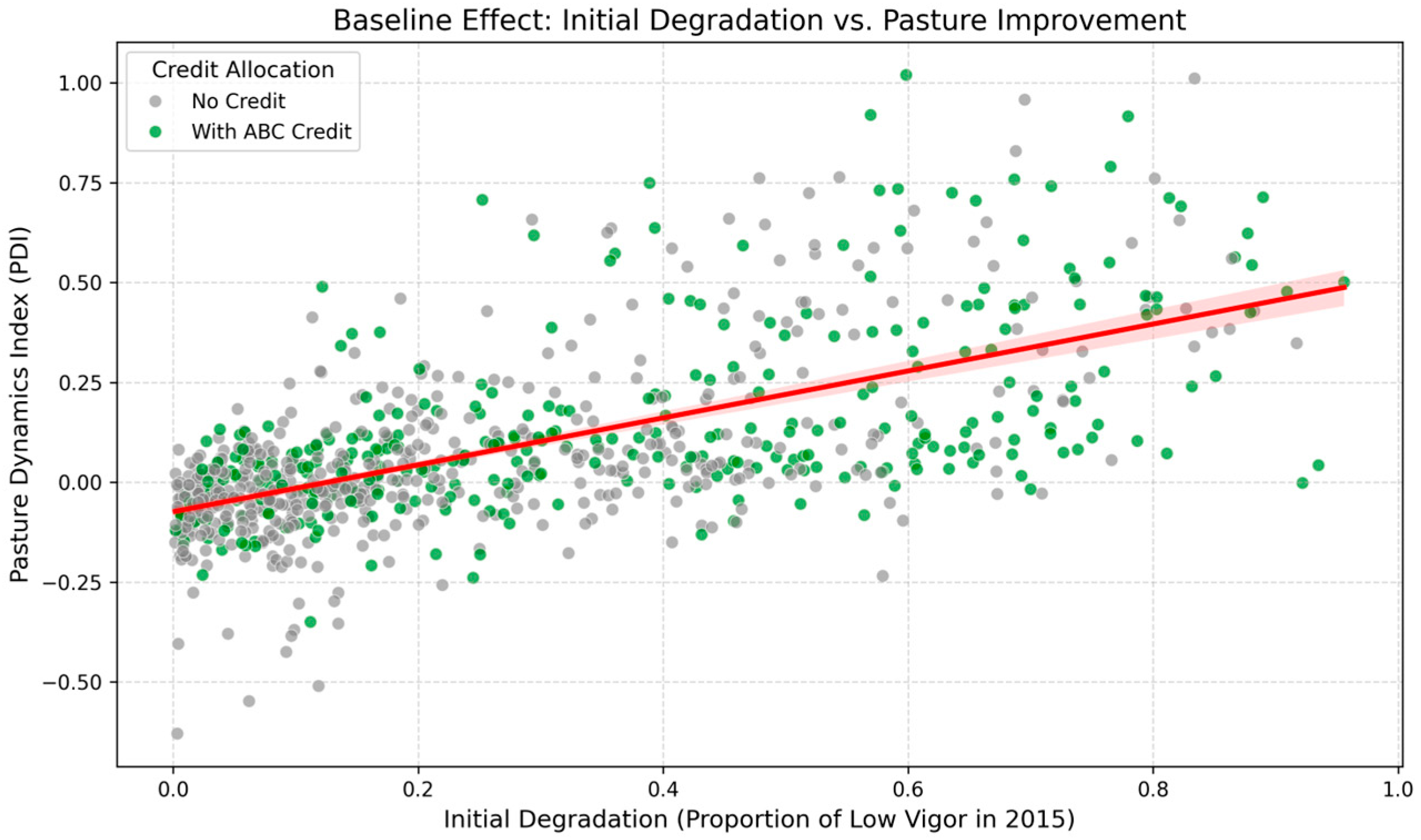
We performed an OLS multiple regression analysis (R2 = 0.394, F = 274.2, p < 0.001). The results confirmed that the initial degradation level (baseline effect) is the dominant predictor of pasture improvement (β = 0.59, p < 0.001) as detailed in Table 3. This strong positive relationship is visualized in Figure 5, which shows that municipalities with higher initial proportions of low-vigor pasture consistently exhibited higher PDI scores, regardless of whether they received ABC credit (green points) or not (gray points).
This indicates that while there is a spatial coincidence between credit and improvement in some areas, the statistical driver of the high PDI scores observed in the state is primarily the baseline condition: municipalities that started with highly degraded pastures in 2015 (such as those in the North) showed the most intense recovery dynamics, independent of the volume of ABC credit received.
Overall, the results indicate a widespread improvement in pasture vigor across all regions of Minas Gerais during the period analyzed, with evidence of a positive association of ABC credit on pasture recovery, although local biophysical factors, such as the initial level of pasture vigor, also influence the strength and distribution of these improvements. These patterns highlight important spatial and temporal dynamics that help explain how credit interacts with local conditions to influence restoration outcomes. In the next section, we examine the implications of these findings for the effectiveness of rural credit policies and discuss how public interventions can be refined to better support pasture restoration.

5. Discussion

The results reveal a clear regional concentration pattern across all three indexes. For the ABC Investment Evolution Index (IDI), stronger variations are concentrated in the Triângulo Mineiro/Alto Paranaíba (Western Minas Gerais) and Northwest of Minas Gerais mesoregions. This concentration can be attributed to the stronger institutional infrastructure in these areas, characterized by a greater presence of financial institutions and cooperatives. Previous studies have identified limited access to qualified financial services as a major barrier to the uptake of ABC credit among farmers [5,56]. In addition, the prevalence of more professionalized agricultural systems—particularly in cattle production—likely contributes to the greater adoption of pasture recovery practices in these regions.
The analysis of pasture vigor performance (2015–2022) reveals a striking geographic pattern. Mesoregions such as North of Minas (+301%), Jequitinhonha (+63%), and Mucuri Valley (+18%) showed the most significant relative improvements, as measured by the percentage change in high-vigor pasture area (Δ%). These substantial gains in northern areas are particularly noteworthy when contrasted with the low volume of ABC credit investment received. Our statistical analysis confirms that this dynamic is primarily driven by the baseline effect: these regions started in 2015 with a lower base of high-vigor pasture, creating a scenario of high marginal returns where basic management interventions trigger large transitions in the PDI.
Furthermore, the lack of statistical significance for credit density in our model suggests that pasture recovery in these frontier regions is likely being driven by private capital, informal financing, or family farming credit lines (e.g., PRONAF), which are not captured in the specific ABC+ dataset. This amplifies relative gains, a dynamic effectively captured by both the PDI and the simpler Δ% metric, which reflect the rate of change rather than the final absolute condition.
Conversely, traditionally strong agricultural regions such as Triângulo Mineiro/Alto Paranaíba (Western Minas) (−28%) and South/Southwest of Minas Gerais (−33%) exhibited a relative decrease in high-vigor pasture area over the same period, even though they still retain large absolute areas of high-quality pasture. This does not imply that the absolute pasture vigor in the North now exceeds that of these better-structured regions, but it highlights a powerful recovery dynamic in areas that were formerly more degraded.
The third index, the Theoretical Carbon Removal Potential (TCRP), confirms that regions with the largest credit increases—Western and Northwest Minas Gerais—also exhibit the highest potential for carbon sequestration. This alignment suggests that, at least partially, the credit policy has succeeded in targeting areas where environmental returns are greatest. However, some regions with high carbon removal potential did not receive equivalent levels of credit investment, indicating room to improve the geographic targeting of the program to fully leverage its environmental benefits.
Considering the three indexes together, distinct insights emerge regarding the drivers of recovery. While simple correlation tests suggested a positive link between ABC Pasture Recovery credit and improvements in pasture vigor, our multivariate regression analysis revealed that this association is largely explained by the initial degradation status rather than financial input alone. This finding nuances the empirical evidence reported by previous studies [4], which identified a positive causal relationship between rural credit and pasture recovery. In the specific spatial context of 2015–2022, our results indicate that while credit is present in some recovering areas, the dominant statistical driver of the high PDI scores is the baseline condition.

Policies Implications

The substantial gains observed in regions with little or no access to credit raise concerns about the territorial equity of the ABC credit program and emphasize the influence of additional factors driving pasture recovery, such as private investment, access to technical assistance, local governance capacity, and complementary rural policies.
Recent research reinforces this perspective, emphasizing that access to information and technical support are key variables mediating the effectiveness of credit in promoting low-carbon agricultural practices [57,58]. These studies analyzed groups of producers assisted either by public extension agencies or cooperatives and found a direct relationship between access to technical guidance and the likelihood of adopting ABC techniques. This evidence suggests that, in many cases, access to credit alone is not the decisive factor; rather, having the appropriate technical orientation on how to implement the practice plays a central role in enabling pasture restoration.
To increase the overall impact and fairness of the policy, future iterations of the ABC Program should consider integrating spatial indicators of environmental potential, such as the Baseline Degradation and TCRP, with broader rural development support, ensuring both effective and equitable outcomes.

6. Final Considerations

This study aimed to conduct an exploratory analysis of the impacts of ABC credit on pasture improvement in the state of Minas Gerais. Pasture recovery has been one of the central pillars of the Low-Carbon Agriculture (ABC) Plan since its launch in 2011, primarily due to the extensive area of degraded pastures across Brazil.
Using municipal-level data from 2015 to 2022, we developed three spatial indicators: one for ABC credit investment (IDI), one for pasture dynamics (PDI), and another for territorial carbon removal potential (TCRP). The analysis revealed that credit investments were heavily concentrated in specific regions (particularly in the Western and Northwestern parts of the state) where agriculture and livestock production are more intensive and professionalized. These areas typically benefit from stronger institutional infrastructure, such as broader access to banking and technical assistance services, which helps explain their greater capacity to absorb public credit.
However, significant improvements in pasture vigor were also observed in regions with very different socioeconomic profiles, such as the North of Minas Gerais and the Jequitinhonha and Mucuri Valleys. This finding suggests that ABC credit, while influential, is not the sole driver of pasture recovery. In addition to the factors commonly highlighted in the literature (technical assistance and private credit) our results show that the baseline effect plays a central role in explaining pasture recovery. These insights highlight a more complex dynamic, in which public credit interacts with multiple other determinants of pasture restoration.
From a policy perspective, the results indicate the need to incorporate explicit environmental indicators into ABC credit allocation. In practical terms, this could be implemented by: (i) using geospatial information to identify municipalities with high carbon-removal potential and prioritizing these areas in annual credit plans; (ii) establishing minimum credit quotas for regions with persistent low-vigor pastures, ensuring that areas with high mitigation potential are not systematically underfunded; and (iii) integrating technical-assistance requirements into credit contracts, so that producers in priority regions receive targeted support on how to implement restoration practices. Strengthening rural information systems and linking credit eligibility to simple environmental metrics would allow the ABC Program to channel resources more efficiently, increasing both the climate-mitigation impact and the territorial equity of public investment.
Future research could focus more deeply on producer-level characteristics to understand under which conditions ABC credit generates the strongest environmental outcomes. Variables such as socioeconomic profile, farm size, production system, and market orientation may significantly influence the effectiveness of credit in promoting pasture restoration. Incorporating these dimensions would allow public policies to better identify which groups of producers benefit most from credit and to design more targeted, efficient, and equitable low-carbon interventions.

Author Contributions

Conceptualization, B.B.P., R.B.S., G.d.O.L. and M.O.C.; methodology, B.B.P., R.B.S., G.d.O.L. and M.O.C.; software, R.B.S., G.d.O.L. and M.O.C.; formal analysis, B.B.P., R.B.S., G.d.O.L. and M.O.C.; data curation, G.d.O.L. and M.O.C.; writing—original draft preparation, B.B.P., R.B.S., G.d.O.L. and M.O.C.; writing—review and editing, B.B.P., R.B.S., G.d.O.L. and M.O.C.; project administration, B.B.P. and R.B.S.; funding acquisition, B.B.P. and R.B.S. All authors have read and agreed to the published version of the manuscript.

Funding

This research was funded by the Fundação de Amparo à Pesquisa do Estado de Minas Gerais (FAPEMIG), grant number APQ-01278-22, and by the Fundação de Amparo à Pesquisa do Estado de São Paulo (FAPESP), grant numbers 2022/16002-1 and 2023/15877-7.

Institutional Review Board Statement

Not applicable.

Informed Consent Statement

Not applicable.

Data Availability Statement

Data are contained within the article.

Acknowledgments

The authors have reviewed and edited the output and take full responsibility for the content of this publication.

Conflicts of Interest

The authors declare no conflicts of interest.

Abbreviations

The following abbreviations are used in this manuscript:
ABCAgricultura de Baixo Carbon—Low-Carbon Agriculture
BCBCentral Bank ok Brazil
SOCSoil Organic Carbon
GISGeographic Information System
IDIInvestment Evolution Index (ABC Credit Investment Index)
PDIPasture Dynamics Index
TCRPTheoretical Carbon Removal Potential
ILPFIntegração Lavoura–Pecuária–Floresta (CropLivestockForest Integration)
SEEGSistema de Estimativa de Emissão de Gases de Efeito Estufa (Greenhouse Gas Emissions Estimation System)
NDVINormalized Difference Vegetation Index

References

  1. Mendonça, A.K.; Silva, S.A.; Bornia, A.C.; Duarte, S.L. Low Carbon Agriculture Plan: An Analysis for the Period 1990–2018. Rev. Eletrôn. Gest. Educ. Tecnol. Ambient. 2023, 27, e8. [Google Scholar] [CrossRef]
  2. Gonzaga da Silva, M.D.; de Oliveira, A.L.; Silva de Resende, A.; de Assis Barros, L.; Basso, V.M. The ABC Program: A Case Study on the Availability and Use of Low-Carbon Agriculture Credit. Braz. Rev. Econ. Agribus./Rev. Econ. Agroneg. 2025, 23, 2. [Google Scholar] [CrossRef]
  3. Manzatto, C.; Araujo, L.S.; Vicente, L.E.; Vincente, A.K.; Perosa, B.B. Plataforma ABC: Monitoramento da Mitigação das Emissões de Carbono na Agropecuária. Agroanalysis 2018, 38, 25–28. [Google Scholar]
  4. de Campos, M.O.; de Camargo, R.A.L.; Bassetto, C.F.; Pissarra, T.C.T.; Cerri, C.E.P.; La Scala, N., Jr.; da Silva, R.P. Impact of Rural Credit on Sustainable Transformation of Brazilian Agriculture: The Case of the Low Carbon Agriculture (LCA) Program in Minas Gerais, Brazil. Environ. Dev. 2025, 57, 101317. [Google Scholar] [CrossRef]
  5. Observatório, A.B.C. Desafios e Restrições dos Produtores Rurais na Adoção de Tecnologias de Baixo Carbono ABC: Estudo de Caso em Alta Floresta; Fundação Getulio Vargas—Centro de Estudos Agronegócios (GV-Agro): São Paulo, Brazil, 2017; Available online: https://www.infoteca.cnptia.embrapa.br/bitstream/doc/959512/1/sumarioestudo1.pdf (accessed on 5 November 2025).
  6. Carrer, M.J.; Souza Filho, H.M.; Vinholis, M.M.B. Determinantes da Demanda de Crédito Rural por Pecuaristas de Corte no Estado de São Paulo. Rev. Econ. Sociol. Rural 2013, 51, 455–478. [Google Scholar]
  7. Gianetti, G.W.; Ferreira Filho, J.B.S. O Plano e Programa ABC: Uma Análise da Alocação dos Recursos. Rev. Econ. Sociol. Rural 2020, 59, e216524. [Google Scholar] [CrossRef]
  8. Instituto Brasileiro de Geografia e Estatística (IBGE). Produção Agrícola Municipal (PAM) 2022. Available online: https://www.ibge.gov.br/estatisticas/economicas/agricultura-e-pecuaria/9117-producao-agricola-municipal-culturas-temporarias-e-permanentes.html (accessed on 12 October 2025).
  9. Instituto Brasileiro de Geografia e Estatística (IBGE). Censo Agropecuário de 2017. Available online: https://censoagro2017.ibge.gov.br/ (accessed on 15 September 2025).
  10. Laboratório de Processamento de Imagens e Geoprocessamento (LAPIG). Atlas das Pastagens; Universidade Federal de Goiás: Goiânia, Brazil, 2022; Available online: https://atlasdaspastagens.ufg.br/map (accessed on 5 November 2025).
  11. FAS/USDA. Brazil: Livestock and Products Annual; Foreign Agricultural Service—United States Department of Agriculture: Washington, DC, USA, 2024. Available online: https://www.fas.usda.gov/ (accessed on 15 January 2025).
  12. Parente, L.; Ferreira, L.G.; Faria, R.M.; Nogueira, S.F.; Araújo, F.M.; Teixeira, A.H.M. Monitoring pasture quality and degradation using time-series NDVI in the Brazilian Cerrado. Remote Sens. 2018, 10, 1761. [Google Scholar]
  13. Dias-Filho, M.B. Diagnóstico das Pastagens no Brasil; Documentos 402; Embrapa Amazônia Oriental: Belém, Brazil, 2014. [Google Scholar]
  14. Projeto MapBiomas. Módulo de Condição de Vigor da Pastagem Versão 2. 2023. Available online: https://plataforma.brasil.mapbiomas.org/pastagem (accessed on 5 November 2025).
  15. Conant, R.T.; Cerri, C.E.P.; Osborne, B.B.; Paustian, K. Grassland management impacts on soil carbon stocks: A new synthesis. Ecol. Appl. 2017, 27, 662–668. [Google Scholar] [CrossRef]
  16. Paustian, K.; Lehmann, J.; Ogle, S.; Reay, D.; Robertson, G.P.; Smith, P. Climate-smart soils. Nature 2016, 532, 49–57. [Google Scholar] [CrossRef]
  17. Carauta, M.; Troost, C.; Guzman-Bustamante, I.; Hampf, A.; Libera, A.; Meurer, K.; Berger, T. Climate-related land use policies in Brazil: How much has been achieved with economic incentives in agriculture? Land Use Policy 2021, 109, 105618. [Google Scholar] [CrossRef]
  18. Cherubin, M.R.; Damian, J.M.; Franco, A.L.C.; Cerri, C.E.P. Soil organic matter in pasture areas in Brazil. Rev. Bras. Ciênc. Solo 2023, 47, e0220149. [Google Scholar]
  19. SEEG. Sistema de Estimativas de Emissões de Gases de Efeito Estufa. 2022. Available online: https://seeg.eco.br (accessed on 9 November 2024).
  20. Reis, J.C.; Kamoi, M.Y.T.; Latorraca, D.; Chen, R.F.F.; Michetti, M.; Wruck, F.J.; Garrett, R.D.; Valentim, J.F.; Rodrigues, R.D.A.R.; Rodrigues-Filho, S. Assessing the economic viability of integrated crop-livestock systems in Mato Grosso, Brazil. Renew. Agric. Food Syst. 2019, 35, 631–642. [Google Scholar] [CrossRef]
  21. Soares-Filho, B.S.; Lima, L.; Bowman, M.S.; Viana, L.; Gouvello, C. Challenges for Low-Carbon Agriculture and Forest Conservation in Brazil. 2012. Available online: https://publications.iadb.org/en/challenges-low-carbon-agriculture-and-forest-conservation-brazil?eloutlink=imf2adb (accessed on 17 December 2025).
  22. Balbino, L.C.; Cordeiro, L.A.M.; Porfírio-da-Silva, V.; Moraes, A.D.; Martínez, G.B.; Alvarenga, R.C.; Galerani, P.R. Evolução tecnológica e arranjos produtivos de sistemas de integração lavoura-pecuária-floresta no Brasil. Pesq. Agropec. Bras. 2011, 46, i–xii. [Google Scholar] [CrossRef]
  23. Verdi, P.H.P. Análise da Viabilidade Econômica de Sistemas de Recuperação de Pastagens Degradadas em Solos Arenosos. Master’s Thesis, Fundação Getulio Vargas, São Paulo, Brazil, 2018. [Google Scholar]
  24. Alves-Pinto, H.N.; Newton, P.; Pinto, L.F.G. Certifying Sustainability: Opportunities and Challenges for the Cattle Supply Chain in Brazil; CCAFS Working Paper No. 57, CGIAR Research Program on Climate Change, Agriculture and Food Security (CCAFS): Copenhagen, Denmark, 2013. [Google Scholar]
  25. Molossi, M.; Hoshide, A.K.; de Abreu, D.C.; de Oliveira, R.A. Agricultural Support and Public Policies Improving Sustainability in Brazil’s Beef Industry. Sustainability 2023, 15, 4801. [Google Scholar] [CrossRef]
  26. Alves, F.V.; Almeida, R.G.d.; Laura, V.A. Carbon Neutral Brazilian Beef: A New Concept for Sustainable Beef Production in the Tropics; Documentos 243; EMBRAPA Gado de Corte: Brasília, Brazil, 2017. [Google Scholar]
  27. Gil, J.D.B.; Garrett, R.; Berger, T. Determinants of crop–livestock integration in Brazil: Evidence from the household and regional levels. Land Use Policy 2016, 59, 557–568. [Google Scholar] [CrossRef]
  28. Hott, M.C.; Carvalho, L.M.T.; Antunes, M.A.H.; Resende, J.C.; Rocha, W.S.D. Analysis of grassland degradation in Zona da Mata, MG, Brazil, based on NDVI time series data with phenological metrics. Remote Sens. 2019, 11, 2956. [Google Scholar] [CrossRef]
  29. Campos, M.O.; Cerri, C.E.P.; La Scala, N. Atmospheric CO2, soil carbon stock and control variables in managed and degraded pastures in Central Brazil. Remote Sens. Appl. Soc. Environ. 2022, 28, 100848. [Google Scholar] [CrossRef]
  30. Carlos, S.M.; Assad, E.D.; Genaro, C.; Lima, C.Z.; Pavão, E.M.; Pinto, T.P. Custos da Recuperação de Pastagens Degradadas nos Estados e Biomas Brasileiros; Observatório da Bioeconomia, FGV EESP: São Paulo, Brazil, 2022. [Google Scholar]
  31. MapBiomas. Coleção 8 de Mapas Anuais de Uso e Cobertura da Terra do Brasil (1985–2022). Available online: https://mapbiomas.org/ (accessed on 25 October 2024).
  32. Conceição, M.C.G.; Matos, E.S.; Bidone, E.D.; Rodrigues, R.d.A.R.; Cordeiro, R.C. Changes in Soil Carbon Stocks under Integrated Crop-Livestock-Forest System in the Brazilian Amazon Region. Agric. Sci. 2017, 8, 904–913. [Google Scholar] [CrossRef]
  33. Universidade Federal de Viçosa (UFV). Levantamento Detalhado de Solos do Estado de Minas Gerais; UFV: Viçosa, MG, Brazil, 2010. [Google Scholar]
  34. IUSS Working Group WRB. World Reference Base for Soil Resources 2014, Update 2015: International Soil Classification System for Naming Soils and Creating Legends for Soil Maps; World Soil Resources Reports; FAO: Rome, Italy, 2015; p. 182. [Google Scholar]
  35. Costa, M.H.G.; Almeida, A.Q.; Alves, L.M. Sustentabilidade na Agricultura do Triângulo Mineiro: Análise das Condições Ambientais e Produtivas. Rev. Geogr. Meio Ambiente 2019, 11, 88–107. [Google Scholar]
  36. IDE-SISEMA. Spatial Data Infrastructure of the State System for Environment and Water Resources (IDE-Sisema); State Secretariat for Environment and Sustainable Development of Minas Gerais: Belo Horizonte, Brazil, 2025. Available online: https://idesisema.meioambiente.mg.gov.br/ (accessed on 23 May 2025).
  37. NEREUS-USP. Shapefile of Brazil. Nucleus of Regional and Urban Economics of the University of São Paulo (NEREUS). Available online: https://nereus.webhostusp.sti.usp.br/?dados=brasil (accessed on 23 May 2025).
  38. Esri. “World Shaded Relief” [Basemap]. Esri, DigitalGlobe, GeoEye, Earthstar Geographics, CNES/Airbus DS, USDA, USGS, AeroGRID, IGN, and the GIS User Community. Available online: https://www.arcgis.com/home/item.html?id=9c5370d0b54f4de1b48a3792d7377ff2 (accessed on 23 May 2025).
  39. Victoria, D.C.; Silva, R.F.B.; Nossack, F.Á.; Viña, A.; Millington, J.D.A.; Vieira, S.A.; Batistella, M.; Moran, E.; Liu, J. Slow-down of deforestation following a Brazilian forest policy was less effective on private lands than in all conservation areas. Commun. Earth Environ. 2023, 4, 111. [Google Scholar] [CrossRef]
  40. Empresa de Assistência Técnica e Extensão Rural do Estado de Minas Gerais (EMATER-MG). Minas Gerais Lidera Ranking de Crédito do Plano ABC. 2015. Available online: https://www.emater.mg.gov.br/portal.do/site-noticias/minas-gerais-lidera-ranking-de-credito-do-plano-abc/?flagweb=novosite_pagina_interna&id=15400 (accessed on 3 July 2025).
  41. Banco Central do Brasil (BCB). Sistema de Operações de Crédito Rural e do Proagro (SICOR). Available online: https://www.bcb.gov.br/estatisticas/sicor (accessed on 10 October 2025).
  42. SoilGrids250m2.0. ISRIC—World Soil Information. Available online: https://soilgrids.org/ (accessed on 5 August 2022).
  43. MapBiomas. Collection 9 of the Annual Land Cover and Land Use Maps of Brazil (1985–2022); MapBiomas: São Paulo, Brazil, 2023. [Google Scholar] [CrossRef]
  44. Parente, L.; Mesquita, V.; Miziara, F.; Baumann, L.; Ferreira, L. Assessing the pasturelands and livestock dynamics in Brazil, from 1985 to 2017: A novel approach based on high spatial resolution imagery and Google Earth Engine cloud computing. Remote Sens. Environ. 2019, 232, 111301. [Google Scholar] [CrossRef]
  45. Valle Júnior, R.F.d.; Siqueira, H.E.; Valera, C.A.; Oliveira, C.F.; Sanches Fernandes, L.F.; Moura, J.P.; Pacheco, F.A.L. Diagnosis of degraded pastures using an improved NDVI-based remote sensing approach: An application to the Environmental Protection Area of Uberaba River Basin (Minas Gerais, Brazil). Remote Sens. Appl. Soc. Environ. 2019, 14, 20–33. [Google Scholar] [CrossRef]
  46. Silva, F.D.; Amado, T.J.C.; Ferreira, A.O.; Assmann, J.M.; Anghinoni, I.; Carvalho, P.C.F. Soil Carbon Indices as Affected by 10 Years of Integrated Crop-Livestock Production with Different Pasture Grazing Intensities in Southern Brazil. Agric. Ecosyst. Environ. 2014, 190, 60–69. [Google Scholar] [CrossRef]
  47. Cherubin, M.R.; Maia, S.M.F.; Damian, J.M.; Cerri, C.E.P. Matéria Orgânica do Solo em Áreas de Pastagens no Brasil. Entendendo a Matéria Orgânica do Solo em Ambientes Tropicais e Subtropicais; Embrapa: Brasília, Brazil, 2023; Volume 788, pp. 601–625. [Google Scholar]
  48. Oliveira Bordonal, R.; Lal, R.; Alves Aguiar, D.; Figueiredo, E.B.; Perillo, L.I.; Adami, M.; Rudorff, B.F.T.; La Scala, N. Greenhouse Gas Balance from Cultivation and Direct Land Use Change of Recently Established Sugarcane Plantation in South-Central Brazil. Renew. Sustain. Energy Rev. 2015, 52, 611–623. [Google Scholar] [CrossRef]
  49. Figueiredo, E.B.; Panosso, A.R.; Bordonal, R.O.; Teixeira, D.D.B.; Berchielli, T.T.; La Scala, N. Soil CO2–C Emissions and Correlations with Soil Properties in Degraded and Managed Pastures in Southern Brazil. Land Degrad. Dev. 2017, 28, 1263–1273. [Google Scholar] [CrossRef]
  50. Kerr, D.D.; Ochsner, T.E. Soil organic carbon more strongly related to soil moisture than soil temperature in temperate grasslands. Soil Sci. Soc. Am. J. 2020, 84, 587–596. [Google Scholar] [CrossRef]
  51. Tito, M.R.; León, M.C.; Porro, R. Guia para Determinação de Carbono em Pequenas Propriedades Rurais; Centro Mundial Agroflorestal (ICRAF): Nairobi, Kenya, 2009. [Google Scholar]
  52. Don, A.; Schumacher, J.; Freibauer, A. Impact of tropical land-use change on soil organic carbon stocks—A meta-analysis. Glob. Change Biol. 2011, 17, 1658–1670. [Google Scholar] [CrossRef]
  53. Spearman, C. The Proof and Measurement of Association Between Two Things. Am. J. Psychol. 1904, 15, 72–101. [Google Scholar] [CrossRef]
  54. Siegel, S.; Castellan, N.J., Jr. Nonparametric Statistics for the Behavioral Sciences, 2nd ed.; McGraw-Hill: New York, NY, USA, 1988. [Google Scholar]
  55. Rivera, J.A. Characterization of the recent (2019–2022) La Plata Basin hydrological drought from a centennial-scale perspective. HydroResearch 2024, 7, 140–153. [Google Scholar] [CrossRef]
  56. Machado, M.Z.P. Agricultura de Baixa Emissão de Carbono: Uma Investigação sobre Financiamento e Potenciais Benefícios. Master’s Thesis, Fundação Getulio Vargas, São Paulo, Brazil, 2016. Available online: https://hdl.handle.net/10438/16416 (accessed on 3 July 2025).
  57. Bragança, A.; Newton, P.; Cohn, A.; Garrett, R.; Reis, J.; Valentim, J.; Rodrigues-Filho, S.; Rodrigues, R. Extension Services Can Promote Pasture Restoration: Evidence from Brazil’s Low Carbon Agriculture Plan. Proc. Natl. Acad. Sci. USA 2022, 119, e2114913119. [Google Scholar] [CrossRef]
  58. Perosa, B.; Newton, P.; Carrer, M.J. Access to information affects the adoption of integrated systems by farmers in Brazil. Land Use Policy 2021, 106, 105459. [Google Scholar] [CrossRef]
Figure 2. Pasture Vigor Evolution in Minas Gerais (2015–2022).
Sustainability 18 00744 g002
Figure 3. Pasture Vigor Evolution by Mesoregion in Minas Gerais.
Sustainability 18 00744 g003
Figure 4. Indexes variation (2015–2022): IDI, PDI and TCRP.
Sustainability 18 00744 g004
Figure 5. Baseline effect analysis showing the relationship between Initial Degradation (proportion of low-vigor pasture in 2015) and the Pasture Dynamics Index (PDI). The regression line (red) indicates a strong positive correlation, confirming that municipalities starting with worse conditions achieved higher relative improvement rates. Green points represent municipalities that received ABC credit, while gray points represent those that did not; the overlap suggests that the recovery dynamic is driven by the baseline conditions.
Sustainability 18 00744 g005
Table 2. Summary of net changes between 2015 and 2022 for pasture vigor.
MesoregionArea in 2015Area in 2022Variation %
Norte de Minas (North of Minas Gerais)324,747.361,304,166.37301.59
Jequitinhonha189,121.79308,295.9663.01
Vale do Rio Doce (Rio Doce Valley)256,329.98351,757.8737.23
Noroeste de Minas (Northwest of Minas Gerais)121,198.22160,244.3832.22
Vale do Mucuri (Mucuri Valley)159,497.70188,934.5518.46
Zona da Mata (Forest Zone)524,728.53579,603.5310.46
Central Mineira (Center of Minas Gerais)145,664.55138,288.15−5.06
Metropolitana de Belo Horizonte (Belo Horizonte Metropolitan Area)382,967.40328,906.23−14.12
Campo das Vertentes (Field of Slopes)79,097.7859,033.37−25.37
Oeste de Minas (West of Minas Gerais)425,244.26307,931.60−27.59
Triângulo Mineiro/Alto Paranaíba (Western of Minas Gerais)778,030.56558,399.06−28.23
Sul/Sudoeste de Minas (South/Southwest of Minas Gerais)924,827.64615,149.12−33.48
Table 3. The results of the OLS Multiple Regression Analysis.
VariableCoefficient (β)Std. Errort-Statisticp-Value
Constant−0.07310.010−7.627<0.001 ***
ABC Credit Density (Log)−0.00100.003−0.3040.762
Initial Degradation (Baseline)0.58960.02622.727<0.001 ***
Note: Dependent Variable: Pasture Dynamics Index (PDI). Model Summary: R2 = 0.394; Adj. R2 = 0.393; F-statistic = 274.2; n = 846. Significance level: *** p < 0.001.
Disclaimer/Publisher’s Note: The statements, opinions and data contained in all publications are solely those of the individual author(s) and contributor(s) and not of MDPI and/or the editor(s). MDPI and/or the editor(s) disclaim responsibility for any injury to people or property resulting from any ideas, methods, instructions or products referred to in the content.