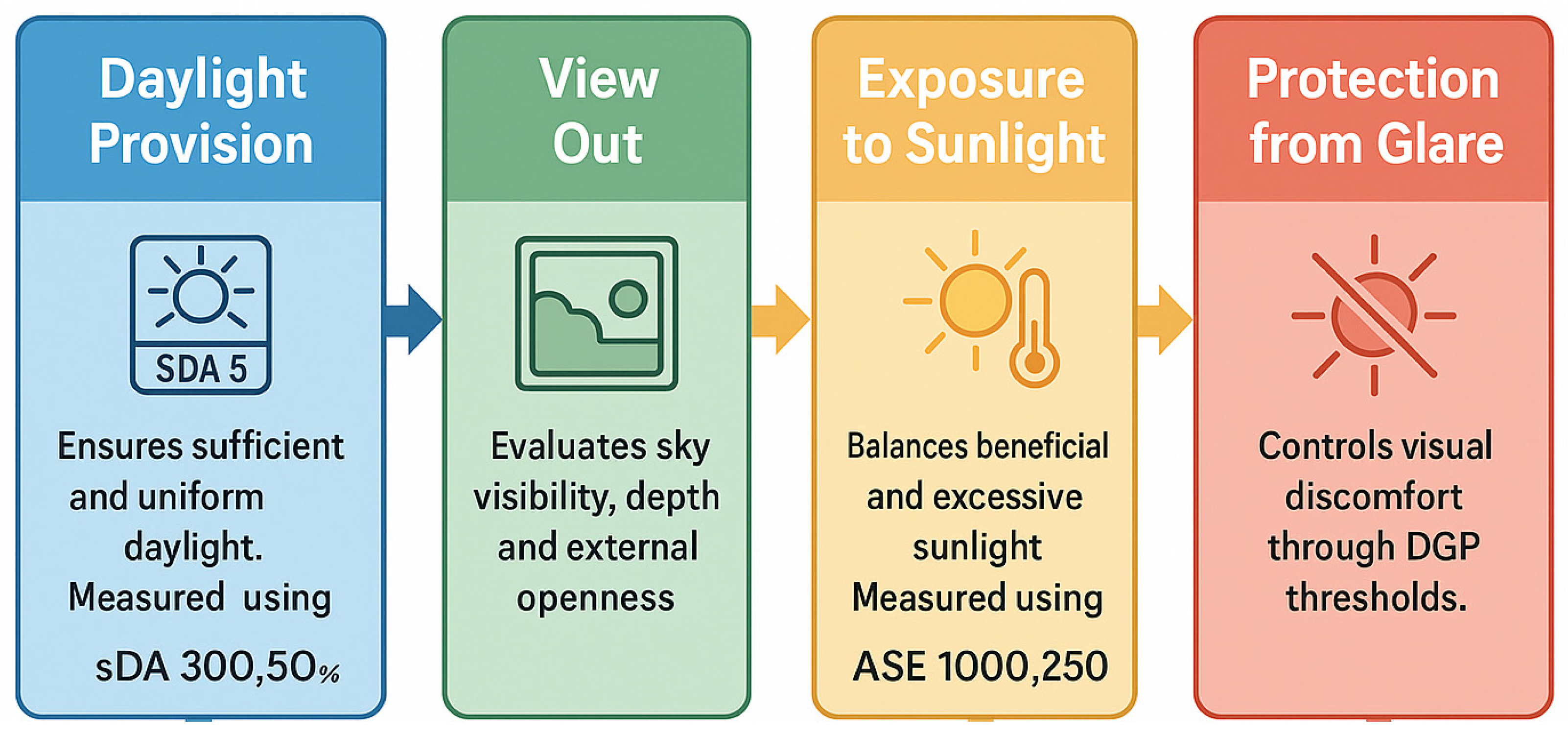
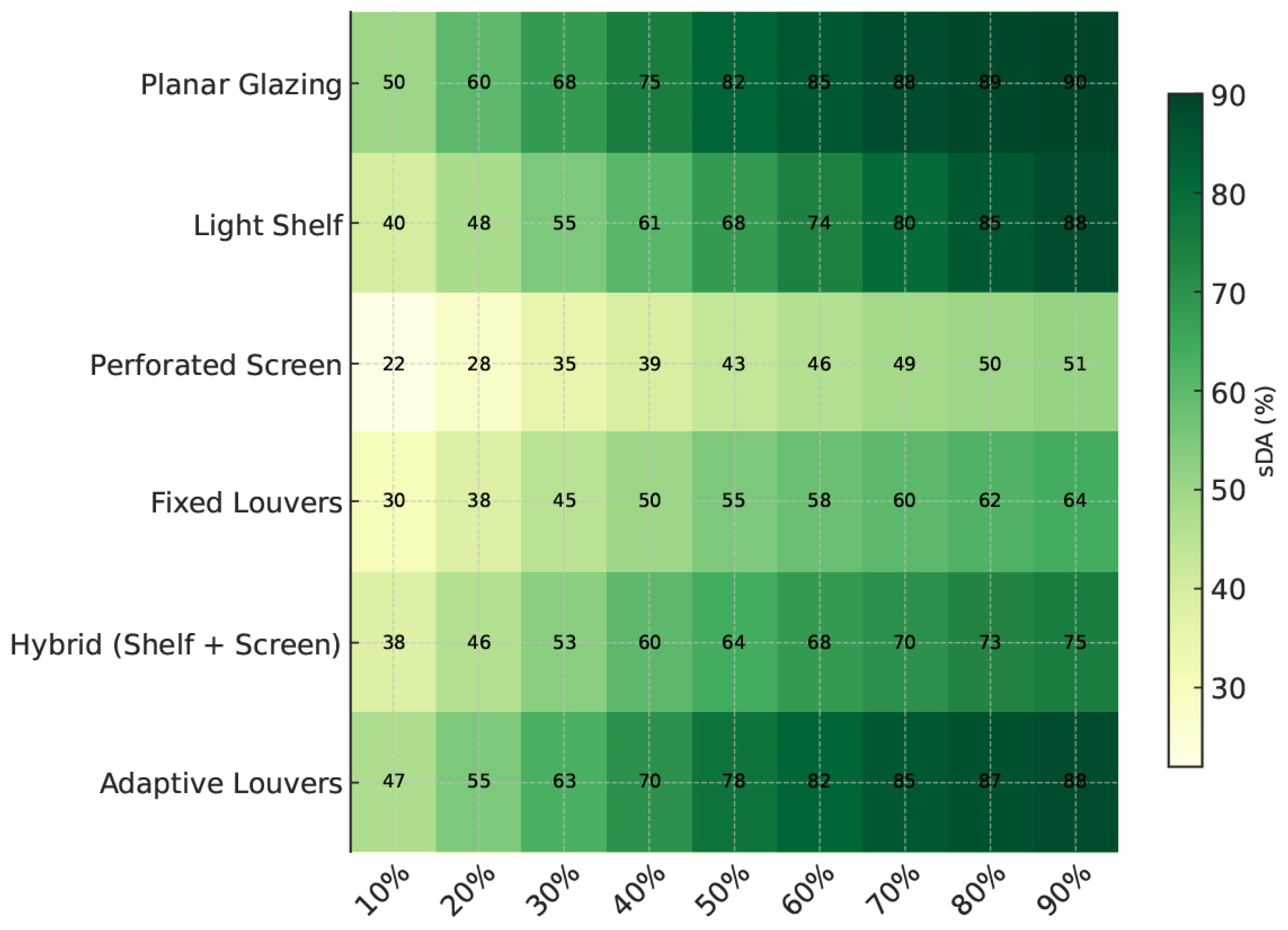
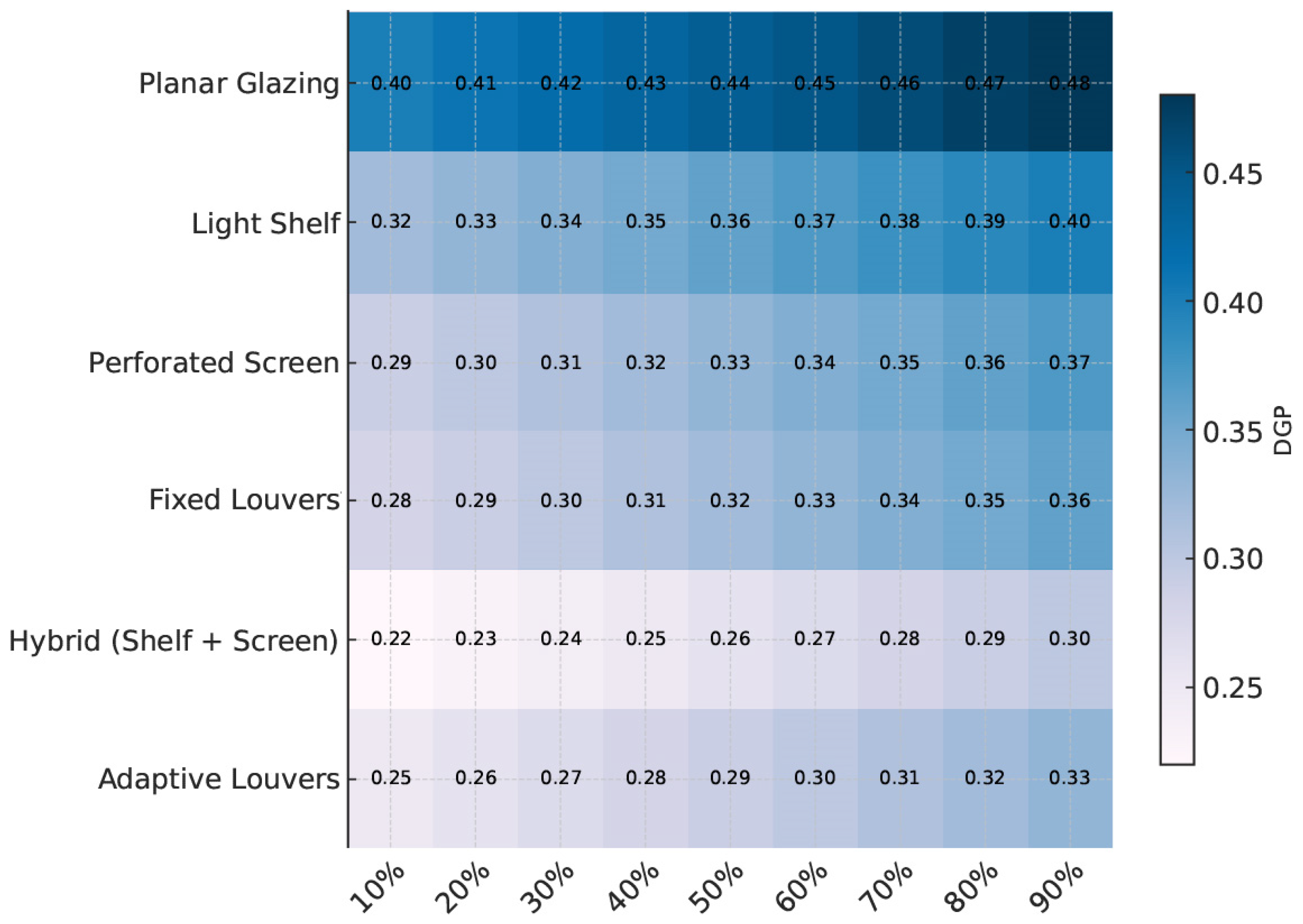
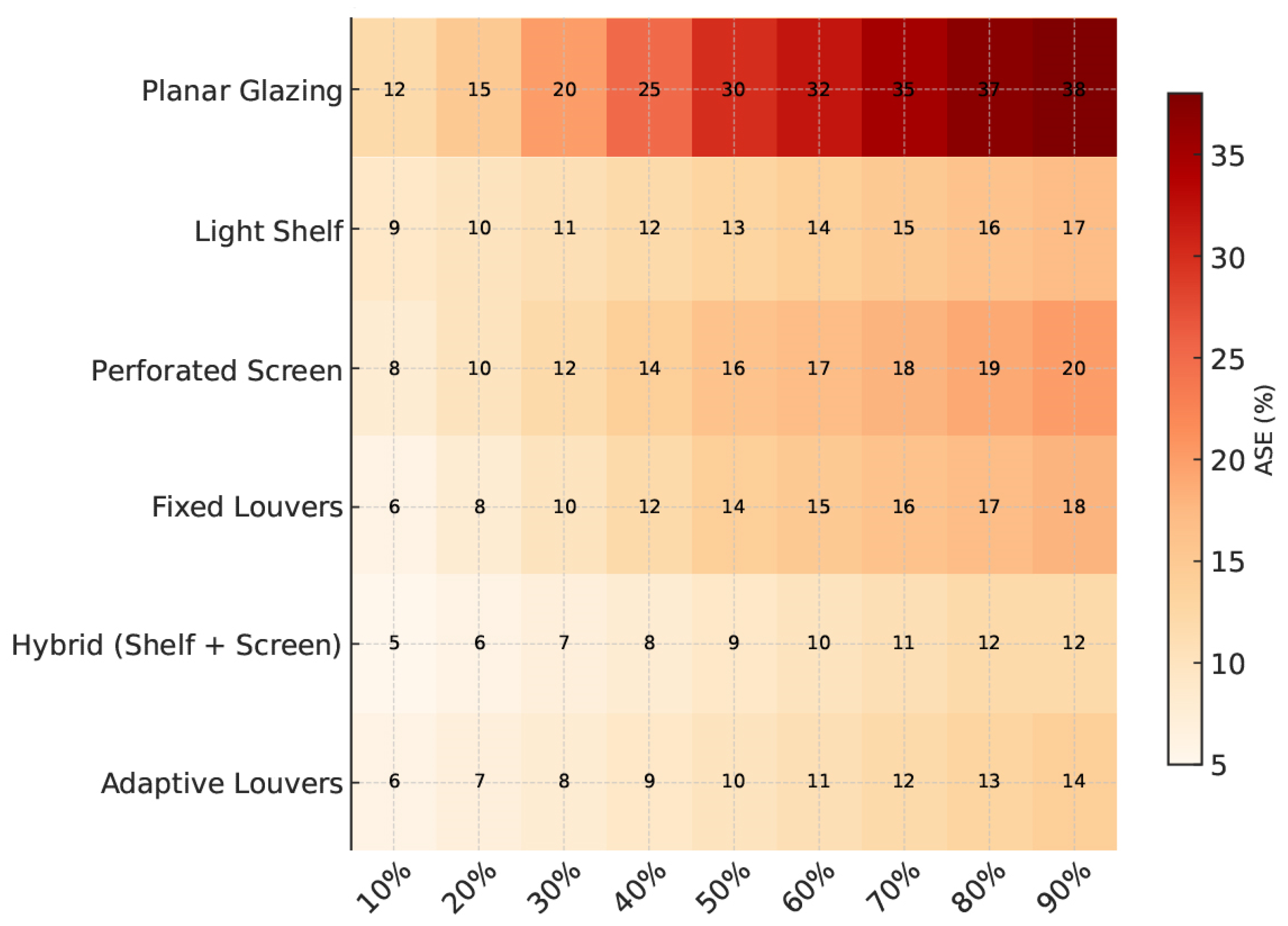
Façade Morphologies and Daylighting Strategies for Visual Comfort in Mediterranean Office Buildings: A Contextual Framework for Northern Cyprus



Abstract
1. Introduction
Background of the Study
2. Materials and Methods
2.1. Morphological Typology of Façade Systems
2.1.1. Category 1: Transparent and Direct Systems
2.1.2. Category 2: Filtered and Diffusive Systems
2.1.3. Category 3: Responsive and Hybrid Systems
Control Strategy for Adaptive Louvre Façade
2.1.4. Derivation of Façade Morphology Typology
2.2. Parametric Modelling and Simulation
Radiance Simulation Parameters and Convergence
3. Results
4. Discussion
5. Conclusions
Author Contributions
Funding
Institutional Review Board Statement
Informed Consent Statement
Data Availability Statement
Conflicts of Interest
References
- Boyce, P.R. Human Factors in Lighting; CRC Press: Boca Raton, FL, USA, 2003. [Google Scholar] [CrossRef]
- Rek-Lipczyńska, A. Salutogenic factors and sustainable development criteria in architectural and interior design: Analysis of Polish and EU standards and recommendations. Sustainability 2025, 17, 9661. [Google Scholar] [CrossRef]
- Plörer, D.; Hammes, S.; Hauer, M.; van Karsbergen, V.; Pfluger, R. Control strategies for daylight and artificial lighting in office buildings—A bibliometrically assisted review. Energies 2021, 14, 3852. [Google Scholar] [CrossRef]
- Mathew, V.; George, A.M.; Varghese, S.G.; Kurian, C.P.; Augustine, N.; George, V. Review on human-centric lighting focusing on smart solid-state lighting and switchable glazing. J. Green Build. 2025, 20, 199–226. [Google Scholar] [CrossRef]
- Bellia, L.; Acosta, I.; Campano, M.Á.; Fragliasso, F. Impact of daylight-saving time on lighting energy consumption and on the biological clock for occupants in office buildings. Sol. Energy 2020, 211, 1347–1364. [Google Scholar] [CrossRef]
- Lotfabadi, P.; Iranmanesh, A. Evaluating the incorporation of ecological conscious building design methods in architectural education. Buildings 2025, 15, 1339. [Google Scholar] [CrossRef]
- Arnaoutakis, G.E.; Katsaprakakis, D.A. Energy performance of buildings with thermochromic windows in Mediterranean climates. Energies 2021, 14, 6977. [Google Scholar] [CrossRef]
- Yao, J.; Chow, D.H.C.; Chi, Y.-W. Impact of manually controlled solar shades on indoor visual comfort. Sustainability 2016, 8, 727. [Google Scholar] [CrossRef]
- Lotfabadi, P.; Hançer, P. Optimization of visual comfort: Building openings. J. Build. Eng. 2023, 72, 106598. [Google Scholar] [CrossRef]
- Medved, S. Visual comfort and architectural lighting. In Building Physics: Heat, Ventilation, Moisture, Light, Sound, Fire, and Urban Microclimate; Springer: Berlin/Heidelberg, Germany, 2022; pp. 251–330. [Google Scholar]
- BS EN 17037:2018; Daylight in Buildings. British Standards Institution (BSI): London, UK, 2018.
- Wienold, J.; Christoffersen, J. Evaluation of a new daylight glare prediction model. Energy Build. 2006, 38, 743–757. [Google Scholar] [CrossRef]
- Frascarolo, M.; Martorelli, S.; Vitale, V. An innovative lighting system for residential application that optimizes visual comfort and conserves energy for different user needs. Energy Build. 2014, 83, 217–224. [Google Scholar] [CrossRef]
- Abdelhamid, Y.M.S.; Wahba, S.M.; El Husseiny, M. The effect of parametric patterned façade variations on daylight quality, visual comfort, and daylight performance in architecture studio-based tutoring. J. Daylighting 2023, 10, 173–191. [Google Scholar] [CrossRef]
- Wu, X.; Wang, Y.; Deng, S.; Su, P. Climate-responsive design of photovoltaic façades in hot climates: Materials, technologies, and implementation strategies. Buildings 2025, 15, 1648. [Google Scholar] [CrossRef]
- Lotfabadi, P.; Hançer, P. A comparative study of traditional and contemporary building envelope construction techniques in terms of thermal comfort and energy efficiency in hot and humid climate. Sustainability 2019, 11, 3582. [Google Scholar] [CrossRef]
- Liu, X.; Wu, Y. A review of advanced architectural glazing technologies for solar energy conversion and intelligent daylighting control. Arch. Intell. 2022, 1, 10. [Google Scholar] [CrossRef]
- Campano, M.Á.; García-Martín, G.; Acosta, I.; Bustamante, P. New approaches in dynamic metrics for lighting control systems: A critical review. Appl. Sci. 2024, 14, 9798. [Google Scholar] [CrossRef]
- Reinhart, C. Daylight performance predictions. In Building Performance Simulation for Design and Operation; Routledge: London, UK, 2019; pp. 221–269. [Google Scholar] [CrossRef]
- Šprah, N.; Košir, M. Daylight provision requirements according to EN 17037 as a restriction for sustainable urban planning of residential developments. Sustainability 2019, 12, 315. [Google Scholar] [CrossRef]
- Mardaljevic, J.; Heschong, L.; Lee, E. Daylight metrics and energy savings. Light. Res. Technol. 2009, 41, 261–283. [Google Scholar] [CrossRef]
- Freewan, A.A. Impact of different external shading systems on interior daylight quality in hot climates. Sol. Energy 2014, 102, 14–30. [Google Scholar] [CrossRef]
- Ávila-Delgado, J.; Robador, M.D.; Barrera-Vera, J.A.; Marrero, M. Glazing selection procedure for office building retrofitting in the Mediterranean climate in Spain. J. Build. Eng. 2021, 33, 101448. [Google Scholar] [CrossRef]
- Tzempelikos, A.; Athienitis, A.K. The impact of shading design on building performance. Sol. Energy 2007, 81, 369–382. [Google Scholar] [CrossRef]
- Monzavi, F.; Gurdalli, H.; Lotfabadi, P. Navigating new horizons: Cultural identities and place attachments of immigrant Iranians in Northern Cyprus. Home Cult. 2025, 22, 77–100. [Google Scholar] [CrossRef]
- Aksamija, A. Sustainable Facades: Design Methods for High-Performance Building Envelopes; John Wiley & Sons: Hoboken, NJ, USA, 2013. [Google Scholar]
- Lee, J. Integration of Daylighting and Building Design for Human Health and Well-Being. Ph.D. Thesis, University of Illinois at Urbana–Champaign, Champaign, IL, USA, 2020. [Google Scholar]
- Brzezicki, M. Enhancing Daylight Comfort with Climate-Responsive Kinetic Shading: A Simulation and Experimental Study of a Horizontal Fin System. Sustainability 2024, 16, 8156. [Google Scholar] [CrossRef]
- Jain, H. Critical insights into thermal comfort optimization and heat resilience in indoor spaces. City Built Environ. 2024, 2, 14. [Google Scholar] [CrossRef]
- Cortiços, N.D.; Duarte, C.C. Environmental comfort and energy efficiency: Compendium for architectural practice. Preprints 2025. [Google Scholar] [CrossRef]
- Mukherjee, B.; Boubekri, M. Sustainable architecture and human health: A case for effective circadian daylighting metrics. Buildings 2025, 15, 315. [Google Scholar] [CrossRef]
- Turan, I.; Chegut, A.; Fink, D.; Reinhart, C. The value of daylight in office spaces. Build. Environ. 2020, 168, 106503. [Google Scholar] [CrossRef]
- Özdemir, H.; Çakmak, B.Y. Evaluation of daylight and glare quality of office spaces with flat and dynamic shading system façades in hot arid climate. J. Daylighting 2022, 9, 197–208. [Google Scholar] [CrossRef]
- Hannoudi, L.; Saleeb, N.; Dafoulas, G. The Solar Shading Performance of the Multi-Angled Façade System and Its Impact on the Sustainable Improvement of the Buildings. Energies 2025, 18, 1565. [Google Scholar] [CrossRef]
- Lotfabadi, P. Spatial lighting considerations to develop sustainable lighting design. Des. Dialogue J. 2025, 2, 67–82. [Google Scholar]
- Ng, M. Toward a cultural ecology of architectural glass in early modern Northern Europe. Art Hist. 2017, 40, 496–525. [Google Scholar] [CrossRef]
- Yildirim, S.G. Alteration of office space to design studio for tertiary education: Daylighting impact. N. Des. Ideas 2025, 9, 661–687. [Google Scholar] [CrossRef]
- Majeed, N.N.; Alsultani, R. Façade analysis for indoor comfort in architectural design. Civ. Environ. Eng. 2024, 21, 254–270. [Google Scholar] [CrossRef]
- Mahdavinejad, M.; Bazazzadeh, H.; Mehrvarz, F.; Berardi, U.; Nasr, T.; Pourbagher, S.; Hoseinzadeh, S. The impact of façade geometry on visual comfort and energy consumption in an office building in different climates. Energy Rep. 2024, 11, 1–17. [Google Scholar] [CrossRef]
- Soares, R.; Corvacho, H.; Alves, F. Summer Thermal conditions in outdoor public spaces: A Case study in a Mediterranean climate. Sustainability 2021, 13, 5348. [Google Scholar] [CrossRef]
- Hraška, J.; Čurpek, J. The practical implications of the EN 17037 minimum target daylight factor for building design and urban daylight in several European countries. Heliyon 2024, 10, e23297. [Google Scholar] [CrossRef]
- Mangkuto, R.A. Phasor method to estimate illuminances due to parallel arrays of light sources. J. Daylighting 2020, 7, 246–257. Available online: https://solarlits.com/jd/7-246 (accessed on 5 January 2025).
- Balocco, C.; Volante, G. Lighting design for energy sustainability, information, and perception: A museum environment as a case study. Sustainability 2018, 10, 1671. [Google Scholar] [CrossRef]
- Zekraoui, D.; Zemmouri, N. Smart and dynamic façades: A path to energy optimization in arid environments. J. Archit. Eng. Res. 2024, 7, 84–102. [Google Scholar] [CrossRef]
- Odiyur Vathanam, G.S.; Kalyanasundaram, K.; Elavarasan, R.M.; Hussain Khahro, S.; Subramaniam, U.; Pugazhendhi, R.; Ramesh, M.; Gopalakrishnan, R.M. A review on effective use of daylight harvesting using intelligent lighting control systems for sustainable office buildings in India. Sustainability 2021, 13, 4973. [Google Scholar] [CrossRef]
- Elshiwihy, S.O.; Chaudhry, H.N. Parametric study on determining optimum shading techniques for urban high-rise dwellings. Urban Sci. 2019, 3, 85. [Google Scholar] [CrossRef]





| Morphological Category | Façade Models | Daylight Behaviour | Design Strategy & Performance Role | Visual Reference |
|---|---|---|---|---|
| 1. Transparent and Direct Systems | Planar Glazing | Direct passage and mirror-like reflection of daylight, producing deep light penetration with a high risk of glare and pronounced luminance contrasts, especially in the zone adjacent to the façade. | High transparency and reflective surfaces reinforce a sense of openness and clear outward views. Light shelves increase daylight penetration by redirecting light onto the ceiling, but they still need to be paired with additional measures to ensure effective glare control. |  |
| Light Shelves |  | |||
| 2. Filtered and Diffusive Systems | Perforated Screens | Selective filtering of sunlight through openings or slats, producing softer, more diffuse interior light and moderate glare mitigation, but with limited capacity to respond to changing solar angles. | Static filtering of daylight, managing brightness and solar gains through the density, orientation, and porosity of the elements; most effective in contexts with relatively stable climatic conditions. | 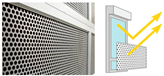 |
| Fixed louvres |  | |||
| 3. Responsive and Hybrid Systems | Hybrid (Shelf + Screen) | Adaptive control of light and shade through a mix of redirection, diffusion, and shading, sustaining high daylight availability while curbing overexposure under changing sky conditions. | Adaptive integration uses a combination of reflection, diffusion, and movable elements to respond to solar conditions in real time, supporting stable daylight quality and visual comfort throughout the year. | 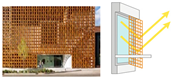 |
| Adaptive louvres |  |
| Parameter | Value | Description |
|---|---|---|
| -ab | 2 | Ambient bounces |
| -ad | 2048 | Number of ambient divisions |
| -as | 256 | Number of ambient super-samples |
| -ar | 256 | Ambient resolution (grid density) |
| -aa | 0.2 | Ambient accuracy |
| -lr | 0.005 | Limit for reflections |
| -lw | 0.01 | Ambient weight threshold |
| Window-to-Wall Ratio (WWR) | 10–90%, 10% increments. EN 17037 does not prescribe WWR; performance is evaluated through daylight/glare criteria. |
| Glazing Type | Double low-e coated IGU. Not mandated by EN 17037; selected to support daylight provision and glare control in warm Mediterranean climates. |
| Visible Light Transmittance | 0.45. A material property (not an EN requirement); chosen to balance daylight levels and reduce glare in high-solar conditions. |
| Orientation | South, rotated 16°. EN 17037 allows realistic site orientation; rotation reflects typical urban alignment in Northern Cyprus. |
| Simulation Period | 08:00–17:00 (Mon–Fri). Aligned with EN 17037 Annex A for standard office occupancy hours. |
| Weather Data | Nicosia Typical Meteorological Year (TMY2). Suitable for climate-based daylight assessment consistent with EN 17037 performance principles. |
Disclaimer/Publisher’s Note: The statements, opinions and data contained in all publications are solely those of the individual author(s) and contributor(s) and not of MDPI and/or the editor(s). MDPI and/or the editor(s) disclaim responsibility for any injury to people or property resulting from any ideas, methods, instructions or products referred to in the content. |
© 2026 by the authors. Licensee MDPI, Basel, Switzerland. This article is an open access article distributed under the terms and conditions of the Creative Commons Attribution (CC BY) license.
Share and Cite
Monzavi, F.; Gurdalli, H.; Lotfabadi, P. Façade Morphologies and Daylighting Strategies for Visual Comfort in Mediterranean Office Buildings: A Contextual Framework for Northern Cyprus. Sustainability 2026, 18, 722. https://doi.org/10.3390/su18020722
Monzavi F, Gurdalli H, Lotfabadi P. Façade Morphologies and Daylighting Strategies for Visual Comfort in Mediterranean Office Buildings: A Contextual Framework for Northern Cyprus. Sustainability. 2026; 18(2):722. https://doi.org/10.3390/su18020722
Chicago/Turabian StyleMonzavi, Fatemeh, Huriye Gurdalli, and Pooya Lotfabadi. 2026. "Façade Morphologies and Daylighting Strategies for Visual Comfort in Mediterranean Office Buildings: A Contextual Framework for Northern Cyprus" Sustainability 18, no. 2: 722. https://doi.org/10.3390/su18020722
APA StyleMonzavi, F., Gurdalli, H., & Lotfabadi, P. (2026). Façade Morphologies and Daylighting Strategies for Visual Comfort in Mediterranean Office Buildings: A Contextual Framework for Northern Cyprus. Sustainability, 18(2), 722. https://doi.org/10.3390/su18020722