
Abstract
Under the influence of multiple factors such as climate change and human activities, the frequency, intensity, and destructiveness of forest fires are increasing, which may trigger multiple ecological crises. Forest fires can be scientifically prevented, and their risks can be mitigated through specific approaches, particularly by managing forest combustible materials. Common methods include mechanical clearance, prescribed burning, and the establishment of biological firebreak belts, along with the application of grazing to regulate forest fuels. This paper presents a review of studies on grazing and fire risk, both domestically and internationally. Research indicates that livestock grazing has complex effects on forest fire risk: appropriate grazing can manage fuels and modify ecosystem structure to reduce fire hazards—for instance, by decreasing the accumulation of surface flammable materials and promoting the regeneration of fire-resistant tree species. Conversely, overgrazing may disrupt ecological balance and increase fire risk, such as by exacerbating soil erosion and encouraging the invasion of flammable weed species. Case studies from different ecological regions worldwide demonstrate varied effects of grazing on fire prevention, though research in this area exhibits geographical disparities. Adaptive management should integrate targeted grazing, prescribed burning, and mechanical treatments in a synergistic manner. Future efforts should prioritize cross-scale studies, investigate the mechanisms of woody fuel modulation, and refine fire ecology models to enhance the precision and global applicability of grazing-based fire management.
1. Introduction
Forest fires, as a critical natural disturbance factor in ecosystems, are exhibiting a global trend of increasing frequency, intensity, and destructiveness under the combined drivers of climate change and human activities such as land-use change and fire suppression legacies [1]. According to the global fire monitoring system, the average annual burned area over the past decade has risen significantly, resulting not only in substantial direct economic losses but also triggering cascading ecological crises such as biodiversity loss, decline in carbon sink function, and severe deterioration of air quality with far-reaching public health impacts [2]. In response to this escalating threat, grazing activities—through livestock foraging, trampling, and other behaviors—modify vegetation density, height, and species composition, thereby enabling dynamic management of forest fuels [3].
The regulation of forest fire risk through grazing is essentially the result of interactions between livestock behavior and multifaceted ecosystem responses. Numerous studies consistently demonstrate that herbivory reduces fuel load and vegetation height through animal trampling and biomass consumption, thereby playing a crucial role in mitigating fire intensity and severity [4,5]. In southeastern Romania, for instance, large herbivores effectively consume fine surface fuels (e.g., grasses), directly reducing fire fuel availability and spread potential [6]. Furthermore, the vegetation patchiness created by grazing activities functions as a natural firebreak, decreasing the likelihood of fire ignition and propagation [7]. Selective foraging by livestock—such as goats consuming significant quantities of flammable shrub biomass—directly reduces surface fuel loads and disrupts spatial fuel continuity [8]. Grazing also indirectly enhances ecosystem fire resilience by altering plant community composition (e.g., promoting fire-resistant grass species) [9], modulating microclimatic conditions (e.g., increasing surface humidity) [10], and improving soil permeability [11]. However, when vegetation cover is excessively reduced or bare soil exposure becomes widespread, overgrazing can induce soil erosion [12] and facilitate the invasion of highly flammable annual weeds (e.g., Vulpia megalura) [13], ultimately expanding high fire-risk areas.
Current empirical research exhibits notable regional imbalances and methodological limitations. While substantial case studies have been accumulated in regions such as the Mediterranean basin, southern Spain, and southeastern France [14,15], many other critical fire-prone areas remain severely understudied. Methodologically, although research approaches have evolved from early plot-scale observations to cross-scale technologies such as LiDAR-based quantification of vegetation heterogeneity [16] and simulation of grazing-fire interactions [17,18,19], significant knowledge gaps persist regarding the regulatory mechanisms governing woody fuels (e.g., snags) and the long-term impacts of grazing on forest succession trajectories. This review synthesizes the multifaceted effects of livestock grazing on forest fire risk, critically examining its dualistic and context-dependent nature. While appropriate grazing practices can play a positive role in fuel reduction and the optimization of plant community structure, effectively mitigating forest fire hazards, overgrazing disrupts ecological balance and can substantially increase fire risk. Although case studies from various global ecosystems demonstrate the diverse potential of grazing in fire management, the existing research body is geographically skewed, raising questions about the universal applicability of current findings.
The escalating global wildfire crisis is not merely a consequence of increasing temperatures but a synergistic product of complex socio-ecological transitions. These include the expansion of the Wildland–Urban Interface (WUI), changes in land-use patterns such as rural abandonment in Mediterranean regions leading to fuel accumulation, and the spread of invasive flammable species. Traditional fire suppression methods, while crucial, are often reactive, cost-intensive, and can have negative ecological impacts. In this context, there is a growing imperative to develop proactive, cost-effective, and ecologically integrated fuel management strategies. Livestock grazing emerges as a promising ‘nature-based solution’ within this paradigm, not only due to its direct fuel reduction capacity but also because it offers a multifunctional approach. This approach aligns wildfire risk mitigation with broader sustainability goals, such as supporting rural economies, maintaining cultural pastoral landscapes, and promoting biodiversity in fire-adapted ecosystems. Consequently, this review aims to move beyond a simple assessment of grazing’s effectiveness. It seeks to critically evaluate the conditions under which grazing transitions from a fire mitigation tool to a potential ecosystem stressor, and to synthesize the principles for its sustainable integration into adaptive, climate-resilient forest management frameworks.
2. Multidimensional Impacts of Grazing on Forest Fire Regimes
Livestock grazing exerts multifaceted influences on ecosystems through behaviors such as foraging and trampling. These effects collectively impact various factors associated with forest fire risk. The underlying mechanisms can be categorized into direct mechanisms—primarily through fuel load management—that reduce fire risk, and indirect mechanisms involving ecosystem modification that also contribute to risk mitigation. However, under certain conditions, a risk reversal mechanism may occur, whereby grazing instead increases fire susceptibility.
2.1. Fuel Load Management
The most direct impact of grazing on forest fire risk lies in its effects on surface fuel load, structure, and spatial continuity. Livestock exhibit selective foraging behavior; for instance, goats and sheep preferentially consume herbaceous plants, young shoots of shrubs, and surface litter [20]. This sustained foraging activity significantly reduces the accumulation of flammable materials, thereby directly diminishing the available fuel following ignition. Studies have shown that in Andalusia, Spain, integrating livestock grazing as a silvopastoral practice effectively reduces surface fuel loads, offering a feasible, ecological, and economical strategy for clearing flammable vegetation within firebreaks [21].
Moreover, the movement and foraging behavior of livestock do not merely reduce fuel volume but actively engineer spatial patterns across the landscape. This grazing-induced heterogeneity naturally forms a network of “fuel breaks” or discontinuities [15]. These gaps are not random but often follow terrain or vegetation gradients influenced by animal preference and movement patterns. They effectively disrupt the horizontal continuity of combustible materials, thereby blocking the propagation pathways of surface fires and suppressing both the eventual burn area and the speed of fire progression [21]. This process of establishing ecological firebreaks through grazing transcends simple biomass removal; it represents a dynamic, self-adjusting form of biological fire management engineering. Its cost-effectiveness stems from leveraging natural animal behavior to achieve a management outcome that would otherwise require significant mechanical or chemical intervention.
2.2. Ecosystem Modification
Grazing activities initiate a cascade of ecological modifications that collectively alter fire regimes. The selective consumption of highly palatable and often flammable grass and shrub species reshapes plant community composition. This process creates a competitive advantage for fire-resistant plants (e.g., those with high moisture content, waxy leaves, or secondary compounds) or less preferred species [22]. Over time, this shift inherently reduces the overall combustibility of the ecosystem, steering the trajectory of plant succession towards communities with higher innate fire resilience [23]. This compositional change is intimately linked to structural and micro-environmental alterations. The reduction in herbaceous cover and litter layer, while increasing ground-level light, also diminishes total transpirational water loss and reduces competition for soil moisture. The resultant microclimate near the soil surface tends toward higher relative humidity and more stable soil moisture levels, creating conditions that increase the energy required for fuel ignition and slow pre-heating [24,25]. Furthermore, the return of livestock manure enhances the physicochemical properties of soil, increasing organic matter content and promoting soil aggregation. These improvements in soil structure bolster water retention capacity [26,27]. Consequently, vegetation in moderately grazed areas may maintain higher moisture content for longer during dry periods, effectively extending the annual “fire-safe period” and narrowing the window of high ignition risk.
2.3. Overgrazing
Based on the scientific principles of grazing management, grazing intensity can be characterized through three key parameters: intensity, the percentage of plant material removed; frequency, how often an area is grazed within a growing season; and timing, the plant growth stage during grazing. Moderate grazing is typically characterized by the removal of less than 50% of photosynthetic leaf area during periods of adequate soil moisture, allowing sufficient regrowth time for plants to replenish energy reserves. In contrast, overgrazing involves the repeated removal of more than 50% of leaf area, particularly during drought conditions or critical growth stages (e.g., boot stage), which depletes root reserves and hinders plant recovery [28].
When grazing pressure exceeds these ecological thresholds, its effects on fire risk are not universally beneficial but can reverse. Overgrazing leads to extreme reduction in vegetation height and density, which not only removes herbaceous fuels but also eliminates the protective plant cover crucial for water retention, thereby exacerbating soil erosion and degradation [29,30]. In arid and semi-arid regions, overgrazing creates ideal open ground for the invasion and establishment of flammable annual weeds such as Bromus tectorum [31]. These invasive grasses have short life cycles, rapidly senesce during dry periods, and form continuous, homogeneous fuel beds of high flammability, significantly increasing the risk of rapidly spreading, high-intensity wildfires [32].
3. Regional Case Studies: Divergent Grazing Outcomes in Global Fire-Prone Ecosystems
3.1. Comparative Analysis of Regional Cases
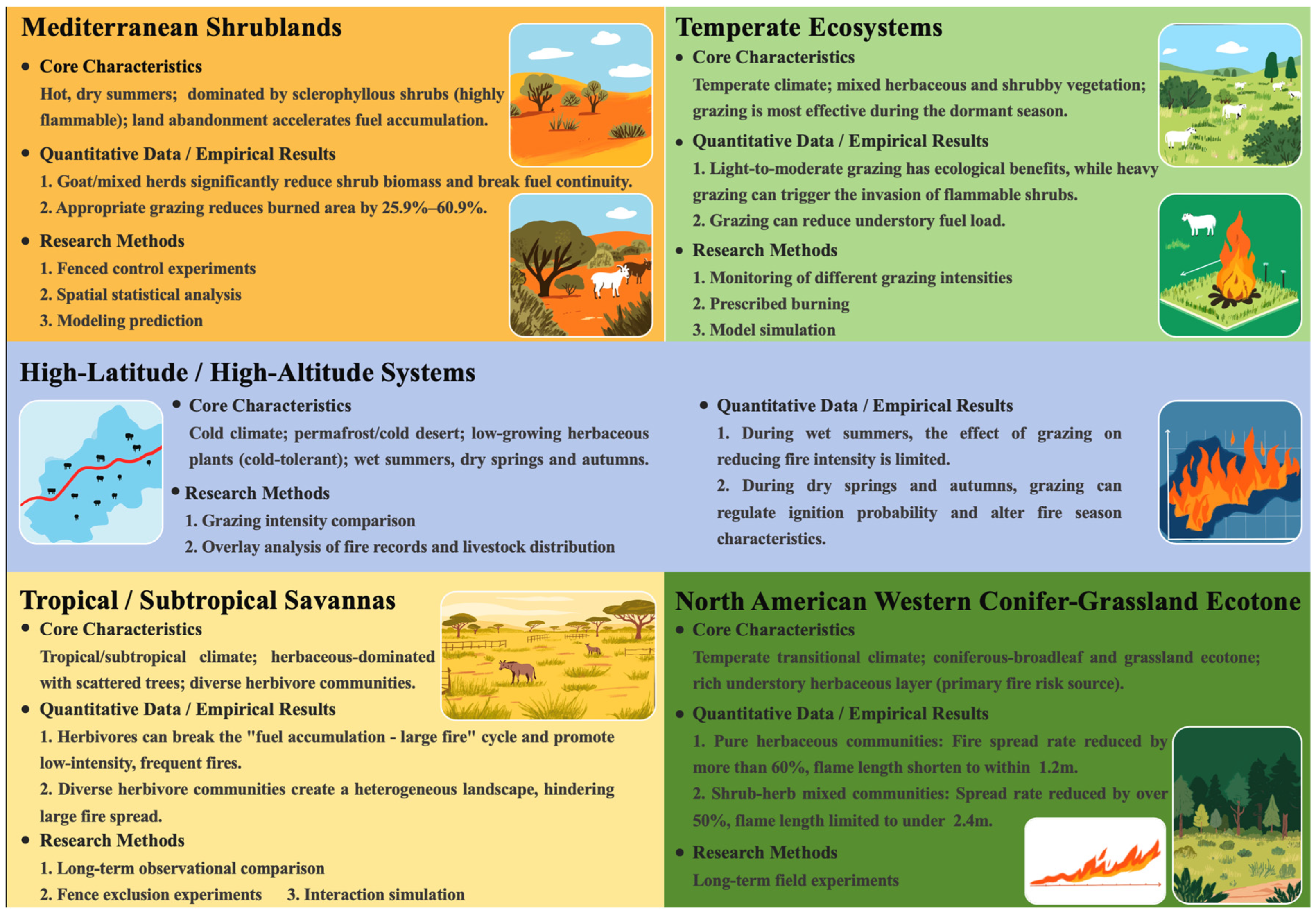
Different ecosystems exhibit highly specific responses to grazing due to their distinct vegetation structures, climatic conditions, and dominant fuel types. An integrated summary of these responses, including core characteristics, key empirical findings, and common research approaches for each major fire-prone ecosystem, is presented in Figure 1.
Figure 1.
The Influence of Grazing on Fire Management in Different Ecosystems.
Research on Mediterranean shrublands is particularly well-established, providing a robust evidence base for grazing as a fire management tool. These regions are characterized by hot, dry summers and vegetation dominated by highly flammable sclerophyllous shrubs. Within this context, grazing is widely regarded as an effective bio-management tool for reducing flammable biomass and mitigating wildfire risk [33,34]. Studies on fire management in Mediterranean ecosystems have employed diverse methodologies: some researchers have conducted controlled field experiments using enclosures to compare fire prevention outcomes between grazed and ungrazed areas [35,36]; others have utilized spatial analysis and statistical models to examine correlations between historical fire data and livestock distribution patterns [37,38]; yet others have applied predictive modeling to simulate changes in fire behavior following grazing interventions [39]. A body of evidence indicates that grazing—particularly by goats and mixed herds—significantly reduces shrub biomass and disrupts fuel continuity [40,41,42]. A critical insight from this region is the role of land abandonment as a driver of fuel accumulation and increased fire frequency [43,44], highlighting grazing not just as an intervention but as a component of sustainable land-use that maintains low-fuel landscapes. However, the use of grazing as a fire management tool also entails risks: improperly executed prescribed burns by pastoralists may inadvertently serve as ignition sources [45,46]. Empirical studies demonstrate that effectively managed grazing can substantially mitigate fire behavior, reducing fire intensity and decreasing burned area by 25.9% to 60.9% [47].
In temperate ecosystems, diverse methodological approaches have been employed to investigate grazing effects, including the establishment of permanent plots under varying grazing intensities to monitor vegetation dynamics [48], the implementation of prescribed burning or simulation-based modeling studies [49,50], and the analysis of correlations between livestock husbandry changes and historical wildfire records. Studies indicate that light to moderate grazing can yield ecological benefits, whereas heavy grazing may facilitate the invasion of flammable shrub species [48]. Furthermore, grazing has been shown to reduce understory fuel loads, although careful management of stocking density is essential to achieve desired outcomes [51]. Notably, implementing moderate grazing during the vegetation dormant season has been demonstrated to be particularly effective for wildfire risk mitigation, as it reduces dead fuel load without excessively compromising the protective cover and regenerative capacity of perennial grasses [52]. A key consideration in temperate systems is balancing fuel reduction with the maintenance of sufficient vegetation structure to prevent soil erosion and suppress the establishment of invasive annuals, a balance that requires careful, context-specific stocking rate management.
In high-latitude and high-altitude systems, spatial overlay analysis of historical fire records and livestock distribution data reveals a distinct season-dependent relationship between grazing activities and fire occurrence [53,54]. Comparative assessments of fire regime metrics—such as fire frequency and burned area—across regions with different grazing intensities indicate that the effectiveness of grazing in reducing fire intensity may be more limited in these regions’ more humid summers, but its role in managing fine fuels in drier spring or autumn periods, thereby altering fire seasonality or limiting fire starts, can be significant [55]. This underscores that in such systems, grazing’s primary fire mitigation benefit may lie in modifying ignition potential and fire timing rather than uniformly suppressing peak-season fire behavior.
In tropical and subtropical savannas, numerous studies have been conducted on fire dynamics and ecological regulatory mechanisms. For instance, long-term observations and comparisons of fire regimes have been carried out in parks or ranches with different herbivore assemblages [56,57]. Fence-exclusion experiments have been implemented to assess the impact of large herbivore removal [5], while modeling approaches have been employed to simulate the interactions among herbivores, vegetation, and fire [48,58]. Research findings indicate that herbivory can disrupt the “fuel accumulation to large fire” cycle and promote frequent, low-intensity fires [59,60]. Furthermore, diverse herbivore communities can create heterogeneous landscapes that impede the spread of large wildfires [56,61].
In the coniferous forest-grassland ecotones of western North America, fire risk is primarily driven by abundant herbaceous understory fuels [5]. A long-term experiment in southeastern Arizona demonstrated that grazing significantly suppresses fire behavior: within pure grass communities, the rate of fire spread was reduced by more than 60%, and flame length was shortened to within 1.2 m (reaching the critical threshold for effective suppression); in mixed grass-shrub communities, the rate of spread decreased by over 50%, with flame length limited to under 2.4 m [62]. By altering vegetation structure, grazing effectively reduces both the rate of spread and intensity of fires, thereby substantially lowering the difficulty of fire suppression efforts.
3.2. Analysis of Geographical Biases in Current Research
Current studies on the relationship between grazing and fire risk exhibit significant geographical imbalances. The majority of empirical evidence originates from regions with long-standing pastoral traditions and well-established ecological research frameworks, particularly Mediterranean-climate zones (e.g., Spain, Greece, France) and temperate grassland-forest ecotones in North America. These areas face substantial wildfire risks exacerbated by land-use changes and invasive species and have increasingly incorporated targeted grazing into official wildfire management strategies.
By contrast, significant gaps exist in research on other critical fire-prone regions globally. In tropical rainforest areas, such as the Amazon Basin and Southeast Asia, lands subjected to slash-and-burn agriculture are often converted to pasture; however, the impact of livestock grazing on fire risk dynamics in secondary forests remains poorly understood due to a lack of systematic monitoring [5]. Similarly, regions of Central and North Asia suffer from a systemic absence of monitoring data and a weak foundation of historical research. This scarcity of region-specific studies not only heightens their vulnerability under climate change but also impedes the development of science-based guidance for implementing low-cost fire mitigation strategies—such as targeted grazing—tailored to local ecological conditions.
3.3. Synthetic Comparative Summary
The case studies presented reveal a clear pattern: the role of grazing in wildfire mitigation is not uniform but is fundamentally shaped by ecosystem-specific characteristics, particularly the dominant fuel types and climatic constraints. Table 1 synthesizes these divergent outcomes by highlighting the primary mechanisms and management implications in each major ecosystem.
Table 1.
Comparative overview of grazing mechanisms and key implications across fire-prone ecosystems.
In synthesis, grazing operates most directly and effectively in ecosystems where the primary wildfire threat stems from herbaceous or fine woody fuels that are palatable and accessible to livestock (e.g., Mediterranean shrublands, savannas, forest-grassland ecotones). Its role becomes more nuanced or seasonally constrained in systems where fuels are predominantly woody, less palatable, or where climatic humidity limits combustion potential. A universal theme is the non-linear relationship between grazing pressure and fire risk, where moderate, well-timed grazing reduces hazard, but both undergrazing (fuel accumulation) and overgrazing (ecosystem degradation, weed invasion) can increase it.
4. Implementing Adaptive Grazing Strategies for Wildfire Management
4.1. Targeted Regulation Strategies
A one-size-fits-all grazing approach is inadequate to address the complex and dynamic patterns of forest fire risk. It is essential to match livestock species with the dominant fuel types present in different regions. The foraging behavior and physiological characteristics of animals determine their optimal habitats. Goats, being skilled climbers with a preference for low-fiber leaves and woody shrubs [63], are particularly suitable for managing brush and flammable understory shrub layers. Cattle, as non-selective grazers, efficiently and uniformly consume large areas of herbaceous fuels [64], making them well-suited for mitigating fire risk in forest-grassland ecotones and grassland regions. Sheep, which feed on both grasses and low shrubs and are highly agile [64], are more appropriate for grazing in shrub-grass transition zones or areas with fragmented topography.
Furthermore, stocking rate must be dynamically adjusted based on fire risk levels. Utilizing remote sensing, vegetation surveys, and fire behavior models, a “fire risk zoning map” can be developed to guide the flexible allocation of livestock. Adopting a fixed stocking rate may result in undergrazing in some areas and overgrazing in others. For example, designating extreme-risk zones as priority grazing areas while reducing stocking rates or implementing temporary grazing exclusion in low-risk regions can enhance management efficacy [65]. This approach, known as “targeted grazing”, ensures that management actions are focused on the most critical fire prevention nodes, significantly improving resource utilization efficiency [66]. Implementing targeted grazing therefore requires a dynamic, data-driven approach that moves beyond static stocking rates. For example, a “prescriptive grazing” plan can be developed by integrating near-real-time satellite imagery to identify areas of high fuel accumulation (e.g., using NDVI or specific fuel indices) with spatially explicit fire weather risk models (e.g., Fosberg Fire Weather Index). Livestock can then be strategically concentrated in these high-priority zones during periods of peak fire danger. Conversely, stocking density can be reduced or animals rotated out during ecologically sensitive periods, such as plant flowering, seeding, or wildlife nesting seasons, or in areas assessed as low risk. This dynamic allocation transforms grazing from a blanket treatment into a precision tool, responsive to both ecological conditions and fluctuating fire hazard.
4.2. Synergistic Integration of Multiple Measures
4.2.1. Prescribed Burning
The integration of grazing with prescribed fire can follow a strategic sequence: (1) Pre-fire grazing to reduce fine fuel loads and ensure burn controllability; (2) Prescribed fire conducted under optimal conditions to consume ladder fuels and stimulate nutrient cycling; (3) Post-fire grazing to manage the rapid growth of often-flammable early successional vegetation, thereby extending the treatment’s effective lifespan. This “grazing-fire-grazing” cycle mimics natural disturbance regimes and can enhance habitat heterogeneity.
Short-term high-intensity grazing implemented prior to prescribed burning can effectively reduce fine surface fuel loads, thereby significantly decreasing fire intensity and variability during controlled burns. This enhances operational safety and controllability [67]. Meanwhile, prescribed burning promotes the decomposition of plant residues and accelerates nutrient cycling, leading to improved forage quality in the early grazing season. Grazing in recently burned areas not only provides high-quality forage for livestock but also helps control rapidly regenerating flammable grasses and weeds after the fire. This complementary approach extends the duration of fire prevention effectiveness [68,69].
4.2.2. Mechanical Fuel Reduction
Grazing activities face geographic constraints in areas such as steep slopes, rocky terrain, or ecologically sensitive zones (e.g., riparian corridors and habitats of endangered species). In these locations, mechanical fuel reduction serves as a critical complementary measure. By using methods such as mechanical mastication and shredding to pre-establish safety zones or fuel breaks [70], livestock can then be directed to graze in these treated areas under controlled conditions. This approach forms an integrated fire management model combining “mechanical pretreatment with biological regulation,” enhancing both safety and ecological effectiveness.
5. Discussion
5.1. Adaptive Grazing as a Multifunctional Fire Management Tool
Appropriate grazing serves as an effective and multifaceted strategy for managing forest fuels. Through direct biomass consumption and trampling, livestock reduce surface fuel loads and disrupt horizontal fuel continuity, thereby impeding fire ignition and spread [71]. Beyond this immediate fuel-modifying effect, moderate grazing can positively reshape ecosystem structure and function [72]. By selectively suppressing flammable shrubs and weeds while promoting the regeneration of fire-resistant species, grazing contributes to a long-term reduction in overall landscape combustibility. Furthermore, grazing influences micro-environmental conditions; improved soil structure and enhanced vegetation cover can increase soil moisture retention [73,74] and reduce the accumulation of dry surface fuels, creating a less fire-prone environment.
However, the relationship between grazing and fire risk is inherently non-linear and context-dependent. Overgrazing can trigger a reversal of these benefits, leading to vegetation cover loss, soil erosion, and the invasion of highly flammable annual weeds [75], ultimately exacerbating fire hazard. This duality underscores that grazing is not a universally beneficial intervention but a management tool whose outcomes are dictated by intensity, timing, livestock species, and ecological context [76].
The synthesis of case studies from diverse ecosystems (summarized comparatively in Figure 1) demonstrates this variability. While grazing is widely recognized as a beneficial fire management tool in Mediterranean systems [77], its role in humid or high-latitude regions may be more subtle or seasonally constrained [78]. A persistent challenge is the pronounced geographical bias in existing research, with significant knowledge gaps in critical fire-prone regions like tropical rainforests and boreal zones. This imbalance limits the development of robust, globally applicable frameworks.
Consequently, moving beyond a one-size-fits-all approach is imperative. The synthesis of global case studies clearly indicates that successful fire mitigation through grazing depends on a carefully calibrated, adaptive strategy. This involves not only aligning livestock species with specific fuel types and dynamically adjusting stocking rates based on fire risk zoning but also strategically sequencing grazing with other interventions within a broader management framework [79]. For example, short-term intensive grazing prior to prescribed burning can enhance its safety and effectiveness by moderating fire behavior, while post-fire grazing can control the rapid regrowth of often-flammable early successional vegetation, thereby extending the treatment’s effective lifespan. In topographically complex or ecologically sensitive areas where grazing access is limited, initial mechanical fuel reduction can create the necessary conditions to enable safe and effective subsequent grazing. This synergistic, “ecological engineering” approach leverages the complementary strengths of each method—biological regulation, controlled fire, and mechanical treatment—to establish a more resilient, cost-effective, and ecologically nuanced fire management system.
5.2. Research Gaps and Future Directions
To translate the potential of grazing into reliable, scalable fire mitigation practice, future research must address several interconnected knowledge gaps and methodological frontiers.
First, a deeper mechanistic understanding is required. While the effects of grazing on herbaceous fuels are relatively well-documented, its indirect regulation of woody fuels (e.g., standing dead trees, coarse woody debris) remains poorly understood. Research should investigate whether livestock activities, through trampling or microenvironment modification, can accelerate the decomposition of these high-energy-density fuels [80]. Furthermore, systematic studies are needed to quantify the differential impacts of livestock species (e.g., goats, cattle, sheep) and define ecologically sustainable stocking rate thresholds across diverse ecosystems, particularly in understudied regions [81]. A key focus must be identifying the tipping points where grazing pressure shifts from reducing to amplifying fire risk.
Second, advancing predictive capacity demands cross-scale and cross-disciplinary integration. Current fire behavior models inadequately represent the dynamic and multifactorial effects of grazing. Future work should develop coupled grazing-fire-vegetation models that dynamically integrate livestock foraging pressure, species-specific impacts, and associated feedbacks on plant community composition, fuel structure, and microclimate [82]. This requires blending field ecology with remote sensing (e.g., LiDAR for 3D fuel mapping), long-term landscape-scale monitoring, and computational simulation [83]. Additionally, integrating social science perspectives is crucial to understanding stakeholder perceptions, economic viability, and the governance models that facilitate or hinder the adoption of fire-smart grazing practices.
Finally, bridging science with policy and practice represents a critical translational frontier. Research must expand beyond biophysical outcomes to examine the socio-economic dimensions of grazing-based fire management [84]. This includes conducting cost–benefit analyses comparing grazing to alternative fuel treatments [85], designing incentive structures and insurance products for landowners, and exploring how traditional and local ecological knowledge can inform adaptive co-management frameworks [86]. Developing clear implementation guidelines—from risk-based zoning and livestock selection to monitoring protocols and adaptive feedback loops—will be essential for operationalizing targeted grazing [87]. By closing these research gaps, the scientific community can provide land managers and policymakers with the robust, context-sensitive evidence needed to harness grazing as a cornerstone of integrated, adaptive, and sustainable wildfire risk reduction strategies [88].
6. Conclusions
The relationship between grazing and forest fire risk is complex and context-dependent, governed by an interplay of ecological, climatic, and management factors. As this review illustrates, livestock grazing holds significant potential as a multifunctional, nature-based strategy for mitigating wildfire risk, primarily through direct fuel reduction and indirect ecosystem modification. However, this potential is tightly constrained by the risks of overgrazing, which can degrade ecosystems and inadvertently increase fire hazard. The divergent outcomes observed across global regions underscore that there are no universal prescriptions. Therefore, the future of grazing in fire management lies in embracing and implementing adaptive, precision frameworks. Success depends on moving beyond broad generalizations to develop locally tailored strategies that strategically combine targeted grazing with other fuel treatments. Prioritizing research to close critical geographical and mechanistic knowledge gaps, particularly in underrepresented ecosystems and regarding woody fuel dynamics, is essential to refine predictive models and provide robust, evidence-based guidance. By doing so, land managers and policymakers can better harness grazing not merely as an agricultural or conservation practice but as a vital, flexible component of integrated, resilient, and sustainable landscape management.
Author Contributions
Conceptualization, S.X. and X.Z.; methodology, H.R. and X.Y.; data curation, S.X. and S.A.; writing—original draft preparation, S.X.; writing—review and editing, S.X. and X.Z.; supervision, Q.W. and X.F.; project administration, Q.W.; funding acquisition, Q.W. All authors have read and agreed to the published version of the manuscript.
Funding
This work was funded by the National Key Research and Development Program of China (2023YFD2202002) and the National Natural Science Foundation of China (32471878, 32160376).
Institutional Review Board Statement
Not applicable.
Informed Consent Statement
Not applicable.
Data Availability Statement
Not applicable.
Conflicts of Interest
The authors declare no conflicts of interest.
References
- Dube, O.P. Global Wildfire Activity Re-Visited. Glob. Environ. Change 2024, 89, 102894. [Google Scholar] [CrossRef]
- Shmuel, A.; Lazebnik, T.; Glickman, O.; Heifetz, E.; Price, C. Global Lightning-Ignited Wildfires Prediction and Climate Change Projections Based on Explainable Machine Learning Models. Sci. Rep. 2025, 15, 7898. [Google Scholar] [CrossRef] [PubMed]
- Du, S.L.; Ma, Y.S.; Li, S.X.; Yin, Y.L.; Zhao, W.; Su, S.F.; Dong, Y.L.; Wang, Y.L. Effects of spring grazing on vegetation community characteristics of alpine steppe-meadow in the Qilian mountains. Pratacultural Sci. 2022, 39, 2062–2073. [Google Scholar]
- Ribeiro, I.; Domingos, T.; McCracken, D.; Proença, V. The Use of Domestic Herbivores for Ecosystem Management in Mediterranean Landscapes. Glob. Ecol. Conserv. 2023, 46, e02577. [Google Scholar] [CrossRef]
- Rouet-Leduc, J.; Pe’er, G.; Moreira, F.; Bonn, A.; Helmer, W.; Shahsavan Zadeh, S.A.A.; Zizka, A.; van der Plas, F. Effects of Large Herbivores on Fire Regimes and Wildfire Mitigation. J. Appl. Ecol. 2021, 58, 2690–2702. [Google Scholar] [CrossRef]
- Feurdean, A.; Hanganu, D.; Bălășescu, A.; Diaconu, A.; Pfeiffer, M.; Warren, D.; Galka, M.; Grindean, R.; Hutchinson, S.M.; Marzolff, I.; et al. Moisture Availability versus Grazing and Burning as Drivers of Holocene Forest-Grassland Coexistence in Europe: A Case Study from Open Ecosystems of Southeastern Romania. Quat. Sci. Rev. 2025, 351, 109153. [Google Scholar] [CrossRef]
- Fu, L.; Bo, T.; Du, G.; Zheng, X. Modeling the Responses of Grassland Vegetation Coverage to Grazing Disturbance in an Alpine Meadow. Ecol. Model. 2012, 247, 221–232. [Google Scholar] [CrossRef]
- Okick, R.E.; Meilby, H.; Ishengoma, R.C.; Abdallah, J.M.; Kicheleri, R.P. Effect of Grazing Intensity on Understory Vegetation in a Village Land Forest Reserve in Northern Tanzania. J. Environ. Manag. 2025, 377, 124339. [Google Scholar] [CrossRef]
- de Andrade Nunes, J.P.; Asensio, L.A.B.; Sfair, J.C.; Chaves, R.B.; de Sousa, J.B.; da Costa Vieira, I.K.; de Oliveira Furtado de Souza, L.; Baldauf, C. The Impact of Grazing on Biodiversity and Forest Succession in the Brazilian Dry Forest Region Is Constrained by Non-Equilibrium Dynamics. Sci. Total Environ. 2024, 946, 174549. [Google Scholar] [CrossRef]
- Kim, J.; Ale, S.; Kreuter, U.P.; Teague, W.R. Grazing Management Impacts on Ecosystem Services under Contrasting Climatic Conditions in Texas and North Dakota. J. Environ. Manag. 2023, 347, 119213. [Google Scholar] [CrossRef]
- Wilcox, B.P.; Caldeira, M.C.; Leite, P.A.M.; Lobo-do-Vale, R.; Bugalho, M.N. Understory Shrubs Improve Soil Infiltrability in Overgrazed Mediterranean Oak Woodlands, but Have Little Impact on Ungrazed Woodlands. For. Ecol. Manag. 2024, 569, 122186. [Google Scholar] [CrossRef]
- Kosmalla, V.; Keimer, K.; Schürenkamp, D.; Lojek, O.; Goseberg, N. Erosion Resistance of Vegetation-Covered Soils: Impact of Different Grazing Conditions in Salt Marshes and Analysis of Soil-Vegetation Interactions by the Novel DiCoastar Method. Ecol. Eng. 2022, 181, 106657. [Google Scholar] [CrossRef]
- Schmelzer, L.; Perryman, B.; Bruce, B.; Schultz, B.; McAdoo, K.; McCuin, G.; Swanson, S.; Wilker, J.; Conley, K. CASE STUDY: Reducing Cheatgrass (Bromus tectorum L.) Fuel Loads Using Fall Cattle Grazing. Prof. Anim. Sci. 2014, 30, 270–278. [Google Scholar] [CrossRef]
- Teruel-Coll, M.; Pareja, J.; Bartolomé, J.; Serrano, E.; Mentaberre, G.; Cuenca, R.; Espunyes, J.; Pauné, F.; Calleja, J.A. Effects of Boom and Bust Grazing Management on Vegetation and Health of Beef Cattle Used for Wildfire Prevention in a Mediterranean Forest. Sci. Total Environ. 2019, 665, 18–22. [Google Scholar] [CrossRef] [PubMed]
- Mena, Y.; Ruiz-Mirazo, J.; Ruiz, F.A.; Castel, J.M. Characterization and Typification of Small Ruminant Farms Providing Fuelbreak Grazing Services for Wildfire Prevention in Andalusia (Spain). Sci. Total Environ. 2016, 544, 211–219. [Google Scholar] [CrossRef]
- Jansen, B.V.S.; Kolden, C.A.; Greaves, H.E.; Eitel, J.U.H. Lidar Provides Novel Insights into the Effect of Pixel Size and Grazing Intensity on Measures of Spatial Heterogeneity in a Native Bunchgrass Ecosystem. Remote Sens. Environ. 2019, 235, 111432. [Google Scholar] [CrossRef]
- Liedloff, A.C.; Coughenour, M.B.; Ludwig, J.A.; Dyer, R. Modelling the Trade-off between Fire and Grazing in a Tropical Savanna Landscape, Northern Australia. Environ. Int. 2001, 27, 173–180. [Google Scholar] [CrossRef]
- Granados, A.; Huguet, G. Gluing and Grazing Bifurcations in Periodically Forced 2-Dimensional Integrate-and-Fire Models. Commun. Nonlinear Sci. Numer. Simul. 2019, 70, 48–73. [Google Scholar] [CrossRef]
- Teague, W.R.; Grant, W.E.; Kreuter, U.P.; Diaz-Solis, H.; Dube, S.; Kothmann, M.M.; Pinchak, W.E.; Ansley, R.J. An Ecological Economic Simulation Model for Assessing Fire and Grazing Management Effects on Mesquite Rangelands in Texas. Ecol. Econ. 2008, 64, 611–624. [Google Scholar] [CrossRef]
- Benthien, O.; Braun, M.; Riemann, J.C.; Stolter, C. Long-Term Effect of Sheep and Goat Grazing on Plant Diversity in a Semi-Natural Dry Grassland Habitat. Heliyon 2018, 4, e00556. [Google Scholar] [CrossRef]
- Ruiz-Mirazo, J.; Robles, A.B.; González-Rebollar, J.L. Two-Year Evaluation of Fuelbreaks Grazed by Livestock in the Wildfire Prevention Program in Andalusia (Spain). Agric. Ecosyst. Environ. 2011, 141, 13–22. [Google Scholar] [CrossRef]
- Siegel, K.J.; Macaulay, L.; Shapero, M.; Becchetti, T.; Larson, S.; Mashiri, F.E.; Waks, L.; Larsen, L.; Butsic, V. Impacts of Livestock Grazing on the Probability of Burning in Wildfires Vary by Region and Vegetation Type in California. J. Environ. Manag. 2022, 322, 116092. [Google Scholar] [CrossRef] [PubMed]
- Davies, K.W.; Bates, J.D.; Boyd, C.S. Response of Planted Sagebrush Seedlings to Cattle Grazing Applied to Decrease Fire Probability. Rangel. Ecol. Manag. 2020, 73, 629–635. [Google Scholar] [CrossRef]
- Vaieretti, M.V.; Iamamoto, S.; Pérez Harguindeguy, N.; Cingolani, A.M. Livestock Grazing Affects Microclimate Conditions for Decomposition Process through Changes in Vegetation Structure in Mountain Grasslands. Acta Oecologica 2018, 91, 101–107. [Google Scholar] [CrossRef]
- Zhumanova, M.; Wrage-Mönnig, N.; Jurasinski, G. Long-Term Vegetation Change in the Western Tien-Shan Mountain Pastures, Central Asia, Driven by a Combination of Changing Precipitation Patterns and Grazing Pressure. Sci. Total Environ. 2021, 781, 146720. [Google Scholar] [CrossRef]
- Ali, B.; Zheng, H.; Usman, M.; Zhao, W.; Hou, F. Impacts of Seasonal Grazing on Soil Enzymes, Physicochemical Properties, and Vegetation in Alpine Meadows. Agric. Ecosyst. Environ. 2025, 393, 109837. [Google Scholar] [CrossRef]
- Ding, L.-M.; Feng, J.-Y.; Subinuer, W.; Yang, M.; Degen, A.A.; Henkin, Z.; Wang, C.-T. The Impacts of Grazing on Vegetation and Soil Properties Are Influenced by Climatic Conditions: A Meta-Analysis. Rangel. Ecol. Manag. 2025, 103, 1–7. [Google Scholar] [CrossRef]
- Bailey, D.W.; Mosley, J.C.; Estell, R.E.; Cibils, A.F.; Horney, M.; Hendrickson, J.R.; Walker, J.W.; Launchbaugh, K.L.; Burritt, E.A. Burritt Synthesis Paper: Targeted Livestock Grazing: Prescription for Healthy Rangelands. Rangel. Ecol. Manag. 2019, 72, 865–877. [Google Scholar] [CrossRef]
- de Hoop, M.; Dekker, S.C.; Rietkerk, M.; Mayor, A.G. Overgrazing Erodes the Sink Role of Vegetated Mounds in Semiarid Hillslopes. Catena 2025, 256, 109121. [Google Scholar] [CrossRef]
- Ji, G.; Hu, G.; Liu, G.; Bai, Z.; Li, B.; Li, D.; L, H.; Cui, G. Response of Soil Microbes to Carex meyeriana Meadow Degeneration Caused by Overgrazing in Inner Mongolia. Acta Oecologica 2022, 117, 103860. [Google Scholar] [CrossRef]
- Vermeire, L.T.; Waterman, R.C.; Reinhart, K.O.; Rinella, M.J. Grazing Intensity and Seasonality Manipulate Invasive Annual Grasses and Native Vegetation. Rangel. Ecol. Manag. 2023, 90, 308–313. [Google Scholar] [CrossRef]
- Mahood, A.L.; Balch, J.K.; Barnard, D.M.; Suding, K.N.; Chambers, J.C. Non-Native Grass Invasion Drives Biodiversity Loss after a Single Fire in a Semi-Arid Shrubland. Biol. Conserv. 2025, 310, 111400. [Google Scholar] [CrossRef]
- Ascoli, D.; Plana, E.; Oggioni, S.D.; Tomao, A.; Colonico, M.; Corona, P.; Giannino, F.; Moreno, M.; Xanthopoulos, G.; Kaoukis, K.; et al. Fire-Smart Solutions for Sustainable Wildfire Risk Prevention: Bottom-up Initiatives Meet Top-down Policies under EU Green Deal. Int. J. Disaster Risk Reduct. 2023, 92, 103715. [Google Scholar] [CrossRef]
- Oikonomou, D.; Vrahnakis, M.; Yiakoulaki, M.; Xanthopoulos, G.; Kazoglou, Y. Grazing as a Management Tool in Mediterranean Pastures: A Meta-Analysis Based on A Literature Review. Land 2023, 12, 1290. [Google Scholar] [CrossRef]
- Mancilla Leytón, J.M.; Martín Vicente, Á. Biological Fire Prevention Method: Evaluating the Effects of Goat Grazing on the Fire-Prone Mediterranean Scrub. For. Syst. 2012, 21, 199–204. [Google Scholar] [CrossRef]
- Silva, V.; Catry, F.X.; Fernandes, P.M.; Rego, F.C.; Paes, P.; Nunes, L.; Caperta, A.D.; Sérgio, C.; Bugalho, M.N. Effects of Grazing on Plant Composition, Conservation Status and Ecosystem Services of Natura 2000 Shrub-Grassland Habitat Types. Biodivers. Conserv. 2019, 28, 1205–1224. [Google Scholar] [CrossRef]
- Kalabokidis, K.D.; Koutsias, N.; Konstantinidis, P.; Vasilakos, C. Multivariate Analysis of Landscape Wildfire Dynamics in a Mediterranean Ecosystem of Greece. Area 2007, 39, 392–402. [Google Scholar] [CrossRef]
- Torres-Manso, F.; Fernandes, P.; Pinto, R.; Botelho, H.; Monzon, A. Regional Livestock Grazing, Human Demography and Fire Incidence in the Portuguese Landscape. For. Syst. 2014, 23, 15–21. [Google Scholar] [CrossRef]
- Mitsopoulos, I.D.; Dimitrakopoulos, A.P. Effect of fuel treatments on crown fire behavior in aleppo pine forests of greece: A simulation study. Environ. Eng. Manag. J. 2017, 16, 1507–1514. [Google Scholar] [CrossRef]
- Jáuregui, B.M.; García, U.; Osoro, K.; Celaya, R. Sheep and Goat Grazing Effects on Three Atlantic Heathland Types. Rangel. Ecol. Manag. 2009, 62, 119–126. [Google Scholar] [CrossRef]
- Pareja, J.; Baraza, E.; Ibáñez, M.; Domenech, O.; Bartolomé, J. The Role of Feral Goats in Maintaining Firebreaks by Using Attractants. Sustainability 2020, 12, 7144. [Google Scholar] [CrossRef]
- Valderrábano, J.; Torrano, L. The Potential for Using Goats to Control Genista scorpius Shrubs in European Black Pine Stands. For. Ecol. Manag. 2000, 126, 377–383. [Google Scholar] [CrossRef]
- Moreira, F.; Viedma, O.; Arianoutsou, M.; Curt, T.; Koutsias, N.; Rigolot, E.; Barbati, A.; Corona, P.; Vaz, P.; Xanthopoulos, G.; et al. Landscape—Wildfire Interactions in Southern Europe: Implications for Landscape Management. J. Environ. Manag. 2011, 92, 2389–2402. [Google Scholar] [CrossRef] [PubMed]
- Lasanta, T.; Khorchani, M.; Pérez-Cabello, F.; Errea, P.; Sáenz-Blanco, R.; Nadal-Romero, E. Clearing Shrubland and Extensive Livestock Farming: Active Prevention to Control Wildfires in the Mediterranean Mountains. J. Environ. Manag. 2018, 227, 256–266. [Google Scholar] [CrossRef]
- Ruiz-Mirazo, J.; Martínez-Fernández, J.; Vega-García, C. Pastoral Wildfires in the Mediterranean: Understanding Their Linkages to Land Cover Patterns in Managed Landscapes. J. Environ. Manag. 2012, 98, 43–50. [Google Scholar] [CrossRef]
- Cano-Crespo, A.; Oliveira, P.J.C.; Boit, A.; Cardoso, M.; Thonicke, K. Forest Edge Burning in the Brazilian Amazon Promoted by Escaping Fires from Managed Pastures. J. Geophys. Res. Biogeosci. 2015, 120, 2095–2107. [Google Scholar] [CrossRef]
- Lovreglio, R.; Lovreglio, J.; Satta, G.G.A.; Mura, M.; Pulina, A. Assessing the Role of Forest Grazing in Reducing Fire Severity: A Mitigation Strategy. Fire 2024, 7, 409. [Google Scholar] [CrossRef]
- Pausas, J.G.; Keeley, J.E. Abrupt Climate-Independent Fire Regime Changes. Ecosystems 2014, 17, 1109–1120. [Google Scholar] [CrossRef]
- Starns, H.D.; Fuhlendorf, S.D.; Elmore, R.D.; Twidwell, D.; Thacker, E.T.; Hovick, T.J.; Luttbeg, B. Recoupling Fire and Grazing Reduces Wildland Fuel Loads on Rangelands. Ecosphere 2019, 10, e02578. [Google Scholar] [CrossRef]
- Diamond, J.M.; Call, C.A.; Devoe, N. Effects of Targeted Cattle Grazing on Fire Behavior of Cheatgrass-Dominated Rangeland in the Northern Great Basin, USA. Int. J. Wildland Fire 2009, 18, 944–950. [Google Scholar] [CrossRef]
- Schoenbaum, I.; Henkin, Z.; Yehuda, Y.; Voet, H.; Kigel, J. Cattle Foraging in Mediterranean Oak Woodlands—Effects of Management Practices on the Woody Vegetation. For. Ecol. Manag. 2018, 419–420, 160–169. [Google Scholar] [CrossRef]
- Davies, K.W.; Boyd, C.S.; Bates, J.D.; Hulet, A. Dormant Season Grazing May Decrease Wildfire Probability by Increasing Fuel Moisture and Reducing Fuel Amount and Continuity. Int. J. Wildland Fire 2015, 24, 849–856. [Google Scholar] [CrossRef]
- Zumbrunnen, T.; Menéndez, P.; Bugmann, H.; Conedera, M. Human Impacts on Fire Occurrence: A Case Study of Hundred Years of Forest Fires in a Dry Alpine Valley in Switzerland. Reg. Environ. Change 2012, 12, 935–949. [Google Scholar] [CrossRef]
- Vacchiano, G.; Foderi, C.; Berretti, R.; Marchi, E.; Motta, R. Modeling Anthropogenic and Natural Fire Ignitions in an Inner-Alpine Valley. Nat. Hazards Earth Syst. Sci. 2018, 18, 935–948. [Google Scholar] [CrossRef]
- Williams, R.J.; Wahren, C.-H.; Bradstock, R.A.; Müller, W.J. Does Alpine Grazing Reduce Blazing? A Landscape Test of a Widely-Held Hypothesis. Austral Ecol. 2006, 31, 925–936. [Google Scholar] [CrossRef]
- Waldram, M.S.; Bond, W.J.; Stock, W.D. Ecological Engineering by a Mega-Grazer: White Rhino Impacts on a South African Savanna. Ecosystems 2007, 11, 101–112. [Google Scholar] [CrossRef]
- Izak, P.J.S.; Sally, A. Herbivore Culling Influences Spatio-temporal Patterns of Fire in a Semiarid Savanna. J. Appl. Ecol. 2018, 56, 711–721. [Google Scholar] [CrossRef]
- Johnson, C.N.; Prior, L.D.; Archibald, S.; Poulos, H.M.; Barton, A.M.; Williamson, G.J.; Bowman, D.M.J.S. Can Trophic Rewilding Reduce the Impact of Fire in a More Flammable World? Philos. Trans. R. Soc. B Biol. Sci. 2018, 373, 20170443. [Google Scholar] [CrossRef]
- Savadogo, P.; Zida, D.; Sawadogo, L.; Tiveau, D.; Tigabu, M.; Odén, P.C. Fuel and Fire Characteristics in Savanna–Woodland of West Africa in Relation to Grazing and Dominant Grass Type. Int. J. Wildland Fire 2007, 16, 531–539. [Google Scholar] [CrossRef]
- Probert, J.; Parr, C.; Holdo, R.; Michael Anderson, T.; Archibald, S.; Courtney Mustaphi, C.; Dobson, A. Anthropogenic Modifications to Fire Regimes in the Wider Serengeti–Mara Ecosystem. Glob. Change Biol. 2019, 25, 3406–3423. [Google Scholar] [CrossRef]
- van der Plas, F.; Howison, R.A.; Mpanza, N.; Cromsigt, J.P.G.M.; Olff, H. Different-Sized Grazers Have Distinctive Effects on Plant Functional Composition of an African Savannah. J. Ecol. 2016, 104, 864–875. [Google Scholar] [CrossRef]
- Bruegger, R.A.; Varelas, L.A.; Howery, L.D.; Torell, L.A.; Stephenson, M.B.; Bailey, D.W. Targeted Grazing in Southern Arizona: Using Cattle to Reduce Fine Fuel Loads. Rangel. Ecol. Manag. 2016, 69, 43–51. [Google Scholar] [CrossRef]
- Torres-Fajardo, R.A.; Ortíz-Domínguez, G.; González-Pech, P.G.; Sandoval-Castro, C.A.; Torres-Acosta, J.F.d.J. The Complexity of Goats’ Feeding Behaviour: An Overview of the Research in the Tropical Low Deciduous Forest. Small Rumin. Res. 2024, 231, 107199. [Google Scholar] [CrossRef]
- Mohammed, A.S.; Animut, G.; Urge, M.; Assefa, G. Grazing Behavior, Dietary Value and Performance of Sheep, Goats, Cattle and Camels Co-Grazing Range with Mixed Species of Grazing and Browsing Plants. Vet. Anim. Sci. 2020, 10, 100154. [Google Scholar] [CrossRef]
- Hunt, L.P.; McIvor, J.G.; Grice, A.C.; Bray, S.G. Principles and Guidelines for Managing Cattle Grazing in the Grazing Lands of Northern Australia: Stocking Rates, Pasture Resting, Prescribed Fire, Paddock Size and Water Points—A Review. Rangel. J. 2014, 36, 105–119. [Google Scholar] [CrossRef]
- Schachtschneider, C.L.; Strand, E.K.; Launchbaugh, K.L.; Jensen, S. Targeted Cattle Grazing to Alter Fuels and Reduce Fire Behavior Metrics in Shrub-Grasslands. Rangel. Ecol. Manag. 2024, 96, 105–116. [Google Scholar] [CrossRef]
- Ridder, L.W.; Morris, L.R.; Day, M.A.; Kerns, B.K. Ventenata (Ventenata dubia) Response to Grazing and Prescribed Fire on the Pacific Northwest Bunchgrass Prairie. Rangel. Ecol. Manag. 2022, 80, 1–9. [Google Scholar] [CrossRef]
- Ansley, R.J.; Pinchak, W.E.; Teague, W.R.; Kramp, B.A.; Jones, D.L.; Barnett, K. Integrated Grazing and Prescribed Fire Restoration Strategies in a Mesquite Savanna: II. Fire Behavior and Mesquite Landscape Cover Responses. Rangel. Ecol. Manag. 2010, 63, 286–297. [Google Scholar] [CrossRef]
- Augustine, D.J.; Derner, J.D.; Milchunas, D.G. Prescribed Fire, Grazing, and Herbaceous Plant Production in Shortgrass Steppe. Rangel. Ecol. Manag. 2010, 63, 317–323. [Google Scholar] [CrossRef]
- Peterson, D.W.; Harrod, R.J.; Dodson, E.K.; Ohlson, P.L.; Pawlikowski, N.C.; Ireland, K.B.; Ottmar, R.D. Mechanical Mastication and Prescribed Burning Reduce Forest Fuels and Alter Stand Structure in Dry Coniferous Forests. For. Ecol. Manag. 2025, 593, 122909. [Google Scholar] [CrossRef]
- Batcheler, M.; Smith, M.M.; Swanson, M.E.; Ostrom, M.; Carpenter-Boggs, L. Assessing Silvopasture Management as a Strategy to Reduce Fuel Loads and Mitigate Wildfire Risk. Sci. Rep. 2024, 14, 5954. [Google Scholar] [CrossRef] [PubMed]
- Tuo, H.; Ghanizadeh, H.; Ji, X.; Yang, M.; Wang, Z.; Huang, J.; Wang, Y.; Tian, H.; Ye, F.; Li, W. Moderate Grazing Enhances Ecosystem Multifunctionality through Leaf Traits and Taxonomic Diversity in Long-Term Fenced Grasslands. Sci. Total Environ. 2024, 957, 177781. [Google Scholar] [CrossRef] [PubMed]
- Teague, R.; Kreuter, U. Managing Grazing to Restore Soil Health, Ecosystem Function, and Ecosystem Services. Front. Sustain. Food Syst. 2020, 4, 534187. [Google Scholar] [CrossRef]
- Li, S.; Li, K.; Zhang, T.; Tang, S.; Zhang, Z.; Chen, H.; Jin, K. The Global Effects of Grazing on Grassland Soil Nitrogen Retention. Agric. Ecosyst. Environ. 2025, 383, 109516. [Google Scholar] [CrossRef]
- Smit, Z.M.; Malan, P.J.; Smit, G.N.; Deacon, F. Impact of Wildlife Grazing During Drought on Herbaceous Vegetation in a Semiarid Rangeland and Postdrought Recovery. Rangel. Ecol. Manag. 2025, 101, 54–63. [Google Scholar] [CrossRef]
- Orr, D.A.; Bates, J.D.; Davies, K.W. Grazing Intensity Effects on Fire Ignition Risk and Spread in Sagebrush Steppe. Rangel. Ecol. Manag. 2023, 89, 51–60. [Google Scholar] [CrossRef]
- Kirkland, M.; Atkinson, P.W.; Aliácar, S.; Saavedra, D.; De Jong, M.C.; Dowling, T.P.F.; Ashton-Butt, A. Protected Areas, Drought, and Grazing Regimes Influence Fire Occurrence in a Fire-Prone Mediterranean Region. Fire Ecol. 2024, 20, 88. [Google Scholar] [CrossRef]
- Ingty, T. Pastoralism in the Highest Peaks: Role of the Traditional Grazing Systems in Maintaining Biodiversity and Ecosystem Function in the Alpine Himalaya. PLoS ONE 2021, 16, e0245221. [Google Scholar] [CrossRef]
- Olofsson, J. Short- and Long-Term Effects of Changes in Reindeer Grazing Pressure on Tundra Heath Vegetation. J. Ecol. 2006, 94, 431–440. [Google Scholar] [CrossRef]
- Abdel-Magid, A.H.; Trlica, M.J.; Hart, R.H. Soil and Vegetation Responses to Simulated Trampling. J. Range Manag. 1987, 40, 303–306. [Google Scholar] [CrossRef]
- Evans, D.M.; Villar, N.; Littlewood, N.A.; Pakeman, R.J.; Evans, S.A.; Dennis, P.; Skartveit, J.; Redpath, S.M. The Cascading Impacts of Livestock Grazing in Upland Ecosystems: A 10-Year Experiment. Ecosphere 2015, 6, art42. [Google Scholar] [CrossRef]
- Pakeman, R.J.; Fielding, D.A.; Everts, L.; Littlewood, N.A. Long-term Impacts of Changed Grazing Regimes on the Vegetation of Heterogeneous Upland Grasslands. J. Appl. Ecol. 2019, 56, 1794–1805. [Google Scholar] [CrossRef]
- Gajendiran, K.; Kandasamy, S.; Narayanan, M. Influences of Wildfire on the Forest Ecosystem and Climate Change: A Comprehensive Study. Environ. Res. 2024, 240, 117537. [Google Scholar] [CrossRef]
- Messner, R.; Richards, C.; Ransom, E.; Mitchell, E.; Rowlings, D. Holistic Grazing Management as a Scalable Niche? A Systems Perspective on Transitions to Increased Sustainability in Beef Cattle Grazing. Sustain. Sci. 2025, 20, 2125–2139. [Google Scholar] [CrossRef]
- Bokdam, J.; Gleichman, J.M. Effects of Grazing by Free-Ranging Cattle on Vegetation Dynamics in a Continental North-West European Heathland. J. Appl. Ecol. 2000, 37, 415–431. [Google Scholar] [CrossRef]
- Evans, D.M.; Redpath, S.M.; Elston, D.A.; Evans, S.A.; Mitchell, R.J.; Dennis, P. To Graze or Not to Graze? Sheep, Voles, Forestry and Nature Conservation in the British Uplands. J. Appl. Ecol. 2006, 43, 499–505. [Google Scholar] [CrossRef]
- Török, P.; Lindborg, R.; Eldridge, D.; Pakeman, R. Grazing Effects on Vegetation: Biodiversity, Management, and Restoration. Appl. Veg. Sci. 2024, 27, e12794. [Google Scholar] [CrossRef]
- Little, K.; Vitali, R.; Belcher, C.M.; Kettridge, N.; Pellegrini, A.F.A.; Ford, A.E.S.; Smith, A.M.S.; Elliott, A.; Voulgarakis, A.; Stoof, C.R.; et al. Priority Research Directions for Wildfire Science: Views from a Historically Fire-Prone and an Emerging Fire-Prone Country. Philos. Trans. R. Soc. Lond. B Biol. Sci. 2025, 380, 20240001. [Google Scholar] [CrossRef]
Disclaimer/Publisher’s Note: The statements, opinions and data contained in all publications are solely those of the individual author(s) and contributor(s) and not of MDPI and/or the editor(s). MDPI and/or the editor(s) disclaim responsibility for any injury to people or property resulting from any ideas, methods, instructions or products referred to in the content. |
© 2026 by the authors. Licensee MDPI, Basel, Switzerland. This article is an open access article distributed under the terms and conditions of the Creative Commons Attribution (CC BY) license.