_Li.png)
Circularity in Agri-Food Value Chains in Developing Countries: A Case in Indonesia


Abstract
1. Introduction
2. Literature Review
2.1. Circular Economy
- Eliminate waste and pollution.
- Circulate products and materials (at their highest value).
- Regenerate nature.
- Rely on energy from renewable sources.
- Differentiate technical and biological nutrients.
2.2. Agri-Food Value Chain
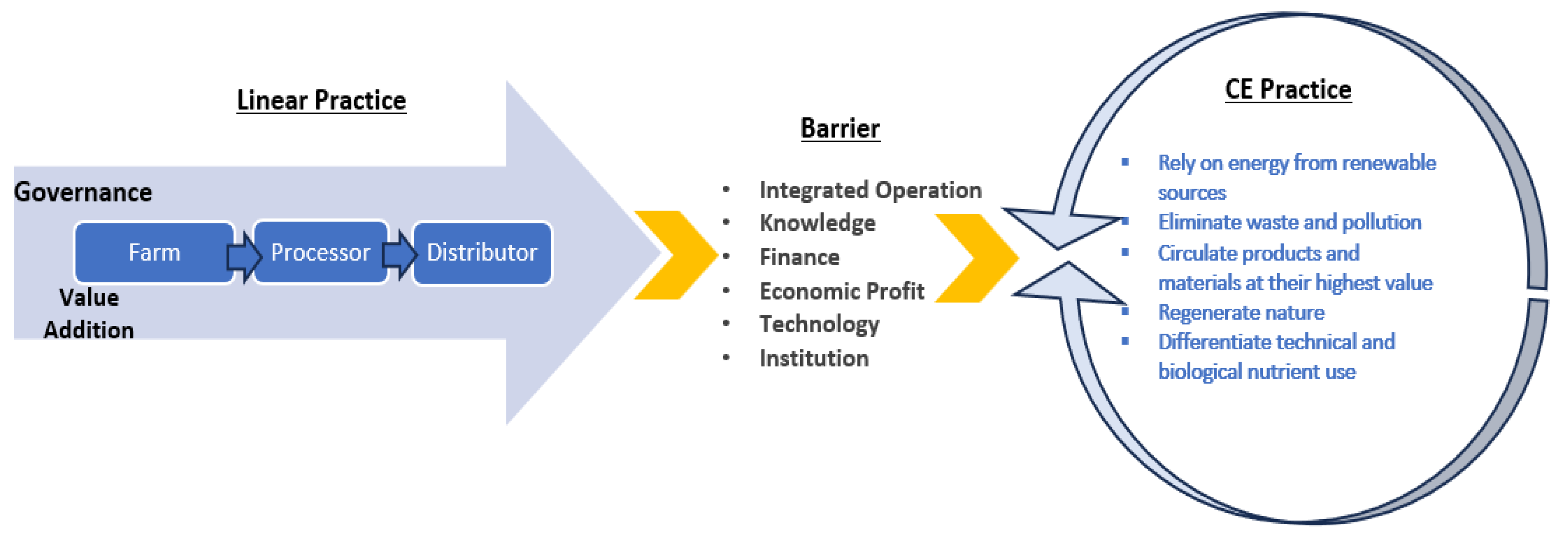
2.3. Development of a Framework for Assessing Circular Agri-Food Value Chains in Developing Countries
3. Methodology
4. Analysis
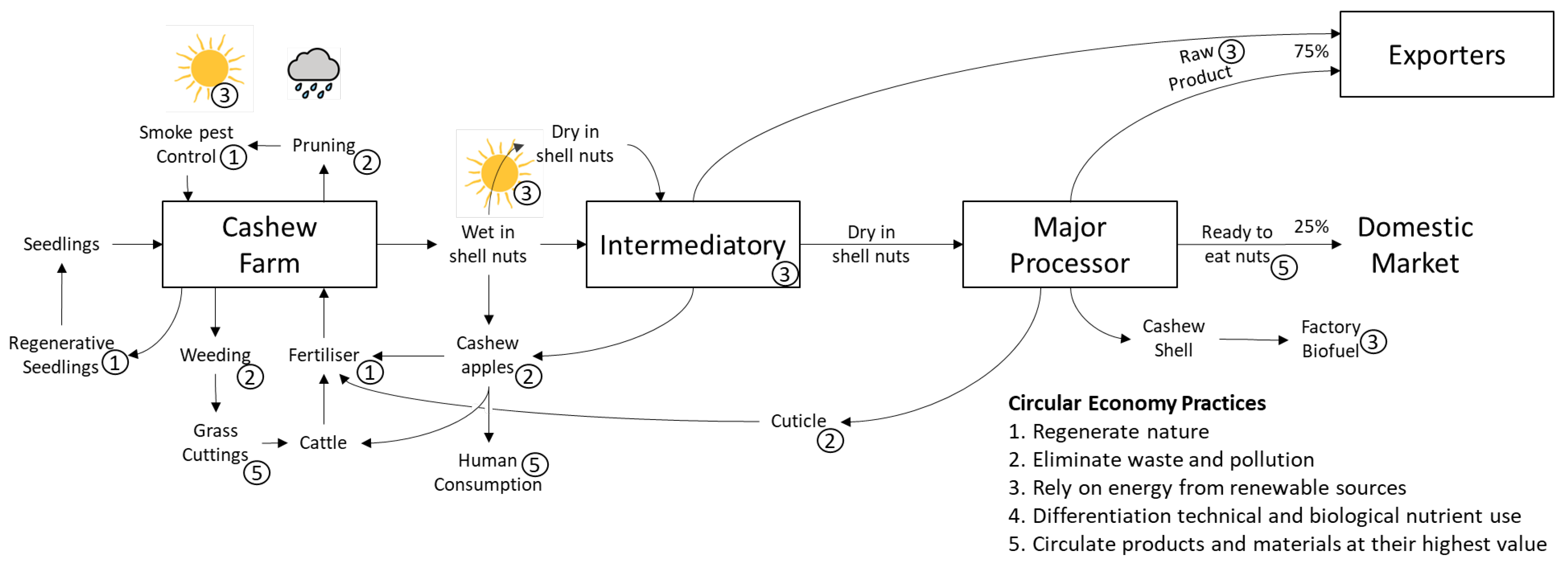
4.1. Cashew Value Chain Practice
4.2. Identification of CE Principles in Cashew Value Chain
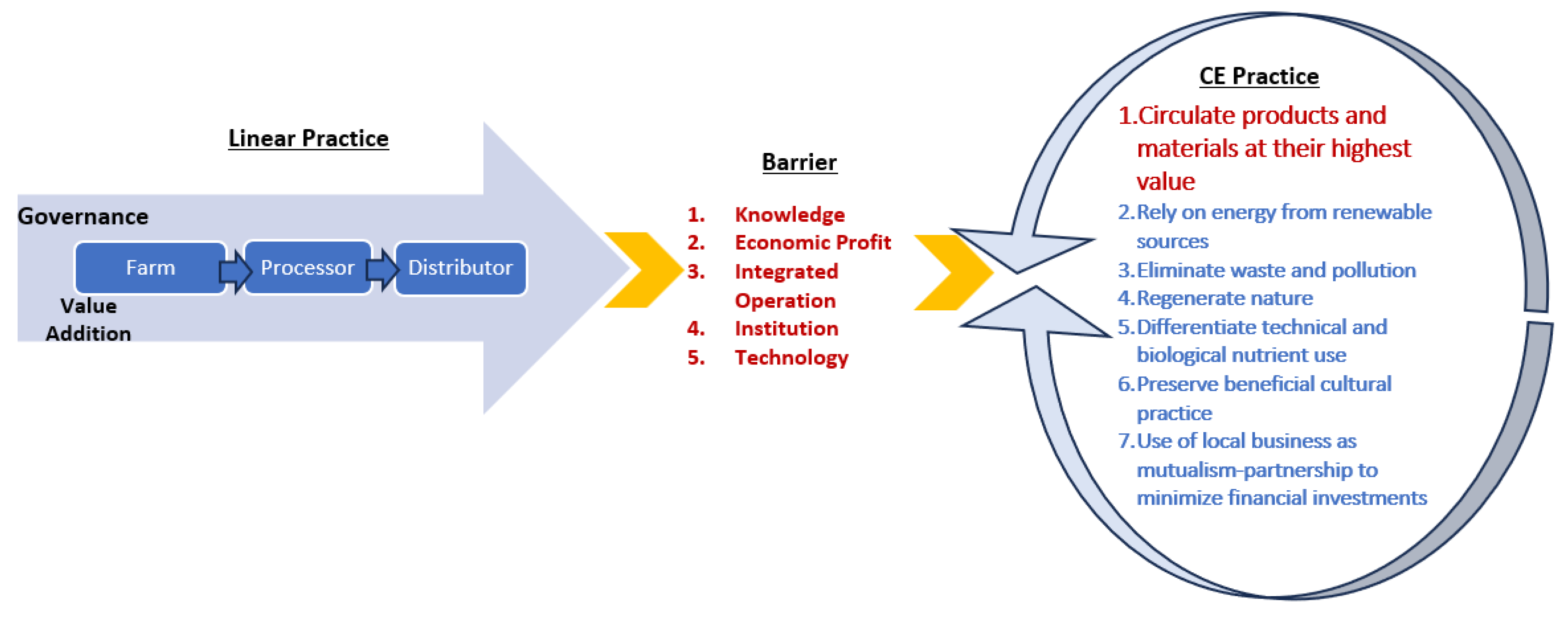
4.3. Identification of CE Barriers in Cashew Value Chain
5. Discussion
6. Conclusions
Author Contributions
Funding
Institutional Review Board Statement
Informed Consent Statement
Data Availability Statement
Acknowledgments
Conflicts of Interest
References
- Despoudi, S.; Sivarajah, U.; Dora, M. From Linear to Circular Food Supply Chains: Achieving Sustainable Change; Springer International Publishing: Cham, Switzerland, 2021; ISBN 978-3-030-72672-0. [Google Scholar]
- Hidayati, D.R.; Garnevska, E.; Childerhouse, P. Sustainable Agrifood Value Chain—Transformation in Developing Countries. Sustainability 2021, 13, 12358. [Google Scholar] [CrossRef]
- Zocca, R.O.; Gaspar, P.D.; da Silva, P.D.; Nunes, J.; de Andrade, L.P. Introduction to Sustainable Food Production. In Sustainable Food Systems from Agriculture to Industry; Elsevier: Amsterdam, The Netherlands, 2018; pp. 3–46. ISBN 978-0-12-811935-8. [Google Scholar]
- Mehmood, A.; Ahmed, S.; Viza, E.; Bogush, A. Drivers and Barriers towards Circular Economy in Agri-food Supply Chain A Review. Bus. Strategy Dev. 2021, 4, 465–481. [Google Scholar] [CrossRef]
- Hofstetter, J.S.; De Marchi, V.; Sarkis, J.; Govindan, K.; Klassen, R.; Ometto, A.R.; Spraul, K.S.; Bocken, N.; Ashton, W.S.; Sharma, S.; et al. From Sustainable Global Value Chains to Circular Economy—Different Silos, Different Perspectives, but Many Opportunities to Build Bridges. Circ. Econ. Sustain. 2021, 1, 21–47. [Google Scholar] [CrossRef] [PubMed]
- Ellen MacArthur Foundation. Delivering the Circular Economy: A Toolkit for Policymakers; Ellen MacArthur Foundation: Cowes, UK, 2015; p. 177. [Google Scholar]
- Groenewald, E.S.; Espinosa-Jaramillo, M.T.; Garg, A.; Pipalia, K.D.; Umasekar, V.; Groenewald, C.A. Circular Economy Strategies in Supply Chain Management: Towards Zero Waste. Power Syst. Technol. 2024, 48, 464–480. [Google Scholar] [CrossRef]
- World Bank. Worldbank_2018_Working with Smallholders: A Handbook for Firms Building Sustainable Supply Chains; World Bank: Washington, DC, USA, 2019. [Google Scholar]
- Liu, J.; Feng, Y.; Zhu, Q.; Sarkis, J. Green Supply Chain Management and the Circular Economy: Reviewing Theory for Advancement of Both Fields. Int. J. Phys. Dist. Log. Manag. 2018, 48, 794–817. [Google Scholar] [CrossRef]
- Chiaraluce, G.; Bentivoglio, D.; Finco, A. Circular Economy for a Sustainable Agri-Food Supply Chain: A Review for Current Trends and Future Pathways. Sustainability 2021, 13, 9294. [Google Scholar] [CrossRef]
- Wang, B.; Luo, W.; Zhang, A.; Tian, Z.; Li, Z. Blockchain-Enabled Circular Supply Chain Management: A System Architecture for Fast Fashion. Comput. Ind. 2020, 123, 103324. [Google Scholar] [CrossRef]
- Miranda, B.V.; Monteiro, G.F.A.; Rodrigues, V.P. Circular Agri-Food Systems: A Governance Perspective for the Analysis of Sustainable Agri-Food Value Chains. Technol. Forecast. Soc. Change 2021, 170, 120878. [Google Scholar] [CrossRef]
- Gong, Y.; Wang, Y.; Frei, R.; Wang, B.; Zhao, C. Blockchain Application in Circular Marine Plastic Debris Management. Ind. Mark. Manag. 2022, 102, 164–176. [Google Scholar] [CrossRef]
- Fan, W.; Dong, X.; Wei, H.; Weng, B.; Liang, L.; Xu, Z.; Wang, X.; Wu, F.; Chen, Z.; Jin, Y.; et al. Is It True That the Longer the Extended Industrial Chain, the Better the Circular Agriculture? A Case Study of Circular Agriculture Industry Company in Fuqing, Fujian. J. Clean. Prod. 2018, 189, 718–728. [Google Scholar] [CrossRef]
- Kapoor, R.; Ghosh, P.; Kumar, M.; Sengupta, S.; Gupta, A.; Kumar, S.S.; Vijay, V.; Kumar, V.; Kumar Vijay, V.; Pant, D. Valorization of Agricultural Waste for Biogas Based Circular Economy in India: A Research Outlook. Bioresour. Technol. 2020, 304, 123036. [Google Scholar] [CrossRef] [PubMed]
- Kusumowardani, N.; Tjahjono, B.; Lazell, J.; Bek, D.; Theodorakopoulos, N.; Andrikopoulos, P.; Priadi, C.R. A Circular Capability Framework to Address Food Waste and Losses in the Agri-Food Supply Chain: The Antecedents, Principles and Outcomes of Circular Economy. J. Bus. Res. 2022, 142, 17–31. [Google Scholar] [CrossRef]
- Silvestri, C.; Silvestri, L.; Piccarozzi, M.; Ruggieri, A. Toward a Framework for Selecting Indicators of Measuring Sustainability and Circular Economy in the Agri-Food Sector: A Systematic Literature Review. Int. J. Life Cycle Assess. 2022, 29, 1446–1484. [Google Scholar] [CrossRef]
- Vrolijk, H.; Reijs, J.; Dijkshoorn-Dekker, M. Towards Sustainable and Circular Farming in the Netherlands: Lessons from the Socio-Economic Perspective; Wageningen University and Research: Wageningen, The Netherlands, 2020. [Google Scholar]
- Zhang, A.; Wang, J.X.; Farooque, M.; Wang, Y.; Choi, T.-M. Multi-Dimensional Circular Supply Chain Management: A Comparative Review of the State-of-the-Art Practices and Research. Transp. Res. Part E Logist. Transp. Rev. 2021, 155, 102509. [Google Scholar] [CrossRef]
- Directorate General of Estate Crops, Ministry of Agriculture. Tree Crop Estate Statistics of Indonesia 2018–2020: Cashew Nuts; Ministry of Agriculture of Indonesia: Jakarta, Indonesia, 2019. [Google Scholar]
- President Republic Indonesia. Regulation Presidential Regulation of Republic Indonesia No 44; President of the Republic of Indonesia: Jakarta, Indonesia, 2016. [Google Scholar]
- Directorate General of Plantation. Technical Guide for Cashew Nuts Development; Directorate General of Plantation: Jakarta, Indonesia, 2012. [Google Scholar]
- United Nations. Commodities at a Glance Special Issue on Cashew Nuts; United Nations: Geneva, Switzerland, 2021; ISBN 978-92-1-005383-9. [Google Scholar]
- ACi. A Value Chain Analysis of the Cashew Sector in Ghana; Technische Zusammenarbeit GmbH (GTZ); FAO: Rome, Italy, 2010. [Google Scholar]
- CBI. Exporting Cashew Nuts to Europe; CBI: The Hague, The Netherlands, 2016. [Google Scholar]
- Dendena, B.; Corsi, S. Cashew, from Seed to Market: A Review. Agron. Sustain. Dev. 2014, 34, 753–772. [Google Scholar] [CrossRef]
- Hidayati, D.R.; Garnevska, E.; Childerhouse, P. Enabling Sustainable Agrifood Value Chain Transformation in Developing Countries. J. Clean. Prod. 2023, 395, 136300. [Google Scholar] [CrossRef]
- Hidayati, D.R.; Garnevska, E.; Ramilan, T. Assessing Smallholders’ Heterogeneity towards Sustainable Agrifood Value Chain in Developing Countries. BFJ 2023, 125, 4307–4334. [Google Scholar] [CrossRef]
- Domenech, T.; Stegemann, J.A. Chapter 2: The Circular Economy: Concept, Tools and Implementation. In Life Cycle Assessment: A Metric for The Circular Economy; Royal Society of Chemistry: London, UK, 2021; pp. 27–53. [Google Scholar]
- Ghisellini, P.; Cialani, C.; Ulgiati, S. A Review on Circular Economy: The Expected Transition to a Balanced Interplay of Environmental and Economic Systems. J. Clean. Prod. 2016, 114, 11–32. [Google Scholar] [CrossRef]
- McLaren, S.J. Chapter 15: Linking Life Cycle Assessment to the Wider Circular Economy. In Life Cycle Assessment: A Metric for The Circular Economy; Royal Society of Chemistry: London, UK, 2021; pp. 358–374. [Google Scholar]
- Graedel, T.E.; Lifset, R.J. Industrial Ecology’s First Decade. In Taking Stock of Industrial Ecology; Clift, R., Druckman, A., Eds.; Springer: Cham, Switzerland, 2016; pp. 3–20. [Google Scholar]
- McDonough, W.; Braungart, M. The Upcycle: Beyond Sustainability—Designing for Abundance; North Point Press: New York, NY, USA, 2013. [Google Scholar]
- McDonough, W.; Braungart, M. Cradle to Cradle: Remarking the Way We Make Things; North Point Press: New York, NY, USA, 2002. [Google Scholar]
- Ellen MacArthur Foundation. Towards the Circular Economy: Economic and Business Rationale for an Accelerated Transition; Ellen MacArthur Foundation: Cowes, UK, 2013. [Google Scholar]
- Kirchherr, J.; Reike, D.; Hekkert, M. Conceptualizing the Circular Economy: An Analysis of 114 Definitions. Resour. Conserv. Recycl. 2017, 127, 221–232. [Google Scholar] [CrossRef]
- Merli, R.; Preziosi, M.; Acampora, A. How Do Scholars Approach the Circular Economy? A Systematic Literature Review. J. Clean. Prod. 2018, 178, 703–722. [Google Scholar] [CrossRef]
- Korhonen, J.; Nuur, C.; Feldmann, A.; Birkie, S.E. Circular Economy as an Essentially Contested Concept. J. Clean. Prod. 2018, 175, 544–552. [Google Scholar] [CrossRef]
- Helander, H.; Petit-Boix, A.; Leipold, S.; Bringezu, S. How to Monitor Environmental Pressures of a Circular Economy: An Assessment of Indicators. J. Ind. Ecol. 2019, 23, 1278–1291. [Google Scholar] [CrossRef]
- Ageron, B.; Gunasekaran, A.; Spalanzani, A. Sustainable Supply Management: An Empirical Study. Int. J. Prod. Econ. 2012, 140, 168–182. [Google Scholar] [CrossRef]
- Seuring, S.; Müller, M. From a Literature Review to a Conceptual Framework for Sustainable Supply Chain Management. J. Clean. Prod. 2008, 16, 1699–1710. [Google Scholar] [CrossRef]
- Srivastava, S.K. Green Supply-Chain Management: A State-of-the-Art Literature Review. Int. J. Manag. Rev. 2007, 9, 53–80. [Google Scholar] [CrossRef]
- Zink, T.; Geyer, R. Circular Economy Rebound. J. Ind. Ecol. 2017, 21, 593–602. [Google Scholar] [CrossRef]
- Ellen MacArthur Foundation. Why Renewable Energy Infrastructure Needs to Be Built Using a Circular Economy Approach; Ellen MacArthur Foundation: Cowes, UK, 2023. [Google Scholar]
- Hidayati, D.R.; Garnevska, E.; Childerhouse, P. Transforming Developing Countries Agrifood Value Chains. Int. J. Food Syst. Dyn. 2021, 12, 358–374. [Google Scholar] [CrossRef]
- Altenburg, T. Governance Patterns in Value Chains and Their Development Impact. Eur. J. Dev. Res. 2006, 18, 498–521. [Google Scholar] [CrossRef]
- Gereffi, G.; Humphrey, J.; Sturgeon, T. The Governance of Global Value Chains. Rev. Int. Political Econ. 2005, 12, 78–104. [Google Scholar] [CrossRef]
- Trienekens, J.H. Agricultural Value Chains in Developing Countries A Framework for Analysis. Int. Food Agribus. Manag. Rev. 2011, 14, 32. [Google Scholar]
- Lazzarini, S.; Chaddad, F.; Cook, M. Integrating Supply Chain and Network Analyses: The Study of Netchains. J. Chain. Netw. Sci. 2001, 1, 7–22. [Google Scholar] [CrossRef]
- Liu, Y.; Garnevska, E.; Shadbolt, N. The Role of Agriculture Cooperatives in Green Agri-Food Value Chains in China: Cases in Shandong Province. Sustainability 2025, 17, 7343. [Google Scholar] [CrossRef]
- Collins, R. Value Chain Management and Postharvest Handling. In Postharvest Handling; Elsevier: Amsterdam, The Netherlands, 2014; pp. 123–145. ISBN 978-0-12-408137-6. [Google Scholar]
- Kaplinsky, R.; Morris, M. A Handbook for Value Chain Research; FAO: Rome, Italy, 2000; p. 113. [Google Scholar]
- Sjauw-Koen-Fa, A.R.; Blok, V.; Omta, O.S.W.F. Critical Success Factors for Smallholder Inclusion in High Value-Adding Supply Chains by Food & Agribusiness Multinational Enterprises. Int. Food Agribus. Manag. Rev. 2016, 19, 83–112. [Google Scholar]
- FAO. Agrifood Market and Value Chains. In Rural Development Report; FAO: Rome, Italy, 2016. [Google Scholar]
- Maspaitella, M.; Garnevska, E.; Siddique, M.I.; Shadbolt, N. Towards High Value Markets: A Case Study of Smallholder Vegetable Farmers in Indonesia. Int. Food Agribus. Manag. Rev. 2018, 21, 73–88. [Google Scholar] [CrossRef]
- FAO. Developing Sustainable Food Value Chains: Guiding Principles; FAO: Rome, Italy, 2014; ISBN 978-92-5-108481-6. [Google Scholar]
- Vlajic, J.V.; Mijailovic, R.; Bogdanova, M. Creating Loops with Value Recovery: Empirical Study of Fresh Food Supply Chains. Prod. Plan. Control 2018, 29, 522–538. [Google Scholar] [CrossRef]
- Nattassha, R.; Handayati, Y.; Simatupang, T.M.; Siallagan, M. Understanding Circular Economy Implementation in the Agri-Food Supply Chain: The Case of an Indonesian Organic Fertiliser Producer. Agric. Food Secur. 2020, 9, 10. [Google Scholar] [CrossRef]
- Tanveer, U.; Ishaq, S.; Gough, A. Circular Economy in Agri-Food Sector: Food Waste Management Perspective. In Business Systems & Operations; Environmental Footprints and Eco-design of Products and Processes; Springer: Singapore, 2021; pp. 55–75. ISBN 978-981-16-3791-9. [Google Scholar]
- Mor, R.S.; Panghal, A.; Kumar, V. (Eds.) Challenges and Opportunities of Circular Economy in Agri-Food Sector: Rethinking Waste; Environmental Footprints and Eco-design of Products and Processes; Springer: Singapore, 2021; ISBN 978-981-16-3790-2. [Google Scholar]
- Abbate, S.; Centobelli, P.; Cerchione, R.; Giardino, G.; Passaro, R. Coming out the Egg: Assessing the Benefits of Circular Economy Strategies in Agri-Food Industry. J. Clean. Prod. 2023, 385, 135665. [Google Scholar] [CrossRef]
- UNDP. Joint Initiative to Upgrade Agricultural Circular Businesses in Viet Nam. Available online: https://www.undp.org/vietnam/press-releases/joint-initiative-upgrade-agricultural-circular-businesses-viet-nam (accessed on 19 December 2025).
- Cherubin, M.R.; Bordonal, R.O.; Castioni, G.A.; Guimarães, E.M.; Lisboa, I.P.; Moraes, L.A.A.; Menandro, L.M.S.; Tenelli, S.; Cerri, C.E.P.; Karlen, D.L.; et al. Soil Health Response to Sugarcane Straw Removal in Brazil. Ind. Crops Prod. 2021, 163. [Google Scholar] [CrossRef]
- Kementrian Pertanian. Outlook Komoditas Perkebunan Jambu Mete; Pusat Data dan Sistem Informasi Pertanian kementrian Pertanian: Jakarta, Indonesia, 2022; pp. 1–87. [Google Scholar]
- Plantation Agency. Strategic Plan of East Java Plantation Agency 2014-2019 (Rencana Strategis (RENSTRA) Dinas Perkebunan Provinsi Jawa Timur Tahun 2014–2019); Plantation Office of East Java Province: Surabaya, Indonesia, 2014. [Google Scholar]
- Susanto, E.B. Eksplorasi Tanaman Jambu Mete (Annacardium occidentale L.) Pada Beberapa Daerah Sentra Di Pulau Madura). J. Produksi Tanam. 2018, 6, 1048–1057. [Google Scholar]
- Statistics Indonesia Sumenep Regency. Plantation Area in Sumenep Regency (Thousand Ha) in 2024; BPS-Statistics Indonesia BPS-Statistics Indonesia Sumenep Regency: Sumenep, Indonesia, 2024. [Google Scholar]
- Cresswell, J.W. Research Design: Qualitative, Quantitative, and Mixed Methods Approaches, 4th ed.; SAGE Publications, Inc.: Thousand Oaks, CA, USA, 2014. [Google Scholar]
- Yin, R.K. Case Study Research: Design and Methods, 4th ed.; Sage: Thousand Oaks, CA, USA, 2009. [Google Scholar]
- Zikmund, W.G.; Babin, B.J.; Car, J.C.; Griffin, M. Editing and Coding: Transforming Raw Data. In Business Research Methods; South Western Cengage Learning: Toronto, ON, Canada, 2010; pp. 461–484. [Google Scholar]
- Aslam, N. Exploring the Potential of Cashew Waste for Food and Health Applications- A Review. Future Foods 2024, 9, 100319. [Google Scholar] [CrossRef]
- Patade, M.A.; Gaikwad, S.T.; Pathare, M.; Nikhade, Y. Utilization of Cashew Nut Waste: Cashew Apple and Shell. Int. J. Chem. Stud. 2020, 8, 2076–2078. [Google Scholar] [CrossRef]
- Pathaveerat, S. The Potential of Cashew Nut Shell Waste in Charcoal Briquettes after Producing Cashew Nut Shell Liquid through Cold Extraction. Results Eng. 2024, 23, 102579. [Google Scholar] [CrossRef]
- Solomon, N.O.; Simpa, P.; Adenekan, O.A.; Obasi, S.C. Circular Economy Principles and Their Integration into Global Supply Chain Strategies. Financ. Account. Res. J. 2024, 6, 747–762. [Google Scholar] [CrossRef]
- Bastos, F.; Tubino, M. The Use of the Liquid from Cashew Nut Shells as an Antioxidant in Biodiesel. J. Braz. Chem. Soc. 2017, 28, 747–755. [Google Scholar] [CrossRef]
- Filgueiras, H.A.C.; Alves, R.E.; Mosca, J.L.; Menezes, J.B. Cashew Apple for Fresh Consumption: Research on Harvest and Postharvest Technology in Brazil. Acta Hortic. 1999, 485, 155–160. [Google Scholar] [CrossRef]
- Darkunde, A.; Kolhe, S.; Somvanshi, S.; Nibe, R.L. Applications and Extraction of Cashew Nut Shell Liquid from Cashew Nut Shell. Int. J. Adv. Res. Sci. Commun. Technol. 2022, 2, 226–236. [Google Scholar]
- Bowler, I. Sustainable Farming Systems. In The Sustainability of Rural Systems; Springer: Dordrecht, The Netherlands, 2002; pp. 169–187. ISBN 978-90-481-5978-9. [Google Scholar]



| Source | Principle |
|---|---|
| Ellen MacArthur Foundation [35] | Design out waste |
| Build resilience through diversity | |
| Rely on energy from renewable sources | |
| Think in ‘systems’ | |
| Waste is food | |
| Ellen MacArthur Foundation [6] | Preserve and enhance natural capital by controlling finite stocks and balancing renewable resource flows |
| Optimize resource yields by circulating products, components, and materials at the highest utility at all times in both technical and biological cycles | |
| Foster system effectiveness by revealing and designing out negative externalities |
| No. | Product | Total Weigh (Gram) | Key Products | Waste Utilization |
|---|---|---|---|---|
| 1 | Cashew fruit | 1 kg | 10% nuts (around 100 g, 16–18 nuts) 90% cashew apples (around 900 g | Local consumption, cattle feed, thrown away |
| 2 | Cashew nuts | 1 kg | 30% shelled nuts (around 300 g) 70% cashew shells (around 700 g) | Fuel source |
| CE Principles | Farmers | Intermediaries | Key Processor | Exporter (Raw Material Exporter) |
|---|---|---|---|---|
| Eliminate waste and pollution |
| N/A |
| N/A |
| Circulate products and material at the highest value |
| Unstandardized raw material | Value-adding processes for domestic consumption (limited national standard) | Export standard products (raw material) |
| Regenerate nature |
| N/A | N/A | N/A |
| Rely on energy from renewable sources |
| Use of sun exposure to dry cashew nuts |
| Gunny sack as main cashew nuts packaging |
| Differentiate technical and biological nutrients |
| N/A | N/A | N/A |
| CE Principles | Practice | Key CE Players |
|---|---|---|
| *** | Farmers and processors |
| * | Processors and exporters |
| *** | Farmers |
| *** | Farmers and processors |
| *** | Farmers |
| Barriers | Barriers Level | Description |
|---|---|---|
| Knowledge | *** | Limited CE and sustainability awareness |
| Profit orientation | *** | Minimal value-adding activities |
| Integrated activities | *** | Limited vertical and horizontal governance |
| Technology | ** | Traditional technology that supports CE practices |
| Institution | *** | Limited farmer groups and governmental incentives |
| Finance | * | Minimal CE investment |
Disclaimer/Publisher’s Note: The statements, opinions and data contained in all publications are solely those of the individual author(s) and contributor(s) and not of MDPI and/or the editor(s). MDPI and/or the editor(s) disclaim responsibility for any injury to people or property resulting from any ideas, methods, instructions or products referred to in the content. |
© 2026 by the authors. Licensee MDPI, Basel, Switzerland. This article is an open access article distributed under the terms and conditions of the Creative Commons Attribution (CC BY) license.
Share and Cite
Garnevska, E.; Hidayati, D.R.; McLaren, S. Circularity in Agri-Food Value Chains in Developing Countries: A Case in Indonesia. Sustainability 2026, 18, 708. https://doi.org/10.3390/su18020708
Garnevska E, Hidayati DR, McLaren S. Circularity in Agri-Food Value Chains in Developing Countries: A Case in Indonesia. Sustainability. 2026; 18(2):708. https://doi.org/10.3390/su18020708
Chicago/Turabian StyleGarnevska, Elena, Dwi Ratna Hidayati, and Sarah McLaren. 2026. "Circularity in Agri-Food Value Chains in Developing Countries: A Case in Indonesia" Sustainability 18, no. 2: 708. https://doi.org/10.3390/su18020708
APA StyleGarnevska, E., Hidayati, D. R., & McLaren, S. (2026). Circularity in Agri-Food Value Chains in Developing Countries: A Case in Indonesia. Sustainability, 18(2), 708. https://doi.org/10.3390/su18020708