Contribution of Citizen Science to SDG 4: A Systematic Review of the Evaluation of Learning Outcomes in Citizen Science Projects in Compulsory Education

Abstract
1. Introduction
1.1. Potential of the CS in Formal Education
1.2. Challenges for the Inclusion of CS in Formal Education
1.3. Previous Revisions of the Use of CS in Formal Education
2. Methods
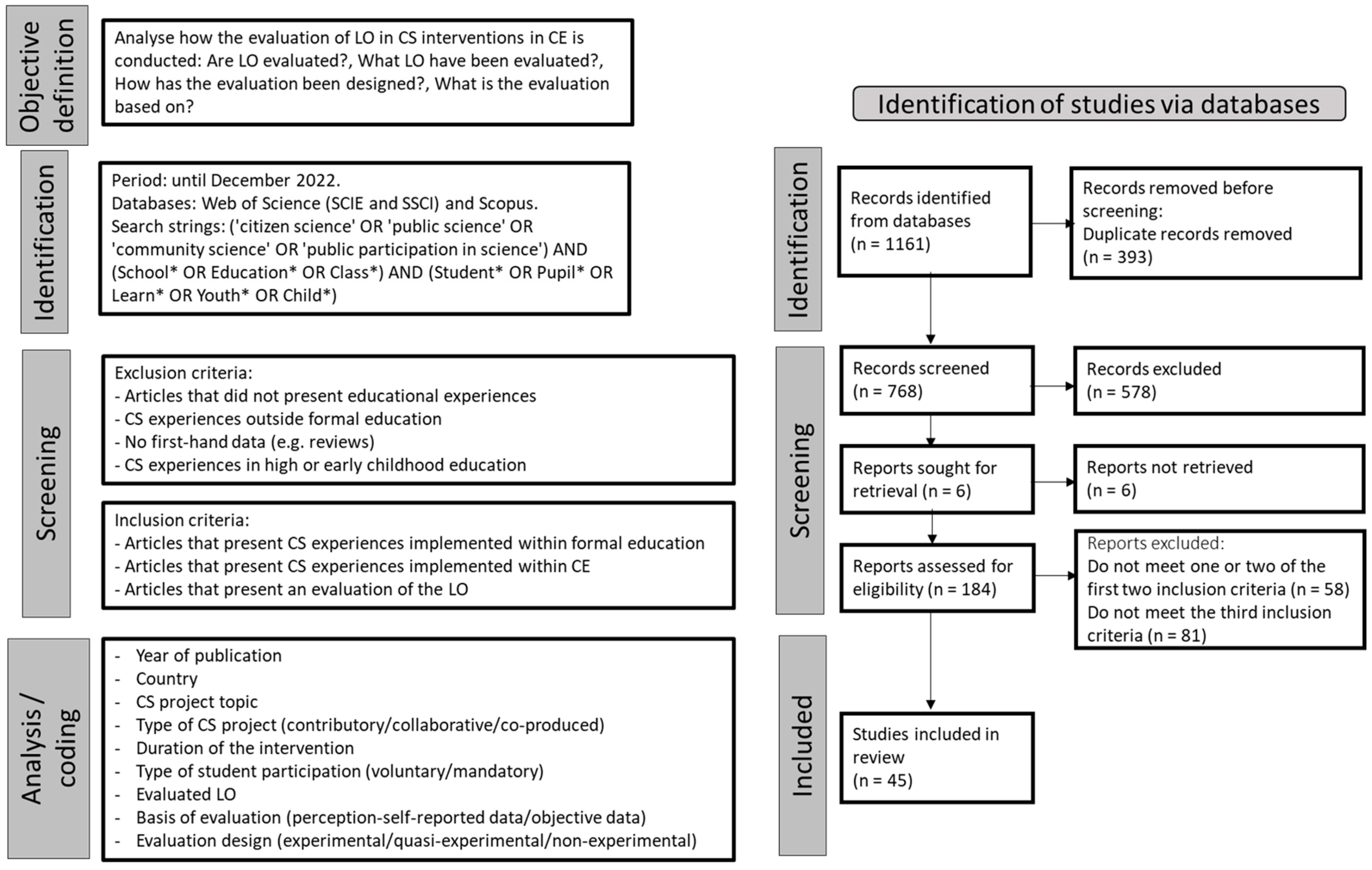
2.1. Search Strategy
2.2. Article Screening
- Articles that did not present educational experiences
- CS experiences outside formal education
- No first-hand data (e.g., reviews)
- CS experiences in high or early childhood education
- Articles that present CS experiences implemented within formal education
- Articles that present CS experiences implemented within CE (for each paper, the educational system of the country was considered, including it as CE or not)
- Articles that present an evaluation of the LO
2.3. Analysis and Coding
3. Results
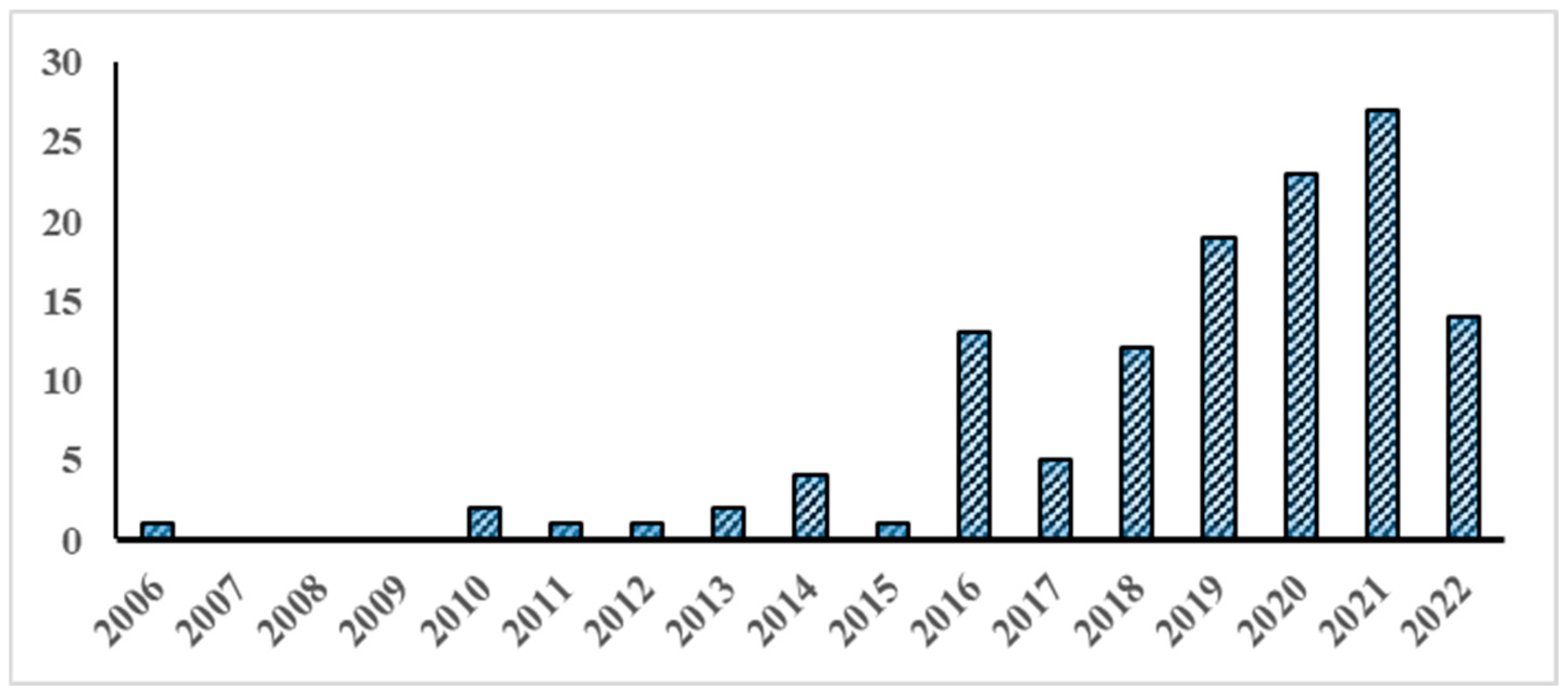
3.1. Characteristics of the CS Projects Analyzed
3.2. Evaluated LO
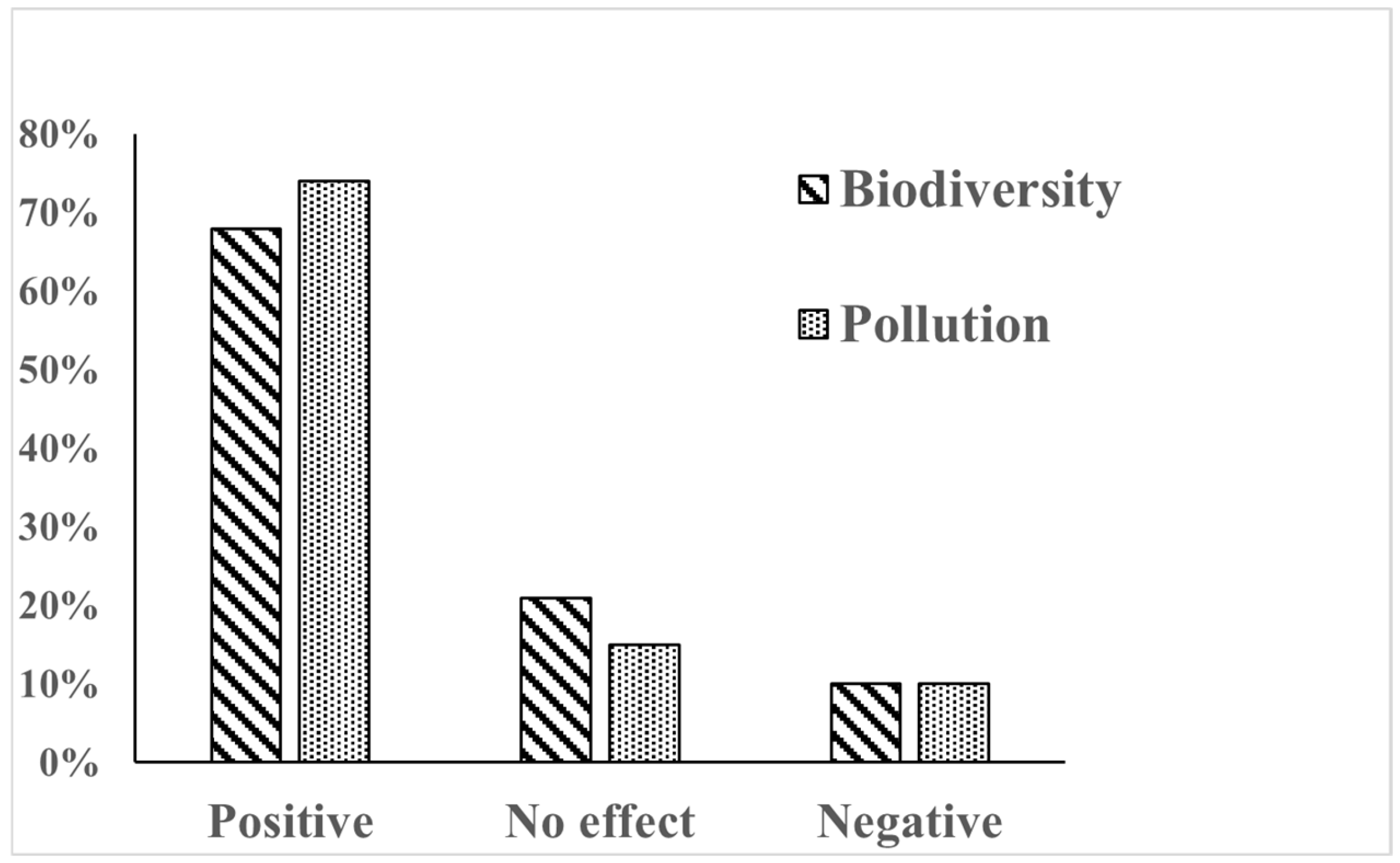
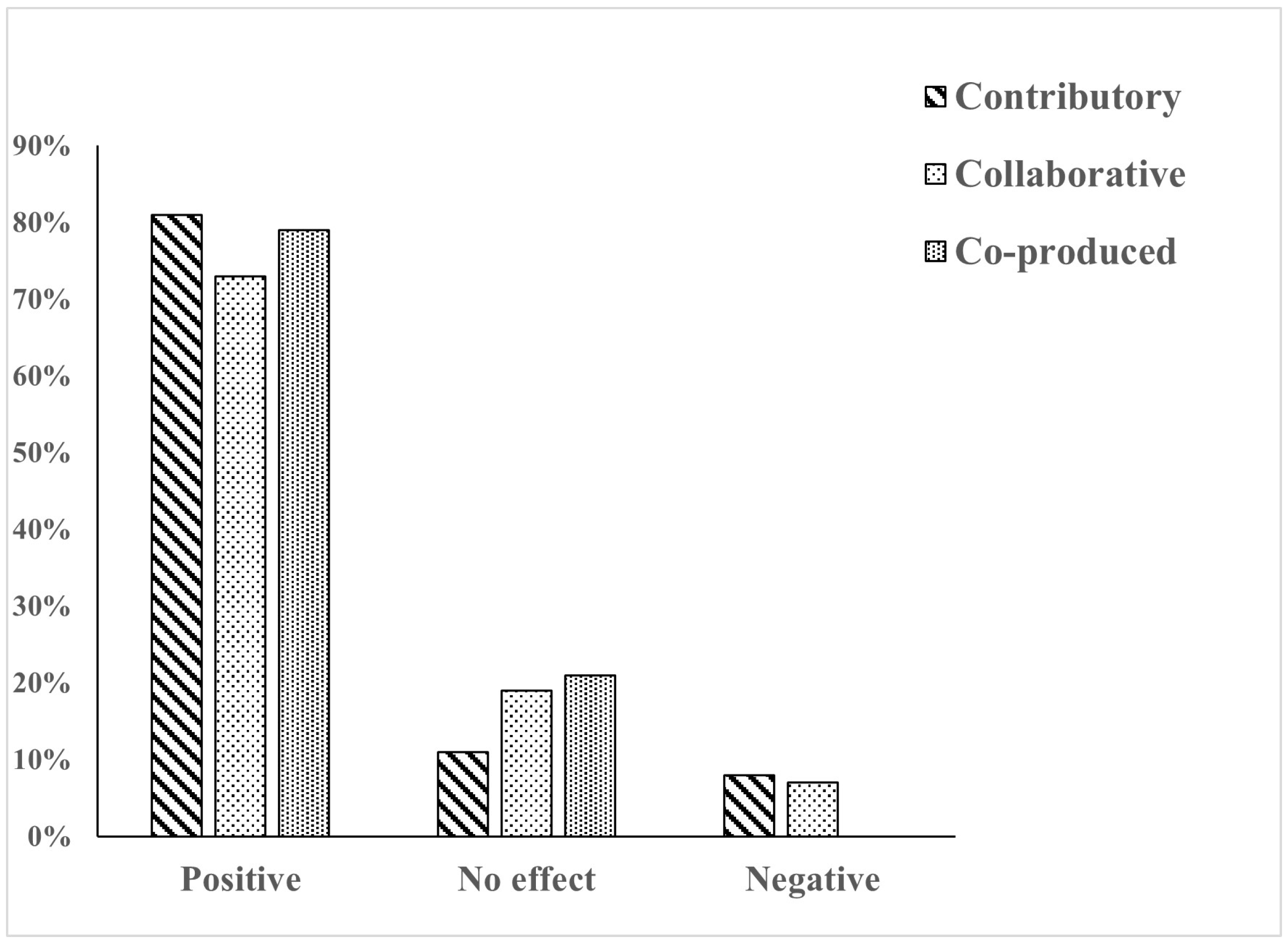
3.3. Reported LO by Study Topic and Type of Project (Contributory/Collaborative/Co-Produced)
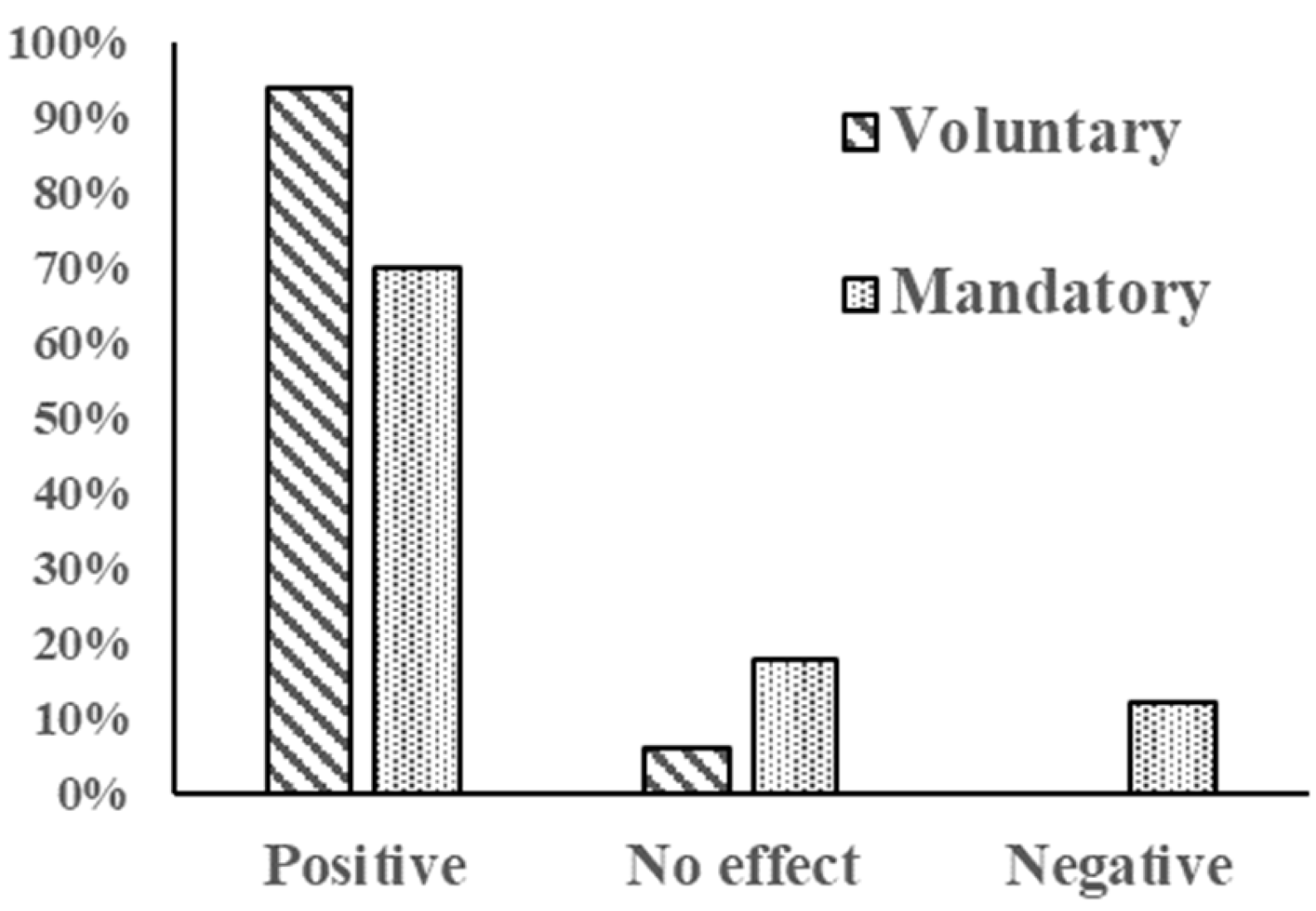
3.4. Reported LO by Type of Participation (Voluntary vs. Mandatory)
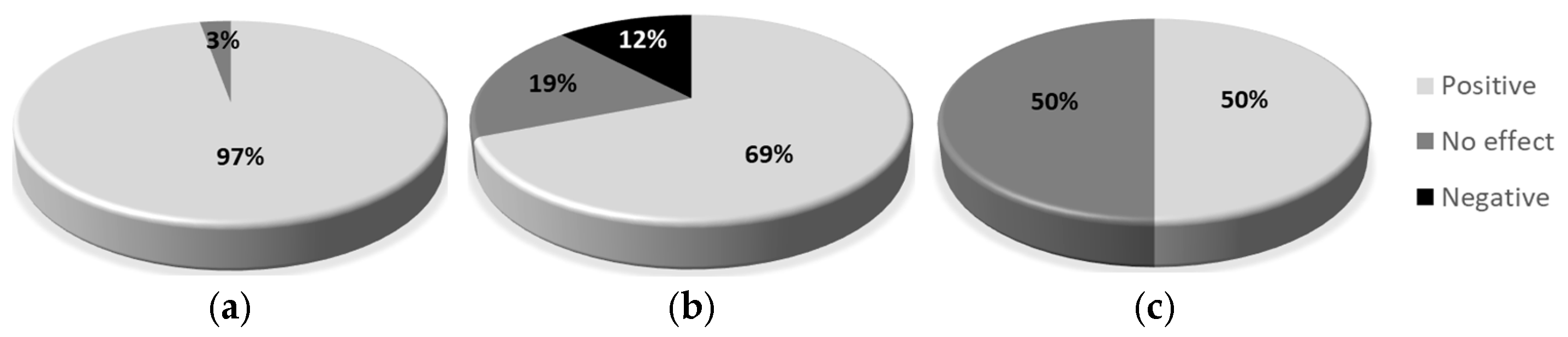
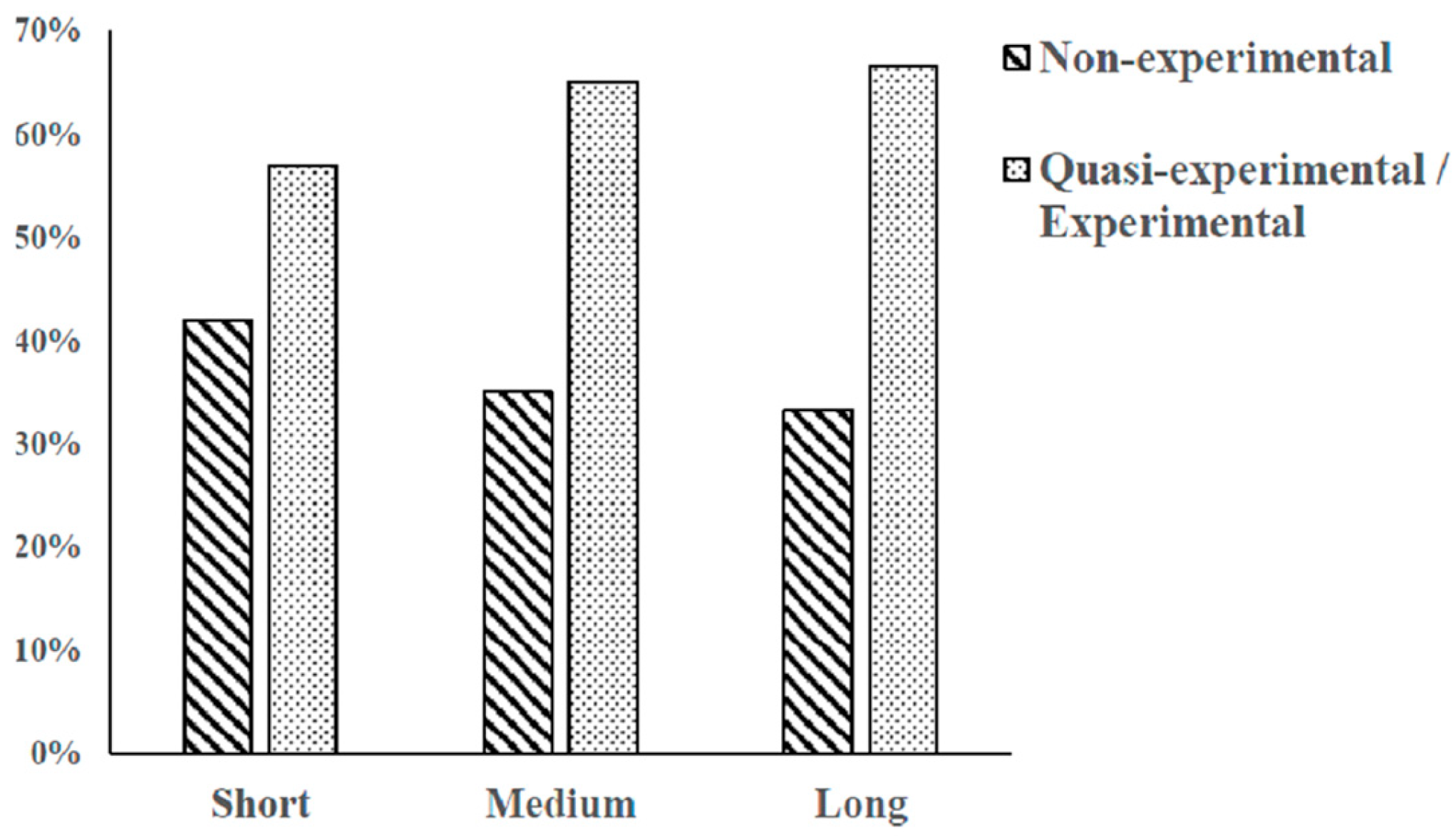
3.5. LO Reported by Evaluation Design
3.5.1. Results of the Evaluation of LO with a Non-Experimental Design
‘When analyzing the participants’ questionnaires, the frequency of response and possible biases must be taken into account........ In this case, the frequency of response is around 18%. It must be assumed that some teachers who respond to the questionnaire also encourage their students to do so, resulting in a certain bias based on mutual experiences. It can also be assumed that those teachers who enjoyed participating are more likely to respond to the questionnaire and encourage their students to do the same.’ [67] (pp. 5–6)‘The main limitation of our study was that we did not track actual learning outcomes but rather students’ perceptions and reports of what they had learned. As our study is based on the students’ self-described experiences, own interpretations, and self-reflection of what has happened, we are not able to assess the factual impact of our project in relation to their learning.’ [7] (p. 335)
3.5.2. Results of the Evaluation of LO with a Quasi-Experimental Design
3.5.3. Results of the Evaluation of LO with an Experimental Design
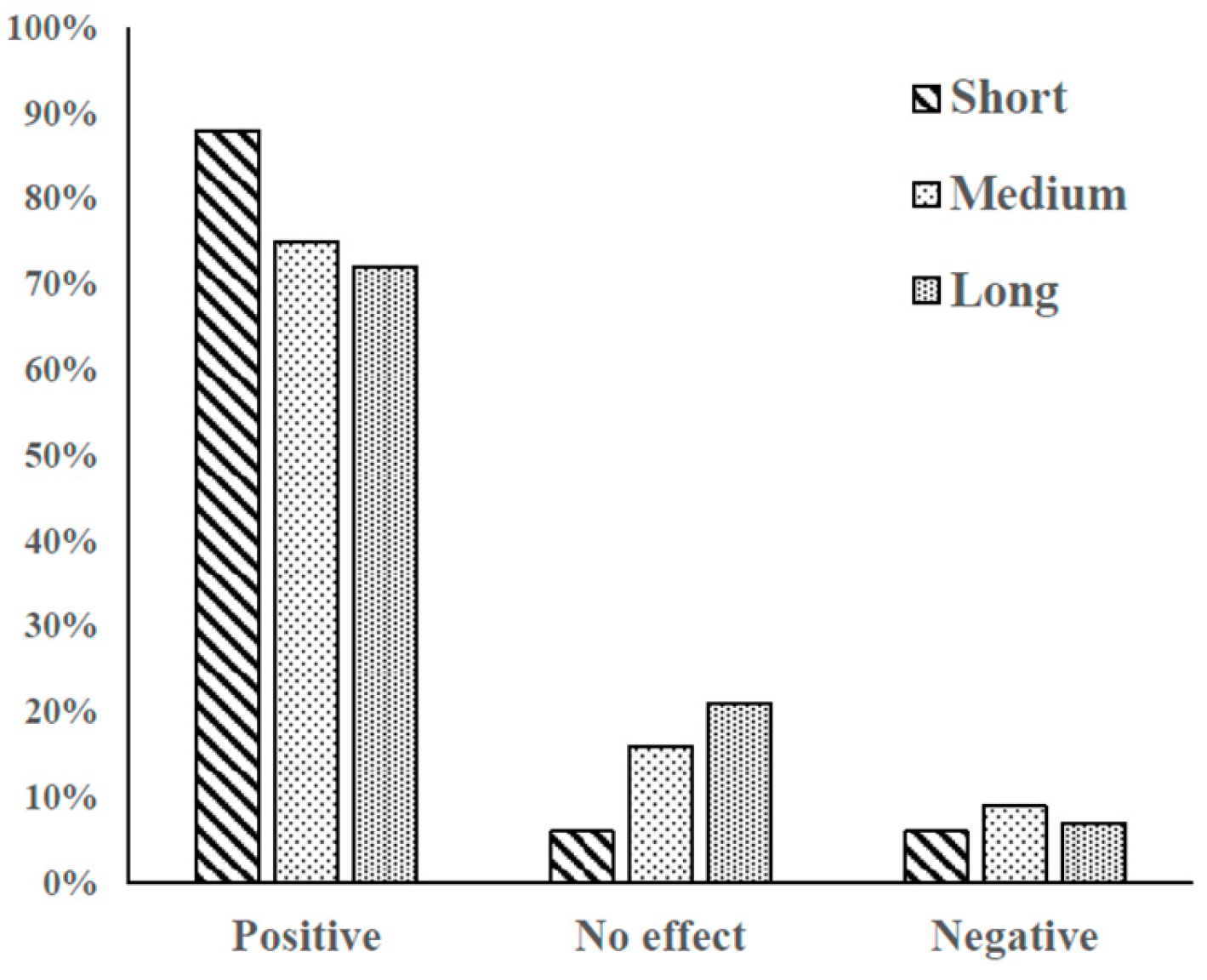
3.6. Reported LO by Duration of the Intervention
4. Discussion
4.1. Effects of the Type of Student Participation on LO Evaluation Results
4.2. Effects of the Evaluation Design on LO Evaluation Results
4.3. Evaluated LO
5. Conclusions and Recommendations
- The CS project has clear and well-defined learning objectives;
- The project design includes an LO evaluation system;
- Whole classes participate in the project;
- All participating students participate in the evaluation;
- The evaluation has an experimental design with pre-test, post-test, and control group;
- The evaluation excludes self-reported LO.
Funding
Acknowledgments
Conflicts of Interest
Abbreviations
| CS | Citizen Science |
| LO | Learning outcomes |
| CE | Compulsory education |
Appendix A
| Year | Authors | Journal | Volume (Issue) | Pages | Title |
| 2012 | Zoellick, B.; Nelson, S. J.; Schauffler, M. | Frontiers in Ecology and the Environment | 10(6) | 310–313 | Participatory science and education: bringing both views into focus. |
| 2014 | Hiller, S. E.; Kitsantas, A. | School Science and Mathematics | 114(6) | 302–311 | The effect of a horseshoe crab citizen science program on middle school student science performance and STEM career motivation |
| 2014 | Nicosia, K.; Daaram, S.; Edelman, B.; Gedrich, L.; He, E.; McNeilly, S.; Shenoy, V.; Velagapudi, A.; Wu, W.; Zhang, L.; et al. | Ecological Economics | 104 | 145–151 | Determining the willingness to pay for ecosystem service restoration in a degraded coastal watershed: A ninth grade investigation |
| 2016 | Grasser, S.; Schunko, C.; Vogl, C. R. | Journal of Ethnobiology and Ethnomedicine | 12 | 46 | Children as ethnobotanists: Methods and local impact of a participatory research project with children on wild plant gathering in the Grosses Walsertal Biosphere Reserve, Austria. |
| 2016 | Ruiz-Mallen, I.; Riboli-Sasco, L.; Ribrault, C.; Heras, M.; Laguna, D.; Perie, L. | Science Communication | 38(4) | 523–534 | Citizen science: Toward transformative learning |
| 2016 | Seifert, V. A.; Wilson, S.; Toivonen, S.; Clarke, B.; Prunuske, A. | Journal of Microbiology & Biology Education | 17(1) | 63–69 | Community partnership designed to promote lyme disease prevention and engagement in citizen science. |
| 2016 | Tosh, J.; James, K.; Rumsey, F.; Crookshank, A.; Dyer, R.; Hopkins, D. | Botanical Journal of the Linnean Society | 181(4) | 711–722 | Is DNA barcoding child’s play? Science education and the utility of DNA barcoding for the discrimination of UK tree species. |
| 2017 | Ballard, H. L.; Dixon, C. G.; Harris, E. M. | Biological Conservation | 208 | 65–75 | Youth-focused citizen science: Examining the role of environmental science learning and agency for conservation |
| 2017 | Weyhenmeyer, G. A.; Mackay, M.; Stockwell, J. D.; Thiery, W.; Grossart, H.; Augusto-Silva, P.B.; Baulch, H.M.; de Eyto, E.; Hejzlar, J.; Kangur, K.; et al. | Scientific Reports | 7 | 43890 | Citizen science shows systematic changes in the temperature difference between air and inland waters with global warming. |
| 2017 | Zarybnicka, M.; Sklenicka, P.; Tryjanowski, P. | PLOS Biology | 15(1) | e2001132 | A webcast of bird nesting as a state-of-the-art citizen science. |
| 2018 | Kelemen-Finan, J.; Scheuch, M.; Winter, S. | International Journal of Science Education | 40(17) | 2078–2098 | Contributions from citizen science to science education: An examination of a biodiversity citizen science project with schools in Central Europe |
| 2019 | Andersson-Sundén, E.; Gustavsson, C.; Hjalmarsson, A.; Jacewicz, M.; Lantz, M.; Marciniewski, P.; Ziemann, V.; Barker, A.; Lundén, K. | Nuclear Physics News | 29(2) | 25–28 | Citizen science and radioactivity |
| 2019 | Ellenburg, J.A.; Williford, C.J.; Rodriguez, S.L.; Andersen, P.C.; Turnipseed, A.A.; Ennis, C.A.; Basman, K.A.; Hatz, J.M.; Prince, J.C.; Meyers, D.H.; et al. | Atmospheric Environment-X | 4 | 100048 | Global ozone (GO3) project and AQTreks: Use of evolving technologies by students and citizen scientists to monitor air pollutants |
| 2019 | Fujiwara, Y.; Hite, R.; Wygant, H.; Paulsen, S. | Childhood Education | 95(2) | 53–59 | Engaging students in global citizen science: A U.S.-japan collaborative watershed project. |
| 2019 | Kermish-Allen, R.; Peterman, K.; Bevc, C. | Cultural Studies of Science Education | 14(3) | 627–641 | The utility of citizen science projects in K-5 schools: Measures of community engagement and student impacts |
| 2019 | Tarter, K.D.; Levy, C.E.; Yaglom, H.D.; Adams, L.E.; Plante, L.; Casal, M.G.; Gouge, D.H.; Rathman, R.; Stokka, D.; Weiss, J.; et al. | Journal of the American Mosquito Control Association | 35(1) | 11–18 | Using citizen science to enhance surveillance of Aedes aegypti in arizona, 2015–17. |
| 2019 | Walkinshaw, L. P.; Hecht, C.; Patel, A.; Podrabsky, M. | Journal of School Health | 89(8) | 653–661 | Training high school student "citizen scientists" to document school water access: A feasibility study. |
| 2020 | Aivelo, T.; Huovelin, S. | Environmental Education Research | 26(3) | 324–340 | Combining formal education and citizen science: a case study on students’ perceptions of learning and interest in an urban rat project |
| 2020 | Anderson, D.; Buntting, C.; Coton, M.; Luczak-Roesch, M.; Doyle, C.; Pierson, C.; Li, Y.J.; Glasson, B.; Brieseman, C.; Boucher, M.; Christenson, D. | Curriculum Matters | 16 | 38–59 | Using online citizen science to develop students’ science capabilities |
| 2020 | Gustavsson, C.; Andersson-Sunden, E.; Barker, A.; Hjalmarsson, A.; Lantz, M.; Lunden, K.; Pomp, S. | EPJ Web of Conferences | 239 | 25001 | Citizen science in radiation research |
| 2020 | Kocman, D.; Števanec, T.; Novak, R.; Kranjec, N. | Sustainability | 12(23) | 10213 | Citizen science as part of the primary school curriculum: A case study of a technical day on the topic of noise and health |
| 2020 | Maicas, S.; Fouz, B.; Figàs-Segura, À.; Zueco, J.; Rico, H.; Navarro, A.; Carbó, E.; Segura-García, J.; Biosca, E.G. | Frontiers in Microbiology | 11 | 564030 | Implementation of antibiotic discovery by student crowdsourcing in the valencian community through a service learning strategy |
| 2020 | Queiruga-Dios, M.; Lopez-Inesta, E.; Diez-Ojeda, M.; Consuelo Saiz-Manzanares, M.; Vazquez Dorrio, J. B. | Sustainability | 12(10) | 4283 | Citizen science for scientific literacy and the attainment of sustainable development goals in formal education. |
| 2020 | Schneiderhan-Opel, J.; Bogner, F. X. | Sustainability | 12(5) | 2036 | The relation between knowledge acquisition and environmental values within the scope of a biodiversity learning module. |
| 2020 | Spicer, H.; Nadolny, D.; Fraser, E. | Citizen Science: Theory and Practice | 5(1) | 14 | Going squirrelly: Evaluating educational outcomes of a curriculum-aligned citizen science investigation of non-native squirrels. |
| 2020 | Walter, A.; Klammsteiner, T.; Gassner, M.; Heussler, C. D.; Kapelari, S.; Schermer, M.; Insam, H. | Sustainability | 12(22) | 9574 | Black soldier fly school workshops as means to promote circular economy and environmental awareness. |
| 2021 | Antunes, P.; Novais, C.; Novais, A.; Grosso, F.; Ribeiro, T.G.; Mourao, J.; Perovic, S.U.; Rebelo, A.; Ksiezarek, M.; Freitas, A.R.; et al. | FEMS Microbiology Letters | 368(4) | fnab016 | MicroMundo@UPorto: An experimental microbiology project fostering student’s antimicrobial resistance awareness and personal and social development. |
| 2021 | Araujo, J. L.; Morais, C.; Paiva, J. C. | Journal of Baltic Science Education | 20(6) | 881–893 | Students’ attitudes towards science: The contribution of a citizen science project for monitoring coastal water quality and (micro)plastics |
| 2021 | Boaventura, D.; Neves, A. T.; Santos, J.; Pereira, P. C.; Luis, C.; Monteiro, A.; Cartaxana, A.; Hawkins, S.J.; Caldeira, M.F.; Ponces de Carvalho, A. | Frontiers in Marine Science | 8 | 675278 | Promoting ocean literacy in elementary school students through investigation activities and citizen science |
| 2021 | Bopardikar, A.; Bernstein, D.; McKenney, S. | Journal of Biological Education | 57(3) | 592–617 | Designer considerations and processes in developing school-based citizen-science curricula for environmental education |
| 2021 | Carson, S.; Rock, J.; Smith, J. | Frontiers in Education | 6 | 674883 | Sediments and seashores: A case study of local citizen science contributing to student learning and environmental citizenship |
| 2021 | Castell, N.; Grossberndt, S.; Gray, L.; Fredriksen, M. F.; Skaar, J. S.; Høiskar, B. A. K. | Frontiers in Climate | 3 | 639128 | Implementing citizen science in primary schools: Engaging young children in monitoring air pollution |
| 2021 | Fagan-Jeffries, E. P.; Austin, A. D. | Zootaxa | 4949(1) | 79–101 | Four new species of parasitoid wasp (Hymenoptera: Braconidae) described through a citizen science partnership with schools in regional South Australia. |
| 2021 | Lewis, R.; Carson, S. | New Zealand Journal of Educational Studies | 56(1) | 101–110 | Measuring science skills development in new zealand high school students after participation in citizen science using a DEVISE evaluation scale. |
| 2021 | Mnisi, B. E.; Geerts, S.; Smith, C.; Pauw, A. | Biological Conservation | 257 | 109087 | Nectar gardens on school grounds reconnect plants, birds and people |
| 2021 | Tucker, C. S.; Trepanier, J. C.; Blanchard, P. B.; Bush, E.; Jordan, J. W.; Schafer, M. J.; Nyman, J. A. | Bulletin of the American Meteorological Society | 102(6) | E1275–E1282 | Using tree-ring research to introduce students to geoscience fieldwork. |
| 2021 | Varaden, D.; Leidland, E.; Lim, S.; Barratt, B. | Environmental Research | 201 | 111536 | “I am an air quality scientist”—using citizen science to characterise school children’s exposure to air pollution. |
| 2021 | Williams, K. A.; Hall, T. E.; O’Connell, K. | Environmental Education Research | 27(7) | 1037–1053 | Classroom-based citizen science: Impacts on students’ science identity, nature connectedness, and curricular knowledge. |
| 2022 | Araujo, J. L.; Morais, C.; Paiva, J. C. | Chemistry Education Research and Practice | 23(1) | 100–112 | Student participation in a coastal water quality citizen science project and its contribution to the conceptual and procedural learning of chemistry |
| 2022 | Kane, F.; Abbate, J.; Landahl, E. C.; Potosnak, M. J. | Sensors | 22(3) | 1295 | Monitoring particulate matter with wearable sensors and the influence on student environmental attitudes |
| 2022 | Oturai, N. G.; Pahl, S.; Syberg, K. | Science of the Total Environment | 806 | 150914 | How can we test plastic pollution perceptions and behavior? A feasibility study with danish children participating in “the mass experiment” |
| 2022 | Rodríguez-Loinaz, G.; Ametzaga-Arregi, I.; Palacios-Agundez, I. | Journal of Biological Education | 58(3) | 609–625 | ICT Tools and Citizen Science: A Pathway to Promote Science Learning and Education for Sustainable Development in Schools. |
| 2022 | Scaini, C.; Peresan, A.; Tamaro, A.; Poggi, V.; Barnaba, C. | International Journal of Disaster Risk Reduction | 69 | 102755 | Can high-school students contribute to seismic risk mitigation? lessons learned from the development of a crowd-sourced exposure database. |
| 2022 | Tarin-Pello, A.; Suay-Garcia, B.; Marco-Crespo, E.; Galiana-Rosello, C.; Bueso-Bordils, J. I.; Perez-Gracia, M. | Frontiers in Microbiology | 13 | 959187 | Evaluation of knowledge about antibiotics and engagement with a research experience on antimicrobial resistance between pre-university and university students for five school years (2017–2021). |
| 2022 | Wichmann, C.S.; Fischer, D.; Geiger, S.M.; Honorato-Zimmer, D.; Knickmeier, K.; Kruse, K.; Sundermann, A.; Thiel, M. | Marine Policy | 141 | 105035 | Promoting pro-environmental behavior through citizen science? A case study with chilean schoolchildren on marine plastic pollution. |
Appendix B


Appendix C
| Evaluation Design | Study Topic | Type of Project | Duration | |||||||
| Biodiversity | Pollution | Others | Contributory | Collaborative | Co-Produced | Short | Medium | Long | No Data | |
| Non-experimental | 19% | 38% | 43% | 69% | 25% | 6% | 50% | 31% | 13% | 6% |
| Quasi-experimental | 40% | 32% | 28% | 60% | 32% | 8% | 40% | 36% | 8% | 16% |
| Experimental | 50% | 50% | --------- | 50% | 50% | --------- | 25% | --------- | 50% | 25% |
References
- OECD. Organization for Economic Co-Operation and Development. In PISA 2018 Evaluation and Analytical Framework, PISA; OECD Publishing: Paris, France, 2019; p. 305. [Google Scholar]
- George, R. A cross-domain analysis of change in students’ attitudes toward science and attitudes about the utility of science. Int. J. Sci. Educ. 2006, 28, 571–589. [Google Scholar] [CrossRef]
- Potvin, P.; Hasni, A. Analysis of the decline in interest towards school science and technology from grades 5 through 11. J. Sci. Educ. Technol. 2014, 23, 784–802. [Google Scholar] [CrossRef]
- Osborne, J.; Simon, S.; Collins, S. Attitudes towards science: A review of the literature and its implications. Int. J. Sci. Educ. 2003, 25, 1049–1079. [Google Scholar] [CrossRef]
- Williams, K.A.; Hall, T.E.; O’Connell, K. Classroom-based citizen science: Impacts on students’ science identity, nature connectedness, and curricular knowledge. Environ. Educ. Res. 2021, 27, 1037–1053. [Google Scholar] [CrossRef]
- National Research Council. Next Generation Science Standards: For States, By States; The National Academies Press: Washington, DC, USA, 2013. [Google Scholar]
- Aivelo, T.; Huovelin, S. Combining formal education and citizen science: A case study on students’ perceptions of learning and interest in an urban rat project. Environ. Educ. Res. 2020, 26, 324–340. [Google Scholar] [CrossRef]
- Bonney, R.; Ballard, H.; Jordan, R.; McCallie, E.; Phillips, T.; Shirk, J.; Wilderman, C.C. Public Participation in Scientific Research: Defining the Field and Assessing Its Potential for Informal Science Education. A CAISE Inquiry Group Report; Center for Advancement of Informal Science Education (CAISE): Washington, DC, USA, 2009; p. 58. [Google Scholar]
- Science Europe. Science Europe Briefing Paper on Citizen Science; Science Europe: Brussels, Belgium, 2018; p. 31. [Google Scholar]
- Vance-Chalcraft, H.D.; Hurlbert, A.H.; Styrsky, J.N.; Gates, T.A.; Bowser, G.; Hitchcock, C.B.; Reyes, M.A.; Cooper, C.B. Citizen science in postsecondary education: Current practices and knowledge gaps. BioScience 2022, 72, 276–288. [Google Scholar] [CrossRef]
- Roche, J.; Bell, L.; Galvão, C.; Golumbic, Y.N.; Kloetzer, L.; Knoben, N.; Laakso, M.; Lorke, J.; Mannion, G.; Massetti, L.; et al. Citizen Science, Education, and Learning: Challenges and Opportunities. Front. Sociol. 2020, 5, 613814. [Google Scholar] [CrossRef]
- Harlin, J.; Kloetzer, L.; Patton, D.; Leonhard, C. Turning students into scientists. In Citizen Science: Innovation in Open Science, Society and Policy; Hecker, S., Haklay, M., Bowser, A., Makuch, Z., Vogel, J., Bonn, A., Eds.; UCL Press: London, UK, 2018; pp. 410–428. [Google Scholar]
- Carson, S.; Rock, J.; Smith, J. Sediments and seashores-A case study of local citizen science contributing to student learning and environmental citizenship. Front. Educ. 2021, 6, 674883. [Google Scholar] [CrossRef]
- Bela, G.; Peltola, T.; Young, J.C.; Balázs, B.; Arpin, I.; Pataki, G.; Hauck, J.; Kelemen, E.; Kopperoinen, L.; Van Herzele, A.; et al. Learning and the transformative potential of citizen science. Conserv. Biol. 2016, 30, 990–999. [Google Scholar] [CrossRef]
- Brossard, D.; Lewenstein, B.; Bonney, R. Scientific knowledge and attitude change: The impact of a citizen science project. Int. J. Sci. Educ. 2005, 27, 1099–1121. [Google Scholar] [CrossRef]
- Dunkley, R.A. The Role of Citizen Science in Environmental Education. In Analyzing the Role of Citizen Science in Modern Research; Ceccaroni, L., Piera, J., Eds.; IGI Global: Hershey, PA, USA, 2017; pp. 213–230. [Google Scholar]
- Shulla, K.; Leal Filho, W.; Sommer, J.H.; Salvia, A.L.; Borgemeister, C. Channels of collaboration for citizen science and the sustainable development goals. J. Clean. Prod. 2020, 264, 121735. [Google Scholar] [CrossRef]
- Trautmann, N.M.; Shirk, J.L.; Fee, J.; Krasny, M.E. Who Poses the Question? Using Citizen Science to Help K-12 Teachers Meet the Mandate for Inquiry. In Citizen Science: Public Collaboration in Environmental Research; Dickinson, J.L., Bonney, R.R., Eds.; Cornell University Press: Ithaca, NY, USA, 2012; pp. 179–190. [Google Scholar]
- Bennett, J. Teaching and Learning Science: A Guide to Recent Research and Its Applications; Bloomsbury Academic: London, UK, 2003; p. 289. [Google Scholar]
- Slingsby, D.; Barker, S. Making connections: Biology, environmental education and education for sustainable development. J. Biol. Educ. 2003, 38, 4–6. [Google Scholar] [CrossRef]
- Rose, D.E. Context-based learning. In Encyclopedia of the Sciences of Learning; Seel, N., Ed.; Springer: New York, NY, USA, 2012; pp. 799–802. [Google Scholar]
- Yu, K.C.; Fan, S.C.; Lin, K.Y. Enhancing students’problem-solving skills through context-based learning. Int. J. Sci. Math. Educ. 2015, 13, 1377–1401. [Google Scholar] [CrossRef]
- Stepenuck, K.F.; Green, L.T. Individual-and community-level impacts of volunteer environmental monitoring: A synthesis of peer-reviewed literature. Ecol. Soc. 2015, 20, 19. [Google Scholar] [CrossRef]
- Trumbull, D.J.; Bonney, R.; Bascom, D.; Cabral, A. Thinking scientifically during participation in a citizen-science project. Sci. Educ. 2000, 84, 265–275. [Google Scholar] [CrossRef]
- Vitone, T.; Stofer, K.; Steininger, M.S.; Hulcr, J.; Dunn, R.; Lucky, A. School of ants goes to college: Integrating citizen science into the general education classroom increases engagement with science. J. Sci. Commun. 2016, 15, A03. [Google Scholar] [CrossRef]
- Shah, H.R.; Martinez, L.R. Current approaches in implementing citizen science in the classroom. J. Microbiol. Biol. Educ. 2016, 17, 17–22. [Google Scholar] [CrossRef]
- Lewandowski, E.J.; Oberhauser, K.S. Butterfly citizen scientists in the United States increase their engagement in conservation. Biol. Conserv. 2017, 208, 106–112. [Google Scholar] [CrossRef]
- Toomey, A.H.; Domroese, M.C. Can citizen science lead to positive conservation attitudes and behaviors? Hum. Ecol. Rev. 2013, 20, 50–62. [Google Scholar]
- Bopardikar, A.; Bernstein, D.; McKenney, S. Designer considerations and processes in developing school-based citizen-science curricula for environmental education. J. Biol. Educ. 2021, 57, 592–617. [Google Scholar] [CrossRef]
- Lüsse, M.; Brockhage, F.; Beeken, M.; Pietzner, V. Citizen science and its potential for science education. Int. J. Sci. Educ. 2022, 44, 1120–1142. [Google Scholar] [CrossRef]
- Zoellick, B.; Nelson, S.J.; Schauffler, M. Participatory science and education: Bringing both views into focus. Front. Ecol. Environ. 2012, 10, 310–313. [Google Scholar] [CrossRef]
- Bonney, R.; Cooper, C.B.; Dickinson, J.; Kelling, S.; Phillips, T.; Rosenberg, K.V.; Shirk, J. Citizen science: A developing tool for expanding science knowledge and scientific literacy. BioScience 2009, 59, 977–984. [Google Scholar] [CrossRef]
- Phillips, T.; Porticella, N.; Constas, M.; Bonney, R. A framework for articulating and measuring individual learning outcomes from participation in citizen science. Citiz. Sci. Theory Pract. 2018, 3, 3. [Google Scholar] [CrossRef]
- Pizzolato, L.A.; Tsuji, L.J. Citizen science in K-12 school-based learning settings. Sch. Sci. Math. 2022, 122, 222–231. [Google Scholar] [CrossRef]
- Jordan, R.C.; Ballard, H.L.; Phillips, T.B. Key issues and new approaches for evaluating citizen-science learning outcomes. Front. Ecol. Environ. 2012, 10, 307–309. [Google Scholar] [CrossRef]
- Turrini, T.; Dörler, D.; Richter, A.; Heigl, F.; Bonn, A. The threefold potential of environmental citizen science—Generating knowledge, creating learning opportunities and enabling civic participation. Biol. Conserv. 2018, 225, 176–186. [Google Scholar] [CrossRef]
- National Academies of Sciences, Engineering, and Medicine (NASEM). Learning Through Citizen Science: Enhancing Opportunities by Design; National Academies Press: Washington, DC, USA, 2018; p. 183. [Google Scholar]
- Ballard, H.L.; Dixon, C.G.; Harris, E.M. Youth-focused citizen science: Examining the role of environmental science learning and agency for conservation. Biol. Conserv. 2017, 208, 65–75. [Google Scholar] [CrossRef]
- Tsivitanidou, O.; Ioannou, A. Citizen Science, K-12 science education and use of technology: A synthesis of empirical research. J. Sci. Commun. 2020, 19, 1–22. [Google Scholar] [CrossRef]
- Hadjichambi, D.; Hadjichambis, A.C.; Adamou, A.; Georgiou, Y. A systematic literature review of K-12 environmental Citizen Science (CS) initiatives: Unveiling the CS pedagogical and participatory aspects contributing to students’ environmental citizenship. Educ. Res. Rev. 2023, 39, 100525. [Google Scholar] [CrossRef]
- Solé, C.; Couso, D.; Hernández, M.I. Citizen science in schools: A systematic literature review. Int. J. Sci. Educ. Part B 2024, 14, 383–399. [Google Scholar] [CrossRef]
- Abourashed, A.; Doornekamp, L.; Escartin, S.; Koenraadt, C.J.; Schrama, M.; Wagener, M.; Bartumeus, F.; van Gorp, E.C. The potential role of school citizen science programs in infectious disease surveillance: A critical review. Int. J. Environ. Res. Public Health 2021, 18, 7019. [Google Scholar] [CrossRef] [PubMed]
- Page, M.J.; McKenzie, J.E.; Bossuyt, P.M.; Boutron, I.; Hoffmann, T.C.; Mulrow, C.D.; Shamseer, L.; Tetzlaff, J.M.; Akl, E.A.; Brennan, S.E.; et al. The PRISMA 2020 statement: An updated guideline for reporting systematic reviews. BMJ 2021, 372, n71. [Google Scholar] [CrossRef]
- Jenkins, L.L. Using citizen science beyond teaching science content: A strategy for making science relevant to students’ lives. Cult. Stud. Sci. Educ. 2011, 6, 501–508. [Google Scholar] [CrossRef]
- Rautio, P.; Tammi, T.; Aivelo, T.; Hohti, R.; Kervinen, A.; Saari, M. “For whom? By whom?”: Critical perspectives of participation in ecological citizen science. Cult. Stud. Sci. Educ. 2022, 17, 765–793. [Google Scholar] [CrossRef]
- Cartwright, L.A.; Cvetkovic, M.; Graham, S.; Tozer, D.; Chow-Fraser, P. URBAN: Development of a citizen science biomonitoring program based in Hamilton, Ontario, Canada. Int. J. Sci. Educ. Part B 2015, 5, 93–113. [Google Scholar] [CrossRef]
- Hachaj, T.; Bibrzycki, Ł.; Piekarczyk, M. Recognition of cosmic ray images obtained from CMOS sensors used in mobile phones by approximation of uncertain class assignment with deep convolutional neural network. Sensors 2021, 21, 1963. [Google Scholar] [CrossRef]
- Jiménez, M.; Triguero, I.; John, R. Handling uncertainty in citizen science data: Towards an improved amateur-based large-scale classification. Inf. Sci. 2019, 479, 301–320. [Google Scholar] [CrossRef]
- Phillips, T.B.; Ferguson, M.; Minarchek, M.; Porticella, N.; Bonney, R. User’s Guide for Evaluating Learning Outcomes in Citizen Science; Cornell Lab of Ornithology: New York, NY, USA, 2014; p. 53. [Google Scholar]
- Martay, B.; Pearce-Higgins, J.W. Using data from schools to model variation in soil invertebrates across the UK: The importance of weather, climate, season and habitat. Pedobiologia 2018, 67, 1–9. [Google Scholar] [CrossRef]
- Honorato-Zimmer, D.; Kruse, K.; Knickmeier, K.; Weinmann, A.; Hinojosa, I.A.; Thiel, M. Inter-hemispherical shoreline surveys of anthropogenic marine debris—A binational citizen science project with schoolchildren. Mar. Pollut. Bull. 2019, 138, 464–473. [Google Scholar] [CrossRef]
- Galloway, A.W.E.; Tudor, M.T.; Vander Haegen, W.M. The reliability of citizen science: A case study of Oregon white oak stand surveys. Wildl. Soc. Bull. 2006, 34, 1425–1429. [Google Scholar] [CrossRef]
- Peckenham, J.M.; Peckenham, S.K. Evaluation of quality for middle level and high school student-generated water quality data. J. Am. Water Resour. Assoc. 2014, 50, 1477–1487. [Google Scholar] [CrossRef]
- Klütsch, C.F.; Aspholm, P.E.; Polikarpova, N.; Veisblium, O.; Bjørn, T.A.; Wikan, A.; Gonzalez, V.; Hagen, S.B. Studying phenological phenomena in subarctic biomes with international school pupils as citizen scientists. Ecol. Evol. 2021, 11, 3501–3515. [Google Scholar] [CrossRef] [PubMed]
- Saunders, M.E.; Roger, E.; Geary, W.L.; Meredith, F.; Welbourne, D.J.; Bako, A.; Canavan, E.; Herro, F.; Herron, C.; Hung, O.; et al. Citizen science in schools: Engaging students in research on urban habitat for pollinators. Austral Ecol. 2018, 43, 635–642. [Google Scholar] [CrossRef]
- Sanden, T.; Spiegel, H.; Wenng, H.; Schwarz, M.; Sarneel, J.M. Learning science during teatime: Using a citizen science approach to collect data on litter decomposition in Sweden and Austria. Sustainability 2020, 12, 7745. [Google Scholar] [CrossRef]
- Young, A.M.; van Mantgem, E.F.; Garretson, A.; Noel, C.; Morelli, T.L. Translational science education through citizen science. Front. Environ. Sci. 2021, 9, 800433. [Google Scholar] [CrossRef]
- Friedman, A.J. (Ed.) Framework for Evaluating Impacts of Informal Science Education Projects; Report from a National Science Foundation Workshop; National Science Foundation: Alexandria, VA, USA, 2008; p. 117. [Google Scholar]
- Castell, N.; Grossberndt, S.; Gray, L.; Fredriksen, M.F.; Skaar, J.S.; Høiskar, B.A.K. Implementing citizen science in primary schools: Engaging young children in monitoring air pollution. Front. Clim. 2021, 3, 639128. [Google Scholar] [CrossRef]
- Kane, F.; Abbate, J.; Landahl, E.C.; Potosnak, M.J. Monitoring particulate matter with wearable sensors and the influence on student environmental attitudes. Sensors 2022, 22, 1295. [Google Scholar] [CrossRef]
- Nicosia, K.; Daaram, S.; Edelman, B.; Gedrich, L.; He, E.; McNeilly, S.; Shenoy, V.; Velagapudi, A.; Wu, W.; Zhang, L.; et al. Determining the willingness to pay for ecosystem service restoration in a degraded coastal watershed: A ninth grade investigation. Ecol. Econ. 2014, 104, 145–151. [Google Scholar] [CrossRef]
- Scaini, C.; Peresan, A.; Tamaro, A.; Poggi, V.; Barnaba, C. Can high-school students contribute to seismic risk mitigation? Lessons learned from the development of a crowd-sourced exposure database. Int. J. Disaster Risk Reduct. 2022, 69, 102755. [Google Scholar] [CrossRef]
- Anderson, D.; Buntting, C.M.; Coton, M.; Luczak-Roesch, M.; Doyle, C.; Pierson, C.; Li, Y.J.; Glasson, B.; Brieseman, C.; Boucher, M.; et al. Using online citizen science to develop students’ science capabilities. Curric. Matters 2020, 16, 38–59. [Google Scholar] [CrossRef]
- Andersson-Sundén, E.; Gustavsson, C.; Hjalmarsson, A.; Jacewicz, M.; Lantz, M.; Marciniewski, P.; Ziemann, V.; Barker, A.; Lundén, K. Citizen science and radioactivity. Nucl. Phys. News 2019, 29, 25–28. [Google Scholar] [CrossRef]
- Araujo, J.L.; Morais, C.; Paiva, J.C. Student participation in a coastal water quality citizen science project and its contribution to the conceptual and procedural learning of chemistry. Chem. Educ. Res. Pract. 2022, 23, 100–112. [Google Scholar] [CrossRef]
- Rodríguez-Loinaz, G.; Ametzaga-Arregi, I.; Palacios-Agundez, I. ICT Tools and Citizen Science: A Pathway to Promote Science Learning and Education for Sustainable Development in Schools. J. Biol. Educ. 2022, 58, 609–625. [Google Scholar] [CrossRef]
- Gustavsson, C.; Andersson-Sunden, E.; Barker, A.; Hjalmarsson, A.; Lantz, M.; Lunden, K.; Pomp, S. Citizen science in radiation research. EPJ Web Conf. 2020, 239, 25001. [Google Scholar] [CrossRef]
- Fujiwara, Y.; Hite, R.; Wygant, H.; Paulsen, S. Engaging students in global citizen science: A U.S.-Japan collaborative watershed project. Child. Educ. 2019, 95, 53–59. [Google Scholar] [CrossRef]
- Grasser, S.; Schunko, C.; Vogl, C.R. Children as ethnobotanists: Methods and local impact of a participatory research project with children on wild plant gathering in the Grosses Walsertal Biosphere Reserve, Austria. J. Ethnobiol. Ethnomed. 2016, 12, 46. [Google Scholar] [CrossRef]
- Tarter, K.D.; Levy, C.E.; Yaglom, H.D.; Adams, L.E.; Plante, L.; Casal, M.G.; Gouge, D.H.; Rathman, R.; Stokka, D.; Weiss, J.; et al. Using citizen science to enhance surveillance of Aedes aegypti in Arizona, 2015–2017. J. Am. Mosq. Control Assoc. 2019, 35, 11–18. [Google Scholar] [CrossRef]
- Kocman, D.; Števanec, T.; Novak, R.; Kranjec, N. Citizen science as part of the primary school curriculum: A case study of a technical day on the topic of noise and health. Sustainability 2020, 12, 10213. [Google Scholar] [CrossRef]
- Walkinshaw, L.P.; Hecht, C.; Patel, A.; Podrabsky, M. Training high school student “citizen scientists” to document school water access: A feasibility study. J. Sch. Health 2019, 89, 653–661. [Google Scholar] [CrossRef]
- Antunes, P.; Novais, C.; Novais, A.; Grosso, F.; Ribeiro, T.G.; Mourao, J.; Perovic, S.U.; Rebelo, A.; Ksiezarek, M.; Freitas, A.R.; et al. MicroMundo@UPorto: An experimental microbiology project fostering student’s antimicrobial resistance awareness and personal and social development. FEMS Microbiol. Lett. 2021, 368, fnab016. [Google Scholar] [CrossRef] [PubMed]
- Maicas, S.; Fouz, B.; Figàs-Segura, À.; Zueco, J.; Rico, H.; Navarro, A.; Carbó, E.; Segura-García, J.; Biosca, E.G. Implementation of antibiotic discovery by student crowdsourcing in the valencian community through a service learning strategy. Front. Microbiol. 2020, 11, 564030. [Google Scholar] [CrossRef]
- Zarybnicka, M.; Sklenicka, P.; Tryjanowski, P. A webcast of bird nesting as a state-of-the-art citizen science. PLoS Biol. 2017, 15, e2001132. [Google Scholar] [CrossRef] [PubMed]
- Lewis, R.; Carson, S. Measuring science skills development in New Zealand high school students after participation in citizen science using a DEVISE evaluation scale. N. Z. J. Educ. Stud. 2021, 56, 101–110. [Google Scholar] [CrossRef]
- Ellenburg, J.A.; Williford, C.J.; Rodriguez, S.L.; Andersen, P.C.; Turnipseed, A.A.; Ennis, C.A.; Basman, K.A.; Hatz, J.M.; Prince, J.C.; Meyers, D.H.; et al. Global ozone (GO3) project and AQTreks: Use of evolving technologies by students and citizen scientists to monitor air pollutants. Atmos. Environ. X 2019, 4, 100048. [Google Scholar] [CrossRef]
- Varaden, D.; Leidland, E.; Lim, S.; Barratt, B. “I am an air quality scientist”—Using citizen science to characterise school children’s exposure to air pollution. Environ. Res. 2021, 201, 111536. [Google Scholar] [CrossRef]
- Spicer, H.; Nadolny, D.; Fraser, E. Going squirrelly: Evaluating educational outcomes of a curriculum-aligned citizen science investigation of non-native squirrels. Citiz. Sci. Theory Pract. 2020, 5, 14. [Google Scholar] [CrossRef]
- Araujo, J.L.; Morais, C.; Paiva, J.C. Students’ attitudes towards science: The contribution of a citizen science project for monitoring coastal water quality and (micro)plastics. J. Balt. Sci. Educ. 2021, 20, 881–893. [Google Scholar] [CrossRef]
- Hiller, S.E.; Kitsantas, A. The effect of a horseshoe crab citizen science program on middle school student science performance and STEM career motivation. Sch. Sci. Math. 2014, 114, 302–311. [Google Scholar] [CrossRef]
- Mnisi, B.E.; Geerts, S.; Smith, C.; Pauw, A. Nectar gardens on school grounds reconnect plants, birds and people. Biol. Conserv. 2021, 257, 109087. [Google Scholar] [CrossRef]
- Wichmann, C.S.; Fischer, D.; Geiger, S.M.; Honorato-Zimmer, D.; Knickmeier, K.; Kruse, K.; Sundermann, A.; Thiel, M. Promoting pro-environmental behavior through citizen science? A case study with Chilean schoolchildren on marine plastic pollution. Mar. Policy 2022, 141, 105035. [Google Scholar] [CrossRef]
- Silva, C.; Monteiro, A.J.; Manahl, C.; Lostal, E.; Schäfer, T.; Andrade, N.; Brasileiro, F.; Mota, P.; Serrano Sanz, F.; Carrodeguas, J.; et al. Cell Spotting: Educational and motivational outcomes of cell biology citizen science project in the classroom. J. Sci. Commun. 2016, 15, A02. [Google Scholar] [CrossRef]
- Soanes, K.; Cranney, K.; Dade, M.C.; Edwards, A.M.; Palavalli-Nettimi, R.; Doherty, T.S. How to work with children and animals: A guide for school-based citizen science in wildlife research. Austral Ecol. 2020, 45, 3–14. [Google Scholar] [CrossRef]
- UNESCO. Education for Sustainable Development Goals: Learning Objectives; UNESCO: Paris, France, 2017; p. 62. [Google Scholar]
- Filgona, J.; Sakiyo, J.; Gwany, D.M.; Okoronka, A.U. Motivation in learning. Asian J. Educ. Soc. Stud. 2020, 10, 16–37. [Google Scholar] [CrossRef]
- Gignac, F.; Solé, C.; Barrera-Gómez, J.; Persavento, C.; Tena, È.; López-Vicente, M.; Júlvez, J.; Sunyer, J.; Couso, D.; Basagaña, X. Identifying factors influencing attention in adolescents with a co-created questionnaire: A citizen science approach with secondary students in Barcelona, Spain. Int. J. Environ. Res. Public Health 2021, 18, 8221. [Google Scholar] [CrossRef] [PubMed]
- Harrington, K.F.; Kohler, C.L.; McClure, L.A.; Franklin, F.A. Fourth graders’ reports of fruit and vegetable intake at school lunch: Does treatment assignment affect accuracy? J. Am. Diet. Assoc. 2009, 109, 36–44. [Google Scholar] [CrossRef] [PubMed][Green Version]
- Pomeranz, D. Methods of evaluation. Harv. Bus. Sch. 2011, 10, 1–12. [Google Scholar]
- Schaefer, T.; Kieslinger, B.; Brandt, M.; van den Bogaert, V. Evaluation in citizen science: The art of tracing a moving target. In The Science of Citizen Science; Vohland, K., Land-Zandstra, A., Ceccaroni, L., Lemmens, R., Perelló, J., Ponti, M., Samson, R., Wagenknecht, K., Eds.; Springer: Cham, Switzerland, 2021; pp. 495–514. [Google Scholar]
- Singh, S.; Singh, S. What is scientific literacy: A review paper. Int. J. Acad. Res. Dev. 2016, 1, 15–20. [Google Scholar]
- Bonney, R.; Phillips, T.B.; Ballard, H.L.; Enck, J.W. Can citizen science enhance public understanding of science? Public Underst. Sci. 2016, 25, 2–16. [Google Scholar] [CrossRef]
- Queiruga-Dios, A.M.; Lopez-Inesta, E.; Diez-Ojeda, M.; Saiz-Manzanares, C.M.; Vazquez Dorrio, J.B. Citizen science for scientific literacy and the attainment of sustainable development goals in formal education. Sustainability 2020, 12, 4283. [Google Scholar] [CrossRef]
- Newman, G.; Wiggins, A.; Crall, A.; Graham, E.; Newman, S.; Crowston, K. The future of citizen science: Emerging technologies and shifting paradigms. Front. Ecol. Environ. 2012, 10, 298–304. [Google Scholar] [CrossRef]
- OECD. An OECD Learning Framework 2030. In The Future of Education and Labor; Bast, G., Carayannis, E.G., Campbell, D.F.J., Eds.; Springer: Cham, Switzerland, 2019; pp. 23–35. [Google Scholar]



| Category | Learning Outcomes | No. Evaluations | Results * | ||
|---|---|---|---|---|---|
| + | 0 | − | |||
| Interest/attitude towards science and the environment | Interest in and/or positive attitude towards science | 11 | 8 | 2 | 1 |
| Positive attitude towards living beings | 5 | 4 | 1 | -- | |
| Interest in environmental conservation | 4 | 3 | 1 | -- | |
| Interest in scientific careers | 8 | 4 | 4 | -- | |
| Highlight of scientific activity | 4 | 3 | -- | 1 | |
| Interest in learning about scientific topics | 4 | 3 | -- | 1 | |
| Connection with nature | 2 | 1 | 1 | -- | |
| Knowledge and awareness of scientific issues | Awareness of the problem under study | 11 | 8 | 2 | 1 |
| Knowledge about the study topic | 33 | 32 | 1 | -- | |
| Knowledge of the Nature of Science | Knowledge about the Nature of Science | 6 | 6 | -- | -- |
| Behavior | More sustainable behaviors | 4 | 2 | 1 | 1 |
| Participation in community projects and/or actions (intention) | 1 | 1 | -- | -- | |
| Skills for scientific inquiry | Data collection | 2 | 1 | 1 | -- |
| Data analysis/graph creation and interpretation skills | 7 | 6 | 1 | -- | |
| Critical thinking | 3 | 3 | -- | -- | |
| Raising research questions | 1 | 1 | -- | -- | |
| Formulating hypothesis | 2 | 1 | 1 | -- | |
| Communication/argumentation | 4 | 4 | -- | -- | |
| Research design | 3 | 3 | -- | -- | |
| Use of dichotomous keys | 1 | 1 | -- | -- | |
| Self-efficacy | To solve problems | 3 | 1 | 1 | 1 |
| To participate in scientific activities | 8 | 5 | 1 | 2 | |
| To learn/study science | 1 | 1 | -- | -- | |
| Others | Less stereotypical image of scientists | 2 | 2 | -- | -- |
| View of oneself as a scientist | 2 | -- | 1 | 1 | |
| TOTAL | 132 | 104 | 19 | 9 | |
| Ask | Article |
|---|---|
| Do you think your knowledge of Excel has improved? Y/N | [62] |
| To what extent did this project help you develop research skills? | [72] |
| At what level was the project useful for acquiring the following competencies (a lot, quite, moderately, a little, nothing): Understanding of scientific and biosafety protocols | [73] |
| Express your degree of agreement with the following sentences: Now I understand better the problem of antibiotic resistance Now I think I know more things than I knew before participating in the project | [74] |
| Did you know before the project how radioactivity is measured? Yes/No/Don’t know. Do you after the project know how radioactivity is measured? Yes/No/Don’t know. | [64] |
| Non-Experimental | Quasi-Experimental | Experimental | |||||||
|---|---|---|---|---|---|---|---|---|---|
| Result of the Evaluation * | + | 0 | − | + | 0 | − | + | 0 | − |
| Interest and/or attitude towards science | 6 | -- | -- | 1 | 2 | 1 | 1 | -- | -- |
| Interest in scientific careers | 2 | -- | -- | 2 | 1 | -- | -- | 3 | -- |
| Awareness of the problem under study | 4 | -- | -- | 3 | 2 | 1 | 1 | -- | -- |
| Knowledge about the study topic | 15 | -- | -- | 15 | -- | -- | 2 | 1 | -- |
| Self-efficacy to participate in scientific activities | 3 | -- | -- | 1 | -- | 2 | 1 | 1 | -- |
Disclaimer/Publisher’s Note: The statements, opinions and data contained in all publications are solely those of the individual author(s) and contributor(s) and not of MDPI and/or the editor(s). MDPI and/or the editor(s) disclaim responsibility for any injury to people or property resulting from any ideas, methods, instructions or products referred to in the content. |
© 2026 by the author. Licensee MDPI, Basel, Switzerland. This article is an open access article distributed under the terms and conditions of the Creative Commons Attribution (CC BY) license.
Share and Cite
Rodríguez-Loinaz, G. Contribution of Citizen Science to SDG 4: A Systematic Review of the Evaluation of Learning Outcomes in Citizen Science Projects in Compulsory Education. Sustainability 2026, 18, 703. https://doi.org/10.3390/su18020703
Rodríguez-Loinaz G. Contribution of Citizen Science to SDG 4: A Systematic Review of the Evaluation of Learning Outcomes in Citizen Science Projects in Compulsory Education. Sustainability. 2026; 18(2):703. https://doi.org/10.3390/su18020703
Chicago/Turabian StyleRodríguez-Loinaz, Gloria. 2026. "Contribution of Citizen Science to SDG 4: A Systematic Review of the Evaluation of Learning Outcomes in Citizen Science Projects in Compulsory Education" Sustainability 18, no. 2: 703. https://doi.org/10.3390/su18020703
APA StyleRodríguez-Loinaz, G. (2026). Contribution of Citizen Science to SDG 4: A Systematic Review of the Evaluation of Learning Outcomes in Citizen Science Projects in Compulsory Education. Sustainability, 18(2), 703. https://doi.org/10.3390/su18020703