Article

PRTNet: Combustion State Recognition Model of Municipal Solid Waste Incineration Process Based on Enhanced Res-Transformer and Multi-Scale Feature Guided Aggregation

1
School of Computer Science, Nanjing University of Information Science & Technology, Nanjing 210044, China
2
Faculty of Information Technology, Beijing University of Technology, Beijing 100124, China
*
Author to whom correspondence should be addressed.
Sustainability 2026, 18(2), 676; https://doi.org/10.3390/su18020676
Submission received: 17 November 2025 / Revised: 27 December 2025 / Accepted: 5 January 2026 / Published: 9 January 2026
(This article belongs to the Special Issue Life Cycle and Sustainability Nexus in Solid Waste Management)

Abstract

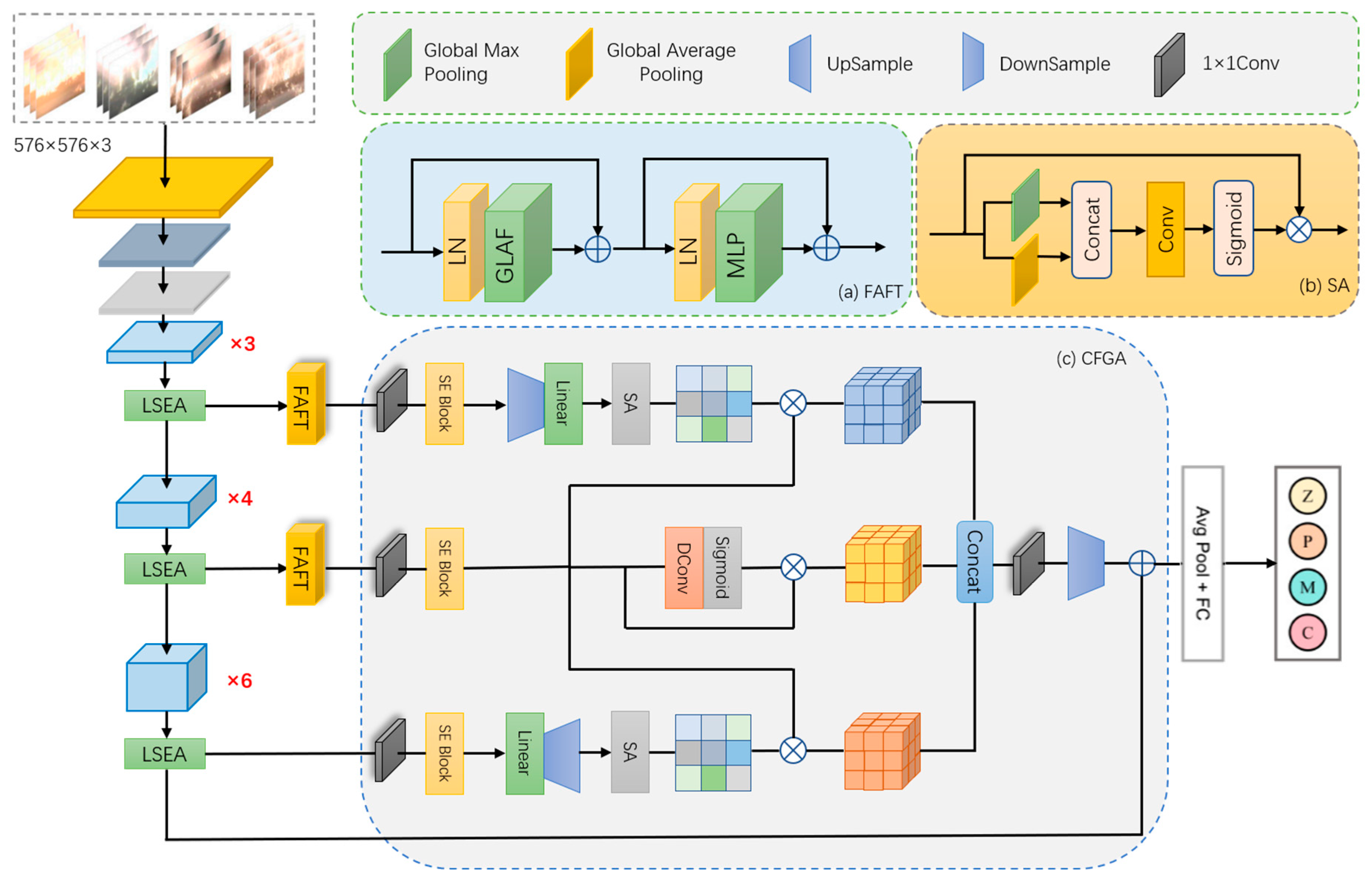
Accurate identification of the combustion state in municipal solid waste incineration (MSWI) processes is crucial for achieving efficient, low-emission, and safe operation. However, existing methods often struggle with stable and reliable recognition due to insufficient feature extraction capabilities when confronted with challenges such as complex flame morphology, blurred boundaries, and significant noise in flame images. To address this, this paper proposes a novel hybrid architecture model named PRTNet, which aims to enhance the accuracy and robustness of combustion state recognition through multi-scale feature enhancement and adaptive fusion mechanisms. First, a local-semantic enhanced residual network is constructed to establish spatial correlations between fine-grained textures and macroscopic combustion patterns. Subsequently, a feature-adaptive fusion Transformer is designed, which models long-range dependencies and high-frequency details in parallel via deformable attention and local convolutions, and achieves adaptive fusion of global and local features through a gating mechanism. Finally, a cross-scale feature guided aggregation module is proposed to fuse shallow detailed information with deep semantic features under dual-attention guidance. Experiments conducted on a flame image dataset from an MSWI plant in Beijing show that PRTNet achieves an accuracy of 96.29% in the combustion state classification task, with precision, recall, and F1-score all exceeding 96%, significantly outperforming numerous mainstream baseline models. Ablation studies further validate the effectiveness and synergistic effects of each module. The proposed method provides a reliable solution for intelligent flame state recognition in complex industrial scenarios, contributing to the advancement of intelligent and sustainable development in municipal solid waste incineration processes.
Keywords: municipal solid waste combustion; flame combustion state; local-semantic enhancement; adaptive fusion; multi-scale feature aggregation; sustainable development municipal solid waste combustion; flame combustion state; local-semantic enhancement; adaptive fusion; multi-scale feature aggregation; sustainable development