Article

Crafting Resilient Audits: Does Distributed Digital Technology Influence Auditor Behavior in the Age of Digital Transformation?

1
School of Accounting, Xijing University, Xi’an 710123, China
2
School of Economics and Finance, Xi’an Jiaotong University, Xi’an 710049, China
*
Author to whom correspondence should be addressed.
Sustainability 2026, 18(2), 623; https://doi.org/10.3390/su18020623
Submission received: 28 October 2025 / Revised: 4 December 2025 / Accepted: 12 December 2025 / Published: 7 January 2026

Abstract

A key component of creating robust and sustainable businesses is the digital transformation of business operations. This study examines the impact of distributed digital technology, namely cloud computing and blockchain technology, on an auditor’s behavior, an essential component of the framework for corporate responsibility. This study also highlights the impact of digital transformation on sustainable auditing, urging auditors to improve their technological skills to build trust in evolving entities. We used a unique dataset of Chinese A-share listed companies from 2013 to 2021 to show that this time period is important because it shows the beginning and growth of these technologies in the Chinese business world. This gives us a good starting point for looking at their early-stage audit effects. Our key findings are threefold. First, we found that firms using distributed digital technologies (cloud computing and blockchain) experienced (a) higher audit fees and (b) standard audit opinions, indicating the growing complexity and the requirement that auditors acquire specialized skills in order to evaluate cyber-resilience and technological structures. Second, firms facing substantial profit fluctuations (higher risk level) following digital engagement were subject to higher audit fees and a decreased probability of standard audit outcomes, emphasizing the nuanced risks of digital transformation. Third, the main results were more pronounced in (a) non-state-owned enterprises and (b) high-tech enterprises. Our study is robust to multiple sensitivity analyses, endogeneity tests, and propensity score matching (PSM). The results show that regulators need to create and support specialized auditing regulations regarding distributed technologies. These regulations would assist auditors in evaluating cloud and blockchain engagement and make it clear to businesses what is important to be compliant.

1. Introduction

The emergence of distributed digital technologies like blockchain and cloud computing has brought about a revolutionary change in the field of corporate operations and audits. These technologies are praised for their capacity to improve data management’s dependability [1], efficiency [2], and integrity [3]. Nevertheless, the effective application of these technologies frequently depends on centralized systems, which poses serious issues with stability, confidentiality, and data protection. The conduct of auditors, who are responsible for verifying the integrity and correctness of financial statements, is unavoidably affected by these uncertainties [4,5]. Importantly, the growing dependence of sustainable business settings on digital technology can affect auditing procedures. As companies incorporate blockchain and cloud computing, auditors must adjust to new data environments that are more complicated and may have security flaws. To improve the robustness of audit methods in the digital era, practitioners and policymakers alike must comprehend how these digital engagements impact varying auditor behavior in connection with nonprofessional investor judgments [4], external auditing practices [6], and financial statement audits [7]. Motivated by this, we contribute by examining how distributed digital technologies (i.e., blockchain and cloud computing) affect auditor behavior (i.e., audit opinions and audit fees) in the current age of digital transformation in Chinese listed firms.
Theoretically, we employ the theoretical perspective of agency theory [8] which suggests that asymmetry in information and conflicting objectives lead to conflicts of interest between principals (such as shareholders) and agents (such as auditors). To curtail agency issue, auditors have the prime task of providing impartial and objective assessments of financial data [9]. The dynamic between auditing firms and their clients may be impacted by the possible engagement of distributed digital technology. In particular, “distributed technology” encompasses cloud computing and blockchain. Blockchain technology is concerned with distributed storage, whereas cloud computing is concerned with distributed computing. However, big data technologies and artificial intelligence, in contrast, serve distinct purposes, e.g., improved accounting information quality [10] and enhanced transparency and trust in accounting practice [11]. Particularly, cloud computing and blockchain technology emphasize the use of platforms for computation and data storage, such as cloud and blockchain platforms [10,12].
Previous research [1,2,13,14,15] has looked at a number of factors for digital technologies and how they affect audit procedures. For example, Centobelli et al. (2022) show how blockchain might improve audit procedures by reducing information asymmetry, tackling frauds, and enabling real-time verification [1]. Similar to this, prior studies address how cloud computing affects sustainable audit outcomes, e.g., improved audit efficiency [2] and increased audit fees [15], highlighting the unique consequences of distant data processing and storage. Kend and Nguyen [13] find that big data analytics, robotics, and artificial intelligence technologies positively impact the auditing practices of Australian firms. Manita et al. (2020) employ qualitative methodology through interviews with auditors from the five main auditing firms in France [14]. They emphasize the need to engage in digital technologies to furnish regulators with the requisite adjustments essential for audit requirements. Despite these developments, there is still a lack of knowledge regarding the ways in which the coexistence of blockchain technology and cloud computing affects auditor behavior, especially in developing economies. We aim to address this research gap.
Contextually, we focus on the Chinese capital markets for a number of reasons. First, China’s economy, which witnessed double digit growth within the past few decades, has a higher digital engagement rate in comparison to others [16]. Second, China’s unusual legal framework and corporate governance structure offer a unique context for examining the subtle impacts of these technologies on auditing procedures. Third, consistent with the directives of President Xi Jinping and the 20th report of the Chinese Communist Party (CCP), it is crucial to promote a new generation of information technology and advance new industrialization [17,18].
Consistent with the theoretical premise of agency perspective [8] and the relevant literature [13,14,15], we argue that, in the presence of distributed digital technology in firms, the auditors’ behavior, which is inclined to provide unbiased and objective valuations of financial statements, will be changed. In particular, we argue that blockchain and cloud computing technologies are transforming audit procedures and introducing additional complexity due to inherent encryption mechanisms and decentralized data storage. This may require specialized tools and knowledge for auditors to validate financial statements, impacting aspects like audit pricing and opinion content [19]. We posit that distributed digital technologies, while offering enhanced data security and transparency, also present new vulnerabilities like data fragmentation and cyber threats. Therefore, effective risk management is crucial for auditors to maintain audit integrity and credibility. Factors like resource allocation, risk assessment, and mitigation strategies may influence their conduct. We further argue that concerns regarding data security and privacy brought up by cloud computing may impact audit plans and risk assessments, resulting in stricter guidelines and increased expenses. Due to the complexity these technologies bring, we posit that auditors may need to adjust how they operate to reconcile the need for a thorough investigation with the needs of clients regarding effectiveness, efficiency, and cost-effectiveness [7]. The premise of our major arguments is that audit outcomes and costs are expected to be altered for organizations that implement these technologies. We specifically argue that, because of the perceived dangers and increased complexity connected with digital technology, these enterprises are more likely to acquire standard audit opinions and pay higher audit fees.
To empirically examine our assertion, we employ a distinct methodology to investigate the impact of distributed digital technology (blockchain and cloud computing) on the auditor’s behavior. The previous studies [13,14] have employed survey methodologies with small data; in this study, we employ a unique and comprehensive panel data of Chinese A-share listed firms over 2013–2021 period. Our key findings show that the firms who engage in distributed digital technologies are more likely to obtain standard audit opinions and higher audit fees. These findings are robust to sensitivity, endogeneity, and matching concerns. Further, we find that firm risk level moderates this main nexus. In further analyses, we find that the main nexus is more pronounced for (a) non-state-owned enterprises (non-SOEs) and (b) high-tech enterprises.
Consequently, we contribute to the growing literature in the field of sustainable audit and distributed digital technology in the following unique ways. First, we investigate the impact of two distinct forms of distributed digital technology, i.e., cloud computing and blockchain on the auditor’s behavior in the form of audit opinions and audit fees. Previous studies [1,2,13,14,15] have failed to draw distinctions between the different forms of growing digital technologies, e.g., artificial intelligence (AI), big data, etc. Our results pertain to agency theory [8] by demonstrating that auditors function as agents for shareholders (the principals) within this novel technological framework. The higher fees (H1a) are the auditor’s way of protecting themselves from their own agency problem, which is the risk of giving an inaccurate opinion because they do not know enough about technology. This helps lower the agency costs that come from the information gap between managers and shareholders. Thus, our findings highlight the crucial role of distributed digital technologies in shaping the behavior of auditors from the perspective of curtailing the agency issues in the firms [8,13,14].
Second, we contribute by investigating the moderating role of enterprise risk on the main nexus. We find that firms having significant fluctuations in their profits in the post-engagement of distributed technology experience higher audit fees and a lower likelihood of standard audit opinions. On the other hand, we also find non-state-owned enterprises (non-SOEs) have a higher probability of receiving standard audit opinions and higher audit fees in comparison to their counterparts in the post-engagement period. Overall, our study underscores the intrinsic worth of digital technology in augmenting organizational activities and fostering superior progress, if it is implemented and regulated effectively.
The rest of the paper is organized as follows. Section 2 presents the literature review and development of the hypotheses. Section 3 provides the research design, followed by empirical results in Section 4. Section 5 concludes the paper.

2. Literature Review and Hypotheses Development

2.1. Enterprise-Level Distributed Digital Technology Application and the Resilient Behavior of Auditors

In terms of positive impact, distributed digital technologies, i.e., cloud computing and blockchain technology, have the potential to (a) enhance the capacity of data computing and storage for enterprises, (b) reduce the cost of enterprise IT resources, and (c) enhance the quality of enterprise IT applications. Consequently, these technologies can further expand the value and operating efficiency [20] and growth and diversification of enterprises [21]. Secondly, the use of cloud computing and blockchain technology to facilitate information exchange can have a beneficial effect on the performance of the supply chain partners [22,23] and sustainable development [24,25], as well as on the financial position of enterprises [26] and the liquidity of their assets [27].
Second, the emergence of “cloud accounting” allows the enterprise’s internal accounting information system to provide information that is more accurate, timely, and comprehensive, which is a significant opportunity for the development of future management accounting [28,29]. Additionally, the operation of the enterprise’s cloud platform data by its information sharing system is made more effective by the tamper-resistant characteristics and decentralized consensus of blockchains. In addition, the application of cloud computing and blockchain technology enables enterprises to improve their internal collaboration capabilities, automate their internal control processes, and identify internal control defects more quickly [11,30]. This also provides the enterprise with a more powerful ability to allocate resources, make resource storage more secure and confidential, and alter the traditional resource attribute, thereby fostering closer internal and external connectivity [16,31].
Nevertheless, from the auditor’s perspective, the application of cloud computing and blockchain technology will inevitably result in increased operational and financial risks for enterprises during the early stages of transformation, as well as increased audit risks for auditors [30]. In addition, the data storage method of the platform increases the likelihood that the audited units will perceive the audit as a risk transfer mechanism, and the enterprise management can engage in additional financial fraud and hidden earnings management activities through the digital technology platform [32,33]. In general, auditors frequently fall behind enterprises in the implementation of information technology [34]. In the event that the auditor lacks the professional knowledge and expertise necessary to conduct an information system audit, information technology specialists may be employed to assist in the audit process.
However, auditors have difficulty in identifying earnings management activities controlled by corporate management through complex software due to the fact that information technology experts frequently possess limited knowledge of financial accounting [35,36]. Consequently, the firm will be penalized. A significant amount of social pressure will necessitate those businesses to undergo a transformation. Moreover, auditors’ exhaustive abilities and audit professional quality can be improved through information system training. This component will be compensated for by increasing the audit fees charged to the audited entities, which is the firm’s cost expense.
Theoretically, agency theory [8] posits that conflicts of interest arise between principals (such as shareholders) and agents (such as auditors) as a result of asymmetry in information and conflicting objectives. Auditors are primarily responsible for conducting independent and unbiased assessments of financial information to address agency concerns. Further, auditors are required to conduct audits in accordance with the audit risk model (audit risk = significant misstatement risk × inspection risk) in the audit process, as per the risk-oriented audit theory. Following the implementation of blockchain technology and cloud computing, listed companies enhance the transparency of internal information, enhance the efficacy of internal control, and substantially mitigate the likelihood of significant financial statement errors. However, the platform is also not under the control of publicly traded companies. When conducting the audit, the auditor must gather pertinent data from the platform for analysis [37]. The data is becoming increasingly difficult to obtain. In the presence of unfamiliar enterprise platforms, auditors will execute substantive procedures more extensively. Auditors must also (i) verify the security of data and systems, (ii) the veracity of system deployment, and (iii) the standardization of technology use, in addition to further expanding the sampling scale in the control test [38]. Krahel and Titera (2015) [38] found that the accounting and auditing standards assist in finding a balance between users’ need for more information and the expenses of preparing that information and sending it. Contrary to the past, where firms used to have to deal with a lack of information, they now have metadata that take up petabytes of space on their servers. They further mentioned that investors are also flooded with data from a lot of different sources, many of which are not useful. To tackle the problem, Krahel and Titera (2015) [38] contend that a shift in standards to emphasize data, the processes that produce it, and its analysis, rather than its presentation, will enhance the value and relevance of the accounting profession, empower end users, and increase the efficiency of capital markets.
The conceptual debate around audit fees arises from the multifaceted characteristics of dispersed digital technology as both risk mitigators and risk amplifiers. In principle, the built-in qualities of blockchain (immutability and transparency) and cloud computing (centralized, standardized processes) might make a company’s financial reporting system more reliable. This could cut both inherent hazards and management risk, which might allow auditors to perform less substantial testing and charge less. But the main effect is likely to be higher audit costs because the probability of finding something wrong will increase a lot. Auditors are now working in a new and complicated setting that their usual training does not prepare them for. Currently they have to check the technology itself to make sure it works. This means checking the logic of smart contracts, making sure that node authorizations are correct on a blockchain, and evaluating cloud security settings. This needs a specialist and expensive IT audit expertise, which makes the audit bigger and harder to achieve a good audit proof, which raises the cost. So, even if it is theoretically conceivable to lower rates, the practical problems of auditing these novel tools make us anticipate that audit fees will increase.
The forecast for audit opinions also depends on the auditor’s evaluation of the risks involved in the digital engagement. If distributed digital technologies are correctly incorporated, they can provide a highly dependable and self-regulating setting, which would lower the chances of making big mistakes. In theory, this “cleaner” way of presenting finances should make it more likely that an audit opinion will be standard and unchanged. But the transformation phase and the related complications bring about new and big hazards. Auditors could come across “black box” structures where they cannot see or check how they work. Also, if the new technology system is unstable or has security holes, it could make the financial data less reliable. When auditors think these tech hazards are too high or they do not know enough to adequately evaluate them, the whole risk of an audit becomes too high. In these situations, auditors are more likely to give a modified opinion to show stakeholders the unique risks that come with the company’s digital transformation. This is given to protect their own accountability. So, the final view shows what the auditor thinks about whether the technology makes reporting more reliable or adds too much doubt.
The main idea behind our conceptual model is that distributed digital technologies change the way auditors think about risk. The rise in audit fees (H1a) reflects the work and expense necessary to address increased detection risk and complexity. The impact on the audit opinion (H2a or H2b) signifies the auditor’s conclusive assessment regarding whether the technology environment ultimately enhances or detracts from the integrity of the financial statements. This brings us to our conflicting hypotheses, which we shall examine in real life.
Consistent with the prior literature and theoretical arguments [8,13,14,15], we posit that the application of “distributed” digital technology by listed companies may enhance the level of enterprise information transparency and internal control, thereby reducing the major error risk for auditors. However, the application of cloud computing and blockchain technology by listed companies will also result in a significant change in the management of enterprise systems and data storage [4]. We contend that this change necessitates that auditors possess a higher level of information audit ability, which will increase the risk of inspection. Consequently, the auditor’s assessment of the risk level is unavoidably altered. Therefore, on the basis of the aforementioned discussion and arguments, the main hypotheses (in alternate forms) of the study are as follows:
Hypothesis 1a.
The engagement in distributed digital technologies, i.e., cloud computing and blockchain technology, will increase the audit fees for listed firms in China.
Hypothesis 1b.
The engagement in distributed digital technologies, i.e., cloud computing and blockchain technology, will decrease the audit fees for listed firms in China.
Hypothesis 2a.
Firms who have engaged in the distributed digital technologies, i.e., cloud computing and blockchain technology, are more likely to receive standard audit opinions from the auditors in China.
Hypothesis 2b.
Firms who have engaged in distributed digital technologies, i.e., cloud computing and blockchain technology, are more likely to receive non-standard audit opinions from the auditors in China.

2.2. Moderating Role of Firm Risk Level

Firms typically encounter a diverse array of risks during their operations, such as technical risk, market risk, strategic risk, financial risk, and operational risk. In particular, the volatility of the stock price increases as a firm assumes more risks, which in turn increases cash flow fluctuations [39,40]. Firms that exhibit a greater degree of risk-taking also exhibit a relatively higher degree of information asymmetry for shareholders and creditors [41,42]. In the short-term, the performance growth of enterprises is impeded by a significant amount of risk-taking, which also has a limited impact on the future development prospects of enterprises [43].
For auditors, the number of risks that an organization takes increases the amount of uncertainty that is present in its business operations, which in turn increases the audit risk. The application of cloud computing and blockchain technology will also increase the operational risk and the strategic risk. This is due to the fact that the new technology application will lead to a significant change in the original management system, business process, and business model. This may result in some employees not adapting to the new business model, which will bring about certain management risks for the enterprise [44,45].
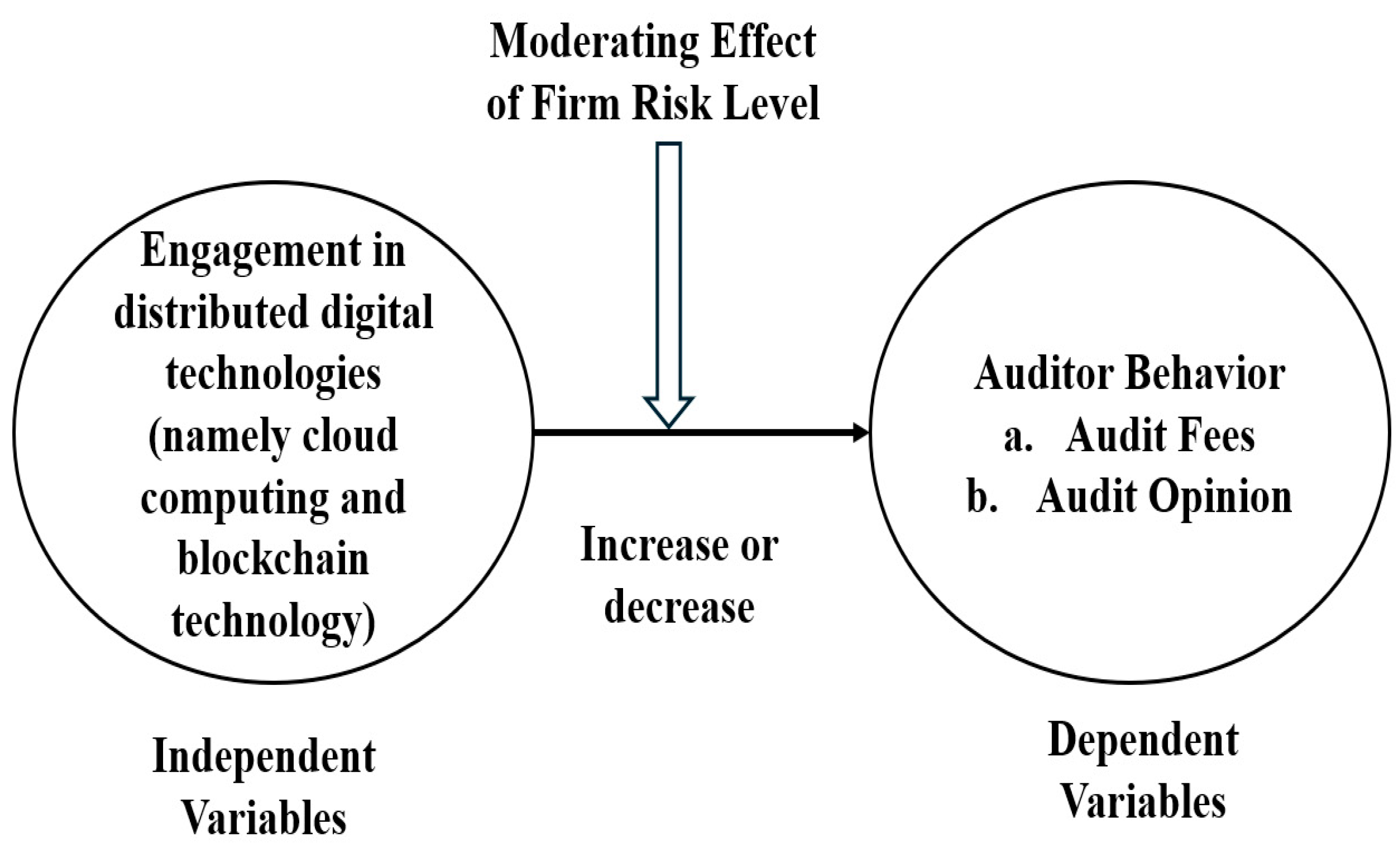
Additionally, the fact that the Internet age allows for integration across international borders is a significant one. The business climate and the competitive environment of companies have undergone significant changes, which has caused some businesses to rush to begin the digital transformation process without being fully equipped. This has the potential to result in the creation of strategic risks for businesses [46]. According to the risk-oriented audit theory, auditors in the audit risk level will concentrate on the overall level of risk when it comes to the application of cloud computing and blockchain technology in businesses. A high enterprise risk level for listed companies has a tendency to cause auditors to exercise greater caution when conducting audits, develop more stringent audit procedures, and further expand the scope of the audit. Figure 1 provides the detailed theoretical framework of the study. Consistent with these arguments, our last hypothesis is as follows:
Hypothesis 3.
Firm-risk level can moderate the nexus between the engagement of distributed digital technology and auditor behavior.

3. Methodology

3.1. Sample Selection and Data

This study uses a unique sample of Chinese A-share listed firms in Shanghai and Shenzhen stock exchanges over the 2013–2021 period. There are various methodological explanations why this time span was chosen. First, this time signifies the commencement of China’s digitalization strategy which includes the “Internet Plus” and “Big Data” programs. It establishes a stable policy framework essential for examining corporate behavior about the engagement of digital technologies. These plans have led to the broad implementation of cloud and blockchain technology by firms. Second, the regulatory crackdowns and socioeconomic shocks caused by the COVID-19 pandemic substantially transformed the business environment, introducing confounding variables that obscure the correlation between technology use and audit results. Thus, incorporating data from 2022 to 2024 will blend two separate analytical eras, concealing the unambiguous identification of correlations established over the 2013–2021 timeframe, which is essential for the validity of our research conclusions. Consequently, a focus on the 2013–2021 time period allows us to look at the effects of the engagement in distributed digital technologies on firm’s audit behavior without mixing it with the effects of other newly introduced policies.
We compiled the data pertaining to our predictor, outcomes, and control variables from (a) the China Stock Market and Accounting Research (CSMAR) database, (b) Juchao Information Website, and (c) official websites of the two stock exchanges. We excluded (1) financial listed firms; (2) special treatment (ST) and *ST listed firms; and (3) firms with missing observations from 2013 to 2021. The ST status is assigned to firms that are having financial problems, such as having two years of negative net profit, which means that investors are taking on more risk. The *ST label means that the firm’s finances are worse, and it could be delisted. We winsorized the continuous variables by 1% and 99% to eliminate the issue of outliers. Our final sample includes 26,569 firm-year observations.

3.2. Empirical Model and Variable Descriptions

To empirically examine our hypotheses, we employ the following econometric models while controlling for industry and year fixed effects.
A u d i t F e e i t = β 0 + β 1 C L B L 1 i t + β n C O N T R O L S i t + I n d u s t r y i + Y e a r t + ε i t
A u d i t O p i t = β 0 + β 1 C L B L 1 i t + β n C O N T R O L S i t + I n d u s t r y i + Y e a r t + ε i t
The first equation pertains to our first hypothesis, i.e., the impact of engagement of distributed digital technology on audit fees. In Equation (1), our key outcome variable is the audit fee (AuditFee), while our key predictor is the engagement in distributed digital technology, i.e., cloud computing and blockchain technology (CLBL1). CONTROLS represent a set of firm- and governance-level control variables. In particular, consistent with the previous studies [10,16,47], we include a number of relevant control variables in our study. In particular, we include firm scale (Size), leverage level (Lev), profitability (Roe), company growth (TobinQ), CEO duality (Dual), book value ratio (Bm), big four (Big4), inventory ratio (Inv), institutional investors (Inst), and equity concentration (Top1). All these variables are explained in detail in Table 1. We also include industry and year fixed effects. This equation uses panel data regression techniques.
The second equation relates to our second hypothesis, i.e., the impact of engagement in distributed digital technology on audit opinion. In Equation (2), our key outcome variable is audit opinion (AuditOp), while our key predictor is the engagement in distributed digital technology, i.e., cloud computing and blockchain technology (CLBL1). CONTROLS represent a set of firm- and governance-level control variables, which are the same as in Equation (1). We also include industry and year fixed effects. This equation uses logit regression techniques.

3.2.1. Dependent Variables

The main outcome variable of this study is the auditor behavior (AuditAct) divided into two components, (a) audit fees and (b) audit opinion. During the audit process, auditors frequently encounter the pressure of public interest regulators, who require that they rely on their professional knowledge and independence to uncover the irregular behavior of the listed firms. To measure audit fees, this paper employs the natural logarithm of audit expenses of A-share listed firms as the measurement index of an auditor’s behavior. To measure audit opinion, we employ a dummy variable equal to 1 if the firm has received a standard unqualified audit opinion and 0 if otherwise.

3.2.2. Independent Variables

Our main independent variable in this study is the digital engagement, i.e., corporate engagement with and strategic commitment to distributed digital technologies in the form of cloud computing and blockchain technology application (CLBL1). Following related papers [14,48,49], this paper selects similar word frequency related to cloud computing and blockchain technology and uses a text crawler on the total number of similar words appearing in the annual reports of the listed companies from 2013 to 2021 with Python software (version 3.11). The original word frequency number derived in the annual report of cloud computing and blockchain technology was processed in accordance with the data cleansing method of related papers [14,48,49]. This comprises five categorized word lists: artificial intelligence technology, blockchain technology, cloud computing technology, big data technology, and digital technology application, derived from the frequency analysis of corporate digitalization-related terminology in firms’ annual reports using Python. The detailed word lists are included in Appendix A. Then, we developed a dummy variable (CLBL1) which equals to 1 if the firm engages in or commits to cloud computing and blockchain technology and 0 if otherwise. In addition, for a robustness check, we used the natural logarithm of the word frequency plus one (CLBL2).

3.2.3. Moderating Variable

This paper, in accordance with related studies [41,43,50], elects to assess the risk-taking capacity of enterprises by utilizing the volatility of enterprise profits. The standard deviation and extreme difference of return on assets (ROA) adjusted by the industry are calculated every three years. The enterprise’s risk-taking level increases as the value increases.

4. Empirical Results

4.1. Descriptive Statistics

The descriptive statistics for our main variables are reported in Table 2. The average value of the audit opinion (AuditOp) is 0.968, and the median is 1, indicating that 96.8% of the listed companies in this sample were issued standard audit opinions. The median of the enterprise cloud computing and blockchain technology application (CLBL1) is 0, and the average is 0.341. This suggests that 34.1% of the listed companies in the sample have mentioned the application and planning of cloud computing and blockchain technology in their annual report, suggesting that the application of these technologies is still in the development stage. From the alternative variable (CLBL2) of enterprise cloud computing and blockchain technology application, the average value is 0.571. This suggests that there is a significant disparity in the application level of cloud computing and blockchain technology among various listed companies. In terms of the descriptive statistics of other control variables, the statistical distribution is generally reasonable and in accordance with the existing literature. In the unreported results, we checked the correlation matrix and found that the correlation value among the key variables is within the threshold and does not alert the concern for multicollinearity.

4.2. Baseline Results

Table 3 presents the results of our main two hypotheses. We present the results for the first hypothesis in column (1) and for the second hypothesis in column (2). In these columns, the main predictor is the application of enterprise “distributed” digital technology (cloud computing and blockchain), i.e., CLBL1 and the outcome variables are audit fees (AuditFee) and audit opinion (AuditOp), respectively. The coefficients in column (1) and (2) are positive and significant at a 1% significance level. In terms of statistical significance, these results show that firms who have engaged in distributed digital technology (CLBL1) are linked with (a) a 1.7% increase in audit fees and (b) a 30.7% higher likelihood of receiving the standard audit opinion. These results imply that the engagement of “distributed” digital technology (cloud computing and blockchain), i.e., CLBL1 is associated with increased (a) audit fees for the firms and (b) likelihood of receiving the standard audit opinion. Thus, these findings provide support to our first and second hypotheses. In addition, the results for the control variables are in line with related studies. In particular, among the control variables, the impact of firm size (Size), leverage (Lev), ROE, and book-to-market ratio (BM) are found to be significant predictors of both audit fees and audit opinions.
These results are in line with our theoretical assertions and the related literature [8,13,14,15]. Our findings of increased audit fees correspond with [15], who acknowledged the expenses associated with procuring IT audit professionals. However, it is different from the efficiency advantages suggested by [2], which means that, in the initial implementation phase, the costs of risk and difficulty are higher than the benefits of effectiveness. The use of distributed digital technology like cloud computing and blockchain by publicly listed firms can impact audit risks. These technologies can strengthen internal control, improve transparency, and make information systems more secure. However, they also introduce strategic, operational, and financial risks, making auditors more cautious. This may require more stringent audit procedures, an expanded scope, and an enhanced pricing scale.
Despite this, auditors are more likely to issue standard audit opinions for listed companies if financial indicators are accurate and the enterprise adheres to technology application. This finding shows that auditors see firms going through digital transformation as less risky, as long as there are not any big mistakes. This view may come from wanting to keep good connections with critical clients. Letting people know about new technology shows a commitment to modernization, which lowers the danger of being seen as out of date. But for high-risk companies with volatility, that suggests possible implementation problems, and auditors may be more careful.

4.3. Robustness Tests

Next, to ensure the robustness of our baseline results, we conduct a series of tests. The details are as follows.

4.3.1. Alternate Independent Variable

First, we employ the natural logarithm of statistical word frequency plus 1 (CLBL2) as an alternative measure for the robustness of the enterprise cloud computing and blockchain technology application. We report the results in column (1) and column (3) of Table 4, while including the same control variables and industry and year fixed effects. The results with the alternate measures of the independent variable demonstrate a positive nexus between enterprise cloud computing and blockchain technology application and audit fees (column 1) and audit opinions (column 2). The use of the alternate independent variable further strengthens the baseline results.

4.3.2. Lagged Independent Variable

Considering that the influence of enterprise cloud computing and blockchain technology application on an auditor’s behavior may have some lag, this paper employs the lag of the core predictor and rerun the regression. The use of a lagged independent variable also reduces the potential reverse causality between our predictor and outcome variables. The results with the lagged independent variable are reported in column (2) and column (4) of Table 4 and remain consistent with the baseline results, showing further support for both of our hypotheses.

4.3.3. Alternate Estimation Techniques

Next, we employ alternate estimation techniques to further ensure the robustness of our results. First, in column (1) and (3) of Table 5, we include year-, firm-, and province-level fixed effects and re-estimate our results using a two-way clustered (at the firm and year level) standard error regression based on (a) fixed effect regressions for audit fees and (b) probit regressions for audit opinions. Second, in column (2) and (4) of Table 5, we include the year- and firm-level fixed effects and re-estimate our results using a two-way clustered (at the firm and year level) standard error regression based on (a) fixed effect regressions for audit fees and (b) probit regressions for audit opinions. We find consistent results with our baseline results, further strengthening the claim that the engagement of distributed digital technologies in the form of cloud computing and blockchain technology is significantly associated with increases in audit fees and the likelihood of standard audit opinions.

4.4. Endogeneity Test

Two-Stage Least Squares Method–Instrumental Variable (IV) Approach

To address the potential issue of endogeneity arising due to a measurement error or omitted variable bias (e.g., managerial sophistication), we employ the two-stage least squares (2SLS) technique with the instrumental variable (IV) approach. To employ a valid IV, it is essential that the employed IV is only linked with the predictor (technology engagement) and is not directly affecting our outcome variable (impacting audit behavior only through its impact on technology engagement). Following a previous study [51], we employ the “level of internet development in urban cities, i.e., High Internet Cities” as an instrumental variable. It is a binary variable which shows if a company is based in a city that the Chinese government has chosen to be a “demonstration city” in its “Broadband China” plan. The list of these demonstration cities was officially released by the Ministry of Industry and Information Technology. We introduce a dummy variable that is equal to 1 and is a firm located in one of these cities, i.e., Shenzhen, Guangzhou, Xiamen, Zhuhai, Hangzhou, Nanjing, Shanghai, Beijing, Wuhan, or Suzhou, otherwise, it is 0.
We argue that our IV is valid for the following reasons. First, the “Broadband China” policy caused the government to spend a lot of money on digital infrastructure in these cities. This external policy shock directly decreases the cost and makes the Internet more widely available. This is necessary for using cloud and blockchain technologies, hence it is strongly related to our endogenous variable (technology engagement). Second, advanced cities have different technological structures because of legislation, yet these differences affect audit results indirectly through the use of technology. It is improbable that policy designation directly affects auditor fees or opinions when essential firm features and economic elements are regulated.
The results of two-stage least squares (2 SLS, Ivprobit) are presented in Table 6. Column (1) displays the level of Internet development in urban cities, i.e., High Internet Cities (IntDev. IV) and our endogenous variable, i.e., enterprise cloud computing and blockchain technology application (CLBL1). We can see that there is a strong positive and significant coefficient between our IV and endogenous variable. Specifically, listed companies are more likely to apply cloud computing and blockchain technology in cities with a higher level of Internet development. The Wald F statistic is employed in this paper, and the Wald F value exceeds the cut-off value of 16.38, indicating that the weak instrumental variable test was successful. The regression results of the second stage are shown in columns (2) and (3) of Table 6 which are consistent with our baseline results. The endogeneity results using the 2SLS technique further strengthen the support for our main hypotheses.

4.5. Moderating Role of Firm Risk Level

The third equation refers to our third hypothesis, i.e., the moderating role of firm risk level on the nexus between the engagement of distributed digital technology and auditor behavior (including audit pricing and audit opinions). In Equation (3), our key outcome variable is auditor behavior (AuditAct). We follow prior research [41,43,50] and employ the volatility of firm profit as a measure to indicate the extent to which enterprises are willing to assume risk. This measure shows overall profitability fluctuation, but, in light of the current digital transformation, it mostly shows execution risk and operational fragility caused by the new technology. We contend that significant profit volatility post-engagement signifies a chaotic and possibly ineffective integration process, hence exacerbating auditors’ apprehensions regarding the dependability of the company’s financial reporting systems. Because of this higher level of risk, auditors do more tests (which costs more) and are more cautious about their opinions.
We are interested in the sign and magnitude of the coefficient of the interaction term (CLBL1 × Risk) between the engagement of distributed digital technology, i.e., cloud computing and blockchain technology (CLBL1) and firm risk level (Risk). We include the same control variables, industry, and year fixed effects as in the previous equations.
A u d i t A c t i t = β 0 + β 1 C L B L 1 i t + β 2 R i s k i t + β 3 C L B L 1 i t X   R i s k i t + β n C O N T R O L S i t + I n d u s t r y i + Y e a r t + ε i t
Table 7 shows the regression results of the moderating role of firm risk level (Risk) on our main nexus. Here, we are interested in the interaction term between our moderator and predictor. In column (1) and (2), we present the interaction results for the audit pricing (AuditFee) and audit opinion (AuditOp), respectively. It is evident that the interaction term (CLBL1 * Risk) for the audit fee in column (1) is positive and significant at 10%. It implies that the high profit volatility strengthens the nexus between enterprise cloud computing, blockchain technology application, and audit pricing, i.e., a significant positive moderating effect. On the other hand, the interaction term (CLBL1 * Risk) for the audit opinion in column (2) is negative and significant at 1%. This result indicates that the high profit volatility suppresses the positive impact of cloud computing and blockchain technology application on the audit opinion and has a significant negative adjustment effect. This shows that listed companies with high profit volatility bear a high risk level, which also makes auditors (i) maintain a higher audit caution, (ii) be more inclined to set higher audit fees, and (iii) increase the possibility of issuing non-standard opinions.

4.6. Further Analysis

4.6.1. Regression Results Based on Different Property Rights

Based on the theory of property rights, economic organizations with varying properties of property rights will engage in a variety of economic activities and will also exhibit differences in the management of operational risks. Consequently, the audit pricing and audit opinions of listed companies with varying property rights are influenced by the application of enterprise cloud computing and blockchain technology in varying ways [7,31]. In Table 8, we present the regression results for the subsample of state-owned (SOEs) and non-state-owned (non-SOEs) enterprises with audit fees and audit opinions as the dependent variables. We find that the positive impact of distributed digital technology (cloud computing and blockchain) is more pronounced for non-SOEs (with positive coefficients and strong statistical significance) when audit fees are the dependent variable. This suggests that the application of cloud computing and blockchain technology in non-state-owned enterprises makes it easier to receive a higher audit pricing level. The operation of state-owned enterprises is contingent upon the value of their assets. As a result, state-owned enterprises possess a significantly more robust risk management system and risk control level than their non-state-owned counterparts. The application of new technology frequently leads to a lack of comprehensive comprehension, as state-owned enterprises are more interested in the commercial value of their assets. Furthermore, the implementation of new technology mitigates operational risk. Auditors are more likely to charge higher audit fees and develop a higher level of audit risk when auditing non-state-owned enterprises.
On the other hand, the positive nexus between the application of cloud computing and blockchain technology and the probability of standard audit opinions in both state-owned and non-state-owned enterprises is positive and significant. Additionally, the coefficient is higher for SOEs in comparison to non-SOEs, indicating that the probability of receiving a standard audit opinion is higher in state-owned enterprises than in non-state-owned enterprises.

4.6.2. Regression Results Based on High and Non-High-Tech Enterprises

In general, the R&D investment of high-tech industry enterprises is higher, with a high value-added product, and is characterized by intellectual, innovative, and strategic capabilities [52]. According to the 2021 high-tech industry trend analysis conducted by “Accenture China,” the high-tech industry has experienced significant technological change, operational changes, and macrotransformation in recent years. The demand for cloud transformation has been accelerating, specifically in the development of service business models. Consequently, the application of cloud computing and blockchain technology will differ between high-tech and non-high-tech enterprises, and the resulting impact on audit costs and audit opinions will also be dissimilar [53].
We present the results for the impact of cloud computing and blockchain technology applications on audit pricing and audit opinions in various samples of non-high-tech enterprises in Table 9. We find that the impact of CLBL1 on the audit fee is more pronounced in high-tech firms in comparison to their counterparts (see columns 1 and 2). The potential explanation is the accelerated advancement of blockchain technology and cloud computation in recent years. Additionally, high-tech industries are more likely to implement or create more intricate blockchain and cloud computing technologies. Auditors will continue to harbor elevated audit concerns regarding the authenticity of data and the security of the system. Obtaining the data will also prove to be more challenging, causing auditors to implement more rigorous auditing protocols. Additionally, the audit pricing level that has been established will be enhanced.
Further, we find that the impact of CLBL1 on the audit opinion is more pronounced in high-tech firms in comparison to their counterparts (see columns 3 and 4). This may be due to the fact that the country promotes enterprise-level digital transformation, which in turn encourages high-tech enterprises to become more knowledgeable and skilled in cloud computing and blockchain technology. This, in turn, enhances the internal control and transparency of information, sending a more positive signal to the outside world. Additionally, the auditor is more likely to issue a standard audit opinion if no related audit suspects are found after the completion of the established audit procedures.

5. Conclusions

5.1. Theoretical Implications

This paper employs a unique data of China’s A-share listed firms from 2013 to 2021 and finds that the firms who have applied cloud computing and blockchain technology may face a significant increase in their audit fees and are more likely to receive standard audit opinions. Further, the firm’s risk level moderates this nexus, and this relationship is more pronounced in (a) non-state-owned enterprises (non-SOEs) and (b) high-tech enterprises. Theoretically, the utilization of “distributed” digital technology (cloud computing and blockchain) by publicly listed firms will affect the audit risks that auditors encounter from two distinct perspectives, thereby leading to evident modifications in auditors’ behavioral judgment [30,54]. On the one hand, the listed companies that use cloud computing and blockchain technology, after reshaping the enterprise information management system, further strengthen the internal control level of the enterprise, improve the enterprise’s internal information transparency, and make the system of information and data more secure, more visual, and more dimensional. This, to a certain extent, can reduce the auditor’s exposure to major misstatement risk.
On the other hand, the listed firm’s use of cloud computing and blockchain technology will also introduce a series of strategic, operational, and financial risks to enterprises. This will make auditors more cautious, as they will concentrate on (a) the security and reliability of the system platform and (b) the application of technology specifications to the enterprise [55,56]. Consequently, the auditor will be compelled to evaluate the level of risk, which will necessitate the development of more stringent audit procedures, the expansion of the audit’s scope, and the enhancement of the audit pricing scale. Nevertheless, auditors are more likely to issue standard audit opinions for listed companies if the disclosure of financial indicators is appropriate and accurate, and the enterprise is in compliance with the application of technology, after a series of audit work has been completed.
From the point of realistic development, in recent years, the information system audit has become a new audit technology. Firms with the intent to adapt to the era of mass digital transformation are (a) strengthening the informatization of audit personnel training, (b) exploring more advanced audit methods, and (c) constructing a more solid information audit system. In comparison to the past, due to the application of cloud computing, blockchain, and other digital technology of listed companies, auditors can more calmly complete all the audit work. Nevertheless, due to digitalization, financial fraud and accounting errors committed by firms can be hidden in the information system. Thus, the authenticity of financial information largely depends on the authenticity of the information system. This forces the auditors to be more cautious about judging the level of audit risk and increase the audit input and costs, eventually increasing the audit fee. However, the final standard audit opinion can reflect that the auditors have enough trust in the authenticity of the financial statements of these listed companies.

5.2. Practical Implications

The study also has some policy and practical implications for the government, auditors, and regulatory bodies. The application of digital technology to listed companies is unquestionably beneficial in the current rapid development of information technology. Consequently, auditors must continuously enhance their information system audit capabilities to accommodate the evolving audit process. Government departments should also gradually increase the regulation of technology application and specification to promote the healthy growth of the digital economy in China. The specific recommendations are as follows. First, government departments should prioritize the expansion of their assistance to enterprises in the “cloud” and “chain” sectors. Second, it is imperative for audit institutions to continuously accelerate the construction pace of information audit, empower audits through big data, artificial intelligence, cloud computing, and blockchain technology, and actualize the digital upgrading of the audit concept, audit methodologies, and audit process [57]. Third, enterprises must conduct strategic planning and deployment prior to “going on the chain” or “going to the cloud” in order to guarantee adequate financial support, solicit the opinions and suggestions of employees, and effectively integrate and collaborate with various departments. Enterprises and platform administrators must acknowledge the system’s stability and make a concerted effort to guarantee the authenticity, privacy, and reliability of the data after “on the cloud” or “on the chain.” This study also offers significant insights for other economies experiencing digital revolution. Despite contextual differences, the common problems are similar across the globe: for instance, (a) auditors needing to close the technological expertise deficit, (b) governments needing to encourage both innovation and durability, and (c) companies needing to handle implementation hazards tactically. The Chinese experience functions as a prospective example, showing that making audits more reliable is a global need for a digital economy that lasts and is dependable.

5.3. Limitations of the Study

Lastly, although our empirical analysis is robust, the subjective nature of our main measurement can be further improved in future research. In particular, future research can employ objective measurements of digital engagement. For instance, investments in distributed digital technology, agreements with prominent cloud service providers (e.g., Alibaba Cloud and Tencent Cloud), or external accreditations of blockchain implementations, etc., can provide new and interesting insights into the existing literature. In addition, future studies can also employ qualitative research techniques, e.g., interviews or questionnaires to provide additional insights on the behavior of auditors and managers in response to the distributed digital technologies and varying environmental requirements [58,59,60]. Further, despite our robust identification procedures, due to the presence of unobserved firm heterogeneity and the absence of matching results (e.g., propensity score matching), our findings should be seen as strong connections aligned with a causal story, rather than as conclusive structural effects. Moreover, our focus on the Chinese context restricts the direct comparison of our findings to other markets, although the fundamental theoretical mechanisms may possess cross-contextual significance. The intricate main nexus is likely to be influenced by changing contextual factors (e.g., developing regulatory goals and macroeconomic fluctuations) that our static models are unable to fully encompass. Subsequent investigations may expand our study by examining these conditional correlations within a long-term, multi-national context.

Author Contributions

Conceptualization, H.-X.L., S.M., X.G. and T.W.; methodology, H.-X.L., S.M., X.G., T.W. and Y.L.; software, S.M., X.G., T.W. and Y.L.; formal analysis, S.M.; resources, H.-X.L.; writing—original draft preparation, S.M. and X.G.; writing—review and editing, H.-X.L., T.W. and Y.L.; supervision, H.-X.L. and Y.L.; funding acquisition, H.-X.L. All authors have read and agreed to the published version of the manuscript.

Funding

Hai-Xia Li acknowledges the financial support from the Humanities and Social Science research projects of the Ministry of Education of China (Grant No: 21YJA630046).

Institutional Review Board Statement

Not applicable.

Informed Consent Statement

Not applicable.

Data Availability Statement

The authors do not have the right to share the data.

Conflicts of Interest

The authors declare no conflicts of interest.

Appendix A. Key List of Digital Engagement of Chinese Firms

CategoryWord Lists
Artificial Intelligence TechnologyArtificial intelligence, business intelligence, image understanding, investment decision assistance system, intelligent data analysis
Analytics, intelligent robots, machine learning, deep learning, semantic search, biometrics, face recognition, voice recognition, identity verification, autonomous driving, natural language processing
Blockchain TechnologyBlockchain, digital currency, distributed computing, differential privacy technology, intelligent financial contracts
Cloud Computing TechnologyCloud computing, stream computing, graph computing, memory computing, multi-party secure computing, brain-like computing, green colour computing, cognitive computing, fusion architecture, billion level concurrency, exabyte level storage, internet of things, information physical system
Big Data TechnologyBig data, data mining, text mining, data visualisation, heterogeneous data, credit reporting, enhancement reality, mixed reality, virtual reality
Digital Technology ApplicationMobile internet, industrial internet, mobile network, internet medical, E-commerce, mobile pay, third party pay, NFC pay, intelligent energy, B2B, B2C, C2B, C2C, O2O, network connection, intelligent wear, intelligent agriculture, intelligent transportation, intelligent medical care, intelligent customer service, intelligent home, intelligent investment advisory, intelligent cultural tourism, intelligent environmental protection, intelligent grid, intelligent marketing, digital marketing, unmanned retail, internet finance, digital finance, Fintech, quantitative finance, open banking
Source: Wu et al. (2021) [49].

Appendix B. Sample Cleaning Process

Firm-Year Observations
1Initial sample of Chinese A-share listed firms (2013–2021)41,258
2Less: Observations from financial firms(3102)
38,156
3Less: ST and *ST firm-year observations(2845)
35,311
4Less: Observations with missing data for key variables(8742)
Final Sample26,569

References

  1. Centobelli, P.; Cerchione, R.; Del Vecchio, P.; Oropallo, E.; Secundo, G. Blockchain technology design in accounting: Game changer to tackle fraud or technological fairy tale? Account. Audit. Account. J. 2022, 35, 1566–1597. [Google Scholar] [CrossRef]
  2. Banker, R.D.; Li, X.; Maex, S.A.; Shi, W. The audit implications of cloud computing. Account. Horiz. 2020, 34, 1–31. [Google Scholar] [CrossRef]
  3. Garanina, T.; Ranta, M.; Dumay, J. Blockchain in accounting research: Current trends and emerging topics. Account. Audit. Account. J. 2022, 35, 1507–1533. [Google Scholar] [CrossRef]
  4. Austin, A.A.; Williams, L.T. Evaluating company adoptions of blockchain technology: How do management and auditor communications affect nonprofessional investor judgments? J. Account. Public Policy 2021, 40, 106882. [Google Scholar] [CrossRef]
  5. Knechel, W.R. The future of assurance in capital markets: Reclaiming the economic imperative of the auditing profession. Account. Horiz. 2021, 35, 133–151. [Google Scholar] [CrossRef]
  6. Dagilienė, L.; Klovienė, L. Motivation to use big data and big data analytics in external auditing. Manag. Audit. J. 2019, 34, 750–782. [Google Scholar] [CrossRef]
  7. Dyball, M.C.; Seethamraju, R. Client use of blockchain technology: Exploring its (potential) impact on financial statement audits of Australian accounting firms. Account. Audit. Account. J. 2022, 35, 1656–1684. [Google Scholar] [CrossRef]
  8. Jensen, M.C.; Meckling, W.H. Theory of the firm: Managerial behaviour, agency costs and ownership structure. J. Financ. Econ. 1976, 3, 305–360. [Google Scholar]
  9. Onjewu, A.K.E.; Walton, N.; Koliousis, I. Blockchain agency theory. Technol. Forecast. Soc. Change 2023, 191, 122482. [Google Scholar]
  10. Fang, B.; Liu, X.; Ma, C.; Zhuo, Y. Blockchain technology adoption and accounting information quality. Account. Financ. 2023, 63, 4125–4156. [Google Scholar] [CrossRef]
  11. Han, H.; Shiwakoti, R.K.; Jarvis, R.; Mordi, C.; Botchie, D. Accounting and auditing with blockchain technology and artificial Intelligence: A literature review. Int. J. Account. Inf. Syst. 2023, 48, 100598. [Google Scholar] [CrossRef]
  12. Lardo, A.; Corsi, K.; Varma, A.; Mancini, D. Exploring blockchain in the accounting domain: A bibliometric analysis. Account. Audit. Account. J. 2022, 35, 204–233. [Google Scholar] [CrossRef]
  13. Kend, M.; Nguyen, L.A. Big data analytics and other emerging technologies: The impact on the Australian audit and assurance profession. Aust. Account. Rev. 2020, 30, 269–282. [Google Scholar] [CrossRef]
  14. Manita, R.; Elommal, N.; Baudier, P.; Hikkerova, L. The digital transformation of external audit and its impact on corporate governance. Technol. Forecast. Soc. Change 2020, 150, 119751. [Google Scholar] [CrossRef]
  15. Zhang, Y.; Li, X.; Xing, M. Enterprise digital transformation and audit pricing. Audit. Res. 2021, 3, 62–71. (In Chinese) [Google Scholar]
  16. Li, C.; Huo, P.; Wang, Z.; Zhang, W.; Liang, F.; Mardani, A. Digitalization generates equality? Enterprises’ digital transformation, financing constraints, and labor share in China. J. Bus. Res. 2023, 163, 113924. [Google Scholar] [CrossRef]
  17. Li, S.; Wang, D.; Dong, H.; Fu, Q. Blockchain development and corporate performance in China: The role of ownership. Emerg. Mark. Financ. Trade 2022, 58, 3090–3102. [Google Scholar] [CrossRef]
  18. Ye, C.; Wang, Y.; Wu, Y.; Jiang, M.; Shahab, Y.; Lu, Y. Confucianism and auditor changes: Evidence from China. Manag. Audit. J. 2022, 37, 625–656. [Google Scholar] [CrossRef]
  19. Gietzmann, M.; Grossetti, F. Blockchain and other distributed ledger technologies: Where is the accounting? J. Account. Public Policy 2021, 40, 106881. [Google Scholar] [CrossRef]
  20. Müller, J.M.; Kiel, D.; Voigt, K.I. What drives the implementation of Industry 4.0? The role of opportunities and challenges in the context of sustainability. Sustainability 2018, 10, 247. [Google Scholar] [CrossRef]
  21. Yaqub, M.Z.; Alsabban, A. Industry-4.0-enabled digital transformation: Prospects, instruments, challenges, and implications for business strategies. Sustainability 2023, 15, 8553. [Google Scholar] [CrossRef]
  22. Cao, Q.; Schniederjans, D.G.; Schniederjans, M. Establishing the use of cloud computing in supply chain management. Oper. Manag. Res. 2017, 10, 47–63. [Google Scholar] [CrossRef]
  23. Deng, N.; Shi, Y.; Wang, J.; Gaur, J. Testing the adoption of blockchain technology in supply chain management among MSMEs in China. Ann. Oper. Res. 2025, 350, 629–648. [Google Scholar] [CrossRef]
  24. Feroz, A.K.; Zo, H.; Chiravuri, A. Digital transformation and environmental sustainability: A review and research agenda. Sustainability 2021, 13, 1530. [Google Scholar] [CrossRef]
  25. Parida, V.; Sjödin, D.; Reim, W. Reviewing literature on digitalization, business model innovation, and sustainable industry: Past achievements and future promises. Sustainability 2019, 11, 391. [Google Scholar] [CrossRef]
  26. Zhang, J.; Ruan, C. Blockchain technology and corporate performance: Empirical evidence from listed companies in China. Sustainability 2024, 16, 9177. [Google Scholar] [CrossRef]
  27. Cheng, M.; Qu, Y.; Jiang, C.; Zhao, C. Is cloud computing the digital solution to the future of banking? J. Financ. Stab. 2022, 63, 101073. [Google Scholar] [CrossRef]
  28. Bhimani, A.; Willcocks, L. Digitisation, ‘Big Data’and the transformation of accounting information. Account. Bus. Res. 2014, 44, 469–490. [Google Scholar] [CrossRef]
  29. Vo Van, H.; Abu Afifa, M.; Saleh, I. Accounting information systems and organizational performance in the cloud computing era: Evidence from SMEs. Sustain. Account. Manag. Policy J. 2024, 64, 3173–4472. [Google Scholar] [CrossRef]
  30. Huang, F.; Wang, T.; Yen, J.C. Opportunities or Challenges? Audit Risk and Blockchain Disclosures in 10-K Filings. Audit. A J. Pract. Theory 2024, 43, 131–158. [Google Scholar] [CrossRef]
  31. Jayasuriya, D.D.; Sims, A. From the abacus to enterprise resource planning: Is blockchain the next big accounting tool? Account. Audit. Account. J. 2023, 36, 24–62. [Google Scholar] [CrossRef]
  32. Lou, Z.; Li, M.; Shan, Y.G.; Ye, A. Does corporate digitalisation moderate real earnings management? Account. Financ. 2024, 64, 4157–4196. [Google Scholar]
  33. Wen 2024, H.; Fang, J.; Gao, H. How FinTech improves financial reporting quality? Evidence from earnings management. Econ. Model. 2023, 126, 106435. [Google Scholar] [CrossRef]
  34. Alles, M.G. Drivers of the use and facilitators and obstacles of the evolution of big data by the audit profession. Account. Horiz. 2015, 29, 439–449. [Google Scholar] [CrossRef]
  35. Ashraf, M.; Michas, P.N.; Russomanno, D. The impact of audit committee information technology expertise on the reliability and timeliness of financial reporting. Account. Rev. 2020, 95, 23–56. [Google Scholar] [CrossRef]
  36. Han, S.; Rezaee, Z.; Xue, L.; Zhang, J.H. The association between information technology investments and audit risk. J. Inf. Syst. 2016, 30, 93–116. [Google Scholar] [CrossRef]
  37. Eilifsen, A.; Kinserdal, F.; Messier, W.F., Jr.; McKee, T.E. An exploratory study into the use of audit data analytics on audit engagements. Account. Horiz. 2020, 34, 75–103. [Google Scholar] [CrossRef]
  38. Krahel, J.P.; Titera, W.R. Consequences of big data and formalization on accounting and auditing standards. Account. Horiz. 2015, 29, 409–422. [Google Scholar] [CrossRef]
  39. Campbell, J.Y.; Lettau, M.; Malkiel, B.G.; Xu, Y. Have individual stocks become more volatile? An empirical exploration of idiosyncratic risk. J. Financ. 2001, 56, 1–43. [Google Scholar] [CrossRef]
  40. Carvalho, D. How do financing constraints affect firms’ equity volatility? J. Financ. 2018, 73, 1139–1182. [Google Scholar] [CrossRef]
  41. Barakat, A.; Chernobai, A.; Wahrenburg, M. Information asymmetry around operational risk announcements. J. Bank. Financ. 2014, 48, 152–179. [Google Scholar] [CrossRef]
  42. Jansen, M. Resolving information asymmetry through contractual risk sharing: The case of private firm acquisitions. J. Account. Res. 2020, 58, 1203–1248. [Google Scholar] [CrossRef]
  43. Cai, W.; Shi, W.; Jiang, F. Cheap Talk? Strategy Disclosure Intensity, Corporate Risk-Taking and Financial Performance. Br. J. Manag. 2024, 36, 361–382. [Google Scholar] [CrossRef]
  44. Grego, M.; Magnani, G.; Denicolai, S. Transform to adapt or resilient by design? How organizations can foster resilience through business model transformation. J. Bus. Res. 2024, 171, 114359. [Google Scholar] [CrossRef]
  45. Zhao, H.; Liu, J.; Zhang, G. Blockchain-driven operation strategy of financial supply chain under uncertain environment. Int. J. Prod. Res. 2024, 62, 2982–3002. [Google Scholar] [CrossRef]
  46. Barker, V.L., III; Luger, J.; Schmitt, A.; Xin, K.R. Corporate decline and turnarounds in times of digitalization. Long Range Plan. 2024, 57, 102211. [Google Scholar] [CrossRef]
  47. Cheng, Y.; Zhou, X.; Li, Y. The effect of digital transformation on real economy enterprises’ total factor productivity. Int. Rev. Econ. Financ. 2023, 85, 488–501. [Google Scholar] [CrossRef]
  48. He, W.; Xian, Y. Does Digital Transformation Affect Earnings Management Choices? Emerg. Mark. Financ. Trade 2025, 1–22. [Google Scholar] [CrossRef]
  49. Wu, F.; Hu, H.; Lin, H.; Ren, X. Enterprise digital transformation and capital market performance: Empirical evidence from stock liquidity. Manag. World 2021, 37, 130–144. (In Chinese) [Google Scholar]
  50. Eckles, D.L.; Hoyt, R.E.; Miller, S.M. Reprint of: The impact of enterprise risk management on the marginal cost of reducing risk: Evidence from the insurance industry. J. Bank. Financ. 2014, 49, 409–423. [Google Scholar] [CrossRef]
  51. Yang, D.; Xia, X.; Jin, S. Audit fees for big data, blockchain and listed companies. Audit. Stud. 2020, 216, 68–79. (In Chinese) [Google Scholar]
  52. Wang, H.W.; Wu, M.C. Business type, industry value chain, and R&D performance: Evidence from high-tech firms in an emerging market. Technol. Forecast. Soc. Change 2012, 79, 326–340. [Google Scholar]
  53. Leng, A.; Zhang, Y. The effect of enterprise digital transformation on audit efficiency—Evidence from China. Technol. Forecast. Soc. Change 2024, 201, 123215. [Google Scholar] [CrossRef]
  54. Brennan, N.M.; Subramaniam, N.; Van Staden, C.J. Corporate governance implications of disruptive technology: An overview. Br. Account. Rev. 2019, 51, 100860. [Google Scholar] [CrossRef]
  55. Gao, T.; Chen, Y. How blockchain technology affects the future of auditing-a technological innovation and industry life cycle perspective. Audit. Res. 2019, 2, 3–10. (In Chinese) [Google Scholar]
  56. Gauthier, M.P.; Brender, N. How do the current auditing standards fit the emergent use of blockchain? Manag. Audit. J. 2021, 36, 365–385. [Google Scholar] [CrossRef]
  57. Mushtaq, R.; Gull, A.A.; Shahab, Y.; Derouiche, I. Do financial performance indicators predict 10-K text sentiments? An application of artificial intelligence. Res. Int. Bus. Financ. 2022, 61, 101679. [Google Scholar] [CrossRef]
  58. Shahab, Y.; Hussain, T.; Wang, P.; Zhong, M.; Kumar, S. Business groups and environmental violations: Evidence from China. Int. Rev. Financ. Anal. 2023, 85, 102459. [Google Scholar]
  59. Shahab, Y.; Wang, P.; Tauringana, V. Sustainable development and environmental ingenuities: The influence of collaborative arrangements on environmental performance. Bus. Strategy Environ. 2023, 32, 1464–1480. [Google Scholar] [CrossRef]
  60. Shahab, Y.; Ye, Z.; Liu, J.; Nadeem, M. Social trust, environmental violations, and remedial actions in China. J. Bus. Ethics 2025, 198, 637–654. [Google Scholar] [CrossRef]
Figure 1. Theoretical framework of the study.
Sustainability 18 00623 g001
Table 1. Variable description.
Variable NameSymbolDescription
Dependent variables
Auditor behaviorAuditFeeNatural logarithm of the audit expenses of listed companies.
AuditOpDummy variable equals to 1 if the firm has standard unqualified audit opinion and 0 if otherwise.
Independent variables
Enterprise cloud computing, blockchain technology applicationCLBL1Dummy variable equals to 1 if the firm uses cloud computing and blockchain technology and 0 if otherwise.
CLBL2Natural logarithm of the word frequency plus one.
Moderating variable
Moderating variable
Enterprise risk assumption
RiskProfit volatility.
Control Variables
Firm sizeSizeThe natural logarithm of the total company assets.
Leverage levelLevTotal liabilities divided by total assets.
ProfitabilityRoeNet income divided by the shareholder’s equity.
Company growthTobinQThe ratio of the market value of the company to the total assets.
CEO dualityDualDummy variable equals to 1 if the chairman of the board and the general manager of the company are the same person and 0 if otherwise.
Book market value ratioBmThe ratio of the book value to the firm’s market value.
Big Four audit firmsBig4Dummy variable equals to 1 if firm has been audited by Big Four accounting firms and 0 if otherwise.
Inventory ratioInvRatio of inventory to total assets.
Share ratio of institutional investorsInstShareholding ratio of institutional investors in the firms.
Equity concentrationTop1The shareholding ratio of top 1% largest shareholder in the firms.
Table 2. Descriptive statistics.
VariablesNMeanStd. DevMinMedMax
AuditFee26,56913.8730.67512.61213.76616.225
AuditOp26,5690.9680.175011
CLBL126,5690.3410.474001
CLBL226,5690.5710.969003.912
Size26,56922.2341.30019.88722.04826.175
Lev26,5690.4190.2050.0570.4090.897
Roe26,5690.0640.133−0.6470.0740.362
TobinQ26,5692.1221.4350.8591.6679.471
Dual26,5690.2950.456001
Bm26,5691.0751.4620.0010.64230.560
Big426,5690.0590.236001
Inv26,5690.1380.1280.00020.1080.687
Inst26,5690.3780.2390.00020.3840.880
Table 3. Baseline results.
AuditFeeAuditOp
(1)(2)
CLBL10.017 ***0.307 ***
(3.05)(3.16)
Size0.338 ***0.344 ***
(33.09)(6.17)
Lev0.133 ***−2.833 ***
(4.33)(−12.24)
ROE−0.174 ***3.730 ***
(−9.76)(20.74)
TobinQ0.004−0.183 ***
(1.56)(−6.97)
Dual0.0020.071
(0.24)(0.80)
BM−0.021 ***−0.202 ***
(−3.98)(−4.70)
Big40.285 ***0.045
(7.34)(0.21)
INV−0.0502.171 ***
(−1.10)(5.90)
INST−0.0240.020
(−1.49)(0.09)
Top1−0.0952.486 ***
(−1.59)(7.36)
Constant5.883 ***−2.476 *
(22.15)(−1.91)
YearYesYes
IndYesYes
N26,56926,565
Adj R20.550
Pseudo R2 0.231
Note: Parentheses contain t-values adjusted for firm-level clustering. *** and * denote significance at the 1%, and 10% levels, respectively. All the variables are defined in Table 1.
Table 4. Robustness results with lagged independent variable.
AuditFeeAuditOp
(1)(2)(3)(4)
CLBL20.013 *** 0.164 ***
(3.04) (3.09)
L1.CLBL1 0.007 ** 0.296 ***
(2.14) (2.80)
Size0.337 ***0.323 ***0.343 ***0.351 ***
(32.92)(27.93)(6.16)(5.79)
Lev0.133 ***0.129 ***−2.832 ***−2.574 ***
(4.33)(3.97)(−12.24)(−9.93)
ROE−0.174 ***−0.142 ***3.727 ***3.968 ***
(−9.71)(−7.88)(20.74)(20.17)
TobinQ0.004−0.000−0.181 ***−0.134 ***
(1.56)(−0.14)(−6.90)(−4.45)
Dual0.0020.0030.0700.115
(0.28)(0.37)(0.79)(1.19)
BM−0.021 ***−0.020 ***−0.201 ***−0.202 ***
(−3.93)(−3.90)(−4.67)(−4.35)
Big40.285 ***0.302 ***0.050−0.094
(7.34)(7.01)(0.23)(−0.42)
INV−0.050−0.0392.148 ***1.895 ***
(−1.11)(−0.82)(5.85)(4.67)
INST−0.023−0.037 **0.0300.040
(−1.46)(−2.07)(0.13)(0.16)
Top1−0.093−0.0822.509 ***2.454 ***
(−1.55)(−1.29)(7.42)(6.58)
Constant5.904 ***6.230 ***−2.436 *−3.138 **
(22.16)(21.05)(−1.88)(−2.24)
YearYesYesYesYes
IndYesYesYesYes
N26,56922,14026,56522,137
Adj R20.5500.511
Pseudo R2 0.2310.228
Note: Parentheses contain t-values adjusted for firm-level clustering. ***, **, and * denote significance at the 1%, 5%, and 10% levels, respectively. All the variables are defined in Table 1.
Table 5. Alternate estimation techniques.
AuditFeeAuditOp
(2)(4)(3)(4)
CLBL10.019 ***0.059 ***0.124 ***0.140 ***
(3.25)(5.26)(2.77)(3.23)
Size0.341 ***0.381 ***0.145 ***0.155 ***
(32.52)(24.58)(5.62)(6.21)
Lev0.135 ***0.117 ***−1.284 ***−1.327 ***
(4.27)(2.63)(−11.88)(−12.79)
ROE−0.180 ***−0.370 ***2.037 ***2.010 ***
(−10.02)(−6.74)(21.46)(22.06)
TobinQ0.0030.017 ***−0.098 ***−0.093 ***
(1.27)(2.49)(−7.57)(−7.46)
Dual−0.0010.040 ***0.0140.038
(−0.09)(3.71)(0.33)(0.94)
BM−0.022 ***−0.014−0.075 ***−0.087 ***
(−4.15)(−1.54)(−3.53)(−4.27)
Big40.284 ***0.588 ***−0.0160.033
(7.32)(19.74)(−0.16)(0.35)
INV−0.067−0.203 ***0.891 ***0.912 ***
(−1.41)(−4.15)(5.20)(5.50)
INST−0.022−0.0510.0190.043
(−1.37)(−1.45)(0.18)(0.43)
Top1−0.101−0.100 *1.022 ***1.029 ***
(−1.63)(−1.85)(6.70)(6.97)
Constant6.098 ***5.363 ***−0.577−0.790
(25.80)(15.11)(−0.99)(−1.35)
YearYesYesYesYes
FirmYesYesYesYes
ProvinceYesNoYesNo
N26,56926,56926,56526,565
Adj R20.5460.631
Pseudo R2 0.2470.233
Note: Parentheses contain t-values adjusted for firm-level clustering. *** and * denote significance at the 1%, and 10% levels, respectively. All the variables are defined in Table 1.
Table 6. Endogeneity results using the instrumental variables technique.
First StageSecond Stage
CLBL1AuditFeeAuditOp
IntDev.IV0.187 ***
(15.21)
CLBL1 0.417 ***1.714 ***
(13.84)(4.61)
Size0.054 ***0.360 ***0.080 ***
(8.32)(93.30)(2.59)
Lev−0.051 *0.137 ***−1.342 ***
(−1.57)(7.76)(−12.47)
Roe−0.039−0.359 ***1.959 ***
(−1.31)(−16.30)(20.00)
TobinQ0.010 ***0.012 ***−0.105 ***
(2.66)(5.17)(−7.91)
Dual0.061 ***0.013 **−0.030
(5.60)(2.00)(−0.68)
Bm−0.032 ***−0.0020.036 ***
(−5.58)(−0.52)(−1.49)
Big4−0.056 **0.595 **0.091
(−2.40)(48.30)(0.93)
Inv−0.217 ***−0.127 ***1.092 ***
(−5.52)(−5.45)(6.17)
Inst−0.096 ***−0.0130.074
(−3.90)(−0.92)(0.72)
Top1−2.44 ***−0.0181.145 ***
(−6.23)(−0.87)(7.45)
Constant−0.768 ***5.648 ***0.175
(−10.10)(73.15)(0.27)
YearYesYesYes
IndYesYesYes
N26,56926,56926,565
R20.2180.5690.240
Wald F231.455 ***
Note: Parentheses contain t-values adjusted for firm-level clustering. ***, **, and * denote significance at the 1%, 5%, and 10% levels, respectively. All the variables are defined in Table 1.
Table 7. Moderating role of firm risk level.
AuditFeeAuditOp
(1)(2)
CLBL10.018 ***0.449 ***
(3.16)(4.00)
Risk0.692 ***−8.149 ***
(9.50)(−12.27)
CLBL1 * Risk0.193 *−4.622 ***
(1.87)(−5.00)
Size0.353 ***0.318 ***
(35.13)(5.42)
Lev0.090 ***−2.844 ***
(3.10)(−11.76)
ROE−0.116 ***3.492 ***
(−6.15)(17.62)
TobinQ0.003−0.193 ***
(1.22)(−7.08)
Dual0.0010.076
(0.21)(0.81)
BM−0.016 ***−0.193 ***
(−3.00)(−4.24)
Big40.291 ***0.204
(7.17)(0.84)
INV−0.0051.881 ***
(−0.11)(4.81)
INST−0.004−0.119
(−0.26)(−0.50)
Top1−0.0552.154 ***
(−0.98)(6.14)
Constant5.567 ***−1.043
(21.68)(−0.74)
YearYesYes
IndYesYes
N26,56926,569
Adj R2/Pseudo R20.5610.232
Note: Parentheses contain t-values adjusted for firm-level clustering. *** and * denote significance at the 1%, and 10% levels, respectively. All the variables are defined in Table 1.
Table 8. Subsample regression based on different property rights.
AuditFeeAuditOp
(1)(2)(3)(4)
State-Owned
Enterprises
Non-State-Owned
Enterprises
State-Owned
Enterprises
Non-State-Owned Enterprises
CLBL10.0020.021 ***0.568 **0.275 **
(0.23)(3.08)(2.46)(2.52)
Size0.340 ***0.301 ***0.442 ***0.391 ***
(18.71)(25.35)(3.72)(5.89)
Lev−0.0270.113 ***−3.190 ***−2.832 ***
(−0.51)(3.10)(−6.35)(−10.61)
ROE−0.087 ***−0.178 ***3.473 ***3.695 ***
(−2.97)(−8.44)(9.12)(17.57)
TobinQ−0.0000.002−0.166 ***−0.194 ***
(−0.06)(0.80)(−2.71)(−6.48)
Dual0.016−0.003−0.0090.195 **
(1.39)(−0.33)(−0.03)(2.02)
BM−0.009−0.010−0.013−0.480 ***
(−1.15)(−1.54)(−0.14)(−8.42)
Big40.248 ***0.310 ***0.346−0.034
(5.30)(5.57)(0.76)(−0.13)
INV−0.042−0.0122.727 ***2.149 ***
(−0.52)(−0.22)(3.26)(5.06)
INST−0.019−0.021−0.449−0.121
(−0.64)(−1.18)(−0.78)(−0.47)
Top10.243 **−0.1071.739 **2.671 ***
(2.30)(−1.56)(2.39)(6.68)
Constant5.799 ***6.647 ***−4.113−3.101 *
(11.83)(21.69)(−1.55)(−1.88)
Experience p value0.075 *0.028 **
YearYesYesYesYes
IndYesYesYesYes
N864317,926824617,922
Adj R20.4530.592
Pseudo R2 0.2290.255
Note: Parentheses contain t-values adjusted for firm-level clustering. ***, **, and * denote significance at the 1%, 5%, and 10% levels, respectively. All the variables are defined in Table 1. SOEs and non-SOEs were chosen based on the criteria provided in CSMAR database. This classification separates companies into state-owned enterprises (SOEs) and non-SOEs based on the name of the ultimate controlling shareholder, which is provided in the CSMAR database. A company is considered an SOE if it is owned by a government agency, a state-owned asset management commission, or a state-owned business. All other companies are considered non-SOEs.
Table 9. Subsample regression based on high-tech and non-high-tech enterprises.
(1)(2)(3)(4)
AuditFeeAuditFeeAuditOpAuditOp
High-Tech
Enterprises
Non-High-Tech IndustriesHigh-Tech
Enterprises
Non-High-Tech Enterprises
CLBL10.016 **0.0090.476 ***0.097
(2.07)(1.11)(3.68)(0.65)
Size0.315 ***0.348 ***0.314 ***0.395 ***
(25.17)(19.91)(4.26)(4.52)
Lev0.162 ***0.107 **−4.126 ***−1.013 ***
(4.39)(2.11)(−13.51)(−2.77)
ROE−0.162 ***−0.170 ***3.091 ***4.658 ***
(−7.27)(−6.12)(13.33)(15.80)
TobinQ0.0000.010 **−0.161 ***−0.198 ***
(0.12)(2.21)(−4.62)(−4.80)
Dual0.003−0.0000.127−0.047
(0.32)(−0.02)(1.11)(−0.33)
BM−0.013−0.019 ***−0.089−0.318 ***
(−1.38)(−3.19)(−1.26)(−5.46)
Big40.243 ***0.297 ***0.246−0.078
(5.02)(5.16)(0.67)(−0.28)
INV0.095−0.155 ***2.468 ***1.717 ***
(1.15)(−3.04)(3.70)(3.72)
INST−0.013−0.0400.230−0.247
(−0.63)(−1.61)(0.76)(−0.69)
Top1−0.129 *−0.1062.958 ***1.831 ***
(−1.65)(−1.37)(6.23)(3.73)
Constant6.666 ***5.816 ***−2.611−3.988 **
(24.03)(14.21)(−1.48)(−2.05)
Experience p value0.085 *0.035 **
YearYesYesYesYes
IndYesYesYesYes
N15,83510,73415,83010,730
Adj R20.5280.534
Pseudo R2 0.2400.240
Note: The table is referring to the Classification of Strategic Emerging Industries, Classification of High-tech Industries (Manufacturing) and OECD (Organization for Economic Cooperation and Development) issued by the National Bureau of Statistics and is according to the Guidelines on Industry Classification of Listed Companies (revised in 2012). High-tech industries include specialized equipment manufacturing; the Internet and related service industries; instrumentation manufacturing; the chemical raw material and chemical product manufacturing industry; the chemical fiber manufacturing industry; the pharmaceutical manufacturing industry; the air transport industry; computer, communications, and other electronic equipment manufacturing industries; software and information technology service industries; and rail, shipping, aerospace, and other transport equipment manufacturing. In this paper, the high-tech variable is equal to 1 if a firm belongs to any of the above high-tech industries and 0 if otherwise. Parentheses contain t-values adjusted for firm-level clustering. ***, **, and * denote significance at the 1%, 5%, and 10% levels, respectively. All the variables are defined in Table 1.
Disclaimer/Publisher’s Note: The statements, opinions and data contained in all publications are solely those of the individual author(s) and contributor(s) and not of MDPI and/or the editor(s). MDPI and/or the editor(s) disclaim responsibility for any injury to people or property resulting from any ideas, methods, instructions or products referred to in the content.