


Abstract
Nature-connection is increasingly promoted as a way of prompting care and concern for nature and encouraging pro-environmental behaviours. Yet its conceptual foundations remain unclear and contested, with researchers defining the construct in divergent ways. In this study, a situational analysis of interviews with nature-connection practitioners is used to provide empirical evidence demonstrating entwined and contradictory discourses at work in their talk about nature-connection theory and practice. The analysis illustrates the ways in which Cartesian dualism and relational ontologies occupy the same discursive space. The data are used to discuss possible routes toward a more coherent premise for an environmental ethic than the ubiquitous biophilia hypothesis, introducing panpsychism as a promising rationale for the moral consideration of nonhumans and the fostering of cultural intuitions of animacy in relationship to urban environments and human-made artefacts. Conservationists and educators are encouraged to explore panpsychism for its potential to provide an ethical framework for promoting a greater sense of ecological responsibility.
1. Introduction
There is now a strong tradition of nature-connection literature that has been developing since the turn of the millennium [1,2,3,4,5,6,7,8,9]. Nature-connection practices have been researched for their potential to construct an environmental identity [10] and prompt greater care and concern for nature [11]. Some studies have demonstrated positive correlations between measures of nature-connectedness and pro-environmental behaviours [12], and it has been suggested that nature-connection can be increased in people through their participation in nature-based interventions, suggesting nature-connectedness is malleable and receptive to cultivation [2]. Barrable and Booth [13] define nature-connection as “our perceived and subjective connection to the non-human natural world” (p. 1). Previous literature suggests that nature-connection in childhood supports the development of pro-environmental attitudes and conservation support, leading to nature-connection practices becoming a key factor for environmental education programmes [13]. Forest schools and nature nurseries are examples of the implementation of nature-connection as a pedagogical setting [14]. Furthermore, a felt connection to the natural world is a stronger driver of pro-environmental behaviour than environmental knowledge alone [13,15]. As such, education can play a vital role in offering experiential opportunities to forge meaningful relationships with nonhuman natures. Barrable [16] developed a framework to encourage this, drawing on environmental and developmental psychology literature to present a “pedagogical framework that is based around the building of relationships between human and non-human nature” (p. 1). The concept of nature-connection is integral to the framework as the mode by which young learners might develop relationships with nonhuman natures.
Nature-connection practices offer a way of fostering an ecocentric approach to environmental education that goes beyond the humanistic goal of individual human wellbeing and extends to encouraging children to feel part of nature. As such, “education can be considered more from a point of view of relationality and interconnectedness, of building a meaningful relationship” (p. 2) [16]. A nature-connection-mediated environmental education makes for a pedagogy capable of nurturing a more-than-human consciousness centred on humans’ right relationship with the natural world.
From a theoretical standpoint, the literature incorporates a range of perspectives, often complementary and seldom critically challenged; however, the biophilia hypothesis remains the primary framing lens [4]. This hypothesis attempts to ground environmental ethics in evolutionary theory by proposing a heritable affinity toward the natural world [17,18]. However, the biophilia hypothesis has been subject to criticism on numerous grounds [19]. In this paper, we focus on the construction of a strong nature/culture dualism within the hypothesis, one which sees human-made artefacts as separated from the natural world. Nature/culture dualism refers to a cultural perception within the modern West that perceives an ontological separation between human-made artifacts and features of the natural world. Thus, “culture and nature are distinguished from each other as if they were two separate realms of reality” [20]. This nature/culture dualism is often accompanied by strong evaluative connotations that have “led to the perpetuation of the urban-bad/nature-good dichotomy” [21] (p. 11). At its extreme, this dichotomy has pathologised children growing up in urban areas as susceptible to a nature deficit disorder [22]. On top of this nature/culture dichotomy has been built an environmental narrative of heroes and villains where environmental educators must save children from the poverty of the urban experience by sending them into the greenwood to be restored [23]. Thus nature-connection has been framed within a “fall-recovery” narrative [24] (p. 315). Yet this narrative seems to contradict a core assertion of the biophilia hypothesis, namely, that the natural world is where humans truly belong [18]. There is, therefore, a logical conflict in which humans’ true natures are located in the natural world, and yet human involvement in that natural world expels us into a separate, cultural world of the artificial. This logical conflict may be explained by the fact that, despite the attempt of the biophilia proponents to naturalise and universalise their conception of the natural world, the nature that many are seeking to (re)connect to has been shown to be contingent upon a uniquely Western construction [25,26] that we refer to here as “green nature”.
The construct of green nature is broadly in tune with the Oxford dictionary’s definition of nature as “all the plants, animals, and things that exist in the universe that are not made by people”. Thus, despite this construct of green nature representing the true home of humans, it remains inherently dualistic in that the purity of green nature is diminished by the extent that the human touch is involved. Despite its critical stance towards human exceptionalism, the nature-connection narrative continues to reproduce human/nature dichotomies through a construct of green nature that is categorically separated from the human world of artefacts. Should there be any doubt as to the thinly veiled misanthropy that is the consequence of this narrative, the words of the late biologist, environmentalist, and founder of the biophilia hypothesis, E.O. Wilson, will relieve any ambiguity:
Artifacts are incomparably poorer than the life they are designed to mimic. They are only a mirror to our thoughts. To dwell on them exclusively is to fold inwardly over and over, losing detail at each translation, shrinking with each cycle, finally merging into the lifeless facade of which they are composed.[18] (p. 115)
Somehow, the Cartesian dualism that ontologically cleaves humans from the rest of nature has not been so easily discarded by environmentalism but rather has found a new expression in the very nature-connection that seeks to eradicate it.
The contradiction inherent within a nature-connection that rejects human-touched materialities as artificial has not been lost on Fletcher, who has accused the term “nature-connection” of constituting an oxymoron [27]. Fletcher (ibid, p. 230) suggests looking for a resolution to the self-contradiction of the nature-connection narrative in the “growing critical literature seeking to develop new vocabulary that challenges the nature-culture dualism”. Within this literature is an exploration of environmental epistemologies that present alternatives to the Western tradition of Cartesian dualism. This has included anthropological research into the perspectives and practices of indigenous people with radically different ways of experiencing human/nonhuman relationships than those inherited by Western culture since the enlightenment [28,29]. The human/nature and nature/culture dichotomies associated with enlightenment thinking assert the human as essentially an immaterial, agentic, self-aware mind which acts through the human body on a world of inert matter [30]. From this perspective, qualities such as morality and agency are the sole purview of humans, and so humans alone are deserving of the rights and value that come with this status [31].
The reason this ontological dualism is seen as antithetical to environmentalism is due to the assertion that Cartesian dualism has progressed hand in hand with a project of mastery and dominion over nature, and that the extraction of subjectivity from the nonhuman has allowed over-exploitation of natural resources and ecological destruction to continue unchecked [32]. Seeking alternatives, scholars and practitioners have drawn on the relational ontologies of some indigenous people where the human is more intimately entangled with a myriad of nonhumans [29,33,34]. By relational ontology we refer to the view that phenomena emerge through their relationships, rather than possessing a fixed or independent essence prior to those relations [35]. As such, no entity can be fully understood in isolation, as its very being is constituted through its entanglements with others. Hornborg [36] discusses the animistic perceptions found in some contemporary indigenous cultures as examples of lived relational ontologies, describing relational ontology as “a mode of knowing that is not only constitutive of both the knower and the known… but that crucially also acknowledges this fundamental condition” (p. 28). Such relations allow for a sense of moral consideration and reciprocity toward nonhuman natures as these are perceived as “communicative subjects” rather than “inert objects” (p. 22) [36]. Such anthropological exploration has resulted in a “new animism” developing in the West where the hope is that “The post-Cartesian reappraisal of animism drives the human sciences in new directions” [37] (p. 39).
In their review of the nature-connection literature, Zylstra et al. [8] offer a definition of nature-connection as a “stable state of consciousness comprising symbiotic cognitive, affective, and experiential traits that reflect, through consistent attitudes and behaviours, a sustained awareness of the interrelatedness between oneself and the rest of nature” (p. 119). The wording “rest of nature” was a conscious effort to avert the possibility of the term nature-connection implying humans are disconnected from nature to begin with [38]. The same authors—working on the assumption that many environmental educators will reject notions of human exceptionalism—ask the question “why do learners routinely express relationships to nature in terms of ‘connection’ or ‘disconnection’?” (p. 4). As Fletcher [27] highlighted, the danger of using language to signify connection lies in the evocation of a premise of initial separation. Assuming the language we inherit and inhabit is a factor capable of influencing our perception of the world [39], the incongruence between the adoption of non-dualistic philosophies taken up by Western nature-connection practitioners and those practitioners’ formative acculturation into dichotomising linguistic practices presents a problem worthy of empirical investigation.
If nature-connection is not inherently self-contradictory, the apparent contradictions may be due to the struggle to express a relational, more-than-human lived experience with a set of linguistic tools that are dichotomising by design. This is problematic because incongruence between the adoption of non-dualistic outlooks and the language available to express those outlooks may weaken effective communication of experiences of nature-connection as a genuine transformation of environmental identity from that of human exceptionalism toward a new animism that may bring with it a much-needed increase in ecological sensitivity.
Despite longstanding concerns about the conceptual ambiguity of nature-connection and the language available to describe it, much of the empirical literature remains silent on these issues. Much of the critical debate has remained at the level of philosophical reflection, leaving a gap in understanding how these conceptual tensions manifest in the everyday practices and meaning-making of those working in the field. This paper addresses that gap by integrating conceptual–philosophical critique with empirical evidence, showing how the contradictions identified in the literature are actively negotiated and reproduced by practitioners themselves. Specifically, we examine how nature-connection practitioners’ underlying worldviews shape their relationships with nonhuman natures, their interpretations of nature-connection in the context of the Anthropocene, and the material, psychological, and discursive configurations through which these experiences take form. Our research seeks to understand how nature-connection practitioners’ underlying worldviews shape their relationships with nonhuman natures, their understandings of nature-connection in the Anthropocene, and the material, psychological, and discursive configurations through which these experiences are formed. Drawing on in-depth interviews, we illuminate the tensions between inherited and emerging environmental paradigms as they surface in practitioners’ talk. By employing situational analysis, we bring together empirical data and philosophical perspectives in a way that highlights how contradictory ontological assumptions co-exist in practice, thereby offering a novel contribution to both the theoretical and applied nature-connection literatures.
2. Materials and Methods
2.1. Sampling
The data for this study was drawn from a broader study on human relationships with nonhuman natures consisting of 18 in-depth interviews across two participant groups who were purposively recruited alongside a snowball strategy. The first group comprised eight nature-connection practitioners, selected due to literature indicating that nature-connection practices may facilitate pro-environmental behaviours [40]. The second participant group consisted of 10 bonsai practitioners, selected as offering an intriguing example of the ways in which human culture and a nonhuman life can be inextricably entangled. These interviews offered an empirical foundation from which to theorise about nature-connection and its potential implications with regard to human relationships with nonhumans.
This paper focuses on one of the themes from the larger project: the presence of multi-paradigmatic entanglements in nature-connection practitioners’ accounts. The analysis draws on three lengthy, in-depth interviews with nature-connection practitioners and educators raised in Western cultural contexts. This deliberate use of a subset of the wider dataset enabled a level of conceptual and discursive detail that would not have been possible had we prioritised breadth over depth. Each interview offered exceptionally rich material, and the selected participants are representative of the broader patterns observed across the full set of interviews, in which multi-paradigmatic entanglements were consistently evident, though they are also unique in ways which will be explored. Because neither the parent study nor this paper seeks statistical generalisation, this selective focus does not present a methodological limitation; rather, it supports the development of a nuanced, in-depth account of individual experiences and environmental worldviews. The findings are therefore not intended to serve as universal claims, but rather to offer a critical re-imagining of the Western environmental worldview.
The research questions guiding this part of the research were are as follows:
- How are nature-connection practitioners’ relationships with nonhuman natures informed by their underlying worldviews?
- How do nature-connection practitioners understand the role of nature-connection experiences in the Anthropocene?
- How are nature-connection practitioners’ experiences materially, psychologically, and discursively configured?
These questions were developed as part of a larger study. Whilst all are relevant to this paper, question 1 is the primary focus for the particular theme of multi-paradigmatic entanglements that are evidenced here.
2.2. Method
After gaining approval from the university ethics committee (EP138), in-depth interviews were conducted online with eight nature-connection practitioners, as part of a wider study. The interviews were based on a semi-structured interview schedule but were deliberately flexible to allow explanation and digression through a relaxed conversational style. Participants were encouraged to explain and define their own terms, and they were invited to discuss their understandings of, and felt relationships to, natural and artefactual features of environments.
Adele Clarke’s situational analysis (SA) was chosen as the most appropriate method for this study [41]. Clarke et al.’s. understanding of discourse is that it is “constitutive of how people see and understand the world around them and act on their understandings” (p. 220). Thus, it offered an ideal format for exploring the ways in which people talk about nature-connection. Although SA has developed in close relationship with the constructivist tradition of Grounded Theory (GT) [42], the approach has matured and developed distinguishing features and analytical priorities such that it has become a method in its own right. By design, SA is flexible and adaptable and is proposed to be congruent for use not just with GT, but also more contemporary conceptual frameworks such as assemblage theory [43]. Thus, one review describes SA as “standing on its own two feet, free to go it alone, or jointly with select others” [44] (p. 4). Situational analysis makes use of three mapping techniques: situational maps, social worlds/arenas maps, and positional maps. Since the analytical procedure of SA is less well known than, for example, thematic analysis, a brief overview of the process is provided here.
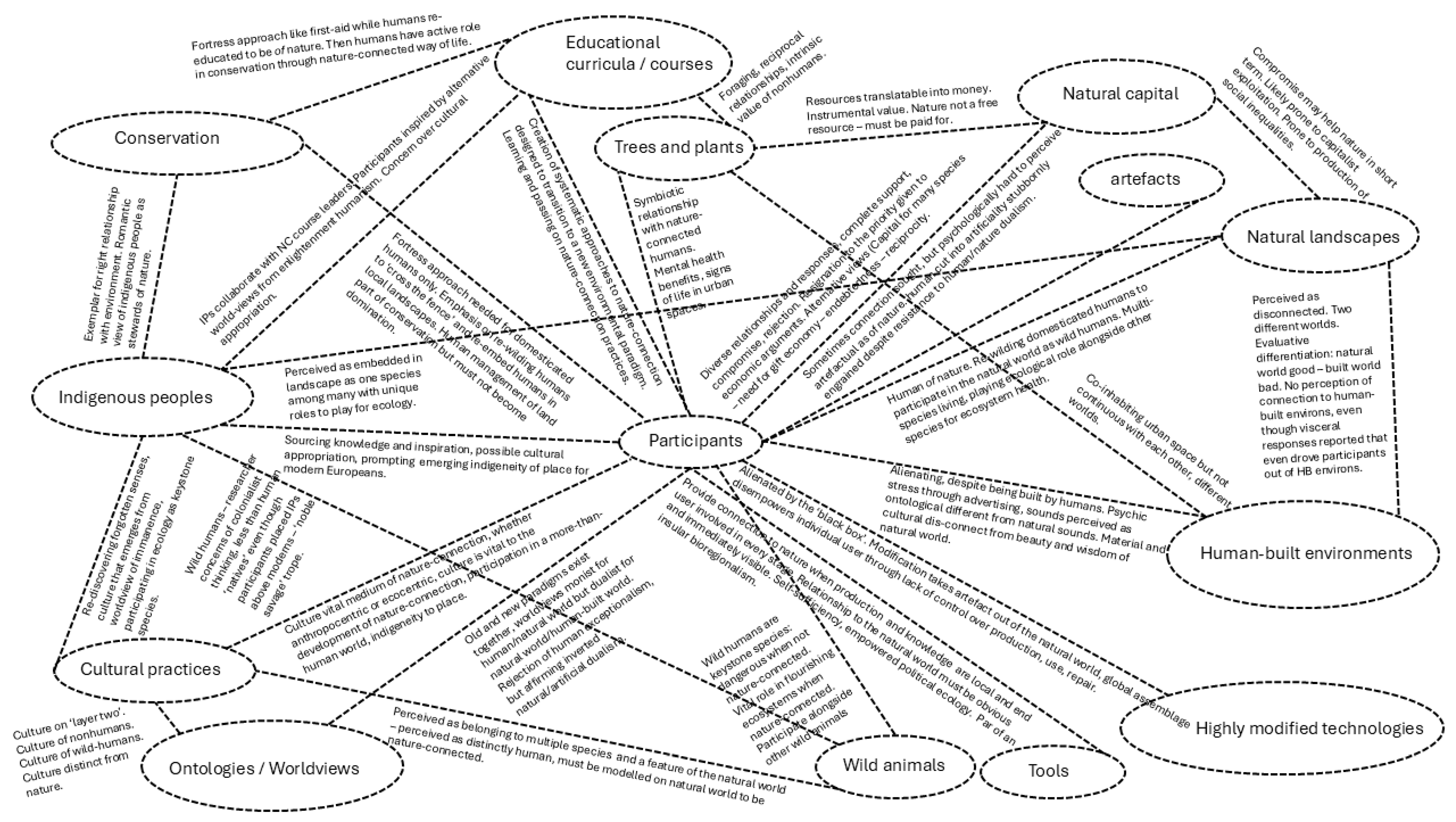
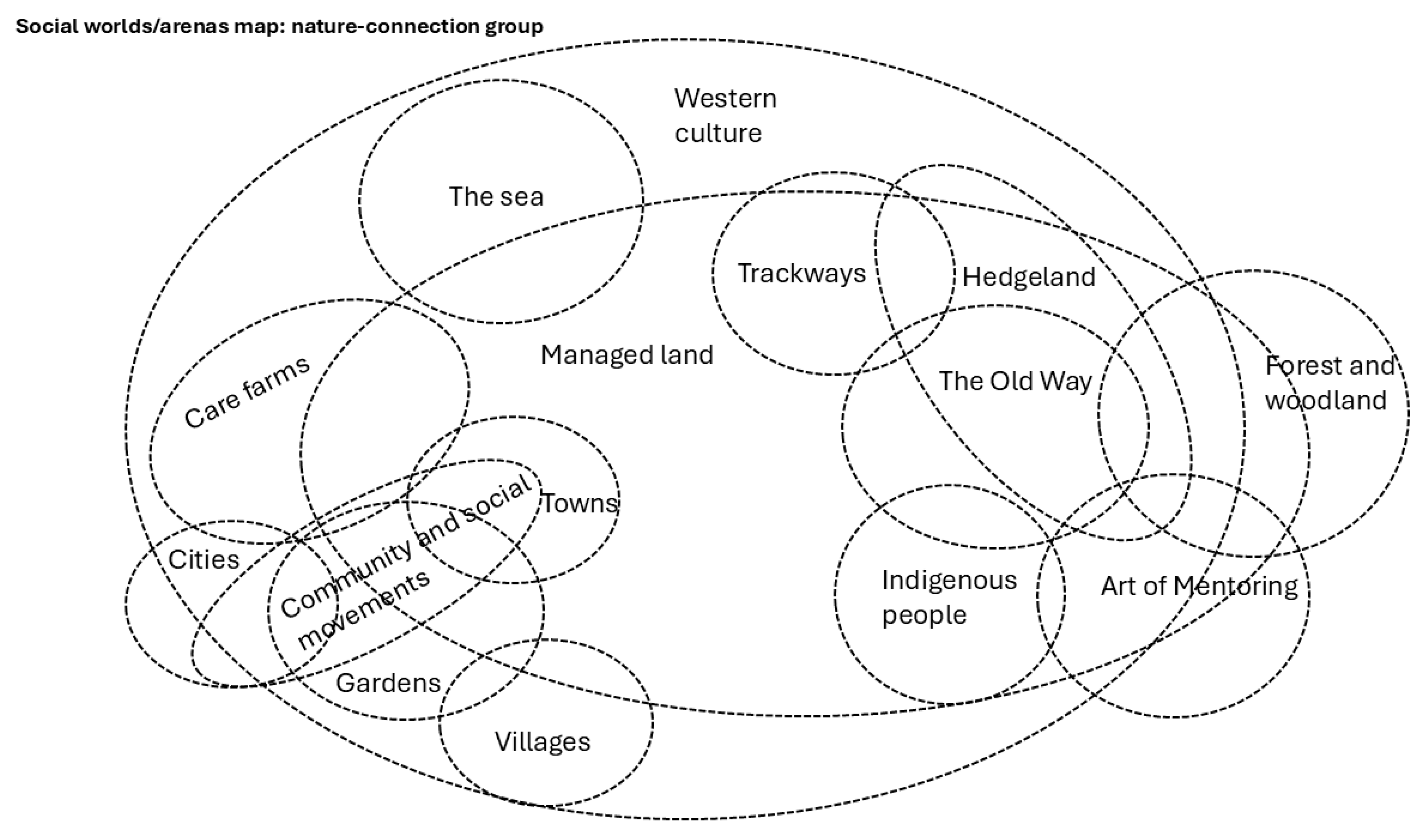
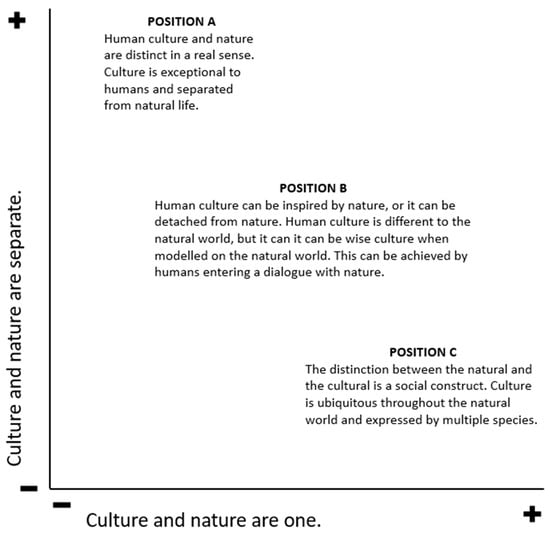
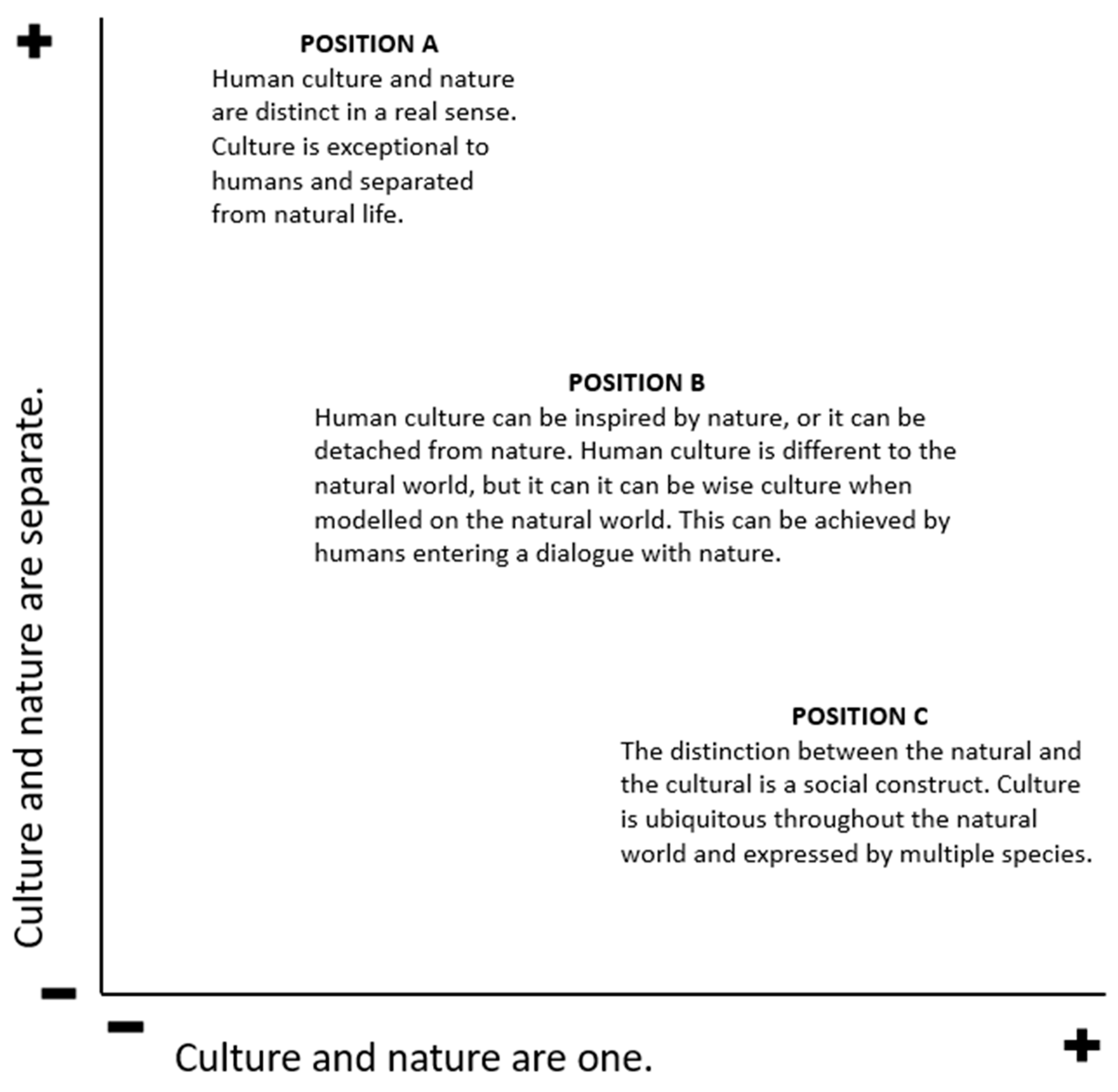
Situational maps allow the researcher to collect all the elements assembling the situation. This form of mapping is non-hierarchical, so material entities, discourses, social institutions, and psychological elements such as lived experiences, schema, or constructs may all be present on one plane. Thus, Clarke et al. [41] describe this plotting of complex networks of elements as “messy” (p. 128). As analysis progresses, attention is focused on those elements that are most relevant to the research question, and these are studied at greater depth through relational mapping (e.g., Figure 1). Relational mapping is an extension of situational mapping, whereby the relationships between the elements are visualised as a network using nodes and edges. Typically the relationships can be noted along the edges. Social worlds mapping (e.g., Figure 2) is a way of visualising collectives. An example from this study would be a nature-connection course. Social worlds offer a way of grouping elements of the situational maps as dynamic collectives, and are useful for looking at broader issues and collective identities. Finally, positional maps (e.g., Figure 3) are described as “the analytic tools applied to the discursive materials in the situation” (p. 165) [41]. Positional maps visualise the stances and perspectives taken on specific issues.
Figure 1.
A relational map of the nature-connection situation.
Figure 2.
Social worlds making the nature-connection situation.
Figure 3.
Positional map of culture/nature relationships. Plus sign indicates greater agreement with this position.
Alongside the mapping exercises, memos are constantly written to document insights and observations as to what the relationships making up the situation co-constitute. Coding is also employed, but in SA a human participant’s voice is not assumed to “emanate from a singular subject” (p. 733) [45]. Rather, participants’ experiences are explored in the more-than-human relationality. As such, much of the coding is spent detailing the relationships between the human and nonhuman elements of a situation.
The analysis involved an iterative movement between mapping practices, coding, memo-writing, and close engagement with individual interview transcripts. Rather than mechanically deriving themes from diagrams, the maps functioned as analytic scaffolds that oriented attention to relationships, tensions, and discursive patterns within and across cases. These patterns were then elaborated through detailed, idiographic analysis of individual interviews, allowing themes to be written up as situated configurations of meaning rather than abstracted categories. This idiographic emphasis is consistent with situational analysis’ commitment to preserving complexity, heterogeneity, and contradiction, and is particularly appropriate for examining how multiple paradigms and worldviews are lived, negotiated, and entangled within specific practitioners’ accounts. Accordingly, the results presented here prioritise depth and situated understanding over generalisation, in keeping with the epistemological commitments of SA.
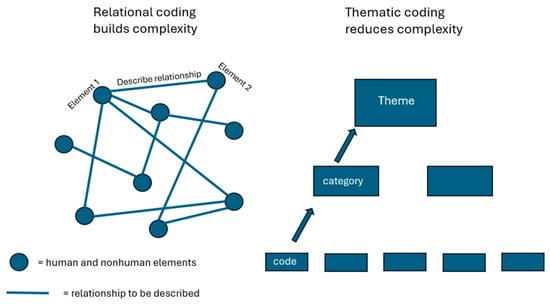
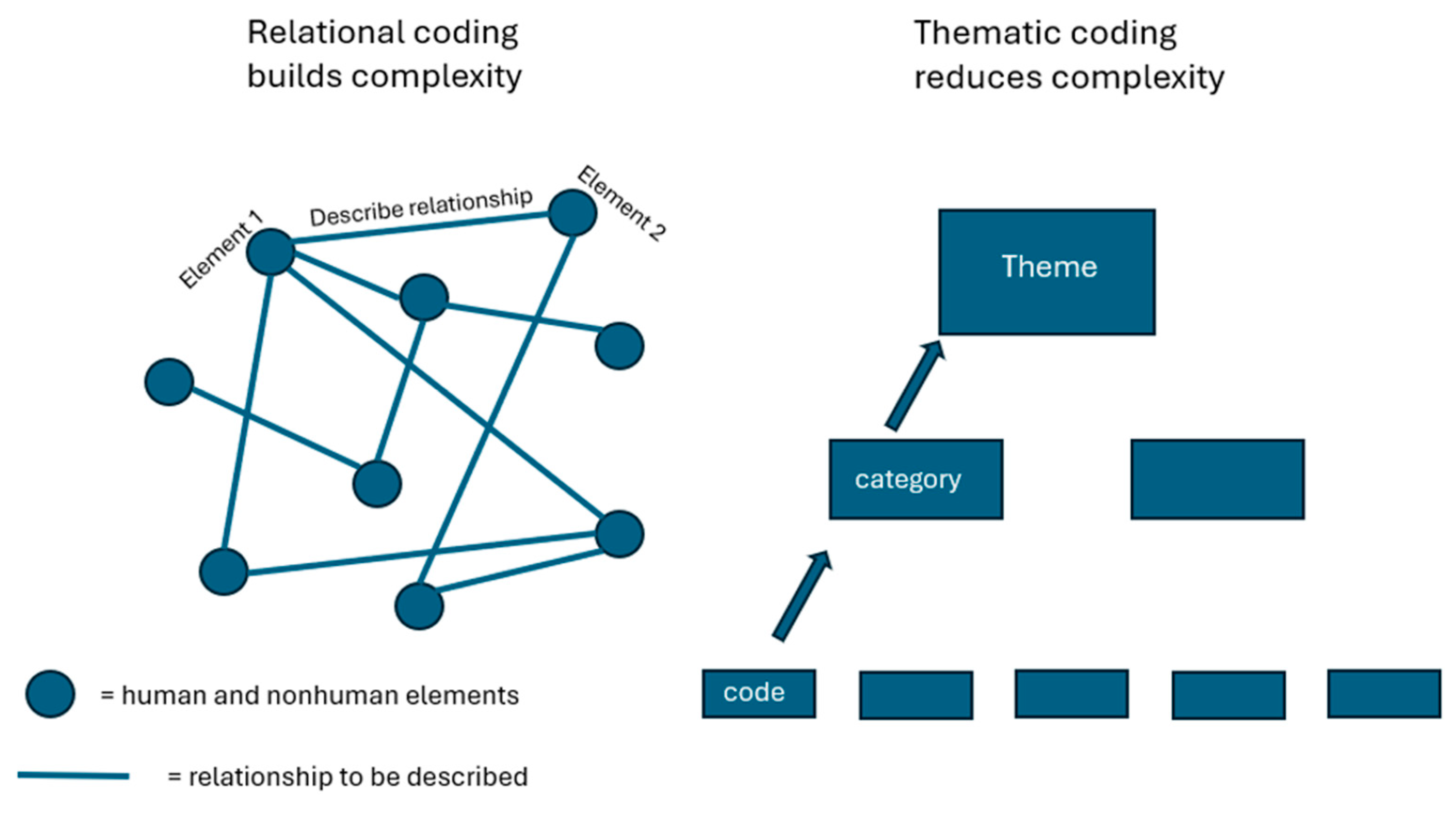
Together, these maps facilitate a cartographic exploration of the material-discursive forces that comprise the situation of interest, plotted in the form of a relational network of elements, and at various scales of analysis. In addition, SA is a method designed to accommodate heterogeneity. Since a central aim of this study was to explore the possibility of multiple worldviews, environmental values, attitudes, and practices, Clarke’s [41] acknowledgement that “individuals and groups of all sorts may and do hold multiple and often contradictory positions on the same issue” (p. 166) is apt. The mapping techniques of SA are designed to accommodate multiplicity and contradiction in ways that make these amenable to analysis without the need for simplification or aggregation of data according to models of normativity. Thus, SA provides a productive and highly suitable method for exploring the multiple discourses woven throughout nature-connection literature and practice. Figure 4 below highlights the relational, cartographic method of SA when compared to a hierarchical approach of qualitative inquiry where themes are built upon lower order categories and codes. The main difference to note here is that qualitative methods based on building themes tend toward a reduction of complexity, whereas the relational analysis of SA tends toward accommodating complexity.
Figure 4.
Comparison of relational coding and thematic coding (blank boxes represent additional codes or categories which are combined to reduce complexity).
3. Results
3.1. Chloe
Chloe is a permaculture teacher and practitioner based in the UK but stemming from the Netherlands. She is deeply involved in nature-connection practices and has taken part in immersive nature-connection courses. The most impactful of these for Chloe was the 8 Shields course developed by John Young. 8 Shields is a framework for connecting to the natural work and building community and draws heavily on indigenous mentoring and cosmological traditions (8 Shields. Principles designed by nature. https://8shields.org/). Chloe’s cultural upbringing in Western Europe coupled with her involvement in the 8 Shields course made her, as with the other nature-connection participants, a source of rich data for exploring the research questions. Chloe offered some initial evidence of her understanding of the relationship between nature and culture when describing the environment around where she lives. She is very active in managing the land around her home, and described her immediate surroundings in the following terms:
It’s still cultured, but it’s heading toward natural. And there’s natural places around.
Chloe’s statement suggests an understanding of nature and culture as existing on a spectrum. The statement suggests that for land to increase in naturalness, culture must recede. One can head toward one or the other, or there can be a ratio of nature to culture, but a “pure” nature would be at least in part defined by an absence of culture. However, later in the interview, Chloe articulated resistance to almost saying “nature and us” on account of her understanding of people as “simply a part of nature”. These examples of talk suggest a discursive conflict: Whilst Chloe wanted to position humans as part of nature, the extent to which human culture is present in the environment was still viewed by her as the extent to which the naturalness of the environment is compromised.
Chloe, more so than other participants, seemed conscious of the conflict between her pursuit of a more-than-human identity and the language available to her to express that identity. For example, having asked her to define the word nature in her own words, she replied with the following:
Yeah, it’s tricky isn’t it because we’re in a transition of understanding, as a society, Western society, the Western mindset, which has always separated—or for many centuries—separated us humans as we stand above, and have dominion over and all that stuff. Whereas increasingly in my personal paradigm, I’m a cog in a wheel, or a node in a web, of all that is, and some of that is other beings—living beings, plants, animals and microbes; but also, other things like rock and soil and air and elemental, things like that. So um, I guess I use the word nature still in the way that it’s understood in the previous paradigm.
Here, Chloe showed she was aware that her personal paradigm, which seemed to describe a kind of relational ontology, was not represented in the way she used the word “nature”, which Chloe acknowledged is a term that suggests something separate from, and even below, human life. Chloe was aware that she was going through a “transition of understanding”. In this transition, new ways of experiencing self, culture, and nature were arising which do not lend themselves to the linguistic habits of categorising the human and the nonhuman in opposing terms, and certainly not in terms of human exceptionalism.
However, Chloe’s talk suggests that language presents more than just the habitual use of dichotomising terms: it has contributed to shaping her perception of the relationship between nature and culture. In other words, Chloe’s talk indicates a genuine conflict of paradigms. For example, although Chloe saw her humanity as part of nature, she still asserted an understanding of nature as those parts of the world that are “less messed with by humans”. A clear conflict emerged in the interview between a discourse of humans as nodes in the more-than-human web of nature and a discourse of the human touch transforming nature into something less natural. These discursive contradictions correlated with the emergence of an environmental identity that is multiple and contradictory as Chloe experienced transition from the old paradigm into the new. Part of this transition entailed Chloe looking for her “rightful place again as a human animal”. Chloe’s use of the word “again” acknowledged her connection to a cultural heritage of Western Europe whose dominant form produces human/nature and nature/culture dichotomies.
Chloe accepted that as a human animal, living as part of nature, her actions will have an impact on her environment. In keeping with Chloe’s permaculture philosophy of working with nature, to be nature-connected in this way is not to withdraw her human presence from nature, but to act with an ecological sensitivity such that her impact occurs in a “less destructive way”. Chloe’s nature-connection teaching, therefore, acknowledged a transition period where discourse and self-concept move from an old paradigm of nature/culture dichotomy toward a new paradigm of more-than-human relationality. However, Chloe was also aware of her own cultural heritage, rooted in hierarchical and dualistic thinking, making her nature-connection practice as much a journey of personal transformation as it was a way of engaging with the more-than-human world.
3.2. Moss
Moss is a coach and nature-connection practitioner who travels internationally to participate in nature-connection courses. When I asked Moss how she understood the term nature-connection, she responded by distinguishing between an external nature (a nature out there) and an inner nature (one’s subjective and individual experience). Moss suggested these two natures can interact such that the external nature can “help a lot to feel more connected inside”. Moss also included cultural practices as capable of forming nature-connection, such as dancing and painting. In essence, for Moss, nature-connection was “all about feeling that you belong to yourself and in the world”. Initially, Moss’s description of nature and nature-connection seemed inclusive of any materiality, as she stated the following:
A well-integrated nature-connection helps a person to feel belonging and feel at home in general, no matter actually where they are.
However, when asked whether the materiality of the environment makes any inherent difference to Moss’s nature-connectedness, she states the following:
Of course, it has an impact or an effect whether the materials are wood and fresh water and green stuff, or if it’s concrete or plastic.
Moss explained how she experienced nature-connection in environments far removed from green nature, such as when dancing, and how on occasion she lacked a sense of nature-connection despite being immersed in a green environment. Given this, I was interested to find out to what extent her sense of nature-connection was predicated on what was going on in an environment compared to the materialities making up an environment. I painted a picture of a peaceful plaza with a café and fountain. Then I asked Moss to compare this with a peaceful meadow or forest and consider whether the materialities of each would be significant in how nature-connected she might feel. Moss took the cut between green nature and human-made artefacts to be a given, as her response below suggests.
I mean of course there’s a difference. And I would also go so far to say that if anyone would argue that it’s otherwise, I would say “look again” (laughs), you know because I think it’s just so engrained in the human that of course there’s a difference.
It is worth highlighting here that Moss did not back up her cutting of the natural from the artefactual by pointing to a quality of the materials themselves, but rather because it is “just so engrained in the human”. In this statement, Moss homogenised the cultural perception of a spatially and historically contingent group of Europeans for whom nature/culture dualism is the dominant outlook, equating this group with humans in general.
Yet, despite the strong sense of a difference between the natural and the artefactual, elsewhere in our interview, Moss demonstrated her understanding of the logic that all human-made artefacts are of nature.
Plastic, concrete, it’s all nature because we have nothing, we have nothing in this world that is not nature because otherwise we could not make it.
Nevertheless, when talking about the development of an iPhone, from the mining of raw materials to the finished product, Moss saw the human touch again as something which extracts materialities out of their natural domain. In a similar vein to Chloe, Moss seemed to perceive a nature-culture spectrum. As shown in the quote below, the more a material is modified by humans, the further away it moves from being identified as nature, and consequently, nature-connection becomes harder to establish. That human modification of nonhuman natures becomes antithetical to nature-connection suggests that the difference between the natural and the artefactual was not just understood typologically. Rather, it was felt ontologically.
It’s just been modified so many times and so many processes have been put into it, that as I see it, the more we spend time with highly modified nature, the more difficult it becomes to experience this nature connection that we’re talking about.
Here, Moss was reminiscent of Wilson [18], when he described modified natures (artefacts) as “lifeless facades” (p. 115). And yet elsewhere in our interview, Moss suggested the following:
Leaving nature completely unmodified is not always the best thing.
Elaborating on this statement, Moss offered a place for humans in nature as respectful gardeners eager to enter a “dialogue” with the natural world. This respectful listening to nature as an outsider was also discernible in our talk about nature and culture. For example, at one point in our interview, Moss described the culture building aspect of her nature-connection course thus:
The whole thing just melted together as one, because we did stuff together that also really strengthened the intimacy in the group and between the people, the same way as we strengthened the intimacy between me and say the frog or the grasshopper for example. It was really an experience of connecting with nature all around.
When I asked Moss if she understood human culture as completely embedded in the natural world, she made a distinction, suggesting that a nature-connected human culture is one that is “inspired” and “built upon” the “wisdom of nature”. Green nature was thus seen as a template for the good life, or a source of inspiration by which humans can attune their culture with nature. Nevertheless, the two were seen by Moss as separate entities: human culture can be in harmony with nature, but it is not of nature. In this instance, a nature-culture dualism was not rejected, but put to work in establishing a humble human who looks to nature as a model for living and the creation of culture that mimics perceived qualities of nature such as interconnectedness, creativity, and harmony.
3.3. Kirsten
Kirsten is a nature-connection course facilitator who relocated from London to a rural UK location to run a nature-connection education business with her partner. This interview offered some analytically fascinating moments where multi-paradigmatic entanglements around the relationship between the natural and the artefactual were thought through by Kirsten. Kirsten saw human/nature dualism as problematic to the goal of living more ecologically, as well as problematic for the idea of a nature-connected human identity. Cognizant that ontologically ejecting the human built and artefactual from nature may deflect attention from sustainable practices where they are most needed—from the processes of extraction, production, consumption, and waste—Kirsten identified language as key to this perceived ontological split.
Again, it’s that labelling and that separation thing. And I think that plays a massive part in where we’ve got to as a society and how unwell we are as a society.
Recognising this, Kirsten built practices into her nature-connection courses that included connecting to human-built artefacts. One of the ways Kirsten integrated the artefactual into people’s nature-connection was through a history-tracing exercise.
One of the pathways that we do in our programmes is looking at the value and meaning of objects; and we ask people often to look around what they have in their house and look at where that’s come from.
Kirsten’s use of this exercise presented a radical departure from the otherwise ubiquitous perception of the human-built and artefactual as antithetical to nature-connection experiences or efforts to develop a more ecological consciousness communicated by other participants. Rather than trying to remedy human-built environments by increasing the presence of green nature, Kirsten recognises that to connect to human-made artefacts is to connect to nature, since those artefacts are continuous with the rest of nature rather than cleaved from nature. This was a departure from any sense of escapism where a polluted, grey world was simply rejected in favour of a pure and natural one. Rather, Kirsten’s connection to human-made artefacts expressed a nature-connection of taking responsibility for one’s role in the continued becoming of a more-than-human world. This exercise shifted the focus from increasing personal wellbeing through contact with green natures, and toward awakening a sense of individual accountability for human participation in environments, whether those environments are classed as natural or artefactual.
However, Kirsten also demonstrated the power and longevity of a dominant worldview internalised through a lifetime of acculturation into dualistic thinking. This became apparent as she talked of the effort and concentration needed to hold the perception of continuity running through the natural and the artefactual.
I’m sitting in a house now and I’ve got a phone and a laptop in front of me, and I do find that, to be honest I find that quite difficult to remember that the tech that I’m using has come from nature; whereas it’s sat on a wooden table and that actually makes me feel quite happy (laughs). So those natural materials, I do think, I find it difficult to really see, even though I know it’s a fact, it’s confusing that there is no such thing that, you know it might have been manufactured but it’s all come from the natural world. I think it’s really quite confusing, a lot of the time to be honest, trying to remember that.
As with the other participants, Kirsten located the natural and the artefactual along a spectrum. Her wooden table was seen as closer to something natural than her laptop because it had been modified by humans to a lesser extent. Here, the dualistic mode of thinking is present again. The tech is from nature rather than of nature. Thus, even in the midst of Kirsten’s conscious efforts to include the artefactual in her nature-connection practices, a human/nature dualism pervaded in that any materiality was seen to leave the natural world to the degree that it had been modified by human hands. The origin of a laptop is natural, but it is not considered of nature in its transformed state. As was the case with Chloe and Moss, this distinction was expressed as more than a useful typological system for the purposes of analysing different materialities. Rather, dichotomising the natural and the artefactual was communicated as a lived experience and a felt response to materialities such that their dualistic differentiation had an ontological feel to it. Kirsten, whilst making a conscious effort to enter into relationship with her household artefacts, was impeded by the stubborn persistence of her dualistic cultural inheritance.
The central finding from this analysis lay in the participants’ pursuit of a relational ontology that became entangled with a culturally inherited human/nature dualism. This entanglement resulted in a phenomenon which can be conceptualised as selective animism. Selective animism encapsulates the process of human-felt connection to a more-than-human world that does not in fact embrace the whole of that world, but only those materialities considered natural. The artefactual was felt to be ontologically cleaved from the natural world, making environments of human-transformed materials obstacles to nature-connection rather than facilitative of it. Paradoxically, humans were seen as at once of nature and that which cuts the artefactual from nature.
3.4. Stepping Back
This paper focuses on three participants in particular. By tracing their experiences in detail, this study is able to demonstrate how meaning is constructed, negotiated, and enacted in specific contexts. However, the analysis also took a wider view. The themes and issues explored by Chloe, Moss, and Kirsten were also considered by others in the sample, and the situational maps give an overview of the networks and relationships uncovered through the analysis. Relationships between urban and wild worlds were discussed, as well as smaller connected worlds such as gardens and urban green spaces. These social worlds were positioned in different ways, shaped by participants’ worldviews, relationships with natural and built environments, cultural upbringings and aspirations, and their political ecologies.
Looking across the three interviews, it is clear that the discourses expressed by participants acted as active agents, in that they conditioned perception according to the way artefacts were separated from the natural world. Such a cut was perceived wherever humans acted on their environments, dividing matter according to their culturally inherited assumptions of human/nature dualism. As such, these interviews empirically demonstrated a multi-paradigmatic entanglement constituting participants’ worldviews. The implications of this will be explored in the following discussion.
4. Discussion
4.1. Challenging the Nature–Culture Dualism
Quantitative studies have shown a positive relationship between measures of nature-connectedness and indicators of pro-environmental behaviour [12]. However, nature-connection scales focus on the relationship between humans and those nonhuman natures that conform to the modern Western construct of the natural world as a place absent of human-transformed materialities. The parameters of such a nature-connection are thus pre-defined by and limited to relationships between humans and green nature. The possibility of profoundly connecting relationships to human-built artefacts are effectively silenced by this research operationalisation. Thus, the potential for nature-connection educational practices to nurture more ecologically sensitive and ethical behaviours is constrained by the human/nature dualism that underpins them. In terms of behavioural intervention design and impact, it may be that powerful leverage points capable of motivating sustainable behaviours go unnoticed where they might enter at the point of human connections to the artefactual rather than the natural. Limiting a conceptualisation of nature-connection exclusively to nonhuman natures that fall within the modern Western construct of the natural world is supported by dominant nature-connection frameworks such as the biophilia hypothesis [18]. However, we argue that such a framework is too underdeveloped to be of use in thinking with the socionatural complexities of the Anthropocene.
What directions, then, might be explored instead? In an article on the apparently oxymoronic nature of the term nature-connection, Fletcher [27] points briefly to new materialist and poststructuralist theories which offer a new vocabulary. However, our empirical work suggests that a new vocabulary will be insufficient to remove entrenched dualistic assumptions. Here we demonstrate the presence of multi-paradigmatic entanglements that resist collapse into a human/nature binary, as they fail to untether themselves from this binary. Rather, both dualistic and relational perspectives are co-constituting the nature-connection experience. Extending these findings, we theorise that the transition into a new environmental paradigm for the West is not achieved by simply abandoning enlightenment thinking for indigenous perspectives of relationality. It may be more like a complex of searching tendrils reaching out from the Cartesian heritage of those acculturated in the modern West, binding to and pulling back in aspects of relational ontologies such as those found in some non-Western indigenous cultures, and resulting in an entangled hybrid worldview marked by discursive contradiction.
This finding prompts new questions in pursuit of negotiating the ecological challenges of the Anthropocene. Firstly, what are the implications of a worldview entwined from both dualistic and relational strands for educators aiming to encourage the development of an environmental ethic of nature-connection? Secondly, in suggesting that the action of a selective animism stops humans from entering into felt relationships of accountability with human-transformed materialities, and advocating for more inclusive nature-connection practices that extend to felt relationships with the artefactual, how might conservationists’ concerns that the deconstruction of human/nature dualism could weaken protection of habitats from human development be addressed [46,47,48,49]?
One reason for looking to the new materialisms relates to their common acknowledgement of the powers and affordances of nonhuman agents, and the inseparable contribution these make to human culture. For example, Bennet’s vital materialism argues that in a world of vibrant matter, the human is always already arising from a more-than-human constellation of forces that do not privilege the idea of an atomised human body/mind as the sole possessor of causal force and agency [50]. For Bennet, objects in the world emerge from relational processes, and creativity is afforded to matter as such, green or otherwise. A strength of vital materialism lies in the emancipation from an anthropocentric social constructionism, where environments are perceived as canvases upon which humans project their meanings and purposes [51]. This in turn may open the door for a genuine recognition of nonhuman others as occupying a place in the world shared with humans rather than created by them.
However, whilst the new materialisms offer us a realist ontology of nature whose sociomateriality pushes us beyond human/nature dualism, White, Rudy, and Gareau [52] suggest a lack of clarity around who might benefit from “an insistence that we acknowledge the lively materiality of nonhuman nature” (p. 141). This question is poignant for the present study. For example, Kirsten’s nature-connection teaching using household objects helped facilitate something of a felt relationship with the artefactual in ways that link to Bennet’s conceptualisation of vibrant matter [50]. And yet, it remains unclear how a perception of matter’s self-organising creativity, even its ontological continuity across the natural/artefactual divide, should lead to an environmental ethic of care for a more-than-human world. There is no direct logical consequence that necessitates moral consideration for a nature on the grounds that it exhibits capacities. Any crafts person can appreciate the apparent wilfulness of matter without the need to attribute anything more than an instrumental value to the material.
We suggest then, that Bennet’s vital materialism [50] brings us part way there by cutting across human/nature dualism and the intuition of an ontological divide between the natural and the artefactual. Even at this part-way stage, there is a significant advantage to using vibrant matter as a sensitising concept over human/nature dualism. As an analytical lens, vibrant matter encourages a more nuanced ecological approach than simply what is touched or untouched by human hands. Rather, the metabolic continuity of materialites that constantly, dynamically, and often unpredictably flow uninhibited across the boundaries of the natural/artefactual divide become more perceptible. More importantly for nature-connection as an experiential engagement with nonhuman natures, artefactual materialities—not just natural ones—are experienced by people through felt relationships. As such, vital materialism raises human-transformed materialities from the status of inert matter, perceived to be ontologically cleaved from the natural world, to matter that is relationally dynamic with the natural world. This alone could enrich any analysis of the relationships making the more-than-human world more than a simple human/nature binary and may hold greater potential for educators and for raising ecological awareness. However, something extra is needed to push beyond the somewhat ethically neutral language of lively materialities if conservationists’ concerns over losing the sharp natural/artefactual divide are to be addressed. We propose that this extra something may be found by drawing on panpsychist philosophy to inform a new environmental worldview for the West.
4.2. Panpsychism
There are different forms of panpsychism [53]. However, the basic premise of the philosophy postulates experientiality as integral to nature rather than exceptional to individual human minds, with Goff [54] arguing that “mentality is a fundamental and ubiquitous feature of the universe” (p. 206). Panpsychist ontologies differ in the sophistication of consciousness afforded to objects, but all afford even the most fundamental particles some form of experience [53]. As such, panpsychism pushes further than Bennet’s [50] assertion of matter’s self-organisation or liveliness by recognising the experience of nonhuman natures as having a sense, however rudimentary, of what it is like to be that nature. This move is relevant to two challenges identified in this study: overcoming the selective animism evident in participants’ accounts, and providing a basis for the moral consideration of nonhuman natures.
If consciousness is understood as a ubiquitous feature of the universe, Western constructs of the natural world are no longer ontologically privileged over human-transformed materialities. This resolves the problem of selective animism, allowing animacy to traverse the boundaries dividing the natural from the artefactual. This is not to say that a typological differentiation of human-made artefacts from natural materialities cannot be analytically useful (such as when measuring human impact on a nonhuman habitat). However, panpsychism prevents these distinctions hardening into ontological dualisms. Dualistic categories can therefore function as analytical tools without undermining an underlying assumption of relationality. In this way, conservationist concerns about retaining distinctions necessary for protection and management can be accommodated without reproducing the selective animism that obscures the lively entanglements continuous across these divides. Both the natural and the artefactual can be analysed relationally and encountered through felt connection. Furthermore, by endowing matter with experientiality, no matter how rudimentary, a basis for the moral consideration of nonhuman natures is set. This assertion rests on the fact that so many of our human rights are predicated on self-awareness, such as the ability to know one is suffering. The attribution of a sense of what it is like to be that to nonhuman natures provides what appears to be missing from Bennett’s vibrant matter [50]. Furthermore, this premise introduces a basis for rich exploration of environmental values as fundamental to environmental education.
Matthews [31,55] proposes panpsychism not just as philosophical proposition, but as a worldview with the potential to transform human relationships with nonhuman natures in ways that challenge physicalism and cultural scientism. Critiquing the “ruthlessly exploitative attitude towards nature” documented in Baconian science, Matthews [31] suggests environmental destruction was made morally permissible due to enlightenment notions of human exceptionalism and an understanding of the nonhuman world as solely inert and mechanical. Plumwood [56], therefore, asserts a need for a “post-Cartesian reconstruction of mind that allows us to emphasise other marks of mind than the on/off concept of consciousness selected by Descartes precisely in order to effect the wholesale exclusion of nonhumans” (p. 397). More recently, Goff [54] states that “there is no real kinship with nature if dualism is true” (p. 190). In transitioning from an ontological dualism toward a panpsychist worldview, it can be argued that panpsychism holds the potential to transform humans’ perception of kinship to a more-than-human world in ways that extend beyond a selective animism and toward an inclusive nature-connection where humans and their artefacts are felt to be of nature as much as those nonhuman natures belonging to the category natural.
If a panpsychist perspective was nurtured to the point of forming the Western ontological intuition, the specifics of any human-to-nonhuman negotiations would be grounded in the moral consideration of nonhuman as well as human natures. This grounding is missing in the human exceptionalist paradigm that constitutes our collective Cartesian hangover but could provide instead an appreciation of the complex hybridity and socionatural relationality that are the hallmarks of the Anthropocene [57]. It might also help guard against those interpretations of the Anthropocene that encourage continued efforts to control and dominate nonhuman natures for solely instrumental purposes [47]. Framed positively, a panpsychist ontology naturally calls for an environmental education that is experiential and relational, and in which students meet nonhuman natures in ways that honour the ontological sovereignty of those natures, and the fundamental kinship between them.
This analysis has provided concrete examples of discursive multiplicity and contradiction that are at work in the talk of nature-connection educators and practitioners. Aspects of participants’ talk that suggest contradiction occupy the same discursive space and move through each other. They are entwined in ways that speak to Barad’s [58] metaphorical use of interference patterns in the phenomenon of diffraction. What is produced by these multi-paradigmatical entanglements should not simply be dismissed as flawed thinking, but taken as an opportunity for a generative, creative working-out of a sense of nature-connection for the Anthropocene. We argue that part of that work is nurturing cultural intuitions around the natural and the artefactual that do not mistake typological systems of analysis with felt ontologies.
4.3. Limitations and Practical Implications
Acknowledging that no study is without limitations, we note that this analysis is based on a small sample of practitioners already deeply engaged in nature-connection work, which may limit the transferability of the findings beyond similar practitioner communities. However, it seems unlikely that those less engaged with the topic will have a clearer understanding, so the probability is that our research underplays the conceptual issues with nature-connection. The study also focuses intentionally on Western practitioners, and this cultural selectivity necessarily constrains the perspectives represented. While this was appropriate for examining the specific ontological inheritances shaping nature-connection within Western contexts, it excludes other diverse viewpoints, and further research into other groups is recommended. Finally, the reliance on interview data means the study captures practitioners’ discursive accounts rather than their embodied practices or situated interactions. Future research utilising observational or participatory methods would help explore further and build on the patterns identified here.
The findings have important practical implications for nature-connection work in education, conservation, and community engagement. For example, recognising that participants’ worldviews are shaped by both dualistic and relational assumptions suggests that environmental educators cannot assume participants have a coherent conceptualisation of “nature”. Programmes may therefore benefit from explicitly inviting reflection on how learners define and differentiate the natural from the artefactual, and from designing activities that surface and gently unsettle unexamined dualisms. Our analysis also suggests that meaningful experiences of connection can arise not only through encounters with green spaces but also through relationships with human-made environments and objects. Practitioners might therefore experiment with pedagogical approaches that incorporate the artefactual (such as guided explorations of household items, urban infrastructure, or everyday technologies), to cultivate ecological sensitivity in contexts where access to green nature is limited. Finally, integrating elements of panpsychist or relational ontologies into educational design through exercises that prompt learners to put themselves in the position of nonhuman entities may help foster more inclusive forms of environmental commitment. Such approaches need not replace existing conservation priorities but can work alongside them by reframing the affective and ethical foundations upon which pro-environmental action is built.
5. Conclusions
Despite nature-connection educators and practitioners exploring human-nature relationships that reject human exceptionalism, an inherited Cartesian dualism continues to exert an implicit influence, resulting in contradictory environmental paradigms occupying the same discursive space. In this paper we provide empirical evidence of this multi-paradigmatic entanglement in the talk of individuals immersed in nature-connection practices. We argue that an environmental attitude rooted in the intuition of an ontological distinction between the natural and the artefactual is inadequate for negotiating socionatural complexity. Further, we claim that panpsychism offers a promising worldview with a long Western tradition that affords intrinsic value and moral consideration to nonhuman natures. As a worldview, panpsychism could inform cultural intuitions of animacy that may promote greater ecological sensitivity in ways that are not limited to social constructs of the natural world. Rather, a panpsychist worldview would encourage and facilitate a perception of connection and moral accountability for human relationships with all nonhuman natures, including those we are most intimately entangled with, namely, our artefacts and built environments.
Author Contributions
Conceptualization, D.R.E.C. and D.H.; methodology, D.H.; validation, D.R.E.C.; formal analysis, D.H.; investigation, D.H.; resources, D.R.E.C.; data curation, D.H.; writing—original draft preparation, D.H.; writing—review and editing, D.R.E.C.; visualization, D.H.; supervision, D.R.E.C.; project administration, D.R.E.C. and D.H. All authors have read and agreed to the published version of the manuscript.
Funding
This research received no external funding.
Institutional Review Board Statement
The study was conducted in accordance with the Declaration of Helsinki, and the ESRC Framework for Research Ethics. It was approved by the Institutional Ethics Committee of Plymouth Marjon University (protocol code EP138, approved 30 April 2021) for studies involving humans.
Informed Consent Statement
Informed consent was obtained from all subjects involved in the study. Written informed consent has been obtained from the patient(s) to publish this paper.
Data Availability Statement
The data that support the findings of this study are not publicly available due to confidentiality restrictions. Anonymised data may be available from the corresponding author upon reasonable request and with appropriate ethical approval.
Acknowledgments
We would like to express our sincere gratitude to all the research participants who generously shared their time, experiences, and insights—this study would not have been possible without their valuable contributions. We are also deeply grateful to the university for supporting this study and to Greg Borne for his guidance and support in the research process.
Conflicts of Interest
The authors declare no conflicts of interest. The funders had no role in the design of the study; in the collection, analyses, or interpretation of data; in the writing of the manuscript; or in the decision to publish the results.
References
- Schultz, P.W.; Tabanico, J. Self, identity, and the natural environment: Exploring implicit connections with nature 1. J. Appl. Soc. Psychol. 2007, 37, 1219–1247. [Google Scholar] [CrossRef] [Scilit]
- Schultz, P.W. Empathizing with nature: The effect of perspective taking on concern for environmental issues. J. Environ. Psychol. 2002, 19, 225–295. [Google Scholar] [CrossRef] [Scilit]
- Schultz, P.W.; Shriver, C.; Tabanico, J.J.; Khazian, A.M. Implicit connections with nature. J. Environ. Psychol. 2004, 24, 31–42. [Google Scholar] [CrossRef] [Scilit]
- Ives, C.D.; Abson, D.J.; Von Wehrden, H.; Dorninger, C.; Klaniecki, K.; Fischer, J. Reconnecting with nature for sustainability. Sustain. Sci. 2018, 13, 1389–1397. [Google Scholar] [CrossRef] [Scilit]
- Tam, K.P. Concepts and measures related to connection to nature: Similarities and differences. J. Environ. Psychol. 2013, 34, 64–78. [Google Scholar] [CrossRef] [Scilit]
- Perkins, H.E. Measuring love and care for nature. J. Environ. Psychol. 2010, 30, 455–463. [Google Scholar] [CrossRef] [Scilit]
- Nisbet, E.K.; Zelenski, J.M.; Murphy, S.A. The nature relatedness scale: Linking individuals’ connection with nature to environmental concern and behavior. Environ. Behav. 2009, 41, 715–740. [Google Scholar] [CrossRef] [Scilit]
- Zylstra, M.J.; Knight, A.T.; Esler, K.J.; Le Grange, L.L. Connectedness as a core conservation concern: An interdisciplinary review of theory and a call for practice. Springer Sci. Rev. 2014, 2, 119–143. [Google Scholar] [CrossRef] [Scilit]
- Richardson, M.; Hunt, A.; Hinds, J.; Bragg, R.; Fido, D.; Petronzi, D.; Barbett, L.; Clitherow, T.; White, M. A measure of nature connectedness for children and adults: Validation, performance, and insights. Sustainability 2019, 11, 3250. [Google Scholar] [CrossRef] [Scilit]
- Clayton, S.; Opotow, S. (Eds.) Identity and the Natural Environment: The Psychological Significance of Nature; MIT Press: Cambridge, MA, USA, 2003. [Google Scholar]
- Baird, J.; Hutson, G.; Plummer, R. Examining links between connections to nature and intentions for pro-environmental behavior as outcomes of NOLS. J. Outdoor Recreat. Educ. Leadersh. 2020, 12, 367. [Google Scholar] [CrossRef] [Scilit]
- Mackay, C.M.; Schmitt, M.T. Do people who feel connected to nature do more to protect it? A meta-analysis. J. Environ. Psychol. 2019, 65, 101323. [Google Scholar] [CrossRef] [Scilit]
- Barrable, A.; Booth, D. Nature connection in early childhood: A quantitative cross-sectional study. Sustainability 2020, 12, 375. [Google Scholar] [CrossRef] [Scilit]
- Knight, S. Forest School and Outdoor Learning in the Early Years; SAGE: London, UK, 2013. [Google Scholar]
- Otto, S.; Pensini, P. Nature-based environmental education of children: Environmental knowledge and connectedness to nature, together, are related to ecological behaviour. Glob. Environ. Change 2017, 47, 88–94. [Google Scholar] [CrossRef] [Scilit]
- Barrable, A. Refocusing environmental education in the early years: A brief introduction to a pedagogy for connection. Educ. Sci. 2019, 9, 61. [Google Scholar] [CrossRef] [Scilit]
- Kellert, S.R.; Wilson, E.O. (Eds.) The Biophilia Hypothesis; Island Press: Washington, DC, USA, 1995. [Google Scholar]
- Wilson, E.O. Biophilia; Harvard University Press: Cambridge, MA, USA, 1984. [Google Scholar]
- Joye, Y.; De Block, A. ‘Nature and I are two’: A critical examination of the biophilia hypothesis. Environ. Values 2011, 20, 189–215. [Google Scholar] [CrossRef] [Scilit]
- Haila, Y. Beyond the nature–culture dualism. Biol. Philos. 2000, 15, 155–175. [Google Scholar] [CrossRef] [Scilit]
- Patuano, A. Biophobia and urban restorativeness. Sustainability 2020, 12, 4312. [Google Scholar] [CrossRef] [Scilit]
- Louv, R. Last Child in the Woods: Saving Our Children from Nature-Deficit Disorder; Algonquin Books: New York, NY, USA, 2008. [Google Scholar]
- Taylor, A. Romancing or Re-configuring Nature in the Anthropocene? Towards Common Worlding Pedagogies. In Reimagining Sustainability in Precarious Times; Malone, K., Truong, S., Gray, T., Eds.; Springer: London, UK, 2017; pp. 61–77. [Google Scholar]
- Dickinson, E. The misdiagnosis: Rethinking “nature-deficit disorder”. Environ. Commun. A J. Nat. Cult. 2013, 7, 315–335. [Google Scholar] [CrossRef] [Scilit]
- Cronon, W. (Ed.) Uncommon Ground: Rethinking the Human Place in Nature; WW Norton & Company: New York, NY, USA, 1996. [Google Scholar]
- McNaughten, P.; Urry, J. Contested Natures; Sage: Thousand Oaks, CA, USA, 1998. [Google Scholar]
- Fletcher, R. Connection with nature is an oxymoron: A political ecology of “nature-deficit disorder”. J. Environ. Educ. 2016, 48, 226–233. [Google Scholar] [CrossRef] [Scilit]
- Ingold, T. Rethinking the animate, re-animating thought. Ethnos 2006, 71, 9–20. [Google Scholar] [CrossRef] [Scilit]
- Descola, P. Beyond Nature and Culture; University of Chicago Press: Chicago, IL, USA, 2013. [Google Scholar]
- Merchant, C. Radical Ecology: The Search for a Liveable World, 2nd ed.; Routledge: Abingdon, UK, 2005. [Google Scholar]
- Mathews, F. For Love of Matter: A Contemporary Panpsychism; Suny Press: Albany, NY, USA, 2003. [Google Scholar]
- Moore, J.W. (Ed.) Anthropocene or Capitalocene? Nature, History, and the Crisis of Capitalism; PM Press: Oakland, CA, USA, 2016. [Google Scholar]
- Abram, D. The Spell of the Sensuous: Perception and Language in a More-Than-Human World; Pantheon Books: New York, NY, USA, 1996. [Google Scholar]
- Ingold, T. Being Alive: Essays on Movement, Knowledge and Description; Routledge: Abingdon, UK, 2011. [Google Scholar]
- Spyrou, S. Relational ontologies. In Oxford Bibliographies: Childhood Studies; Montgomery, H., Ed.; Oxford University Press: Oxford, UK, 2022. [Google Scholar] [CrossRef] [Scilit]
- Hornborg, A. Animism, fetishism, and objectivism as strategies for knowing (or not knowing) the world. Ethnos 2006, 71, 21–32. [Google Scholar] [CrossRef] [Scilit]
- Harvey, G. The Handbook of Contemporary Animism; Routledge: Abingdon, UK, 2014. [Google Scholar]
- Zylstra, M.; Esler, K.; Knight, A.; Le Grange, L. Integrating multiple perspectives on the human-nature relationship: A reply to Fletcher 2017. J. Environ. Educ. 2019, 50, 1–10. [Google Scholar] [CrossRef] [Scilit]
- Masuda, T.; Nisbett, R.E. Attending holistically versus analytically: Comparing the context sensitivity of Japanese and Americans. J. Personal. Soc. Psychol. 2001, 81, 922–934. [Google Scholar] [CrossRef]
- Steg, L.; Vlek, C. Encouraging pro-environmental behaviour: An integrative review and research agenda. J. Environ. Psychol. 2009, 29, 309–317. [Google Scholar] [CrossRef] [Scilit]
- Clarke, A.E.; Friese, C.; Washburn, R.S. Situational Analysis: Grounded Theory After the Interpretive Turn, 2nd ed.; Sage: Thousand Oaks, CA, USA, 2018. [Google Scholar]
- Charmaz, K. Constructing Grounded Theory: A Practical Guide Through Qualitative Analysis; Sage: Thousand Oaks, CA, USA, 2006. [Google Scholar]
- DeLanda, M. Assemblage Theory; Edinburgh University Press: Edinburgh, UK, 2016. [Google Scholar]
- Whisker, C. Review: Adele E. Clarke, Carrie Friese & Rachel S. Washburn (2018). Situational Analysis: Grounded Theory After the Interpretive Turn (2nd ed.). Forum Qual. Sozialforschung Forum Qual. Soc. Res. 2018, 19, 35. [Google Scholar] [CrossRef]
- Mazzei, L.A. A voice without organs: Interviewing in posthumanist research. Int. J. Qual. Stud. Educ. 2013, 26, 732–740. [Google Scholar] [CrossRef] [Scilit]
- Caro, T.; Darwin, J.; Forrester, T.; Ledoux-Bloom, C.; Wells, C. Conservation in the Anthropocene. In Keeping the Wild; Island Press: Washington, DC, USA, 2014; pp. 109–113. [Google Scholar] [CrossRef] [Scilit]
- Crist, E. On the poverty of our nomenclature. Environ. Humanit. 2013, 3, 129–147. [Google Scholar] [CrossRef] [Scilit]
- Sessions, G. Deep ecology, new conservation, and the Anthropocene worldview. Trumpeter 2014, 30, 106–114. Available online: https://trumpeter.athabascau.ca/index.php/trumpet/article/view/1404 (accessed on 14 November 2024).
- Wuerthner, G.; Crist, E.; Butler, T. (Eds.) Protecting the Wild: Parks and Wilderness, the Foundation for Conservation; Island Press: Washington, DC, USA, 2015. [Google Scholar]
- Bennett, J. Vibrant Matter; Duke University Press: Durham, NC, USA, 2010. [Google Scholar]
- Jerolmack, C.; Tavory, I. Molds and totems: Nonhumans and the constitution of the social self. Sociol. Theory 2014, 32, 64–77. [Google Scholar] [CrossRef] [Scilit]
- White, D.; Rudy, A.; Gareau, B.J. Environments, Natures, and Social Theory: Towards a Critical Hybridity; Palgrave-Macmillan: London, UK, 2016. [Google Scholar]
- Griffin, D.R. Unsnarling the World-Knot; University of California Press: Berkeley, CA, USA, 1998. [Google Scholar]
- Goff, P. Galileo’s Error: Foundations for a New Science of Consciousness; Rider: London, UK, 2019. [Google Scholar]
- Mathews, F. The Ecological Self; Routledge: Abingdon, UK, 1991. [Google Scholar]
- Plumwood, V. Intentional Recognition and Reductive Rationality: A Response to John Andrews. Environ. Values 1998, 7, 397–421. [Google Scholar] [CrossRef] [Scilit]
- Arias-Maldonado, M. Environment and Society: Socionatural Relations in the Anthropocene; Springer: Cham, Switzerland, 2015. [Google Scholar]
- Barad, K. Meeting the Universe Halfway Quantum Physics and the Entanglement of Matter and Meaning; Duke University Press: Durham, NC, USA, 2007. [Google Scholar]
Disclaimer/Publisher’s Note: The statements, opinions and data contained in all publications are solely those of the individual author(s) and contributor(s) and not of MDPI and/or the editor(s). MDPI and/or the editor(s) disclaim responsibility for any injury to people or property resulting from any ideas, methods, instructions or products referred to in the content. |
© 2026 by the authors. Licensee MDPI, Basel, Switzerland. This article is an open access article distributed under the terms and conditions of the Creative Commons Attribution (CC BY) license.