


Abstract
Precisely assessing electric vehicle hosting capacity (EVHC) is critical for ensuring the secure integration of EVs and optimizing the use of distribution network resources. Although optimization-based methods such as Particle Swarm Optimization (PSO) can identify a high theoretical HC under steady-state voltage constraints, these static formulations fail to capture short-term dynamics such as photovoltaic (PV) intermittency and uncoordinated EV arrivals. As a result, the hosting capacity that can actually be used in practice is often reduced to a much lower capacity to keep the system operating safely. This study compares optimization-based and simulation-based HC assessments and introduces a Weighted Average Power Estimator (WAPE)-based dynamic control framework to preserve the higher HC identified by optimization under real-world conditions. Case studies on a modified IEEE 13-bus system show PV drops of 90% during a 4-s cloud event. Studies also demonstrate that a sudden clustering of multiple EVs would significantly lower effective HC. With WAPE control, the system maintains stable operation at full HC, holding the bus voltage within an acceptable range (400–430 V) during the two events, representing a 2–3% voltage improvement. In addition, WAPE allows the EV to continue charging at a lower rate during disturbances, reducing the total charging time by almost 10% compared with completely stopping the charging process. Overall, the proposed WAPE substantially improves the usable and sustainable HC of distribution networks, ensuring reliable EV integration under dynamic and uncertain operating conditions.
1. Introduction
Driven by the rapid advancement of transportation electrification, electric vehicles (EVs) have experienced significant growth worldwide [1]. Recent reports indicate that worldwide sales of EVs encompassing both battery electric vehicles (BEVs) and plug-in hybrid electric vehicles (PHEVs) reached approximately 10.52 million units by the end of 2022. This figure represents a substantial 55% growth compared to 2021, underscoring the accelerating global transition toward cleaner and more sustainable transportation solutions [2]. Their increasing presence has led to a deep interconnection with modern power distribution systems, where EVs now function not only as energy consumers but also as potentially distributed energy resources. This close interaction between transportation and power infrastructures is transforming the operational dynamics of power networks and creating new challenges for system stability, load management, and energy optimization [3,4]. The influence of uncoordinated EV charging on the voltage profile of the distribution network was examined under a high demand charging scenario, highlighting the potential voltage deviations and system stress caused by simultaneous, unmanaged charging activities [5]. To ensure a harmonious interaction between the rapid growth of EV adoption and the secure, stable operation of the power grid, it is essential to determine the EV HC (HC) of the distribution network [6,7]. Assessing the highest number of EVs that can be integrated into a distribution network while adhering to its technical and operational limits is of critical importance. This maximum allowable integration threshold is commonly known as the EVHC [8]. This can be achieved through different comprehensive analyses that evaluate the effects of EV charging on network performance and operational boundaries under different scenarios. Recent scholarly research and industrial investigations have introduced a range of simulation-oriented and optimization-based methodologies to assess the HC of distribution networks. The classification of these approaches largely depends on how they represent operational conditions and system uncertainties [9]. Optimization-based approaches are designed to determine the maximum feasible HC by solving optimal power flow (OPF) problems, ensuring that all technical and operational constraints of the grid are satisfied [10]. These methods systematically adjust control variables such as voltage levels, power dispatch, and reactive power compensation to maximize EV integration without violating system limits.
By employing a swarm intelligence-based forecasting algorithm, a complex and nonlinear multi-objective optimization framework is developed to enhance EV charging station deployment [11]. This approach aims to simultaneously minimize greenhouse gas emissions, maximize the network’s HC, and improve the overall net present value of the system through strategic planning and resource allocation. The method enables efficient integration of the highest anticipated EV demand throughout the day, ensuring the distribution network can accommodate peak charging requirements without compromising stability or performance. A novel two-layer HC optimization framework was implemented, incorporating transmission expansion planning and demand response mechanisms, and tested on the Garver network as well as the IEEE 24-bus system using a hierarchical optimization algorithm [12]. The outcomes revealed that integrating demand response into the HC assessment effectively lowered peak load levels by approximately 10.4% to 23.25%, demonstrating its potential to enhance grid flexibility and reduce system stress. A hierarchical bi-level optimization-framework for HC assessment was developed, incorporating both dynamic tariff-driven demand response (DR) and smart inverter (SI) Volt/VAR control [13].
In the lower layer, the load profiles of participating consumers and the charging schedules of EV aggregators are optimally modified in response to forecast-based dynamic pricing signals. Simulation results indicate that the proposed coordinated strategy significantly enhances system performance, increasing distributed generation (DG) HC by approximately 49.2% and EV HC by about 61.2%. A two-stage stochastic optimization framework was developed for renewable energy planning in distribution networks integrated with EVs [14]. In the first stage, the optimal renewable capacity is determined to maximize the system’s HC, while in the second stage, the operational strategies of EVs, renewable sources, and grid power are optimized to minimize the expected energy losses. Simulation results on a 33-bus distribution system with 500 EVs demonstrate that incorporating vehicle-to-grid (V2G) functionality enhances the overall HC by 29.86% compared to uncoordinated charging and by 6.36% relative to coordinated charging strategies.
On the other hand, model-driven simulation techniques utilize comprehensive power flow assessments to investigate HC, including voltage stability, conductor and transformer loading levels, active power dissipation, and voltage imbalance metrics [15]. Reference [16] presents an EV modelling approach that performs a high-level deterministic simulation across all of Orion’s low-voltage (LV) networks to pinpoint regions more susceptible to operational constraints. The primary advantage of this modelling framework lies in its ability to identify potential congestion zones within the LV distribution system, quantify and rank their severity, and illustrate how network limitations progressively intensify with increasing levels of EV penetration. Moreover, probabilistic simulation approaches incorporate multiple sources of uncertainty associated with distributed energy resources (DERs) to improve the precision of HC evaluations in time [17,18]. By capturing a wide range of possible operating conditions, these methods offer more realistic and reliable insights, although they often come at the expense of significantly increased computational complexity and processing requirements.
Excluding uncertainty factors in HC assessment can lead to inaccurate or overly optimistic results, thereby reducing the reliability of planning and decision-making processes for future grid integration of EVs [19,20]. A simplified or streamlined methodology is employed to estimate the HC of distribution networks, aiming to reduce computational effort and processing time while maintaining acceptable accuracy in the evaluation process [21]. Nonetheless, these approaches demand substantial computational resources and rely heavily on detailed datasets such as network topology, load characteristics, and operational parameters, which are often difficult and time-consuming to obtain in practical applications. This occasionally leads to discrepancies in HC estimations when comparing results derived from optimization-based approaches with those obtained through simulation-based analyses. Table 1 summarizes recent studies focused on EV HC assessment along with their principal outcomes and research gaps.
Table 1.
Current research on EVHC.
Recent studies [22,23,24,25,26,27] have explored various approaches to EVHC assessment, outlining diverse objectives, methodologies, and findings, as summarized in Table 1. For instance, Ref. [23] reported that a network could reliably host up to 72 EV chargers representing a 45% penetration level before experiencing voltage violations below 0.9 p.u. when additional EVs are connected. This instability primarily arises from the uncoordinated and simultaneous arrival of EVs. Similarly, Ref. [26] highlighted the thermal overloading risks caused by uncontrolled charging, which may invalidate previously determined HC limits.
Table 1 summarizes recent studies on EV hosting capacity assessment, highlighting their key findings and identified research gaps, whereas Table 2 provides a comparative overview of EVs’ active and reactive power control strategies aimed at enhancing hosting capacity.
Table 2.
Comparison of EV active/reactive power control strategies for hosting capacity enhancement.
Collectively, these findings from both tables reveal that several stochastic and operational factors, including PV generation variability, EV arrival randomness, and DER penetration, can substantially alter the actual HC derived from static assessments. Such deviations stem from the dynamic nature of distribution network components and their time-varying interactions. The research gap identified across prior works lies in the limited consideration of these dynamic uncertainties, resulting in HC estimations that may not fully represent real-world operational behavior.
To address these limitations, the present study performs a comparative evaluation of optimization-based and simulation-based EVHC assessment techniques to identify where static HC estimation diverges from real-world behavior. Unlike existing EV active/reactive power control approaches that primarily improve voltage profiles under steady or slowly varying conditions, the proposed WAPE-based framework explicitly targets short-duration PV intermittency and uncoordinated EV arrivals. By dynamically adjusting EV charging power rather than applying conservative derating, the proposed approach preserves the optimization-derived hosting capacity while simultaneously reducing charging interruption and improving driver satisfaction. By incorporating dynamic control, the proposed method enhances the realism, adaptability, and operational robustness of EVHC estimation, providing a more reliable foundation for distribution network planning and large-scale EV integration. The key contributions are as follows:
- A Particle Swarm Optimization (PSO)-based formulation is developed to estimate the maximum theoretical EV HC under voltage-constrained steady-state conditions.
- The optimized EV HC obtained from PSO is validated using a simulation framework environment to assess its real-time applicability.
- A Weighted Average Power Estimator (WAPE) controller is integrated into the simulation environment to mitigate PV intermittency and EV stochasticity, enabling the system to sustain the higher optimization-derived HC without requiring conservative derating.
Section 2 describes the methodology, outlining both the optimization and simulation frameworks and detailing the operation of the WAPE controller. Section 3 presents the system modelling adopted for this study, including the network configuration and parameter definitions. Section 4 discusses the results obtained from static and dynamic analyses, accompanied by a critical evaluation of the findings. Finally, Section 5 provides the conclusions, summarizing the key outcomes and highlighting potential directions for future research.
2. Methodology of Analysis
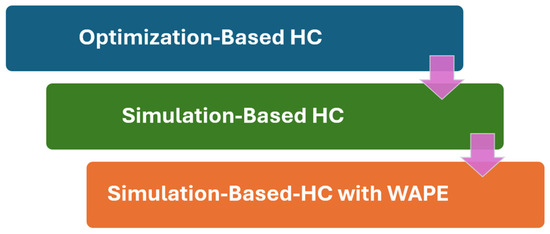
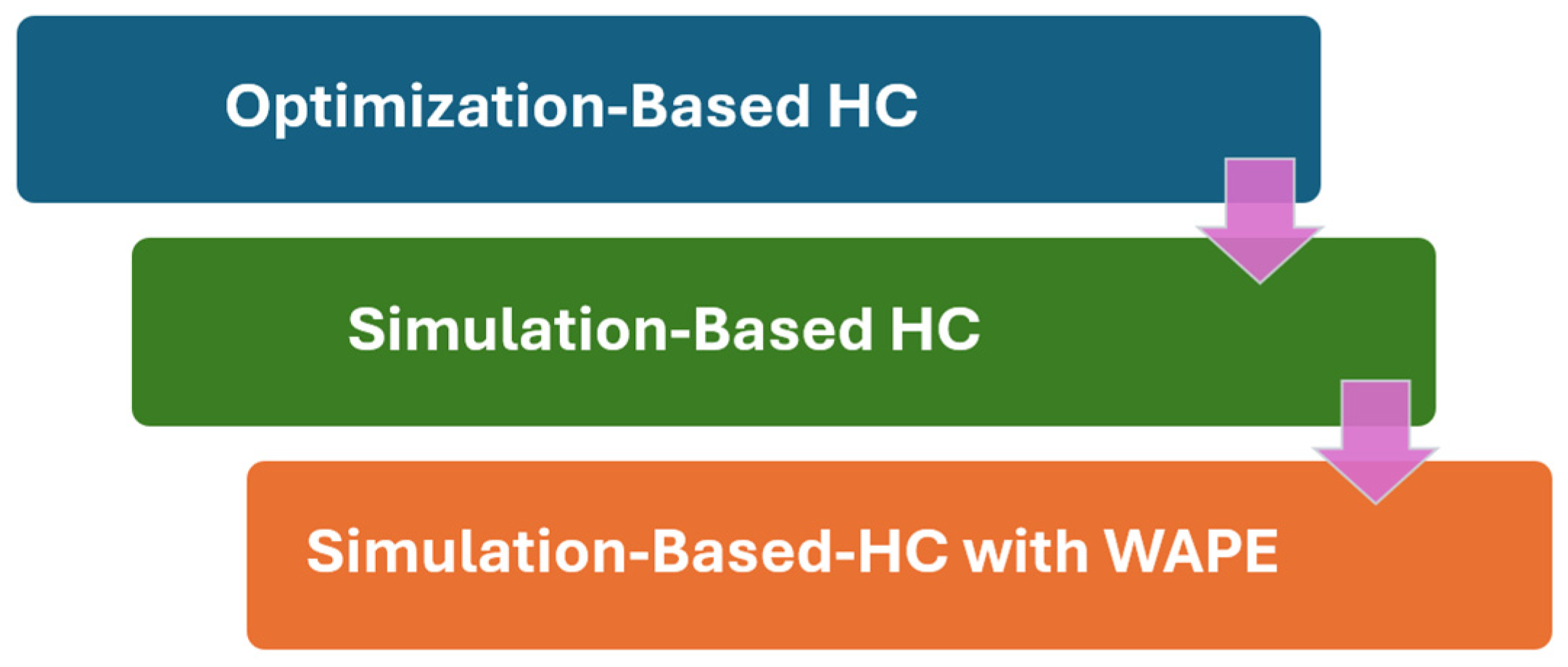
The proposed methodology for EVHC assessment is structured into three progressive stages optimization-based HC, simulation-based HC, and simulation-based HC enhanced with the WAPE controller as illustrated in Figure 1. In the first stage, a PSO framework is employed to determine the maximum EV charging power that can be accommodated without violating steady-state voltage limits. This static assessment relies on deterministic load-flow analysis and provides a baseline for HC, allowing for further investigation. The second stage evaluates the dynamic feasibility of the PSO-derived HC using detailed time-domain simulations. In the final stage, a WAPE-based real-time control mechanism is incorporated into the simulation environment to dynamically regulate active and reactive power during PV intermittency and uncoordinated EV arrivals. MATLAB 2023b (m-file and Simulink) has been utilized for the entire analysis. The proposed control approach enhances the network’s practical HC by enabling it to sustain higher charging demand under variable operating conditions.
Figure 1.
Steps of the study.
2.1. Optimization Framework
The PSO algorithm was employed to determine the optimal charging power of a single EV connected to the distribution network. PSO is a population-based meta-heuristic inspired by the social behavior of bird flocks, offering a simple yet robust approach to solving nonlinear and non-convex optimization problems. In this study, each particle represents a potential charging power setting of the EV, while the fitness function evaluates the voltage deviation at the EV bus and the overall network power loss. The optimization objective is to minimize the voltage deviation from the nominal reference 415 V while maintaining bus voltages within acceptable limits (e.g., 400 V–430 Vrms). According to the Institute of Electrical Engineers (IEE) regulations [32], the permissible voltage variation for a 415 V three-phase AC system is ±6%. However, to achieve better voltage regulation and enhance system performance, this study adopts an operational range of ±4% (400 V to 430 V) when designing the EV charger controller. This voltage range has been followed throughout the study. Mathematically, the objective function can be expressed as:
Inequality constraints,
- Charging power,
- Voltage at the connecting point,
- Active and reactive power relationship,
- where is the voltage magnitude at bus i, is the nominal, and are the allowable bounds (e.g., 400–430 Vrms) is the EV charging power decision variable (searched by PSO) varies from 0 to 7 kW. represents the reactive power supported by EV. The rated apparent power is considered 7 kVAR for level 2 chargers. During each iteration, the velocity and position of each particle are updated according to:where and denote the position and velocity of a particle at iteration k, and are the best local and global solutions found so far, is the inertia weight controlling exploration and exploitation, and are the cognitive and social learning coefficients. The PSO process continues until the convergence criterion, defined by a minimum change in the objective function or a maximum number of iterations, is satisfied. The resulting optimal charging power is then applied in the load flow analysis to assess its impact on the network’s voltage profile.
The PSO parameters used in this study are summarized as follows: the inertia weight was set to w = 0.8, while the cognitive and social acceleration coefficients were selected as c1 = 1.5 and c2 = 1.5, respectively. A swarm size of 30 particles and a maximum iteration limit of 100 were employed. These parameter values were chosen based on commonly accepted guidelines in the literature to ensure a proper balance between global exploration and local exploitation. Simulation results showed rapid convergence, with the objective function stabilizing well before reaching the maximum number of iterations. Furthermore, minor variations in PSO parameters did not lead to noticeable changes in the optimal EV HC, indicating robustness of the proposed optimization framework. For instant, a sensitivity analysis with respect to the PSO population size (5–100 particles) showed negligible impact on the optimal EV hosting capacity, confirming robustness of the proposed optimization framework.
2.2. Simulation Framework
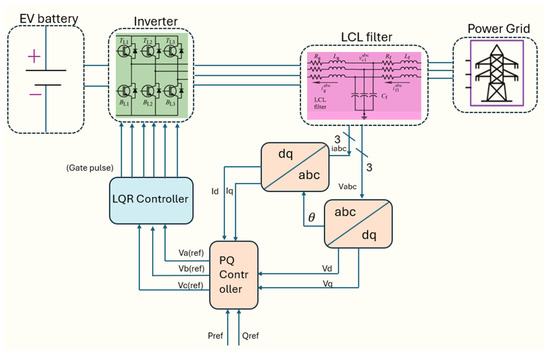
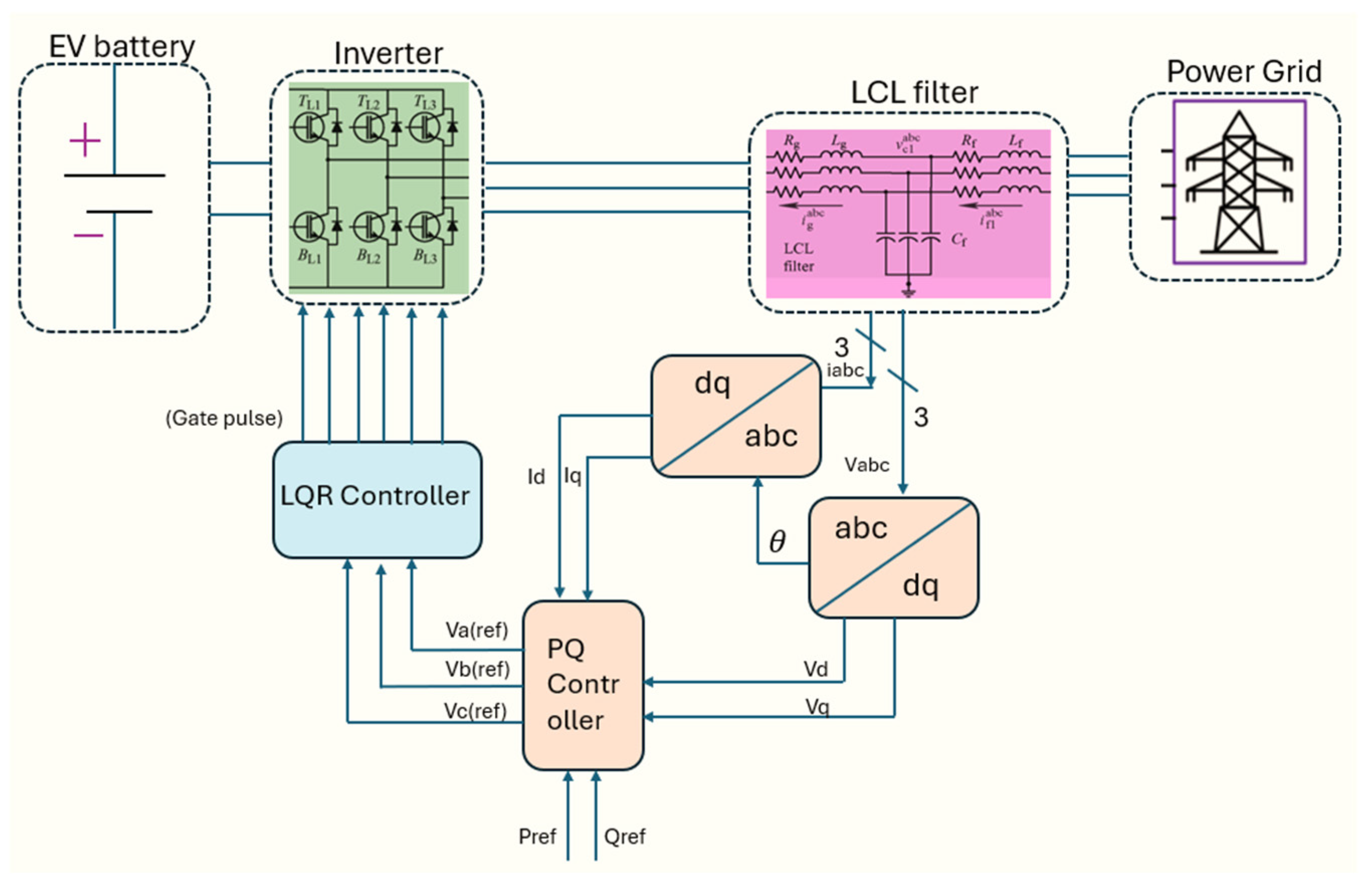
Figure 2 illustrates the Simulink model of the bidirectional EV charger, which consists of four main blocks: the EV battery, the voltage source inverter, the grid interface (LCL filter), and the control subsystem [33]. The EV battery is modelled as the DC source whose power is to be exchanged with the AC grid. A three-phase, two-level inverter converts the DC power to AC and is connected to the grid through an LCL filter to attenuate high-frequency switching harmonics and ensure grid-code-compliant current injection. On the control side, the grid voltages and currents are first transformed from the three-phase abc frame to the synchronous dq frame using Clarke–Park transformations, enabling decoupled control of active and reactive power. A current PI controller in the dq frame regulates the d-axis current (active power/charging–discharging) and q-axis current (reactive power/voltage support), while a separate PI or LQR-based outer loop generates the reference three-phase voltages. These reference voltages are then converted back from dq to abc and fed to the PWM gating logic of the inverter switches (T1–T6). In this way, the model can operate in both grid to vehicle (G2V) and vehicle to grid (V2G) modes, inject or absorb reactive power, and interact with the grid dynamically through the LCL filter. This structure is suitable for embedding higher-level strategies, such as the proposed WAPE-based power management, to test EVHC under PV and EV uncertainties.
Figure 2.
Converter model for Simulation-based HC.
2.3. WAPE-Based Dynamic Simulation
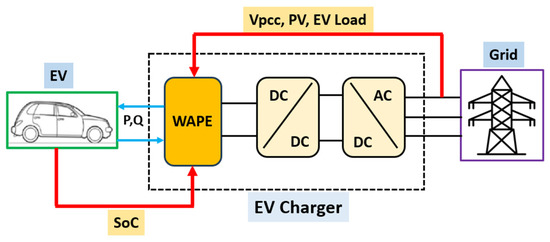
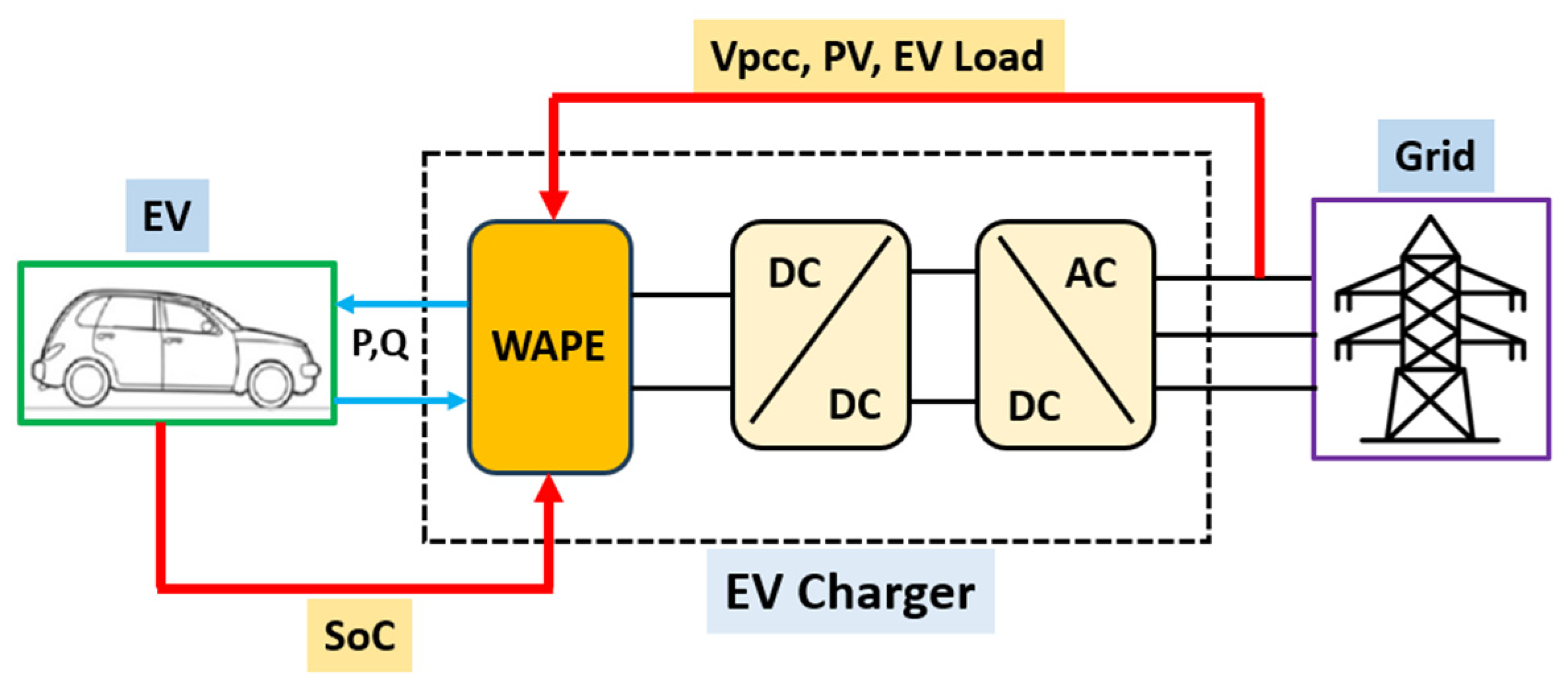
In the final stage of the proposed simulation framework, a WAPE is integrated into the EV charging control loop to enhance the HC under time-varying and uncertain operating conditions. Unlike static OPF-based HC, which assumes fixed loading and deterministic EV behavior, the WAPE-based strategy continuously observes the instantaneous grid voltage, SoC of EV battery, EV load, and PV generation level, and then allocates the active–reactive power (P–Q) setpoints of the EV chargers. The estimator computes a weighted average of recent measurements (from PV, EV load, and EVs battery (SoC)), giving higher priority to the most recent samples so that sudden changes such as cloud-induced PV drops or multiple EV arrivals are reflected immediately in the control action. The block diagram of the WAPE-based EV charging power management is shown in Figure 3.
Figure 3.
Block diagram for WAPE-based EV charging.
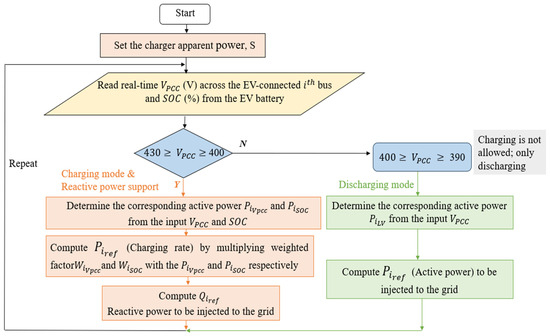
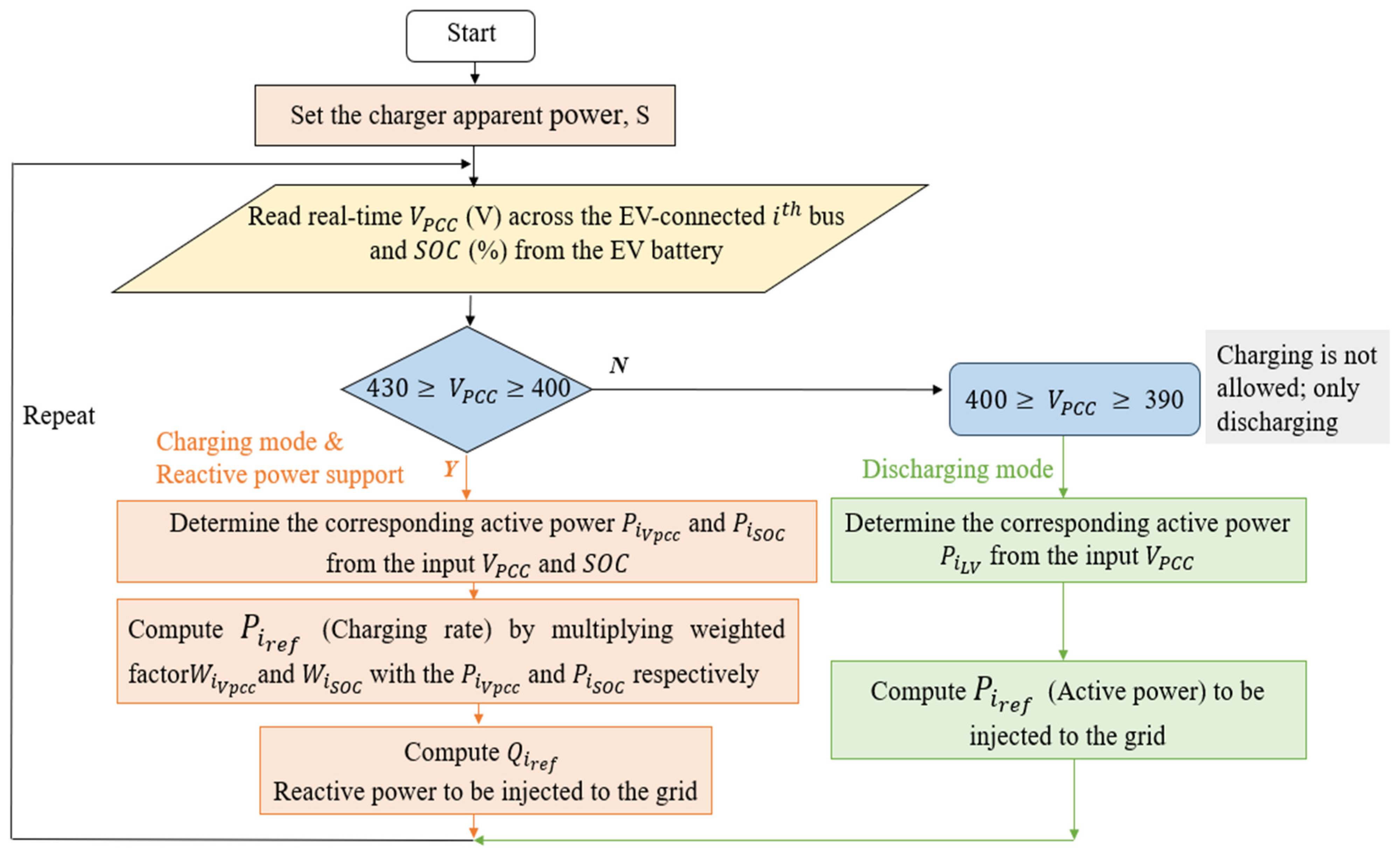
The reference charging power active power, P and reactive power, Q are determined using the WAPE Equations (1) and (2). The details of the WAPE method including the information of the parameters in the following equations can be found in Ref. [34]. Figure 4 represents the flow chart for real-time EV’s active and reactive power management using WAPE.
where
Figure 4.
Flow chart for real-time EV’s active and reactive power management using WAPE.
- , Active power reference to consume/inject.
- , Reactive power reference to consume/inject.
- , Estimated active power corresponding to the in charging mode.
- , Estimated active power corresponding to the bus voltage in charging mode.
- , Estimated Power corresponding to the bus voltage in discharging mode.
- , The weighted factor for of battery in charging mode.
- , The weighted factor for in charging mode.
- S, Charger rated apparent power (kVA).
The control procedure starts by specifying the rated apparent power of the EV charger, S, which sets the operating limits for both active and reactive power exchange, as illustrated in Figure 4. The controller continuously measures the point-of-common-coupling voltage , together with the instantaneous state of charge of the EV battery percentage of the EV battery at that time. The charging mode starts when is within 400 Vrms to 430 Vrms, the control algorithm calculates the required optimal active power for EV charging (G2V) while maintaining grid voltage using different weighted factors from the proposed WAPE method. From , it calculates the reactive power, that can be injected into the grid during charging to support the grid. When the grid voltage lies below 400 Vrms, the system enters discharging mode (V2G), indicating that the grid requires active power support from the EV battery due to heavy loading, which causes lower voltage levels. The algorithm calculates the required based on the respective weighted factors to provide active power support to the grid while reactive power support is disabled during the discharging mode.
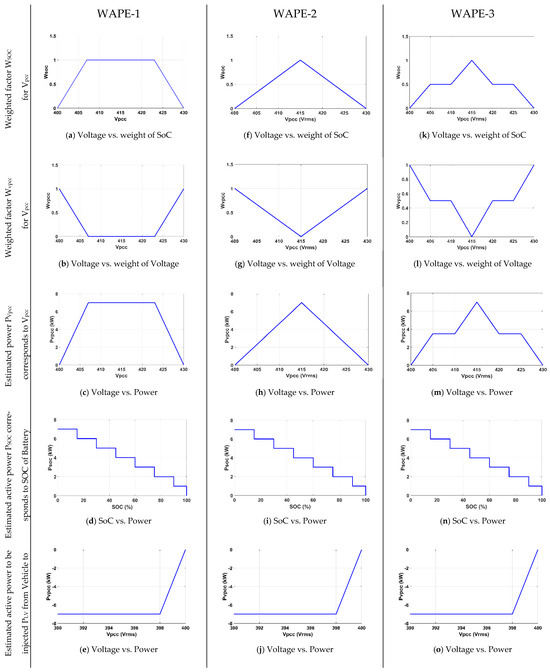
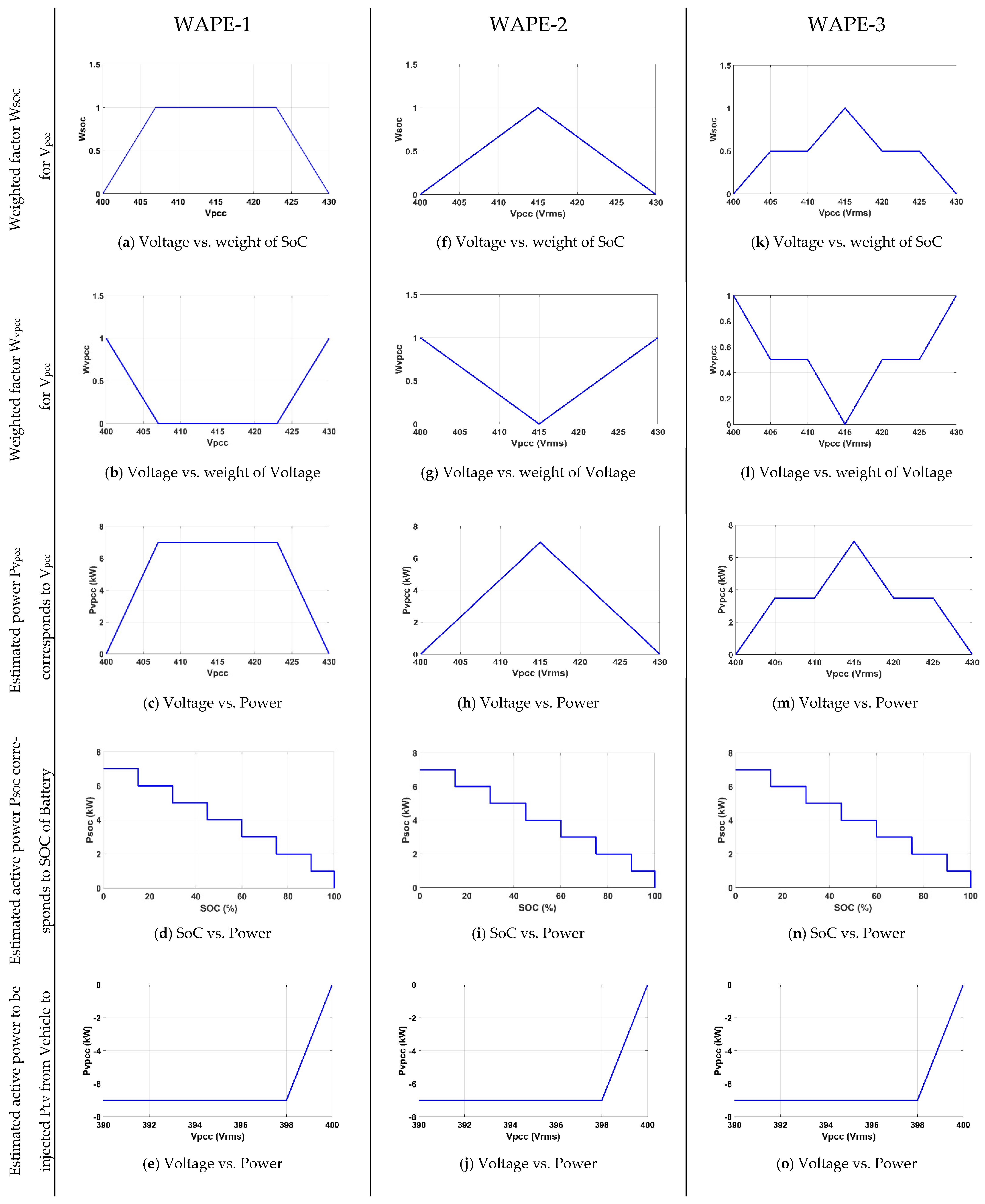
The functional relationships implemented in the WAPE simulations were derived from the curve-fitting results presented in Figure 5a–e. This data-driven formulation allows the EV charging power reference to be adaptively modified as a function of both the battery state of charge and the PCC voltage. In addition to the primary configuration, Figure 5 also illustrates the characteristics of the WAPE-2 and WAPE-3 variants, which were examined to evaluate the impact of different curved profiles. Since the WAPE methodology is empirical in nature, multiple WAPE shapes were analyzed to identify the most effective configurations for dynamic power allocation and voltage regulation.
Figure 5.
Estimated power and weighted factors shape of WAPE.
The WAPE controls the system operation solely by providing reference values for active and reactive power and therefore does not directly govern the stability of the system. Overall system stability is maintained by the inner current control loops, which are designed with sufficient robustness, ensuring a phase and gain margin of at least 60°, thereby delivering a stable and well-damped dynamic response. In contrast to traditional droop-based control strategies that are mainly used to enable proportional power sharing among multiple sources, the proposed WAPE-based framework is dedicated to real-time power adjustment for voltage regulation at the point of common coupling. Consequently, droop control is not incorporated, as the primary objective of this work is voltage support rather than coordinated power sharing. The step-by-step algorithm of WAPE based EV charging for HC enhancement is shown in Algorithm 1.
| Algorithm 1. WAPE based EV charging power management | ||||
| 1. | Measure Grid voltage, PV generation, EV Load and SOC of EV | |||
| 2. | if Cloud event/Multiple EV arrival detected | |||
| Flag: Activate WAPE control | ||||
| 3. | // Obtain references using lookup table | |||
| // Obtain weighting factors using lookup table | ||||
| // Enforce constraint | ||||
| 4. | // Compute real-time active-power reference | |||
| // Compute and provide reactive power | ||||
| 5. | else No Event/Disturbance | |||
| Flag: Normal HC based charging | ||||
| // Charging with rated HC without reactive power support | ||||
| 6. | end | |||
3. System Model
This section outlines the overall system framework developed for both optimization-based and simulation-based framework to evaluate the EVHC. The modelling process is divided into three subsections, each addressing a distinct aspect of the analysis. Section 3.1 presents the modified IEEE 13-bus distribution network, which serves as the test system for both optimization and simulation-based investigations. The network is designed to incorporate distributed PV generation units and EV charging loads, thereby replicating realistic operating conditions. Section 3.2 describes the load-flow computation techniques employed for steady-state optimization. A power flow algorithm is used to determine the voltage profiles. Section 3.3 details the real-time simulation and power management strategy implemented for EV charging control. This part focuses on the dynamic operation of EV chargers, where active and reactive power management is achieved.
3.1. Network Model
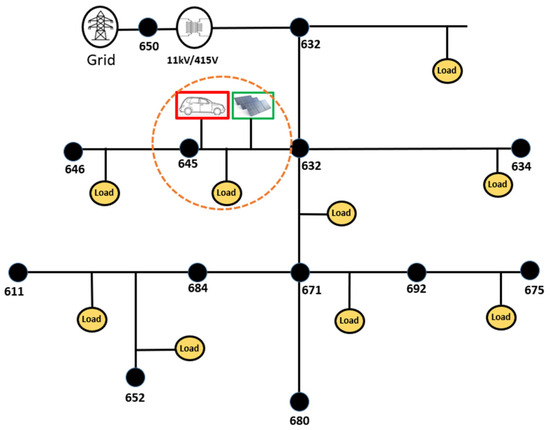
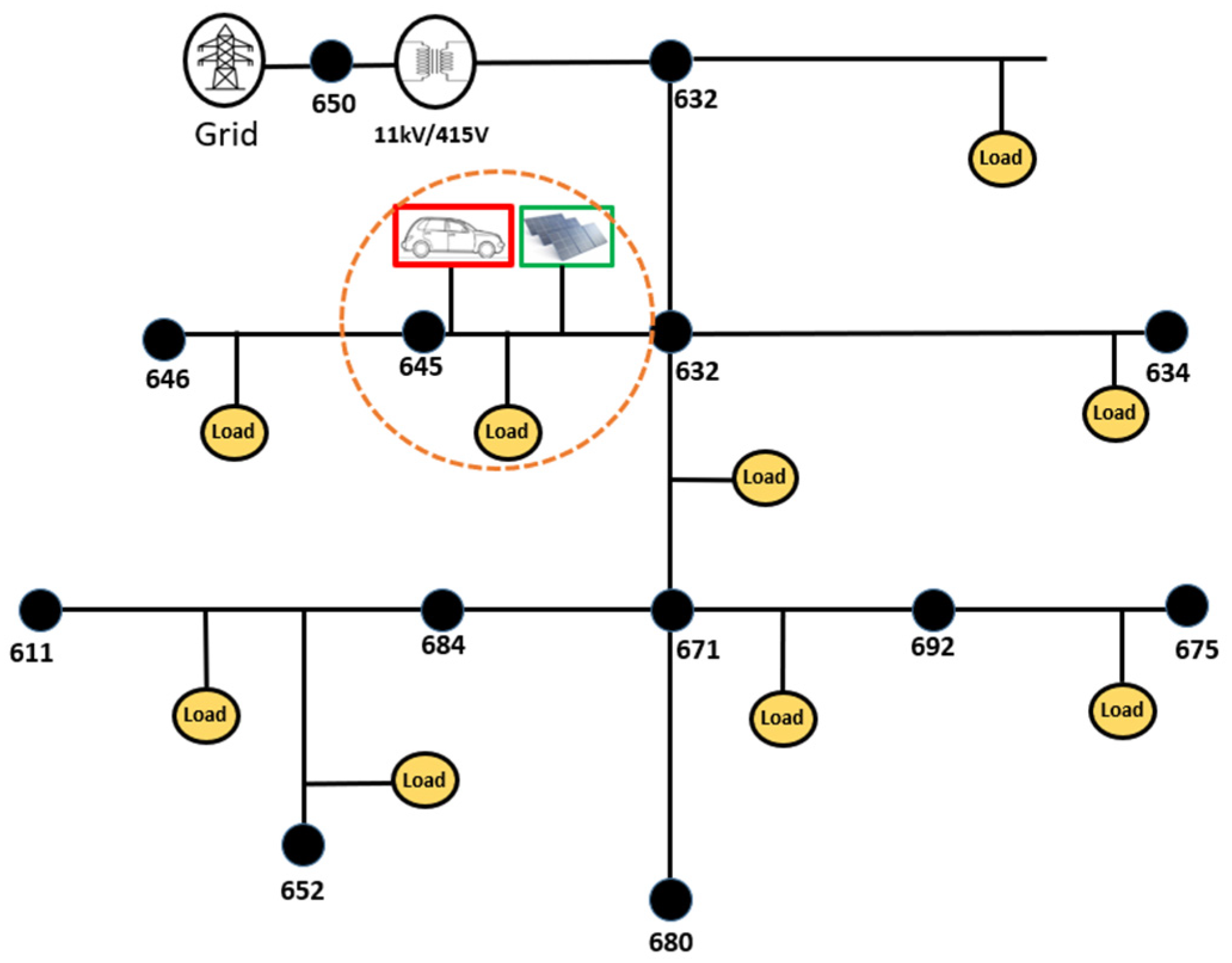
To evaluate the EVHC, a modified IEEE 13-bus distribution network [35] has been developed, as illustrated in Figure 6. The original feeder has been enhanced to include residential and commercial loads, and distributed PV generation, along with EV charging stations positioned at selected bus to represent realistic operational conditions. The network operates at a nominal voltage of 415 Vrms, with line parameters, load distribution, and transformer ratings configured to reflect a low-voltage urban distribution environment. The modified network serves as the foundational platform for both optimization-based and dynamic simulation-based HC assessments.
Figure 6.
Modified IEEE 13 bus network EVHC assessment.
3.2. Load Flow Model
The distribution network load flow is modelled using the backward/forward sweep (BFS) algorithm based on the DistFlow equations, which is well-suited for radial and weakly meshed systems [36]. This method iteratively computes bus voltages and branch power flows by alternating between two stages: a backward sweep that updates branch currents or power flows from the terminal nodes toward the substation, and a forward sweep that updates node voltages from the substation toward the end nodes. DistFlow formulation accounts for active and reactive power balance, line impedance, and voltage magnitude relationships, ensuring an accurate representation of voltage drops and power losses in low-voltage networks. Compared to conventional Newton–Raphson or Gauss–Seidel methods, the BFS algorithm offers superior numerical stability and faster convergence for radial feeders, making it particularly suitable for EV integration studies where numerous power flow evaluations are required during optimization.
3.3. EV Charger/Converter Model
The EV Charger model defines the operational parameters and the associated control strategy for managing both active and reactive power flow between the grid and the EV battery. The key parameters of the charger are summarized in Table 3. The charger operates as a bidirectional charger/converter capable of functioning in both G2V and V2G modes.
Table 3.
EV Charger parameters.
The Clarke and Park transformations [37] are applied in the design of the converter circuit for the EV charger to facilitate efficient control of active and reactive power. These mathematical transformations convert the three-phase stationary reference frame (abc) into two orthogonal rotating reference frames (dq), thereby simplifying the control of sinusoidal quantities in real-time. By using these transformations, the controller achieves precise regulation of current and voltage, allowing smooth transitions between G2V and V2G modes. Three-phase terminal voltages and currents are and respectively. The instantaneous total power in the time domain,
and can be expressed in a space vector.
Now, Clarke transformation is used to derive two phase αβ components from a three-phase system.
where
Finally,
After getting αβ components from the three-phase system, Park transformation is utilized to derive components of the rotating frame, while αβ was the stationary frame.
where ρ is the angle between αβ coordinate and coordinate system.
Similarly, for the current,
From (10) and (11) grid voltage and current have been found in format. These are the reference voltage and current for the controller circuit. Power equations can be written in terms of component,
4. Results and Discussion
The Results section is organized into four subsections to systematically evaluate and interpret the EVHC improvement enabled by the proposed dynamic control framework. Section 4.1 compares the HC obtained from conventional optimization-based assessment with that observed through dynamic simulation, highlighting how static optimization overestimates HC when real-time fluctuations are ignored. Section 4.2 examines the inherent limitations of optimization-based HC determination specifically, its reliance on safety factors and worst-case assumptions, which often force planners to reduce HC significantly to avoid voltage violations during PV intermittency or clustered EV arrivals. Section 4.3 presents the simulation-based HC evaluation using the proposed WAPE controller, demonstrating how WAPE can safely maintain the higher HC levels determined by optimization without requiring severe derating. Finally, Section 4.4 introduces a charging-time comparison, illustrating how WAPE enables continued low-rate charging during PV cloud events or sudden EV clustering, thereby reducing driver waiting time and increasing the practical usability of the higher HC with an improved driver satisfaction.
4.1. Optimization vs. Simulation Based HC
Section 4.1 presents the HC results obtained through the static optimization framework using the PSO algorithm and compares them with the values observed through dynamic, simulation-based analysis. Static optimization determines HC under fixed voltage limits for the modified IEEE 13-bus network and typically identifies relatively high theoretical HC, as it assumes steady operating conditions and average PV generation levels. However, when these same HC values are applied in the MATLAB/Simulink environment, the resulting dynamic voltages differ noticeably due to real-time fluctuations. These deviations are summarized in the comparative tables, showing that static optimization tends to overestimate the feasible HC when dynamic behavior is ignored.
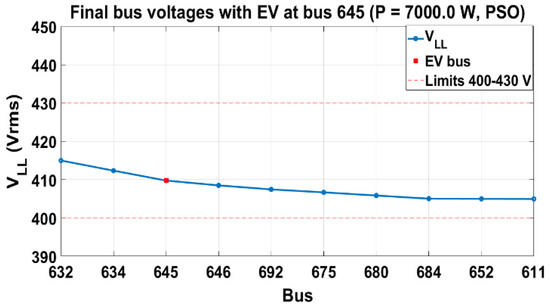
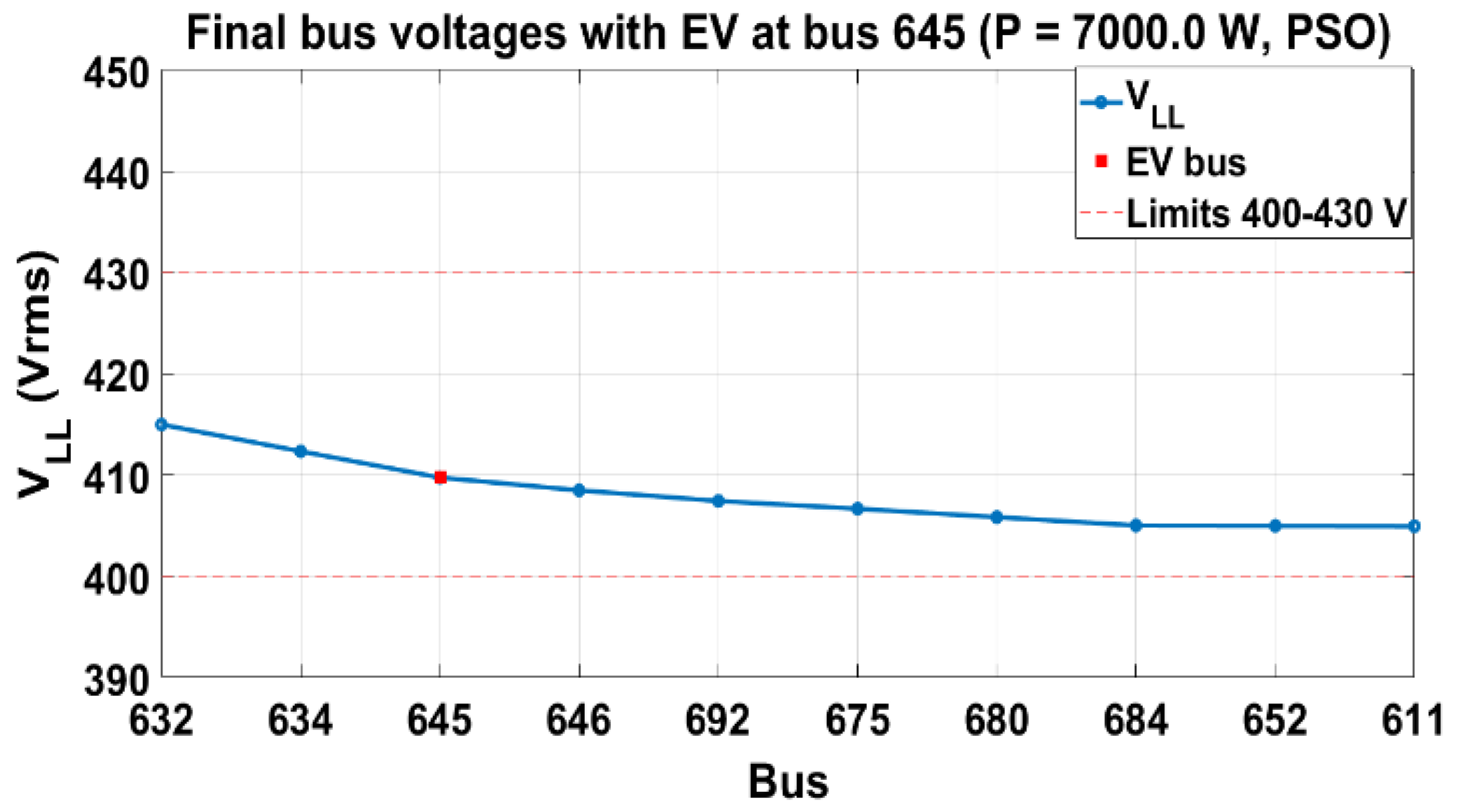
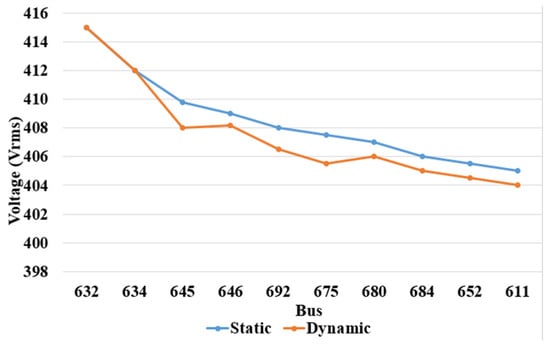
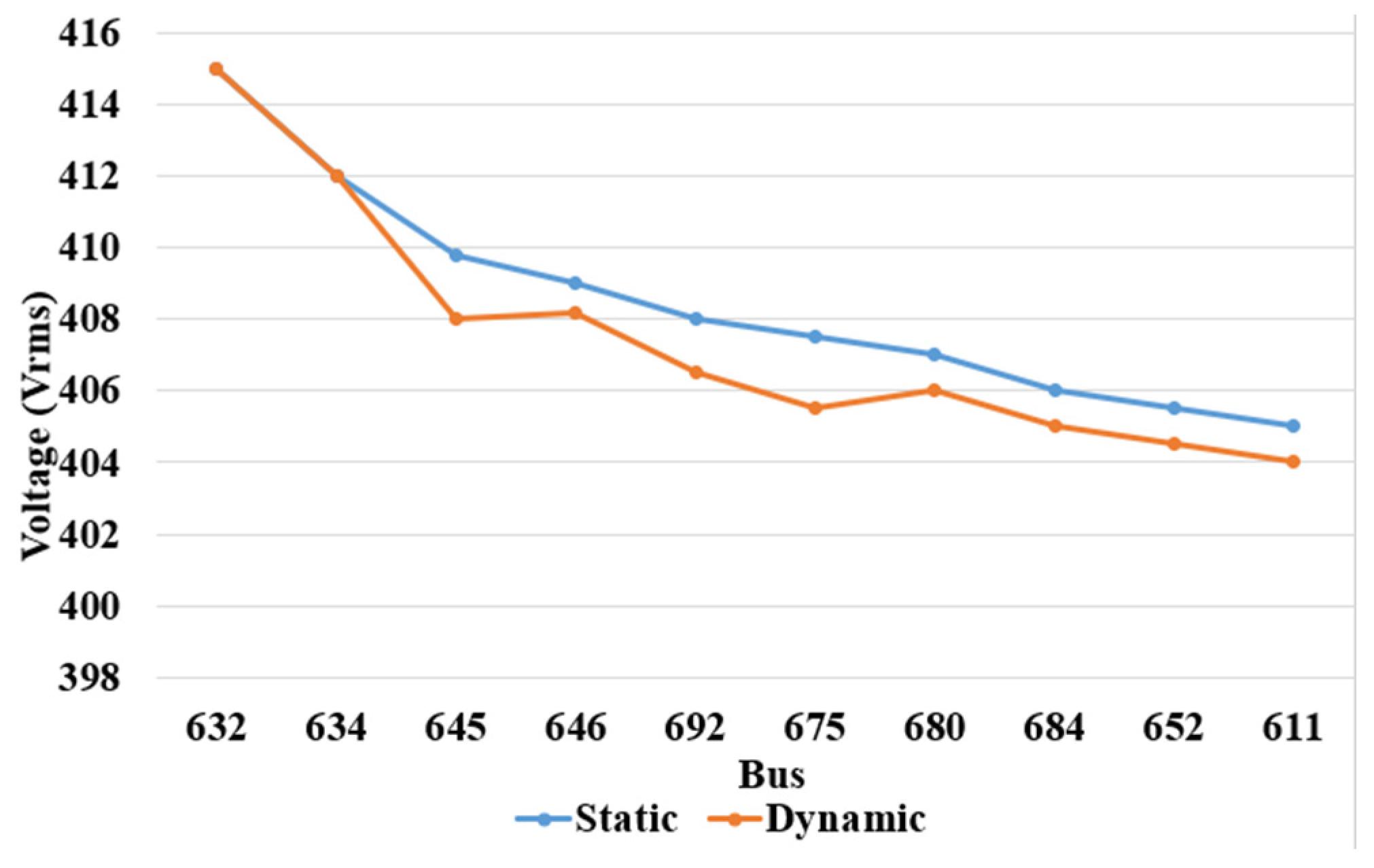
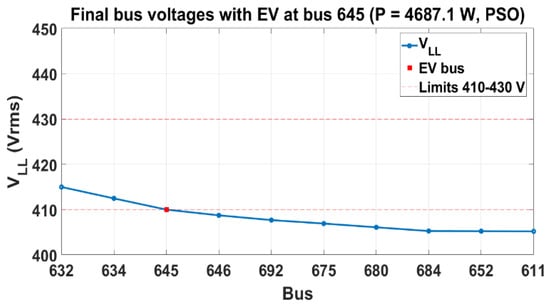
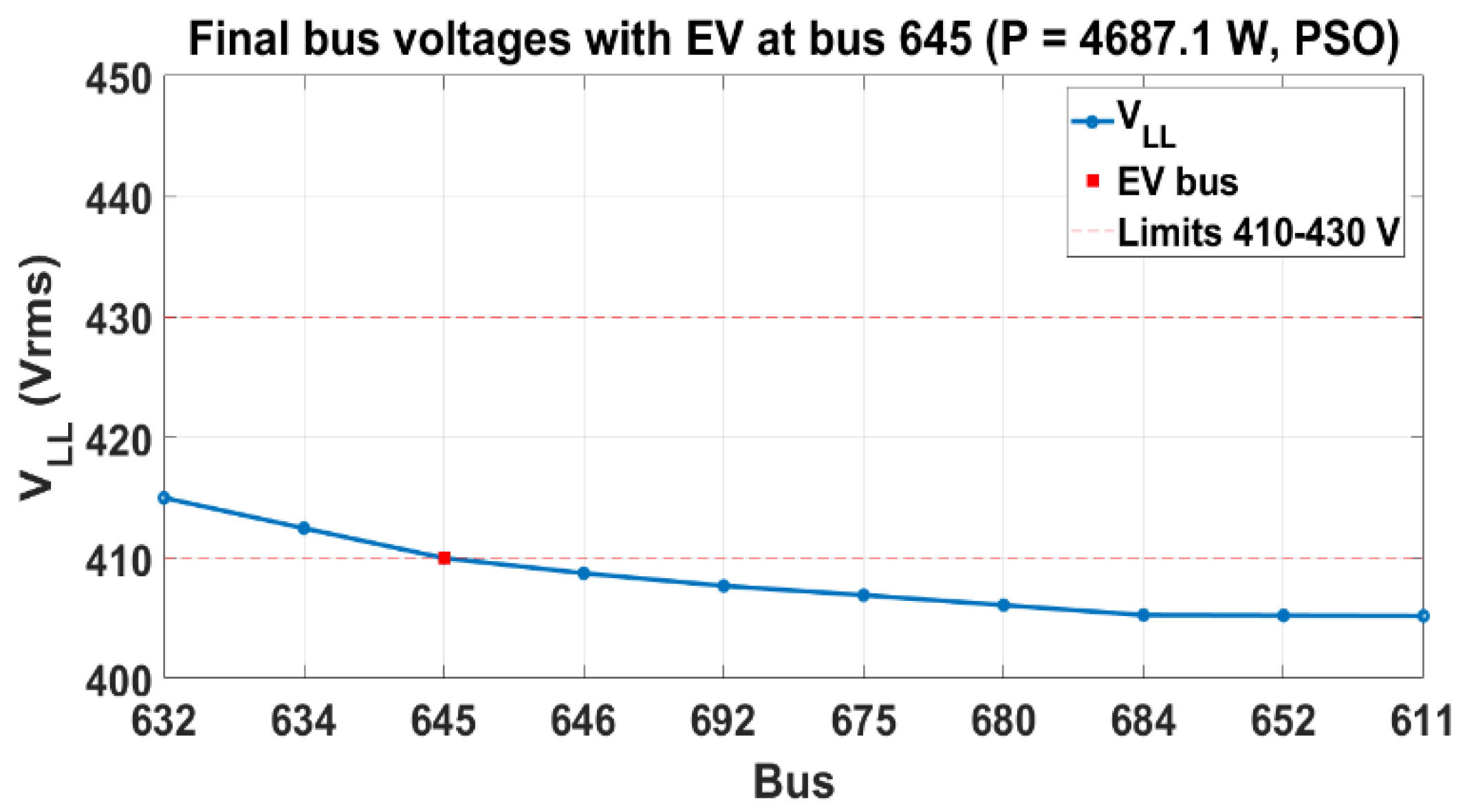
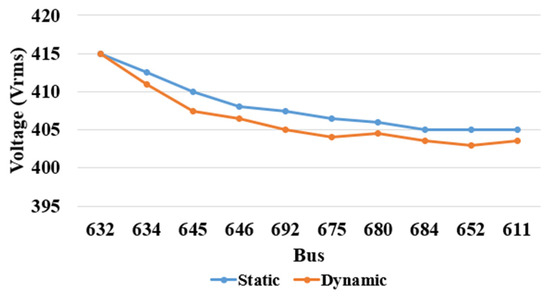
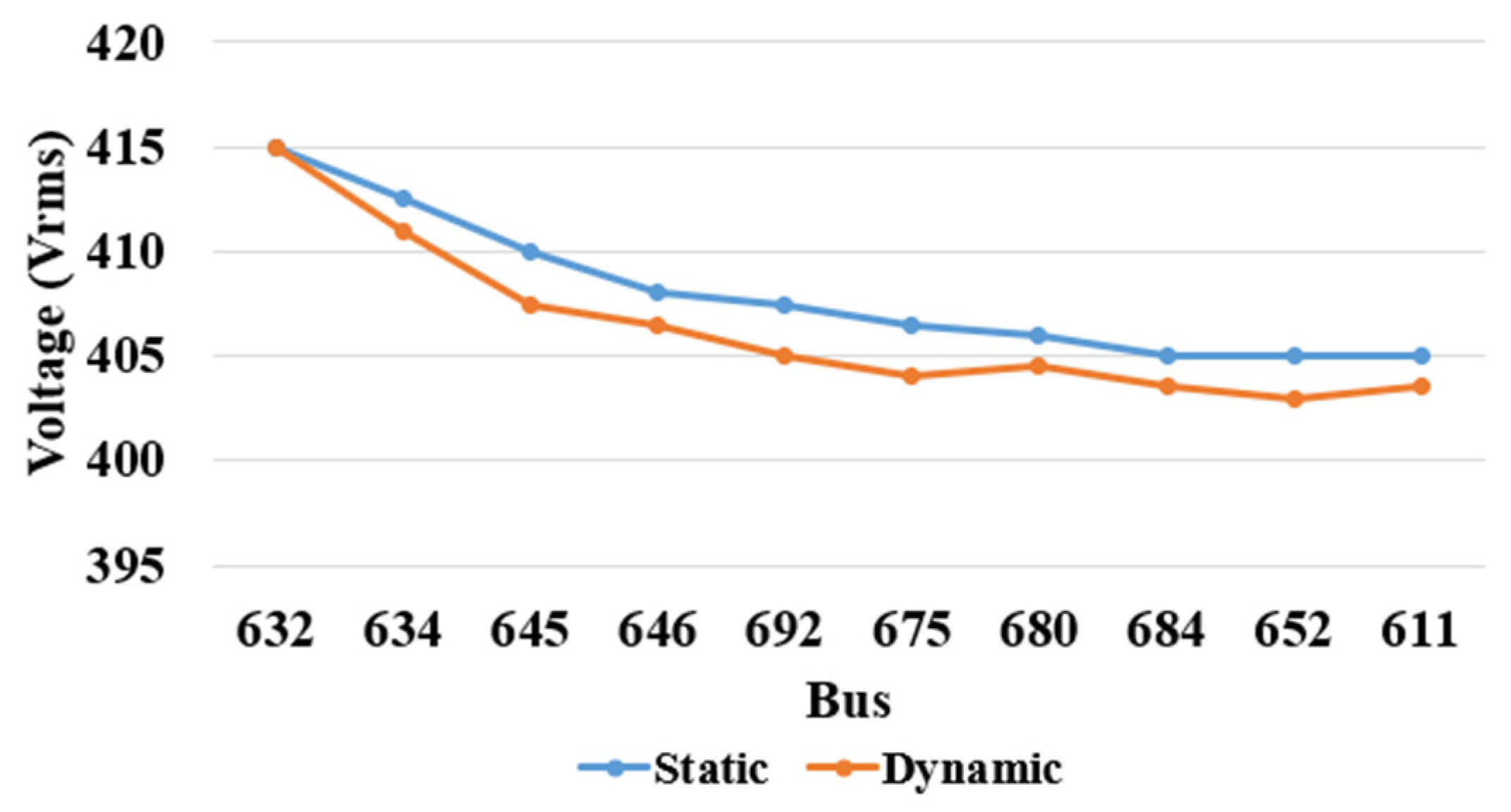
At the initial stage of the EVHC assessment, the PSO algorithm is applied to determine the optimal charging power for a single EV connected to the distribution network. Within the voltage constraint range of 400–430 Vrms, the static optimization results indicate that the maximum EVHC is 7 kW, indicating that only one EV can be accommodated without violating network voltage limits, as shown in Figure 7. The corresponding bus voltage at node 645 is recorded as 409.67 V, which remains within permissible range. The HC value of 7 kW, obtained from the optimization-based assessment, is subsequently applied to the simulation-based analysis to validate its real-time feasibility. Under this condition, the voltage at bus 645 exhibits a slight reduction to 407 V, indicating minor voltage deviations. Figure 8 illustrates the voltage profiles obtained from both the optimization-based and simulation-based EVHC assessments. It is evident that the bus voltages obtained from the simulation-based evaluation deviate slightly from the HC results determined through static optimization. This variation arises from the inclusion of real-time system dynamics in the simulation. With a tighter voltage constraint of 410–430 Vrms, the PSO algorithm determines a new HC of 4.68 kW, corresponding to a bus voltage of 410 V, as illustrated in Figure 9. However, when this optimized HC value is applied in the simulation-based assessment, the voltage at bus 645 further decreases to 407.5 V, indicating the influence of dynamic effects and real-time grid behavior not captured in the static analysis. Figure 10 compares the voltage profiles obtained from both assessment techniques, showing that the simulation-based approach reflects a slightly lower voltage magnitude across buses.
Figure 7.
Voltage profile with EV at bus 645 using PSO (Voltage limit 400–430 V).
Figure 8.
Voltage profile: Optimization vs. Simulation-based assessment (Voltage limit 400–430 V).
Figure 9.
Voltage profile with EV at bus 645 using PSO (Voltage limit 410–430 V).
Figure 10.
Voltage profile: Optimization vs. Simulation-based assessment (Voltage limit 410–430 V).
Table 4 and Table 5 summarize the EVHC when multiple EVs are integrated into the network. Under the 400–430 Vrms constraint, static optimization estimates that five EVs (35 kW) can be hosted while maintaining a minimum voltage of 408.06 V. In contrast, the dynamic simulation also accommodates five EVs but records a lower minimum voltage of 398.52 V, reflecting the realistic voltage depression. Under the stricter 410–430 Vrms constraint, optimization predicts a minimum voltage of 410.06 V, while simulation produces 402.52 V, reinforcing that static optimization tends to overestimate HC by neglecting dynamic operating conditions.
Table 4.
Bus voltage after injecting five EVs at bus 645 with a voltage limit of 400–430 V.
Table 5.
Bus voltage after injecting five EVs at bus 645 with a voltage limit of 410–430 V.
These results demonstrate a key limitation of static optimization: although it identifies a higher theoretical HC, the actual realizable HC under dynamic conditions is lower. As a result, many studies recommend applying a 10–15% safety margin to optimization-based HC values to ensure secure operation under real-time variability [38,39,40]. Moreover, optimization studies often incorporate idealized best-case scenarios where PV output is stable and EV arrivals are moderate to maximize HC, alongside worst-case scenarios where PV drops or simultaneous EV charging events occur to estimate minimum operational capability. However, neither approach fully captures the rapid, short-duration disturbances (e.g., cloud events or sudden EV clustering) that ultimately determine whether the network can reliably support the higher HC value.
These findings underscore the need for a dynamic control strategy capable of preserving the higher HC predicted by optimization, while still maintaining safe operation under real-time disturbances an issue addressed through the WAPE-based approach in Section 4.3.
4.2. Limitations of the Optimization-Based Assessment
Although optimization-based EVHC assessment provides a convenient means of estimating the maximum EV penetration under static constraints, it inherently overestimates the practically usable HC because it ignores short-term dynamic variations. To compensate for this mismatch, most studies incorporate a 10–15% safety margin, intentionally derating the optimization-derived HC. For example, reducing an estimated 20 kW HC to about 14 kW to ensure safe operation under real-world dynamic conditions. Furthermore, optimization studies typically evaluate best-case and worst-case operating scenarios. While best-case conditions tend to maximize the estimated HC, worst-case assumptions such as PV = 0 or sustained peak EV loading drastically reduce the HC, often yielding values (e.g., 6–7 kW from 14 kW) that are far lower than what the network can realistically support under typical operating conditions. As a result, relying solely on optimization makes it difficult to determine the true HC, because the method does not account for rapid, high-impact variations that determine whether a high HC can be maintained safely in practice.
Critically, optimization-based methods fail to capture short-duration, high-impact dynamic events, such as quick PV drops or sudden EV clustering at a charging station. These events occur over time scales of a few seconds but can cause temporary stress capable of reducing the realizable HC. Therefore, Section 4.2.1 and Section 4.2.2 demonstrate how these dynamic variations directly influence the network’s effective HC. Section 1 examines PV intermittency caused by transient cloud cover, while Section 2 analyzes the effect of uncoordinated EV arrivals. Both cases highlight that dynamic variations not captured in static optimization significantly constrain the actual hosting capability of the distribution system.
4.2.1. PV Uncertainties
A major drawback of optimization-based EVHC assessment is its inability to accommodate transient PV intermittency. Standard optimization formulations typically use average PV generation or simplified best/worst-case values [35], which fail to represent real-world PV fluctuations occurring over seconds. While these boundary conditions help define a theoretical HC range, they offer no guarantee that the higher HC value can be safely maintained during short-term cloud events.
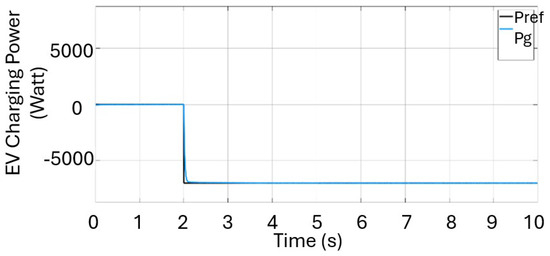
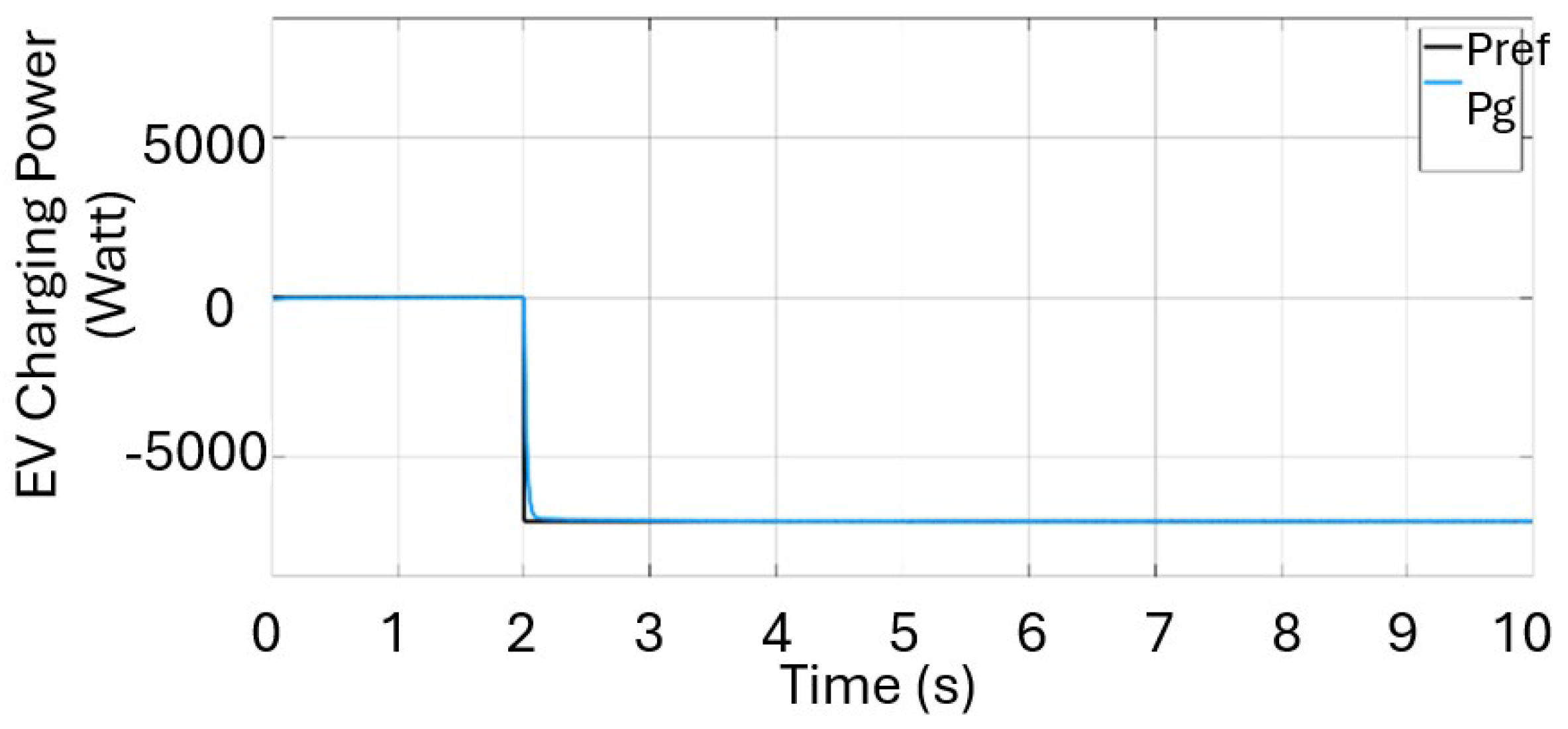
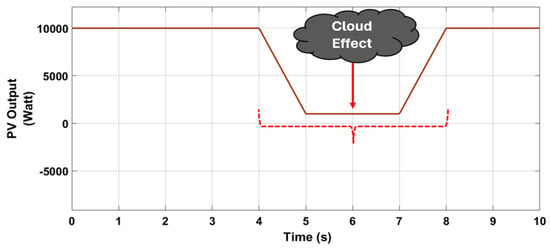
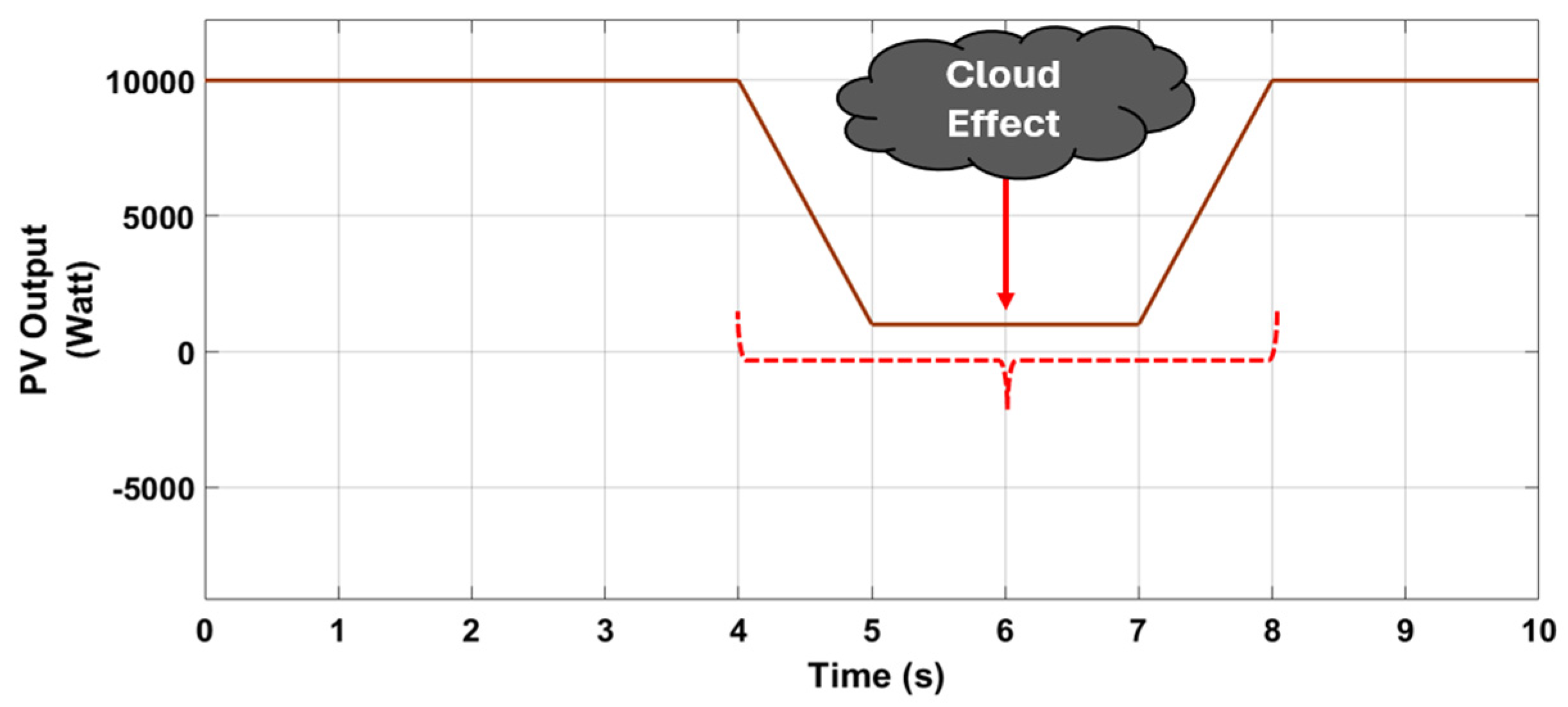
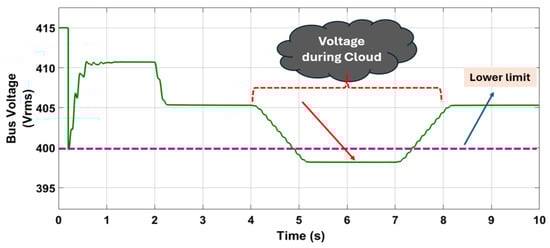
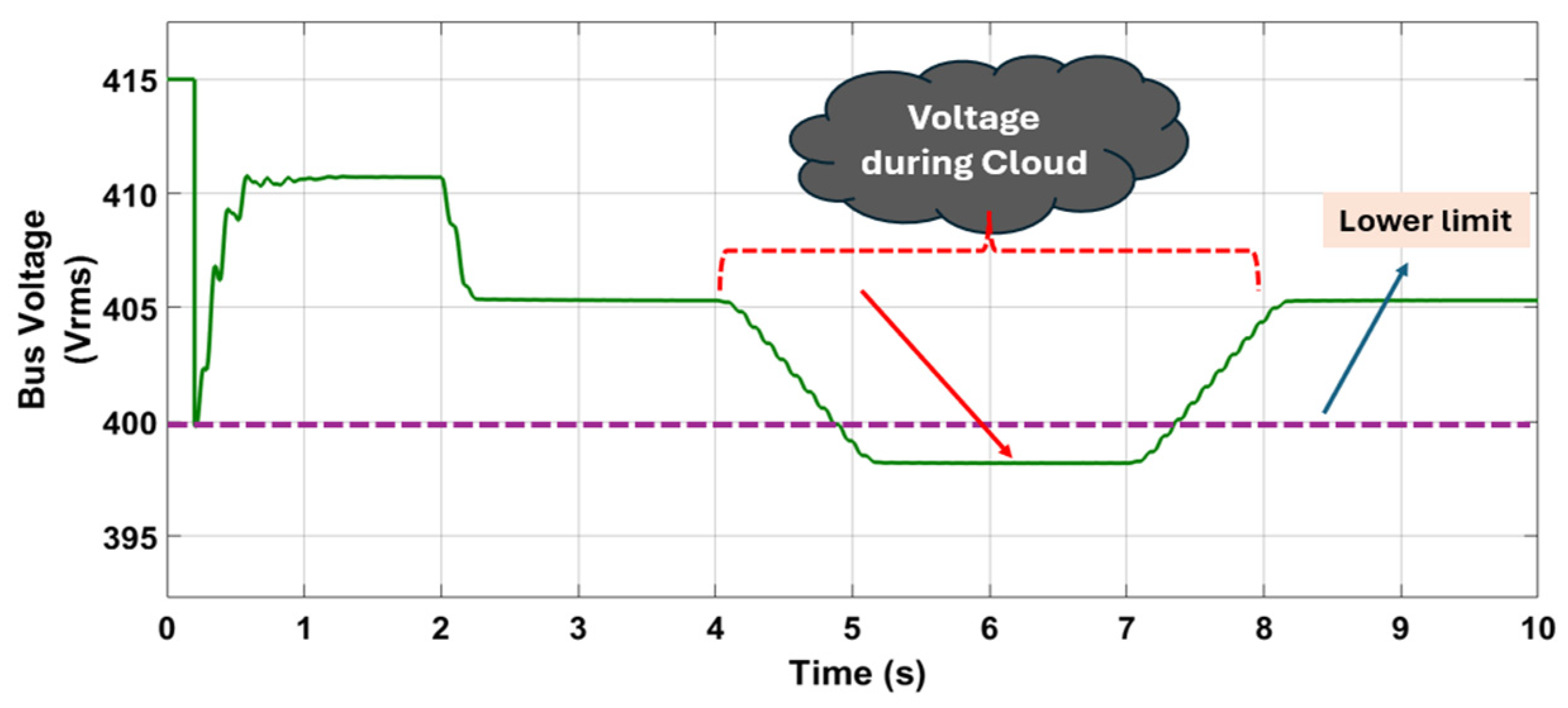
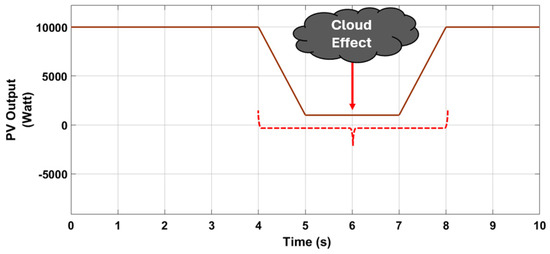
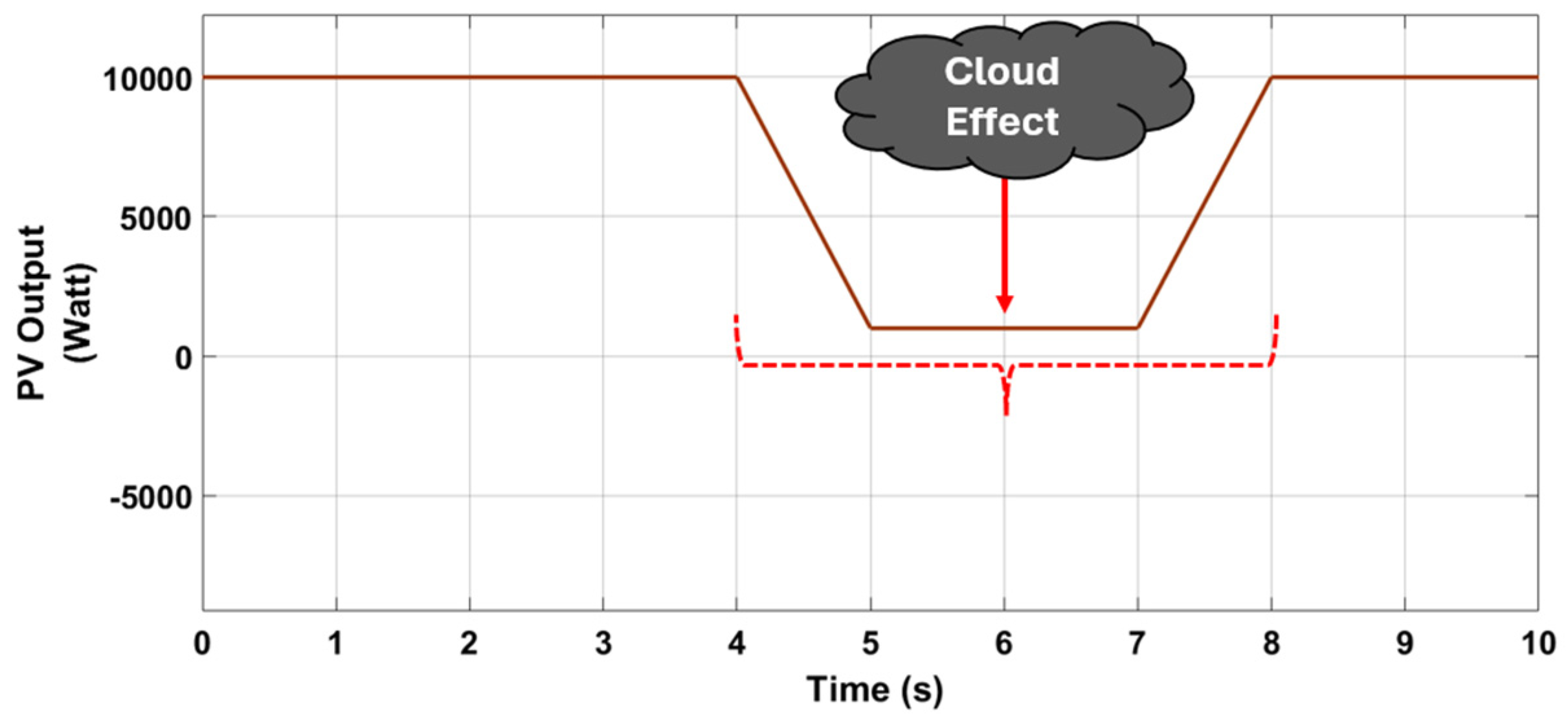
To illustrate this limitation, Figure 11 shows EV charging under the optimized HC of 7 kW where the blue line is denoted by grid power Pg and the black line is denoted by reference power Pref respectively. Figure 12 presents a 4-s cloud event during which PV generation sharply drops from 10 kW to 1 kW. Figure 13 shows the resulting voltage response in the simulation environment. During the cloud-induced PV dip, the bus voltage falls from 405 V to 398 V, temporarily breaching acceptable limits. This voltage sag demonstrates that even though optimization allowed 7 kW HC the network cannot sustain this HC during short PV interruptions, unless a dynamic control mechanism is present. In practice, if planners were to include PV = 0 in the optimization process, the HC would be reduced drastically (e.g., <1 kW instead of 7 kW), leading to underutilization of infrastructure. Thus, transient PV intermittency directly reduces effective HC under static optimization, highlighting the need for dynamic control to preserve higher hosting levels.
Figure 11.
EV charging with 7 kW from Optimization-based HC.
Figure 12.
Cloud cover pattern applied to PV generation for a duration of 4 s.
Figure 13.
Effect of transient cloud cover on bus voltage during EV charging.
4.2.2. Uncoordinated EV Arrival
Another major limitation of optimization-based HC assessment is the assumption of predictable or averaged EV charging demand, which overlooks the stochastic and user-dependent characteristics of real EV behavior. In real operation, multiple EVs may arrive simultaneously due to workplace schedules, weather changes, or commuting peaks events that are extremely difficult to capture using static optimization models.
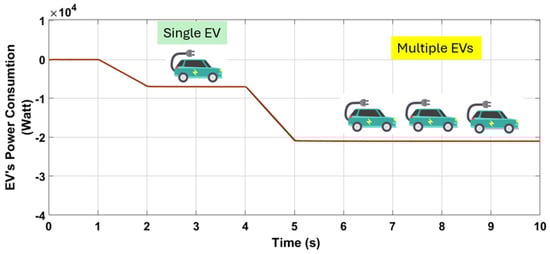
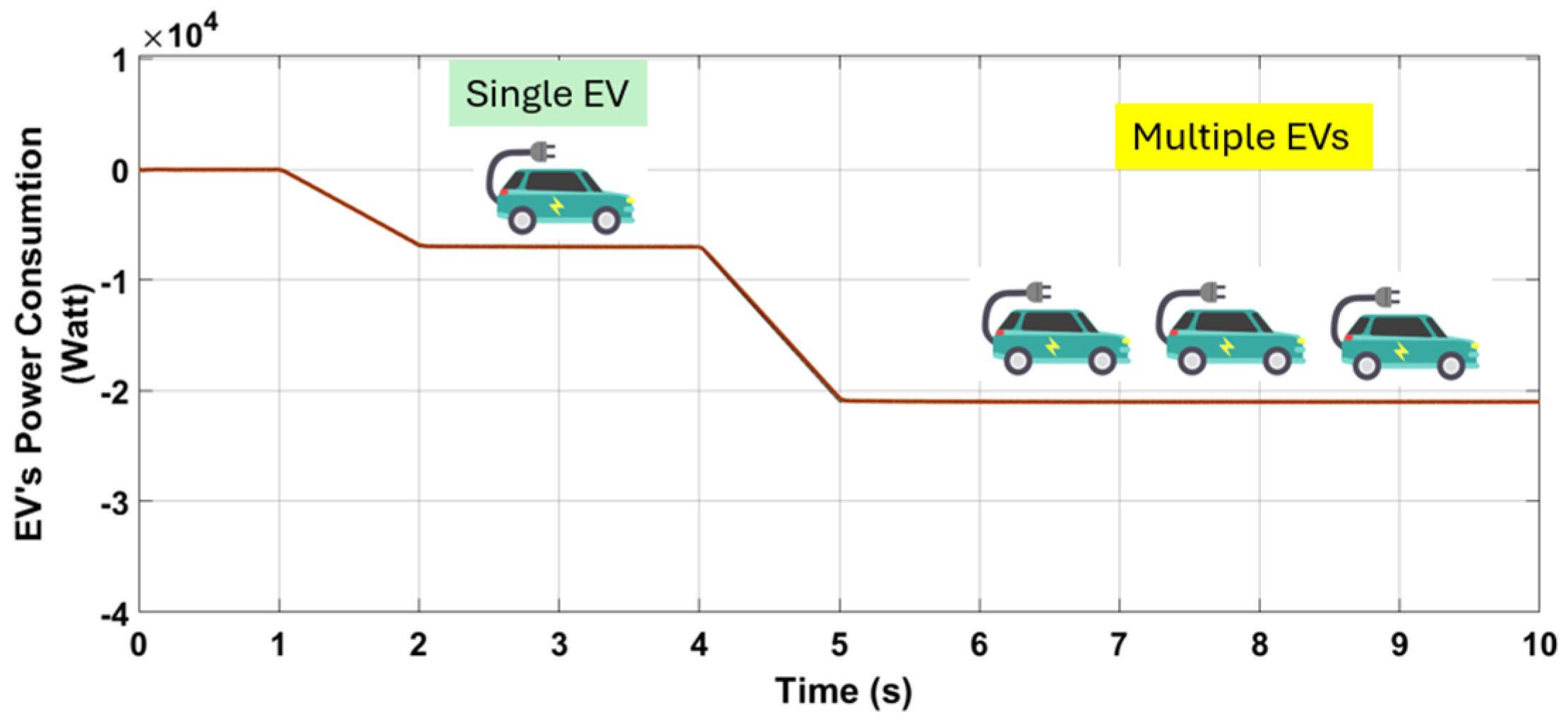
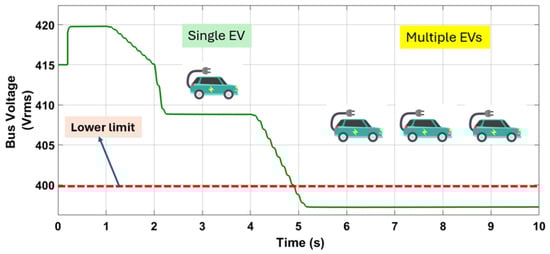
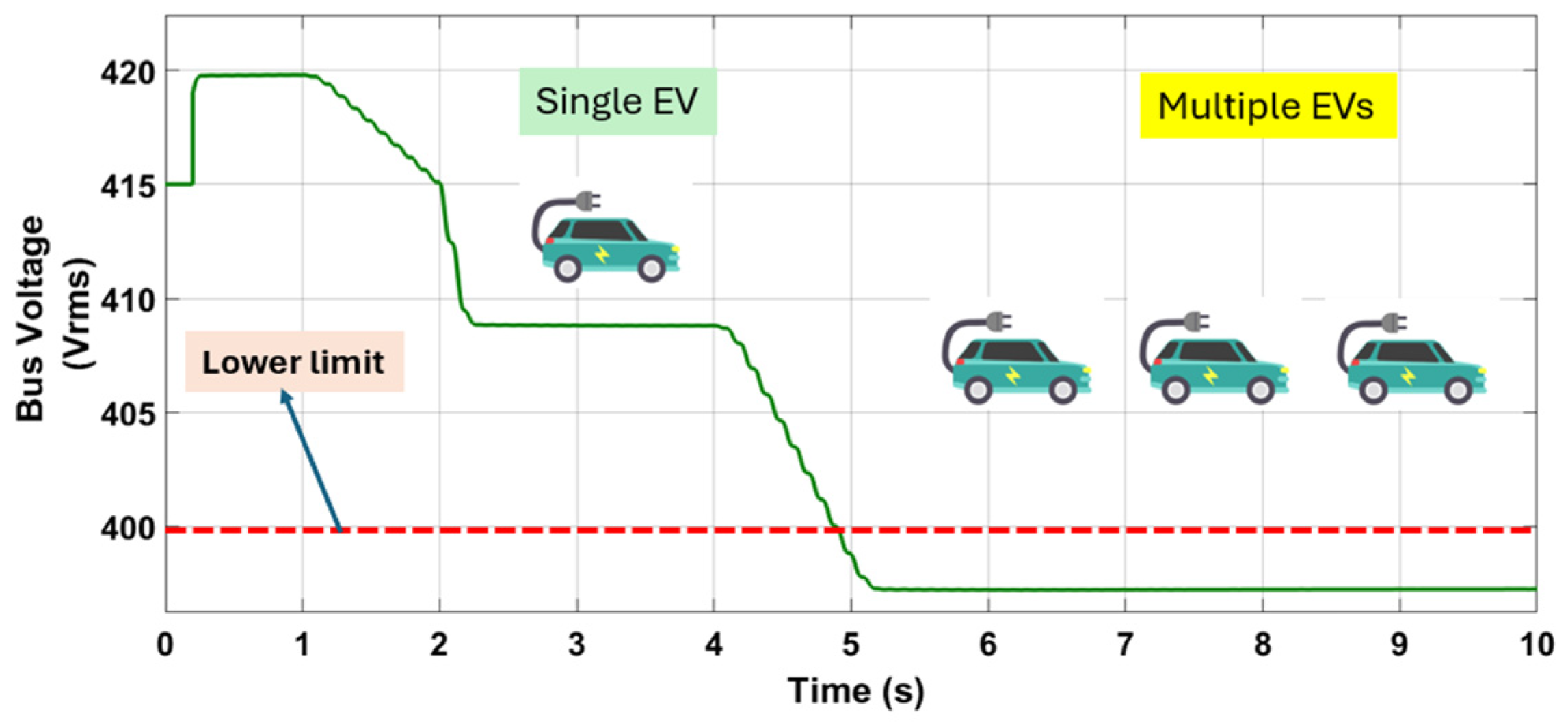
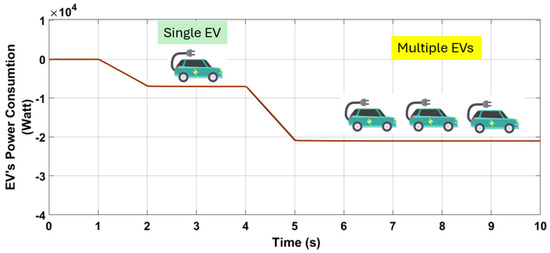
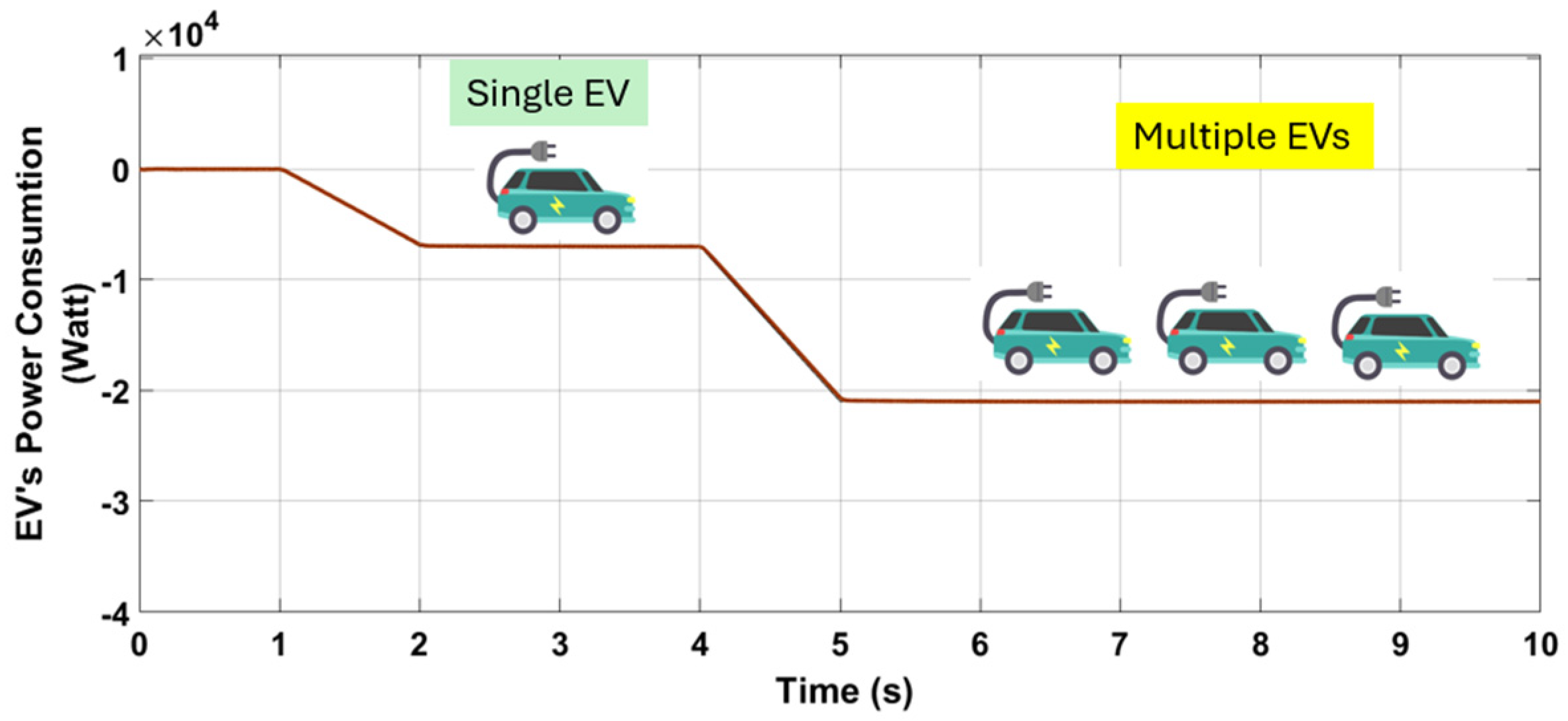
Figure 14 demonstrates this situation. Initially, a single EV begins charging at the optimized HC of 7 kW. After 4 s, three additional EVs arrive simultaneously, drawing a combined 21 kW from the grid. Figure 15 shows the resulting voltage profile: the bus voltage drops from 408 V to 395 V, immediately violating the acceptable limits. This sudden demand surge means that even though optimization permitted a HC for one EV, the real-world stochastic arrival of multiple EVs temporarily reduces the feasible HC of that charging location. In an optimization-only framework, such stochasticity would force planners to reduce the HC significantly to prevent voltage violations again, demonstrating how dynamic uncertainty imposes a lower effective HC.
Figure 14.
Multiple EV charging events representing stochastic arrival.
Figure 15.
Bus voltage variation during unwanted or simultaneous EV arrival events.
Together, these results show that transient PV drops, and uncoordinated EV arrivals directly reduce the usable HC under static optimization methods. This motivates the need for a dynamic control strategy such as the WAPE controller to temporarily adjust EV charging during these short events so that the higher HC determined through optimization can still be safely achieved in practice.
4.3. Simulation-Based HC with WAPE Controller
This subsection evaluates how the proposed WAPE controller enables the distribution network to retain a higher HC under dynamic operating conditions that would otherwise force a significant reduction in HC. Unlike static optimization, which assumes steady PV output and predictable EV demand, the WAPE controller continuously monitors real-time grid voltage, PV generation, EV SoC, and charging demand. Using this information, the system dynamically adjusts both the active power (P) and provide reactive power support (Q) to counteract short-duration disturbances. This empirical behavior prevents temporary PV drops or sudden EV clustering from forcing a large reduction in HC. By stabilizing the network during such events, the WAPE controller makes it feasible to operate at higher HC determined by optimization (e.g., 7 kW), without reverting to a drastically lower HC (e.g., <1 kW) that would be required under static worst-case constraints. Thus, WAPE improves the realizable HC by enabling the grid to withstand short-term disturbances while maintaining continuous EV charging.
For a 7 kVA Level-2 charger, the maximum reactive power injection considered in this study (up to approximately 6 kVAR) corresponds to a power factor range of about 0.85–0.9, which is consistent with internationally accepted operating behavior for grid-interconnected power converters, and such capability is technically achievable with modern commercial EV chargers that are based on fully controlled power-electronic inverters through appropriate control and firmware configuration [41]. Therefore, the reactive power capabilities assumed in this study are realistic and achievable within current grid-code-compliant EV charging technology.
4.3.1. WAPE Controller for Cloud Cover
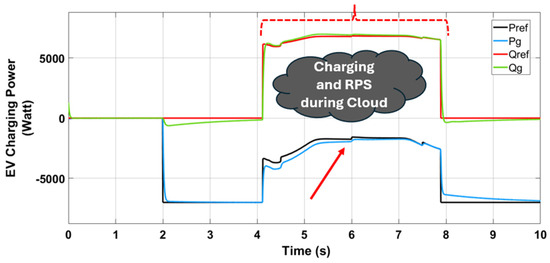
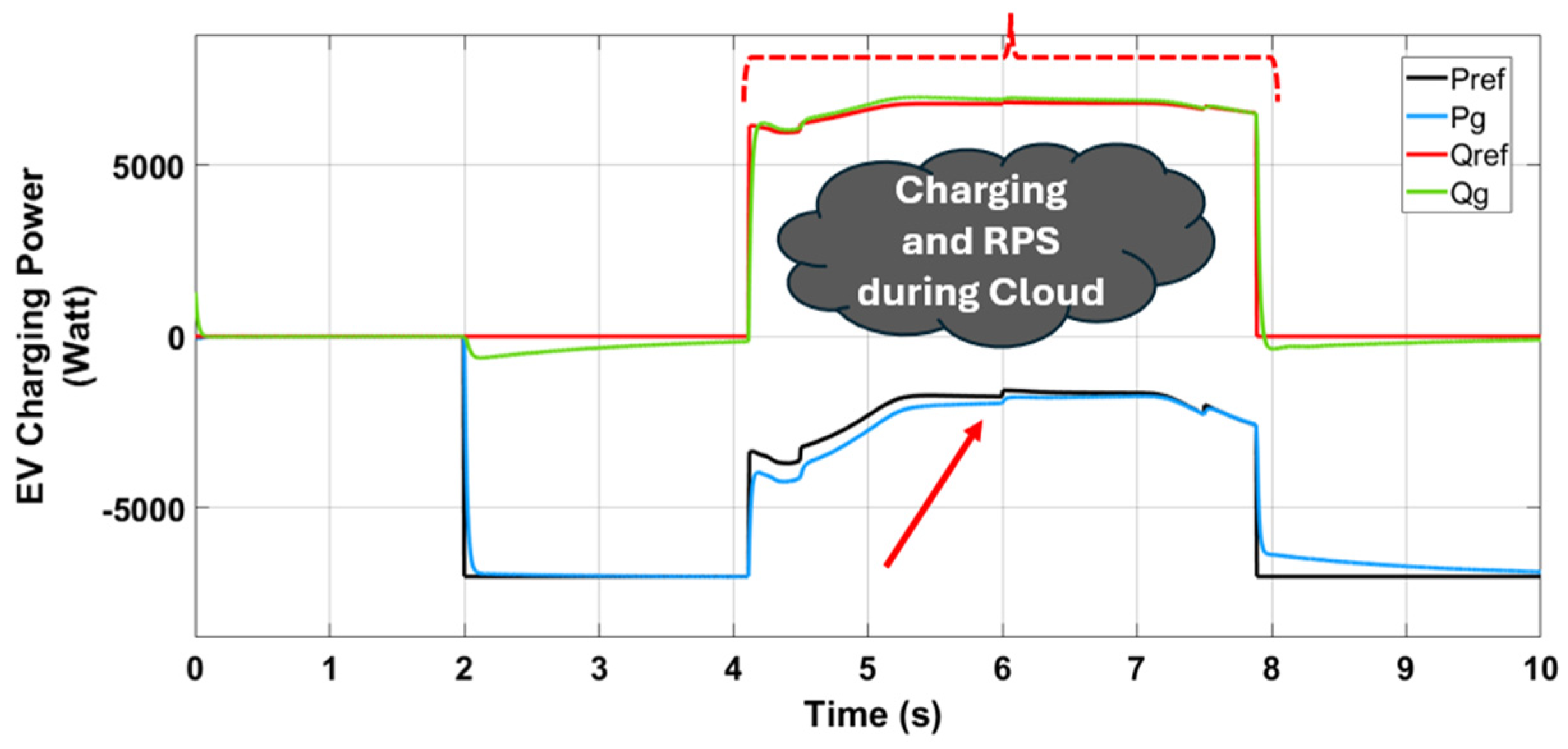
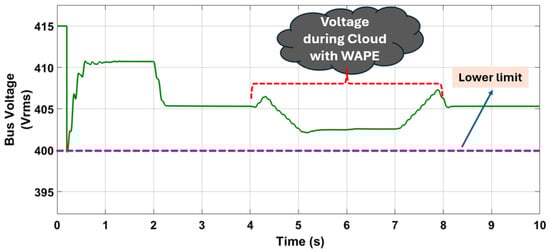
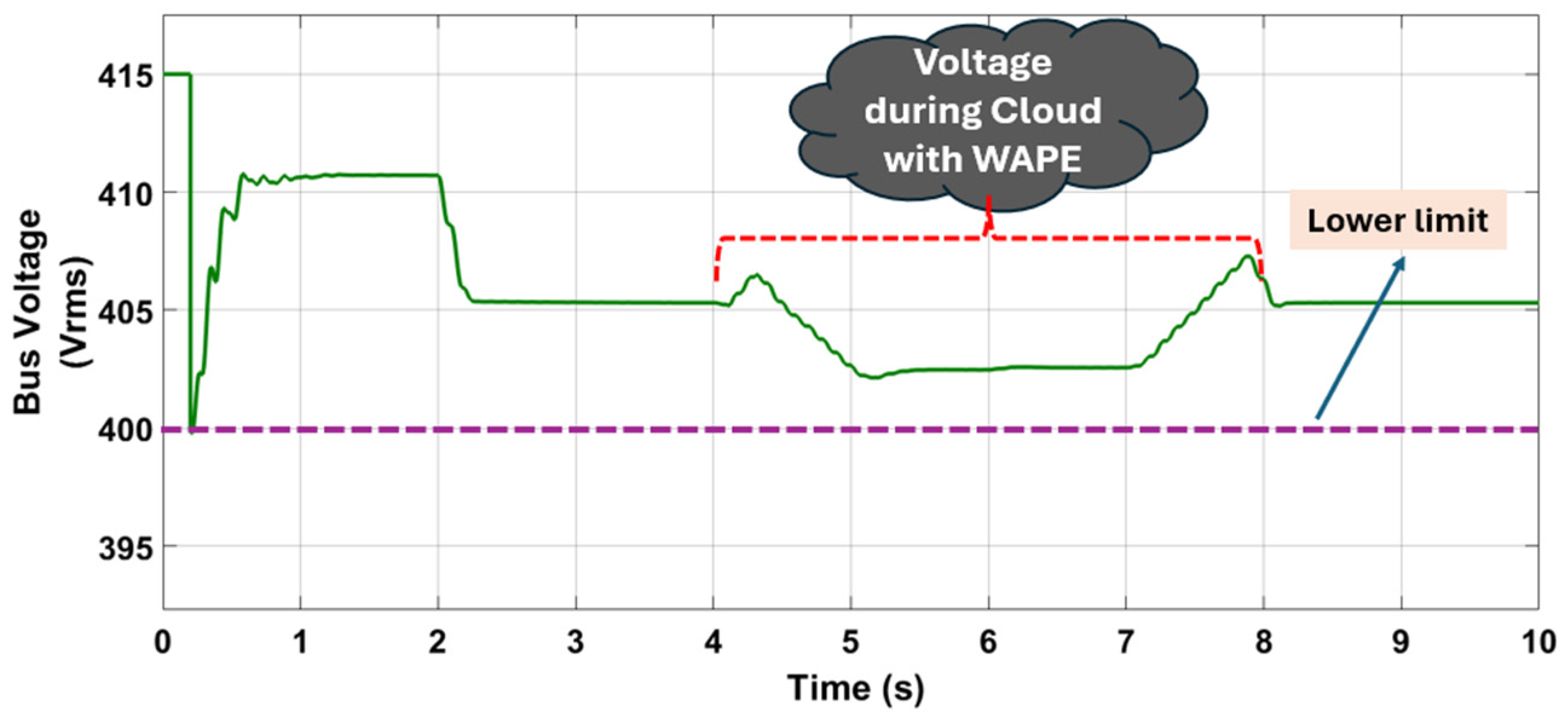
Figure 16 shows the PV output with cloud effect while Figure 17 and Figure 18 demonstrate how WAPE preserves HC during short PV interruptions. Under normal conditions, the EV charges at the optimized HC of 7 kW. Between 4–8 s, a rapid cloud-cover event reduces PV output from 10 kW to 1 kW, a condition that would normally force a reduction of HC from 7 kW to <1 kW if modeled in static optimization. Instead of disconnecting the charger or violating voltage limits, WAPE momentarily reduces the charging power to 1.8 kW and provides reactive power support for 6 kVAR. As shown in Figure 18, this adaptive control keeps the bus voltage at 403 V, well above the minimum threshold.
Figure 16.
PV output with cloud effect of 4 s.
Figure 17.
EV charging during cloud cover with WAPE.
Figure 18.
Voltage during cloud cover with WAPE.
This ability to temporarily limit charging while maintaining stability allows the system to resume 7 kW charging once PV recovers, rather than permanently reducing the HC to <1 kW as a worst-case optimization would require. Hence, WAPE protects the higher HC and prevents long-term underutilization of charging infrastructure.
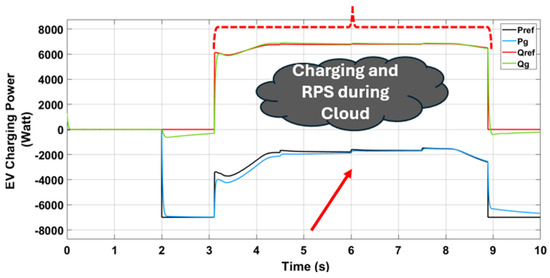
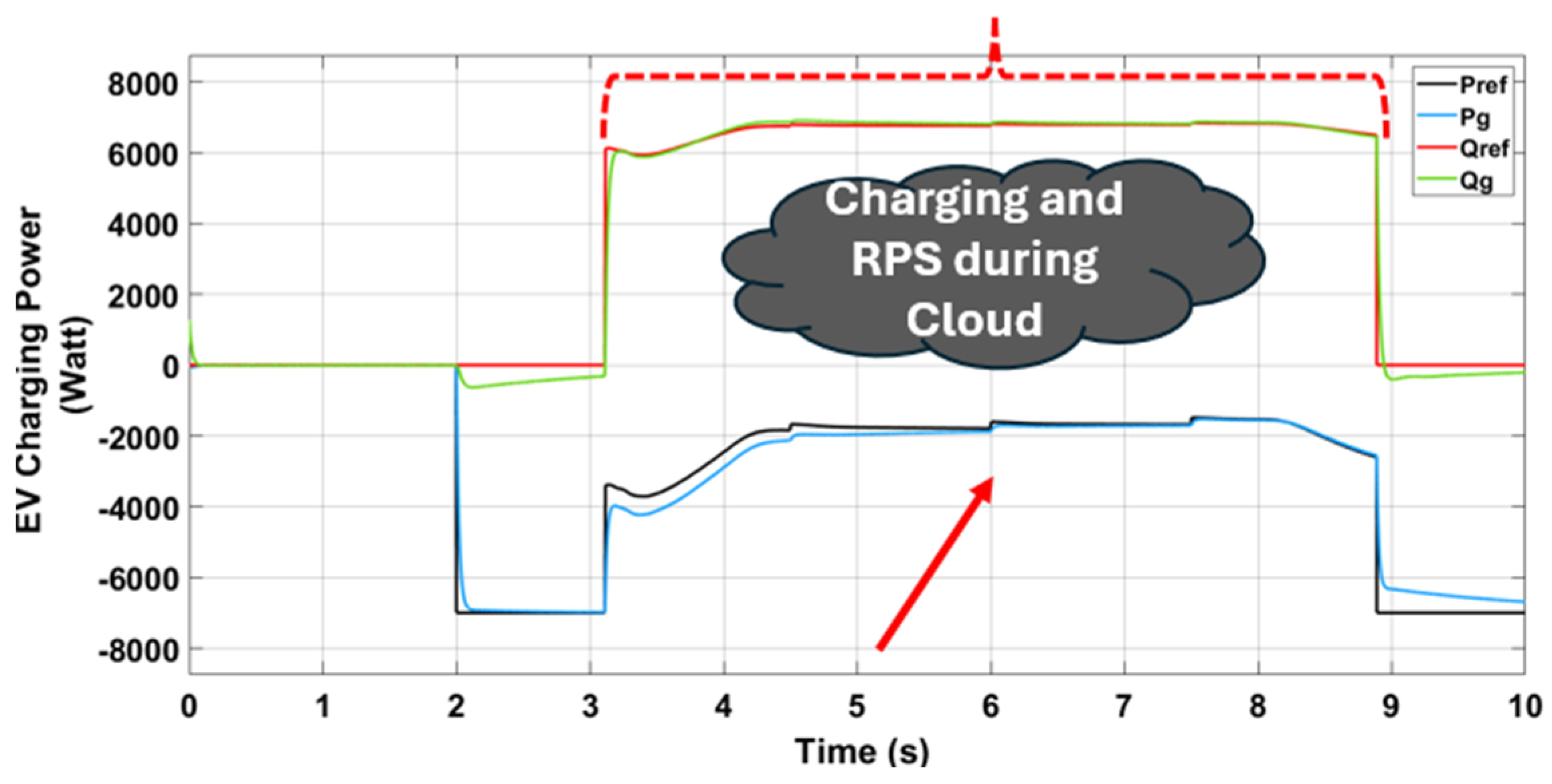
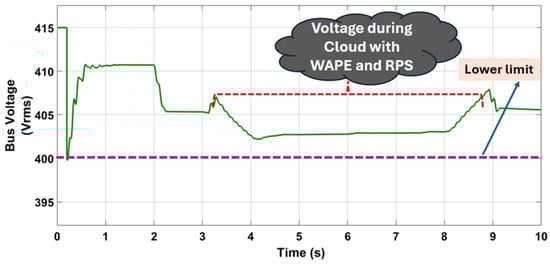
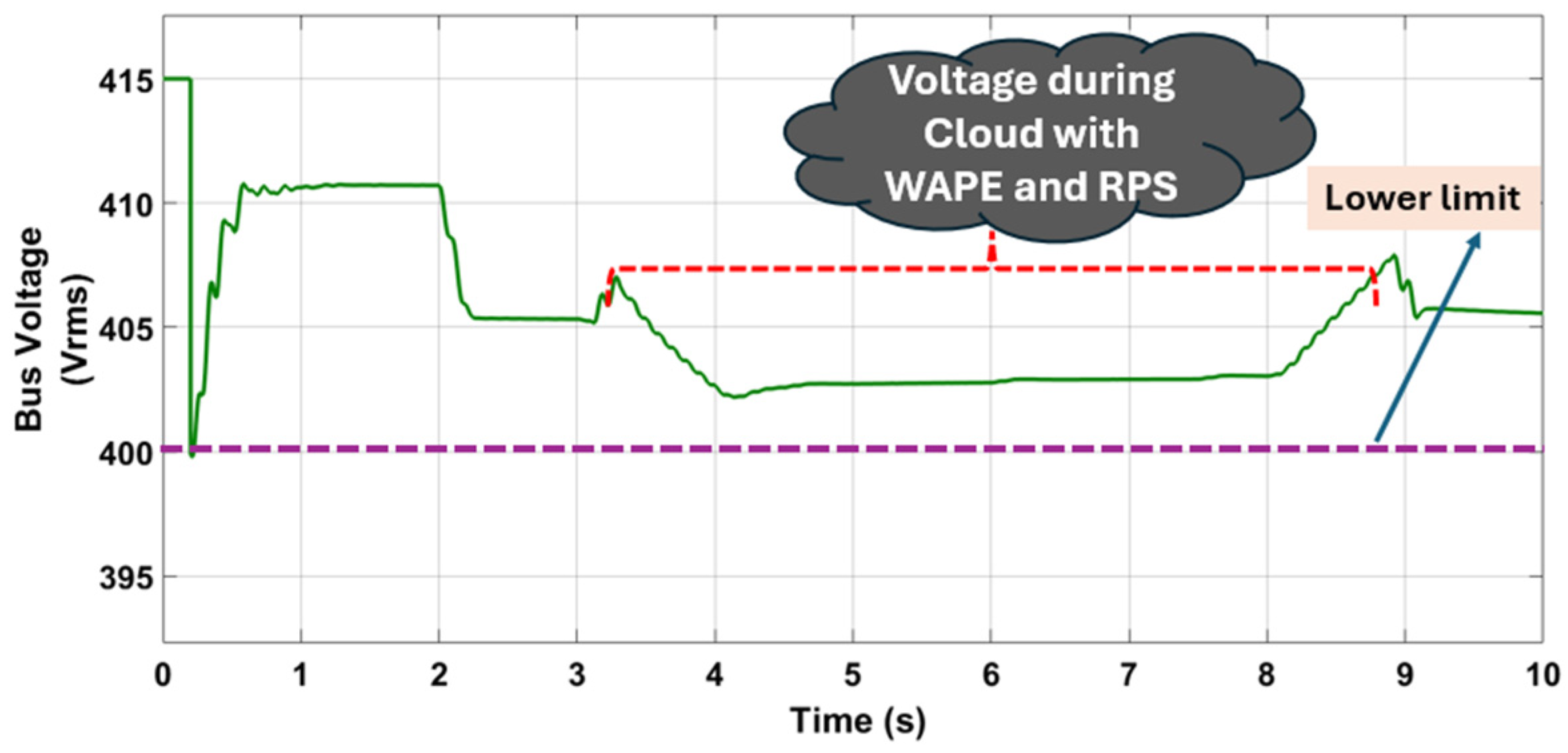
To further evaluate the robustness of the proposed control strategy, the cloud-induced PV power drop was extended from the initial short-duration event to a longer interval (3–9 s). Simulation results (Figure 19 and Figure 20) show that, during this prolonged PV reduction, the WAPE controller effectively regulates the EV charging power and injects reactive power to maintain the PCC voltage within the prescribed limits. Although the extended disturbance increases the duration of reduced-rate charging, voltage stability and hosting capacity are preserved, and normal charging operation resumes immediately after PV recovery.
Figure 19.
EV charging during longer cloud cover with WAPE.
Figure 20.
Voltage during longer cloud cover with WAPE.
4.3.2. WAPE Controller for Uncoordinated EV Arrival
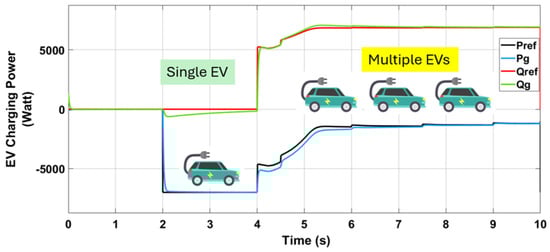
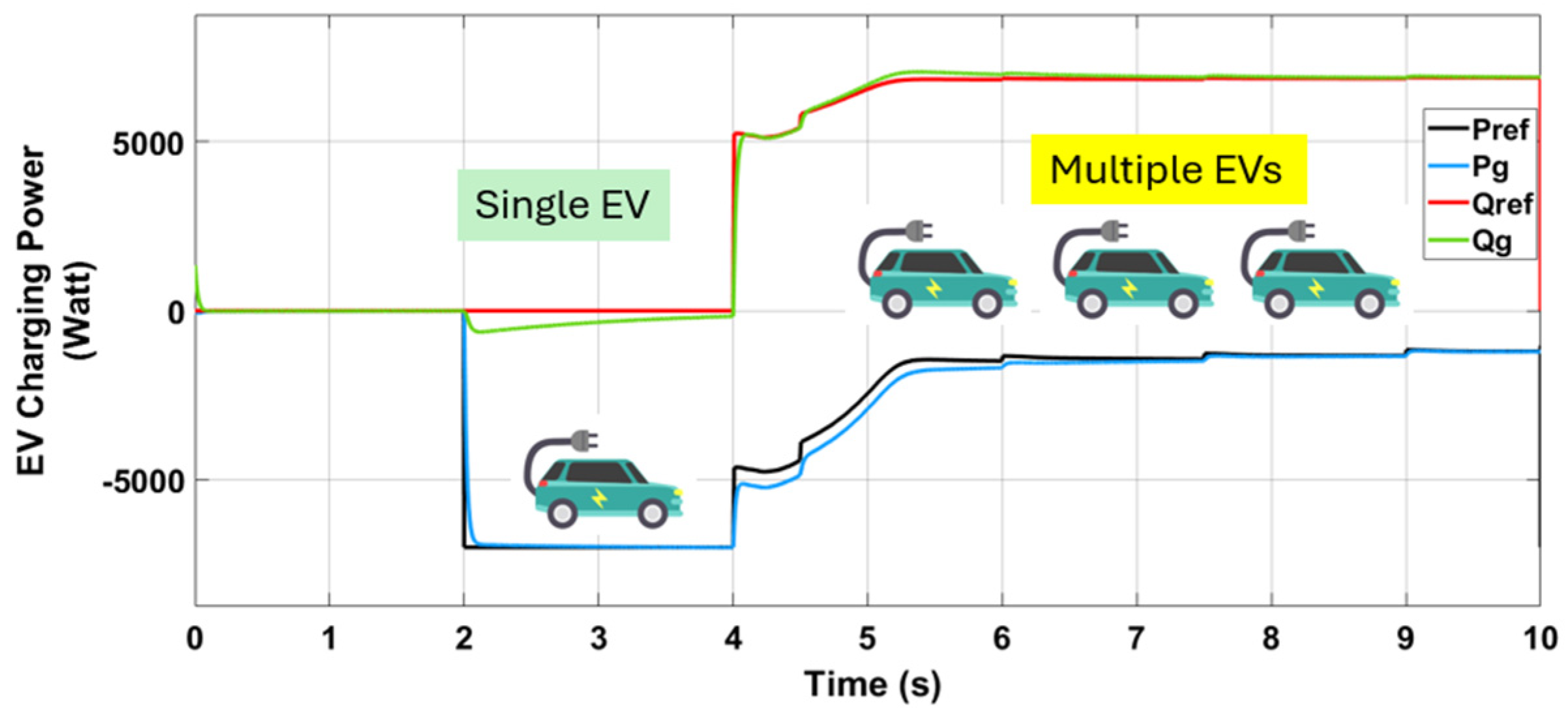
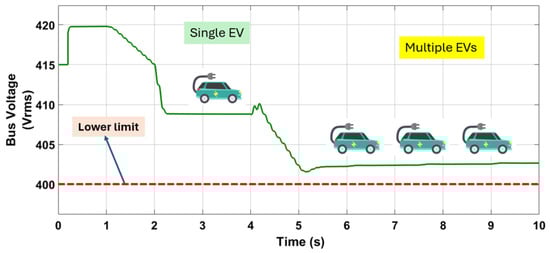
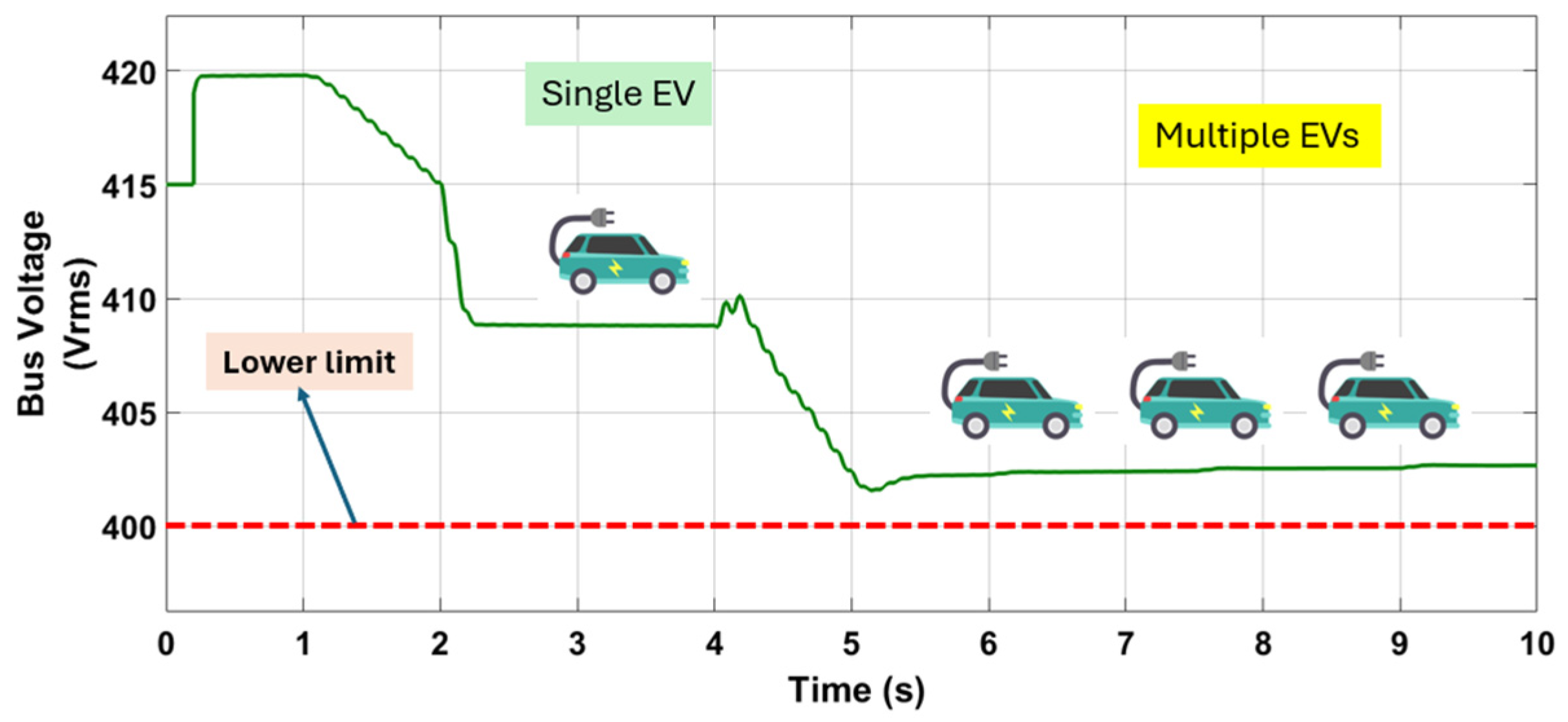
Figure 21 and Figure 22 illustrate how WAPE mitigates the impact of unexpected EV clustering, another event that forces HC reduction under static optimization. Initially, one EV charges at the full HC of 7 kW. At 4 s, three additional EVs arrive unexpectedly, producing a sudden demand of 21 kW, which would normally cause voltage collapse and reduce the effective HC to a value supporting just one EV. With WAPE enabled, the controller immediately limits the combined charging demand to 2 kW and injects reactive power of 6.1 kVAR to counteract the voltage drop. Figure 23 shows that the bus voltage remains stable at 402 V, despite the surge in load. After the transient event, the system can safely return to the full HC of 7 kW, instead of forcing a long-term derated HC. This demonstrates that WAPE preserves HC by absorbing the impact of stochastic arrivals, maintaining stability, and restoring full charging levels once the system recovers.
Figure 21.
Uncoordinated EV arrival event.
Figure 22.
EV charging during multiple EV arrival with WAPE.
Figure 23.
Bus voltage during multiple EV arrivals with WAPE.
Overall, the WAPE controller enables the distribution network to maintain the higher HC determined through optimization by dynamically adjusting EV charging during short-lived disturbances. In contrast, static optimization would require permanently reducing HC to very low values (e.g., <1 kW) to ensure worst-case safety. By preventing unnecessary decreasing, WAPE significantly increases the usable, realistic, and economically efficient HC of the system.
4.4. Charging Time and Driver Satisfaction
In addition to enhancing the network’s HC, the proposed WAPE controller offers a significant practical benefit for EV users and charging-station operators. Under conventional control strategies, short-term PV intermittency such as a cloud event that temporarily reduces PV output to zero often forces operators to postpone EV charging entirely to prevent voltage violations. Such interruptions not only reduce the effective HC but also lead to longer waiting times, inconvenience, and increased range anxiety for EV drivers. Similarly, sudden clustering of EVs can trigger complete charging suspension in traditional schemes. In contrast, the simulation-based HC with WAPE maintains continuous, reduced-rate charging during these disturbances while keeping the voltage within acceptable limits. By avoiding full charging postponement and enabling partial power delivery during PV cloud events or uncoordinated EV arrivals, the WAPE controller increases the usable HC and substantially improves the overall charging experience. To quantify the benefit, the total charging time with and without WAPE can be computed as follows
- Without WAPE (charging postponed):
- , Total EV battery capacity (kWh)
- , Full rate charging power (kW)
- , Reduced charging power during cloud (kW)
- , Full rate charging time (hours)
- , Duration of cloud or disturbance (hours)
- , Energy charged during reduced-rate period (kWh)
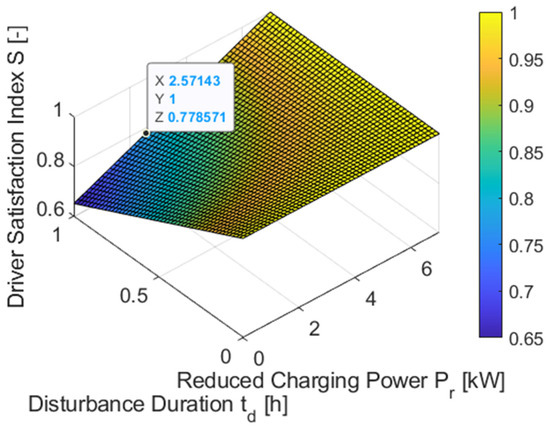
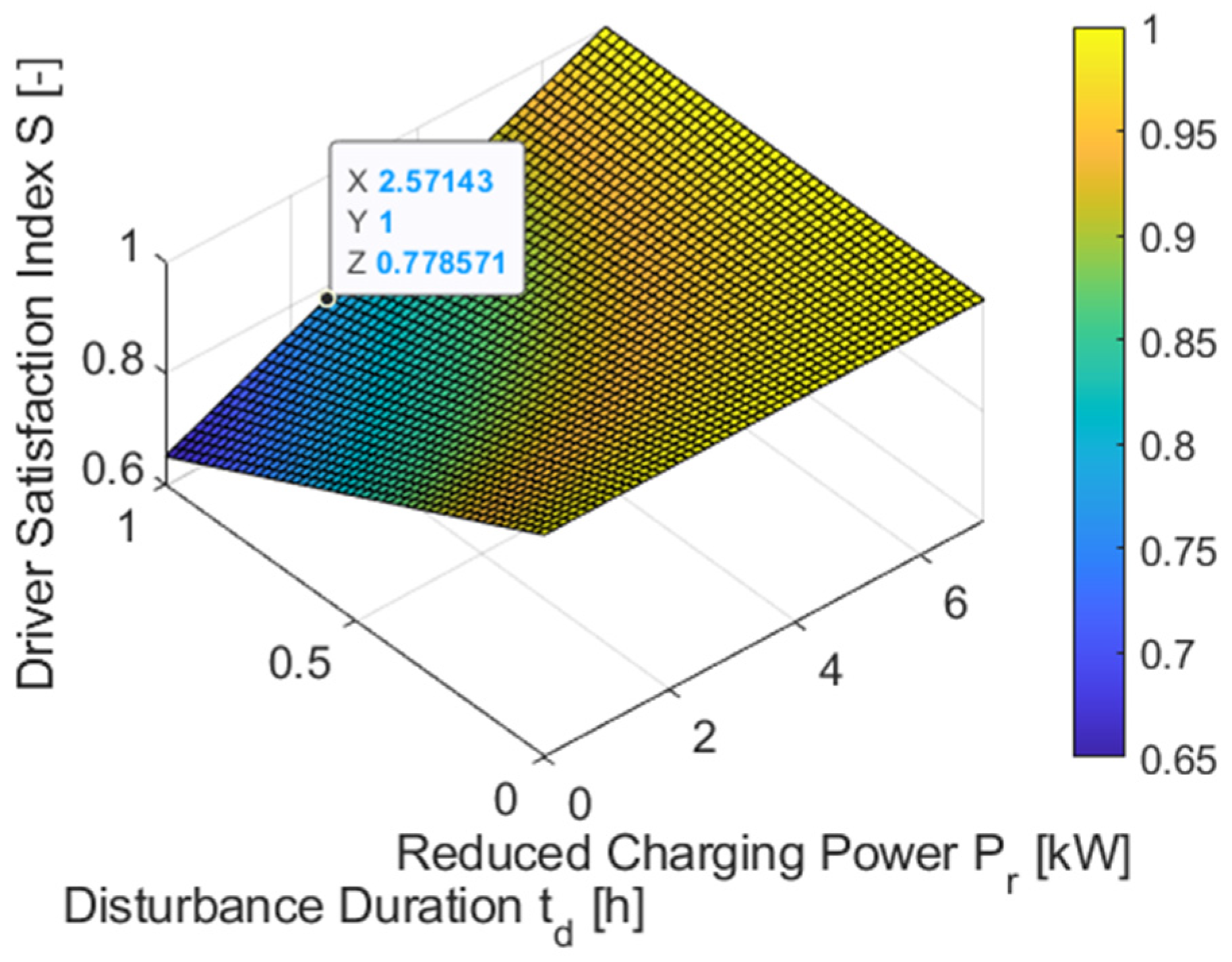
As the charging time is reduced even under short-term disturbances such as cloud-induced PV drops, a new metric referred to as the Driver Satisfaction Index (S) can be introduced to quantify the improvement in user experience enabled by the WAPE controller. The index relates overall charging time to perceived driver satisfaction, with S ranging between 0 and 1, where 1 indicates maximum satisfaction (i.e., no additional charging delay) and 0 represents minimum satisfaction (i.e., charging time significantly extended due to interruptions). By maintaining reduced rate charging rather than fully suspending the process during disturbances, the WAPE controller increases the effective value of S, thereby demonstrating its ability not only to preserve HC but also to enhance the practicality and user-friendliness of EV charging operations. Driver satisfaction index,
For example, with = 20 kWh, = 7 kW, = 2.5 kW and a disturbance duration . The WAPE controller facilitates 2.5 kW charging power during the cloudy interval. As a result, the total charging time decreases from 3.86 h (if charging were fully postponed) to 3.50 h, representing an improvement of approximately 10%.
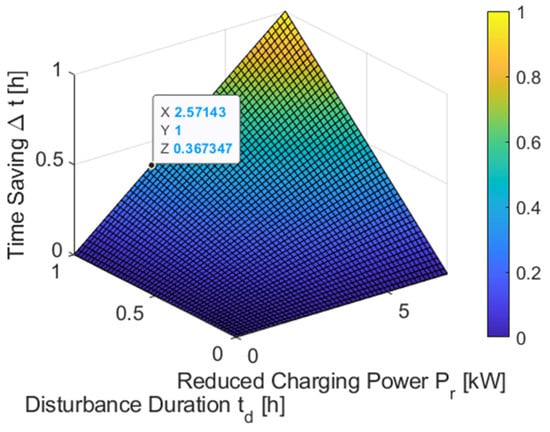
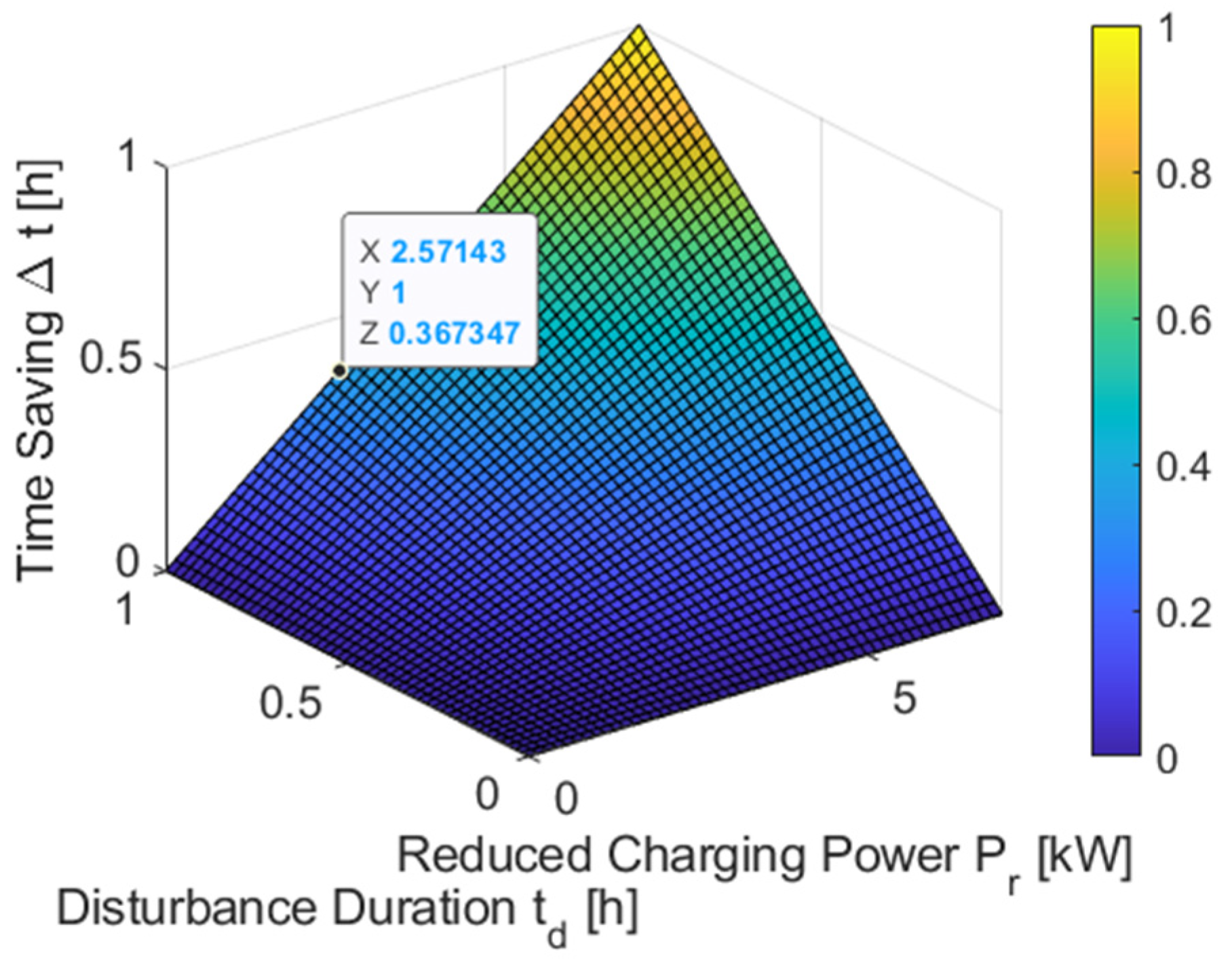
Figure 24 illustrates how the time savings defined as the difference between postponed charging and WAPE-based partial charging varies with disturbance duration () and reduced charging power (). Larger values of during PV cloud events or uncoordinated EV arrivals enable continued EV charging, significantly reducing the total charging delay and yielding higher . In contrast, longer disturbances combined with zero charging power result in minimal or no time savings.
Figure 24.
3D-view for EV charging time saving.
The 3D surface (Figure 25) illustrates how the Driver Satisfaction Index S varies as a function of short-term disturbance duration () and the reduced charging power () maintained by the WAPE controller. Higher values of during cloud-induced PV drops or uncoordinated EV arrivals lead to shorter total charging times and consequently higher satisfaction levels (values of S closer to 1). Conversely, longer disturbances combined with zero or minimal charging power result in lower satisfaction levels, corresponding to extended charging delays. The surface plot highlights the operational benefit of WAPE-based partial charging, showing that even modest reduced-rate charging significantly improves user satisfaction and preserves effective HC under dynamic grid conditions.
Figure 25.
3D-view for EV driver satisfaction index.
To evaluate the capability and practical benefits of the proposed WAPE-based EV charging, a comparative assessment is conducted against existing EV power-management approaches. This comparison illustrates how the WAPE strategy diverges from and outperforms conventional methods. Key performance indicators—including voltage enhancement, voltage stability margin, achievable charging power, and total charging duration—are examined to underscore the strengths of the WAPE framework. Although the detailed voltage stability margin (VSM) calculation is not presented in this paper, its qualitative impact is incorporated as part of the comparative discussion. Table 6 summarizes the results of prior studies with results on power management during EV integration.
Table 6.
Comparison of results/findings with different studies.
While several existing studies report modest improvements in voltage regulation and active-power performance, their impact on actual hosting capacity remains limited. For example, Reference [42] achieved small gains of 2.89% in grid voltage and 5.45% in VSM; however, the analysis focused primarily on steady-state voltage and stability and did not examine how these improvements translate into increased EV hosting capability. Key practical factors such as charging time, charging power during disturbances, and the combined role of active and reactive power control were also not considered. In contrast, the proposed WAPE-based EV charger not only delivers superior voltage enhancement (3.10%) and a significantly larger improvement in VSM (155.81%), but more importantly, these gains directly contribute to maintaining the higher optimization-derived hosting capacity under dynamic conditions. By enabling continued reduced-rate charging during PV intermittency and uncoordinated EV arrivals, the WAPE controller ensures that the network can sustain a higher usable HC without applying conservative derating, offering a more practical and deployment-ready solution for EV-integrated distribution networks.
5. Conclusions
This study presented a comprehensive evaluation of EVHC using both optimization-based and simulation-based approaches and introduced a WAPE controller to address the limitations inherent in static optimization. While the PSO-based optimization framework effectively identified the theoretical HC under fixed voltage constraints, it was unable to accommodate the short-term dynamic variations such as PV intermittency and uncoordinated EV arrivals that critically determine the realizable HC in practice. The proposed WAPE controller overcomes these limitations by incorporating real-time feedback and adaptive active–reactive power management, enabling the system to sustain higher HC values without relying on conservative derating.
Simulation results demonstrated that the WAPE controller substantially enhances the robustness and practical usability of EVHC. During a 90% short-term PV drop caused by a 4-s cloud event, WAPE maintained the bus voltage at 403 V, achieving an improvement of approximately 2% compared with the uncontrolled scenario. Likewise, under a sudden cluster of simultaneous EV arrivals, WAPE sustained the voltage at 402 V, providing a 3.10% improvement relative to static optimization. Importantly, the controller supports reduced rate charging during disturbances rather than postponing charging entirely, resulting in nearly a 10% reduction in total charging time and significantly improving EV driver satisfaction. By enabling continuous but controlled charging, WAPE prevents the need to permanently reduce HC (e.g., from 7 kW to 1 kW) and thus preserves the higher HC identified under normal operating conditions.
Overall, the WAPE-enhanced framework not only validates the optimized HC but also improves its resilience, adaptability, and real-world feasibility. The controller effectively bridges the gap between theoretical HC obtained from optimization and the operational HC achievable under dynamic grid conditions. Future research will extend this work to three-phase unbalanced systems, hardware-in-the-loop validation, and field-scale deployment. Additionally, incorporating AI-driven adaptive control and multi-objective optimization frameworks for joint energy, cost, and voltage regulation presents a promising pathway for advancing EVHC in next-generation distribution networks.
Author Contributions
Conceptualization, A.-A. and G.M.S.; methodology, A.-A., G.M.S. and M.S.; software, A.-A. and S.M.F.; validation, A.-A., G.M.S. and S.M.F.; formal analysis, A.-A. and S.M.F.; investigation, A.-A. and S.M.F.; writing—original draft preparation, A.-A.; review and editing, G.M.S., M.S. and S.M.F. and supervision, G.M.S., M.S. and S.M.F. All authors have read and agreed to the published version of the manuscript.
Funding
This research received no external funding.
Institutional Review Board Statement
Not applicable.
Informed Consent Statement
Not applicable.
Data Availability Statement
The original contributions presented in this study are included in the article. Further inquiries can be directed to the corresponding author.
Conflicts of Interest
The authors declare no conflicts of interest.
References
- Lopes, J.A.P.; Soares, F.J.; Almeida, P.M.R. Integration of Electric Vehicles in the Electric Power System. Proc. IEEE 2011, 99, 168–183. [Google Scholar] [CrossRef] [Scilit]
- International Energy Agency. Global EV Outlook. Available online: https://www.iea.org/reports/global-ev-outlook-2023 (accessed on 25 November 2025).
- Then, J.; Agalgaonkar, A.P.; Muttaqi, K.M. HC of an Australian Low-Voltage Distribution Network for Electric Vehicle Adoption. In Proceedings of the 2022 IEEE International Conference on Power Electronics, Smart Grid, and Renewable Energy (PESGRE), Trivandrum, India, 2–5 January 2022. [Google Scholar] [CrossRef] [Scilit]
- Zhang, Z.; Wang, K.; Zhao, Q.; Tian, Y.; Li, L. Positive Sequence Current Phase-Based Improved Reverse-Power Protection and a PV HC Assessment Method for Spot Networks. IEEE Access 2020, 8, 42529–42539. [Google Scholar] [CrossRef] [Scilit]
- Wang, X.; Kaleybar, H.J.; Brenna, M.; Zaninelli, D. Power quality indicators of electric vehicles in distribution grid. In Proceedings of the 2022 20th International Conference on Harmonics & Quality of Power (ICHQP), Naples, Italy, 29 May–1 June 2022. [Google Scholar] [CrossRef] [Scilit]
- Xi, Z.; Xiang, Y.; Huang, S.Y.; Yu, B.; Weng, L.; Tang, C.; Xu, W.; Liu, J. Hosting capability assessment and enhancement of electric vehicles in electricity distribution networks. J. Clean. Prod. 2023, 398, 136638. [Google Scholar] [CrossRef] [Scilit]
- Khan, M.; Kirmani, S.; Rihan, M. Impact assessment of electric vehicle charging on distribution networks. Renew. Energy Focus 2024, 50, 100599. [Google Scholar] [CrossRef] [Scilit]
- Ismael, S.; Aleem, S.; Abdelaziz, A.; Zobaa, A. State-of-the-art of HC in modern power systems with distributed generation. Renew Energy 2019, 130, 1002–1020. [Google Scholar] [CrossRef] [Scilit]
- Karmaker, A.; Prakash, K.; Siddique, M.N.I.; Hossain, M.A.; Pota, H. Electric vehicle HC analysis: Challenges and solutions. Renew. Sustain. Energy Rev. 2024, 189, 113916. [Google Scholar] [CrossRef] [Scilit]
- Rabiee, A.; Mohseni-Bonab, S. Maximizing HC of renewable energy sources in distribution networks: A multi-objective and scenario-based approach. Energy 2017, 120, 417–430. [Google Scholar] [CrossRef] [Scilit]
- Al-Dhaifallah, M.; Refaat, M.M.; Alaas, Z. Enhancing HC for electric vehicles in modern power networks using improved hybrid optimization approaches with environmental sustainability considerations. Sci. Rep. 2024, 14, 25607. [Google Scholar] [CrossRef] [Scilit]
- Almutairi, S.Z.; Alharbi, A.M.; Ali, Z.M. A hierarchical optimization approach to maximize HC for electric vehicles and renewable energy sources through demand response and transmission expansion planning. Sci. Rep. 2024, 14, 15765. [Google Scholar] [CrossRef] [Scilit]
- Zenhom, Z.M.; Aleem, S.H.E.A.; Zahab, E.A. Simultaneous distributed generation and electric vehicles HC enhancement through a synergetic hierarchical bi-level optimization approach based on demand response and Volt/VAR control. Sci. Rep. 2025, 15, 5443. [Google Scholar] [CrossRef] [Scilit] [PubMed]
- Rawat, T.; Singh, J.; Pandey, V.; Sharma, S. Planning renewables in distribution system with electric vehicles to improve HC and energy losses: Two-stage stochastic optimization framework. Sustain. Energy Grids Netw. 2024, 39, 101445. [Google Scholar] [CrossRef] [Scilit]
- Abad, M.S.S.; Ma, J.; Zhang, D.; Ahmadyar, A.S.; Marzooghi, H. Probabilistic Assessment of HC in Radial Distribution Systems. IEEE Trans. Sustain. Energy 2018, 9, 1935–1947. [Google Scholar] [CrossRef] [Scilit]
- McNab, S.; Schipper, J.; Yuyin, K. Modelling the HC of Orion’s Low Voltage Network for EV Charging. In Proceedings of the Electricity Engineers Association 2021 Conference, Wellington, NZ, USA, 2–4 August 2021. [Google Scholar]
- Mulenga, E.; Bollen, M.H.; Etherden, N. Adapted stochastic PV HC approach for electric vehicle charging considering undervoltage. Electricity 2021, 2, 387–402. [Google Scholar] [CrossRef] [Scilit]
- Chihota, M.J.; Bekker, B.; Gaunt, T. A stochastic analytic-probabilistic approach to distributed generation HC evaluation of active feeders. Int. J. Power Energy Syst. 2022, 136, 107598. [Google Scholar] [CrossRef] [Scilit]
- Chathurangi, D.; Jayatunga, U.; Perera, S.; Agalgaonkar, A. A generalised deterministic approach to evaluate PV HC of LV distribution networks under different operating conditions. In HC for Smart Power Grids; Springer: Berlin/Heidelberg, Germany, 2020; pp. 149–177. [Google Scholar]
- Chathurangi, D.; Jayatunga, U.; Perera, S.; Agalgaonkar, A. Evaluation of maximum solar PV penetration: Deterministic approach for over voltage curtailments. In Proceedings of the 2019 IEEE PES Innovative Smart Grid Technologies Europe (ISGT-Europe), Bucharest, Romania, 2 October 2019; IEEE: New York City, NY, USA, 2019; pp. 1–5. [Google Scholar]
- Rylander, M.; Smith, J.; Sunderman, W. Streamlined Method for Determining Distribution System HC. In Proceedings of the 2015 IEEE Rural Electric Power Conference, Asheville, NC, USA, 19–22 April 2015. [Google Scholar] [CrossRef] [Scilit]
- Gatta, F.M.; Geri, A.; Lamedica, R.; Maccioni, M.; Ruvio, A. PQ and HC issues for EV charging systems penetration in real MV/LV networks. In Proceedings of the 2016 Power Systems Computation Conference (PSCC), Genoa, Italy, 20–24 June 2016. [Google Scholar] [CrossRef] [Scilit]
- Cundeva, S.; Mateska, A.K.; Bollen, M.H.J. HC of LV residential grid for uncoordinated EV charging. In Proceedings of the 2018 18th International Conference on Harmonics and Quality of Power (ICHQP), Ljubljana, Slovenia, 13–16 May 2018. [Google Scholar] [CrossRef] [Scilit]
- Wang, L.; Kwon, J.; Verbas, O.; Rousseau, A.; Zhou, Z. Charging station planning to maximize extra load HC in unbalanced distribution system. In Proceedings of the 2020 IEEE Power & Energy Society General Meeting (PESGM), Montreal, QC, Canada, 2–6 August 2020; IEEE: New York City, NY, USA, 2020; pp. 1–5. [Google Scholar]
- Jones, C.B.; Lave, M.; Darbali, R. Overall capacity assessment of distribution feeders with different electric vehicle adoptions. In Proceedings of the 2020 IEEE Power & Energy Society General Meeting (PESGM), Montreal, QC, Canada, 2–6 August 2020; IEEE: New York City, NY, USA, 2020; pp. 1–5. [Google Scholar]
- Karandeh, R. Placement Evaluation of Distributed Energy Storage for Integrating EV Charging and PV Solar Infrastructure. In Proceedings of the 2021 IEEE 12th International Symposium on Power Electronics for Distributed Generation Systems (PEDG), Chicago, IL, USA, 2–6 August 2021. [Google Scholar] [CrossRef] [Scilit]
- Kim, T.H.; Kim, D.; Moon, S.I. Evaluation of electric vehicles HC based on interval undervoltage probability in a distribution network. IEEE Access 2021, 9, 140147–140155. [Google Scholar] [CrossRef] [Scilit]
- Leemput, N.; Geth, F.; Van Roy, J.; Olivella-Rosell, P.; Driesen, J.; Sumper, A. MV and LV Residential Grid Impact of Combined Slow and Fast Charging of Electric Vehicles. Energies 2015, 8, 1760–1783. [Google Scholar] [CrossRef] [Scilit]
- Paudyal, S.; Ceylan, O.; Bhattarai, B.P.; Myers, K.S. Optimal Coordinated EV Charging with Reactive Power Support in Constrained Distribution Grids. In Proceedings of the 2017 IEEE Power & Energy Society General Meeting (PESGM), Chicago, IL, USA, 16–20 July 2017. [Google Scholar]
- Wang, J.; Paudyal, S. Reactive Power Support from EVs for Distribution Grid Voltage Management. In Proceedings of the 2018 IEEE Power & Energy Society General Meeting, Portland, OR, USA, 5–10 August 2018. [Google Scholar] [CrossRef]
- Trinh, P.-H.; Chung, I.-Y. Integrated Active and Reactive Power Control Methods for Distributed Energy Resources in Distribution Systems for Enhancing Hosting Capacity. Energies 2024, 17, 1642. [Google Scholar] [CrossRef] [Scilit]
- Murthy, S.S. 12-Renewable energy generators and control. In Electric Renewable Energy Systems; Rashid, M.H., Ed.; Academic Press: Cambridge, MA, USA, 2016; pp. 237–289. [Google Scholar] [CrossRef] [Scilit]
- Henriksson, D.; Cervin, A.; Årzén, K. True-Time: Real-time Control System Simulation with MATLAB/Simulink. In Proceedings of the Nordic MATLAB Conference, Copenhagen, Denmark, 21–22 October 2003. [Google Scholar]
- Al–Amin; Ferdous, S.; Shoeb, M.; Shafiullah, G. Advanced Grid Integration of EVs with V2G Capabilities: Power Management Across Diverse Distribution Networks. In Proceedings of the 2024 International Conference on Sustainable Technology and Engineering (i-COSTE), Perth, WA, Australia, 18–20 December 2024. [Google Scholar] [CrossRef] [Scilit]
- Aref, A.; Davoudi, M.; Razavi, F.; Davoodi, M. Optimal DG Placement in Distribution Networks Using Intelligent Systems. Energy Power Eng. 2012, 4, 92–98. [Google Scholar] [CrossRef]
- Wang, D.; Turitsyn, K.; Chertkov, M. DistFlow ODE: Modeling, analyzing and controlling long distribution feeder. In Proceedings of the 2012 IEEE 51st IEEE Conference on Decision and Control (CDC), Maui, HI, USA, 10–13 December 2012. [Google Scholar] [CrossRef] [Scilit]
- Ferdous, S.; Shafiullah, F.S.G. Provisional energy transaction management amongst neighboring microgrids through a DC power exchange link. IET Power Electron. 2020, 13, 4129–4139. [Google Scholar] [CrossRef] [Scilit]
- Umoh, V.; Davidson, I.; Adebiyi, A.; Ekpe, U. Methods and Tools for PV and EV HC Determination in Low Voltage Distribution Networks—A Review. Energies 2023, 16, 3609. [Google Scholar] [CrossRef] [Scilit]
- Carmelito, B.E.; Filho, J.M.d. HC of Electric Vehicles on LV/MV Distribution Grids—A New Methodology Assessment. Energies 2023, 16, 1509. [Google Scholar] [CrossRef] [Scilit]
- McGill, E. Flexible Criteria for Assessing EV HC in Stochastic Load-Flow Simulations. Doctoral Thesis, University of Canterbury, Christchurch, New Zealand, 2021. [Google Scholar]
- Wang, Y.; Qiu, D.; Strbac, G.; Gao, Z. Coordinated Electric Vehicle Active and Reactive Power Control for Active Distribution Networks. IEEE Trans. Ind. Inform. 2023, 19, 1611–1622. [Google Scholar] [CrossRef] [Scilit]
- Chukwu, U.C.; Mahajan, S.M. Real-Time Management of Power Systems with V2G Facility for Smart-Grid Applications. IEEE Trans. Sustain. Energy 2014, 5, 558–566. [Google Scholar] [CrossRef] [Scilit]
- Leemput, N.; Geth, F.; Roy, J.V.; Büscher, J.; Driesen, J. Reactive power support in residential LV distribution grids through electric vehicle charging. Sustain. Energy Grids Netw. 2015, 3, 24–35. [Google Scholar] [CrossRef] [Scilit]
- Gandhi, O.; Zhang, W.; Rodríguez-Gallegos, C.D.; Srinivasan, D.; Reindl, T. Continuous optimization of reactive power from PV and EV in distribution system. In Proceedings of the 2016 IEEE Innovative Smart Grid Technologies-Asia (ISGT-Asia), Melbourne, VIC, Australia, 28 November–1 December 2016. [Google Scholar] [CrossRef] [Scilit]
- Wang, J.; Bharati, G.R.; Paudyal, S.; Ceylan, O.; Bhattarai, B.P.; Myers, K.S. Coordinated Electric Vehicle Charging With Reactive Power Support to Distribution Grids. IEEE Trans. Ind. Inform. 2019, 15, 54–63. [Google Scholar] [CrossRef] [Scilit]
- Chen, J.; Bei, G.; Zhang, Q.; Huang, L.; Liu, K.; Chen, P. Integrated reactive power optimization for distribution systems considering electric vehicle dis-/charging support. Energy Rep. 2023, 9, 1888–1896. [Google Scholar] [CrossRef] [Scilit]

Disclaimer/Publisher’s Note: The statements, opinions and data contained in all publications are solely those of the individual author(s) and contributor(s) and not of MDPI and/or the editor(s). MDPI and/or the editor(s) disclaim responsibility for any injury to people or property resulting from any ideas, methods, instructions or products referred to in the content. |
© 2026 by the authors. Licensee MDPI, Basel, Switzerland. This article is an open access article distributed under the terms and conditions of the Creative Commons Attribution (CC BY) license.