
Next Article in Journal
Machine Learning—Driven Analysis of Agricultural Nonpoint Source Pollution Losses Under Variable Meteorological Conditions: Insights from 5 Year Site-Specific Tracking
Previous Article in Journal
Enhancing EV Hosting Capacity in Distribution Networks Using WAPE-Based Dynamic Control
error_outline You can access the new MDPI.com website here. Explore and share your feedback with us.
 
 
Article

Digital–Intelligent Synergy Empowers Chinese Firms’ Internationalization: A Dual Perspective Based on Green Innovation and Stable Investment


School of Accounting, Harbin University of Commerce, Harbin 150028, China
*
Author to whom correspondence should be addressed.
These authors contributed equally to this work.
Sustainability 2026, 18(2), 588; https://doi.org/10.3390/su18020588
Submission received: 1 December 2025 / Revised: 2 January 2026 / Accepted: 3 January 2026 / Published: 7 January 2026

Abstract

Amid the rapid growth of the digital economy and increasing global competition, the role of digital–intelligent technologies in enabling corporate internationalization has gained significant attention. From the perspective of “digital–intelligent synergy,” this study constructs a mediated moderation model to explore the impact mechanism of digital–intelligent synergy on corporate internationalization. The findings indicate that data assets, artificial intelligence, and digital–intelligent coupling coordination significantly enhance overseas revenue. Green technology innovation mediates this relationship, while investor stability exerts an asymmetrical moderating effect. This strengthens both the direct effect of digital–intelligent synergy on internationalization and its impact on green innovation, though not the path from green innovation to international performance. Further analysis indicates that self-use data assets significantly promote firm internationalization, while transactional data assets do not. Both AI technology and applications markedly enhance overseas expansion. For digital–intelligent coupling coordination, the level of coordination—not merely coupling intensity—positively affects internationalization level. By integrating green innovation and investor behavior perspectives, this study reveals the complex mechanisms through which digital–intelligent synergy empowers internationalization, offering theoretical and policy insights for corporate global expansion in the digital–green transition era.

1. Introduction

The current global economic landscape remains challenging, characterized by sluggish recovery, heightened geopolitical conflicts, and increasing protectionism. Corporate internationalization faces unprecedented uncertainties, with challenges extending beyond traditional market entry barriers [1] to include cultural adaptation [2], compliance risks [3], supply chain resilience [4], and sustainable development [5]. Despite these headwinds, Chinese listed companies have demonstrated notable resilience in overseas expansion. According to statistics from the China Association of Public Companies (CAPCO), in 2024, their overseas revenue reached CNY 9.44 trillion, a year-on-year increase of 7.97%. Overseas operations accounted for 14.3% of total revenue among entity firms, with sectors such as communications, automobiles, electronics, computers, and pharmaceuticals maintaining growth rates between 10% and 30% [6]. Meanwhile, forecasts from the China National Data Administration indicate that the digital economy will account for 35% of China’s GDP by the end of 2025 [7]. This figure underscores the continued dominance of the real economy and the absence of structural transformation in traditional tangible resource foundations. At the same time, however, the share of industrial digitalization has surpassed 80%, propelled by deepening digital transformation and rapidly evolving digital–intelligent technologies [8]. Against this backdrop, Chinese enterprises are demonstrating consistently strong overseas performance. This raises a core question: given that traditional tangible resource foundations have not fundamentally changed, can Chinese firms’ robust international expansion be attributed to a successful strategic shift from “hard resources” to “soft power” centered on digital and intelligent capabilities? Therefore, rigorously examining the relationship between digital–intelligent capabilities and internationalization levels, along with their underlying mechanisms and influencing factors, has become an urgent academic and practical imperative.
Data and intelligence are pivotal drivers of corporate transformation and competitive advantage. While existing research has examined their individual impacts on green performance and value creation [9,10,11], less attention has been given to their synergistic effects—particularly how they jointly influence corporate strategy and market expansion. In practice, data provides the foundational support for intelligence [12], and intelligence extends the application scope of data [13]. To deepen the analysis of this synergistic mechanism and extend the theoretical exploration of its implications, this study systematically incorporates the concept of “digital–intelligent synergy” within an established theoretical framework. First, digital–intelligent synergy represents a strategic organizational capability, encompassing the higher-order capacity for integration and reconfiguration required for firms to adapt to a digitalized environment [14]. Second, its core operating mechanism involves the strategic orchestration and coupled coordination of key complementary digital assets—data and artificial intelligence. This perspective is grounded in resource orchestration theory, which highlights how the synergistic configuration of complementary assets generates value [15]. Finally, from a value creation standpoint, this process serves as a critical micro-mechanism that drives digital transformation and reshapes pathways for value generation [16].
In summary, digital–intelligent synergy is a strategic organizational capability that integrates and orchestrates data assets, artificial intelligence, and their coupling coordination to enhance decision-making, operational efficiency, and value creation. It represents a systemic and dynamic process that transcends the sum of its parts, enabling intelligent, adaptive, and sustainable competitive advantages. It enables firms to integrate resources more efficiently, amplifying value creation [17] and creating opportunities to expand operational boundaries [18]. Textual analysis and proxy variables are currently the primary methods for measuring data assets and artificial intelligence indicators. Textual analysis involves extracting information content from structured texts [19,20], while proxy variables refer to using input or output variables highly correlated with data assets and AI as substitutes [21,22]. Direct research using “digital–intelligent synergy” as a keyword remains limited. Existing studies predominantly employ keywords such as digital intelligence, digital–intelligent integration, or digital–intelligence transformation [23,24,25], often treating digital–intelligent transformation as the core research subject without sufficiently considering the synergistic effects between data assets and artificial intelligence.
To effectively promote internationalization, digital–intelligent Synergy must operate through concrete and measurable mechanisms. Green technology innovation serves as a strategic facilitator for corporations to build market competitiveness [26,27], enabling them to circumvent green barriers and access international markets, green patents serve as the primary metric for assessing green technology innovation [28,29,30]. They are categorized based on patent type into green strategic innovation and green substantive innovation, gauged by the number of utility model patents and invention patents, respectively. Furthermore, based on the application stage, green technology innovation is divided into green technology application and green technology acquisition, typically measured by the quantity of green patents applied for and granted. Meanwhile, the internationalization process entails substantial uncertainties and financial risks that require stable investment as essential support for such expansion [31], the daily investor turnover rate is typically used as a direct proxy for investor stability [30,32]. Drawing on technological, environmental, and governance perspectives, this study investigates how Chinese listed companies can leverage digital–intelligent capabilities to foster green innovation, build a sustainable brand image and drive overseas revenue growth.
This study examines how digital–intelligent synergy promotes corporate internationalization, using data from Chinese A-share listed firms (2015–2024). The empirical findings reveal the following:
  • Direct Impact: Data assets, artificial intelligence and their coupling coordination significantly enhance the level of corporate international business.
  • Transmission Mechanism: Green technology innovation—whether substantive or symbolic, behavioral or outcome-based—acts as a key mediator in this relationship.
  • Moderating Factor: Investor stability positively moderates the effect, strengthening the link between digital–intelligent synergy and international operations, as well as the effect between digital–intelligent synergy and green technology innovation.
  • Component-specific Analysis: The analysis confirms that self-use data assets, AI technology, AI application and digital–intelligent coordination significantly enhance firm internationalization, while transactional data assets and digital–intelligent coupling intensity does not show a significant impact.
This study positions digital–intelligent synergy as the driver, green innovation as the guide, and investor stability as the stabilizer, offering a theoretical and empirical basis for building competitive advantage in a complex global environment. Compared to existing studies, this paper offers several potential contributions:
  • Theoretical Framework Innovation: This study conceptualizes digital–intelligent synergy as a dynamic strategic capability and develops an integrated framework of “digital–intelligent driving—green orientation—investor stability—market expansion.” It reveals the mechanism through which digital–intelligent synergy drives green innovation, thereby facilitating international market entry. This provides a new theoretical explanation for unpacking the black box between digital–intelligent synergy and corporate internationalization.
  • Boundary Condition Innovation: A key contribution lies in identifying “investor stability” as a critical contextual factor and boundary condition for the success of digital–intelligent strategies. This finding shifts the focus from “whether digital–intelligent strategies are effective” to “under what market conditions they work best,” highlighting the specific capital market environment on which strategic success depends and expanding existing understanding of digital–intelligent outcomes.
  • Research Method Innovation: This study introduces the coupling coordination model from ecology into management research, creatively quantifying digital–intelligent synergy. This approach accurately captures the degree of coupling and coordination between corporate data assets and artificial intelligence, thereby establishes a necessary foundation for conducting refined empirical research in this field.
  • Policy Tool Innovation: By integrating the coupling coordination model from environmental science, investment theory from finance, and strategic management theory, this study establishes a new research paradigm. Based on this, it proposes a “digital infrastructure—green finance—capital market” policy framework, facilitating the transformation of theoretical insights into actionable governance tools.

2. Theoretical Analysis and Research Hypotheses

2.1. Mechanism of Digital–Intelligent Synergy

Data serves as the foundation for the development of intelligence. Artificial intelligence operates via a data-driven paradigm rooted in deep learning [33], where intelligence arises from identifying statistical patterns in large-scale data instead of predefined rules. Statistical learning theory indicates that models generalize to unseen data [34], with performance heavily dependent on the scale and quality of training data. The law of large numbers indicates that richer data samples yield estimates closer to the true distribution. Diverse, large-scale data enables complex mappings and reduces overfitting [35], while independent datasets provide evaluation benchmarks for generalization and parameter tuning [36]. Ultimately, the scale, quality, and diversity of data define the ceiling of intelligent capability.
Intelligence empowers data primarily through “management” and “creation.” In management, machine learning-based data mining and knowledge discovery techniques extract valuable information from data [37], enabling efficient processing of unstructured raw data and deepening value extraction. In creation, generative AI learns the probability distribution of real data and samples from it [9], producing novel, valuable data. This mitigates data scarcity [38] and facilitates exploration of unknown domains via synthetic data. Thus, intelligence optimizes data into structured knowledge and expands its boundaries, acting as both an optimizer and an amplifier.
The interaction between data and intelligence forms a co-evolutionary closed-loop system, rather than a one-time linear process. Grounded in control theory, the “data intelligence closed loop” uses real-world data to optimize models while continuously generating authentic feedback data [39]. These data streams capture contextual performance, user preferences, and special cases [40], which are fed back into the data platform, enabling incremental learning and creating a flywheel effect [41]. Therefore, this loop transforms static model training into a dynamic, evolving intelligent agent, enhancing environmental adaptability, with flowing data serving as the sustained driver for iterative system improvement. Such a reciprocal, interdependent, and co-adaptive relationship aligns structurally with the concept of coupling coordination in ecosystem theory, wherein two subsystems evolve synergistically through mutual inputs and feedbacks [42]. Therefore, examining the coordination between data assets and AI through the lens of ecological coupling offers a theoretically coherent framework for capturing their synergistic evolution.

2.2. The Impact of Digital–Intelligent Synergy on Internationalization Level

According to information processing theory, timely information processing improves a firm’s risk perception and decision accuracy [43]. As a fifth factor of production, data enhances the efficiency and depth of information processing, supporting more precise decision-making. In international expansion, firms encounter significant uncertainties and must process complex market, policy, and industry information to mitigate risks. Data technologies enable real-time analysis of global demand, offering accurate market insights [44]. Data-driven decisions also improve internationalization effectiveness [45]. Operational data from social and cross-border e-commerce platforms have become valuable assets, helping to identify market potential and bottlenecks and refine positioning and strategies. Therefore, converting data into assets enhances environmental sensing and strategic adaptation, providing essential impetus for global business growth.
Drawing on organizational learning theory [46], intelligent systems enable firms to learn continuously from overseas operational data, refining decision-making models iteratively. In supply chain management, intelligent algorithms forecast overseas demand fluctuations and optimize cross-border logistics [47]. In customer service, automated tools enhance response efficiency and satisfaction among international clients. For cultural integration, intelligent tools reduce barriers in cultural and institutional adaptation, cutting the costs of international compliance [48]. Overall, AI technologies strengthen a firm’s adaptability, operational optimization, and cross-border coordination, ultimately improving international performance.
Based on market power theory, digital–intelligent coupling coordination helps build competitive advantages [49] and strengthens market control [50], thereby enhancing international operations. In resource allocation, it provides analytical foundations and capabilities, using global supply chain data and intelligent algorithms to enable dynamic allocation and accurate demand forecasting, improving multinational operational efficiency [51]. For market competitiveness, this synergy facilitates scalable overseas expansion through precise customer insights and agile product customization. Regarding synergistic effects, composite technologies foster corporate optimization and ecological synergy [52]. Ultimately, digital–intelligent synergy creates an integrated process of risk perception and business response, driving a qualitative leap in internationalization.
Based on the above analysis, the following hypotheses are proposed:
H1a. 
Data assets can significantly enhance the level of corporate international operations.
H1b. 
Artificial intelligence can significantly enhance the level of corporate international operations.
H1c. 
Digital–intelligent coupling coordination can significantly enhance the level of corporate international operations.

2.3. The Mediating Role of Green Technology Innovation

Based on technological innovation theory, technological change can enhance innovation efficiency [53]. Digital–intelligent synergy promotes the steady advancement of green technology innovation through dual mechanisms of “internal co-construction” and “external coordination.” Within the firm, digital–intelligent technologies facilitate cross-departmental data sharing and process integration [54], enabling deep convergence of R&D, production, and management processes on digital platforms. By leveraging data-driven R&D decision-making and optimizing resource allocation [55], technologies such as digital twins accelerate the testing and iteration of green technology innovations [56], thereby reducing R&D uncertainty and enhancing the efficiency of green innovation. From an external perspective, platforms such as the industrial internet, built on digital–intelligent technologies, help break down information barriers among supply chains, research institutions, and customers [57]. This facilitates the cross-boundary flow of green technology information and mobilizes broader innovation resources to address complex environmental challenges [58]. In summary, digital–intelligent synergy comprehensively advances corporate green technology innovation by reducing innovation uncertainty, optimizing resource allocation, enabling innovation processes, and accelerating information flow.
As a core organizational capability, green technology innovation enhances competitive advantage and compliance in international operations. Rooted in the resource-based view, it creates heterogeneous resources that shape differentiated global competitiveness. Green innovation also signals commitment to sustainability, improving a firm’s position in global green value chains [59]. Institutional theory suggests it aids compliance with international environmental standards, enhancing legitimacy in high-end markets. Improved ESG ratings build trust among global investors and consumers [60], facilitating business expansion. Substantive green innovation reflects advanced technological capability, enabling high-value products that attract international partners and boost overseas revenue [27,61]. Symbolic green innovation reduces product carbon footprints to meet international standards [62]. Therefore, green technology innovation amplifies the effect of digital–intelligent resources and strengthens institutional compliance, serving as a mediating bridge.
Based on the above analysis, the following research hypothesis is proposed:
H2. 
Green technology innovation mediates the relationship between digital–intelligent synergy and the level of corporate international operations.

2.4. The Moderating Role of Investor Stability

In the process of enhancing corporate internationalization through digital–intelligent synergy, stable investors not only reflect the stability of the corporate equity structure but also strongly demonstrate the long-term perspective of investors. Based on resource dependence theory, a stable supply of resources provides a solid foundation for advancing internationalization via digital–intelligent synergy [63]. The development of overseas operations faces institutional and market risks, requiring stable and continuous capital support [64]. Stable investors provide “patient capital”, creating a resource buffer against uncertainties in the international market [65] and helping the firm withstand short-term market fluctuations during international expansion [66]. This endows management with the strategic determination to drive internationalization through digital–intelligent synergy. From a signaling perspective, a stable equity structure sends a credible signal to domestic and international stakeholders about the firm’s technological strength and long-term commitment. This reduces information asymmetry during internationalization and enhances international market recognition of the firm [67]. Furthermore, stable investors indicate that the firm is committed to long-term operations, with the willingness and behavior to continuously invest resources in adapting to local markets and fulfilling social responsibilities [68]. In summary, the stronger the investor stability, the more significant the promoting effect of digital–intelligent synergy on the level of internationalization.
Based on the above analysis, the following research hypothesis is proposed:
H3a. 
Investor stability positively moderates the relationship between digital–intelligent synergy and the level of internationalization.
From the resource-based view, green technology innovation is characterized by long R&D cycles, high asset specificity, and uncertain returns [69]. Stable investors provide solid financial support for advancing green technology innovation, helping firms withstand short-term profit pressures and ensuring the long-term dedicated investments required for digital–intelligent technologies to promote green R&D [70]. Thereby, they enhance the conversion efficiency from digital–intelligent collaboration to green technology innovation. From the perspective of agency theory, green technology innovation is oriented toward resource conservation and sustainable development [71], which may conflict with management’s performance-oriented goals. In the process of advancing green technology innovation through digital–intelligent synergy, investor stability can curb myopic behaviors driven by performance pressure among investors [72]. It also incentivizes managers to pursue green technology innovation in alignment with green development and dual-carbon goals [67], thereby allocating digital–intelligent resources such as data assets and artificial intelligence to green innovation areas with long-term strategic value. In summary, in the process of promoting green technology innovation through digital–intelligent synergy, investor stability not only provides a resource buffer and capital assurance at the resource level but also mitigates the conflict at the governance level between the long-term objective of green sustainability and management’s short-term performance goals. Consequently, it significantly strengthens the driving effect of digital–intelligent synergy on green technology innovation.
Therefore, the following research hypothesis is proposed:
H3b. 
Investor stability positively moderates the relationship between digital–intelligent synergy and green technology innovation.
First, based on signaling theory, green technology innovation faces information asymmetry in the international market [73]. Overseas stakeholders find it difficult to accurately assess the true value and long-term feasibility of Chinese enterprises’ green technology innovation. Stable investors, as a signal of commitment [74], convey credible information to the international market regarding the firm’s governance quality, financial stability, and green technology roadmap. This effectively ensures the quality and continuity of green technology innovation activities [75], thereby reducing verification costs for overseas stakeholders [76] and enhancing the acceptance of green technologies in the international market. Second, from a strategic management perspective, using green technology innovation to drive international revenue is a process fraught with uncertainties, representing a high-risk and high-commitment strategic decision [77]. In this process, investor stability grants management the capacity for risk-taking and strategic patience [78]. This enables firms to implement phased international strategic layouts in line with their technological innovation strategies and international market dynamics [79], while also allowing for dynamic adjustments based on market feedback. The strategic and gradual resource investment model, supported by investor stability, strongly facilitates the translation of green technology innovation into international competitive advantages.
Therefore, the following research hypothesis is proposed:
H3c. 
Investor stability positively moderates the relationship between green technology innovation and the level of internationalization.
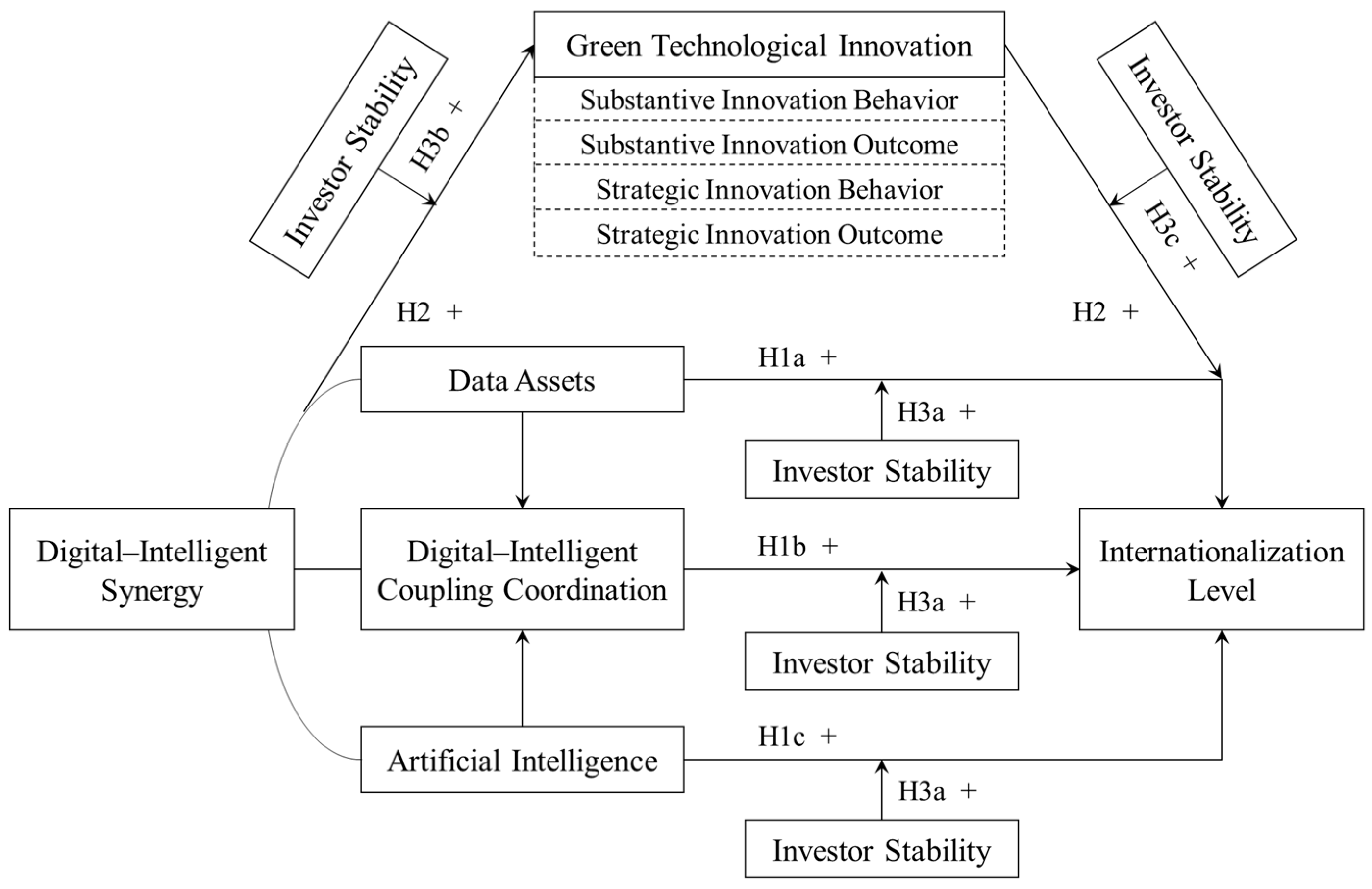
Based on the above analysis, the conceptual model of this study is constructed, as shown in Figure 1.
Figure 1 presents the conceptual model illustrating how digital–intelligent synergy influences the level of enterprise internationalization. The model conceptualizes digital–intelligent synergy through three dimensions: data assets, artificial intelligence, and their coupling coordination. Green technology innovation plays a partial mediating role in this process, encompassing four aspects: strategic green innovation behavior, substantive green innovation behavior, strategic green innovation outcomes, and substantive green innovation outcomes. Investor stability serves as a moderator that not only influences the direct relationship between digital–intelligent synergy and internationalization but also regulates the mediating pathway involving green technology innovation. To clearly depict the core analytical framework of this study, Figure 1 includes only the main variables examined. The same set of control variables was employed in all empirical tests.

3. Research Design

3.1. Sample Selection and Data Sources

China launched its National Big Data Strategy in 2015, actively fostering the growth of the digital economy and related sectors. This study selected Chinese A-share listed companies from 2015 to 2024 as the initial sample, applying the following filters: (1) exclusion of financial firms; (2) removal of ST, *ST, or PT firms during the sample period; and (3) omission of observations with major missing data in key variables. All continuous variables were winsorized at the 1st and 99th percentiles to minimize outlier effects. Data were primarily sourced from the CNRDS and CSMAR databases.
The final dataset formed an unbalanced panel of 36,493 firm-year observations, comprising 5102 unique listed companies over the period from 2015 to 2024. On average, each firm was observed for approximately 7.15 years within the sample period. In terms of industry distribution, manufacturing enterprises accounted for over 60%. The Information Transmission, Software, and Information Technology Services sector, the Wholesale and Retail Trade sector, and the Production and Supply of Electricity, Heat, Gas, and Water sector ranked second to fourth in terms of firm representation. Regarding the temporal distribution, the sample size showed a consistent year-on-year increase, rising from 2015 observations in 2015 to 4932 observations in 2024.

3.2. Variable Definitions

3.2.1. Explanatory Variables

Digital–intelligent synergy (DIS). This construct was measured across three dimensions, including Data Assets (DA), Artificial Intelligence (AI), and the digital–Intelligent Coupling Coordination Degree (DICD).
Data Assets (DA): The measurement of data assets followed the approach of He Ying [19], involving textual analysis and keyword frequency counts in corporate annual reports. Using Python 3.9 and the jieba 0.42.1 library for word segmentation, the total frequency of keywords related to Self-use data assets (SDAs) and transactional data assets (TDAs) was extracted (Appendix A). The natural logarithm of the total frequency plus one served as a proxy for DA.
Artificial Intelligence (AI): The proxy for Artificial Intelligence was constructed based on the method of He Qin [20] (Appendix B). This measure calculates the natural logarithm of the sum of word frequencies for Artificial Intelligence Technology (AIT) and Artificial Intelligence Application (AIA), plus one.
Digital–Intelligent Coupling Coordination (DICD): The comprehensive development levels of DA and AI were first evaluated using the entropy method (Appendix C). Subsequently, a coupling coordination degree index between the two dimensions was constructed, based on the coupling coordination model proposed by Liu Yaobin [42]. This model is originally developed to assess synergistic interactions among ecological, social, and economic subsystems, quantifies the degree of mutual reinforcement and developmental alignment between two interdependent systems. Within the context of digital–intelligent integration, it effectively captures the extent of coupling and coordination between data assets and artificial intelligence. Such a dynamic aligns closely with the co-evolutionary and interactive features described in the mechanistic analysis.
The coupling degree quantifies the intensity of such interaction, whereas “coordination” reflects the positive and synergistic nature of their relationship. The coupling coordination degree integrates both the interaction strength and the level of harmonious development between systems, offering a comprehensive measure of their interdependent dynamics.
The coupling degree model for data assets and artificial intelligence (DICC):
C = 2 D A i · A I i D A i + A I i 2
Here, the C-value has a range of [0, 1] and represents the coupling degree function between data assets and artificial intelligence.
The coordination degree model for data assets and artificial intelligence (DICT) is as follows:
T = α D A i + β A I i
Considering the equal importance of corporate data assetization and artificial intelligence development, the parameters were set as α = β = 0.5.
The coupling coordination degree model for data assets and artificial intelligence (DICD) is as follows:
D =   C · T

3.2.2. Explained Variable

Internationalization Level (IL): Following Di Lingyu [80], this study employed a firm’s overseas revenue to measure its internationalization level. The natural logarithm of overseas revenue plus one was used as a proxy variable for IL. For robustness, a dummy variable indicating the presence or absence of overseas revenue was constructed as an alternative measure.

3.2.3. Mediating Variable

Green Technology Innovation (GTI): Drawing on Johnstone N and Aghion P [28,29], the number of green patents served as a proxy variable for GTI. Based on Li X [81], green technology innovation was further classified into substantive and strategic innovation. To distinguish between innovation behavior and outcomes, GTI was subdivided into Substantive Green Innovation Behavior (GSubB), Substantive Green Innovation Outcome (GSubO), Strategic Green Innovation Behavior (GStrB), and Strategic Green Innovation Outcome (GStrO).
GSubB denotes the natural logarithm of the number of green invention patent applications. It measures early-stage investment in fundamental green R&D, reflecting exploratory innovation in core technologies. GSubO denotes the natural logarithm of the number of green invention patents granted. It represents certified high-quality innovations that have passed substantive examination, indicating a substantive technological edge with legal protection. GStrB denotes the natural logarithm of the number of green utility model patent applications. It captures R&D efforts focused on adaptive improvements and structural optimization of existing green technologies, reflecting incremental and practical innovation activities. GStrO denotes the natural logarithm of the number of green utility model patents granted. It gauges practically oriented innovations that have obtained fast legal protection, demonstrating capabilities in technology implementation and rapid market deployment.

3.2.4. Moderating Variable

Investor Stability (IS): Stable investors are defined as shareholder groups with a propensity for long-term holdings. Following Loh [32], investor stability was measured as the negative of the average turnover rate during the 30 trading days preceding each quarterly and annual earnings announcement. The annual indicator was constructed as the negative mean of these four periodic averages.

3.2.5. Control Variables

Consistent with the focus on intelligence, data, and internationalization, the following control variables were included: Cash Flow Ratio (Cashflow), Inventory to Total Assets Ratio (INV), Number of Directors (Board), Listing Age (ListAge), and Occupation of Funds by Largest Shareholder (Occupy).
Detailed definitions and explanations for all variables are provided in Table 1.

3.3. Model Construction

3.3.1. Main Effect Model

To examine whether data assets, artificial intelligence, and their synergy affect corporate internationalization, a two-way fixed-effects regression model was constructed.
I L i , t = α 0 + α 1 D I S i , t + C o n t r o l s i , t + Y e a r + I d + ε i , t
Here, D I S i , t represents the digital–intelligent synergy level of firm i in period t , including Data Assets ( D A i , t ), Artificial Intelligence ( A I i , t ), and the digital–Intelligent Coupling Coordination Degree ( D I C D i , t ). I L i , t is the internationalization level of firm i in the period t. C o n t r o l s i , t represents the control variables. Year denotes time fixed effects, Id denotes individual fixed effects, and ε i , t is the random error term. To address potential concerns of heteroskedasticity and serial correlation within firms over time, all regressions employ robust standard errors clustered at the firm level. This approach is consistently applied to subsequent models as well.

3.3.2. Mediation Effect Model

A mediation model was used to test whether green technology innovation plays a mediating role. The first step involved the main effect test, consistent with Model (4). The second step examined the effect of digital–intelligent synergy on green technology innovation.
G T I i , t = β 0 + β 1 D I S i , t + C o n t r o l s i , t + Y e a r + I d + ε i , t
In the mediation analysis, the broad GTI measure was substituted with its four specific components: Substantive Green Innovation Behavior (GSubB), Outcome (GSubO), Strategic Green Innovation Behavior (GStrB), and Outcome (GStrO). A significant β 1 suggests that digital–intelligent synergy exerts a significant effect on green technology innovation.
The third step evaluated the effect of digital–intelligent synergy on internationalization with the inclusion of the green technology innovation mediator.
I L i , t = γ 0 + γ 1 D I S i , t + γ 2 G T I i , t + C o n t r o l s i , t + Y e a r + I d + ε i , t
Here, the significance of coefficients γ 1 and γ 2 determined the mediating role: full mediation is present if γ 1 is insignificant but γ 2 is significant; partial mediation is indicated if both are significant; and no mediation exists if γ 2 is insignificant.

3.3.3. Mediated Moderation Model

First, a moderation model was used to test whether investor stability moderates the direct effect of digital–intelligent synergy on internationalization. A significant δ2 indicates the presence of this moderation.
I L i , t = δ 0 + δ 1 D I S i , t + δ 2 D I S i , t × I S i , t + δ 3 I S i , t + C o n t r o l s i , t + Y e a r + I d + ε i , t
Second, model (8) examined its moderating effect on the relationship between digital–intelligent synergy and green technology innovation.
G T I i , t = ρ 0 + ρ 1 D I S i , t + ρ 2 D I S i , t × I S i , t + ρ 3 I S i , t + C o n t r o l s i , t + Y e a r + I d + ε i , t
Contingent on the established mediation (implying ρ 1 is significant), a significant ρ 2 indicates that investor stability moderates the DIS → GTI link.
Finally, the moderating role of investor stability on the second stage (GTI → IL) was tested.
Scenario A: If the direct effect is not moderated in Model (7):
I L i , t = θ 0 + θ 1 D I S i , t + θ 2 I S i , t + θ 3 G T I i , t + θ 4 I S i , t × G T I i , t + C o n t r o l s i , t + Y e a r + I d + ε i , t
A significant θ 4 would indicate this moderation, alongside θ 1 and θ 3 , confirming the main and mediation effects, respectively.
Scenario B: If the direct effect is moderated in Model (7):
I L i , t = ω 0 + ω 1 D I S i , t + ω 2 I S i , t + ω 3 I S i , t × D I S i , t + ω 4 G T I i , t + ω 5 I S i , t × G T I i , t + C o n t r o l s i , t + Y e a r + I d + ε i , t
A significant ω 1 confirms the main effect; ω 3 confirms moderation of the direct DIS → IL effect; ω 4 confirms the mediation exists. A significant ω 5 indicates that investor stability also moderates the second-stage GTI → IL path.
In the above models, green technology innovation (GTI) variable encompasses both green innovation behavior and outcome. To account for the objective time lag between innovation activities and their measurable results, the empirical analysis adopted a refined treatment: data on green innovation outcomes were lagged to capture the impact of prior innovation efforts on contemporaneous internationalization performance, whereas data on green innovation behavior were contemporaneously measured.

4. Analysis of Empirical Results

4.1. Descriptive Statistics

Descriptive statistics in Table 2 show that the mean value of data assets (DA) is 3.363. Self-use data assets (SDAs) account for the majority, while transactional data assets (TDAs) remain limited, reflecting inactive data asset transactions. The mean artificial intelligence (AI) level is 1.522, with AI technology (AIT) slightly higher than AI application (AIA), suggesting challenges in translating technical capability into practical use. The digital–intelligent coupling coordination (DICD) is low (mean = 0.122), indicating preliminary synergy between DA and AI. The internationalization Level (IL) varies considerably across firms. Substantive innovation (GSubB) and strategic innovation behavior (GStrB) show similar means, but the outcome of substantive innovation (GSubO) is significantly lower, pointing to its slower and more difficult nature. Investor stability (IS) is generally high with little variation. Among the control variables, CashFlow is stable on average but negative for some firms. Inventory levels (INV) vary widely, with some firms holding zero inventory and others facing accumulation risks. Board size is concentrated, ListAge is broadly distributed, and fund occupation (Occupy) differs notably across firms.

4.2. Diagnosing Multicollinearity

To mitigate potential multicollinearity arising from the multiple interaction terms in the model, all interaction terms and their constituent variables were mean-centered to reduce multicollinearity. Following this procedure, the relevant interaction terms were computed using the centered variables, and subsequent empirical tests were conducted based on these centered values.
Thereafter, four sets of variance inflation factor (VIF) tests were performed; the first set involves Variance Inflation Factor tests among the three components of the explanatory variables and the control variables, while the remaining three sets pertain to a distinct group of variables that appear together in the model, with the results reported in Table 3. Specifically, column (1) presents the VIF values for all explanatory and control variables; column (3) focuses on data assets (DA) along with their associated mediating, moderating, and interaction terms; columns (5) and (7) respectively report the VIFs for variable groups related to artificial intelligence (AI) and digital–intelligence coupling coordination (DICD). Across all tests, the VIF values remain below the common threshold of 10, indicating that serious multicollinearity is not a concern in the specified models.

4.3. Baseline Regression

4.3.1. Data–Intelligent Synergy and Internationalization Level

Table 4 reports the baseline regression results examining the impact of Data Assets (DA), Artificial Intelligence (AI) and digital–intelligent coupling coordination (DICD) on internationalization level (IL). The results demonstrate that data assets, artificial intelligence, and digital–intelligent coupling coordination all exert a significantly positive effect on overseas revenue at the 1% level, thereby enhancing the level of corporate internationalization. Therefore, Hypothesis H1 is supported.

4.3.2. Discussion on Baseline Regression

Data assets and artificial intelligence serve not only as production tools but also as critical assets and core drivers of internationalization strategies, providing strong empirical evidence for firms to integrate them into their core resource base to expand into international markets. Existing research has often focused on the independent functions of information technology, such as enhancing risk perception, market insight, and supply chain optimization [43,44,46], or emphasized its role in reducing costs and shaping competitive advantages [48,49]. This study confirms that the effective implementation of an internationalization strategy relies not only on the separate application of data assets or AI technologies, but also on their deep integration and systemic coordination. This finding not only aligns with the view that composite technological applications can promote holistic optimization and ecological synergy [52], but further clarifies that synergy itself functions as a mechanism. Its value does not stem from the simple accumulation of individual technologies or resources, but from the leap in overall effectiveness achieved through structural coordination. Therefore, this study theoretically advances the current discussion on “how digital technologies promote internationalization,” shifting the focus from “tool-enabled empowerment” to “systemic synergy,” and offers a new explanatory pathway for understanding how firms can build sustainable international competitiveness through digital–intelligent integration.

4.4. Robustness and Endogeneity Tests

4.4.1. Replacing the Explained Variable

A dummy variable for the internationalization level (IL_dummy) was constructed based on the presence of overseas business revenue. As shown in Table 5, the significantly positive coefficients in columns (1)–(3) reaffirm support for Hypotheses H1a, H1b, and H1c.

4.4.2. Replacing the Explanatory Variables

To ensure robustness, alternative measures were adopted. Following Qi H. [21], data assets were proxied using “digital transformation intangible assets,” measured as the share of Digital-related intangible assets in total intangible assets. The significantly positive result in column (1) of Table 6 confirms the robustness of H1a. Similarly, following Yao J. [22], an alternative AI word frequency measure was used, and its positive effect in column (2) again supports H1b.
An alternative index of digital–intelligent coupling coordination was derived via principal component analysis (PCA) based on standardized measures of data assets (DA) and artificial intelligence (AI). The result presented in column (3) confirms that its relationship with internationalization level is still significant at the 1% level, lending additional support to Hypothesis H1c.
To capture the core concepts of data assets and AI more precisely, the study constructs narrow dictionaries by filtering the original keyword lists to retain the most representative terms (Appendix A and Appendix B). After recalculating the coupling coordination degree using these refined measures, the results in columns (4)–(6) remain consistent with the main findings, supporting H1a, H1b, and H1c.

4.4.3. Lagged Variables

To mitigate endogeneity due to reverse causality or dynamic factors, one-period lagged values of the explanatory variables were used in the regression. The results in Table 7, which account for time trends and reduce reverse causality concerns, confirm the robustness of H1a, H1b, and H1c.

4.4.4. Modifying the Fixed Effects Specification

To further examine the impact of digital–intelligent synergy at the industry level, the models were re-estimated. As detailed in Appendix D, industries are classified according to China’s National Economic Industry Classification Standard [82]. As shown in Table 8, data assets, AI, and digital–intelligent coupling coordination all exhibit significantly positive effects on internationalization at the industry level.

4.4.5. Interactive Fixed Effects

To account for variation in digital–intelligent development and international policies across industries and regions, industry–year and region–year interactive fixed effects are incorporated into the baseline regression specifications, respectively. Industries are classified according to China’s National Economic Industry Classification Standard (Appendix D), and regions are defined at the provincial administrative level. Baseline regression results including individual, year, and industry–year fixed effects are reported in columns (1)–(3) of Table 9, whereas those with individual, year, and region–year fixed effects appear in columns (4)–(6). The findings demonstrate that hypotheses H1a, H1b, and H1c remain robust even after the inclusion of these interactive fixed effects.

4.4.6. Instrumental Variable Approach

To address potential endogeneity, this study employs an instrumental variable (IV) approach. The instrumental variable is a predicted provincial digitalization index constructed using a leave-one-out procedure based on data from the CSMAR Database, which satisfies the relevance and exclusion restriction conditions. The regional digital environment provides a foundation for firms’ digital investment and synergy, ensuring the relevance of the IV. As a macro-level predicted value based solely on the digital performance of other firms within the same province, the IV isolates the direct influence of a firm’s own digitalization. Furthermore, to control for potential confounding effects from regional digital conditions via economic, financial, informational, technological, and infrastructural channels, province-level controls are included in the analysis: economic development (per capita GDP), financial development (total deposits and loans to GDP ratio), R&D intensity (R&D expenditure to GDP ratio), internet penetration (internet users to population ratio), technology market development (technology transaction value to GDP ratio), transportation infrastructure (road density), and openness (total import and export to GDP ratio). Data are sourced from the National Bureau of Statistics and provincial statistical yearbooks.
The IV tests in Table 10 show that in the first-stage regressions, the IV is positively and significantly correlated with each endogenous explanatory variable at the 1% level. The Kleibergen–Paap rk Wald F statistics all exceed the 10% critical value (16.38), and the Kleibergen–Paap rk LM statistics are all significant at the 1% level, ruling out concerns of weak instruments and underidentification. The second-stage estimates indicate that, after controlling for endogeneity, the positive effects of data assets, artificial intelligence, and digital–intelligent coupling coordination on firm internationalization remain statistically significant. In summary, these results from the instrumental variable estimations, which mitigate potential endogeneity issues, provide further support for the robustness of the main findings regarding the positive role of data assets, AI, and digital–intelligent coupling coordination in promoting firm internationalization.

5. Further Analysis

5.1. The Mediating Effect of Green Technology Innovation

5.1.1. Substantive Green Innovation Behavior

Substantive green innovation behavior in this study refers to the number of green invention patent applications. Table 11 presents the mediation test results. Columns (1)–(3) show that substantive green innovation behavior mediates the relationship between data assets and internationalization revenue, with significantly positive outcomes confirming this effect. Similar mediating roles are observed in the relationships involving artificial intelligence and digital–intelligent coupling coordination. These results provide partial support for Hypothesis H2.
Specifically, firms utilize big data to analyze global environmental trends and market demand, and apply machine learning to simulate experiments and optimize R&D processes. Through digital–intelligent synergy, they integrate resources and accelerate innovation decision-making, thereby increasing investment in core technology R&D. This enhances firms’ innovation vitality and establishes a technical foundation for global expansion.

5.1.2. Substantive Green Innovation Outcome

Table 12 presents the results for the mediating effect of substantive green innovation outcomes in the relationship between digital–intelligent synergy and internationalization, providing partial support for Hypothesis H2.
Specifically, the integration of data assets and AI enhances patent quality, helps firms avoid potential conflicts, and increases patent grant rates. Meanwhile, digital–intelligent synergy improves innovation chain efficiency, enabling more effective transformation of R&D outcomes and strengthening intellectual property barriers in international markets.

5.1.3. Strategic Green Innovation Behavior

Table 13 presents the mediating effect of strategic green innovation behavior in the relationship between digital–intelligent synergy and internationalization. The results confirm its mediating role, providing further partial support for Hypothesis H2.
Digital–intelligent synergy delivers timely market feedback and user needs, facilitating swift patent filings for environmental equipment or process improvements tailored to specific international requirements or regulatory shifts. It also enhances cross-departmental collaboration, allowing firms to adapt more flexibly to diverse environmental standards and strengthen market responsiveness. These rapidly accumulated competitive advantages ultimately help mitigate internationalization risks.

5.1.4. Strategic Green Innovation Outcome

Table 14 presents the mediating effects of strategic green innovation outcomes in the relationship between digital–intelligent synergy and internationalization. The results confirm that digital–intelligent synergy enhances internationalization by fostering such outcomes, thus providing full support for Hypothesis H2.
The findings suggest that digital–intelligent synergy helps identify high-value technological enhancements and facilitates the rapid implementation of outcomes. Therefore, strategic green innovation serves as an effective approach for firms to achieve international expansion at relatively lower cost, build brand loyalty, expand market share, and ultimately elevate their level of internationalization.

5.1.5. Discussion on Mediating Effect

This study finds that digital–intelligent synergy simultaneously drives both substantive and strategic green innovation, enabling them to collectively serve the firm’s international competitiveness. This supports the view that substantive green innovation, as an advanced technological capability, can be translated into higher value-added products and enhance overseas revenue [27,61], while also confirming the role of strategic innovation in reducing product carbon footprints [62]. These findings deepen existing research that regards green technology innovation as a signal of sustainable development for gaining international competitive advantage [59,60], and shift the perception of green innovation from a “cost center” to a “functional asset”.
The study not only echoes the perspective that composite technology applications can promote holistic optimization and ecological synergy, but also reveals a systematic mechanism of “digital–intelligent synergy—dual-path green innovation—internationalization,” thereby providing an integrated explanation for understanding how firms can build green international competitiveness through digital–intelligent integration.

5.2. Mediated Moderation Effects

5.2.1. The Moderating Effect of Investor Stability on the Main Relationship

Based on Model (7), Table 15 reports the moderating effect of investor stability on the relationship between digital–intelligent synergy and internationalization. Columns (1)–(2), (3)–(4), and (5)–(6) present the moderation tests for data assets, artificial intelligence, and digital–intelligent coupling coordination, respectively. With the inclusion of the interaction terms (DA × IS, AI × IS, DICD × IS), both the explanatory variables and interaction terms show coefficients significant at the 1% level, indicating that investor stability amplifies the positive effect of these factors on internationalization. In international strategy implementation, stable investors not only provide financial support but also supply resources and risk mitigation, thereby validating Hypothesis H3a.

5.2.2. The Moderating Effect of Investor Stability Between Digital–Intelligent Synergy and Green Technology Innovation

Based on Model (8), Table 16 presents the test results for the moderating effect of investor stability in the relationship between digital–intelligent synergy and green technology innovation. The significance of the interaction terms (GTI × DA, GTI × AI, GTI × DCID) indicates whether a moderating effect exists. The results show that investor stability positively moderates the impact of digital–intelligent synergy on both substantive green innovation behavior (GSubB) and substantive green innovation outcomes (GSubO), as shown in columns (1), (5), (9) and (2), (6), (10), respectively.
However, investor stability exerts a differentiated moderating role in the relationship between digital–intelligent synergy and strategic green innovation. Specifically, it does not significantly moderate the effect of digital–intelligent synergy on strategic green innovation behavior, as shown in columns (3), (7), and (11). In terms of strategic green innovation outcomes, investor stability moderates the relationships involving data assets and digital–intelligent coupling coordination (columns 4 and 12), but not the relationship involving artificial intelligence (column 8).
Overall, investor stability primarily moderates the pathways through which digital–intelligent synergy influences green innovation “outcomes” and substantive green innovation. This can be attributed to the financial support and risk tolerance provided by stable investors, which facilitate sustained and in-depth green innovation activities. Strategic green innovation “behavior” involves relatively lower costs and does not directly affect core business operations or product transformation, making it less sensitive to investor stability. Conversely, substantive green innovation and green innovation outcomes often accompanies strategic initiatives such as product renewal and business expansion [27], thereby requiring the assurance of stable investors. In conclusion, Hypothesis H3b is partly supported.

5.2.3. The Moderating Effect of Investor Stability Between Green Technology Innovation and Internationalization

Based on Model (9), Table 17 presents the moderating effect of investor stability on the relationship between green technology innovation and internationalization. The coefficients of all interaction terms are insignificant, indicating that investor stability does not moderate the latter stage of the mediation pathway, i.e., between green innovation and internationalization. This implies that overseas revenue generation relies more on corporate strategic planning and core capability building, where green technology innovation serves as a tactical tool to overcome trade barriers and comply with environmental regulations. While stable external funding offers financial security, it does not directly affect overseas customers’ purchasing decisions, explaining the lack of a moderating effect in this pathway. Therefore, Hypothesis H3c is not supported.
In the above empirical analysis, the green innovation outcome variable is lagged to align with a time lag between digital–intelligence synergy, innovation outcomes, and subsequent internationalization performance. This approach helps to clearly identify the sustained impact of green innovation outcome on international revenue. Meanwhile, DIS may enhance innovation efficiency and accelerate the application of green technologies, exerting a more immediate effect on internationalization within the same period. To ensure that the core findings are not driven by specific modeling choices—such as variable centering or lag structures—and to test the robustness of the mechanism, Appendix E reports estimation results using uncentered and non-lagged variables. The results confirm that the mediating role of green technology innovation between DIS and internationalization remains robust. Moreover, the moderating effects of investor stability are consistent with those reported in the main text: it positively moderates the DIS → IL path and the DIS → GTI path, but does not significantly moderate the GTI → IL path. Therefore, the hypotheses H3a (supported), H3b (partially supported), and H3c (not supported) hold across both model specifications, further reinforcing the reliability of the conclusions.

5.2.4. Discussion on Mediated Moderation Effects

The study reveals that investor stability exerts an asymmetric moderating effect along the strategic pathway of “digital–intelligent synergy—green innovation—internationalization.” Stable investors provide “patient capital” and continuous resource support [63,65], strengthening the role of digital–intelligent synergy in driving green technology innovation and international expansion. This confirms theoretical expectations from behavioral strategy and the resource-based view, indicating that a stable ownership structure helps curb managerial myopia [72], ensures sustained investment in long-term strategies such as digital–intelligent integration and green R&D [70,71], and supports firms in overcoming short-term fluctuations while building market credibility during internationalization [66,67].
However, the study finds that investor stability does not play a moderating role in the “GTI → IL” path. This differs from some of the theoretical expectations derived from signaling theory [74,76] and the strategic commitment perspective [77,78,79]. One possible explanation is that in international markets, the credibility of green technology innovation relies more heavily on direct signals such as international certification and localized partnerships, which may dilute the indirect signaling effect of equity stability. Meanwhile, during the highly uncertain process of commercializing green innovation outcomes, management’s risk-averse tendencies may be reinforced, leading to a preference for incremental rather than breakthrough internationalization strategies, which may interrupt the development chain of “stable investment—strategic innovation—international expansion.” These findings suggest that the strategic value of investor stability is highly context-dependent, being more relevant in supporting technology integration and innovation incubation than in directly facilitating the international marketization of innovation performance.

5.3. Segmented Explanatory Variables

5.3.1. Regression Results on Segmented Data Assets

Table 18 reports the baseline regression results of segmented data assets on the corporate Internationalization Level (IL). Data assets are categorized into Self-use data assets (SDAs) and transactional data assets (TDAs) to further distinguish the effects by data type. The results reveal that SDAs significantly enhance internationalization, whereas TDAs show no significant relationship with IL. This suggests that data assets deeply integrated into a firm’s internal operations are the primary driver of overseas expansion. Although TDAs can generate cash flow, they have not yet become a significant factor in boosting international business at the current stage.

5.3.2. Regression Results on Segmented Artificial Intelligence

Table 19 reports the baseline regression results of Artificial Intelligence (AI) on the corporate Internationalization Level (IL). When AI is categorized into AI Technology (AIT) and AI Application (AIA), both dimensions show significantly positive coefficients. This suggests that AI technologies and AI applications serve as key strategies in strengthening firms’ competitive advantage in international markets.

5.3.3. Regression Results on Segmented Digital–Intelligent Coupling Coordination

The influence of digital–intelligent coupling coordination on internationalization is examined through three metrics: the Digital–Intelligent Coupling Coordination Degree (DICD), Coupling Degree (DICC), and Coordination Degree (DICT). Columns (2)–(3) in Table 20 reveal that the coupling degree alone has no significant effect, while the coordination degree plays a critical role. Integrating these findings with earlier results, it can be inferred that although both data assets and AI individually facilitate internationalization, the sheer intensity of their coupling does not directly determine international outcomes. In contrast, the coordination degree—reflecting interactive quality and harmonious development—proves essential.
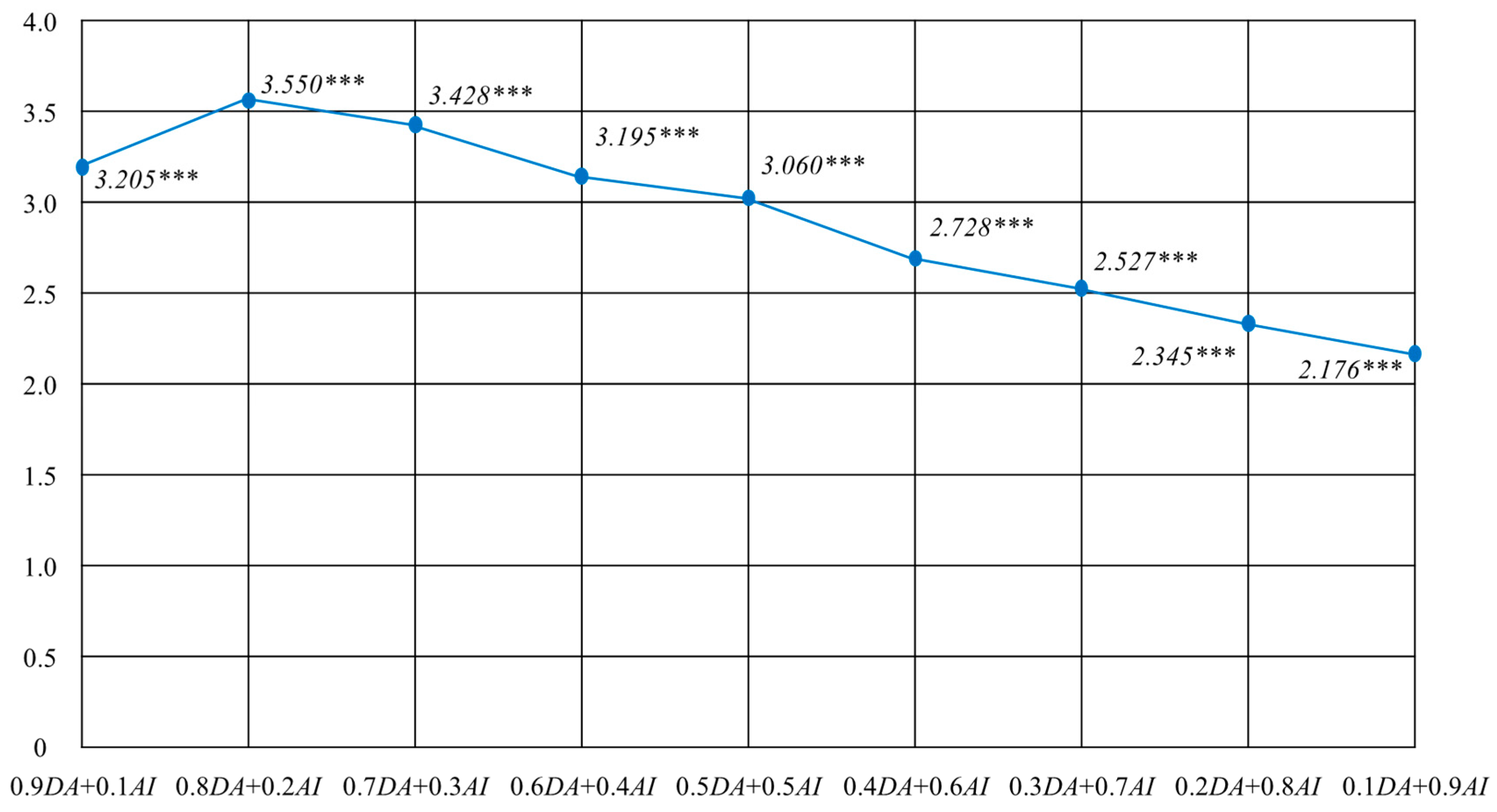
To further examine the findings under alternative weighting schemes, the study recalculated the coupling coordination degree by progressively varying the weight of data assets from 0.9 to 0.1 (and correspondingly, that of artificial intelligence from 0.1 to 0.9), and then regressed it on the level of internationalization.
As shown in Figure 2, the curve plotted based on the estimated coefficients under different weights indicates that the positive main effect remains statistically significant across all weighting settings. Furthermore, the trend in the coefficient estimates suggests that, within the context of the sample and measurement approach adopted in this study, the variation in data asset (DA) disclosure contributes more substantially to changes in the synergy index. This may reflect the critical role of data infrastructure development at the current stage.

5.3.4. Discussion on Segmented Explanatory Variables

The regression results on segmented data assets and artificial intelligence reveal that proprietary data assets, AI technologies, and AI applications all significantly enhance the level of internationalization, consistent with findings that digital–intelligent capabilities enhance international competitiveness through improved risk perception and market insight [43,44]. Transactional data assets do not yet exhibit a significant positive impact on overseas revenue at this stage, which aligns with the current early exploratory phase of data asset trading in China. The results reveal that the coordination degree, rather than the mere coupling degree, serves as the key driver of international outcomes. The findings indicate that the key to development lies not in the mechanical coupling of data assets and AI, but in their organic integration and in-depth coordination to advance the level of internationalization.
Furthermore, analysis across alternative weight assignments consistently indicates a positive relationship between digital–intelligent coupling coordination and internationalization. Within this study’s context, the contribution of data assets to the synergy index is pronounced. This pattern reinforces that the current stage of development depends not on the mere aggregation of digital resources, but on their strategic, synergistic integration. It underscores why transactional data assets alone show limited impact, while the deliberate coordination of self-use data assets with AI technologies and applications emerges as a central driver of international competitiveness.

6. Conclusions, Implications and Future Directions

6.1. Conclusions

Firstly, digital–intelligent synergy serves as a significant driver for firms to enhance their level of internationalization. Data assets and artificial intelligence can not only function independently but their coupling and coordination generate a synergistic effect with multiplied benefits. This underscores the need to treat data and intelligence as integrated strategic resources.
Secondly, green technology innovation is a critical pathway through which digital–intelligent synergy drives internationalization. It incentivizes both substantive and strategic green innovation activities and outcomes, thereby helping firms build a differentiated competitive advantage and lay the foundation for entering international markets.
Simultaneously, investor stability is an important factor influencing the realization of the internationalization effects of digital–intelligent synergy. Stable investors strengthen the impact of digital–intelligent synergy on both green technology innovation and the level of internationalization, providing crucial resource support for the digital–intelligent transformation and the exploration of green technologies.
Finally, the internationalization effects of digital–intelligent synergy exhibit significant heterogeneity when examining the constituent dimensions separately. Within the current stage and specific context of this research, the results suggest that internal data integration, AI technologies and applications, and digital–intelligent coordination play a more critical role in advancing internationalization.

6.2. Implications

6.2.1. Theoretical Implications

This study introduces the coupling coordination measurement method from the environmental field into the evaluation of digital–intelligent synergy effects. It constructs and validates an analytical framework integrating digital–intelligent technologies, green innovation, and value effects. This reveals the internal mechanism through which digital–intelligent synergy influences the internationalization level of Chinese firms. By verifying investor stability as an asymmetric influencing factor, this study deepens the understanding of the boundaries of investor stability’s role.

6.2.2. Practical Implications

For firms: The focus of technology application should shift from isolated uses to deep integration. Firms should leverage digital–intelligent synergy to rationally promote green technology innovation, reduce technical trade barriers, and shape a green and sustainable brand image. They need to develop green technologies and products with international competitiveness, transforming environmental pressures into market advantages.
For investors and financial institutions: They should fully realize their important value in enabling digital–intelligent effects by optimizing investment decision-making processes and avoiding short-term performance pressures. Providing long-term, stable, and strategic “patient capital” is essential for supporting firms’ international expansion.
For policymakers: Tailored support policies should be formulated to ensure targeted implementation. Encouraging and enhancing the participation of long-term investors can increase corporate commitment to sustainable innovation. Building an ecosystem that fosters cross-sector collaboration among data, artificial intelligence, and green technologies will help build competitive advantage in the global market.

6.3. Limitations and Future Directions

6.3.1. Measurement Method

The study employed a coupling coordination model but lacked granular measurement of qualitative dimensions, such as the depth of integration between data assets and AI within organizations or changes in management processes. Future research could adopt case studies, surveys, or text analysis to develop composite indicators that better capture the quality and progression of digital–intelligent integration.

6.3.2. Mechanism Exploration

While green technology innovation is identified as a key mediator, other pathways—such as enhanced organizational resilience or business model transformation—may also explain how digital–intelligent synergy influences internationalization. Factors like top management team characteristics and external policy uncertainty represent additional boundary conditions to examine. Further study could integrate dynamic capability theory or behavioral strategy perspectives to unravel this complex causal network.

6.3.3. Contextual Boundary

This study is primarily based on domestic green technology innovation and investor stability within the Chinese context. Whether digital–intelligent synergy can facilitate the acquisition of international green patents and attract global investors, thereby directly driving internationalization, remains an open question. Future research could extend the examination to international settings to explore how such mechanisms operate across different institutional and cultural environments.

6.3.4. Generalizability of Findings

Conclusions are primarily based on data from Chinese listed firms, limiting generalizability across different institutional contexts, cultures, or types of enterprises. Future work could conduct cross-national comparative studies to test the applicability and evolution of these findings under diverse systems and technological conditions.

Author Contributions

J.Z. and Y.Z. contributed equally to this work. Conceptualization, J.Z. and Y.Z.; methodology, Y.Z. and J.Z.; software, Y.Z.; validation, J.Z. and Y.Z.; visualization, Y.Z.; formal analysis, J.Z.; investigation, Y.Z.; resources, Y.Z.; data curation, J.Z.; writing—original draft preparation, Y.Z.; writing—review and editing, J.Z.; supervision, J.Z.; project administration, J.Z.; funding acquisition, J.Z. All authors have read and agreed to the published version of the manuscript.

Funding

The research was supported by the National Social Science Fund of China (Grant No. 21BJY189), “Green Governance Mechanisms and Policy Support for Scenic-Village Integration from a Rural Revitalization Perspective”.

Institutional Review Board Statement

Not applicable.

Informed Consent Statement

Not applicable.

Data Availability Statement

The raw data supporting the conclusions of this article will be made available by the authors on request.

Conflicts of Interest

The authors declare no conflicts of interest.

Abbreviations

The following abbreviations are used in this manuscript:
DAData Assets
SDAsSelf-use Data Assets
TDAsTransactional Data Assets
AIArtificial Intelligence
AITArtificial Intelligence Technology
AIAArtificial Intelligence Application
DICDDigital–Intelligent Coupling Coordination
DICCDigital–Intelligent Coupling
DICTDigital–Intelligent Coordination
ILInternationalization Level
GTIGreen Technology Innovation
GSubBSubstantive Green Innovation Behavior
GSubOSubstantive Green Innovation Outcome
GStrBStrategic Green Innovation Behavior
GStrOStrategic Green Innovation Outcome
ISInvestor Stability

Appendix A. Data Asset Indicator Construction Process and Validity Verification

Appendix A.1. Construction Process

The construction of the data asset measurement indicators in this paper primarily follows the research approach of He Ying et al. [19], implemented through the following steps:

Appendix A.1.1. Definition of Seed Words

Based on the existing literature, the definition of assets in international standards for national economic accounting, and relevant reports from the China Academy of Information and Communications Technology, the words “information,” “network,” “digital,” and “data” were identified as the foundational seed words for data assets.

Appendix A.1.2. Corpus Construction

A systematic collection of national and local laws and regulations related to data security, fundamental data systems, data ownership, data transactions, and accounting treatment of enterprise data resources was conducted. These texts were integrated and preprocessed using Python tools to form a standardized corpus for subsequent analysis.

Appendix A.1.3. Similar Word Expansion Based on the Word2Vec Model

The Word2Vec neural network model was employed. Using its context prediction mechanism, the corpus was trained to map segmented words into high-dimensional word vectors, thereby calculating the similarity between words. Deep learning techniques were used to filter and retain words with higher similarity to the seed words, initially constructing a set of similar terms.
The model was trained based on the Skip-gram architecture, with key hyperparameters set as follows: (1) vector dimension: 300; (2) context window: 8; (3) minimum word frequency: 5; (4) negative sampling count: 15; and (5) training epochs: 20.
A two-stage rolling expansion strategy was adopted for dynamic keyword expansion. In the first stage, the initial seed words—”data,” “information,” “network,” and “digital”—were used to extract the top 60 most similar words for each from the model, with a minimum similarity threshold set at 0.6. The results were merged, and words containing negative semantics or irrelevant parts of speech were removed to obtain a preliminary keyword set. In the second stage, 30 keywords closely related to the core concepts were manually selected from the preliminary set as new seed words for rolling expansion. For each new seed word, the top 20 words with similarity greater than 0.6 were extracted again. The results from the second stage were merged and deduplicated with those from the first stage, forming an expanded candidate pool.

Appendix A.1.4. Screening and Validation of Similar Words

To enhance the accuracy of the keyword set, words containing negative semantics such as “not”, “without”, and “non-” were first removed. Subsequently, a combination of authoritative concept searches and manual verification was used to check the semantic applicability of the remaining words one by one.

Appendix A.1.5. Keyword Statistics in Annual Reports and Indicator Generation

Annual reports of listed companies were obtained from the official websites of the Shanghai and Shenzhen Stock Exchanges and converted into a unified text format. Based on the constructed keyword set, a full-text search and frequency count were performed on the annual reports to obtain the total frequency of data asset-related keywords for each company. In subsequent analysis, this word frequency was logarithmically processed to construct the data asset measurement indicator for empirical research.

Appendix A.1.6. Indicator Dimension Division

Following the classification framework of the China Academy of Information and Communications Technology, the keywords were further divided into two categories: Self-use Data Assets (SDA) and Transactional Data Assets (TDA). This division supports a differentiated examination of different forms of data assets.
Table A1. Data Asset Keyword List.
DA TypeKeyword TypeDA Keywords
SDADigitalDigital infrastructure, digital facilities, digital factories, digital equipment, digital economy, digital technology innovation, digital governance, digital management, digital operations and maintenance, digital design, digital technology means, digital technology, digital resources, digital elements, digital science and technology, digital backbone enterprises, digital applications, digital ecosystem, digital capabilities, digital literacy, digital industry, digital space
DataData infrastructure, data laboratory, data acquisition, data collection, data development, data development and utilization, data governance, data storage, data-driven, data processing, data computation, data utilization, data innovation, data standardization, data resource management, data strategy, data resource integration, data monitoring, data refinement, data economy, data research, data protection, data interaction, data optimization, data aggregation, data talent cultivation, data encryption, data desensitization, data research and development, data cleaning, data networking, data operations, data supply, data integration, data consolidation, data interfacing, data migration to the cloud, data management, data access, data analysis, centralized data management, data resources, data factors, data assets, data technology, data talent, key data technologies, data experts, data algorithms, data information, data information technology, data business, data networks, data talent teams, data computing power, data engineering, data engineering technology, data enterprises, data SMEs, data leading enterprises, data industrial bases, data ecosystem, data visualization, data resource advantages, data space, data auditing, data querying, data research institutes, data industrial parks, data verification, data industrial layout, data scale, data capabilities, data application, data simulation, data interfaces, data security levels, data acquisition, data technology industry, data confidentiality, data industry chain, data projects, data artificial intelligence, data empowerment, data production, data usage, data industry, data applications, data development
InformationInformation infrastructure, information facilities, information terminals, information equipment, information disclosure, information acquisition, information collection, information management, information gathering, information interfacing, information research and development, information access, information and communications, information resources, information technology, information data, information science and technology, information networks, information carriers, information operations, information manufacturing, information protection, information inclusion, information identification, information monitoring, information recording
NetworkNetwork infrastructure, network information system, network data center, network facilities, network construction, network storage, network governance, network access, network data, network technology, network information technology, network information, network digital, network services, network industry chain, network performance, network establishment, network optimization, network functions, network applications, network expansion, network layout, network operations, network operation
TDADigitalDigital platform, digital trade, digital authentication, digital consumption, digital products, digital currency, digital product security
DataData platform, data trading platform, data open platform, data service platform, data trading, data openness, data circulation, data resource sharing, data sharing, data collaboration, data synergy, data delivery, data application services, data hosting, data consumption, data property rights, data usage rights, data security, data and information security, data evaluation, data service providers, data disclosure, data supervision, data service vendors, data interoperability, data exchange, data market, data provision
InformationInformation platform, information sharing, information services, information consumption, information resource sharing, information interconnection and interoperability, information service system, information exchange, information service level, information service platform
NetworkNetwork transactions, network sales, network data security, network information security, network security, network risks, network provision, network services, network interoperability, network convergence, network interconnection, network service providers, cyberspace sovereignty

Appendix A.1.7. Keywords: Narrowed Lexicon for Data Assets

The keyword list above is constructed based on relatively comprehensive data asset-related matters. To better highlight the core attributes of data assets, the study employs a narrower lexicon focused on these core attributes—derived from the existing glossary—for robustness tests. The keywords are as follows:
Digital infrastructure, digital resources, digital factors, digital technology, digital backbone enterprises, digital applications, data infrastructure, data acquisition, data collection, data development, data governance, data storage, data processing, data resource management, data resource integration, data monitoring, data refinement, data aggregation, data talent cultivation, data encryption, data desensitization, data cleaning, data consolidation, data integration, data interfaces, data analysis, data resources, data factors, data assets, data business, data industrial bases, data auditing, data acquisition, data projects, data production, data utilization, digital products, digital currency, data platform, data trading platform, data open platform, data trading, data openness, data circulation, data resource sharing, data sharing, data consumption, data property rights, data usage rights, data evaluation, data service provider, data disclosure, data supervision, data service provider, data exchange, data market, information services, information disclosure, and information resource sharing.

Appendix A.2. Validity Verification

Appendix A.2.1. Manual Verification

Scoring Framework
Twenty annual reports were randomly selected. Two experts with professional experience in the data asset domain independently reviewed these reports and classified the corporate data asset level into two categories: “High” and “Low”.
“High” Data Asset Level: Indicates that the company demonstrates a systematic approach to data management in its annual report, with concrete evidence across dimensions such as strategic recognition, assigned responsibilities, resource commitment, business application, and risk oversight.
“Low” Data Asset Level: Indicates that the discussion of data assets in the annual report remains at a conceptual or general level, lacking clear governance planning, dedicated investment, specific application cases, or substantive risk disclosure.
Scoring Rules
The experts made their judgments based on the evaluation dimensions detailed in Appendix A Table A2.
Table A2. Evaluation Dimensions of Data Assets.
Evaluation DimensionHigh-Level Data AssetsLow-Level Data Assets
Strategy & GovernanceRecognizes data as an important resource; assigns clear data management responsibilities; has a plan or initiative for data management or utilization.Mentions data-related terms only in broad context; shows no defined responsibility or plan for data governance.
Investment & ActivitiesDiscloses resource allocation directed towards data-related initiatives, such as system upgrades, or analytics tools.Shows no evidence of targeted investment or dedicated activities for data capability enhancement; data efforts are ad hoc or passive.
Output & ApplicationProvides examples of using data to support business decisions, optimize processes, or improve customer insights in one or more operational areas.Fails to cite concrete instances of data application; describes potential benefits in general terms without operational linkage.
Risk & DisclosureAcknowledges data-related risks and outlines basic response measures or compliance statusDisclosure on data risks is absent, extremely minimal, or purely generic with no substantive content.
Scoring Process
The two experts independently read the same annual report without consultation.
Following the rules above, each expert assigned a “High” or “Low” judgment for each report.
The rating result from each expert for each report was recorded.
Calculation and Reporting of Inter-Rater Reliability
Cohen’s Kappa statistic was used to assess inter-rater agreement. The scoring matrix for the 20 reports is presented in Appendix A Table A3.
Table A3. Scoring Matrix of Data Asset Level for the 20 Annual Reports.
Expert B: HighExpert B: LowTotal
Expert A: High10212
Expert A: Low178
Total11920
Based on the evaluation results from the two experts presented in Table A3, Cohen’s Kappa was used to assess inter-rater agreement. The analysis yielded an observed agreement proportion (Po) of 0.85 and an expected agreement proportion (Pe) of 0.51, resulting in a Kappa coefficient (κ) of 0.69. This value indicates a substantial level of agreement between the experts, confirming the good reliability of the manual verification process.
Comparison Between Manual Scores and Text Analysis Results
A comparison between the experts’ ratings and the percentile ranks of data asset keyword frequency obtained via text analysis shows a considerable degree of consistency. This suggests that the frequency of data asset keywords in annual reports can reflect the underlying data asset level of the firms. The comparison is detailed in Appendix A Table A4.
Table A4. Manual Verification vs. Data Asset Keyword Frequency.
No.IdYearExpert AExpert BPercentileNo.IdYearExpert AExpert BPercentile
013003422022HighHigh99.6%110004212021HighLow67.4%
023011172023HighHigh98.7%120023632018LowHigh63.2%
036007562019HighHigh97.3%133004422021HighLow53.1%
040024012017HighHigh93.6%143004472021LowLow50.0%
050021952016HighHigh92.4%153009132020LowLow47.3%
060007012020HighHigh91.8%160020772022LowLow30.7%
070004082024HighHigh85.4%170005332018LowLow20.4%
080008292018HighHigh82.0%183002172020LowLow17.3%
090012552024HighHigh75.1%190000692021LowLow11.5%
100001002019HighHigh73.8%200005702023LowLow4.8%

Appendix A.2.2. Spearman Rank Correlation Test

To further validate the effectiveness of the “data asset” measurement method, a Spearman rank correlation test was conducted. Two theoretically relevant and widely recognized indicators were selected as criteria: a comprehensive digital transformation index (from the CSMAR database) and the proportion of digital intangible assets (a financial metric).
The test results indicated that the constructed “data asset” indicator showed a significant positive correlation with the digital transformation index (coefficient = 0.5835, p = 0.000), as well as a significant positive correlation with the proportion of digital intangible assets (coefficient = 0.2988, p = 0.000). This demonstrates that the measurement results maintain a robust and consistent relationship with external criteria across different dimensions. The strong correlation with the index effectively reflects the overall degree of digitalization at the strategic and behavioral level of enterprises. Simultaneously, the constructed indicator, distinct from the singular financial asset structure represented by the proportion of digital intangible assets, captures a richer connotation of digital capability. Both tests were highly significant (p = 0.000), providing strong support for the validity and reliability of the constructed measurement.
Table A5. Spearman Rank Correlation Test of Data Asset.
Spearman Rand CorrelationData SourceNumber of Obs.Spearman’s Rhop-Value
Data Asset
Digital Transformation Index
This Study
CSMAR Database
36,4930.58350.000
Data Asset
Proportion of Digital Intangible Assets
This Study
CSMAR Database
36,4930.29880.000

Appendix B. Artificial Intelligence Construction Process and Validity Verification

Appendix B.1. Construction Process

The construction of the artificial intelligence (AI) measurement indicator in this study draws on the research of He Qin et al. [20] and follows the analytical framework proposed by Grashof et al. [83], which divides AI into two dimensions: “Artificial Intelligence Technology (AIT)” and “Artificial Intelligence Application (AIA)”. The former primarily refers to the software and hardware infrastructure as well as core technologies related to AI, while the latter focuses on the specific application scenarios of AI across various fields. The indicator construction process is similar to that of the data asset indicator, outlined as follows:

Appendix B.1.1. Corpus Construction and Keyword Extraction

A specialized corpus was formed by systematically collecting authoritative policy documents and research literature, such as the New Generation Artificial Intelligence Development Plan and the Artificial Intelligence Development Report. Based on this corpus and the connotations of AIT and AIA, corresponding keywords for both categories were manually screened and identified, establishing a structured keyword library.

Appendix B.1.2. Text Processing and Word Frequency Statistics

Annual reports of listed companies were obtained from the official websites of the Shanghai and Shenzhen Stock Exchanges and uniformly converted into text format. Using the constructed keyword library, a full-text search and matching were conducted on the annual reports to count the occurrence frequency of keywords related to “Artificial Intelligence Technology” and “Artificial Intelligence Application”, respectively.

Appendix B.1.3. Indicator Generation and Processing

The mentioned word frequencies were aggregated to derive the overall AI exposure for each company. To mitigate distribution skewness and enhance indicator stability, the word frequency was subjected to logarithmic transformation in the empirical analysis, ultimately forming the AI measurement indicator.
Table A6. Artificial Intelligence Keyword List.
AI TypeKeyword TypeAI Keywords
AITAIT KeywordsBig data, cloud computing, machine learning, deep learning, semantic search, biometric identification technology, identity verification, natural language processing, Internet of Things, digital technology, automatic control
AIAAIA KeywordsAutonomous driving, unmanned retail, human–computer interaction, intelligent robots, smart wearables, intelligent healthcare, smart homes, intelligent transportation systems, intelligent customer service, robo-advisors, intelligent marketing, intelligent control, intelligent logistics, smart manufacturing, intelligent warehousing, intelligent connectivity, intelligent production, intelligent management

Appendix B.1.4. Keywords: Narrowed Lexicon for Artificial Intelligence

To capture the core conceptual attributes of artificial intelligence, a narrowed AI lexicon was constructed based on the keywords above for use in robustness tests. The keywords are as follows:
Machine learning, deep learning, semantic search, biometric identification technology, identity verification, natural language processing, automatic control, autonomous driving, unmanned retail, human–computer interaction, intelligent robots, smart wearables, intelligent healthcare, smart homes, intelligent transportation systems, intelligent customer service, robo-advisors, intelligent marketing, intelligent control, intelligent logistics, smart manufacturing, intelligent warehousing, intelligent connectivity, intelligent production, and intelligent management.

Appendix B.2. Validity Verification

Appendix B.2.1. Manual Verification

Scoring Framework
Corporate artificial intelligence (AI) levels were categorized into two groups: “High” and “Low”.
“High” AI Level: Indicates that the company demonstrates proactive application of AI technology in its annual report, with concrete evidence reflected across multiple dimensions, including strategic recognition, resource allocation, technology implementation, and business impact.
“Low” AI Level: Indicates that the company’s discussion of AI remains primarily conceptual or focused on industry trends, lacking concrete implementation plans, dedicated resource support, specific use cases, or clearly articulated benefits linked to core operations.
Scoring Rules
The experts made their judgments based on the evaluation dimensions detailed in Appendix B Table A7.
Table A7. Evaluation Dimensions of Artificial Intelligence.
Evaluation DimensionHigh-Level Artificial IntelligenceLow-Level Artificial Intelligence
Strategy & PositioningExplicitly identifies AI as an important business enabler or innovation initiative; mentions specific application goals for AI in business unit strategies or plans.Only mentions AI incidentally when discussing technology trends; fails to integrate AI into any concrete business or functional planning.
Organization & InvestmentHas a dedicated AI project team or responsible lead; discloses resource allocation for AI technology exploration, pilot projects, or skill development.Lacks designated personnel or teams for AI; discloses no specific resource investment related to AI initiatives.
Technology & CapabilityDescribes specific AI technology applications under implementation or pilot; mentions using mainstream AI development platforms or cloud services.Only refers to general automation or IT tools; does not mention any specific AI technologies, platforms, or application development.
Business Impact & ValueIllustrates application scenarios of AI in specific business processes and describes qualitative benefits.Descriptions of AI application and its effects are highly vague, conceptual, or lack clear connection to specific business processes.
Scoring Process
The two experts independently read the same annual report without consultation.
Following the rules above, each expert assigned a “High” or “Low” judgment for each report.
The rating result from each expert for each report was recorded.
Calculation and Reporting of Inter-Rater Reliability
Cohen’s Kappa statistic was used to assess inter-rater agreement. The scoring matrix for the 20 reports is presented in Appendix B Table A8.
Table A8. Scoring Matrix of Artificial Intelligence Level for the 20 Annual Reports.
Expert B: HighExpert B: LowTotal
Expert A: High617
Expert A: Low11213
Total71320
An inter-rater agreement test using Cohen’s Kappa was conducted based on the evaluation results of the two experts in Table A8. The calculated observed agreement proportion (Po) was 0.90, the expected agreement proportion (Pe) was 0.545, and the Kappa coefficient (κ) was 0.78, indicating a substantial level of agreement between the experts and confirming the good reliability of the manual verification process.
Comparison Between Manual Scores and Text Analysis Results
As shown in Appendix B Table A9, the considerable degree of consistency suggests that the frequency of artificial intelligence keywords in annual reports can reflect the underlying AI level of the firms.
Table A9. Manual Verification vs. Artificial Intelligence Keyword Frequency.
No.IdYearExpert AExpert BPercentileNo.IdYearExpert AExpert BPercentile
013001512024HighHigh95.7%110013262023LowLow73.1%
020020842017HighHigh92.9%123008632024LowLow71.2%
030012882024HighHigh90.7%130004042016LowLow68.8%
043001242019HighHigh89.2%146008932021LowLow66.1%
056011072024HighHigh87.5%150000192024LowLow58.8%
063012352023HighHigh85.5%166008282019LowLow58.8%
070025462019LowHigh83.7%173007912023LowLow53.6%
080007192021HighLow82.2%186031992023LowLow47.1%
090009692017LowLow79.1%193007622020LowLow47.1%
100006802020LowLow77.9%200020772015LowLow38.8%

Appendix B.2.2. Spearman Rank Correlation Test

For the AI dimension, two criterion variables were selected, one qualitative and one quantitative: (1) a text-based word-frequency measure (using the Yao-weighted method) derived from annual reports to reflect strategic emphasis, and (2) the number of AI patent applications (sourced from the CNRDS database) to reflect technological output.
The validation results show that the proposed measure exhibits a strong positive correlation with the text-frequency measure (coefficient = 0.7685, p = 0.000), indicating its effectiveness in capturing firms’ AI-related focus at the strategic and disclosure level. Simultaneously, a significant positive correlation is observed with the number of patent applications (coefficient = 0.3132, p = 0.000), confirming its alignment with hard technological metrics. The reasonable difference between the two correlation coefficients suggests that this measure does not merely replicate any single existing indicator. Although it is strongly related to strategic textual content, it is not equivalent to patent output. It likely captures a broader spectrum of AI capability and application level, situated between strategic declaration and technological achievement.
Table A10. Spearman Rank Correlation Test of Data Asset.
Spearman Rand CorrelationData SourceNumber of Obs.Spearman’s Rhop-Value
Artificial Intelligence
Text-Based Word-Frequency Measure
This Study
Measure of Yao J [22]
36,4930.76850.000
Artificial Intelligence
Number of AI Patent Applications
This Study
CNRDS Database
36,4930.31320.000

Appendix C. Entropy Weight Method

Taking the measurement of the comprehensive data asset score as an example, the entropy weight method was applied to determine the objective weights for the two indicators: self-use data assets ( j = 1 ) and transactional data assets ( j = 2 ). The procedure consisted of the following five steps.

Appendix C.1. Step 1: Data Normalization

The keyword frequency of each indicator was first normalized to eliminate scale differences. The min-max normalization was applied to transform the data into the range [0, 1].
y i j = x i j min ( x j ) max x j min ( x j ) ,           i = 1 , , n ;   j = 1 ,   2
Here, x i j is the keyword frequency, and y i j is the normalized value for sample i on indicator j .

Appendix C.2. Step 2: Calculation of Proportion

The proportion p i j of each sample’s value relative to the total for each indicator was computed.
p i j = y i j i = 1 n y i j

Appendix C.3. Step 3: Calculation of Entropy

The entropy e j for each indicator was calculated based on the proportion matrix.
e j = k i = 1 n p i j · ln p i j ,           k = 1 l n n
Here, n is the number of samples. A higher e j indicates greater dispersion in the data for indicator j .

Appendix C.4. Step 4: Determination of Weights

The weight w j for each indicator was derived from its entropy. A lower entropy value implies the indicator provides more distinct information and thus receives a higher weight.
w j = 1 e j j = 1 m 1 e j ,           m = 2

Appendix C.5. Step 5: Calculation of Comprehensive Score

Finally, the annual comprehensive data asset score ( D A i ) for each sample i was obtained by aggregating the weighted normalized values of the two indicators.
D A i = j = 1 2 w j · y i j
The comprehensive level of artificial intelligence ( A I i ) was calculated following an identical procedure.

Appendix D

Industrial Classification for National Economic Activities (GB/T 4754-2017 [82])
Categories and Codes:
A
Agriculture, Forestry, Animal Husbandry and Fishery
B
Mining
C
Manufacturing
D
Production and Supply of Electricity, Heat, Gas and Water
E
Construction
F
Wholesale and Retail Trade
G
Transport, Storage and Post
H
Accommodation and Catering Services
I
Information Transmission, Software and Information Technology Services
J
Financial Intermediation
K
Real Estate Activities
L
Leasing and Business Services
M
Scientific Research and Technical Services
N
Management of Water Conservancy, Environment and Public Facilities
O
Services to Households, Repair and Other Services
P
Education
Q
Health and Social Work
R
Culture, Sports and Entertainment
S
Public Management, Social Security and Social Organization
T
Activities of International Organizations

Appendix E. Results of the Moderated Mediation Model Test Using Uncentered and Non-Lagged Variables

Appendix E.1. The Mediating Effect of Green Technology Innovation

Appendix E.1.1. Substantive Green Innovation Behavior

Table A11. Mediating Effect of Substantive Green Innovation Behavior (Corresponding to Table 11 in the main text).
Variables(1)(2)(3)(4)(5)(6)(7)(8)(9)
ILGSubBILILGSubBILILGSubBIL
DA0.431 ***0.137 ***0.400 ***
(3.02)(7.33)(2.81)
AI 0.182 ***0.061 ***0.168 **
(2.71)(8.21)(2.51)
DICD 3.060 ***1.106 ***2.806 **
(2.74)(8.59)(2.53)
GSubB 0.230 *** 0.231 *** 0.229 ***
(3.45) (3.46) (3.44)
Constant5.361 ***0.213 *5.312 ***6.572 ***0.595 ***6.435 ***6.497 ***0.563 ***6.368 ***
(5.18)(1.89)(5.14)(7.43)(6.12)(7.28)(7.30)(5.80)(7.16)
Obs.36,49336,49336,49336,49336,49336,49336,49336,49336,493
Adj. R20.8150.7030.8150.8150.7030.8150.8150.7040.815
IdYESYESYESYESYESYESYESYESYES
YearYESYESYESYESYESYESYESYESYES
ControlsYESYESYESYESYESYESYESYESYES
Note: ***, **, and * represent statistical significance at the 1%, 5%, and 10% levels, respectively; t-statistics are reported in parentheses.

Appendix E.1.2. Substantive Green Innovation Outcome

Table A12. Mediating Effect of Substantive Green Innovation Outcome (Corresponding to Table 12 in the main text).
Variables(1)(2)(3)(4)(5)(6)(7)(8)(9)
ILGSubOILILGSubOILILGSubOIL
DA0.431 ***0.055 ***0.422 ***
(3.02)(4.28)(2.96)
AI 0.182 ***0.020 ***0.178 ***
(2.71)(3.81)(2.66)
DICD 3.060 ***0.498 ***2.977 ***
(2.74)(5.46)(2.68)
GSubO 0.168 ** 0.169 ** 0.165**
(2.15) (2.18) (2.12)
Constant5.361 ***0.240 ***5.320 ***6.572 ***0.398 ***6.505 ***6.497 ***0.376 ***6.435 ***
(5.18)(2.90)(5.15)(7.43)(5.29)(7.37)(7.30)(4.99)(7.24)
Obs.36,49336,49336,49336,49336,49336,49336,49336,49336,493
Adj. R20.8150.6340.8150.8150.6340.8150.8150.6340.815
IdYESYESYESYESYESYESYESYESYES
YearYESYESYESYESYESYESYESYESYES
ControlsYESYESYESYESYESYESYESYESYES
Note: ***, ** represent statistical significance at the 1%, 5% levels, respectively; t-statistics are reported in parentheses.

Appendix E.1.3. Strategic Green Innovation Behavior

Table A13. Mediating Effect of Strategic Green Innovation Behavior (Corresponding to Table 13 in the main text).
Variables(1)(2)(3)(4)(5)(6)(7)(8)(9)
ILGStrBILILGStrBILILGStrBIL
DA0.431 ***0.065 ***0.423 ***
(3.02)(4.08)(2.97)
AI 0.182 ***0.041 ***0.177 ***
(2.71)(6.38)(2.64)
DICD 3.060 ***0.507 ***2.996 ***
(2.74)(4.77)(2.69)
GStrB 0.127 ** 0.125 ** 0.126 **
(2.03) (2.00) (2.02)
Constant5.361 ***0.0715.352 ***6.572 ***0.242 ***6.542 ***6.497 ***0.240 ***6.466 ***
(5.18)(0.70)(5.18)(7.43)(2.69)(7.40)(7.30)(2.66)(7.27)
Obs.36,49336,49336,49336,49336,49336,49336,49336,49336,493
Adj. R20.8150.6630.8150.8150.6630.8150.8150.6630.815
IdYESYESYESYESYESYESYESYESYES
YearYESYESYESYESYESYESYESYESYES
ControlsYESYESYESYESYESYESYESYESYES
Note: ***, ** represent statistical significance at the 1%, 5% levels, respectively; t-statistics are reported in parentheses.

Appendix E.1.4. Strategic Green Innovation Outcome

Table A14. Mediating Effect of Strategic Green Innovation Outcome (Corresponding to Table 14 in the main text).
Variables(1)(2)(3)(4)(5)(6)(7)(8)(9)
ILGStrOILILGStrOILILGStrOIL
DA0.431 ***0.082 ***0.416 ***
(3.02)(4.97)(2.92)
AI 0.182 ***0.048 ***0.173 ***
(2.71)(7.19)(2.59)
DICD 3.060 ***0.645 ***2.944 ***
(2.74)(5.73)(2.65)
GStrO 0.180 *** 0.178 *** 0.179 ***
(2.72) (2.70) (2.72)
Constant5.361 ***0.263 **5.313 ***6.572 ***0.481 ***6.487 ***6.497 ***0.475 ***6.412 ***
(5.18)(2.54)(5.14)(7.43)(5.14)(7.35)(7.30)(5.07)(7.22)
Obs.36,49336,49336,49336,49336,49336,49336,49336,49336,493
Adj. R20.8150.6820.8150.8150.6820.8150.8150.6820.815
IdYESYESYESYESYESYESYESYESYES
YearYESYESYESYESYESYESYESYESYES
ControlsYESYESYESYESYESYESYESYESYES
Note: ***, ** represent statistical significance at the 1%, 5% levels, respectively; t-statistics are reported in parentheses.

Appendix E.2. Mediated Moderation Effects

Appendix E.2.1. The Moderating Effect of Investor Stability on the Main Relationship

Table A15. Moderating Effect of Investor Stability (DIS → IL) (Corresponding to Table 15 in the main text).
Variables(1)(2)(3)(4)(5)(6)
ILILILILILIL
DA0.431 ***0.408 ***
(3.02)(2.86)
AI 0.182 ***0.174 ***
(2.71)(2.59)
DICD 3.060 ***2.878 ***
(2.74)(2.58)
IS 1.807 * 1.970 * 1.984 *
(1.71) (1.86) (1.87)
DA × IS 5.432 ***
(4.11)
AI × IS 1.761 ***
(2.65)
DICD × IS 29.406 ***
(3.20)
Constant5.361 ***5.615 ***6.572 ***6.838 ***6.497 ***6.761 ***
(5.18)(5.33)(7.43)(7.56)(7.30)(7.44)
Obs.36,49336,49336,49336,49336,49336,493
Adj. R20.8150.8150.8150.8150.8150.815
IdYESYESYESYESYESYES
YearYESYESYESYESYESYES
ControlsYESYESYESYESYESYES
Note: *** and * represent statistical significance at the 1% and 10% levels, respectively; t-statistics are reported in parentheses.

Appendix E.2.2. The Moderating Effect of Investor Stability Between Digital–Intelligent Synergy and Green Technology Innovation

Based on the results from Appendix E Table A16 and Table 16, it can be concluded that investor stability plays a positive moderating role between digital–intelligent synergy and green substantive innovation, but does not exert a moderating effect between digital–intelligent synergy and green strategic innovation behavior. Furthermore, when considering lagged effects, investor stability moderates the impact of data assets and digital–intelligent coupling coordination on the green strategic innovation outcomes. Within the same time period, investor stability moderates the influence of artificial intelligence and digital–intelligent coupling coordination on the green strategic innovation outcomes, pointing to the dynamic moderating role of investor stability, which varies across time and depends on different factors.
Table A16. Moderating Effect of Investor Stability (DIS → GTI) (Corresponding to Table 16 in the main text).
Variables(1)(2)(3)(4)(5)(6)(7)(8)(9)(10)(11)(12)
GSubBGSubOGStrBGStrOGSubBGSubOGStrBGStrOGSubBGSubOGStrBGStrO
DA0.151 ***0.073 ***0.061 ***0.082 ***
(7.50)(5.23)(3.61)(4.68)
AI 0.070 ***0.033 ***0.043 ***0.055 ***
(8.68)(5.58)(6.14)(7.53)
DICD 1.205 ***0.640 ***0.516 ***0.706 ***
(8.87)(6.56)(4.65)(6.01)
DA × IS0.493 ***0.588 ***−0.0970.049
(2.86)(4.64)(−0.77)(0.38)
AI × IS 0.312 ***0.406 ***0.0760.229 ***
(3.72)(6.41)(1.08)(3.10)
DICD × IS 3.688 ***4.990 ***0.4312.310 **
(2.95)(5.15)(0.47)(2.39)
IS−1.188 **−1.885 ***0.5470.2270.033−0.501 ***0.1110.0570.060−0.498 ***0.1830.132
(−2.08)(−4.48)(1.23)(0.49)(0.20)(−4.08)(0.72)(0.36)(0.34)(−3.64)(1.14)(0.79)
Constant0.229 *0.184 **0.1190.321 ***0.650 ***0.387 ***0.270 ***0.526 ***0.620 ***0.366 ***0.273 ***0.525 ***
(1.94)(2.10)(1.13)(2.99)(6.50)(4.97)(2.93)(5.50)(6.20)(4.68)(2.95)(5.48)
Obs.36,49336,49336,49336,49336,49336,49336,49336,49336,49336,49336,49336,493
Adj. R20.7030.6340.6630.6820.7040.6340.6630.6820.7040.6350.6630.682
IdYESYESYESYESYESYESYESYESYESYESYESYES
YearYESYESYESYESYESYESYESYESYESYESYESYES
ControlsYESYESYESYESYESYESYESYESYESYESYESYES
Note: ***, **, and * represent statistical significance at the 1%, 5%, and 10% levels, respectively; t-statistics are reported in parentheses.

Appendix E.2.3. The Moderating Effect of Investor Stability Between Green Technology Innovation and Internationalization

Table A17. Moderating Effect of Investor Stability (GTI → IL) (Corresponding to Table 17 in the main text).
Variables(1)(2)(3)(4)(5)(6)(7)(8)(9)(10)(11)(12)
ILILILILILILILILILILILIL
DA0.559 ***0.581 ***0.586 ***0.579 ***
(3.77)(3.91)(3.95)(3.90)
AI 0.217 ***0.227 ***0.230 ***0.224 ***
(3.06)(3.21)(3.25)(3.18)
DICD 3.606 ***3.768 ***3.826 ***3.755 ***
(3.16)(3.30)(3.36)(3.30)
IS−16.144 ***−16.052 ***−16.580 ***−16.424 ***−0.608−0.503−0.922−0.672−1.583−1.438−1.782−1.569
(−3.56)(−3.59)(−3.73)(−3.68)(−0.43)(−0.37)(−0.69)(−0.50)(−1.06)(−1.00)(−1.25)(−1.09)
DA × IS5.308 ***5.312 ***5.436 ***5.420 ***
(3.98)(4.02)(4.11)(4.10)
AI × IS 1.653 **1.657 **1.787 ***1.713 **
(2.46)(2.50)(2.68)(2.58)
DICD × IS 28.395 ***28.230 ***29.587 ***28.902 ***
(3.07)(3.10)(3.22)(3.14)
GSubB0.225 *** 0.224 *** 0.224 ***
(3.37) (3.37) (3.37)
GSubB × IS0.057 0.269 0.091
(0.05) (0.23) (0.08)
GSubO 0.158 ** 0.157 ** 0.154 **
(2.06) (2.04) (2.01)
GSubO × IS 0.210 0.597 0.392
(0.12) (0.35) (0.23)
GStrB 0.130 ** 0.128 ** 0.129 **
(2.08) (2.07) (2.08)
GStrB × IS −0.396 −0.769 −0.649
(−0.38) (−0.73) (−0.62)
GStrO 0.175 *** 0.173 *** 0.174 ***
(2.67) (2.64) (2.65)
GStrO × IS 0.381 0.196 0.278
(0.34) (0.18) (0.25)
Constant4.941 ***4.964 ***4.976 ***4.933 ***6.601 ***6.683 ***6.708 ***6.654 ***6.500 ***6.580 ***6.601 ***6.545 ***
(4.64)(4.67)(4.67)(4.64)(7.29)(7.39)(7.42)(7.37)(7.14)(7.24)(7.26)(7.20)
Obs.36,49336,49336,49336,49336,49336,49336,49336,49336,49336,49336,49336,493
Adj. R20.8150.8150.8150.8150.8150.8150.8150.8150.8150.8150.8150.815
IdYESYESYESYESYESYESYESYESYESYESYESYES
YearYESYESYESYESYESYESYESYESYESYESYESYES
ControlsYESYESYESYESYESYESYESYESYESYESYESYES
Note: *** and ** represent statistical significance at the 1% and 5% levels, respectively; t-statistics are reported in parentheses.

References

  1. Buckley, P.J.; Casson, M.C. Analyzing Foreign Market Entry Strategies: Extending the Internalization Approach. J. Int. Bus. Stud. 1998, 29, 539–561. [Google Scholar] [CrossRef]
  2. Sasaki, I.; Nummela, N.; Ravasi, D. Managing Cultural Specificity and Cultural Embeddedness When Internationalizing: Cultural Strategies of Japanese Craft Firms. J. Int. Bus. Stud. 2020, 52, 245–281. [Google Scholar] [CrossRef]
  3. Pacheco, L.; Lobo, C.; Maldonado, I. Do ISO Certifications Enhance Internationalization? The Case of Portuguese Industrial Smes. Sustainability 2022, 14, 1335. [Google Scholar] [CrossRef]
  4. Kiessling, T.; Dabić, M.; Yadav, S.; Huck, N.; Maley, J.F. Supply Chain Disruptions and Need for Resilience: Smes Direct/Indirect Exporting and Rapid Internationalization. IEEE Trans. Eng. Manag. 2025, 72, 115–133. [Google Scholar] [CrossRef]
  5. Park, S. Multinationals and Sustainable Development: Does Internationalization Develop Corporate Sustainability of Emerging Market Multinationals? Bus. Strategy Environ. 2018, 27, 1514–1524. [Google Scholar] [CrossRef]
  6. Xinhua Net. China to Build World’s Largest Optical Telescope. Fortune 2025. Available online: https://www.news.cn/fortune/20250516/8d7a1d27a52c4377b9952a269b320b5e/c.html (accessed on 16 May 2025). (In Chinese).
  7. Sohu. China’s FAST Telescope Detects Key Signal in Search for Extraterrestrial Life. News 2025. Available online: https://news.sohu.com/a/929582941_267106 (accessed on 28 August 2025). (In Chinese).
  8. National Development and Reform Commission. Report on the Progress of Expanding Middle-Income Groups and Promoting Common Prosperity; National Development and Reform Commission: Beijing, China, 2024. Available online: https://www.ndrc.gov.cn/xwdt/ztzl/NEW_srxxgcjjpjjsx/yjcg/zw/202409/t20240914_1393016_ext.html (accessed on 14 September 2024). (In Chinese)
  9. Imran; Qayyum, F.; Kim, D.-H.; Bong, S.-J.; Chi, S.-Y.; Choi, Y.-H. A Survey of Datasets, Preprocessing, Modeling Mechanisms, and Simulation Tools Based on AI for Material Analysis and Discovery. Materials 2022, 15, 1428. [Google Scholar] [CrossRef] [PubMed]
  10. Azhar, A.; Rehman, N.; Alyas, T.; Makki, B.I. AI Adoption for Green Performance: An Understanding of Moderated Mediation Model. Int. J. Hosp. Manag. 2025, 129, 104191. [Google Scholar] [CrossRef]
  11. Farmanesh, P.; Solati Dehkordi, N.; Vehbi, A.; Chavali, K. Artificial Intelligence and Green Innovation in Small and Medium-Sized Enterprises and Competitive-Advantage Drive toward Achieving Sustainable Development Goals. Sustainability 2025, 17, 2162. [Google Scholar] [CrossRef]
  12. Zha, D.; Bhat, Z.P.; Lai, K.-H.; Yang, F.; Jiang, Z.; Zhong, S.; Hu, X. Data-Centric Artificial Intelligence: A Survey. ACM Comput. Surv. 2025, 57, 1–42. [Google Scholar] [CrossRef]
  13. Duan, Y.; Edwards, J.S.; Dwivedi, Y.K. Artificial Intelligence for Decision Making in the Era of Big Data—Evolution, Challenges and Research Agenda. Int. J. Inf. Manag. 2019, 48, 63–71. [Google Scholar] [CrossRef]
  14. Teece, D.J. Explicating Dynamic Capabilities: The Nature and Microfoundations of (Sustainable) Enterprise Performance. Strateg. Manag. J. 2007, 28, 1319–1350. [Google Scholar] [CrossRef]
  15. Helfat, C.E.; Raubitschek, R.S. Dynamic and Integrative Capabilities for Profiting from Innovation in Digital Platform-Based Ecosystems. Res. Policy 2018, 47, 1391–1399. [Google Scholar] [CrossRef]
  16. Vial, G. Understanding Digital Transformation: A Review and a Research Agenda. J. Strateg. Inf. Syst. 2019, 28, 118–144. [Google Scholar] [CrossRef]
  17. Bhuiyan, N.; Kamruzzaman; Saha, S.; Siddiki, S.; Mondal, R.S. Role of Data Analysis and Integration of Artificial Intelligence. Int. J. Comput. Artif. Intell. 2025, 6, 111–118. [Google Scholar] [CrossRef]
  18. Kar, A.K.; Kushwaha, A.K. Facilitators and Barriers of Artificial Intelligence Adoption in Business—Insights from Opinions Using Big Data Analytics. Inf. Syst. Front. 2021, 25, 1351–1374. [Google Scholar] [CrossRef]
  19. He, Y.; Chen, L.; Du, Y. Does Data Assetization Alleviate Financing Constraints of SRDI SMEs. China Ind. Econ. 2024, 8, 154–173. (In Chinese) [Google Scholar] [CrossRef]
  20. He, Q.; Li, X. The Nonlinear Impact of Artificial Intelligence on Enterprise Income Distribution: A Test Based on Listed Company Data from 2007 to 2022. Popul. Econ. 2024, 3, 111–128. (In Chinese) [Google Scholar] [CrossRef]
  21. Qi, H.; Wei, Y.; Liu, Y. Corporate Digital Transformation and Trade Credit Financing. Econ. Manage 2022, 44, 158–184. (In Chinese) [Google Scholar] [CrossRef]
  22. Yao, J.; Zhang, K.; Guo, L.; Feng, X. How Does Artificial Intelligence Enhance Corporate Productivity?—A Perspective Based on the Restructuring of Labor Skills. Manag. World 2024, 40, 101–116+133+117–122. (In Chinese) [Google Scholar] [CrossRef]
  23. Zhao, J.; Wang, X.; Yao, X.; Xi, X. Digital-Intelligence Transformation, for Better or Worse? The Roles of Pace, Scope and Rhythm. Internet Res. 2024, 35, 1465–1507. [Google Scholar] [CrossRef]
  24. Ru, J.; Li, J.; Gan, L.; Sun, J.; Wang, S. Urbanization, Digital–Intelligent Integration, and Carbon Productivity: Spatiotemporal Dynamics in the Middle Reaches Urban Agglomeration of the Yellow River. Land 2025, 14, 2087. [Google Scholar] [CrossRef]
  25. Hao, M.; Zhang, F.; Xu, S.; Dong, Z.; He, Z. The Impact of Digital Intelligence on Energy-Intensive Firms’ Green Transformation. Environ. Res. Commun. 2025, 7, 025016. [Google Scholar] [CrossRef]
  26. Noailly, J.; Ryfisch, D. Multinational Firms and the Internationalization of Green R&D: A Review of the Evidence and Policy Implications. Energy Policy 2015, 83, 218–228. [Google Scholar] [CrossRef]
  27. Lambertini, L. Green Innovation and Market Power. Annu. Rev. Resour. Econ. 2017, 9, 231–252. [Google Scholar] [CrossRef]
  28. Johnstone, N.; Haščič, I.; Popp, D. Renewable Energy Policies and Technological Innovation: Evidence Based on Patent Counts. Environ. Resour. Econ. 2009, 45, 133–155. [Google Scholar] [CrossRef]
  29. Aghion, P.; Dechezleprêtre, A.; Hémous, D.; Martin, R.; Van Reenen, J. Carbon Taxes, Path Dependency, and Directed Technical Change: Evidence from the Auto Industry. J. Political Econ. 2016, 124, 1–51. [Google Scholar] [CrossRef]
  30. Xu, A.; Zhu, Y.; Wang, W. Micro Green Technology Innovation Effects of Green Finance Pilot Policy—From the Perspectives of Action Points and Green Value. J. Bus. Res. 2023, 159, 113724. [Google Scholar] [CrossRef]
  31. Tanasiichuk, A.; Kovalchuk, S.; Sokoliuk, S.; Kovtun, E.; Dodon, O.; Sakun, H.; Serednytska, L. International Business Strategy: Ensuring Enterprise Stability amidst Turmoil. Eur. J. Sustain. Dev. 2024, 13, 278. [Google Scholar] [CrossRef]
  32. Loh, R.K. Investor Inattention and the Underreaction to Stock Recommendations. Financ. Manag. 2010, 39, 1223–1252. [Google Scholar] [CrossRef]
  33. Jakhar, D.; Kaur, I. Artificial Intelligence, Machine Learning and Deep Learning: Definitions and Differences. Clin. Exp. Dermatol. 2019, 45, 131–132. [Google Scholar] [CrossRef]
  34. Vapnik, V.N. An Overview of Statistical Learning Theory. IEEE Trans. Neural Netw. 1999, 10, 988–999. [Google Scholar] [CrossRef]
  35. Cheng, Y.; Chen, K.; Sun, H.; Zhang, Y.; Tao, F. Data and Knowledge Mining with Big Data towards Smart Production. J. Ind. Inf. Integr. 2018, 9, 1–13. [Google Scholar] [CrossRef]
  36. Brous, P.; Janssen, M.; Herder, P. Next Generation Data Infrastructures: Towards an Extendable Model of the Asset Management Data Infrastructure as Complex Adaptive System. Complexity 2019, 2019, 5415828. [Google Scholar] [CrossRef]
  37. Mitchell, T.M. Machine Learning and Data Mining. Commun. ACM 1999, 42, 30–36. [Google Scholar] [CrossRef]
  38. Grimes, M.; von Krogh, G.; Feuerriegel, S.; Rink, F.; Gruber, M. From Scarcity to Abundance: Scholars and Scholarship in an Age of Generative Artificial Intelligence. Acad. Manag. J. 2023, 66, 1617–1624. [Google Scholar] [CrossRef]
  39. Hu, K.; Bi, Z.; He, Q.; Peng, Z. A Feature Extension and Reconstruction Method with Incremental Learning Capabilities under Limited Samples for Intelligent Diagnosis. Adv. Eng. Inform. 2024, 62, 102796. [Google Scholar] [CrossRef]
  40. Rafailidis, D.; Nanopoulos, A. Modeling Users Preference Dynamics and Side Information in Recommender Systems. IEEE Trans. Syst. Man Cybern. Syst. 2016, 46, 782–792. [Google Scholar] [CrossRef]
  41. Gurkan, H.; de Véricourt, F. Contracting, Pricing, and Data Collection under the AI Flywheel Effect. Manag. Sci. 2022, 68, 8791–8808. [Google Scholar] [CrossRef]
  42. Liu, Y.; Li, R.; Song, X. Analysis of coupling degrees of urbanization and ecological environment in China. J. Nat. Resour. 2005, 20, 105–112. (In Chinese) [Google Scholar] [CrossRef]
  43. De Rodes, D.M. Risk Perception and Risk Communication in the Public Decision-Making Process. J. Plan. Lit. 1994, 8, 324–334. [Google Scholar] [CrossRef]
  44. Ye, M.; Li, G. Internet Big Data and Capital Markets: A Literature Review. Financ. Innov. 2017, 3, 6. [Google Scholar] [CrossRef]
  45. Verhoef, P.C.; Broekhuizen, T.; Bart, Y.; Bhattacharya, A.; Qi Dong, J.; Fabian, N.; Haenlein, M. Digital Transformation: A Multidisciplinary Reflection and Research Agenda. J. Bus. Res. 2021, 122, 889–901. [Google Scholar] [CrossRef]
  46. Levitt, B. Organizational Learning. Annu. Rev. Sociol. 1988, 14, 319–340. [Google Scholar] [CrossRef]
  47. Zdolsek Draksler, T.; Cimperman, M.; Obrecht, M. Data-Driven Supply Chain Operations—The Pilot Case of Postal Logistics and the Cross-Border Optimization Potential. Sensors 2023, 23, 1624. [Google Scholar] [CrossRef]
  48. Richer, S.M.; Canioni, J. The Role of AI and Emerging Technologies in Global Trade Compliance. J. Supply Chain Manag. Logist. Procure. 2024, 7, 34. [Google Scholar] [CrossRef]
  49. Hou, L.; Su, J.; Ye, Y. Exploring the Influence of Smart Product Service Systems on Enterprise Competitive Advantage from the Perspective of Value Creation. Sustainability 2023, 15, 13828. [Google Scholar] [CrossRef]
  50. Fast, V.; Schnurr, D.; Wohlfarth, M. Regulation of Data-Driven Market Power in the Digital Economy: Business Value Creation and Competitive Advantages from Big Data. J. Inf. Technol. 2023, 38, 202–229. [Google Scholar] [CrossRef]
  51. Akter, S.; Michael, K.; Uddin, M.R.; McCarthy, G.; Rahman, M. Transforming Business Using Digital Innovations: The Application of AI, Blockchain, Cloud and Data Analytics. Ann. Oper. Res. 2020, 308, 7–39. [Google Scholar] [CrossRef]
  52. Han, B.A.; Varshney, K.R.; LaDeau, S.; Subramaniam, A.; Weathers, K.C.; Zwart, J. A Synergistic Future for AI and Ecology. Proc. Natl. Acad. Sci. USA 2023, 120, e2220283120. [Google Scholar] [CrossRef]
  53. Butler, J.E. Theories of Technological Innovation as Useful Tools for Corporate Strategy. Strateg. Manag. J. 1988, 9, 15–29. [Google Scholar] [CrossRef]
  54. Kamble, S.S.; Gunasekaran, A.; Subramanian, N.; Ghadge, A.; Belhadi, A.; Venkatesh, M. Blockchain Technology’s Impact on Supply Chain Integration and Sustainable Supply Chain Performance: Evidence from the Automotive Industry. Ann. Oper. Res. 2021, 327, 575–600. [Google Scholar] [CrossRef]
  55. Tan, L.; Yang, Z.; Irfan, M.; Ding, C.J.; Hu, M.; Hu, J. Toward Low-carbon Sustainable Development: Exploring the Impact of Digital Economy Development and Industrial Restructuring. Bus. Strategy Environ. 2023, 33, 2159–2172. [Google Scholar] [CrossRef]
  56. Li, X.; Shen, Y.; Cheng, H.; Yuan, F.; Huang, L. Identifying the Development Trends and Technological Competition Situations for Digital Twin: A Bibliometric Overview and Patent Landscape Analysis. IEEE Trans. Eng. Manag. 2024, 71, 1998–2021. [Google Scholar] [CrossRef]
  57. Ahmed, S.F.; Alam, M.S.; Hoque, M.; Lameesa, A.; Afrin, S.; Farah, T.; Kabir, M.; Shafiullah, G.; Muyeen, S.M. Industrial Internet of Things Enabled Technologies, Challenges, and Future Directions. Comput. Electr. Eng. 2023, 110, 108847. [Google Scholar] [CrossRef]
  58. Nhu Laursen, L.; Houman Andersen, P. Resource and Supplier Interaction in Network Innovation Governance: The Case of Innovating at Unilever. J. Bus. Res. 2023, 156, 113465. [Google Scholar] [CrossRef]
  59. Le, T.T.; Vo, X.V.; Venkatesh, V.G. Role of Green Innovation and Supply Chain Management in Driving Sustainable Corporate Performance. J. Clean. Prod. 2022, 374, 133875. [Google Scholar] [CrossRef]
  60. Lee, H.J.; Rhee, T. How Does Corporate ESG Management Affect Consumers’ Brand Choice? Sustainability 2023, 15, 6795. [Google Scholar] [CrossRef]
  61. Luan, X.; Wang, X. Open Innovation, Overseas Business Income and the Mediating Effect of Environmental, Social and Governance. Bus. Strategy Environ. 2024, 33, 6235–6253. [Google Scholar] [CrossRef]
  62. López-Malest, A.; Gabor, M.R.; Panait, M.; Brezoi, A.; Veres, C. Green Innovation for Carbon Footprint Reduction in Construction Industry. Buildings 2024, 14, 374. [Google Scholar] [CrossRef]
  63. Le Breton-Miller, I.; Miller, D. The Paradox of Resource Vulnerability: Considerations for Organizational Curatorship. Strateg. Manag. J. 2014, 36, 397–415. [Google Scholar] [CrossRef]
  64. Nunes, M.P.; Malagri, C.N.; Steinbruch, F.K.; Schreiber, D.; Damacena, C. The Relation between Digital Transformation and Internationalization—A Systematic Literature Review. Eur. J. Innov. Manag. 2024, 28, 3217–3237. [Google Scholar] [CrossRef]
  65. Deeg, R.; Hardie, I. What Is Patient Capital and Who Supplies It? Socio Econ. Rev. 2016, 14, 627–645. [Google Scholar] [CrossRef]
  66. Qiu, S.; Wang, Y.; Ke, Z.; Shen, Q.; Li, Z.; Zhang, R.; Ouyang, K. A Generative Adversarial Network-Based Investor Sentiment Indicator: Superior Predictability for the Stock Market. Mathematics 2025, 13, 1476. [Google Scholar] [CrossRef]
  67. Bataineh, M.J.; Sánchez-Sellero, P.; Ayad, F. Green Is the New Black: How Research and Development and Green Innovation Provide Businesses a Competitive Edge. Bus. Strategy Environ. 2023, 33, 1004–1023. [Google Scholar] [CrossRef]
  68. Lu, H.; Oh, W.-Y.; Kleffner, A.; Chang, Y.K. How Do Investors Value Corporate Social Responsibility? Market Valuation and the Firm Specific Contexts. J. Bus. Res. 2021, 125, 14–25. [Google Scholar] [CrossRef]
  69. Khan, S.I.; Rahman, M.S.; Ashik, A.A.; Islam, S.; Rahman, M.M.; Hossain, E. Big Data and Business Intelligence for Supply Chain Sustainability: Risk Mitigation and Green Optimization in the Digital Era. Eur. J. Manag. Econ. Bus. 2024, 1, 262–276. [Google Scholar] [CrossRef]
  70. Gao, J.; Hu, W. Investor Attention, Corporate Technology Investment, and Green Innovation. Financ. Res. Lett. 2025, 85, 107874. [Google Scholar] [CrossRef]
  71. Jie, G.; Jiahui, L. Media Attention, Green Technology Innovation and Industrial Enterprises’ Sustainable Development: The Moderating Effect of Environmental Regulation. Econ. Anal. Policy 2023, 79, 873–889. [Google Scholar] [CrossRef]
  72. He, Z.; Hirshleifer, D. The Exploratory Mindset and Corporate Innovation. J. Financ. Quant. Anal. 2020, 57, 127–169. [Google Scholar] [CrossRef]
  73. Lu, Z.; Li, H. Does Environmental Information Disclosure Affect Green Innovation? Econ. Anal. Policy 2023, 80, 47–59. [Google Scholar] [CrossRef]
  74. Connelly, B.L.; Certo, S.T.; Ireland, R.D.; Reutzel, C.R. Signaling Theory: A Review and Assessment. J. Manag. 2010, 37, 39–67. [Google Scholar] [CrossRef]
  75. Jia, H.; Che, W. Institutional Investor Stability, Executive Equity Incentives, and Corporate Innovation. Financ. Res. Lett. 2025, 83, 107691. [Google Scholar] [CrossRef]
  76. Rossi, F.; Harjoto, M.A. Corporate Non-Financial Disclosure, Firm Value, Risk, and Agency Costs: Evidence from Italian Listed Companies. Rev. Manag. Sci. 2019, 14, 1149–1181. [Google Scholar] [CrossRef]
  77. Li, R.; Xu, G.; Ramanathan, R. The Impact of Environmental Investments on Green Innovation: An Integration of Factors That Increase or Decrease Uncertainty. Bus. Strategy Environ. 2022, 31, 3388–3405. [Google Scholar] [CrossRef]
  78. Breuer, W.; Renerken, T.; Salzmann, A.J. Measuring Risk-taking and Patience in Financial Decision Making. Rev. Financ. Econ. 2021, 40, 97–114. [Google Scholar] [CrossRef]
  79. Figueira-de-Lemos, F.; Hadjikhani, A. Internationalization Processes in Stable and Unstable Market Conditions: Towards a Model of Commitment Decisions in Dynamic Environments. J. World Bus. 2014, 49, 332–349. [Google Scholar] [CrossRef]
  80. Di, L.; Bu, D. Introduction of Foreign Shareholders and the Internationalization Strategy of State-owned Enterprises: Taking the Realization of Overseas Sales Income as an Example. World Econ. Stud. 2021, 5, 83–102+136. (In Chinese) [Google Scholar] [CrossRef]
  81. Li, X. Behind the Recent Surge of Chinese Patenting: An Institutional View. Res. Policy 2012, 41, 236–249. [Google Scholar] [CrossRef]
  82. GB/T 4754-2017; Industrial Classification for National Economic Activities. Standards Press of China: Beijing, China, 2017.
  83. Grashof, N.; Kopka, A. Artificial Intelligence and Radical Innovation: An Opportunity for All Companies? Small Bus. Econ. 2022, 61, 771–797. [Google Scholar] [CrossRef]
Figure 1. Conceptual Model.
Sustainability 18 00588 g001
Figure 2. Regression Coefficients under Differential Weights. *** represent statistical significance at the 1% levels.
Sustainability 18 00588 g002
Table 1. Definitions and Descriptions of Main Variables.
TypeNameSymbolDescription
Explanatory
Variable
Digital–Intelligent SynergyDIS
Data AssetsDALn (Data Asset Word Frequency +1)
Self-use Data AssetsSDAsLn (Self-use Data Asset Word Frequency +1)
Transactional Data AssetsTDAsLn (Transactional Data Asset Word Frequency +1)
Data Assets in Robustness TestsDA-replaceThe ratio of digital transformation-related intangible assets to total intangible assets.
Artificial IntelligenceAILn (AI Word Frequency +1)
Artificial Intelligence TechnologyAITLn (AI Technology Word Frequency +1)
Artificial Intelligence ApplicationAIALn (AI Application Word Frequency +1)
Artificial Intelligence in Robustness TestsAI-replaceFollowing the measurement approach of Yao et al.
Digital–Intelligent Coupling CoordinationDICDCoupling Coordination Degree (AI & Data)
Digital–Intelligent CouplingDICCCoupling degree (AI & Data)
Digital–Intelligent CoordinationDICTCoordination degree (AI & Data)
DICD in Robustness TestsDICD-replaceCoupling Coordination Degree (PCA)
Explained
Variable
Internationalization LevelILLn (Overseas Revenue +1)
IL-dummyEquals 1 if the firm has overseas revenue, and 0 otherwise.
Mediating
Variable
Green Technology InnovationGTINatural Logarithm of (Green Patents + 1)
Substantive Green Innovation BehaviorGSubBLn (Green Invention Patent Applications +1)
Substantive Green Innovation OutcomeGSubOLn (Green Invention Patent Grants +1)
Strategic Green Innovation BehaviorGStrBLn (Green Utility Model Patent Applications +1)
Strategic Green Innovation OutcomeGStrOLn (Green Utility Model Patent Grants +1)
Moderating
Variable
Investor StabilityIS(-) Avg Turnover Ratio
(30 days pre-earnings announcement)
Control
Variable
Cash Flow RatioCashflowOperating Cash Flow/Total Assets
Inventory-to-Asset RatioINVNet Inventory/Total Assets
Board SizeBoardLn (Number of Board Directors +1)
Years Since ListingListAgeLn (Years Since Listing +1)
Tunneling by Largest ShareholderOccupyOther Receivables/Total Assets
Table 2. Descriptive Statistics.
Variables(1)(2)(3)(4)(5)
NumberMeanSDMinMax
DA36,4933.3630.6721.7925.961
SDAs36,4933.3190.6451.7925.855
TDAs36,4930.6180.85603.970
DA-replace36,49312.985.652020.07
AI36,4931.5221.29504.500
AIT36,4931.0551.20404.407
AIA36,4930.8991.03703.738
AI-replace36,4930.9831.21204.913
DICD36,4930.1220.09350.01760.503
DICC36,4930.5620.2450.1751.000
DICT36,4930.04770.07540.0005350.385
IL36,4939.5889.942024.50
IL-dummy36,4930.4890.50001
GSubB36,4930.6230.98204.511
GStrB36,4930.5750.91004.043
GSubO36,4930.3300.68703.871
GStrO36,4930.6030.92204.094
IS36,493−0.03390.0365−0.2660
Cashflow36,4930.04860.0664−0.1670.267
INV36,4930.1280.11100.719
Board36,4932.0940.1951.6092.708
ListAge36,4932.0450.96303.466
Occupy36,4930.01250.02076.10 × 10−50.184
Table 3. Variance Inflation Factor Test.
Variables(1)(2)(3)(4)(5)(6)(7)(8)
VIF1/VIFVIF1/VIFVIF1/VIFVIF1/VIF
DA1.480.6738191.140.878975
AI6.070.164864 1.120.892584
DICD7.130.140261 1.140.877161
Cashflow1.010.9880621.070.9385701.060.9462131.060.942343
INV1.020.9845271.060.9398801.040.9571441.050.952426
Board1.000.9984271.040.9625501.040.9610811.040.962390
ListAge1.020.9810031.490.6700241.490.6694331.490.670666
Occupy1.010.9910961.060.9469501.050.9495781.050.949399
IS 1.510.6628041.510.6625741.510.663118
DA × IS 1.090.916001
AI × IS 1.080.927453
DICD × IS 1.100.906075
GSubB 2.970.3368682.970.3370553.000.333187
GSubO 2.250.4452752.250.4453462.250.445176
GStrB 3.680.2713773.620.2759953.640.274494
GStrO 3.630.2753023.630.2753793.630.275267
GSubB × IS 2.830.3529682.830.3528412.860.349199
GSubO × IS 2.140.4667942.140.4677702.140.467310
GStrB × IS 3.480.2877083.420.2921023.440.290635
GStrO × IS 3.210.3119653.210.3118953.210.311620
Mean VIF2.47 2.10 2.09 2.10
Table 4. Digital–Intelligent Synergy and Internationalization Level.
Variables(1)(2)(3)
ILILIL
DA0.431 ***
(3.02)
AI 0.182 ***
(2.71)
DICD 3.060 ***
(2.74)
Constant6.811 ***6.849 ***6.871 ***
(7.79)(7.84)(7.87)
Obs.36,49336,49336,493
Adj. R20.8150.8150.815
IdYESYESYES
YearYESYESYES
ControlsYESYESYES
Note: *** represent statistical significance at the 1% levels; t-statistics are reported in parentheses.
Table 5. Regression Results after Replacing the Explained Variable.
Variables(1)(2)(3)
ILILIL
DA0.019 **
(2.53)
AI 0.007 **
(2.00)
DICD 0.118 **
(2.03)
Constant0.383 ***0.384 ***0.385 ***
(8.52)(8.55)(8.58)
Obs.36,49336,49336,493
Adj. R20.8110.8110.811
IdYESYESYES
YearYESYESYES
ControlsYESYESYES
Note: *** and ** represent statistical significance at the 1%, 5% levels, respectively; t-statistics are reported in parentheses.
Table 6. Regression Results after Replacing the Explanatory Variables.
Variables(1)(2)(3)(4)(5)(6)
ILILILILILIL
DA-replace0.012 *
(1.68)
AI-replace 0.083 *
(1.66)
DICD-replace 0.298 ***
(3.44)
DA-narrow 0.279 **
(2.24)
AI-narrow 0.270 ***
(3.81)
DICD-narrow 8.121 ***
(4.12)
Constant6.611 ***6.728 ***6.881 ***6.769 ***6.857 ***6.879 ***
(7.50)(7.66)(7.89)(7.72)(7.84)(12.22)
Obs.36,49336,49336,49336,49336,49336,493
Adj. R20.8150.8150.8150.8150.8150.815
IdYESYESYESYESYESYES
YearYESYESYESYESYESYES
ControlsYESYESYESYESYESYES
Note: ***, **, and * represent statistical significance at the 1%, 5%, and 10% levels, respectively; t-statistics are reported in parentheses.
Table 7. Regression Results Lagged by One Period.
Variables(1)(2)(3)
ILILIL
L.DA0.310 **
(2.10)
L.AI 0.151 **
(2.28)
L.DICD 2.372 **
(2.19)
Constant7.141 ***7.175 ***7.184 ***
(7.10)(7.15)(7.15)
Obs.30,66830,66830,668
Adj. R20.8240.8240.824
IdYESYESYES
YearYESYESYES
ControlsYESYESYES
Note: ***, ** represent statistical significance at the 1%, 5% levels, respectively; t-statistics are reported in parentheses.
Table 8. Regression Results at the Industry Level.
Variables(1)(2)(3)
ILILIL
DA0.613 ***
(2.67)
AI 0.904 ***
(8.97)
DICD 11.920 ***
(7.74)
Constant6.097 ***5.988 ***6.112 ***
(4.77)(4.70)(4.80)
Obs.30,66830,66830,668
Adj. R20.8240.8240.824
IdYESYESYES
YearYESYESYES
ControlsYESYESYES
Note: *** represent statistical significance at the 1% levels; t-statistics are reported in parentheses.
Table 9. Regression Results with Interactive Fixed Effects.
VariablesInd × Year FixedRegion × Year Fixed
(1)(2)(3)(4)(5)(6)
ILILILILILIL
DA0.445 *** 0.402 ***
(3.05) (2.81)
AI 0.185 *** 0.181 ***
(2.74) (2.71)
DICD 3.228 *** 2.947 ***
(2.86) (2.67)
Constant6.718 ***6.743 ***6.767 ***6.918 ***6.955 ***6.972 ***
(7.80)(7.84)(7.87)(7.75)(7.81)(7.83)
Obs.36,48336,48336,48336,49336,49336,493
Adj. R20.8160.8160.8160.8160.8160.816
IdYESYESYESYESYESYES
YearYESYESYESYESYESYES
Ind × YearYESYESYES---
Region × Year---YESYESYES
ControlsYESYESYESYESYESYES
Note: *** represent statistical significance at the 1% levels; t-statistics are reported in parentheses.
Table 10. Predicted Province-Year Digital Index as an Instrumental Variable.
VariablesDAAIDICD
(1)(2)(3)(4)(5)(6)
First StageSecond StageFirst StageSecond StageFirst StageSecond Stage
IV0.0588 *** 0.2082 *** 0.0136 ***
(14.4915) (24.3113) (22.1605)
DA 1.8020 *
(1.7684)
AI 0.5090 *
(1.7862)
DICD 7.8066 *
(1.7817)
Constant−1.5953 *** −1.0439 −0.1704 ***
(−2.9825) (−1.3514) (−3.0238)
Obs.31,11031,11031,11031,11031,11031,110
R-squared0.890−0.0050.8550.0010.8940.001
Controls FE (Firm&Province)YesYesYesYesYesYes
Id FEYesYesYesYesYesYes
Year FEYesYesYesYesYesYes
Kleibergen–Paap rk Wald F210.010 [16.38]591.059 [16.38]491.106 [16.38]
Kleibergen–Paap rk LM173.641 ***386.393 ***333.882 ***
Note: *** and * represent statistical significance at the 1% and 10% levels, respectively; t-statistics are reported in parentheses.
Table 11. Mediating Effect of Substantive Green Innovation Behavior.
Variables(1)(2)(3)(4)(5)(6)(7)(8)(9)
ILGSubBILILGSubBILILGSubBIL
DA0.431 ***0.137 ***0.400 ***
(3.02)(7.33)(2.81)
AI 0.182 ***0.061 ***0.168 **
(2.71)(8.21)(2.51)
DICD 3.060 ***1.106 ***2.806 **
(2.74)(8.59)(2.53)
GSubB 0.230 *** 0.231 *** 0.229 ***
(3.45) (3.46) (3.44)
Constant6.811 ***0.0526.799 ***6.849 ***0.688 ***6.834 ***6.871 ***0.0766.853 ***
(7.79)(0.54)(7.79)(7.84)(7.09)(7.84)(7.87)(0.79)(7.86)
Obs.36,49336,49336,49336,49336,49336,49336,49336,49336,493
Adj. R20.8150.7030.8150.8150.7030.8150.8150.7040.815
IdYESYESYESYESYESYESYESYESYES
YearYESYESYESYESYESYESYESYESYES
ControlsYESYESYESYESYESYESYESYESYES
Note: ***, ** represent statistical significance at the 1%, 5% levels, respectively; t-statistics are reported in parentheses.
Table 12. Mediating Effect of Substantive Green Innovation Outcome.
Variables(1)(2)(3)(4)(5)(6)(7)(8)(9)
ILGSubOILILGSubOILILGSubOIL
DA0.300 **0.063 ***0.289 *
(2.04)(4.93)(1.96)
AI 0.146 **0.022 ***0.142 **
(2.20)(4.31)(2.14)
DICD 2.268 **0.494 ***2.177 **
(2.09)(5.45)(2.01)
GSubO 0.184 ** 0.185 ** 0.183 **
(2.09) (2.10) (2.08)
Constant7.816 ***0.0827.801 ***7.840 ***0.0827.824 ***7.846 ***0.0897.830 ***
(8.55)(1.12)(8.53)(8.58)(1.12)(8.57)(8.58)(1.22)(8.57)
Obs.30,66830,66830,66830,66830,66830,66830,66830,66830,668
Adj. R20.8240.6410.8240.8240.6410.8240.8240.6410.824
IdYESYESYESYESYESYESYESYESYES
YearYESYESYESYESYESYESYESYESYES
ControlsYESYESYESYESYESYESYESYESYES
Note: ***, **, and * represent statistical significance at the 1%, 5%, and 10% levels, respectively; t-statistics are reported in parentheses.
Table 13. Mediating Effect of Strategic Green Innovation Behavior.
Variables(1)(2)(3)(4)(5)(6)(7)(8)(9)
ILGStrBILILGStrBILILGStrBIL
DA0.431 ***0.065 ***0.423 ***
(3.02)(4.08)(2.97)
AI 0.182 ***0.041 ***0.177 ***
(2.71)(6.38)(2.64)
DICD 3.060 ***0.507 ***2.996 ***
(2.74)(4.77)(2.69)
GStrB 0.127 ** 0.125 ** 0.126 **
(2.03) (2.00) (2.02)
Constant6.811 ***−0.282 ***6.847 ***6.849 ***−0.270 ***6.883 ***6.871 ***−0.272 ***6.905 ***
(7.79)(−3.15)(7.83)(7.84)(−3.03)(7.89)(7.87)(−3.04)(7.91)
Obs.36,49336,49336,49336,49336,49336,49336,49336,49336,493
Adj. R20.8150.6630.8150.8150.6630.8150.8150.6630.815
IdYESYESYESYESYESYESYESYESYES
YearYESYESYESYESYESYESYESYESYES
ControlsYESYESYESYESYESYESYESYESYES
Note: ***, ** represent statistical significance at the 1%, 5% levels, respectively; t-statistics are reported in parentheses.
Table 14. Mediating Effect of Strategic Green Innovation Outcome.
Variables(1)(2)(3)(4)(5)(6)(7)(8)(9)
ILGStrOILILGStrOILILGStrOIL
DA0.300 **0.066 ***0.293 **
(2.04)(3.70)(1.99)
AI 0.146 **0.051 ***0.140 **
(2.20)(7.22)(2.12)
DICD 2.268 **0.675 ***2.193 **
(2.09)(5.64)(2.02)
GStrO 0.113 * 0.109 * 0.110 *
(1.68) (1.65) (1.65)
Constant7.816 ***0.0297.813 ***7.840 ***0.0467.835 ***7.846 ***0.0437.842 ***
(8.55)(0.28)(8.55)(8.58)(0.45)(8.59)(8.58)(0.42)(8.59)
Obs.30,66830,66830,66830,66830,66830,66830,66830,66830,668
Adj. R20.8240.6830.8240.8240.6830.8240.8240.6830.824
IdYESYESYESYESYESYESYESYESYES
YearYESYESYESYESYESYESYESYESYES
ControlsYESYESYESYESYESYESYESYESYES
Note: ***, **, and * represent statistical significance at the 1%, 5%, and 10% levels, respectively; t-statistics are reported in parentheses.
Table 15. Moderating Effect of Investor Stability (DIS → IL).
Variables(1)(2)(3)(4)(5)(6)
ILILILILILIL
DA0.431 ***0.408 ***
(3.02)(2.86)
AI 0.182 ***0.174 ***
(2.71)(2.59)
DICD 3.060 ***2.878 ***
(2.74)(2.58)
IS 1.807 * 1.970 * 1.984 *
(1.71) (1.86) (1.87)
DA × IS 5.432 ***
(4.11)
AI × IS 1.761 ***
(2.65)
DICD × IS 29.406 ***
(3.20)
Constant6.811 ***6.926 ***6.849 ***7.035 ***6.871 ***7.045 ***
(7.79)(7.80)(7.84)(7.94)(7.87)(7.95)
Obs.36,49336,49336,49336,49336,49336,493
Adj. R20.8150.8150.8150.8150.8150.815
IdYESYESYESYESYESYES
YearYESYESYESYESYESYES
ControlsYESYESYESYESYESYES
Note: *** and * represent statistical significance at the 1% and 10% levels, respectively; t-statistics are reported in parentheses.
Table 16. Moderating Effect of Investor Stability (DIS → GTI).
Variables(1)(2)(3)(4)(5)(6)(7)(8)(9)(10)(11)(12)
GSubBGSubOGStrBGStrOGSubBGSubOGStrBGStrOGSubBGSubOGStrBGStrO
DA0.134 ***0.025 *0.065 ***0.082 ***
(7.17)(1.94)(4.05)(4.68)
AI 0.060 ***0.010 *0.040 ***0.037 ***
(8.03)(1.93)(6.33)(4.94)
DICD 1.079 ***0.254 ***0.501 ***0.572 ***
(8.43)(2.80)(4.74)(4.75)
DA × IS0.493 ***0.445 **−0.0970.680 ***
(2.86)(2.35)(−0.77)(3.19)
AI × IS 0.312 ***0.286 ***0.0760.186
(3.72)(3.04)(1.08)(1.52)
DICD × IS 3.688 ***3.121 **0.4312.931 *
(2.95)(2.23)(0.47)(1.81)
IS0.471 ***0.258 **0.220 *0.2140.508 ***0.280 **0.227 *0.2830.511 ***0.281 **0.236 **0.283
(3.76)(2.15)(1.84)(1.21)(4.03)(2.30)(1.90)(1.63)(4.06)(2.33)(1.98)(1.62)
Constant0.0980.141 *−0.256 ***0.0360.1170.152 *−0.246 ***0.0680.1280.156 *−0.246 ***0.070
(0.99)(1.66)(−2.81)(0.31)(1.19)(1.78)(−2.71)(0.59)(1.30)(1.83)(−2.71)(0.61)
Obs.36,49330,66836,49330,66836,49330,66836,49330,66836,49330,66836,49330,668
Adj. R20.7030.6410.6630.6830.7040.6410.6630.6830.7040.6410.6630.683
IdYESYESYESYESYESYESYESYESYESYESYESYES
YearYESYESYESYESYESYESYESYESYESYESYESYES
ControlsYESYESYESYESYESYESYESYESYESYESYESYES
Note: ***, **, and * represent statistical significance at the 1%, 5%, and 10% levels, respectively; t-statistics are reported in parentheses.
Table 17. Moderating Effect of Investor Stability (GTI→IL).
Variables(1)(2)(3)(4)(5)(6)(7)(8)(9)(10)(11)(12)
ILILILILILILILILILILILIL
DA0.378 ***0.245 *0.400 ***0.241 *
(2.66)(1.86)(2.81)(1.75)
AI 0.160 **0.141 *0.169 **0.139 *
(2.41)(1.92)(2.53)(1.89)
DICD 2.636 **2.177 *2.815 **2.164 *
(2.38)(1.80)(2.53)(1.79)
IS1.713 *2.994 *1.706 *3.147 **1.909 *3.526 **1.799 *3.571 **1.888 *3.402 **1.834 *3.497 **
(1.65)(1.93)(1.66)(2.02)(1.73)(2.30)(1.66)(2.32)(1.71)(2.21)(1.69)(2.26)
DA × IS5.308 ***6.501 ***5.436 ***6.295 ***
(3.98)(3.34)(4.11)(3.26)
AI × IS 1.653 **2.129 *1.787 ***2.101 *
(2.46)(1.94)(2.68)(1.91)
DICD × IS 28.395 ***37.295 ***29.587 ***36.031 **
(3.07)(2.62)(3.22)(2.53)
GSubB0.225 *** 0.224 *** 0.224 ***
(3.37) (3.37) (3.37)
GSubB × IS0.057 0.269 0.091
(0.05) (0.23) (0.08)
GSubO 0.189 ** 0.187 ** 0.187 **
(2.21) (2.19) (2.19)
GSubO × IS −1.396 −1.020 −1.339
(−0.62) (−0.45) (−0.59)
GStrB 0.130 ** 0.128 ** 0.129 **
(2.08) (2.07) (2.08)
GStrB × IS −0.396 −0.769 −0.649
(−0.38) (−0.73) (−0.62)
GStrO 0.107 * 0.109 * 0.109 *
(1.92) (1.66) (1.66)
GStrO × IS −0.069 −0.424 −0.326
(−0.04) (−0.26) (−0.20)
Constant6.903 ***7.241 ***6.961 ***7.244 ***7.006 ***7.409 ***7.071 ***7.420 ***7.015 ***7.406 ***7.080 ***7.411 ***
(7.79)(7.10)(7.85)(7.11)(7.92)(7.29)(7.98)(7.31)(7.93)(7.29)(7.99)(7.30)
Obs.36,49330,66836,49330,66836,49330,66836,49330,66836,49330,66836,49330,668
Adj. R20.8150.8240.8150.8240.8150.8240.8150.8240.8150.8240.8150.824
IdYESYESYESYESYESYESYESYESYESYESYESYES
YearYESYESYESYESYESYESYESYESYESYESYESYES
ControlsYESYESYESYESYESYESYESYESYESYESYESYES
Note: ***, **, and * represent statistical significance at the 1%, 5%, and 10% levels, respectively; t-statistics are reported in parentheses.
Table 18. Segmented Data Assets and Internationalization Level.
Variables(1)(2)(3)
ILILIL
DA0.431 ***
(3.02)
SDAs 0.425 ***
(2.98)
TDAs 0.084
(1.12)
Constant6.811 ***6.803 ***6.779 ***
(7.79)(7.77)(7.74)
Obs.36,49336,49336,493
Adj. R20.8150.8150.815
IdYESYESYES
YearYESYESYES
ControlsYESYESYES
Note: *** represent statistical significance at the 1% levels; t-statistics are reported in parentheses.
Table 19. Segmented Artificial Intelligence and Internationalization Level.
Variables(1)(2)(3)
ILILIL
AI0.182 ***
(2.71)
AIT 0.088 *
(1.66)
AIA 0.254 ***
(3.50)
Constant6.849 ***6.796 ***6.845 ***
(7.84)(7.77)(7.82)
Obs.36,49336,49336,493
Adj. R20.8150.8150.815
IdYESYESYES
YearYESYESYES
ControlsYESYESYES
Note: ***, * represent statistical significance at the 1%, 10% levels, respectively; t-statistics are reported in parentheses.
Table 20. Segmented Digital–Intelligent Coupling Coordination and Internationalization Level.
Variables(1)(2)(3)
ILILIL
DICD3.060 ***
(2.74)
DICC −0.089
(−0.59)
DICT 3.510 **
(2.22)
Constant6.871 ***6.749 ***6.844 ***
(7.87)(7.69)(7.81)
Obs.36,49336,49336,493
Adj. R20.8150.8150.815
IdYESYESYES
YearYESYESYES
ControlsYESYESYES
Note: ***, ** represent statistical significance at the 1%, 5% levels, respectively; t-statistics are reported in parentheses.
Disclaimer/Publisher’s Note: The statements, opinions and data contained in all publications are solely those of the individual author(s) and contributor(s) and not of MDPI and/or the editor(s). MDPI and/or the editor(s) disclaim responsibility for any injury to people or property resulting from any ideas, methods, instructions or products referred to in the content.