Article

A Circular Economy-Oriented Network DEA Model for Evaluating and Improving the Efficiency of Industrial Water Recycling Systems in China

Business School, Nanjing Audit University, Nanjing 211815, China
Sustainability 2026, 18(2), 555; https://doi.org/10.3390/su18020555
Submission received: 12 November 2025 / Revised: 26 December 2025 / Accepted: 31 December 2025 / Published: 6 January 2026

Abstract

Confronting severe water scarcity challenges, China’s industrial water circularity demands robust efficiency evaluation frameworks. This research pioneers a two-stage network model integrating undesirable outputs and feedback mechanisms to assess 30 provincial systems. The methodology captures interconnected processes where production generates wastewater, which is then treated to yield reusable water fed back into production. Comprehensive efficiency gaps were quantified using weighted optimization, enabling tailored provincial enhancement paths: wastewater volume reduction and reclaimed water augmentation strategies. Results reveal striking regional disparities, with only two regions initially achieving full efficiency while coastal manufacturing hubs exhibited paradoxical inefficiency despite high output. Implementation demonstrated reclaimed water enhancement’s superior efficacy—enabling over half of regions to reach full efficiency—while wastewater reduction alone proved insufficient for most provinces. Crucially, ecologically fragile regions achieved optimal performance through minimal precision interventions. The study establishes that effective water circularity requires coordinated optimization of both production and treatment stages, with region-specific sequencing strategies. This approach delivers policymakers a diagnostic toolkit for spatially differentiated resource transition planning, balancing economic output with environmental sustainability.

1. Introduction

Confronting intensifying water scarcity exacerbated by climate change and rapid industrialization, optimizing industrial water circularity represents a critical pathway toward sustainable development. Industrial sectors globally account for 19% of freshwater withdrawals [1], rising to 22.1% in China according to the 2023 Water Resources Bulletin [2]. Traditional linear “take–use–discharge” paradigms have proven ecologically unsustainable, resulting in degraded water quality and compromised ecosystem integrity. Circular water economies—where wastewater is systematically treated and reused as feedback inputs—offer transformative potential through closing resource loops. Performance evaluation of these integrated production-treatment systems is thus paramount for identifying improvement pathways, enhancing water productivity, and implementing precision resource allocation policies. As nations pursue Sustainable Development Goal 6 targets, scientifically robust assessment frameworks become indispensable for reconciling industrial growth with environmental stewardship.
The efficient utilization of water resources is a critical challenge for industrial sustainability, particularly in water-stressed regions. While Data Envelopment Analysis (DEA) has been widely adopted for water efficiency evaluation, conventional models often treat the production system as a “black box,” failing to capture the internal structure of water circulation processes [3,4]. This limitation is especially pronounced in industrial water systems, where the linear “take–make–dispose” model is increasingly being replaced by a circular “use–treat–reuse” paradigm. Recent studies have begun to address this gap by developing network DEA frameworks that dissect the water use process into sequential stages, such as water production versus distribution [5] or water withdrawal versus productivity [6]. However, these approaches often overlook a fundamental characteristic of circular systems: the interdependent feedback loop between subsystems. For instance, Lozano and Borrego-Marín [6] assume a unidirectional influence from the water withdrawal stage to the water productivity stage. The first stage generates water withdrawals, which are then used as inputs for the second stage. However, in reality, the efficiency of the water productivity stage can also impact the water withdrawal stage, as treated wastewater from the water productivity stage could be reused as an input for the water withdrawal stage. Moreover, the accurate treatment of undesirable outputs, such as wastewater, remains a methodological challenge, as it is critical to internalize their environmental costs without distorting the efficiency measurement [7,8].
The accurate handling of complex, multi-stage systems with undesirable outputs is not unique to water research [9] but is a frontier topic in DEA methodology. Advanced models have been developed in other fields, such as those incorporating shared resources and undesirable outputs in airline efficiency [10], or integrating greenhouse gas emissions for dynamic forecasting [11]. Furthermore, the integration of machine learning techniques has shown promise in enhancing the robustness of efficiency analysis [12]. The evolution of methods for addressing undesirable outputs has witnessed a clear paradigm shift: traditional radial models, which assume proportional adjustments of inputs and outputs, were gradually found inadequate for capturing the asymmetric characteristics of desirable and undesirable outputs [13]. To overcome this limitation, the directional distance function (DDF) was proposed as a critical advancement, enabling simultaneous expansion of desirable outputs and reduction in undesirable outputs along a predefined direction [14]. Building on this foundation, non-radial models such as the slacks-based measure (SBM) further relaxed the radial constraint, allowing for non-proportional adjustments of inputs and outputs to more accurately measure efficiency with undesirable outputs [15]. Similarly, the standard total factor productivity index and its decomposition [16] offer a systematic approach to disentangle the drivers of productivity change while accounting for undesirable outputs, enriching the methodological toolkit for efficiency analysis. Despite these advancements, a significant gap persists in applying these sophisticated frameworks to the specific context of industrial water circulation, where the closed-loop nature of the system demands a model that can explicitly account for the bidirectional flow of resources (water) and wastes (wastewater) between interconnected stages.
To bridge these gap, this paper makes two primary contributions. First, we develop a novel network DEA model that explicitly conceptualizes the industrial water system as two interconnected subsystems—Industrial Production and Wastewater Treatment—linked by a feedback loop. This structure authentically represents the circular flow where wastewater from production is treated and subsequently reused, moving beyond sequential network models to capture the essence of a circular economy. Second, our model introduces an innovative valuation mechanism within the objective function. It imposes a directional penalty on undesirable outputs (wastewater) in the production stage to internalize environmental externalities, while simultaneously assigning a positive economic value to the circular resource (reused water) in the treatment stage. This dual valuation ensures the efficiency measure reflects both economic output and environmental performance.
Beyond static assessment, our third contribution lies in a dynamic efficiency improvement strategy. We introduce a diagnostic framework based on gap variable analysis (e.g., wastewater reduction gap, reused water augmentation gap) [17]. This framework not only identifies inefficiency but also pinpoints its technological roots within specific subsystems, offering actionable pathways for optimization, such as prioritizing wastewater reduction versus enhancing water reuse capabilities.
By integrating a circular network structure, a novel undesirable output valuation method, and a diagnostic improvement strategy, this study provides a comprehensive theoretical framework and a practical tool for evaluating and enhancing the efficiency of industrial water circulation systems, offering significant insights for achieving sustainable water management in the industrial sector.
The paper proceeds as follows: Section 2 formalizes the mathematical model, introducing our two-stage DEA formulation with feedback and directional penalty mechanisms. Section 3 presents efficiency paradox findings and simulates circularity enhancement scenarios. Section 4 establishes policy implications for precision resource governance and concludes with research limitations and future extensions.

2. Materials and Methods

This section introduces a novel network DEA framework to assess the efficiency of industrial water circulation systems. Its core theoretical contribution lies in the innovative modeling of the entire water cycle as two interdependent subsystems—industrial production and wastewater treatment—thereby capturing the fundamental circular flow of “use–treatment–reuse”. A key methodological innovation is the explicit incorporation of undesirable outputs within the objective function, which internalizes the environmental cost of wastewater and values reclaimed water as a resource, moving beyond conventional efficiency evaluation.

2.1. Network Structure of Industrial Water Circulation Systems

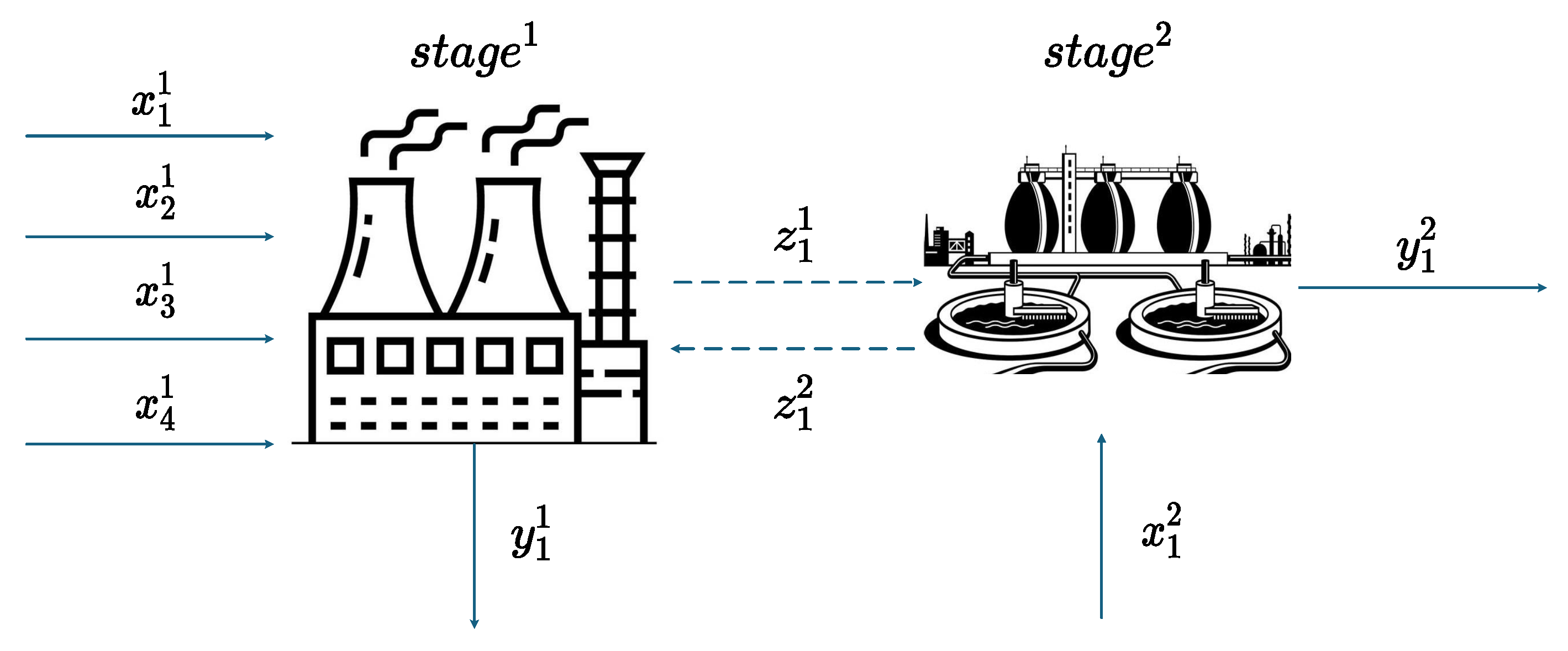
According to [4], the industrial operations of region j ( j = 1 , , N ) are modeled as a DMU j comprising two interdependent subsystems (i.e., Stage 1 and Stage 2), as illustrated in Figure 1.
To facilitate understanding, the inputs, outputs, and linked variables of each subsystem are explained in one-to-one correspondence with the structural components in Figure 1 as follows:
The industrial production (Stage 1) stage is shown in the left part of Figure 1, this subsystem realizes industrial output through comprehensive input of production factors and forms a linked variable with Stage 2. Specifically,
Inputs: Corresponding to the arrows entering Stage 1 in Figure 1, including four primary production inputs and one recycled input:
  • Industrial Capital ( x 1 j 1 ): The fixed and circulating capital invested in industrial production activities;
  • Energy Consumption ( x 2 j 1 ): The energy resources consumed during production;
  • Industrial Labor ( x 3 j 1 ): The labor force engaged in industrial production;
  • Industrial Water Use ( x 4 j 1 ): The fresh water extracted from external sources for production;
  • Wastewater Reuse Volume ( z 1 j 2 ): The water resource recycled from Stage 2 (corresponding to the feedback arrow from Stage 2 to Stage 1 in Figure 1), which closes the internal water circulation loop.
Outputs: Corresponding to the arrows exiting Stage 1 in Figure 1, including one desired output and one undesirable linked output:
  • Industrial Output Value ( y 1 j 1 ): The desired economic output generated by industrial production, reflecting the production efficiency of the subsystem;
  • Industrial Wastewater ( z 1 j 1 ): The undesirable by-product produced during production (corresponding to the dotted line arrow from Stage 1 to Stage 2 in Figure 1), which is entirely diverted to Stage 2 as the core processing object of wastewater treatment.
The Wastewater treatment ( Stage 2 ) stage is shown in the right part of Figure 1, this subsystem processes the undesirable output from Stage 1 and provides recycled resources for Stage 1, forming a mutual dependence with Stage 1. Specifically,
Inputs: Corresponding to the arrows entering Stage 2 in Figure 1, including one linked input and one investment input:
  • Industrial wastewater ( z 1 j 1 ): The linked input from Stage 1 (consistent with the undesirable output of Stage 1), which is the key treatment object of this subsystem;
  • Total Wastewater Treatment Investment ( x 1 j 2 ): The capital invested in wastewater treatment facilities, technology, and operations.
Outputs: Corresponding to the arrows exiting Stage 2 in Figure 1, including one recycled linked output and one desired economic output:
  • Wastewater Reuse Volume ( z 1 j 2 ): The reusable water resource obtained after wastewater treatment (corresponding to the feedback arrow from Stage 2 to Stage 1 in Figure 1), which is fed back to Stage 1 to realize water recycling;
  • Product Output Value ( y 1 j 2 ): The desired economic output generated during wastewater treatment (e.g., value of by-products from treatment, environmental benefits converted into economic value), reflecting the treatment efficiency and economic benefits of the subsystem.

2.2. Network DEA Efficiency Evaluation Model

Let v i k , u r k , w s k denote weights for inputs, desirable outputs, and link variables at stage k ( k = 1 , 2 ) , with α k representing the decision-maker’s weight for stage k ( α 1 + α 2 = 1 ). It is worth noting that only when the efficiency of both stages is equal to 1 simultaneously can the entire decision-making unit reach an efficient state. Therefore, from this perspective, the values of α 1 and α 2 have no significant impact on the efficiency improvement method we are about to adopt, which aims to achieve overall efficiency. Following the conventional approach of previous research Wang et al. [18], without loss of generality, we assume α 1 = α 2 = 0.5 . The overall efficiency for DMU o is
E o = max α 1 u 1 1 y 1 o 1 w 1 1 z 1 o 1 i = 1 4 v i 1 x i o 1 + w 1 2 z 1 o 2 + α 2 u 1 2 y 1 o 2 + w 1 2 z 1 o 2 v 1 2 x 1 o 2 + w 1 1 z 1 o 1
subject to
i = 1 4 v i 1 x i j 1 + w 1 2 z 1 j 2 u 1 1 y 1 j 1 w 1 1 z 1 j 1 , j
v 1 2 x 1 j 2 + w 1 1 z 1 j 1 u 1 2 y 1 j 2 + w 1 2 z 1 j 2 , j
The model specification establishes two fundamental design principles governing the two-stage efficiency evaluation. The objective function (1) maximizes the weighted sum of stage efficiencies, where Stage 1 efficiency ( E o 1 ) is formulated as the ratio of net output to inputs, incorporating a directional penalty ( w 1 1 ) for wastewater ( z 1 o 1 ) to internalize its environmental externality. Conversely, Stage 2 efficiency ( E o 2 ) adopts a conventional output-to-input ratio but assigns positive economic value ( + w 1 2 ) to reused water ( z 1 o 2 ), recognizing its circular resource contribution. Complementary constraints (2) and (3) enforce unified weight consistency across all decision-making units, ensuring that no DMU-stage combination exceeds unit efficiency (≤1) under identical production possibility frontiers, thereby maintaining benchmarking fairness while accommodating inter-stage resource transfers through shared weight parameters.

2.3. Efficiency Improvement Strategies

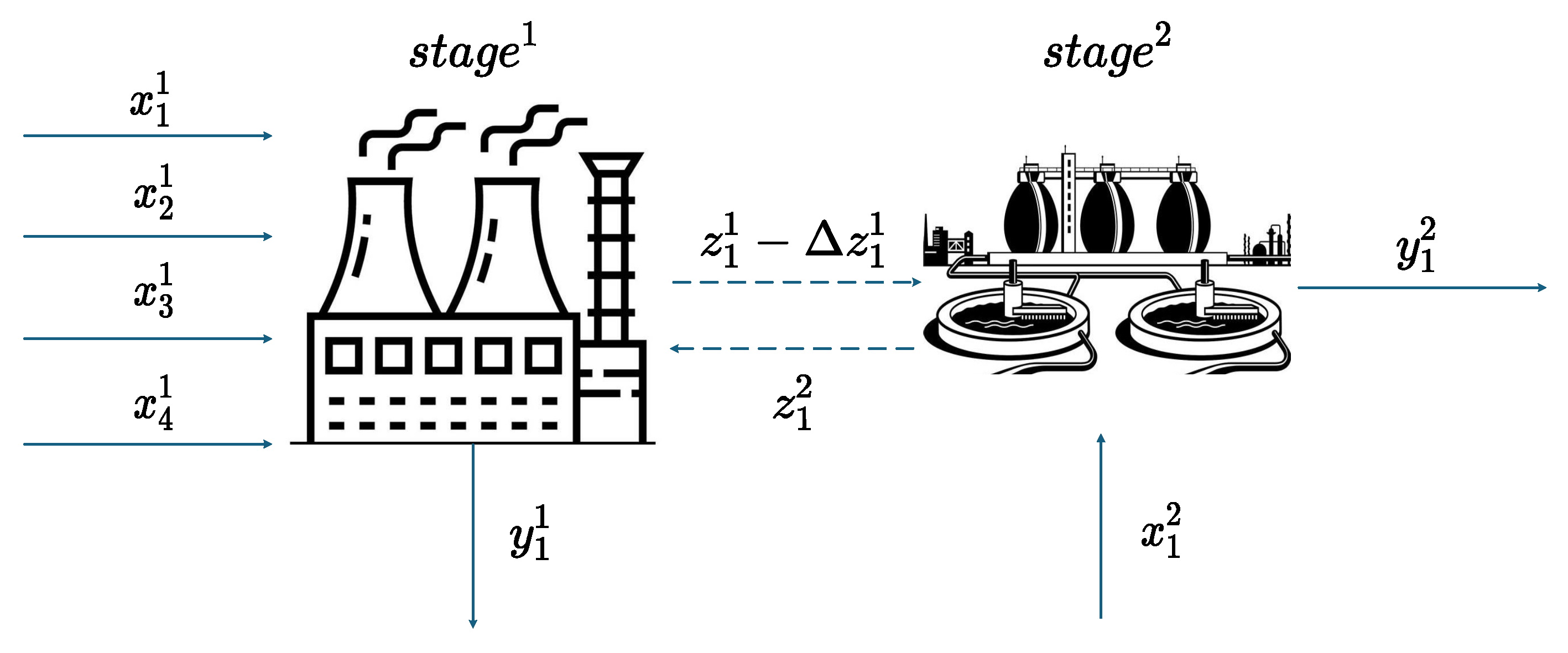
Following efficiency assessment, region-specific improvement paths are designed. Focusing on wastewater reduction ( z 1 j 1 ), we define Δ z 1 j 1 as the reducible wastewater volume (Figure 2), constrained by technological feasibility (4)–(10).
j λ j k x i j k x i o k , k , i = 1 , 2 , 3
j λ j 1 ( x 4 j 1 + z 1 j 2 ) x 4 o 1 + z 1 o 2
j λ j k y 1 j k y 1 o k , k
j λ j 1 z 1 j 1 z 1 o 1 Δ z 1 o 1
j λ j 2 z 1 j 1 z 1 o 1 Δ z 1 o 1
j λ j 2 z 2 j 2 z 2 o 2
λ j k 0 , j , k
Here, the constraint set (4)–(10) represents the production possibility set of the industrial water circulation system under the assumption of constant scale returns. In the DEA theory, the production possibility set is usually represented as a linear convex combination of the input–output vectors of sub-stages of the existing DMUs (i.e., the two sub-stages of the industrial water circulation system), and λ j k (≥0, where k = 1 , 2 denotes the stage) is the coefficient of these linear combination.
While specific mechanical interventions—such as process equipment upgrades (involves the replacement of high-water-consumption legacy equipment with water-saving alternatives), closed-loop recirculation systems like mechanical vapor recompression, and end-of-pipe filtration—provide viable pathways for operationalizing the reduction targets ( Δ z 1 o 1 ), these measures are inherently constrained by physical and technological limits. Consequently, despite the implementation of these engineering solutions, the capacity for wastewater abatement is finite, rendering unlimited reduction unattainable and resulting in persistent efficiency gaps ( d z o 1 > 0 ) where further source reduction is technically infeasible.Therefore, the efficiency improvement model incorporates a goal-programming gap variable d z o 1 :
min d z o 1
subject to
i = 1 4 v i 1 x i o 1 + w 1 2 z 1 o 2 = u 1 1 y 1 o 1 w 1 1 ( z 1 o 1 Δ z 1 o 1 ) d z o 1
v 1 2 x 1 o 2 + w 1 1 ( z 1 o 1 Δ z 1 o 1 ) d z o 1 = u 1 2 y 1 o 2 + w 1 2 z 1 o 2
with constraints (2), (3) and (4)–(10).
Here, constraints (12) and (13) aim to simultaneously improve the efficiency of both stages of the industrial water circulation system by reducing wastewater generation. However, under current technological conditions—as defined by the production possibility set in constraints (4)–(10)—it may be infeasible to achieve this specific reduction target. Consequently, the variable d z o 1 is introduced to quantify the ‘irreducible gap’ between the desired reduction and the technically feasible level.
The interpretation of gap variable analysis reveals critical technological feasibility thresholds for efficiency optimization. When the wastewater reduction gap is eliminated ( d z o 1 = 0 ), it indicates that the targeted wastewater reduction ( Δ z 1 o 1 ) successfully achieves full system efficiency, signifying that the proposed reduction volume aligns with current technological capabilities. Conversely, a positive wastewater reduction gap ( d z o 1 > 0 ) demonstrates that even after implementing the maximum feasible wastewater reduction, persistent inefficiencies remain due to insurmountable technological constraints under existing production systems, necessitating fundamental process redesign rather than incremental pollution control measures.
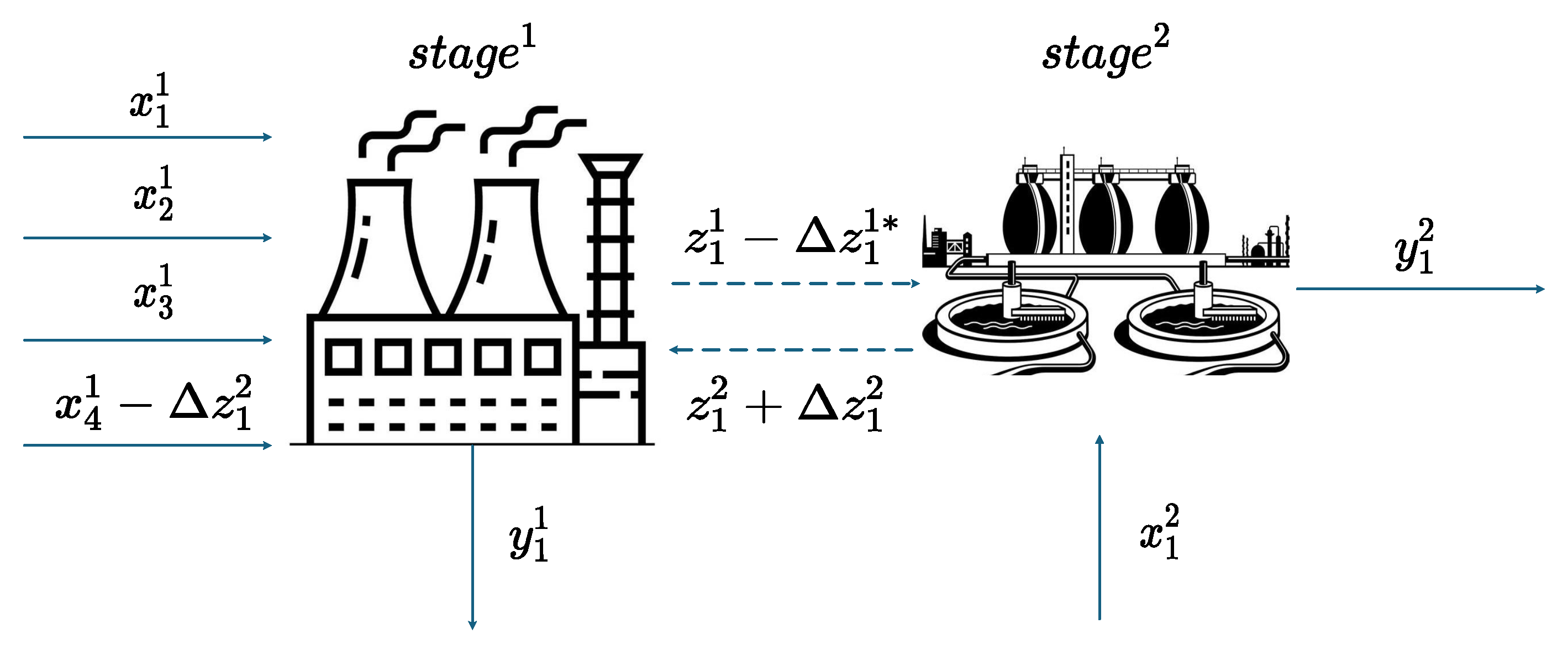
To address limitations of wastewater reduction alone, we introduce reused water augmentation Δ z 1 j 2 (Figure 3), constrained by constraint set (4), (6), (10) and
j λ j 1 ( x 4 j 1 + z 1 j 2 ) x 4 o 1 + z 1 o 2 + Δ z 1 o 2
j λ j 1 z 1 j 1 z 1 o 1 Δ z 1 o 1
j λ j 2 z 1 j 1 z 1 o 1 Δ z 1 o 1
j λ j 2 z 2 j 2 z 1 o 2 + Δ z 1 o 2
The corresponding model minimizes gaps ( d z o 2 , d e 1 ):
min d z o 2 + d e 1
subject to
i = 1 4 v i 1 x i o 1 + w 1 2 ( z 1 o 2 + Δ z 1 o 2 ) + d z o 2 d e 1 = u 1 1 y 1 o 1 w 1 1 ( z 1 o 1 Δ z 1 o 1 )
v 1 2 x 1 o 2 + w 1 1 ( z 1 o 1 Δ z 1 o 1 ) = u 1 2 y 1 o 2 + w 1 2 ( z 1 o 2 + Δ z 1 o 2 ) + d z o 2
with constraints (2)–(4), (6), (10) and (14)–(17).
The optimal solution of Model (18) yields a comprehensive classification of efficiency status through gap variables, delineating four distinct operational states. Full efficiency is achieved under two mutually exclusive conditions: either the wastewater reduction gap is eliminated ( d z o 1 = 0 ), or simultaneously the reclaimed water augmentation gap is closed ( d z o 2 = 0 ) and the production efficiency gap is resolved ( d e 1 = 0 ). Stage-specific efficiency manifests when the reclaimed water augmentation gap is eliminated ( d z o 2 = 0 ) for Stage 2 efficiency, or when the production efficiency gap is resolved ( d e 1 = 0 ) for Stage 1 efficiency. Conversely, the system is classified as following an inefficient path when all three gaps persist simultaneously—wastewater reduction ( d z o 1 > 0 ), reclaimed water augmentation ( d z o 2 > 0 ), and production efficiency ( d e 1 > 0 )—indicating fundamental limitations requiring cross-stage technological upgrade and systematic intervention measures are needed to address these issues.

3. Results

3.1. Data Source and Original Data

The data used in this study were obtained from the China Environmental Statistics Yearbook (2023) and the China Statistical Yearbook (2023), and the resulting analysis reflects short-term trends. The units of measurement for the various inputs and outputs within this two-stage industrial system are as follows:
  • Inputs to the Industrial Production stage:
    Industrial Capital ( x 1 j 1 ): Expressed in billion RMB.
    Energy Consumption ( x 2 j 1 ): Measured in million tons of standard coal equivalent.
    Industrial Labor ( x 3 j 1 ): Quantified in thousand persons.
    Industrial Water Use ( x 4 j 1 ): Recorded in million tons.
    Wastewater Reuse Volume ( z 1 j 2 ): Measured in million tons.
  • Outputs of the Industrial Production stage:
    Industrial Output Value ( y 1 j 1 ): Valued at billion RMB.
    Industrial Wastewater ( z 1 j 1 ): Measured in tons.
  • Inputs to the Wastewater Treatment stage:
    Industrial Wastewater ( z 1 j 1 ): Received from Stage 1, measured in tons.
    Total Wastewater Treatment Investment ( x 1 j 2 ): Expressed in million RMB.
  • Outputs of the Wastewater Treatment stage:
    Wastewater Reuse Volume ( z 1 j 2 ): Measured in million tons.
    Product Output Value ( y 1 j 2 ): Generated from the treatment process, valued at million RMB.
And the original data are presented in Table 1.

3.2. Original Efficiency Performance and Regional Disparities

The evaluation of 30 Chinese regions using the network DEA model reveals significant efficiency disparities, as summarized in Table 2 and Table 3.
The network DEA evaluation of 30 Chinese provinces reveals significant heterogeneity in industrial water circularity efficiency, with profound implications for regional sustainability planning. As presented in Table 2, only two regions—Shanxi and Inner Mongolia—achieved Pareto efficiency ( E j = 1.0 ), while coastal manufacturing powerhouses like Jiangsu ( E j = 0.65 ) and Zhejiang ( E j = 0.53 ) exhibited substantial inefficiencies despite high industrial output. This counterintuitive pattern underscores the “efficiency paradox” where economic development does not inherently guarantee resource circularity. The national efficiency distribution (Table 3) further demonstrates polarization: 80% of regions scored below 0.8, with western provinces like Qinghai ( E j = 0.51 ) showing critical deficiencies. Crucially, subsystem analysis reveals treatment inefficiency ( e j 2 < 0.5 in 40% of regions) as the primary constraint, particularly in water-stressed areas where Stage 2 investments lag behind industrial expansion.

3.3. Improvement Pathways: Wastewater Reduction

The efficiency improvement model (11) evaluates 30 Chinese regions (DMUs) using two key metrics: Δ z 1 o 1 , which represents the recommended wastewater reduction volume, and d z o 1 , which denotes the efficiency gap after implementing Δ z 1 o 1 . The results are presented in Table 4 and Table 5.
Implementation of the wastewater reduction strategy ( Δ z 1 o 1 ) yielded geographically differentiated outcomes, as quantified in Table 4. While regions like Zhejiang achieved substantial reducible volumes ( Δ z 1 o 1 = 30 , 487 tons), wastewater reduction gaps ( d z o 1 > 0 ) persisted in 93% of provinces, confirming the technological limitations of standalone reduction approaches. The regional classification in Table 5 highlights three distinct clusters: fully efficient systems (Shanxi, Inner Mongolia), partial improvement zones (Liaoning, Anhui), and technology-constrained regions (Jiangsu, Guangdong) where d z o 1 values exceeded 18,000. Notably, Jiangsu’s wastewater reduction gap ( d z o 1 = 38,863.84) accounts for 69% of its initial wastewater volume, signaling systemic rather than marginal improvement needs. To further elucidate the heterogeneity behind these classifications, it is imperative to contextualize the efficiency gaps within specific industrial and resource endowments. The “Technology Limited” status, predominantly observed in eastern coastal powerhouses like Jiangsu and Guangdong, is intrinsically linked to their high-water-consumption and high-emission manufacturing structures. For instance, Jiangsu’s massive gap is anchored in chemical processing and textile industries, where wastewater generation is structurally rigid under current technological paradigms. Similarly, provinces in the North China Plain, such as Hebei and Shandong, face compounded challenges where the sheer volume of process water required for steel and thermal power generation renders source reduction strategies ( Δ z 1 o 1 ) ineffective. Conversely, the full efficiency observed in Shanxi and Inner Mongolia is likely attributable not to superior technology, but to distinct industrial compositions dominated by energy extraction or dry processing, which generate lower volumes of biodegradable wastewater relative to their outputs. This divergence confirms that “Technology Limited” inefficiencies are frequently a manifestation of an industrial mismatch between regional development models and local water environmental carrying capacities.
Micro-level analysis of the optimization results reveals distinct mechanisms underlying efficiency improvements in ecologically fragile regions versus industrial hubs. Taking Qinghai as a representative case, the transition from severe inefficiency ( E j = 0.51 ) to full Pareto efficiency ( E j = 1.00 ) was achieved through a highly leveraged “precision intervention” strategy. Specifically, the required reclaimed water augmentation ( Δ z 1 o 2 = 207.09 tons) constituted merely a marginal fraction of the system’s total throughput, yet it decisively resolved the bottleneck in Stage 2 utilization. This disproportionate impact—where a minimal input increment yielded a maximum efficiency gain—suggests that regions with lower industrial base volumes often suffer from acute “structural shortages” in recycling infrastructure rather than absolute capacity limits. In contrast, the efficiency improvements in coastal regions relied on “volume-based adjustments,” where substantial increases in Δ z 2 (e.g., 24,372.85 tons in Jiangsu) were necessary to align large-scale industrial discharge with treatment capabilities. These findings quantitatively validate that resource-dependent economies can bypass heavy infrastructure investment by targeting critical, small-scale nodes in the water circularity network, thereby achieving rapid sustainability gains with minimal economic costs.

3.4. Improvement Pathways: Reclaimed Water Augmentation

We can obtain the improvement plan for reclaimed water by calculating model (18), as shown in Table 6. Here, the increase in reclaimed water is represented by Δ z 1 o 2 , d z o 2 indicates the gap between the increase in reclaimed water and the ideal increase amount, and d e o 1 represents the gap between the weighted sum of output and input in the first stage after implementing Δ z 1 o 2 .
One can observed that the reuse augmentation heterogeneity is reflected in two distinct patterns: High-Volume Intervention, where industrial hubs such as Jiangsu ( Δ z 2 = 24,372) and Guangdong (13,837) require substantial reuse expansion to close efficiency gaps yet achieve full Stage 2 optimization ( d z o 2 0 ), validating infrastructural scalability in capital-intensive economies; and Precision Optimization, as seen in Beijing (349) and Qinghai (207), which attain Stage 2 efficiency ( d z o 2 = 0 ) with minimal augmentation, demonstrating technology-driven efficiency convergence.
We substitute z 1 o 1 Δ z 1 o 1 and z 1 j 2 + Δ z 1 o 2 as the values of Industrial Wastewater and Wastewater Reuse Volume into Model (1) to recalculate the improved comprehensive efficiency of the industrial water system in each region. The comprehensive post-optimization efficiency landscape (Table 7) confirms reclaimed water’s transformative potential while highlighting wastewater reduction production constraints in resource-dependent economies.
Reclaimed water augmentation ( Δ z 2 ) demonstrated superior efficacy in closing circularity gaps, with results detailed in Table 6. The intervention enabled 53% of regions (16/30 provinces) to achieve full efficiency, including transformation of severely inefficient systems like Qinghai ( E j from 0.51 to 1.00) through minimal precision augmentation ( Δ z 2 = 207 tons). Treatment stage efficiency ( d z o 2 = 0 ) was attained in 83% of regions after optimization, validating wastewater reuse as the critical leverage point.
Beyond the aggregate count of fully efficient provinces, a comparative analysis of individual efficiency rankings reveals profound structural shifts and persistent constraints induced by reclaimed water augmentation. Specifically, regions previously categorized as severely inefficient, such as Zhejiang (rank 27th, E j = 0.53 ) and Jiangsu (rank 24th, E j = 0.65 ), experienced the most dramatic ascent in the hierarchy, surging to full efficiency status ( E j = 1.00 ). This underscores the strategy’s potency in rectifying systemic deficits in high-output manufacturing zones. Conversely, the strategy exposed intrinsic rigidity in production-side configurations; Ningxia, despite a marginal initial deficit ( E j = 0.83 ), stagnated with the lowest post-optimization production efficiency ( e j 1 = 0.65 ). Similarly, Xinjiang remained inefficient ( e j 1 = 0.84 ) despite substantial augmentation potentials. These divergent trajectories validate that while water reuse acts as a powerful catalyst for overcoming treatment-stage bottlenecks, it fails to rectify deep-seated inefficiencies rooted in the industrial production processes of resource-dependent economies.
The superior efficacy of reclaimed water augmentation, evidenced by the shift of 16 provinces to full efficiency, can be deeply interpreted through the lens of regional water scarcity endowments and the maturity of existing water policies. The “High-Volume Intervention” pattern observed in Jiangsu ( Δ z 2 = 24,372) and Guangdong ( Δ z 2 = 13,837) is not merely a statistical requirement but a reflection of these provinces’ urgent policy transition toward “Zero Liquid Discharge” (ZLD) mandates and the Sponge City initiatives. In Jiangsu, the massive required increase in reclaimed water correlates directly with the province’s efforts to alleviate the environmental load of the Taihu Lake basin, where local regulations incentivize industrial water reuse to mitigate eutrophication risks. Here, augmenting reclaimed water supply resolves the structural bottleneck by transforming wastewater from a liability into a resource for industrial cooling and landscaping, effectively decoupling industrial growth from freshwater withdrawal. On the other hand, the “Precision Optimization” seen in Beijing and Qinghai reveals a different dynamic: Beijing, facing severe water scarcity, has already implemented aggressive water recycling infrastructure and high water pricing schemes, meaning that marginal increases in reclaimed water yield immediate efficiency returns ( d z o 2 = 0 ) due to high system readiness. Similarly, in ecologically fragile regions like Qinghai and Gansu, the low volume of required augmentation is aligned with their protection-oriented policies (e.g., the Three-River-Source protection), where industrial scales are intentionally controlled. Thus, the success of the augmentation strategy lies in its alignment with regional “Water-Saving Intensive Societies” construction policies, which provide the institutional framework necessary for converting wastewater treatment capacity into circular economic value.
The comparative analysis of improvement pathways yields three critical insights for regional water governance. First, reclaimed water augmentation demonstrated 3.2× higher full-efficiency attainment than wastewater reduction alone, establishing reuse infrastructure as the primary circularity accelerator. Second, ecologically fragile regions achieved disproportionate sustainability returns through minimal interventions, exemplified by Qinghai’s full-efficiency transformation with less than 0.5% system modification. Third, the persistence of Stage 1 inefficiencies ( e j 1 < 1.0 in 50% of optimized systems) reveals fundamental limitations in industrial input configurations that water circularity alone cannot resolve. These findings necessitate integrated strategies combining precision reuse infrastructure with production process redesign, particularly in manufacturing-intensive provinces where water–energy–pollution nexuses constrain holistic efficiency gains. Ultimately, the divergence between “Technology Restricted” and “Partial Improvement” regions underscores that water governance cannot be decoupled from industrial restructuring; provinces with high water-dependency ratios must synchronously pursue technological upgrades in production processes alongside water reuse infrastructure to break the efficiency ceiling imposed by their existing industrial layouts.


4. Discussion

4.1. Theoretical Implications: Advancing Circular Water DEA Frameworks

This research bridges critical gaps in water resource efficiency evaluation through a two-stage network DEA model that fundamentally extends prior work by simultaneously incorporating three transformative innovations. First, our framework pioneers Closed-Loop Integration by formalizing reclaimed water ( z 1 j 2 ) as a feedback variable—unlike conventional sequential models (e.g., Yin et al. [5])—thus resolving the “open-loop fallacy” in industrial water systems. Second, we advance Non-Radial Environmental Accounting beyond D’Inverno et al. [7]’s directional distance approach through embedded directional penalties ( w 1 1 ) for wastewater as inter-stage links, internalizing externalities more rigorously than traditional SBM-DEA model. Third, the novel Diagnostic Precision system employing gap variables ( d z o 1 , d z o 2 ) enables granular inefficiency source identification, overcoming the “black-box limitation” of aggregate scores noted in Cabrera et al. [19]. Collectively, these innovations establish a unified analytical framework that aligns with SDG 6.4 monitoring principles [6] while addressing Zhang et al. [20]’s call for context-specific industrial circularity metrics, creating a paradigm shift from linear efficiency assessment to circular system optimization.

4.2. Empirical Revelations: Regional Efficiency Paradoxes and Intervention Pathways

Our provincial-level analysis reveals two counterintuitive patterns with significant policy implications.
First, the Coastal Manufacturing Efficiency Paradox manifests in economically advanced regions like Jiangsu ( E j = 0.65 ) and Zhejiang ( E j = 0.53 ) exhibiting substantial inefficiency despite high industrial output. To mechanistically deconstruct this paradox, we must transcend aggregate metrics and examine the sub-dimensional heterogeneity of industrial structure and investment intensity. The inefficiency in these coastal powerhouses is not merely a volume issue but a structural misallocation characterized by “rigid” freshwater inputs ( x 4 j 1 ), where industrial water intake per unit of output remains stubbornly high due to the dominance of water-intensive sectors like chemical processing and textiles. This rigidity is compounded by a critical “treatment lag” effect: while capital inputs ( x 1 j 1 , x 2 j 1 ) drive rapid production expansion, investment in treatment infrastructure ( x 1 j 2 ) has failed to keep pace, creating a severe subsystem imbalance as noted by Ding et al. [4]. Empirical evidence from Jiangsu exemplifies this structural bottleneck; despite its advanced industrial base, its massive wastewater reduction gap ( d z o 1 = 38,863.84) accounts for nearly 69% of its initial discharge volume. This statistic indicates that the current industrial composition generates biodegradable loads structurally incompatible with existing linear treatment paradigms, confirming that the paradox is rooted in a deep mismatch between high-water-consumption industrial layouts and local environmental carrying capacities.
Second, our improvement simulations demonstrate *Reclaimed Water’s Disproportionate Leverage*, where augmentation ( Δ z 2 ) achieved full efficiency in 53% of regions—tripling the effectiveness of wastewater reduction ( Δ z 1 )—validating the systemic advantage of output-oriented optimization and aligning with Lozano and Borrego-Marín [6]’s governance emphasis on enhancing water productivity within the SDG 6.4 framework. However, the explanation of this phenomenon requires delving deeper than surface-level “technology-driven convergence.” In ecologically fragile regions like Qinghai and Gansu, the efficacy of minimal interventions is driven by a synergistic mechanism between resource endowments and industrial positioning. Unlike the coastal manufacturing hubs, these regions possess industrial structures characterized by lower water-intensity sectors (e.g., energy extraction vs. wet processing), which inherently generate a more manageable wastewater profile. This favorable baseline intersects with policy-driven constraints to create a low threshold for “decoupling.” Consequently, precision optimization ( Δ z 2 < 250 for Qinghai) allows for immediate efficiency convergence ( e j 2 1.0 ) because the system does not grapple with the rigid, high-volume pollutant loads seen in the east. Thus, the superior performance of augmentation in these areas stems not from superior technology, but from a favorable alignment of resource constraints and industrial scale, demonstrating that marginal interventions yield maximal systemic returns only when the underlying industrial composition is structurally compatible with circular goals.
Third, the empirical validation of augmentation strategies underscores the pivotal significance of technological water reuse as a fundamental mechanism for decoupling industrial growth from natural water uptake. By shifting the reliance from virgin freshwater resources to recycled streams, regions can effectively alleviate the pressure on local hydrological cycles and conserve scarce supplies for critical ecological functions. This transition aligns directly with the Sustainable Development Goals (SDG 6.4), specifically the mandate to substantially increase water-use efficiency and ensure sustainable withdrawals and supply of freshwater. Viewed through the lens of future technological pathways, prioritizing water reuse represents a strategic shift towards a circular economy, where advanced treatment technologies—such as membrane filtration and zero liquid discharge (ZLD) systems—are not merely end-of-pipe solutions but core components of industrial water security. Ultimately, integrating these technological advancements is essential for mitigating the risks of water scarcity and establishing a resilient, climate-adaptive industrial foundation for long-term development.

4.3. Limitations and Research Extensions

Despite the robust diagnostic capabilities of the current network DEA framework, its limitations stem primarily from static and isolated modeling assumptions, which constrain its applicability to complex, dynamic industrial ecosystems. First, the cross-sectional nature of this study captures efficiency performance at a single point in time, thereby obscuring the evolutionary trajectory of water circularity. A static framework fails to account for the temporal dynamics of technological progress, the lagged effects of policy interventions, or the impact of climate variability on water availability. Consequently, the model may misidentify transient inefficiencies as structural defects, potentially leading to myopic or ineffective long-term decision-making. To address this, future research should integrate temporal dynamics—such as those proposed by Abdolazimi et al. [9]’s DEA-GARMA framework—to model technological diffusion pathways and distinguish between short-term fluctuations and genuine trends in efficiency improvement.
Second, the current analysis treats each province as a closed decision-making unit, an assumption that often contradicts the hydrological reality of transboundary river basins. By evaluating administrative units in isolation, the model neglects spatial externalities; specifically, it overlooks the correlation of water quality across provincial boundaries. This isolation risks measurement bias where a province achieves high “efficiency” scores simply by exporting pollution downstream to neighboring regions rather than implementing actual circularity measures. To correct for this potential “pollution haven” effect, future extensions must incorporate spatial interdependencies.
Third, while the model aggregates industrial sectors, this macro-level resolution masks significant sectoral heterogeneity that is critical for precision management. Without dis-aggregating industrial subsectors, as suggested by Zheng et al. [3], the current “one-size-fits-all” efficiency scores may obscure specific inefficiencies inherent to water-intensive versus light manufacturing processes. Furthermore, the robustness of the variable selection can be enhanced to mitigate data uncertainty through Pishini et al. [17]’s DOE-PCA integration. Finally, to bridge the “evaluation–implementation gap” highlighted by Cabrera et al. [19], these methodological refinements should be coupled with metafrontier analysis [6] to benchmark regions against global technological frontiers. Such a comprehensive evolution will transform the current diagnostic tool into a predictive, spatially aware decision-support platform capable of navigating the intricate water–energy–pollution nexuses of modern industrial development.

Funding

This research received no external funding.

Institutional Review Board Statement

Not applicable.

Informed Consent Statement

Not applicable.

Data Availability Statement

The original contributions presented in this study are included in the article. Further inquiries can be directed to the corresponding author.

Acknowledgments

The author acknowledges Gurobi for the academic license of the linear programming solver.

Conflicts of Interest

The author declares no conflicts of interest.

Abbreviations

The following abbreviations are used in this manuscript:
DEAData Envelopment Analysis

References

  1. UNESCO World Water Assessment Programme. World Water Development Report 2023. 2023. Available online: https://iahs.info/News/news/the-united-nations-world-water-development-report-2023/ (accessed on 11 November 2025).
  2. Ministry of Water Resources of China. 2023 China Water Resources Bulletin. 2024. Available online: http://www.mwr.gov.cn/sj/tjgb/szygb/202406/t20240614_1713318.html (accessed on 11 November 2025).
  3. Zheng, Z.; Wei, X.; Wang, L.; Guo, R.; Xu, H. Design of DEA water efficiency evaluation model for cotton field irrigation in Xinjiang. Water Supply 2023, 23, 1519–1530. [Google Scholar] [CrossRef]
  4. Ding, T.; Wu, H.; Jia, J.; Wei, Y.; Liang, L. Regional assessment of water-energy nexus in China’s industrial sector: An interactive meta-frontier DEA approach. J. Clean. Prod. 2020, 277, 118797. [Google Scholar] [CrossRef]
  5. Yin, C.; Hsiao, B.; See, K.F. Efficiency analysis of China’s urban water supply utilities using a dynamic multiactivity network DEA model. Struct. Change Econ. Dyn. 2024, 71, 387–404. [Google Scholar] [CrossRef]
  6. Lozano, S.; Borrego-Marín, M.M. A metafrontier network DEA approach for water usage efficiency assessment in the light of SDG target 6.4. Environ. Sci. Policy 2024, 159, 103857. [Google Scholar] [CrossRef]
  7. D’Inverno, G.; Carosi, L.; Romano, G.; Guerrini, A. Water pollution in wastewater treatment plants: An efficiency analysis with undesirable output. Eur. J. Oper. Res. 2018, 269, 24–34. [Google Scholar] [CrossRef]
  8. Halkos, G.E.; Petrou, K.N. Treating undesirable outputs in DEA: A critical review. Econ. Anal. Policy 2019, 62, 97–104. [Google Scholar] [CrossRef]
  9. Abdolazimi, O.; Sepehrifar, M.; Shishebori, D.; Banicescu, I.; Azad, S.; Pishini, K.; Ma, J. A stochastic DEA-GARMA integration for dynamic forecasting of undesirable outputs applied to the temporal efficiency analysis of water and sewerage services. J. Clean. Prod. 2025, 485, 146177. [Google Scholar] [CrossRef]
  10. Yang, Z.; Omrani, H.; Imanirad, R. Assessing airline efficiency with a network DEA model: A Z-number approach with shared resources, undesirable outputs, and negative data. Socio-Econ. Plan. Sci. 2024, 95, 102080. [Google Scholar] [CrossRef]
  11. Wang, C.-N.; Nguyen, T.T.-V.; Chiang, C.-C.; Le, H.-D. Evaluating renewable energy consumption efficiency and impact factors in Asia-pacific economic cooperation countries: A new approach of DEA with undesirable output model. Renew. Energy 2024, 231, 120586. [Google Scholar] [CrossRef]
  12. He, J.; Lau, W.-Y.; Ng, K.-H. A machine learning-enhanced three-stage SBM-DEA model with undesirable outputs for measuring green total factor productivity on a global scale. Financ. Res. Lett. 2025, 70, 108611. [Google Scholar] [CrossRef]
  13. Sharma, S.; Majumdar, K. Efficiency of rice production and CO2 emissions: A study of selected Asian countries using DDF and SBM-DEA. J. Environ. Plan. Manag. 2021, 64, 2133–2153. [Google Scholar] [CrossRef]
  14. Guo, B.; Yu, H.; Jin, G. Urban green total factor productivity in China: A generalized Luenberger productivity indicator and its parametric decomposition. Sustain. Cities Soc. 2024, 106, 105365. [Google Scholar] [CrossRef]
  15. Addis, A.K. Sustainability and efficiency analysis of 42 countries: Super SBM-DEA model and the GML productivity index with undesirable outputs. Ecol. Indic. 2025, 177, 113767. [Google Scholar] [CrossRef]
  16. Aparicio, J.; Santín, D. The standard total factor productivity index and its decomposition. Eur. J. Oper. Res. 2026, 329, 981–1003. [Google Scholar] [CrossRef]
  17. Pishini, K.; Abdolazimi, O.; Shishebori, D.; Rezaee, M.J.; Sepehrifar, M. Evaluating efficiency in water and sewerage services: An integrated DEA approach with DOE and PCA. Sci. Total Environ. 2025, 958, 178288. [Google Scholar] [CrossRef]
  18. Wang, X.; Hsiao, P.-C.; Zhang, W.; Johnston, B.; Stokes, A.; Wei, Q.; Fell, A.; Surve, S.; Shengzhao, Y.; Verlinden, P.; et al. Equivalent solutions to additive two-stage network data envelopment analysis. Eur. J. Oper. Res. 2018, 264, 1189–1191. [Google Scholar] [CrossRef]
  19. Cabrera, E.; Estruch-Juan, E.; Molinos-Senante, M. Adequacy of DEA as a regulatory tool in the water sector. The impact of data uncertainty. Environ. Sci. Policy 2018, 88, 155–162. [Google Scholar] [CrossRef]
  20. Zhang, W.; Wu, X.; Chen, J. Low-carbon efficiency analysis of rail-water multimodal transport based on cross efficiency network DEA approach. Energy 2024, 311, 132348. [Google Scholar] [CrossRef]
Figure 1. The network structure of industrial water circulation systems.
Sustainability 18 00555 g001
Figure 2. Improved network with wastewater reduction.
Sustainability 18 00555 g002
Figure 3. Improved network with reused water augmentation.
Sustainability 18 00555 g003
Table 1. Raw Data on Industrial Water Recycling Systems Across 30 Chinese Provinces.
Region x 1 1 x 2 1 x 3 1 x 4 1 y 1 1 z 1 1 x 2 1 z 2 1 y 2 1
Beijing4857.2413.03817.00240.00503.641358.002.26182.50304.44
Tianjin1908.8549.95959.00460.00540.272352.008.83306.60759.42
Hebei4378.31226.462603.001630.001467.5310,795.0063.056018.853792.61
Shanxi4107.44153.802046.001160.001275.863666.0080.451846.901570.33
Inner Mongolia3275.06213.84983.001320.00970.384996.00271.771627.903396.70
Liaoning3346.05181.921895.001500.001023.9110,482.00133.233186.452748.23
Jilin1464.9931.36727.00870.00373.795857.0017.00594.95512.03
Heilongjiang1412.7164.55844.001460.00425.766406.001.122127.951334.14
Shanghai3982.4953.001822.006300.001079.458140.0032.92580.351555.86
Jiangsu12,567.96254.139391.0024,550.004859.3656,124.00255.704051.507687.53
Zhejiang9127.73291.127602.003540.002887.1341,465.001206.803759.506608.05
Anhui4161.3599.242809.007890.001379.2012,781.0044.503741.253015.72
Fujian3658.83100.863715.002440.001962.8816,369.00100.036062.652567.39
Jiangxi2577.2567.292219.004220.001177.0316,944.0053.062514.852394.49
Shandong8438.77370.515653.003310.002873.9038,059.00599.925577.207669.23
Henan4089.37140.553303.002130.001959.2813,134.0086.152996.652153.58
Hubei3953.59163.262672.008090.001754.6312,142.00243.142430.902347.55
Hunan2829.55108.322978.005090.001502.5311,313.0010.151463.651299.72
Guangdong190,140.8923.7713,477.007340.004772.3034,981.00149.033467.506687.22
Guangxi2033.6489.661452.003160.00677.5915,864.001.322587.851229.75
Hainan372.2810.44121.00140.0077.013879.007.30200.75231.22
Chongqing        1964.8046.511524.001710.00827.608039.004.13532.90802.04
Sichuan5070.23132.393019.002120.001641.2215,431.0026.813755.853173.36
Guizhou1520.5650.05802.001120.00549.313427.00105.841730.10773.96
Yunnan2174.1097.43813.001420.00719.717955.0089.491941.801097.81
Shaanxi3387.88104.281643.001070.001315.836818.0048.121215.452171.72
Gansu1277.8555.06497.00630.00329.722431.00104.58445.30591.05
Qinghai605.4436.43168.00270.00122.871627.0011.7791.25144.50
Ningxia1040.3087.30327.00450.00209.402338.008.99430.70896.43
Xinjiang2347.81142.12732.001090.00602.287134.004.751609.651869.23
Table 2. Efficiency Performance for various regions.
DMU E j Rank of E j e j 1 Rank of e j 1 e j 2 Rank of e j 2
Beijing0.8781.0010.7512
Tianjin0.9231.0010.839
Hebei0.9050.79211.001
Shanxi1.0011.0011.001
Inner Mongolia1.0011.0011.001
Liaoning0.69220.73270.6515
Jilin0.52280.75240.2928
Heilongjiang0.8690.72281.001
Shanghai0.75151.0010.5016
Jiangsu0.65240.94160.3626
Zhejiang0.53270.75240.3027
Anhui0.78130.80200.7512
Fujian0.83111.0010.6614
Jiangxi0.70210.95150.4421
Shandong0.62250.79210.4618
Henan0.73171.0010.4520
Hubei0.71201.0010.4324
Hunan0.73171.0010.4618
Guangdong0.75151.0010.5016
Guangxi0.8690.72281.001
Hainan0.47300.75240.2029
Chongqing0.68230.96140.4125
Sichuan0.78130.81190.7611
Guizhou0.8970.88170.918
Yunnan0.72191.0010.4421
Shaanxi0.9051.0010.8010
Gansu0.60260.76230.4421
Qinghai0.51291.0010.0130
Ningxia0.83110.66301.001
Xinjiang0.9230.84181.001
Table 3. Distribution Characteristics of Overall Efficiency Performance.
Efficiency RangeRegion CountProportionRepresentative Cases
1.026.7%Shanxi, Inner Mongolia
0.80–0.921033.3%Hebei, Tianjin
0.60–0.791446.7%Jiangsu, Hubei
<0.6413.3%Hainan, Qinghai
Table 4. Recommended Improvements and Deviations for Wastewater Discharge.
DMU Δ z 1 o 1 d zo 1
Beijing0435.98
Tianjin0391.07
Hebei05407.13
Shanxi00
Inner Mongolia00
Liaoning4121.553419.76
Jilin4346.31259.1
Heilongjiang05183.8
Shanghai04363.54
Jiangsu038,863.84
Zhejiang30,487.47549.38
Anhui4431.79940.17
Fujian05495.44
Jiangxi7743.483001.44
Shandong24,421.862627.94
Henan07528.7
Hubei07070.69
Hunan06831.95
Guangdong018,792.07
Guangxi013,417.18
Hainan3328.89321.25
Chongqing05315.59
Sichuan4550.973065.18
Guizhou324.011235.57
Yunnan04472.32
Shaanxi01528.12
Gansu1357.323.51
Qinghai1091.92295.28
Ningxia01708.39
Xinjiang04508.38
Table 5. Regional Performance Classification for Wastewater Discharge.
CategoryCharacteristicRegionsCount
Fully Efficient Δ z 1 o 1 = 0 , d z o 1 = 0 Shanxi, Inner Mongolia.2
Partial Improvement Δ z 1 o 1 > 0 , d z o 1 > 0 Liaoning, Jilin, Zhejiang, Anhui, Jiangxi, Shandong, Hainan, Sichuan, Guizhou, Qinghai.10
Technology Limited Δ z 1 o 1 = 0 , d z o 1 > 0 Beijing, Tianjin, Hebei, Heilongjiang, Shanghai, Jiangsu, Fujian, Henan, Hubei, Hunan, Guangdong, Guangxi, Chongqing, Yunnan, Shaanxi, Ningxia, Xinjiang.18
Table 6. Recommended Improvements and Deviations for Wastewater Treatment.
DMU Δ z 1 o 2 d zo 2 d eo 1
Beijing349.060.000.00
Tianjin624.420.000.00
Hebei0.000.006092.57
Shanxi0.000.000.00
Inner Mongolia0.000.000.00
Liaoning0.00359.883979.26
Jilin247.350.000.00
Heilongjiang0.000.001884.11
Shanghai3376.500.000.00
Jiangsu24,372.850.010.00
Zhejiang422.590.000.00
Anhui0.0065.063460.16
Fujian3064.030.000.00
Jiangxi2588.050.000.00
Shandong0.000.004068.63
Henan4326.330.000.00
Hubei4338.980.000.00
Hunan2619.380.000.00
Guangdong13,837.420.000.00
Guangxi0.000.002185.89
Hainan0.00105.97396.34
Chongqing2245.880.000.00
Sichuan0.00849.084212.49
Guizhou0.000.001489.70
Yunnan2493.580.000.00
Shaanxi2585.990.000.00
Gansu2.830.003.34
Qinghai207.090.000.00
Ningxia0.0099.411902.67
Xinjiang0.00899.463214.85
Table 7. The efficiency calculation results of the improved DMU.
DMU E j e j 1 e j 2
Beijing1.001.001.00
Tianjin1.001.001.00
Hebei0.890.781.00
Shanxi1.001.001.00
Inner Mongolia1.001.001.00
Liaoning0.870.741.00
Jilin0.980.961.00
Heilongjiang0.860.721.00
Shanghai1.001.001.00
Jiangsu1.001.001.00
Zhejiang1.001.001.00
Anhui0.980.980.98
Fujian1.001.001.00
Jiangxi0.990.981.00
Shandong0.960.911.00
Henan1.001.001.00
Hubei1.001.001.00
Hunan1.001.001.00
Guangdong1.001.001.00
Guangxi0.870.751.00
Hainan0.880.751.00
Chongqing1.001.001.00
Sichuan0.950.901.00
Guizhou0.940.891.00
Yunnan1.001.001.00
Shaanxi1.001.001.00
Gansu1.001.001.00
Qinghai1.001.001.00
Ningxia0.830.651.00
Xinjiang0.920.841.00
Disclaimer/Publisher’s Note: The statements, opinions and data contained in all publications are solely those of the individual author(s) and contributor(s) and not of MDPI and/or the editor(s). MDPI and/or the editor(s) disclaim responsibility for any injury to people or property resulting from any ideas, methods, instructions or products referred to in the content.