Article

Can the Digital Economy Power High-Quality Development in the Logistics Industry?

1
School of Public Policy and Management, Nanchang University, Nanchang 330031, China
2
School of Economics and Management, Jiangxi University of Science and Technology, Ganzhou 341000, China
*
Author to whom correspondence should be addressed.
Sustainability 2026, 18(1), 8; https://doi.org/10.3390/su18010008
Submission received: 11 April 2025 / Revised: 27 April 2025 / Accepted: 4 May 2025 / Published: 19 December 2025
(This article belongs to the Special Issue Digital Economy and Sustainable Development)

Abstract

The rapid development of the digital economy provides an important opportunity for high-quality developments in the logistics industry. Based on the panel data of 30 provinces in China from 2011 to 2022, this paper investigates the impact of the digital economy on high-quality development in the logistics industry by constructing an index measuring the efficiency of high-quality development in the logistics industry and the digital economy. The results show that there is a positive U-shaped relationship between the digital economy and high-quality development in the logistics industry; additionally, the results show that the digitization level in China is on the rise. However, due to the regional digitization imbalance and the intensification of the competition trend, a decline in the high-quality development level of the logistics industry is likely. A heterogeneity analysis shows that the impact of the digital economy on high-quality development in the logistics industry varies in different regions and at different economic levels. Further analysis shows that, when the level of new urbanization is higher than the threshold value of 0.592, it should promote the development of the logistics industry; when the contrary, it seems to have an inhibiting effect. This paper provides practical references for other developing countries and emerging countries with digital strategies in promoting the digital economy and logistics industry.

1. Introduction

China’s economy is in a critical transition period from scale expansion to a quality leap; here, cultivating new development momentum and promoting high-quality development have become the core propositions for breaking through the middle-income trap [1]. In this process, the digital economy and new urbanization form a “technology empowerment–spatial reconfiguration” driving mechanism; this is profoundly reshaping the path of industrial upgrading [2]. Data show that, in 2022, the proportion of the digital economy in GDP has climbed to 40%; the “14th Five-Year Plan” emphasizes a new urbanization strategy for forming strategic coupling, jointly promoting the construction of a modern logistics system [3]. This synergistic effect is particularly significant in the field of logistics as a circulatory system in the national economy. In the logistics industry, there is a predicted value of CNY 347.6 trillion in the total social logistics industry, on the basis of a sustained growth rate [4]. This not only highlights its fundamental position in the economy, but also exposes a lack of regional synergy and a lack of digital transformation in kinetic energy given deep-seated contradictions. The 14th Five-Year Plan for the Construction of Modern Circulation Systems lists “digital transformation” and “efficient urban and rural distribution” as strategic pillars, highlighting the pivotal role of new urbanization in the interaction between the digital economy and the logistics industry [5]. New urbanization is not a simple population relocation project; rather, it is a complex system that optimizes the allocation of factors through spatial reconfiguration and cultivates digital ecology through institutional innovation [6]. As a physical carrier of digital technology diffusion, new urbanization affects the logistics system through a threefold mechanism: firstly, population agglomeration generates scale demand [7]; secondly, infrastructure interconnection builds a physical network [8]; thirdly, institutional innovation reduces the barriers faced by digital applications [9,10]. Existing studies have mostly focused on the linear facilitation of urbanization in logistics networks [11], but they have neglected the possible qualitative changes in the efficiency of digital technology penetration and logistics resource allocation patterns when urbanization crosses a specific development stage [12].
Scholars at home and abroad have conducted research around two main dimensions. ① Research is being conducted on the mechanism of digital-economy-driven transformation in the logistics industry. Some scholars start from the perspective of technology penetration, pointing out that digital technology reduces operating costs by optimizing path planning [13], improving warehouse intelligence, etc. [14]; other studies emphasize the factor allocation effect, arguing that the platform economy integrates dispersed logistics resources [15]. Meanwhile, big data analysis improves the matching efficiency of supply and demand [16], and there is a stage of incremental marginal benefit for digital infrastructure inputs [17]. ② Research is being conducted on path exploration to determine the effects of new urbanization on the logistics network. At the physical level, the density of the transportation network directly expands the radius of logistics coverage [18]; at the economic level, the scale effect generated by industrial agglomeration reduces the unit cost of transportation [19]; at the social level, the concentration of the population generates demand for consumption upgrading, forcing the improvement of the quality of logistics services [20], such as the construction of smart cities through the deployment of the Internet of Things to improve the efficiency of logistics nodes [21].
The topics of the digital economy, new urbanization, and high-quality development in the logistics industry have been subject to extensive attention from scholars at home and abroad. However, most of the studies have been conducted on two of these topics; few studies have included all three in the same analytical framework. Many have failed to reveal the impact of the leap that has occurred in urbanization development. Based on this, this paper realizes a theoretical expansion in three aspects. Firstly, it reveals the nonlinear relationship between the digital economy and high-quality development in the logistics industry, elucidating the mechanism by which digitalization can break through the tipping point, producing a transformational dividend; secondly, it constructs a dual-channel mechanism model of “technological empowerment–structural upgrading”, which explains the deeper causes of the differences in regional development; thirdly, it introduces a new type of urbanization level and a new urbanization level, which is the most important factor in the development of the logistics industry; finally, we introduce a threshold analysis for the level of new urbanization, which provides a theoretical basis for the formulation of differentiated policy combinations. In particular, this study provides new ideas for breaking the double constraints of “digital input trap” and “lagging urbanization”.

2. Theoretical Analysis and Research Hypothesis

2.1. Direct Impact

The digital economy has become an important part of economic activities, mainly relying on digital and information technology to improve economic development. In the logistics industry, the digital economy can optimize the allocation of resources, improve the overall operational efficiency of the logistics industry, improve the efficiency of logistics enterprises, and enhance the quality of the development of the logistics industry itself with the advantages of convenience, speed and low cost. The impact of the digital economy on the logistics industry is complex and variable. Still, the further development of digitalization will have a positive impact on the high-quality development of the logistics industry.
The relationship between the digital economy and the high-quality development of the logistics industry is complex. On the one hand, a digital economy relying on big data, cloud computing, automation, and other forms of operation will greatly improve the capabilities and level of articulation of the various links of the logistics industry, and promote the improvement of the efficiency of total factor allocation. On the other hand, China’s digital economy started late, and its infrastructure and regional coordination show a serious imbalance; the logistics industry is traditional, and many enterprises lack advanced management thinking and business philosophy. The introduction of the digital economy into the logistics industry at the initial stage will result in a lack of effective linkage between digital facilities, digital talent and digital technology, resulting in low efficiency and slow development. This dynamic evolution mechanism stems from the stage-specific adaptation characteristics of the digital economy and the transformation of the logistics industry; in the early stage of technology diffusion, the path dependence of traditional business gives rise to friction costs with the incompleteness of digital facilities; when the digital penetration rate breaks through the critical value, the network effect and collaborative innovation begin to dominate. Differences in factor endowments between regions, on the other hand, exacerbate the spatial heterogeneity of the nonlinear relationship, with developed regions possibly entering the stage of increasing marginal returns in advance, while less developed regions remain trapped in the digital capacity trap for a long time [22,23]. However, with the development of the digital transformation of enterprises and the development of enterprise standardization, through the construction of a modern logistics system and the improvement of the operational efficiency of each link [24], it will achieve the effect of reducing costs and increasing efficiency, and will greatly improve the level of development of the logistics industry in the whole society, and promote the high-quality development of the logistics industry. As a result, hypothesis 1 is proposed.
H1a: 
The digital economy can promote the high-quality development of the logistics industry.
H1b: 
There is a U-shaped effect between the digital economy and the high-quality development of the logistics industry.

2.2. Indirect Impacts

The indirect impact of the digital economy on the high-quality development of the logistics industry is mainly actualized through two key channels: industrial structure upgrading and technological innovation. First, industrial structure upgrading is the core conduction path by which the digital economy empowers the logistics industry. According to Peru’s growth pole theory and Porter’s industrial cluster theory [25,26], the digital economy promotes the structural upgrading of the logistics industry through the following mechanisms: ① The factor reorganization effect—digital technology breaks down the traditional factor allocation mode and promotes the transformation of the logistics industry from labor-intensive to technology–capital-intensive, and the application of big data, cloud computing and other technologies significantly improves the efficiency of resource allocation and the formation of economies of scale [27]. ② Thee value chain climbing effect—this entails the emergence of intelligent logistics equipment, digital supply chain management, and other new forms of business to encourage the industry to move towards the high end of the value chain, and this process of structural heightening directly enhances the added value and competitiveness of the logistics industry [28]. Technological innovation is another key intermediary variable; based on Schumpeter’s innovation theory and Romer’s endogenous growth theory [29,30], the digital economy promotes technological innovation through a triple mechanism, including the following: ① innovation cost reduction effect—digital platforms dramatically reduce the marginal cost of technology research and development and application, enabling small and medium-sized enterprises to participate in technological innovation [31]; ② knowledge spillover effect—digital infrastructure breaks down information islands, accelerates technology diffusion, and forms innovation network externalities [32]; ③ collaborative innovation effect—the digital economy builds a collaborative innovation system between industry, academia, research, and application, and promotes the deep integration of technological innovation and business model innovation [33]. The upgrading of the industrial structure reflects the reconfiguration of the digital economy in terms of industrial organization, and technological innovation reflects its function of shaping the innovation ecosystem, which together constitutes the “structural optimization—technological innovation” driving mechanism by which the digital economy affects the development of the logistics industry. Thus, hypothesis 2 is proposed.
H2: 
The digital economy can have an impact on the high-quality development of the logistics industry through technological innovation and industrial structure upgrading.

2.3. Threshold Effects of New Urbanization

The impact of the digital economy on the high-quality development of the logistics industry will be affected by different urbanization levels and produce different utilities. On the one hand, the logistics industry, as the most terminal service industry, not only needs the support of good technology, a cluster level, and other soft strengths, but also needs hard strengths such as regional infrastructure conditions, manpower, capital, etc. The development of new urbanization represents the progress of comprehensive strength, which can not only provide the logistics industry with modern infrastructures [34], a good business environment and policies, technical support, and talent absorption, which supports the development of hardware in the logistics industry [35], but it can also improve the efficiency of enterprise development in terms of soft strength by improving the level of logistics industry agglomeration and industrial integration. Different regional subjects will show heterogeneity among different regions due to different inclined development directions, economic development level bases, and development efforts [36]. Low-level urbanization will increase the upfront investment costs of enterprises due to the low level of industrial agglomeration, imperfect infrastructure, and unsound conditions for related investment attraction, and it will accordingly crowd out the resources of enterprises and reduce the quality of the development of the logistics industry at the early stage of the introduction of the digital economy. Finally, the increase in the level of urbanization and the overall level of the digital economy will accordingly manifest inter-regional agglomeration and a scale effect; urbanization attracts labor and capital, which continuously inject traditional power for enterprises, and the digital economy delivers modern digital information power for enterprises, which will improve the quality and efficiency of the development of logistics enterprises. Therefore, there is an evolutionary role to be played by the digital economy in the development of the logistics industry. As a result, this paper proposes hypothesis 3.
H3: 
Threshold effect of the presence of a new level of urbanization on the impact of the digital economy on the high-quality development of the logistics industry.
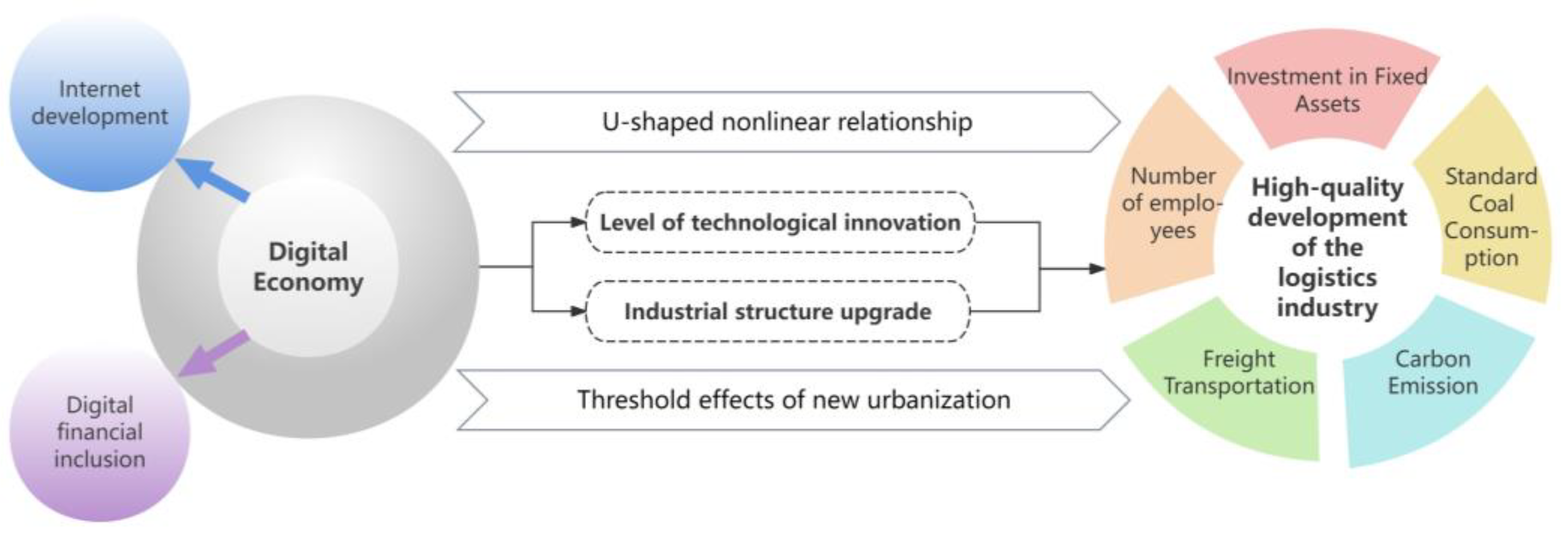
Based on the above assumptions and internal logic, the theoretical framework of the digital economy and high-quality development of the logistics industry is established as shown in Figure 1.

3. Research Design

3.1. Model Setting

In order to examine the direct effect of digital economy development on the high-quality development of the logistics industry, this paper constructs the model as follows:
L H Q i t = α 0 + α 1 D i g i t + γ 1 G o v i t + γ 2 F r i i t + γ 3 E c o i t + γ 4 E m p i t + γ 5 F u d i t + τ i + μ t + ε i t
To further verify the nonlinear correlation between the two, the digital economy squared term is included in the model, and the model is constructed as follows:
L H Q i t = β 0 + β 1 D i g i t + β 2 D i g 2 i t + γ 1 G o v i t + γ 2 F r i i t + γ 3 E c o i t + γ 4 E m p i t + γ 5 F u d i t + τ i + μ t + ε i t
Among them, L H Q i t is the level of high-quality development of the logistics industry, i denotes the province, t denotes the year, D i g i t is the core explanatory variable of this paper, representing the level of the digital economy in each region, α , β and γ are the parameters that need to be estimated, G o v i t , F r i i t , E c o i t , E m p i t , F u d i t is the text of the control variables, and τ i , μ t and ε i t represent the individual and time-fixed effects, and the random perturbation terms, respectively.
Drawing on Zhonglin Wen et al.’s human mediation effect three-step method, controlling statistical errors at the same time can be more robust and help in identifying the effect mechanism of the digital economy on the high-quality development of the logistics industry. The construction of the mediation effect model is as follows [37]:
Q i t = β 0 + β 1 D i g i t + β 2 D i g 2 i t + γ 1 G o v i t + γ 2 F r i i t + γ 3 E c o i t + γ 4 E m p i t + γ 5 F u d i t + τ i + μ t + ε i t
L H Q i t = β 0 + β 1 D i g i t + β 2 D i g 2 i t + β 3 Q i t + γ 1 G o v i t + γ 2 F r i i t + γ 3 E c o i t + γ 4 E m p i t + γ 5 F u d i t + τ i + μ t + ε i t
Q i t is the mediating variable, representing technological innovation and industrial structure upgrading, and other symbols have the same meaning as above.

3.2. Selection of Variables

3.2.1. Explained Variable

This section addresses the level of high-quality development of the logistics industry (LHQ). Drawing on existing studies [38,39,40], the input–output indicators are constructed as follows, as shown in Table 1: (1) the input indicators are the capital inputs, the labor inputs, and the amount of energy consumption in the logistics industry; (2) the output indicators are classified into desired and non-desired outputs; the amount of freight transported in the logistics industry is taken as the desired output, while the non-desired output indicator is the total amount of carbon emissions from energy consumption. In order to eliminate the influence of price changes, we deflate the selected fixed asset investment in the logistics industry and the output value of logistics industry indicators, with 2011 as the base period.
SBM (Slacks-based Measure) is a non-radial DEA model. However, since the efficiency value is limited to (0, 1), to address this limitation, the Super SBM model proposed by Tone is used in this paper [41]. In measuring the performance of the logistics industry, CO2 emissions need to be minimized as much as possible. Therefore, in this paper, the Super SBM model, which takes into account the undesired outputs, is used for the assessment from the perspective of the efficiency of the logistics industry.
Suppose there are n decision units with inputs and outputs X = x i o R mn , Y = y k 0 R s n , Z = z l 0 R p θ ,so that X > 0 and Y > 0 . The production possibility set is P = x , y | x X d , y Y d , d 0 , where d = λ 1 , λ 2 , . . . , λ n R n denotes the vector of weight coefficients, and the two inequalities in the P function represent the actual level of inputs that are greater than or less than the level of outputs at the frontier, respectively. The formula is as follow:
ρ = m i n 1 + 1 m i = 1 m S i x x i 0 1 1 S 1 + S 2 ( k = 1 S 1 S k y y k 0 + l = 1 S 2 S l z z l 0 ) s . t x i 0 j = 1 , 0 n λ j x j S i x , i ; y k 0 j = 1 , 0 n λ j y j S k y , k ; z l 0 j = 1 , 0 n λ j z j S l z , l ; 1 1 S 1 + S 2 k = 1 S 1 S k y y k 0 + l = 1 S 2 S l z z l 0 > 0 ; S i x 0 , S k y 0 , S l z 0 , λ j 0 ,   i , j , k , l ;
When ρ = 1, that is S x = 0 , S y = 0 and S z = 0 , it means the DMU is valid, but when ρ < 1, it means the DMU is not valid and there is room for improvement.
In this paper, the Super SBM model is used to measure the level of development of the provincial logistics industry. The symbol is denoted by LHQ and its expression is
L H Q = ρ i t , ρ i t < 1 ρ i t , ρ i t = 1
where ρ denotes the efficiency value, which indicates the high-quality development of the logistics industry, and the range of values of ρ is not limited by l. S X R m and S Z R S 2 denote the excess of inputs and non-desired outputs, respectively, and S y R S 1 denotes the shortage of desired outputs, while x , y , and z denote the numbers of variables of inputs, desired outputs, and non-desired outputs, respectively.

3.2.2. Explanatory Variable

Digital economy development level (Dig). In this paper, we refer to the study of Zhao Tao et al. to measure the level of digital economic development from the two aspects of Internet development and digital financial inclusion [42]. The main measurement indexes are shown in Table 2, and the data of the five indexes are standardized by the entropy weighting method and then downscaled; finally, we get the index of digital economic development.

3.2.3. Intermediate Variable

According to the analysis of previous literature, it is known that the digital economy mainly plays a role in the high-quality development of the logistics industry through the technological innovation of logistics enterprises and the upgrading of industrial structure. Therefore, the following mechanism variables are selected: the level of technological innovation (Tec) is expressed by the number of patent approvals at the end of the year; the level of industrial structure upgrading (Gra) is expressed by the ratio of the output value of the tertiary industry to the total output value of GDP in China.

3.2.4. Threshold Variable

This paper takes new urbanization as the threshold variable for in-depth analysis, and its main measurement indexes are shown in Table 3, the index data can be standardized through the principal component analysis method, which can eliminate the influence of the quantitative outline, and then carry out the dimensionality reduction processing, and finally derive the new urbanization index.

3.2.5. Control Variable

Drawing on existing studies, and also considering that these factors may have an impact on the level of high-quality development of the logistics industry, a series of control variables are used in this paper [2,43,44,45], including the level of economic policy (Gov) expressed in terms of the ratio of the general public budget expenditure of the local financial sector to GDP; the level of economic development (Eco) expressed as the natural logarithm of per capita GDP; the level of regional employment (Emp), with the ratio of the number of people employed in the regional logistics industry to the total number of people in the region; the level of foreign investment (Fri), with the logarithm of China’s foreign investment at the end of the actual investment, in which foreign exchange rates are converted according to the current year’s exchange rate of RMB to the USD. The level of transportation infrastructure (Fud) is expressed as the ratio of the area of completed roads to the total area of the province at the end of the year.

3.3. Data Sources and Descriptive Statistics

Considering the availability of data, and at the same time ensuring the time validity of the data, this paper adopts the panel data of 30 provinces in China from 2011 to 2022 as the sample for analysis. Tibet, Hong Kong, and Taiwan are not included in this paper due to the serious lack of data. The data used in this paper are mainly from the China Energy Statistics Yearbook, China Statistics Yearbook, China Carbon Accounting Database, Cathay Pacific, and provincial statistical yearbooks. For the small number of missing values in the sample, this study used the linear interpolation method, the proximate annual mean method, and the regional almanac patch to deal with the patch, while all control variables were standardized by the extreme value method in order to eliminate the error caused by the size difference. Descriptive statistics of the variables are shown in Table 4.

4. Empirical Results and Analysis

4.1. Baseline Analysis

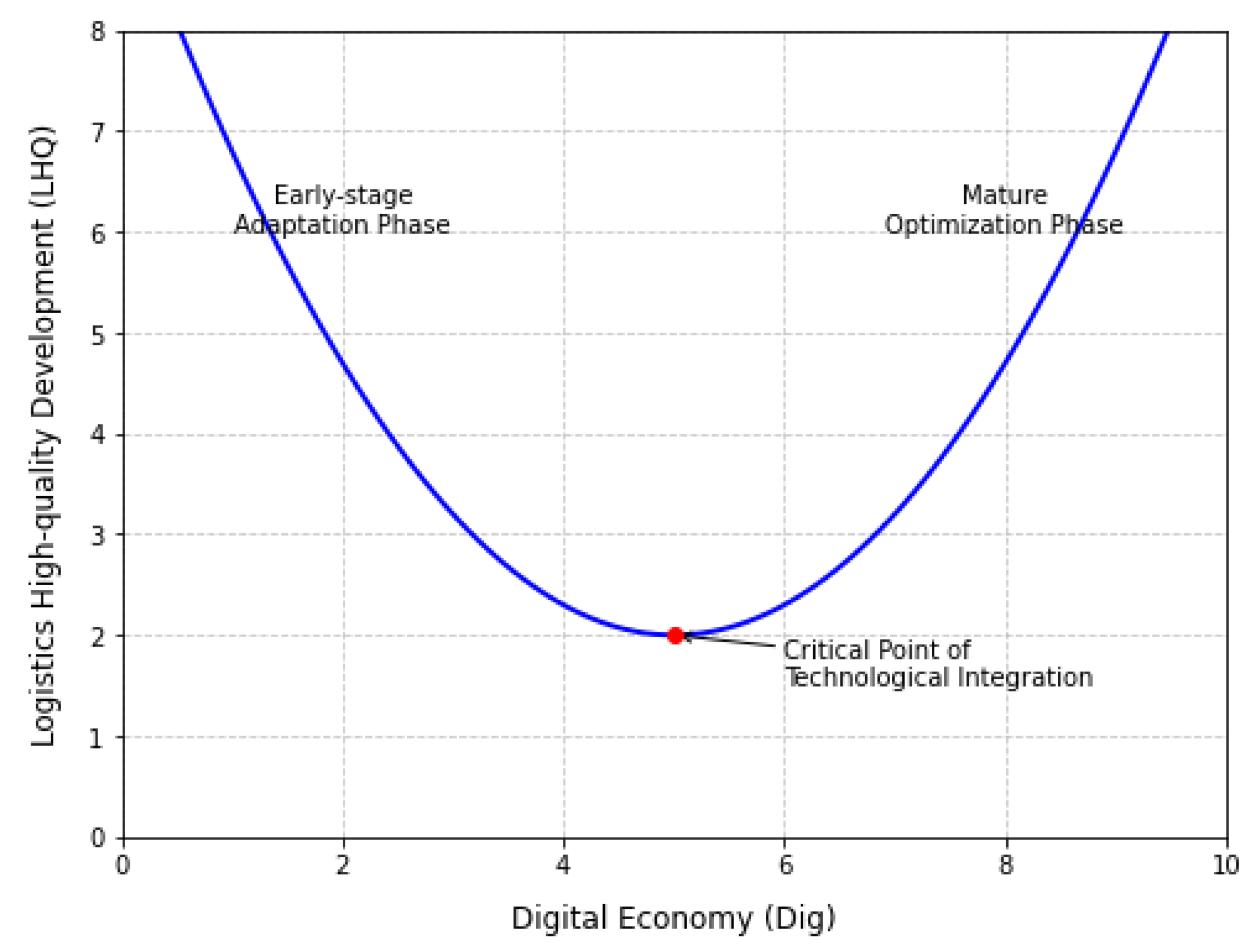
Fixed-effects models can enable a more accurate estimation of the net effect of the core explanatory variables on the explanatory variables by eliminating the unobservable heterogeneity of individuals that does not vary over time, especially when these non-observables are correlated with the explanatory variables. This paper rejects the original hypothesis of the random effects model by the Hausman test (p < 0.01) and supports the use of the fixed effects model. To control for macroeconomic results and individual differences, this paper uses a fixed effects model regression. As shown in Table 5, the primary term regression results in Column (1) show that the correlation between the digital economy and the high-quality development of the logistics industry is negative, which is not in line with the results required for this paper’s research. Therefore, it is necessary to consider the nonlinear relationship between the two. Columns (3) and (4) show the results after adding the square term of the digital economy, and it can be seen that the coefficient of the square term of the digital economy is positive at a significant level of 5%, which indicates that there is a positive U-shaped relationship between the digital economy and the high-quality development of the logistics industry that is inhibited first and then promoted, i.e., if the digital economy, as a new mode of economic growth, is integrated into the logistics industry, it will promote the development of the logistics industry, which can be seen in Figure 2. With the development of the digital economy, and the logistics industry sees a strong agglomeration of industries, it will cause the industrial structure to undergo irrational intensification, which will lead to a decline in the level of high-quality development of the logistics industry. With the entry of domestic and foreign capital, the increase in management experience and the results of technological innovation will gradually lead to the improvement of enterprise factor production efficiency and industrial structure upgrading; logistics enterprises will develop to become more green, coordinated, and sustainable, thus showing the long tail effect and promoting the development of the logistics industry towards the high-quality level. Comparing the regression results of column (3) and column (4), it can be seen that the coefficient of the quadratic term decreases from 2.297 to 2.153, and the inflection point value of the positive U-shape changes very little after joining the control variables, which indicates that its influence on the inflection point is very small.
From the regression results in column (4), we can see that the coefficients of economic policy and infrastructure are statistically significant. This indicates that economic policies are not effective in improving the high-quality development of the logistics industry in the current sample, which may be related to the lagged impact of policies. The reason for the significant level of economic development and infrastructure may be that the logistics industry is transportation-based and engaged in cross-regional transportation economic activities, with relatively low dependence on the level of local economic development. Better infrastructure will, to a certain extent, accelerate the volume of transportation and warehousing, and an increase in the volume of transportation will lead to an increase in the income of the logistics industry. The coefficient of foreign investment shows a non-significant negative correlation.

4.2. Robustness Test

To improve the robustness of the estimation results, this paper carries out the following robustness tests, the specific results of which are shown in Table 6. Firstly, the explanatory variables are replaced, the digital economy is replaced by the development of digital finance [46], and then the digital economy development index is obtained through the principal component analysis, which is recorded as Dige. The results are shown in column (1) in Table 6, which shows that the coefficient of the squared term of the digital economy is still significantly negative, which suggests that after replacing the explanatory variables, the digital economy will still show a positive U-type correlation with the high-quality development of the logistics industry. Second, this paper sets up a reduced-tail treatment for all variables outside the 1–99% range; from columns (2) and (3), it can be seen that the coefficients of the reduced-tailed primary and secondary terms have the same sign as those of the original regression results and are all significant at the 5% level of significance, thus proving the robustness of the results. Thirdly, the Malmquist efficiency index is used to replace the explanatory variables [47]. The Malmquist Efficiency Index is a dynamic efficiency evaluation method based on data envelopment analysis that utilizes the ratio of distance functions to quantify the degree of efficiency improvement [48]. The results are detailed in column (4) and column (5) of Table 6, which again proves the conjecture of this paper that the digital economy presents an opposite effect on the high-quality development of the logistics industry at a low level, and that with improvements in the level of the digital economy, the gradual rationalization of the industrial structure and the narrowing of the gap in the digital divide will have a positive effect on the high-quality development of the logistics industry.

4.3. Endogeneity Test

The endogeneity problem that arises in the model will cause bias in the empirical evidence; to mitigate the endogeneity of the sample period, using the method of Qunhui Huang et al. [49], the number of telephones in 1984 and the broadband access subscribers in the previous year of the sample period are introduced, and the result of multiplying the two is used as an instrumental variable of the model to overcome the endogeneity problem. The results, as shown in Table 7, show that the squared term of the digital economy’s development is significantly negatively correlated with the high-quality development of the logistics industry at the 5% level, indicating that the association between the digital economy and the high-quality development of the logistics industry is sufficiently strong, and the result of the exclusivity test F = 68.36 is smaller than the critical value at the 5% confidence level and greater than 10 in statistical significance, which means that the selected instrumental variables are not weakly correlated and satisfy the assumption of homogeneity. Therefore, the instrumental variables constructed in this paper satisfy the assumptions of correlation and exogeneity and can be used for the statistical analysis of endogeneity issues. That is, there is a positive U-shaped relationship between the digital economy and the high-quality development of the logistics industry, which reconfirms the reliability of the regression conclusions in the previous paper.

4.4. Heterogeneity Analysis

4.4.1. Regional Heterogeneity

Considering the heterogeneity of the level of development of the digital economy and the status of high-quality development of the logistics industry at different stages of economic development and regional endowments, this paper explores the relationship between the digital economy and the high-quality development of the logistics industry from the perspectives of the level of economic development and location. The results of the study are shown in Table 8. Columns (1), (2), and (3) refer to the provinces divided into east, central, and west according to geographic location, respectively, and the regression results show that the east and the central regions show a negative correlation, but the coefficients show that the negative correlation coefficients in the east are much smaller than those in the central region. This may be because the development of the digital economy in the eastern region has entered a mature stage, where the substitution effect of digital technology on the traditional logistics model temporarily exceeds the synergy effect, the infrastructure is more complete and the degree of digitalization clustering is relatively high, and it is thus logical to cross the pole in advance to yield positive utility in the logistics industry. However, because the total factor productivity in the eastern region that is required to improve the space is relatively small, the level of digitization polarization is serious, and in the logistics industry there is a relative lag, and such the eastern region as a whole shows a negative correlation; in the central region, the level of digitization is gradually improving, but the overall trend in the tendency towards uneven deterioration will widen the gap of digitization between the regions [50], triggering a digital divide and irrational industrial structure, and negatively affecting the high-quality development of the logistics industry. The West shows the opposite trend to the East; being in the primary stage, the digital economy in the Western region can significantly improve the total factor productivity of the logistics industry, and the West has more room for improvement [51]; further, differentiated camps between the regions have not yet been formed, and so the integration of the digital economy in the western region at the beginning of the integration of the digital economy shows a positive effect on the high-quality development of the logistics industry.

4.4.2. Economic Development Heterogeneity

Columns (4) and (5) are categorized into economically developed regions and economically underdeveloped regions. Compared with economically developed regions, economically underdeveloped regions show a U-shaped correlation; economically underdeveloped regions have imperfect infrastructure, with digitalization that started late and at a low level, and blind digital transformation will not only squeeze the resources of enterprises, but will also give rise to the digital divide and irrational industrial structure, which will have a counterproductive effect on the development of the logistics industry. In economically developed regions, due to the earlier start of digitization, the infrastructure and logistics industry agglomeration level is higher, and the different degrees of digitalization between regions will form competition that will gradually intensify due to the lateness of the state in introducing corresponding regional coordination policies, along with the improvement of regional digital infrastructure, data centers and the construction of technology centers [52]. For the logistics industry, the universality of data technology will provide opportunities. These can accelerate the mitigation of adverse effects, although some regions enter a positive growth stage due to the existence of offsetting and compensating effects, the overall picture still features a negative effect on the high-quality development of the logistics industry.

4.5. Institutional Analysis

In order to further investigate the impact path of the digital economy, based on Equations (5) and (6), we introduce the mediating effect model, which is detailed in Table 9. In column (2) and column (4), it can be seen that the relationship between the digital economy and technological innovation shows a linear positive correlation and a U-shaped correlation with industrial structural upgrading. This may be because the digital economy relies on modernized data forms to improve the total factor productivity of production, distribution, warehousing, transportation, and distribution in the logistics industry [53], which reduces logistics costs and alleviates the financial pressure, promoting technological innovation. In the process of integration of the traditional logistics industry and the digital economy, it is necessary to establish a sound technical and industrial foundation in the early stage, which will increase the proportion of the secondary industry to a certain extent, which is not conducive to the upgrading of industrial structure. On the other hand, the progress of technology requires a large number of high-quality talents, and the cultivation of relevant talents requires a certain amount of time investment. With the rapid development of the digital economy, the advancement of related technologies and increases in talent, the positive impact of the digital economy on technological innovation and industrial structural upgrading will continue to appear. After a comparison of column (1), column (3), and column (5), we found that the coefficients of the primary and secondary terms of the level of high-quality development of the logistics industry have changed significantly. In column (3), after adding the mediating variable of technological innovation, the coefficient of the high-quality development of the logistics industry increased by 0.193, which may be because the digital economy promotes the upgrading of the industrial structure by promoting technological innovation and industrial integration [54], and further promotes the digital transformation of enterprises; through the digitization of the industry and digital industrialization, we can greatly improve the union between industries and solve the information asymmetry problem, thus promoting the high-quality development of the logistics industry. In column (5), after adding industrial structure upgrading, the coefficient of high-quality development of the logistics industry decreased by 0.745, which verifies hypothesis 2. After adding the mediating variables of technological innovation and industrial structural upgrading, the inflection point of the effect of the digital economy on the high-quality development of the logistics industry decreases from 0.92 to 0.87 and rises to 0.77, respectively. Development, either directly or indirectly through technological innovation and industrial structure, affects the high-quality development of the logistics industry to a certain extent.
Finally, the mediating effect was tested using the Bootstrap method and significant results were obtained. Specifically, this paper derived 1000 samples from the original sample base; we assessed 1000 samples each time via regression and mediation effect analysis, and obtained 1000 mediation effect values. Using these values, this paper calculates the confidence intervals for the mediating effects and finds that 95% of the confidence intervals are significant and do not contain zero, which implies that the mediating effects are significant and that industrial structure upgrading and technological innovation play important roles in mediating between the digital economy and high quality in the logistics industry. These results further confirm the research hypothesis of this paper, which again proves that the digital economy can influence the high-quality development of the logistics industry through technological innovation and industrial structural upgrading.

4.6. Further Analysis: A Test of the Threshold Effect of New Urbanization

To further test the impact of the digital economy on the high-quality development of the logistics industry under different levels of new urbanization, this paper takes the median of new urbanization, 0.592, as the dividing line, divides the urbanization levels of 30 provinces into high-level and low-level areas, and analyzes the specific effects of the high and low levels of urbanization development on the high-quality development of the logistics industry as induced by the digital economy. To ensure the robustness of the results, 5% before and after the sample is here excluded. The results, as shown in Table 10, show that the digital economy has an overall negative effect on the high-quality development of the logistics industry. However, the digital economy in areas with high levels of urbanization presents a promotional effect on the high-quality development of the logistics industry at a significant level of 5%; the digital economy in areas with low levels of urbanization presents a negative effect on the high-quality development of the logistics industry at a significant level of 1%. This verifies hypothesis 3. The new urbanization that has developed rapidly since the pilot in 2014 has impacted the regional coordination policy, with an increase in the urban population and the expansion of the town scale across the country, and leading to the integration of infrastructure and the equalization of public services, rendering these areas more ready to undertake digitization and attract enterprises to move in.

5. Conclusions and Policy Recommendations

5.1. Research Conclusion

Studying how the digital economy can improve the quality and healthy development of the logistics industry as a whole is an important issue in relation to contemporary sustainable economic development. Based on an empirical study of China’s 2011–2022 provincial panel data, this paper draws the following conclusions:
Firstly, we find a positive U-shaped correlation between the digital economy and the high-quality development of the logistics industry, i.e., the development of the digital economy in the early stage will hurt the high-quality development of the logistics industry, and when the digital economy develops to a certain stage, this will positively promote the high-quality development of the logistics industry. Secondly, the heterogeneity test shows that economically developed regions and eastern regions will show positive development in their logistics industry due to the higher level of digital economic development and the concentration of the logistics industry, but the overall positive development of the logistics industry will be hindered here by the obvious gap in the digital development of the region and the gradual intensification of the competitive situation; the central region is impacted by the intensification of digital imbalance. We also ought to address the causes of the digital divide and the irrational industrial structure. The western region is impacted by the digitalization of the logistics industry. The primary stage of digitization will improve the efficiency of factor allocation in logistics enterprises and has not formed differentiated camps, which will improve the development of the logistics industry to a certain extent. Thirdly, through its influence mechanisms, the digital economy can not only directly affect the development of the logistics industry, but also indirectly have an influence on the high-quality development of the logistics industry through technological innovation and industrial structure upgrading, and under the mechanism of technological innovation and industrial structure upgrading, the digital economy will have an effect of promoting the high-quality development of the logistics industry. Through an analysis of regions with different levels of new urbanization, it is found that in regions with higher levels, the digital economy shows a facilitating effect on the level of development of the logistics industry.

5.2. Policy Suggestion

The policy implications derived from the aforementioned conclusions are as follows.
Firstly, the implementation of a differentiated digital investment strategy must be enacted to grasp the opportunity represented by the U-shaped curve inflection point. Given the positive U-shaped relationship between the digital economy and the development of the logistics industry, local governments should establish a digital economy development monitoring system, and prioritize the improvement of logistics digital infrastructure in regions that have not reached the critical level and have already crossed the inflection point of the region (such as in the eastern provinces), these being regions that need to focus on the promotion of the deep integration of digital technology and the traditional logistics industry, and the release of the transformation dividend. Secondly, we ought to build a “technology–industry” dual-wheel drive mechanism to strengthen the intermediary conduction effect. Based on the intermediary role of technological innovation and industrial structure upgrading, it is recommended to set up a special fund for the digital transformation of logistics, with targeted support for intelligent warehousing, path optimization algorithms, and other core technology research, along with the simultaneous implementation of the industrial chain digital transformation plan so as to ensure the collaborative innovation of enterprises’ supply chains, as well as giving tax credits to stimulate the intermediary variables in the conduction of efficacy. Thirdly, we must formulate a regional cooperative development program to crack the spatial heterogeneity constraints. Given the regional heterogeneity, the following can be declared: ① the eastern region should pilot the market-oriented reform of logistics data elements to limit the efficiency loss caused by the polarization of the digital level; ② the central provinces need to establish a compensation mechanism for digital resource allocation in order to curb the trend of imbalance deterioration; ③ the western region should, in order to increase the intensity of investment in the “digital new infrastructure”, set the urbanization rate of 0.592 as the threshold for the policy, and prioritize the deployment of smart logistics hubs in cities that have reached the standard. Fourthly, we ought to improve the digital–urban synergistic development system, and amplify the double empowerment effect. According to the threshold effect of new urbanization, it is recommended to incorporate the digital transformation of logistics parks into the urbanization assessment system, and implement the following measures in the city clusters exceeding the threshold: ① establish a cross-regional logistics data sharing platform; ② implement the “Digital Talent Settlement Project” to strengthen the support of human capital; ③ innovate the linkage mechanism between the urban land use index and the logistics digital inputs, such that a virtuous cycle of “promoting the city with numbers, and bringing the flow to the city” can be formed.

5.3. Discussion

This paper reveals the complex dynamic relationship between the digital economy and the high-quality development of the logistics industry, and its core findings provide a new theoretical perspective for understanding digital technology-driven industrial transformation. In terms of the formation mechanism of the U-shaped relationship, the inhibitory effect of the digital economy on the logistics industry at the initial stage may stem from two key contradictions. First is the mismatch between the high sunk cost of digital infrastructure construction and the short-term benefits, which is particularly significant at the initial stage of the digital transformation of logistics enterprises. Second is the time lag between the speed of technological diffusion and the enhancement of organizational capabilities, whereby economies of scale are only apparent when the digital penetration of the enterprise exceeds a certain level. When the critical point is crossed, the network externalities and learning curve effects of digital technology begin to dominate, forming a positive cycle of increasing marginal returns. The deep root of regional heterogeneity lies in the structural differences in factor endowment; although the eastern region has technological advantages, it entered the technological substitution stage too early. For example, the substitution of traditional transportation with automated driving has led to the burden of employment restructuring, while the central and western regions are still in the stage of technological complementation. Further, it is easier for digital technology to synergize with traditional logistics modes; for example, the integration mode of Zhengzhou Air Port’s “Digital+Cross-border Logistics”. The main contribution of this paper is to provide policymakers with a theoretical framework for the high-quality development of the digital economy and the logistics industry, and to provide empirical evidence from China for developing countries or emerging countries enacting new digital strategies, which is of great significance for the high-quality development of the global digital economy.
However, due to the difficulty of data collection, this paper references several directions that will be worth exploring further, as follows: ① This paper only analyzes the impact of the digital economy on the high-quality development of the logistics industry from a macro perspective. Future research can further focus on the micro business perspective, and the in-depth exploration of the digital economy on the micro level of the logistics industry’s high-quality development for a specific role and operation mechanism. ② Focusing the research on other specific industries, such as manufacturing, agriculture, or services, can offer deeper analyses of the specific role of the digital economy in the high-quality development of various industries and the mechanisms of influence, and provide more targeted strategic recommendations for the industry’s high-quality and sustainable development. ③ We should study the impact of the current policy and economic environment on the relationship between the digital economy and the high-quality development of the logistics industry. This will provide enterprises with development suggestions in line with international standards. ④ We should also further analyze the specific differences in the impacts of the digital economy on the high-quality development of the logistics industries in different geographic places (e.g., cities, urban agglomerations, provinces, and regions) so as to provide international perspectives and empirical evidence related to the sustainable development of the logistics industry.


Author Contributions

Conceptualization, X.Z.; methodology, J.D.; software, J.D.; validation, X.Z.; formal analysis, X.Z.; investigation, X.Z.; resources, X.Z.; data curation, X.Z.; writing—original draft preparation, X.Z.; writing—review and editing, X.W.; visualization, J.D.; supervision, X.W.; project administration, X.W.; funding acquisition, X.Z. All authors have read and agreed to the published version of the manuscript.

Funding

This research was funded by “Data Security Governance Key Technology Research and Application Project” of Science and Technology of Jiangxi Province, grant number 20224BBC41001.

Institutional Review Board Statement

Not applicable.

Informed Consent Statement

Not applicable.

Data Availability Statement

The data presented in this study are available on request from the first author.

Conflicts of Interest

The authors declare no conflicts of interest.

References

  1. Ding, C.; Liu, C.; Zheng, C.; Li, F. Digital economy, technological innovation and high-quality economic development: Based on spatial effect and mediation effect. Sustainability 2021, 14, 216. [Google Scholar] [CrossRef]
  2. Wu, X.L. Research on high-quality development of logistics industry in the era of digital economy. J. Commer. Econ. 2022, 41, 134–136. [Google Scholar]
  3. He, L.M. China’s logistics industry development review in 2022 and outlook for 2023. China Bus. Mark. 2023, 37, 3–7. [Google Scholar]
  4. Tang, C.S.; Veelenturf, L.P. The strategic role of logistics in the industry 4.0 era. Transp. Res. Part E Logist. Transp. Rev. 2019, 129, 1–11. [Google Scholar] [CrossRef]
  5. Yang, P.; Zhang, Y.; Yin, Y. Research Investigating the Influence of the Digital Economy on the High-Quality Advancement of New Urbanization in the Yellow River Basin. Sustainability 2024, 16, 5887. [Google Scholar] [CrossRef]
  6. Su, L.; Fan, J.; Fu, L. Exploration of smart city construction under new urbanization: A case study of Jinzhou-Huludao Coastal Area. Sustain. Comput. Inform. Syst. 2020, 27, 100403. [Google Scholar] [CrossRef]
  7. Yang, P.Q. Correlation Analysis of Development Goals and Power Mechanisms of New Urbanization in Western Region. J. Northwest Univ. Philos. Soc. Sci. Ed. 2020, 50, 139–149. [Google Scholar]
  8. Xu, H.; Lian, R.; Niu, K.; Wei, S. Does the digital economy promote the high–quality development of urban–rural integration? experience analysis based on panel data of 30 provinces in China. Environ. Dev. Sustain. 2024, 1–26. [Google Scholar] [CrossRef]
  9. Wang, S.P.; Teng, T.W.; Xia, Q.F.; Bao, H. Spatial and temporal characteristics of China’s digital economy development level and its innovation driving mechanism. Econ. Geogr. 2022, 42, 33–43. [Google Scholar]
  10. Cai, F.; Chen, X.H.; Zhang, J.; Li, X.S.; Hong, J.J.; Zhang, K.; Lu, M. Research and Interpretation of the Spirit of the Fifth Plenary Session of the 19th CPC Central Committee Pen Talk. China Ind. Econ. 2020, 12, 5–27. [Google Scholar]
  11. Chen, X.F.; Yao, S.M.; Zhan, L.C. Theoretical and Practical Issues of China’s Urban-Rural Integration in the Context of New Urbanization. Geogr. Sci. 2016, 36, 188–195. [Google Scholar]
  12. Wu, Y.; Ni, W.H. Empirical Study on the Coupling Development Efficiency of New Urbanization and Logistics Industry. J. Commer. Econ. 2020, 15, 98–101. [Google Scholar]
  13. Guan, H.; Guo, B.; Zhang, J. Study on the impact of the digital economy on the upgrading of industrial structures—Empirical analysis based on cities in China. Sustainability 2022, 14, 11378. [Google Scholar] [CrossRef]
  14. Luo, S.; Yimamu, N.; Li, Y.; Wu, H.; Irfan, M.; Hao, Y. Digitalization and sustainable development: How could digital economy development improve green innovation in China? Bus. Strategy Environ. 2023, 32, 1847–1871. [Google Scholar] [CrossRef]
  15. Zhang, J.; Liu, H.; Wang, J.; Huang, Q. Spatial impact of the digital economy on low-carbon logistics efficiency in RCEP countries. J. Environ. Manag. 2024, 360, 121221. [Google Scholar] [CrossRef]
  16. Shoaib, M.; Zhang, S.; Ali, H.; Ahmad, M.S.; Khan, M.A. Integrating circular economy while adopting digital twin for enhancing logistics efficiency: A hybrid Fuzzy Delphi-FUCOM based approach. Int. J. Logist. Res. Appl. 2025, 1–43. [Google Scholar] [CrossRef]
  17. Huang, Y.C.; Gong, S.J.; Zou, C.; Jia, L.; Xu, Z.F. Digital economy, factor allocation efficiency and integrated urban-rural development. China Population. Resour. Environ. 2022, 32, 77–87. [Google Scholar]
  18. Gao, Z. City Logistics Efficiency and Its Spatial Spillover Effect—Taking Henan Province as an Example. Urban Probl. 2014, 7, 62–68. [Google Scholar]
  19. Liu, Z.; Xin, Z.; Guo, C.; Zhao, Y. An Analysis Method of System Coupling and Spatio-Temporal Evolution of County New Urbanization and Logistics Industry. Systems 2024, 12, 185. [Google Scholar] [CrossRef]
  20. Yan, S.B. Evaluation of the Coordinated Development of Modern Logistics and New Urbanization in Fujian. J. Commer. Econ. 2017, 2, 107–109. [Google Scholar]
  21. Tang, Y.; Yang, Z.; Yao, J.; Li, X.; Chen, X. Carbon emission efficiency and spatially linked network structure of China’s logistics industry. Front. Environ. Sci. 2022, 10, 1004463. [Google Scholar] [CrossRef]
  22. Li, X.Z.; Wu, J.X. Regional differences in the transformation and upgrading of industrial structure driven by the digital economy. J. Int. Econ. Coop. 2020, 36, 81–91. [Google Scholar]
  23. Wang, Y.F.; Hou, N.S.Q.; Yao, K. Impact of the digital economy on the transformation and upgrading of China’s industrial structure. J. Commer. Econ. 2022, 41, 185–188. [Google Scholar]
  24. Helo, P.; Thai, V.V. Logistics 4.0–digital transformation with smart connected tracking and tracing devices. Int. J. Prod. Econ. 2024, 275, 109336. [Google Scholar] [CrossRef]
  25. Liu, Y.Q.; Liu, S.; Shao, X.Y.; He, Y.Q. Policy spillover effect and action mechanism for environmental rights trading on green innovation: Evidence from China’s carbon emissions trading policy. Renew. Sustain. Energy Rev. 2022, 153, 111779. [Google Scholar] [CrossRef]
  26. Nie, P.Y.; Wang, C.; Lin, L.K. Cooperation of firms yielding industrial clusters. Area 2020, 52, 731–740. [Google Scholar] [CrossRef]
  27. Liu, Y.; Yang, Y.; Li, H.; Zhong, K. Digital economy development, industrial structure upgrading and green total factor productivity: Empirical evidence from China’s cities. Int. J. Environ. Res. Public Health 2022, 19, 2414. [Google Scholar] [CrossRef]
  28. Du, P.; Lou, F. Research on the Impact of Digital Economy Development on the Optimization and Upgrading of Industrial Structure. J. Commer. Econ. 2022, 41, 185–188. [Google Scholar]
  29. Florida, R.; Adler, P.; Mellander, C. The city as innovation machine. Reg. Stud. 2017, 51, 86–96. [Google Scholar] [CrossRef]
  30. Irmen, A.; Tabakovic, A. Factor income distribution and endogenous economic growth: Piketty meets Romer. Econ. Inq. 2020, 58, 1342–1361. [Google Scholar] [CrossRef]
  31. Lin, Y.J.; Yang, C.; Cai, X. Digital Transformation of Enterprises and Upgrading of Green Innovation Capability—An Analysis Based on Network Effects. Mod. Financ. Econ. 2023, 43, 3–19. [Google Scholar]
  32. Liu, X.Z.; Zhu, S.Y.; Zhou, H.M. Can Digital Economy Development in the Yangtze River Economic Belt Promote Regional Green Innovation? Study Pract. 2022, 10, 21–29. [Google Scholar]
  33. Wei, S.W.; Du, J.M.; Pan, S. How the Digital Economy Promotes Green Innovation—Empirical Evidence from Chinese Cities. Collect. Essays Financ. Econ. 2022, 38, 10–20. [Google Scholar]
  34. Ding, B.; Duan, Y.Y. Research on the Relationship between the Development of China’s Logistics Industry and New Urbanization. Stat. Decis. 2017, 16, 56–59. [Google Scholar]
  35. Wu, B.; Yin, J.; Bai, H.Z.; Liu, T.; Shao, M.H. Measurement on Interaction between Regional Logistics and New Urbanization. J. Highw. Transp. Res. Dev. 2022, 39, 160–166+182. [Google Scholar]
  36. Hao, X.; Li, Y.; Ren, S.; Wu, H.; Hao, Y. The role of digitalization on green economic growth: Does industrial structure optimization and green innovation matter? J. Environ. Manag. 2023, 325, 116504. [Google Scholar] [CrossRef]
  37. Wen, Z.L.; Ye, B.J. Mediation effects analysis: Methodology and model development. Adv. Psychol. Sci. 2014, 22, 731–745. [Google Scholar] [CrossRef]
  38. Cao, Y.C.; Li, T.; Lin, H.N. The Path to Realize High-Quality Development of China’s Regional Logistics Industry—An Empirical Analysis Based on 31 Provinces and Municipalities in China. Commer. Res. 2020, 65, 66–74. [Google Scholar]
  39. Li, J.; Wang, Q.M. Study on the Measurement of Development Quality and Balance of China’s Four Major Sectors of Logistics Industry—Based on the Perspective of Logistics Industry Efficiency. J. Stat. Inf. 2019, 34, 76–84. [Google Scholar]
  40. Cao, B.R.; Deng, L.J. Factors Influencing the Efficiency Growth of the Logistics Industry in the Yangtze River Economic Belt. Econ. Geogr. 2019, 39, 148–157. [Google Scholar]
  41. Tone, K. A slacks-based measure of super-efficiency in data envelopment analysis. Eur. J. Oper. Res. 2002, 143, 32–41. [Google Scholar] [CrossRef]
  42. Zhao, T.; Zhang, Z. Digital Economy, Entrepreneurial Activity and High-Quality Development—Empirical Evidence from Chinese Cities. J. Manag. World 2020, 36, 65–76. [Google Scholar]
  43. Luo, R.; Wang, Q.M. Study on Regional Differences and Spatial Convergence in the Level of High-Quality Development of Digital Logistics. Stat. Decis. 2022, 38, 109–113. [Google Scholar]
  44. Lu, Y.H. The Impact of Digital Economy Development on Logistics Efficiency Improvement—An Analysis Based on Transaction Costs. J. Commer. Econ. 2021, 40, 99–103. [Google Scholar]
  45. Jiang, S.L.; Zhang, Z. Digital Economy Development and Industrial Upgrading of Logistics Industry—A Test Based on Innovation Mechanisms. J. Commer. Econ. 2020, 39, 84–87. [Google Scholar]
  46. Guo, F.; Wang, J.Y.; Wang, F.; Kong, T.; Zhang, X.; Cheng, Z.Y. Measuring the Development of Digital Inclusive Finance in China: Indexing and Spatial Characterization. China Econ. Q. 2020, 19, 1401–1418. [Google Scholar]
  47. Zhang, L.G.; Li, D.; Zhou, D.Q. Dynamic Changes and Regional Differences in Carbon Dioxide Emission Performance of China’s Logistics Industry: An Empirical Analysis Based on Provincial Panel Data. Syst. Eng. 2013, 31, 95–102. [Google Scholar]
  48. Yang, H.; Wang, X.; Bin, P. Agriculture carbon-emission reduction and changing factors behind agricultural eco-efficiency growth in China. J. Clean. Prod. 2022, 334, 130193. [Google Scholar] [CrossRef]
  49. Huang, Q.H.; Yu, Y.Z.; Zhang, S.L. Internet Development and Productivity Growth in Manufacturing Industry: Internal Mechanism and China Experiences. China Ind. Econ. 2019, 8, 5–23. [Google Scholar]
  50. Han, Z.A.; Zhao, J.F.; Wu, H.Z. A Study on Measuring the Size of China’s Interprovincial Digital Economy, Non-equilibrium and Regional Differences. J. Quant. Technol. Econ. 2021, 38, 164–181. [Google Scholar]
  51. Yang, H.M.; Jiang, L. The digital economy, spatial effects and total factor productivity. Stat. Res. 2021, 38, 3–15. [Google Scholar]
  52. Wang, K.K.; Wu, G.B.; Zhang, G.J. Has the development of the digital economy improved productivity? Economis 2020, 10, 24–34. [Google Scholar]
  53. Zhang, L.J.; Ma, L.P. Digital economy, industrial structure upgrading and total factor productivity. Stat. Decis. 2022, 38, 5–10. [Google Scholar]
  54. Qin, J.Q.; Zhao, J.J.; Wang, W. Mediating effects and empirical evidence on the impact of digital economy on industrial structure upgrading. Stat. Decis. 2022, 38, 99–103. [Google Scholar]
Figure 1. Theoretical framework diagram.
Sustainability 18 00008 g001
Figure 2. The U-shaped relationship between the digital economy and the high-quality development of the logistics industry.


Sustainability 18 00008 g002
Table 1. Descriptive statistics of variables.
Basic IndicatorsMetricsQuantitative IndicatorsUnit
Input indicatorsCapital investmentInvestment in fixed assets in the logistics industryBillions
Labor inputNumber of employees in the logistics industryAll the people
Energy inputsStandard coal consumption in the logistics sectorTons of standard coal
Output indicatorsExpected outputsVolume of freight transported by the logistics industryTons
Non-expected outputsCarbon footprintTons
Table 2. Key measures of the digital economy.
Primary IndicatorsSecondary IndicatorsTertiary IndicatorsAffectWeights
Digital economyDegree of Internet developmentInternet broadband subscribers/100 people+0.0766
Number of people working on the InternetShare of computer and software personnel in the urban working population+0.3148
Number of Internet outputsTelecommunications services per capita+0.4322
Number of mobile subscriberscell phone use/100 people+0.0852
Digital Inclusive FinanceDigital Inclusive Finance Development Index+0.0912
Note: “+” indicates a positive attribute for the indicator.
Table 3. Key measures of new urbanization.
Level 1 IndicatorsSecondary IndicatorsTertiary IndicatorsAffectWeights
New UrbanizationUrbanization of populationPercentage of urban population+0.0570
Urban population density+0.0833
Share of secondary and tertiary employment+0.0111
Economic urbanizationGDP per capita+0.0909
Regional GDP growth rate+0.0104
Urban disposable income per capita+0.1007
Social urbanizationBuilt-up road area per capita+0.0392
Electricity consumption per capita+0.0742
Per capita expenditure on education+0.0709
Ecological urbanizationforest cover+0.0959
Percentage of wetland area+0.27636
Non-hazardous treatment rate of domestic waste+0.0900
Note: “+” indicates a positive attribute for the indicator.
Table 4. Descriptive statistics.
Variable SymbolVariable NameSample SizeAverage ValueUpper QuartileStandard DeviationMinimum ValueMaximum Values
LHQHigh quality level of the logistics industry3600.6200.6110.07700.4920.958
Digdigital economy3600.2150.1740.1560.01701.494
GovEconomic policy3600.001000.001000.00100−0.003000.0100
FriForeign investment3600.2440.2230.1010.09400.643
EcoLevel of economic development36014.9415.452.6165.61919.04
EmpEmployment level36010.9310.830.6258.95614.54
FudLevel of infrastructure3600.2900.1410.3950.002001.969
Table 5. Benchmark regression results.
High-Quality Development of the Logistics Industry
(1)(2)(3)(4)
Dig−0.808 ***−0.519 **−4.762 ***−4.238 ***
(−5.6094)(−2.8174)(−4.5983)(−3.9990)
Dig2 2.297 ***2.153 ***
(3.9418)(3.7360)
Gov 0.222 *** 0.121
(4.6927) (1.6740)
Fri −0.001 0.000
(−0.5628) (0.1842)
Fud −0.091 ** −0.122 ***
(−2.4504) (−4.3929)
Emp 11.096 ** 11.786 **
(2.6285) (2.7046)
Eco −0.038 *** −0.036 ***
(−3.5888) (−3.3150)
Constant term0.628 ***0.861 ***2.193 ***2.303 ***
(6.5011)(4.8092)(5.1528)(4.8307)
Fixed timebebebebe
Area fixedbebebebe
Sample size360360360360
R20.8000.8040.8080.810
Inflection point Value 0.950.92
F-value3.161.693.642.34
Note: ** p < 0.05, *** p < 0.01.
Table 6. Robustness test.
Entropy Value (1)Reduction of Tail (2)Reduction of Tail (3)(4) M Index(5) M Index
Dig−0.789 ***−0.650 **−3.921 ***−2.169 ***−10.966 ***
(−5.7773)(−2.9528)(−3.5549)(−8.2888)(−13.059)
Dig20.529 *** 2.083 *** 6.298 ***
(4.1054) (3.3212) (10.587)
Control variablecontainmentcontainmentcontainmentcontainmentcontainment
Constant term0.607 ***1.029 ***2.161 ***2.170 ***5.048 ***
(4.3244)(4.8284)(4.3728)(15.7454)(18.1636)
Fixed timebebebebebe
Area fixedbebebe
Sample size360360360360360
R20.8140.8470.8520.0350.046
Inflexion point 0.84 0.884 0.86
F-value0.771.752.381.922.25
Note: ** p < 0.05, *** p < 0.01.
Table 7. Endogeneity test results.
VariablesPhase IPhase II
Instrumental Variable0.980 ***
(42.86)
Dig 18.410 ***
(8.74)
Dig2−0.050 **−0.085 **
(−2.75)(−2.42)
Gov0.0011.391 ***
(0.13)(3.81)
Fri0.003 **0.481 ***
(2.25)(4.55)
Fud0.000 *0.000
(1.80)(0.83)
Emp−0.023 **4.343 ***
(−2.14)(4.30)
Eco0.0000.000 ***
(1.53)(10.68)
Constant term0.011 **5.402 ***
(2.36)(11.72)
Sample size360360
R20.8390.692
F68.36
Note: * p < 0.1, ** p < 0.05, *** p < 0.01.
Table 8. Analysis of regional heterogeneity.
East AreaCentral AreaWestern AreaEconomically Developed AreaEconomically Less Developed Area
(1)(2)(3)(4)(5)
Dig−0.701 ***−5.711 ***1.830 ***−0.708 ***−1.108 ***
(−12.97)(−8.651)(6.999)(−17.67)(−4.565)
Dig2 1.219 ***
(3.58)
Control variablecontainmentcontainmentcontainmentcontainmentcontainment
Constant term0.708 ***2.970 ***−0.396 **0.598 ***0.215 ***
(0.033)(0.333)(0.127)(0.019)(1.011)
Fixed timebebebebebe
Area fixedbebebebebe
Sample size13213296180180
R20.5630.5560.1000.2690.258
F-value4.632.041.052.130.59
Note: ** p < 0.05, *** p < 0.01.
Table 9. Mechanism effect results.
Variables(1) LC(2) Tec(3) LC(4) Gra(5) LC
Dig−4.238 ***−3.172 ***−4.045 ***5.960 ***−3.493 **
(−3.9990)(−3.6975)(−3.5522)(1.012)(1.174)
Dig22.153 *** 1.953 ** 1.988 **
(3.7360) (2.8229) (0.671)
Tec −0.104 ***
(−5.0785)
Gra −0.047 *
(0.025)
Control variablecontainmentcontainmentcontainmentcontainmentcontainment
Constant term 2.303 ***11.087 ***3.239 ***1.358 **2.173 ***
(4.8307)(11.1610)(5.2139)(0.574)(0.495)
Fixed timebebebebebe
Area fixedbebebebebe
Sample size360360360360360
(3.7360) (2.8229) (0.671)
R20.8100.9860.8660.9590.854
Inflexion point 0.92 0.87 0.77
F-value2.343.792.188.411.55
Bootstrap [0.1358933 0.6481817][−0.6561603 −0.0371012]
Note: * p < 0.1, ** p < 0.05, *** p < 0.01.
Table 10. Effect test for different levels of new urbanization.
Variable NameNationalLow Level of UrbanizationHigh Level of Urbanization
Dig−0.134 **−0.660 ***0.274 **
(−2.4539)(−3.8760)(2.7150)
Control variablecontainmentcontainmentcontainment
Constant term0.660 ***0.755 ***0.530 ***
(0.158)(0.264)(0.189)
Fixed effectbebebe
N342189153
R20.1880.1230.266
Note: ** p < 0.05, *** p < 0.01.
Disclaimer/Publisher’s Note: The statements, opinions and data contained in all publications are solely those of the individual author(s) and contributor(s) and not of MDPI and/or the editor(s). MDPI and/or the editor(s) disclaim responsibility for any injury to people or property resulting from any ideas, methods, instructions or products referred to in the content.