Systematic Review

Systematic Review for Urban Flood Disaster in Managerial Perspective: Forecasting, Assessment and Optimization

1
SILC Business School, Shanghai University, 20 Chengzhong Rd., Jiading, Shanghai 201800, China
2
The Digital Industry Group of Shanghai Urban Construction Corporation, Xuhui, Shanghai 200032, China
3
SHU-SUCG Research Centre for Building Industrialization, Shanghai University, Shanghai 201800, China
4
Business School, Sichuan University, Chengdu 610064, China
*
Author to whom correspondence should be addressed.
Sustainability 2026, 18(2), 1106; https://doi.org/10.3390/su18021106 (registering DOI)
Submission received: 4 November 2025 / Revised: 22 December 2025 / Accepted: 6 January 2026 / Published: 21 January 2026
(This article belongs to the Special Issue Advanced Studies in Sustainable Urban Planning and Urban Development)

Abstract

Urban flood disaster management is an interdisciplinary field that integrates hydrology, geology, engineering, and urban planning, with prediction, assessment, and optimization serving as its core components. However, a comprehensive and systematic synthesis of recent developments in this domain remains limited, constraining both theoretical understanding and practical advancement. To address this gap, this study conducts an in-depth analysis of urban flood management research as a systematic review, with a particular focus on advances in prediction, assessment, and optimization. Utilizing a multistep holistic review, combining bibliometric and scientometric analysis with structured literature categorization, the research critically examines and synthesizes relevant findings. This study analyzed 166 research papers related to urban flood management within the Web of Science database. Through co-citation and keyword co-occurrence analyses, five dominant research dimensions are identified: physics-based simulation methods, data-driven approaches, risk assessment tasks, optimization strategies, and miscellaneous emerging topics. Based on these insights, we propose a task-oriented framework that systematically integrates prediction, assessment and optimization across the four phases of disaster management: mitigation, prevention, emergency response and recovery. This framework aids scholars and practitioners in understanding and implementing effective techniques and strategies. The study’s findings shed light on key trends and potential future directions, providing a roadmap for further exploration of urban flood management and guiding professionals in related fields.

1. Introduction

The inundation of urban areas due to flooding has become a prevalent risk worldwide. In contrast to other natural hazards, floods exhibit a higher frequency of occurrence and inflict more substantial cumulative damage. From 2000 to 2019, a substantial body of global records indicates that 3254 flood events transpired, comprising 44% of the total disaster occurrences during this timeframe. These flood events had a profound impact, affecting approximately 1.65 billion people, resulting in an estimated 100,000 fatalities, and causing staggering economic losses estimated at around USD 6.51 trillion [1]. Urban centers function as dual hubs for population aggregation and infrastructure systems, demonstrating an intricate interconnection between their spatial configurations and socio-economic dynamics. Urban systems, composed of interconnected components such as transportation, water supply, energy, communication, and disaster resilience, are vulnerable to systemic disruptions when any single component fails [2]. Thus, urban systems exhibit heightened vulnerability when confronted with flood disasters.
According to the IPCC Sixth Assessment Report, anthropogenic climate change has already led to increases in the frequency and intensity of heavy precipitation in many regions, exacerbating flood risks in urban settings [3]. Complementarily, the UNDRR Global Assessment Report underscores the growing systemic risks and cascading impacts posed by urban floods, particularly in rapidly urbanizing areas [4]. Under typical circumstances, urban flood disasters are primarily attributed to two interrelated factors: rapid urbanization and the escalating impact of climate change [5]. Rapid urbanization frequently coincides with inadequate drainage systems and improper land use planning, which are key contributors to the high vulnerability of urban areas to flooding [6]. Global climate change increases the likelihood of cities experiencing flood disasters [2], including threats such as sea-level rise induced by the greenhouse effect, directly impacting coastal cities [7,8]. Extreme weather events lead to more frequent occurrences of heavy rainfall, localized precipitation, sudden onset, and unpredictability, ultimately resulting in river flooding [9], flash floods [10], and urban inundation [5,11,12,13]. Combined with high urban vulnerability and increased flood probability due to climate change, the risk of urban flood disasters is on the rise [14]. Consequently, effective urban flood disaster management has garnered widespread attention in academia [15].
Urban flood risk evaluation is a key task in urban flood disaster management [16]. Its purpose is to quantitatively and qualitatively assess the likelihood of floods and waterlogging disasters in cities, revealing potential sources of risk, the severity of hazards, and the possible impact areas [17]. Taking Fuzhou City (China) as an example, X. Wang et al. [18] constructed an urban waterlogging vulnerability evaluation system from three dimensions: exposure, sensitivity, and adaptive capacity. Yuan et al. [19] introduced the use of convolutional neural networks to predict high-resolution urban flood depths, enabling comprehensive evaluation of economic losses based on the attributes of flooded locations. Han et al. [20] presented travel times under ideal evacuation conditions to quantify evacuation vulnerability. Through urban flood risk evaluation, the level of flood risk in different regions and scenarios can be quantified, key prevention targets and defense areas can be identified, and scientific basis can be provided for decision-making in urban flood disaster management.
In order to reduce the risks of urban flood disasters, pre-disaster flood control measures are another significant research focus. Flood control measures in coastal cities typically include constructing seawalls, raising embankments, building breakwaters, and strengthening embankment slopes to withstand the onslaught of marine disasters such as tsunamis, storm surges, and tidal waves [7]. Cities along rivers need to consider building embankments, reinforcing river channels, planning flood process control zones, and installing floodgates [6,21]. Mountainous cities focus on preventive measures against geological disasters such as mountain floods and landslides, including building sediment barriers, setting up warning systems, and reinforcing mountainsides [22]. In flat areas, urban inundation occurs when heavy rainfall exceeds the performance of urban drainage systems. Corresponding flood control measures include building rain gardens, improving drainage systems, and enhancing urban greening [23,24]. However, further validation of the effectiveness of flood control measures involves research on urban flood simulation methods and evaluation index systems.
Urban flood simulation is the foundation of urban flood risk evaluation and flood control measures, as it can simulate future flooding to identify urban flood risk areas and validate the effectiveness of flood control measures such as levee construction, sponge city design, and drainage system design. However, urban flooding is a complex process involving rainfall, runoff, convergence, and watershed dynamics, making urban flood simulation a challenging and complex task [7]. Significant efforts have been made over the past few decades to improve the accuracy and efficiency of urban flood simulation models [25]. Schubert and Sanders [10] compared the accuracy and efficiency of building modeling methods including the building-resistance method, building-block method, building-hole method, and building-porosity method. Chen et al. [26] utilized a coupled rainfall water management model (SWMM) and shallow water model (SWM) to study the response of urban floods to rainfall patterns, aiming to avoid flood risks during urban design and planning stages, and mitigate risks during maintenance phases. Gallien et al. [7,8] used a nonlinear two-dimensional Godunov-type finite volume model of shallow water equations to simulate urban inundation considering wave action, aiming to determine wave protection and urban drainage network schemes.
Significant progress has been made in various aspects of urban flood generation, impact evaluation, and measures optimization. However, existing research mainly focuses on the study of single measures or methods for urban flooding, without fully integrating classical disaster management theories. There is a lack of clear elucidation of the interrelationships among the various elements of simulation, modeling, prediction, evaluation, and flood control scheme formulation in the methodology of urban flood disaster management. A systematic research framework for urban flood disaster management has not yet been established. This represents a significant gap in the current research landscape, necessitating in-depth analysis and exploration of the research framework for urban flood management. On the theoretical level, a systematic review on the interrelationships among various methods and processes form the foundation of establishing a more comprehensive theoretical framework for urban inundation emergency management. At a practical level, the comprehensive synthesis and integration of diverse methodologies and processes contribute significantly to the advancement of systematic, scientifically sound, and operationally efficient urban inundation emergency management. This, in turn, boosts the effectiveness of urban flood disaster prevention and control measures.
Urban flood management spans multiple disciplines including engineering, data science, planning, and environmental studies and encompasses highly heterogeneous types of research. Given the current research gaps, establishing a systematic research framework for urban flood disaster management has become the primary research question. This study systematically reviews existing literature in the field of urban flood disaster management to develop an integrated research framework. By combining scientometric analysis with thematic synthesis, the study identifies five key research dimensions, namely physics-based simulation methods, data-driven approaches, risk assessment tasks, optimization strategies, and miscellaneous emerging topics. This research aims to establish a task-oriented framework that connects prediction, evaluation, and optimization across all phases of the disaster management cycle. This framework systematically integrates forecasting, assessment and optimization across the four phases of disaster management—namely mitigation, prevention, emergency response and post-disaster recovery to provide actionable insights for future academic inquiry and practical applications. It serves as a reference for urban planners, policymakers, and emergency managers in designing more adaptive and resilient urban flood strategies.

2. Background of Urban Flooding Disaster Management

Despite significant improvements in humanity’s capacity to manage floods through economic and technological advancement, flood disasters have become increasingly catastrophic. It is evident that flood risk is not merely a hydrological or engineering issue, but rather a complex, interdisciplinary and cross-system challenge. In managing urban flooding disasters, the perspective must shift from traditional, singular engineering or technical approaches towards a holistic, dynamic flood risk management model involving multiple stakeholders [27].
Research on the management of various types of disasters has become mature and is mainly divided into three related concepts: the disaster management cycle, disaster operations management, and disaster risk management.
The disaster management cycle refers to dividing disasters into different stages [28], which remains the most widely referenced, with varying stage granularity across models—ranging from two-stage [29,30], four-stage [31], to six-stage frameworks [32]. These models generally divide disaster management into phases such as mitigation, preparedness, response, and recovery. While initially conceptualized as a linear or cyclical process, recent critiques argue that these phases often overlap in practice and operate concurrently [33,34].
Disaster operations management is defined by [35] as a series of activities carried out before, during, and after a disaster to prevent loss of life, minimize its impact on the economy, and restore normalcy. Disaster operations management can be seen as further research based on the disaster management cycle. Authors of [36,37] point out that the occurrence and impact of disasters are stochastic and independent, requiring dynamic, real-time, effective, and cost-efficient solutions, which belong to the research field of management and operations research.
Disaster risk management similarly developed based on the disaster management cycle, and it was not until the 1970s that governments institutionalized risk management processes and practices [38]. Risk evaluation is a key part of disaster risk management, including vulnerability, exposure, resilience, etc.
Although disaster management theory has matured, the integration of these concepts into urban flood disaster management remains relatively underdeveloped. Price and Vojinovic [39] were among the first to propose the concept of urban flood disaster management, emphasizing proactive approaches that include historical data analysis, flood modeling, damage assessment, and risk evaluation—implicitly linking simulation, assessment, and optimization tasks. In recent years, especially in flood-prone countries like Malaysia, scholars have explored more structured frameworks. For example, Shariff and Hamidi [40] proposed a Flood Risk Management framework encompassing risk assessment, strategy implementation, and policy feedback loops. Saad et al. [41] aligned urban flood management with the Sendai Framework for Disaster Risk Reduction, which advocates risk understanding, governance, resilience, and preparedness. Muzamil et al. [42] adapted the four-phase model specifically for flood management, identifying tasks such as flood prediction, vulnerability analysis, risk mapping, and planning.
In general, the goal of urban flood disaster management is to systematically coordinate and manage all parties involved in every stage of urban flooding to reduce the impact of disasters, including timely warning, real-time data acquisition, rational evaluation of losses, determination of evacuation plans, and effective management of emergency supplies [43,44]. Considering simplicity, effectiveness, and practicality, the widely accepted and commonly used four-stage theory [31] is chosen to divide the urban flood disaster management cycle. In urban flood disaster management, the mitigation stage aims to prevent disasters and mitigate their impacts; the preparedness stage involves early warning and monitoring of disasters to reduce their impact; the response stage is to take swift actions to address emergencies when disasters occur; and the recovery stage focuses on implementing long-term measures to mitigate the impact of future disasters. The specific management contents of each stage are shown in Table 1.
Risk management and operations management are two key tasks in the urban flood disaster management process. These tasks play different roles in mitigation, preparedness, response, and recovery stages. Therefore, different methods should be selected to execute these tasks according to the characteristics of each stage to ensure the optimal effectiveness of urban flood management. To refine the framework mentioned above, it is necessary to review the research progress in urban flood disaster management, which helps understand mainstream academic research directions and future research opportunities.

3. Methodology

3.1. Proposed Methodology

In this study, a multistep holistic review approach is introduced to identify research themes in urban flood disaster management. This method integrates the review steps from disaster management and resilience research by Zeng [44], H. Xu [45], and Tong [46], as depicted in Figure 1. Initially, the background of urban flood disaster management is analyzed to clarify the keywords for retrieval. Subsequently, advanced searches are conducted on the Web of Science platform, followed by the screening of duplicates, invalid entries, irrelevant items, and articles exceeding predefined criteria. Next, VOSviewer (version 1.6.18) software is utilized for bibliometric analysis of the organized data, clustering co-citations and keywords to visually reveal the structural relationships among various components in the field of urban flood disaster management such as the paper by Van Eck & Waltman [47]. Clustering was performed using VOSviewer for both co-citation analysis and keyword co-occurrence analysis, with the resolution parameter set to 1.0. Furthermore, each paper’s content is subjected to categorization analysis, and based on the clustered knowledge map results, the main research dimensions are identified. The study concludes by summarizing the current research themes, methodologies, existing challenges, and future research opportunities in urban flood disaster management. Finally, integrating disaster management theories, a research framework for urban flood disaster management is proposed to elucidate the relationships among tasks such as simulation, prediction, evaluation, and optimization, providing valuable insights for future research in this field. This study follows the PRISMA framework methodologically, integrating scientometrics clustering with disaster management theory. It consciously couples quantitative knowledge mapping with domain-specific theoretical frameworks to identify dominant research dimensions, thereby constructing a framework for urban flood research.

3.2. Literature Search and Selection

To ensure transparency and reproducibility, the literature selection process adhered to the PRISMA-ScR (Preferred Reporting Items for Systematic Reviews and Meta-Analyses) guidelines (see Supplementary Materials) [48,49]. The procedure comprised four key stages: identification, screening, eligibility assessment, and inclusion. The initial search yielded 296 articles, which were screened based on relevance to urban flood disaster management and filtered through eligibility criteria. After removing duplicates, non-peer-reviewed studies, ecological-focused research, and regional-scale studies irrelevant to urban pluvial flooding, a final set of 166 articles was retained for synthesis.
In the realm of urban flood disaster management, this study initially employs the disaster management cycle theory, as proposed by McLoughlin [31], to examine its four stages: mitigation, preparedness, response, and recovery. Web of Science is an internationally recognized high-quality literature database, particularly well-suited for systematic review analyses. The period after 2005 marked a paradigm shift in urban flood research, with the emergence of modeling and data-driven tools. Therefore, an advanced search was conducted on the Web of Science database, utilizing the following search criteria for the period 2005–2025: (TI = ((“urban*”) OR (“city”) OR (“cities”))) AND (TI = (flood* OR waterlogging* OR inundation*)) AND (TI = (prevent* OR predict* OR monitor* OR warn* OR response* OR recovery*)), as shown in Table 2. This search resulted in a total of 296 articles, including peer-reviewed journal articles, conference papers, technical reports, publications from governmental and international organizations, and foundational theoretical works. The most recent search was executed in August 2025 reflecting the extensive literature on urban flood management.
After deduplication and exclusion of review articles, a total of 260 papers were initially retained. A thorough examination of abstracts and annotation of research subjects and content led to the removal of 6 papers unrelated to urban flooding (n = 6). The excluded papers mainly focused on the ecological effects, changes, and impacts during flood events, such as how tree species respond to floods [50], microbial exposure risks in urban floodwaters [51], the influence of riverbed bacterial communities in urban floods [52], the impact of floods on sandy ecosystems [53], and the interactions and roles of various forces outside disasters [54].
After annotating the remaining papers, it was observed that the research scales varied. They were categorized from large to small as region, urban area, and neighborhood. Regions refer to areas covering over 100 square kilometers and including several administrative districts, such as the Pearl River Delta, Yangtze River Delta, and Xianyang region [55]. Urban areas encompass the entire urban area of a single city, typically ranging from 20 to 100 square kilometers. Neighborhoods, on the other hand, represent relatively independent parts of urban hydrology within urban areas, with an area usually less than 20 square kilometers. This categorization was made because different research scales have distinct disaster triggers, problem characteristics, and research methods. For instance, research focusing on urban flooding disasters at the urban area and neighborhood scales often involves extreme precipitation as the main trigger, with a primary focus on effective research on urban drainage systems, including drainage pipes, urban rainfall, and land-use infiltration. In contrast, for regional urban flooding disasters, the main triggers typically include tsunamis, river floods, and flash floods, where urban drainage systems are no longer the primary influencing factors. Therefore, papers focusing on regional areas were excluded (n = 88), resulting in 166 papers remaining. The exclusion rules are shown in Table 3.
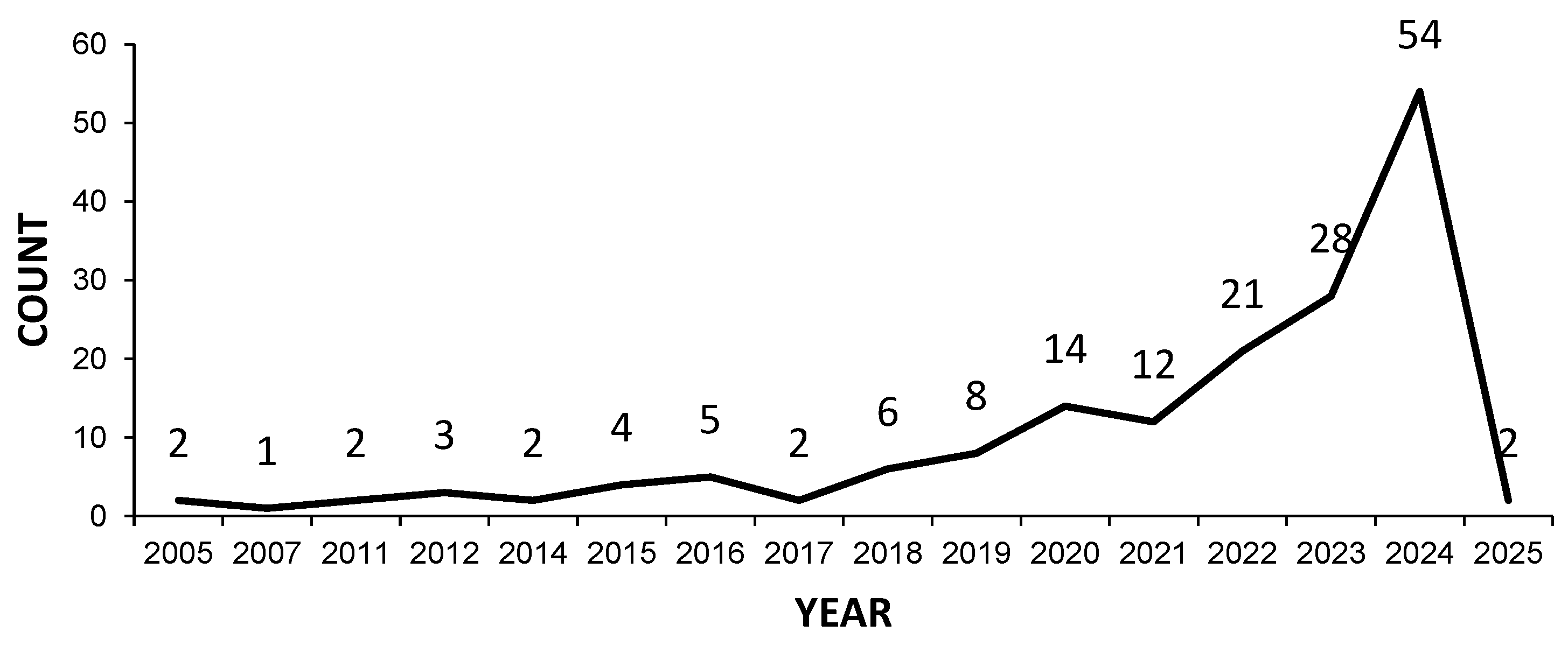
Figure 2 presents the annual distribution of research papers, revealing a steady upward trend. Notably, there has been a significant increase since 2021, with a consistent rise in publications each year. This surge suggests a growing recognition among scholars of the relevance of these studies, particularly in light of the rising frequency of extreme weather events, such as temperature extremes and heavy precipitation. It is plausible to expect that this heightened interest will propel the number of papers to new heights by 2025.

3.3. Literature Synthesis Approach

To ensure a rigorous and meaningful synthesis of the selected literature, this study adopted a hybrid approach combining quantitative scientometric techniques with qualitative content analysis. After identifying 166 eligible articles through the PRISMA-guided bibliometric screening, a two-stage synthesis process was conducted:
(1)
Thematic Clustering via Scientometric Mapping: Co-citation analysis and keyword co-occurrence networks were constructed using VOSviewer to reveal latent structures and topic clusters within the field. These clusters represented dominant research dimensions such as physics-based simulation models, data-driven simulation models, risk evaluation tasks, and optimization tasks.
(2)
Qualitative Thematic Analysis: Each cluster was then examined through in-depth reading of the associated core articles. Key themes, methodological paradigms, research objectives, and findings were manually coded and compared. This allowed for identifying methodological patterns, knowledge gaps, and interrelationships across research domains.
By combining algorithmic clustering with domain-specific reading and interpretation, the study ensured both objective mapping and context-sensitive integration of insights, thus achieving a comprehensive synthesis of urban flood disaster management research.

4. Scientometric Analysis

4.1. Co-Citations Analysis

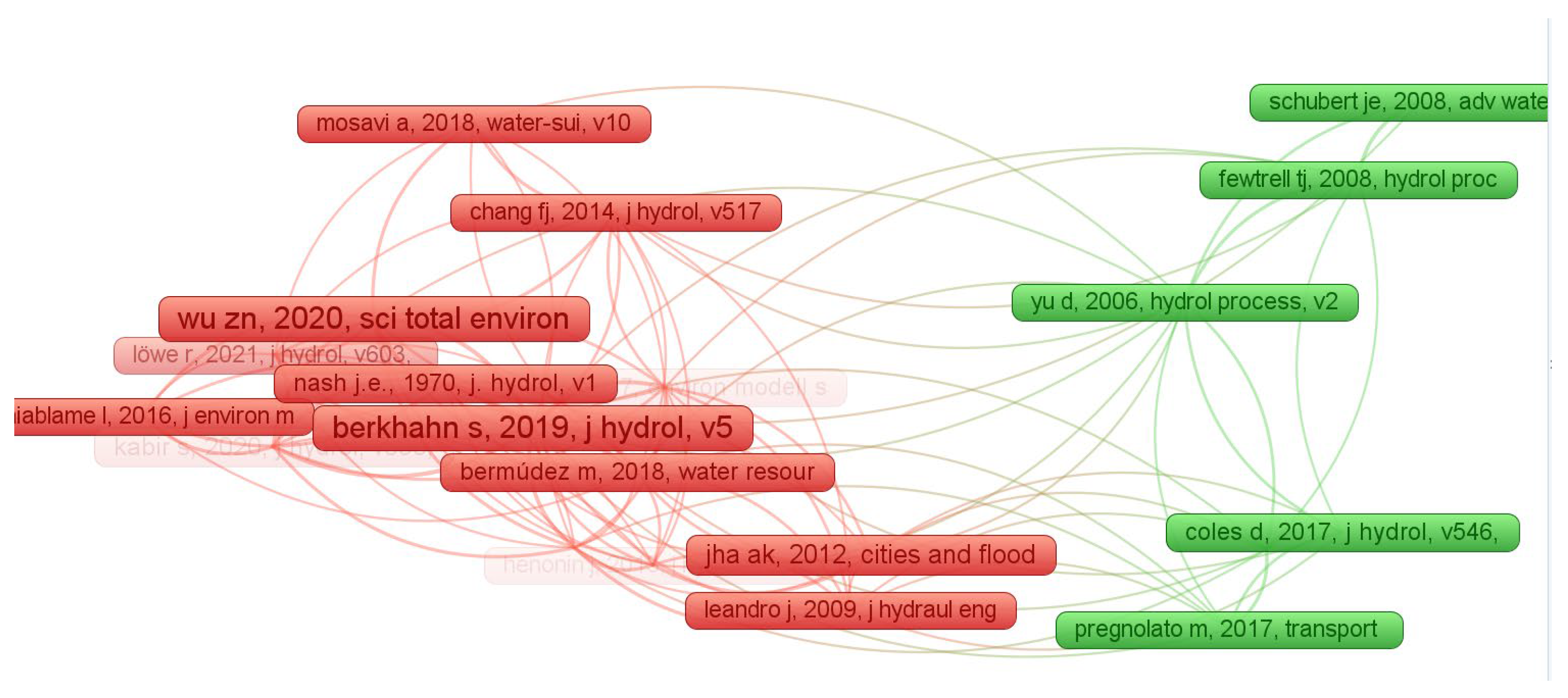
Compared to literature coupling, co-citation [56] is a dynamic relationship that changes with the publication of new papers, reflecting the contributions of articles to different research developments in the field. In this study, the co-citation network was constructed using the following parameters: minimum number of citations = 6, minimum total link strength = 1, and resolution parameter = 1.0, resulting in 20 remaining articles. The co-citation knowledge graph is depicted in Figure 3, while the most influential articles in the field of urban flood management are presented in Table 4.
This co-citation network reveals the knowledge structure and theoretical foundations within urban flood research by analyzing shared citation relationships among studies. It comprises 20 studies cited at least 6 times in the analyzed dataset and 102 co-citation links. Connections between nodes represent co-citation relationships, where two studies appear simultaneously in each other’s reference lists. Node proximity reflects thematic similarity, with closer-proximity studies exhibiting stronger conceptual connections. Link thickness indicates co-citation strength. VOS clustering identified two distinct research clusters: the red cluster comprises 14 studies primarily focused on urban flood modeling, risk assessment, and management strategies; the green cluster includes 6 studies emphasizing hydrological processes and flood simulation methodologies.

4.2. Co-Occurrence of Keywords Analysis

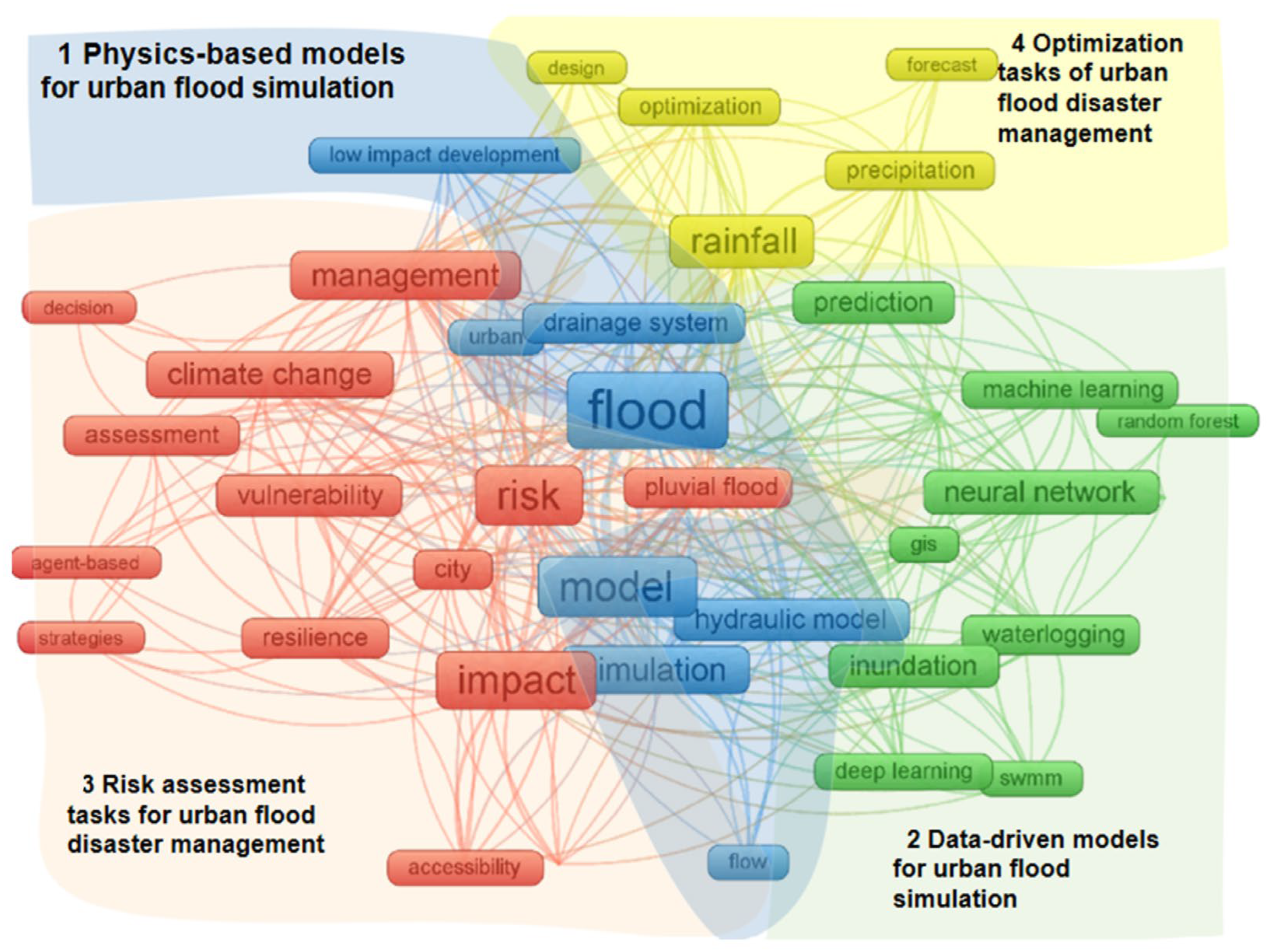
Keyword analysis is widely used to identify research field hotspots [65]. This study applied knowledge mapping methods to organize and chart data extracted from the included sources of evidence. From each included study, major research hotspots in the field of urban flood management were obtained as key variables for constructing the knowledge graph: cluster, total link strength, occurrences, average publication year, and citations. Since this study covered all articles related to the entire process of urban flood management in urban and suburban areas, the articles covered a wide range of topics and were studied by scholars from various regions and disciplines. This co-occurrence network extracted 649 unique terms from 112 studies, comprising 391 author keywords and 295 index keywords. Link weights were calculated using a fractional counting method, accounting for the number of keywords in each document to prevent high-frequency terms from dominating the network. To ensure semantic consistency, manual normalization was performed. After excluding keywords unrelated to disaster emergency management or with unclear significance, such as “network”, “lid”, “som”, “size”, etc., and standardizing keywords with similar meanings, such as “spatial optimization” and “optimization”, “support vector machine” and “machine learning”. The keyword co-occurrence network was generated with a minimum occurrence threshold of 2, minimum total link strength of 1, and a resolution parameter of 1.0. Synonymous terms were manually merged prior to analysis to enhance semantic consistency, resulting in 38 keywords as shown in Figure 4 and listed in Table 5.
According to Figure 4, blue nodes represent physics-based model for urban flood simulation, including modeling and simulation of floods, drainage networks, and runoff. They occupy a central position in the knowledge graph, serving as the foundation and core of other research hotspots. Green nodes represent data-driven simulation methods, including neural networks, machine learning, and deep learning. They are closely linked to blue nodes as they rely on physical urban flood simulation models to obtain data. Red nodes represent risk evaluation tasks in the urban flood management process, including resilience, vulnerability, accessibility, and other indicators. Yellow nodes include prediction, design, and optimization, serving as optimization tasks in the urban flood management process.
This study aims to more effectively determine the current status and direction of urban flood disaster management research. Based on keyword co-occurrence knowledge mapping, existing articles are categorized into five dimensions:
(1)
Physical simulation methods for urban flood simulation, which involve modeling and simulation of floods, drainage networks, and runoff based on physical principles;
(2)
Data-driven methods for urban flood simulation, including machine learning and deep learning methods;
(3)
Risk evaluation tasks in the urban flood disaster management process, focusing on constructing risk indicator systems for different processes of urban flood disasters, including vulnerability, accessibility, resilience, and emergency capacity; and
(4)
Optimization tasks in the urban flood disaster management process, emphasizing the research on perception, design, and optimization strategies and schemes; and
(5)
Other research, which consists of studies from diverse fields using alternative methods, such as flood governance, urban double repair, flood disaster support ontology, system dynamics, and theory of planned behavior. These papers are excluded from Figure 4 for clarity and will be separately examined in subsequent discussions. The distribution of research in these categories, as per statistical analysis, is as follows: 17% for physical simulation, 31% for data-driven methods, 21% for risk evaluation, 16% for optimization, and 16% for other literature.

5. Research Frontiers and Opportunities

Through a comprehensive analysis of the literature, gaps and research opportunities in each aspect were identified. Please see Table 6 for details. These classifications will be introduced in the following sections.

5.1. Physics-Based Models for Urban Flood Simulation

5.1.1. Literature Synthesis

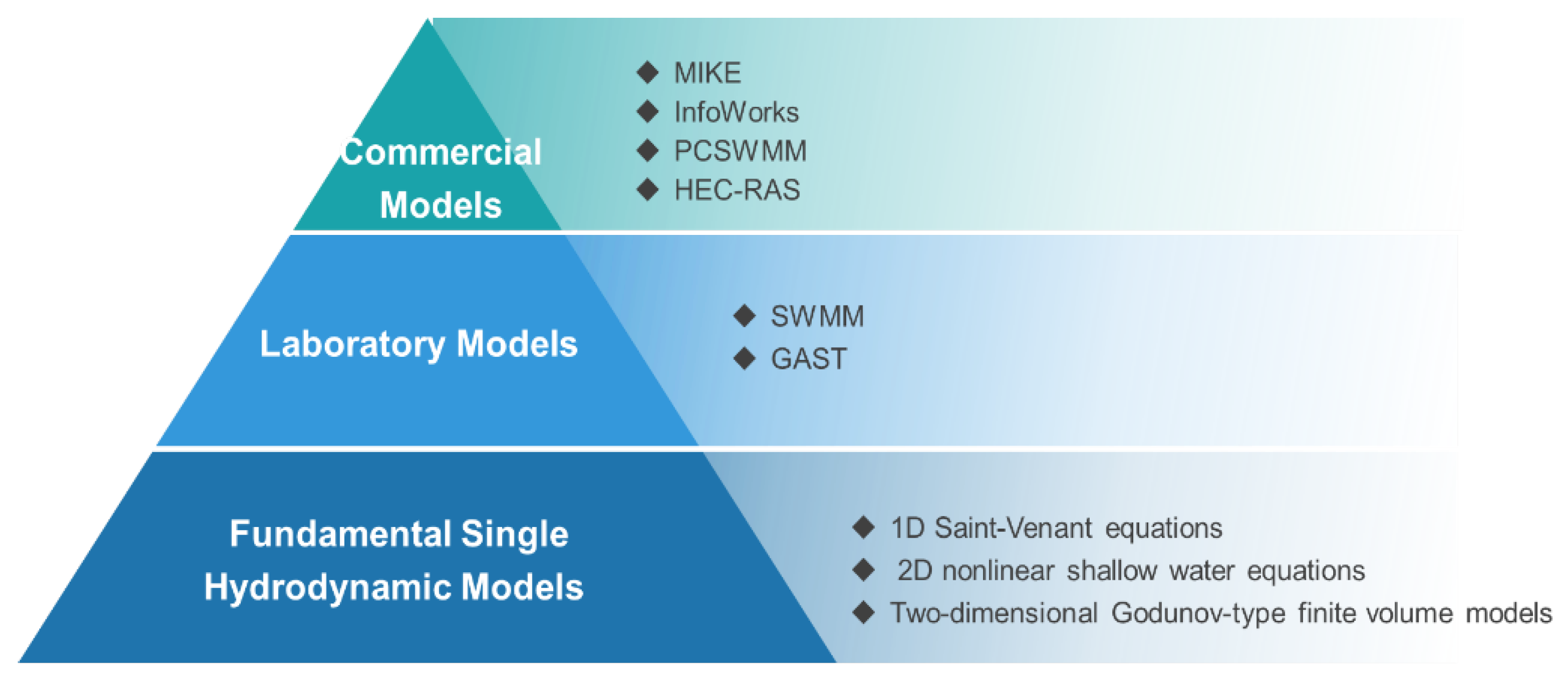
This dimension includes 29 papers, and the primary research objectives along with representative works are summarized in Table 7. Physics-based models for urban flood simulation can be classified into three categories, as shown in Figure 5, according to their application maturity:
The first category is fundamental single hydrodynamic models, such as 1D Saint-Venant equations and 2D nonlinear shallow water equations [66], which serve as the cornerstone for physics-based models for urban flood simulation. Study on such models focuses on examining the movement of water itself from a hydraulic perspective, as well as the interaction between water and buildings [67], and so forth.
The second category consists of laboratory models for urban flooding, such as the storm water management model (SWMM) coupled with various sub-models including rainfall-runoff, surface runoff, and pipe flow. Due to their free availability and ease of extension, this category has the largest number of related studies. These models are primarily used to simulate urban flooding scenarios and analyze the different roles of various elements in the process of urban waterlogging based on their simulation results, such as the importance of temporal rainfall variability relative to spatial rainfall variability [67,68].
The third category comprises commercial models for urban flooding, such as MIKE and InfoWorks, which further incorporate one-dimensional pipe and two-dimensional runoff models, making them more complex and closer to reality. As commercial models, they aim to enhance usability but may sacrifice scalability. These models primarily provide the foundation for future urban flood control planning, sponge city design, and low-impact development. For instance, they support urban flood control and planning beyond standards [69], evaluate different levels of urban development and low-impact development schemes [70], wave protection schemes [7,71], watershed protection schemes [72], flash flood warnings [73], and integration and warning of rainfall, flood, and disaster information [2].
Table 7. Representative Papers on Physics-Based Models for Urban Flood Simulation.
Research ObjectivesRepresentative Papers
Enhancing data qualityImproving the accuracy of rainfall forecasts for hydrological applications (Yoon, 2019) [74]
Investigate the potential of radar rainfall nowcasting in predicting flood events (Thorndahl et al., 2016) [75]
Using a uniform grid of 624 × 550 units with a high resolution of 1 m (Bai et al., 2021) [76]
Model optimizationApplying the SWMM-LISFLOOD coupled model (Z. Zhao et al., 2024) [77]
Determining hydrological model parameters using intelligent algorithms (Liao et al., 2019) [78]
Improve model computational efficiencyDeveloping a relatively coarse grid in the 2D ground surface flow model (L. Wu et al., 2022) [66]
Developing the GPU parallel computing technology to improve computing efficiency (X. Li et al., 2022) [79]
Impact of different building modeling approaches on model efficiency (Schubert & Sanders, 2012) [10]

5.1.2. Challenges and Opportunities

The primary challenge faced by Physics-based models for urban flood simulation is the delicate balance between computational efficiency and accuracy. Urban flood simulation typically involves fundamental elements such as rainfall, land, and drainage networks, as well as additional factors like waves, rivers, and flash floods. The physical simulation of urban flooding is characterized by its high complexity and computational demands. Thus, achieving precise predictions of urban inundation situations, including inundation points, depths, areas, and temporal variations, is crucial at a technical level.
To enhance the accuracy of models, future endeavors can focus on improving data quality and optimizing models. Firstly, enhancing data quality entails various approaches, including the utilization of authentic rainfall data, prediction future rainfall [73,75,80], simulating rainfall data [81,82], integrating multiple rainfall simulation models [74,83], predicting urban land use, employing high-precision digital elevation models [76], and incorporating real-time monitoring data. Under these strategies, the significance of historical data for model optimization becomes particularly pronounced [39]. Secondly, model optimization encompasses methodologies such as refining urban building modeling, integrating multiple models [77,79] enhancing models for various scenarios such as river and urban model integration [84], selecting resolutions for multiscale models [73], and optimizing model parameters [78].
To improve model computational efficiency, research can explore avenues such as constructing rapid models, grid simplification [66], utilizing different numerical computation methods, multiscale modeling [85], model fusion [26], and leveraging physical means such as GPUs for acceleration [79].
In addition, future research topics of interest include ensuring the generality and transferability of models, applying them to watersheds that have not been measured or suffer from poor measurements. Expanding the simulation scope and selecting appropriate levels of generalized models according to the scale covered by the model can strike a balance between accuracy and computational efficiency. Combining digital twin technology with physical models can achieve more comprehensive and accurate simulation and prediction of urban flood disasters, thus enhancing the efficiency and reliability of urban flood disaster management.

5.2. Data-Driven Models for Urban Flood Simulation

5.2.1. Literature Synthesis

This dimension comprises 51 articles. The primary research objectives and corresponding representative works are presented in Table 8.
The papers in this field are relatively new, with publication dates concentrated after 2019, and more than two-thirds of them were published after 2023. This indicates that urban flood simulation methods based on machine learning and deep learning are currently a focal point in the research on urban flood disaster management. One possible reason is that machine learning and deep learning methods have already achieved significant success in other fields.
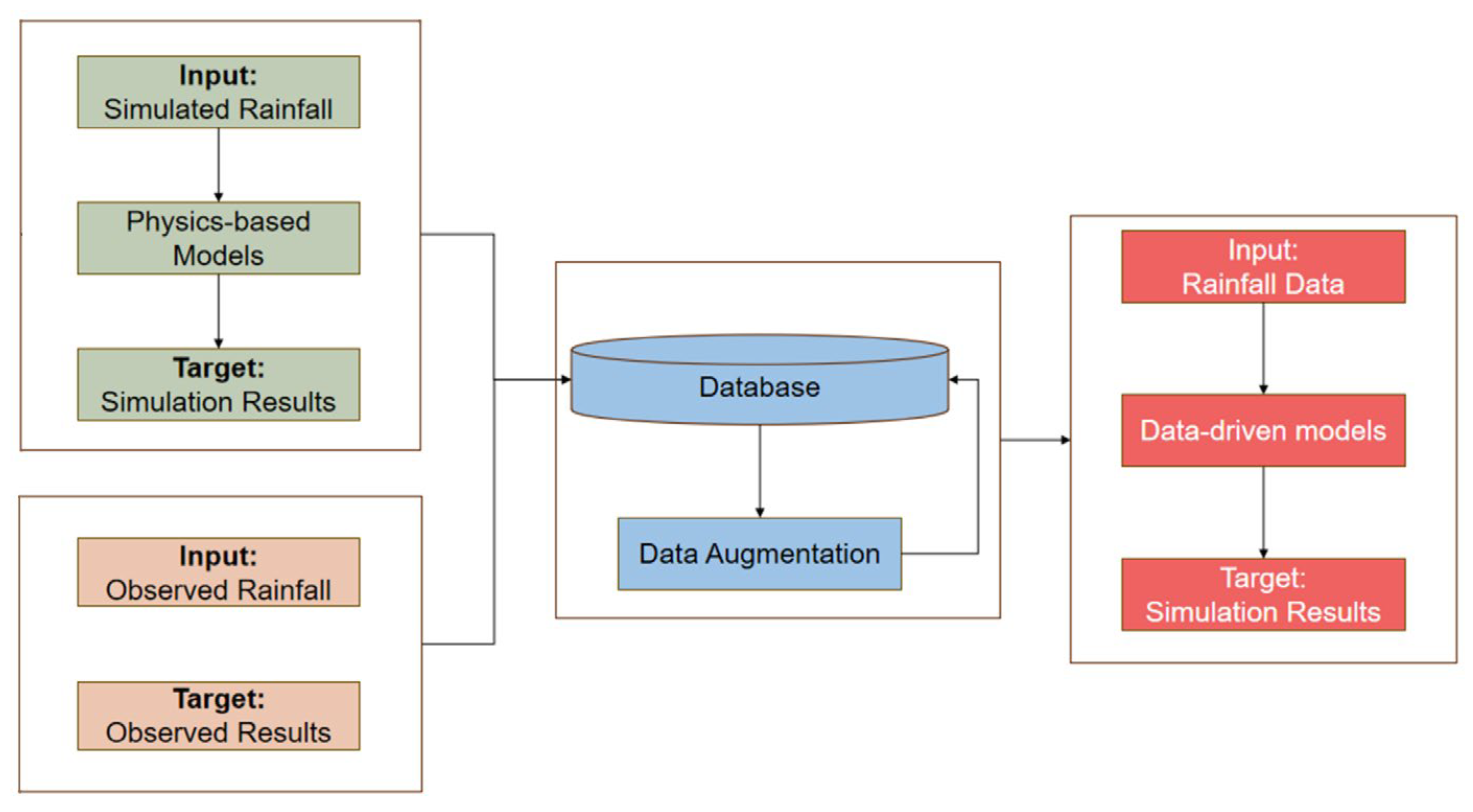
Data-driven models exhibit a strong connection with physics-based models, as their data sources frequently originate from the latter, as depicted in Figure 6. Owing to the scarcity of real-world data, the majority of data-driven simulation techniques function as secondary replicas of physical models [92], reflecting their reliance on physical principles. The pioneering work by [93] employed a Bayesian model to address the challenge of prediction and modeling unmeasured or inadequately measured watersheds. Since then, conventional machine learning techniques have been increasingly employed in urban flood simulation, such as multiple regression [94], random forest [92], gradient boosting decision trees [12], logistic regression [95], XGBoost [96] and K-means clustering [97], among others. However, these methods blur the spatial relationships between the predicted grids. Therefore, deep learning methods, represented by convolutional neural networks (CNNs) [87,98,99], have been used for urban flood simulation.
Compared to physics-based models, which simulate the dynamic states of multiple elements involved in the urban flood process at each time step, the aforementioned data-driven studies exhibit a significant limitation: most focus solely on predicting the peak inundation depth within a region, thereby lacking the capacity to support real-time decision-making and control during flood events. To address the need for temporal modeling, recurrent neural networks (RNNs) have been widely adopted. In particular, Long Short-Term Memory (LSTM) networks [100] and Gated Recurrent Units (GRUs) [91,101] have shown promising performance in capturing the sequential evolution of urban inundation levels.

5.2.2. Challenges and Opportunities

Data-driven models also focus on enhancing accuracy and efficiency. Therefore, extracting effective features [102] and predicting features such as rainfall [103] play a crucial role in effectively predicting urban flooding. Particularly, data-driven models for urban flood simulation exhibit significant advantages in computational efficiency, enabling predictions of urban flooding over larger areas in less time and with higher efficiency. Consequently, overcoming the low computational efficiency of physical models stands as a prominent research focus in this domain.
Data-driven models not only strive for enhanced accuracy and efficiency but also focus on model expansion, interpretability, transferability, and credibility. As a large number of data-driven approaches have been applied to urban flood simulation, the inherent limitations of data-driven approaches have become apparent. Data-driven approaches, such as deep learning, necessitate substantial data availability [104], often exhibit model interpretability challenges [95,96], and can be sensitive to data size and structure [104], with a tendency to yield larger errors in time series predictions [86]. Overfitting [57] is a concern that requires further investigation, and ensemble models [105] are employed to address instability. Moreover, integrating physically based and data-driven simulation methods [85,92,106] presents a promising area for future research.

5.3. Risk Evaluation Tasks for Urban Flood Disaster Management

5.3.1. Literature Synthesis

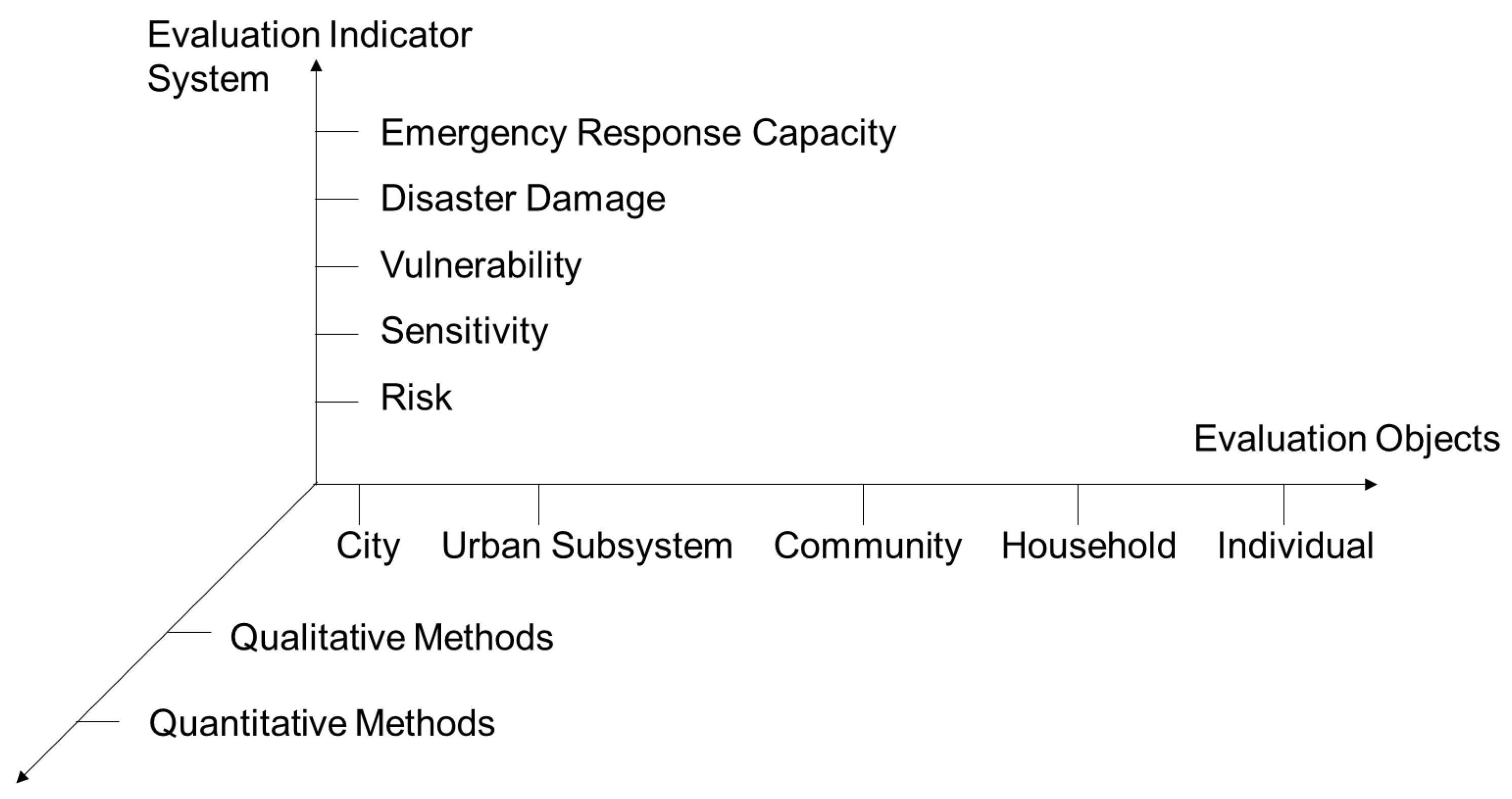
This dimension comprises 35 papers. Figure 7 provides a comprehensive overview of the research landscape by summarizing the evaluation methods, target objects, and indicator systems employed in these studies. Representative works, categorized by evaluation method, are listed in Table 9.
A limited number of studies, such as [112], who developed a hierarchical analysis index system for urban flood risk evaluation, considering safety, economic, infrastructure, and environmental aspects, and [23], who employed expert scoring and BP neural network techniques to evaluate urban resilience from social, natural, and economic viewpoints, predominantly focus on qualitative evaluations at a macro level. Reference [113] developed an index system encompassing five critical aspects: driving indicators (precipitation), pressure indicators (water level at river channels), status indicators (depth of inundation), impact indicators (damage caused by urban flood disasters), and response indicators (urban flood control measures). In contrast, the majority of research centers on micro-level quantitative evaluations. These studies utilize urban flood prediction results as the basis, using indicators such as maximum water depth, inundation area, flow velocity, etc., as foundational data. They employ tools like depth-damage functions [19] and flood velocity-damage functions [109] to assess the risks and impacts of urban flooding on cities. This cluster’s contribution to urban flood prediction research differs by emphasizing the development of evaluation index systems and the determination of appropriate evaluation methodologies, rather than merely replicating existing studies.
The evaluation scope in this field encompasses a diverse array of targets, including cities [112], urban subsystems [114], communities [115], households [67], individuals [116], low-impact development schemes [5], as well as public attention and perception of risk [117].
Regarding evaluation indicators, the research is rich and varied. Studies primarily evaluate emergency response capabilities [118], disaster damage [19,108,113], vulnerability [6,18,119], resilience [14,114,120], and risk [13,115,116,119]. Emergency response capabilities mainly include the accessibility of public services, emergency response capabilities, evacuation time, etc. Disaster damage is evaluated from an economic perspective and is generally divided into direct and indirect losses, also referred to as tangible and intangible losses. Direct losses include losses of life, property, and assets, while indirect losses refer to economic losses caused by city road closures, etc. Vulnerability refers to the degree of susceptibility to damage when facing disaster risks, indicating the ability of urban systems or socio-economic systems to resist disasters. Resilience is typically defined as the adaptability, recovery, and rebuilding capabilities of systems when faced with external pressures or impacts. Risk is a comprehensive evaluation of the probability of disaster occurrence and potential losses. In terms of the disaster management cycle, vulnerability and risk evaluations occur during the mitigation and preparedness phases, emergency response capability evaluations occur during the response phase, and disaster losses occur during the recovery phase. Resilience is relevant throughout the entire disaster management process [6]. However, the current trend in related research is to use scenario analysis and urban flood simulation predictions as tools to evaluate the vulnerability, losses, and emergency response capabilities of various urban objects before disasters occur, which is more in line with practical societal needs.

5.3.2. Challenges and Opportunities

Quantifying disaster losses, particularly in urban flood events, remains challenging due to the lack of standardized methods. Current research employs depth-damage [108] and flow velocity-damage functions [109], but their limited applicability across diverse geographical, climatic, and urban contexts restricts their universal use. Measuring indirect losses, which involve complex economic and social aspects, poses an even greater challenge. To evaluate urban emergency response capacity, it is vital to anticipate future urban changes, continually refine evaluation models, and adapt emergency plans promptly. Disaster dynamics [110,121], such as transportation networks and human traffic, should be incorporated into evaluation factors to ensure efficient urban resilience. The abstract concepts of vulnerability and resilience [114] lack unified definitions and evaluation methodologies, necessitating future research on standardizing indicator selection criteria.
Urban flood disaster evaluation primarily relies on scenario analysis [13], which is grounded in flood simulation methods. Enhancing simulation accuracy is crucial for accurate risk evaluation and response planning, necessitating continuous model refinement and data improvement. To broaden the scope, urban flood risk evaluation should extend beyond a single event to encompass the entire disaster process and multiple consecutive events, considering frequency, intensity, and spatial extent. The evaluation targets should expand from isolated facilities to the comprehensive urban system, encompassing infrastructure, buildings, communities, economic activities, and more. This expanded approach better reflects the city’s risk profile, supporting sustainable development.

5.4. Optimization Tasks of Urban Flood Disaster Management

5.4.1. Literature Synthesis

With representative works listed in Table 10, this dimension encompasses 25 scholarly contributions, which focus on aspects such as monitoring, optimization, and control. The field of optimization in urban flood management is relatively nascent, with a significant concentration occurring in recent years, signifying its emerging status as a prominent research focus. The current research on optimization tasks aims to mitigate and prevent urban flooding: Before disasters occur, optimization efforts include optimizing impermeable surface areas to reduce runoff in urban renewal schemes [24,122,123] and finding optimal and adaptive maintenance, repair, and overhaul (MRO) strategies for stormwater retention basins [124]. During disaster events, the focus of current research is on real-time control of drainage pipes and reservoirs [125,126].
To achieve real-time control during disaster events, monitoring of urban flooding is crucial. Pressure sensors [127] and radar water level sensors [128,129] are commonly used for monitoring water depth and flow velocity, while acoustic sensors [130] and tipping bucket rain gauges [128] are used for rainfall monitoring. Furthermore, cloud platforms are utilized as data storage tools [131]. In addition to research on traditional sensors, current studies focus on using computer vision to research water depth [132], inundation area [133], and flood height [134]. Furthermore, data fusion from multiple sources is also a current research focus. Ref. [135] integrated heterogeneous sensor systems to provide disaster information to stakeholders. In addition to this, crowdsourced data [136], social media data [137,138], and road traffic data [139] are widely used in urban flood monitoring. The selection of monitoring points is also a topic worthy of research [140].
Table 10. Representative Papers on Optimization tasks of urban flood disaster management.
Representative PapersResearch TopicsResearch Methods
(Sun et al., 2023) [125]Reduce peak tank outflowlinear programming
(Z. Zhang, Tian et al., 2023) [126]Leveraging infrastructure to mitigate sewer overflows (CSOs) and urban floodingDecentralized control strategy for multi-agent reinforcement learning
(Chang et al., 2018) [127]Development of wireless water level monitoring system for urban drainage floodsPressure Sensor
(Peleg et al., 2023) [130]Low-cost acoustic sensor detects rainfallLow-cost acoustic sensor, short-term early warning
(Hong & Shi, 2023) [135]Integrating heterogeneous sensor systems to provide disaster information to stakeholdersMultiple data fusion
(R.-Q. Wang et al., 2018) [137]High-resolution monitoring of urban flooding using social media and crowdsourced dataNatural language processing;
computer vision;
(H. Han et al., 2021) [133]Automatic monitoring method for urban road floodingYOLOv2
(J. Zhao et al., 2024) [123]Optimizing the spatial layout of impervious surfacesNondominated Sorting Genetic algorithm 2 (NSGA2), and Multiple Linear Programming (MLP) algorithm

5.4.2. Challenges and Opportunities

Currently, urban flood monitoring datasets predominantly rely on water depth measurements from isolated stations, which fail to provide a comprehensive representation of flood conditions. Consequently, the strategic selection of monitoring stations to effectively integrate data into a comprehensive urban flood prediction framework represents a substantial challenge [141]. Social, crowdsourced, and traffic data, characterized by lag, are difficult to directly use for future urban flood prediction. Although integrating these data as supplements to other monitoring data can provide a more comprehensive understanding of urban flooding, offering a more accurate basis for formulating optimization plans, the heterogeneity, complexity, and vastness of data still present challenges in the research field of multi-source data fusion [137]. With the deepening research into urban flood disaster simulation, prediction, and evaluation, optimization tasks have become a focal point in urban flood disaster management research, requiring the integration of knowledge from multiple disciplines such as hydrology, meteorology, urban planning, and civil engineering to address issues such as low-impact development schemes, flood control plans, selection of public infrastructure, as well as optimization of drainage strategies, real-time control of drainage pipelines, and evacuation process optimization during disaster occurrence.

5.5. Other Research on Urban Flood Disaster Management

In addition to the four prominent research clusters, there are 26 papers falling outside the conventional categorization. Some of these papers use their unique approaches to study the entire process of urban flood disaster management, employing methods like empirical research [142], system dynamics [143], and economics [144], offering distinct perspectives and insights. Other papers focus on more specialized aspects of urban flood disaster management, addressing specific subfields. These include studies on the relationships between disaster management entities using ontologies [145] and holistic management theory [146], spatial-temporal visualization of road inundation [147], human-centered flood risk strategies [148], understanding and influencing driver behavior [149], Identifying different postures of humans submerged in floodwaters [150], and evacuation strategies [151].

6. Research Framework for Urban Flood Disaster

In Section 5, a thorough examination of urban flood simulation models, risk evaluation tasks, and management optimization tasks was conducted, with a particular focus on the analysis of methodologies within each research cluster. This examination delved into the current status, challenges, and potential opportunities. Moving forward, the paper will explore the interconnectedness of three key subtasks of urban flood disaster management: simulation, evaluation, and optimization, thereby contributing to the development of the research framework initially outlined in Section 2.

6.1. Three Subtasks in Urban Flood Disaster Management

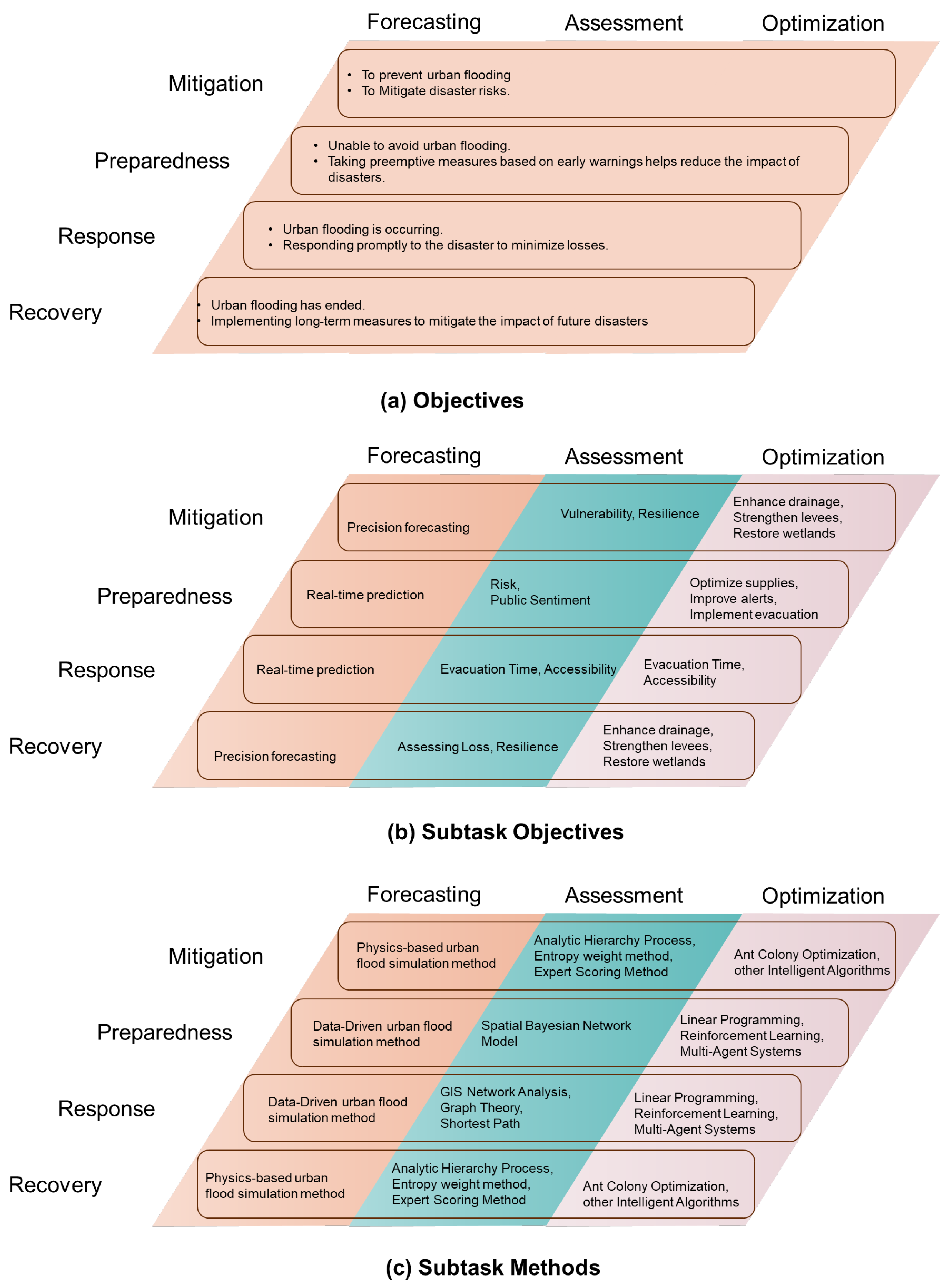
Drawing on disaster management theory and a review of existing research, the urban flood disaster management cycle is intrinsically composed of three interconnected subtasks: prediction, evaluation, and optimization. The prediction task, in practical application, employs urban flood simulation techniques, whether they are physics-based or data-driven models, to predict key parameters such as flood extent, duration, water depth, and flow velocity. The evaluation task centers on constructing a multi-dimensional indicator system to provide an in-depth understanding of the current situation. Optimization, on the other hand, revolves around the development and refinement of strategies related to urban planning, water resource management, real-time response, and control. By examining the disaster management cycle, one discerns distinct objectives at each stage, which in turn dictate the nature of the prediction, evaluation, and optimization tasks.
These tasks necessitate tailored methods that align with their respective stage-specific objectives, as depicted in Figure 8. Specifically, Figure 8a illustrates the distinct management objectives associated with each phase of the disaster cycle. Figure 8b further outlines the corresponding objectives of the three core tasks—prediction, evaluation, and optimization—within each phase. Finally, Figure 8c presents the methodological approaches used to fulfill these task-specific objectives across different stages.

6.2. The Relationship Between Prediction, Evaluation, and Optimization

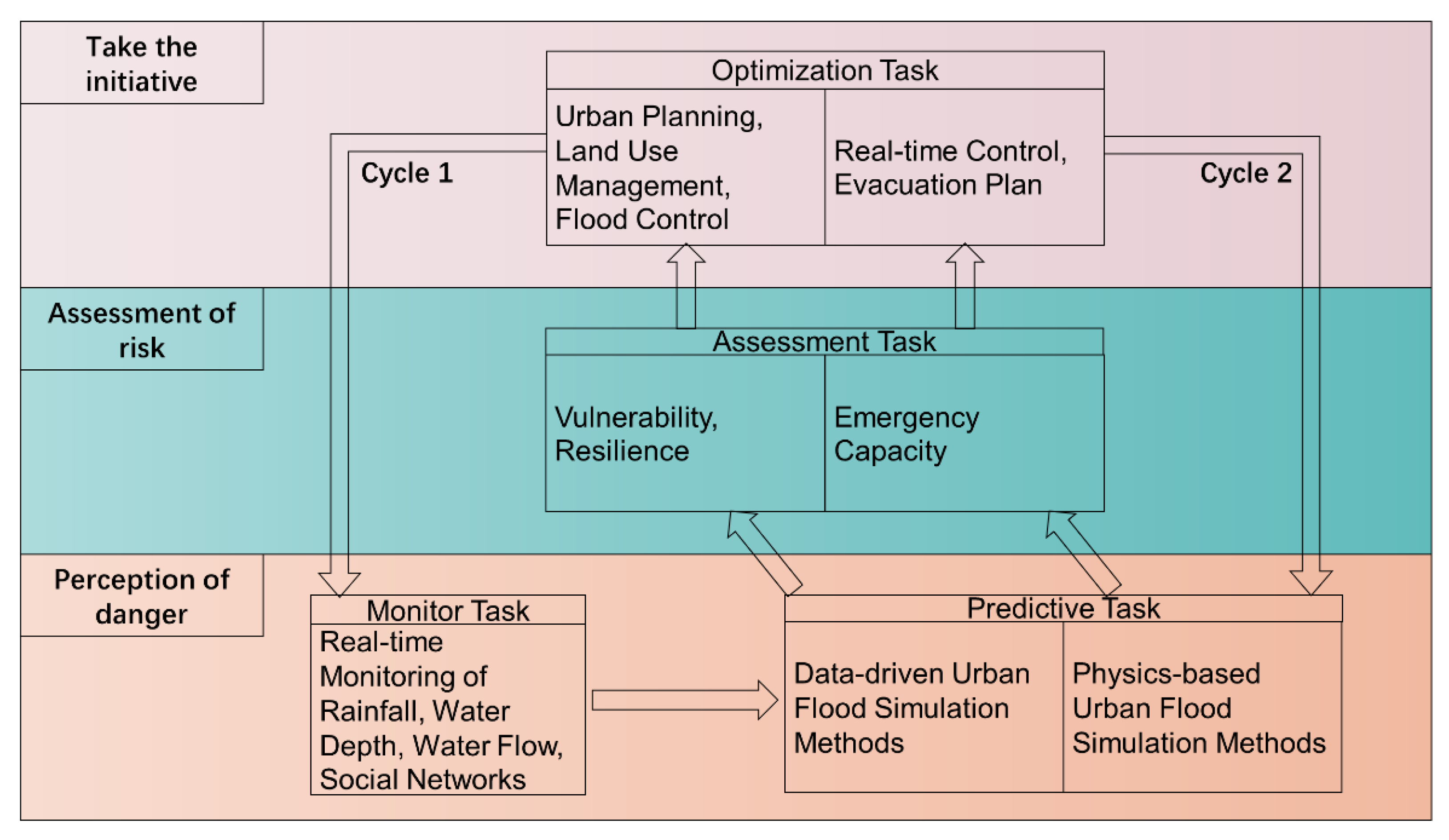
Having established the framework for urban flood disaster management, the subsequent discussion will focus on the relationship among prediction, evaluation, and optimization tasks. The prediction task serves as the cornerstone of urban flood disaster management, providing data support for evaluation and optimization tasks. The evaluation task relies on the output of the prediction task to identify and quantify the potential impacts of flood disasters on various aspects of the city, including its residents, environment, and economy. The evaluation results furnish feedback and guidance for the optimization task. By evaluating the actual impacts of flood disasters on various aspects of the city, existing issues and areas for improvement can be identified. This process provides a basis and reference for the formulation of optimization schemes, aiming to minimize the occurrence and impact of disasters to the greatest extent possible. In summary, the relationship among prediction, evaluation, and optimization tasks in the four stages of urban flood disaster management is illustrated in Figure 9.
In urban flood disaster management, the tasks during the mitigation and recovery phases involve the long-term management of potential flood disasters that have not yet occurred. Therefore, actions such as urban planning, land use changes, and the implementation of sponge flood control projects can be undertaken. At these stages, the objective of optimization tasks is to balance flood control costs with potential disaster losses, determining the optimal solution with the minimum overall cost. The evaluation task determines the potential losses that may arise from disasters. During these phases, there is a low requirement for timeliness but a high requirement for accuracy in prediction tasks. Therefore, it is necessary to select urban flood simulation methods based on physical modeling, as illustrated in Figure 9 Cycle 1.
In urban flood disaster management, the tasks during the preparedness and response phases involve the short-term management of imminent flood disasters. Therefore, when significant changes in urban structure are not feasible, optimization tasks primarily focus on how to implement mitigation measures to ensure the safety of affected populations and property to the greatest extent possible. This includes actions such as real-time control of drainage pipelines, response to sudden rainstorms, and formulation of evacuation plans. During these phases, evaluation tasks need to be based on predicted flood data to evaluate the emergency capacity of urban public service facilities. At these stages, the timeliness of prediction tasks becomes more crucial. Hence, real-time monitoring data such as rainfall, water depth, flow velocity, and network status are inputted into data-driven approaches to predict data such as urban flood depth, as illustrated in Figure 9 Cycle 2.
It is important to note that Figure 8 and Figure 9 present a conceptual framework based on the four-stage disaster management cycle. In practical urban flood management, however, core tasks—particularly simulation and optimization—often transcend individual phases. These tasks are frequently deployed in multiple stages simultaneously or cyclically, depending on evolving flood dynamics and system requirements. This reflects a well-known critique of the traditional disaster management cycle: that disaster phases are not strictly sequential, but rather dynamic and overlapping in real-world scenarios. Therefore, the framework should be understood as an abstract representation of dominant task-stage relationships, rather than a rigid or linear progression.

7. Conclusions

This study demonstrates that despite methodological diversity in urban flood disaster management research, a systematic review can be organized around three core tasks: prediction, assessment, and optimization. These tasks correspond to distinct phases within the disaster management cycle. By integrating bibliometric mapping with disaster management theory, we reveal dominant research dimensions: physics-based simulation models, data-driven simulation models, risk assessment tasks, optimization tasks, and various emerging themes. Building upon this foundation, we propose a task-oriented systematic framework that provides a comprehensive guiding perspective for both academic research and practical applications.
Based on the systematic framework, we offer the following actionable recommendations to policymakers and urban stakeholders to support evidence-based urban flood resilience planning:
(1)
Prediction
Use physics-based models for long-term mitigation and recovery planning—such as sponge city design and land-use regulation. Deploy data-driven models in preparedness and response phases for real-time forecasting and early warning under extreme rainfall.
(2)
Evaluation
Establish unified metrics for vulnerability, resilience, and economic loss quantification across departments (urban planning, emergency management, infrastructure). Integrate scenario-based risk assessments into development approvals and disaster drills.
(3)
Optimization
Prioritize optimization of drainage networks and low-impact development schemes using multi-objective algorithms. Develop dynamic control systems that use real-time monitoring data (rainfall, water level, traffic) to guide evacuation routes and reservoir operations during emergencies.
Despite its comprehensive scope, this review has several limitations. First, the proposed framework is constructed based on the disaster management cycle, which has itself been critiqued for oversimplifying the dynamic and overlapping nature of disaster phases. Second, the scientometric analysis relies on clustering performed by VOSviewer, where parameter settings and normalization choices are sensitive. Alternative clustering methods may yield different results. Dependence on the Web of Science database introduces potential biases: inadequate coverage of non-English literature and regional technical reports may weaken geographical representativeness. Additionally, the systematic review excluded regional-scale flood studies, narrowing the scope to urban storm flooding. While this enhances focus on urban resilience, it overlooks insights from larger hydrological systems affecting urban areas during extreme events. Third, as artificial intelligence tools continue to evolve, the landscape of scientific literature reviews is likely to shift, with automated knowledge discovery and real-time synthesis becoming increasingly feasible. Future reviews should embrace these developments while maintaining critical interpretation and domain-specific insight.

Supplementary Materials

The following supporting information can be downloaded at: https://www.mdpi.com/article/10.3390/su18021106/s1, PRISMA Checklist [49].

Author Contributions

Conceptualization, J.D. and B.L.; methodology, X.T. and H.Z.; validation, Z.H. and H.Z.; formal analysis, X.T. and H.Z.; investigation B.L.; resources, J.D.; data curation, M.H.; writing—original draft preparation, X.T. and H.Z.; writing—review and editing, X.T., J.D. and Z.H.; visualization, M.H.; supervision, J.D.; project administration, M.H.; funding acquisition, J.D. All authors have read and agreed to the published version of the manuscript.

Funding

This work is funded by the National Natural Science Foundation of China (grant number 72471133). The funders had no role in the design, analysis, interpretation, or writing of this review.

Institutional Review Board Statement

Not applicable.

Informed Consent Statement

Not applicable.

Data Availability Statement

The raw data supporting the conclusions of this article will be made available by the authors on request.

Acknowledgments

This paper is supervised and guided by Wenbo Zhou (Municipal Engineering Branch of the China Civil Engineering Society and Shanghai University).

Conflicts of Interest

Author Xuan Tang was employed by Shanghai Urban Construction Corporation. The remaining authors declare that the research was conducted in the absence of any commercial or financial relationships that could be construed as a potential conflict of interest.

References

  1. ICFM. A Compilation of 2020–2021 Global Flood Events and International Experience in Flood Management—Reports—Views—ICFM—International Conference on Flood Management. 2022. Available online: https://www.icfm.world/Views/Reports/874/A-COMPILATION-OF-2020-2021-GLOBAL-FLOOD-EVENTS-AND-INTERNATIONAL-EXPERIENCE-IN-FLOOD-MANAGEMENT (accessed on 3 August 2025).
  2. Zang, Y.; Meng, Y.; Guan, X.; Lv, H.; Yan, D. Study on urban flood early warning system considering flood loss. Int. J. Disaster Risk Reduct. 2022, 77, 103042. [Google Scholar] [CrossRef]
  3. IPCC. Climate Change 2023: Synthesis Report. Contribution of Working Groups I, II and III to the Sixth Assessment Report of the Intergovernmental Panel on Climate Change; Core Writing Team, Lee, H., Romero, J., Eds.; IPCC: Geneva, Switzerland, 2023; pp. 35–115. [Google Scholar] [CrossRef]
  4. UNDRR. Global Assessment Report on Disaster Risk Reduction 2025: Resilience Pays: Financing and Investing for Our Future; United Nations: New York, NY, USA, 2025. [Google Scholar] [CrossRef]
  5. Hua, P.; Yang, W.; Qi, X.; Jiang, S.; Xie, J.; Gu, X.; Li, H.; Zhang, J.; Krebs, P. Evaluating the effect of urban flooding reduction strategies in response to design rainfall and low impact development. J. Clean. Prod. 2020, 242, 118515. [Google Scholar] [CrossRef]
  6. Yang, L.; Scheffran, J.; Qin, H.; You, Q. Climate-related flood risks and urban responses in the Pearl River Delta, China. Reg. Environ. Change 2015, 15, 379–391. [Google Scholar] [CrossRef]
  7. Gallien, T.W.; Sanders, B.F.; Flick, R.E. Urban coastal flood prediction: Integrating wave overtopping, flood defenses and drainage. Coast. Eng. 2014, 91, 18–28. [Google Scholar] [CrossRef]
  8. Gallien, T.W.; Schubert, J.E.; Sanders, B.F. Predicting tidal flooding of urbanized embayments: A modeling framework and data requirements. Coast. Eng. 2011, 58, 567–577. [Google Scholar] [CrossRef]
  9. Lee, S.; Kim, J.-C.; Jung, H.-S.; Lee, M.J.; Lee, S. Spatial prediction of flood susceptibility using random-forest and boosted-tree models in Seoul metropolitan city, Korea. Geomat. Nat. Hazards Risk 2017, 8, 1185–1203. [Google Scholar] [CrossRef]
  10. Schubert, J.E.; Sanders, B.F. Building treatments for urban flood inundation models and implications for predictive skill and modeling efficiency. Adv. Water Resour. 2012, 41, 49–64. [Google Scholar] [CrossRef]
  11. Ashley, R.M.; Balmforth, D.J.; Saul, A.J.; Blanskby, J.D. Flooding in the future—Predicting climate change, risks and responses in urban areas. Water Sci. Technol. 2005, 52, 265–273. [Google Scholar] [CrossRef] [PubMed]
  12. Wu, Z.; Zhou, Y.; Wang, H.; Jiang, Z. Depth prediction of urban flood under different rainfall return periods based on deep learning and data warehouse. Sci. Total Environ. 2020, 716, 137077. [Google Scholar] [CrossRef] [PubMed]
  13. Zhang, J.; Li, X.; Zhang, H. Research on urban waterlogging risk prediction based on the coupling of the BP neural network and SWMM model. J. Water Clim. Change 2023, 14, 3417–3434. [Google Scholar] [CrossRef]
  14. Guimarães, L.F.; Miguez, M.G. Supporting decision-making on urban flood control alternatives through a recovery deficit procedure for successive events. J. Flood Risk Manag. 2020, 13, e12596. [Google Scholar] [CrossRef]
  15. Josipovic, N.; Viergutz, K. Smart Solutions for Municipal Flood Management: Overview of Literature, Trends, and Applications in German Cities. Smart Cities 2023, 6, 944–964. [Google Scholar] [CrossRef]
  16. Li, C.; Sun, N.; Lu, Y.; Guo, B.; Wang, Y.; Sun, X.; Yao, Y. Review on Urban Flood Risk Assessment. Sustainability 2023, 15, 765. [Google Scholar] [CrossRef]
  17. Battemarco, B.P.; Veról, A.P.; Miguez, M.G. Methodological framework for quantitative assessment of urban development projects considering flood risks and city responses. Urban Water J. 2023, 20, 1695–1712. [Google Scholar] [CrossRef]
  18. Wang, X.; Zhang, Z.; Hu, W.; Zhao, X.; Qi, X.; Cai, R. Vulnerability assessment and future prediction of urban waterlogging—A case study of Fuzhou. Water 2023, 15, 4025. [Google Scholar] [CrossRef]
  19. Yuan, H.; Wang, M.; Li, J.; Zhang, D.; Muhammad Adnan Ikram, R.; Su, J.; Zhou, S.; Wang, Y.; Zhang, Q. Matrix scenario-based urban flooding damage prediction via convolutional neural network. J. Environ. Manag. 2024, 349, 119470. [Google Scholar] [CrossRef] [PubMed]
  20. Han, Z.; Mitani, Y.; Kawano, K.; Taniguchi, H.; Honda, H.; Meng, L.; Li, Z. Quantitative assessment of flooding risk based on predicted evacuation time: A case study in Joso city, Japan. Int. J. Disaster Risk Reduct. 2023, 98, 104113. [Google Scholar] [CrossRef]
  21. Shih, S.-S.; Kuo, P.-H.; Lai, J.-S. A nonstructural flood prevention measure for mitigating urban inundation impacts along with river flooding effects. J. Environ. Manag. 2019, 251, 109553. [Google Scholar] [CrossRef]
  22. Luz Barcellos Pda, C.; da Costa, M.S.; Cataldi, M.; Soares, C.A.P. Management of non-structural measures in the prevention of flash floods: A case study in the city of Duque de Caxias, state of Rio de Janeiro, Brazil. Nat. Hazards 2017, 89, 313–330. [Google Scholar] [CrossRef]
  23. Cui, P.; Ju, X.; Liu, Y.; Li, D. Predicting and improving the waterlogging resilience of urban communities in China—A case study of Nanjing. Buildings 2022, 12, 901. [Google Scholar] [CrossRef]
  24. Yu, H.; Zhao, Y.; Fu, Y. Optimization of impervious surface space layout for prevention of urban rainstorm waterlogging: A case study of Guangzhou, China. Int. J. Environ. Res. Public Health 2019, 16, 3613. [Google Scholar] [CrossRef]
  25. Kc, S.; Shrestha, S.; Ninsawat, S.; Chonwattana, S. Predicting flood events in Kathmandu Metropolitan City under climate change and urbanisation. J. Environ. Manag. 2021, 281, 111894. [Google Scholar] [CrossRef]
  26. Chen, W.; Huang, G.; Zhang, H.; Wang, W. Urban inundation response to rainstorm patterns with a coupled hydrodynamic model: A case study in Haidian Island, China. J. Hydrol. 2018, 564, 1022–1035. [Google Scholar] [CrossRef]
  27. Vojinović, Z. Flood Risk: The Holistic Perspective: From Integrated to Interactive Planning for Flood Resilience; IWA Publishing: London, UK, 2015. [Google Scholar] [CrossRef]
  28. Prince, S.H. Catastrophe and Social Change: Based upon a Sociologicalstudy of the Halifax Disaster; Columbia University Press: New York, NY, USA, 1968. [Google Scholar] [CrossRef]
  29. Tufekci, S.; Wallace, W.A. The Emerging Area Of Emergency Management and Engineering. IEEE Trans. Eng. Manag. 1998, 45, 103–105. [Google Scholar] [CrossRef]
  30. Neal, D.M. Reconsidering the Phases of Disaster. Int. J. Mass Emergencies Disasters 1997, 15, 239–264. [Google Scholar] [CrossRef]
  31. McLoughlin, D. A framework for integrated emergency management. Public Adm. Rev. 1985, 45, 165–172. [Google Scholar] [CrossRef]
  32. Baird, A. Towards an Explanation and Reduction of Disaster Proneness; Bradford University, Disaster Research Unit: Bradford, UK, 1975. [Google Scholar]
  33. Alexander, D. Principles of Emergency Planning and Management. 2002. Available online: https://www.semanticscholar.org/paper/Principles-of-Emergency-Planning-and-Management-Alexander/8fbad752582b17814ac0f44a77aa6f8ebaa4de1f (accessed on 6 August 2025).
  34. Coetzee, C.; Van Niekerk, D. Tracking the evolution of the disaster management cycle: A general system theory approach. Jàmbá J. Disaster Risk Stud. 2012, 4, 54. [Google Scholar] [CrossRef]
  35. Altay, N.; Green, W.G. OR/MS research in disaster operations management. Eur. J. Oper. Res. 2006, 175, 475–493. [Google Scholar] [CrossRef]
  36. Galindo, G.; Batta, R. Review of recent developments in OR/MS research in disaster operations management. Eur. J. Oper. Res. 2013, 230, 201–211. [Google Scholar] [CrossRef]
  37. Lamos Díaz, H.; Aguilar Imitola, K.; Acosta Amado, R.J. OR/MS research perspectives in disaster operations management: A literature review. Rev. Fac. Ing. Univ. Antioq. 2019, 91, 43–59. [Google Scholar] [CrossRef]
  38. McEntire, D. Disaster Response and Recovery: Strategies and Tactics for Resilience; Wiley: Hoboken, NJ, USA, 2006; Available online: https://www.semanticscholar.org/paper/Disaster-Response-and-Recovery%3A-Strategies-and-for-McEntire/2b63cb4ac137487f387e3b672a735a9a18b54988 (accessed on 12 August 2025).
  39. Price, R.K.; Vojinovic, Z. Urban flood disaster management. Urban Water J. 2008, 5, 259–276. [Google Scholar] [CrossRef]
  40. Shariff, N.N.M.; Hamidi, Z.S. Community-based approach for a flood preparedness plan in Malaysia. Jàmbá J. Disaster Risk Stud. 2019, 11, a598. [Google Scholar] [CrossRef] [PubMed]
  41. Saad, M.S.H.; Ali, M.I.; Razi, P.Z.; Ramli, N.I. Flood Risk Management in Development Projects: A Review of Malaysian Perspective within the Sendai Framework for Disaster Risk Reduction 2015–2030. Construction 2024, 4, 103–117. [Google Scholar] [CrossRef]
  42. Muzamil, S.A.H.B.S.; Zainun, N.Y.; Ajman, N.N.; Sulaiman, N.; Khahro, S.H.; Rohani, M.M.; Mohd, S.M.B.; Ahmad, H. Proposed Framework for the Flood Disaster Management Cycle in Malaysia. Sustainability 2022, 14, 4088. [Google Scholar] [CrossRef]
  43. Sinha, A.; Kumar, P.; Rana, N.P.; Islam, R.; Dwivedi, Y.K. Impact of internet of things (IoT) in disaster management: A task-technology fit perspective. Ann. Oper. Res. 2019, 283, 759–794. [Google Scholar] [CrossRef]
  44. Zeng, F.; Pang, C.; Tang, H. Sensors on the Internet of Things Systems for Urban Disaster Management: A Systematic Literature Review. Sensors 2023, 23, 7475. [Google Scholar] [CrossRef]
  45. Xu, H.; Li, Y.; Tan, Y.; Deng, N. A Scientometric Review of Urban Disaster Resilience Research. Int. J. Environ. Res. Public Health 2021, 18, 3677. [Google Scholar] [CrossRef]
  46. Tong, P. Characteristics, dimensions and methods of current assessment for urban resilience to climate-related disasters: A systematic review of the literature. Int. J. Disaster Risk Reduct. 2021, 60, 102276. [Google Scholar] [CrossRef]
  47. Waltman, L.; Van Eck, N.J.; Noyons, E. A unified approach to mapping and clustering of bibliometric networks. J. Infometr. 2010, 4, 629–635. [Google Scholar] [CrossRef]
  48. Page, M.J.; McKenzie, J.E.; Bossuyt, P.M.; Boutron, I.; Hoffmann, T.C.; Mulrow, C.D.; Shamseer, L.; Tetzlaff, J.M.; Akl, E.A.; Brennan, S.E. The PRISMA 2020 statement: An updated guideline for reporting systematic reviews. BMJ 2021, 372, n71. [Google Scholar] [CrossRef]
  49. Tricco, A.C.; Lillie, E.; Zarin, W.; O’Brien, K.K.; Colquhoun, H.; Levac, D.; Moher, D.; Peters, M.D.J.; Horsley, T.; Weeks, L.; et al. PRISMA Extension for Scoping Reviews (PRISMAScR): Checklist and Explanation. Ann. Intern. Med. 2018, 169, 467–473. [Google Scholar] [CrossRef] [PubMed]
  50. Simmons, M.E.; Wu, X.B.; Whisenant, S.G. Bottomland hardwood forest species responses to flooding regimes along an urbanization gradient. Ecol. Eng. 2007, 29, 223–231. [Google Scholar] [CrossRef]
  51. Taylor, J.; Biddulph, P.; Davies, M.; Man Lai, K. Predicting the microbial exposure risks in urban floods using GIS, building simulation, and microbial models. Environ. Int. 2013, 51, 182–195. [Google Scholar] [CrossRef]
  52. Navratil, O.; Boukerb Ma Perret, F.; Breil, P.; Caurel, C.; Schmitt, L.; Lejot, J.; Petit, S.; Marjolet, L.; Cournoyer, B. Responses of streambed bacterial groups to cycles of low-flow and erosive floods in a small peri-urban stream. Ecohydrology 2020, 13, e2206. [Google Scholar] [CrossRef]
  53. Dang, K.B.; Pham, H.H.; Nguyen, T.N.; Giang, T.L.; Pham, T.P.N.; Nghiem, V.S.; Nguyen, D.H.; Vu, K.C.; Bui, Q.D.; Pham, H.N.; et al. Monitoring the effects of urbanization and flood hazards on sandy ecosystem services. Sci. Total Environ. 2023, 880, 163271. [Google Scholar] [CrossRef]
  54. Tammar, A.; Abosuliman, S.S.; Rahaman, K.R. Social Capital and Disaster Resilience Nexus: A Study of Flash Flood Recovery in Jeddah City. Sustainability 2020, 12, 4688. [Google Scholar] [CrossRef]
  55. Chen, C.; Jiang, J.; Zhou, Y.; Lv, N.; Liang, X.; Wan, S. An edge intelligence empowered flooding process prediction using Internet of things in smart city. J. Parallel Distrib. Comput. 2022, 165, 66–78. [Google Scholar] [CrossRef]
  56. Kessler, M.M. Bibliographic coupling between scientific papers. Am. Doc. 1963, 14, 10–25. [Google Scholar] [CrossRef]
  57. Berkhahn, S.; Fuchs, L.; Neuweiler, I. An ensemble neural network model for real-time prediction of urban floods. J. Hydrol. 2019, 575, 743–754. [Google Scholar] [CrossRef]
  58. Jha, A.; Lamond, J.; Proverbs, D.; Bhattacharya-Mis, N.; Lopez, A.; Papachristodoulou, N.; Bird, A.; Bloch, R.; Davies, J.; Barker, R. Cities and Flooding: A Guide to Integrated Urban Flood Risk Management for the 21st Century; World Bank Publications: Washington, DC, USA, 2012. [Google Scholar]
  59. Kabir, S.; Patidar, S.; Xia, X.; Liang, Q.; Neal, J.; Pender, G. A deep convolutional neural network model for rapid prediction of fluvial flood inundation. J. Hydrol. 2020, 590, 125481. [Google Scholar] [CrossRef]
  60. Bermúdez, M.; Ntegeka, V.; Wolfs, V.; Willems, P. Development and Comparison of Two Fast Surrogate Models for Urban Pluvial Flood Simulations. Water Resour. Manag. 2018, 32, 2801–2815. [Google Scholar] [CrossRef]
  61. Coles, D.; Yu, D.; Wilby, R.L.; Green, D.; Herring, Z. Beyond ‘flood hotspots’: Modelling emergency service accessibility during flooding in York, UK. J. Hydrol. 2017, 546, 419–436. [Google Scholar] [CrossRef]
  62. Nash, J.E.; Sutcliffe, J.V. River flow forecasting through conceptual models part I—A discussion of principles. J. Hydrol. 1970, 10, 282–290. [Google Scholar] [CrossRef]
  63. Teng, J.; Jakeman, A.J.; Vaze, J.; Croke, B.F.W.; Dutta, D.; Kim, S. Flood inundation modelling: A review of methods, recent advances and uncertainty analysis. Environ. Model. Softw. 2017, 90, 201–216. [Google Scholar] [CrossRef]
  64. Yin, J.; Yu, D.; Yin, Z.; Liu, M.; He, Q. Evaluating the impact and risk of pluvial flash flood on intra-urban road network: A case study in the city center of Shanghai, China. J. Hydrol. 2016, 537, 138–145. [Google Scholar] [CrossRef]
  65. van Eck, N.J.; Waltman, L. Software survey: VOSviewer, a computer program for bibliometric mapping. Scientometrics 2010, 84, 523–538. [Google Scholar] [CrossRef]
  66. Wu, L.; Tajima, Y.; Sanuki, H.; Shibuo, Y.; Furumai, H. A novel approach for determining integrated water discharge from the ground surface to trunk sewer networks for fast prediction of urban floods. J. Flood Risk Manag. 2022, 15, e12773. [Google Scholar] [CrossRef]
  67. Yang, L.E.; Scheffran, J.; Süsser, D.; Dawson, R.; Chen, Y.D. Assessment of Flood Losses with Household Responses: Agent-Based Simulation in an Urban Catchment Area. Environ. Model. Assess. 2018, 23, 369–388. [Google Scholar] [CrossRef]
  68. Yang, L.; Smith, J.A.; Baeck, M.L.; Zhang, Y. Flash flooding in small urban watersheds: Storm event hydrologic response. Water Resour. Res. 2016, 52, 4571–4589. [Google Scholar] [CrossRef]
  69. Chen, J.; Tian, Y.; Zhang, S.; Li, Y.; Guo, Z. Study of Urban Flooding Response under Superstandard Conditions. Water 2023, 15, 1492. [Google Scholar] [CrossRef]
  70. Li, D.; Hou, J.; Zhou, Q.; Lyu, J.; Pan, Z.; Wang, T.; Sun, X.; Yu, G.; Tang, J. Urban rainfall-runoff flooding response for development activities in new urbanized areas based on a novel distributed coupled model. Urban Clim. 2023, 51, 101628. [Google Scholar] [CrossRef]
  71. Zhong, M.; Xiao, L.; Li, X.; Mei, Y.; Jiang, T.; Song, L.; Chen, X. A study on compound flood prediction and inundation simulation under future scenarios in a coastal city. J. Hydrol. 2024, 628, 130475. [Google Scholar] [CrossRef]
  72. Smith, J.A.; Miller, A.J.; Baeck, M.L.; Nelson, P.A.; Fisher, G.T.; Meierdiercks, K.L. Extraordinary Flood Response of a Small Urban Watershed to Short-Duration Convective Rainfall. J. Hydrometeorol. 2005, 6, 599–617. [Google Scholar] [CrossRef]
  73. Rafieeinasab, A.; Norouzi, A.; Kim, S.; Habibi, H.; Nazari, B.; Seo, D.-J.; Lee, H.; Cosgrove, B.; Cui, Z. Toward high-resolution flash flood prediction in large urban areas—Analysis of sensitivity to spatiotemporal resolution of rainfall input and hydrologic modeling. J. Hydrol. 2015, 531, 370–388. [Google Scholar] [CrossRef]
  74. Yoon, S.-S. Adaptive Blending Method of Radar-Based and Numerical Weather Prediction QPFs for Urban Flood Forecasting. Remote Sens. 2019, 11, 642. [Google Scholar] [CrossRef]
  75. Thorndahl, S.; Nielsen, J.E.; Jensen, D.G. Urban pluvial flood prediction: A case study evaluating radar rainfall nowcasts and numerical weather prediction models as model inputs. Water Sci. Technol. 2016, 74, 2599–2610. [Google Scholar] [CrossRef]
  76. Bai, G.; Hou, J.; Zhang, Y.; Han, H.; Yang, D.; Shi, B.; Ma, Y.; Ji, G. High-resolution simulation and monitoring of urban flood processes at the campus scale. J. Hydrol. Eng. 2021, 26, 05021018. [Google Scholar] [CrossRef]
  77. Zhao, Z.; Huo, A.; Liu, Q.; Yang, L.; Luo, C.; Ahmed, A.; Elbeltagi, A. Assessment of urban inundation and prediction of combined flood disaster in the middle reaches of Yellow river basin under extreme precipitation. J. Hydrol. 2024, 640, 131707. [Google Scholar] [CrossRef]
  78. Liao, H.-Y.; Pan, T.-Y.; Chang, H.-K.; Hsieh, C.-T.; Lai, J.-S.; Tan, Y.-C.; Su, M.-D. Using Tabu Search Adjusted with Urban Sewer Flood Simulation to Improve Pluvial Flood Warning via Rainfall Thresholds. Water 2019, 11, 348. [Google Scholar] [CrossRef]
  79. Li, X.; Hou, J.; Pan, Z.; Li, B.; Jing, J.; Shen, J. Responses of urban flood processes to local land use using a high-resolution numeric model. Urban Clim. 2022, 45, 101244. [Google Scholar] [CrossRef]
  80. Xu, H.; Zhao, Y.; Dajun, Z.; Duan, Y.; Xu, X. Exploring the typhoon intensity forecasting through integrating AI weather forecasting with regional numerical weather model. npj Clim. Atmos. Sci. 2025, 8, 38. [Google Scholar] [CrossRef]
  81. Krvavica, N.; Rubinić, J. Evaluation of Design Storms and Critical Rainfall Durations for Flood Prediction in Partially Urbanized Catchments. Water 2020, 12, 2044. [Google Scholar] [CrossRef]
  82. Qi, W.; Ma, C.; Xu, H.; Chen, Z.; Zhao, K.; Han, H. A review on applications of urban flood models in flood mitigation strategies. Nat. Hazards 2021, 108, 31–62. [Google Scholar] [CrossRef]
  83. Tuyls, D.M.; Thorndahl, S.; Rasmussen, M.R. Return period assessment of urban pluvial floods through modelling of rainfall–flood response. J. Hydroinform. 2018, 20, 829–845. [Google Scholar] [CrossRef]
  84. Fewtrell, T.J.; Neal, J.C.; Bates, P.D.; Harrison, P.J. Geometric and structural river channel complexity and the prediction of urban inundation. Hydrol. Process. 2011, 25, 3173–3186. [Google Scholar] [CrossRef]
  85. Chew, A.W.Z.; He, R.; Zhang, L. Multiscale homogenized predictive modelling of flooding surface in urban cities using physics-induced deep AI with UPC. J. Clean. Prod. 2022, 363, 132455. [Google Scholar] [CrossRef]
  86. Kim, H.I.; Han, K.Y. Urban Flood Prediction Using Deep Neural Network with Data Augmentation. Water 2020, 12, 899. [Google Scholar] [CrossRef]
  87. Guo, Z.; Leitão, J.P.; Simões, N.E.; Moosavi, V. Data-driven flood emulation: Speeding up urban flood predictions by deep convolutional neural networks. J. Flood Risk Manag. 2021, 14, e12684. [Google Scholar] [CrossRef]
  88. Xu, K.; Han, Z.; Xu, H.; Bin, L. Rapid Prediction Model for Urban Floods Based on a Light Gradient Boosting Machine Approach and Hydrological–Hydraulic Model. Int. J. Disaster Risk Sci. 2023, 14, 79–97. [Google Scholar] [CrossRef]
  89. Nguyen, D.H.; Bae, D.-H. Correcting mean areal precipitation forecasts to improve urban flooding predictions by using long short-term memory network. J. Hydrol. 2020, 584, 124710. [Google Scholar] [CrossRef]
  90. Chen, J.; Li, Y.; Zhang, S. Fast Prediction of Urban Flooding Water Depth Based on CNN−LSTM. Water 2023, 15, 1397. [Google Scholar] [CrossRef]
  91. Yan, Y.; Zhang, W.; Liu, Y.; Li, Z. Simulated annealing algorithm optimized GRU neural network for urban rainfall-inundation prediction. J. Hydroinformatics 2023, 25, 1358–1379. [Google Scholar] [CrossRef]
  92. Zahura, F.T.; Goodall, J.L.; Sadler, J.M.; Shen, Y.; Morsy, M.M.; Behl, M. Training machine learning surrogate models from a high-fidelity physics-based model: Application for real-Time street-scale flood prediction in an urban coastal community. Water Resour. Res. 2020, 56, e2019WR027038. [Google Scholar] [CrossRef]
  93. Sikorska, A.E.; Scheidegger, A.; Banasik, K.; Rieckermann, J. Bayesian uncertainty assessment of flood predictions in ungauged urban basins for conceptual rainfall-runoff models. Hydrol. Earth Syst. Sci. 2012, 16, 1221–1236. [Google Scholar] [CrossRef]
  94. Gaitan, S.; van de Giesen, N.C.; ten Veldhuis, J.A.E. Can urban pluvial flooding be predicted by open spatial data and weather data? Environ. Model. Softw. 2016, 85, 156–171. [Google Scholar] [CrossRef]
  95. Li, X.; Willems, P. A Hybrid Model for Fast and Probabilistic Urban Pluvial Flood Prediction. Water Resour. Res. 2020, 56, e2019WR025128. [Google Scholar] [CrossRef]
  96. Liu, Y.; Wang, H.; Guan, X.; Meng, Y.; Xu, H. Urban Flood Depth Prediction and Visualization Based on the XGBoost-SHAP Model. Water Resour. Manag. 2024, 39, 1353–1375. [Google Scholar] [CrossRef]
  97. Wang, H.; Xu, S.; Xu, H.; Wu, Z.; Wang, T.; Ma, C. Rapid prediction of urban flood based on disaster-breeding environment clustering and Bayesian optimized deep learning model in the coastal city. Sustain. Cities Soc. 2023, 99, 104898. [Google Scholar] [CrossRef]
  98. Löwe, R.; Böhm, J.; Jensen, D.G.; Leandro, J.; Rasmussen, S.H. U-FLOOD—Topographic deep learning for predicting urban pluvial flood water depth. J. Hydrol. 2021, 603, 126898. [Google Scholar] [CrossRef]
  99. Yang, J.; Liu, K.; Wang, M.; Zhao, G.; Wu, W.; Yue, Q. A Convolutional Neural Network-Weighted Cellular Automaton Model for the Fast Prediction of Urban Pluvial Flooding Processes. Int. J. Disaster Risk Sci. 2024, 15, 754–768. [Google Scholar] [CrossRef]
  100. Liu, Y.; Zhang, W.; Yan, Y.; Li, Z.; Xia, Y.; Song, S. An effective rainfall–ponding multi-Step prediction model based on LSTM for urban waterlogging points. Appl. Sci. 2022, 12, 12334. [Google Scholar] [CrossRef]
  101. Shao, Y.; Chen, J.; Zhang, T.; Yu, T.; Chu, S. Advancing rapid urban flood prediction: A spatiotemporal deep learning approach with uneven rainfall and attention mechanism. J. Hydroinform. 2024, 26, 1409–1424. [Google Scholar] [CrossRef]
  102. Zhang, L.; Qin, H.; Mao, J.; Cao, X.; Fu, G. High temporal resolution urban flood prediction using attention-based LSTM models. J. Hydrol. 2023, 620, 129499. [Google Scholar] [CrossRef]
  103. Zhang, Z.; Jian, X.; Chen, Y.; Huang, Z.; Liu, J.; Yang, L. Urban waterlogging prediction and risk analysis based on rainfall time series features: A case study of Shenzhen. Front. Environ. Sci. 2023, 11, 1131954. [Google Scholar] [CrossRef]
  104. do Lago, C.A.F.; Giacomoni, M.H.; Bentivoglio, R.; Taormina, R.; Gomes, M.N.; Mendiondo, E.M. Generalizing rapid flood predictions to unseen urban catchments with conditional generative adversarial networks. J. Hydrol. 2023, 618, 129276. [Google Scholar] [CrossRef]
  105. Zhou, Y.; Wu, Z.; Xu, H.; Yan, D.; Jiang, M.; Zhang, X.; Wang, H. Adaptive selection and optimal combination scheme of candidate models for real-time integrated prediction of urban flood. J. Hydrol. 2023, 626, 130152. [Google Scholar] [CrossRef]
  106. Du, B.; Wang, M.; Zhang, J.; Chen, Y.; Wang, T. Urban flood prediction based on PCSWMM and stacking integrated learning model. Nat. Hazards 2024, 121, 1971–1995. [Google Scholar] [CrossRef]
  107. Zhang, Y.; Li, X.; Kong, N.; Zhou, M.; Zhou, X. Spatial Accessibility Assessment of Emergency Response of Urban Public Services in the Context of Pluvial Flooding Scenarios: The Case of Jiaozuo Urban Area, China. Sustainability 2022, 14, 16332. [Google Scholar] [CrossRef]
  108. Albano, R.; Sole, A.; Adamowski, J.; Mancusi, L. A GIS-based model to estimate flood consequences and the degree of accessibility and operability of strategic emergency response structures in urban areas. Nat. Hazards Earth Syst. Sci. 2014, 14, 2847–2865. [Google Scholar] [CrossRef]
  109. Gallegos, H.A.; Schubert, J.E.; Sanders, B.F. Structural Damage Prediction in a High-Velocity Urban Dam-Break Flood: Field-Scale Assessment of Predictive Skill. J. Eng. Mech. 2012, 138, 1249–1262. [Google Scholar] [CrossRef]
  110. Yin, J.; Yu, D.; Liao, B. A city-scale assessment of emergency response accessibility to vulnerable populations and facilities under normal and pluvial flood conditions for Shanghai, China. Environ. Plan. B Urban Anal. City Sci. 2021, 48, 2239–2253. [Google Scholar] [CrossRef]
  111. Gangwal, U.; Dong, S. Critical facility accessibility rapid failure early-warning detection and redundancy mapping in urban flooding. Reliab. Eng. Syst. Saf. 2022, 224, 108555. [Google Scholar] [CrossRef]
  112. Levy, J.K.; Hartmann, J.; Li, K.W.; An, Y.; Asgary, A. Multi-Criteria Decision Support Systems for Flood Hazard Mitigation and Emergency Response in Urban Watersheds1. JAWRA J. Am. Water Resour. Assoc. 2007, 43, 346–358. [Google Scholar] [CrossRef]
  113. Chen, Y.; Zhou, H.; Zhang, H.; Du, G.; Zhou, J. Urban flood risk warning under rapid urbanization. Environ. Res. 2015, 139, 3–10. [Google Scholar] [CrossRef]
  114. Fang, X.; Lu, L.; Li, Y.; Hong, Y. A Driver-Pressure-State-Impact-Response study for urban transport resilience under extreme rainfall-flood conditions. Transp. Res. Part D Transp. Environ. 2023, 121, 103819. [Google Scholar] [CrossRef]
  115. Kim, Y.; Newman, G. Advancing scenario planning through integrating urban growth prediction with future flood risk models. Comput. Environ. Urban Syst. 2020, 82, 101498. [Google Scholar] [CrossRef] [PubMed]
  116. Balbi, S.; Villa, F.; Mojtahed, V.; Hegetschweiler, K.T.; Giupponi, C. A spatial Bayesian network model to assess the benefits of early warning for urban flood risk to people. Nat. Hazards Earth Syst. Sci. 2016, 16, 1323–1337. [Google Scholar] [CrossRef]
  117. Wang, B.; Loo, B.P.Y.; Zhen, F.; Xi, G. Urban resilience from the lens of social media data: Responses to urban flooding in Nanjing, China. Cities 2020, 106, 102884. [Google Scholar] [CrossRef]
  118. Zhang, Y.; Zhou, M.; Kong, N.; Li, X.; Zhou, X. Evaluation of Emergency Response Capacity of Urban Pluvial Flooding Public Service Based on Scenario Simulation. Int. J. Environ. Res. Public Health 2022, 19, 16542. [Google Scholar] [CrossRef]
  119. Xu, Y.; Yang, Y.; Wang, Z.; Xiong, J.; Yong, Z.; Zhang, X.; Liu, J.; Chen, G.; Zhao, Q.; Hao, J.; et al. Dynamic response of flood risk in urban-township complex to future uncertainty. Int. J. Disaster Risk Reduct. 2024, 114, 104999. [Google Scholar] [CrossRef]
  120. Peixoto, J.P.J.; Costa, D.G.; Portugal, P.; Vasques, F. Flood-Resilient Smart Cities: A Data-Driven Risk Assessment Approach Based on Geographical Risks and Emergency Response Infrastructure. Smart Cities 2024, 7, 662–679. [Google Scholar] [CrossRef]
  121. Yin, J.; Yu, D.; Lin, N.; Wilby, R.L. Evaluating the cascading impacts of sea level rise and coastal flooding on emergency response spatial accessibility in Lower Manhattan, New York City. J. Hydrol. 2017, 555, 648–658. [Google Scholar] [CrossRef]
  122. Liu, C.; Xie, T.; Yu, Q.; Niu, C.; Sun, Y.; Xu, Y.; Luo, Q.; Hu, C. Study on the response analysis of LID hydrological process to rainfall pattern based on framework for dynamic simulation of urban floods. J. Environ. Manag. 2024, 351, 119953. [Google Scholar] [CrossRef]
  123. Zhao, J.; Ke, E.; Wang, B.; Zhao, Y. An optimization model for the impervious surface spatial layout considering differences in hydrological unit conditions for urban waterlogging prevention in urban renewal. Ecol. Indic. 2024, 158, 111546. [Google Scholar] [CrossRef]
  124. Assaf, G.; Assaad, R.H. Optimal Preventive Maintenance, Repair, and Replacement Program for Catch Basins to Reduce Urban Flooding: Integrating Agent-Based Modeling and Monte Carlo Simulation. Sustainability 2023, 15, 8527. [Google Scholar] [CrossRef]
  125. Sun, L.; Xia, J.; She, D.; Guo, Q.; Su, Y.; Wang, W. Integrated intra-storm predictive analysis and real-time control for urban stormwater storage to reduce flooding risk in cities. Sustain. Cities Soc. 2023, 92, 104506. [Google Scholar] [CrossRef]
  126. Zhang, Z.; Tian, W.; Liao, Z. Towards coordinated and robust real-time control: A decentralized approach for combined sewer overflow and urban flooding reduction based on multi-agent reinforcement learning. Water Res. 2023, 229, 119498. [Google Scholar] [CrossRef]
  127. Chang, H.-K.; Lin, Y.-J.; Lai, J.-S. Methodology to set trigger levels in an urban drainage flood warning system—An application to Jhonghe, Taiwan. Hydrol. Sci. J. 2018, 63, 31–49. [Google Scholar] [CrossRef]
  128. Acosta-Coll, M.; Ballester-Merelo, F.; Martínez-Peiró, M. Early warning system for detection of urban pluvial flooding hazard levels in an ungauged basin. Nat. Hazards 2018, 92, 1237–1265. [Google Scholar] [CrossRef]
  129. Jang, B.-J.; Jung, I. Development of High-Precision Urban Flood-Monitoring Technology for Sustainable Smart Cities. Sensors 2023, 23, 9167. [Google Scholar] [CrossRef]
  130. Peleg, N.; Torelló-Sentelles, H.; Mariéthoz, G.; Benoit, L.; Leitão, J.P.; Marra, F. Brief communication: The potential use of low-cost acoustic sensors to detect rainfall for short-term urban flood warnings. Nat. Hazards Earth Syst. Sci. 2023, 23, 1233–1240. [Google Scholar] [CrossRef]
  131. Leal Sobral, V.A.; Nelson, J.; Asmare, L.; Mahmood, A.; Mitchell, G.; Tenkorang, K.; Todd, C.; Campbell, B.; Goodall, J.L. A Cloud-Based Data Storage and Visualization Tool for Smart City IoT: Flood Warning as an Example Application. Smart Cities 2023, 6, 1416–1434. [Google Scholar] [CrossRef]
  132. Dhaya, R.; Kanthavel, R. Video Surveillance-Based Urban Flood Monitoring System Using a Convolutional Neural Network. Intell. Autom. Soft Comput. 2021, 32, 183–192. [Google Scholar] [CrossRef]
  133. Han, H.; Hou, J.; Bai, G.; Li, B.; Wang, T.; Li, X.; Gao, X.; Su, F.; Wang, Z.; Liang, Q.; et al. A deep learning technique-based automatic monitoring method for experimental urban road inundation. J. Hydroinform. 2021, 23, 764–781. [Google Scholar] [CrossRef]
  134. Lo, S.-W.; Wu, J.-H.; Lin, F.-P.; Hsu, C.-H. Visual Sensing for Urban Flood Monitoring. Sensors 2015, 15, 20006–20029. [Google Scholar] [CrossRef] [PubMed]
  135. Hong, J.-H.; Shi, Y.-T. Integration of Heterogeneous Sensor Systems for Disaster Responses in Smart Cities: Flooding as an Example. ISPRS Int. J. Geo-Inf. 2023, 12, 279. [Google Scholar] [CrossRef]
  136. Li, X.; Willems, P. Probabilistic flood prediction for urban sub-catchments using sewer models combined with logistic regression models. Urban Water J. 2019, 16, 687–697. [Google Scholar] [CrossRef]
  137. Wang, R.-Q.; Mao, H.; Wang, Y.; Rae, C.; Shaw, W. Hyper-resolution monitoring of urban flooding with social media and crowdsourcing data. Comput. Geosci. 2018, 111, 139–147. [Google Scholar] [CrossRef]
  138. Liu, H.; Hao, Y.; Zhang, W.; Zhang, H.; Gao, F.; Tong, J. Online urban-waterlogging monitoring based on a recurrent neural network for classification of microblogging text. Nat. Hazards Earth Syst. Sci. 2021, 21, 1179–1194. [Google Scholar] [CrossRef]
  139. Yuan, F.; Xu, Y.; Li, Q.; Mostafavi, A. Spatio-temporal graph convolutional networks for road network inundation status prediction during urban flooding. Comput. Environ. Urban Syst. 2022, 97, 101870. [Google Scholar] [CrossRef]
  140. Zhang, H.; Jia, H.; Liu, W.; Wang, J.; Xu, D.; Li, S.; Liu, X. Spatiotemporal information mining for emergency response of urban flood based on social media and remote sensing data. Remote Sens. 2023, 15, 4301. [Google Scholar] [CrossRef]
  141. Song, Y.; Lee, H.; Kang, D.; Kim, B.; Park, M. A Study on the Determination Methods of Monitoring Point for Inundation Damage in Urban Area Using UAV and Hydrological Modeling. Water 2022, 14, 1117. [Google Scholar] [CrossRef]
  142. Winter, A.K.; Karvonen, A. Climate governance at the fringes: Peri-urban flooding drivers and responses. Land Use Policy 2022, 117, 106124. [Google Scholar] [CrossRef]
  143. Zhao, H.; Li, Z.; Zhang, J. Establishing a risk dynamic evolution model to predict and solve the problem of urban flood disaster. Environ. Sci. Pollut. Res. 2022, 29, 53522–53539. [Google Scholar] [CrossRef]
  144. Gertz, A.B.; Davies, J.B.; Black, S.L. A CGE Framework for Modeling the Economics of Flooding and Recovery in a Major Urban Area. Risk Anal. 2019, 39, 1314–1341. [Google Scholar] [CrossRef] [PubMed]
  145. Dutta, B.; Sinha, P.K. An ontological data model to support urban flood disaster response. J. Inf. Sci. 2023, 51, 01655515231167297. [Google Scholar] [CrossRef]
  146. Liu, Z.; Li, X.; Zhu, X. A full-view scenario model for urban waterlogging response in a big data environment. Open Geosci. 2021, 13, 1432–1447. [Google Scholar] [CrossRef]
  147. Zhou, J.; Shen, J.; Zang, K.; Shi, X.; Du, Y.; Šilhák, P. Spatio-Temporal Visualization Method for Urban Waterlogging Warning Based on Dynamic Grading. ISPRS Int. J. Geo-Inf. 2020, 9, 471. [Google Scholar] [CrossRef]
  148. Mann, C.; Wolfe, S.E. Risk Perceptions and Terror Management Theory: Assessing Public Responses to Urban Flooding in Toronto, Canada. Water Resour. Manag. 2016, 30, 2651–2670. [Google Scholar] [CrossRef]
  149. Hamilton, K.; Smith, S.R.; Wright, C.; Buchhorn, Y.M.; Peden, A.E. Predicting and Changing Intentions to Avoid Driving into Urban Flash Flooding. Water 2022, 14, 3477. [Google Scholar] [CrossRef]
  150. Nair, B.B.; Vallimeena, P.; Gopalakrishnan, U.; Rao, S.N.; Krishnamoorthy, S. Enhanced Urban Flood Monitoring: Integrating Advanced Semantic Segmentation and Human Facial Feature and Posture Analysis. IEEE Access 2024, 12, 185807–185825. [Google Scholar] [CrossRef]
  151. Kang, H.; Kim, K.; Yang, M.; Man, K.L.; Kim, M. Crowd-movement-based Geofence-construction method for urban flood response. KSII Trans. Internet Inf. Syst. 2024, 18, 3470–3490. [Google Scholar]
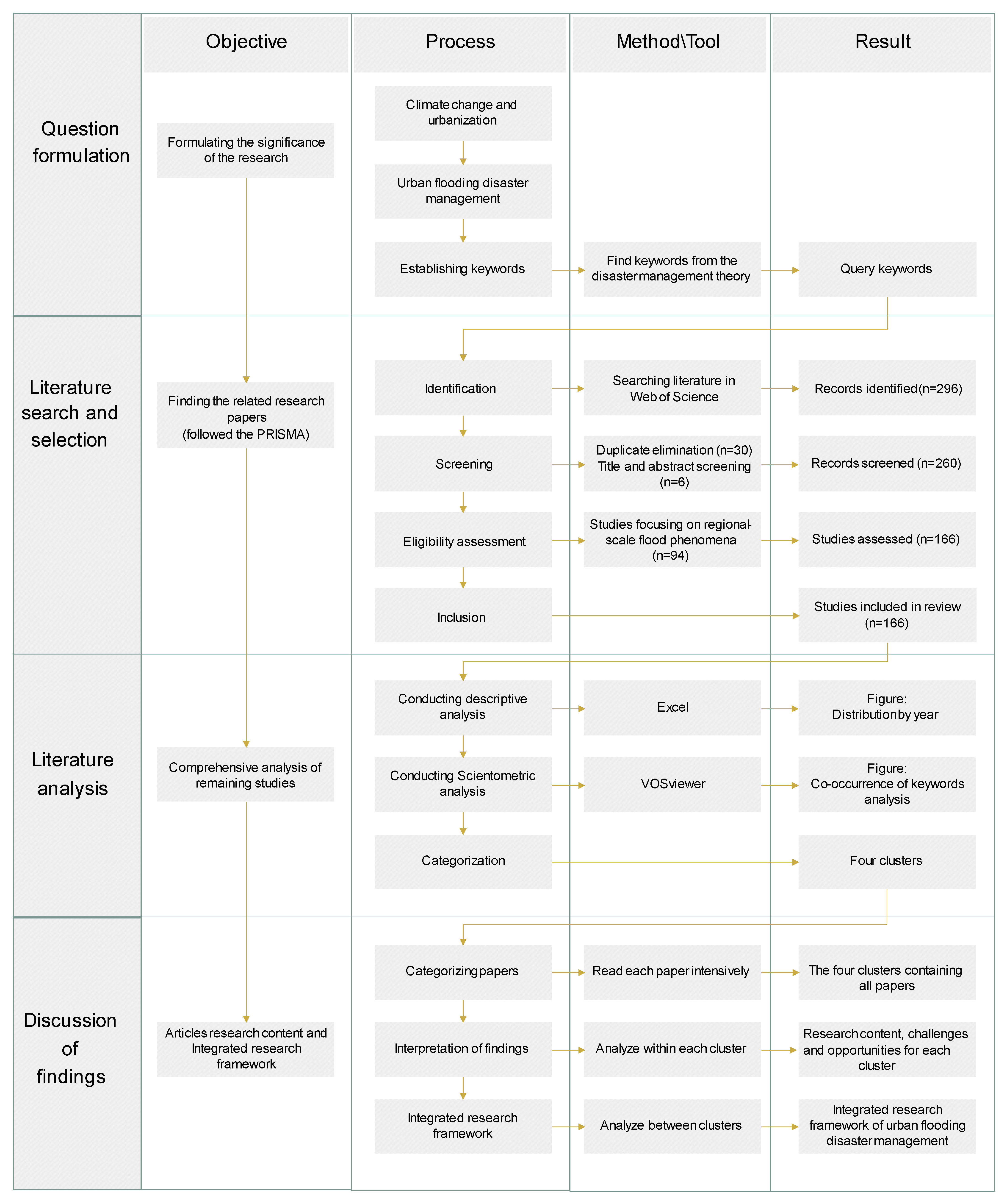
Figure 1. Research framework.
Sustainability 18 01106 g001
Figure 2. The annual publication count of articles related to urban flood management.
Sustainability 18 01106 g002
Figure 3. Scientific mapping for papers in urban flood management.
Sustainability 18 01106 g003
Figure 4. Scientific mapping for keywords in urban flood management.
Sustainability 18 01106 g004
Figure 5. The Classification of Urban Flood Simulation Models Based on Physical Simulation.
Sustainability 18 01106 g005
Figure 6. The relationship between Data-driven models and Physics-based models.
Sustainability 18 01106 g006
Figure 7. The Research Framework for Risk Evaluation Tasks.
Sustainability 18 01106 g007
Figure 8. Urban Flood Disaster Management Research Framework.
Sustainability 18 01106 g008
Figure 9. The interactive mode of prediction, evaluation, and optimization tasks.
Sustainability 18 01106 g009
Table 1. The Four-Stage Theory of Urban Flood Disaster Management Cycle.
StagesObjectivesContents
MitigationPreventing the occurrence of disasters and mitigating their impacts.Prevent
Low impact development
Sponge City
PreparednessProviding early warning and monitoring of disasters to reduce their impact.Predict
Monitor
Warn
ResponseTaking swift action to address emergencies when disasters occur.Emergency supply
Response
Control
Decision
Coordinate
RecoveryImplementing long-term measures to mitigate the impact of future disasters.Recovery
Restoration
Reconstruction
Table 2. Keyword search list.
ListKeyword
List1-Geographical Scopeurban, city, cities
List2-Disaster Typeflood, waterlogging, inundation
List3-Disaster Management Methodsprevent, predict, monitor, warn, response, recovery
Table 3. Exclusion rules.
Exclusion CriteriaNumber of Exclusions
Review Articles36
unrelated to urban flooding6
focusing on regional areas88
Table 4. Most influential papers in urban flood management.
TitleClusterTotal Link StrengthCitations
An ensemble neural network model for real-time prediction of urban floods (Berkhahn et al., 2019) [57]14612
Depth prediction of urban flood under different rainfall return periods based on deep learning and data warehouse (Z. Wu et al., 2020) [12]13312
Cities and Flooding: A guide to integrated urban flood risk management for the 21st Century (Jha et al., 2012) [58]1149
A deep convolutional neural network model for rapid prediction of fluvial flood inundation (Kabir et al., 2020) [59]1288
Development and Comparison of Two Fast Surrogate Models for Urban Pluvial Flood Simulations (Bermúdez et al., 2018) [60]1277
Beyond ‘flood hotspots’: Modelling emergency service accessibility during flooding in York, UK (Coles et al., 2017) [61]2127
River flow forecasting through conceptual models part I-A discussion of principles (Nash & Sutcliffe, 1970) [62]1197
Flood inundation modelling: A review of methods, recent advances and uncertainty analysis (Teng et al., 2017) [63]1247
Evaluating the impact and risk of pluvial flash flood on intra-urban road network: A case study in the city center of Shanghai, China (Yin et al., 2016) [64]2157
Table 5. Most Frequent Keywords in urban flood management.
LabelClusterTotal Link StrengthOccurrencesAvg. Pub. YearCitations
flood313046201925.76
model310530202026.53
risk112529201927.03
impact19227202023.33
rainfall48122202020.59
simulation37118202027.11
management16818202020.94
climate change15015201932.00
neural network23914202210.07
inundation24613202037.31
hydraulic model33511201841.27
vulnerability14411202020.18
prediction23211202114.64
assessment1289201741.67
waterlogging223920228.00
drainage system3358201937.13
resilience1328202025.88
pluvial flood1468202118.88
city1348202214.00
precipitation4227201726.86
machine learning2277202214.86
Table 6. The current research themes, challenges and opportunities in urban flood disaster management.
Research DimensionsCurrent Research ThemesResearch Challenges and Opportunities
1 Physics-based models for urban flood simulationFundamental model development
Integration of multiple models to account for diverse flood factors
Applications include designing urban flood control schemes and early warning systems
Striking a balance between computational speed and precision
Enhancing model versatility and portability
Integration with digital twin technology
2 Data-driven models for urban flood simulationRapid forecasting
Real-time prediction
Striking a balance between computational speed and precision
Addressing the ongoing challenges unique to data-driven approaches, including managing large volumes of data, ensuring model interpretability, and mitigating risks of overfitting
Innovative integration methods for combining data-driven models
3 Risk assessment tasks for urban flood disaster managementDiverse entities: cities, urban subsystems, communities, families, individuals, and programs
Aspects: emergency response capabilities, disaster losses, vulnerability, resilience, and risk.
Establishing a unified evaluation index system
Formulating standardized loss quantification methods
Accounting for the disaster’s dynamic nature
Broadening the scope of evaluation tasks in both temporal and spatial dimensions
4 Optimization tasks of urban flood disaster managementMonitoring: rainfall, water level, water area, network data
Optimization: land use, maintenance strategies, real-time control of drainage pipes
Building a disaster early warning system based on multi-source data fusion
Optimization framework integrating knowledge from multiple subject areas
Table 8. Representative Papers on Data-driven models for urban flood simulation.
Research ObjectivesRepresentative Papers
Predicting urban flooding using single-value outputPresenting an Artificial Neural Network (ANN) based model for the prediction of maximum water levels during a flash flood event (Berkhahn et al., 2019) [57]
Developing an ANN model to predict cumulative overflow volumes, based on simulation results generated by SWMM (H. I. Kim & Han, 2020) [86]
Presenting a CNN model for the prediction of maximum water levels (Guo et al., 2021) [87]
Presenting a Gradient Boosted Decision Tree for predicting flood depth (Z. Wu et al., 2020) [12]
Developing a Light Gradient Boosting Machine model to predict maximum depth, based on simulation results generated by PCSWMM (K. Xu et al., 2023) [88]
Predicting time series of urban floodingPresenting a LSTM model for generating three-hour urban flooding predictions (Nguyen & Bae, 2020) [89]
Using CNN and LSTM to predict urban flood depth (J. Chen, Li et al., 2023) [90]
Employing a GRU model optimized via simulated annealing for hourly urban rainfall-inundation depth prediction (Yan et al., 2023) [91]
Table 9. Representative Papers on risk evaluation tasks for urban flood disaster management.
Evaluation MethodsResearch Topic and Representative Papers
Entropy weight methodEvaluating urban public service emergency response capabilities (Y. Zhang, Li et al., 2022) [107]
Predicting regional water accumulation risks under different urban heavy rain scenarios (J. Zhang, Li et al., 2023) [13]
Assessing Fuzhou’s vulnerability and predict its future development (X. Wang et al., 2023) [18]
Depth-destruction function Estimating direct and indirect losses during flood events in urban areas (Albano et al., 2014) [108]
Comprehensive assessment of economic losses (H. Yuan et al., 2024) [19]
Analysis of successive flood events for recoverability (Guimarães & Miguez, 2020) [14]
Examining the various damage states (Gallegos et al., 2012) [109]
Dijkstra shortest path Quantifying evacuation risk in terms of evacuation time (Z. Han et al., 2023) [20]
Assessing the spatial accessibility of emergency response to key public services in cities (Y. Zhang, Li et al., 2022) [107]
Optimizing the distribution of emergency stations and developing strategic emergency plans for vulnerable populations and facilities (Yin et al., 2021) [110]
Graph theoryReveal accessibility disparities and identify vulnerable communities (Gangwal & Dong, 2022) [111]
Expert scoring methodPredicting social, physical and economic resilience before floods occur (Cui et al., 2022) [23]
Analytic hierarchy processFlood disaster mitigation and emergency response in urban watersheds (Levy et al., 2007) [112]
Evaluating the performance of LID practices in urban flood control and emission reduction (Hua et al., 2020) [5]
Disclaimer/Publisher’s Note: The statements, opinions and data contained in all publications are solely those of the individual author(s) and contributor(s) and not of MDPI and/or the editor(s). MDPI and/or the editor(s) disclaim responsibility for any injury to people or property resulting from any ideas, methods, instructions or products referred to in the content.